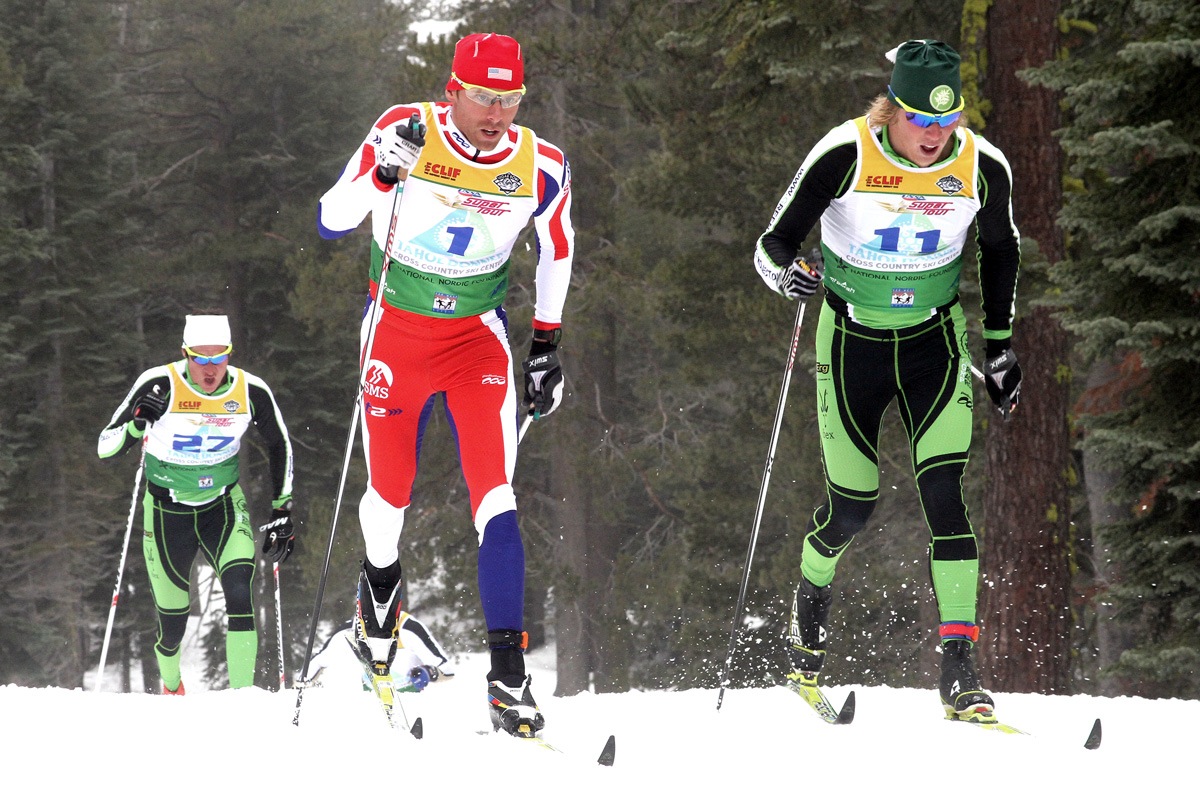
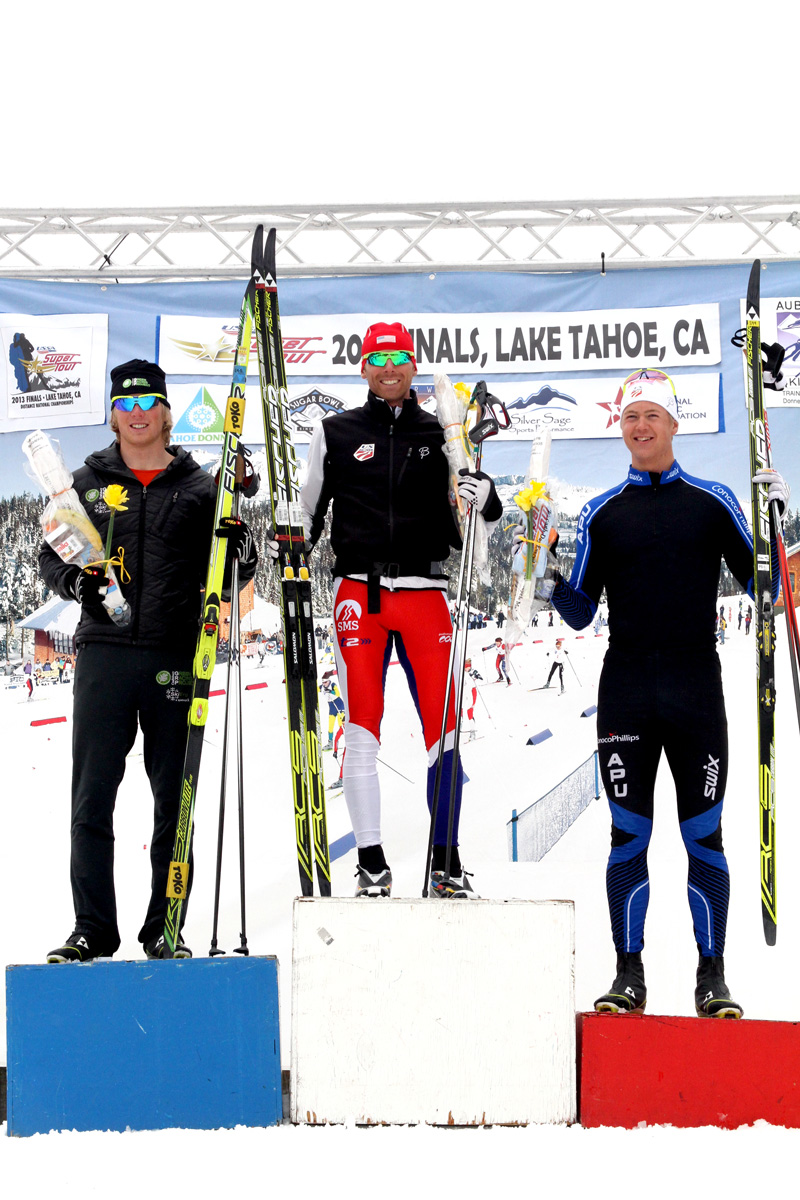
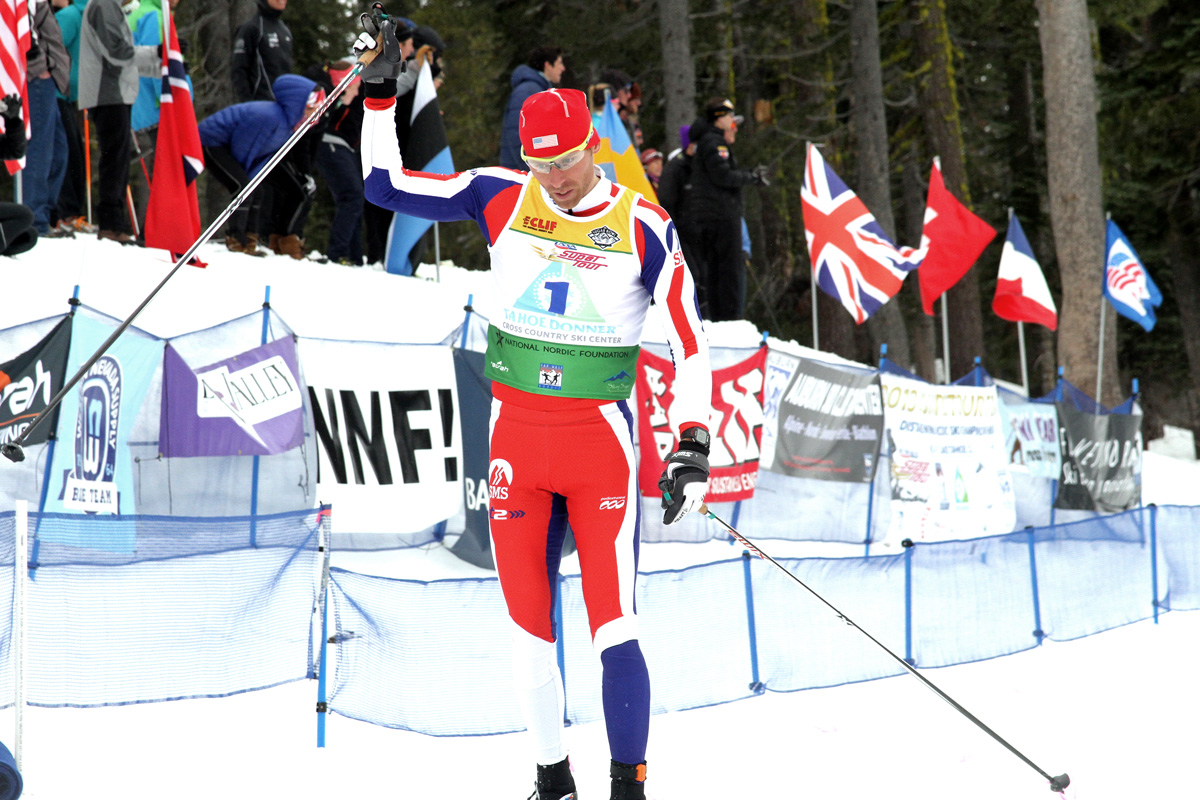
Torin Koos (BSF/Rossignol) crossing the line in first in the A-final of the men’s classic sprint at 2012 U.S. nationals. While waiting to take to the podium, he found out his win was in question. (Photo: FlyingPointRoad)
At Norway’s 2015/2016 season-opening International Ski Federation (FIS) weekend, defending World Champion Martin Johnsrud Sundby was in for a surprise. The final starter to hit the deteriorating tracks in the 15-kilometer classic individual start, the Norwegian initially posted the fastest overall time, only to later be disqualified for a skating infraction.
A similar result greeted American sprint leader, Torin Koos in the closing competition of the 2012 U.S. Cross Country Championships in Rumford, Maine. After crossing the finish line first in the men’s classic sprint A-final, Koos was ultimately disqualified for what the jury deemed “an obstruction of competition“, switching lanes before completely clearing his competitor’s skis.
While being the athlete in either of the above situations is never easy, difficult too is the position of technical delegates (TD) who determine their outcomes. When should a skier be disqualified? How many skating steps counts as an infraction in a classic competition? How much should this vary for level of competition and competitor?
Whether a World Cup race or a junior club competition, TDs are as key an event element as the right race-day wax. But serving as a ski referee is not the only responsibility TDs hold.
When conditions are icy enough to send skiers rocketing into trees lining a race course, or the day’s temperatures forecast frostbite, canceling or delaying a competition is also a judgement call made by TDs.
Race courses are also on the list of TD’s concerns. Although the whereabouts of V-boards may not weigh heavily in the minds of athletes, the layout of a course can determine the outcome of a race for skiers, with the duty of setup falling partly on TDs.
As a resource, TDs serve another role. By advising and working with race organizers, TDs ensure those involved with a cross-country sporting event, from the groomer to the timers, are in compliance with USSA and FIS rules.
In the United States at present, however, few individuals are signing up for the job. The total estimated number of individuals who began training this fall to become a level one TD is 10. While few appear to be entering the TD pipeline, many of the current TDs in the U.S. are also rapidly approaching retirement.
“I don’t know what the average age of a TD [in the U.S.] is, but it’s certainly not a young person’s activity,” Scott Wilson, regional coordinator for the Midwest and chair of the U.S. Ski & Snowboard (USSA) TD assignment committee, said on the phone in early October.
Wilson, 70, who has been a TD and coach for the past 25 years, also indicated that not all those currently listed on the TD record remain active in their membership.
“There are 75 on our roster right now,” Wilson said. “But … because there are insurance issues and background checks … we’ll probably nick it down more to 65 [TDs] that are making some progress or staying current.”
As outlined by Wilson, there are three different levels of TDs, with one newly emerging level he refers to as “in-training”. Following the “in-training” level, each consecutive level is known as Level 1, Level 2 and Level 3 TD. For an individual to be considered a Level 1 in the U.S., they must attend a TD seminar (usually held in the fall with dates determined by regional coordinators).
Technical delegate Eileen Carey (left) talking with race volunteers at an event at Soldier Hollow in Midway, Utah, in 2013.
Level 1 TDs are only permitted to run local club competitions, whereas a Level 2 can run a local or national event — such as a Continental Cup (e.g. SuperTour) — and a Level 3 may work anything from a World Cup competition to a small-scale ski race.
For this reason, following their initial seminar, many Level 1 TDs work for two years shadowing an experienced Level 2 or Level 3 TD.
After two years, a Level 1 TD may have accumulated enough experience to become a Level 2. Advancing from Level 1 to Level 2 requires an evaluation which takes place over the course of two competitions.
During the first competition, a Level 1 will serve as an assistant TD, primarily observing the more experienced TD. During the second competition, they are no longer an assistant, but placed in charge and monitored by the more experienced TD.
If the the Level 1 TD successfully becomes a Level 2, another two years of race experience are required before they can consider becoming a Level 3. A recommendation from the regional coordinator must also be put forth for a Level 2 to become a Level 3.
Furthermore, according to the FIS rulebook, an individual must be under the age of 50 in order to start training to become a Level 3 TD. To become a Level 3 TD also requires an examination as well as a presentation at a TD seminar. All said and done, becoming a TD particularly at the World Cup level, is not as simple as counting skate steps in a classic race.
“It’s a fairly big commitment, for most of which you don’t get reimbursed or paid,” Al Pokorny, the TD regional coordinator for Pacific Northwest Ski Association and Intermountain Division, said on the phone in late September. “So the only people who really can do that are people who are older and people who have money.”
At present, a TD’s training expenses, such as travel to and from required instructional seminars, are not covered. For American TDs in training, one seminar must be attended during the fall. A TD must then continue to attend seminars every two years — which rotate location between the U.S. and Canada — at every level in order to maintain their TD status.
With many required trainings, little compensation and a lofty time commitment, pulling TDs into the pipeline is a constant challenge. Pokorny, who has been a TD for almost 10 years, explained that’s a challenge that must be addressed, since having not just young TDs, but TDs who understand the sport from the inside, is beneficial.
“We have great TDs, but the ideal TD would be someone who is relatively young [and has been] involved in the sport at a high level,” Pokorny said. “One of our jobs as a TD is to go out and ski the course and to determine if the course is appropriate for the level of competition and so you kind of have to know what that means. The best way to know what that means is to have done it. So that’s the main reason someone who has been in the sport at a high level makes a good TD.”
Yet, recruiting individuals who have been in the sport at a high level and are fairly young, regardless of compensation is no easy task.
“Those people typically have young children, they’re just getting married. There’s a whole bunch of stuff going in their lives and the last thing they want to do is have to go back and be a TD,” Pokorny said.
Even after throwing in the compensation most TDs receive for events they help run, which amounts to $50-$100 dollars per day, along with travel or accommodation costs (usually but not always), the reimbursement still is not much more than what a high-school referee might earn while working a varsity football game.
Sally Jones, the regional coordinator for the Far West region, pointed out that for the amount of time put in compared to the payout, a TD may as well work for free.
“It’s challenging to find TD’s, whether male or female, because it’s quite a time commitment,” Jones, one of 10 women currently listed as a TD in the U.S., said on the phone in early October.
“It’s not a career, it’s a volunteer position,” she added.
So what drew many of these TDs into the job in the first place? Why spend hours upon hours shivering watching snowflakes and ski racers fly by? One of the most experienced FIS TDs, Al Serrano boiled it down to one word: community.
“You know, we’re a crazy community,” the 48-year-old Serrano said. “We’ve done some things to bring up the compensation a little [for TDs]. There is a requirement for a NRL or FIS race that the TD assistant get paid for their travel expenses and get paid for the day with rates up to what the FIS rate has been … roughly on par for $100 dollars a day. … But bottom line is you do [TD work] because you’re a part of the community and you want to stay involved with it.”
“… Bottom line is you do [TD work] because you’re a part of the community and you want to stay involved with it.”-– Al Serrano, FIS technical delegate on what keeps many TDs involved
Bruce Cranmer, head nordic coach at the University of Colorado-Boulder echoed the sentiment of Serrano and many other TDs FasterSkier spoke with.
“Some are trying to do it at a professional level,” Cranmer said on the phone. “Others are doing it more … to give back and help the sport.”
Perhaps if American TDs can recruit individuals with similar mindsets, the pool of TDs may not shrink so soon after all. Maybe if they can hook the right ones, they will safely replace those soon looking to retire.
“We need to do a better job of targeting people,” Serrano said of potential ways to encourage membership. “You know, going to the clubs and the teams and asking about their retiring athletes and people who might be willing to do it.”
***
The Steps to Become a TD in the U.S.
Outlined below are a few steps individuals can take to become a TD in the U.S. After completing the initial training, a TD has the opportunity to remain a Level 1 TD, or move up to Level 2, which allows them to work as the head TD at national-level events. A Level 2 TD who wishes to move up may continue training and become a Level 3 TD, permitting them to work as the head TD at FIS-sanctioned competitions.
– Step 1: Contact your local coordinator.The first step to becoming a TD is contacting the coordinator for your region. There are currently five regional coordinators: Justin Easter (East), Scott Wilson (Midwest), Al Pokorny (West), Sally Jones (Farwest), and Matt Pauli (Alaska region).
Many TDs also indicated that in order to replace the current cohort of TDs approaching retirement, TD coordinators and TDs need to communicate with local clubs and college programs to obtain contact information for individuals who may be interested in becoming, or are qualified to be, a TD.
“We need good candidates,” Serrano said. “We need to have local people so the travel distance [for TDs to competitions] isn’t so far.”
– Step 2: Attend the trainings.While most of the initial TD seminars take place in the fall, there in not an established date for training among all regions. Contacting regional coordinators for specific training times is crucial.
“The initial TD training is done through the regional coordinators, which varies from region to region,” Serrano said. “That’s one issue we’re trying to work on, is to standardize [TD trainings] a little bit.”
– Step 3: Spend time as an apprentice. Spending time shadowing various TDs at multiple levels of competitions provides a vast scope of the TD styles and ways to work an event.
Andy Newell (c) fighting Pat O’Brien (r) up the last climb in the classic sprint final on Saturday at SuperTour Finals. Newell won the race, and O’Brien took second. (Photo: Mark Nadell/MacBeth Graphics)
FasterSkier’s coverage of SuperTour Finals and U.S. Distance Nationals is brought to you by the generous support of Concept2, the leading manufacturer of indoor rowers, racing oars, and the SkiErg.
SODA SPRINGS, Calif. — When Andy Newell (SMS T2/U.S. Ski Team) shows up to a sprint in the U.S., his name carries a certain cache with it. As the fifth-ranked sprinter on the World Cup this season and the only man in the world to qualify for the heats in every sprint he started, he is undoubtedly the standard-bearer in short distances whenever he returns to the domestic circuit. His name precedes him; Newell’s younger competitors grew up with posters of him on their walls, and when they meet him in an A-final they plan their entire strategies around him.
“I remember my first Andy Newell poster I got in, like, elementary school,” says Erik Bjornsen (Alaska Pacific University/USST), a teammate of Newell’s on the national team. “I remember my friends and I talking about him in school, like, ‘That guy’s such a badass!’”
There may come a day when one of the upstart generation of American sprinters upsets him, but Saturday was not that day. Four rounds of the sprint course later and Newell lived up to his reputation, winning the third stage of SuperTour Finals in commanding fashion against Pat O’Brien (Craftsbury Green Racing Project), Bjornsen, Tim Reynolds (CGRP), Rune Ødegård (University of Colorado) and Mike Sinnott (Sun Valley Ski Education Foundation) in the A-final.
It’s been two years since Newell last entered a sprint race in the U.S., as he was sick for spring series a year ago, but he picked up right where he left off in Sun Valley, Idaho, in 2011. Based on his track record, the casual observer might conclude that Newell’s win was a sure thing at the Auburn Ski Club; that nobody in the domestic field could hope to touch someone who has been competing on the World Cup since he was 20 years old and has since proven himself to be one of the most consistent sprinters in the world.
But Newell has been around long enough to know that losing is always a possibility, no matter what the field. His finish in the prologue in variable conditions put him nearly a minute out of the lead and limited his chances at winning the four-race tour on day one. Forced to shift focus from the SuperTour Finals title to individual races, Newell showed up for the sprint aware that nothing is ever a sure thing, particularly against a rabid domestic group of skiers.
“There’s a lot of good sprinters in the U.S.,” Newell said. “Obviously qualification isn’t quite as competitive as the World Cup, but when you’re racing heats against these people it’s like, anybody can win. It’s sprint racing; so much can happen out on the snow. A lot of these guys are really fast. So I wouldn’t say I expect to win, but I definitely go into a sprint in the U.S. hoping to win.”
The men’s podium: 1. Andy Newell, 2. Pat O’Brien, 3. Erik Bjornsen. (Photo: Mark Nadell/MacBeth Graphics)
From word ‘go’ in the qualifying round through to the A-final, Newell made his supremacy known. He was one of a small set of athletes with the confidence to start the preliminary round on skate skis in conditions that were changing and softening in steadily falling snow, and on a course with two serious climbs to boot. Newell’s double-pole is unparalleled in this field, however, and it was clearly the right choice for him — he won a three-minute qualifier by five seconds over CU’s Gustav Nordstroem to start the day.
In the heats, Newell played a more tactical game. Back on classic skis, he took second behind O’Brien in each round and never used more energy than he needed to advance.
For the final, both Newell and O’Brien went in with a good idea of what the other would do. O’Brien was riding the high of an unanticipated late-season resurgence and “really good” skis, and led each of the early heats from start to finish. He left the start line knowing he wanted to get out fast enough to pick his own lane again after the scrub zone, as a difference in track speed developed as the day wore on.
Newell, for his part, guessed O’Brien would go to the front early again, and planned to tuck in behind him down the descent out of the stadium and take control on the climbs.
“I was thinking I wanted to conserve as much energy as possible, but that didn’t really happen,” O’Brien said. “I don’t know; it was just kind of racehorse instincts. I wanted to try to take it pretty easy, but it was also pretty easy to ski from the front there and be able to choose your own lines.”
With O’Brien out front, Newell was able to decide when to ramp up his own power output. He made his move on the first climb and O’Brien was unable to respond; nor was Reynolds, Bjornsen, Ødegård or Sinnott in line behind them. When Newell emerged from the woods and climbed the hill back into the stadium, he had an even bigger lead than he had expected.
“I was able to choose my own line and was able to get my own track on the uphill, which is what I wanted to do,” Newell said. “I just put my head down and went, and I didn’t know I had such a big lead because I was hammering into the first part of the stadium. I looked back and I couldn’t see anybody. So I guess it worked out.”
O’Brien expected the move when it came, but was to gassed to respond.
Newell raising a triumphant but tired arm across the finish line. (Photo: Mark Nadell/MacBeth Graphics)
“He opened up a little bit over the top and I just couldn’t quite close him,” O’Brien said. “I knew that’s how he’d been skiing the quarter and semis, so I knew he was going to go there and I expected it, I just couldn’t really match it.”
O’Brien hung on long enough to hold onto second, and behind him Bjornsen passed Reynolds and Ødegård in the final straight to claw his way onto the podium. Reynolds skied across the line in fourth for his best result of the year, Ødegård held on to fifth and Sinnott took sixth.
Finishing second to someone like Newell left O’Brien extremely pleased with the way the end of his season has been going.
“It’s a really good feeling,” O’Brien said. “It’s been a tough winter and I haven’t really felt myself. So to come out here to altitude, where I normally struggle, and feel good on the last three races…I’m super happy with today.”
Bjornsen, winner of the prologue and runner-up in the 15 k, was ecstatic with third. Slow skis left him far off the pace in fifth at the furthest point on the course, at which point he nearly gave up on the idea of a top-three. He had asked for more kick before the start of the A-final, and the extra wax slowed him down on the flats.
“I really had to work on the double-pole section, and I actually got to the far end of the course and I was like, ‘I think my day is over,’” Bjornsen said. “But no, I started gaining back on the first hill and coming down into the next one I could see people were dying a little bit, and I saw third place up there and that really fired me up, so I just went for it.”
Reynolds said he had nothing left in the finish stretch when Bjornsen caught him from behind.
“I thought I closed pretty well on the uphill, and then just kind of died in the finish stretch,” Reynolds said. “Bjornsen blew by me.”
Though Reynolds just missed out on the podium, fourth is “easily” his best result of the season.
“I mean, it doesn’t really erase the 20-odd bad races I’ve had…but obviously it’s nice to feel a little more like yourself and ski a little faster,” he said. “I’d actually felt pretty good this week, so I was hoping to have a good race. And we had great skis and my body felt good.”
Ødegård, the 2013 NCAA champion in the 10 k classic, repeated his result from a week ago at Canadian Nationals in taking fifth.
Behind Ødegård, Sinnott conceded that sixth was as much as he could muster at the end of a sprint day. He delaminated a ski in his quarterfinal, and though he managed to advance second in the heat anyway, he had to scramble to find a good replacement for the next round.
“I didn’t really notice it until we went up to rewax some top sauce, and was like, ‘Oh, this isn’t going to work,’” Sinnott said.
He advanced as a lucky loser in his semifinal, and in the final he was “pretty exhausted.”
“I was tired and just couldn’t keep up,” he said. “I kind of slipped a couple times on the climb and just blew my arms out and didn’t have much for the finish. But so it goes.”
The bonus seconds available in the sprint were substantial. With only the hill climb left to go in the tour, Bjornsen now sits in the lead just over 40 seconds ahead of Newell and Freeman in the overall standings. The trio will be separated by this margin in the pursuit-style start of the hill climb on Monday, and whoever makes it to the top of Sugar Bowl will win SuperTour Finals.
“I’m feeling pretty good,” Newell said. “I thought I’d be hurting more, but this late in the season your body’s so used to racing you don’t even really get sore any more, you’re just kind of tired. Hopefully the sun will come out tomorrow and we can hang out more and do more California-style things, because I’m kind of over winter at this point.”
— Kris Freeman (Maine Winter Sports Center/USST), who led the tour after winning the second stage on Friday, finished outside of qualifying in 39th. MWSC head coach Will Sweester took responsibility for the wrong ski call — he brought skate skis to Freeman at the last second after observing the success Newell and others had with double-poling and being convinced it would be the right call for Freeman, too.
“We’ve had a steep learning curve, him and me, and all the skis he has,” Sweester said. “Today I sprinted up at the start with skate skis at the last minute and it was definitely the wrong call on my part. We had good classic skis but the snow made me nervous.”
— Torin Koos (Bridger Ski Foundation/Rossignol), in his first race of the tour after being ill for the prologue and 15 k, did not advance to the final after tangling with another competitor and falling in his semifinal. He qualified in sixth position on skate skis in the preliminary round, eight seconds behind Newell. A coach approached the jury with “grumblings” about Koos’ lane crossing technique in the qualifier, but no official protests were filed. According to Technical Delegate Al Serrano, three jury members reviewed the relevant video footage of the qualifier and determined that Koos did not skate when changing lanes at the point in question.
— Sylvan Ellefson (Ski & Snowboard Club Vail Team HomeGrown) collided with a spectator in his quarterfinal a few hundred meters from the finish, which resulted in his automatic advancement to the semifinals. The spectator stood in the tracks with her back turned when Ellefson, double-poling with his head down, clipped her with his shoulder and “from what I heard, I knocked her over,” he said.
Ellefson was in fifth at the time of the collision and finished fifth in the quarter. As the fourth qualifier he wore the lowest bib number of his heat and only needed to finish third in order to advance to the next round. Unable to say whether the spectator prevented Ellefson from advancing, the jury decided to put him through anyways as a seventh man at no prompting from Ellefson or his coaches.
“I don’t know if I was in striking distance or not,” Ellefson said. “It’s their fault I guess for not having the v-boards up.”
Serrano said there is no rule in the FIS rulebook that covers interference with a bystander, and the jury decided to advance Ellefson as if it he had instead been the victim of obstruction from a competitor.
“There’s a specific rule for what happens if someone is taken out and the person that takes them out is disqualified,” Serrano said. “If another competitor takes them out, then they advance. Basically [that’s] the way we ended up advancing Sylvan, as the seventh person in the heat, starting two meters back.”
Our recent series on biathletes facing the question of when and whether to go to college (parts one, two, and three) produced more interview material than we could fit into the three-part sequence, but we wanted to share a few more of the ideas with you anyway. What do biathletes do if they miss a target in a relay? They use a spare round. This week, we’re presenting you with short briefs on a few lingering topics.
Annelies Cook competing in a World Cup relay in Hochfilzen, Austria. Photo: nordicfocus.com / USBA.
When Annelies Cook decided to attend the University of Utah in the fall of 2006, it was because she needed a change. After pursuing biathlon full-time at the Maine Winter Sports Center to round out her junior career, Cook had been unsure what to do next, so she had returned to her home in upstate New York and jumped back into ski racing, battling against current U.S. Ski Team members Liz Stephen and Ida Sargent in NENSA’s Eastern Cup series.
It was fun. She wanted to ski more. So she went to Utah.
But what she found had another added bonus – she got to ski, do high-level training with her teammates (some of whom were, like her, older and, unlike her, from Europe), and get a degree, but she also got paid.
“I was very fortunate because I had a scholarship,” Cook told FasterSkier last fall. “Eli [Brown] did his best to spread out his scholarship money between as many of his athletes as possible, so I don’t think anyone had a full scholarship, but a lot of us had 70%, which basically meant free tuition plus $300 per month for living expenses.”
Not every biathlete who has gone to college has seen such a financial lure: Laura Spector, Carolyn Bramante, and now Ethan Dreissigacker and Carly Wynn attend Dartmouth College, which does not offer athletic scholarships. Neither does Bowdoin College, the alma mater of Walt Shepard. Several top juniors, including Kelly Kjorlien, Casey Smith, and Sam Dougherty, are currently at Montana State University, but the men do not ski for the college and as such don’t see even the possibility of a scholarship.
Not being on a scholarship, of course, has its benefits as well, like an increased ability to focus on biathlon if an athlete so chooses. Dartmouth coach Cami Thompson pointed out that she didn’t pressure the biathletes on her team to focus on college racing: “[other schools] do give you scholarships and they expect you to produce for them, but we’re not bound by that because we don’t give you anything!”
But both Cook and Lowell Bailey, who went to the University of Vermont, decided to leave biathlon for the majority of their college careers and focus on skiing, reasoning that if they did return to biathlon, added ski speed would be a benefit. With endurance training as their main goal, scholarships sweetened the deal.
Bailey at 2012 World Championships. Photo: USBA/NordicFocus.
“For some people, maybe money isn’t a big deal,” Bailey said in an interview. “But for a lot of people, for me I know, it was really hard for a little while to make ends meet, and I was really struggling on the financial side. Had I had the same level of support that I have now, would I have made the same decision? Probably, so I’m not saying that it was the only factor for me deciding to go to UVM or not, but it was a big factor.”
Both Brown and Al Serrano, Bailey’s coach at UVM, knew that athletes like Bailey were facing tough choices about whether they could continue in nordic sports with so little financial support, and tried to use their clout in offering scholarships to U.S. juniors.
“We had a very unique team,” Bailey said. “I might remember this wrong, but we had the only team of all Americans for UVM, because previous to that it had always been European recruits, and after that, too. So [Serrano] had recruited some of the best nordic skiers from the junior ranks in the country. We had a really talented team and we motivated each other, and I think we trained at a really high level.”
Brown didn’t go quite that far – some of Cook’s teammates were European. But even though he did recruit foreign skiers to bolster his team’s speed, Brown spent a lot of time thinking about whether it was the right thing to do.
“Just because [skiers] have a lot of training under their belt, they could turn out a lot of different ways,” Brown said. “Just because they have a different color passport doesn’t mean that it was a good recruiting choice. Some of those people are coming over because they didn’t make it in the big show, and maybe that’s even the norm for the European recruits. But [on the other hand] maybe they still love it enough and enjoy this new feeling of being on a team that they can really contribute.”
Cook, for her part, said that she benefitted from having older, more experienced teammates to chase and learn from. But in a perfect world those older, more experienced skiers would be Americans – racers who perhaps took a few years off after high school, but who could use the financial help offered by state universities.
“My hope is to make this puzzle piece fit, of NCAA skiing in the U.S. development pipeline, and to have more scholarship dollars end up going to American kids,” Brown said. “The only way that’s going to happen, to raise the level so that we don’t need the Europeans as much, is if they are more mature.”
Even now, top biathletes and skiers can take advantage of the scholarships offered to not only gain the financial freedom to spend their time training, but also to get onto a team where they don’t have to worry about logistics. That, said Cook, was also important.
“I was totally set up at Utah,” Cook explained. “I didn’t have to worry about anything – everything was organized. It was laid out for you. We had coaches, we had vans, we had transportation every weekend and when we went somewhere we had a stipend for food. And 75% of the team had some kind of support. That’s something that I don’t think very many people would want to turn down, because it’s hard to pay for an education and if you can get one without paying, that’s pretty amazing.”
Bailey agreed.
“A university can offer a kid a scholarship, and at the end of four years a degree that you can then use once your athletic career is over,” he said. “I think those are two huge benefits that a university ski team can offer, that quite honestly are not [otherwise] available. Even though I’ve put my heart and soul into the sport of biathlon, it’s not like they’re handing me a degree at the end of the day. It really was the opportunity of a lifetime – I never would have guessed that I would have been able to go to college for free, and to have that experience and that caliber of an education.”
Our recent series on biathletes facing the question of when and whether to go to college (parts one, two, and three) produced more interview material than we could fit into the three-part sequence, but we wanted to share a few more of the ideas with you anyway. What do biathletes do if they miss a target in a relay? They use a spare round. This week, we’re presenting you with short briefs on a few lingering topics.
Lowell Bailey competing in Ruhpolding earlier this year. Bailey spent several years training full-time before attending the University of Vermont. Photo: NordicFocus/USBA.
In the first part of our series, we focused on several elite junior biathletes who, bucking the conventions of the early- and mid-2000’s, decided to go to college before returning – often extremely successfully – to biathlon. Without a single exception, the five athletes said that today’s juniors should not rule college out as a means of facilitating a long-term career in biathlon.
But in general, the biathletes had another message, too. It was that one reason they were able to succeed as college athletes and then return to biathlon, and maintain a serious focus on training despite the challenges faced by student-athletes, was that before going to college they had taken a year or several off to train full-time. That period, which often involved race tours in Europe, gave them the tools to make their plans work.
Juniors, they seemed to suggest, can have it both ways: they can complete their junior careers by going into biathlon after high school, thus increasing their chances of having top results at the international level, but still end up with a degree, potentially funded by scholarship money, and a fresh sense of motivation to compete into their 30’s.
Why is the postgraduate option so alluring? In their own words, biathletes and coaches explain it.
Walt Shepard, five-time U.S. national champion who attended Bowdoin College: “I really got a lot out of my time between high school and college, both from a training perspective and from a life perspective, just getting to do so much traveling and the opportunity to train full-time for something, that was really meaningful. To go back to school five years later, I had a lot more life experience and perspective, and I think I got a ton more out of my academic experience. So I think the whole thing worked out pretty well for me.”
Annelies Cook, two-time World Championships competitor and University of Utah alumna: “I was just a little bit more mature than some of the young guys coming in, so I would train a little bit more than what they did on the team. I had four years of training experience under my wing, I didn’t go to school as an 18-year-old who might have been more prone to wanting to party. That worked really well in communicating with Eli [Brown] and Wendy [Wagner].”
Eli Brown, Cook’s coach at Utah: “I think it’s really important that [taking postgraduate years to ski] becomes more of the norm. The thing that’s most important for the nation’s development is the trend that we have seen recently of more 20-year-olds, or 25-year-olds or even 30-year-olds on the SuperTour results sheet. The next change I’d like to see is more postgraduate options, and we should have more junior college teams out there. Not only keeping college on the radar, but moving it back a year or two would make it better.”
Carolyn Bramante, 2006 Olympian and Dartmouth College graduate: “I think the main thing that has worked for me and Sara [Studebaker] and Laura [Spector] is that we all learned how to shoot in high school – it’s a lot easier to come back to it, especially something like shooting. So if people want to go to college I support it, of course, and if you can do as much training and really a lot of coaching and shooting [before college], that’s really important.”
Per Nilsson, head coach of the U.S. national team: “The early senior years when you are building up your fitness are probably the best to miss for a biathlete, to take advantage of that and get a degree in school. When you are younger you work on a lot of basics in technique, so to miss the practical biathlon coaching here is not an good idea.”
Lowell Bailey, 2006 and 2010 Olympian, and University of Vermont alumnus: “To come from the idea of being a national team athlete to the idea of being a university student is something that I don’t think is given a lot of thought. But there are definitely a lot of examples of people who have successfully gone or are in higher learning.”
Al Serrano, Bailey’s coach at the University of Vermont: “[Bailey’s] experience and intelligence added to the development of our training plans. We were able to work on overall plans that revolved around specific workouts. He did not need me or anyone else to tell him what to do every day – he understood the process.”
Lowell Bailey competing in 2012 IBU World Championsips, his seventh. Bailey left biathlon completely for two years during his time as a ski racer at the University of Vermont.
Note: this is the beginning of a three-part series following several groups of biathletes as they negotiate the college question. .
In the summer of 2002, Lowell Bailey was a national “A” team biathlete living in a trailer at Camp Ethan Allen, a national guard training site in Jericho, Vermont.
Lowell Bailey Hometown: Lake Placid, NY Age: 30 Results Before College: Three top-20 World Junior Championships races, along with three top-10’s at European Championships; started a World Cup. Alma Mater: University of Vermont Notable Senior Results: Five World Cup top-10’s, numerous top-20’s, scramble leg for U.S. relay team. What’s Up Now: Bailey had his major breakthrough in the 2011-12 season, where he finished 14th in the Total Score, the top-ranked American. He’s planning to continue at least until the Sochi Olympics. Quote: “I really think that if I didn’t go to UVM, if I didn’t have college and the things that college has to offer, I don’t think I would have gone back to biathlon. I think I needed that mental break from the sport at that moment in my life.”
In some ways, his career as a biathlete was looking up: although he had missed the previous winter’s Olympics by two spots, a few veterans had retired, leaving Bailey near the top of the heap on the U.S. team. And after years on the junior national team and the previous season on the senior team, he was beginning to accumulate the kind of training that can make skiers fast.
There was just one problem, and the trailer and military base had something to do with it.
“I was at a point in my biathlon career where I was kind of burnt out, believe it or not, at age 21,” Bailey told FasterSkier in an interview last fall. “I was thinking, ‘man, what am I doing?’ The funding for biathlon was pretty much nothing. I had a lot of pressure from my family and my grandparents, and a lot of people that were wondering what I was doing with my life.”
Ten years later, Bailey is a two-time Olympian and has ascended to the top of the international field. He netted four individual top-ten World Cup results in 2012 and landed 14th in the Total Score. How he got there, however, was by taking the road less traveled – not only by U.S. nordic athletes, but by the other biathletes he is now battling in Europe.
Bailey spent three years at the University of Vermont, training with the college ski team and racing on the EISA circuit and at NCAA Championships. While he was quick to say that college isn’t for every athlete, Bailey was clear that in his case, it was a career-saver.
“I really think that if I didn’t go to UVM, if I didn’t have college and the things that college has to offer, I don’t think I would have gone back to biathlon,” he said. “I think I needed that mental break from the sport at that moment in my life.”
The Changing Face of USBA Development
Typically, national team coaches in the U.S. don’t support the college model; just this spring, both Matt Whitcomb and Chris Grover told FasterSkier that education was not compatible with athletic commitment to the U.S. Ski Team program. Biathlon coaches agree.
“It’s for sure nothing that we recommend, going to college, if we see potential for an athlete,” U.S. Biathlon Association (USBA) Head Coach Per Nilsson wrote in an e-mail to FasterSkier. “We prefer to keep them more under our guidance.”
That was even more true a decade ago, when USBA had a well-funded and successful junior national team program. In 2002, Lanny Barnes, Tracy Barnes, and Carolyn Treacy (now Bramante) teamed up for silver in the World Junior Championships relay, putting the U.S. on the podium for the first time since Jay Hakkinen’s 1997 sprint title, and other athletes were frequently finishing in the top 20.
At that point, Bramante seriously considered heading off to a university like other high school seniors, and applied to Dartmouth College. But after being accepted she decided to defer, taking summer classes at Colorado College instead.
Carolyn Bramante Hometown: Duluth, MN Age: 30 Results Before College: Silver medalist in World Junior Championships relay in 2002, and three other individual top-20’s. Alma Mater: Dartmouth College Notable Senior Results: Represented the U.S. at 2006 Olympics in Torino, as well as 2007 and 2009 World Championships. What’s Up Now: Just finished medical school at University of Minnesota, headed to Johns Hopkins University for residency in Internal Medicine and Pediatrics; also gave birth to a son, Leo, who has child-sized scrubs. Quote: “My choice to go to Dartmouth was definitely what I thought was best for my biathlon career. Skiing wasn’t always a huge strength of mine, so I [wanted] to work on skiing for a year or more, and I knew I would have great training and racing at Dartmouth.”
“On the ‘A’ junior team nobody was really going to school except for me, and not on the senior national team either,” Bramante told FasterSkier. “Biathlon has only been an Olympic sport for women since 1992, so when I was looking at the women who had gone to the Olympics, none… went to school while they were training. There were very few examples to look at of how to do school and training.”
The U.S. coaching staff couldn’t give her the answers she wanted, either.
“When I was a junior I really liked our coaches, but they were very discouraging of going to school,” she said.
And why wouldn’t they be? The team provided coaching, racing opportunities in Europe, and fast, hardworking teammates; it seemed like a no-brainer for dedicated athletes to stick with biathlon full-time to until finishing their junior careers at age 20. Tim Burke, Walt Shepard, and Anders Osthus were among those who trained with development coach James Upham out of Burlington, Vermont.
But after the 2002 Olympics, much of that funding disappeared, leaving both juniors and first- and second-year senior racers in the lurch. The development program was routed through the then-still-nascent Maine Winter Sports Center, and although that organization provided support, the timing was ripe for biathletes who wanted to go to college to assert themselves.
“There was pretty much zero support from U.S. Biathlon at that point, and that was a huge influence on my decision,” Bailey said.
The reasons to consider college were numerous and highly individual; Bailey and Bramante, who enrolled at Dartmouth a year later, were followed by Annelies Cook heading to the University of Utah, Shepard to Bowdoin College, and Laura Spector to Dartmouth. For Bramante, Spector, and Shepard, finances were less of the equation, since Ivy League and Division III schools cannot offer scholarships.
But Cook and Bramante, for example, considered themselves strong shooters who wanted to improve their ski speed, and chose college teams accordingly. Shepard wanted to move back to southern Maine, where he had grown up, and to work with former Canadian and U.S. national team coach Marty Hall, who headed the Bowdoin program at the time.
Bramante racing at the ’09 World Championships (Courtesy Photo)
And then there was the consideration of life after biathlon.
“The trend at that point, and to some degree today, is that you do your ski career and then you pick up on real life after that,” Bailey said. “The trouble with that is – I mean, right now I just turned 30, and I’m looking at Sochi very seriously, so at the end of that season I’ll be 32 or 33, and there’s still the possibility of continuing on. If I do choose to retire, I’m a 32-year-old and I have to start from where a 21-year-old college graduate is starting. To me, that’s a pretty scary prospect.”
Shepard, who retired after the 2010 season, echoed that sentiment in an interview, pointing out that he is now almost 30 and in his first full year in the work force. Cook hopes to go into nursing, which will require additional education, while Spector is planning on a graduate degree and Bramante recently earned her M.D. Not all athletes have such ambitious career goals, but for those who do, the thought of starting undergraduate classes at age 30 is understandably daunting.
“I didn’t want to push medical school off forever, because medical training is a really long road,” Bramante said. “I was really excited to start learning.”
The All-American Route: Bailey at UVM
While Bramante knew exactly what she wanted, Bailey was in more of a general funk – and didn’t have much of an inkling that he would blaze a new path and inspire other biathletes to broaden their horizons. A single interaction with assistant coach Al Serrano, however, changed the course of his athletic career.
“Al one day mentioned during training that he was the head coach at UVM,” Bailey told FasterSkier. “He mentioned for the first time the possibility of me skiing for UVM, and the fact that scholarship money was available.”
Bailey now wonders if the comment was made in jest, since he was on track to be a career biathlete. But the idea quickly grew in his mind, and it took only one night before he went back to Serrano and asked how they could make it work. At first, Serrano was careful not to steal Bailey away from the biathlon team, and Bailey wanted to keep racing for the national team that had given him so much support. In 2003, he attempted to compete as both a collegiate skier and an international biathlete.
“It was probably the busiest year of my life,” he said. “I went and raced the December and early January race circuit in Europe. Then I came back and raced the college circuit and I remember perfectly – we had NCAA’s at Dartmouth that year and I finished the final race, went back and packed my bags, and was on a plane to Russia the next morning. I competed at World Championships for biathlon and I think I was racing five or six days later.”
Annelies Cook Hometown: Saranac Lake, NY Age: 27 Results Before College: Four top-20’s at World Junior Championships, several more in European Cup races. Alma Mater: University of Utah Notable Senior Results: Competed at 2011 and 2012 World Championships; two World Cup top-40’s What’s Up Now: Recently promoted to national team “A” status after the best year of international racing of her career. Quote: “You know, I didn’t make the Olympic team [in 2010] and it was heartbreaking, but if you asked me whether I would trade my years at Utah for two weeks at the Olympics, I don’t know that I would do that.”
Bailey did fine that year – he finished 45th, 50th, and 59th at World Championships, placed second in the 10 k skate at NCAA Championships, and helped UVM to the runner-up trophy – but he realized that it wasn’t sustainable (four years later, Spector would make the same discovery). Believing that he had to pick a single focus, he chose Vermont and said goodbye to biathlon.
“At that point, as much as I was really grateful to U.S. Biathlon for the opportunities that I’d had racing and the lifestyle and all of that, I thought that I was transitioning into a different phase of my life,” Bailey explained. “I wanted to focus on nordic skiing and school, and enjoy my time at UVM. I really liked the team atmosphere.
“I mean, there’s nothing like a college ski team.”
Bailey excelled as a skier: he was an All-American every season at UVM, and in 2004 he replicated his second-place NCAA finish. In 2005, he finished fifth in the U.S. Nationals 10 k classic. Of the four men who beat him, three – Ivan Babikov, Justin Freeman, and James Southam – went on to compete in the Olympics in skiing, and two (Babikov and John Stene of Norway) were foreigners, so Bailey ended up with bronze.
As graduation drew near, Bailey began thinking about what to do with his degree. Once again, he was approached by a coach. This time it was Upham, the USBA development team coach who had moved to the Maine Winter Sports Center. Upham saw Bailey in Burlington – “I played guitar with him, actually” – and urged him to at least try out his program. After all, the upcoming Olympic trials would be in northern Maine.
Cook at 2012 World Championships.
“I even said he could stay at my house,” Upham told FasterSkier.
Bailey was undeniably in great shape, so despite uncertainty about how quickly his shooting would come back, he figured he might as well “give myself a year to see what I can do in biathlon.” Since then, he has not looked back, except to say thank you – both to USBA for its support early and late in his career, and to college, without which he doesn’t believe he would have made it to the 2006 Olympics.
“Competing at the college level relieves the pressure of the long term development goals, and we got to focus on the moment and let the rest fall where they may,” Serrano said of Bailey’s years at UVM. “I think this helped him reinvent himself for the next stage of his international career – which he has had do a few other times since. His ability to do this is extraordinary, and I am in awe of what he has accomplished.”
Bramante and Spector: Olympic-Bound Students
When Cook headed for Utah, she more or less copied Bailey’s plan, only competing as a biathlete at U.S. Nationals every spring. Shepard, too, mostly eschewed biathlon while he was at Bowdoin, and raced on the EISA circuit until 2010, when he took the year off to train for Vancouver. But athletes also have another option for their college years: remaining a full-time biathlete. Bramante blazed that path in the runup to the Torino Olympics, and since then Spector has done the same thing.
While coaches feared that athletes leaving biathlon for college skiing would train less, stop shooting, and never return to the sport at a high level, Bramante’s approach carried different worries. In the past several years, only one school – UVM – has had any sort of collegiate biathlon program, meaning that students who want to continue as biathletes have no training or race support and must spend a significant chunk of time and energy on logistics, travel, and planning.
At Dartmouth, Spector and Bramante had to tackle a lot on their own. Bramante started fixing up the old shooting range at Dartmouth and re-started the Biathlon Club, which had been a division of the school’s Outdoor Programs Office; Spector often traveled an hour and a half to Jericho, Vermont when she needed a better range.
Laura Spector Hometown: Lenox, MA Age: 24 Results Before College: Member of tenth- and seventh-place relay teams at World Junior Championships; placed 11th in a European Cup race. Alma Mater: Dartmouth College Notable Senior Results: The 2010 Olympian finished 19th in a World Cup in 2010-11, and also had four more top-30 results.
What’s Up Now: Member of the national team “B” squad, taking the summer off from full-time training to study organic chemistry at the University of Montana. Quote: “I plan to not ever in the future be just solely an athlete. Because that just doesn’t work for me. I want to be able to love the sport that I’m doing, and when I have nothing else to balance my time I stop loving it.”
Despite those challenges, Bramante made the senior national team in 2004-2005, then qualified for the Olympics the next season. In her eyes, she had proven herself. But she still felt pushback from USBA.
“I think the coaches were definitely impressed that I had been able to do it while being in school, but… they wouldn’t endorse [that approach],” Bramante said. “Bernd [Eisenbichler] was the new High Performance Director and coming from a German background it was understandable that he wouldn’t support me going to school. I don’t want to sound too negative against USBA, because I don’t blame them for not wanting us to go to school.”
By the time Spector arrived at Dartmouth the next fall, she didn’t get the same feeling. But she also hadn’t received as much support from USBA as a junior, which she said meant that the team was less invested in her sticking to its program.
She was immediately hit by the challenges of her situation.
“She was trying to go up to Jericho to train and do the shooting, and then she’s come down and try to train with us , and she’d try to go to the carnivals, and she’d try to go to World Juniors,” Dartmouth women’s coach Cami Thompson told FasterSkier. “It was way too much. She just wasn’t focused enough, and she got tired and run down and it impacted her results. She skied okay, but she could have skied better and she probably could have done biathlon better.”
The next year, Spector focused entirely on biathlon and qualified for her first senior World Championships. Then in 2010, she became an Olympian, finishing 65th in the sprint and 77th in the individual in Vancouver. Her best season came in 2011, when – still a student – she qualified for two 30-woman mass starts and had her first World Cup top-20.
Five years after Bailey’s first Olympic appearance changed the game, Spector’s results had a similar effect. At the time, they were landmarks for the U.S. women’s team; the last American to appear in a World Cup mass start had been Rachel Steer six years earlier.
“Laura is really structured in her personality and can get in the right amount of training,” Nilsson, the current head coach, said. “The compromise for her is shooting and combination training – it gets a little more complicated to find time for shooting when you have studies plus 20 hours of physical training, and then try to squeeze in a drive to go and do combo training. But obviously it’s possible to progress, as she showed last year! She did a good job.”
You Can’t Always Win, But There’s Accident Forgiveness
In fact, both women found that they struggled once they left school. Bramante finished Dartmouth in the fall of 2006, had her best season in 2007, then started medical school at the University of Minnesota, which was a “hard decision” to make while thinking about the 2010 Olympics. She ultimately decided to take time off – in Bramante’s world that means getting a masters degree in public health – to prepare for Vancouver.
That year’s trials were a disaster. Bramante struggled with rifle problems, and also felt that her strategy to spend more time on biathlon had backfired.
“There was not quite as much academically, and that allowed me to go to training camps,” she said. “I didn’t get any slower in speed, but I didn’t get faster, and I think I almost trained too much that year because I had so much time and I was going to all the camps and whatnot. For some people that amount of training just doesn’t work. There’s a beauty to just doing one thing and getting really into it, but for me that never felt right, and it just wasn’t as successful as when I also had school going on.”
Spector faced similar challenges. Her last term at Dartmouth came in the summer of 2011, after which she moved to Lake Placid for her first fall training full-time with the national team. But instead of continuing her rise towards the top of the biathlon standings, Spector began backsliding. She failed to make the top 70 in the first period of World Cups, and raced on the Continental Cup for the rest of the season. Spector said in an interview last week that she believed the transition away from school had negatively affected her performance.
Except for Bailey, who seemed to skate effortlessly from one success to the next, there have been hiccups and disappointments along the way for each athlete who tried the college route.
Cook, for example, was hoping to replicate Bailey’s route all the way to the 2010 Olympics, but it didn’t work out. After leaving Utah she was immediately invited to the national team, where she initially floundered.
Laura Spector in a sprint in Atholz, Italy, last year. Photo: NordicFocus.com courtesy of USBA.
“It was such a big change from the way that I had been training as a nordic skier and college athlete that I had a really terrible year, actually,” Cook told FasterSkier last fall. “I was really burnt out and I didn’t get to build into it at all. Unfortunately that was an Olympic year, so I didn’t make the Olympics and that was kind of a bummer, and then I didn’t get re-named to the team because they restructured everything.”
Shepard, too, missed the 2010 Olympics; he made it to the last series of trials races in Altenberg, Germany, where six men were competing for the final two spots on the Olympic team. It was disappointing – he had dreamed of racing at the Olympics since he was a kid, and had been preparing for Vancouver ever since missing the Torino team – but Shepard didn’t blame the failure on his training or his decision to attend Bowdoin. Instead, he humbly explained that he just wasn’t good enough.
“I mean, if Tim [Burke] and Lowell and Jeremy [Teela] weren’t such good friends I would have a lot of cause to write them out of my will for my career coinciding with the glory day of men’s biathlon,” Shepard joked in an interview.
While Spector has been on the national team for the past several years, Cook, Bramante, and Shepard all spent time off the roster and still either made or came close to making the international racing squads. And that’s one place where USBA policy diverges from that of, say, the U.S. Ski Team.
For each international tour – such as World Cups, World Championships, and Olympic Games – there are explicit trials procedures. The trials themselves change from year to year, but never more than a handful of national team athletes are prequalified for any competitions; if one of USBA’s own athletes is beat out by someone else, so be it. Discretion seldom comes into play.
“It was just based purely on the math and the times and the percent back,” Shepard, one of the team’s Athlete Representatives, said of his first trials before Torino. “It was the polar opposite of the way they were choosing the nordic team, which was heavily based on discretion. We had gone the other way because on the nordic side there was a lot of controversy, a lot of people upset about the process, and it created a lot of headaches for USSA.”
The downside, he said, was that there was no room to accommodate athletes who might be the best pick but had raced poorly for one reason or another. But the upside, for athletes like him, seems obvious: there’s no nepotism, and athletes can’t be penalized for working outside the national team system. If biathletes show up and race well, they’re in.
For example, Cook trained largely on her own in 2011 – “I had a lot of help from people” – and not only started her first World Cup that season, but also made World Championships. After that she was re-named to the national team, and has since been one of its core members.
A Matter of Perspective
The resiliency shown by Cook and others likely isn’t entirely unrelated to their career paths. For instance, several of them talked about how college freed them from getting hung up on biathlon-related disappointments and minutiae.
“It’s really easy for any biathlete or nordic skier to get wrapped around all the little training elements,” Shepard said. “You wake up in the morning and your heart rate is a couple beats out of whack, and you’re generally being a geek about your life, that to me can be a really negative process, where if you get up and everything isn’t totally in its place then you’re going to have a bad day.”
Walt Shepard Hometown: Yarmouth, ME Age: 29 Results Before College: Two top-20’s at 2002 World Junior Championships, several European Cup top-20’s. Alma Mater: Bowdoin College Notable Senior Results: Competed in 2005 World Championships; domestically, was a five-time national champion and a three-time North American champion. What’s Up Now: Works at a consulting firm in Portland, Maine, and is getting married next week. Quote: “Adding the school element put the whole process in perspective for me. It’s really easy for any biathlete or nordic skier to get wrapped around all the little minutia that make up the training elements… it was raising the bar in terms of what I thought I was capable of.”
Shepard had taken time off after high school to race full-time, but still didn’t feel that he was mature enough as an athlete when he tried out for the 2006 Olympics.
“There was a lot of pressure, a lot of travel, and not necessarily the kind of perspective that I really needed to be successful,” he said. “That was a big part of the decision-making process for me in deciding to go back to school, was that I just really needed to be a more well-rounded person if I was going to have a shot to make the 2010 Games… When I was in the last year of my career, I was a completely different person.”
All five biathletes said that the traditional reasons to attend school – scholarship money, the promise of a job after biathlon, new training partners, being surrounded by people one’s own age – were joined by another, and that was balance.
“If you look at an athlete as a human being who has facets other than just being a good athlete, if you actually look at them as a whole person, then something like college can actually be a good thing,” Bailey said. “It can be a positive for their sports career because it gives you a different perspective, and I think you’re just mentally fresher and more able to put your heart and soul into the training sessions. You’re not faced with the monotony day in and day out.”
Conversely, having taken time off to compete in biathlon full-time before entering college also improved their educational opportunities.
“When I went into college, I told myself, I really want to go back into biathlon when I’m done here,” Cook said. “I had four years of training experience under my wing, so I didn’t go to school as an 18-year-old who might have been more prone to wanting to party. I had a good time, but I definitely treated myself as an athlete and a student first.”
Sheppard sporting Maine Winter Sports Center colors at his last U.S. Nationals.
Shepard, too, said that he did better at college than he probably might have had he gone directly to Middlebury, where he was accepted after high school. Instead, he lived in Burlington for several years and trained with Burke, Bailey, and company. That made all the difference when he made it to Bowdoin, where he maintained his progression of increasing training hours every year.
“To go back to school five years later, I had a lot more life experience and perspective, and I think I got a ton more out of my academic experience,” Shepard said. “And it really made me so much more of a calm person when it came to 2010, because when all I was doing was biathlon, that felt pretty easy to me all of a sudden.”
Does College Slow You Down?
When Bailey initially left biathlon to attend UVM, his excitement for learning and joining a college team did nothing to answer the questions of whether leaving the national team would cause the kind of athletic decline that many predicted. He and Bramante were the guinea pigs.
What did they learn? Bailey, for one, was the first to admit that on paper, school isn’t the smartest route for elite athletes, and the reasoning is based firmly in truth.
“I’m not going to say that it’s the ideal training environment,” he said of college. “If your main focus is having the most ideal training environment, I would definitely say that a college campus isn’t it.”
Ideal or no, the proof of whether athletes can compromise is in the proverbial pudding: a comparison of the development of athletes who took the college detour and those who didn’t.
When Bramante was reunited with the Barnes sisters at the 2006 Olympics in Torino, all three were about to turn 24 – on the young side, as most medalists were in their late 20’s or even mid 30’s. Bramante she finished 80th in the sprint, while Tracy Barnes placed 71st in the sprint and Lanny Barnes 64th in the individual. Bramante wasn’t quite even with her peers who had stayed in the national team program, but she was close. (By the time Vancouver rolled around and they reached the age where athletes are more likely to win medals, only Lanny made the Olympics, where she finished 23rd in the individual.)
Bailey had joined them in Torino and fared better, placing 27th in the individual and in the mid-40s in the sprint and pursuit. That was about as well as Burke had finished, and the men – who had each placed 11th at World Junior Championships in the early 2000’s – still seemed to be back on par.
Bailey racing at 2012 World Championships. Photo: Nordic Focus.com courtesy of USBA.
In 2012, that’s still the case. Although Burke had his major breakthrough first, wearing the overall yellow World Cup leader’s bib in 2009, both finished 2012 ranked in the top 20 in the World Cup Total Score; Burke’s top finishes were fourth and sixth, while Bailey placed fifth twice.
“Lowell was the first person to go to college and take a three year break from biathlon, fulltime, which went against everything that every biathlon coach would ever tell you in this country: that if you stop doing biathlon, there’s no chance for you to have success afterwards,” Shepard said. “And Lowell totally disproved that.”
Meanwhile, Cook and Spector’s teammates from their World Junior Championships days are no longer competing. While they certainly left the sport for a myriad of different reasons, from other interests to burnout, allowing athletes the chance to pursue education likely wouldn’t worsen the dropout rate – and in some cases, like Bailey’s, it might even make them more likely to continue in the sport.
“It was a very much needed break,” Cook, who had previously spent three very productive years at the Maine Winter Sports Center, said of her time at the University of Utah. “You can imagine living in northern Maine and not going to college. I did miss out on the whole college scene, and that was at times difficult, I would say. All my friends were doing different things, and I was a full-time athlete.”
The national team, due to low participation numbers in the sport, admits that it must accept that some athletes will want to go to college; if top biathletes aim to get an education, the team has little choice but to demur. But thanks to this group’s success, taking a break from the sport doesn’t necessarily seem like such a bad option.
“After your studies, when you have some more experience in life, maybe you still feel that you want to be a really good biathlete,” Nilsson said. “Then you can get back to it with high motivation again. This was the case for Lowell.”
It takes a highly organized and dedicated athlete to maintain an elite-level training load through college. Nevertheless, there’s been a softening of the biathlon community’s attitude. Instead of saying no, some are asking: why not?
“You look at a guy like Lowell Bailey, who was able to do really robust training as a junior with us, and then go on and have a really successful career at the UVM, stand on the podium at NCAA’s, and then come back to biathlon and make the Olympic team in 2006 fresh out of college, and continue to be a strong member of the team – I think that’s a good example for us,” Cobb concluded.
What advice do these athletes have for others currently navigating the college question? Stay tuned for part three of the series, when we’ll check back in with Bailey, Bramante, Shepard, Spector, and Cook, as well as the current crop of juniors. Part two, focusing on USBA’s 2007 and 2008 development teams, will run next Monday.
Holding elite level events, whether World Cup races, National Championships or just FIS points competitions, pose numerous challenges for organizers and National Governing Bodies in the US and Canada. Over the course of the summer FasterSkier will examine the various issues at hand. Today we start with a piece on homologation, with future topics to include snowmaking and prize money, among others.
Until this year, the U.S. and Canada have had reprieve from the International Ski Federation (FIS) rule requiring that scored races be held on homologated courses. For the 2011-12 season, that will change.
“Basically, the races that are coming up, beginning this calendar year, have to have a certified course in order to be scored,” said Al Serrano, a homologation inspector the Eastern region of the United States.
With just eight homologated ski areas in the U.S. and four in Canada as of May 2011, both countries are facing challenges with getting a variety of race series, including SuperTours and NorAms, scored with FIS points.
“I don’t anticipate one hundred percent compliance for the upcoming season,” said Dave Dyer, Director of Events Management for Cross Country Canada.
What is Homologation?
Homologation is a certification process run by FIS. Just as FIS points are theoretically a universal ranking system for skiers around the world who have never competed against one another, homologation attempts to ensure that racers are competing on courses with similar terrain and technical features no matter where they travel. Homologation also addresses safety issues – although not always successfully, as Petra Majdic showed at the Vancouver Olympics.
“The goal with this FIS homologation work is to create a good group of sites that have courses where FIS points can be awarded in a fair way (and where US/CAN athletes can be tested on courses alike what is used on the WC circuit,” FIS regional coordinator John Aalberg wrote in an e-mail. “I often compare this to golf – you can not play PGA tournaments (‘Continental Cup/Championships’) on a 3-par course, and a person’s golf handicap (‘FIS points’) can not be awarded solely from playing on easy 3-par courses.”
Although FIS requires that all races scored for FIS points take place on homologated courses, the standards are different for World Cup competitions and Continental Cup races, making it more manageable for smaller ski areas to tackle the process.
There are also different requirements for different race formats: courses used for mass start races must be wider than those for interval start races, and classic sprint courses are required to have particularly steep uphills to discourage racers from using skate skis and double poling the entire race.
While the main concerns are generally terrain features – there are a required number of climbs within a range of height differentials and grades for every possible course length – the total climbing over a course is also important, as is stadium setup and other infrastructure.
In some cases, homologation of existing courses is easy. In others, significant trailwork is required and hiring a trail designer is a big help. For a better understanding of the homologation process, read FasterSkier’s into to the concept, published last summer, and the step-by-step guide from last fall.
Why is Homologation So Tough for North America?
When the FIS rules about homologation went into effect, the U.S. and Canada were given extra time to satisfy the certification requirement because there were very few venues which had been through the process.
Why were the countries lagging behind Europe in the first place? Both Dyer and Serrano pointed to one thing: a lack of homologation inspectors.
“There’s been a lot lost in translation both with homologation inspectors and technical delegates in terms of getting them fully certified up to the FIS level,” Serrano said.
“FIS has all of these systems and protocols now… that say okay, this is how we’re going to certify people. The problem with the process was that it’s a mentorship sort of thing. We had one homologation inspector in the United States, John Aalberg. He’s been doing the Olympic Games since the year 2000 and homologation inspections on the side, and not able to mentor anybody, not able to sign off on anybody as a new certifier.
“So we have a system where you’re certified by a peer, but we don’t have any grandfathered certified people.”
While the number of inspectors has increased over the last few years, numbers are still an issue. To make matters worse, Aalberg recently took at job at Holmenkollen in Oslo, Norway, and is no longer even living on the continent.
“I live in Norway right now, but am still coordinating some of the homologation work on behalf of FIS,” Aalberg wrote in an e-mail. “Both Canada and US have their own homologation ‘leads’ and groups, and I am mostly involved with questions they have or in case of World Cup courses (Sovereign, Canmore, Callaghan the last few years).”
While the number of inspectors was the root of the homologation crush, other issues remain – like money.
“If you’re talking about just taking an existing course and not spending any money to do earthwork or upgrades or anything like that… and you just want to use the course that you’ve always been using, then it seems kind of expensive,” Serrano explained.
“The floor level cost, the minimum for just one course, is there’s a $200 fee from USSA, and then 100 Swiss Franks so basically $100 from FIS, and then whatever inspector costs, and that’s going to be a minimum of a day, so that’s probably $300 to $500. So even at the bottom level, that’s probably about $800.”
There is also a per-course fee for the certification process. And that’s not all.
“Besides the trail, you have to have infrastructure, like the stadium, grooming staff, and buildings,” said Matt Pauli, a member of USSA’s Rules and Technical Subcommittee.
If trailbuilding and excavation is required, along with the help of a trail design contractor, things get exponentially more expensive. From Serrano’s experience, the costs associated with making a new race course make sense to his client organizations, but the hundreds of dollars in expenses required simply to continue racing on a traditional course are more difficult to justify.
“For instance, Rumford’s whole deal was four courses… so it scales up nicely as you add more courses,” Serrano said. “But in the grand scheme of things that was $30,000 worth of stadium work and $15,000 worth of trailwork. So [homologation] is actually a pretty small expense when you’re talking about building trails and upgrading trails.”
US: On The Right (Certified) Track
This spring at the USSA Congress, a homologation subcommittee was formed and regional coordinators were assigned. USSA hopes to be able to encourage and supervise more homologation projects around the country and allow for the best FIS schedule possible.
“If a project comes to USSA, we see it, and we decide how to best assign an inspector to that particular project,” Serrano said. He is the regional coordinator for the East as well as being a homologation inspector and working on a consulting basis in other regions.
On top of the eight venues which already have certificated, Serrano said that about four ski areas in his region were far enough along in the process to invite an inspector for the initial site visit.
But even though he has been contacted and the ski areas have identified what they need to do in order to have a certificate in hand, Serrano said homologation wasn’t a sure thing for the upcoming season.
“I know at least one place that just doesn’t have any money,” he explained.
However, according to Pauli it is likely that a few more certificates will be in the hands of U.S. ski areas by the time winter rolls around. Pauli is also a homologation inspector himself and coordinates homologation efforts in Alaska and the Midwest, as well as acting as Chief of Race at numerous competitions including U.S. Nationals.
He listed Birch Hill in Fairbanks, Bohart Ranch in Bozeman, and Battle Creek and Theodore Wirth Park in the Twin Cities as areas which should have certificates soon, with Kincaid Park in Anchorage and the Michigan Tech trails in Houghton rehomologating and adding new courses.
Even with those additions, the SuperTour schedule will be affected.
“I think there’s been some certain changes to the race schedule,” Pauli said. “For instance, in West Yellowstone, it’s really hard to get any additional terrain.”
He noted that altitude was also an issue, with FIS setting a maximum elevation for any part of a race course at 1800 meters or just under 6000 feet. This rules out competition for FIS points at venues like Aspen, which hosts the popular Owl Creek Chase.
“Owl Creek won’t be on the SuperTour [in the future] due to the lack of an ability to homologate,” Pauli said.
The SuperTour might be the highest-profile race series in the U.S., but other calendars will be affected as well.
“The one thing that is going to be really difficult is college racing, West and East,” Serrano said. “The Western colleges, they are going to be limited with elevation… if Colorado wants to race at Eldora it’s never going to happen. In the East it’s tough because they just have to go through the process.”
While the Western schools struggle with the altitude limit, Eastern schools will face their own challenges if they want to hang on to FIS points. For instance, Dartmouth College’s Oak Hill, one of the classic carnival venues, has a terrain profile which will never pass the homologation test.
Last year, including NCAA Championships, twelve weekends of college racing were scored for FIS points. Of those weekends, only eight took place at homologated venues, with some venues hosting races more than once.
But although some SuperTour and college races will no longer be FIS competitions, the situation isn’t dire.
“So far as I know, there hasn’t been any panic from USSA,” Serrano said.
Pauli agreed that the U.S. was making good progress.
“What we’re trying to do is get the best we can out of a trail system and meet those standards,” Pauli told FasterSkier. “We’re not trying to get any World Cup courses, just the Continental Cup courses, so it’s not as difficult.”
Canada: No Money, More Problems
In Canada, the story is somewhat different. With only four venues currently holding homologation certificates – and three of those being in Western Canada – the country is not on track to meet the FIS deadline.
The majority of homologated courses in Canada are certified for World Cup competition. Sovereign Lakes, Canmore, and Whistler all have the highest level of certification, and a proposed city sprint in Quebec does not require homologation (FIS allows leeway for “popular events” such as major marathons as well as for city sprints).
As a result, the country will be able to host World Cup races in two different provinces in 2012, but because little progress has been made recently with homologation at smaller venues, the domestic calendar is in jeopardy.
Dyer noted that many NorAm races are hosted by nonprofit clubs which lack the capital necessary to homologate their venues.
“Our structure is very much club-based… so not a lot of money is available,” he told FasterSkier.
Nonetheless, Aalberg provided FasterSkier with a list of Canadian sites currently working on homologation, and there are quite a few. Five venues have started work: Mount Orford, Nakkertok, and Mont Sainte Anne in Quebec, and Sovereign Lakes and Rossland in British Columbia. In addition, Thunder Bay in Ontario and Whitehorse in the Yukon are listed as on track to receive certificates this fall, although they did not appear to have begun the process.
While he admitted that the homologation requirement was a struggle for Canada, Dyer was quick to support the concept.
“FIS is trying to ensure that races are safe,” Dyer said. “We would never substitute safety. They also want to ensure that they are quality courses. The philosophy is great, but the application of the philosophy is different in a nontraditional ski community. I hope that FIS is understanding and keeps letting us race for points.”
Thirty hours of snowmaking has left varying levels of cover on the trails in Rumford, the site of the 2011 U.S. National Championships.
On Tuesday morning, athletes trained and coaches tested on a 900-meter loop, while organizers and volunteers were using shovels, dump trucks, groomers, and even chainsaws to prepare a course for Wednesday’s classic distance races.
Their efforts were focused primarily on a one-kilometer extension to the 1.4-k sprint course used for Sunday’s classic sprint. As of 10:30 a.m. Tuesday, much of that extension was still thin, but a large quantity of snow had been stockpiled in strategic places, to spread around later in the day.
According to Assistant Technical Delegate Al Serrano, the total climb on the 2.5 k loop is roughly 75 meters, which equates to 300 meters of ascending for the women’s 10 k, and 450 for the men’s 15 k – within the International Ski Federation’s standards for homologated courses.
Back in June, Nat Herz ran a piece on homologation called “It’s Not as Boring as You Think.” Since then, I’ve gone through most of the process while working for the Craftsbury Outdoor Center. Nat was right. It’s not boring. However, the relative ease or difficulty of some parts of the process took me by surprise.
Since Nat introduced the concept of homologation on a theoretical level, I thought I would provide a first-person perspective to show what homologation was really like on a practical level. You should read his article before diving into this one – I’m assuming the reader is familiar with homologation’s basic concepts.
The trails we are homologating are used year-round for many different applications.
Step One: Make a Map!
The first thing you need to do is to make a high-quality map. You will eventually have to hand in a map at a 1:5000 meter scale with one-meter contour lines, so you might as well start there.
For us, this was the easy part, because I was already working on making a new trail map for the Center. We had purchased a GPS unit and had received a grant of GIS software, so we had everything necessary to make a fairly accurate map.
(Quick primer on acronyms: a Geographic Positioning System (GPS) unit takes data from satellites to tell you where you are at any particular moment, with varying levels of accuracy. A Geographic Information System (GIS) is basically a huge database of, well, geographic information. You can add GPS data into the GIS program as a layer, along with other data such as elevation maps, lot lines, streams and rivers, town boundaries, or pretty much anything else you can imagine.)
If you have a decent GPS unit (or can borrow one), it is very easy to collect this portion of the data yourself.
What comes next is a little harder. In order to get your GPS data, which shows the exact location of your trail system, into a GIS system, you have to post-process it. I used a program called DNRGarmin, which you can get online for free, to import my GPS data into GIS.
Once your course is visible – and accurately projected – in your GIS program, you need to add the contour lines. This, too, is a little tricky. I used a digital elevation model (DEM) to get elevation data. A DEM is made from data gathered by a airplane, which flies over an area and shoots laser beams down at the ground.
There are DEM’s for almost everywhere in the U.S., but depending on where you live, a DEM may be quite accurate or quite general. In Craftsbury, Vermont, there isn’t much reason for anyone to pay to make a super-accurate DEM, so some smaller terrain features didn’t appear on the model. But in other places, it really did show what was going on.
In the end, I had a map.
The map of Craftsbury's "Race Loop," which was produced during the homologation process.
If you don’t have GIS capabilities, or can’t convince a local college student to do this for a class project, or someone who works at an organization with a GIS program to volunteer their time, you’re going to have to pay for it, which could be expensive.
Step Two: Look at Your Course!
Based on your map, you should be able to tell what types of climbs your course contains. The contour lines may not be 100 percent accurate, but if you know that an “A” climb needs at least 30 meters of height differential, and your biggest climb appears to only have 20, then you know that you probably have your work cut out for you.
If you think that the contour lines are wrong, head out onto the trails with any surveying tool you can get your hands on, and try measuring the elevation change by hand. This won’t be entirely accurate either, but you’ll get a better understanding of the actual terrain on your course.
Next, check the FIS Homologation Manual to see how many climbs of each type your course requires. You should also check the width requirements in the manual: If you want to use your course for mass start skate races, you’re looking at nine meters of width on the uphills, which is tough to achieve. But if you only want to use the course for interval start races, you only need four meters of width on the uphills.
For both terrain and width, not everything needs to be perfect at this point. While the manual spells out some very specific requirements, there is flexibility in the process. If your course isn’t wide enough, but you could easily make it so, you don’t have to do it yet – don’t do the work until you know you have to.
We worked with FIS Homologation Inspector Al Serrano, who reminded us repeatedly that the most important aspect of a homologated race course is that it be fair. If your second “A” climb isn’t quite big enough, there may be some reason that the inspector will certify it anyway – and he or she may also have some solution to the problem that you haven’t thought of yet. If you are close, but not perfect, don’t despair – all is not necessarily lost! (Although it might be, too.)
So: Do you think that this course will meet the requirements, or not?
Step Three: Just Like Starting Over…
If your course doesn’t seem like it’s going to fit, you have two options. One is to do some major trailwork to add to your climbs. The other is to come up with a new course.
While it might feel like you’re starting over, this isn’t exactly true. You have a much better understanding of your trails and terrain than you did the first time, and you can use the suitable parts of your original course in your next one.
When I was going through this process, I mapped out at least ten different courses of various lengths before we decided which ones were our priorities.
So, repeat steps one and two until you have something you’re excited about.
Step Four: Tackle the FIS “Eibl” Software
The last thing you need to do before sending all your data to an International Ski Association (FIS) Homologation Inspector is to put it through its paces with the FIS software. You can get the software for free; it’s referred to as “Eibl” after the guy who wrote it, but it’s also called “Homologation 2.0.”
This name makes me wonder what Homologation 1.0 was like, because if it was any worse than 2.0…yikes. There isn’t a help file, so you’re pretty much on your own for solving any problems and difficulties you run into. When you open up the software, try typing in a few arbitrary data points – make a course with, say, five points – and try clicking through all the buttons at the top to figure out what they do.
The premise of the software is that for each point you designate along the course, there are three pieces of data: the distance from the last point, the elevation, and the grade. If you type in any two of these three pieces of data, it will calculate the third.
So, to import your course into Homologation 2.0, you have to select locations on your trail where you think the gradient is changing – from a flat to an uphill, or a gradual uphill to a steep uphill, etc. – and measure the distance and the elevation. The gradients will be automatically calculated for you. Then, you can produce a course profile with the climbs marked, and a data sheet that shows the percentage of the course made up of “A” climbs, “B” climbs, and “C” climbs, as well as the maximum climb and total climb.
One piece of advice I’ll give you right away is to load the correct language file. Another is that while “B” climbs are automatically defined, you have to set the size of the “A” climbs, because they vary over different course distances.
You can also manually define a specific climb – for instance, if you have a long uphill with a bit of undulating terrain in the middle, it might still be an “A” climb, but the program won’t pick that up.
The preliminary course data sheet.
Step 5: Go for a Walk
At this point, you can send your map and the homologation file to a FIS Homologation Inspector for review. If everything seems to be in place, the inspector will want to come see the course in person. Get ready for a lot of walking – and you’ll need to pay the inspector, too.
As I mentioned before, Al Serrano was the inspector assigned to our case. There are several inspectors you could end up working with, and they all report to a regional higher-up, in this case John Aalberg, who is responsible for all FIS and Continental Cup courses in the United States and Canada. Serrano said he was working on three other projects right now.
Besides just walking the courses we had picked out, Serrano wanted to see what other terrain we had available, so we ended up walking most of our trail system. We also spent a lot of time discussing stadium layout. While Serrrano said that the two courses we had submitted looked fine, all of us wanted to make sure that we homologated the best possible courses we could – which meant a lot of looking, walking, and thinking.
At the end of the meeting, you will know whether your course(s) can be homologated or not. And you’ll likely have a list of things you need to fix up: new cutoffs for your trail, widening, or other improvements.
You’ll also have more data, because the inspector will bring a wheel to measure distance and an inclinometer to measure the gradients of your climbs. You might have thought you were done working with data, but this is absolutely not the case.
Your stadium layout is one thing a homologation inspector will want to examine.
Step 6: Make the Improvements
This is pretty self explanatory. You need to actually make the trail improvements that you said you would. In Craftsbury, this meant renting an excavator and sending the boys out with chainsaws. Depending on what your course looks like, this could be pretty expensive – or it could be a non-issue.
Step 7: Eibl, again
If you thought that working with Homologation 2.0 was a pain in the butt the first time around, you had no idea what you were in for.
You will have different points to work with this time – the ones chosen by the homologation inspector. Rather than typing in the distance and elevation, you will be typing in the distance and gradient. If you add the elevation of your starting point, the elevations will be automatically calculated for the other points.
The hitch here is that if your gradients aren’t perfectly accurate, which they probably aren’t, your elevations won’t be perfectly accurate either. This is compounded by the fact that the program only calculates elevation to the nearest meter – which sounds fine in theory, but if you are up to half a meter off at each data point, the inaccuracies will compound. By the time you get to the end of the course, your finishing point may be several meters (or more) above or below the start, even though they are in the same stadium!
To deal with this, I recreated the program in Microsoft Excel so that I could keep all the decimal places. This made things a little better, but not much – the main problem was that the gradients weren’t perfectly accurate. In the end, you will have to manually adjust the gradients until everything comes out even. To make sure you’re not losing anything in the lurch, use some points from the DEM that you think are really accurate as a reference. Then plug everything back into Eibl and try to match them up as well as you can.
I hesitate to say this, but at this point in the process, I got fairly disillusioned. It was supposed to be the time when everything became more accurate, but that clearly wasn’t the case. It took a lot of time, and I ended up fudging some of the data anyway. I was disappointed.
Step 8: Final Inspection
We haven’t gotten to this step yet, but in theory, once you’ve made your improvements and sent the new homologation files, the inspector will check that you’ve done everything you said you would, and then he’ll submit the course to the Aalberg, along with some of his comments and descriptions. If Aalberg thinks it’s a good course, then you’re all set! All you have to do is pay 100 Swiss Francs and you’ll have your certificate in two or so months.
Bill Koch League racers enjoying the same Lemon's Haunt hill that elite racers will ski on once the course is homologated.
Conclusion
As I mentioned in the title, some parts of the homologation process are easier than expected, and some are harder. In the end, I spent many, many hours on this project. If you outsource the work, it will be less difficult but more expensive.
If you have any questions about the specifics of the process, feel free to contact me or ask them in the comments. Or, find out who the inspector is for your region; they would be happy to answer questions if you are considering a homologation project of your own.
The last thought that I’ll leave you with is that after Nat’s article ran, there was a lot of negativity about the concept of homologation. People complained that courses would turn into superhighways lacking in character. This might be true in some cases, but it’s possible to avoid, too. We are homologating our “Race Loop,” which is a classic course, for interval-start races only. There will be some minor changes in spots to make things more fair, but almost everything about the course, including its character, will remain the same.