On July 24th, Scott Patterson toed the line outside of Girdwood, Alaska, for his eighth run of the Crow Pass Crossing, a roughly 22 mile race with nearly 3,000 feet of vertical gain through the rugged Alaskan backcountry. Two hours fifty minutes and five seconds later, he crossed the finish line at the Eagle River Nature Center, shattering the 11-year-old course record set by ultrarunning legend Geoff Roes at the peak of his career by four minutes and 39 seconds. To put this in perspective, Roes set the record at the storied 100 mile Western States Endurance Run that same summer.
To those, like myself, who are thousands of miles away from Girdwood and lack perspective on the Crow Pass course, a 2.7% difference in time for a race that long may sound unremarkable, but to those versed in the trail, Patterson’s time garners respect comparable to Eliud Kipchoge’s 2:01:39 at the 2018 Berlin Marathon. In the race’s 30-plus year history, the three-hour barrier has only been dipped under ten times by four separate individuals. Four of those times are Patterson’s, three belong to Roes, two to former elite ski racer turned APU Junior coach Eric Strabel, and one to local semi-pro mountain runner Allan Spangler. Patterson has now won the footrace seven times, which is also a record.
The course record has been on Patterson’s mind for several years, and he’s come very close — a minute and a half back in 2015 — but due to changes to the trail, chasing the time became an increasingly elusive goal.
“Scott, along with fellow Nordic skiers Eric Strabel and David Norris, have helped raise the bar of what’s possible in Alaska trail and mountain races, so we were thrilled when Scott finally broke the Crow Pass record that he’d been chasing for years…” race director Matias Saari wrote in an email. “It was hard to imagine anyone breaking Roes’ Crow Pass record, and while Patterson came close in 2015, the changing conditions of the trail were conspiring against him. Despite Scott’s great fitness and course knowledge, the lack of course maintenance, extremely brushy trail, elimination of key shortcuts and a trail reroute extension four miles from the finish made breaking a stout record all the more challenging.”
To dive further into the story and what a result like this implies as he prepares for an Olympic year, FasterSkier connected with Patterson on a call on August 9th. Patterson also discussed his pursuit of the record at Crow Pass, and his decision to repeatedly come back to Crow Pass despite the lack of prestige it may hold relative to other well known Alaskan running events.
“I think it was one of the first Alaskan mountain running races that I actually won,” Patterson explained. “And so it kind of felt like it’s this one that I’ve got a good history with and I always want to come back to. I’ve won it a lot, but it seems like every year it gets slower. It’s more overgrown, there’s more downed trees, there have been a couple of reroutes of the trail, which have slowed things down. So, as I’ve gone through these years, I have just felt like I could maybe get the record, but it’s been a little bit out of touch.”
While this year, Patterson gapped the field to win by a margin of almost seventeen minutes, he has often had chasers only a few minutes back. That said, he explained that he typically spends the majority of the race running on his own and sees this as a factor that has historically held him back mentally from pursuing the record in earnest.
“My strength is always the first miles climbing up to the pass. So I always tend to break away really early, and then run on my own for 18 to 20 miles of the race. And it’s a long run, so it’s like, ‘Okay, I think I can run faster.’ But sometimes, you’re kind of just running along the bottom of the river valley just running along, get a little distracted and lose motivation, trip a couple times and slow down… And so I’m solid at it, but that record has kind of felt out of reach.
“This year, I kind of went into like, ‘Okay.’ I haven’t run the course, since we raced before COVID, so it’s been two years since I’ve been on the full race course. I actually got to ride down to the start with the race director. And he was asking me, if I thought I had a course record in me, and I said, ‘Ehh — I think I’ve got sub three hours in me’… but I really didn’t think I had the record. And then going out into the race, I hit the pass where my friend and former teammate Eric Packer was up at the top. I came through there with a really good split, and he was cheering me on. I was thinking to myself that I had one good split, so I better keep going and pushing hard.”
Fourteen miles and multiple water crossings later, Patterson reached an unofficial checkpoint known as the Perch, and looked at his watch to see how close he was to the record with four miles to go.
“I was exactly 30 minutes from the course record. I know I can definitely run in from the Perch in sub-30. So it was great, kind of that last final spur of motivation. I think I said in the [Anchorage Daily News] article that I threw down some sub-six-minute miles on the trail after that, when I realized I was going to get the record and kept pushing to try and make sure it actually happened.”
While overall, the course has gotten slightly longer and, according to long-time racers, “harder”, Patterson credited ideal racing conditions this year for his ability to capitalize on his fitness and take down the record.
“It was just kind of a combination of really good conditions. It was not too bad of temperatures — not too hot, not too cold. The brush — the trail is pretty notorious for getting overgrown, and that’s part of the challenge of the race is that in the middle 10 miles it can be hard to really see your feet in places while running a technical trail. And so that section was actually in pretty good shape this year. The race organizer and a few others had gone out a month before and done some brushwork, and we really thought it wouldn’t make a difference because it was a month out, but it ended up being great conditions. So I was really excited to take advantage of that.”
So far, you’ve read about 3,000 feet of climbing, water crossings, and an overgrown cobbled trail along a river bottom. But this subset of obstacles does not fully paint the picture of how burly the Crow Pass Crossing is to an outsider. To bring this section of the Last Frontier a little closer to those of us in the Lower 48, Patterson further broke down the course, which includes a little bit of everything the Chugach has to offer.
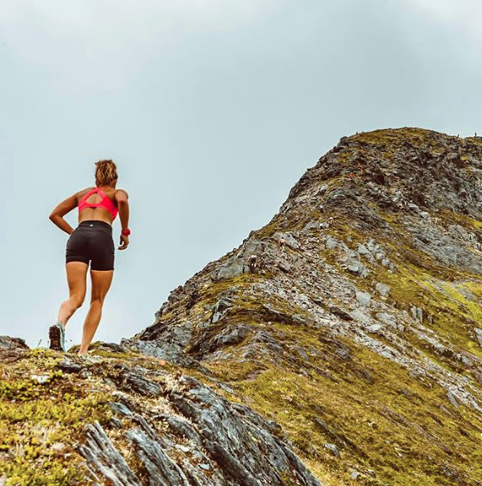
Starting at a trailhead at the end of the road outside of Girdwood — home to Alyeska ski resort — the trail climbs 2,200 feet to Crow Pass, rapidly ascending from the lush undergrowth of a coastal rainforest to subalpine tundra. Patterson describes this section as “beautiful trail, easy running.” [According to FasterSkier contributor and multiple time race finisher Gavin Kentch, those without an Olympic level engine may not describe this climb as “easy”.]
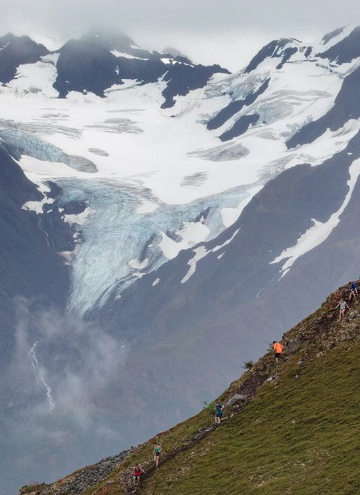
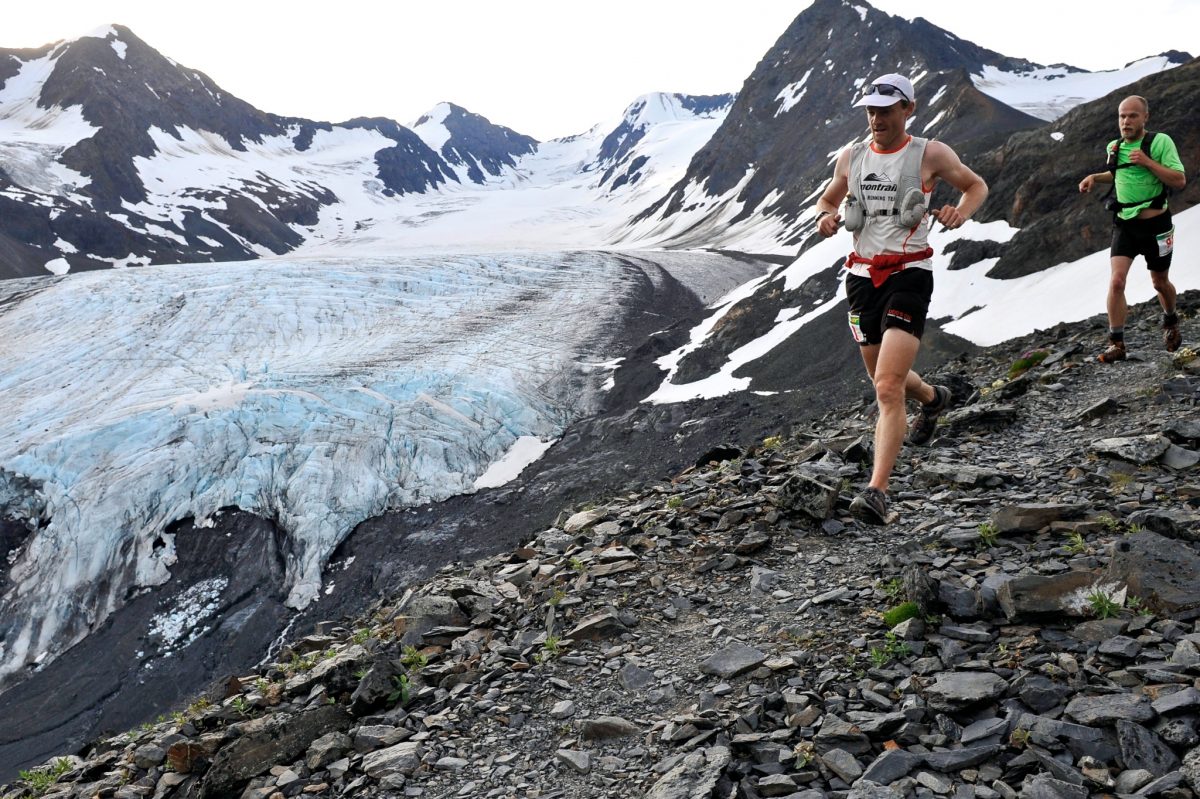
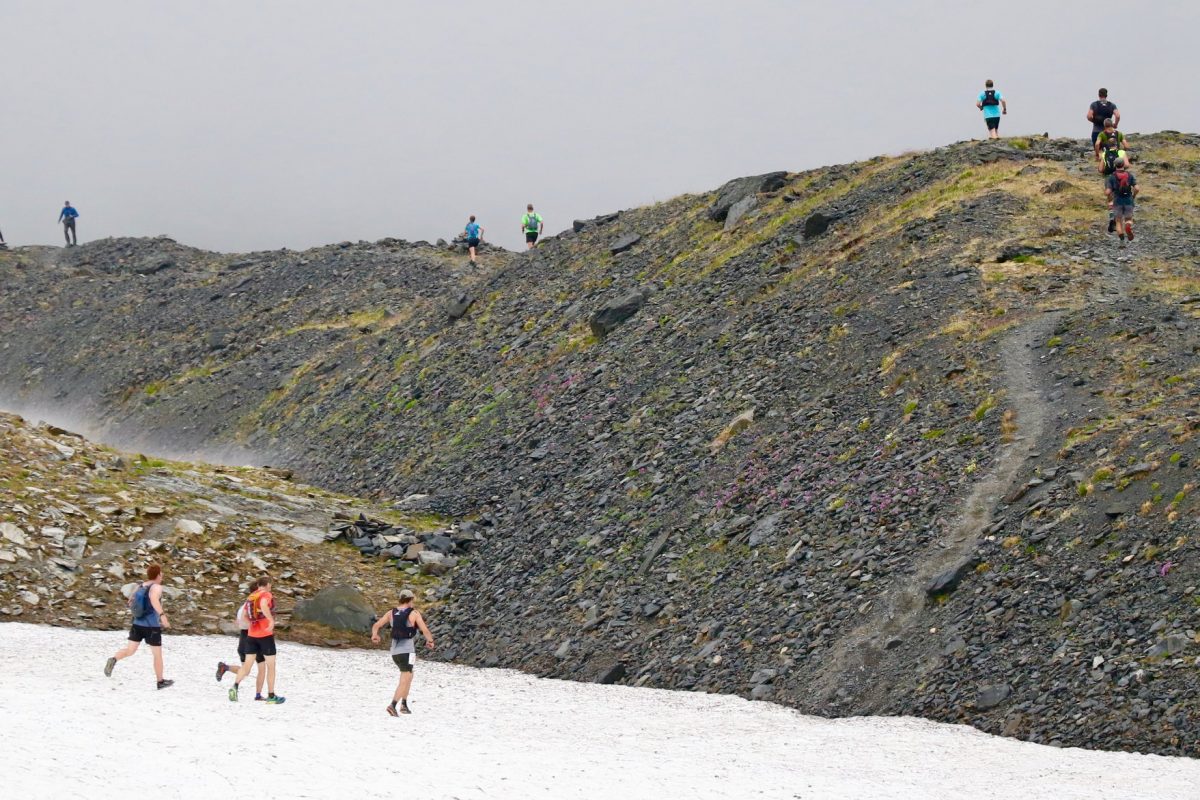
Dropping over the pass, racers are met with spectacular views as they navigate glacial terrain.
“That’s kind of the classic photo. You can see Raven Glacier in the background, and there’s a few snowfields you cross because it’s northern aspect and it just holds snow over the summer. You drop down, gradually to start, into Raven Creek gorge. And again, you’re still above treeline, so it’s really nice.”
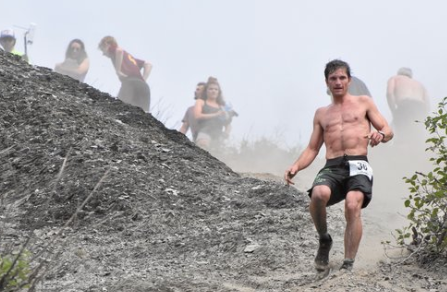
Here, racers pick their way through loose shale while running down a series of moraines as they continue to drop to the first major creek crossing, which Patterson described as “knee high,” although it has a very strong current. The trail follows Raven Creek as it descends down the valley toward its confluence with the Eagle River.
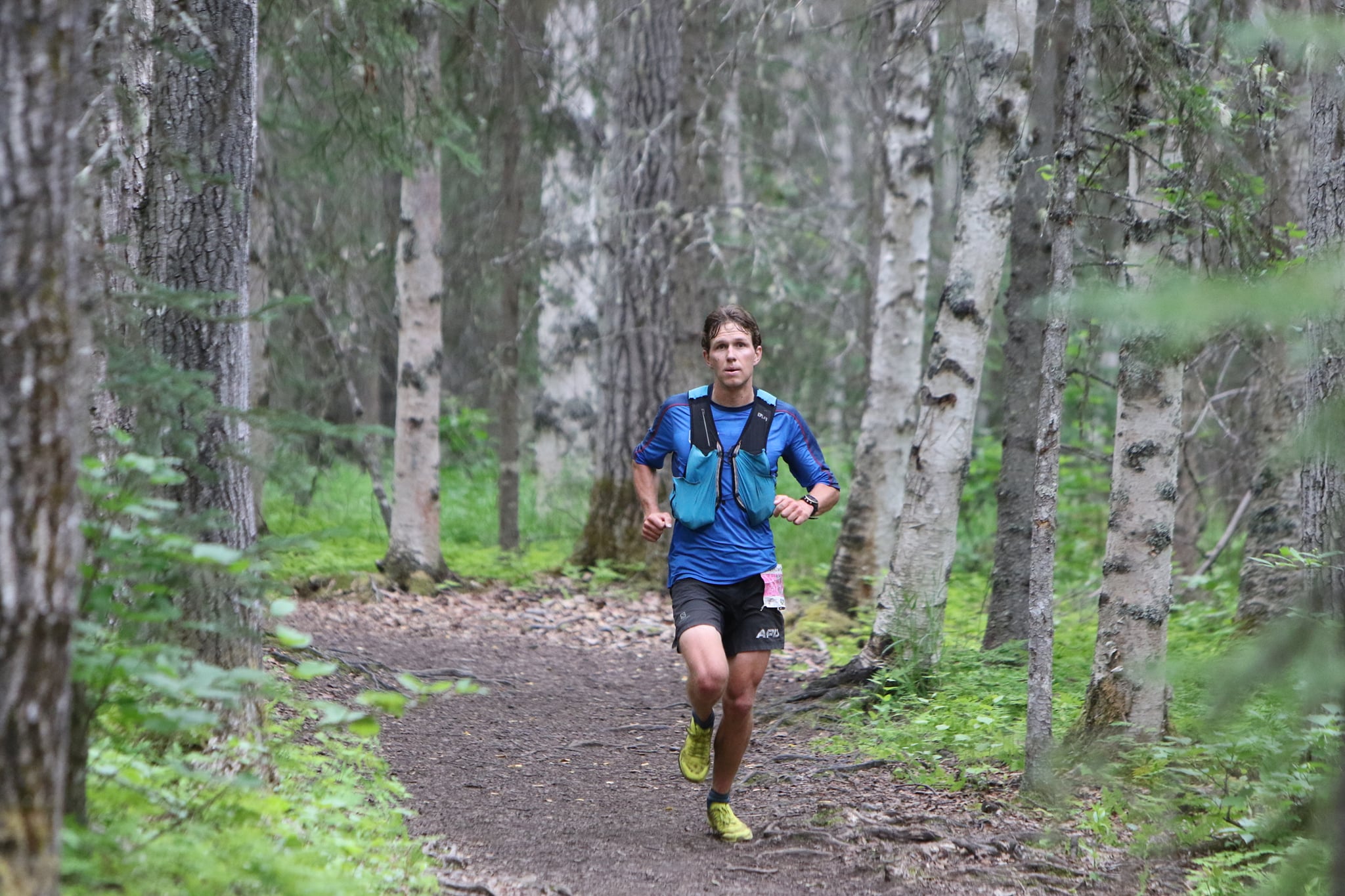
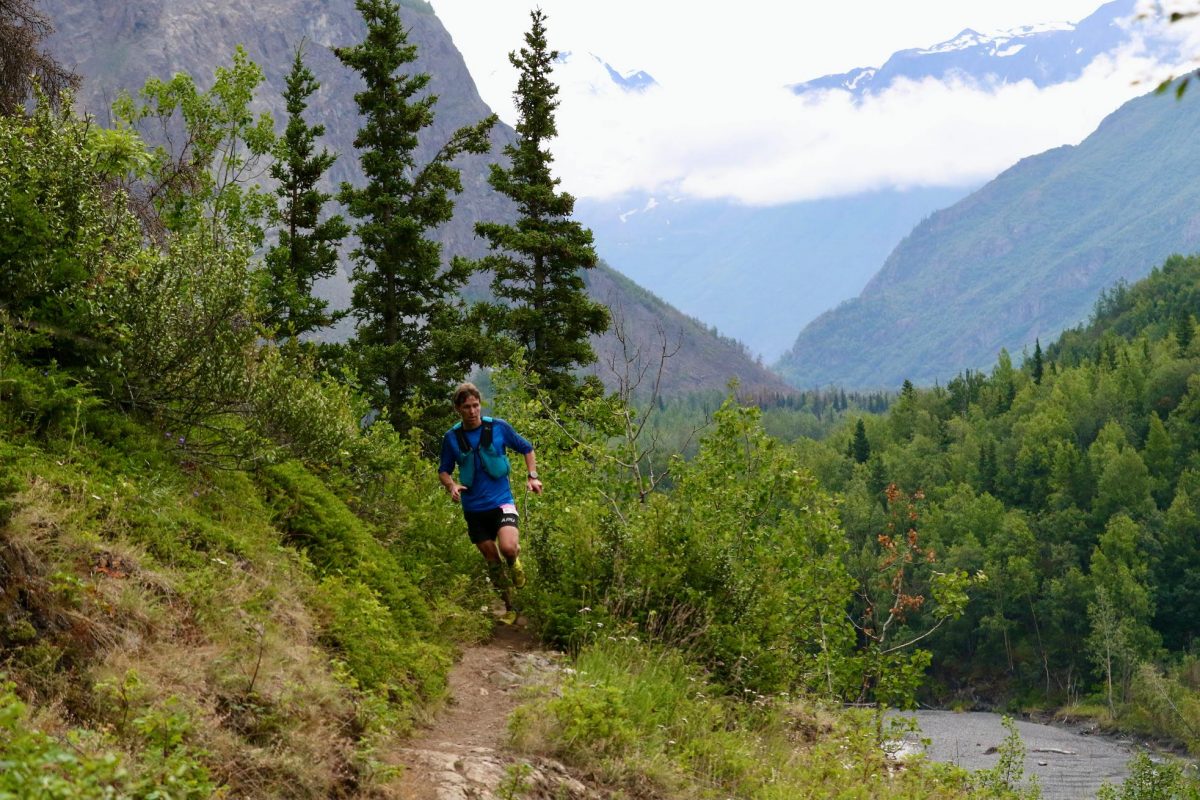
“And that’s where you really start getting into the brush… It’s still a really good trail underneath, but it’s just overgrown. So it’s alders, it’s cow parsnip — and on a sunny day, those can give you some pretty bad rashes, so you have to watch out for that. There’s stinging nettles, and rose bushes, and other spiky things. And it just kind of covers the trail on either side.”
In this section, experience reigns. Runners spend 30 minutes to an hour loping through an extended rolling downhill, pushing back chest to eye-level overhanging vegetation while attempting to dodge the hidden toe-grabbing rocks below.
Patterson explained that his previous runs gave him the insight to trust his footing even when he couldn’t see where his feet were landing, and he remembered the sections where he needed to slow down to avoid obstacles underneath the vegetation. Patterson recalled that a few years ago, a handful of higher profile non-Alaskan mountain runners came to the event, but their lack of experience on the trail held them back during this section.
“It’s really about knowing the trail more than just running, so it becomes really tricky for them.”
Just before the confluence, the trail peels away from Raven Creek and climbs gradually over a divide before dropping down to the Eagle River.
“The Eagle River crossing is kind of a distinctive feature that everyone thinks of with Crow Pass. You’re crossing the river a couple miles downstream of the glacier, but it’s pouring out a solid amount of water. I mean, I think this year, I was probably upper thigh [deep] crossing. I mean, I’m basically six feet. So anyone smaller is starting to get pretty wet and pushed around a little bit.”

Not only will you get “wet and pushed around”, but the water temperature is what you’d expect given its proximity to the glacial source.
So you’ve successfully forded the river, found the trail on the other side of a featureless gravel bar, and avoided cramping after a minute or more in the icy water, but we’ve only made it halfway. The next 11 miles continue down the Eagle River Valley, between towering granite peaks often compared to Yosemite. The trail stays mostly at river level, with a few exceptions where it hops up onto a bench above the river.
“There’s one place — it’s called Chutes and Ladders — where it’s these quick up and downs and there’s a few ladders going over rocks, and then a descent with a rope to grab on to. It’s kind of tricky, slows you down.”
This section is also where many of the reroutes Patterson mentions have taken place. Over the last few years, sections of trail that were being eroded by the river have been rebuilt higher up. In the year Roes set his long-standing record, runners were able to run along the floodplain of the river, whereas now, racers are climbing and traversing above the river.
“It was just flat fast running versus rock on the hillside,” Patterson explained.
The most significant of these climbs happens around mile 18 as racers approach The Perch.
“It’s the only significant elevation after the top of the pass at mile three. So there you are at mile 18 trying to climb up this decent ascent. I mean, it’s nothing huge, but after running downhill for the last 15 miles, you really feel the uphill.”
As runners approach the Eagle River Nature Center, the trail turns to a dirt road double track, where those fit enough to still have pop in their step can open up their stride and cruise the last couple of miles. But, sticking with the theme of the race, the final mile contains a steady climb of about 100 feet.
“The last mile is going from basically river elevation up to the Nature Center. It’s just this gradual uphill that kind of grinds you down for the little bit to the finish.”
Patterson covered this final mile in 6:15.
By all accounts, the Crow Pass Crossing is “low key”. There are no course markings, no aid stations, no pacers, no support, no help at the river crossing, no prize money save for a course-record bonus, few rules beyond required safety gear, and the participant list is almost entirely Alaskan. The event is also a fundraiser for the local non-profit Healthy Futures AK, which aims to empower Alaskan youth to lead active lifestyles.
Patterson explained that the simplicity and lack of “hype” are part of what draws him back year after year.
“Usually it’s kind of the local scene,” he explained in a call. “It’s a big deal for those of us that like the race, but it’s got nothing like the hype of, like Mount Marathon or something like that. Which, for me this summer has definitely been something I’ve kind of keyed into. I didn’t race Mt Marathon, partially with all the hype. I didn’t want to deal with it. With something like Crow, it’s kind of low key; just go and do it on the weekend and have fun, And then it’s over and you move onto the next thing.”
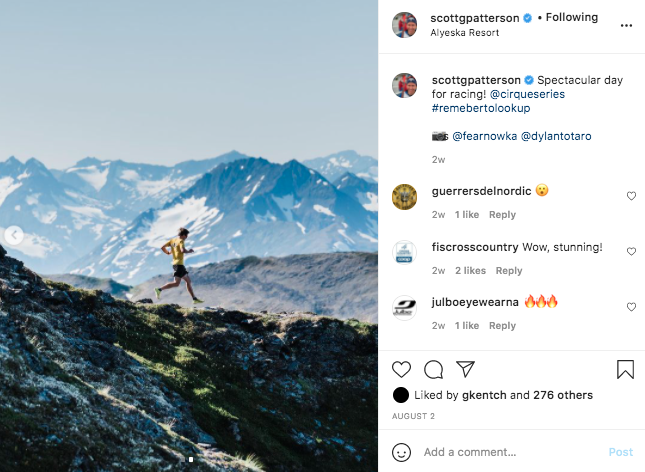
The next thing was a week later — the Cirque Series event at Alyeska, which packs almost 4,000 feet of climbing and descent into a 5.9 mile loop.
“That one’s a little more hyped up, but it also had some prize money, which I didn’t feel like passing up on.”
Patterson won that one too, setting a course record and taking home a $1000 check.
Looking ahead, Patterson acknowledged that his big goal is six months away: the 2022 Beijing Winter Olympic Games. Patterson had strong results at the 2021 World Championships in Oberstdorf, Germany, finishing 10th in the 50-kilometer classic and 14th in the 30k skiathlon.
Amidst high-volume summer training with the APU Team, Patterson explains that he holds his results in summer mountain races lightly. They provide insight into his training, but he does not project into the ski season based on a course record earned in the summer.
“We don’t do that many time trials during summer, so [results at Crow Pass and the Cirque Series are] definitely one of those markers that I always have. But it’s a little hard to read too much into them, because, like Crow Pass, you get a great year, and it’s fast, then it’s a nasty, rainy, cold year and you probably don’t want to read too heavily into it. But I think I mean, for me, I’ve done four races this summer, and set course records on three of them. So between that, and then also just taking in the other factors from intervals, some of the time for time trials we do, things like that, it really kind of gives us a good overall picture for going into the season. So it’s definitely a marker, but it’s not the only one.”
Besides the Cirque Series race, the two races Patterson mentions were Kal’s Knoya Ridge Run and the Robert Spurr Memorial Hill Climb on Bird Ridge, both of which he called “low key” and put on by Alaska Mountain Runners. Patterson snagged the course record on Knoya Ridge, but laughed that David Norris “crushed him a bit” on Bird Ridge. He explained that there were a few others he looked at, but he decided he didn’t want to do too much summer racing coming into the Olympic year.
If his proclivity toward low key races and relatively low profile on social media haven’t already indicated to you that Patterson is humble and modest, his closing statement on his current fitness and how he’s feeling heading into the season should do the trick.
“I’m pretty psyched with where I am right now with some fast races and then some good other signs. So training is going well for the summer.”
– Additional course intel contributed by Gavin Kentch.