From the FasterSkier archive — posts syndicated from athletes’ and coaches’ own blogs between 2004 and 2012, kept online as published. Current coverage is at fasterskier.com.
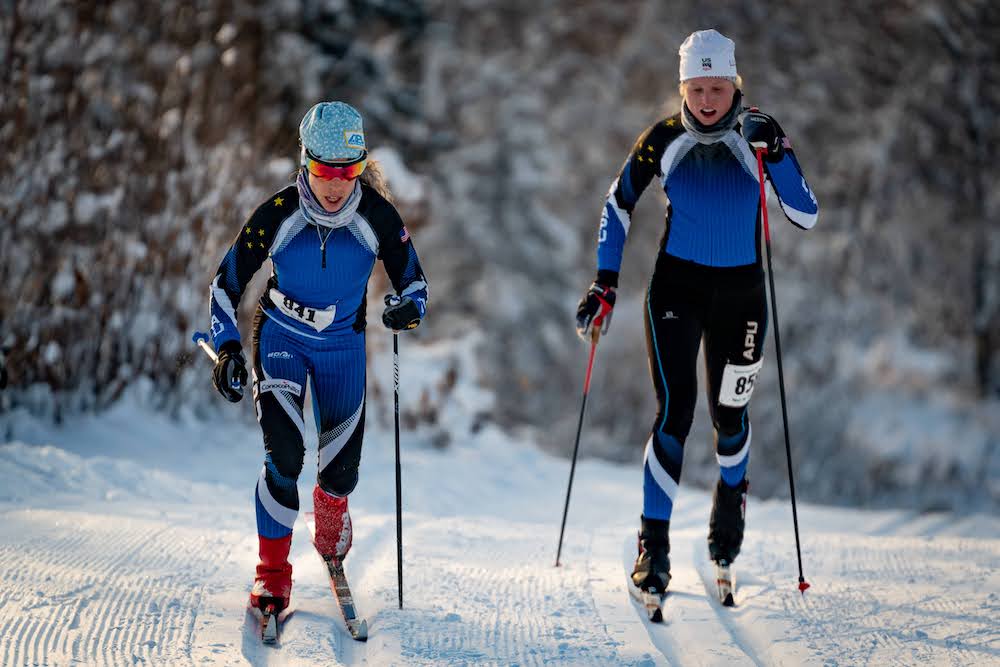
Rosie Frankowski, left, and Hailey Swirbul race at Government Peak Recreation Area, Palmer, Alaska, Nov. 14, 2021, in the season-opening Race to the Outhouse #1. (photo: Eric Strabel for APUNSC)
GOVERNMENT PEAK RECREATION AREA, above Palmer, Alaska — High-end nordic ski racing was last seen in this country in mid-April, when a bevy of national-team members who call Alaska home competed in a pair of FIS races in mid-winter conditions, followed by a more vernal 2,000’ hill climb the following weekend. Less than seven months later, as Alaska kicks off another season of ski racing, little has changed: the country’s deepest domestic fields, single-digit temps, and fierce competition. The 2021/2022 American race season is officially underway.
The Mat-Su Ski Club has hosted the season-opening Race to the Outhouse #1 somewhere in the Matanuska–Susitna Valley, above Palmer, Alaska, for the past 13 years now. Typical locations are Archangel Road and Independence Mine. The race course at Archangel ends with a 240-meter climb; the race course at Independence Mine starts with a 145-meter climb over the first 1.8 kilometers. Both feature an eponymous state parks outhouse near the finish line. Neither is exactly FIS-legal.
This year, poor road conditions on the upper mountain caused by recent heavy snowfall necessitated a last-minute change to Government Peak Recreation Area, or GPRA, elev. 1,000′.
When the snow cleared and the new venue was announced on Friday morning, this year’s race was somehow even harder. The Government Peak 5k FIS course has 38.2 meters of gain per kilometer, on par with the Lahti World Cup course (38.5) that has hosted multiple World Championships. It has a height difference of 81m, more than Ruka or Lillehammer or Lahti or Falun or Oberstdorf or frankly most venues. After Sadie Maubet Bjornsen skied here for the first time, in October 2020, she called these “the most legit ski trails I have ever skied in the US,” and pronounced the venue World Cup-ready.
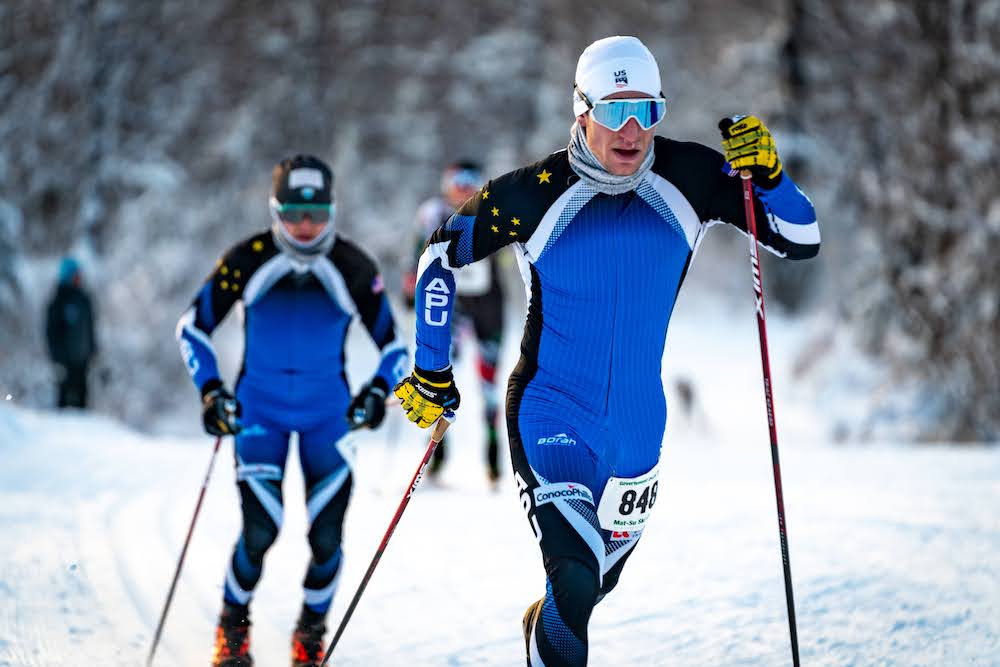
Hunter Wonders races at Government Peak Recreation Area, Palmer, Alaska, Nov. 14, 2021, in the season-opening Race to the Outhouse #1. (photo: Eric Strabel for APUNSC)
Overnight temperatures on Friday of nearly zero, rising to only 7° F in time for Saturday’s race, did not make the snow on an already difficult course ski any faster.
Rosie Brennan (USST/APU) was unfazed by the slow snow, covering two laps in 32:18.4 to take a commanding win in the women’s 10-kilometer mass start classic race. She was followed by Hailey Swirbul (USST/APU, +2:44.6), who was 0.7 seconds ahead of Rosie Frankowski (APU). Fourth place was another Olympian, Australian–American dual national Jessica Yeaton (Australia National Team/APU).
“I was looking for an opportunity to practice racing and shake some cobwebs off on the snow,” Brennan wrote to FasterSkier on Saturday. “It was absolutely incredible what Mat-Su Ski Club pulled off for us today. From one surprise storm they were able to set classic tracks on a 5k homologated loop. I honestly can’t think of a better way to get a good test race in than that. I am very grateful for the community support and effort to help get us ready to race before leaving. I am really happy with my effort and was able to find some race feelings and some good movements on snow. I am feeling on track and ready to hit the road.”
Swirbul sounded similar sentiments, writing, “I was hoping to get a good workout in and practice pacing. I don’t think time trials have to be great to have a good effect and shake some of the cobwebs out. Good to go hard with some great teammates!”
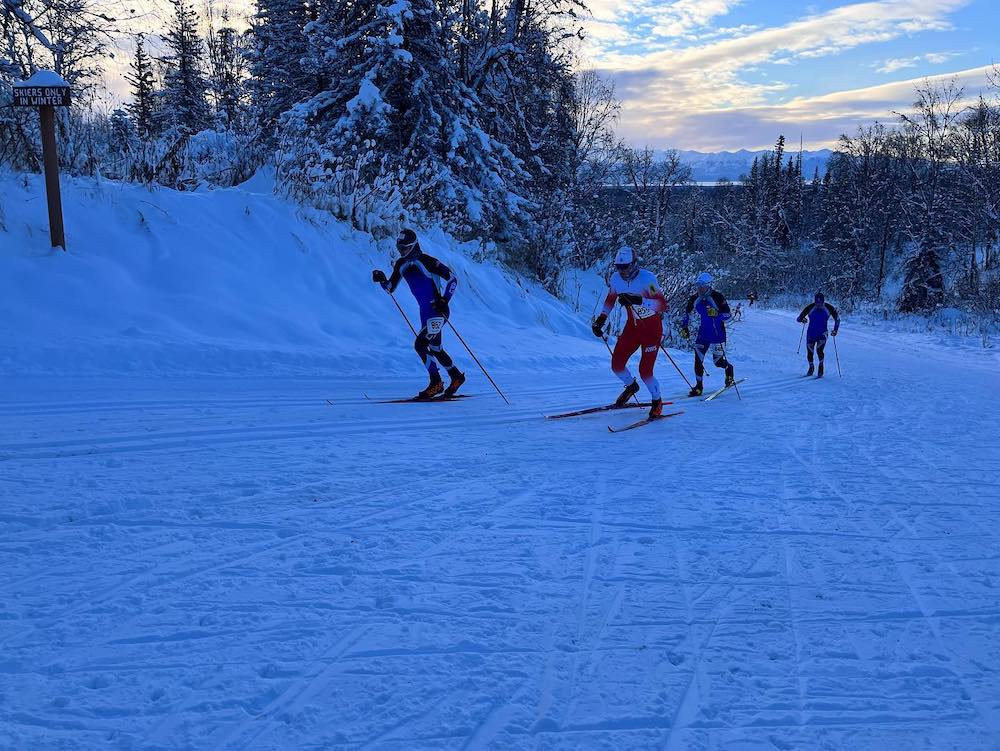
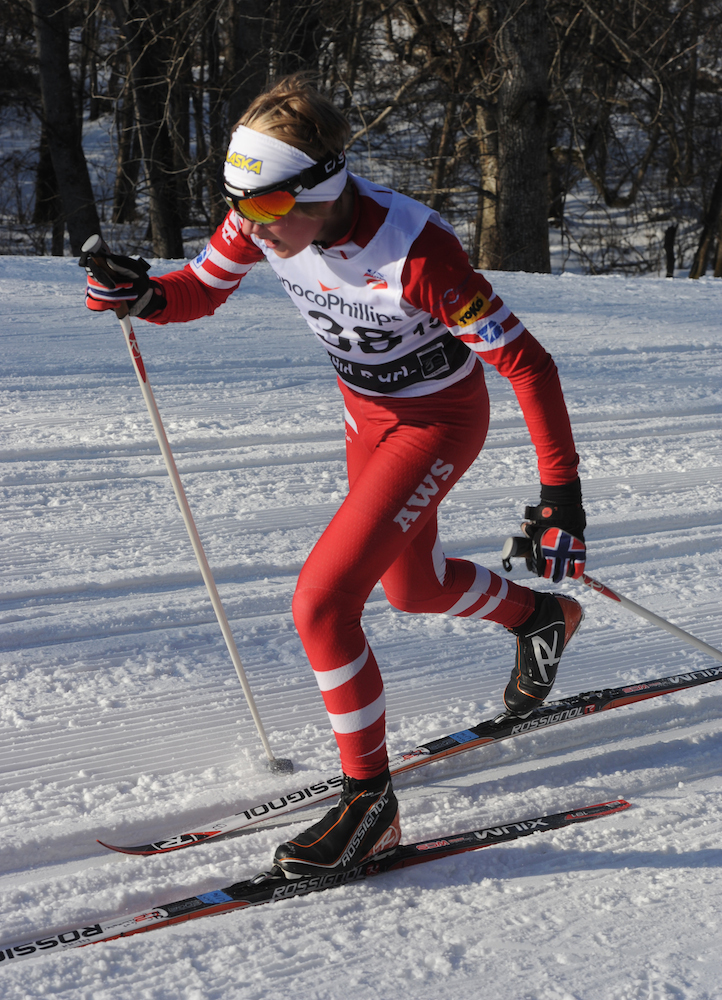
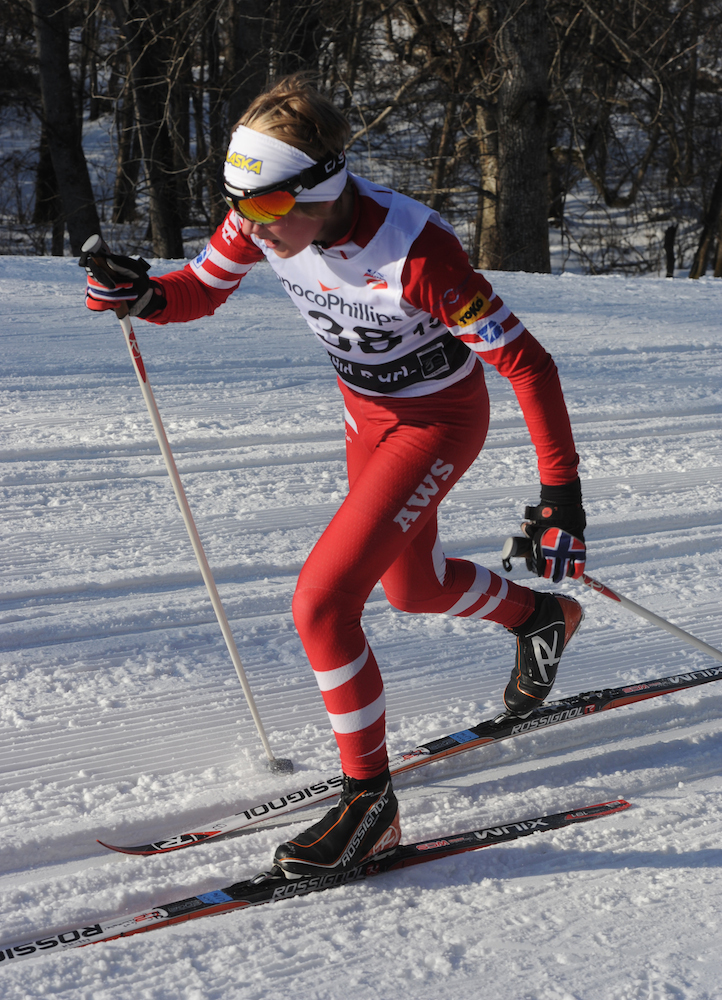
From left, David Norris, Gus Schumacher (red AWS suit), Hunter Wonders, and Tyler Kornfield charge up the first hill out of the stadium at Government Peak Recreation Area, Palmer, Alaska, Nov. 14, 2021, in the season-opening Race to the Outhouse #1. (photo: courtesy APUNSC)
For the men, Gus Schumacher (USST/Alaska Winter Stars) took the win in the 10 k classic, crossing the line in 29:29.2 in the mass start race. He was closely followed by Hunter Wonders (USST/APU) and David Norris (APU), 0.8 and 2.4 seconds back, respectively.
Schumacher had much the same reaction as Swirbul, writing to FasterSkier, “Today was mostly just to shake off some cobwebs and get a sense for where my race fitness is at. It went really well; I felt good and it was fun to end up ballpark where I want to be. It gives me some confidence just to have a solid race under my belt before travel.”
The World Cup athletes were concentrated in the 10 k classic. In the men’s 5k skate, Oskar Flora led a strong junior field to take the win in 15:50.4, followed by Liam Chisholm (+36.0) and Kyle Fischer (+54.7). In the women’s 5k classic, it was Meredith Schwartz first in 18:59.6, Alison Arians (Schwartz’s mother) 43.6 seconds back, and Tuva Granøien in third, 1:25.8 back.
In the men’s 10k skate, JC Schoonmaker (USST/UAA) led a small field to the finish in 29:35.1. He was followed by local juniors Skyler Amy and Cole Flowers in second and third several minutes later.
Anna Engel (45:26.7) appears to have been the only woman who did the 10k skate.
* * *
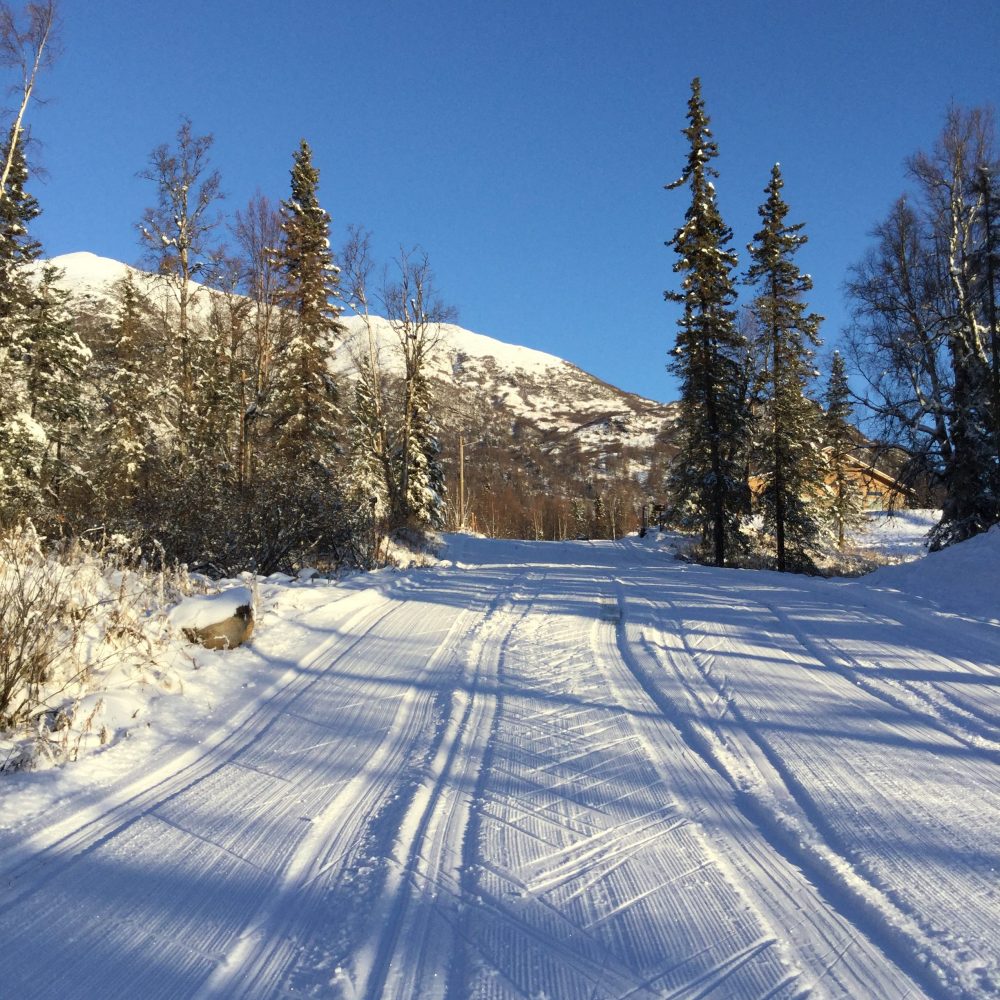
The races were a robust test of athletes’ fitness on a challenging course. They were also somewhat of an epistemological puzzle: Is it really an early-season race if you’ve been on snow for nearly two months already? Snow came to the Chugach foothills above Anchorage, ca. 2,000 feet, on September 24. By the time that early-season storm was melting out, race-skis skiing was online at Independence Mine – this photo was taken on October 10:
An Anchorage- or Palmer-based athlete in a position to drive could have logged seven full weeks on snow by the time race day dawned. APU head coach Erik Flora had 30 hours on snow by Halloween. Climate change is undeniably present in southcentral Alaska, but its effects in this La Niña winter have so far been kind to skiers.
Making the question of “what type of race is this, anyway” even more complicated was the depth of the fields. Alaska’s World Cup skiers are off to Europe soon, but not yet, and turned out in force for Saturday’s race – four out of five athletes on the U.S. Ski Team A-Team raced, and a total of six athletes who will be starting on the World Cup this fall were in the field (potentially seven depending on what happens with alternates).
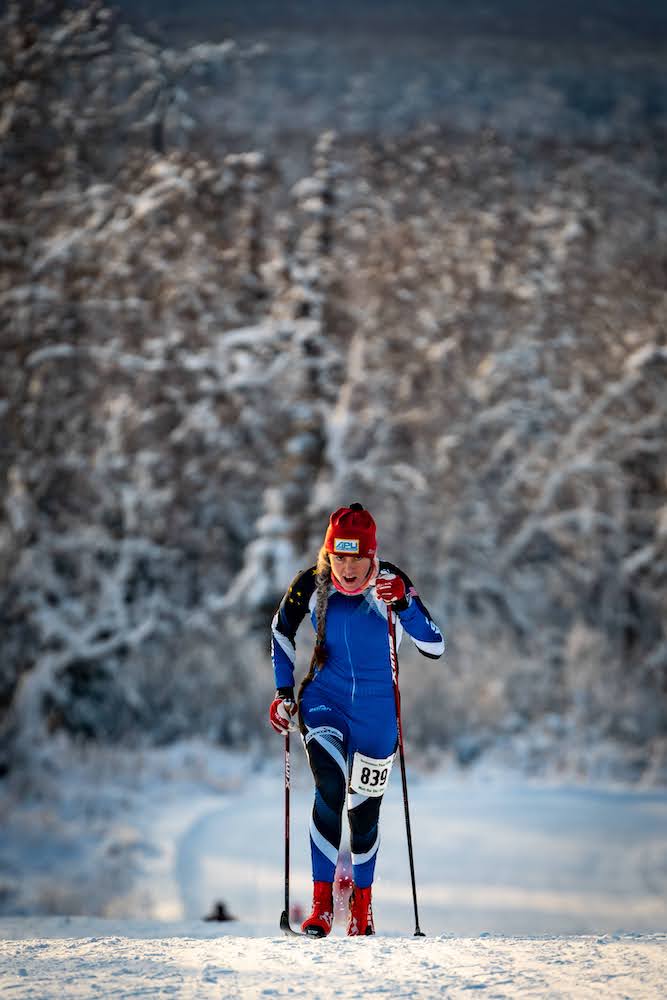
Becca Rorabaugh races at Government Peak Recreation Area, Palmer, Alaska, Nov. 14, 2021, in the season-opening Race to the Outhouse #1. (photo: Eric Strabel for APUNSC)
FasterSkier unofficially calculates the race penalty for the men’s race as 23.7, and as 30.3 for the women, if these had been sanctioned as FIS races. U.S. Nationals, in Soldier Hollow in January, will likely have a higher number, reflecting the fact that the country’s fastest athletes are typically racing in Europe in January. Two out of three women on Saturday’s podium have World Cup podiums to their name; the third was 21st in the Olympics. For the men, Schumacher, Wonders, and Norris would not be surprising picks for the 2022 Winter Olympics American men’s relay team. Was this a free, low-key fun run involving a line in the parking lot to sign a waiver and pick up safety pins for your bib, or was it an unofficial U.S. Nationals? It’s complicated.
Racing continues in Alaska next weekend with the start of the town race series at Fairbanks’ Birch Hill ski area, then over Thanksgiving with races at Government Peak (the first annual Turkey Trax race) and Birch Hill (the 57th annual Turkey Day Relays). Domestic FIS racing gets underway in West Yellowstone the same weekend. The Midwest racing calendar at SkinnySki.com is currently unavailable, but the Duluth SuperTour races on December 4-5 are a notable early-season event. In New England, the NENSA calendar begins with the Quarry Road Opener on December 5. Wherever you are and whatever your local racing scene looks like, think snow.
(N.b., the results are slightly idiosyncratic, reflecting a free, low-key event in which athletes could choose between doing a 5k and a 10k up to the moment of the finish lane vs. lap cutoff. This manifests as all racers for both distances being listed together in a single results sheet, which is then further sorted by wave and gender. My sense of what’s what is: In the 10 a.m. men’s wave, places 9–11 did the 10k; in the 10 a.m. women’s wave, all athletes did 5k; in the 10:02 a.m. men’s wave, first place did the 5k and everyone else did 10k; in the 10:02 a.m. women’s wave, places 1–4 did 5k and the rest did 10k; in the 10:04 a.m. wave, places 23 and 24 for the men, and 9th place for the women, did 10k; everyone in the 10:06/10:08/10:10 a.m. waves did 5k, except that 8th place in the 10:06 a.m. classic did 10k.)
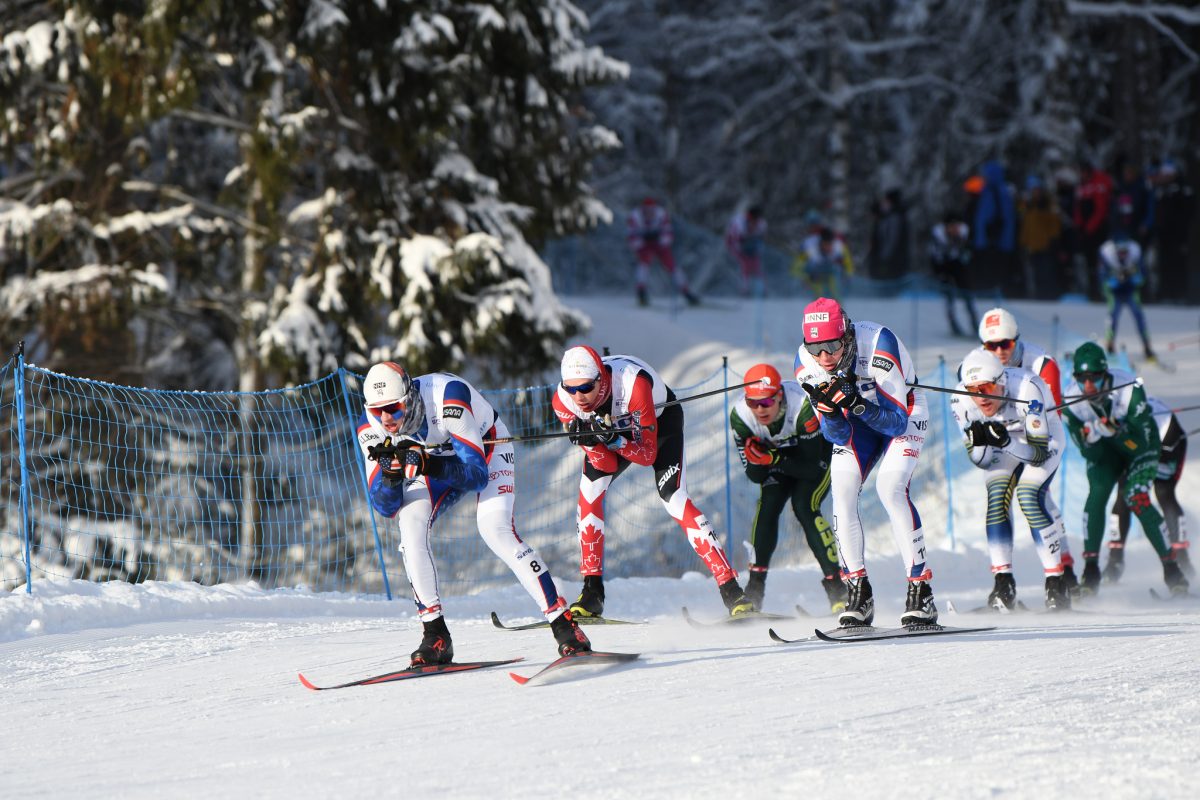
Gus Schumacher leading the pack with teammate Ben Ogden (pink hat) in the draft — during the U20 30 k classic mass start at World Juniors in Lahti, Finland. (Photo: Doug Stephen)
With the 2018/2019 season officially in the rearview, FasterSkier is running a series of articles highlighting some of the players and performances from the season. This year, the junior skier of the year is Gus Schumacher.
Perhaps it is a testament to the steady growth of U.S. developmental programming or perhaps it is a trickle down effect as Americans see more success on the World Cup level; one thing is clear when you consider the depth of the current field of junior skiers, the future looks bright. Choosing just one athlete to recognize as Junior Skier of the Year was not an easy decision, but the outstanding achievements of Gus Schumacher in 2019 make the 18-year-old USST D-Team member from Anchorage, AK a worthy recipient.
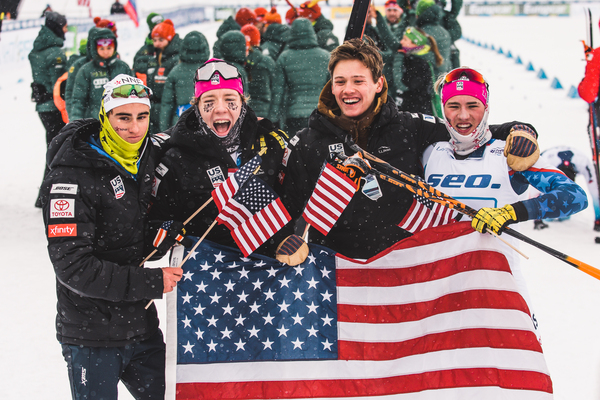
The U20 World Juniors 4 x 5 k relay first place team from the U.S, (l-r) Luke Jager, Ben Ogden, Johnny Hagenbuch, and Gus Schumacher. (Photo: JWSC2019 / Mikaela Takala)
While his performance anchoring the gold medal U20 men’s relay team at Junior Worlds in Lahti was likely the most dramatic and noteworthy result Schumacher earned this season, his achievements extend much further. In fact, there was a major highlight for the Alaska Winter Stars standout each month.
In January’s Senior National Championships, Schumacher took 7th in the 15-kilometer individual start freestyle, 5th in the freestyle sprint, and 4th in the 30 k mass start classic amongst a field of senior men vying for World Cup starts and a spot on the team at World Championships. His results made him the top junior athlete in each race, except for the skate sprint where Noel Keefe took 3rd.
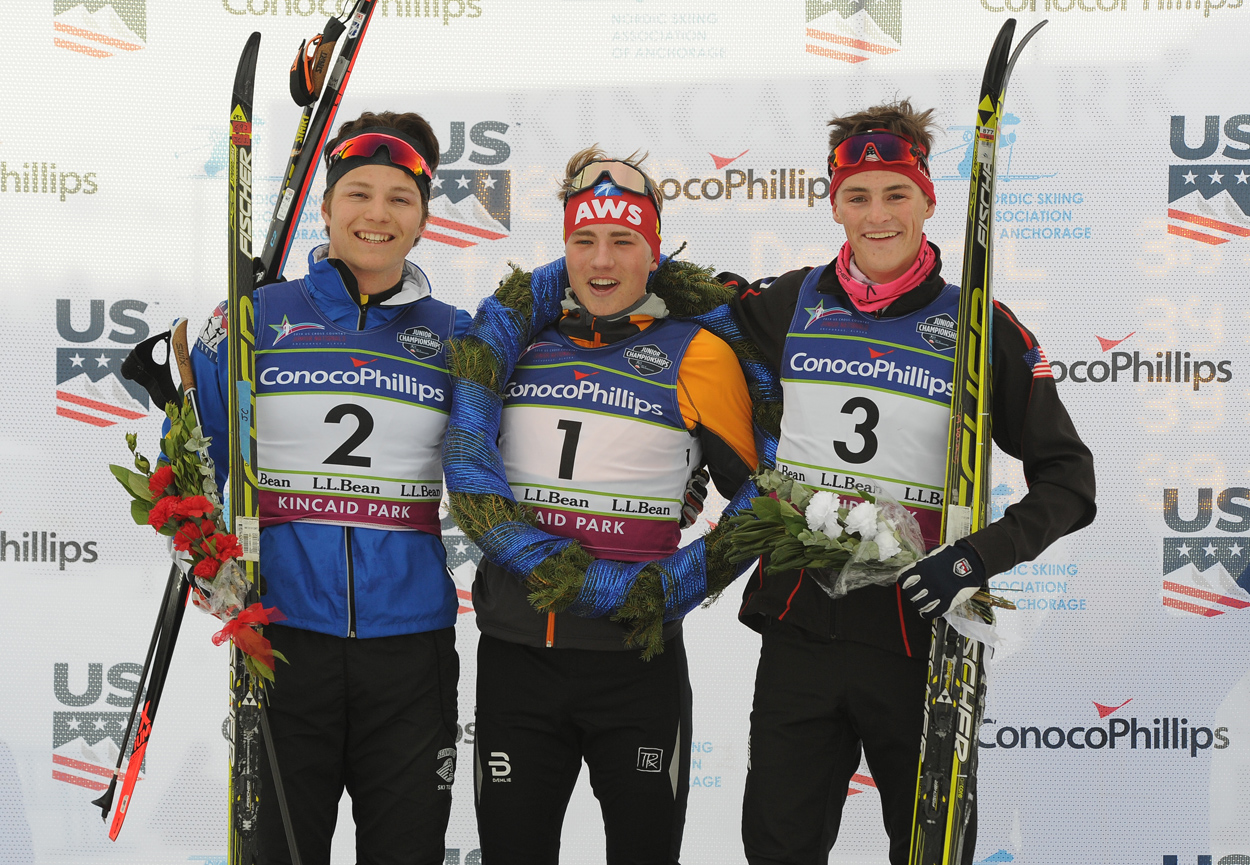
Gus Schumacher (Alaska Winter Stars/Team Alaska), center, won the U20 men’s 15K classic mass start race Friday at the 2019 U.S. Ski & Snowboard Cross Country Junior National Championships at Kincaid Park. J.C. Schoonmaker (UAA-Auburn Ski Club/Far West), left, was second, followed by Cameron Wolfe (Ski and Snowboard Club Vail/Rocky Mountain), right. The win gave Schumacher a three-race sweep of the 2019 JN individual events. (Photo: Michael Dinneen)
In March, Schumacher swept Junior Nationals on home turf in Anchorage. Not only did he win each event and anchor the winning relay, but his victories in both distance races, a 10 k skate and a 15 k classic, were won by a margin of roughly a minute each. Because of his results at U.S. Nationals and World Juniors, Schumacher earned his first starts on the World Cup during the final races in Québec City later in the month.
Finally, as the season wound down and April began, Schumacher wrapped up a fantastic season at Super Tour Finals in Presque Isle, ME. He took 8th overall in the freestyle sprint and landed himself on the podium with Simi Hamilton and Erik Bjornsen by taking 3rd in the 15 k classic. While skiing with the lead pack of 50 k racers, Schumacher also cruised to victory in the junior 30 k skate.
The men’s podium for the 15-kilometer mass start classic during the Super Tour Finals in Presque Isle, ME. Erik Bjornsen (USST/APU; center) took the win ahead of Simi Hamilton (USST/SMST2; left) and Gus Schumacher (USST-D/APU; left). (Photo: U.S. Ski & Snowboard – Reese Brown)
Before we wrap this up, we want to give a shout out to Kendall Kramer of Fairbanks who also swept Junior Nationals for U18 women. Kramer was also the top American in the 15 k classic at World Juniors with a 4th place finish, and ended her season in Québec with her first World Cup race starts at just 16-years-old. With results like these, she’ll certainly be in the running for this award in the coming years.
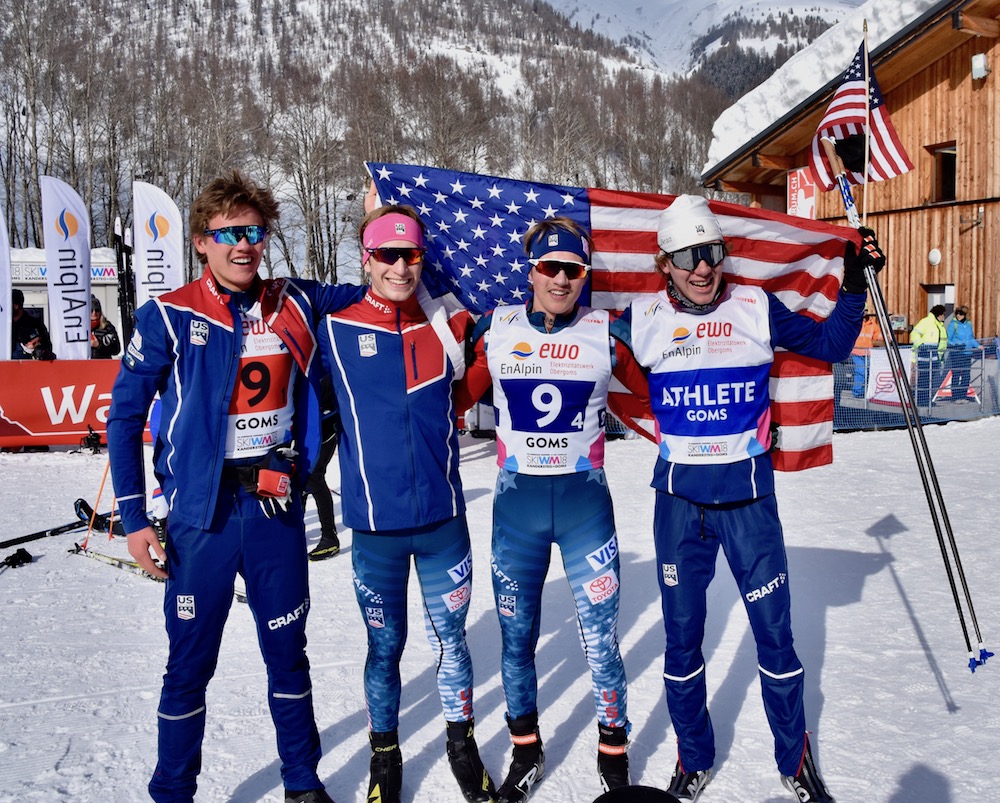
The U.S. men’s silver-medal relay last February at 2018 Junior World Championships in Goms, Switzerland, with (from left to right) Luke Jager, Hunter Wonders, Gus Schumacher, and Ben Ogden. (Photo: Julia Kern)
ANCHORAGE, Alaska — Gus Schumacher spent last winter traveling the world for ski racing, including laying down the season’s most dramatic anchor leg, non-Jessie Diggins edition, to bring the U.S. men’s relay team from fourth to a historic second at World Juniors. The then-high school senior also spent the season touring the country to plan his future in ski racing, talking with multiple NCAA coaches to discuss their programs and weigh everything from coaching philosophy to snow conditions and altitude. In the end, Schumacher chose to return back home to where it all began, Jan Buron and Alaska Winter Stars, where he prepares for what’s next from the comfort of his childhood home.
Schumacher, 18, spoke with FasterSkier in late December, shortly before leaving for U.S. Nationals in Vermont. We discussed his goals for this year’s World Juniors relay, the appeal of the familiar, and the future of American men’s skiing, among other areas.
The early years
Schumacher was born Outside, in Madison, Wisconsin, while his father was finishing a medical residency. Weeks later, he moved to Alaska for good. He had a classic Anchorage kid introduction to skiing: strap-on skis in the backyard, graduating to Anchorage Junior Nordic League a few years later.
“I started at Kincaid Junior Nordic,” Schumacher reminisced, “all the way through my first years as a Hawk, and then did Hillside Junior Nordic for my last couple years as a Hawk. I’ve still got the pictures of my first night home as a Hawk, with the new jacket, and holding up the skis. It was a pretty memorable event.”
(There are four levels in the Junior Nordic program – Polar Cub, Otter, Wolverine, and Hawk – with Hawks as the most advanced group, as marked by a distinctive jacket. Other famous quondam Hawks include Kikkan Randall, Tyler Kornfield, and pretty much anyone else who grew up skiing in Anchorage in the past 30 years.)
Schumacher didn’t dabble in too many other sports outside of skiing, but he was an avid soccer player. The family – siblings Heidi (now 12) and Rudy (now 15), and their parents, who work as an orthopedic surgeon (father Greg, who has worked with the U.S. Ski Team) and a pediatrician (mom Amy) – spent some summers in Kenai, for cabin time and fishing, and Gus and Rudy played in a soccer league there.
There was no single Saul on the road to Damascus moment when Schumacher knew he wanted to be a skier, he now recalls, so much as a more organic progression.
“It was more just, I stuck with it,” Schumacher says. “I remember, like, as a Junior Nordic skier, seeing Winter Stars skiing around, and wanting to be like that. And then seeking Kikkan have success, and wanting to be like that. Just kind of always having skiers as my main role models. It wasn’t like a big event, I’d say.”
Gus Schumacher, 13, of Alaska Winter Stars, climbs the final hill in the 2014 SuperTour Finals classic-sprint qualifier at Kincaid Park on Sunday. The youngest in the field, he placed 65th. (Photo: Bill Roth/Anchorage Daily News)
(And as for those role models, this is as good a place as any to mention Kikkan’s thoughts on a then-13-year-old Schumacher racing at Spring Series 2014: “We spent all winter on the World Cup and you almost forget what it was like when you were first getting going in skiing and how these local races were so big. We could have some future Olympians out here – kids that you want, people that you want to get fired up about cross-country skiing.”)
By the time Schumacher was nine or ten, he had joined the Alaska Winter Stars program long run by Jan Buron. He offers up another photographic memory to place the date that he joined: “It was third or fourth grade. Because I remember there was a year where we were allowed to bring props in for our school pictures, and I brought skis and wore my Winter Stars jacket that was new, and that I was pretty proud of.”
Alaska Winter Stars, then and now
Fast forward nine years, and Schumacher remains happily ensconced within the Alaska Winter Stars (AWS) family.
There has historically not been a strong post-juniors program at AWS, which has led many Winter Stars athletes to move to other programs, either in Alaska or the lower 48, soon after they finish high school. Tyler Kornfield and Scott Patterson are two recent examples of athletes who raced for AWS through high school, then did some NCAA racing, then moved to the APU Elite Team.
In contrast to these examples, Schumacher ultimately decided to stay with Buron and Alaska Winter Stars after he graduated from high school in May 2018. The decision is readily explained by the existence of an ongoing athlete–coach relationship stretching back nearly a decade and yielding multiple strong results; in addition to that World Juniors silver, Schumacher is also a two-time Alaska state high school ski champion. But it was very much a reasoned decision, following a lengthy and considered process.
“It was definitely one of the harder decisions I’ve made,” Schumacher says of the decision to forego the APU Elite Team in Anchorage, NCAA skiing anywhere in the country, or any other option to remain with his longtime coach and program.
So how did he go about it?
“My thought process was, I started with five or six [NCAA] schools,” Schumacher now reconstructs.
Gus Schumacher (Alaska Winter Stars) racing at 2018 U.S. Cross Country Championships in his hometown of Anchorage, Alaska, in January 2018. (Photo: Charlie Renfro)
“I started by emailing a bunch of coaches, and made some phone calls, and I talked with people I knew who had gone to places, and I toured a few places. And I asked some of the same questions at every place, like, ‘How’s the snow,’ ‘How’s the altitude,’ ‘What is your general philosophy on training and strength,’ ‘How’s the race schedule,’ ‘How’s the team,’ ‘How do you view growth, and growth outside of NCAA,’ and so on.”
“And it kind of came down to, who’s a coach that I know about? And I know that taking that risk [of moving to a different coach] is obviously something that works out really well for a lot of people with a new coach, but I ultimately thought I knew what was going on here, and I knew that I could keep getting better here [with Buron]. And that the snow, while it’s not the best here, it’s pretty consistent, and I can do whatever competitions I want basically and I don’t have to be distracted by a full-time classload. So that’s kind of how I came to that. But I think there’s a number of ways it could have gone, and I think a number of ways that it probably could have gone pretty well, but for now I’m happy with where I’m at. I think I made the right decision.”
So far, the decision seems to have worked out well for Schumacher. (This was perhaps more of an open question at the time of the original interview for this story, before Schumacher consistently destroyed the junior field at 2019 Senior Nationals, placing 4th, 5th, 7th, and 12th overall in four races while recording the highest junior finish in each event.)
“I think it has,” Schumacher muses.
He adds, in a self-effacing nod to his millennial status, “There’s been some times where I felt like lots of people moved on, and I didn’t move on, and sometimes that makes me feel like, I guess, the classic millennial, where I’m still at home, and what am I doing… but I just need to think about why I’m staying, and that my training’s going well, and my collaboration with my coach is going well, and I’ve still got people like Luke [Jager], and athletes who haven’t gone off to college and who are doing a similar thing as me, and kind of going for the same goals, and it’s good to have them around.”
So who is still around? Or put another way, and perhaps more bluntly, does one of the country’s top juniors even have a training group?
U20 men Luke Jager, Gus Schumacher, and Ti Donaldson at a December 2018 Besh Cup race. (photo: courtesy CCAK)
“I for sure do,” Schumacher reassures. “I spend a good amount of time alone, just based on convenience; it’s easier sometimes to just go out alone. But I train with Marion [Woods] sometimes, as the ‘Winter Stars Elite Team,’ just joking, in quotes. But I train with Luke, and Dawson [Knopp], and Tracen [Knopp], and lots of those younger APU guys I can train with, and some of those UAA [University of Alaska Anchorage] guys. Once in a while I’ll do some intervals, and we do distance sessions together a lot.”
The flip side of a training group of one may be that Schumacher has a training plan for one. His training plan is “definitely based” on Buron’s guidance, Schumacher says, “but more recently, when it’s mostly just me, and I’m not really training with a lot of other people, he’ll call me at night, and we kind of talk about what to do the next day.”
Schumacher is, like many experienced athletes and coaches, making the move toward becoming more of his own coach. “I think I’ve been doing a better job of trying to have my own input,” Schumacher reasons, “and making sure I’m not just following what he does, but really trying to get an understanding for why he’s saying what he’s saying, and then get an understanding from other coaches who say why to do stuff.”
Schumacher will think through this, then advise, for example, “’Maybe we should do a little heavier on the L4 today,’ or something like that. Sometimes he’ll say, ‘Yeah, that could be a good idea,’ and sometimes he thinks I’m wrong. We’ve started to argue a little more, as I’ve gotten older, which sometimes is probably a little annoying to him, but I think is pretty helpful, for me at least, to try to get a better understanding of training, so I’m not always asking him every day what I need to do. … Jan hasn’t been, like, ‘You need to do this.’ But it has been more like realizing, you kind of have to become a form of your own coach. With help.”
College classes and a potential future in college skiing
Schumacher may have charted a path that takes him away from college skiing for the time being, but he is nonetheless keeping open a place in his life for both college classes now and potential NCAA skiing down the road.
For the present, Schumacher is enrolled in classes at the University of Alaska Anchorage, or UAA. His current major is officially civil engineering, in part because he had to select something when he registered for his freshman semester last fall but in part because he enjoys math and science and thinks he would enjoy this field. He took three courses last semester, totaling 11 credits, and is enrolled in two this semester, “online so I can travel, but still be able to have some other goals that aren’t skiing-related.”
For the future, Schumacher’s choice of only 11 credits, and to pay tuition for them, represents a conscious decision to preserve his potential future NCAA eligibility. He graduated very near the top of his class at Service High School, and so qualified for a partial scholarship given to Alaska high school students who are in the top 10 percent of their graduating class… but you have to be a full-time student to receive the scholarship.
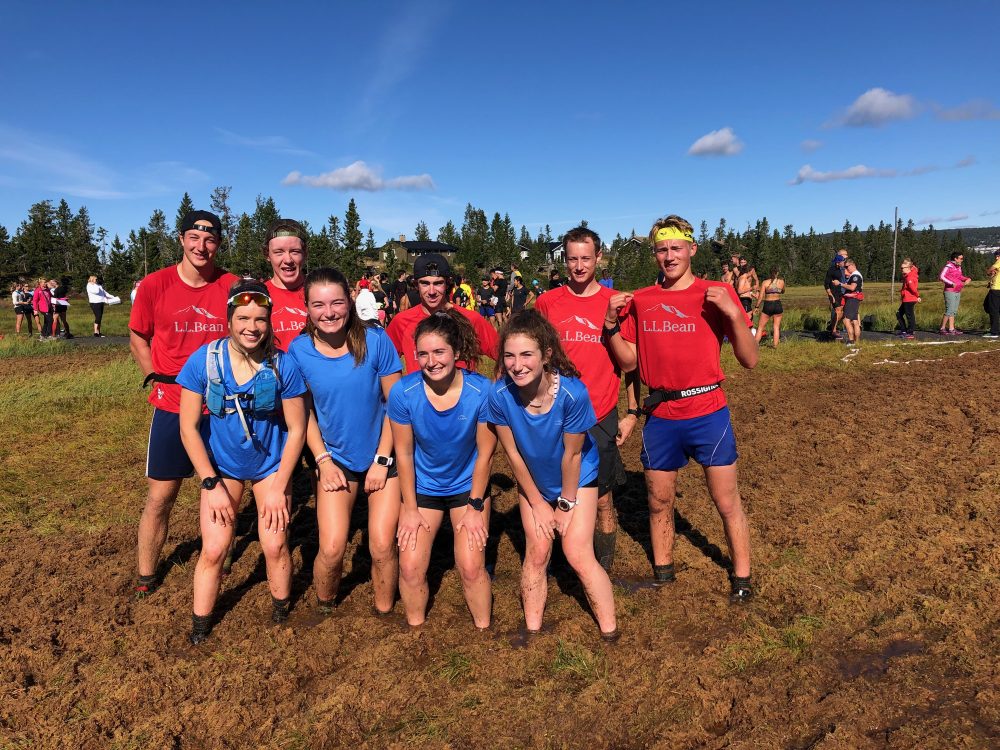
Americans during a muddy training session at the 2018 International Junior Camp in summer 2018 in Sjusjøen, Norway. (Front row, l to r) Abby Jarzin, Mae Chalmers, Sophie Shomento, Molly Gellert, and Noel Keeffe. (Back row, l to r) Ben Ogden, Wyatt Gebhardt, Ti Donaldson, Gus Schumacher. (Photo: Maria Stuber)
“And my angle on that,” Schumacher says, “was that I didn’t want to start my NCAA [eligibility] clock – if I take 12 credits, that starts the clock. And if it’s my plan to involve NCAA skiing down the road, I would like to have all of my eligibility. So whether it’s a 26-year-old Norwegian or a 26-year-old American that’s still doing it, I’d like to have that option open.” For now, he notes, “I have the opportunity to get some smaller scholarships that don’t require a full class load.”
Speaking of money, Schumacher also intends to tread very carefully over the next few years when it comes to accepting any potential prize money from SuperTour races or national championships.
“I’m definitely looking to preserve that eligibility,” Schumacher says, explaining that he will look at the NCAA rules very carefully to see what, if anything, he is allowed to accept in terms of prize money.
“I’d definitely double-check that before accepting any prize money,” Schumacher notes. “But the idea is to stay eligible, if I ever wanted to do that.”
Season goals and a return to World Juniors
So let’s go back to last year’s World Juniors men’s relay for a second, featuring a relay lineup that underscored the fact that American junior cross-country skiing is fundamentally a very small world, as well as that 3-kilometer Anchorage middle school competitions are truly a breeding ground for future champions.
Luke Jager, an Anchorage skier who had told this site that he prepared for the race by “reminiscing about beating Gus Schumacher at the season opener middle school race in 8th grade” in February 2014, skis the scramble leg, keeping the Americans in sixth as a number of teams already start to drop off the pace. Ben Ogden, a Vermont skier of whom Jager and Schumacher once wrote, “We were so impressed that @ben.0gden could beat any of us that we decided to make him an honorary Alaskan,” brings the team up to fourth by the end of leg two. Hunter Wonders, an Anchorage skier who finished 1.7 seconds behind Jager in the sixth-grade season opener middle school race in January 2012, holds that position through leg three, handing off to Schumacher 31.3 seconds out of first and 26.2 seconds off the podium.
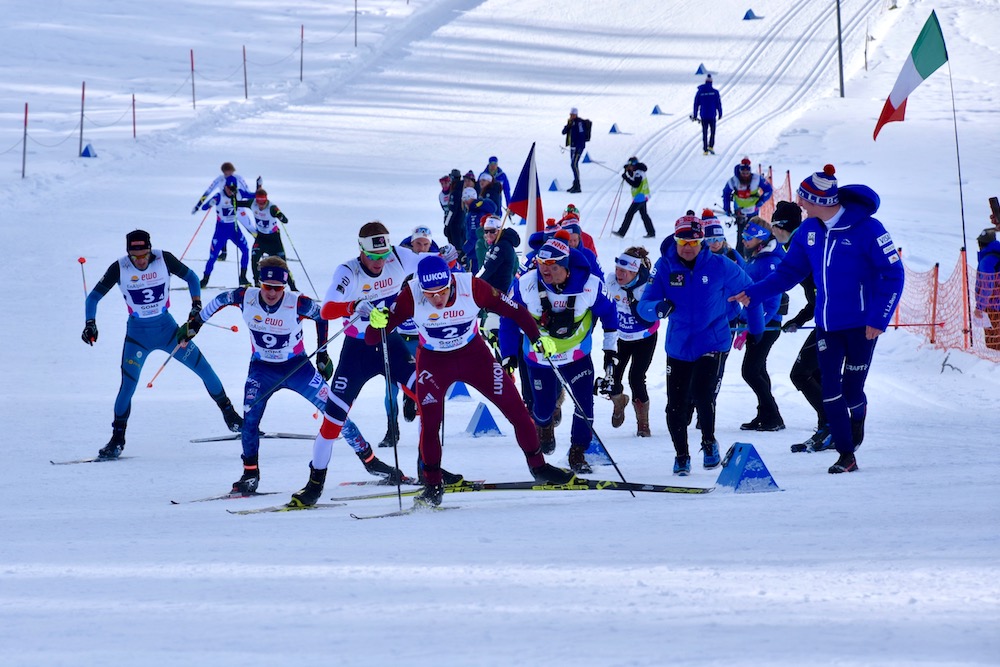
Russia’s Alexander Terentev leading Norway’s Jørgen Lippert, American Gus Schumacher (9), and France’s Pierre Tichit (3) up a climb in the final leg of the men’s 4 x 5 k relay at 2018 Junior World Championships in Goms, Switzerland. American coach Bryan Fish (NNF hat) is to Lippert’s left. (Photo: Julia Kern)
Each leg is only 5 kilometers long, but Schumacher takes off on his anchor leg like a man possessed. He catches France, moving the U.S. onto the podium. He comes around the final corner and suddenly catches sight of Russia and Norway ahead of him. Schumacher surges, Russia’s Alexander Terentev does not, and Schumacher exults across the finish line to secure a historic silver medal for America, 2.2 seconds behind Norway in first. “Second in the world with the boys,” Jager writes on Instagram. “Doesn’t get much better.”
“There was definitely a good amount of surprise there,” Schumacher candidly says of the result. “I remember pretty distinctly the night before, in the pre-race meeting, Hunter saying something about, ‘If the stars align, we could podium.’ … We definitely didn’t write ourselves off, but we also weren’t thinking we had a guaranteed spot anywhere.”
But once the race began, Schumacher recalls, “Every lap it got more and more exciting. Like, ‘Oh, cool, Luke’s hanging with the lead pack.’ And then, like, ‘Oh, lots of people got dropped from the lead pack, and Luke’s still there. Oh, the lead pack is down to five, and Ben’s still there. And then Hunter’s hanging on, and not losing time.’ It was really cool and exciting – and you could tell the excitement of everyone there, like the coaches are like, ‘you ready, Gus’; they can see what’s happening, and we can all see what’s happening. It was a pretty fun event to be a part of.”
When Schumacher spoke with FasterSkier in late December, before U.S. nationals, he said with an absolutely straight face that he just hoped to qualify for this year’s team.
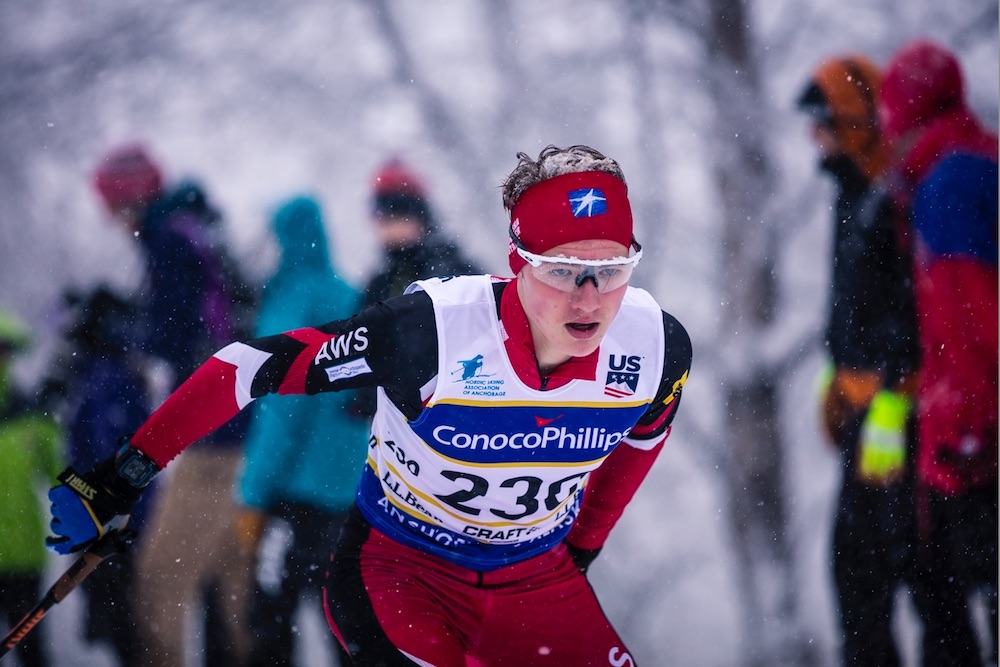
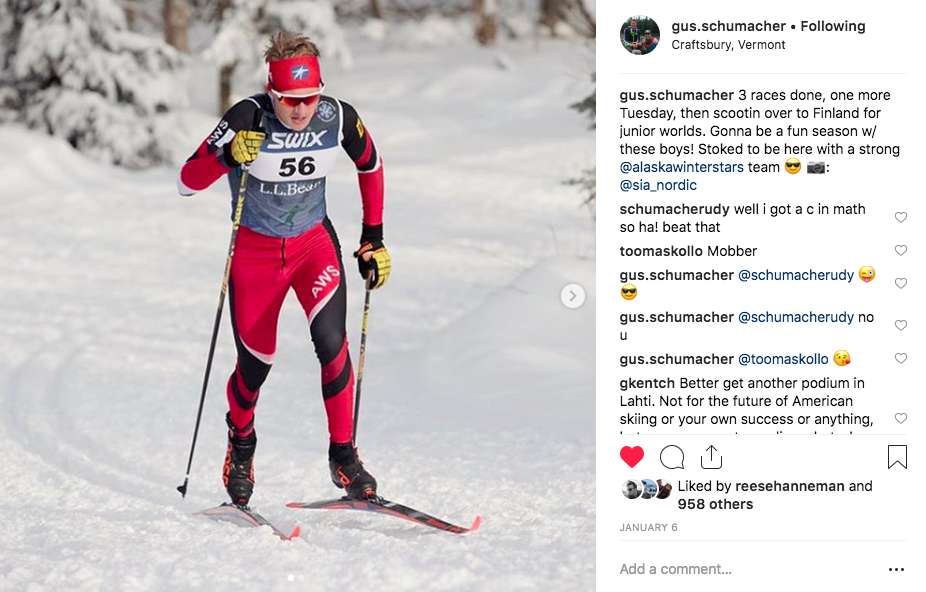
Gus Schumacher (AWS) racing at U.S. nationals in Craftsbury, Vermont, in January 2019. (photo: Instagram screenshot)
When asked about a results goal for this season, Schumacher immediately zeroes in on this event: “My biggest goal is to improve on our relay result from last year at World Juniors, and win that race. I think that would be super crazy, and super fun. I think that this, or next year too, is the year to do it; there’s such a strong group of guys that has a lot of chemistry. I think that – if we did that, I could sign off on the season from there. That would be pretty amazing.”
(It’s worth noting that the U.S. had by far the youngest relay team of the top-10 teams at last year’s World Juniors; while Norway et al. will obviously refill their ranks from within, Schumacher really could have two more cracks at this race.)
After World Juniors, which occur in Lahti, Finland, from January 20-27, Schumacher hopes to stay in Europe for some time. “There’s a possibility that I would stay, maybe in Norway with a friend, or somewhere over in Europe, and continue some high-level races, possibly with Luke, and then maybe the OPA Cup trip, and SuperTour Finals after that. All of it obviously sort of depends on how I’m doing, and how I’m feeling and stuff. But ideally I spend a good amount of time in Europe, getting some race exposure, and getting some success, and competitive races there, and just kind of keep my season going after Nationals.”
Looking to the future
Schumacher is asked what the American success in Goms last year says about the current strength of American men’s skiing.
His answer reflects an athlete who recognizes a cliché when he sees it, but who nonetheless sincerely believes in the strength of the team: “I think you don’t have to look super deep into it to notice that there’s a strong group of guys that are coming up. And it extends way past that relay team. I think it’s, maybe not cliché yet, but it’s said a lot, that, like, there’s a team behind the team. And I think one of the big things to say about the future is that there were four guys in bibs that day, but – this is going to sound pretty cliché – but there were twenty that got us there. You see other athletes, like Johnny Hagenbuch, that have the potential – I could list off ten people that could be on that relay team this year. Like, I might not even part of that. There’s so many fast boys that are really into it; I think there’s some promise there.”
Finally, a similar theme emerges when the topic turns to the future of American men’s skiing over the next generation: Be a successful team, just like the American women.
I would like, everyone would like, us to be like the girls – they’re really good.
“Obviously I don’t know” what the future holds, Schumacher says, “but a pretty strong upwards trajectory is what I would say. I think the goal obviously, sort of unspoken, but I would like to see us get to where the girls are. They have a ton of success, and to try to mimic that, and do what they’ve been doing – everyone talks about the team, and I think that for this whole generation, not just like this year’s juniors, but even the older ones as well, there’s that sense of team. I would like, everyone would like, us to be like the girls – they’re really good. I think it’s possible. It would be really cool, and I think it’s doable.”
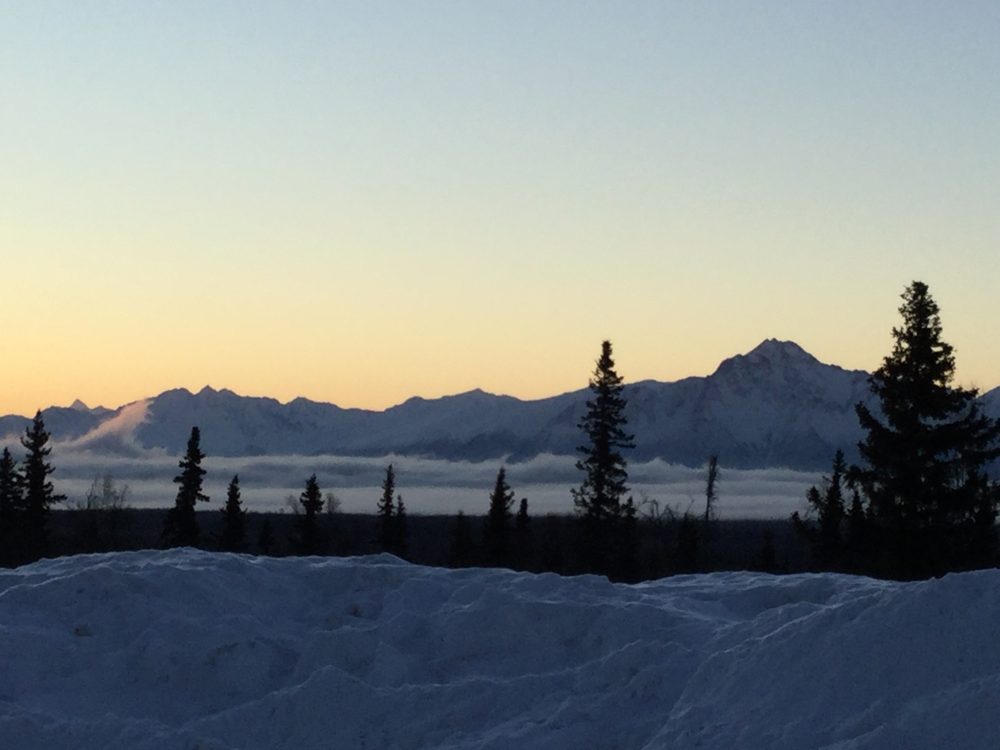
The Chugach Mountains and a winter sunrise, seen in this file photo view from the parking lot at Government Peak Recreation Area, Palmer, Alaska, in February 2018. (photo: Gavin Kentch)
Note: FasterSkier is accepting submissions for regional race reports, including for juniors racing. If you would like to see a particular race circuit covered and have the writer with the will to do it, please have them email info@fasterskier.com. Be sure to include a link to results, and preferably a few original race photos with proper credits.
GOVERNMENT PEAK RECREATION AREA, outside Palmer, Alaska — On a day that had a decidedly old school feel, one of the state’s newest racing venues took center stage, as Government Peak Recreation Area successfully hosted the opening Besh Cup races of the 2018/2019 Junior Nationals qualifying series this past weekend on less than a week’s notice.
Saturday morning saw U18 boys and up cover 15 kilometers, on a hilly two-lap course; U18 girls and up raced 10 k, on an even hillier two-lap course. It was classic technique, it was interval start, it was cold, and the trees were draped with fresh snow. It felt like a World Cup race circa 1990.
Senior women Hailey Swirbul, Rosie Frankowski, and Lydia Blanchet. (photo: courtesy CCAK)
The comparison isn’t totally bathetic, given the overall leaderboards for Saturday’s races: Rosie Frankowski, Hailey Swirbul, and Kendall Kramer for the women, and Gus Schumacher, Luke Jager, and Hunter Wonders for the men. That’s an Olympian and a three-time World Juniors medalist for the women, and three-fourths of this spring’s breakthrough World Juniors silver medal relay team for the men. Oh, plus the 16-year-old Kramer, who was third in the junior women’s 5 k classic mass start at 2018 U.S. Cross Country Championships and who may have a pretty bright future in this sport herself.
Saturday: distance classic races
Male racers set out at 11 a.m. Saturday morning from the compact stadium at Government Peak Recreation Area (GPRA), a labor of love by the Mat-Su Ski Club and the Palmer and Wasilla ski community over the past ten years. They headed out on a course that is a poor man’s Davos distance course, with consistent climbs and V2-able false flats for the first two-thirds of the loop, giving way to a working downhill and a sharp drop back to the stadium. Or to just below the stadium, actually; the course ends with a grueling B-climb immediately before the finish (see next picture, below right). The obvious challenge is to pace the uphills easily enough the first time to ski the downhills and flats efficiently, then do the same thing a second time in lap
After roughly 80 racers had covered two 7.5 k laps in the day’s first race, leaving the stadium at 30-second intervals, it was Schumacher who had done this most efficiently, covering 15 k in 43:23.11. Jager (+12.36) and Wonders (+26.53) made up the overall podium. The top three senior athletes were Wonders, Logan Hanneman (fourth overall), and Tyler Kornfield (fifth).
The top three U20 racers on the day were Schumacher, Jager, and Ti Donaldson, who was seventh overall. Leading the U18 racers were Zanden McMullen (15th overall), Everett Cason (16th), and Max Germain (19th). 50-year-old Adam Verrier, a 1994 Olympian, was the top Master in 47th. Behind Schumacher, who skis for Alaska Winter Stars, in first, Alaska Pacific University (APU) showed its depth by putting six skiers in the top 10 and 10 in the top 16.
Part of the final climb leading back up to the stadium at the end of the Government Peak comp loop, seen in this file photo view from November 1, 2018. (photo: Gavin Kentch)
The day’s second race saw 43 women, age U18 and up, take on two laps of the Davos-lite 5 k course described above. Two laps of 5 k at Government Peak is in many ways harder than two laps of 7.5 k, as the longer course adds 2.5 kilometers of gently rolling terrain near the end of the homologated (or perhaps homologation-pending) 5 k course. The 5 k course has no such recovery intermezzo, and the final climb of the first lap segues into the first climb of the second lap for a difficult extended climb with negligible recovery.
After two laps and 10 k classic, the day’s last starter, Rosie Frankowski, posted the fastest time, finishing in 32:28.01. (While snow conditions are obviously extremely variable from one venue and race to the next, making time comparisons unreliable, and Frankowski did not have World Cup skiers in front of her to chase on Saturday, the fact that Frankowski has previously skied a World Cup 10 k classic in 27:44, on a homologated course in Falun with 365 meters of total climb, suggests that the new Government Peak comp loop deserves respect.)
Frankowski’s APU teammate, Hailey Swirbul, was second on Saturday, 22.39 seconds back. Kramer (+1:42.15) was third, ahead of a top-10 otherwise composed of skiers from the University of Alaska Anchorage and local Dartmouth College skiers home for winter break.
The top three senior athletes were Frankowski, Swirbul, and Lydia Blanchet, who was fourth overall. The U20 podium was Jenna Difolco (seventh overall), Molly Gellert (17th), and Maggie Meeds (23rd). Somewhat ahead of them were the three fastest U18 skiers: Kramer, Adrianna Proffitt (11th), and Ivy Eski (14th). M4 skier Alison Arians, in 18th, was the top Master.
U16 girls Katey Houser, Marit Flora, and Victoria Bassette. (photo: courtesy CCAK)
Next out on the course were 51 U14 and U16 boys, who did a single lap of the comp loop. U16 skier Aaron Maves, like Frankowski before him, lived up to his top seeding, finishing one lap in 16:35.99. Second and third went to Konrad Renner (+18.99) and Eli Merrill (+36.83), also both U16 athletes. The top U14 skiers in this race were Skyler Amy (22nd overall), Murphy Kimball (23rd), and Aven Elsberg (26th).
Moments later came the start for the first of 49 U14 and U16 girls, as organizers efficiently put roughly 250 total athletes out on course at a venue that is a one-hour drive from Anchorage and sees a mid-December sunrise some time after 10 a.m. U14/U16 girls likewise did one lap of the 5 k comp loop.
Quincy Donley had the highest seed and final start position for this race, but 5 k later it was penultimate starter Marit Flora who took the victory. Flora finished in 18:23.47. Donley was 22.78 seconds back in second. Meredith Schwartz (+48.59) was third.
All three podium finishers were U16 girls. The top three U14 finishers in the race were Heidi Schumacher (12th overall), Sammy Legate (15th), and Zarah Laker-Morris (24th).
Sunday: distance freestyle races
After the U12, U10, and U08 skiers finished up the first day’s races, and the afternoon’s sunset time of 3:33 p.m. threatened, volunteers took down the course, coaches packed up waxing equipment, and tired racers began the trek back to Anchorage homes or Mat-Su hotel rooms. The first volunteers were officially on site by 7:30 a.m. Sunday morning to assist with parking, although doubtless some people had returned to the venue by long before then.
Day two of racing brought some differences – freestyle instead of classic, shorter distances, and slightly warmer temperatures – but more repeat podium finishers than not across the day’s races.
The first division on course was again U18 boys/U20/Seniors/Masters men, this time with 78 starters going out at 15 seconds apart. Sunday’s skate race was 10 k freestyle interval start, twice around the 5 k comp loop (precisely the same as the senior women’s 10 k classic the day before). The top three overall were unchanged from Saturday’s 15 k classic: Gus Schumacher, then Jager, then Wonders, the World Juniors silver-medal relay team united once more. Schumacher’s time on Sunday was 26:17.07. Jager (+15.56) and Wonders (+42.74) were the only other two athletes to break 27 minutes on the hilly course.
U16 boys Josh Baurick, Konrad Renner, and Aaron Maves. (photo: courtesy CCAK)
The U20 leaders on Sunday were again Schumacher, Jager, and Donaldson, who was fourth overall. The senior podium was Wonders (third overall), Thomas O’Harra (fifth), and Forrest Mahlen (sixth). Best times for U18 skiers went to McMullen (seventh), Cason (11th), and Germain (16th), precisely the same U18 podium as in the 15 k classic. Much as on Saturday, behind Alaska Winter Stars skier Schumacher in first, APU placed seven athletes in the top 10.
The first Master, among eight Masters finishers on Sunday, was M1 skier Cody Priest, 30, a former skier and runner at the University of Alaska Fairbanks, in 25th overall.
Soon after the last of the Senior men collapsed across the finish line, the first of the U16 boys headed out for one lap of the 5 k course. (All races on both days were interval-start.) First on Sunday was Renner (15:21.27), improving on his second-place finish from the day before. Josh Baurick (+9.17) was second, with Maves (+17.20) staying on the podium but moving down to third after his victory on Saturday.
Next up were 43 U18 girls/U20/Seniors/Masters women. Neither Frankowski nor Swirbul raced on Sunday, but their APU teammate Jessica Yeaton, who skis domestically with APU but competes internationally for her native Australia, did after not racing on Saturday. Yeaton was seeded third in the 5 k skate but ended up first, covering one 5 k lap in 14:47.25. Kramer (+26.15) moved up to second overall on Sunday, with Emma Tarbath (+46.32) third, barely a second ahead of Lydia Blanchet in fourth. Anna Darnell was the fifth and final woman to break 16 minutes on the hilly course.
The senior women’s podium was Yeaton, Tarbath, and Blanchet. The top three U20 finishers were Jenna Difolco (seventh overall), Molly Gellert (ninth), and Emma Jerome (21st). The top three U18 finishers were, again, Kramer (also second overall), then Ivy Eski in eleventh overall, barely ahead of Annika Hanestad in twelfth. Arians (15th) was again the first Master.
U14 boys were the next race out on the course. Sunday brought a 3.75 k skate, on a course that covered most of the 5 k comp loop used throughout the weekend, but elided one major climb and the only rolling section from the top part of the course. The technique and the distance were different, but the U14 podium was precisely the same as on Saturday: Amy (13:29.76), then Kimball (+2.05), then Elsberg (+7.19).
Finally, U14 and U16 girls headed out on the same 3.75 k loop. Marit Flora took her second victory of the weekend by a substantial margin, finishing in 12:13.98. Katey Houser (+30.59) and Victoria Bassette (+32.64) collected their first podia of the weekend.
The overall podium was again all U16 racers. The U14 leaders were Legate (tenth overall), Heidi Schumacher (16th), and Nora Hulse (24th).
Reflecting the depth of skiing in southcentral Alaska, the roughly 250 entrants for the weekend’s races included a healthy six former Olympians (Rosie Frankowski, Logan Hanneman, Tyler Kornfield, Adam Verrier, Casey Wright, and Jess Yeaton) and four World Juniors medalists (Gus Schumacher, Luke Jager, Hailey Swirbul, and Hunter Wonders), as well as additional senior national championship podium finishers, most of the rest of the APU Elite Team, a dozen or more NCAA skiers, and scads of past Team Alaska Junior National members.
Both races were FIS races, as well as certified for National Rankings List purposes by U.S. Ski & Snowboard. FasterSkier unofficially calculates the USSA penalty at a healthy 41.99 points for the men’s distance races.
Thoughts on the weekend
Two common themes emerged after talking with a handful of the weekend’s podium finishers: One, these races are a good introduction to the season and to bigger races still ahead. And two, the new Government Peak courses are great. But hard.
As two-time U18 champion Zanden McMullen told FasterSkier Sunday afternoon, “Yesterday I was definitely hurting in the race, but I was proud to come out on top. I definitely felt a lot better today. I’m pretty happy going into the season, where I am; I still have a little work to do before Senior Nationals, but I’m super excited.”
U20 men Luke Jager, Gus Schumacher, and Ti Donaldson. (photo: courtesy CCAK)
Two-time overall champion Gus Schumacher expressed similar sentiments, telling FasterSkier, “I wanted to use [these races] to get into racing more, and get some more races under my belt, so I felt better at the bigger races. But obviously, to get into good racing shape, you want to be trying to race as best you can, so that was kind of the goal, to be able to start getting my racing speed to its top level.”
Schumacher, who is undefeated in five local races this year, including the Race to the Outhouse #1 hill climb at Hatcher Pass the preceding weekend and a sprint and distance race in Fairbanks in the Alaska Nordic Cup in early December, described his current shape as “pretty good.” He elaborated that he plans to add some more intensity soon, but thinks that he is “coming into my race form, and it looks pretty good. Good to have these fast boys around me to push me every day.”
Schumacher plans to do some trials with Alaska Winter Stars, possibly collaborating with APU, before flying to Craftsbury on December 29th for senior nationals.
Two-time U18 champion (and double overall podium finisher) Kendall Kramer sounded similar notes, but was somewhat more introspective when asked what her weekend results told her about her current fitness and the upcoming race season.
“I got invited to a lot of national camps this summer,” Kramer said to FasterSkier, “and I think being exposed to so many different training groups and training styles – I really diversified how I trained this year, and so I’m happy that it’s working out for me. It’s less stressful, and I’m putting less pressure on myself.”
Kramer, who had never previously raced at Government Peak, described the new courses as “really, really tough.” She seemed to recognize that the course profile was advantageous to her, while stopping short of actually saying that she had enjoyed them when asked if she had liked the courses: “I mean, yes, being super small and light and getting up hills – I wouldn’t pick this venue, necessarily. But I think it was good for me.”
Ivy Eski, who claimed a pair of U18 podium finishes on the weekend, was more effusive.
“I love it,” she told FasterSkier. “It was really fun. I definitely want to race here again. The courses are amazing.”
Eski also praised the “really good snow and super good grooming,” calling it “overall really a great weekend.”
U18 boys Everett Cason, Zanden McMullen, and Maxime Germain. (photo: courtesy CCAK)
And McMullen, who had also never raced at this venue, similarly said of the new courses, “They’re tough, but I like them. You definitely have to be on top of it to be able to push it and go fast.”
Are they as hard as a nationals course? he was asked. “I definitely think they could be,” said McMullen, who has raced throughout the U.S. as well as in Finland. “Because if you don’t ski it correctly, you could be hurting.”
* * *
The overall success of the weekend is noteworthy only in light of two facts: That the Mat-Su Ski Club had never hosted an event at this level before, and that it did so on less than a week’s notice, as poor trail conditions throughout southcentral Alaska forced governing body Cross Country Alaska (CCAK) to have a series of competition committee meetings and teleconferences during the week of December 3 to decide where in the state to send 250 athletes and their parents for a weekend of racing. (Anchorage and Fairbanks are a six-hour drive apart, nearly the twice amount of daylight in Fairbanks in mid-December; the decision to move a race weekend is not made lightly.)
On Sunday evening, December 9, CCAK announced the decision of the Competition Committee to have the opening Besh Cup weekend at the Government Peak ski trails. Six days later, skiers were pouring into the carefully managed, not-really-large-enough parking lot for the weekend’s first race, with overflow parking stretching hundreds of yards down one side of the access road. Notwithstanding the venue’s youth and the Mat-Su Ski Club’s relative inexperience, all races on both days appear to have gone flawlessly. (Full disclosure, this reporter contributes money to Mat-Su Ski Club for grooming each year, but was not otherwise involved in organizing or supporting these races save for paying an entry fee for both days to race as a Masters athlete.)
Senior men Logan Hanneman, Hunter Wonders, and Tyler Kornfield. (photo: courtesy CCAK)
Next up
Besh Cup racing for Team Alaska selection continues with two more weekends of racing, currently scheduled for Soldotna on January 19-20, 2019, and Fairbanks on February 2-3. There are traditionally two interval-start distance races, two mass start distance races, and two sprint races throughout the six-race Besh Cup series, three races each of skate and classic. CCAK will announce future race details in advance of upcoming race weekends, after atypically starting the season with two consecutive interval-start distance races due to the last-minute move to Government Peak.
2019 Junior Nationals will be held at Kincaid Park in Anchorage from March 9-17, 2019. Recent snowfall has brought the trails there from, as CCAK recently described them, “ice/grass rinks” to skiable within the past week (that is, after the decision was made to move the races).
While relatively warm temperatures hindered the Nordic Skiing Association of Anchorage (NSAA)’s ability to make snow through the early winter, leading to NSAA running the snowmaking system for only 48 hours through November 28, the snowmaking system did survive the 7.0 earthquake of November 30 unscathed, NSAA Business Manager Erin Beam told FasterSkier in an early-December email. “NSAA has tested it since the earthquake, and there are no apparent damages or problems,” she wrote at the time. “It’s certainly incredible it wasn’t worse.” NSAA has made some snow at Kincaid within the past week or so, in addition to grooming the natural snow on most trails.
On Thursday, U.S. Ski & Snowboard released its roster for its 2018/2019 national cross-country team nominations, and the list includes five returning A-team members (four women and one man), an all-male B-team, and seven athletes on the D (development) team.
Kevin Bolger (Sun Valley Ski Education Foundation) during his debut World Cup race weekend in Lahti, Finland, last March. There, he placed 11th in the freestyle sprint and 54th in the 15 k classic. (Photo: Fischer/NordicFocus)
Simi Hamilton leads the men’s team as its lone A-team member, while Sadie Bjornsen, Sophie Caldwell, Jessie Diggins, and Ida Sargent are all back on the A-team. The B-team includes three returners — Erik Bjornsen, Paddy Caldwell and Scott Patterson — as well as 25-year-old rookie Kevin Bolger, out of the Sun Valley Ski Education Foundation (SVSEF), who was named to the team after some breakthrough World Cup results last season.
All four of last year’s D-team were renominated, namely 2018 NCAA champions Katharine Ogden (who swept both races at the collegiate championships) and Ian Torchia, Julia Kern and Hannah Halvorsen. Joining them are three athletes who broke through at 2018 Junior World Championships: Hailey Swirbul, Ben Ogden and Gus Schumacher.
Seven of the 16 nominees train with the Stratton Mountain School (SMS) in Vermont. Six others are based out of Anchorage, Alaska; five train with Alaska Pacific University (APU) while the 17-year-old Schumacher hails from the Alaska Winter Stars. The Craftsbury Green Racing Project has one athlete on the team (Sargent), as does SVSEF (Bolger). Torchia is entering his senior season at Northern Michigan University.
Here’s the U.S. Cross Country Ski Team’s nomination list. The team will be officially named this fall.
U.S. Ski Team2018-19 Cross Country Nominations (Hometown; Club; Birthdate)
A TEAM Men
Simi Hamilton (Aspen, Colo.; Stratton Mountain School Elite Team; 5/14/87)
Women
Sadie Bjornsen (Winthrop, Wash.; Alaska Pacific University Nordic Center; 11/21/89)
Sophie Caldwell (Peru, Vt.; Stratton Mountain School Elite Team; 3/22/90)
Jessie Diggins (Afton, Minn.; Stratton Mountain School Elite Team; 8/26/91)
Ida Sargent (Orleans, Vt.; Craftsbury Green Racing Project; 1/25/88)
B TEAM Men
Erik Bjornsen (Winthrop, Wash.; Alaska Pacific University Nordic Center; 7/14/91)
Kevin Bolger (Minocqua, Wisc.; Sun Valley Ski Education Foundation; 4/11/93)
Patrick Caldwell (Lyme, N.H.; Stratton Mountain School Elite Team; 2/18/94)
Scott Patterson (Anchorage, Alaska; Alaska Pacific University Nordic Center; 1/28/92)
D TEAM Men
Ben Ogden (Landgrove, Vt.; Stratton Mountain School; 2/13/00)
Gus Schumacher (Anchorage, Alaska; Alaska Winter Stars; 7/25/00)
Ian Torchia (Rochester, Minn.; Northern Michigan University; 3/8/96)
Women
Hannah Halvorsen (Truckee, Calif.; Alaska Pacific University Nordic Center; 2/19/98)
Julia Kern (Waltham, Mass.; Stratton Mountain School Elite Team; 9/12/97)
Katharine Ogden (Landgrove, Vt.; Stratton Mountain School; 11/17/97)
Hailey Swirbul (Aspen, Colo.; Alaska Pacific University Nordic Center; 7/10/98)
Molly Gellert (Alaska Winter Stars) racing in the freestyle sprint on Sunday, Jan. 28, at 2018 Junior World Championships in Goms, Switzerland. She placed 18th overall on the day. (Photo: Glenn Gellert)
In an effort to showcase the North Americans who competed at last week’s International Ski Federation (FIS) 2018 Nordic Junior/U23 World Championships in Goms, Switzerland, we asked those qualifying athletes several questions about themselves — actually, we had them fill in the blanks. Here we have 17-year-old Molly Gellert, of Alaska Winter Stars, who represented the U.S. at her first Junior Worlds.
Last week in Goms, Gellert qualified for the freestyle sprint heats in 21st and went on to place 18th overall. She also placed 40th in the 10 k skiathlon.
***
“My full name is Margaret, but you can call me Molly.
I was born and raised in Anchorage, Alaska, and I learned to ski at 7 years old.
I spent the time between U.S. nationals and Junior/U23 Worlds explaining to my teachers why I’d be missing two weeks of their class.
The hardest workout I did in the last training year to prepare for this was bounding intervals with my team and coach Jan.
This is my second time in Switzerland and third time racing internationally, and so far it’s been grand.
One difference I’ve noticed between Switzerland and the U.S. are the duvets.
Skiing and racing in the Alps is picturesque. Usually racing at altitude is tough for me because I live at sea level. There are beautiful mountains around where I live.
One of the things I’m most excited about for Junior/U23 Worlds in Goms are the challenging courses on real snow.
One race I’m especially targeting there is the skiathlon.
I really hope I can chat/make friends with someone from Norway and ask them to adopt me.
My favorite thing at the breakfast where we are staying is the bread.
Fondue is not my favorite. The cheese here is authentic. And the chocolate comes in huge bars.
If I had a totally free day here and didn’t have to worry about race fitness or training, I’d spend it starting my homework.
The best way to follow me on social media is on Instagram @molly.gellert.”
Gus Schumacher (Alaska Winter Stars) racing at 2018 U.S. Cross Country Championships in his hometown of Anchorage, Alaska, earlier this month. (Photo: Charlie Renfro)
In an effort to showcase the North Americans competing at this week’s International Ski Federation (FIS) 2018 Nordic Junior/U23 World Championships in Goms, Switzerland, we asked those qualifying athletes several questions about themselves — actually, we had them fill in the blanks. Here we have 17-year-old Gus Schumacher, of Alaska Winter Stars (AWS), who’s representing the U.S. at his first Junior Worlds.
In three individual races in Goms, Schumacher has placed in the top 30 in all three: 19th in the freestyle sprint, 17th in the 10 k classic, and most recently 15th in the 20 k skiathlon on Thursday.
***
“My full name is August, but you can call me Gus.
I was born in Madison, Wisconsin, and raised in Anchorage, Alaska, and I learned to ski at Kincaid.
I spent the time between U.S. nationals and Junior/U23 Worlds at home doing local races.
Gus Schumacher leading Hunter Wonders during a rollerski session at the NEG (National Elite Group) Camp in October in Park City, Utah. (Courtesy photo)
The most productive workout I did in the last training year to prepare for this was L3 bounding with Molly Gellert, another AWS skier.
This is my third time in Switzerland and third time racing internationally, and so far it’s been super tight.
One difference I’ve noticed between Switzerland and the U.S. is the roads are narrow and people drive crazy.
Skiing and racing in the Alps is really pretty and warm. Usually racing at altitude is moderate to tough for me because I am from sea level. There are almost too many mountains around where I live.
One of the things I’m most excited about for Junior/U23 Worlds in Goms is racing with confidence.
One race I’m especially targeting there is the 10 k classic.
10. I really hope I can chat/make friends with someone from Germany and ask them about ski culture there.
My favorite thing at the breakfast where we are staying is the orange juice.
Fondue is usually melted cheese with bread to dip. The cheese here is lots of times the same stuff we get at home because at home it’s still Swiss cheese. And the chocolate is solid.
If I had a totally free day here and didn’t have to worry about race fitness or training, I’d spend it tanning.
The best way to follow me on social media is on Instagram @25gusbus and Snapchat @gusbus_2000.”
Alex Kilby (Alaska Winter Stars/Anchorage Biathlon Club) racing in the youth men’s 10.4 k sprint on Dec. 28, 2016 in Jericho, Vt. There, he earned a spot on the U.S. team for 2017 IBU Youth/Junior World Championships. (Photo: Catherine Kilby)
You know the drill. We did “Under 23 Questions” with the North American athletes at Nordic Junior and U23 World Championships, now we’re checking in with the world-class U.S. and Canadian biathletes that will be competing at 2017 International Biathlon Union (IBU) Youth & Junior World Championships Feb. 22-28 in Osrblie (also known as Brezno-Osrblie), Slovakia. We had them fill in the blanks to tell us more about themselves.
Starting off, here’s 18-year-old Alex Kilby, of Alaska Winter Stars and the Anchorage Biathlon Club, who will be representing the U.S. at his second Youth Worlds.
***
“My full name is Alexander Kilby, but you can call me Kilby. I was born in Manitowoc, Wis., raised in Anchorage, Alaska, and one thing you should know about my hometown is that moose like to stand in the trails, and some people have a harder time than others getting by them.
I started cross-country skiing when I was 11 and started biathlon when I was 12, thanks to Eagle Eyes Biathlon. I currently train in Anchorage with Alaska Winter Stars and Anchorage Biathlon Club.
If I’m not skiing, you might find me in the mountains. If I had to pick a favorite book, I wouldn’t because I hate reading.
One of the things I’m most excited about for Youth/Junior World Championships in Brezno-Osrblie is the crowds and attention biathlon gets in Europe. This will be my second time at Youth/Junior World Championships, and this year, I’m competing as a youth.
One race I’m especially targeting there is the sprint. The best advice anyone ever gave to me about skiing or racing was ‘Smooth is fast, fast is smooth.’
One of the best race memories I have is shooting clean in 2015 Youth World Trials.
If I could meet one World Cup skier, it would be Ole Einar Bjørndalen.
If I don’t end up being a professional skier, I’ll probably be an engineer.
I’m missing zero days of school to be here, and I don’t have any teachers/professors.
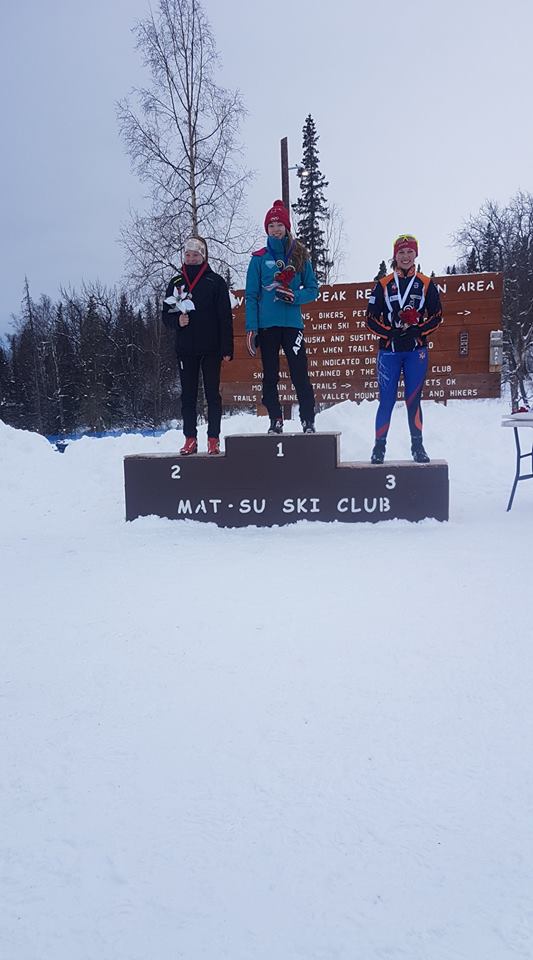
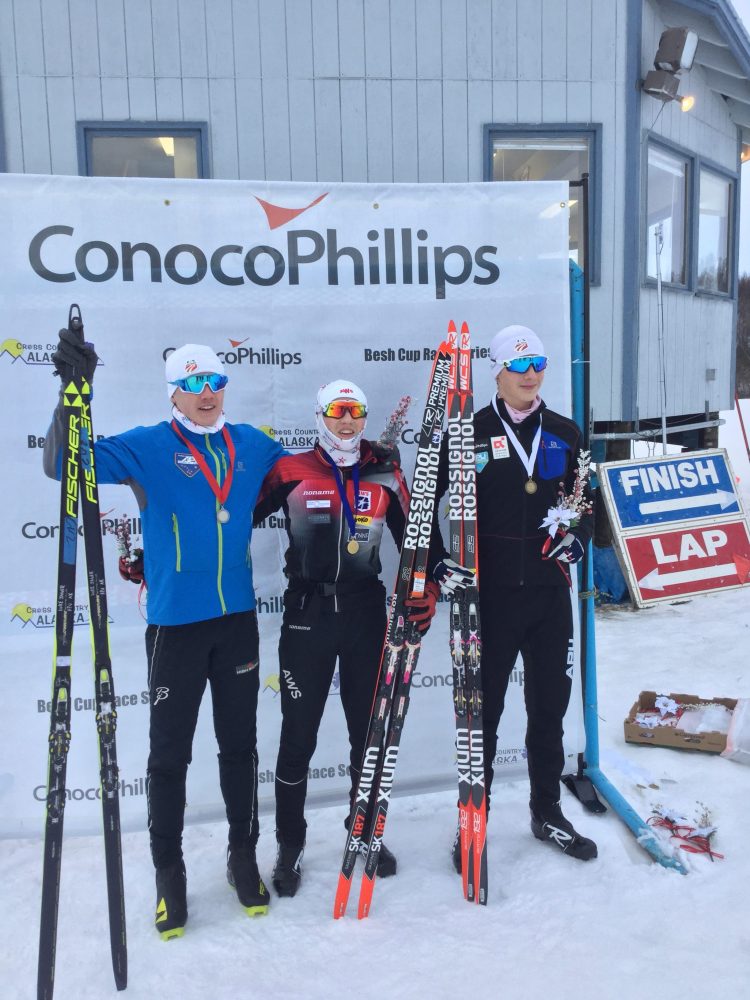
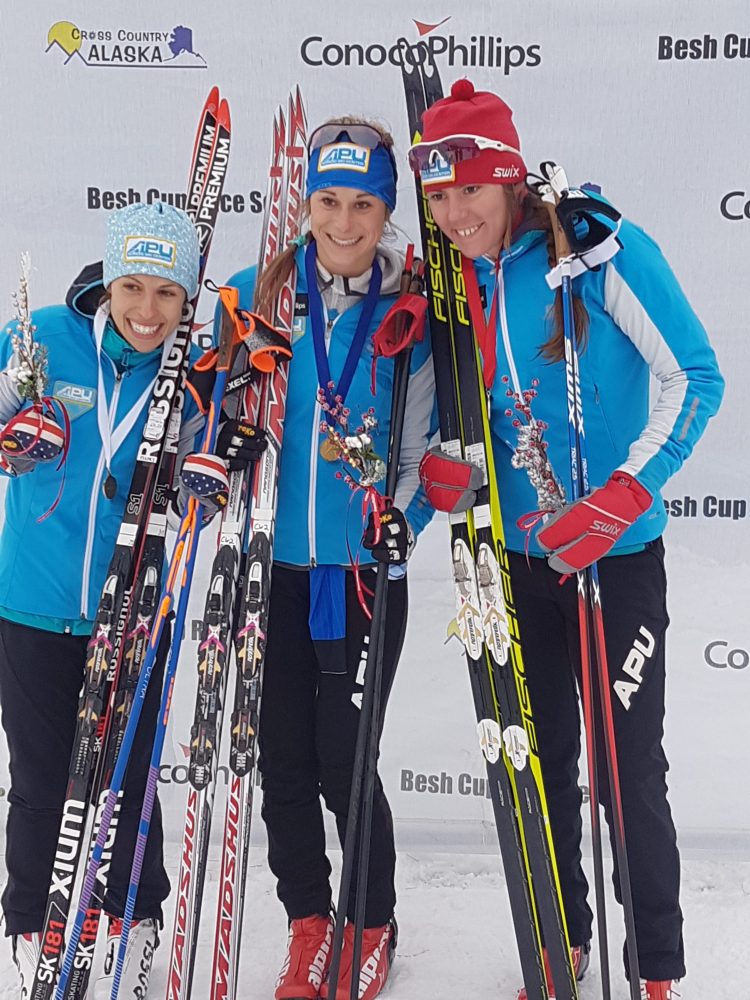
Jenna DiFolco (c) of FXC, Abby Amick of APU (l), and Addison Gibson of ANR (r) on the podium for the U18 girls division of the Besh Cup 5 k skate race in Fairbanks, Alaska, Feb. 4, 2017.
FAIRBANKS, Alaska — Alaska Airlines operates roughly 10 flights a day between Anchorage and Fairbanks. Last Friday morning many of those flights were packed with skiers, and ski bags piled up at baggage claim in Fairbanks, as Anchorage skiers streamed north for the final weekend of Besh Cup racing to select Alaska’s representatives to next month’s Junior Nationals in Lake Placid, N.Y. Two days later many of those same skiers returned south with plans to fly all the way to Lake Placid, where Team Alaska will have roughly equal representation from the state’s two largest cities.
The 2016/2017 Besh Cup series concluded with a pair of distance races at Birch Hill ski area: freestyle interval start on Saturday, classic mass start on Sunday. The weather for both days was Fairbanks at its mid-winter best, clear and sunny and relatively warm. Cold powder and hard glide waxes were de rigueur.
(The emphasis here is on relatively, as national FasterSkier readers might find Saturday’s race-time temperature of 10 degrees Fahrenheit, or Sunday’s reading of 2 degrees, objectively not all that warm. But it was -16 degrees at the airport on Sunday – Birch Hill’s elevated location on a hill above town often keeps it significantly warmer than the low-lying areas of central Fairbanks where official temperature readings are taken – and it is forecast to be -35 degrees in Fairbanks by later this week. So, relatively warm.)
The first race on Saturday was the boys 10-kilometer freestyle individual start for racers in the U18 division and older, 45 starters in all. The overall podium on Saturday was U18 skier Ti Donaldson of the Nordic Ski Club Fairbanks racing team (FXC), Senior skier Cody Priest of Alaska Nordic Racing (ANR), and U18 skier Josiah Alverts (ANR).
Among U20 men, FXC skier Benjamin Koenig was first, leading his teammate Logan Mowry in second and Dax Cvancara of ANR in third.
The U18 boys division, which saw two of the top-three overall finishers, had Donaldson in first, Alverts in second, and APU skier Tristan Wiese in third.
U16 boys raced a 5 k skate individual start, covering one lap of the blue course that 10 k skiers completed twice. Eli Hermanson of Alaska Winter Stars (AWS) led the all-Anchorage-area podium in the 5 k, followed by George Cvancara of ANR and Zanden McMullen of APU.
Finally, the U14 boys raced a 1 k skate ski-cross event, with jumps, gates, slaloms, and other technical challenges. The event is a crowd favorite that, race organizers wrote, “helps develop skiers’ abilities to ski in a ‘pack’ along with developing technical skills.” (It may also soon be coming to a race series near you! Here is an example from the 2016 Youth Olympic Games in Lillehammer.) In another Anchorage-area sweep, Aaron Maves of APU took the A-Final, followed by Rudy Schumacher of AWS and Konrad Renner from ANR.
On the girls side, a field of 57 racers (U16 and older) contested a 5 k skate individual start. At the end of one lap around the blue course, APU skier Maggie York took the overall victory by 40 seconds over FXC skier Jenna DiFolco, with Kendall Kramer (FXC) another 14 seconds back.
York also topped the U20 podium. She was followed there by Alyeska Daniels and Lupua Oba, both of FXC.
DiFolco, second overall, was first among U18 girls. Second in this division was Abby Amick of APU, with ANR’s Addison Gibson third.
U16 girls took third through fifth overall in the combined U16/U18/U20/Masters field for the 5 k (there were no Senior skiers in the race). Locals Kendall Kramer and Kaya Ratzlaff of FXC led this division, with Annika Hanestad (ANR) third.
U14 girls also raced a 1 k ski cross. First here was Quincy Donley of AWS, continuing her winning ways from the Anchorage and Soldotna Besh Cup weekends. She was followed across the finish line of the A-Final by Marit Flora of APU and Katey Houser of ANR.
Ti Donaldson of FXC (r) and Josiah Alverts of ANR (l) on the podium for the U18 boys division of the Besh Cup 10 k skate race in Fairbanks, Alaska, Feb. 4, 2017.
Saturday’s overall winner for the boys race, U18 skier Ti Donaldson, was racing on home turf. “I’ve had a few wins [in the Besh Cup series] in the past,” Donaldson told FasterSkier in an in-person interview following the race. “Most of them have been in Fairbanks. I’m from here, so definitely a home-field advantage.”
Donaldson came in expecting a “brutal” race, based on his knowledge of the course and his time previewing it. “But I knew it would be pretty fast conditions,” he continued – “it was nice and hard, and it wasn’t too cold. So I was pretty excited to see how it would go, and really just wanted to work the transitions and stay strong on the climbs, and crest over. So I stuck to that plan, and it worked out pretty well.”
Donaldson was looking forward to 2017 Junior Nationals in March.
“I’d be thrilled with a top-five finish,” Donaldson said of his goals for next month. “Two years ago, when I was racing the same kids, I placed fourth in a race, and so I’d like to repeat that result. That would be a good goal of mine.”
Jenna DiFolco, the U18 girls winner and second-place overall skier, was also racing at home. She credited “my FXC coaches” for waxing her winning skis, and had hot cereal for breakfast, with raisins and dried cranberries, at home before heading out to Birch Hill.
The race was “really fun,” DiFolco recounted in an in-person interview. “Warming up, I didn’t feel so good, I was feeling kind of tired, maybe I’d overdone it this week. And then I expected this course to be really hard, because there are so many hills. And it was definitely, like, it was a rough course. But it went a lot better than I expected it to.”
DiFolco described her strategy for racing a one-lap 5 k course with nearly constant climbing or descending: “The first part is mostly downhill, so I kind of just started out like a sprint almost, because I knew I’d be able to recover on the downhill. And the first couple of hills I was just trying to keep it light, keep it relaxed, and then really start hammering up South Tower [the high point of the course], because I got a big break after that. And then the last two hills are basically just hard, really hard.”
Looking ahead to Lake Placid, DiFolco said that she was “hoping to get a couple top-10 finishes.” She added, “A big dream, it’d be a big stretch, but I’m hoping to get, like, a podium would be really, really cool. But top 15, top 10 would be awesome.”
Sunday saw classic mass starts instead of freestyle individual starts, and temperatures around 10 degrees colder, but otherwise it was more of the same. Seven of eight age-group winners from Saturday picked up a second victory on Sunday, as a pair of distance races rewarded skiers who were consistent in both techniques. (The first two weekends had featured one sprint and one distance race apiece, leading to greater variability in the podium finishers.)
Sunday’s classic race also rewarded skiers who were good at traditional classic skiing, in light of the relatively slow snow and the impressive elevation change of a Birch Hill race course.
The trails at Birch Hill are built on the side of, well, a hill (also, there are birch trees). The courses used for this weekend’s races were marked by an impressive Height Difference (the elevation change between the lowest and highest points on the course) of 89 meters within a 5-kilometer course. The World Cup skiathlon race that was contested in South Korea the same weekend, on the trails that will be used for the 2018 Winter Olympics in PyeongChang, featured height differences of only 58 and 41 meters on the two skiathlon courses.
In fact, a height difference of 89 meters is a greater elevation spread than was present on most of the traditional World Cup courses this season, including in Davos (84m), Lillehammer (74m), Falun (69m), and Ulricehamn (57m). That said, some of those courses had more average climb per kilometer than the Birch Hill 5 k course. But only some of them. This may help explain why the winning time for a 10 k skate on Saturday was 29:22 for the men, and 16:15 for 5 k for the women, in a race with some of the top junior skiers in the country. (Winning times for Sunday’s 10 k classic races were 32:17 and 37:53.)
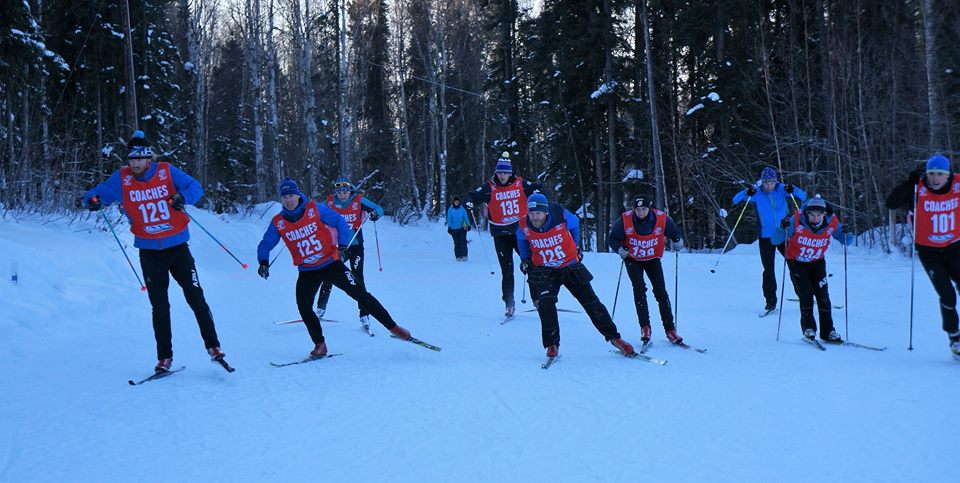
Coaches compete in the final ski-cross heat of the day, the coaches’ race, on Feb. 4 in Fairbanks, Alaska. Racers include Galen Johnston (129), Eric Strabel (125), Anson Moxness (126), and Pete Leonard (101). (Courtesy photo)
APU Devo and Master Coach Galen Johnston shared his thoughts on the effects of such a course profile after spending the weekend watching his athletes race up and down these hills. “One of the best parts of the weekend was to see how the combination of slow snow and lots of strideable sustained climbing put the focus of the [classic] races on striding and fitness rather than simply double pole strength,” Johnston wrote to FasterSkier on Monday.
“Courses designed like this can keep striding a viable, and even necessary part of classic skiing,” Johnston continued by email. “Birch Hill has some of the most progressive course designs that I’ve seen and it’s paying off. Skiers ski differently than they did even 10 years ago, and it’s really neat to see a course that can accommodate and challenge that change in style without turning things into an unskiable death march. Estle is keeping people very honest, but still allowing for ample fun,” Johnston concluded in reference to longtime Fairbanks race director and ski-course designer (and former U.S. Ski Team coach) John Estle.
On Sunday the best strider was DiFolco, who took first place in the 10 k classic mass start race by 19 seconds over Saturday’s winner York. Third overall was ANR skier Heidi Booher (ANR), another 23 seconds back.
York was again first in the U20 women division. The rest of the podium was also unchanged from Saturday, with Daniels in second and Oba in third.
DiFolco was again first among U18 girls. Second on Sunday was Booher, with Emma Nelson of ANR third.
There was a substantial drop-off in distance from U18 girls to U16 girls, with the latter group racing not 10 k but a 3 k classic mass start. First after just under 10 chaotic minutes was Kramer again, edging out her FXC teammate Ratzlaff by 0.7 seconds. Tjarn Bross rounded out the all-FXC podium in third.
U14 girls raced the same 3 k course as the U16 girls. And after 11 to 12 minutes of racing, it was precisely the same U14 girls podium as on Saturday: Donley, Flora, and Houser.
On the boys side, U18/U20/Senior/Masters skiers raced a 10 k classic mass start on the same course as the girls. First overall was Lukash Platil (officially unaffiliated, but listed on the University of Alaska Fairbanks (UAF) ski team roster), followed by Donaldson of FXC and Wiese of APU.
Platil was also first in the Senior men’s division. He was followed there by Kenny Brewer (now unaffiliated, formerly of UAF) and Matt Muffoletto (The Other Guys).
Among the U20 men, Koenig picked up his second first place of the weekend, and Mowry his second second place. Hamish Wolfe (APU) was third.
Donaldson and Wiese led the U18 boys. They were followed by Alverts, as the age group podium remained largely unchanged from Saturday.
The U16 boys raced a 3 k classic mass start. This was the only age group to see a new winner on Sunday, as Cvancara moved up from second the day before to nudge Hermanson down a step on the podium. Everett Cason of APU was third.
And the U14 boys (also 3 k classic) were again an all-Anchorage affair: Maves once again in first, Rowan Morse (APU) in second, and Schumacher in third.
Later Sunday afternoon a crowd gathered in the Birch Hill Recreation Center, ignoring Super Bowl LI then in progress, for the naming of Team Alaska for this year’s Junior Nationals (JNs).
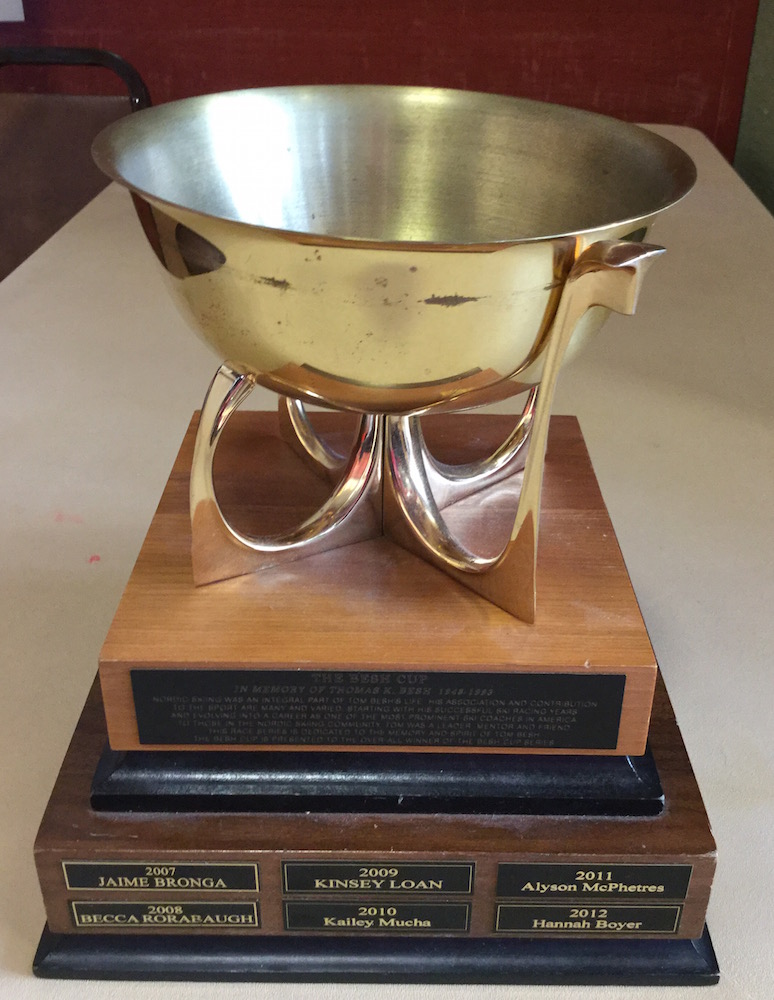
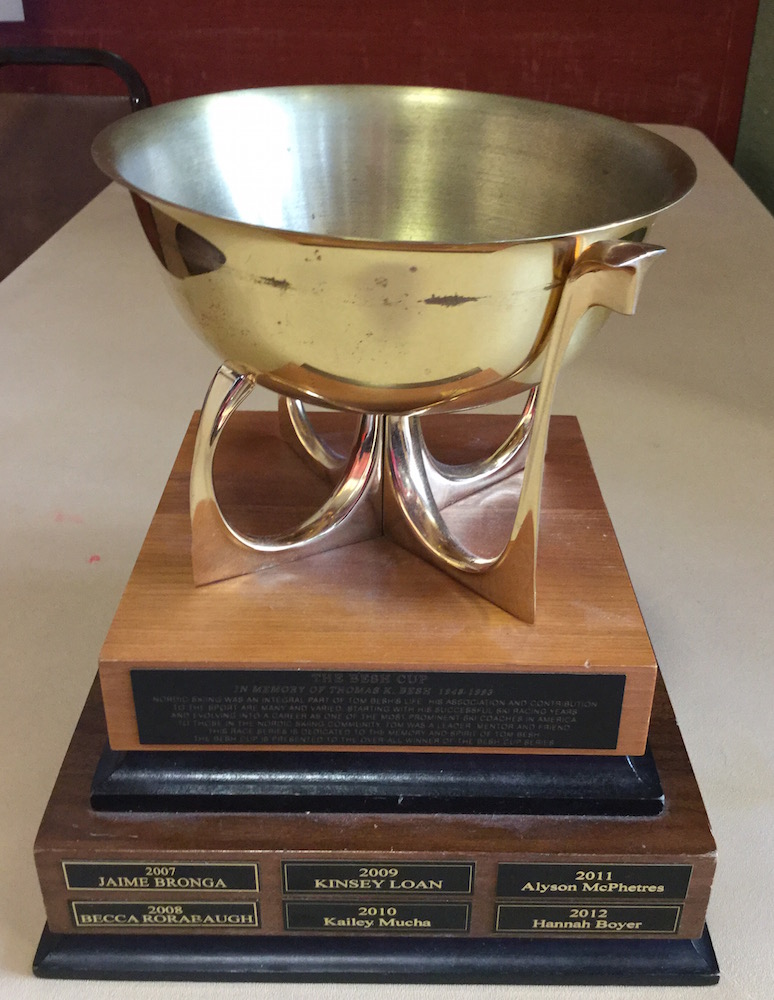
The Besh Cup Trophy, photographed in Fairbanks, Alaska, in February 2017.
Cross Country Alaska also awarded the Besh Cup Trophy, given to the U18 or U20 skier with the greatest number of JN qualifying points across all six races combined. This year’s winners were Josiah Alverts for the boys and Jenna DiFolco for the girls. Their names will be added to a trophy, Stanley Cup-style, that includes on its plinth recognizable names from American skiing such as David Norris, Becca Rorabaugh, Reese Hanneman, Andy Liebner, Zach Hall, Eric Strabel, Kate Pearson, and Rob Whitney.
While winning the Besh Cup Trophy is undeniably prestigious, it also necessarily rewards the best skier who was in Alaska all winter for the races, as opposed to competing Outside or internationally. For example, among U18/U20 girls, you may have heard that the University of Alaska Anchorage’s Hailey Swirbul was racing in Soldier Hollow, while Molly Gellert was on the Scandinavian Cup trip in Norway.
DiFolco graciously acknowledged as much, telling FasterSkier on Sunday soon after receiving the trophy, “I think some of the fastest skiers are not here, because they pre-qualified [for JNs] and they went on big trips.” But DiFolco still skied the races and earned the results, including two firsts and two seconds in the final four races of the series.
“It’s pretty cool,” DiFolco said of the season-long honor. “I never would have really expected this to happen a year ago. … I’m pretty proud of it. I’m happy with it.”
Shortly after the awards ceremony ended the migration began to repeat itself in reverse, as out-of-town skiers loaded up cars in the Birch Hill parking lot for the 7-hour drive south to Anchorage or paraded ski bags through the Fairbanks airport. The flight home for Anchorage skiers was marked by ski hats, team jackets, and quiet chatter, as athletes talked about next month’s trip to the East Coast and parents fretted about missed school days and makeup work.
Junior Nationals begin in Lake Placid in early March. The first race is a 5/10 k freestyle individual start on March 6.
FasterSkier is seeking contributions (written, photography or videography) from regional race circuits across North America. Please email info@fasterskier.com if interested.
Gus Schumacher of Alaska Winter Stars (c) with APU skiers Canyon Tobin (r) and Luke Jager (l) on the podium for the men’s U18 15 k skate at the Besh Cup race on Sunday, Dec. 18, in Anchorage, Alaska. (Photo: Gavin Kentch)
Note: FasterSkier is accepting submissions for regional race reports. If you would like to see a particular race circuit covered and have the writer with the will to do it, please have them email info@fasterskier.com. Be sure to include link to results, and preferably a few original race photos with proper credits.
***
ANCHORAGE, Alaska — Becca Rorabaugh, Jessica Yeaton, and Reese Hanneman each claimed a pair of podium finishes on the weekend, while Alaska Pacific University (APU) senior skiers took 11 out of 12 total podium spots in the season’s first two Junior National qualifying races at Kincaid Park in Anchorage, Alaska. But the single most noteworthy result may have come from U18 skier Gus Schumacher (Alaska Winter Stars), who was third overall in the distance skate.
The Besh Cup series, named for former Alaskan skier and ski coach Tom Besh, is Alaska’s six-race selection series to determine the athletes who will race for Team Alaska at U.S. Junior National Championships. There are three race weekends throughout the state, one each in December, January, and February. The December races are traditionally held in the Anchorage area and attract a stacked field, including APU skiers tuning up for nationals and locals who ski collegiately but are home for Christmas.
(The December races are International Ski Federation (FIS) certified. The men’s winner in the distance skate earned a respectable 41.22 FIS points for the victory, which is not quite comparable to a SuperTour race but is getting pretty close.)
APU swept the podium with Jessica Yeaton (c), Becca Rorabaugh (r), and Rosie Frankowski (l) in the women’s 10 k skate at the Besh Cup race on Sunday, Dec. 18, in Anchorage, Alaska. (Photo: Lauri Bassett)
The podium for Saturday’s 1.4-kilometer classic sprint would not have been out of place at a SuperTour or national championship: Rorabaugh (APU), Yeaton (APU and Australian National Team), and Lauren Fritz (APU) in the women’s race. Likewise for the men: Reese Hanneman, Logan Hanneman, and Tyler Kornfield (all APU), all of whom have won a SuperTour or National Championship sprint. Reese Hanneman controlled the day, winning the qualifier by 6.23 seconds over younger brother Logan, several hours before winning the final in the mid-afternoon twilight.
The parade of APU blue continued on Sunday, as the women raced a 10 k freestyle mass start around two laps of a 5 k course while the men raced three laps for a 15 k skate mass start. Yeaton (26:29.9) and Rorabaugh (+0.3) traded places this time, with Yeaton nosing out Rorabaugh in a sprint to the line. Rosie Frankowski (APU), who led for much of the race in an attempt to keep the pace honest on the rolling hills, was third, 4.8 seconds back.
On the men’s side, Scott Patterson (APU) destroyed the field, skiing away from the 78-skier pack at the gun to cross the finish line unchallenged in 33:49.5. Reese Hanneman was second, 1:37.5 back. Schumacher was 0.3 seconds behind him. (Logan Hanneman, in fourth, came within 9 ½ seconds of making it a second fraternal podium.)
Behind the senior skiers dominating the podium, a number of age-group skiers put up impressive results in their quest to be named to Team Alaska.
In Saturday’s 1.1 k classic sprint, girls winners were Kaya Ratzlaff, Annie Gonzales and Kendall Kramer in the U16 division, and Quincy Donley, Marit Flora and Hjelle Personius in U14. For the boys, it was Zanden McMullen, George Cvancara and Eli Hermanson for U16, and Rudy Schumacher, Rowan Morse and Aaron Maves for U14.
On Sunday, both genders and age groups raced a 5 k skate (one lap of the course). Top U16 girls were Helen Wilson, Kramer and Ratzlaff. Top U14 girls were Donley (first overall in the combined U16/U14 race), Personius, and Alison Ulrich.
On the boys side, McMullen, Hermanson and George Cvancara paced the U16 division. Rudy Schumacher (Gus’s younger brother), Konrad Renner and Rowan Morse were tops among U14 boys.
At the front of the field, meanwhile, the U18 and senior racers were using the Besh Cup weekend as a springboard to bigger things. “I felt good today and am hoping to build on that heading into U.S. Nationals in Utah next month,” Sunday’s 10 k skate champion Yeaton wrote in an email to FasterSkier.
“It’s always fun coming home to race the Besh Cups,” Yeaton added. “Rosie made today’s race tough from the start by pushing the pace, and it was awesome having a sprint battle with Becca at the finish.”
Patterson, who won the men’s 15 k skate by over 90 seconds, is similarly looking toward the future. As the race began, he recalled in an in-person interview, “It was cold in the start, so I figured I’d go out real fast, and basically sprinted the first lap, and was able to pull away with that.” But “going into Nationals,” he continued, “I tried to push it the next two laps, and built a pretty good lead.”
Patterson must be comfortable with his own thoughts by now; he has made a habit of time-trialing the approximately 24-mile Crow Pass Crossing backcountry marathon completely on his own, running by himself for most of a three-hour race. “I do pretty well, honestly,” Patterson told the Alaska Dispatch News after winning last summer’s race by more than four minutes for his fourth victory in five years. “I can handle it.”
On Sunday, he was asked what he thinks about when he’s time-trialing a ski race. “A lot of it, once I’m out there on my own, it’s about building fitness, getting ready for more important races,” he explained to FasterSkier. “So it’s really still trying to make those surges, trying to push all the way in. I mean, I gave it a sprint finish, all on my own.”
APU swept the podium with Scott Patterson (c), Reese Hanneman (r) and Logan Hanneman (l) in the U18+ men’s 15 k skate at the Besh Cup on Sunday, Dec. 18, in Anchorage. (Photo: Gavin Kentch)
Patterson clarified that he won the sprint.
Patterson tends to win 15 k races, or at least to do very well in them: In his last eight domestic 15 k races, dating back to West Yellowstone in November 2015, he has eight podium finishes, including five wins. But he is quick with an answer when asked about the last 15 k skate he did not win: “This spring,” Patterson instantly replied. “At Craftsbury Spring Series. I lost to Noah Hoffman by point six seconds. I was quite disappointed with that one.”
He hopes to avoid future disappointment with his goals for next month’s U.S. Nationals: “Win. Two races. 15 k and 30 k.”
If Patterson, in first, is part of the present of American men’s distance skiing, then Gus Schumacher, in third, may portend the future. Schumacher, 16, who was first profiled in FasterSkier as a 13-year-old racing at Spring Series in Anchorage in 2013, was 0.3 seconds behind Reese Hanneman in the race for second, but well ahead of the chase pack of seven racers that finished within the next twenty seconds.
The race was “really fun,” Schumacher said in an in-person interview. “Lots of familiar skiers out on the course. Not too hectic at the start, good starting spot. It was fun to be able to relax and ski with some really technically good skiers.”
Schumacher confirmed that Patterson had simply skied away from the field off the start with relative ease.
“The last time I saw Scott was probably 0.2 k in,” Schumacher said. “He was gone.”
A large chase pack formed behind Patterson, including the Hanneman brothers. “And then Reese and Logan crashed on one of the icy corners on Rollercoaster, and fell back to the second pack.” The reconstituted chase pack “cruised for pretty much most of two laps,” Schumacher recalled, “and then it started to break up with some attacks.” Reese Hanneman put a move on the field with about 4 k to go on the final lap, “and really started to spread things out.”
While Schumacher has narrowly won both of the first two races on the competitive Anchorage high school circuit, like Patterson he shared more national- and international-level goals for the rest of the season: “I want to make Junior Worlds in SoHo [at U.S. Nationals], and then be able to race hard and competitively at SoHo again in February. And then keep my fitness up, and try to have some good results at Distance Nationals” in Fairbanks.
Besh Cup racing continues with skate sprint and classic interval start races at Soldotna’s Tsalteshi Trails in January.
Kids excited to ski at the start of the day at the fourth-annual Lickety-Splits Ski Camp for Kids on Dec. 22 in Kincaid Park in Anchorage, Alaska. (Courtesy photo)
Last Monday, 150 bright-eyed kids got a chance to ski with 23 top US athletes at the 4th Annual Lickety-Splits Ski Camp for Kids. The camp offered the opportunity for kids to spend the afternoon playing games and learning to ski from some of the best skiers in the country.
Tyler Kornfield, the founder of Lickety-Splits, noted “This year’s camp was the best yet. Since the beginning, we have had between 100 and 140 kids [per year] and this year, we had a record of over 150.”
The Lickety-Splits camp is a way for elite Alaskan athletes to give back to the community and get kids excited about skiing, Kornfield explained. “Among the coaches, eight ski professionally, 19 skied or are skiing in college, and they represent many of the ski clubs in Alaska.” Kornfield himself is a two-time US National Champion and professional athlete with the Alaska Pacific University Nordic Ski Center.
Konfield noted “The priority of the camp was to get the kids outside and having fun while having solid role models to look up to.” The camp was free to attend, and open kids ages 7-13.
Lickety-Splits focuses on a younger age range than Fast and Female, and unlike Fast and Female, is open to both boys and girls.
“When I was planning and starting Lickety-Splits, I based a lot of it off of Fast and Female because they do an amazing job. The priority of my camp was to get the kids outside and having fun while having solid role models to look up to.”
Caitlin Patterson (Craftsbury GRP) pulls a train of happy skiers at the mushing station at the Lickety-Splits Ski Camp for Kids on Dec. 22 at Kincaid Park in Anchorage, Alaska. (Photo: Lickety-Splits)
At the camp, the kids practiced technique, played games, and even participated in a mini race. Lex Treinen, also an athlete with APUNSC, was the coach of the uphill/downhill station where kids learn basic climbing technique and practiced slalom turns on the descents.
“My favorite part of doing this is meeting all the kids, seeing their excitement for skiing, and helping inspire the next generation of athletes”
Kornfield’s goal, ultimately, it to get more kids interested in skiing early on. “This is a crucial age group for getting them excited to ski before moving on to middle school and high school.”
Kornfield himself followed that path, skiing with Alaska Winter Stars, UAF, and ultimately APU. “We designed the camp to connect kids with more athletes like me who came up the same pipeline.”
The camp is slated to be held again next year in mid-December.
Eric Packer and a group of kids enjoy some recovery food at the end of the ski at Lickety-Splits Ski Camp for Kids on Dec. 22 in Anchorage, Alaska. (Courtesy photo)
Gus Schumacher, 13, of Alaska Winter Stars, climbs the final hill in the SuperTour Finals classic-sprint qualifier at Kincaid Park on Sunday. The youngest in the field, he placed 65th. (Photo: Bill Roth/Anchorage Daily News)
ANCHORAGE, Alaska — Gus Schumacher is used to the little-guy jokes, like when his Alaska Winter Stars (AWS) coach Jan Buronsays he weighs less than his dog — or when his Junior Nationals team makes him carry the Alaska Cup all the way to Stowe, Vt., because he’s the youngest one on the team.
But the 13-year-old from Anchorage doesn’t seem to mind because really, the joke’s on them. He can say, ‘What’s up?’ to Andy Newell and Newell will greet him back.
The son of U.S. Ski Team doctor Greg Schumacher, an orthopedic practitioner in Anchorage, Gus even raced in the same event as Newell in Sunday’s 1.4-kilometer classic sprint at SuperTour Finals. He raced the day before, too, aging up into the U16 category for AWS, but Newell didn’t do the distance event. Other Olympians, like Noah Hoffman, Erik Bjornsen and Simi Hamilton did though. And then there were several U.S. Ski Team women from Anchorage, like Kikkan Randall, Holly Brooks and Sadie Bjornsen.
“It was really fun to race SuperTours, to be racing with these guys that I totally look up to,” Schumacher said after Sunday’s race, in which he placed 65th in the sprint (he said he’s more of a distance skier). “I watch them on the World Cup and I’m just amazed at their abilities.”
And Schumacher’s actually seen them in person — he went with his family to Switzerland while his dad worked with the team.
“The fact that I’m racing them right now is incredible,” he said. “They’re people too … so It’s really cool to know who they are.”
Before SuperTour Finals, Schumacher was one of about 26 males to make Alaska’s Junior National team after qualifying in an older age group at the trials.
“I really just tried hard in the races, I knew I could somewhat match [the older racers], but I didn’t know how well I could do it,” he said. “So I did the races and I did well, well enough to make it and it was just a great experience.”
The youngest guy on the team by almost two years, he had to take the Alaska Cup as a carry-on for the duration of their flights to Junior Nationals earlier this month in Stowe. He placed 30th in the U16 men’s 5 k classic race, 38th in the classic sprint, and fifth with Alaska’s second team in the 3 x 3 k skate relay.
When he’s training (which is year-round), Schumacher tries to stick with teammates like 15-year-old Matthew Hoefler.
“He’s a pretty good match for me especially in distance kind of stuff,” he said. “And then some of the older guys … they’re just too hard to stay with sometimes. It’s not good for training if you’re with them.”
But Schumacher’s been on skis longer than most.
“I’ve been skiing since I was really young, since I could walk,” he said. “I’m one of those kids.”
His mom, Amy, is a volunteer at the Anchorage SuperTour Finals and said the family loves skiing and being outdoors. She said Gus got his racing starts with a junior nordic program in Anchorage.
“[That’s] what got him to really love it,” she said. “When you add friends and coaches, it makes skiing much more fun than being with parents.”
She said he works hard “by his own drive,” and will be making the step up from middle school next year in his first year at Service High School.
Buron said he shows a lot of promise and joked that he weighs 85 pounds — more than his dog. Schumacher said he’s 110 pounds. “I think he’s exaggerating,” Schumacher said of his coach, whom Amy described as “extremely encouraging and positive [and] … sincere.”
On July 25, Schumacher will turn 14, and next year, he’ll be racing up in high school as well. But not many high-school skiers can claim to have skied with Olympians.
“It’s a big deal,” Kikkan Randall said of up-and-comers like Schumacher. “We spent all winter on the World Cup and you almost forget what it was like when you were first getting going in skiing and how these local races were so big. We could have some future Olympians out here — kids that you want, people that you want to get fired up about cross-country skiing.”
Patterson leading Matias Saari (4th), and Matt Adams (2nd) about 1.5 miles into the Crow Pass Crossing on July 21. Courtesy photo.
On July 21, University of Vermont junior Scott Patterson became the youngest winner of the Crow Pass Crossing, a grueling 24-mile backcountry trail race in Girdwood, Alaska. With a winning time of 3:05:16.7, the 20-year-old survived thousands of feet of climbing, treacherous and overgrown terrain, a few river crossings, and the ever-present danger that “you could literally run right into a bear” — clearly, a win that signifies Patterson is in pretty good shape.
But the race was more important to him than off-season races generally are. It was one of several that Patterson signed up for this summer to specifically test his fitness and build back his racing confidence on the heels of what he calls “an extremely disappointing ski season.”
Within the first 500 meters of the Williams carnival 10 k last February, Patterson knew something was wrong. He was skiing at what was supposed to be his usual race pace, but his body simply didn’t have the energy to sustain it for more than half a kilometer.
The low point came partway through what had already been an subpar sophomore season and prompted Patterson to take time off to figure out how to get healthy again.
Patterson as a freshman, skiing at the 2011 SuperTour Finals.
“Last year was the first since I really began seriously training that I have not experienced significant increases in fitness and results,” Patterson said.
As a freshman the year before, he had been named the Eastern Intercollegiate Ski Association (EISA) rookie of the year, picking up two wins and four other podium finishes in his first year as a college skier. He finished eighth and 20th in the 10 k and 20 k, respectively, at NCAAs.
As a sophomore, Patterson was suddenly struggling through regular-season carnivals.
“About midway through December I started to notice problems with how I was racing and how I was feeling especially at higher intensities,” he said.
Patterson ruled out overtraining fairly quickly, but it wasn’t until April that he was able to fully resolve his health issues and began regaining fitness. Meanwhile, the season had continued and finished without him; his teammates at UVM won the 2012 NCAA championship. It was just the post-season scenario every college athlete envisions, but Patterson was on the sidelines.
Determined to help the Catamounts to a repeat national title in 2013, the Alaska native returned to Anchorage this summer set on using the time to regain his old form. To do this, he signed up for an unusually high number of mountain running events, triathlons and bike races to test himself throughout the summer. The Crow Pass Crossing was his most recent test, and his second year entering the event. Unlike previous summers when he’d train straight through summer races, Patterson specifically focused on Crow Pass.
“This year I approached the race a little differently,” he said. “After racing it once, I knew better how my body would behave. After an extremely disappointing ski season, I signed up for more races this summer and actually put in specific training for them, especially on Crow Pass.”
His preparation consisted mainly of doing more and longer trail runs. “This was something both enjoyable and beneficial for later racing,” Patterson said. “I made sure I trained so that I was ready for it, but not to the extent that would not also be beneficial for skiing.”
Racers ascending to the Pass on a wet race day. Courtesy photo.
The work paid off; just over three hours after leaving the start line on the morning of July 21, Patterson won Crow Pass against a challenging field.
“I had high expectations going into the race, but I also knew that anything could happen over 24 miles depending on how everyone was feeling,” he said.
The outcome also depended on avoiding injury. With slippery and overgrown terrain to contend with, Patterson wasn’t the only one to leave blood out on the course. On wobbly legs in the last three miles, he ran the final section of the race unchallenged, having dropped fellow leaders Matthew Adams and Matias Saari after crossing a waist-deep Eagle River.
“The final miles seemed to drag on until the last long gradual uphill to the finish,” Patterson said. “Luckily I have never had anyone around me at that point because battling for the finish would be rather painful.”
Adams ended up coming in second, 3:22 behind Patterson. Third-place finisher Andrew Arnold, who is a frequent training partner of Patterson’s, came in at 3:18:31.4.
Alaska Winter Stars skier Andrew Arnold (3rd), two miles from the finish. Couresy photo.
As Patterson continues to build back fitness and confidence through the rest of the summer, he has his sights ultimately set on a junior season and maybe a few key championships — U23s, NCAAs, SuperTour finals. When he’s not working as a mechanical engineering intern at an Anchorage firm, he’s been training with his junior club, Alaska Winter Stars.
“My training is going well,” Patterson said. “We generally get a good group of college skiers returning…as well as younger skiers looking for fast training partners.”
As the end of August approaches, college skiers all over the country look towards heading back to school. Patterson returns to Vermont on the twenty-first, and will be competing in the Race to the Top of Vermont the day before classes begin.
CXC had a great US Nationals this year — a sweep in the women’s skate sprint, Jessie Diggins winning four US National titles (three outright, with only Dasha Gaizova — Canadian and 9th in World Cup sprint this year besting her), Karl Nygren re-emerging as a sprinter to look out for, and 66% of all the women’s podiums. The common thread in all of these races was Toko wax. (I mostly work with the glide waxes, and Gus does kick — so sometimes I’m not 100% on what he does for grip).
Throughout the week, we tested many combinations of wax, and a couple of really interesting things came up. For the first race, the aforementioned skate sprint, HelX Red was insanely good. Jennie Bender, Jessie Diggins and Caitlin Gregg clearly had the fastest skis in the field, and Karl Nygren easily could have finished higher than 6th place, had there been more finishing lanes. The downhill finish at Rumford makes tactics extremely important — in retrospect, with skis like that, the draft wasn’t as big of an issue it could have been, and Karl could have lead down the last downhill.
Ian Harvey came by our wax cabin for the skate distance races reporting that Jetstream Red and Blue block together was very good and … he was right. I’d never mixed the blocks before, but they ran extremely well. I’d like to do more experimentation — we race the blue over the red, because we thought the blue might not rub off on the softer red. We did vice versa later on that week, but I’m not sure which one makes more sense.
For the classic distance races, we ran with a super safe bet: HF Blue (mixed with a hard graphite) and Jetstream Red and Blue powder mixed 50:50. We thought we needed the hardness of the HF layer to combat dirt and the hard snow, and the fluoro layer would be good if things warmed up or cooled down during the race. As it turns out, it began to snow right before the start, so the hard HF might not have been all that important. For both the women and the men’s kick, we ran a layer of Green klister wiped off, then a layer of Base Green ironed in. We had a mix of kicks running, depending on who the skier was.
On the classic sprint day, we went on the Red-Blue block over the HF layer … no powder. As the sprint day went on, we went back to the HelX Red, as it seems to run well when the snow is really worked over. Despite some icy sections, we ran on straight hard waxes. These were sort of ephemeral waxing jobs — fast, effective, not necessarily durable … but refreshed between the heats so they stood up. Sprint days are certainly the hardest on wax techs.
All in all, the CXC coaches were really happy and extremely tired post-Nationals — but the results make it all worth it!
Jason Cork, CXC Elite Team Head Coach
The CXC Women dominated the US Nationals with Jessie Diggins winning all 4 races and Caitlin Gregg and Jennie Bender winning another 4 top 3 placings between them (8 of 12 podium spots in total).
Clarke Sullivan, Serviceman for Torin Koos
As you know we had great success at Nationals with Toko top coats. In both Sprints Torin raced on JetStream Red and Blue crayoned on and then roto corked together. We also used the same combination of Red and Blue powder ironed in the Classic distance race. We routinely used 2 HF reds to 1 blue as the under layer. All season we found it is easier to mix in HF red or blue depending on the free moisture content of skied-in track conditions or even due to natural transformation of the snow. We monitored this window of change and found at Nationals more HF red was needed after the sprint qualifications as we remade skis for the heats. We also tested x-cold powder in with Blue powder for increased durability in the top layer and found it didn’t seem to slow things down. Racing on manmade snow the abrasiveness of the broken snow crystals with high humidity lead us to try these methods. On the kick side of things we really liked using base green with dots of base green klister as a binder. We also found the new red kick wax worked very well alone over the binder and even held up well with very little shearing from the hardness of the classic track. All week hard wax options covered over a klister drop melt in binder was the ticket. In one instance we tested red klister straight over a base green hard wax binder and we found it offered a free ski feeling but all around the track never fully glazed to the degree we anticipated (as is more common in natural snow klister conditions), so we still prefered the red hard wax as the race option. It is with great gratitude to you Ian and the hard work of your ski testers/technicians that we and Torin were able to find great success at Nationals, it was truly a team effort, and we wouldn’t have been able to find success without the aid and support and guidance of your test results.
Clarke
Torin Koos led from the front and dominated both sprint events.
Field Report from Alaska Winter Stars
For the 30k Classic Mass Start, we waxed David Norris with LF Moly then HF Red, then JetStream Red with some XCold Powder mixed in. For his kick, we started with Base Green binder and then covered it with layers of the new Nordic Grip Red. His skis were good and he ended up 2nd behind Noah Hoffman.
Jan Buron, Head Coach, Alaska Winter Stars
Field Report from Cambridge Sports Union
CSU tested lots of combinations, but found that the recommended mix of Blue and Red JetStream was the best topcoat. We had also used the recommendation of HF Blue with Cold Powder for our base layer. Our skis were clearly as fast or faster than other skis. Corey Stock was able to attack on the downhills during the heats to make it into the A final. She finished 4th behind the 3 CXC gals who were on the same topcoats. Not bad for a 17 year old high school senior.
Rob Bradlee, Head Coach, CSU
(Corey Stock finished 4th in the Senior National Skate Sprint as a 17 year old – way to go!)
Field Report from the Bridger Ski Foundation
The Bridger Ski Foundation arrived in Rumford, Maine for the 2012 US National Championships unsure of what conditions to expect. Despite unseasonably warm temperatures and a complete lack of natural snow in the area, the Chisholm Ski Club was able to provide a well-prepared and fair course for all of the competitors to race on during the weeklong series.
Racing on man-made snow always presents its challenges, and the courses in Rumford were no exception. A substantial amount of rain followed by cold temperatures early on in the week had us initially scratching our heads about how to approach the waxing for the week. One thing was clear right off the bat: some sort of graphite or moly under-layer was an absolute must for every race. We even found that an under-layer like Toko HF Moly ran very well on its own when compared to other base waxes, but considering that the course was so hard (as a result of being soaked through and subsequently frozen), we knew it couldn’t hold up on its own, since it is a softer wax. As such, mixing Toko Cold Powder in with the HF Moly was a good starting point. Harder graphites from other companies also ran very well, but we found that a high flouro content was needed in the transformed, man-made snow.
Base waxes were a bit of a challenge for the first sprint race. The race had been postponed due to overnight rain, and since coaches and athletes were not allowed to ski on the course while the organizers repaired the course, we did not have a chance to do a thorough test of base waxes for the new conditions. Again, since the course was soaked with rain and then frozen, we chose to run on Toko HF Blue, since it is a very good hard wax with an appropriate flouro content. As the week progressed, we continued to find that very hard base waxes with high flouro contents ran the best. Moreover, we tried several different combinations of cold, hard base waxes mixed with warmer, high-flouro waxes. We found that a small amount of warmer wax (reds, primarily) mixed with the cold waxes ran exceptionally well.
As for pure-flouro top coats, the same trend as the base waxes seemed to hold true: mixing cold and warm top coats was a winning combination. A mix of Toko JS Red and Blue block was great, especially towards the end of the week. Liquids were also running surprisingly well, considering that temperatures were not really that warm throughout the week.
Finally, finding a suitable kick wax presented the biggest challenge for us throughout the week. Just when we thought we were getting close to a great wax choice, the weather would change ever so slightly and throw us off again. There was one constant though: there was enough ice present in the tracks that klister was always something to consider. We really like the Toko Green Base Spray klister, since it is easy to apply in thin layers-thin layers were the key when applying klister for each race! For the men’s 30km, new snow was falling early in the race, so if you overdid it on the klister base, skis became incredibly slow and draggy. Covering the klister with an appropriate hard wax really helped to speed things up.
All in all, we were quite pleased with our skis, despite the challenges the course threw at us. With a little patience, creativity, and effort, there is always some way of waxing some fast skis!
Bjørn Bakken, BSF
Jan giving information and encouragement to David.
Mid Atlantic Wins!
Congratulations to the Mid Atlantic JO Team for winning the Toko Facebook promotion. Mid Atlantic had the most votes in answer to the question “Which division has the most fun JO team?” Mid Atlantic received 1034 votes, New England 896, and Alaska came in third with 373. Mid Atlantic wins $2000 of Toko waxes and tools. Congratulations! (and have FUN!)
Watch World Cup Ski Races on YouTube
You can watch races whenever you want. Visit WorldCupSkiVideos YouTube channel here.
Watch World Cup Ski Races on YouTube.
Toko is now on Google+. Click the logo to follow.
Introducing TokoVideos.com. Learn about how to work on skis and boards at any level on your own terms. Check it out!
Dimond High School nordic skier and runner Amelia Hennessy competes in the regional skate relays on Feb. 19, 2011. In her junior year, Hennessy recently had a heart procedure to correct a genetic abnormality. (Courtesy photo)
The way 16-year-old Amelia Hennessy throws the word “tachycardia” around, you would think she was talking about an annoying homework assignment.
But when the high school runner and nordic skier felt her heart beating abnormally hard to the point of severe dizziness, she knew her reoccurring problem – supraventricular tachycardia– was worse than the average teenager’s.
The issue came frighteningly front and center in August, when Hennessy collapsed at the finish line of the Bartlett Invitational cross-country meet in Anchorage, Alaska.
The Dimond High School junior had felt her heart fatigue before and almost expected its rapid beating about 2 kilometers in, but this was different. After setting a season best in the 5 k with a fifth-place finish, she couldn’t catch her breath and remained on the ground for nearly 15 minutes.
“When I crossed the finish line, I just fell,” Hennessy said in a phone conversation from Anchorage. “I was just so dead.”
In an effort to help her recover and avoid other runners trampling her, the finish-line crew urged Hennessy to get up. She remembered saying she couldn’t.
“I was like, ‘It’s my heart,’ ” she said. “I remember repeating ‘My heart, my heart,’ over and over again.”
Her coach in all three high-school seasons, Nate Normandin, crouched by her. He had seen Hennessy go through similar episodes before – during intervals, when her ski poles slipped, etc. – but this stood out.
Plagued with the heart abnormality – which struck suddenly and randomly – since at least age 5, Hennessy managed to win the Cook Inlet Conference cross-country championships as a freshman, but found the arrhythmia intensified with her training in high school.
She joined the Alaska Winter Stars nordic skiing program last summer and stepped up her fitness. According to Normandin, she came into the fall season in superior shape and had the potential to rank in the top 5 among Alaska’s high-school runners.
Of all things, her heart held her back.
“It wasn’t pain, it was just an annoyance,” Hennessy said, describing the pounding “boom, boom, boom,” which felt like her heart could beat out of her chest.
Hennessy at the Bartlett Invitational in Anchorage, Alaska, on Aug. 20. Four days later, the 16-year-old had a heart procedure. (Courtesy photo)
The Bartlett Invitational confirmed what she already knew; it was time to get it taken care of.
Three weeks earlier, she experienced a major episode when her heart rate hit 225 in practice. A LifeWatch monitor, which she wore in an iPod armband, recorded the data, with three suction cups attached to her body (and duct-taped in practice).
Later that evening at home, another dizzy spell prompted Hennessy to go to the hospital, where her cardiologist reassured her the condition wasn’t life threatening, but it was unusually severe. He recommended surgery.
Four days after Bartlett on Aug. 24, Hennessy underwent the heart procedure. Years ago, open-heart surgery would have been her only option, as it was for her father, John, who outgrew the genetic issue.
“Now with all the mapping, they can just go in and zap it,” Hennessy said.
She was covered with sticky pads and underwent a catheter ablation, which involved threading a thin wire into an artery in her groin and up to her heart. There, doctors detected the abnormal rhythm through X-ray guidance and transmitted energy to destroy the problematic tissue.
During the 3-4 hour procedure, Hennessy’s mother was elsewhere in the hospital, receiving her final chemotherapy treatment for breast cancer. Father and husband John balanced the two: first accompanying his youngest daughter then visiting his wife.
“(My dad) always knows what to do in every situation,” Hennessy said. “He never freaks out.”
None of the Hennessys seem to. If Amelia was any reflection of her family, they are a pretty matter-of-fact bunch.
“It kind of worked out because it was just one trip (to the hospital),” she said.
Runs in the Family
One day after her mother, Gretchen, had breast-cancer surgery, the fitness instructor went for a hike. She insisted she didn’t use her arms.
Amelia wasn’t much different. The day after her procedure, she ran at practice. Two days after that, she raced at the Skyview Invitational.
Her parents instinctually objected, but let the cardiologist have the final say. According to Hennessy, he gave her the go-ahead.
“My mom said, ‘You know she’s going to go all out?’ and (the doctor) said, ‘Isn’t that what a race is?’ ” Hennessy recalled. “My jaw just dropped.”
She ended up 23rd at Skyview and in a lot of pain. This time, her heart ached so bad she felt like she was being stabbed in the chest, she said. She racked it up to her heart’s wounded area where the catheter went in. Her physician said feeling fatigued and some pain was normal for two months or so.
Hennessy continued to push the pace in her recovery, placing sixth at a Big 8 meet a week later and finishing third at a dual meet in mid-September.
The pain was still there, but it seemed the post-procedural symptoms weren’t hindering her any more than the tachycardia had.
Her experience at the regional championships on Sept. 24 forced her to reconsider her bullheadedness. After another excruciating race, in which she considered dropping out, Hennessy finished 11th. She helped the Dimond High girls team qualify for states by two points, which meant seven could go on to compete as opposed to just one.
“I know I can finish the race, it’s just whether I want to go through that much pain,” Hennessy said. “I guess I did.”
Beyond Tough
There are plenty of 16-year-olds like Hennessy – so giggly and social that her coach once blamed her heart troubles on her laughter.
However, the talented runner and skier had another side that transcended typical teenage behavior.
“She’s really, really competitive and when she’s not doing well, she gets really down on herself,” Normandin said. “It’s been rough this last year and a half, especially with all the medical issues that have been going on. It was interesting to see how she was handling it. It seemed she was doing fine mentally.”
Physically, she continued to push through, he said. But the heart-clenching finishes, where she literally held her chest, showed she was dealing with something significant.
A longtime runner, Normandin had witnessed people overdoing it before. His college roommate — also a runner —went into a coma because of a lingering heart issue.
“That makes me a little bit more conservative with what I let Amelia do,” he said. “On the other side of things, I have seen what Amelia was going through for a year and a half.”
After regionals, Normandin supported the decision of Hennessy’s father, who said she wouldn’t race at states. She was disappointed, but understood their reasoning.
“They think I shouldn’t be going through that much pain,” Hennessy said.
Gearing up for the ski season, Hennessy began training with the Winter Stars and hoped she would feel better soon. Her doctor had detected an extra beat in her heart at the one-month follow-up, but said it was common in athletes and more active post-surgery. If it turned out to be problematic, she could have a pacemaker put in.
Hennessy, who watched her team at states and hosted a pasta dinner beforehand, remained upbeat.
“I think I’m just pushing a lot harder than most people would after having this,” she said.
Recently voted the most inspirational by her cross-country teammates, Hennessy said she put in some hard workouts on rollerskis and was scaling back as needed.
After qualifying for the Junior Olympics in nordic skiing two years ago, she aimed to place in the top 10 in the region and return to nationals this winter. Normandin said she could rank similarly in the state, depending on how her recovery plays out.
“She’s pretty dang focused so I think she’ll do well,” he said.
Last year at this time, Hennessy said she nearly quit nordic skiing. She had lost interest, which was remedied once she joined the Winter Stars. Now with her tachycardia taken care of and her heart on the mend, she was committed.
“My plan has always been to go to college for skiing,” she said. “I just want to make skiing my main sport. I just really love it.”
***
Note: This is part of an ongoing series on junior and collegiate racers in the U.S. and beyond. The nordic sports are certainly not the largest, but there are still thousands of great stories. We will be picking athletes out of this pack to feature – nominations for outstanding or interesting nordic skiers can be sent to alex@fasterskier.com. We are looking for unique stories, not necessarily the fastest skiers. Nominations should include a brief explanation of why we should profile the athlete.