From the FasterSkier archive — posts syndicated from athletes’ and coaches’ own blogs between 2004 and 2012, kept online as published. Current coverage is at fasterskier.com.

Tag: Alberta World Cup Academy

  • Alison Mackie Is Chasing the Speed She Doesn’t Have Yet

    Alison Mackie Is Chasing the Speed She Doesn’t Have Yet

    This article was made possible through the generous support of our voluntary subscribers. If you value coverage like this, please support FasterSkier with a voluntary subscription.
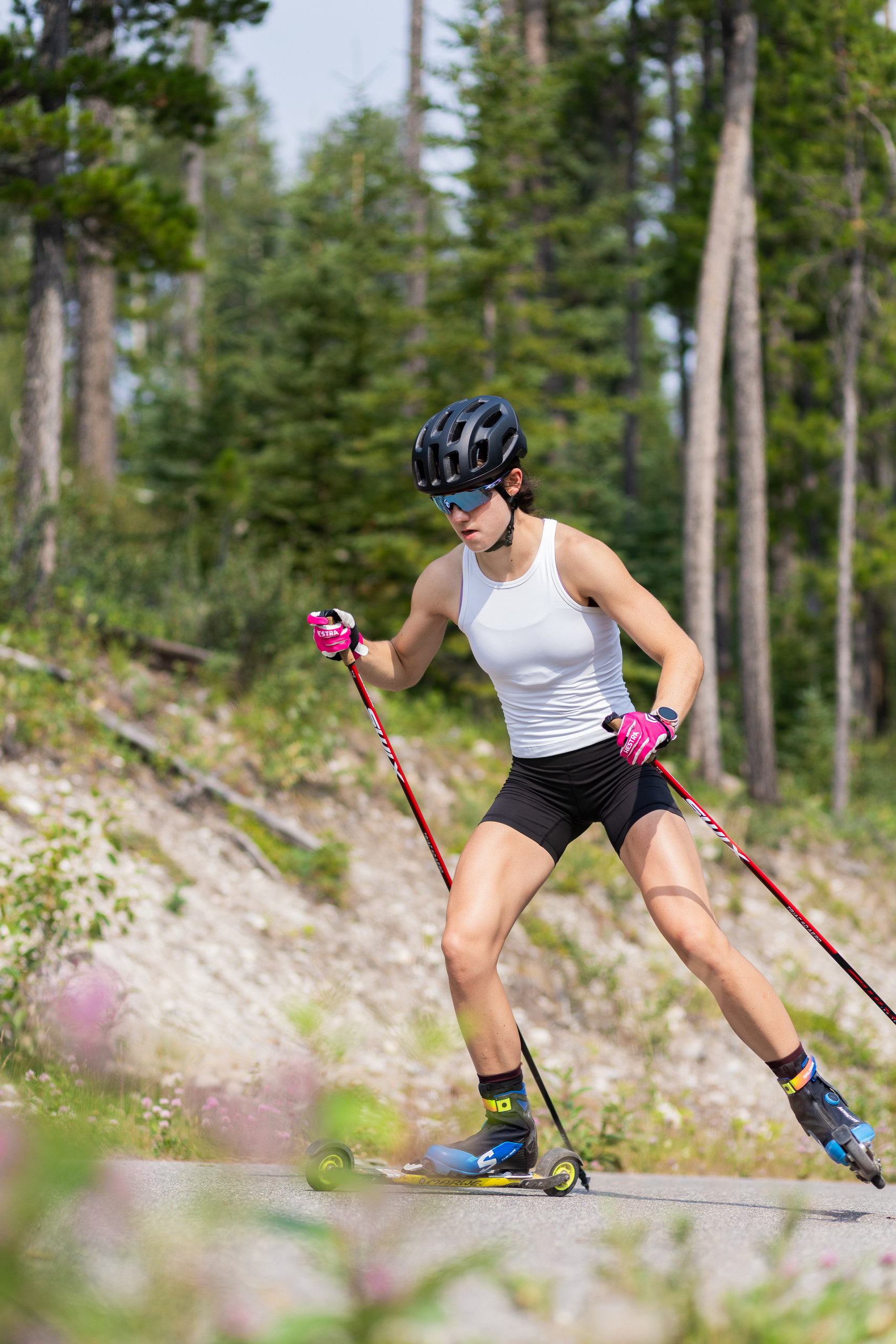
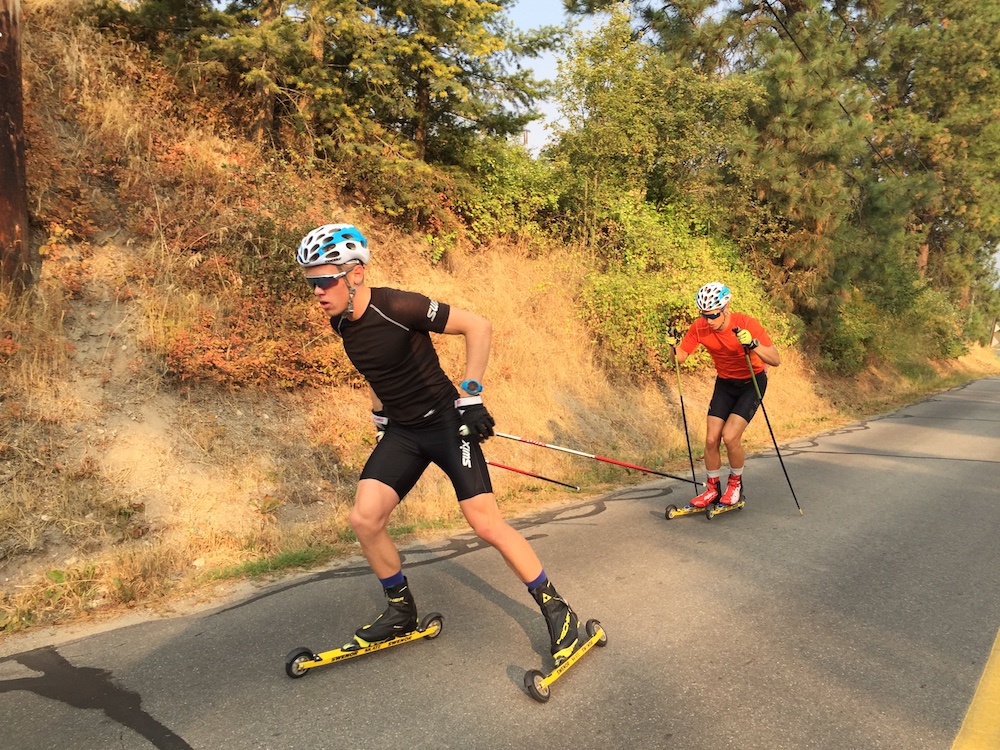
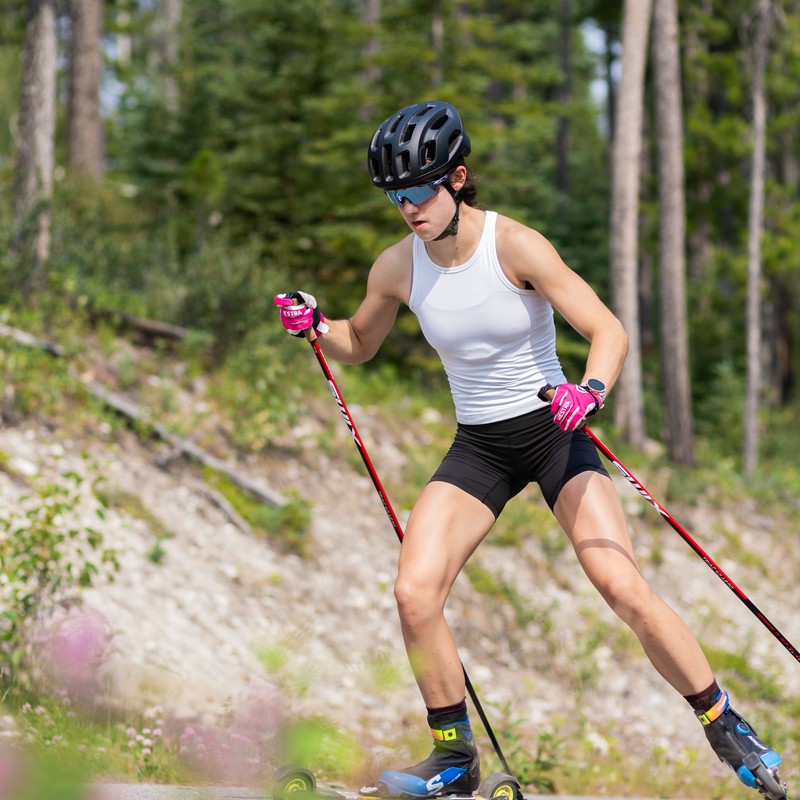
    Alison Mackie skate rollerskiing uphill on a paved forest road in a white training top and black helmet.
    Alison Mackie rollerskiing during summer training in July. She trains with the Alberta World Cup Academy in Canmore, Alberta. (Photo: Nathaniel Mah)

    For Alison Mackie, the 2024 Junior World Championships in Planica never really started.

    She had arrived in Slovenia with reason to expect something. A year earlier, at 17, she had finished 13th in the 20 k at the junior championships in Whistler, British Columbia, on home snow, in exactly the kind of long, grinding distance race that suits her. In Planica she missed the qualification in the opening sprint, fell ill, and watched the rest of the week from a hotel room. She was not on the tracks when her Canadian teammates made history either: Sonjaa Schmidt won the U23 sprint, and Canada won the U23 relay.

    Back at her base in Canmore, Alberta, at the end of that season, Mackie and her coaches set a target for the next one. Top five at the 2025 Junior World Championships in Schilpario, Italy.

    Privately, she wanted more than that.
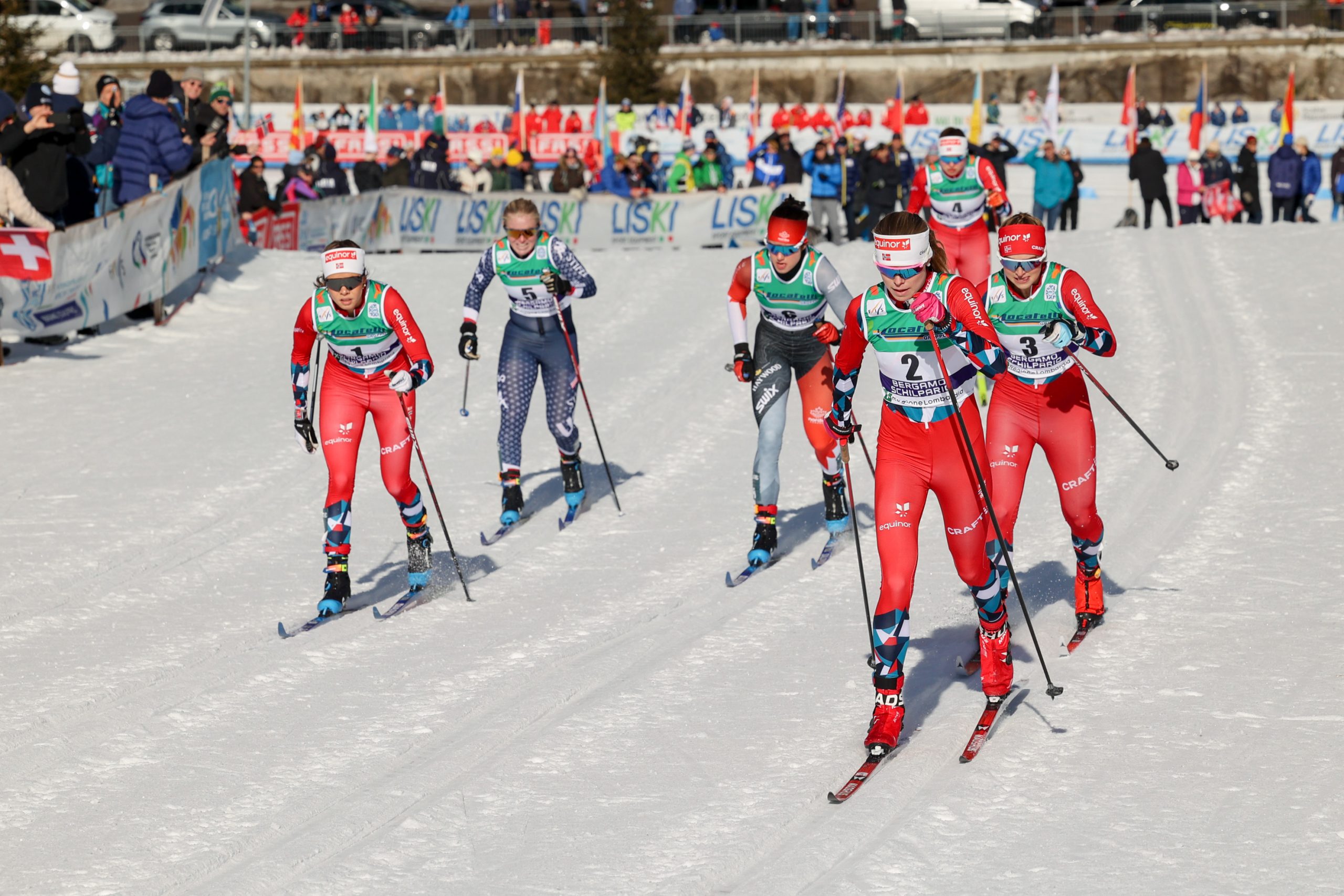
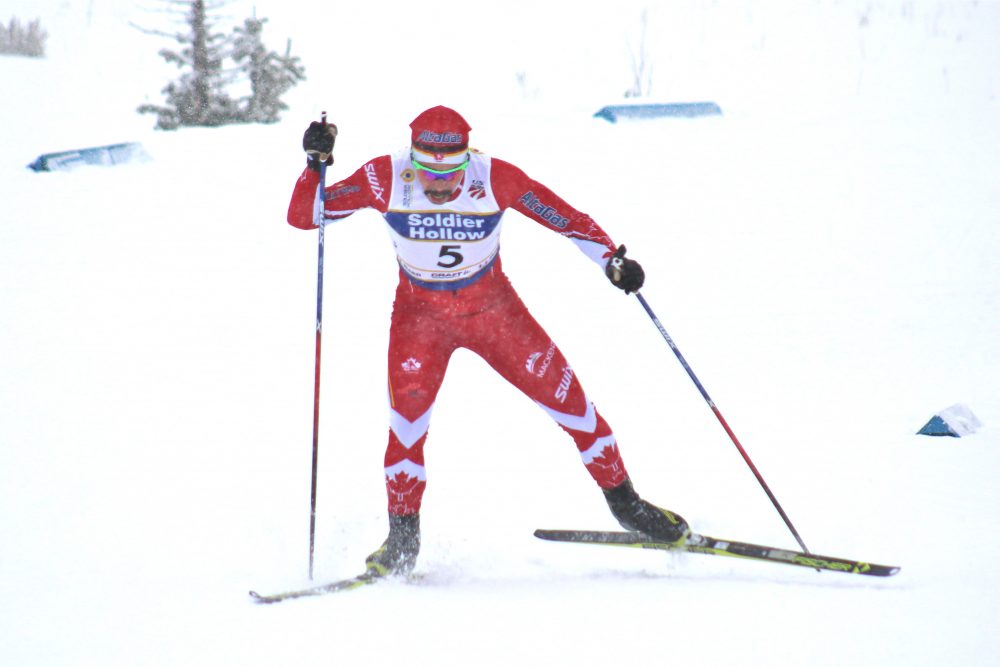
    Alison Mackie in bib 6 racing a classic sprint heat alongside Sammy Smith and four Norwegians.
    Mackie in bib 6 during the classic sprint at the 2025 Junior World Championships in Schilpario, where she finished fourth. Two bronze medals followed in the distance races. (Photo: Newspower.it)

    A Comeback in Schilpario

    “Yes, Junior World Championships in Schilpario were the main focus of my season that year,” Mackie said. “I trained specifically for that event to get my best shape there. But I wouldn’t say revenge, instead a kind of comeback because the year before in Planica I was pretty disappointed because I haven’t had the opportunity to race being sick.”

    On the Italian tracks she won bronze in the 20 k mass start classic, then bronze again two days later in the 10 k interval start skate. She was fourth in the classic sprint. They were the first junior world championship medals won by a Canadian woman since 1989.

    “I wanted a top five, and I finished with three top fours, including two medals,” she said. “The preparation we had put in proved to be correct, and I had a lot of confidence before starting the championships because I felt really good in the previous months leading up to my arrival in Italy.”
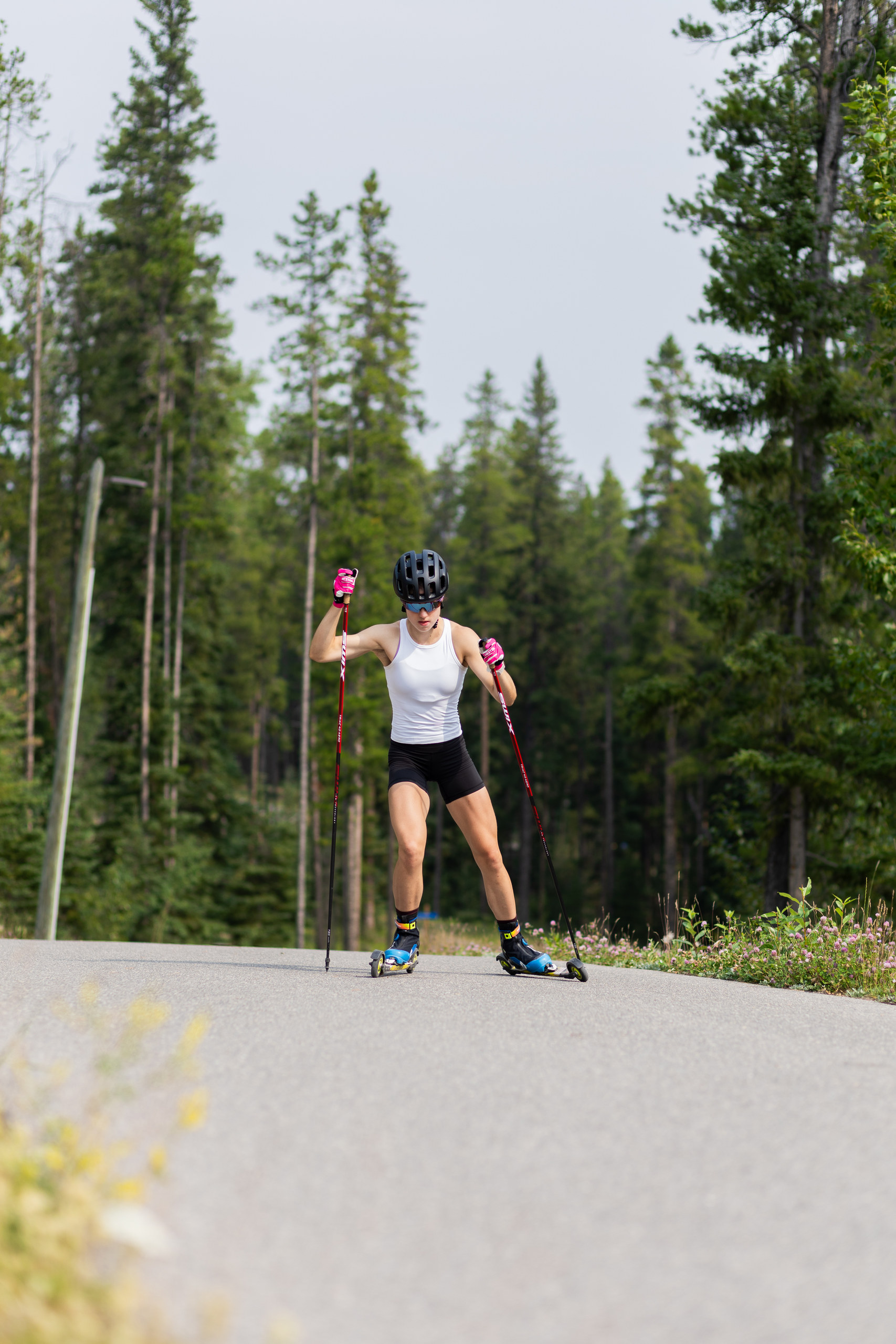
    Alison Mackie rollerskiing toward the camera on a paved road lined with evergreens.
    Mackie on a summer rollerski session in July. She started racing in Alberta as a teenager and won her first national title at 16. (Photo: Nathaniel Mah)

    Put on Skis Before She Could Walk

    Mackie was born in Montreal and raised in Edmonton, and she is 20 years old. Her mother, Jennifer, is a pediatrician. Her father, Andrew, is a pediatric cardiologist. Both of them ski, and both of them had her on skis before she has any memory of it.

    “My parents put me on ski as soon as I could walk,” she said. “So skiing accompanied all my childhood. Then I took real ski lessons and I started doing racing in my region of Alberta during my teenage times. That’s till Covid period arrived and with the restrictions I had nothing else to do others than training. But anyway, I really enjoyed myself during that period, developing my technique with my coaches at Edmonton ski club and when Covid finished my very first race that I won was our National title in March 2022 as a 16 year old.”

    Canada is known around the world as the home of ice hockey. Why did you choose cross-country skiing over hockey, freestyle, or swimming, following Summer McIntosh’s footsteps for example?

    “In parallel with cross-country skiing, I did a lot of other sports like cross-country track and field, rock climbing, mountain biking, swimming, soccer and in all of these sports I wasn’t as super competitive as I was in cross-country skiing. I did that only for fun as an opportunity to stay healthy during summer period. Cross-country skiing has been to me the only sport I competed at my best in my early ages and my favourite discipline. That’s why I chose it.”

    That first national title, won in Whistler in March 2022, is the race she keeps coming back to.

    “Yes, that race in Whistler BC was one of the first big races after the Covid pandemic,” she said. “I trained a lot during that period and didn’t have the opportunity to race and see my level, and when I went to my first National Championships and won the first race, it was a special moment and made me realize that I wanted to keep pursuing cross-country skiing for even better results and seeing how far I could get.”
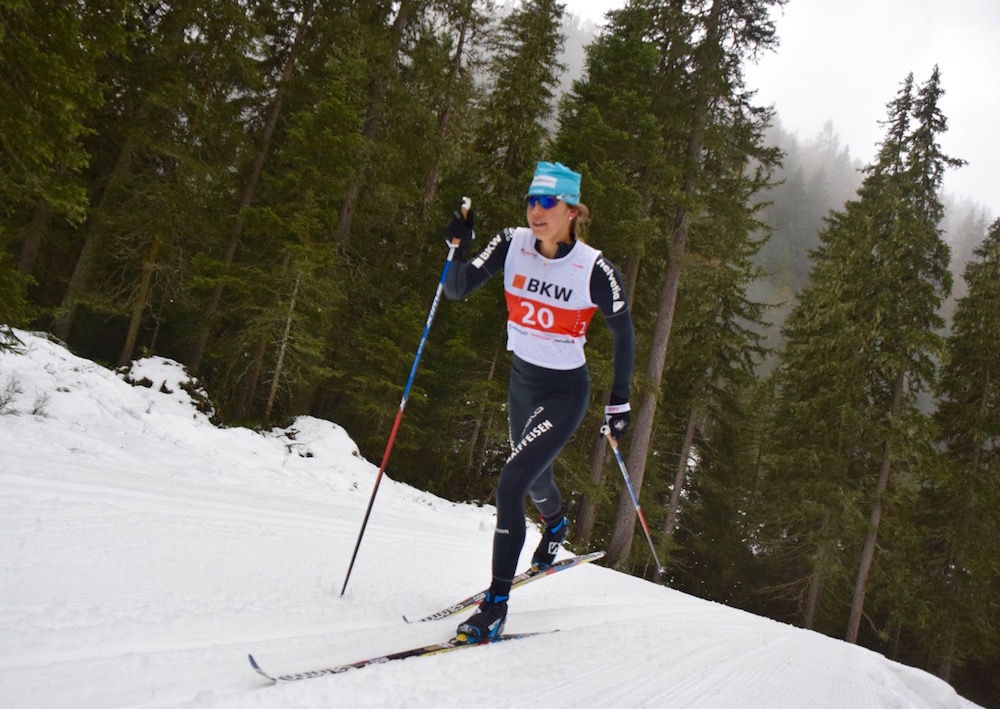
    Alison Mackie racing the Olympic 10 k freestyle in Tesero, panned against a packed grandstand.
    Mackie racing to eighth in the Olympic 10 k freestyle in Tesero on Feb. 12, the best Olympic cross-country result by a Canadian woman. (Photo: Vanzetta/NordicFocus)

    Eighth at the Olympics

    The line has run one direction since. Two bronze medals at Junior Worlds. Her first World Cup top 10s, in Toblach and Val di Fiemme. Eighth in the 10 k free at the Milano Cortina Olympics in her first senior season. Gold in the 20 k mass start free at the U23 World Championships in Lillehammer in March. And at the end of that season, on 548 points, the FIS U23 overall World Cup title, the first won by a Canadian woman, with the finals held at Lake Placid.

    At the Milano Cortina Olympics you finished eighth in the 10 k free, after your first World Cup top 10s in Toblach and Val di Fiemme. What do you remember from those two weeks in Italy?

    “It was super cool being part of that multi sport event that the Olympic Games represent. It was my dream since I was a child watching Olympics on TV and having the opportunity to compete in high level in this huge event was really special to me. Definitely they have been long two weeks, also overwhelming at the time, but made me really happy how I performed overall and the 8th place I got in 10km skating has definitely been the highlight without any doubt. Entering the top 10 has been quite a surprise to me in that moment, because there were all the best skiers at the starting line. But now looking back at all the hard work I did during the whole season and the good results I got before that race in both World Cup and in under 23 World Championships, I wouldn’t say it was a huge surprise for me. Probably demanding Val di Fiemme’s track suited me very well, given that I finished as well 8th in Tour de Ski’s Cermis climb the month before.”

    What is the current situation in Canada for cross-country skiing, in terms of ski club membership, visibility in the national media, and financial support?

    “I would say the current cross-country skiing community in Canada is pretty small, if compared to other European power nations, but strong and with lots of passion in developing our discipline. There are a lot of young skiers coming up and I think it is very exciting for the great results to come in the future. Our National sports organization here in Canada are working really hard to make sure our National team can get all the support we need in order to achieve some World Cup podium with both boys and girls team during the seasons to come.”
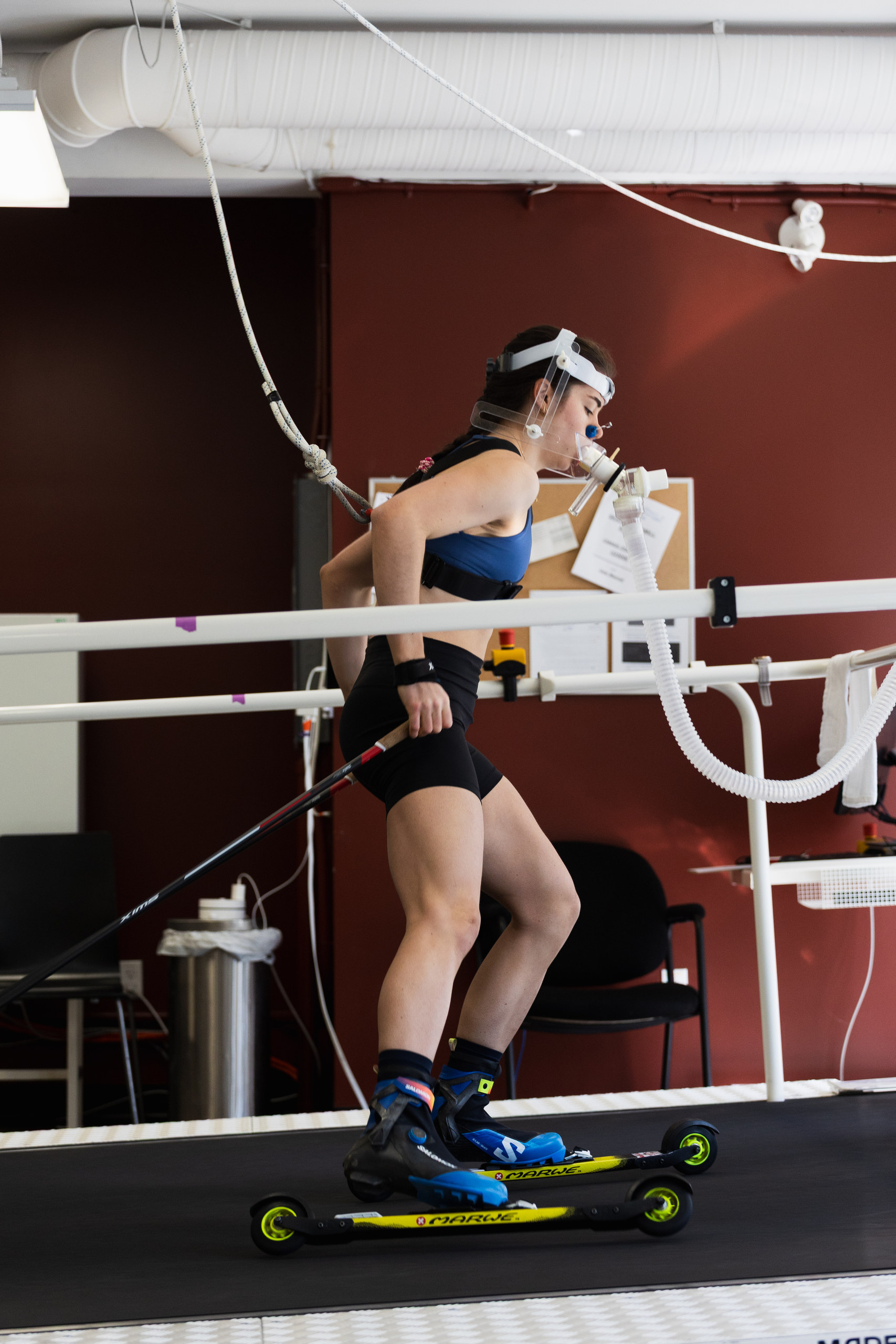
    Alison Mackie skate rollerskiing on a laboratory treadmill while wearing a metabolic mask.
    Mackie on the treadmill during a lab test in May. Distance racing is her strength, and finding speed is the summer’s assignment. (Photo: Nathaniel Mah)

    Distance Strength, Sprint Homework

    Describe yourself as a cross-country skier. What are your characteristics, your strengths, and the areas you are working on for the coming seasons?

    “I describe myself as a pretty strong skier in distance races, while I struggle a bit in sprint not to get through the top 30 and consequently not play the sprint finals, that is an element that I am working on in next seasons,” she said. “Between classic and skate I have found more success in free technique in the past seasons, but I enjoy training both classic and skate equally. Distance races are definitely my strength but I am working to improve my speed skiing as well so I could become a really strong overall skier in order, in the future, to fight for a higher overall spot in World Cup.”

    And the criticism you get from your coaches?

    “More than critics I would call special feedback from my coaches. Because sometimes I have a tendency to train too much and too hard that I need. That is something I am working on this summer, knowing when to push my body and when to give the correct time to rest and recover.”

    The World Cup calendar keeps skiers from outside Europe away from home for close to five months a season. How hard is that for you?

    “Personally I have spent on the road, following World Cup calendar, the past two seasons, but not the full European calendar. I really enjoy travelling and being on the road, so I don’t think it is a huge struggle for me. It is tough to not see friends and family for a long time but I am really lucky that I had friends and family came and watched me on tracks while I was in Europe a couple of time during season. Next season it will be quite different for me, because I am transitioning to attend the University of Utah so I will leave World Cup a bit because I do need to go to class and represent the University of Utah in North America as well.”
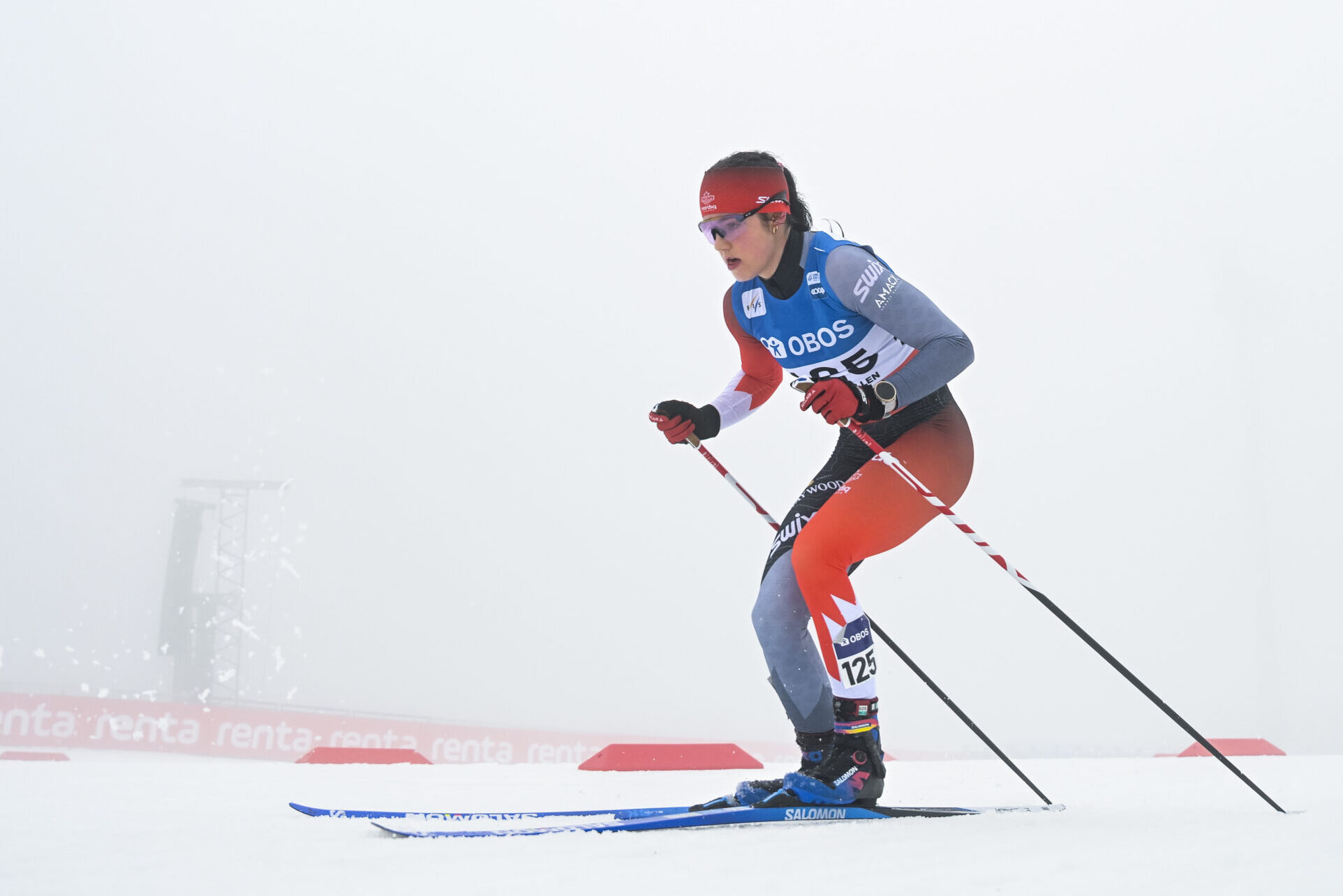
    Alison Mackie skiing in a Canadian race suit through fog at Holmenkollen.
    Mackie at the Holmenkollen World Cup in March, a week before the tour reached Lake Placid. (Photo: Authamayou/NordicFocus)

    A Winter Without Diggins

    The World Cup went to Minneapolis in the last two seasons, and Lake Placid hosted the finals in March in front of enormous crowds. Why not race in North America more often?

    “We do have actually Canmore scheduled for World Cup 2028, but realistically there are not so many resources for cross-country skiing in North America,” Mackie said. “It takes a lot of money and human power for the organization and preparation of those races. Of course, it will be amazing to have more opportunities to race in North America in the future but I have to be realistic and understand that organizing an event here in Canada, for example every four years, require lots of efforts and preparations from the local organization. Maybe we need more venues in North America that we currently have that are able to bring here World Cup events. I admit with huge pleasure that in the past seasons both Minneapolis and Lake Placid events showed how strong local communities are in terms of support and enthusiasm for cross-country skiing and those events have been a great boost for our discipline in North America, especially between young kids.”

    After fifteen seasons, this will be the first World Cup winter without Jessie Diggins, who clinched one more crystal globe in Lake Placid in March before retiring. Will she be missed outside the U.S. team as well? Did you ever get advice from her?

    “I definitely think Jessie’s presence will be missed in World Cup. Not only inside USA Team. I think she has always been a positive skier and a really amazing role model in so many ways. And 100% her presence, her ambitious way of racing and unique skiing spirit will be missed. That will definitely change some racing tactics as well. I had the opportunity to train together with Jessie in New Zealand last summer and it was a pretty cool experience and I wish all the best in her future.”
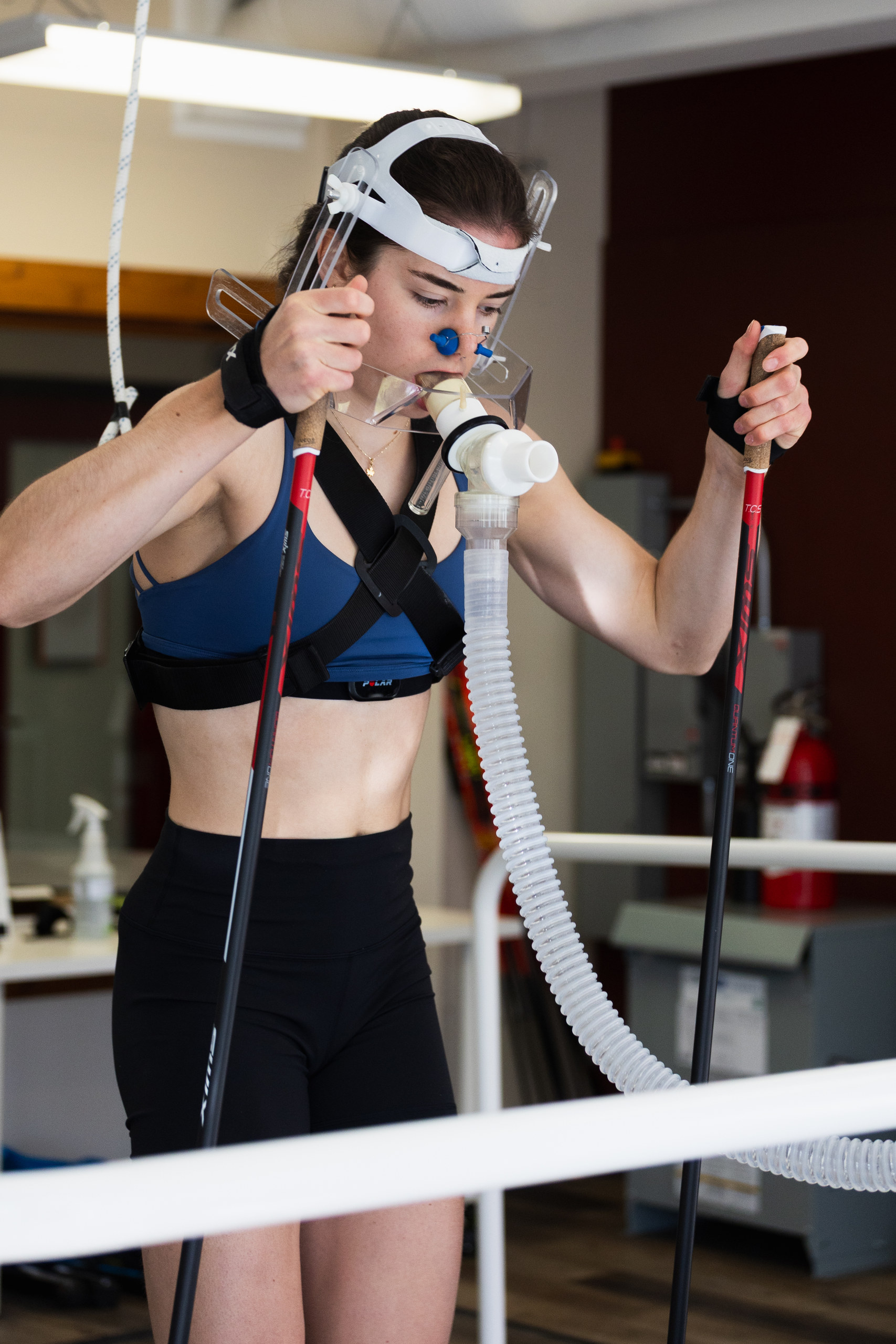
    Alison Mackie adjusting a metabolic testing mask while holding ski poles in a testing lab.
    Mackie fitting a metabolic mask before a treadmill test in May. She trains in Canmore and will study medical engineering at the University of Utah this year. (Photo: Nathaniel Mah)

    Canmore, Utah, and Life Off the Snow

    How is the Canadian team organized, and how is training divided between the women and the men at camps and at home?

    “I think Canadian skiing is gonna take a really exciting trajectory. I am really excited to work with our new Swedish coach Stefan Thomson over the next seasons but also in our group here in Canmore we have Norwegian Tormod Vatten as our assistant coach and with them we have a really strong support staff. For the Canadian National Team over the next seasons is going to be really exciting seeing where we all can go in World Cup and I am really proud to be part of this young but strong group of skiers that our Nordiq Canada are building now, under the [leadership] of former Olympic champion Beckie Scott and our amazing ski communities.”

    How do you manage your studies, at Queen’s University until last year and now at the University of Utah, with training and racing that run through most of the academic year?

    “I just make sure that I manage my schedule accordingly to have enough time for both my trainings and school throughout my day. I think having something other than skiing to focus on is really important for me. I was an online student at Queen’s University over the past two years and now I am transitioning to the University of Utah studying medical engineering. I think it is important the communication with the professors, making sure they know that my situation is a little bit different if compared to normal students, due to the fact that my training sessions, travels and races during winter season take my mind. But despite that my goal is to give my full focus during hours in classrooms too.”

    What kind of person are you away from cross-country skiing? Your personality, your interests, what you do on days off from training and racing?

    “Outside of cross-country skiing I am a pretty introvert person. I try to keep things on my own. I like studying and I really enjoy sewing clothes in my free time. I truly also love to learn new things and that is why I am excited to attend the University of Utah this year. I also love to spend time in the mountains nearby Edmonton where I grew up and in Canmore where I train myself with Alberta World Cup Academy and where I graduated in High school. Hiking, Mountain biking, running and skiing, of course, are my favourite activity when I can spend my time outside in the lush Canadian Nature.”

    In 10 to 15 years, at the end of your career, you will be proud of yourself if what?

    “I think, regardless of what I achieve in my future, I will be extremely proud of my career in addition to what I already accomplished. But really, my goal is just to ski because I love it and see where I can get of myself and also trying to inspire other young skiers. I think that there are a lot of young skiers in Canada right now, who have the potential to be amazing athletes. I really want to inspire them, showing them that anything is possible, it doesn’t matter what country you are from or how old you are. So regardless of what I achieve over the rest of my career I will always be proud of what I have already achieved.”

    Paolo Romanò is a freelance reporter based in Italy who covers cross-country skiing and Nordic combined.

    Help Support Our Coverage!

    If you value the thoughtful work and access FasterSkier provides, please consider becoming a Voluntary Subscriber. Your support directly fuels our work to cover the people, places, and moments that make our sport special.

    Join the FasterSkier community!
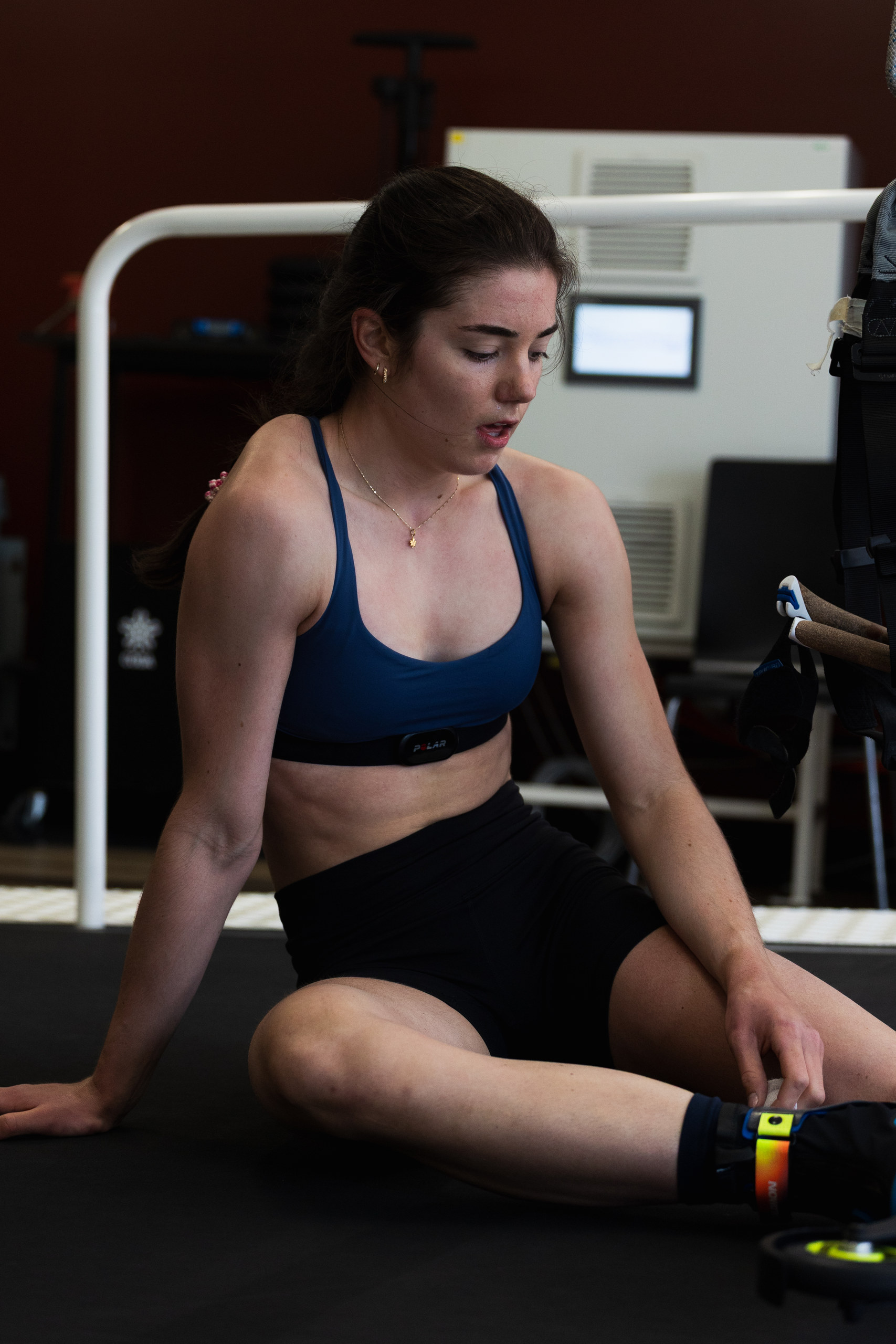
     

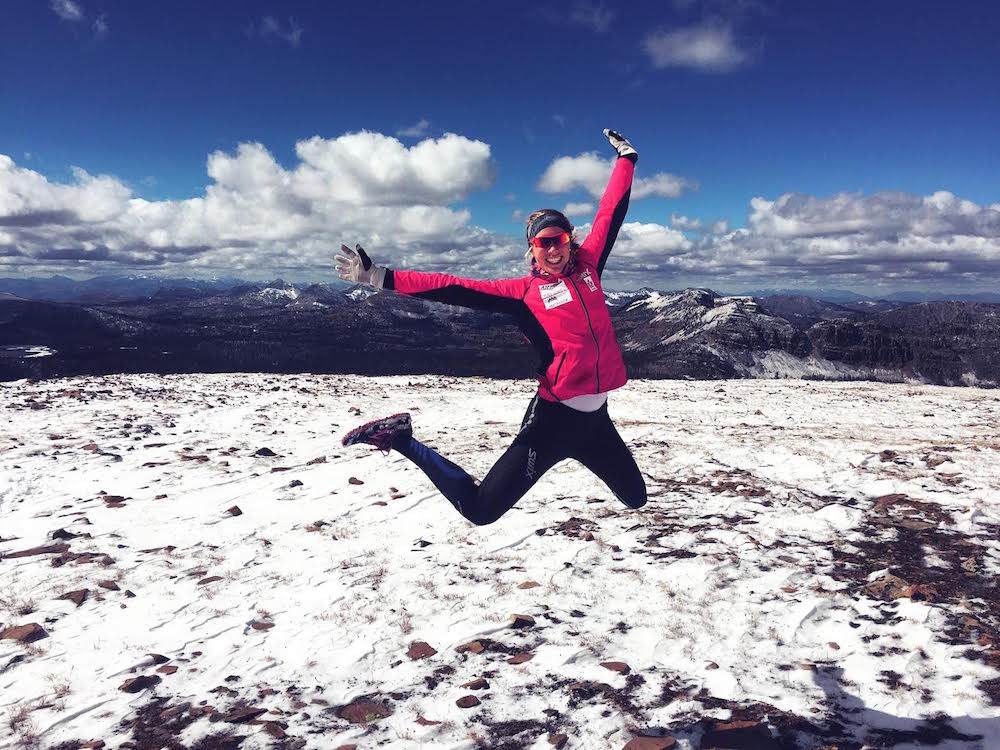
    Alison Mackie sitting on a laboratory floor catching her breath and unstrapping a sensor from her leg.
    Mackie catching her breath after a lab test in May. She races her first season for the University of Utah this winter. (Photo: Nathaniel Mah)
  • Alpine Insurance Alberta World Cup Academy Team Announcement 2019-2020 (Press Release)

    Alpine Insurance Alberta World Cup Academy Team Announcement 2019-2020 (Press Release)

    For Immediate Release

     Alpine Insurance Alberta World Cup Academy Team Announcement

    Press Release

    June 11, 2019

    Canmore – The Alpine Insurance Alberta World Cup Academy is proud to announce our new team for the 2019-20 season.

    Comprised of two formal training groups, one in Calgary and one in Canmore, the 2019-20 team is the most diverse group of athletes to date.  Led by six national team members, Emily Nishikawa, Dahria Beatty, Elizabeth Elliott, Benita Peiffer, Matthew Strum (biathlon), and Nathaniel Mah (nordic combined) and numerous medalists from last year’s Canadian Nationals, this also is one of the deepest.  “There is a lot to be excited about going forward,” says Chris Jeffries, High Performance Program Director.  “Last year saw a great group of U20 athletes join our university program in Calgary, which bodes well for the future.  This year we have had a few very successful U25 athletes, Maya MacIsaac-Jones, Sadie White and Annika Richardson, join our Canmore program, skiers to keep an eye on for the World Cup Finals in Canmore, March 2020.”

    “We have seen a lot of changes in our programming over the last few years, and this year’s team more than ever signals the positive direction these changes are taking us,” explains Greg Manktelow, Vice President of the Alberta World Cup Society.  “Our athlete group is diverse and extremely talented, making it very exciting and motivating for all of us as we look ahead to not only this winter, but our athlete dream goals of representing their country at the 2022 and 2026 Olympics.  We feel like we have taken some major steps towards creating a more sustainable program for our athletes, sponsors and partners.  We know the work is just beginning, but we are building excitement of where we are going, and it makes it a lot easier to find new and innovative ways to help our Canadian skiers and athletes dream big.”

    Last year saw the biggest changes at the Academy to date with the arrival of the inaugural group of University athletes in Calgary.  This new direction was a major step forward, providing athletes the flexibility and support needed to pursue post-secondary studies and their sport goals concurrently. “Last year we took a major leap of faith opening the doors in Calgary in August for the first time.  The education/sport path has been a major gap in our Canadian system for a long time, one that we are excited to help close”, explains Jeffries.  “We saw successes both in the classroom and on the race course.  The smiles on the faces of our athletes last year highlighted the balanced approach we strived to achieve.”

    Joining the Academy staff for this year will be coaches Anneke Winegarden and Julia Ystgaard.  Anneke is in her 2ndyear of a master’s program in the Human Performance Laboratory at the University of Calgary and worked with the team last year.  Julia is from Norway and is doing a year in the Kinesiology department at the University of Calgary as part of her studies in Oslo.

    Training for the 2019-20 season is well under-way in Canmore for those local athletes.  The core university group will be arriving back in the Bow Valley for a training camp August 23 to the 31 before starting classes at the beginning of September.  The racing season kicks off November 30thfor the team at the Sovereign Lake ski club near Vernon, BC.

    Team List

    Women

    Dahria Beatty (Sr National Ski Team) – Whitehorse Nordic Ski Club

    Emily Nishikawa (Sr National Ski Team) – Whitehorse Nordic Ski Club

    Elizabeth Elliott (Jr. National Ski Team) – Revelstoke Nordic Ski Club

    Benita Peiffer (Jr. National Ski Team and Sr Biathlon Development Team) – Whistler Nordic Ski Club

    Laurence Dumais – Fondeurs-Laurentides

    Beth Granstrom (B.C. Ski Team) – Revelstoke Nordic Ski Club

    Hannah Jirousek (Yukon Ski Team) – Whitehorse Ski Club

    Paige Latta – Sovereign Lake Nordic

    Maya MacIsaac-Jones – Rocky Mountain Racers

    Annika Richardson – Hollyburn Ski Club and Lappe Nordic

    Amanda Thomson (Yukon Ski Team) – Whitehorse Ski Club

    Sadie White – Big Thunder Ski Club

    Men

    Nicolas Bennett (NWT Ski Team) – Yellowknife Ski Club

    Mathieu Bilodeau (2016 Olympic Racewalker)

    Nate Gerwing – Rocky Mountain Racers

    Michael MacIsaac-Jones – Rocky Mountain Racers

    Nathaniel Mah (National Nordic Combined Team) – Altius Nordic Ski Club

    Thomas Manktelow – Canmore Nordic Ski Club

    Nicholas Randall (Ontario Ski Team) – Big Thunder Ski Club

    Matt Strum (Sr National Biathlon Development Team) – Canmore Nordic Ski Club


    “The Alpine Insurance Alberta World Cup Academy has been the development centre where several generations of top Canadian cross-country skiers have honed their skills before being named to the National Ski Team.  Our athletes have represented Canada at the Olympics, the Nordic World Championships and on the world cup circuit.  Thanks to the support being provided by Alpine Insurance, we will continue to be “THE PLACE” for the next generation of our best developing cross-country skiers.”

    Media Contact:

    Nancy Richard, Business Development Manager

    Phone 403-585-0503

    Email Address: nrichard@albertaworldcup.com


  • Alpine Insurance Renews its Support of the Alberta World Cup Academy (Press Release)

    For Immediate Release

    Alpine Insurance renews its support of the Academy


    Press Release

    June 11, 2019

    Canmore – The Alpine Insurance Alberta World Cup Academy, Canada’s premier high-performance training centre, is thrilled to announce Alpine Insurance’s continued support in a multi-year title sponsorship agreement.

    The partnership represents a longstanding and mutually beneficial relationship between the two iconic organizations. Alpine Insurance has a rich history of supporting amateur athletics in Alberta, while the Alberta World Cup Academy has a trusted track record in training Canada’s future cross-country skiers as they develop into future Olympians.

    buy clindamycin online

    “We’re thrilled Alpine Insurance has agreed to increase their support for the Academy team in developing Canada’s next generation of cross-country ski champions.  Alpine Insurance is an ideal partner for us and we sincerely appreciate their support,” said Alberta World Cup Society Vice President Greg Manktelow.

    “Alpine Insurance is delighted to be able to support the Alberta World Cup Academy. Alpine Insurance has been a proud sponsor of Nordic events since the World Cup in 2005, and we see this as a natural progression of helping to build our sport. Thank you to the Alberta World Cup Society for creating the opportunity for Alpine Insurance. We are proud of our athletes and appreciate how much effort the individuals put into their own training. There are many ways to build a community. We encourage others to also continue to support the sport, the athletes and the community,” said Ken Hughes, Chair of the Board and co-founder of Alpine Insurance & Financial Inc.

    “It is exciting to see our partnership with Alpine Insurance continue to grow and develop.  We share a common value of providing the best service possible today while evolving our businesses for the demands of tomorrow.  We look forward to growing together in the coming years and raising our respective “games” together” said Chris Jeffries, High Performance Program Director

    “The Alpine Insurance Alberta World Cup Academy has been the development centre where several generations of top Canadian cross-country skiers have honed their skills before being named to the National Ski Team.  Our athletes have represented Canada at the Olympics, the Nordic World Championships and on the world cup circuit. Thanks to the support being provided by Alpine Insurance, we will continue to be “THE PLACE” for the next generation of our best developing cross-country skiers.”

    Media Contact:

    Nancy Richard, Business Development Manager

    Phone 403-585-0503

    Email Address: nrichard@albertaworldcup.com


  • Bridging the Gap: Nordiq Canada’s Female Coach Mentorship Program

    Bridging the Gap: Nordiq Canada’s Female Coach Mentorship Program

    It is no secret that the lineup of coaches, wax techs, and support staff in high level cross country skiing is predominantly male; while the percentage of female coaches and support staff varies by country, it is far from 50-50 across the board. The degree to which nations are addressing this disparity also varies.

    Allison McArdle is a high performance coach for Alberta World Cup Academy and is the chair of Nordiq Canada’s Women’s Committee. (Photo: Alberta World Cup Academy)

    On March 20th, the Women’s Committee of Nordiq Canada launched its second iteration of the Female Coach Mentorship program, which provides support and resources to women who are interested in becoming a high performance coach in Canada.

    “The reason the Women’s Committee started this was because there is a distinct lack of female role models within the sport of cross-country skiing in Canada,” Women’s Committee Chair Allison McArdle told FasterSkier in a call. “On the national team level there are no female coaches, and of the three national training centers, only one training center has had a female coach. And it has been two different female coaches but each of the coaches have only been in the position for one year.”

    She continued that there are very few female coaches above the U14 level, let alone at an elite level. The phenomenon extends across all sports, not just cross-country skiing.

    “In collegiate sport, which is where the most number of full time coaches exist in Canada, it’s less than 20 percent of coaches are female, I think it’s only 16 or so percent now,” McArdle said.

    Beyond her work with the Women’s Committee, McArdle leads by example with a long list of credentials and leadership roles in the sport. Currently, she is the Alberta Ski Team Director and chair of Cross Country Alberta.  Formerly, she was a high performance coach for the Alberta World Cup Academy where she worked with top Canadian athletes, such as World Cup racers Dahria Beatty and Emily Nishikawa. McArdle has also been the National Coaching Director for cross country skiing with Ski and Snowboard Australia and is on the Nation Selection Committee of the Ski and Snowboard Australia Cross Country Committee. She is also a two-time recipient of the Australian Sports Commission’s Women’s Leadership in Sport Grant. Her advocacy for women in cross country skiing continues as she also sits on the FIS Women’s Committee, and has been the co-manager of Fast and Female Australia (her home country).

    The mentorship program selects two female applicants that are interested in advancing within the sport and connects them with a mentor, male or female, who is coaching at the level that the mentee aspires to one day work. The pair works through a workbook put together by the Canadian Association for the Advancement of Women in Sport and Physical Activity(CAAWS), which is a framework of educational resources, goal setting tools, and prompts for purposeful discussions.

    “We know that to get [female coaches] into a high performance role we need to be able to support them and one of the best ways to do that is to connect them with each other,” McArdle explained.

    While the long term goal is to achieve gender balance in the highest level of the sport, applicants to the program do not need to aspire to become national team coaches to be selected. The program supports female coaches from the club level upward.

    “Some of these people might work with athletes aged 16, 17, 18 or they are they are new to the role and they are already an elite coach of a club, because they belong to a small club,” McArdle explained. “And they want the knowledge to be able to make sure they can support their athletes from the sort of 15 to 20 age range of competition.”

    She added, “The goal is to mentor them towards being a coach who can coach athletes at a national champion and successful international performance level.”

    The CAAWS curriculum encompasses a wide array of topics including physiology, best practices, and psychology. But, the coaches selected for the program are able to tailor their experience based on their individual strengths and areas of weakness. The mentee sets personal growth goals, then charters a plan for improvement with her mentor.

    “A lot of the time people are just looking for new ideas on how to do things with their athletes. I’d say in particular, the writing training plans for the higher level athlete is one of the main reasons people want to be part of the program. Because they want to learn more about that and they want to be connected with someone who has experience at a level above them so they can bounce ideas about yearly training plans or polarized training, that kind of thing.”

    The mentee and mentor check in monthly to progress through the CAAWS workbook and to discuss any questions either person has. The mentee also receives a grant which provides funding over the course of two years to facilitate an in-person meeting, typically at a camp run by her mentor. Ideally, the face-to-face correspondence can happen twice each year, but at a minimum, the pair meets once.

    Katie McMahon, a mentee in the first iteration of Nordiq Canada’s Female Coach Mentorship program, smiles for a shot while on a trail run during a camp she attended with the Pierre Harvey Training Centre in Ramsau, Austria. (Courtesy Photo)

    The female coach mentorship program is one of many initiatives that the Women’s Committee is working on.

    “We also provide grants for women wanting to attend coaching courses or, for example, there is a high performance coaching seminar in Canmore in May, and you have to be of a certain level to be able to attend this seminar,” explained McArdle. “We provided full grants for coaches who want to attend the seminar in May, so we provided two grants for women who have to travel longer than 700 kilometers to attend and then two smaller grants for people who are traveling less than 100 kilometers.”

    Beyond providing education and support for developing female coaches, the Women’s Committee also passed a mandate to create opportunities for qualified women to assist Nordiq Canada as trainers, doctors, or therapists.

    “The Women’s committee was involved in a change in policy for national team camps and trips,” McArdle shared. “It’s now stipulated for those trips and camps with Nordiq Canada that there must be a female staff member. That doesn’t have to be a coach, there just has to be a female staff member. The reason that we went there is that we thought we should just start with a female represented on staff before we started demanding that there is at least a female coach, too.”

    The work of the committee extends to the next generation of athletes and staff as well. A similar mentorship program was created which pairs female high school athletes with current or retired elite level female athletes with the goal of retaining and encouraging developing skiers. The committee also offers small grants to women pursuing ski racing at a high level while attending university, as they noticed a significant drop out at this juncture.

    “We’re trying to do some good work,” McArdle concluded. “We’re lucky that we have some really good and passionate people involved in our programs that drive things forward.”


  • New Program Info for the Alpine Insurance Alberta World Cup Academy

    New Program Info for the Alpine Insurance Alberta World Cup Academy

    (Press Release) March 20, 2019 – Our Academy programs in Canmore and Calgary are currently accepting applications. We have brought changes to our Program Guidelines for 2019-20, new options are now available, providing financial flexibility.  Program Guidelines

    Submit your application with the Alpine Insurance Alberta World Cup Academy by April 7, 2019. Apply Here!

    We welcome questions through email or direct message us on social media.

  • Cross Country Canada: The Reboot Part Two

    Cross Country Canada: The Reboot Part Two

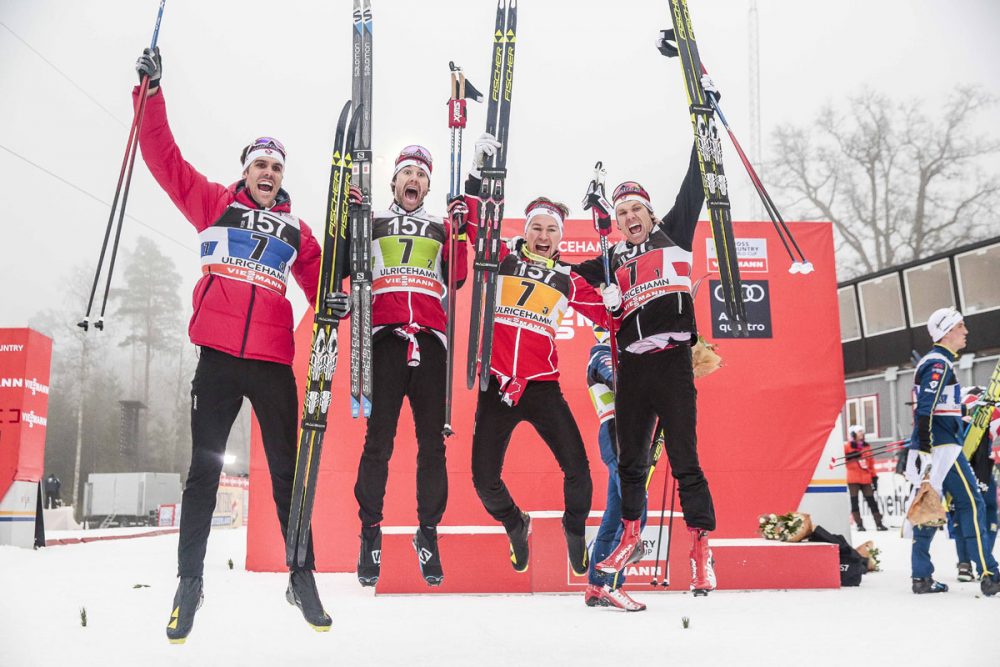
    Left to right: Canada’s Len Valjas, Alex Harvey, Knute Johnsgaard, and Devon Kershaw after their historic third place finish in the 2017 men’s 4 x 7.5-kilometer team relay in Ulricehamn, Sweden. (Photo: Fischer/Nordic Focus)

    This is the second part of FasterSkier’s report on the state of high performance cross-country skiing and athlete development in Canada. You can read part one here.

    Cross Country Canada (CCC), as the national governing body for cross-country skiing in Canada has the difficult task of steering a rather large ship. The idea in steering the ship is to maintain a path requiring little quick and nimble maneuvering. Survey the landscape, mine the data, set a course, and sail. Along the way, there’s the ability to make slight adjustments for efficiencies, accommodate unforeseen changes.

    To help make those macro and micro changes, Cross Country Canada hired Nic Lemyre as a high performance consultant in June, 2018. Lemyre, a Canadian living in Oslo, Norway has concrete ideas of what sustainable improvement and success resemble.

    Where do we want to be?

    Nic Lemyre (Photo: Norges Idrettshøgskole/Norwegian Sports Academy/)

    “We’re thinking our starting point is to build a really strong relay team, on both the women’s and the men’s side,” Lemyre told FasterSkier. “We want to have five athletes, so that we can rotate with the fifth athlete and we’re never in a situation where we can’t field a strong team because one athlete’s injured or sick.”

    According to Lemyre, the composite team must be derived of skiers who can hit specific individual benchmarks “[When] we have athletes that can start scoring points in every race they enter on the world cup, that’s a medium term goal,” Lemyre said. “From there, we start aiming for the top-15 for all athletes that are identified in that group.“

    Part of the reasoning behind the relay vision is that for a skier to get a permanent spot on the World Cup, the athlete not only has to reach a high level, but also help raise four other Canadians up to that level. Lemyre believes this should foster cooperation and team spirit.

    “It helps us meet goals of performance,” Lemyre added. “But also it helps us meet goals that are related to how to build a strong performance culture, where the athletes need to support each other, to learn from each other. They need to push each other. They need to push each other beyond limits they may have experienced before.”

    How do we get there?

    After PyeongChang, CCC appeared to have both the political will to start the painful process of another re-invention. However, that will came with a reduced budget with which CCC could support its future options.

    The simplified model of corporate restructuring begins with terminating certain roles and concludes with creating new roles filled by new individuals near the top of the organizational pyramid. Often, in a medium or large corporation, most people will be shuffled around and only a few near the top will lose their jobs. The final step is to find a quick win to help the newly reshaped organization gain morale and unify.

    buy amoxicillin online

    In a small organization like CCC, everyone is near the top. While the process works well for the survival of the organization, it can be hard on individuals. 

    The change at CCC began with long-time High Performance (HP) director Tom Holland’s planned retirement. Lemyre was hired as a consultant to oversee the restructuring of the HP group. Shortly before Lemyre’s hiring, CCC eliminated some positions.

    As Joel Quenneville’s recent firing demonstrates, proven ability and past success is not enough to provide job security during a reboot. (Quenneville was the NHL’s Chicago, Blackhawk’s head coach since 2008. During his tenure Quenneville lead the team to three Stanley Cups.)

    On November 1st, CCC hired Erik Bråten as a new national team coach and modified Louis Bouchard’s title. Bouchard remains head of the National Training Centre in Mont Ste-Anne, Québec, with the added title and responsibilities of World Cup Head Coach.

    Bråten, a recent Norwegian School of Sports Science graduate with a specialization in cross-country skiing, won the 2018 coach of the year award from the Norwegian ski federation. This hiring didn’t happen as quickly as some had hoped, but is considered the first win for CCC’s new structure.

    “Erik has a strong sports science background applied to cross-country skiing,” Lemyre said on the phone. “His profile is unique in our environment. The fact that he’s young is really positive for us, because he’s open to this new experience. He comes with a solid base, and his excitement and his motivation, I think, will be great assets in applying that knowledge in the right culture in Canada. At an individual level, Erik is unique in working one on one with athletes. I think our athletes are going to really appreciate that.”

    Along with bringing in new personel, Lemyre aims to improve sharing of training information in Canada. In Norway’s organizational structure, athletes and coaches are able to log hours and training plans on an interface organized by the Norwegian National Ski Federation. It’s a model and template Lemyre is intimate with.

    “The fact is that we have a large country, and we can’t be with athletes every day of the year following them on site,” Lemyre said. “Now the technology is there to pool [training data] in a way that our coaching staff and the local coaches can communicate really well, But also as we’re building up our science team, we also have interaction with our different people involved in helping the athletes develop.”

    Dahria Beatty racing the 2018 Holmenkollen 30 k freestyle mass start in Oslo, Norway. (Photo: Fischer/NordicFocus)

    Another planned shift is to interchange athletes between Europe and Canada more often. For example, Dahria Beatty will start the season in Canada — a change encouraged by her coach Chris Jeffries and supported by Lemyre.

    “This summer my coach Chris and I came up with a plan that allowed me to stay in Canada to start the season to build into the race season and then head over the Europe and race on the World Cup circuit leading up to World Championships in Seefeld,” Beatty said. “With this being the first year of the new quadrennial, it is the perfect time to fine tune some of those race details domestically before leaving for Europe mid-December. I am looking forward to racing part of the Tour de Ski then period 3 and hopefully finding my peak for World Championships and World Cup finals in Quebec.”

    Lemyre’s concept is to allow athletes like Beatty to build into the early part of the season domestically and arrive in Europe at a higher level of race fitness.

    “The way we scheduled the trips this year, giving some athletes the chance to prepare very well before they race on the World Cup,” Lemyre added. “I think some of them will be stronger when they show up on the World Cup, and also they’ll be able to sustain that level of performance over the time period they are on the World Cup. We will try to be a little more selective and well prepared when we show up, and then post really good results when the athletes are racing the World Cup.”

    Jeffries stated that the stress of living abroad, a dynamic known all to well by North American World Cup skiers, can be counterproductive to a developing athlete.

    “The last few years, our top athletes spent the majority of their time in Europe,” Jeffries said. “I think it stalled our development a little bit, because we’re always living out of a suitcase, and we’re always having to ski races where we’re trying to perform.”

    Dave Wood spent 18 years as a national team coach. His time leading the team included the post-Nagano rebuild and managing athletes at the Olympics in Vancouver. His vision includes giving skiers more time to develop and less emphasis on being fast all season.  

    “Sara [Renner] had far less World Cup starts before she was top-15 at the Olympics than the people of today,” Wood said. “I think that this big argument about experience is valuable when you are looking for seconds. When you are looking for minutes, [World Cup experience] makes no difference.”

    Will it Work?

    The U.S. has been able to develop a strong women’s team built off Kikkan Randall’s determination to drag U.S. skiing to the top. Randall took inspiration and knowledge from Canada’s post-1998 rebuild where Scott, Renner, Milaine Thériault, Jamie Fortier and Amanda Fortier decided it was time to lead the charge.

    American Kikkan Randall tucking during the women’s 10 k classic mass start at 2018 World Cup Finals in Falun, Sweden. (Photo: Fischer/NordicFocus)

    In both cases, the athletes didn’t succeed alone. The “fantastic five” got the support of Holland, Wood, and many others. Randall also collected a large supporting cast, well documented by Peggy Shinn’s book ‘World Class’. 

    Laura McCabe, now a Methow Valley coach and two-time Olympian, spent most of her free time in Nagano with the Canadian women’s team because it felt like a group that had a vision and a willingness to support one another to collective success.

    “It just shoots you up the ladder when you come back and you feel like you have a very safe place, you’re working on this goal together, you’re all in it together, and you’re there for each other all the time,” McCabe told FasterSkier. “I felt like the Canadian women were doing that. And now I feel like Matt Whitcomb has led that charge for the American women.”

    While crediting Randall for starting the process, McCabe feels that the team’s work to be a team is the critical factor.

    “They have goals, team goals and they have personal goals,” McCabe said. “They are always there for each other. One of their biggest goals is to basically keep their relationships positive and keep everybody moving forward. I think that is one of the number one reasons that team is doing well.”

    In a conversation last May with FasterSkier, Yukon coaching icon Alain Masson spoke of the complexities of achieving success on the international stage. Simply possessing physical gifts, the aerobic capacity, the predisposition to tolerate and absorb high training loads, is no guarantee of success.

    There’s the behind the scenes unglamourous work of nurturing athletes, remaining true to organizational core values, and feeding the system with money, intellect, and vision.

    “Definitely, there’s a minimum set of physical characteristics that you need to perform at that level,” Masson explained to FasterSkier. “But you also need many characteristics, personality characteristics, that are vital. What Alex showed, and Sara Renner, and Chandra [Crawford] and Beckie [Scott]. I think athletes that combine both the physical and the mental characteristic at a time when the program works together, and everything lines up with the funding, good leadership, and everybody working together. That’s the difficulty, this is the issue, trying to get all of that together. As the women in the U.S. have demonstrated, when you have all of that lining up, it’s amazing what you can do.” 


  • Cross Country Canada: The Reboot Part 1

    Cross Country Canada: The Reboot Part 1

    Canada’s Alex Harvey celebrating on the podium after placing second in the men’s 15 k freestyle mass start in Seefeld, Austria, for his best result of the 2018 World Cup season. (Photo: Salomon/NordicFocus)

    Cross Country Canada (CCC) has begun a reboot process as the new Olympic cycle starts. Corporations call this a reset, a rebranding, a new direction, restructuring, and various other names that try to disguise the challenges and issues that come with enacting real change.

    The reboot process traditionally starts with an acknowledgement that the current level of success, and that of the foreseeable future, doesn’t align with the goals or the potential of the organization.

    Canada left PyeongChang with no medals at three consecutive Olympics, only one skier in the World Cup red group, and a perception that there was no obvious successor to Alex Harvey.

    There are many people who, with the benefit of hindsight, believe that CCC allowed itself to be trapped by a combination of success and the Own The Podium (OTP) funding model. 

    The process of assigning blame for the past, called “blamestorming”in the corporate world, is one of the most effective ways to waste time and destroy morale without doing anything to improve the future. The “best practices” approach to a reboot starts with four apparently simple questions: How did we get here? Where are we now? Where do we want to be in five years? How can we get there?

    While CCC does many things as a national sport body, this article will focus on high performance and the development system.

    How did we get here?

    After a disastrous 1998 Olympics in Nagano, CCC shrank to a full-time staff of five and endured a forced re-invention. Four years later, in 2002 at Salt Lake, Beckie Scott won all three medals in the skiathlon after the initial silver and gold medalists were caught doping. Sara Renner missed the B final in the sprint for 9th place.

    Canadian Chandra Crawford in the 2011 team sprint in Dusseldorf, Germany. (Photo: Fischer/NordicFocus)

    In 2006 in Torino, Chandra Crawford earned a surprise gold in the sprint while Scott finished fourth. Scott had earlier teamed up with Renner for a team sprint silver medal.

    buy vancomycin

    In 2010, there were no Canadian cross-country medals. However, there were signs of promise. Renner skied to her fourth Olympic top-10 finish. All four Canadians competing in the men’s skiathlon finished in the top-15. Devon Kershaw lost out in final kilometer of the 50 k to finish fifth, 1.6 seconds away from gold.

    That post-Vancouver glow was possibly the point where CCC temporarily slid off the rails.

    A number of Canadian sports fell victim to OTP incentives. A sport qualifies for OTP funding by having good prospects for a medal in the next Olympics. The money comes with strings attached, to ensure that resources are spent on improving the probability that specific individuals will podium. For smaller sports where the OTP money is a significant proportion of the sport’s annual budget, it is hard to make choices that put that money at risk. Choices like balancing the emerging athletes in the pipeline, while simultaneously supporting those athletes already at the top-end of the sport. 

    As a result, many sports have lost their OTP eligibility by losing the focus on development and the vision that qualified the sport for OTP in the first place. Some people put cross-country skiing in the list of sports that fell into this trap.

    After 2010, the future looked bright. Harvey and Kershaw were World Champions in the 2011 team sprint. Kershaw was second overall in the 2011/2012 World cup. (A feat only equaled in North America by Scott and Jessie Diggins).

    Harvey arrived at Sochi in 2014 as a medal favorite. He was fresh off a World Cup podium in Toblach the weekend before the 2014 Games began. Sochi ended poorly when Canada, along with Norway, couldn’t solve the difficult waxing conditions.

    In 2017, the men’s World Cup relay podium in Ulricehamn, Sweden sustained the hope — that result earned another year of OTP funding for five men. (Harvey remained a the top, as he won the men’s 50 k skate at the Lahti, Finland World Championships.) 

    The results in PyeongChang were similar to 2002 numerically: Harvey was close to a medal in multiple races and Lenny Valjas collected 7th in the classic sprint. A medal would have changed the mood, but not overall situation. 

    Where are we now?

    Post-PyeongChang, CCC believes Canada is not achieving the international results a country with plentiful snow and 37 million people is capable of.

    The development system in Canada consists of the National Team, the official training centers (Centre National d’Entrainment Pierre Harvey (CNEPH), Thunder Bay National Team Development Centre (TBay), and the Alberta World Cup Academy (AWCA)), and the clubs. The ten provinces and three territories have teams, but don’t have a formal place in the development system as each of the thirteen regions approaches development support differently. In the last few years, the number of clubs actively recruiting and developing athletes while supporting a high performance team has increased. For our purposes, as no official name has been affixed to these clubs, the term ‘elite club’ will be used here.

    In the past, all national team members were required to belong to a training center while developing athletes were encouraged to join.

    “I can speak for many of the athletes, they thought that if they didn’t go to a training centre, then they might as well quit skiing,” Telemark’s coach Adam Elliot said. “It was that broad of a choice, they felt they had to choose between skiing and school immediately.”

    The landscape is more diverse now, with more options. The examples that follow skew to Western Canada, largely because the coaches quoted brought teams to Sovereign Lake snow camps in May and November and were available for in-person interviews. Eastern Canada remains equally diverse in terms of its club offerings.

    A common theme among the coaches and athletes is that each athlete’s needs are different, and he or she needs to find an environment that fills those needs. FasterSkier asked AWCA’s head coach Chris Jeffries how an athlete should choose his or her path to success.

    “It’s such an individual, case by case thing,” he said. “I don’t have an answer.”

    In 2017, a shift to allow more development paths resulted in new senior National Team member Gareth Williams staying at his home club, Telemark, in Kelowna, BC. Elliot described how it came about.

    “Tom Holland approached us, for Gareth, and said we like what you’re doing in the Okanagan, and we want to keep Gareth there. We’re going to support you and your program to be able to support Gareth.”

    Also in 2017, Julien Locke returned to his home club Black Jack while Russell Kennedy shifted to the new Team R.A.D., part of the Canmore Nordic Club.

    To further illustrate the spectrum of options and pathways, FasterSkier contacted three Canadian athletes, each with a history of NorAm podiums and some international success, to discuss their ski-training choices. Dahria Beatty started at AWCA and has remained there, Evan Palmer-Charette started at TBay then recently moved to Team R.A.D., and Andy Shields has gone rogue.

    Dahria Beatty en route to 20th overall in the Seefeld World Cup freestyle sprint for her season-best result in 2017/2018. (Photo: Fischer/NordicFocus)

    “For me, I’ve been working with Chris [Jeffries] for six years,” Beatty told FasterSkier in November. “It works really well for me, and I have a good group of training partners where I am, that can push me everyday in training.”

    AWCA is also the home training group for National Team skier Emily Nishikawa and two junior national team skiers. AWCA also benefits from its close proximity to a number of other training groups.

    “For me, Canmore’s a location where I want to be training, where I want to be based out of,” Beatty said. “All the pieces fit well together for [me], it’s somewhere I think I can keep improving.”

    Palmer-Charrette made a summer-time decision to change things up by finding a fresh environment in Team R.A.D.

    “I think the best part of being on a training centre is the entire program is based around a small group of athletes of similar age which makes for a great training and racing environment,” Palmer-Charrette wrote. “I feel training centres, as they are, are best-suited for junior/u23 athletes and especially great for athletes who are a bit late to the game like I was at the end of high school and will really benefit from learning from other athletes on the day to day training life.”

    Shields is no longer affiliated with an official team. He funds his skiing by painting houses in the summer and representing ski wax companies in the winter. Although he refers to ski racing as a hobby, he did end the last season as COC leader and will race period 1 of the World Cup.

    “I don’t think I could have done this straight out of junior,” Shields wrote. “My time on Tbay is still having a huge positive effect on my ski career. Being on a team through my early years as a senior made it much easier to get a decent training base and set a couple good habits in place which are paying dividends.”

    Shields did reflect and offer an alternative to how he might have changed his path to elite level skiing.

    “If I could go back in time I would have gone the NCAA route straight out of junior,” Shields added. “College skiing in the States is a much better deal than a training center for people in their early twenties. You can go down to the States, get a degree, not pay a dime, and come out the other side with plenty of time to have a full-time ski racing career. I would have joined a training centre upon finishing with NCAA.”

    The Canadian university system differs from the U.S. model, offering little money for sports. Heading south to the U.S. as a student-athlete remains an option for some Canadian skiers. Most athletes remain in the Canadian system to develop. With that in mind, FasterSkier asked why some athletes had chosen some of the Western based training centres.

    Jeffries, who leads the AWCA, also noted how his program has evolved. There appears to be room at the AWCA for those with concurrent goals. The AWCA has partnered with the University of Calgary to allow AWCA athletes to work towards degrees.

    “We’re always evolving our programming, and what it entails, and how we package it,” Jeffries said. “That’s why we have this new university program this year, because you just look at the popular decision making of graduated high school athletes.” 

    Elliott, based in the Okanagan, said his program offers athletes a well rounded experience too. 

    “You’ve got the trifecta,” Elliot said. “You’ve got access to education opportunities for post-secondary. We’ve got the university, UBC Okanagan, and the college. Most of the people who’ve moved here have gone to school. Secondly, it’s the Okanagan. Which is probably the best place to ski in North America, with skiing up and down the valley –with Nickel Plate, Telemark, [Kelowna] Nordic, Sovereign, and Larch Hills. The third is that you’re moving into a community of skiers: family, volunteers, everybody trying to make a go of keeping people in sport.”

    Clearly the times have changed from a programming perspective and the past’s financial windfall for Canadian cross-country skiing.

    “Probably the quad between 2010 and 2014, CCC had more money almost than it knew what to do with, ” Dave Wood, former National Team head coach, told FasterSkier in May as he finished up a long ski day. “Now, I think the budget’s still three and a half million. While it’s maybe low compared to what it has been, it’s a hell of a lot higher than it was in ‘99, by about four times.” 

    Former CCC High Performance Director Tom Holland spoke of those larger commitment from clubs during the Frozen Thunder races in October. 

    “There’s a lot more resources,” Holland said, referencing the increased numbers of coaches attending Frozen Thunder with their athletes. “One of the reasons clubs are more important now is that there are paid coaches at the clubs. That’s why training centres started in the 90’s, because you’ve got to have a coach, full-time.”

    Thee deep question remains: what next for Cross Country Canada as it ponders a post-Alex Harvey scene? Better and more diverse options for Canadian skiers, like those modernizing their offerings to connect with the student-athlete, is a step forward. But fans of the sport, and of course Cross Country Canada, have short-term and long-term goals. No one wants to see another Olympic quadrennial transpire without the glimmer of medal potential at the international championship level. 

    “I think when Alex Harvey retires, mostly likely after next year with Lenny Valjas, it will be the end of an era having athletes being able to finish on the podium at World Cups, World Championships, said Alain Masson, Whitehorse head coach. “So definitely, the program is going to go into a real rebuilding phase with lots of young athletes, but no guarantee of success in the near future.” 

    This is part one of a two-part story. 


  • Cockney on Growing Up with Skiing, Retiring and What’s Next

    Cockney on Growing Up with Skiing, Retiring and What’s Next

    Jess Cockney (l) and Foothills Nordic skiers on top of Apex, outside of Penticton, British Columbia, on May 19. After retiring from professional skiing this spring, Cockney has been helping out as an assistant coach at Foothills Nordic. He’ll study full time at the University of Calgary this fall. (Courtesy photo)

    Strength. Balance. Agility. Jesse Cockney had all of those qualities as a child growing up in Yellowknife, Northwest Territories — just like most Inuit kids — according to his father, Angus. But what he could do with that talent was what Angus hoped to nurture.

    Since he had put his son on skis at age 3, Angus reflected in an email that he “knew then that [Jess] had incredible potential to succeed.”

    Jess Cockney and his family after the 2014 Olympic trials in Canmore, Alberta, with his mother, Trish, father, Angus, and sister, Marika. (Courtesy photo)

    And so the Cockneys moved to Canmore, Alberta, when Jess was 7. That included Jess’s mother, Trish, and his sister, Marika. According to Angus, a former competitive skier and junior national champion in 1973, ’74 and ’75 (who spent two months skiing to the North Pole in 1989), the move was about giving Jess “a better opportunity to succeed as it had the right environment with the Nordic Centre and a community full of support with like-minded kids and parents. In other words, we wanted him around a healthy environment.”

    It was an easy transition, Angus explained. Canmore was more conducive to training with milder temperatures than Yellowknife and a wealth of experienced coaches and athletes.

    More than two decades later, Jess credited his dad for helping him reach the highest level of cross-country skiing. A two-time Olympian, Cockney, now 28, has spent 11 years on Canada’s senior national team and two more on the junior national team. He achieved a sixth-place finish in a classic sprint at U23 World Championships in 2011, as well as four individual top-10 finishes on the World Cup.

    “The big reason that I have cross-country skied at this level and really understood at an early age what it meant to pursue racing at a high level was definitely because of Dad,” Cockney said on the phone in April. “He took skiing to a high level as a junior and didn’t carry on after his junior career but stayed really involved with the sport and with racing, too.”

    Jess Cockney enjoying some on-snow time as a youngster. (Courtesy photo)

    He emphasized how special it was to share moments like shuffling on skis at a young age with his dad to seeing him on the side of a World Cup course, calling out splits and taking pictures.

    “It’s pretty fun to be able to share that time together, because skiing means so much to both of us,” Cockney said. “I’m quite happy that my career has worked out as well as it has and that Dad has been able to be there for so many of the good days with it, too.”

    After six years of traveling across Europe on the World Cup circuit (as well as to places like Sochi, Russia, and PyeongChang, South Korea, for the Olympics), Cockney retired from professional skiing this spring. It was a decision that had been on his mind for the better part of the last two seasons, he explained. Toward the end of the PyeongChang Olympics in February, he felt what he described as a mental “decompression” and a natural ending to his career, which solidified his decision.

    “I know how much mental energy it takes to commit towards the training year and the travel for the racing season,” Cockney said. “I had a blast doing that for so many years and I just didn’t think that I was going to be sharp enough or motivated enough. I’m just happy to have such a great season as a final year with the Olympic team and being together with so many of my teammates from over the years at those Games. It just feels like the time is right and I’m excited to do something else.”

    Annika Hicks rocking the new AWCA suit to 4th place (Photo: Glen Crawford Production Services)
    Annika Hicks (Alberta World Cup Academy) racing in the 2016 Frozen Thunder sprint qualifier in Canmore, Alberta. (Photo: Glen Crawford Production Services)

    While currently renovating his home in Canmore with his girlfriend Annika Hicks (as well as his dad, skier Bob Thompson, and another friend) and assistant coaching at Foothills Nordic, Cockney plans to start classes at the University of Calgary this fall. He was accepted into the university’s political-science program this spring.

    Hicks, who previously trained out of the Alberta World Cup Academy (AWCA) in Canmore, will also be studying full time at the University of Calgary. She is halfway through her studies there toward a science/kinesiology degree in exercise and health physiology. Like Cockney, she explained in an email that she’s been “on the fence” about continuing with skiing for the last two years.

    “I wanted to stop skiing on my terms and with a healthy relationship with the sport,” Hicks, 26, wrote. “I have no regrets and am happy to have that closure. I’m grateful to have had the opportunity to ski race for so long.”

    In her career, she started 15 World Cup races, competed at two U23 World Championships and 2011 Junior Worlds, tallied at least three podiums at Canadian senior nationals (including two second-place results at 2018 nationals in March), and ended this season as the second-ranked Canadian woman overall on the NorAm circuit.

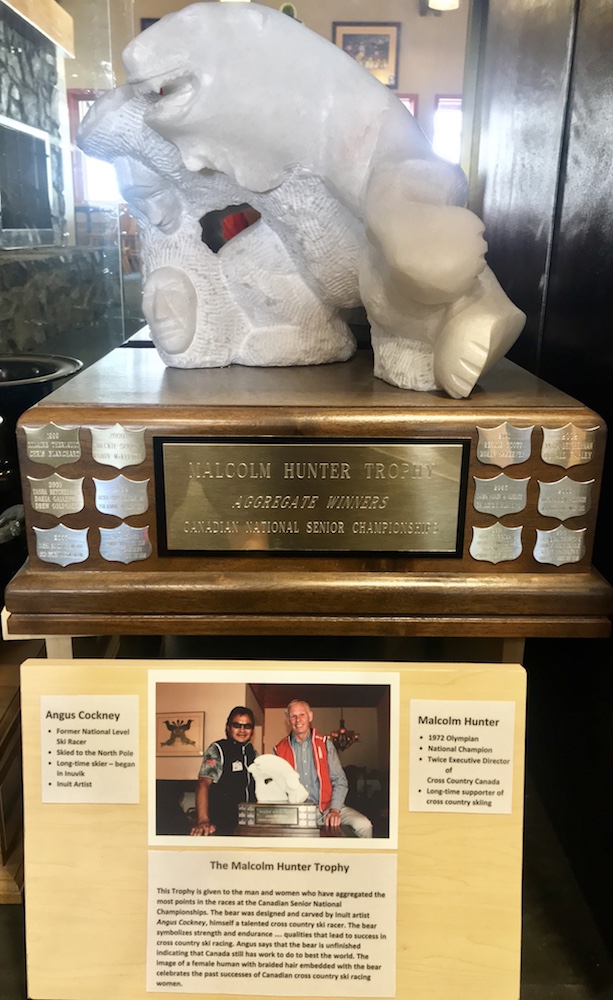
    The Malcolm Hunter Trophy for aggregate winners of Canadian senior nationals, designed by Angus Cockney, as seen in the Canmore Nordic Centre day lodge. (Photo: Cross Country Canada)

    Cockney also finished the second on the overall NorAm aggregate points list. After winning both the freestyle sprint and 15 k freestyle pursuit at this year’s nationals, he also was also awarded the Malcolm Hunter award — a trophy his dad made — as the aggregate male winner at nationals.

    “It was a great way to end the season and end the career,” Cockney said. “I’d never won the nationals aggregate before so that was a big thing for me to do … To get that in my last stab at it was pretty sweet.”

    Angus pointed out that his son’s aggregate win was also special because of where it took place.

    “It was in Thunder Bay [Ontario] where Canada lost my good friend/foe in the late great Reijo Puiras,” Angus wrote. “He too was passionate for cross country and especially made time for and congratulated Jess whenever he could. And, Jess was presented the Malcolm Hunter trophy; a trophy I created and Malcolm was my former coach who brought me to victory in the stormy ice-cold 1975 Canada Winter Games. Therefore, it was very befitting for Jess to go out that way. He came back and told me, ‘Dad, I won the trophy you made.’ ”

    Choosing nordic

    Looking back, Angus explained that his proudest moment of Jess was was when his son consciously chose to pursue cross-country skiing at age 11.

    “I believe he would have made the National Hockey League if he wanted to but I’m glad he picked the greatest sport in the world,” he wrote. “For Jess, I’m proud on how he has become well respected as a person in the community and abroad. Of course too, he showed he belonged on the world’s stage with a number of top ten finishes on the World Cup circuit but was especially proud of him as the second qualifier here in Canmore in 2012 sprints. He certainly had the community a buzz. As a Father/Son duo though, I’m proud too on how we are the only Father/Son duo to win our respective Canada Winter Games; 1975 and 2009.”

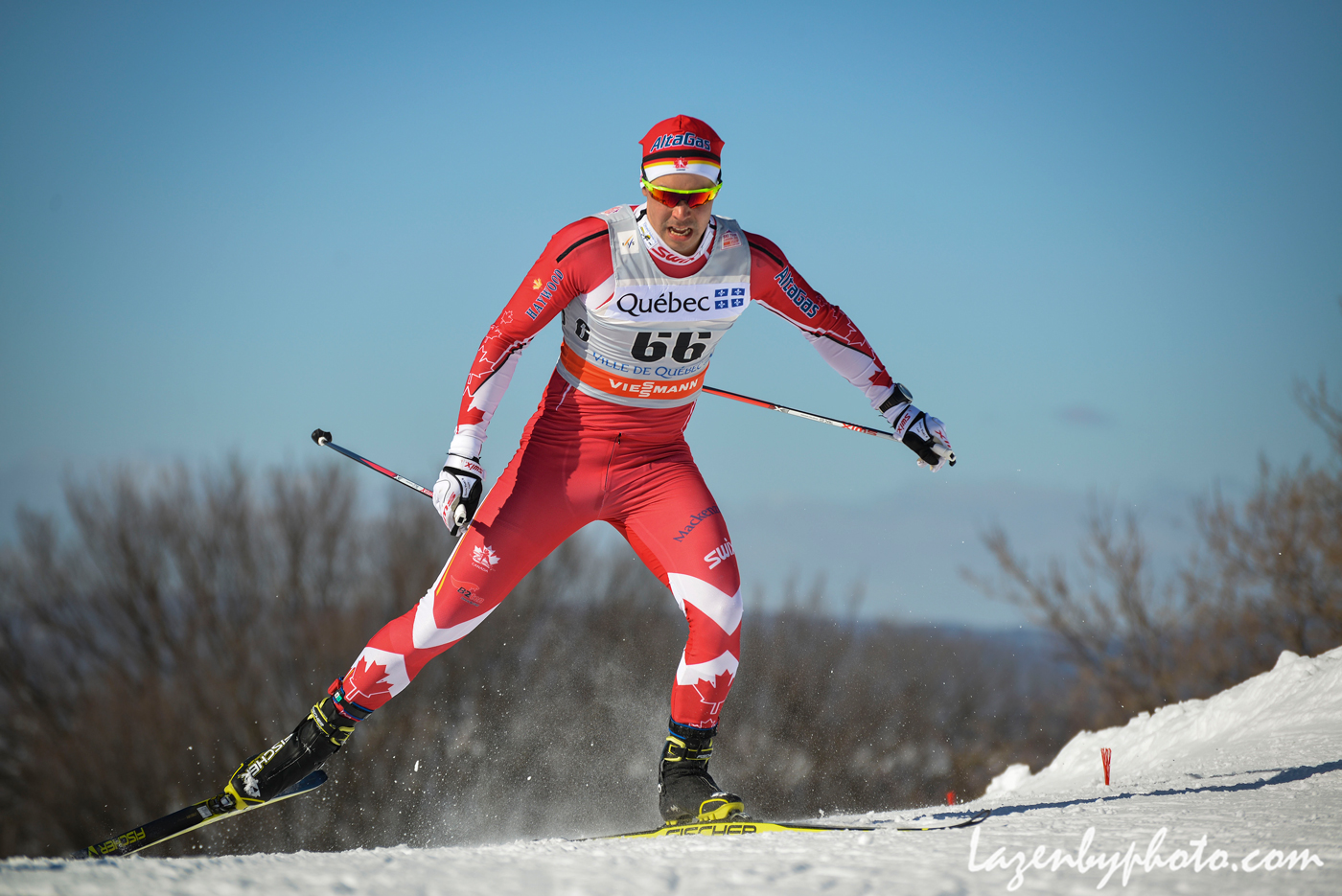
    Jess Cockney racing to 29th in the freestyle sprint qualifier at Stage 3 of the 2016 Ski Tour Canada in Quebec City. He went on to reach the semifinals and finish the day in 10th. (Photo: John Lazenby/Lazenbyphoto.com)

    Cockney had a number of standout moments at the World Cup level, the first of which came at home in Canmore in December 2012, when he placed ninth in a World Cup skate sprint. Then,  late in the 2015/2016 season in Quebec City, he raced to 10th in the Ski Tour Canada’s skate-sprint World Cup stage. The next winter, he notched two more individual top-10 results: first in a classic sprint at the 2017 World Cup in PyeongChang and then in another skate sprint in Quebec City.

    Those top 10’s effectively earned him a spot on Canada’s 2018 Olympic team as well as its 2017/2018 World Cup A-team.

    “The time in Canmore, for sure, was such a special race for me,” Cockney reflected of his career-best World Cup result. “That was really big because it went well and my family was all there and it was just really a great surprise kind of day.”

    Another race he’ll never forget was the 50 k mass start at the 2014 Sochi Olympics, a race he had never expected to enter.

    “Just the way that people got sick and things don’t work out for other teammates, I was able to start it, and I was just so happy to be able to race that massive race at the Olympics,” he said. “That’s just such a big deal for me in my career, to have raced it and finished it.”

    Phil Widmer (CNST/AWCA) leads teammate Jesse Cockney (second from l), Dakota Blackhorse-von Jess (Bend Endurance Academy) and Canadian Para Nordic skier Brian McKeever (r) in a classic-sprint heat at 2013 Frozen Thunder in Canmore, Alberta. (Photo: Pavlina Sudrich)

    He recalled his time with the AWCA and transitioning from the NorAm to international racing with peers like Kevin Sandau, Michael Somppi, Chris Hamilton, Graeme Killick, Graham Nishikawa, Brent McMurtry, Drew Goldsack, and Phil Widmer.

    “So many fun Phil battles,” Cockney reflected. “Now that that group is still there with Bob Thompson making his way — it’s great to see that group is still getting stronger with that tail end of younger guys in that group. … Probably my biggest highlight is the relationships that I’ve been able to foster and have come from skiing, for sure, is the people and the time that we’ve shared together.”

    Besides his dad and his fellow competitors, he credited his high-school training group, the Banff Ski Runners, and its coach Anders Lenes, as well as Mike Cavaliere as major influences.

    “We had so many good guys my same age, and really the time with friends was actually just time training so it was the perfect atmosphere for a couple of us to take it really far,” Cockney said of the Banff team.

    “My coach right after Anders, Mike Cavaliere, definitely had a really big impact in fostering that next level of belief for me, from going from a good skier in Western Canada to trying to be the best that I could be in Canada,” he continued. “And then setting goals to reach potential in the international scene, too, with time together at World Juniors and Under 23’s and early in my World Cup and my first Olympics we were still working together.”

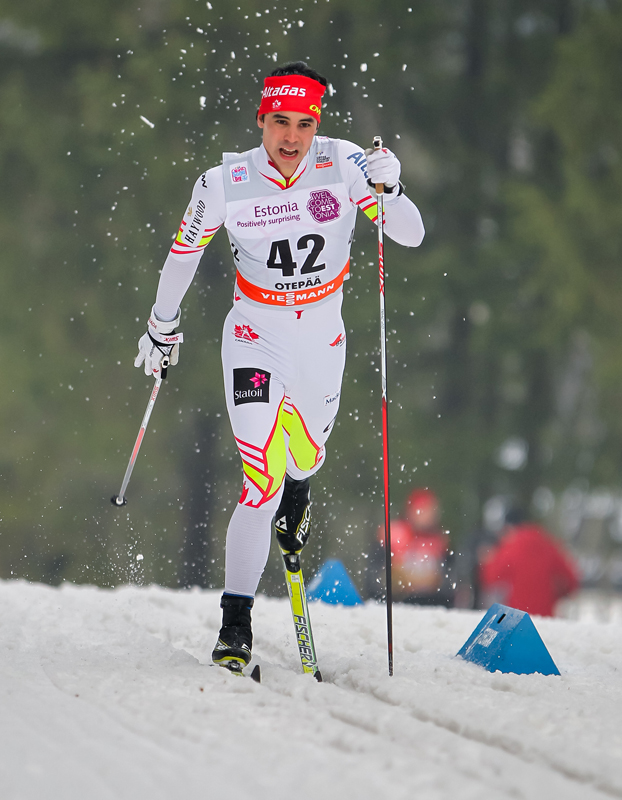
    Jess Cockney racing in a 2015 World Cup classic sprint in Otepää, Estonia. (Photo: Fischer/NordicFocus)

    Asked what it was like growing up on the national team and how the sport has shaped him, Cockney was introspective.

    “I’m definitely softer spoken or maybe more considerate at this point,” he said. “Really what I’ve gotten to understand is respecting everybody’s hard work in sport and understanding what someone’s going through; we don’t really get it all the time.

    “I’m a little bit more — I’d just say not as brash or just a little bit more reserved,” he continued. “I learned some hard lessons from being just a little bit too mouthy or a little bit too, maybe even arrogant. The time in sport has really shaped a lot of who I am, probably more than I realize. I’m super appreciative of the people who’ve been a part of that, just being such great people, and how they carry themselves, [and] emulating that where I can in life.”

    A longtime member of Canada’s senior development team, Cockney was promoted to World Cup B-team status in recent years and spent his last season as an A-team member. So while funding has become tighter within Cross Country Canada (CCC) since 2014, Cockney said he had the unique experience of increased financial support in the last couple years.

    “I started supporting myself for World Cup opportunities in 2014 and paying out of pocket for the whole thing, and then by this year I was getting more support from the whole team,” he explained. “My seasons have been consecutively getting more and more financially feasible, so I’m lucky it was trending in that direction and I was able to be a little bit better financially as the years went by.”

    With further budget cuts for CCC expected, Cockney said his retirement wasn’t motivated by the prospects of self-funding. He is one of four men from last year’s Canadian World Cup Team who have decided to retire (the other three being Devon Kershaw, Knute Johnsgaard and Graeme Killick.) Alex Harvey and Len Valjas are the lone returners to the 2018/2019 World Cup A-team.

    “Alex and Lenny and Graeme and I, we’ve been going to nationals together since I think, like, 2004,” Cockney reflected. “So it’s been a really long time together and more and more time with Devon at the top level of the sport. I was roommates with Knute for a while last year so we really felt like we’re a tight-knit group of guys and it was fun. They’re not just teammates, they’re friends that are now going to be part of our life for the rest of our time out of sport.”

    The next steps

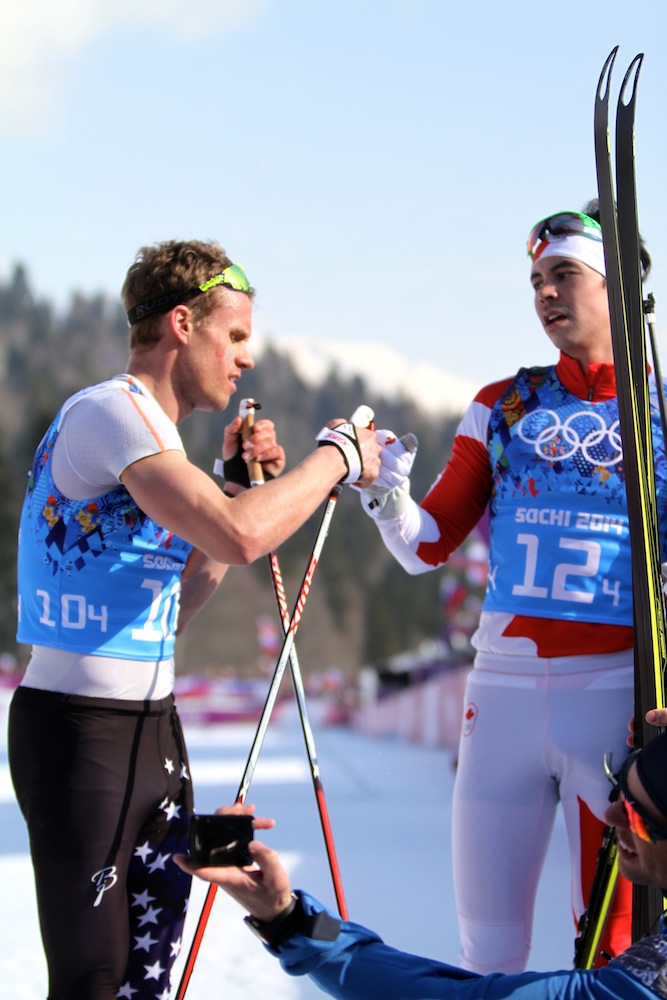
    Canada’s Jesse Cockney (l) and American Simi Hamilton bump fists after anchoring their countries’ relay teams at the 2014 Olympics in Sochi, Russia.

    In mid-April, Cockney said his permanent break from racing hadn’t really sunk in yet. A month later, he was coaching Foothills Nordic athletes at a training camp in Penticton.

    Asked what piece of advice he’d give up-and-coming skiers, he said it was “cheesy”, but simply to be true to oneself.

    “At the end of the day, it’s your name on the results and you’ve got to be able to be the one driving the train and figuring things out,” he said. “It’s a brutally honest sport, and we’re judged with a clock. It’s your name next to that time, so be true to yourself and enjoy the process so much. … In cross-country skiing, the process is 95 percent of the sport, and 5 percent of it is competing… Just having a real love for the training, the relationships, the places that you go, that’s the biggest thing.”

    And as he parts ways with CCC, he stressed the importance of club programs in the development pipeline as they helped cultivate his career (Cockney grew up skiing with Foothills Nordic).

    “The club systems were really strong in Canada and could provide athletes with a lot of support through different points in their career, and I think we’ve really put a big focus on the training centres, taking up the mantle with that,” Cockney said. “If clubs were able to be more supportive, be more things to athletes at different points in their career, I think that you would start to see an improvement in just the health of the sport across the country. The more places people can ski at a high level, or whatever level they feel they want to, without moving, without uprooting themselves, I think that’s the best thing. It’s not always feasible for someone to pick up and move to a training centre and change their life. If there’s a club in town that they can pursue their goals in sport, then that’s the best way to get people sticking with the sport.”

    As for his future endeavors and adventures, Cockney predicted that he probably wouldn’t rollerski for fun. Rather, he was looking forward to mountain biking in the Bow Valley, going fishing and enjoying “a few more outdoor pursuits that are for myself” and a slower pace. “I think that will be good for me,” he said.

    “[I’m] definitely keen to get going with something else in life,” he said. “It’s been an absolutely amazing time in sport for me and I achieved pretty much everything that I would’ve wanted to in a career and I had a great time doing it … but it’s going to be a challenge, for sure, because it’s been so long since I was doing school consistently. … Just looking forward to a new challenge.”

  • Beatty Caps Season with 160 k Arctic Circle Race Victory

    Beatty Caps Season with 160 k Arctic Circle Race Victory

    Northern lights at camp on one of two nights during the 2018 Arctic Circle Race in Greenland. (Photo: Arctic Circle Race)

    Canada’s Dahria Beatty closed out her World Cup season with the rest of her international-racing peers on March 18 in Falun, Sweden. After three straight days of races, the 24-year-old Whitehorse, Yukon, native finished World Cup Finals in 54th overall.

    Five days later, she endured a three-day 160-kilometer classic race in Greenland, 65 kilometers north of the Arctic Circle. And Beatty didn’t just survive the 22nd-annual epic adventure, she won it.

    Canada’s Dahria Beatty racing to first among women and fifth overall in the three-day Arctic Circle Race in late March in Greenland. (Photo: Arctic Circle Race)

    In her first Arctic Circle Race, Beatty was the first woman to complete all 160 k in the backcountry near Sisimiut, Greenland, spending two nights in tents with temperatures below -28 degrees Celsius (-18 Fahrenheit) and fueling herself with dehydrated meals and a jar of peanut butter.

    The first woman and fifth overall across the line, she finished on March 25 with a total ski time of 14:19:15 hours. Her dad Craig Beatty completed the race as well, finishing 18th overall and second in his 50+ age group.

    “In 2005, my dad went with some of his friends to do this race and he just loved it,” Beatty told FasterSkier in a phone interview earlier this month. “At the time I was 11 years old and he came back and just thought Greenland was an amazing place, and a place that I should experience.”

    They decided that they would do the race together when she was old enough to compete, 18 or older by the race’s standards. When she looked at her race schedule this year, which kept her in Europe until late March, Beatty figured a stop in Greenland on the way home to do what organizers dubbed “the world’s toughest ski race” was a great opportunity.

    She arrived in Greenland two days before the race and spent two days there after, then recovered in Iceland for six days with her dad.

    Craig Beatty at the finish of the 2018 Arctic Circle Race in Greenland. He finished second in his age group. (Photo: Dahria Beatty)

    “It was really a great trip, to be able to be with my dad,” Beatty recalled. “We haven’t done a trip like that in a long time, so it was a lot of fun and I really enjoyed it.”

    The race itself entailed three back-to-back marathon distances of skiing 50 kilometers or longer, with the longest day being 57 k. Competitors crossed a finish line each day, with Beatty being the first woman on each day, and third overall on Day 1, fifth on Day 2, and finally fifth on Day 3. She noted that her dad, whom she met up with each night at camp, skied a more consistent race.

    “His time on the first day and the last day, which were similar distances, were only separated by 15 minutes or so, whereas I was over an hour slower the third day,” Beatty recalled. “I maybe went a little too fast off the gun, but other than that it was a ton of fun. The first day I was skiing in second and third the entire race, men included, and dropped off a little the second two days…

    “It’s definitely a totally different event than doing something that’s a one-day event, or something where you can go inside and sleep in the warmth at night,” Beatty added. “It definitely is more a test of survival, which is a cool thing to experience, and we were a little bit unlucky in the fact it was so cold.”

    At the same time, racers experienced abundant sun and “bluebird skies”, she said.

    “We had amazing views of the mountains, of the fjords, each day we were racing,” she said. “And at night the sky was lit up with northern lights.”

    Dahria Beatty at the start of the 2018 Arctic Circle Race in Sisimiut, Greenland. (Photo: Arctic Circle Race)

    At the end of each day, racers had access to two- or three-person tents with a thermal groundsheet for sleeping, according to the Arctic Circle Race website. They were provided with a saucepan, frying pan and matches to cook their own food, while organizers supplied hot and cold water as well as coffee and tea. Racers had to wax their own skis and use outdoor “earth closet” bathrooms. There were no showers, beds or cell service, but that all made it part of an experience Beatty won’t forget.

    “The volunteers in the race were absolutely incredible,” she said. “The second and third day, when I was absolutely exhausted, they were standing out there all day [at the feed stations] while we were racing, making sure we had food and hot beverages to drink, and cheering us on. 

    “On the second day, we skied down off the mountains onto a fjord, and at the bottom, my hands were so cold that I couldn’t get my gloves off myself,” she continued. “When I made it to the feed station, the volunteers were there and they helped me take off my wet, cold gloves, and grab my warm mitts out of my backpack and help me put them on. There’s just a really amazing atmosphere around the race. The entire community of Sisimiut looks forward to it each year, and it seems like half the community comes out to volunteer for this race … so that was really cool.”

    With a population of about 6,000, Sisimiut is both a small fishing town and the second-largest city in Greenland. It’s also the country’s most northern ice-free town in the winter and most southern town for dogsledding. In many ways, Beatty said it felt like home.

    inhalers online

    “It was really cool to experience their culture and see so many ties to the Canadian North,” she said. “… I would love to go back in the summer. I met some amazing people from there and they were telling me how different it is in the summertime. It’s definitely a place I’d like to explore more…”

    Going the Distance

    In her career, Beatty has completed four 30 k races, including a third place in the 30 k freestyle mass start at 2015 Canadian Nationals, 34th in the 30 k skate at 2017 World Championships, and 49th in the Holmenkollen 30 k skate at this year’s World Cup in Oslo, Norway. 

    Dahria Beatty racing the Holmenkollen 30 k freestyle mass start on March 11 in Oslo, Norway. (Photo: Fischer/NordicFocus)

    But 50 k? That’s something she’d like to do more of after completing distances of 52.2, 57.1 and 51 k on three consecutive days in Greenland.

    “I had a lot of fun racing this 50 k, and it was definitely slightly different than a 30 k, but I went at it with the same mentality,” said Beatty, who is best known for her World Cup top-30 (and even a top-15) sprint results. 

    “I mean, I’ve had better results internationally in sprint, but when I was a junior, I was always better at distance skiing,” she pointed out. “Right now I’d say I’m usually stronger in sprinting, but a lot of the times those long-distance races, especially in a loppet-style format lend themselves well to sprint athletes. I think there’s a lot of times you see people that are considered sprinters do well in 50 k and 30 k events, more so than they would in a 15 k. I think they kind of almost lend themselves to each other in a very strange way.”

    As she progresses as a skier, Beatty, who made the jump to Canada’s World Cup B-team last spring, said she’s aiming to be more of an “all-around athlete.”

    “I’ve scored World Cup points in a distance race once, and I’d definitely want to do it again, many times before my career is over so it’s definitely something that in my training. I’m not trying to train just to be a sprinter. I’d like to have a balance.”

    Last season, Beatty spent most of five months on the European World Cup circuit. Pre-selected to the 2018 Olympic squad, she returned to Canada in late December for training and racing in Mont Sainte-Anne, Quebec, where she won both sprints at the Canadian NorAm/Olympic trials. In January, she headed back to Europe.

    Dahria Beatty en route to 20th overall in the Seefeld World Cup freestyle sprint for her season-best result in 2017/2018. (Photo: Fischer/NordicFocus)

    On the World Cup, Beatty achieved her best individual result of the season — 20th — in the freestyle sprint in Seefeld, Austria. She competed in five events at the Olympics, placing 13th with her teammates in the 4 x 5 k relay as well as freestyle team sprint.

    Asked about the highlight of her first Olympics, she said it was that team sprint with Emily Nishikawa.

    “For me, the team sprint was more than just racing for Canada,” Beatty said. “Emily and I are both from the Whitehorse Cross-Country Ski Club and the Yukon Ski Team so I was racing for the entire country, but also for my hometown, my club, the roots of where I began skiing and that was really special, knowing I was tagging off to my teammate who grew up through the same program as me and we both could get to this point together was absolutely amazing. We had a good race, and for me, individually, I felt the best that day of the Games and was able to carry a lot of motivation through the race and it was really fun to tag off right in the mix.”

    Racing in the heats in Seefeld was another season highlight.

    “… The course in Seefeld is so much fun; it’s such a beautiful location,” she said. “We had a perfect sunny day and knowing that World Championships will be there next year, it was really fun to kind of prepare to figure out what tactics worked and didn’t, and look forward to the next season.”

    Canada’s Dahria Beatty (l) and Emily Nishikawa after placing 13th in the freestyle team sprint at the 2018 Winter Olympics in PyeongChang, South Korea. (Courtesy photo)

    Under the guidance of Alberta World Cup Academy Head Coach Chris Jeffries, Beatty has typically spent most of her offseason training in Canmore, Alberta. While she said “there’s lots of change going on right now in Canmore” in terms of her training plans this year, Beatty was confident she’d be training with Nishikawa — as she has for the past five years. She also plans on having a strong training group of women, both national-team and non-national team members, to train with in Canmore.

    That group has been gaining momentum and traction on the World Cup scene, with Cendrine Browne scoring her first World Cup points in the last race of the season with the 27th-fastest time of day in Falun’s 10 k freestyle pursuit. Beatty observed that the cohesiveness of the Canadian women’s team has contributed to its growing success.

    “Having a belief in your teammates and being able to learn from your teammates and the strengths of you teammates is so important,” she said. “… I definitely think it’s something that all teams should strive for an strive to support and use each other’s strengths to build the most well-rounded team of teammates, and I definitely think the American women are wonderful role models and having the opportunity to get to know all of them very well over the winters and on the World Cup has been an absolute pleasure. I think we can learn a lot from them, and how they’ve built up their team.”

    At the moment, Beatty is enjoying some time at home with her family and new dog Ozzy in Whitehorse, where she estimates she spends about two months a year. Between spending about half the year in Canada and half the year on the road, she said she’s grateful for her teammates. 

    “Having roommates and having teammates to spend time with and just relax with, and support you on the good races and the bad races, and be out there on the race course with you, too, that’s a huge part,” Beatty said. “I haven’t ever experienced having to be there [on the World Cup] alone luckily, but I’m always grateful for my teammates, and we’re such a close group of friends, I can’t imagine it without them.”

    2018 Arctic Circle Race results

    — Gerry Furseth and Andrea Potyondy-Smith contributed

    From left to right: Canada’s Dahria Beatty, Emily Nishikawa, Zina Kocher, and Cendrine Browne at a late-season World Cup. (Photo: Dahria Beatty)
  • Alpine Insurance Alberta World Cup Academy Announces Allison McArdle as new High Performance Coach

    Alpine Insurance Alberta World Cup Academy Announces Allison McArdle as new High Performance Coach

    CANMORE – The Alpine Insurance AWCA is very pleased to announce that Allison McArdle will be joining our organisation starting January 1st, as a High Performance Coach. Allison will work with Chris Jeffries, High Performance Program Director, to design and deliver the Academy program.

    “Allison will make a great addition to our coaching team. I am very happy she is going to help us provide the best athlete development program in Canada. Allison brings many excellent qualification to the job. Among them are her international network, her coaching experience and her team leadership experience. But what I am most excited about is that she is bringing her sincere desire to see athletes reach their full potential.” said Norbert Meier, President, Alberta World Cup Society.

    Allison has over 15 years of experience in both domestic and international coaching roles in Australia and Canada. In addition, she currently sits on the FIS Ladies Cross Country Sub-committee, is the Chair of CCC’s Women’s Committee and is the Alberta Ski Team Director.

  • Frozen Thunder Day 1:  Locke Wins Qualifier for World Cup Spot; Valjas Outlunges Thompson in Final

    Frozen Thunder Day 1: Locke Wins Qualifier for World Cup Spot; Valjas Outlunges Thompson in Final

    Canadian World Cup Team member Len Valjas (1) and Bob Thompson (NTDC Thunder Bay) lunge to the line during Wednesday’s Frozen Thunder classic sprint at the Canmore Nordic Centre in Canmore, Alberta. (Photo: Doug Stephen)

    Clouds heavy with building snow and a winter-storm warning already in effect cast a second anticipatory shadow over a jittery group of racers gathered on Wednesday for the first Frozen Thunder race of the season at the Canmore Nordic Centre in Canmore, Alberta.

    At stake for some of the top Canadians participating in the day’s classic sprint was the opportunity to secure the final spot on the men’s World Cup team for the first period of World Cup racing starting later this month. Nearly 12 centimeters of snow had fallen the night before on the two-lap race track, and for many stepping out onto the freshly groomed trails, months upon months of training prep was in the barn.

    “That World Cup spot. That has been a goal for pretty well the whole year,” said Bob Thompson, who trains with the Thunder Bay National Team Development Centre (NTDC), on the phone after Wednesday’s races. 

    Thompson, 26, was not the only one hoping to book a plane ticket for World Cup Period 1, which starts Nov. 24 in Kuusamo, Finland, and continues through December. Sixty-six skiers started Wednesday’s men’s sprint qualifier and anyone in the hunt for that World Cup spot would have to outperform them all, excluding the Americans and Canadian World Cup Team member, Len Valjas, who was prequalified for the World Cup.

    Even with the competition’s added edge, many racers went about business as usual on race day and in the days leading up to the event, Thompson explained.

    “It’s been fairly carefree the week we’ve been here,” said Thompson, who arrived in Canmore with his NTDC teammates on Oct. 23. “The morning [of the sprint] I wouldn’t say things were a bleak atmosphere or super serious, it was just kind of everyone was doing their thing.”

    Thompson went about his warmup the way he normally would on race day. In retrospect, he saw his plan as well-executed and his warmup as strong, despite breaking a pole during his intensity segment. For him, the qualifier went “really well,” he said.

    Julien Locke (Canadian U25 Team/Black Jack) after winning the men’s classic sprint qualifier at Frozen Thunder in Canmore on Wednesday and securing the final spot on the Canadian men’s team for World Cup Period 1. (Photo: Cross Country Canada)

    But Julien Locke, of the Canadian U25 Team and Black Jack Ski Team, was the fastest man in the open men’s qualifier and thus earned that coveted World Cup spot.  Locke, 24, posted the top time of 3:37.81 minutes, nearly a second ahead of Valjas in second (+0.97) and 3.57 seconds ahead of the third qualifier, Dominique Moncion-Groulx of the Alberta World Cup Academy (AIAWCA). Thompson qualified fourth, 4.15 seconds off of Locke’s winning time.

    “I didn’t have regrets or second thoughts on how I raced,” Thompson said. “Julien had a great race, props to him. I’ll just have to come back next time.”

    Locke could not be reached at press time, but he spoke with Cross Country Canada (CCC) in a video posted on Twitter after the race.

    “I’m really excited to have won the race this morning and qualified for Period 1 World Cup, but the Olympics is the big goal this year,” Locke said. “It’s super important to go get results on the World Cup, and I’m excited to have a chance to do that.”

    According to CCC High Performance Director Thomas Holland, Locke and the rest of the World Cup Team (excluding Alex Harvey and Cendrine Browne) will head to Gällivare, Sweden, on Nov. 10, where they’ll compete in a weekend of International Ski Federation (FIS) races from Nov. 17-19. Meanwhile, Harvey and Browne, who train out of the Pierre Harvey National Training Centre (CNEPH) with coach Louis Bouchard in Quebec, will train in Davos, Switzerland, in advance of the World Cup opener in Finland.

    But let’s get back to Frozen Thunder. With the qualifier behind them and the heats slated to take place in a zero-elimination King’s Court format, many racers approached the rest of Wednesday adamant on getting in some solid race efforts.

    (Article continues below)

    https://www.instagram.com/p/Ba9eMJtnlWV/?taken-by=coach_babs_

    “The King’s Court format that we use in the heats was a great showcase for athlete development whereby every athlete entered in the race gets to race all 3 heats,” Holland explained in an email. “The format sees men and woman and para-skiers in some of the same heats – super fun event for all the athletes.”

    In the first heat, Thompson, Locke, Valjas, and Moncion-Groulx went head to head, yet with the heats starting one minute apart on the two-lap track, there was a constant influx of skiers and some overlap.

    “I think comments were made that we were dogging it a little bit,” Thompson said of that initial round. “There were other heats that we were basically skiing in the first lap with that were going faster than us … they were running pretty quick through the starts.”

    Dominique Moncion-Groulx (Alberta World Cup Academy) leads Julien Locke (3), of Canada’s U25 Team and Black Jack, and Len Valjas (l), of the Canadian World Cup Team, during a Frozen Thunder classic sprint heat on Wednesday at the Canmore Nordic Centre in Canmore, Alberta. (Photo: Doug Stephen)

    In the second heat, Locke and Valjas paired up with Knute Johnsgaard (Canadian World Cup Team/AIAWCA) and American Cole Morgan, of the Sun Valley Ski Education Foundation (SVSEF). Thompson and Moncion-Groulx faced another American SVSEF skier, Kevin Bolger, as well as NTDC Thunder Bay’s Andy Shields. Four men advanced to the  senior men’s final: Bolger, Thompson, Locke and Valjas.

    In the final, Thompson recalled creating what he saw as “a bit of a gap” between himself and Valjas, yet Valjas, a seasoned World Cup sprinter, caught him in the lunge to the line for first. Overall on the day, Valjas placed first, Thompson second, Locke third, and Bolger fourth.

    With the King’s Court format, female racers competed in the same same qualifier as the men, with Dahria Beatty (U25 Team/AIAWCA) emerging as the fastest female qualifier in 4:20.66. Her time was 8.56 seconds clear the second woman, American Chelsea Holmes, of Alaska Pacific University (APU), and 10.03 seconds ahead of Katie Weaver (Hollyburn Ski Club) in third. The third-placed Canadian woman in the qualifier, Annika Hicks (AIAWCA) clocked in fourth (+13.25). 

    In the heats, the women continued to race with the men. In the all-women final, Maya MacIsaac-Jones (U25 Team/Rocky Mountain Racers) took the win, Hicks placed second, Holmes third, and Frédérique Vézina (CNEPH) fourth.

    Frozen Thunder racing continues Friday with men’s 10 k and women’s 7.5 k distance races, starting at 9 a.m. Mountain time. In a press release, CCC anticipated a turnout of 115 participants.

    Classic sprint results: Qualifier | Heats

    https://www.instagram.com/p/Ba-9qryFyoc/?taken-by=cccski

  • AWCA Position Opening: High Performance Coach

    AWCA Position Opening: High Performance Coach

    (Job posting)

    Position Opening: High Performance Coach – Alpine Insurance Alberta World Cup Academy 

    The Alpine Insurance Alberta World Cup Academy (Alpine Insurance AWCA) has a current opening for a High Performance Coach for the 2017/18 competition year, November through March.  This position could lead to a full-time contract for the 2018/19 training and competition season.

    As a designated NTDC, the Academy is part of Cross Country Canada’s national network of training centres and has the status of an “A+B” centre. This full-time position will be part of the team assisting athletes achieve their full racing potential, ranging from junior and U23 level athletes to those athletes ready for selection to the NST and WC team.

    The Alpine Insurance AWCA has a 9-year track record of helping athletes obtain placement on the NST and the WC, WSC and OWG teams.

    Located in Canmore, Alberta, the High Performance Coach is expected to:

    • Have a level of experience and expertise commensurate with the level of athlete training at the Alpine Insurance AWCA;
    • Preference will be given to coaches who have a Level 4 designation, but applications from coaches with a Level 3 designation will also be considered;
    • Superior expertise in all relevant technical aspects of our sport (race support, YTP development, wax/ski knowledge, etc.);
    • A track record of proven success as a High Performance Coach;
    • Alberta Class 4 driver’s license (or ability to obtain such in first month on the job).

    Expected start date is November 13th, 2017.

    All interested applicants are requested to send their resume to:

    Deadline for application is October 24th, 2017

    See also: http://www.albertaworldcup.com/thank-you-scott/

  • It’s Been a Bad Combo Out West: Wildfire Smoke and Training

    It’s Been a Bad Combo Out West: Wildfire Smoke and Training

    Fran Vukonic, Tallon Noble, and Ian Williams pose at the end of a bluebird day trail run at Big White in front of the newest Kelowna fire, September 5, 2017. (Photo: Gareth Williams)
    Canadians Fran Vukonic, Tallon Noble and Ian Williams after completing a trail run on Sept. 5 at Big White in Kelowna, B.C.,with the backdrop of the newest Kelowna fire on an otherwise bluebird day. (Photo: Gareth Williams)

    This week’s featured articles are made possible thanks to the generous support of The Loppet Foundation, host of the Masters World Cup 2018. Registration opens in October.

    ***

    Beyond the hundredth meridian, a traditional geographic line demarcating where the West begins, it’s been a hot and dry summer. Wildfires have raged from Washington to California, the Intermountain West, and in western Canada. The conditions remain ripe for extreme fire danger. Even if a wildfire didn’t burn near you, odds are the smoke found its way there. 

    Across the board and across the U.S., it’s been an off-the-charts summer. While many Americans have been consumed with hurricane coverage and concerns over the last several weeks, fires have scorched more than a million acres in Washington and Oregon alone this year, according to Quartz Media. That’s up from 513,226 total acres in 2016, but in 2015 and 2014, more than a million acres were affected.

    NOAA wildfire smoke and the correlating Air Quality Index for Sept. 5, 2017. (Photo: NOAA)

    Along with the devastated landscapes and loss, the wildfires’ byproducts of smoke and ash have made for smoggy, poor air quality. We’re talking about seriously hazy days when visibility often wasn’t more than a mile or two.

    Training outside in less-than-ideal quality air can compromise an athlete. To better understand when it’s OK to go out or stay in, many skiers and coaches became intimate with the scientific benchmarks for air quality.

    “I sort of have this rule where if I can see the glaciers on the mountain, I would rollerski but not do intervals,” Dakota Blackhorse-von Jess, who’s based out of the Bend Endurance Academy in Oregon, said on the phone last Friday. “My personal limit for being outdoors is that 75 AQI limit. That’s the unhealthy or moderate zone.”

    Here’s a quick primer. The U.S. Environmental Protection Agency (EPA) has developed an user-friendly Air Quality Index (AQI). The index is color coded and provides a numerical value indicative of a region’s air quality. An AQI of 75 means the air has a PM2.5 concentration of 23.5 micrograms per cubic meter. Going further, PM2.5 refers to the size of particulate matter in the air. In this case, the 2.5 corresponds to particulate matter 2.5 microns or less in width. That’s small enough to penetrate deep into the lungs, even the bloodstream.


    U.S. Environmental Protection Agency Air Quality Index (Photo: EPA/AIRNOW.gov)

    That 75 Blackhorse-von Jess limit falls midway into the moderate zone on the AQI.

    “The higher end of moderate,” Blackhorse-von Jess clarified. “You see what the station says and then you walk outside and determine if it is going to work. Honestly, at this point, it’s been five weeks. I’ve done so much training indoors, that now it’s more of a mental break than a training deficiency.”

    In places like Bend, Ore., where Blackhorse-von Jess calls home, some athletes have ignored the warnings.

    “I saw guys out there riding today, I see them every time when I am looking for breaks in the smoke,” Blackhorse-von Jess explained. “I cannot believe that people are out there. I think people living in the smoke have accepted a lower standard and are going about their daily lives and actually, their daily activities in the smoke have come to accept the shittiness of the feeling they are experiencing. And for the professional athlete, it is something that you cannot afford, I don’t believe.”

    BlackJack's Julien Locke training at a hazy Haig Glacier camp, August 2017. (Photo: Anthony Killick)
    Julien Locke (Canadian U25 Team) training at a hazy Haig Glacier camp in August. (Photo: Anthony Killick)

    While several fires continue to burn, the smoke cleared in Bend on Sept. 9. During much of August and into the beginning of September, Blackhorse-von Jess relied on a SkiErg, running treadmill and a stationary bike for much of his over-distance training.

    He is not alone.

    “Actually today, it was still dark when I woke up, but when the sun came up there was actually blue sky,” U.S. Ski Team member Liz Stephen said Friday from her home in Park City, Utah. “Where other days, you weren’t even sure the sun was up. It was really nasty.”

    Like other elite skiers across the West, Stephen had made use of indoor training opportunities. The day before Stephen spoke to FasterSkier, she logged four hours on a ski treadmill at U.S. Ski and Snowboard’s Center of Excellence (COE) in Park City.

    The AQI is also careful to note what are called “sensitive groups”. That can mean older adults, children, or people with lung or heart issues. Those populations must take precautions when high exertion exercise and poor air quality mix. Being responsible for junior athletes places a premium on being cautious. 

    For Leslie Hall, director of the Methow Valley Nordic Team in Washington state, dealing with smoke and subsequent air quality issues have been an on-and-off again affair.

    “We had a bad two week period at the beginning of August and it was leading into our annual Methow PNSA [Pacific Northwest Ski Association] Camp … so we had to make the call to move the camp,” Hall wrote in an email. “We ended up going to Oakridge, Ore., for the camp and had a great camp there with 32 kids but a fire started nearby there while we were there so we had one moderately smoky day and it has since gotten much worse there.”

    Like her athletic and coaching counterparts, Hall keeps an eye on air-quality websites to determine if a practice is indoors our out. But kids are kids.

    “It is quite hard to keep the kids motivated and they do not enjoy the gym workouts,” Hall noted. “But during the early smoke time, we knew we were going to go somewhere else to train fairly soon so we kept that in mind.  This past week was good because there are a variety of kids running and different coaches which help.  Also, intensity workouts on the exercise machines help the time go by quicker. There is plenty of complaining and calls to move East, but I think all the kids realize that we are very fortunate in general and it is hard to complain when the hurricanes are decimating the south and we just have bad air for a week or so.”

    Reports from Canada mirrored the smoke-filled experience of skiers in the Western part of the U.S.

    According to FasterSkier’s Gerry Furseth, on Sept. 7, British Columbia’s indices for air quality deemed Fort St John and Terrace as the only locations in the province “safe” for exercise. (The Canadian AQI is based on particulate matter 2.5 microns or smaller, but uses a 1-10+ scale with “1” being low health risk and “+” very high.)

    Air Quality Health Index 5 in Vernon. BC (Photo: Gerry Furseth)
    Air Quality Health Index 5 in Vernon. BC (Photo: Gerry Furseth)
    Air Quality Health Index 1, Vernon, BC (Photo: Gerry Furseth)
    Air Quality Health Index 1, Vernon, BC (Photo: Gerry Furseth)

    Gareth Williams, a member of Canada’s national U25 Team and a native of Kelowna, B.C., wrote in an email that the smoke was a near-constant companion this summer.

    Gareth Williams leads Fran Vukonic through an orange-tinted rollerski in Kelowna, BC. (Courtesy photo)
    Gareth Williams (Canadian U25 Team) leads Fran Vukonic during an orange-tinted rollerski in Kelowna, B.C. (Courtesy photo)

    “Summer has been great for me, I spent much of it on the Haig [glacier near Canmore, Alberta] in July,” Williams explained. “I’ve been in Kelowna the whole month of August and the smoke has yet to subside, it has actually gotten much worse recently. In past years the smoke has been bad, but I have never seen it like this. …  I think the smoke isn’t as bad as some people have suggested, for me it’s not the greatest worry. I will be happy once it is gone though, getting a little tired of the orange lighting and not being able to see the sun!”

    Michael Somppi, who trains with the Alberta World Cup Academy (AWCA) in Canmore, altered his plans depending on conditions.

    “Personally, I haven’t found the breathing to be too bad,” Somppi wrote. “That said, I am avoiding doing any hard intensity efforts on smoky days.  Today was the first day (in Kelowna) I was forced to alter my training plans, as I had planned to do a rollerski time trial, and instead opted to do zone 3 because of the smoke.  Even breathing semi hard felt sketchy with how bad the air quality is at the moment.”

    Another member of Canada’s U25 Team, Julien Locke has literally trained above the smoke on occasion.

    “I’ve been lucky in that the smoke hasn’t been too thick during most of the important training blocks so far,” Locke wrote. “I was at the Haig Glacier 4 times this summer and while we had some hazy days, for the most part, 2400m elevation was high enough to have clear skies.”

  • Cockney Leads ‘North of the Border’ U.S. Nats Prologue Podium

    Cockney Leads ‘North of the Border’ U.S. Nats Prologue Podium

    Left to right: Julien Locke of the Alberta World Cup Academy along with Jess Cockney of Canada's World Cup B-team and Knute Kohnsgaard also of the Alberta World Cup Academy standing on the podium for freestyle sprint prologue on Thursday at U.S. nationals in Midway, Utah.
    The men’s podium at Thursday’s freestyle sprint prologue at 2017 U.S. Cross Country Championships at Soldier Hollow, with (from left to right) Julien Locke (AWCA/NST U25 Team), Jess Cockney (Canadian World Cup B-team), and Knute Johnsgaard (AWCA/NST U25 Team).

    MIDWAY, Utah. — Most were swallowed in seconds, the steady stream of snowflakes on Thursday serving a magician-like purpose: a curtain of snow through which the first five starters all appeared, only to disappear once again. All except one.

    A speck of red bobbing through the Soldier Hollow’s (SoHo) new sprint course, sporting bib 5 and the Canadian national team suit, Jess Cockney did not go unseen.

    The 27-year-old member of Canada’s World Cup B-team lost nothing to the freshly falling snow, posting the fastest course time as the fifth finisher through.

    Jess Cockney of the Canadian World Cup B-team racing the men's 1.5-kilometer freestyle sprint prologue on Thursday at U.S. nationals in Midway, Utah.
    Jess Cockney of the Canadian World Cup B-team racing to the win in the men’s 1.5-kilometer freestyle sprint prologue on Thursday at U.S. nationals in Midway, Utah.

    However, with more than 65 racers still looking to push past the start wand onto the 1.5-kilometer freestyle-sprint prologue loop at 2017 U.S. Cross Country Championships, Cockney had a wait before he had a win.

    Starting seven bibs behind Cockney and 1 minute and 30 seconds after him, Julien Locke, of the Alberta World Cup Academy (AWCA) and Canadian U25 Team, headed out of the gate in bib 12.

    The 23 year old was racing for the podium. After his classic sprint last Sunday ended in “disappointment”, Locke was ready for redemption.

    “The plan for this week was to land on the podium,” Locke said during a post-race interview.

    Locke hammered through the first undulating uphill leading out of the stadium, challenging the previous course leader’s pace. Looping through the first descent heading into the second major climb, he didn’t appear to be losing or gaining ground on Cockney.

    However, rounding into the final finishing stretch, Locke was at a deficit. He finished 2.69 seconds behind Cockney’s prologue time, the closest any competitor would get for the remainder of the day.

    Cockney’s prologue time of 3:15.20 minutes not only kept him in first place, but secured his spot at the upcoming World Championships in Lahti, Finland, starting late next month. With much at stake for many skiers heading to the start line of Thursday’s race — for Cockney, a chance at qualifying for his second World Championships — the Canadian sprinter indicated that staying confident gave him a leg up on his competitors. 

    Julien Locke of the Alberta World Cup Academy racing the men's 1.5-kilometer freestyle sprint prologue on Thursday at U.S. nationals in Midway, Utah.
    Julien Locke (AWCA/Canadian U25 Team) racing to second in the men’s 1.5-kilometer freestyle sprint prologue on Thursday at U.S. nationals in Midway, Utah.

    “Being on the start line is exactly the same as sitting down for a test,” Cockney said after. “You don’t really have to stress about it if you did all the preparation and you studied for it. Ski training is very similar to that.”

    Cockney was joined on the U.S. nationals prologue podium (no sprint heats followed) by two fellow Canadians, Locke in second place and, (down to Locke by three-hundredths of a second) Knute Johnsgaard in third overall (+2.72).

    Since Johnsgaard (also a member of the AWCA and Canadian U25 Team) was not pre-qualified for World Championships coming into this week’s competitions, Thursday’s prologue was his last shot at proving his deserved a team spot.

    “I was fighting hard for the last couple spots [on the World Championships team],” Johnsgaard said Thursday. “I still don’t know [whether or not I’ve been selected].”

    Regardless of whether Johnsgaard gets to sport the red maple leaf in Finland in late February/early March, he viewed the four days of racing at SoHo as valuable.

    “It was a really great weekend to be able to have a bit deeper field than our usual domestic races in Canada,” Johnsgaard said. “Especially for the sprint heats, to be able to be going head to head with the fastest guys in North America and not just the fastest guys north of the border, it’s a really great experience and helps a lot.” 

    Knute Johnsgaard of the Alberta World Cup Academy racing the men's 1.5-kilometer freestyle sprint prologue on Thursday at U.S. nationals in Midway, Utah.
    Knute Johnsgaard (AWCA/Canadian U25 Team) racing to third in the men’s 1.5-kilometer freestyle sprint prologue on Thursday at U.S. nationals in Midway, Utah.

    While Americans dominated the NorAm opening weekend at Sovereign Lake, B.C., in December, Canada stuck it to its southern rivals on Thursday. If nothing else, it was confidence boosting with more than 600 racers coming out for the week’s races (although on Thursday, 71 started the senior men’s race).

    “The field can be as deep as it is here, and you can still be confident that all the work you did to get to that start line is going to hopefully be better than anyone else’s,” Cockney said.

    Though no American podium ceremony was held, the top Americans for the day were Logan Hanneman of Alaska Pacific University (APU) in fourth overall (+3.37), Cole Morgan of the Sun Valley Ski Education Foundation (SVSEF) Gold Team in sixth (+5.03) and his SVSEF teammate, John Hegman in seventh (+5.71). Both SVSEF Gold Team members also finished on Sunday’s American classic sprint podium.

    — Jason Albert and Gerry Furseth contributed

    Results 

    (Above video by Kirk Nichols of The Utah Nordic Alliance)

  • Widmer Waits for World Cup Window, Shines With Swiss Status

    Widmer Waits for World Cup Window, Shines With Swiss Status

    Heidi Widmer, who lives and trains in Switzerland, racing to 15th in the women's 8 k classic preseason race on Nov. 19 in Davos, Switzerland. (Photo: NORDIC-ONLINE.CH)
    Heidi Widmer, who lives and trains in Switzerland, racing to 15th in the women’s 8 k classic preseason race on Nov. 19 in Davos, Switzerland. (Photo: NORDIC-ONLINE.CH)

    In 2015, Swiss-Canadian skier Heidi Widmer moved from Canada to Switzerland. In 2016, she moved between the World Cup and the lower-tier Alpen Cup. Now she’s trying to figure out what’s next, while left rueing the difference that four-tenths of a second can make.

    Widmer, now 25, skied strongly throughout the 2013/2014 season. She represented Canada in three races at the Sochi Olympics, won her first Canadian national championship, and won the season-long NorAm sprint title (Canada’s Continental Cup). But 2014/2015 was in many ways a step back for Widmer; her results suffered, and she failed to earn World Cup or World Championship starts.

    Heidi Widmer, a former Alberta World Cup Academy and Canadian national team member, racing a skate sprint at 2014 Canadian Olympic trials. (Photo: Angus Cockney)“I was under recovered” throughout that season, Widmer told FasterSkier in May 2015, “and when your body is run down, it leads to other problems such as low iron and ferritin as well as sickness.”

    Widmer was not re-named to the Canadian national team, but wanted to continue with high-level racing. Thanks to a Swiss-born father, and a sympathetic ally in coach Christian Flury (currently in Switzerland, but formerly with Widmer’s Canadian club, the Alberta World Cup Academy), Widmer successfully embarked on the process of using her dual citizenship to begin racing for Switzerland.

    Positive results soon followed. Widmer gained World Cup starts at several weekends in the 2015/2016 season, qualifying for the heats in two out of five freestyle sprints she entered. She consistently placed in the teens on the Alpen Cup, and on the podium in Swiss Cup races. The move to trade the red-and-white maple leaf for the white-and-red Swiss cross seems to have served her well.

    But vexillology aside, her most recent results are still somewhat vexing. Widmer finished 32nd in last Sunday’s skate sprint qualifier in Davos, 0.39 seconds away from making the heats and earning World Cup points. (Sprinting can be a cruel mistress: Widmer’s 32nd in qualifying placed her ahead of, among many others, Norway’s Heidi Weng, Ida Ingemarsdotter of Sweden, and American Kikkan Randall. All three have World Cup sprint wins on their résumés. Randall and Ingemarsdotter have World Championships sprint medals.)

    Objectively speaking, that’s almost nothing, the difference between 5.95 seconds back from the qualifying winner, Jonna Sundling, and 6.34 seconds back. The literal blink of an eye. Less time than it takes a Major League fastball to reach home plate. But when it comes to World Cup-level racing, tiny margins can have a big impact.

    “It’s really hard to say now” whether or not start rights for this year’s Tour de Ski are in her future, Widmer told FasterSkier in an in-person interview shortly after her qualifying effort. “Had I qualified today it would have been an easy decision, but who knows.”

    Widmer added that she had “no idea, to be honest,” where she would be racing this coming weekend.

    “I usually play my season one step in front of the other,” she said. “My first priority is to process today and if I am granted the opportunity and the privilege next weekend in La Clusaz for the relay I would be super stoked; I know that we want to start a team in the relay there so that is unfortunately not in my hands. If I don’t go there then I will be in Goms [Switzerland] again for COC Cup [Europa Cup], which is also super-good competition. So yeah … those decisions are above my reach. And then hopefully a Tour de Ski start.”

    Widmer was disappointed with her result in Davos, but clear-eyed about the implications of 0.39 seconds at this level of competition. “[I] had really good feeling in my legs today,” she said in Davos. “I lacked that last little [bit]. 99.9 percent was there, but I lost a little; a little snap was missing. So I need to be really happy with what I put on the line today, but obviously super disappointed at the same time.”

    She continued, “It’s the name of the game that we sign ourselves up for that all the ladies here are obviously super strong, and to know it can go one way” or the other. “Last year,” Widmer recalled, she was “so close on the other side of the fence in 29th qualifying … and I think there were more ladies on the start line this year, and that’s what we want to see.”

    Stepping back to consider her season as a whole, Widmer was pleased that her training “has been really good.”

    Heidi Widmer (c) with Swiss skiers Nathalie von Siebenthal (l) and Christa Jäger after rollerski intensity on Stelvio Pass in Switzerland in June 2013. (Courtesy photo)She added that she has found a challenging and complementary training group in her fellow Swiss skiers.

    “I can say confidently that I have never trained so hard in my life and never challenged myself so much. Training with Nadine Fähndrich and Nathalie von Siebenthal is an incredible opportunity, those girls train really hard and have an incredible work ethic and professional take on the game. … We are all completely different personalities and we gel together really well. I think we challenge each other in ways that the other person can’t take the lead in and vice versa.”

    In November, Widmer was getting in some early racing on farmed snow in Davos. She said at the time that her performance was “FAR off the mark!” and that “the fitness is not where it should be.” By early December, things had come around somewhat, and Widmer was winning the season’s first Swiss Cup race in Goms, posting the top qualifying time by 1.79 seconds in a three-minute sprint. But then came last weekend in Davos, and those missing 0.39 seconds.

    “We want it to be a close game,” Widmer graciously told FasterSkier immediately after her just-short qualifying effort, “because we always – we all work so hard to be here.”

  • 17 Questions for 2017: Dahria Beatty

    17 Questions for 2017: Dahria Beatty

    08.03.2016, Canmore, Canada (CAN): Dahria Beatty (CAN) - FIS world cup cross-country, individual sprint, Canmore (CAN). www.nordicfocus.com. © Felgenhauer/NordicFocus. Every downloaded picture is fee-liable.
    Canada’s Dahria Beatty (29) racing to third in her quarterfinal for a career-best 15th overall at the 2016 Ski Tour Canada classic sprint in Canmore, Alberta, on March 8, 2016, one day after her birthday. (Photo: Fischer/NordicFocus)

    Welcome to “17 Questions for 2017”, where we are catching up with American and Canadian national-team members before the beginning of the winter season.

    ***

    The day after her 22nd birthday last March, Dahria Beatty made the case that she could be Cross Country Canada’s next star. Not only did she score her first World Cup top 30, but she nabbed a career-best 15th in a World Cup stage at home (her training base) in Canmore, Alberta.

    Beatty, of the Alberta World Cup Academy and national U25 Team, was the only Canadian woman to qualify for the heats in the classic sprint that day, and she ended up third in her quarterfinal heat.

    Now after an offseason of remedying some back troubles and building strength, Beatty says she looks like a different person when she’s double poling, and not just because she cut off her hair.

    1. Biggest change in your life in the last five or so months since the ski season ended?

    I cut off 9 inches of my hair, it’s really speeding me up

    2. Biggest change in your training?

    I started doing pilates and made adjustments to my technique with our technique coach Kathy.

    3. Major areas of improvement you’ve seen so far?

    I look like a different person when I’m double poling now!

    4. Whom you’ve been working closest with this offseason (coaches or training partners)?

    My teammates, Maya, Emily and I spent 3 weeks together in NZ. We helped coach each other while we were away.

    5. Best trip in the last five months (and why)?

    New Zealand, it was my first time to the southern hemisphere. Loved the skiing, loved the sheep, loved driving the twisty roads.

    Dahria Beatty celebrating at snowy peak during an overdistance run near Park City (Courtesy Photo)
    Dahria Beatty (Canadian U25 Team) celebrating a snowy peak during an overdistance run near Park City, Utah, in October. (Courtesy photo)

    6. Favorite cross-training?

    I got a new mountain bike from Icycle Sport this summer. I have rediscovered how awesome mountain biking is.

    7. Favorite non-athletic activity or pastime this summer?

    Surfing, aka falling off my board lots

    8. Song that was your jam this summer?

    My favourite jam is raspberry…. I can never remember the names of songs

    9. All-time favorite race moment?

    Racing my first World Cup sprint quarterfinal last spring in Canmore in front of my family and friends.

    10. First thing you pack in your bag when you leave for Europe?

    My travel pillow… sleep is the best

    11. Venue/event you’re most excited to visit this season?

    Drammen. I’ve always wanted to do a city sprint in Europe!

    12. Who will win the men’s and women’s World Cup titles this year?

    It would be nice to see some North Americans fighting for the titles, I’ll be cheering for Alex and Jessie.

    13. Biggest sacrifice you feel you’ve made choosing this career path?

    I had to give up on my dream of playing in the WNBA.

    14. If you could change one thing about your sport, what would it be?

    Have more WC races in North America

    15. What did you have for breakfast this morning?

    Eggs on toast with almond butter and fruit.

    16. In 5 years, I’ll be ____?

    27… Still racing and hopefully a lot closer to the top of the results list 😉

    17. In 50 years, I’ll be ____?

    27 backwards… An old lady, hopefully a grandma and still an avid skier.

  • Biathlon Veteran Perras Ventures Further into ‘Adulthood’ as AWCA HP Coach

    Biathlon Veteran Perras Ventures Further into ‘Adulthood’ as AWCA HP Coach

    Scott Perras (l) with Devon Kershaw on his heels in Monday's Frozen Thunder distance race at the Canmore Nordic Centre in 2014. (Photo: Noel Rogers/Bow Valley Photography)
    Scott Perras (front) with Devon Kershaw on his heels in the 2014 Frozen Thunder distance race at the Canmore Nordic Centre. Perras retired from biathlon this spring and will coach the Alberta World Cup Academy. (Photo: Noel Rogers/Bow Valley Photography)

    Scott Perras’s first biathlon World Cup result back in 2007 might have seemed tough at the time: in Kontiolahti, Finland, he finished 104th in the 20 k individual.

    But nine seasons later, he has made five trips to World Championships, become an Olympian and hit the top 10 on the World Cup. He was a key part of a Canadian relay team which reached the World Cup flower ceremony in 2014, finishing sixth, and then finished a best-ever seventh at the Olympics a few weeks later.

    After all of that, the 32 year old from Saskatechewan is hanging up his rifle.

    “I didn’t realize how long my career was until I quit,” Perras said with a laugh in a recent phone interview. “For me, the high point was being part of the team for so long, and having really great teammates along the way. From Robin Clegg and J.P. Le Guellec at my first World Cup, to guys like Macx Davies and Christian Gow in Rupholding [this year] — just a lot of having fun, tom-foolery. Putting off being an adult for as long as I could.”

    Perras can now no longer say he’s putting off being an adult. He got married this summer, helped his wife set up her business, and is now moving into a full-time, non-athlete job himself: Perras will be the new high-performance coach for the Alberta World Cup Academy (AWCA) cross-country ski team.

    It’s a transition away from biathlon, and yet one day last week found him in a familiar place with the men and women he had called teammates until just a few weeks earlier.

    “Yesterday I was at Sunshine Meadows with the biathlon team because they have technique camp,” Perras explained last Wednesday. “They bring in Mats Larson from Sweden, and I wanted to get some refreshers for that for my team going forward.”

    The next day, he was back in Canmore leading a workout for AWCA’s under-21 men’s team.

    “There has always been an invisible barrier maybe between cross-country and biathlon and I hope to maybe bridge it a bit, and help everybody work together a little bit easier,” Perras explained. “I also have good relationships with all the top biathletes and biathlon coaches and am also developing them in cross-country. I can go to anyone and ask for help anytime I need it.”

    “There has always been an invisible barrier maybe between cross-country and biathlon and I hope to maybe bridge it a bit.” — Scott Perras

    The 2015/2016 season didn’t go as Perras had hoped, and he found himself off the World Cup team. In between racing at the second-tier IBU Cup, he also jumped into some ski races, including finishing second in a NorAm 20 k and 12th in the American Birkebeiner 51 k, the biggest international ski race in North America.

    So besides drawing on his former team staff and teammates when he needs to learn about coaching, he is hoping to bring the biathlon and cross-country communities closer together more generally. In Canmore, the national teams as well as local teams often train on the same trails anyway.

    “I’ve noticed everyone has a really clear picture in their mind of what they want to do, what they want to achieve, and how they are going to achieve it,” Perras said. “Sometimes as coaches we end up being more tied to that plan than to being flexible and seeing the advantages of maybe being more inclusive.”

    Perras wasn’t certain that he would retire after this season, and he also wasn’t certain that he wanted to go into coaching. But it was one of two possible futures he saw for himself, and when AWCA opened up an assistant coaching position it was a good fit.

    He saw AWCA providing a good transition for him from racing to coaching: while he’s on the ground leading workouts, head coach Chris Jeffries is the main brain behind the operation. The team has its training plans and physiological goals worked out already.

    “It’s great knowing that all of the really big picture things, we have people with a lot of experience writing that,” he said. “That stuff definitely interests me, but it’s nice learning about it and applying all at the same time with the insurance of having these well educated well experienced people behind us.”

    Spending more time on the IBU Cup this season, Perras also got to know some of the younger biathlon athletes. He observed what made them tick, and also the ways in which they weren’t so different from veteran athletes like himself. It’s an experience he’ll take into his new coaching job.

    “I knew some of them well, because like I said we are all on the range every day, but getting to know them better and seeing their levels of dedication, seeing the enthusiasm they have- it was nice,” he said. “It is really important as a coach to keep an eye on what is an important or a big result for someone.”

    For him, those results weren’t coming anymore.

    “When you are in your thirties the goal is to be there when things happen, and if you are not then it’s time to move on,” he said. “That is just how it is. It is a high performance sport and I wasn’t competing at my best. I think I could have raced another year and had a better year than last year, but at the same time like I said my life was going in some really good directions and in other ways and I kind took those opportunities.”

    Looking back, Perras is nothing if not thankful that he was able to train and compete full time for nearly ten years. That, he said, was living the dream.

    “When I first moved up to Canmore, I was at home in Regina and I was talking to my mom,” he reminisced. “We were talking about the lottery. And she said ‘What would you do if you won the lottery?’

    “I said ‘Oh, I’d train for biathlon. I’d train for biathlon and not work.’ So to me, for the last seven years or however long I was carded, I kind of got to live like I won the lottery. That’s pretty sweet. And it’s over now. I spent all my winnings. That is pretty special to me for sure.”

  • FasterSkier’s Canadian Breakthrough Skiers of 2016: Dahria Beatty and Knute Johnsgaard

    FasterSkier’s Canadian Breakthrough Skiers of 2016: Dahria Beatty and Knute Johnsgaard

    Dahria Beatty (l) and Knute Johnsgaard (r) are FasterSkier's Breakthrough Skiers of the Year for Canada. (Photos: Peggy Hung & Flying Point Road)
    Dahria Beatty (l) and Knute Johnsgaard (r) are FasterSkier’s Breakthrough Skiers of the Year for Canada. (Photos: Peggy Hung & Flying Point Road)

    The 2015/2016 awards continue this week, chosen by the FasterSkier staff based on performances from last season. While not scientific, these points of recognition are intended to reflect a broader sense of the season in review.

    Previous categories: American Breakthrough Skiers | Biathletes of the Year | Collegiate Skiers | Juniors | Nordic Combined | Para-Nordic

    ***

    Canadian Breakthrough Skiers

    Dahria Beatty, Alberta World Cup Academy/Canadian U23 Development Team

    Dahria Beatty is the definition of breakthrough skier of the year for Canada, as the 22-year-old Whitehorse, Yukon, native placed 15th in a World Cup classic sprint in front of a home crowd at the Ski Tour Canada (STC) in Canmore, Alberta.

    Before that, her best individual World Cup result had been 32nd in a freestyle sprint in January in Planica, Slovenia. That was two spots away from qualifying for the heats, two spots away from the points, and she blew both away by reaching the quarterfinals in Canmore.

    And she almost made the semifinals.

    “I pushed really hard and missed out on the lucky loser position by I think 0.3 of a second,” said Beatty, a member of Canada’s U23 Development Team and the Alberta World Cup Academy in Canmore. “It was by far my best result ever … My best result at World Juniors is [15th] so to have that on the senior World Cup level is amazing.”

    Beatty opted out of U23 World Championships this year to focus on the STC, of which she raced seven of eight stages.

    “You always feel a little bit like maybe I’m not quite good enough to be here,” Beatty told FasterSkier after the Canmore classic sprint. “But having a day like this makes me go, even if some days aren’t that great. There is something in there that I can be able to compete at this level and that’s nice to know.”

    Beatty finished the NorAm season as the overall winner and tallied national titles in two out of the four races she competed in at Whitehorse in late March (the 10 k freestyle and skate sprint).

    She rivaled World Cup regular and national B-team member Emily Nishikawa throughout the week at nationals, with Nishikawa tallying two titles as well (in the 5 k classic and 30 k classic mass start).

    “Emily is a very strong skier, but I think we have a group of girls now ready to join her at the World Cup level,” Beatty told Cross Country Canada, according to a press release. “At least we are certainly ready to try. I think it is time we have a real women’s team over in Europe which is definitely going to make us stronger together if we continue to push each other.”

    Beatty topped the overall NorAm standings after nationals with 960 points, 160 more than runner-up Cendrine Browne, of the Pierre Harvey National Training Centre. The NorAm winner for the last two seasons, the 26-year-old Nishikawa placed 14th overall after spending the entire season in Europe.

    Knute Johnsgaard, AWCA/Canadian U23+ Development Team

    Another Whitehorse native who spent the last season training with the AWCA in Canmore, Johnsgaard, 23, broke into the points in the first stage of the STC. After previously having placed outside the top 50 in World Cup races, Johnsgaard qualified 29th and finished 30th in the freestyle sprint in Gatineau, Quebec.

    “Thanks to everyone who helped me score my first World Cup point yesterday!” Johnsgaard tweeted on March 2. “Hopefully many more to come.”

    “I was just trying to relax … and maybe make a move on the second lap,” he told FasterSkier after being eliminated in the quarterfinals. “Everyone is so strong … I don’t think it was much about tactics today, just the strongest skiers went through.”

    It was his sixth World Cup race. Johnsgaard raced a total of 10 this season, making his international World Cup debut in Planica, Slovenia, and finishing the winter on the overall NorAm podium in third (behind Andy Shields and AWCA teammate Kevin Sandau).

    In the season-ending races at nationals, Johnsgaard placed third and fourth in the 10 k classic interval start and 50 k classic mass start, respectively — behind World Cup regulars Alex Harvey and Len Valjas to start the week, and trailing Harvey, Graeme Killick and Ivan Babikov in the final mass start.

    Honorable mentions

    Maya MacIssac-Jones, Rocky Mountain Racers

    Canada's Maya MacIsaac-Jones (Rocky Mountain Racers) on her way to 30th in the women's 1.7 k freestyle sprint qualifier at the Ski Tour Canada's opening stage in Gatineau, Quebec. She went on to place 29th for her first World Cup points. (Photo: Peggy Hung)
    Canada’s Maya MacIsaac-Jones (Rocky Mountain Racers) on her way to 30th in the women’s 1.7 k freestyle sprint qualifier at the Ski Tour Canada’s opening stage in Gatineau, Quebec. She went on to place 29th for her first World Cup points. (Photo: Peggy Hung)

    With a six-syllable, three-part name, Maya McIssac-Jones of Rocky Mountain Racers gets our vote for women’s breakout honorable mention. In a single season, this 20 year old won her first NorAm race then proceeded to place 31st in her first European World Cup in Planica.

    “I was both shocked and very excited to finish 31st!” MacIsaac-Jones wrote in an email after the Planica skate sprint. “Although I would have loved to race in the heats, my result today gives me confidence and belief in myself that I am capable of top-30 results on the World Cup circuit.”

    McIsaac-Jones qualified for the STC, then achieved her goal — finishing 29th in the Stage 1 Gatineau skate sprint.

    “It really means a lot for me to be in the points today,” MacIsaac-Jones said afterward. “I hope this will help inspire the other Canadian skiers on the tour with me and I hope this shows we are capable of being in the mix.”

    In Stage 3 in Quebec City, she placed 34th in another skate sprint and finished her first World Cup tour in 49th overall. In her final race of the season at nationals, she placed third in the skate sprint (behind Beatty and Olivia Bouffard-Nesbitt) and ended up second to Beatty in the NorAm sprint standings (25 points shy of first).

    Jess Cockney, Canadian B-team

    Jess Cockney racing to 29th in the freestyle sprint qualifier at Stage 3 of the Ski Tour Canada in Quebec City. (Photo: John Lazenby/Lazenbyphoto.com)
    Jess Cockney racing to 29th in the freestyle sprint qualifier at Stage 3 of the Ski Tour Canada in Quebec City. He went on to place 10th after reaching the semifinals. (Photo: John Lazenby/Lazenbyphoto.com)

    If we had an award for comeback skier of the year, Cockney would get it, but since we don’t — breakthrough honorable mention makes the most sense for this 26 year old from Yellowknife, N.W.T.

    After starting the season on the World Cup and finishing outside the top 60 in individual sprints, Cockney returned to Canada for some NorAm racing and notched podiums in the skate sprint (third place) and 20 k classic mass start (second) at Eastern Canadian Championships.

    He made the standard for the STC, and raced to 10th in the skate sprint in Quebec City. It was his best individual World Cup result since placing ninth in the skate sprint in December 2012 in Canmore.

    “Man, I have had a really hard go of it this year,” Cockney told FasterSkier after the Quebec City sprint. “Nothing was working at the start of the year … So this is a big lift. I’m really happy with that. Skiing a semifinal is always awesome. Nice to have a two-heat day again.”

    In his final race of the season, Cockney placed fourth in the nationals skate sprint behind Harvey, Valjas and NorAm overall sprint winner Julien Locke. He finished the NorAm season ninth in the overall sprint standings.

  • Alberta World Cup Academy Seeks High-Performance Coach

    Alberta World Cup Academy Seeks High-Performance Coach

    AWCA

    (Press release)

    Position Opening: High Performance Coach – Alberta World Cup Academy 

    The Alberta World Cup Academy (AWCA) has a current opening for a High Performance Coach for the 2016/17 training year.

    As a designated NTDC, the Academy is part of Cross Country Canada’s national network of training centres and has the status of an “A+B” centre. This full-time position will be part of the team assisting athletes achieve their full racing potential, ranging from junior and U23 level athletes to those athletes ready for selection to the NST and WC team.

    The AWCA has an 8-year track record of helping athletes obtaining placement on the NST and the WC, WSC and OWG teams. The recent completion of a very successful Ski Tour Canada showcased numerous AWCA athletes performing on the world stage. The Academy is committed to continuing to be the place where our athletes get the very best so that they can be the very best.

    Located in Canmore, Alberta, the High Performance Coach is expected to:

    • Have a level of experience and expertise commensurate with the level of athlete training at the AWCA;
    • Preference will be given to coaches who have a Level 4 designation, but applications from coaches with a Level 3 designation will also be considered;
    • Superior expertise in all relevant technical aspects of our sport (race support, YTP development, wax/ski knowledge, etc.);
    • A track record of proven success as a High Performance Coach;
    • Alberta Class 4 driver’s license (or ability to obtain such in first month on the job).

    Expected start date is April 15, 2016.

    All interested applicants are requested to send their resume to:

    Norbert Meier, President, Alberta World Cup Society

    Email : nmeier@albertaworldcup.com

    Deadline for application is March 31, 2016.

  • From the Yukon to Europe, Beatty Part of Canada’s U25 B-Tour

    From the Yukon to Europe, Beatty Part of Canada’s U25 B-Tour

    Dahria Beatty (AWCA/Canadian U23 Development Team) racing to her first NorAm victory of the season in Canmore, Alberta. (Photo: Buff Canada/Peter Collins)
    Dahria Beatty (AWCA/Canadian U23 Development Team) racing to her first NorAm victory of the season in Canmore, Alberta. (Photo: Buff Canada/Peter Collins)

    Subarctic temperatures. More than 85 kilometers of cross-country ski trails. Best of all, enough snow to cover the ground nearly year round. All this and more make up the capital and hometown of one of Canada’s top development skiers and current NorAm leader, Dahria Beatty, who was recently selected to Cross Country Canada’s U25 European B-Tour.

    Along with Beatty,  five other Canadians — Cendrine Browne, Katherine-Stewart Jones, Knute Johnsgaard, Maya MacIsaac-Jones, and Andy Shields — departed on Dec. 28  for the January OPA Cup and World Cup races in Planica, Slovenia, and Nove Mesto, Czech Republic.

    Women's Canmore NorAm classic sprint winner Dahria Beatty (AWCA/NST U23 Development Team) after her A-final victory. (Photo: CCC/Twitter)
    Women’s Canmore NorAm classic sprint winner Dahria Beatty (AWCA/NST U23 Development Team) after her A-final victory. (Photo: CCC/Twitter)

    While the 21-year-old Whitehorse native was excited to pack her bags earlier this week, Beatty also appreciates all the experiences that lead her to this point, including her time spent in the Yukon Territory’s capital.

    “Alain Masson was my coach growing up in Whitehorse. He’s an Olympian and created an amazing ski program in the Yukon, which has fostered a lot of great athletes,” Beatty, who now lives and trains with the Alberta World Cup Academy (AWCA) in Canmore, Alberta, said in a phone interview.

    Now, Beatty is another one of the athletes joining that list.

    “This season is really shaping up quite well for me. I was really happy with how I skied [in Canmore] before Christmas,” she said. “I’m hoping to keep that positive track.”

    Beatty’s positive start to the 2015/2016 race season included placing third in the SuperTour skate sprint in West Yellowstone, Mont., then proceeding to win two out of three of the opening NorAm races in Canmore, Alberta, as well as the distance race at the Sovereign Lake NorAm for the second-straight year. That put her on top of the overall NorAm standings, 110 points ahead of second-ranked Andrea Dupont of Rocky Mountain Racers.

    Beatty explained that her most recent accomplishments are also a product of moving to Canmore in 2012 and working with Chris Jeffries, the current head coach of the AWCA.

    “When I graduated high school in 2012, I decided to go to move to Canmore mainly because at that time, the Alberta World Cup Academy had eleven other women on the team,” Beatty explained.

    Despite Beatty’s close ties to her hometown, she had witnessed the benefits of leaving Whitehorse to train with the AWCA.

    “Growing up in the Yukon, I had a great program–one of the best programs–an amazing coach, and a great training group,” said Beatty, “Still, Emily [Nishikawa] and Janelle [Greer] had moved to Canmore and I had seen how well that had gone for them, so I wanted to follow them in that path and be closer to the national team.”

    Beatty’s smooth transition to skiing in Canmore with the AWCA was largely made possible by her coach Jeffries.

    “Having been overtrained the first year I got to [Canmore], he and I have worked really closely and we’ve both learned a lot together,” she said.

    Beatty in Brief:
    Name: Dahria Beatty
    Nickname: Dar
    Hometown: Whitehorse, Yukon
    Current Job: Student-Commerce at Athabasca University
    Interests/Hobbies: Baking, painting, Basketball
    Exotic Pet(s) of Choice: Tiger, polar bear, baby sheep, dog
    Desired Superpower: Flight
    Where I want to travel: I really want to travel to Chile and Argentina and trek through Patagonia

    Beatty’s close work with Jeffries will continue, as he is leading the B-Tour in Europe.

    “One of the main physiological things [Jeffries] and I have worked on is having me hold a pace for longer,” Beatty said. “I’ve learned a lot about how to figure out my body.”

    She said she also focused on improving her skate and double-pole technique throughout the offseason. And while ski-specific drills have been key, Beatty added that her experience in a profusion of physical activities has contributed to her skiing success.

    “Doing as many sports as you can when you’re young is the best way to go,” Beatty explained. “I figure skated, did gymnastics, and danced as a kid. I also played soccer, and then as I got older, I started playing basketball and volleyball as well.

    “I think having all those different sports as a kid makes you a better, well-rounded athlete,” she added. “It also made me realize how much I truly do love skiing because I had the opportunity to experience so many different sports, but was able to pick the one that was definitely my favorite.”

    Dahria Beatty (AWCA/Canadian U23 Development Team ) (l) with training partner and dad, Craig Beatty, during a spring ski in Whitehorse, Yukon. (Courtesy photo)
    Dahria Beatty (AWCA/Canadian U23 Development Team) with training partner and dad, Craig Beatty, during a spring ski in Whitehorse, Yukon. (Courtesy photo)

    Her parents made the juggling of extracurriculars possible: “I was really lucky that my parents didn’t limit what I could do,” she said. “My parents were extremely supportive. They signed me up for everything I wanted to do and drove me to all my practices.”

    Beatty’s father also took an active role in her love of all things nordic.

    “My dad loves skiing so much … he was always the one who took me out skiing and growing up having that shared passion with my Dad was great,” Beatty said. “Even still, every time I go home he’s my best training partner.”

    And while her decision to move to Canmore was mostly about finding more women to push her in training, this past year she found herself with fewer female training partners than ever.

    “It definitely was a bit more challenging this year; there were less women around to train with,” she explained.

    “I did a lot of my volume blocks in the summer on my own, which was just mentally challenging, mostly because you’re at that point of fatigue and don’t have anyone around you. It really taught me to toughen up and self-motivate,” she reflected.

    Of course, that’s not to say Beatty trains alone 24/7.

    “In the summer I train a lot with Emily Nishikawa,” she said of the Canada’s most experienced current World Cup skier, also from Whitehorse.

    “Emily is a great training partner and someone who I am always looking to chase,” she added.

    With her first World Cup starts of the season just around the corner, Nishikawa won’t be the only skier Beatty will try to chase down.

    “My ideal goal for this season would be able to crack the top 30 on the World Cup,” Beatty said. “That’s a big goal, so if not in these ski races in January, then I’ll try again [at the Canadian World Cups] in March.” 

    The Ski Tour Canada begins in eastern Canada with a sprint in Gatineau, Quebec, followed by a mass start in Montréal and a back-to-back series of races in Quebec City. After a three day break, racing resumes in western Canada, with a second series of races in Canmore, followed by a distance even in Lake Louise, Alberta.

    “I’m really excited about having the Tour in Canada. It’s going to be such a cool experience to have so many people there supporting you,” said Beatty of the Canadian World Cup competitions.

    “My sister and grandparents will be at the eastern portion and my Mom and Dad will be down for the Canmore half,” she added.

    With her family and coaches backing her along the way, Beatty’s goals for her second stage of racing go beyond just results.