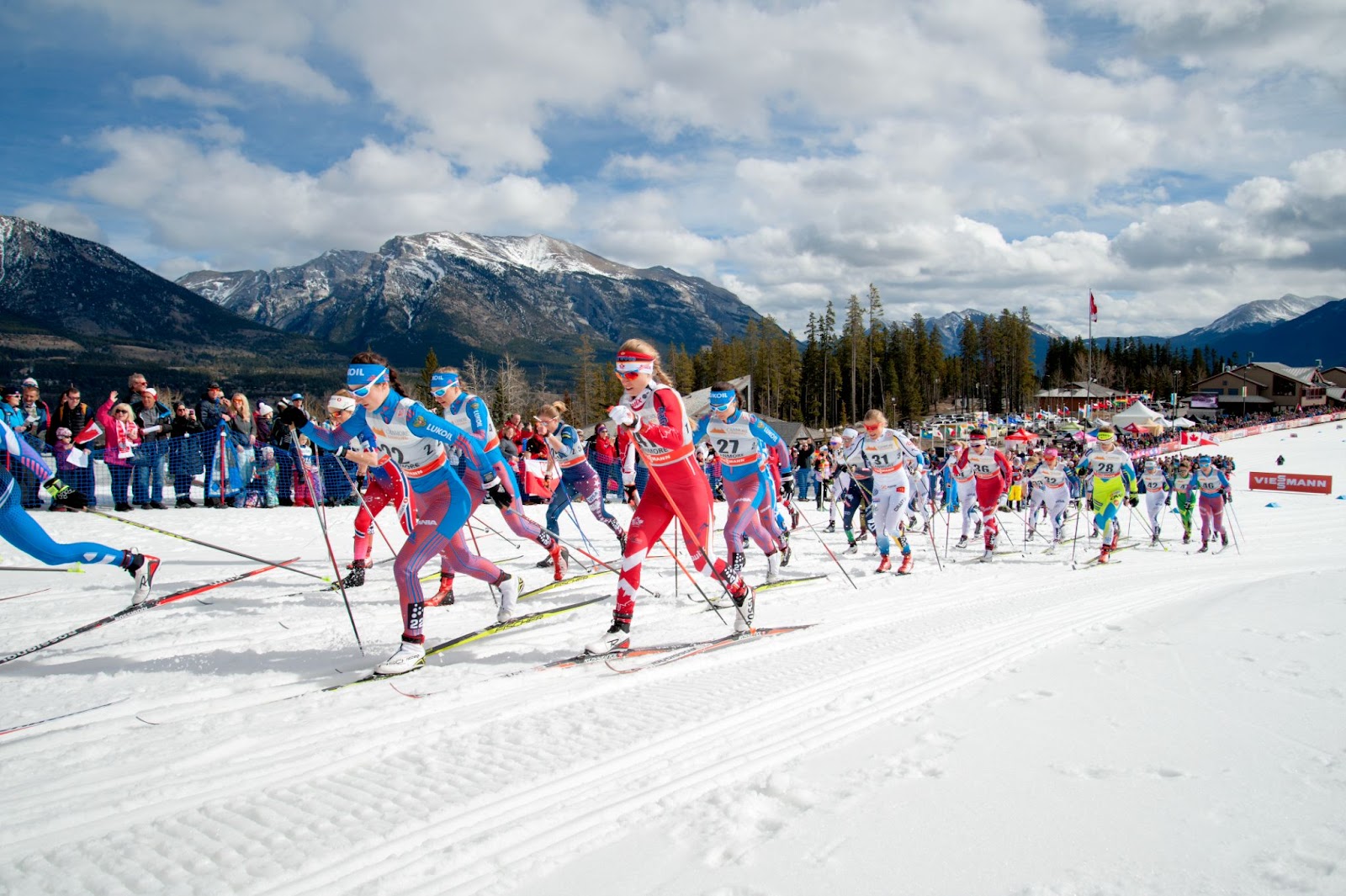
Canmore Nordic Centre Provincial Park hosted World Cup racers during Ski Tour Canada, 2016. Canmore is again scheduled to host FIS World Cup Cross Country events in February, 2024. (Photo: Pam Doyle Photography)
Canmore, Alberta—February 9-13, 2024
The Alberta World Cup Society (AWCS) will host the COOP FIS Cross-Country World Cup for three race days at the Canmore Nordic Centre Provincial Park and one City Sprint in Calgary from February 9-13, 2024. This marks the seventh time that AWCS has invited the world’s best skiers to experience Alberta’s world renowned Canmore Nordic Centre Provincial Park. And a new challenge has been undertaken by the organizing committee, hosting a City Sprint in Calgary! The Calgary City Sprint on Prince’s Island Park will be the first of its kind and all Calgarians will be invited to take part in this exciting event.
“Hosting of international events in Canada is critical for the development of Canadian skiers but also for FIS to truly deliver its mandate as an international federation,” said Stéphane Barrette, CEO, Nordiq Canada. “We are grateful to have another opportunity to partner with FIS in hosting these World Cups next February to continue building the profile of cross-country skiing around the World.”
To request additional information, please contact Nancy Richard at (403) 585-0503 or nrichard@albertaworldcup.com
Minneapolis, Minnesota—February 17-19, 2024
After their events in Alberta, World Cup athletes will travel to the United States for two more races when the Loppet Foundation, Share Winter Foundation, and U.S. Ski & Snowboard will welcome the world to Minneapolis’ Wirth Park for the COOP FIS Cross Country World Cup Feb. 17-19, 2024 (date pending final FIS confirmation). This will also mark the first time in two decades that such event has been staged on American soil
The Loppet Foundation was prepared to host a Minneapolis World Cup in March 2020, but that event was canceled due to the coronavirus pandemic. The Loppet Foundation looks forward to hosting in 2024 while building on preparations made for the 2020 event.
“We are thrilled to work with the Loppet Foundation and Share Winter Foundation to bring back a cross country World Cup to the states,” said President and CEO of U.S. Ski & Snowboard Sophie Goldschmidt. “We know that this event will be a huge success and allow our athletes to showcase their incredible talent in front of a community that has always supported this sport.”
Minnesota native, Jessie Diggins, is the most decorated American in Olympic Cross Country Skiing. (Photo: NordicFocus)
“I’m excited to give ski fans from around the U.S. a chance to see the action up close for the first time in over 20 years,” said US Team standout—and Minnesota native—Jessie Diggins. “I am so proud to represent Minnesota as one of the first American athletes to win Olympic gold in cross country, and now to bring the sport I love to the state I call home.”
The Loppet Foundation is a 501(c)(3) nonprofit organization that connects people to the outdoors through experiences that grow community. Learn more at loppet.org.
Share Winter Foundation (Share Winter) is a non-profit grantmaking organization working to improve the lives, health, and fitness of youth through winter sports, and create a more diverse, inclusive, and welcoming winter sports community. Learn more at www.sharewinterfoundation.org.
U.S. Ski & Snowboard is the Olympic National Governing Body (NGB) of ski and snowboard sports in the USA, based in Park City, Utah. For more information, visit www.usskiandsnowboard.org.
Masters World Cup 2021 Postponed Due to COVID-19 Pandemic
Originally scheduled for March 4-12 in Canmore, Alberta, the Masters World Cup 2021 has been postponed to 2022.
PRESS RELEASE
The Masters World Cup 2021 for cross-country skiing has been postponed due to the COVID-19 pandemic. The Masters World Cup was originally scheduled for March 4-12, 2021 in Canmore and has now been rescheduled for March 3-11, 2022 in Canmore.
Due to the on-going travel restrictions and the current limitations around hosting major Sporting Events, the Alberta World Cup Society (AWCS) and the World Masters Association (WMA), along with our tourism partners and the Alberta Health authority, have agreed to postpone the MWC 2021 in Canmore.
“We’ve been watching the pandemic trends and it appears that the restrictions affecting our event will continue to be in place for the foreseeable future. The health and welfare of all the expected 1,200 participants coming from around the world, our volunteers and our community are our highest priority.
All of our community stakeholders want the Masters World Cup to be a tremendous success when we hold it and it looks like March 2021 is too soon for that to be the case. We’ve been strongly supported by the Alberta Chief Medical Office, Tourism Canmore Kananaskis and our hotel partners in Canmore in reaching this conclusion. The World Masters Association has been an incredible partner as well. We both want this event to be a great success when we hold it and it looks like that won’t be possible until 2022,” said Norbert Meier, AWCS, Event Chair.
“The decision to postpone the MWC 2021 in Canmore has been the result of a careful evaluation process over several months. The Alberta World Cup Society (AWCS) and the World Masters Association (WMA) have been committed towards looking at what was best plan from both local and international perspectives. Ultimately it became clear to all parties that postponing to 2022 was our best path forward. In the midst of what is an incredibly challenging era for sport organizers around the globe, the WMA could not ask for a better partner than the AWCS. Everyone in Canmore has been exceptionally professional while also remaining positive about what we all believe will ultimately be a fantastic MWC 2022 in Canmore!” said John Downing, WMA, President.
The Masters World Cup has been held annually since 1980 and brings together cross country skiers aged 30 to 90+ from all over the world for a week of racing, camaraderie and celebration of cross country skiing as a lifelong sport.
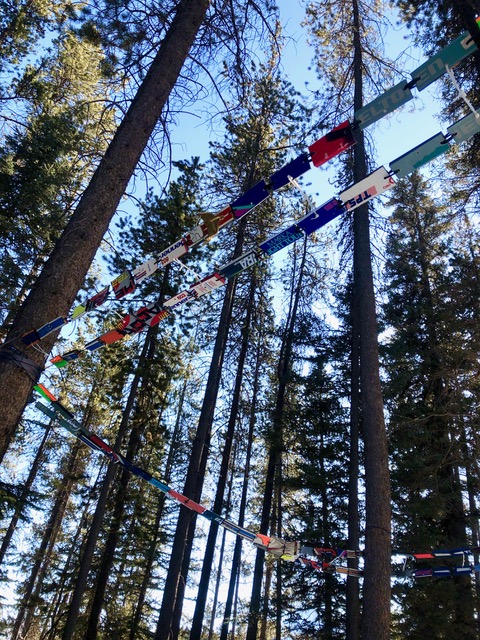
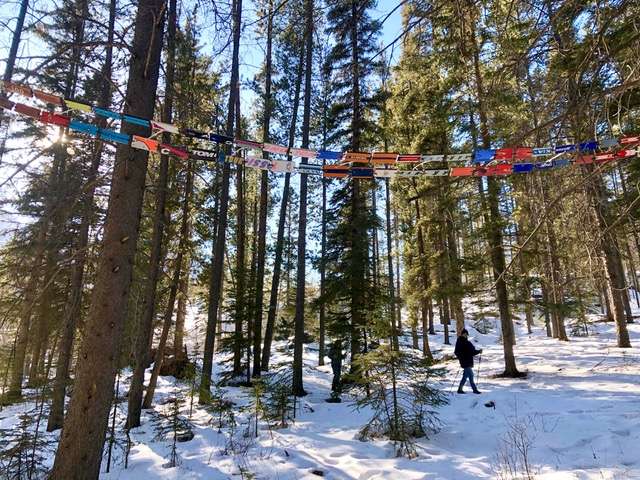
Nordic Blessings (Fast Track) by Michelena Bamford. (Photo: Michelena Bamford)
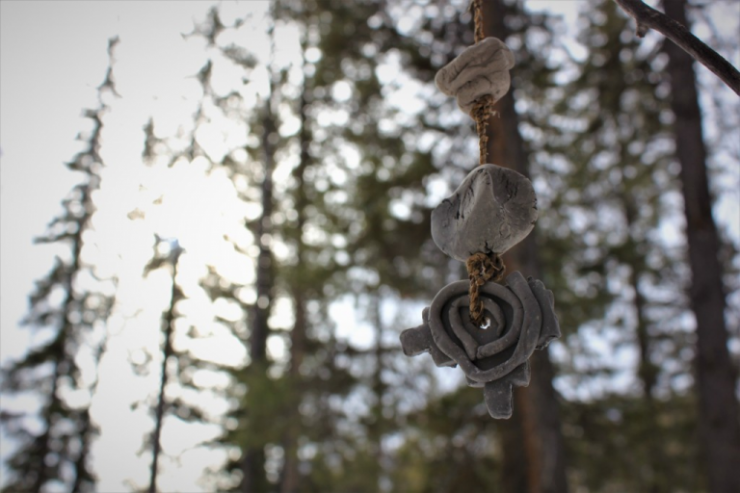
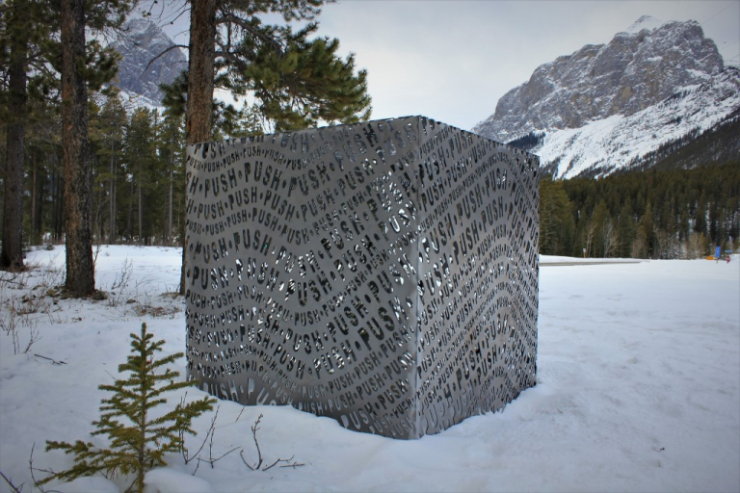
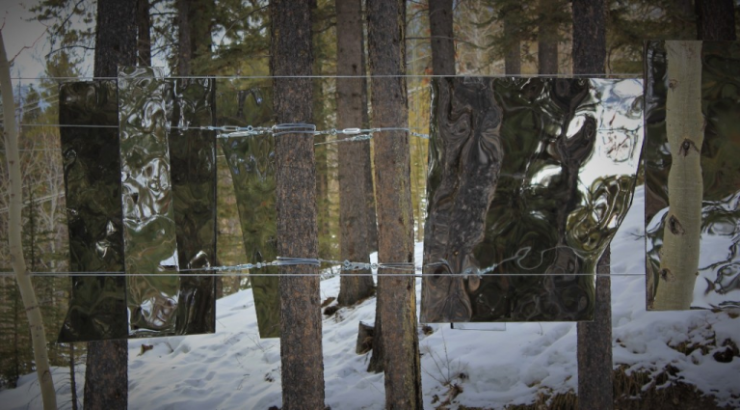
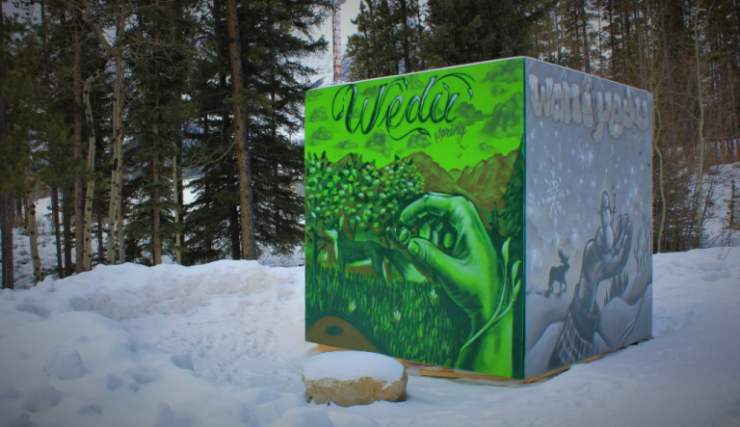
The cowbells, lycra, and the spine of the Northern Rockies as the serrated backdrop would have been part of the World Cup scene in Canmore, Alberta this past March. We all know the story: the global pandemic became a whip crack. The racing was canceled. Now, imagining the scene in Canmore, it’s easy to become wistful. Beyond the racing, visitors to Canmore missed an opportunity to experience six temporary art installations near the World Cup, all part of the 2020 Art Walk in the Woods.
Prayer Beads by Kari Woo. (Photo: Town of Canmore)
Motivation by Lesley Russel. (Photo: Town of Canmore)
Close up of Motivation by Lesley Russel. (Photo: Town of Canmore)
Coordinates by Stuido North. (Photo: Town of Canmore)
23 Reasons to Smile by Cedar Mueller. (Photo: Town of Canmore)
Part of dagunenâ ktûtha giya – AJA Louden and Chiniki College. (Photo: Town of Canmore)
The Art Walk in the Woods was a collaborative project between the Town of Canmore and the Alberta World Cup Society — part of supporting the World Cups from an arts and culture perspective. Canmore recently completed a new path connecting the town center to the Nordic Centre Provincial Park called the Legacy Trail Extension. The paved path extends roughly 1.8 kilometers.
“One of our goals was to encourage people to walk up to the Nordic Centre to watch the World Cup races,” said Nicky Pacas, the Arts and Culture Coordinator for Canmore. “We encouraged people to either walk up and take public transit down or vice versa, take public transit up and walk down to get from the Nordic Centre down to the Bow River Trail in town.”
Part of the incentive to walk along the newly minted trail were the six temporary art pieces, all installed prior to the World Cup, and intended to be removed this past April.
A map of Canmore’s 2020 Art Walk in the Woods. (Map: City of Canmore)
“When the World Cup was canceled we didn’t know what that was going to look like for the artwork,” said Pacas. “As it turned out, people started walking that trail system more and more. Because we are all isolated ourselves and people are exercising now more than ever, they are getting out of their houses and not flocking towards spaces where people are gathering but are using trail systems and getting out at different times of the day. We saw an increase in usage of that trail system and an increase in the number of people who were going past the art installations.”
With Alberta Parks shuttering provincial land, on which the art was installed, the artist and town had no reasonable way to remove the installations. The town worked out an agreement with Alberta Parks to keep the artwork in place through early July.
Which brings us to the art itself. The call for art proposals asked for installations that repurposed materials and kept disruption to the local environment to a minimum. One art piece by Calgary based artist Michelena Bamford speaks to nordic sport and the ephemeral way many of us travel on skis through the woods.
Nordic Blessings (Fast Track) – by Michelena Bamford hangs as part of Canmore’s 2020 Art Walk in the Woods. (Photo: Michelena Bamford)
“My art practice fosters objects of meaning and memory; the sentimental tesserae of our human experience; that I reclaim and repurpose in new ways through an ancient mosaic lens. Within the context of the Nordic World Cup, skis are the perfect medium – a vibrant symbol of our human journey in the mountain wilderness,” Bamford wrote of her installation, Nordic Blessings (Fast Track).
Bamford’s installation was initially inspired by the scores of international flags lining Canmore Nordic Centre’s stadium. “That resonated with me and I wanted to reflect that color and that sort of global diversity, and that coming together of everyone at the World Cup,” said Bamford.
After walking the grounds of the race venue and the proposed art sites, she landed on an idea of using old nordic skis in her piece. With each ski being graphically unique and possessing a personal story, she intended the repurposed skis to serve as a blessing of sorts strung in the woods like Tibetan prayer flags.
“There is so much meaning and memory tied to objects, this what I love about mosaic work, it is called tesserae, the little pieces that you use. You essentially break down and deconstruct materials and then rebuild them in a new way,” said Bamford. “Those skis just have so much meaning, there are all these memories. That is why people have skis hanging around their garages forever. They just cannot let go of them. They hold this memory or they represent this place in time.”
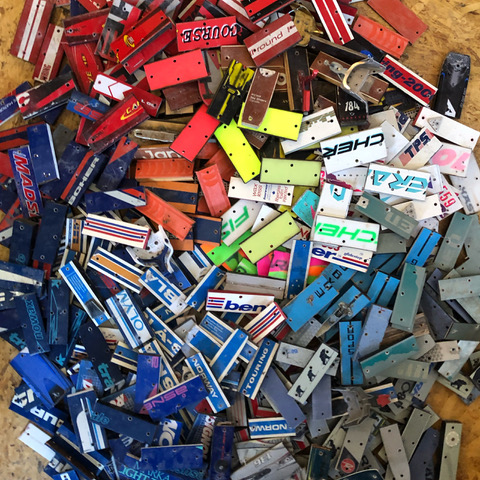
Ski segments for the project. (Photo: Michelena Bamford)
Bamford and her assistants on the project cut through 80 different skis, drill pressed holes on each side of the six-inch pieces, and linked them together in varying length parallel segments. Suspended in the woods above Canmore, Nordic Blessings resembles colorful parallel ski tracks.
Hanging the piece required no permanent fixtures but did call for a minimum height of roughly nine feet to accommodate the passing of antlers underneath the artwork; Canmore remains a place with a healthy elk and moose population.
Skis are everyday objects for many of us. There’s a child’s first pair. An old-timers last pair. Interspersed in between are the favorite pairs. Favored, maybe, not for their speed, but due to their value as an everyday object recording our memories. Bamford has hit on something with her Nordic Blessings. And it resonates.
CANMORE – The Alpine Insurance AWCA is very pleased to announce that Allison McArdle will be joining our organisation starting January 1st, as a High Performance Coach. Allison will work with Chris Jeffries, High Performance Program Director, to design and deliver the Academy program.
“Allison will make a great addition to our coaching team. I am very happy she is going to help us provide the best athlete development program in Canada. Allison brings many excellent qualification to the job. Among them are her international network, her coaching experience and her team leadership experience. But what I am most excited about is that she is bringing her sincere desire to see athletes reach their full potential.” said Norbert Meier, President, Alberta World Cup Society.
Allison has over 15 years of experience in both domestic and international coaching roles in Australia and Canada. In addition, she currently sits on the FIS Ladies Cross Country Sub-committee, is the Chair of CCC’s Women’s Committee and is the Alberta Ski Team Director.
After a two year hiatus, International Ski Federation (FIS) Cross Country Skiing World Cup competitions will resume in North America, as a brand-new Quebec City site will be unveiled before the show heads west to the Rockies and Canmore, Alberta.
According to Norbert Meier, Chair of the Alberta World Cup Society, there will be World Cup races held on December 8th and 9th in Canmore, and December 15th and 16th in Quebec City, with the possibility of a mid-week non-World Cup race on Thursday in Canmore.
As the Canmore Nordic Center recently underwent a multi-million dollar upgrade, it is set to hold races with no further upgrades, while the current plan for the Quebec City World Cup is to use a downtown site.
In terms of specific events, Meier said that his group “has preferences, but it’s up to the FIS and CCC to decide the specific formats.”
Canadian Sara Renner captures the final step on the podium at the 2010 World Cup in Canmore. Photo: Philip Bowen
New Venue
From December 6-9, 2012, Quebec City will play host to the FIS World Cup for the first time in Canadian history, featuring a freestyle sprint.
According to CCC Director of Marketing and Events Dave Dyer, part of the reason Quebec City became a viable host was to build the capacity to host high-level races in Eastern Canada. Currently Canada has just four homologated sites – Canmore, Alberta, Whistler, B.C., Sovereign Lake, B.C., and one on the East Coast – which are able to host World Cup events, but three of the four are in the West.
“65% of the recreational skiers in Canada live in Quebec and Ontario, hence there is tremendous potential to tap into this resource and introduce the sport to youth in these areas,” wrote Dyer in an e-mail to FasterSkier.
“We know that a World Cup event in Quebec, with Alex and Devon on the top of their game will generate tremendous excitement, a huge media following and perhaps ignite a dream in a young 8 year old,” he wrote.
In terms of infrastructure, there remains some work to be done. Dyer explained that Mont Ste-Anne is currently in the midst of a feasibility study which could include the construction of paved roller ski trails, the introduction of snow making, and fully homologated World Cup trails.
However, Dyer does not believe all of the MSA site upgrades would be ready for the World Cup in December of 2012.
“We don’t expect all the upgrades to be completed by December 2012, however once funding is sourced a priority list of projects including a shift in the stadium and new sprint courses will begin,” he wrote. “These elements might be ready for 2012, but that will depend on the level and speed of support from their partners.”
However, Dyer did say that both CCC and the FIS is committed to the downtown location, and regardless of the upgrades at MSA, the World Cup will be run in the city.
In an e-mail to FasterSkier earlier this year, FIS Cross-Country Director Jurg Capol confirmed that the FIS was focused on the city as the main venue, with a sprint and team sprint in mind.
Before any new location can host a World Cup, a test event must be run by the organizing committee. For Quebec City, the test run will the 2011 Haywood Ski Nationals, which according to Dyer will use existing Mont St Anne trails, as well as a downtown sprint location.
Scheduled for late March, which will allow the Canadian World Cup athletes to compete, Dyer is also hoping for some international talent.
“We hope that top Canadian, US and some invited Europeans will be able to race in part of the Ski Nationals this year, including the sprint,” he wrote.
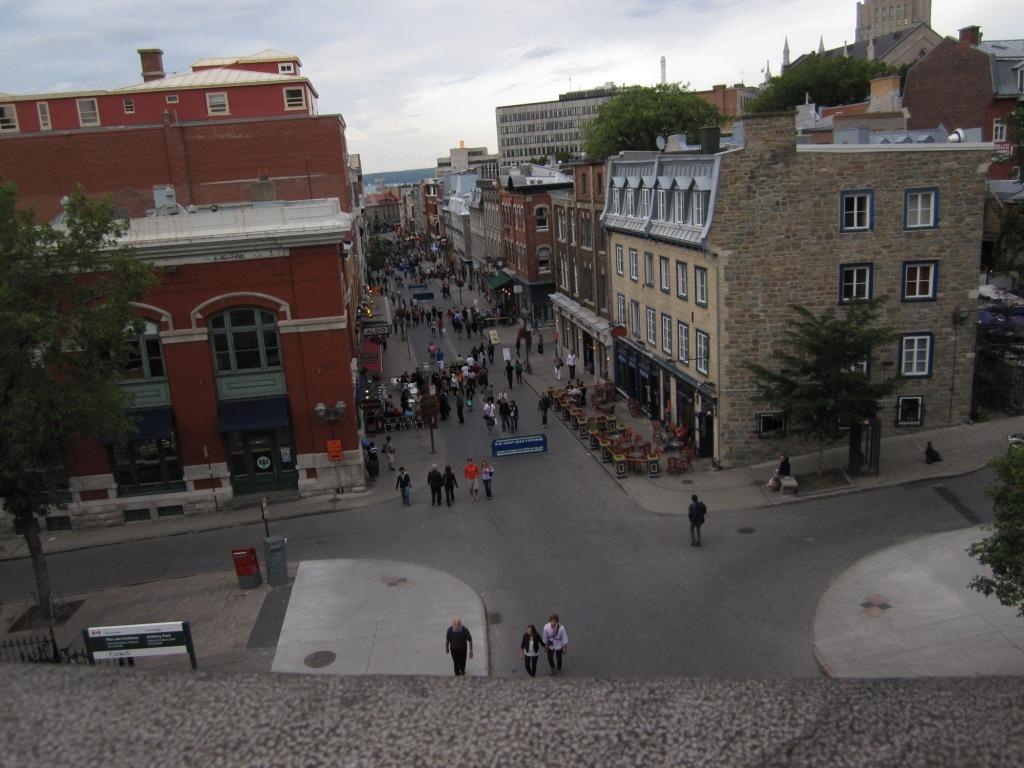
The streets of Old Quebec, which could see World Cup racing in December 2012
While many are envisioning a city sprint down the cobble stone streets of Old Quebec, it won’t be happening for Haywood Ski Nationals in 2011.
In a recent interview with FasterSkier, Dyer made it clear that shutting down the city core was something that CCC and the organizing committee for the National Championships was going to avoid. Instead, the sprint will be held on the Plains of Abraham, a large area of green space in downtown.
While the test event will not be held on the major streets of the city, according to a press release by the organizing group Gestev, the World Cup is to be run in the streets of Old Quebec.
However, Dyer was hesitant to say that Gestev, a group which has a record of being involved with major sporting events in Quebec City, including Red Bull Crashed Ice, was going to be able to run the event in Old Quebec, indicating that plenty of work still needed to be done to finalize that plan.
Dyer also indicated that course considerations were to play a part in where exactly in the city the sprint would be held, as he wasn’t sure if a sprint in the old city would meet the FIS qualifications.
While the 2012 Nationals are the test event, Dyer made it clear that FIS was not looking for exact courses to be confirmed in March, “the test event is really to get the organizing committee together, and get them to operate as a group,” he said.
Turn Out
One of the biggest issues North American World Cups have had in the past is the low turnout compared to European events.
Norbert Meier assured FasterSkier drawing more international skiers was a key consideration in the process to host World Cups.
“The idea with the race formats is to use the number of races we have as a draw,” he said. “That way there will just be too many World Cup points on the line for them to miss.”
As a result, Meier said that providing a good mix of races would be important to draw both sprinters and distance skiers. Meier also said that the dates fell into a good range – after the early season Scandinavian World Cup swing, but before the Tour de Ski.
The Canadians lucked out in the scheduling, according to Dyer, as at the recent FIS meetings the Cross Country Committee modified the 2012-2013 World Cup schedule, dropping the World Cup in La Clusaz, France, from its traditional pre-Christmas slot.
“This now gives skiers ten days before the start of the Tour,” wrote Dyer. “We were worried before this happened that skiers might choose to skip either the Canadian dates or La Clusaz weekend. There is more certainty now, but nothing is guaranteed.”
Capol agreed with Dyer, and felt that the FIS did its best to encourage participation.
“From planning point of view, we cancelled the [World Cup race] weekend on December 21 and 22 before Christmas, which means we reduced the World Cup load and supported the Canadian program even more,” he wrote.
However, there is still potential for scheduling conflict, primarily with the Tour de Ski.
In an interview with Devon Kershaw earlier this year, the World Champ expressed some concern with the placement of the races.
“I don’t really know who is going to come over. If people are gunning for the Tour de Ski, and it’s a championship year, are people really going to want to get on a plane, stop in Quebec, and then head to western Canada?” he said.
Both Gestev and CCC mentioned the success of Kershaw and fellow World Champion Alex Harvey as a factor in the decision to host a race in Quebec.
Devon Kershaw (L) and Alex Harvey (R) with their World Championship gold medals
“With the boys [Alex Harvey, Devon Kershaw, Ivan Babikov and Len Valjas] skiing so well right now, it has the potential to be a big draw,” Dyer said.
But Kershaw voiced some doubt as to whether the Canadians would even be present “We’ll have to see when that year comes, but even for us, do we go to Europe to prepare for the Tour de Ski?”
However, that decision is still over a year away, and for now, the Canadians are just enjoying the return of the World Cup to Canada.
“Racing in Canada rules!” said Kershaw
Norbert Meier believes that the 2012 World Cups will have the greatest turnout ever. “Cross country skiing has never had such a high profile in Canada. We know people are going to be excited to see the races.”
Switzerland's Dario Cologna racing in the 2010 World Cup in Canmore, Alberta. Canmore likely would have been one of the venues of a Tour de Ski-style stage race proposed for Canada in 2012. (Photo: Phil Bowen)
Cross Country Canada’s decision not to host the continent’s first-ever Tour de Ski-style stage race in February, 2012, came despite the recommendation of an independent feasibility study commissioned by the government of Alberta, documents obtained by FasterSkier show.
The study, a preliminary version of which was delivered to Cross Country Canada (CCC), the International Ski Federation (FIS), and other stakeholders in early May, urged the organizations to “immediately proceed” with the planning necessary to host an Alberta-based stage race. But the concept was rejected by CCC’s board of directors later in the month, who cited the financial risks that would have been shouldered by the organization, as well as a compressed time frame.
In the wake of the decision, the study’s author and local organizers have both criticized CCC, which, as the national governing body, has approval or veto power over World Cup races in the country. In an interview, Ken Davies, whose consulting firm conducted the feasibility study, said that the concerns of CCC’s board were contrived. Deadlines were flexible, he said, and the financial risk could have been passed on to local organizing committees.
“As far as I’m concerned, they had no risk,” Davies said. “I don’t think they’re reaching as far as they should reach.”
The Study
The feasibility study, conducted by Davies’ firm Lumina Consulting, was commissioned by the government of Alberta early this year as part of an effort in western Canada to ensure the continued use of the Olympic venues from the 1988 Games in Calgary and the 2010 Games in Vancouver.
While CCC was in no way bound by the conclusions of the study, its directors did cite a draft version in their decision not to host the race. FasterSkier has obtained a copy of the draft report, and a Freedom of Information request is pending with the Alberta government for the full version.
In the study, Lumina examines the viability of a Canada-based stage race, looking at aspects like potential venues, volunteer capacity, and revenues and costs. In the draft version, the costs of the tour were calculated as ranging anywhere from $3.4 to $5.1 million, depending on the logistics of the race and the number of stages. A more expensive format included a competition in Quebec, while the cheaper options limited venues to Alberta and British Columbia.
Canadian Brent McMurtry racing in Canmore in February, 2010. Photo: Win Goodbody.
The majority of those costs would have been covered by private sponsorship, and Lumina held preliminary meetings with a short list of Canadian oil and gas firms to gauge interest. “The price tag,” the study reads, “does not intimidate them.”
“They said, ‘come back when you’re serious,’” Davies said.
The report concludes by offering an estimate of the direct benefits of holding the race—which would have amounted to nearly $4 million in spending on hotel reservations and meals—and a formal recommendation: to “immediately proceed with further exploration of an Alberta-based Tour de Ski concept.”
“The direct benefits alone justify the recommendation for the Tour de Ski proceeding, but it is expected that the real win for the sport and for Canada will be the indirect benefits,” the study reads. (In the report, indirect benefits include anything that is not an immediate economic impact of the race itself, like promotion of tourism or increased exposure for the sport.)
CCC Declines
One week after receiving the draft report, on May 14, CCC’s board of directors released its decision declining to host the race, in a letter to FIS. In an interview at the time, CCC Executive Director Davin Macintosh told FasterSkier that the board’s major concernwith the proposed race was the financial risk involved—as well as the relatively brief window that organizers had to plan the event.
“It really is just financial risk—and it’s a short time frame,” he said.
But in interviews, both Davies and a potential race organizer arguedthat CCC would have been only minimally involved in the preparation—and wouldn’t have been on the hook for any of the costs of the race. According to Davies, the financial burden of hosting the Tour would have been passed on to local organizing committees.
“The whole idea was to take it completely out of their hands,” Davies said. “There was no financial dealings with them at all.”
Dale Swanson, the outgoing chairof the Canmore-based Alberta World Cup Society (AWCS), said that his organization was ready and willing to assume the financial risks and take the lead in hosting the race.
“If [CCC] would give us the right to go after the sponsors…we would take on that responsibility,” Swanson said. But, he continued, “even if we tell them that we will accept the risk, they don’t seem to understand that, or believe it.”
In the past, both Swanson and Davies acknowledged, CCC has stepped in to provide financial assistance for the weekend World Cups hosted in Alberta. But according to Davies—himself a former AWCS chair—CCC could have been indemnified from a tour with the stroke of a pen.
“It’s just as simple as writing that line,” Davies said.
While the details of the potential arrangement with the AWCS were not outlined in the feasibility study, Davies said that he made them absolutely clear to CCC.
“In simple terms, we said to them that they don’t have to put up a penny,” he said.
Macintosh, CCC’s director, was attending the organization’s annual meeting in Newfoundland last week and did not respond to repeated requests for a follow-up interview. But Jim McCarthy, CCC’s board chair, said that the group was not persuaded that they would have been insulated from all of the risk.
“I suppose they were trying to set it up that way, but we were not convinced in the end that they had, or that they could,” McCarthy said. “We’ve got a bit of a history there, back to fundraising for World Cups…They didn’t identify to our satisfaction that there were funding sources available.”
According to Davies, however, the Canadian oil and gas firms were very interested in the prospect of underwriting a Canadian tour. That industry has a poor environmental reputation in Europe, he said, and the companies could have used the 100 million TV viewing sessions that come with a tour to sell their image.
Poland's Justyna Kowalczyk in Canmore.
“This was a perfect opportunity,” Davies said—especially with the recent incident with the British Petroleum oil well in the Gulf of Mexico. “It’s right when things are at their worst.”
With the planning for the event still in preliminary stages, the companies wouldn’t give a firm commitment, Davies said, but the potential was there.
“From our assessment, there was interest, and it was pursuable,” he said. “The feasibility study says there’s not money in the bank, but…that there’s likely the necessary money there. And it basically becomes an effort of solidifying that, and FIS would have given us time to do that.”
According to FIS Cross-Country Race Director Jurg Capol, his organization did want a commitment from CCC in advance of the ski federation’s meetings at the end of May. Both Macintosh and McCarthy cited that deadline as the reason CCC made its decision to decline when it did.
But in an interview, Capol said that CCC’s commitment would not have been binding. If money had not been forthcoming over the next three to four months, he said, there was still time for them to back out.
“I didn’t say I wanted to have all the details,” Capol said. “We wanted to see a process of the project.”
The Impact
The World Cup is still tentatively scheduled to return to Canada for weekend races in December, 2012, with events in Canmore and Whistler, BC. In its letter to FIS declining to host the tour, CCC’s board wrote that it “hopes that the momentum of this process, and the energy of all participants, may be directed immediately toward ensuring the success of [those races].”
But according to Swanson, the AWCS outgoing chair, the weekend World Cup races have nowhere near the same appeal to his volunteers, who he said were discouraged by CCC’s decision to turn down the tour.
“It’s a presumption on CCC’s part that they can take us for granted, and count on us any time they want after some of their decisions that really disappoint us,” Swanson said. “We may or may not come back to the table, and they need to realize that. Our working relationship with them needs to change.”
McCarthy said that CCC’s board was mindful about the impact of its decision on local organizing committees, but that at the same time, that had to be balanced.
“We’re obviously concerned about that,” McCarthy said, “but the financial risks were huge, without really anything approaching assurance that they could be managed.”
The effects of turning down the race are not limited to local organizers, however, according to Bjorger Petterson, a former Canadian national team coach who also served as the country’s FIS delegate for 27 years. In an interview, Pettersen said that CCC also passed up an opportunity to develop the sport throughout the entire nation.
“You get kids interested in baseball in every city in the U.S., and the reason for that is it’s kept in front of them at the highest level all the time,” he said. A race like the tour, he added, “inspires the general public, it inspires development skiers, and it inspires national team skiers.”
Ultimately, Pettersen said, CCC’s board made its decision because it failed to recognize the slew of potential benefits that came with the tour—which he chalked up to a lack of leadership.
“It’s not that they don’t want to help the sport,” Pettersen said. “Within the organization, it needed a leader that…understood how strong a development vehicle this would be for the sport, and for our national team.”
A "Tour of the Rockies" would have used the World Cup venue in Canmore (Photo: Win Goodbody)
A previous version of this article incorrectly stated that Ken Davies is currently the chair of the Alberta World Cup Society. FasterSkier regrets the error.
Cross Country Canada (CCC) has turned down an opportunity to host a Tour de Ski-style event in February of 2012, according to a letter released by the organization Tuesday.
In interviews, CCC officials said that plans for the “Tour of the Rockies” foundered on the potential costs, which could have ranged as high as six million dollars, as well as a short time frame for preparation—especially given World Cup events already scheduled in Canada for the following season.
But the president of a consulting firm hired to study the feasibility of a Tour-style race said that the plan for the event was “as good as it gets at this stage, without having final exact location.”
“Suffice to say, it’s not in question that it would work, from an objective perspective,” said Ken Davies, whose firm, Lumina Consulting, produced a preliminary report that CCC cited as the basis for its decision.
Davies is also the chair of the Alberta World Cup Society, which was involved in the planning of the proposed event.
Details of the race had not been settled on, but Davies said that it would have resembled the Tour de Ski, the multi-day format that has gained traction in Europe since its inception in 2007. Hill climbs, city sprints, and conventional distance races were all on the table.
According to Dave Dyer, CCC’s events director, plans for the tour had been evolving since it was first discussed with the International Ski Federation (FIS).
The original proposal, he said, would have included races at established venues in Canmore and Whistler. A “unique transportation experience” would have advertised the tourism potential of both British Columbia and Alberta to athletes, coaches, team managers, and the media.
In a later version, Dyer said, race logistics would have been run from a “hub” in Canmore—which he suggested would place unreasonably high stress on the organizing committee there.
Lumina’s feasibility study was commissioned by the government of Alberta, and the final version has not yet been published; it is due out at the end of the month. Davies would not comment on the details until the report was issued.
The provincial governing body for skiing, Cross Country Alberta, was supportive of the Tour concept, and FIS Race Director Jurg Capol said that the Alberta government had been in favor of it, as well. According to Capol, the province would have been one of the race’s financial sponsors.
Alberta has sponsored World Cup events in the past, but Glen Cowper, a government representative, said that it would be premature to say whether it would have done so in this case.
With FIS’s spring meetings approaching at the end of the month, Davin Macintosh, CCC’s executive director, said that his organization’s board was forced to make a decision based on the preliminary report. For CCC, the tight timing and financial hurdles were too much to take on.
“It’s by no means something that we think would be impossible, but it would be an unprecedented amount of private funds that we would have to gather together, in a relatively short time frame,” Macintosh said. “We went through a detailed analysis of the cost…and determined that it wasn’t a reasonable risk for the organization to take on at this time, in addition to the 2012 World Cup that’s already scheduled.”
Having organized the Tour de Ski for the past four years, FIS Race Director Jurg Capol acknowledged that CCC would be taking on financial risks by hosting a similar event. But he said that a certain degree of uncertainty in the planning process was unavoidable, which race organizers must to be willing to accept.
“You need the spirits to go for it, even when everything is not fixed,” Capol said. “It’s always easy to find reasons not to do it.”
The ’12 Tour appears to be the last chance to land that race format in North American until at least 2015—Capol said that FIS would not consider holding another Tour in Canada for the next five to ten years.