From the FasterSkier archive — posts syndicated from athletes’ and coaches’ own blogs between 2004 and 2012, kept online as published. Current coverage is at fasterskier.com.

Tag: Alberta

  • This Week in Canmore: Biathlon World Cup Season Finale

    This Week in Canmore: Biathlon World Cup Season Finale

    Canmore is having a year.

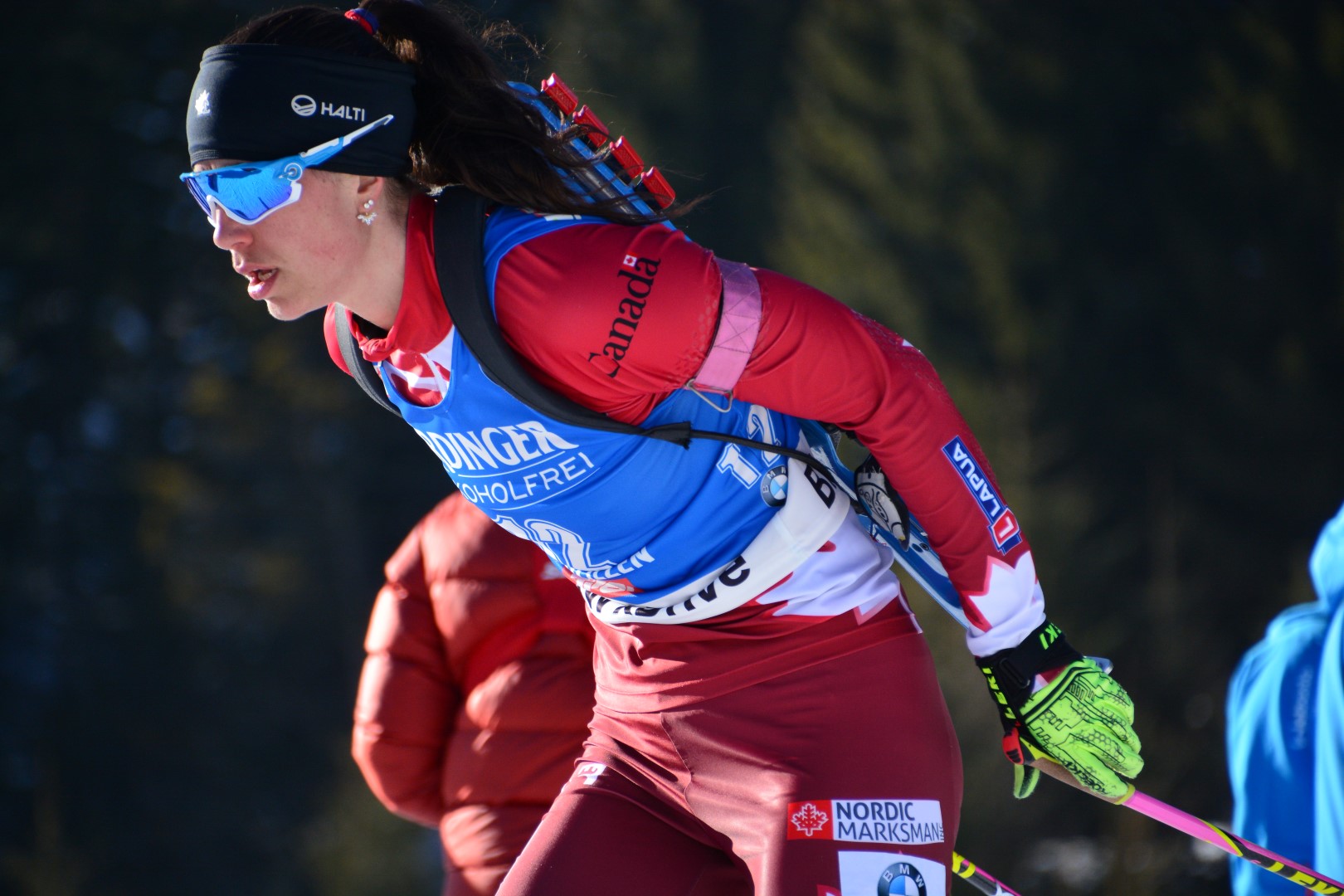
    Just over a month after hosting the International Ski Federation (FIS) Cross Country World Cup, the Canmore Nordic Centre is pulling out all the stops and showcasing its brand-new biathlon facility as the host of the International Biathlon Union (IBU) World Cup Finals from Thursday, March 14 to Sunday, March 17.

    The world-class venue amid Canada’s Rocky Mountains is no stranger to World Cup nordic and mountain bike events. It hosted 2016 and 2019 IBU World Cups and, as recently as last year, eight IBU Cup events in advance of the 2024 Biathlon World Cup Finals.

    Two years ago, Alberta’s provincial government granted the Canmore Nordic Centre $17.5 million to upgrade and enhance its biathlon building, stadium, snowmaking, and range. According to Ken Davies, the Canmore IBU World Cup event chair, they broke ground in May 2022 and have nearly completed the project as of this March.

    New biathlon building at the Canmore Nordic Centre. (Photo: Biathlon Canada/Pam Doyle)

    “It’s huge,” he said. “We sort of stirred the pot initially seven years ago to get them to reinvest in the nordic centre, and the Alberta government followed through, so credit to them.”

    In 2017, the Canmore Nordic Centre requested improvements to its biathlon facility, which hadn’t been updated since 1986, when it was built for the 1988 Olympics. The biathlon stadium needed to be widened to meet IBU regulations and continue to host World Cups. The nordic centre also wanted to replace its undersized timing building and wax facilities, expand its snowmaking, and modernize its shooting range.

    Just three days before the start of the IBU World Cup Finals, the Canmore Nordic Centre is ready to show the world its fresh new look. According to Davies, the father of Olympic biathlete Macx Davies and a Canmore World Cup organizer since 2005, the biathlon course has been “turned upside down.”

    “When you come in and shoot, we now do a 180-degree turn in the stadium so the spectators can see the athletes for longer,” he explained. “We used a lot of the same course, but how we start and finish is completely different.”

    Situated between 1,425 and 1,550 meters (4,675 and 5,085 feet) above sea level, the Canmore Nordic Centre is one of Canada’s highest cross-country ski areas, and it has a deceivingly challenging World Cup course.

    “The trails are so well maintained, and they’re wider, so they look like highways, [but] they’re sort of sneaky hard,” Davies said. “People forget we’re at 1,400 meters of elevation. … We’re as tough as most places, and the racers all realize that when they come here.”
    Rosanna Crawford (Biathlon Canada) racing to 26th in the women’s 7.5 k sprint at the 2017 IBU World Championships in Hochfilzen, Austria. (Photo: Glen Crawford)

    According to Rosanna Crawford, a three-time Olympic biathlete based in Canmore, the approach to the range has changed. On each lap, racers must climb up to the stadium before shooting.

    “I’m curious to see how the athletes will like it,” said Crawford, who lives in Canmore with her husband, Brendan Green, also a Canadian Olympic biathlete. “Before, you had a somewhat easier range entry, but now, especially for the men’s sprint, they’re going to climb right up into the range, so I think they’ll be pretty gassed.”

    On the range, she said changing conditions can cause the wind flags to change immediately.

    “It’s a tricky range. The wind can really rip through there,” she said. “So I’ll be curious to see how the athletes handle that.”

    While Crawford has never watched a Biathlon World Cup in person since retiring from racing in 2019, she is excited to spectate with Green and her family this weekend. (Crawford is the younger sister of Olympic cross-country skier Chandra Crawford.)

    “Seeing it in person is going to be special because we are huge biathlon fans. We don’t miss a race, and we try to stay off social media until we can get home and watch the races on Eurovision,” Rosanna explained.

    Brendan Green racing to sixth for Canada in the men’s 4 x 7.5 k relay at the 2017 IBU World Cup in Hochfilzen, Austria. Sixth place matched the Canadian men’s previous best relay result. (Photo: Biathlon Canada/NordicFocus)

    “Brendan retired in Canmore [in 2019], so it was really special having his family there in the crowd,” she added. My cousin made some funny signs, like those face ones, so my whole family had my face on a stick that they were holding up. … Canmore’s just so special. I’m looking forward to being a number-one sports fan during the races.”

    When she’s not at the races hanging out in the Rocky Mountain Club and grandstands, she can tune in while working as a dental hygienist in town.

    “In my dental office, there’s a TV, and I’m able to stream from my computer,” she explained. “Luckily, I had some ski fans in my chair [during Canmore’s Cross-Country World Cup], and they would tell me when to look because you can’t clean teeth and watch TV at the same time.”

    USBA arrives in Canmore after stellar results at their home races in Soldier Hollow, Utah, led by Campbell Wright (USA), who finished in sixth place in the men’s 10km sprint. (Photo: NordicFocus)

    With more than 240 athletes from 25 countries, the Biathlon World Cup Finals are expected to draw 3,000 to 5,000 spectators for the Thursday and Friday events and up to 10,000 on the weekend days. Additionally, more than 50 million viewers are expected to watch remotely via Eurosport.  According to Davies, Canmore sold out of VIP and grandstand tickets within 36 hours, 70 percent of which were purchased by Europeans.

    General admission to the races is free and doesn’t require a ticket. In addition to the indoor Rocky Mountain Club VIP zone and bleacher (grandstand) seating, the venue can accommodate 10,000 non-paying spectators.

    Spectators are encouraged to use the courtesy shuttles between downtown and the venue, or take the scenic route by foot and enjoy an Art Walk in the Woods along the way. The Canmore Nordic Centre is 3.5 k west of Canmore, about a 30- to 40-minute walk from downtown. Crawford recommended bringing YakTrax or traction cleats for walking, just in case.

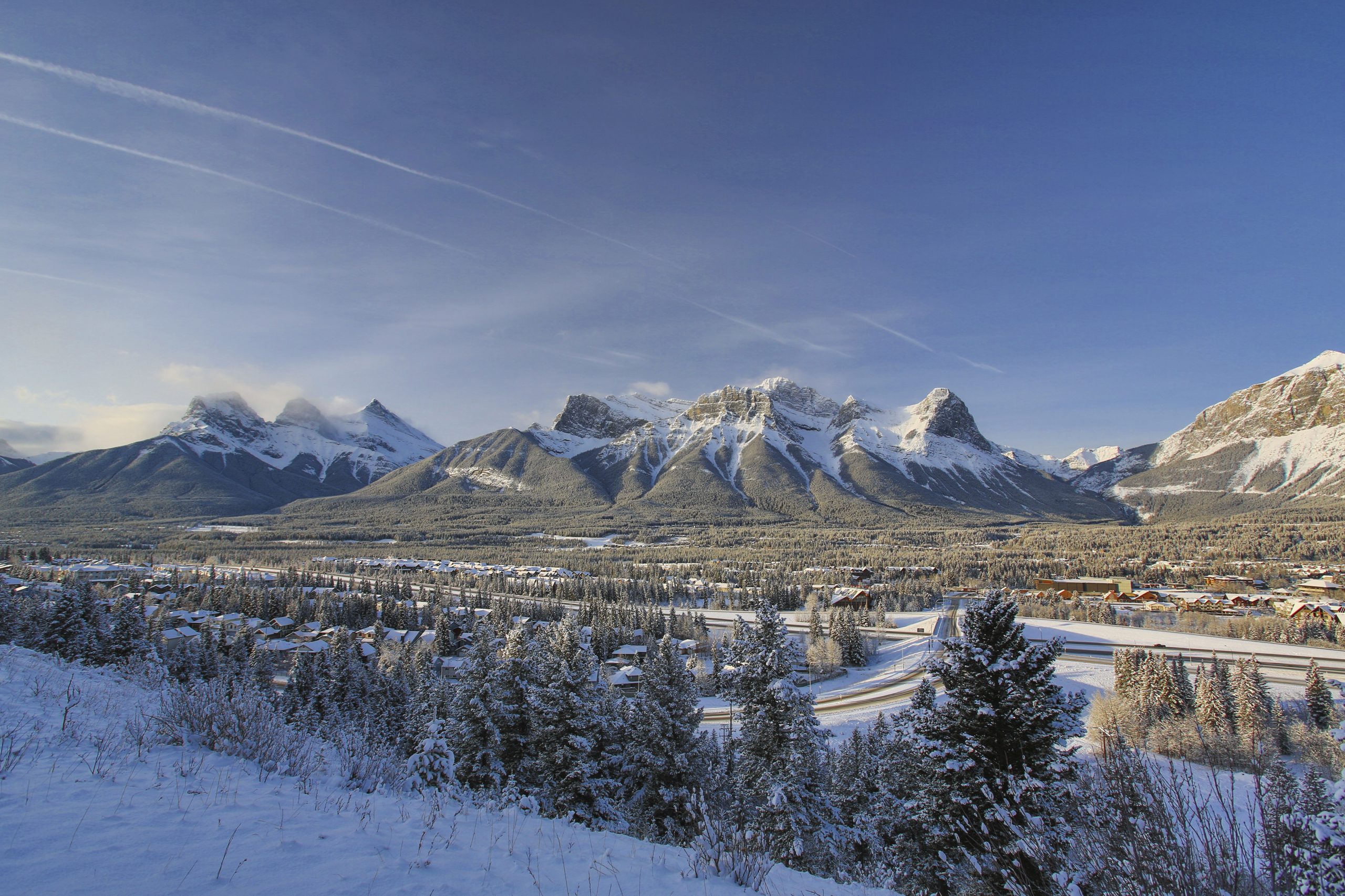
    In late February, a snowstorm brought about a foot of fresh snow to Canmore, which made everything look wintery again after an up-and-down winter. Davies said the biathlon loops have been ready since early December, and with expanded snowmaking, the Canmore Nordic Centre can open at least 10 kilometers of trails in mid-October.

    “We had a weird winter,” he said of the 2023/24 season thus far. “We had a really hot spot in January, but we also had a really cold spot. So there has been natural snow since November, but [the February storm] helped. .… It didn’t help me with organizing the event as far as digging everything out, but it helped what it looks like. It’s a winter wonderland right now.”

    This week, the forecast in Canmore called for sunny weather with daytime temperatures between 5 and 10 degrees Celsius (mid to high 40s Fahrenheit). During the last two IBU World Cups in Canmore, which were held in February of 2016 and 2019, many races were either shortened or canceled due to frigid temperatures.

    According to Davies, average temperatures for early March are a pleasant 3 degrees during the day and -5 at night. After the races, 12 Crystal Globes will be awarded to the top-ranked athletes in each discipline for their season-long performances. The competitions include sprints, pursuits, and mass starts over four days, and other spectator activities are being offered in town and at the venue, including an indigenous kickoff party on Thursday night.

    “Like Soldier Hollow, we have the benefit of not being in Europe. We have the benefit of being at a high enough elevation. We have winter, and we have snow,” Davies said of Canmore’s attraction. “We’re in the mountains, and it’s pretty easy to get an audience to watch races in that environment. The skiers love it. We have 70 kilometers of non-race trails that are groomed and ready to go. It’s all part of the same facility.”


    BIATHLON WORLD CUP FINALS SCHEDULE

    (All times MST)

    Thursday, March 14

    10:40: Women’s 7.5 k sprint (10:40 a.m.)


    Friday, March 15

    10:40: Men’s 10 k sprint


    Saturday, March 16

    11:10: Women’s 10 k pursuit

    15:10: Men’s 12.5 k pursuit


    Sunday, March 17

    11:10: Women’s 10 k mass start

    15:20: Men’s 15 k mass start


    Rosanna’s Favorite Canmore Hot Spots 

    • Best Lunch: Crazy Weed
    • Best Coffee: Bike Cafe
    • Best Shopping: “There are so many cute little stores that you can wander around and really experience the mountain life.”
     

    More recommendations


    Canmore, Alberta Canada


  • It’s Been a Bad Combo Out West: Wildfire Smoke and Training

    It’s Been a Bad Combo Out West: Wildfire Smoke and Training

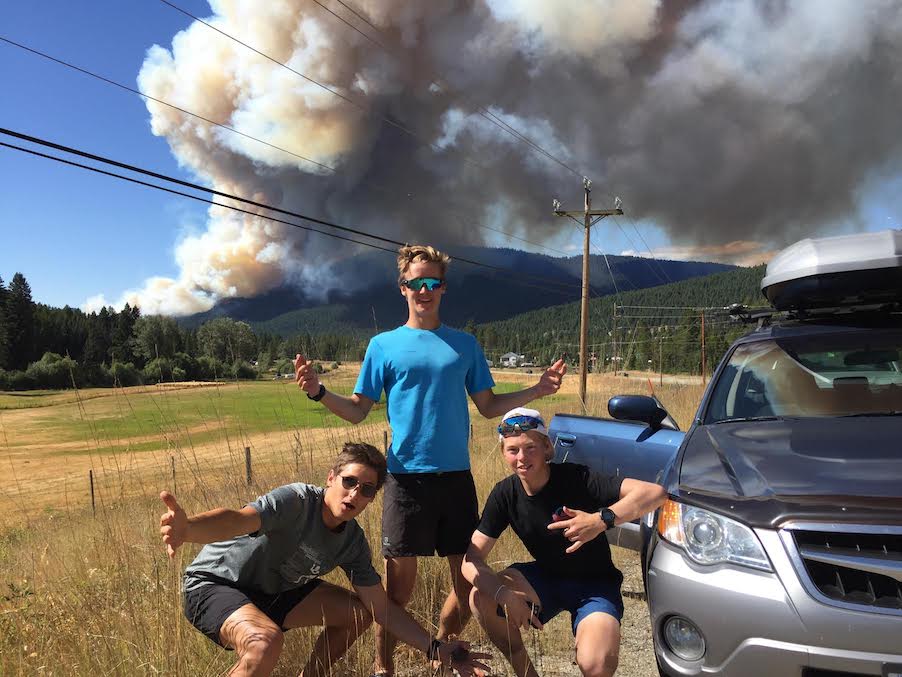
    Fran Vukonic, Tallon Noble, and Ian Williams pose at the end of a bluebird day trail run at Big White in front of the newest Kelowna fire, September 5, 2017. (Photo: Gareth Williams)
    Canadians Fran Vukonic, Tallon Noble and Ian Williams after completing a trail run on Sept. 5 at Big White in Kelowna, B.C.,with the backdrop of the newest Kelowna fire on an otherwise bluebird day. (Photo: Gareth Williams)

    This week’s featured articles are made possible thanks to the generous support of The Loppet Foundation, host of the Masters World Cup 2018. Registration opens in October.

    ***

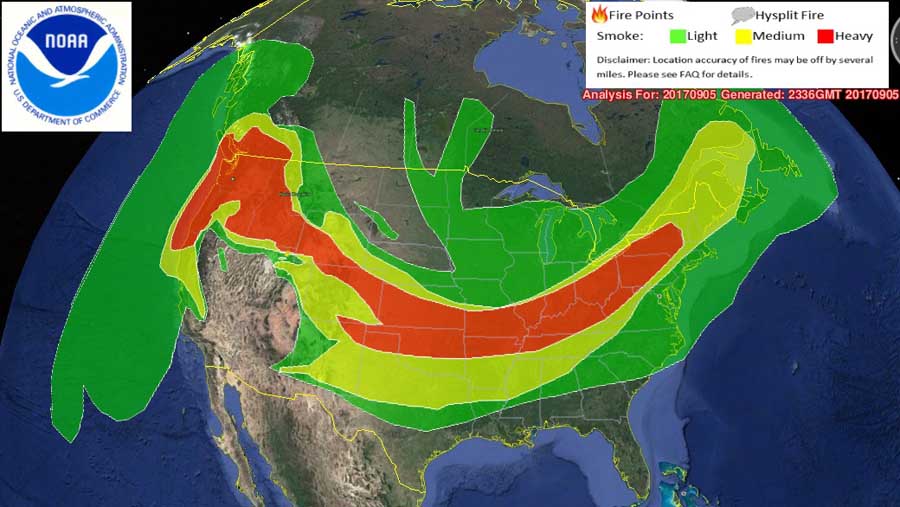
    Beyond the hundredth meridian, a traditional geographic line demarcating where the West begins, it’s been a hot and dry summer. Wildfires have raged from Washington to California, the Intermountain West, and in western Canada. The conditions remain ripe for extreme fire danger. Even if a wildfire didn’t burn near you, odds are the smoke found its way there. 

    Across the board and across the U.S., it’s been an off-the-charts summer. While many Americans have been consumed with hurricane coverage and concerns over the last several weeks, fires have scorched more than a million acres in Washington and Oregon alone this year, according to Quartz Media. That’s up from 513,226 total acres in 2016, but in 2015 and 2014, more than a million acres were affected.

    NOAA wildfire smoke and the correlating Air Quality Index for Sept. 5, 2017. (Photo: NOAA)

    Along with the devastated landscapes and loss, the wildfires’ byproducts of smoke and ash have made for smoggy, poor air quality. We’re talking about seriously hazy days when visibility often wasn’t more than a mile or two.

    Training outside in less-than-ideal quality air can compromise an athlete. To better understand when it’s OK to go out or stay in, many skiers and coaches became intimate with the scientific benchmarks for air quality.

    “I sort of have this rule where if I can see the glaciers on the mountain, I would rollerski but not do intervals,” Dakota Blackhorse-von Jess, who’s based out of the Bend Endurance Academy in Oregon, said on the phone last Friday. “My personal limit for being outdoors is that 75 AQI limit. That’s the unhealthy or moderate zone.”

    Here’s a quick primer. The U.S. Environmental Protection Agency (EPA) has developed an user-friendly Air Quality Index (AQI). The index is color coded and provides a numerical value indicative of a region’s air quality. An AQI of 75 means the air has a PM2.5 concentration of 23.5 micrograms per cubic meter. Going further, PM2.5 refers to the size of particulate matter in the air. In this case, the 2.5 corresponds to particulate matter 2.5 microns or less in width. That’s small enough to penetrate deep into the lungs, even the bloodstream.


    U.S. Environmental Protection Agency Air Quality Index (Photo: EPA/AIRNOW.gov)

    That 75 Blackhorse-von Jess limit falls midway into the moderate zone on the AQI.

    “The higher end of moderate,” Blackhorse-von Jess clarified. “You see what the station says and then you walk outside and determine if it is going to work. Honestly, at this point, it’s been five weeks. I’ve done so much training indoors, that now it’s more of a mental break than a training deficiency.”

    In places like Bend, Ore., where Blackhorse-von Jess calls home, some athletes have ignored the warnings.

    “I saw guys out there riding today, I see them every time when I am looking for breaks in the smoke,” Blackhorse-von Jess explained. “I cannot believe that people are out there. I think people living in the smoke have accepted a lower standard and are going about their daily lives and actually, their daily activities in the smoke have come to accept the shittiness of the feeling they are experiencing. And for the professional athlete, it is something that you cannot afford, I don’t believe.”

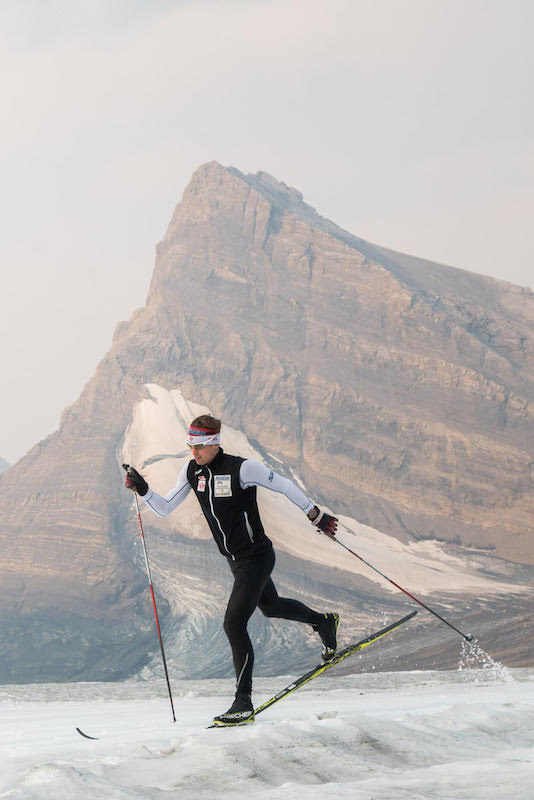
    BlackJack's Julien Locke training at a hazy Haig Glacier camp, August 2017. (Photo: Anthony Killick)
    Julien Locke (Canadian U25 Team) training at a hazy Haig Glacier camp in August. (Photo: Anthony Killick)

    While several fires continue to burn, the smoke cleared in Bend on Sept. 9. During much of August and into the beginning of September, Blackhorse-von Jess relied on a SkiErg, running treadmill and a stationary bike for much of his over-distance training.

    He is not alone.

    “Actually today, it was still dark when I woke up, but when the sun came up there was actually blue sky,” U.S. Ski Team member Liz Stephen said Friday from her home in Park City, Utah. “Where other days, you weren’t even sure the sun was up. It was really nasty.”

    Like other elite skiers across the West, Stephen had made use of indoor training opportunities. The day before Stephen spoke to FasterSkier, she logged four hours on a ski treadmill at U.S. Ski and Snowboard’s Center of Excellence (COE) in Park City.

    The AQI is also careful to note what are called “sensitive groups”. That can mean older adults, children, or people with lung or heart issues. Those populations must take precautions when high exertion exercise and poor air quality mix. Being responsible for junior athletes places a premium on being cautious. 

    For Leslie Hall, director of the Methow Valley Nordic Team in Washington state, dealing with smoke and subsequent air quality issues have been an on-and-off again affair.

    “We had a bad two week period at the beginning of August and it was leading into our annual Methow PNSA [Pacific Northwest Ski Association] Camp … so we had to make the call to move the camp,” Hall wrote in an email. “We ended up going to Oakridge, Ore., for the camp and had a great camp there with 32 kids but a fire started nearby there while we were there so we had one moderately smoky day and it has since gotten much worse there.”

    Like her athletic and coaching counterparts, Hall keeps an eye on air-quality websites to determine if a practice is indoors our out. But kids are kids.

    “It is quite hard to keep the kids motivated and they do not enjoy the gym workouts,” Hall noted. “But during the early smoke time, we knew we were going to go somewhere else to train fairly soon so we kept that in mind.  This past week was good because there are a variety of kids running and different coaches which help.  Also, intensity workouts on the exercise machines help the time go by quicker. There is plenty of complaining and calls to move East, but I think all the kids realize that we are very fortunate in general and it is hard to complain when the hurricanes are decimating the south and we just have bad air for a week or so.”

    Reports from Canada mirrored the smoke-filled experience of skiers in the Western part of the U.S.

    According to FasterSkier’s Gerry Furseth, on Sept. 7, British Columbia’s indices for air quality deemed Fort St John and Terrace as the only locations in the province “safe” for exercise. (The Canadian AQI is based on particulate matter 2.5 microns or smaller, but uses a 1-10+ scale with “1” being low health risk and “+” very high.)

    Air Quality Health Index 5 in Vernon. BC (Photo: Gerry Furseth)
    Air Quality Health Index 5 in Vernon. BC (Photo: Gerry Furseth)
    Air Quality Health Index 1, Vernon, BC (Photo: Gerry Furseth)
    Air Quality Health Index 1, Vernon, BC (Photo: Gerry Furseth)

    Gareth Williams, a member of Canada’s national U25 Team and a native of Kelowna, B.C., wrote in an email that the smoke was a near-constant companion this summer.

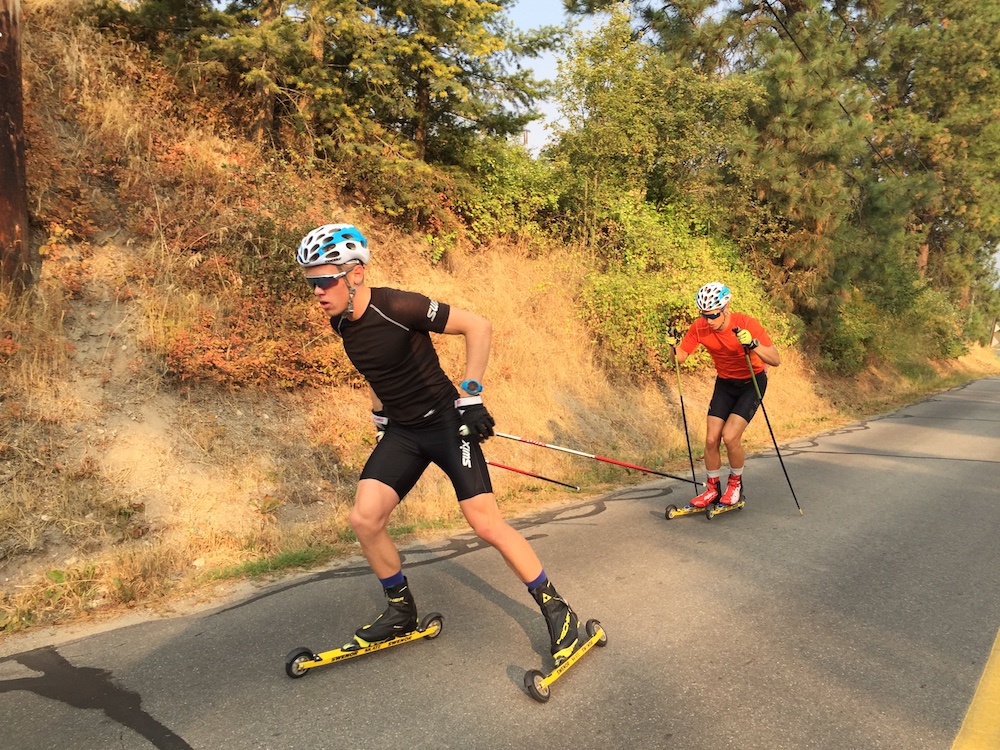
    Gareth Williams leads Fran Vukonic through an orange-tinted rollerski in Kelowna, BC. (Courtesy photo)
    Gareth Williams (Canadian U25 Team) leads Fran Vukonic during an orange-tinted rollerski in Kelowna, B.C. (Courtesy photo)

    “Summer has been great for me, I spent much of it on the Haig [glacier near Canmore, Alberta] in July,” Williams explained. “I’ve been in Kelowna the whole month of August and the smoke has yet to subside, it has actually gotten much worse recently. In past years the smoke has been bad, but I have never seen it like this. …  I think the smoke isn’t as bad as some people have suggested, for me it’s not the greatest worry. I will be happy once it is gone though, getting a little tired of the orange lighting and not being able to see the sun!”

    Michael Somppi, who trains with the Alberta World Cup Academy (AWCA) in Canmore, altered his plans depending on conditions.

    “Personally, I haven’t found the breathing to be too bad,” Somppi wrote. “That said, I am avoiding doing any hard intensity efforts on smoky days.  Today was the first day (in Kelowna) I was forced to alter my training plans, as I had planned to do a rollerski time trial, and instead opted to do zone 3 because of the smoke.  Even breathing semi hard felt sketchy with how bad the air quality is at the moment.”

    Another member of Canada’s U25 Team, Julien Locke has literally trained above the smoke on occasion.

    “I’ve been lucky in that the smoke hasn’t been too thick during most of the important training blocks so far,” Locke wrote. “I was at the Haig Glacier 4 times this summer and while we had some hazy days, for the most part, 2400m elevation was high enough to have clear skies.”

  • 5 Peaks Trail Running in Canmore: A Who’s Who of Nordic Racers

    5 Peaks Trail Running in Canmore: A Who’s Who of Nordic Racers

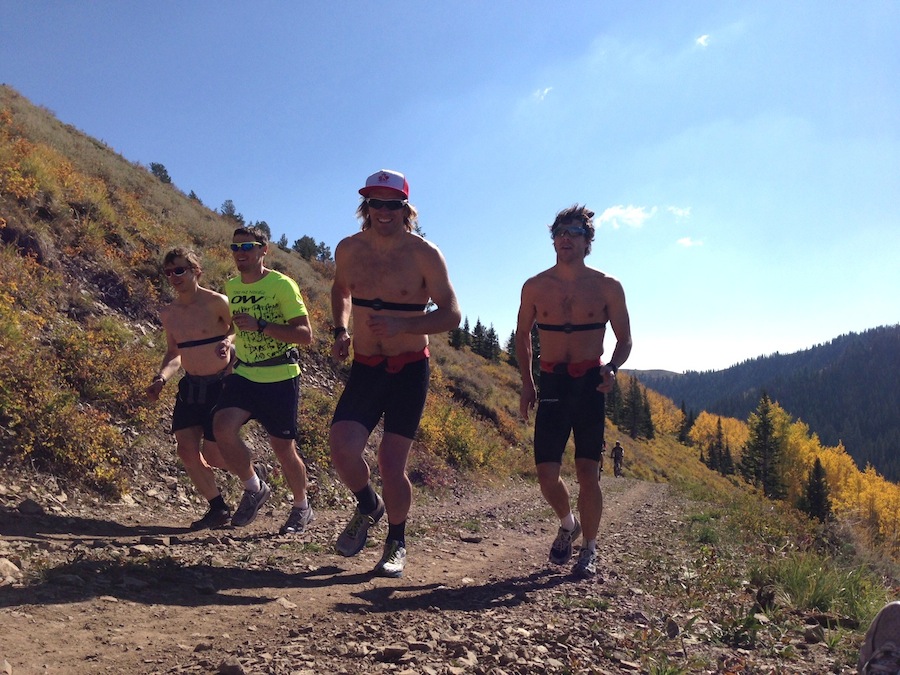
    The Canadian men during a dryland camp in Park City, Utah. From left to right: development-team members Kevin Sandau and Mike Somppi, and World Cup athletes Devon Kershaw and Alex Harvey.
    Kevin Sandau, Michael Somppi, and Devon Kershaw (l-c) competed in the second installment of the 5 Peaks Race Series in Camore, Alberta June 14, 2014. Here they are pictured training with Alex Harvey (r) in Park City ,Utah in 2012.

    On June 14th, the 5 Peaks Trail Running Series came to Canmore for the second installment of central Alberta’s race series. Consistent with the usual 5 Peaks format, the event consisted of an “enduro” distance and a “sport” distance, both 12 k and 8 k, respectively. But unlike your average 5 Peaks race, this event featured Olympians.

    Devon Kershaw, of the Canadian World Cup Team and the Alberta World Cup Academy (AWCA) and teammate Jess Cockney (AWCA – NST B) took two of the podium steps on the day, finishing first in 51:14 and third in 53:17, respectively. Kevin Sandau (AWCA – NST Dev) rounded out the skiers in the top five of the enduro category with a fourth place finish in 53:55.

    “It was definitely a hard race,” Kershaw told the The Cragand Canyon, who pushed the pace and ran off the front of the pack right from the start.

    Cockney ran just behind Sandau and fellow AWCA skier Michael Somppi for most of the race, setting “a strong climbing rhythm” and pacing himself on the descents. He passed his teammates to take his spot on the podium with about 1.5 k to go.

    Cockney was happy with his performance and felt that he “dug deep,” even though he prefers road running races to trail events.

    “My preference is definitely to run road races as there’s no confusion about what pace to stick to or any descents to throw off my rhythm, but it’s good to switch it up and be uncomfortable with a new challenge,” he wrote in an email.

    Sandau, who had not ran a trail running race in a number of years, also compared the race to the road running events that he is more familiar with.

    “That was my first trail run in a long time, such a different feeling than road racing. The climbs are hard and doesn’t feel like I need to run my legs off. It was hard so I was happy with the race,” he wrote.

    Noting Kershaw’s dominance right of the start, Sandau ran just behind teammate Graeme Killick (AWCA – NST B) until Killick took a wrong turn-off around 2 k into the event. From there, Sandau kept his position just ahead of Cockney until he “lost steam” at the 10 k mark and was passed.

    While Killick, Cockney, and Kershaw made a good showing for the male Olympic skiers in the Enduro category, Heidi Widmer (AWCA – NST Dev) represented the women in the 8 k distance, posting a blistering speed of 39:27, almost three minutes ahead of the next competitor.

    With the 8 k and 12 k races starting at the same time, Widmer ran with the 12 k runners until her turn-off, where the race became a practice in pacing for her.

    Widmer really enjoyed the loop but was kept on her toes having not ran the course pre-race.

    “The course was great! I had a general idea of where it went but hadn’t run the loop until the race. There was a long descent mid race that went to the bottom of the Georgetown trail which is essentially as low as you can get on the nordic centre trails. When I was sprinting down that hill, all I was thinking was ‘oh brother, I have to come all the way back up this,’ so the next bit of the race really hurt,” Widmer wrote.

    5 Peaks Trail Running Series – Central Alberta Race #2 Results

  • Skiers Flock to Frozen Thunder for Pre-Season Tune-Up (Photo Gallery)

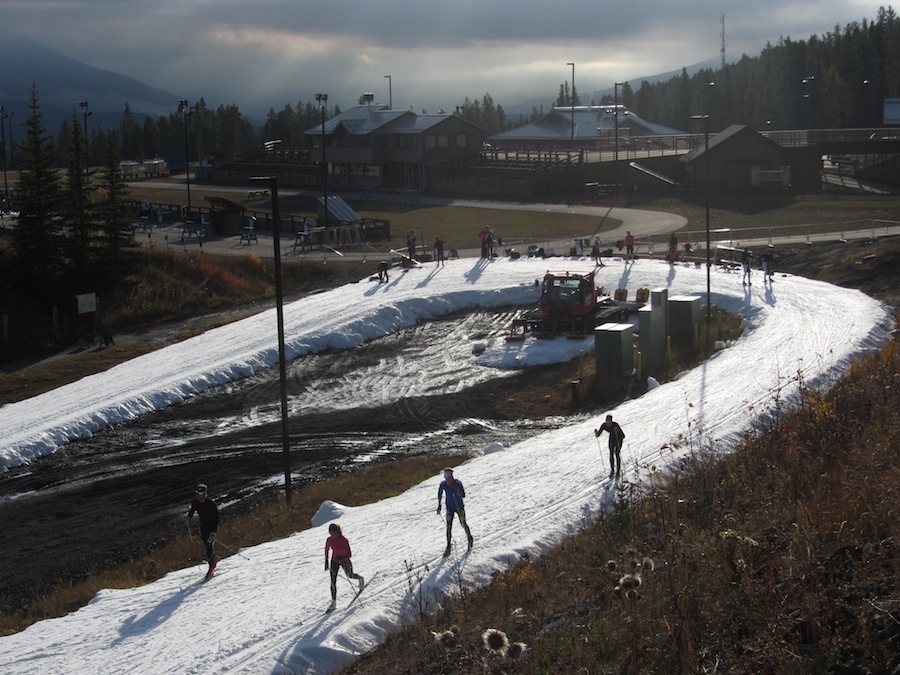
    The start area of the 2.2-kilometer loop at Frozen Thunder at the Canmore Nordic Centre, with the Bow Valley in the background in Canmore, Alberta.
    The start area of the 2.2-kilometer loop at Frozen Thunder at the Canmore Nordic Centre, with the Bow Valley in the background in Canmore, Alberta.

    By Katie Bono 

    CANMORE, Alberta — The days are getting shorter and shorter in Canmore, and if you’re an elite Nordic skier in North America, you know what that means. It’s Frozen Thunder time!

    Skiers from across the U.S. and Canada recently converged upon Canmore to ski the seasonal anomaly that is Frozen Thunder: a 2.2-kilometer loop of real snow skiing, harvested from last winter and saved over the brief Canadian summer under a thick coat of sawdust.

    According to a Cross Country Canada press release, Frozen Thunder’s first incarnation was in 2009 as a 400-metre loop of snow. However, if you know anything about the Canmore Nordic Centre, you know that settling for an ‘adequate’ trail experience is not in their nature.  Accordingly, the loop has been expanding ever since.  This year’s loop is the longest yet, and even includes a bridge crossing.

    Conditions on the loop thus far have been surprisingly good. Despite temperatures in the mid-teens (Celsius, around 50 degrees Fahrenheit) since opening day on Oct. 19, the trail has stayed thick, white and fairly firm, and skiers who were on the loop last year say that this year’s loop is substantially better than last year’s version.

    The list of skiers already getting their training on at Frozen Thunder is long: All of the Canmore-based Canadian teams are here, and many of the farther afield Canadian and U.S. teams are, as well. The Wisconsin-based Central Cross Country (CXC) was in town for the first four days of skiing and has since departed, while members of the U.S. Ski Team, Stratton Mountain School T2 Team, XC Oregon, Maine Winter Sports Center, and the Methow Olympic Development, among others, will be in town for a while longer.

    Skiers were out in full force on Wednesday and there was almost a palpable stoke in the air. Many looked to be gearing up for tomorrow’s classic sprint race while others were simply getting a solid interval session in.  Tomorrow’s race will be hosted by Winsport, and many of the top U.S. and Canadian skiers are expected to participate as their preliminary warmup for the season.  Qualification starts at 9 a.m. Mountain time, and only the top 16 in each gender will move on to heats.

  • Bits from Canmore: Athlete Notes and Quotes (+Video Montage)

    Bits from Canmore: Athlete Notes and Quotes (+Video Montage)

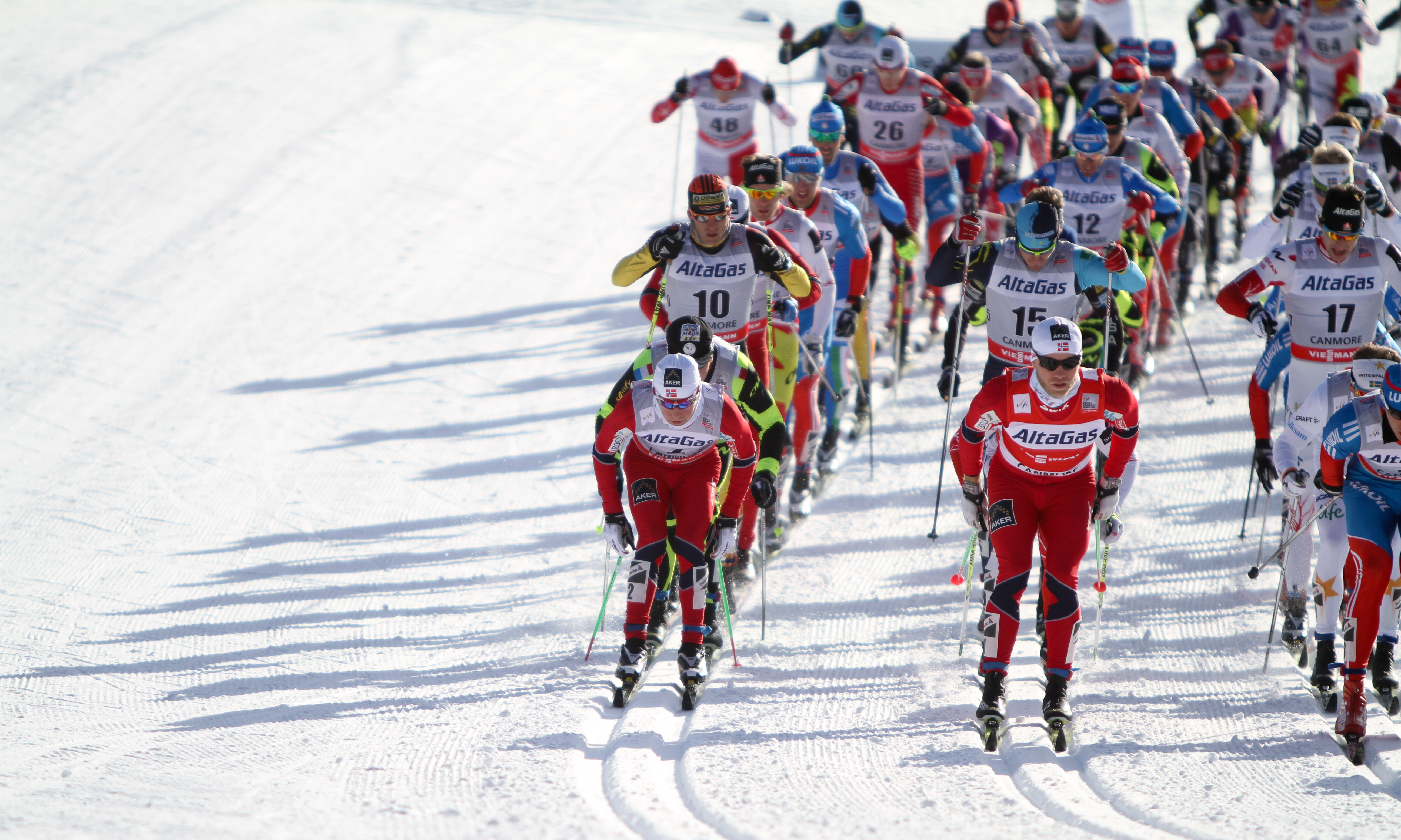
    Start of the Alberta World Cup 15 k classic mass start on Dec. 13 in Canmore, Alberta.

    CANMORE, Alberta – With the holidays heralding a rest period for many, Canmore might be in the back of many racers minds, but we haven’t forgotten about several of the athletes we interviewed there. Here are some of the highlights, and be sure to check out our video montage with several Canadian nation’s group skiers.

    Déjà vu?

    It was good until the top of the hill and just complete lactate at the top, just really heavy. We knew it was going to happen so we tried to forget about it and keep skiing well. – Alysson Marshall, Alberta World Cup Academy (AWCA), on sprint qualifier

    Canadian National Team member Perianne Jones attacks the hill in the 1.3 k freestyle sprint in Canmore, Alberta. She was 11th overall for an individual World Cup best.

    The top piece always feels like you should’ve went harder, but I’m pretty happy. – Andrea Dupont, Rocky Mountain Racers (RMR)

    I wanted to ski my own race and make sure that I pushed over the hills well. – Paul Kovacs, Australian NST

    It’s tough but it’s really just one climb, it’s pretty short. – Mikey Sinnott, Sun Valley Ski Education Foundation (SVSEF) on sprint course

    It’s not that long but there’s no forgiveness on it. It’s like, ugh. – Patrick Stewart-Jones, AWCA

    Those hills are so tough … They really burn you. – Michael Somppi, AWCA

    It’s a big opportunity to get to race in a world cup at home so I just went all in and it was good. I did the best I could so I’m happy. – Marlis Kromm, AWCA 

    There’s still some big opportunities for us for the rest of the winter, just race, move onto the next race. – Matt Wylie, AWCA 

    Newbies

    Before doing the World Cups, people would tell me that’s what it’s going to be like, but you could never actually like feel like what it is, I couldn’t have guessed what it was going to feel like. It’s such a cool feeling. – Corey Stock (Cambridge Sports Union)

    It was pretty fun to see all those people cheering for us at home, well it’s not really home, but it’s still in Canada and to see all those fast skiers too. We see that nothing is impossible. – Frédérique Vézina (CNEPH)

    I’m still really nervous every morning, but hopefully it gets normal by the end of the year. I’m just getting used to that level. Hopefully in a couple years, everything is gonna be fast. – Alexis Turgeon, Pierre-Harvey NTC (CNEPH)

    Improvement’s always good. I think I can do better but I couldn’t have done any better today. – Russell Kennedy, AWCA (42nd in skate sprint qualifier)

    It’s really an honor to be able to race in these world cups. It’s amazing to be able to race these and get some experience racing against international athletes. – Maya McIsaac-Jones, Rocky Mountain Racers

    It’s pretty awesome to represent Canada. – Zoe Roy, RMR

    It was fun for me, a good experience to ski with the fastest so I appreciate. – Anne-Marie Comeau (CNEPH)

    It’s a great experience just to race against these guys. It’s so different than any NorAm you could ever do. – Knute Johnsgaard, Yukon Elite Squad

    Ready or Not, Go!

    I think I found some parts of my lung that I haven’t felt before. It felt pretty horrible … You feel like you’re at the end of the sprint, but you’re only a third of the way through. – Reese Hanneman, Alaska Pacific University (APU) on sprint qualifier

    I didn’t know I was racing until 8 this morning. [US Ski Team member] Simi [Hamilton] was sick or something so they knocked on my door, they were like, ‘Hey, you want to do a hot lap?’ I was like, ‘What do you mean, like, drive you to the venue right now?’ And they’re like, ‘No you want to race? Simi’s out and Freeman didn’t want to race.’ So it kind of fell to me. I’m glad I skied the course like once [the day before] and kind of learned it. I wasn’t sure how I’d be able to ski the course. … I was kind of excited just to get to go out there. – Mikey Sinnott, SVSEF

    I was awake at 4:30 this morning. It’s hard to expect a similar performance to yesterday, just because it’s a completely different race, but I’m happy. A 30 k is usually quite a pain train for me so I think I got better at it today and I’m still learning. – Jesse Cockney, AWCA

    I felt pretty flat. I think six days of not doing anything, it makes sense. I wasn’t really expecting to do much today [Saturday], just use [the sprint] as a good warmup for [Sunday], but yeah, it’s a tough course. A minute and a half of climbing and then shoot down to the finish. – Sylvan Ellefson, Ski & Snowboard Club Vail (SSCV)/Team HomeGrown

    I don’t think the shape is right there for this weekend. It was tough. – Graeme Killick, AWCA

    I wish I wasn’t tired but I think I am a little bit tired. I guess maybe traveling or something, but altitude I think takes it out of you, too. – Caitlin Patterson (Craftsbury Green Racing Project)

    Happy Thoughts

    This is such a beautiful day. The course was just perfect, great snow and it was so awesome to hear so many fans. I know my parents are out there and tons of my friends from the Yukon are here, too, which is super cool. I couldn’t have asked for a better day. – Emily Nishikawa, AWCA (34th in skiathlon)

    There’s so many awesome fans here and I have so many family and friends. I’m out here to just hopefully have a good result, but mostly have a good time and just race well. – Sylvan Ellefson, SSCV/Team HomeGrown

    Canmore fans are the best fans especially when you’re from here. I think we’ve got such a great community supporting cross-country skiing and the national ski teams, it’s just a fantastic place to train and race and we’re very, very proud to be a part of this community. – Brian McKeever, Canadian Para-Nordic Ski Team

    I think it’s so cool to have the best in the world come to our home course. I see them walking around downtown and it’s pretty neat. – Marlis Kromm, AWCA

    Outside Skiing

    [Note: Sylvan Ellefson dedicated his races on Saturday and Sunday to those affected by the Connecticut school shooting]

    When I’m not ski racing I’m in the fourth grade classroom at my old elementary school and my mother-in-law is a kindergarten teacher. I just can’t even imagine having her be in those teachers’ positions or even the families’ positions in Connecticut. – Ellefson 

  • Tscharnke Motors to First World Cup Victory, Leads Germans in Canmore

    Tscharnke Motors to First World Cup Victory, Leads Germans in Canmore

    Coverage of the Canmore World Cups was made possible through the generous support of Travel Alberta and Tourism Canmore.

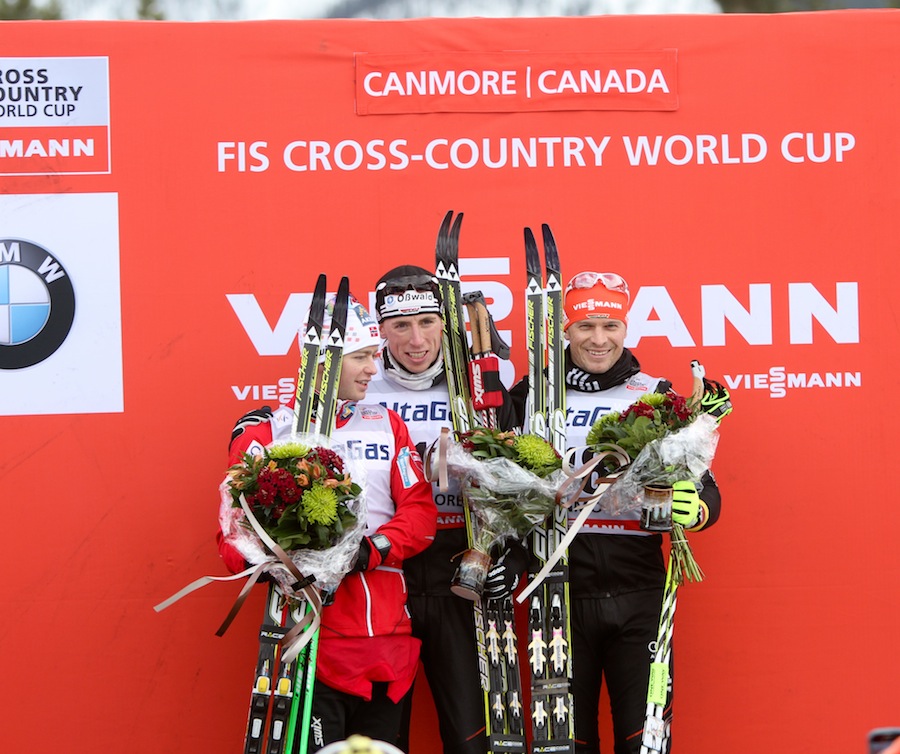
    Germany’s Tim Tscharnke celebrates his 23rd birthday with a World Cup win in Thursday’s 15 k classic mass start in Canmore, Alberta. It was his first individual podium, and he was joined by Sjur Roethe (NOR) in second and teammate Tobias Angerer in third.

    CANMORE, Alberta – Thursday was a good one for Tim Tscharnke before it started. On his 23rd birthday, the German had some basic goals for the men’s 15-kilometer classic mass start, but once he realized how fast his skis were and how good he was feeling, he dug a little deeper.

    Following close behind 35-year-old teammate Tobias Angerer, who last skied in Canmore at the 1997 Junior World Ski Championships (where he tallied two distance top 30s), Tscharnke searched within himself on the last of four laps for something, anything else.

    Tscharnke (GER) sits tight before punching hard near the finish to win the Alberta World Cup 15 k classic mass start Thursday in Canmore.

    “[I] realized I had some more petrol,” Tscharnke said in a press conference.

    The extra gas and timing turned out to be key as Tscharnke skied away on the final climb and held off his contenders on the following flat. He then double poled like crazy down into the stadium, throwing his arms up at the finish and nearly buckling at the knees at his birthday achievement. It was Tscharnke’s first World Cup victory and first individual podium.

    He finished in 41:14.8, considerably slower than most World Cup 15 k courses and a testament to its difficulty at 1,400 meters (4,600 feet) above sea level. Roethe trailed 4.8 seconds behind and notched second for his first World Cup podium. Angerer took third (+5.8), an individual World Cup best (outside of stages) as well.

    Three Germans made the top six, after Hannes Dotzler held his own near the front early in the race and placed sixth (+9.3) behind Russia’s Evgeniy Belov in fourth (+6.2) and Italy’s Giorgio Di Centa in fifth (+8.7).

    Belov, 22, was in the running for the podium before Roethe outsprinted him and Angerer to the line. Di Centa, 40, remained competitive throughout the race in his 227th World Cup start.

    “We were very strong as a team today,” Tscharnke said in a press conference. “We had very good skis.”

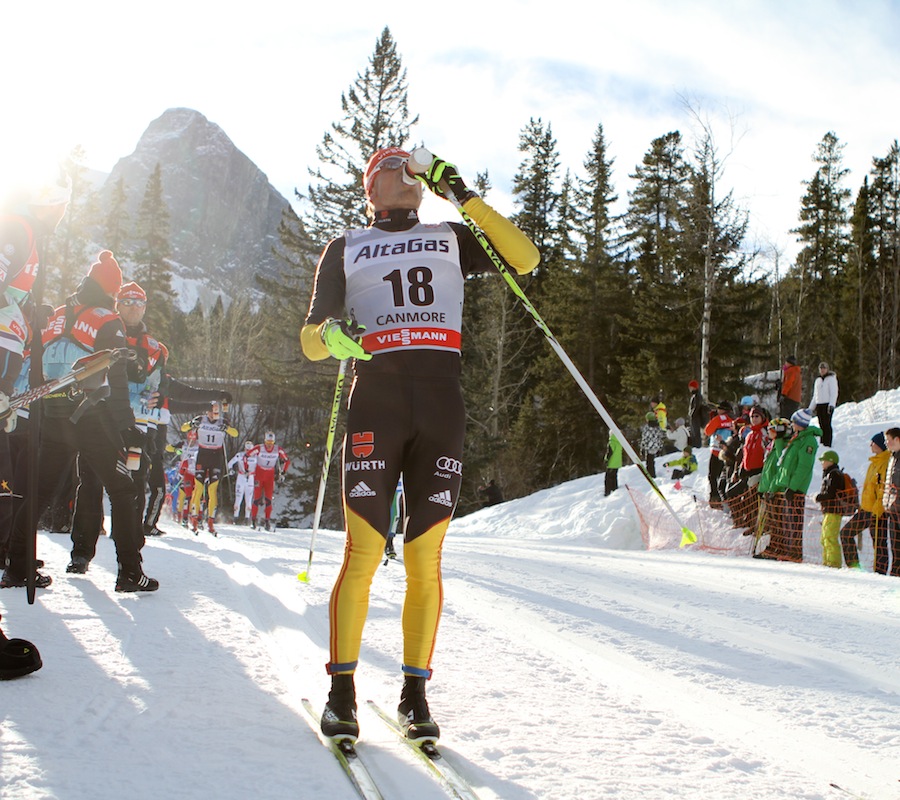
    Feeds also worked for the Germans, who appeared to be among the few taking them. Angerer dropped outside the top 15 near the end of the second lap when he took one, and teammate Thomas Bing was vying for the lead before taking a feed just before that.

    A few minutes later, Bing regained his spot behind Norwegian leaders Chris Andre Jespersen and Roethe and next to Emil Jönsson (SWE). Meanwhile, Angerer worked his way to the front and was the second to Belov at the bonus preem at 9.7 k. Angerer took the lead for the final lap as Belov followed, and by the high point of the course, Tscharnke stuck behind his teammate to get in the top three. More than five seconds back with two kilometers to go, Dotzler, Russia’s Andrey Larkov, Di Centa, Roethe and Jespersen tried to catch up.

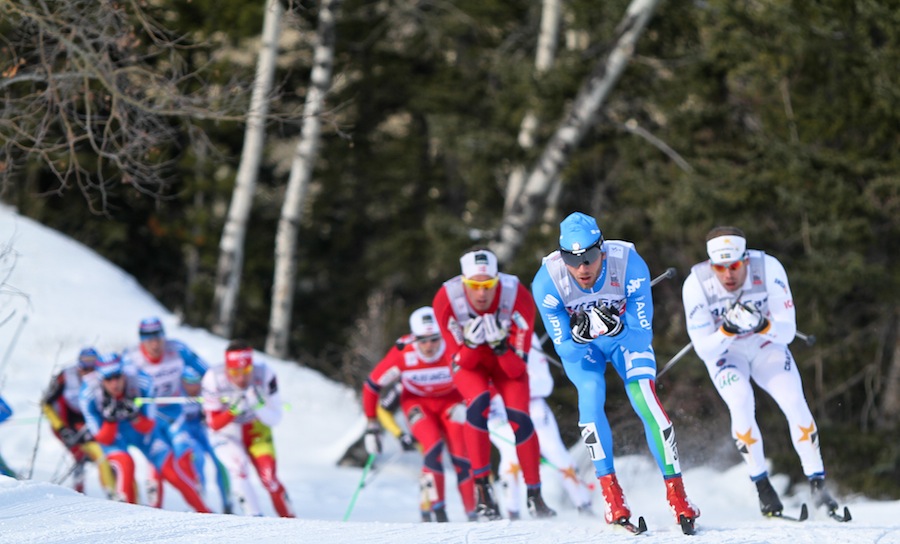
    Norwegians Sjur Roethe (l) and Chris Andre Jespersen (r) set the pace with Roland Clara (ITA) and Emil Jonsson (SWE) close behind in the first half of the 15 k classic mass start.

    Speed turned out to be on the Germans’ side, as Angerer and Tscharnke sandwiched Belov and dropped him in the final kilometer.

    “The downhills were our friends, not our enemy,” Tscharnke said.

    The chase pack absorbed Belov on the final downhill and Roethe skied around him to catch Angerer before the finish.

    Tscharnke said he “could not have hoped for a better result,” and Angerer said the Germans’ performance, with several taking turns up front, was a must for team morale. Jens Filbrich finished 13th (+31.2), and Bing was ultimately 21st (+1:10.1).

    “Today was the first time this season that we showed everyone that we are in good performance,” Angerer said. “The first two weeks we were a little tired. We trained a lot.

    “For me, I need to get the confidence in the mass starts to see if I can do the right things in the right place,” he added. “Today was good. … [I] wish every World Cup could be here.”

    Roethe echoed the enthusiasm after outsprinting Angerer and Belov to the finish.

    “I have had a few fourth places in the World Cup,” the 24-year-old said. “Finally I reached the podium. A little hard in the first lap, [but the] third and fourth, I felt really good.”

    ***

    Also: Martin Johnsrud Sundby (NOR) in bib No. 1 crashed on a downhill at the end of the first lap and later withdrew from the race. Larkov ended up seventh, Jespersen placed eighth and Jonsson was ninth.

    Alex Harvey led the Canadians in 11th for his best result this season, and Kris Freeman (USA) went from skiing in the top 10 to finishing 14th for his best performance of 2012/2013 as well.

    — Topher Sabot contributed reporting

    ***

    Men’s 15 k classic mass start results

  • Bottomley Tries Training in Canmore, Seeking Top 30 in Québec

    Bottomley Tries Training in Canmore, Seeking Top 30 in Québec

    Australian Esther Bottomley (second from left) at the Canmore NorAm freestyle sprint on Dec. 2 in Canmore, Alberta. Bottomley qualified for the heats in 12th and went on to place ninth. (Courtesy photo)

    The idea struck Esther Bottomley in early October. If she wanted to break into the top 30 on the World Cup this season, why not start practicing at one of the venues she’ll compete at?

    The 29-year-old Australian National Ski Team member called up Perianne Jones, who was training with the Canadian national team in Park City, Utah. Jones spoke to her friend Amanda Ammar, who races for the Canmore Nordic Ski Club in Alberta and had an extra room back home. A couple weeks later, Bottomley was on snow training in Canmore, living at altitude and soaking up her surroundings.

    A month into her visit, Bottomley, who’s been on the Australian national team for the better part of a decade, talked to FasterSkier about what she’s been up to in Canmore and why she decided to train there in the first place. One of two women on her team and the only one competing in Canada this season, Bottomley opted to skip the early World Cup races in Europe to prepare for the Québec and Canmore sprints Dec. 8 and 15, respectively.

    Esther Bottomley (AUS) in the Canmore NorAm 10 k classic on Dec. 2, where she finished 17th. (Courtesy photo)

    FasterSkier: Why Canmore?

    Esther Bottomley: They’ve got the World Cups over in Canada so that’s sort of why I was going to come here, but mostly it was to try and get a big group of girls that are at a really high level and be able to train with them. So far I’ve trained with three different training groups [the Canadian NST, Alberta World Cup Academy and Rocky Mountain Racers], and it’s been great, like, really good skiers and very motivated.

    FS: How have you made it work with your training plan?

    EB: I have my own plan and when I can get information from other teams in advance it’s really good, which they’ve sometimes been able to do. My coach can accommodate some of their intensity sessions so I’ve been trying to do as many sessions as I can with other people but also stick to some of my own things as well.

    FS: How much time had you previously spent in Canada?

    EB: I’ve been for the World Cups before and a wedding [teammate Chris Darlington married former Canadian skier Brooke Gosling last winter], but I’ve never spent more than like a week here. It’s the first time I’ve been able to do a bit more exploring, which has been fun.

    (Note: Bottomley achieved her career-best World Cup result of 35th in a 2005 freestyle sprint in Vernon, British Columbia.)

    FS: What are your goals for this season?

    EB: This year, I guess the goal is to try to get into the top 30 in the sprints, focus on the sprints, and try and sort of cut back travel. I’d like to try and stay in one spot for a while, which has been really good here. I can train here the whole time then go to Quebec and back again. I’ll be in Europe for the rest of the season until March.

    FS: Why the change in travel?

    EB: I’d kind of like to be able to, if I can, sit in one spot for a little while and just cut back the amount of hours. I didn’t go to the early World Cups in Europe just so I could cut down the jet-lag time and the hours because we already have to do that big flight from Australia to get anywhere.

    FS: How has your training been?

    EB: Pretty good. … We did a sprint simulation on the World Cup track so that’s fantastic. You get to come here and they’ve opened up the sprint course like the last weekend so we can now get on it and see what we have to do to ski faster on it. I think that’s the really big advantage to be able to come somewhere and just be able to ski the course and know the course before you race it.

    FS: What’s the sprint course in Canmore like?

    EB: Canmore is a bit of a hill climb. It’ll be a hundred percent different I think than Québec, which is meant to be a long flat course to here, which is really just a big climb in the middle and flat into it and flat out of it and that’s it. It’s a tough course.

    FS: What do you know about the Québec course?

    EB: It’ll be interesting. I think it’s quite a long course for the women so it’ll be interesting to see how that goes. The NorAms will give us an idea of how things are going and then right straight into it.

    (In a follow-up after Bottomley placed ninth in the Canmore NorAm freestyle sprint and 17th in the 10 k classic Dec. 1-2):

    FS: How did the Canmore NorAm go?

    EB: Last weekend was good fun but didn’t quite go as well as I was hoping for the races. Looking forward to going to Québec and racing on Saturday to see if I can ski a bit faster there.

    FS: What kind of sprint course do you prefer?

    EB: I kind of like in between [hilly and flat], sort of just an undulating where you can climb hard and recover a bit in between, but we’ll see. I’ve been training I think well during [the offseason]. It’s always hard to know at the start of the season. Hopefully I’m a little bit fitter and hills are all right.

  • Nishikawa Edges Ellefson, Stephen Runs Solo to Win Spray Drag

    Nishikawa Edges Ellefson, Stephen Runs Solo to Win Spray Drag

    U.S. Ski Team member Liz Stephen extending her lead to win the second annual Spray Drag running race on Saturday in Canmore, Alberta. (USSA Nordic courtesy photo)

    Thirty-six men in the Spray Drag running race didn’t end up chasing Devon Kershaw up Spray Lakes Road in Canmore, Alberta, on Saturday, but they had one heck of a battle from the start.

    According to American Sylvan Ellefson (Ski & Snowboard Club Vail/Team HomeGrown), the pace was fast for a bunch of nordic skiers early on.

    “Any road runner could have pulled away, but it was a quick pace,” he wrote in an email. “It continued on the road with a couple of us switching off in the lead.”

    From the Canmore Nordic Centre, racers (including 26 women and seven junior boys) ascended a snow- and dirt-covered road to the Spray dam. In an email, race organizer and Alberta World Cup Academy coach Stefan Kuhn wrote that some fresh snow made for an interesting race, and it was “definitely colder at the top than last year.”

    Start of the Spray Drag men’s race on Saturday in Canmore, Alberta. The second-annual road run up Spray Lakes Road was a fundraiser for the Alberta World Cup Academy. Graham Nishikawa (5835) won it, followed by Sylvan Ellefson (5805) in second and Michael Somppi (5818) in third. (AWCA courtesy photo)

    The men raced 7.5 kilometers with nearly 400 meters (1,312 feet) of elevation gain, and the women and juniors did 5 k.

    About six men took off at the beginning of the dirt road, including Ellefson and AWCA/Senior Development Team skiers Graham Nishikawa, Michael Somppi, Kevin Sandau, Graeme Killick, and Jesse Cockney. Nishikawa and Ellefson opened up a gap around the halfway point, and Nishikawa – who holds the course record in 29:23 – tested his competitor with about 1 k to go.

    “Nish moved ahead of me put a little speed in to see how I’d react maybe (at least that’s what it felt like, not sure if he actually did … ha),” Ellefson wrote. “And then with about 200m to go he kicked and I couldn’t hold on.”

    Nishikawa, who was third last year to Canadian World Cup Team members Kershaw and Ivan Babikov, won the second annual race – an AWCA fundraiser – in 30 minutes and 28.1 seconds. Kershaw won it last year in 29:44. According to Kuhn, the Canadian national team didn’t compete this year because the race didn’t fit in with their schedule in Canmore.

    “It is a very tough course,” Nishikawa wrote in an email. “I am happy to see my shape is good after the Park City camp.”

    Sylvan Ellefson (SSCV/Team HomeGrown) working to catch Graham Nishikawa (AWCA/CNST) in the final stretch of Saturday’s 7.5 k Spray Drag road race in Canmore, Alberta. (SMS courtesy photo)

    The runner-up, Ellefson finished 14.1 seconds back. Somppi was third (+24.1) and Killick placed fourth (+27.3), respectively. After leading early with Nishikawa and Ellefson, Sandau was fifth (+1:05.5).

    The women’s race turned out to be a spectacle with U.S. Ski Team member Liz Stephen crushing the competition and course record. She won by more than three minutes in 23:01.2, besting the record (25:41 by Madeleine Williams) and last year’s winning time (25:53 by Brittany Webster) by nearly three minutes. Last year, Perianne Jones was second, and Rhonda Jewett finished third.

    After Stephen, Canadian Zoe Roy, who skied for the University of Utah and now trains with Rocky Mountain Racers, placed second (+3:02.0). Heidi Widmer (AWCA) was third (+3:27.3).

    “We where excited to see Heidi run a [personal best],” Kuhn wrote. “Race winner Liz definitely showed us a new level for this event for the ladies’ time.”

    Complete results

  • Canada’s Frozen Thunder Offers Goods to All

    Canada’s Frozen Thunder Offers Goods to All

    Alberta World Cup Academy skiers Brent McMurtry and Phil Widmer skating on the 1.8 k manmade course at Frozen Thunder on its opening day, Oct. 13. (Devon Kershaw courtesy photo/devonkershaw.com)

    Before the sun rises in Canmore, Alberta, those near the ski trails can probably hear the sounds of striding and skating along hard-packed snow this time of year. That’s likely accompanied by voices, chit-chatting as skiers compete 1.8-kilometer loops around the Canmore Nordic Centre before trail passes go on sale at 9 a.m.

    They’re not exactly renegades, night owls or extreme enthusiasts. For the most part, these individuals belong to clubs – some of which are American – and they’re just sharing a slice of the popular pie that is Frozen Thunder.

    According to Canmore Nordic Centre manager Michael Roycroft, about 150 skiers per day for the next few weeks are expected to use to the 5-meter wide manmade course, which officially opened for the fourth straight year on Oct. 13 and is expected to stay open through the winter. That daily estimate probably didn’t account for groups like F.A.S.T. Performance Training from Hayward, Wis., which were among those skiing before or after business hours.

    Juniors from F.A.S.T. Performance Training out of Hayward, Wis., on snow for the first time this season on Oct. 13 at the Canmore Nordic Centre. From left to right: Ryan Davis, Zach Goldberg and Ben Saxton. (F.A.S.T. courtesy photo: facebook.com/pages/FAST-Performance-Training/222929117723592)

    F.A.S.T. head coach Bill Pierce guessed there were as many as two hundred skiers at the centre Wednesday afternoon, and not all were on snow.

    “It’s amazing how busy the training centre was with athletes in the afternoon,” he wrote on Facebook. “Cross country skiers both on snow and rollers, runners, mountain bikers, and biathletes in every age range were training.”

    With more than a week and a half remaining of their two-week Canmore camp, Pierce wrote his five athletes recently transitioned higher intensity, like many of the skiers there. They started with an easy 1 ½-hour ski on snow, followed by speed work on rollerskis in the afternoon. Earlier in the week, the Alberta World Cup Academy invited them to a strength session at the national-team headquarters.

    “Canmore is living up to its reputation as the perfect place to train for endurance sport,” Pierce wrote in an email. “The camp is a great mix of dryland and snow!”

    He added that it was unusual to be in a wax room when it’s 50 degrees Fahrenheit (10 degrees Celsius) with green grass outside. Regardless, the snow was holding up despite the warmer temperatures earlier in the week.

    Pierce recalled the feeling of getting on Frozen Thunder for the first time.

    Frozen Thunder two years ago on Oct 17, 2010. (Canmore Nordic Centre courtesy photo)

    “The first 500m of snow felt awkward and unstable but after 5 min., the feel of slippery glide gets under control and the grace of being on snow takes over,” he wrote. “It was just an awesome feeling and even at 50F the snow was faster than rollers.”

    According to Pierce, the weather had been a mix of sun and clouds that initially shrunk the snow base. Fortunately for the groomers and snowmakers there, daytime highs below freezing were expected through the weekend.

    “We’re just glad to have the snow opportunities mixed in with the dryland,” Pierce wrote. “One learns in today’s training and racing environment that any day on snow is better than not. It’s a great camp in a great town!”

    Who’s there: 

    CANADA

    1. Nordic World Cup

    2. Biathlon

    3. Para-Nordic

    4. Biathlon development

    5. Alberta World Cup Academy

    6. Thunder Bay NDC

    7. Canmore Nordic Ski Club

    8. Rocky Mountain Racers

    9. Blackjack Ski Club

    USA

    1. U.S. Nordic Ski Team

    2. CXC

    3. Craftsbury GRP

    4. Bridger Ski Foundation

    5. Stratton Mountain School T2

    6. F.A.S.T.

    (Note: This is not a complete list, but is based on those who registered with CCC high-performance director Tom Holland and other sources.)

    He called the scene “almost an elite WY [West Yellowstone],” with more than a dozen teams flocking to the first substantial, skiable surface in North America.

    In all, there were at least nine Canadian teams, six of which were national-team affiliated, and six squads from the U.S., including its national ski team.

    Against a rainy backdrop on Friday, Cross Country Canada officially announced its 2012/2013 World Cup, Biathlon and Para-Nordic teams at Frozen Thunder (FT), a project launched in 2009 to provide preseason training opportunities to their high-performance athletes. Since then, FT has expanded from spreading a snow pile (preserved through the summer under sawdust) into a 400-meter track to one that’s nearly two kilometers and growing.

    American Matt Liebsch, who’s been training in Canmore while staying with Canadians Ian Murray and national-team biathlete Brendan Green, said the potential is certainly there for more skiing and the snowmakers have their guns ready along a 5 k loop. Back in 2010, Canmore proved it could blow about 30 kilometers worth of snow when it hosted the World Cup.

    “It was very low snowfall and they still had 30 k of trails open,” Liebsch said on the phone Friday. “There’s not anything quite like this in the states.”

    The Minnesota skier with Borton Volvo XC United said he scheduled a six-day trip to Frozen Thunder to get the maximize his time before the season starts in nearly a month. In late August, he took a group of skiers to the Haig glacier, about 45 minutes outside Canmore, for a week of high-altitude, on-snow training.

    “That was a little awkward, you know, long skiing and stuff, but since I’ve been here I’ve put the skates on and that felt really good,” Liebsch said. “I was doing quality sessions my second and third day here.”

    Since then, he’s been working out with friends like former teammate Tad Elliott (U.S. Ski Team/Team HomeGrown) and Sylvan Ellefson (Team HomeGrown). The U.S. Ski Team (USST) arrived on Thursday, and Liebsch said he skied with those two on Friday morning. Yesterday, he and Ellefson went on a 1 ½-hour mountain bike.

    In terms of getting on snow, scheduling isn’t too complicated. While it was previously first-come, first-served, Roycroft wrote that this year, the nordic centre reserved time for high-performance athletes from any country (either national team, provincial or the development equivalent) to use the trails from 9 a.m. to noon. The public can ski any time outside of that. Regarding total use, he said it’s up 25 percent.

    Phil Widmer (AWCA) on snow at Frozen Thunder on Oct. 13 in Canmore, Alberta. (Devon Kershaw courtesy photo)

    While the Canadian World Cup skiers have been in Canmore for more than a week, their U.S. counterparts recently settled in for their 1 ½-week camp. According to Canadian head coach Justin Wadsworth, they hadn’t coordinated workouts, but that didn’t mean they weren’t going to.

    “This part of the season is crucial to be flexible and not force workouts just because they’re on the plan,” Wadsworth wrote in an email.

    One thing’s for sure: there’s going to be a timed-and-bibbed sprint showdown Oct. 26.

    According to a Cross Country Canada press release, Frozen Thunder’s first major sprint race – the WinSport Frozen Thunder Classic – will include more than 100 competitors from the U.S. and Canada. Qualifying will begin at 9 a.m. with the head-to-head heats starting at 10 a.m.

    “The sprint race is another important element in Frozen Thunder’s delivery of what Canada’s athletes have asked for, and need, in their pursuit of international excellence,” Roycroft said in the release.

    “Through the financial backing of the Government of Canada’s commitment to the Own the Podium program, along with WinSport Canada, this multi-year effort complements the more than $30 million these organizations, along with the Government of Alberta, have invested into the facilities and resources at the Canmore Nordic Centre over the last two Olympic cycles to help our Nordic athletes reach their goals.”

    As Wadsworth put it: “It’s just a really competitive field for sprinting so it should be a fun race to see.”

    Cross Country Canada announcing its World Cup and Para-Nordic Ski Teams on Friday at Frozen Thunder in Canmore, Alberta. (CCC photo/twitter.com/cccski)
    A look at the 1.8 k course at Frozen Thunder in Canmore, Alberta, earlier this week. (Matt Liebsch courtesy photo/mattliebsch.com)
  • Spray Drag Running Race Returns to Canmore

    Spray Drag Running Race Returns to Canmore

    2ND ANNUAL SPRAY DRAG RUNNING RACE
    October 20th, 2012
    Men – 7.5km

    Women – 5km

    Come challenge World Champion Devon Kershaw along with the entire Alberta World Cup Academy in a running race up the Spray Lakes road! All proceeds go to helping support the team for their upcoming season…

    According to AWCA coach and race organizer Stefan Kuhn, “It’s basically all up hill … Starts on the river and we run all the way up then past the nordic center and up to the Spray dam, which looks over Canmore.”


    Race Information:

    • Entry Fee $35.00 – registration on Zone4.ca, deadline is October 18th, 2011
    • Bib pick up Friday October 19th between 2 – 6pm at Ultimate Fit Center on Main Street

    Last minute pick up can be done at Bill Warren Training Centre between 7:45 – 8:15am on race morning

    8:15am briefing at cross country ski stadium at the Canmore Nordic Centre

    A van will be at the Nordic Centre parking lot and at each starting point for shuttling clothing to the finish line. Shuttling from the finish line to the Nordic Centre will be available.

    There will be 3 Vans to shuttle people down from race finish to Nordic center parking lot.

    Awards/snacks/prizes at BWTC – TBD room 12-2pm


    Start Times:

    • Women and Junior Boys/Girls 17 and Under – 9:30am – 5km – Rundle view Entrance. 
    • Open M 18+ – 9:40am – 7.5km – Green gate about 400meters from power plant spill way.

    Finish at the top of Spray Road by the dam for both men and women


    Course Records:

    • Graham Nishikawa – 29:23
    • Madeleine Williams – 25:41


    Course maps: Men | Women | Overall Course Layout


    Lactate Challenge

    Lactate: During power exercises such as sprinting, when the rate of demand for energy is high, lactate is produced faster than the ability of the tissues to remove it, so lactate concentration begins to rise.

    Think you have what it takes to have the highest lactate? $50 will enter you in the 50/50 draw which will measure your lactate at the finish line.  The harder your push, the better your chances!

    50% of entry goes to AWCA and 50% goes to the winner. Separate draws for men and women. Registration for Lactate Challenge on Zone4.

    Hope to see you out!

  • Clegg in Hospital, Myslicki and Crooks Act Against Aggressive Driving

    Clegg in Hospital, Myslicki and Crooks Act Against Aggressive Driving

    Winter Olympians Jason Myslicki (l) and Robin Clegg (yellow/red leaders jersey on the right) competing in the Banff Bikefest in June. Teammates on the Canmore-based Rundle Mountain Cycling Club, Clegg won the overall Category 3 title on June 17 to earn Category-2 status. Myslicki won a race later this summer to also achieve Cat. 2. (Courtesy photo)

    The average adult makes somewhere around 35,000 decisions per day. Before setting out for a road ride on Sunday, three retired Olympians made a couple of casual ones.

    First, former Canadian national-team members Robin Clegg (biathlon), Jason Myslicki (nordic combined) and Sean Crooks (cross-country skiing) decided to ride between 80 to 100 kilometers just outside Calgary, Alberta. Second, they picked a quiet township road, which would lead them to a coffee shop in the suburb of Cochrane.

    In a phone conversation on Tuesday, Myslicki said he initially didn’t want to go that way. His friends and Rundle Mountain Cycling Club teammates out of Calgary and Canmore, Alberta, convinced him the road was newly paved and seldom used.

    Cruising along the same road in a sport utility vehicle, one driver made some choices of his own. Upon approaching the three cyclists from behind, he honked his horn and buzzed by them, yelling that they shouldn’t ride on a road with no shoulder, according to Myslicki.

    They reacted to the close call between the car and their bodies by yelling back, and the male driver responded by slamming his brakes just ahead of them. Myslicki and Crooks veered to the left to avoid colliding with his tailgate, and Clegg, who was behind them, went toward the opening on the right. The driver then allegedly accelerated, hitting Clegg with the front of his car and sending him crashing onto the ground.

    A three-time Olympian who helped Canada place 10th in the relay at the 2010 Vancouver Games, Clegg, 35, never lost consciousness, but took the brunt of the fall on his right side. An ambulance transported him to the hospital, where he later had surgery to insert a plate in his broken elbow. According to Crooks, Clegg also broke his collarbone and potentially some ribs.

    A 2006 Olympian who spent seven years on the Canadian National Ski Team, Crooks, 29, wrote in an email that he visited Clegg on Tuesday. “He is pretty beat up,” he wrote, but Clegg expected to be out of the hospital by Wednesday. Doctors estimated it would take 12 weeks for his elbow to heal.

    “I’m frustrated with how some drivers perceive athletes training on the road,” Crooks wrote. “There are too many drivers out there who, for whatever reason, think it is a good idea to bully the athlete with their vehicle.”

    As a competitive cyclist living and training in the area, he’s had several run-ins with drivers before. Unfortunately, Calgary is notorious for driver aggression toward bikers, he wrote. But he had never witnessed anything as bad as this.

    “The guy was trying to scare us, and it went too far,” Crooks wrote. “I’ve had a few verbal confrontations in the past, but, honestly, when I see a vehicle stop to get angry for me being on the road, I’m not excited about what’s coming. With the skier/cyclist physique, I’m not looking for a physical confrontation. Also, chances are, this person is obviously irrational and is likely wearing much more stable footwear than I am.”

    Myslicki said he threw up his hands as many cyclists do when drivers intentionally get too close. He pointed toward the road as if to say, ‘What’s your problem? It’s a wide-open road; it’s straight, it’s flat.’

    “If it was a tractor driving on the road, you wouldn’t buzz them and honk,” Myslicki, 34, recalled thinking.

    “It’s definitely a greater hatred towards cyclists,” the two-time Olympian said. “I feel a bit sorrowful for those people; I wonder how bad their lives are that they’re willing to go out of their way and ruin someone else’s life.”
    After the incident, in which the Cochrane police, Royal Canadian Mounted Police, emergency services and a fire crew responded, Myslicki and Crooks continued on their ride. At the time, they hadn’t been identified as Olympians – no one knew who they were – and they decided to keep the story under wraps.

    Myslicki later reconsidered and made perhaps his second-most important choice that day, after his split-second reaction to swerve left and avoid the SUV. He wanted to go public with this.

    He thought about his girlfriend and her family and all the other people he had turned onto cycling. After retiring, he, Clegg and Crooks became teammates at the Rundle Mountain Cycling Club (RMCC). They biked as frequently as they could together and each achieved the prestigious Category 2 in road racing.

    “I’ve got to use this platform because it’s an opportunity to raise awareness for cycling,” Myslicki told himself Sunday. “If I can prevent even one person from bullying a guy on a bike then we’re getting somewhere as far as that’s concerned.”

    He contacted the Calgary Herald that evening, and by Monday morning, his phone was lighting up with press inquiries. Myslicki said he also spoke with Calgary’s mayor and several administrators about the incident, which was still under investigation.

    According to Myslicki, there was at least one witness – a woman in another vehicle who was an unknown distance behind – but he wasn’t sure what she reported.

    “I haven’t heard of what precedent is out there,” he said of the punishment for aggressive driving toward cyclists. “We’re hoping that someone makes an example of it.”

  • Elite Team Preview: Alberta World Cup Academy

    Elite Team Preview: Alberta World Cup Academy

    The Alberta World Cup Academy team behind a banner promoting the upcoming World Cup races from Dec. 13-16 in Canmore, Alberta, during a Canada Day parade July 1 in downtown Canmore. (AWCA courtesy photo)

    This is the third preview in a quick-and-dirty series about Canadian national-training centres. We asked coaches to send their 2012/2013 rosters and tell us what’s new for the coming season. We will be publishing additional reports over the next few weeks. Teams are presented in no particular order.

    Team: Alberta World Cup Academy (AWCA)

    Coaches: Chris Jeffries (head coach/women’s coach), Mike Cavaliere (racing director/men’s coach), George Grey (women’s assistant coach), Stefan Kuhn (universal coach/men’s assistant), Jeremy Hecker (summer intern), Rob Soffer (strength and conditioning trainer), Shelly Collier (strength and conditioning)

    Roster: 20 senior athletes, eight of which are on the Canadian Senior Development Team (SDT), between the men’s and women’s teams

    The 2012/2013 AWCA women’s team stops for a photo while rollerskiing on Palliser Range in Banff National Park in the Canadian Rockies. (AWCA courtesy photo)

    Men: Kevin Sandau (SDT), Graham Nishikawa (SDT), Graeme Killick (SDT), Brent McMurtry (SDT), Jess Cockney (SDT), Mike Somppi (SDT), Phil Widmer, Patrick Stewart-Jones, Matt Wylie, Russell Kennedy, Chris Hamilton

    Women: Emily Nishikawa (SDT), Alysson Marshall (SDT), Kate Brennan, Janelle Greer, Annika Hicks, Heidi Widmer, Alana Thomas, Marlis Kromm, Rebecca Reid

    Who’s new: Four men – McMurtry (from Pierre-Harvey National Training Centre), Somppi (NDC Thunder Bay), Hamilton (NDC Thunder Bay) and Kennedy (Canmore Nordic Ski Club).

    Three women – Thomas (from Nakkertok), Greer and Reid (first-year seniors).

    Also on the team, three juniors all born before 1994: Dahria Beatty, Suzanne Stevenson and Brittany Evans. According to Jeffries, this is notable since the team didn’t have any female applicants or additions last year and received as many as 20 applications this spring. This year, the women’s team – with 12 total skiers – exceeds the men’s by one.

    Who’s missing: Drew Goldsack (retired), Zach Holland (pursuing education), Pate Neumann (Canmore Nordic Ski Club), Bob Thompson (NDC Thunder Bay), Gerard Garnier, Joey Burton.

    “All of the above are very good skiers, it is just challenging because of the strength of the group and our applications,” Cavaliere wrote in an email. “Drew had a great career and always brought a lot of professionalism to our team, and we wish him the best … and we are sure he will make some great contributions to skiing in the future.”
    Top results last season: Sandau and Marshall clinched the overall men’s and women’s NorAm titles, respectively, to secure World Cup starts and start in prime positions this season.

    Cockney celebrates winning the 1.6 k NorAm freestyle sprint ‘A’ final at Black Jack Ski Club in Rossland, British Columbia. (Photo by Dan Roycroft/AWCA)

    Cockney won three NorAm skate sprints, including his first of the season in Rossland, B.C., where he skied away from the pack and ahead of the crashes to come out on top. According to Cavaliere, that style is what they’re looking for.

    “Take some chances, be aggressive and go for it,” Cavaliere wrote.

    The next day, Cockney pushed his teammate Sandau to win the mass start after hanging with him for several laps.

    “It has been a great couple of years watching the overall progression of the group and their ability to push each other in races,” Cavaliere added about the Academy, now in its fifth season.

    In all, eight AWCA athletes won races last year, and two more, Greer and Reid, topped junior podiums. Sandau won four NorAms and placed second in four others, battling with McMurtry throughout the season for the overall title. He went on to notch a World Cup career-best of 37th in a 35 k mass start in Falun, Sweden.

    McMurtry was a runner-up at five straight NorAms then finished fourth before securing his first win, and closed the season with four victories. Like Sandau, Graham Nishikawa earned some World Cup starts, and back home, he won a NorAm 15 k pursuit in Canmore, Alberta, and finished fourth at Canadian nationals in the 50 k classic mass start. Killick started last season with a 10 k classic SuperTour win in West Yellowstone, Mont., and later won the Mont Orford NorAm 15 k skate. Phil Widmer won the NorAm skate sprint in Whistler, B.C., and placed third in the sprint at nationals.

    Canmore
    Heidi Widmer leads AWCA teammates Marshall (c) and Nishikawa (r) in the NorAm skate sprint semifinal at the Canmore Nordic Centre in on Jan. 21. Marshall won the A-final, Widmer was second and Nishikawa was fifth. (Photo courtesy of Angus Cockney)

    Widmer’s younger sister, Heidi, also won a NorAm skate sprint. She turned 21 shortly after the U23 World Championships in Erzurum, Turkey, where she was 27th in a skate sprint.

    The two women on the senior development team, Marshall and Emily Nishikawa had a rivalry similar to Sandau and McMurtry on the NorAm circuit, except Marshall and Nishikawa were teammates last year. Marshall tallied two NorAm sprint victories (four if you take out U.S. Ski Team member Jessie Diggins in two early NorAm sprints). She placed 35th in a World Cup skate sprint in Poland and 37th in a classic sprint in Lahti, Finland, and at nationals, the 24-year-old was second in the 10 k skate.

    Nishikawa, 23, won the 10 k at nationals, which might have been a bit of redemption for missing out on a trip to the World Cup last season. Either way, she went to U23 World Championships, where she placed 17th in a 10 k classic, and tallied five NorAm wins mostly in distance events.

    As part of a new arrangement with the national team, Marshall and Nishikawa have been training with the women’s World Cup skiers (Chandra Crawford, Perianne Jones and Dasha Gaiazova) while they’re in Canmore. Later this week, most of them will meet up in Whitefish, Mont., for an AWCA camp.

    Coach’s comment: After dividing the team into men’s and women’s training groups this spring, Jeffries wrote in an email that the program has become more manageable.

    World Cup Academy members getting ready for a rollerski in Canmore in August. (AWCA photo)

    “Each coach has a more defined role and can better focus on individual athletes vs. group management,” he wrote.

    Personally, Cavaliere’s satisfied to see the transition working. “Both groups are happy and working well with the coaches,” he wrote. “We love what we see.”
    At the same time, the Academy’s philosophy remains the same.

    “We generally focus on the process-progress of each individual and against themselves,” Cavaliere added.
    Nothing’s really changed in terms of goals; they want to place athletes on the World Cup team and start as many World Cups as possible.

    “We always view our job as getting them to 97% and let the [World Cup] coaches and IST [Integrated Support Team] get them from 97-100,” Cavaliere wrote. “We are always being creative in the type of training and work we do to close the gaps and strengthen each individual. This is what makes being involved with our team so exciting – lots of perspectives and diverse ideas.”

    Canmore in July. (AWCA photo)

    Five years since Cavaliere created the training centre, which has quickly become a development powerhouse, he acknowledged its challenges. Financially, providing the highest level of support for a couple dozen athletes isn’t easy.

    “I think we just have to accept that we have to balance a fine line between what is a need vs. a want,” he wrote. “I believe we can afford everything we need. Having the WC/Nationals in the west always helps our budget a lot. We also hope to get more involved in some business ventures, which may help generate some consistent funding.”

    After two Olympians, Grey and Kuhn, joined the coaching staff last year, Grey is balancing another life change – a baby – and recently moved back to Rossland to be with his new family. Cavaliere explained his team involvement will be camp and competition specific.

    “We will still use George as he is an incredible resource, but we have an efficient system and lot of knowledge,” he added. “He all just have to work a little harder.”

    AWCA skiers, including Kevin Sandau (r), get the crowd going while rollerskiing through a Canada Day parade on July 1 in downtown Canmore, Alberta. (AWCA photo)

    ***

    Other previews: NDC Thunder Bay | Pierre-Harvey NTC

    Related: Canadian National Team, World Cup Academy on Same Track

  • Roy Returning to Canadian Roots

    Roy Returning to Canadian Roots

    Zoe Roy (RMR) leads Alberta World Cup Academy skiers Emily Nishikawa (c) and Kate Brennan (l) up a climb on the middle of their fourth of six laps in the 30 k classic mass start at Canadian Ski Nationals on March 24 in Mont Sainte-Anne, Quebec. Roy finished seventh to tie a personal best at Canadian nationals.

    Maybe it was the transition to full-time racing or the fact that Zoe Roy was competing in her home nation last season. It could’ve been the back-and-fourth flights across the U.S/Canadian border, or one team’s hospitality that helped Roy reach new heights on the NorAm circuit.

    Whatever it was, she wasn’t fighting it. After spending some 20 years in Bend, Ore., Roy, who turned 25 on Sunday, is moving to Canmore, Alberta. Starting Aug. 1, she plans to live and train at Canada’s cross-country epicenter with Rocky Mountain Racers (RMR), which took her in last year. Traveling with the club and taking advantage of its wax resources, Roy achieved her first NorAm podiums with second- and third-place in 10 k races, and tied her personal best at Canadian nationals in seventh.

    Between races, Roy was studying at the University of Utah in Salt Lake City. In her fifth year there, she was done with collegiate racing and entering the pro scene as a founding member of StellaRacing – a Salt Lake-based women’s squad in its inaugural year. She was also in her first season with XC Oregon, making her club affiliation that much more confusing.

    In committing to a domestic circuit, she chose Canada because she’s from there. Born in Ontario, Roy remains a Canadian citizen and doesn’t have dual ties despite growing up in Bend. She started last year with the West Yellowstone SuperTour, then spent the rest of her season in Canada (except for a convergence trip to Europe and local races in Salt Lake).

    FasterSkier chatted with Roy on the phone last week shortly after her surfing vacation in El Salvador. Earlier this month, she and a childhood friend from Oregon flocked to the sea to learn the sport in a place they could do it every day. After fulfilling their goals and surfing under moonlit skies, Roy was back in ski mode in Bend.

    ***

    FasterSkier: After more than a week of mostly surfing, are you a pro now?

    Zoe Roy: Not a pro by any stretch, but I’m better than really bad. Took lessons the first few days to get the hang of it.

    FS: What was the best part of your trip?

    ZR: I’d say the highlight … was going surfing at night under the full moon. That and the fried plantains.

    Zoe Roy working with a Fire and Ice Camp junior in late June at Mt. Bachelor in Bend, Ore. (MBSEF photo)

    FS: Before El Salvador, you worked at the Fire and Ice Camp in Bend. How was that?

    ZR: The day before we left, I was on snow. It was kind of funny going from that to surfing. … I coached for TUNA [The Utah Nordic Alliance] the week before [the Fire and Ice Camp] and then I did Fire and Ice for a couple days before I left. I was kind of an assistant coach for [that].

    There were a ton of juniors there. It was pretty cool to be able to get all those kids together. At any age, it’s fun to see everyone else skiing, too. You see all your friends that you might not get to see the rest of the year.

    FS: How long had you been back in Bend?

    ZR: I came [back] after school at the beginning of June and I’m going up to Canmore in the beginning of August. … I actually graduated in May [with a degree in] exercise and sport science with a minor in entrepreneurial business and a TESOL certificate, which means I can teach English as a second language.

    FS: Why did you decide to move to Canmore?

    ZR: I had a good year last year and I got to travel with the Canadians a bit. I’m originally Canadian … so I thought I might as well move up there and spend the year skiing with them and see how it goes. That’s the main reason. I also have an aunt and uncle in Calgary so that’s nice, too. I’m on the team RMR, which I traveled with on the Canadian circuit last year. It’s based out of Canmore, so that seemed the natural place to go.

    FS: How did your relationship with RMR start, and what about the team appeals to you?

    ZR: They waxed for me at nationals two years ago so maybe that was the beginning of it, and then after that I got more connected with them.

    It’s a fun team. They have the whole spectrum from juniors up to elite racers. Dasha [Gaiazova] is part of it and Andrea Dupont, those are probably the two main older girls on that team, and then John Jaques, the coach, is awesome, too. It’s probably a combination of who’s there and then John, too. I don’t know [new assistant coach] Mike Vierra too well, but he’s the new coach there, but I’ve heard great things about him, too.

    I’m psyched to be [moving] up there. I feel like there’s a pretty solid group of, not just on that team, but the whole Canmore community. The [Alberta] World Cup Academy’s there so I’m excited to have that whole group of girls to train with. … That’s another big reason. I feel like it doesn’t get much better than that.

    FS: When it comes to climbing the elite ranks of racing, why did you pick the Canadian route?

    ZR: I think mostly because opportunities do exist for me to race in Canada. Those same opportunities don’t exist for me to race for the U.S. because I’m not a U.S. citizen, so I guess that’s the main reason. I thought, ‘If I’m going to see how fast I can race, I might as well go somewhere where there are opportunities to make teams’ … so I thought I’d go to Canada.

    FS: We heard you were leaving XC Oregon, but what’s the status of StellaRacing?

    ZR: As of this coming year we’re splitting up a few more different ways because it was really based out of Salt Lake. I’m heading up to Canada, Katie [Ronsse] is in PT school, Evelyn [Dong] is coming back to Bend.

    It was great; we had an awesome time putting it together and have a team based in Salt Lake to work from and race with, but I’d say as of now, it’s splitting up a bit more. I’m sure some of us will still wear our suits at certain times, but I don’t know if it will be as much as a team as it was last year, but we had a great time doing it.

    FS: What are your goals for this coming season?

    ZR: Well, the World Cups are in Canada so if I qualified for that, that would be amazing, but who knows. If that could happen, that would be awesome, but other than that podiums at NorAms and another Scando Cup would be sweet, too. I don’t know exactly what the opportunities are for another Scando trip.

    FS: What did you gain from the convergence trip?

    ZR: It was cool to just race in Europe and see the other parts of the ski world. It’s good to race against those girls and see what level they’re at. I feel like just that in itself was a good experience.

    [Note: After winning four state championships at Summit High School, Roy spent a year and a half in Austria training and racing at the University of Salzburg.]

    FS: How did you feel last season went overall?

    ZR: I was psyched about those [NorAm] results. What can I attribute it to? I don’t know exactly, but I mean, it’s hard to pinpoint one thing. I guess before that I was racing [collegiately] so I couldn’t come to Canada that much. I was on the NCAA circuit.

    FS: What are your thoughts on truly making the next step to full-time racing?

    ZR: It’s exciting. It’ll be interesting to sort of concentrate more on skiing than I really did before.

  • Former Olympian Jewett Becomes Cycling Provincial Champ

    Canadian Olympian and Canadian National Ski Team veteran Gord Jewett is still racing – but on his bike, rather than a pair of skis.

    Earlier this month Jewett became Alberta Provincial Road Cycling Champion, taking top honors in the 130 k race in Lethbridge, Alberta.

    The 33 year old Jewett, who lives in Calgary, Alberta, retired from ski racing following the 2010 season, where he competed in the Vancouver Olympics.

    Jewett races for the Rundel Mountain Cycling Club – a non-professional team drawing most of their racers from the Canmore and Banff region. The team features a few other former elite skiers – ex-Canadian National Ski Team member Sean Crooks is also on the team as well as Eric Jenson, a top biathlete in the late 1990’s.

    Gordon Jewett finishing fourth at the West Yellowstone SuperTour Distance in 2009 Race Photo: Win Goodbody

    While Jewett had been riding hard all summer, racing pretty much every weekend either on his road or mountain bike, he didn’t come into the event with much in the way of expectations.

    “I was sick for two weeks straight coming into the race,” said Jewett. “I did a mid-week local race in Calgary the week before and I could barely pull through.”

    Even at the start line, he was thinking of helping the team effort, rather than going for the win himself – he told teammate Sean Crooks that he was going to work for him.

    “I was riding into the wind to keep Sean out of the crosswind, he crashed, I waited for him and paced him back to the group – basically I did what I could to take care of him.”

    With 40 k left, the pack hit high cross winds, and the group shattered. Initially, Jewett stayed with Crooks, but after realizing that his team mate was struggling, Jewett jumped across the gap to the two leading riders, and decided to race for the win.

    But he was faced with a tough task – both of the other riders were racing for a single squad, and employed the full range of team tactics in an attempt to get rid of the tough skier-turned-cyclist.

    “I had to respond to a bunch of attacks, and they guttered me [when a rider is forced to continuously ride in the cross-wind, never getting a draft], but I was feeling pretty strong,” Jewett said.

    Jewett also knew that he had a good chance if it came down to a sprint, and was focused on getting close to the line in contact with the other riders. With 200 meters left, he jumped into his sprint, and rode across the line as Alberta Champion.

    Despite his success, Jewett isn’t looking for a second athletic career – his goals for cycling are modest.

    “It’s just fun,” he said. “I’m just trying to be strong on the bike.”

    And he isn’t turning his back on the ski world. He does a little bit of work with the Alberta World Cup Academy (AWCA), the development center based in Canmore. His wife, Rhonda Jewett, also a former World Cup level cross country skier, is on the Cross Country Canada (CCC) board of directors.

    His brother-in-law Kevin Sandau, is currently on the Canadian National Ski Team’s Senior Development Team, and a member of the AWCA.

    In terms of ski training, he doesn’t get too involved. “I think I rollerskied twice last fall,” he said, “but I ski every weekend during the winter.”  At the grassroots level, he and his wife coach a group of young skiers at the Foothills Nordic Ski Club based in Calgary.

    In the mean time, Jewett is focusing on school, attending University of Calgary pursuing a degree in software engineering, with the ultimate goal of being an entrepreneur in the field of biomedical software technology.

    Jewett isn’t the only cross country skier to have success riding a bike; as a junior Alex Harvey went to World Junior Mountain Bike Championships, and more recently, ex-National Team member Tara Whitten has become a track racing star, collecting medals at Track Cycling World Championships in 2009 and 2010.

    Full results from Alberta Provincial Road Cycling Championships here

  • Canadian Birkie A Success

    Canadian Birkie A Success

    Over 1,600 racers were met with mild temperatures and fast conditions for today’s Canadian Birkebeiner Ski Marathon just outside of Edmonton, Alta.

    It was a very flat course that started at the Ukrainian Cultural Village and wound it’s way through Elk Island National Park to the Cooking Lake Blackfoot recreation area.   Racers got to take in the northern Alberta prairie scenery, crossing a number of frozen lakes and bogs in near-perfect conditions.

    The premier event, the 55km Birkebeiner with 5.5kg pack, was won by Kirk Howell of Calgary in a time of three hours, three minutes and seven seconds.   He was tied with Blaine Penny, also of Calgary.   Third place went to Mikhail Kudienko with a time of 3:11:04, making it a Calgary sweep.

    Wietske Eikelenboom of St. Albert, Alta. was the fastest woman in the 55km with a pack, clocking a time of 3:45:42.

    Though some had been worried yesterday about the conditions, 55km Birkie Lite (no pack) winner Andy Pohl said conditions were very fast. Temperatures held steady around –2C, with patchy cloud cover protecting the track from the sun’s glare, which made for an icy and quick first half of the race.

    “It was tough when we merged with the 31km course, but up till then it had been super fast,” Pohl said after his race.   “It was good, but really tough.   My arms are spent from all the double polling, and I could barely stand up at the end.”

    The Camrose racer took the win with a time of 2:49:56, three minutes and thirty-five seconds over 2nd place team mate Nils Lokken.   Calgary’s Gabe Altebauemer was third.

    Andrew Brisbin, also from Camrose, skied away with the win in the 31km Edmonton Journal Tour.   Calgary’s Kurtis Wenzel and Lethbridge’s Alex Mahoney finished 2nd and 3rd.

    Canmore’s Amanda Ammar was the fastest woman in the 31km event.   She said it was a bit of a lonely ski.

    “I was battling it out with some junior boys and masters men, but for the most party I was by myself,” Ammar said.   Still, the 2006 Olympian said she was happy with her result, especially after working a 50-hour week heading into the Birkie.

    “I’m glad I snagged some of the Rocky Mountain Racer guys.   I think they’re about 14, so I can’t beat up on them too much, and the older boys got me because of all the double polling, but overall I’m pretty stoked,” Ammar said.

    The day wasn’t just about high performance however.   Of the 1,600-plus racers, ages ranged from two-years-old up to the legend Frank Haley.   At 86, Haley was the oldest racer on course today, and has raced every full 55km Birkebeiner with a pack till this one.   He said he’d registered in the 55km again this year, but his family convinced him to play it safe and race the 31km Journal Tour; still nothing for an octogenarian to sneeze at.

    Haley too, was please with the course.

    “The folks doing the grooming set an excellent course,” said Haley.   “It got a little soft and difficult towards the end, but overall it was great.”

    Haley said he hopes to race again next year, but has to be realistic about it.

    “At my age, I’m not making any commitments,” he said.   Skiing has added decades to Haley’s sporting career.   The well-known Birkie veteran used to run marathons, but said he finds skiing “much kinder” on the body.

    Full results are available HERE:

    http://www.raceheadquarters.com/results/rhqResultsOther.php

  • Canadian Birkebeiner Races Start Today

    Canadian Birkebeiner Races Start Today

    In true Viking style, two of tomorrows started the festivities early.

    The twenty-third annual Canadian Birkebeiner races take off Saturday morning in Edmonton, Alta., but the festival is already well underway.

    “You could almost say the festival started on Wednesday,” said Birkie General Manager Glenda Hanna.   “We had our volunteer orientation and appreciation event Wednesday night, and it was a great party atmosphere.”

    Hanna positively glows while talking about the 600-plus volunteers who make the Birkie happen.   That’s no surprise, as the Canadian Birkie is Canada’s largest classic-only loppet.

    Many of the volunteers were working hard Friday night at the Edmonton Hotel and Convention Centre, running the Birkie’s Nordic Fare.   The event doubles as the bib pick-up and information booth, but it also included display booths from local sponsoring shops, a free beer sampling station, and free waxing and advice.

    Track 'N Trail had ski tech's on hand to help racers prep their skis

    Ski techs from Mountain Equipment Co-Op and Track ‘N Trail were on hand to provide free pre-race ski tuning for racers.   MEC also donated over $600 in door prizes for the volunteer orientation party.   It’s support like this that Hanna said helps make the Birkie what it is.

    “We have lots of support.   For example there is the Ukrainian Cultural Village.   They do a huge amount for this event.   All the starts are right at the village, and they take care of organizing all the food for everyone and also handle the official start.”

    The official start will certainly be something to witness.   According to Hanna, registration is already over 1,600 skiers, not including race day registration for the shorter events like Ole’s Tour, an optional 2.5- or 4-kilometer fun event for kids and first time skiers to try out.   Hanna predicts there could be upwards of 1,800 participants by the time the gun goes off tomorrow.

    Ian Clark will be one of those on the start line.   He is a longtime Birkie racer, and he’ll be tackling tomorrow’s 55km Birkeibiner, which requires racers to carry a 5.5kg pack.   The pack is symbolic of Norway’s infant Crown Prince Haakon Haakonsson who, in 1206 rescued from a civil war and carried 55kms from Gudbrandsdal valley over two mountain ranges to Rena, in Osterdal valley, by two Viking warriors.   Clark said tomorrow’s snow should be ok, but by the afternoon will likely soften up quite a lot.

    “It’ll be tough by the end,” said Clark.   “The experts are saying tomorrow’s wax is going to be two layers of red klister covered with a layer of blue hard wax.”

    He the snow coverage in northern Alberta has been pretty good this year, but a lot of it is old.

    “It’s Christmas snow, mostly.   We’ve had decent coverage, and I’ve been able to ski six times a week at home [in Bently, Alta.], but because it’s so old a lot of it is transformed now.”

    Glenda Hanna acknowledged the warm temperatures, but said she has confidence in the grooming crew.   The Edmonton area has over a dozen cross-country ski areas, and many have chipped in to help get the trails at the Blackfoot recreation area in shape.

    “It’s a huge effort to get all the grooming done.   We’re talking over 100kms of trails,” said Hanna.   She’s thinks tomorrow’s conditions will be good, despite some unseasonably warm weather in Edmonton this week.

    “If it was going to rain, it would have happened today.   It didn’t, and tomorrow should be good.   It will be fast in the morning, and while it will slow down as the day goes on, we have enough snow.”

    Hanna herself is a Birkie veteran, one of only four skiers who have completed all but one of the 55km Birkebeiners.   She had to sit out one year while she was pregnant with her son, but the following year she made up for it by carrying him in a backpack.

    “He’s the only one known to have been carried just like the prince,” said Hanna, smiling.

    Saturday’s races kick off at 9 a.m. at the Ukrainian Cultural Village in the Cooking Lake Blackfoot Provincial Recreation Area, just outside Edmonton.   Race categories include the 55km Birkebeiner, a 55km Birkie lite (which doesn’t require a pack), and a 31km event.   There will also be a 13km Mini-Birkie and Ole’s Tour, which start at 11 a.m. and 1:30 p.m. respectively.   All races are classic only, and aid stations with food and drinks are provided on course.

    Fast Trax's Shauna Blackburn-Cook helps a young Birkie racer get ready for tomorrow's big event
  • Canmore: Crown Jewel of Alberta Skiing

    Tracks at the Canmore Nordic Center in Alberta, during the 2010 Pre-Olympic World Cup event.

    Twenty-two years after the 1988 Winter Olympics, the Canmore Nordic Centre remains a model of legacy planning for Olympic cross-country venues.

    When it was built in 1986, Canmore set a new standard for nordic facilities, and when it was refurbished in 2005, the ski area redefined that standard.

    In his masters’ thesis, John-Christopher Reid called the 1988 Winter Olympics “…the single most significant precedent in terms of structuring Winter Olympic legacies in North America.”  Canmore has shared in that legacy.

    Like Utah’s Soldier Hollow, Canmore is a stand-alone facility. But unlike any other North American Olympic venue, Canmore, located in one of Alberta’s provincial parks, is government-owned and funded.

    “It’s the most outstanding venue in the world, when you look at everything from A to Z. Nobody has done anything like it,” said former Canadian and American national team coach Marty Hall.

    Beginnings

    Canmore’s road to the Olympics started in 1956, when the Calgary Olympic Development Association (CODA) was founded to secure the Winter Games for the city. After missing out in 1964 and 1968, Calgary was finally awarded the 1988 Games, beating Falun, Sweden and Cortina d’Ampezzo, in Italy.

    CODA’s winning bid cited Bragg Creek, 60 miles southeast of Canmore, as the cross-country venue, which had “excellent terrain,” according to Bjorger Pettersen, the chief of competition for Canmore’s cross-country events.

    But Don Gardner, who collaborated with Pettersen on site selection, and later, trail layout, felt that Bragg Creek was too exposed to the Chinook, a warming wind that can raise temperatures as much as fifty degrees in a few hours.

    Moreover, Gardner said he thought that Bragg Creek’s location wasn’t economically viable post-Olympics, since it wasn’t near a major road, and lacked infrastructure. And when

    Southam racing at the Canmore World Cup

    organizers deemed the installation of a snowmaking system too expensive, CODA expanded its search for a cross country venue.

    After inspecting several sites, Gardner and Pettersen felt that Canmore had the best snow retention of all the sites they inspected. Work began on the venue in 1983.

    The courses there were “definitely harder than anything that came before,” said Hall, who coached the 1988 Canadian Olympic cross-country team. “Both uphill and down. Particularly up.”

    The trails were well-received, Gardner said, but he also acknowledged that some people thought they were too difficult. Intended to test both fitness and technique, Gardner said that he designed the trails to challenge the top 30.

    “They were designed to test great skiers…not those that would finish in 60th place,” Gardner said.

    “I thought this was the way the sport was [evolving],” said Pettersen of the famously big hills. At 104 meters, one ascent in particular exceeded the maximum for a single climb. “Somehow, Bjorger talked FIS [the International Ski Federation] into leaving it,” Gardner said.

    Post-Games

    Following the Games, CODA took over management of the Olympic ski jumping, sliding, and speed skating venues. But because Canmore was located in a provincial park, the government opted to manage the venue itself, rather than turn it over to CODA. (In 2009, CODA was renamed Canadian Winter Sport Institute, or WinSport.)

    “The [province’s] operations of the center addressed the community’s desire for [it] to remain a public facility as well as meeting recreational and high-performance sport needs,” said Dan Huang, a spokesman for Alberta Parks, in an e-mail.

    One of the benefits of provincial management was free skiing: for the first eight years after the Olympics, visitors didn’t have to pay a fee to use Canmore’s trails.

    But in the early 1990s, collapsing oil and gas prices hobbled Alberta’s economy.  Facing some $20 billion in debt, the province enacted broad budget cuts—including to its parks.

    “There were budget reductions throughout the Alberta Parks system. At the Canmore Nordic Centre, capital reinvestment was limited,” Huang wrote.

    While Canmore still received regular maintenance, the only major upgrade following the Olympics was CODA’s construction of the Bill Warren Training Centre in 1994, which offered facilities for weight training, performance testing and recovery on-site.

    By 1996, Canmore had begun charging a trail fee to help defray expenses. Today, however, its $10 trail pass is still below the market rate for a top-end cross-country ski center.

    “Historically, there’s been a reluctance to have fees at market level, due to the fact that it’s a public facility,” said Mike Roycroft, Canmore’s manager.

    Renewal

    Seeking more race starts for Canadian athletes, in 2002, Cross Country Canada (CCC) requested a spot for the country on FIS’s World Cup calendar.

    According to Dave Dyer, CCC’s events planning director, one motivating factor for the bid was a presentation by athlete Beckie Scott to CCC’s executive committee and board of directors, in which she expressed her desire to compete in international events on home soil.

    “We entrenched a planning principal at FIS that overseas nations would be able to hold World Cup races every second year,” Dyer said. 2005 would be the start of that cycle.

    CCC solicited bids to hold World Cup events, and according to Dyer, “…Canmore was the site we thought could hold an event right off the bat.”  Ultimately, Sovereign Lake, B.C. and Foothills Nordic in Calgary won the bids to host the races, and Foothills organized its event at Canmore.

    As plans for the World Cups developed, the provincial government “rolled up its sleeves and

    Women racing in the sprint in Canmore in February.

    decided to look at reinvestment options in Canmore,” according to Glen Cowper, strategic development manager for the Alberta Ministry of Parks, Tourism and Recreation. By June, 2004, the province had “decided to invest, to bring Canmore up to current international standards,” he said—both for biathlon and cross-country skiing.

    In just thirteen months, new competition trails were laid out to comply with current homologation rules. In addition to shorter and more spectator- and television-friendly loops, said Roycroft, acceptable climb criteria had changed significantly in the intervening sixteen years since the 1988 Olympics. The elevation profile and grade of the courses are now much different.

    Gardner, one of the 1988 course designers, collaborated with John Aalberg on the changes to the trails. “The whole style is different, because of television and spectators,” Gardner said. “The courses are convoluted and back and forth. The climbs are shorter, but there are more of them.”

    In addition to new trails, Canmore received a new cross-country stadium, a new snowmaking system and new wax facilities. Cowper characterized these as the minimum upgrades necessary to run the December, 2005 World Cup races.

    After those events, work continued, with updated biathlon trails, a new biathlon stadium, an improved day lodge, and a paved rollerski trail added by 2008.

    Thanks to the refurbishment, Canmore can now hold “simultaneous World Cup events, and still have 40 [kilometers] of trail open to the public for recreational skiing,” said Magi Scallion, Canmore’s events coordinator.

    Training

    Today, Canmore is the home of both the Canadian National Ski Team, and the National Biathlon Team. CCC’s headquarters are in the Bill Warren building, and the Alberta World Cup Academy, an elite club, also makes its home in Canmore.

    Athletes use the ski and rollerski trails at the venue, then can head immediately to the Bill Warren center’s recovery facilities, like hot tubs and saunas, without having to drive anywhere, Roycroft said.

    “You can live in Canmore and rollerski to the Canmore Nordic Center for some rollerskiing on the rollerski loop, or use the gym. In Whistler [BC], you would have to drive roughly 15 to 20 minutes to the site to begin quality training,” said Scott Perras, a Canadian biathlete, in an e-mail. “The staff in Canmore are very good, and are getting better every year at understanding our needs.”

    Canmore is also creative in extending the ski season for local athletes. 2009 was a “trial year”

    Stefan Kuhn in Canmore in February. Photo, Win Goodbody.

    for an initiative that has since been dubbed “Frozen Thunder.” Temperatures were cold enough around Canada’s Thanksgiving, in October, that the nordic center opened a limited loop with snow they had harvested and stored under sawdust over the previous summer.  With its success, they expanded the program for fall 2010.

    According to Roycroft, last summer “probably double” the amount of snow, compared to 2009, was set aside. The preserved snow was laid over a one-kilometer loop, and some was saved to fill on thin spots.

    Securing the Future

    With experience and momentum gained since 2005, Gardner said he thinks that Canmore has a bright future.

    However, he said he was also concerned, generally, about the sustainability of large, high-overhead ski venues—specifically in a tough economy. He cited the Ontario provincial government’s closing of Big Thunder National Ski Training Center in 1996, following the 1995 World Championships.

    “Cross-country places are going to have to fight for their existence,” Gardner said.

    Roycroft said that in a future economic downturn, there wouldn’t be the pressure to de-fund here as there might be at other park facilities in Alberta.  The nordic center is “considered one of the top three [park] facilities in the province,” he said.

    Compared to other legacy venues supported by endowment funds, Roycroft argued, “Canmore…has probably got the most stable funding model,” noting that an endowment fund’s value can fluctuate with the stock market. Currently, approximately 35 percent of Canmore’s operating budget is funded by trail fees, with the rest coming from general tax revenue.

    By funding upgrades to Canmore earlier in the decade, the province “made a commitment to FIS and the International Biathlon Union,” Roycroft said. He described Canmore as a showpiece and an “economic driver” for the city and the province—a 24-hour mountain bike race alone generates $1 million in revenue, for example.

    Dyer agreed, saying that the provinces are interested in the economic impact of World Cup races, which he characterized as “brand exposure.” Still, he added, if either the federal or provincial governments decided not to support future World Cup races in Canada, “we’d have a lot of soul-searching to do.”

  • Canadians Tackle Long Days and Epic Amounts of Monopoly at Haig Training Camp

    Canadians Tackle Long Days and Epic Amounts of Monopoly at Haig Training Camp

    Just another beautiful day at the office… Photo, Graeme Killick

    During the month of June, the Canadian National Ski Team (CNST) tackled the usual Haig glacier ‘Yo-Yo’ Camp. Featuring 23 days of skiing, intervals, distance workouts and traveling from high to low altitudes and back again, the ‘Yo-Yo’ camp has been a fixture on the CNST schedule for the last couple of years.

    The training camp has always been a difficult one, due to its length and its strenuous workouts. The 2010 edition featured four cycles of three days on the Haig glacier followed by three days at the lower altitude of Canmore, Alberta. The big volume days could be four or five hours, depending on the level of the athlete.

    The skiing conditions in June were excellent. “I’ve never seen the Haig with so much snow,” said first-year CNST member Graeme Killick in a recent e-mail to FasterSkier. “Conditions were prime, with good grooming and even some awesome crust skiing.

    There was actually too much snow. Traditionally, the athletes run up to the glacier, while their equipment is flown in via helicopter. However, with deeper snow depths, a lengthy snowshoe was required, and for the second high-altitude cycle, the location was moved to Jasper, Alberta, a short drive from Canmore, but also at altitude.

    While on the glacier or at altitude, the schedule was for two high-volume days, with an easier day in between. On returning to Canmore, the Canadians had a rest day, followed by 7×7 minute intervals to force the extra blood volume through the athletes’ bodies.

    Graeme Killick skiing on the Haig glacier, Photo: Graeme Killick

    For Killick, the toughest workout came on the last day of the first cycle on the Haig glacier. “The weather was just so spazzy, snowing on-and-off during the ski, and then turning into a cold rain on our snowshoe/run out,” he said. “By the time we got to the cars and finally had everyone organized, Devon [Kershaw, CNST member] and I were seriously ready to book tickets to Maui and finish the rest of the ‘yo-yo’ on Haleakala [a volcano on the Hawaiian island].”

    In such a lengthy camp, exhaustion, fatigue and a lack of motivation can often drag down athletes. However, for the Canadians, the cure was the board game Monopoly. “I don’t remember a day where we wouldn’t have two or three games in an afternoon,” Killick said. The games, he added, were “all-out”–a “serious addiction.”