From the FasterSkier archive — posts syndicated from athletes’ and coaches’ own blogs between 2004 and 2012, kept online as published. Current coverage is at fasterskier.com.

Tag: Alessandro Pittin

  • Frenzel Defends Title in First Olympic NoCo Comp; Bryan Fletcher 17th

    Germany’s Eric Frenzel celebrates defending his Olympic gold in the normal hill/10 k Gundersen on Wednesday, the first nordic-combined competition of the 2018 Olympics in PyeongChang, South Korea. Japan’s Akito Watabe (l) placed second, 4.8 seconds back. (Photo: FlyingPointRoad)

    FasterSkier would like to thank Fischer Sport USA, Madshus USA, Concept2, Boulder Nordic Sport, and Swix Sport US for their generous support, which made this coverage possible.

    PYEONGCHANG, South Korea — Wednesday at the Alpensia nordic sport complex, the first of the scheduled three nordic-combined events of the 2018 Olympics got underway. Despite the women’s 15-kilometer individual biathlon event being postponed to Thursday due to high winds, the nordic-combined jumping portion went off earlier in the day as planned.

    The men’s individual normal hill/10-kilometer Gundersen competition saw Austria’s Franz-Josef Rehrl scored the highest number of points off the jump with a jump of 112 meters and 130.6 points. Norway’s Jarl Magnus Riiber jumped to second, flying 111 meters and scoring 126.9 points, and Japan’s Akito Watabe posted the third-best jump of 105.5 meters, which scored 123.7 points.

    Four U.S. nordic combined skiers entered the competition. After the jump, Bryan Fletcher was the top American in 18th place. Ben Loomis was the next best placed American in 37th, while Taylor Fletcher ranked 39th and Jasper Good 47th.

    The pursuit-race format saw Rehrl leave first on the demanding four-lap, 10 k course. Riiber followed in second, starting 15 seconds back, Watabe began with a 28-second deficit.

    Germany’s Eric Frenzel (5) leads Austria’s Lukas Klapfer during the individual normal hill/10 k competition on Wednesday at the 2018 Olympics in PyeongChang, South Korea. Frenzel went on to win while Klapfer placed third. (Photo: FlyingPointRoad)

    Several skiers ready to chase down the leaders began with reasonable time penalties to overcome. Germany’s Eric Frenzel started 36 second back in fifth, Austria’s Lukas Klapfer was Frenzel’s initial rabbit, starting four seconds before the German in fourth place.

    Both Fletcher brothers are renowned for their cross-country skiing. Often ranked in the top three for overall time on the 10 k course, a deficit of over a minute is not an insurmountable gap for the brothers from Steamboat Springs, Colorado. Yet on Wednesday, Bryan began 2:06 minutes back while Taylor looked ahead at a massive 3:37-minute vacuum to Rehrl in first. Loomis began the ski four seconds ahead of Taylor, while Good started in the wave, 4 minutes back.

    For the first 2.5 k lap of the race, the 24-year-old Rehrl skied alone until a climb about 5 minutes in, where Riiber caught him. The chase group, with Watabe, Klapfer, and Frenzel, wasn’t much farther behind. At the 2.5 k mark, that group was just 12 seconds behind the two leaders as they lapped through the stadium.

    Meanwhile, Bryan pushed out of the start in immediate pursuit of Finland’s Ilkka Herola and Germany’s Fabian Rießle 2 and 3 seconds ahead of him, respectively. At 2.5 k, Bryan was up to 16th, skiing in a pack with Herola, Fabian Rießle, Germany’s Vinzenz Geiger, and Japan’s Hideaki Nagai and Go Yamamoto, about 1:33 minutes back from the leaders.

    Halfway through the race at 5 k, Frenzel, Riiber, Watabe, Klapfer, and Rehrl pushed on as a unit, forming the nucleus from which gold, silver and bronze would eventually come. There, Bryan continued to ski in 16th with a slightly more strung-out chase pack, 1:18 behind Frenzel in first.

    Frenzel, Watabe and Klapfer swapped leads over the next 2.5 k, while Rehrl dropped to seventh, 25 seconds behind Germany’s Johannes Rydzek and Finland’s Eero Hirvonen, who had 21 seconds between them and the leaders at 7.5 k.

    Bryan spent most of that next lap skiing alone in 17th, about 10 seconds out of 16th. By the end of the third lap, he was almost a minute clear of France’s Jason Lamy-Chappuis in 18th.

    While Bryan held his ground in 17th for the final 2.5 k, the four-man lead group battled for three medals. Frenzel moved into first with 1 k to go and on the last climb, a long grinder before a descent into the stadium, Frenzel launched his attack. Only Watabe in second could immediately respond, but about halfway up the climb, even he lost sight of Frenzel over the top.

    Japan’s Akito Watabe (3) leading Germany’s Eric Frenzel and Austria’s Lukas Klapfer during the 10 k ski race portion of the normal hill/10 k at the 2018 Olympics in PyeongChang, South Korea. Frenzel went on to win, Watabe placed second and Klapfer third. (Photo: FlyingPointRoad)

    Frenzel steamrolled into the stadium to cross the finish line first in 24:15.4 minutes, defending his title from the normal hill/10 k four years ago at the Olympics in Sochi, Russia. While Frenzel, 29, is a perennial threat, it was only his second victory of the season, after he won a normal hill/10 k World Cup event in December in Ramsau, Austria. Meanwhile, Watabe came into the Games having won four of the last five individual World Cup competitions. But an Olympic gold still eludes the Japanese skier.

    “It was a moment that was hard to stomach for me,” Frenzel recalled of the last few hundred meters of the race in an interview with German broadcaster ZDF. “In that moment I couldn’t yet quite believe that I could come back on the finish stretch in first place, and just tried to enjoy the moment. It was a lot of work up to this place for it to work out today. I waited for this for a long time again. And so I am overjoyed it worked out again.”

    Watabe crossed the line 4.8 seconds later for silver, his second medal in as many Olympics after he placed second in the normall hill/10 k behind Frenzel in Sochi. Klapfer held off Riiber for third, 18.1 seconds behind Frenzel, for Klapfer’s second Olympic bronze after taking third with his Austrian teammates in the 4 x 5 k team event in Sochi.

    Riiber placed fourth (+22.5), Rydzek was just behind in fifth (+27.9), Hirvonen finished sixth (+51.6), and Rießle and Herkola moved all the way up to seventh (+1:05.3) and eighth (+1:05.5), respectively, finishing with Geiger in ninth (+1:05.5).

    With four Germans in the top 10, Frenzel predicted more success for his team at these Olympics.

    “I hope there will be more golden moments like this here,” he told ZDF. “I think all of us are in good shape at the moment, especially Fabian [Rießle] who definitively was out of luck on the jump today. He surely can perform at a similar level as I did. So because of that we will keep attacking here over the next few days, especially on the large hill, and then we will see what is in it for us.”

    American Bryan Fletcher racing to 17th in the normal hill/10 k Gundersen start on Wednesday at the 2018 Olympics in PyeongChang, South Korea. It was his first individual top 20 at his second Olympics. (Photo: FlyingPointRoad)

    Bryan nearly caught Estonia’s Kristjan Ilves in 16th at the line, finishing 0.3 seconds behind him in 17th (+2:12.2) for his best individual result in his second Olympics. The 31 year old’s previous Olympic best was 22nd in the large hill/10 k in Sochi.

    In a post-race interview with FasterSkier and other reporters in PyeongChang, Bryan said that he was disappointed with the result and felt that, with faster skis, he could’ve been in the mix. He noticed his skis weren’t up to par with Germany and FInland immediately out of the start, where he said he was sprinting to catch Rießle and Herkola.

    “A two-second gap, I should be able to just yo-yo right onto them, and I couldn’t even get there,” he said. “That to me was a surefire sign that something was up. Either my physical performance wasn’t there or the skis weren’t there. It very well could’ve been a combination of both.”

    He explained that nordic-combined athletes don’t warm up on race skis. “They were good, but just not quite there,” Bryan said of his skis.

    On the day, his course time ranked 22nd, about 20 places slower than usual.

    “I dug deep, I’m happy with how I managed that today and limited losses,” he explained. “Positive takeaways from the jump hill I think were really good. I know that I can be in the fight there and also know that with some better skis I can be in fight in the cross-country, so refocus and looking forward to next week.”

    American Bryan Fletcher after jumping to 18th on the 109-meter normal hill at the 2018 Olympics in PyeongChang, South Korea. He went on to finish 17th in the 10 k later in the day. (Photo: FlyingPointRoad)

    After his jump, he had hoped for a top 10.

    “In fact, I think it was completely doable,” Bryan said. “It was only about a minute to eighth so it was a little bit disappointing going in and not being able to close that gap. It’s a big event, it’s one day and certainly anything can happen. And unfortunately today the cards didn’t stack in our favor.”

    As a father and the oldest member of the USA’s young Olympic team, Bryan said he had been giving his teammates some pointers.

    “I think they’ve been calling me ‘Dad’ all week because they love the advice, so falling into a parent role again,” he said. “It’s been fun and certainly they give me as much energy as I give them.”

    Behind him, his younger brother Taylor, 27, finished 35th (+3:27.8) with the 15th-fastest course time, Loomis placed 41st (+4:29.4), and Good 45th (+5:48.4).

    American Taylor Fletcher racing to 35th in the normal hill/10 k, after jumping to 39th, at the 2018 Olympics in PyeongChang, South Korea. (Photo: FlyingPointRoad)

    Asked about his day, Taylor described it as “Not awesome. I mean it was realistic,” he explained. “Average day on the jump, average day on the cross-country. I know what I did and what I need to do, and I think that’s the harsh reality, for sure, but it was a mix between thinking the skis weren’t so great, me definitely going a little too hard at the beginning and maybe me [trying to figure] out whether it was me or whether it was skis, and honestly I think it was more me.”

    Italy’s Alessandro Pittin started the race 4 seconds ahead of him in 38th. Pittin went on to ski the fastest 10 k time of 23:48.9 to end up 19th at the finish.

    “Alessandro Pittin is the fastest skier, he’s taken that away from me for sure,” Taylor said. “I think I put a little too much energy on that first lap trying to stay with him and then I actually went passed him and led in the wind going up this hill coming back toward the stadium, and I think that just put me on edge a little bit too much and too early.”

    Taylor described the conditions as variable, alternating from glazed and fast to “mush” and “dead” feeling.

    “It’s hard to describe where I’ve skied that before, but it has no character, no feeling to it, and it’s really hard to glide on it,” he said of the snow in PyeongChang. “I was struggling on the gradual hill coming back into the stadium and I felt like I couldn’t get up onto my toe for that final kick of V2 so I was very static and heavy on the legs and that’s not where I want to be at all. It’s not fluid for me, and it’s just difficult.”

    As for his jumping, he was pleased with his improvement since earlier this season.

    “It’s a million times better than it was in December,” he said. “… It’s still got a ways to go, but I’ve shown in these last couple weeks that slightly better jumps are leaps and bounds better for me.”

    As the 10th jumper to descend down PyeongChang’s 109-meter hill on Wednesday, Taylor explained that the first three American jumpers got “a little unlucky” with the crosswind on the jump. Good was the first jumper of the day in bib 1, Loomis started ninth, Taylor 10th, and Bryan 26th out of 48 starters.

    (Article continues below)

    American Ben Loomis jumping to 37th on the 109-meter normal hill at the 2018 Olympics in PyeongChang, South Korea. (Photo: FlyingPointRoad)

    “I still had good conditions compared to Jasper, but compared to a lot of the other guys, I was still slightly behind them,” Taylor said. “But for me, I’ve just got to jump a little bit early and a little bit more forward with the speed and it’ll be there.”

    Good told reporters that the top of the PyeongChang jump “literally feels like a hurricane. The wind is just howling and the first time we got up there training earlier this week, I was like, there is no chance we’re jumping right now,” he recalled. “But the wind barriers they have set up do an awesome job because when you actually get to the jump the wind is fine so it’s more of a mental battle.”

    In his first Olympic competition, the 21-year-old Good’s jump of 76 meters put him last place going into the 10 k. But he started with four other skiers in a wave start, 4 minutes behind the leader.

    “It’s a little bit easier to get motivation starting in the back in this event just because it’s so big, you’re on the world stage, and this is the kind of race where everyone has, like, inspired skis regardless of where they’re skiing,” Good said. “It just feels like there’s more to it and there’s more within you, but it’s just awesome to be out competing and achieve a personal dream of mine.”

    American Ben Loomis en route to 41st in the normal hill/10 k Gundersen at the 2018 Olympics in PyeongChang, South Korea. (Photo: FlyingPointRoad)

    Loomis said that while PyeongChang is probably the windiest place he’s ever jumped, it made for a challenging and exciting competition. He said his jump on Wednesday, at 86.5 meters, was better than most of his training jumps there.

    “Most of the training rounds were even a lot windier than today, so we kind of got well-prepared for that, and luckily it was pretty good for the comp today,” Loomis explained. “The winds were about as even as they’ve been here so far.”

    At 19 years old, Loomis is coming off a bronze-medal performance and fourth-place finish in two individual races at Junior World Championships in Kandersteg, Switzerland, just two weeks ago.

    “It’s my first Olympics and I’m one of the younger guys so I’m looking to take it all in and learn from this and gain as much experience as I can for the next Olympics in four or even eight years out of today,” he said.

    The next nordic-combined competition at the Games is set for Tuesday, Feb. 20 with the individual large hill/10 k.

    Results: Jumping | Final

    The nordic-combined normal hill/10 k podium at the 2018 Olympics, with Germany’s Eric Frenzel (c) in first, Japan’s Akito Watabe (r) in second, and Austria’s Lukas Klapfer (l) in third. (Photo: FlyingPointRoad)
  • Sunday Rundown: Ramsau, Toblach, Annecy, St. Ulrich, Rossland (Updated)

    Sunday Rundown: Ramsau, Toblach, Annecy, St. Ulrich, Rossland (Updated)

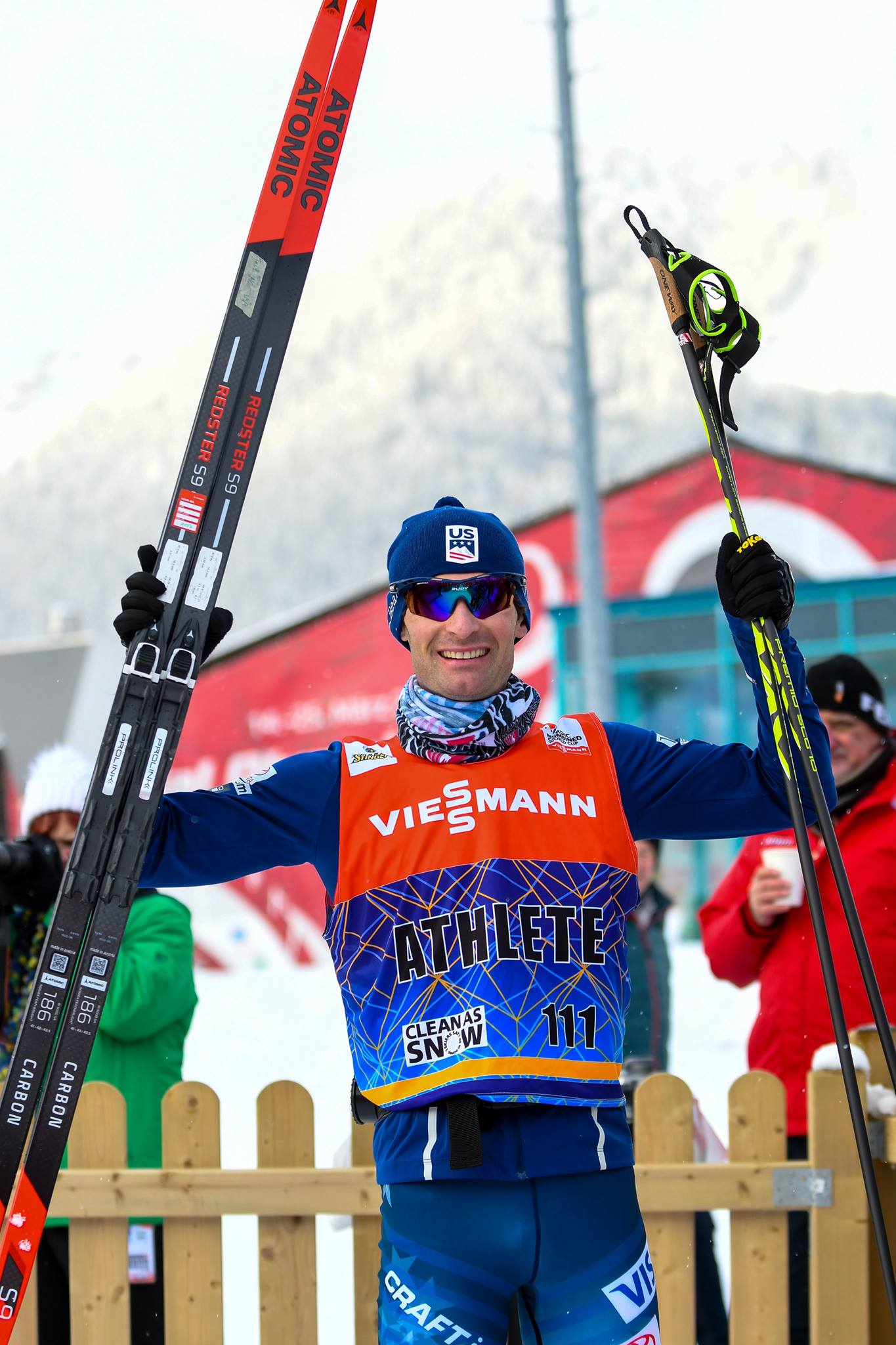
    Bryan Fletcher (USA Nordic) jumping to 45th in the Nordic Combined World Cup on Sunday in Ramsau, Austria. In the 10 k that followed, he skied the third-fastest time to finish 14th overall. (Photo: Romina Eggert/USA Nordic Facebook)

    NorAm mini tour (Rossland, B.C.): 10/15 k freestyle pursuits

    Team Gregg ended the Rossland NorAm mini tour with another double win, with American Caitlin Gregg and her husband Brian Gregg winning the 10- and 15-kilometer freestyle pursuits, respectively, at the Black Jack Ski Club trails.

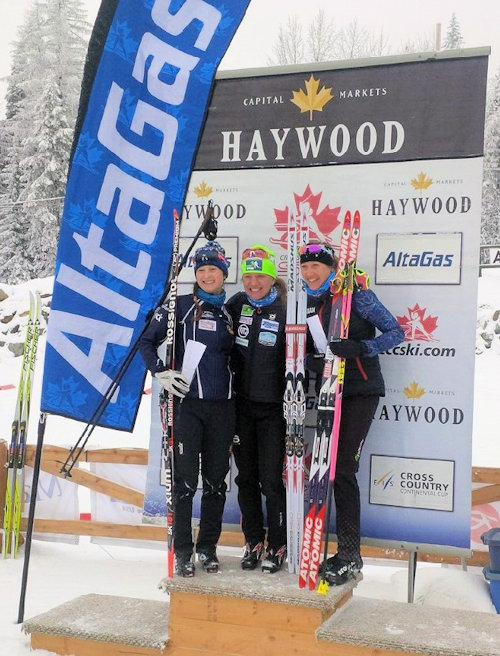
    The women’s 10 k freestyle pursuit podium at the NorAm in Rossland, B.C., with American Caitlin Gregg (c) in first, and Canadians Zina Kocher (l) and Andrea Dupont (r), in second and third, respectively. (Photo: Cross Country Canada)

    Caitlin capped the long weekend with her third-straight win, a 48.28-second victory over former Canadian biathlete Zina Kocher (Foothills Nordic). Caitlin started first and was first across the finish in 29:02.86, while Kocher started ninth and rose to second place for her second-consecutive podium (after placing third in Saturday’s skate sprint). Andrea Dupont (Rocky Mountain Racers) started fourth and finished third (+1:58.35) for her second-straight podium as well (she was second in the skate sprint behind Gregg).

    Lisle Compton of the National Team Development Centre (NTDC) Thunder Bay and Canadian National Junior Team finished fourth overall (+2:07.03), Frederique Vezina of the Pierre-Harvey National Training Centre (CNEPH) was fifth (+2:16.10), and Annika Hicks of the Alberta World Cup Academy (AWCA) sixth (+2:16.51). Laura Leclair (CNEPH) placed seventh, Kaia Andal (Caledonia Nordic) was the top junior in eighth overall, Jaqueline Mourao (Brazil Ski Team) ninth, and Sophie Carrier-Laforte (Skinouk) 10th.

    Brian, who won the Rossland men’s 10 k classic on Friday, also started Sunday’s 15 k freestyle pursuit first and finished in that position in 38:43.93. Andy Shields (Lappe Nordic) raced to second overall, 7.65 seconds back, after starting fourth, and Jack Carlyle (AWCA) reached the podium in third (+8.75) after starting 10th.

    Evan Palmer-Charrette (NTDC Thunder Bay) ended the weekend in fourth (+17.68), Philippe Boucher (CNEPH) was fifth (+19.02), Brian McKeever (Canadian Para-Nordic Ski Team) sixth (+22.16), Michael Somppi (AWCA) seventh (+34.62), Alexis Dumas (CNEPH) eighth (+52.78), Bob Thompson (NTDC Thunder Bay) ninth (+54.76), and Julien Locke (Black Jack/Canadian U25 Team) 10th (+1:04.46).

    Results

    ***

    FIS Nordic Combined World Cup (Ramsau, Austria): Saturday & Sunday individual competitions

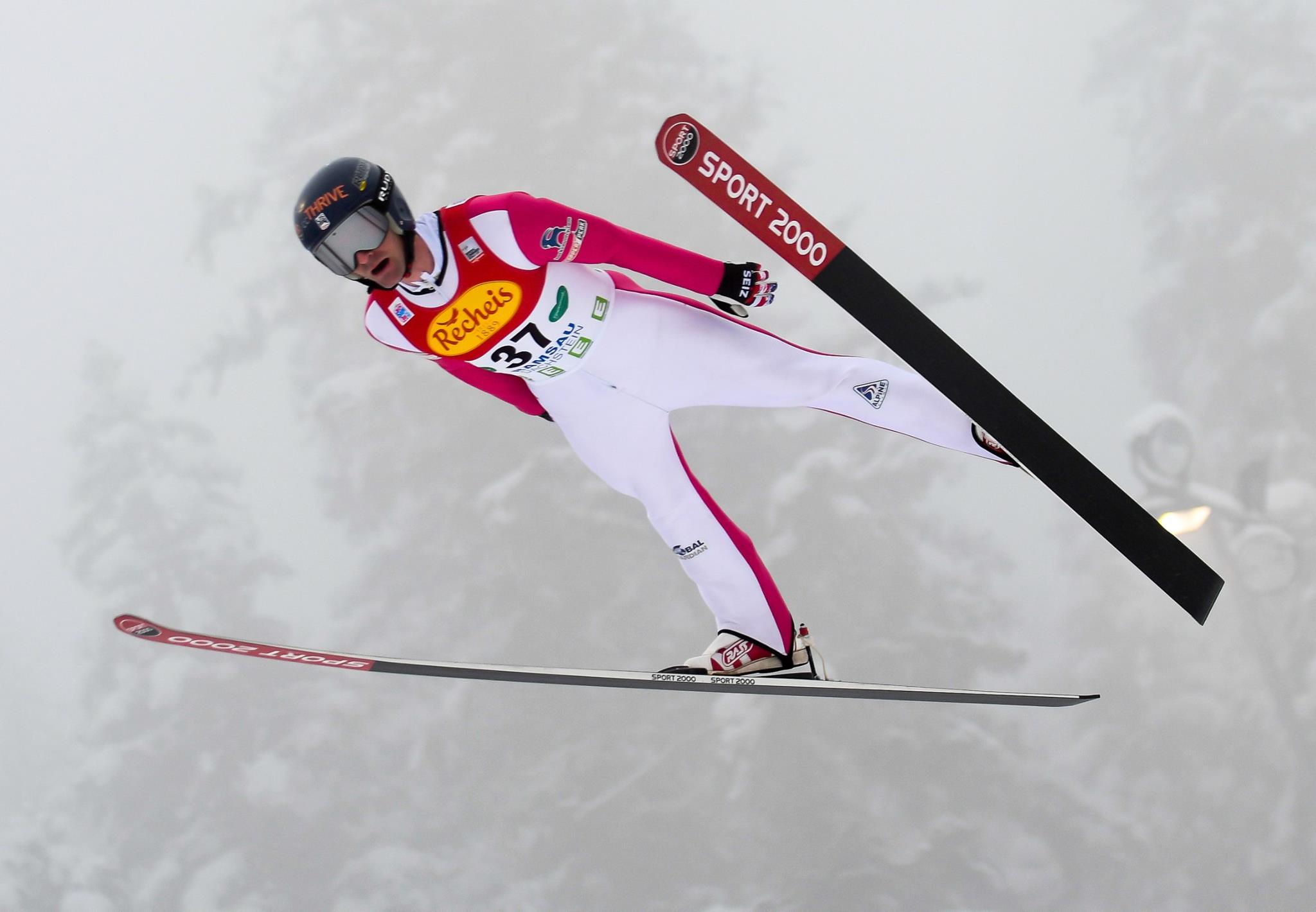
    Bryan Fletcher (USA Nordic) notched seventh in the Nordic Combined World Cup this weekend in Ramsau, Austria, for his best result since January 2016. (Photo: USA Nordic/Facebook)

    After a bye week, the Nordic Combined World Cup resumed in Ramsau am Dachstein, Austria, with back-to-back individual normal hill/10-kilometer Gundersen starts on Saturday and Sunday.

    On Saturday, American Bryan Fletcher posted his best individual result in nearly two years in seventh place, 32.6 seconds behind German winner Eric Frenzel.

    Saturday’s individual competition on Ramsau’s 98-meter hill started out with Japan’s Taihei Kato going farthest in the jump portion, the Czech Republic’s Tomas Portyk jumping to second, and Frenzel jumping to third. Fletcher tied Japan’s Yoshito Watabe for 28th and the two started the 10 k race 1:02 minutes back accordingly.

    While Frenzel picked off two places to finish first in 24:05.8 minutes, Fletcher moved up 21 spots to seventh place with the second-fastest course time of 23:48.4.

    Germany had two on the podium with Fabian Rießle just 0.7 seconds back in second place, and Norway’s Jan Schmid finished third, 8.1 seconds behind Frenzel.

    On Sunday, Rießle climbed to the top step on the podium, winning the weekend’s second normal hill/10 k in 26:12.5.

    Norway’s Jørgen Graabak led after the jump portion, yet ultimately finished sixth, 9.8 seconds behind Rießle.

    Rießle jumped to ninth and started 18 seconds out of first, then took the win on the four-lap course by just 0.3 seconds over Italy’s Alessandro Pittin. The Italian notched second place after starting 36th based on his jump and racing the fastest 10 k time in 25:00.8.

    Finland’s Eero Hirvonen finished third (+1.5) after starting 10th, and Schmid was another 2 seconds back in fourth (+3.5) after jumping to seventh. Frenzel did not start.

    Three Americans qualified for Sunday’s competition. Fletcher jumped to 45th and started 1:30 back, yet rose to 14th (+43.7) with the third-fastest course time. His younger brother Taylor Fletcher skied the second-fastest course time to finish 34th (+2:01.6), up 24 places after jumping to 58th. Adam Loomis finished 52nd (+4:38.6) after jumping to 59th.

    The U.S. Nordic Combined team is headed back to the states to prepare for U.S. Olympic trials later this month, according to the USA Nordic Facebook page.

    Results: Saturday | Sunday

    ***

    FIS Cross Country World Cup (Toblach, Italy): 10/15 k classic pursuits

    Norway’s Johannes Høsflot Klæbo after winning the men’s 15 k classic pursuit for his seventh World Cup win of the season on Sunday in Toblach, Italy. With win No. 7, he has the most wins before the new year in FIS Cross Country World Cup history. (Photo: FIS Cross Country/Twitter)

    Women’s report

    Men’s report

    If you thought Johannes Høsflot Klæbo was out, think again. After placing 10th in the men’s 15-kilometer freestyle on Saturday in Toblach, the 21-year-old Norwegian raced to his seventh victory of the season in the men’s 15 k pursuit on Sunday.

    In doing so, Klæbo broke the record for the most World Cup wins before the New Year: he’s tallied seven in the last eight races he’s contested.

    On Sunday, he started 10th, 36 seconds behind his Norwegian teammate Simen Hegstad Krüger, who won the 15 k freestyle and started first. Klæbo had worked his way up to third by 11.4 k, and at the finish, he edged Russia’s Sergey Ustiugov by 1.9 seconds for the win in 33:31.1 minutes.

    Ustiugov, who started fifth, claimed second, and Kazakhstan’s Alexey Poltoranin rose from 14th to third place (+4.5), ahead of Russia’s Alexander Bessmertnykh in fourth (+9.7), Finland’s Matti Heikkinen in fifth (+9.8), France’s Maurice Manificat in sixth (+10.7), Norway’s Hans Christer Holund in seventh (+11.1), Switzerland’s Dario Cologna in eighth (+11.8), Canada’s Alex Harvey in ninth (+16.3), and Krüger in 10th (+24.0). Norway’s defending Overall and Distance World Cup champion, Martin Johnsrud Sundby placed 11th (+34.4) after starting 20th based on his result on Saturday.

    Erik Bjornsen once again led the U.S. men, racing from 29th at the start to 26th (+1:43.1). Scott Patterson improved from 42nd to 39th (+2:37.2), Paddy Caldwell moved up from 52nd to 44th (+2:57.7), and Noah Hoffman slipped to 49th (+3:01.7) after starting 40th.

    Canada’s Devon Kershaw moved up five places to 33rd (+2:02.8), Graeme Killick finished 50th (+3:42.0), Russell Kennedy 66th (+5:05.8), and Knute Johnsgaard moved up six places to finish 76th (+6:20.8).

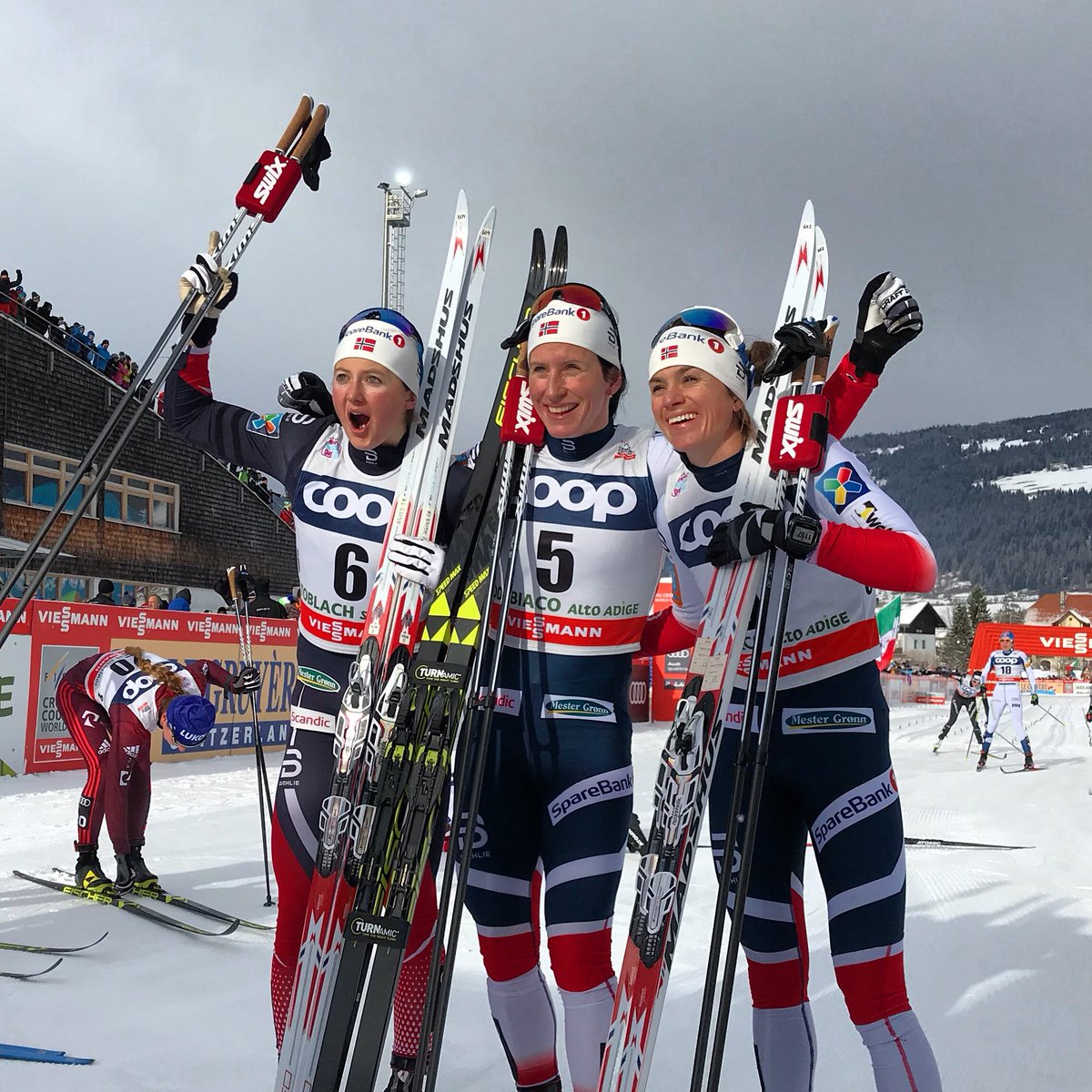
    The all-Norwegian women’s 10 k classic pursuit podium on Sunday at the World Cup in Toblach, Italy, with Marit Bjørgen (c) in first, Ingvild Flugstad Østberg (l) in second and Heidi Weng (r) in third. (Photo: FIS Cross Country/Twitter)

    In the women’s 10 k classic pursuit earlier in the day in Toblach, Norway’s Marit Bjørgen overcame a 22-second starting deficit to take the win by just 0.3 seconds over her teammates Ingvild Flugstad Østberg in second. It was an all-Norwegian podium with Heidi Weng in third (+0.8).

    Bjørgen started fifth, 22 seconds behind Swedish race leader Charlotte Kalla, based on their results in Saturday’s 10 k freestyle individual start. By the 6.4 k checkpoint, Bjørgen led a pack of four other Norwegians and Kalla — all within 1.4 seconds of first. At 8.5 k, Bjørgen led Østberg in second and Weng in third, while another Norwegian Astrid Uhrenholdt Jacobsen skied another eight seconds back with teammate Ragnhild Haga in fourth and fifth, respectively. By that point, Kalla was skiing alone, another 11.7 seconds in sixth, while American Jessie Diggins led a group 25 seconds behind Kalla in sixth.

    Ultimately, Bjørgen finished first in 25:19.3 and formed an all-Norwegian podium with Østberg and Weng, Jacobsen placed fourth, 21.5 seconds out of first and 20.7 seconds behind Weng in third.

    Haga was fifth (+31.8), Kalla sixth (+41.9), Diggins seventh (+53.7), Russia’s Natalia Nepryaeva eighth (+54.2), American Sadie Bjornsen ninth (+55.2), and Austria’s Teresa Stadlober 10th (+55.6) in a photo finish with Finland’s Kerttu Niskanen, who placed 11th (+55.6).

    For the U.S. Ski Team, Diggins and Bjornsen retained their starting positions of seventh and ninth, respectively, while Rosie Brennan started 19th and finished 25th (+2:14.6). Chelsea Holmes (Alaska Pacific University) finished 39th (+3:03.8) and Liz Stephen (USST) finished 48th (+4:05.2).

    Canada’s Emily Nishikawa placed 53rd (+4:14.5), Dahria Beatty finished 63rd (+5:44.7), Cendrine Browne 66th (+5:57.7), and Katherine Stewart-Jones 70th (+7:31.5).

    Results: Women | Men

    ***

    IBU World Cup (Annecy, France): Women’s and men’s mass starts

    Women’s report

    Men’s report

    France’s Justine Braisaz won her first International Biathlon Union (IBU) World Cup race of the season on Sunday at home in Annecy, France, topping the women’s 12.5 k mass start by 11.2 seconds in 37:19.4.

    While Braisaz shot 19-for-20 (0+0+1+0), Iryna Kryuko of Belarus cleaned the four-stage race for second place, her first World Cup podium. Germany’s Laura Dahlmeier, who won Saturday’s 10 k pursuit, placed third (+19.9) with two penalties (0+1+0+1).

    Two North Americans qualified for the selective mass start, with Susan Dunklee (US Biathlon) racing to 20th (+1:16.3) with three misses (1+0+1+1), and Emma Lunder (Biathlon Canada) placing 28th (+2:21.4) with a single penalty (1+0+0+0).

    In the men’s 15 k mass start that followed, France’s Martin Fourcade finally got the win he was looking for, shooting clean and beating his main rival Johannes Thingnes Bø of Norway by 3.9 seconds. Fourcade crossed the finish line first in 36:30.3, Bø settled for second after skiing two early penalty loops (2+0+0+0) and Germany’s Erik Lesser tallied his second podium in Annecy (after placing third in the sprint) in third place again (+6.2) with clean shooting.

    Two Americans and a Canadian qualified for the mass start, with US Biathlon’s Lowell Bailey leading them in 23rd (+2:22.4) with three penalties, Sean Doherty following in 24th (+2:52.5) with four misses, and Biathlon Canada’s Scott Gow finishing 26th (+4:05.4) with five penalties.

    Results: Women| Men

    ***

    OPA Cup (St. Ulrich, Austria): 10/15 k freestyle pursuits

    On the final day of Alpen Cup (a.k.a. OPA Cup) racing in St. Ulrich, Ida Sargent of the U.S. Ski Team (USST) scored her third-straight top five with a fifth place in the women’s 10 k freestyle mass start. She previously placed third in the skate sprint and 5 k classic on Friday and Saturday.

    Germany’s Julia Belger won the women’s mass start on Sunday in 28:33.6, while Saturday’s 5 k winner, Elena Soboleva of Russia placed second (+0.7). Russia had two on the podium with Mariya Istomina in third (+6.4). Germany’s Elisabeth Schicho finished fourth (+15.8), just ahead of Sargent in fifth (+15.9).

    Germany’s Antonia Fräbel placed sixth (+17.1), followed by American Sophie Caldwell in seventh (+17.9). The USST had three in the top 10 with Julia Kern in 10th (+41.9), out of 60 finishers.

    In the men’s 15 k freestyle mass start, Beda Klee of Switzerland took the win in 37:14.6, 2.4 seconds ahead of Germany’s Thomas Bing in second. Six-time Olympian Sergey Dolidovich of Belarus reached the podium in third (+4.5).

    The U.S. had two men in the race, with Simi Hamilton finishing 14th, 16 seconds out of first, and Andy Newell finishing 71st (+2:25.2) out of 118.

    Results: Women | Men

  • Rydzek Realizes Every Child’s Dream as Nordic Combined World Champ; Taylor Fletcher Leads U.S. in 19th

    Germany's Johannes Rydzek celebrates his first World Championships title in the first nordic-combined competition of 2015 World Championships on Friday in Falun, Sweden. (Photo: FlyingPointRoad)
    Germany’s Johannes Rydzek (5) celebrates his first World Championships title in the first nordic-combined competition of 2015 World Championships on Friday in Falun, Sweden. He edged Italy’s Alessandro Pittin in the normal hill/10 k individual by 1.3 seconds. (Photo: FlyingPointRoad)

    FasterSkier’s coverage of the 2015 FIS Nordic World Ski Championships in Falun, Sweden, is brought to you by the generous support of L.L. Bean, now featuring a complete line of Kikkan Randall training wear.

    FALUN, Sweden — Johannes Rydzek hadn’t seen the podium in a World Championships competition since his first World Championships in 2011 in Oslo, Norway, where he won three silver medals between the large-hill individual and two team events.

    Four years later, the 23-year-old German rose to gold in the normal hill/10-kilometer individual on Friday, the first day of nordic combined at 2015 FIS Nordic World Ski Championships.

    “Every child that comes to sport has this dream to be a world champion, and now I am one,” Rydzek told the Associated Press.

    Rydzek jumped to fifth on the 100-meter hill at Lugnet Arena in Falun, Sweden, then overcame a 31-second starting deficit to make a break for first on the last lap of the 10 k Gundersen start. Rydzek answered an attack from Italian leader Alessandro Pittin with about half a kilometer to go, trailing him down into the stadium. On the final rise before a sweeping downhill toward the finish, Rydzek passed Pittin and outlasted him by 1.3 seconds for the win.

    “I tried everything to go alone,” Pittin told the AP. “But for sure, Johannes was faster than me when we entered the stadium.”

    Pittin had raced up to second with the fastest ski time, latching onto the lead pack on the fourth-and-final lap. He jumped to 14th and started the 10 k race 1:16 minutes behind Germany’s Eric Frenzel, who led the jumping portion.

    Rydzek posted the fourth-fastest ski time to win in 26:38.9, while France’s defending Olympic champion Jason Lamy Chappuis finished third (+5.0) after starting third, 25 seconds back. Frenzel placed fourth (+6.1) with the 20th-ranked time.

    Håvard Klemetsen led Norway in fifth (+9.6) after starting sixth, and Japan’s Akito Watabe and Yoshito Watabe placed sixth (+12.2) and seventh (+14.4), respectively. The two were among the most competitive in the jump on a windy afternoon, which included delays, with Yoshito soaring to second and Akito ranking fourth heading into the 10 k.

    Norway’s Jørgen Graabak improved from 11th to eighth, Germany’s Fabian Riessle rocketed from 23rd to ninth with the fifth-fastest time, and Austria’s Bernhard Gruber went from 17th to 10th overall.

    U.S. Nordic Combined's Taylor Fletcher (25) racing to 19th in Friday's 10 k after jumping to 25th on the normal hill in Falun, Sweden. Fletcher was the lone American in the top 20 on the first day of nordic combined at the 2015 World Championships. (Photo: FlyingPointRoad)
    U.S. Nordic Combined’s Taylor Fletcher (25) racing to 19th in Friday’s 10 k after jumping to 25th on the normal hill in Falun, Sweden. Fletcher was the lone American in the top 20 on the first day of nordic combined at 2015 World Championships. (Photo: FlyingPointRoad)

    Taylor Fletcher led the U.S. in 19th after starting 25th, 1:31 behind Frenzel, and finished 1:32.5 after Rydzek. His ski time ranked 18th.

    “I felt like I had good speed, I just I never got into a rhythm,” Fletcher said afterward. “I felt like I was swimming and I was never comfortable. I had people stepping all over my poles and I was going in and out of the line of people trying to move up, and I didn’t race my style.”

    Fletcher started four seconds behind his older brother Bryan, who jumped to 20th and ended up 21st (+1:40.9).

    “We were really hoping that we’d be able to pull away or work together and pull up to the front, but with the way the conditions were and just how I was skiing, it was really hard to actually make up ground on anybody,” Bryan said.

    While temperatures cooled slightly to around 35-degrees Fahrenheit by the start of the race at 4 p.m., the course had turned to a mashed-potato-like consistency with the sun beating down on a 40-degree afternoon.

    The 50-man field saw the jumping portion delayed from 10 a.m. to 1:30 p.m. because of winds, leaving competitors with about 50 minutes after the last jump to prepare for the pursuit-style race.

    “We didn’t get much of a warmup and we were only able to ski the upper part of the course,” Bryan said. “They didn’t have the full course open or anything so that was tough. It was a quick turnaround.”

    Ben Berend (U.S. Nordic Combined) competing in his first World Championships competition on Friday in Falun, Sweden. After jumping to 16th on the normal hill, Berend finished 45th in the 10 k. (Photo: FlyingPointRoad)
    Ben Berend (U.S. Nordic Combined) competing in his first World Championships competition on Friday in Falun, Sweden. After jumping to 16th on the normal hill, Berend finished 45th in the 10 k. (Photo: FlyingPointRoad)

    He noted that his teammate Ben Berend, in his first World Championships, had more adversity to deal with jumping as the ninth starter in the first group.

    “Every time they were going to start the competition today, he’d have to get dressed, go all the way to the top of the jump and by the time he’d get there, they’d say, ‘OK we’re not going to do it,’ and he’d have to come right back down,” Bryan said. “For us in the later group, it wasn’t nearly as bad. It certainly is a lot of warming up and then, ‘OK, we’re not going yet.’ … It’s the same for everybody. It used to happen a lot more on World Cup then it does these days with TV and everything, but it’s just something you have to deal with.”

    Berend jumped to 16th, the second best of the four Americans after Billy Demong leapt to 10th.

    After having competed at one World Cup beforehand, the 19-year-old Berend was surprised to discover he led the jump through the first 18 men.

    “I went and actually got equipment checked. I was in there forever and I came back out and they were like, ‘You’re still in the lead. You need to come back to the leader’s chair,’ ” he recalled. “I’ve never been there before so that was a pretty awesome experience being able to take that in.”

    The 19th jumper, Demong bumped him out of it.

    “Having Bill take me out of that leader’s chair, it couldn’t have been more perfect,” Berend said.

    “They were like, ‘You’re still in the lead. You need to come back to the leader’s chair.’ ” — Ben Berend (U.S. Nordic Combined), who was 16th in Friday’s jump and 45th overall for his career best in his second World-Cup-level individual competition

    Demong went on to finish 25th in the 10 k (+1:51.8), and Berend placed 45th (+4:54.6).

    “I’m not fast enough to ski at the front of these races,” Berend said. “The conditions just made it tougher so the race was pretty brutal, but you learn. It was good experience for me out there. … Overall it was an awesome day. I’m looking forward to learning from this and moving on to better results in the future.”

    Demong noted that this was Berend’s first World Championships and third-ever World Cup event (after two competing twice at last month’s World Cup in Schonach, Germany).

    “To execute well and sit in the lead, that’s huge,” Demong said. “At 19 it’s a lot easier to train a few years and get faster at cross country than it is to make a ski jumper. Ski jumping is a really funny sport. When I was his age I was a great jumper, but I struggled in cross country. I’d rather start with someone who is a talented athlete, a great jumper, and try to teach them the cross-country side.”

    In his eighth World Championships, the 34-year-old Demong explained that jumping has been his strong point this year.

    “I haven’t competed a whole lot, and seemingly in my old age not training much for jumping has paid off,” he said. “The same can’t be said about cross country. I haven’t raced super well this year, but it’s been stable. Today, I started out harder, hoping to make something happen and paid for it the second half of the race. Ordinarily, these were my racing conditions. When I was my fittest this is where I would win, like Vancouver and Liberec. That being said, when you’re not the fittest, it is punishing.”

    The second of four nordic-combined events is scheduled for Sunday with the 4 x 5 k team event.

    “Sunday is going to be great if we can jump like we did today,” Demong said. “I think Taylor and Bryan skied a really good first half today. They’ve been two of the fastest, if not the fastest guys this year, so hopefully I can pull my stuff together and we’ll have a fight for a medal.”

    — Lander Karath contributed reporting

    Results

  • Pittin Sweeps for Italy; Demong and Spillane Notch Season Bests

    Olympic gold medalist Billy Demong at the 2010 Vancouver Games

    In some ways, starting off average works well for Billy Demong.

    It’s not that he would prefer to rank 21st out of 54 athletes, although for some nordic combined athletes, that would be a good jump in the World Cup.

    For Demong, a four-time Olympian and gold medalist, that result meant he was about 20 spots away from where he wanted to be.

    On Sunday, the 31-year-old attacked the afternoon 10 k Gundersen start as he would have liked to on the 118-meter large hill in Chaux-Neuve, France. It was Demong’s last day of World Cup competition for nearly three weeks, and he went for it.

    At the same time, so did his U.S. teammate Johnny Spillane, who ranked 20th in the morning jump. Working together, they captured their best results of the season as Demong finished sixth and Spillane placed eighth.

    Starting 1 second in front of Demong, Spillane charged ahead to chase down his competition, and Demong followed. For most of the four laps, Demong and Spillane worked with Norway’s Mikko Kokslien to move to the front and drop those behind them, Demong wrote in an email.

    They successfully caught second on the third lap, with only the weekend’s two-time defending champion, Alessandro Pittin (ITA), ahead. Demong held his position at the front of the chase group and attempted to drop his contenders on the last hill. In the end, he found he was too tired to sprint at the finish and fight for a podium spot.

    While sixth wasn’t first, second or third, Demong was satisfied with his progress.

    “I’m feeling good overall, building again,” Demong wrote. “My goals for this season are basically to get back on the podium and win. I’m also still satisfied to be struggling a bit as it fields my motivation to train harder.”

    By struggling, Demong and Spillane and the rest of the U.S. crew generally mean their jumping. On Sunday, Demong clocked the third-fastest 10 k time (21:34.6) and Spillane had the fifth-fastest split (21:42.6).

    Kokslien was the fastest of the day (21:30.6), and after starting 24th,  the Norwegian placed third. Pittin picked up his third-straight victory of the weekend in 22:18.1 after becoming the first Italian to top the World Cup podium on Friday. Joergen Graabak (NOR) was second overall.

    “They key to today’s race was jumping,” Pittin told EuroSport Italia on Sunday. “There, I made a difference.”

    If Demong, Spillane or any of the other Americans had ranked fourth after the jumps, like Pittin, it’s likely they could have ended up in even better positions.

    “The level both on the hill and on the course is really high,” U.S. Nordic Combined Head Coach Dave Jarrett said. “In order to win you have to very good at both sides in every comp.  Not very much room for mistakes.”

    American Bryan Fletcher placed 26th after ranking  28th in the jump. His brother, Taylor, finished 39th after starting 51st and Nick Hendrickson moved one spot down from 50th in jumping to 49th overall.

    On the road almost as soon as the three-day competition ended, Jarrett said his athletes would fly home to train in Park City, Utah, and Steamboat Springs, Colo., for at least a week. The team will reunite in early February when the World Cup starts up again with a penalty race, team sprint and Gundersen start in Predazzo, Italy.

    Sunday’s overall results.


  • Pittin Picks Up Second-Straight Win; Spillane Makes Top 10

    Johnny Spillane (USA) at the 2011 World Championships in Oslo. On Saturday, he notched a season-best ninth.

    A day after Alessandro Pittin became the first Italian to win a nordic combined World Cup event, the Olympic bronze medalist repeated his success, edging Jason Lamy Chappuis of France on Saturday in Chaux-Neuve, France.

    After ranking 22nd of 54 athletes in the 118-meter large hill jump, Pittin went on to catch the leaders in the 10 k Gundersen start and pulled out the victory in a photo finish with Lamy Chappuis and Fabian Riessle (GER), who was third.

    Pittin posted the second-fastest time Saturday after Magnus Moan (NOR), who ranked 30th in the jump and first in the race. Not far behind the race leaders, American Bill Demong climbed his way to 12th place with the third-fastest split.

    While Pittin added another achievement to the Italian history books, and Lamy Chappuis, who was born in Montana and moved to France as a kid, maintained his top spot in the World Cup standings, American Johnny Spillane lowered his season-best to ninth on Saturday.

    Spillane had previously notched his best result of 2011/2012 season on Friday, when he finished 13th in Chaux-Neuve. The same day, Demong placed a season-best eighth, and Bryan Fletcher had his second-best result of the season in 14th.

    “Everything has been slowly coming together, mostly on the jumping side of things,” Spillane wrote in an email after Saturday’s competition. “I have been feeling good on the skinny skis but needed to do a better job on the jump hill to have a chance.”

    On Saturday, the second of three consecutive days of competition, Spillane was the ninth fastest in the 10 k after ranking 13th in the jump.

    After seeing his best results in nearly two years following an injury that caused him to miss the beginning of last season, the 2010 Olympic silver medalist hadn’t met his podium expectations, but felt he was getting there.

    “I’m feeling positive about the rest of the season,” Spillane wrote. “I feel like I’m in good shape but I still have work to do on the jump hill before I can be in there day in and day out.”

    After Spillane, who was 7.9 seconds out of first, and Demong (+10.5), Taylor Fletcher was 31st and his brother, Bryan Fletcher, 32nd on Saturday. Both climbed from ranking a respective 49th and 41st in the morning jumping portion. Another American, Nick Hendrickson finished 41st after ranking 49th in the jump.

    Saturday’s results.

  • Spillane Ends U.S. NoCo Quest With Silver

    Spillane Ends U.S. NoCo Quest With Silver

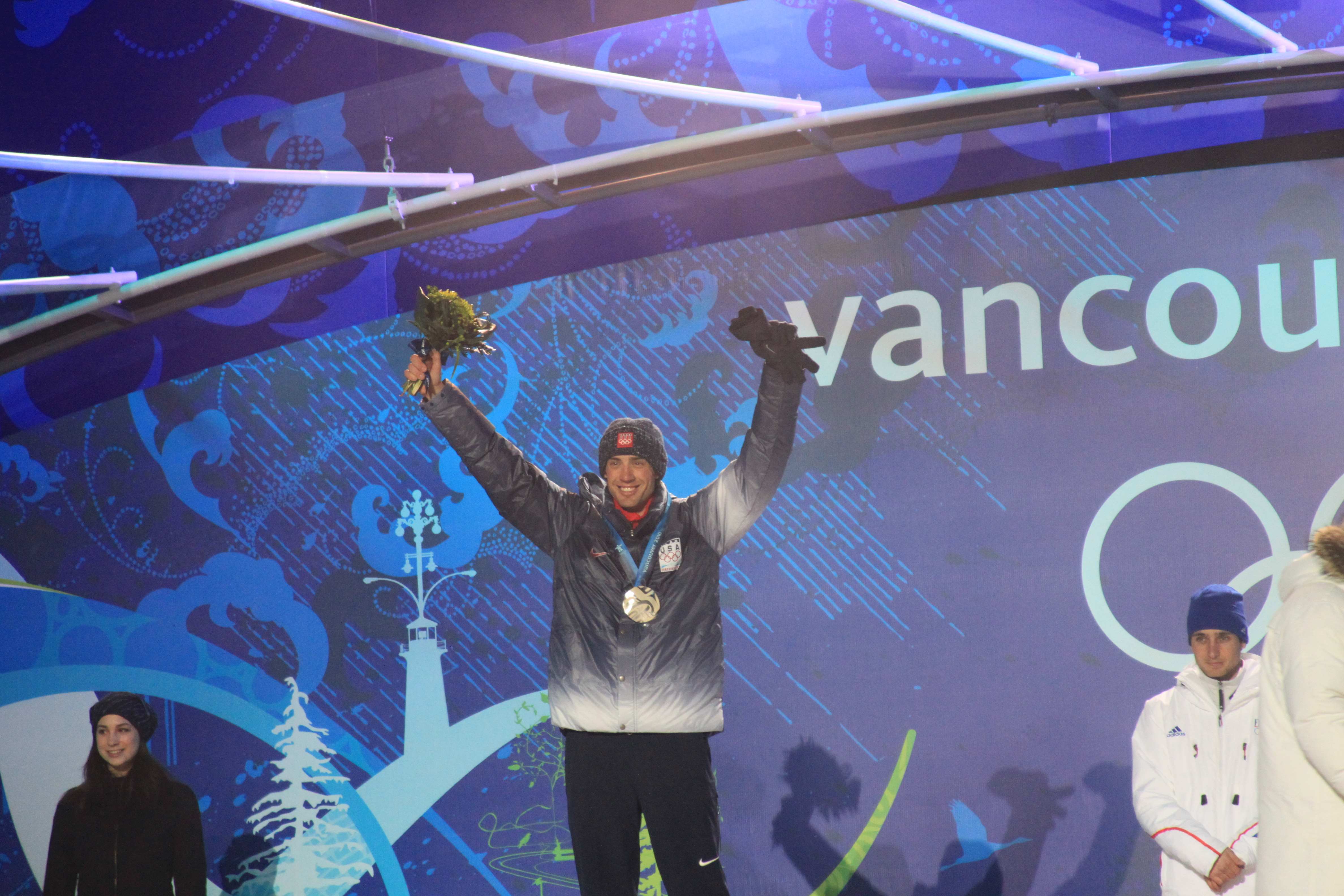
    Johnny Spillane after receiving his silver medal for the men's 10k individual nordic combined race
    Johnny Spillane after receiving his silver medal for the men's 10k individual nordic combined race

    After Johnny Spillane won a silver medal Sunday afternoon—the first of any color in U.S. nordic combined history—his former coach, Tom Steitz, voiced the rhetorical question on every reporter’s mind here.

    “How do you boil up 86 years of emotion and frustration?” he asked.

    The answer? Todd Lodwick’s face.

    Struggling to explain himself and holding back tears after just missing out on the bronze, Lodwick quivered with feeling: fierce pride for his teammate and friend, disappointment from coming so tantalizingly close to a medal, and envy stemming from the sheer competitiveness that has fueled the rise of three Americans to the sport’s greatest heights, which finally culminated with Spillane’s performance today.

    “This one’s satisfying,” said a teary-eyed Luke Bodensteiner, who oversees the American nordic combined program as the U.S. Ski and Snowboard Association’s (USSA’s) associate director of high performance. “This one’s the first.”

    The crowd at the nordic combined/cross country venue during Sunday's race
    The crowd lining the course at the nordic combined/cross country venue during Sunday's race

    Capitalizing on the fourth-best jump of the morning, Spillane skied 99 percent of a tactically perfect 10-k. Attacking out of a chase group in the last kilometer and reeling in Japan’s Norohito Kobayashi, Spillane took a ten-meter gap over the last climb and looked to be on his way to gold—the stadium announcers were hyping the “battle for second” as the lead group came down into the stadium.

    But they underestimated the fitness of  Jason Lamy-Chappuis, the French World Cup leader. With Spillane fading on the finishing stretch, Lamy-Chappuis inexorably closed the gap between the two, catching the American with about ten meters to go—depriving him of a storybook ending to what was still an historic day for U.S. skiing.

    After Lodwick and Spillane took second and fourth in this morning’s jump, an American medal seemed all but assured, given the strength of those two on their skis. But the two still had to contend with Lamy-Chappuis, as well as other strong skiers who cracked the top-ten in the jump like Mario Stecher (AUS) and Anssi Koivuranta (FIN).

    Janne Ryynaenen (FIN) had by far the longest leap of the morning, and headed out on course with a 34-second lead over Lodwick, who had another ten to 15 seconds over a group of chasers that included Spillane, Lamy-Chappuis, Stecher, and eventual bronze-medallist Alessandro Pittin (ITA).

    Nordic combined races tend to form big packs, with the real racing not playing out until the last few kilometers, and this one was no different.

    By the four k mark, Lodwick had caught up to Rynaenen—not a strong skier—and he was joined soon after by Spillane, Koivuranta, Kobayashi, and a handful of others. For the next five kilometers, the two Americans took turns at the front, with Lodwick doing the bulk of the work leading into the finale.

    Afterward, he said that he was hoping to stretch things out, and perhaps open up a gap. But it also helped Lodwick to know that Spillane was behind him, resting.

    “I sacrificed myself to push the pace high, because I knew that if we didn’t do that, people were going to come up from behind,” he said. “For the

    Todd Lodwick leads the pack out of the stadium
    Todd Lodwick leads the pack out of the stadium

    greater good of the team, I pushed the pace hard.”

    As the group neared the bottom of the big climb on their final 2.5k lap, Kobayashi attacked, getting about five seconds on the rest of the bunch, which was still tightly packed. But with those half-dozen athletes still together behind him, there was a sense that Kobayashi was a little early.

    Spillane was the first to respond, and he did so with authority, using a sharp acceleration to leave the rest of the group behind. He quickly reeled in Kobayashi going over the top of the big climb, and it was clear that this would be the race’s decisive move.

    There was one last hill before the stadium, and Spillane climbed it alone, exhorted by the fines lining the course and still chased by Lodwick, Lamy-Chappuis and Pittin. The rest of the pack was shattered behind them.

    Spillane looked sharp on his way up, still able to hop-skate. He looked so good that the stadium announcer guaranteed a win barring a fall on the final downhill turn.

    But Lamy-Chapuis wasn’t done. Aided by a very fast pair of skis, the Frenchman had Spillane within five meters when the group entered the stadium. As the pair turned the corner onto the finishing stretch, the race was a toss-up, with Spillane clinging to a slowly-eroding lead as every American in the stadium held their breath. But Lamy-Chappuis had just a little more left, having spent a few more seconds out of the wind. He edged Spillane by .4 seconds, completing a perfect tactical race.

    The French fans celebrate Lamy-Chappuis's victory
    The French fans celebrate Lamy-Chappuis's victory

    “Jason—I’ll give it to him,” Lodwick said. “He’s a smart motherf—–, I’ll tell you what.”

    Having burned a few more matches, Lodwick was another second behind. After returning to chase an Olympic medal following a two-year retirement, the fourth place was tough for him to stomach. There was an edge to his voice after the race, revealing a twinge of jealousy of his teammate’s accomplishment.

    “To tell you the truth, being the fourth really sucks,” he said. “We’ve got two events left, but I’d much rather be fifth.”

    On another day, Billy Demong also would have been on the podium. After a poor jump left him in 24th place, he fought his way to the lead pack, despite having started over two minutes down on Ryynaenen. He didn’t have the gas for the sprint, though, after working so hard to catch up, and he was dropped on the last hill. Demong ended up sixth, 18 seconds down, but with a silver lining of the field’s third-fastest ski time.

    “It makes it that much sweeter I was able to finish in the group with those guys, but honestly, today was a team success,” he said. “Hopefully it means it will be that much easier to do it again.”

    The powerhouse nordic combined team now flies back to Park City on a private jet for a few days of rest before the next competition, the relay, which takes place on the 23rd.

    After Sunday’s race, Lodwick guaranteed a medal for the U.S. in that race.
    “I’ll say it right now: we will be on the podium in the team event,” he said. “No questions. We’re gonna be there.”

    But regardless, the combiners have already done more than any team before them, which USSA Nordic Director John Farra said should provide a boost for his whole program.

    Spillane's father celebrating during the flower ceremony after the race
    Spillane's father during the flower ceremony after the race

    “I’m sure the guys that have been hoping for this and investing in this for years at USSA, and holding out hope that nordic was going to be part of the solution, are going to say ‘okay, here we go. It costs a lot of money to get there, but it’s worth it,’” he said. “And I’d like to think it continues to prove what kind of investment we can get in our sport.”