From the FasterSkier archive — posts syndicated from athletes’ and coaches’ own blogs between 2004 and 2012, kept online as published. Current coverage is at fasterskier.com.
Prince of Quebec Alex Harvey and his protege on the Canadian team, Tony Cyr, check in with us after a three-day weekend of racing in Germany. We went kinda long. Also: We have a first-of-its-kind waxing and service report from U.S. Ski Team technician Eli Brown.
Let us know what you think: We’re at devon@fasterskier.com and nat@fasterskier.com. We’ll be back after another weekend of racing in Switzerland before the World Cup circuit heads to North America.
We’re back, with some incremental improvements to our audio production and full stoke for a new season of the Devon Kershaw Show. On this first episode of the new season, Devon and Nat break down the winter’s opening races in Sweden, Finland and Norway, and prime the pump for the World Cup kickoff in Finland next weekend. As always, email us at devon@fasterskier.com and nat@fasterskier.com.
A resurgent Calle Halfversson had a breakout weekend in Ruka — until his encounter with the race jury on Sunday. (photo: Fischer/NordicFocus)
This episode of the Devon Kershaw Show breaks down the lead-up to the Olympics with special guest star Alex Harvey, the Canadian World Championships gold medalist. Harv and Kersh make their podium predictions for the six Olympic events; we discuss the nightmare scenario with COVID cases inside Norway’s national team; and Nat checks in from his quarantine in Los Angeles in advance of his flight to Asia.
We’ll be back periodically during the Olympics — send questions and comments to devon@fasterskier.com and nat@fasterskier.com. And you can follow Nat’s journey to Beijing here on FasterSkier, or on Twitter and Instagram at @nat_herz.
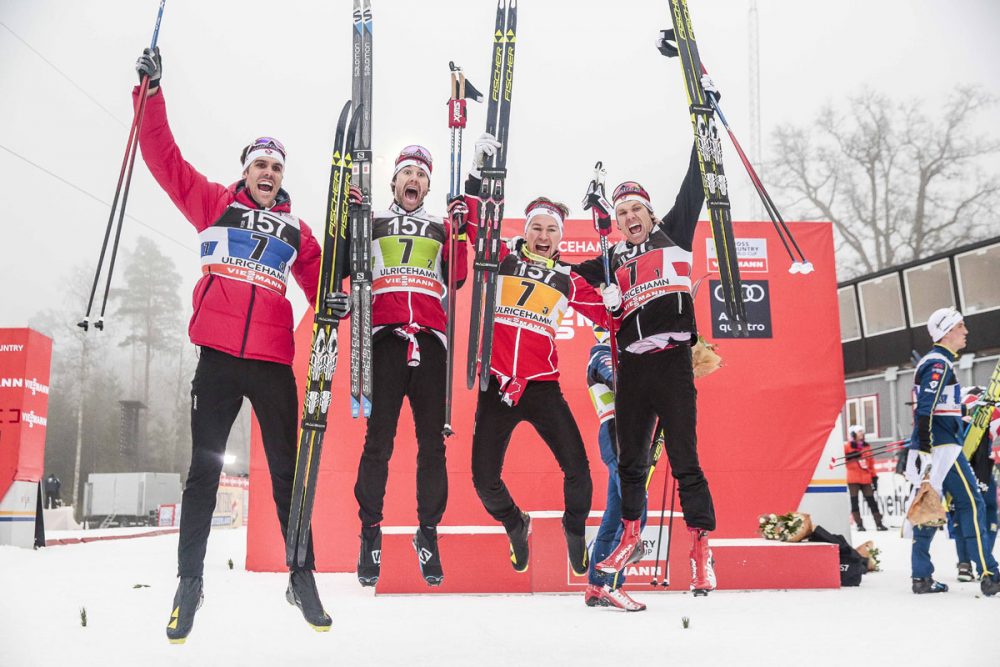
Left to right: Canada’s Len Valjas, Alex Harvey, Knute Johnsgaard, and Devon Kershaw after their historic third place finish in the 2017 men’s 4 x 7.5-kilometer team relay in Ulricehamn, Sweden. (Photo: Fischer/Nordic Focus)
We are catching our breath here with Alex Harvey with the 50 k classic rundown on the podcast. On another planet where the perceived forces of good and evil do not wear Lycra, this race is simply catalogued as another classic, not a mega-classic.
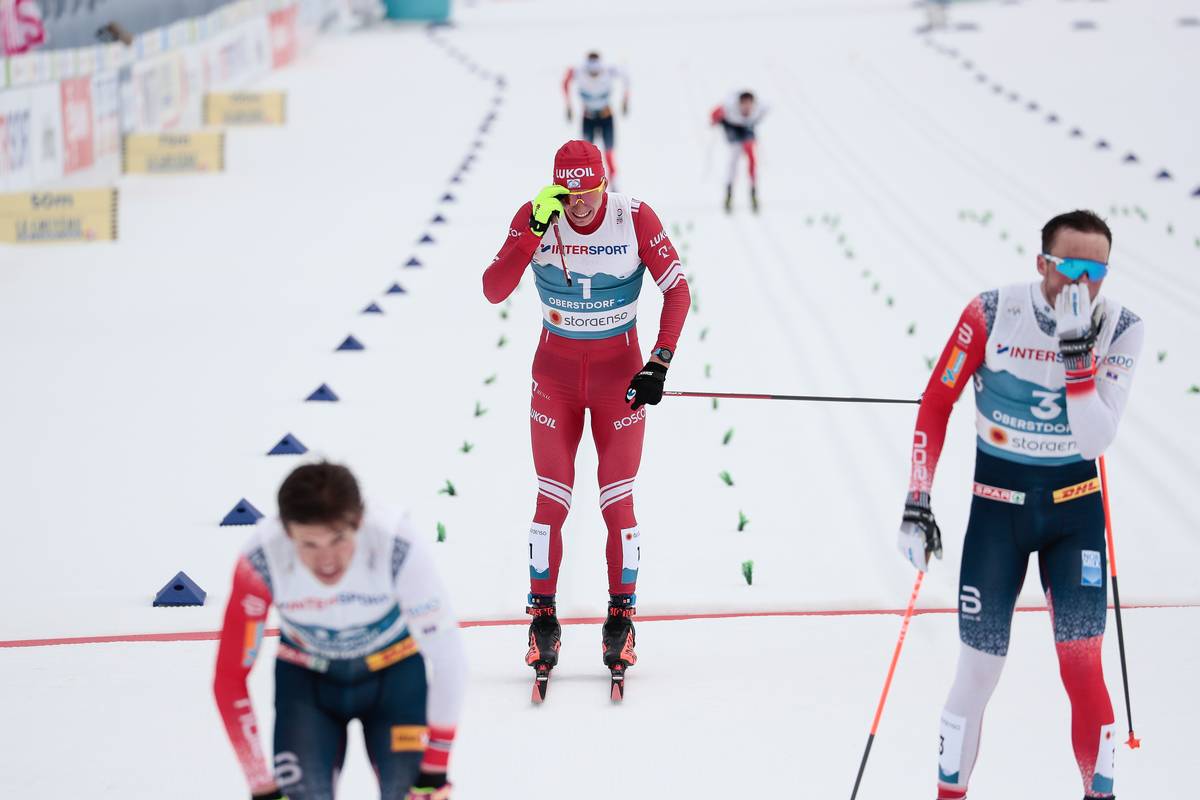
Such is life and such is racing. This 50 k classic monster came down to the wire as Russia’s Alexander Bolshunov and Norway’s Johannes Høsflot Klæbo flowed into the final straight.
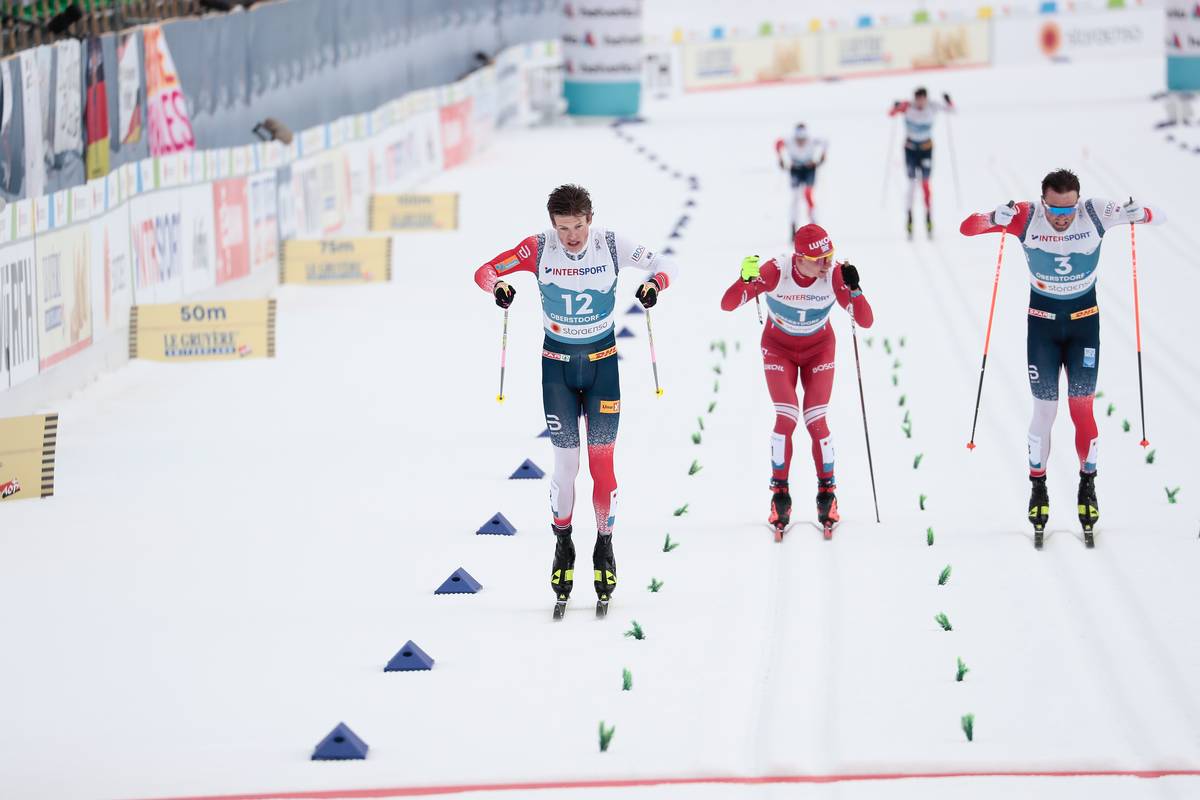
The closing stages of Sunday’s 50 k classic mass start. Klaebo (NOR), Bolshunov (RSF) and Iversen (NOR) (left to right). (Photo: NordicFocus)
Here’s the replay from today’s race report:
No matter how you look at it, pro-Russia, pro-Norway, pro-fun racing, Bolshunov went wide to close the door on Klæbo and the Norwegian sprinter nearly lost his balance dodging V-boards, ski tips, and Bolshunov’s physical presence. During the brush-up, with no crowd noise, you can hear Bolshunov’s pole crack with the bottom half falling to the ground after he stuck it between his legs.
As Klæbo and Bolshunov re-centered, both now with barely enough room to push the pedals down, the drag race ensured with, as one might guess, Klæbo winning and Bolshunov, with one effective pole, losing ground.
The rest, as they say, is recent history. Klæbo is DQ’d, Iversen wins and on and on. And if you still need video evidence to prove or disprove your respective point of view, head to our Facebook page where several people have posted replay videos. Here’s the call from the folks at NBC.
Thanks for listening to the podcast and we appreciate you taking the time out of your day to check in with our World Championship coverage.
In this Sunday, World Championship team sprint episode of the Devon Kershaw Show, we have a special guest from Québec , the actual Prince of Québec … Alex Harvey.
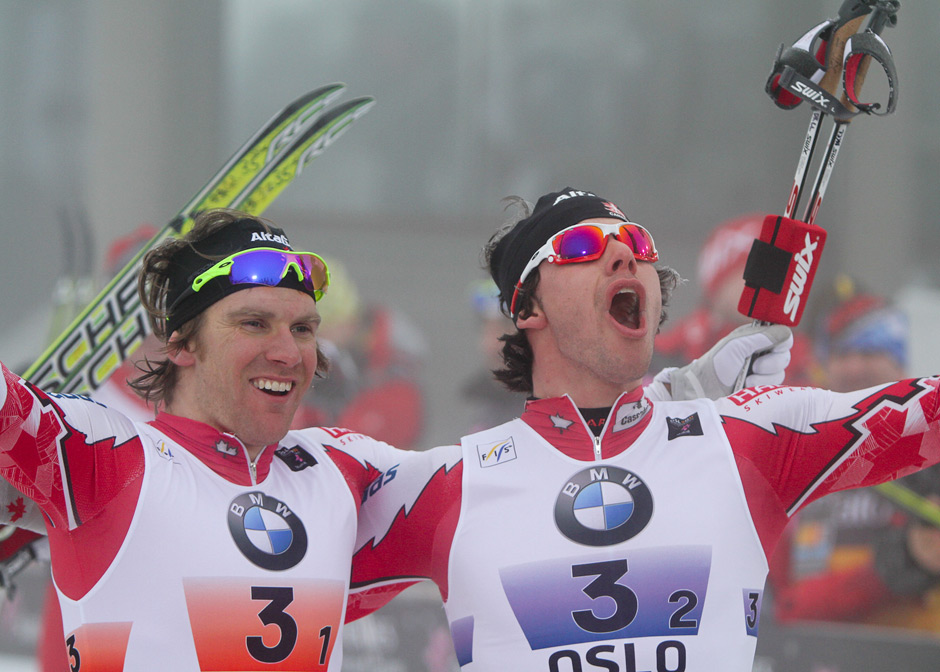
It has been ten short or long years since he and Kershaw won the classic team sprint at the 2011 Oslo World Championships. First off, before listening to the episode today…check out the videos posted below.
Devon Kershaw (l) and Alex Harvey celebrate their World Championships gold in 2011 in Oslo, Norway.
To set the scene, this win goes down at the Holmenkollen, the Shangri La of cross-country skiing. The Holmenkollen is hallowed ground.
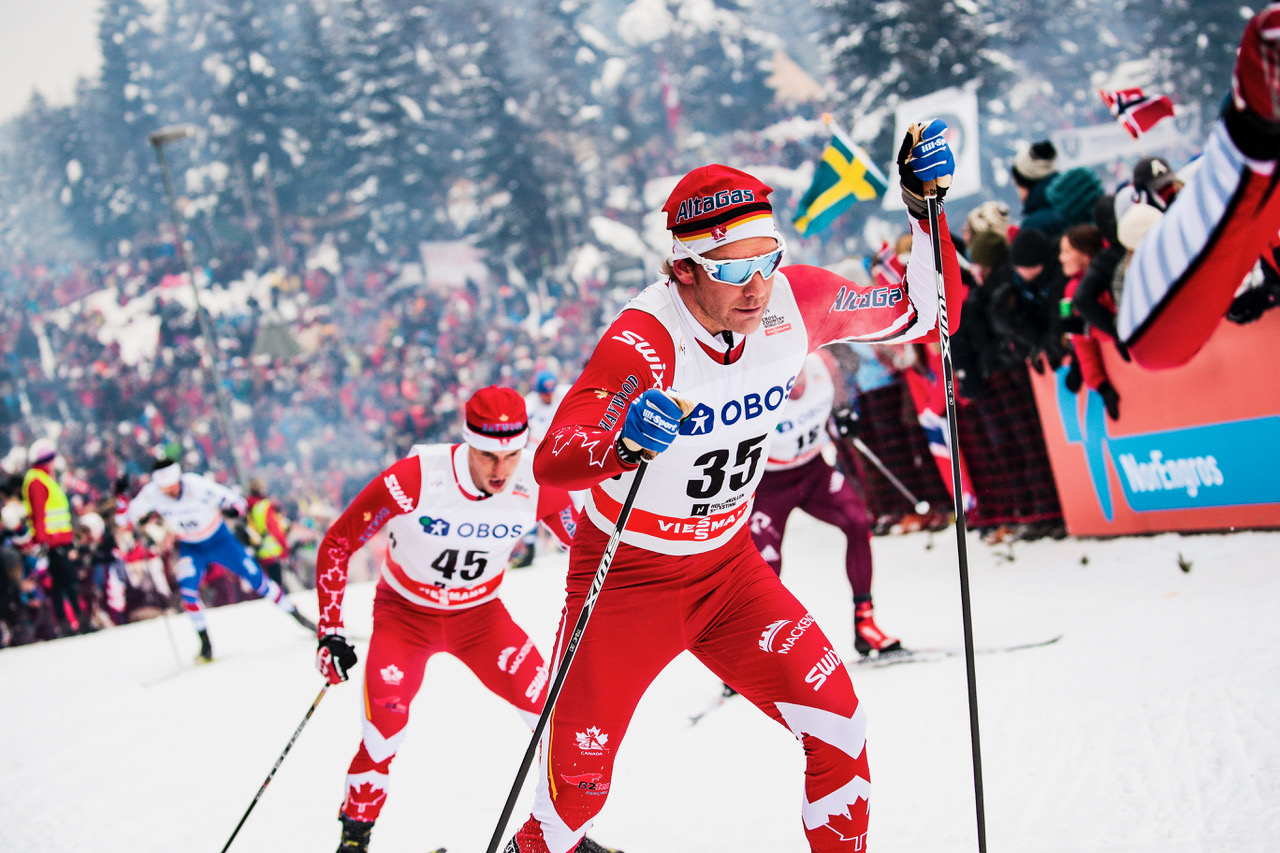
Devon Kershaw leads his Canadian teammate Andy Shields during the 2018 Holmenkollen 50 k freestyle mass start on March 10 in Olso, Norway. (Photo: Fischer/NordicFocus)
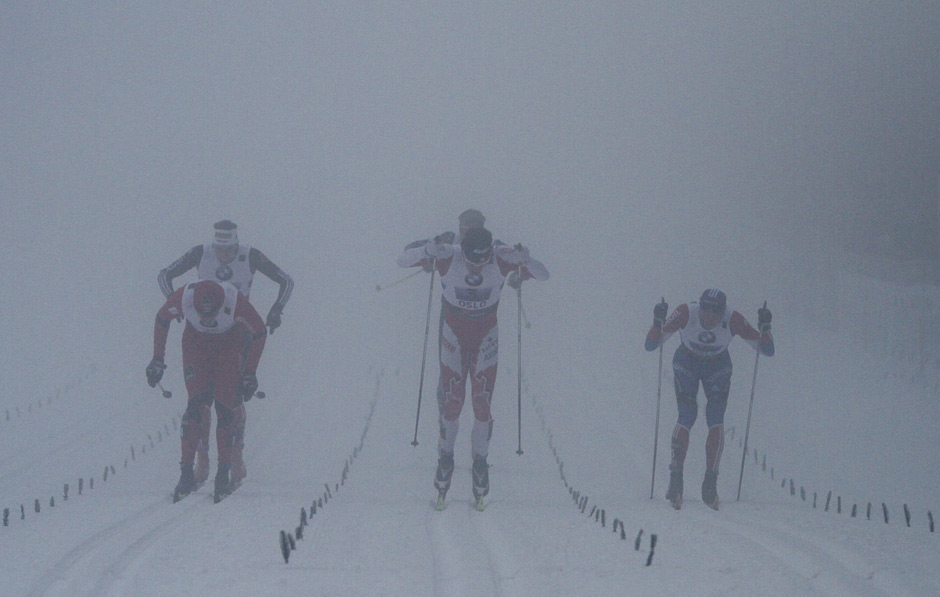
Think dense fog rolling in from Oslo fjord – a hundred thousand fans lining the course and stomping in the stands – there to witness the Canadians overtake a Norwegian in the final straight to win the team sprint. Back then, Harvey and Kershaw were a decade younger but no less wise. But we’ll let them tell the story.
Harvey (C) powers to the line ahead of Ola Vigen Hattestad (L) and Alexander Panzhinskiy (R) for the 2011 World Champs win in Oslo.
For now, their win in Oslo is a good spine tingle for these times. They remind us of the gift of crowds and that anything can happen when the stars and maybe a little fog align.
Here are some solid videos to time-machine back and relive the scene:
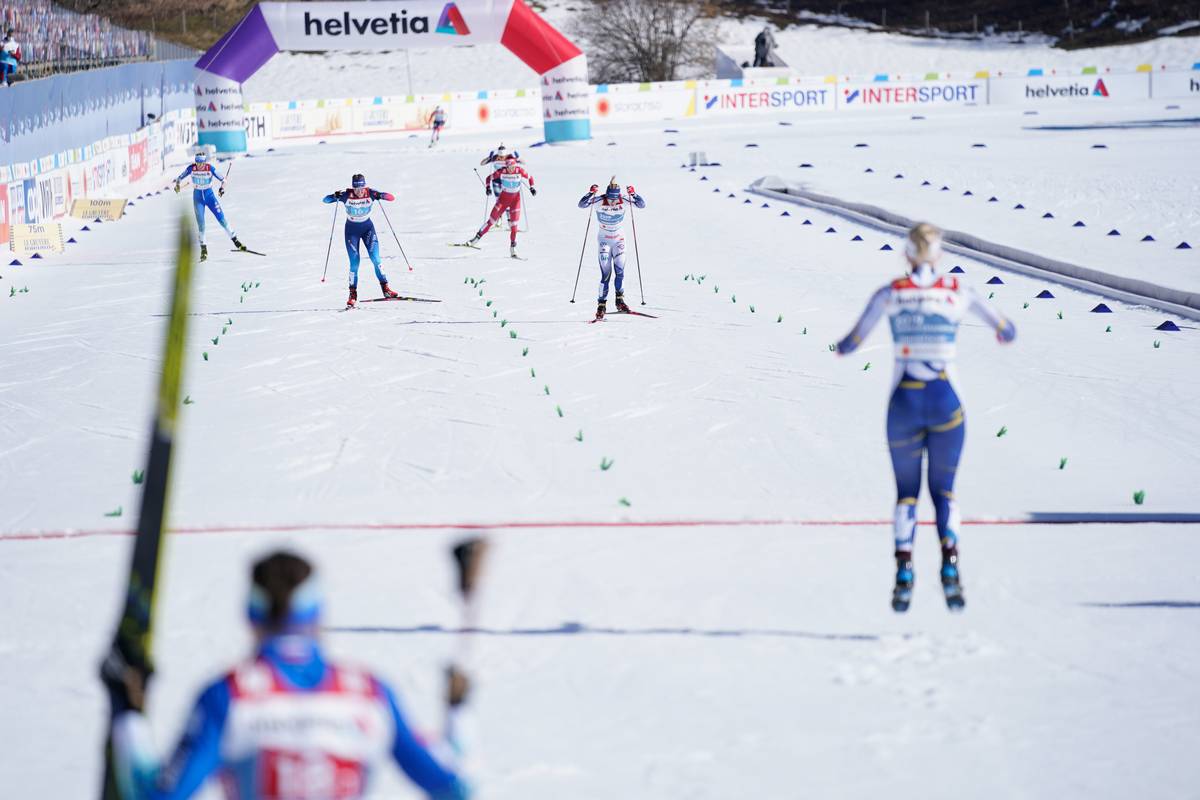
Indeed, we do get to the 2021 World Championships too. Kershaw and Harvey chat about the sunny day’s racing in the freestyle team sprint won by Norway on the men’s side and Sweden for the women.
Thanks for listening.
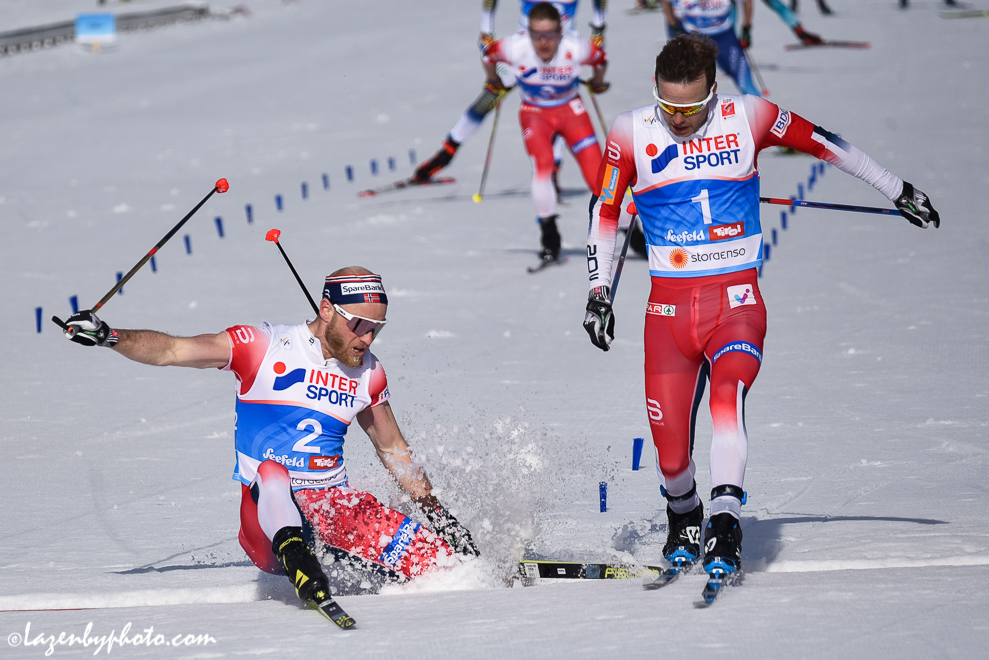
The final moments of the World Championship team sprint in Oberstdorf, Germany. (Photo: NordicFocus)
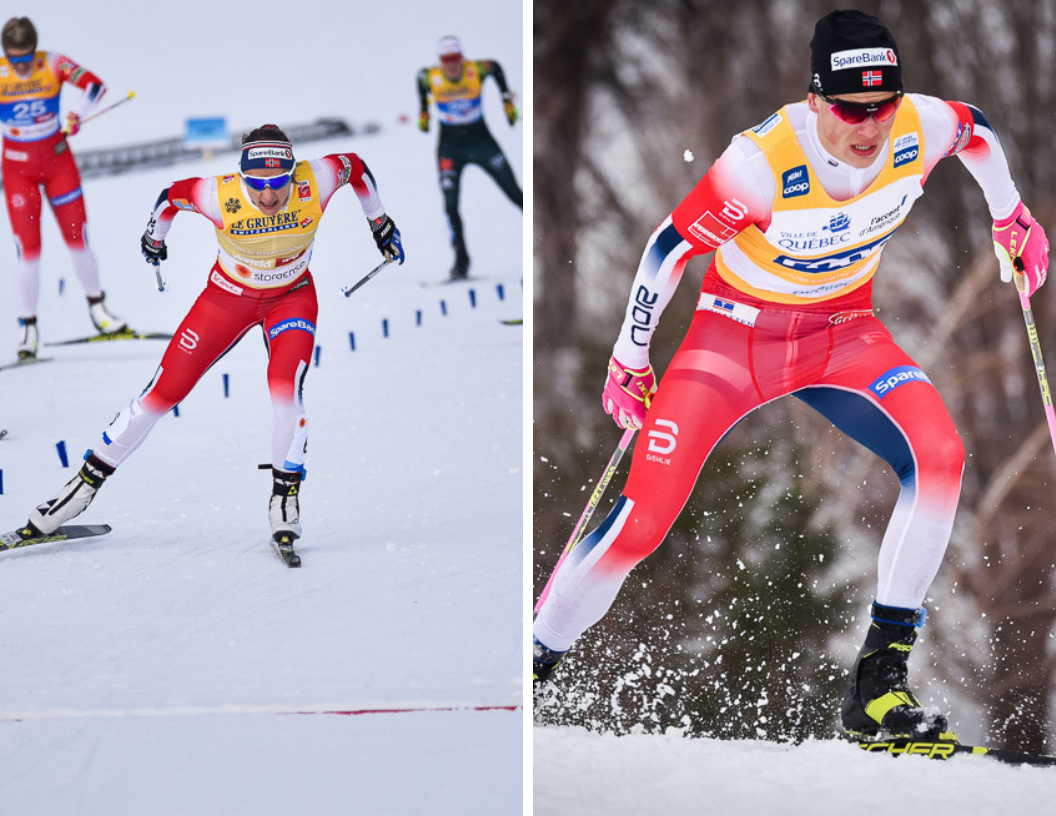
Norway’s Ingvild Flugstad Østberg (left) and Johannes Høsflot Klæbo (right) were the top money winners on the 2018/2019 World Cup. (Photos: John Lazenby/lazenbyphoto.com)
If you’ve read the International Ski Federation’s (FIS) website in the last few weeks and deviated from exploring the cross-country sub-site, U.S. alpine star Mikaela Shiffrin has been prominently featured. Her season was record-breaking. With 17 wins, she set a FIS World Cup record for alpine victories in a single season. With the fattening of her win total, was the commensurate growth of her bank account.
She became the first World Cup skier, male or female, to earn more than one million Swiss Francs (CHF) in prize money during a single season. She won 886,386 CHF for her regular World Cup haul, and 114,000 CHF for her gold and bronze at the Åre, Sweden Alpine Ski World Championships.
As of this writing, with the exchange rate set at 1 CHF = 0.98 USD, that equates to 980, 447.25 U.S. Dollars. Not exactly bottom feeding for a professional skier. (Since the beginning of April, the dollar has lost value against the Swiss Franc.)
On the cross-country World Cup, Norway’s Ingvild Flugstad Østberg, the overall winner, was first on the money earnings list with 175,900 CHF. Her teammate Therese Johaug, the winner of the distance crystal globe, earned the second highest total with 146,375 CHF. (American Jessie Diggins was eighth with 54,525 CHF in earnings.)
Sweden’s Stina Nilsson, the fourth-ranked prize money earner and winner of the sprint globe earned just shy of the 100,000 CHF mark with 97,575 CHF in total earnings. Beyond her presumably sizable income from sponsors and endorsements, this is a proud living for fast skiing. Yet, it becomes a precipitous drop off in earnings from 10th place (Russia’s Yulia Belorukova with 40,950 CHF) to 30th, where Norway’s Kari Øyre Slind amassed 7,450 CHF.
Of the ninety female athletes on the money list, 32 earned less than 1,000 CHF.
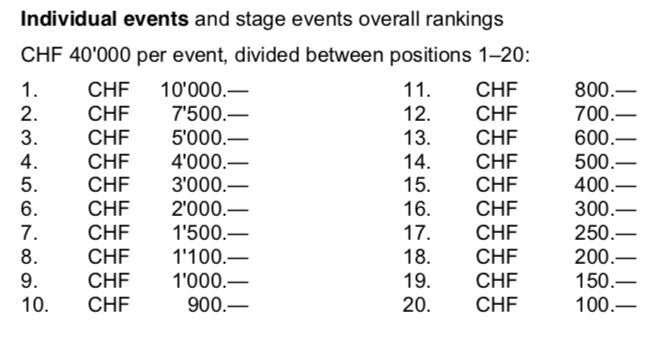
According to the Rules for the FIS Cross Country World Cup, the organizing committees must divide a sum of 40,000 CHF per individual race amongst the top-20 skiers. The winner receives 10,000 CHF, second place 7,500 CHF until the 20th place skier is left with 100 CHF. (See below for the specific breakdown.)
For individual sprints, prize money is reserved for those making the finals. A total of 30,000 CHF is divided amongst the top-six finishers in the final sprint standings. First place receives 12,000 CHF, second 8,000 CHF, third 4,000 CHF, fourth 3,000 CHF, fifth 2,000 CHF, and sixth 1,000 CHF.
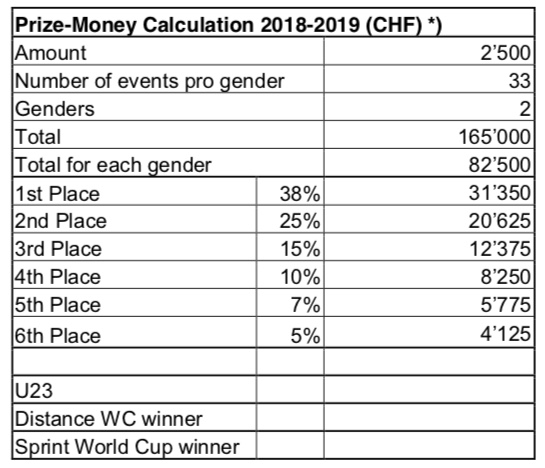
As far as earnings for the World Cup overall, each gender divides 82,500 CHF amongst the top six athletes. (See below for the breakdown.)
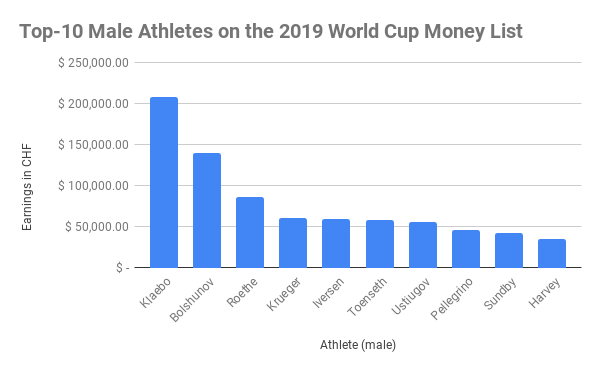
Like on the women’s side, those who dominate the men’s podiums collect the cash. Norway’s Johannes Høsflot Klæbo, with 207,500 CHF, was the top-ranked male on the money list. Of the top-ten male earners, six were Norwegian, two Russian, one Italian, and in tenth was Canada’s Alex Harvey with 35,550 CHF.
Only the top two athletes on the men’s list earned more than 100,000 CHF: Klæbo and the second overall prize money earner, Russia’s Alexander Bolshunov, with 139,625 CHF.
The 20th ranked skier, Gleb Retivykh of Russia, was the first male skier to fall below the 20,000 CHF threshold with 19,850 CHF. Keeping things tidy by tens, Norway’s Finn Hågen Krogh was ranked 30th — he was the first skier below 10,000 CHF in prize winnings with 9,150 CHF.
Breaking the numbers down.
Twenty different women stood on individual World Cup podiums this past year. For the men, the number bumped to twenty-eight different skiers.
Prize money is skewed towards the top performers. It follows that skiers like Østberg and Johaug would lead the money standings: Johaug won 11 individual World Cups this year, Østberg five. Østberg stood on twelve individual podiums and finished second a total of three times and placed third a total of four times. Nilsson, the top sprinter, won eight individual World Cup events. She also placed second once for her nine total World Cup podiums. The chart below shows the drop off in earnings for the women’s field — the top spots in World Cup races are secured by a relatively small number of skiers. Over twenty-nine individual races, three different skiers — Johaug, Østberg, and Nilsson — amassed 24 total wins.
By comparison, Diggins stepped on five podiums and placed fourth through 10th nine different times. Russia’s Yulia Belorukova, the tenth-ranked money earner, won a single race for her only podium and placed between fourth and 10th on 11 different occasions. The money stays near the podium: 10th place earns nine percent of the winner’s take in distance racing. That’s 900 CHF for placing 10th in the world.
It’s a similar story for the men, yet the drop off from the top two prize winners was steeper. (Again, 20 different women podiumed compared to 28 different men.) Klæbo won 13 individual World Cup races and placed second a single time. Bolshunov had 12 podiums: five wins, three second place finishes, and four third place results. Klæbo and Bolshunov locked up 18 wins between them over the 29 individual World Cup races.
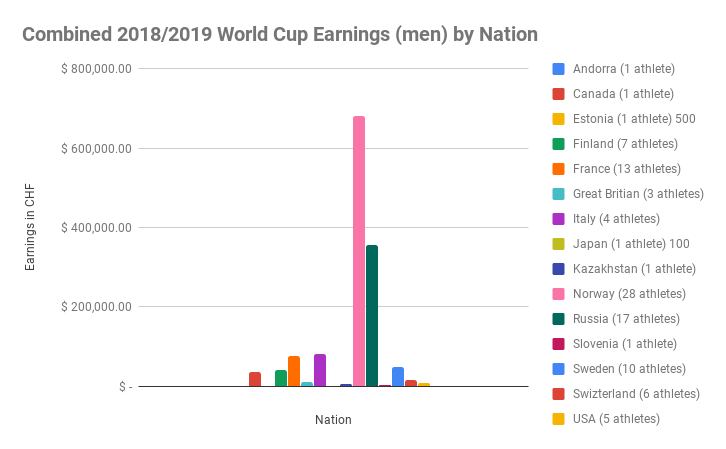
The trend of top-heavy earnings in the World Cup field is no mystery as this FasterSkier article from 2015 suggests. The article was titled, How to Score Points and Win Money on the World Cup (Hint: Be Norwegian). For the men, the main theme of that article still rings true. Norway had 28 different athletes in the money this season. In a nation to nation comparison, Norway’s men won the most cash. Russia, with 17 skiers earning prize money, clawed at Norway. Sweden, a country we often think of as a powerhouse, has been unable to field a well-rounded men’s team recently and lags behind the earnings of Italy (that’s skewed by Federico Pellegrino) and France. (Link to an interactive chart of the men’s data here.)
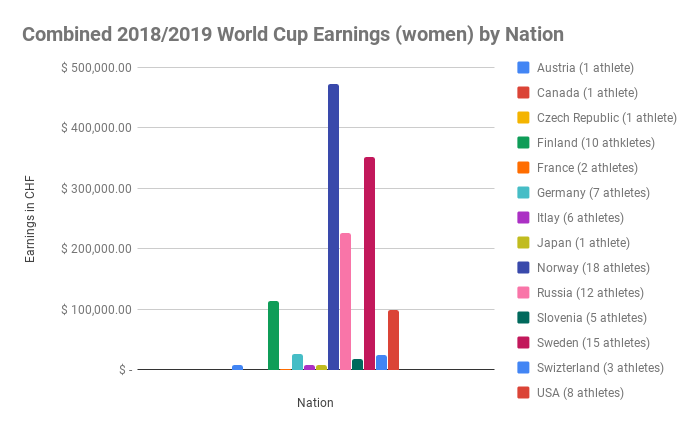
The nation to nation comparison for the women reveals a Sweden that has emerged as a challenger to Norway. Norway prevails with 472,375 CHF in total earnings. But, Sweden and Russia are serious contenders, while Finland and the U.S. have also separated themselves. (You can link to an interactive chart for the women’s data here.)
Does it pay to be an elite cross-country skier? That depends. And it may be of no concern to those who compete simply for the love of their chosen sport. Yet, for those at the top of the xc skiing food chain, prize winnings along with the padding of endorsements can make for a comfortable life. And it still doesn’t hurt if you are from Norway.
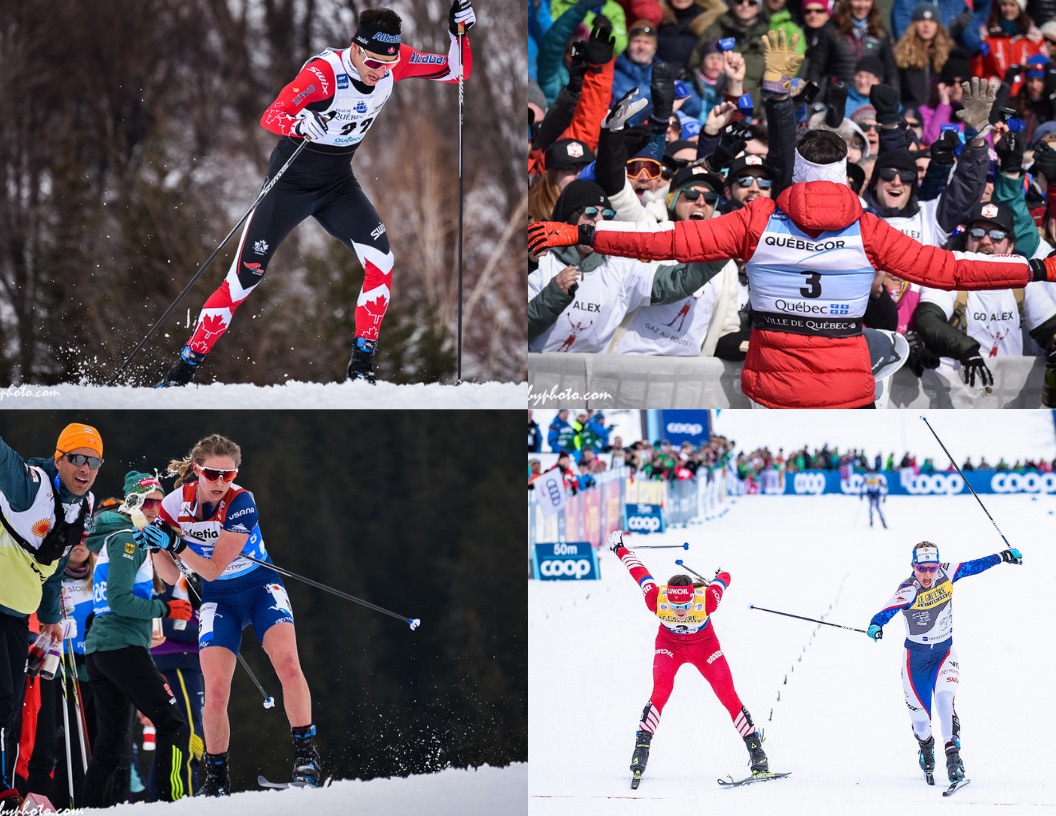
Alex Harvey (top), Jessie Diggins (bottom). (Photos: John Lazenby/lazenbyphoto.com. Bottom right photo: Nordic Focus)
With the 2018/2019 season officially in the rearview, FasterSkier is running a series of articles highlighting some of the players and performances from the season. This honor goes to two outstanding North American skiers of the year.
***
Alex Harvey, Canadian World Cup Team
Thirty years old and finis. Canada’s Alex Harvey has for years been the preeminent male skier from North America. This is not the time to honor his collective achievements, of which there are many, but to recognize his 2018/2019 ski performances.
Harvey skis for podiums. During a year that many might consider a notch below his usual strong stats, he landed third on only the second World Cup weekend in Lillehammer, Norway’s skate sprint. That began a podium drought that lasted until the World Cup’s final weekend in Québec.
Before we get there, sandwiched in between were three top-ten performances including a bare miss in Oslo when Harvey placed fifth, two seconds out of the medals. At the World Championships in Seefeld, Austria, Harvey raced to sixth in the skiathlon and 12th in the 50-kilometer freestyle.
He remained a skier all year to watch, but he struggled to find the mix and match of physical sensations that had often propelled him to the front of the pack with the kick to finish off with a podium call up. He ranked 13th overall on World Cup, 11th in distance, and 26th in the sprint.
With Harvey’s retirement already announced, he came home to Québec’s massive crowds and enough remaining energy to treat all of Canada to one last show. He began the three-race series with a tenth in the skate sprint, followed up with a second in the 15 k classic mass start.
This was not seeing some way out of his prime athlete resurrect themselves, but an example of how emotions and environment can eke out an extra percent of speed from a champion. In the mass start, Harvey defined himself as still world class while making a select group of five in front.
(Video highlights from Harvey’s final World Cup race.)
In his final career World Cup race, a 15 k skate pursuit, Harvey and Russia’s Alexander Bolshunov chased down a tactically skiing Johannes Høsflot Klæbo to create a three-skier poker match for the weekend’s overall win. Klæbo did his thing, which was crank over the final bump with an unmatchable hop skate and slide across the line uncontested. Harvey, on the other hand, stuck behind Bolshunov, who has been a foil to the Canadian, until the two opened up their engines in the final 100 meters and came toe to toe across the line.
Harvey took second, Bolshunov third. The younger Bolshunov, at 22, has had a stellar season. On this day, moments after crossing the line, Harvey approached the Russian, flexed his bicep and pointed at it, as if stating he was stronger in the end.
Even with a less stellar finish in Québec, Harvey would have remained the male cross-country skier of the year. Two podiums in Québec make it feel real.
Jessie Diggins, U.S. Ski Team/SMS T2
Jessie Diggins came into the season with a map into semi-charted territory. Her World Cup map remains well defined. The steady-drip of media and promotional engagements teasing at her time during her first full season as an Olympic champion was something new to navigate.
“In the 50 days following the Olympics, I packed in 25 events, with more to come in the summer and fall,” Diggins wrote on her blog earlier this month. “I shamelessly pitched the World Cup coming to Minnesota in pretty much every interview, unsolicited, until we gained more traction.”
Let’s face it – Diggins willed the Minneapolis World Cup onto the schedule. It took boundless energy to see that through.
Successful and sought after alpine skiers from the U.S. have dealt with the time-bleed from training and rest for years. The manual on how to build on-snow results while honoring commitments to sponsors and media is dog eared. There are Lindsey Vonn and Mikaela Shiffrin to name two of the most recent alpine athletes to manage notoriety with training and racing. The list of American cross-country athletes who can empathize with Diggins is thin. She does have those who provide advice, but in many ways, her new map has at its edges “Here be dragons”.
As she often states explicitly post-race, Diggins made no excuses and simply did her best.
She earned five World Cup podiums – four third places and a win. One of those third places came in a 10 k skate pursuit in the TdS where she skied the fastest time of day. Her lone win came in Cogne, Italy’s skate sprint.
Her 2019 World Championships included an eighth in the skate sprint (she was the top American), fifth in the team sprint and 4 x 5 k relay, and fourth in the 30 k mass start skate where again she was the top American.
Diggins is often quick to deflect her individual success to her coach Jason Cork or her teammates or any other person or entity that might have played a positive role. There were, however, other moments when for certain it was all Diggins and her internal drive.
The 10 k mass start classic in Oberstdorf, Germany, the fourth stage in the Tour de Ski (TdS) comes to mind. It was a dicey waxing day. Diggins came into the stage wearing the overall TdS leader’s bib. Right from the go, she struggled to find kick. But she willed herself to an 11th place, losing just over a minute with the effort, and finished the TdS sixth overall.
Diggins placed sixth in the World Cup overall standings, sixth in the distance overall, seventh in the sprint.
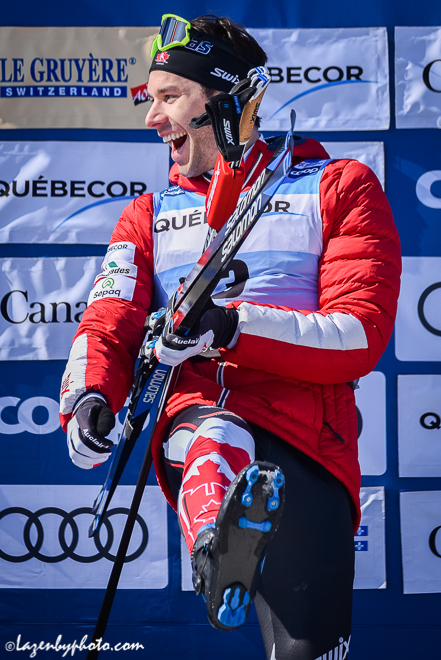
One more riff: Harvey’s “air -guitar” remains in tune. (Photo: John Lazenby/lazenbyphoto.com)
Alex Harvey finished his career racing for Canada with a bang today in Québec City, Canada. Harvey placed second to Norway’s Johannes Høsflot Klæbo in today’s 15-kilometer freestyle pursuit. It was Harvey’s second podium in as many races as he can now claim a perfect ending to his career. Another solid ending went to Klæbo, who with his win today earned the overall World Cup title. Although the point differential lent an air of intrigue to the racing as Klæbo and Alexander Bolshunov of Russia were fighting for the overall title today, Klæbo’s knack for theater and endurance left nothing to doubt. Bolshunov placed third on the day and second in the overall standings.
“It was a cool race out there, Klæbo told FasterSkier after the race. “Bolshunov and Harvey were really strong and I think Bolshunov did most of the job today. On the second lap there, I felt the pace behind was quite high so I decided to let them in and I saw that when they took the head with me I felt like it was much easier to stay behind. This was a really cool race and it’s really cool to have Harvey on the podium again. I am really happy for him and it was important for me that he took Bolshunov as well. I was saying thank you to him after the race. I think he was really happy, he said so.”
For the Win. Johannes Høsflot Klæbo (NOR) wins the Overall World Cup Title at the World Cup Finals in Quebec City, Canada
Klæbo’s sentiments weren’t guaranteed with Bolshunov as the chaser. Klæbo started the pursuit 52 seconds ahead of Bolshunov and Harvey. Because of this, Klæbo skied the first half of the race alone. But, in a chase lead by Bolshunov, Harvey and Bolshunov continued to make up time on the Norwegian. Just before the 8k mark, Bolshunov and Harvey came into eyesight of Klæbo and by the 8.2 checkpoint, the three skiers were skiing together. They were locked as a trio until near the finish.
Bolshunov lead the second half of the race, with Harvey in second and Klæbo sitting in behind. But during the final climb, Klæbo found a last bit of energy and attacked, pulling ahead of Bolshunov and Harvey. He kept this lead to the finish, ending the race +2.8 seconds ahead of Harvey.
Bolshunov seemed to have second place in the bag when he and Harvey came around the corner into the finishing stretch. Harvey came from behind with an inspiring final push and managed to overtake Bolshunov and grab second place. Today’s podium was the 28th and final podium of Harvey’s World Cup Career as he is set to retire at the end of this season. Bolshunov is ending his 2018/2-19 season with 10 podiums, five of which were wins.
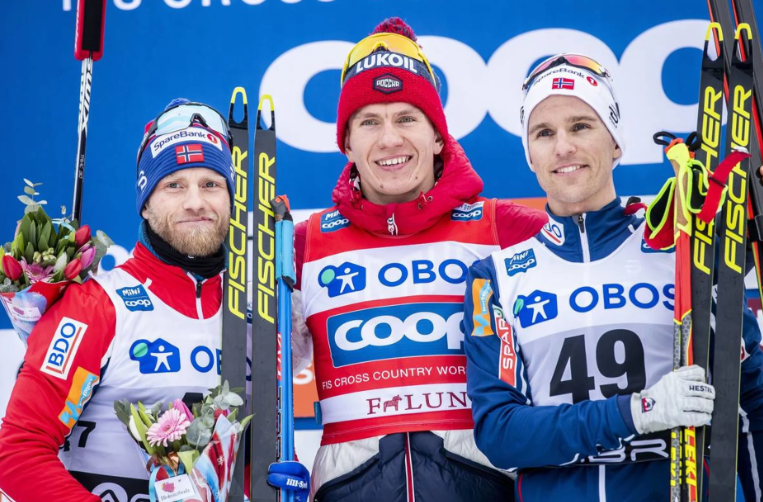
All smiles at the end of the season. From left to right, Alex Harvey (CAN) was 2rd, Johannes Høsflot Klæbo (NOR) was 1st and Alexander Bolshunov (RUS) was 3rd.
“I didn’t feel as strong today and I think that the pace behind was really high, so I decided to just let them get in and go behind and stay behind before the end there and then try to push all into the last uphill and before the finish there, “ Klæbo said of his race strategy. “The tactic worked quite good and it was even better to see Harvey beat the Russian guy, that was amazing.”
Yet Klæbo qualified his statements to note that he harbors no deep-seated resent for the Russians.
“I don’t have any bad things to say about Russia at any time,” Klæbo said. “It’s good to have this type of duels I think. It’s really fun and exciting for the sport that we have this tight duel. I don’t know how many points it was at the end there, but I don’t think it was that much. It’s cool to have this type of competition and today was a lot of points to ahead today. The Canadian guys, it’s just friendly. No enemies at all, so it’s really cool and I think we all are very happy about Harvey and the way he can end his career.”
Harvey and the podium stoke. (Photo: John Lazenby/lazenbyphoto.com)
Harvey spoke to FasterSkier about his season and ending his career.
“The last 5 months for me, basically since November, have been a struggle for me this year, so it’s a good way to end it. This is the best way to end a career with two podiums like that at home, so that’s the end.”
The chase pack, consisting of Norwegians and Italians fought hard to gain time of the leaders, but in the end, the leader of the chase pack, Francesco De Fabiani of Italy, finished +1:13.3 behind Klæbo. Norway finished the day with six men in the top ten and Italy with two.
Sjur Røthe was third in the Overall World Cup results. In today’s race, he was 10th, but he has won three World Cups and was second in a fourth race. Six Norwegian athletes finished in the top 10 of the season-long overall standings. De Fabiani and his teammate Federico Pellegrino were seventh and eighth respectively.
U.S. Ski Team member Erik Bjornsen was the next North American to finish, placing 20th. This is Bjornsen’s fifth top-20 this season.
“It’s been kind of an up and down season,” Bjornsen said in the mixed zone. “I’ve usually been pretty consistent in the past and this seasons, there’s been a lot of doubts, I’ve also had some of my best results so I’m looking forward training harder this summer and having a little bit more of a relaxed summer and hopefully getting more consistent results next year.”
Simi Hamilton placed 26th. Hamilton blasted the course to ski the third fastest time of day. Harvey and Bolshunov, wh0 turboed to catch Klæbo, were first and second respectively. Hamilton’s time of 28:48.9 was 33.5 seconds behind Harvey’s who skied the fastest time of day. British skier Andrew Young marked the fourth fastest time, 0.1 seconds slower than Hamilton.
“It was good, it was really fun fast skiing, good course, short course, not a ton of climbing, but really rolly,” Hamilton said. “My skis were awesome, you never really know how a pursuit is going to go, just because there is so much that depends on the people you’re skiing with and obviously with the wind today it was just so good to be in someone’s draft, I was really lucky to start in front of the first wave so it was basically guaranteed to skiing with people the whole time and I felt great. It went awesome. It was a good one to end on.”
Kevin Bolger and Scott Patterson skied together during today’s race, they finished 44th and 45th respectively. Also racing for the US were David Norris who was 55th, Logan Hanneman who was 65th and Ben Saxton who was 69th.
The US started a number of athletes who are new to the World Cup circuit. The was the first World Cup weekend for Gus Schumacher who placed 52nd, Ben Ogden who placed 66th, and Peter Holmes who placed 70th.
Schumacher spoke with FasterSkier after his race, “It was really good, I felt strong, and my skis were good. It was nice to just fight and race how I could. Yesterday was a little tough, conditions-wise, and today I just felt like it was kind of just me and my fitness out there.”
The US Super Finals begin on March 28th in Presque Isle, Maine. These are the final races of the season for the U.S Ski Team.
Alexander Bolshunov of Russia leading Canada’s Alex Harvey and Norway’s Johannes Høsflot Klæbo on the final lap of the men’s 15-k skate pursuit. (Photo: Peggy Hung)
FIS World Cup Québec City Men’s 15 k Freestyle Pursuit
Norway’s Johannes Høsflot Klæbo did not cede the win today as he moved to take the World Cup overall over Russia’s Alexander Bolshunov. The day’s first starter in the 15-kilometer freestyle pursuit, Klæbo won in 29:05.4. Klæbo began with a 52 second lead on second starter Bolshunov and a 53-second gap on Canada’s Alex Harvey. The trio eventually linked up with Klæbo pulsing with speed to take the win.
Harvey of Canada finished his career atop the podium with a second place. He took Bolshunov at the line. Harvey was 2.8 seconds back, Bolshunov 2.9.
Canada’s Alex Harvey acknowledging the crowd after his second place in the men’s 15 k classic in Québec City. (Photo: John Lazenby/lazenbyphoto.com)
Amidst overcast skies and spectators bearing signs for the local cross-country favorite, Canadian Alex Harvey, World Cup Finals resumed on Saturday in Québec City, Québec with a men’s 15-kilometer classic mass start race.
Thanks to his win in Friday’s freestyle sprint, Norway’s Johannes Høsflot Klæbo lead Saturday’s 78 starters out of the gate, his yellow bib also indicative of his first place rank in the 2019 Overall World Cup Standings.
With Saturday and Sunday being the last competition days of the World Cup season, and only 24 points separating Klæbo’s first place (1443 points) from second place Alexander Bolshunov of Russia (1419 points) in the Overall Standings heading into the 15 k on Saturday, both athletes were looking for a win.Klæbo to solidify his position on top and Bolshunov to supersede it.
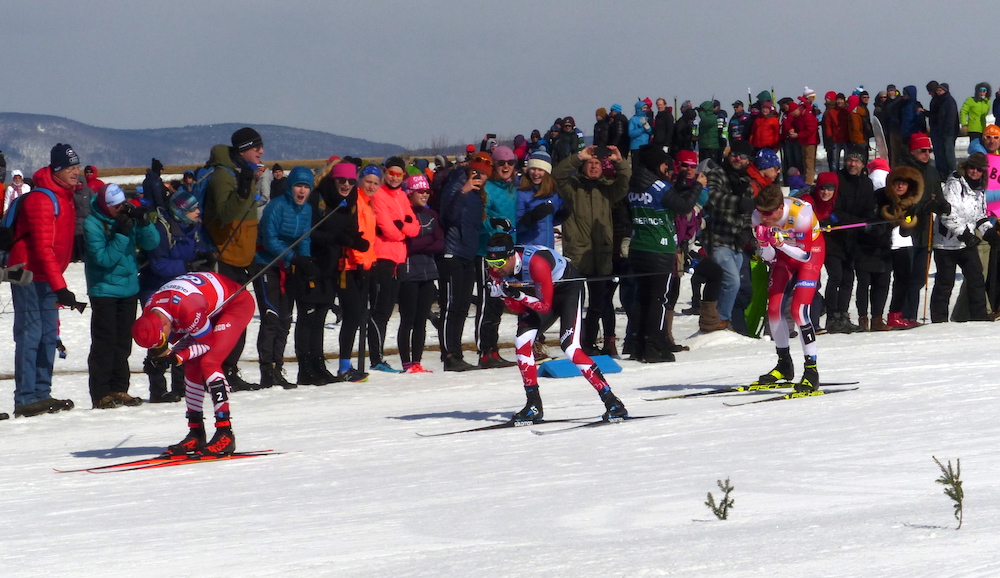
A literal mass of skiers after the start of the men’s 15 k mass start classic in Québec City. (Photo: John Lazenby/lazenbyphoto.com)
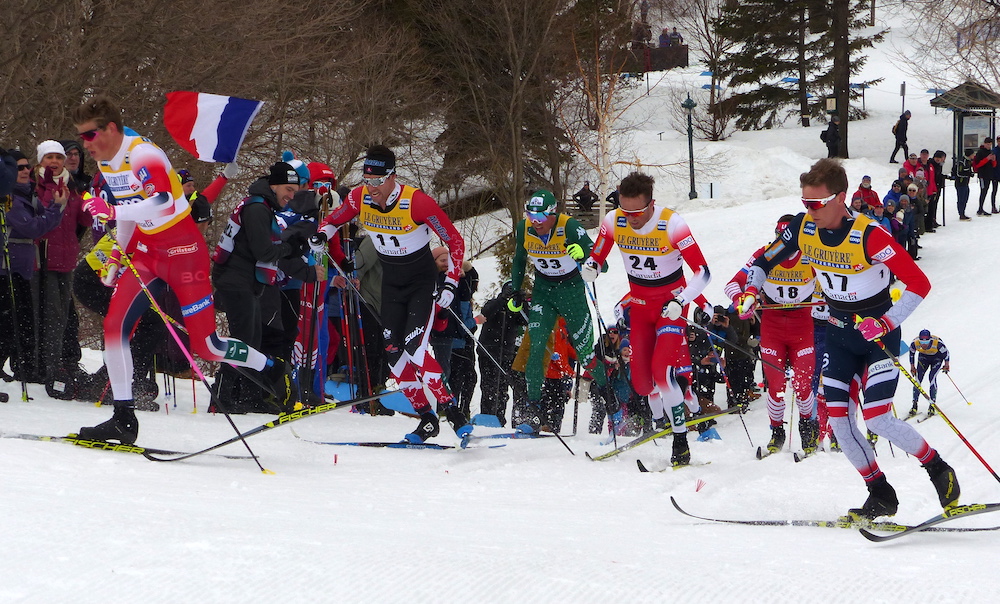
Leading up to 10 k, it appeared as if Bolshunov was on track to overhaul Klæbo’s immutable position on top. The Russian had positioned himself at the front of the lead pack’s 13 skiers which included Klæbo, Harvey, Italians Federico Pellegrino and Francesco de Fabiani, Russian Andrey Larkov, Switzerland’s Dario Cologna and Norwegians Didrik Tønseth, Sindre Bjørnestad Skar, Emil Iversen, and Sjur Røthe.
Taking charge through the climbs, Klæbo and Bolshunov went stride for stride, with Harvey hard pressed a little more than 1 second behind.
“I didn’t want to be leading because it was windy but I wanted to be near the lead every time,” Harvey told FasterSkier after the race.
Their descents through the tight sugary s-turns were maneuvered with ease. At 12 k, a Klæbo versus Bolshunov battle had directed most of the race and seemed fated to the finish.
However at the 13 k mark, halfway up one of the course’s major climbs, the bottom of Bolshunov’s right pole snapped. Although he received a replacement pole within a meter or so, the broken one did damage to his pace.
Russia’s Alexander Bolshunov leads the front group of skiers in the mens’s 15 k mass start classic in Québec City. (Photo: John Lazenby/lazenbyphoto.com)
“When I heard the Russian broke his pole, I went all in for Klæbo to make a gap as big as possible,” Tønseth told FasterSkier after the race. “We went for Klæbo and that’s the most important thing.”
With Tønseth pushing the pace, Bolshunov began to fall back. By the bottom of the next descent, the lead group had dwindled to five: Tønseth, Klæbo, de Fabiani, Røthe, and Harvey.
“We started to stretch the pack and…Didrik [Tønseth] is the strong guy that can make a hard drive in the final 2 kilometer to the finish he’s better than Johannes [Klæbo] or me in that so it was almost fun for him, if you want to be on the podium you got to punch it hard now and I knew for me it was going to help me,” Harvey said.
For the remaining 2 k, all five skied together until the finishing stretch. In the final 100-meters to the finish, Klæbo moved to the front and held off the charge of Harvey and Tønseth. Klæbo crossed first in a time of 36:10.9, while Harvey claimed second, just 0.8 seconds behind Klæbo, after a last minute surge past Tønseth.
Crossing 0.5 seconds back from Harvey and 1.3 seconds back from his teammate, Klæbo, was Tønseth in third.
“It’s a different scenario than two years ago when I came in newly World Champion fighting for the top three in the overall, I feel like this time I’ve had a harder season, was a bit more of an outsider,” the 31-year-old Harvey said. So I knew I needed my best race of the year to be on the podium and I was able to do that today so it’s pretty special.”
It is spring. “Go Alex!” (Photo: John Lazenby/lazenbyphoto.com)
Harvey confirmed earlier this season that World Cup Finals in Québec City will be the last World Cup races of his career. The Canadian will now start Sunday’s pursuit less than a second behind Klæbo.
“I felt strong today so I was able to come up in the front again. I needed these points for the total World Cup,” Klæbo told FasterSkier after the race.
With Saturday’s 15 k complete, Klæbo retained his top spot in the Overall Standings now with 1493 points. Bolshunov is currently second with 1451 points and Røthe third with 892 points.
Following Harvey was the U.S. Ski Team’s (USST) Erik Bjornsen in 18th (+1:04.3).
“I’m happy with the result,” Bjornsen told FasterSkier after the race. “I think it might have been the first time I was leading a World Cup for a bit. ”
Around 4 k, Bjornsen was at the front of the 78 skiers who started the race.
“The way my season’s been going it feels easy to go at race pace but when there are surges in the pack, if I try to go I just flood and I can’t really recover the way I’m hoping. But that was fun today,” Bjornsen said.
The next top North American finisher was Canada’s Len Valjas in 32nd (+1:43.6).
“It was one of the best distance races of my career,” Valjas told FasterSkier after the race. “I’ve had a few really good ones, but I don’t think I’ve ever been near [Top] 30 in my career other than the two podiums. So I’m super happy. Alex had a great day. I feel like I had a great day and I’m looking forward to tomorrow.”
“I was in bib 69 and I was skiing with some guys who were in the Top 20, so it’s really exciting for me to feel sort of back again,” Valjas added.
Following Valjas was the USST’s Simi Hamilton in 39th (+2:13.7). After the race, Hamilton indicated that prior to Saturday, his most recent classic distance race had been the Lillehammer 15 k back in December.
“I think by far the hardest part about today was the poling,” Hamilton told FasterSkier after the race. “It was just super rotten everywhere, the tracks stayed firm, which was nice, but the poling trenches just got so deep. I was constantly trying to look for harder snow on the outside and it made for, as a bit of a heavier skier, it made for a tricky 15k, but it was fun.”
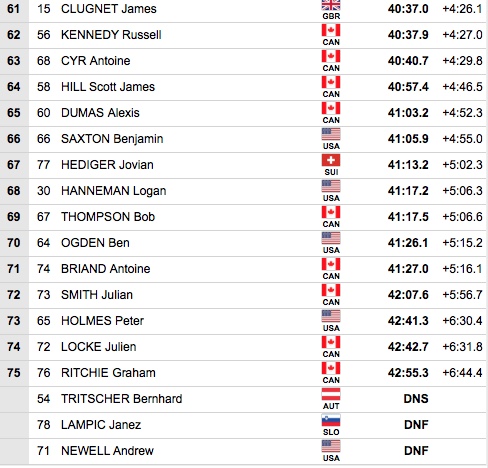
Also skiing for the Americans was Kevin Bolger in 44th (+2:31.1), Scott Patterson in 50th (+2:37.9), Gus Schumacher in 56th (+3:44.1), David Norris 57th (+3:48.8), Ben Saxton 66th (+4:55.0), Logan Hanneman 67th (41:17.2) Ben Ogden 70th (+5:15.2) and Peter Holmes 73rd (+6:30.4). Andy Newell did not finish.
For the Canadians Remi Drolet finished 52nd (+2:57.4), Evan Palmer-Charette 55th (+3:16.6), Philippe Boucher 58th (+3:53.9), Jack Carlyle 59th (+4:13.6), Russell Kennedy 62nd (+4:27.0), Antoine Cyr 63rd (+4:29.8), Scott James Hill 64th (+4:46.5), Alexis Dumas 65th (+4:52.3), Bob Thompson 69th (+5:06.6), Antoine Briand 71st (+5:16.1), Julian Smith 72nd (+5:56.7), Julien Locke 74th (+6:31.8), Graham Ritchie 75th (+6:44.4).
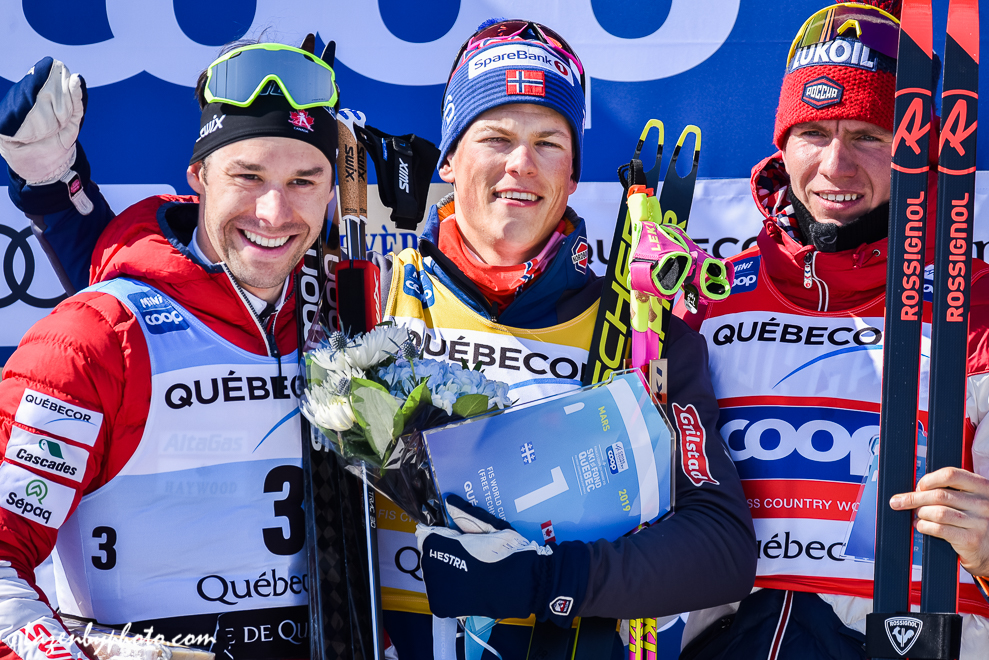
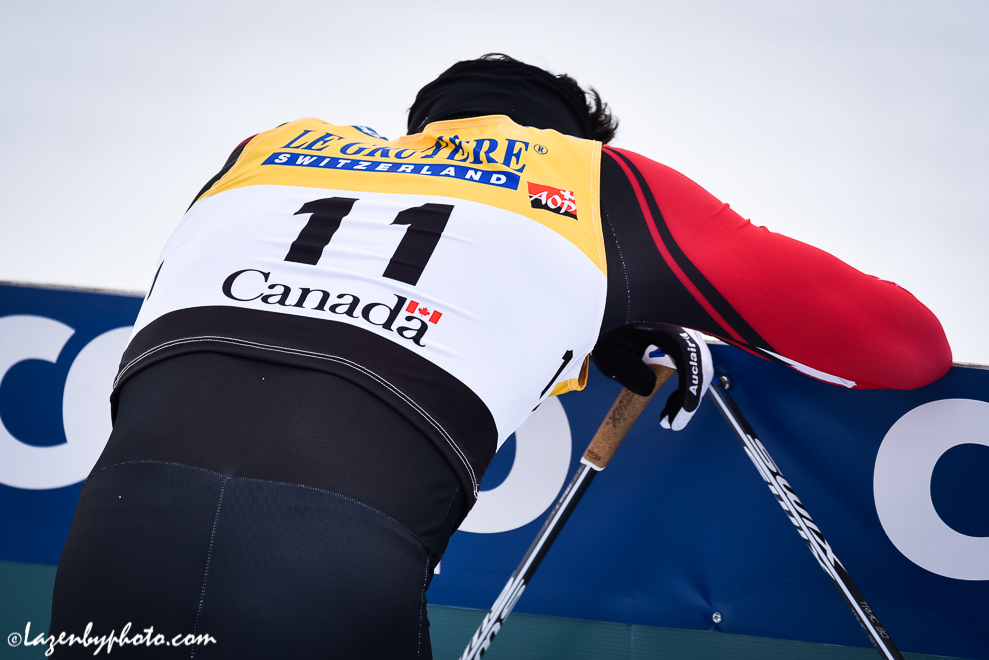
The men’s podium from the 15 k classic mass start in in Québec City. Alex Harvey (bib 11) was given the honor of standing in the center. Harvey placed second to Johannes Høsflot Klæbo (left). Third place went to Didrik Tønseth (bib 17). (Photo: John Lazenby/lazenbyphoto.com)
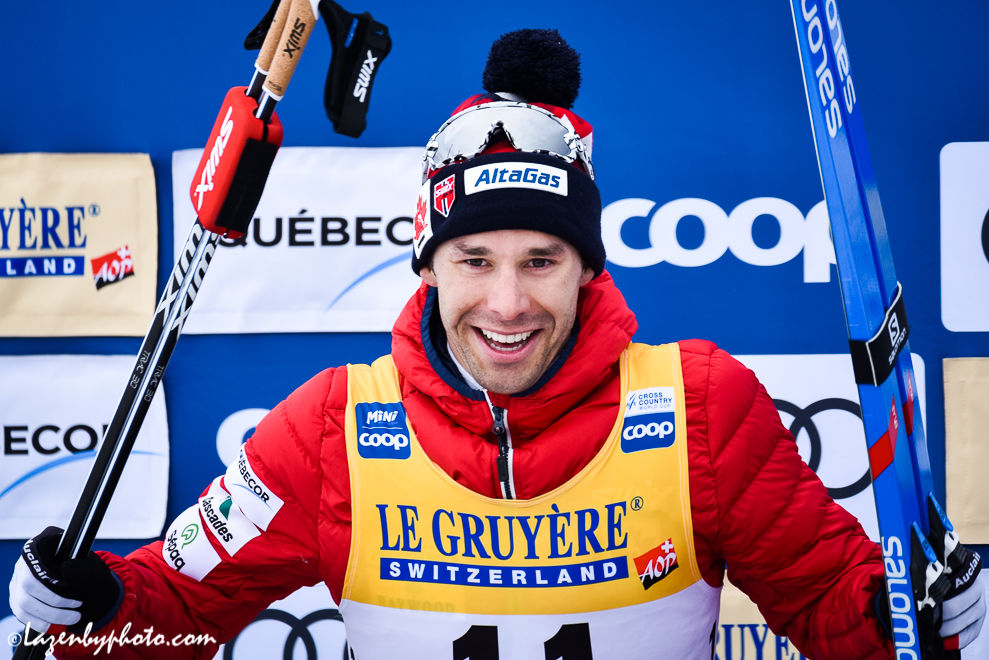
Alex Harvey takes in the cheers after placing second in the men’s 15 k mass start classic in Québec City. (Photo: John Lazenby/lazenbyphoto.com)
It’s remarkably sweet when an athletic career ends on a grace note: Ted Williams lofting a home run in his final game at Fenway, say, or John Elway passing his Broncos to a Super Bowl victory.
Or, earlier today, Alex Harvey taking second in front of a levitating crowd of supporters on the Plains of Abraham in the middle of Quebec City.
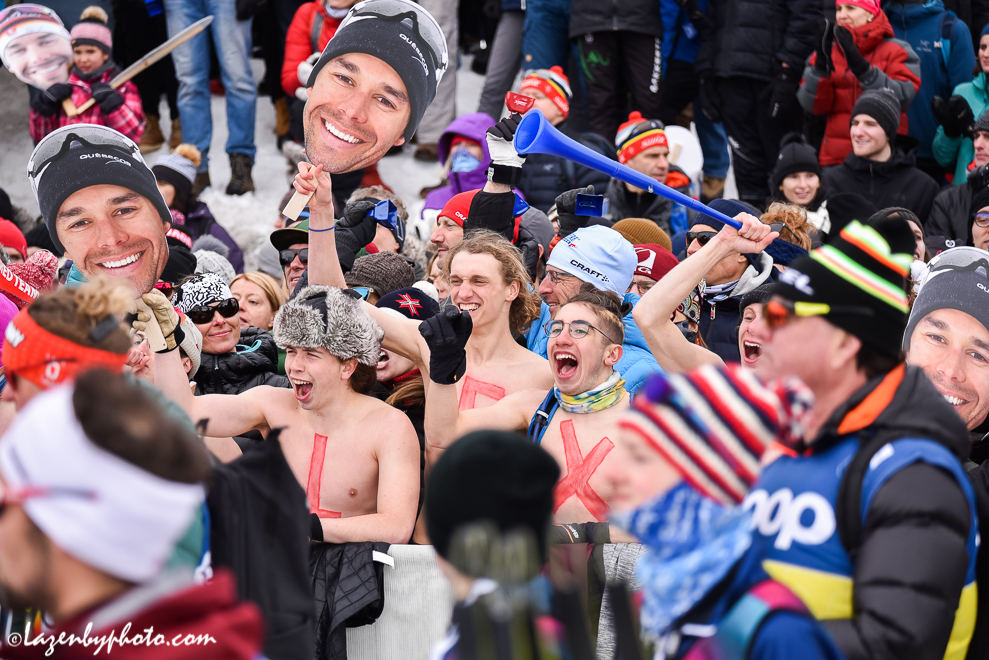
Harvey’s career has been winding slowly down from its world championship apex, but the affection of his local supporters has if anything been growing—an affection, remember, that builds on the love for his father Pierre, Canada’s ski hero of an earlier age. Today his fans lined the sinuous World Cup course, four and five deep on the hills and along the stretched-out stadium finish—some waved placards with his face, others stood bare chest to bare chest to spell out “Go Alex!”
Harvey fans. (Photo: John Lazenby/lazenbyphoto.com)
And an omen that he had a shot—or at least that things would not automatically default to the season’s normal standings—came in the women’s race that sprung from the line shortly after 9 a.m. Yesterday’s slushy track had turned rock solid today, and the speeds were withering: Therese Johaug was out in front but only by a smidge, since the flying descents shot skiers halfway up the next climbs, reducing the advantage that her peerless motor had provided all year long. When they dropped on to the long flat that hooked to the line, it seemed certain Stina Nilsson would sweep past, and indeed she did.
That left people thinking that Alexander Bolshunov, too, might not be the lock that the season’s results would indicate. As the men began their 15k course, he surged to the lead with Johannes Høsflot Klæbo, but neither could begin to shake the pack of at least a dozen skiers that hovered nearby. And by the third of four laps, as Harvey solidified his place in that frontrunning corps, a buzz began to build around the course. Spectators dashed across the infield to see the next climb, the next drop—as Harvey moved into third on the steep uphill near the start of the final lap, a kind of hope-against-hope excitement began to build.
And then Bolshunov snapped a pole—an audible cheer went up on parts of the course, less because it helped the local hope today, I think, than because the Russian cheating scandal remains a fresh wound, with Harvey denied an Olympic medal on Korean snow behind a pair of red suits. At any rate, as they climbed the final hill of the course, Harvey was definitely in contention, duking it out with Klæbo and Didrik Tønseth—and as they dropped down the final incline and into the stadium, and stood up for the turn towards home, he seemed pushed by a personal gust of wind, passing Toenseth and streaking across the finish behind only Klæbo.
That pairing of youthful flash and aging grit seemed just right: as they climbed the podium, a tearful Harvey took most of the cheers from a huge crowd that gathered as near the podium as FIS officials would allow. And then, in a small but classy move, Klæbo edged to his right and pushed a grinning Harvey into the center of the podium.
Harvey had skied with brio and joy much of his career: there’s a cardboard cutout by the stadium here of him playing air guitar on his skis after one of his wins. Today he skied with something else: a kind of love from fans that few athletes get to feel, and fewer still get to return in such fairytale fashion. He’s got one more race tomorrow, and whatever happens it will feel like a victory lap.
Taking in the moment. Alex Harvey after placing second in the men’s 15 k mass start classic in Québec City. (Photo: John Lazenby/lazenbyphoto.com)
Bill McKibben is a founder of the environmental group 350.org, and the author of, among many other books, Long Distance: A Year of Living Strenuously about his adventures as a slow cross-country ski racer.
Grinding uphill in the men’s 15 k classic mass start. (Photo: Peggy Hung).
FIS World Cup Québec City 15 k Mass Start Classic
We’re changing the format for this race rundown. With many North Americans racing during World Cup finals in Québec, screenshots from Live Timing will keep the rundown updated efficiently.
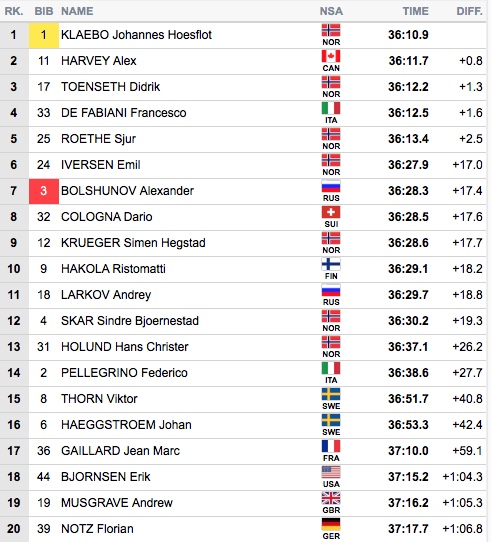
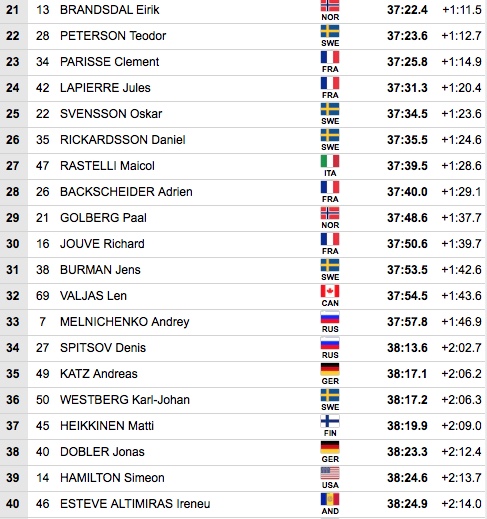
Why start with the top of the podium, when the real story sat front and center in second. Canada’s Alex Harvey nailed the pacing and nailed the finish to ski himself into a storybook-like ending in Québec. This was Harvey’s next to last day before retiring from competition after Sunday’s pursuit.
That said, Norway protected Johannes Høsflot Klæbo – more on those tactics in the race report – as he went on to win in 36:10.9.
Erik Bjornsen was the top U.S. skier in 18th (+1:04.3).
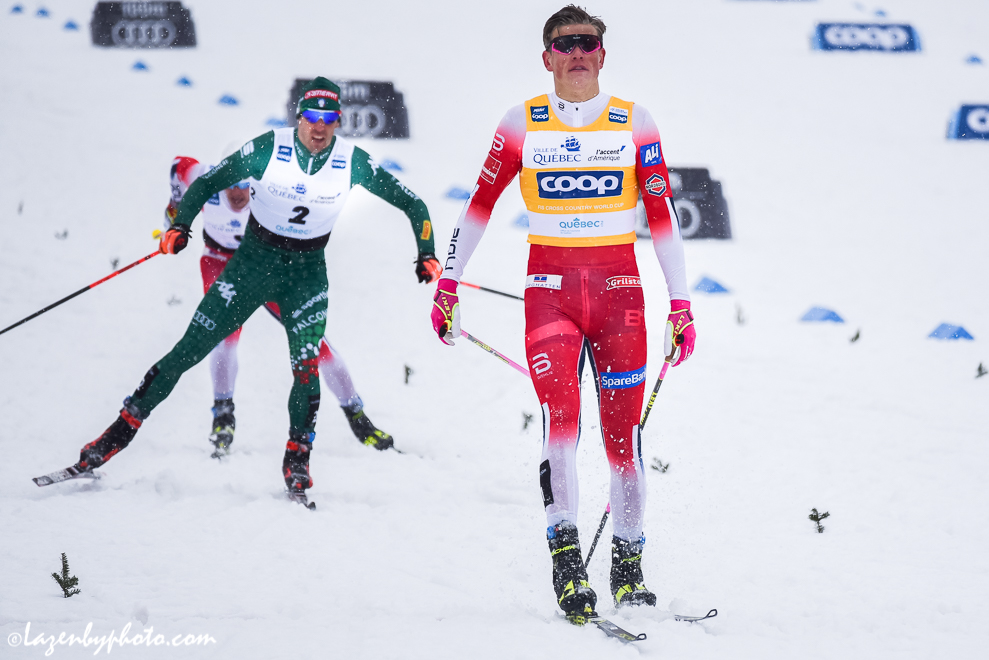
Johannes Høflot Klæbo wins the sprint with Federico Pelligrino and Sindre Bjørnestad Skar following. (Photo: John Lazenby/lazenbyphoto.com)
How to play the Johannes Høsflot Klæbo sprint game? It has got to go through every sprinter’s mind. As the day’s fastest qualifier, Klæbo set the tone in 3:07.61.
Prior to Friday’s 1.6-kilometer freestyle sprint in Québec, the young Norwegian had started nine World Cup sprints this season. He had won seven of them and placed second in another. And he had already locked up another sprint cup crystal globe becoming the first to win the prize in three successive seasons. With the globe pressure off, Klæbo could play his hand. Which brings us back to how he’d ski on a long sprint course with soft conditions and how his competitors would counter.
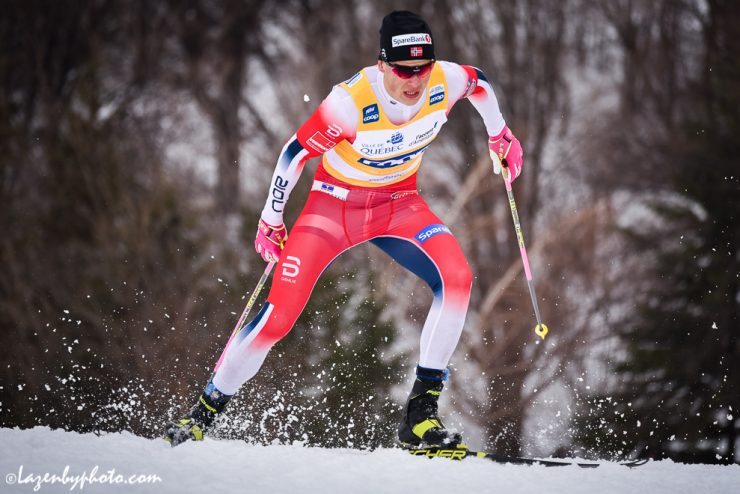
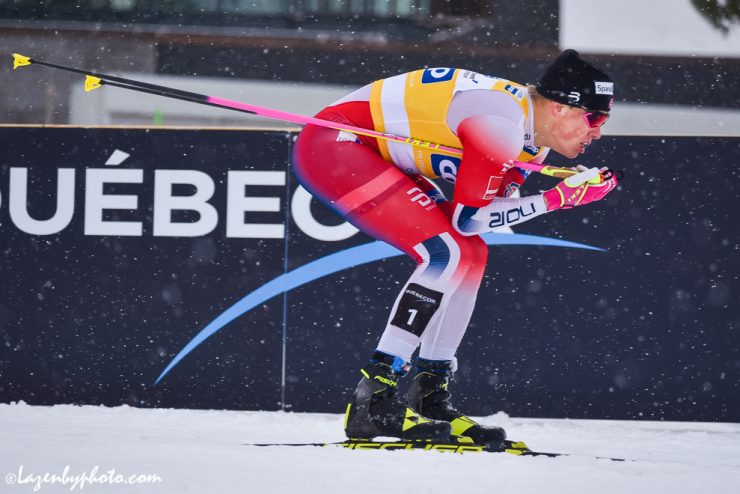
Johannes Høsflot Klæbo during the Quebec City sprint qualifier. (Photo: John Lazenby/lazenbypohoto.com)
Johannes Høsflot Klæbo during the Quebec City sprint. (Photo: John Lazenby/lazenbypohoto.com)
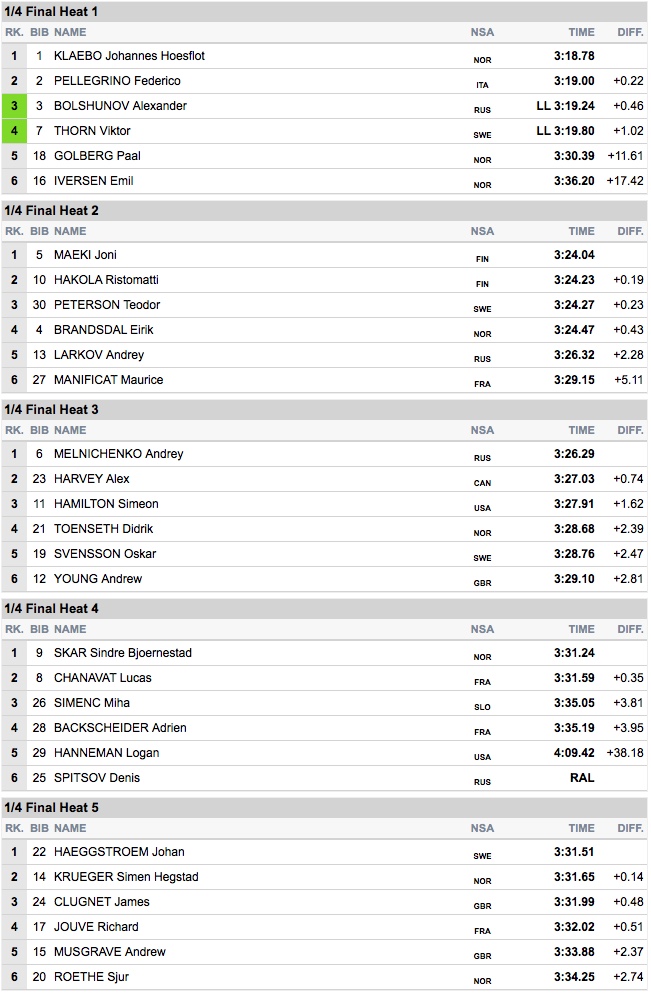
Russia’s Alexander Bolshunov, second in the World Cup overall standings, went head to head twice against Klæbo on Friday. In the quarterfinals, Bolshunov went full-throttle from the start. He looked like he could pull off the start-to-finish-pull for much of the first Klæbo encounter. Yet had did fade to place third in the heat which his nemesis won.
In the final with Klæbo, Bolshunov had a timid start. He hung in the back. This time playing a different strategy. Around 1:20 into the final, Bolshunov did accelerate. He gained a few spots to move into fourth.
Another skier in the final knowing it was Klæbo’s show, Italy’s Federico Pellegrino, made an up-tempo counter punch on a steep climb at the 1:55 mark. Hop-skating on the outside, Pellegrino pushed. Sindre Bjørnestad Skar of Norway led over the top and kept the Pellegrino move in check. With over a minute of racing to go, Klæbo kept in control. Skar took the lead, Klæbo followed, with the Italian and Bolshunov in third and fourth.
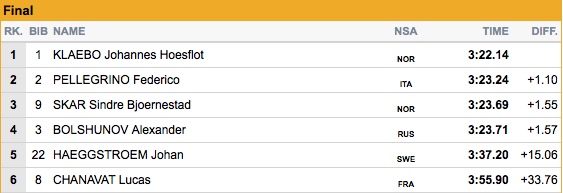
Nonchalantly, Klæbo took over race control ten seconds later. Nothing shiny. Nothing really marked with flare. Just simple flat out free-skating, V2ing, and lovely sprinting. He won in 3:22.14. Pellegrino was second (+1.10), and Skar third (+1.55). Bolshunov skied to fourth (+1.57).
The men’s sprint final in Quebec City. (Photo: John Lazenby/lazenbyphoto.com)
Johannes Høsflot Klæbo of Norway strining out the men’s sprint final in Quebec City. (Photo: John Lazenby/lazenbyphoto.com)
“Quite difficult conditions today, it was a really fun race,” Klæbo told FIS after the race. “I think the quarterfinal was the toughest one, it was really hard. It seems like Bolshunov is in good shape so it should be an interesting weekend.”
Coming into Friday’s races, Klæbo held a 14 point lead over Bolshunov for the World Cup overall. With the win, Klæbo earned 50 points, Bolshunov 40th for fourth. With two distances races remaining, it does get interesting. Klæbo leads with 1443 points to Bolshunov’s 1419.
In the press conference, Pellegrino made light of his second place finish as he deferred to a skier he has gained much respect for.
“This adds to the long list of second place behind Johannes,” Pellegrino said according to a translator. “It will be a long list. I will keep training very hard to be on top. I still have the legs to keep up so I will keep on trying. I have never made a podium in Québec before so I think I can do it again next year. I heard a lot of noise, ‘Pellegrino, Pellegrino’. In Europe, it’s hard to get people to come out and watch in bad weather. There was a lot of emotion in Alex [Harvey], but next year I hope they will still come to watch even without Alex. The courses were in good shape in spite of the conditions and the crowd here is amazing!”
Federico Pellegrino the men’s sprint qualifier in Quebec City. (Photo: John Lazenby/lazenbyphoto.com)
A spent Federico Pellegrino after the men’s sprint final in Quebec City. (Photo: John Lazenby/lazenbyphoto.com)
World Cup skiers understand Pellegrino’s sentiments. They too are here to soak in the Québec City atmosphere as it is an extension of Alex Harvey’s love for the sport and Québec’s love for him. Harvey qualified in 23rd on Friday and finished 10th overall.
“It was really good,” Harvey said in the mixed zone after the race. “I think in a stage event like this the goal for every sprint day is to make the semis, that’s where the sweet spot is for bonus seconds, so that was really good. … The semi-final was the fastest heat out of the two, it was just full gas the whole way with Bolshunov. So the other guys were just faster, but I haven’t qualified on the World Cup since December 2018. So I’m not the best sprinter anymore. So for me to make the semis it was great.”
This is Harvey country. (Photo: John Lazenby/lazenbyphoto.com)
Alex Harvey during the Quebec City sprint qualifier. (Photo: John Lazenby/lazenbypohoto.com)
Simi Hamilton was the top American on the day in 13th. After qualifying in 11th, Hamilton bowed out after placing third in his quarterfinal, roughly .5 seconds behind Harvey who skied to second.
“It’s just tough out there,” Hamilton said of the soft snow. “You know I think I’ve gotten better at skiing in those kinds of conditions, but still not totally there and it was just really soft and slow, made it extra hard with the headwind in places and it’s not fun skiing, but that’s ski racing. It’s not gonna be super enjoyable all the time. I think probably everyone feels like they can’t really ski out there today because it’s so hard.”
U.S. skier Logan Hanneman made the top-30 cut after qualifying in 29th. Skiing near the back of his heat in the quarters, Hanneman lost his balance around a dicey downhill corner.
“My ski just got grabbed by some of the snow,” Hanneman said of his tumble. “It’s pretty wet and deep on that corner especially and a snake jumped up and bit me and down I went. That’s how it goes I guess, but it’s tricky conditions out there and even on the downhill leading into it was grabbing the skis and going everywhere. You have to be light on your feet, which is not my forte.”
Simi Hamilton (bib 11) during his quarterfinal of the Quebec City sprints. (Photo: John Lazenby/lazenbyphoto.com)
Logan Hanneman during the Quebec City sprint qualifier. (Photo: John Lazenby/lazenbypohoto.com)
Hanneman has seized several opportunities this season on the World Cup. He first qualified for the World Cup heats this past February in Cogne, Italy.
“Just this season, I’ve only got a few World Cups in me and I qualified 15th in Cogne,” Hanneman said. “And then I qualified at World Champs and here and so I’m really happy to be making it into the heats now. I was really excited today to try to be a little more competitive in the heats because in the heats I’ve done before I’ve just been in the back. I don’t know when and where to pass because it’s so tight. So I was excited I felt pretty good on that uphill and I was excited for this uphill for sure and it didn’t happen so that’s okay.”
Racing continues tomorrow with a 15 k classic mass start race for the men and a 10 k for the women.
Sweden’s Stina Nilsson during the 1.6 k skate sprint qualifier in Quebec. Nilsson won the sprint final. (Photo: Doug Stephen)
We’re changing the format for this race rundown. With many North Americans racing during World Cup finals in Québec, screenshots from Live Timing will keep the rundown updated efficiently.
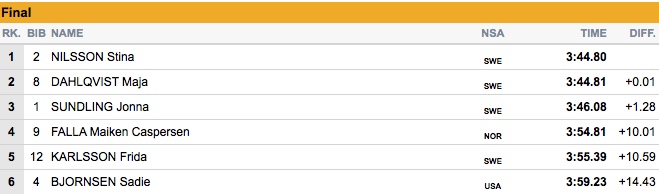
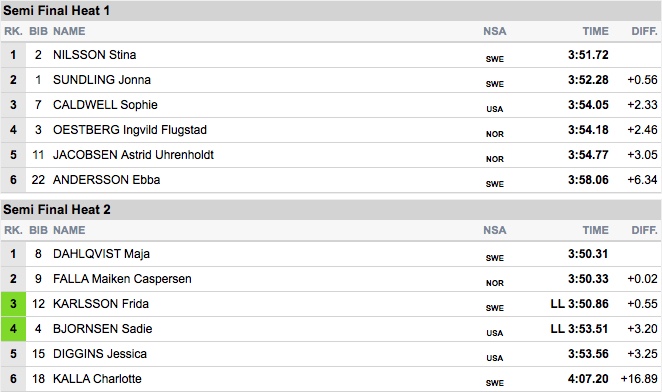
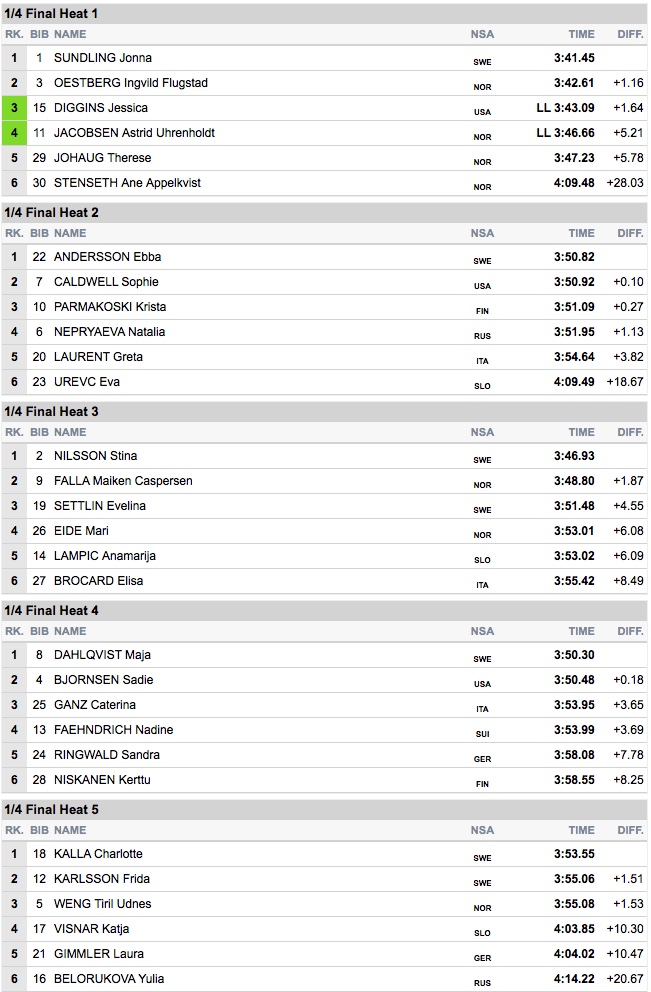
In the finals of Fridays; 1.6 k skate sprint in Québec, Stina Nilsson took the win and with it the sprint Crystal Globe overall. Sweden also took second and third place with Maja Dahlqvist and Jonna Sundling respectively. American Sadie Bjornsen placed sixth overall as the top North American finisher.
FIS World Cup 1.6 K Freestyle Sprint Québec
In the semi-finals, Jessie Diggins (USST), Bjornsen, and Sweden’s Charlotte Kalla tangled up early in the second semi-final as they rounded a tight corner. Kalla fell off the pace, while Diggins and Bjornsen fought to regain contact with the three skiers up ahead. Bjornsen out-toed Diggins for a lucky loser spot in the finals.
In the men’s race, Norway’s Johannes Høsflot Klæbo took control of the final late in the race to do as he does: win with little pressure to push a toe across the line. Italy’s Federico Pellegrino place second, with Sindre Bjørnestad Skar of Norway in third.
Canada’s Alex Harvey advanced to the semis where he was eliminated to place 10th in the final standings.
Simi Hamilton was the top-ranked U.S. skier finishing 13th in Thursday’s sprint. Logan Hanneman (APU), also for the U.S., fell in the fifth heat but ranked 25th overall.
The men’s podium from the Falun, Sweden 15 k skate. From left to right, Norway’s Martin Johnsrud Sundby in Second, Alexander Bolshunov of Russia first, and Didrik Tønseth of Norway third. (Photo: fis-ski.com screenshot)
Sunday’s men’s 15-kilometer freestyle individual start race in Falun, Sweden, was the final European stop for the World Cup. With the race concluded, athletes will pack up ski bags, moth-ball the wax buses, and jet across the Atlantic. Next week athletes will race amidst the crowds and city-scape of Québec.
The final Euro-leg of the World Cup saw Alexander Bolshunov of Russia win his third individual race in a row. His top-step effort was his fifth win of the season. Norway took the next three spots with Martin Johnsrud Sundby in second, Didrik Tønseth in third and Sjur Røthe in fourth.
During the first 5k of the race Bolshunov moved up through a tight pack clustered near the top of the time splits.
After his first 5k lap, Bolshunov held a 4.4 second margin over Russia’s Alexey Chervotkin at 5k. Sundby kept it real for Bolshunov coming through at 5.6 seconds back. With the relative luxury of a late bib start, Bolshunov wore bib 69, Sundby 47, the Russian could push towards the redline of effort knowing precisely where he stood against Sundby.
At the 10 k mark Sundby was a an eyeblink back amounting to 0.4 seconds behind Bolshunov. In other words, Bolshunov understood his race lead margin was thin. With 2 k remaining, Bolshunov had a pad of 3.1 seconds. That buffer would have been enough as Bolshunov finished today’s race in a time of 33:18.6. Sundby placed second, 8.9 seconds back.
Along with the day’s top prize, Bolshunov seized for good the overall distance crystal globe. The twenty-two-year-old Russian began the distance crystal globe campaign with the first race of the season, a 15 k classic win in Ruka, Finland. Along the way, Bolshunov collected seven distance podiums, including Sunday’s win. His streak of three successive World Cup distance wins includes a 15 k classic in Cogne, Italy prior to World Championships. He then followed that with a win in the Holmenkollen 50 k classic.
Canadian skier Alex Harvey was the first North American to cross the line finishing 11th overall. During the second half of the race, Harvey skied from 21st to 11th, he finished +1:10.9 behind Bolshunov.
David Norris (APU) of the U.S. was the top American finisher. In Falun, he finished 16th for a career best individual World Cup result. The success curve of late for Norris has been remarkable. The twenty-eight-year-old Anchorage based athlete has been a highlight for U.S. men’s distance skiing.
The man has a motor. Ask the field contesting the Mt. Marathon race in Seward, Alaska. He’s a multi-time winner. The motor has now been fine tuned to excel in wintertime Europe. He placed 20th in the 2019 World Championship 50 k mass start skate. He proved that mark was no aberration with a 24th in the Holmenkollen 50 k mass start classic. And then Sunday was a bump in the standings for that 16th place.
“I am certainly more confident this spring than I was during Period 1 of World Cup,” Norris emailed when asked if he was carrying more confidence since his Seefeld result. “This higher confidence allowed me to improve my pacing today; I was more relaxed going into it and able to ski my own race.”
According to Norris, he’s more likely to push on the climbs and recover on more variable terrain. He attributes some of his success to making subtle pacing changes.
“My usual tendency is to focus on the climbs,” Norris wrote. “I have been working on relaxing a bit on the climbs so that I can focus more on pushing the gradual terrain. I know I can climb well, but if I emphasize that too much I tend to lose time over the rest of the course.
“The new snow today packed down well for the men’s race. I like how the course flowed; I felt strong on the long climb and had a game plan to really target the flats after the climb and the flats leaving the stadium.”
American David Norris the men’s 30-kilometer skiathlon at the 2019 World Ski Championship in Seefeld, Austria. (Photo: John Lazenby/lazenbyphoto.com)
During a year when the U.S. Ski Team has offered numerous international starts to a host of non-USST members, Norris and his trifecta of results in the points promotes the notion that on the right day and even the right World Cup string of races, elite U.S. skiers can step up.
“I am super happy with my result- I feel like I have recovered well from back-to-back 50ks, and my skis were good,” explained Norris when asked if he was surprised to find himself so close in the standings to Canada’s Alex Harvey, who placed 11th. “Today was the type of result I have been believing I should be able to do on a good day, so I am psyched to have made that happen.”
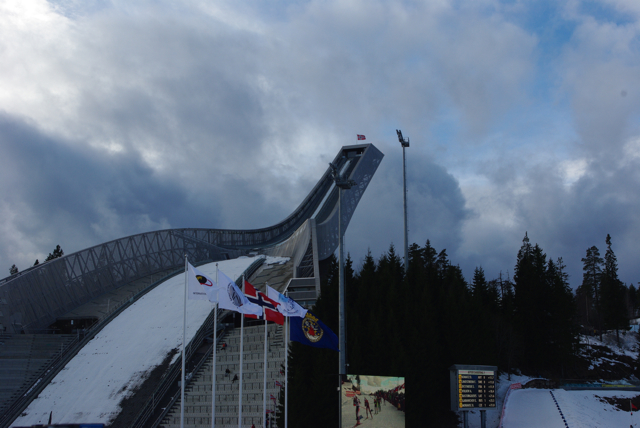
The Holmenkollen jump overloooks the iconic venue above Oslo, Norway.
FIS World Cup Oslo, Norway Holmenkollen 50 K Mass Start Classic
Today’s podium at the men’s 50-kilometer mass start classic at Holmenkollen involved a tight group of skiers, many of them Russians and Norwegians.
Of the top-11 skiers, five were from Russia, five from Norway with the lone wolf slotted in there, Alex Harvey from Canada.
Russia swept the podium with twenty-two-year-old Alexander Bolshunov placing first in 2:23:49.8 hours. Maxim Vylegzhanin was second (+1.0), and Andrey Larkov third (+1.6). For good measure, Ilia Semikov, also from Russia, skied to fourth (+2.0).
Harvey, in his final appearance at Holmenkollen, placed fifth (+4.6). Norway took sixth through ninth.
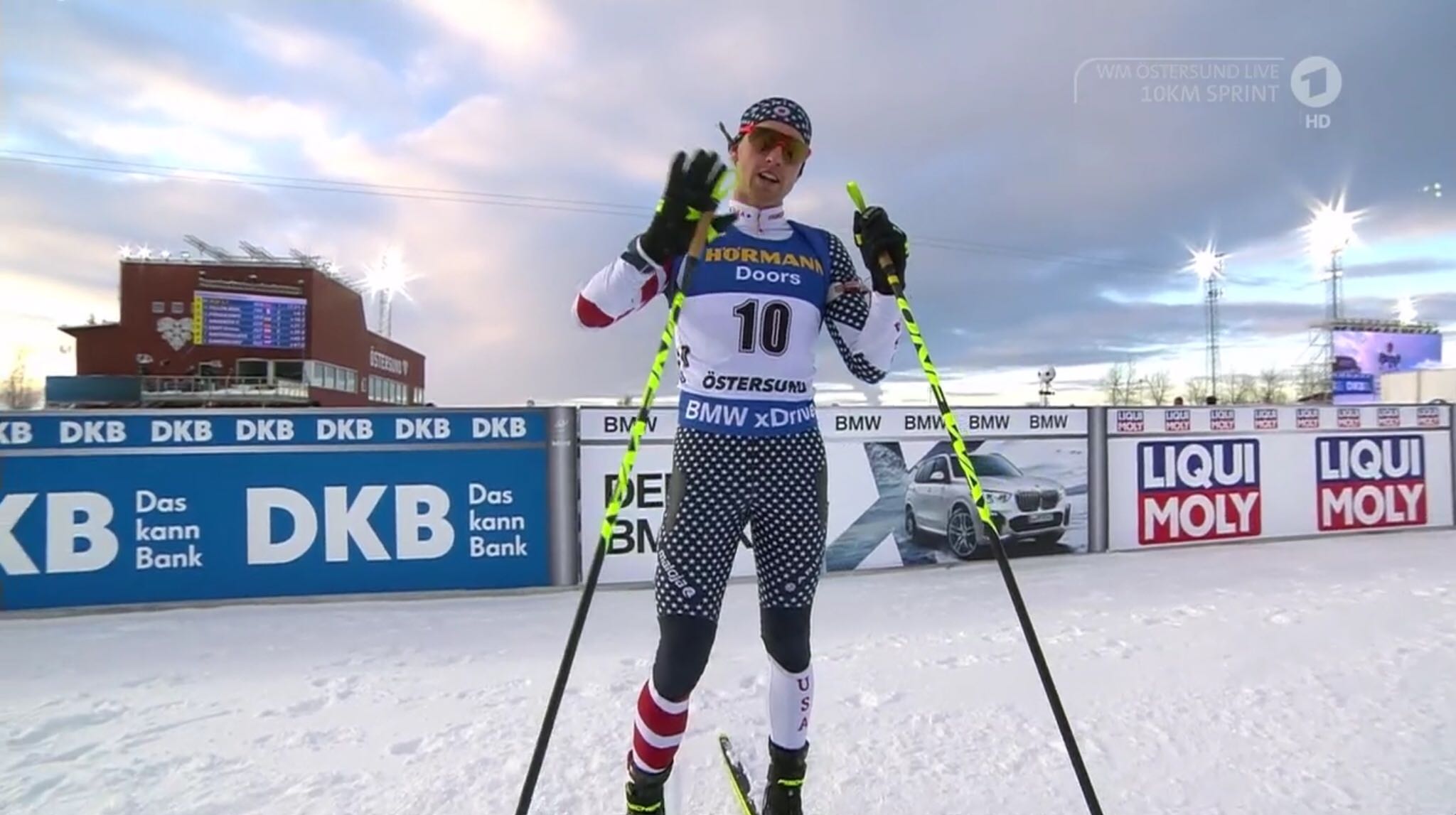
On Saturday in Östersund, Sweden, the IBU World Cup men’s field raced a 10-kilometer sprint, with Norway’s Johannes Thingnes Bø took the win, completing the course in a time of 24:37.6 after one miss (0+1). Russia’s Alexander Loginov placed second after shooting 100 percent and finishing 13.7 seconds behind Bø. Third place went to France’s Quentin Fillon Maillet, who also shot clean and finished 16.5 seconds behind the winner.
Leading the way for the North Americans was the U.S.’s Sean Doherty in 22nd. Doherty shot clean and finished 1:32.1 minutes back from Bø. Just outside the Top 30 was American Leif Nordgren who also had a perfect shooting score and finished 1:51.5 minutes off the winning time.
American Sean Doherty ater placing 22nd on Saturday in the men’s IBU World Cup 10-kilometer sprint held in Östersund, Sweden. (Photo: ZDF Screenshot)
Racing for Canada, Scott Gow finished in 50th (+2:18.2) after one miss. U.S. skier Jake Brown placed 58th (+2:41.0) after three misses (0+3) and Canadian Aidan Millar 61st (+2:43.5) with one missed shot (1+0). Two more Canadians raced on Saturday, with Jules Burnotte placing 76th (+3:18.1) after two misses and Christian Gow finishing in 84th (+3:32.5) after four missed shots (2+2).
The 2019 NCAA Skiing National Championships wrapped up on Saturday, with the University of Utah taking home the overall title. Utah finished with 530.5 points, followed by the University of Vermont with 476 points, and Colorado University with 455 points.
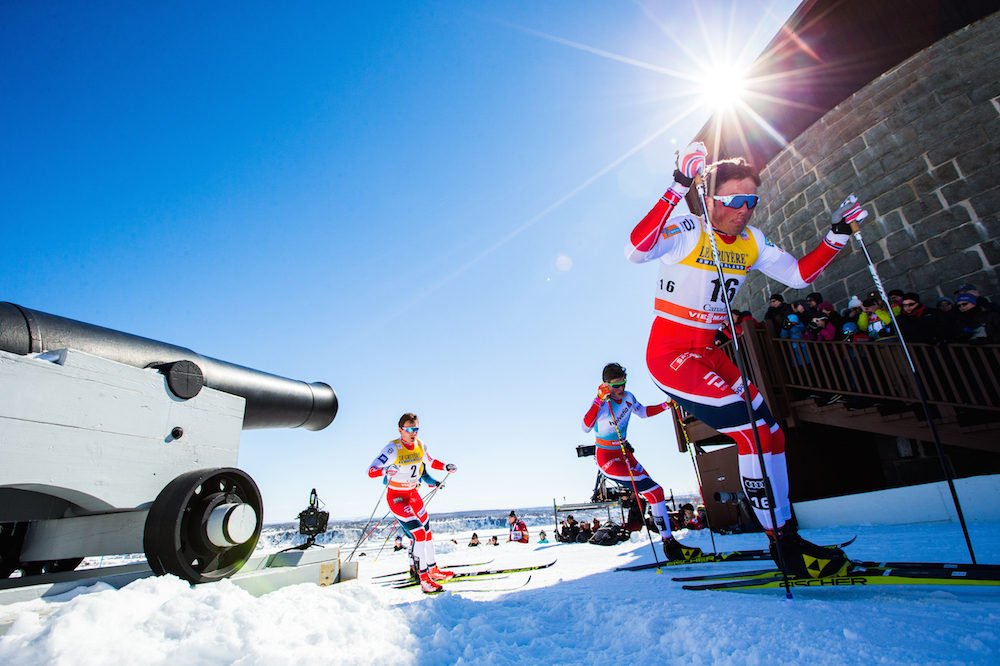
Norway’s Emil Iversen (16) leads Johannes Høsflot Klæbo (c) and Finn Hågen Krogh during the men’s 15 k classic mass start on March 18, 2017, at World Cup Finals in Quebec City. Klæbo went on to win. (Photo: Dustin Satloff)
North American World Cups are becoming a fixture on the schedule, with the season ending in Canada in 2016, 2017, 2019, and 2020. In 2020, Minnesota will join in with a city sprint- that race falls between the Quebec City and Canmore events. These races are important for athlete development as both Canada and the U.S. are granted ‘host nation’ start allocations. Fifteen male and 15 female athletes may represent each country with the added bonus of allowing young skiers to see World Cup stars in person.
Cross Country Canada wanted to integrate these World Cup events with the domestic racing calendar. As nationals are held at the end of the season, the obvious solution was to select a nationals host that is near the World Cup Final. While Canada has roughly the same population as California, that population is spread over 5.5 time zones in a land area far larger than the United States. The opportunity to race nationals and watch a World Cup with a single round-trip flight makes this much more attractive and affordable to families.
With the introduction of the Junior FIS Invitational Rising Stars in 2019 (a race for young skiers on the World Cup course), there is a third incentive to make the trip and see Alex Harvey’s retirement weekend in person. CCC’s Dave Dyer is excited about the new addition: “With the Rising Stars race, those [young athletes] that have a FIS license can also train beside WC athletes and compete on the same course. We have junior teams from across North America planning to participate in the junior FIS race.”
To make this schedule work, CCC needed host venues for nationals that could set homologated courses for seven days of racing later in March. Even in Canada, reliable snow in March can be a challenge.
To align with 2019 World Cup finals in Quebec City from March 22 to 24th, nationals will be hosted less than five hours drive away at the Nakkertok trails, in Gatineau, Quebec from March 13th to 20th.
In 2020, Sovereign Lake will host nationals after World Cup finals from March 25th to April 3rd. The 2020 bid document requested that bidders plan to follow the three final world cups in 2020, from March 14th to 22nd (Quebec City, Minnesota, Canmore). Sovereign Lake, along with the interconnected SilverStar Mountain Resort, has 105km of trails open every April. As the annual Spring Fling snow camp in May shows, ‘late season’ skiing is pretty reliable at 1,600m elevation.
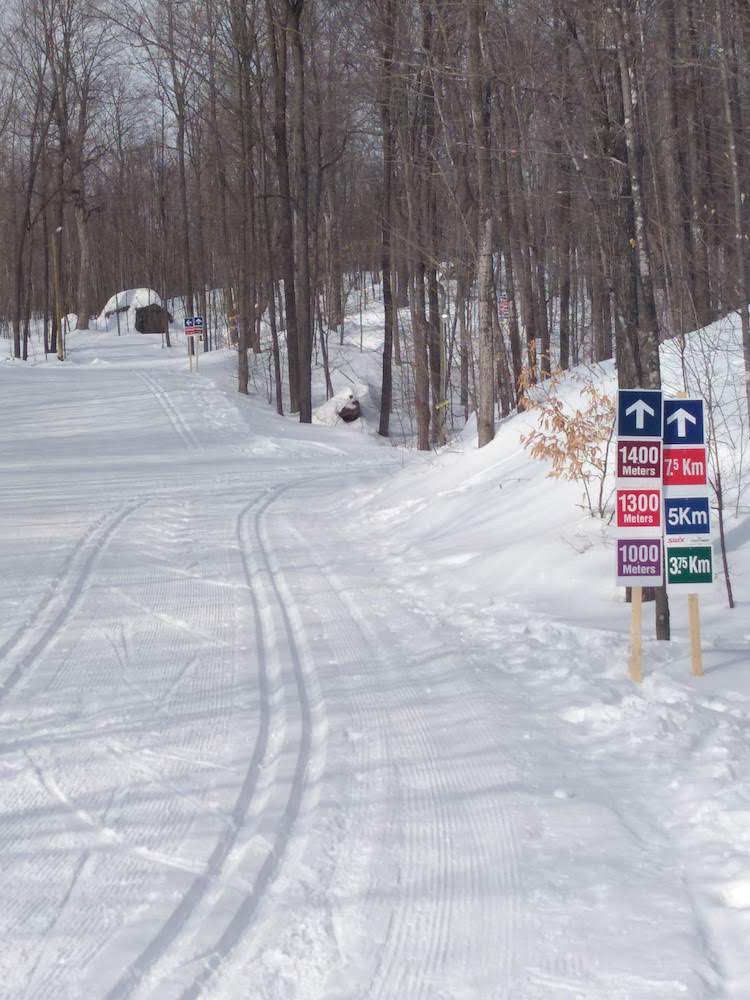
Nakkertok Trails on March 5th, 2019. (Photo: Toni Scheier)
In eastern Canada, there is snow and good skiing in March most years, but guaranteed snow on homologated courses is less certain. As a result, most clubs choose earlier dates in their bids to host nationals, sometimes even starting in February. With the advent of snowmaking at the Nakkertok trails in 2016, the game changed. While natural snow is abundant this season and snowmaking won’t be needed this month, the capacity to make snow was an important part of Nakkertok’s winning bid.
Gatineau remains an accessible area for many. The trails sit across the river from Ottawa (Canada’s capital) and are less than an hour from the major airport. The region is also surrounded by large population centres like Montreal and Toronto, with over 12 million Canadians within six hours drive. To restate, one third of Canadians live within weekending distance of the venue. This is one factor in the historic success of Eastern Canadian Championships over the past decade, with over 700 racers consistently making this the largest FIS event in North America in those years.
A second factor contributing to the venue’s race-hosting success was the formation of a stable coalition to host events. The 2019 nationals will be hosted by Évènements Nordiques Gatineau Nordic Events, an organization made up of Chelsea Nordiq, Nakkertok Nordic, Club Skinouk and the Gatineau Loppet. ÉNGNE also hosted the Gatineau stage of Ski Tour Canada in 2016.
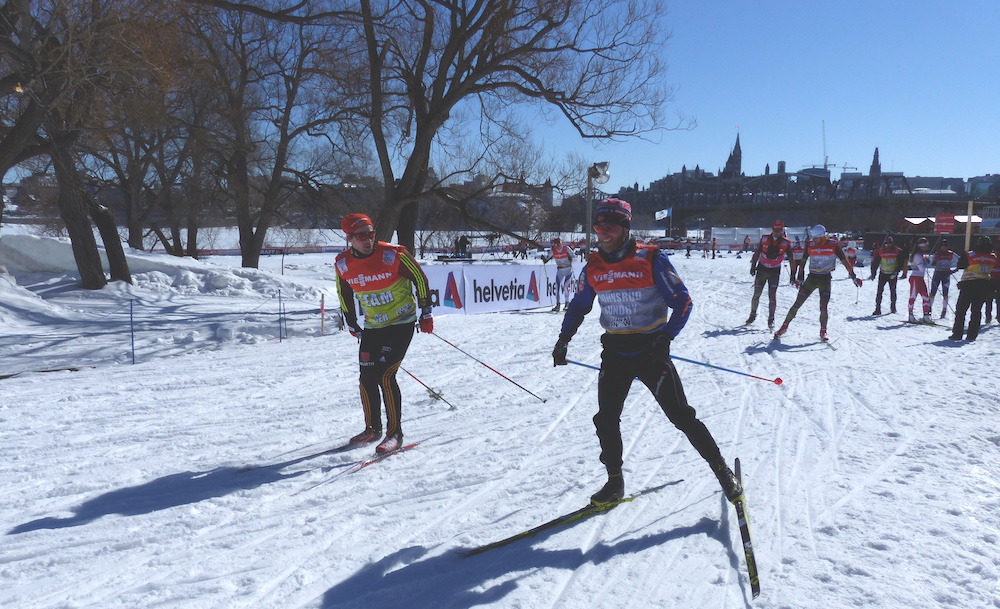
ÉNGNE was the host for stage 1 of the Ski Tour Canada in Gatineau. Martin Johnsrud Sundby inspects the course with Ottawa’s parliament building visible in the background. (Photo: Peggy Hung)
Pierre Millette, Chief of Race for 2019 Nationals and a Skinouk member, summarized the formula for success this way: “Mutual respect, a written agreement, complementary strengths. … The right people in the right places.”
Even though the races will be held on the Nakkertok trail system, every Nakkertok member interviewed for this article has been careful to reference the coalition.
Toni Scheier, a Nakkertok member who writes the CCC race reports, followed up with an emailed request: “Please emphasize that while the event is held at Nakkertok, […] the organizing committee ÉNGNE is from Skinouk, Chelsea, Nakkertok and Gatineau Loppet.”
This care to respect the contributions of others and a points system to share profits appear to be the key difference that keeps the engine turning. It is also easier to share profits than losses, which has contributed to ÉNGNE’s past reluctance to bid for late season events, as cancellations and venue changes are never profitable.
When Nakkertok’s snowmaking infrastructure was completed, the club expected to create reliable skiing on December 1st.
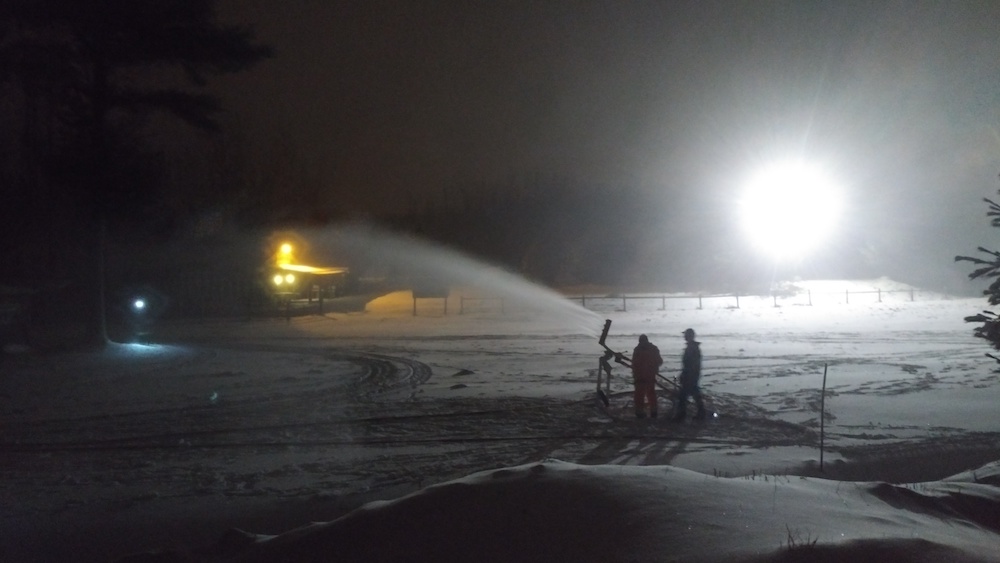
Testing the snowmaking equipment in November 2016. (Courtesy photo)
“From my perspective as head coach of the racing program, this is an amazing opportunity,” Nakkertok’s Kieran Jones wrote in November 2016. “Snowmaking has leveled the playing field across the country and the continent for our program. We’re competing against other top clubs and regions who have access to early season snow, and up until this point we have been at the mercy of the weather. For example, last season’s poor early-season weather meant we didn’t have skiing in the Ottawa-Gatineau area until between Christmas and New Year’s.”
Talking about the first Candy Cane Cup, scheduled for December 18th, 2016, Jones wrote, “our goal in the future is to create a high quality race experience at Nakkertok that is accessible in terms of cost and travel distance for the large numbers of athletes in Eastern Canada and the US who want and need to race.”
Scheier elaborated on Jones’s email, writing “It will also ensure snow for the Easterns where clubs from across the country attend, (700 plus competitors) and for our Nationals bid, likely 2019.”
On November 23rd, 2016, the day after Jones and Scheier made these statements, the first skiers were out training on man-made snow. Subsequently, they were able to open limited trails on November 11th, 2017 and November 12th, 2018. Those ambitious dreams are starting to look real.
Training on man-made snow on November 11th, 2017. (Photo: Toni Scheier)
The snowmaking system at Nakkertok came about in an unusual way. The core funding came from the Kraft-Heinz Project Play contest, which offers annual awards to communities in Canada to create opportunities to play. The grand prize winner gets $250,000, and the three runners up collect $25,000. Nakkertok won the 8th edition in 2016.
The race team raised $50,000 and money from other parts of the budget filled in the gaps to build the original system. The city of Cantley (on the west side of the trail system) helped Nakkertok to a “Fonds de développement des territoires” grant of $60,000 in 2017.
The ‘NakkerTrak’ expansion in 2018 is evidence of continued success in snowmaking and fundraising.
The upgrading process continues.
In the final analysis, was all the work that went into connecting these events together worth it? Many families will be making the combined trip, this nationals should be the largest FIS event in North American history, and to give Dave Dyer the last word:
“There are 250 racers in the National Capital Region that can sleep in their own beds.”
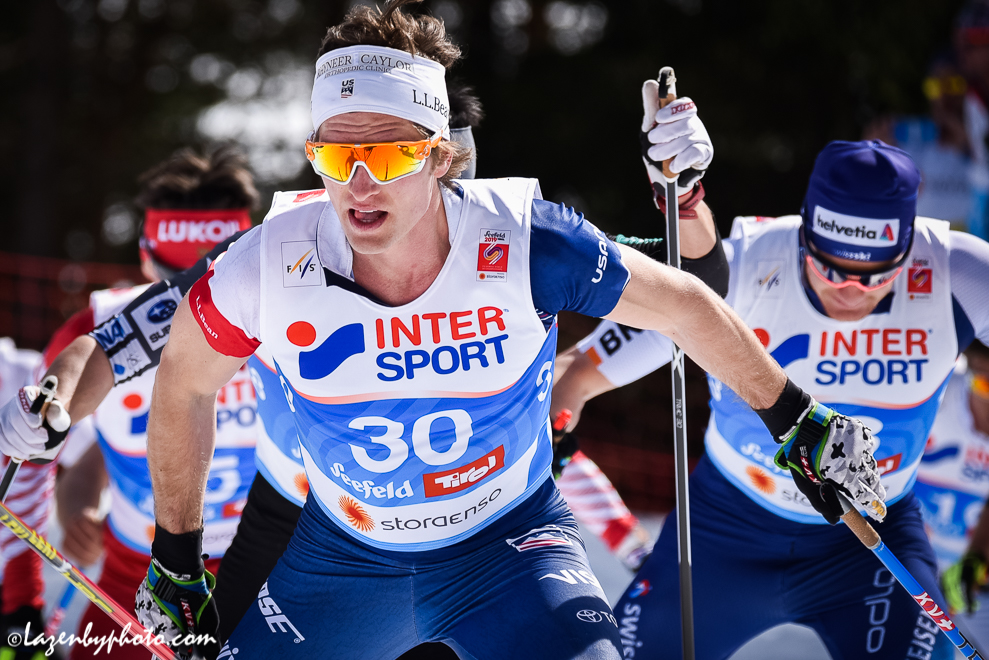
Norway’s Hans Christer Holund reaching for a feed during the men’s 50 k skate at the 2019 World Championships. (Photo: John Lazenby/lazenbyphoto.com)
The 2019 Seefeld World Championships event came to a close on Sunday, the 11 days of competition capping off with a men’s 50-kilometer freestyle mass start. Unlike two years ago at the Lahti World Champs, when the top six finished within four seconds of each other, Canada’s Alex Harvey ultimately earning the 2017 title, this year’s World Champs featured no head-to-head sprint to the finish.
In Seefeld on Sunday, Norway’s Hans Christer Holund crossed alone, arms raised high in celebration of his gold medal performance. He stopped the clock at 1:49:59.3, the next closest finisher being Russia’s Alexander Bolshunov, who crossed 27.8 seconds after Holund.
Norway’s Hans Christer Holund crossing the line in first as he wins the 50 k skate at the 2019 World Championships. (Photo: John Lazenby/lazenbyphoto.com)
Holund’s break from the pack came at the 21 k mark, a decisive move observed by his teammate Martin Johnsrud Sundby, who initially assumed the role of leading the chase pack as Holund skied ahead. The pulse of close to 40 skiers threatened to swallow Holund back up, if Sundby let it.
But the Norwegian continued to ski alone and in the lead past the 25 k mark, the 30 k mark, the 35 k. What may have at first appeared like an unsustainable rabbit’s pace off the front, was turning out to be cruise control for Holund. The 14-second gap he had on the field at 22 k had grown by a minute at the 34 k mark. Over the remaining 15 k, only Bolshunov would manage to put any more than 30 seconds back into Holund.
Even after securing the win, the 30 year old was somewhat surprised that he managed to maintain such a significant amount of time between himself and the rest of Sunday’s 50 k field.
Norway’s Hans Christer Holund taking a feed during the men’s 50 k skate at the 2019 World Championships. (Photo: John Lazenby/lazenbyphoto.com)
This is the first race Holund has competed in at the Seefeld World Champs, his start itself uncertain until recently.
“I’ve been in not so good shape this year and I actually didn’t thought I was going to go this race because I wasn’t qualified, but when I finally got the chance I thought well this may be my last chance to be World Champion, so I just have to go for it,” Holund said.
According to the FIS database, the title is Holund’s first World Championships gold–the only other World Champs event he has raced was the Lahti 50 k, where he placed 10th.
Holund’s closest challenger on Sunday, Bolshunov, had made his move to the helm of the chase pack around 25 k. The Russian did not begin to gain time on the Norwegian, however, until he broke from the chase group at 38 k.
From there, Bolshunov did regain 46.2 seconds on Holund, but ran out of course to see if he could make up the remaining 27.8 seconds. The podium finish is Bolshunov’s fourth from the Seefeld World Champs, all of which have been silver medal performances. Prior to this year, the 22 year old had never medaled at a World Champs event.
Russia’s Alexander Bolshunov during the men’s 50 k skate at the 2019 World Championships. Bolshunov came close to closing down Holund’s lead. (Photo: John Lazenby/lazenbyphoto.com)
Sunday’s battle for bronze place came down to Norwegians Sjur Røthe and Martin Johnsrud Sundby. With less than 5 k to go, the two had moved to the front of the chase pack behind Holund and Bolshunov. In a sprint to the finish, Røthe outlunged his teammate by 0.1 seconds for third (+57.8) and Sundby place fourth (+57.9).
Leading the way for the North Americans on Sunday was Canada’s Alex Harvey in 12th (+1:10.5). Two years ago in Lahti, Harvey earned his first individual World Championships title in the men’s 50 k race, Sunday’s 50 k being his final career World Champs event. At the age of 30, Harvey announced his decision to retire after this year’s World Cup races in Quebec City, Quebec.
“I think it is pretty clear it is not what I had hoped for or dreamed for,” Harvey said during a post-race phone call. “I think today and for the whole week, or the whole of the last two weeks, I just have got to look at things with a more objective eye. The skiathlon is my best result of the season in distance. I had my best race of the season at World Champs so that is good. But of course, I was hoping to come away from Seefeld with a podium.”
Over the course of his career, Harvey has competed in six World Championships events, his first being in Liberec in 2009. He has since then amassed five World Champs medals, including two golds, two bronzes, and one silver.
“I really expected the Norwegians to attack, maybe a tiny bit later in the race, I was expecting more around 30 k,” Harvey said of Holund’s move at 21 k. “They kind of did that in Lahti in the 50 k. It forces the other nations to try and take on the chase. So knowing that they have so much depth, I was expecting it from either Holund or Krüger, because it is more their style of racing anyways.
“I had made a decision before the race that if an attack was made, it would not be the one chasing because it would have played too much in the hand of Sundby and Rothe,” he added “At the end of the day, I think Holund was just way better than the rest.”
Canada’s Alex Harvey (first skier from right in the front group) during the men’s 50 k skate at the 2019 World Championships. (Photo: John Lazenby/lazenbyphoto.com)
With less than a kilometer to go, Harvey was still in the running for a podium. The final hill, however, found his legs flooded.
“I think for me there was still an opportunity for third place and I really positioned myself in the best way possible at the base of the sprint hill,” Harvey said. “Then I did not have the legs to go up the hill. I just lost a lot of position I just wasn’t strong enough. It is as simple as that. But everything else, we had the skis. In the 50k you have to have a feeding strategy and try to save energy where you can. I think I did everything to the best. … I would not do anything different. I just was not good enough. It is a bitter-sweet feeling knowing …it is easy to say I gave it my all. At the end of a race, you always give it your all. I think I really executed my plan.”
Following Harvey, two Americans cracked the top 20 on Sunday, with David Norris placing 20th (+1:22.6) and Scott Patterson in 23rd (+2:05.5). Norris came into Sunday’s race having competed in last year’s Holmenkollen 50 k where he placed 38th (He also won the 2016 American Birkebeiner 52 k). Seefeld has been his first World Championships experience.
David Norris of the U.S. racing to 20th overall in the men’s 50 k skate at the 2019 World Championships. (Photo: John Lazenby/lazenbyphoto.com)
“At Holmenkollen [last year], I felt strong, but often I have struggled to get engaged into the top-twenty,” Norris explained during a phone conversation. “From the gun I feel like I am one of the stragglers, trying to hang on.”
Sunday that was not the case for Norris. The 28 year old managed to position himself in the top 20 from the start, making for what he described as “smoother” skiing. He experienced less accordioning between groups of skiers and during the second half of the race was still skiing within 10 bibs of Sundby and Røthe.
“The way I have always tried to race over here is to go out hard and put yourself into the position to have a result that you are excited about and represents my goals,” Norris said. “So often I have died and blown up several times over here, but I feel like when that happens I also know in the back of my mind that if I put everything together the result that is almost a great one was not so far away.
“I think today, when I was racing, more things were just working out and clicking so it allowed me to finally reach the result that I have been pursuing and chasing in the first of races often instead of fading, I continued to feel strong all the way to the finish for the most part,” he added.
Norris will race next weekend’s Holmenkollen 50 k as well as the remaining Period III World Cup races. “I feel like I’m really fortunate that every year my skiing seems to get more feasible and the support has been there,” Norris said. “I think every athlete experiences huge portions of their season where they’re second-guessing or frustrated and those are the times to push through and believe in the plan.”
Patterson explained, the race was “a step up in results”, though still left him “ looking for a little more.” Seefeld is Patterson’s first World Championships, with Sunday’s 23rd his best individual ranking to date. Earlier in the week, he placed 30th in the 15 k classic and 32nd in the skiathlon.
“I spent most of the race kind of dangling on the back end of the lead pack,” Patterson wrote in an email.
The American indicated that he had good energy, though not enough to follow Holund’s break from the front group near the race’s halfway mark.
“I was a bit disappointed with the lack of leadership in the pack when we just chilled out instead of reacting at all to Holund’s move,” Patterson wrote. “There is talk around here of the unwritten principle of the Norwegians to not chase down the first attack. I think we saw that today as well as some weakness in the other strong nations such as Russia and France.”
The American maintained contact with the lead group until his sixth lap when things began to separate. Positioned at the rear of the group, Patterson found himself unable to chase down any breaks.
“Over the course of the first long hill on that lap, the main group seemed to spread and splinter between skiers,” Patterson wrote. “I was a little too far back to make the split for the front of the pack. I tried hard to chase, but going for it solo wasn’t working against a pack of 18. Overall, I am satisfied with 23rd but also believe that I still have more to give the rest of this season. I’m looking forward to another 50 k next weekend at Holmenkollen.”
Scott Patterson of the U.S. racing to 23rd overall in the men’s 50 k skate at the 2019 World Championships. Simi Hamilton (bib 41) placed 34th. (Photo: John Lazenby/lazenbyphoto.com)
However, as much as compartmentalizing athletes simplifies the narrative, Hamilton’s definition of cross-country racer helps broaden the sprint or distance paradigm. According to the FIS, Sunday’s race was Hamilton’s third 50 k at this level of competition. He placed 54th in the 2014 Holmenkollen 50 k classic and was a DNF last season in the Holmenkollen 50 k skate.
“It’s definitely intimidating, I think this is maybe the third fifty k I’ve skied at this level, one of which I didn’t finish – at Holmenkollen last year, and I skied Holmenkollen the previous year,” Hamilton said in a post-race phone call. “It’s certainly quite different from the domestic scene generally, now the pace is just way hotter from the start.”
American Adam Martin raced to 45th (+8:01.7), while Canadians Russell Kennedy finished in 46th (+9:57.6), Evan Palmer-Charrette in 47th (+11:26.1), and Scott James Hillin 50th (+11:27.6).
The toe-surge by Norway’s Sjur Røthe for third place over teammate Martin Johnsrud Sundby who placed fourth during Sunday’s 50 k skate at World Championships. (Photo: John Lazenby/lazenbyphoto.com)
Double click on the photos below to enlarge.
Sweden’s Calle Halfvarsson during the men
s 50 k skate at the 2019 World Championships. (Photo: John Lazenby/lazenbyphoto.com)
Canada’s Russell Kennedy during the men’s 50 k skate at the 2019 World Championships. (Photo: John Lazenby/lazenbyphoto.com)
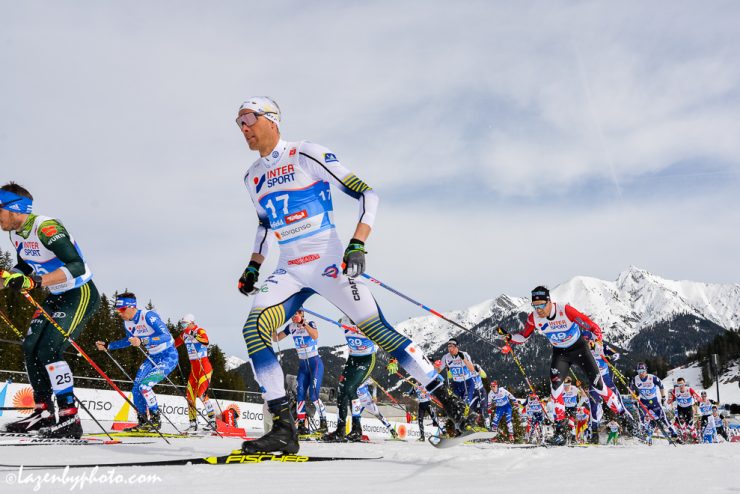
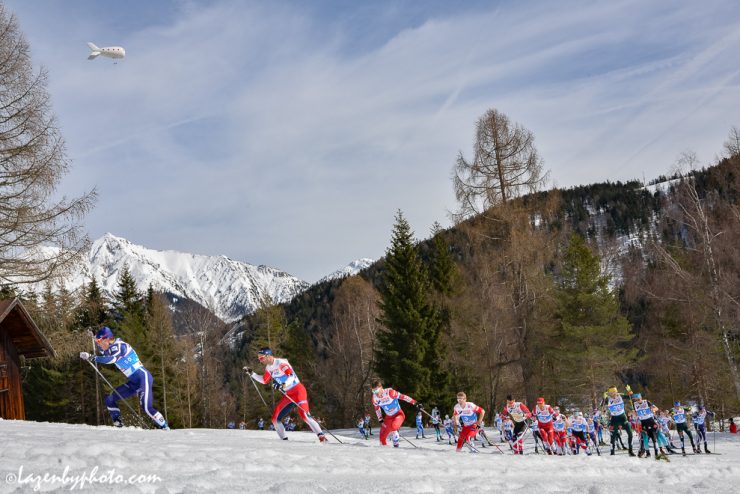
Early in the men’s 50 k skate at the 2019 World Championships. (Photo: John Lazenby/lazenbyphoto.com)
Canada’s Evan Palmer-Charette (bib 43) in the men’s 50 k skate at the 2019 World Championships. (Photo: John Lazenby/lazenbyphoto.com)
Fourth place skier in the men’s 50 k skate at the 2019 World Championships, Martin Johnsrud Sundby of Norway walks with his son after the race. (Photo: John Lazenby/lazenbyphoto.com)
The men’s 50 k skate podium at the 2019 World Championships. From left to right, Russia’s Alexander Bolshunov in second, Norway’s Hans Christer Holund in first, and Sjur Røthe of Norway third. (Photo: John Lazenby/lazenbyphoto.com)
Simi Hamilton of the U.S. takes a feed during the men’s 50 k skate at the 2019 World Championships. (Photo: John Lazenby/lazenby photo.com)
Norway’s Martin Johnsrud Sundby (bib 2) leading the chase-train in the men’s 50 k skate at the 2019 World Championships. (Photo: John Lazenby/lazenbyphoto.com)
Adam Martin of the U.S. in the men’s 50 k skate at the 2019 World Championships. (Photo: John Lazenby/lazenbyphoto.com)
Canada’s Russell Kennedy during the men’s 50 k skate at the 2019 World Championships. (Photo: John Lazenby/lazenbyphoto.com)
David Norris of the U.S. placed 20th overall in the the men’s 50 k skate at the 2019 World Championships. (Photo: John Lazenby/lazenbyphoto.com)
Alex Harvey of Canada after his final career World Championship race. (Photo: John Lazenby/lazenbyphoto.com)
Norway’s Hans Christer Holund crossing the line in first as he wins the 50 k skate at the 2019 World Championships. (Photo: John Lazenby/lazenbyphoto.com)
FIS Nordic Ski World Championships Men’s 50 K Freestyle Mass Start
It has come to a close. The 2019 Nordic Ski World Championships ended today with the men’s 50-kilometer freestyle mass start. Hans Christer Holund of Norway began to make his mark on the race shortly after 20 k with a solo attack. In his bold ski-alone effort, Holund was able to fend off any chasers and win in 1:49:59.3 hours.
Russia’s Alexander Bolshunov timed his chasing surge for a last 10 k punch. By the finish, Bolshunov had eaten up some time on Holund to place second, 27.8 seconds back.
Sjur Røthe and Martin Johnsrud Sundby, teammates on the formidable Norwegian team, created their own gap on the sizable main chase group as they raced up the course’s final climb. Sprinting down the straight into the finish, Røthe out-toed Sundby for third overall (+57.8) as Sundby took fourth (+57.9).
Canada’s Alex Harvey was the top North American in 12th (+1:10.5). He was followed by teammates Russell Kennedy in 46th (+9:57.6), Evan Palmer-Charrette in 47th (+11:26.1), and Scott James Hill in 50th (+11:27.6). If you love play games with mods, Download mods for android games free and let’s go to run your fav game
David Norris was the top American in 20th (+1:22.6), followed by Scott Patterson in 23rd (+2:05.5), Simi Hamilton in 34th (+4:02.), and Adam Martin in 45th (+8:01.7).
The toe-surge by Norway’s Sjur Røthe for third place over teammate Martin Johnsrud who placed fourth during Sunday’s 50 k skate at World Championships. (Photo: John Lazenby/lazenbyphoto.com)
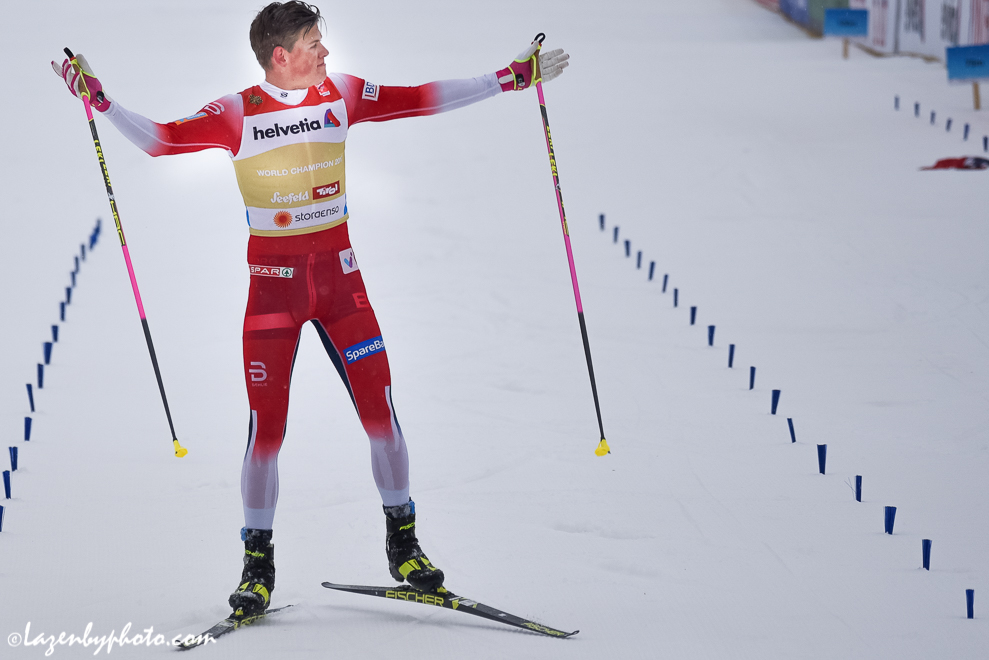
Johannes Høsflot Klæbo of Norway anchoring Norway to the 4 x 10 k relay win at the 2019 World Championships in a Norwegian fan filled Seefeld, Austria. (Photo: John Lazenby/lazenbyphoto.com)
While a temperature in the upper thirties would not normally classify as cool to a ski racer, it was a welcome break from the blazing sun and upper 50’s that have been ever-present in the 2019 Nordic World Ski Championships in Seefeld, Austria. Light rain peppered the athletes in the 4 x 10-kilometer relay, continuing to keep things challenging for the wax techs.
The relay is a testament to both a nation’s depth and strategy, a chess match and a horse race. As was seen in the women’s relay, the selection and placement of athletes decide how the race will evolve, but these decisions are made without the knowledge of an opponent’s line up.
In their quest for a tenth consecutive gold medal in the event, Norway chose the line up of Emil Iversen, Martin Johnsrud Sundby, Sjur Røthe, and as the closer, their sprint champion, Johannes Høsflot Klæbo. Røthe and Sundby sit in second and third respectively in the World Cup distance rankings, while Iversen has shown that he is an “all-arounder” who can respond to many dynamic racing scenarios. Sundby also brings experience to the team as he was a member of the gold medal team in both 2011 and 2017. After winning the overall Tour de Ski, Klæbo has shown that he can be a force in distance races but is most known for his closing speed and sprint prowess, which would come in handy should the race come down to the final meters.
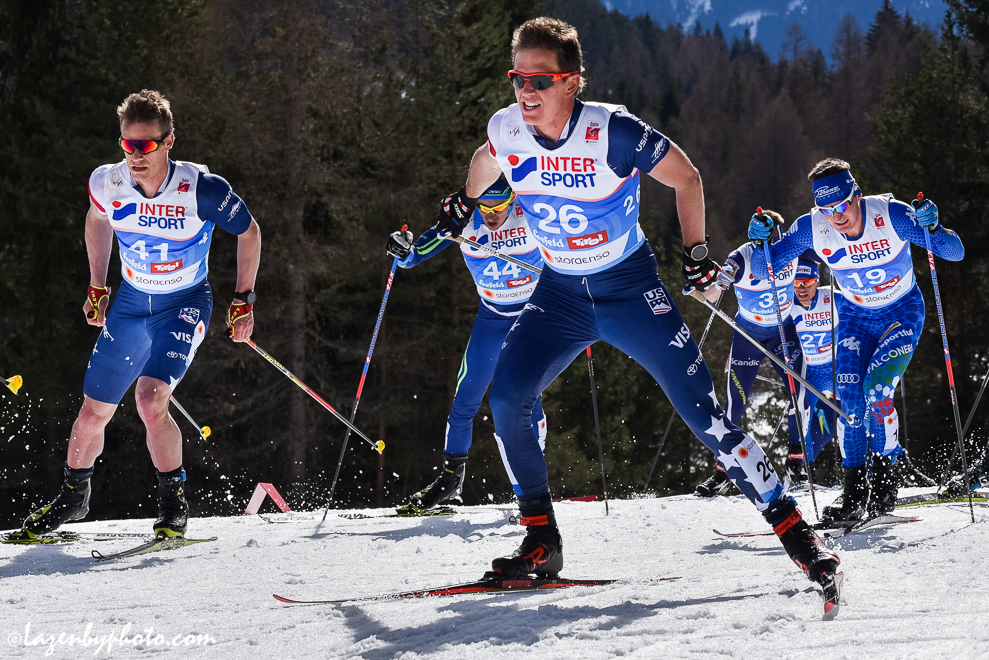
Scramble leg of the men’s 4 x 10 k relay at the 2019 World Championships in Seefeld, Austria. (Photo: John Lazenby/lazenbyphoto.com)
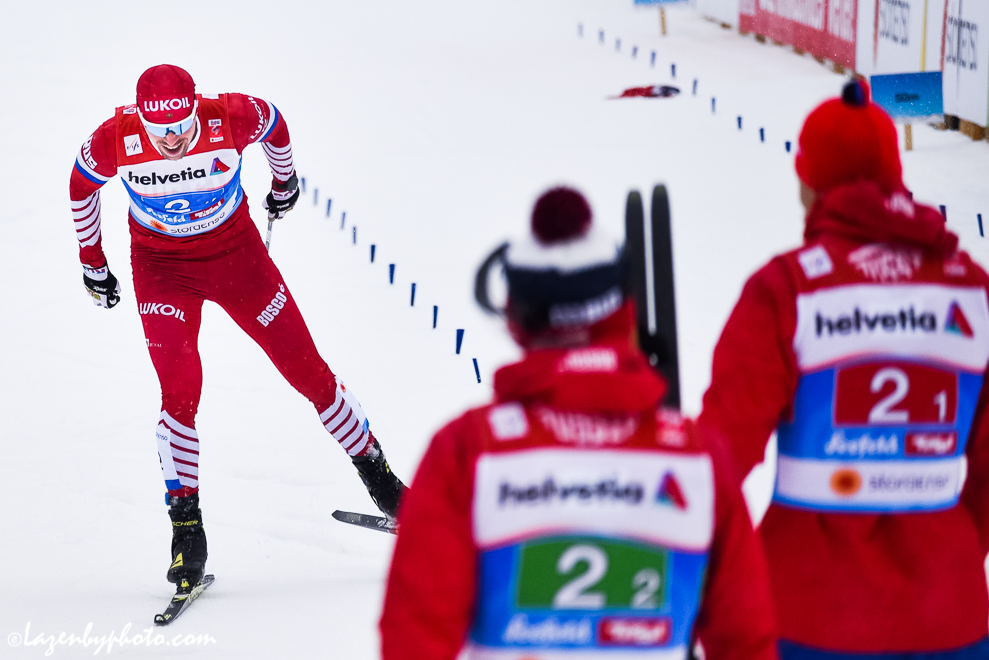
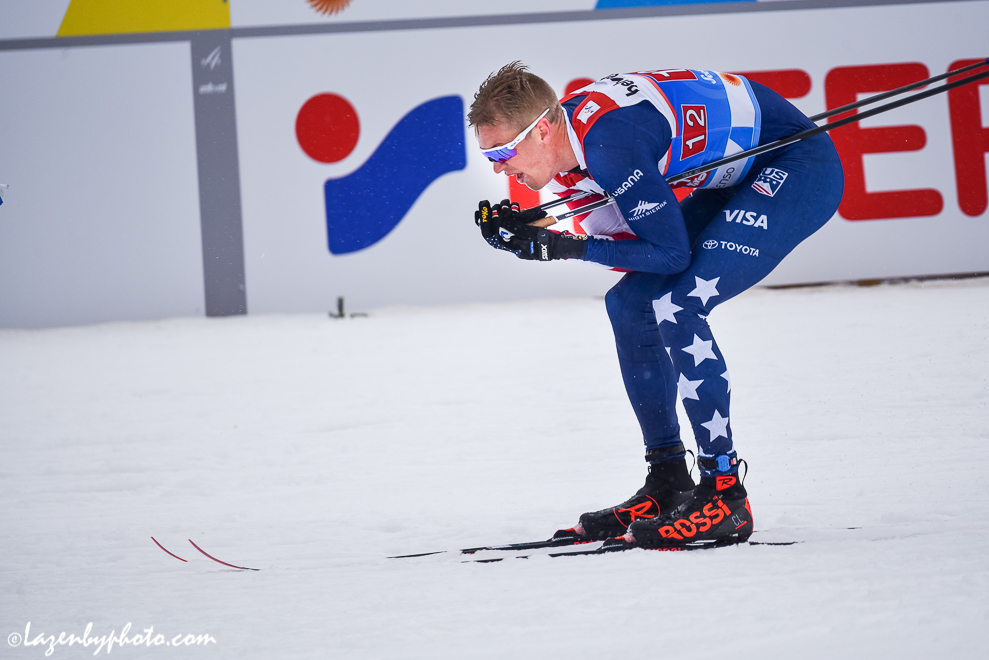
As the race unfolded, it was unclear which nations’ tactics would trump the others. In the first leg, the men slowly began to string out, but the lead exchanged hands several times. Russia’s Andrey Larkov made an early run but was marked by Erik Bjornsen of the US who also spent time at the front. Despite slipping a bit on the climbs, Iversen, who was on harries, skied near the front throughout, entering the stadium first to tag his teammate. At the first exchange, Norway, Russia, and Germany were all within one second of each other, with the US in fourth fading into a chase pack with Sweden and France.
As the second leg began, Sweden’s Calle Halfvarsson surged to catch the leaders within the first kilometer, unwilling to lose sight of a possible 29th World Championship relay medal for Sweden. With him was Iivo Niskanen of Finland, Scott Patterson of the US, and Maurice Manificat of France.
Sweden’s Calle Halfvarsson during the men’s 4 x 10 k relay at the Seefeld, Austria World Championships. (Photo: John Lazenby/lazenbyphoto.com)
While the rain picked up, Niskanen charged to the front and began to string things out in a fashion reminiscent of his performance in the 30 k skiathlon. Sundby stuck with the Finn, and was closely tailed by Alexander Bessmertnykh of Russia. The three skiers atop the podium after Wednesday’s 15 k reunited on the relay tracks.
Halfvarsson began slipping on the hills and was unable to hold onto the pace, falling back a few seconds behind the leaders at first, then fading to nearly 30 seconds back by the end of his leg. Likewise, France, Germany and the US began to lose touch, dropping behind by over 30 seconds by the next exchange.
However, as the first skate leg began, Jens Burman of Sweden followed Halfvarsson’s lead with yet another powerful surge to reconnect with the lead pack, closing the gap from 27 seconds at the exchange, to just two seconds at the 2.5 k checkpoint. Also rapidly making up ground, Clement Parisse of France gained 22 seconds on the leaders within the first lap. Unfortunately for Sweden, Burman seemed to burn a few too many matches in his charge, and in the second half of his leg, he fell back again almost as rapidly as he had advanced. He was overtaken by Parisse who did manage to light a fire for France, drawing to within eight seconds of the bronze medal before his final exchange to French sprinter Richard Jouve.
At the front, Alexander Bolshunov of Russia and Røthe hammered their final lap, separating themselves from the field in yet another Norway vs. Russia battle for gold. The men entered the stadium together with a gap of more than 20 seconds on the Finn who sat in third. Bolshunov tagged Sergey Ustiugov to face Klæbo for their final World Championship duel, mano a mano.
Russia’s Sergey Ustiugov leads Norway’s Johannes Høsflot Klæbo of Norway as they race the fourth leg of the 4 x 10 k relay at the 2019 World Championships in Seefeld, Austria. (Photo: John Lazenby/lazenbyphoto.com)
In their last matchup in the sprint at the onset of the championships, Ustiugov pushed Klæbo after a tangle in the semifinals robbed the Russian of his momentum. After the heat, the men were seen in a heated shouting match where Ustiugov again pushed Klæbo and gave him an antagonizing pat on the cheek. He was issued a yellow card for obstruction and was disqualified for unsportsmanlike conduct, while Klæbo went on to win the gold. The two were also rivals throughout the Tour de Ski, where Ustiugov nearly caught the exhausted Norwegian leader in the final hill climb, but ultimately ran out of time and finished second.
As they took to the course in the final leg, this much was clear: the Russian did not want to hand the victory over to his opponent. Ustiugov dictated the pace with the Norwegian tucked in behind him. They did not take turns, rather, Ustiugov held fast at the front. But, as they entered their third and final lap of the course, Ustiugov’s fatigue began to become evident, and Klæbo had plenty left in his tank to capitalize on the moment.
Johannes Høsflot Klæbo of Norway in what has become his iconic gesture when crossing the line as a winner. Once again it was an opportunity for the arms being outstretched as Klæbo anchored Norway to the 4 x 10 k relay win at the 2019 World Championships. (Photo: John Lazenby/lazenbyphoto.com)
The Norwegian surged to the front and did not lay off the gas, leaving Russia trailing behind, desperately trying to keep it together for silver. Klæbo cruised through the lap with enough room to begin his celebration well before the finish. He stopped the clock at a time of 1:42:32.1, 38 seconds ahead of Russia.
“It was a really hard race, and I think the conditions now is really tough, but I think all of us had very good skis today and the waxing team and the guys helping us did a very good job,” Klæbo told the International Ski Federation (FIS) after the race. “So its very cool to stand here with those guys and take the gold medal. It’s unbelievable.”
“This is a different kind of emotional,” Sundby told FIS as he compared his wins. “But for the team, this is the most important. This is the race we’ve been thinking about since we started training in May, so for the team and for Norway, I think this is emotional for the nation. And for us, we are such good of a group, so to be able to do this together and of course for Johannes to destroy Russia on the last leg, that was amazing.”
Sergey Ustiugov of Russia coming in for second overall during the men’s 4 x 10 k relay at the 2019 World Championships in Seefeld, Austria. (Photo: John Lazenby/lazenbyphoto.com)
Behind the racers in red, a battle for bronze was underway between France and Finland. With a gap ahead and behind, Jouve and Perttu Hyvarinen had duked it out for nearly 8 k. With less than a kilometer to go, the men came to a standstill, neither willing to break the wind for the other in the last descent. Not wanting to be caught by the teams chasing behind, Hyvarinen conceded and took the lead. Rounding the last corner into the stadium, Jouve rocketed around the Finn, no pole skating with lightning fast tempo toward the line to win bronze, 1.8 seconds ahead of Finland.
After a strong start, the American team fell back in the pack. Patterson tagged David Norris in 7th to ski the first skate leg for the US, and the team was in 9th at the final tag to Kyle Bratrud. The team ended the day in 9th (+4:06.4).
Canada’s Alex Harvey, Scott James Hill, Evan Palmer-Charrette, and Lenny Valjas placed 12th (+7:05.5).
“We started off the morning on the wrong foot because Simi, who was going to be our anchor, woke up with a sore throat,” explained Chris Grover in a call. “After that, it went pretty well. Awesome opening leg for Erik… had a really great leg, had really good skis, felt like glide was excellent.”
“We were excited that Erik was able to put together yet another really strong classic leg, and also another really strong lead off relay leg,” he continued. “He’s almost always our lead off person in the relay, and this time might have been the closest he’s been to the leader coming in. So that was great.”
Erik Bjornsen of the U.S. during the men’s 4 x 10 k relay at the 2019 World Championships in Seefeld, Austria. (Photo: John Lazenby/lazenbyphoto.com)
Bjornsen was also pleased with his leg; despite a less than ideal starting position, he was able to advance through the pack into a better position to execute his race plan.
“I was trying to make sure to be in position for when the pace kind of turned up,” explained Bjornsen in a call. “And it actually took a little longer than I was expecting, but then on the last lap about halfway through on one of the big hills it started notching up and Russia made a big surge and I was able to jump right behind Larkov and kind of chase him on the big sprint climb. So I felt like I was able to play with the group and ski near the front, didn’t have the attack that I wanted on the last climb, but I saw by the splits that I was 5 seconds off the leader at the end, so I was pretty happy with that. I felt like I was able to compete with the best.”
While Patterson could not maintain contact with the leaders, he skied his leg with grit
“Another really solid leg out of Scott [Patterson], to go out and kind of close that gap that was presented to him,” said Grover. “At one point he said ‘Yeah, I got a little bit caught behind when the leaders broke.’ But at the same time, I think we recognize that the guys that broke away, Sundby, Bessmertnykh, and Niskanen, were the three guys that were on the podium in the 15k classic a few days before. So I think Scott recognized it was really hard for him to keep that pace. But he did a really good job when he was at his max really holding technique together and skiing really well.”
Scott Patterson of the U.S. during the men’s 4 x 10 k relay at the 2019 World Championships in Seefeld, Austria. (Photo: John Lazenby/lazenbyphoto.com)
Though he lost additional places, Grover also felt that Norris skied a strong leg.
“For a while, he was catching a ride with Dario Cologna who was skiing up from behind him, and David [Norris] held with him for a little bit, but then that pace was too hard for him. He fell off that and had to regroup a bit.
David Norris of the U.S. during the men’s 4 x 10 k relay at the 2019 World Championships in Seefeld, Austria. (Photo: John Lazenby/lazenbyphoto.com)
“By that time, the spread between teams was so big that Kyle started a minute or so behind, and had a minute or so to go to the person that was behind him,” Grover continued. “So, unfortunately, he skied by himself the whole time, which is not that conducive to having a fast leg, but he skied really well. Seemed like he was moving pretty good and skiing with great technique.
“Overall, it was a really solid day for those guys with some absolute highlight coming at the beginning,” he concluded.
The 9th place finish marks improvement for the team, as they finished 11th in the event two years ago in Lahti.
“I think for the most part the relay team is satisfied with our performance today,” wrote Patterson in an email. “Unless we win though, there are also little things that each of us wished had gone a little better. Erik skied a great leg and I am proud of the performances of our whole team. While there were 8 teams in front of us that I would have like to beat, we also did manage to beat some good teams. It is always fun to come together as a group and see what we can do.”
While the weather might not have been well received by all parties, the Americans didn’t seem to mind. In fact, they felt it may have been a benefit in many ways.
“Honestly, I’m a little excited about the rain,” Patterson told FIS before the race. “Everyone else gets miserable and you just have to enjoy the other’s misery.”
After the race, he still had an overall favorable opinion on the weather.
“It was a nice variation from the heat of the 15k,” he wrote. “However, I will also admit that I was pretty cold and miserable myself while hanging out in the rain for the skate legs of the relay.”
Wet and looking dour: wet fans during the men’s 4 x 10 k relay at the 2019 World Championships in Seefeld, Austria. (Photo: John Lazenby/lazenbyphoto.com)
Bjornsen also shared that he enjoyed the rain and thought it helped speed up the tracks.
“Once you start racing in the rain, you don’t even notice,” he laughed. “It was fun.”
From a waxing perspective, it was felt that the grey skies and moisture affected the course evenly. So while it was still a challenge for waxers, it was at least consistent conditions throughout the course.
“It was a bit more uniform than in the past where we had a sunny side and a shady side,” Grover shared. “The cloud cover helped make things more uniform out there, which may have helped some of the teams get closer in the hunt for the right wax. Because, unfortunately, it just seems like a lot of the days we’ve seen some big discrepancies in skis, where some of the bigger nations just have incredible skis and everyone else is trying to figure out how to solve the puzzle with not quite as much manpower.”
The World Championships in Seefeld conclude with a women’s 30k Saturday, followed by the men’s 50k on Sunday.
Norway’s winning relay team posing for the obligatory photos. (Photo: John Lazenby/lazenbyphoto.com)
France wins bronze in the men’s 4 x 10 k relay at the 2019 World Championships in Seefeld, Austria. Norway’s winning relay team posing for the obligatory photos. (Photo: John Lazenby/lazenbyphoto.com)