From the FasterSkier archive — posts syndicated from athletes’ and coaches’ own blogs between 2004 and 2012, kept online as published. Current coverage is at fasterskier.com.
This World Cup coverage is made possible through the generous support of Marty and Kathy Hall and A Hall Mark of Excellence Award. To learn more about A Hall Mark of Excellence Award, or to learn how you can support FasterSkier’s coverage, please contact info@fasterskier.com.
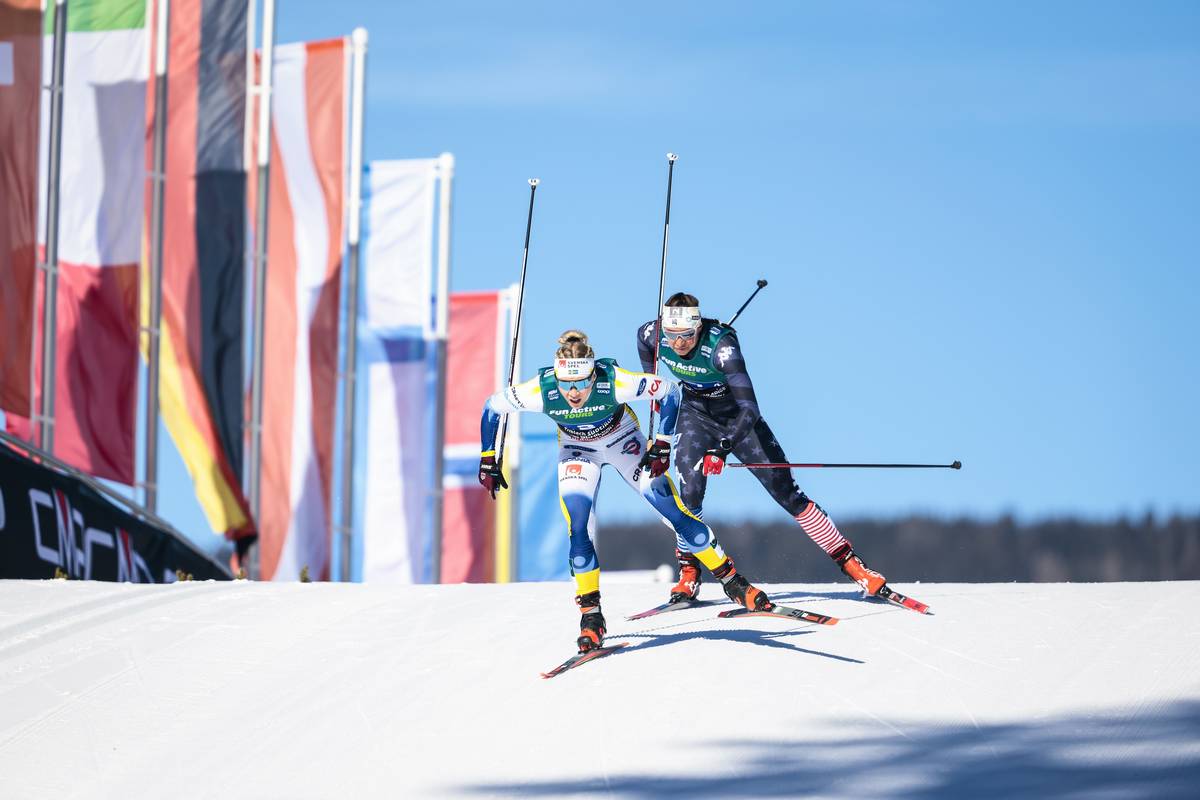
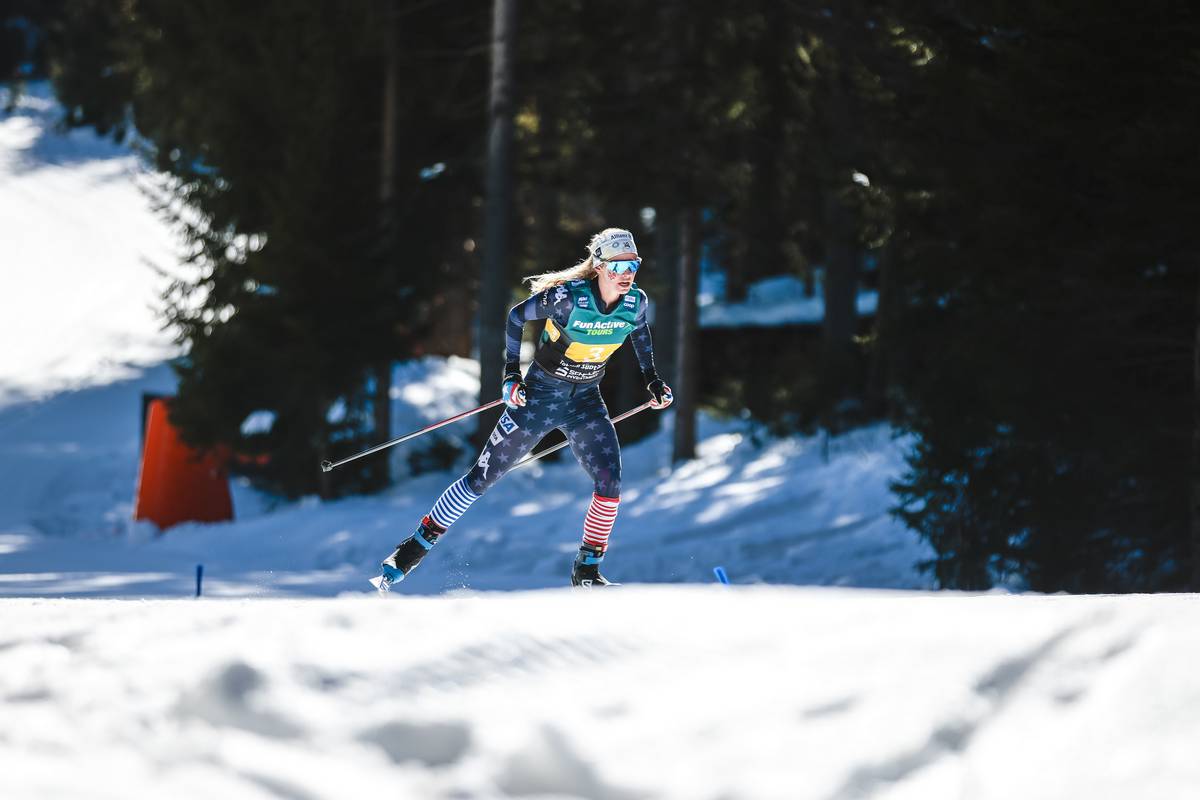
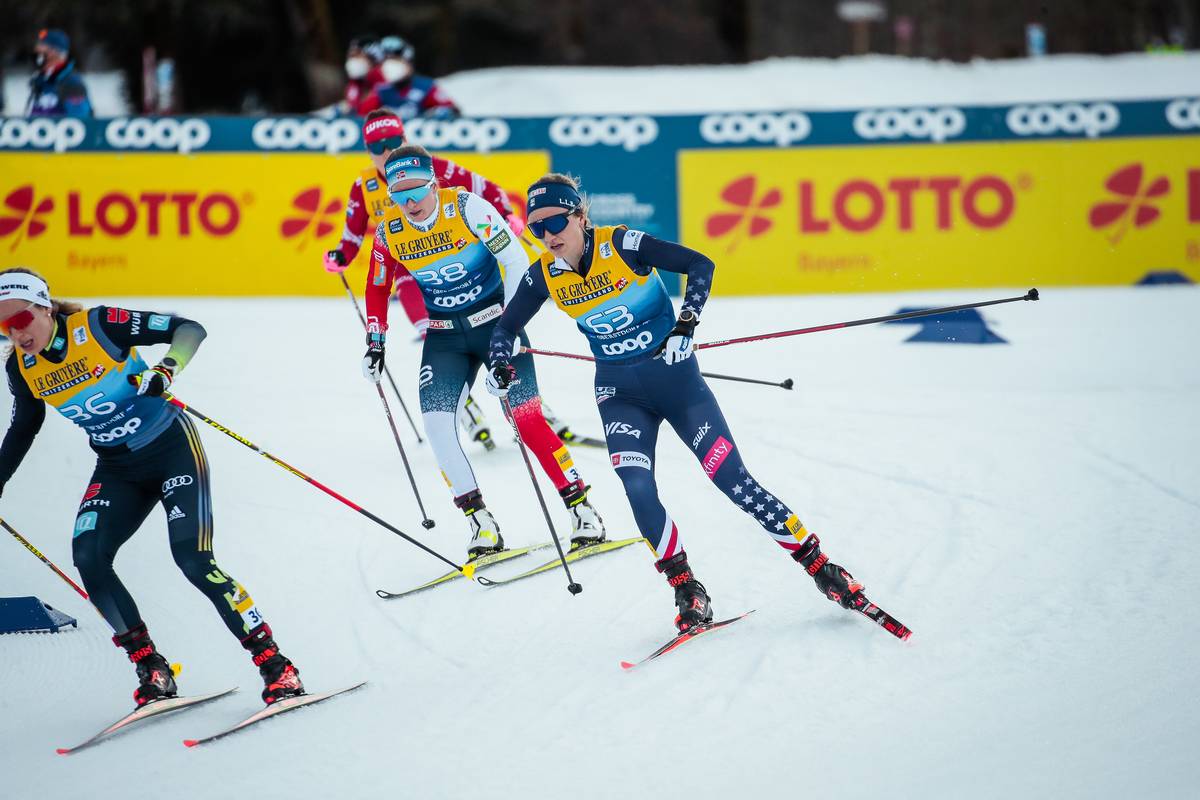
Julia Kern (USA) follows Jonna Sundling (SWE) on the anchor leg of Sunday’s Team Relay in Toblach. Sundling would edge out Kern in a sprint for second place. (Photo: NordicFocus)
As the World Cup entered its third day of racing in Toblach for a 4 x 7.5 km Team Relay, the tone was one of anticipation: what would happen in the race? Even more so, what was beyond this final day in the Italian Sud Tirol? This was the last race before a two week hiatus in the World Cup schedule, after which the best skiers in the world will gather in Planica, Slovenia for the World Championships.
Looking forward to those championships, fans and spectators may anticipate the familiar site of another Norwegian relay victory. Today in Toblach, Norway I (Heidi Weng, Anne Kjersti Kalvaa, Ingvild Flugstad Oestberg, Silje Theodorsen) won the 15th of its last 16 World Cup relays, setting the stage for a showdown with Team Sweden at the World Championships in Planica. Sweden I (Emma Ribom, Ebba Andersson, Moa Ilar, Jonna Sundling) was second on the day. USA I (Hailey Swirbul, Rosie Brennan, Jessie Diggins, Julia Kern) would finish the relay as the fourth team across the line, but would later be elevated to third place after the disqualification of the German team (more on the later). USA II finished seventh with the young team of Alayna Sonneysn, Alexandra Lawson, Sarah Goble, and Lauren Jortberg.
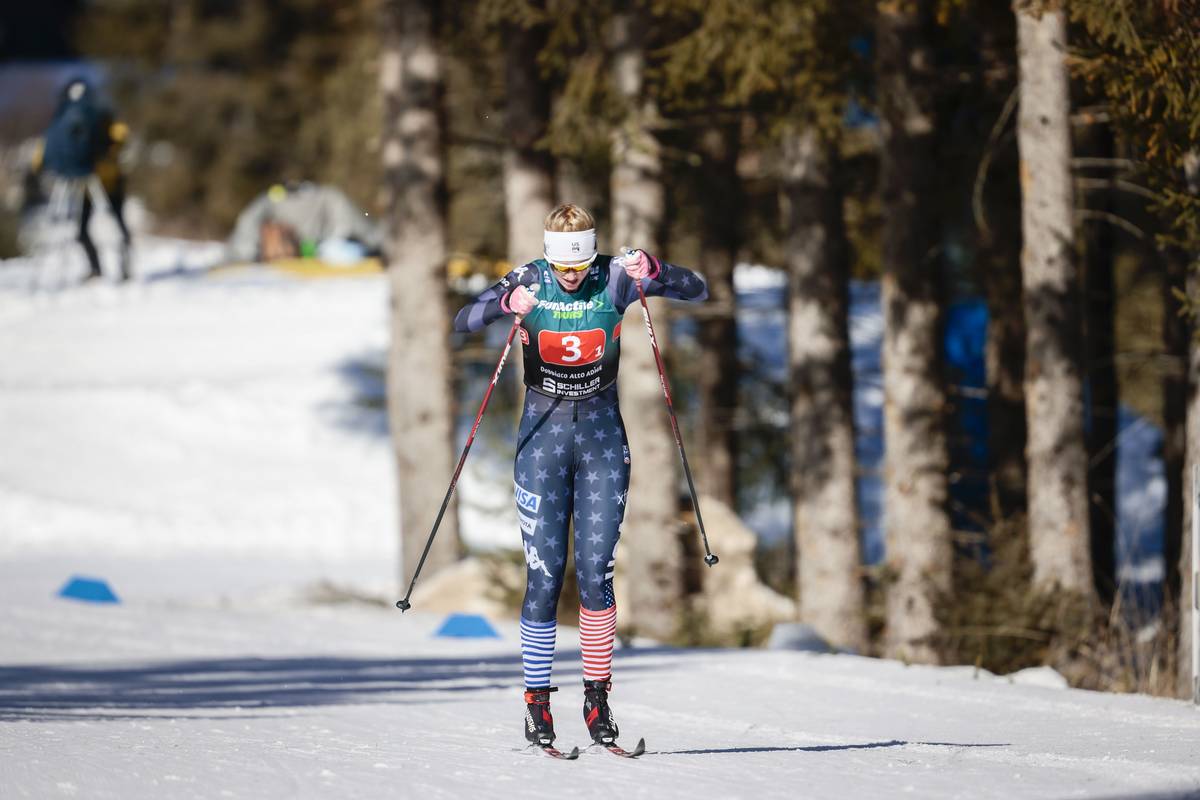
Hailey Swirbul (USA) scrambled for USA I during Sunday’s Team Relay, a position she previously held at the Beijing Olympics. Swirbul’s turn put USA I in a position to push for the podium in Toblach. (Photo: NordicFocus)
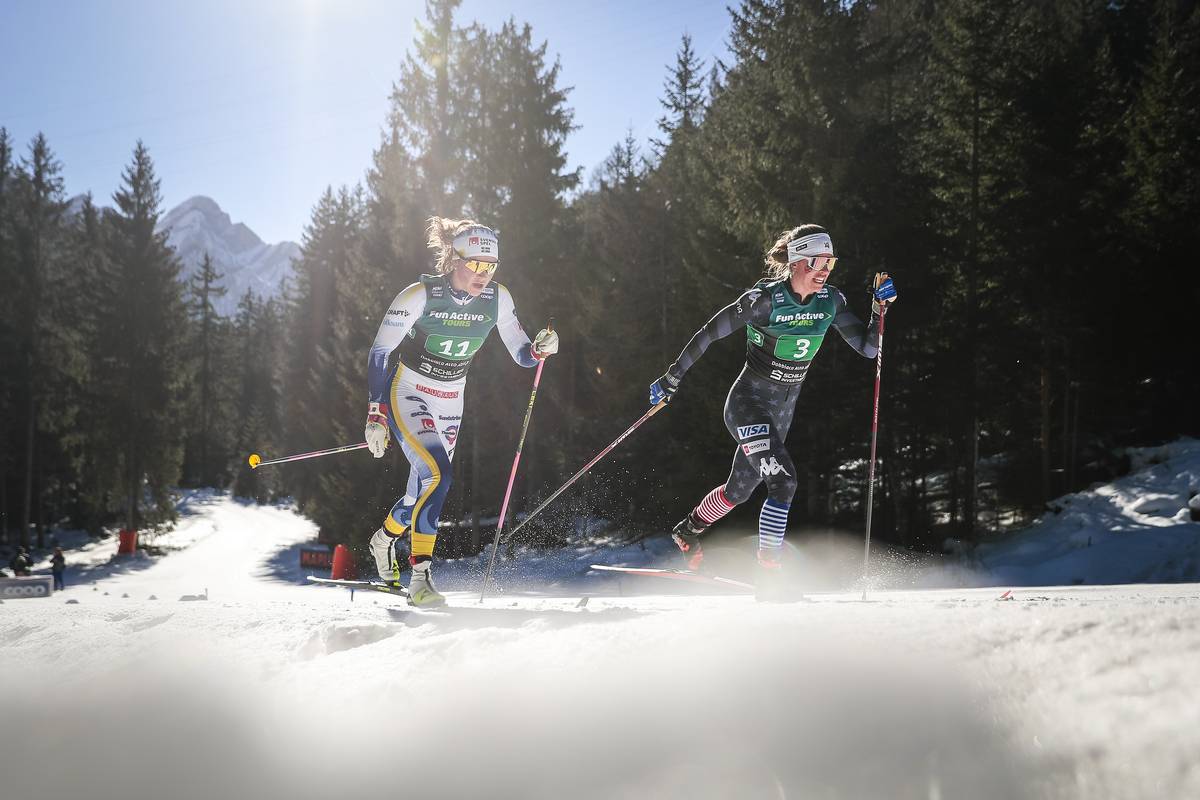
Team relays are the intersection where team tactics meet individual and collective will. The relays staged in Toblach would also hint at choices that national teams were likely to make in weeks to come as they prepare for World Championships. For the United States, Toblach was a chance to try out a new lineup in preparation for making a run at a World Championship medal. The most recent World Cup-level team relay happened at the Beijing Olympics, where the US Women took sixth place. In that race, Swirbul scrambled (first leg), Brennan took second leg, Novie McCabe took third leg, and Diggins anchored. In Toblach, Swirbul and Brennan still skied first and second classic legs for USA I, but Diggins moved to the third (and 1st skate) leg, as Julia Kern—following her strong sprint results this season—took the anchor leg.
The most notable team tactics on the field today concerned the Swedish Women’s team, which has been the dominant team at these World Cup races in Toblach, and throughout the season. Sweden fielded two teams in Toblach, but the lineup shuffle within those two was a clear deviation from their strongest possible lineup. Of the team that won a Bronze at the Beijing Olympic Team Relay—Maja Dahlqvist, Ebba Andersson, Frida Karlsson, and Jonna Sundling—Karlsson was absent from the lineup. Dahlqvist would lead Sweden II, while Sundling and Andersson joined Sweden I. Dahlqvist’s Sweden II team also included Linn Svahn, who decided to withdraw from the relay after start lists were made, meaning that Sweden II would start the race, but scratch after the third leg.
All of that decision-making still led to a familiar sight when the race started: Heidi Weng surging to the front in the first leg. Norway’s Women had won 14 of the last 15 relay events on the World Cup, and Heidi Weng has been in the line-up for the past 11 of those wins. Her first leg in Toblach was an early hint that the winning trend among Norwegian team relays would continue today. A pack formed as Weng was joined by Sweden, Germany, the United States, and Finland. All the main players present in World Cup relays of the past were back to challenge once again.
Heidi Weng (NOR) resumed her scrambling duties for the Norway I team on Sunday. Weng, in the 1st leg position, has been part of Norway’s last 12 wins in the event after Toblach. (Photo: NordicFocus)
Weng handed off to Anne Kjersti Kalvaa, who leveraged the advantage into a definitive split in the field. The only woman to follow the Norwegian was Katharina Hennig for Germany, who arrived as an unassuming, yet unsurprising, presence at the front of Team Relay field. Despite Hennig being the only German Women to have individually podiumed in the last three seasons of World Cup racing, the Germans have had a strong contingent of women present near the top 15 places of the World Cup. Germany won silver in the Beijing Olympic Team Relay (Hennig, Victoria Carl, Katerine Sauebrey, and Sofie Krehl) ahead of many of the notable individual names from other nations that populate podiums week-to-week on the World Cup.
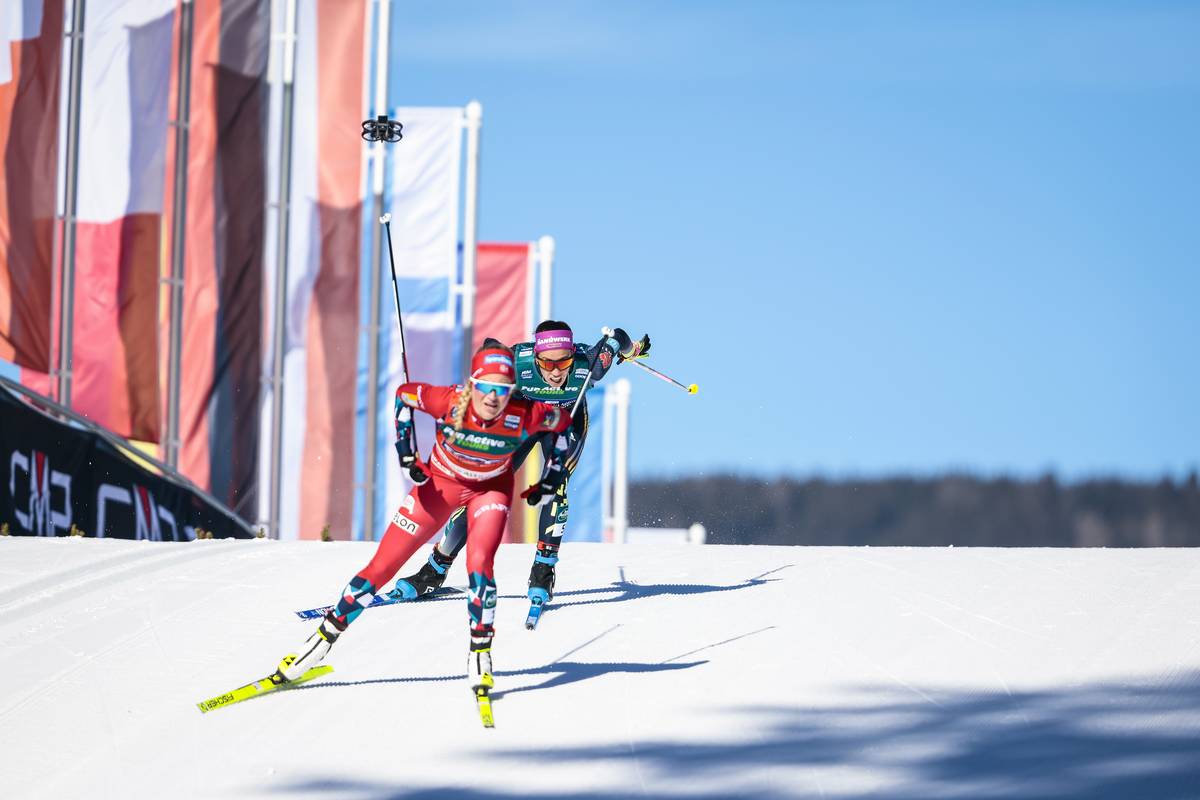
Silje Theodorsen (NOR) pushes ahead of Sofie Krehl (GER) during the anchor leg of Sunday’s Team Relay. Theodorsen would secure Norway’s 15th win in 16 tries at the Women’s Team Relay event. (Photo: NordicFocus)
As the Norwegians looked to open a gap early in the race, the German’s strongest skier was right there to continue on the move from Gimmler in the first leg. Hennig skied confidently up with Kalvaa, and the pairing would form the lead pack alongside Ebba Andersson for Sweden I, who kept with her recent streak of strong skiing by pushing the lead group into a pack that held through the 3rd leg of the race. Pia Fink held the pace for the Germans through the 3rd leg as Oestberg pushed the pace for Norway, as Sweden I faded. Norway’s anchor, Theodorsen, conducted a masterclass closing leg, taking control a kilometer out from the finish-line and driving all the way through. Germany’s Sofie Krehl couldn’t keep up, and Theodorsen finished in the arms of her teammates. The Norwegians had won their 15th in 16 tries at the World Cup Team Relay.
Rosie Brennan (USA) and Moa Lundgren (SWE) on the second leg of Sunday’s Team Relay. Brennan began the USA I charge towards the lead pack during her leg, which landed the USA I team in third place in Toblach. (Photo: NordicFocus)
USA I
Clad in the striped relay socks of Team USA, Swirbul handed off to Brennan in fourth place. Brennan knew the hard task ahead of her, saying in post-race comments that “Leg 2 is a hard one that tends to be pretty stacked with strong distance skiers,” said Brennan. “So I knew I had my work cut out for me. I wanted to ski my own race in an effort to minimalize time lost, [which] I felt like I did well, but still managed to lose more time than I would have liked…I felt we all had some good battles out there and also know where we need to look to improve.”
Brennan’s hand-off to Jessie Diggins found the Americans 41 seconds off the lead group, and Diggins went straight into reducing that gap. Diggins didn’t let up, going into the unrelenting turn-over that has become her signature on the World Cup. When she caught Ilar (Sweden I) near the end of her leg, the full scope of Brennan and Diggins combined move had become clear. In a Team Relay, where the field can string out, paces can drop, and energy can falter, the Americans had attacked every meter of the course with jolting energy today.
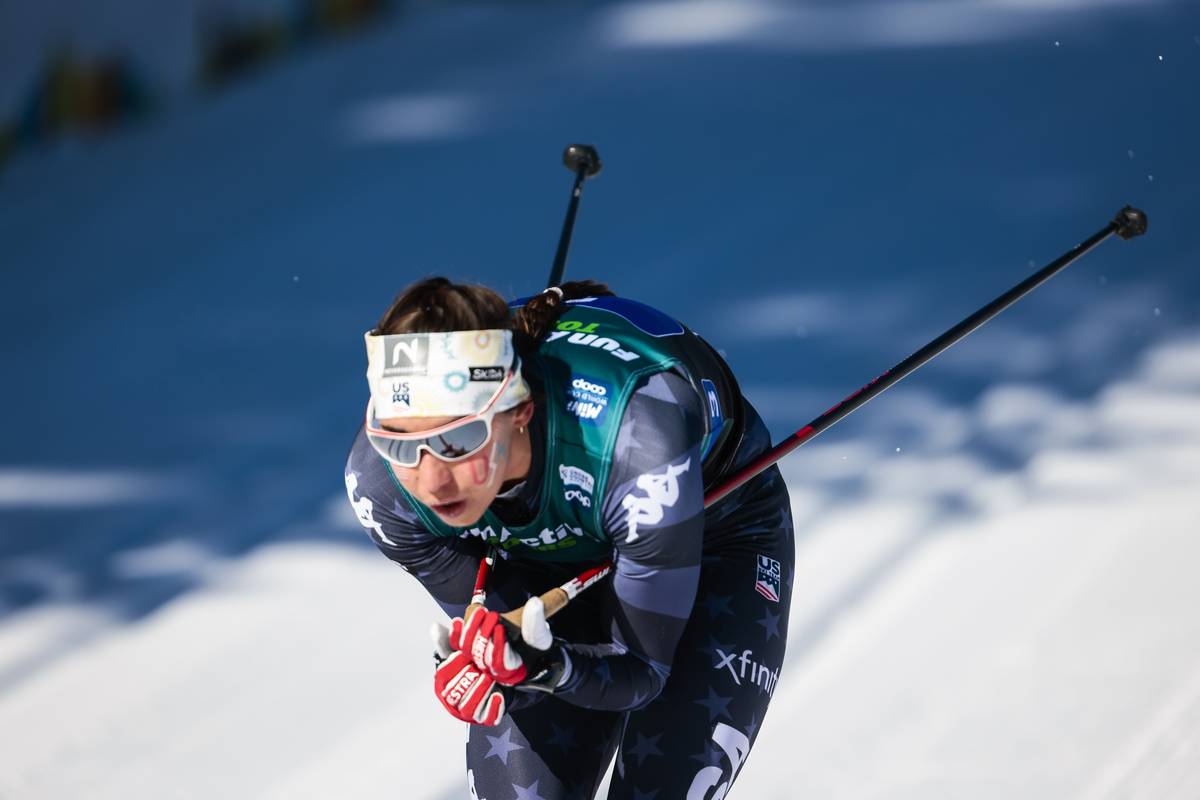
Jessie Diggins (USA) during her leg of the Team Relay on Sunday. Diggins’ efforts during the team’s third leg reduced a gap that helped set up Julia Kern (USA) to sprint to third place in Toblach. (Photo: NordicFocus)
That energy was transferred to their anchor, Kern, whose rival in the race for third was none other than the weekend’s sprint champion, Sundling (Sweden I). As Sofie Krehl led the Germans across the line to claim second, Kern continued to do battle with Sundling. They swept into the stadium, Sundling went out from behind Kern and gained a slight advantage in the run-up. Kern pushed again, but ran out of room. The pair lunged across the line with Sundling .2 seconds ahead of Kern: Sweden I in third, USA I in fourth.
Julia Kern (USA) during her anchor leg on Sunday. Kern lost a close battle across the line to Jonna Sundling (SWE) for third place. USA I was eventually elevated in the standings after Germany’s disqualification for an illegal substitution. (Photo: NordicFocus)
German Disqualification
Across the line would prove a key phrase in the post-race melee. When final results were posted, it was revealed that the race jury disqualified the 2nd place German team for “participating under false pretenses.” The FIS International Competition Rule cited was “ICR 352.2.2.,” a vague piece of international competition law can be translated as “who was on the course was not who was on the start list.” In this case, Krehl had been substituted for Colleta Rydzek after official start lists had been made. The decision to disqualify Germany meant that the USA I was elevated to third place. It was a strange, but auspicious, sign for the Team USA as they look toward making the podium at World Championships in the same event in just a few weeks. In post-race comments, Rosie Brennan said “Germany’s disqualification [was] something I haven’t ever experienced before and was certainly unfortunate. That is not how I want to land on the podium. They all skied really strong legs. It’s unfortunate that the athletes have to take the hit there.”
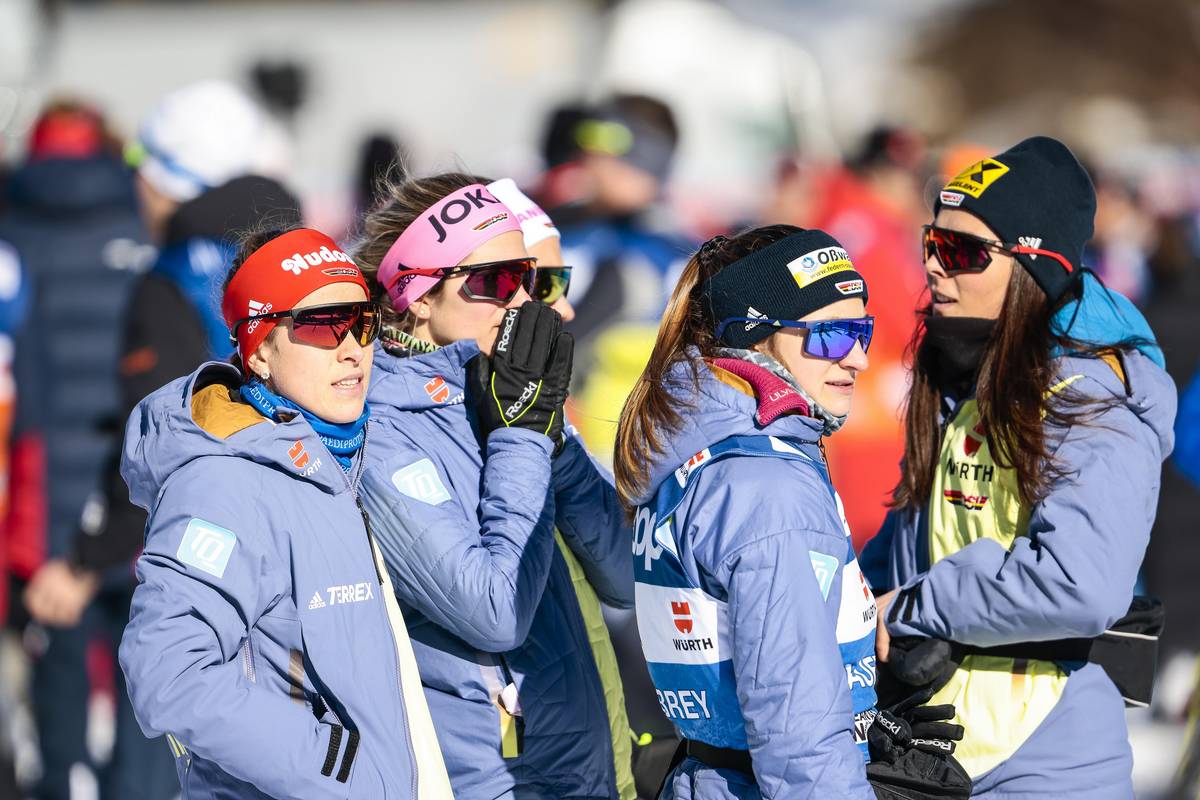
The German team awaits a race jury decision after crossing the line in 2nd place on Sunday. The race jury reached a decision to disqualify Germany after a late substitution saw Sofie Krehl anchor the team instead of Coletta Rydzek, who was on the official start list. (Photo: NordicFocus)
USA II
Lauren Jortberg smiled into her teammates’ arms in seventh place. With her crossing the finish line, came a symbolic close on the sequence of the World Cup that has served as a broad introduction for the young skiers that made up USA II today. For Jortberg and Sonnesyn, that has meant an introduction to the demands of racing the World Cup calendar with all challenges that commitment brings. For Goble and Lawson, Toblach marks the end of the beginning of their World Cup careers. In comments to FasterSkier, Alex Lawson said, “The biggest thing I took into and out of Toblach is to be confident in myself! [The World Cup] is a different scene, field, and venue but it is still a ski race and something that I have spent years training for.”
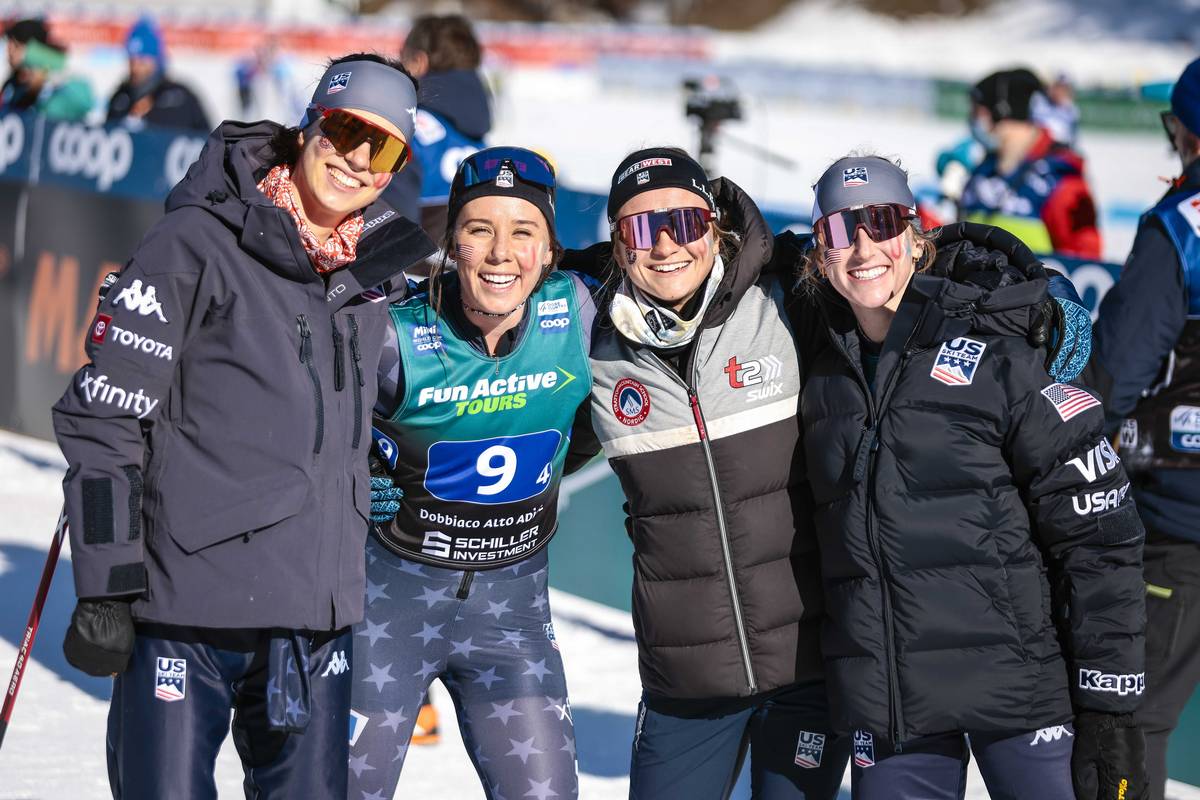
The USA II Team on Sunday, which finished 7th place. (L-R) Alex Lawson, Lauren Jortberg, Alayna Sonnesyn, and Sarah Goble. (Photo: NordicFocus)
Lawson’s reflections on her first World Cup will serve as wisdom for all the Team USA as they look ahead in the season’s calendar. Next up for the American women is the event that the season has been building towards: World Championships begin in Planica, Slovenia on Tuesday, February 21st with a 5 k Freestyle Individual Start. The Americans are sure to come into Planica the way they left Toblach today, with a persistent drive and energy, fighting for every second.
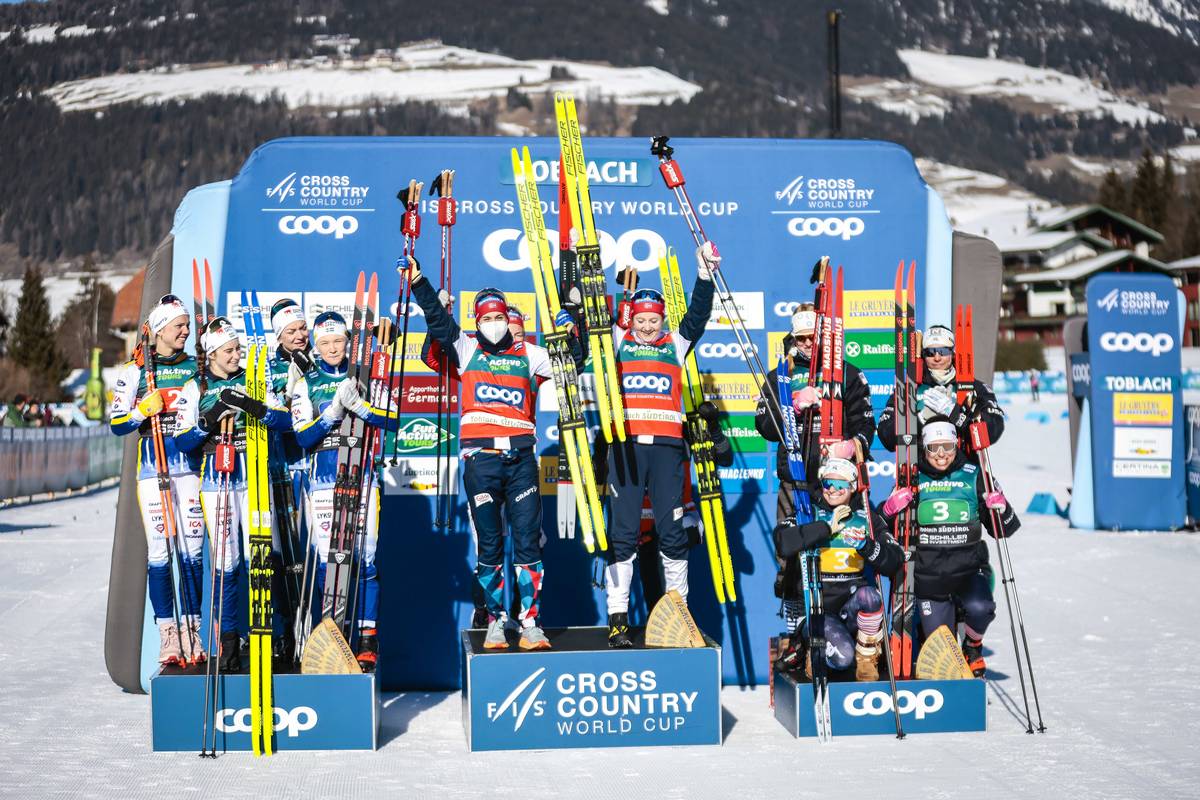
The Official Women’s Podium featuring USA I in third place. Norway won its 15th of the last 16 Team Relays, while Sweden took second. (Photo: NordicFocus)
While World Cup Finals were underway in mid-March in Falun, Sweden, a second contingent of top American skiers was lining up roughly 2,000 kilometers south to race in the OPA Cup Finals in Sappada, Italy. Located along the northern edge of Italy near the Austrian border, the small town is nestled among the spectacular, jagged massifs of the Italian Dolomites, roughly an hour’s drive east of Toblach, which typically hosts the final stages of the Tour de Ski. The team spent the week prior to competition training in Toblach, which features similarly spectacular views, along with the benefits of the delicious food and drink one might expect when traveling in Italy.
For those unfamiliar with the OPA Cup, it is an international race series featuring predominantly European athletes racing just below the World Cup level. The US Ski & Snowboard development program typically facilitates a trip to OPA Cup Finals to provide athletes who may not have earned World Cup starts the opportunity to experience high level competition overseas. Qualification is based on national rankings, beginning with those racing on the World Cup, and proceeding through the top domestic racers, depending on declines. Often, there is overlap between the teams for the FIS Junior/U23 World Ski Championship teams and the OPA Cup teams, which may conveniently allow some athletes to prolong their stay in Europe and attend both events.
“Generally the trip is geared toward athletes that are a bit older, who either have had World Cup starts or on track for that,” explained US Ski Team Development Team coach Greta Anderson.
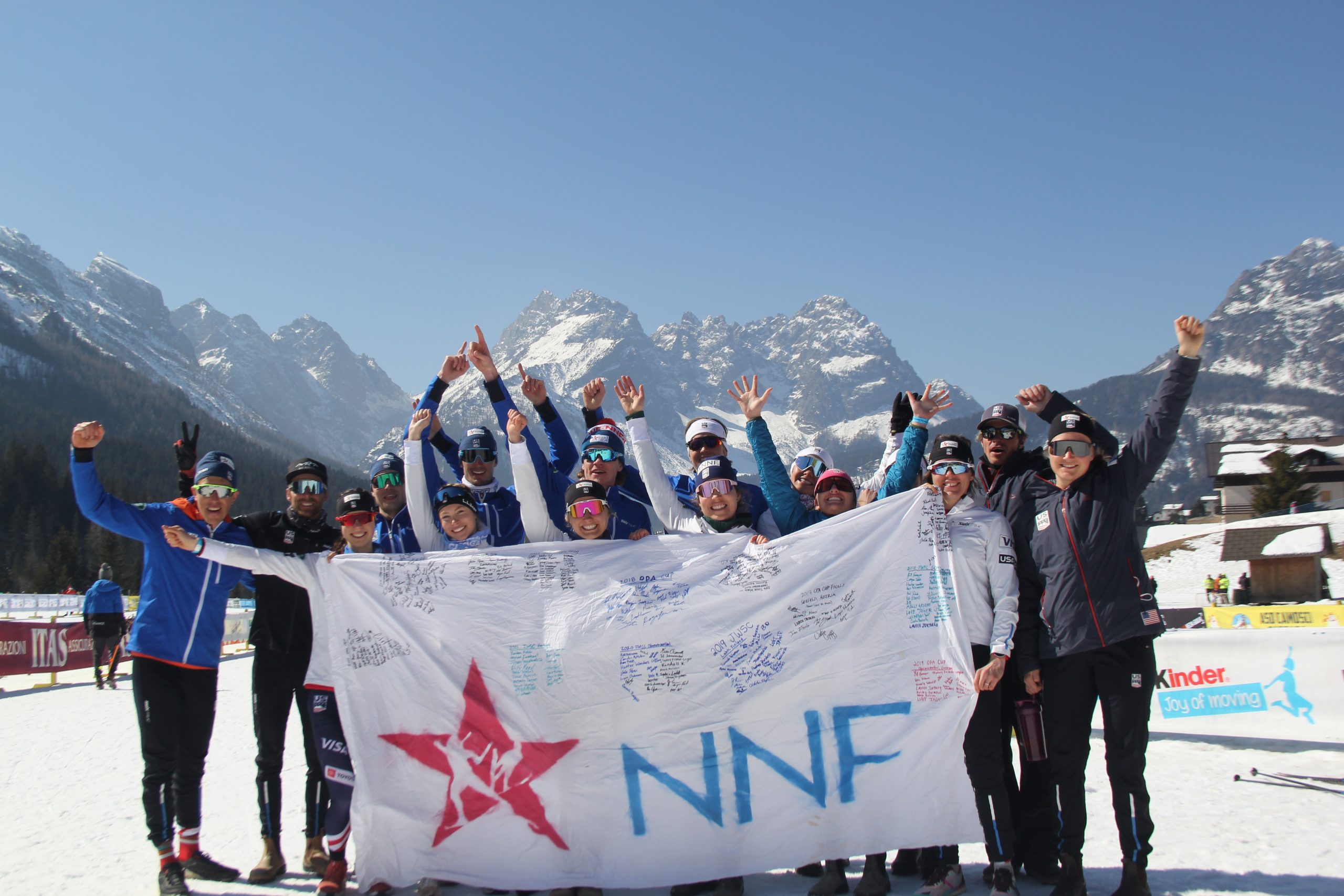
The American OPA Cup Finals team celebrates fast races and bluebird days in Sappada, Italy. (Photo: Bryan Fish/NNF)
Identifying it on its list of “Pillar Projects”, the National Nordic Foundation (NNF) helps subsidize the cost of the trip for the qualified athletes. The trip can accommodate up to 16 skiers, who are generally kept to an approximately even male to female ratio through the qualification criteria. This year, due to conflicting schedules and a number of declines, thirteen athletes attended, with nine women and four men.
In alphabetical order, the senior men included: Braden Becker (CGRP), Logan Diekmann (BSF Pro), Finn O’Connell (BSF Pro), Karl Schultz (SVSEF). Senior women included: Mariah Bredal (BSF Pro), Margie Freed (CGRP), Alex Lawson (CGRP), Hannah Rudd (BSF Pro), Becca Rorabaugh (APU), Lina Sutro (SMS T2), and Alayna Sonnesyn (SMS T2).
Finn O’Connell (2nd from L) alongside Braden Becker (L), Karl Shulz (2nd from R), and Logan Diekmann (R) at OPA Cup Finals
in March 2022. O’Connell was recently named to the US Ski Team for the 2022-23 season. (Photo: Alayna Sonnesyn)
SMS T2 teammates Alayna Sonnesyn and Lina Sutro show their love for Sappada during the Opa Cup Finals trip. (Photo courtesy of Alayna Sonnesyn)
This year, two U20 athletes headed from World Juniors in Lygna, NOR to Italy along with D-Team coaches Anderson and Bryan Fish: Kate Oldham (Aspen Valley Ski Club) and Annie McColgan (UVM).
“It’s pretty cool that we have more racers that are racing professionally or post collegiately than, I think, ever in the US, and they have more clubs and places to choose from,” said Anderson. “There were several athletes that, especially because racing was shut down on the East Coast last year and I happened to be in Alaska and wasn’t wasn’t traveling very much before I took this job, it was kind of the first time I’ve gotten to work with them, or the first time I’ve gotten to work with them in three or four years. So it was really cool to get to know Alayna Sonnesyn a little better and Lina Sutro a little better, and Margie Freed and Alex Lawson, who I’ve seen race many times, but it was the first time I’ve gotten to really work with them and get to know them. The same with Braden Becker and Karl Schultz… So it was a pleasure on the trip to get to work with some new athletes that have come through different development systems and are excited about and ready to make that next step. And this racing circuit is a really good opportunity for that.”
Anderson took the lead with organizing the trip and supporting athletes, working alongside US Ski & Snowboard Cross Country Sport Development Manager and long-time OPA Finals trip lead coach Bryan Fish. The wax support staff included BSF Pro Team head coach Andy Newell, former APU athlete and current staff member Peter Kling, and Jackson Hole comp team coach Jon Filardo.
US Ski & Snowboard Cross Country D-Team head coach Greta Anderson supports athletes during the Sun Valley SuperTour races in January. (Photo: Tobias Albrigtsen / @untraceableg)
Anderson identified the OPA Finals trip as a key development opportunity for a number of reasons: though perhaps lower pressure than World Cup, it’s a professional race circuit with small but competitively dense fields, athletes race aggressively and tactically in a style younger athletes who have not yet raced at this level may not have experienced, and it offers the opportunity for an athlete to dial in some of the small but significant factors details that support success adapting to a new and different environment following long international travel.
“Bryan’s been doing [the OPA Cup Finals] trip for a long time,” Anderson said. “So Peter Kling, who was on a coaching staff, and Becca Rorabaugh, they were like, ‘I’m pretty sure that we were on Bryan’s first ever OPA Cup trip.’ And it used to be that we started at the bottom of the results sheet and started looking upward for names. And right now we’re starting at the top and we don’t have to look very far down.”
In two days of racing, the US had seven top-10 finishes, with another set of athletes finishing well-within the top-20. Highlighting the US team was SMS T2’s Sonnesyn, who took third in the 10 k classic on Saturday the 12th, and won the 10 k skate the following day.
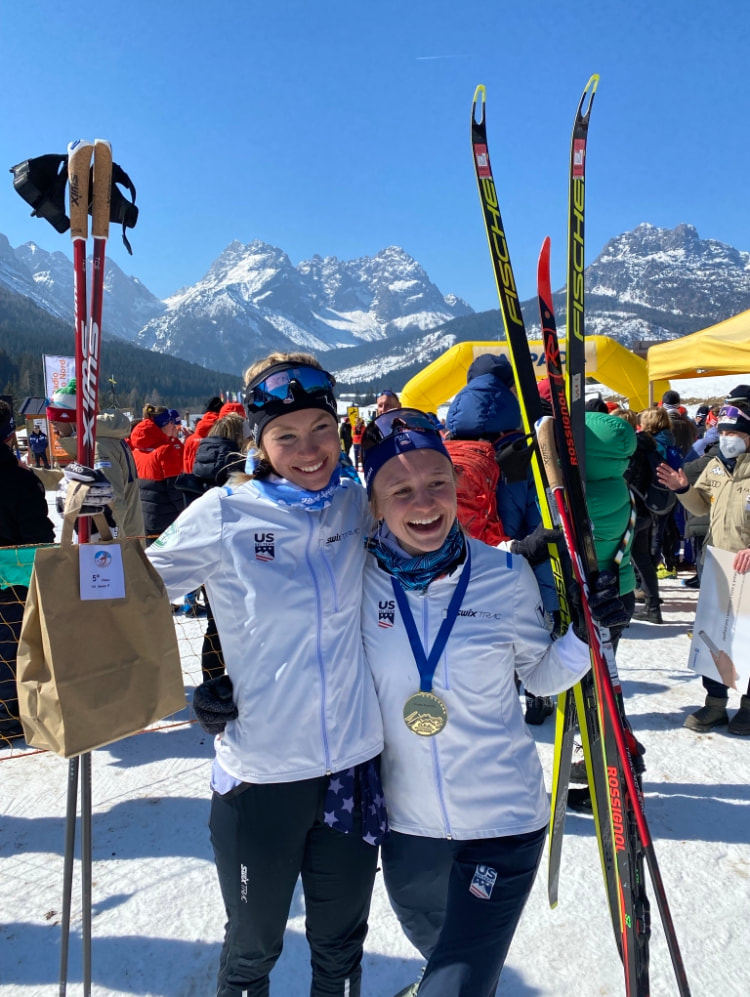
Alayna Sonnesyn (SMS T2) takes the win in the 10 k skate at Opa Cup Finals in Sappada, ITA, with Mariah Bredal (BSF Pro) finishing just behind in fifth. (Photo courtesy of Alayna Sonnesyn)
“It’s pretty special,” Anderson said of the performances in Sappada. “It’s awesome to get to see that. For Alayna to start a race and say like, ‘What’s my plan to try to win this?’ It’s not just, ‘Hey, we’re here to participate and learn,’ but ‘Hey, we’re here to participate and learn but also we’re going to try to win.’ And I think, with that comes — not only from staff but from racers — this level of professionalism. Okay, we’re going to select skis. We’re going to make sure we’re organized and in a good place. Where can we be? Where can we do feeds? How can we set you up to have the success you need to have?
“It just feels like a really good time to be an American ski racer.”
After winning two of the first five SuperTour races this season, and finishing on the podium in each of the others, Sonnesyn was offered starts at the Tour de Ski, where she hoped she could achieve strong enough international results to qualify for the Olympic Team. But these goals did not come to fruition; Sonnesyn struggled to find the same race sensations while on the World Cup and tap into the fitness she knew was still there, which was reflected in results below her expectations. She shared her disappointment openly on her blog and social media, providing a relatable and important example to her followers that the pro-skier journey is not immune to bumps in the road.
“My experience on the World Cup this year – it was quite demoralizing, to be honest,” said Sonnesyn in a call from the airport as she was on her way to SuperTour Finals in Whistler. “And then, after the Tour de Ski, I got COVID. And it just really put a damper on the whole winter for me. And I started questioning like, ‘Okay, am I fit? And I like, can I race? Well, like, what have I been training for? This is really bad timing with COVID, too.’ So I was just pretty down. But then I was able to have really great SuperTour races, back in January and February, and then to be able to race internationally again in Italy. It wasn’t a World Cup, but it was still very high level of racing. So to have it go so well kind of reaffirmed to me that I belong on the international stage. And I definitely needed that, a little bit, just to give myself more confidence moving forward and motivation as well. So I’m really excited about the races and how they went and what I did to prepare for them and kind of my mental attitude around them, too.”
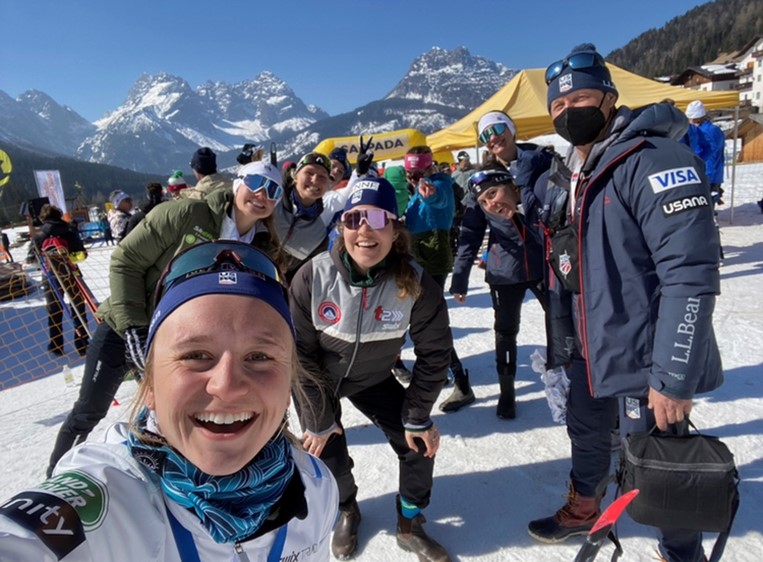
A selfie in Sappada: the American team prepares for race day at Opa Cup Finals. (Photo: Alayna Sonnesyn)
As she reflected on the trip and her experiences racing internationally over the last few seasons, Sonnesyn echoed Anderson’s sentiments about the progression of the American team at the event.
“Compared to my first OPA Cup trip, which was in 2018, I think there were maybe two or three top 10 performances. And they were exciting, but for the most part, it was kind of like, ‘We’re just here to get the experience. We’re not really sure what we’re doing.’ And I think that the way the US is developing right now, the way that new courses are being built in Cable or Duluth, or wherever it is – they are preparing us better for racing internationally. And I think that was shown in the results that we had in Sappada. And it was just so exciting during that 10 k skate on Sunday to cross the finish line in first, and then turn around and see a ton of my other US teammates come in right behind me. That’s not something that was happening four years ago. So I think we are really developing and that is a huge thanks to so many different people and so many reasons, but it’s exciting to see.”
Sonnesyn also spoke to the importance these international opportunities have provided her specifically, speaking from the perspective of what she dubbed a “bubble athlete” who has oscillated between World Cup and domestic racing over the last four seasons. She got her first World Cup starts in Quebec in March, 2019, and has been offered starts beginning in Period 2 each season since. Though this is a key stepping stone in the process toward consistent World Cup racing, she expressed that bubble athletes can have a challenging time planning seasons in advance and need to be prepared to adapt quickly to more frequent overseas travel.
“I think that every single experience that an athlete has going and racing internationally, and traveling, and competing at that higher level, it all adds up to be super beneficial and a great learning experience. For example, I have gotten really great at overcoming jet lag, which the first couple of international trips I went on, I had no idea how to handle. I tried my best to do what I could, but it’s hard. And also to know what little things you want from home, like after being in Europe for four or five weeks, what do you really want from the US?
“And then also, how do you work in a new environment? A lot of times, if you’re going over to the World Cup, sometimes you’re provided a wax tech or sometimes not, or you have to bring your own, but you have to be willing to work with whoever you get.”
Sonnesyn explained that on the Sappada trip, she had worked with each of the techs before, but on her first trip in 2018, it was her first experience working with those wax staff members. Given the importance of ski choice and wax, working together effectively is imperative to an athlete’s success, but it requires dialogue and practice.
“Being ready to communicate effectively with the staff, what do you need? How do you want your skis prepared? What do you need from a hotel? All those things seem like such small little details, but they really add up with the more experiences you have.”
Alayna Sonnesyn races in Oberstdorf, Germany during the 2021/22 Tour de Ski. (Photo: NordicFocus)
She also spoke to the differences in the style of racing between the US and her international experiences, and how a trip like Sappada better athletes for what they might encounter should they be offered a World Cup start down the line.
“When it comes to racing: the courses in Europe are very challenging and very technical. Downhills, uphills, flats – whatever it is, there’s a lot of it, and you have to be ready to go for it. And then the competitors are fierce. They know how to be aggressive in a race, and you have to know how to hold your own. So it just helps to have that experience to understand how you approach the race. How aggressive are you going to be? How are you going to pace the race? How are you going to handle others around you?”
With the highest levels of competition for our sport happening across the pond, it is easy to understand why opportunities like the OPA Cup trip provide an essential bridge for developing athletes. But it is not simply the facilitation of this trip that has led to marked improvement for the American team.
“I think we’re open to change right now,” Anderson said as she reflected on her key takeaways from the experience in Italy and her first season coaching the D-Team. “I think the US, in a year with COVID, and lots of challenges logistically and politically in the world, we handle those changes better than almost any other country does. And I think that’s really shown here.”
Alex Lawson skates to 7th in the 10 k skate during OPA Cup Finals in Sappada, ITA. (Photo: Bryan Fish / NNF)
While the OPA Cup crew was putting together a very solid day in the 10/15 k skate, the team of Rosie Brennan, Zak Ketterson, Scott Patterson, and Jessie Diggins had taken the win in the thrilling 4 x 5 k mixed relay in Falun. As the team in Sappada mingled near the finish to support the final racers as they skied through, Anderson said that a Swiss national team coach walked over and showed them the World Cup result on the phone.
Layered on top of the broader success at the OPA Cup Finals, Anderson expressed that this opened her athletes’ eyes to what might be possible for them in the years to come also. In particular, the Falun results of Zak Ketterson, a newcomer to the World Cup who ended his debut season with a 15th place finish in the 15 k skate and a mixed relay win.
“[The guys racing at OPA Cup] are like, ‘Oh, man, I beat Zak sometimes’, or ‘I’m right with him’, ‘I trained with him in college.’ The level of confidence that brings… ‘Maybe maybe I can do that too.’”
Moreover, Anderson expressed that this relay gold medal speaks to the equity of skiing in the US. “That we have good female athletes, and we have good male athletes, and we have a good balance of the two, and teams that are mutually supportive of each other,” she said. “Not every country has that.”
Boiling down the experience and her feelings as the season wraps up, Anderson concluded, “I have nothing but good things to say about our athletes right now. I’m really impressed with them. They handle the change better than anyone, and I think as a staff and from an organizational perspective, we’re trying to keep up, remove barriers, make sure they’re supported. And we’re open to trying new things, and it seems that we’re excelling in places where we’re willing to experiment and get our feet wet.”
Kate Oldham (AVSC) races the 10k classic during Opa Cup Finals in Sappada, ITA. (Photo: Bryan Fish / NNF)
Providing additional insights from the perspective of an OPA Cup Finals first-timer, FasterSkier also heard from U20 athlete Kate Oldham, who trains with the Aspen Valley Ski & Snowboard Club (AVSC) and competes for Middlebury College. Oldham took 11th place in both the 10 k classic and skate in the junior women’s category.
“Sappada was incredible,” Oldham wrote. “In congruence with the pre-camp in Toblach, the OPA Cup trip was unforgettable… My favorite ski to-date was on a long ski over the pass from Cortina to Toblach, stopping midway for trail side pastries and cappuccinos! Being with a group of older athletes was a valuable change from the World Junior trip because each team member brought new energy and experience to the group. Between that and the gelato shop next door to our hotel, the trip couldn’t have gotten much better!
Enjoying a cappuchino and pastry fueling stop while skiing from Cortina to Toblach. (Photo: Kate Oldham)
BSF Pro Teammates Hannah Rudd (left) and Mariah Bredal (right) sip cappuchinos while skiing from Cortina to Toblach during the Opa Finals pre-camp. (Photo: Kate Oldham)
“One of the things I think are most valuable about training and racing camps is the exposure to coaches and athletes outside one’s home team. For years I have been seeking out opportunities to attend regional and national camps that would bring new perspectives, training groups, and social dynamics to push me and help me adapt my own training method while making friends from schools and clubs all over the country. This winter I was lucky enough to have both my club coach and a group of skilled and passionate wax technicians/trip leaders selected from all around the US to lead the trips to Junior World Championships and OPA Cup finals. I know that over the six years I’ve been skiing competitively I have developed the competence to independently navigate high-level skiing events, but having techs to guide me through the process at the international level was extremely helpful, particularly when one of them I had worked closely with for those six years of training and racing.
“With new coaches come new perspectives. Another set of eyes, a different experience, or a new phrase can be all it takes for the pieces of new advice to click into place. Or maybe a coach has a different perspective on the bigger picture of skiing that resonates with you unlike the philosophy you previously knew… which of the infinitely wide range of mindsets in ski racing works best for you? Which one reminds you why you love ski racing? Which one helps you stay motivated through the hardest parts of the season when the last thing you want to do is get out the door for training? Which one eases the heartbreak of coming so close to a goal but falling short despite your hardest effort? Without a doubt, cross country skiing is a delicate balance of internal and external factors, but having great teammates and coaches like the ones I got to know and work with in Europe this winter is certainly a key ingredient to the recipe for success in the lifelong pursuit of excellence on the race course and off.”
Coaches: Pepa Miloucheva (head coach); Michael Gibson (biathlon coach); Nick Brown (assistant coach and wax tech); Ethan Dreissigacker (assistant biathlon coach)
Current roster (skiing and biathlon): Braden Becker, Adam Martin, Akeo Maifeld-Carucci, Caitlin Patterson, Michaela Keller-Miller, Margie Freed, Annika Landis, Alex Lawson (skiing); Jake Brown (Luke’s brother), Raleigh Goessling, Hallie Grossman, Susan Dunklee, Kelsey Dickinson, Tara Geraghty-Moats, Clare Egan, Luke Brown (Jake’s brother) (biathlon)
Who’s new: Luke Brown joins the team for biathlon, coming from Crosscut; Carsen Campbell joins the team for biathlon, coming from Rocky Mountain Racers; Tara Geraghty-Moats rejoins the team for biathlon, coming from nordic combined; Annika Landis joins the team for skiing, coming from Sun Valley; Alex Lawson joins the team for skiing after graduating from Middlebury this spring
Who’s still on this team, or otherwise involved in American skiing, from when we did this in 2012: Caitlin Patterson (athlete, skiing); Susan Dunklee and Clare Egan (athletes, biathlon); Maria Stuber (head nordic coach, St. Scholastica); Patrick O’Brien (head coach, SMS Elite Team); also, former CGRP teammates Pat O’Brien and Ida Sargent got married this summer
Susan Dunklee in Pokljuka, Slovenia, February 2021. (photo: Manzoni/NordicFocus)
Top results last season: Starting with biathlon: The redoubtable veteran Dunklee finished last season on a strong note with two individual eighth-place finishes in Nové Město, one in sprint and one in the pursuit. She teamed up with Sean Doherty for the country’s first single mixed relay World Cup podium since Lowell Bailey and, well, Dunklee, in 2017. Egan had a pair of top-10 finishes, 9th and 10th in Hochfilzen, and was a member of two sixth-place relay teams. Dunklee and Egan are both already qualified for the Beijing Olympics. Jake Brown was on a sixth-place mixed-relay team in Nové Město and had a season’s best of 12th in individual races, in the sprint in Pokljuka.
Moving on to nordic combined: Geraghty-Moats won the only regular-season women’s noco race that was able to be held last year, in Ramsau, to take the inaugural overall title, while garnering praise as a trailblazer for women’s sports. She was fifth at World Champs in Oberstdorf.
And finally, on the nordic trails: Patterson raced on the World Cup from Ruka through the end of January, including finishing 34th overall in the Tour de Ski. She was on a fifth-place relay team in Lahti, and had individual World Cup bests of 27th, 29th, and 30th. Martin had three World Cup starts in distance races, with a best of 44th in Davos. Lawson was 24th at World Juniors in the 10 k skate.
Tara Geraghty-Moats racing at World Champs in Oberstdorf, February 2021. (photo: Modica/NordicFocus)
Coach’s comments: Pepa Miloucheva writes, “Summer and fall training for GRP was good and mostly went as planned. This spring we officially added Alex Lawson, although she was here last year too and the only other addition was Annika Landis, who joined us after a year in Sun Valley.
“The whole team stayed and trained in Craftsbury through August. Waverly Gebhardt and Rena Schwartz trained with us as part of the summer U23 program and with our GRP biathletes here we had a really solid training group.
“Michaela had a setback early summer, broke her ankle and had to have surgery, but she kept really good fitness by spending hours on the SkiErg and was able to join the rest for the ski camp in September.
Adam Martin racing in Davos, December 2020. (photo: Modica/NordicFocus)
“Early September we went to Oberhof, Germany, for just over two weeks of training in the ski tunnel. This was our first trip since the pandemic, so I was little nervous, but everything worked out really well. The first few days the focus was on technique, transferring on-snow improvements athletes worked on during the summer. Second part was a solid speed block. Luckily there ware only a few other skiers [in the tunnel] at this time so we ware able to have really high quality intensity sessions.
“After a few weeks training at home and having incredible fall weather we packed up bags again and went to Park City for two weeks of elevation training. First part of the camp was lots of volume, some L3, a few athletes even hopped in a rollerski race at SoHo for fun. Second week we lowered the volume, had a couple mellow days, and finished the camp with a couple solid TT efforts to gain some experience racing at this elevation in preparation for Nationals.
“Back home athletes took a few easy days post-Utah. I did some testing, where a few records were broken, which was exciting to see, and now we are concentrating on race prep. Caitlin Patterson left for Europe [on Nov. 17], she will race the first WC period and in less than two weeks we all are about to hit the road for a month and a half.
Caitlin Patterson racing in Lahti, January 2021. (photo: Vianney THIBAUT/NordicFocus)
“Last year we were totally sheltered here at the center, didn’t travel at all, didn’t go to any camps, didn’t go to any races outside Craftsbury. Although we had everything we need here and the outdoor center staff was incredible, taking really good care and keeping us safe and healthy, it was mentally very hard on the athletes not to be able to race against the other regions. So this year I’m excited for this team to have a more normal race season and to see what they can do, as they worked really hard for it.”
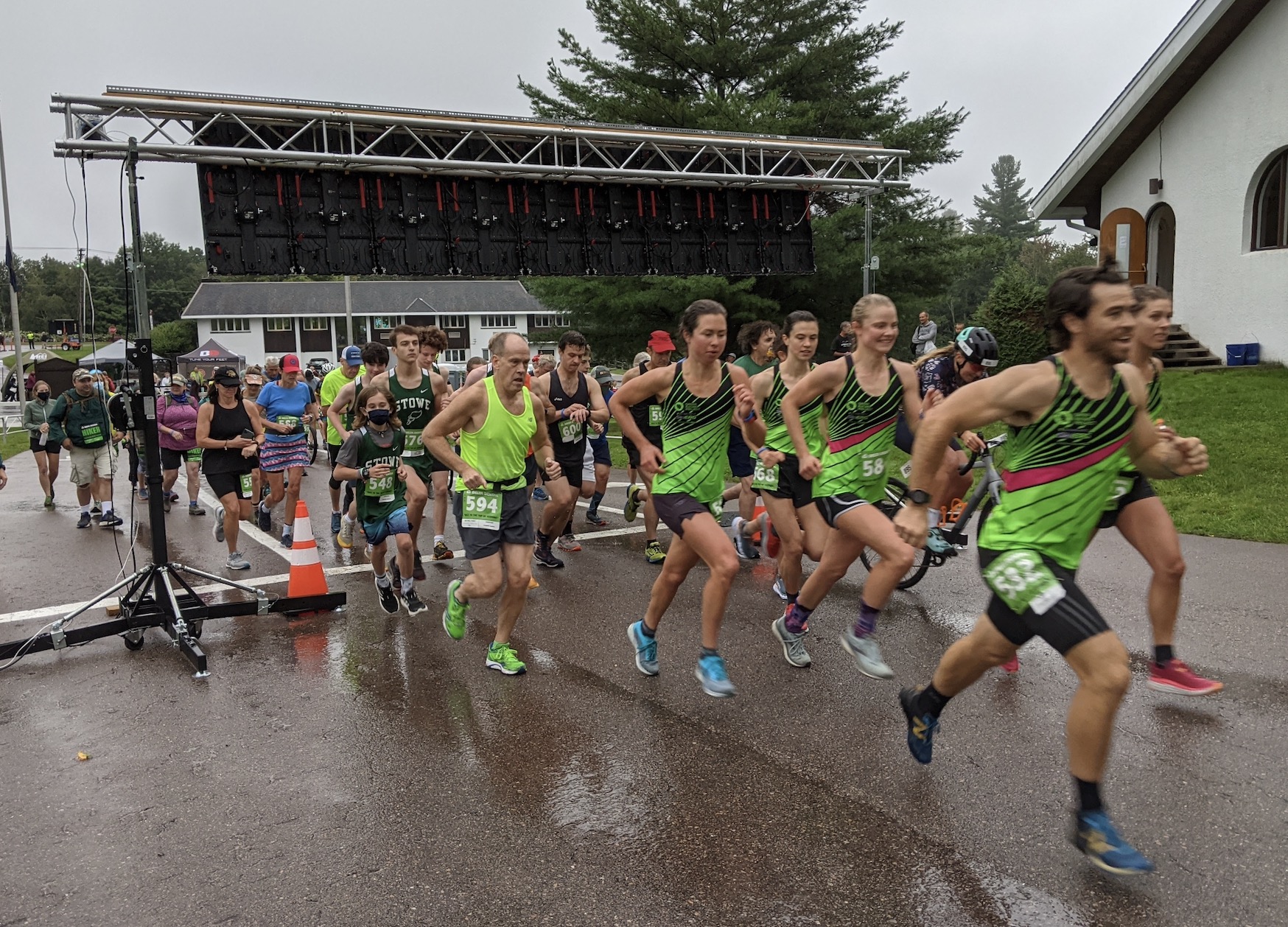
Racers take off to climb the Mount Mansfield service road in the 2021 Race to the Top of Vermont. (Courtesy photo)
Under gray skies, runners and bikers lined up on Sunday, August 29th in Stowe, VT, to “Race to the Top of Vermont.” The 4.3 mile race climbs over 2,500 vertical feet up the Mt. Mansfield Toll Road at roughly an 11% average grade, this year finishing inside a cloud with wind whipping the finish line flagging. The event drew in nearly 300 participants with 215 runners taking on the focal challenge of making their way up the mountain on foot. The event is a fundraiser for the Catamount Trail Association (CTA), which maintains a 300 mile long backcountry ski trail through the heart of Vermont, from the Massachusetts border to the south and ending on the Canadian border at its northern end.
According to CTA events director Greg Maino, “[The CTA] focuses on developing backcountry ski terrain, conservation in the state of Vermont, and increasing access to the outdoors for everyone.”
Topping the results list were several members of the Craftsbury Green Racing Project (GRP), including winners Adam Martin and Caitlin Patterson. FasterSkier connected with Martin and Patterson via email as they prepared to travel across the pond to spend time on snow.
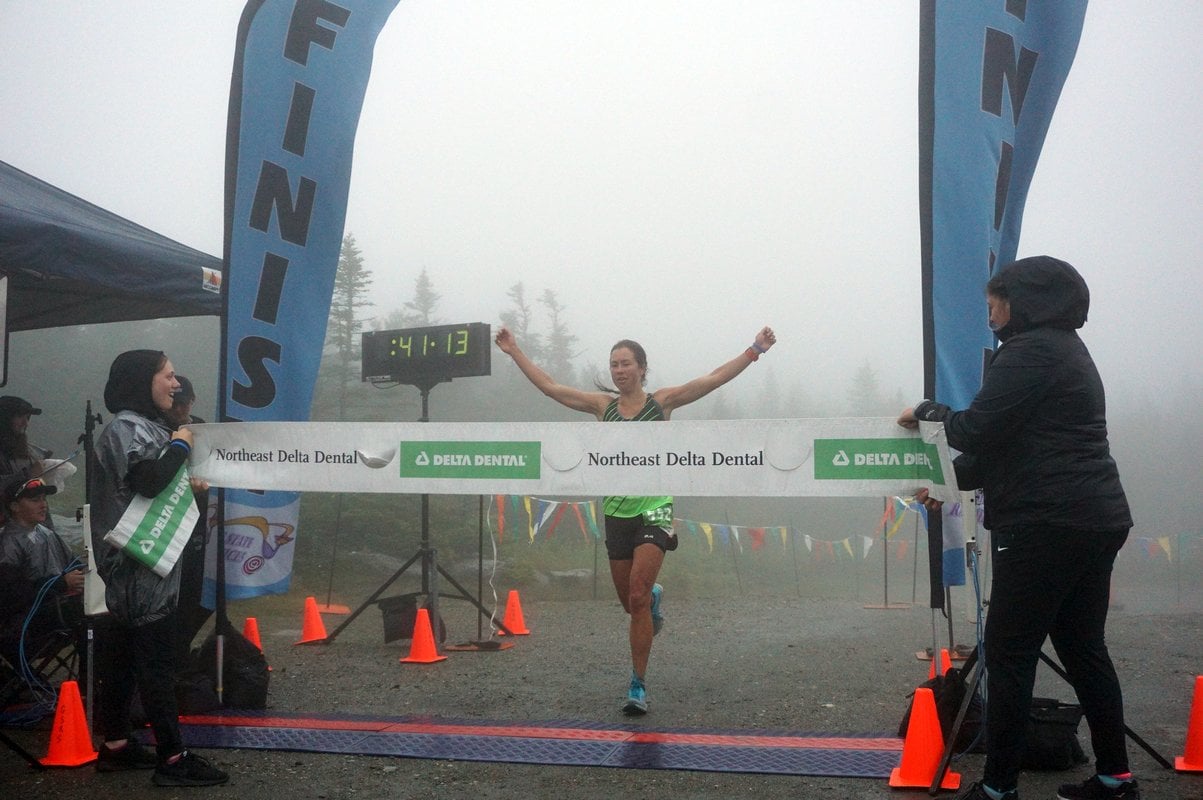
Martin expressed that his summer training has been “going great”. Crossing the line as the first runner to the top — he was beaten by just one cyclist — Martin stopped the clock at 34:11.5, nine seconds off his fastest time. In his email, he explained how this race fits into his ski training regimen.
Adam Martin breaks the tape (and stops his watch) at Race to the Top of Vermont. (Photo: Granite State Race Services)
“This year my big focus is on prioritizing intensity workouts, and so far, I think my body has been responding well. We’re planning on heading to Germany [to get on snow in] the Oberhof ski tunnel this week, so last week I backed off a bit ahead of the race and upcoming travel. Across the GRP, I think we were all coming in at varying levels of fatigue.”
It’s no secret that Martin has got some wheels. He’s got a 1:06:18 half marathon PR (5:03 per mile), and caught our eye for running a 14:34 5k in 2019 (4:41 per mile). While uphill is a different ballgame for some runners, ski training lends itself well to the challenge.
“Sunday the race was great – and hard. Early on I broke away from the rest of the field and tried to embrace the grind for the remaining 30+ minutes of the race. I really like this event, specifically how it’s a huge climb on an easy running surface, and I’m really happy to come away with the win.”
All five of the men of Crafsbury landed in the top-eight, with biathlete Raleigh Goessling taking third (37:10), Luke Brown fourth (37:45), Akeo Maifeld-Carucci seventh (38:28), and Carsen Campbell eight (39:14).
Caitlin Patterson takes the win at Race to the Top of Vermont. (Photo: Granite State Race Services)
Female cross country skiers have a history of breaking the tape at this event. Queen of the hill climb, Liz Stephen holds the course record of 37:15.9 set in 2014. This year, Patterson set a new personal best of 41:14 for tenth place overall.
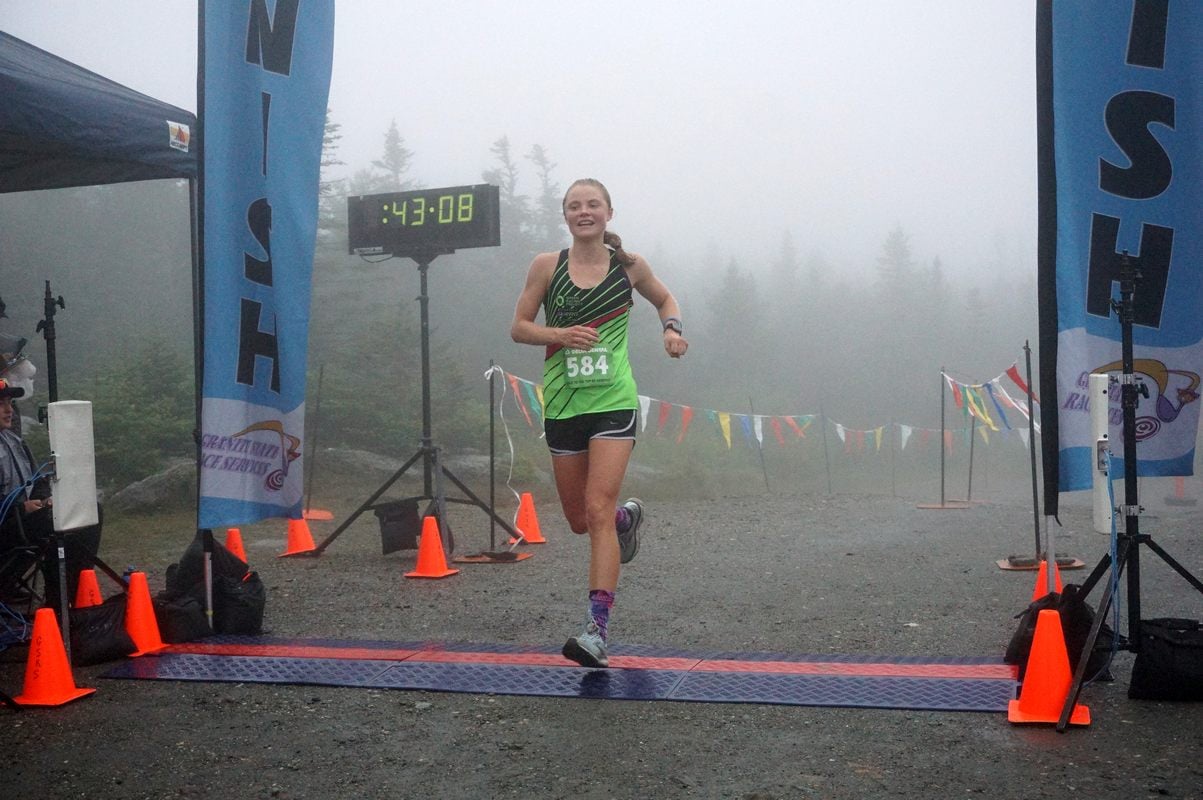
Making a clean sweep for Crafsbury, Alex Lawson took second place in 41:42, with Margie Freed following for third in 43:09. Both women are new to the GRP this season after graduating from Middlebury College and the University of Vermont, respectively.
Hallie Grossman took fourth in 45:25, and Annuka Landis rounded out the GRP results in sixth 47:23.
Margie Freed finishes third at Race to the Top of Vermont. (Photo: Granite State Race Services)
“Race to the Top of VT is always a fun one, and I’ve done it enough past years that it’s a bit like a fitness-check time trial for me,” wrote Patterson after the race. “I was looking forward to it as a hard effort and chance to put on a bib – I’d hoped to have done some running races earlier in the summer, but I strained a tendon in my foot in July so have hardly run at all during August. Of course I’ve been doing plenty of other ski training and all of that is going well, but I was very pleased with the Race to the Top, to win it and to run a fast time. In fact this year was my fastest time ever, helped I’m sure by the nice cool misty weather conditions.”
Patterson also sent the following comment about her racing strategy, which she initially shared with a local newspaper covering the event.
“Alex and I ran together for at least the first 3 miles, and she was really strong today too. We’ve been doing running workouts together for our ski training and I had an idea that Alex would be fast today. So we ran together for much of the race, and then I very gradually pulled ahead in the last mile or 1.5 miles or so, but Alex was not far back at all. In an uphill race like this, I think we were just enjoying the company in suffering, keeping moving, but not doing anything drastic. My race strategy was basically just to run smooth and efficiently, to breathe well, and be ready to dig in and make it hurt especially towards the top. So I was pleased with how the race went and I enjoyed running with Alex while it lasted because otherwise I did not see many people at all.”
DU’s Eveliina Pippo taking the win Thursday in Bozeman. (Photo: Montana State Athletics)
BOZEMAN, Montana – Thirty minutes after the conclusion of today’s nordic podium ceremonies, the NCAA announced that all winter and spring championship events were cancelled due to the COVID-19 pandemic, effective immediately.
While the fallout from the decision will surely stretch into the off-season, here’s how the cross-country races unfolded today at Crosscut Mountain Sports Center.
The day dawned cool and cloudy, with low overnight temps making the snow firm and fast. With occasional peeks of sunshine through the cloud cover, it looked like it could be a classic Montana March day.
Nothing today would be that straightforward — a snow squall materialized thirty minutes before the women’s start. Although just half an inch fell, the course was totally transformed and slowed down dramatically.
Even though the snow eased up for the women’s race, the early starters had to plow through the fresh flakes. Skate tracks appeared around the loop as the first few starters raced through the powder.
Crosscut’s course is mostly rolling, but features brutal climbs at about the 1 and 4k marks. The climbs are long, steep, and demanding, especially because of the venue’s location 6,100’ above sea level. The new snow made the climbs sloppy, with a few inches of sugary powder sucking speed on their upper pitches.
Starters were reverse seeded based on regional rankings. Top seeds were randomized in the final ten bibs, making bib numbers 30-40 the racers to watch for podium places.
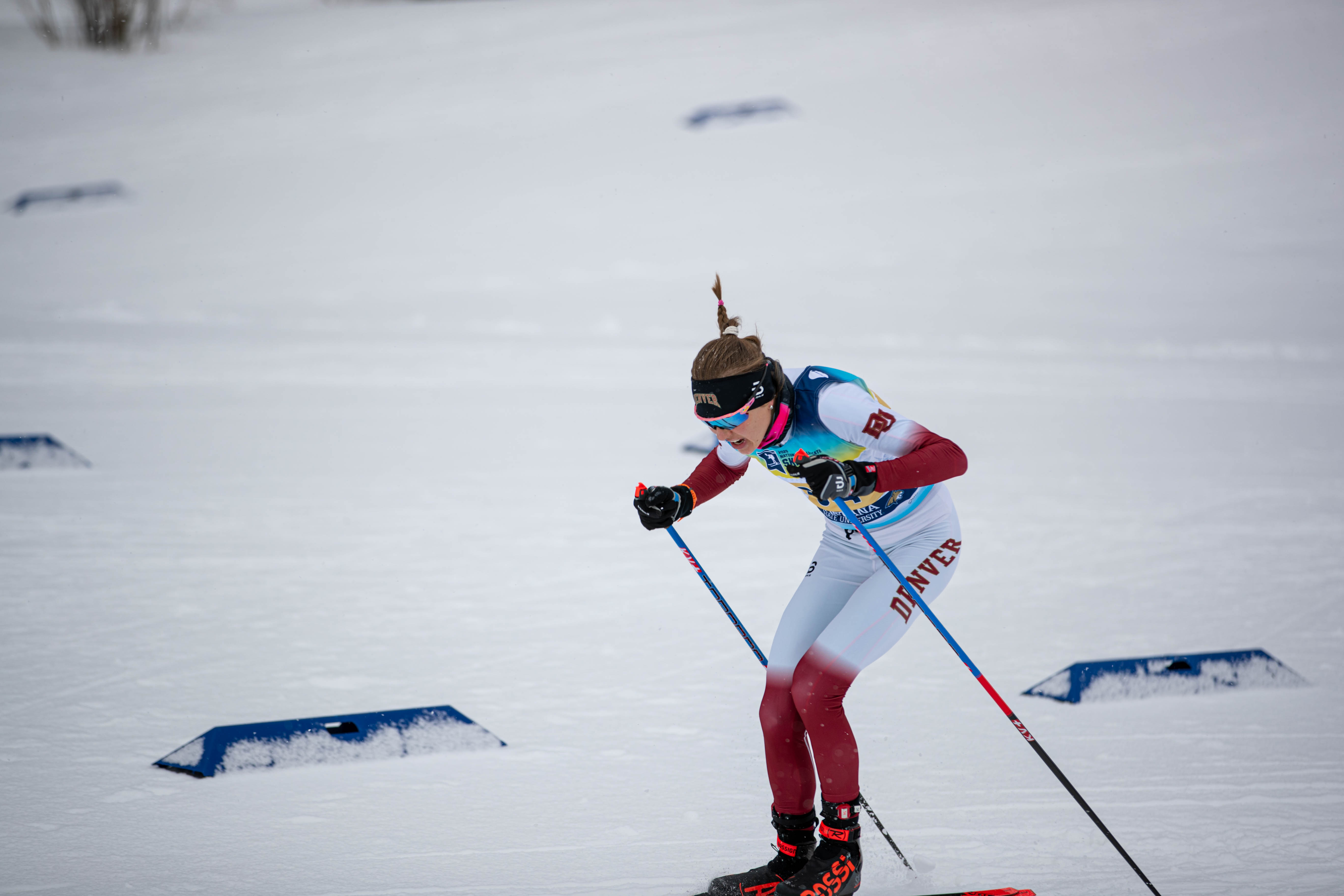
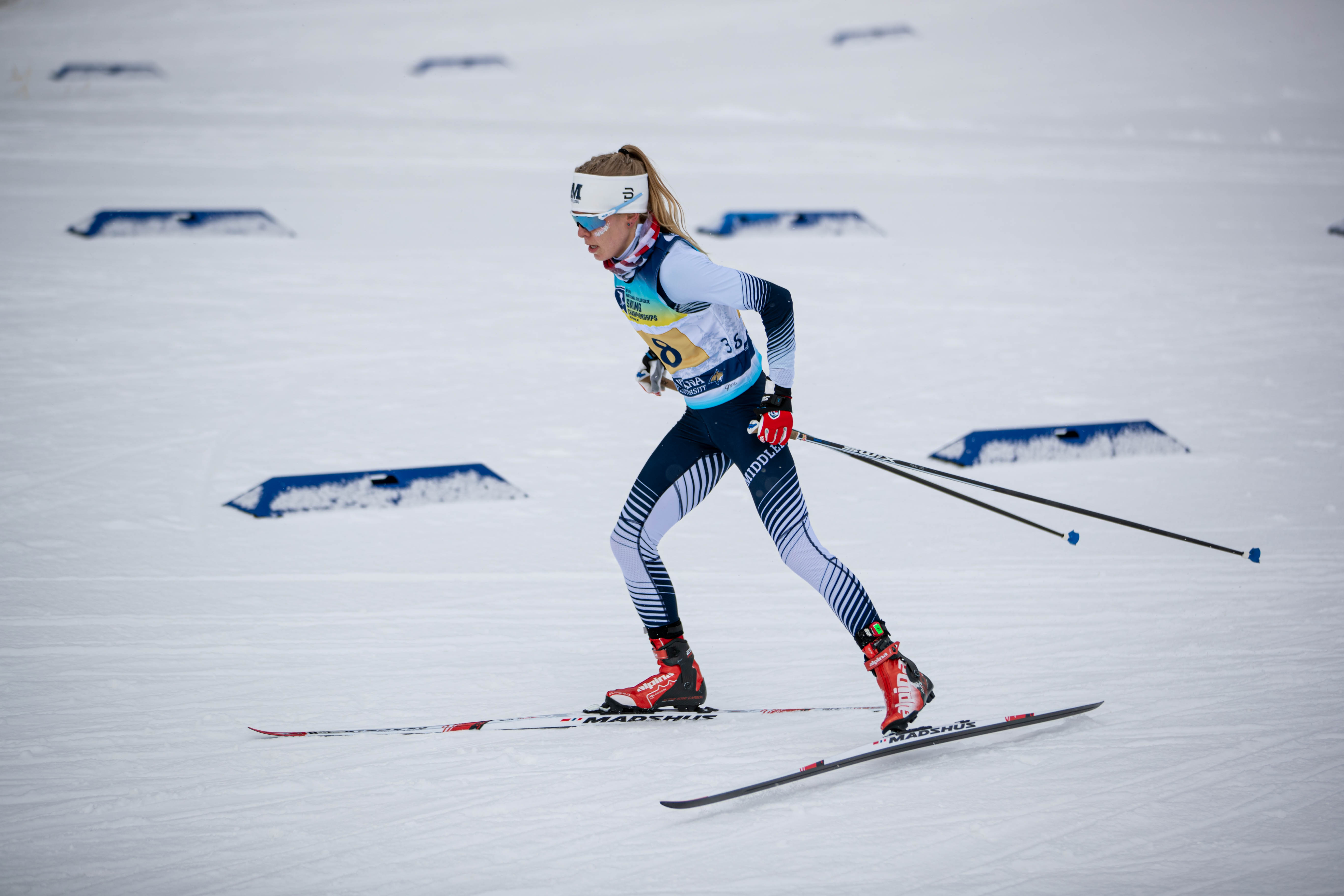
As the women rolled through the course, a pair of late starters separated themselves from the pack. Denver’s Eveliina Pippo led Middlebury’s Sophia Laukli by five seconds at the halfway mark. Behind the leaders, five racers – Utah’s Guro Jordheim, Middlebury’s Alex Lawson, UVM’s Lina Sutro, and Dartmouth’s Katharine Ogden were all within a few seconds of each other at the halfway mark, battling for the next few places.
Laukli continued attacking the course with her signature high tempo, showing the form that earned her fifth in the Junior Worlds 15k mass start last week in Oberwiethensal, Germany.
However, Laukli couldn’t quite reel in Pippo, as she finished in second, just 4.8 seconds back. Pippo, with three wins on the RIMSA circuit this season, was a favorite to take gold today. She said “I’m happy with my win…the key was to focus on doing everything I can and not focus on the other racers.”
Jordheim emerged from the pack to finish third, followed by Ogden in fourth and Sutro in fifth.
The Middlebury trio of Laukli, Lawson, and Annika Landis has been on a tear throughout the EISA this season. Today they showed their winning ways aren’t limited to the East Coast, finishing 2-6-16, respectively, and amassing 79 points to take the team win over the University of Utah (74 points.) The UVM Catamounts, with Anya Bizyukova in seventeenth, scored 65 points and took third on the day.
Middlebury’s Sophia Laukli racing to second place in Bozeman. (Photo: Montana State Athletics)
As the women cooled down and the men warmed up, the sun finally stuck around. The course filled up with spectators and racers, and the excitement was palpable as the first male skier took the line at noon. Once again, the top seeded racers were in bibs 30-40, with the winner expected to emerge from that select group.
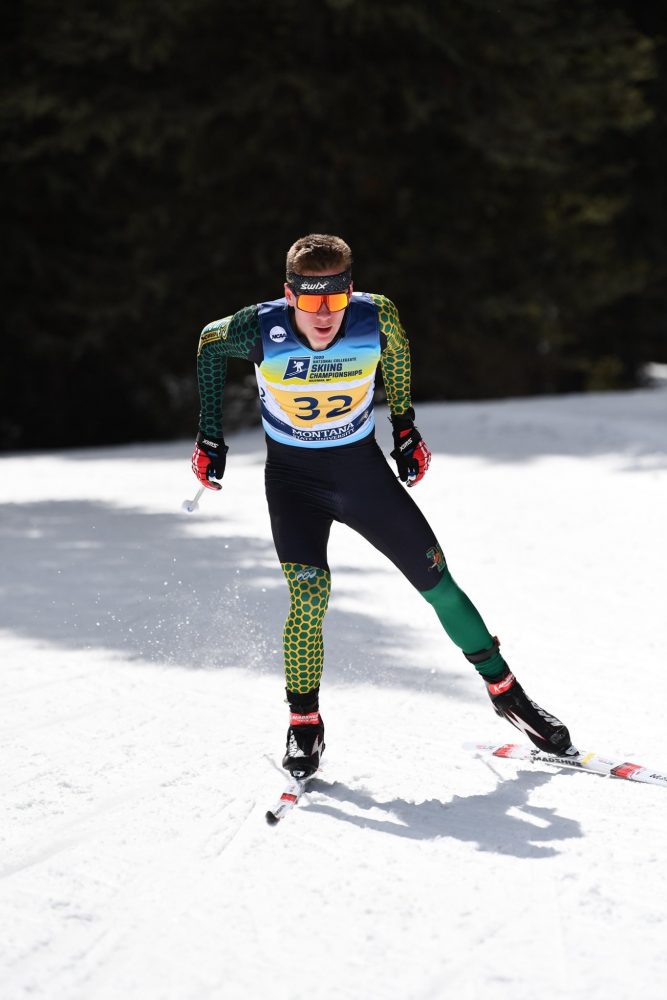
Ben Ogden accelerated like a rocket from the start, flying through the first 5k nine seconds faster than anyone else. Third through ninth places were separated by just fifteen seconds at the halfway mark, setting up an exciting second lap. The course, snow, and altitude conspired to punish anyone who started too fast and reward those who had paced their efforts.
Utah’s Sam Hendry started reeling Ogden in, coming back from a seventeen second deficit at 10k to a three second margin at 7.5k. Ogden came into the final climb and entered into a tunnel of Catamounts, with teammates, friends, and fans screaming on both sides of the trail.
UVM’s Ben Ogden, skating to an NCAA win. (Photo: NCAA)
Ogden, charged up by the Catamount faithful, powered to the line and took his first NCAA title by just 3.1 seconds over Hendry. With a second-straight gold medal in the relay at Junior Worlds last week, Ogden may need to invest in a bigger trophy case. Ogden was thrilled with his result, saying “I’m ecstatic! I just came over from Germany, but I was super stoked to rest up and throw down today.”
Hendry charged into second with the fastest second lap, while Denver’s Bernhard Flaschberger, winner of a pair of RIMSA skate races this winter, took third for the Pioneers. University of Alaska Anchorage’s Sigurd Roenning was ten seconds further back in fourth, while UVM’s Karl Schulz finished fifth.
Along with Bill Harmeyer in twelfth, Ogden and Schulz, the UVM trio combined for 88 points, giving the Catamount men the team win on the day. Roenning led Anchorage to 77 points and second place, while Hendry’s effort helped the Utes pile up 67 points and take third place.
Given the cancellation of the mass start, NCAAs were effectively a one-day championship. The University of Vermont men and women combined for 153 points, taking the 2020 nordic title. Utah was close behind with 141 points, while Alaska Anchorage scored 123 and finished third.
Complete nordic results are on Summit Timing.Team scores are available on RIMSA.
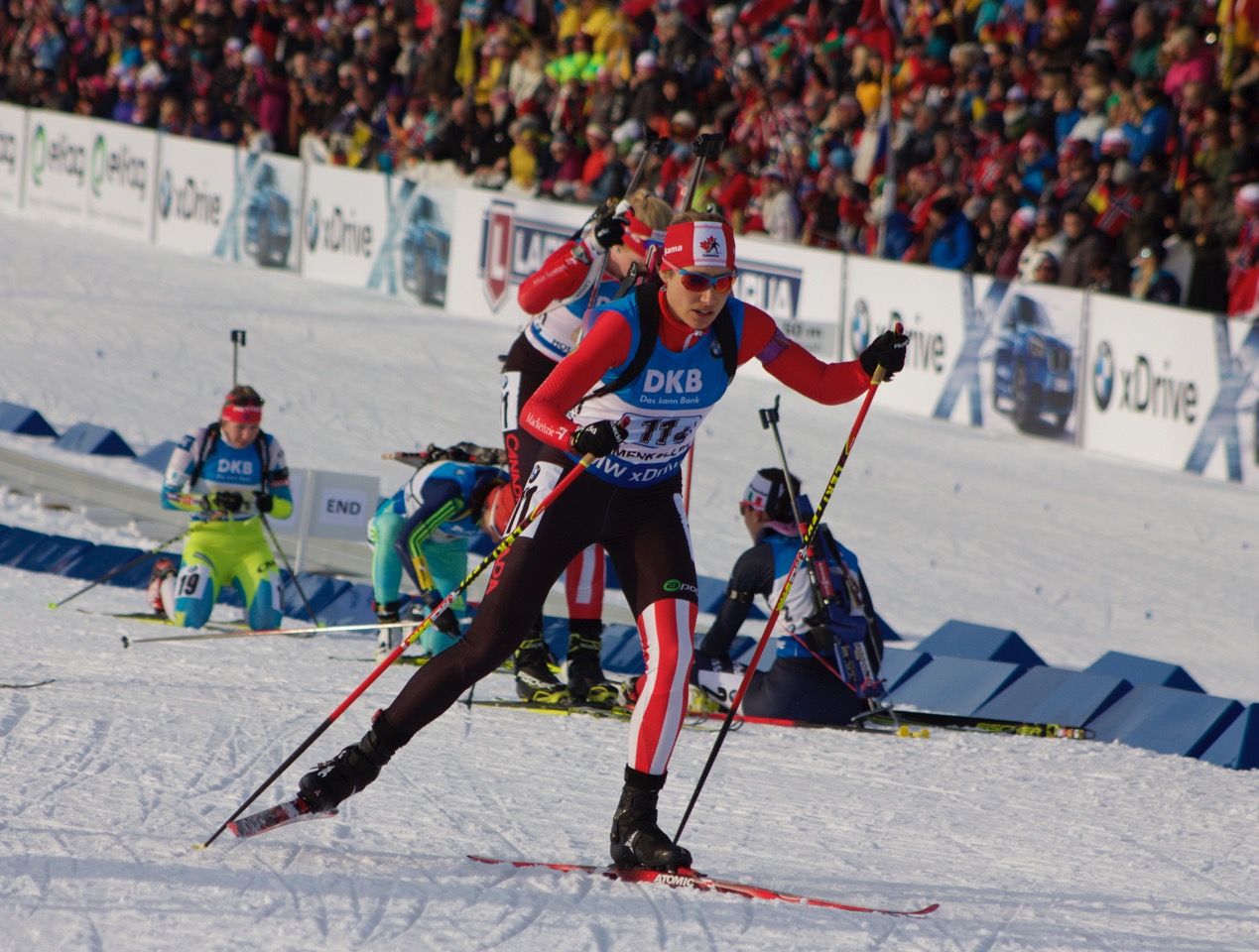
Canada’s Zina Kocher heading out for the final leg of the women’s 4 x 6-kilometer relay at 2016 IBU World Championships in Oslo, Norway. Her team went on to place 15th. (Photo: JoJo Baldus)
“I’m un-retiring for six months,” 34-year-old Zina Kocher said with a laugh on the phone earlier this week.
Kocher, who lives in Canmore, Alberta, announced via Instagram on Oct. 2 that she was returning to elite-level racing with the one-and-done hope of making the 2018 Winter Olympics in PyeongChang, South Korea. As she referenced in her social-media post, Kocher’s return to the trails will be “4k” (kilograms) lighter — her current run at the Olympics Games will be in cross-country, not biathlon.
For sixteen years, Kocher trained and raced as a top-tier Canadian biathlete. She was a three-time Olympic biathlete and raced at 12 World Championships. After the 2016 race season, Kocher pulled the plug on her ski career. She worked as a doula, completed her first year of massage-therapy school at Calgary’s Mount Royal University, and married Alex Lawson this past summer.
The question for Kocher was what to do with all her pent-up energy? Like many endurance athletes, she’s wired for movement.
“I guess for the first few months after I retired, I didn’t exercise much,” Kocher said. “I traveled, I went to Turkey and Greece, I rock climbed a lot. … Actually in January 2017, when I started school full time, I just felt that I needed something. When I left school each day, I was like a caged animal and I had to go and be physical because I had had enough of sitting in a chair for hours and listening.”
That restlessness was partially tamed with bi-weekly gym sessions, running and occasionally, cross-country skiing in the evening. All this was simply to burn extra fuel.
“My body had a hard time with being sedentary,” Kocher said. “There was no thought about being in the Olympic Games. It was just, I need to be physically active. That was my only thought. I actually would often study for one of my classes while I was on a bike in the weight room because I had to go through flashcards for anatomy. So I would study and work out at the same time.”
Zina Kocher (r) leads Emily Nishikawa in the 30 k freestyle mass start at the 2017 Canadian Ski Nationals. (Photo: Peggy Hung)
Flipping through flashcards, passing classes and pumping the blood wasn’t enough. Considering Kocher’s athletic resume, she needed something more. She signed up for the Cross Country Canada (CCC) 2017 Ski Nationals in Canmore. No travel, no stress finding a wax guru to prime the skis — a Canadian nationals in her backyard would simply be a carrot to motivate her while in school.
Kocher is known as one of Canada’s best skate skiers — at the 2017 Canadian Ski Nationals in March, she won the 5-kilometer freestyle and placed second to CCC World Cup Team member Emily Nishikawa in the 30 k freestyle mass start.
“There were definitely side comments after those races from people, like, ‘Are you training?’ and ‘You should maybe think about maybe training full time again,’ and ‘Have you thought about the Olympics?’” she reflected.
The 2018 Olympics were not part of the plan. But Kocher’s results at nationals started the wheels turning.
Last April, Kocher said Boruta made a few passing jokes about qualifying for the Olympics. Initially, she was tepid about the prospects of a comeback. Her primary goal remained finishing her education. She did, however, ask Boruta and her former physiologist if she could mount a viable comeback if she delayed full time training until this September.
“Basically their thoughts, Richard’s thought and the physio’s was, yeah, I have a huge base behind me and I haven’t exactly laid on the couch and done nothing for a year and a half,” she said. “So we can do this.”
In a sad twist of timing, Kocher said the day she contacted Boruta to confirm she was ready to begin his training plan was also the day of Boruta’s accident.
“Richard knew we still wanted to do it, but he was waiting for me basically to be ready to start a full program,” she said. “I think I would have had regrets if I hadn’t done this, and it was going to be our fun challenge together. I think in a way it’s my way to honor Richard.”
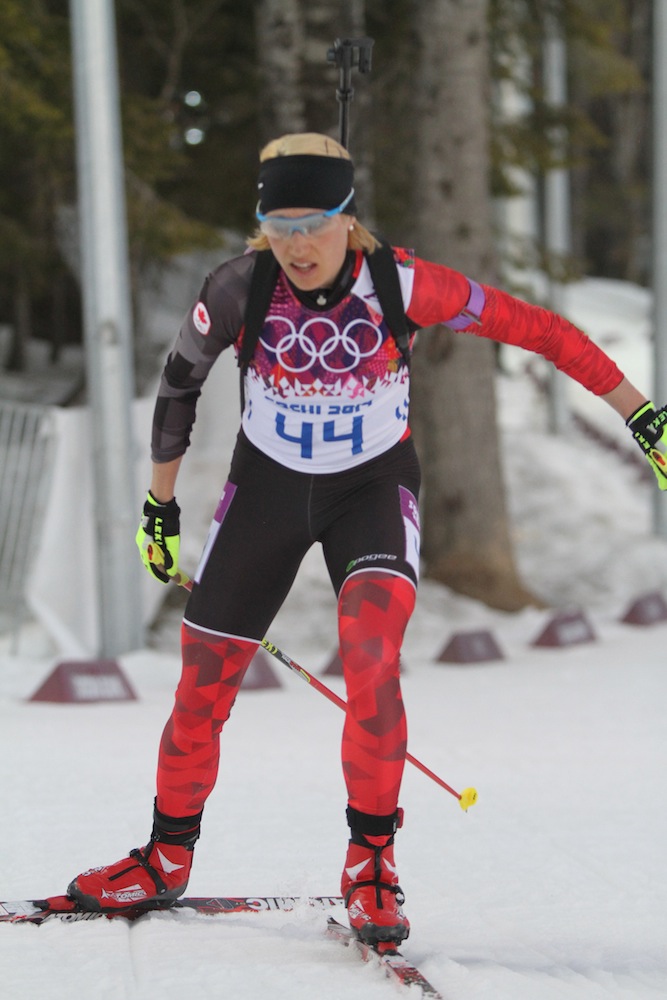
Zina Kocher racing the 15 k individual at the 2014 Sochi Olympics. (Photo: FasterSkier)
Committed to the comeback, Kocher reached out to former CCC national-team head coach Justin Wadsworth for assistance. Wadsworth also lives in Canmore and is now coaching Kocher.
“We have had Zina at our training camps in the past and Zina is just a real pleasure to have around,” Wadsworth said on the phone. “She is easygoing and she has always been positive. So she asked me if I would be interested to help, especially in light of what happened with Richard I told her I would be more than happy to do what I can, and so we set out on this journey together.”
Kocher appears to have all the parts to make an Olympic return. Yet one critical aspect of the comeback is a work in progress. For all of her adult life (up until a year and a half ago), Kocher trained full time as a biathlete. In that world, classic skiing expertise is not a requirement.
“I feel confident in skating,” Kocher said with a slight laugh. “I don’t feel confident in classic, but I hope that in a couple months I will feel confident in classic.”
On the International Biathlon Union (IBU) World Cup circuit, her career best was third place in the 15 k individual in 2006 in Östersund, Sweden. In reaching that podium, she was the first Canadian to earn a medal in over a decade. She went on to record several top-1o finishes and was a member of the Canadian women’s 4 x 6 k relay team that placed fourth at a World Cup in 2013, with Megan Imrie, Rosanna Crawford and Megan Tandy. At the Sochi Olympics, her 4 x 6 relay team placed eighth for the best-ever Canadian Olympic result in that event, and she was the top Canadian in 25th in the Sochi 10 k pursuit.
But all of those events were skate. The classic-technique piece is critically important for Kocher’s PyeongChang quest. The Canadians will host Olympic Trials in January in Mont Sainte Anne, Quebec. At those trials, Kocher will have to contest, and most likely win, a 10 k classic and a skiathlon in hopes of qualifying. (The PyeongChang women’s distance events are a 10 k skate, 30 k classic and 15 k skiathlon.)
With limited time and limited classic experience — Kocher said she only used classic technique as recovery when she was a full-time athlete — Wadsworth has an abridged plan for Kocher. He also understands the challenges at play.
“I’ve seen Zina classic ski a tiny bit over the years,” Wadsworth said. “And classic skiing is got to be right in there with one of the most technical athletic things that you can do. The motion, kicking the ski, it is quite hard to become efficient at.”
Wadsworth admitted he likes the challenge and has laid down a practical approach to hone Kocher’s classic skiing.
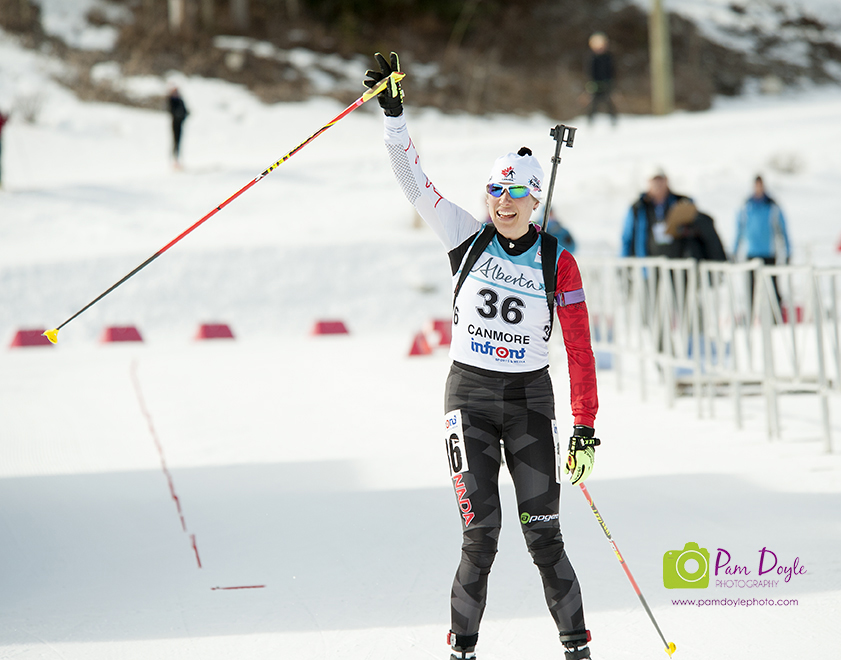
Zina Kocher waves to the home crowd after placing second in an IBU Cup sprint in Canmore, Alberta. (Photo: Pam Doyle)
“We have a few strategies,” Wadsworth said. “We have just focused on double poling and skating. And then we are going to start working on actual classic technique once we get on snow so there are no bad habits developed on the rollerskis. We don’t have a lot of time, a couple of months here, but I think she can get to a place where on the right day with the right skis she could stay near enough to the leaders in a skiathlon to let her skating take over.”
It appears since retiring and un-retiring, Kocher’s high quality, low-volume training has her motor primed. Back in the late spring, Kocher received some data indicating she had not lost much fitness since retiring as a biathlete.
“I did do a treadmill test just because they needed some subjects for some students, and that was in May or June,” Kocher said. “Everything was totally normal to how I always am in the spring. It was the exact same baseline.”
More recently, Kocher displayed an effort indicating her temporary comeback may be for real.
“I will say at this point — we’ve trained for about three or four weeks and then kind of officially together — she did the Norquay uphill time trial and I think she posted her second-best time there as an athlete and among the better times that I have seen from cross-country skiers,” Wadsworth noted. “Fitness-wise she is back in good shape, and I think she is ready to give a good stab at this. … Definitely some really good women are preparing for the Olympics and probably have a leg up on her, but you know, there are some spots available. And I think she has a good opportunity and she has a lot of experience. She is approaching her training plan very wisely and with a lot of experience it might pay off.”
The winners of NENSA’s 2017 App Gap Challenge rollerski race, Kam Husain (who set a course record) and Alex Lawson, at the awards ceremony at Mad River Glen in Fayston, Vt. While Husain was awarded $100 cash for breaking the course record, he explained in an email that he donated it to NENSA to comply with NCAA rules. (Photo: Dave Priganc)
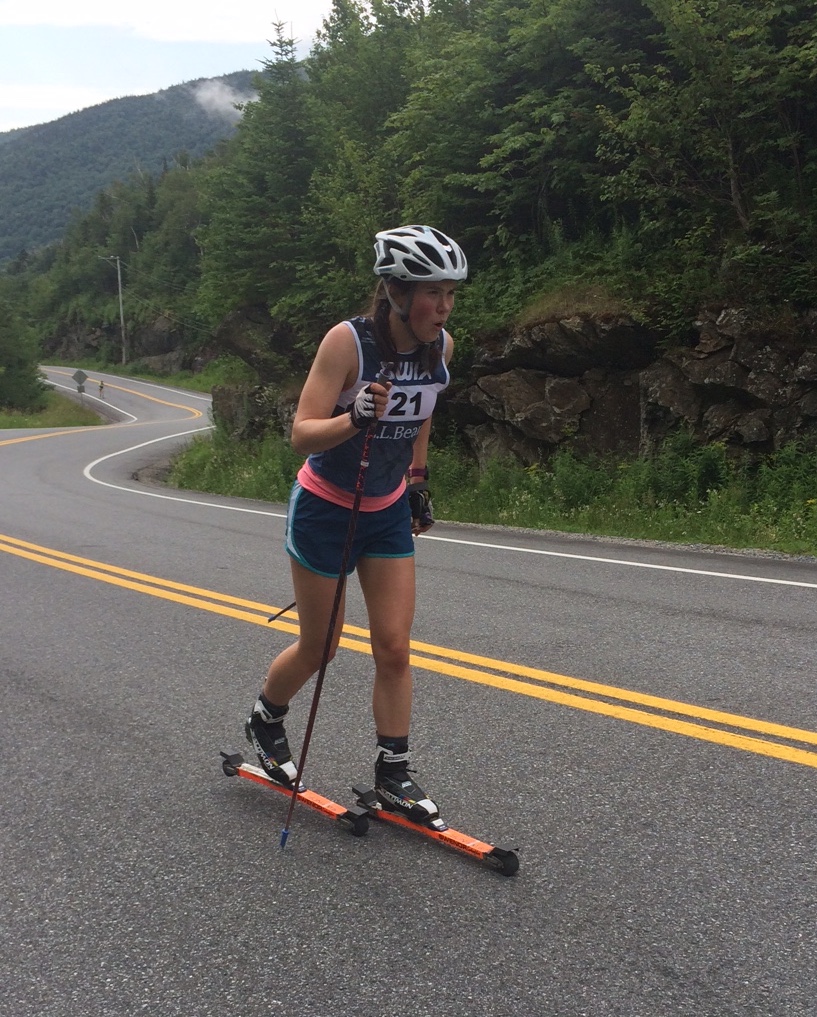
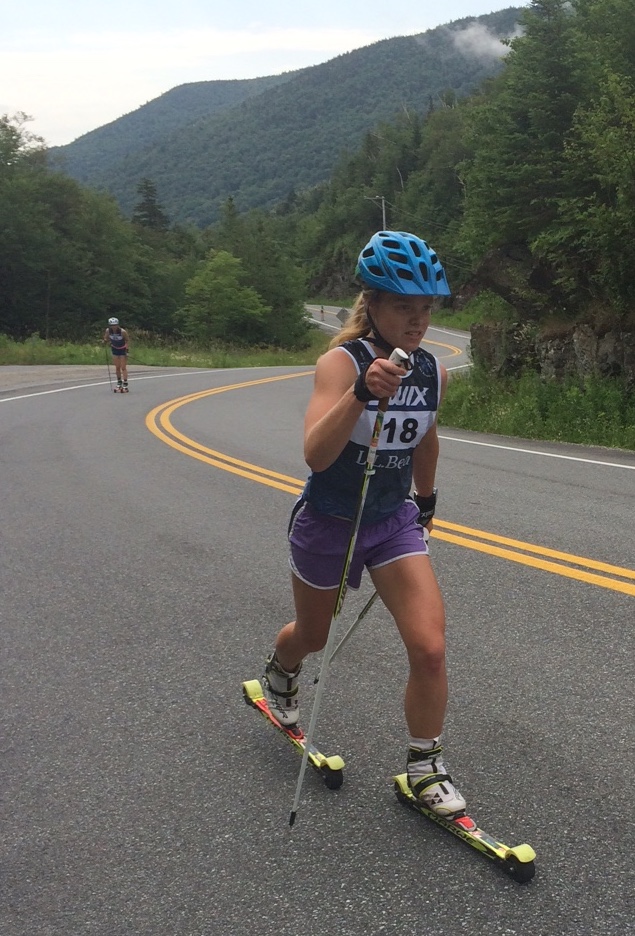
FAYSTON, Vt. — This past Sunday, July 23, Kam Husain and Alex Lawson won the 2017 App Gap Challenge and set some of the fastest times on the grueling course in the process. Husain, a 19-year-old Vermont native and former Stratton Mountain School skier, set a new men’s course record of 30 minutes, 28 seconds. Lawson, a Craftsbury Nordic skier coming off her senior year at St. Johnsbury Academy, was the second-fastest woman ever on the course, winning in 26:58 and coming within 21 seconds off Corrine Malcolm’s record.
Competitive cyclists refer to the individual time trial as the race of truth. It’s just the athlete against the course and the clock, and there’s no pack to hide in. On the steeps leading up to Vermont’s Appalachian Gap, men raced 7.5 kilometers and the women raced 5 k in Fayston, near Waitsfield, Vt. Since Vermont Route 17 was left open to traffic, the race was an individual start. App Gap may be the only rollerski skiathlon in the U.S. (if there are others, email peter (at) fasterskier.com), with the flip-flopped format of skate technique followed by a transition to classic.
(Article continues below)
“Last time I did it, I was only a J2, so I wanted to beat that,” said Husain, who will be a freshman at Dartmouth College this fall. “I’ve been working on my skate skiing, so I wanted to take my skate skiing out hard and see if I could hold it through the classic. And it worked out pretty well.”
“I was definitely trying to gun for it, because I was feeling pretty good,” Husain reflected. “I’ve been really trying to work on my fitness, especially in a race like this. I’m glad my work has been paying off.”
Alex Lawson (Craftsbury Nordic) with her game face as she approaches the summit and first place in the 2017 App Gap Challenge on July 23 in Fayston, Vt. (Photo: Laurel Minde)
Lawson, of Bethlehem, N.H., explained that while she was new to the race, she was familiar with the territory and terrain.
“I’ve never raced the App Gap before, but I’ve skied parts of it at a few camps that I’ve done at GMVS [Green Mountain Valley School],” she wrote in an email. “I didn’t really have too much of a plan for how to ski it, but I definitely took the skate part pretty conservatively and just tried to ski smoothly.”
Her time was the second fastest of any woman in the race’s nearly 10-year history (Malcolm set the record of 26:37 in 2012). The race started in 2007 and was held every year thereafter, except last year, according to Justin Beckwith of the New England Nordic Ski Association (NENSA). Beckwith started the race as a finale to his junior camps at GMVS, where he was previously a coach and nordic director. After it went on hiatus for a year in 2016, Beckwith, NENSA’s new competition director, decided to revive it.
“I think [the race] went really well and the event was a lot of fun,” Lawson wrote. “I haven’t really done many rollerski races before, but this one was a blast and certainly makes me want to do more in the future.”
The second-overall woman, Callie Young, of Newport, Vt., finished 1 minute and 31 seconds behind Lawson. She was also unfamiliar with the course, but received some advice from a friend who had done it before.
Callie Young, of Newport, Vt., racing toward the summit and second overall in the women’s race at the 2017 App Gap Challenge in Fayston, Vt. (Photo: Laurel Minde)
“‘ Hammer the skate leg and just walk the classic section,’ ” she recalled. “I definitely didn’t want to take that advice … but decided to go out pretty hard for the skate leg then once I transitioned just focus on good technique and smoothness for the classic section. The only thing I had to know when I was close to the top was when I got to the record time I knew I was pretty close. At that point, I was going to try to push a little harder if I had anything left.”
In retrospect, Young wished she had driven the course before the race.
The Mad River Glen ski area served as race headquarters and also the transition zone.
“My goal was to bring cross-country skiing to an alpine hill,” Beckwith said, adding that he wanted to recreate the vibe of European rollerski events like Norway’s Blink Festival. “The biggest clubs are so strong, they’re having their own time trials. Hopefully we’re creating more excitement for cross-country skiing and also rollerski races. Having this community event, it’s not just about who had the fastest time. You get together with your buddies.”
Fifty-seven starters lined up Sunday under cloudy skies with temperatures in the low 60s. Right around the start, it began raining lightly, which continued for about 25 minutes. The terrain is markedly different from the Northeast’s other major uphill-rollerski race. Whereas the Climb to the Castle, up Whiteface Mountain’s toll road outside Lake Placid, N.Y., is a steady 8-percent grade, Route 17 from the men’s start teases you with mainly easier sections below 5-percent grade.
Strava lists Route 17 to Appalachian Gap as a 5-percent grade, but that’s deceiving. As you get closer to Mad River Glen, the road pitches upward, with a 15-percent ramp right below the ski area to soften you up. Starting 2.5 k closer to Mad River, the women had maybe a kilometer of relatively easy grade before the steeps. The pavement is slow and you need to watch for cracks. There’s also the odd pothole that you wouldn’t notice while driving, but that would take you out on rollerskis.
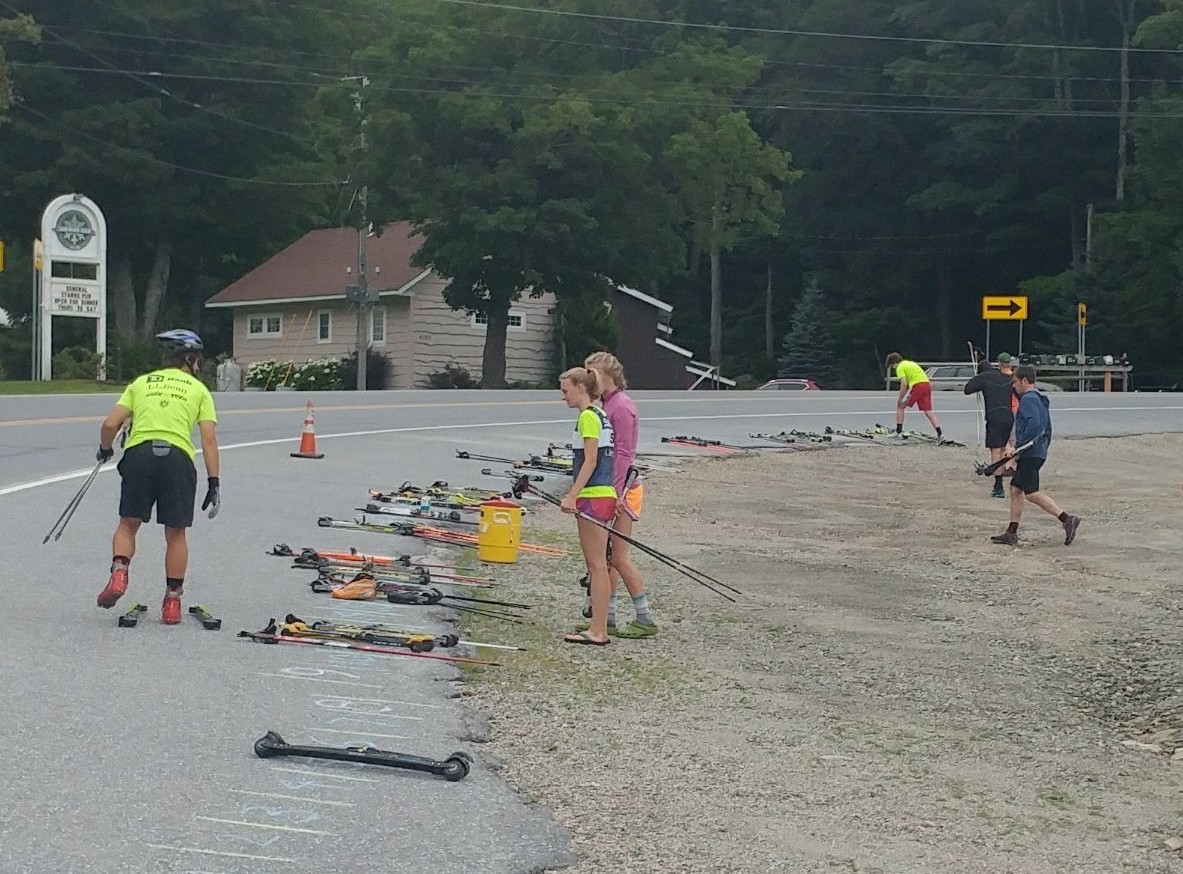
Pre-race at the 2017 App Gap Challenge in Fayston, Vt.: skiers setting up their classic gear in the transition area. (Photo: Peter Minde)
From the exchange, there’s no relaxing, with regular grades over seven percent and several over 15 percent. The killer is a 20-percent incline right below the finish. At least the pavement is new and faster than the pavement for the skate segment.
As with any other race, being familiar with the course helps.
“I live right in the valley. I know this road,” said Elliot Ketchel, a four-time App Gap racer who won the junior men’s race in 31:18. A GMVS graduate, he’s headed to Bowdoin College this fall.
At the finish, 1,509 vertical feet above the men’s start, skiers loaded their boards and boots into a sag wagon and changed into dry shirts and sneakers for a hike down the ski trails. With perfect timing, the sun came out for the barbeque and awards.


 This World Cup coverage is made possible through the generous support of Marty and Kathy Hall and A Hall Mark of Excellence Award. To learn more about A Hall Mark of Excellence Award, or to learn how you can support FasterSkier’s coverage, please contact info@fasterskier.com.