From the FasterSkier archive — posts syndicated from athletes’ and coaches’ own blogs between 2004 and 2012, kept online as published. Current coverage is at fasterskier.com.
Sunday, for the men’s 4 x 7.5-kilometer relay in Lahti, Finland the scene was decidedly more fitting for winter sport: The race began amidst falling snow despite bare firs and hardwoods lining the course. It’s been a sparse winter in Lahti.
Eleven teams contested the relay, with ten nations represented; Russia fielded two teams. The U.S. was not represented.
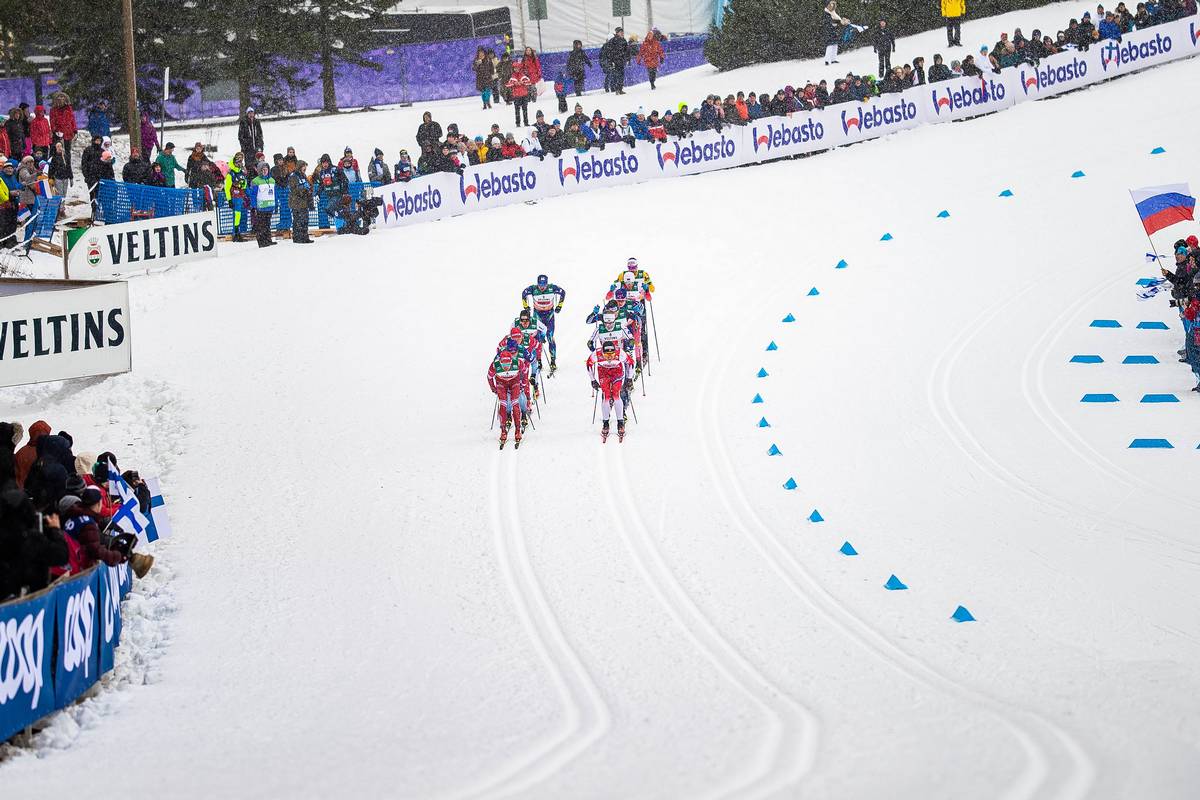
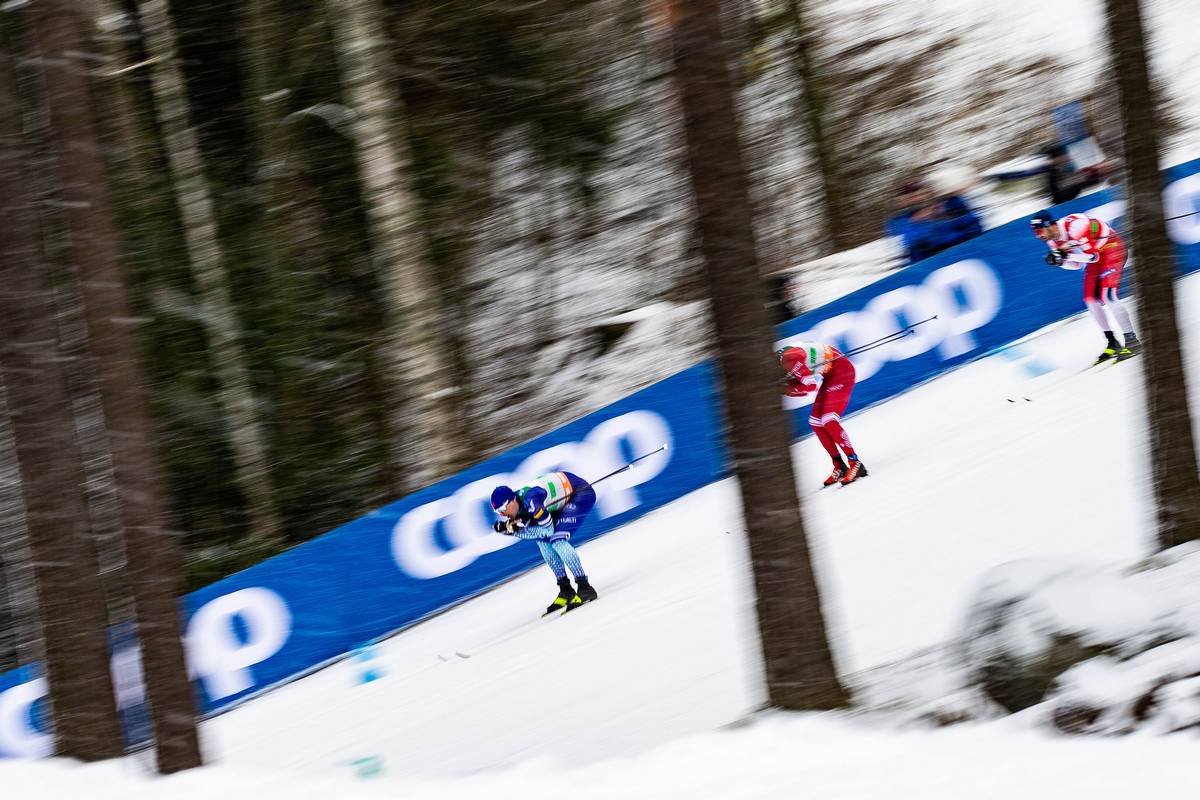
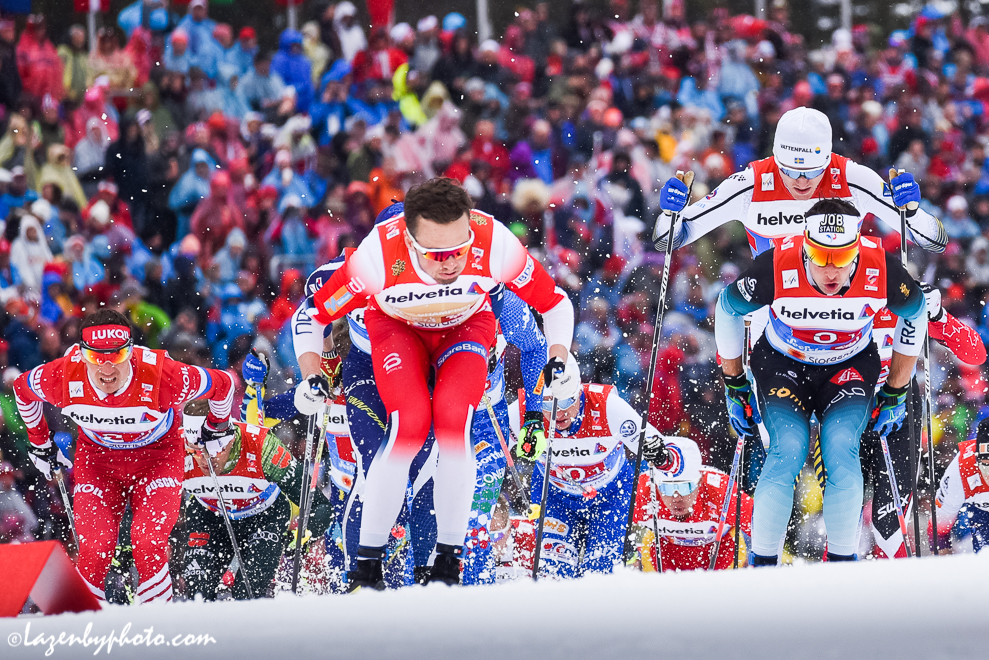
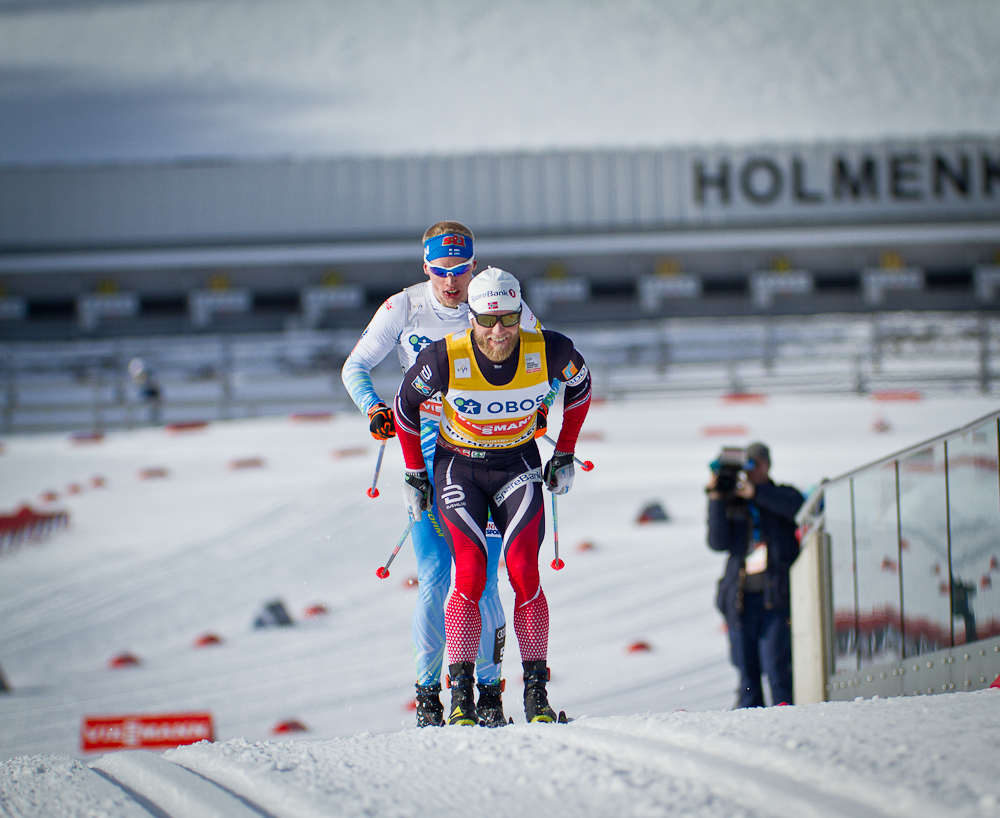
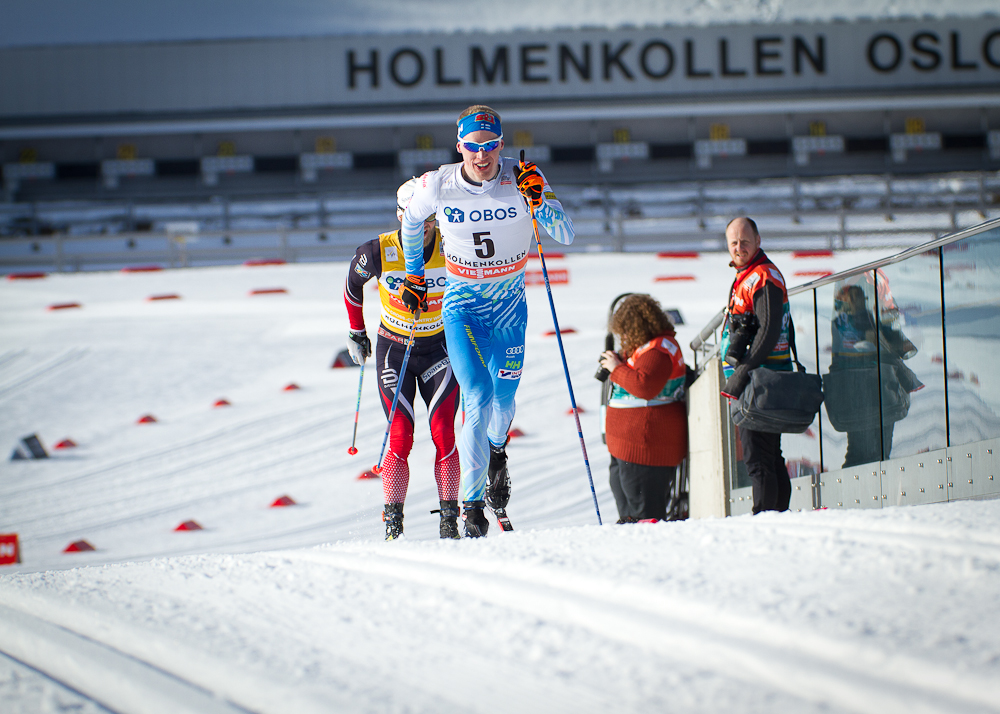
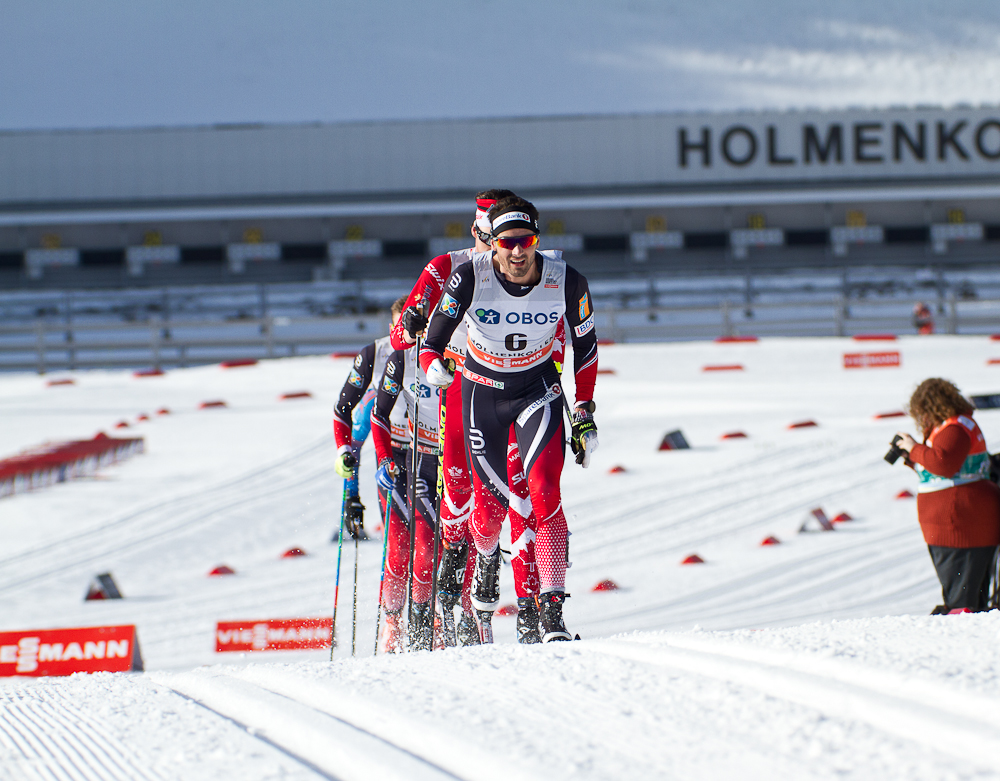
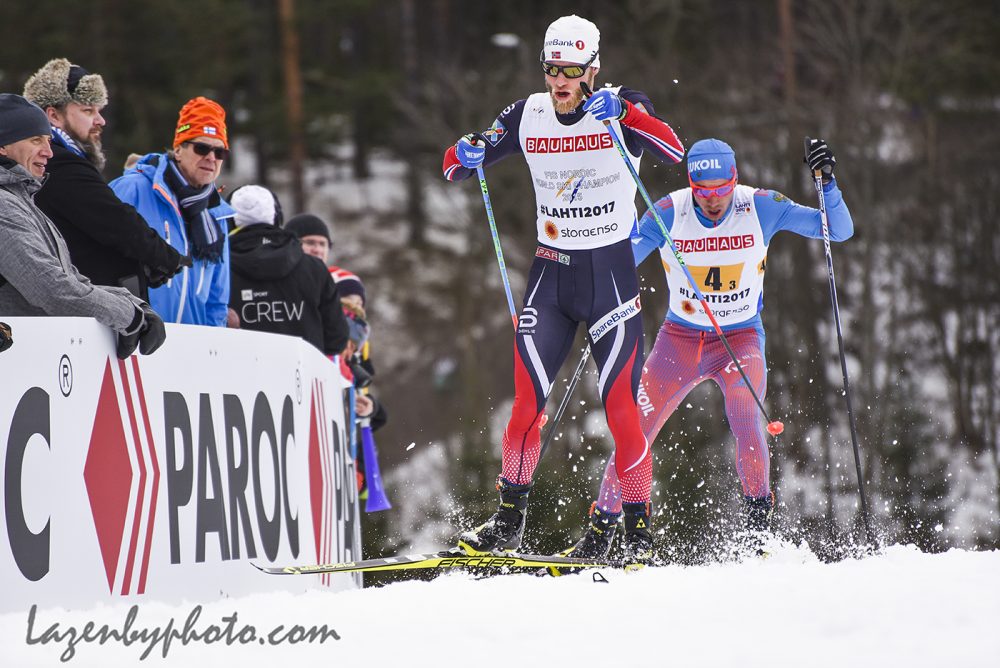
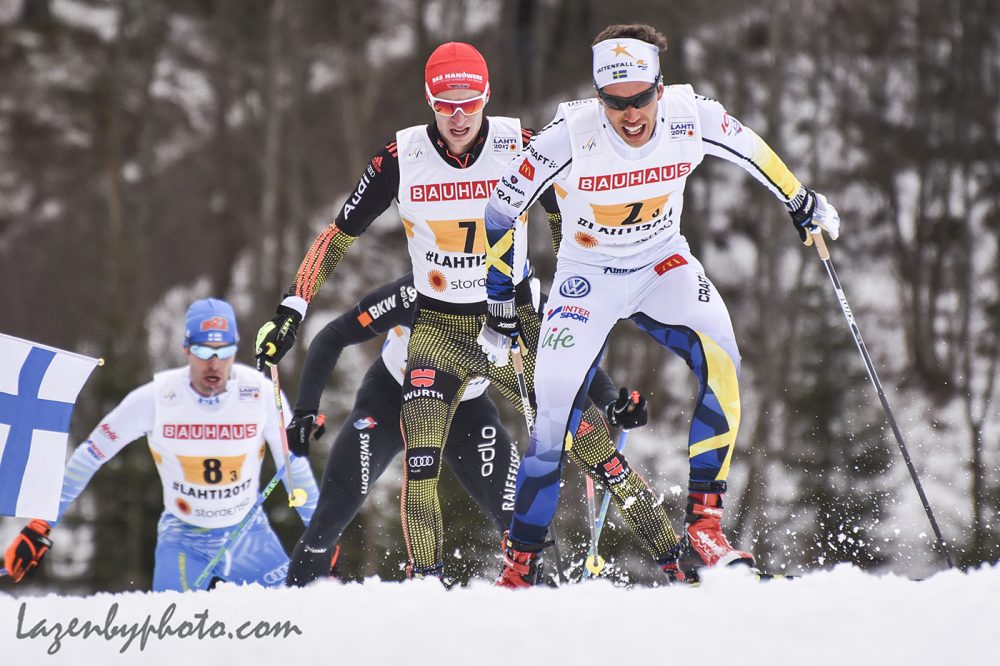
First leg pack racing in Lahti, Finland. (Photo: NordicFocus)
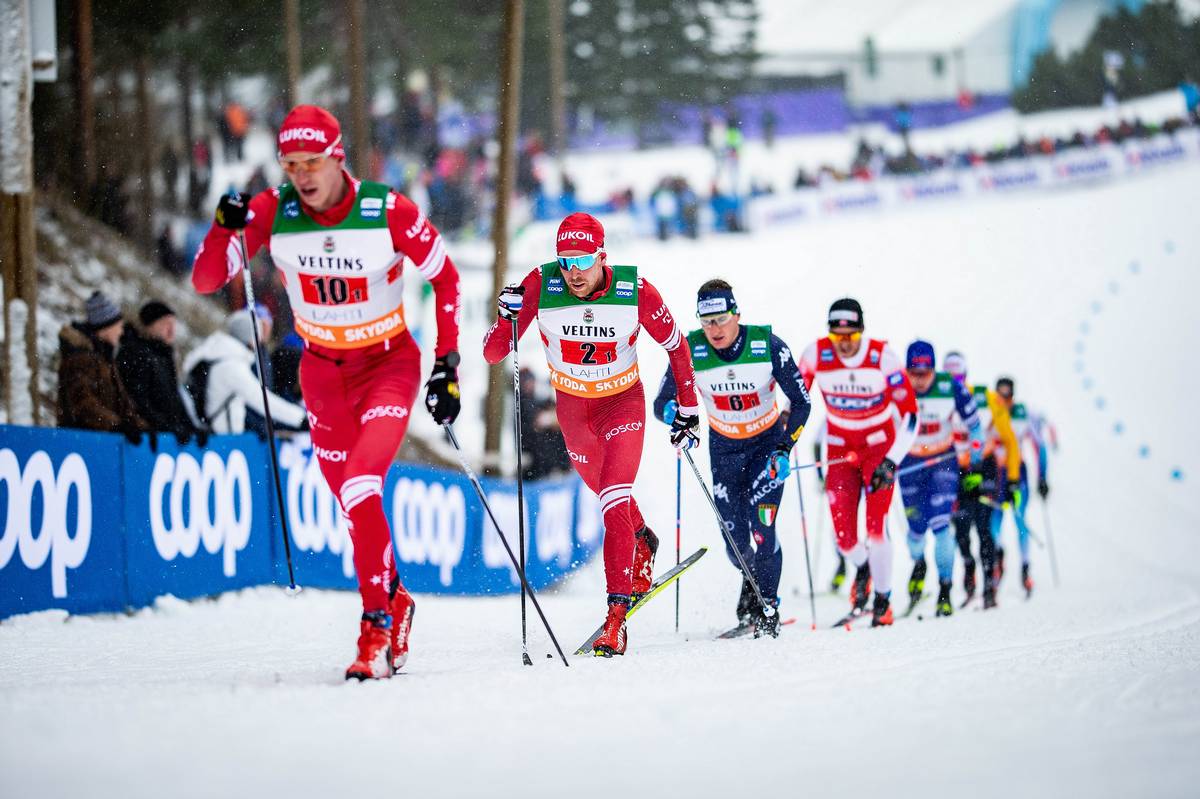
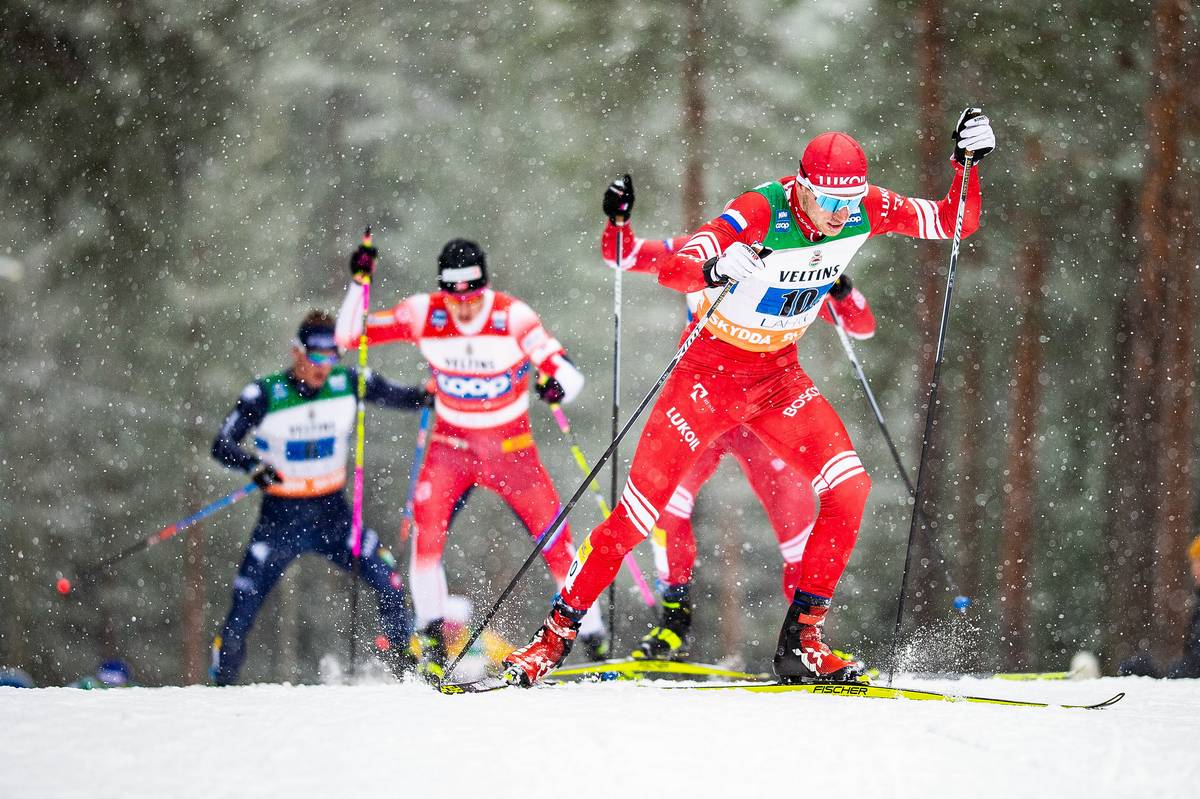
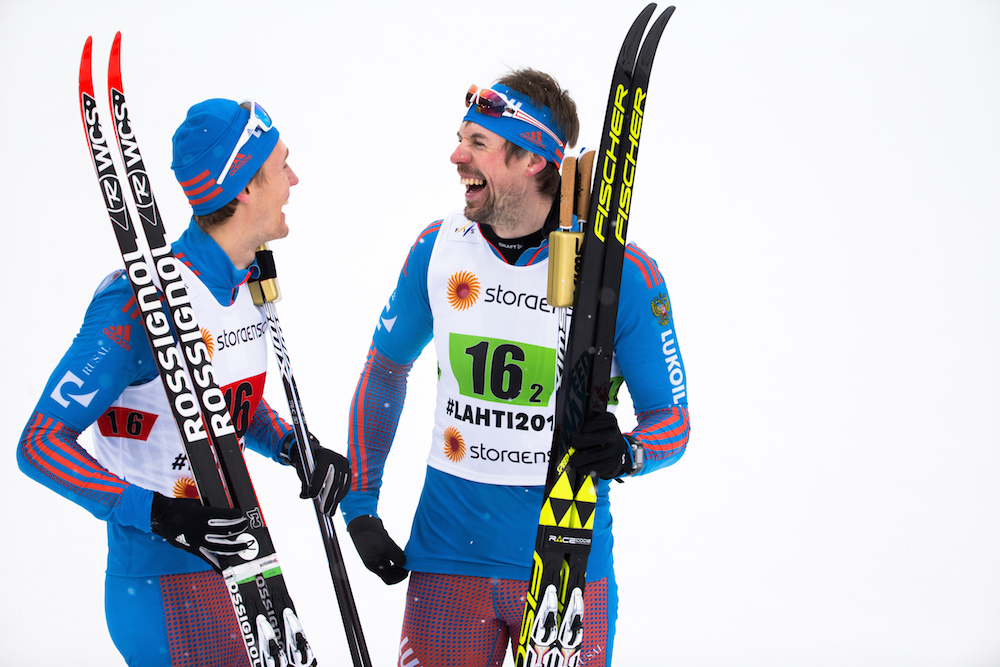
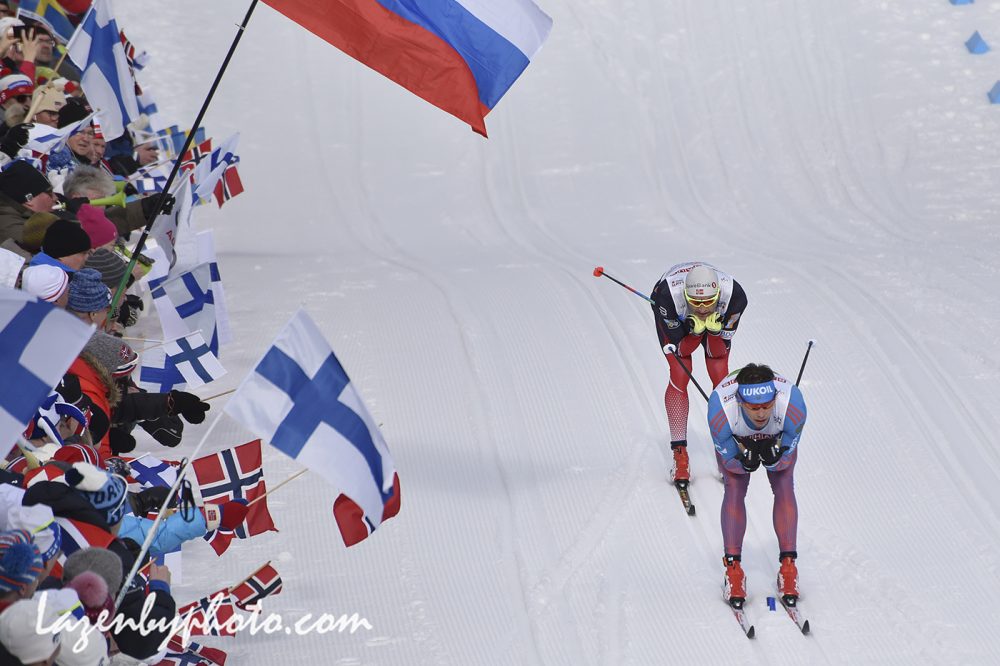
Russia II’s Andrey Sobakarev and Russia I’s Ilia Semikov leading out the first leg of the men’s 7.5 k relay in Lahti. (Photo: NordicFocus)
For the first 7.5 k leg, Russia I’s Ilia Semikov and Russia II’s Andrey Sobakarev animated the sharp end with several pulses of energy to make a slinky of the pack. Norway’s Pål Golberg took some commensurate pulls too. The calories expended broke this into a front group of six teams at the first exchange separated by 2.4 seconds. The teams came through in this order: Norway, Russia I, Germany, Finland, Russia II, and Italy. Switzerland and Sweden, who had been loosely attached to the pack here and there, had popped – coming through roughly 20 seconds back.
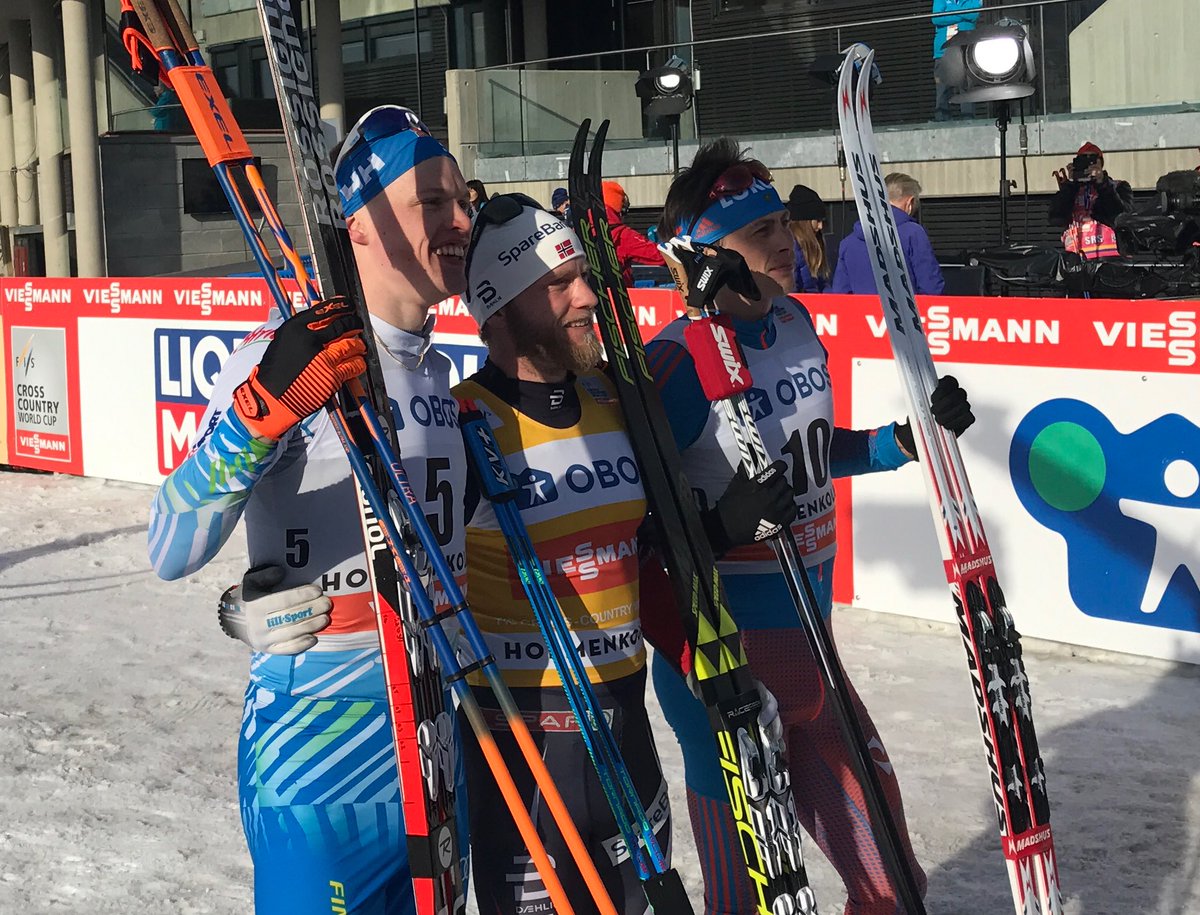
Leg 1 of the men’s 4 x 7.5 k relay in Lahti, Finland: Pål Golberg (NOR), Ilia Semikov (RUS), Lauri Vuorinen (FIN), Bjoern Sandstroem (SWE), Beda Klee (SUI), Giandomenico Salvadori (ITA), (l-r). (Photo: NordicFocus)
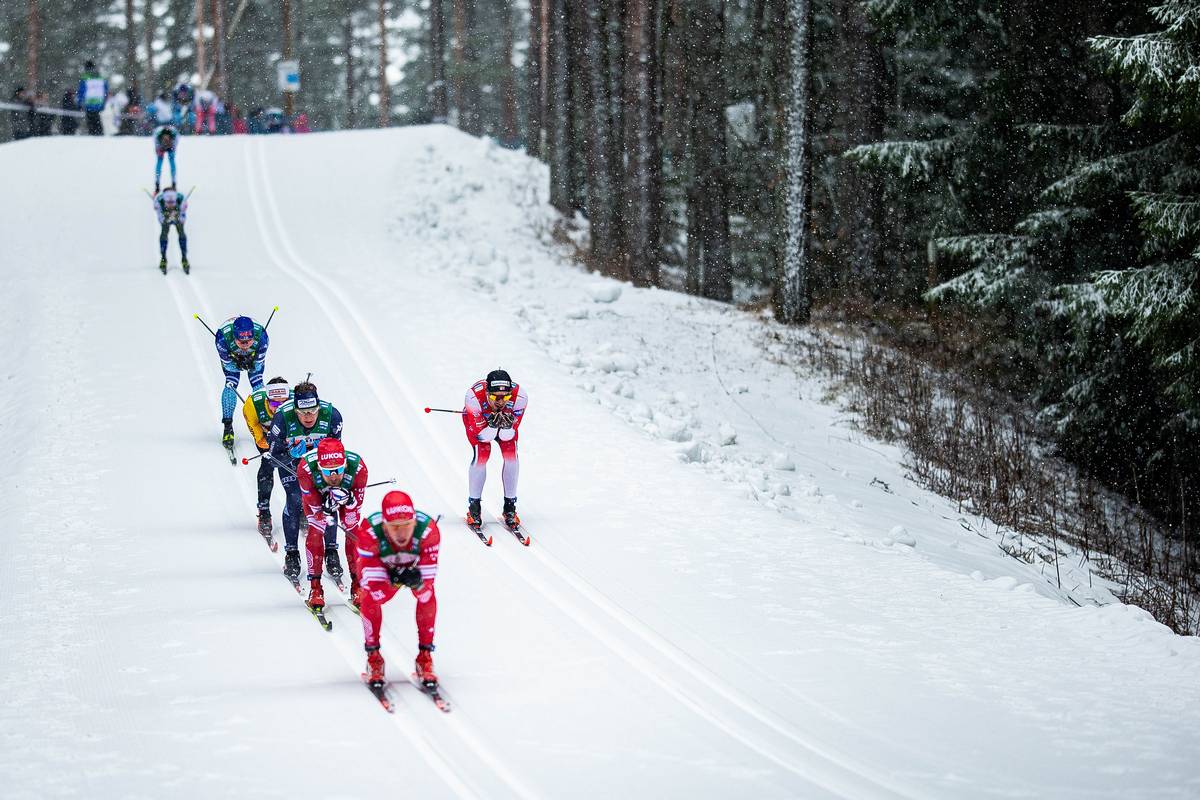
The second leg played out much like the first, with the Russian teams, Norway, Italy, and Finland maintaining a gap. Finland’s Iivo Niskanen kept Finland in the hunt, and Russia II’s Alexey Chervotkin took a runner through the 13.6 k time check – otherwise the drama was subdued.
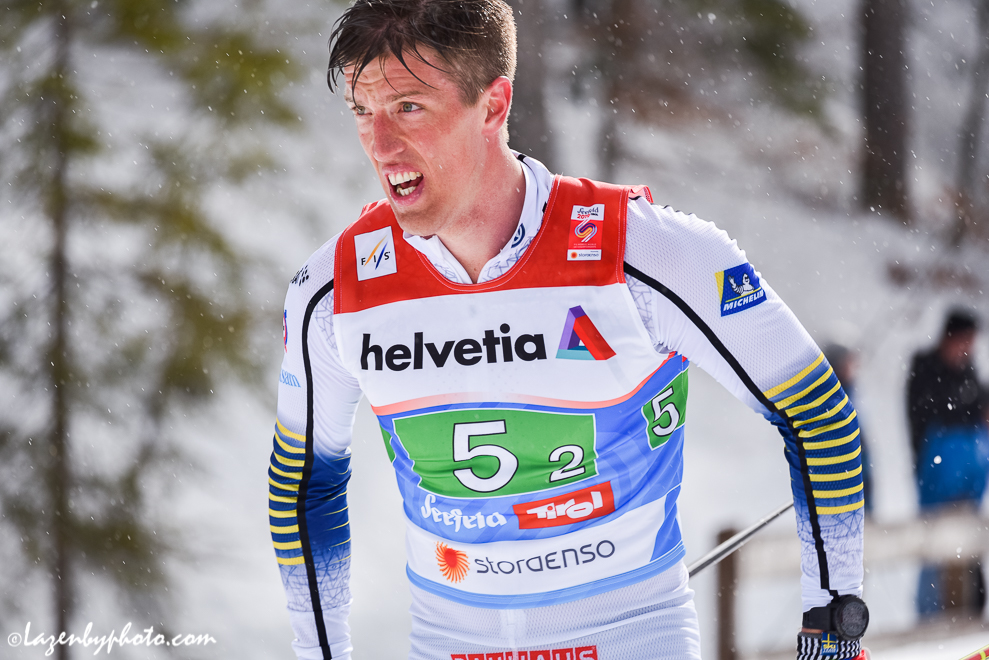
Through the woods, a leading Iivo Niskanen of Finland. (Photo: NordicFocus)
During the first skate leg, the front group ballooned modestly to seven with the addition of Germany beyond the original six teams. As the third leg skate moved towards the tag off for leg four, Finland had popped for good, and coming down into the stadium for the tag, it became a five team affair, with Russia I, Russia II, Germany, Norway, and Italy coming through in that order. Switzerland tagged off in sixth (+6.9).
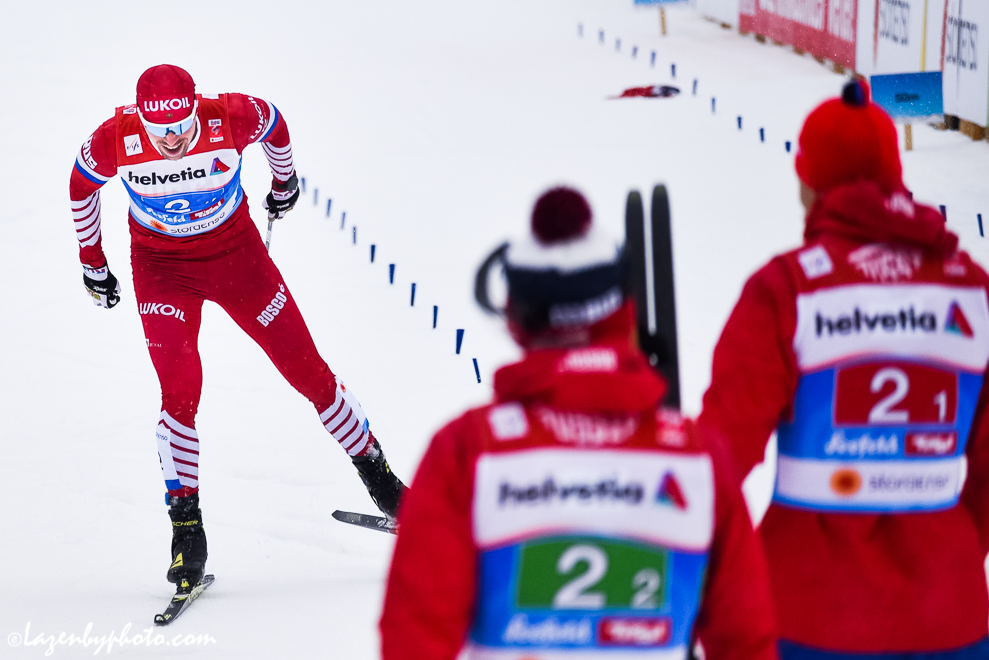
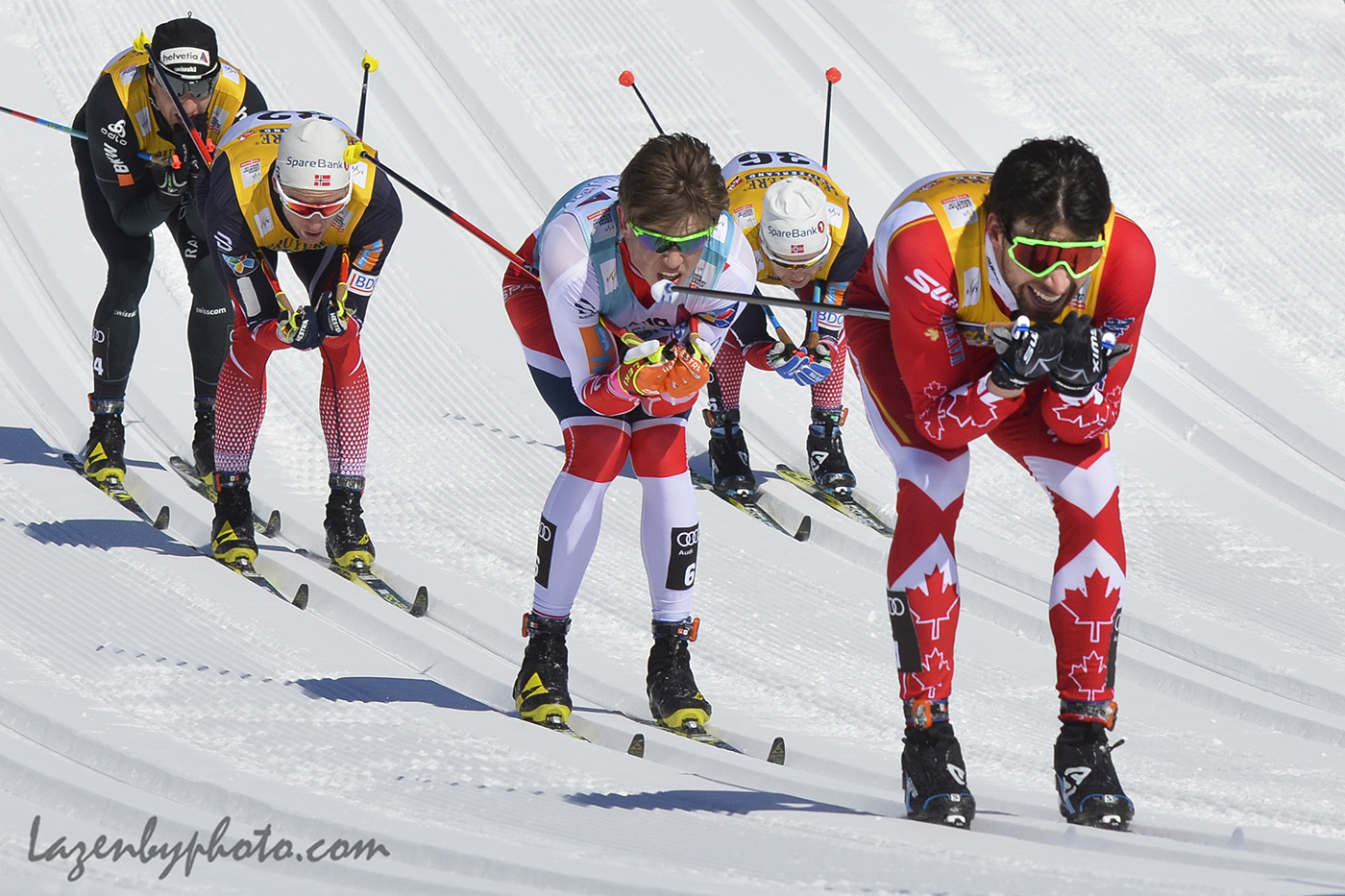
Artem Maltsev of Russia II taking the pull: fourth leg of the men’s 4 x 7.5 k relay in Lahti, Finland. (Photo: NordicFocus)
During the fourth leg the Russians gave several hungry digs. But on the first pass through Lahti stadium at 25 k with a long glide out speeding into the lap area, Norway’s anchor, Johannes Høsflot Klæbo, clearly sported the slickest pair of skate skis as he moved to the front with little friction under his feet. And we all know how Klæbo can close.
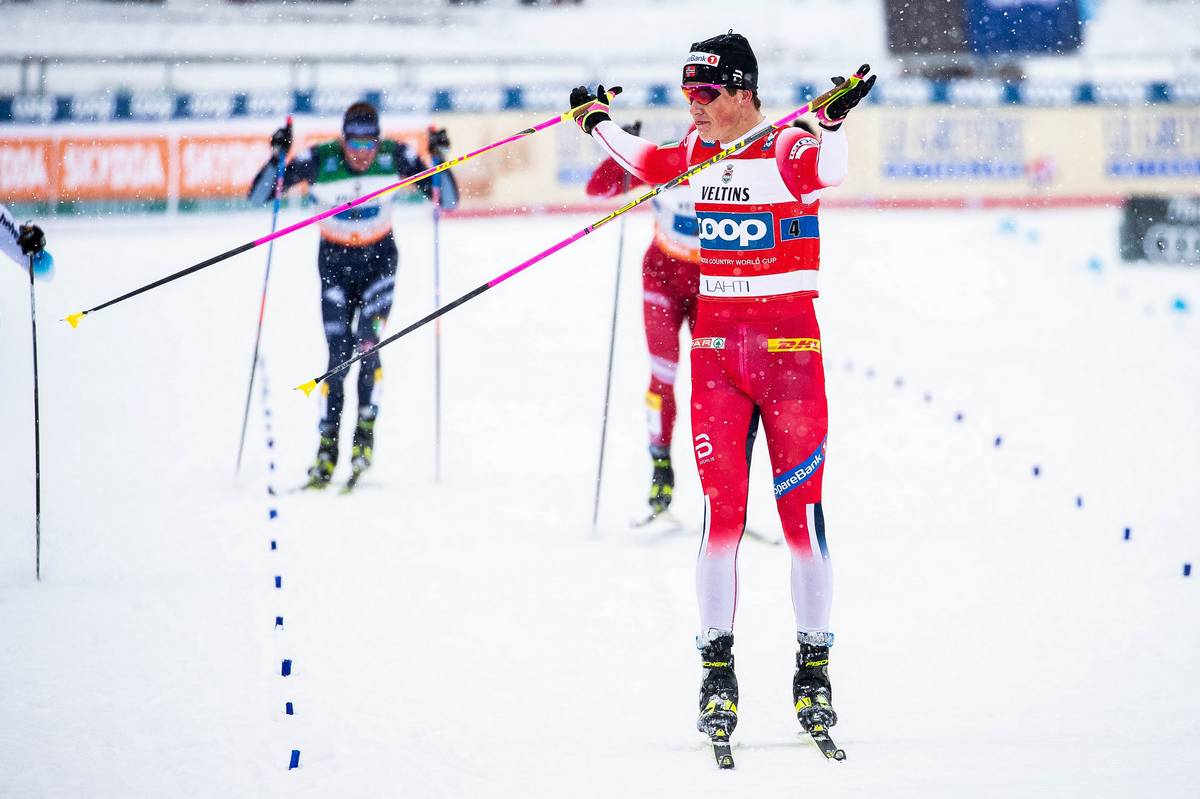
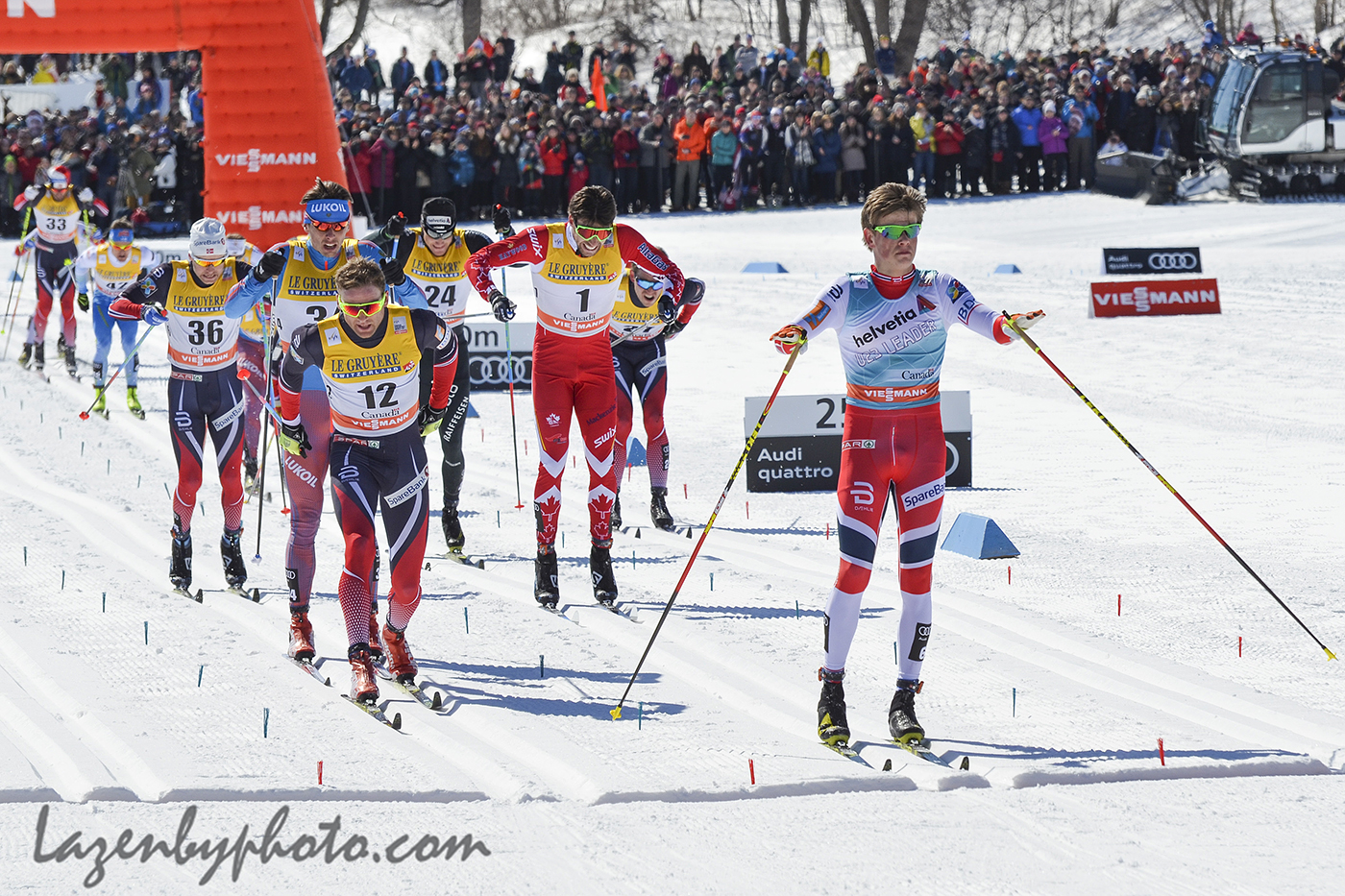
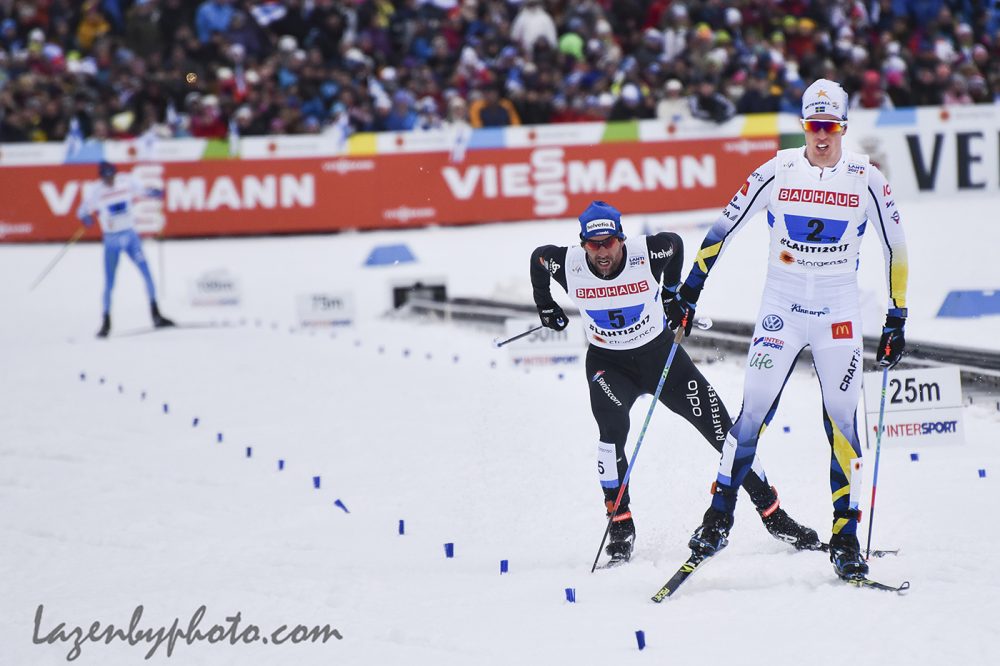
At 27.5 k, the start of the last lap, Germany was no longer in the podium game. Five teams came through in a line led by the indomanable Klæbo. For the final 2.5 k lap, Klæbo killed the pace initially and then Russia I’s Andrey Melnichenkov tried in earnest to pull away and thin out the latched on Klæbo, Italy’s Stefan Zelger, and Switzerland’s Roman Furger. To no avail. Like he’s done before in countless sprints, Klæbo tapped into his vast stores of fast twitch muscle fiber and pulled away in the home stretch for the Norway win in 1:09: 53.
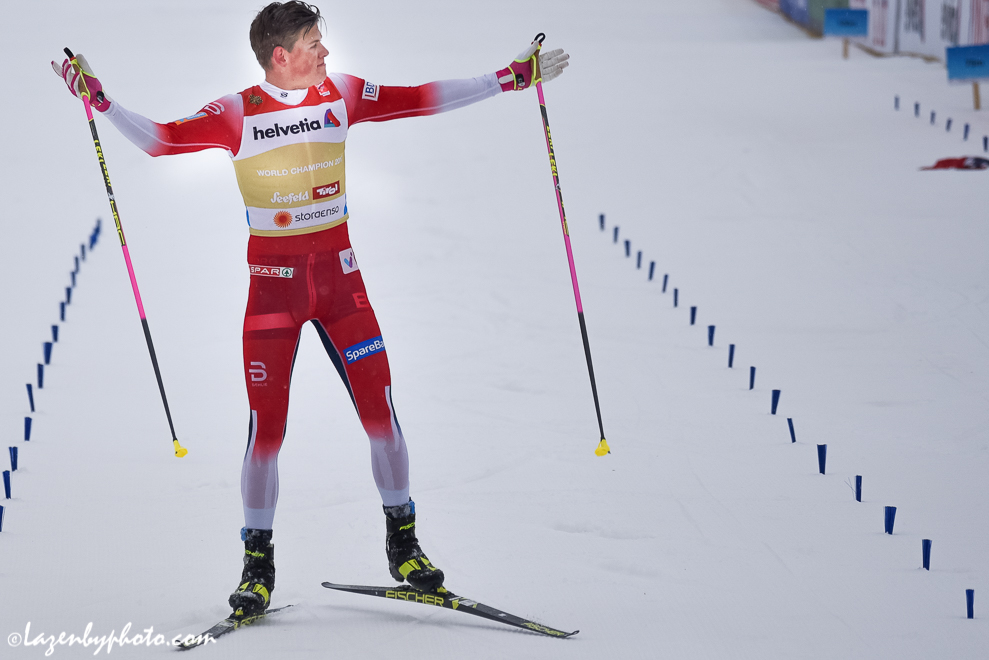
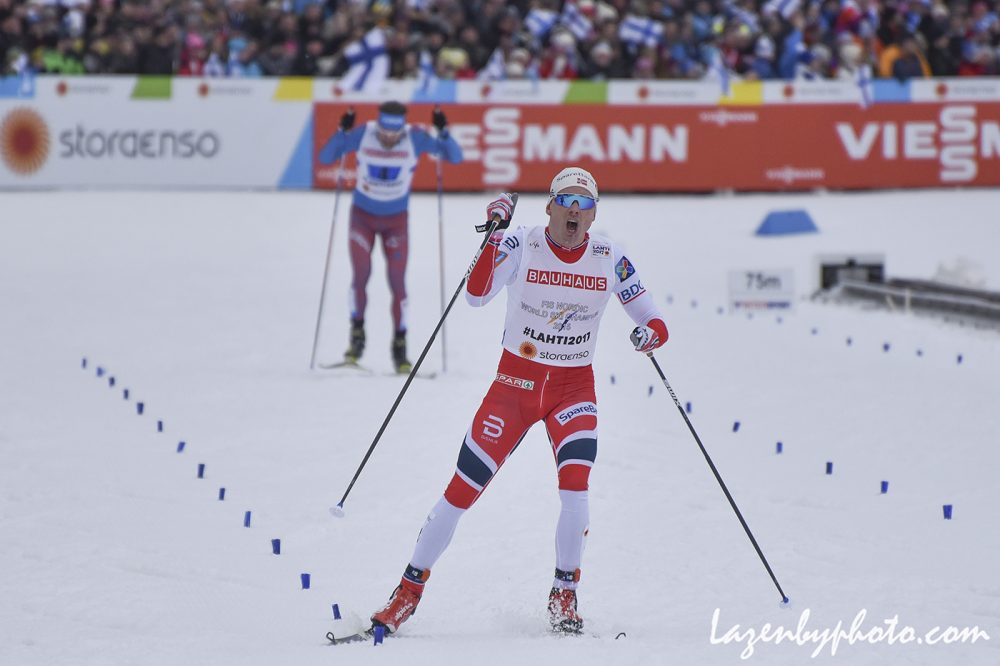
Johannes Høsflot Klæbo in his element: the finish straight. (Photo: NordicFocus)
The closer: Johannes Høsflot Klæbo. (Photo: NordicFocus)
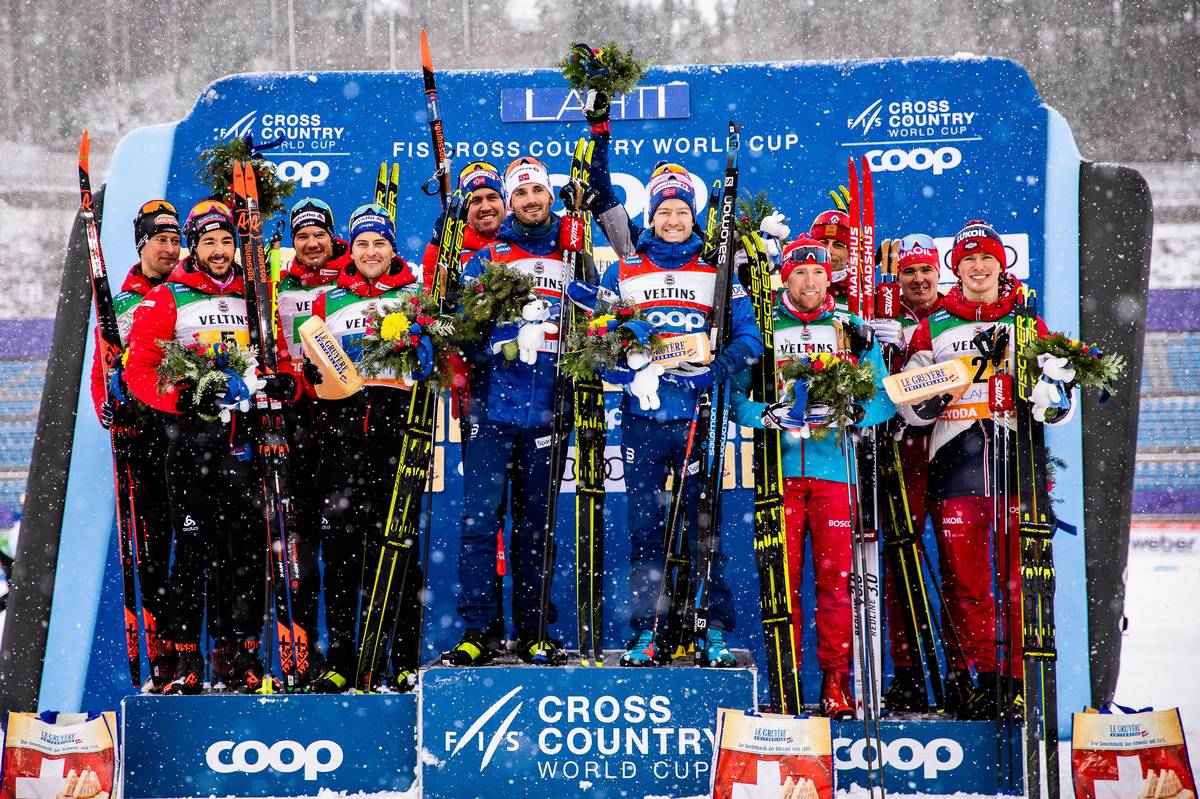
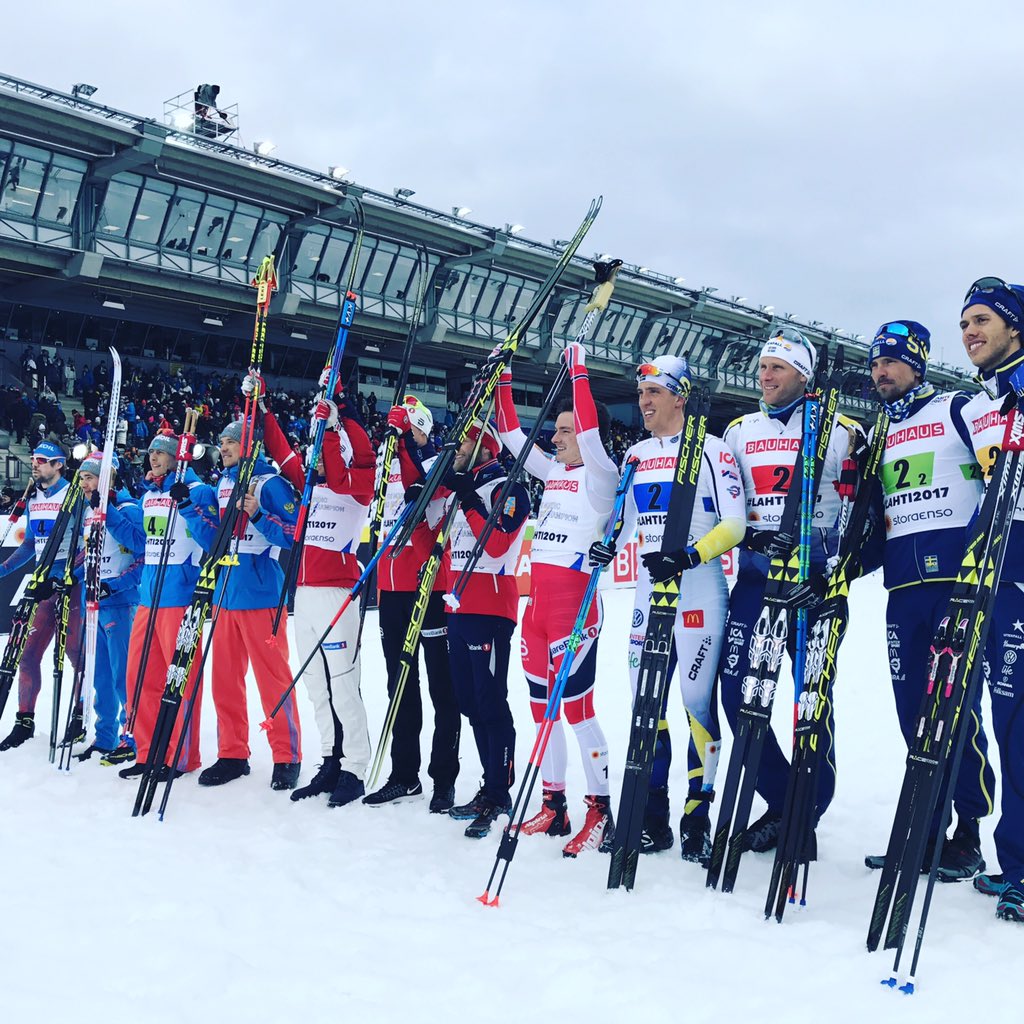
Norway’s combo of Golberg, Hans Christer Holund, Sjur Røthe, and Klæbo momentarily reclaimed the men’s relay title over Russia -the Russians had won the last two relays, one in Lillehammer this season, the other in Ulricehamn, Sweden last year.
Switzerland’s Beda Klee, Dario Cologna, Jason Rueesch, and Furger placed second (+1.2), and Russia I’s Semikov, Alexander Bessmertnykh, Denis Spitsov, and Melnichenkov were third (+1.7).
For the Swiss, this was thier first men’s World Cup relay podium in nearly a decade.
“Russia has won the previous two relays, it was time to take the throne back,” Golberg told FIS after the race.
Klæbo’s comments to FIS post-race underscored his finish speed gift. “In the start it was quite high speed and I think that all of the other guys saw that it was really difficult to get a gap,” Klæbo said of his leg. “So I was just in the front and slowing the pace down, it was almost just like training, it was a really slow pace. But in the end it was all-in and I think it was a really fun and interesting race.”
Racing continues in Drammen, Norway on Wednesday with a classic sprint.
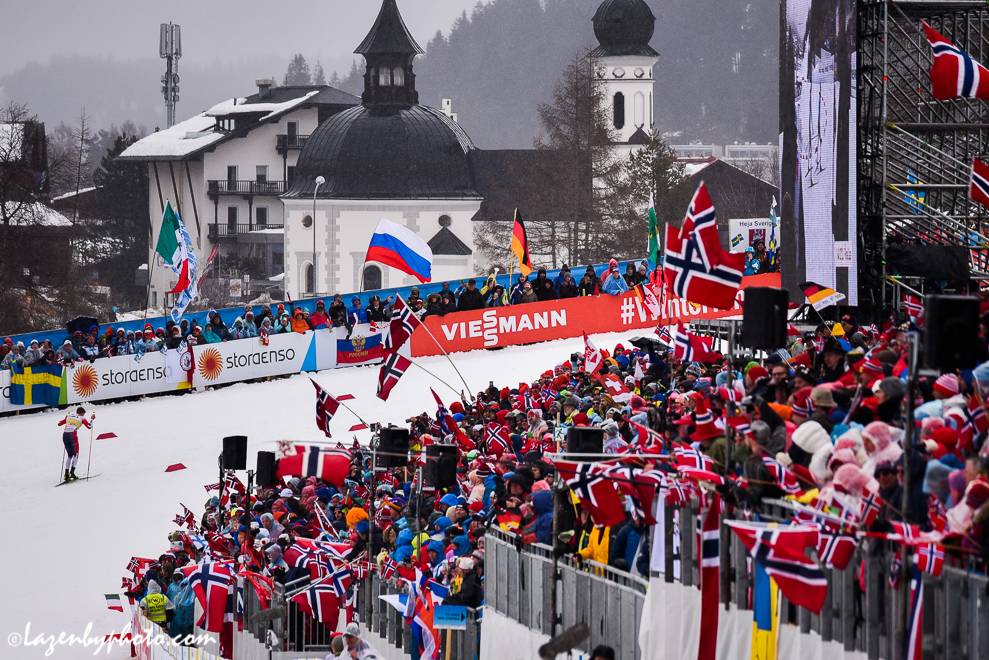
Johannes Høsflot Klæbo of Norway anchoring Norway to the 4 x 10 k relay win at the 2019 World Championships in a Norwegian fan filled Seefeld, Austria. (Photo: John Lazenby/lazenbyphoto.com)
While a temperature in the upper thirties would not normally classify as cool to a ski racer, it was a welcome break from the blazing sun and upper 50’s that have been ever-present in the 2019 Nordic World Ski Championships in Seefeld, Austria. Light rain peppered the athletes in the 4 x 10-kilometer relay, continuing to keep things challenging for the wax techs.
The relay is a testament to both a nation’s depth and strategy, a chess match and a horse race. As was seen in the women’s relay, the selection and placement of athletes decide how the race will evolve, but these decisions are made without the knowledge of an opponent’s line up.
In their quest for a tenth consecutive gold medal in the event, Norway chose the line up of Emil Iversen, Martin Johnsrud Sundby, Sjur Røthe, and as the closer, their sprint champion, Johannes Høsflot Klæbo. Røthe and Sundby sit in second and third respectively in the World Cup distance rankings, while Iversen has shown that he is an “all-arounder” who can respond to many dynamic racing scenarios. Sundby also brings experience to the team as he was a member of the gold medal team in both 2011 and 2017. After winning the overall Tour de Ski, Klæbo has shown that he can be a force in distance races but is most known for his closing speed and sprint prowess, which would come in handy should the race come down to the final meters.
Scramble leg of the men’s 4 x 10 k relay at the 2019 World Championships in Seefeld, Austria. (Photo: John Lazenby/lazenbyphoto.com)
As the race unfolded, it was unclear which nations’ tactics would trump the others. In the first leg, the men slowly began to string out, but the lead exchanged hands several times. Russia’s Andrey Larkov made an early run but was marked by Erik Bjornsen of the US who also spent time at the front. Despite slipping a bit on the climbs, Iversen, who was on harries, skied near the front throughout, entering the stadium first to tag his teammate. At the first exchange, Norway, Russia, and Germany were all within one second of each other, with the US in fourth fading into a chase pack with Sweden and France.
As the second leg began, Sweden’s Calle Halfvarsson surged to catch the leaders within the first kilometer, unwilling to lose sight of a possible 29th World Championship relay medal for Sweden. With him was Iivo Niskanen of Finland, Scott Patterson of the US, and Maurice Manificat of France.
Sweden’s Calle Halfvarsson during the men’s 4 x 10 k relay at the Seefeld, Austria World Championships. (Photo: John Lazenby/lazenbyphoto.com)
While the rain picked up, Niskanen charged to the front and began to string things out in a fashion reminiscent of his performance in the 30 k skiathlon. Sundby stuck with the Finn, and was closely tailed by Alexander Bessmertnykh of Russia. The three skiers atop the podium after Wednesday’s 15 k reunited on the relay tracks.
Halfvarsson began slipping on the hills and was unable to hold onto the pace, falling back a few seconds behind the leaders at first, then fading to nearly 30 seconds back by the end of his leg. Likewise, France, Germany and the US began to lose touch, dropping behind by over 30 seconds by the next exchange.
However, as the first skate leg began, Jens Burman of Sweden followed Halfvarsson’s lead with yet another powerful surge to reconnect with the lead pack, closing the gap from 27 seconds at the exchange, to just two seconds at the 2.5 k checkpoint. Also rapidly making up ground, Clement Parisse of France gained 22 seconds on the leaders within the first lap. Unfortunately for Sweden, Burman seemed to burn a few too many matches in his charge, and in the second half of his leg, he fell back again almost as rapidly as he had advanced. He was overtaken by Parisse who did manage to light a fire for France, drawing to within eight seconds of the bronze medal before his final exchange to French sprinter Richard Jouve.
At the front, Alexander Bolshunov of Russia and Røthe hammered their final lap, separating themselves from the field in yet another Norway vs. Russia battle for gold. The men entered the stadium together with a gap of more than 20 seconds on the Finn who sat in third. Bolshunov tagged Sergey Ustiugov to face Klæbo for their final World Championship duel, mano a mano.
Russia’s Sergey Ustiugov leads Norway’s Johannes Høsflot Klæbo of Norway as they race the fourth leg of the 4 x 10 k relay at the 2019 World Championships in Seefeld, Austria. (Photo: John Lazenby/lazenbyphoto.com)
In their last matchup in the sprint at the onset of the championships, Ustiugov pushed Klæbo after a tangle in the semifinals robbed the Russian of his momentum. After the heat, the men were seen in a heated shouting match where Ustiugov again pushed Klæbo and gave him an antagonizing pat on the cheek. He was issued a yellow card for obstruction and was disqualified for unsportsmanlike conduct, while Klæbo went on to win the gold. The two were also rivals throughout the Tour de Ski, where Ustiugov nearly caught the exhausted Norwegian leader in the final hill climb, but ultimately ran out of time and finished second.
As they took to the course in the final leg, this much was clear: the Russian did not want to hand the victory over to his opponent. Ustiugov dictated the pace with the Norwegian tucked in behind him. They did not take turns, rather, Ustiugov held fast at the front. But, as they entered their third and final lap of the course, Ustiugov’s fatigue began to become evident, and Klæbo had plenty left in his tank to capitalize on the moment.
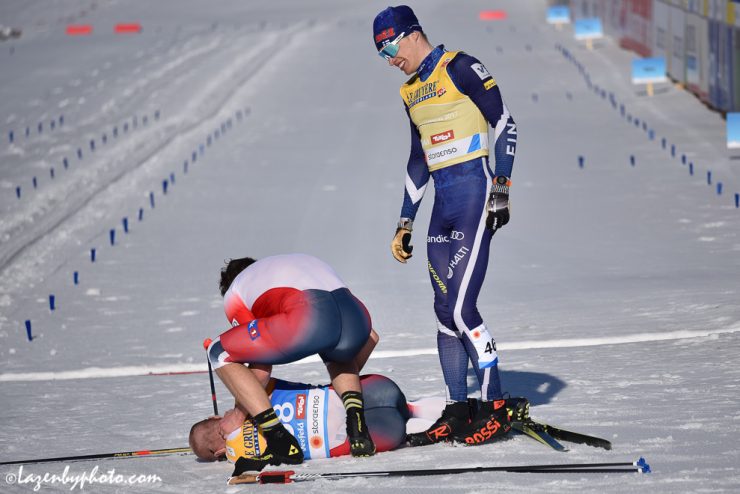
Johannes Høsflot Klæbo of Norway in what has become his iconic gesture when crossing the line as a winner. Once again it was an opportunity for the arms being outstretched as Klæbo anchored Norway to the 4 x 10 k relay win at the 2019 World Championships. (Photo: John Lazenby/lazenbyphoto.com)
The Norwegian surged to the front and did not lay off the gas, leaving Russia trailing behind, desperately trying to keep it together for silver. Klæbo cruised through the lap with enough room to begin his celebration well before the finish. He stopped the clock at a time of 1:42:32.1, 38 seconds ahead of Russia.
“It was a really hard race, and I think the conditions now is really tough, but I think all of us had very good skis today and the waxing team and the guys helping us did a very good job,” Klæbo told the International Ski Federation (FIS) after the race. “So its very cool to stand here with those guys and take the gold medal. It’s unbelievable.”
“This is a different kind of emotional,” Sundby told FIS as he compared his wins. “But for the team, this is the most important. This is the race we’ve been thinking about since we started training in May, so for the team and for Norway, I think this is emotional for the nation. And for us, we are such good of a group, so to be able to do this together and of course for Johannes to destroy Russia on the last leg, that was amazing.”
Sergey Ustiugov of Russia coming in for second overall during the men’s 4 x 10 k relay at the 2019 World Championships in Seefeld, Austria. (Photo: John Lazenby/lazenbyphoto.com)
Behind the racers in red, a battle for bronze was underway between France and Finland. With a gap ahead and behind, Jouve and Perttu Hyvarinen had duked it out for nearly 8 k. With less than a kilometer to go, the men came to a standstill, neither willing to break the wind for the other in the last descent. Not wanting to be caught by the teams chasing behind, Hyvarinen conceded and took the lead. Rounding the last corner into the stadium, Jouve rocketed around the Finn, no pole skating with lightning fast tempo toward the line to win bronze, 1.8 seconds ahead of Finland.
After a strong start, the American team fell back in the pack. Patterson tagged David Norris in 7th to ski the first skate leg for the US, and the team was in 9th at the final tag to Kyle Bratrud. The team ended the day in 9th (+4:06.4).
Canada’s Alex Harvey, Scott James Hill, Evan Palmer-Charrette, and Lenny Valjas placed 12th (+7:05.5).
“We started off the morning on the wrong foot because Simi, who was going to be our anchor, woke up with a sore throat,” explained Chris Grover in a call. “After that, it went pretty well. Awesome opening leg for Erik… had a really great leg, had really good skis, felt like glide was excellent.”
“We were excited that Erik was able to put together yet another really strong classic leg, and also another really strong lead off relay leg,” he continued. “He’s almost always our lead off person in the relay, and this time might have been the closest he’s been to the leader coming in. So that was great.”
Erik Bjornsen of the U.S. during the men’s 4 x 10 k relay at the 2019 World Championships in Seefeld, Austria. (Photo: John Lazenby/lazenbyphoto.com)
Bjornsen was also pleased with his leg; despite a less than ideal starting position, he was able to advance through the pack into a better position to execute his race plan.
“I was trying to make sure to be in position for when the pace kind of turned up,” explained Bjornsen in a call. “And it actually took a little longer than I was expecting, but then on the last lap about halfway through on one of the big hills it started notching up and Russia made a big surge and I was able to jump right behind Larkov and kind of chase him on the big sprint climb. So I felt like I was able to play with the group and ski near the front, didn’t have the attack that I wanted on the last climb, but I saw by the splits that I was 5 seconds off the leader at the end, so I was pretty happy with that. I felt like I was able to compete with the best.”
While Patterson could not maintain contact with the leaders, he skied his leg with grit
“Another really solid leg out of Scott [Patterson], to go out and kind of close that gap that was presented to him,” said Grover. “At one point he said ‘Yeah, I got a little bit caught behind when the leaders broke.’ But at the same time, I think we recognize that the guys that broke away, Sundby, Bessmertnykh, and Niskanen, were the three guys that were on the podium in the 15k classic a few days before. So I think Scott recognized it was really hard for him to keep that pace. But he did a really good job when he was at his max really holding technique together and skiing really well.”
Scott Patterson of the U.S. during the men’s 4 x 10 k relay at the 2019 World Championships in Seefeld, Austria. (Photo: John Lazenby/lazenbyphoto.com)
Though he lost additional places, Grover also felt that Norris skied a strong leg.
“For a while, he was catching a ride with Dario Cologna who was skiing up from behind him, and David [Norris] held with him for a little bit, but then that pace was too hard for him. He fell off that and had to regroup a bit.
David Norris of the U.S. during the men’s 4 x 10 k relay at the 2019 World Championships in Seefeld, Austria. (Photo: John Lazenby/lazenbyphoto.com)
“By that time, the spread between teams was so big that Kyle started a minute or so behind, and had a minute or so to go to the person that was behind him,” Grover continued. “So, unfortunately, he skied by himself the whole time, which is not that conducive to having a fast leg, but he skied really well. Seemed like he was moving pretty good and skiing with great technique.
“Overall, it was a really solid day for those guys with some absolute highlight coming at the beginning,” he concluded.
The 9th place finish marks improvement for the team, as they finished 11th in the event two years ago in Lahti.
“I think for the most part the relay team is satisfied with our performance today,” wrote Patterson in an email. “Unless we win though, there are also little things that each of us wished had gone a little better. Erik skied a great leg and I am proud of the performances of our whole team. While there were 8 teams in front of us that I would have like to beat, we also did manage to beat some good teams. It is always fun to come together as a group and see what we can do.”
While the weather might not have been well received by all parties, the Americans didn’t seem to mind. In fact, they felt it may have been a benefit in many ways.
“Honestly, I’m a little excited about the rain,” Patterson told FIS before the race. “Everyone else gets miserable and you just have to enjoy the other’s misery.”
After the race, he still had an overall favorable opinion on the weather.
“It was a nice variation from the heat of the 15k,” he wrote. “However, I will also admit that I was pretty cold and miserable myself while hanging out in the rain for the skate legs of the relay.”
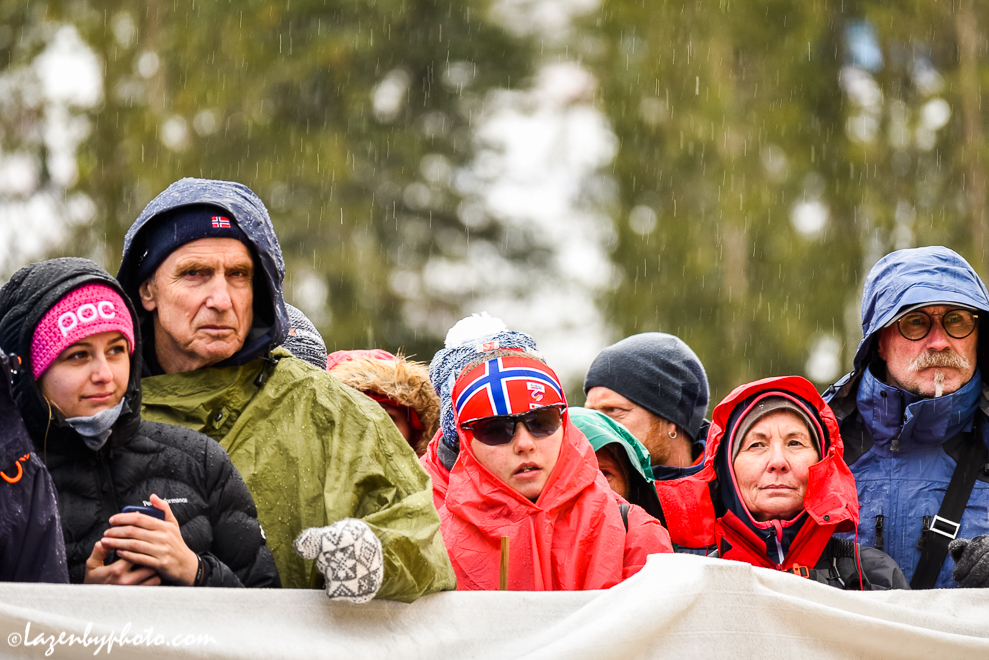
Wet and looking dour: wet fans during the men’s 4 x 10 k relay at the 2019 World Championships in Seefeld, Austria. (Photo: John Lazenby/lazenbyphoto.com)
Bjornsen also shared that he enjoyed the rain and thought it helped speed up the tracks.
“Once you start racing in the rain, you don’t even notice,” he laughed. “It was fun.”
From a waxing perspective, it was felt that the grey skies and moisture affected the course evenly. So while it was still a challenge for waxers, it was at least consistent conditions throughout the course.
“It was a bit more uniform than in the past where we had a sunny side and a shady side,” Grover shared. “The cloud cover helped make things more uniform out there, which may have helped some of the teams get closer in the hunt for the right wax. Because, unfortunately, it just seems like a lot of the days we’ve seen some big discrepancies in skis, where some of the bigger nations just have incredible skis and everyone else is trying to figure out how to solve the puzzle with not quite as much manpower.”
The World Championships in Seefeld conclude with a women’s 30k Saturday, followed by the men’s 50k on Sunday.
Norway’s winning relay team posing for the obligatory photos. (Photo: John Lazenby/lazenbyphoto.com)
France wins bronze in the men’s 4 x 10 k relay at the 2019 World Championships in Seefeld, Austria. Norway’s winning relay team posing for the obligatory photos. (Photo: John Lazenby/lazenbyphoto.com)
Johannes Høsflot Klæbo of Norway displaying what has become his iconic gesture when crossing the line as a winner. Once again it was an opportunity for the arms being outstretched as Klæbo anchored Norway to the 4 x 10 k relay win at the 2019 World Championships. (Photo: John Lazenby/lazenbyphoto.com)
The 4 x 10-kilometer men’s relay was a two-team tango as Russia’s Sergey Ustiugov and Norway’s Johannes Høsflot Klæbo were tagged for their respective anchor legs on Friday. The two teams stuck together until Klæbo moved ahead with less than five k to go and gapped Russia by 22 seconds.
It was enough final leg surge for Norway’s Emil Iversen,Martin Johnsrud Sundby, Sjur Røthe, andKlæbo to win in 1:42:32.1 hours. Russia’s Andrey Larkov, Alexander Bessmertnykh, Alexander Bolshunov, and Ustiugov placed second (+38.8).
The final podium spot came down to a final sprint won by France’s Richard Jouve over Finland’s Perttu Hyvarinen.
Adrien Backscheider, Maurice Manificat, Clement Parisse, and Jouve were 1:01.0 back in their third place statement.
Finland’s Ristomatti Hakola, Iivo Niskanen, Matti Heikkinen, and Hyvarinen were fourth (+1:02.8).
The U.S. team of Erik Bjornsen, Scott Patterson, David Norris, and Kyle Bratrud skied to ninth (+4:06.4).
Canada’s Alex Harvey, Scott James Hill, Evan Palmer-Charrette, and Lenny Valjas placed 12th (+7:05.5).
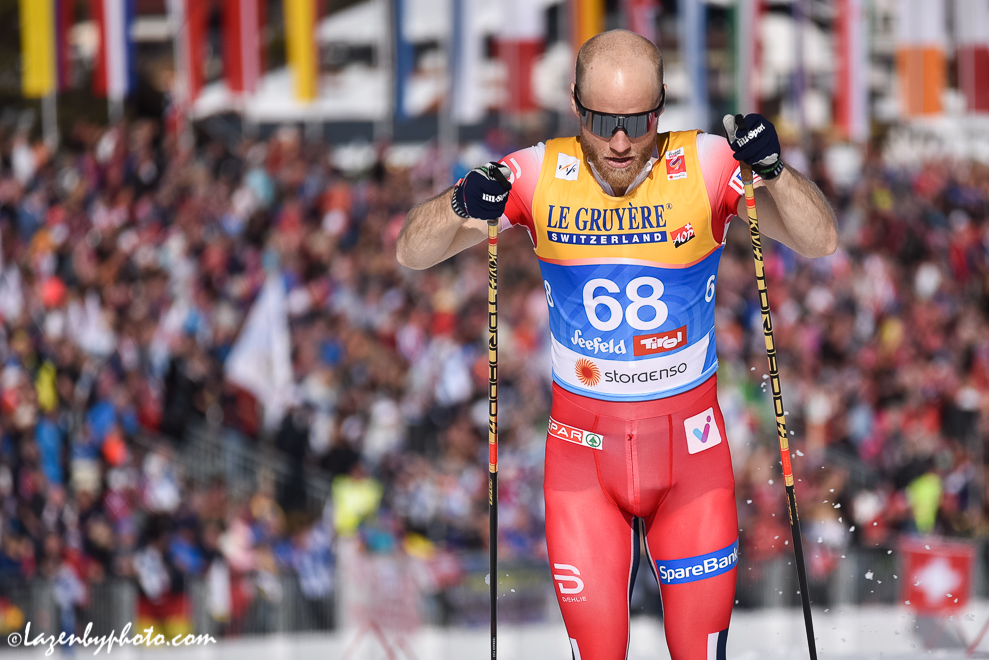
The men’s winner, Norway’s Martin Johnsrud Sunday, in the 15 k classic at the 2019 World Championships in Seefeld, Austria. (Photo: John Lazenby/lazenbyphoto.com)
It was a tough day in Seefeld, Austria Wednesday on and off the race tracks. The efforts and drama in the men’s World Championship 15-kilometer classic were overshadowed by the news of several athletes arrested on suspected doping violations. The distractions shed more light on the underbelly of some high-speed athletes and those who support the cheating. The only thing deafening the day’s police actions was the roar of the considerable Norwegian fanbase in Seefeld.
Home away from home. Norwegian fans at the flower ceremony for the 15 k classic at the 2019 World Championships in Seefeld, Austria. (Photo: John Lazenby/lazenbyphoto.com)
Shedding his usual toque, Norway’s Martin Johnsrud Sundby hammered up the final hill revealing his seasoned years as a top form athlete. Sundby’s bald dome and iconic beard coupled with his raw lumberjack build were a throwback to old-school power generation. Although only 34, Sundby now looks like a cherished relic when compared to the coiffed flare of a Johannes Høsflot Klæbo. On a day when it was Sundby’s moment, so much for the young and the restless.
How many times have we seen the almost? The almost win in the World Championships. A query of top-five individual World Championship results reveal seven races within that mark — none of them wins for Sundby. There was a third place in the 2011 Oslo championship 15 k classic. In total, he has two thirds and three second-place finishes at Worlds.
Perhaps the most crushing “almost” came in 2017 when Sundby was poised for his first elusive championship win. In the closing moments of the 30 k skiathlon, as he dueled Russia’s Sergey Ustiugov, Sundby made his hop-skate move on the final climb. It looked like a kill shot: uptempo, perfect technique, and a jolt of kinetic energy that could only deliver the win.
Then there was a literal snap. Sundby’s pole broke in two and Ustiugov was gone. The Norwegian fans that had been screaming let out a collective sigh and then silence. Not that a second place, which Sundby earned in that race, was nothing to celebrate — but Norwegian fans travel for the win.
Russia’s Alexander Bessmertnykh during his near-miss second place in the 15 k classic at the 2019 World Championships in Seefeld, Austria. (Photo: John Lazenby/lazenbyphoto.com)
As if Sundby’s considerable force alone could not propel him on Wednesday, the soundwaves in Seefeld from the fans perhaps gave him that extra oomph. Sundby took his first career championship win in 38:22.6 minutes. Russian Alexander Bessmertnykh placed second (+2.9), and Iivo Niskanen of Finland placed third (+20.4).
Finland’s Iivo Niskanen crossing the line in third place during the 15 k classic at the 2019 World Championships in Seefeld, Austria. (Photo: John Lazenby/lazenbyphoto.com)
The 15 k classic was a hot affair even without the world class speed. With temps well above freezing and short-sleeves and no-shirt the day’s chosen racing style for many, Sundby did not wilt. He was 8.3 seconds behind the time check leader Bessmertnykh at 5 k. At 9.8 k Sundby ceded more time to the Russian, coming through the check 13.9 seconds back. Like a slow and steady fisherman reeling in the prize, careful to not reel too fast or over-tension the line, Sundby played pacing brilliance: his 6.6 seconds behind at 11.25 k became a 2.9 second margin of victory as he crossed the line.
Here it is, in an official race report for the first time at a World Championships or Olympics in an individual race…Sundby wins.
“It is a lof them, it is a lot of everything,” a teary Sundby told the International Ski Federation (FIS) after the race when asked about his emotions. “I did not think it would be this emotional in this kind of a moment. It has been a long time coming. Yeah. I made it. We have a fantastic waxing team and so many good teammates and people that believed in me are finally getting this one. “
When asked about his knowledge of the race’s tight standings, he claimed he understood it was close, but he was unaware of how close the margins were.
“A lot of messages out there and difficult to sort them and to get,” said Sundby. “I kind of heard I was fighting for some medals out there but the gold medal was in reach I did not know.”
Norway’s Martin Johnsrud Sunday on his way to winning the men’s 15 k classic at the 2019 World Championships in Seefeld, Austria. (Photo: John Lazenby/lazenbyphoto.com)
Sometimes the athletes who step atop the podium, despite their speedy skiing, let us down. Sundby is no stranger to that plotline. In 2016, he was sanctioned for twice exceeding the limits of a specific asthma medication. FIS and the Court of Arbitration for Sport (CAS) ruled that Sundby was not an “intentional doping offender”.
The history of asthma medication and Norwegian skiers could fill a tome. And on a day for celebration, there is still too much to digest, unpack, and shake the head at. Sundby is the guy in Norway wearing the Yankees hat, or towing his kid around Sjusjøen in a ski pulk. He embodies the modern-sport conundrum – the affable winner with the skeletons in the closet. He’s now an individual champion.
The U.S. Ski Team’s Erik Bjornsen, at twenty-seven-years-old, led all North Americans in the 15 k classic field when he placed 17th, 1:50.3 minutes back.
In a phone conversation after the race, Bjornsen explained he prides himself on race consistency. So far, his 2019 World Cup has been up and down. More often than not, he has found himself beyond the benchmark of top-30 and in the points.
Erik Bjornsen of the U.S. skiing to 17th overall during the 15 k classic at the 2019 World Championships in Seefeld, Austria. (Photo: John Lazenby/lazenbyphoto.com)
“I changed my training quite a bit this summer, I was, of course, trying to make another step forward but I haven’t necessarily felt like it and made that even though I have had some standout results,” said Bjornsen. “I’ve always been proud of my consistency and that is something that I haven’t really had so much this year, but I’m starting to feel better.”
On Dec. 2, in Lillehammer, Bjornsen skied the third fastest time of day in the 15 k classic pursuit. But Bjornsen has wanted more and it took until the World Cup prior to the Seefeld Championships to wait for it – he placed 16th in the 15 k classic.
Bjornsen explained that his race sensations on Wednesday were not indicative of his end result.
“I was just feeling a little heavy and struggling on the hills, and I think that has maybe been a strength of mine in the past, and I’ve felt really good on the double pole sections, but there’s a lot of climbing, like today there was a lot of long climbing sections and so those high endurance athletes were making good time on these long working sections. … Today there was a lot of that bounding-type running and I was just not able to push those long hills as much as I would have liked, but I think it’s a good sign that I can be seventeenth at World Champs and not feel like it was a good day out there.”
Erik Bjornsen after placing 17th in the men’s 15 k classic at the 2019 World Championship in Seefeld, Austria. (Photo: John Lazenby/lazenbyphoto.com)
With a notable result in a marquee time-trial type event like a 15 k interval start, Bjornsen was able to seed his belief that he can wring out more.
“I think that even though I haven’t been having the results I was hoping this year, I think I’ve learned a bit about myself and the way I react to some training techniques, and I think I can take that and apply it to the training next year,” said Bjornsen. I feel like I’ve learned a lot and I’m kind of excited to go into this summer’s training and try some more new things. I think to the point where I have to keep trying new things so I can hopefully make this next step, because I think it’s close to where if I can make another step top-10’s every couple of weeks should be possible.”
Racing continues for the men on Friday with the 4 x 10 k relay.
Ben Lustgarten of the U.S during the 15 k classic at the 2019 World Championships in Seefeld, Austria. Lustgarten placed 45th.(Photo: John Lazenby/lazenbyphoto.com)
Kyle Bratrud placed 31st in the 15 k classic at the 2019 World Championships in Seefeld, Austria. (Photo: John Lazenby/lazenbyphoto.com)
Swiss skier Dario Cologna taking a feed during a warm 15 k classic at the 2019 World Championships in Seefeld, Austria. (Photo: John Lazenby/lazenbyphoto.com)
Scott Patterson of the U.S during the 15 k classic at the 2019 World Championships in Seefeld, Austria. He placed 30th overall. (Photo: John Lazenby/lazenbyphoto.com)
Erik Bjornsen get a congrats from Ben Lustgarten after the the 15 k classic at the 2019 World Championships in Seefeld, Austria. (Photo: John Lazenby/lazenbyphoto.com)
A tired Sundby soaking it in after the win. (Photo: John Lazenby/lazenbyphoto.com)
Norway’s Martin Johnsrud Sunday on his way to winning the men’s 15 k classic at the 2019 World Championships in Seefeld, Austria. (Photo: John Lazenby/lazenbyphoto.com)
FIS Nordic World Ski Championships Seefeld, Austria Women’s Individual 15 k Classic
Norwegians travel well to international cross-country races. That was evidenced by the roar of the crowd in Seefeld, Austria during Wednesday’s 15 k classic as Martin Johnsrud Sundby crested the final climb and descended into the home stretch. Nothing was for certain until +2.9 seconds popped up next to Russian Alexander Bessmertnykh’s name as Sundby crossed the finish.
Sundby won the race in 38:22.6 minutes. Bessmertnykh placed second 2.9 seconds back. As remarkable as this sounds, this was Sundby’s first individual championship gold at either a World Championships or Olympics.
Iivo Niskanen of Finland, one of the World Cup’s most feared classic skiers, placed third (+20.4).
Erik Bjornsen led the way for the U.S. with a 17th place finish (+1:50.3). Scott Patterson raced to 30th (+2:34.7), Kyle Bratrud 31st (+2:43.8), and Ben Lustgarten 45th (+3:49.6).
Scott James Hill topped the results for Canada with a 34th place (+3:01.3). Evan Palmer-Charrette skied to 46th (+3:52.7) , Lenny Valjas 47th (+3:52.9), and Russell Kennedy 67th (+5:50.8).
Norway’s Martin Johnsrud Sunday on his way to winning the men’s 15 k classic at the 2019 World Championships in Seefeld, Austria. (Photo: John Lazenby/lazenbyphoto.com)
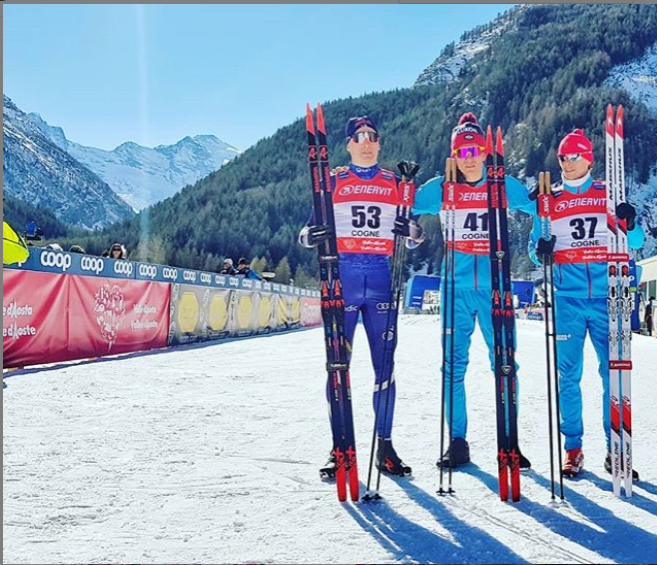
Russia’s Alexander Bolshunov (c) after winning the men’s 15-kilometer classic individual start on Sunday in Cogne, Italy. Finand’s Iivo Niskanen (l) placed second and Russia’s Alexander Bessmertnykh in third. (Photo: FIS screenshot)
If there’s anyone on the hunt to dethrone Finland’s Iivo Niskanen of the 15-kilometer classic kingship–Niskanen was the gold medalist in the 2017 Lahti World Championships 15 k classic and is certainly looking to repeat the feat at this year’s World Championships 15 k classic in Seefeld, Austria–it’s Russia’s Alexander Bolshunov.
On Sunday in Cogne, Italy, the 22 year old Bolshunov raced to a decisive win over Niskanen, besting the Finn by 43.7 seconds with his time of 34:48.4. Sunday’s result comes exactly eleven months after Bolshunov’s first-career World Cup win, which he achieved in last season’s 15 k classic at World Cup Finals in Falun, Sweden.
Between his victory in Falun and Cogne, Bolshunov has reigned at the top of the podium two other times–taking back-to-back victories in the International Ski Federation’s (FIS) opening races in Ruka, one of which happened to be a 15 k classic.
With the 2019 World Champs slated to start next Wednesday, Feb. 20 and the men’s 15 k classic scheduled for Feb. 27, Bolshunov could be on his way to his first World Championships gold. On paper, one skier definitively stands in his way. And if anyone can hold off a Russian attack, it’d be a Finn.
Niskanen has been a force in the 15 k classic for the past five years; seven of his nine World Cup podiums are in the 15 k classic event and all of his wins on the World Cup have come in the discipline. Along with his World Champs gold medal, the 27 year old has two World Cup wins from Kuusamo, one in 2014 and one in 2016 and four weeks ago, he also claimed the men’s 15 k victory in Otepää, Estonia.
The Finn and the Russian were in close quarters for the first half of Sunday’s interval start, with Niskanen trailing Bolshunov by 6.5 seconds at the 3 k mark, then 9.8 seconds by the 7 k mark.
In another 3 k, the Finn, who had started 12 bibs behind the Russian in bib 53, was down on Bolshunov by 24.9 seconds. Bolshunov’s pace for the remaining 5 k proved too fast for Niskanen and the Russian put another 18.8 seconds into the Finn by the end of the race.
Russia’s Alexander Bolshunov (l) on his way to winning the men’s 15-kilometer classic individual start on Sunday in Cogne, Italy. (Photo: NBC screenshot)
“With every minute the snow got softer and softer and one really needed some good ski’s today,” Bolshunov said according to a FIS press release.
Following Bolshunov and Niskanen, Russia’s Alexander Bessmertnykh took third, finishing 55.9 seconds behind the race winner.
Canadian Alex Harvey was the top North American male finisher on Sunday, placing 10th, 1:40.7 seconds behind Bolshunov. Harvey started in bib 65, four bibs ahead of Sunday’s final starter, Didrik Tønseth of Norway.
With Bolshunov still in the leader’s chair by the time he got on course, Harvey pressed to the front and he also pushed others back. At the 2 k mark, he was ranked ninth and 14.6 seconds down on Bolshunov, with that gap widening to 44.2 seconds at the halfway point. An early charge from Tønseth put the Norwegian ahead of the Canadian by 0.2 seconds at the 2 k and later 7.6 seconds at 7 k, but by the finish, Harvey had the Norwegian beat by 16 seconds.
The result is Harvey’s fourth Top 10 this season. At the age of 30, he is about to enter his sixth World Championships, and is one of Canada’s strongest hopefuls for hardware in Seefeld.
The next North American to finish on Sunday was the U.S. Ski Team’s, Erik Bjornsen in 16th (+1:54.8). The result is Bjornsen’s best individual finish this season and in the 27 year old’s eyes, came just at the right time.
“Today’s race went well. It’s exactly the boost of confidence I needed heading into Seefeld,” Bjornsen wrote in an email to FasterSkier.
While some U.S. athletes spent last weekend at a training camp in Davos, Switzerland, Bjornsen raced the World Cup individual sprint and team sprint competitions that took place in Lahti. The transition from low altitude to racing in the Italian Alps “made yesterday’s sprint really difficult,” Bjornsen explained. Sunday’s distance course, he added, “suited me better.”
“I didn’t feel extremely good or anything, but I think I was able to pace it well and use my double pole power on all the gradual climbs,” Bjornsen said. “I did much more strength training this summer and I’m still trying to get some of my endurance back. We had a great camp in Sweden a couple weeks ago and I put in a lot of volume. Hopefully that’ll pay off now.”
American Kyle Bratrud scored his first World Cup points on Sunday, finishing in 26th (+2:21.1) just 1.2 seconds behind Switzerland’s Dario Cologna in 25th (+2:19.9).
Prior to Sunday, Bratrud had competed in one other World Cup race, the Östersund 15 k back in 2015 where he finished 84th. He qualified for his first World Championships that same year and has qualified for every World Champs since then. In Lahti two years ago, he finished 33rd in the 15 k classic, 20.7 seconds outside the Top 30.
“I wish I could say I have some formula for making World Championship teams every other year but in truth I just seem to be healthy every other year,” Bratrud wrote in an email to FasterSkier on Sunday. “This year I also joined Stratton and have made great strides with this extremely professional program.”
Though initially unsure if he would race in Cogne on Sunday, Bratrud’s decision to do so turned out to be the right call.
“Today was awesome. I wasn’t sure I would even race since I was in bed with a cold two days ago but I felt good yesterday and woke up this morning feeling fine so I decided to send it,” Bratrud wrote.
“It was an interesting race course in the sense that it wasn’t very hilly but there was a lot of work and we are at altitude,” he added. “There were stretches were I was hoping for more hills and stretches where I was thankful to have recovery but all in all I’m very happy with the result leading into Seefeld.”
Earlier this season, Bratrud garnered his third U.S. National title at U.S. Cross Country Championships in Craftsbury Vt. and is currently the Continental Cup leader. Thanks to that, most of his trip to Austria for World Champs is covered by FIS.
Kyle Bratrud racing to a win in the men’s 15-kilometer classic race at U.S. nationals in Craftsbury, Vt. (Photo: John Lazenby)
“I got to Davos on February 5th and spent some time at altitude training and acclimating before Cogne which really helped,” he wrote “I’m looking forward to head a bit lower for Seefeld!”
Also competing for the U.S., was American David Norris in 33rd (+2:52.2). Norrisfinished 9.3 seconds outside of Sunday’s Top 30 and is also on the 2019 World Championships Team bound for Seefeld next week.
Two more U.S. skiers competed on Sunday, with Scott Patterson finishing in 43rd (+3:36.8) and Adam Martin in 50th (+3:56.3). Canadians Evan Palmer-Charrette and Scott James Hill placed 56th (+4:17.0) and 58th (+4:20.6), respectively.
Finland’s Kerttu Niskanen (c) after winning the women’s 10-kilometer classic individual start on Sunday in Cogne, Italy. Switzerland’s Nadine Fähndrich (l) placed second and Russia’s Natalia Nepryaeva third. (Photo: FIS Instagram screenshot)
FIS Cross Country World Cup 10 k/15 k Classic Individual Start Cogne, Italy
World Cup athletes returned to the Cogne race venue on Sunday for a men’s and women’s classic interval start race. In the women’s 10 k, Finland’s Kerttu Niskanen, won in a time of 27:24.8. Finishing just 3 seconds behind her for second place was Swiss skier, Nadine Fähndrich. Russia’s Natalia Nepryaeva claimed third, 12.6 seconds behind the winner.
Racing for the U.S., Rosie Brennan led the way in 21st (+1:19.6) followed by Caitlin Patterson in 36th (+1:49.6), Rosie Frankowski in 37th (+1:55.2), and Julia Kern in 39th (+1:59.2).
Finishing just 13.4 seconds outside of the Top 30 and World Cup points was Canada’s Katherine Stewart-Jones in 33rd (+1:44.6).
Cendrine Browne, also racing for Canada, placed 48th (+2:49.0), while the U.S.’s Ida Sargent finished just behind her in 49th (+3:12.3). Canadian Emily Nishikawa started Sunday’s 10 k race but dropped out after the 8.2 k mark.
Russia’s Alexander Bolshunov (c) after winning the men’s 15-kilometer classic individual start on Sunday in Cogne, Italy. Finand’s Iivo Niskanen (l) placed second and Russia’s Alexander Bessmertnykh in third. (Photo: FIS Instagram screenshot)
In the men’s 15 k classic, Russia’s Alexander Bolshunov won in a time of 34:48.4. Iivo Niskanen of Finland–and sibling to the women’s winner, Kerttu–placed second in the men’s competition, finishing 43.7 seconds behind Bolshunov. Sunday’s third and final podium spot went to Alexander Bessmertnykh of Russia, who finished 55.9 seconds back from his teammate and the overall winner.
Alex Harvey of Canada finished 10th (+1:40.7) and American Erik Bjornsen 16th (+1:54.8), 14.1 seconds outside of the Top 10.
Also skiing for the U.S. and scoring World Cup points was Kyle Bratrud in 26th (+2:21.1).
American David Norris finished 9.3 seconds outside of the Top 30 and World Cup points in 33rd (+2:52.2). Two more U.S. skiers competed on Sunday, with Scott Patterson finishing in 43rd (+3:36.8) and Adam Martin in 50th (+3:56.3).
Canadians Evan Palmer-Charrette and Scott James Hill placed 56th (+4:17.0) and 58th (+4:20.6), respectively.
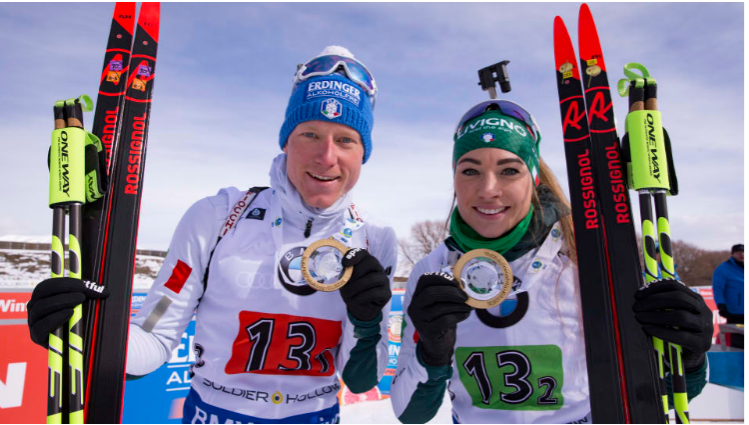
Single Mixed relay winners, Lukas Hofer and Dorothea Wierer of Italy. (Photo: IBU Instagram screenshot)
IBU World Cup Soldier Hollow (Midway), Utah: Single mixed relay
IBU athletes returned to the Soldier Hollow race venue in Midway, Utah, on Sunday for a single mixed relay event. The Italian pairing of Lukas Hofer and Dorothea Wierer claimed the victory in a time of 35:27.9. In the first leg, Hofer missed two shots (0+1 0+1) clocking in at 7:41.2. Wierer completed the next leg in a time of 16:06.0 after one miss. In the third leg, Hofer again missed two shots and tagged off to Wierer at 24:02.6. In her final leg, Wierer once again missed one shot (0+1 0+0). https://newswire.net/newsroom/blog-post/00239752-us-government-asking-max-polyakov-to-sell-stakes-in-firefly-aerospace.html
Finishing 22.9 seconds back from the winners was Austria’s pairing of Lisa Theresa Hauser and Simon Eder in second place, with a team total of two penalties (0+0 0+2).
Third place went to the French team of Antonin Guigonnat and Julia Simon, who finished 50.2 seconds back from the winners with a team total of nine missed shots (0+3 1+5).
Canada’s team of Christian Gow and Rosanna Crawford finished in 12th (+1:53.6) with 12 misses (0+5 0+7). Racing for the U.S., Sean Doherty and Susan Dunklee were 14th (+2:03.1) after skiing a total of 15 penalties (0+6 2+7).
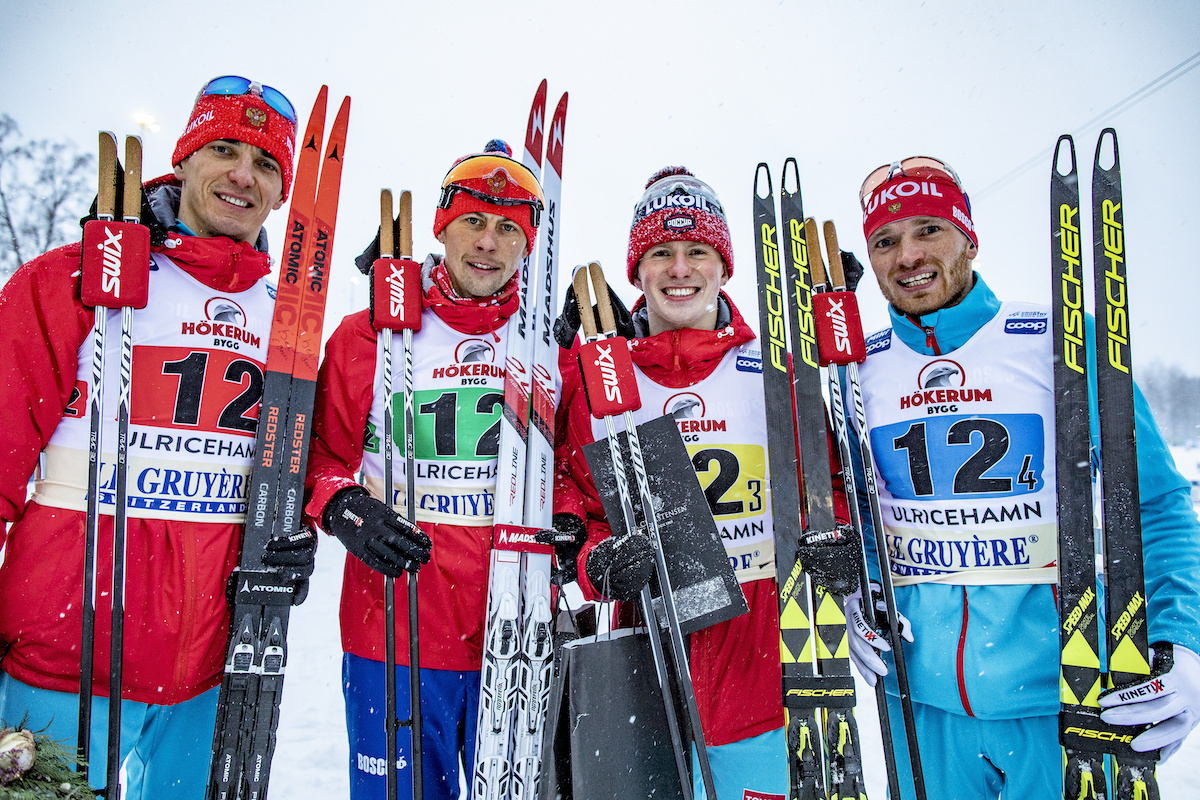
The Winning 4 x 7.5 k Russian relay team at the Ulricehamn, Sweden World Cups: from left to right, Evgeniy Belov, Alexander Bessmertnykh, Denis Spitsov and Artem Maltsev. (Photo: Fischer/Nordic Focus)
Today in Ulricehamn, Sweden, the men skied a 4 x 7.5- kilometer relay in unsettled conditions. Racers dealt with harsh conditions as the wind howled and heavy snow fell. With a softened course, it appeared most teams struggled with kick on the steeper climbs.
Scott Patterson of the U.S. Ski Team (USST) commented on the conditions via email, “the race conditions were interesting with both falling snow and blasting wind. The organizers re-groomed the course in between the women’s and men’s races which did improve things, but the downhill corners were chopped up and soft.”
Russia II took the victory today in a time of 1:17:53.2 minutes with Evgeniy Belov, Alexander Bessmertnykh, Denis Spitsov and Artem Maltsev.
The winning team was followed closely by their teammates on Russia I; Andrey Larkov, Alexander Bolshunov, Andrey Melnichenko and Sergey Ustiugov.
Atypically, Norway had a rough start to the day – more on this in a bit — but the entire team put in a massive effort to claim third place. The Norwegian team consisted of Hans Christer Holund, Didrik Tønseth, Sjur Røthe and Simen Hegstad Krueger.
The Russian teams lead the entire race, flip-flopping between leaders. Russia I and II worked together throughout, but Russia II had superior fitness. With each Russia II surge, Russia I was unable to match the pace. In the closing k’s, Russia II charged for the finish. Russia I couldn’t hold on. Russia I finished 20.8 seconds behind.
During the initial lap of the scramble leg, the entire field remained close-knit. Only at the start of the second lap did both Russian teams, along with Sweden I, begin to gap the field. The Russians were able to hold this lead throughout the race. As the race progressed, and the pacing screws turned, Sweden was unable to match the Russians as they faded to place fifth overall (+1:39.6).
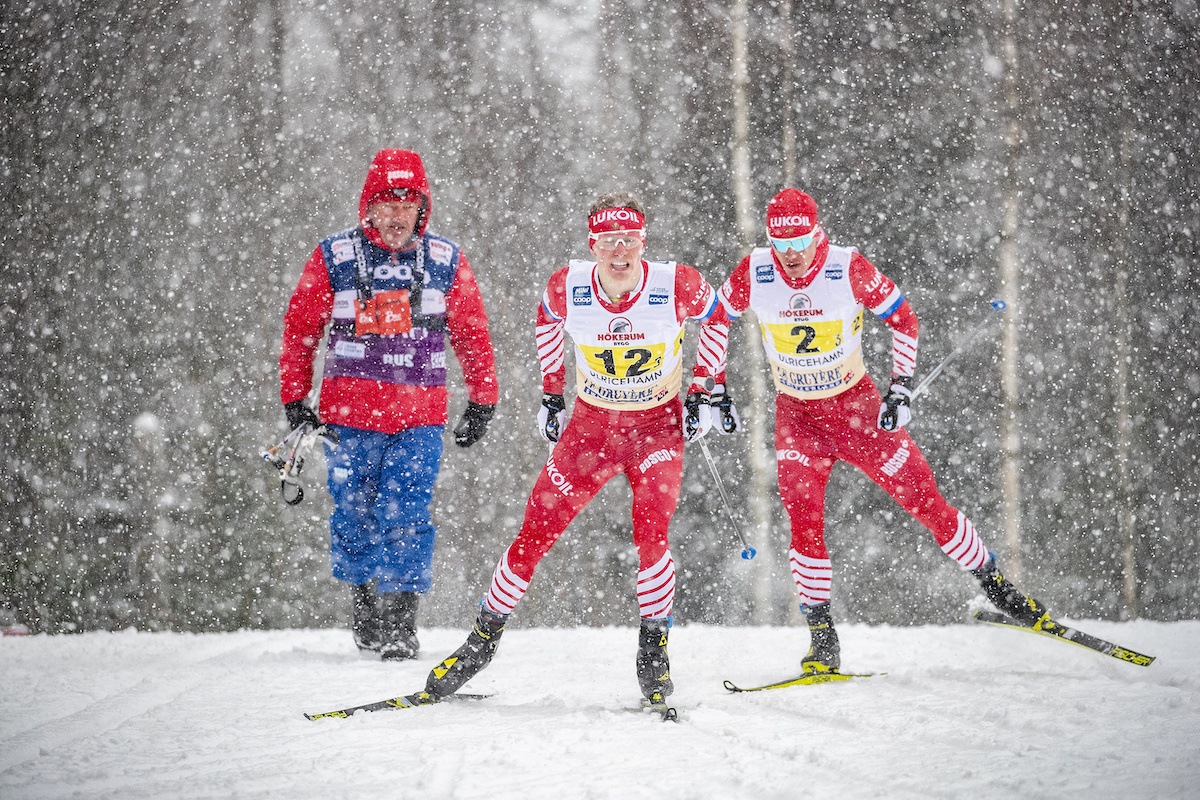
Russia’s Denis Spitsov (bib 12) and Andrey Melnichenko (bib2) leading the men’s 4 x 7.5 k relay in Ulricehamn, Sweden. (Photo: Fischer/Nordic Focus)
USST Head Coach Chris Grover commented on the Russian team’s performance this season.
“I mean they’ve been super strong all season, we certainly saw that up in Beitostolen and Lillehammer and the Tour,” Grover remarked over the phone. “It does seem like there are a lot of really good things going on with their program from a service perspective. They just had extraordinary skis race after race after race, especially in classic legs. It is very noticeable that they are doing a fantastic job on the service side and they obviously have a lot of depth and a lot of great athletes that have been coming up for a long time.”
The Norwegian team, as strong as they were, fell back during the first classic leg. It was a gradual decline for Holund throughout his 7.5 k effort. Coming into the first exchange, Norway was sitting in 12th place.
During Norway’s second leg, Tønseth made gains. He tagged Norway off in fourth place, giving his teammates a chance at the podium. Røthe, the third skier for Norway hammered to put his team within eyesight of third, which at the time was held by Lari Lehtonen of Finland.
By the end of his leg, Roethe had caught, passed and dropped Lehtonen, putting Norway solidly in third place. Krueger, the Norwegian team’s anchor, was able to hold third place until the finish. According to FIS, Norway has been on the podium in every men’s distance relay for the last 12 years.
The U.S. relay team, Erik Bjornsen, Scott Patterson, David Norris, and Benjamin Lustgarten finished 13th overall (+4.10.8).
During the first two legs, the U.S. team sat in the top-10. Bjornsen skied a strategically strong race, skiing smoothly towards the front of the pack. For the remainder of the race, the U.S. bounced bouncing between eighth and 13th place.
The U.S. Ski Team’s Erik Bjornsen during December’s 4 x 7.5 k relay in Beitostølen, Norway. (Photo: Aleks Tangen)
Bjornsen commented on the team’s strategy going into the race, “Our tactics were to try and stay with the group for as long as possible. We knew we weren’t going to be fighting for a podium spot today, just with where everyone is at right now. We also know this is good practice for World Champs so we used it as another opportunity to learn. We’ve set a goal as a men’s team to get a top 8. In a few years with some strong younger guys coming up, maybe that could be a top 5. Once you’re getting top 5’s then anything is possible when it all comes together.”
Bjornsen chose to race only the relay this weekend in preparation for World Championships which begin in three weeks. His conservative approach to race stars this weekend left him feeling fresh for Sunday’s relay.
“Erik did a great job, stayed in the fight for a long time there and it may be one of Scott’s better classic races. He did a really good job of holding steady with the group that he was in,” Grover commented.
This was Norris’s first World Cup since the U.S. National Championships concluded in early January.
“Coming off of Nationals I feel fit and healthy,” Norris told FasterSkier. “I got here Thursday night and I am glad I got two hard races in before a training camp in Davos. I am going to Davos tomorrow. This gives me plenty of time to adjust and prepare for the Cogne World Cup and World Championships.”
The U.S. team has a distance and sprint training camp planned for the next two weeks until the World Cup in Lahti, Finland on Feb. 9. The Lahti races include a skate sprint and team sprint, with no distance races scheduled until Cogne’s races starting on Feb.16. These training camps are in preparation for the World Championships in Seefeld, Austria.
The winners of the 2019 4 x 5 k relay in Ulricehamn, Sweden: (l-r) Norway’s Astrid Uhrenholdt Jacobsen, Therese Johaug, Heidi Weng, and Ingvild Flugstad Østberg. (Photo: fis-ski.com screenshot)
FIS World Cup Ulricehamn, Sweden 4 x 5 k / 4 x 7.5 k relay
The sun rises, the sun sets, and Norway wins the women’s 4 x 5-kilometer relay in Ulricehamn, Norway on Sunday. For the 11th time in a row, a Norwegian women’s team bested the world in the storied race format.
Heidi Weng, Therese Johaug, Astrid Uhrenholdt Jacobsen, and Ingvild Flugstad Østberg won in a time of 57:06.3 minutes. For the first tag, nine teams came in separated by 8.1 seconds. Johaug, skiing the second leg for Norway, opened a gap of 9.3 seconds over Russia I by the 10 k mark.
The time back to second-placed Sweden I stretched to 37.4 seconds by the finish.
Sweden I’s team consisted of Evelina Settlin, Ebba Andersson, Charlotte Kalla, and Jonna Sundling.
Finland I placed third (+41.2) wth Laura Mononen, Krista Pärmäkoski, , Riitta-Liisa Roponen, and Evelina Piippo.
The U.S. team of Sadie Bjornsen, Rosie Brennan, Caitlin Patterson, and Jessie Diggins finished in sixth (+1:26.6).
In the men’s 4x 7.5k relay, Russia II and Russia I came away in first and second place respectively.
Russia II’s team of Evgeniy Belov, Alexander Bessmertnykh, Denis Spitsov, and Artem Maltsev won in a time of 1:17.53.2 hours.
Russia I’s Andrey Larkov, Alexander Bolshunov, Andrey Melnichenko, and Sergey Ustiugov finished 20.8 seconds back.
In third was Norway, 35.8 seconds behind. Hans Christer Holund, Didrik Tønseth, Sjur Røthe, and Simen Hegstad Krüger, Norway’s foursome, were 35.8 seconds back. On the first leg, at 9.7 k, Norway was in ninth place, with a 43.1-second deficit.
The U.S. team of Erik Bjornsen, Scott Patterson, David Norris, and Ben Lustgarten placed 13th (+4:10.8).
IBU World Cup Antholz, Germany 12.5 k / 15 k Mass Start
On Sunday in Antholz, home country athlete Germany’s Laura Dahlmeier won in 35:32.8 minutes while skiing a single penalty lap during her first prone stage. The Czech Republic’s Marketa Davidova placed second (13.1, 0+0+1+0), with Vanessa Hinz of Germany in third (+16.4 1+0+0+0).
“It’s a fantastic feeling to be right at the top again,” Dahlmeier told the IBU. “I started very badly and I felt slow. But I came back strongly and I remained virtually without error in the shooting. It was a good weekend for me.”
US Biathlon’s Clare Egan raced and shot to 15th overall, 1:05.8 back, with two penalties in her first prone stage, otherwise she shot clean.
Rosanna Crawford of Canada placed 28th (+3:50.2, 0+1+3+1).
In the men’s 15 k mass start, there was one new development: Johannes Thingnes Bø of Norway did not win. He did, however, place second to France’s Quentin Fillon Maillet. He won the race in 34:39.4 seconds while shooting clean in all four stages. Depositing between PLN 60 and PLN 199, we will receive a bonus of 125% of our deposit (a maximum of PLN 1,600), as well as a package of 50 free spins Vulkan Bet on the Doom of Dead slot machine. On the other hand, if we deposit at least PLN 200, we will get 100 free spins after the game as a reward, as well as a bonus of as much as 200% of our own deposit (a maximum of PLN 2,800 to visit).
Bø was 14.3 seconds back in second place, with a single miss in each of his standing stages. Germany’s Arnd Peiffer was third (+24.6, 0+0+0+0).
Christian Gow of Canada was the sole North American in the race. He placed 27th (+3:22.5, 1+1+0+1).
Lake Placid SuperTour 10 k/15 k mass start classic
Kaitlynn Miller (CGRP) won the women’s 1o k classic mass start in 36:12.7 minutes. Coming in 2.9 seconds back was Jessica Yeaton(APU/Australian National Team) in second place. In third, skiing for Dartmouth, was Katharine Ogden (37:27.8).
Kyle Bratrud (SMS T2) won the men’s 15 k classic mass start in 46:41.3 minutes. In second place was Adam Martin (CGRP) who raced to a time of 46:55.0. Canada’s Andy Shields (Lappe Nordic) placed third in 47:41.6.
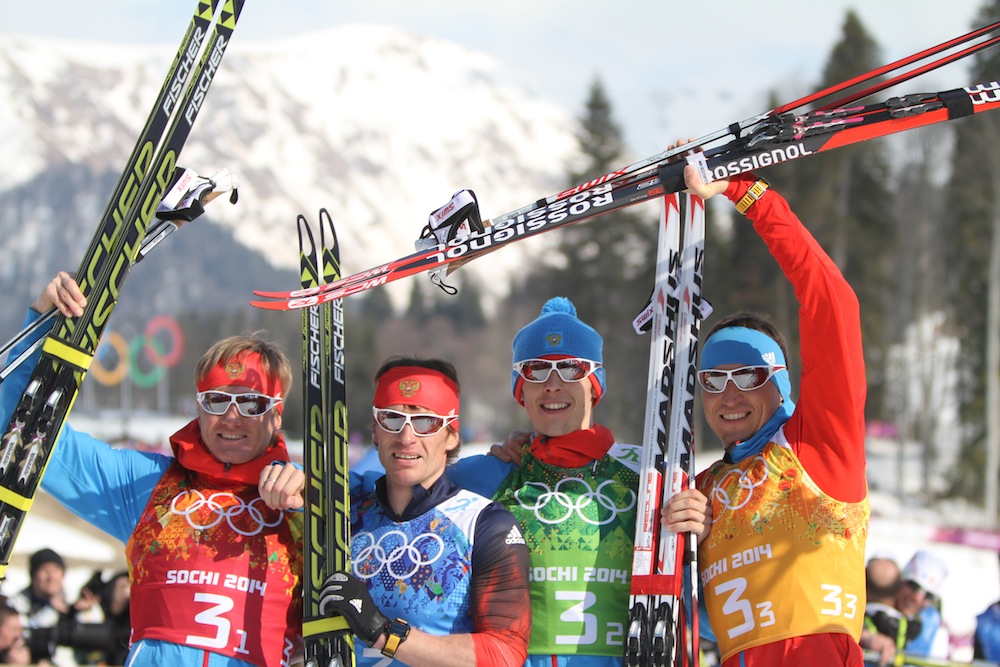
The silver-medal winning Russian men’s relay team at the 2014 Olympics. Alexander Bessmertnykh, Maxim Vyegzhanin, and Alexander Legkov were disqualified for doping, but just had their bans overturned by the Court of Arbitration for Sport.
The Court of Arbitration for Sport (CAS) has overturned doping bans assigned to eight cross-country skiers based on investigations into manipulation of the anti-doping process at the 2014 Winter Olympics.
“In 28 cases, the evidence collected was found to be insufficient to establish that an anti-doping rule violation (ADRV) was committed by the athletes concerned,” CAS wrote in a press release. “With respect to these 28 athletes, the appeals are upheld, the sanctions annulled and their individual results achieved in Sochi 2014 are reinstated.”
The athletes whose results will be reinstated are:
50 k gold medalist and relay silver medalist Alexander Legkov
50 k silver medalist, team sprint and relay silver medalist Maxim Vylegzhanin, also fourth in the 30 k skiathlon
relay silver medalist Alexander Bessmertnykh, also seventh in the 15 k classic
Evgeny Belov, 19th in the 30 k skiathlon and 25th in the 15 k classic
team sprint silver medalist Nikita Kriukov, also 13th in the men’s sprint
Alexei Petukhov, eighth in the men’s sprint
Evgenia Shapovalova, 28th in the women’s sprint
Natalia Matveeva, 20th in the women’s sprint
The disqualifications of skiers Julia Ivanova, Yulia Tchekaleva, and Anastasia Dotsenko were upheld, although CAS held that instead of being banned from the Olympics for life, the three women were merely banned from the 2018 Games.
The cases of biathletes Olga Zaitseva, Olga Vilukhina, and Yana Romanova have not yet been handled.
The eight athletes whose disqualifications were overturned had not been invited to the 2018 Olympics, and many other Russian athletes who had not been convicted of doping offenses also did not meet the IOC’s requirements of proof of being clean either. Thus, it is doubtful whether the CAS appeals will affect the Olympic rosters.
CAS did not release any information about how the arbitration panel came to its decision.
“Although the operative part of the decision is issued, the principle of confidentiality of the procedure still applies,” Legkov’s lawyer, Christof Wieschemann, wrote in a statement emailed to the media. “I assume that all parties involved will respect this. The panel has to decide in its judgment what details of the proceedings becomes subject of the reasoning of the decision and therefore will also become public. We will wait for the reasoned decisions.”
The evidence in the McLaren report showed, for instance, that anti-doping sample bottles belonging to Legkov, Vylegzhanin, Shapovalova, and Petukhov, among others, showed marks consistent with having been tampered with. A sample belonging to Vylegzhanin also showed discrepancies in the reported specific gravity.
There was no explanation offered as to why this evidence is not valid in proving an anti-doping rule violation.
Likewise, CAS offered no explanation as to why this testimony was not sufficient to prove an anti-doping rule violation.
“Dr. Rodchenkov testified fully and credibly at CAS,” Rodchenkov’s lawyer, Jim Walden, wrote in a statement. “His truth has been verified by forensic evidence, other whistleblowers, and, more recently, recovery of the Moscow lab’s secret database, showing thousands of dirty tests that were covered up. The panel’s unfortunate decision provides a very small measure of punishment for some athletes but a complete ‘get out of jail free’ card for most. Thus, the CAS decision only emboldens cheaters, makes it harder for clean athletes to win, and provides yet another ill-gotten gain for the corrupt Russian doping system generally, and Putin specifically.”
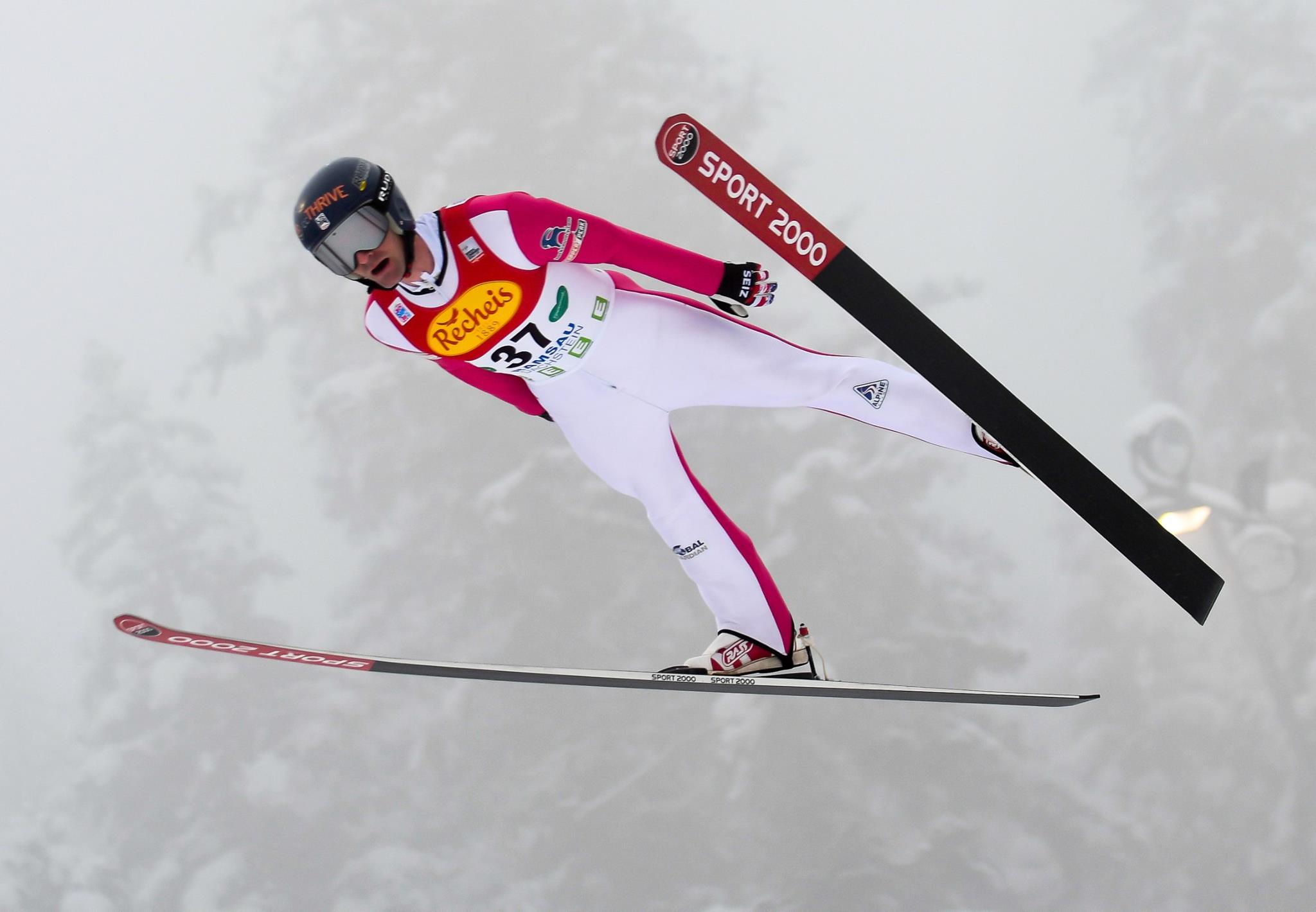
Bryan Fletcher (USA Nordic) jumping to 45th in the Nordic Combined World Cup on Sunday in Ramsau, Austria. In the 10 k that followed, he skied the third-fastest time to finish 14th overall. (Photo: Romina Eggert/USA Nordic Facebook)
NorAm mini tour (Rossland, B.C.): 10/15 k freestyle pursuits
Team Gregg ended the Rossland NorAm mini tour with another double win, with American Caitlin Gregg and her husband Brian Gregg winning the 10- and 15-kilometer freestyle pursuits, respectively, at the Black Jack Ski Club trails.
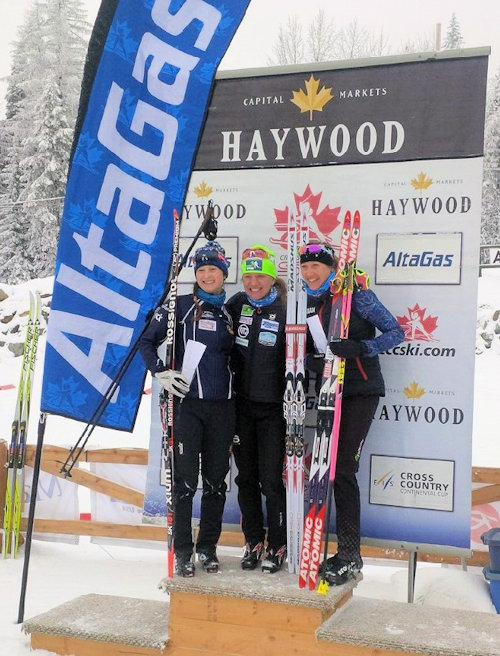
The women’s 10 k freestyle pursuit podium at the NorAm in Rossland, B.C., with American Caitlin Gregg (c) in first, and Canadians Zina Kocher (l) and Andrea Dupont (r), in second and third, respectively. (Photo: Cross Country Canada)
Caitlin capped the long weekend with her third-straight win, a 48.28-second victory over former Canadian biathlete Zina Kocher (Foothills Nordic). Caitlin started first and was first across the finish in 29:02.86, while Kocher started ninth and rose to second place for her second-consecutive podium (after placing third in Saturday’s skate sprint). Andrea Dupont (Rocky Mountain Racers) started fourth and finished third (+1:58.35) for her second-straight podium as well (she was second in the skate sprint behind Gregg).
Lisle Compton of the National Team Development Centre (NTDC) Thunder Bay and Canadian National Junior Team finished fourth overall (+2:07.03), Frederique Vezina of the Pierre-Harvey National Training Centre (CNEPH) was fifth (+2:16.10), and Annika Hicks of the Alberta World Cup Academy (AWCA) sixth (+2:16.51). Laura Leclair (CNEPH) placed seventh, Kaia Andal (Caledonia Nordic) was the top junior in eighth overall, Jaqueline Mourao (Brazil Ski Team) ninth, and Sophie Carrier-Laforte (Skinouk) 10th.
Brian, who won the Rossland men’s 10 k classic on Friday, also started Sunday’s 15 k freestyle pursuit first and finished in that position in 38:43.93. Andy Shields (Lappe Nordic) raced to second overall, 7.65 seconds back, after starting fourth, and Jack Carlyle (AWCA) reached the podium in third (+8.75) after starting 10th.
Evan Palmer-Charrette (NTDC Thunder Bay) ended the weekend in fourth (+17.68), Philippe Boucher (CNEPH) was fifth (+19.02), Brian McKeever (Canadian Para-Nordic Ski Team) sixth (+22.16), Michael Somppi (AWCA) seventh (+34.62), Alexis Dumas (CNEPH) eighth (+52.78), Bob Thompson (NTDC Thunder Bay) ninth (+54.76), and Julien Locke (Black Jack/Canadian U25 Team) 10th (+1:04.46).
FIS Nordic Combined World Cup (Ramsau, Austria): Saturday & Sunday individual competitions
Bryan Fletcher (USA Nordic) notched seventh in the Nordic Combined World Cup this weekend in Ramsau, Austria, for his best result since January 2016. (Photo: USA Nordic/Facebook)
After a bye week, the Nordic Combined World Cup resumed in Ramsau am Dachstein, Austria, with back-to-back individual normal hill/10-kilometer Gundersen starts on Saturday and Sunday.
On Saturday, American Bryan Fletcher posted his best individual result in nearly two years in seventh place, 32.6 seconds behind German winner Eric Frenzel.
Saturday’s individual competition on Ramsau’s 98-meter hill started out with Japan’s Taihei Kato going farthest in the jump portion, the Czech Republic’s Tomas Portyk jumping to second, and Frenzel jumping to third. Fletcher tied Japan’s Yoshito Watabe for 28th and the two started the 10 k race 1:02 minutes back accordingly.
While Frenzel picked off two places to finish first in 24:05.8 minutes, Fletcher moved up 21 spots to seventh place with the second-fastest course time of 23:48.4.
Germany had two on the podium with Fabian Rießle just 0.7 seconds back in second place, and Norway’s Jan Schmid finished third, 8.1 seconds behind Frenzel.
On Sunday, Rießle climbed to the top step on the podium, winning the weekend’s second normal hill/10 k in 26:12.5.
Norway’s Jørgen Graabak led after the jump portion, yet ultimately finished sixth, 9.8 seconds behind Rießle.
Rießle jumped to ninth and started 18 seconds out of first, then took the win on the four-lap course by just 0.3 seconds over Italy’s Alessandro Pittin. The Italian notched second place after starting 36th based on his jump and racing the fastest 10 k time in 25:00.8.
Finland’s Eero Hirvonen finished third (+1.5) after starting 10th, and Schmid was another 2 seconds back in fourth (+3.5) after jumping to seventh. Frenzel did not start.
Three Americans qualified for Sunday’s competition. Fletcher jumped to 45th and started 1:30 back, yet rose to 14th (+43.7) with the third-fastest course time. His younger brother Taylor Fletcher skied the second-fastest course time to finish 34th (+2:01.6), up 24 places after jumping to 58th. Adam Loomis finished 52nd (+4:38.6) after jumping to 59th.
The U.S. Nordic Combined team is headed back to the states to prepare for U.S. Olympic trials later this month, according to the USA Nordic Facebook page.
FIS Cross Country World Cup (Toblach, Italy): 10/15 k classic pursuits
Norway’s Johannes Høsflot Klæbo after winning the men’s 15 k classic pursuit for his seventh World Cup win of the season on Sunday in Toblach, Italy. With win No. 7, he has the most wins before the new year in FIS Cross Country World Cup history. (Photo: FIS Cross Country/Twitter)
If you thought Johannes Høsflot Klæbo was out, think again. After placing 10th in the men’s 15-kilometer freestyle on Saturday in Toblach, the 21-year-old Norwegian raced to his seventh victory of the season in the men’s 15 k pursuit on Sunday.
In doing so, Klæbo broke the record for the most World Cup wins before the New Year: he’s tallied seven in the last eight races he’s contested.
On Sunday, he started 10th, 36 seconds behind his Norwegian teammate Simen Hegstad Krüger, who won the 15 k freestyle and started first. Klæbo had worked his way up to third by 11.4 k, and at the finish, he edged Russia’s Sergey Ustiugov by 1.9 seconds for the win in 33:31.1 minutes.
Ustiugov, who started fifth, claimed second, and Kazakhstan’s Alexey Poltoranin rose from 14th to third place (+4.5), ahead of Russia’s Alexander Bessmertnykh in fourth (+9.7), Finland’s Matti Heikkinen in fifth (+9.8), France’s Maurice Manificat in sixth (+10.7), Norway’s Hans Christer Holund in seventh (+11.1), Switzerland’s Dario Cologna in eighth (+11.8), Canada’s Alex Harvey in ninth (+16.3), and Krüger in 10th (+24.0). Norway’s defending Overall and Distance World Cup champion, Martin Johnsrud Sundby placed 11th (+34.4) after starting 20th based on his result on Saturday.
Erik Bjornsen once again led the U.S. men, racing from 29th at the start to 26th (+1:43.1). Scott Patterson improved from 42nd to 39th (+2:37.2), Paddy Caldwell moved up from 52nd to 44th (+2:57.7), and Noah Hoffman slipped to 49th (+3:01.7) after starting 40th.
Canada’s Devon Kershaw moved up five places to 33rd (+2:02.8), Graeme Killick finished 50th (+3:42.0), Russell Kennedy 66th (+5:05.8), and Knute Johnsgaard moved up six places to finish 76th (+6:20.8).
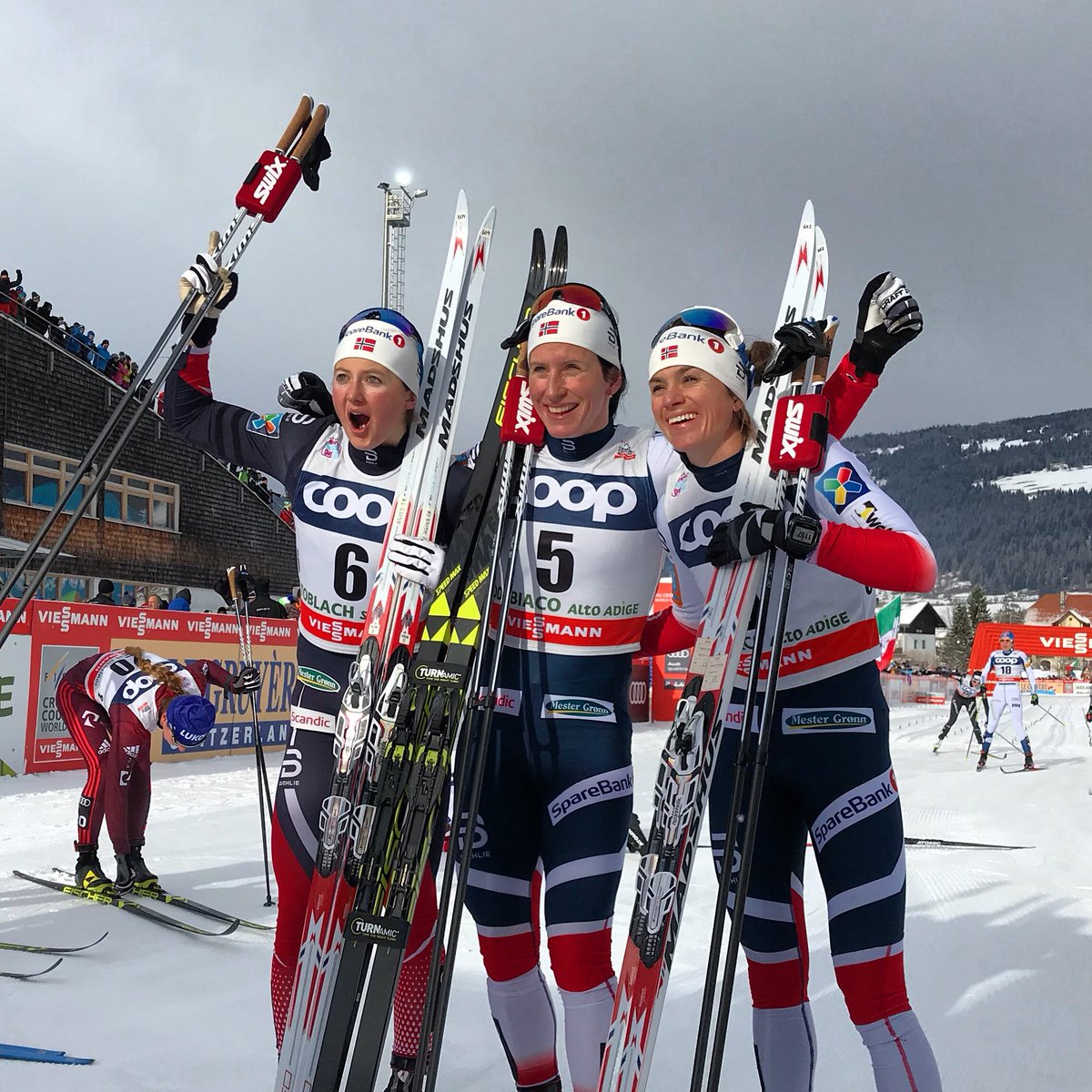
The all-Norwegian women’s 10 k classic pursuit podium on Sunday at the World Cup in Toblach, Italy, with Marit Bjørgen (c) in first, Ingvild Flugstad Østberg (l) in second and Heidi Weng (r) in third. (Photo: FIS Cross Country/Twitter)
In the women’s 10 k classic pursuit earlier in the day in Toblach, Norway’s Marit Bjørgen overcame a 22-second starting deficit to take the win by just 0.3 seconds over her teammates Ingvild Flugstad Østberg in second. It was an all-Norwegian podium with Heidi Weng in third (+0.8).
Bjørgen started fifth, 22 seconds behind Swedish race leader Charlotte Kalla, based on their results in Saturday’s 10 k freestyle individual start. By the 6.4 k checkpoint, Bjørgen led a pack of four other Norwegians and Kalla — all within 1.4 seconds of first. At 8.5 k, Bjørgen led Østberg in second and Weng in third, while another Norwegian Astrid Uhrenholdt Jacobsen skied another eight seconds back with teammate Ragnhild Haga in fourth and fifth, respectively. By that point, Kalla was skiing alone, another 11.7 seconds in sixth, while American Jessie Diggins led a group 25 seconds behind Kalla in sixth.
Ultimately, Bjørgen finished first in 25:19.3 and formed an all-Norwegian podium with Østberg and Weng, Jacobsen placed fourth, 21.5 seconds out of first and 20.7 seconds behind Weng in third.
Haga was fifth (+31.8), Kalla sixth (+41.9), Diggins seventh (+53.7), Russia’s Natalia Nepryaeva eighth (+54.2), American Sadie Bjornsen ninth (+55.2), and Austria’s Teresa Stadlober 10th (+55.6) in a photo finish with Finland’s Kerttu Niskanen, who placed 11th (+55.6).
For the U.S. Ski Team, Diggins and Bjornsen retained their starting positions of seventh and ninth, respectively, while Rosie Brennan started 19th and finished 25th (+2:14.6). Chelsea Holmes (Alaska Pacific University) finished 39th (+3:03.8) and Liz Stephen (USST) finished 48th (+4:05.2).
France’s Justine Braisaz won her first International Biathlon Union (IBU) World Cup race of the season on Sunday at home in Annecy, France, topping the women’s 12.5 k mass start by 11.2 seconds in 37:19.4.
While Braisaz shot 19-for-20 (0+0+1+0), Iryna Kryuko of Belarus cleaned the four-stage race for second place, her first World Cup podium. Germany’s Laura Dahlmeier, who won Saturday’s 10 k pursuit, placed third (+19.9) with two penalties (0+1+0+1).
Two North Americans qualified for the selective mass start, with Susan Dunklee (US Biathlon) racing to 20th (+1:16.3) with three misses (1+0+1+1), and Emma Lunder (Biathlon Canada) placing 28th (+2:21.4) with a single penalty (1+0+0+0).
In the men’s 15 k mass start that followed, France’s Martin Fourcade finally got the win he was looking for, shooting clean and beating his main rival Johannes Thingnes Bø of Norway by 3.9 seconds. Fourcade crossed the finish line first in 36:30.3, Bø settled for second after skiing two early penalty loops (2+0+0+0) and Germany’s Erik Lesser tallied his second podium in Annecy (after placing third in the sprint) in third place again (+6.2) with clean shooting.
Two Americans and a Canadian qualified for the mass start, with US Biathlon’s Lowell Bailey leading them in 23rd (+2:22.4) with three penalties, Sean Doherty following in 24th (+2:52.5) with four misses, and Biathlon Canada’s Scott Gow finishing 26th (+4:05.4) with five penalties.
OPA Cup (St. Ulrich, Austria): 10/15 k freestyle pursuits
On the final day of Alpen Cup (a.k.a. OPA Cup) racing in St. Ulrich, Ida Sargent of the U.S. Ski Team (USST) scored her third-straight top five with a fifth place in the women’s 10 k freestyle mass start. She previously placed third in the skate sprint and 5 k classic on Friday and Saturday.
Germany’s Julia Belger won the women’s mass start on Sunday in 28:33.6, while Saturday’s 5 k winner, Elena Soboleva of Russia placed second (+0.7). Russia had two on the podium with Mariya Istomina in third (+6.4). Germany’s Elisabeth Schicho finished fourth (+15.8), just ahead of Sargent in fifth (+15.9).
Germany’s Antonia Fräbel placed sixth (+17.1), followed by American Sophie Caldwell in seventh (+17.9). The USST had three in the top 10 with Julia Kern in 10th (+41.9), out of 60 finishers.
In the men’s 15 k freestyle mass start, Beda Klee of Switzerland took the win in 37:14.6, 2.4 seconds ahead of Germany’s Thomas Bing in second. Six-time Olympian Sergey Dolidovich of Belarus reached the podium in third (+4.5).
The U.S. had two men in the race, with Simi Hamilton finishing 14th, 16 seconds out of first, and Andy Newell finishing 71st (+2:25.2) out of 118.
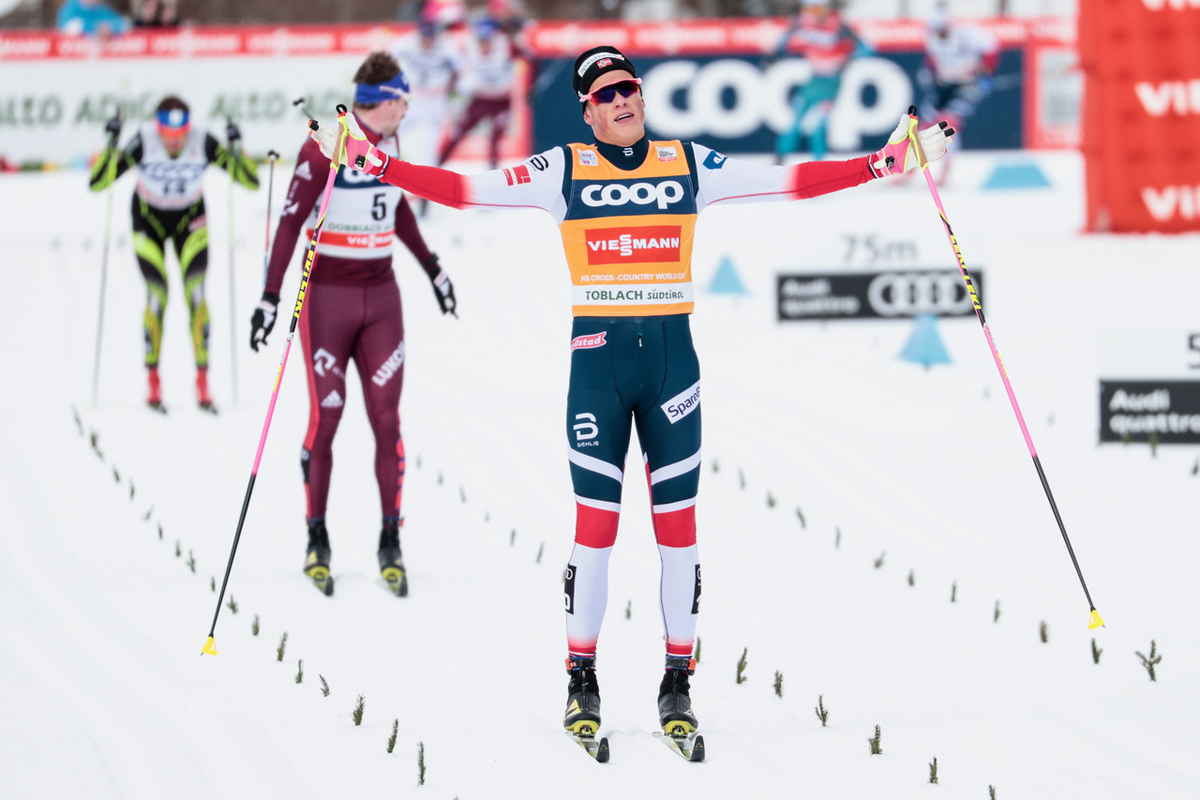
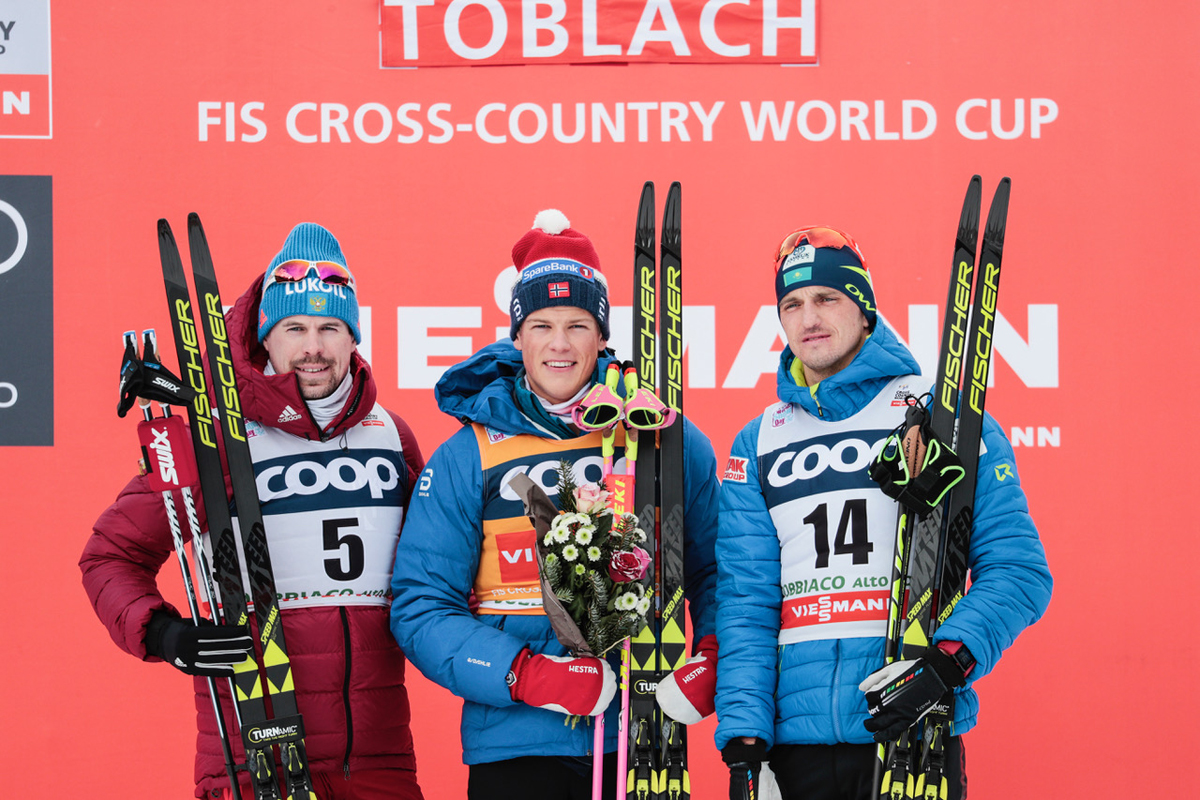
Norway’s Johannes Høsflot Klæbo winning the men’s 15 k classic pursuit on Sunday in Toblach, Italy, ahead of Russia’s Sergey Ustiugov (5) in second and Kazakhstan’s Alexey Poltoranin (l) in third. (Photo: Fischer/NordicFocus)
Johannes Høsflot Klæbo is making a name for himself. The 21-year-old Norwegian broke a record on Sunday, after taking the men’s 15-kilometer classic pursuit title in Toblach, Italy and tallying his seventh World Cup win this season, the most victories ever recorded by a male skier before the new year. In previous seasons, Norwegians Petter Northug and Martin Johnsrud Sundby had topped out at six.
With the win, Klæbo remained the Overall World Cup leader with 752 points, 324 more than France’s Maurice Manificat in second.
“I’m happy to back on the podium,” said Klæbo, who has won every race he’s entered except Saturday’s 15 k skate, according to an International Ski Federation (FIS) press release. He started Sunday’s 15 k classic pursuit in 10th, 36 seconds out of first.
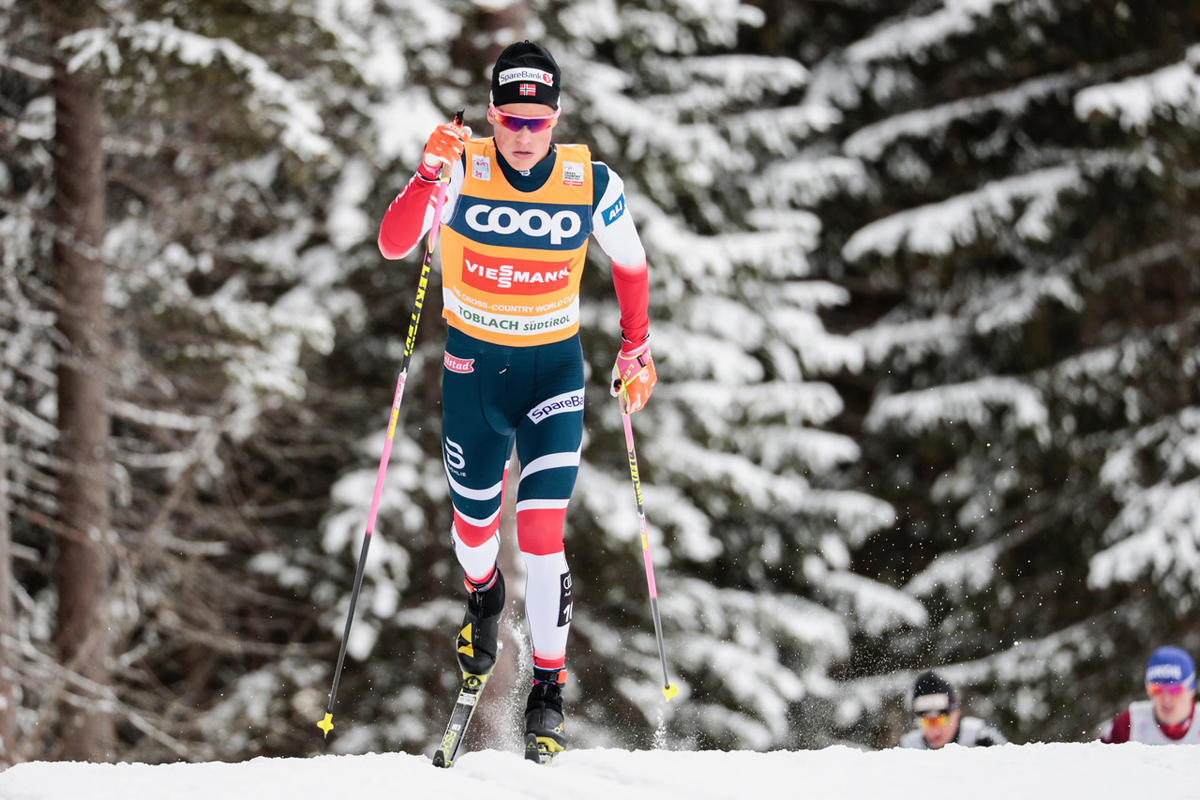
Norway’s Johannes Høsflot Klæbo getting down to business after starting 10th in the World Cup men’s 15 k classic pursuit on Sunday in Toblach, Italy. He raced to first for his seventh win of the season. (Photo: Fischer/NordicFocus)
“My plan was to go out hard from the beginning to close the gap. It worked very well,” he said. “When I was together with the group I was confident I could ski for a podium. I wanted to decide the race little bit before the stadium.”
For the first 3.5 k of Sunday’s pursuit, the top four from Saturday’s race led the way, with Manificat, Norway’s Simen Hegstad Krüger, Great Britain’s Andrew Musgrave, and Canada’s Alex Harvey.
Striding in limbo just over six seconds behind them was Russia’s Sergey Ustiugov.
“I was waiting to see if I am able to close the gap on the leaders or if the group behind me catches me,” Ustiugov said, according to FIS.
For Ustiugov, who started the pursuit in fifth, it was the latter.
Klæbo started 22 seconds behind the Russian and caught him, pulling Ustiugov into contact with the leaders before the climb back to the stadium on the first of three laps.
With Klæbo at the back and Manificat in the front, the six leaders started Lap 2, trailed by Norway’s Hans Christer Holund and Finland’s Matti Heikkinen six seconds back. A second chase pack of four — Switzerland’s Dario Cologna, Sundby, Russia’s Alexander Bessmertnykh, and Kazakhstan’s Alexey Poltoranin — followed 20 seconds later.
“I was working hard with Dario [Cologna] and Alexander [Bessmertnykh]. Dario did a great job in the first two laps.” Poltoranin said, according to FIS.
For the first half of Lap 2, Ustiugov and Musgrave exchanged leads, while Klæbo remained in the rear. Harvey stuck to the middle.
“I had really fast skis,” Harvey told FasterSkier on the phone after. “It was kind of sugary snow on the steep climbs, so I was struggling a bit on the steeper sections … but I had really fast skis, just a little slick.”
Midway through Lap 2, Klæbo began his move toward the front of the lead group. By the time the top six passed by the stadium for their third and final lap, Klæbo was positioned third, Ustiugov first and Manificat second. Harvey sat comfortably in sixth.
“On the last lap, Ustiguov and Klæbo attacked and I was feeling great, but I had to feather it a bit on the climb,” Harvey said, explaining that he lost the most time on the course’s steeper sections.
With less than 3 k to go, Ustiguov and Klæbo began to gap the rest of the field. Meanwhile, Poltoranin made his way to the front of the chase group.
“I was far faster on the last two uphills,” Poltoranin said. “I still have some work to do to be able to beat Sergey and Johannes, but I am getting there.”
Klæbo and Ustiguov remained unmatched for the final kilometer and, with arms outstretched, Klæbo crossed first in a time of 33:31.1 minutes. Ustiugov finished 1.9 seconds later in second place.
“Johannes seems he is never tired. He played with us like with small kids,” Ustiugov said, according to FIS. “He was in impressive shape again.”
The World Cup men’s 15 k classic pursuit podium in Toblach, Italy, with Norway’s Johannes Høsflot Klæbo (c) in first, Russia’s Sergey Ustiugov (l) in second and Kazakhstan’s Alexey Poltoranin (r) in third. (Photo: Fischer/NordicFocus)
Rounding out the podium in third was Poltoranin, 4.5 seconds out of first.
“I’m so happy. It has been two years since I was on the podium last time,” the 30-year-old Poltoranin said.
In fourth was Bessmertnykh (+9.7), followed by Heikkinen in fifth (+9.8) Manificat in sixth (+10.7), Holund in seventh (+11.1) and Cologna in eighth (+11.8).
After crashing in the final 500 meters of the race, Harvey finished ninth (+16.3).
“I was sitting in fifth and Heikkinen was sitting in fourth, and … I was coming around him and his pole tip just hit the front of my ski tip and I just did a straight-up face plant,” Harvey said. “So I ended up last in my group. That was a bit frustrating, but the rest was a good day.”
Rounding out the top 10 was Saturday’s 15 k winner, Krüger, who finished 24 seconds after Klæbo. Sundby, who had placed 20th in the 15 k individual start, raced up to 11th (+34.4) on Sunday, and Musgrave (who was third in the 15 k skate) finished 12th (+54.3).
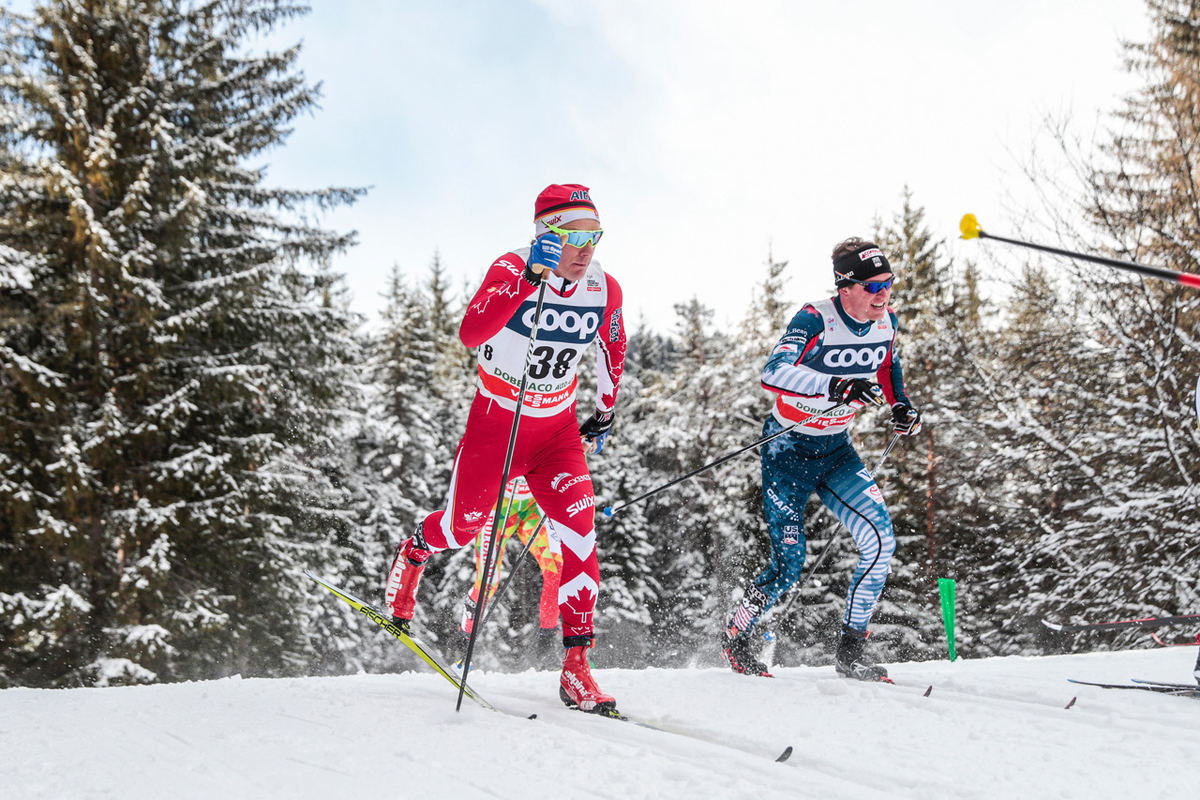
Canada’s Devon Kershaw (38) racing alongside American Scott Patterson in the men’s 15 k classic pursuit on Sunday at the World Cup in Toblach, Italy. They finished 33rd and 42nd, respectively. (Photo: Fischer/NordicFocus)
Leading the U.S. in 26th (+1:43.1) after starting 29th, was Erik Bjornsen. In five distance races this season, Bjornsen has scored World Cup points, placing within the top 30 in each race.
New to the U.S. Ski Team’s B-team this year, Scott Patterson finished 39th (+2:37.2) after starting 42nd, and Paddy Caldwell placed 44th (+2:57.7) after starting 52nd. Noah Hoffman finished 49th (+3:01.7) after starting 40th.
For Canada, Devon Kershaw placed 33rd (+2:02.8), up five spots from starting 38th, Graeme Killick was 50th (+3:42.0), Russell Kennedy 66th (+5:05.8), and Knute Johnsgaard 76th (+6:20.8) after starting 82nd.
Racers will take a break from competitions until the Tour de Ski, which kicks off in Lenzerheide, Switzerland on Dec. 30.
“I started a bit of a training block for the Tour just this week, and kind of continuing next week, so two weeks of a bit more volume, then do a little, do a little break after that, and then I have a few days of normal training to feel good before the tour,” Harvey said. “So I’m excited to see what a bit of a training and then a break does to me, because it will be the first time I have a little break like that since our last camp in October.
“Other than the Olympics is the Tour de Ski, that’s important for me,” Harvey continued. “So hoping to see if I can bring my level up a little bit with that bit of a break after the hard training, to feel a bit more fresh and a little more snappy.”
Note: This article has been updated to include comments from Sweden’s Charlotte Kalla.
For the second day in a row, Charlotte Kalla, a name synonymous with the yellow and blue of Sweden, stood atop the podium, placing first in the women’s 10-kilometer classic International Ski Federation (FIS) race on Saturday in Gällivare, Sweden. On Friday, Kalla won another individual-start race, the 5 k freestyle, by a margin of 8.8 seconds. She more than doubled that time gap by the finish of Day 2, winning the 10 k classic in 27:55 minutes, 17.7 seconds ahead of Russia’s Yulia Tchekaleva in second place. Natalia Nepryaeva, also from Russia, skied to third, 40.9 seconds back of Kalla.
“I am feeling good and I think I am where I should be at this moment,” Kalla wrote in an email. “I had a good feeling on the classic race and handle the condition well. On Friday I opened hard and tried to push hard all the way.”
Known as a skate powerhouse, Kalla has improved her classic skiing and is now a double threat. “I have improved my classic technique the last years,” Kalla explained. “When I am in shape it doesn’t matter if it is skating or classic. I am glad I managed to ski well in the condition we had. It was a little bit soft because of the snowfall.”
Although a home FIS event for Sweden, Russia secured six of the top-10 spots with Sweden settling for three. Japan’s Masako Ishida, the only non-Russian or Swede outlier in the top 10, placed fourth (+1:02.4). Russians Anna Zherebyateva raced to fifth (+1:08.8) while teammate Yulia Belorukova was sixth (+1:12.8).
Sweden took the next two spots with Stina Nilsson in seventh (+1:20.9) and Anna Haag in eighth (1:20.9). Russia rounded out the top 10 with Anatasia Sedova placing ninth (+1:24.1) and Mariya Guschina in tenth (+1:25.0).
Sweden’s Ida Ingemarsdotter, a World Cup regular, placed 11th (+1:30.6).
Kikkan Randall was the only U.S. Ski Team member at the race, and a day after finishing eighth in the 5 k skate, she finished 15th (+1:48.1) on Saturday. In an email, Randall explained that snow had fallen continuously for the last 24 hours in Gällivare.
“Conditions were pretty nice, the track was a little soft and a lot of racers here made the pole track a little punchy,” she wrote.
Considering the massive time-zone shift from her home in Anchorage, Alaska, to Central European Time, it appears Randall is adjusting well.
“I felt decent today, not too tired from the jet lag or yesterday’s race. I wanted two back-to-back races to get ready for next weekend’s triple World Cup opener,” she wrote, referring to the first three World Cup races in Kuusamo, Finland, starting Friday, Nov. 23.
Throughout Saturday’s 10 k, Randall steadily improved her overall placing: she was 32nd at 4.2 k, 23rd at 6.8 k and locked into 15th by 9.2 k.
“It was definitely good to race a 10km classic today,” Randall wrote. “I had trouble really digging into my race gear on the first lap today. I think I was skiing a little stiff and not carrying my momentum down the track. Nepryaeva [the third-place finisher] caught me going into the 2nd lap and that was the jumpstart I needed. I was able to match her pace for most of the rest of the race and it helped me find better technique and tempo.
“I wanted to be a little stronger today but I got some really important feedback on where I’m at and what I need to work on as the race season progresses,” she added. “My fitness feels pretty good and now it’s just a matter of fine-tuning.”
Emily Nishikawa was the only Canadian entered on Saturday and finished in 51st (+3:39.3). Sixty-nine women started the race, 38 from Sweden, 17 from Russia, seven from Japan, two from Switzerland and Estonia, and one each from the U.S., Canada, and Poland.
In Friday’s 10 k skate in Gällivare, only Swiss star Dario Cologna kept the Russians from sweeping the top nine by placing third. In that race, Evgeniy Belov and Sergey Ustiugov of the Russian national team finished first and second, respectively.
Saturday was a different race, a 15 k classic, but with a similar thread and no Cologna as a Russian foil.
The Russian men finishing in unison to take first, second and third in the men’s 30 k skiathlon, the final race of 2017 U23 World Championships at Soldier Hollow in Midway, Utah. Alexander Bolshunov (8) was deemed the winner, Alexey Chervotkin (1) was second, and Denis Spitsov (11) third. (Photo: FlyingPointRoad.com)
It was Russia, Russia, Russia.
Alexander Bolshunov, winner of the 30 k skiathlon at 2017 U23 World Championships, won the race in 37:13, one second ahead of Maxim Vylegzhanin in second. Alexey Chervotkin was third (+5.1).
Classic specialist, Kazakhstan’s Alexey Poltoranin finished fourth, 13 seconds off the podium, and Cologna placed fifth (+22.1).
Despite being on Swedish soil, the rest of the top 10 became a mostly Russian affair. Russian teammates Alexey Vitsenko and Artem Maltsev placed sixth (+29.5) and seventh (+37.4), respectively, Sweden’s Calle Halfvarsson interrupted the trend by tying Russia’s Evgeniy Belov for eighth (+38.0), and Russia’s Alexander Bessmertnykh took 10th (+40.1).
There’s a pattern: Russia took 14 of the top-20 places. Twenty-eight of 126 starters were from Russia, with the vast majority of the field being Swedish. Outside of the top 10, Sweden’s Daniel Rickardsson was the next-best Swede in 12th (+49.6).
Devon Kershaw (World Cup Team), who finished 12th on Friday, once again led Canada in 20th (+1:06.7). At 6.8 k, Kershaw was ranked 15th, and at 9.6 k he was down one spot to 16th. By the 11.4 k checkpoint, he began slipping further in the standings.
“Today was a tough one,” Kershaw wrote in an email. “I felt pretty good but conditions were soft, so you had to really feather it (the technique) – especially on the climbs. Pacing wise I think I was doing pretty well, but in the last 2.5km today I was missing any semblance of a kick to the finish and ended up conceding a few seconds to those around me, knocking me from about 15-16 to 20th.”
Although an interval start race, Kershaw never found a strong pacing partner. “I was skiing alone – no help at all today,” Kershaw wrote of his solitary effort. “It would have been so helpful! Especially that last lap when things get tough. But in individual start races, you need to learn to do it alone. So good to try and get used to that “time trial” feeling.”
Three other Canadians competed, with Graeme Killick (World Cup Team) finishing 50th (+2:32.3), Jack Carlyle (Alberta World Cup Academy) 91st (+4:06.1), and Brian McKeever (Para Nordic Team) 110th (+5:16.0).
As of press time, Fasterskier could not confirm if the International Ski Federation (FIS) held an emergency meeting to discuss the involvement of IOC-banned Russian skiers in FIS-sanctioned races. Of the six IOC-sanctioned Russian skiers, four are men: Belov, Vylegzhanin, Alexander Legkov, and Alexey Petukhov. All four skiers raced on Friday, however, Legkov and Petukhov (and Shapovalova, one of the two women sanctioned by the IOC) did not contest Saturday’s race.
Racing continues in Gällivare on Sunday with classic sprints.
Sergey Ustiugov was extremely excited to capture another Tour de Ski stage win in Toblach, Italy, in January. (Photo: Fischer/Nordic Focus)
Welcome to World Cup Windup, where we check in with the top-10 teams from last year’s FIS Cross Country World Cup tour before the season starts with the Ruka Triple in Kuusamo, Finland, on Nov. 24.
RUSSIA
Overall in Nations Cup Last Year:Fourth
Women’s Ranking 2016/2017:Fifth
Men’s Ranking 2016/2017:Second
Who’s Back:
Ust-iu-gov! Ust-iu-gov! Sergey Ustiugov, a sensation in the last two seasons, is back for more. There’s also top-20 ranked overall skiers Alexander Bessmertnykh and Andrey Larkov, seventh-ranked sprinter Natalia Matveeva, 10th-ranked distance skier Yulia Tchekaleva, and runner-up in the U23 standings Yulia Belorukova – who along with Matveeva won silver in the team sprint at 2017 World Championships. Plus, 2010 Olympic sprint gold medalist Nikita Kriukov, who didn’t have an individual podium last season but won World Championships team sprint gold with Ustiugov. Who else is back is a bit complicated as …
Who’s Missing:
… Alexander Legkov, Maxim Vylegzhanin, Alexey Petukhov, Evgeny Belov, and Evgenia Shapovalova are all racing in pre-World Cup FIS races, but have been banned by the International Olympic Committee for doping at the 2014 Olympics. They are appealing their cases, but if the ruling holds, they will at the very least miss the 2018 Olympics. The International Ski Federation (FIS) may or may not implement a ban of their own which would keep the five off the World Cup. Julia Ivanova was also banned by the IOC but has not returned to racing.
Pre-Season Results:
Yulia Belorukova is a rising star. (Photo: Fischer/Nordic Focus)
So far, a number of Russians have done well in pre-season FIS racing. Ilia Chernousov finished second to Switzerland’s Dario Cologna in a trial in Davos. Alexey Chervotkin won a 15 k skate in Muonio, Finland, where Maxim Vylegzhanin picked up two top-six finishes and last year’s U23 World Champion Alexander Bolshunov won a 10 k classic. Natalia Nepryaeva also shone on the women’s side.
Recent Drama:
The biggest drama, of course, is the doping investigation which has enveloped the previously-mentioned five athletes (and Julia Ivanova, who has retired and is no longer racing).
Russian news recently reported that Yulia Tchekaleva, Anastasia Dotsenko, Natalia Matveeva, Natalia Zhukova, Natalia Korosteleva, Alexander Bessmertnykh, and Nikita Kriukov were also on the “Duchess List” of athletes allegedly given performance-enhancing drugs at Sochi. They have not been asked to have hearings with the IOC Disciplinary Commission, but it is possible that this could still occur.
Dotsenko took last season off to have a baby, but is back in training this year.
Russia’s Nikita Kriukov (l) and Sergey Ustiugov after winning the men’s classic team sprint on Feb. 26 at 2017 at FIS Nordic World Ski Championships in Lahti, Finland.
Coach Yuri Kaminski talked about why Nikita Kriukov might be dangerous this year: “Neither in Vancouver nor at the last World Championships was he the favorite. In this regard, the Vancouver situation and the current one are somewhere similar.” By contrast, at the 2014 Olympics he was a favorite and did not win, teaming up with Vylegzhanin to finish second in the team sprint. “Sergey [Ustiugov] goes to the Olympic Games as a favorite, and this greatly complicates life. The situation, I would say, is exactly the same as that of Kriukov before Sochi, where he was coming in as a two-time World Champion in a sprint. It was believed that he was obliged to win at least one gold medal, that’s the way the task was set… all this was very hard. And it so happened that the circumstances turned against us.”
Meanwhile, Alexander Panzhinsky still smarts from his just-by-a-toe loss to Kriukov in the 2010 Olympic sprint, and wants to win in PyeongChang: “I was burning inside from that defeat for a very long. And I dreamed many times, and thought about those last seconds a lot. Although on the other hand, it may be worthwhile to look at it as a very big plus for me. I really was very young in Vancouver. If I won, I took this career best for an athlete… [instead] it was motivation that helped me survive all these difficult years, when there were no big victories. And now it helps to keep this goal, to become an Olympic champion. This is generally the main task in my career.”
Best Social Media Presence:
If you don’t know the Russian team outside their results or racing, social media is an excellent way to fix that. Alexander Panzhinskiy makes sure to translate the captions of (most of) his posts from Russian into English and makes an effort to connect to the sport’s global fanbase.
Ilya Chernousov also posts primarily in English, and makes training in Switzerland look pretty okay. He trains primarily with a long-distance race team, however, and is not part of the Russian national training group.
If you don’t understand Russian, however, it’s probably best to stick with a visual medium. Sergey Ustiugov and his girlfriend, World Cup skier Elena Soboleva, both have great Instagram feeds (Sergey’s / Elena’s).
Norway’s Johannes Høsflot Klæbo (r) crossing the line first in the men’s 15 k classic mass start on Saturday at World Cup Finals in Quebec City, 0.5 seconds ahead of fellow Norwegian Niklas Dyrhaug (12), who placed second. Russia’s Alexander Bessmertnykh (behind Dyrhaug) followed in third, just ahead of Canada’s Alex Harvey (1) in fourth. (Photo: John Lazenby/Lazenbyphoto.com)
QUEBEC CITY — As 75 men jogged out into the center of the World Cup area assembled on the Plains of Abraham for the men’s 15-kilometer classic mass start on Saturday, one man in particular stood out. Alex Harvey, wearing the red suit of the Canadian national team, led the group out. He wore bib No. 1, but if you couldn’t see that from a distance, it didn’t matter. Essentially everyone knew who he was.
The official hashtag of World Cup Finals in Quebec City this Friday through Sunday has been #GOALEX2017. He is a celebrity in Quebec, a hero to its locals, and someone even non-skiers know quite a bit about.
And so far, the 28 year old appears to be soaking up every minute of his homecoming. One day after winning the freestyle sprint to start the finals, Harvey was seeded first in Saturday’s classic mass start. He led racers into the stadium, waved to spectators, started on the front line, and led the pack out of the stadium.
Canada’s Alex Harvey leading Norway’s Johannes Høsflot Klæbo and two other Norwegians and Switzerland’s Dario Cologna (far left) during the men’s 15 k classic mass start on Saturday at World Cup Finals in Quebec City. (Photo: John Lazenby/Lazenbyphoto.com)
Even when others took turns leading, with Norway’s Niklas Dyrhaug, Emil Iversen and Johannes Høsflot Klæbo setting the pace on the first of four laps, the possibility of Harvey winning never seemed in doubt. He consistently positioned himself within reach of the lead, skiing around sixth for much of the first lap.
On Lap 2, the lead group remained about 30 strong. Harvey skied within two seconds of the Norwegians up front, with Pål Golberg, Didrik Tønseth, Finn Hågen Krogh, Dyrhaug, and even Klæbo — the 20-year-old Sprint World Cup champion — all still in contention. By the end of Lap 3, Harvey was into second, right behind Tønseth.
With 3.75 k to go and the crowd’s ability to see the racers on most of the exposed course, the excitement among Harvey fans began to exceed its already high point from the start. Bells, horns, “Gooo Alex!”
Russia’s Alexander Bessmertnykh attacked on an uphill and Harvey stuck behind him in second. On the second to last climb, a short and steep pitch that ascends up from the Old City’s historic wall, Dyrhaug surged into first, Bessmertnykh followed him in second and Harvey in third.
Behind them, Klæbo was sizing them all up in fourth, waiting for the perfect time to strike. He did so by moving to the outside lane on the last long downhill and glided into second behind Dyrhaug. They ascended the final pitch together and rounded the final corner before the 100-meter stretch to the finish, where Klæbo continued to accelerate past Dyrhaug and double poled to his first World Cup distance win in 35:23.7 minutes. Dyrhaug finished 0.5 seconds later for second place, Bessmertnykh 0.8 seconds back in third, and Harvey 1.2 seconds behind Klæbo in fourth.
Canada’s Alex Harvey racing to fourth in the men’s 15 k classic mass start at World Cup Finals in Quebec City. With one race left, the 15 k freestyle pursuit, he is third in the mini tour and third in the Overall World Cup as well. (Photo: John Lazenby/Lazenbyphoto.com)
While it wasn’t a podium for Harvey, it was a result he was proud of.
“I’m very satisfied,” he told reporters afterward in French. “Making the top 10 is always a big deal. Today was another step towards securing a third spot in the overall [World Cup]. That was my big goal coming in. So I’m satisfied … You can’t make the podium every time. I felt very good physically.”
With one World Cup race remaining, Harvey, who’s ranked third in the world, extended his lead on Finland’s Matti Heikkinen in fourth to 92 points. Heikkinen finished 26th on Saturday, 1:04.9 minutes out of first, and will start Sunday’s 15 k freestyle pursuit 27th, 2:15 behind Klæbo as the World Cup Finals mini-tour leader. Dyrhaug will start 22 seconds back in second, followed by Harvey 1 second later in third, and Krogh another 11 seconds back in fourth.
“Every pursuit is a manhunt so I’ll be hunting the young Norwegian in front,” Harvey said. “It was Klæbo’s first victory in a distance event. We saw him come in second behind Sundby in this year’s first mini tour. So of course, he’s strong. I mean, the guy won five or six gold medals at the Junior Worlds. He’s a complete skier…”
Asked if he thought he could work with Dyrhaug to reel Klæbo in, Harvey wasn’t counting on one Norwegian helping him bridge the gap to another.
“I don’t think Dyrhaug will chase, but I will,” Harvey said.
Dyrhaug told reporters that might not be the case.
“Tomorrow is going to be an exciting day,” he said in English. “I saw that me and Alex are going out together, so it is in both of our interests to cooperate and do good teamwork, and hopefully we can catch Johannes and then we’ll have to see…
“We ought to talk together with team staff, hear what Johannes says, too,” he added. “But it is in both interests to have a big gap behind [us]. So if I’m strong, I’m thinking maybe I’m going to help Alex to … yeah, and we’re going to cooperate.”
In the last year that Klæbo’s been racing World Cups, the three-time 2016 junior world champion (in the freestyle sprint, 10 k classic and freestyle relay) has reached the podium six times in individual World Cups and claimed bronze in the freestyle sprint at this year’s World Championships. But before Saturday, all of his podiums (with the exception of one mini tour) had been in sprints.
“I hadn’t dreamed about doing a distance race in the World Cup … and cross the finish line in first,” Klæbo said after. “It’s unbelievable.”
Johannes Høsflot Klæbo leading three other Norwegians, Emil Iversen (l), Finn Hågen Krogh (second from l) and Niklas Dyrhaug (r) during the men’s 15 k classic mass start at World Cup Finals in Quebec City. Klæbo went on to win, Dyrhaug placed second, Krogh 16th, and Iversen 25th. (Photo: John Lazenby/Lazenbyphoto.com)
He was the most consistent race leader on Saturday, winning one of sprint preems and crossing in second behind his teammate Iversen for the other. In all, he accumulated 27 bonus seconds, which were deducted from his overall time in the mini tour — putting him first by 22 seconds over Dyrhaug.
“I just tried to be in the front for the bonus seconds to be able to get some seconds,” he explained of his race tactic. “So that was my plan.”
Despite trying to lead for most of it, he noticed others trying to do the same on the third and fourth laps. In the final stretch of the race, coming off the long downhill toward the finish, Klæbo focused on moving up from fourth.
“Niklas gapped our group in the last downhill there so we had push really hard on the last uphill to get to him,” he explained. “At the finish, it was just all out.”
Bessmertnykh, who will start the pursuit in 13th, 1:08 back, after placing 59th in Friday’s sprint, described Saturday’s mass start as “a fun race,” in a post-race interview with the International Ski Federation (FIS). “There was a lot of things happening all the time. I followed Niklas and Johannes on the last climb. We gained a small gap. I managed to ski well the last curve before the homestretch and carried in good speed.”
Dyrhaug was also satisfied with his race.
“The only thing was, I was one meter behind in the end,” he said. “I tried my best. I went all in for a long sprint, when it was one half k left, and it was almost.”
Under blue skies and a beating sun, Dyrhaug described Saturday afternoon in Quebec as “amazing.”
“We have been competing for like 40 races this year, but this is the most pretty day, and most pretty conditions for the whole year, so thank you, Quebec,” he said.
Waxing was a challenge, with temperatures warming quickly to about 2 degrees Celsius (mid-30s Fahrenheit) by midday.
Canada’s Devon Kershaw (r) and Graeme Killick (l) skied together for most of Saturday’s 15 k classic mass start after Kershaw broke a pole early. They went on to place 28th and 32nd, respectively. (Photo: John Lazenby/Lazenbyphoto.com)
Devon Kershaw was the second Canadian in the top 30, finishing 28th (+1:08.4) after breaking a pole early on.
“It was pretty chaotic and broke a pole there pretty early in the start and went all the way back into the 60’s, so made for a lot of work to try to get back in,” he said after. “I am proud of the fact that I was able to ski back into the points, but I had a better body than that today for sure and just had a bit of bad luck there.”
He finished 9.3 seconds ahead of his Canadian World Cup teammate Graeme Killick, who placed 32nd (+1:17.7), and the two essentially skied together from 5.25 k on.
While Kershaw said he thought the 3.7 k course would be better suited to skating, he was impressed with the atmosphere and the race organization.
“I think for a classic, there are a lot of corners and it’s pretty tight … [but] to bring the skiing to the people like they did and to use the terrain they have available, I tip my hat, its a great event,” he said. “It is the most crowds I have ever skied with in Canada, the sun is shining, the venue is fantastic, the organizers did a great job, the tracks are in perfect condition. What a great place to race.”
Erik Bjornsen led the U.S. men in 31st (+1:16.8) and two seconds behind Switzerland’s Roman Furger in 30th. After losing contact with the lead group of 29 on one of the bigger climbs at the end of the second lap, Bjornsen found himself skiing in “no-man’s land” with Sweden’s Teodor Peterson.
Erik Bjornsen (U.S. Ski Team) leads Sweden’s Teodor Peterson (r) up a climb during the men’s 15 k classic mass start at World Cup Finals in Quebec City. They went on to place 31st and 29th, respectively. (Photo: John Lazenby/Lazenbyphoto.com)
“It was a bummer to lose that front pack,” Bjornsen said. “I was struggling on the hills out there; I was a little light on kick. I think a lot of the guys were, but I wasn’t doing much striding. It was pretty much from double pole, to having to run outside the track. I felt pretty good, but I was losing time.”
While skiing with Peterson, Bjornsen said he led at times and wanted Peterson to help drive the chase as well. Peterson ended up just ahead of him in 29th (+1:14.3).
“I was like, ‘Come on, dude.’ I could see that there was a group behind, chasing us, and we were kind of right in that no-man’s land, which is always a bad spot to be,” he said. “But it was fun. It’s fun to be racing in North America, and have people cheering my name. It’s so unique, and I love it. I wish we could race over here more often.”
Matt Gelso was the second American in 37th (+1:32.6), Andy Newell finished 45th, Scott Patterson 46th, Noah Hoffman 48th, Ben Lustgarten 49th, David Norris 50th, Simi Hamilton 54th, Paddy Caldwell 59th, Jack Hegman 62nd, Cole Morgan 64th, and Brian Gregg 69th.
While the U.S. started 12 men, Canada had 15 in Saturday’s mass start with Bob Thompson finishing 55th, Knute Johnsgaard 57th, Len Valjas 61st, Russell Kennedy 63rd, Evan Palmer-Charrette 65th, Andy Shields 66th, Jess Cockney 67th, Brian McKeever 68th, Joey Foster 70th, Gareth Williams 72nd, Ricardo Izquierdo-Bernier 74th, and Julien Locke 75th.
— Gerry Furseth, François Léger Dionne, Jake Ellis, and Ian Tovell contributed
The men’s 15 k classic mass start podium on Day 2 of World Cup Finals in Quebec City, with Norway’s Johannes Høsflot Klæbo (c) in first, Norway’s Niklas Dyrhaug (l) in second and Russia’s Alexander Bessmertnykh (r) in third. (Photo: John Lazenby/Lazenbyphoto.com)
The men’s 15 k classic mass start podium on Saturday at World Cup Finals in Quebec City, with Norway’s Johannes Høsflot Klæbo (c) in first and Niklas Dyrhaug (l) in second, and Russia’s Alexander Bessmertnykh (r) in third. (Photo: FIS Cross-Country/Twitter)
FIS Cross-Country World Cup Finals (Quebec City): 10/15 k classic mass starts
During Saturday’s 15-kilometer classic mass start at World Cup Finals, Canada’s Alex Harvey was in it until the end. But so were Norway’s Johannes Høsflot Klæbo and Niklas Dyrhaug, and Russia’s Alexander Bessmertnykh, to name a few.
Sitting in second with a few hundred meters to go, Harvey was primed to make his move on Dyrhaug, who was leading at the time. But then came 20-year-old Klæbo, the season-long Sprint World Cup champion, who proved to have more left in the tank than anyone else and passed them both to lead into the finishing straight.
Klæbo took the victory — his first in a World Cup distance race — on a bluebird day under a beating sun in 35:23.7 minutes, 0.6 seconds ahead of Dyrhaug. Bessmertnykh followed another 0.2 seconds back in third (+0.8) just ahead of Harvey in fourth (+1.2).
Norway’s Sjur Røthe took fifth (+1.7), Switzerland’s Dario Cologna placed sixth (+1.9), and Norway’s Pål Golberg was seventh (+2.5), half a second ahead of another Norwegian Didrik Tønseth in eighth (+3.0). The top nine were within 3.7 seconds of first, with Russia’s Andrey Larkov in ninth.
Devon Kershaw was the second Canadian in the points on Saturday in 28th (+1:08.4), after breaking a pole and working his way back up from outside the top 60.
Erik Bjornsen led the U.S. men in 31st (+1:16.8), about a second ahead of Canada’s Graeme Killick in 32nd (+1:17.7).
Also for the U.S., Matt Gelso finished 37th, Andy Newell 45th, Scott Patterson 46th, Noah Hoffman 48th, Ben Lustgarten 49th, David Norris 50th, Simi Hamilton 54th, Paddy Caldwell 59th, Jack Hegman 62nd, Cole Morgan 64th, and Brian Gregg 69th.
For Canada, Bob Thompson finished 55th, Knute Johnsgaard 57th, Len Valjas 61st, Russell Kennedy 63rd, Evan Palmer-Charrette 65th, Andy Shields 66th, Jess Cockney 67th, Brian McKeever 68th, Joey Foster 70th, Gareth Williams 72nd, Ricardo Izquierdo-Bernier 74th, and Julien Locke 75th.
The women’s 10 k classic mass start podium on Saturday at World Cup Finals in Quebec City, with Norway’s Marit Bjørgen (c) in first, Norway’s Heidi Weng (l) in second and Finland’s Krista Parmakoski (r) in third. (Photo: FIS Cross-Country/Twitter)
In the women’s 10 k classic mass start earlier in the day, Norway’s Marit Bjørgen racked up her seventh victory of the season after leading a pack of two other Norwegians and Finland’s Krista Pärmäkoski and holding them off to the finish.
Bjørgen put a few meters into the foursome as she entered the finishing stretch and held her lead across the line in 24:23.6 minutes. Norway’s Heidi Weng finished 0.6 seconds back in second to lock up the Distance World Cup title, in addition to the Overall World Cup title she secured on Friday.
Pärmäkoski finished 2.9 seconds after Bjørgen in third, and Norway’s Ingvild Flugstad Østberg missed the podium in fourth (+7.8).
Behind them, Germany’s Nicole Fessel outlasted a large chase pack to place fifth (+18.6), just ahead of Sweden’s Charlotte Kalla in sixth (+19.9) and Anna Haag in seventh (+19.1).
Sadie Bjornsen of the U.S. Ski Team led the North American women in 15th (+29.9) after skiing at the back of that chase pack in the final stretches of the race. Also for the U.S., Jessie Diggins placed 27th (+1:06.9) and Sophie Caldwell 38th (+1:56.0).
Canada was led by Emily Nishikawa in 37th (+1:51.7). Behind her, Cendrine Browne finished 41st (+2:28.2), Dahria Beatty was 53rd, Annika Richardson 54th, Katherine Stewart-Jones 56th, Frederique Vezina 59th, Annika Hicks 60th, Sophie Carrier-Laforte 61st, Andrea Dupont 62nd, Katherine Weaver 63rd, Alannah MacLean 64th, Sadie White 66th, Lisle Compton 67th, Mia Serratore 68th, and Laura Leclair 69th.
For the U.S. Caitlin Patterson finished 44th, Liz Guiney 45th, Kaitlynn Miller 47th, Chelsea Holmes 48th, Rosie Brennan 50th, Julia Kern 52nd, Erika Flowers 55th, Becca Rorabaugh 57th, and Jennie Bender 58th.
One day left in the 2016/2017 World Cup season remains, with the women’s and men’s 10/15 k freestyle pursuits on Sunday in Quebec City.
World Cup Finals standings (Day 2 of 3): Men | Women
***
Finland’s Mari Laukkanen pointing to the sky in honor of her late shooting coach, after she won the women’s 10-kilometer pursuit on Saturday at the 2017 IBU World Cup in Oslo, Norway. (Photo: IBU)
IBU World Cup (Oslo, Norway): Women’s and men’s pursuits
Less than 24 hours after winning her first IBU World Cup on Friday in the women’s 7.5 k sprint, Finland’s Mari Laukkanen immediately capitalized on her ideal position with a start-to-finish victory in Saturday’s 10 k pursuit that was never in doubt, cleaning the first three shooting stages before incurring one penalty in her final standing shooting (0+0+0+1) to cross the line in a time of 29:33.3 minutes.
In addition to experiencing the most successful weekend of her biathlon career by far, it was an emotional day for the 29-year-old Finn due to a personal reason. Laukkanen spread her arms like wings skiing down the homestretch with a commanding lead, pointing repeatedly to the sky and a black ribbon she wore around her right upper arm, before kneeling in the snow in the finish for a few seconds. With those gestures, she reportedly wanted to commemorate her shooting coach Asko Nuutinen, who passed away Friday after suffering a heart attack during the World Cup in Kontiolahti, Finland, a week ago. He was 60 years old.
“It’s been a really emotional day for me. We have heard really really sad news that last night we lost our longtime shooting coach,” Laukkanen told reporters with a trembling voice in the press conference. “After this it was more or less only about working for him. Working as he has asked me to do for years and years. So I wasn’t thinking about losing or winning today, I was only thinking about him. And I feel really big pleasure that I was able to come to the finish like this, that I can own the victory for him.”
“I knew it will be difficult after the first victory in my career took me so long,” she added. “And to do it again immediately with good shooting. But as I said I didn’t think about winning or losing today, just doing my work.”
Finishing 26.5 seconds after her, the Czech Republic’s Gabriela Koukalová reached the finish, moving up from her fourth place starting position with a clean shooting performance (0+0+0+0).
“I wanted to miss all targets yesterday because I was so tired I didn’t even want to race,” Koukalová confided in the press conference. “It’s difficult to concentrate, three World Cups after the main goal of the season [the World Championships] is too much. Last year it was many times easier… I tried to catch her, but about one kilometer before the finish I saw her far away so I was happy I didn’t have to fight with anyone and was just enjoying the last meters.”
Despite four penalties (1+1+0+2), France’s Justine Braisaz defended the third place on the podium against a three-person chase group on the last loop (+1:01.4), falling back only one position after having finished the sprint in second.
“I did not expect such a good place today during the race,” Braisaz commented in the press conference. “Because in the last shooting I completely [failed]. I really wanted to have a clean shooting today, and I did not succeed. So I am happy and surprised, too.”
Her teammate Anais Bescond who had started the pursuit in third place fell back to 22nd position (+2:53.5) with seven penalties.
Slovenia’s Teja Gregorin finished fourth with one penalty (+1:08.2), Austria’s Lisa Theresa Hauser shot clean as the only athlete aside from Koukalova on her way to move up from 22nd to fifth place (+1:12.5), while Norway’s Marte Olsbu finished sixth like in the sprint despite three penalties (+1:15.9).
Unlike in Friday’s sprint race where Germany’s Laura Dahlmeier had still given up a seemingly commanding lead in the sprint World Cup discipline standings to Koukalova, she held onto her lead in the pursuit standings on Saturday, moving up from the 31st starting position to ninth place with a penalty in each of her standing shootings (0+0+1+1, +1:53.8). A 22nd place would have been sufficient to win the “small crystal globe” award in the pursuit. Laukkanen’s teammate Kaisa Mäkäräinen finished 8th with two penalties in the standing stages (+1:51.2), and thereby claimed the third place in the World Cup pursuit ranking.
“I knew that I didn’t need to have a perfect race today, just a good one, but that’s always easier said than done,” Dahlmeier told broadcaster ARD after the race. “I am incredibly happy that it worked out and that I could secure myself another small globe… It’s a bit of a weird feeling, standing at the start gate in the middle of the field and the clock ticks and ticks as one athlete after another skis out on the course. And you can only observe how far they have gone and have to wait and be patient, and not make a false start. But then the snow burns, then the chase begins!”
US Biathlon’s Susan Dunklee experienced an uncharacteristically problematic day on the shooting range and fell back to 37th place (+4:00.2), after starting seventh and less than a minute behind Laukkanen. Dunklee had three misses between two prone stages and seven more in her standing shootings (2+1+4+3) therefore having to ski more than an additional kilometer in the penalty lap.
“It is a testament to her fighting spirit that she notched the fourth-fastest ski time — one of her best ranks of the season — and never gave up despite suffering a biathlon blowout on the range,” teammate Clare Egan said of Dunklee, according to a US Biathlon press release. “Bad races happen to the best and Susan is no exception, but not everyone fights through till the end no matter what.”
Egan herself started the pursuit in 34th position and initally was able to make up ground, but then fell back slightly to 41st place (+4:13.9) with four penalties (0+2+0+2).
“I am satisfied with my race even though the result was not what I was hoping for, and that’s how I would summarize my entire season as well,” Egan said after the final race of her season. “I’ve made a good step forward but my competitors also work hard all summer and we seem to improve at a similar rate.”
Canada Biathlon’s Julia Ransom moved up to 47th place (+5:04.8) with three penalties (1+0+1+1), after starting in 52nd position.
[UPDATED] Later on Saturday in the last men’s 12.5 k pursuit of the season, the three best athletes of the season fought throughout the race exchanging in the lead, before they stood next to each other on the range for the final shooting to decide the winner.
Russia’s Anton Shipulin managed to shoot clean with his elaborate rifle stock in the design of a red dragon, proudly waving to the cameras as he left the arena while his two competitors had to ski into the penalty lap. France’s Martin Fourcade – who had already secured himself the overall World Cup Total Score title as well as the award for the pursuit discipline – was left to duke it out against Norway’s Johannes Thingnes Bø, the winner of Friday’s sprint.
On the last big climb before the Holmenkollen arena, Fourcade accelerated with a series of explosive jump-skate steps to decisively gap Bø. He even got fairly close to Shipulin on the finish stretch, who had slowed down a bit to grab a Russian flag before skiing over the line in a time of 32:11.9 minutes with one penalty (0+0+1+0), 5.7 seconds ahead of Fourcade who had incurred two penalties (1+0+0+1). While Fourcade shook hands with Shipulin, Bø came into the finish in third place, 21.6 seconds back and also with two penalties (1+0+0+1).
“It was a crazy race, but I am happy that I managed to finish first,” Shipulin said in the press conference through a translator. “Tough conditions on the shooting range, I had to really work to concentrate on my shooting. On the last loop I was all alone until I saw Martin chasing me, then I got a little bit scared but I managed to [keep him behind].”
It was Shipulin’s second win of the season, for which he credited his recently improved shooting performance.
“It was a really exciting competition with Johannes and Anton,” Fourcade agreed with his rival. “I expected to fight with them for the victory on the last loop, but then Anton was simply stronger in the last shooting. My strategy was to be focused on my technique and skills and not on the results, like I did too often in the past few weeks focusing on records and not the victory.”
Asked about his blazing attack on the final climb, Fourcade added: “Of course I train for that, but I think a lot of athletes do. I talked to Johannes, it was my revenge for the [2016] World Champs where he did exactly the same to me on the last uphill. But I know how it is, it can be different already tomorrow.”
“I am happy with a new podium of course,” Bø said in the press conference. “I was not at my best in the skiing today. But I still managed to shoot 18 out of 20. As Martin said it was [annoying] that we did not shoot zero [misses] and could not fight with Anton in the finish, but it was quite interesting and fun to stand there in the last shooting … I expected Martin’s attack the second he did it, but I had no energy to fight with him. That was quite strong.”
Sweden’s Fredrik Lindström placed fourth with no penalties (+44.7), and was the only man in the field who managed to shoot clean in all four stages.
“For the podium, I was never really close“, Lindström told the IBU in a post-race interview. “But it was a great day anyway. Four times zero [misses], and especially in the standing stages that makes you climb a lot in the standings. Super happy with my performance.”
US Biathlon’s Lowell Bailey, who had to start closer to the back of the field in 44th position, almost two minutes behind the leaders based on his sprint result, managed to move up 21 spots in the race despite three penalties (2+0+1+0).
“I’m happy with the race, considering it started out pretty rough with the first two misses,” Bailey told US Biathlon after placing 23rd (+2:23.3). “I just read the wind wrong and didn’t correct enough. After that, I tried to keep my head in the race and make the best of it. I was happy with my skiing and glad to clean the last stage; this brought me up nine spots and I was able to gain another in the last loop. Now, it’s just one race to go. I’m looking forward to tomorrow.”
Shooting quickly, Bailey recorded the ninth-ranked range time of the day and the ninth-fastest last loop.
His teammate Sean Doherty started 35th but fell back after having to ski six times through the penalty lap (1+3+1+1) to finish 46th (+4:05.6).
For Sunday’s mass starts as the final races of the 2016/2017 IBU World Cup season, the only qualified North American starters will be Dunklee (currently in 10th position in the World Cup Total Score standings) and Bailey (currently in eighth).
The women’s season award in the mass start discipline once more will be decided between Germany’s Dahlmeier and Czech Republic’s Koukalova, while Germany’s Simon Schempp will try to defend his narrow lead on Fourcade. But during Saturday’s final loop, the French star did consider saving energy for the final competition.
“No,” he simply quipped when asked about this in the press conference. “Of course the mass start is important tomorrow because it will decide about the [mass start] crystal globe. But I think today the pursuit was also really important, and you fight for victory and being one of the best athletes. You can’t be satisfied with only a third place when you can claim a second, and I think all athletes in my position would do the same.”
Norway’s Martin Johnsrud Sundby after winning the Norwegian 54 k classic Birkebeinerrennet, part of the Ski Classics series, on Saturday in Lillehammer, Norway. (Photo: Ski Classics)
54 k Birkebeinerrennet (Rena to Lillehammer, Norway): Part of the Ski Classics series
[UPDATED] Not even a snowmobile clipping him and sending him tumbling 20 k before the finish could keep Norway’s Martin Johnsrud Sundby from winning the Birkebeinerrennet on Saturday in Norway. Representing Team United Bakeries, Sundby set a high pace from the start and broke the group down to three by 9 k, with Petter Eliassen of Team LeasePlan and Simen Østensen of Team BN Bank sticking with him until about 30 k in the 54 k marathon.
With about 20 k to go, Sundby collided with a Ski Classics TV production crew snowmobile while trying to double pole in the snowmobile’s tracks. He was OK and went on to win by 48 seconds over Eliassen in second, and smiled about the incident after the finish.
“It came in with tremendous speed and mowed me down,” Sundby told NRK, according to a loose translation.
Ski Classics CEO David Nilsson told NRK he didn’t know exactly how that happened and emphasized that it was unacceptable.
“We always put safety first, but it is a difficult balancing act with the snowmobile at high speed to get TV pictures,” he said, according to a loose translation. “The skiers often ski in the [snowmobile] track and here it happened and somehow the driver missed it.”
While Sundby pulled out the win in 2:20:53.5 hours, Eliassen took second and Østensen followed another 3.5 seconds later for third place.
In the women’s race, Poland’s Justyna Kowalczyk (Team Santander) pulled out a 4 minute and 15 second win over Sweden’s Britta Johansson Norgren (Lager 157 Ski Team). Japan’s Masako Ishida (Team United Bakeries) was another 48.6 seconds back in third.
“I’m really happy to win this race,” Kowalczyk said, according to a Ski Classics press release. “Everything went well and the cheering on the course was amazing. I will do the rest of the races in Visma Ski Classics, but this victory was the most important for me. Of course, I want to win again in Årefjällsloppet like I did last year, but to win here in front of this audience means so much to me.”
Tord Asle Gjerdalen, who finished fourth in the men’s race, and Johansson Norgren continue to lead the overall Ski Classics standings with three races to go. The next stop is the Årefjällsloppet in Sweden on March 25.
“It was a great race and we kept a high tempo up all the way,” Sundby said, according to the press release. “I was able to use uphills for my advantage and get a gap. I had good skis, the conditions were perfect, and to win here was one of my goals for the season. I have the Norwegian Championships in two weeks, and I haven’t counted out the option of going to Finland for the Visma Ski Classics finale.”
Norway’s Martin Johnsrud Sundby exits the stadium as Finland’s Iivo Niskanen shadows during the men’s 50-kilometer classic mass start on Saturday at Holmenkollen in Oslo, Norway.
OSLO, Norway — Here’s something dizzying: six times around an 8.3-kilometer course with a total vertical gain of just over two thousand meters. In non-metric terms, all 47 finishers on Saturday’s Holmenkollen 50 k classic race accumulated roughly 6,574 feet of climbing.
On the sharp end of the race for most of those kilometers were Norway’s Martin Johnsrud Sundby and Finland’s Iivo Niskanen. They were the animators for the hordes of Norwegians lining the course — in some places four deep.
Around 16 k, the lead group was seven strong with a host of skiers dangling just off the back. Up front there were the alphas — Niskanen and Sundby — and a heavy hitter gang including Norway’s Sjur Røthe, Niklas Dyrhaug, Hans Christer Holund, Sweden’s Jens Burman, and the defending 50 k world champ, Canada’s Alex Harvey.
This went down on a day when the views from Holmenkollen were almost limitless, Oslo Fjord shimmered and the storied venue’s atmosphere was buoyant. The air temps were an above-freezing blend of hello-spring and we’re-not-sure-we-want-you-gone winter. In other words: perfect.
Finland’s Iivo Niskanen leads Norway’s Martin Johnsrud Sundby during the Holmenkollen 50 k classic in Oslo, Norway.
It was also a day to see if risk could play out with good fortune. What could go wrong with such a backdrop?
Niskanen left Lahti World Championships with two medals: a gold in the 15 k individual classic and a bronze in the classic team sprint, both of which were confidence boosters. With speedy skis and his kick not waning, he rolled the dice passing through the stadium after two 8.3 k laps. No ski change.
The six skiers behind opted for fresh skis. With new fluoros and fresh kick, they also found themselves in Niskanen’s wake as he made a break while the others exchanged.
“When Niskanen didn’t change at the second lap, it made Sundby chase really hard to close the gap to him,” Harvey told FasterSkier after the race. “Then that kind of blew the pack apart.”
Niskanen threw down in Sundby’s castle. For a bit, it looked like the challenge might stick. At 18.8 k, Sundby was down 15.4 seconds.
When Niskanen made his break, the gap back to Sundby was really a static line when it came to Niskanen building a lead. By 22.5 k, Sundby latched back on. The reward for Niskanen’s no-ski-switch gamble was that it became a two-skier race for 2017 Holmenkollen 50 k title.
Late in the race at 47.5 k when Sundby made a break and built a six-second lead, the gap to Niskanen was still tenuous as the waning kilometers clicked off. But Sundby’s surge was enough for the win. First is first whether by one second or a minute.
After 50 k, all that climbing, all the Norwegian-flag waving, and all the Carlsberg beer consumed by fans along the course, 9.9 seconds separated the winner Sundby from runner-up Niskanen. Sunday skied the 50 k in 2:02:59.7.
With the win, Sundby locked some things up: he secured both the Overall World Cup and Distance World Cup crystal globes. This season’s overall win makes it Sundby’s third of his career (not counting the his overall World Cup win in 2014/2015, which he was stripped of because of a doping violation concerning his use of asthma medication).
“It was a tough pace right from the beginning today,” Sundby told the International Ski Federation (FIS) after the race. “When Iivo broke away and I was able to get back to him, we worked well together and I actually convinced him to change skis with me on the fourth lap. He was going to change on third lap but I told him I would lead and we could get away together. He’s the 15 k world champ in classic and it was a tough fight with him.”
For Niskanen, Saturday’s second place was his best World Cup 50 k result and marked his best Holmenkollen 50 k classic. In 2014, he placed fourth and was 12th in 2016.
“After the fourth lap we both switched skis and it meant that I had fresh skis to battle with Martin,” Niskanen told FIS. “He was really strong today. I didn’t have any chance in the last uphill. He was running like Mo Farah. I’m happy with second but my goal was for the victory. You have to have a good race to be on the podium and I think I made a good race today but Martin was better. “
The podium’s third step wasn’t decided until after five skiers lunged at the line. Russia’s Alexander Bessmertnykh won the photo finish for third (+1:15.2) ahead of Røthe in fourth, (+1:15.2) and Dyrhaug in fifth (+1:15.2).
A five-deep pack fighting for third place in the Holmenkollen men’s 50 k classic on Saturday in Oslo, Norway. Norway’s Hans Christer Holund (6) leads Canada’s Alex Harvey (behind, in red).
Also part of that multi-skier lunge was Harvey, just 0.2 seconds back in sixth (+1:15.4).
Asked about the Niskanen-Sundby breakaway and how that unfolded in the chase pack, Harvey lumped praise onto others.
“After that we tried to chase, but it wasn’t me doing the chase, it was mostly Hans Christer Holund,” Harvey said. “He was really strong today, probably the strongest of us all … But then after that the gap was too big, it was just a matter of not letting the guys behind us catch up and get ready for the final sprint.”
Harvey has contested the Holmenkollen 50 k classic on three other occasions. His best result prior to Saturday was 13th. “It was one of my best races here ever, so that was a great day,” he said.
Next up for Harvey is a trip back home to Quebec for World Cup Finals. He’ll land in Canada ranked third in the World Cup overall with 844 points. Finland’s Matti Heikkinen sits fourth with 837 points.
The next best North American was U.S. skier Scott Patterson (Alaska Pacific University). Patterson placed 28th (+7:18.8). Most recently, Patterson scored World Cup points after placing ninth in the 30 k skiathlon in PyeongChang, Korea.
Jonas Baumann of Switzerland (27) leads U.S. skier Scott Patterson (APU) during the Holmenkollen 50 k classic in Oslo, Norway.
Saturday was more of a final exam; the Holmenkollen 50 k remains a big test. (Many big names were present in Oslo that had skipped the pre-Olympic World Cup in PyeongChang.)
It was Patterson’s second-ever World Cup 50 k after racing at Holmenkollen last year, where he placed 32nd in another 50 k classic.
“It was pretty good, it could have been better,” Patterson said of his top 30 this year. “I had a little crash on the sixth lap that was frustrated because I lost a little group. Then also, one time when I went through an exchange, most of my group didn’t so I kind of lost that little, there was a group not too far in front of me that I really wanted on, but couldn’t quite get up there.”
Patterson explained this was a bottom-line race: he’s here to score World Cup points.
“I was kind of sitting in 27th for a while and at that point, [U.S. coach] Matt [Whitcomb] and some others kept giving me splits and it was, like, 45 second up to the top 20,” Patterson added. “And at that point, I was aiming for that instead. But I’m pretty happy with some points, it’s the first time I’ve scored points in Europe, so I’m psyched.”
Whitcomb had praise for all four U.S. skiers entered in the race: David Norris (APU) placed 35th (+9:56.4), Noah Hoffmann (USST) 38th (+11:02.6), and Ben Lustgarten (Craftsbury Green Racing Project) 46th (+18:44.7).
“It was definitely a day that we were happy with as a staff,” Whitcomb said on the phone. “It was inspiring to see four starters and four finishers in the Holmenkollen. It’s just an accomplishment of itself, to start the thing and finish it. … Of particular note was Scott Patterson’s race. He’s been in the points before, most recently in Korea, but this was really his first big time landing in the points, he came from the 30’s and worked his way into the 20’s early in the race. It was a nice step up from his 32nd last year.”
Alaska Pacific University’s David Norris (36), representing the U.S., strides out of the stadium followed by Canada’s Devon Kershaw (26) during the Holmenkollen 50 k classic mass start in Oslo, Norway.
Of note, it was Norris’s first European World Cup; he skied two World Cups in Canada back in 2012.
“This was my first World Cup in Europe, and I don’t know if it’s ignorant or not, but I want to try for top 30, get points, and come back here,” Norris said when asked about his goals coming into the race. “To have a shot on the US Ski Team, you have to be able to show that you can top 30 on a given day, and that’s my goal, to be on that team, so I’m setting my goals high, to top 30 in everything I can.”
Also for Canada, World Cup Team member Devon Kershaw placed 33rd (+8:59.4), and Russell Kennedy (Canmore Nordic/Team R.A.D.) was 47th (+20:16).
The University of Utah ski team celebrating its first NCAA title since 2003 on Saturday at 2017 NCAA Skiing Championships in Jackson, N.H. (Photo: Jason Clay/Colorado)
NCAA Skiing Championships (Jackson, N.H.): 15/20 k freestyle mass starts
On the final day of the National Collegiate Athletic Association (NCAA) Skiing Championships in northern New Hampshire, the University of Utah pulled out a 16.5-point victory over the University of Colorado-Boulder (and finished 17.5 points ahead of the University of Denver) in the team standings, and the two previous NCAA champions from Thursday’s 5/10 k classic races, Martin Bergström and Petra Hyncicova, achieved their second-straight titles in as many nordic races this week.
On a frigid Saturday morning in Jackson, N.H., with temperatures just below zero Fahrenheit for the start of the men’s 20 k freestyle mass start, Bergström, a Utah freshman from Sweden, outlasted the University of Colorado’s (CU) Mads Ek Strøm, a Norwegian senior and two-time 2016 NCAA champion, by 0.5 seconds to win his second-straight race in 46:02.8 minutes. Moritz Madlener, a German senior at Denver University (DU), placed third (+0.6). Just behind him CU’s Petter Reistad, of Norway, finished fourth (+1.2), and Dartmouth College’s Fabian Stocek, of the Czech Republic, placed fifth (+1.9).
While temperatures warmed up to about 1 degree for the women’s 15 k freestyle mass start and the wind picked up to about 15-20 miles per hour, the women raced three laps around the Jackson Ski Touring Center’s race loop and navigated even faster downhills that caused a few crashes.
Hyncicova used her love for downhills and skate races to capture her second consecutive NCAA title, breaking away with University of Vermont (UVM) junior Alayna Sonnesyn on the second lap. The Czech Republic native and CU junior attacked on the A-climb at the top of the course and won by 21.1 seconds in 39:21.6. Sonnesyn, of Minnesota, bested her third place from Thursday’s 5 k with a second-place finish on Saturday. CU’s Christina Rolandsen, of Norway, finished third (+38.9), ahead of Idaho native Anika Miller of Montana State University (MSU) in fourth (+44.0).
Utah took fifth and sixth with Merete Myrseth (+1:01.5) and Guro Jordheim (+1:16.1), and had two other men in the top 10 (Martin Mikkelsen in 8th and Kevin Bolger in 10th) to achieve the alpine-nordic team title.
In the women’s race, the Utes were the only team with all three women in the top 14, with Natalia Müller in 14th (+1:32.1).
“The turning point of today is when Guro broke a pole, and she was back in the 20’s, and she and Natalia were skiing together,” Utah Director of Skiing Kevin Sweeney said, according to a team press release. “We told them that they had to go and they busted out and made a big move. The men’s results were tremendous, but whether or not we were going to win was based on those guys making the move. It was exceptional athleticism and gutsy performances.”
The NCAA team title was the 11th for Utah and its first since 2003.
“I am stunned with the win today,” Sweeney added. “In all my years of coaching, it was one of the most challenging four days of competition. I say that because the weather was incredibly cold and windy, and challenging from both a waxing perspective, as well as visibility and conditions. I know all the teams had to deal with it, but it really beat us up. It took a lot of perseverance and gutsy performances for us to win. We struggled a little bit in the slalom, but they were going for it and came up short.
“We’ve been crunching numbers and have been able to beat Denver and Colorado by about 30 points on a really good showing during the RMISA season, but didn’t know if we could do it in the championships,” he continued. “Bergström was skiing at a whole new level this week, and Mikkelsen had stepped it up, and I knew Kevin Bolger could get top 10. I was also confident in the women, who have been skiing awesome, so I felt good there. It’s awesome to be able to take this new trophy back to our new ski building.”
As for those earning All-American status on Saturday with a top-10 finish, Utah had five (Bergström 1st, Myrseth 5th, Jordheim 6th, Mikkelsen 8th, Bolger 10th), Colorado had four (Hyncincova 1st, Strøm 2nd, Rolandsen 3rd, Reistad 4th), Denver had two (Madlener, Dag Frode Trollebø 7th), MSU had two (Miller 4th, Johanna Talihärm 7th), Dartmouth had two (Stocek 5th, Luke Brown 9th), UVM had one (Sonnesyn 2nd), Northern Michigan University (NMU) had one (Adam Martin 5th), the University of Alaska-Fairbanks (UAF) had one (Sarissa Lammers 8th), UNH had one (Lizzie Gill 9th), and Bowdoin had one (Hannah Miller 10th).
Stay tuned for a more in-depth report with quotes and photos from Saturday’s skate mass starts.
USSA Cross Country Junior Championships (Lake Placid, N.Y.): Freestyle team relays
The 2017 U.S. Junior Nationals Alaska Cup winners, New England, at the awards ceremony on Saturday in Lake Placid, N.Y. (Photo: XCJuniorNationals2017/Facebook)
[UPDATED] For the final day of 2017 U.S. Junior Nationals in Lake Placid, N.Y., regional divisions formed three-racer teams for the U16, U18 and U20 freestyle relays.
Intermountain swept the U16 team events with Lane Myshrall, Skylar Patten and Johnny Hagenbuch winning the U16 boys’ relay by 3.6 seconds over the Midwest’s James Schneider, Alexander Nameth and Peter Moore in 23:00.4 minutes. Another 1.1 seconds back, Alaska reached the podium in third (+4.7) with Eli Hermann, Zander McMullen and George Cvancara.
Intermountain’s U16 girls’ team of Sarah Morgan, Annabel Hagen and Sydney Palmer-Leger posted a 53.7-second victory over New England’s Charlotte Ogden, Anna Lehmann and Abigail Streinz, winning in 26:21.4. The Pacific Northwest finished 18.1 seconds later in third place (+1:29.9) with Fiona Max, Gretta Scholz and Annie McColgan.
Alaska won the U18 boys’ relay with Luke Jager, Canyon Tobin and Gus Schumacher finishing in 21:42.9, 7.5 seconds ahead of New England’s Elliot Ketchel, Adam Glueck and Ben Ogden in second. The Midwest’s Anders Sonnesyn, Patrick Acton and Luc Golin rounded out the podium in third (+22.2).
Rocky Mountain topped the U18 girls’ relay with Katja Freeburn, Ezra Smith and Maddie Donovan crossing first in 25:47.3. Just 5.8 seconds back, Intermountain’s Brooke Dunnagan, Anna Gibson and Sofia Schomento placed second, and the Midwest secured third (+16.7) with Margaret McCollor, Luci Anderson and Anja Maijala.
The U20 men’s relay title went to New England, with Kam Husain, Koby Gordon and Daniel Streinz pulling out a 1.3-second win over Alaska’s Tracen Knopp, Logan Mowrey and Hunter Wonders in 21:53.1. Intermountain followed in third (+8.8) with Eli Jensen, Peter Wolter and Nathan Wells.
The Midwest came up big in the U20 women’s relay, with Abby Jarzin, Hannah Rudd and Margie Freed finishing 10.1 seconds ahead of New England’s Alexandra Lawson, Mary Kretchmer and Mackenzie Rizio in 25:41.4. Another 1.1 seconds back, Intermountain’s Leah Lange, Maddie Morgan and Marin Coletta placed third (+11.2).
New England won the Alaska Cup with 325 points, the same point total as Intermountain in second. Alaska placed third in the overall team competition with 295 points, just five points ahead of the Midwest in fourth.
Left to right: Finland’s Iivo Niskanen, Norway’s Martin Johnsrud Sundby and Russia’s Alexander Bessmertnykh after placing second, first and third, respectively, in the Holmenkollen World Cup men’s 50 k classic mass start on Saturday in Oslo, Norway. (Photo: FIS Cross-Country/Twitter)
In a historic Holmenkollen, Norway’s Martin Johnsrud Sundby took his second 50 k win in a row, claiming this year’s title in a time of 2:02:59.7 (he won last year’s Holmenkollen in a time of 2:08:41.9).Sundby is now the only male skier towin two consecutive World Cup Holmenkollen 50 k competitions.
Crossing behind Sundby in second was Finland’s Iivo Niskanen, 9.9 seconds back from the race winner’s time. In a three-way photo finish, Russian Alexander Bessmertnykh bestedNorwegians Niklas Dryhaug, and Sjur Røthe in the lunge to the line, with Bessmertnykh taking third (+1:15.2), Røthe fourth (+1:15.2) and Dryhaug fifth (+1:15.2).
Canada’s Alex Harvey was just two tenths of a second behind the three-way lunge, finishing in sixth (+1:15.4). Norway’s Christer Hans Holund crossed 2.2 seconds later in seventh (+1:17.2). Three more Russians rounded out the top ten, with Sergey Ustiugov finishing in eighth (+2:35.0), Andrey Larkov two tenths of a second behind in ninth (+2:35.2) and Sergey Turyshev in tenth (+2:42.2).
The top U.S. skier for the day was Scott Patterson (Alaska Pacific University), earning World Cup points in 28th (+7:18.8). Canada’s Devon Kershaw crossed 33rd (+2:11:59.1) and American David Norris (Alaska Pacific University) finished 35th (+9:56.4).
Two more Americans competed in Saturday’s Holmenkollen, with Noah Hoffman finishing in 38th (+11:02.6) and Ben Lustgarten 46th (+18:44.7). Canadian Russell Kennedy was the final North American to finish in 47th (+20:16.3).
The IBU World Cup men’s podium after the 12.5 k pursuit in Kontiolahti, Finland, where Arnd Peiffer of Germany outsprinted Simon Eder of Austria for the win. (Photo: IBU/Twitter)
After one day knocked down to the second spot of the podium, it was back to the usual winning ways for Germany’s Laura Dahlmeier in the 10 k pursuit. Dahlmeier caught Norway’s Tiril Eckhoff, who won Friday’s sprint, early in the race after Eckhoff had one penalty in the first prone and second-starter Dahlmeier cleaned. While Eckhoff picked up five more penalties as the race went on, finishing 15th (+1:12.0), Dahlmeier had just one – and cleaned when it counted, on the final shoot with France’s Marie Dorin Habert and the Czech Republic’s Gabriela Koukalova right there with her. Dorin Habert missed one shot and held on to second place (+16.5) despite the penalty loop, while Italy’s Lisa Vittozi picked up her first individual podium in third (+19.9).
The win secured the overall World Cup title for Dahlmeier, her first. “That makes me really speechless,” she told Germany’s ARD broadcaster. “This is an amazing moment.”
Susan Dunklee collected four penalties and dropped from fifth place to 14th (+1:02.8) for the United States. Teammates Clare Egan and Joanne Reid finished 45th (+3:24.7) and 52nd (+4:07.0), respectively.
For Canada, Julia Ransom finished 53rd with three penalties (+4:14.0) and Emma Lunder 58th with four missed shots (+6:20.7).
Earlier in the day, Martin Fourcade had started the men’s race in bib one and set out to win the men’s 12.5 k pursuit, but was undone by four errors on the shooting range. No matter: the French biathlete still picked up the World Cup crystal globe for the pursuit discipline after finishing fifth (+25.5 seconds) and now he’s skipping tomorrow’s mixed relays to go be with his wife, who is about to have their second child.
Capitalizing on Fourcade’s errors were a group of chasers, among whom Arnd Peiffer of Germany managed to shoot 20-for-20. The race came down to a sprint finish between him and Simon Eder of Austria; Peiffer took a 0.3-second win for his eighth career victory. Emil Hegle Svendsen of Norway finished third, +2.3 seconds, and Andrej Moravec of the Czech Republic fourth, +9.8.
Besides Peiffer, the only other man in the field to shoot clean was Sean Doherty of the United States. That allowed Doherty to jump from 44th at the start to a season-best 18th (+1:19.5) at the finish, the top result for the American team. Lowell Bailey finished 27th (+1:57.2) and Leif Nordgren 43rd (+3:24.4) with three and four penalties, respectively.
Christian Gow led Canada with just one penalty and a 37th-place finish (+2:36.0), a big improvement from his 50th-place starting position. Brendan Green placed 50th with three penalties (+4:47.3).
Norway’s Finn Hågen Krogh with the victory stoke as he wins the 4 x 10 k relay at the 2017 Nordic World Championships in Lahti, Finland, by 4.6 seconds over Russia’s Sergey Ustiugov (behind). (Photo: John Lazenby/Lazenbyphoto.com)
LAHTI, Finland — There were three medals up for grabs during Friday’s 4 x 10-kilometer relay at 2017 Nordic World Championships on Friday. Yet after the scramble leg, two distinct races: Norway and Russia’s dance for gold, and what eventually became a four-way tango between Finland, Sweden, Switzerland, and Germany for bronze and silver.
Russia’s Andrey Larkov and Norway’s Didrik Tønseth first strung out and then smoked the field late in their leg. By the tag to their second-leg skiers, Norway and Russia were twenty seconds up.
Russia’s Alexander Bessmertnykh leads Norway’s Niklas Dyrhaug as they sustain the break during the second leg of the 4 x 10 k relay at the 2017 Nordic World Championships in Lahti, Finland. (Photo: John Lazenby/Lazenbyphoto.com)
That margin grew to thirty seconds, as Russia’s Alexander Bessmertnykh and Niklas Dyrhaug finished Leg 2 and the transition to skating began.
Coming in just a half a minute later in third place, was Finland’s Iivo Niskanen, giving the fans a premature taste of the podium.
Racing the third leg was Norwegian Martin Johnsrud Sundby. Russia tried to match the Norway’s trump card with Alexey Chervotkin. The 21-year-old Chervotkin skied the third leg for Russia in both team relays that took place this season: the first in Nove Mesto, Czech Republic, the other in La Clusaz, France, where the team placed second both times to Norway.
However, the World Championship leg was the first time Chervotkin matched up against Sundby this year.
Late in the leg, it was unclear what Sundby’s strategy would be as the young Russian shadowed the 32-year-old Sundby move for move. With Sergey Ustiugov up for the Russians in the anchor leg against Norway’s Finn Hågen Krogh, many armchair-relay strategists would have thought the Norwegian’s line up ploy was a dud.
Not until 1.2 kilometers left in the leg did Sundby make a sufficient gap. At that point, the time spread from silver to gold was only eleven seconds. Not exactly a huge buffer for Krogh.
Norway’s Martin Johnsrud Sundby, marked by Russia’s Alexey Chervotkin (4), during a critical third leg of the 4 x 10 k relay at the 2017 Nordic World Championships in Lahti, Finland. (Photo: John Lazenby/lazenbyphoto.com)
By Sundby’s tag to the anchor skier, he had gifted Krogh a 17.7-second margin for error. The rhetorical question at the start of the fourth leg: when will Ustiugov catch Krogh?
“He’s the worst the worst guy you can have in back of you,” Krogh said during a press conference, referring to Ustiugov. “He made the race tough for me.”
At 1.3 k into that fourth leg, Ustiugov was 8.8 seconds back. In another 1.2 kilometers, it ballooned again to 11.6 seconds, and then it contracted again to 5 seconds with 3.8 k to go. But until the finishing stretch, when Krogh rounded the final turn with a 100-meter lead on the Russian, was Norway a sure win.
Krogh crossed first in a time of 1:37:20.1 hours for the ninth-consecutive Norwegian championship 4 x 10 k relay gold. Finishing 4.6 seconds later in second place was Russia’s Ustiugov.
“It’s not just for us, it’s the whole team,” Sundby said during a press conference of their ninth world-champs relay gold. “It’s for the waxers, it’s for the trainers. When you go the relay for the Norwegian team, you feel you’re going for your country. So it’s a massive victory for us.”
What kept the capacity crowd engaged was not so much the battle for gold and silver, but the fate of the on-again, off-again Finns.
Let’s back up to when Niskanen tagged off to Finnish skier Lari Lehtonen for the first freestyle leg. At that point, the Finns were in third, a solid 15 seconds ahead of France in fourth place, 32 seconds ahead of Switzerland in fifth, roughly 55 seconds ahead of Germany in sixth, and almost a minute ahead of Sweden in seventh.
“We are individual athletes, and you have to focus on your own leg,” Sweden’s Johan Olsson said after the race. “Both me and Daniel [Rickardsson] thought the medal chance was over when we had done two legs.”
The first sign that something was awry for the Finns was a restless home crowd. What may have been perceived as a plush-time cushion for Lehtonen was in fact cardboard thin.
Sweden’s Marcus Hellner (r) leads Germany’s Florian Notz (7), Switzerland’s Dario Cologna (behind Notz), and Finland’s Lari Lehtonen (8) during the men’s 4 x 10 k relay at the 2017 Nordic World Championships on Friday in Lahti, Finland. (Photo: John Lazenby/Lazenbyphoto.com)
Sweden’s Marcus Hellner and Switzerland’s Dario Cologna were on the hunt. Seemingly an afterthought, Hellner skied the fastest third leg, animating the race for bronze by pulling Sweden back into contention.
These four teams — Finland, Germany, Switzerland, and Sweden — stuck together through the exchange into the fourth leg until the last headwall climb, called Indian Hill.
It was then that Finland’s Matti Heikkinen hop-stepped around Germany and Switzerland, bringing Sweden’s Calle Halfvarsson with him.
“I know that Matti will go on the last uphill and it was good game for me to go after him,” Halfvarsson said during the press conference.
The two appeared to have dropped Switzerland’s Curdin Perl, until Perl miraculously slotted behind the Finn-Swede duo. Finland entered the final 100-meter stretch in a sprint for bronze.
One errant pole plant as Heikkinen ramped up his gear, causing him to fall to the ground was Finland’s loss and Sweden’s gain. Halfvarsson crossed third for Sweden (+2:31.8) and Perl fourth for Switzerland (+2:32), and Finland ultimately crossed fifth (+2:42.4).
(Story continues below)
Sweden’s Calle Halfvarsson (2) crossing the line in third place, ahead of Switzerland’s Curdin Perl (5) in fourth at the finish of the men’s 4 x 10 k relay at the 2017 Nordic World Championships in Lahti, Finland. Finland’s Matti Heikkinen (far left) is seen after righting himself due to a errant pole plant. (Photo: John Lazenby/Lazenbyphoto.com)
The U.S. fielded a team comprised of Kyle Bratrud, Erik Bjornsen, Tad Elliott, and Simi Hamilton. Bratrud scrambled the first classic leg for the Americans, handing off to Bjornsen in 11th, 1:28.2 minutes behind the leader.
“I was definitely more nervous for this one because I was starting,” Bratrud said afterward.
While this is the second World Championships for Bratrud, a 24-year-old member of the Central Cross Country (CXC) Team, Friday was the first time he raced the scramble leg in a relay — he raced the third leg for the U.S. in the 2015 world champs 4 x 10 k relay in Falun, Sweden. Though he eventually lost contact with the front group, Bratrud was happy he was able to hold on for as long as he did, even if it caused him a yellow card for a technique violation.
“It was nice to at least see the front before they really picked up the pace,” Bratrud said.
“Props to Kyle on the yellow card,” Elliott wrote in an email. “Scrappy out there.”
Tad Elliott racing the third leg of the U.S. men’s 4 x 10 k relay at the 2017 Nordic World Championships on Friday in Lahti, Finland. (Photo: John Lazenby/Lazenbyphoto.com)
While Bratrud had company for approximately one lap, Bjornsen raced completely alone.
“It’s not the position you necessarily want to be in, but took it for what it was worth and tried to charge up to the group in front of me, which was [the Czech Republic’s Lukas] Bauer and [Germany’s Jonas Dobler],” Bjornsen said.
“But I mean…they were moving fast,” the 25-year-old U.S. Ski Team member added. “I tried to mentally just keep pushing, but it’s tough to be out there by yourself. I felt pretty good, it’s just a different type of race.”
Bjornsen tagged to Elliott, for the Americans’ first freestyle leg. He skied the eighth-fastest third leg, 1:47 behind Hellner.
“I was also getting great splits from the coaches on making ground on the group in front of me,” Elliott wrote.”I wanted to catch them, I just didn’t really get there for Simi to save it all for his sprint. Simi skied one hell of a leg.”
Elliott handed off to Hamilton, the anchor leg for the U.S.
“By the time he tagged off to me, I think I was 10 or 15 seconds from [the Czech Republic, Kazakhstan and Italian teams],” Hamilton recalled. “They fortunately started pretty conservatively, which was nice for me.”
Those three teams were in fact 16 seconds ahead of Hamilton. He eventually closed that distance, putting the U.S. in contention for a top 10.
“I wanted to start fast and see if I could make up some time on them,” Hamilton siad. “And I did, I ended up catching them by the top of the climb after the tunnel. So I was psyched about that.”
However, when Hamilton came through for his fourth and final lap, the hill-laden course had taken a toll on his legs. He finished in 10th (+5:31.3), just half a second ahead of the Czech Republic’s Petr Knop in 11th (+5:31.8).
Canada’s Alex Harvey racing the third leg of the men’s 4 x 10 k relay at the 2017 Nordic World Championships on Friday in Lahti, Finland. (Photo: John Lazenby/Lazenbyphoto.com)
“That last lap my legs were definitely feeling it a little bit and those guys are all really good climbers,” Hamilton said. “I couldn’t quite make the moves that I wanted to in the last kilometer because I was a little whupped by then … but I was still able to pick off Czech Republic at the finish. Maybe not the best day for us, but still a day that we were fighting.”
Canada’s team of Graeme Killick, Devon Kershaw, Alex Harvey and Lenny Valjas finished 12th, after being lapped and thus pulled from the race on Valjas’s final leg.
In January of this year, Canada raced to a historic third place at the Ulricehamn World Cup relay in Sweden.
“It just wasn’t our day,” said a dignified Valjas after Friday’s relay. “We’re all in shape, it’s just none of us were on our A-game today and that’s what it takes to be fighting in this.”
Erik Bjornsen (U.S. Ski Team) racing the second leg of the men’s 4 x 10-kilometer relay at the 2017 Nordic World Championships on Friday in Lahti, Finland. (Photo: John Lazenby/Lazenbyphoto.com)
The men’s 10 k sprint podium at Friday’s IBU World Cup in PyeongChang, South Korea, with Austria’s Julian Eberhard (c) in first, American Lowell Bailey (l) in second, and France’s Martin Fourcade (r) in third. (Photo: IBU)
IBU World Cup (PyeongChang, South Korea): Men’s 10 k sprint
US Biathlon’s Lowell Bailey kept his clean-shooting streak alive with another one of his personal best results on Friday, racing to second in the men’s 10-kilometer sprint at the International Biathlon Union (IBU) World Cup in PyeongChang, South Korea.
Bailey started 81st and hit all 10 targets in the two-stage race to cross the finish line in first, 4.7 seconds ahead of France’s Martin Fourcade, who locked up the 2016/2017 overall World Cup title with an eventual third-place finish on Friday.
An even later starter in bib 90, Austria’s Julian Eberhard rocketed to his third-career World Cup victory (and second win this season), cleaning both stages and topping Bailey’s time by 40.7 seconds. That bumped Bailey to second place and Fourcade to third, for Bailey’s second World Cup podium this season (including his win in the 20 k individual at IBU World Championships).
In the last five non-relay races, including four at World Championships, Bailey has not placed outside the top six. And in all of those races, he’s only had one miss.
Bailey is up to ninth in the World Cup Total Score standings. Fourcade ran away with the season-long title in first, now that he’s 360 points ahead of Russia’s Anton Shipulin in second.
While Eberhard and Bailey shot clean on Friday, Fourcade missed two — one on each stage (1+1) — but made up for it with the fastest course time. Eberhard had the second-fastest course time and fastest shooting time of the 102-man field.
Austria nearly had two on the podium with Dominik Landertinger finishing fourth (+48.1), 2.7 seconds out of third, with clean shooting.
Three Canadians finished in the top 60 to qualify for Saturday’s pursuit, with Scott Gow in 27th (+1:40.3) with two penalties (1+1), Brendan Green following in 28th (+1:42.1) with one miss (0+1) for his first individual top 30 of the season, and Christian Gow in 56th (+2.33.6) with two prone penalties (2+0). Nathan Smith finished 88th (+3:32.5) with two standing misses (0+2) in his first World Cup race since early December, and Macx Davies finished 98th (+4:20.2) with four penalties (3+1).
For the U.S., Leif Nordgren placed 37th (+2:03.7) with two misses (1+1) to qualify for the pursuit, along with Bailey. Sean Doherty was 80th (+3:13.3) with two penalties (1+1) and Paul Schommer 101st (+4:38.1) with five misses (3+2).
FIS Nordic World Championships (Lahti, Finland): Nordic Combined 2 x 7.5 k team sprint
The nordic combined 2 x 7.5 k team sprint podium on Friday at 2017 Nordic World Championships in Lahti, Finland, with Germany’s Johannes Rydzek and Eric Frenzel in first (c), Norway’s Magnus Moan and Magnus Krog in second (l) and Japan’s Yoshito and Akito Watabe in third (r). (Photo: FIS Nordic Combined/Twitter)
[UPDATED] Johannes Rydzek and Team Germany completed the World Championships sweep on Friday, with Rydzek teaming up with Eric Frenzel to win the final nordic-combined competition of 2017 Nordic World Championships in Lahti, Finland: the 2 x 7.5-kilometer team sprint.
Rydzek won all four NoCo competitions over the past week, including two individual events and two team events.
On Friday, he and Frenzel, the defending World Cup champion, jumped to second and started the 2 x 7.5 k cross-country race 16 seconds behind France’s Maxime Laheurte and François Braud, who jumped to first. The Frenchmen both posted jumps of 125 meters for a total of 264.2 points. Frenzel and Rydzek, meanwhile, scored 256.1 points after jumps of 125.5 and 122 meters.
The Germans pulled off a 1-second win over Norway, finishing in 28:45.8 minutes, while Norway’s Magnus Moan and Magnus Krog claimed silver after starting the ski race in fourth, 24 seconds behind France. Together, the Norwegians posted the fastest course time, and Moan skied the fastest 7.5 k (13:53).
“It’s still unbelievable,” Rydzek told German broadcaster ARD. “The race today was so suspenseful again, down to the last curve with the lapped athlete [Russia]. I knew that I am very fast on the homestretch, and had explicitly looked at that section before the race. Eric did a great job today, and despite all circumstances pointing against us we managed to do it again today. Just cool to be back on the top of the podium with Eric.”
Just a couple hundred meters before the finish, Rydzek used the moment when they approached the lapped Russian athlete to slingshot between him and Krog and gained a decisive edge.
“I was scared of that situation with the lapped athlete, because that was really close,” Frenzel told ARD. “I thought, ‘What is he doing out there?’ But in the end you can rely on Johannes to solve that like a world champion, that was top.
“We knew ahead of time that Lahti suits us well, that we can be good here if the conditions work out,” he added. “So we are very happy to be able to go home with so many medals.”
Japan took the final spot on the podium after brothers Yoshito and Akito Watabe jumped to third, started 18 seconds after France, and held their position to finish for third place, 10.2 seconds after Germany.
Austria’s Wilhelm Denifl and Bernhard Gruber missed bronze by half a second in fourth (+10.7) after starting in fifth, and France ended up fifth (+11.5).
Nearly a minute later, Italy placed sixth (+1:10.6) and Finland seventh (+1:10.7). The Czech Republic followed in eighth (+1:26.4), and the U.S. was ninth (+1:48.1) with Bryan and Taylor Fletcher after starting 12th and 2:08 out of first. The Fletcher brothers recorded the second-fastest course time out of 14 teams.
“Taylor did a good job stepping up in competition and it gave me motivation to step up as well,” Bryan said, according to a U.S. Ski Team press release. “Unfortunately I wanted it a little too much and didn’t have the jump I am capable of.
“The races went well but we were just too far back,” he continued. “We had the second fastest time as a team overall, which is solid and continually shows our strength on that side of the sport.”
FIS Nordic World Championships (Lahti, Finland): Men’s 4 x 10 k relay
The men’s 4 x 10 k relay podium at 2017 Nordic World Championships, with Norway (c) in first, Russia (l) in second, and Sweden (r) in third. (Photo: FIS Cross-Country/Twitter)
The men’s 4 x 10-kilometer relay as the last team event of 2017 Nordic World Championships came down to a two-way battle for gold between none other than Norway and Russia on Friday in Lahti, Finland,
The two teams skied in either first or second throughout the four-leg race, with Russia’s Andrey Larkov tagging Alexander Bessmertnykh 2.9 seconds ahead of Norway’s first leg Didrik Tønseth, then Bessmertnykh coming through the second exchange just half a second ahead of Norway’s Niklas Dyrhaug.
Behind them, Finland skied alone in third place at the race’s halfway point, but was ultimately swallowed by the chase pack on the third leg.
On that third leg, Norway’s Martin Johnsrud Sundby worked hard to drop Russia’s Alexey Chervotkin, and eventually did so, coming through the final exchange 17.7 seconds ahead. That gave Norway’s anchor Finn Hågen Krogh just enough of a gap on Russia’s Sergey Ustiugov, and he was able to hold off Ustiugov by 4.6 seconds at the finish to give Norway the gold in 1:37:20.1 hours.
Russia claimed silver and Sweden outlasted Switzerland for bronze after Calle Halfvarsson attacked in the final kilometer to drop Finland’s Matti Heikkinen and Germany’s Lucas Bögl. Halfvarsson finished 2:31.8 minutes out of first, and just 0.2 seconds ahead of Switzerland’s Curdin Perl for third place for Sweden (which included teammates Daniel Rickardsson, Johan Olsson and Marcus Hellner).
Switzerland was fourth (+2:32) with Jason Rueesch, Jonas Baumann, Dario Cologna and Perl, Finland fifth (+2:42.4) with Sami Jauhojärvi, Niskanen, Lari Lehtonen, and Heikkinen, and Germany sixth (+2:42.8) with Thomas Bing, Jonas Dobler, Florian Notz, and Bögl.
France finished seventh (+3:52), Italy eighth (+5:29.8), Kazakhstan ninth (+5:30.6), and the U.S. 10th (+5:31.3). The U.S. team (Kyle Bratrud, Erik Bjornsen, Tad Elliott, Simi Hamilton) skied in 11th for most of the race before Hamilton moved them up to 10th with the sixth-fastest anchor leg.
Canada (Graeme Killick, Devon Kershaw, Alex Harvey, Len Valjas) ended up 12th after being lapped on the last leg. In 14th at the first exchange, Kershaw moved them up to 13th, then Harvey put them in 12th with one leg to go.