From the FasterSkier archive — posts syndicated from athletes’ and coaches’ own blogs between 2004 and 2012, kept online as published. Current coverage is at fasterskier.com.

Tag: Alexander Panzhinskiy

  • Race-cation: Erik Bjornsen and Marine Dusser on Iceland and the Fossavatn Ski Marathon

    Race-cation: Erik Bjornsen and Marine Dusser on Iceland and the Fossavatn Ski Marathon

    While many skiers were blowing the dust off of their rollerskis, hitting the track or trail, or looking for crust to cruise on May 1st, Erik Bjornsen and his wife Marine Dusser were previewing the race course for the Fossavatn Ski Marathon, or Fossavatngangan, in Isafjördur, Iceland.   
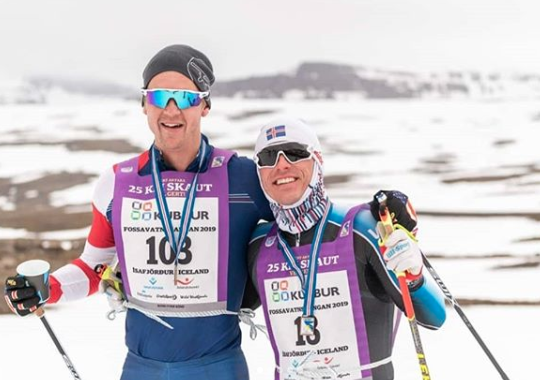
    Erik Bjornsen poses with Snorri Einarsson, an Icelandic World Cup skier, at the finish of the Fossavatn Ski Marathon in Isafjördur, Iceland. (Photo: Instagram @ebjornsen1991)

    While it might seem odd to begin a new season by racing a 21 k followed by a 42 k just two days later, Bjornsen and Dusser agreed that they did not go into the race with performance goals, rather to experience a new place and to enjoy the sport they both love.

    “I feel like we went on vacation and we made a race out of a vacation,” Dusser explained in a call. “We like nordic skiing and we both like racing, but we didn’t really put any pressure [on ourselves].”

    Though the Fossavatn has only been a member of the World Loppet series since 2015, the race dates all the way back to 1935. In addition to the 50-kilometer marathon distance, which is always classic technique, the event features a 25 k skate and classic race and a 12.5 k classic in the days preceding. There are also 1 k and 5 k children’s races. Typically, each of the courses are one loop, but because it has been a low snow year in Iceland, this year the course was rerouted and distances were scaled back as the longest available loop was 21 k, which the marathoners skied twice.

    “It was kind of like skiing on the glacier [in Alaska],” Dusser shared. “You have no trees and pretty mellow terrain. No steep hills, but it’s up and down. Erik was able to double pole the classic race, but for me, it was too hilly, so I was classic skiing.”

    Marine Dusser on her way to a second place finish in the 21 k skate at the 2019 Fossavatn in Isafjördur, Iceland. (Photo: Instagram @marinedusser)

    While they may not have approached the race with goals, both walked away with strong results. Dusser won the 42 k classic and placed second to Caitlin Gregg in the 21 k skate, while Bjornsen was 7th in the classic and 2nd in the skate.

    A glance at the results over the last few years shows names like Iivo Niskanen, Riita Lisa Roponen, and Petter Northug, just to name a few, which begs the question, ‘At an odd time in the year, what is drawing top names to the 66th north parallel for a marathon?’. The duo explained that the race manager, Bobbie Sigujónsson, had contacted Bjornsen about traveling to Iceland for the event, and has enticed other top athletes to do the same.

    “I think he has been pretty good with marketing and communication, and this race is pretty sexy because it’s very pretty there and it’s so different than anything that you can see [elsewhere],” Dusser explained. “And it’s also in May, so it’s easy to get good athletes because people are on vacation. And I think that they are pretty curious about Iceland, so it’s easy to get big names because people can make a vacation out of the race.”

    The couple enjoyed having the opportunity to spend time around the other top athletes attending while away from the World Cup setting.

    wellbutrin sr

    “We got to spend some time with [Nikita] Kryukov and [Alexander] Panzhinzkiy and Iivo [Niskanen],” said Bjornsen. “I mean all those guys have Olympic gold and silver medals, so it was pretty cool to spend more time around them. We were in the same hotel as Kryukov, so we actually got to know him quite well and that was fun.”

    In addition to complimenting race organizers and noting how much fun people were having in the race itself, both Bjornsen and Dusser recommend the event to anyone looking for a novel experience.  

    “There was a big dinner – a “fish party” they called it – where they have live music and an announcer and really good food and stuff,” said Bjornsen. “So I’d just say that we highly recommend it to everybody. It was a really fun experience and if people get the opportunity, it’s a really cool one to do in the spring at the end of the year to have a fun end of the season.”

    While the names at the front of the pack might seem intimidating, Dusser added that the Fossavatn race series is inclusive for skiers of all ages and abilities.

    “There were a lot of masters and I think this race is really open for all of them,” said Dusser. “Because it’s not very all-terrain either — you don’t have very long uphills. I think it’s pretty attractive for all levels. You can see every age and every level can go and have fun, so it’s not just for athletes, so it’s kind of cool.”
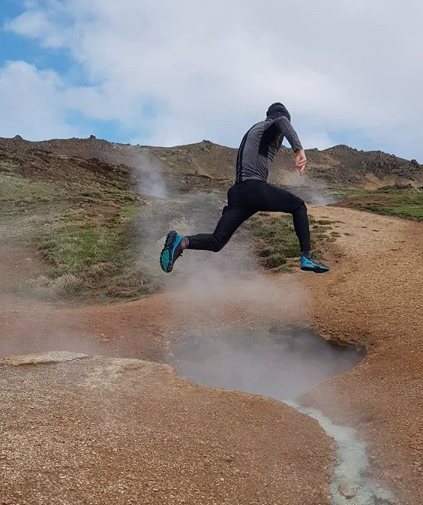
    Erik Bjornsen leaps over a geothermal spring during a trail run in Iceland. (Photo: Instagram @ebjornsen1991)

    Capitalizing on the opportunity, the pair used the week before the race to explore and see other parts of the country, which was new to both of them.

    “We flew into Reykjavik and based out of there for three days, and explored all around that area for day trips,” Bjornsen shared. “We’d head an hour out of town each direction each day and saw different parts of southern Iceland. It’s not a huge place, so we were able to see quite a bit around Reykjavik in those first three days. Then we drove five – 600 miles to the northwestern part of Iceland [for the race]. It was in the west fjords and it was the biggest town in that section of Iceland. So it was really cool. I feel like we saw half of Iceland, or quite a bit of it, and of course snippets of the area along the way.”

    Marine Dusser explores Iceland by foot. (Photo: Instagram @marinedusser)

    Apart from the more obvious features that contrast their coastal Alaskan home – lower mountains and turquoise blue hot springs – they were taken aback by how much closer to the sea they felt there and also by the size of the waves.

    “On the drive up there [to Isafjördur], we actually spotted some whales,” Bjornsen recalled. “You’d drive for an hour and you basically wouldn’t see anybody. We were driving through these fjords and it was a day where there wasn’t a lot of wind, so the sea was pretty quiet, and there were three or four whales that were swimming 150 or 200 meters from the road. We just turned the car off right on the road and watched. In Anchorage, it’s a bit different. You have to drive a ways. We’re in the Cook Inlet right now, and there is a lot of glacier silt, so it’s never very deep. There are some whales that are around but you rarely… it’s just a different feel around here.”

    Looking ahead, Dusser, who has coached for the UAA Seawolves the last two seasons, will be continuing her work with the Alaska Biathlon Association, including coordinating the upcoming spring training camp. In her own ski career, Dusser was a member of the French National Biathlon Team. During that time, she won three medals at the Junior World Championships in biathlon and was the French Junior National Champion six times.

    “We have a camp the first week of June and usually we try to invite a bunch of biathletes,” Dusser explained. “Last year we had a biathlete from Switzerland, she actually won the World Junior championship, and Tim Burke is coming as well to help coach, so that should be fun. It’s pretty busy organizing that camp, it’s pretty big every year, so it’s nice.”

    Bjornsen, who this season advanced to the USST A-Team, will be continuing to work toward the upcoming World Cup season, but is also looking forward to upcoming non-ski-related events this summer.

    “I’m getting back into training,” Bjornsen stated. “Doing a similar camp schedule that I’ve done in the past, so I’ll be heading down to Bend here in about a week, definitely Eagle Glacier this summer, then I’m headed to Norway, and a fall camp with the ski team. My sister is getting married [in July], then we’re having Marine’s parents come to town and my parents are coming of course, so it should be a fun summer.”
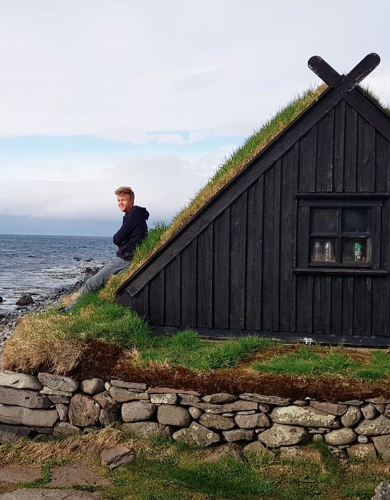
    Erik Bjornsen explores coastal Iceland on a trip with his wife, Marine Dusser. (Photo: Instagram @erikbjornsen1991)
  • Klæbo Takes a Bow in Drammen Classic Sprint; Erik Bjornsen 18th

    Klæbo Takes a Bow in Drammen Classic Sprint; Erik Bjornsen 18th

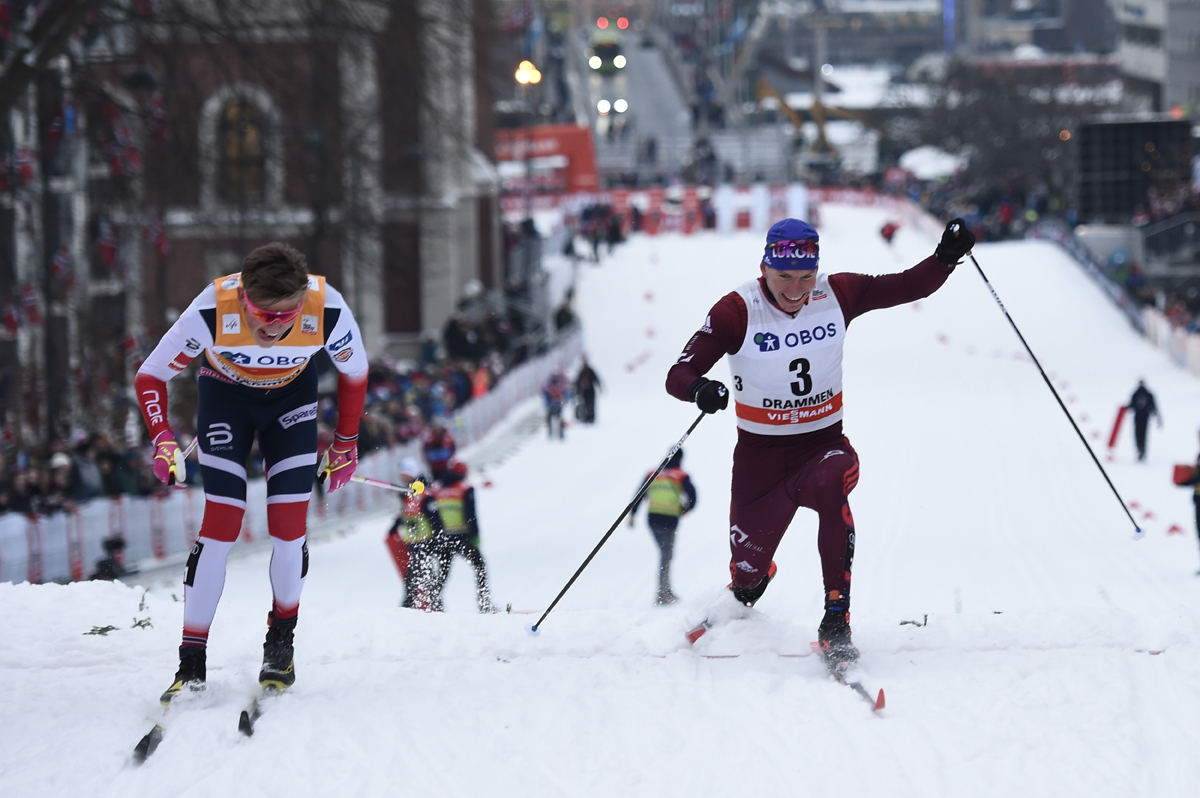
    Norway’s Johannes Høsflot Klæbo (l) edging Russia’s Alexander Bolshunov (3) and Norway’s Eirik Brandsdal (not shown) in the first semifinal of the men’s classic sprint at the World Cup in Drammen, Norway. Klæbo went on to win the final, ahead of Brandsdal in second and Bolshunov in third. (Photo: Fischer/Nordic Focus)

    In the classic venue that are the Drammen city sprints, it was a singular affair from start to finish during the men’s World Cup 1.2-kilometer classic sprint on Wednesday. In a race format that tapered from a field of 61 skiers to the winner, one only needs to track the skier in the overall World Cup’s leader bib to follow along.

    The yellow-bibbed skier, Norway’s Johannes Høsflot Klæbo, didn’t surprise with his sprint win in Drammen as much as place another high performance stamp on his 2017/2018 campaign.

    Klæbo won the qualifier in 2:49.32 minutes. Teammate Eirik Brandsdal skied to second in the qualifier, 3.5 seconds behind Klæbo. Russian Alexander Bolshunov skied the third-fastest qualifying time, finishing 4.48 seconds back. This puts some things in perspective, if anybody thought Klæbo would bloat in his post-Olympic gold medal glow — he won three golds in PyeongChang — you’d be wrong.

    Klæbo would have have good reason to cash it in. What exactly does the 21 year old need to prove? Coming into Wednesday’s race, Klæbo had already captured the Sprint World Cup Crystal Globe. It’s the Norwegian phenom’s second-consecutive overall sprint title.

    Yet Klæbo is also on the verge of sealing up his first Overall World Cup title. After the Drammen sprints, Klæbo leads the overall standings with 1308 points. Behind him, Martin Johnsrud Sundby of Norway (who did not contest Wednesday’s sprint), trails in second place with 980 points total.

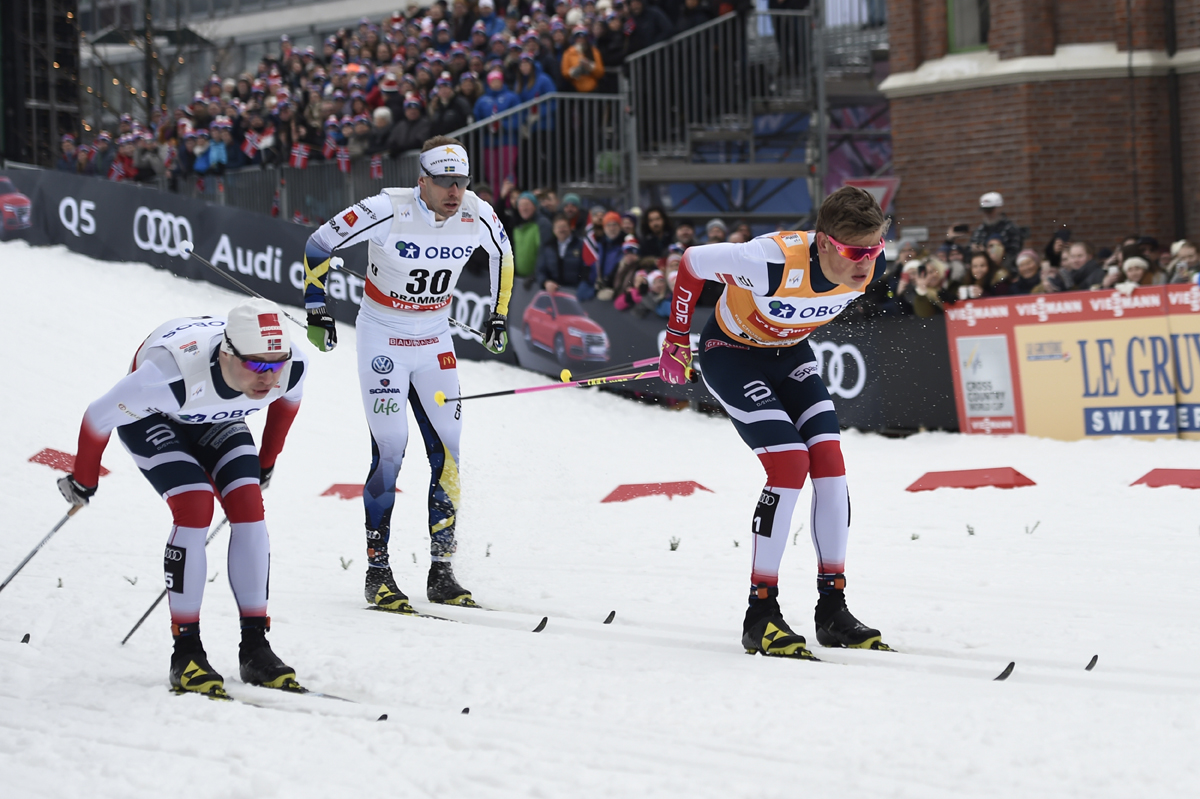
    Johannes Høsflot Klæbo leads his quarterfinal with fellow Norwegian Fredrik Riseth (l) and Sweden’s Emil Jönsson (30) at the World Cup classic sprint in Drammen, Norway. (Photo: Fischer/NordicFocus)

    “It was really important to me to get the 100 points today,” Klæbo told the International Ski Federation (FIS) after the race. “I need as many points as I can get against the other guys for the [overall] Crystal Globe. I will race the Holmenkollen 50 k this weekend and I know it will be tough. Also it’s great to win here in front of all the people. I was second here last season and I’m really happy to now have won Drammen.”

    Let’s circle back to what Klæbo needs to prove, beyond padding his overall lead by another 100 points by winning the Drammen sprint. He’s proving at his young age, pending any monumental flameout, that he’s setting the stage for a historic international cross-country ski career.

    This season alone, Klæbo has won six of nine individual sprint World Cups. He’s won 10 World Cup races in total. That win total puts Klæbo in rarefied company: in the men’s field, only Petter Northug (with 10 wins) and Sundby (16 wins) have won 10 or more World Cup races in a single season.

    Winners want to win. Amidst the five-deep crowd surrounding the sprint course featuring Drammen’s iconic Bragernes Church, with his pink-themed flare, Klæbo proved once again he is a consummate winner.

    There was his dominating qualifier. Then there was Klæbo’s quarterfinal, in which he looked less threatening. He won the first quarterfinal by 0.7 seconds in a photo finish with Brandsdal. That heat seemed to be a test run, as if Klæbo were feeling the course out and asking himself how it skied with five other bodies jousting for tracks and inside lines. There was never the hallmark Klæbo burst of speed or any real dominance. Klæbo kept in contact up the long initial uphill, and down through the tight and sinuous S-turns after the course’s highpoint.

    If in fact the first quarterfinal was a dress rehearsal, Klæbo must have realized that any real podium threats would be drag racing up the final quarter-kilometer climb that finished nearly smack-dab in front of the church.

    The first semifinal featured the day’s top-three qualifiers: Klæbo, Brandsdal and Bolshunov. (Bolshunov advanced by winning the second quarterfinal.) The three skiers finished 1-2-3 with Klæbo taking the win in another photo finish with Brandsdal.

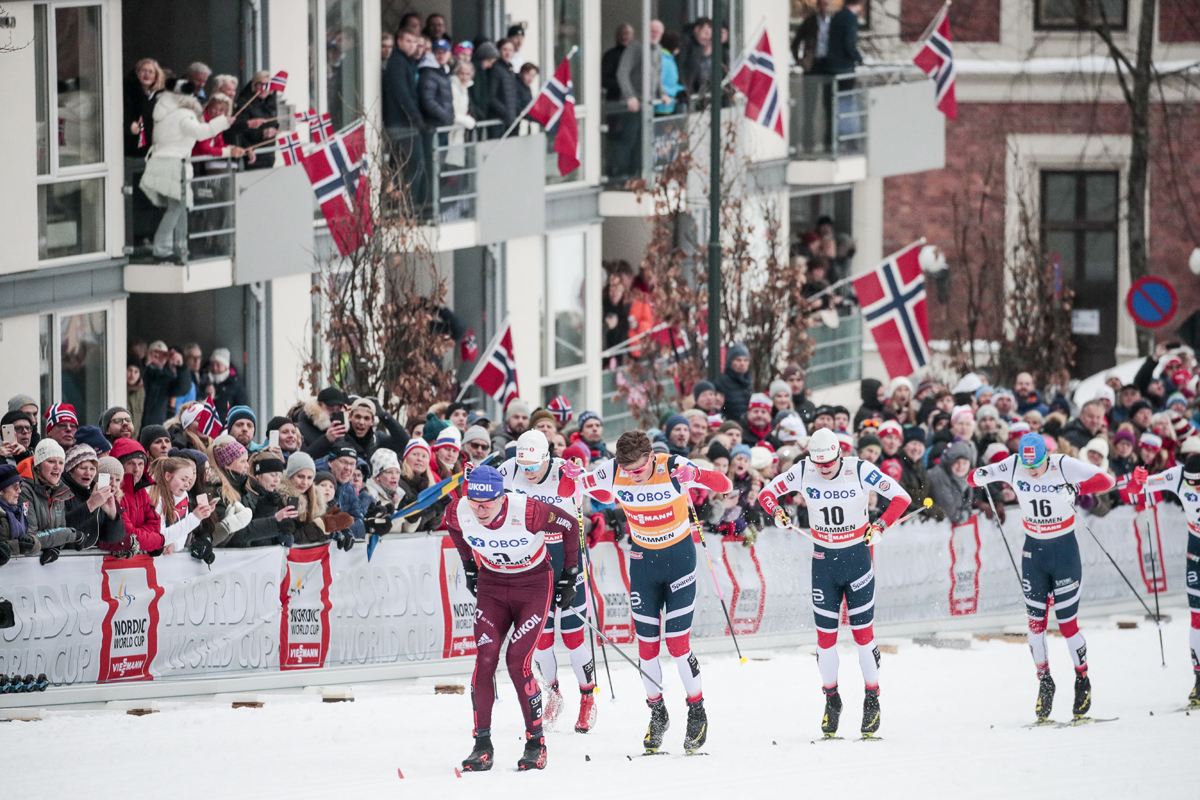
    Russia’s Alexander Bolshunov leads five Norwegians in the men’s classic sprint final at the World Cup in Drammen, Norway: (from l to r) Eriik Brandsdal, Johannes Høsflot Klæbo (yellow bib), Sindre Bjørnestad Skar (10), Kasper Stadaas (16), and Emil Iversen. (Photo: Fischer/Nordic Focus)

    Tactically, Bolshunov played his hand early. Determined to break Klæbo, the Russian led out hard and took the sharp end of the race in earnest. At the top of the course, Bolshunov had strung the five other skiers out behind him. Moments before the highpoint and entering the technical downhill S-turns, Bolshunov and Klæbo gave a burst of speed and distanced themselves by 10 meters. As Klæbo learned in his heat, even with speedy skis, the downhill is not decisive. It’s more a function of skiing out front, staying on your feet and entering the final straight with enough high-octane gas to turbo the finish.

    Up the final climbing stretch, which seems as eternal as some flame burning inside the Bragernes Church, Bolshunov faded slightly, while Klæbo and Brandsdal pulled ahead.

    Klæbo’s second takeaway: he already knew the course was won on the final straightaway climb. If he could match Bolshunov on the remainder of the course, Bolshunov could not mirror him in the final meters.

    The final played out like Klæbo’s semi. Bolshunov punched it early. Klæbo sat behind the Russian, matching him pole for pole, stride for stride. Up front was as good a place as any for Bolshunov. Besides the Russian, it was an all-Norwegian final. There was Klæbo and Brandsdal, along with Sindre Bjørnestad Skar, Kasper Stadaas and Emil Iversen.

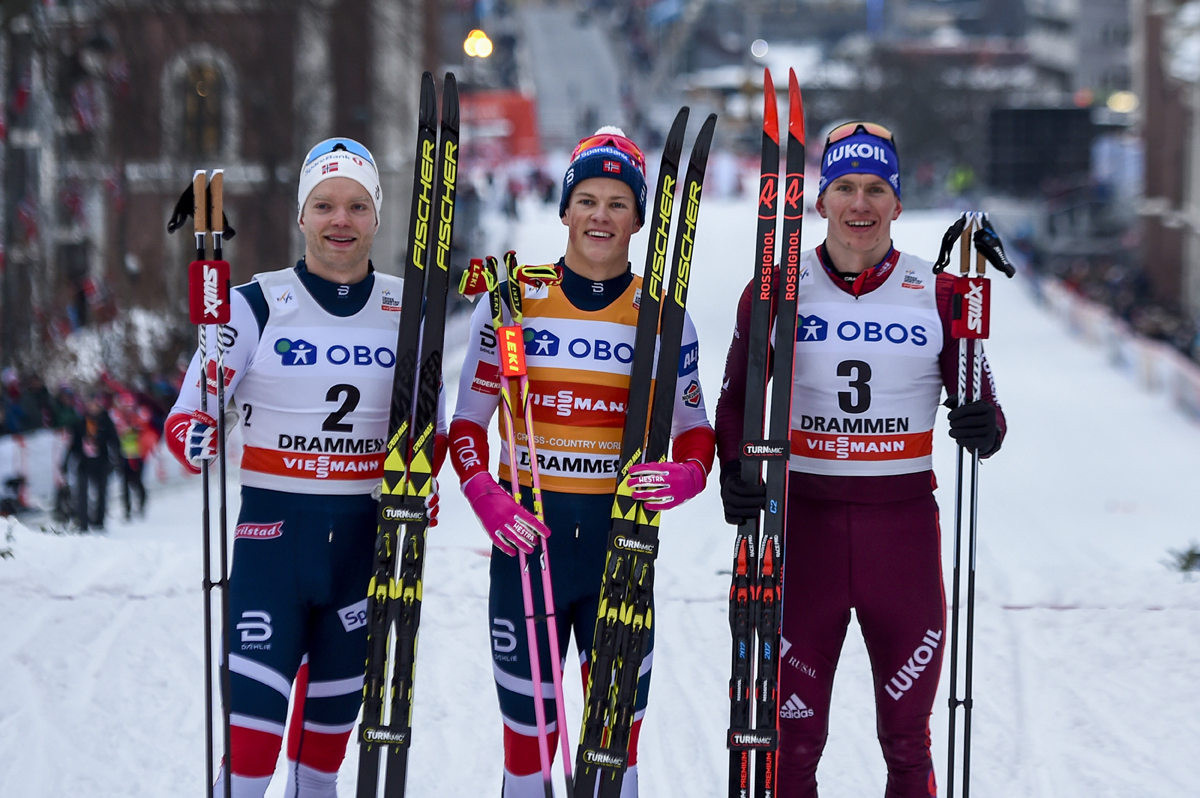
    The men’s podium from Drammen’s 2018 classic sprint. Norway’s Johannes Høsflot Klæbo (c) placed first, his teammate Eirik Brandsdal (l) was second, and Russia’s Alexander Bolshunov (r) finished third. (Photo: Fischer/NordicFocus)

    Bolshunov again led up and over the top of the course, through the S-turns and through the tucking downhill. Brandsdal trailed by 10 meters, but by the final turn before the uphill to the church’s front door, the threesome had regrouped. Again, as the double poling got down to business, Bolshunov faded, Klæbo pulled away and Brandsdal could only stay a second behind the day’s winner. And of course Klæbo was able to toe the line as he bowed to the frenzied crowd. Nothing to prove except he can win with panache and win in style when the Norwegian cameras turn out in force.

    Klæbo won the final in 2:44.69 minutes. Brandsdal followed 1.04 seconds back in second place, Bolshunov finished third (+3.78), Bjørnestad fourth (+6.55), Kaspar fifth (+8.71), and Iversen sixth (+11.45).

    Bjornsen Reaches Quarterfinals, 18th Overall

    Erik Bjornsen was the lone North American who advanced to the heats, qualifying in 26th and finishing the day in 18th.

    “I was feeling good,” Bjornsen told FasterSkier after the race. “It’s a tight course. It was a bit scrappy. … It’s my first time here qualifying for the heats, so I’m learning some things, for sure.”

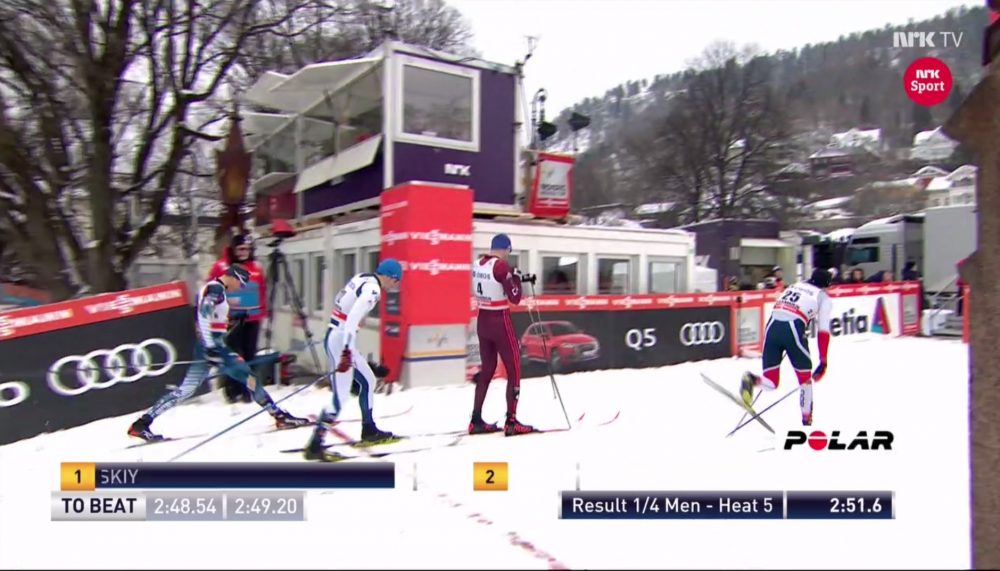
    Bjornsen skied in the fifth quarterfinal with Iversen, Russia’s Alexander Panzhinskiy, Finland’s Ristomatti Hakola, Emil Nyeng of Norway, and France’s Lucas Chavanat.

    The American skied near the back of the group but avoided any real mishaps. Although the sport is not roller derby, Drammen’s tight-and-rutted corners offer up a close cross-country skiing cousin.

    The U.S. Ski Team’s Erik Bjornsen toeing the line in fourth during Wednesday’s fifth heat in Drammen, Norway. Bjornsen placed 18th on the day. (Screenshot: NRK broadcast)

    “I feel like – I kind of missed a few spots,” Bjornsen said.  “At the bottom corner I was pushed to the outside. I was almost moving up into second, and looking back maybe I should have gone around him on the other side.”

    Up the never-ending final straightaway, Bjornsen poled himself into a position to potentially advance to the semifinals as a lucky loser. However, that didn’t pan out for Bjornsen. Iversen won the heat in 2:51.96 minutes, Panzhinskiy placed second (+0.20), Hakola third (+0.99), with Bjornsen in fourth (+1.18).

    Andy Newell racing to 33rd in the men’s classic sprint qualifier at the World Cup in Drammen, Norway. (Photo: Fischer/NordicFocus)

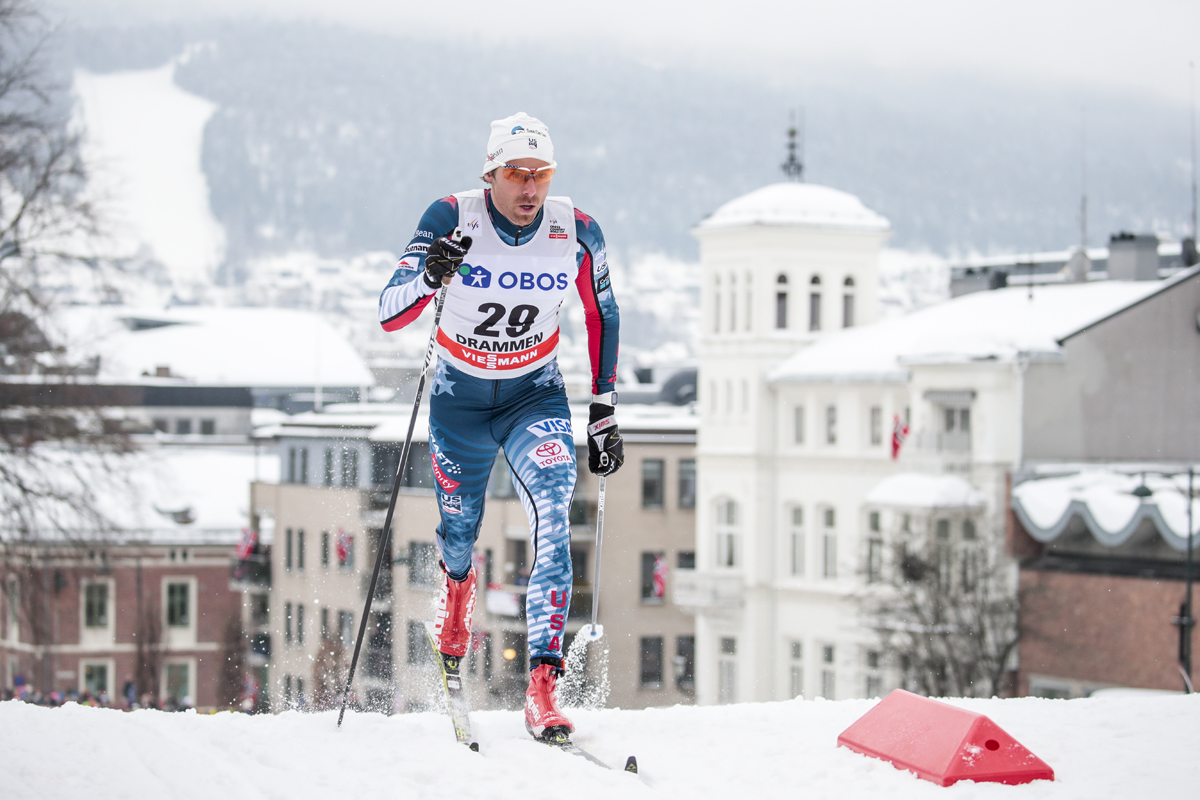
    Also for the U.S., Andy Newell missed the quarterfinals after finishing 33rd in qualification, 0.9 seconds out of 30th. Logan Hanneman and Kevin Bolger finished 49th and 50th, respectively, and Reese Hanneman 56th. The U.S. Ski Team’s Simi Hamilton sat out Wednesday’s sprint as he is recovering from an illness.

    For Canada, Julien Locke finished 51st in qualifying, Alex Harvey was 54th, and Andy Shields 58th.

    Results: Qualifier | Final

  • Valjas 4th, Newell 6th in PyeongChang Sprint Final

    Valjas 4th, Newell 6th in PyeongChang Sprint Final

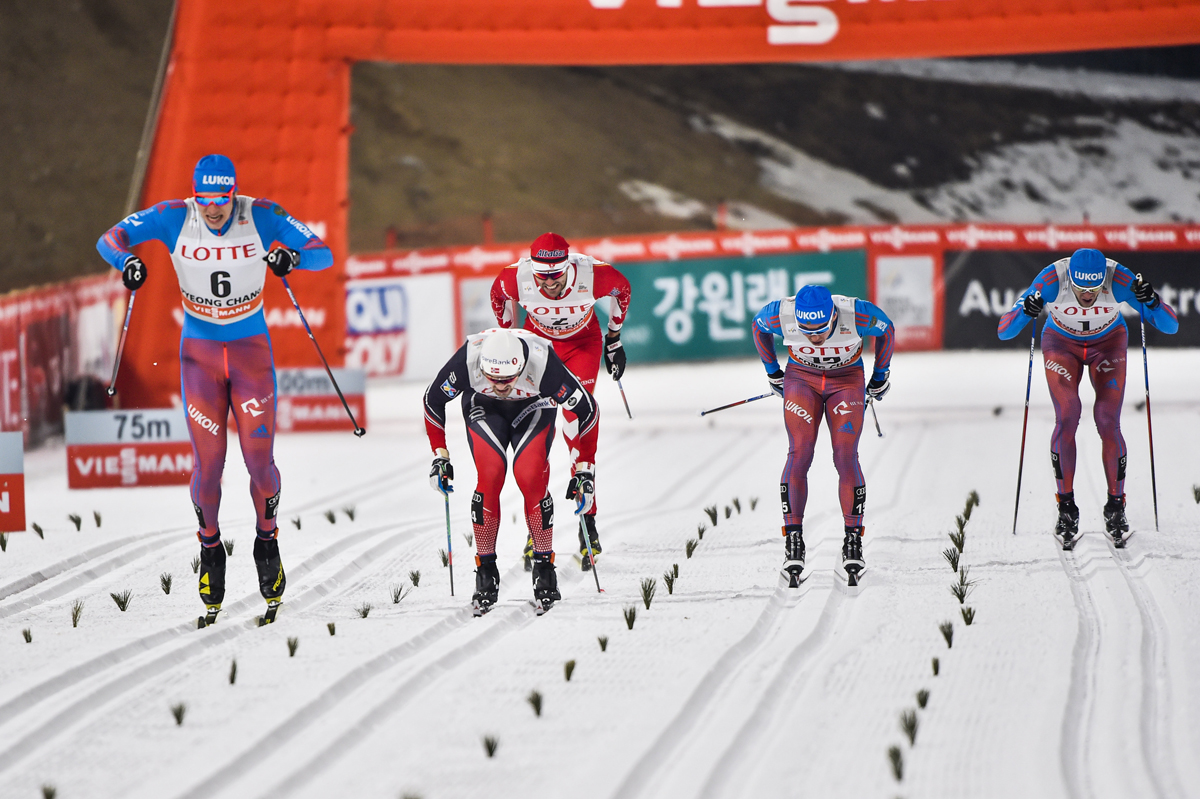
    Russia's Gleb Retivykh (l) racing to his first World Cup victory and podium on Friday in the World Cup classic sprint in PyeongChang, South Korea, ahead of Norway's Sondre Turvoll Fossli (second from l), Canada's Len Valjas (behind Fossli), and Russia's Andrey Parfenov and Alexander Panzhinskiy. (Photo: Fischer/NordicFocus)
    Russia’s Gleb Retivykh (l) racing to his first World Cup victory and podium on Friday in the World Cup classic sprint in PyeongChang, South Korea, ahead of Norway’s Sondre Turvoll Fossli (second from l), Canada’s Len Valjas (behind Fossli), and Russia’s Andrey Parfenov (second from r) and Alexander Panzhinskiy (r). (Photo: Fischer/NordicFocus)

    As a sphere, the Earth is a tidy shape and can be divided into equal segments. It takes roughly 24 hours for the planet to rotate on its axis once, constituting a single day. So there’s 24 time zones, one for each hour of rotation. On Friday, the tidiness was disrupted a bit for European-based World Cup skiers. PyeongChang, South Korea, host of the 2018 Winter Olympics, was site of the men’s World Cup 1.5-kilometer classic sprint.

    PyeongChang sits a full eight hours ahead of Central European Time, a time zone most World Cup skiers are adjusted to. To accommodate the time shift, the sprints were run at night, under the lights.

    “It’s been tough. We knew the races were going to be really late here in Korea so that the T.V. time works in Europe,” U.S. Ski Team (USST) member Andy Newell said on the phone. “But as far as adjusting, you go in and out and definitely feel pretty tired at times, like when you’re trying to fire it up and get ready to race. But once you’re racing, it seems like it’s OK. You don’t notice the jet lag once you’re out there on the track.”

    In a field of 55 skiers, Newell was one of two North Americans to make the men’s final; the other was Canada’s Lenny Valjas. Newell placed sixth in the final (+17.1), Valjas fourth (+0.74) in a photo finish with Russia’s Andrey Parfenov (+0.73), who skied to third overall.

    “It was really close between me and Lenny,” Parfenov told the International Ski Federation (FIS), according to a press release. “I know he was next to me. I was lucky have a better lunge. It was a good track for classic. There is not so much double poling sections, more uphills and that was good for me. I am really happy for my second podium of my career.”

    Russia’s 26-year-old Gleb Retivykh won the final in 3:30.79, ahead of Norway’s Sondre Turvoll Fossli in second (+0.30). It was Retivykh’s first career World Cup win and first time on the podium, despite finishing in the top 10 in World Cup sprints on 10 other occasions. And despite his comments to FIS, the Russian’s speediness may just have allowed him to momentarily outrun the jet lag.

    “I arrived here yesterday so I am still jet lagged,” Retivykh said. “I knew Sondre is very strong. I did not think I could win. I was hoping for a good result. I had to wait six years for my first victory and it is great.”

    Valjas Leads Canada in 4th

    Time zones and new food be damned. For seasoned athletes like Valjas and Newell, planes, shuttle buses, and exploratory cuisine are all part of the international skiing life. Despite the time-zone-shift-wormhole, both skiers delivered.

    For Valjas, of Canada’s World Cup A-team, the vagaries of food prep in South Korea flummoxed him.

    “Adjusting to the time change went fairly well, but I ran into some trouble with the food here,” Valjas wrote in an email. He is allergic to peanuts and fish; two ingredients in the form of peanut and fish oil that’s ubiquitous in Korean meals.
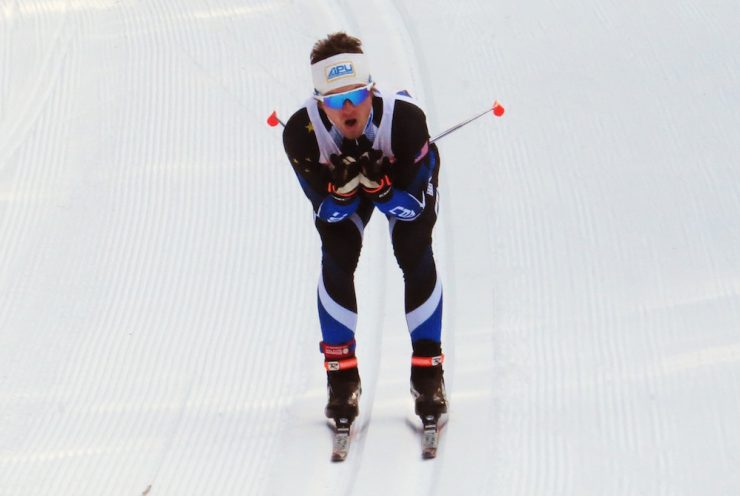
    “The last two dinners I have not been able to eat because I had reactions,” Valjas added. “Even the ‘safe’ boiled potatoes ended up having peanut oil dribbled all over them. The language barrier makes it very hard to understand which foods may or may not kill me. I could feel my energy getting lower and lower today, could have been my inability to eat well or the jet lag after flying here two days ago.”

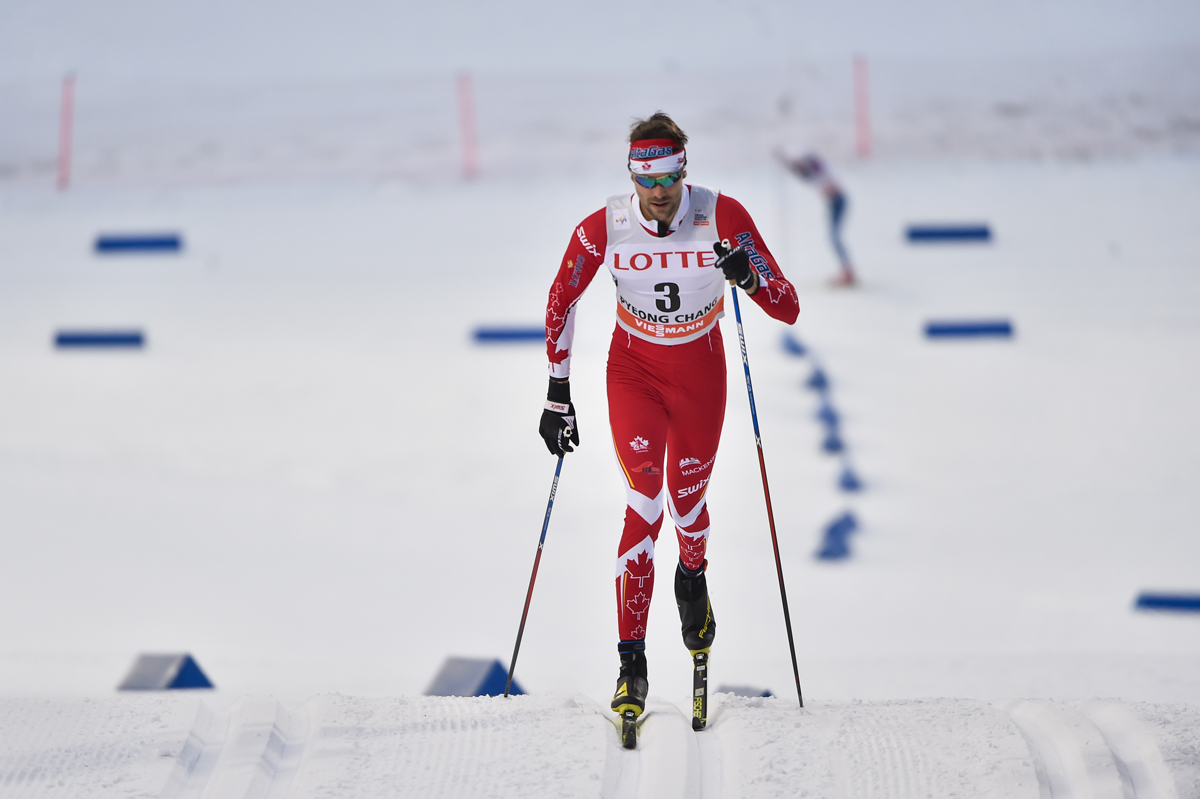
    Canada's Lenny Valjas racing to second in the men's classic sprint qualifier on Friday at the World Cup in PyeongChang, South Korea. (Photo: Fischer/Nordic Focus)
    Canada’s Lenny Valjas racing to second in the men’s classic sprint qualifier on Friday at the World Cup in PyeongChang, South Korea. (Photo: Fischer/Nordic Focus)

    Despite the lack of food intake, Valjas qualified in second place, 1.97 seconds back from fifth-place overall finisher and first-place qualifier Alexander Panzhinskiy of Russia.

    Valjas’s progression looked like this: second in his quarterfinal then advancing to the finals as the second lucky loser from the first semifinal. And ultimately his fourth place in the final — where he missed his eighth-career World Cup podium and his third of the season, by 0.01 seconds.

    “I have mixed feelings about today,” Valjas wrote about his PyeongChang classic sprint experience. “It’s tough to be that close and come up short.”

    Mindful that the day was also about gaining pre-Olympic beta, Valjas noted his time in South Korea was well spent.

    “On the bright side, I learned so much skiing the Olympic course today. It’s a very tough course, but it is built amazingly well,” he wrote. “The climbs are the perfect grade for striding, and racing at night with all the lights was really cool. … I hope I can use the valuable info I learned tonight to my advantage when I race here next winter in the Olympic sprint.”

    Jess Cockney (Canadian World Cup B-team) racing to 16th in the men's classic sprint qualifier on Friday at the World Cup in PyeongChang, South Korea. He went on to place 10th overall for a season best. (Photo: Fischer/NordicFocus)
    Jess Cockney (Canadian World Cup B-team) racing to 16th in the men’s classic sprint qualifier on Friday at the World Cup in PyeongChang, South Korea. He went on to place 10th overall for a season best. (Photo: Fischer/NordicFocus)

    Jess Cockney, of Canada’s World Cup B-team, placed 10th after qualifying 16th. Cockney skied to first in his quarterfinal after avoiding several skiers involved in crashes, including one involving U.S. Ski Team member Simi Hamilton.

    “I felt that I could ski relaxed and work my way through some positions in the second half of the course and it ended up being really good to also avoid the crashes in my heat,” Cockney wrote in an email.

    In his semifinal, Cockney was on fumes and finished fifth.

    “He gave it all on the quarterfinal so he lost a lot of energy there, but still making it to the semi is very good,” Charles Castonguay, Canada’s lead coach in PyeongChang, said on the phone. “But at the end, I think he did really well, too. Top 10 for him is really really good and he is pretty confident that he can repeat that for Lahti in two weeks [at World Championships]. We had a little chat after and he said he was pretty happy; he said he gave it his all. … It’s his best result since [last] year in Quebec [where he placed 10th in the freestyle sprint]. So yeah, it’s promising for him for the Otepää World Cup and the Worlds at Lahti.”

    The next best Canadian was Simon Lapointe, of the Pierre-Harvey National Training Centre (CNEPH), who qualified 25th and finished 27th overall. Friday marked his first international World Cup and his previous personal best was 70th in a Ski Tour Canada stage last year.

    Bob Thompson (NTDC Thunder Bay) missed qualifying by one-hundredth of a second in 31st (for his best World Cup result by 21 places), and Julien Locke (Alberta World Cup Academy/Canadian National U25 Team), in his first World Cup, placed 36th.

    Newell Sixth in Final

    The 1.5 k men’s course was a no-rest affair. Thirty seconds of initial double poling brought skiers into a roller coaster of a course — two big ups, quick downs, and a straight away finish all under the brights lights. 

    Leading the U.S. was veteran USST skier Newell in sixth overall. He qualified seventh (+5.18).

    “For me in the qualifier, how I gauge a good or bad qualifier, usually it doesn’t even necessarily depend on what place I finish, a lot of it is seconds back and a lot of it is how I feel if I nailed the course or not,” Newell said on the phone Friday night.

    A thorough student of the classic-skiing sprint scene, Newell adjusted after sensing he hadn’t skied the second major hill effectively.

    “I know my strengths and weaknesses on a course like this,” Newell said. “I know I can be as good as anyone on those hills and so that was kind of the goal, was to make sure I was in a good position.”

    American Andy Newell chasing Russia's Alexander Panzhinskiy during their quarterfinal of the men's classic sprint at the PyeongChang World Cup in South Korea. (Photo: Fischer/Nordic Focus)
    American Andy Newell (7) chasing Russia’s Alexander Panzhinskiy during their quarterfinal of the men’s classic sprint at the PyeongChang World Cup in South Korea. (Photo: Fischer/Nordic Focus)

    Newell was matched with top-qualifier Panzhinskiy in his quarter and semifinal. Panzhinskiy and Newell placed first and second in both, respectively, with Newell 0.63 seconds back in the quarter and 0.34 seconds back in the semi.

    “[Panzhinskiy] was the top qualifier so I knew he was going to be fast and so we were kind of really able to kind of get away from anyone in our heats in both the quarterfinal and the semifinal up that [second] hill,” Newell said.

    As a made-for-television production, the heats run on a tight schedule. And due to clearing the course after several crashes, organizers were running behind schedule. The time after the Newell’s semifinal to the final was reduced, hampering both Panzhinskiy’s and Newell’s normal pre-final recovery period.

    “Maybe we pushed each other a little too hard in the semifinal because I think we were both a little tired,” Newell reflected. “It just so happened that the schedule they were running behind with the heats today, which means the semifinal went off five to ten minutes late, but they have to keep the final on time. … That kind of took us by surprise because I think we both pushed each other pretty hard in that semi and then to have a short ten-minute recovery as opposed to one that’s fifteen or twenty, that was definitely a tough turnaround.”

    Newell skied from the back in the final. According to the Vermont-based skier, he changed skis in the final, and that decision compounded with his less-than-normal, pre-finals recovery period impacted his overall placing.

    “I swapped out for a different pair of skis and was using a different pair of skis in the final,” Newell said. “It was an easier-kicking pair of skis, which probably worked out great for the first few heats, but in the final I think one of the things that came to bite us was the fact that [my wax tech] Mark and I kept adding a layer of wax to make sure we had good grip up that big climb because it was such decisive part of the race. But by the final I think we were dragging a little bit too much wax, which really played a big role in me getting shelled off after about half way through because yeah, kick was dragging considerably in the final, but you know that’s all part of the game.”

    Newell ultimately finished 17.19 seconds back in sixth after realizing his efforts were in vain. But being present and racing well in PyeongChang remained important for Newell.

    “This race in particular was kind of one of the races I wanted to make sure I was at,” Newell said of how he planned out his current World Cup campaign. “My goals are really quite focused towards the Olympics next year. For me, the excitement was there today just because it’s a new venue and it’s the place where the Olympics are going to be taking place next year and I know I can be competitive in these classic sprints.”

    Newell will skip Saturday’s skiathlon to prep for Sunday’s freestyle team sprint. He’ll be racing the team sprint with Hamilton.

    “I was not feeling great all day, and it’s been kind of a tough week for me in general,” Hamilton wrote of his adjustment to South Korea. “I was definitely struggling with how my body was responding to big travel and a pretty significant time shift, but still, I think it is extremely valuable to be able to be here experiencing the courses and the layout of the land before 2018.”

    Simi Hamilton (U.S. Ski Team) racing to 12th in the men's classic sprint qualifier on Friday at the PyeongChang World Cup in South Korea. He went on to finish 17th overall after crashing in his quarterfinal and finishing fourth in that heat. (Photo: Fischer/NordicFocus)
    Simi Hamilton (U.S. Ski Team) racing to 12th in the men’s classic sprint qualifier on Friday at the PyeongChang World Cup in South Korea. He went on to finish 17th overall after crashing in his quarterfinal and finishing fourth in that heat. (Photo: Fischer/NordicFocus)

    Hamilton qualified 12th, which he was dissatisfied with.

    “I felt like I had a pretty weak qualifier, and was struggling to find big power and big glide on the two big climbs,” he wrote.

    Hamilton’s focus this year has been on skate sprinting: a traditionally strong technique for him.

    “But with so many skate sprints this year and the fact that the sprint in Lahti is skate, I haven’t really been thinking too much about classic sprinting or gearing my training towards classic sprinting,” he explained. “So I think with some focused training I’ll be able to dial in my preparations for this course specifically and hopefully feel much better in qualification the next time we are racing here.”

    In his quarterfinal, Hamilton was well positioned for the second climb — sitting back a few meters from the leaders.

    “Coming down the fast descent into the bottom of that hill, I made a slingshot move to the outside, open track on the far left, and was carrying some really good momentum past the two Norwegians in my heat,” he recalled.

    With his momentum carrying him up to the leaders, Norwegian Daniel Stock swerved into Hamilton’s tracks. (Stock was eventually relegated to 30th overall due to his obstructing Hamilton.)

    “I think he skied right over both of my bindings with his left ski as he was skating into that track. My feet were basically stopped dead in their tracks as the rest of my body was hurling up the hill.”

    A broken pole and stopped dead, Hamilton’s chances of advancing had been squelched.

    “As I got to my feet, the pack was already about 10 meters ahead of me and I realized that my night was over,” Hamilton added. He finished 17th overall.

    Another American, Matt Gelso (Sun Valley Ski Education Foundation) scored his first career World Cup points. Gelso had earned the World Cup starts as the Period 1 SuperTour leader.

    “It’s great to score my first ever World Cup points in my second-ever sprint,” Gelso wrote in an email. “Never thought my first points would come in a sprint. I skied the transitions well in my qualifier and accelerated through the course. I probably could have started harder but overall pacing was pretty good.”

    Gelso qualified 29th and placed 29th overall after finishing sixth in his heat.

    Also for the U.S., Scott Patterson (Alaska Pacific University) finished 44th and Noah Hoffman 48th in the qualifier.

    Results: Qualifier | Final

  • Friday Rundown: PyeongChang, Soldier Hollow & Eastern Canadian Champs (Updated x3)

    Katharine Ogden (SMS/USST) finishing third for bronze in the women's 10 k skiathlon on Friday at 2017 Junior World Championships at Soldier Hollow in Midway, Utah. She is the first American to reach the podium in a Junior World Championships. (Photo: FlyingPointRoad.com)
    Katharine Ogden (SMS/USST) finishing third for bronze in the women’s 10 k skiathlon on Friday at 2017 Junior World Championships at Soldier Hollow in Midway, Utah. She is the first American to reach the podium in a Junior World Championships. (Photo: FlyingPointRoad.com)

    FIS Nordic Junior World Championships (Midway, Utah): 10/20 k skiathlon

    A Junior World Championships medal has been on Katharine Ogden’s mind for some time — two years, to be exact.

    “Every day in training, it’s kind of something that I think about. It’s the little thing that helps me push myself,” Ogden, a 19-year-old member of the Stratton Mountain School and U.S. Ski Team D-team, said in a post-race interview with the U.S. Ski Team on Friday. “Even in the middle of June, I’ll be like, ‘You know what I want to be? On the podium at World Juniors.’ ”

    She did just that on Friday, racing to third in the women’s 10-kilometer skiathlon at 2017 Junior World Championships at Soldier Hollow in Midway, Utah. In doing so, she became the most successful American at World Juniors, surpassing Lindsey Williams’s previous best of fourth place in 2003.

    Ogden finished 10.4 seconds behind the winner, Norway’s Marte Mæhlum Johansen, who finished first in 27:17.3 minutes. Sweden’s Ebba Andersson took second, 6.6 seconds back. Behind Ogden, Italy’s Anna Comarella placed fourth (+51.6) ahead of Finland’s Eveliina Piippo in fifth (+58.7).

    Hailey Swirbul (University of Alaska Anchorage) was the second U.S. woman in 24th (+2:21.0), while Natalie Hynes (Whitehorse) led Canada in 28th (+3:11.3).

    Also for Canada, India McIsaac (Rocky Mountain Racers) finished 30th (+3:13.8), Lisle Compton (NTDC Thunder Bay) was 33rd (+3:45.5) and Annika Richardson (NTDC Thunder Bay) 41st (+4:49.3).

    Also for the U.S., Lauren Jortberg (Dartmouth) finished 37th (+4:04.5) and Taeler McCrerey (University of Denver) 38th (+4:07.5).

    [UPDATED] In the men’s 20 k skiathlon that followed, Russia’s Vladislav Vechkanov notched his second gold of the week in 49:40.5, outlasting Norway’s Thomas Helland Larsen by 1.9 seconds. Norway had two on the podium with Harald Østberg Amundsen in third (+2.2).

    Canada’s Gareth Williams (Telemark Race Team) was the top North American in 11th (+1:24.0) for his best result at his first Junior Worlds.

    American Wyatt Gebhardt (Steamboat Springs WSC) followed in 12th (+1:42.7) for his second-straight top 20 and Hunter Wonders (Alaska Pacific University) also finished in the top 20 for the second-straight race in 18th (+1:57.9).

    Canada’s Philippe Boucher (CNEPH) was 22nd (+3:15.7), Ryan Jackson (Team Hardwood) 31st (+3:52.5), and Remi Drolet (Black Jack) 49th (+6:57.3).

    Also for the U.S., Kam Husain (SMS) placed 50th (+6:59), and Logan Diekmann (University of Utah) was 53rd (+7:47.3).

    Results: Women | Men 

    ***

    NorAm Eastern Canadian Championships (Cantley, Quebec): Classic sprint

    The NorAm series resumed at the Nakkertok Nordic Centre on Friday with Eastern Canadian Championships with classic technique sprints.

    Alberta World Cup Academy’s Maya MacIsaac-Jones returned from U23s in time to win the 1.3 k A-final in 3:42.06, after qualifying sixth. Top qualifier Sophie Carrier-Laforte was second for CNEPH at her home event, 0.66 seconds behind. SMS Elite’s Anne Hart rounded out the podium at 3.40 seconds back.

    On the men’s side, AWCA’s Dominique Moncion-Groulx qualified first before winning every heat on his way to victory in 3:14.84 on a slightly longer 1.4 k course. NTDC Thunder Bay’s Angus Foster was a close second, 0.09 seconds behind. Team R.A.D.’s Russell Kennedy was a comfortable third, 2.75 seconds back, on a day marked by some surprising eliminations.

    The elite field is slightly smaller than usual with some athletes away in Soldier Hollow and PyeongChang. As many younger racers were stuck in school for the day, there are only about 500 starters for what is usually the largest FIS event in Canada.

    Results: Qualifier | Heats

    ***

    FIS Cross-Country World Cup (PyeongChang, South Korea): Classic sprint

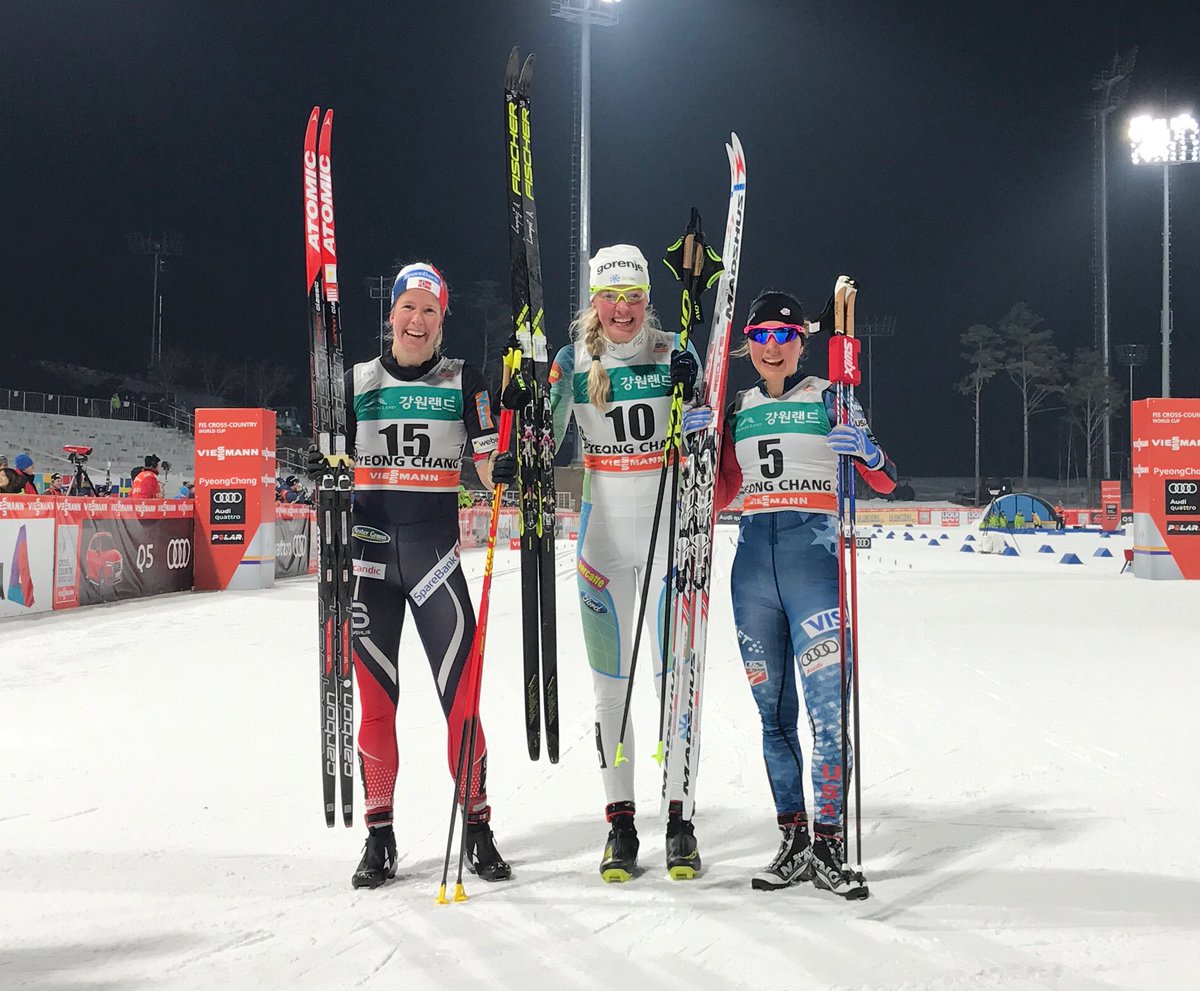
    The women's 1.4 k classic sprint podium on Friday at the pre-Olympic PyeongChang World Cup in South Korea, with Slovenia's Anamarija Lampič (c) in first, Norway’s Silje Øyre Slind (l) in second, and American Ida Sargent (r) in third. It was the first time on the World Cup podium for all three athletes. (Photo: FIS Cross-Country/Twitter)
    The women’s 1.4 k classic sprint podium on Friday at the pre-Olympic PyeongChang World Cup in South Korea, with Slovenia’s Anamarija Lampič (c) in first, Norway’s Silje Øyre Slind (l) in second, and American Ida Sargent (r) in third. It was the first time on the World Cup podium for all three athletes. (Photo: FIS Cross-Country/Twitter)

    In the last month, we’ve seen two U.S. Ski Team members — Jessie Diggins and Sadie Bjornsen — on the World Cup podium. Add Ida Sargent to that list.

    On Friday, the Vermont native raced to third in the women’s 1.4-kilometer classic sprint at the first-ever World Cup in PyeongChang, South Korea. It was the first of three days of racing in PyeongChang, which will host the 2018 Winter Olympics next season.

    Sargent qualified fifth (4.76 seconds behind her teammate Sophie Caldwell, who won the qualifier in 3:40.89 minutes) and went on to win her quarterfinal in a photo finish, then placed second her semifinal (also in a photo finish), edging Russia’s Alisa Zhambalova in third by less than 0.01 seconds.

    Both advanced to the final, where Sargent ultimately finished third, 1.79 seconds behind Slovenia’s Anamarija Lampič, who won in 3:41.97. Norway’s Silje Øyre Slind took second (+1.6), just 0.19 seconds ahead of Sargent. For all three women, it was their first time on a World Cup podium.

    Sargent beat out Poland’s Justyna Kowalczyk for third by 0.56 seconds. Zhambalova finished fifth and Slovenia’s Katja Visnar was sixth (+17.1).

    “I’m really excited about the podium and it hasn’t really set in yet,” Sargent wrote in an email on Friday. “It has been a goal of mine for a long time to be on the podium so it was a very special day! I’ve been inspired by so many fast teammates so happy to follow in their footsteps!”

    All five U.S. women racing on Friday finished in the top 30 to qualify for the heats. Caldwell won the qualifier by 1.84 seconds over Kowalczyk, Caitlin Patterson qualified 22nd, Liz Guiney 25th and Liz Stephen 29th (Stephen’s first time making the heats in three years).

    Jessica Yeaton, who races for Australia but trains with Alaska Pacific University, took the last qualifying spot in 30th (+26.29).

    Canada’s Annika Hicks and Sadie White missed qualifying in 32nd (+32.96) and 34th (+38.96), respectively, out of 36 women.

    Caldwell won her quarterfinal but finished fourth in her semifinal (behind Slind, Kowalczyk, and Sweden’s Maria Nordström, respectively) to miss advancing to the final. She placed eighth overall.

    Guiney placed 24th overall after finishing fifth in her quarterfinal, Stephen was 25th after taking fifth in the same quarterfinal as Sargent (where Yeaton finished sixth for 30th overall), and Patterson was 27th after finishing sixth in her quarterfinal.

    ***

    Both Canada’s Len Valjas and American Andy Newell reached the final in the men’s 1.5 k classic sprint on Friday, where they raced to fourth and sixth, respectively.

    Valjas started the day by qualifying in second, 1.97 seconds behind Russia’s Alexander Panzhinskiy, who topped the qualifier in 3:26.78. The Canadian went on to advance in second from his quarterfinal and fourth as a lucky loser from the first semifinal. In the final, he missed out on the podium in a photo finish with Russia’s Andrey Parfenov, who took third, 0.01 seconds ahead of him.

    Meanwhile, Newell qualified seventh (+5.18) and took second in both his quarterfinal and semifinal (finishing the second semifinal 0.34 seconds behind Panzhinskiy in first).

    In the final, Russia’s 25-year-old Gleb Retivykh pulled off his first World Cup victory and podium with a 0.3-second win over Norway’s Sondre Turvoll Fossli in 3:30.79. Retivykh qualified sixth (+4.53) then won his quarterfinal and placed third in the same semifinal as Valjas, advancing as the other lucky loser.

    “I had wait six years for my first victory and it is great,” Retivykh said, according to an International Ski Federation (FIS) press release.

    Russia had two on the podium with Parfenov in third (+0.73), just ahead of Valjas. The third Russian in the final, Panzhinsky ended up fifth (+1.49), ahead of Newell in sixth (+17.19)

    Three Canadian men qualified for the heats, with Jess Cockney in 16th (+10.24) and Simon Lapointe in 25th (+14.15). Bob Thompson missed 30th by one-hundredth of a second in 31st (+16.95), and Julien Locke was 36th (+17.9).

    Three Americans qualified as well, with Simi Hamilton in 12th (+8.26) and Matt Gelso in 29th (+16.66). Distance skiers Scott Patterson and Noah Hoffman finished 44th (+24.21) and 48th (+25.28) out of 55.

    Cockney reached the semifinals after winning his quarterfinal. In the second semifinal with Newell, he placed fifth, 5.44 seconds behind Panzhinskiy, for 10th overall.

    In Cockney’s quarterfinal, Hamilton crashed and finished fourth (+41.9) for 17th overall.

    Canada’s 23-year-old Lapointe finished sixth in his quarterfinal to place 27th, besting his previous World Cup best by 43 places. Gelso took 29th for his first-ever World Cup points after placing sixth in his quarterfinal.

    Results:

    Women’s qualifier | Women’s brackets

    Men’s qualifier | Men’s brackets 

  • Norway’s Subs, Golberg and Klæbo Take 1st and 3rd in Ruka; Harvey 25th

    Norway’s Subs, Golberg and Klæbo Take 1st and 3rd in Ruka; Harvey 25th

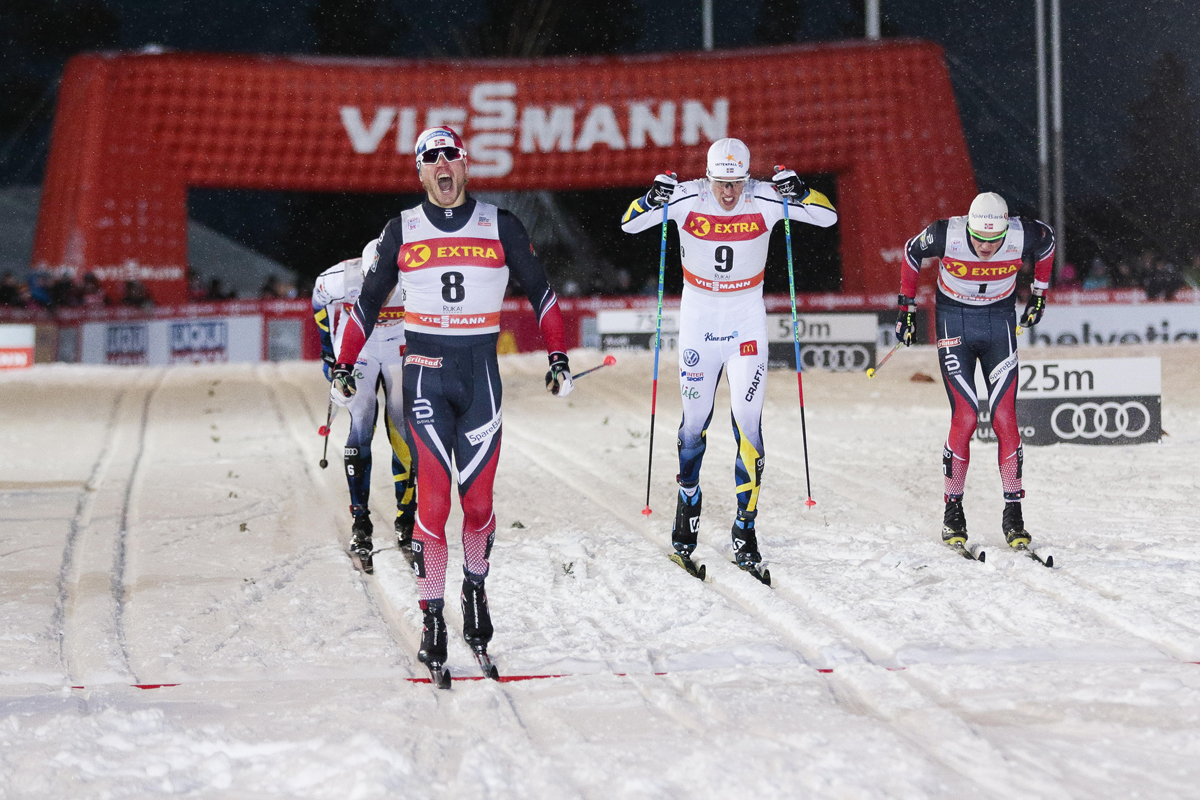
    Norway's Pål Golberg (8) celebrates his first classic sprint win in the first World Cup of the 2016/2017 season on Saturday after beating out Sweden's Calle Halfvarsson (9), Norway's Johannes Høsflot Klæbo (far right) and Sweden's Teodor Peterson (behind), respectively, in Kuusamo, Finland. (Photo: Fischer/NordicFocus)
    Norway’s Pål Golberg (8) celebrates his first classic sprint win in the first World Cup of the 2016/2017 season on Saturday after beating out Sweden’s Calle Halfvarsson (9), Norway’s Johannes Høsflot Klæbo (far right) and Sweden’s Teodor Peterson (behind), respectively, in Kuusamo, Finland. (Photo: Fischer/NordicFocus)

    The two men who landed on the first and third steps of the podium in Saturday’s World Cup opener in Kuusamo, Finland, weren’t even slated to start as of a week ago. But 20-year-old Johannes Høsflot Klæbo’s breakthrough sprint result in Beitostølen, Norway, last weekend put him on the Norwegian national team’s radar, and Pål Golberg received a call on Wednesday that he could start in Petter Northug’s place. Northug chose to skip the opening World Cup weekend because his energy wasn’t where he wanted it to be.

    “It’s just so competitive [this] time of year,” Canadian Alex Harvey observed in a post-race phone interview. “The Norwegians that were first and third [Golberg and Klæbo], they weren’t even supposed to race today, it’s just ’cause [Eirik] Brandsdal got sick and Northug decided not to come, so guys were racing for their season today. … Guys are racing just to be allowed to start next weekend, so I think guys from the big nations — Russia, Finland, Sweden, and Norway — they come in close to the best shape of the season here. I think one of the deepest fields we get is Kuusamo.”

    In spite of the depth, Golberg and Klæbo rose to the top, with just Sweden’s Calle Halfvarsson coming between them in second place. In his second World Cup start (his other was a classic sprint last February), Klæbo, of Norway’s U23 Team, put down the fastest qualifying time on the 1.4-kilometer course in 2:50.7 minutes. Russia’s Alexander Panzhinskiy clocked in 0.81 seconds slower in second, and the next-fastest qualifier, Estonian Marko Kilp was 2.01 seconds off Klæbo’s time in third.

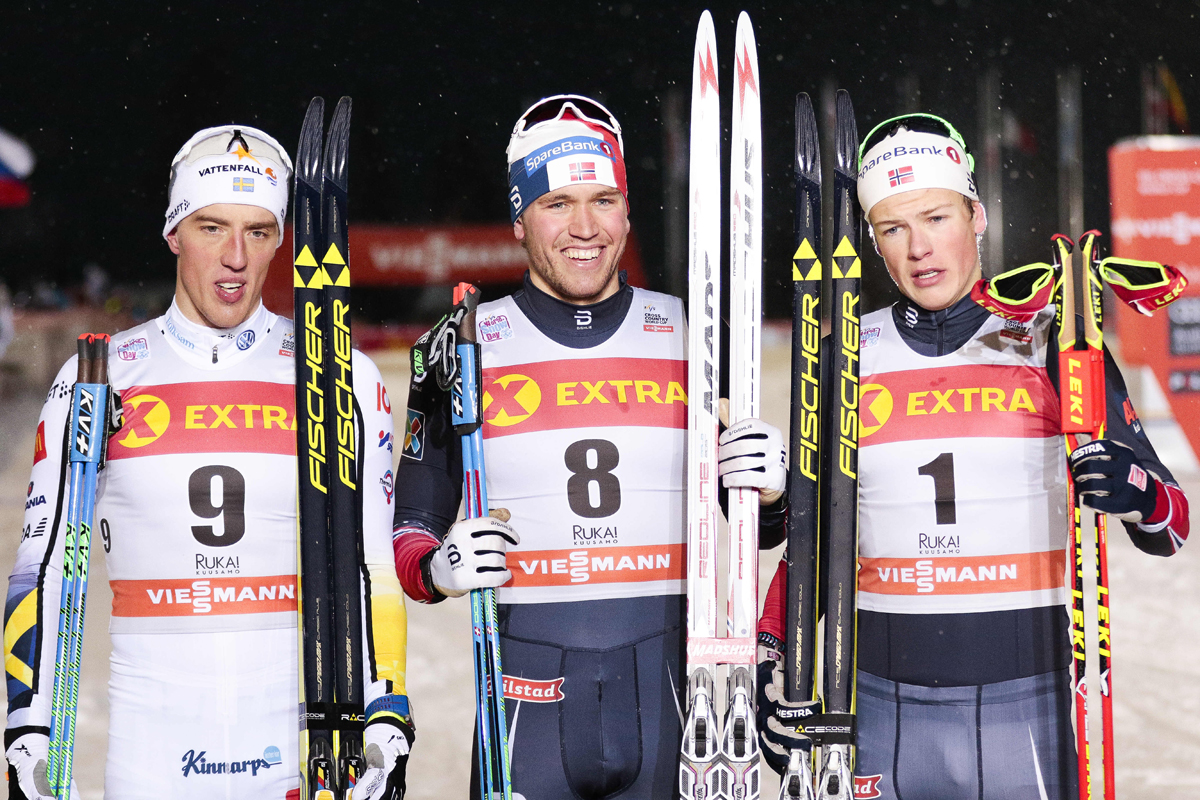
    The men's classic sprint podium in the first World Cup race of the season on Saturday in Kuusamo, Finland, with Norway's Pål Golberg (c) in first, Sweden's Calle Halfvarsson (l) in second, and Norway's 20-year-old Johannes Klaebo (r) in third. (Photo: Fischer/NordicFocus)
    The men’s classic sprint podium in the first World Cup race of the season on Saturday in Kuusamo, Finland, with Norway’s Pål Golberg (c) in first, Sweden’s Calle Halfvarsson (l) in second, and Norway’s 20-year-old Johannes Klaebo (r) in third. (Photo: Fischer/NordicFocus)

    Meanwhile, Golberg, a 26-year-old former Norwegian World Cup Team member, qualified eighth, 3.4 seconds back. From there, Klæbo in bib 1 rode his momentum all the way to the final, winning his quarterfinal and semifinal by charging to the front of the pack on the last of Ruka’s two sprint climbs: a grueling, 150-meter-long ascent into the stadium.

    Golberg placed fourth in his quarterfinal, nipping Harvey by two-hundredths of a second for the final spot in the semifinals. That ended Harvey’s racing for the day and put the Canadian 25th overall.

    “I knew it was a fast heat so I was hoping that fourth place would be lucky loser, so that’s what I was fighting for,” Harvey explained. “But in the end it was just not enough. But I never felt that I was totally out of it until I crossed the line and I knew I couldn’t come around Pål.”

    While Harvey reflected that his skis may have had just a bit too much grip in the powdery conditions, Golberg had another chance in the semifinals. There, the Norwegian raced to second in another photo finish — this time with Klæbo.

    “In the quarterfinals I had a pretty bad climb; I lost a few spots so I decided to stay more in the back in the semifinals and that worked out,” Golberg said in a post-race interview with FIS.

    While Klæbo led his semifinal competitors into the last climb, Golberg pushed past Finland’s Ari Luusua to move into second by the top. In the last 250 or so meters of the race, which flattens out and curves left into the finish, Golberg chased down Klæbo and finished 0.02 seconds behind him. Both automatically advanced to the final, and considering theirs was the fastest of the two semifinals, so did Sweden’s Halfvarsson and Teodor Peterson in third (+0.42) and fourth (+1.17) in that heat.

    In the final, Panzhinskiy — the lone Russian in the final (two Russians reached the women’s final) — set the pace out of the start while the two Swedes followed in second and third. Halfvarsson rode his faster skis on an early descent past Panzhinskiy, while Krogh lost contact with the group early.

    With Panzhinskiy on one side of Halfvarsson and Klæbo on the other, the Russian and young Norwegian challenged the Swede up the first climb, but Halfvarsson kept his spot up front. Panzhinskiy drafted and passed him on the descent before the last climb, leading Klæbo, Halfvarsson and Golberg into the base of it, while Peterson stayed in contact in back. (Krogh was well out of camera range at this point.)

    Halfvarsson pushed to move into first early in the climb while Golberg ran outside the track on the far left and seized the lead over the top. Peterson double poled behind Halfvarsson and Golberg raced away from the pack to secure the victory in 2:54.12. Halfvarsson stayed ahead of Klæbo and Peterson for second place (+0.75), while Klæbo, close on Halfvarsson’s heels, switched lanes with less than 100 meters to go to edge Peterson for third (+0.87). Peterson took fourth (+1.06), Panzhinskiy settled for fifth (+8.22), and Krogh came through the stadium casually, 1:12 minutes after Golberg in sixth.

    According to Krogh’s hometown paper, Altaposten, he decided to save his energy for Sunday’s 15 k classic after failing to stay with the group early in the race. He stopped on the last hill to talk to coaches.

    Canada's Alex Harvey (r) congratulates Norwegian winner Pål Golberg at the finish of Friday's 1.5 k freestyle sprint final. Harvey placed fifth for a season best. (Photo: Fischer/NordicFocus)
    Canada’s Alex Harvey (r) congratulates Norwegian winner Pål Golberg at the finish of a 2014 World Cup freestyle sprint in December 2014. Harvey placed fifth in that race. (Photo: Fischer/NordicFocus)

    At the finish, Golberg smiled as he patted Klæbo on the back. It was Klæbo’s first World Cup podium, and Golberg’s fourth career win.

    “This means a lot to me,” Golberg told NRK after. “I know very well that I can ski fast, but it’s always nice to be able to remind others of that.

    “It’s a bonus that I’m here,” he added. “I know that the members of the [national] team have first priority, and that makes even more to perform well.”

    The win came a week after Golberg finished second to Klæbo by 0.5 seconds in a freestyle sprint FIS race in Beitostølen. On Saturday, Klæbo told NRK in a TV interview that he was very pleased with his second World Cup start. (He placed 15th in the Drammen classic sprint last season.)

    “I didn’t chose the right tracks in the last hill and the end of the final, but I’m still happy about the third place,” Klæbo said.

    It snowed Friday night and throughout the day on Saturday, making Ruka’s notoriously tough sprint course even more challenging. Harvey estimated there were three to five centimeters of fresh snow in the morning, and snow continued to fall into the afternoon. He said organizers didn’t groom after around midnight on Friday to avoid making the course even softer.

    “These were quite difficult conditions with the new snow, but I had perfect skis,” Golberg told FIS. “Most important today was to have a good kick on the uphill. It is great to start the season with the win.”

    Sweden's Calle Halfvarsson racing to second in the 4.4 k freestyle prologue, the first stage of the 2015 Tour de Ski on Saturday in Obertsdorf, Germany. (Photo: Fischer/NordicFocus)
    Sweden’s Calle Halfvarsson racing to second in the first stage of the 2015 Tour de Ski, a 4.4 k freestyle prologue, in Obertsdorf, Germany. (Photo: Fischer/NordicFocus)

    For Halfvarsson, it was his first podium in a classic sprint and first time back on the podium in an individual World Cup since the Tour de Ski two years ago.

    “I am very happy,” the 27-year-old Halfvarsson said. “[The] finish was really hard today. Pål was very strong there. The crowd was great.”

    Harvey, who narrowly made the top-30 qualifying cutoff in 28th said he was happy to make the heats. He called Kuusamo one of the hardest places to qualify because of the depth of the field. Last year at the same venue, he placed 47th in the classic-sprint opener.

    “Just qualifying made the day a positive day already,” he said. “It was a really tricky day to find the right combination of glide and kick at the same time. In the qualifier, I went for an option with kind of slick skis, but fast, and I think the skis were really fast in qualification, but I went maybe a little too thin on the grip so I came out of the track a little earlier than I would’ve hoped for, but it was still good enough to just sneak in there.”

    For his quarterfinal, in which he faced Golberg, Halfvarsson, Russia’s Anton Gafarov, Norway’s Sondre Turvoll Fossli, and Finland’s Sami Jauhojärvi, Harvey went for more grip.

    “Knowing that it would come down to the last climb, the strategy was to go for a little more kick,” Harvey said, adding that he decided the night before to go on faster, slicker skis for the qualifier then switch to more grip for the heats. “I think I might’ve just overdid it a little bit, but the skis were still good. They were still fast.”

    Finding himself around fifth place for most of his quarterfinal, Harvey stayed in contact with the four frontrunners until the base of the last big uphill. Despite being several strides behind the group, he caught up to Golberg by the top.

    Canada's Alex Harvey racing to ninth in the second stage of the Ski Tour Canada, the men's 17.5 k classic mass start, on Wednesday in Montreal, Quebec. (Photo: John Lazenby/Lazenbyphoto.com)
    Canada’s Alex Harvey racing to ninth in the second stage of the 2016 Ski Tour Canada, the men’s 17.5 k classic mass start, in Montreal, Quebec. (Photo: John Lazenby/Lazenbyphoto.com)

    “In the hill, I had the skis to make a move, but you need to be so quick up that hill and I’m better when there’s more of a gliding phase in each stride, and when it’s just running like that, I’m not as quick as some of the other guys so I kind of got stuck in fifth,” he said. “In the finish I was starting to come around Pål Golberg for lucky loser, it was a photo finish between us, but I knew he beat me before I saw the photo and in the end he ended up winning the day, and at the end of the day, I had the best two guys in my quarterfinal.”

    All things considered, Harvey said he felt good. “I take a lot of positive out of the day but it was not perfect. I just have to be a bit stronger in the finish.”

    The seventh-ranked man in the overall World Cup last season, Harvey was the lone North American qualify for the men’s sprint rounds on Saturday.

    Andy Newell led the U.S. men in 40th, missing the top 30 by 0.48 seconds and finishing 7.74 seconds behind Klæbo. Another 0.07 seconds back, Newell’s teammate Erik Bjornsen placed 42nd (+7.81), and last year’s SuperTour winner Eric Packer finished 78th (+17.3) out of 94.

    “It was unexpected for me not to make the top 30 today,” Newell wrote in an email. “I felt pretty decent, but then again have not done any maximal efforts in about two weeks because of my elbow infection so it was hard to tell. I think it was a combination of being a little flat and also dragging a little too much kick wax around the course.”

    Andy Newell (U.S. Ski Team) on his way to 40th in the men's classic-sprint qualifier in the first race of the 2016/2017 World Cup season on Saturday in Kuusamo, Finland. (Photo: Fischer/NordicFocus)
    Andy Newell (U.S. Ski Team) on his way to 40th in the men’s classic-sprint qualifier in the first race of the 2016/2017 World Cup season on Saturday in Kuusamo, Finland. (Photo: Fischer/NordicFocus)

    Saturday marked Newell’s first race of the season after having to sit out the Beitostølen opener with a bacterial infection.

    “He healed up really quickly,” U.S. coach Matt Whitcomb said on the phone after Saturday’s race. “He’s been really smart in his preparation, he hasn’t been overreaching, and today I think he was a little bit flat. He wasn’t too far out; things were pretty tight. I think that’s as far as we have to look there. He’s been looking pretty good and I think it’s a matter of getting a race under his belt.”

    Whitcomb said Newell would likely start Sunday’s 15 k classic, but Newell didn’t give a definitive answer.

    “I will feel things out tomorrow and see how it goes,” Newell wrote. He was listed on Sunday’s start list.

    Simi Hamilton did not start on Saturday, and Whitcomb said he’s trying to get over a small cold.

    “[Not] a full-blown cold, but slightly elevated heart rate when he moves, and just general feelings of lower energy,” Whitcomb explained. “He was feeling quite a bit better yesterday so we had him do a short little race prep to test things out, about a half an hour of skiing, and it ended up sending him in the wrong direction, not dramatically but it gave us the information that we needed to say, ‘Hey, it’s not going to be smart to start today.’ ”

    Len Valjas placed 54th for Canada, 11.28 seconds off of the top qualifying time, Devon Kershaw was 63rd on the day (+12.28), Knute Johnsgaard 69th (+13.46), Bob Thompson 80th (+17.64), and Jess Cockney 83rd (+19.52).

    Final results | Qualifying | 15 k classic start list

  • Saturday Rundown: Ruka, West Yellowstone & (Not) Beitostølen (Updated x4)

    Saturday Rundown: Ruka, West Yellowstone & (Not) Beitostølen (Updated x4)

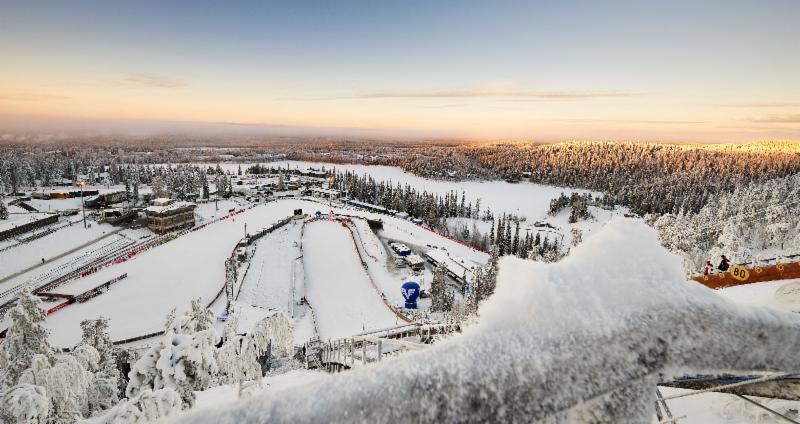
    The Ruka stadium from above in Kuusamo, Finland. (Photo: Toko)
    The Ruka stadium from above in Kuusamo, Finland. (Photo: Toko)

    Welcome to The Rundown, your quick primer of need-to-know information about the day’s racing. We’ll be updating this digest as the day goes on with additional results, photos and quotes. The Rundown is NOT a race report; stay tuned for complete race reports later today with interviews from the day’s top racers.

    ***

    West Yellowstone FIS Races: 5/10 k classic 

    Scott Patterson (APU) double poling to the win in the men's 10 k classic FIS race on Saturday in West Yellowstone, Mont. (Photo: Ian Harvey/Toko)
    Scott Patterson (APU) double poling to the win in the men’s 10 k classic FIS race on Saturday in West Yellowstone, Mont. (Photo: Ian Harvey/Toko)

    Scott Patterson of Alaska Pacific University (APU) continued his winning streak on Saturday, topping the 10-kilometer classic FIS race at the Rendezvous Ski Trails in West Yellowstone, Mont. (In the two FIS races he’s competed in — the other being a 7.5 k freestyle last weekend in Fairbanks, Alaska — Patterson is undefeated.) He won Saturday’s classic race in 22:12.2 minutes, more than 20 seconds ahead of runner-up Matt Gelso, of the Sun Valley Ski Education Foundation (SVSEF), who placed second (+20.8). Ben Lustgarten, of the Craftsbury Green Racing Project (CGRP), improved on his fifth-place finish in Friday’s 10 k freestyle, reaching the podium in third (+23.4).

    David Norris (APU) placed fourth (+30.0), Kevin Bolger (University of Utah) was fifth (+33.1), and Ben Saxton, of the Stratton Mountain School (SMS) T2 Team, was sixth (+38.9). Petter Reistad, of the University of Colorado-Boulder (CU), finished seventh (+45.7), Daniel Streinz (Mountain Endurance Sports) took eighth (+49.9), Friday’s winner Paddy Caldwell, of SMS, Dartmouth College and the U.S. Ski Team (USST), was ninth (+56.0), and Martin Mikkelsen (Utah) placed 10th (+1:00.8) out of 70 male finishers.

    In the women’s 5 k classic, Craftsbury’s Liz Guiney took the win in 13:06, edging Utah freshman Merete Myrseth by just 0.3 seconds. Friday’s 5 k freestyle winner, Katharine Ogden (SMS/USST) reached the podium again in third (+11.1), Jesse Knori (CU) was fourth (+13.5), and Erika Flowers (SMST2) fifth (+18.2) on her 27th birthday.

    Kaitlynn Miller (CGRP) took sixth (+21.8), Christina Rolandsen (CU) was seventh (+21.9), Petra Hyncicova (CU) eighth (+24.1), Guro Jordheim (Utah) ninth (+28.9), and Jennie Bender, of the Bridger Ski Foundation, 10th (+31.2), out of 74 female finishers.

    While this weekend’s FIS races are over, West Yellowstone will host again next weekend, as Bozeman SuperTour organizers announced Friday afternoon that it was moving its races to West, its southern neighbor, because of a lack of snow. Next weekend’s SuperTour races will be the first of the season, featuring the originally planned freestyle sprints on Saturday, Dec. 3, and 10/15 classic races on Sunday, Dec. 4.

    Results

    ***

    FIS Cross-Country World Cup in Ruka: Classic sprint:

    Women’s report | Men’s report | Kikkan Randall interview

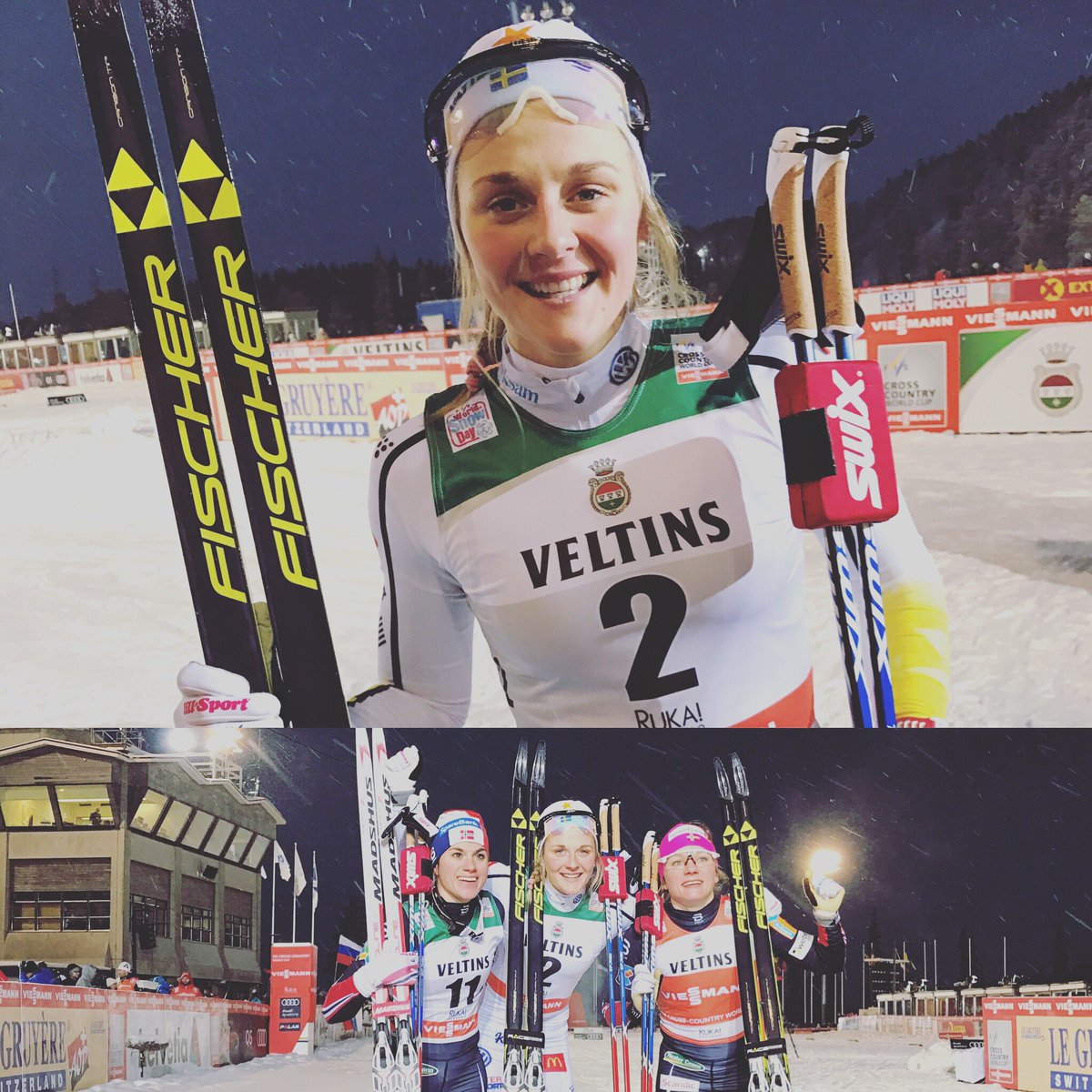
    Sweden's Stina Nilsson (top and bottom center) won her first World Cup classic sprint on Saturday in the first race of the 2016/2017 World Cup season. Norway's Maiken Caspersen Falla (bottom right) placed second and Heidi Weng (bottom left) was third. (Photo: FIS Cross Country Twitter)
    Sweden’s Stina Nilsson (top and bottom center) won her first World Cup classic sprint on Saturday in the first race of the 2016/2017 World Cup season. Norway’s Maiken Caspersen Falla (bottom right) placed second and Heidi Weng (bottom left) was third. (Photo: FIS Cross Country Twitter)

    Sweden’s Stina Nilsson and Norway’s Pål Golberg emerged as the big winners on Saturday in the first race of the 2016/2017 FIS Cross-Country World Cup season, winning the women’s and men’s 1.4-kilometer classic sprint finals, respectively, in Kuusamo, Finland.

    After qualifying second, Nilsson won both her quarterfinal and semifinal before dethroning Norway’s Maiken Caspersen Falla in the final. Falla had not lost a World Cup classic sprint since February 2015 (two seasons ago in Östersund, Sweden). Falla won her quarterfinal and placed third in her semifinal, advancing to the final as a lucky loser with Finland’s Krista Parmakoski. There, Nilsson held off Falla by 0.17 seconds and won the final in 3:21.61. Heidi Weng was the second Norwegian on the podium in third (+0.69), finishing ahead of two Russians, Natalia Matveeva (4th, +3.18) and Yulia Belorukova (6th, +8.94) and Parmakoski (5th, +5.12).

    “This is also my first victory in classic so I’m very, very happy,” Nilsson told FIS in an on-air, post-race interview.

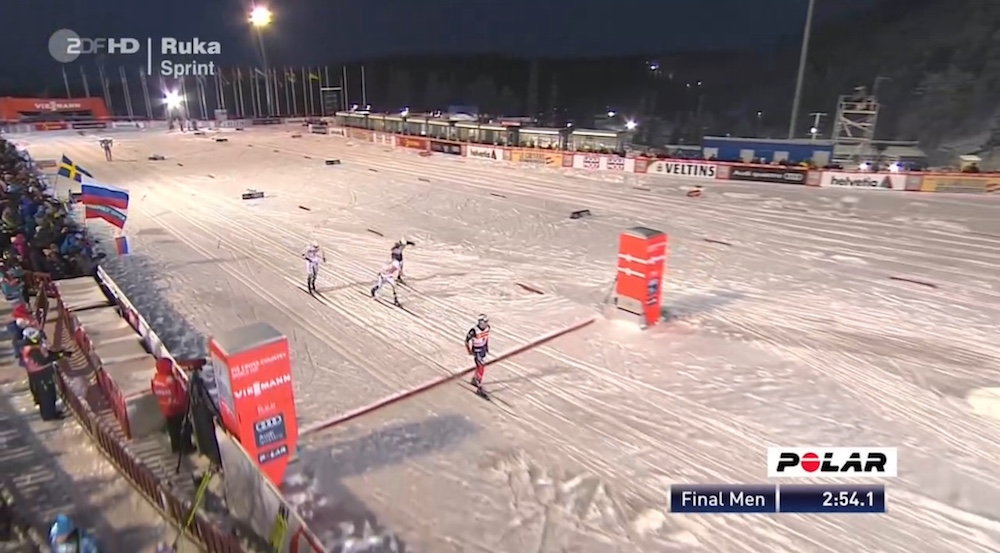
    Norway's Pål Golberg crossing the finish line a few ski lengths ahead of his competition in the men's classic sprint final on Saturday at the World Cup opener in Kuusamo, Finland. Sweden's Calle Halfvarsson placed second, and Norway's Johannes Klæbo edged Sweden's Teodor Peterson for the final podium spot in third. (Photo: NRK screenshot)
    Norway’s Pål Golberg (r) crossing the finish line a few ski lengths ahead of his competition in the men’s classic sprint final on Saturday at the World Cup opener in Kuusamo, Finland. Sweden’s Calle Halfvarsson placed second, and Norway’s Johannes Klæbo edged Sweden’s Teodor Peterson (l) for the final podium spot in third. (Photo: NRK screenshot)

    In the men’s final, Golberg surged past his competitors on Ruka’s infamous final climb and held off Sweden’s Calle Halfvarsson by 0.75 seconds for the win. Golberg found out on Wednesday of this week that he had been tapped for the sprint, after fellow Norwegian Petter Northug opted out of this weekend.

    “I knew my shape was good, but the skiers from the national team are good skiers so that’s why I wasn’t supposed to be here but Petter got sick so that’s why I’m here,” Golberg told FIS in a post-race interview. “In the quarterfinals, I had a pretty bad climb [on the final hill]. I lost a few spots so I decided to stay more in the back in the semifinals and that worked out.”

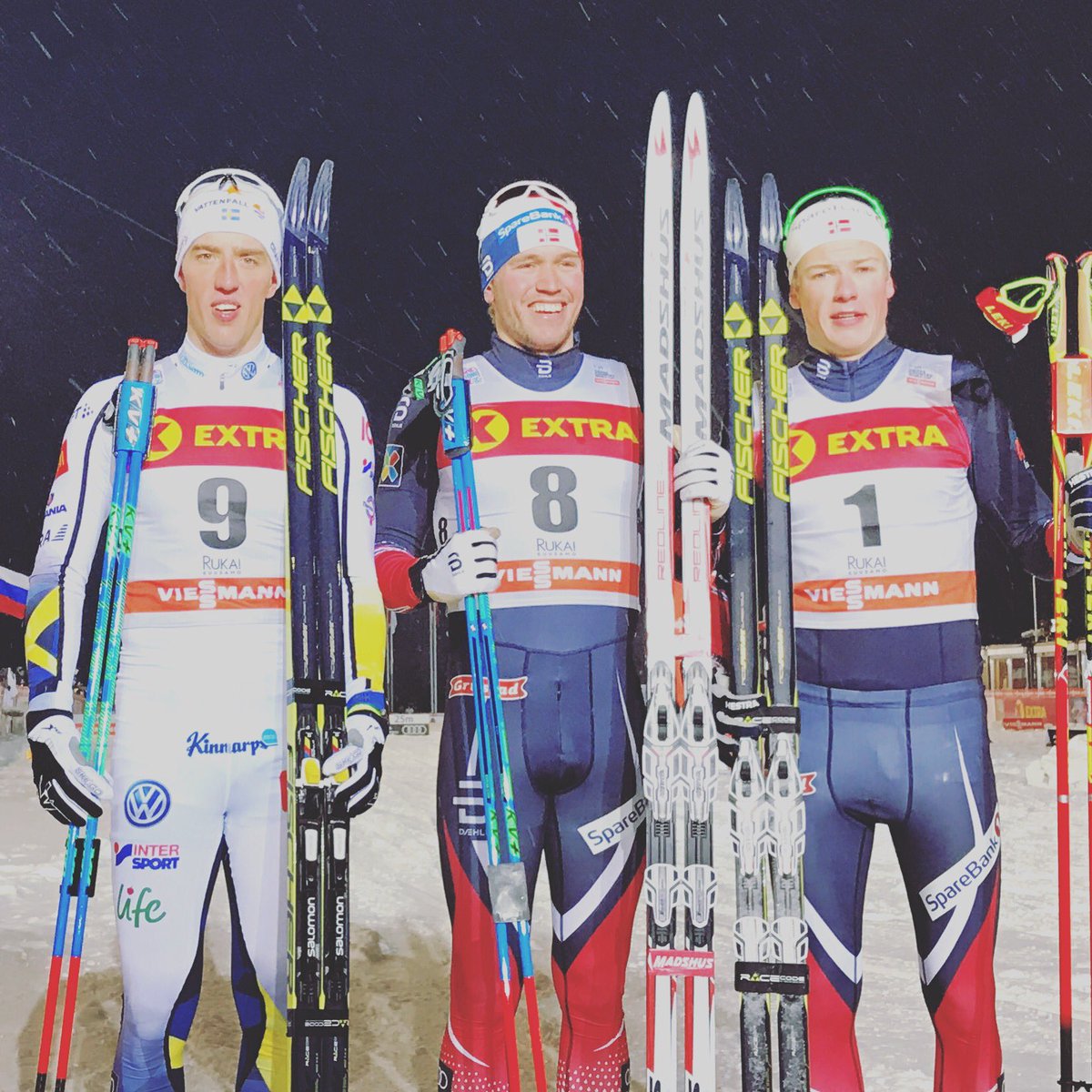
    The men's classic sprint podium in the first World Cup race of the season on Saturday in Kuusamo, Finland: Norway's Pål Golberg (c) placed first, Sweden's Calle Halfvarsson (l) was second, and Norway's 20-year-old Johannes Klaebo (r) was third. (Photo: FIS Cross Country Twitter)
    The men’s classic sprint podium in the first World Cup race of the season on Saturday in Kuusamo, Finland: Norway’s Pål Golberg (c) placed first, Sweden’s Calle Halfvarsson (l) was second, and Norway’s 20-year-old Johannes Klaebo (r) was third. (Photo: FIS Cross Country Twitter)

    After placing fourth in his quarterfinal, Golberg advanced as a lucky loser. In the semifinals, he placed second to ensure his spot in the final. He won the final in 2:54.12, Halfvarsson was second (+0.75) and Norway’s 20-year-old Johannes Klæbo captured his first World Cup podium in his second-ever World Cup in third (+0.87). Sweden’s Teodor Peterson narrowly missed the podium in fourth (+1.06), Russia’s Alexander Panzhinskiy was fifth (+8.22), and Norway’s Finn Hågen Krogh finished more than a minute later in sixth (+1:12.58).

    In her comeback season after having a baby last December, Norway’s Marit Bjørgen placed 10th after finishing fifth in her semifinal (she qualified in 10th and was second in her quarterfinal). Another top Norwegian, Ingvild Flugstad Østberg placed seventh on the day after placing third in the Bjørgen’s semifinal.

    The top American, Sadie Bjornsen posted the seventh-fastest qualifying time then finished the day in 17th overall. She placed fourth in her quarterfinal. Also for the U.S. Ski Team, Sophie Caldwell placed 20th (after qualifying in 30th then placing fourth in her quarterfinal), Ida Sargent was 23rd (qualified 23rd and was fifth in her quarterfinal), and Jessie Diggins 26th (13th in the qualifier, sixth in her quarterfinal).

    The lone North American man in the heats, Alex Harvey of Canada placed 25th overall after qualifying in 28th then placing fifth in his quarterfinal. The two men directly ahead of him in his quarterfinal, Russia’s Anton Gafarov and Golberg, placed third and fourth respectively, and advanced to the semifinals as lucky losers.

    In the morning’s sprint qualifier, Parmakoski and Klæbo posted the top times.

    Parmakoski notched a 1.14-second qualifying win, ahead of three Swedish sprinters. Nilsson and Ida Ingemarsdotter finished second and third, +1.14 and +2.40 respectively. Their teammate Hanna Falk qualified in fourth (+3.70) ahead of Justyna Kowalczyk of Poland (+3.93). Østberg was the top Norwegian, qualifying in sixth (+4.05).

    Sadie Bjornsen led the U.S. team by qualifying in seventh (+4.41). Three teammates joined her in the quarterfinals: Diggins (13th, +6.27), Sargent (23rd, +10.28), and Caldwell (30th, +11.84).

    A fifth U.S. Ski Team (USST) member, Rosie Brennan missed the heats in 44th (+15.28), and in her return to the World Cup after a year of maternity leave, Kikkan Randall (USST) finished 52nd, tied with Craftsbury’s Caitlin Patterson (+19.75). For Canada, U25 Team skiers Dahria Beatty raced to 50th (+18.80), followed by Cendrine Browne in 62nd (+26.05).

    Klæbo eked out a narrower victory in the qualifier, edging Russia’s Panzhinsky by just 0.81 seconds. Marko Kilp of Estonia qualified third, +2.01, followed by two Finns: Ari Luusua (+2.18) and Anssi Pentsinen (+2.22). Peterson of Sweden rounded out the top six (+2.31).

    The lone North American qualifier was Harvey in 28th (+6.94). His Canadian teammates were left out of the heats: Len Valjas 54th (+11.28), Devon Kershaw 63rd (+12.28), Knute Johnsgaard 69th (+13.46), Bob Thompson 80th (+17.64), Jesse Cockney 83rd (+19.52), and Andy Shields 91st (+25.07).

    Simi Hamilton did not start for the U.S., and according to U.S. coach Matt Whitcomb, he is fighting a small cold. Andy Newell led the team in 40th (+7.74), shortly followed by Erik Bjornsen in 42nd (+7.81). SuperTour leader Eric Packer of Alaska Pacific University finished 78th (+17.30).

    The World Cup continues Sunday with the 10/15 k classic individual starts in Ruka.

    Qualifier results: men | women

    Final results: men | women

    ***

    FIS Nordic Combined World Cup in Ruka: Individual Large Hill/10 k

    In the first Nordic Combined World Cup competition of the season, also in Kuusamo, Akito Watabe of Japan won the jumping round with a total of 145 points. Johannes Rydzek of Germany jumped into second. After jumping Bryan Fletcher was sitting in 32nd place for the U.S. and Ben Berend in 38th. The Americans started the cross-country race 3:54 and 4:08 behind Watabe.

    In the 10 k Gundersen start, Fletcher improved to 23rd and Berend did not start. Fletcher finished 4:06.5 behind the winner of the day, Rydzek, who won in 27:31.7. Germany took the top two spots on the podium with Eric Frenzel in second (+34.1). Frenzel skied the fastest course time in 26:52.8, moving up six spots after ranking eighth in the jump.

    Norway’s Jørgen Graabak placed third (+45.6) and Watabe ultimately finished seventh (+1:23.5). The World Cup continues Sunday in Kuusamo with another large hill/10 k individual competition.

    Final results

    ***

    IBU Cup Beitostølen: 7.5/10 k sprint

    The IBU Cup in Beitostølen, Norway, has been canceled for the day due to strong winds. The men’s and women’s sprints are rescheduled for Sunday.

  • Tomas Northug Gets His, Wins First World Cup in Otepää Classic Sprint

    Tomas Northug Gets His, Wins First World Cup in Otepää Classic Sprint

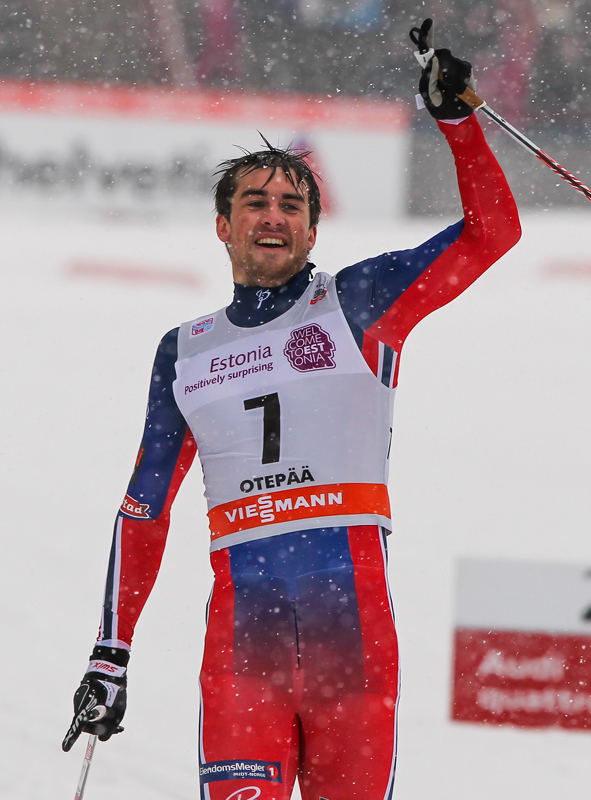
    Norway's Tomas Northug, 24, celebrates his first World Cup win on Saturday in the men's 1.5 k classic-sprint final in Otepää, Estonia. (Photo: Fischer/NordicFocus)
    Norway’s Tomas Northug, 24, celebrates his first World Cup win on Saturday in the men’s 1.5 k classic-sprint final in Otepää, Estonia. (Photo: Fischer/NordicFocus)

    If he hadn’t been a Northug, one might have wondered what that 24-year-old Norwegian was doing.

    Tomas Northug had already ditched his hat during the men’s 1.5-kilometer classic sprint on a snowy, just-above-freezing afternoon in Otepää, Estonia. And not long after the start of the final, he made it clear that he was going to drop everyone else if he could, too.

    Commentators remarked that his surge early on the first of two climbs on the 1,500-meter course had been very Northug-like, referring to the gutsy performances often churned out by his older brother Petter.

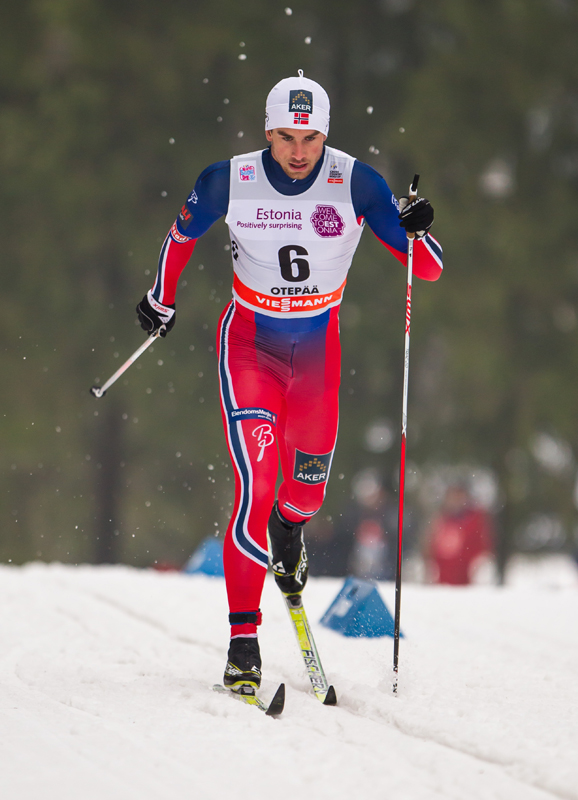
    Norway's Tomas Northug in Saturday's 1.5 k classic-sprint qualifier, in which he advanced in seventh and went on to win the final for his first World Cup win in Otepää, Estonia. (Photo: Fischer/NordicFocus)
    Norway’s Tomas Northug in Saturday’s 1.5 k classic-sprint qualifier, in which he advanced in seventh and went on to win the final for his first World Cup win in Otepää, Estonia. (Photo: Fischer/NordicFocus)

    But Petter wasn’t racing on Saturday — Tomas was — and he made his presence known after advancing from the semifinal in fourth as a lucky loser (who was luckily not taken out by Russian Sergey Ustiugov’s late, self-inflicted crash).

    Out of the start in the final, Northug positioned himself in second, sitting on the heels of Norwegian teammate Finn Hågen Krogh, the Sprint World Cup leader who opted to double pole on skate skis for the final, while staying ahead of the final’s other Norwegian double-poler, Pål Golberg, in third.

    At the base of the first climb, it became apparent that double poling was not the way to go in the slow-and-chewed-up snow, and Northug stepped right to get around Krogh and move to first. The double-polers hopped in behind him by the midway point of the climb, and from there, they started to lose Northug. He strode away while the three others on classic skis (Finland’s Toni Ketelae, and Norway’s Ola Vigen Hattestad and Sondre Turvoll Fossli) lost contact in a one-track train behind Krogh and Golberg.

    By the top, Northug heard he had a 50-meter gap from a Norwegian coach (arguably closer to 40 meters) and he took his word, refraining from looking back until several strides later as he began the tuck down the backside of the hill. Meanwhile, another up-and-comer seeing a World Cup breakthrough, Ketelae, 26, led the chase with Hattestad, both several seconds behind on the first descent.

    “I feel there was room and I came up the uphill and I think about the race Bjørgen did many years ago,” Northug said in a post-race interview with FIS in broken English. “The coach [on] the uphill say I had fifty [meters] and say to go so I do it.”

    In the second semifinal, Ketelae edged four Norwegians (Fossli, Eirik Brandsdal, Timo Andre Bakken, and Vegard Bjerkreim Nislen, respectively) and Russia’s Alexander Panzhinskiy for the win. With that confidence, he chased down Northug to the best of his ability in the final, but the young Norwegian was too far gone.

    Northug ran with a narrow herringbone up the steepest of the two hills, getting more encouragement from Norwegian coaches, and Ketelae and Hattestad skied together some six seconds behind on the following downhill.

    With 200 meters remaining, Northug double poled up and over the last rise, glanced back once more and realized the race was his. He nearly took himself out on the lefthand corner before the finishing straight, teetering for a moment on his inside ski in all his excitement, but picked the center lane and double poled like mad to the line. There, sealing the win in 3:50:59, he looked back, raised his arms to his chest and pumped them fiercely, gesturing that he, in fact, was the man.

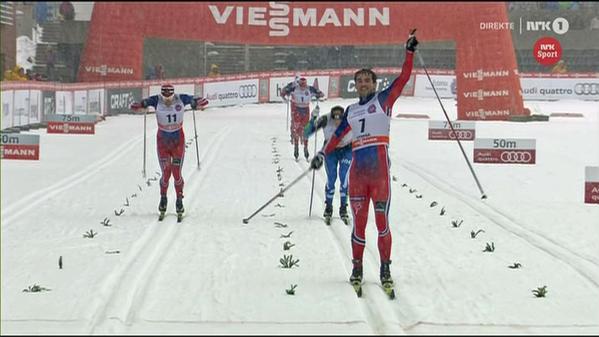
    Norway's Tomas Northug (7) celebrates his first World Cup victory and podium on Saturday in the men's classic sprint in Otepää, Estonia, while teammate Ola Vigen Hattestad (l) challenges Finland's Toni Ketelae (in blue behind Northug) for second.
    Norway’s Tomas Northug (7) celebrates his first World Cup victory and podium on Saturday in the men’s classic sprint in Otepää, Estonia, while teammate Ola Vigen Hattestad (l) challenges Finland’s Toni Ketelae (in blue behind Northug) for second.

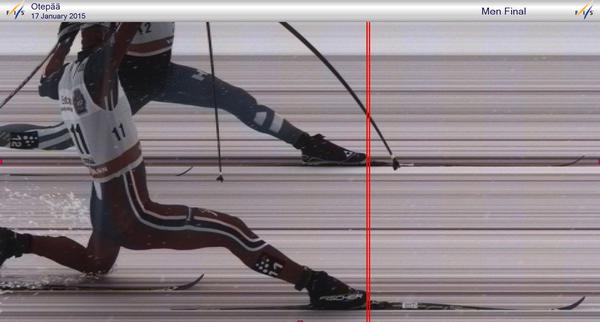
    Trailing Ketelae into the stadium, Hattestad jumped to a left lane to challenge the Finn for second. Hattestad outlunged Ketelae in such a close photo finish, time couldn’t even determine it, but a finish-line camera could. The two finished 1.57 seconds after Northug, with Ketelae placing third for his first World Cup top 10 and podium.

    After holding his own in fourth for much of the final, Golberg placed fourth, 6.28 behind Northug, and Krogh finished about a second ahead of Fossli, who struggled to keep pace early on and finished 9.23 seconds back.

    “It was not really plan to [go ahead] like that, but I felt very strong,” Northug told NRK, according to a translation.  “There are some feelings, it is clear there. I have put an enormous amount of work, but not quite achieved what I want. And then came here today.”

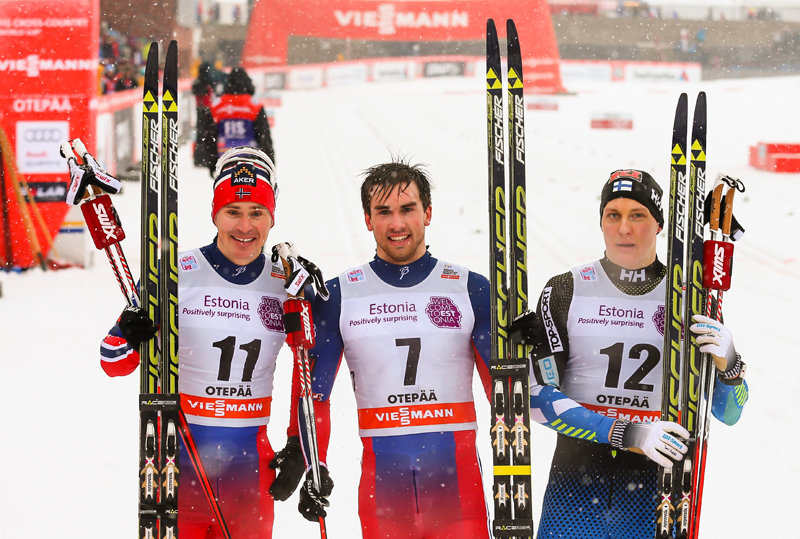
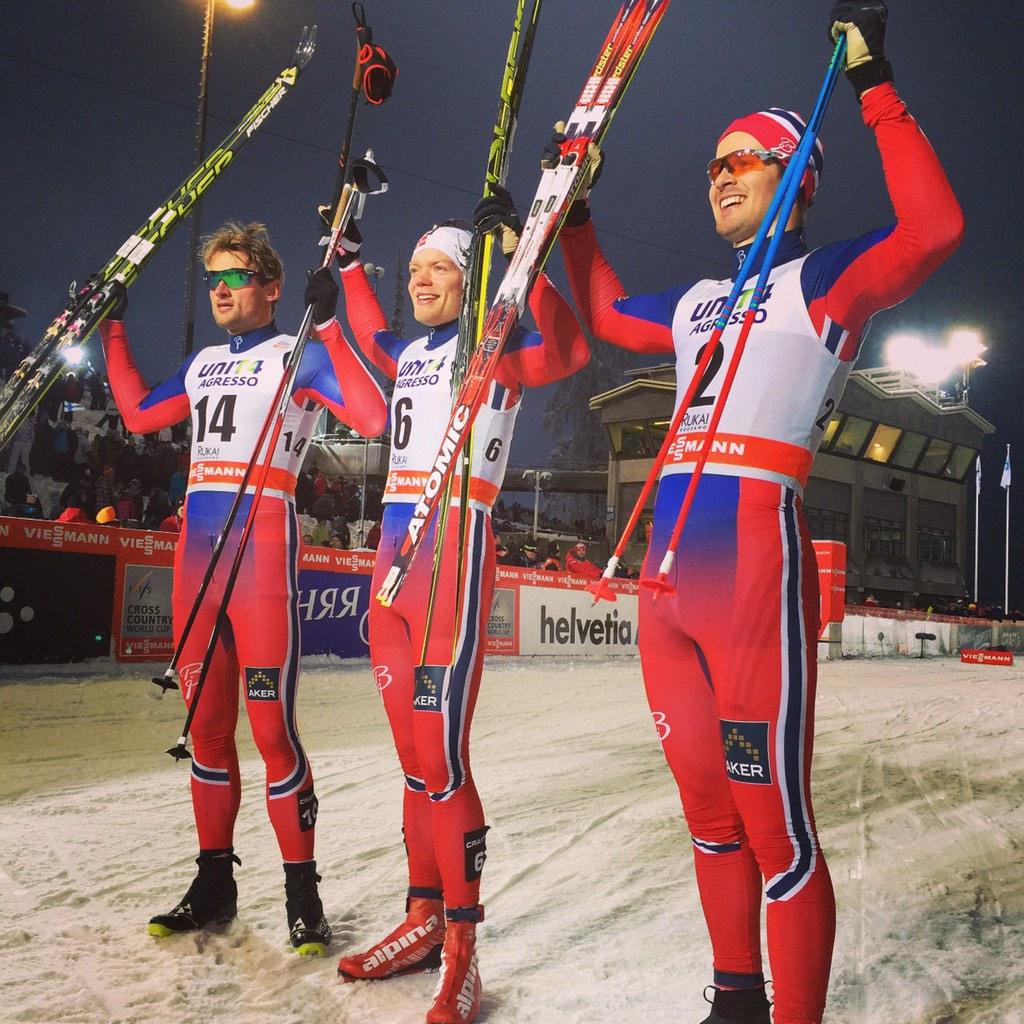
    The men's classic-sprint podium in Otepää, Estonia: with Norwegian winner Tomas Northug (c), Ola Vigen Hattestad (l) of Norway in second, and Finland's Toni Ketelae (r) in third. (Photo: Fischer/NordicFocus)
    The men’s classic-sprint podium in Otepää, Estonia: with Norwegian winner Tomas Northug (c), Ola Vigen Hattestad (l) of Norway in second, and Finland’s Toni Ketelae (r) in third. (Photo: Fischer/NordicFocus)

    Northug’s previous best was fifth in a classic-sprint final at 2013 World Cup Finals in Stockholm, Sweden. In the only other classic sprint before Saturday’s this season, he missed the final but placed eighth in Kuusamo, Finland, and was sixth in a freestyle sprint last month in Davos, Switzerland.

    He qualified for the heats on Saturday in seventh, 4.4 seconds behind Golberg, who set the fastest qualifying time in 3:17.61. Times were notably slower as the day wore on, with the track breaking down amid wet-and-heavy snowfall and with each passing round of men’s and women’s heats. Fossli qualified second, 1.68 seconds back, and Brandsdal, in the hunt for the Sprint World Cup title, ranked third (+2.74).

    The fourth-fastest qualifier, Sweden’s Emil Jönsson edged Northug in their quarterfinal by 0.06 seconds in 3:26.74, which ended up being the second-fastest men’s heat. The two advanced to the semifinals, where Northug got a boot out ahead of Jönsson, who was behind Ustiugov when the Russian poled between his legs and face planted in the finishing stretch. Ustiugov fell into Northug on his left, but Northug avoided escaped with a minor clip and strode a few steps toward the line with Jönsson charging on his right.

    The photo-finish picture from the men's sprint for second and third in the 1.5 k classic-sprint final in 1.5 k classic sprint in Otepää, Estonia, with Hattestad (bottom) edging Ketelae. (Photo: FIS Cross Country/Twitter)
    The photo-finish picture from the men’s sprint for second and third in the 1.5 k classic-sprint final in 1.5 k classic sprint in Otepää, Estonia, with Hattestad (bottom) edging Ketelae. (Photo: FIS Cross Country/Twitter)

    Northug nipped him by 0.16 seconds for the final lucky loser spot, despite finishing fourth in his heat (Jönsson was fifth and Ustiugov finished 14 seconds later in sixth).

    Ketelae qualified in 12th and went on to win his quarterfinal, half a second ahead of Fossli, and his semifinal as well, by six-hundredths of a second over Fossli and nine-hundredths of a second ahead of Brandsdal. Right then and there, the Finn had already achieved a career-best day.

    “It is amazing to finish third today,” Ketelae told FIS. “It was my first World Cup final and my first World Cup podium result. I felt very good since the prologue.”

    Hattestad noted that the final was a gamble when it came to selecting skis.

    “I was testing three pairs of skis before the final,” he told FIS. “I think it was the most crazy final I have ever skied. I did not catch Tomas, [he went] away and then the gap was too big.”

    Results

  • Brandsdal Defends Kuusamo Sprint Title, Norway Takes Top Four with Russia in Hot Pursuit 

    Brandsdal Defends Kuusamo Sprint Title, Norway Takes Top Four with Russia in Hot Pursuit 

    An all-Norwegian men's podium on Saturday at the 1.4 k classic-sprint World Cup opener in Kuusamo, Finland. Eirik Brandsdal (c) won it, Petter Northug (l) was second and Sondre Turvoll Fossli notched a career-best third in his first World Cup final. (Photo: FIS Cross Country/Twitter)
    An all-Norwegian men’s podium on Saturday at the 1.4 k classic-sprint World Cup opener in Kuusamo, Finland. Eirik Brandsdal (c) won it, Petter Northug (l) was second and Sondre Turvoll Fossli notched a career-best third in his first World Cup final. (Photo: FIS Cross Country/Twitter)

    The World Cup season got off to a blistering start on Saturday in the northern reaches of Finland with a 1.4-kilometer classic sprint. Eighty-seven men toed the line for the prologue on a gray day in Kuusamo, Finland.

    Alexander Panzhinskiy of Russia put down the best qualifying time of 2:38.35, two-tenths of a second ahead of Norway’s Sondre Turvoll Fossli in second place and 5 1/2 seconds faster than the last man to make it to the heats, Martin Jaks of the Czech Republic.

    Norway managed to put eight men into the heats with host nation, Finland, grabbing seven of the 30 qualifying slots.  Three North Americans — Simi Hamilton (USA), Alex Harvey (CAN), and Andy Newell (USA) — qualified in 16th, 17th and 24th, respectively. Harvey went on to place 14th, Hamilton was 26th and Newell 28th after being eliminated in the quarterfinals.

    Just-below-freezing variable conditions combined with the hilly course made for difficult waxing conditions, which were evident through the day as the skiers attacked each round.

    When asked how the conditions affected wax choice on Saturday, U.S. Ski Team wax technician Gus Kaeding wrote, “Finding kick wasn’t a problem, managing icing with [a] mix of dry powder and ice was. It took a combination of wax, correct application, athletes skiing the conditions, and patience to pull off good skis.

    “When everything comes together we see a career best! Congrats Ida!” he added, referring to American Ida Sargent’s career-best fifth-place finish in the women’s sprint.

    Two memorable moments from the men’s race came from Fossli and Italy’s Federico Pellegrino in the quarterfinals. Fossli was leading the fourth quarterfinal coming into the last turn before the finishing straight, when it appeared that his pole or strap broke leaving him to cover the last few hundred meters with a single pole.  Striding hard nonetheless, he watched his teammate Finn Hågen Krogh pass him, and Krogh seemed to consider, if only for a moment, letting Fossli win.  Better safe than sorry, and he led Fossli into the finish in first and second, and the two moved on to the semifinals.

    The second moment came with Pellegrino as his heat entered the final climb before the stadium. Sitting in sixth at the base of that hill, Pellegrino swung to the outside and put in some extremely fast and hard striding, opening up a sizable gap between himself and the rest of the field by the top.  He was unable to repeat his performance in the semifinal and finished third in that heat for seventh overall.

    The final turned out to be a battle between Norway and Russia with four Norwegians and two Russians in the mix. The finalists jumped out to a clean start with the Norwegians leading the Russians into the first corner.  At the bottom of the first climb, Russia’s Sergey Ustiugov put in a brief kick to attempt to take the lead, but settled into third at the crest.

    Norway’s Petter Northug, whose technique and power had been less than stellar in his previous two heats, seemed to put it together on the final climb, looking strong and composed while powering from fourth to the front as the Russians faded.

    Northug’s teammate, Eirik Brandsdal led Fossli, Ustiugov and Northug, the last two of which were side by side, in the flat before the climb, followed by Russia’s Alexey Petukhov and Krogh. Northug moved up at the base, passing Ustiugov and Fossli. Brandsdal remained in the lead and the Norwegians kept charging ahead while the Russians appeared to lose steam with a not as much kick.

    Rising up and over the top, Northug inched ahead of Brandsdal, who slipped on his kick momentarily. Fossli moved to third ahead of Krogh. Around the last turn, Northug and Brandsdal skied alongside each other, and Brandsdal held stronger to the finish — winning in 2:34.84 by 0.47 seconds.

    Saturday's winner, Brandsdal congratulates fellow Norwegian Fossli, who placed third, at the finish of the men's classic sprint final in Kuusamo, Finland.
    Saturday’s winner, Brandsdal (l) congratulates fellow Norwegian Fossli, who placed third, at the finish of the men’s classic sprint final in Kuusamo, Finland.

    Norway swept the podium with Fossli placing third (+1.18), and Krogh took fourth (+1.69) ahead of Petukhov in fifth (+4.54) and Ustiugov in sixth (+14.63).

    For the second-straight year, Brandsdal, 28, won the Kuusamo classic-sprint (last year beating Russia’s Anton Gafarov and Sweden’s Teodor Petterson, respectively). It was his sixth World Cup victory.

    “I felt from the beginning it was my day,” he told FIS after the race. “I had also perfect skis. I struggled a little bit in the quarterfinal when I did not ski up the hill as I had planned, but the semifinal was much better. In the final I managed to keep calm and go for the victory. Sprint World Cup is one of my goals and it is great to start the season with the victory.”

    Brandsdal won both his quarterfinal (by 0.5 seconds over Sweden’s Teodor Peterson) and semifinal (by nearly two seconds over Northug). And for now, he’s in the lead for the overall 2014/2015 World Cup.

    “I saw the eyes of Peter. It will be tough next time,” Brandsdal told VG. “He is set on the [overall] yellow jersey.”

    Northug was probably the most talked about athlete competing today.  After a summer of legal battles and a 50-day jail sentence stemming from a drunk-driving incident in May, he stepped onto the course with intensity.

    “It’s good to get a good start. I was only double poling in Beitostølen,” he said of his FIS classic-sprint win in Norway last week. “Today I was on grip wax and it is a tough course, and I am happy to be on the podium. On the last climb I did not have any power left. When Eirik attacked I could not react, but I am happy for the second place.”

    Fossli, 21, was excited about a podium in his first World Cup final, and told FIS he felt strong all day.

    “I was lucky in the quarterfinal to make it to the semifinal with one pole,” he said. “It feels great to be on the podium. I was second in Beitostølen and it is great to start the World Cup season with a podium.”

    The World Cup continues Sunday in Ruka with a 10/15 k classic and then moves to Lillehammer, Norway, for a series of three races next weekend.

    Results | Heats

    ***

    About the author: Tommy is a former Stratton Mountain School and Middlebury College skier.  After college, he took a different route from skiing and spent nine years flying attack helicopters for the Marine Corps. After too many winters spent in hot dusty climates, he left the Marines and is back in Vermont where he couldn’t be happier.  

  • Panzhinskiy Predictably Impressive, Takes U-23 Title

    Panzhinskiy Predictably Impressive, Takes U-23 Title

    Russian sprinter Alexander Panzhinskiy on Saturday. Photo, Langd.se

    Alexander Panzhinskiy’s skiing in the U-23 Championships classic sprint wasn’t the dominating performance that everyone anticipated—at least, not until the finals.

    After skiing to tactical wins in his quarter- and semifinal heats in Otepaa, Estonia, Panzhinskiy, an Olympic silver medalist from Vancouver, unleashed a fury in the final round. After stretching out the heat from the beginning, his colossal double-pole finish consigned Norwegians Timo Andre Bakken and Magnus Moholt to silver and bronze.

    In the early rounds, Panzhinskiy told FasterSkier through a translator, “I didn’t want to show my strength.” Instead, he said, he wanted to “surprise” his competitors in the finals.

    Perhaps the strategy worked. More likely, the Norwegians knew exactly what was coming, and there was nothing they could do about it.

    “He has a silver medal from the Olympics last year, so he is a tough guy,” Bakken said. “I didn’t expect to win.”

    The victory was impressive on its own merits, but it was made even more so by the fact that Panzhinskiy said he had been sick earlier this week. After taking three days off, he started training again just a few days ago.

    With the victory, the Russian now owns gold medals from both the World Junior and U-23 Championships. What’s left to chase? He told FasterSkier that he wants World Senior Championships and Olympic wins to add to his collection.

    On Saturday, while he held back in his first two heats, it was clear that Panzhinskiy would be tough to beat as soon as he crossed the line in the men’s qualifier. There, he led Canada’s Len Valjas by three-tenths of a second, with Moholt the only other man within four seconds.

    Panzhinskiy may not have been truly tested in his quarter and semi, but it wasn’t hard to tell that he was the class of the field, as he skied with fluidity and control that seemed unparalleled.

    Like Valjas, Panzhinskiy is a big guy. But while Valjas, at 6’6”, strides a bit awkwardly, Panzhinskiy’s body seems designed for the express purpose of skiing. When push came to shove in the finals, Bakken and Moholt weren’t competitive.

    In the press conference, Panzhinskiy said that he would celebrate his victory with “many alcohol. Vodka. Discotheque.”

    In all seriousness, though, he departs Otepaa on Sunday to prepare for the World Ski Championships in Norway, which begin in late February. There, he said, he hopes to compete in the team sprint with his fellow Olympic sprint medalist, Nikita Kriukov.

  • Cockney Sixth in U-23 Sprint; Valjas Misses A-Final

    Cockney Sixth in U-23 Sprint; Valjas Misses A-Final

    Canada's Jessie Cockney in qualifying. Photo, Langd.se

    A mix of impressive strength, clever tactics and luck took a Canadian man all the way to the finals of Saturday’s U-23 World Championships classic sprint. It just wasn’t the one everyone expected.

    Instead of the lanky 6’6” frame of Len Valjas gunning for a medal in Otepaa, Estonia, it was the perfectly average one of Jesse Cockney, who showed in a strong outing that what he lacks in height, he makes up with ski smarts and fitness. And the way things went for him on Saturday, it wouldn’t be surprising if he has a few four-leaf clovers lining his boots, too.

    “I was pretty lucky,” he said.

    Valjas, on the other hand, was not. On a course that was all but built for him, he failed to advance past the semifinals after qualifying in second place, the victim of a slow, windblown track on the homestretch.

    With his Estonian roots, the fans were cheering for Valjas like he was one of their own. But on a blustery day in Otepaa, it made no difference, as the faster, glazed tracks to the finish line were blocked by skiers in front of him.

    “I felt good, but with the blowing snow, my only chance was on the far left coming into the finish,” he said. “There’s only one or two good lanes—even on the hill, I was going in ankle-deep, dry snow. I’m pretty disappointed right now.”

    The U.S.’s Reese Hanneman was the only other North American starter on Saturday; he was competitive in his quarterfinal, sitting in third coming into the homestretch, but faded and was eliminated, ultimately placing 24th on the day.

    How good of an outing was it for Cockney, though? Things started off on the right foot in the morning, when he was 30th in the qualifier. A mere .21-second cushion over 31st place was the difference between being the last man to qualify for the afternoon heats and the first guy out, in the race Cockney had targeted at these championships.

    “My coach said he was going to beat me up after the heats, because that’s taken a couple of years off his life, waiting for the qualifying results,” Cockney said.

    Domestically, the 21-year-old Cockney is known for being strong in the rounds, but indeed, according to the Canadian team leader, Eric de Nys, “where he does struggle, a bit, is in the qualifying.”

    “I think that will be something he’ll have to focus on next year,” de Nys said.

    In his quarterfinal, Cockney was matched up with Russia’s Alexander Panzhinskiy, the winner of qualifying, along with Czech skier Jan Barton and German Sebastian Eisenlauer, among others.

    The heat was tactical; Panzhinskiy bided his time before escaping on the homestretch with a commanding double-pole. Cockney

    Len Valjas in qualifying. Photo, Langd.se

    came to the top of the course’s main climb at the back of the group, but moved up on the ensuing descent into the homestretch, where he and Eisenlauer had a fierce fight for the final guaranteed spot in the semis.

    They two came to the line together, with a lunge that was too close to call and sent Cockney sprawling. Initially, the stadium announcer said that Eisenlauer had won, and Cockney was already on his way out of the finish pen when he found out that he had advanced—greeting the news with a loud exclamation that cannot be printed.

    In the semis, he had to face Panzhinskiy again, along with Estonian Karel Tammjarv, Italian Dietmar Noeckler, Swede Calle Halfvarsson, and Eisenlauer, who ended up advancing as a lucky loser.

    Cockney was at the back from the start of the heat, and finished fifth, for what seemed like the end of his day. But then, the news came through that Halfvarsson had been disqualified.

    The Swede had been one of the few men to race on skate skis on Saturday’s course, and on its two hills, he had tried to avoid the windblown powder piled up inside the tracks by climbing outside them. Video footage clearly showed one of his skis making subtle sideways pushes, which according to jury member Torbjorn Broks Pettersen was “inadequate classic technique.”

    “He accepted it,” Pettersen said. ““When you’re doing it on skate skis, you know that you will be borderline from time to time.”

    The disqualification moved Cockney up to fourth in his heat, and when the other semifinal was slower, he moved on to the finals as a lucky loser. There, Panzhinskiy unleashed his full power for the first time, and by that point, Cockney was cooked, trailing in for last in the heat.

    “I wasn’t exactly prepared for that type of speed,” he said.

    Still, Cockney said, he was happy with the result. His goal since May had been to make the A-final here, and he did, in what he said was the first set of international heats he’d raced in two years, since he was a junior.

    “I wasn’t as competitive in the A-final as I would like, but that’s for next year—hopefully I can grab a spot on that podium,” he said.

    Indeed, at 21, Cockney has another year left as a U-23, and he’ll have his shot at a medal at next year’s championships, in Turkey. Valjas, by contrast, had his last chance on Saturday.

    He was clearly, and understandably, let down at the finish line. Despite bettering his result at last year’s U-23 Championships sprint by two places, Valjas had been looking for more after a muscular start to his season on the World Cup circuit.

    On Saturday, Valjas said he felt good. He had won his quarterfinal with ease, looking every bit like the athlete who in qualifying had skied to within a half-second of Panzhinskiy, an Olympic silver medalist.

    But from the start of his semifinal, he got caught behind Norwegians Timo Andre Bakken and Magnus Moholt, who went on to take second and third overal. He was still in contact by the homestretch, but was stymied by his slower lane.

    “I felt like, if I’d had one of those good, glazed tracks…” he said, trailing off. “That sucks.”

    In retrospect, Valjas said, he needed to be in the lead coming over the course’s main climb.

    “Then you pick the good track,” he said.

    Organizers appeared to be doing everything they could to keep the tracks fast, mustering workers with brooms and even a leaf-blower to clean out the powder in the morning. In the afternoon, there were groups of forerunners were skiing the course, section-by-section, throughout the rounds, but it still wasn’t enough to keep up with Otepaa’s gusty wind.

    Third place in his heat, Valjas’s finish was still good enough for seventh, and he’ll get a few more chances at big-time events later this year, with a trip to Norway for a World Cup and the World Ski Championships on his schedule. But on Saturday, he was stuck on the sidelines watching his teammate Cockney in the finals.

    “I was standing getting ready for the A-final, and I asked [a coach] ‘Where’s Len?’ She said he didn’t make it,” Cockney said. “I’ve gotta tell you, my heart did kind of sink a little, knowing I was going to be on my own there. But that’s how it goes.”

    Men’s qualifying results. Men’s final results.

  • Valjas Takes Second in U-23 Sprint Prelim; Nine N. Americans Qualify

    Valjas Takes Second in U-23 Sprint Prelim; Nine N. Americans Qualify

    Canadian Len Valjas on his way to second in the U-23 men's sprint qualifier. (At 6'6", he's too big to fit the frame!) Photo, Langd.se.

    One year ago, it was an American, Simi Hamilton, who topped the men’s skate sprint prelim at the U-23 World Championships in Germany.

    In this season’s edition, Canada’s Len Valjas couldn’t quite match that feat, but he came darn close. In Saturday’s classic sprint qualifier in Estonia, he was second, within a half-second of Olympic silver medalist Alexander Panzhinskiy of Russia, the winner.

    The finish sets up Valjas well for a run at a medal here, since as the second qualifier, he will not have to face Panzhinskiy until the finals.

    The two were well clear of the field, with Norway’s Magnus Moholt the only man to finish less than three seconds behind.

    The sprint course in Estonia might as well be laid out for Valjas, who at 6’6” has an untouchable double-pole. The 1.4-kilometer loop has just two short climbs, and with an endless, 250-meter long finishing straight, Valjas could enter in last, “and still have a shot,” said Canadian coach Eric Bailey.

    Valjas may be the best North American hope for the heats, but he’s not the only one that will get a start in the quarterfinals. No fewer than nine Americans and Canadians qualified in the top 30, plus Britain’s Andrew Musgrave.

    American Ida Sargent, who finished 21st. Photo, Langd.se

    On the women’s side, Sadie Bjornsen (USA) led the way in 11th, seven seconds down on winner Kerttu Niskanen of Finland.

    Alysson Marshall of Canada was 14th, American Jennie Bender 18th, Canadian Emily Nishikawa 19th, Ida Sargent (USA) 21st, and Canada’s Sara Hewitt in 30th. Erin Tribe (CAN) and Becca Rorabaugh (USA) were the only North American starters not to qualify, with Tribe the second Canadian in two days stuck in the 31st spot.

    On the men’s side, Musgrave was 28th, with American Reese Hanneman 29th, and Canada’s Jesse Cockney 30th, just topping Gianluca Cologna, the brother of Swiss superstar Dario, for the last spot in the rounds.

    Despite temperatures just below freezing, wax didn’t end up being a factor—there was enough new snow mixed into the tracks to make things straightforward. Just one of the men, Austria’s Markus Bader, opted to double-pole the course, and it clearly was not an advantage. (Bader was seeded fourth, and finished 19th, clearly bogging down on the main climb.)

    The fields were small, with 56 men and 40 women. Especially on the women’s side, the depth that was present in Friday’s junior race was clearly absent.

    Hewitt, in 30th, was nearly 21 seconds down on Niskanen’s time, compared to a 10-second spread last weekend’s World Cup qualifier on the same course. Swedish sprinter Hanna Brodin, who was second to Petra Majdic in that race, appeared to be holding back a bit on Saturday, and she finished ninth.

    Things were a little tighter on the men’s side, with Panzhinskiy finishing 13 seconds up on Cockney, but that was still a 50 percent larger spread than the one from Norway’s Ola Vigen Hattestad to Switzerland’s Valerio Leccardi, the first and last qualifiers in the World Cup.

    The course, Hanneman said, favors athletes who are jacked enough to power through the long double-pole sections, but who can also stay relaxed and smooth on Otepaa’s gradual terrain, of which there is plenty.

    “Fluid and long—I think on this type of course, that’s how you’ll ski fastest. There’s nothing steep enough that you need to run, or anything like that. It skis pretty easy,” he said. “But then, in a way, it’s also hard, because there’s so much time that’s on these weird, awkward…sections. The hills are really short.”

    Women’s results.

    Men’s results.