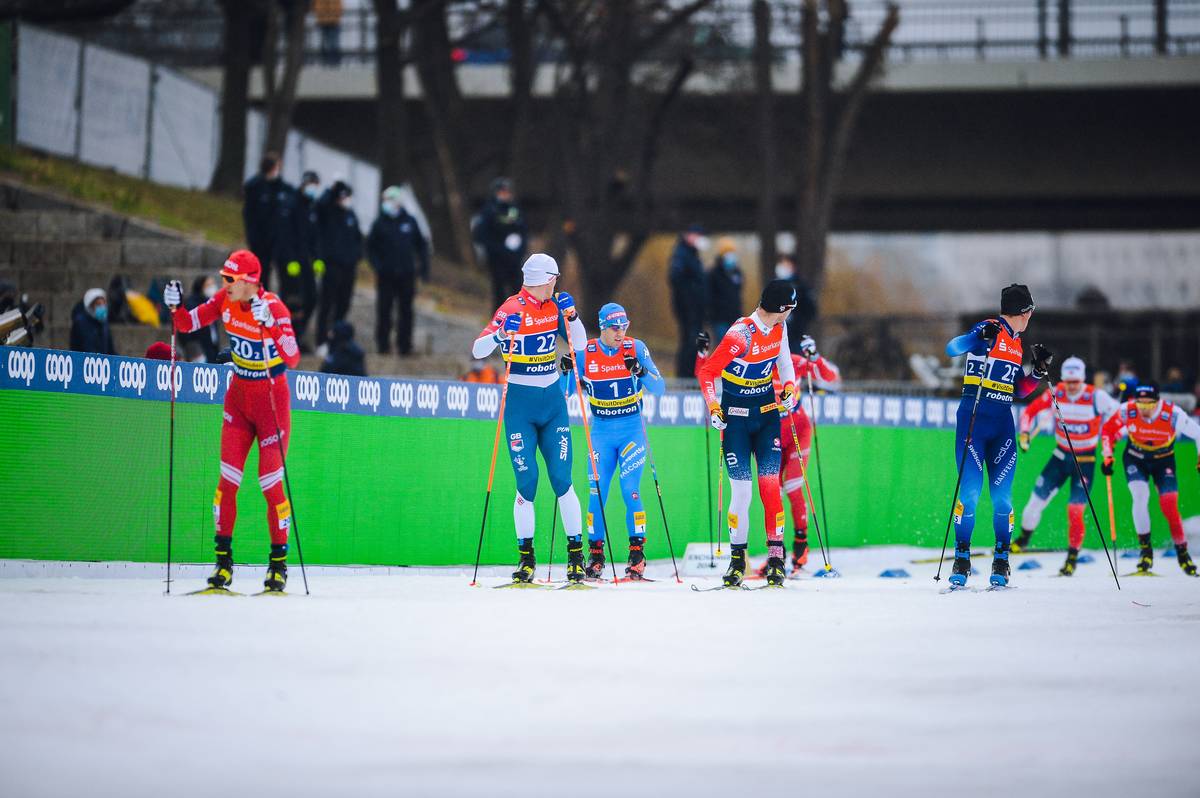
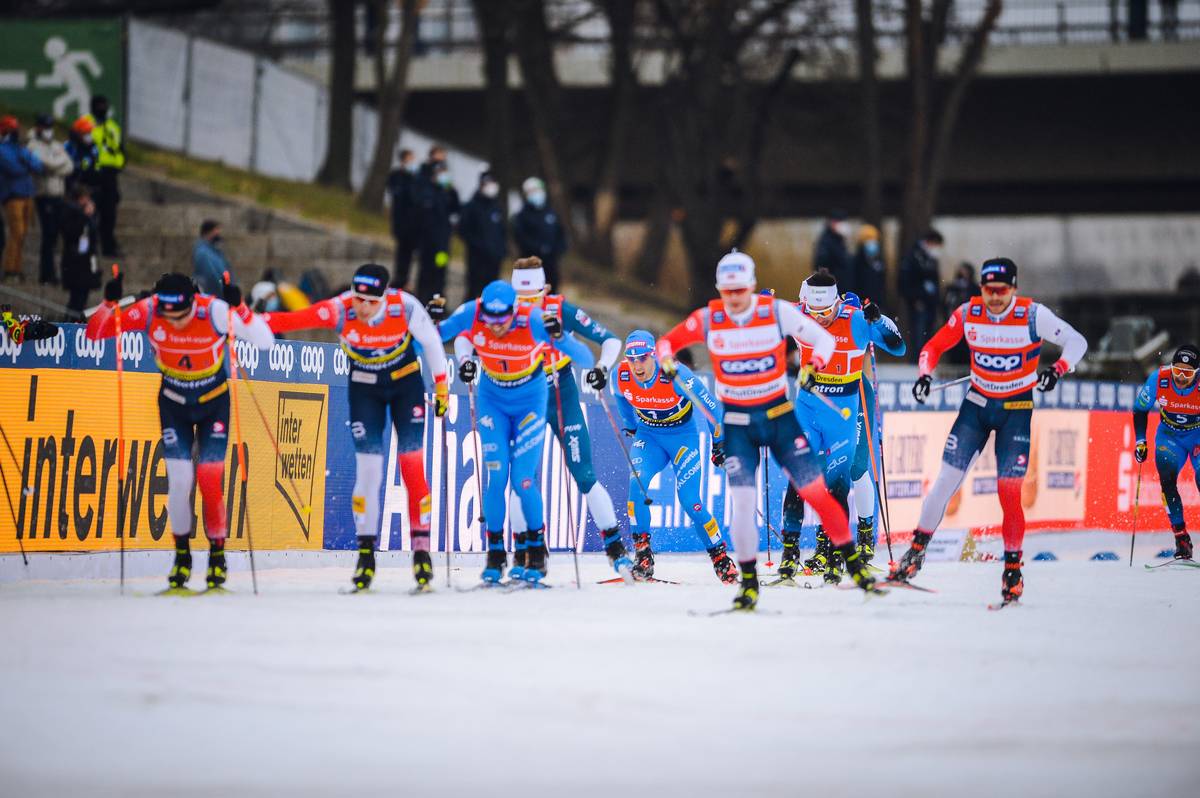
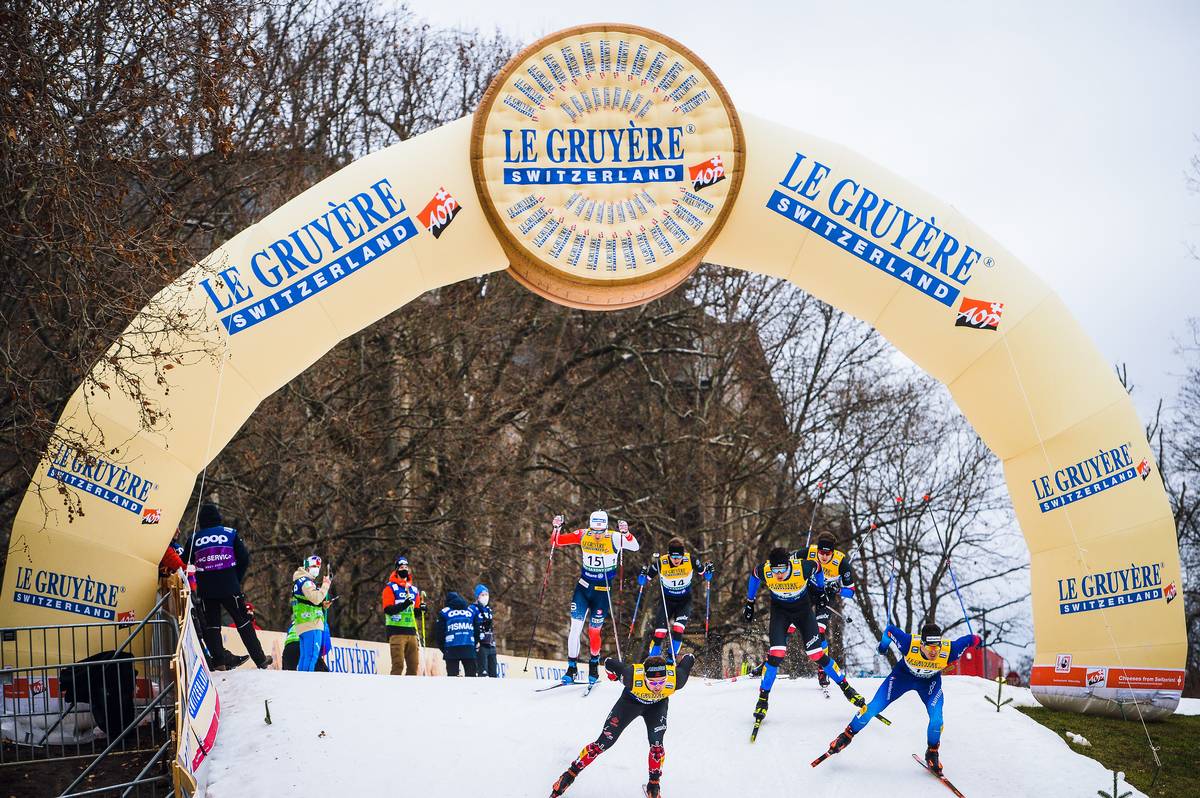
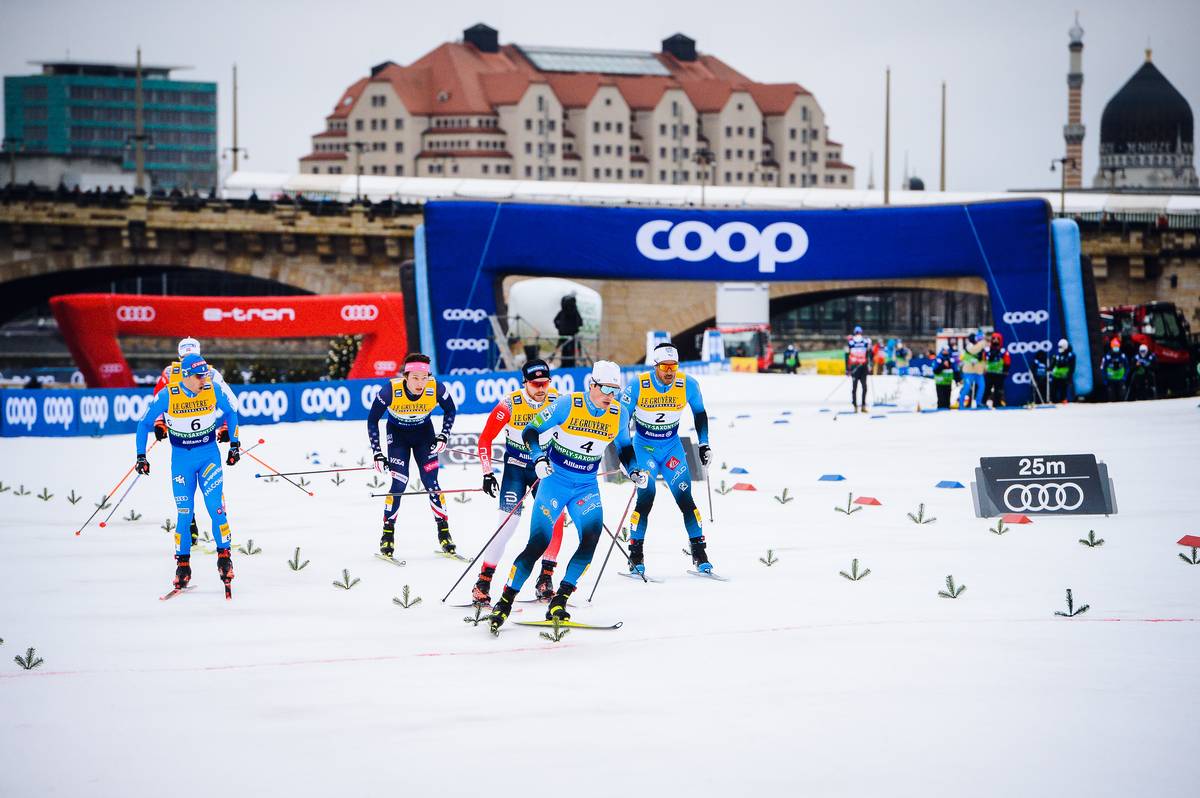
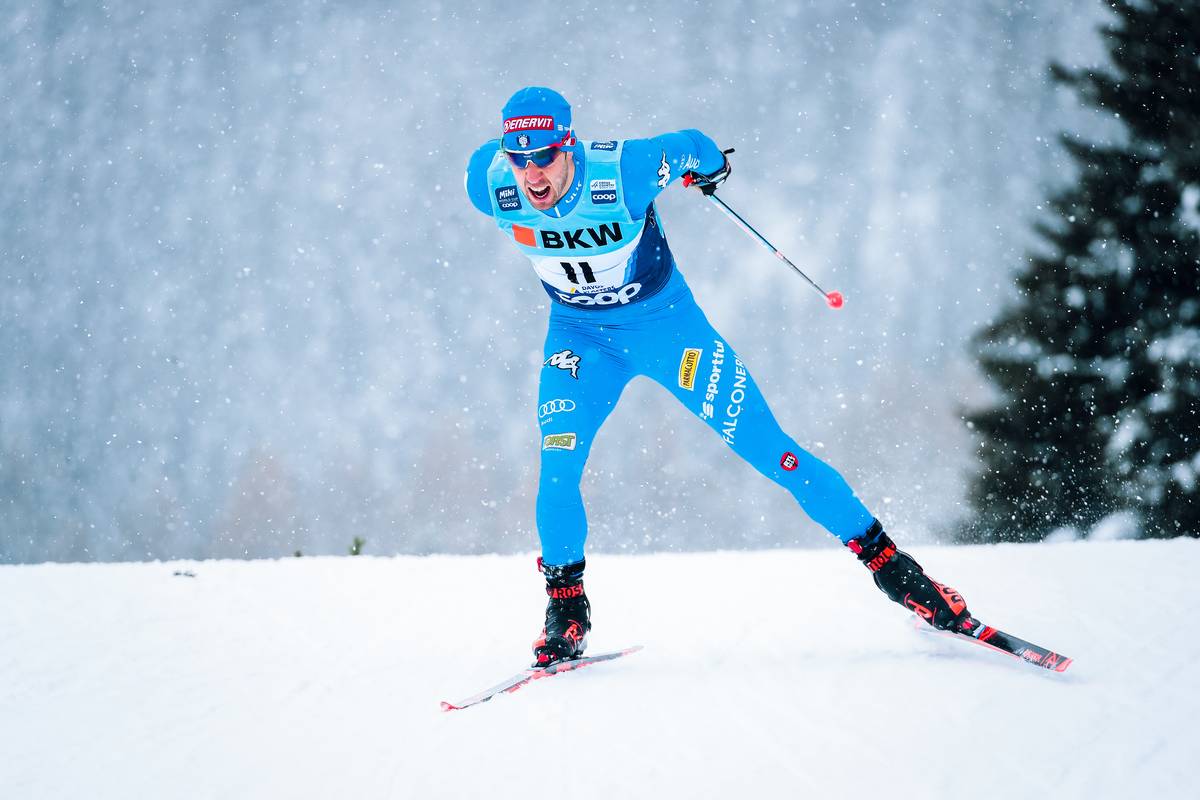
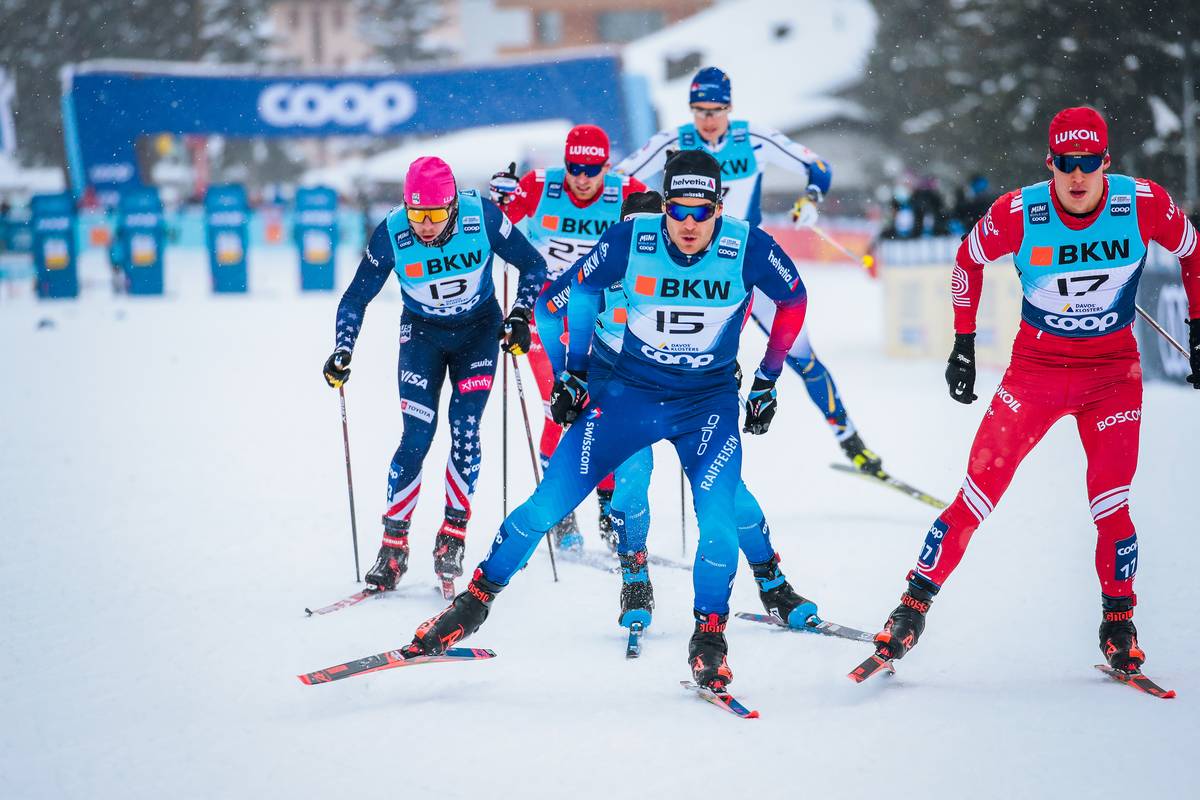
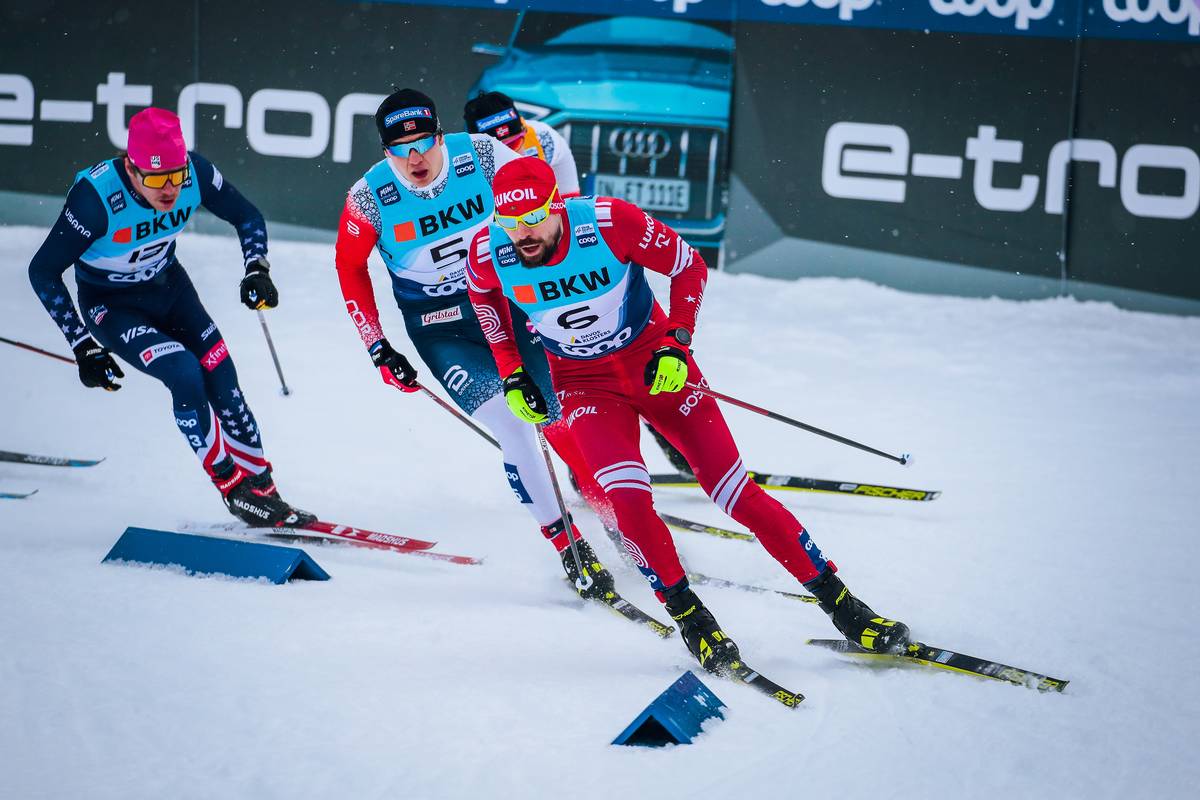
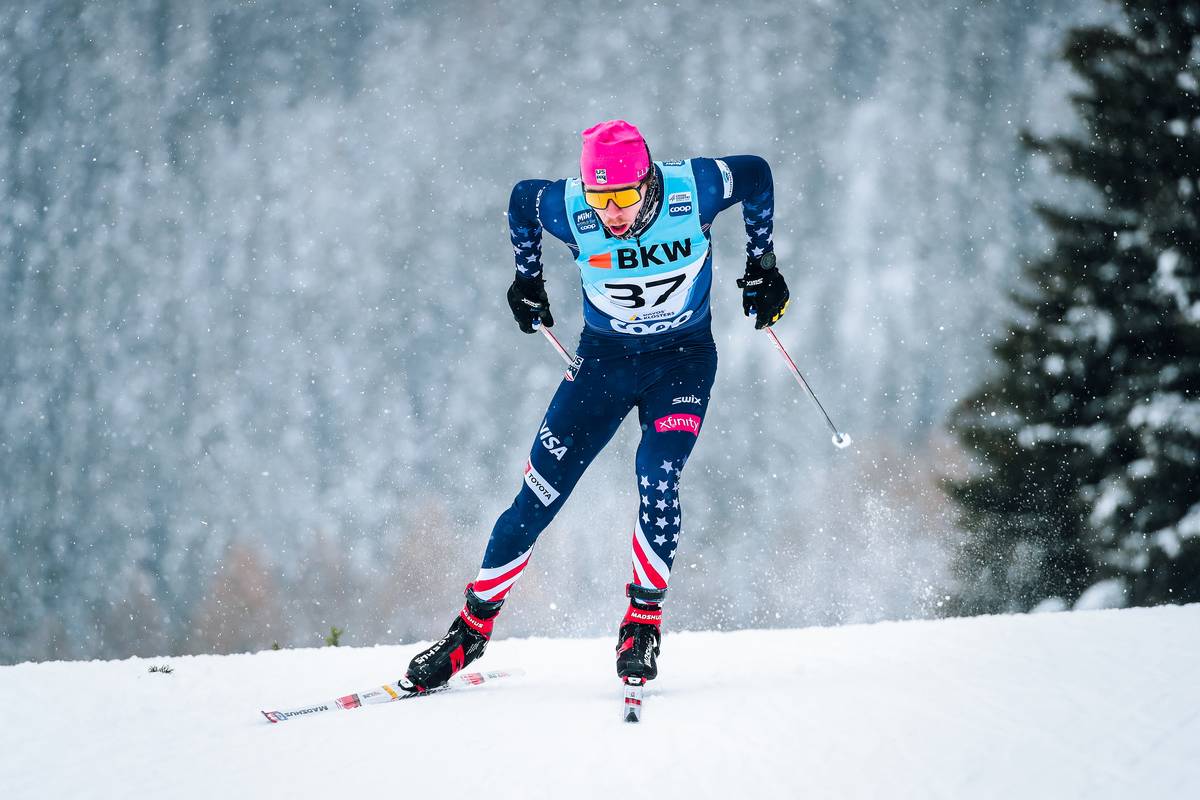
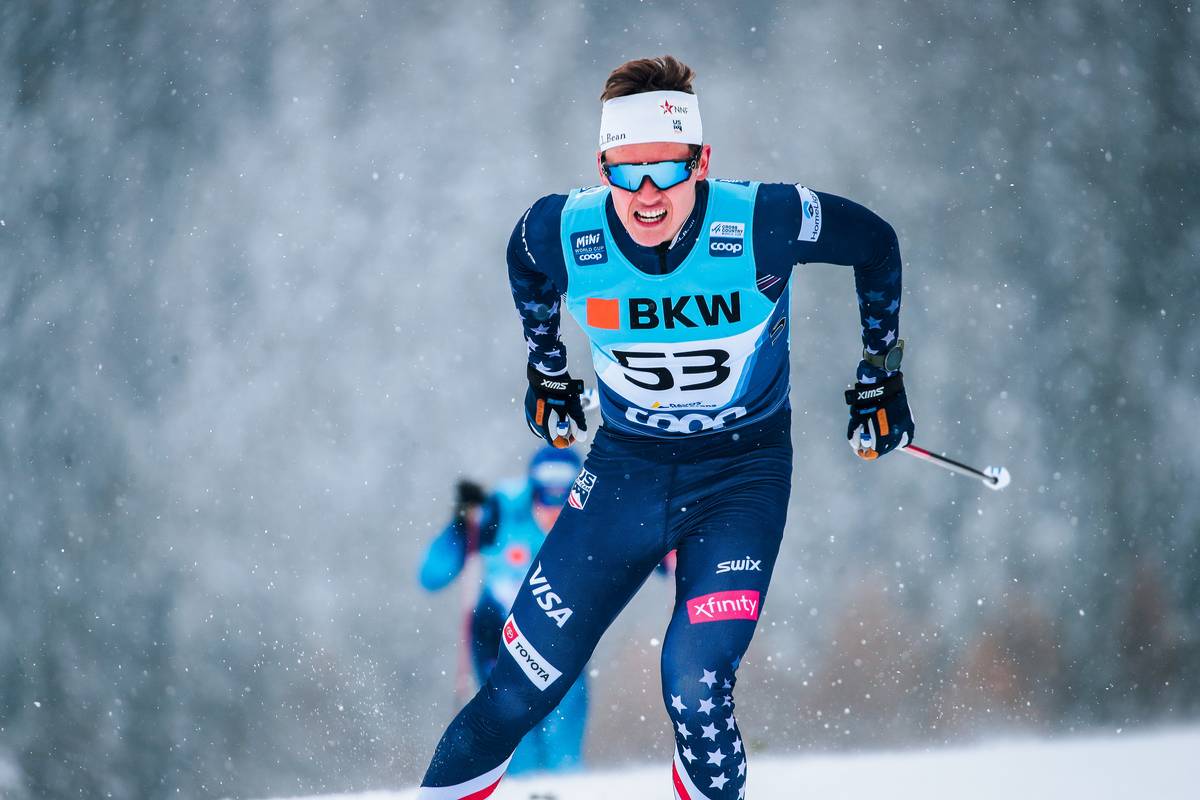
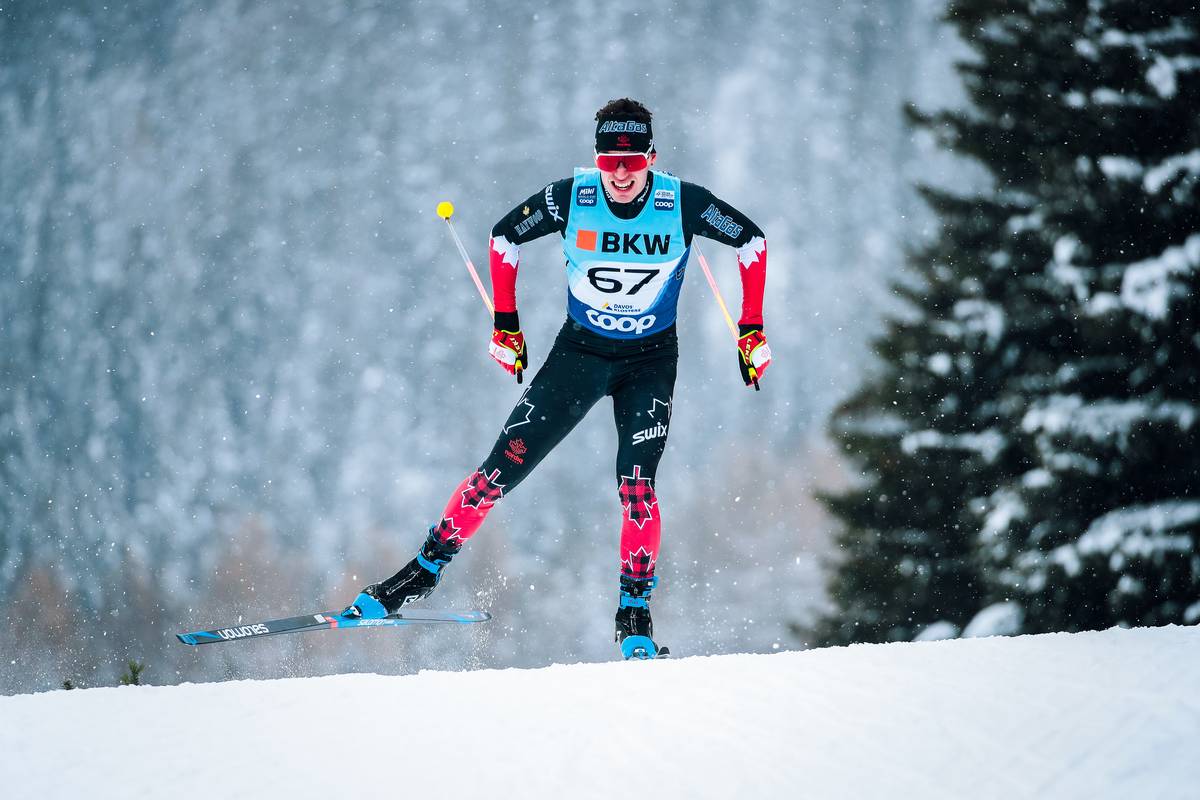
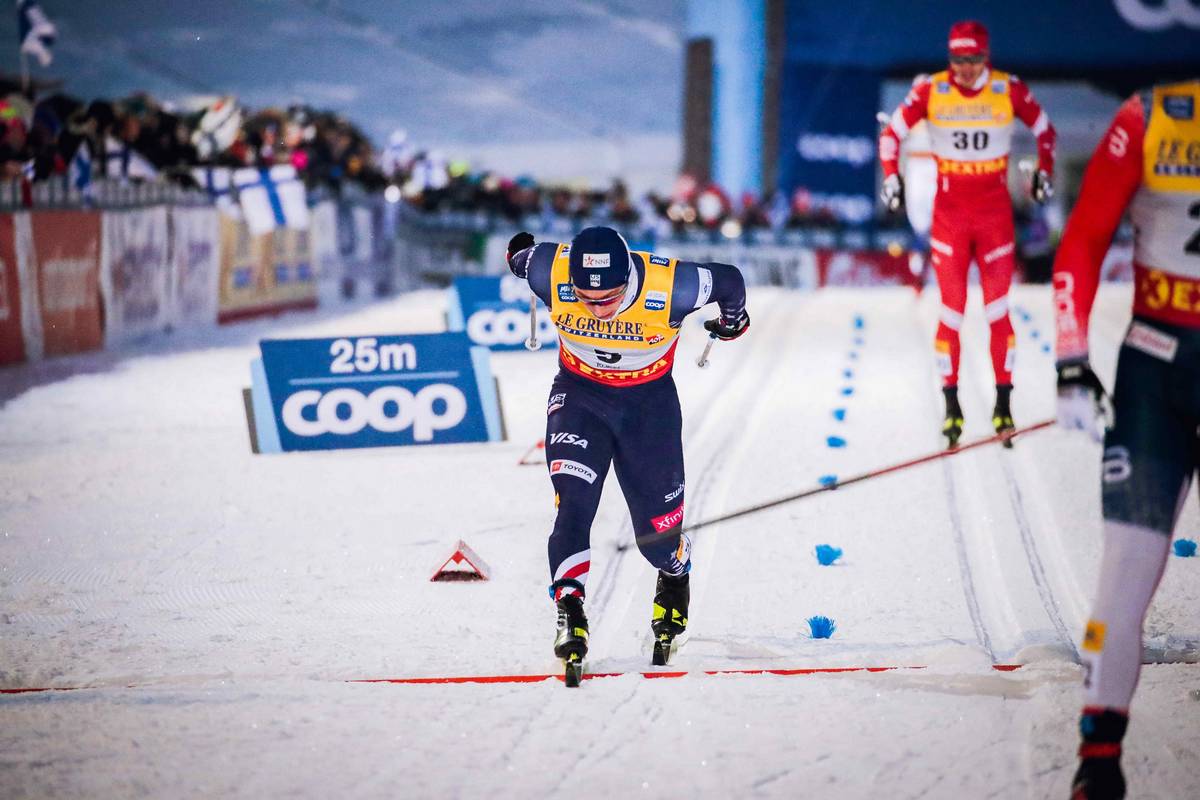
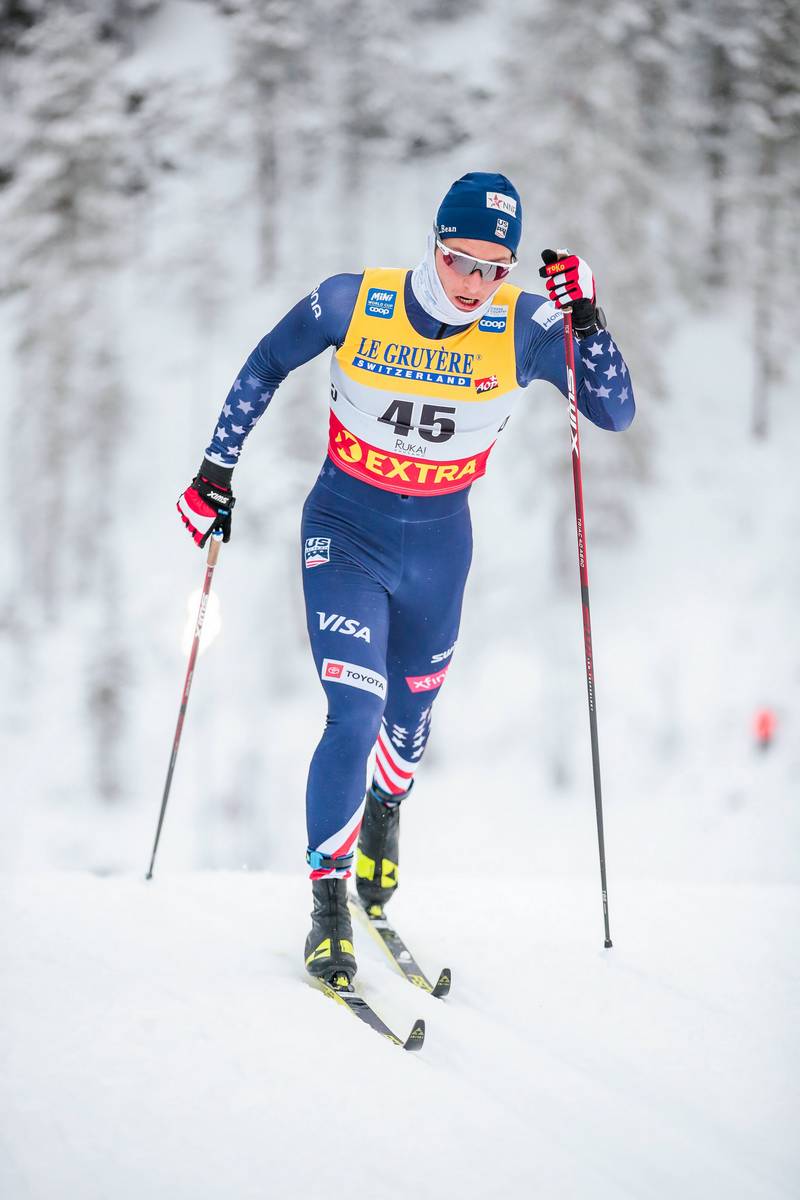
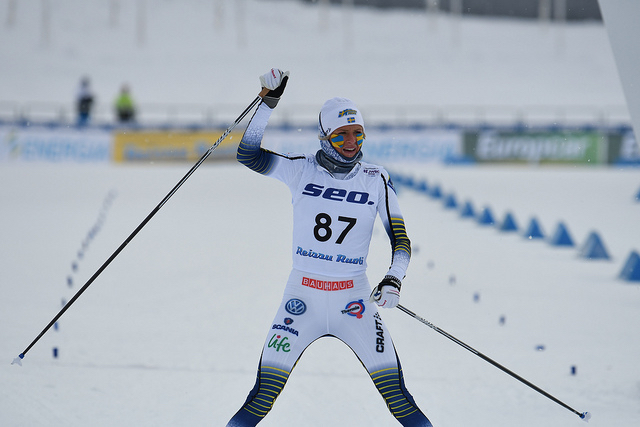
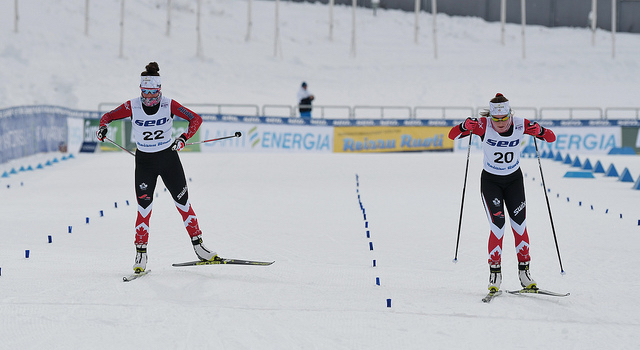
Tag: Alexander Terentev

  • Norway Pulls off a Historic Team Sprint Gold Repeat; Canadians in 5th and Americans in 9th for Strong Team Debut

    Norway Pulls off a Historic Team Sprint Gold Repeat; Canadians in 5th and Americans in 9th for Strong Team Debut

    This World Cup coverage is made possible through the generous support of Marty and Kathy Hall and the A Hall Mark of Excellence Award.  To learn more about A Hall Mark of Excellence Award or to learn how you can support FasterSkier’s coverage please contact info@fasterskier.com.

     

    The team sprint: it’s the youngest event on the Olympic program, having been contested only since the 2006 Torino Games. The event has since become a marquee event in the sport of cross country skiing.

    Holding it up as a marquee event, of course, is easier to say coming from the United States. If you tuned into the NBC broadcast, you got the delight of hearing 2018 team sprint gold medalist Kikkan Randall analyze the race where she won the US’s only gold medal in cross country skiing, while her teammate from that race, Jessie Diggins, worked to repeat the Olympic medal feat. 

    Yes, the team sprint was that race, and we could all revel in that memory as it played out in Zhangjiakou, China on Wednesday.
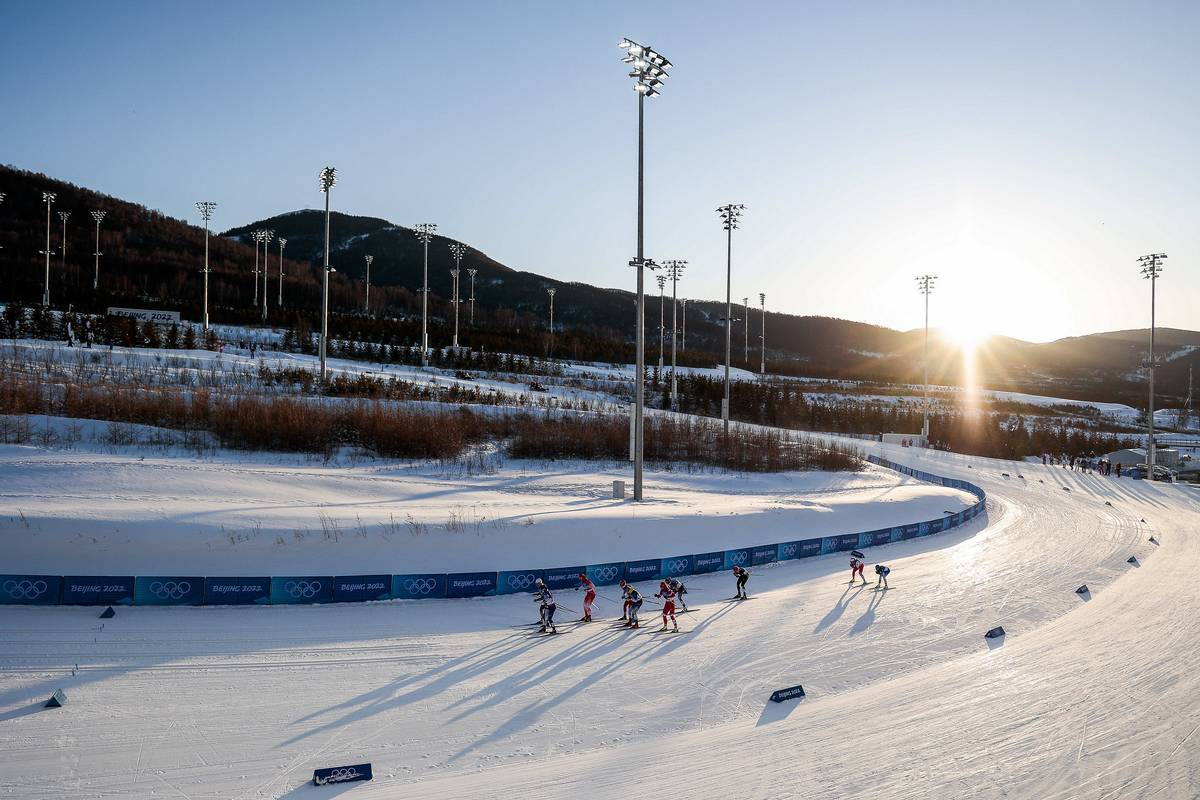
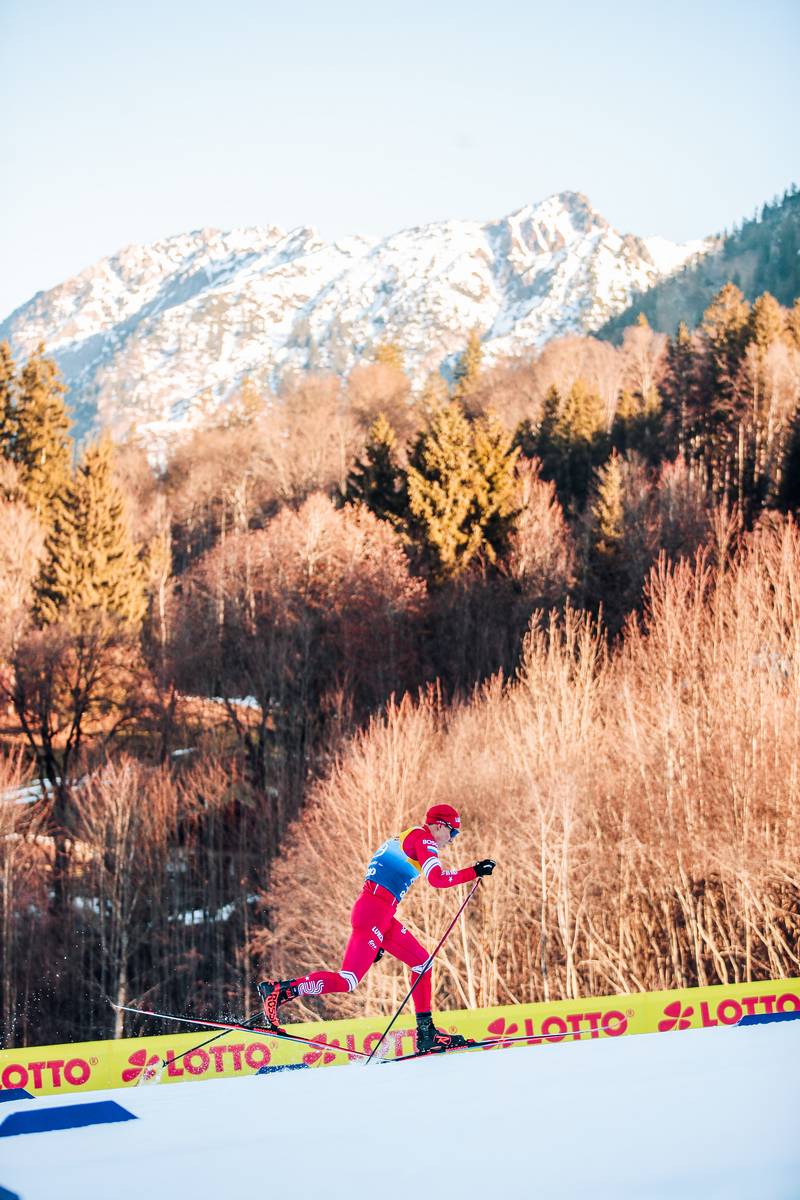
    Competitors surrounded by the colors of the sunset. (Photo: NordicFocus)

    Beyond that, though, no other event exemplifies the nuances involved in modern skiing like the team sprint. This is an event that pairs the specialists with the even-more specialized, and has an err of a nordic nerd’s daydream to the team-selection possibilities that arise from doing so.

    What if you lined up the two athletes who single-handedly changed a generation of skiers together under one flag? Well, they’d turn out to win gold in Pyeongchang 2018, like when Johannes Høsflot Klæbo and Martin Johnsrud Sundy were paired as team Norway. What if you repeated when Finland won gold in Sochi 2014, but this time Iivo Niskanen, who was then seemingly untouchable as a classic skier? Well, that one offers a bridge to what played out in Beijing 2022.

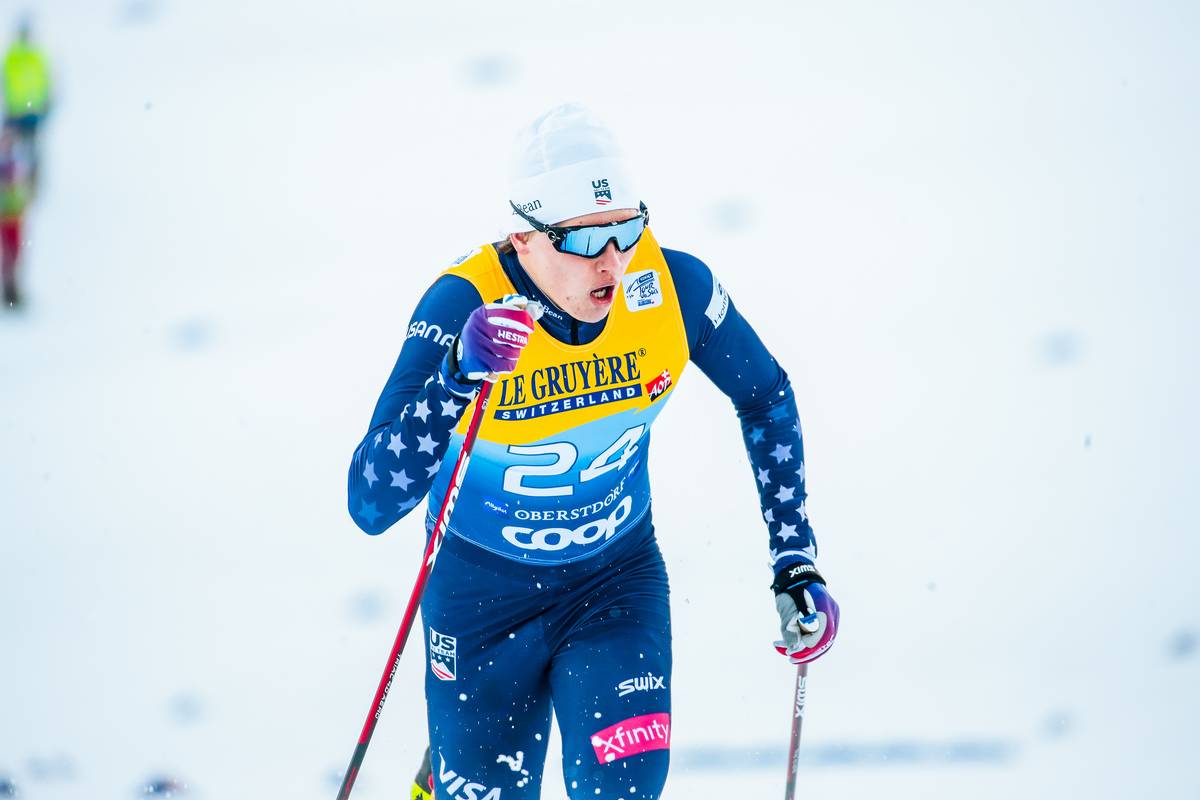
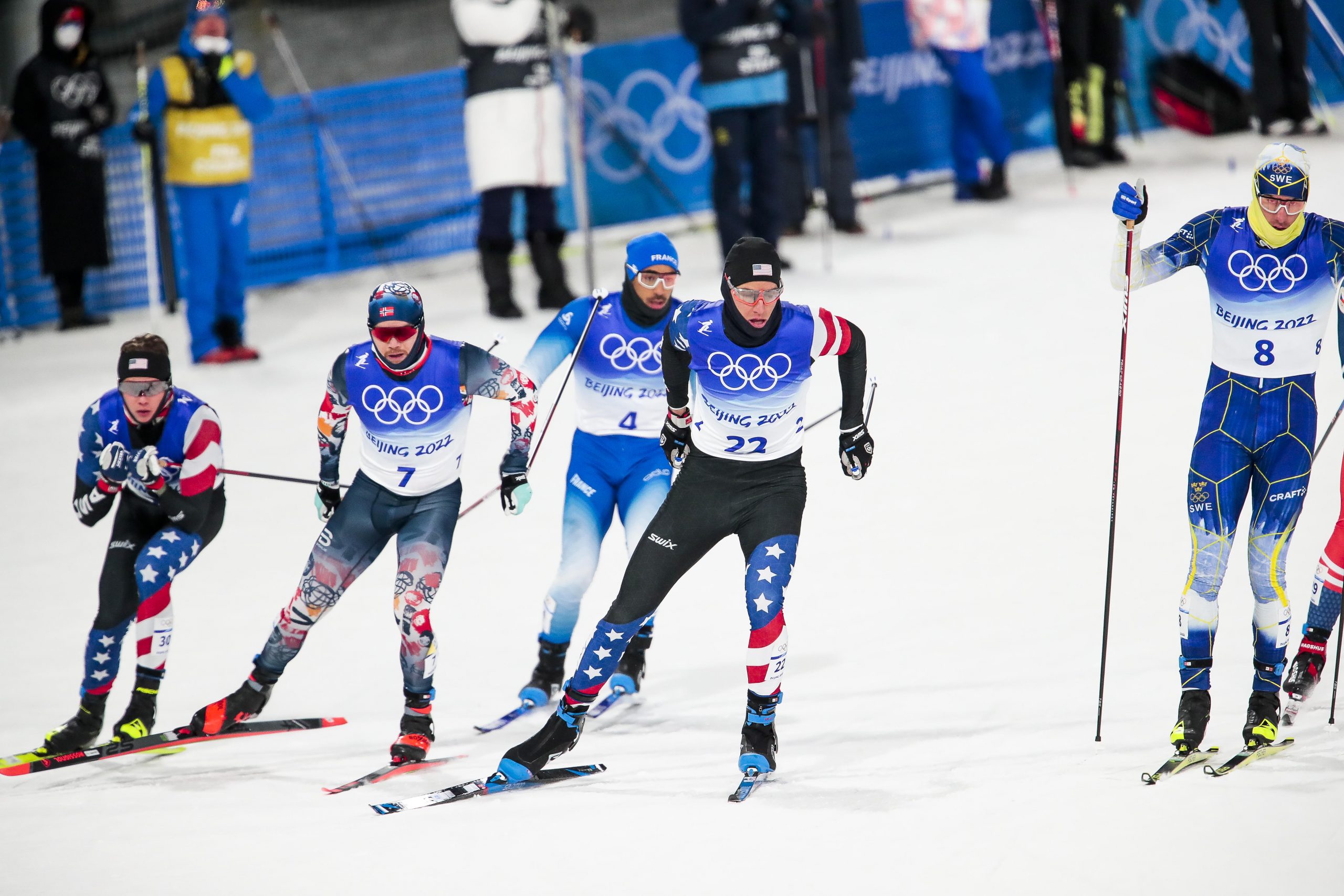
    Of course, hypotheticals joined up with storylines that didn’t need to be posed as a question today too. For the US men, this was the crystallized moment where one generation was handed off to another. Call to mind the US Olympic team sprint team anytime in the last eight years and it was the steadfast duo of Simi Hamilton and Erik Bjornsen. These men, now retired, were sixth in the team sprint in both the 2014 Olympics in Sochi and the 2018 Games in PyeongChang. Then, this morning, it was Ben Ogden and JC Schoonmaker, both born in 2000.
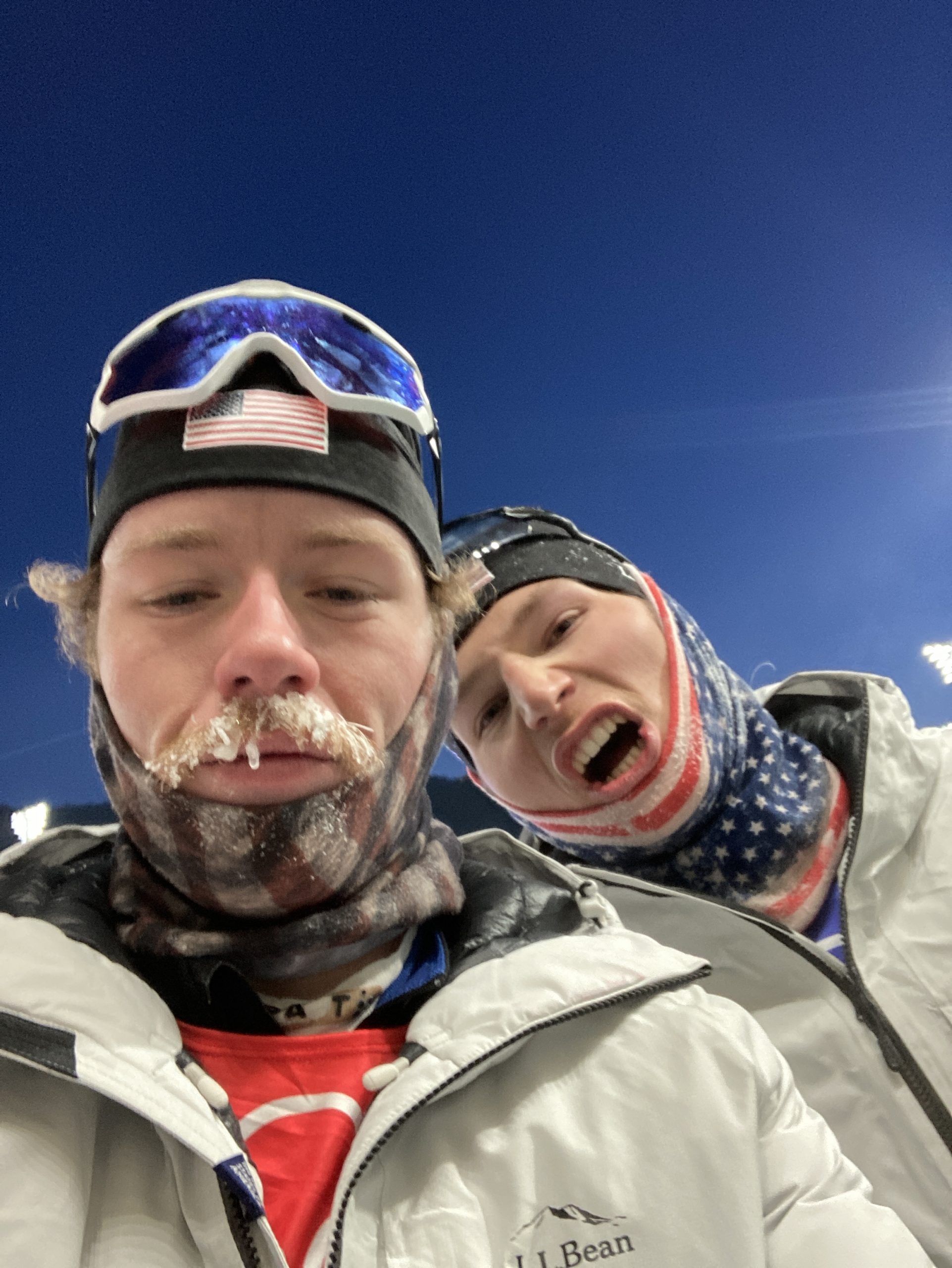
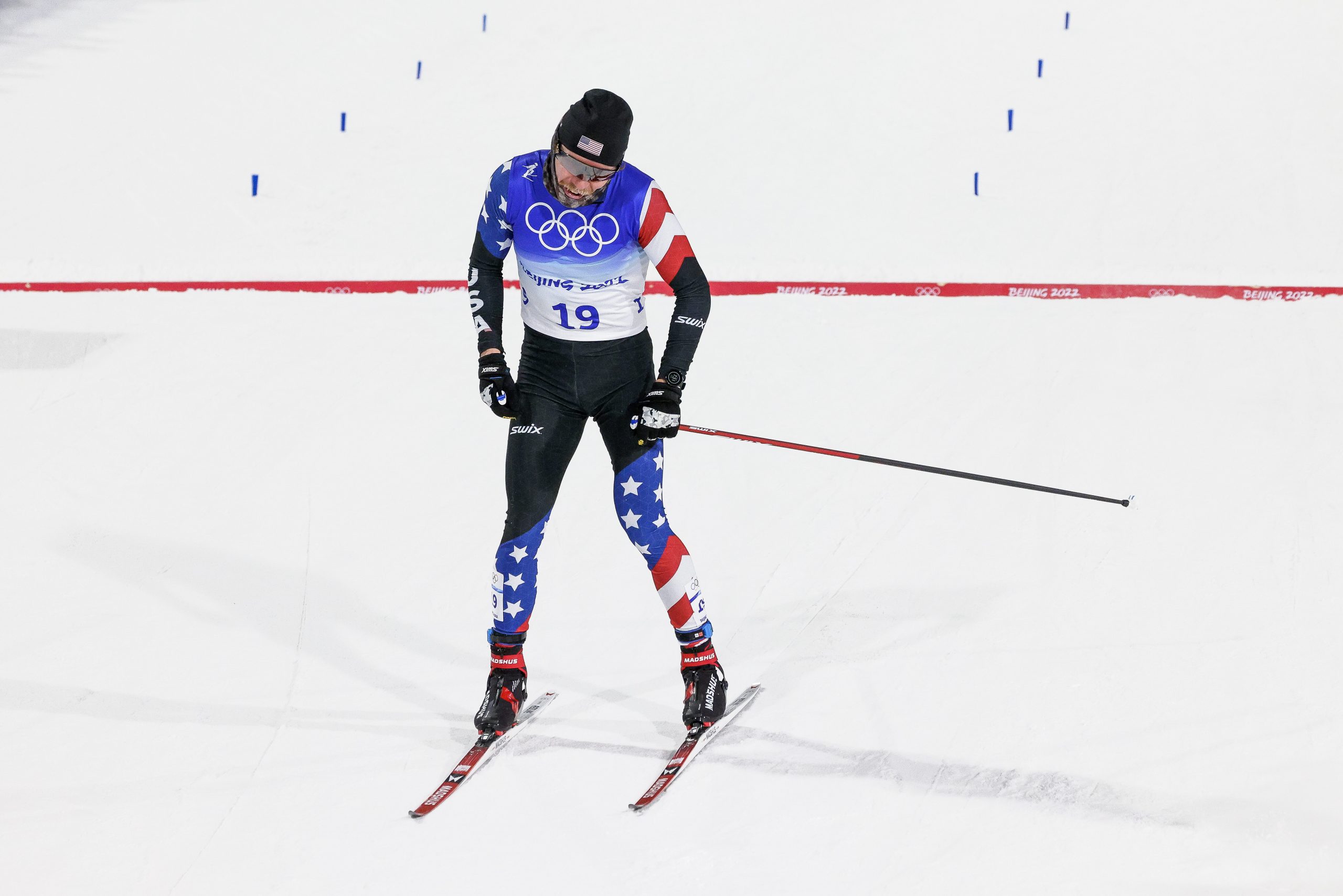
    The (frozen) fresh-faces of American skiing. Teammates Ben Ogden and JC Schoonmaker after completing the Team Sprint on Wednesday in Beijing. (Photo: Nat Hertz)

    The two made up a pairing that was more pure-sprint oriented than most of the competitors that were most closely watched going into today. The strategy for a few of the top teams, in particular, the Russian Olympic Committee and Finland, seemed to be pairing their top-class distance skier with a sprinting specialist.

    For the course in Beijing, it was a good strategy on paper. The 1.5-kilometer course, last seen in the individual sprint last week, had one tactical pressure point going into a downhill when it was raced as a single lap. When it was raced in a burst of three per skier with little rest in between, however, just how much the long, semi-gradual, uphills on this course made skiers work moved to the forefront. In the team sprint, having a skier who could stay with a sustained attack through multiple legs was an appealing prospect, especially when it was meant to set up for a punchy last climb that would no doubt give way to a mad dash for the finish.

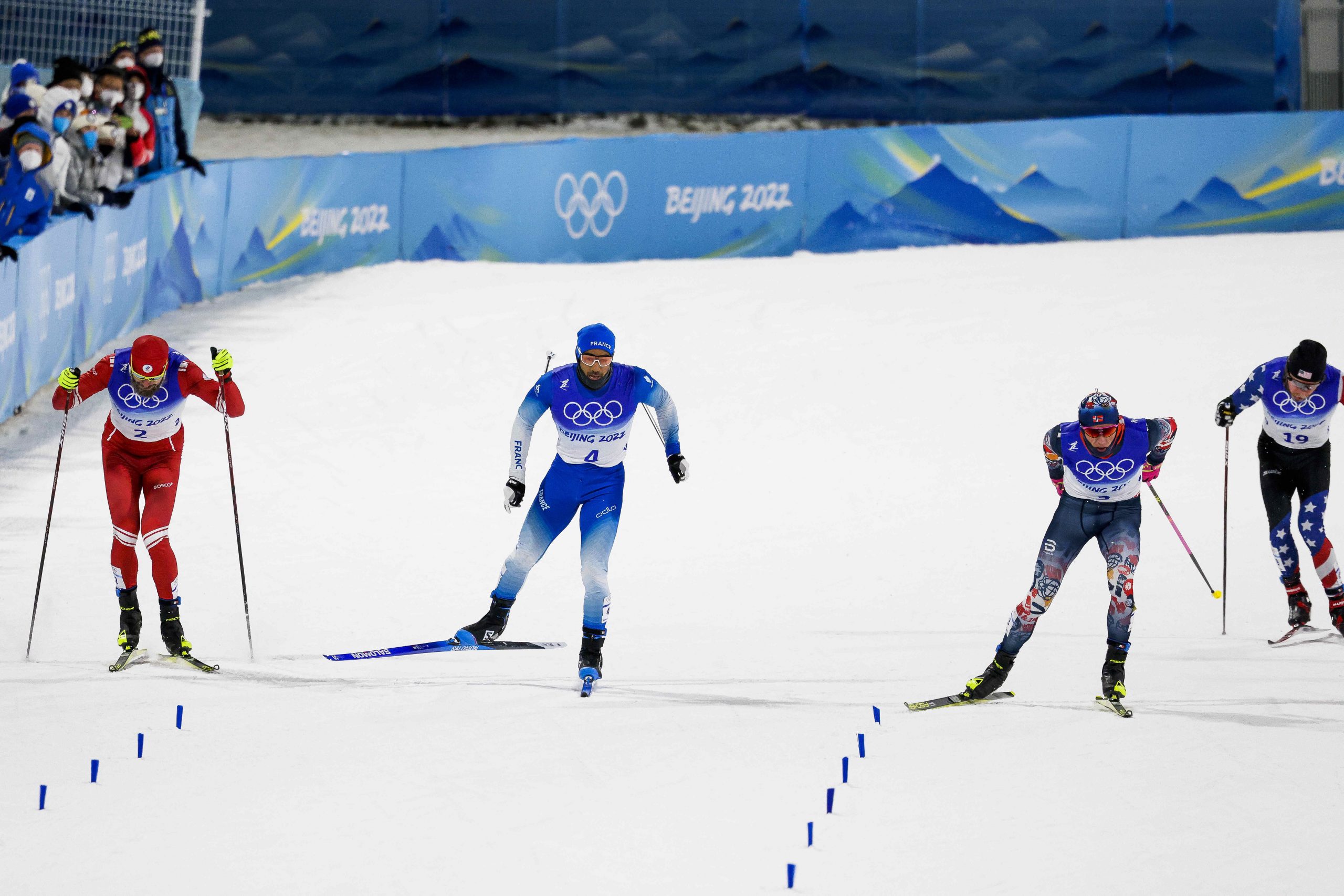
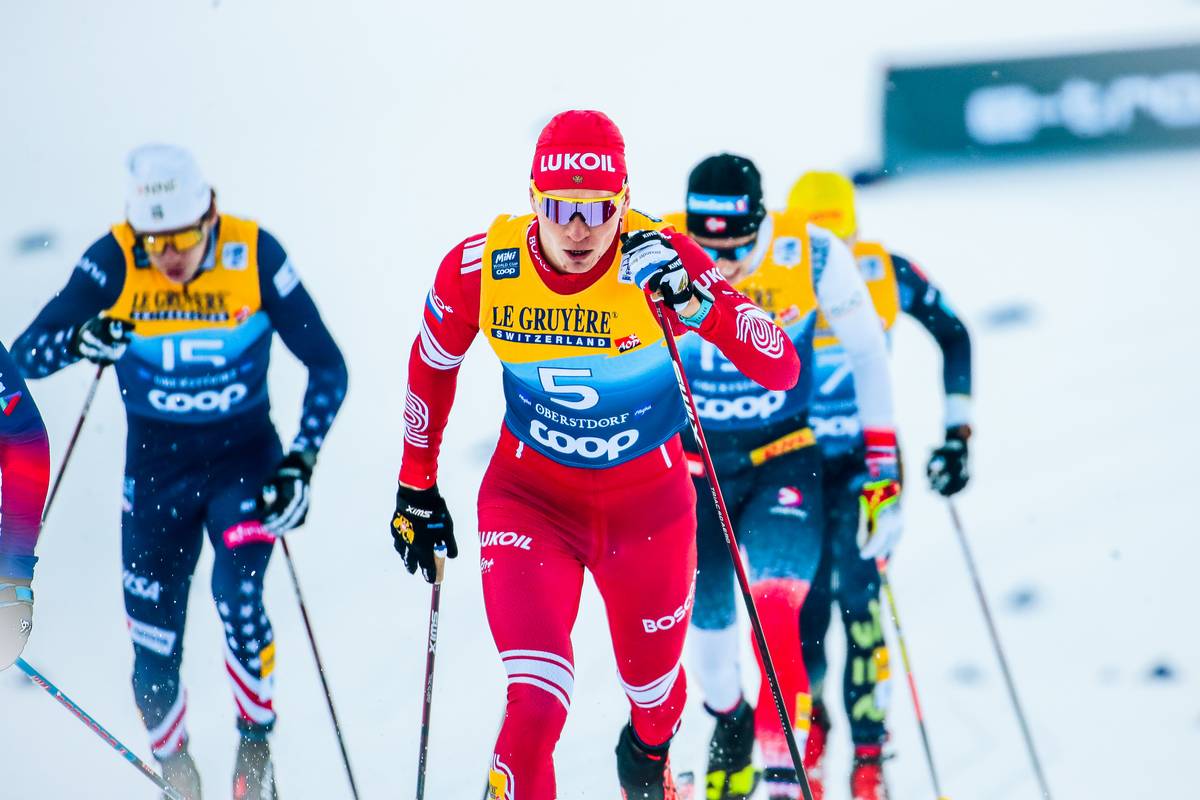
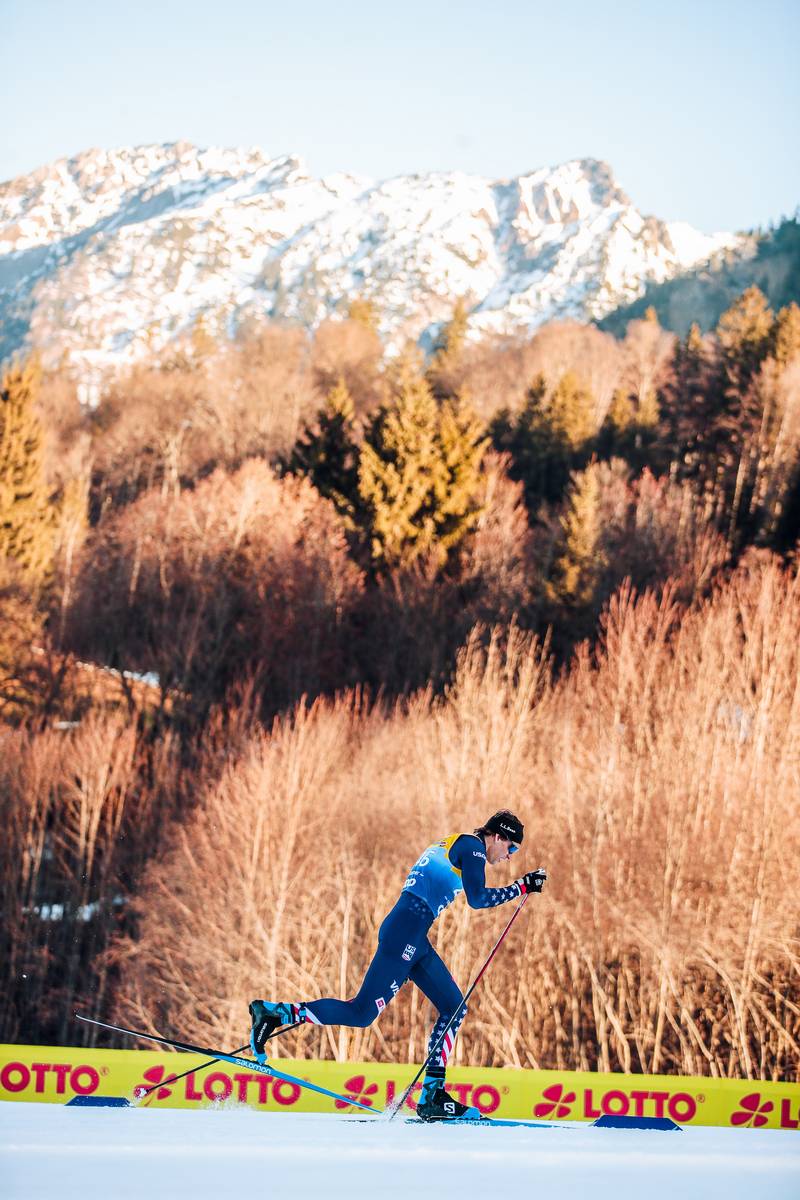
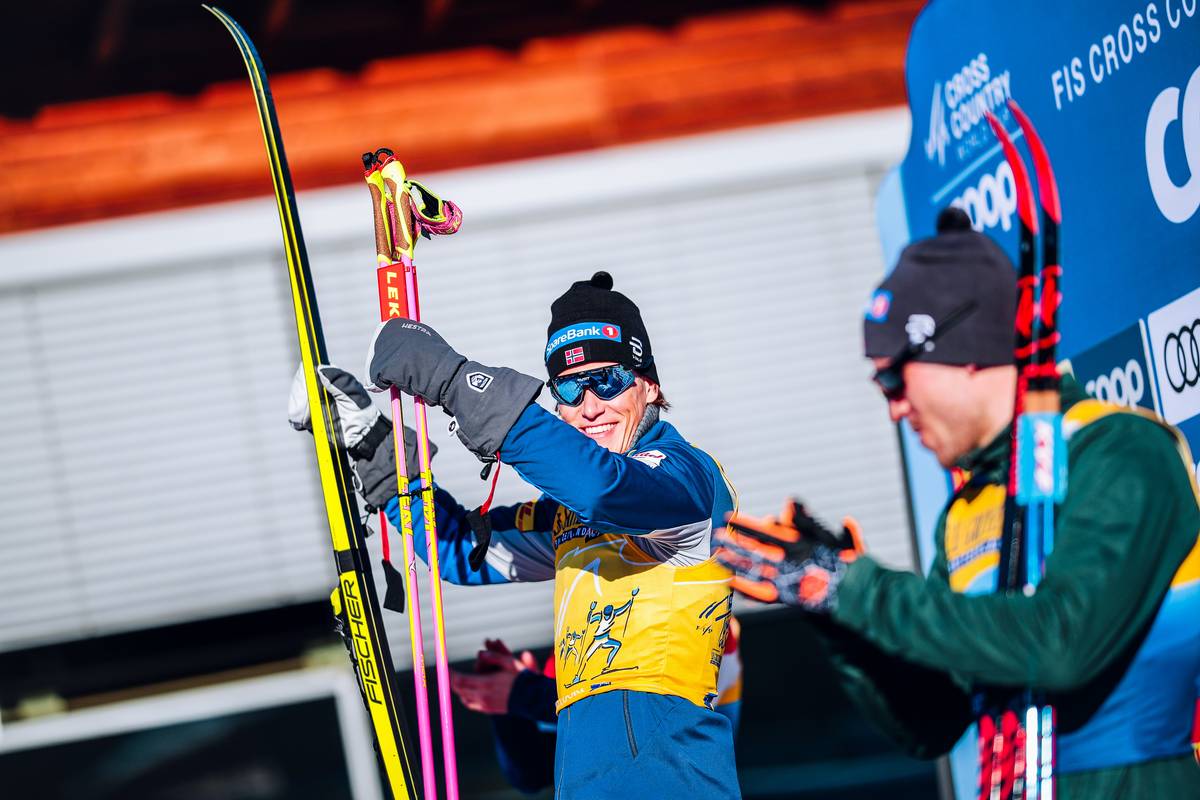
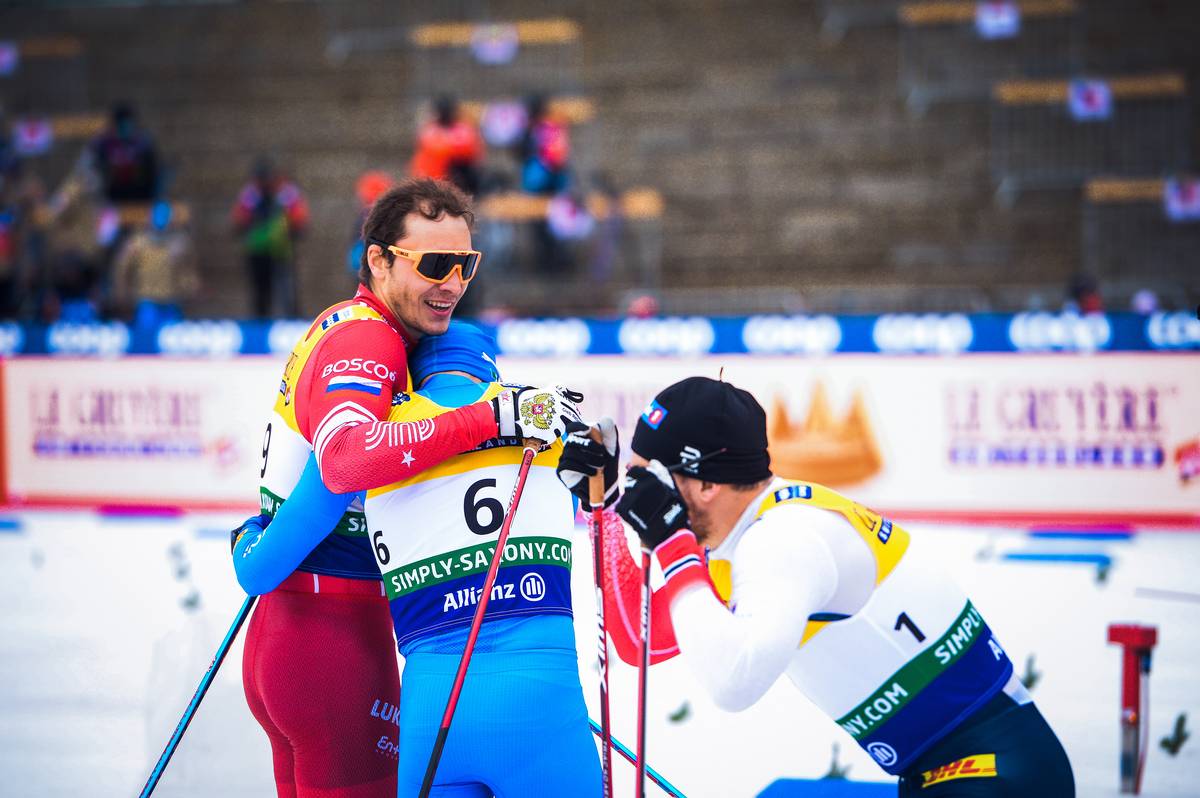
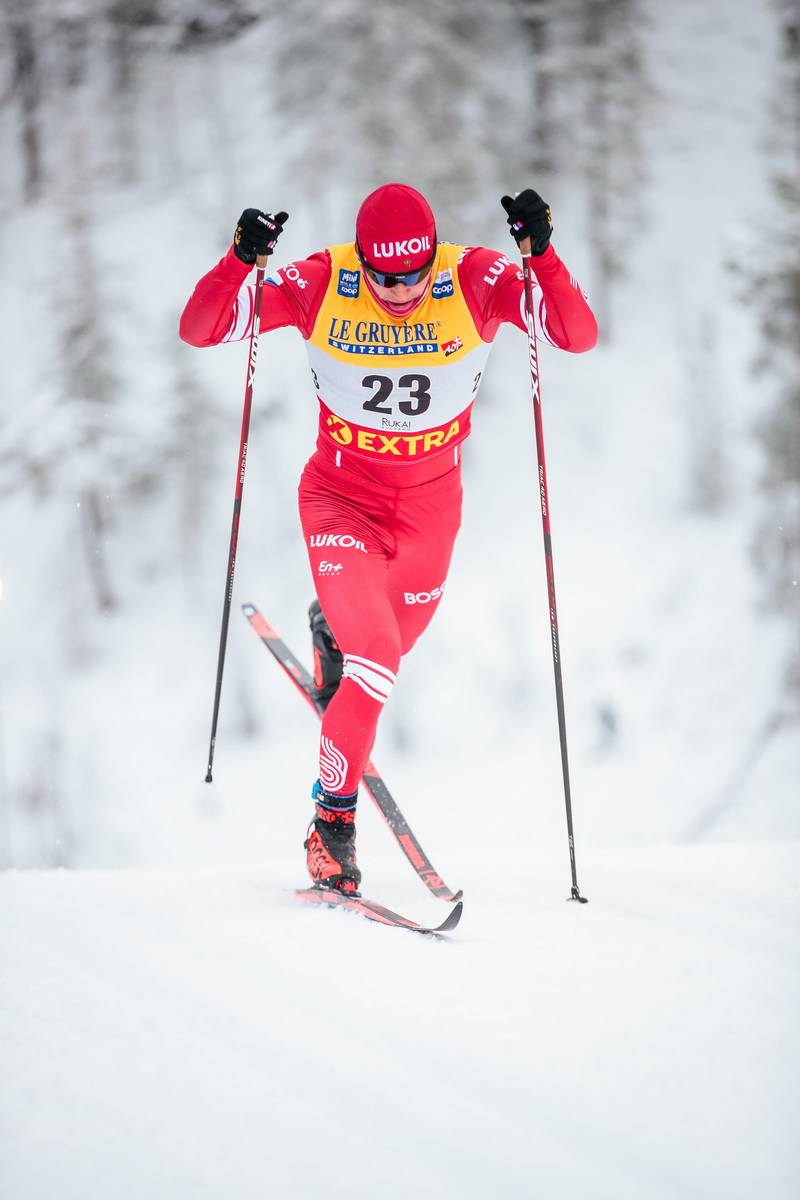
    For two teams, Norway and the Russian Olympic Committee (ROC), that mad dash had been setting up since the first World Cup of the season, when 22-year-old Alexander Terentev (ROC) out-dueled sprint superstar Johannes Høsflot Klæbo (NOR) to challenge the latter’s classic sprinting dominance.
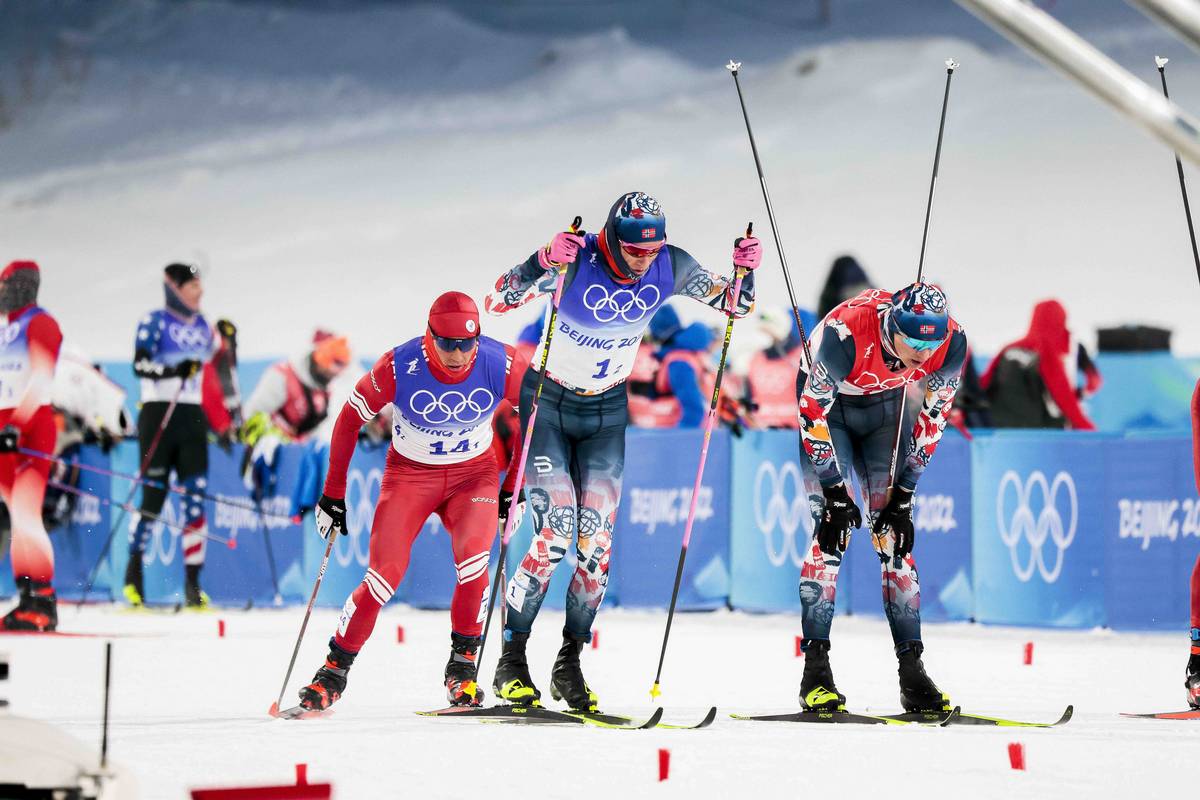
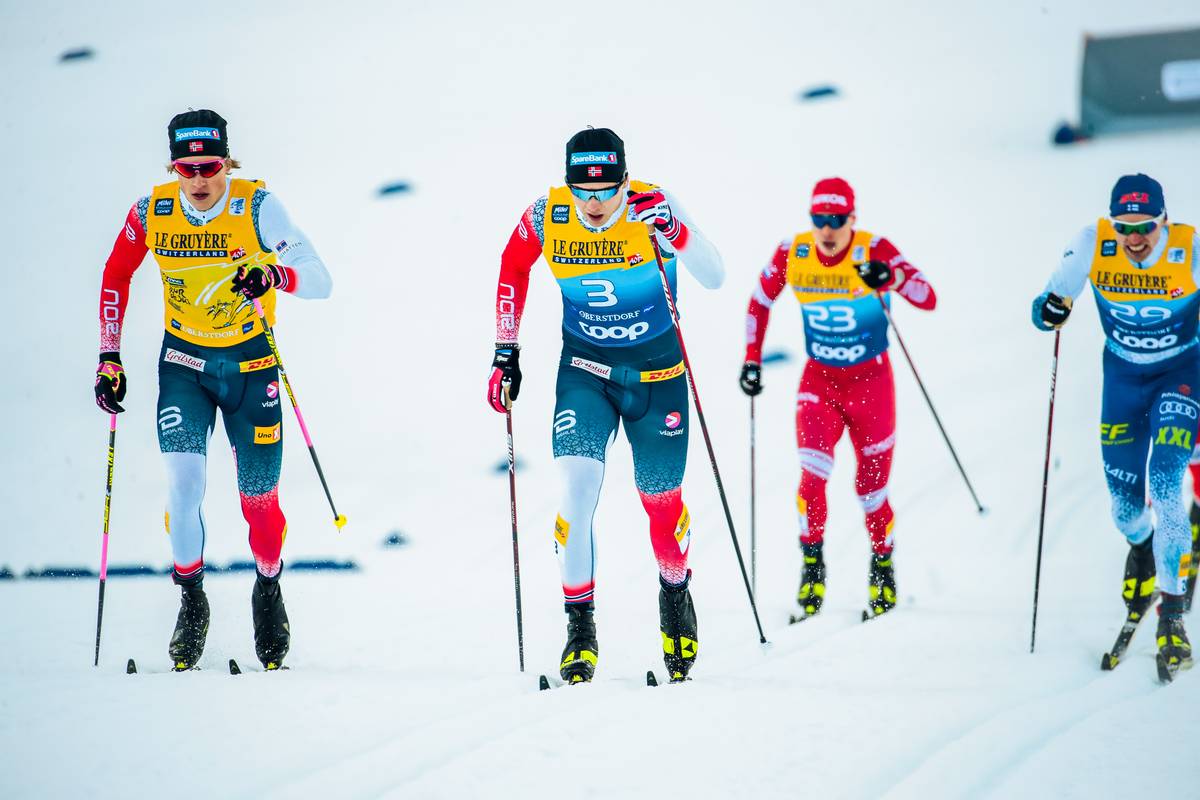
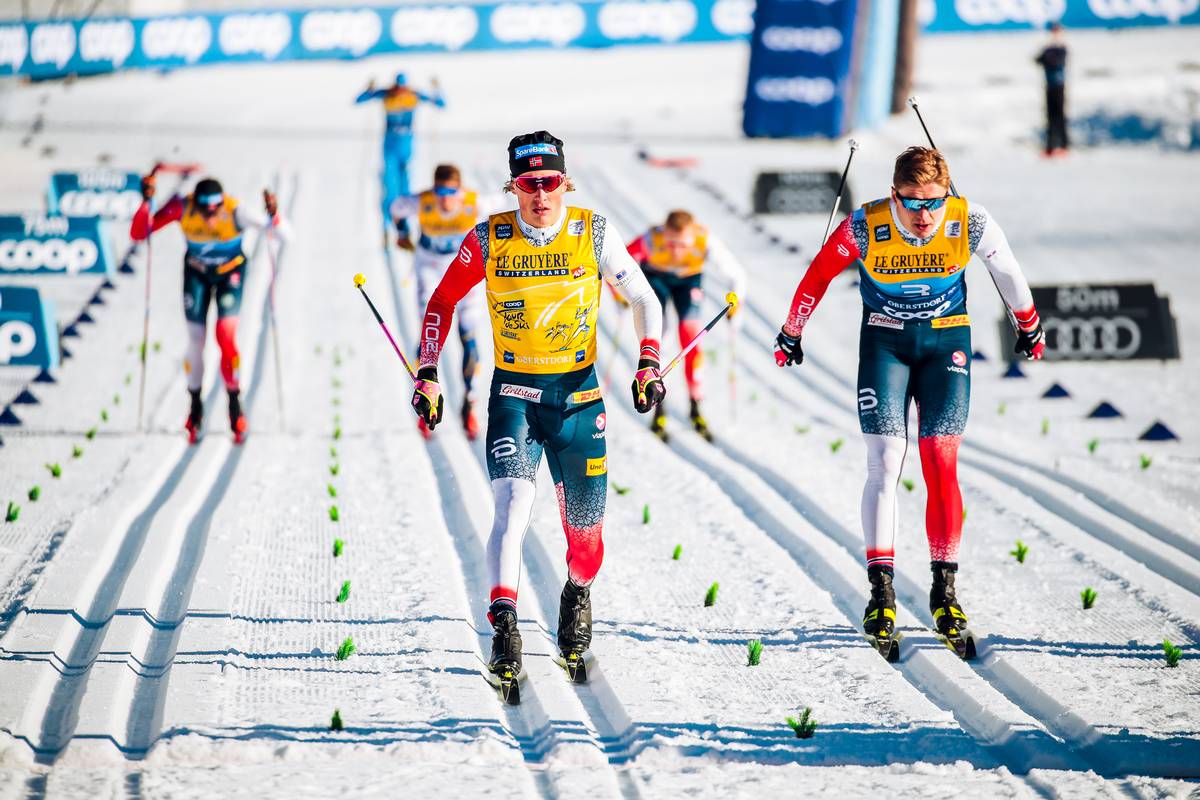
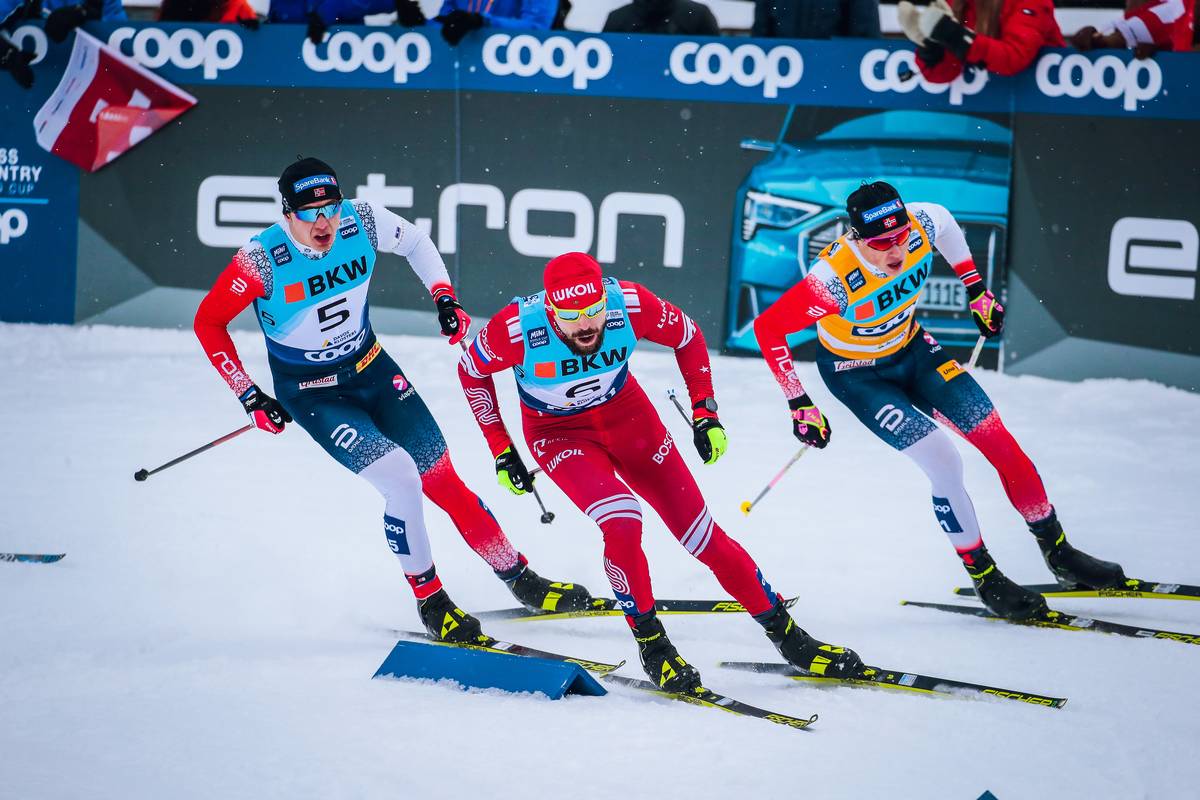
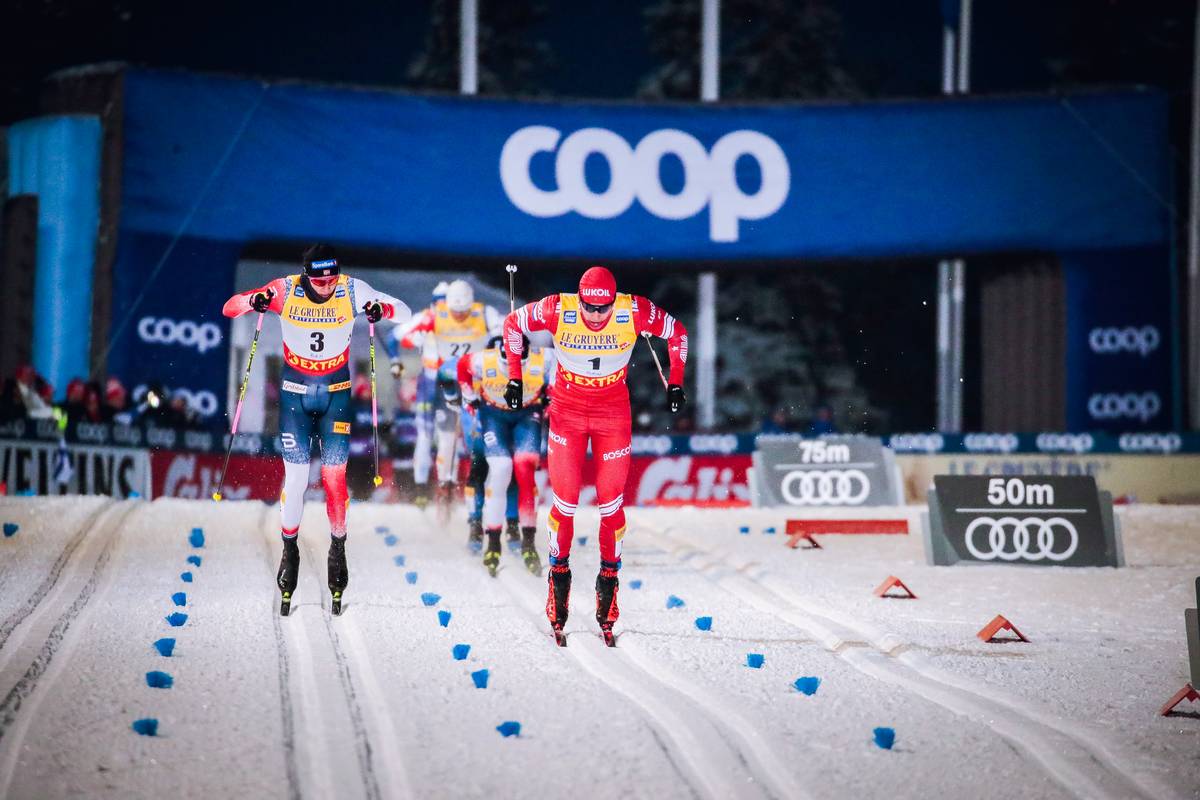
    Johannes Høsflot Klæbo (NOR) accelerates out of the exchange zone after receiving a tag from teammate Erik Valnes, followed by Alexander Bolshunov (ROC) on his way to tag teammate Alexander Terentev. (Photo: NordicFocus)

    They would both ski the anchor legs on their teams. Klæbo was paired with fellow sprinter Erik Valnes to make team Norway, while Terentev was paired with 30 k skiathlon gold medalist Alexander Bolshunov to make team ROC. Finland joined the intrigue, sending out 15 k classic gold medalist Iivo Niskanen in the first leg paired with the World Cup’s perennial “oh, that’s right he’s a great sprinter too!” Joni Maki as an anchor.

    As such, the teams in the final skied the first and second legs could roughly be divided into: leg 1 – the distance skiers and long-burn sprinters, and leg 2 – classic sprinting’s very best.

    The US had qualified for the final as the second lucky loser, finishing a messy semi-final that saw Ben Ogden break a pole and recover to finish 6th place (+4.43 off of heat winners Italy’s mark of 20:06.99). 

    “It was a hard semi-final, ours was fast and everyone was pushing. [The pole break] was one of many places where we used more energy than we had to today.” said Ogden in post-race interview with FasterSkier in the mixed zone.

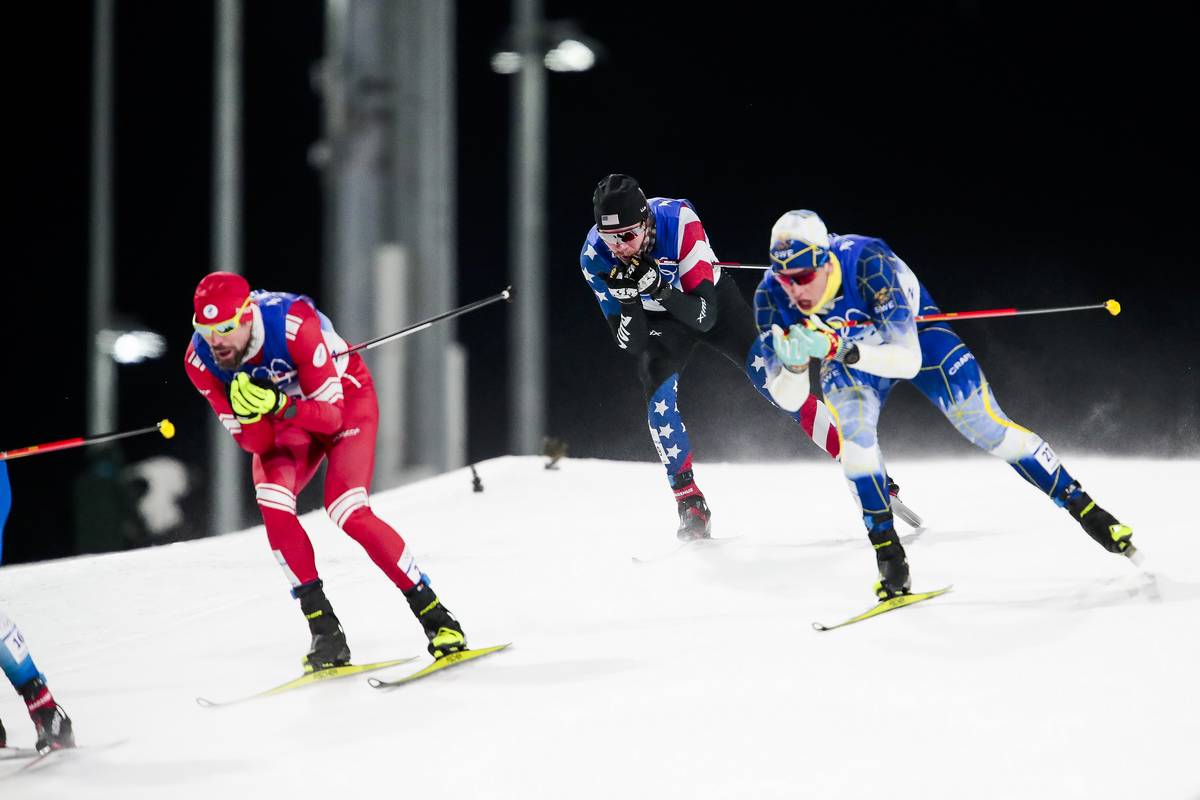
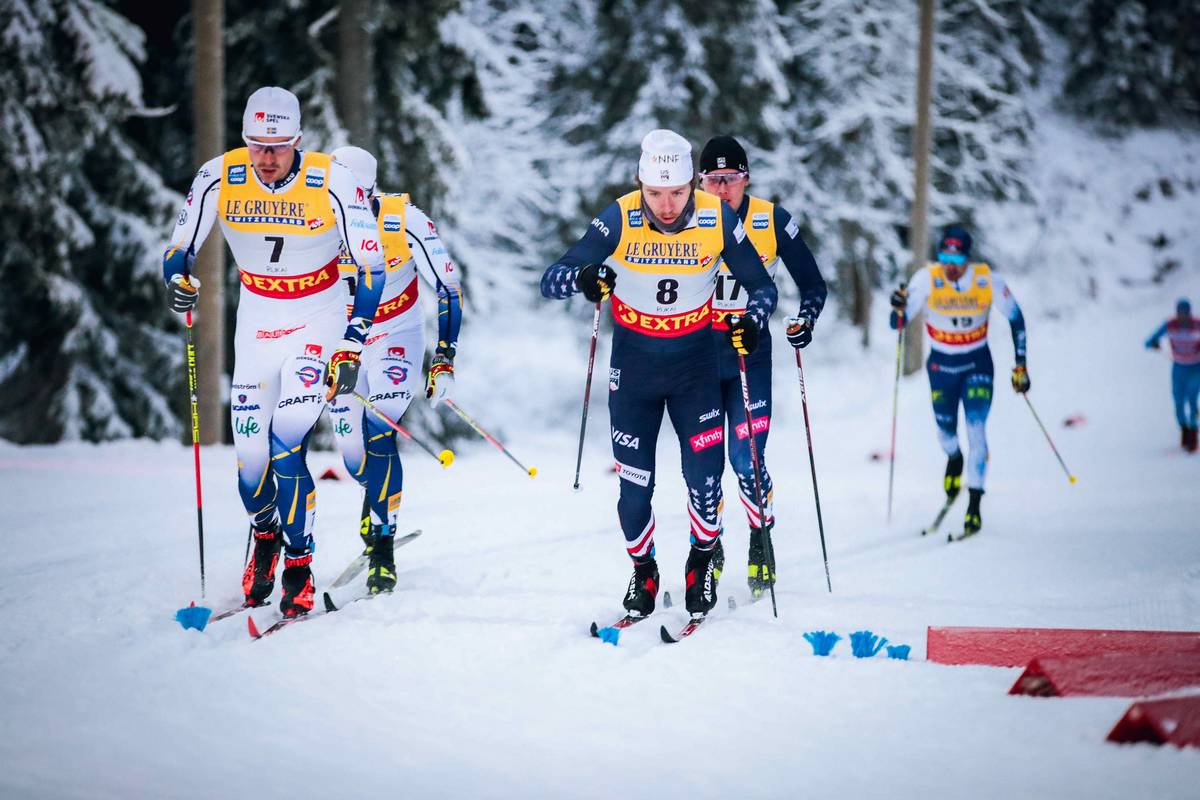
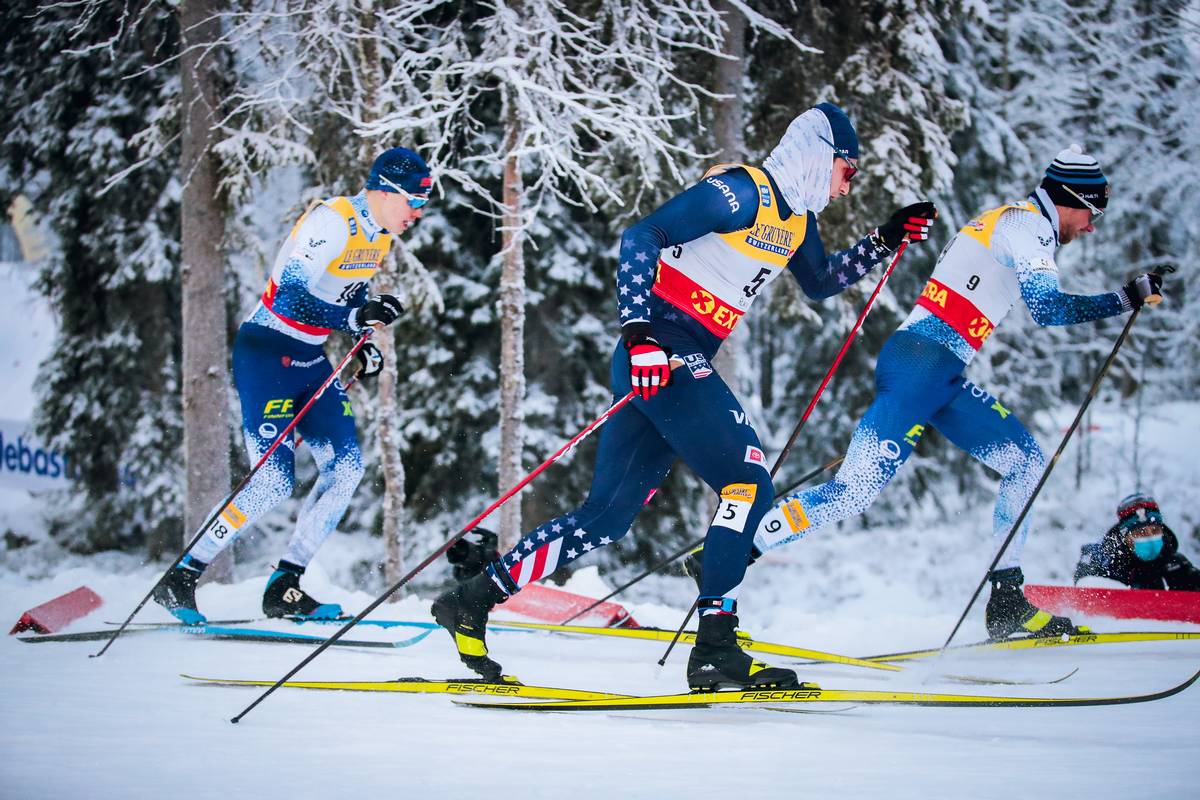
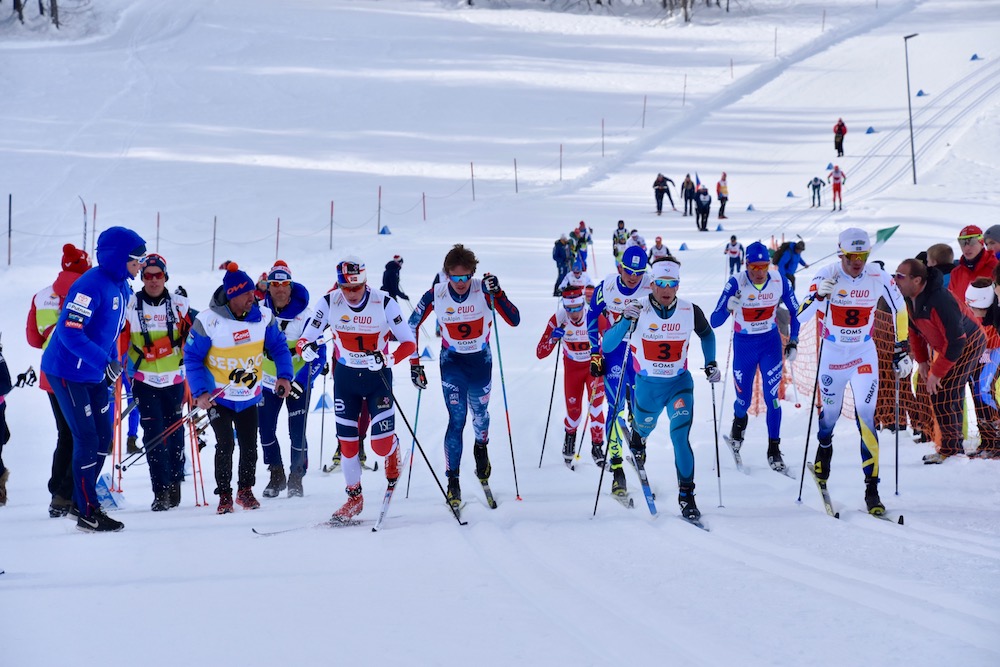
    But as Ogden went out in the final, he seemed to settle in and leave the troubles of that semi-final behind. He looked comfortable in a pack that had settled on jockeying for position in the early part of the race, moving up to 4th place through the first exchange.
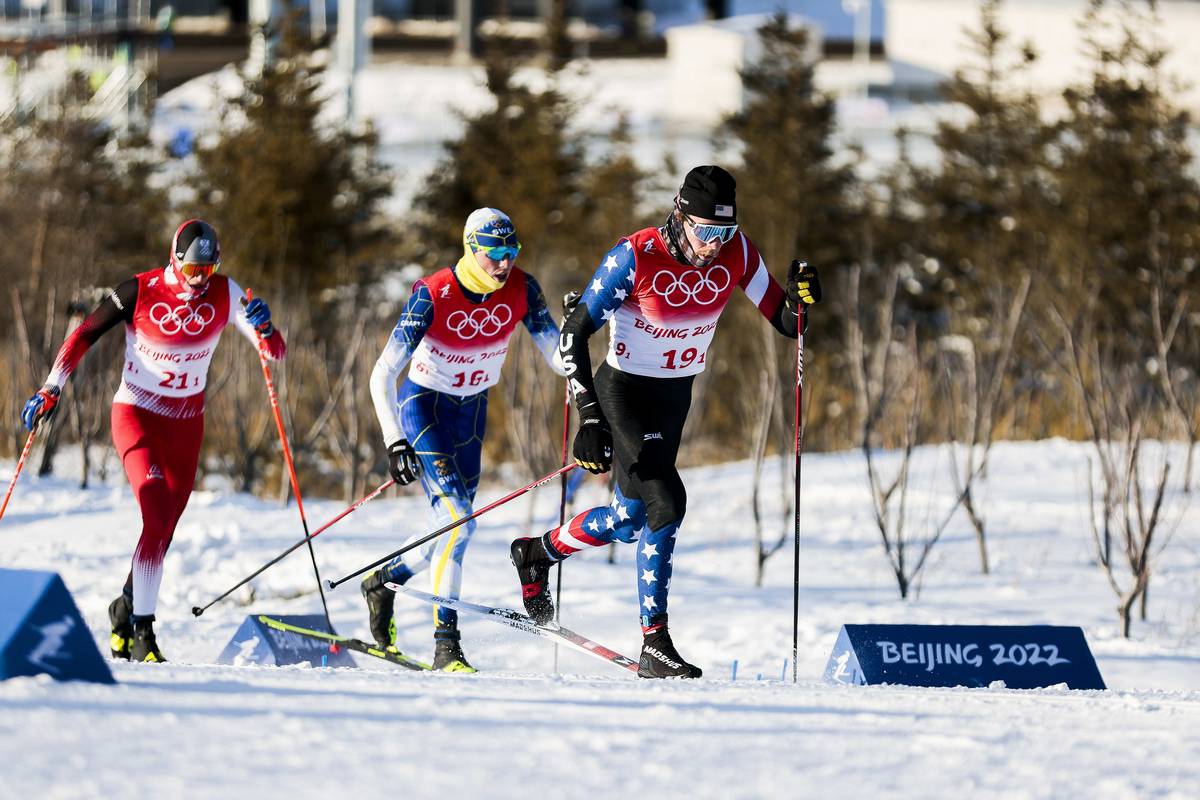
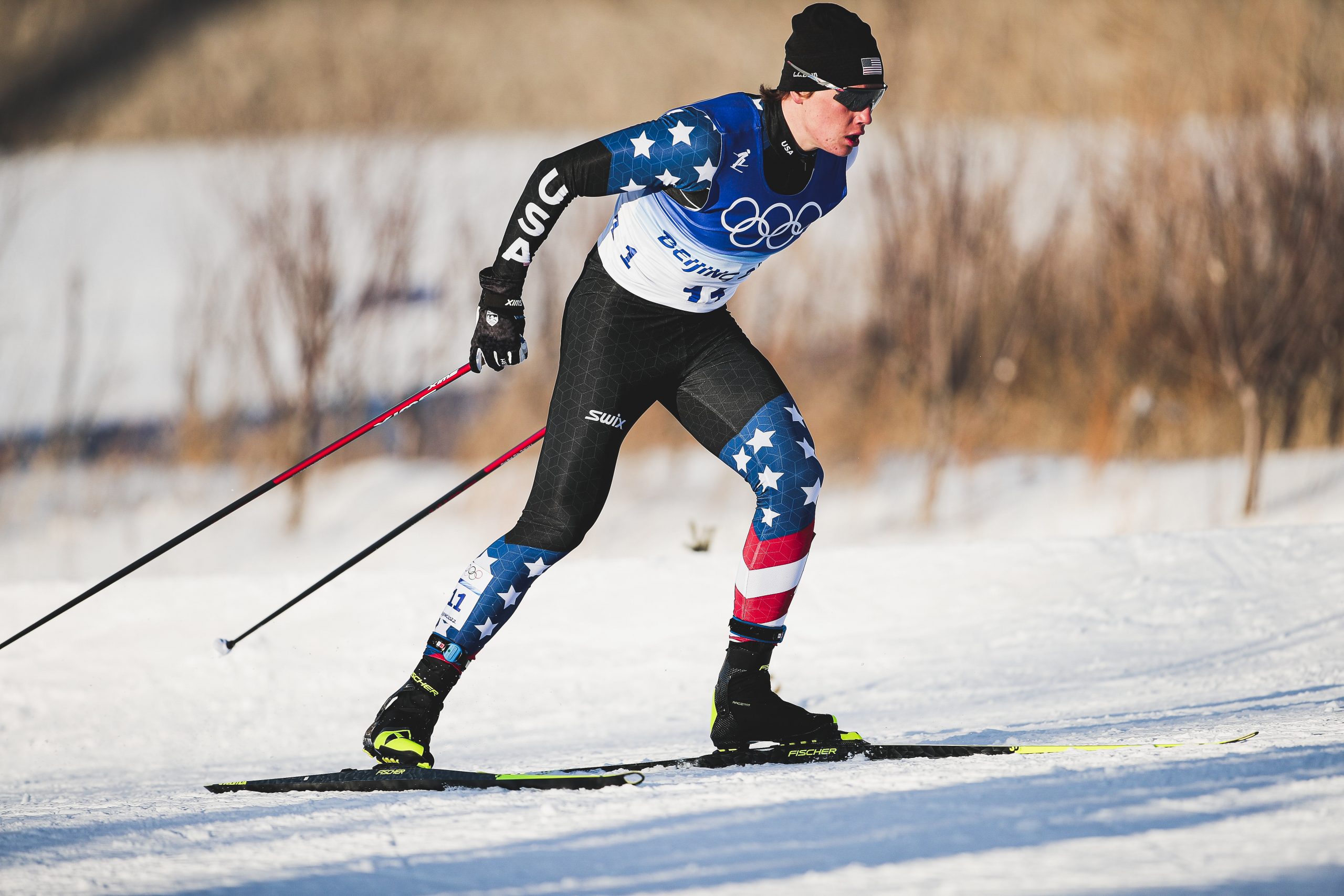
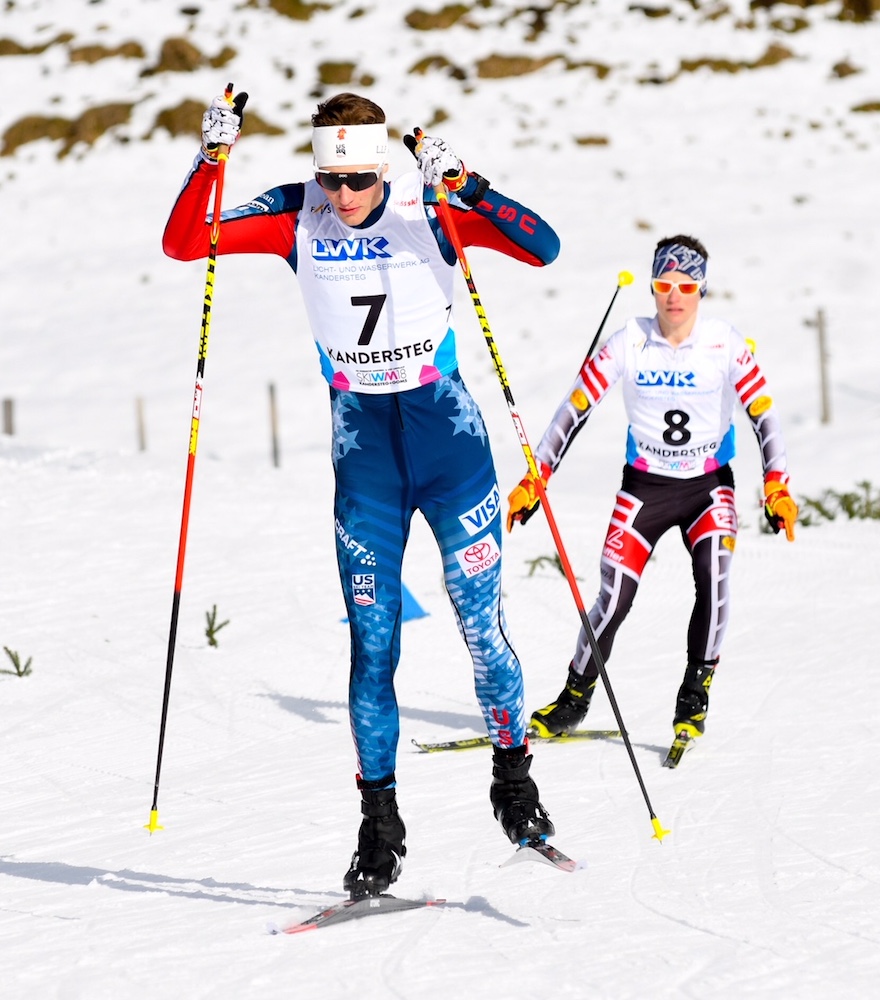
    Ben Ogden (USA) strides early in the the team sprint. (Photo: NordicFocus)

    The men’s field going out relatively slowly could be attributed to Norway’s Valnes. He seemed to comprehend that with his team as a pre-race favorite, the eyes of the pack were on the “What is that?” pattern of his suit. Valnes looked to lead the pack so-as only to try and lull it into complacency. It was a strategy that made sense, knowing he would be tagging off to the current fastest human on skis in a drag race, Klæbo.

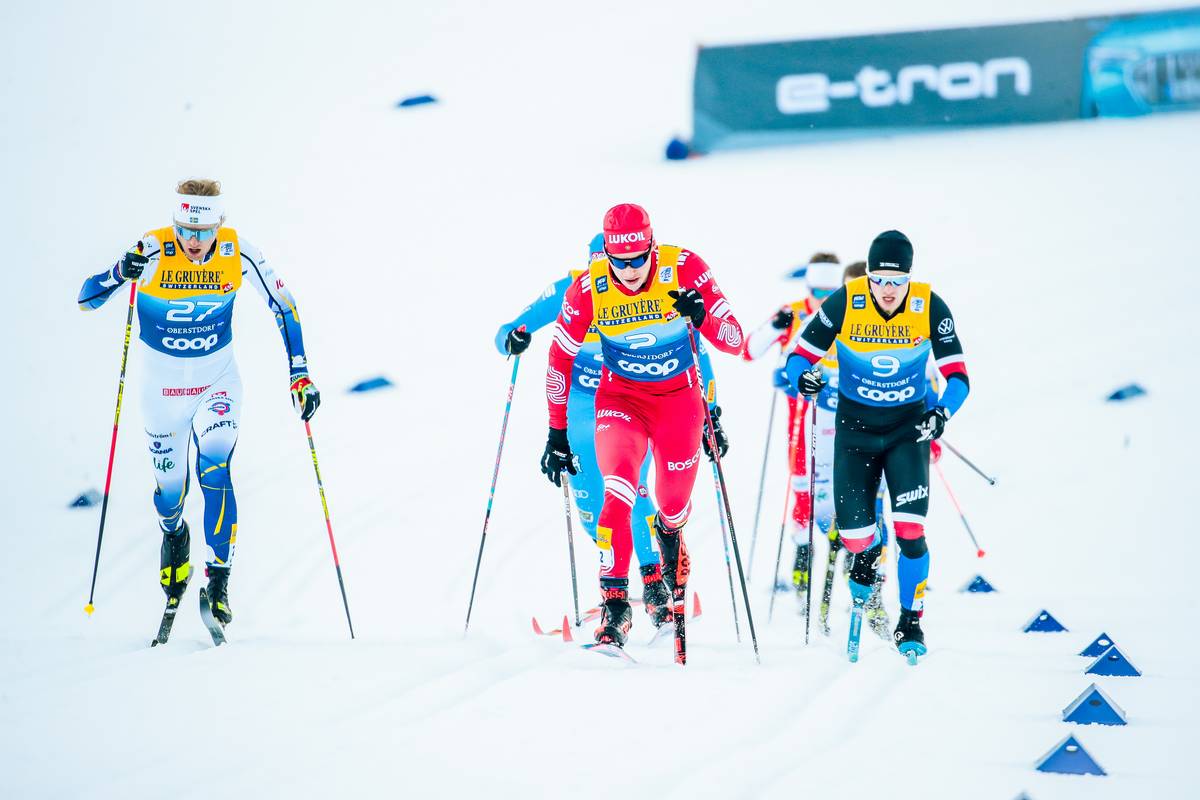
    Alexander Bolshunov, though, called Valnes out on his bluff, making sure to pick up the pace just enough so that the pack would have to work throughout its first leg.

    So began the stalemate that would last for much of the early legs of the race. In the first exchange to the anchor-legs, Klæbo showed outward signs of his strength, and his desire to keep the pace right in the sweet spot where he could shoot around them in the end. JC Schoonmaker, meanwhile, remained placed right off the leaders, in the pack, moving through the course.

    The second showing of leg 1, including Valnes, Bolshunov, Niskanen, and Ogden saw Bolshunov push on the initial climb out of the stadium. Valnes covered the move, before the pack came together in the final climb into the stadium. The pressure, and the speed, had increased. Ben Ogden, though, had kept up with the pack, and came through the half-way mark with the Americans in 7th place (+4.4).

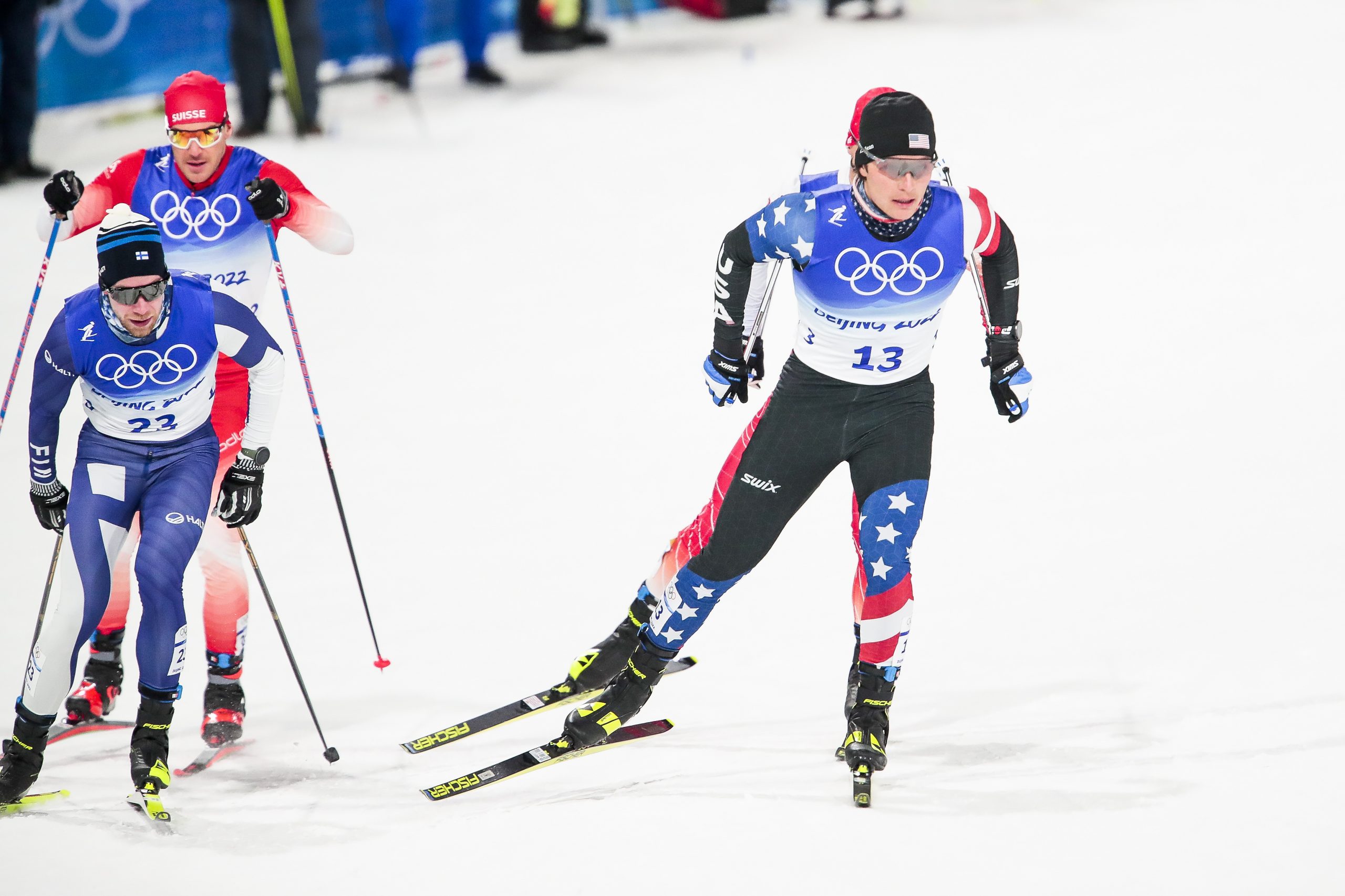
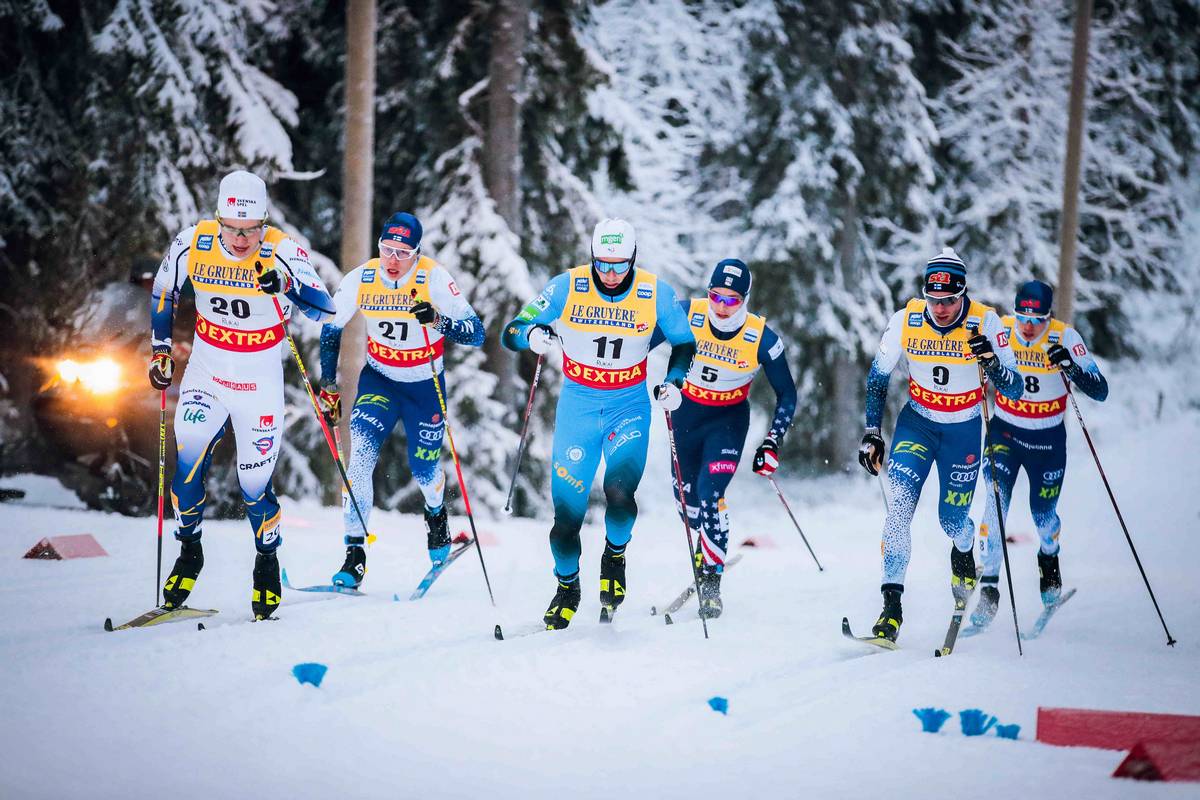
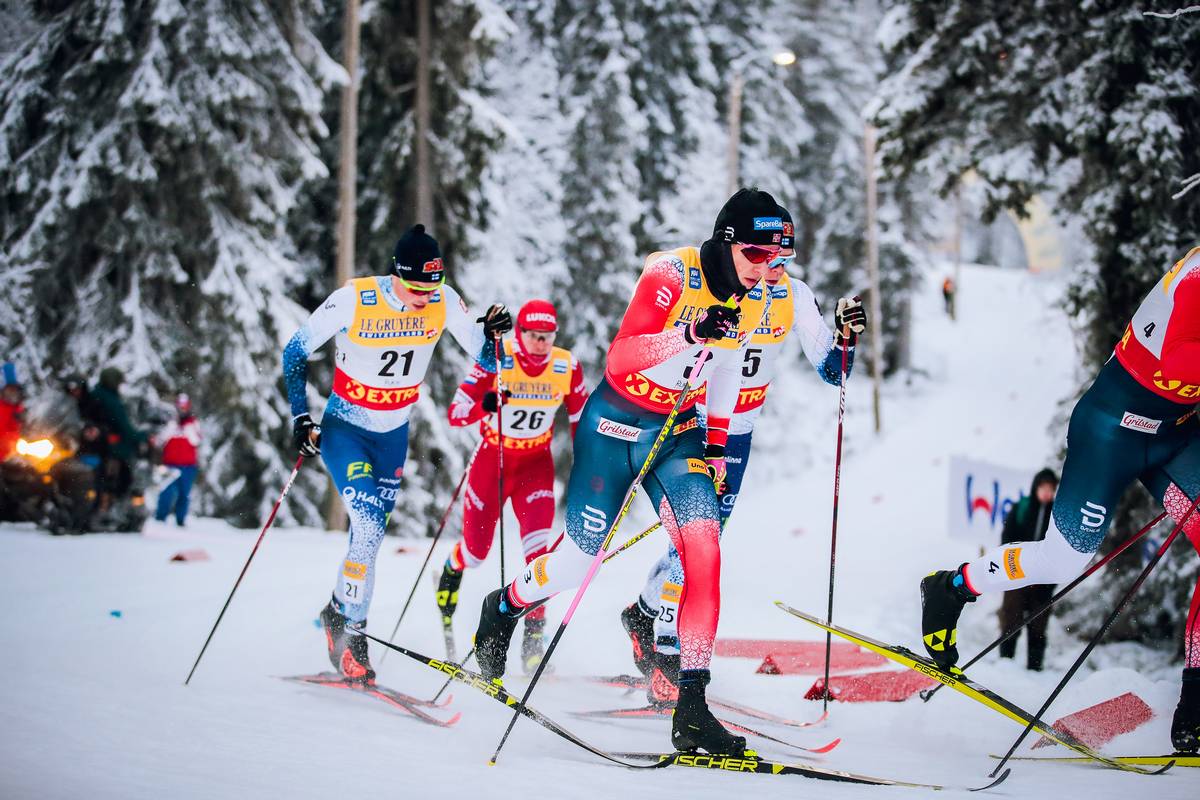
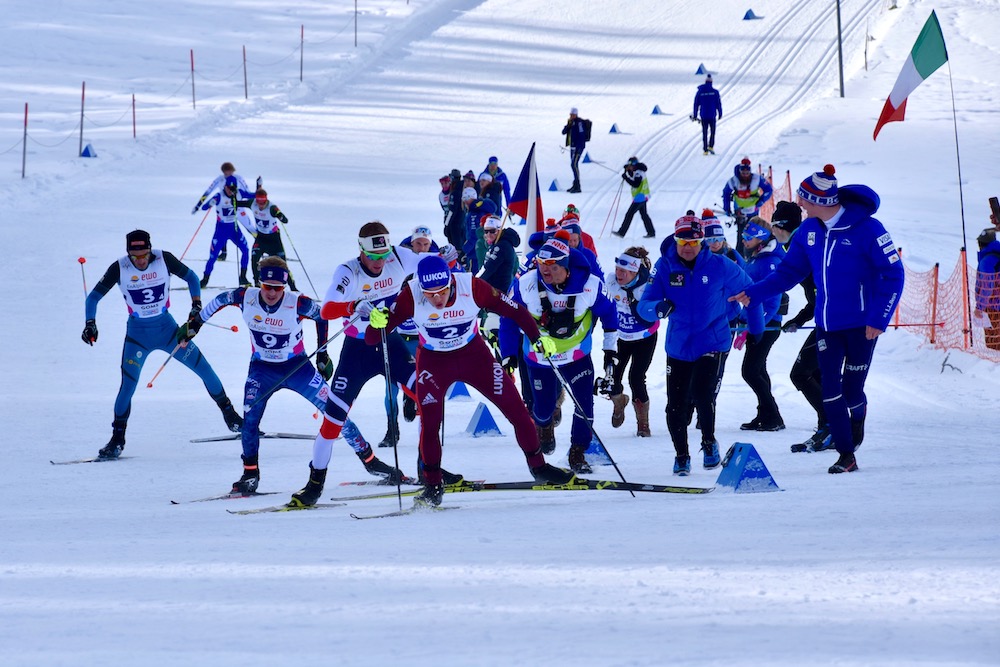
    Johannes Høsflot Klæbo (NOR), Richard Jouve (FRA), and Joni Maki (FIN) face off in the classic team sprint during the 2022 Olympic Winter Games. (Photo: NordicFocus)

    In their second laps, a lead group that included Terentev, Klæbo, Maki, and Schoonmaker, the pack began to take shape. The decisive move didn’t come from any of those skier’s mentioned, though, but instead from a familiar agitator in sprint heats on the World Cup. Moving up from behind the leaders, France’s Richard Jouve powered to the front of the pack on the first uphill, but was quickly matched by both Terentev and Klæbo. The duo, as they approached  the downhill, put in a burst of speed that hadn’t been seen on the course up to that point, and it was all it took for the pack to begin to thin.

    This was the move that saw the young American team begin to lose contact with the lead group. Schoonmaker later said that “the downhills felt tighter and more aggressive than some other World Cup sprints.”

    The Americans slipped to 9th place, and remained there for the rest of the day despite the early efforts of the duo to stay locked in and pushing all the way through.
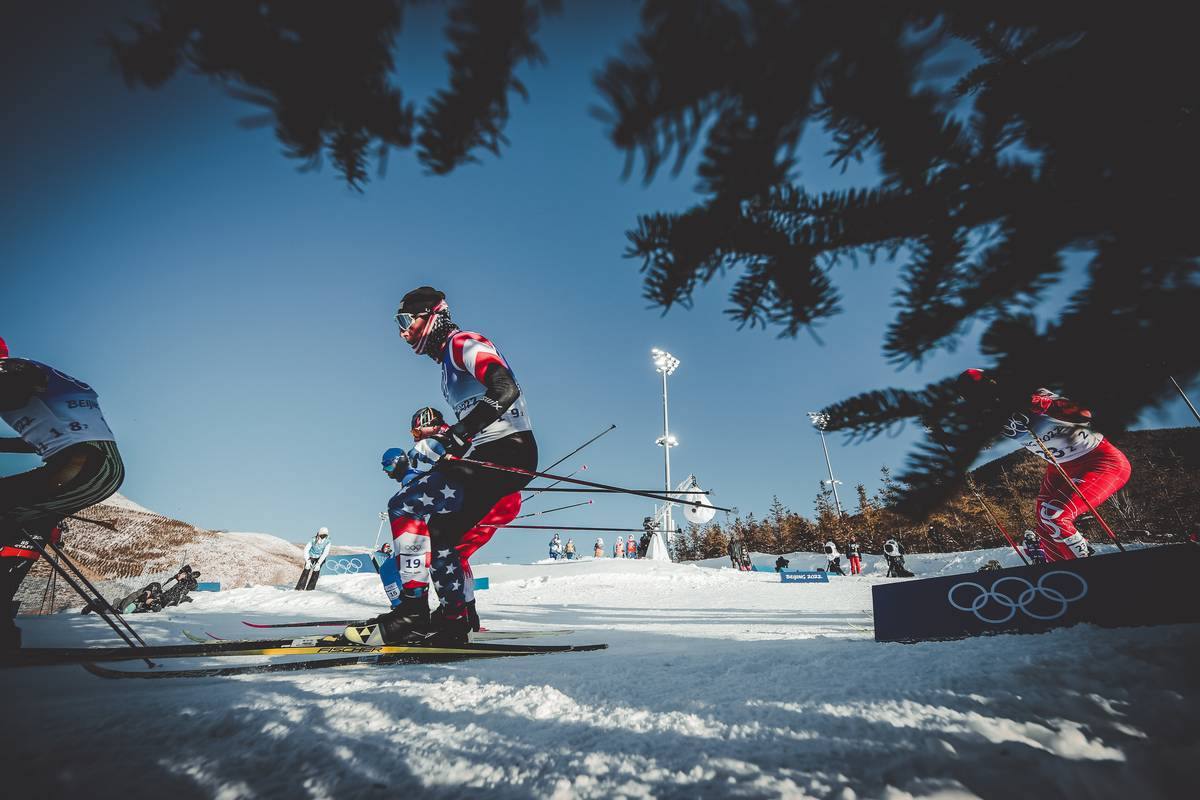
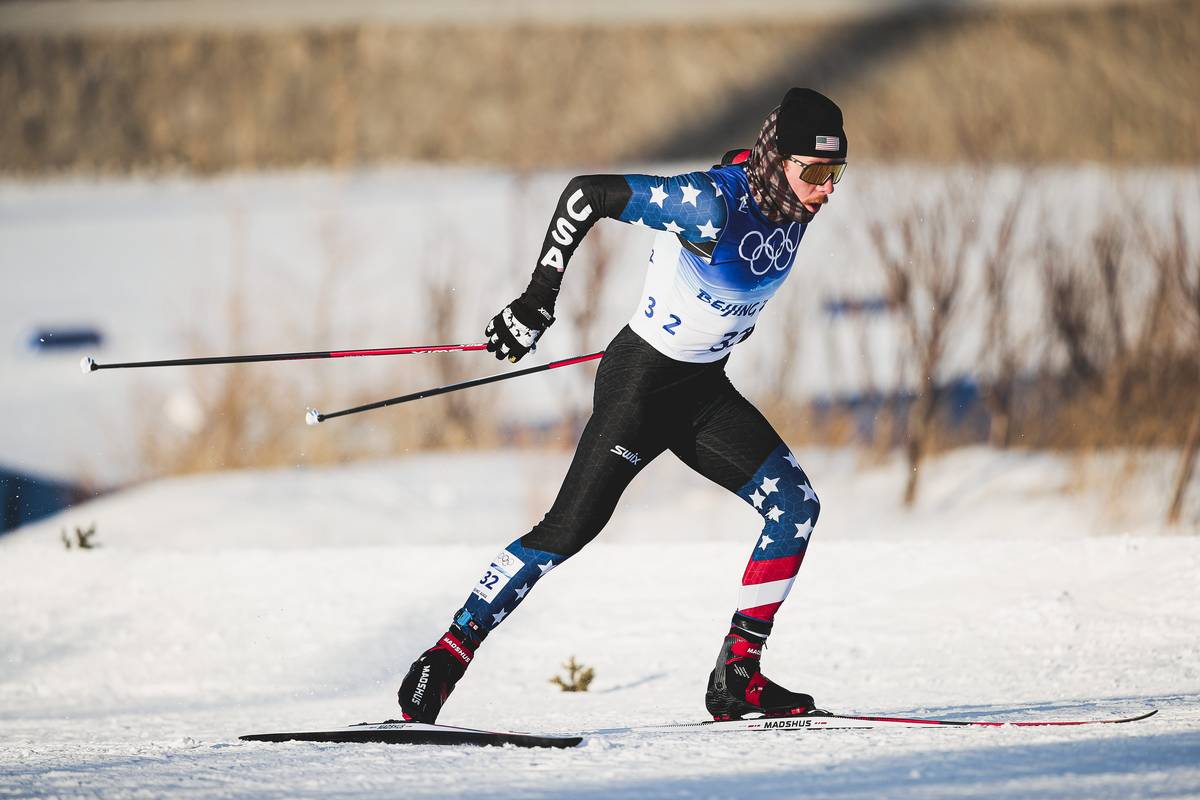
    JC Schoonmaker races the classic team sprint final during the 2022 Olympic Winter Games. (Photo: NordicFocus)

    Meanwhile, at the front, the exchange to the final lap of the odd-leg skiers found Bolshunov once again putting in an attack on the uphill that led out of the stadium. The move indicated that the ROC had faith in the young Terentev as the anchor, but that chancing it with Klæbo still on deck was not the preferred option. Valnes took the ROC strategy off the table anyway, letting out a blistering counter-attack that showed his own strength and served to further separate the pack. When they came into the final climb into the stadium for the last exchange, it was just Norway, the ROC, and Finland who were in contention for the gold medal.

    Finland, in fact, was the first to the exchange. That came courtesy of Niskanen, who evaded the front of the pack for much of his race. The 15 k classic champion unleashed his diagonal stride on his final climb of the day, with both efficiency and power that exemplify optimal technique.

    The last lap, then, looked like a three-way pack of Finland, Norway, and the ROC, and, not far back and putting together an outstanding day, Canada (+9.7). The team of Graham Ritchie and Antoine Cyr had put in an unexpected and auspicious effort for the whole world to see.
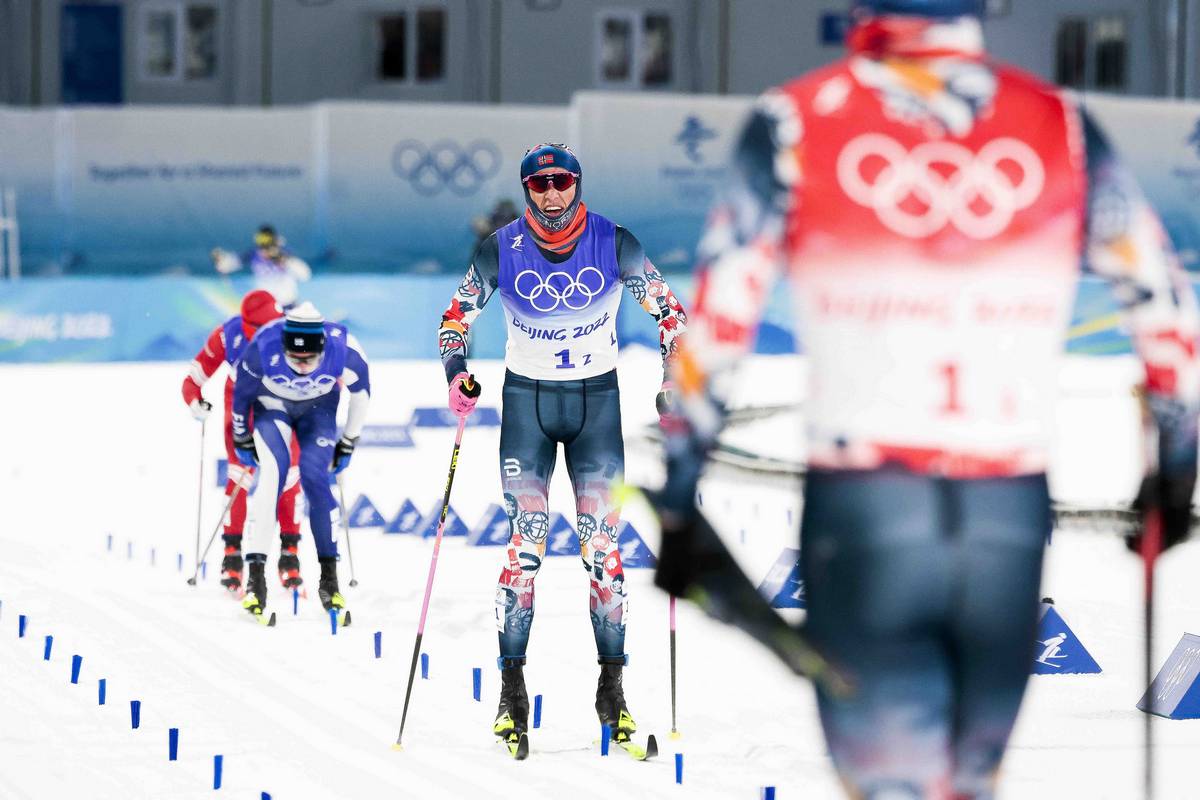
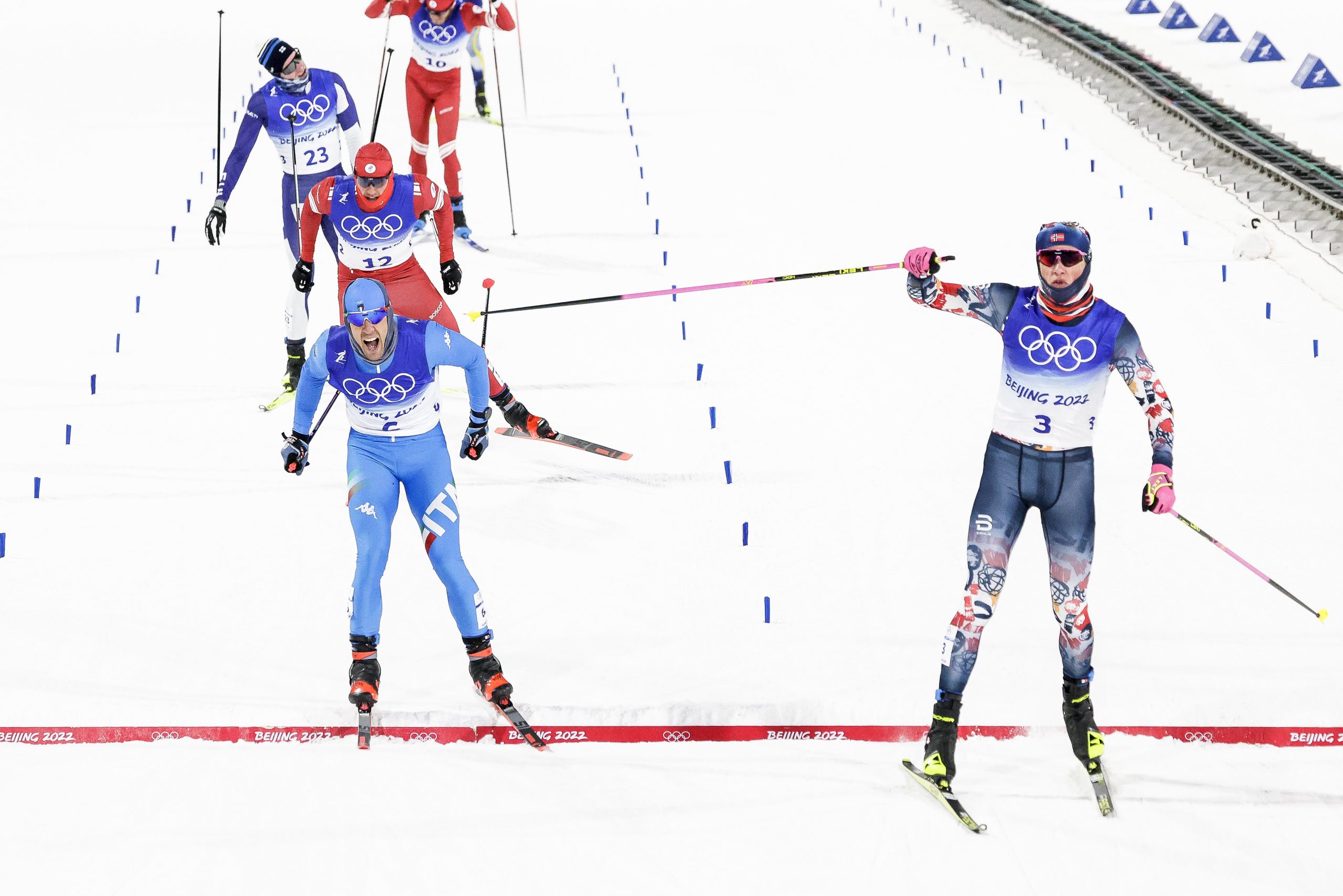
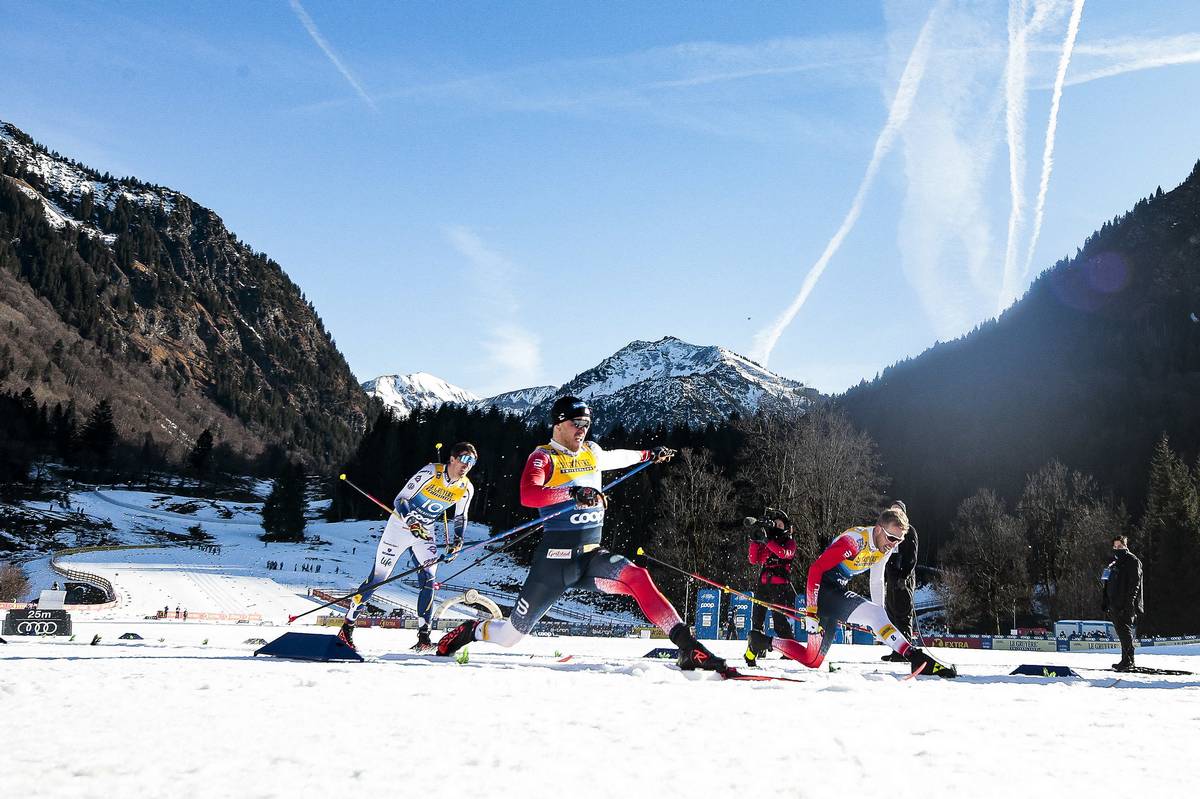
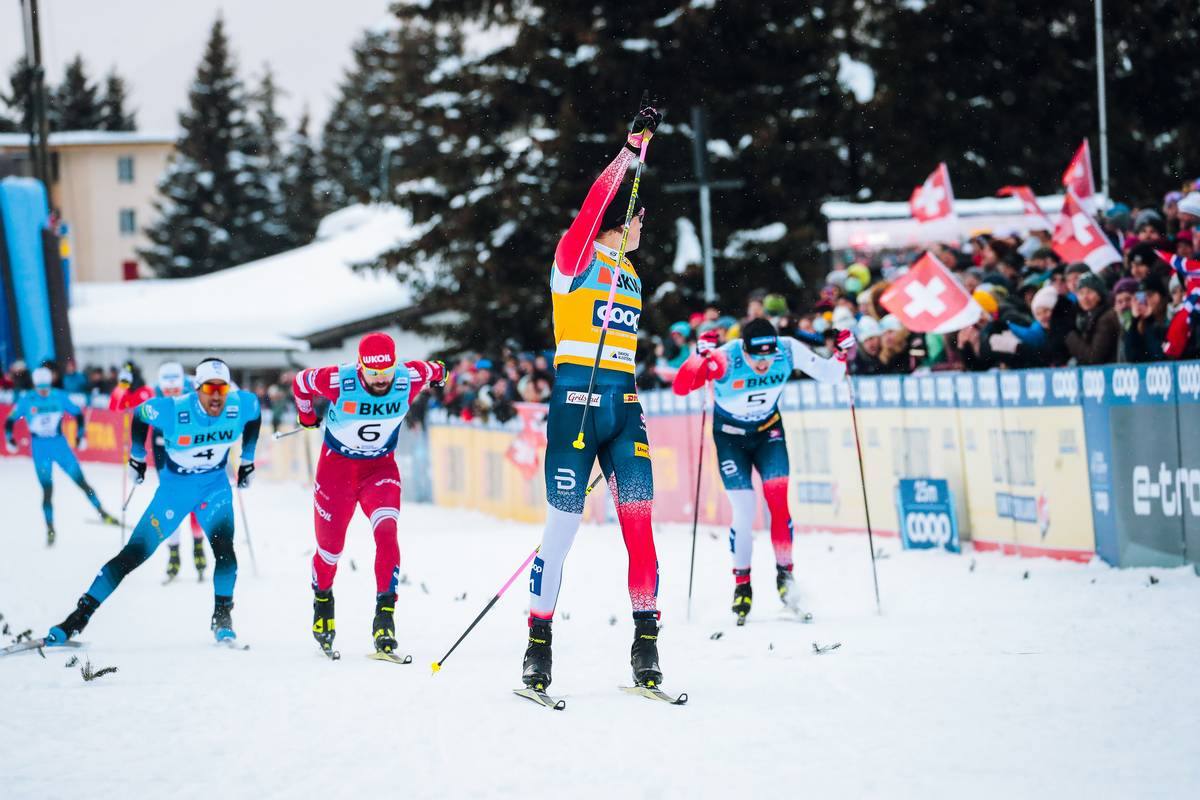
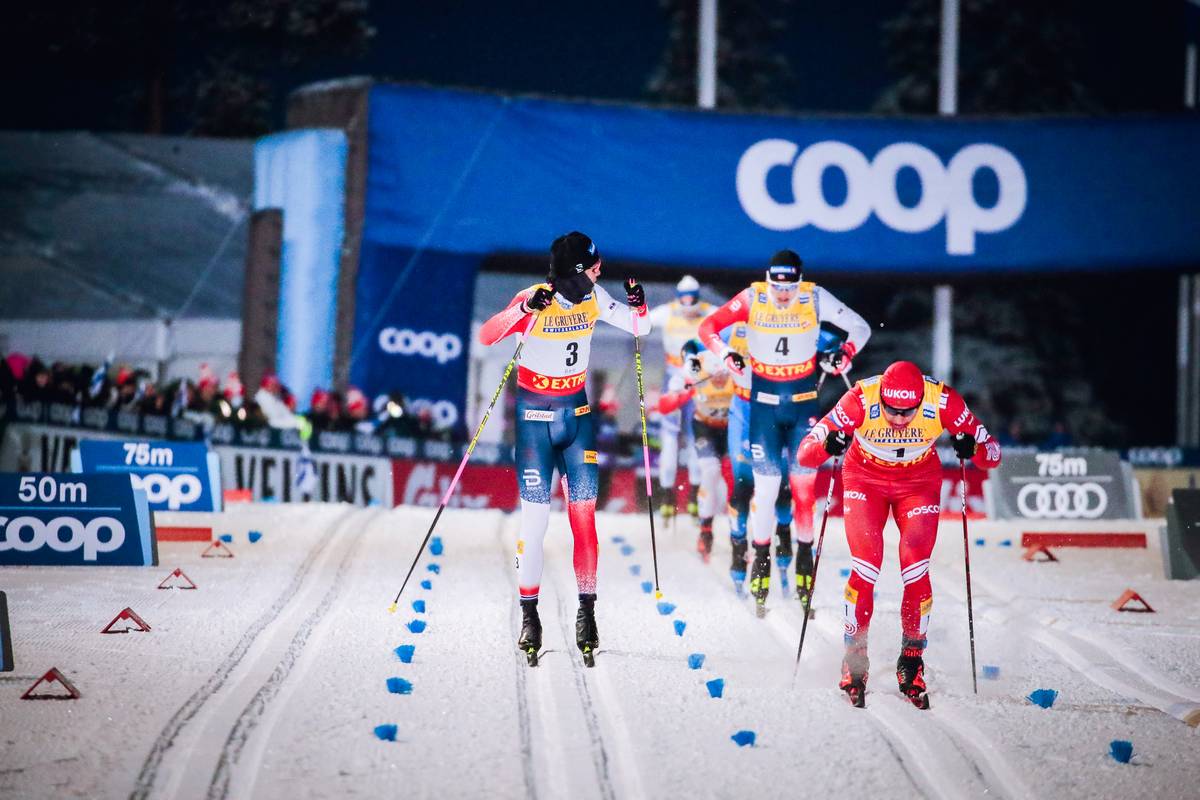
    Johannes Høsflot Klæbo (NOR) leads the way to the line, with Joni Maki (FIN) and Alexander Terentev (ROC) behind for second and third. (Photo: NordicFocus)

    Still, the skiers to face off for medals remained; Joni Maki (FIN), Johannes Høsflot Klæbo (NOR), Alexander Terentev (ROC).

    The front three remained tight throughout the final lap. The pace was fast, but not fast enough to shake the familiar feeling that we’d been here, on this 1.5 k course, before, and it was a stage for which one player was ready to take the lead role: Klæbo.

    On the last hill, Klæbo went, and proved again that he was both a master of the art of sprint racing, and still indisputably its best practitioner. He, and Norway, would repeat as gold medalists in the team sprint in a time of 19:22.99.
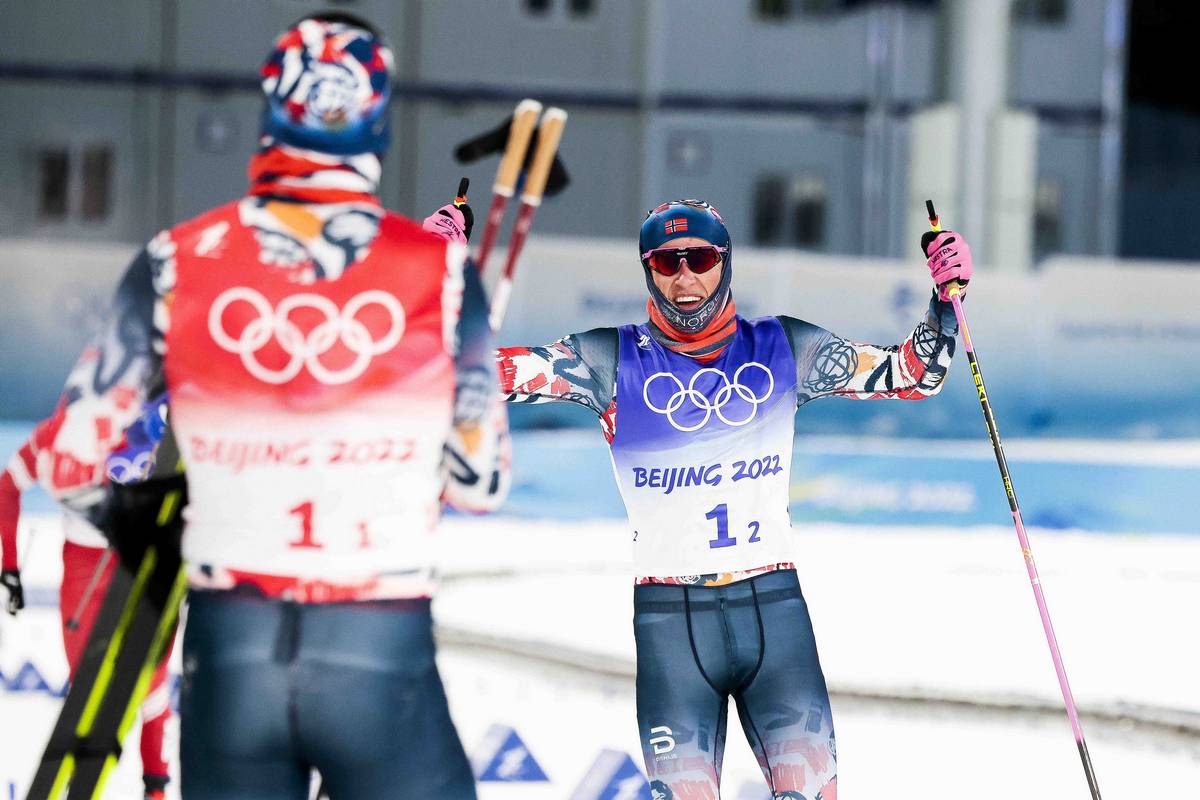
    Johannes Høsflot Klæbo celebrates team sprint gold with teammate Erik Valnes. (Photo: NordicFocus)

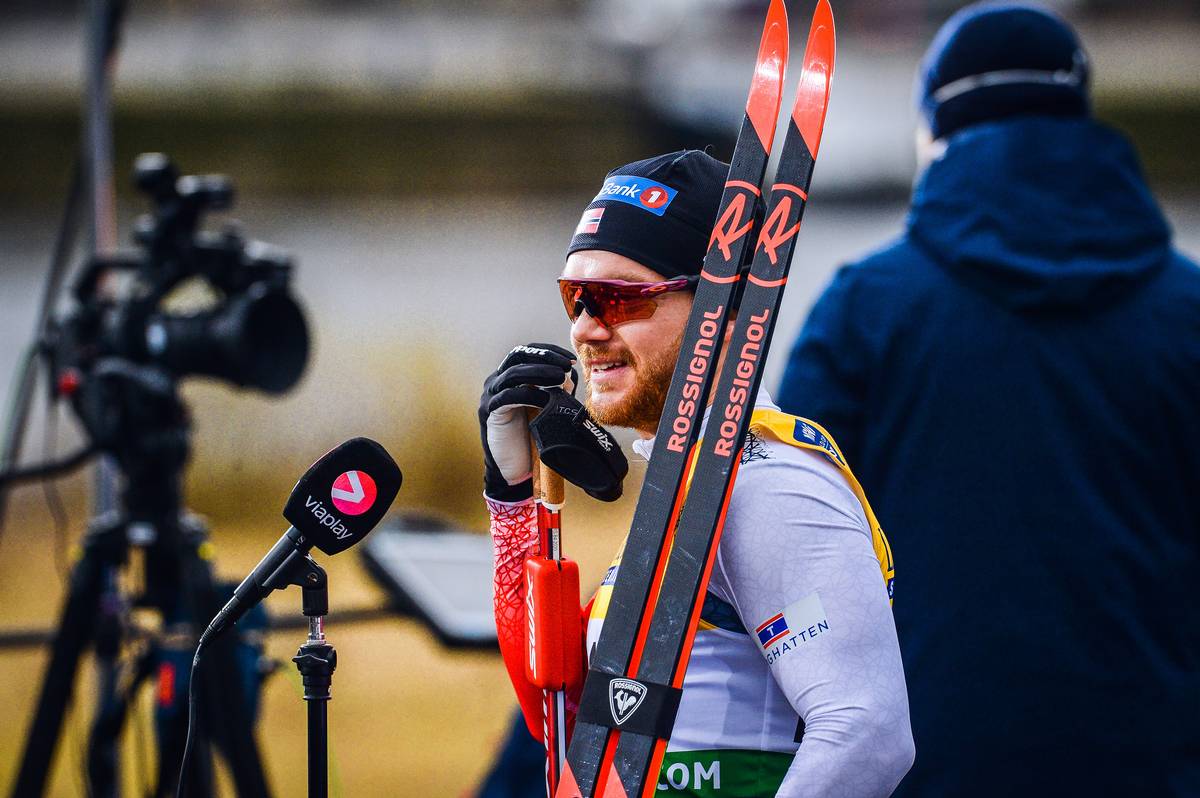
    In comments to the press after, Klæbo said of repeating as a gold medalist, “I’m really proud, it’s special to do this together as a team. We won the team sprint in 2018, and doing it in a different way now, different style, with a different person, it’s special.”

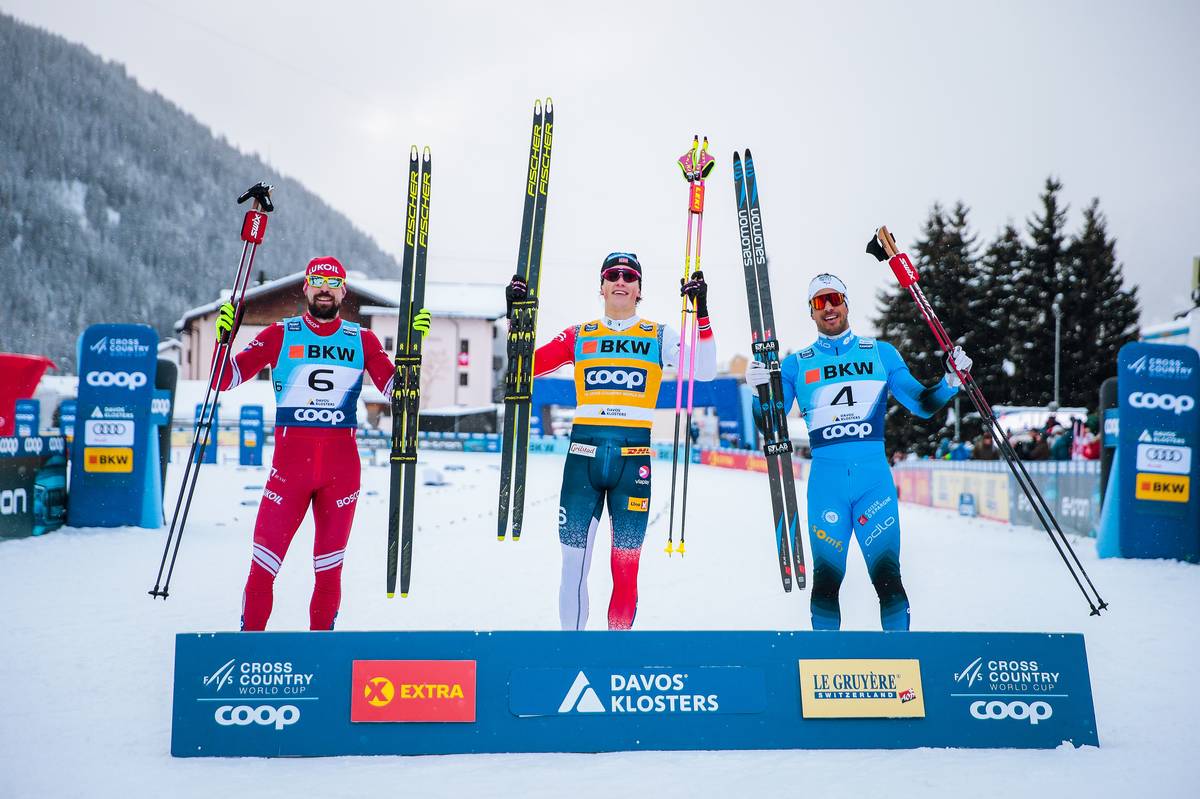
    Behind him, Joni Maki made a late effort to pull in front of Terentev and deliver Finland, and his teammate Iivo Niskanen, back to the medal ceremony that they last attended for the team sprint in 2014 by finishing second (+2.46). Terentev finished third (+4.29), ensuring that the ROC (or, for these purposes, the Olympic delegation formerly known as Russia) continued its streak of never having finished outside of the medals in the team sprint at an Olympic Games.
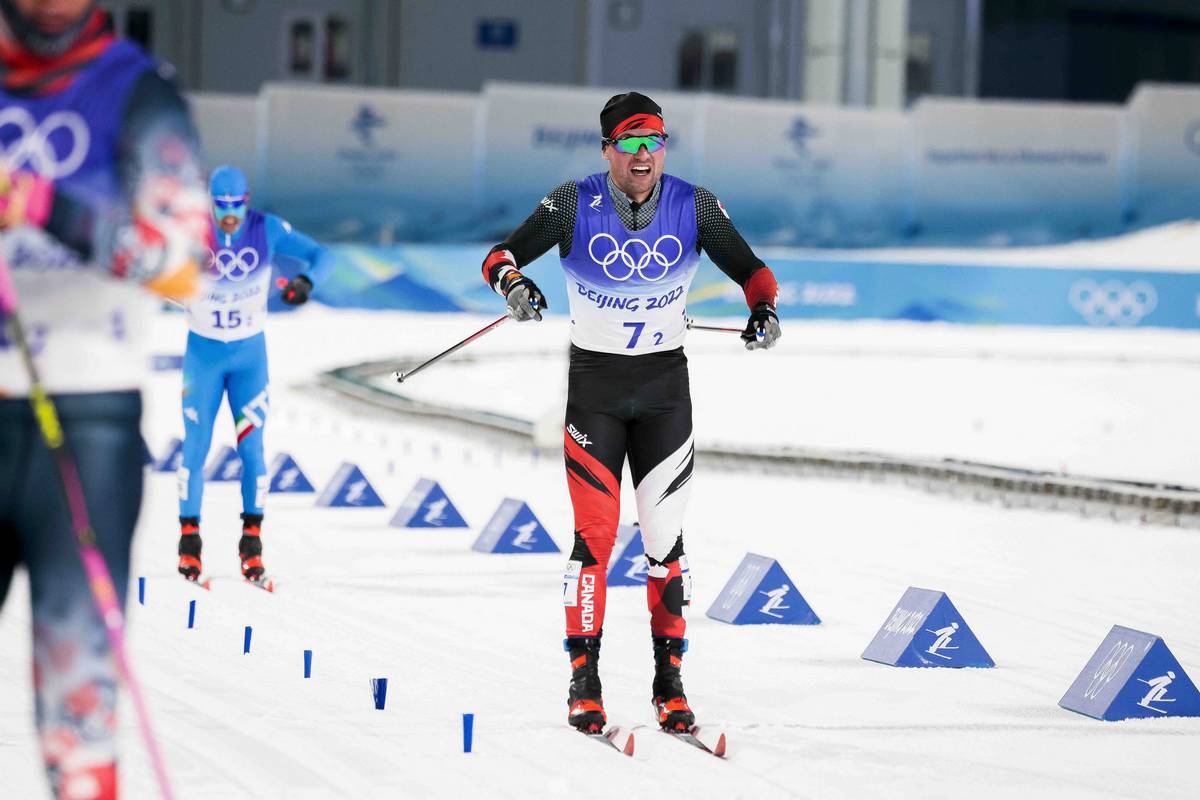
    Graham Ritchie (CAN) double-poles toward the finish of the men’s team sprint. (Photo: NordicFocus)

    Sweden pulled back to fourth place (+15.06), and the surprise of the day was the young Canadian team of Ritchie and Cyr, both 23 years old, finishing in fifth place (+22.31). The Americans held the gap to +1:05.08, and finished in ninth.

    Ogden and Schoonmaker came away feeling optimistic on their first go-around at the Olympic team sprint, saying “It’s good. With some experience, we can be a lot better.” 

    Ben Ogden (USA) and James Clinton Schoonmaker (USA) at the finish of the team sprint. (Photo: NordicFocus)

    “Some more training under our belts will be a big game changer for us,” Schoonmaker continued, “[because] we’ve done zero team sprints [like this] with 3 laps. This is our first time skiing a real team sprint.” 

    Through its pushes-and-pulls, posturing and performances, the team sprint again proved to be a thrilling highlight of skiing. And with it completed, and a pair of gutsy performances turned in, it is possible to turn a glint of our attention today towards what the two young North American teams will do four years from now in Cortina, Italy. Really, it is just too easy to go there already, and let the Olympic dreams run wild.

    That of course though, would be premature. There’s as old-school a race as they come left in Beijing on Saturday, when the 50 k freestyle will be revived on the Olympic stage. The final men’s event promises to be as pleasant a distraction from future thoughts as there is in the world of skiing. So let’s enjoy.
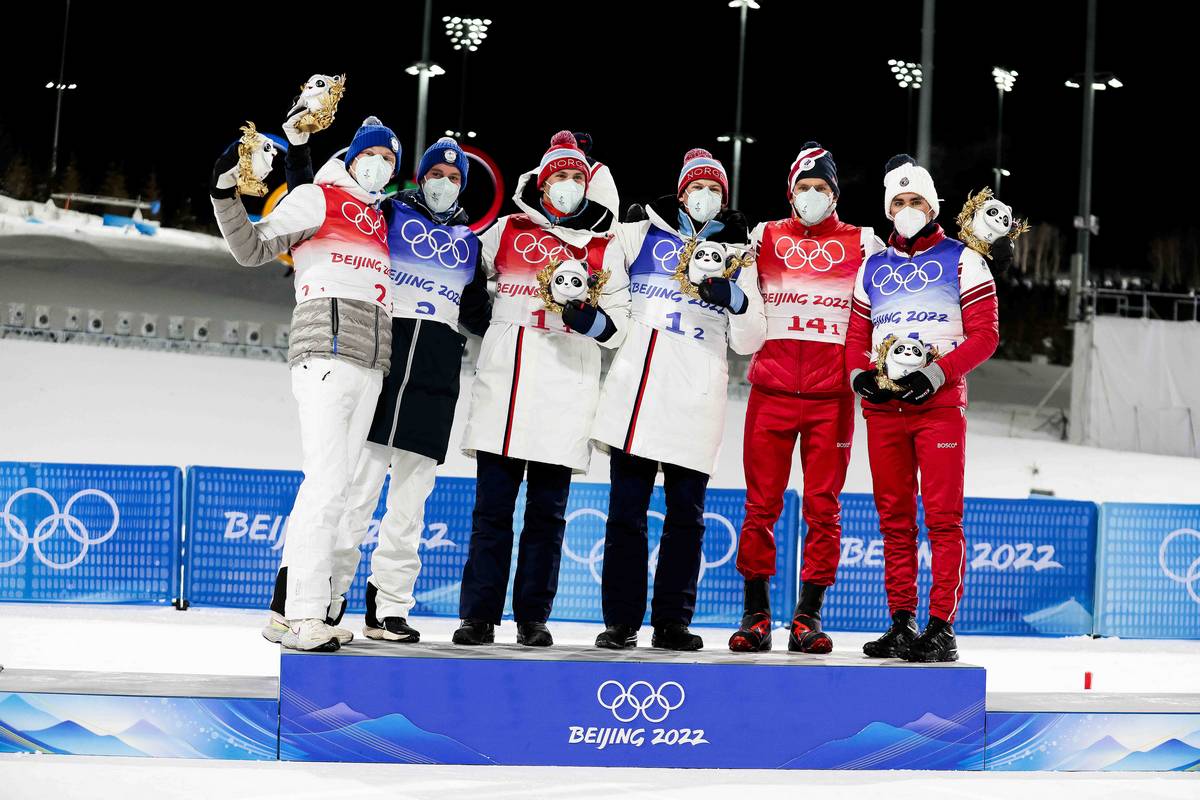
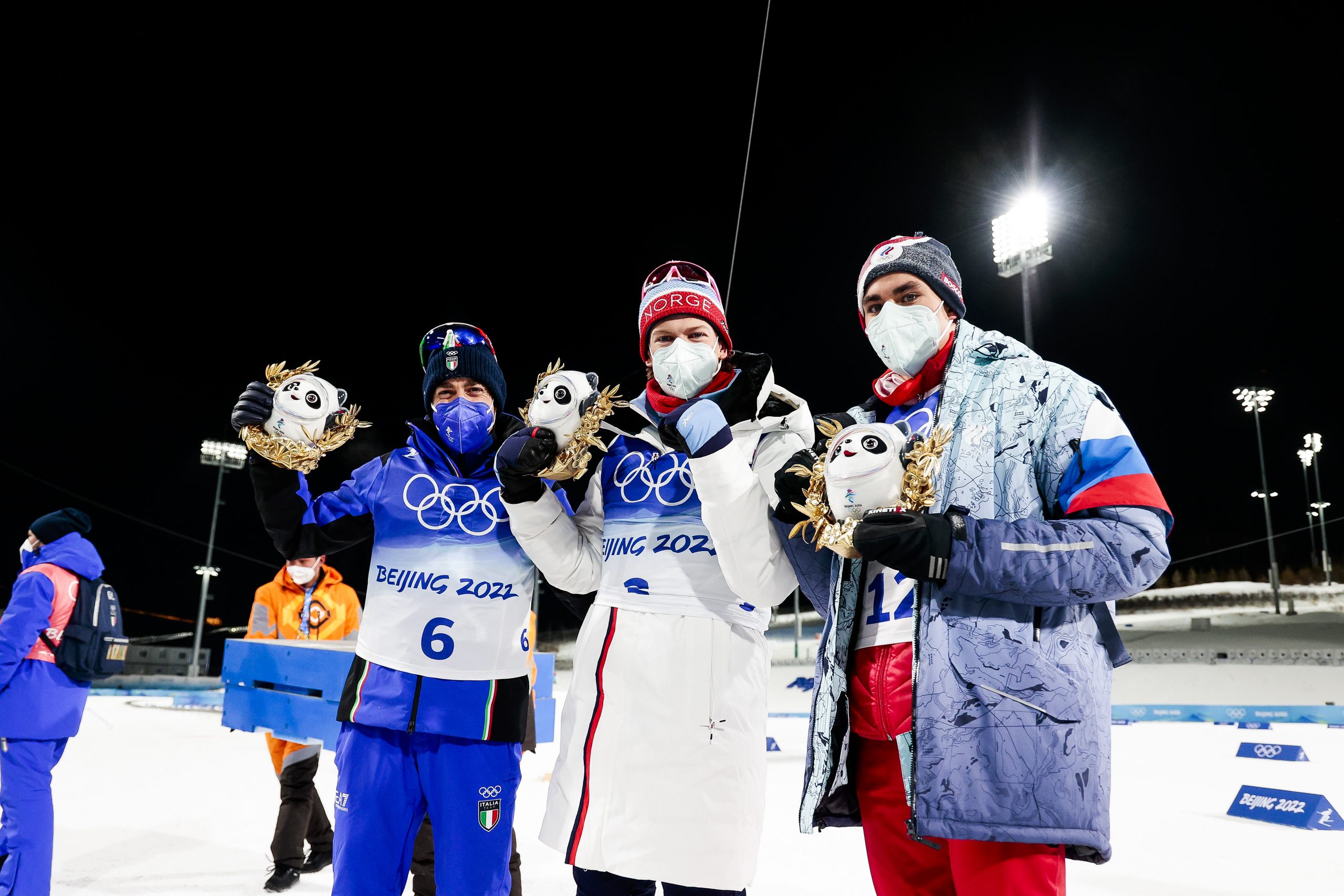
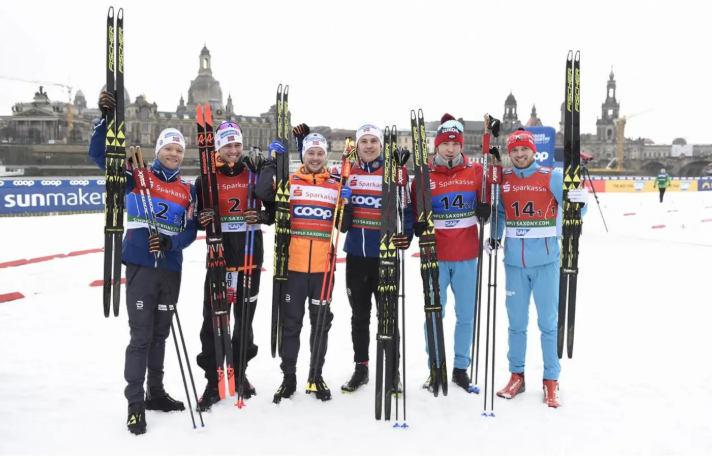
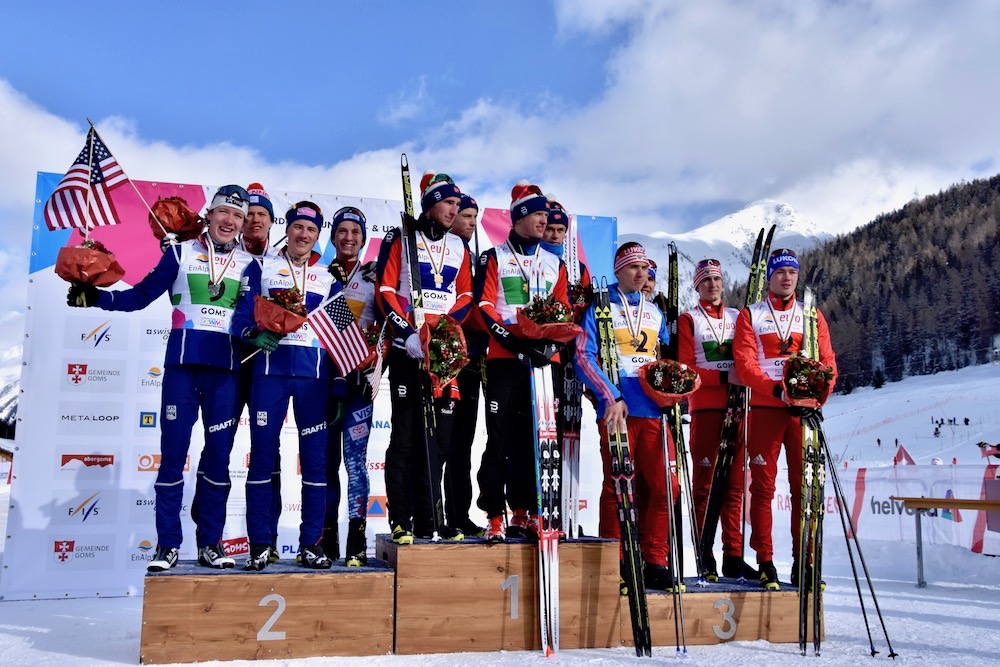
    Finland, Norway and the Russian Olympic Committee on the men’s team sprint podium. (Photo: NordicFocus)

    Results: Semifinal A | Semifinal B | Final

  • Klæbo Defends Olympic Gold as Americans Soar to New Heights in the Freestyle Sprint

    Klæbo Defends Olympic Gold as Americans Soar to New Heights in the Freestyle Sprint

    This World Cup coverage is made possible through the generous support of Marty and Kathy Hall and the A Hall Mark of Excellence Award.  To learn more about A Hall Mark of Excellence Award or to learn how you can support FasterSkier’s coverage please contact info@fasterskier.com.


    During the American broadcast of the 30-kilometer Skiathlon on Sunday, NBC Analyst Chad Salmela made the comment that race represented the “old-school” of long-burn, grind-it-out ski racing. That length of ski race, updated only for the introduction of skating, has been a feature of Olympic competition since the 12th Olympiad held in 1956.

    In contrast, each one of the American skiers starting today was already born when the 1.5 km freestyle sprint became an Olympic event at the 2002 Salt Lake City games. In fact, only Kevin Bolger (born in 1993) can claim to have a living memory of that event. The other three – JC Schoonmaker, Ben Ogden, and Luke Jager – were all two years old when Tor Arne Hetland won gold at Soldier Hollow.  

    Luke Jager (USA) on his way to qualifying 30th in the Individual Sprint Qualifier in Beijing. (Photo: NordicFocus)

    In the intervening twenty years, those latter three were part of an American generation that came of age sprinting on the 2002 Soldier Hollow course, contesting junior and senior U.S. Nationals as they climbed through the ranks and quietly holding tight to their Olympic dreams. Meanwhile, the generation of skiers they looked up to were trailblazers, with sprinting their preferred in-road for American skiing on the Olympic stage. At the 2006 Torino games, Andrew Newell came through qualifiers in 2nd. Then Simi Hamilton became a consistent presence on the World Cup circuit, and qualified for heats in the last freestyle the Olympic sprint at the 2014 Sochi games. Eight years later in 2022, the kids had grown, and from Vermont hollows, Wisconsin Northwoods, the California snowfields, and the Alaskan frontier, had converged on a start-line in Beijing, ready to push for something new.

    After qualifying, they had already done it. The American men started four skiers for the individual sprint, and for the first time in Olympic history, each one of them made the heats. Leading the way was recently crowned U.S. sprint champion JC Schoonmaker, who finished in 13th, +6.12 seconds off of winner Lucas Chanavat (FRA), who clocked a 2:45.03 on the 1.5 k course. Ben Ogden finished in 19th (+7.18), Kevin Bolger was 22nd (+7.47), and Luke Jager rounded out the quarterfinal field in 30th (+9.41).

    Jager, in 30th, found himself right away in the unique challenges the Olympics can bring then, saying in an interview with FasterSkier that “There were seeded guys behind me and I knew I was right on the bubble [for qualifying]. I was getting interviewed by NBC and the whole time just wanting to reach down and check my phone.”

    In the end, he was through with his American teammates.

    Ben Ogden skis to 19th in qualification in the men’s individual freestyle sprint. (Photo: NordicFocus)

    They joined the established field that’s become familiar to those who follow the World Cup week-to-week, and for whom the individual sprint was a priority at these Games. That included defending individual sprint gold medalist Johannes Høsflot Klæbo (NOR), who qualified in 3rd (+1.71), defending silver medalist Federico Pellegrino (ITA) in 6th (+4.52), and the Russian Olympic Committee’s (ROC) own young star Alexander Terentev in 14th (+5.89). 

    The whole field would converge in the quarterfinals to race a 1.5 k course that raced as a “true sprint” as NBC Analyst and American gold medalist Kikkan Randall remarked on the American broadcast. Her remarks were apt; the course raced as a single-lap, taking three minutes for the majority of the field, on fully artificial snow. If you were looking for an archetype for what the “sprint-course” has developed into since the inception of the event at the 2002 Olympics, you’d have the one in Beijing. A first climb gave way to a downhill, which led to a long final climb, before skier’s took a sharp left turn into the final stadium stretch. The tactical pressure-point was the turn to go into the descent following the first-climb. If you went over with speed, the transition into the final hill could prove to be a decisive factor in a long-burn attack. If you followed, the draft could be just as important to launch a punchy sprint to move up the field on the last climb.

    That racers would see both approaches became apparent straight from the first quarterfinal, which featured Klæbo, Sergey Ustiugov (ROC), and Ben Ogden. Klæbo seemed to take the tactic of a long-burn attack on this course, which was helped along by a field that seemed set at every level today to try and force him out in front so as to catch his draft. He used the corner off of the first uphill to delay his burst of speed into the downhill just enough to surprise the field, and by the time he hit the final climb, he was in a comfortable position to win the heat.

    Ben Ogden crosses the finish-line in sprint heat action. Ogden would finish 12th, the best men’s individual sprint finish in US Olympic history. (Photo: NordicFocus)

    His burst of speed, though, had blown open the field behind him. Ben Ogden was caught out in 5th place going into the final corner. It turned out, in this particular case, to be a blessing. In front of him, Renaud Jay (FRA) stumbled over Anton Persson (SWE) (who was given a yellow-card for obstruction)  and caused a split-second hang up in the field with Oskar Svensson (SWE) that allowed Ogden to come into the finishing straight with a chance. He ended up taking it, finishing fourth place. Klæbo (2:51.57) had animated the quarterfinal, and the chase behind him yielded a fast heat. Ogden finished with a time of 2:53:00, good enough to warrant hope for a lucky loser spot into the semi-finals, but he would have to wait through four more heats to find out for certain.

    The third quarterfinal saw the next American action, with Kevin Bolger and JC Schoonmaker lining up against sprint stalwarts Richard Jouve (FRA) and Håvard Solås Taugbøl (NOR). Bolger, who is eight years senior to his fellow teammates, took a tactic in this race that suggested he understood the gravitas of the Olympics and how you race to stay in it. He led the pack out with gusto, trying to take the heat along with him.

    The field, however, seemed to have other ideas. Bolger said in an interview with FasterSkier that he “started V1-ing on the hill and I went ‘nope, not getting lucky loser, this is a different pace than the qualifier.” With those lucky loser spots most likely gone, the heat became a race for 1st and 2nd. Jouve and Taugbøl turned out to have the burst of speed needed in the end, with Bolger in 3rd. For the bleary-eyed among us back in the U.S., he provided the first glimmer of the American’s intrepidness on the day. For his part, Jager followed his older teammate, and his presence in 5th across the line was another reminder that that American spirit was found in spades on the day.

    Kevin Bolger (USA) and Luke Jager (USA) in quarterfinal action. Photo: NordicFocus.

    Jager pointed to how the Olympic experience was a unique one that he’ll hope to build on in an interview with FasterSkier, saying, “maybe it was the novelty, [but] to be perfectly honest my head wasn’t maybe in a great place to look towards advancing, but I think it’s one step at a time and I’m figuring out the right mindset to qualify consistently now and to advance. It was unlike anything else… it’s dark out and you need sunglasses, that’s awesome!”

    The fourth heat fleshed out the idea that Bolger had in the previous heat. The skiers went hard from the gun, knowing that if they could race a faster heat than the first quarterfinal, a 3rd or 4th in this heat could still keep their Olympic dreams alive. This was all complicated as Erik Valnes (NOR) pulled away to win the heat and a long sprint for second ensued. Pål Golberg (NOR) and Raimo Vignants (LAT) went down, and the sprint seemed to end up going for Chinese skier Qiang Wang, who hadn’t raced in the World Cup field since before the pandemic in 2019.

    Unofficial results showed that Valnes and Wang were through in 1st and 2nd, respectively. Results also showed that the quarterfinal had been the fastest heat of the day. Valnes finished in 2:49.31, with 3rd place Artem Maltsev (ROC) at 2:50.37 getting a lucky loser nod. The race jury quickly deliberated and disqualified (or officially, “ranked as last”) Wang, which meant that Maltsev was through to the semifinals on an automatic bid. That opened up one more lucky loser spot, and the next time on the list would prove to be a 2:53:00; belonging to Ben Ogden. He was through to the semifinals of the Olympic games.

    JC Schoonmaker (USA) races in the final quarterfinal on Tuesday in Beijing. Photo: NordicFocus.

    The last quarterfinal saw JC Schoonmaker narrowly lose out on a sprint to Alexander Terentev and Joni Mäki (FIN), after Schoonmaker led out the pack for the first part of the race.

    The men’s semifinals then, for the first time ever in an Olympic games, featured an American. And that American found himself in a who’s-who of heavyweights. The first semi-final lineup; Klæbo , Pellegrino, Jouve, Ustiugov, Chanavat, and Ben Ogden.

    Ben Ogden races the quarterfinal of the men’s freestyle sprint during the 2022 Beijing Olympic Winter Games. (Photo: NordicFocus)

    As the field climbed up the first hill, the skiers seemed set on fighting Klæbo tactics with Klæbo tactics. The race to get over the top was on.

    Richard Jouve ended up winning the fight to go into the downhill first, while Klæbo got caught at the back-end of a pack that remained tight. That included Ogden, who had weathered the storm to come into the final hill with the group. The transition into the final climb was furious, with Klæbo moving through the pack and bringing his rivals along with him. When they came into the final stretch, the field spread four wide and Klæbo, in shades of race nightmares past, looked to have eased up early, producing a four-way photo finish. Pellegrino and Klæbo ended up getting the nod to the finals in first and second, respectively.

    Ogden finished just off the sprint in 6th place (+1.24). His final placing of 12th is the best for an American man in an Olympic sprint. More than that though, he loomed in the background of a sprint of the world’s biggest names, appearing not as a straggler but as a shadow. The youngest in his semi-final field by 5 years, as he crossed the line, it seemed to be a reminder that the Americans are the ascendent force in sprint racing, with much more to learn, and to come, as they continue to gain experience at the Olympics.

    The second semi-final saw Artem Maltsev race with the same purpose he had struck out with in the quarterfinal. He seemed set on making sure that luck, in the lucky losers, would be with the second semi-final. After the first climb he had a gap that his teammate Alexander Terentev and Joni Mäki would claw back successfully in the lead-up to the stadium sprint, finishing 1st and 2nd, respectively. Maltsev and Oskar Svensson (SWE) were successful in their project of creating a fast heat though, and claimed the two lucky loser bids to the finals.

    The final then, had a field filled with shades of the last Olympic individual sprint. Klæbo had his chance to defend his medal. Pellegrino had his chance to one-up himself and claim gold in his stronger technique. Terentev, Mäki, Svensson, and Maltsev were all racing for their first Olympic medal of any sort.

    Sergey Ustiugov (ROC), Richard Jouve (FRA), Johannes Høsflot Klæbo (NOR), and Ben Ogden (USA) in semi-final heat 1. Klæbo and Ustiugov advanced to the final. (Photo: NordicFocus).

    There was again then, a guarantee for something new. A new medalist at the Olympic games. This was, though, still a sprint race of the world’s best. That meant the field knew who they didn’t want to have a positional advantage – Johannes Høsflot Klæbo. They skied wide, without much depth, to try and force him to the front. Through the first climb, they were successful. Klæbo though, one-upped them, again sneaking a move into the later part of the corner leading into the downhill, and catching the field just off-guard enough to give himself an advantage going into the final climb.

    Johannes Høsflot Klæbo (NOR) crosses in 1st to win gold in the men’s 1.5 k individual sprint. Federico Pellegrino (ITA) follows in 2nd place to claim silver. Photo: NordicFocus.

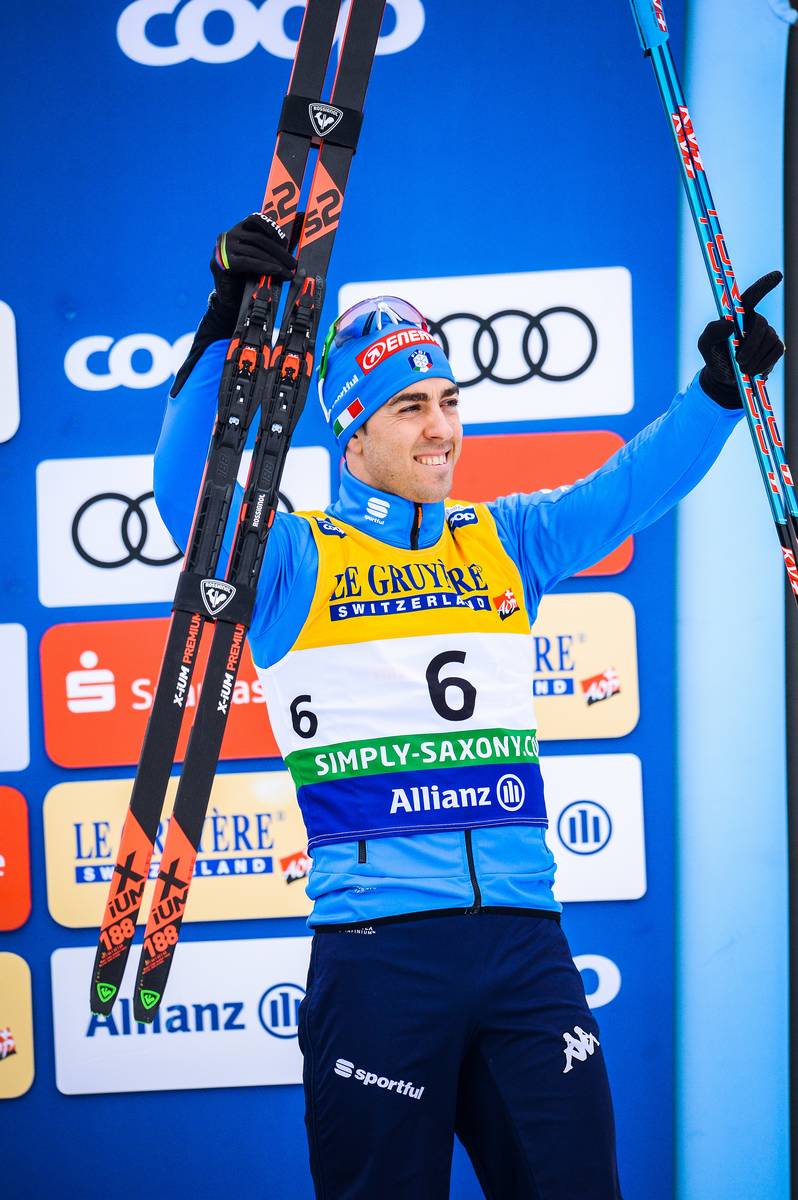
    There was no reeling him back. He came across the finish line an Olympic champion once again, defending his individual sprint medal and further building his case as one of the sport’s greats. Pellegrino pulled into the final climb and let out a final sprint that proved he is still Klæbo’s chief sprint competitor, four years on from establishing that fact in PyeongChang. The final step on the podium was occupied by Alexander Terentev, who, after a season in which he opened with a win, got to see his potential as an Olympic skier converted into kinetic possibility. He has one medal, and it would be a good bet that it won’t be long before he starts dreaming of the 1.5 k course that will be dreamt up for Milano-Cortina in 2026.

    Which, on the men’s side as a whole, is where many of us Americans are too. Even in these first few moments after their arrival on the Olympic stage, there is an err of possibility, energy, and optimism in the air about where this crop of skiers goes from here. We could get carried away and let that excitement uproot us from the source of that optimism in the first place. So before we look forward, let’s remember that the act of converting optimism into action is tenacity, and we can cherish Kevin Bolger, JC Schoonmaker, Luke Jager, and Ben Ogden giving us an image clad in stars and stripes of that here, today, in Beijing 2022.

    Men’s podium of the Olympic 1.5 k Individual Sprint in Beijing. Johannes Høsflot Klæbo (NOR) in 1st, Federico Pellegrino (ITA) in 2nd, Alexander Terentev (ROC) in 3rd. Photo: NordicFocus.

    The Canadians also put up a set of strong performances in the sprint qualifier. Graham Ritchie finished 34th (+10.01), just 0.6 seconds out of qualifying for heats. The results continued with Olivier Léveillé in 54th (+17.23), and Antoine Cyr in 56th (+17.56).

    Final Results:

    Qualifying | Finals

  • Klæbo Runs Away with Third Stage Win in the Classic Sprint; Ogden 22nd, Jager 27th

    Klæbo Runs Away with Third Stage Win in the Classic Sprint; Ogden 22nd, Jager 27th

    This World Cup coverage is made possible through the generous support of Marty and Kathy Hall and the A Hall Mark of Excellence Award.  To learn more about A Hall Mark of Excellence Award or to learn how you can support FasterSkier’s coverage please contact info@fasterskier.com.


    As we begin Stage 4 of the Tour de Ski, the first classic sprint since the opening race of the season in Ruka, Finland on November 26th, we look back to the last time athletes raced the event on the tracks in Oberstdorf, Germany. 

    During the 2021 World Championships, Johannes Høsflot Klæbo (NOR) took command of the gold medal from the qualifier on a 1.5-kilometer course seemingly designed for his racing style. A quick double pole start from the stadium leads to a long steady first climb where he skied long, strong, and steady, usually in second or third position. After a winding descent, athletes encounter a second short but steep climb of roughly 18 vertical meters, where Klæbo would begin his signature run. Stomping his way to the lead as he crested the top of the climb, stepping around a left-hand curve, and dropping into a tuck on the final descent leading into the stadium, Klæbo was repeatedly in position to advance through each round comfortably, eventually winning the final by several ski lengths. (Video highlights here.) 

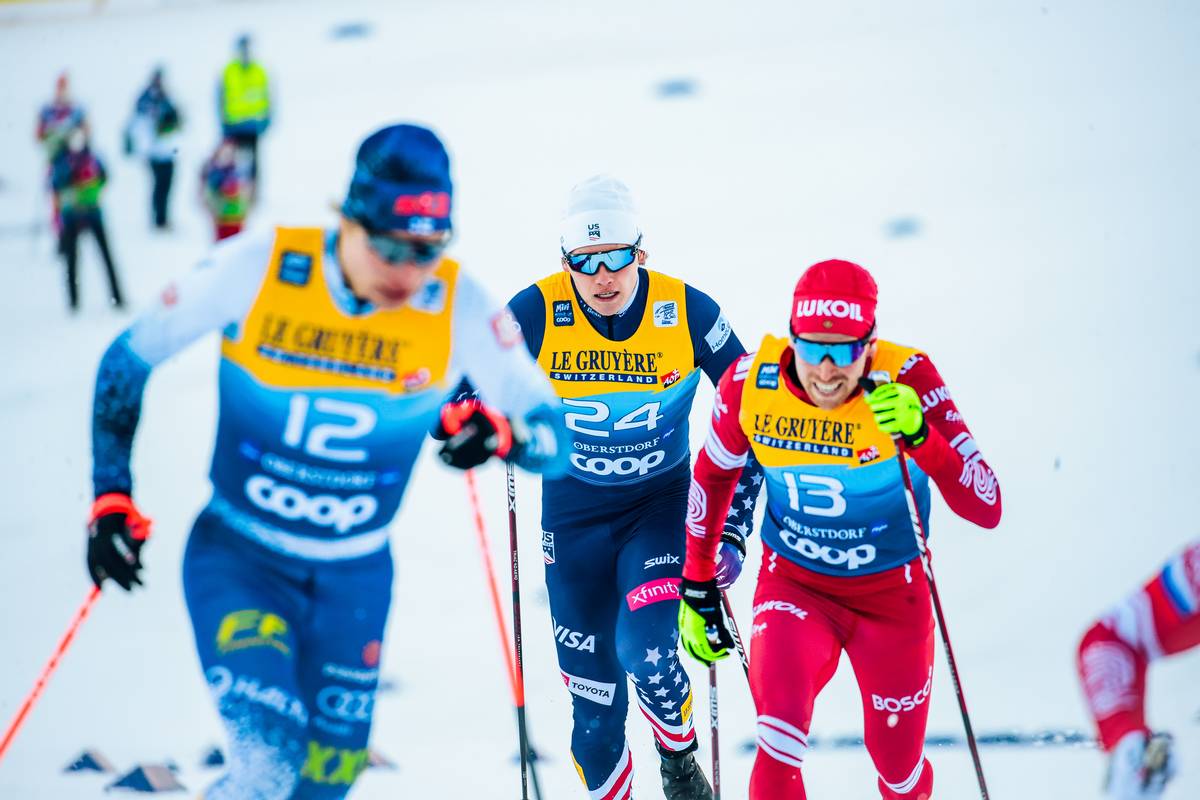
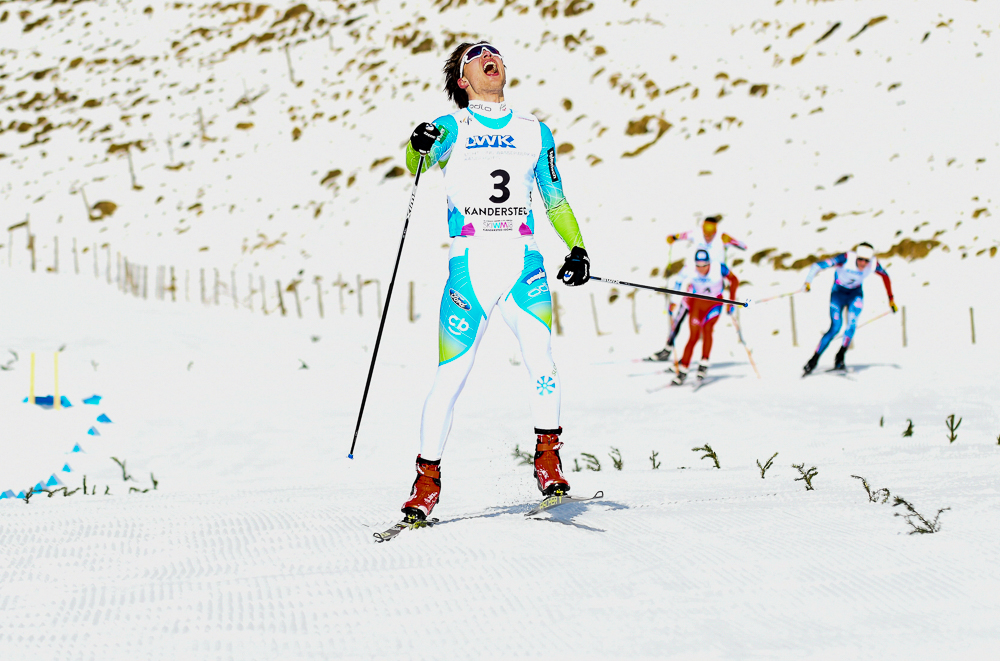
    Alexander Terentev races to second place in qualification during Stage 4 of the Tour de Ski in Oberstdorf. (Photo: NordicFocus)

    Winning today’s qualifier in 2:55.78, Klæbo looked to be on track for a repeat victory in Oberstdorf, however, it is worth noting that he did not win the aforementioned other classic sprint this season. In Ruka, it was 22-year-old Alexander Terentev who took hold of the event in qualification and looked to, well, out-Klæbo Klæbo throughout the heats. We saw familiar tactics with a power move on the final climb, paired with impressive acceleration over the final meters to capture the win, but this time, the athlete employing these tactics was in a Russian race suit. While Klæbo has won each of the sprints he has entered since, with Terentev eliminated in the semis, Stage 4 would be a rematch both were eyeing. 

    Setting the stage, Terentev was second in qualification, +1.5 behind Klæbo, with Erik Valnes (NOR) in third (+2.37), Federico Pellegrino 4th (+3.53), and Alexander Bolshunov 5th (+3.61). Ben Ogden was the top American qualifier today, finishing 15th (+8.08), while Luke Jager finished 24th (+10.83). The American selected heats two and five, respectively. 

    Johannes Høsflot Klæbo and Erik Valnes take the lead in the final climb of the quarterfinal, with Ivan Yakimushkin (bib 23) and Iivo Niskanen (bib 29) chasing. (Photo: NordicFocus)

    In the first wave of the quarterfinal, Finland’s Iivo Niskanen, winner of the Stage 2 15k classic, pushed the pace heading up the first climb, perhaps looking to ensure an opportunity for a fast rather than tactical heat, knowing he was up against Valnes and Klæbo and likely would only have the opportunity to advance as lucky loser. However, the Norwegians, unphased, chose not to respond, waiting patiently mid-pack to use the same tactic described at World Champs. In the second climb, both created enough room to look as if they had begun their cooldown as they skied through the finish lanes, with Klæbo addigng a lackadaisical boot slide at the line that put him just ahead of his teammate. Behind them, Niskanen and Ivan Yakimushkin (RUS) sprinted to the line to chase the clock, with the Russian finishing ahead of the Finn. However, their times did not hold up through subsequent rounds and their day had ended.

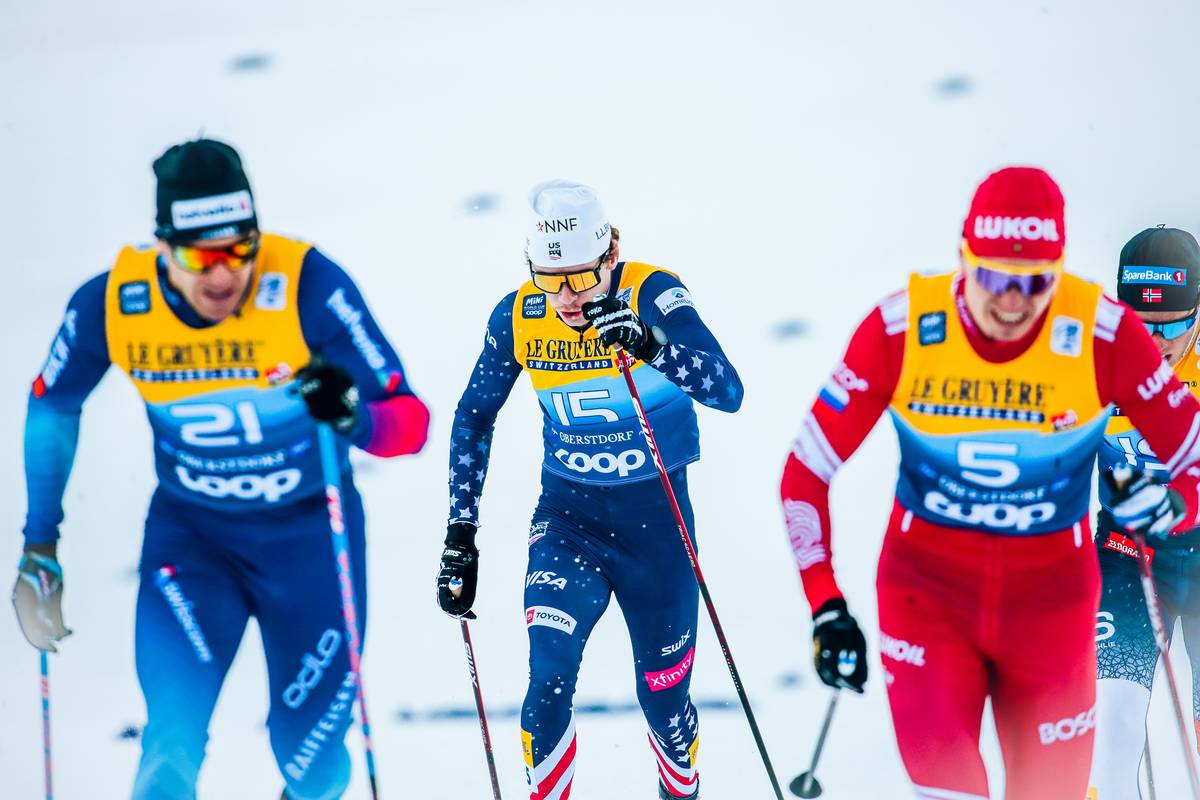
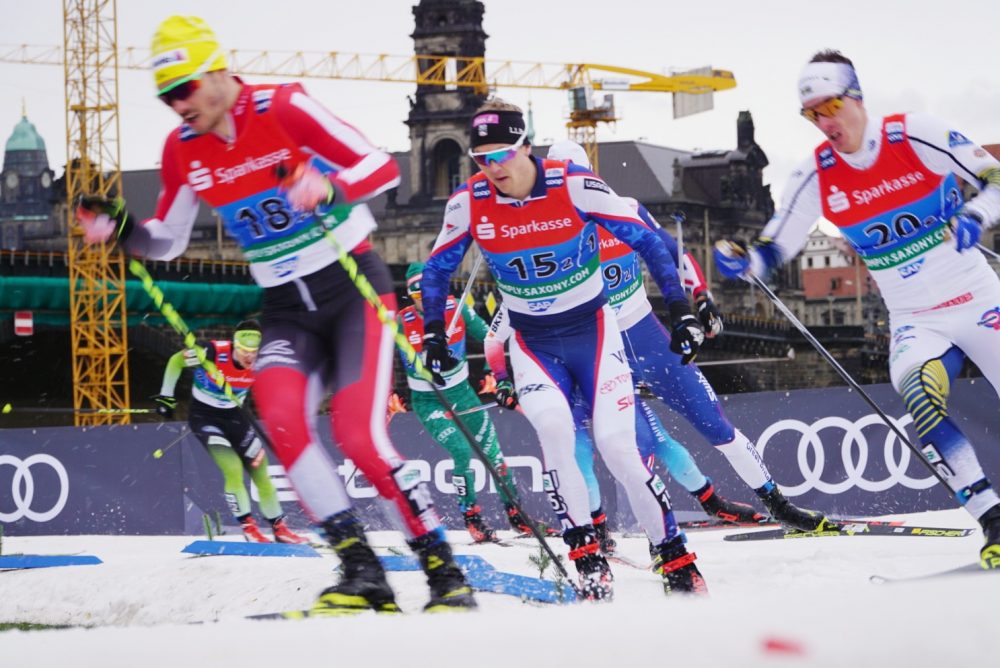
    Alexander Bolshunov leads the quarter final during Stage 4 of the Tour de Ski, with Ben Ogden racing in bib 15. (Photo: NordicFocus)

    In the second heat of the quarters, Ogden lined up alongside Bolshunov, who took control out of the gate. Staying in the pack through the first climb, Ogden found himself in fifth as athletes exited the second and began descending toward the stadium. In the final curves, Ogden couldn’t quite maintain the position needed to contend for a spot as lucky loser, finishing 5th in a fast heat, +1.52 behind Bolshunov.

    Terentev looked as though his day might be over before he could face Klæbo head-to-head. Federico Pellegrino (ITA) stepped on his pole as lanes decreased in the opening stretch, causing it to snap. Terentev calmly accepted a replacement, steadily working his way back into the mix. Running out of the tracks in the final climb, Terentev accelerated around the left-hand curve and into the downhill in the lead, continuing through the finish for the win ahead of Mikal Novak (CZE) to advance comfortably.

    Alexander Terentev leads his quarterfinal during Stage 4 of the Tour de Ski in Oberstdorf. (Photo: NordicFocus)

    In the fifth heat of the quarters, Jager maintained contact with the pack through the first climb, but found himself off the back as he left the second. Jager’s legs wobbled as he found his footing in the descent. Perhaps too flooded to ski as aggressively as was needed to put himself in contention for higher placement, he crossed the line sixth in the heat, +6.88 behind the winner. 

    Luke Jager raced in the fifth quarterfinal during Stage 4 of the Tour de Ski in Oberstdorf. (Photo: NordicFocus)

    On we go to the semifinals.

    In a stacked first heat, Bolshunov and Terentev set the pace at the front heading up the first climb. Striding metronomically, they held Valnes and Klæbo temporarily at bay. As the men charged into the final climb, Klæbo advanced at a run up the outside, rounding the left hand bend with Terentev at the front before beginning the sweeping downhill side by side. 

    Terentev began to move across the track behind Klæbo, looking to finding a line that might be optimal for using the Norwegian’s draft to slingshot into the final lanes at high speed. Not waiting long enough, Terentev caught his tips on the Norwegian’s tails, losing his footing and crashing with a slide into the v-boards. No chance to recover what was lost, Terentev stood up, taking a defeated swing at the ground with his pole, before slowly continuing through the final meters to the finish, now well off the back. 

    As the two had created a small gap to their chasers, Valnes and Bolshunov navigated around the crash easily, racing to the line for second and third. Pulling ahead with his double pole, Valnes snagged second with Bolshunov less than half a second back, hoping for a lucky loser spot in the final.

    With a comfortable lead, Johannes Høsflot Klæbo looks over his shoulder as Erik Valnes and Alexander Bolshunov race to the line in the semifinal. (Photo: NordicFocus)

    Terentev later received verbal warning for a classical technique infraction.

    In the second and less-eventful semi, Pål Golberg and Even Northug attempted to take control of the race in the final climb, but they remained matched by Italy’s Francesco De Fabiani and Sweden’s Calle Halfvarsson as they crested the top. Goldberg picked up the most speed in the descent, accelerating out of the final curve with a sizable gap to his three chasers. Laying off the gas before the line, Goldberg took the win ahead of Northug, who left De Fabiani and Halfvarsson fighting for lucky loser spots on his tails. 

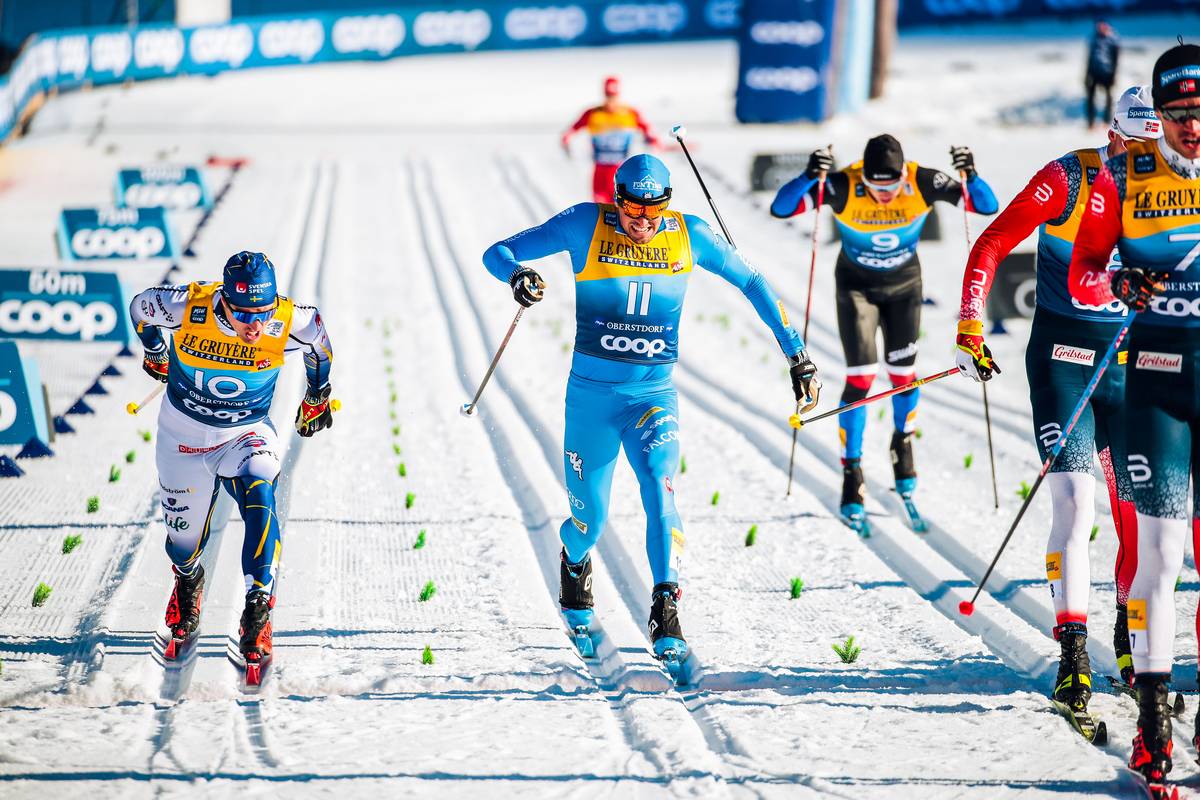
    Calle Halfvarsson and Fracesco de Fabiani take it to the line in the semifinal. (Photo: NordicFocus)

    De Fabiani and Halfvarsson crossed in a photo finish, both just 0.02 seconds ahead of Bolshunov’s mark, allowing them both to advance to the final and ending the Russian’s day.

    With four Norwegians in the final, they were guaranteed at least one spot on the podium. 

    Norway were 1-2-3 coming out of the first climb, with Klæbo sitting in second position. Doublepoling into the next climb, Klæbo matched Valnes as the two ran at the front, Klæbo out of track and Valnes in the inside lane.

    Johannes Høsflot Klæbo leads into the final descent in the last round of the Stage 4 classic sprint in Oberstdorf. (Photo: NordicFocus)

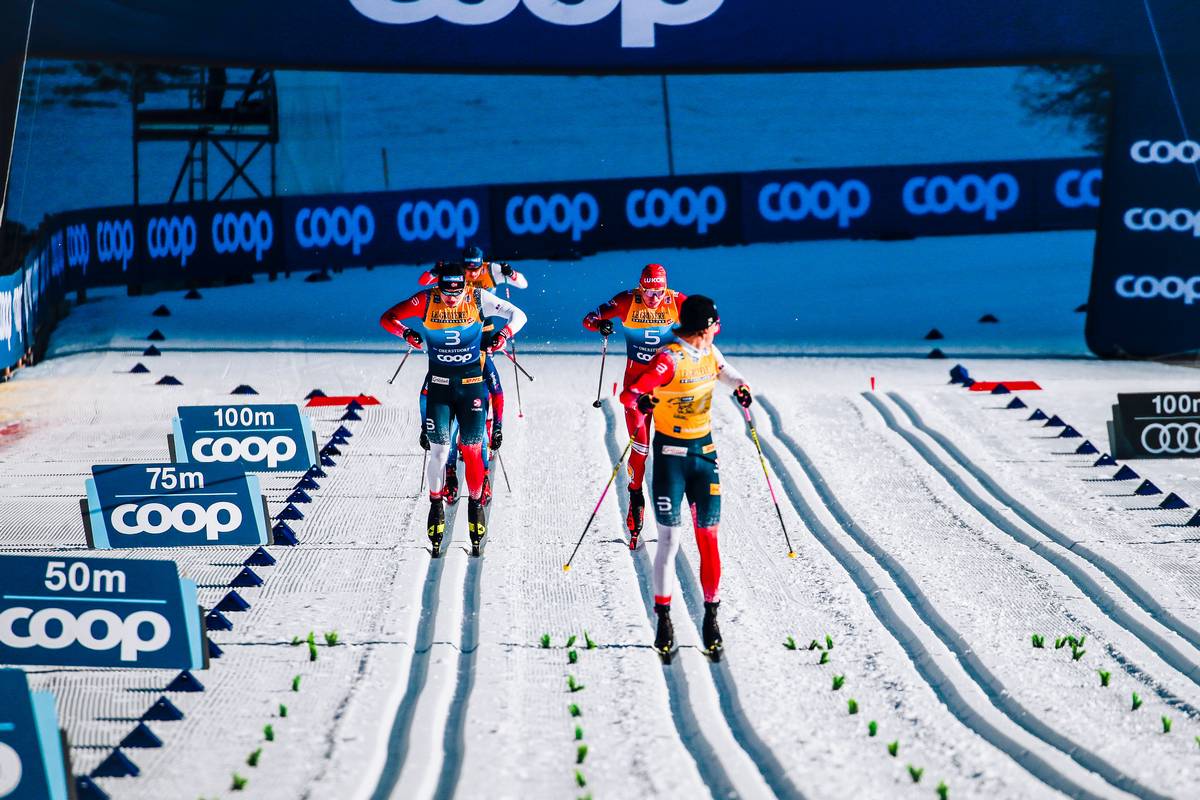
    Klæbo accelerated into the curve at the top stepping in front of Valnes and leading him into the downhill. Klæbo powered into the final stretch still in the lead, with Valnes a ski length back but closing fast with a strong doublepole. Valnes changed lanes, knowing it was his only opportunity if he wanted to try for a win, but there was not enough real estate left and this cost him speed as they came to the line. No time to celebrate this time, Klæbo pushed his boot over the finish to stop the clock at 2:54.77, roughly 3.5 seconds faster than any other rounded, with Valnes 0.3 seconds back for second place. 

    Johannes Høsflot Klæbo takes the win in Stage 4 ahead of teammate Erik Valnes, while Pål Golberg, Even Northug, and Calle Halfvarsson fight for the final spot on the podium behind. (Photo: NordicFocus)

    Behind the duo, the remaining two Norwegians sprinted to the line for a photo finish, with Goldberg edging out Northug for third by just 0.02 seconds. Halfvarsson, still in contention for the podium in the final stretch, crossed 0.5 seconds behind the Norwegians to end his day in 5th, while De Fabiani seemed to have accepted his fate, crossing the line casually +11.71 behind Klæbo. 

    Determining third place, Pål Golberg (center) edges out Even Northug, wit hCalle Halfvarsson just off the mark in fifth. (Photo: NordicFocus)

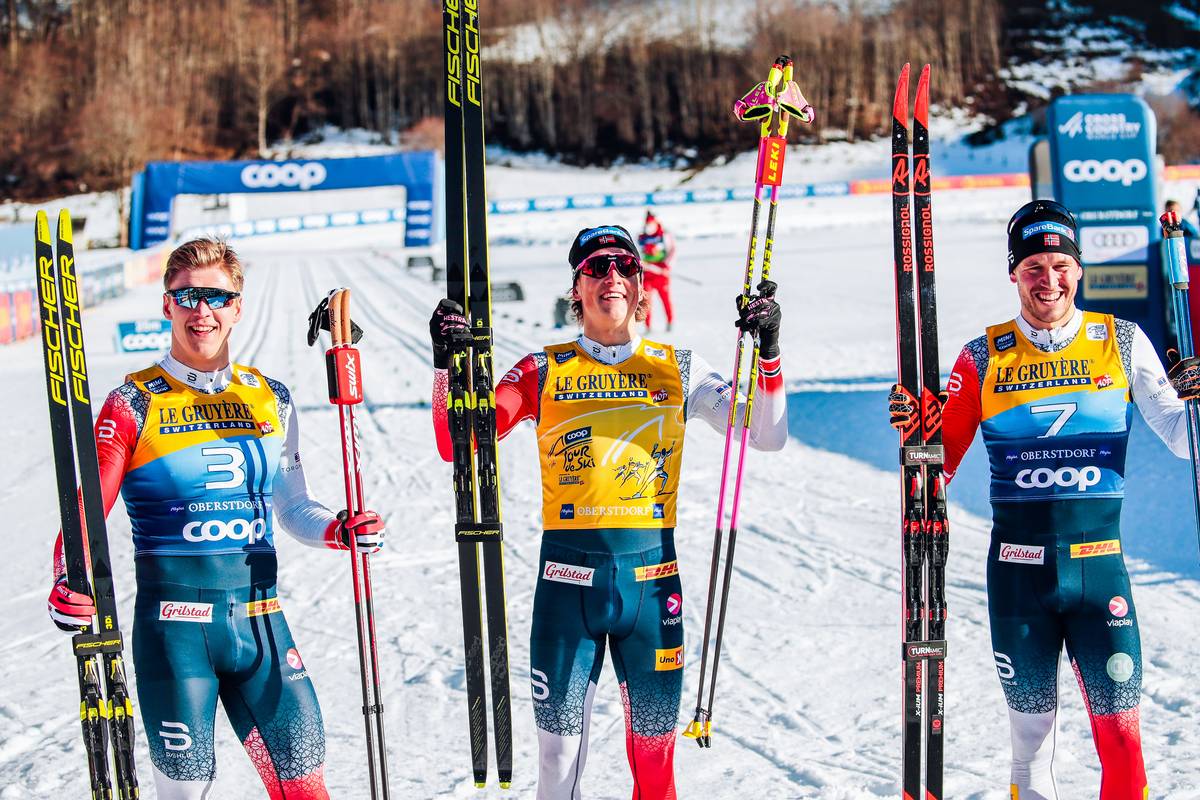
    Another all-Norway classic sprint podium in Oberstdorf, and a second consecutive win for Klæbo.

    “It’s amazing to start a new year with a victory and also to have two of my best friends coming onto the podium as well,” Klæbo told FIS at the finish. “I am really satisfied with today’s race, and also to start, hopefully, a good new year.”

    After four races in five days, Klæbo was asked whether Tour fatigue had begun to set in. 

    “For sure, I am getting a little bit tired, but still, when the weather is like this and the conditions are pretty nice, it gives you a lot of energy. So it’s just trying to push hard, looking forward to a rest day tomorrow, and trying to push hard in the last two legs.” 

    The all-Norwegian men’s podium after Stage 4 of the Tour de Ski: Johannes Høsflot Klæbo took his fourth win of the Tour ahead of Erik Valnes in second and Pål Golberg in third. (Photo: NordicFocus)

    After the final results were determined, Ogden ended his day in 22nd. 

    “I took the qualifier out really hot, hoping to be in the top 3 in qualification,” Ogden told U.S. Ski & Snowboard cross country communications manager Tom Horrocks at the finish. “I was a little flooded at the end, but not the end of the world. I chose heat 2, which is not always what I do, so I tried something different, and I think I skied well in the heat. It’s been a lot of racing for me early, so I’m a little tired, and wasn’t the smartest out there… but I’d say I’m learning a lot and making progress, so one day I’ll put it together.”

    Full audio clip with Ben Ogden, interviewed by Tom Horrocks.

    Ben Ogden races in heat 2 of the quarterfinals in Oberstdorf. (Photo: NordicFocus)

    It was Jager’s second time qualifying for the rounds in a classic sprint, and his second-best overall World Cup result. Jager was 18th in the opening classic sprint in Ruka, and finished 27th today.

    “I was trying to be competitive, in second, third, or fourth, somewhere where I could potentially get in a draft and have a good finish, hopefully,” Jager told Horrocks post-race. “It didn’t work out that way… Hindsight is 20/20, so maybe I wish I had picked a different lane and just gotten out and ran earlier, but at the end of the day, the pace was just really, really fast. I was and am, chronically and acutely, pretty tired right now, so I just didn’t really have it and wasn’t as aggressive as I should have been going over the top. I like to think if I had another shot in that exact same position, I could make fourth or fifth, but an objective qualification in that [heat] probably wasn’t going to happen for me today.” 

    Luke Jager races to 27th in Stage 4 of the Tour de Ski in Oberstdorf. (Photo: NordicFocus)

    Looking to the bright side, Jager expressed how grateful he has been to have had excellent skis in every race he’s competed this season, which provides confidence even on the days when the body doesn’t want to cooperate. At 21-years-old, Jager’s career is still nascent, and it’s easy to understand how progress at this level may not be linear. 

    “I’m super thankful for the opportunity [to race on the World Cup this season]… It feels often like it’s one step forward, four steps backward over here, just because it’s so brutal. The last month, especially, has been pretty tough and pretty demoralizing at times for me. I’m going home today, so it’s pretty nice to end with a glimmer of hope for what is to come. It’s the real deal. Sometimes it’s easy to forget that because so many Americans are doing well, but it’s pretty damn hard over here.”

    Full audio clip with Luke Jager, interviewed by Tom Horrocks.

    Kevin Bolger races to 33rd in qualification during Stage 4 of the Tour de Ski in Oberstdorf. (Photo: NordicFocus)

    Outside the Top-30, Kevin Bolger and Zak Ketterson were just shy of making the heats, finishing 33rd (+13.10) and 34th (+13.39), less than a second off the time needed to advance. Logan Hanneman was also a near-miss, finishing 37th (+14.08). Gus Schumacher rounded out the American starters in 45th (+16.51) of 73 starters. 

    Looking at the overall Tour de Ski standings with four of six stages complete, Johannes Høsflot Klæbo tops the list for both cumulative time and points after winning three of four events. By time, he sits 1:03 ahead of teammate Pål Golberg and 1:19 ahead of Alexander Bolshunov. With a 15k mass start classic and 10k freestyle hill climb to go, Klæbo is in good standing, but cannot be complacent, as the hill climb, in particular, has historically favored Bolshunov. 

    By points, which favor sprint stages and intermediate sprints in distance races, Klæbo leads with 81 points ahead of Erik Valnes, who holds 50, and Goldberg with 41.

    After a rest and travel day, racing continues Monday in Val di Fiemme, Italy.

    With three wins in four stages, Johannes Høsflot Klæbo leads the overall Tour de Ski standings by both cumulative time and points. (Photo: NordicFocus)

    Stage 4 Results:

    Qualification | Final

    Tour Standings After Stage 4:

    Cumulative Time | Points 

  • Norway Takes the Top Two Podium Spots in the Team Sprint; Bolger and Schoonmaker Ski to 9th

    Norway Takes the Top Two Podium Spots in the Team Sprint; Bolger and Schoonmaker Ski to 9th

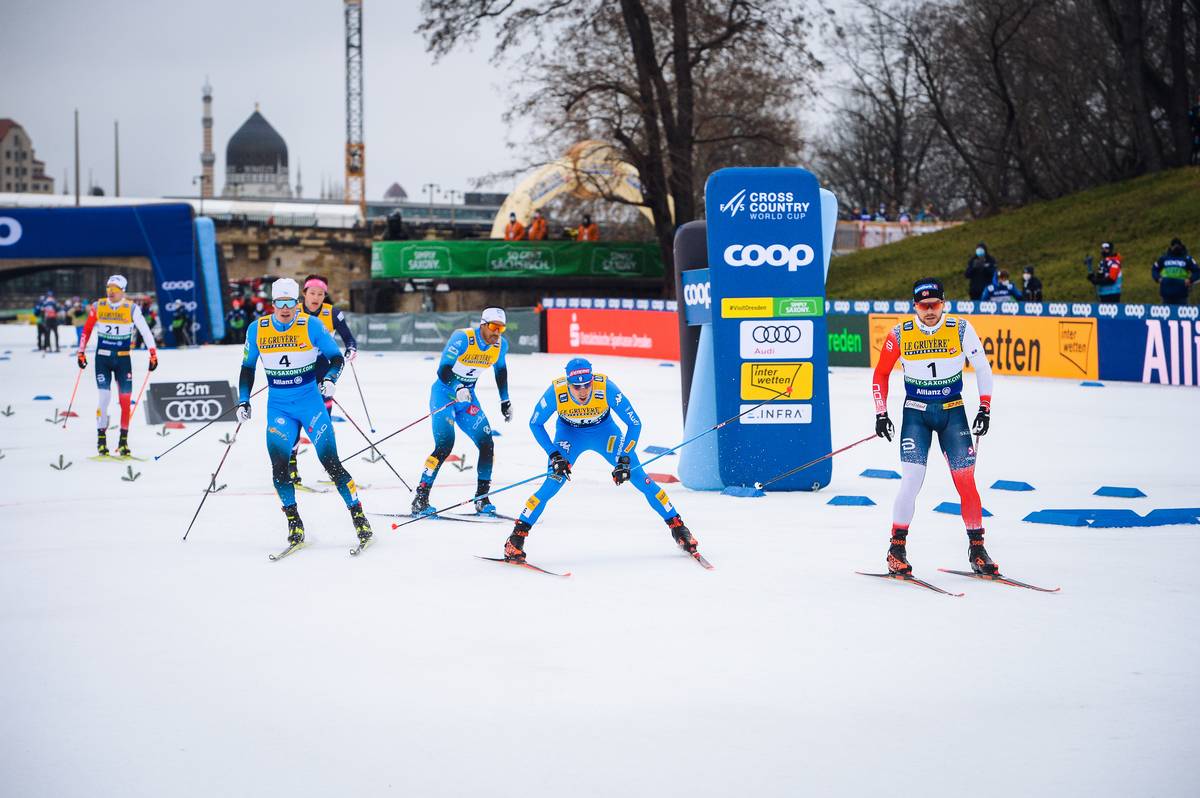
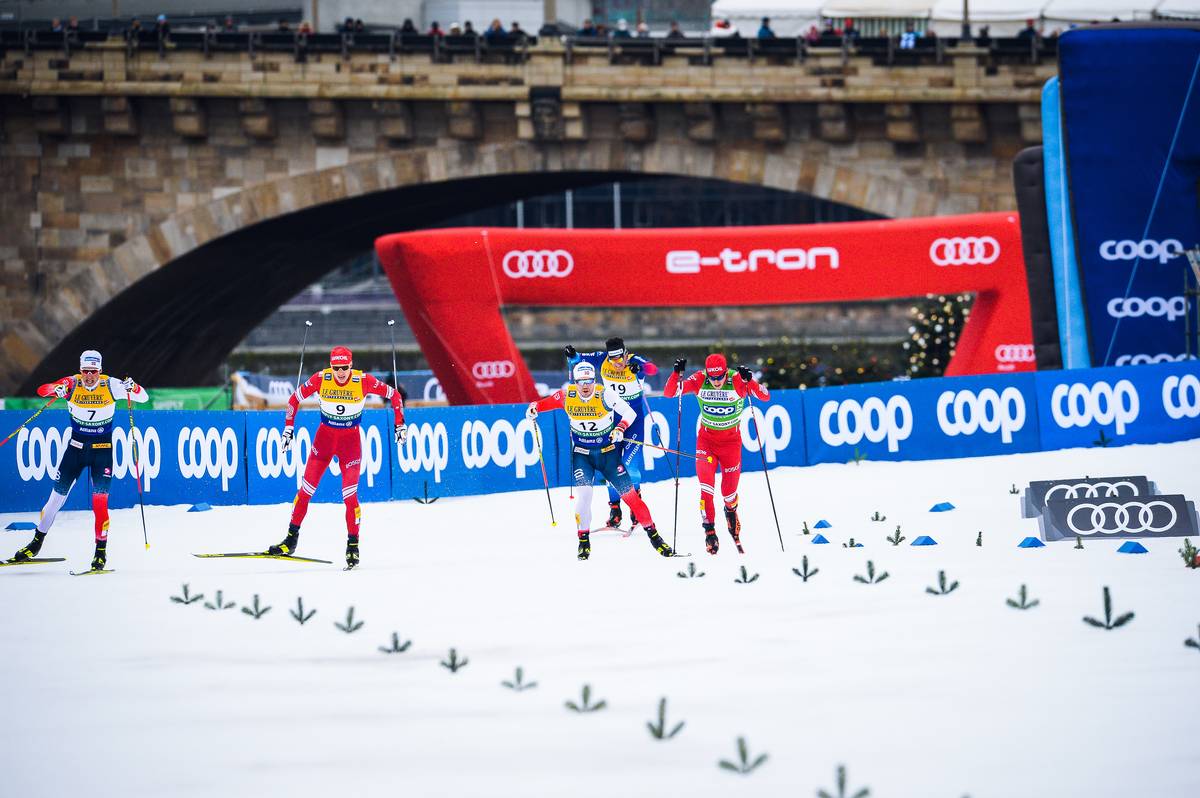
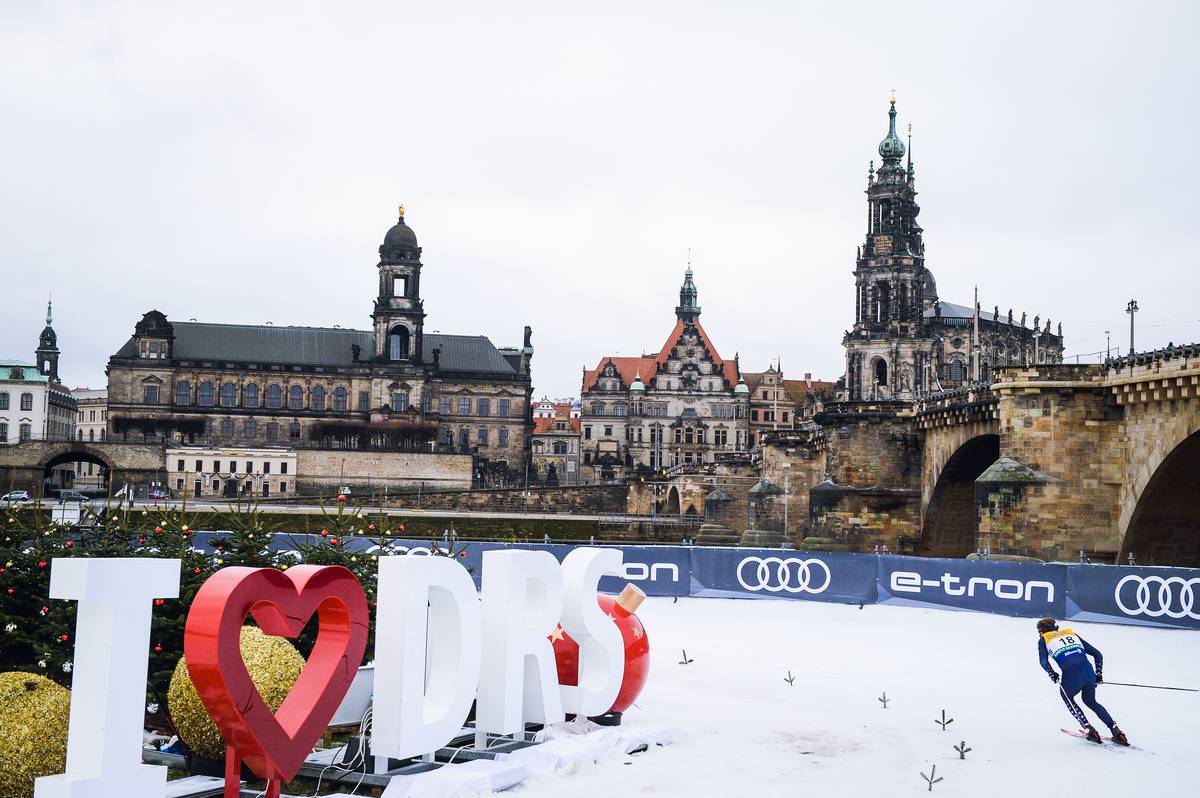
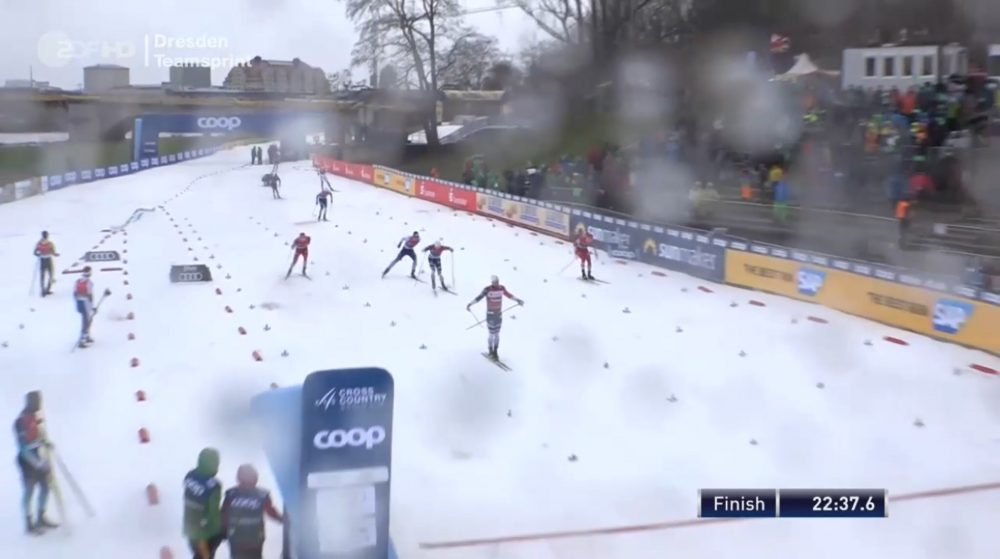
    Overcast skies mute the spectacular architecture along the River Elbe, which provides the backdrop for the sprint track in Dresden, Germany. (Photo: NordicFocus)

    This World Cup coverage is made possible through the generous support of Marty and Kathy Hall and the A Hall Mark of Excellence Award. To learn more about A Hall Mark of Excellence Award or to learn how you can support FasterSkier’s coverage please contact info@fasterskier.com.

    In the wake of the American women taking second to the Swedish powerhouse duo, and yesterday’s top two spots on the podium, Maja Dahlqvist and Jonna Sundling, the men’s team of JC Schoonmaker and Kevin Bolger lined up to race the freestyle team sprint final on the track in historic Dresden, Germany. 

    “Together again,” wrote Bolger in a post-race email. “We teamed up 3 years ago when JC came over for his first World Cup and didnt ski great then together, but being able to team up again and move to the final after a really solid semi was super rad today! He skied really well all weekend and I’m so impressed with how he’s looking, so it made today really fun!”

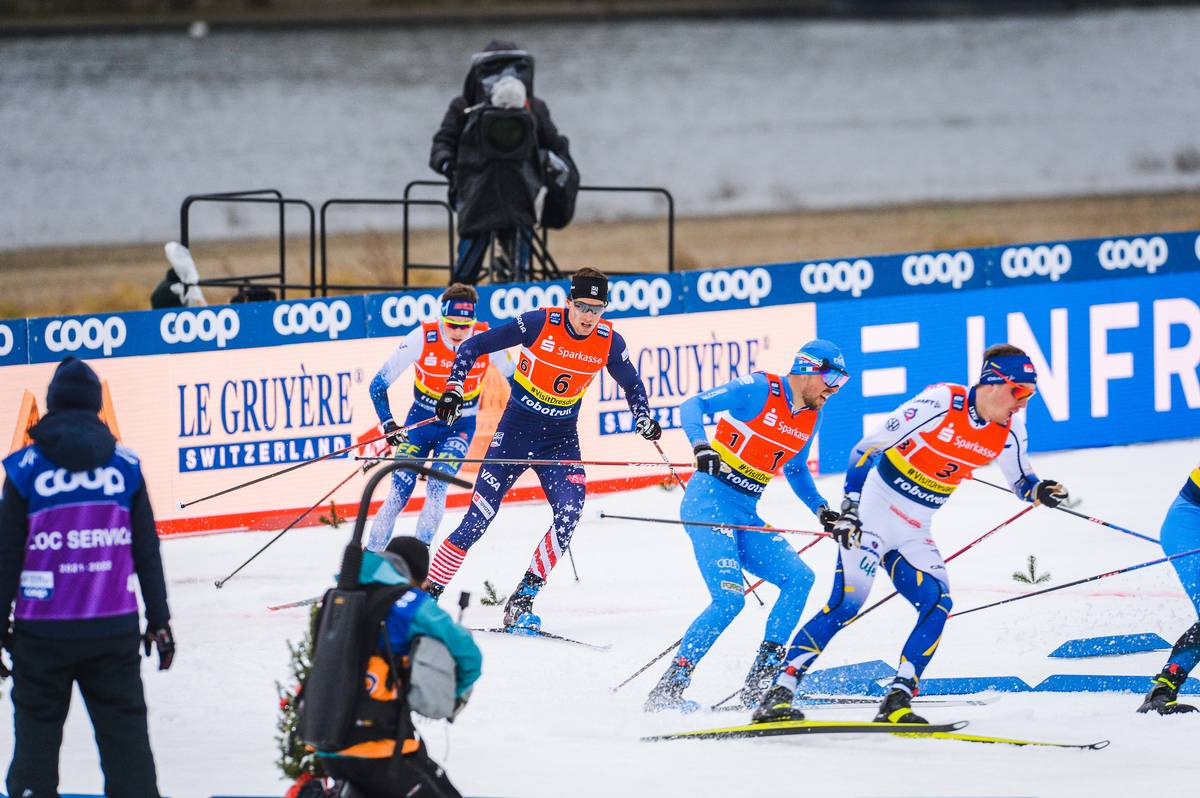
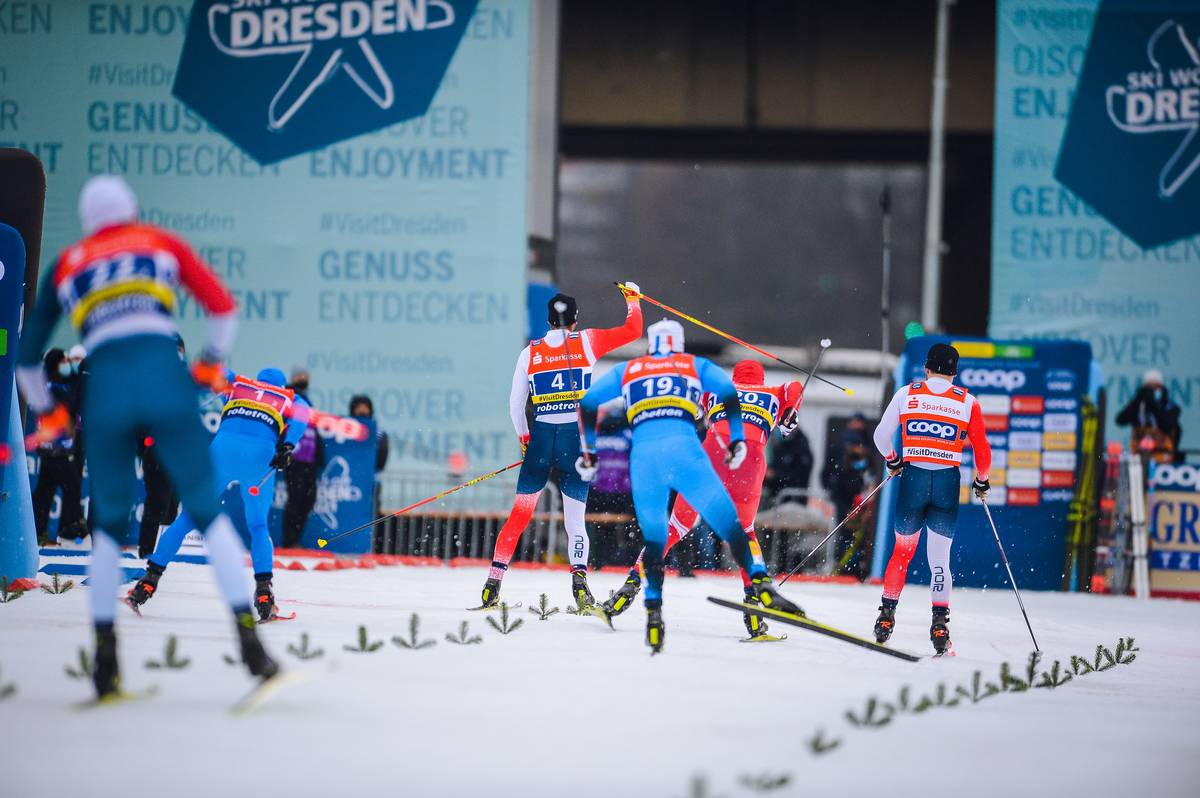
    Six quick laps each, eleven exchanges total, on a flat and fast city 0.65-kilometer loop with minimal recovery means flooded legs and tight racing. Like a series of just-over one minute intervals with equal rest, athletes take a conservative start, accruing fatigue while minimizing the opportunity for crashes and broken equipment to decide the race, over fitness and tactics. As the number of remaining laps dwindles, the pace steadily builds, like a bottle rocket, until the critical point arrives in the last few laps and leaders explode off the front in an effort to take control of the outcome. 

    Kevin Bolger navigates a tight curve during the men’s team sprint in Dresden, Germany. (Photo: NordicFocus)

    As expected from a lap that lasted just over a minute, the whole pack of ten teams stayed very tight through the halfway mark. The Norway II team of Thomas Larsen and Even Northug spent time at the front, putting in quick surges at the beginning of each leg to re-establish their position. 

    Tagging off after lap 6, the team tagged off with Great Britain on one side, and the Norway I team of Sindre Bjørnestad Skar and Håvard Solås Taugbøl, on the other. Still very much in the mix were the Russia I pairing of Alexander Bolshunov tagging Gleb Retivykh, Italy’s Francesco di Fabiani and Federico Pellegrino, and France’s Richard Jouve and Lucas Chanavat. 

    The leaders wait for a tag during the Dresden team sprint. (Photo: NordicFocus)

    At the half, the Americans remained in contact near the back of the pack, as Bolger tagged Schoonmaker in 9th (+2.0). 

    Coming into lap 9, Bolshunov made a move to the front to take the reins for Russia I, with both Norway teams and Jouve quickly responding to his tempo, while Italy and Great Britain worked hard to maintain contact. This burst set the tone for the final three laps.

    As Retivykh unsuccessfully attempted to drop Taugbøl and Northug in lap 10, the pack in pursuit began to stretch out. While all remained in contact with the leaders, Great Britain began to look out of the running for a win, with Italy and France remaining a podium-threat in fourth and fifth. The teams behind thinned rapidly.

    Still tight at the Tag, Norway II, Italy, and Norway I (left to right) head out for another lap during the Dresden team sprint. (Photo: NordicFocus)

    In Bolshunov’s final lap, he rocketed off the front, skiing powerfully through his legs with an aggressive forward lean, carrying momentum between each push. Whereas the early laps, rounding the tight curves looked careful and calculated, the men shot around the degrading bends, losing no speed as they pushed into the straightaways. 

    Tagging off for the final lap, Northug accelerated ahead of Retivykh, free skating powerfully off the first roller to regain the lead for Norway II. Feet quickly stepping around the first curve, Norway II looked in control with Norway I and Russia not ceding the win just yet. Italy and France remained on their tails, still in position for the podium. 

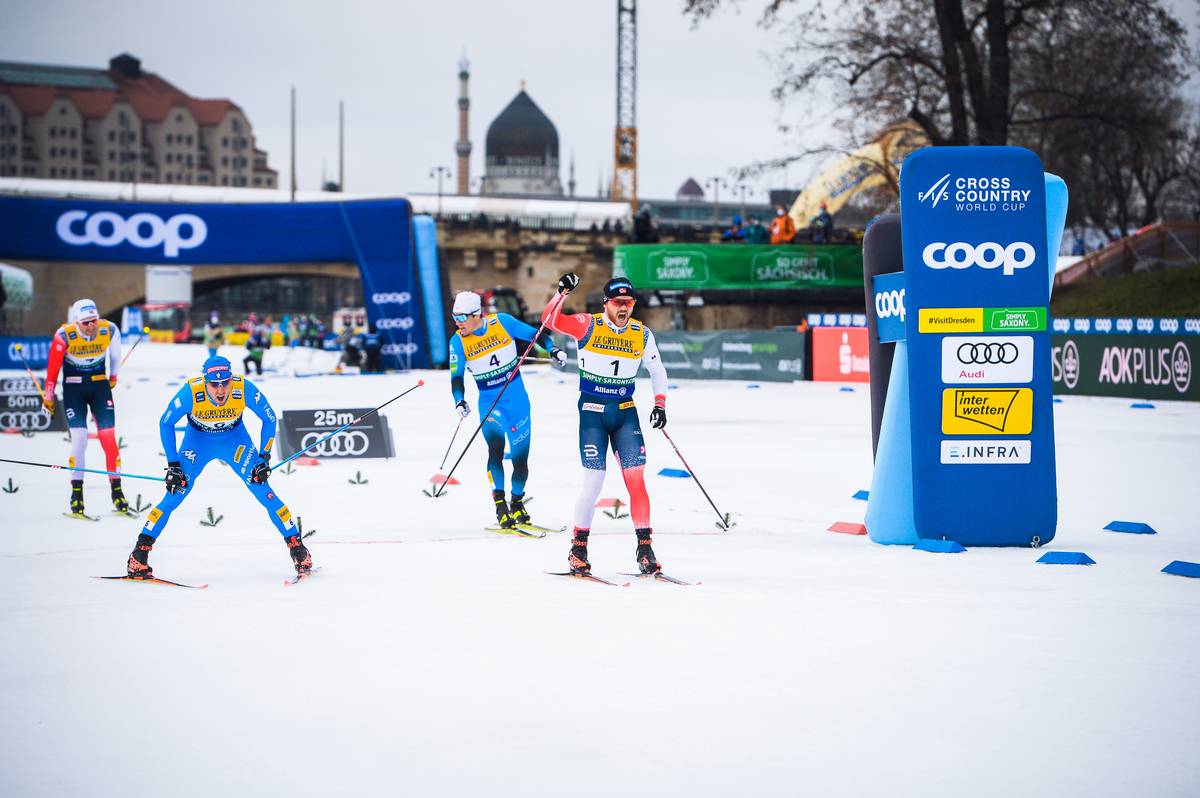
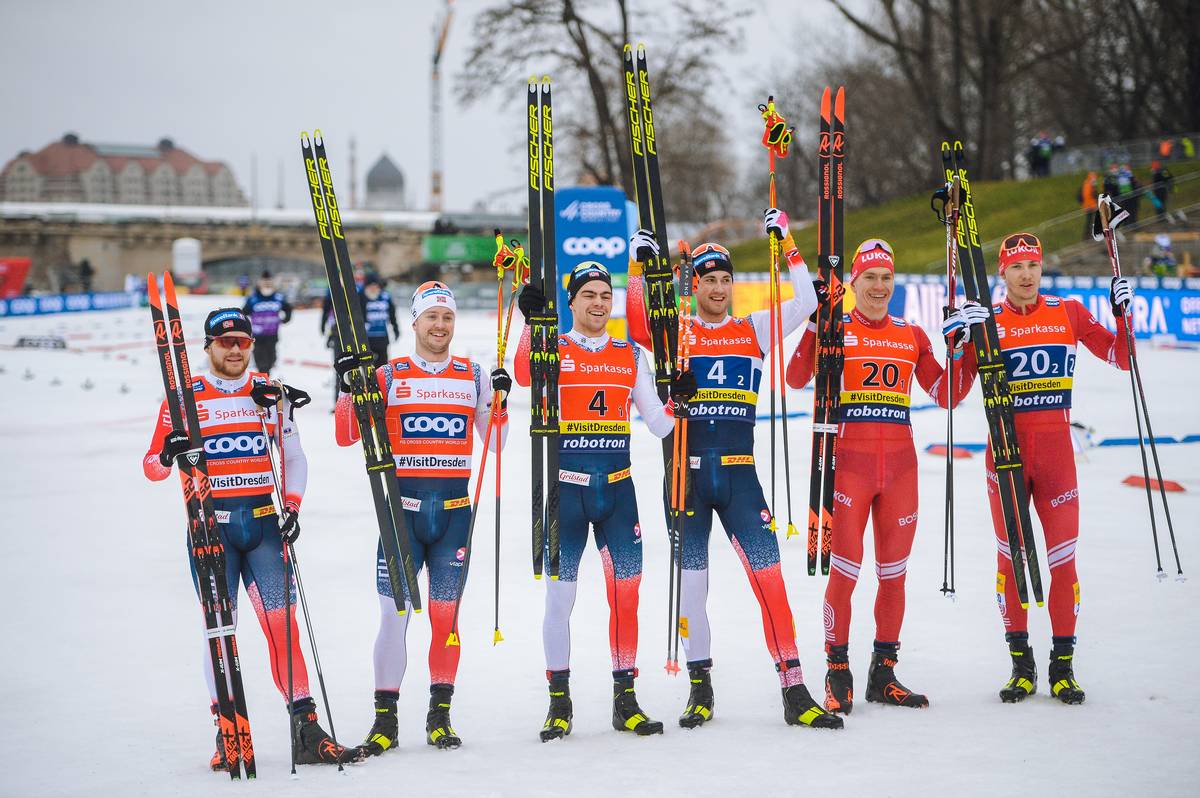
    Coming into the final curve hot, Taugbøl made an attempt to slingshot Norway I to the lead, but the tactic was thwarted by the closing speed and power of Northug. Standing up to pump his fist into the air, Northug coasted over the line for the win in 14:19.34, while Taugbøl narrowly edged out a hard-closing Retivykh to make it Norway II, Norway I (+0.42), then Russia I (0.62) for the podium. 

    Even Northug pumps his fist as he takes the win, while the second and third spots on the podium remain up for grabs behind him. (Photo: NordicFocus)

    “It was amazing,” Northug told FIS at the finish. “We struggled a little bit in the semifinal, but in the final we did everything right. Thomas sent me out first on the final lap and that was the plan. It was good.”

    Speaking to the experience of racing with Northug, Larsen spoke highly of his partner, and of putting the Norway II team ahead of Norway I on the podium. 

    “It’s fantastic, he’s an incredibly good skier,” Larsen said. “He hasn’t had so many chances in the World Cup so far, but now he shows with yesterday and last week, he shows that he is one of the best in the world. I think this was a dream team today, and it’s cool to be the underdogs and just take it home.”After a fast final leg by Pellegrino to keep his team in the mix for the top-three, Italy was next over the line, narrowly missing the podium in fourth (+0.78), with Chanavat bringing the French I team home in fifth (+1.21). Knowing he was no longer in position to snag top-three, Great Britain’s Andrew Young relaxed in the final stretch, coasting over the line in sixth (+3.84), followed by a sizable gap to the next racers. 

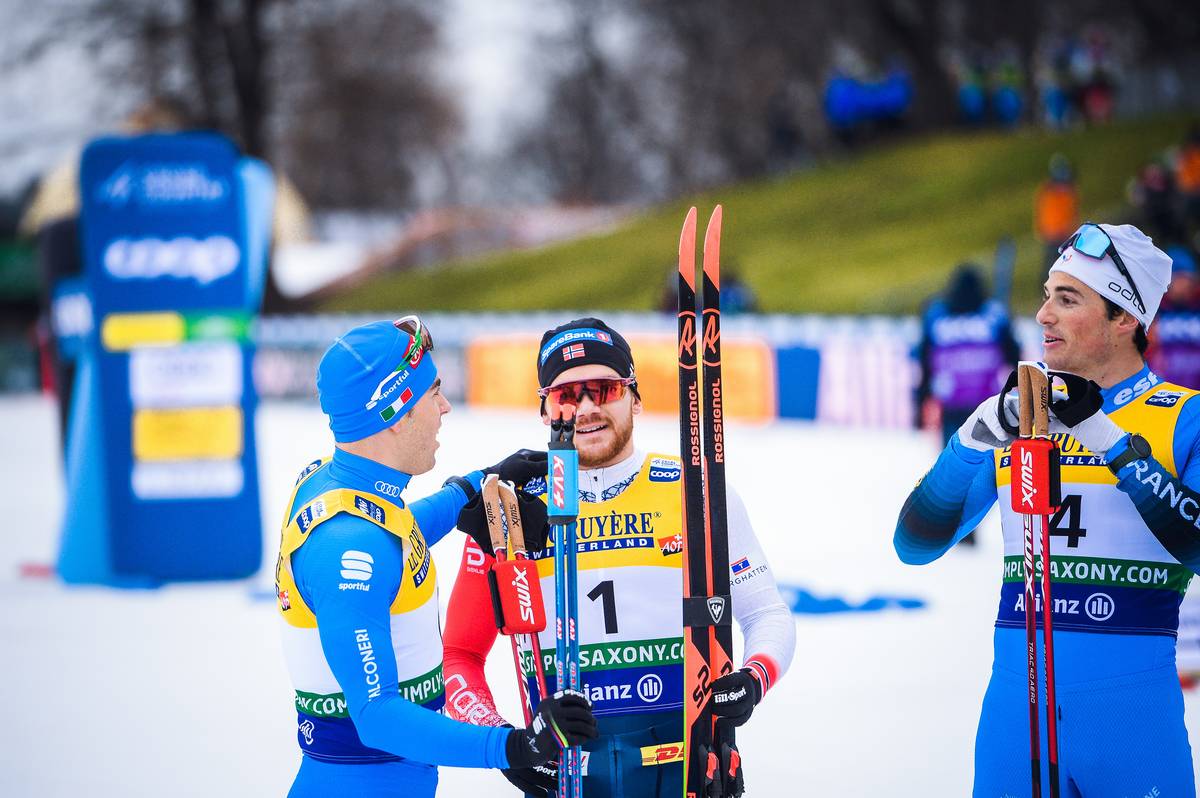
    The men’s podium of the team sprint in Dresden: The Norway II team of Thomas Larsen and Even Northug took the win ahead of Norway I, Sindre Bjørnestad Skar and Håvard Solås Taugbøl, and Russia I, Alexander Bolshunov and Gleb Retivykh. (Photo: NordicFocus)

    After losing contact in the final laps, Schoonmaker brought the American team to the line in 9th (+11.36). 

    “Dresden is a really fun event,” Bolger said after the race. “I think it’s something a lot of us skiers on the a World Cup enjoy to mix things up!”

    Bolger explained that he and Schoonmaker “just wanted to stay out of trouble — and try as best as we could to put ourselves into a position to where we could attack when we needed to… I was hoping for more of a tactical final but it seemed like Bolshunov had a different plan and really pushed the pace for my leg the whole time, which made it really hurt, but I think that makes it really fun and competitive!”

    Providing insights into the team’s tactics and his experience during the final, Schoonmaker provided the following comment in a post-race email from the road.

    “I would say our main strategy going into the final was to conserve energy while staying in the top half of the field so that we would be able to match any moves made later in the race,” Schoonmaker explained. “It seems everyone had the same plan in mind, though, so it was tough to make that work. We were a little too far back to make anything happen when the pace picked up in the second half of the race. In Dresden, it really seems to be all about being out front because passing is just hard on a short, narrow and turny course. It’s a super fun format with the short laps, but also very challenging!”

    Racing in semifinal B, Luke Jager and Logan Hanneman skied to 10th (+10.96), with the Canadian duo of Russell Kennedy and Graham Ritchie not far behind in 12th (+14.91). Neither team advanced to the finals. 

    With champagne spraying, Even Northug and Thomas Larsen step off the top spot of the team sprint podium in Dresden. (Photo: NordicFocus)

    Despite sitting out the weekend in Dresden, Norway’s Johannes Høsflot Klæbo currently leads both the World Cup overall and sprint standings. Klæbo is roughly 150 points ahead of Sergey Ustiugov (RUS) in the overall, and 60 points ahead of Taugbøl in sprinting. 

    Leading the American men, Schoonmaker sits in 11th place in the sprint standings with 112 World Cup points, and 20th in the overall. Schoonmaker is also the second ranked U23 skier, trailing Russia’s Alexander Terentev by 219 points. 

    Ben Ogden also ranks inside the top-30 in sprinting, sitting in 23rd with 46 points. Ogden is 4th on the U23 list, with Gus Schumacher 20 points behind in 7th. Luke Jager sits in 13th of the 21 athletes on the U23 list, with Zanden McMullen close behind in 16th. The future of American skiing is looking bright.

    Face painted with stars and stripes, JC Schoonmaker leads the American men in the overall, sprint, and U23 World Cup standings. (Photo: NordicFocus)

    After a holiday break, racing continues with the Tour de Ski, which kicks off in Lenzerheide, SUI on December 28th. 


    Results:

    Team Sprint: Semifinal A | Semifinal B | Final
    World Cup: Sprint Standings | Overall | U23

  • Taugbøl Takes the City Sprint Win in Dresden; Schoonmaker Back in the Semis to Finish 9th

    Taugbøl Takes the City Sprint Win in Dresden; Schoonmaker Back in the Semis to Finish 9th

    The men’s podium of Dresden’s individual freestyle sprint. Håvard Solås Taugbøl (NOR) took the win ahead of Federico Pellegrino (ITA) and Lucas Chanavat (FRA). (Photo: NordicFocus)

    This World Cup coverage is made possible through the generous support of Marty and Kathy Hall and the A Hall Mark of Excellence Award. To learn more about A Hall Mark of Excellence Award or to learn how you can support FasterSkier’s coverage please contact info@fasterskier.com.

    With Christmas decor lining a ribbon of snow providing a better indication that we are nearing the end of Period I and heading into the holiday season than the surrounding green grass in Dresden, Germany, athletes took to the track in the city for yet another iteration of its thrilling sprint weekend. Humid conditions well above freezing made for fast racing on the two-lap course, which often sees spicy turns and tactics, without a significant climb to separate the field in a deciding manner. 

    If you’d like a throwback from January, 2018, here’s a video clip from Instagram where Simi Hamilton painfully face-plants, just after having broken the pole of Johannes Høsflot Klæbo. This left Hamilton with a lip full of carbon-fiber splinters and plenty of abrasions from the harsh granular track. Good times.

    After the first three weekends of racing, 21-year-old JC Schoonmaker sat in second place in the U23 World Cup standings, and 27th in the overall World Cup ranks. Showing he was ready to build on this platform, Schoonmaker smashed the qualifier, finishing third, 1.16 seconds behind Norway’s Håvard Solås Taugbøl and roughly 0.3 behind Richard Jouve of France, who qualified in second. 

    In an episode of Nordic Nation recorded earlier this week, Schoonmaker, along with teammates Ben Ogden and Gus Schumacher, discussed how their results in the early season races have encouraged them to raise their limits and take chances in their sprinting as they transition into their senior racing careers. Instead of choosing heat four or five, which they explained shows that one is limiting their potential on the day to the semifinal, they wanted to begin racing in earlier heats with the top qualifiers. Thus increasing their risk of being knocked out early, but also learning what it takes to advance further through the rounds.

    JC Schoonmaker skis to 3rd in qualification in Dresden. (Photo: NordicFocus)

    Today, Schoonmaker raced in heat one alongside Taugbøl and Jouve, along with Even Northug (NOR), Johan Häggström (SWE), and teammate Logan Hanneman, who qualified in 7th, 28th, and 30th, respectively. 

    The first lap of the race, the pace was fast but the men looked cool, each carefully navigating the hairpin curves and not racing aggressively. As they accelerated in the second lap, Schoonmaker kept himself in contact with Jouve, who was not in the lead, but still racing in a position of control at the front with Taugbøl. Dropping into a tuck coming off a roller and safely rounding the hairpin, Schoonmaker headed to the final straight behind Jouve. As they powered through the final lanes, it was Taugbøl and Jouve at the front for a photo finish, with Northug finishing just ahead of Schoonmaker close on their tails for third and fourth. 

    JC Schoonmaker marks Richard Jouve (FRA) during the first quarterfinal heat in Dresden. Logan Hanneman stays in contact with the pack in bib 30. (Photo: NordicFocus)

    As the remaining quarterfinals progressed, it became clear that Heat 1 was the fastest, allowing both Northug and Schoonmaker to advance to the semifinals. 

    Hanneman also stayed in contact through the round, finishing 1.88 second behind the leaders, but sixth in the heat. After the final rounds were decided, Hanneman’s position was 30th overall on the day. 

    Also racing in the quarters, Canada’s Graham Ritchie qualified in 16th and raced in the fifth quarterfinal heat. In a competitive position throughout the second lap, Ritchie came into the final hairpin on the inside of the curve, looking to slide up in position heading into the final stretch. Perhaps lacking real estate along the v-board, Ritchie went down, losing his position and ability to advance further. He ended his day in 26th. 

    Graham Ritchie pushes the pace in the quarterfinal in Dresden. (Photo: NordicFocus)

    A post-race Instagram story posted by Ritchie’s coach Erik Bråten captioned “sh*t happens” showed his ski tip had broken off and the base had delaminated — not ideal.

    Racing in the first semifinal, Schoonmaker looked comfortable and smooth, approaching the round in a similar way as the first in terms of his positioning heading into the second lap. 

    At the front, Italy’s Federico Pellegrino, last year’s winner, set the tone alongside Taugbøl, with Jouve in a strong position on their tails. 

    Lapping through the finish, JC Schoonmaker stays in position with the leaders to advance into the final round. (Photo: NordicFocus)

    Putting faith in his boards and catching a quick draft, Schoonmaker again dropped low coming down the last roller and into the final curve. Once again, he was following Jouve and in contact with the front of the pack, however, as they headed into the final lanes, he was only in position to take fifth in the heat, unable to advance into the final round. 

    Still a very strong overall result, Schoonmaker ended his day in 9th overall. 

    In a post-race interview, Schoonmaker discussed his decision to select heat one, along with his rollerski warm up, maintaining the headspace needed to perform between rounds, and what’s next for him over the next few weeks. A quick note, we had some trouble with WiFi connection, which interrupted some of Schoonmaker’s comments. The trials of remote reporting from eight time zones away.

    Taugbøl took the win in the first semi, with Pellegrino narrowly staying ahead of Chanavat in second and third. Jouve was just 0.3 seconds behind his teammate, leaving the two Frenchman in wait to see whether they would advance as lucky losers. 

    A close finish for the top-four, JC Schoonmaker crosses in fifth in his semifinal heat. (Photo: NordicFocus)

    Lead changes and tight racing developed the plot line of the second heat of the semis, which featured Northug and his teammate Sindre Bjørnestad Skar fighting for position at the front with two Russians, Gleb Retivykh and Alexander Terentev, who beat Klæbo in the opening sprint in Ruka and currently ranks just ahead of Schoonmaker in the U23 standings. 

    Each unable to break away at the front on the fast and flat tracks, Northug, Skar, and Retivykh came to the line in unison, throwing their boots for a three-way photo finish. Though their times were indistinguishable, it was determined that their finish order was just that: Northug, Skar, Retivykh, with Terentev a ski length behind in fourth. Men crashed in every direction crossing the line, falling to the ground and gasping for air to evidence the intensity of the effort. 

    Heading into the finish, the second semifinal was tight between two Russians and two Norwegians. (Photo: NordicFocus)

    By the clock, Jouve and Terentev were on the wrong side of the cusp for lucky loser. They ended their day in the semis, while Retivykh and Chanavat advanced to the final. 

    More lead changes and thrill, Chanavat took the lead in the first lap of the final. Lapping over the finish line for the first time, Taugbøl moved to the front while Pellegrino lurked on their tails. Down the backstretch, the Italian moved up alongside Chanavat, skiing powerfully on Taugbøl’s tails as they safely rounded the first hairpin. Not looking to cede space, Taugbøl held himself in a position of command at the front. 

    Around the final curve, Pellegrino tried to sneak around the outside of Taugbøl, but could not quite gain enough ground to find the lead. Heading into the final straightaway, Pellegrino was attacking the track with a powerful V2, but it was still Taugbøl with the advantage at the front, crossing the line just 0.15 seconds ahead of the Italian. 

    Norway’s Håvard Solås Taugbøl takes his first World Cup victory ahead of Federico Pellegrino (ITA) and Lucas Chanavat (FRA). (Photo: NordicFocus)

    In pursuit, France’s Lucas Chanavat crossed the line a ski length behind Pellegrino for the third step of the podium (+0.68), with Northug, Skar, and Retivykh crossing a few meters behind to close out the final round in fourth (+1.22), fifth (+2.01), and sixth (+6.15). 

    Today’s result marked Taugbøl’s fist career World Cup victory.

    “It feels pretty good,” he told FIS humbly after the race. “It’s of course a goal I have tried to reach my whole life, and to do that in Dresden in a show sprint venue, it’s really fun and I’m proud of myself today.”

    The men’s podium congratulates one another on their efforts in Dresden. (Photo: NordicFocus)
    Sportsmanship and respect on display at the finish of the men’s sprint in Dresden. (Photo: NordicFocus)

    Taugbøl also spoke to his highly-respected opponents with whom he shared the podium.

    “Of course to beat guys like Pellegrino and Chanavat, it’s a dream come true. If you try to count how many podiums and victories they have, I can’t count so far. So it’s amazing to be there with them.” 

    Norway’s Håvard Solås Taugbøl earned his first World Cup victory on the tracks in Dresden. (Photo: NordicFocus)

    Despite not adding another win to his resume, today’s result perhaps marks a turning point in the start of Pellegrino’s season. The Italian, who has been a force in skate sprints for many seasons now, had not raced in a final yet this season.

    In an Olympic year that features a freestyle sprint, Pellegrino will be looking to find his peak form in February. The Italian was 11th in the event at the 2014 Olympics in Sochi, and took second in the classic sprint, his weaker discipline, in PyeongChang in 2018, just behind Klæbo. 

    Italy’s Federico Pellegrino skis back into form in Dresden. (Photo: NordicFocus)

    Outside the top 30, Kevin Bolger, who was 6th in the individual sprint in Dresden last year, qualified in 42nd (+7.97). Bolger was roughly two seconds outside the top-30.

    Following Bolger, Ben Ogden finished 51st in the qualifier (+9.37), with Luke Jager in 63rd (+10.73).

    Ben Ogden races the qualifier with the spectacular skyline of Dreden in the background. (Photo: NordicFocus)

    Racing for Canada, Russell Kennedy took 48th (+8.85) in qualification. 

    The weekend of city sprinting continues tomorrow with men’s and women’s team sprints. 

    Results: 

    Qualification | Final
     

  • Klæbo Takes His Fourth Sprint Win in Davos; Ogden 12th

    Klæbo Takes His Fourth Sprint Win in Davos; Ogden 12th

    This World Cup coverage is made possible through the generous support of Marty and Kathy Hall and the A Hall Mark of Excellence Award.  To learn more about A Hall Mark of Excellence Award or to learn how you can support FasterSkier’s coverage please contact info@fasterskier.com.


    Three weeks in, the World Cup swings to the picturesque Alpen valley which holds Davos, Switzerland. As may be hinted by the towering mountains surrounding the glacial valley, Davos sits roughly a mile high in elevation, making this the first high-altitude stop of the World Cup season. Most seasons, that simply means less available oxygen for the athletes to consume, adding a variable that might shake up what is expected on the results sheet. 

    However, with less than two months to go until the start of the 2022 Winter Olympics, performance at altitude might carry additional weight. According to FIS, the cross country course at the Kuyangshu Nordic Center near Zhangjiakou, China tops out at 1,800 meters, just under 6,000 feet, in elevation. By concentration of available oxygen per volume, that translates to a deficit of roughly 4% relative to competition at sea level. Altitude is its own beast, and it is not always as simple as adjusting pace when it comes to optimizing performance as an athlete. 

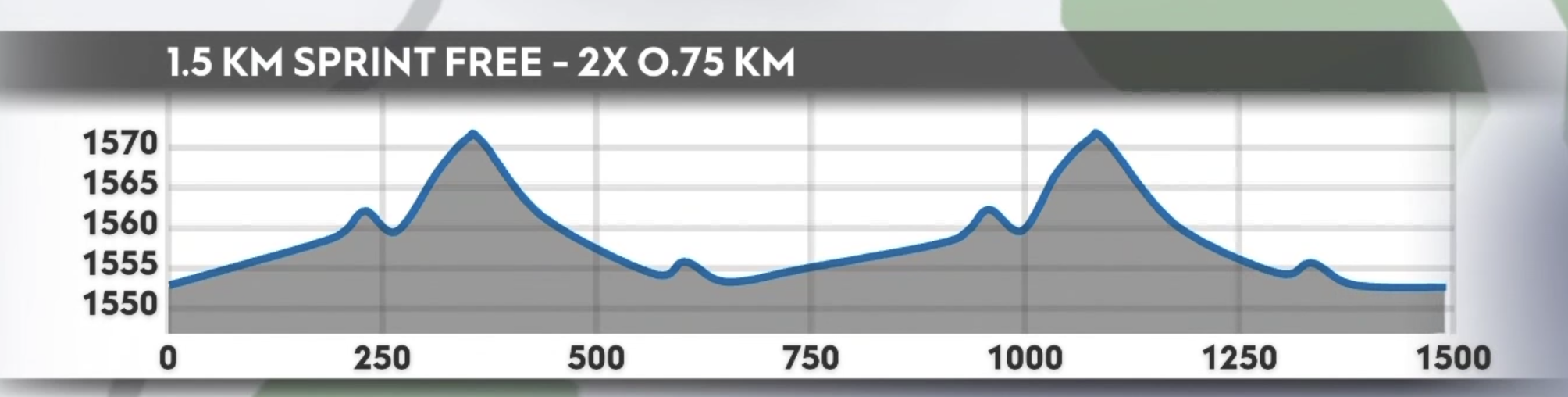
    Altitude and rugged mountain backdrop aside, the sprint course in Davos sits on the valley floor, making it relatively flat compared to other venues. The maximum climb on the two-lap 1.5-kilometer course is just 12 meters; 30 meters or more is needed to meet the criteria of an A-Climb by FIS homologation standards. 

    The elevation profile of the two-lap 1.5k sprint course in Davos, SUI. (Photo: FIS Broadcast)

    Taking command in the qualifier, Norway’s Johannes Høsflot Klæbo set the fastest time of 2:24.16. Lucas Chanavat of France was second in the qualifier (+1.51) followed closely by Federico Pellegrino of Italy, whose name we have not yet seen in the final. That said, Pellegrino had history in his favor when it comes to freestyle sprints on Swiss snow. 

    Coming into the weekend, he had won three freestyle sprints in Davos, including last year, along with two wins in the freestyle sprint stage of the Tour de Ski in Val Müstair, SUI a couple of weeks later. Pellegrino has also won multiple times in Cogne, Italy, at a similar elevation, and has shown prowess on flat courses, including the city sprint in Dresden, Germany. 

    Federico Pellegrino (ITA) races to third in qualification in Davos. (Photo: NordicFocus)

    The Italian’s stats in Davos are only matched by Klæbo, who also has three wins at the venue. Today was the tie breaker. Who would take home a fourth wooden sled for his collection? 

    On the American front, Ben Ogden was the only athlete who qualified for the rounds today. Ogden skied to 13th (+2.87) and raced in heat five of the quarterfinals.

    The storyline of Pellegrino versus Klæbo was decided before the two could line up to face each other head to head. Klæbo advanced smoothly from the first heat, however, Pellegrino was knocked out in his quarterfinal shortly thereafter. 

    Italy’s Federico Pellegrino pushes the pace during his quarterfinal of the freestyle sprint in Davos. (Photo: NordicFocus)

    In heat two, Pellegrino took the lead in the second lap, hopskating up the primary climb and powering over the top just ahead of Norway’s Håvard Solås Taugbøl and Richard Jouve of France. Holding his position at the front as the men pushed around the final curve, Pellegrino was matched by the surging men as they each held their own finish lane while sprinting to the line. Jouve had the fastest acceleration, gaining the advantage as the three men threw their boots for a photo finish. Jouve took the heat, with Taugbøl 0.12 seconds behind, leaving Pellegrino third (+0.2) Unfortunately for the Italian, the tactical heat was too slow for him to advance to the semis. 

    In Ogden’s quarter, two Swiss men, Jovian Hediger and Valerio Grond, pulled from the front through the first lap. As the men hit the primary climb in the second lap, Russia’s Alexander Terentev, who won the opening sprint in Ruka, accelerated up the left side of the course, cresting the hill with the two Swiss men, creating a spicy final turn into the stadium. Grond caught a ski tip on his teammate’s tails, causing him to lose speed in the turn, but all of the men stayed upright. 

    Ben Ogden (Bib 13) races into the semifinal from a tight heat of the quarters. (Photo: NordicFocus)

    Terentev led in the final straight, but Ogden and Sweden’s Anton Persson, who had maintained contact throughout the heat, were rapidly gaining ground on the Swiss skiers. Coming to the line four across, the men slid over the finish, Persson in second (+0.37), followed by Grond (+0.44), and Ogden (+0.53), with Hediger just behind in fifth (+0.74). Though it was the final heat of the quarters, it ended up being the fastest, allowing both Grond and Ogden to advance to the semifinals. Hediger (SUI) could be seen swatting the ground with his pole at the finish upon seeing his result. 

    In the first heat of the semis, Ogden lined up with three Norwegians, Klæbo, Taugbøl, and Erik Valnes. The heat also contained Jouve, and Russia’s Sergey Ustiugov, who had challenged Klæbo in the quarters. 

    Ustiugov takes the lead in the semifinal in Davos. Note Ben Ogden in contact wearing bib 13. (Photo: NordicFocus)

    As the pace accelerated in the final lap, Ustiugov took to the front again, this time seeming to want a larger margin over Klæbo as they headed into the final turn and straightaway. Though the Russian led into this turn, Klæbo was able to slingshot around the outside, earning a clear lane to the finish. The Russian was on his right, with Valnes on the other side. Perhaps too confident for his own good, Klæbo stood up before the line, coasting across with a boot kick that looked like an afterthought.

    Erik Valnes (NOR), Sergey Ustiugov (RUS), Johannes Klaebo (NOR), (l-r) (Photo: NordicFocus)

    With five men still tight around him, this allowed Ustiugov to take the win, while an accelerating Jouve tried to throw his boot along Klæbo’s left side, from within the same lane, just 0.14 seconds behind the Norwegian. With multiple athletes vying for limited real estate at the finish, Klæbo had his tails skied over, sending him abruptly onto the ground just after he crossed the line. 

    Valnes was fourth in the heat, followed closely by Taugbøl; these first five men were spread by only 0.58 seconds in total. Ogden, who had lost contact in the second lap, held on for sixth in the heat (+7.28). 

    While still tight, the second heat of the semis had a clear winner, Chanavat of France. Behind him was Even Northug of Norway, followed by Terentev, whose time was not fast enough for a lucky loser spot in the final.

    The pace was pedestrian as the first lap of the final progressed, the athletes seemingly biding their time and conserving energy for a tactical second lap. Mirroring the first two rounds of racing, Ustiugov made a big push in the second time up the climb as the men powered uphill with impressive tempo. But again, as they headed downhill and around the final right-hand curve, it was Klæbo on the Russian’s tails, shooting around the outside and into the center lane as he cruised to the finish for a commanding victory. 

    This time waiting to celebrate until he was over the line, Klæbo took home his fourth win on the tracks in Davos. Ustiugov held pace for second (+0.87), followed by Jouve in third (+1.23). 

    Johannes Høsflot Klæbo takes the win in Davos, while Sergey Ustiugov and Richard Jouve accelerate to second and third. (Photo: NordicFocus)

    Off the podium, Valnes was fourth in the final (+1.31), followed after a gap by Northug in fifth (+3.74) and Chanavat in sixth (+7.95). 

    “It was an amazing day,” Klæbo told FIS at the finish. “I think it was really, really fun to race out there. I was a little bit skeptical because of the weather before we started today, but I think the conditions are really really good and it was a fair fight, which was really nice.”

    The men’s podium of the freestyle sprint in Davos. Johannes Høsflot Klæbo (NOR) took his fourth win at the venue, ahead of Sergey Ustiugov (RUS) and Richard Jouve (FRA). (Photo: NordicFocus)

    It was a blustery day with light snow peppering the athletes throughout the rounds, a contrast to the sun and blue sky we often expect from the venue. Klæbo also shared that he will have an extended stay in Davos, putting in some additional time and training at altitude. 

    “I’m going to be here now until the 22nd of December, so I have a few more days left here, and it’s beautiful now, and I see that the weather is going to be much better next week, so I’m looking forward to some nice weeks here.”

    After the final standings were firmed up, it was concluded that Ogden finished his day in 12th.

    Ben Ogden races into the semis in Davos. (Photo: NordicFocus)

    “Today was a lot of fun,” wrote Ogden in a post-race email. “For the qualifier, I knew it was going to be hard but there was a good amount of rest out there so I wasn’t afraid to pretty much pin it out from the start ,which thankfully worked out well. I was definitely slower the second time up the hill but was able to push hard over the top and get into the finish without anything catastrophic happening. I was surprised and happy to qualify in 13th.

    “In the quarter final, I figured it was going to be fast because all of us qualified so close to each other. I learned on the first lap that my skis were very fast, so when the other guys got a little gap on me over the top of the hill on the second lap, I was still hopeful. Then they made the critical mistake of sliding the first bit of the last corner, and because I was a touch behind I could step around it and set myself up well for the final straight. I bet it wasn’t pretty, but it was just enough to get me into the semi finals for the first time! Really pumped with this. I always figured I would first advance [into the semifinals] in classic, but things came together today so that was awesome.” 

    Ben Ogden puts together a career-best finish in Davos, ending his day in 12th. (Photo: NordicFocus)

    “I did, however, learn that there is a reason all the fast guys pack into quarter final 1 and 2 when I finished and learned that I had just over 10 minutes before my semi final…” Ogden continued. “The guys in the semi final were damn strong, but I was pumped to stay in it for a bit and push all the way to the finish. One step at a time! Fun stuff out there and cheers to my wax tech (the famous Jason Cork) and all the wax techs for awesome skis!”

    Luke Jager skis to 41st in the qualification round in Davos. (Photo: NordicFocus)

    Outside the heats, JC Schoonmaker was second for the Americans, finishing 41st (+6.73) in qualification, less than 1.5 seconds off the time needed to compete in the rounds. Logan Hanneman was 44th (+6.99), followed by Luke Jager in 50th (+7.93), Kevin Bolger in 51st (+8.28), and Gus Schumacher in 65th (+10.48). 

    Here is a post-race interview with U.S. Ski Team Head Coach Matt Whitcomb with insights into the altitude and conditions on course, along with individual feedback on the men and women who raced today. Whitcomb also comments on the string of victories earned by Bolger’s girlfriend, Swedish champion Maja Dahlqvist.

    Racing for Canada, Antoine Cyr skied to 36th in qualification (+6.43), followed by Graham Ritchie in 45th (+7.02). 

    Antoine Cyr leads the Canadian men, skiing to 36th in the qualifier. (Photo: NordicFocus)

    Results:

    Qualification | Final
  • American Men Light Up Ruka; JC Schoonmaker 7th, Three in Top-20

    American Men Light Up Ruka; JC Schoonmaker 7th, Three in Top-20

    JC Schoonmaker slides across the line in the semifinal. (Photo: NordicFocus)


    This World Cup coverage is made possible through the generous support of Marty and Kathy Hall and the A Hall Mark of Excellence Award.  To learn more about A Hall Mark of Excellence Award or to learn how you can support FasterSkier’s coverage please contact info@fasterskier.com.

    By Ben Theyerl

    Friday in Ruka, under the dim lights of an Arctic Circle sky, was the moment that potential energy – a new season and new names – converted into something kinetic for both U.S. skiing and the World Cup at-large. Under hats, glasses, moleskin, and buffs were some decidedly fresh faces, not just mixing it up in an event with Olympic and World Champions, but beating them too.

    And one of them did beat them all. Alexander Terentev, a 22-year old Russian who won the U23 World Championship in the Classic Sprint last season, looked to have no problems taking the step up to the senior circuit. Terentev won the qualifying round with a second to spare (2:31.13) over second place Richard Jouve (+1.62) and third place Johannes Høsflot Klæbo (+1.72). 

    Russia’s Alexander Terentev wins the qualifying round in Ruka. (Photo: NordicFocus)

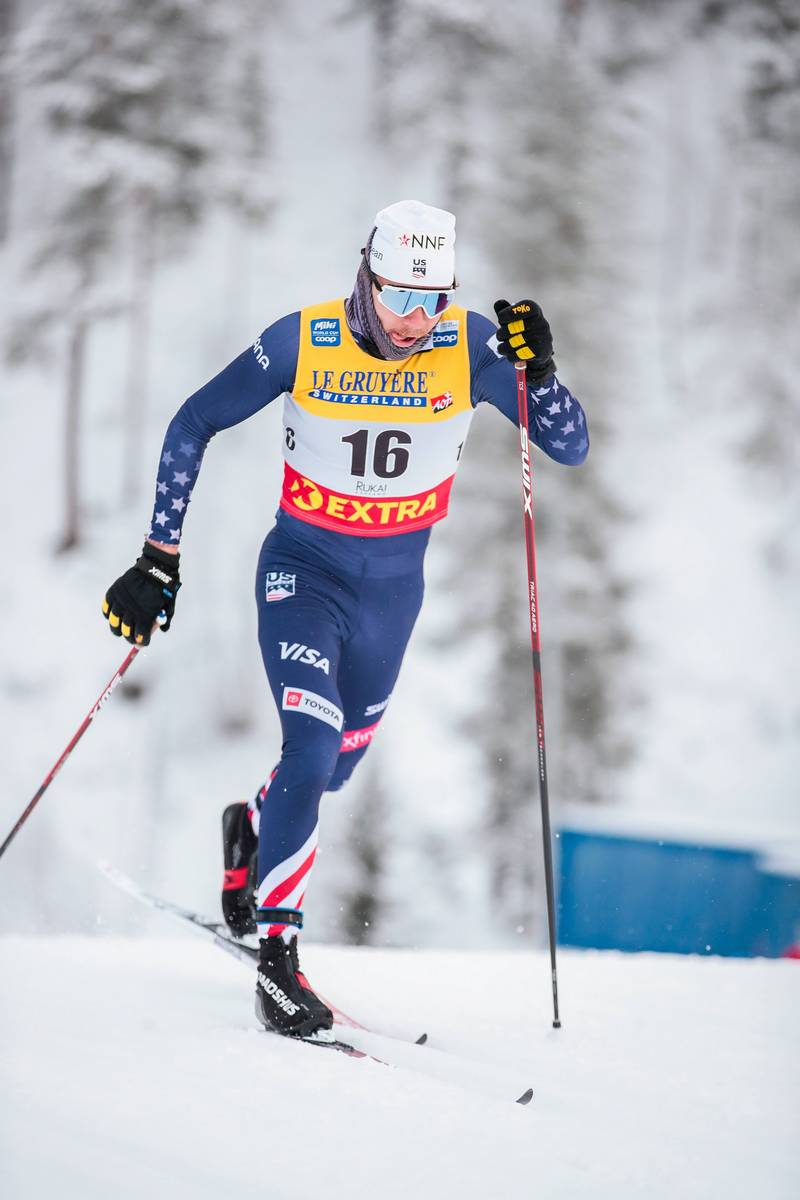
    If young potential was representing a country in Ruka, however, it would have been draped in an American flag. JC Schoonmaker, Ben Ogden, and Luke Jager all qualified for heats and did it decisively in 5th (+3.01), 8th (+3.68), and 17th (+6.43), respectively.

    It was another moment in U.S. skiing – think the World Championship double podium in 2015, or the Olympic gold medal in 2018 – where things changed in an instant. Before the qualifying round today, there was a group of young American men with the potential to achieve great results at the sport’s highest level. After it, that potential had been realized.

    Ben Ogden skis to 8th place in the qualifier during the classic sprint stage in Ruka. (Photo: NordicFocus)

    “A lot of us, in this country, have seen this coming. But it’s a different thing to see it actually arrive. They announced with their qualifications today that we’re here, and they weren’t just coming in under the buzzer, they were locked in.” said U.S. Ski Team Head Coach Matt Whitcomb in a post-race interview with FasterSkier.

    Full audio clip from post-race interview with Matt Whitcomb


    With a Top-8 spot in a freestyle sprint guaranteeing a spot on the Olympic Team, Schoonmaker, Ogden, and Jager also took a step forward toward pursuing their dreams. 

    Schoonmaker’s fifth place qualifying put him in pole position against the home crowd, with Finnish skier Joni Maki taking the place next to him on the start line. Schoonmaker went in with a clear tactic: “I was trying to take it easier in the beginning and stay relaxed for that final climb,” he said, and when the final climb did come he was able to “get a lane to myself and just ski away from the pack a little bit.”

    JC Schoonmaker stays in the mix through the heats in Ruka. (Photo: NordicFocus)

    Maki outpaced him on the final stretch, but Schoonmaker held on to make it to the semifinals.

    Jager and Ogden lined up together against current World Cup Sprint Champion Federico Pellegrino in the next quarter-final. An early fall took Pellegrino out of the competition, which led to the still somewhat unusual sight of two Americans and two Swedes battling it out up the final climb in a World Cup. 

    The Swedes would take the top two spots, outlasting a late burst of speed up the final climb from Ben Ogden that Luke Jager followed. Ogden finished third in the heat with Jager just behind him.

    Ben Ogden leads teammate Luke Jager up the first climb during the quarterfinal of the classic sprint in Ruka. (Photo: NordicFocus)

    Schoonmaker advancing to the semis put him in a position to finish in the Top-12. Joni Maki and H.S. Taugboel hit the base of the final climb in first and second, with Schoonmaker joined by a pair of Swedes – Marcus Grate and Anton Persson – in pursuit. That pursuit met trouble rounding the final corner, with the two Swedes and Schoonmaker briefly stumbling over each other.

    “I got caught up with two Swedish guys. I think it was just ski racing, I don’t think it was anyone’s fault. We were skiing close to each other and no one wanted to give any one else space” Schoonmaker said on the tangle.

    Schoonmaker would finish the heat in third, but the incident left him seven seconds off the lucky loser mark.

    Schoonmaker finished in seventh place on the day.  This was a huge milestone that both he and Coach Matt Whitcomb attributed to great tactical thinking, aggressive skiing on the day, and perhaps most importantly, having two of his American teammates alongside him.

    “Having [Ben and Luke] warming up for the heats with me was a huge help. We were just loose and having a good time.” said Schoonmaker.

    Relaxed and confident, JC Schoonmaker skis to 7th in the classic sprint in Ruka. (Photo: NordicFocus)

    Whitcomb, meanwhile, went for an apt metaphor for an American team finding success in a traditionally European sport,  “People want to know how our guys are doing it, and I think if you watched Ted Lasso – Luke, Ben, and JC could probably have lead roles in that show.”

    In the other semi, Terentev met up with last year’s Ruka sprint champion Erik Valnes and runner-up Johannes Høsflot Klæbo. Terentev quickly established the pattern he raced the 1.4-kilometer loop in all day – leading out the field in the first climb, before tucking in as they hit the first downhill, and then looking to overpower the field on the last climb. In a Norwegian-heavy heat,  Pål Golberg ended up pushed out in front, while Klæbo seemed for most of the race to be off the pace.

    Johannes Høsflot Klæbo skis through the rounds to finish second in Ruka. (Photo: NordicFocus)

    The push up the last climb saw Valnes lead the move to overtake Golberg with Terentev following.  Klæbo, meanwhile, recovered to finish fourth place behind Richard Jouve (FRA), who took third. Klæbo looked to be out, but the stumble in the opposite heat meant that he would have a chance in the final as a lucky loser.

    After an unpredictable and exciting day, the final ended up strangely reaffirming what we knew about the day and about the World Cup. Terentev was the strongest out of the gate , and the strongest up the final climb. We learned that on the day. Klæbo is still able to control a field tactically, and make skiing plain fun to watch. We learned that years ago, but it looks to be a fact for another season.

    As the field crawled to a stop going into the first downhill on the course, it was Klæbo who shot around them, daring skiers a few years his junior to keep up. Today, Terentev could not only keep up but win, while Klæbo came out ahead of Erik Valnes for second and third, respectively.

    The final meters of the men’s sprint in Ruka. Russia’s Alexander Terentev takes the win ahead of Norway’s Johannes Høsflot Klæbo and teammate Erik Valnes. (Photo: NordicFocus)
    The final stretch: Terentev with the closing speed, Klæbo with the look. (Photo: NordicFocus)

    And as for another thing we know about the World Cup: that the American men are a rising force, and as fans, it will be thrilling to witness their trajectory.

    Reflecting on his 7th-place finish in an interview with FasterSkier, JC Schoonmaker shared the following:

    “It feels great. I’m not necessarily looking at the result, but really happy with how I raced today and how I felt. I felt confident going into the heats, and that’s something I wasn’t expecting. It’s great to know I can ski with those guys.”

    And on his biggest takeaway:

    “It was great to see three young American guys skiing aggressively in the heats. That was an awesome feeling.”

    JC Schoonmaker skis to 5th place in the qualifying round in Ruka. (Photo: NordicFocus)

    Full audio clip from post-race interview with JC Schoonmaker:


    Outside of the heats for the U.S., Logan Hanneman finished in 33rd (+8.26), with Gus Schumacher in 56th (+11.71) and Kevin Bolger in 57th (+11.71).

    Results:

    Qualification | Final
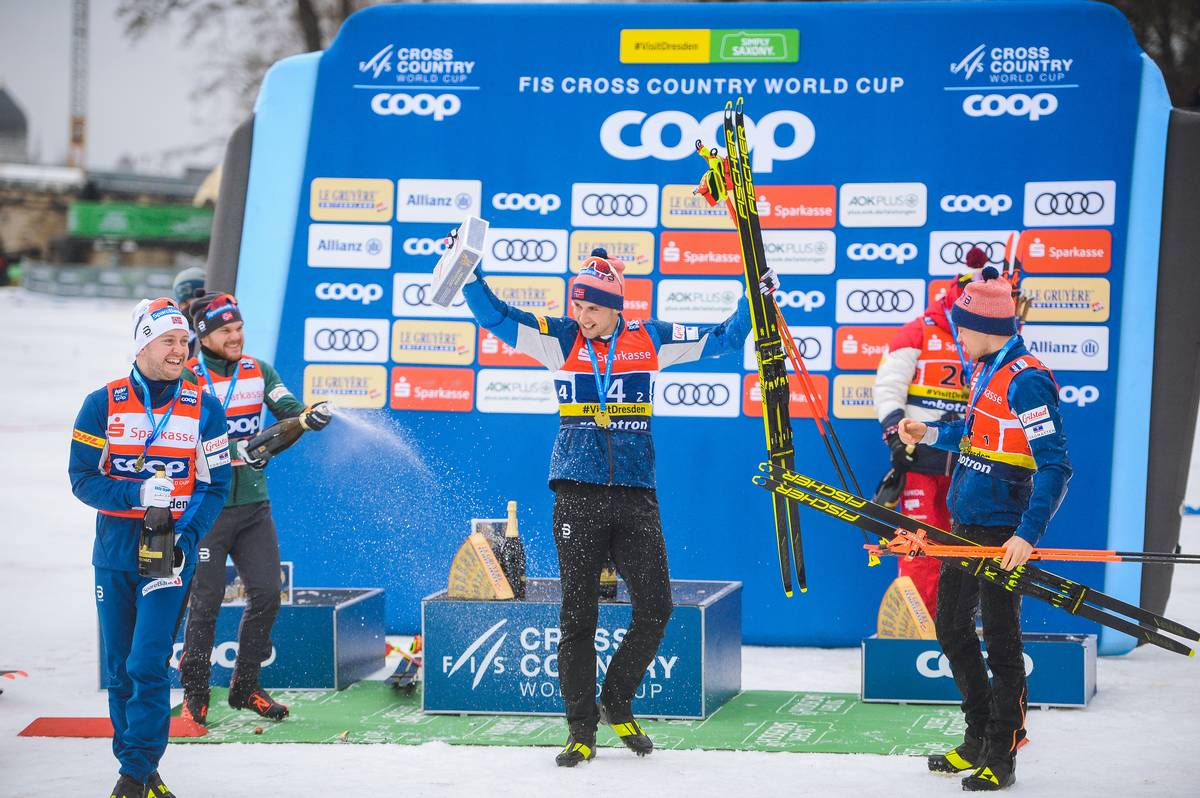
  • Tuesday Race Rundown: Lahti Junior Worlds  U20 5 k/10k Individual Skate (Updated 2x)

    Tuesday Race Rundown: Lahti Junior Worlds U20 5 k/10k Individual Skate (Updated 2x)

    Gus Schumacher skiing to sixth place in the U20 10 k skate during the 2019 Junior Worlds in Lahti, Finland. (Photo: Doug Stephen).

    FIS Junior World Ski Championships Lahti, Finland 5 k/10k Freestyle Interval Start

    Tuesday in Lahti, Finland was as Finland should be: squeaky-snow-cold and cross-country ski racing on offer.

    Eighteen-year-old Gus Schumacher broke through for the U.S. and placed sixth overall in the U20 men’s 10-kilometer freestyle. Schumacher was the 95th starter of 102 finishers on the day. His sixth place finish was consistent with his 1.1k, 5k, and 6.6k splits where he was ranked 5th, 6th, and 7th respectively. Schumacher stopped the clock in 23:19.3 minutes, 44.4 seconds behind the winning mark.

    The Lahti championships are Schumacher’s second Junior Worlds. His sixth place is his best individual result. He was part of the second place 4 x 5 k U20 relay last year in Goms, Switzerland.

    “I was most nervous about hitting it right and doing the right pacing and making sure I can have the best race that know I can,” Schumacher told FasterSkier over the phone. “I approached it as just a new race almost. We have done a fair amount of watching old world cups and world championships that were on the exact same courses here. It was definitely hard to reflect on that because none of them were exactly 10 k. And obviously those athletes are quite a bit stronger than we are. And the snow is different.”

    Schumacher extracted what he needed from the videos. Imprinted in his mind before his 10 k start were enough visuals to quell the nerves and provide a path to fast clean skiing.

    “We watched that and I felt like I got an idea for what the body movements looked like of those guys,” Schumacher said. “I thought about how that would feel for me and I thought about the other middle distance skate races I have done this year –which is actually a fair amount between early season time trials.”

    Schumacher executed his plan. He dialed back the initial effort, stayed in control, and systematically revved the engine.

    “I went out and tried for at least the first five minutes to go a little easier, because I think that is the high risk time, the very beginning,” said Schumacher. “I tried to go out and keep it consistent and as I started to get into it, I started to ramp it up a little more and really try to make the most of the recovery. Which wasn’t a lot, but enough that I could put my head in between my knees on the downhill and I could tell myself that 15 seconds of high speed downhill is helping me. And I could get my breath down a little bit and I was ready for the next hill.”

    His run at the podium came up just 17 seconds short. But with his plan executed, the Anchorage based skier had no regrets when reflecting on Tuesday’s race effort. 

    “I definitely wanted to be top-10, but I felt like and still feel like a medal is in sight,” Schumacher said. At 18, he still has one more year of eligibility in the U20 ranks.

    “For sure satisfied with this race, it felt like a good result and it was one of my better races. And I am happy with how it played out and also thinking about how I can hit the 30 k and do the most I can do.”

    France’s Jules Chappaz won the race in a time of 22:34.9 after skiing the fastest splits at 5 k and 6.1 k. Sunday’s classic sprint winner, Russia’s Alexander Terentev, placed second (+21.0), and Norway’s Iver Tildheim Andersen in third (+27.2).

    Canada placed two skiers in the top-31. Remi Drolet finished in 20th (+1:14), Samuel Gary Hendry 21st (+1:15.9), Thomas Stephen 31st (+1:36.8). Xavier McKeever skied to 44th (+2:04.6).

    For the U.S., Zanden McMullen placed 32nd (+1:40.6), Johnny Hagenbuch 34th (+1:46.3), and Noel Keeffe 58th (+2:45.7).

    Men’s U20 Results

    Sweden’s Frida Karlsson winning the U20 5 k skate at Junior World Ski Championships in Lahti, Finland. (Photo: Doug Stephen)

    Sweden’s Frida Karlsson won the U20 5 k skate in 12:50.6 minutes. Norway’s Helene Marie Fossesholm placed second 11 seconds back, with Finland’s Anita Korva in third (+19.8).

    “It was fun to ski today. I just wanted to have my revenge”, Karlsson told race organizers after the race. Karlsson had qualified first on Sunday’s U20 classic sprint but placed fifth in the overall.

    U.S. skier Kendall Kramer post U20 5 k skate at Junior World Ski Championships in Lahti, Finland. (Photo: Doug Stephen)

    The best placed North American was U.S. skier Kendall Kramer who finished in 15th (+55.6) place. Also for the U.S., Sydney Palmer-Leger was 20th (+1:04.9), Novie McCabe 29th (+1:20.8), and Waverly Gebhardt 65th (+2:28.8).

    Canada’s Anna Pryce (bib 22) and Jasmine Drolet (bib 20) finishing the U20 5 k skate at Junior World Ski Championships in Lahti, Finland. (Photo: Doug Stephen)

    Anna Pryce was the top Canadian in 43rd (+1:36.5). Teammates Molly Miller skied to 50th (+1:52.9), Isobel Hendry 58th (+1:57.1), and Jasmine Drolet 67th (+2:35.7).

    Women’s U20 Results


  • Spills and Thrills as Norway I wins Men’s Team Sprint in Dresden

    Spills and Thrills as Norway I wins Men’s Team Sprint in Dresden

    The men’s team sprint podium from the Dresden, Germany World Cup team sprint: From left to right, Norway II in second, Norway I first, and Russia I third. (Photo: fis-ski.com screenshot)

    A strip of imported snow along the Elbe river, iconic architectural reminders of old-world Europe’s city-scape in Dresden, Germany, Lycra, speedy skiers, and teams of two: all the ingredients for the men’s 1.6-kilometer freestyle team sprint.

    With tight pack skiing a function of the the relatively flat Dresden ski loop, the ten teams in the final attempted to play stay-out-of-trouble-skiing for the six total laps. But with a crowded tag area and tight corners where skiers abruptly bled speed, mix ups and tumbles occasionally picked skiers out of the front scrum.

    Coming into the final tag, 8 k into the race, the top-seven teams came through the time check all within 2.63 seconds of one another.

    Norway II, Italy I, Russia II, Norway I, France I, Russia I, and Great Britain sped through with the remaining three teams in the finals, Switzerland I, Austria I, and Australia I within closing distance to the leaders.

    Intermittently contracting and spreading out, no decisive moves to splinter the group materialized until the last lap.

    In the team sprint, it’s not simply the fastest one or two lap skier who prevails — each athlete, during their three respective legs (each leg consisted of three laps), was required to mentally focus and push the boundaries of their aerobic and anaerobic engines for 4.8 k total.

    On that last lap, the pull away move was simple enough. 

    Leading much of the final k was Norway I’s Sindre Bjørnestad Skar, the winner of Saturday’s skate sprint in Dresden. Skar kept out trouble, positioning himself at the front. He then shifted into a sixth or seventh gear no other skier could match.

    Up to the point Skar began to channel his reserve of booster-fuel, it appeared it could have been one of several teams across the line first. But approximately 4.6 k into Skar’s pathway to the finish line, his top effort was simply too much. he was on another level of endurance-sprint fitness as he closed out the win. 

    Skar along with his teammate Erik Valnes won the final in 22:38.72 minutes. 

    Sindre Bjørnestad Skar in front to finish first for Norway I during the Dresden, Germany World Cup team sprint on Sunday. (Photo: ZDF screenshot)

    But behind Skar, a four team whirlwind charged down together on the finish. A photo-finish captured the moment to decide the final standings. In second (+0.75) was Norway II’s Pål Golberg and Eirik Brandsdal, Russia I’s Artem Maltsev and Gleb Retivykh third (+0.80).

    Fourth place, 1.01 seconds back, went to Roland Schaad and Jovian Hediger of Switzerland. Russia II’s Andrey Krasnov and Alexander Terentev were fifth (+1.04).

    Great Britains’s James Clugnet and Andrew Young placed sixth (+3.17).

    Right in the middle of the the finishing lane mix, possibly fighting for podium scraps was Italy’s Federico Pellegrino. He appeared to catch his tip on another skiers ski-tail and took a spill. He and teammate Dietmar Nöckler placed 10th in the 10 team final. The Italian duo won last season’s team sprint in Dresden.


    https://www.youtube.com/watch?v=5AkfrAn3dBg&feature=youtu.be

    Canada’s Bob Thompson and Len Valjas placed seventh (+2.46) in the first semi-final and did not advance to the final. It was the same fate for the only U.S. team entered in the men’s team sprint. Andy Newell and Erik Bjornsen placed 10th (+3.66) in the second semi, and failed to make the finals.

    Canada placed 15th in the final standings, the U.S. 19th.

    In bib 15, the U.S. Ski Team’s Erik Bjornsen navigates the crowds during Dresden, Germany’s team sprint on Sunday. (Photo: Garrott Kuzzy)

    Results

  • Saturday Rundown: Relay Silver for U.S. Men; Loomis 4th; Plus Hakuba & Gatineau

    Saturday Rundown: Relay Silver for U.S. Men; Loomis 4th; Plus Hakuba & Gatineau

    The U.S. men’s silver-medal relay at 2018 Junior World Championships in Goms, Switzerland, with (from left to right) Luke Jager, Hunter Wonders, Gus Schumacher, and Ben Ogden. (Photo: JWSC2018.ch)

    (Note: This article has been updated to include comments from Americans Ben Loomis, Luke Jager and Gus Schumacher.)

    Junior World Championships (Goms, Switzerland): Men’s and women’s relays

    Two individual medals and a relay podium. That’s how the U.S. team fared this week at Junior World Championships in terms of a medal count, but the significance of its breakthroughs go way beyond the hardware.

    Hailey Swirbul became the most successful American nordic skier at Junior World Championships with a silver and a bronze in the two women’s distance races. Then, on Saturday, the U.S. men took their turn in the spotlight, racing to second and almost first in the 4 x 5-kilometer relay for the best relay finish by an American team at Junior Worlds. Last year, the U.S. women placed third at 2017 Junior Worlds at Soldier Hollow in Midway, Utah.

    Luke Jager started the team off on Saturday as the first classic leg, putting the U.S. men in sixth at the first exchange, 14 seconds behind Sweden in first.

    While Sweden dropped to second on the next leg, the U.S. continued to move up, with Ben Ogden racing to fourth, 8.5 seconds out of first, behind Norway, Russia and France, respectively.

    On the first freestyle leg, Hunter Wonders held the U.S. in fourth and tagged anchor Gus Schumacher in fourth, 31.3 seconds out of first. Norway continued to lead with France, and Russia skied about 5 seconds back in third with 5 k to go.

    Schumacher then skied the fastest anchor leg to race up to second, passing France and finally Russia in the finishing straight, as he crossed the line 2.2 seconds behind Norway’s Jørgen Lippert — who eased up in the finish and secured the Norwegian gold with a total time of 50:04.2 minutes.

    The men’s 4 x 5 k relay podium at 2018 Junior World Championships with Norway (c) in first, the U.S. (l) in second (Ben Ogden, Luke Jager, Gus Schumacher, Hunter Wonders), and Russia (r) in third. (Photo: Julia Kern)

    The U.S. placed second, 3.3 seconds ahead of Russia in third (+5.5), and France finished fourth (+29.6).

    Norway’s winning team included two men who won individual golds this week, Harald Østberg Amundsen (in the 20 k skiathlon) and Jon Rolf Skamo Hope (10 k classic), as well as Håvard Moseby and Lippert (who took bronze in two races).

    Russia’s team was made up of Kirill Kilivnyuk, Sergey Ardashev, Yaroslav Rybochkin, and Alexander Terentev. Team France was Camille Laude, Hugo Lapels, Tom Mancini, and Pierre Tichit.

    Canada placed 11th (+3:12.8) with Antoine Cyr, Ritchie Graham, Felix Longpre, and Etienne Hebert. Sixteen teams contested the men’s relay on the final day of Junior Worlds in Goms.

    American Luke Jager (9) skiing with Norway’s Harald Østberg Amundsen (1), France’s Camille Laude (3), and Sweden’s Jacob Nystedt (8) during the first leg of the men’s 4 x 5 k relay on Saturday at 2018 Junior World Championships in Goms, Switzerland. (Photo: Julia Kern)

    In an email, Jager, who turned 18 last month, explained that he was grateful for the opportunity to race at his first Junior Worlds.

    “I barely qualified for this trip after a tough week in Anchorage so my options for starts were super limited,” Jager wrote. “I got the sprint start last week which was pretty horrendous and then a guaranteed spot on the relay team. So I had the whole week to prepare and rest. Watching the boys all week we realized that a medal could be possible and we started targeting that super closely.”

    But over the last week, Jager hadn’t been feeling well.

    “I was feeling really really bad in the days following the sprint and could barely get out and ski for 60 minutes each day,” he recalled. “I had actually told [U.S. Ski Team Development Coach Bryan] Fish that if I continued to feel as bad as I had been I was gonna sit out the relay. But I started feeling better and better throughout the week and was feeling really good this morning.”

    He had previously asked Fish if he could ski the scramble leg.

    “Bryan was stoked about it too so that decision was easy,” Jager explained. “This group of dudes is perfect for each leg of a relay so we barely even needed to discuss order. I am definitely a stronger classic skier so I was stoked to be able to get some redemption for my poor form in the last month.”

    Schumacher, 17, explained he found out the relay order on Friday night and “really started to get excited about it,” he wrote in an email. “We had some foreign friends say that they thought we could do well so that really helped confidence.”

    From the gun, Jager expected a fast pace and pushed to put himself in the lead group while trying to conserve energy and avoid any tangles He locked onto Norway’s Amundsen and by the last climb on the second lap, found that the group was beginning to string out.

    “I was thankfully able to hold on just enough to maintain connection with the leaders and put Ben in a position where he could do his thing,” Jager wrote. “I would have liked to be a little further up in the group when I tagged off to Ben but the Swedes’ first skier had done so much damage in the last minutes that we were all in single file and pretty much in survival mode up the last climb.”

    Russia’s Alexander Terentev leading Norway’s Jørgen Lippert, American Gus Schumacher (9), and France’s Pierre Tichit (3) up a climb in the final leg of the men’s 4 x 5 k relay at 2018 Junior World Championships in Goms, Switzerland. (Photo: Julia Kern)

    Fast-forward to Schumacher getting tagged in fourth in the final exchange, 31.5 seconds behind Norway in first, 30.9 seconds behind France in second, and 26.2 seconds behind Russia in third. Despite the gap, he believed he could close it.

    “I definitely thought those three were in reach, and I wanted to catch them, if for no other reason than to keep clear of 5th and 6th,” Schumacher wrote. “I focused on really holding steady for the first 2k, then starting to push more, and I was able to catch that lead pack and then recover with them for the last sprint, which did end up really hurting.”

    While he had distanced himself from France and secured third by the final hill, he hadn’t anticipated catching Russia or Norway.

    “By the time I got through the downhill corner, however, I was closing fast on the Russian and realized I was right there,” Schumacher wrote. “I popped around the last corner and was almost even with Russia, then after a few seconds of sprinting I pulled ahead and he slowed down and I knew I had it.”

    While Jager explained he’s not one to get very nervous about racing, Saturday was completely different.

    “… Watching the rest of the race progress was one of the most nerve wracking experiences of my life,” he wrote. “When Hunter tagged off to Gus I knew we were really really gonna be in the fight for a medal. I’ve been racing Gus for most of my life and I know when that kid is gonna throw down and produce a miracle and I could see it…

    “This is something this group of guys has been dreaming of and training for for a really long time now,” he added. “To be able to watch that dream come into fruition today was indescribable. Probably the best day of my life since Cole Morgan added me on Snapchat. We came here this year to show the world that US skiing is the real deal and that we’re here to stay and I think we did that. To be able to be a piece of that history was an honor.”

    “Experiencing the podium here has been so cool,” Schumacher wrote. “I thought it was possible, but actually getting it feels amazing. This whole trip has been really cool even without this success, it’s such an amazing place and the team is tight. I think individually I anticipated results maybe a little better, but this seems about right, and as a team I think we all surprised ourselves. Together we can make some big waves.”

    Germany Wins Women’s Relay; U.S. 8th

    In the women’s 4 x 3.3 k relay earlier on Saturday, Germany took the win by 8.6 seconds over Russia with a winning time of 39:17.4. Sweden finished third, 47.5 seconds out of first.

    Germany’s Alexandra Danner, Celine Mayer and Lisa Lohmann await their teammate Anna-Maria Dietz at the finish of the women’s 4 x 3.3 k relay on Saturday at 2018 Junior World Championships in Goms, Switzerland. Germany placed first and Russia finished second, 8.6 seconds later. (Photo: JWSC2018.ch)

    Germany (Alexandra Danner, Celine Mayer, Lisa Lohmann, Anna-Maria Dietz) improved from third on the first leg, to second on the second and third legs, and final first on Dietz’s anchor leg.

    Russia (Polina Nekrasova, Hristina Matsokina, Nina Dubotolkina, Maya Yakunina) led the race from the first through the third and final exchange, before slipping to second at the finish.

    Sweden (Tua Dahlgren, Frida Karlsson, Alicia Persson, Johanna Hagström) rebounded from 13th and more than a minute and a half back at the first exchange to tag in fourth and 28 seconds out of first thanks to Karlsson’s fastest second-leg time. By the final exchange, they were up to third and they held that position to the finish.

    The U.S. women’s 4 x 3.3 k relay at 2018 Junior World Championships, with (from left to right) Hailey Swirbul, Kathleen O’Connell, Hannah Halvorsen, and Molly Gellert. They placed eighth on Saturday. (Photo: Julia Kern)

    The U.S. placed eighth (+1:08.1) with Kathleen O’Connell, Swirbul, Molly Gellert, and Hannah Halvorsen. After O’Connell put them in eighth and about a minute back on the first leg, Swirbul skied them up to sixth with the second-fastest second leg, 30.1 seconds out of first. Gellert held onto that position on the first skate leg, but Halvorsen slipped two places on the anchor leg to finish eighth.

    Canada finished 15th (+4:47.8) out of 16 teams with Hannah Mehain, Natalie Hynes, Annika Richardson, and Alexandra Racine.

    Results: Men | Women

    ***

    Slovenia’s Vid Vrhovnik (3) celebrates his win in the last nordic-combined competition of 2018 Junior World Championships, the individual normal hill/5 k, on Saturday in Kandersteg, Switzerland, while the Czech Republic’s Jan Vytrval, Austria’s Dominik Terzer and American Ben Loomis (r) battle for second. (Photo: JWSC2018.ch)

    Nordic Combined Junior World Championships (Kandersteg, Switzerland): Normal hill/5 k Gundersen

    In the final nordic-combined competition of Junior Worlds, American Ben Loomis nearly notched his second podium of the week, missing it by one-tenth of a second in fourth place.

    American Ben Loomis (7) leads Austria’s Johannes Lamparter during Saturday’s 5 k at 2018 Nordic Combined Junior World Championships in Kandersteg, Switzerland. Loomis went on to place fourth and Lamparter finished eighth. (Photo: Romina Eggert)

    Slovenia’s 18-year-old Vid Vrhovnik won the individual normal hill/5 k Gundersen by 4.9 seconds over Austria’s Dominik Terzer. After posting the third-best jump on the 106-meter hill, Vrhovnik started the 5 k race 6 seconds behind Germany’s Luis Lehnert in first. Terzer jumped to second and started just 4 seconds behind, while the Czech Republic’s Jan Vytrval jumped to fourth and started 10 seconds back. Loomis jumped to seventh (just as he did on Tuesday before racing to third place) and started 27 seconds out of first.

    “I was happy with my jump being closer in time to the front,” Loomis wrote in an email about his his jump, which put him about 10 seconds closer to the leaders than on Tuesday. “I didn’t feel quite as lucky with the wind. I was hoping to jump around the top 5, but 7th, only 27sec back was good, too.”

    Over the two-lap 5 k, Vrhovnik battled with Terzer, while Lehnert slipped to seventh at the finish, 23.5 seconds behind. The Slovenian took the win by nearly five seconds over Terzer in 11:28.8, and Vytrval outlunged Loomis for third place (+5.4). Loomis placed fourth (+5.5), well ahead of Norway’s Einar Lurås Oftebro in fifth (+18.4).

    Ben Loomis (USA Nordic) on the last day of 2018 Nordic Combined Junior World Championships in Kandersteg, Switzerland. He jumped to seventh and moved up to fourth in the 5 k. (Photo: Romina Eggert)

    “I was able to catch places 3-6 on the first lap and ski with them through the beginning of the second lap,” Loomis wrote. “Towards the end of second lap I closed down on second place (Jan Vytral) with Dominik Terzer. On the last corner we packed up in positions 2-4.

    “The finish started with a sharp downhill corner followed by a quick stretch less than 100 meters,” he continued. “I came into the finishing lanes in second but unfortunately took the wrong line and was passed by Dominik and never quite caught Jan in front of me.”

    While he had been hoping for another podium, Loomis acknowledged that he was pleased to ski the fastest race time and “be battling at the front”.

    “Overall I am leaving Switzerland with my goals accomplished and feeling satisfied,” he wrote. “It would have been nice to walk away with a double podium but I am still very happy with how to week went. This week has been a huge confidence booster going into the Olympics next week. I am very excited to represent my country and enjoy my time at the games. I am looking to have fun, take in experience and not overthink the results.”

    Also for the U.S., Stephen Schumann placed 18th (+1:18.6), up one place from 19th in the jump, Jared Shumate finished 40th (+3:05.7), up from 48th in the jump, and Tucker Hoefler was 55th (+5:50.5), after jumping to 55th.

    Results: Jumping | Final
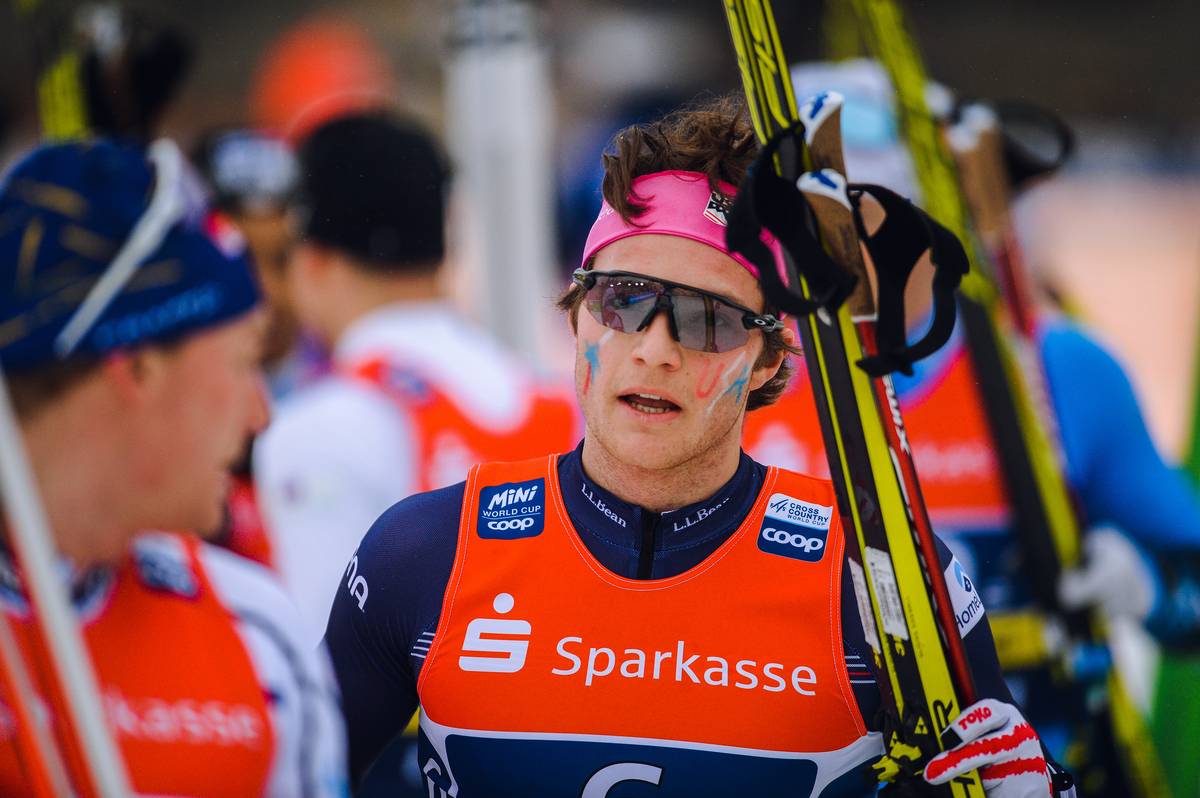
    ***

    The podium at Saturday’s Nordic Combined World Cup in Hakuba, Japan, with Japan’s Akito Watabe (c) in first, Norway’s Jan Schmid (l) in second and Germany’s Manuel Faißt (r) in third. (Photo: FIS/Flawia Krawczyk)

    Nordic Combined World Cup (Hakuba, Japan): Large hill/10 k Gundersen

    Many of the winter-sports World Cups were off this weekend before the Olympics start in earnest a week from today in PyeongChang, South Korea, but not nordic combined, which had a World Cup stop in Hakuba, Japan.

    There, local hero Akito Watabe took the win in 24:14.6 minutes, a whopping 1:12.6 minutes clear of Norway’s Jan Schmid in second. Germany’s Manuel Faißt placed third, 1:22 back, and Estonia’s Kristjan Ilves finished 52 seconds later in fourth (+2:14).

    The lone American competing in Saturday’s 10 k Gundersen, Ben Berend achieved his first individual World Cup top 30, placing 23rd (+4:31.7) after jumping to 16th on Hakuba’s 134-meter large hill.

    Watabe led from the beginning of the day after jumping to first, ahead of Ilves in second, Faißt in third, and Schmid in fourth. Watabe started the 10 k with a 16-second head start on Ilves, while Faisst started 52 seconds out of first and Schmid started 1:08 behind.

    Berend started the 10 k with a 2:36 deficit to first, with five others within 10 seconds of him. His teammate Adam Loomis did not start the 10 k after jumping to 38th.

    Another individual large hill/10 k Gundersen will be held on Sunday in Hakuba. The first nordic combined competition in PyeongChang, the individual normal hill/10 k, is set for Wednesday, Feb. 14.

    Results: Jumping | Final 

    ***

    The men’s 15 k freestyle podium at 2018 Eastern Canadian Championships in Gatineau, Quebec, with Jack Hegman (c) in first, David Norris (l) in second and Tad Elliott (r) in third. (Photo: Rob Smith)

    NorAm Eastern Canadian Championships (Gatineau, Quebec): 10/15 k freestyle

    Americans swept the podium in both the men’s and women’s freestyle individual starts on Saturday at Eastern Canadian Championships in races that count toward both NorAm and SuperTour standings.

    According to unofficial results, Jack Hegman, of the Sun Valley Ski Education Foundation (SVSEF), won the men’s 15 k by 9.1 seconds over David Norris, of Alaska Pacific University (APU), in 35:44.9. Tad Elliott (Ski Club Vail) placed third (+38.7) just ahead of the top Canadian, Jack Carlyle, of the Alberta World Cup Academy (AWCA), in fourth (+41.7).

    The U.S. occupied eight of the top 10 in the men’s race, with Kevin Bolger (SVSEF) in fifth (+45.0), Ben Lustgarten, of the Craftsbury Green Racing Project (CGRP) in sixth (+52.3), Brian Gregg (Team Gregg/LNR/CXC) in seventh (+57.0), Rogan Brown (SVSEF) in eighth (+58.1), Canada’s Scott Hill (Barrie Cross Country) in ninth (+1:14.7), and Eric Packer (APU) in 10th (+1:18.6).

    The women’s 10 k freestyle podium at 2018 Eastern Canadian Championships in Gatineau, Quebec, with Rosie Frankowski (c) in first, Becca Rorabaugh (l) in second and Erika Flowers (r) in third. (Photo: Rob Smith)

    After placing second in a 10 k freestyle at last weekend’s SuperTour in Craftsbury, Vermont, Rosie Frankowski (APU) won the women’s 10 k freestyle on Saturday in Gatineau by more than 30 seconds in 27:07.3. Her teammate Becca Rorabaugh (who won the Craftsbury 10 k skate as well as Friday’s classic sprint in Gatineau) placed second (+37.1) on Saturday, and Erika Flowers placed third (+1:26.4) for the third-straight race.

    Frédérique Vézina, of the Pierre-Harvey National Training Centre, led the Canadians in fourth (+1:46.2), while America Liz Guiney (CGRP) placed fifth (+1:52.2), and Olivia Bouffard-Nesbitt (Rocky Mountain Racers) finished sixth (+1:56.4).
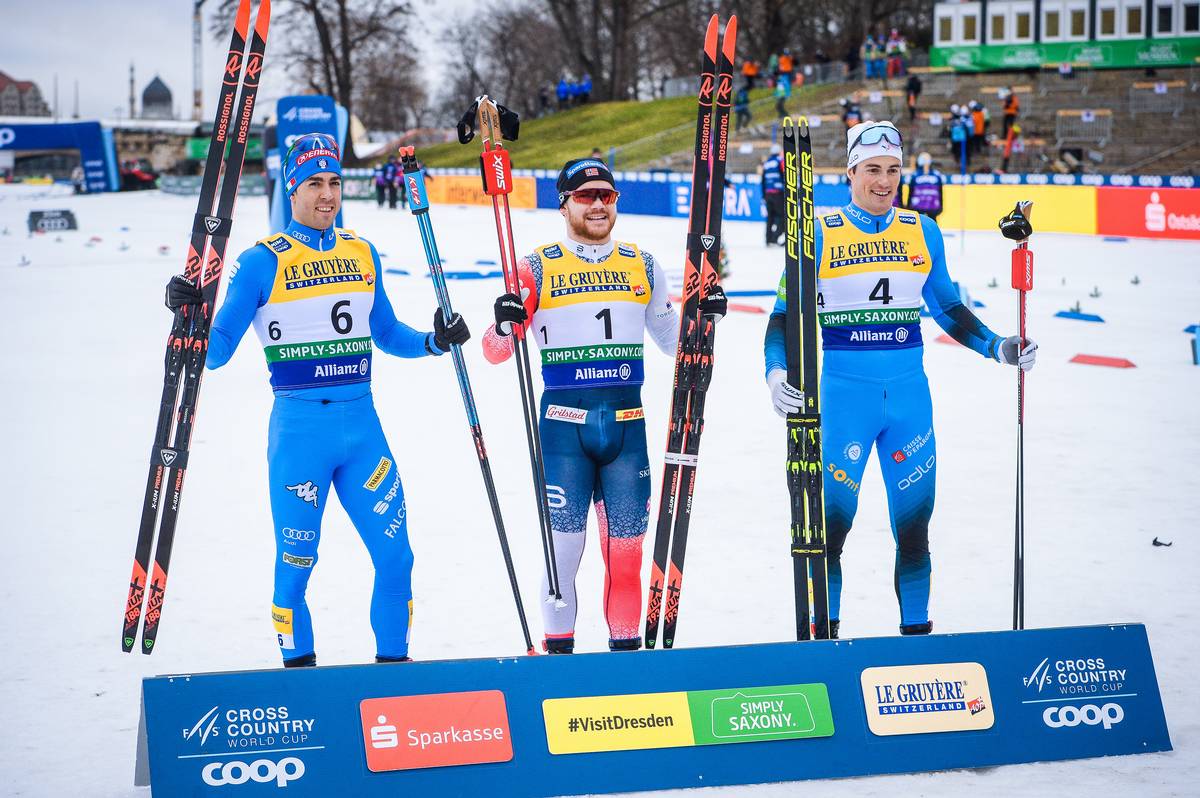
    Also in the top 10, Kaitlynn Miller (CGRP) placed seventh (+1:57.8), Felicia Geisor (CXC Team) was eighth (+2:18.5), Zoë Williams (Carleton University) ninth (+2:39.6) and Annika Hicks (AWCA) 10th (+2:43.4).

    Eastern Canadian Championships conclude Sunday with 10/15 k classic pursuits at the Nakkertok Nordic Ski Centre.

    Results

  • Tuesday Rundown: Swirbul 2nd at Junior Worlds; Loomis 3rd (Updated)

    Tuesday Rundown: Swirbul 2nd at Junior Worlds; Loomis 3rd (Updated)

    The women’s 5 k classic podium at 2018 Junior World Championships in Goms, Switzerland, with American Hailey Swirbul (r) in second, Russia’s Polina Nekrasova (c) in first, and Finland’s Anita Korva (l) in third. (Photo: JWSC2018.ch)

    (This article has been updated to reflect that American Hailey Swirbul was in second for most of Tuesday’s 5 k race, not over one minute back as previously reported based on a live timing error. It has also been updated to include comments from Americans Hailey Swirbul, Ben Loomis, Stephen Schumann, and Gus Schumacher, Canada’s Antoine Cyr, University of Alaska Anchorage nordic head coach Andrew Kastning, and U.S. Ski Team Development Coach Bryan Fish.)

    Junior World Championships (Goms, Switzerland): 5/10 k classic

    Hailey Swirbul became the second American cross-country skier to earn an individual medal at Junior World Championships and first to take silver (Katharine Ogden claimed bronze in last year’s skiathlon) in the women’s 5-kilometer classic individual start on Tuesday in Goms, Switzerland.
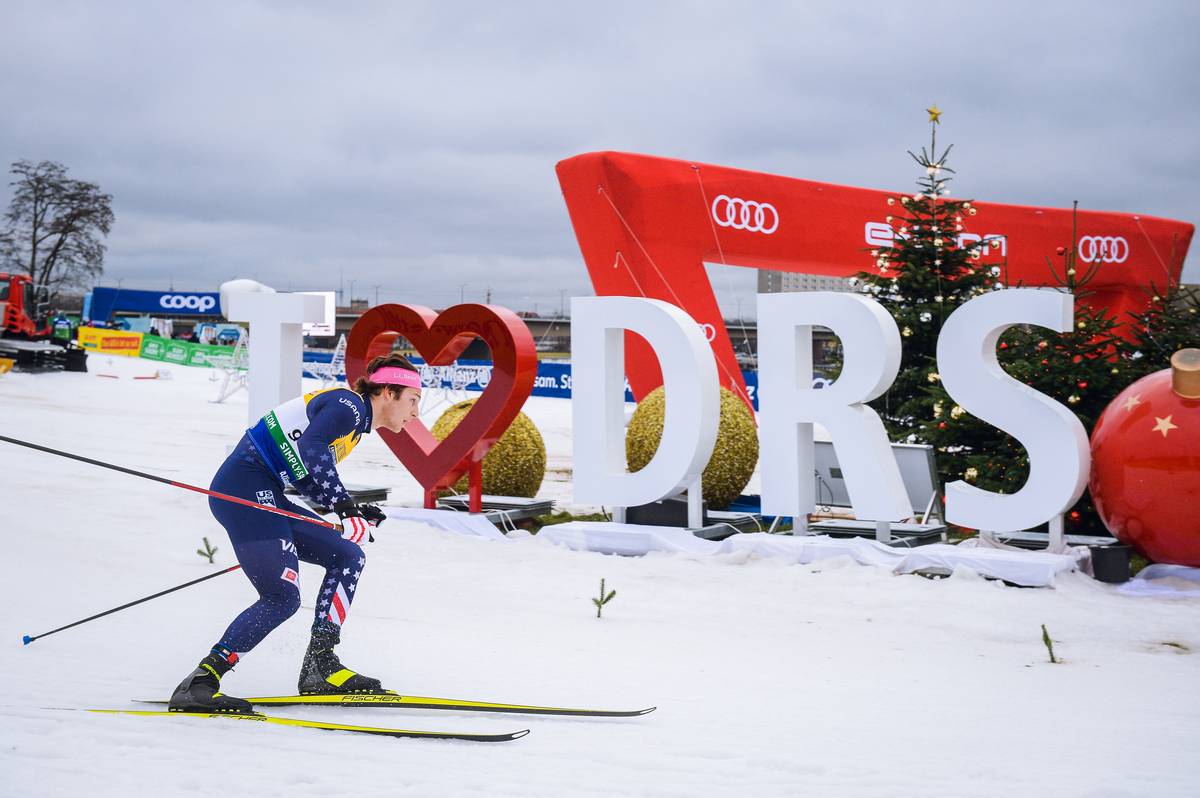
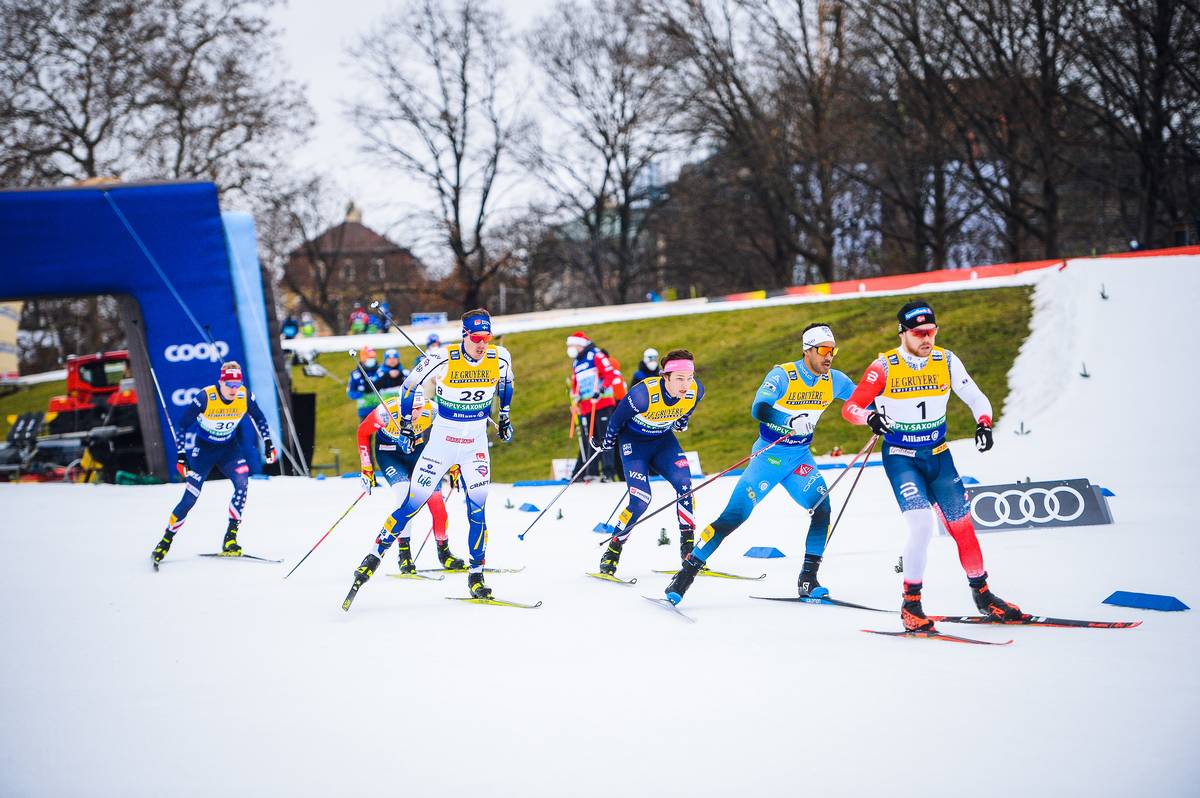
    Swirbul, a 19-year-old University of Alaska Anchorage sophomore, also tallied the best American finish at a Junior/U23 World Championships since Jessie Diggins earned silver in 2014 in the freestyle sprint. It was Swirbul’s second medal the last two Junior Worlds after she teamed up with Hannah Halvorsen, Julia Kern, and Ogden to take bronze in last year’s relay.

    Going into this week’s championships, Swirbul, a Colorado native, explained she was aiming for a top 10 in one of the distance races. U.S. Ski Team Development Coach Bryan Fish pointed out that she wasn’t sure she’d feel up to racing on Tuesday.

    “She had been feeling under the weather so she didn’t come up and ski yesterday,” Fish said on the phone Tuesday. “It was a little bit of a shock to Hailey herself that she skied so fast because there was some contemplation of whether she would race or not.”

    “I made it a goal to stay relaxed and ski the race I would ski in a lower pressure race,” Swirbul wrote in an email. “I often find that I, and others, change their good race habits when at a high pressure event, so I was hoping to pace the race evenly and not start out too fast.

    “The key for interval starts for me is to only think about skiing smoothly and powerfully for the first few kilometers of the race, and I’ve been discovering that that usually leads to decent splits throughout my race,” she continued.

    She ended up racing to second place on Tuesday in the second race of 2018 Junior World Championships. The 61st starter (out of 84), Swirbul skied in second for most of the race, just behind Russia’s Polina Nekrasova, according to Fish.

    “She was basically tied for second and really had a strong second half of the course, and really skied solid in particular the last kilometer,” Fish said. “Always in the top five for sure, and well within striking distance [of the podium].”

    The women’s 5 k classic podium at 2018 Junior World Championships in Goms, Switzerland, with American Hailey Swirbul (r) in second, Russia’s Polina Nekrasova (c) in first, and Finland’s Anita Korva (l) in third. (Photo: Bryan Fish)

    She initially crossed the finish line in first place, more than a minute faster than the previous race leader. Her time remained faster than all but one of the women who started behind her — as Russia’s Polina Nekrasova (bib 71) took the win in 13:58.7 minutes, 14.4 seconds ahead of Swirbul.

    Finland’s Anita Korva started 77th and finished third, 25.4 seconds out of first.

    The Czech Republic’s Barbora Havlickova (bib 81) followed in fourth (+26.8), and Norway’s Kristine Stavås Skistad (bib 67) finished fifth (+31.9), and France’s Laura Chamiot-Maitra (bib 83) placed sixth (+34.9).

    “… I honestly had no idea I was in the running for the podium during my race, because about 20 girls had yet to finish, so it wasn’t until the last girls came in that I knew I claimed a spot!” Swirbul wrote.

    “It was a special moment when I ran down off of the course and I knew her split,” Fish said of Swirbul’s finishing time. “I knew she was sitting in second and they kept announcing and kept announcing, and I told her, ‘You will be second today,’ and it was kind of a combination facial expression of shock and elation. She really couldn’t believe it, but [I said], ‘You’ve got a big enough gap over third place and no one’s catching you.’

    “It’s our best Junior Worlds result ever,” Fish added. “Last year was the first individual medal we had ever won or team medal at Junior Worlds and to follow that up with a silver is incredible.

    “She was obviously on our podium relay last year, but she came in from U.S. nationals skiing well, qualified very high and she skied incredibly well today,” he explained. “Very fluid stride and did a great job shifting gears and doing a bit more running during the second half of the course.”

    “The result hasn’t hit me yet,” Swirbul wrote. “It was beyond what I expected, so my brain is still catching up to the reality! I’ve been dreaming of racing how I know I could for the past 3 years or so, and this season has finally been my chance to break through. I’m so fortunate that things aligned for me on the day that really counted. I couldn’t have done it without Bryan Fish’s unwavering belief in us athletes, and my mom and dad’s support all these years, of course.”

    Fish emphasized that while snow conditions have been “very, very good” and “very stable” in Goms, which received 1 1/2 meters (nearly 5 feet) of snow a week and a half ago, the waxing had been a bit challenging due to a temperature range of around -9 degrees to 5 degrees Celsius each day.

    “I’m sure there were some teams on klister, some on klister covered with hard wax,” he said of Tuesday’s classic race. “Our techs did a really good job and they were clever with what they came up with when I heard what they were trying. … They’ve been right in the ballpark the last few days and I think they really dialed it in today, and it was impressive kick and glide. To get a podium you ned to have everything going right and I definitely think we had the skis in our favor.”

    Halvorsen was the second-best American in 22nd on Tuesday, 1:10.1 out of first, Kathleen O’Connell finished 38th (+1:33.5) and Hannah Rudd was 59th (+2:24.1).

    Canada’s Natalie Hynes placed 36th (+1:30.5), Hannah Mehain was 45th (+1:53.3) and Annika Richardson was 67th (+2:53.7). Catherine Reed-Metayer did not finish.

    Hailey Swirbul (University of Alaska Anchorage) navigating a downhill while racing to second place in the women’s 5 k classic at 2018 Junior World Championships in Goms, Switzerland. (Photo: JWSC2018.ch)

    Andrew Kastning, head coach of the University of Alaska Anchorage (UAA) nordic team, stayed up late the night before Alaska time to watch three UAA skiers (Swirbul, Rudd and Hynes) race on the Junior World Championships livestream.

    “Hailey has made classic technique a priority since she stepped on UAA’s campus because that’s where she had the most potential for gain,” Kastning wrote in an email on Tuesday. “She has been working hard on a more powerful and smooth stride on the uphills while getting over elbow pain when double poling. The course looked like it played well to her strengths and that strategy.

    “I saw one clip of her entering the big climb and could see that she was relaxed and striding really well,” he continued. “I knew then she was going to have a really good race.”

    He noticed that the course had some intimidating downhills and corners, but he knew Swirbul wouldn’t have a problem navigating them.

    “Hailey has a solid alpine skiing background and I figured if anyone would be willing to straight line the descents and flatten the corners then a massive amount of time could be saved,” Kastning wrote. “Hailey must have done that because she put 47 seconds on a Russian she was tied with at the high point. I was sort wondering if I was dreaming at moments and had to refrain from yelling and screaming because I’d wake up three daughters and a wife if I did. What a night, what a day. Seawolf Nation and USA are very proud this morning.”

    Ogden 7th, Cyr 12th

    In the men’s 10 k classic that followed, the excitement continued for Team USA, with 17-year-old Ben Ogden, of the Stratton Mountain School, racing to seventh in his Junior World Championships debut.

    The men’s 10 k classic podium at 2018 Junior World Championships in Goms, Switzerland, with Norway’s Jon Rolf Skamo Hope (c) in first, Russia’s Sergey Ardashev (l) in second and Norway’s Jørgen Lippert (r) in third. (Photo: JWSC2018.ch)

    Ogden started 72nd and crossed the finish line in first, 16.6 seconds faster than previous race leader Alexander Terentev of Russia. Six later starters ultimately bumped Ogden to seventh, and Norway’s Jon Rolf Skamo Hope took the win in 24:58.8, 40.5 seconds ahead of Ogden.

    Russia’s Sergey Ardashev placed second, 9 seconds back, and Norway’s Jørgen Lippert reached the podium in third (+27.9). Norway put four in the top five and Russia had two in the top six, making Ogden the first non-Norwegian or non-Russian male finisher on the day.

    According to race splits, Ogden skied an extremely consistent race, clocking the eighth, ninth or 10th fastest times throughout the 10 k.

    Canada’s Antoine Cyr placed 12th (+1:07.7) in the second race of his career at Junior World Championships. Two days ago, he finished 30th in the freestyle sprint. Cyr, 19, started 78th and also skied a consistent race, hanging mostly within the top 12 throughout it.

    “I knew that classic 10 km was good race for me,” Cyr wrote in an email. “On a good day I was hoping for top 30 but the course was hard and I knew that if I played it smart and paced myself I would be happy with my race.”

    He focused on skiing powerfully on his first lap, with big strides and strong double poling, and tried to attack the A-climb and “punchy climb towards the end of the loop” on the second and last lap.

    “A top 12 for us in Canada means a lot and with a 25th place in the [skate sprint qualifier] and a 12th place today I think it makes me realize that I have my place on the world level scene,” Cyr wrote. “… This race was a good redemption after my crash in the sprint. I am really happy with the results !!”

    Gus Schumacher notched his second top 20 of the week in 17th (after placing 19th in the skate sprint), finishing 1:19.1 out first first, Hunter Wonders placed 22nd (+1:39.1), and Canyon Tobin was 37th (+2:17.2) for the U.S.

    In an email, Schumacher, of Alaska Winter Stars, explained he had been aiming for a top 10.

    “For this race I really focused on keeping the first quarter super relaxed and then picking it up after that,” he wrote of his pacing. “During the race I felt like I raced the first lap well but somewhere on the second lap I must’ve pushed just a little too hard and gone over my threshold, because I really faltered in the middle of that one on the big sprint hill. Other than that I felt like I skied the flats and most of the gradual uphills well, especially before 7.5k.”

    Overall he added that he was “fairly satisfied … but I know that I can do better and that kind of hurts me. I just didn’t feel like I had the spark that I normally have towards the end of a race like this.” Moving forward, he had similar goals for the skiathlon and was excited for the relay.

    Canada’s Etienne Hebert finished 44th (+2:42.3), Ty Godfrey was 57th (+3:29.5), and Felix Longpre 58th (+3:29.7) out of 96 finishers.

    “It’s really exciting when you look at our day in general,” Fish noted. “We had two young boys with 2000 birth years; there was only three boys in the top 40 that had a 2000 year of birth and we had two. … That’s just really exciting for U.S. skiing in general, that we have athleetes showing up not just to participate, but to really perform.”

    Results: Women | Men

    ***

    The men’s individual normal hill/10 k Gundersen podium at the first Day of Nordic Combined Junior World Championships in Kandersteg, Switzerland, with American Ben Loomis (r) in third, the Czech Republic’s Ondrej Pazout (c) in first, and Norway’s Einar Lurås Oftebro (l) in second. (Photo: Josh Parker)

    Nordic Combined Junior World Championships  (Kandersteg, Switzerland): Normal hill/10 k Gundersen

    In the first competition of 2018 Nordic Combined Junior World Championships in Kandersteg, Switzerland (about 75 kilometers west of Goms), American Ben Loomis achieved the first podium of his career in his fifth Junior Worlds (counting his first in straight-up ski jumping), racing to third in the individual normal hill/10 k Gundersen on Tuesday.

    Ben Loomis (USA Nordic) jumping to seventh on Tuesday at 2018 Nordic Combined Junior World Championships in Kandersteg, Switzerland. He went on to place third in the 10 k for his first Junior Worlds medal. (Photo: Josh Parker)

    Loomis, a 19-year-old U.S. Nordic Combined national team member who grew up in Wisconsin, was recently selected to compete at his first Olympics next month in PyeongChang, South Korea. In an email, Loomis explained he found out just over a week ago, which motivated him to compete at a high level, but it didn’t change his plans or goals for his last Junior Worlds.
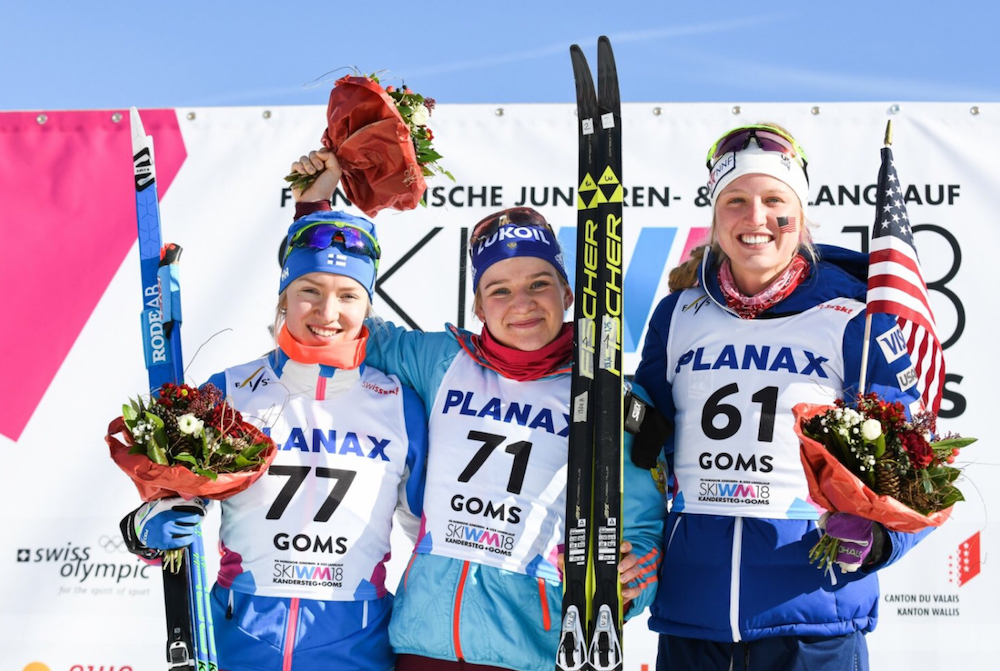
    “My focus of the winter has always been the Junior World championships so my Olympic nomination has not changed my training in the last few weeks,” he wrote. “Going into this week, and for the last 2 years now my goal was always a podium finish.”
    He started out Tuesday by jumping to seventh on the 106-meter “normal” hill, then started the 10 k race 38 seconds out of first.

    “The hill here in Kandersteg is very new which is nice because it feels similar to other modern jumps,” Loomis explained. “I was satisfied with my competition jump but not 100% happy. There are still a few things I need to fix on the technical side of my jumping.”
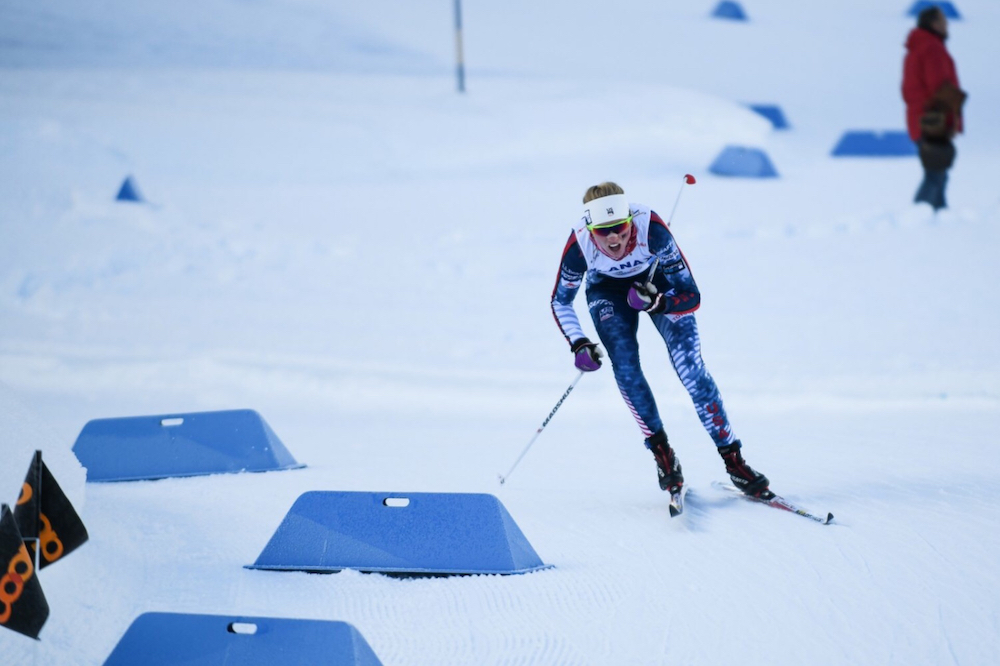
    The Czech Republic had the two best jumpers on the day, with Ondrej Pazout leading after the jump portion, followed by his teammate Jan Vytrval in second. Pazout started the 10 k with an 11-second head start on Vytrval and ended up holding off his challengers to secure gold, finishing first in 22:58.3. Norway’s Einar Lurås Oftebro raced from 10th after the jump to second at the finish, just 2.3 seconds behind Pazout, with the second-fastest 10 k time.

    Loomis passed four skiers to finish third, 8.3 seconds out of first, with the third-fastest time. Norway’s Johannes Lamparter slipped from third to fourth overall (+16.2), and Vytrval finished fifth (+21.6).

    “I knew with a good race a podium was still possible from 38 seconds back,” Loomis wrote. “The track here is really tough with technical decent which leaves good opportunity to make up time.”

    Working within a group, he caught up to third place on the first of four laps and was up to second on the second lap.

    American Ben Loomis (7) racing with Norway’s Einar Lurås Oftebro (l) during the 10 k Gundersen on Tuesday at 2018 Nordic Combined Junior World Championships in Kandersteg, Switzerland. Loomis went on to finish third for his first Junior Worlds medal and Oftebro placed second. (Photo: Josh Parker)

    “We had 5 or 6 guys in this group and on the 3rd lap I took the lead,” Loomis explained. “Towards the last hill on the 4th lap, I made a move alongside Einar Oftebro. Einar was strong on the last stretch and able to beat me as well as almost catching the leader Ondra.

    “Taking a step on the podium was an excellent feeling today,” he added. “I have been working very hard, especially towards this specific race for a long time now. Accomplishing this is a huge relief and very motivating for the future.”

    The U.S. had two in the top 15 with Stephen Schumann in 13th (+1:29.1). Schumann was 29th after the jump and started the 10 k 1:47 out of first, then posted the fifth-fastest course time to pick off 16 places.

    “Going into today I was really just hoping to put together a solid jump and a good race and hopefully finish within the top 10 like last year,” Schumann wrote in an email. “Unfortunately I did not have the jump I was hoping for. I was about 1 meter late off the end of the take off, taking away some of the power and height that my legs otherwise would have given me. Luckily the conditions on the hill were pretty consistent today so I knew about where I would be standing after jumping going into the race.”

    Given his starting position, he believed a top 15 was within reach. He ended up catching Italy’s Aaron Kostner, who started 27th, and the two worked together to catch one group after another.

    “I felt pretty good but he got me on the last lap,” Schumann wrote of Kostner, who finished about 20 seconds ahead of him in 11th place. “But over all it was a pretty good race and I finished with the 5th fastest time. Behind Aaron with the 4th fastest.

    “Overall I feel that had I had a little bit better jump on the hill I could have contended for a top 10 maybe top 5 but was happy with my race and my 13th place finish,” he added. “Coming across the line I was pretty sure Ben had finished in the top 5 at least, as I could see him going up the last hill as I was staring down it. But when I actually crossed the line and saw him I could tell he had gotten to the podium and I was psyched for him, went and gave him a hug and congratulated him.”

    Looking ahead to the rest of the week, Schumann’s hoping for a medal in the 4 x 5 k team event.

    “And personally I hope to finish in the top 10 in the 5km race with a better jump and another solid race,” he wrote.

    Also for the U.S., Jared Shumate placed 35th (+4:06.3), up from 49th in the jump, and Tucker Hoefler was 51st (+6:37.4), up from 53rd.

    Results: JumpingFinal