From the FasterSkier archive — posts syndicated from athletes’ and coaches’ own blogs between 2004 and 2012, kept online as published. Current coverage is at fasterskier.com.
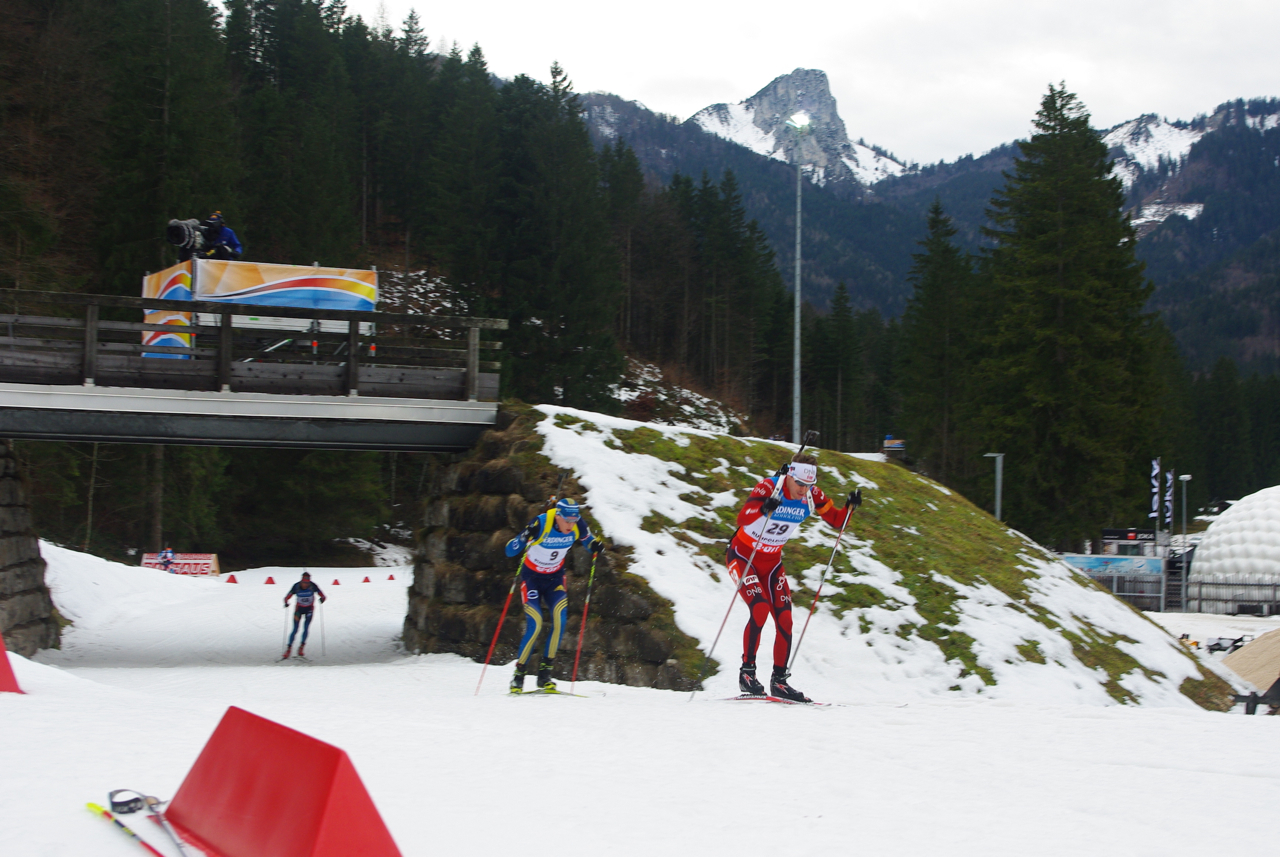
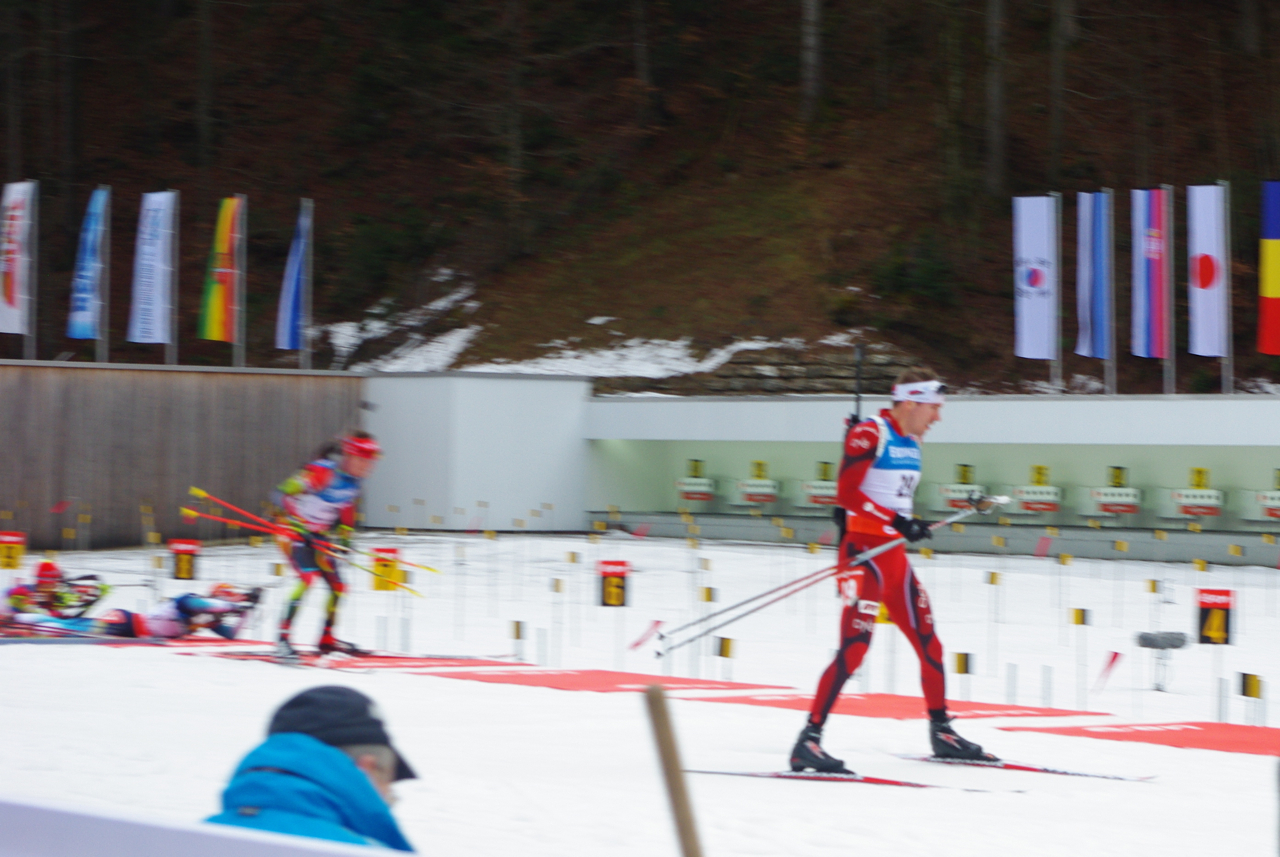
Emil Hegle Svensen (NOR) leads Bjorn Ferry (SWE) out on course in Ruhpolding today. Svendsen won the 20 k individual, while Ferry missed three shots to place 15th.
RUHPOLDING, Germany – Emil Hegle Svendsen didn’t have the most auspicious start to today’s 20 k individual race. He missed a shot in prone: bam, a minute of added time as a penalty. With many athletes cleaning that first stage, he was left down in 51st place after four kilometers.
But the veteran Norwegian has an added tool in his arsenal this year: mental resilience. He came back to hit every one of his next 15 shots, which combined with the fifth-fastest ski time of the day earned him his 34th World Cup victory.
Entering the range is now a zone of calm for Svendsen.
“I found a way to focus on the right way,” Svendsen said of this season. “What is different now is that I really focus on doing it the same every time and not letting myself slack when I do a good race. I focus on doing the same thing race after race, and I think this is the recipe for good and stable racing – to do the same thing every time.”
By the second clean stage, Svendsen was up to 13th place. After the third, he was in sixth. When he cleaned his final five targets, he moved into the lead, at the time by 27 seconds over Evgeniy Ustyugov of Russia.
Later in the start order, Alexei Volkov, also of Russia, hit all 20 of his targets. He left the final stage only four seconds down to Svendsen. But he was unable to ski anything near the Norwegian’s pace, and Svendsen ended up winning by 14 seconds. Volkov barely managed to hold on to second place over Ustyugov.
Among the things that Svendsen has changed this year is to work hard on his mental game. Once dominant in the sport – he won three medals at the 2010 Olympics as well as that year’s overall World Cup title – Svendsen has been pushed hard in recent seasons. Martin Fourcade of France has come on strong, taking the overall title both of the last two seasons.
Where Svendsen’s incredible ski speed used to be plenty to win him races, even if he made mistakes on the range, coming into this year’s Olympics he knew he needed to be more than just fast. He needed to be accurate, if he was to beat Fourcade on the sport’s biggest stage.
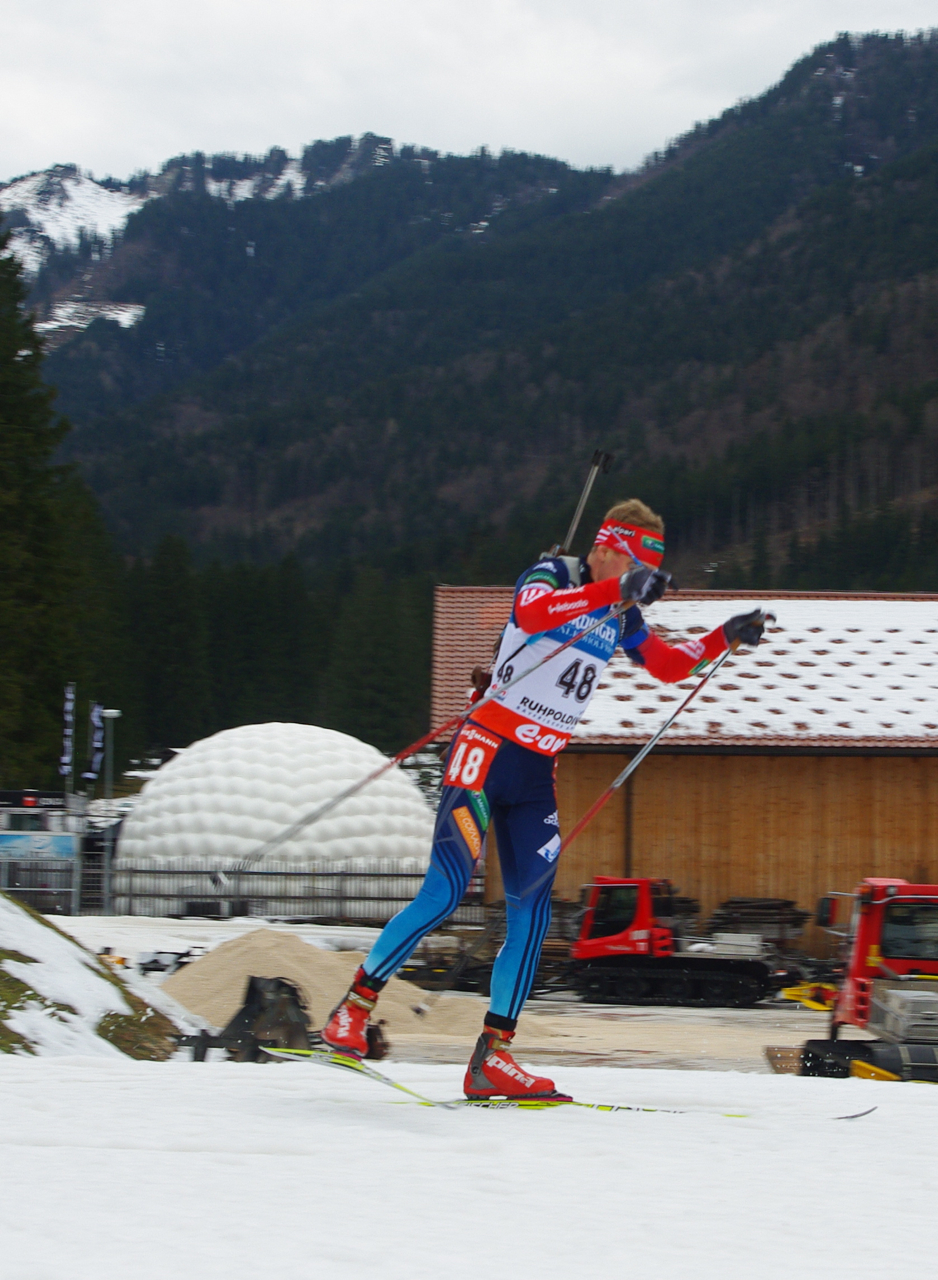
Alexei Volkov (RUS) used clean shooting to secure second place.
The press hasn’t always been easy on him when he loses races, either. “I’m a big fat man,” he joked today of how hard the last loop was, alluding to the way that Norwegian broadcaster NRK dedicated an entire story to the fact that he gained six kilograms over the summer.
It doesn’t seem to have cost him anything. Svendsen is still fast, and now he’s better on the range, too. This weekend, Fourcade isn’t here – he’s off training. But last weekend in Oberhof, Svendsen beat his French rival in back-to-back races for the first time this season.
“I think the biggest difference is that I’m stronger on the shooting range,” Svendsen said. “I have been working a lot of course with the shooting in the summer and the fall, and also in the winter.”
The mental work isn’t just about staying focused in a single race, but also over the course of a season. Svendsen had a tough opening, failing to make the top ten in either of the opening individual races in Östersund, Sweden, while watching Fourcade take a more than two-minute win in the kickoff competition. But this year, Svendsen cares about the big picture. That’s the Olympics.
“This is one of my advantages now, I’m strong mentally,” he said. “I have been doing a lot of good mental work and it is starting to pay off… Hopefully I can keep it that way even in the Olympics when it’s even more pressure. It is going to be fun to see if I can keep it together.”
Fourcade will likely take the Total Score again, but can he beat Svendsen at the Olympics? The Norwegian has shown that he can be at his best when it counts, including last year when he won gold in both the sprint and pursuit, as well as the relay, which Foucade had hoped France would win. It was a slap in the face considering how dominant Fourcade was for the entire rest of the season.
Svendsen believes that he’s setting up for another chance to win the gold.
“This victory is very important to me today, especially considering the shooting,” Svendsen told NRK. “The 20 k is a shooting competition, and today it turned out that I’m on a good track for the Olympics.
To be at his best in Sochi, Svendsen is taking the next weekend of World Cup racing off in order to relax and focus.
“I race tomorrow and after that I go home for some days, and after that we are going to Switzerland, to Lenzerheide, for preparation for the Olympics,” he said. “For me now, it’s important to get some rest and get my head straight before the Olympics. I think it’s going to be very big and very tough, and it’s important to be in top shape.”
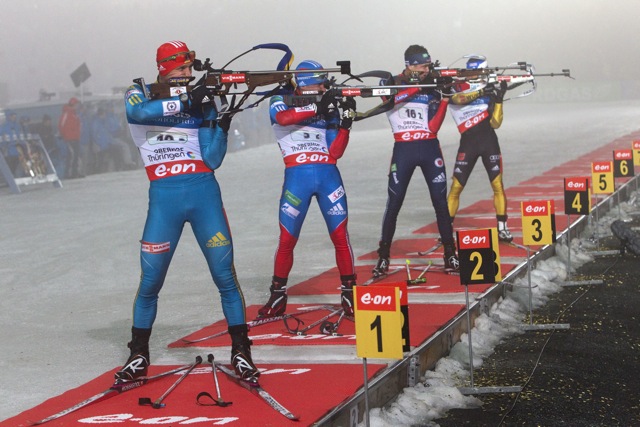
Sergui Sednev (UKR), Evgeniy Garanichev (RUS), Tim Burke (USA), and Erik Lesser (GER) on the foggy range in the men’s relay in Oberhof, Germany, on Friday. Photo: USBA/NordicFocus.
After watching the women slog through Thursday’s relay, the men of the IBU World Cup knew what they were in for in Oberhof on Friday.
But then, they knew what they were in for before even showing up to Germany this year.
“The conditions in Oberhof are as always, the same conditionsm,” Russian biathlete Alexei Volkov said through a translator in a post-relay press conference. “You can see them for yourself. So for us that doesn’t change a lot. The only thing that changed was sometimes the wind on the shooting range.”
And despite having a slightly longer loop, the men’s 4 x 7.5 k relay was arguably less sloppy than the women’s race – the rain wasn’t pouring out of the sky with the same intensity, the tracks had been salted and were a bit more firm, and a downhill hairpin turn that had claimed several victims was eliminated as the loop grew in length.
At the outset, Ukraine hoped to repeat the win garnered by its women’s team just one day before. The ladies had seized the dreadful course conditions and made them their own – and so did Serhiy Semenov, who, impressively, didn’t use a single spare round on the leadoff leg. No slouch on his skis, either, the Ukrainian tagged off with an 18-second advantage on the Czech Republic and Russia.
And more favorites had taken a beating. Germany was 30 seconds back in fifth, thanks to a penalty loop by Simon Schempp; Norway sat in ninth after Henrik L’Abee-Lund hit the penalty loop in each stage. Austria was 15th, France 19th, and Sweden 20th.
But a few athletes set out to change the standings on leg two. Most notable, Ole Einar Bjørndalen of Norway, who received the tag from L’Abee-Lund 33 seconds behind Ukraine.
“I went out determined and knew how I would go over the course,” Bjørndalen told Norwegian broadcaster NRK. “I should be proactive and drive on, do my thing. It worked well… it was easier for me to shoot today than many others.”
They don’t call him the king for nothing. 38-year-old Bjørndalen had the fastest time on the first loop, then cleaned the prone stage while several others struggled. Sergui Sednev of Ukraine used a spare round and was still in the lead, but it didn’t last long as Bjørndalen blew by him on the trail. He continued the pace on the second loop and then, incredibly, quickly cleaned the standing stage as well.
So far this season the champion had seemed quite far from showing the form that would allow him to capture World Cup victory number 94. His top finish had been seventh in the pursuit in Hochfilzen, Austria, where he was 30 seconds off the podium. But after today’s relay, he’ll surely be back in the mix in individual racing as well.
“Yeah, it was fun,” Bjørndalen told NRK. “A leg that shows that the most successful biathlete still has much to offer.”
Another man on the attack was Tim Burke of the American team. Starting his leg in seventh place, he used only a single spare round over the two stages to move into third, and then put in a furious effort on the final loop to overtake Erik Lesser of Germany and tag off in second position, 25 seconds behind Bjørndalen.
“I was not sure if I was going to catch Lesser on the last lap,” Burke told FasterSkier. “I think he actually put a few seconds on me in the first few climbs, but I was able to get by him in the approach to the finish. I really like the long flat heading into the finish here, it seems to suit my technique.”
(For more from the U.S. men, stay tuned for a later article.)
The top two teams both unleashed the least-experienced of their racers on leg number three: for the Norwegians, it was Erlend Bjøntegaard, in his first World Cup season, and for the U.S. Russell Currier, who is no stranger to the World Cup but hasn’t done as many relays.
While Bjøntegaard seemed to be purposefully using a loose, relaxed technique and trying to ski smoothly, Currier was swept up by veteran Arnd Peiffer of Germany and Artem Pryma of Ukraine. The three men were skiing hard to try to make up time, and visibly straining much more than the Norwegian. Currier skied with the group to the range, and then used a single spare to maintain that position.
Bjøntegaard had also used a spare, and was still in the lead. In standing he used another, but left with the lead again.
Peiffer, meanwhile, had dropped several places back after relying on all of his extra bullets to clean prone and then using one spare in standing. But he was on the move, pulling the Ukraine team along with him as he caught and passed Anton Shipulin of Russia and then Currier.
While Currier spent a long time on the range, waiting for lulls in the wind to avoid using more than one spare round, and left the range in fifth, Shipulin, Pryma, and Peiffer shot more quickly if not necessarily accurately. On the last loop it was Shipulin who was on the attack, grinding away at the course’s big uphills and dragging Peiffer with him. The two closed on the Norwegian and, amazingly, Shipuling tagged off only 1.5 seconds from the lead.
“As far as I’m concerned about my performance, yes, of course, I’m very satisfied, and that bodes well for the upcoming competitions,” Shipulin said through a translator at the press conference.
Bjøntegaard? He wasn’t as sure.
“Today I was terribly tired,” the Norwegian said after starting with a 40-second lead. “I was a bit dead and didn’t have any splash. I threw up when I got to the finish, and I’ve never done that before. It suggests that things aren’t quite as they should be.”
By the last leg, it was clear that the race was going to be a barnburner.
Emil Hegle Svendsen of Norway, Dmitry Malyshko of Russia, Florian Graf of Germany, and Andriy Deryzemlya of Ukraine all came together on the first loop and entered the range at the same time. The wind was blowing heavily at that point, and Svendsen was the only man to clean in prone. Unsurprisingly, he skied hard after leaving the rang with a 14-second advantage on Malyshko. But the Russian skied just as hard. Their loop times were separated by only 0.3 seconds.
So Svendsen came to the last shooting of the race – which, in the slow conditions, had already dragged on for an hour and fifteen minutes – with a 14-second lead. But then he began missing shots, three of them by the time he’d used his five bullets.
He carefully loaded his first spare round, and knocked down a target. Then did it again. And again. Meanwhile, Malyshko arrived, shot, used a spare round, and hit the trails.
“At the range, Emil was already shooting, and when I came in and got ready to shoot I felt that the wind was blowing really hard,”Malyshko explained in the press conference through a translator. “And that’s the moment where he basically missed two or three targets. I was lucky because when I started shooting there was a little lull in the wind, and I managed to shoot a lot better than him.”
“That was not cool, to stand there and know that [I had to hit them],” Svendsen told NRK. “But fortunately I did and it salvaged a podium.”
While he may have been disappointed that the lead he had so aggressively crafted was destroyed, Bjørndalen was nonetheless impressed by his teammate.
“Emil managed to bring down the last three of three shots, and that’s an achievement,” he said. “Some might say that it was a bad series to shoot three misses, and that’s okay, but when you get in the situation where you have three extra shots and every boom is a penalty loop, it’s a great achievement to hit on all three with trembling legs and 20,000 people in the stands.”
The gap to Malyshko was nine seconds, and it almost seemed like Svendsen would be able to close it; he’s accomplished more monumental feats before. But Malyshko, once again, showed no interest in being dominated by the former World Champion.
“As I came out of the last stage – we had a little break during Christmas and had some good training, and I felt well-rested and in good form,” he said. “On the last lap I let Svendsen come back a bit, but I just managed to keep the gap big enough, and so, yeah, we won. So I’m very happy.”
Svendsen, meanwhile, hung his head at the finish. His teammates tried to console him, but he was clearly disappointed.
Malyshko’s teammate, second-leg skier Evgeniy Garanichev, said that while you always hope for the best, he hadn’t expected to win; Shipulin complimented the whole squad.
“The relay in the end is a team sport, and I want to congratulate each of my team members because each of them because each ran an excellent race,” he said. “The fact that each of us ran very good is why we came in first.”
Graf hung in for a solid third place finish after cleaning the final stage. He wasn’t as fast on his skis as the two leaders, but still put a significant gap on Deryzemlya.
“I was actually just informed this morning that I would be able to race, so I was very happy,” Graf said through a translator in the press conference. “Erik [Lesser] had said before that we have to make the same position as the women yesterday, and with a solid performance of the whole team we achieved that.”
After Ukraine crossed the line in fourth, the United States brought it home in fifth, tying their best relay performances of the last two decades.
Notes and Quotes: Oberhof Atmosphere
To race in Oberhof is one of the most exhilarating things a biathlete can do. A few podium finishers weighed in during the press conference:
Malyshko: The last lap, when you come into the stadium in Oberhof, the wall of sound is massive and we really have to switch off your ears so you can concentrate on the shooting. Maybe in Ruhpolding, but I’ve never heard so much noise when coming into the shooting range.
Bjøntegaard: So many athletes and people have tried to explain to me how it is to race here, but I think it can’t be explained. You have to experience it. It’s so much fun to race for so many people. This is biathlon at its best. A lot of fun. Not always with the weather, but that’s part of the game – we race for twenty minutes, so I can take some rain!
Lesser: You have now here today 20,000 people pushing you. It’s really a danger at the Birgtseig – I was warned by some of my colleagues who aren’t here that you really have to avoid getting pushed too much. Two laps I could avoid that, but the third time it was a fact. But of course it was a great experience here.