From the FasterSkier archive — posts syndicated from athletes’ and coaches’ own blogs between 2004 and 2012, kept online as published. Current coverage is at fasterskier.com.

Tag: Alexey Chervotkin

  • Double Gold: ROC Dominates Men’s 4 x 10 k Relay in Lengthy Race; USA 9th, CAN 11th

    Double Gold: ROC Dominates Men’s 4 x 10 k Relay in Lengthy Race; USA 9th, CAN 11th

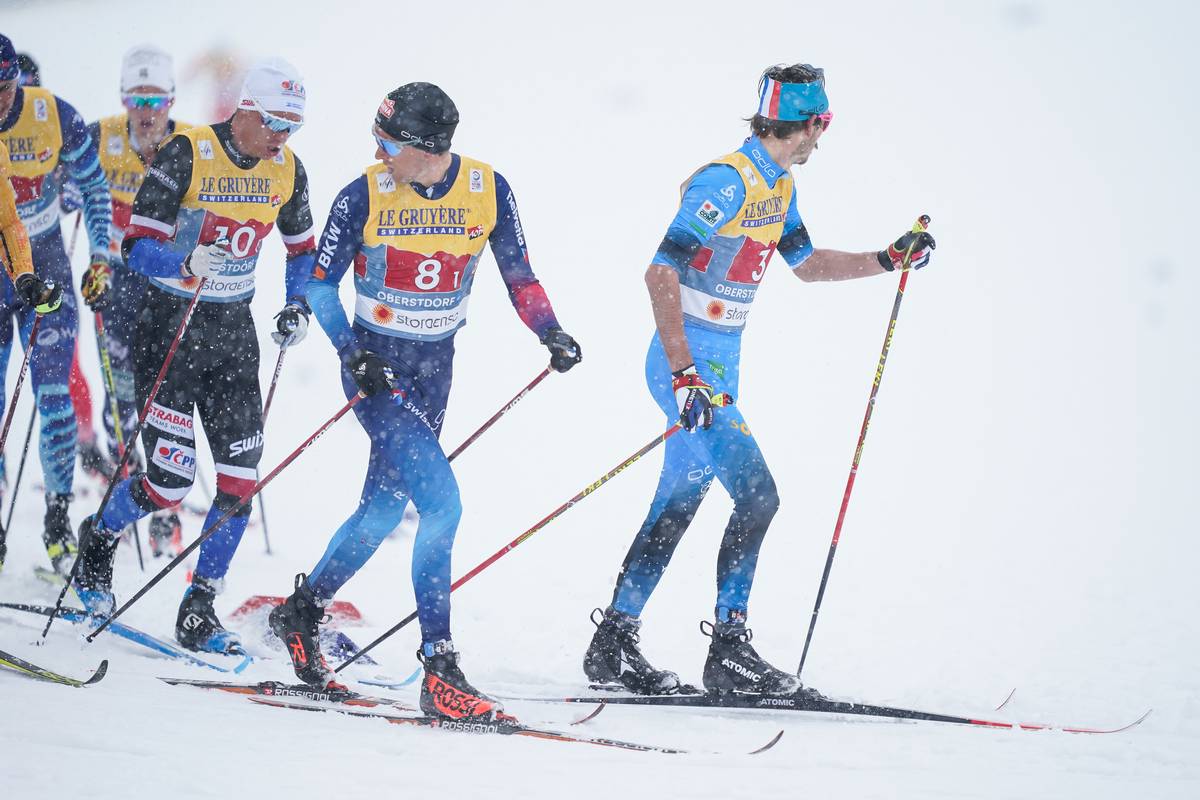
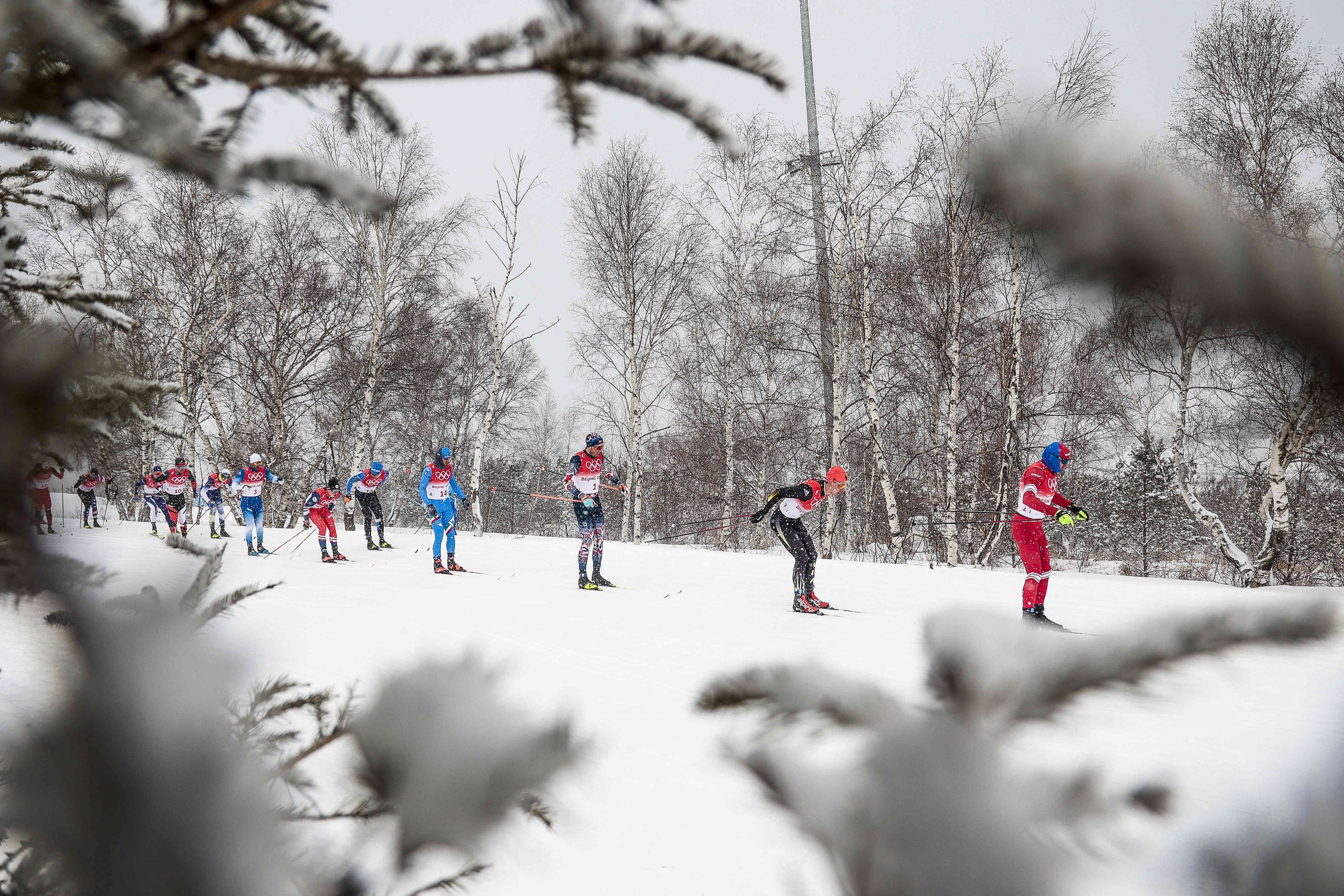
    Early stages, Emil Iversen (NOR), Alexey Chervotkin (ROC), Richard Jouve (FRA), and Oskar Svensson (SWE) (l-r) lead the men’s 4 x 10 k relay. (Photo: NordicFocus)

    This World Cup coverage is made possible through the generous support of Marty and Kathy Hall and the A Hall Mark of Excellence Award.  To learn more about A Hall Mark of Excellence Award or to learn how you can support FasterSkier’s coverage please contact info@fasterskier.com.

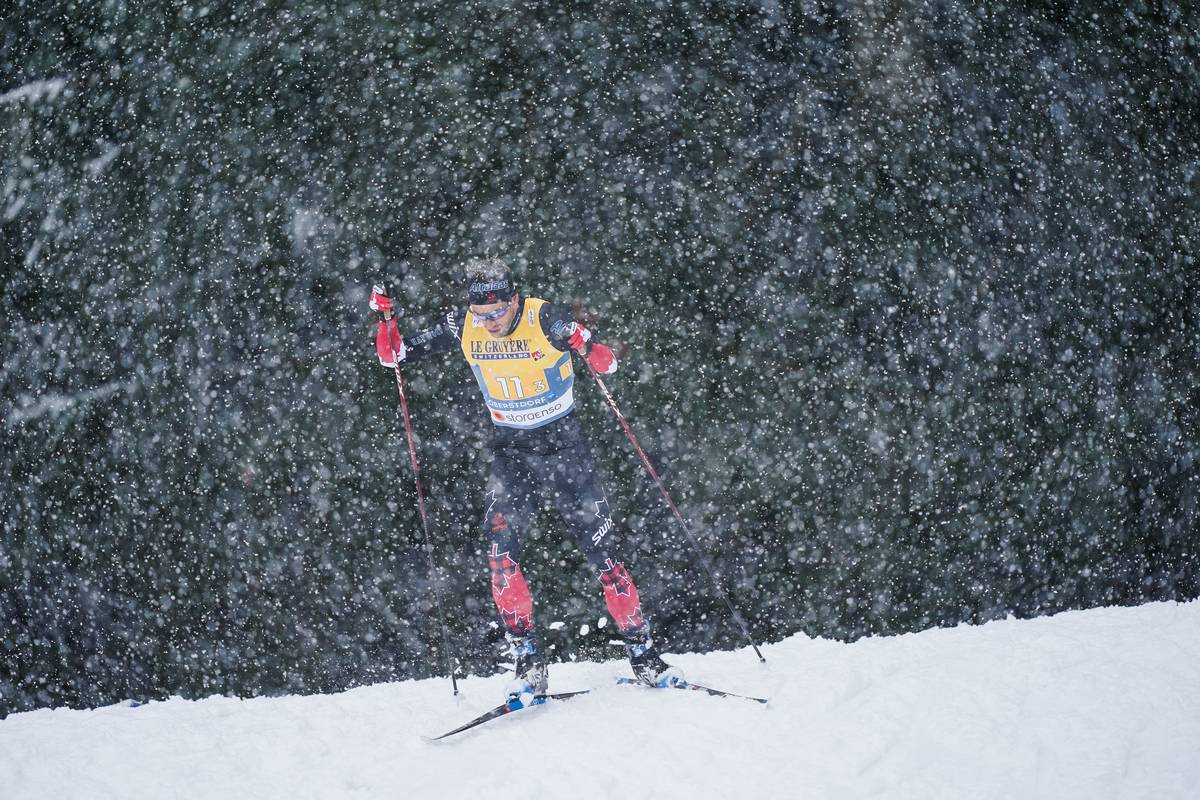
    After a thrilling women’s relay event on Saturday, it was the men’s turn to compete, each athlete skiing the laps of 3.3-kilometers for a total of 4 x 10 k. In a surprising turn of events, more snow than has fallen in a decade came down in Zhangjiakou over the last 24 hours, altering the otherwise stable man-made conditions the men have raced to this point. Conditions being what they were, heavy snowfall and 11°F on challenging courses, this made for an especially long race.

    The ROC proved to best handle the conditions, winning gold in 1:54:50.7. Norway skied to silver (+1:07.2), with France taking bronze (+1:16.4), while the American men skied to ninth (+8:05.6), with the Canadians in 11th (+9:10.4).
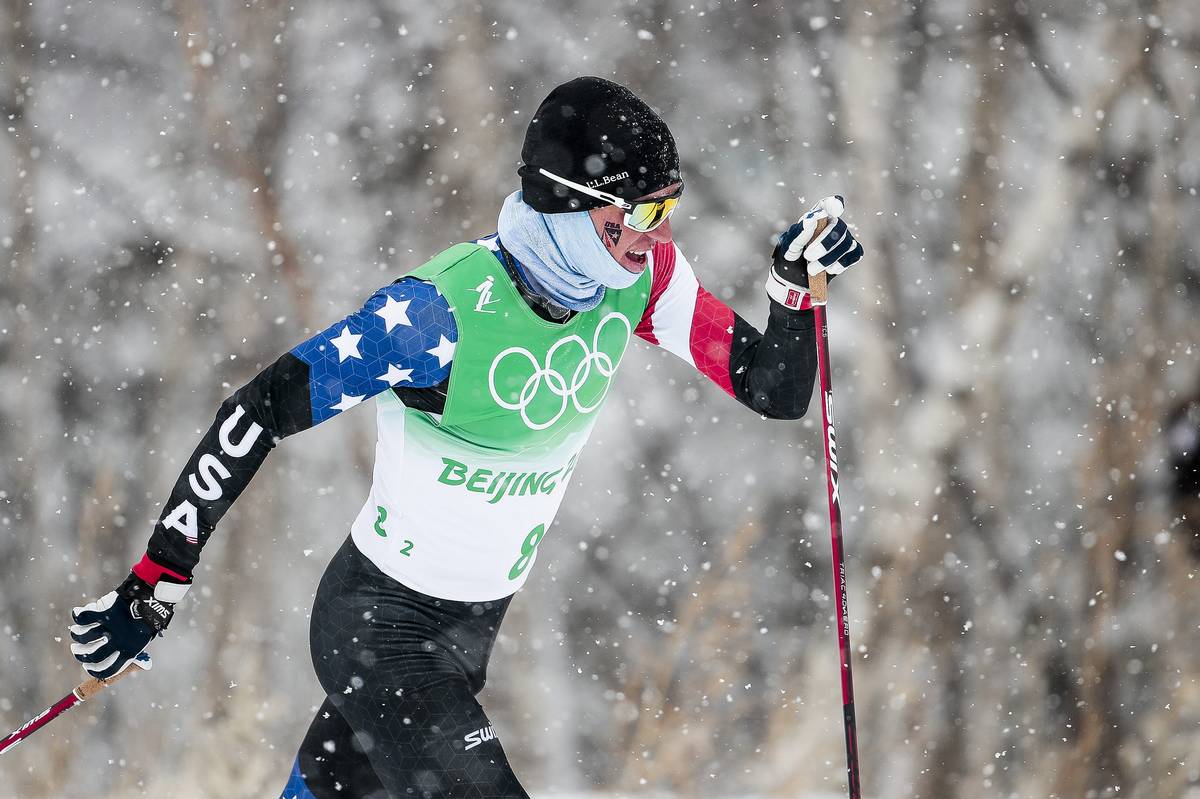
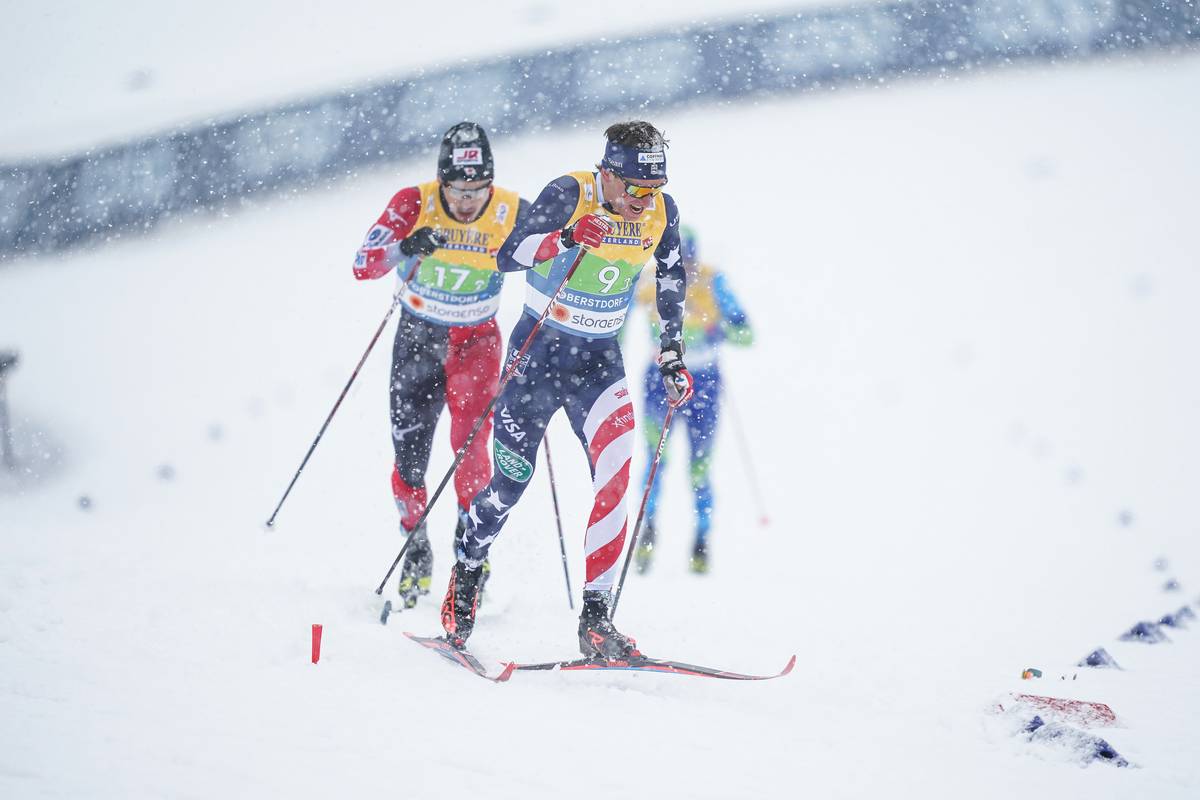
    Scott Patterson skis the second leg of the men’s 4 x 10 k relay through unprecedented conditions. (Photo: NordicFocus)

    Men’s skiing for the past few years has been dominated by two nations, Norway and Russia (or as they are known at these Games, the Russian Olympic Committee (ROC)). When it comes to the men’s 4 x 10 k relay however, Norway has historically been in a class of its own. 
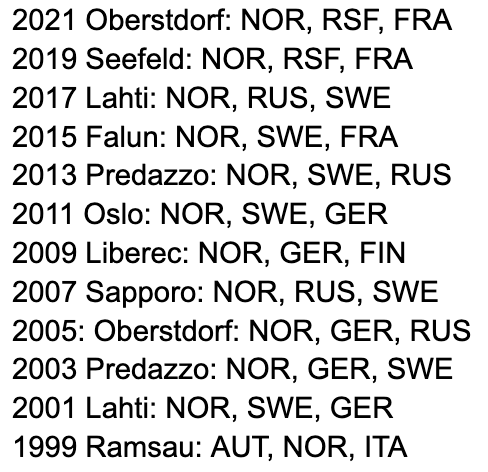
    Results summary for men’s 4 x 10 k relay at World Championships since 1999.

    Since Team Norway’s all-around poor showing at Sochi in 2014, which included the men’s team finishing 4th, they have not lost a championship relay. Indeed, looking at relay results from World Championships, you have to dig all the way back to 1999 to find Norway not winning gold, when Norway finished second to Austria in Ramsau. Their performances at the Olympics have been less dominant but most relevant for today’s race, they won gold in PyeongChang in 2018 with the same man, Johannes Høsflot Klæbo, in the anchor leg. 

    As such, despite the Norwegian men’s struggles thus far at these games, it seemed likely that fans would be seeing another battle between Norway and the ROC for top spot. Fifteen nations were represented on the start line and as the first leg was underway Sunday morning, the race appeared to be playing out remarkably similarly to the World Championships in Oberstdorf last year.

    A brief recap for those who don’t remember, in heavy snowfall, ROC athlete Alexey Chervotkin made an early move and ended his leg with nearly a minute lead on the rest of the field which was later eaten up and the win went to Norway. Today it was a different story.
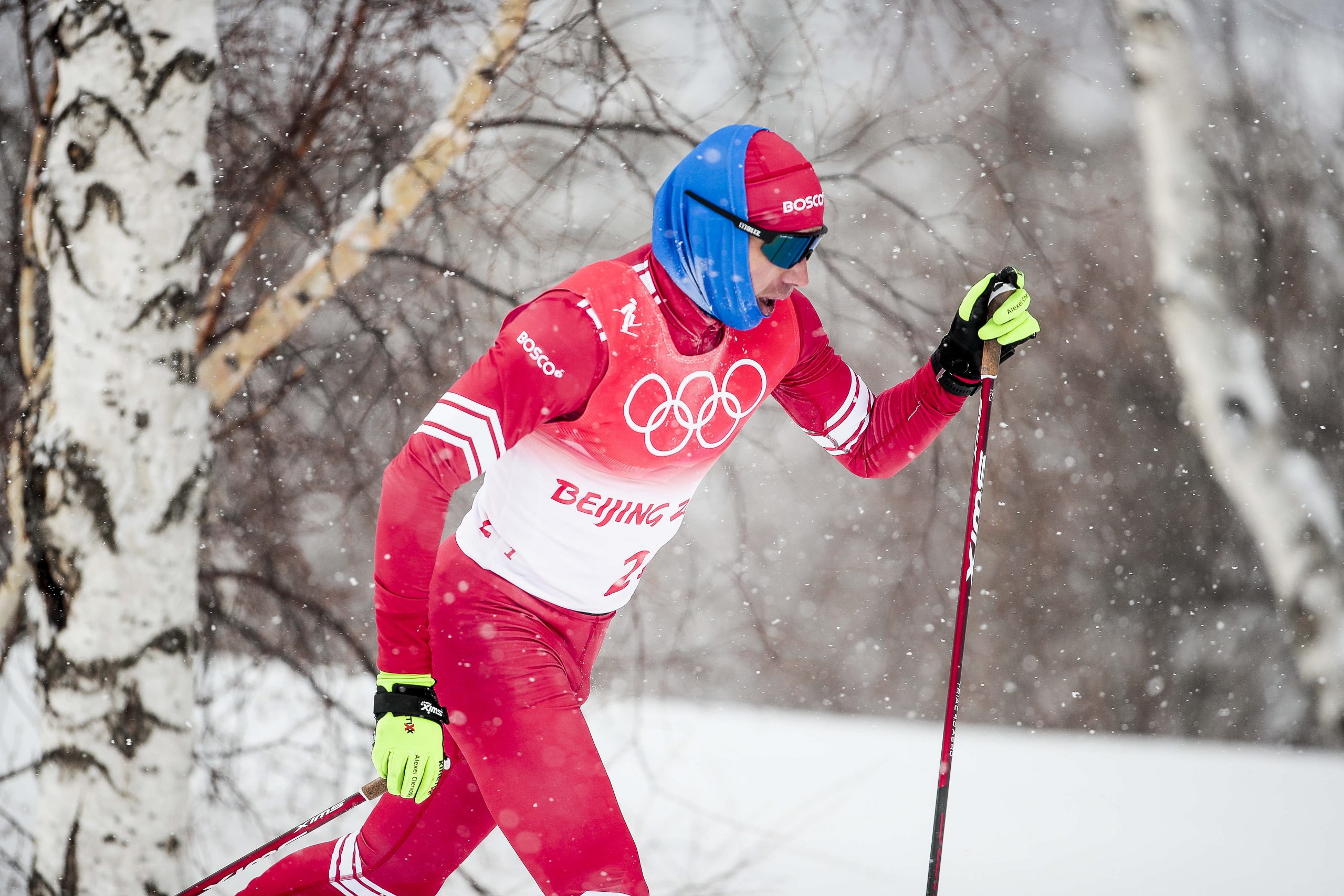
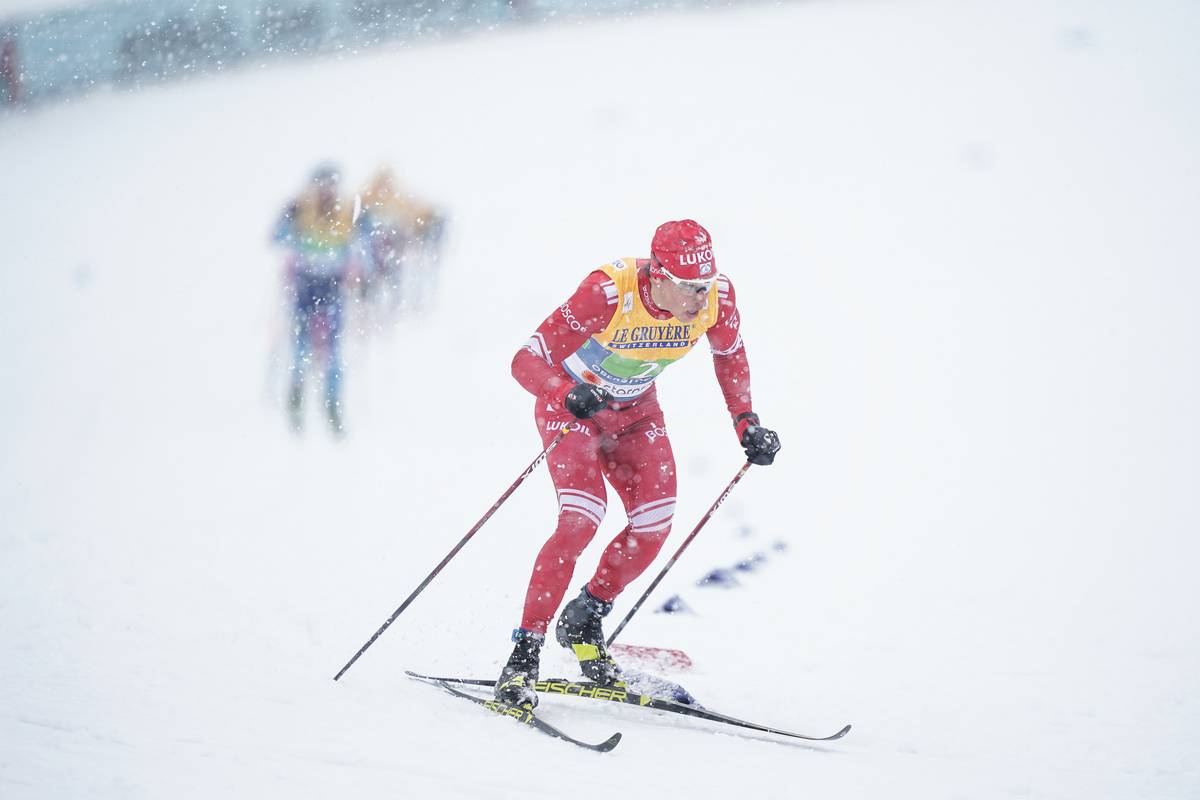
    Alexey Chervotkin (ROC) making a decisive early break (Photo: NordicFocus)

    Chervotkin was once again in the scramble position for the ROC and he put the hammer down right from the start gun. At 4.3 k he had a gap of +12.6 seconds to the rest of the field and that was the closest anyone got to the ROC for the rest of the race. Although it took three more athletes and another hour and forty-one minutes of skiing to seal the deal. 
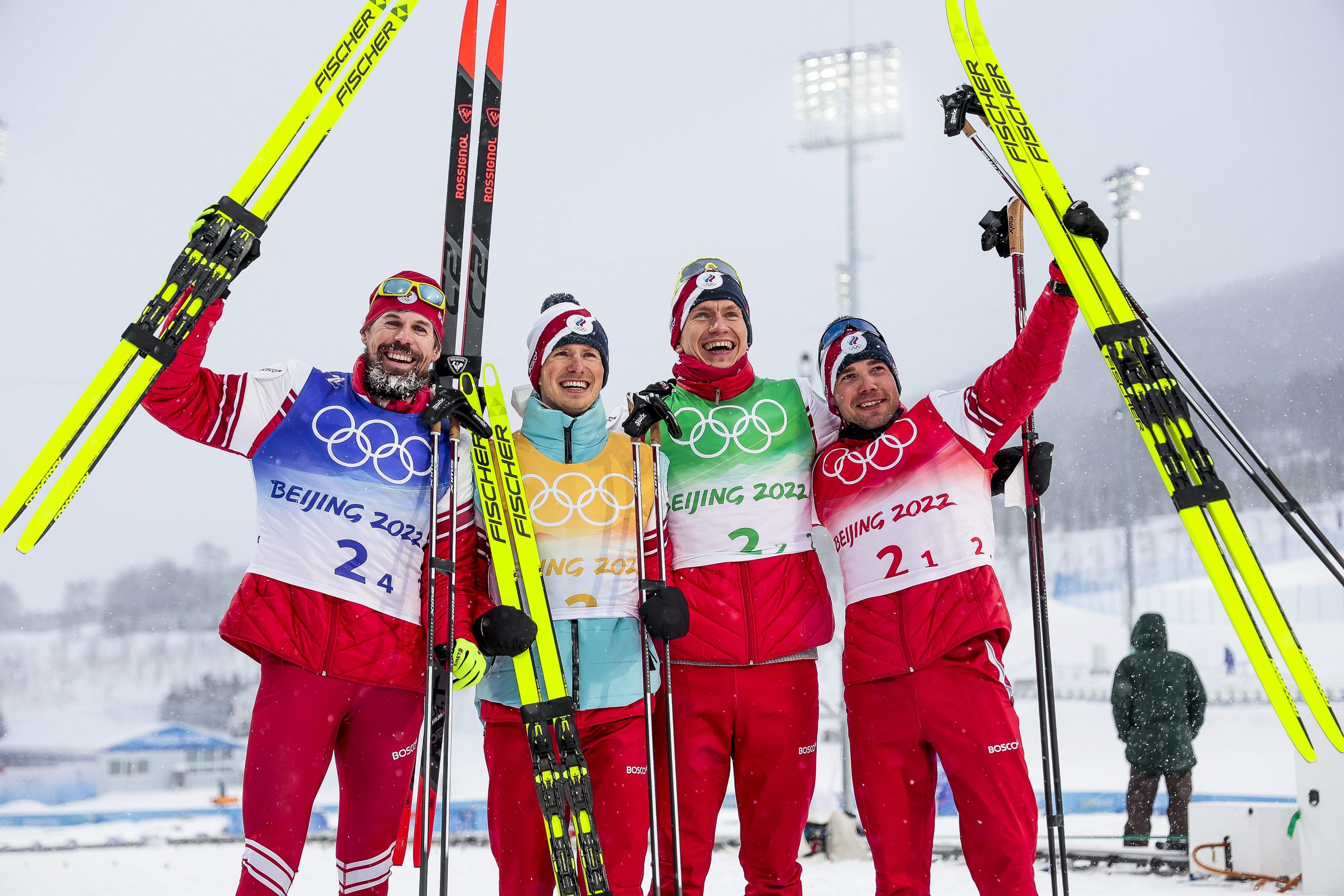
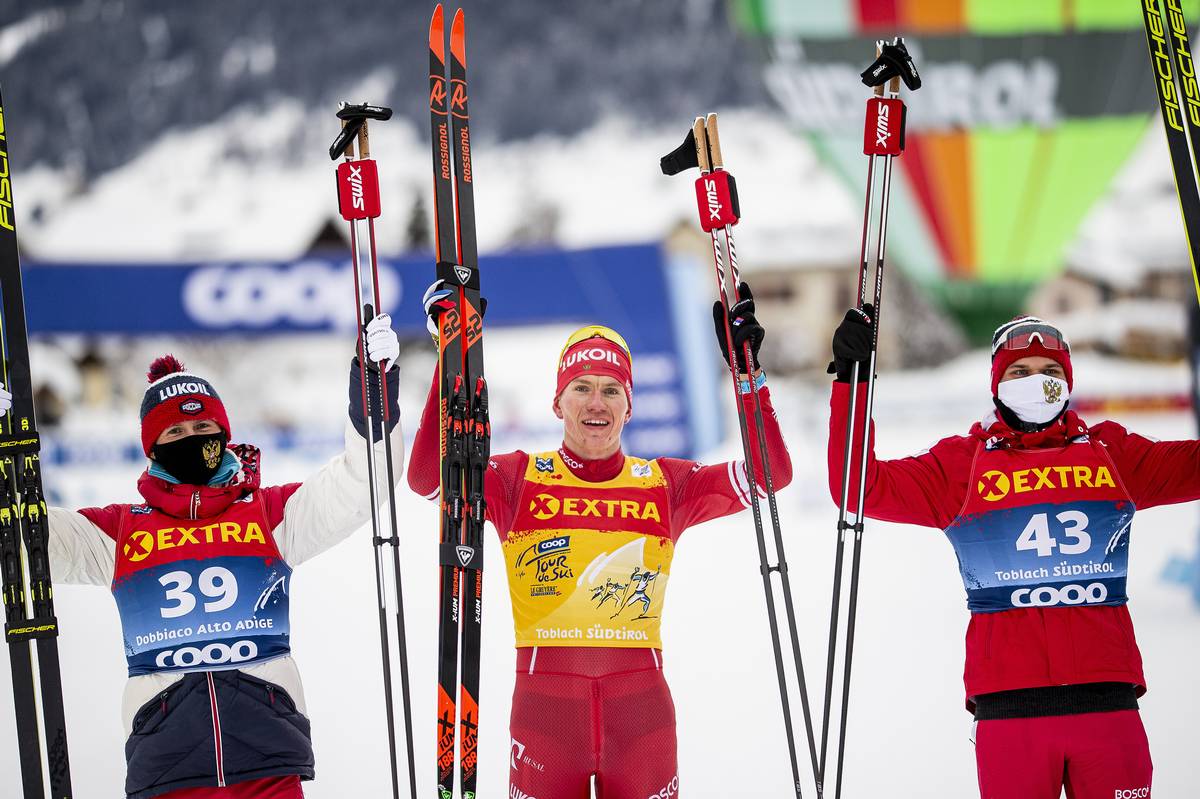
    All smiles for Sergey Ustiugov, Denis Spitsov, Alexander Bolshunov, Alexey Chervotkin, (l-r) after taking Olympic gold for the ROC for the first time in over forty years. (Photo: NordicFocus)

    Making his first appearance at these games after some controversy regarding a start in the 15 k classic, Emil Iversen took the first leg for Norway. For the majority of his leg, Iversen did the work to pull at the front of the chase group, which was composed of teams Italy, Germany, Sweden and France. No doubt inspired by the German women’s relay performance, Janosch Brugger skied a strong leg for Germany, ultimately pulling away with Italy’s Federico Pelligrino in the final kilometers of their leg.
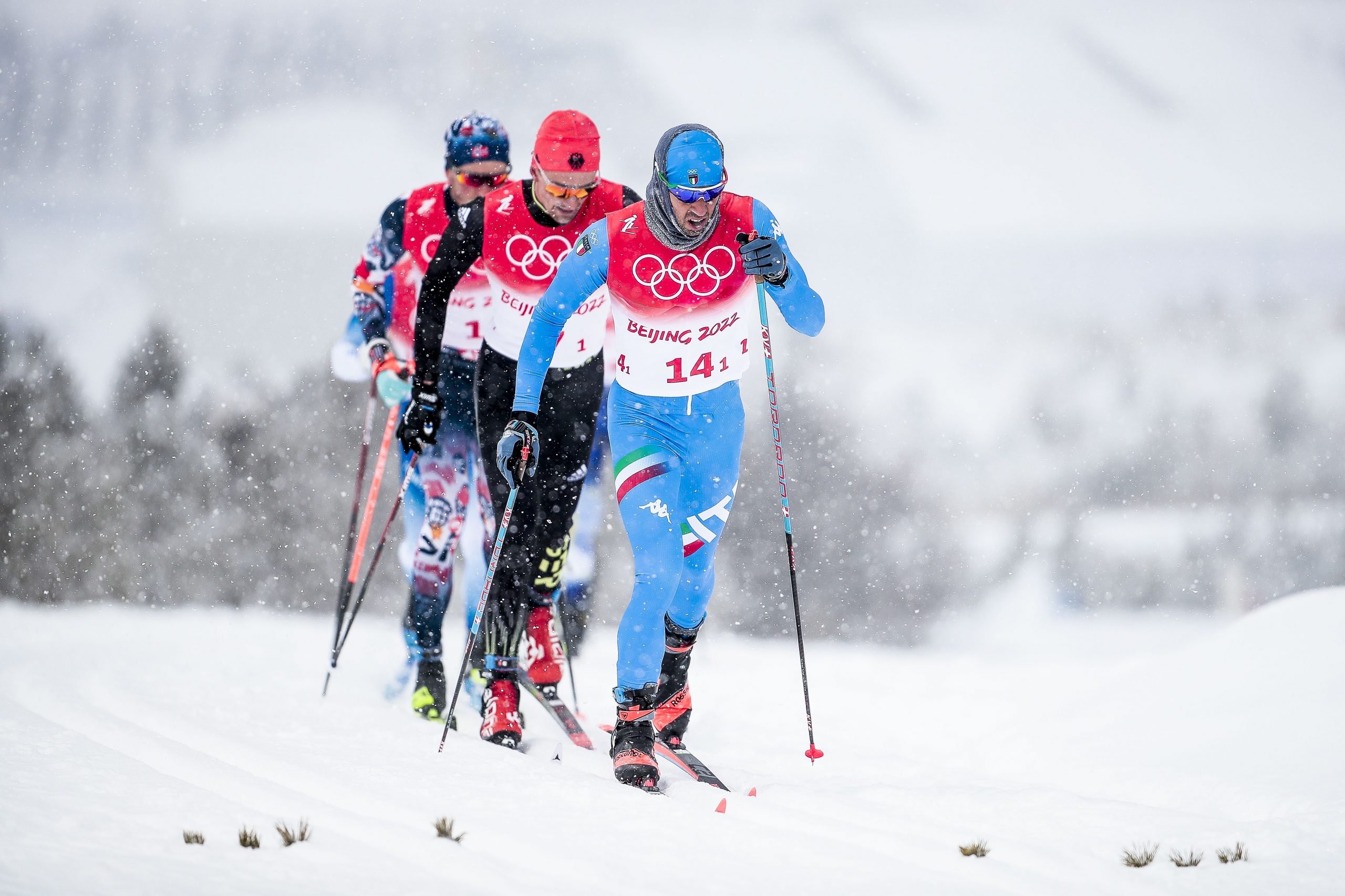
    Federico Pellegrino (ITA) leads Janosch Brugger (GER) and Emil Iversen (NOR) (Photo: NordicFocus)

    With Iversen fading fast on the final lap up the A-climb, Brugger and Pelligrino gapped the Norwegian by 10 seconds, coming into the first exchange +23.5 and +24.1, respectively, behind Chervotkin of the ROC. Next came Iversen, who tagged his teammate, Pål Golberg, with a gap of +34.4 to the ROC.

    Despite the hard work put in by Chervotkin, the conditions were such that it took him 30:14.7 to ski 10 k, which is much slower than we might normally expect. Chervotkin had taken 5th place in the 15 k classic on Friday in 38:51.7 with stable conditions; five additional kilometers in roughly 8.5 minutes longer.
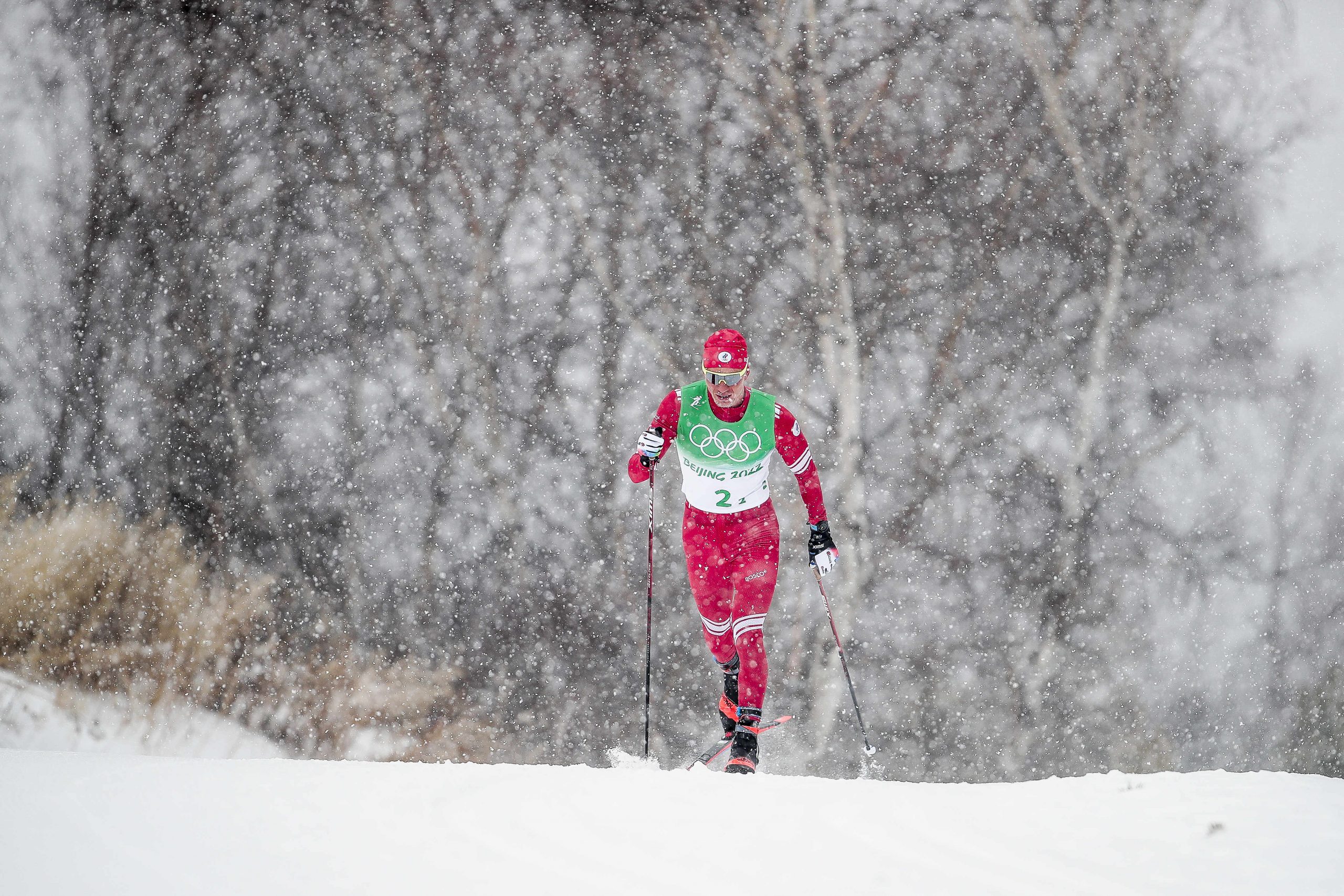
    Gliding on his own through falling snow, Alexander Bolshunov (ROC)(Photo: NordicFocus)

    With the first leg complete, it was skiathlon winner Alexander Bolshunov who took over for the Russian Olympic Committee. Grinding out front on his own, Bolshunov continued to put time into the rest of the field, widening his lead to +37.8 through 13.3 k, up to +44.5 at 16.6 k and +59.5 at the completion of his three laps.

    Behind him, Golberg worked quickly to close the gap to Italy and Germany, legs which were being skied by Francesco de Fabiani and Friedrich Moch. Over the course of his second lap, Golberg began to pull away, creating a ten second gap to the chasers. However, as the skiers completed the third, and their final, 3.3 k lap, things were shaking up. 

    Pål Golberg (NOR) who would later fade and be caught by William Poromaa of Sweden (Photo: NordicFocus)

    Iivo Niskanen, having been tagged in 11th position and +1:47.5 behind, was executing another outstanding classic performance, gaining time on everyone in the field. With the Finn closing quickly, what had been two chase groups merged to one.

    Moch for Germany, William Poromaa for Sweden, Hugo Lapalus for France and Niskanen for Finland were all battling for bronze medal position as de Fabiani of Italy faded off the back. Up the final A-climb that had been the undoing of Iversen one leg earlier, Golberg too began to slow.
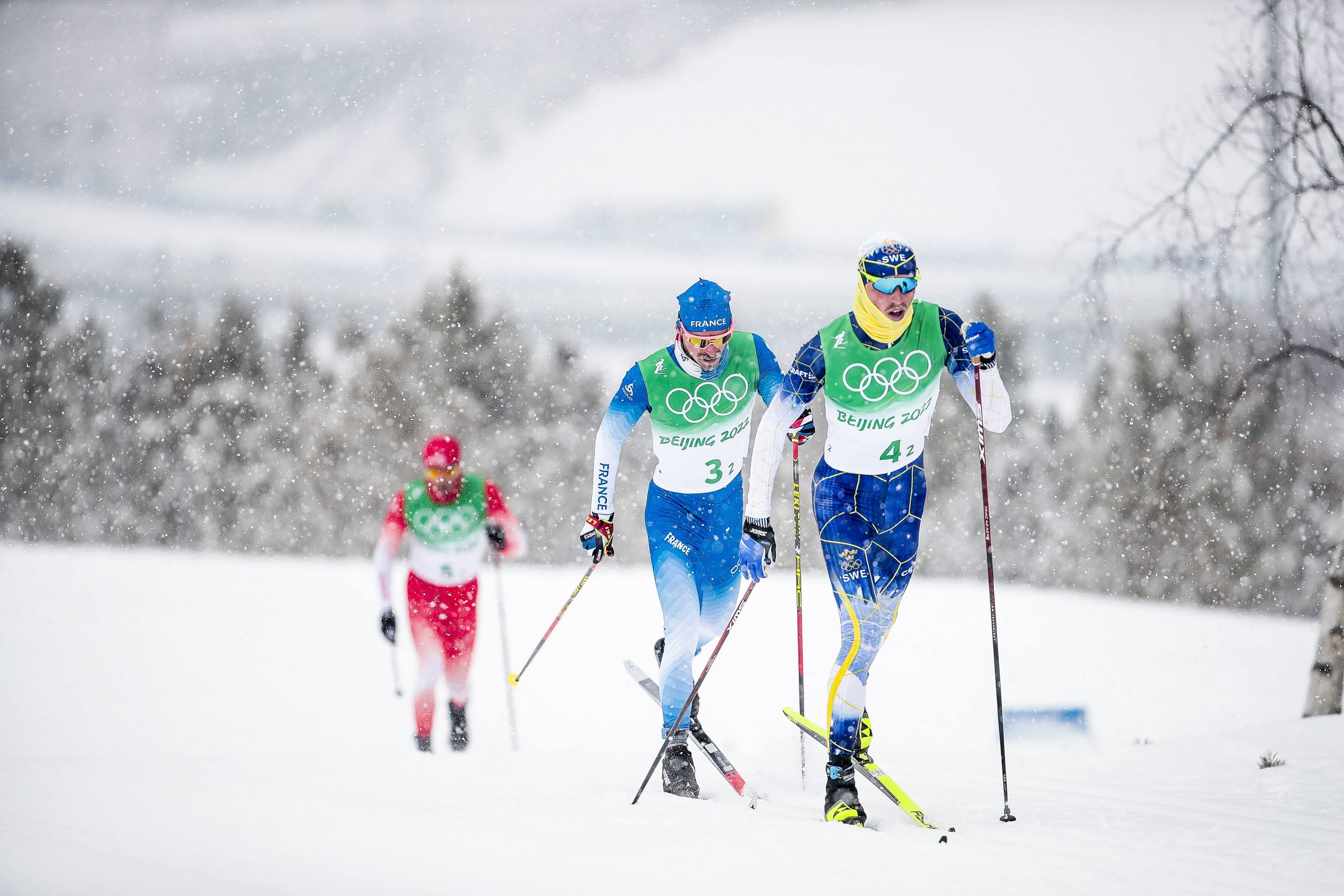
    Hugo Lapalus (FRA) and William Poromaa (SWE) both skiing well (Photo: NordicFocus)

    This show of weakness was all Poromaa needed to up the pace, and by the time they entered the stadium for the second exchange, the Swede had caught the Norwegian.

    Golberg tagged Hans Christer Holund, +59.5 behind Bolshunov who had given way to Denis Spitsov. Poromaa handed over to Jens Burman, +59.7 behind the ROC. Behind them, Niskanen had moved his team from 11th to 4th and gained 36 seconds on the ROC as he tagged Perttu Hyvarinen. Lapalus of France handed off to Clement Parisse, +1:09.7 back. 
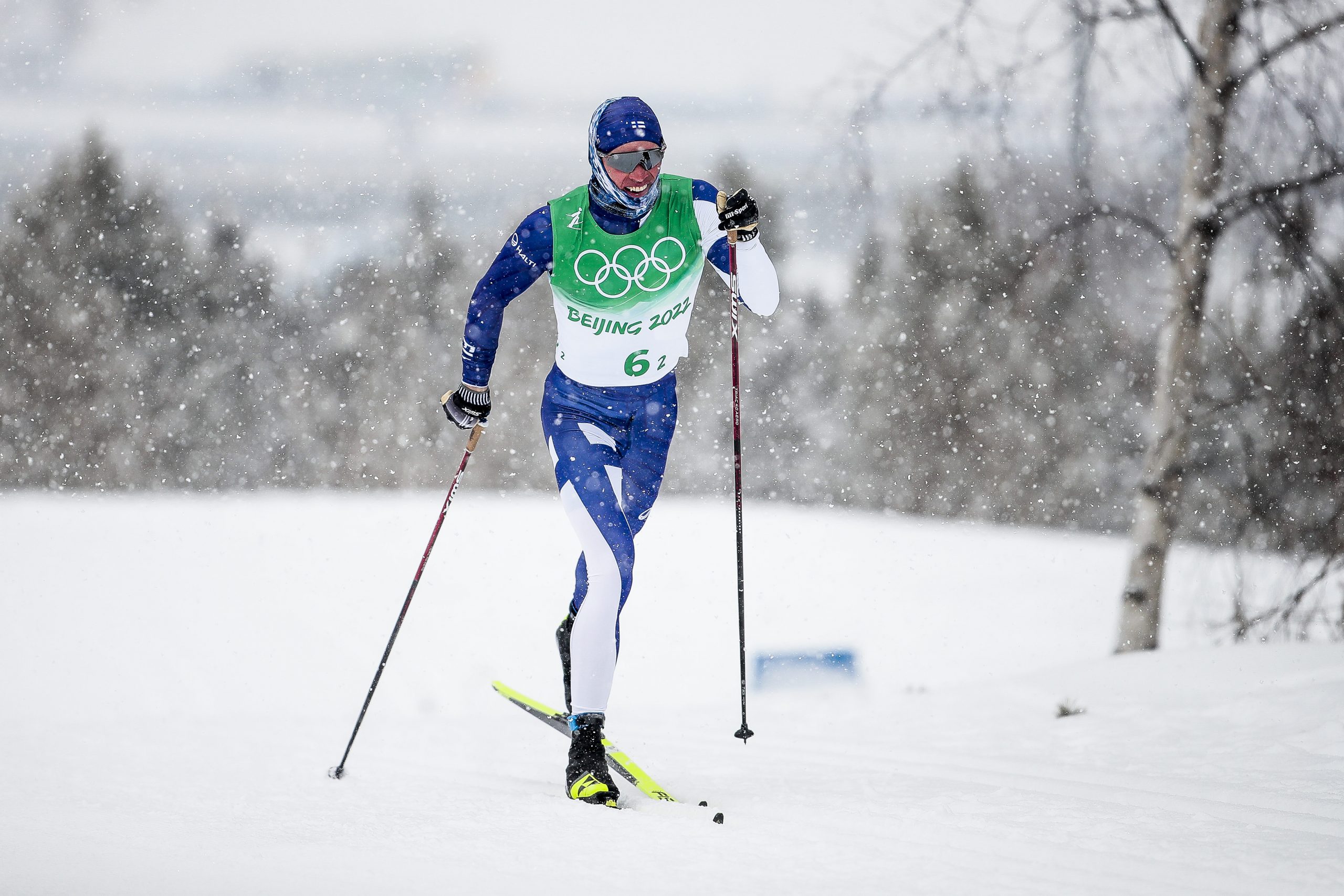
    Showing his classic strength, Iivo Niskanen (FIN) works to close a big deficit (Photo: NordicFocus)

    Having switched to freestyle technique, the third leg was underway and suddenly there was a pack of five nations vying for silver and bronze position, the ROC nearly a minute ahead and all but secured the gold.

    Despite the deep snow, Spitsov (ROC) seemed to have no trouble maintaining his advantage as Holund (NOR) took up the mantle of the chase. Through 23.3 k, Holund led the train, still trailing +51.4 behind the ROC.
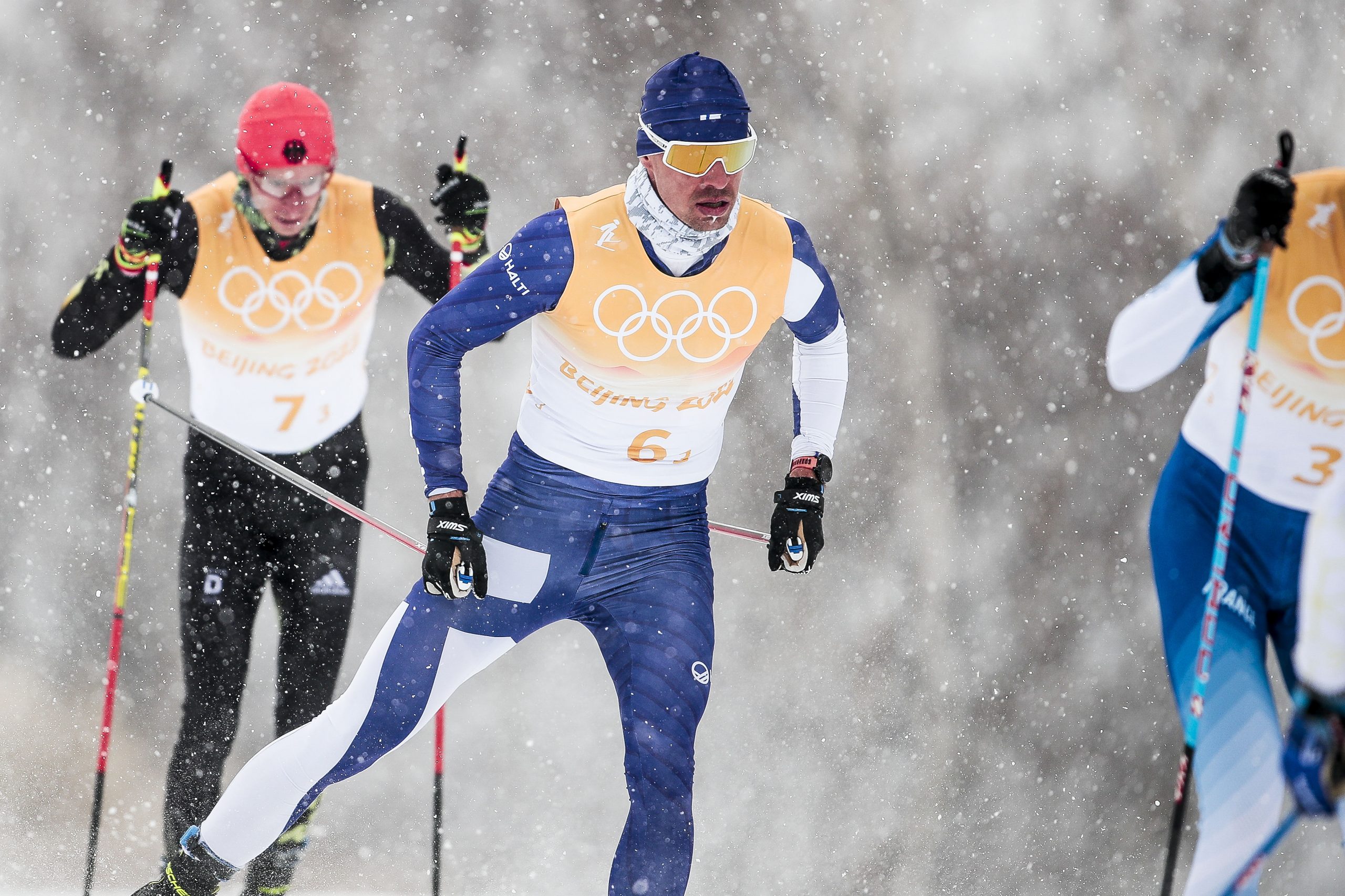
    Perttu Hyvarinen (FIN) fading fast (Photo: NordicFocus)

    After Niskanen’s effort, the Finnish team was dropping quickly with Hyvarinen at the helm and was soon out of contention. Florian Notz, skiing for Germany, was also beginning to fade, seeming to drift off the back on each uphill and regain time on the downhill. Eventually, as the chase group entered the stadium for the final lap of their leg, Notz lost contact, bringing the group down to three nations, Norway, Sweden and France. 
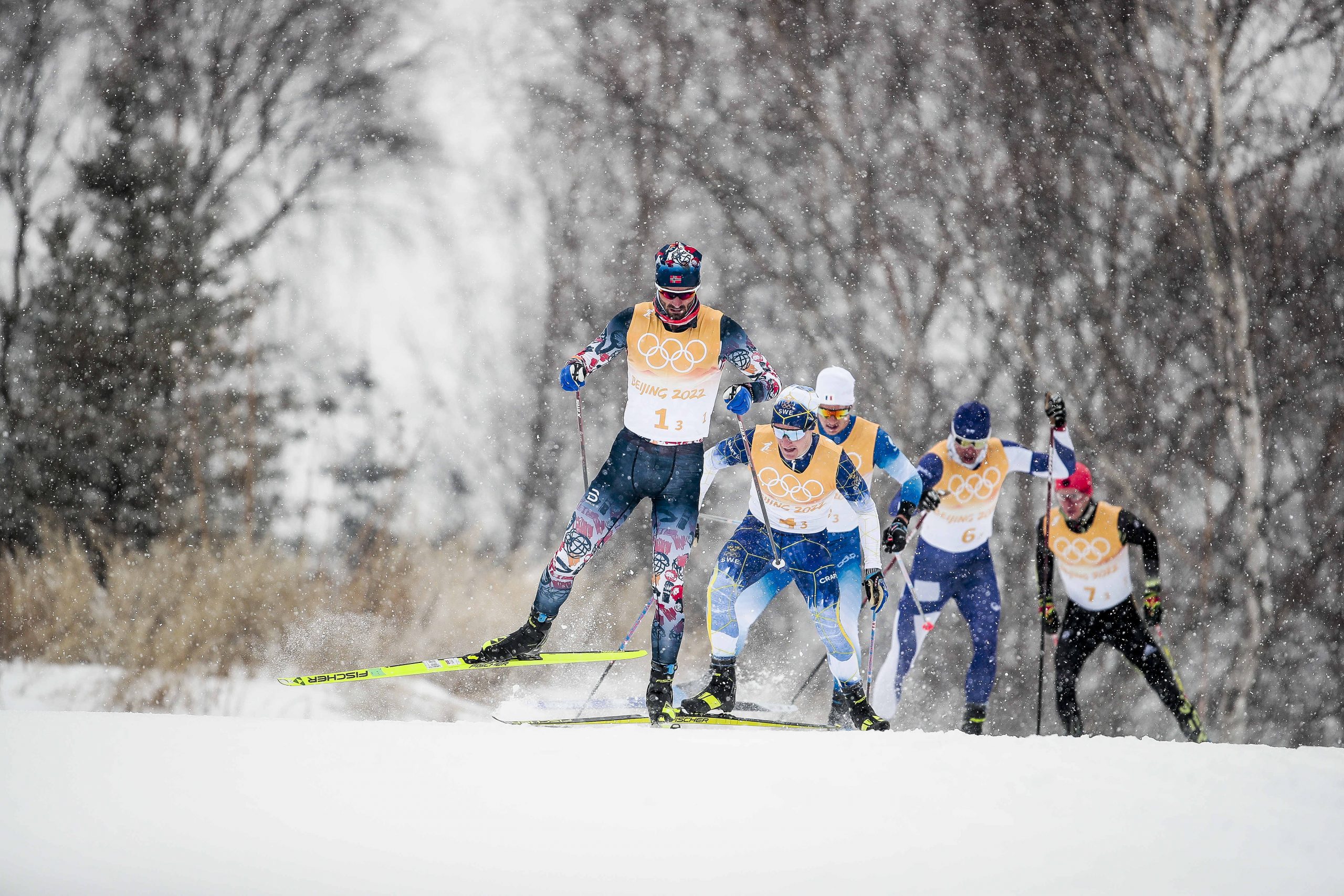
    Hans Christer Holund (NOR) leads a train of chasers (Photo: NordicFocus)

    Spitsov still clear off the front, Holund continued to lead the chase. With each section of downhill it became clear that the skis of Parisse (FRA) were not gliding like those of Burman (SWE) and Holund (NOR). In spite of this, and perhaps thanks to the trailside encouragement of his teammates, Parisse dug deep to stay in contact with the Swede and the Norwegian. 
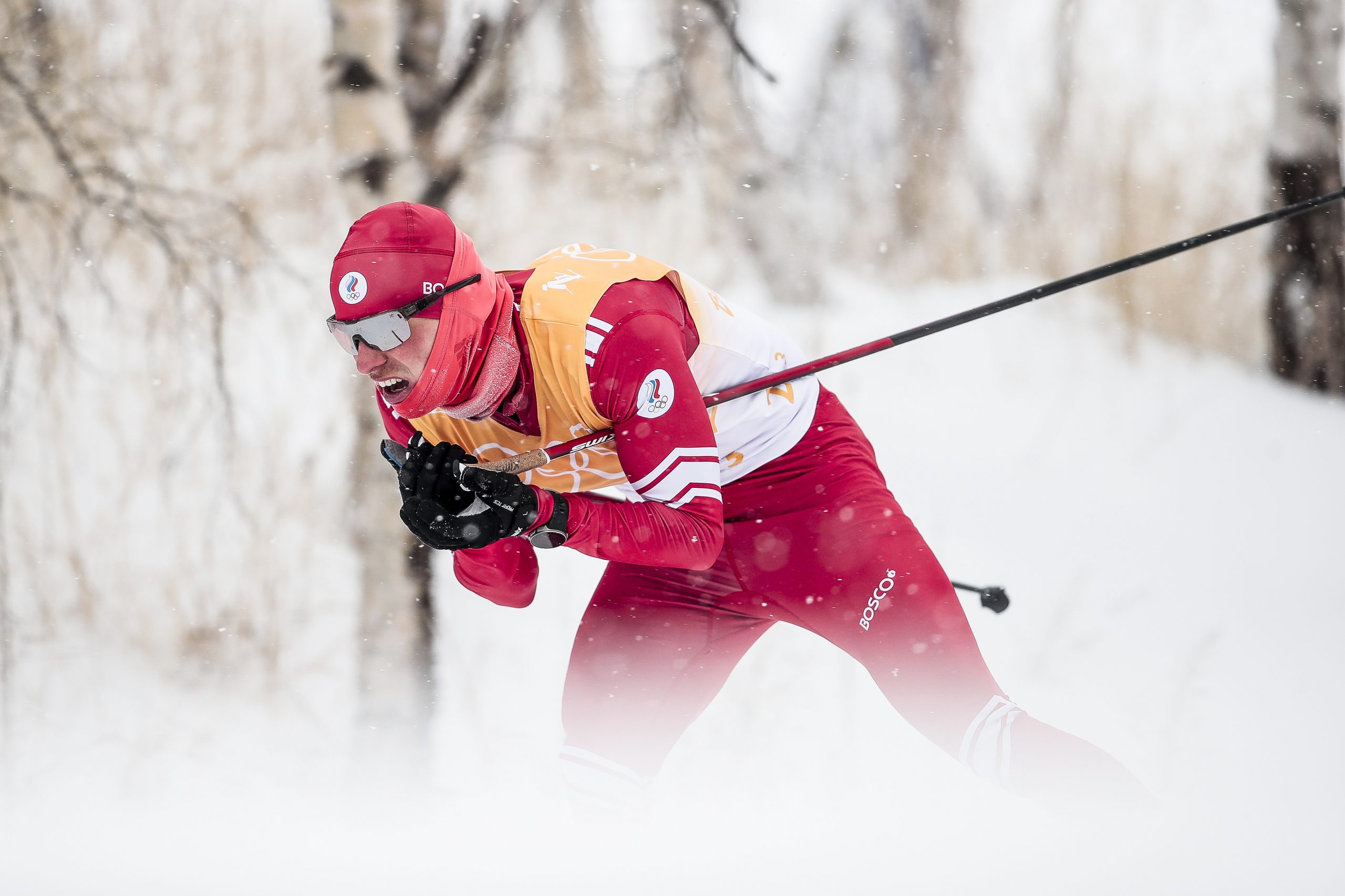
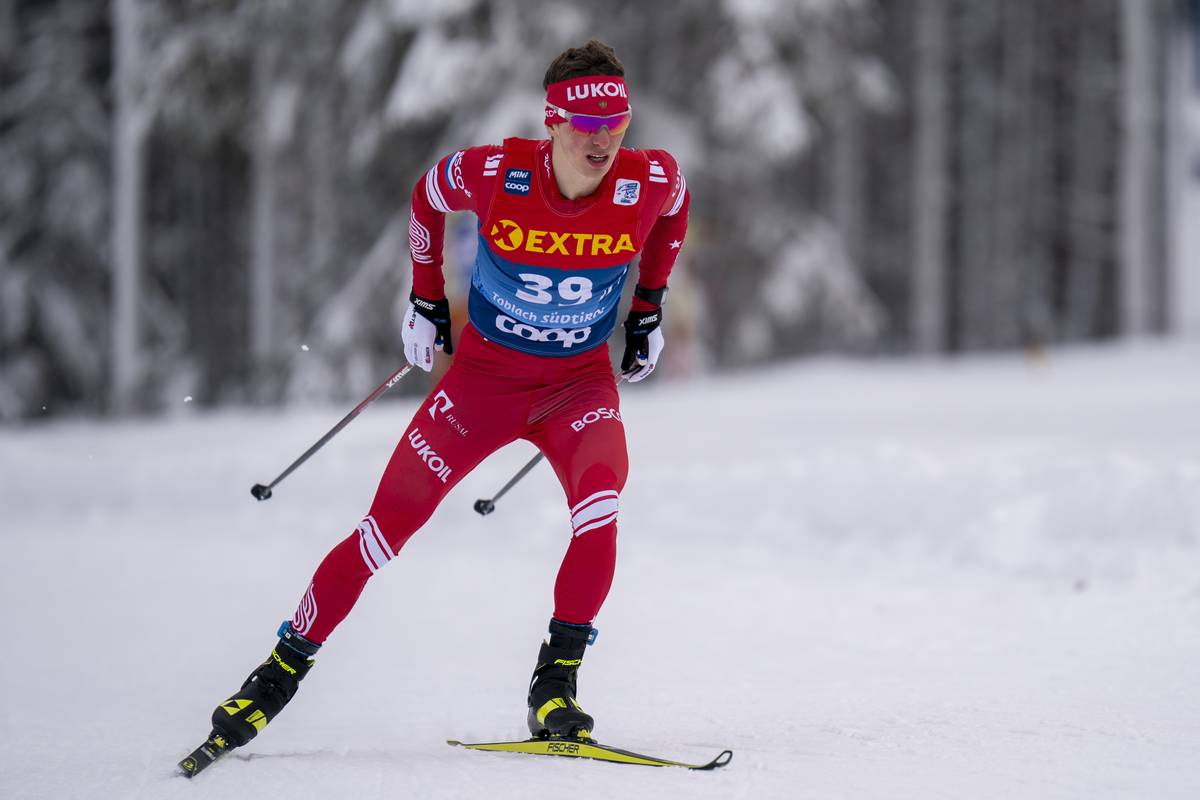
    Denis Spitsov (RUS) holds a tuck, skiing through deep snow on his own (Photo: NordicFocus)

    With 1:27:09.3 on the clock, Spitsov tagged off to Sergey Ustigov, still well clear of the rest of the field. Gaining a few meters on the Frenchman, Holund and Burman tagged their anchor legs with virtually no time between them, +44.9 and +45.4 behind the ROC. A few seconds later, Parisse gave way to the veteran Maurice Manificat, +49.2. 

    Clement Parisse (FRA) who hung tough in the third leg to help secure bronze for France (Photo: NordicFocus)

    This lengthy battle now in its final stages, Manificat worked to close the gap to Sweden and Norway, making the chase pack a group of three once again.

    The skis still looked to be a challenge for France as Norway’s anchor, Klæbo, pulled away from the other two by thirteen seconds on the descent towards the stadium, in a move that appeared to be largely unintentional. Not letting up, Manificat took on the task of closing on Klæbo once again, pulling Sweden’s Johan Häggström with him. The second time up the last A-climb of the 3.3 k loop, Manificat busted away from the Swede, catching Klæbo, who appeared to be out for an easy distance ski. 
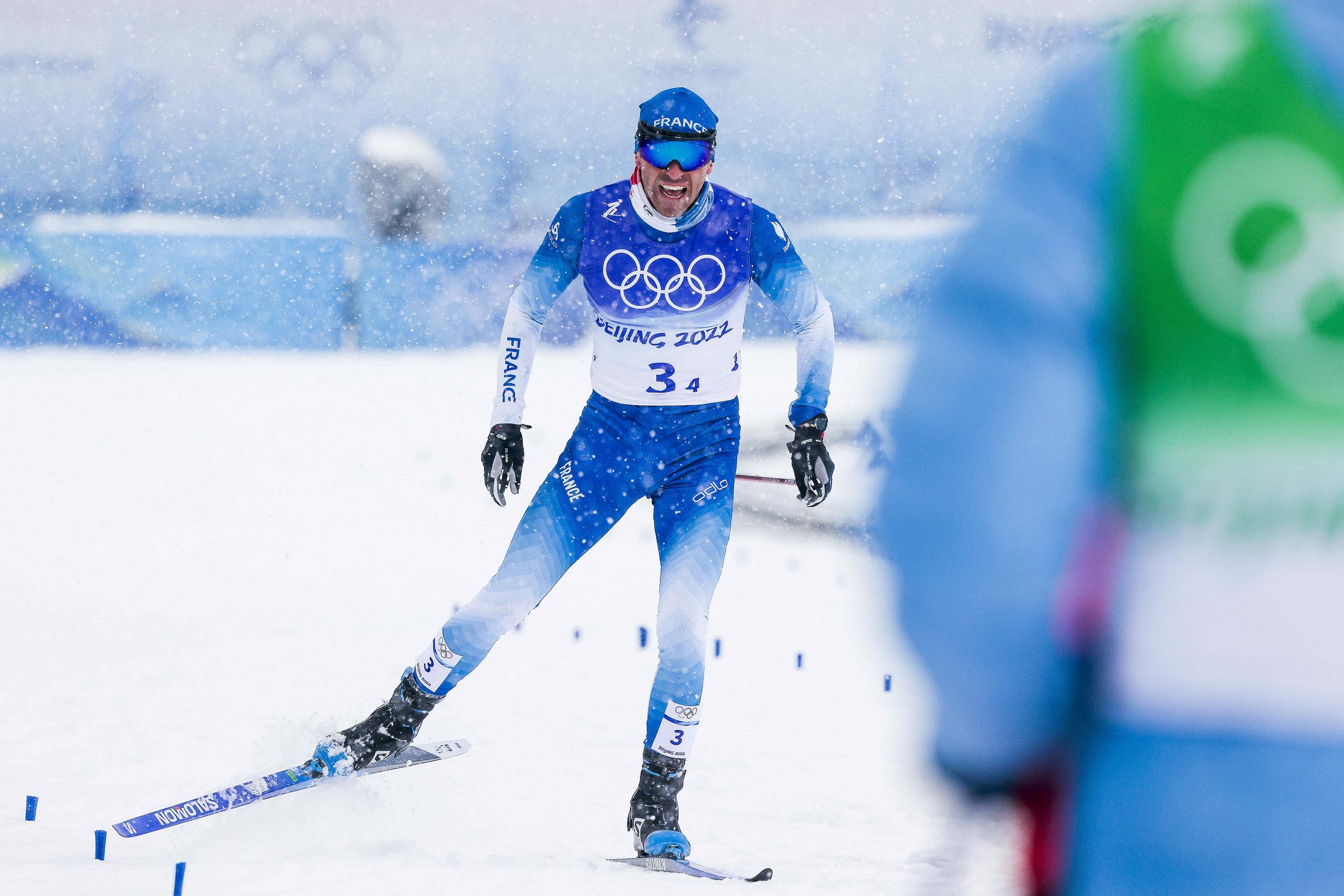
    Maurice Manificat (FRA) in the closing moments of his relay leg (Photo: NordicFocus)

    Through the stadium for the final time with 36.6 k complete, Ustigov and the ROC was +1:04.3 clear of France and Norway.

    To put it bluntly, the last 3.3 k were hard to watch. Knowing he had no chance of beating the Norwegian in a sprint finish, Manificat continued to push to his limit, his ski speed not doing him any favors. Klæbo was all too happy to sit in behind, drafting easily as Manificat tried his best to shake him. In the end, Klæbo did not even have to reach into his bag of tricks, he simply out-glided the Frenchman, who could do nothing about it. 
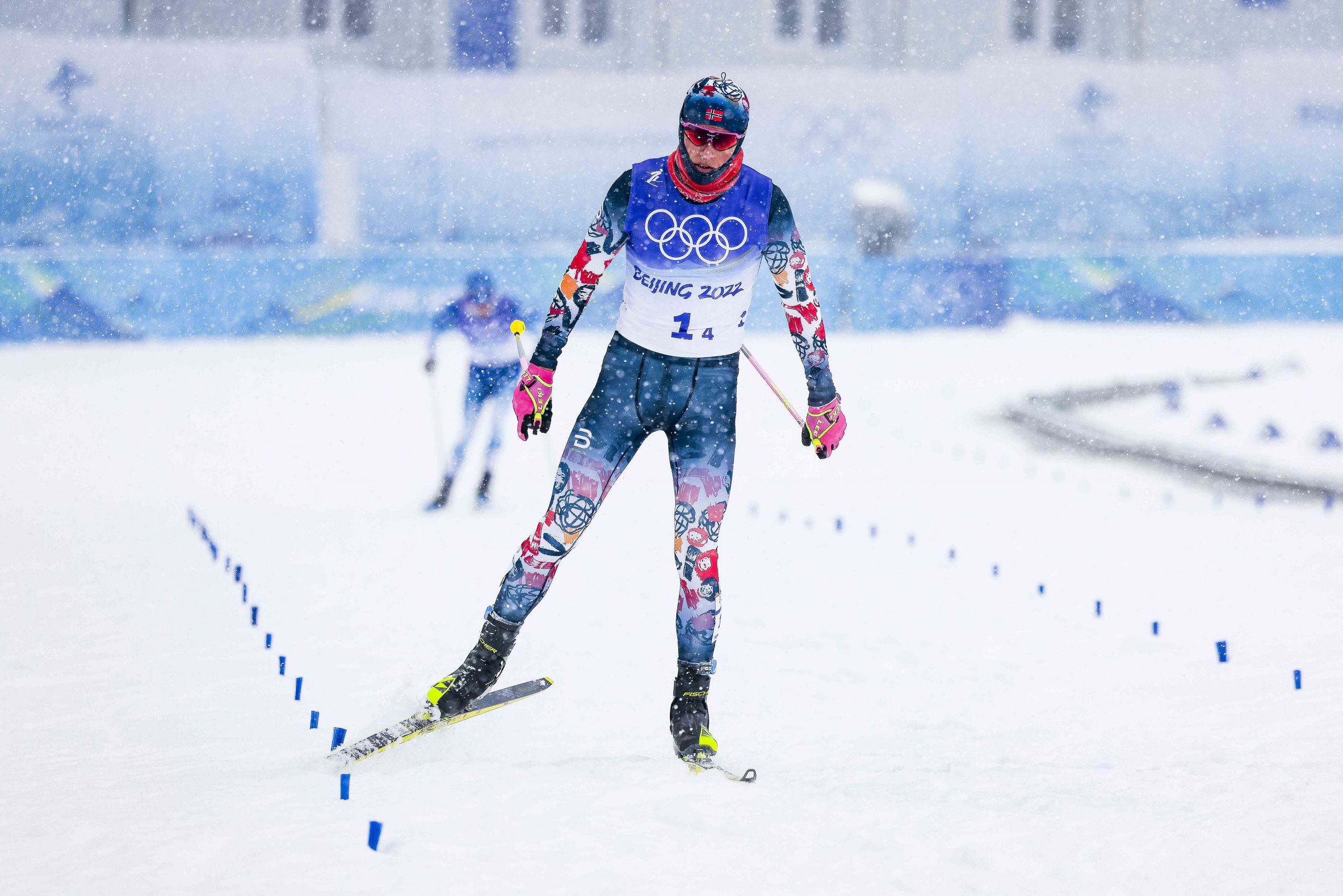
    No big moves from Johannes Høsflot Klæbo (NOR) as he brings home the silver medal for Norway (Photo: NordicFocus)

    Many meters ahead, Ustigov cruised into the stadium, grabbed an ROC flag and waved it triumphantly as he crossed the finish line before any challengers had even entered the stadium. Finishing in a time of 1:54:50.7 the men secured the second relay gold medal of the Games, after the ROC women brought home gold in the 4 x 5 k yesterday.

    Chervotkin, who gave the ROC such a strong start, said of winning gold, “we were aiming for this. We tried to achieve it, and for several years we haven’t been able to. Today everything aligned. Everything was super. The weather seemed to be hard and there was snow but it was in our favor so everything was great.”
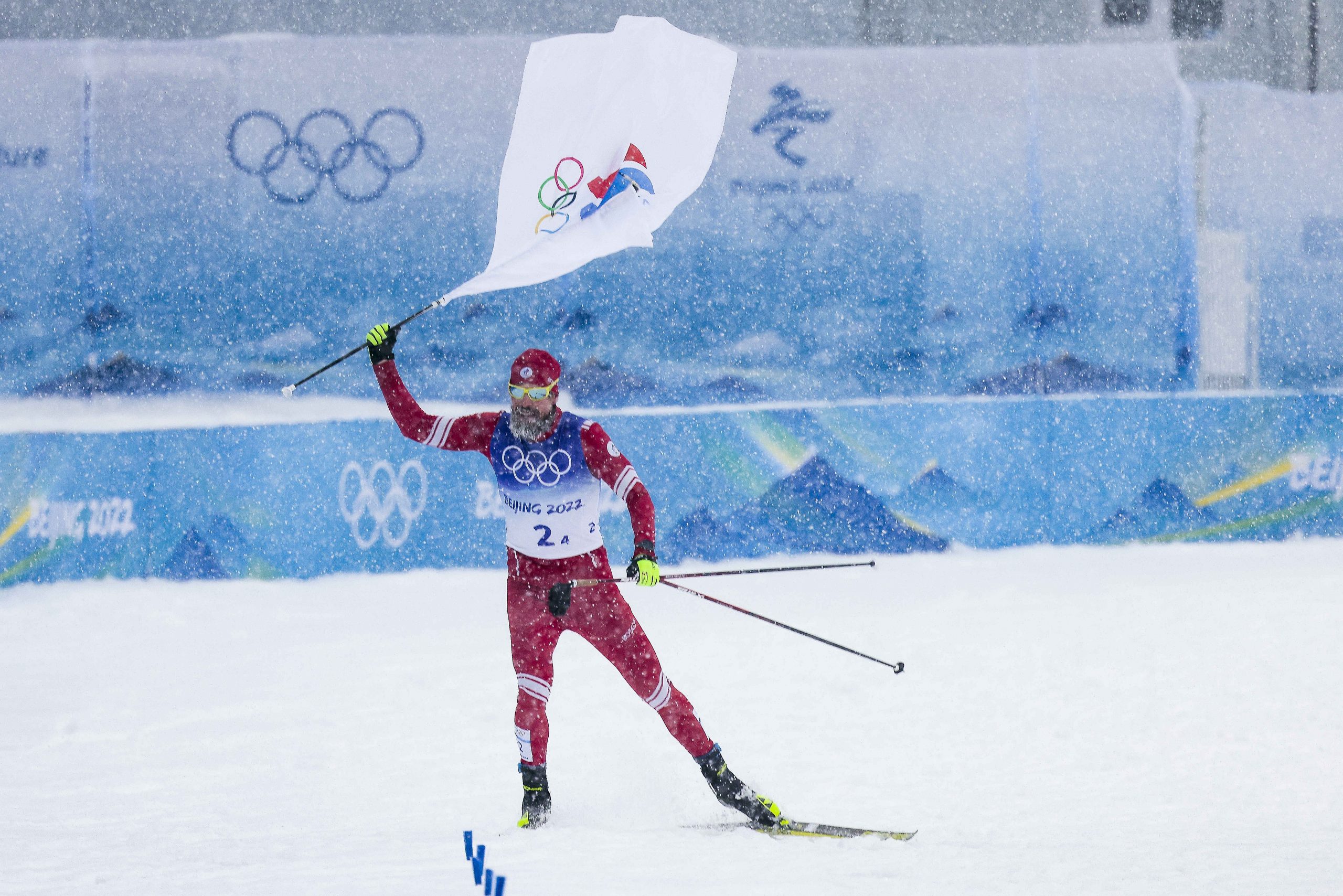
    Alone with a flag, Sergey Ustiugov (ROC) heads for gold (Photo: NordicFocus)

    Despite the consistent strength of the Russian team, they have not won a 4 x 10 k relay in over forty years. The last time they topped the podium in this event it was under yet another name, as the Soviet Union, at Lake Placid in 1980. Of course in recent years, they have consistently been runner-up, earning silver in 2021 Obserstdorf, 2019 Seefeld, 2018 PyeongChang and 2017 Falun. 
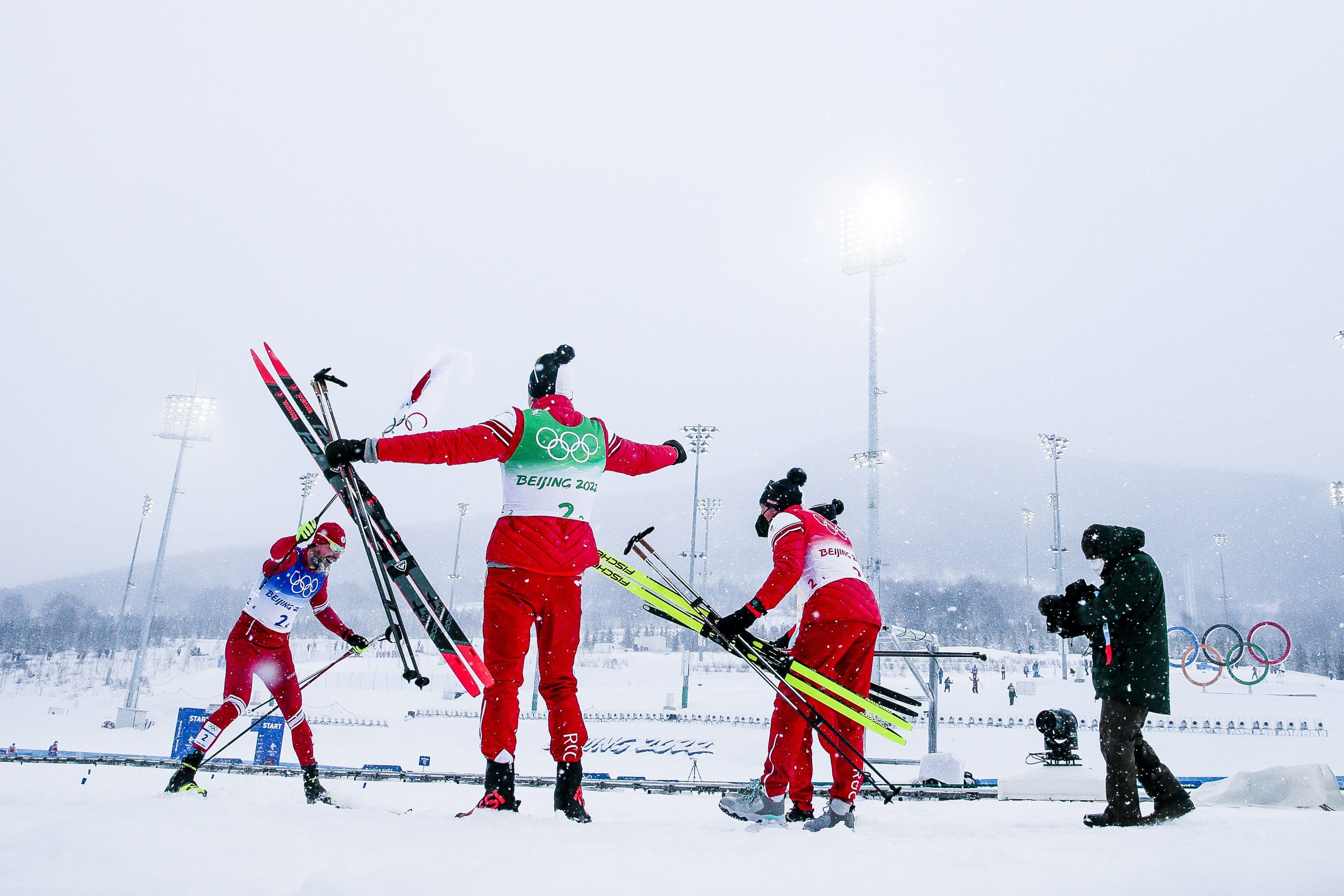
    Ustigov crosses the finish line unchallenged as his teammates wait to congratulate him (Photo: NordicFocus)

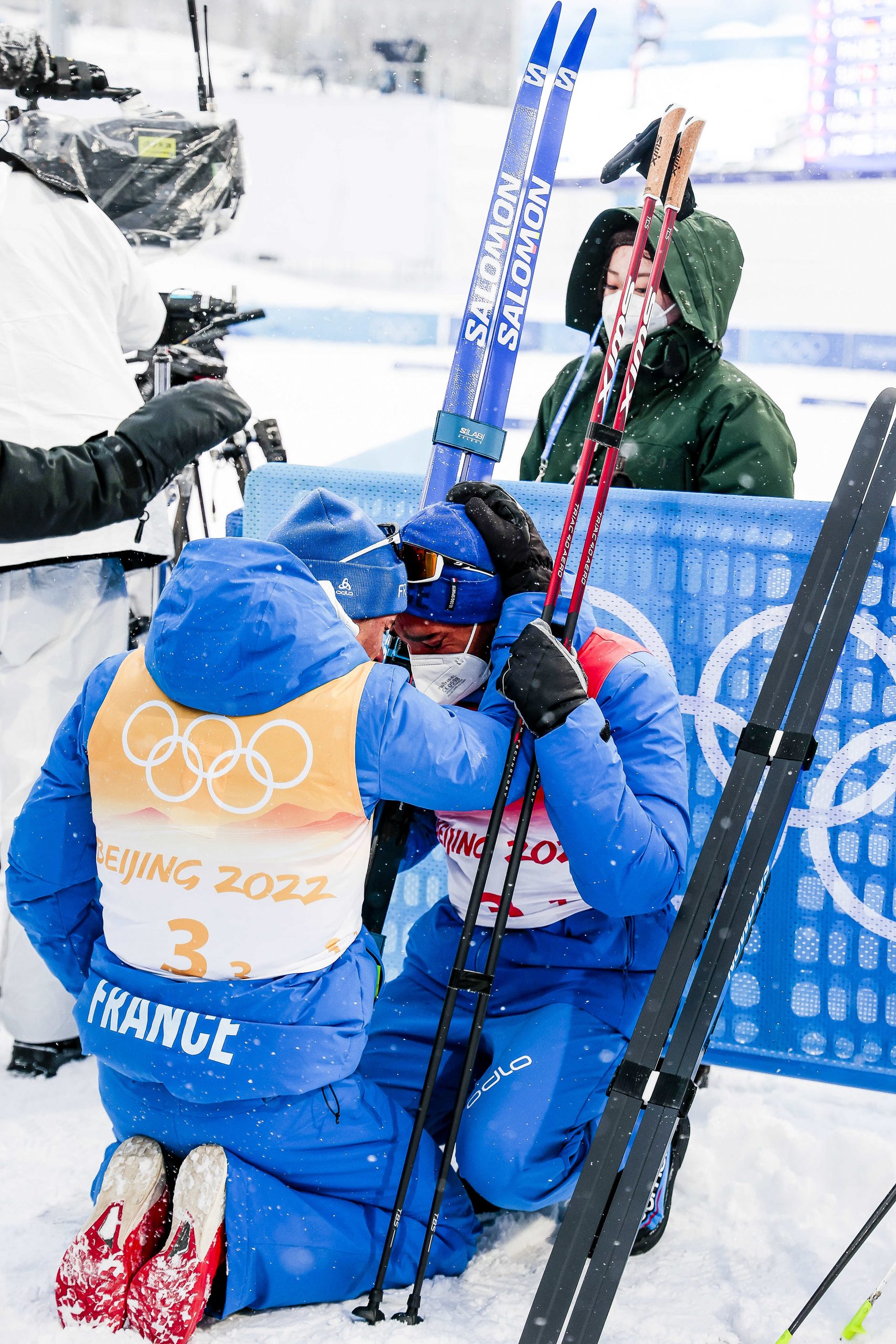
    Today the positions were reversed as Klæbo skied slowly across the line for silver, having simply glided away from Manificat in the closing stages. He was met by rather somber congratulations from his teammates, particularly in comparison to the French who celebrated their bronze as if it were gold.
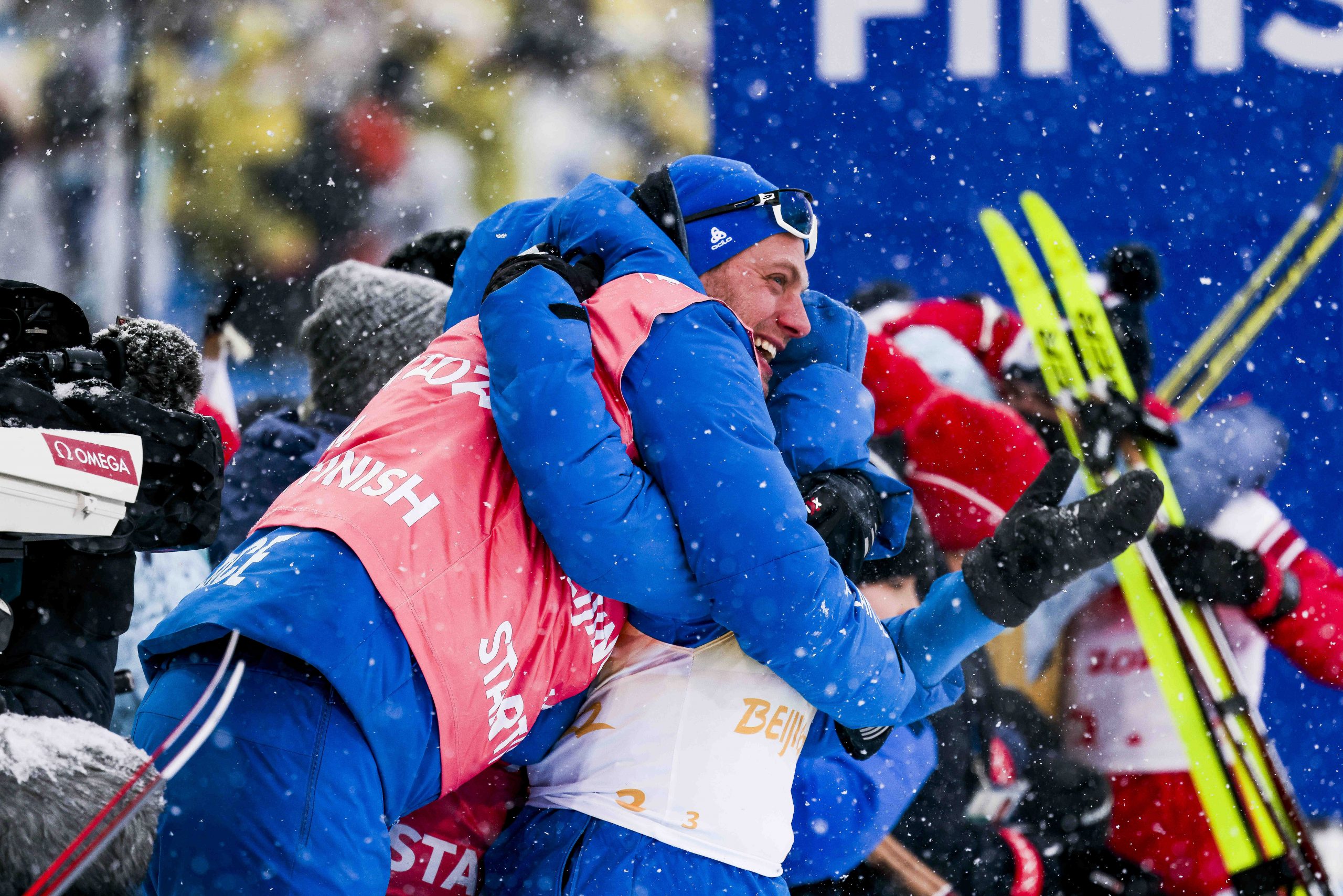
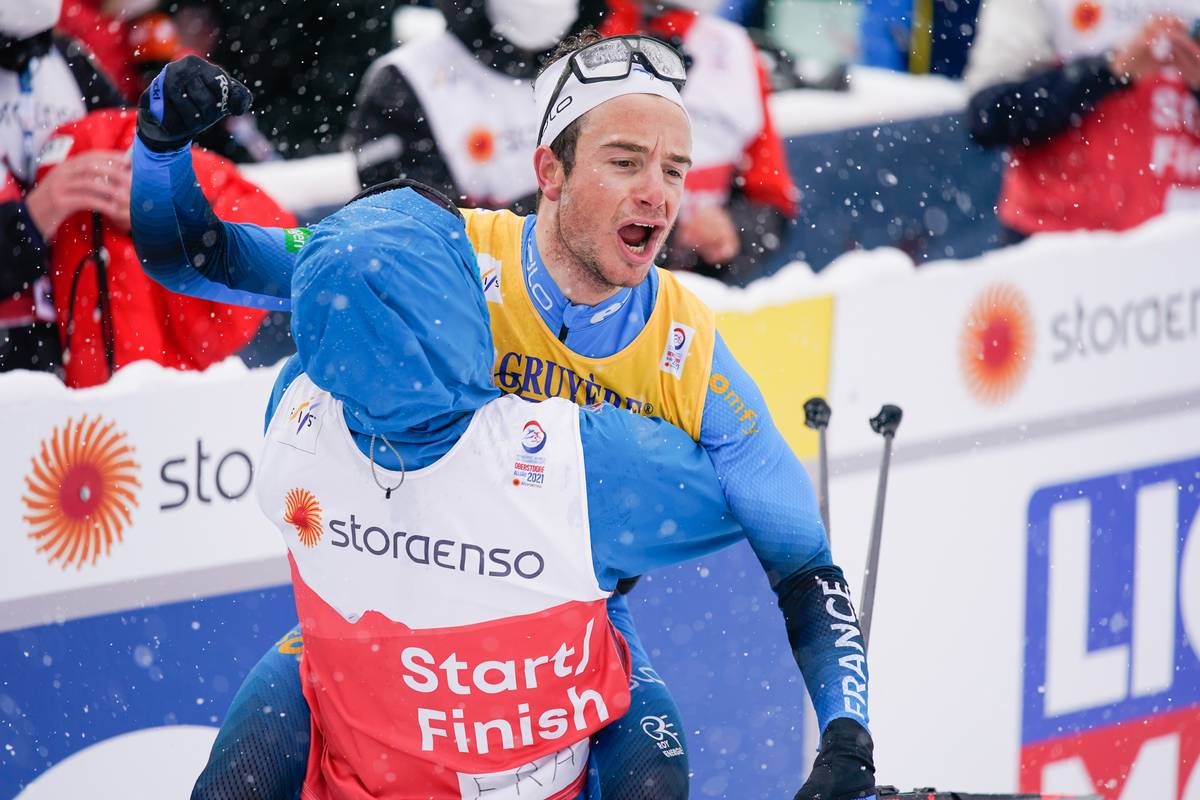
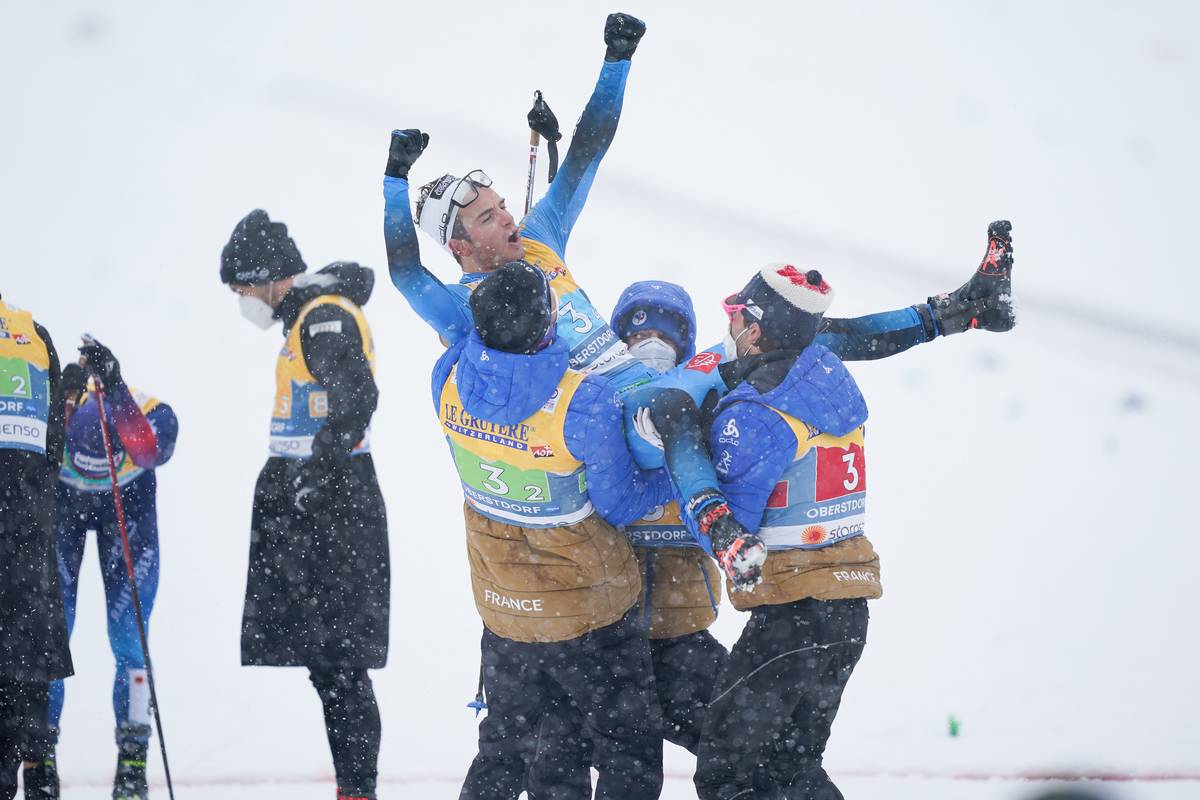
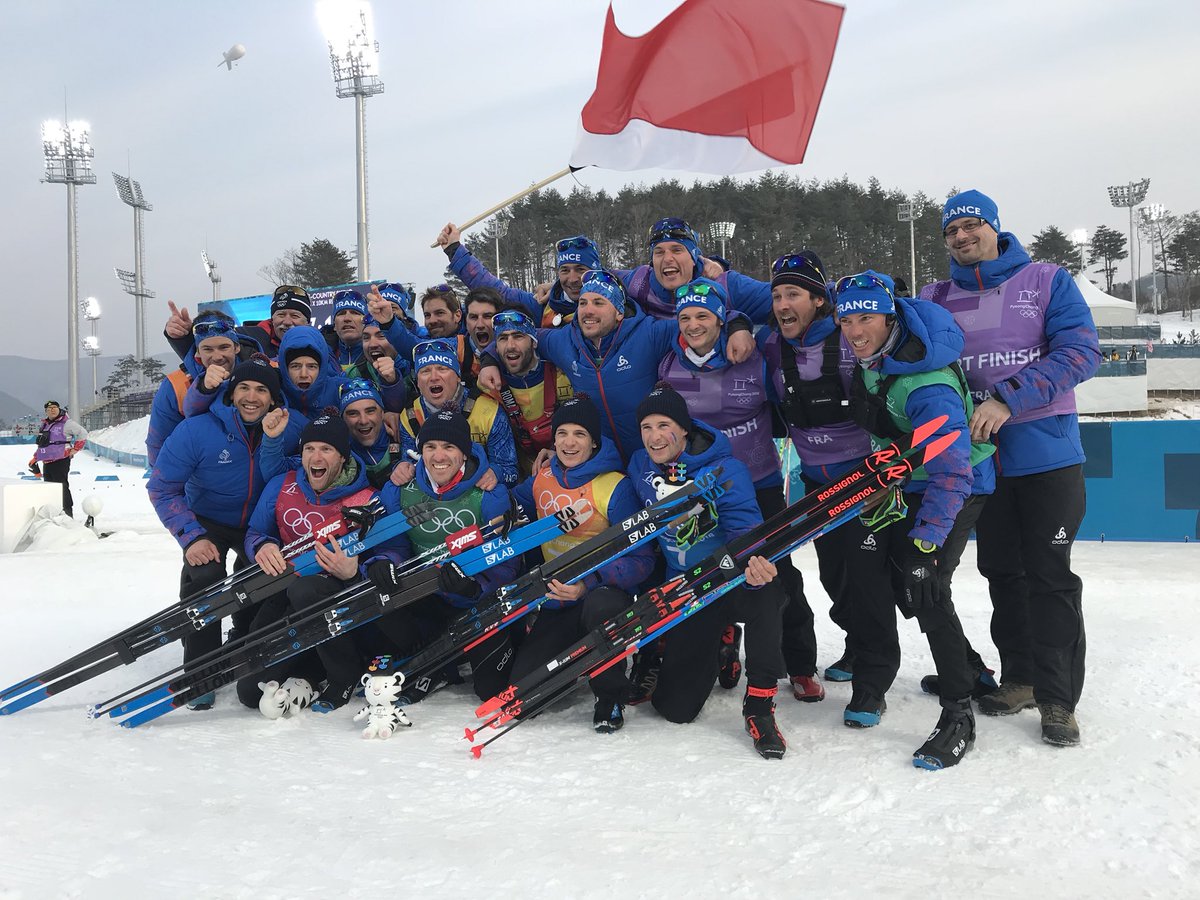
    Elation for the French at having secured another Olympic bronze in the men’s relay (Photo: NordicFocus)

    After the race, Klæbo said, “when you’re doing a relay, you’re doing it as a team and that is the beautiful part of it, so it’s always fun to race the relay and do it together. We all need to be satisfied with today’s result, and I guess we’re going to celebrate it in the evening and then some of us need to start preparing for the next race. But still we’re going to enjoy this evening.”

    His teammate Pål Golberg spoke about the challenging conditions, saying, “The course was tough before and with the snow and wind today, it was even tougher. So I mean, with altitude and everything it’s challenging but we did our best today. The four Russian guys were better so just take the hat off to them and try to be satisfied with the silver.” 
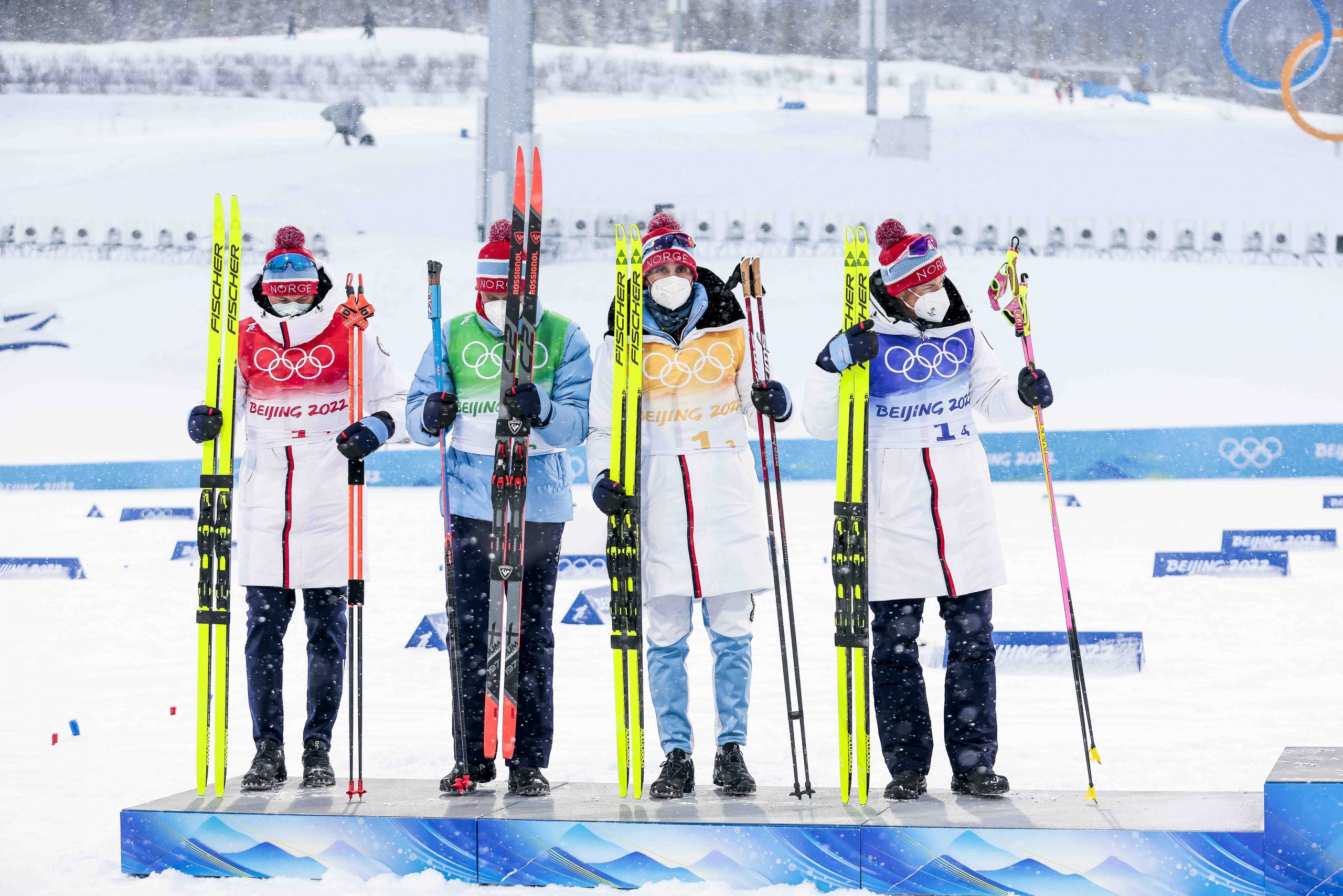
    Emil Iversen (NOR), Pål Golberg (NOR), Hans Christer Holund (NOR), Johannes Høsflot Klæbo (NOR), (l-r) were the only team not celebrating their medal (Photo: NordicFocus)

    If Norway has held a monopoly on gold in the men’s relay, then the same can be said about the French and bronze. This is the third consecutive Olympics that France has earned bronze in the men’s 4 x 10 relay and Maurice Manificat has played a part in all of them. Similarly, in the last four World Championships, France has collected bronze in three of them.

    When asked about winning another medal at the Games, Manificat replied, “four Olympics for me and some medals in the relay since Sochi, so for sure it’s an amazing feeling.”

    Regarding the challenge of trying to drop Klæbo he said, “I tried, in the big uphill and I give my best, I give all I had. Medal in relay is the best medal. Because you share it together. We thought all the year about the relay, it’s our soul.” 
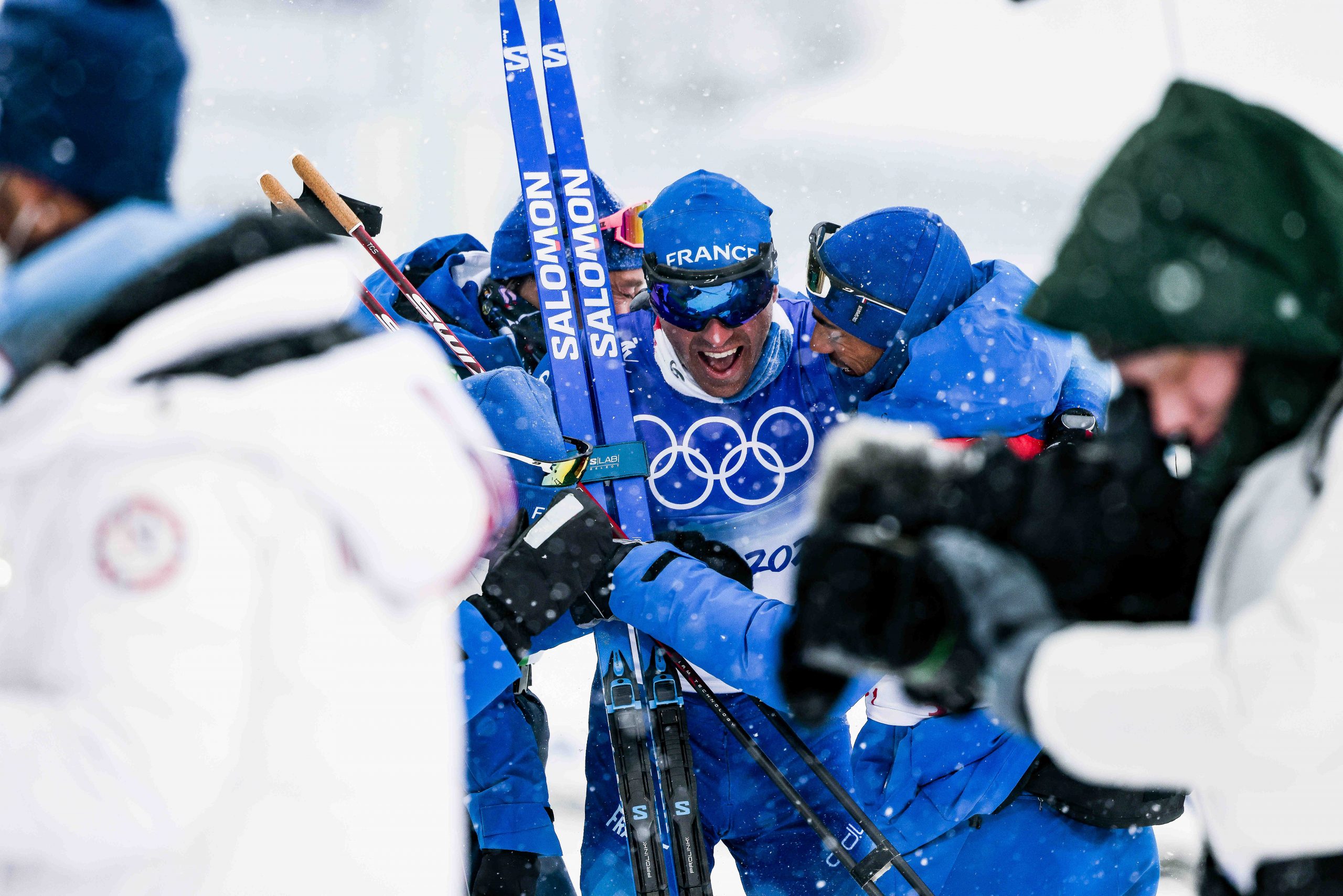
    Teammates congratulate Maurice Manificat (FRA) on a gutsy final leg to bring France the bronze medal (Photo: NordicFocus)
    Clement Parisse (FRA) and Richard Jouve (FRA) share a moment at the finish. (Photo: NordicFocus)

    With three teams lapped out of the race and the spread between the ROC and 12th place finishers, the Czech Republic at +10:07.1, the day was evidently a tough one.

    Improving on an 11th place finish in PyeongChang, the American men skied to 9th place today, +8:05.6 behind. 
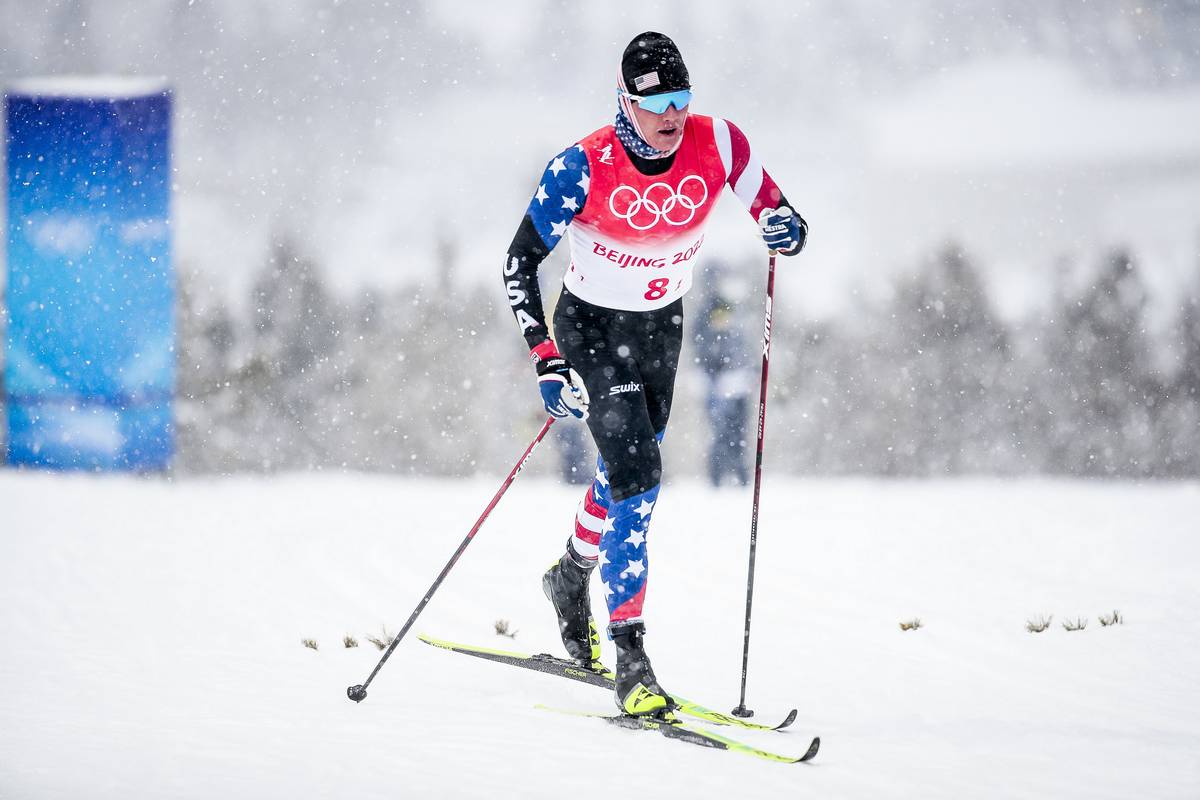
    Luke Jager skis the scramble leg for the Americans during the Olympic 4 x 10 k relay. (Photo: NordicFocus)

    Luke Jager took the scramble leg for Team USA, putting the team in 13th, +2:39 behind at the conclusion of his leg.

    “I felt kind of like I’d become sort of aware of some of the subtleties of how scramble legging in skiing works in the last years, but it was sort of like, all that went out the window,” Jager told FasterSkier from the mixed zone. “For a lot of reasons: the course is really hard, the altitude was really hard, and 10 k versus five or 7.5, was a really big difference. At the end of the day, I just wasn’t fit enough to be where I want to be and there was no hiding to be had. So, I feel like I learned a lot from it, but I just feel like I need to go home and train a lot more.”

    While Jager chalked it up as a disappointment, he contrasted the statement it with: “that’s obviously multifaceted. There’s pros to it all, and I’m really thankful to be here.”

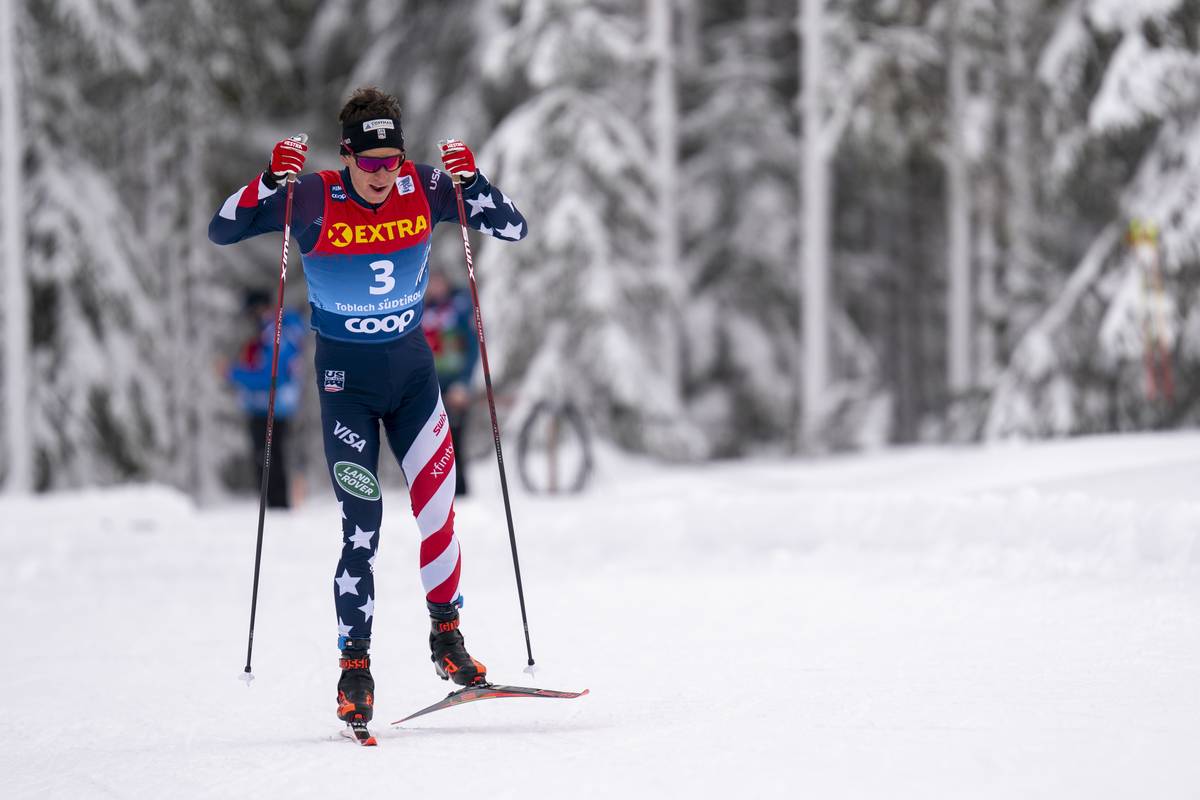
    Up next was Scott Patterson, who started the Games with an impressive 11th place finish in the skiathlon. Patterson bumped the team up into 11th place, though the time gap continued to widen at +4:23.2.

    “I think as we’ve seen in every race this week, those courses are pretty unforgiving,” Patterson explained. “I felt like I had to go out and ski my own race and not really think too much about what everyone else was doing, just go move into the race and try to ski well. It was a little bit interesting place where Luke tagged me off, but I think I picked off some people and put us in a good spot, so I’m happy with that.”

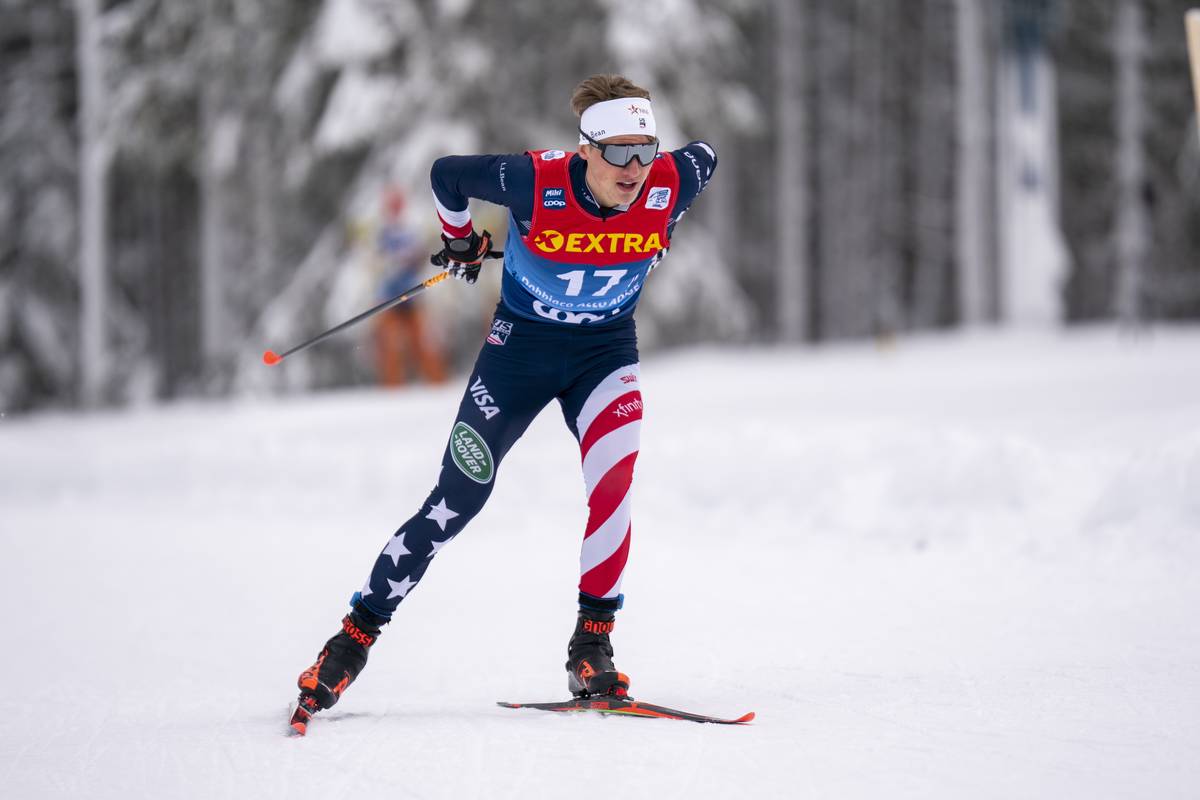
    Gus Schumacher races the third leg of the men’s 4 x 10 k relay. (Photo: NordicFocus)

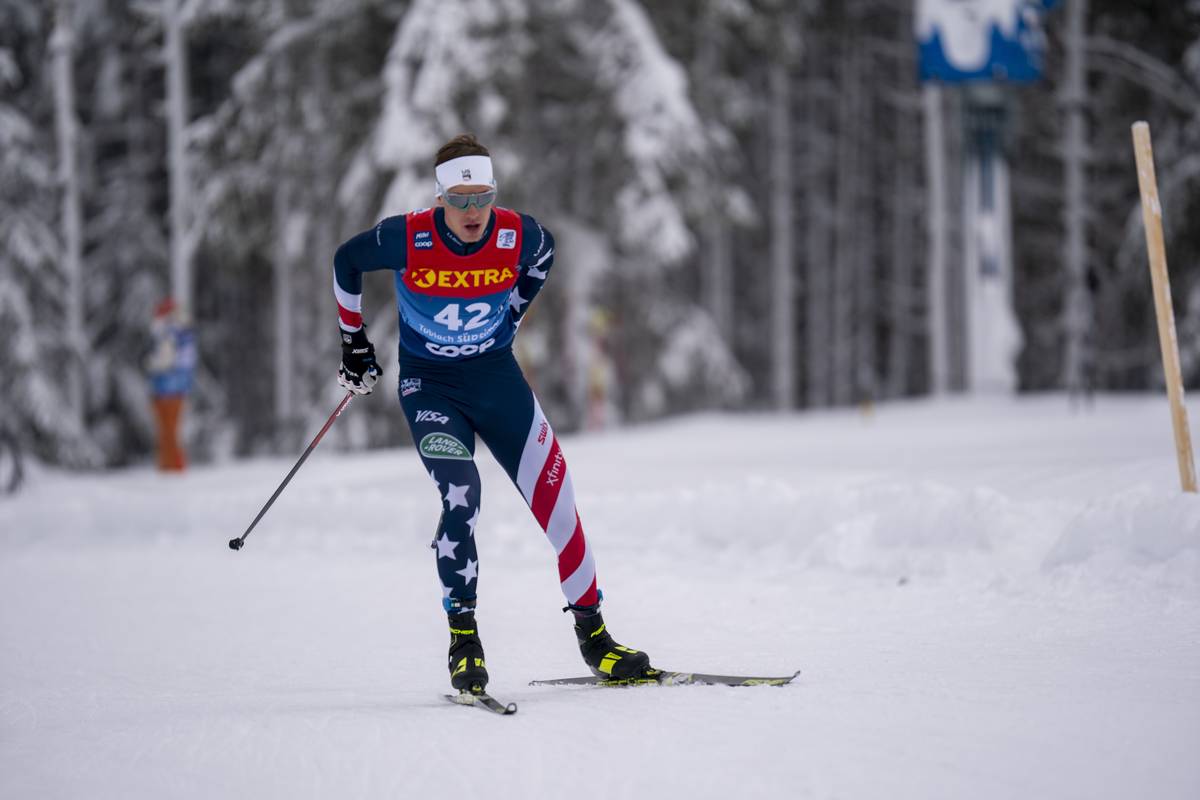
    Patterson tagged Gus Schumacher who maintained their position in 11th place and finished his leg +6:04 behind. In the anchor position, Kevin Bolger moved past both the Japanese and Czech team to put the team in 9th place. 

    “I’m proud of us for coming together the team,” said Schumacher after the race. “We’ve all had some tough races here… It hasn’t been easy for us. I think it’s a little bit hard especially to have the girls’ success – there’s some pressure there.”

    While the team was seemingly unanimous that this pressure was self-imposed and that it had been a relief to feel they had “nothing to lose and everything to gain,” the Americans also affirmed that they brought hopeful energy to the day, looking to take a step forward as a team, regardless of what that looked like on paper.

    Over the last four Olympic cycles, the Americans have been 11th place in the last two Games, along with 12th in 2006 and 13th in 2010. It might not be a medal, but it was, in fact, a step forward for the program.

    “I think we all really put it out there and yeah, good energy,” Schumacher concluded.
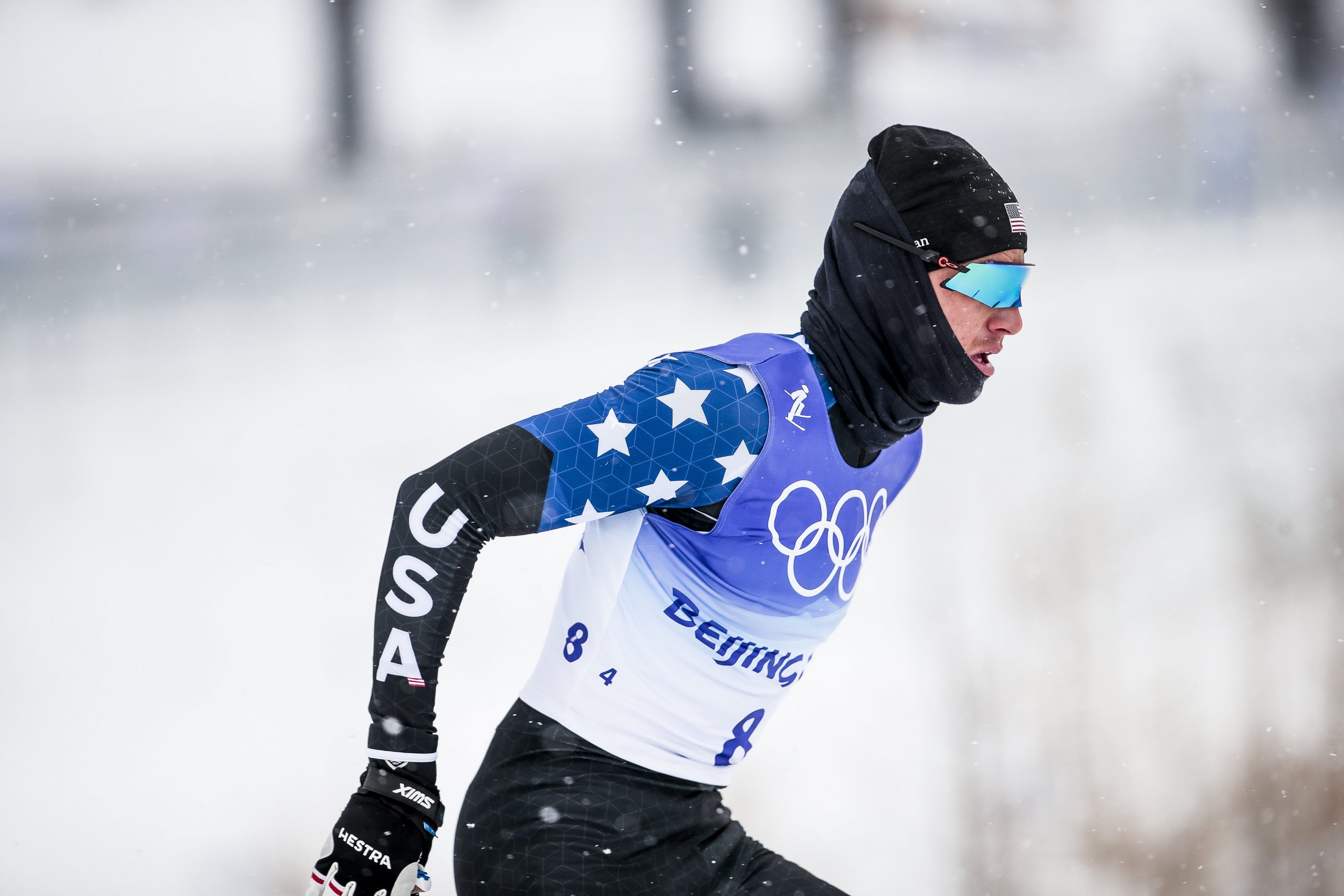
    Kevin Bolger (USA) skiing the anchor leg for Team USA (Photo: NordicFocus)

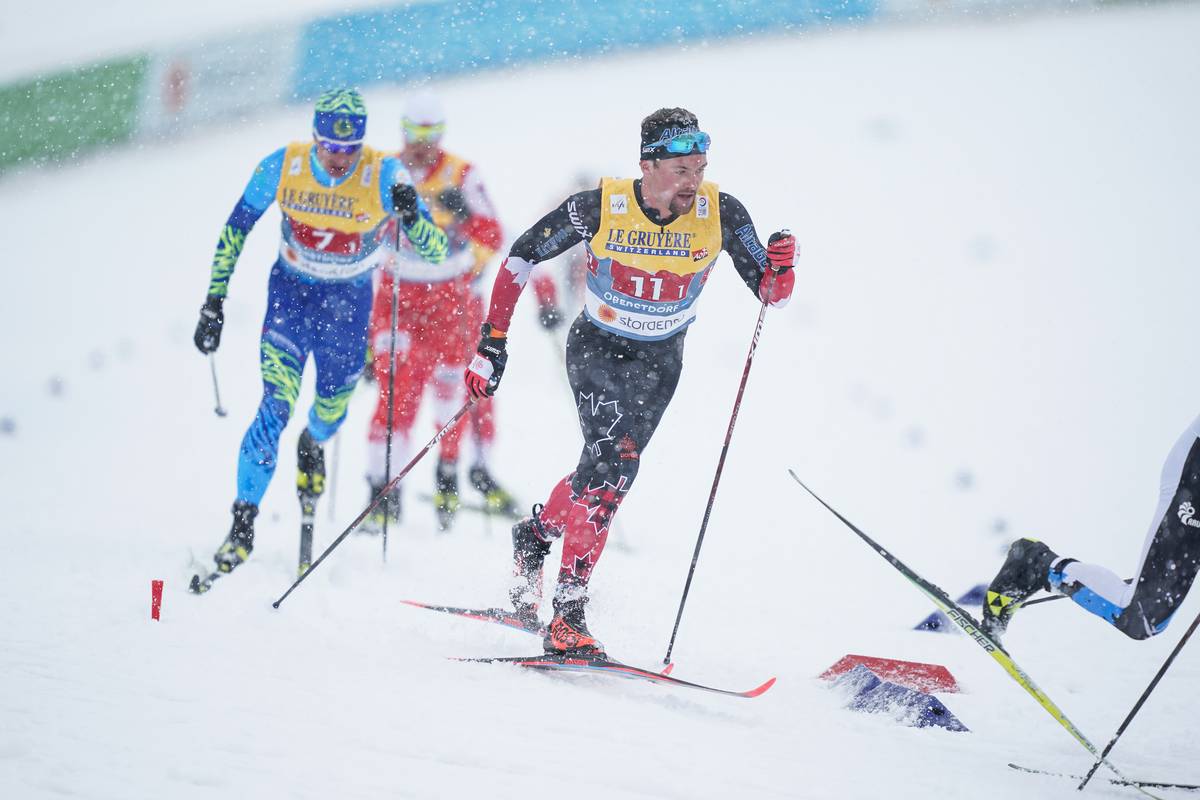
    The Canadian team was led out by Graham Ritchie who ended his leg in 14th, +2:42 behind. Antoine Cyr took the second classic leg and moved up one position to 13th, +4:23.2.

    In the transition to skate, Olivier Léveillé skied Canada’s third leg, again moving the team up one position to 12th, +6:44.6. Rémi Drolet anchored to bring the team home in 11th position, +9:10.4. 

    Antoine Cyr (CAN) skiing the second leg for Canada (Photo: NordicFocus)
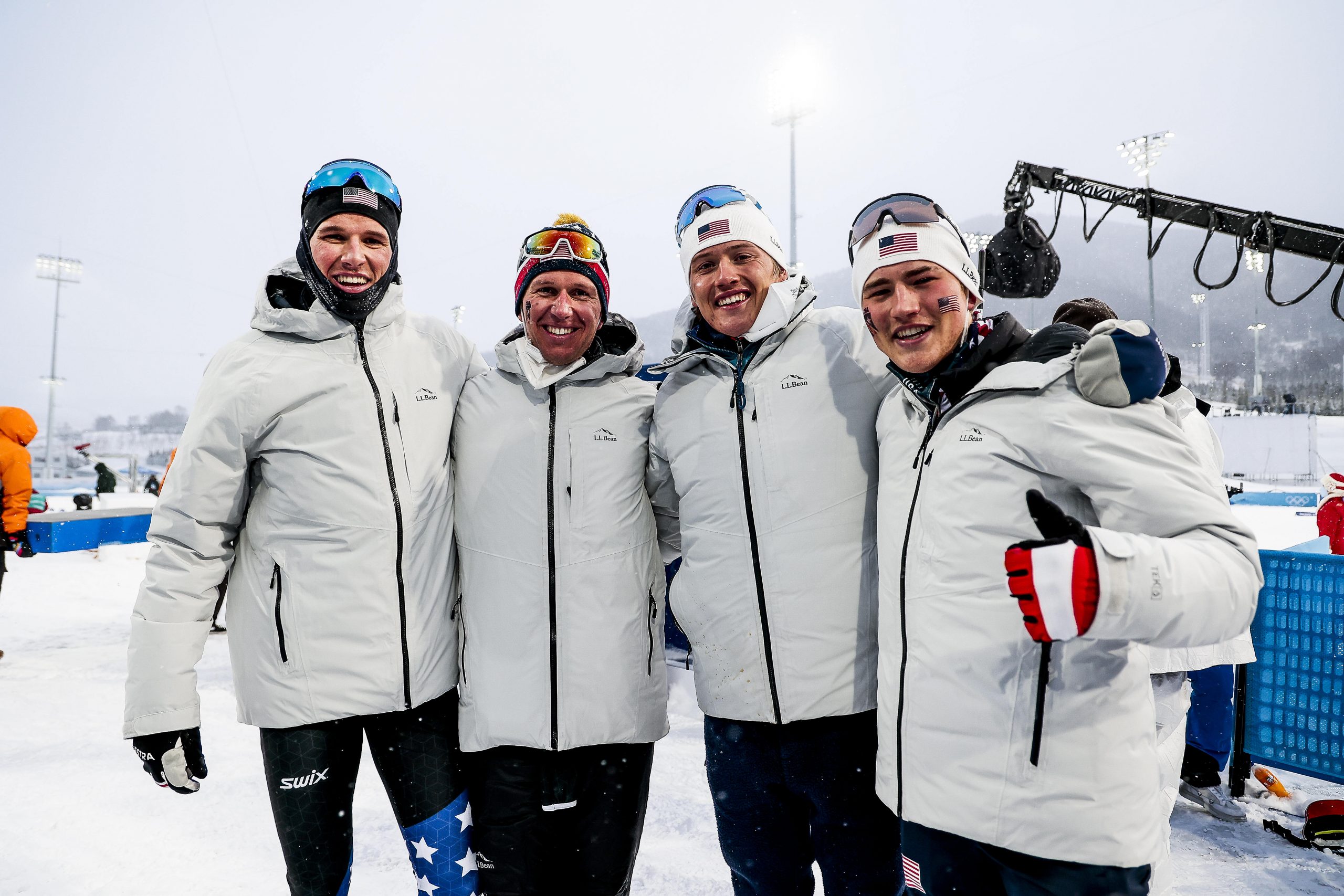
    American men’s 4 x 10 k relay team: Kevin Bolger, Scott Patterson, Luke Jager, and Gus Schumacher (l-r) (Photo: NordicFocus)

    “The relay is really a game of staying in contact,” Matt Whitcomb told FasterSkier in the mixed zone. “When you lose contact, it becomes a different race. Time expands immeasurably. So I’m very proud of the way that these guys tackled the project that they’re handled today. There’s also – and I say it with a Canadian over my shoulder – this is one of our favorite rivalries: our northern friends. And it really is a friendly and very fun rivalry, where we’re always giving each other splits back and forth, and I’m proud of both teams today. And I’m also excited for our guys to come out just a little bit on top.”

    The next Olympic cross country ski event will be the men’s and women’s team sprint, happening on Wednesday, February 16th.

    Results

  • Klæbo Pulls Away for Fourth Stage Win in 15k Mass Start Classic to Build Overall Tour Lead

    Klæbo Pulls Away for Fourth Stage Win in 15k Mass Start Classic to Build Overall Tour Lead

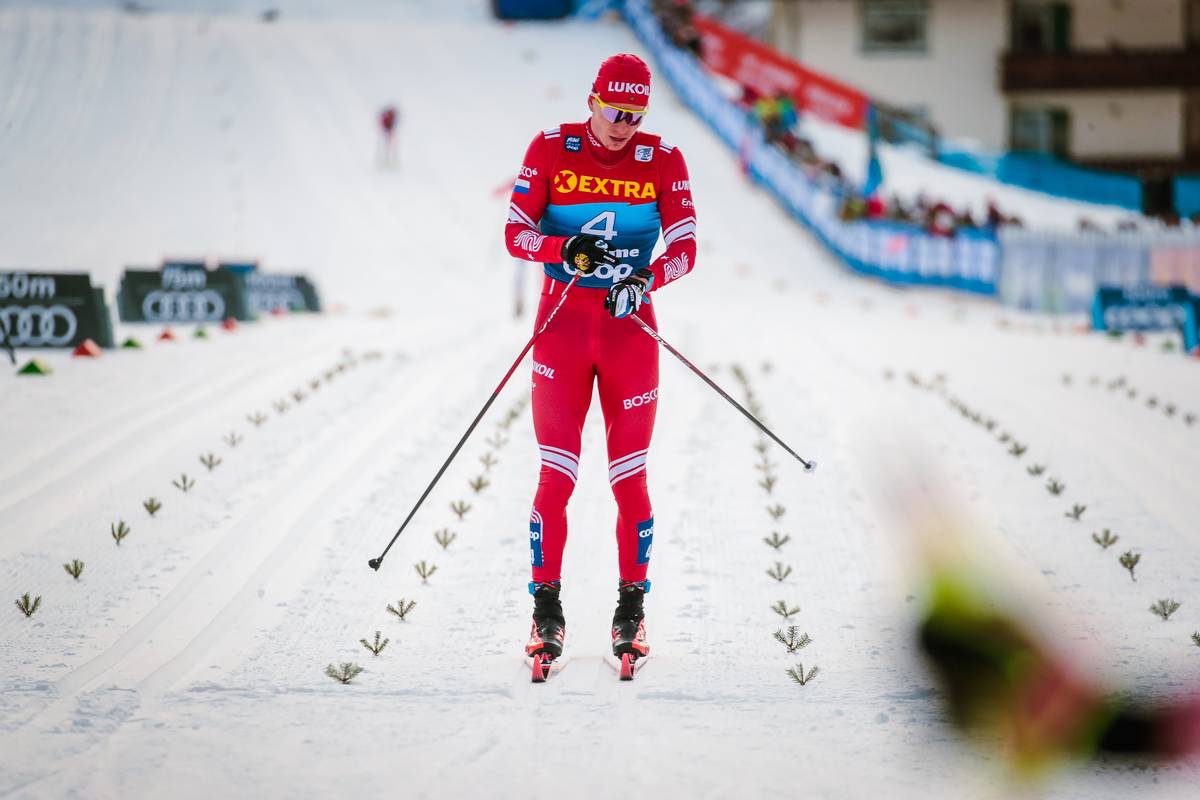
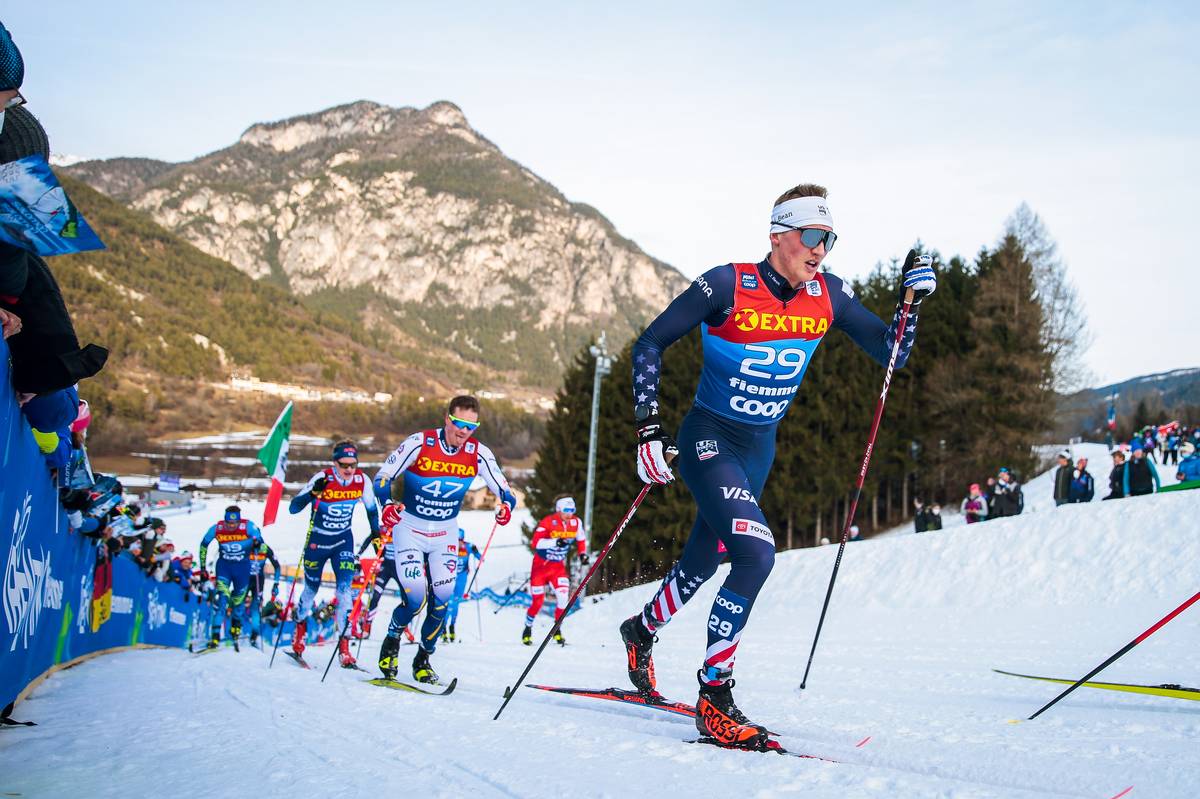
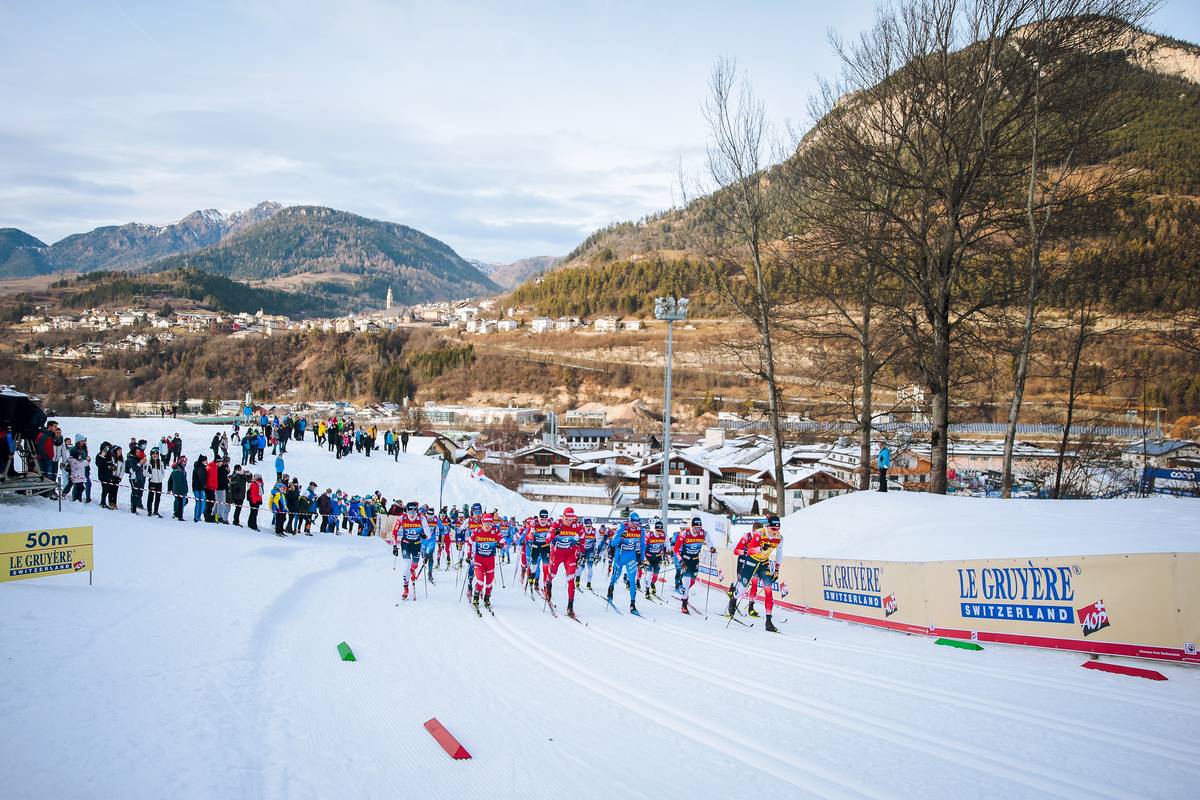
    Athletes take to the tracks for Stage 5 of the 2021/22 Tour de Ski, a 15-kilometer mass start classic in Val di Fiemme, Italy. (Photo: NordicFocus)

    This World Cup coverage is made possible through the generous support of Marty and Kathy Hall and the A Hall Mark of Excellence Award.  To learn more about A Hall Mark of Excellence Award or to learn how you can support FasterSkier’s coverage please contact info@fasterskier.com.

    From Switzerland, to Germany, to the Italian Dolomites, the 2021/22 Tour de Ski continued today with its fifth of six stages, a 15-kilometer classic in Val di Fiemme. Dwindling from over 100 racers in the opening stages in Lenzerheide, just 62 men took the tracks in Stage 5, perhaps reducing the inevitable congestion of a mass start during the first of six 2.5k loops.

    With the end of the Tour fast approaching, today’s race was all about time gaps. With three wins over four stages, Johannes Høsflot Klæbo (NOR) led the tour by 1:03 over teammate Pål Golberg, and perhaps more importantly, 1:19 over Russia’s Alexander Bolshunov, who entered the Tour on the heels of overall victories in both 2020 and 2021. With an abbreviated schedule that perhaps favors sprinters more than the usual seven-plus stage grind, Klæbo’s lead was not unprecedented, however, the Norwegian’s track record up the final hill climb on the infamous Alpe Cermis pales in comparison to the Russian’s.

    Over the last four iterations of the Tour de Ski, Bolshunov has incrementally shaved a position or two off each year. Finishing sixth in 2018 by time of day, he advanced to fifth in 2019, third in 2020, and second in 2021. In contrast, Klæbo was 21st up the hill in 2020 and skied the 27th fastest time of day in 2019. He did not compete in the 2018 or 2021 Tours. 

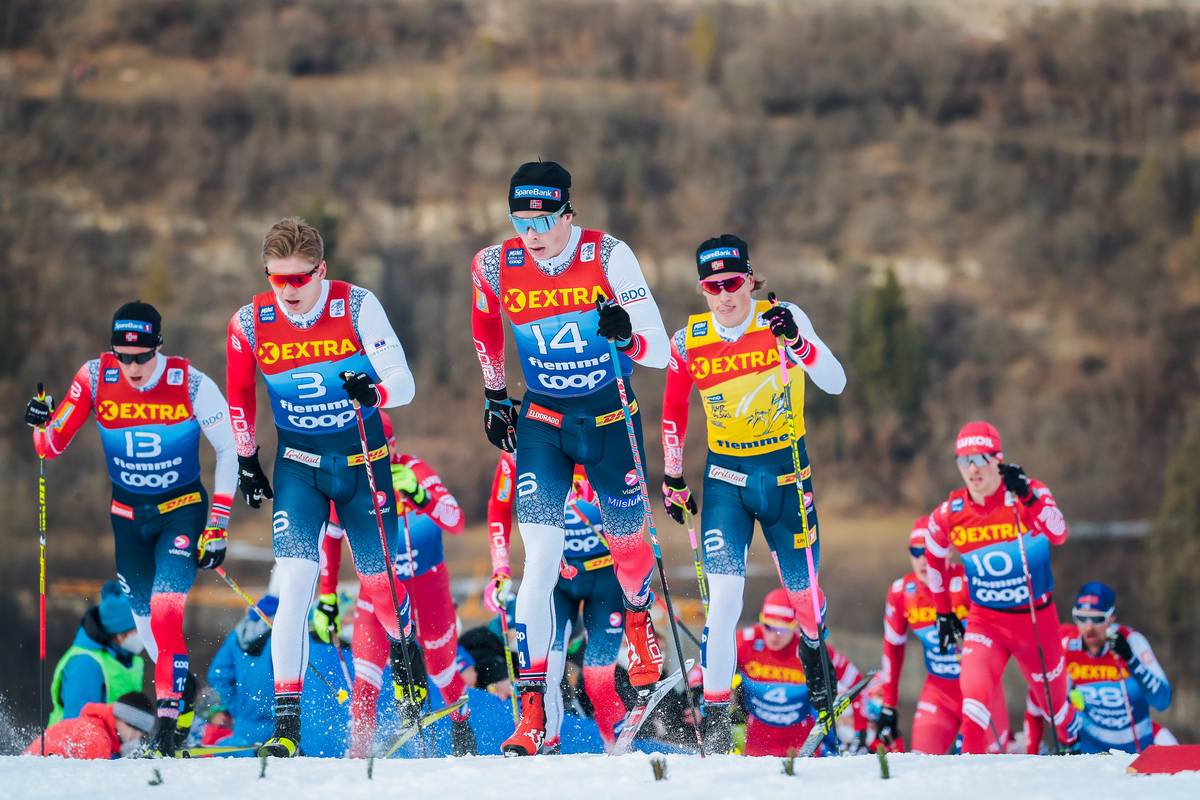
    A slew of Norwegians lead the way in the opening laps of the 15k mass start classic in Val di Fiemme. (Photo: NordicFocus)

    Though the margin was only 15 seconds between the men, Bolshunov had also beaten Klæbo in the previous classic stage, on the second day of racing in Lenzerheide. With a time bonus opportunity today at 8.5k, Bolshunov had the potential to do some damage in the overall standings.

    With both athletes through the opening kilometers cleanly, without crashes or broken equipment, the tension began to build through the middle laps. 

    At the halfway mark, Stage 2 winner and 15k classic specialist Iivo Niskanen (FIN) led the way through the stadium with a train of athletes, mostly Norwegian and Russian, on his tails. Klæbo sat comfortably in 4th (+1.3), with Bolshunov back in 17th (+6.8). Klæbo surged ahead of Niskanen to collect the maximum time bonus of 15 seconds at 8.5k, before allowing the Finn to continue the work at the front. Bolshunov was 9th at the time bonus, earning only 2 seconds. 

    Iivo Niskanen leads the way in Stage 5. (Photo: NordicFocus)

    At 10k, Niskanen and Klæbo began to break away from the lead group, led by Bolshunov, who had skied into third, now five seconds back on Klæbo. 

    Pulling away with 5k to go is not a tactic we typically see from Klæbo, who historically has been better served by tactical finishes where the pack remains tight until the final kilometer, where he’s able to use his sprint acceleration to excel. Niskanen showed in Stage 2 his capability to run away with a win, but could Klæbo keep pace?

    By the next lap, Klæbo showed that not only could he match the Finn, but he could drop him. The two were separated by 9.5 seconds at the 12.5k checkpoint, with the chase group over 23 seconds behind Klæbo. Halfway through the final lap, Klæbo had grown his lead to nearly 17 seconds over a fading Niskanen, with Russia’s Alexey Chervotkin leading the chase group 26 seconds back from the leader.

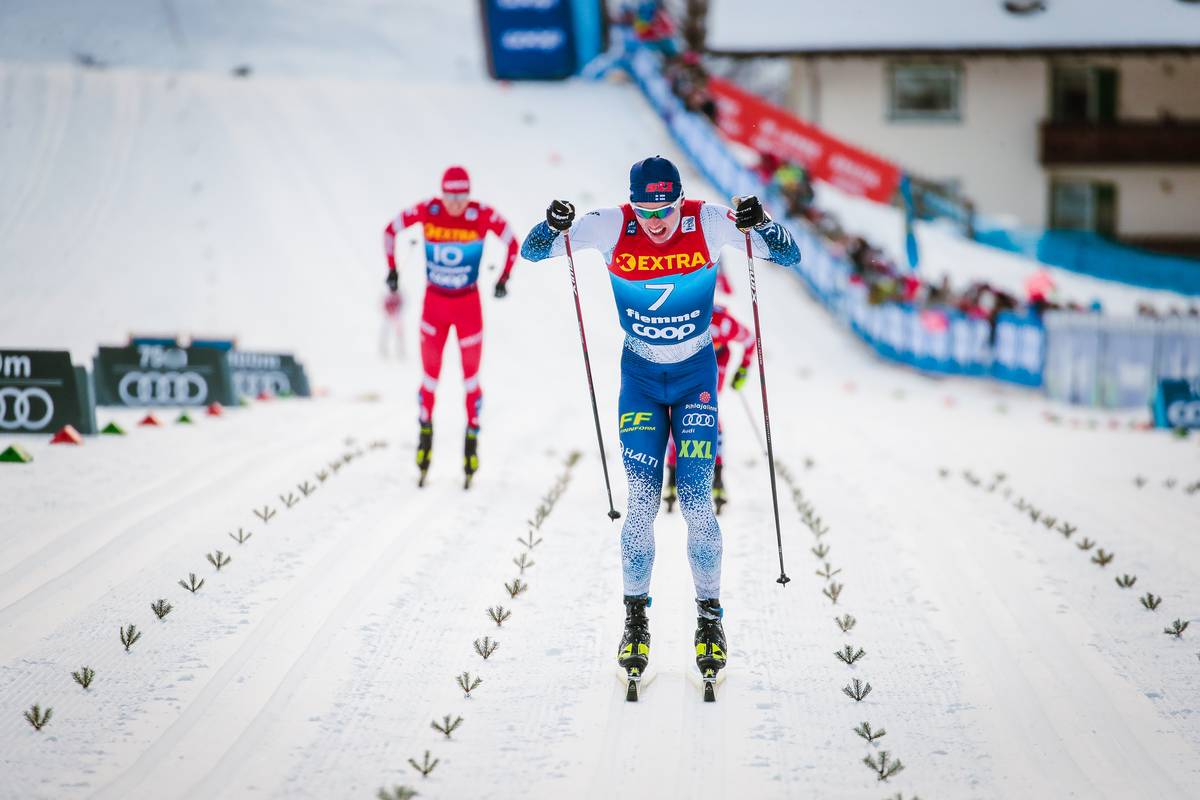
    Running away with a fourth stage win, Johannes Høsflot Klæbo crosses the line of the 15k mass start classic while his chasers in the background descend into the stadium. (Photo: NordicFocus)

    Climbing powerfully up the final climb, pushing into the downhill, and cruising confidently through the finish lanes for the win, Klæbo took a fourth Stage win in 41:31.2. Niskanen held his ground for second (+20.8), while Chervotkin continued to chase the podium for third (+23.7), edging out his teammate Denis Spitsov by 0.3 seconds at the line. 

    Iivo Niskanen pushes to second place in Stage 5, while Russian chasers fight for the final podium spot in his wake. (Photo: NordicFocus)
    Stopping the watches, Alexey Chervotkin (right) and Denis Spitsov cross third and fourth, respectively, at the finish of Stage 5 in Val di Fiemme. (Photo: NordicFocus)

    Losing time in the overall standings, Bolshunov crossed the line 5th (+27.9). Between the time difference of the finish and the net loss of 13 seconds at the time bonus, this set Bolshunov back in the overall Tour standings by 2 minutes, though he remains in second place behind Klæbo.

    Bolshunov coasts over the line for fifth in the 15k mass start classic in Val di Fiemme. (Photo: NordicFocus)

    Commenting on his win and the growth of his advantage, Klæbo called it an “amazing day” in his post-race interview with FIS. 

    “We had amazing skis, and I think I used the rest day yesterday pretty good, so it was amazing to go out there with great grip and great gliding.”

    On his fatigue as the tour wanes, Klæbo continued, “I think we all are tired, but I was just trying to push all I could today, and like I said, amazing skis and the shape was good so it was amazing to actually win from the front for a change.”

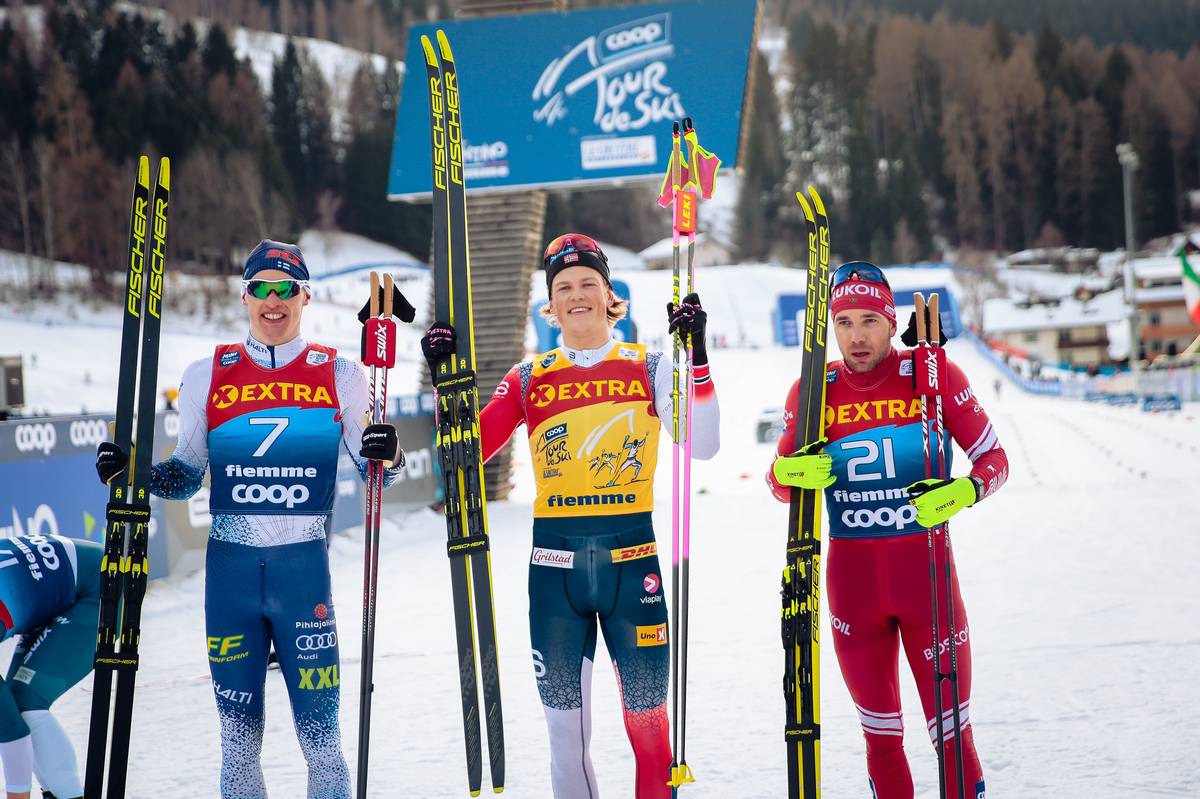
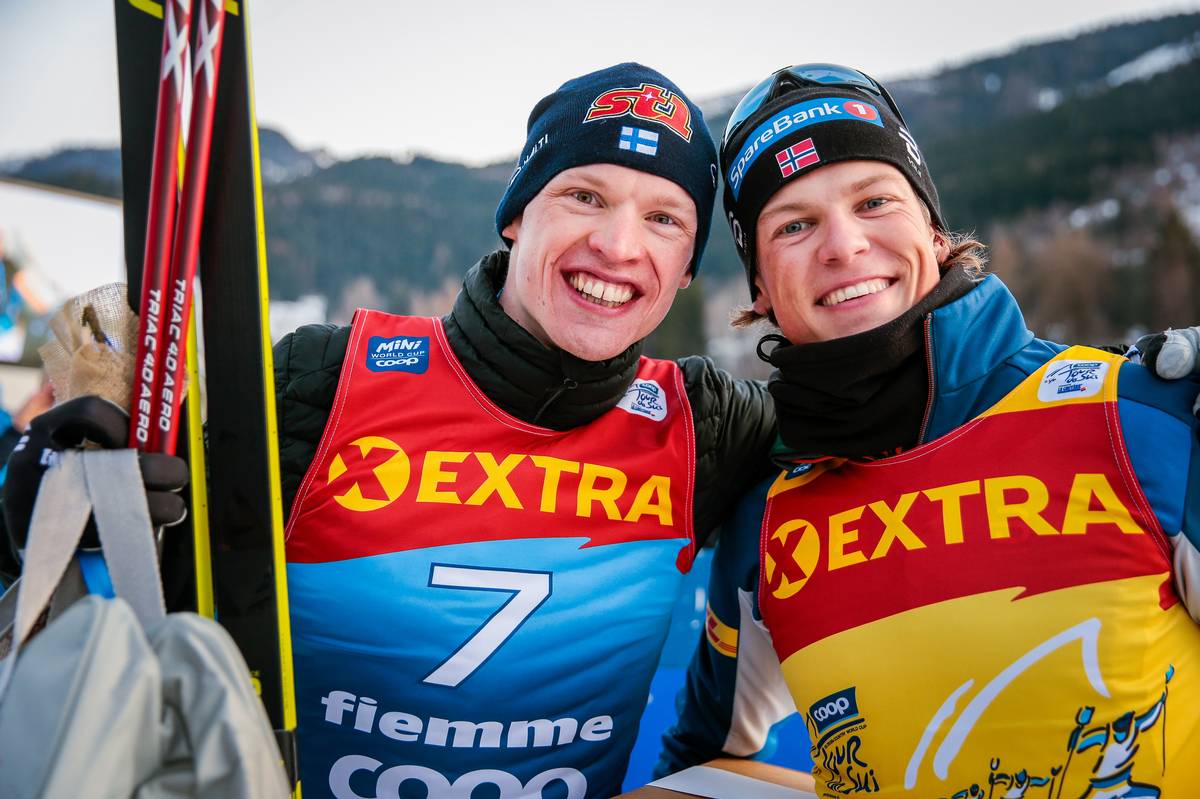
    The men’s podium after Stage 5 of the Tour de Ski: Johannes Høsflot Klæbo (NOR) took the win ahead of Iivo Niskanen (FIN) in second and Alexey Chervotkin (RUS) in third. (Photo: NordicFocus)

    The start format of the final hill climb has shifted from a pursuit start based on overall standings in the tour, indicating that the first to the top of the hill would be the winner, to a mass start where overall standings become more foggy. This may mean that Klæbo is steadily being passed through the climb tomorrow, often those more lithe than the muscular sprint champion, while an athlete like Bolshunov climbs with more real estate, and perhaps less demoralization, near the front.  

    In response to the format, Klæbo explained: “[It’s not my favorite for sure, but I want to push everything I can tomorrow, then we’ll just see how it goes, but looking forward to tomorrow’s race as well.”

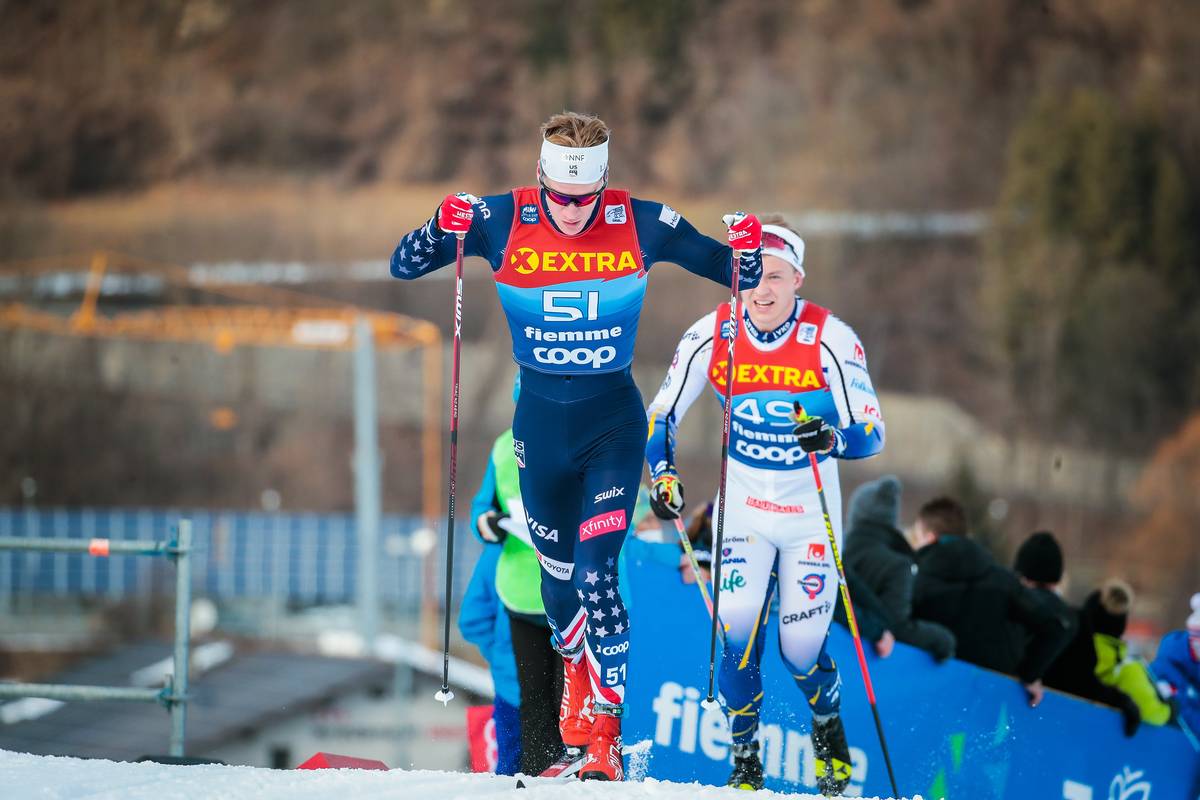
    Gus Schumacher races Stage 5 of the 2021/22 Tour de Ski in Val di Fiemme. (Photo: NordicFocus)

    It was a challenging day for the American men today, with only Gus Schumacher and Zak Ketterson remaining in the tour. Schumacher skied to 50th (+4:15.5) while Ketterson finished 59th (+5:42.9). Luke Jager and Ben Ogden, both sprint focused, pulled from the Tour after Stage 4. 

    “This is my first tour, and probably the first time I’ve done this many races in so few days,” Ketterson said after his race. “You kind of go into the race, just seeing what will happen. Today was pretty tough, of course, but I guess it’s just the nature of skiing that you have to just look toward the next stage. We have another race tomorrow and it’s a new chance. So, just have to have short term memory loss, I guess.”

    Zak Ketterson races Stage 5 of the 2021/22 Tour de Ski in Val di Fiemme, ITA. (Photo: NordicFocus)

    In terms of what he has learned over the last week in his first starts on the World Cup, Ketterson explained that this biggest adjustment has been to the level of racing and the density of world-class athletes.

    “The most interesting thing, if I have an off day in the US on the SuperTour, may I’ll be in the top 10, maybe top 20… but here, if you have a bad race, you get exposed. So it’s just seeing that you just have to stay super focused, because if you slip even a little bit here, you just lose so much.” 

    Full audio from post-race interview with Zak Ketterson, hosted by U.S. Ski & Snowboard cross country communications manager Tom Horrocks.

    Leaders of the day, Iivo Niskanen (FIN) and Johannes Høsflot Klæbo (NOR) set the pace in the 15-kilometer mass start classic in Val di Fiemme. (Photo: NordicFocus)

    Taking a last look at the overall standings before the final stage, Iivo Niskanen sits in third by time (+2:49) behind Klæbo and Bolshunov, with Norway’s Erik Valnes and Golberg in fourth (+3:04) and fifth (+3:09), respectively. Klæbo sits atop the points standings with 93, leading Valnes in second with 63, and Bolshunov in third with 42.

    Stage 5 Results

    Overall Tour Standings: Cumulative Time | Points

  • Niskanen for the Win in Ruka Distance Opener; Nordiq Canada’s Antoine Cyr 11th

    Niskanen for the Win in Ruka Distance Opener; Nordiq Canada’s Antoine Cyr 11th


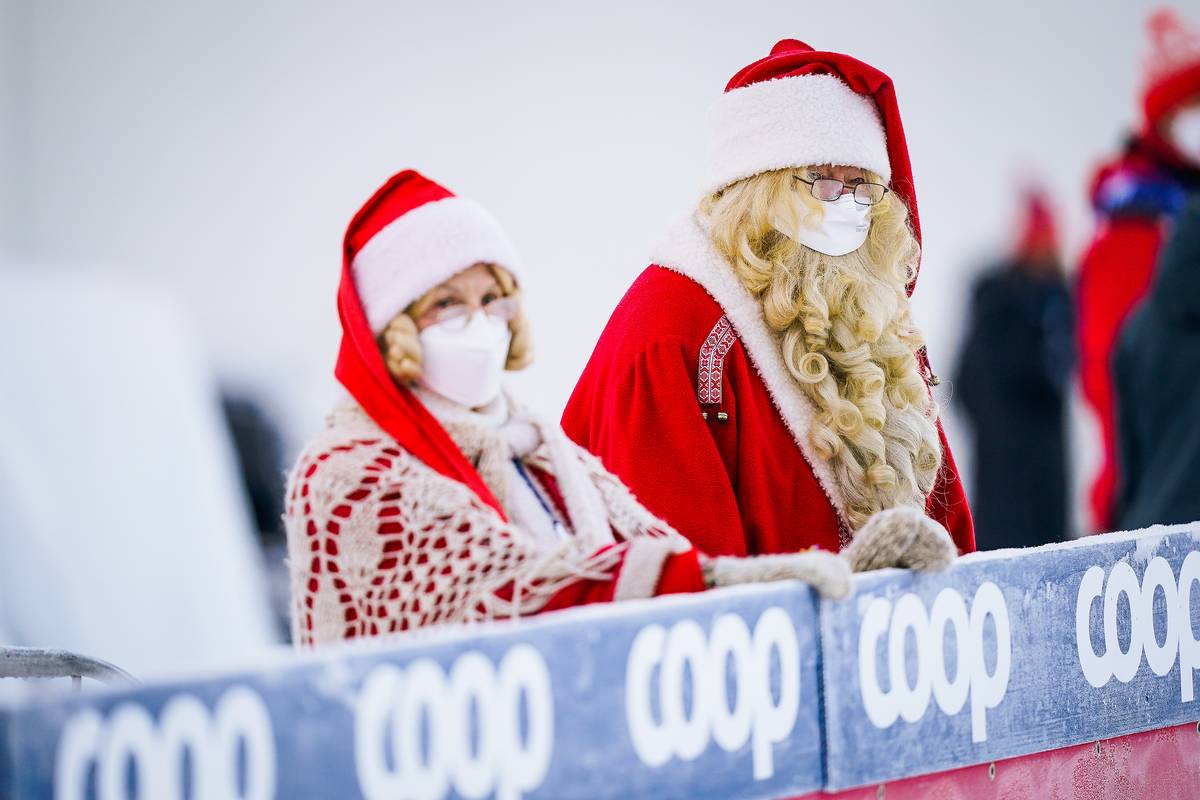
    Mr. and Mrs. Claus took a break from their Christmas preparations (less than one month to go!) to watch the classic distance race in Ruka. (Photo: NordicFocus)

    This World Cup coverage is made possible through the generous support of Marty and Kathy Hall and the A Hall Mark of Excellence Award. To learn more about A Hall Mark of Excellence Award or to learn how you can support FasterSkier’s coverage please contact info@fasterskier.com.

    By Ryan Sederquist

    If Friday’s sprint signaled a potential changing of the guard, with 22-year old Alexander Terentev displacing Johannes Høsflot Klæbo atop the podium, the men’s 15-kilometer interval start classic represented a return to normalcy. Racing in perhaps his best event, Finland’s Iivo Niskanen collected his fourth Ruka World Cup victory and sixth total World Cup win, skiing the fastest time in today’s stage of the Ruka Triple. 

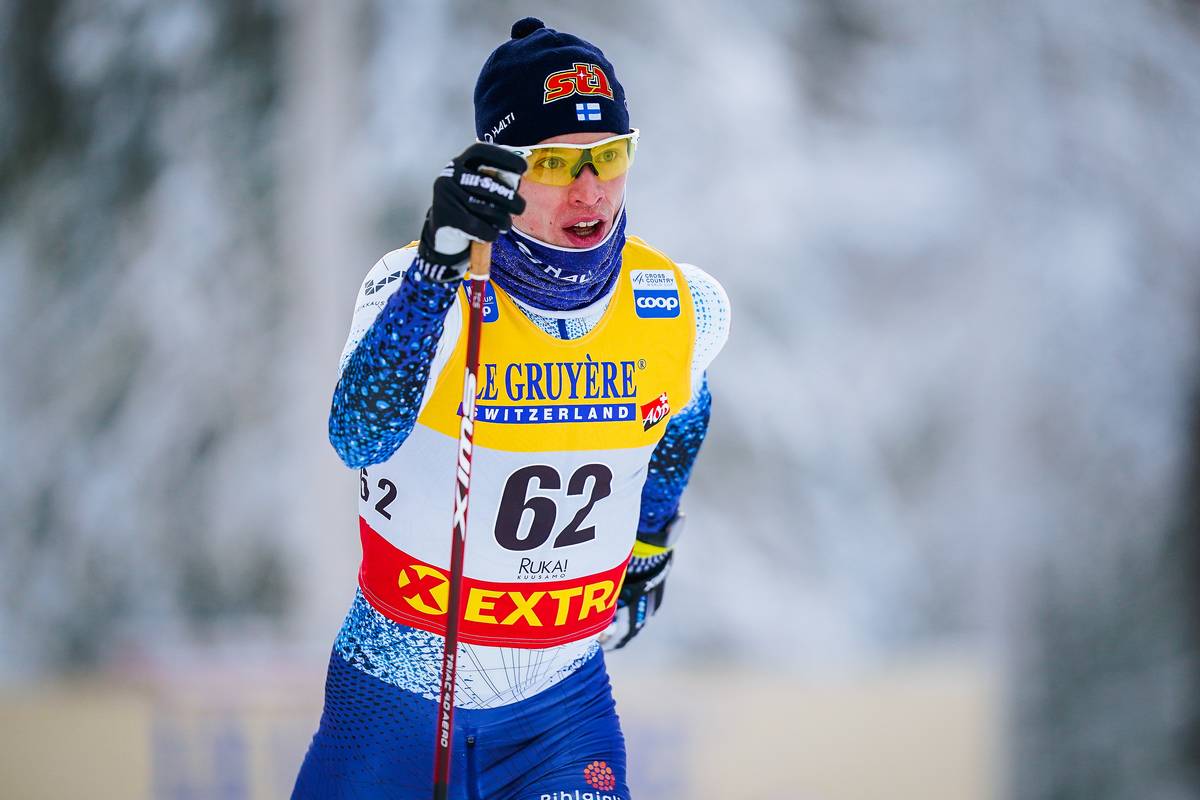
    In his signature event, Iivo Niskanen wins the 15k individual start classic race in Ruka. (Photo: NordicFocus)

    Of Niskanen’s five World Cup wins, four have come in Finland and all have been at the 15-kilometer distance. His time of 33:08.6 was 8.3 seconds ahead of second-place finisher Russia’s Alexey Chervotkin and 14.1 seconds ahead of Alexander Bolshunov, who took third. 

    As fans have grown accustomed, aside from Niskanen, the rest of the top ten was littered with only Norwegians and Russians. However, shortly thereafter, Canada’s Antoine Cyr finished in a notable 11th place, just in front of former World Champion Hans Christer Holund. 

    Racing under clear skies on cold, hard-packed conditions, the -17.0 Celsius (about 1.4 degrees Fahrenheit) temperatures seemed only to aid the gritty Niskanen as he attacked the three-loop course in his native country. Other than being .4 seconds back from France’s Richard Jouvre at the 1.1-kilometer checkpoint, Niskanen came through every split ahead of his competitors. 

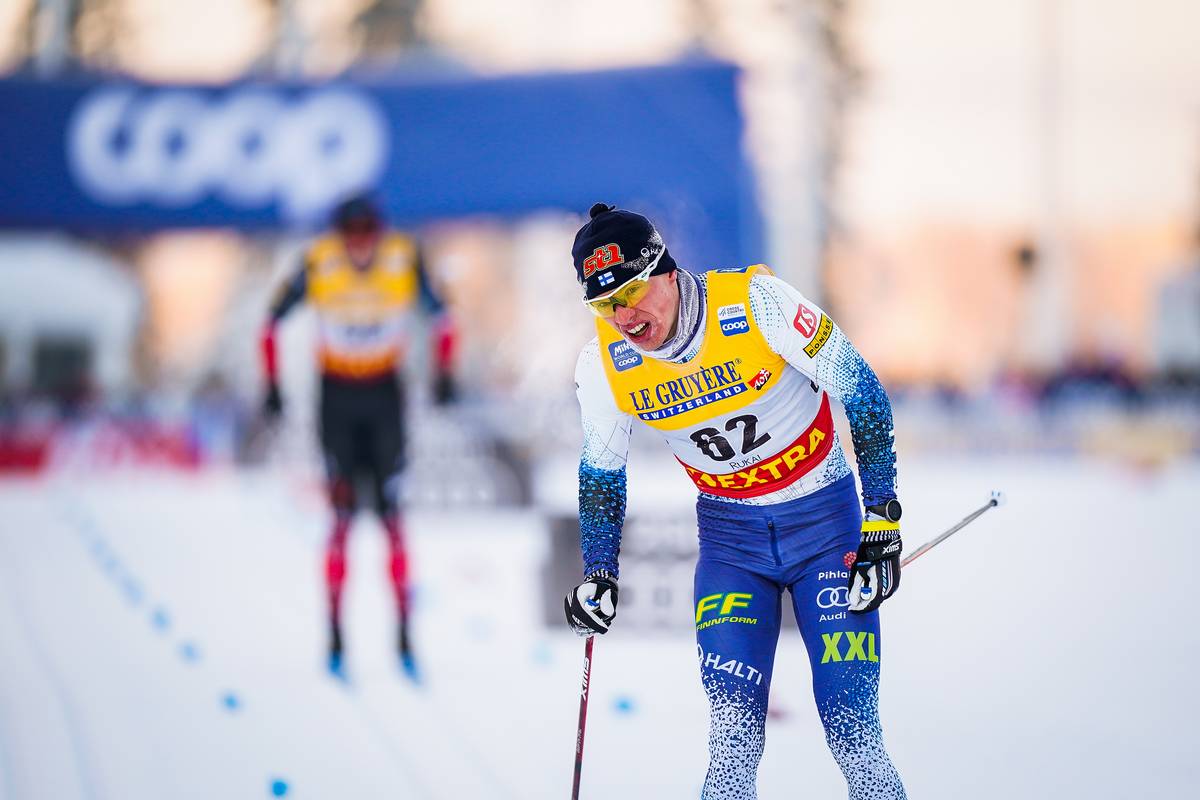
    Iivo Niskanen takes the win in the 15k individual start classic in Ruka. (Photo: NordicFocus)

    “It can’t get any better. This is a great feeling,” Niskanen told FIS reporters after the race. “Beautiful day, really nice conditions even though it’s quite cold,” he said, visibly struggling to get his speaking muscles to cooperate in the frosty air. 

    “I’m very happy about this kind of start of the season. Service team did everything great. Great speed, great kick, perfect start.”

    The men’s podium after the 15k classic in Ruka. Finland’s Iivo Niskanen took the win ahead of Russians Alexey Chervotkin (left) and Alexander Bolshunov (right). (Photo: NordicFocus)

    While Niskanen’s and Chervotkin’s split positions never wavered, the battle for the third podium spot seemed up for grabs until late. Bolshunov, who has won the distance World Cup in each of the last three seasons, came through the 8.1-kilometer checkpoint in second place. At 10-kilometers, he had slid to fifth, falling behind teammate Sergey Ustiugov and Norwegian Erik Valnes. While that triplet was separated by just a few tenths of a second, Emil Iversen, the only male skier to have won at least one World Cup distance event in each of the past six seasons, and Ivan Yakimushkin loomed within striking distance, sitting just 4.4 seconds back from Bulshonov.

    Alexander Bolshunov skis to third in the 15k individual start classic in Ruka. (Photo: NordicFocus)
    Alexander Bolshunov finishes third in the 15k classic in Ruka. (Photo: NordidFocus)

    The 23-time World Cup winner showed that his recent dental woes might be behind him, as he threw down the fastest sector split from 11.1 to 13.1-kilometers and firmly secured his podium position. The Russian came into the race having won each of the last five World Cup distance events in the classic style, which was a men’s all-time record.

    Klæbo, who won the distance opener in Ruka in both 2017 and 2020, was 41.7 seconds back in 9th. With his combined results from the first two stages, he currently holds the overall World Cup leader bib.

    After taking second place in the classic sprint and ninth in the 15k classic distance race, Johannes Høsflot Klæbo leads the overall World Cup standings. (Photo: NordicFocus)

    In 32nd place, Gus Schumacher (+1:42.0) was the top American finisher, sandwiched between Great Britain’s Andrew Young and Andrew Musgrave. Schumacher was just 1.1 seconds out of a scoring top-30 position, which was occupied by Canada’s Olivier Leveille. 

    “Gus was quite happy, quite content with his race,” said head coach Matt Whitcomb. “A long ways ahead of where he was last year on this day.”

    Gus Schumacher was the top-American in the 15k classic in Ruka, finishing just outside the points in 32nd. (Photo: NordicFocus)

    Whitcomb said the focus going into Ruka was more on process-based results, and he is pleased with Schumacher’s current status in terms of general fitness and racing.  

    “I think [Gus is]  just encouraged to know that he’s where he should be right now, and is excited about tomorrow.”

    The neighbors to the north had a fine showing, led by Cyr in 11th (+52.3), Russell Kennedy in 27th (+1:34.8), and Leveille in 30th (+1:40.9). 

    Nordiq Canada’s Russell Kennedy skis to 27th in the men’s individual start classic in Ruka. (Photo: NordicFocus)

    “Today was a great day for the team. We all have had a good training season and it’s sweet to build this confidence early in the season and know you have done the right things,” Kennedy wrote in a post-race email.

    The 30-year old Russell Kennedy has been encouraged by his early season results.

    “It’s always hard with these early season races because you don’t have the confidence in your fitness yet. So it helped me to know I had raced fast earlier this season in Muonio,” he said, noting that he felt lacking in fitness during the second lap but was able to recover for a strong final loop.

    “Our techs gave us really good skis and I was able to use them well. Very excited for the day and stoked for tomorrow!”

    Canada’s Antoine Cyr skied to a career best 11th place (+52.3) in the 15k classic in Ruka. (Photo: NordicFocus)

    Antoine Cyr’s previous best came last year in a 15-kilometer classic in Engadin, when he placed 21st. The 23-year-old hails from Gatineau, QC, home to an extensive cross-country trail system where Cyr grew up skiing. 

    “I felt really good today,” Cyr wrote in a post-race email. “It was good course for me with lots of long uphill and cold weather is good for us Canadians. We are use to racing in the cold and I don’t mind it. I am really stoked and surprised about this result. It is the work of all my team, staff, tech and coach that is reflecting. I feel confident for the rest of the season and I am excited to race the rest of period 1 on the World Cup. There will be plenty of good opportunity to come and I am looking forward to it.”

    Whitcomb was thrilled to see the North American comrades race well, too.

    “They’re sort of our second family over here a little bit,” he said, elated by the opportunity to speak to Canada’s successes. “So exciting to see three men in the top 30. Antoine Cyr — just a huge race — so fun to watch. To hear the noise coming out of the Canadian truck after the race is super cool. Very happy for our northern neighbors.”  

    In his World Cup season opener, David Norris skis to 51st in Ruka. (Photo: NordicFocus)

    David Norris was the second American, placing 51st (+2:20.8). Zanden McMullen was the 8th U23 athlete to come through, placing 55th overall (+2:29.7). Luke Jager, who earned 13 points on Friday from his 18th place finish in the sprint, finished in 60th (+2:42.4), two places ahead of teammate Ben Ogden in 62nd (+2:46.6). Hunter Wonders rounded out the American contingent in 67th (+2:53.4). 

    Whitcomb said the sentiment for many of the men’s team members was that they were “going as hard as they could, but couldn’t go as hard as they needed to.”

    “That’s fairly typical this time of year and sometimes also on really cold days,” he said. “We just need some hard efforts. It’s starting to feel normal but we’re just not there yet.”

    Hunter Wonders on course in the 15k individual start classic in Ruka. (Photo: NordicFocus)

     Still, he and the rest of the team are optimistic about the opportunity presented by tomorrow’s pursuit skate.

    “We have a lot of people looking for more.”

    Full audio from post-race conversation on both the men’s and women’s performance in Ruka.


    Men’s Final Results

  • Heavy Snow and a Heavy Klæbo Hop-Skate: Norway Beats Russia for Men’s Relay Win

    Heavy Snow and a Heavy Klæbo Hop-Skate: Norway Beats Russia for Men’s Relay Win

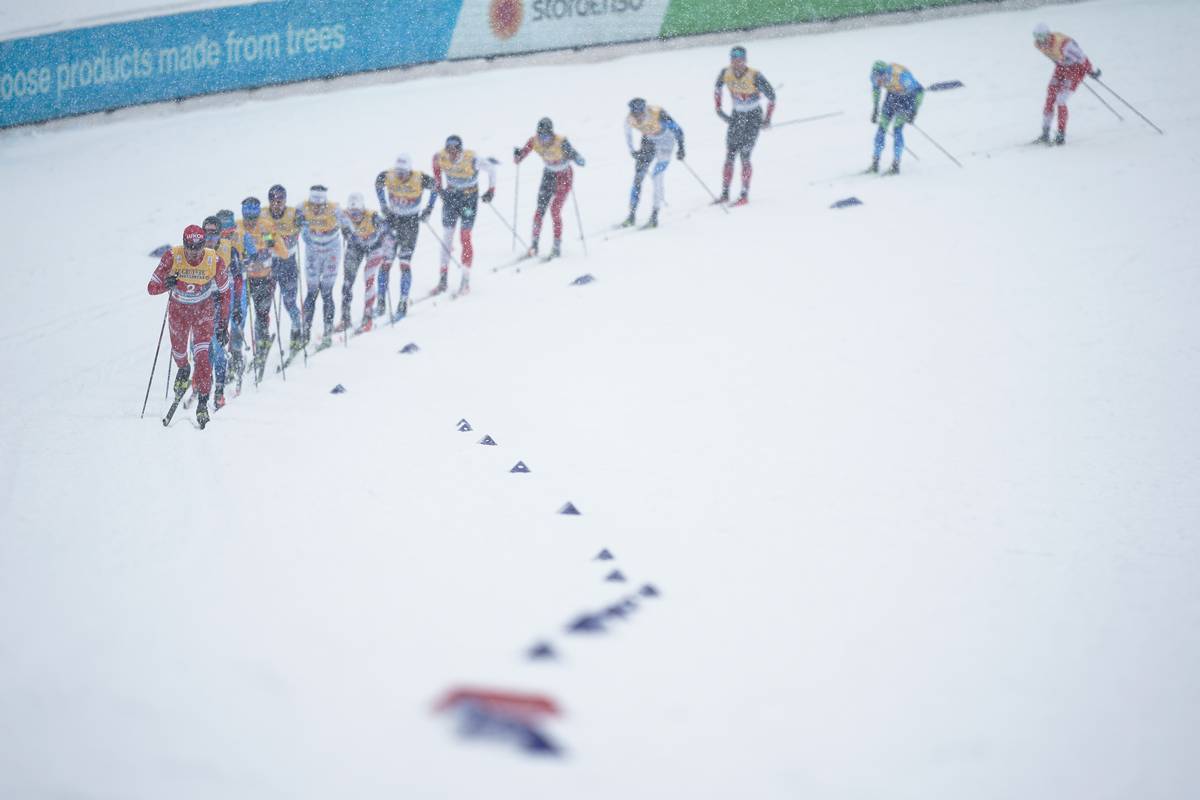
    A train, led by Alexey Chervotkin (RSF), winding through the snow. (Photo: NordicFocus)

    This World Championship coverage is made possible through the generous support of Marty and Kathy Hall and their A Hall Mark of Excellence Award. To learn more about A Hall Mark of Excellence Award or to learn how you can support FasterSkier’s coverage please contact info@fasterskier.com. 

    After the tropical conditions of the past week, the men were greeted with heavy snowfall for Friday’s championship 4 x 10 k relay competition in Oberstdorf. Temperatures hovered around freezing and the snow fell thick and fast as the scramblers lined up at the start. Eighteen nations were represented at the start line with thirteen completing the whole race. 

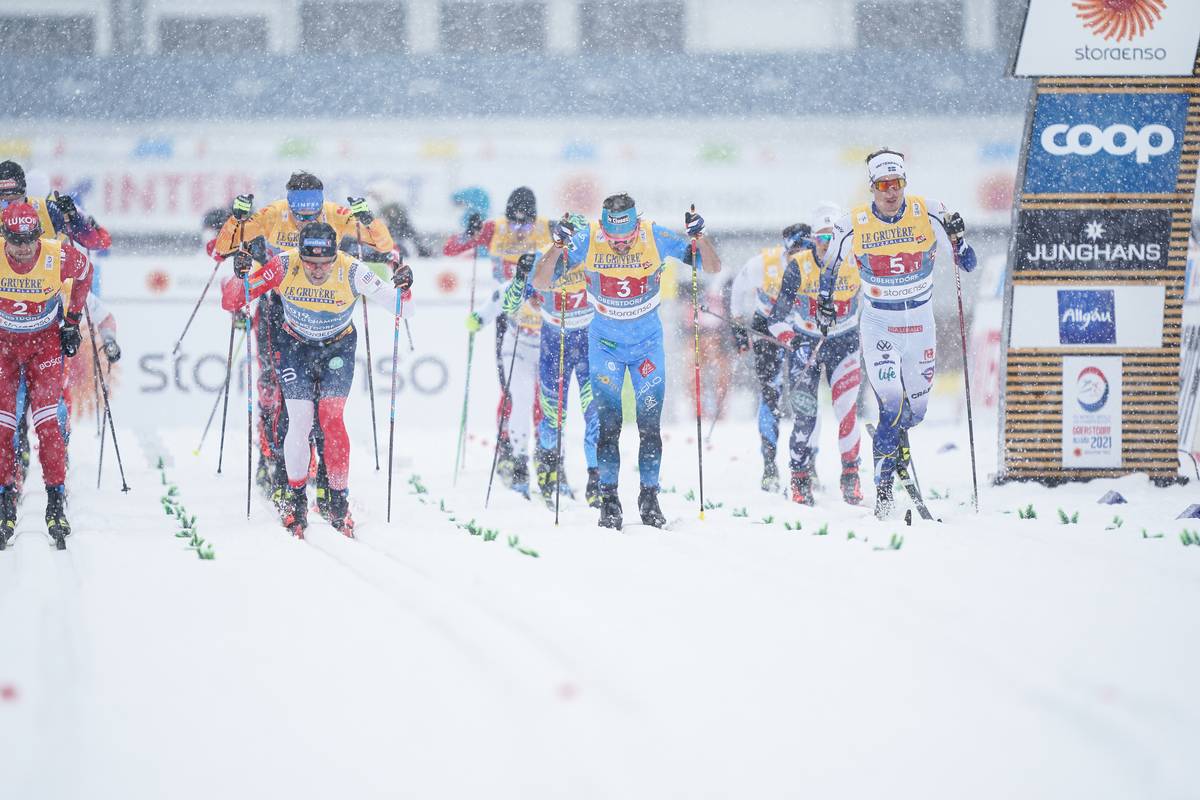
    The start to a snowy 4 x 10 k relay at the 2021 World Championships. (Photo: NordicFocus)

    On paper Norway was the team to beat out on the track. Of the last 15 men’s relay titles at a World Championship, Norway has won all but one. The last time Norway failed to win the men’s relay was in 1999 when team Austria finished 0.2 seconds ahead of Norway. And in the end on Friday after striding and skating through fresh snow for 40 k, it was once again team Norway that crossed the line in first, but what a race it was to get them there. 

    Johannes Hoesflot Klaebo (NOR), Hans Christer Holund (NOR), Emil Iversen (NOR), Paal Golberg (NOR), (l-r) 2021 Relay World Champions. (Photo: NordicFocus)

    The team most likely to challenge Norway was Russia, or the Russian Ski Federation as they are represented at these championships. The bar was set from the beginning. Despite conditions not favoring an early breakaway, Alexey Chervotkin (RSF) made a move just 1.4 k off the start, putting distance between himself and the pack.

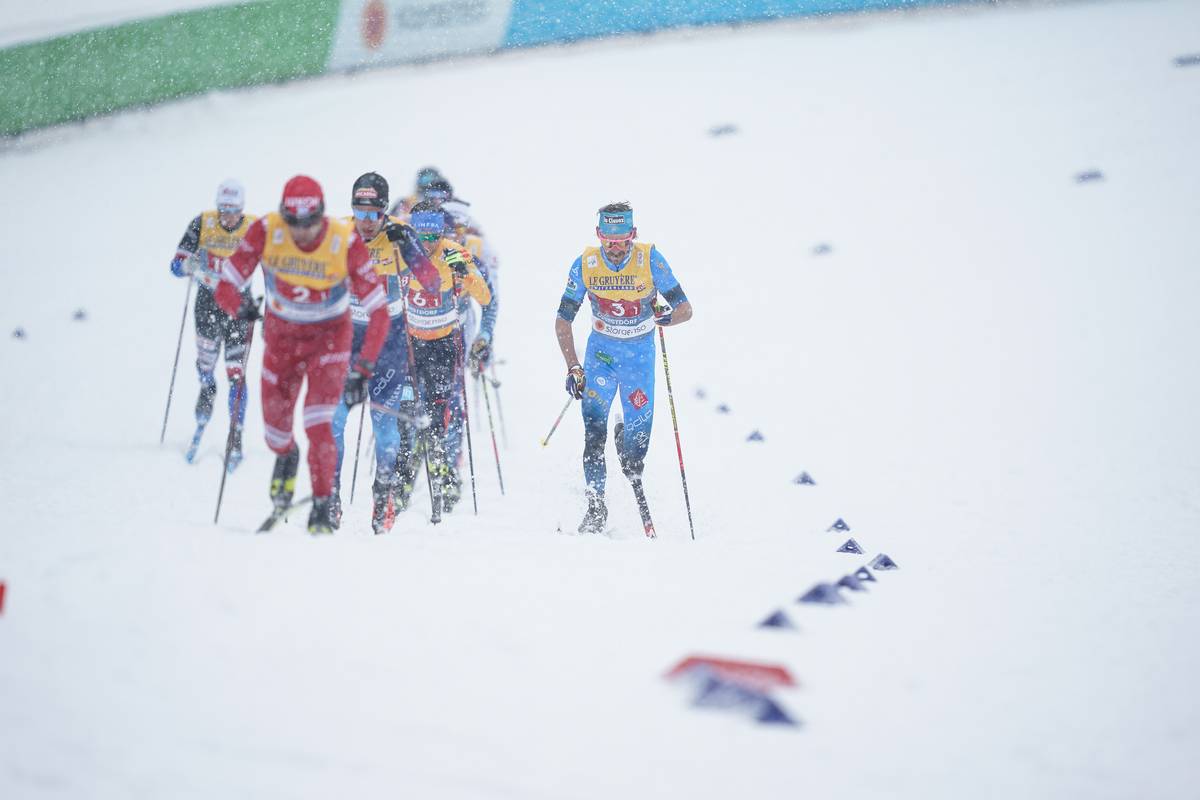
    Hugo Lapalus (FRA), out of the tracks, while Alexey Chervotkin drives the bus. on the scramble leg. (Photo: NordicFocus)
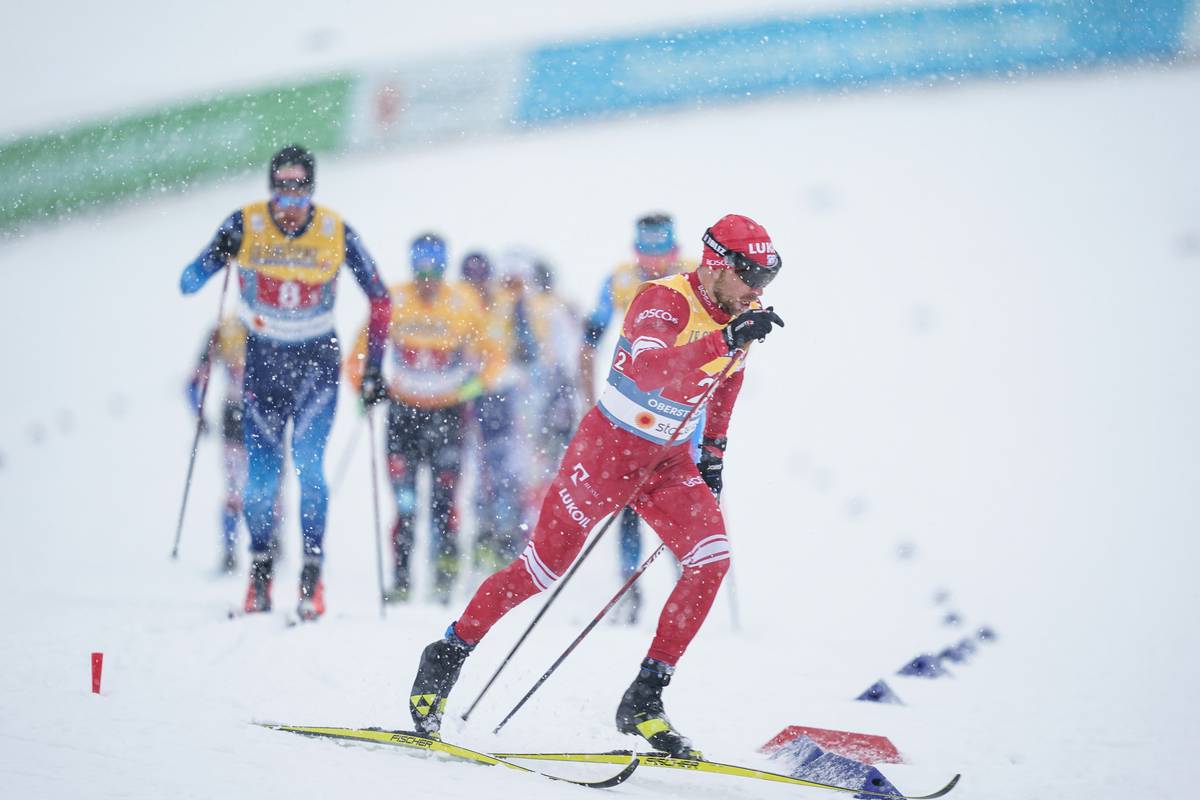
    Making a move that stuck on the first keg: Russia’s Alexey Chervotkin pushed over the top. (Photo: NordicFocus)

    At 4.7 k, Chervotkin had stretched his lead to +14.1 seconds and the group seemed largely unprepared to mount an organized counterattack. Perhaps expecting the Russian to fade or simply unable to respond, Norway’s Pål Goldberg remained tucked in the rear of the pack. At 6.6 k the margin was +33.6 to Russia. Save for Chervotkin’s effort out front, the pace remained World Cup-pedestrian. At one point, the skiers nearly halting completely at the crest of the sprint hill, playing chicken for who would descend first. Through 8 k the gap to Russia was nearly one minute.

    No man’s land, atop the climb, Michal Novak (CZE), Beda Klee (SUI), Hugo Lapalus (FRA), (l-r) bring the pace to a walk as no team wants to chase Russia down. (Photo: NoricFocus)

    Entering the first exchange the chase pack had split in two, with France leading and Norway off the back in 10th position. In a post-race interview Golberg said of his race, “it was a bit of a tough start. I chose a different choice [of ski] from the seventeen other skiers so that was really stupid but fortunately I have three skiers on my team that are better than everyone else here today so I’m really happy for them.” One of those skiers was Emil Iversen who took over for Norway on the second leg. His work linked Norway up with the rest of the chase pack, now being led by Iivo Niskanen of Finland. Ivan Yakimushkin had taken control for RSF, but already, with the hot pace set by Niskanen, the gap was down to +30.4 seconds to Norway. 


    Ivan Yakimushkin, Russia’s second leg skier, sensing the group led by Iivo Niskanen closing in on the second leg. (Photo: NordicFocus)

    At 13.3 k Niskanen, Iversen, and Dario Cologna of Switzerland were closing in on Yakimushkin. After 40 minutes on the clock they had overtaken the Russian. The pack now comprised six nations (France and Sweden also in contention), with team Canada drifting around eight seconds behind. Again on lap two through the stadium the pace slowed to a halt before the descent, unrelenting snow adding an extra challenge to the lead. 

    At the base of the Burgstall climb on his final lap, Iversen (NOR) made his move, directly shadowed by Niskanen (FIN). To the soundtrack of much excited shouting from the coaches, the pair closed in on the exchange zone, with Russia now off the back. 

    Iivo Niskanen of Finland doing the work to reel in Russia on the second leg of the 4 x 10 relay. (Photo: NordicFocus)

    Wednesday’s 15 k skate champion, Hans Christer Holund, contended the first skate leg for Norway. His lead over Russia being +23.6 seconds at the tag zone. Followed by Perttu Hyvarinen, Finland’s third leg, Holund broke trail out front through deep snow as behind him, Artem Maltsev for RSF turned on the burners, starting to forge the gap. At 23.3 k there was just six seconds between them and the Finn was fading fast. At 24.7 k Holund was alone out front, +12.1 ahead of RSF and Finland now in third. As the athletes battled through their last loop, the wheels seemed to come off for Maltsev (RSF) and Clement Parisse of France and Jens Burman of Sweden moved to the fore. 

    Norwegian work horse on the third leg: Hans Christer Holund. (Photo: NordicFocus)

    Into the final exchange Holund handed team anchor Johannes Høsflot Klæbo a +25.5 second lead over France and Sweden (virtually neck and neck), and a +35 second lead to Russia, for whom Alexander Bolshunov would be taking anchor. 

    Johannes Hoesflot Klæbo (NOR) biding his time for the final show-down. (Photo: NordicFocus)

    With Klæbo (NOR) out on his own in deep snow, Bolshunov was on the hunt. The ten second lead over Russia held by Sweden and France was immediately absorbed and once again there was a pack of five teams in contention behind Norway. At 31.4 k Bolshunov had only gained 0.5 seconds on Klæbo but that was soon to change. By 33.3 k he had broken away from the chase pack and was +15.8 behind. Each of the two athletes played to their respective strengths, Klæbo cruising easily while he waited for his ride to catch up and Bolshunov grinding away with metronomic consistency.

    Locked in for battle, Norway versus Russia to conclude the Men’s 4×10 k championship relay. (Photo: NordicFocus)

    By 34.7 k the duel was on – the world’s best playing hot and cold as they ticked away the kilometers toward the finish line. With Norway absent for much of the Wold Cup season, these two rivals have not had many head-to-head opportunities this year up until this moment. For his part, Bolshunov never moved to pull away from Klæbo who boasts a peerless finishing kick. Once atop the course’s final major run up the Burgstall climb, when Bolshunov had gained no ground, this chess march was all but done. 

    Klaebo (NOR) not giving an inch to Bolshunov (RSF). (Photo: NordicFocus)

    Entering the corner into the final sprint hill before the finish there was virtually no gap between the two skiers, though in reality the game had tipped in Norway’s favor. While Bolshunov may dominate the distance races, Klæbo remains king of the sprint and once he made his up-skate move, there was nothing the Russian could do. The decisive moment came half way up the hill as Klæbo catapulted himself away with an unmatched turn of pace, setting up for an easy cruise down the finish straight, sealing the deal on gold for Norway once again in a time of 1:52:39. Twelve seconds later, Bolshunov crossed the line, meaning silver for RSF. 

    The deal has been sealed, Johannes Hoesflot Klæbo (NOR) celebrates victory as a defeated Bolshunov (RSF) gives up before the line. (Photo: NordicFocus)

    Rewind a bit and the fight for bronze was unfolding on the Burgstall climb as Jules Lapierre of France made a break, gaining ten seconds of advantage over Sweden, Finland and Switzerland.

    Jules Lapierre (FRA) gets a boost after bringing home bronze for France. (Photo: NordicFocus)

    Though that advantage shrunk on the descent, it remained enough to give France third place, finishing + 1:12.6 behind Norway and four seconds ahead of Sweden in fourth. 

    No shortage of enthusiasm from team France after their third place finish. (Photo: NordicFocus)

    For team USA, David Norris raced the scramble, handing over to Scott Patterson in 11th position at the first exchange. 

    Scott Patterson for the U.S. settles into a pacing groove on the second leg of the 4 x 10 k relay. (Photo: NordicFocus)

    Patterson remained steady through his laps and tagged Simi Hamilton, still in 11th. Over the course of his 10 k, Hamilton gained one position and tagged Gus Schumacher in 10th place.

    “It was awesome,” Hamilton said of the racing and wild Oberstdorf weather. “It was, I mean a pretty crazy, bizarre, different weird day with the conditions. You know like, you never really know what to expect when you wake up and its basically 32 and dumping all day. It’s going to make for a pretty different race but I’m super proud of our team.

    “I think we put together just four really good consistent legs. Our skis were awesome, my boards were running really really well. The climb was tough for me, as kind of a “sprinter” when you mix in a four-minute climb its always tough for me but thankfully I was able to kind of rely on some good glide to recover from the top down to the stadium each time so that was great. But yeah, these boys are… it was maybe the most fun relay I’ve ever skied on, on the World Cup or World Championship just because, I don’t know we had a really good energy going today. We all came out and fought hard and I think this is the type of energy that you know eventually will land us on the podium. I won’t be on that team, but it’s cool to be a part of it. I’m stoked, it was a great way to end the championships for me and it was a fun day.”

    Simi Hamilton, leg three skier for the U.S. (Photo: NordicFocus)

    Schumacher and Friedrich Moch of Germany battled it out, the advantage ultimately going to Germany who finished in 7th, Schumacher crossing the line 8th for the United States. 

    Graham Ritchie (CAN) keeping Canada’s team in contact during the scramble leg. (Photo: NordicFocus)

    Team Canada, who posted a strong start by Graham Ritchie, ended the day in 10th place. Skiing leg two for Canada was Antoine Cyr, followed by Russell Kennedy with youngster Remi Drolet holding the anchor position. 

    In a snow globe, Russell Kennedy of Canada during leg three of the 4 x 10 k relay. (Photo: NordicFocus)

    This year’s World Championships conclude for the men on Sunday with a 50 k classic mass start event. 

    Results: Men’s 4×10 k Relay

  • Bolshunov and Russia Sweep, Schumacher in 14th: Stage 4 of the Tour de Ski

    Bolshunov and Russia Sweep, Schumacher in 14th: Stage 4 of the Tour de Ski

    Lights out. Alexander Bolshunov takes the Stage 4 15-kilometer individual start freestyle by eight seconds. (Photo: NordicFocus)

    This World Cup coverage is made possible through the generous support of Marty and Kathy Hall and their A Hall Mark of Excellence Award. To learn more about A Hall Mark of Excellence Award or to learn how you can support FasterSkier’s coverage please contact info@fasterskier.com.

    Stage 4 of the Tour de Ski introduced a change of scenery on Tuesday with the flanks of the Dolomites sinking from sky to valley floor in Tobalch, Italy. The day’s 15 k skate pursuit brings the Tour’s traveling circus to a new locale, however, the narrative remains the same: Russia’s Alexander Bolshunov, last season’s overall World Cup winner, has gripped the TdS lead after winning Stages 2 and 3.

    Barring the unforeseen, and citing Bolshunov’s runaway performance in Sunday’s 15k skate pursuit, which he won by a margin of 53.7 seconds over his teammate Artem Maltsev, and with four stages remaining, this TdS appears to be locked up for the twenty-four-year-old Bolshunov. If Bolshunov slam-dunks the remainder of the Tour, he’ll have won back-to-back Tours – the first male skier to do so since Swiss star Dario Cologna won in 2010/2011 and 2011/2012.

    Bolshunov began as the last of 63 starters. As such, he had the gift of knowing the fastest splits at every time check allowing him to notch the pace up, throttle down to conserve energy, or simply sustain an unmatchable combo of power and cardio endurance.

    At 5k, 10k, and the finish, Bolshunov was true to form as the leader. He won in 32:49.6 minutes to capture his third stage win of this Tour and take a 1:15 minute lead into Stage 5, a 15 k classic pursuit.

    “It was a tough race without much help. I had to just listen to splits. I am happy with the result and thanks to the service for good skis.” Bolshunov said post-race through a translator.

    Denis Spitsov (RUS) powers through the 15-kilometer individual start freestyle to take 2nd in Stage 4 of the 2021 Tour de Ski. (Photo: NordicFocus)

    As Devon Kershaw noted through a text mid-race, “It’s the Russian championship out there.”

    Officially, not exactly, but the results illustrate the dominance. Denis Spitsov second (+8.3), Ivan Yakimushkin third (+13.9), Alexey Chervotkin fourth (+19.2), Artem Maltsev fifth (+21.8), Maurice Manificat of France sixth (+22.9), Evgeniy Belov seventh (+27.6), and Andrey Melnichenko eighth (+29.2).

    In other words, seven of the top eight finishers on the day were Russian. Top-heavy and deep. The only Russian outside the top-10 was Alexander Terentev in 15th (+52.5).

    The top three men celebrate their performance after Stage 4 of the 2021 Tour de Ski. Russians Alexander Bolshunov, Denis Spitsov (left), and Ivan Yakimushkin (right) clocked the top three fastest times, respectively. (Photo: NordicFocus)

    One spot ahead of Terentev, at 51.3 seconds back was twenty-year-old Gus Schumacher for the U.S. Starting in Bib 17, the Anchorage, Alaska based skier posted a career-best World Cup result in 14th. Before Tuesday’s race, Schumacher possessed two World Cup top-30s: a 25th in the Davos skate sprint, and the 24th best time of day in the Ruka 15 k skate pursuit. Both races were this season. According to FIS, he has contested 13 World Cup events, including today’s race.

    “In many ways, and it is a bold statement, but in many ways, it is up for consideration for the race of the day,” said U.S. Head Coach Matt Whitcomb. “When an athlete new to the World Cup gets his first t0p-15 that is a really special moment and to do it somewhat early in the Tour, when there are still 63 men starting is just super impressive.”

    Post-race comments from U.S. Head Coach Matt Whitcomb.

    Gus Schumacher skis to a World Cup career-best 14th in Stage 4 of the 2021 Tour de Ski, a 15-kilometer individual start freestyle. (Photo: NordicFocus)

    Starting in bib 17, Schumacher notched the 16th fastest split at 5k.

    “It was definitely kind of a similar approach as always that I have,” said Schumacher about his first 5 k. “I try to focus on the first five to eight minutes being easier than I think it should be. I think my best races come when I feel like I did that. But, my split was still good. So today, I think I got to that first time where I got a split, and there were only 17 people through, they said I was tied for first and I was still feeling pretty comfortable. … When you hear the good split and you also feel good after six minutes, that was when I think I was like, ‘I can do something with this.’”

    On his second go-around, at 10 k, he was positioned further back on the leaderboard at 26th, 56.1 seconds off of Bolshunov’s mark, and 13 seconds off the pace of Swiss skier Dario Cologna, who skied through in 15th (+43.0).

    Eventually, Schumacher locked onto a ride with the 39th starter, Spitsov. Although eventually placing second overall, Spitsov was eighth after 10k. According to Schumacher, the Russian caught Schumacher atop the course before a working descent.

    “I saw [Spitsov] on a 180 corner, and I knew who it was and I was pretty excited, I was like, ‘this is going to be a good ride’. He caught us, I was in a little group, and he caught us right before the downhill, and I just hopped in behind him.

    “It was kind of funny because that downhill felt really easy behind him when I am sure it was about as fast as before just working it, but I was able to not work it that hard. Going into the third lap, [Spitsov] notched it up a lot actually. That little rest was good so I could hang through the third lap.”

    Post-race comments from Gus Schumacher.

    Spitsov gained roughly 10 seconds on Bolshunov on his third lap. For his part, Schumacher gained too. At 12.1 k he was 18th overall, 17th at 13 k, and ultimately sliding across the line 14th. For the overall Tour, Schumacher is 25th (+4:55).

    Placing the race in context for his U23 cohort, which is small on the World Cup, of the seven U23 athletes Schumacher was second fastest. Terentev, the Russian in 15th, is also a U23 and anchored the Russian junior team at the 2018 and 2019 Junior World’s Relay. Both races were won by the Schumacher anchored U.S. team.

    Scott Patterson on his way to a 32nd place finish in Stage 4 of the 2021 Tour de Ski. (Photo: NordicFocus)
    Kevin Bolger on course during Stage 4 of the 2021 Tour de Ski. (Photo: NordicFocus)

    Also for the U.S., Scott Patterson was just outside the points in 32nd (+1:38.1), and Kevin Bolger placed 40th (+1:57.1). Simi Hamilton did not start. 

    Racing continues tomorrow with Stage 5 of the Tour de Ski, a 15 k classic pursuit.

    Stage 4 Results | Overall 


  • Bolshunov wins 15 k in Falun and the Distance Cup; Harvey 11th, David Norris 16th

    Bolshunov wins 15 k in Falun and the Distance Cup; Harvey 11th, David Norris 16th

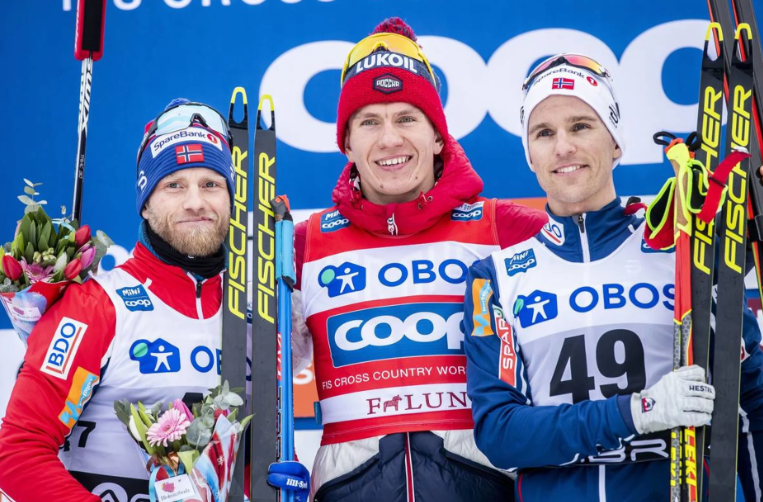
    The men’s podium from the Falun, Sweden 15 k skate. From left to right, Norway’s Martin Johnsrud Sundby in Second, Alexander Bolshunov of Russia first, and Didrik Tønseth of Norway third. (Photo: fis-ski.com screenshot)

    Sunday’s men’s 15-kilometer freestyle individual start race in Falun, Sweden, was the final European stop for the World Cup. With the race concluded, athletes will pack up ski bags, moth-ball the wax buses, and jet across the Atlantic. Next week athletes will race amidst the crowds and city-scape of Québec.

    The final Euro-leg of the World Cup saw Alexander Bolshunov of Russia win his third individual race in a row. His top-step effort was his fifth win of the season. Norway took the next three spots with Martin Johnsrud Sundby in second, Didrik Tønseth in third and Sjur Røthe in fourth.

    During the first 5k of the race Bolshunov moved up through a tight pack clustered near the top of the time splits.

    After his first 5k lap, Bolshunov held a 4.4 second margin over Russia’s Alexey Chervotkin at 5k. Sundby kept it real for Bolshunov coming through at 5.6 seconds back. With the relative luxury of a late bib start, Bolshunov wore bib 69, Sundby 47, the Russian could push towards the redline of effort knowing precisely where he stood against Sundby.  

    At the 10 k mark Sundby was a an eyeblink back amounting to 0.4 seconds behind Bolshunov. In other words, Bolshunov understood his race lead margin was thin. With 2 k remaining, Bolshunov had a pad of 3.1 seconds. That buffer would have been enough as Bolshunov finished today’s race in a time of 33:18.6. Sundby placed second, 8.9 seconds back.

    Along with the day’s top prize, Bolshunov seized for good the overall distance crystal globe. The twenty-two-year-old Russian began the distance crystal globe campaign with the first race of the season, a 15 k classic win in Ruka, Finland. Along the way, Bolshunov collected seven distance podiums, including Sunday’s win. His streak of three successive World Cup distance wins includes a 15 k classic in Cogne, Italy prior to World Championships. He then followed that with a win in the Holmenkollen 50 k classic.

    skelaxin

    Canadian skier Alex Harvey was the first North American to cross the line finishing 11th overall. During the second half of the race, Harvey skied from 21st to 11th, he finished +1:10.9 behind Bolshunov.

    David Norris (APU) of the U.S. was the top American finisher. In Falun, he finished 16th for a career best individual World Cup result. The success curve of late for Norris has been remarkable. The twenty-eight-year-old Anchorage based athlete has been a highlight for U.S. men’s distance skiing.

    The man has a motor. Ask the field contesting the Mt. Marathon race in Seward, Alaska. He’s a multi-time winner. The motor has now been fine tuned to excel in wintertime Europe. He placed 20th in the 2019 World Championship 50 k mass start skate. He proved that mark was no aberration with a 24th in the Holmenkollen 50 k mass start classic. And then Sunday was a bump in the standings for that 16th place.

    “I am certainly more confident this spring than I was during Period 1 of World Cup,” Norris emailed when asked if he was carrying more confidence since his Seefeld result. “This higher confidence allowed me to improve my pacing today; I was more relaxed going into it and able to ski my own race.”

    According to Norris, he’s more likely to push on the climbs and recover on more variable terrain. He attributes some of his success to making subtle pacing changes.

    “My usual tendency is to focus on the climbs,” Norris wrote. “I have been working on relaxing a bit on the climbs so that I can focus more on pushing the gradual terrain. I know I can climb well, but if I emphasize that too much I tend to lose time over the rest of the course.

    “The new snow today packed down well for the men’s race. I like how the course flowed; I felt strong on the long climb and had a game plan to really target the flats after the climb and the flats leaving the stadium.”

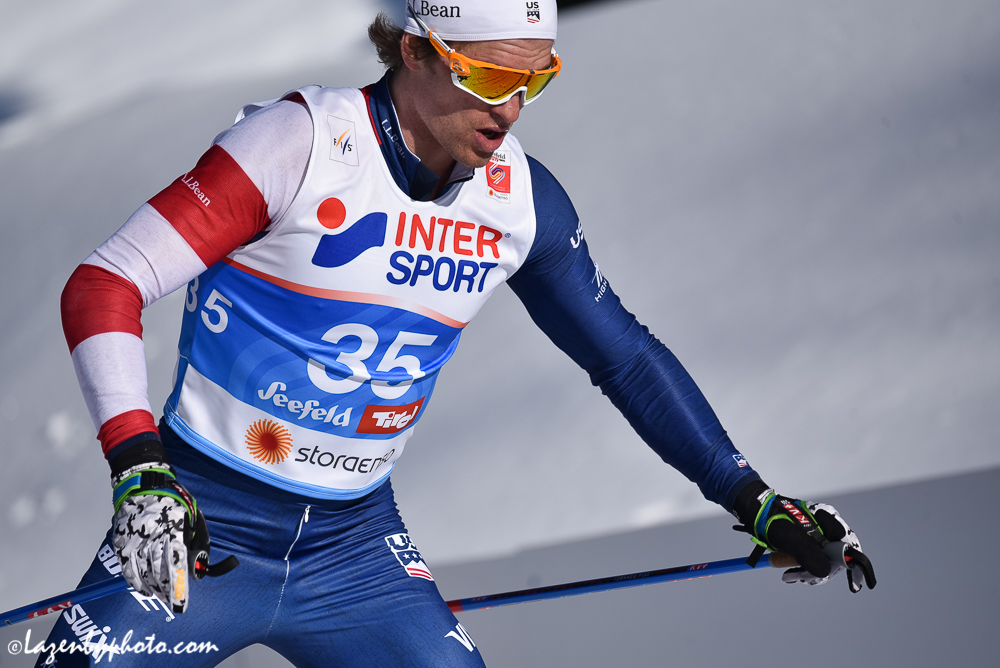
    American David Norris the men’s 30-kilometer skiathlon at the 2019 World Ski Championship in Seefeld, Austria. (Photo: John Lazenby/lazenbyphoto.com)

    During a year when the U.S. Ski Team has offered numerous international starts to a host of non-USST members, Norris and his trifecta of results in the points promotes the notion that on the right day and even the right World Cup string of races, elite U.S. skiers can step up.

    “I am super happy with my result- I feel like I have recovered well from back-to-back 50ks, and my skis were good,” explained Norris when asked if he was surprised to find himself so close in the standings to Canada’s Alex Harvey, who placed 11th. “Today was the type of result I have been believing I should be able to do on a good day, so I am psyched to have made that happen.”

    Results

  • World Cup Preview: #3 Russia

    World Cup Preview: #3 Russia

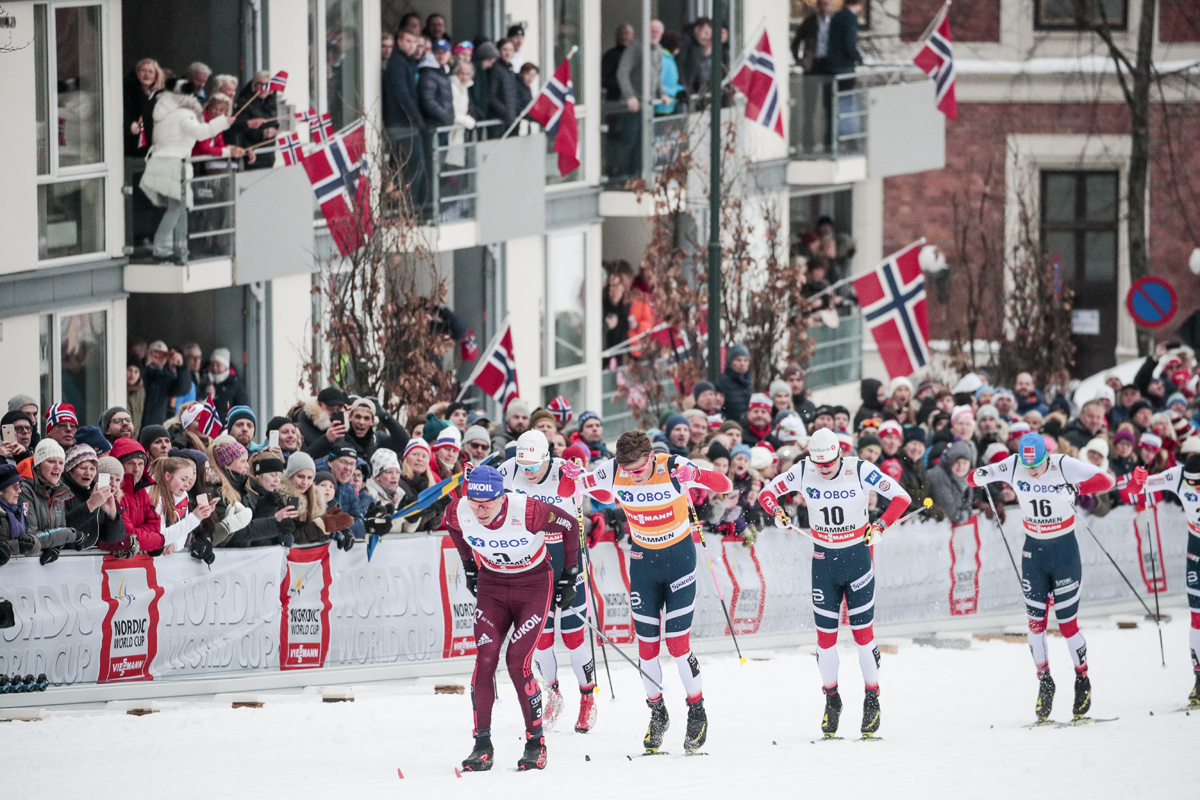
    Russia’s Alexander Bolshunov leads five Norwegians in the men’s classic sprint final at the World Cup in Drammen, Norway: (from l to r) Eriik Brandsdal, Johannes Høsflot Klæbo (yellow bib), Sindre Bjørnestad Skar (10), Kasper Stadaas (16), and Emil Iversen. (Photo: Fischer/Nordic Focus)

    Welcome to FasterSkier’s World Cup Preview, where we check in with the top-10 teams from last year’s FIS Cross Country World Cup tour before the season starts. The World Cup begins with a classic sprint in Ruka, Finland on Nov. 24th.

    ***

    Russia

    Overall in Nations Cup Last Year: 3rd

    Women’s Ranking 2017/2018: 5th

    Men’s Ranking 2017/2018: 2nd

    Russians to Watch:

    For several years the attention grabbing fact about Russia was the morass of allegations and findings regarding rampant doping.

    The bureaucratic seesaw teetering and tottering prior to the 2018 PyeongChang Games boiled down to will they or won’t they. As in, will Russian athletes be able to compete?

    The International Olympic Committee (IOC) did ban some athletes, including 26-year-old multiple World Champion Sergey Ustiugov for his links to Sochi doping. Ustiugov skied through the January 28, Seefeld, Austria World Cup races. By then he had collected six podiums.

    The Russian Federation was banned outright from the Games; it’s athletes competed under the IOC flag as Olympic Athletes from Russia (OAR).

    The taint on competing Russian cross-country athletes last season was palpable. Clean or not, there was a sense of guilt by association. They must be a tough lot. Whatever psychic baggage the Russians carried as part of a shunned team, their collective results at the Olympics didn’t skip a beat. The same goes for the World Cup, where the group landed third overall in the Nation’s Cup.

    A cadre of young Russian skiers propelled themselves into medal position. There was  22-year-old Denis Spitsov who missed a bronze in the Olympic 30 k skiathlon by less than three seconds. He placed third in the Holmenkollen 50 k skate.

    vancomycin buy online

    Remove a Ustiugov from the picture and insert a 21-year-old Alexander Bolshunov.

    Bolshunov skied like a decade-long-veteran on the World Cup, earning three silvers and a bronze in his first Olympics. His versatility was on display in PyeongChang. He silvered in the team sprint and won bronze in the classic sprint. He proved his mix of slow and fast twitch muscle fiber — paired with a massive engine — could propel him in the 50 k classic too. He won silver in an off-the-front dual with Finland’s Iivo Niskanen.

    The Russian men won silver in the PyeongChang 4 x 10 k relay.

    By season’s end, Bolshunov was fifth overall in the World Cup standings. Added into Russia’s overall mix, Alexey Chervotkin was 11th overall, Usitugov 12th, Andrey Larkov 18th, Spitsov 20th, Maxim Vylegzhanin 27th, and Gleb Retivykh 30th.

    Count them up, that’s seven men in the top-30 of the World Cup overall. Deep is deep.

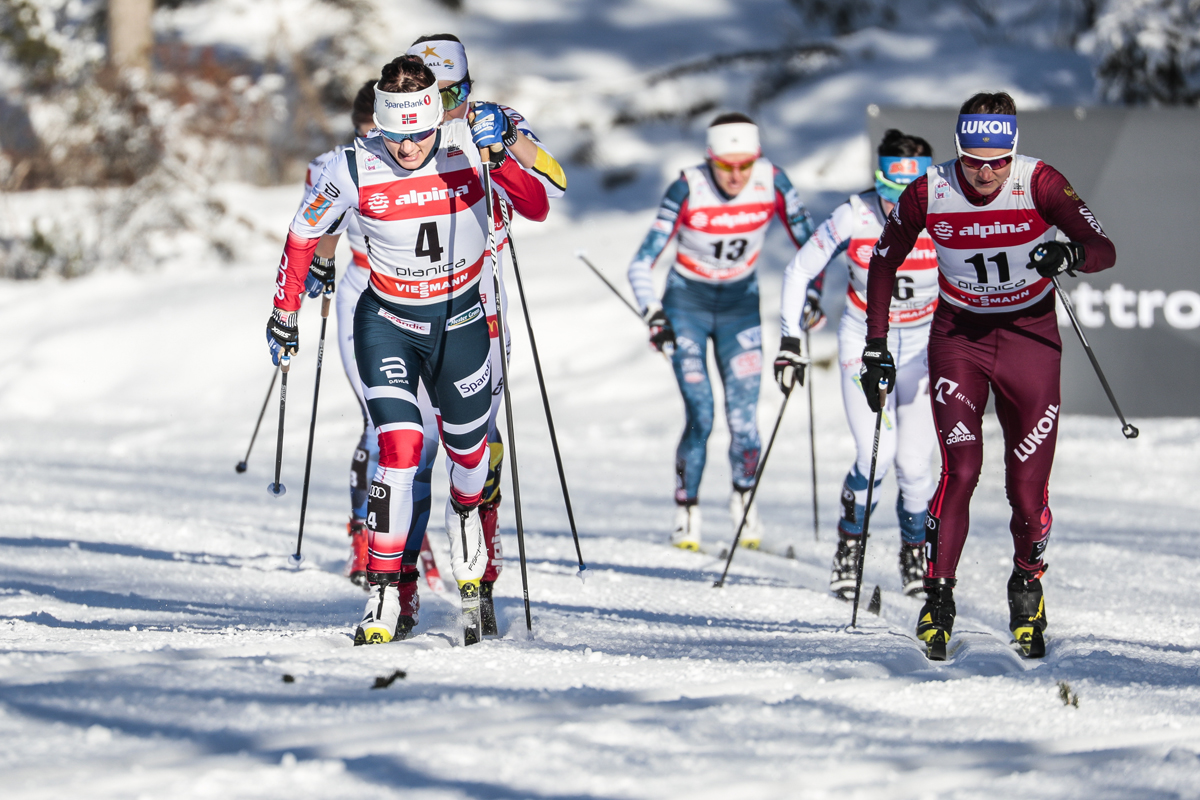
    Maiken Caspersen Falla (NOR), Yulia Belorukova (RUS), (l-r) during the 2018 FIS world cup cross-country, individual sprint, Planica, Slovenia. (Photo: Fischer/Nordic Focus)

    The Russian women had three athletes in the top-30 overall. Natalia Nepryaeva was ranked 13th, Anastasia Sedova 16th, and Yulia Belorukova 29th.

    Nepryaeva, at twenty three years old, had three top-five finishes on the World Cup including a second place in Lahti’s 10 k classic. She placed fourth in the Olympic classic sprint and eighth in the 15 k skiathlon. Also at twenty-three-years-old, Belorukova podiumed on several occasions in World Cup sprints, and won bronze in the Olympic classic sprint.

    In the Games 4 x 5 k relay, Nepryaeva, Belorukova, Sedova, and Anna Nechaevskaya, were third for Russia.

    Beginning a new Olympic quadrennial, many years removed from Sochi but its dark-sided impacts still relatively fresh, Russia has new faces on the scene. The Russian Ski Federation appears that it can plug and play as it moves athletes into its winning pipeline.

    WADA recently reinstated RUSADA as an anti-doping agency in good standing under it’s watchdog umbrella. The political maneuvering involving Russia and WADA is most likely not over. However, In 2018/2019, Russia has young, but World Cup experienced skiers.

  • Bolshunov Nabs First-Career World Cup Win, Controls Falun Mini Tour

    Bolshunov Nabs First-Career World Cup Win, Controls Falun Mini Tour

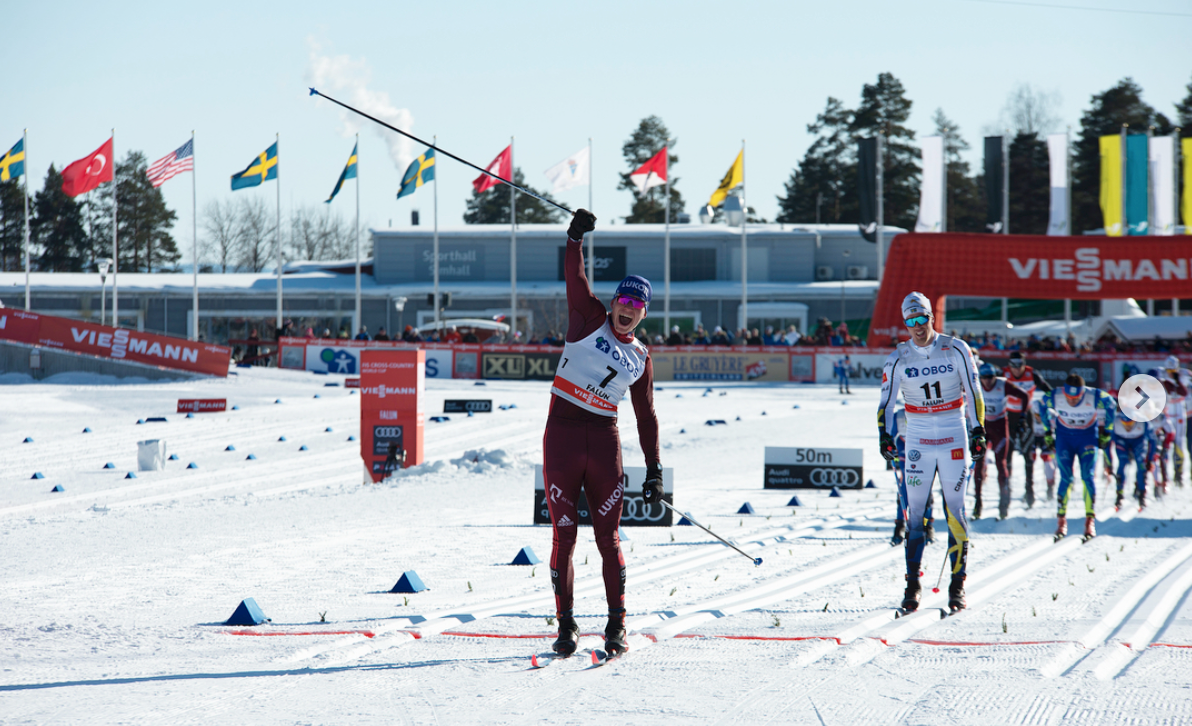
    Russian Alexander Bolshunov celebrates as he wins his first-career World Cup, a 15 k classic mass start, just ahead of Sweden’s Calle Halfvarsson (11) at 2018 World Cup Finals in Falun, Sweden. (Photo: Svenska Skidspelen/Instagram)

    Saturday was the second day of World Cup Finals mini tour, held in Falun, Sweden, which conclude the 2017/2018 season. Friday’s first stage began with a skate sprint, while Saturday featured a 15-kilometer classic mass start for the men.

    As the season is no longer young, the fitness for some athletes frayed, a mass start could offer the opportunity for some to hide in the pack and others to exploit. On a sunny and cold Saturday in Falun, the leading distance skiers on the World Cup were unable to separate. The terrain was World-Cup hilly, yet the pace was never decisive enough to shatter the field.

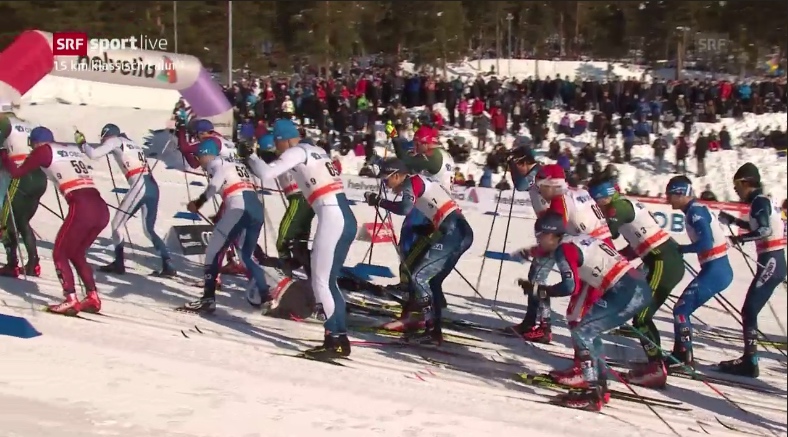
    That field was 91-skiers full. 182 poles. 182 skis. Churning from the start, only those skiers in the front rows of the start pyramid could pole and stride away unscathed. As is the nature of 91 skiers fighting for classic-track scarcity — the lanes taper down in number — pile-ups are the norm. So while some skiers like U.S. Ski Team members Erik Bjornsen and Scott Patterson lost time in a starting-scrum spill, others were looking for brighter opportunities up front.

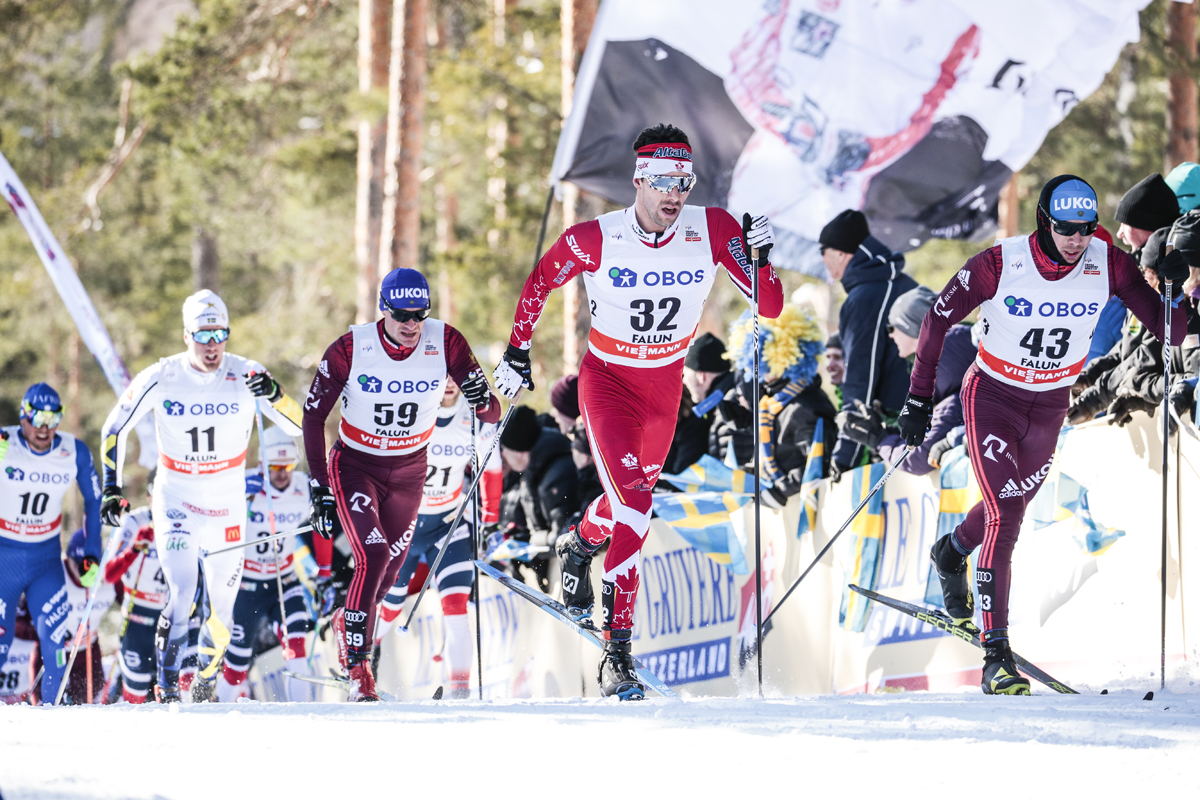
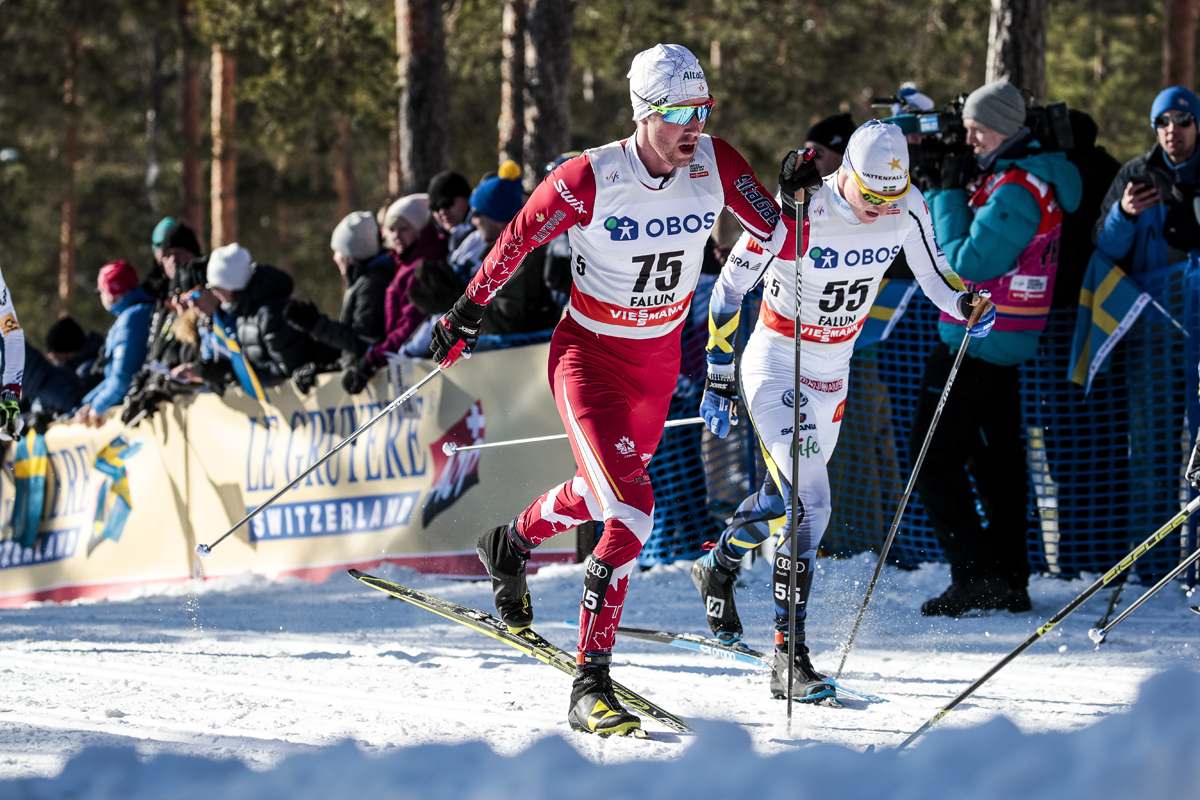
    Russia’s Alexey Chervotkin (43) and Canada’s Alex Harvey (32) lead another Russian Maxim Vylegzhanin 59), Sweden’s Calle Halfvarsson (11) and Italy’s Francesco De Fabiani (10) up a climb during the men’s 15 k classic mass start at World Cup Finals in Falun, Sweden. (Photo: Fischer/NordicFocus)

    From the start the pace was hot. There was Finland’s Iivo Niskanen, Sweden’s Emil Jönsson, Norway’s Johannes Høsflot Klæbo, Martin Johnsrud Sundby, Niklas Dyrhaug, Canada’s Alex Harvey, Kazakhstan’s Alexey Poltoranin, Russians Alexey Chervotkin and Alexander Bolshunov, and Swedes Calle Halfvarsson and Marcus Hellner, all in either a strung-out or condensed formation 3.75 k into the race. Skiers were slowly slipping off the back. But even with the surging up front, the tactics playing out appeared to place a premium on safety in numbers.

    Bolshunov surged at 4.5 k to snag the highest-value time bonus. Otherwise, for much of the race, identifying specific skiers was a task in itself. Coming down the hills a third through the race, the top-50 skiers were a sinuous and continuous line separated by 17.7 seconds. At the bottom of climbs, the compressive part of the accordion effect was in play. Skiers in front could push, those behind became a more dense cluster of lycra-clad athletes.

    Despite the prevalent pulsing of pace, skiers like Chervotkin and Harvey had their moments of pluckiness. Each paced a long line of skiers through the 9.3 k mark. But clear at this point was that the pattern of this race would be defined by the collective mass of skiers that began the mass start. Yes, time gaps would balloon a bit by the finish, but at 12 k (the second time bonus), a gap of 1.7 seconds separated first through 35th place.

    The move that mattered in this race came from the birthday boy, Halfvarsson. According to FasterSkier’s reporter on the ground, the Swedish crowd serenaded Halfvarsson, 29, with a happy birthday rendition prior to the start. Maybe it was birthday stoke, maybe it was an acknowledgment that with age comes fewer opportunities to seize the win, but with one kilometer to go, Halfvarsson ran like Klæbo. Up and over the hill, the Swede forged a small gap on the 30-plus chasers.

    Again on the last short incline before the speedy descent into the stadium, Halfvarsson performed a masterful high-step run. Only Bolshunov at this point could suck up near the Swede’s tails. For a moment, rounding into the final straight, it looked like Halfvarsson’s icing on his birthday cake would be a Falun stage win.

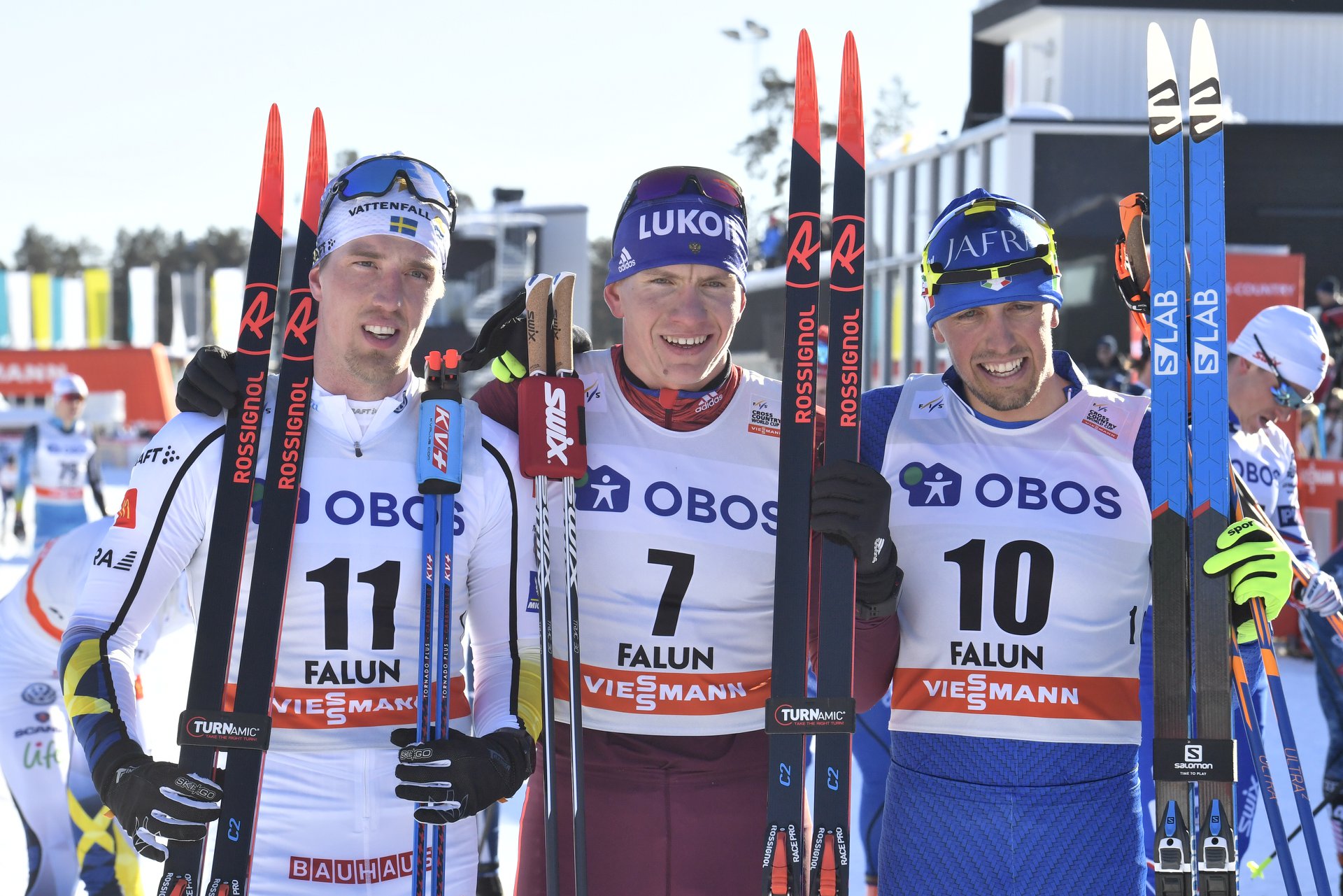
    The men’s 15 k classic mass start podium at 2018 World Cup Finals in Falun, Sweden, with Russia’s Alexander Bolshunov (c) in first, Sweden’s Calle Halfvarsson (l) in second, and Italy’s Francesco De Fabiani (r) in third. (Photo: FIS World Cup Svenska Skidspelen/Facebook)

    Halfvarsson came into the straight out of the tracks. As he zeroed in to begin the double-poling finish, the birthday boy stumbled slightly slotting into the nearest lane. Bolshunov flew by with a supreme double pole and took the win in 36:59.8. Halfvarsson placed second (+1.3), Italy’s Francesco De Fabiani third (+3.1), Poltoranin fourth (+3.7) and Chervotkin fifth (+5.2).

    For the 21-year-old Bolshunov, it was his first-career World Cup win. Prior to Saturday’s win, Bolshunov had stood on the podium six times in his first full season on the World Cup. (Bolshunov’s only World Cup start last season was in Drammen, Norway, in March 2017.) Along with Klæbo, also 21, Bolshunov has risen into one of the sport’s top athletes. He claimed three silvers and a bronze medal in PyeongChang. His two individual Olympic medals were a second in the 50 k classic mass start and third in the classic sprint.

    “I have had many second and third place finishes this season so I am very happy to finally have a win,” Bolshunov told the International Ski Federation (FIS) after the race. “This feels good. I will do what I can tomorrow for another good result but for now, I will enjoy this win.”

    Sunday’s final men’s race of the season and last race of the three-stage mini-tour, will be a 15 k freestyle pursuit. Bolshunov leads the mini-tour standings in first with a total elapsed time of 38:37 minutes. Klæbo, who finished 22nd (+13.6) on Saturday, sits in second (+38.0), while Halfvarsson is third (+39.2).

    The Swede took away the positives from the day’s near-win in front of the home crowd.

    “I tried today to get a win but it was too much,” Halfvarson told FIS. “Off the final corner, I was really tired. I am still happy with second place. I have been on a podium a few times this season and always third. So at least second place is an improvement even if I didn’t manage the win.”

    Canada’s Alex Harvey was the best placed North American in 20th place (+10.7). He’ll begin Sunday’s pursuit in 18th (+1:16.1).

    Canada’s Graeme Killick (75) skiing with Sweden’s Jens Burman during the men’s 15 k classic mass start at World Cup Finals in Falun, Sweden. Killick went on to finish 41st. (Photo: Fischer/NordicFocus)

    Teammate Devon Kershaw finished 26th (+14.6) for his fourth-straight race in the top 30 (including his 26th-place finish in the Olympic 50 k classic). Graeme Killick placed 41st (+1:13) and Julien Locke was 81st (+3:29) for Canada.

    “I felt quite good today,” Kershaw said after the race. “I was a little disappointed with the last kilometer because I was kind of out of position a little bit after Mördarbakken and couldn’t quite get up through traffic, but it’s really close. And a little disappointed to be 26th again; it seems like that’s kind of where I’ve lived all year, but it was a good race for me.”

    Kershaw, a 35-year-old staple of the Canadian team, has been seeking a return to top form.

    “Just races like today where I feel good and can execute decently well,” Kershaw explained.
    “To be honest this year I am super motivated after the championship. I’ve [been] having major, major asthma issues at the Olympics and that really really affected me and it took a long time to get a little better, but I felt like by the time I got to Lahti I was feeling quite a bit better. So that really helps, I mean, I can breathe again and I’m feeling good.”

    Kershaw is expected to mull over the prospects of continuing his ski career in the coming weeks.

    “We’re not sure, I’ll talk to the wife next week [Norwegian former elite skier Kristin Størmer Steira],” Kershaw said of his future plans. “You know there’s a lot of issues right now in Canada so I’ll have to think about it. A lot of guys are saying that they’re gonna call it a day. And I’m not getting any younger, but I still feel quite good, and I mean a race like today shows that I can still compete with the best in the world so that’s motivating, but we’ll definitely have to take some weeks to think about it.”

    Nowhere to go: U.S. skiers Erik Bjornsen (bib 57) and Scott Patterson (bib 67) stuck in a pile-up after the start of the men’s 15 k mass start classic at World Cup Finals in Falun, Sweden. (Screenshot: SRF Sport broadcast)

    For the U.S., Erik Bjornsen finished 52nd (+1:47.1), Simi Hamilton 62nd (+2:06.4), Kevin Bolger 69th (+2:27.1), David Norris 70th (+2:31.2), Scott Patterson 71st (+2:40.6), Paddy Caldwell 75th (+2:52.7), and Andy Newell 86th (+4:47).

    Patterson’s race did not go as planned.

    “I was in a big pile-up right at the start,” Patterson told FasterSkier after. “I was the second-to-last one out of the stadium and then the first time up Mördarbakken, my ski fell off. So I skied halfway down, got my ski back on, just turned back around and then just like stupidly chasing the rest of the race. …

    “I felt OK,” Patterson added. “[Without] those two stupid things it would have been a good race. But I was so far off and then it was really hard to get back to the pack and then it was like, ‘Well, I can’t get to the pack. I am here with those guys.’ ”

    Lately, Patterson, 26, has been a highlight for the U.S. distance skiing prospects. The first-year U.S. Ski Team member notched three individual top-20 results at last month’s Olympics, including 11th in the 50 k classic. Last weekend in Oslo, Norway, Patterson proved that was no fluke, as he placed 16th in a traditionally deep field at the Holmenkollen 50 k skate.

    World Cup Finals conclude with 10/15 k freestyle pursuits on Sunday.

    Results | Falun mini-tour standings| Men’s pursuit start list

    — Gabby Naranja, Harald Zimmer and Alex Kochon contributed

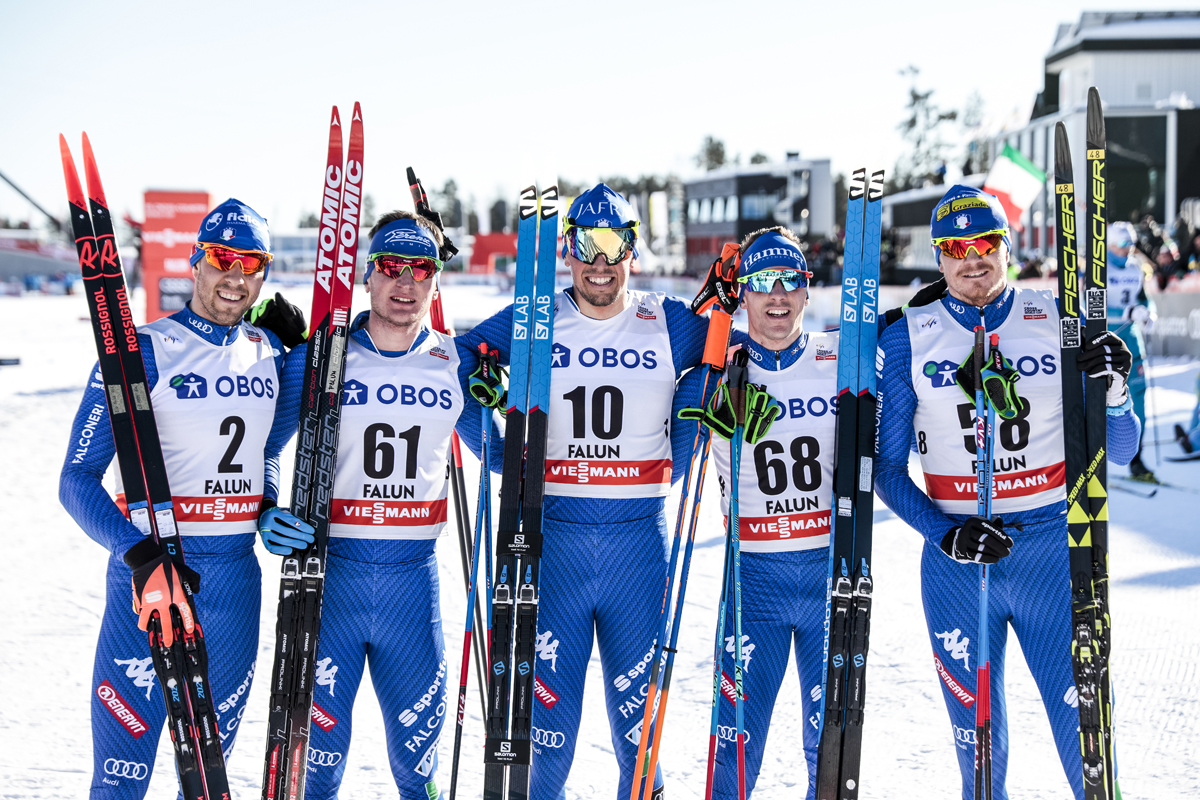
    The Italian men’s team after Saturday’s 15 k classic mass start at 2018 World Cup Finals in Falun, Sweden, with (from left to right) Federico Pellegrino, Giandomenico Salvadori, Francesco De Fabiani, Maicol Rastelli, and Dietmar Nöckler. (Photo: Fischer/NordicFocus)
  • Saturday Rundown: Pärmäkoski Beats Bjørgen in Falun 10 k Classic; Bolshunov Notches First Win

    Saturday Rundown: Pärmäkoski Beats Bjørgen in Falun 10 k Classic; Bolshunov Notches First Win

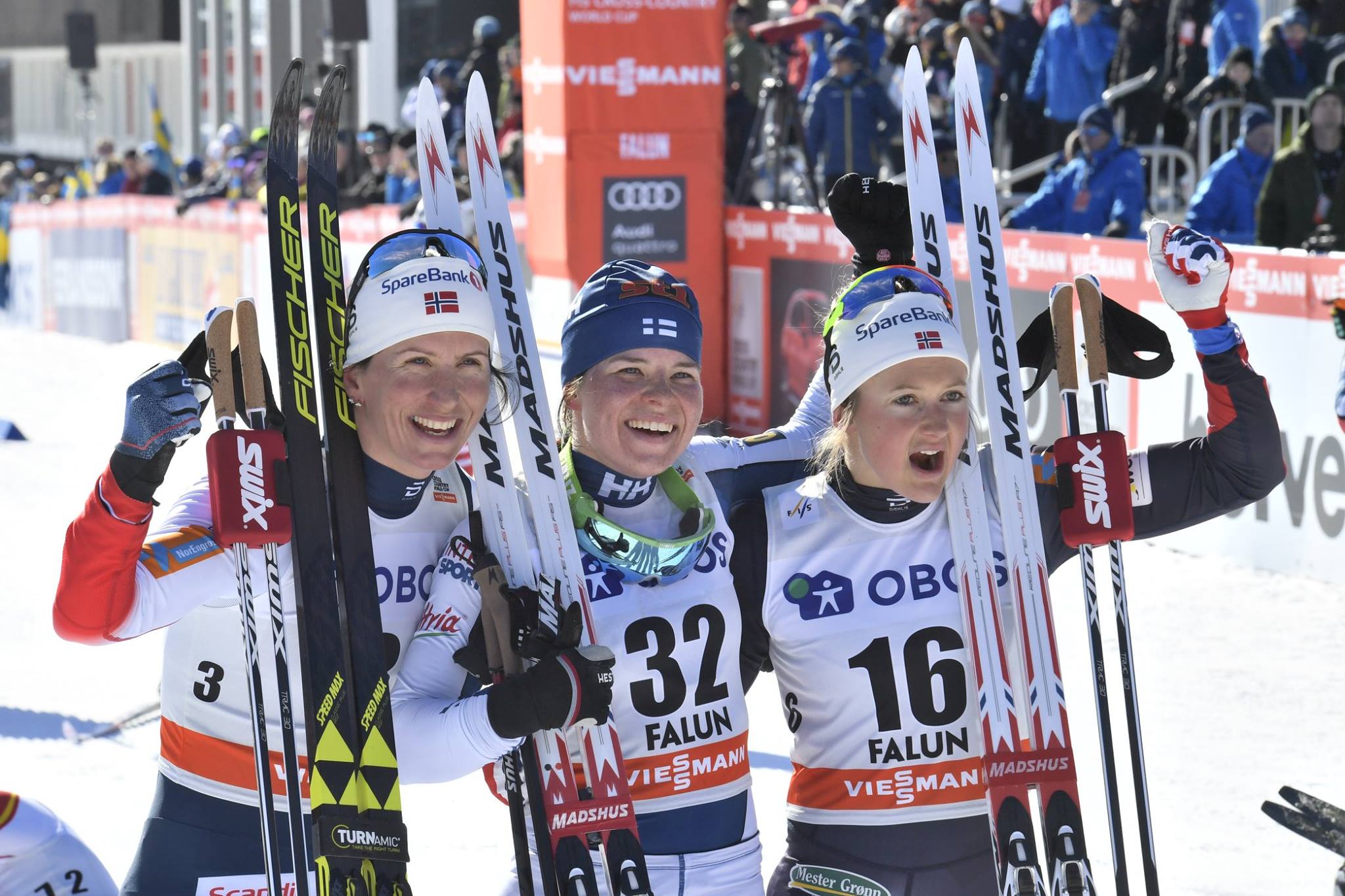
    The women’s 10 k classic mass start podium at 2018 World Cup Finals in Falun, Sweden, with Finland’s Krista Pärmäkoski (c) in first, Norway’s Marit Bjørgen (l) in second and Ingvild Flugstad Østberg (r) in third. (Photo: FIS World Cup Svenska Skidspelen/Facebook)

    FIS Cross Country World Cup Finals (Falun, Sweden): 10/15 k classic mass starts

    Women’s report

    Men’s report

    Day 2 of World Cup Finals in Falun entailed 10- and 15-kilometer classic mass starts on Saturday, and in the first race of the day, Finland’s Krista Pärmäkoski pulled out a thrilling finishing-sprint victory over Norway’s Marit Bjørgen.

    After American Jessie Diggins led early in the first 2.5 k loop, Bjørgen set the tone from the front for most of the race. With less than a kilometer to go, Norwegian powered up the final horseshoe-shaped climb in first, with Pärmäkoski and Bjørgen’s Norwegian teammate Ingvild Flugstad Østberg just behind her. The three had dropped the field while lapping through the stadium around the 7.5 k.

    While Østberg fell off the pace on that final uphill, Bjørgen accelerated as she took a few quick strides over the top, gaining a few meters on Pärmäkoski as they headed into the descent. The finishing stretch is long in Falun, and Pärmäkoski was able to come on strong just before she and Bjørgen entered the final 100 meters before the finish. There, Pärmäkoski’s double-pole speed not only matched Bjørgen, but beat her, as Pärmäkoski passed her with several meters to go and took the win by 0.2 seconds in 26:00.5 minutes. It was Pärmäkoski’s second win of the season and fourth of her career (including time-of-day pursuit stage wins).

    Just behind Pärmäkoski and Bjørgen, who congratulated each other immediately at the finish, Østberg finished 5.1 seconds back in third. Five women fought for fourth place, with Sweden’s Ebba Andersson taking it (+14.5) ahead of Japan’s Masako Ishida in fifth (+14.8), Sweden’s Charlotte Kalla in sixth (+15.2), Austria’s Teresa Stadlober in seventh (+15.4), and Diggins in eighth (+15.5).

    Norway’s Astrid Uhrenholdt Jacobsen was the next finisher across the line in ninth (+24.8), then Finland’s Kerttu Niskanen in 10th (+26.2) and American Sadie Bjornsen in 11th (+26.3).

    Canada’s Emily Nishikawa was the next North American in 36th (+1:31.1), and she led her teammates Cendrine Browne, who placed 50th (+2:05.7), Dahria Beatty in 61st (+2:46.6) and Zina Kocher in 69th (+6:12).

    For the U.S., Sophie Caldwell finished 41st (+1:36.1), Rosie Frankowski 44th (+1:43.7), Caitlin Patterson 47th (+1:54.8), Ida Sargent 52nd (+2:10.2), Liz Stephen 54th (+2:20.0), Kikkan Randall 57th (+2:34.1), and Kaitlynn Miller 64th (+2:50.7). Rosie Brennan did not start.

    The men’s 15 k classic mass start podium at 2018 World Cup Finals in Falun, Sweden, with Russia’s Alexander Bolshunov (c) in first, Sweden’s Calle Halfvarsson (l) in second, and Italy’s Francesco de Fabiani (r) in third. (Photo: : FIS World Cup Svenska Skidspelen/Facebook)

    In the men’s 15 k classic mass start on Saturday afternoon, Russia’s 21-year-old Alexander Bolshunov notched his first-career World Cup win after reaching the podium seven other times this season (placing third in six of those seven races).

    Bolshunov hung in the pack and took the lead at the start of the final lap at 11.25 k, ahead of four of his Russian teammates, Alexey Chervotkin in second, Evgeniy Belov in third, Andrey Larkov in fourth, and Maxim Vylegzhanin in fifth. Behind them, Switzerland’s Dario Cologna skied just ahead of Norway’s Martin Johnsrud Sundby and Canada’s Alex Harvey, who were among 29 skiers within four seconds of first.

    While Sweden’s Calle Halfvarsson led the final climb before the stadium, Bolshunov caught him on the downhill and out-double-poled him in the finishing stretch, taking first by 1.3 seconds in 36:59.8. Halfvarsson finished second and Italy’s Francesco de Fabiani scored his second World Cup podium of the season in third (+3.1).

    Kazakhstan’s Alexey Poltoranin missed the podium by 0.6 seconds in fourth (+3.7), Chervotkin followed in fifth (+5.2), ahead of Cologna in sixth (+5.6) and Italy’s Federico Pellegrino in seventh (+5.6), after they finished together. Sundby and his Norwegian teammate Niklas Dyrhaug also crossed the line at the same time in eighth (+6.3) and ninth (+6.3), respectively, just 0.1 seconds ahead of another one of their teammates, Sjur Røthe, in 10th (+6.4).

    Less than five seconds later, Harvey finished 20th (+10.7), ahead of Norway’s Johannes Høsflot Klæbo in 22nd (+13.6). Klæbo slipped out of contention on the third of four laps, as he dropped from fourth to 22nd in less than two kilometers.

    Canada’s Devon Kershaw finished 26th (+14.6) for his fourth-straight race in the top 30 (including his 26th-place finish in the Olympic 50 k classic mass start), Graeme Killick placed 41st (+1:13) and Julien Locke was 81st (+3:29).

    Erik Bjornsen was the top American man in 52nd (+1:47.1), Simi Hamilton finished 62nd (+2:06.4), Kevin Bolger was 69th (+2:27.1), David Norris 70th (+2:31.2), Scott Patterson 71st (+2:40.6), Paddy Caldwell 75th (+2:52.7), and Andy Newell 86th (+4:47).

    World Cup Finals conclude with 10/15 k freestyle pursuits on Sunday.

    Results: Women | Men

    ***

    IBU World Cup (Oslo, Norway): Women’s relay + men’s pursuit

    Women’s relay report

    Men’s pursuit report

    France won the International Biathlon Union (IBU) World Cup women’s 4 x 6 k relay to start the day at Holmenkollen, ahead of Germany and Italy, while the Canadian women’s team (Sarah Beaudry, Julia Ransom, Emma Lunder, and Rosanna Crawford) placed 11th and the U.S. (Clare Egan, Susan Dunklee, Joanne Reid, and Emily Dreissigacker) came back from 21st to finish 15th.

    In the men’s 12.5 k pursuit that followed, France’s Martin Fourcade won his 10th race at Holmenkollen, putting himself 49 points ahead of Norway’s Johannes Thingnes Bø with three individual races in Tyumen, Russia, remaining. US Biathlon’s Sean Doherty tied his second-best result this season in 17th and his teammate Lowell Bailey raced up to 28th with the 19th-fastest time of day. Leif Nordgren placed 40th and Tim Burke was 47th, while Canada’s Scott Gow finished 51st and Christian Gow was 54th.

    Results: Women’s relay | Men’s pursuit

  • Sunday Rundown: Pärmäkoski Wins At Home in Lahti 10 k; Poltoranin Tops 15 k

    Sunday Rundown: Pärmäkoski Wins At Home in Lahti 10 k; Poltoranin Tops 15 k

    Krista Pärmäkoski of Finland (center) won her second straight 10 k classic, to the delight of the crowd in Lahti. Natalia Nepryaeva of Russia (left) finished second and Marit Bjørgen of Norway third. (Photo: FIS Cross Country/Twitter)

    FIS Cross Country World Cup (Lahti, Finland): 10/15 k classic

    Women’s report

    Men’s report

    Racing at home in Finland, Krista Pärmäkoski picked a good time to collect the second World Cup victory of her career, and again in a 10 k classic. Pärmäkoski’s first win came in the 10 k classic in Planica, Slovenia, earlier this season.

    In second was Russia’s Natalia Nepryaeva, who picked up her first World Cup podium. The current U23 standings leader, Nepryaeva’s time was 20.9 seconds slower than Parmakoski. Both she and Marit Bjørgen of Norway, who finished third (+26.7), used a steady pace to reach the podium. At the 5 k split, Heidi Weng of Norway – wearing the yellow bib of the overall World Cup leader – was in second at the halfway point but faded to finish fifth (+43.3), and Kerttu Niskanen of Finland was in third place but she dropped to fourth by the finish, +27.0. Austria’s Teresa Stadlober finished sixth (+52.4).

    Sadie Bjornsen placed seventh (+57.6) to lead the American team. Caitlin Patterson was next, just missing the World Cup points in 32nd (+2:02.7). Ida Sargent and Sophie Caldwell  finished 40th (+2:21.9) and 42nd (+2:24.2),  respectively. Rosie Brennan finished 48th (+3:02.1) and SuperTour leader Kaitlynn Miller placed 51st (+3:09.1).

    Liz Stephen of the U.S. Ski Team did not start due to illness.

    Canada started only two women: Emily Nishikawa finished 41st (+2:22.2) and Dahria Beatty 44th (+2:40.7).

    The men’s 15 k classic podium at the World Cup in Lahti, Finland, with Kazakhstan’s Alexey Poltoranin (c) in first, Russia’s Alexander Bolshunov (l) in second and Finland’s Iivo Niskanen (r) in third. (Photo: FIS Cross Country/Twitter)

    In the men’s race that followed, Alexey Poltoranin of Kazakhstan got some redemption after a major bonk in the Olympics 50 k last weekend, winning the 15 k classic individual start in Lahti.

    Starting in the middle of the field in bib 44 (out of 71), Poltoranin paced it perfectly, skiing a steady race with some of the top split times and then turning it up another notch over the last several kilometers to take the win in 33:11.9 minutes. His biggest threat was Russia’s Alexander Bolshunov, who started 64th and clocked faster splits at every timing point throughout the three-lap race except the one that mattered most — the finish. There, Bolshunov came up 9.1 seconds short of Poltoranin’s time to place second, and Finland’s Iivo Niskanen — the Olympic 50 k champ — placed third, 20.9 seconds out of first.

    Norway took fourth through seventh, with Emil Iversen in fourth (+28.8), Martin Johnsrud Sundby in fifth (+39.9), Niklas Dyrhaug in sixth (+50.1), and Johannes Høsflot Klæbo in seventh (+1:00.3). Russia’s Alexey Chervotkin placed eighth (+1:08.3), Germany’s Thomas Bing was ninth (+1:08.5) and Sweden’s Daniel Rickardsson finished 10th (+1:09.2).

    Canada’s Devon Kershaw led the North Americans in 25th (+1:43.2), and Erik Bjornsen was the top American in 32nd (+2:06.6).

    Four Canadian men raced, with Graeme Killick placing 39th (+2:22.9), Julien Locke 69th (+4:56.6) and Andy Shields 70th (+5:42.1).

    The U.S. was represented by six men, with Noah Hoffman placing 40th (+2:24.0), Paddy Caldwell 45th (+2:40.5), Scott Patterson 50th (+2:58.7), Kevin Bolger 54th (+3:09.5), and David Norris 57th (+3:23.5).

    The World Cup picks back up again this Wednesday with classic sprints in downtown Drammen, Norway.

    Results: Women | Men

  • Raising the Bar: Harvey Closes Out Olympics in Fourth in 50 k Classic; Patterson 11th

    Alex Harvey (2) follows Kazakhstan’s Alexey Poltoranin (5) at the front of the pack during the during the men’s 50 k classic mass start at the 2018 Pyeongchang Olympics in South Korea (Photo: Flyingpointroad)

    FasterSkier would like to thank Fischer Sport USA, Madshus USA, Concept2, Boulder Nordic Sport, and Swix Sport US for their generous support, which made this coverage possible.

    PYEONGCHANG, South Korea —Not even three kilometers into the men’s 50-kilometer classic mass start on Saturday, Canada’s Devon Kershaw was an S.O.S. skier. The Canadian’s ski pole had snapped and he singlesticked for almost a kilometer before he received another. By the time Kershaw was handed a spare, many of the bibs he started with were striding away; any hope he may have harbored for a podium dashed away with them.

    But in his fourth and final Olympics, the 35-year-old Kershaw will be the first to tell you there were other reasons he committed to four more years of Winter Games preparation following Sochi.

    “I really stuck around to see if I could push Alex [Harvey] — I do push Alex in training — and to see him get an Olympic medal,” Kershaw told FasterSkier in person after Saturday’s race.

    PyeongChang is also, allegedly, Canadian Alex Harvey’s final Olympics. He has stated his plans to retire after the 2019 World Cup Finals in Québec City.

    “I was just so motivated to be around to see the first Olympic medal for men get hung around a [Canadian] neck. That’s what drove me every day,” Kershaw reflected.

    Canadians Devon Kershaw (r) and Graeme Killick during the men’s 50 k at the 2018 Pyeongchang Olympics in South Korea (Photo: Flyingpointroad)

    Coming into the 2018 Winter Games, Harvey, 29, was the favorite for a country that has yet to claim an Olympic medal in men’s cross-country. Harvey’s closest finish until Saturday was seventh in the men’s 15 k freestyle, just 12.5 seconds away from bronze. Earlier in the PyeongChang Games, the Québec native placed eighth in the men’s 30 k skiathlon, and 32nd in the classic sprint. Last year at World Championships in Lahti, Finland, Harvey was crowned the 50 k freestyle mass start world champ. 

    On Saturday in PyeongChang, while Kershaw waved one half of his ski pole in search of a whole, Harvey hammered away up front in an attempt to earn hardware for Canada.

    Harvey, Russia’s Andrey Larkov, and Norwegians Martin Johnsrud Sundby and Hans Christer Holund, skied in a chase pack behind Finland’s Iivo Niskanen, Kazakhstan’s Alexey Poltoranin and Russia’s Alexander Bolshunov, the three of which had gapped the field around the race’s halfway point.

    For close to 20 k, Harvey, Larkov, Sundby, and Holund appeared to be racing for fourth through seventh place. With less than 8 k to go, the four men began gaining ground on Poltoranin skiing in third.

    “We knew that going with Niskanen is such a hard pace and some of these guys would pay the price later on,” Harvey told FasterSkier of the lead group’s fast pace.

    As Harvey, Larkov and Sundby exchanged leads, the time gap to third shrank from 1 minute and 15 seconds at the 30 k mark to 26 seconds by the 43 k mark. Around 45 k, Poltoranin had slowed to a shuffle and stepped aside to let Larkov, Sundby, Harvey, and Holund pass.

    With 5 k to go, Harvey was visibly working hard. Afterwards, he told reporters he was unabashed about the demands he put on his body.

    “The last laps, my quads were cramping, my biceps, my calves, my stomach, too,” Harvey said. “You just focus on the process, the present, on your technique. If there’s somebody ahead of you, you just focus on his skis; just stay on his tails.”

    Three Norwegians leading the pack, with Hans Christer Holund (3), Emil Iversen (12) and Martin Johnsrud Sundby (4) looking to see if anyone else wants to take a turn up front during the men’s 50 k classic mass start at the 2018 Olympics in PyeongChang, South Korea. Canada’s Alex Harvey is directly behind Iversen. (Photo: FlyingPointRoad)

    Harvey skied within centimeters of Sundby, Larkov and Holund until the final headwall climb. As the four strode up to the hill’s halfway point, Larkov made his move. The Russian put close to three seconds on the Canadian and the Norwegians by the crest of the hill. That gap widened by the time they made their final descent to the stadium.

    Larkov propelled himself into third, 2:37.5 minutes after Niskanen crossed the line first in 2:08:22.1 hours. Second went to Russia’s Bolshunov (+18.7). Harvey sprinted into the finishing stretch with Sundby at his side and outlunged the Norwegian for fourth. All said and done, the Canadian missed a medal by just 6.1 seconds.

    In his final Olympics, Harvey’s emotions were heavy as he approached the press. Given the dark cloud that surrounds the 2014 Games, Harvey weighed in tacitly about Saturday’s 50 k podium, which included two Russians.

    “You want to believe in the new generation of Russians, so you’ve got to give them the benefit of the doubt, for sure,” Harvey said. “It’s so hard to be fourth with two Russians in front. I do believe these younger guys are doing it clean, but with everything we’ve seen … in the back of your mind there’s a bit of doubt.”

    After reflecting on all three of his Winter Olympics, Harvey hoped he and his teammates are a harbinger for Canada’s future cross-country scene (Harvey and Kershaw have been a staple for more than a decade, bringing Canada its best Olympic team result after placing fourth in the 2010 Vancouver team sprint).

    Canada’s Alex Harvey after giving his all in the men’s 50 k classic mass start at the 2018 Olympics in PyeongChang, South Korea. He placed fourth for the best individual Olympic result for a male Canadian cross-country skier. (Photo: FlyingPointRoad)

    “I think with my teammates, Devon [Kershaw], Ivan [Babikov], George [Grey], we were able to raise the bar for men’s cross-country skiing in Canada,” Harvey said. “… To realistically have expectations set for ourselves of believing in the podium, that was never done before, so I think that’s good for the future generations. To believe that it’s possible, to fight for the top ten, top five, week in [and] week out in the World Cup, at the World Championships, at the Olympics. That’s something that I’m really proud of.”

    Harvey’s fourth place now ranks as Canada’s best individual men’s cross-country performance at a Winter Games. The previous best individual result was Kershaw’s fifth in the Vancouver 50 k freestyle. On Saturday, Kershaw was the second Canadian across the line in 26th (+9:27.).

    As both close out their Olympic careers, they seem grounded. Not every Olympic dream has to end with medals. Rather, it’s about reaching the limits they push themselves to, once they are there. 

    “It’s a hard position to end up in,” Harvey said of his fourth place. “But it’s all I had today; there’s no regrets.”

    Patterson 11th for Best U.S. Men’s Result Since 1976

    Just as the U.S. women crushed a decades-old record earlier this week, American Scott Patterson raced to the best individual distance finish for a male U.S. cross-country skier since Bill Koch placed second and sixth at the 1976 Winter Olympics in Innsbruck, Austria. A first-time Olympian, Patterson placed 11th (+4:52.1), 15.2 seconds outside of the top 10 and 31 seconds back from Switzerland’s 15 k gold medalist Dario Cologna in ninth.

    “Early on, I was with that second chase pack just trying to ski relaxed, ski well,” the 26-year-old Patterson said.

    He had been skiing around 20th for the first 20 k, but moved up into 15th by the 23 k mark. In another 2 kilometers, Patterson was up to 13th. He pulled with Germany’s Andreas Katz and Russia’s Denis Spitsov — the 15 k freestyle bronze medalist — eventually dropping both.

    American Scott Patterson (29) racing to 11th in the men’s 50 k classic mass start at the 2018 PyeongChang Olympics in South Korea. In doing so, he tallied the best American men’s result in an individual Olympic cross-country race since Bill Koch placed second and sixth at the 1976 Olympics. (Photo: Flyingpointroad)

    Patterson worked his way past Norway’s Niklas Dyrhaug, Russia’s Alexey Chervotkin, and Poltoranin (who had been in contention for the bronze medal), before ultimately taking 11th.

    “It was exciting for the last 5 k when people were starting to dangle in front of me,” Patterson said. “Probably a couple of k out when I got Dyrhaug, and then coming by Poltoranin, too, who I think was skiing pretty far up there early on there in the race. I just wanted a few more k to get [Norway’s Emil] Iversen and get into the top 10, maybe Cologna, too.”

    The next American finisher on the day was Noah Hoffman in 33rd.

    “Every race has gotten better at these Olympics and I would have loved to have been top 30,” Hoffman, a two-time Olympian, said. “In Sochi I was looking for big results and here I haven’t been close to that and it’s disappointing, but I’ve processed all of that. It’s been four years since I’ve really skied the way that I’ve wanted to and I’m pretty just excited to be here. I’m living up these Games trying to take it all in.”

    American Noah Hoffman during the men’s 50 k classic mass start at the 2018 PyeongChang Olympics in South Korea (Photo: Flyingpointroad)

    Three more North Americans competed in Saturday’s race, with Canada’s Graeme Killick finishing 27th (+10:06.7), American Tyler Kornfield placing 48th (+16:14.4)  and Canada’s Russell Kennedy 49th (+16:54.5).

    Despite getting sick Friday, Killick entered the race and finished with his best performance of the Games.

    “My energy felt pretty decent and I’m really happy with that race,” Killick said. “I had to fight really hard for the last lap, because I had a group coming back on me and I was kind of in no man’s land. I’m really happy I was able to hold them off.”

    The 50 k start was Kornfied’s second race of his first Olympics. Just last month, the 26 year old made his World Cup debut. Reflecting on his recent experiences, Kornfield was perceptive of the idea that racing takes time.

    Canada’s Graeme Killick (48) leading his teammates Russell Kennedy (49) and Devon Kershaw in the men’s 50 k classic at the 2018 Olympics in PyeongChang, South Korea. They went on to place 27th, 49th and 26th, respectively. (Photo: FlyingPointRoad)

    “I didn’t get the opportunity to race the World Cup until this year and a lot of times that got me down, frustrated me and felt like I wasn’t progressing with a lot of the other athletes in the nation and internationally as well,” Kornfield said. “I just had to be patient and know that eventually it’s going to click.

    “It’s been a breakthrough season, but it hasn’t been above and beyond what I’ve done in the past,” he added. “So it’s just being patient and waiting your turn and knowing that it’s going to come, you just need to put your best race you can each day.”

    Kennedy will head to a training camp in Japan, before returning to PyeongChang for the 2018 Winter Paralympics March 9-18 as one of Brian McKeever’s guides for the visually impaired races.

    “I was feeling really good, I just didn’t have it in the end, the last two laps. I blew up pretty hard,” said Kennedy, a 26-year-old first-time Olympian. “It was still fun, and I, you always learn something from a 50 about what your body can do and where the limit is.”

    The final cross-country 2018 Olympic event, the women’s 30 k classic mass start, takes place Sunday.

    Results

  • Canada’s Men 9th for Second-Best Olympic Relay Result; U.S. 14th in PyeongChang

    Canada’s Len Valjas (l) and American Andy Newell scrambling during the first leg of the men’s 4 x 10-kilometer relay on Sunday at the 2018 Olympics in PyeongChang, South Korea. (Photo: FlyingPointRoad)

    FasterSkier would like to thank Fischer Sport USA, Madshus USA, Concept2, Boulder Nordic Sport, and Swix Sport US for their generous support, which made this coverage possible.

    PYEONGCHANG, South Korea — Zooming in on the leaders of Sunday’s nordic race, the Olympic broadcast stream focused on a red Norwegian suit set against the backdrop of Russian maroon. The televised showdown presented for the men’s 4 x 10-kilometer relay final leg was shaping up to be between the Olympic Athletes from Russia and Norway: Denis Spitsov verses Johannes Høsflot Klæbo. As the two skiers struck out for Lap 2 of 3 of the final 10 k leg, both spectators and screen apprehensively followed.

    Had the camera panned 250 meters ahead, it might have caught the flurrying ski tails of American Noah Hoffman, dashing the top of the 3.3 k lap’s initial climb. Around 45 seconds earlier, Hoffman had been tagged into the race as the anchor leg for the U.S. men. His hot start was not just for show or a final push to the front. If he wanted to prevent the U.S. team from an eliminatory pull, he would need to stay ahead of Spitsov and Klæbo.

    A cat-and-mouse game between the leaders certainly could buy the U.S. skier a little more time to pad the time gap. But until then, he sifted a reductionist race: Stay in the game. Don’t get caught by Klæbo. 

    American Noah Hoffman anchoring the U.S team during the men’s 4 x 10-kilometer relay on Sunday at the 2018 Olympics in PyeongChang, South Korea. (Photo: FlyingPointRoad)

    “The highlight for me was watching these guys stick with their guys,” Canada’s Len Valjas said of his relay teammates in a post-race interview with FasterSkier. “And another one was watching Noah stay away from Klæbo. We were all yelling, cheering for him. That was amazing.” 

    The relay had more than one race in the works. Hoffman staying in front of Klæbo was one. Canada’s Graeme Killick catching Sweden was another.

    After Valjas scrambled the first classic leg, he came through the exchange in 10th, handing off to Killick for the second classic leg. As Killick headed out for his first lap, Sweden was four places and 38.3 seconds ahead.

    The 28-year-old Canadian, in his second Olympics, was by no means deterred. Working kilometer by kilometer, Killick strode past the Czech Republic’s Martin Jaks, Germany’s Thomas Bing and eventually Sweden’s Daniel Rickardsson.

    After moving up three places, Killick went through the second exchange in seventh with the seventh-fastest time, passing off the race to Russell Kennedy. Going into Leg 3, 2.6 seconds separated the Canadians from the tag between Sweden’s Rickardsson and Marcus Hellner. All said and done, Killick had made up 40.9 seconds to catch and pass Sweden. 

    “Everyone, I think, skied to a higher level today,” Killick told FasterSkier after. “We were all able to dig deep for our teammates and make sure we pass off in good position.”

    “Anything can happen in a relay and that’s one of the reasons it’s always exciting to get on the start line and do your best,” Killick continued. “When I tagged off Russell, he was with Hellner … It was cool to see everyone dig so deep and just fight for the team.”

    Racing Canada’s third relay leg, Kennedy, a 26-year-old Olympic rookie, held tight to Hellner through the first lap. And again through the second. And through the first half of the third. It was not until around the final major climb, that Hellner broke away from Kennedy’s red maple-leaf suit.

    Canada’s Graeme Killick racing the second leg of the men’s 4 x 10-kilometer relay on Sunday at the 2018 Olympics in PyeongChang, South Korea. He brought the team from 10th to seventh with the seventh-fastest second-leg time. (Photo: FlyingPointRoad)

    “I was psyched when I saw GKill killed it, and gave me an amazing position,” Kennedy said after. “But I was also a bit nervous because … I was walking to the line with Hellner and I was like, he’s an Olympic champ. I got to stick with him and hold on, and that’s what I did. I just locked on, the wax techs gave me amazing skis today, and I held on as hard as I could. He threw in a sprint at the top of the hill, blew me up, but I was psyched to have made it almost three laps with him.”

    Hellner has two relay gold medals from the Olympics, one from 2014 and another from 2010, as well as two 30 k skiathlon golds from the 2010 and 2014 Games. The 32-year-old Swede is also a multiple-time World Championships medalist with several top-10 World Cup 15 k freestyle results. While Kennedy considers himself more of a sprinter, Sunday’s performance may perhaps change his perspective.

    “I was just thinking, don’t blow. Do it for the team,” Kennedy said. “I knew that if I could hand off to Knute in a good position, were were in a really good position for us. Can’t ask for much more than that. I gave it everything for sure. I was just happy we caught the Slovakian guy so Knute had someone to ski with. But yeah, amazing day for me, for sure. I felt really good.”

    Canada’s Knute Johnsgaard (12) racing the final leg of the the men’s 4 x 10-kilometer relay on Sunday at the 2018 Olympics in PyeongChang, South Korea. He anchored the team to ninth for its second-best Olympic relay result. (Photo: FlyingPointRoad)

    After skiing the seventh-fastest third leg, Kennedy came through the exchange in eighth and handed off to teammate Knute Johnsgaard, also in his first Olympics, for the final freestyle leg. Johnsgaard kept the Canadians ahead of the Czech Republic, staving off Kazakhstan until the final kilometer and a half.

    “It was pretty tough for me, especially the sprint hill,” Johnsgaard, 25, said. “We knew it was going to be hard. We did the best we could.”

    Canada finished in ninth, 3:41 seconds off first, which was taken by Norway’s lineup of Didrik Tønseth, Martin Johnsrud Sundby, Simen Hegstad Krüger, and Klæbo in a time of 1:33:04.9. The ninth place ties the country’s second-best Olympic relay result, which was set at the Calgary Games in 1988. Canada’s best relay finish was in 2010 when the team placed seventh with Devon Kershaw, Alex Harvey, Ivan Babikov, and George Grey.

    Harvey opted not to race Sunday’s relay, and Johnsgaard started in his place.

    In last year’s World Championships team relay in Lahti, Finland, with Harvey on the team, the Canadians were lapped out of the race.

    “We’ve had some terrible luck with relays. I think we did great today,” said Valjas, a 29-year-old two-time Olympian. “It’s not our A-team; we knew that coming in. I think we performed amazing and I’m super happy with how it went. Especially all these guys staying with some serious big names in cross-country skiing. I’m impressed, these guys were fighting hard and I’m proud of all of them.”

    Alongside the Canadian’s solid team performance, the U.S. had several personal highlights. Scrambling in the first leg was American Andy Newell in his second race of the week (after placing 37th in the individual classic sprint) and potentially, the 32 year old’s last Olympic race. 

    “The sprint day was really disappointing, because I knew I had a lot more to give in the qualification. To be just out was frustrating, I know I had a much better result than that in me, and my body is feeling better than that result,” Newell told FasterSkier on Sunday. “To be able to come back and get another start, it was great.”

    Having scrambled in Olympic relay races before, Newell explained that allowing the pace to burn off the front was part of his plan. Through the first lap he was 2.3 seconds off the lead pace. Around 5 k, he was racing with Canada, Estonia, Austria, the Czech Republic, Switzerland, and Germany around 6 seconds back. With around one lap to go, Kazakstan’s Alexey Poltoranin bulldozed to the front and began pushing pace. Newell stuck to his racing plan.

    “It’s a high-pressure event. Somebody who has raced first legs for their country before, talk about being nervous the night before, when you know you’re going to go off and the rest of the team’s counting on you,” Newell said. “Relays … there’s so much national pride, no matter what team you come from. Whether it is a Norway/Sweden rivalry or and Canada/U.S. rivalry, they all go back and have their history.”

    “I probably haven’t raced a 10 k in probably over a month, talk about nerve racking,” Newell continued. “To step to the line with Poltoranin, some of these guys, when you know they are much better 10 k classic skiers than I am.”

    Poltoranin has reached the World Cup podium numerous times in distance classic races. On Sunday, Newell came through the exchange in 12th, 1:28.8 minutes behind Poltoranin in first.

    “I just have to go and be like, ‘A minute twenty back, it feels like a bad race, but these guys are the best in the world. … It sounds bad, but we have to do what we call damage control a little bit, try to ski with the guys we can ski with, and put our team in the best position we can,” Newell explained.

    American Resse Hanneman racing the second leg of the men’s 4 x 10-kilometer relay on Sunday at the 2018 Olympics in PyeongChang, South Korea. In his first Olympic race, after being tagged in 12th, he came through the second exchange in 14th. (Photo: FlyingPointRoad)

    He passed off to American Reese Hanneman for the second classic leg. The event was Hanneman’s debut Olympic race. The 28-year-old Alaska native was called on to the team as the first alternate.

    “Skiing with the top 13 classic skiers in the world … for me, it became apparent that I was going to have to really focus and make it hurt to minimize the time I was going to lose to them,” Hanneman said. “I could barely see or stand up by the end of it. I’m not happy with how I performed, but I’m happy with how deep I was able to dig.”

    Hanneman tagged off to Scott Patterson in 14th, who then took the American’s first freestyle leg. Creeping up on Patterson were the race leaders. He geared up through all three of his laps, holding off both Norway’s Simen Hegstad Krüger and Russia’s Alexey Chervotkin.

    “All the coaches were out there going, ‘You’ve got two minutes. You’ve got 1:39,’ just the whole way,” Patterson said, referring to his time back to the leaders. “It’s not the direction you want to be getting splits, but that’s where we were.”

    “Also, we knew with Erik [Bjornsen] sitting out, with Simi [Hamilton] sitting out, with Paddy [Caldwell] sick, we knew were in a little bit of a tough shape for today, so not getting lapped was a bit of goal going in,” Patterson added.

    With Hoffman anchoring the final three laps, the Americans achieved their goal. Don’t get caught by Klæbo became ‘Klæbo can’t catch me.’

    “They weren’t charging their second lap — my first lap — but I knew they would be charging on the last lap and I knew I needed every second I possibly could, so I went out hard,” Hoffman said. “I  was just viewing it as a 6.6 k race. Like the last lap doesn’t matter at that point, just got to get there. I did everything I could and it was close but I am pretty psyched that we as a team made it.”

    The Americans finished the relay in 14th (+9:24.2) out of 14 teams.

    “You never know how its going to go down,” Hoffman said of relays. “Unless you are scrambling you don’t know what the start is going to be like, where you’re going to be, if you’re going to be alone, if you’re going to be with people, you got to be adaptable, you got to be able to make your own plan out there.

    “This was my first time ever anchoring a relay so that’s pretty cool experience,” Hoffman added. “I had a lot of support finishing. … Even though we were a long ways back the crowd seemed to stick around for me, which was pretty fun.”

    Results

  • Monkey Off Its Back, Norway Wins First Men’s Olympic Relay Since 2002

    Johannes Høsflot Klæbo of Norway moments before crossing the line for Norway’s first Olympic men’s 4 x 10 k relay victory since 2002 in Salt Lake City, Utah. (Photo: FlyingPointRoad)

    FasterSkier would like to thank Fischer Sport USA, Madshus USA, Concept2, Boulder Nordic Sport, and Swix Sport US for their generous support, which made this coverage possible.

    PYEONGCHANG, South Korea — Conversing in the native tongue of the men’s 4 x 10-kilometer relay winner of Olympics past and present requires a world map and an aptitude for language acquisition. 1952 Oslo Games: Finland wins. 1956 in Cortina: the Soviets win. 1968 in Grenoble: France wins. 1984 in Sarajevo: Sweden prevails. 1992 in Albertville: Norway wins.

    The previous two Olympics in Vancouver, British Columbia, and Sochi, Russia, — Norway took a hit. The nation’s simultaneously self-righteous and justifiable claims of cross-country-ski-racing dominance fell hollow on the men’s Olympic relay stage. In a country where it’s win and nothing else, the years between the last two Olympic cycles, 2010-2018, have been fraught with relay angst and foreboding.

    Sweden won the men’s 4 x 10 k relay in Vancouver and Sochi. Norway placed second in Vancouver. Within the Norwegian singularity of win or lose, that’s a Norway loss. In 2014, Norway placed fourth. Fourth place. Can you imagine the Norwegian disgust?

    Start of the scramble leg during the men’s 4 x 10 k Olympic relay on Sunday in PyeongChang, South Korea. (Photo: FlyingPointRoad)

    “I knew some of those teams, like Russia, was going to try to spread it out,” Andy Newell, the Americans’ scramble-leg skier told FasterSkier after his first leg in Sunday’s Olympic 4 x 10 k relay. “I knew Poltarainen was going to try to spread it out because he’s such an amazing classic skier.”

    For the full 10 k on the scramble leg, Kazakhstan’s Alexey Poltoranin monopolized camera time. His killing form dragged Andrey Larkov, of the Olympic Athletes of Russia, close behind as he stuck to Poltoranin’s tails. Unable to keep pace, and bleeding time already were Italy (+10.0) and France (+10.8) in third and fourth. Norway tagged off in fifth (+18.2), Sweden sixth (+36.9), and Finland seventh (+1:02).

    Surely Norwegian social media was rife with eyeroll and poop emojis. And for Norway’s waxing boss, Knut Nystad, most recently featured in a New York Times piece, another debacle like Sochi would cost him.

    With Kazakhstan’s team expected to drop off during the next three legs, Alexander Bolshunov of Russia used Larkov’s Poltoranin-pull as a springboard.

    Norway has a reliable steady — and over the last three years that has been Martin Johnsrud Sundby. Like Poltoranin, Sundby is a kick-and-glide master. On paper at least Sundby would cut Norway’s losses to the steal-the-show Russians.

    Norway’s Martin Johnsrud Sundby (1), Italy’s Francesco de Fabiani (8) and Kazakstan’s Yevgeniy Velichko (9) during Leg 2 of the men’s 4 x 10 k Olympic relay on Sunday in PyeongChang, South Korea. (Photo:FlyingPointRoad)

    Since the 2014 Norwegian relay breakdown in Sochi, there have been six 4 x 10 k relays on the World Cup and World Championships combined — Norway won them all. Sundby was in five of those six Norwegian relay lineups. Through thick and thin, Sundby appeared to be the winning missing link.

    Yet, a little more than halfway through his leg, Sundby’s and all of Norway’s fate resembled the second leg of the women’s Olympic 4 x 5 k relay on Saturday when Norwegian Astrid Uhrenholdt Jacobsen fell adrift of the front skiers. Both were haunting Sochi déjà-vu moments.

    Passing his 6.6 k checkpoint Sundby looked spent. He uncharacteristically let France and Italy take over the pacing. By then, Bolshunov had gapped the chasing trio by a full 41 seconds.

    In the post-race press conference, Bolshunov explained he had been hospitalized in the weeks before the Olympics.

    “I have fever over 40 degrees [104 Fahrenheit] and I spent like a week in a hospital,” Bolshunov said of his illness. “But like two weeks ago I began my preparation for the Olympic games. It was not very easy but I am very glad I got myself in a good shape and that I could compete on the same level as my contenders.”

    Chervotkin took over for Russia on the third leg. Skating away up the first climb alone was Russia, followed by Italy (+24.5), France (+28) and Norway (+32.1) as they tagged off for the first of two skate legs.

    The moment Norway’s Simen Hegstad Krüger, already a two-time medalist here, gold in the 30 k skiathlon and silver in the 15 k skate, glided away on his leg, the Norwegian fans in attendance vigorously waved their once-limp flags.

    Krüger took control by reeling in France, Italy, and eventually Chervotkin of Russia. By the 10 k mark, when Krüger tagged Norway’s now-and-future relay anchor, Johannes Høsflot Klæbo, France hung tight with Norway, while Russia tagged off in third (+16.2).

    Klæbo and France’s anchor, Adrien Backscheider, backed off the pace intermittently as Klæbo appeared reluctant to make a too-early move. Russia’s Denis Spitsov caught Norway and France from behind with less than half the leg remaining.

    Denis Spitsov of the Olympic Athletes from Russia leading Norway’s Johannes Høsflot Klæbo (1) and France’s Adrien Backscheider (7) during the fourth leg of the men’s Olympic 4 x 10 k relay in PyeongChang, South Korea. (Photo: FlyingPointRoad)

    Backscheider faded as Klæbo and Spitsov danced. Klæbo went where he was expected to go: in a flurry of red-white-and-blue lycra up and over the final headwall. With enough time to grab a Norwegian flag and undo eight years of wait, Norway won the day, crossing the line in 1:33.04.9. Of the eight gold medals awarded so far in these Games, Norway has won five. Sunday also marked Sundby’s first Olympic gold in his third Olympics.

    “Today Didrik and I are very happy that we’re on the same team as Simen and Johannes,” Sundby told Eurosport after, according to a translation. “We have a fantastic team and I would at the same time like to send a greeting to all of the other guys on the team. There are a lot of guys who could have skied here today.”

    “I think for all of us it’s an unbelievable feeling to be able to take part of this great team,” Klæbo said at the press conference. “I think that we have people back at the hotel we also could have this relay with us. I think that we have done something right the last couple of years and to be part of this team is quite cool. I think we are all grateful for that.”

    Russia secured silver as Spitsov came through 9.4 seconds after Klæbo, and France’s Backscheider was next across the line for bronze (+36.9).

    Norway’s 2018 Olympic 4 x 10 k relay winners: the country’s first Olympic gold in the event since 2002. From left to right, Didrik Tønseth, Martin Johnsrud Sundby, Simen Hegstad Krüger, and Johannes Høsflot Klæbo. (Photo: FlyingPointRoad)

    “This is a great achievement also for my country,” Spitsov said of his team’s silver at the press conference, through a translator. “We are a young team represented here while a majority of athletes were not able to attend and participate in the Olympic Games. We are very young, but still we proved that we are able to achieve great result and we are happy about that.

    France’s Manificat made it clear the bronze medal was no disappointment. “For sure its a bronze medal, but for us it’s like gold,” Manificat explained. This is France’s second consecutive 4 x 10 k relay bronze after finishing ahead of fourth place Norway in Sochi.  

    “To do it again it’s really important,” Manificat reflected. “We are a lot of generation in this relay — old guys in term of dates and young’ ones. But they are really strong. In all the legs we were really strong and we knew that we could play the game and it was perfect.”

    Finland placed fourth (+1:40.5), Sweden fifth (+2:05.6), Germany sixth (+2:08.2), Italy seventh (+2:35.2), and Kazakhstan eighth (+3:31.4). Canada was ninth (+3:41.0) to tie its second-best Olympic relay result (with Len Valjas, Graeme Killick, Russell Kennedy, and Knute Johnsgaard), and the U.S. finished 14th (+9:24.2), out of 14 teams, with Andy Newell, Reese Hanneman, Scott Patterson, and Noah Hoffman. 

    Racing continues Wednesday with the men’s and women’s team sprint.

    Results

  • Sunday Olympic Rundown: Klæbo Anchors Another Norwegian Gold; Fourcade Edges Schempp in Mass Start

    Johannes Høsflot Klæbo anchoring the Norwegian men’s 4 x 10 relay to gold on Sunday at the 2018 Olympics in PyeongChang, South Korea, while Denis Spitsov (background) celebrates silver for the Olympic Athletes for Russia. (Photo: FlyingPointRoad)

    FasterSkier would like to thank Fischer Sport USA, Madshus USA, Concept2, Boulder Nordic Sport, and Swix Sport US for their generous support, which made this coverage possible.

    2018 Olympics (PyeongChang, South Korea): Men’s 4 x 10 k relay

    International report

    North American report

    For a while in the men’s 4 x 10-kilometer relay on Sunday, it looked like the Russians might run away with the win. But that was just two classic legs and 20 k into the race, with a lot more racing to come.

    While Kazakhstan’s Alexey Poltoranin had handed off in first at the first exchange, just ahead of Andrey Larkov of the Olympic Athletes from Russia, Italy, France and Norway skied together behind them, with Norway’s Didrik Tønseth trailing off the back, 18 seconds behind.

    On the next classic leg, Russia’s Alexander Bolshunov put a hurt on the field. Within the first 3.3 k lap, he was 25 seconds ahead of Kazakhstan’s Yevgeniy Velichko in second, who was followed closely by Italy, Norway and France in third through fifth. Sweden’s Daniel Rickardsson had fallen farther behind to more than a minute back in sixth place, after his teammate Jens Burman lost contact with the lead group on the first leg.

    By the second exchange, Russia was 24.5 seconds clear of second place, while Italy’s Francesco de Fabiani tagged Giandomenico Salvadori in second, France’s Maurice Manificat tagged Clement Parisse in third (+28.0), and Norway’s Martin Johnsrud Sundby tagged Simen Hegstad Krüger in fourth (+32.1). Kazakhstan’s Velichko had fallen off the pace and was another 19 seconds back in fifth.

    Over the next 10 k, the first skate leg, Krüger and Parisse reeled in Russia’s Alexey Chervotkin, catching him before the end of their second lap. One lap later, Krüger came through the final exchange in first, tagging Johannes Høsflot Klæbo 0.4 seconds ahead of France in second. Chervotkin tagged Russia’s anchor Denis Spitsov in third, 16.2 seconds back, while Finland’s Matti Heikkinen passed Italy’s Salvadori on the last climb to put Finland in fourth (+58.6).

    Team France celebrates its bronze-medal finish in the men’s 4 x 10 k relay at the 2018 Olympics on Sunday in PyeongChang, South Korea. (Photo: FIS Cross Country/Twitter)

    Early in the final leg, France’s Adrien Backscheider took the lead ahead of Klæbo. The two held Spitsov off until the end of the second lap, where Spitsov came through the stadium first to start the final loop. Spitsov and Klæbo soon upped the pace, dropping Backscheider, and shortly after the 8.27 k checkpoint, Klæbo truly put the jets on to accelerate away from Spitsov. He dropped the Russian on a climb just before the final uphill, where it was clear that the gold was Norway’s.

    As he sped down into the stadium, Klæbo relaxed his arms, skied to the sideline and took a flag from the stands. He looked back for a moment and then crossed the finish line first in 1:33:04.9 hours, while Spitsov followed 9.4 seconds later for silver for Russia. Backscheider held on for bronze (+36.9) as his team exuberantly celebrated with him at the finish.

    Finland placed fourth (+1:40.5), Sweden fifth (+2:05.6), Germany sixth (+2:08.2), Italy seventh (+2:35.2), and Kazakhstan eighth (+3:31.4). Canada was ninth (+3:41.0) for its second-best Olympic relay result (with Len Valjas, Graeme Killick, Russell Kennedy, and Knute Johnsgaard), and the U.S. finished 14th (+9:24.2), out of 14 teams, with Andy Newell, Reese Hanneman, Scott Patterson, and Noah Hoffman.

    Results (will be posted here)

    ***

    France’s Martin Fourcade lunging for his second gold of the 2018 Olympics in PyeongChang, South Korea, winning the men’s 15 k mass start on Sunday. (Photo: FlyingPointRoad)

    Biathlon: Men’s 15 k mass start

    Full report

    Martin Fourcade is the champion once again. Six days after he won the 12.5-kilometer pursuit for his first gold in PyeongChang, the 29-year-old Frenchman did it again in the men’s 15 k mass start on Sunday, winning in a photo finish at the line.

    He took charge on the first loop, leading the field into the range for the first prone shooting. There, Fourcade shot a penalty and slipped to 19th, but it wasn’t over.

    Clean shooting on the second prone brought him up to eighth, 9.4 seconds out of first. Germany’s Benedikt Doll took that lead at that point after his second stage without a miss. Meanwhile Norway’s Johannes Thingnes Bø shot three misses on that second stage and dropped out of contention.

    One loop later, Fourcade moved into first with a clean standing. He left the range about 1 second ahead of Germany’s Simon Schempp and 2 seconds ahead of Germany’s Erik Lesser, after both made it through the first three stages without a miss. Doll missed one to slip to seventh, almost 30 seconds behind.

    After Fourcade and Schempp exchanged leads over the next loop, Lesser moved into first just before the final shooing, Going head to head, Fourcade and Schempp both missed one while Lesser missed two. Fourcade and Schempp still left the range in first and second, respectively, separated by 0.4 seconds, while Lesser slipped to fifth, 22.5 seconds back.

    Doll left the range in third (+19.2) after cleaning and Norway’s Emil Hegle Svendsen moved into fourth (+21.9) with a clean standing stage as well.

    In the end, Fourcade outlunged Schempp for the win in 35:47.3 minutes, with Schempp finishing less than a tenth of a second behind for silver, and Svendsen beat out Lesser in the finishing stretch by 0.4 seconds to claim bronze, 11.2 seconds behind, while Lesser settled for fourth (+11.6). Doll followed them in fifth (+18.8), Austria’s Julian Eberhard placed sixth (+30.7) with three penalties, Norway’s Erlend Bjøntegaard seventh (+32.1) with two misses, Norway’s Tarjei Bø eighth (+34.6) with three penalties, Sweden’s Jesper Nelin ninth (+34.6) with two misses, and Slovenia’s Jakov Fak 10th (+36.1), just ahead of the Czech Republic’s Ondřej Moravec in 11th (+36.3), with one miss each.

    Results

  • Russian Olympians Announced: 12 Skiers, Four Biathletes to PyeongChang

    The Russian men finishing in unison to take first, second and third in the men’s 30 k skiathlon, the final race of 2017 U23 World Championships at Soldier Hollow in Midway, Utah. Alexander Bolshunov (8) was deemed the winner, Alexey Chervotkin (1) was second, and Denis Spitsov (11) third. All three will be going to the 2018 Olympics. (Photo: FlyingPointRoad.com)

    Earlier this week it was announced that cross-country skier Sergey Ustiugov and biathlete Anton Shipulin were among the Russian athletes excluded from the 2018 Olympic Games coming up in PyeongChang, South Korea, next month.

    The question arose: just who would be representing Russia?

    The list of the 169 athletes on the “Olympic Athletes of Russia” team (which is not supposed to be confused with the Russian Olympic Team, which has been banned) has now been released.

    For nordic sports, no athletes who had competed in the 2014 Olympics in Sochi, Russia – where the anti-doping process was manipulated to protect Russian athletes who had used banned performance-enhancing drugs – are included.

    The cross-country ski team is nevertheless reasonably full. According to the Russian Ski Federation, the athletes set to compete are Alexander Bolshunov, Alexei Vitsenko, Andrei Larkov, Andrei Melnichenko, Alexander Panzhinsky, Denis Spitsov, Alexei Chervotkin, Julia Belorukova, Alisa Zhambalova, Natalia Nepryaeva, Anna Nechaevskaya, and Anastasia Sedova.

    Russia’s Ekaterina Yurlova reacts after sealing her first career victory and podium on the World Cup level at IBU World Championships in the women’s 15 k individual in Kontiolahti, Finland. Yurlova will not be PyeongChang. (Photo: Kontiolahden Urheilijat/Kari Kuninkaanniemi)

    The team size of five women and seven men is nearly identical to the team size from 2014, when five women and eight men represented Russia. Six of those 13 athletes who competed in Sochi have since been disqualified for doping.

    For biathlon, the team for PyeongChang is tiny: just four athletes, two men and two women. According to the Russian Biathlon Union, Anton Babikov, Matvei Eliseev, Uliana Kaisheva, and Tatyana Akimova have been invited to PyeongChang. They can thus form a mixed relay team but Russia will be out of both the men’s and women’s relay competitions.

    The International Olympic Committee (IOC) released information this week about how the list of invited athletes had been chosen. Some criteria were as expected: it had been previously announced that no athletes who had previously served doping suspensions would be on the list, barring biathletes Irina Starykh and Alexander Loginov as well as cross-country skier Natalia Matveeva.

    “I think that the current situation around the Games is not easy, but we are Russian, and we will all survive,” Loginov – who just today won a silver medal in the sprint at Open European Championships – said in a Russian Biathlon Union press release (according to a translation). “I will sincerely support our guys who are going to the Olympics. ”

    If an athlete’s name appeared on the “Duchess List”, a list of athletes allegedly receiving performance-enhancing drugs and whose anti-doping samples were covered up or manipulated, then that was also a disqualification, as expected.

    But the IOC also used more evidence, for instance the Laboratory Information Management System (LIMS), a database which was copied from the Moscow anti-doping laboratory by a whistleblower and delivered to the World Anti-Doping Agency (WADA). The IOC relied, too, on information from international winter sports federations, checked Russian athletes’ whereabouts reports for discrepancies, and re-tested all previously collected anti-doping samples.

    Finally, the IOC used “intelligence extracted from WADA’s ‘Speak-up’ whistleblower programme and other sources.”

    The women’s podium for the first race of the 2017/2018 World Cup season, the Ruka classic sprint in Kuusamo, Finland, with (from right to left) American Sadie Bjornsen in second, Sweden’s Stina Nilsson in first, and Russia’s Yulia Belorukova in third. (photo: Fischer/Nordic Focus)

    For most of the athletes who were expected to represent Russia but were then found to be excluded – like Ustiugov and Shipulin – it is not known which one of these information sources led to them being disinvited from PyeongChang.

    Additional notable absences are Ekaterina Yurlova-Percht, the 2015 World Champion biathlete in the 15 k individual, and Gleb Retivykh, who made the sprint finals in both of the last two cross-country World Cup weekends.

    Instead, the Russian biathlon team will feature two World Cup podium finishers: Babikov, who won a World Cup and was part of Russia’s gold-medal winning men’s relay team at 2017 World Championships, and Akimova, who likewise has a win and a third-place World Cup finish to her name.

    Those two have each competed in two World Championships. Neither Kaisheva nor Eliseev have ever competed in a senior World Championships. Eliseev has three World Cup top-tens in his career.

    The cross-country team’s biggest stars will be its rising U23 athletes: Bolshunov, Chervotkin, Spitsov, Belorukova, Sedova, and Nepryaeva. All have their own collections of World Cup top-tens this season, including podiums by Belorukova and Bolshunov, and Sedova’s seventh-place finish in the multi-stage Tour de Ski.

    Much older is Larkov, who also had a World Cup podium this season and was a member of Russia’s 2015 and 2017 World Championships teams, and 2010 Olympic sprint silver medalist Panzhinsky.

  • Sunday Rundown: U.S. Nationals; Tour de Ski Finale; Oberhof Relays

    Sunday Rundown: U.S. Nationals; Tour de Ski Finale; Oberhof Relays

    APU’s Tyler Kornfield (126) leads APU’s Eric Packer (118) and DU’s Eivind Romberg Kvaale (124) to the line in the men’s 30 k classic mass start at 2018 U.S. Cross Country Championships on Sunday in Anchorage, Alaska. Kornfield, Packer, and Kvaale finished first, second and third, respectively. Kris Freeman (10, second from left) was fourth overall and the third American.

    U.S. Cross Country Championships (Anchorage, Alaska): 20/30 k classic mass starts

    Men’s report

    Women’s report

    Sweden’s Hedda Bångman denied Caitlin Patterson of her first outright victory of the week at 2018 U.S. Cross Country Championships, but Patterson as the first American racked up her third-straight national title in the women’s 20-kilometer classic mass start at Kincaid Park on Sunday in Anchorage, Alaska.

    The top-three Americans in the women’s 20 k classic mass start on Sunday at 2018 U.S. nationals in Anchorage, Alaska, with Caitlin Patterson (1) of the Craftsbury Green Racing Project (CGRP) in first, Rosie Frankowski of APU (l) in second, and Kaitlynn Miller (r) of CRGP in third.

    Bångman, a 22-year-old freshman at the University of Colorado Boulder (CU), pulled off a 15.9-second win in the mass start, crossing the line in 1:00:55.3 hours. Patterson, of the Craftsbury Green Racing Project (CGRP), finished second, but was the top American in the event for the third time this week, and Rosie Frankowski, of Alaska Pacific University (APU), notched third (second American), 19.6 seconds back.

    Rounding out the top 10 was Jessica Yeaton, who trains with APU and races for Australia, in fourth (+44.1), Kaitlynn Miller (CGRP) as the third American in fifth overall (+1:13.5), Alayna Sonnesyn of the University of Vermont (UVM) in sixth (+1:25.3), Chelsea Holmes (APU) in seventh (+1:55.4), Norwegian CU skiers Christina Rolandson and Anne Siri Lervik in eighth (+1:55.7) and ninth (+1:56.1), respectively, and Erika Flowers of the Stratton Mountain School (SMS) Elite Team in 10th (+2:14.6).

    The men’s 30 k classic mass start was incredibly close, with APU’s Tyler Kornfield taking his first-ever distance national title (he was the 2012 classic sprint national champion) in 1:21:43.6. He edged his teammate Eric Packer by 0.7 seconds at the line, and Eivind Romberg Kvaale, a sophomore at the University of Denver (DU), finished 1 seconds back in third.

    Kris Freeman (Caldwell Sport) was just off the overall podium in fourth (+1.6), but was the third American. Another DU skier, Dag Frode Trollebø, also from Norway, finished fifth (+2.0), and APU had three in the top six with David Norris in sixth (+2.5). Noah Hoffman (Ski & Snowboard Club Vail) finished seventh (+2.6), Scott Patterson (APU) eighth (+3.6), and Craftsbury’s Adam Martin and Ben Lustgarten followed in  ninth (+14.7) and 10th (+14.9), respectively. With Brian Gregg (CXC/LNR/Team Gregg) in 11th (+16.1), the men’s top 11 were separated by less than 17 seconds.

    Results: Women | Men

    ***

    IBU World Cup (Oberhof, Germany): Men’s and women’s relays

    Racers on the range during the men’s 4 x 7.5 k relay on a foggy Sunday at the IBU World Cup in Oberhof, Germany. (Photo: IBU/Biathlonworld)

    The Swedish men’s team and French women won the second relays of the International Biathlon Union (IBU) World Cup season on Sunday, with Sweden winning the men’s 4 x 7.5 k relay by 1:10.8 over Italy, and France besting Germany by 32.4 seconds.

    Notably, most of the top teams didn’t start all of their “A” teamers.

    In the men’s race, Sweden’s Martin Ponsiluoma, Jesper Nelin, Sebastian Samuelsson, and Fredrik Lindström combined for their first win together — and the first win for most of the members on the team.

    “It is a dream when you are a kid to compete in a World Cup,” Samuelsson said, according to an IBU press release. “To have a win is really amazing!”

    The Swedish women’s team also landed on the podium in third (+48.2).

    “What a race by the whole team,” said Lindström, who also has one non-relay World Cup win (from 2012) to his name. “It could not be better.”

    Conditions could not have been much more difficult for shooting on Sunday, with the fog that had descended early in the day for the women’s race worsening for the men’s race. When there wasn’t fog, there was wind.

    Misses were common throughout the two races, and even with racers being able to use three spares per shooting stage to clean, there were a high number of penalty laps.

    But the Swedish men kept their penalties to a minimum, with just one for the entire team and a total of nine spare rounds used among them. After Ponsiluoma came through the first exchange in sixth, Nelin skied them into third, Samuelsson picked off another place despite skiing a penalty after his standing stage to put them in second, and Lindström anchored them to first.

    “The conditions today were so special. Somehow I felt not so nervous, I was calm and had luck on my side,” Lindström said at a post-race press conference about his nearly flawless shooting (0+0; 0+1).

    “I have never [been first] before,” he added. “Not like this in a relay at least. That’s really fantastic.”

    “I had to look up to see if I was aiming the right way,” Nelin said after cleaning prone (0+0) then using two spares to clean standing (0+2). “I had no idea where I was aiming, so it was really difficult. But I hit, and it was good. Maybe these conditions fit me and I should never see anything.”

    Italy placed second with Thomas Bormolini, Lukas Hofer, Dominik Windisch, and Thierry Chenal combining for two penalties and 11 spares. Hofer had skied them up from eighth to second, and Windisch then took the lead on the third leg to put them in first at the final exchange, 1 minute ahead of Sweden. But Chenal slipped with the seventh-fastest last leg time and a penalty after standing.

    “Being on the podium with the team is always a special feeling,” Hofer said at the press conference. “For Thierry, it’s the first year in the World Cup, and he does a really good job, not just today. I am really happy that he could close out this relay. Second place is like a win for us.”

    Norway placed third (+2:04.6) with Vetle Sjåstad Christiansen, Henrik L’Abée-Lund, Lars Helge Birkeland, and Tarjei Bø. Together, they had three penalties (two from L’Abée-Lund and one from Birkeland) and 14 spares.

    “I grew up on Holmenkollen so I practiced a lot there [in fog],” L’Abée-Lund said. “But today was really really hard, I didn’t see anything in prone. Standing was OK, but prone was really difficult.”

    “It’s great to be on the podium,” Christiansen said. “Of course Norway always wants to win, but today we are very happy for our brothers in our neighbor-country Sweden.”

    The Canadian men placed 10th (+6:23.1) out of 25 teams with Christian Gow, Scott Gow, Brendan Green, and Carsen Campbell having a combined six penalties and 20 spares. Three of those penalties came on Scott Gow’s second leg, two from Campbell’s anchor leg, and one on Christian Gow’s first leg.

    After a penalty on his first prone stage (1+3), Christian cleaned standing with a spare (0+1) and tagged Scott in 11th, 53 seconds out of first. Scott then had two penalties in prone and three in standing, but managed to improve to eighth given how much everyone else was struggling with the shooting as well. Green kept them in eighth with two clean stages (0+2, 0+3), and Campbell, in his first World Cup relay, cleaned prone (0+2) but had two standing penalties (2+3) to put the team in 10th at the finish.

    In an interview with German broadcaster ARD halfway through the race, Canadian coach Matthias Ahrens called the range conditions, which ranged from thick fog to unpredictable wind, “very hard to assess.”

    “… To be honest, the good thing was that conditions were very bad,” he later added. “So regarding visibility, almost everyone was on the range at the same time [with the same irregular conditions]. They had to wait very long, and of course had bad conditions to shoot, but much of the field was there at the same time.”

    The French women’s team, of Anais Bescond, Anais Chevalier, Celia Aymonier, and Justine Braisaz, celebrate their relay victory on Sunday at the IBU World Cup in Oberhof, Germany. (Photo: IBU/Biathlonworld)

    In the women’s race, with better shooting visibility, France’s Anais Bescond, Anais Chevalier, Celia Aymonier, and Justine Braisaz took the win in 1:12.42.4, with one penalty and 10 spares. After Bescond put them in first through the first exchange, 6 seconds ahead of Italy in second, Chevalier had to ski a penalty loop after prone but cleaned standings (1+3, 0+0) and tagged off in second, 23 seconds behind Italy, now in first.

    One loop later, France was back in first thanks to Aymonier, who cleaned with just two spares (0+0, 0+2), and they extended their lead from 0.8 seconds at the last exchange to 32 seconds at the finish with Braisaz, who shot 0+1, 0+3, and skied the fastest anchor leg.

    “I know that it’s always good for Justine to start in the first position, so I really wanted to pass the relay to her in that,” Aymonier said in a press conference after.

    “I was nervous, too,” Braisaz said. “That kind of shooting turned my mind upside down, actually. The crowd was very loud, and … I wasn’t very focused on what I did. It was a bit foggy, too, so that made it harder. But finally it was a French day, maybe.”

    “In my mind the whole team is really strong, and really able to get the first place,” Bescond said. “After years and years and years behind Germany’s team we finally did it. So just Oberhof spirit I think.”

    Germany placed second with Vanessa Hinz, Denise Herrmann, Franziska Preuss, and Maren Hammerschmidt. They combined for two penalties and 13 spares; with a penalty on Hinz’s first leg and one more on Hammerschmidt’s last shooting. After being tagged in 14th, Herrmann skied them into fourth, 40 seconds out of first, and Preuss elevated them to second, which Hammerschmidt held onto.

    “I was struggling a little bit in the prone shooting,” Herrmann said. “But the skiing was good today, and also the standing [shooting]. I tried to go fast on the track and catch some girls.”

    Sweden, with Linn Persson, Anna Magnusson, Elisabeth Högberg, and Mona Brorsson, avoided the penalty loop and used eight spares to reach the podium for the first time in six seasons. In sixth place at the first exchange, they slipped one place to seventh on the second leg, but Högberg raced them up to fourth with near-perfect shooting (0+0, 0+1) with one leg to go. Brorsson then anchored them to third with clean shooting (0+2, 0+1) and the third-fastest last leg.

    “It’s just super nice for us! I am super happy,” Magnusson said. “We were very emotional at the finish.”

    When Brorsson was asked if she believe she could fight for the podium, she responded, “Not really. But I said to Linn, ‘Maybe it is our day today. Please let it be our day today.’ ”

    The Canadian women finished 14th (+6:37.5), out of 20 teams, with two penalties and 13 spares. Sarah Beaudry initially put them in 15th after shooting 0+1, 0+2, then Julia Ransom had a standing penalty (0+2, 1+3) to slip one place to 16th. Megan Tandy picked off three places with clean shooting (0+0, 0+2) and tagged Emma Lunder in 13th, and Lunder had a penalty in prone but cleaned standing (1+3, 0+0) to finish in 14th.
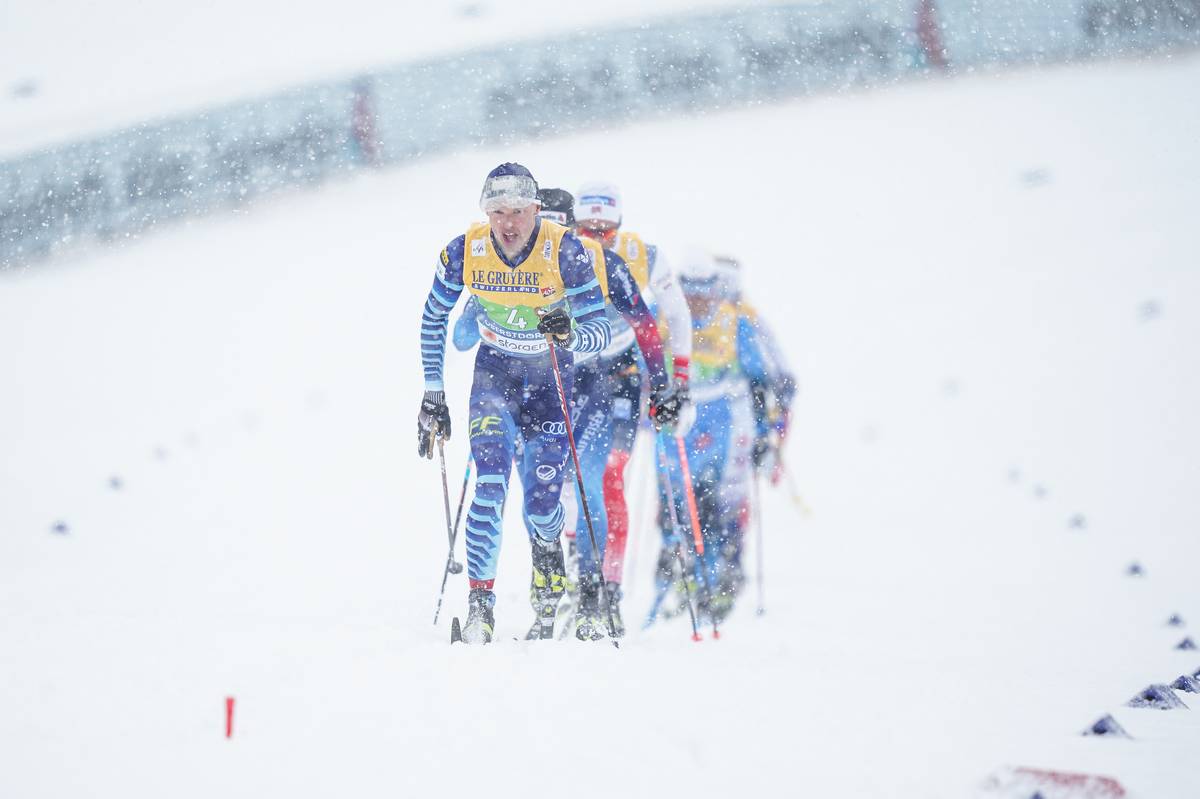
    Results: Men | Women

    ***

    Tour de Ski Stage 7 (Alpe Cermis, Val di Fiemme, Italy): 9 k freestyle climb 

    Women’s report

    Men’s report

    The men’s overall 2018 Tour de Ski podium atop Alpe Cermis after the final Stage 7 hill climb: with Switzerland’s Dario Cologna (c) in first, Norway’s Martin Johnsrud Sundby (l) in second and Canada’s Alex Harvey (r) in third. (Photo: FIS Cross Country/Twitter)

    Dario Cologna of Switzerland added a fourth Tour de Ski (TdS) title to his list of accolades on Sunday, winning the 2018 edition of the race in dominant fashion, with a 1:26.5-minute win over Norway’s Martin Johnsrud Sundby. And Canada’s Alex Harvey scored his first TdS overall podium in third.

    The 31-year-old Cologna started the 9-kilometer freestyle pursuit up Alpe Cermis 1:15 ahead of Kazakhstan’s Alexey Poltoranin in second. Russia’s Sergey Ustiugov, slated to start third, did not start due to a back injury. Thus Harvey was the third man off the start line, 1:23 behind Cologna.

    (Sweden’s Marcus Hellner, 13th after Saturday’s Stage 6, also did not start the Tour’s final stage.)

    Early on, Cologna started putting time into his competitors, extending his lead on Poltoranin to 1:20.5 and Harvey to 1:24 at 1.8 k.

    By 4 k, however, Harvey had used his speedy skiing on the flatter portions of the race leading up to the climb to catch Poltoranin, and the two clocked through that checkpoint 1:19.4 behind Cologna. Behind them, Russia’s Alexander Bolshunov skied just ahead of Sundby, another 21 seconds and 22 seconds back, respectively, in fifth and sixth.
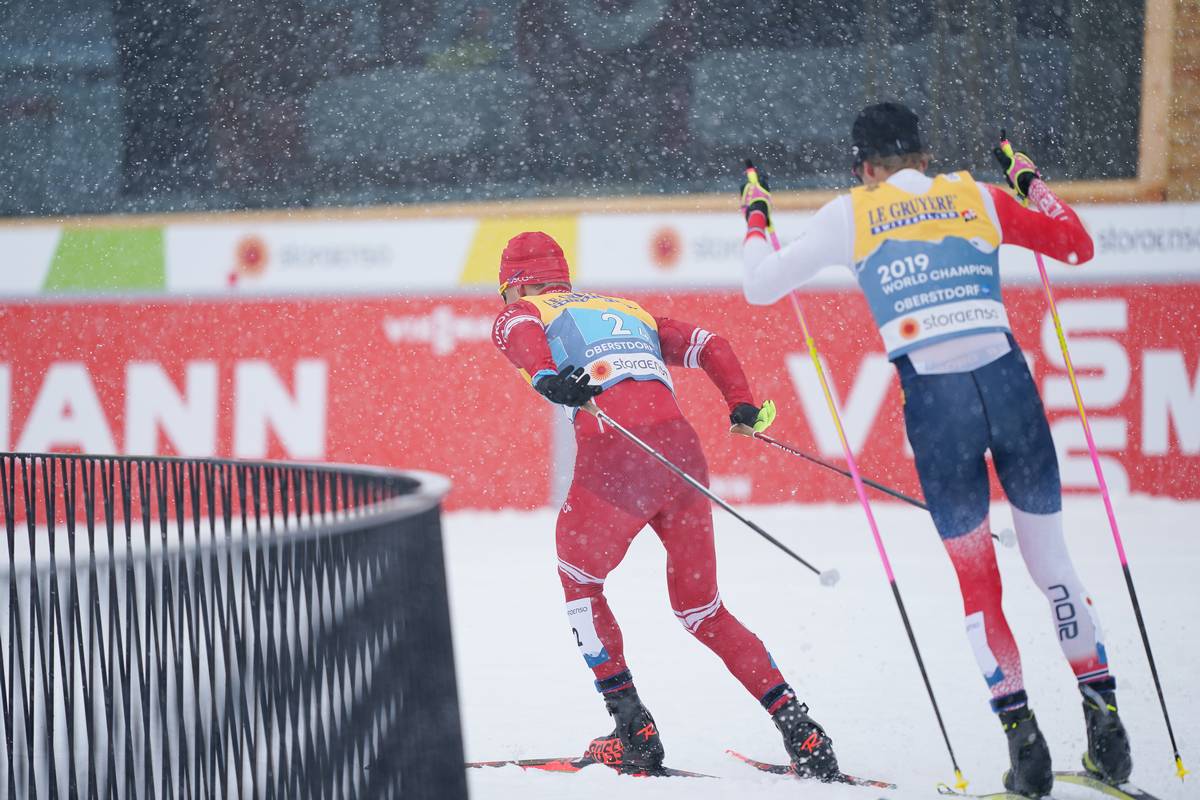
    While Harvey clawed back a few more seconds on Cologna, he was still 1:17.8 back at 6.2 k, with Poltoranin just 0.7 seconds behind him in third.

    Harvey remained in second until around 8.5 k; with just a half kilometer to go, Sundby had caught both Poltoranin and Harvey, passing them both. Sundby held that position and finished second, 1:26.5 behind Cologna, who won in 28:52.1.
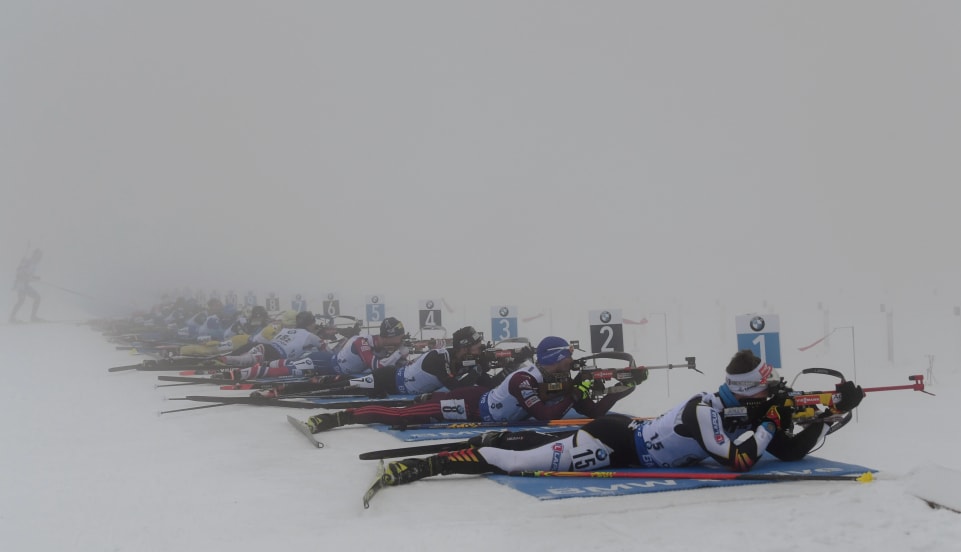
    Harvey stayed strong for third (+1:30.6) while Poltoranin dropped off the Canadian’s pace in the final half kilometer and finished fourth (+1:41.7). Norway’s Hans Christer Holund placed fifth (+2:17.8), Bolshunov lost a spot to finish sixth (+3:09.7), France’s Jean-Marc Gaillard finished seventh (+3:16.7), Sweden’s Daniel Rickardsson eighth (+3:20.8), and Russia’s Alexey Chervotkin and Andrey Larkov took ninth (+3:33.5) and 10th (+3:37.8), respectively.

    France’s Maurice Manificat, known for his strength in freestyle hill climbs and pursuit races, rose from 14th to 11th (+3:45.7) with the second fastest time of day, 12.8 seconds slower than Sundby as the time of day winner in 28:36.4. Cologna’s time was fourth fastest (+15.7), behind Russian U23 skier Denis Spitsov in third (+14.3) (Spitsov started 20th and finished 13th). Holund’s time ranked fifth (+20.6) and Harvey’s time was sixth fastest (+23.6) of the 43 men that finished the race.

    The lone American man to complete this year’s Tour, Paddy Caldwell (U.S. Ski Team) skied the 22nd fastest time of day for 38th overall (+11:54.8).

    Heidi Weng (center) celebrates her second Tour de Ski victory, with teammate Ingvild Flugstad Østberg second and the U.S. Ski Team’s Jessie Diggins third. (Photo: FIS Cross Country/Twitter)

    In the women’s hill climb that kicked off the day, Heidi Weng raced to her second consecutive TdS title. The Norwegian started the day within two seconds of teammate Ingvild Flugstad Østberg, and the two skied together for the flat section of the nine-kilometer stage of the competition. But when the climbing got steep on Alpe Cermis, Weng left her teammate behind and eventually racked up a 48.5-second win.

    The battle for third was less predictable. Jessie Diggins of the United States started the day in fourth, but made up the ten seconds to third-place Krista Pärmäkoski of Finland in the first few kilometers. The pair climbed together for a while before Diggins attacked. Pärmäkoski tired on the final sections of the Alpe Cermis and Diggins took the podium in definitive style, 2:23.2 behind Weng and 24 seconds ahead of Pärmäkoski. It’s the first overall Tour de Ski podium for Diggins or any American athlete.

    Teresa Stadlober of Austria finished fifth (+3:09.4), Kerttu Niskanen of Finland sixth (+4:17.0), Russia’s Anastasia Sedova seventh (+4:49.6), and Switzerland’s Nathalie von Siebenthal eighth (+4:56.1).

    Sadie Bjornsen started eighth and slipped one spot to finish ninth (+6:15.0), giving the U.S. two top-ten finishers in the Tour de Ski for the first time. Liz Stephen finished 16th (+8:25.8) and Rosie Brennan 24th (+10:59.6).

    En route to her win, Weng notched the fastest time of the day on the 9 k stage. Stadlober’s time was second, Diggins third, Østberg fourth, and Stephen fifth.
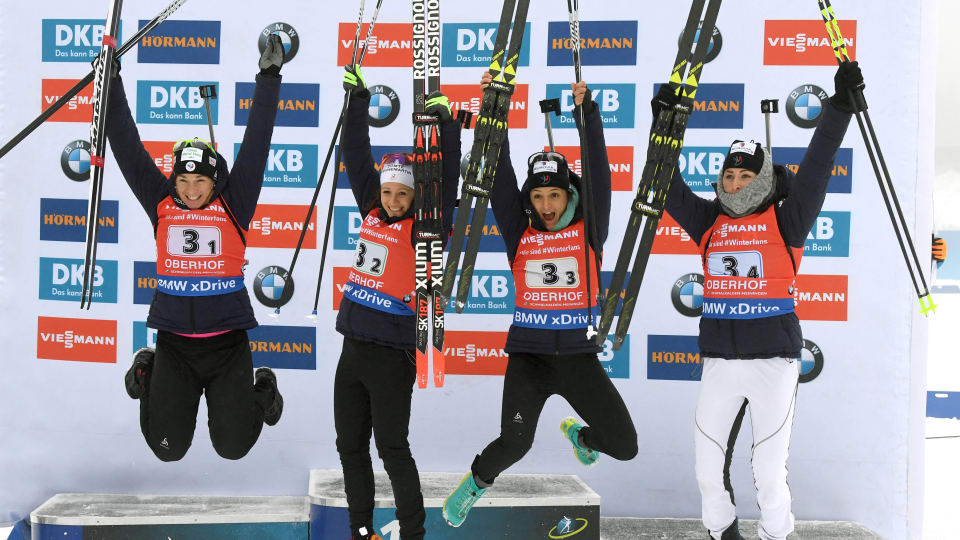
    32 women finished this year’s edition of the Tour de Ski.
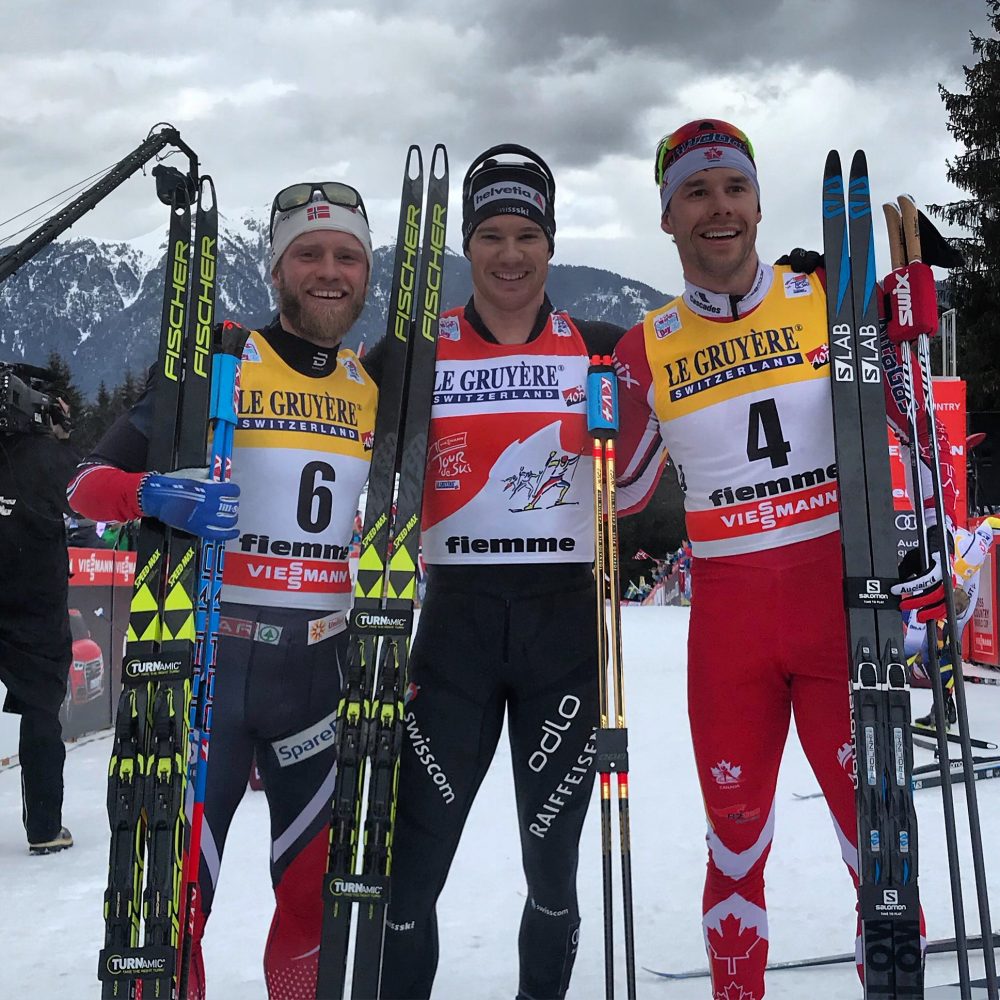
    Results:

    Men’s Stage 7 | Men’s time of day | Men’s Tour de Ski overall standings (final)

    Women’s Stage 7 | Women’s time of day | Women’s Tour de Ski overall standings (final)

  • Cologna in Control with TdS Pursuit Win; Harvey 4th, Bjornsen 22nd

    Cologna in Control with TdS Pursuit Win; Harvey 4th, Bjornsen 22nd

    The men’s 15 k freestyle pursuit podium at Stage 3 of the 2018 Tour de Ski on Monday, with Switzerland’s Dario Cologna (c) in first, and Russia’s Sergey Ustiugov (l) in second and Alexander Bolshunov (r) in third in Lenzerheide, Switzerland. (Photo: Fischer/NordicFocus)

    The Tour de Ski (TdS) theater was treated to a solo-skier drama during the Stage 3 men’s 15-kilometer freestyle pursuit on Monday in Lenzerheide, Switzerland.

    On New Year’s Day, it was a homegrown skier, Switzerland’s Dario Cologna, who stole the show winning the race in 34:56.6 minutes. Cologna is a three-time Tour de Ski winner, who until Saturday’s 15 k classic stage win, hadn’t won a World Cup race in three years.

    “It was an amazing day already yesterday,” Cologna told the International Ski Federation (FIS) in a post-race interview. “Today I didn’t plan to already go away [from Ustiugov] on the second loop, but I felt very good. It was amazing with the crowd again here, with a home crowd it gives you so much energy. The last loop was very tough, Sergey came back strong, but I was just pushing and really wanted this win. It was one of these amazing days.”

    Russia took the remaining podium spots with Sergey Ustiugov in second, 17.6 seconds behind Cologna, and U23 skier Alexander Bolshunov in third (+45.5). The lone Canadian in the race, Alex Harvey, outsprinted a six-man group to finish in fourth (+46.8). Kazakhstan’s Alexey Poltoranin was fifth (+47.1), Norwegians Martin Johnsrud Sundby sixth (+48.1) and Hans Christer Holund seventh (+48.2), Russia’s Alexey Chervotkin eighth (+49.9), Finland’s Iivo Niskanen ninth (+51.5), and Sweden’s Marcus Hellner 10th (+1:21.7).

    For the last day in 2017 and the first in 2018, Cologna is ringing in the new year with a vigorous resurgence. On paper before the race, Cologna’s potential top spot on the podium seemed possible, but based on recent stats, uncertain. Yes, Stage 2’s win was a statement, but a horde of would-be winners and chasers weren’t far back from Cologna at the start.

    Russia’s Sergey Ustiugov racing to second in the Stage 3 men’s 15 k freestyle pursuit at the 2018 Tour de Ski on Monday in Lenzerheide, Switzerland. (Photo: Fischer/NordicFocus)

    As the red-bibbed Tour leader, Ustiugov started first with only a 0.01-second wisp of time before second skier, Cologna, skied away. One-two, they were gone, with Bolshunov 12 seconds back, and the likes of Sundby and Harvey 39 seconds and 53 seconds behind, respectively.

    In a quote to media after his Saturday win, Cologna noted he was hoping to pace together with Ustiugov from the start to keep the chasers at bay. The duel-with-Ustiugov tactics looked like they might play out for the duration — Ustiugov is known as a near-impossible skier to break.

    At 2.7 k, it was a Cologna-Ustiugov tandem; they were separated by 0.4 seconds. But the impressions of the physical strain on 25-year-old Ustiugov were apparent — the strained facial expressions, the suddenly faltering technique. Cologna, on the other hand, looked like he had turned back the clock to his old dominating ways — the 31 year old’s skiing was big, smooth, and powerful.

    At 4.7 k, Ustiugov was 7.3 seconds back. In the next k, Cologna pulled ahead. By 5.8 k, the time gap to Ustiugov had ballooned to 19.3 seconds. And with no apparent flaws evident in Cologna’s skiing, it was game over — Cologna eventually skied across the line on a blue-sky Swiss day waving to the home crowd.

    “I was surprised myself. It really was my tactic to ski together exchanging in the lead, and initially that worked very well,” Cologna told Swiss broadcaster SRF, according to a translation. We regularly exchanged, and then he suddenly couldn’t quite keep up. I had thought that he started extremely fast, I barely could hang on at the beginning, but then he paid a little for that. I was surprised myself. But later he was able to recuperate and kept the gap constant. For me, it worked out great.”

    The Tour takes a rest day on Tuesday and will ramp up again for a Stage 4 classic sprint in Oberstdorf, Germany, on Wednesday. After that, the distance races reign until the Tour concludes with the Stage 7 final climb in Val di Fiemme, Italy.

    “It’s looking good right now,” Cologna told SRF. “Classic sprint is surely my weakest discipline in this tour. Ustiugov will try to win again and then he might be ahead. But then we have three distance races again, and I have shown that I can hold up. The starting position is better than ever. And now I’ll try to pull through.”

    Swiss skier Dario Cologna makes it two wins in a row after a three-year a World Cup victory drought. Cologna won Stage 3 men’s 15 k freestyle pursuit at the 2018 Tour de Ski on Monday.(Photo: Fischer/NordicFocus)

    For now, Cologna asserts with understated confidence that he can crack last year’s TdS winner Ustiugov.

    “I think when you are in this position that has to be the goal. It won’t be easy, the day after tomorrow you can win another minute [in bonus seconds] and that rather will go to Ustiugov than to me. So it’s still very wide open. One also knows that he can rest up very quickly. And the others are also not out of the picture yet, there are some very strong athletes behind who will try everything they have, but I will also give it my best.”

    Harvey 4th, Bjornsen 22nd

    As the ninth starter in a sea of podium-shot skiers, Harvey had to ski strategically from the go. Sundby, starting sixth and 14 seconds in front, was a world-class rabbit to chase. Soon after, by 2.1 k, Harvey had locked onto Sundby.

    “I talked with Holund just before the race and since I was starting just ahead of him, like a second, we agreed that I would just start fast and try to reel in Chervotkin first and then do the first 2 k in the front,” Harvey explained on the phone about his race plan. “Then [Holund] said he was going to help if he felt good, so he was able to help to close the last I don’t know 6 seconds to Sundby.  … I was expecting Sundby go a bit hard. I don’t know if he was playing it conservative knowing that the course bites you in the ass on the last lap with the slow snow condition, or if he felt a little tougher today, but it was a bit unexpected to be coming back on him. At like 3 k we were back on him — it was fairly fast to close 15 seconds on him.”

    At 6 k, Harvey was part of a strong group of seven skiers, all of whom except Finland’s Ristomatti Hakola, were glued together until the final straight. Beyond Harvey and Hakola, the group included Holund, Poltoranin, Sundby, Niskanen, and Chervotkin.

    “The group was working well, but it was kind of such slow snow on the climb that no one was feeling good enough to do really good pulls,” Harvey said. “We would do a pull, and then your legs would get so tired and people would move over but it was the same for everybody. … It was really hard actually. The snow on the climbs especially was cold and dry, and then the downhills were a bit faster, but it was really hard, especially muscularly on the legs.”

    In last year’s Lahti World Championship men’s 50 k freestyle mass start, Harvey showed he’s a master of gamesmanship and crushing sprint efforts after a distance effort. Sometimes leading, sometimes drafting in the pack on Monday, Harvey in part, let his brains dictate the strategy.

    “I was trying to help a bit on the sections I am the best, and I had really good skis,” Harvey said. “I was trying to, on the flatter sections where it’s more high speed, take some lead, and on some downhills push some baskets if I am following. I know on the steep terrain, the long grindy hill is maybe not my strength compared to Sundby — they were doing a lot of the work there — I was trying to push it on the flat and the more high-speed sections. …  when you are in a pack with Sundby, it is kind of up to him to try to break us. I think everyone knew he was the strong man of the group, he is not the World Cup overall leader now, but he still is still one of the favorites, he is top-three overall.”

    Canada’s Alex Harvey (9) and Norway’s Hans Christer Holund (10) during Stage 3 men’s 15 k freestyle pursuit at the 2018 Tour de Ski on Monday. Harvey placed fourth in the race. (Photo: Salomon/NordicFocus)

    In the closing kilometer, Bolshunov’s gap on the Harvey pack was closeable. Perhaps with a few more meters and coupled with Bolshunov’s fade starting around 13 kilometers, Harvey could have snagged the last podium spot. Harvey showed he’s still a standout finisher by outsprinting his cohort and nearly catching Bolshunov as he captured fourth place — 1.3 seconds behind Bolshunov.

    “I knew with the good skis, I could have a good kick at the end if I was feeling OK,” Harvey said. “So my card was more to be in good position for the last two k instead of trying to break the group.”

    Harvey plans on finishing the Tour. The Quebec native explained he’s being treated well after the other Canadian who started the Tour, Devon Kershaw came down with an illness and withdrew after Stage 1.

    “We still have five wax technicians; I still have seven total staff working just for me,” Harvey said. “It’s actually pretty sweet. With the small group it is really quick to turn around, we drove out of the hotel 15 minutes ago and we saw the French guys pulling in, so they hadn’t showered yet, they hadn’t packed their bags so we are probably 30 minutes in front of them. It makes it good for the recovery and more seamless for all the transitions. I am really lucky.”

    With time bonuses factored in, Cologna leads the Tour standings with 1:12:46.6 hours of cumulative time. Ustiugov is in second, 22.6 seconds back, Bolshunov third (+55.5), and Harvey fourth (+1:01.8).

    Harvey is joined by several skiers closely separated from fifth to ninth. Poltoranin is fifth overall (+1:02.1), Sundby sixth (+1:03.1), Holund seventh (+1:03.2), Chervotkin eighth (+1:04.9), and Niskanen ninth (+1:06.5). Hellner sits in 10th (+1:36.7).

    For the U.S., Erik Bjornsen’s distance skiing remains a highlight. He kept his personal streak of skiing into the top 30 in every distance race he’s entered this season alive. Bjornsen notched a 27th in Saturday’s classic pursuit, a result that set him up for success on Sunday. He started one spot and 11 seconds behind World Cup overall distance leader, France’s Maurice Manificat.

    Right away, Manificat set a too-hot pace. By 2 k, the Frenchmen had moved up to 19th place (+1:37.0), while Bjornsen bumped to 26th (+1:57.7). Manificat, in fact, skied the fastest time of day, covering the 15 k in 34:41.8 minutes.

    The U.S. Ski team’s Erik Bjornsen (blue suit near the finish) about to toe the line during the Stage 3 men’s 15 k freestyle pursuit at the 2018 Tour de Ski on Monday. Bjornsen placed 22nd. (Photo: screenshot from SRF)

    Bjornsen soon found his groove and his mates for the remaining kilometers.

    At 10 k, Bjornsen skied in 28th place in a dense ski train of approximately 11 skiers. The group accounted for places 32nd through 23rd.

    For another 2 k, Bjornsen seemed married to his 28th spot. But, seeking an opportunity, Bjornsen, along with Sweden’s Calle Halfvarsson and Britain’s Andrew Musgrave, moved to the front and pushed the pace of what would be a line of close-in-contact chasers.

    In the final kilometers, the Bjornsen group closed nearly ten seconds on Cologna. With his constant up-tempo pressure and smart skiing, Bjornsen finished in 22nd place (+2:20.7) with the 26th-fastest time of day.  

    Bjornsen goes into the rest day now placed 22nd in the Tour and 2:35.7 minutes behind Tour leader Cologna.

    “He’s really consistent,” U.S. Ski Team Head Coach Chris Grover said on the phone from the U.S. “He is really strong every event whether in a distance race, sprint, classic, skate. I think he wanted a little bit more out of the classic a day ago, I know it was a tough waxing day for all of those guys.”

    Monday’s 22nd place was Bjornsen’s second-best result of the season — he placed 20th in the World Cup 30 k skiathlon last month in Lillehammer, Norway.

    Bjornsen is now faced with deciding if he stays or goes as it relates to the Tour. Grover stated Bjornsen will contest the Stage 4 sprint in Oberstdorf, but will then determine his race plan.

    “He can have some great races in Oberstdorf,” Grover noted. “He will be one that is actually trying to make the decision, that at what point coming out of  Oberstdorf where it makes sense to complete the entire Tour or whether it makes sense for him to stop and race in Dresden.”

    The Dresden World Cup weekend runs Jan. 13-14 and features a freestyle team sprint. That team sprint in Dresden is the only opportunity to contest that event before the Olympics. (The team sprint is also an Olympic event and Bjornsen is targeting the team sprint at the Games.)

    “He is the one that is keeping his eye on that possibility,” Grover explained. “He’ll make his own determination after the next two days of racing which path he wants to go on. Both of them are great ways to go. It just depends whether he wants to really try to move up in the last few of the TdS standings or if he feels like it is more valuable for him to be in a tactical sprint experience of the team sprint.”

    Also for the U.S. Ski Team on Monday, Simi Hamilton placed 48th (+4:13.9), Paddy Caldwell 68th (+6:04.4) and Andy Newell 74th (+8:15.6).

    After Sunday’s racing, Caldwell, who had intended to finish the whole Tour, sits 51st in the Distance World Cup standings. For the 23-year-old Caldwell to meet the objective criteria for an Olympic spot, he’ll need to be in the top 50.

    “He knew the deal going in,” Grover said of Caldwell’s decision to race the Tour. “He knew that he would have to qualify using World Cup or he would have to qualify using U.S. National Championships and racing SuperTour in the fall. For him, he felt like it was more valuable to race World Cup to gain the experience and have a lot of starts during this period. He has weighed the options and he fully realizes that he may not qualify for the Olympics if he chooses what could be the more difficult path. He really felt like the World Cup was the more valuable experience for him because he wants to be a World Cup skier in the future and he wants to be someone who is having good results on the World Cup in the future.”

    Grover also recognized Caldwell’s presence at the Tour as beneficial in the long run.

    “As the youngest guy on the team, he’s skiing all of these races, in all of these venues for the very first time,” Grover said. “For him, it is about building experience for the future. If you can just go and learn these venues and learn these course, learn how to manage his energy in a Tour de Ski, in a seven-stage, nine-day event, that is really critical. That will be the kind of preparation he needs for the future.”

    Tuesday is a rest day for Tour skiers. Racing resumes on Wednesday in Oberstdorf with a classic sprint.

    Results: Stage 3 pursuit | Time of Day | TdS standings (through Stage 3)

  • Tour de Ski Rundown: Diggins 3rd; Harvey 4th; Østberg and Cologna Tally Win No. 2

    Tour de Ski Rundown: Diggins 3rd; Harvey 4th; Østberg and Cologna Tally Win No. 2

    The women’s freestyle pursuit podium at Stage 3 of the Tour de Ski, with Norway’s Ingvild Flugstad Østberg (c) in first and Heidi Weng (l) in second and American Jessie Diggins (r) in third on Monday in Lenzerheide, Switzerland. (Screenshot: ZDF broadcast)

    Tour de Ski Stage 3 (Lenzerheide, Switzerland): 10/15 freestyle pursuits

    Women’s report

    Men’s report

    In the first three stages of the Tour de Ski (TdS), three different American women have reached the podium. Jessie Diggins became the latest in Monday’s New Year’s Day 10-kilometer freestyle pursuit in Lenzerheide, Switzerland.

    Heading into Stage 3, the last one in Switzerland before the Tour moves to Oberstdorf, Germany, Diggins ranked third overall in the TdS. She started the pursuit in that place, 1:05 minutes after Tour leader Ingvild Flugstad Østberg of Norway. More than 30 seconds ahead of her, another Norwegian Heidi Weng headed out of the start in second place, 33 seconds after Østberg. And 10 seconds behind Diggins, her U.S. teammate Sadie Bjornsen started fourth, 1:15 out of first and just two seconds ahead of Russia’s Natalia Nepryaeva in fifth.

    The women’s race then became a demonstration of strength and grit as Østberg kept herself out of reach, leading by a comfortable margin at every checkpoint and securing her second-straight win in 26:48.1 minutes. Weng could see her, and Diggins could see Weng, but neither linked up, as Weng finished second, 27.8 seconds after Østberg, and Diggins held onto third (+1:16.9) for her first podium of the season.

    Behind Diggins, Finland’s Krista Pärmäkoski rose from eighth and 1:35 back at the start (starting behind her Finnish teammate Kerttu Niskanen in sixth and American Sophie Caldwell in eighth), to fourth at the finish, 1:45.9 out of first. Pärmäkoski outlasted Bjornsen by 0.3 seconds and Niskanen by 0.7 seconds at the finish to put herself in fourth overall in the Tour standings with four stages remaining, while Bjornsen placed fifth (+1:46.2) and Niskanen sixth (+1:46.6).

    Norway’s Astrid Uhrenholdt Jacobsen moved up from 15th at the start to seventh at the finish (+1:59.9) with the fifth-fastest time of day. Austria’s Teresa Stadlober won the time of day, covering the course in 26:20.6 and improving from 22nd to 11th.

    The U.S. had three finish in the top 20 with Caldwell placing 18th (+2:59.2) after skiing with a group of nine, led by Jacobsen and Switzerland’s Nathalie von Siebenthal, until the last of three laps. Caldwell fell off the pace around 7.5 k and skied the remainder of the lap alone to put herself 18th overall in the tour.

    Liz Stephen started 37th and moved up to 31st (+4:07.7) with the 26th-fastest time of day (1:27.2 behind Stadlober). Rosie Brennan started 33rd and finished in that position (+4:17.9), and Ida Sargent finished 55th (+6:09.2) after starting 31st. Sixty-one women remain in the tour with four stages to go.

    Cologna Takes Control

    The men’s 15 k freestyle pursuit podium at Stage 3 of the 2018 Tour de Ski on Monday, with Switzerland’s Dario Cologna (c) in first, and Russia’s Sergey Ustiugov (l) in second and Alexander Bolshunov (r) in third in Lenzerheide, Switzerland. (Photo: FIS Cross Country/Twitter)

    [UPDATED]

    One second wasn’t enough for Russia’s Sergey Ustiugov to keep Dario Cologna at bay on the Swiss skier’s home turf, as the two started the men’s 15 k freestyle pursuit in first and second, respectively, with just 1 second between them on Monday in Lenzerheide.

    Cologna took the lead after the first lap, around 3.7 k, and never relinquished as he scored his second-straight stage victory in Stage 3 of the Tour de Ski. Cologna previously won Sunday’s 15 k classic, but was second based on time back in the overall Tour standings to Ustiugov.

    Between 3.7 and 4.7 k, Cologna put about six seconds into the Russian and was more than 19 seconds ahead of him by the 5.8 k checkpoint. Ustiugov skied around 22 seconds back at 10 k, still 15 seconds clear of another Russian Alexander Bolshunov in third and 43 seconds ahead of another one of his teammates Alexey Chervotkin in fourth.

    Meanwhile, Canada’s Alex Harvey skied in fifth place with the six-man chase group Chervotkin was leading. Norway’s Martin Johnsrud Sundby took charge of that group by 13.3 k, while Harvey remained in fifth.

    At the finish, Cologna took the win by 17.6 seconds over Ustiugov, crossing the line in 34:56.6. Ustiugov placed second and Bolshunov third (+45.5), while Harvey charged hard for the podium and placed fourth (+46.8). The Canadian beat Kazakhstan’s Alexey Poltoranin by 0.3 seconds for fourth, while Poltoranin settled for fifth (+47.1), Sundby sixth (+48.1), Norway’s Hans Christer Holund seventh (+48.2), Chervotkin eighth (+49.9), Finland’s Iivo Niskanen ninth (+51.5), and Sweden’s Marcus Hellner 10th (+1:21.7).

    Cologna leads the Tour by 22.6 seconds over Ustiugov, Bolshunov is 55.5 seconds back in third, and Harvey 1:01.8 minutes back in fourth, just ahead of Poltoranin in fifth (+1:02.1), Sundby in sixth (+1:03.1) and Holund in seventh (+1:03.2).

    Erik Bjornsen is up to 22nd in the Tour standings with four stages to go, 2:35.7 out of first, after placing 22nd on Monday and finishing 2:20.7 behind Cologna. The U.S. Ski Team’s leading man started 25th and skied the 26th-fastest time of day.

    Can you guess who won the men’s time of day? France’s Maurice Manificat, who has a tendency to win these FIS points races, with a course time of 34:41.8. Manificat started 24th and skied up to 14th at the finish. Harvey’s time ranked fourth, 7.8 seconds slower than Manificat’s, while Holund was fifth fastest (+8.5) and Cologna sixth fastest (+13.2).

    Four American men raced the third stage of the Tour, with Simi Hamilton finishing 48th (up from 54th at the start), Paddy Caldwell finishing 68th (up from 74th), and Andy Newell finishing 74th (after starting 69th). Overall, Hamilton, a sprint-focused skier who hadn’t planned on racing the whole Tour, according to U.S. head coach Chris Grover, is 48th in the Tour, 4:28.9 out of first. Caldwell is 68th (+6:19.4), and another sprinter, Newell 74th (+8:30.6) out of 77 men remaining in the TdS.

    Racing resumes Wednesday in Oberstdorf with Stage 4 classic sprints.

    Results:

    Women’s Stage 3 pursuit | Women’s Time of Day | Women’s TdS standings (through Stage 3) 

    Men’s Stage 3 pursuit | Men’s Time of Day | Men’s TdS standings (through Stage 3)

  • Cologna is Back with a TdS Stage Win; Harvey 20th, Bjornsen 27th

    Switzerland’s Dario Cologna after winning the Tour de Ski Stage 2 men’s 15 k classic on Sunday in Lenzerheide, Switzerland, for his first World Cup win since January 2015. (Screenshot: ZDF broadcast)

    Tick-tock. An appropriate intro in a place like Switzerland — a nation and culture known for accurate timepieces and punctuality.

    Depending on how you look at it, for 31-year-old Swiss skier Dario Cologna, one of two things has been on-the-dot: his three year slide in results since winning the 2014/2015 World Cup overall and his battle with both injuries and an ascendant Martin Johnsrud Sundby; Or his rejuvenated Lenzerheide, Switzerland Tour de Ski (TdS) Stage two kick, glide, and pole performance in the 15-kilometer classic individual start on Saturday.  

    In the final 100 meters, the clocked ticked down precious seconds for Cologna as he attempted to keep his grasp on a hair-thin margin over classic ski specialist from Kazakhstan, Alexey Poltoranin. Until Cologna’s appearance near the finish line, Poltoranin looked locked in the leader’s chair.

    But as Cologna came into the home stretch, with the Viessman markers indicating 100m, 75m, 50m and 25m before him, the clock read -13.7 seconds. For Cologna to win. Thirteen point six of those 13.7 seconds could tick off for the Swiss skier to win.    

    As the time passed, it looked physically impossible for Cologna to cover the ground fast enough — the seconds seemingly ran off faster than the meters covered.

    With his toe crossing the line and the Swiss flags waving, Cologna won with a margin of 0.6 seconds over second place skier Poltoranin. For most, a razor-thin time margin for a 15 k race. But in Switzerland, coming in on the good side of a 0.6 second win might as well be an hour cushion— early is early, late is late, and a win is a win.

    Cologna covered the 15 k distance in 35:29.5 minutes, winning the second stage of the 2018 Tour de Ski for his first World Cup victory in three years. Poltoranin placed second (+0.6), and Norway’s Martin Johnsrud Sundby scored his first podium since early December. Sundby placed third, 13.1 seconds out of first.

    “After a sprint, it is always a little harder to get going again,” Cologna told Swiss broadcaster SRF, according to a translation. Cologna placed 14th in the TdS Stage one sprint. That was Cologna’s best sprint result since a 13th in last seasons TdS opening day sprint.

    “But I already showed yesterday that I am well on my way, that I could race a good prologue, and today it worked out great,” Cologna continued. “I had good material. And I think I could make a good race towards the finish. It’s amazing, the first victory in Switzerland. I think it’s my 22nd, but the first one at home, which is very beautiful. And after a two-year break, it really is a great satisfaction.”

    The race wasn’t only a contest between Cologna and Poltoranin. With Cologna starting in bib 62 and Poltoranin in bib 27, the time stamps for success had been laid down. Starting six spots back behind Cologna was Russia’s Alexander Bolshunov in bib 68.

    Bolshunov started hot and sustained that pace for the first two laps. On the other hand, Cologna began a bit more tempered, posting the ninth fastest split at 2.5 k. Cologna then throttled up and posted the fastest splits at 6 k, 8.5 k, and 10 k. Those times held up until Bolshunov steamrolled through.

    The Russian U23 skier posted the fastest splits until the finish. Bolshunov began the last lap at 10 k with a 7.4 second lead on Cologna but faded on the final lap to place fourth, 14 seconds behind the winning time.

    “I felt good and I think I paced myself well,” Cologna said in the SRF interview. “In the beginning, I didn’t feel that I was going so fast, but the split times were alright, never far away (off the pace), and in the end, I could really push the tempo again. Especially the long climb out of the stadium, I timed that well and never over-paced there, that worked out perfectly. And surely the equipment was also super until the end.”

    Another Russian U23 skier, Alexey Chervotkin skied to fifth (+16.2). Norway’s Hans Christer Holund was sixth (+21.2), Finland’s Iivo Niskanen seventh (+22.9), Italy’s Francesco De Fabiani eighth (+27.2), Norway’s Didrik Tønseth ninth (+37.1), and Russia’s Sergey Ustiugov 10th (+37.1).

    Despite his 10th place, Ustiugov remains the TdS leader. On Monday’s 15 k freestyle pursuit, Ustiugov will ski off first, followed by Cologna in second (+1.6), while Bolshunov will ski off third, 13.1 seconds behind.

    This position, just behind the leader Ustiugov, appears to suit Cologna heading into stage three.

    “The starting position, I think just one or two seconds back, that is pretty much optimal,” Cologna said to SRF. “Then I can ski with Ustiugov from the start, and I hope we will be fast. That is really ideal. If I was ten seconds ahead that wouldn’t help much, I probably would just get caught quickly. This way, we can work together right from the beginning. It’s going very well so far, and I hope it will continue like that.”

    Cologna is a three-time winner of the TdS — having placed first overall in 2008/2009, 2010/2011 and 2011/2012. Asked by SRF if he felt like he is back to his old form, Cologna expressed hope that the old self is the new self.

    “I hope so! I also had a good feeling at the beginning of the season, always close… but it never fully worked out, and today it didn’t,” Cologna said. “In the finish, the six-tenth of a second were on my side for once. And yeah, I hope I am back.”

    Alex Harvey on his way to 20th place in the Tour de Ski Stage 2 men’s 15 k classic on Sunday in Lenzerheide, Switzerland. (Screenshot: ZDF broadcast)

    Having never left the top-end of the sport is Canada’s, Alex Harvey. After placing seventh in Saturday’s sprint, and coming into Sunday’s race ranked 6th overall in the TdS, Harvey began as the 48th starter. The race did not play out to Harvey’s liking

    “It was just a bad day,” Harvey said according to a Cross Country Canada press release. “The 15 kilometre classic is my weakest event, but I was still expecting something better today. I just have to forget about today and focus on tomorrow.”

    Harvey was 15th, 17th, and 18th at the 6 k, 8.5 k, and 10 k marks respectively. He finished in 20th (+57.9).

    “The beginning was good, but I just didn’t ski well and struggled the rest of the way,” Harvey told Cross Country Canada. “I didn’t blow up or explode. I was just bleeding time the whole way. It is a really hard course with a bit of altitude and I think I lost most of my time on the climbing sections.”

    After Sunday’s race, Harvey slipped from seventh to ninth place in the overall standings. He’ll start Monday’s pursuit 53 seconds behind Ustiugov and 14 seconds back from sixth overall skier Sundby.  

    Canada brought two skiers to the TdS, Harvey, and teammate Devon Kershaw. Kershaw has started all 12 TdS editions.

    “I had the 2nd most starts in stages, but now Jean-Marc Gaillard (FRA) will pass me and I will be 1 or 2 down on Petter (Northug),” Kershaw wrote in an email “ If you look at the stats, it’s incredible that Petter has started and finished 10 Tours, and has been top 4 in all those. That’s amazing. He’s missed here.”

    On Sunday, Kershaw did not start due to illness. According to the skier, early Friday morning, he was “rocked hard” by a stomach illness.

    “Friday I was in bed all day long and could not eat anything except for two pieces of white bread at about 19:00 and about 1L of sport drink… It was agony,” Kershaw emailed.

    “I tried to race on Saturday (in hopes of just getting through the sprint in case I bounced back fast),  but obviously I was completely empty. In the sprint I had no energy and no power whatsoever,” Kershaw explained. “But by Saturday after the race I was eating some “actual” food again, so I was hoping for a miracle today. This 15km classic was a target race of mine when the World Cup calendar came out, so it was hard to let go of. I went up to the stadium, tested my skis, and skied with Ivan some kilometres to judge how I was feeling. The verdict was depressing: I just had zero power in the body, and felt so empty again, so I couldn’t justify starting. Now it’s time to eat as much as I can, and drink a ton to get back feeling normal again.”

    Kershaw now plans on traveling to Davos for some training until Jan. 4. After, Kershaw will begin his Olympic prep with a three week altitude block in Seiser Alm, Italy.

    “With me missing these vital races, I will change my plans a bit and most likely race in Planica, SLO on the 21st weekend,” Kershaw added. “The main thing now is to fill up the tank again. I am so disappointed and sad to miss my favourite event – I love the Tour de Ski and it’s been good to me in the past. Not much I can do now, it was horrible timing to get  a stomach bug, but I should be a-ok in a few days and back on track after taking a decision like this (to stop).”

    On the U.S. side in Saturday’s 15 k classic, Erik Bjornsen led the U.S. men in 27th (+1:22.4). Bjornsen was Sunday’s third starter and as such was in a virtual time-split void.

    “I would prefer to start around the seeded guys, just to have a better idea of where I’m at in the overall, but it was fine to start bib three,” Bjornsen said over Skype. “I started behind two French guys that I kinda followed their results in the past. So it was fun to have a rabbit out there that I really wanted to catch. I got some feedback, but nothing super-useful because it’s hard to give splits to someone who’s starting so far up in the pack. They’re able to give me splits at like 6K when I was finishing, and it sounded like I was in a pretty decent spot so, yeah, I mean, the splits weren’t super-useful today.”

    Erik Bjornsen of the U.S. Ski Team in the Tour de Ski Stage 2 men’s 15 k classic on Sunday in Lenzerheide, Switzerland. Bjornsen placed 27th in the race. (Screenshot: ZDF broadcast)

    This is Bjornsen’s third Tour and being an Olympic year and the possibility that he’ll contest the sprints in Dresden on Jan. 13 and 14, he’s still unsure he’ll race until the Tour’s final stage.

    “I guess finishing this tour is still a little bit up in the air, which, I think, in the past two years, I went into the Tour thinking I would for sure finish,” Bjornsen said. “I guess that’s a little bit of a different mindset going into it. But the approach is still the same, I mean, hopefully, I hope to be competitive every day, work hard at trying to make sure I’m recovered after every race, and prepared for the next one.”

    Bjornsen will begin Monday’s pursuit ranked 25th, 1:46 minutes behind Ustiugov. This time around, it will be a controlled mass start in ways and Bjornsen will have plenty of rabbits to chase. French standout and World Cup distance list leader, Maurice Manificat, starts in bib 24, nine seconds ahead of Bjornsen.

    It should also be noted that Bjornsen is on a distance race roll. He has started five World Cup distance races of seven and scored World Cup points in each. (The top-30 skiers score points.)

    “I’m pretty excited that I’ve actually finished top-30 in every distance race I’ve started this year, so hopefully that’ll be the goal again for tomorrow,” Bjornsen added. “I was definitely hoping for a little better result today–I tend to be a little better classic skier. But, I mean, tomorrow, just kinda hold the position. I haven’t looked at which guys I’m around but I’m sure it’s pretty tight. So hopefully we can have a good group to work with and, yeah, I mean, definitely stay top 30 is the big goal.”

    Other U.S. finishers were Simi Hamilton in 58th (+2:41.8), Andy Newell was 71st (+3:11.5), and Paddy Caldwell 75th (+3:36.2).

    Eighty-five men finished the second stage of the Tour de Ski.

    Results: Men’s 15 k classic | Tour standings (through Stage 2)

    — Harald Zimmer, Andrea Potyondy-Smith, and Alex Kochon contributed

  • Tour de Ski Rundown: Sadie Bjornsen 3rd; Østberg Posts 25-Second Win; Cologna Wins at Home

    Tour de Ski Rundown: Sadie Bjornsen 3rd; Østberg Posts 25-Second Win; Cologna Wins at Home

    The women’s 10 k classic podium at Stage 2 of the 2018 Tour de Ski, with Norway’s Ingvild Flugstad Østberg (c) in first and Heidi Weng (l) in second, and American Sadie Bjornsen (r) in third in Lenzerheide, Switzerland. (Photo: FIS Cross Country/Twitter)

    Tour de Ski Stage 2 (Lenzerheide, Switzerland): 10/15 classic

    Women’s report

    Men’s report

    For the second-straight day of the Tour de Ski, an American landed on the podium, with Sadie Bjornsen placing third in the women’s 10-kilometer classic individual start on Sunday in Lenzerheide.

    For Bjornsen, it was her third individual podium of the season and first in a race longer than 5 k.  She finished behind two Norwegians, Ingvild Flugstad Østberg, who took the win in 26:59.4 minutes, and Heidi Weng, who was 25.7 seconds back in second.

    Bjornsen was 42.2 seconds out of first and 6.7 seconds clear of Finland’s Kerttu Niskanen in fourth (+48.9). Sweden’s Anna Haag placed fifth (+52.6), Germany’s Nicole Fessel finished sixth (+58.2), and the second American in the top 10, Jessie Diggins in seventh (+1:04.4).

    Switzerland’s Nathalie von Siebenthal placed eighth (+1:08.3) on home soil, just ahead of Germany’s Stefanie Böhler in ninth (+1:08.8), and Slovenian U23 skier Anamarija Lampič placed 10th (+1:08.9).

    For Østberg, the win came two seasons after she won her very first distance World Cup race in Lenzerheide. With the win she leads the Tour standings by 32.8 seconds over Weng in second. Diggins is up to third overall (+1:04.9) and will start Monday’s 10 k freestyle pursuit accordingly, 1:05 seconds after Østberg, who will head out of the gate first.

    Bjornsen is fourth overall (+1:15.4), just ahead of Russia’s Natalia Nepryaeva in fifth (+1:17.3) while Niskanen is another 15 seconds back in sixth (+1:32.0), and will start the pursuit with American Sophie Caldwell, who was second in Saturday’s Stage 1 skate sprint and ranks seventh overall (+1:32.0). Caldwell placed 21st on Sunday, 1:40.6 behind Østberg.

    “It’s has been a huge goal of mine to be on the distance podium,” Bjornsen said, according to a FIS press release. “It felt really crazy out there today. At the 6.0 km I got the information I was in 2nd place. I had to ski a lot out of the track. I had to give everything I had in the last 2.5 km. I was little bit disappointed yesterday, I was hoping for more so today feels really great.”

    The U.S. had five in the top 30 with Liz Stephen in 28th (+2:04.8) and Ida Sargent in 30th (+2:06.7). For Stephen, it was her first time in the points (top 30) this season. Rosie Brennan placed 38th (+2:20.5). Kikkan Randall did not start and thus withdrew from the Tour.

    Dario Cologna rose to the challenge on Sunday, winning the second stage of the 2018 Tour de Ski for his first World Cup victory in three years.

    The 31-year-old Swiss skier completed the men’s 15-kilometer classic individual start in 35:29.5 minutes, besting the time of Kazakhstan’s Alexey Poltoranin by 0.6 seconds to win in front of a home crowd in Lenzerheide, Switzerland.

    Cologna started 62nd and sped up as the race progressed, clocking the fastest times from 6 k on. Russia’s Alexander Bolshunov started behind him in bib 68 and topped Cologna’s time at every checkpoint, skiing 7.4 seconds faster than him at 10 k. But over the final 5 k loop, Cologna prevailed and Bolshunov faded, with the Russian U23 skier finishing fourth, 14 seconds off Cologna’s winning time.

    “It’s amazing, the first victory in Switzerland,” Cologna told Swiss broadcaster SRF. “I think it’s my 22nd [World Cup win], but the first one at home, which is very beautiful. And after a two-year break it really is a great satisfaction.”

    Poltoranin started 27th and claimed his second podium of the season and first one of the tour, while Norway’s Martin Johnsrud Sundby scored his first podium since early December. Sundby placed third, 13.1 seconds out of first. Russia had two in the top five with another U23 skier, Alexey Chervotkin in fifth (+16.2). Norway’s Hans Christer Holund was sixth (+21.2), Finland’s Iivo Niskanen seventh (+22.9), Italy’s Francesco De Fabiani eighth (+27.2), Norway’s Didrik Tønseth ninth (+37.1), and Russia’s Sergey Ustiugov 10th (+37.1).

    Canada’s Alex Harvey placed 20th (+57.9) and slipped two places in the overall standings to ninth. Russia’s Sergey Ustiugov, who won yesterday’s Stage 1 skate sprint, still leads the standings while Cologna is up to second, just 1.6 seconds back heading into Monday’s freestyle pursuit in Lenzerheide. Bolshunov is third, 12.7 seconds back, Poltoranin fourth (+22.0), Finland’s Ristomatti Hakola fifth (+27.7), Sundby sixth (+39.1), Niskanen seventh (+46.4), Chervotkin eighth (+49.8), Harvey ninth (+53.8), and Holund 19th (+54.5).

    In Saturday’s 15 k classic, Erik Bjornsen led the U.S. men in 27th (+1:22.4), Simi Hamilton finished 58th (+2:41.8), Andy Newell was 71st (+3:11.5), and Paddy Caldwell 75th (+3:36.2).

    Eighty-five men finished the second stage of the Tour de Ski; Canada’s second man, Devon Kershaw, did not race on Sunday and withdrew from the tour due to illness.

    Results:

    Women’s 10 k classic | Women’s Tour standings (through Stage 2) 

    Men’s 15 k classic | Tour standings (through Stage 2)

    Monday start lists: 

    Women’s 10 k freestyle pursuit | Men’s 15 k freestyle pursuit