From the FasterSkier archive — posts syndicated from athletes’ and coaches’ own blogs between 2004 and 2012, kept online as published. Current coverage is at fasterskier.com.

Tag: Alexey Petukhov

  • Kalla Continues to Dominate in Gällivare; Russia Sweeps Men’s 15 k Classic

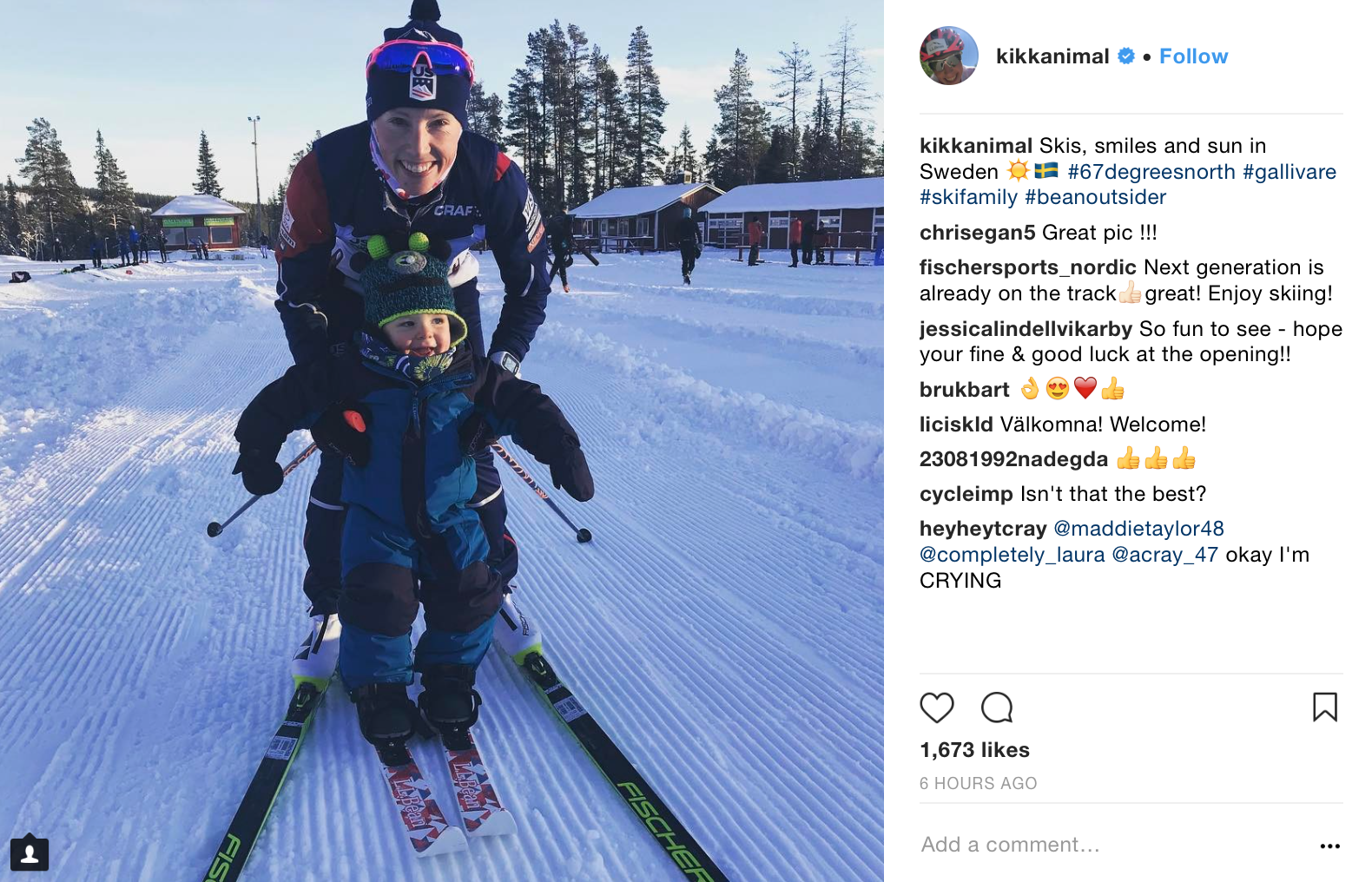
    https://www.instagram.com/p/BbpElh6gxkx/?taken-by=kalla_87

    Note: This article has been updated to include comments from Sweden’s Charlotte Kalla.

    For the second day in a row, Charlotte Kalla, a name synonymous with the yellow and blue of Sweden, stood atop the podium, placing first in the women’s 10-kilometer classic International Ski Federation (FIS) race on Saturday in Gällivare, Sweden. On Friday, Kalla won another individual-start race, the 5 k freestyle, by a margin of 8.8 seconds. She more than doubled that time gap by the finish of Day 2, winning the 10 k classic in 27:55 minutes, 17.7 seconds ahead of Russia’s Yulia Tchekaleva in second place. Natalia Nepryaeva, also from Russia, skied to third, 40.9 seconds back of Kalla.

    “I am feeling good and I think I am where I should be at this moment,” Kalla wrote in an email. “I had a good feeling on the classic race and handle the condition well. On Friday I opened hard and tried to push hard all the way.”

    Known as a skate powerhouse, Kalla has improved her classic skiing and is now a double threat. “I have improved my classic technique the last years,” Kalla explained. “When I am in shape it doesn’t matter if it is skating or classic. I am glad I managed to ski well in the condition we had. It was a little bit soft because of the snowfall.”

    Although a home FIS event for Sweden, Russia secured six of the top-10 spots with Sweden settling for three. Japan’s Masako Ishida, the only non-Russian or Swede outlier in the top 10, placed fourth (+1:02.4). Russians Anna Zherebyateva raced to fifth (+1:08.8) while teammate Yulia Belorukova was sixth (+1:12.8).

    Sweden took the next two spots with Stina Nilsson in seventh (+1:20.9) and Anna Haag in eighth (1:20.9). Russia rounded out the top 10 with Anatasia Sedova placing ninth (+1:24.1) and Mariya Guschina in tenth (+1:25.0).

    Sweden’s Ida Ingemarsdotter, a World Cup regular, placed 11th (+1:30.6).

    Kikkan Randall was the only U.S. Ski Team member at the race, and a day after finishing eighth in the 5 k skate, she finished 15th (+1:48.1) on Saturday. In an email, Randall explained that snow had fallen continuously for the last 24 hours in Gällivare.

    “Conditions were pretty nice, the track was a little soft and a lot of racers here made the pole track a little punchy,” she wrote.

    Considering the massive time-zone shift from her home in Anchorage, Alaska, to Central European Time, it appears Randall is adjusting well.

    “I felt decent today, not too tired from the jet lag or yesterday’s race. I wanted two back-to-back races to get ready for next weekend’s triple World Cup opener,” she wrote, referring to the first three World Cup races in Kuusamo, Finland, starting Friday, Nov. 23.

    Throughout Saturday’s 10 k, Randall steadily improved her overall placing: she was 32nd at 4.2 k, 23rd at 6.8 k and locked into 15th by 9.2 k.

    “It was definitely good to race a 10km classic today,” Randall wrote. “I had trouble really digging into my race gear on the first lap today. I think I was skiing a little stiff and not carrying my momentum down the track. Nepryaeva [the third-place finisher] caught me going into the 2nd lap and that was the jumpstart I needed. I was able to match her pace for most of the rest of the race and it helped me find better technique and tempo.

    “I wanted to be a little stronger today but I got some really important feedback on where I’m at and what I need to work on as the race season progresses,” she added. “My fitness feels pretty good and now it’s just a matter of fine-tuning.”

    Emily Nishikawa was the only Canadian entered on Saturday and finished in 51st (+3:39.3). Sixty-nine women started the race, 38 from Sweden, 17 from Russia, seven from Japan, two from Switzerland and Estonia, and one each from the U.S., Canada, and Poland.

    Yesterday’s 12th-placed skier, Russian Evgenia Shapovalova, who was recently handed down a lifetime Olympic ban by the International Olympic Committee (IOC), did not start the race.

    Russia Sweeps

    In Friday’s 10 k skate in Gällivare, only Swiss star Dario Cologna kept the Russians from sweeping the top nine by placing third. In that race, Evgeniy Belov and Sergey Ustiugov of the Russian national team finished first and second, respectively.

    Saturday was a different race, a 15 k classic, but with a similar thread and no Cologna as a Russian foil.

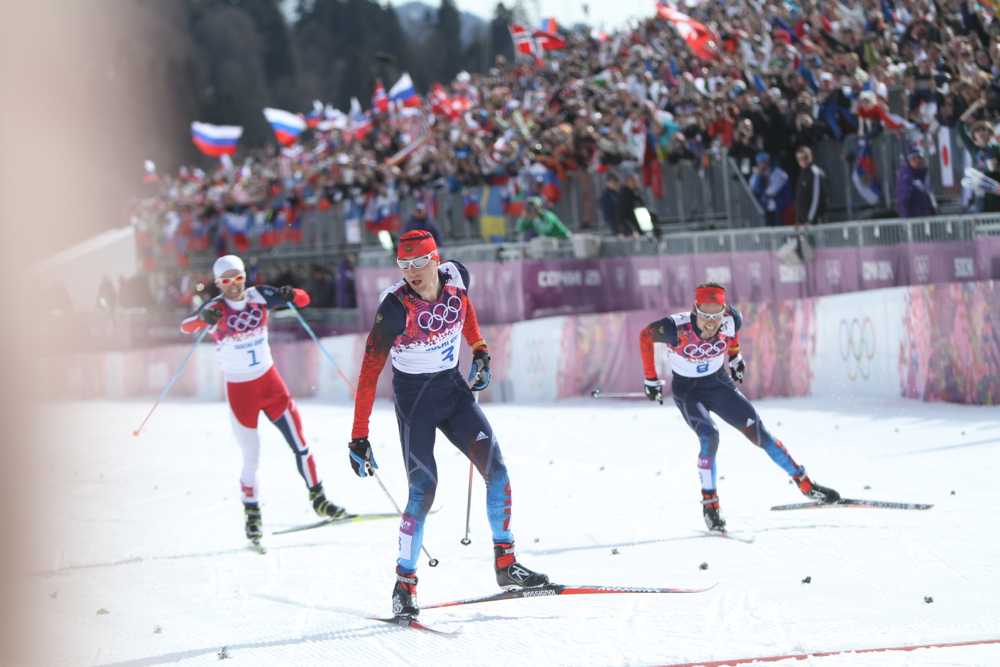
    The Russian men finishing in unison to take first, second and third in the men’s 30 k skiathlon, the final race of 2017 U23 World Championships at Soldier Hollow in Midway, Utah. Alexander Bolshunov (8) was deemed the winner, Alexey Chervotkin (1) was second, and Denis Spitsov (11) third. (Photo: FlyingPointRoad.com)

    It was Russia, Russia, Russia.

    Alexander Bolshunov, winner of the 30 k skiathlon at 2017 U23 World Championships, won the race in 37:13, one second ahead of Maxim Vylegzhanin in second. Alexey Chervotkin was third (+5.1).

    Classic specialist, Kazakhstan’s Alexey Poltoranin finished fourth, 13 seconds off the podium, and Cologna placed fifth (+22.1).

    Despite being on Swedish soil, the rest of the top 10 became a mostly Russian affair. Russian teammates Alexey Vitsenko and Artem Maltsev placed sixth (+29.5) and seventh (+37.4), respectively, Sweden’s Calle Halfvarsson interrupted the trend by tying Russia’s Evgeniy Belov for eighth (+38.0), and Russia’s Alexander Bessmertnykh took 10th (+40.1).

    There’s a pattern: Russia took 14 of the top-20 places. Twenty-eight of 126 starters were from Russia, with the vast majority of the field being Swedish. Outside of the top 10, Sweden’s Daniel Rickardsson was the next-best Swede in 12th (+49.6).

    Devon Kershaw (World Cup Team), who finished 12th on Friday, once again led Canada in 20th (+1:06.7). At 6.8 k, Kershaw was ranked 15th, and at 9.6 k he was down one spot to 16th. By the 11.4 k checkpoint, he began slipping further in the standings.

    “Today was a tough one,” Kershaw wrote in an email. “I felt pretty good but conditions were soft, so you had to really feather it (the technique) – especially on the climbs.  Pacing wise I think I was doing pretty well, but in the last 2.5km today I was missing any semblance of a kick to the finish and ended up conceding a few seconds to those around me, knocking me from about 15-16 to 20th.”

    Although an interval start race, Kershaw never found a strong pacing partner. “I was skiing alone – no help at all today,” Kershaw wrote of his solitary effort. “It would have been so helpful! Especially that last lap when things get tough. But in individual start races, you need to learn to do it alone. So good to try and get used to that “time trial” feeling.”

    Three other Canadians competed, with Graeme Killick (World Cup Team) finishing 50th (+2:32.3), Jack Carlyle (Alberta World Cup Academy) 91st (+4:06.1), and Brian McKeever (Para Nordic Team) 110th (+5:16.0).

    As of press time, Fasterskier could not confirm if the International Ski Federation (FIS) held an emergency meeting to discuss the involvement of IOC-banned Russian skiers in FIS-sanctioned races. Of the six IOC-sanctioned Russian skiers, four are men: Belov, Vylegzhanin, Alexander Legkov, and Alexey Petukhov. All four skiers raced on Friday, however, Legkov and Petukhov (and Shapovalova, one of the two women sanctioned by the IOC) did not contest Saturday’s race.

    Racing continues in Gällivare on Sunday with classic sprints.

    Results: Women | Men

  • Kalla, Belov Top Gällivare FIS Opener; Randall 8th, Kershaw 12th

    Kalla, Belov Top Gällivare FIS Opener; Randall 8th, Kershaw 12th

    Sweden’s Charlotte Kalla racing to a win in her first race of the 2017/2018 season, the women’s 5 k freestyle in Gällivare, Sweden, on Friday. (Photo: Sporteventgallivare/Instagram)

    Sweden’s Charlotte Kalla and Hanna Falk went 1-2 in Sweden’s season-opening International Ski Federation (FIS) race on Friday in Gällivare, with Kalla winning the women’s 5-kilometer freestyle by 8.8 seconds in 12:58.1 minutes. Falk, her teammate on the Swedish women’s team, placed second and Russia’s Yulia Belorukova took the third spot on the podium, 10.3 seconds out of first.

    The host nation had three in the top four, with Ida Ingemarsdotter in fourth (+16.1). Switzerland’s Nathalie von Siebenthal finished fifth (+17.8), Russia’s Yulia Tchekaleva placed sixth (+23.4), and Russia’s Natalia Nepryaeva was seventh (+25.0).

    Kikkan Randall of the U.S. Ski Team raced to eighth (+27.2), just ahead of Sweden’s Evelina Settlin in ninth (+32.0) and Russia’s Anna Nechaevskaya in 10th (+33.5). Japan’s Masako Ishida was just 0.3 seconds out of the top 10 in 11th.

    In an email, Randall explained that she decided to venture to Europe earlier this year to get some racing in ahead of the World Cup.

    “We also wanted a little extra time to let Breck adjust to the 10hr time change!” she wrote of her 1-year-old son, who will be traveling the World Cup circuit with Randall and her husband, Jeff Ellis, this winter.

    (Article continues below)

    Most of the U.S. Ski Team arrived in Rovaniemi, Finland, on Thursday, Nov. 16 (with the exception of Andy Newell, who is racing this weekend in Beitostølen, Norway, with Noah Hoffman). The rest of her teammates planned to train at the Santasport Olympic training center in Rovaniemi until Nov. 21, when the entire team will meet up in Kuusamo (also known as Ruka), Finland — the site of next weekend’s World Cup opener.

    “I’m happy with my start today,” Randall wrote of Friday’s race. “It took my a couple km’s to get going today but I felt like I was finding my rhythm in the 2nd half of the course.  It’s my first hard session this week after the travel over so today was a good jolt!  It was a competitive field and I was satisfied to be in the mix.”

    Ninety-two women raced the Gällivare 5 k skate, compared to 56 women on Friday in Beitostølen (Norway’s FIS season-opener). Randall planned to race the 10 k classic on Saturday in Gällivare, then skip Sunday’s classic sprint.

    “It’s great to be back around other World Cup skiers again and I’ve always liked Gällivare so it’s nice to be back here,” she wrote. “My former wax tech lives here and has been taking great care of us. … Looking forward to meeting up with the team in Ruka next week.”

    With 46 Swedes and 23 Russians accounting for most of the women’s field, Canada’s Emily Nishikawa put herself in the mix in 26th, 54.9 seconds behind Kalla. Nishikawa’s Canadian World Cup teammate Dahria Beatty placed 56th (+1:38.3).

    For Nishikawa, who’s known as a distance skier, the top-30 result was notable in that a 5 k falls somewhere between a sprint and a distance race.

    “5km is such a hard distance, and it is over so fast, but it is a lot of fun,” Nishikawa wrote in an email. “I have been able to work on my sprinting a bit more this summer as I have been injury free, so I’m looking forward to seeing more speed in my racing this season.”

    She planned to race all three days in Gällivare, including Sunday’s sprint.

    “With these races, I am just hoping to fine tune my fitness and get some hard intensity in to feel sharp for the upcoming World Cup races,” added Nishikawa, who’s entering her fifth World Cup season as a leading member of the Canadian women’s World Cup Team. “Today’s race was a really hard effort and I am happy with how I skied today.”

    The 12th-ranked Russian woman on Friday, Evgenia Shapovalova, who was recently banned for life from future Olympics, placed 22nd.

    Belov Bests Ustiugov

    In the men’s 10 k freestyle on Friday, another one of the Russians sanctioned by the International Olympic Committee (IOC), Evgeniy Belov won in 23:08.5. He was 6.5 seconds faster than his Russian teammate Sergey Ustiugov, who placed second. Ustiugov is the defending Tour de Ski champion and Overall World Cup runner-up.

    Switzerland’s Dario Cologna placed third, 7.6 seconds out of first, and Russia swept fourth through ninth, with Sweden’s Marcus Hellner following in 10th (+36.4). Out of the five actively competing skiers the IOC sanctioned earlier this month, all five raced on Friday in Gällivare, which was legal considering FIS had not ruled they can’t.

    Four of those skiers are men. In addition to Belov, Maxim Vylegzhanin placed 14th (+43.2), Alexander Legkov followed in 15th (+45.9) and Alexey Petukhov finished 23rd (+56.7) out of 157 finishers on Friday.

    Devon Kershaw (front) training with U.S. Ski Team sprinter Andy Newell in Sjusjøen, Norway, last week. (Photo: Noah Hoffman)

    Ahead of them, Canada’s Devon Kershaw ended up 12th (+39.9), tying another Russian Artem Maltsev (who is not on the IOC-banned list) with identical times.

    “My stance on the whole Russian fiasco is unchanged,” Kershaw wrote in an email, referring to a previous email he wrote to FasterSkier earlier this week when asked how he felt about the IOC-banned Russians competing in FIS events. “I find the entire thing both disturbing and hilarious. The fact that FIS is risking their credibility like this makes no sense to me. Apparently there will be an emergency meeting of sorts tomorrow about it (with FIS I’m assuming but I haven’t heard much about it) – so we’ll have to all wait and see what they come up with.

    “As for seeing Belov win – I mean, that’s no surprise,” Kershaw continued. “He’s shown that he’s a force when he’s in form. But yeah, the fact that he and others have been recently banned for life by the IOC are winning races after that news came out just shows the Mickey Mouse club that our sport has become.”

    As for his own race, Kershaw wrote that he felt great about it. The course suited him well without too much hard climbing. “… You kind of need to be pushing the whole way around. I really like courses like that,” he wrote.

    The conditions, however, with about 10 to 15 centimeters of new snow from the early morning that continued into the race, made the course slower, which Kershaw found to be more challenging.

    “But that is another reason why I am so satisfied with the effort today. Individual start skating in soft conditions? Not my favourite, so I’m happy how I was able to execute things,” he wrote. “For me to be in the mix in a 10km skate like that feels great. I had good energy all race and hit my technical goals for the race too, so I have to be satisfied.”

    Kershaw and the rest of Canada’s Period 1 World Cup team arrived in Gällivare last Sunday. Over the last week, they’ve been testing equipment and getting into a race routine ahead of the World Cup opener, he explained.

    “I changed various things with my training this year so it’s exciting to see how my body feels in the beginning of a new season,” Kershaw wrote. “… My goals are really to just be calm and execute well – which means going into the racing with no expectations other than to ski as technically well as possible while working on the whole pacing thing (which can be challenging at the beginning of the season when you don’t have that many races in the body). I’ll look to have another well executed race tomorrow and the results will be what they will be.”

    Canada’s NorAm leader at the end of last season, Russell Kennedy (Team R.A.D.) was the next-best Canadian in 48th (+1:35.7), followed by Len Valjas (World Cup Team) in 49th (+1:37.0). Jack Carlyle (Alberta World Cup Academy) placed 67th (+2:07.2), Julien Locke (National U25 Team) was 72nd (+2:10.9), Graeme Killick (World Cup Team) 90th (+2:32.2), Brian McKeever (Para Nordic Team) 97th (+2:39.0), and Jess Cockney (World Cup Team) 119th (+3:10.7). Knute Johnsgaard (World Cup Team) did not start.

    Racing continues in Gällivare this weekend with 10/15 k classic individual starts on Saturday followed by classic sprints on Sunday.

    Results: Women | Men

  • Four More Russian Skiers, Vylegzhanin Included, Disqualified From 2014 Olympics

    Four More Russian Skiers, Vylegzhanin Included, Disqualified From 2014 Olympics

    Russian team staff cheer on Maxim Vylegzhanin, the country’s anchor skier, in the 4 x 10 k relay at the 2014 Olympics in Sochi, Russia. Vylegzhanin has now become the second member of that silver-medal relay team to be disqualified for doping.

    After Alexander Legkov and Evgeny Belov were retroactively disqualified from the 2014 Olympics last week for doping offenses, four more teammates have now been banned as well. Elena Valbe, the head of the Russian Cross-Country Ski Federation, told R-Sport that the IOC Disciplinary Commission had disqualified Maxim Vylegzhanin, Alexey Petukhov, Julia Ivanova, and Evgenia Shapovalova.

    All four were identified in the McLaren Report, an independent investigation commissioned by the World Anti-Doping Agency to investigate reports from whistleblowers that Russia had systematically evaded the anti-doping process at the 2014 Olympics.

    “The athletes have been disqualified for life from taking part in the Olympic Games,” Valbe said.

    With Legkov’s disqualification, Russia had already lost a gold medal in the 50 k and a silver medal in the 4 x 10 k relay.

    Vylegzhanin had finished second in the 50 k, but with him now disqualified as well, there could be a substantial medal re-allocation. Third-place Ilia Chernousov, also from Russia but not implicated the McLaren report, would stand to gain gold. Fourth-place Martin Johnsrud Sundby of Norway would take silver, and fifth-place Sergei Dolidovich of Belarus would earn bronze.

    Vylegzhanin also won silver in the men’s team sprint with Nikita Kriukov. With that result invalidated, Sweden’s Emil Jönsson and Teodor Peterson will move from bronze to silver, and fourth-place Northug and Ola Vigen Hattestad would earn bronze.

    Valbe said that the IOC Disciplinary Commission’s decision will be appealed to the Court of Arbitration for Sport, so such medal reallocations are not yet finalized.

    “It’s hard to choose words, but I’ll fight to the end — it’s a violation of all human rights,” Petukhov said, according to a translation.

    Petukhov finished eighth in the skate sprint in Sochi; Shapovalova finished 28th. Ivanova was part of the sixth-place women’s relay and team sprint teams, both of which stand to be disqualified, and finished 17th in the 10 k classic and 30th in the 30 k skate.

    The Canadian team of Perianne Jones and Dasha Gaiazova missed qualifying for team sprint finals as “lucky losers” by one spot. The Russian pair of Ivanova and Anastasia Dotsenko, however, did advance as lucky losers – meaning that if they had not been in the race, the Canadians would have been next in line for a spot in the finals.

  • FIS on Allowing Suspended Russian Skiers to Rejoin National Team: It’s ‘Special Circumstances’

    FIS on Allowing Suspended Russian Skiers to Rejoin National Team: It’s ‘Special Circumstances’

    Maxim Vylegzhanin competing in the 10 k classic in Falun, Sweden, in 2016. Vylegzhanin is provisionally suspended while the International Olympic Committee investigates possible doping infractions at the 2014 Olympics. (Photo: Fischer/NordicFocus)

    In part of the media storm following the Court of Arbitration for Sport’s response to an appeal by six Russian cross-country skiers, Russian Ski Federation President Elena Valbe made a surprising assertion: that the athletes, who remain provisionally suspended by the International Ski Federation (FIS), are allowed to train with the national team.

    This is not generally the case for athletes serving suspensions, but FIS Anti-Doping Coordinator Sarah Fussek confirmed the organization’s stance.

    “You cannot really say it is a deviation [from the norm] because we have not had these [types of] facts on the table before,” she said in a phone interview on Friday. “This is a special case and it requires special handling.”

    Are All Provisional Suspensions Created Equal?

    FIS more often deals with cases which start with a positive drug test, or “adverse analytical finding”. A positive test results in a nearly-automatic suspension while the case proceeds – called a “mandatory provisional suspension”.

    The cases of Alexander Legkov, Maxim Vylegzhanin, Alexey Petukhov, Julia Ivanova, and Evgenia Shapovalova arose via investigation started by journalists, continued by Richard McLaren on behalf of the World Anti-Doping Agency, and now being conducted by the International Olympic Committee (IOC).

    “The investigation of the alleged anti-doping rule violations will be carried out by the IOC Disciplinary Commission, which has the results and case management authority for anti-doping at the Olympic Winter Games, whereby the provisional suspensions are imposed by FIS,” stated a FIS press release announcing the suspensions on Dec. 22, 2016.

    In cases without a positive drug test, sports federations are allowed to implement an “optional provisional suspension”. This is what FIS put in place on the six Russian skiers, whose samples were allegedly tampered with at the 2014 Olympics.

    Fussek said she awaited a written explanation from the FIS Anti-Doping Panel, which gave the recommendation to the athletes that they could train with their national team again. For privacy reasons and due to rules governing ongoing cases, FIS cannot not share documents which were provided to the athletes explaining such decisions.

    However, Fussek understood that it was because of the optional nature of the provisional suspension that the athletes were being allowed to officially train again (all had been training on their own while serving their suspensions).

    “As you know, we do not have an adverse analytical finding where a mandatory suspension would have been put in place,” Fussek said. “Presumably they have decided for that, because it was special circumstances… they would give them a special allowance to train. They have decided not to prohibit them to train in order to keep a balance between the provision of the suspension and the actual consequences. It is an ongoing case with special circumstances.”

    Indeed, considerable time that has passed with no news or hearings from the IOC investigation. In the ruling from the Court of Arbitration for Sport (CAS), the organization gave FIS until Oct. 31 to bring a formal case against the athletes, or else their suspensions will be lifted. At that point, they would have waited 10 months.

    “The provisional suspension switches into a sanction in face of its duration and the ongoing investigations from which nobody knows how long they will last,” the lawyer for Legkov and Belov wrote in a press release. “The provisional suspension is no longer appropriate if the federation is not in the position to provide full proof that the athlete is guilty of an anti-doping rule violation within a reasonable time.”

    FIS is in a strange position because it is waiting on the IOC commission and doesn’t necessarily have control over the time frame. But if allowing the athletes to train with the national team was FIS’s attempt to mitigate these special circumstances and the long wait, it does not appear to have a formal basis in anti-doping rules. There are no specific guidelines in the FIS Anti-Doping Rules or the World Anti-Doping Code specifying what is allowed of athletes under mandatory versus optional provisional suspensions, if indeed there is a difference.

    Those rules only note the meaning of a provisional suspension more generally: “Provisional Suspension means the Athlete or other Person is barred temporarily from participating in any Competition or activity prior to the final decision at a hearing conducted under Article 8,” the 2016 FIS Anti-Doping Rules state at the top of page 61.

    In prior rulings against the skiers, it was made clear that anything involving the national team was off-limits.

    On Dec. 30, 2016, FIS denied an appeal by the skiers, who wanted to be reinstated in time for the Tour de Ski.

    “As a result of the decision, all of the above mentioned athletes may not take part in any competitions or national team activities,” FIS wrote in their press release at the time.

    And in a Jan. 25, 2017, press release confirming the decision to uphold the provisional suspensions of Alexander Legkov and Evgeny Belov, FIS again wrote, “as a result of the decisions, the above-mentioned athletes may not take part in any competitions or national team activities.”

    So what constitutes “activities”? The 2017 International Standard for Testing and Investigations, published by the World Anti-Doping Agency (WADA), defined “team activity” as “Sporting activities carried out by Athletes on a collective basis as part of a team (e.g., training, travelling, tactical sessions) or under the supervision of the team (e.g., treatment by a team doctor).”

    However, that was in reference to whereabouts reporting, not to allowable activities under a suspension.

    Unwittingly, A Trap?

    The skiers may want to be wary of FIS’s allowance. One reason that an athlete’s treatment during a provisional suspension is important is because the time served in a provisional suspension is usually included in the period of their final suspension as well – credit for time served.

    “If an Athlete or other Person voluntarily accepts a Provisional Suspension in writing from FIS and thereafter respects the Provisional Suspension, the Athlete or other Person shall receive a credit for such period of voluntary Provisional Suspension against any period of Ineligibility which may ultimately be imposed,” read the FIS Anti-Doping Rules (page 43).

    And once an athlete is ineligible, they cannot participate in training or any other national team events.

    “No Athlete or other Person who has been declared Ineligible may, during the period of Ineligibility, participate in any capacity in a Competition or activity (other than authorised anti-doping education or rehabilitation programs) authorised or organised by FIS or any National Ski Association or a club or other member organisation of FIS or any National Ski Association, or in Competitions authorised or organised by any professional league or any international or national level Event organisation or any elite or national-level sporting activity funded by a governmental agency,” the FIS Anti-Doping Rules state (page 44).

    Below this rule, FIS goes out of its way to clarify even further what types of activities are not allowed during a period of ineligibility.

    “For example… an Ineligible Athlete cannot participate in a training camp, exhibition or practice organised by his or her National Ski Association or a club which is a member of that National Ski Association or which is funded by a governmental agency… The term ‘activity’ also includes, for example, administrative activities, such as serving as an official, director, officer, employee, or volunteer of the organisation described in this Article. Ineligibility imposed in one sport shall also be recognised by other sports.”

    Logically, time served under a provisional suspension should be counted in any final duration of ineligibility only if an athlete behaved the same way during their provisional suspension as they are required to during ineligibility.

    The Russian skiers hope to be proven innocent, and act confident that they will be.

    “The athletes will be free to participate in the competition season 2017/2018 and the World Cup 2017/2018 starting 24.11.2017 in Ruka if the ongoing investigations of Oswald Commission of IOC will not bring out new facts and new evidence beyond the facts published by Prof McLaren and if the athletes will not be definitely sanctioned based on such new facts,” Legkov and Belov’s lawyer wrote in their press release. “The defense has no reason to believe that the investigations will bring out such new facts.”

    But if the skiers do face sanctions after their final hearings — it would no doubt devastate them if those suspensions started from the hearing date, not from Dec. 22, 2016, when they were very first provisionally suspended.

  • CAS Gives FIS Until October to Bring Doping Case Against Russian Skiers

    CAS Gives FIS Until October to Bring Doping Case Against Russian Skiers

    Alexander Legkov (3) beat out fellow Russians Maxim Vylegzhanin (not shown) and Ilya Chernousov (r) for gold in the Sochi Olympics 50 k freestyle mass start — the last race of the 2014 Games. Vylegzhanin took silver by 0.7 seconds, just a tenth of a second ahead of Chernousov in third, and Norway’s Martin Johnsrud Sundby (1) missed a medal by 0.2 seconds in fourth. Legkov and Vylegzhanin may still have months to go before they learn if they can compete next season.

    The Court of Arbitration for Sport (CAS) did one thing that the Russian skiers wanted: they issued a decision of some sort quickly, far more quickly than is typical in doping appeals.

    Alexander Legkov, Maxim Vylegzhanin, Alexey Petukhov, Evgenia Shapovalova, Julia Ivanova, and Evgeniy Belov have been provisionally suspended by the International Ski Federation (FIS) since December. The six cross-country skiers are among a group of Russian athletes whose anti-doping samples from the 2014 Olympics were tampered with, according to an independent investigation commissioned by the World Anti-Doping Agency.

    In the six months since the provisional suspensions were enacted, FIS has not formally brought Anti-Doping Rule Violations (ARDV’s) against the six athletes. They were asking CAS to cancel their provisional suspensions.

    CAS disagreed, but essentially gave FIS a deadline to bring a case forward.

    “The CAS Panels in charge of the matters have decided to maintain the provisional suspensions imposed on the athletes until 31 October 2017, at the latest,” the tribunal wrote in a press release. “In the absence of any anti-doping rule violation (ADRV) having been assessed against any of the athletes so far, the temporary suspension shall lapse and the athletes shall be allowed to compete again. A further provisional suspension may be imposed on the athletes by the International Ski Federation (FIS) after that date, if the facts and circumstances so merit, and would be subject to appeal.”

    While detailed minutes of the May 25 hearings for the Russian skiers were not released, CAS did give a glimpse into some of the evidence that may have been presented. Namely, FIS apparently provided a timeframe for their own investigation, and that was based on a separate timeline from the International Olympic Committee.

    “The Panels in charge of these matters have noted that the reports following the investigations conducted by a special IOC commission would be delivered during the summer period and found that it was necessary to allow the FIS time to complete its own investigation before issuing its final decisions concerning the six athletes,” the tribunal wrote.

    The skiers were not pleased.

    “Of course, the whole situation is very angering,”  Vylegzhanin told Sport-Express, according to a translation. “I would like to calmly train and prepare for the season, just knowing that it will happen. But apparently, we will have to get used to the idea that until October 31, we are in a special situation. At the same time, there is a hope that we will get the all-clear before the season…. Sometimes, during hard training, I have bad thoughts anyway, because of this whole situation. But I hope this will not interfere with my preparations for the season. The thoughts about the upcoming Olympic Games in Pyeongchang motivate me to work in full.”

    The others are also training and planning to compete. Legkov reportedly ran a 32:10 10 k at a charity running race recently; both he and Petukhov recently posted cycling pictures from training camps on the Mediterranean.

    Meanwhile, Russian Ski Federation President Elena Valbe said in a separate interview with Sport-Express that FIS was allowing the suspended athletes to train with the Russian National Team, a major departure from normal rules for suspended athletes.

    https://www.instagram.com/p/BUfIp2IDnOu/

    https://www.instagram.com/p/BUlFNm7FVSU

  • FIS Denies Appeal by Suspended Russian Skiers For Tour de Ski

    FIS Denies Appeal by Suspended Russian Skiers For Tour de Ski

    Alexander Legkov of Russia celebrates his Tour de Ski victory atop the Alpe Cermis in January, 2013. Legkov cannot compete in this year’s Tour de Ski because he is suspended for possible doping violations. (Photo: Fiemme2013)

    The International Ski Federation (FIS) has denied an appeal by six Russian cross-country skiers suspended under the suspicion of doping.

    FIS and the International Olympic Committee (IOC) are investigating the six athletes because bottles used to store their urine samples from the 2014 Olympics in Sochi, Russia, bore signs of tampering. FIS suspended the skiers while the investigation takes place.

    The athletes had appealed this suspension because many planned to compete in the Tour de Ski, starting on Saturday.

    “After receiving written submissions from the athletes and the response from FIS, the FIS Doping Panel made the unanimous decision today to uphold the provisional suspensions of the Russian Cross Country athletes, Evgeniy Belov, Julia Ivanova, Alexander Legkov, Evgenia Shapovalova, Alexey Petukhov and Maxim Vylegzhanin,” FIS wrote in a statement emailed to the press. “The reasons for the Panel’s decision will be communicated directly to the athletes in due course. As a result of the decision, all of the above mentioned athletes may not take part in any competitions or national team activities.”

    This was also the first time that FIS publicly named the six skiers.

    FIS Secretary General Sarah Lewis told FasterSkier last week that one other athlete may be suspended.

    “There is only one additional non-Games time case and this is presently being processed,” she wrote in an email. “The timeline is the next week if possible.”

    That brings the total number of cases in progress to seven. FasterSkier identified at least 34 skiers mentioned in the McLaren report, an investigation into systematic doping in Russia.

    Content of Legkov and Belov Appeal

    Legkov and Belov, sometime training partners who were previously based in Davos, Switzerland,  hired German lawyer Christof Wieschemann.  He filed an appeal for the pair to be reinstated before the Tour de Ski. The text of their public statement is available in German and in Russian.

    The appeal, in summary, states the following:

    • FIS did not tell the athletes what part of the World Anti-Doping Code they were suspected of violating.
    • The suspensions were based on the McLaren report’s findings that sample bottles had been opened and closed after sample collection. Wieschemann notes that in some other cases, the samples were positive for banned substances, or even belonged to a different person than the athlete who was supposedly being tested. This was not true for either Legkov or Belov. Evidence showed only that the bottles had been opened or tampered with. Wieschemann argues that this does not necessarily mean that the samples were not “clean”.
    • According to Wieschemann, neither Legkov nor Belov were on the “Duchess” list. That was a list of athletes who were provided banned performance-enhancing drugs by the Russian government and then protected from anti-doping measures.

    The statement also notes that Legkov and Belov were often previously tested by outside anti-doping agencies in Europe.

    “There is neither a positive sample from either of the athletes, nor any other indication that they could have taken banned substances… Such a connection is also not provided in the McLaren Report,” the statement says, according to a translation. “In fact, both athletes also gave blood samples in Sochi, which were negative. McLaren does not provide any information about swapping blood samples. This is a sure sign that both athletes were not drugged at the time of the Olympic Games.”

    Complicit in Tampering or Not?

    FIS wrote in their statement that “the reasons for the Panel’s decision will be communicated directly to the athletes in due course.” The rationale was not described to the media.

    However, there are several reasons that FIS may want to keep the athletes suspended while they finish their investigation.

    Article 2.5 of the World Anti-Doping Code prohibits “Tampering or Attempted Tampering with any part of Doping Control: Conduct which subverts the doping Control process but which would not otherwise be included in the definition of Prohibited Methods. Tampering shall include, without limitation, intentionally interfering or attempting to interfere with a doping Control official, providing fraudulent information to an anti-doping organization or intimidating or attempting to intimidate a potential witness.”

    A footnote clarifies that “for example, this Article would prohibit altering identification numbers on a Doping Control form during Testing, breaking the B bottle at the time of B Sample analysis, or altering a Sample by the addition of a foreign substance.”

    Sports organizations must decide the appropriate action for cases where a sample was tampered with by someone other than an athlete.

    According to emails in the McLaren report, anti-doping officials opened sample bottles in order to replace “dirty” urine with “clean” urine. That means that the athletes must have been complicit in providing the “clean” urine sample in the first place. Yet it’s also very possible that some sample bottles were either opened by mistake or tampered with in a different way, without the knowledge or complicity of the athlete.

    FIS may have evidence that they have not disclosed. The federation may also simply want more time to determine whether the athletes were complicit in sample manipulation.

    Other Reasons the Appeal May Have Failed

    Legkov and Belov do appear in planning documents for Sochi released as part of the McLaren report evidence packet. At the very least, that means that the government anti-doping officials carefully noted and tracked their participation at the Games.

    Regarding the clean blood samples, this may not be sufficient evidence that athletes had not taken performance-enhancing drugs. Urine and blood samples detect different substances over different periods of time.

    “A blood sample does not replace a urine test, because it concerns primarily different substances and different methods,” the Finnish Center for Integrity in Sports, SUEK, writes on its website.

    Urine contains substances excreted from the body, while blood contains those integrated into the body. Testing agencies may not even test for all of the same substances in the two different types of samples. For example, human growth hormone is tested in blood, but not in urine; steroids are easier to detect in urine than in blood.

    Furthermore, the IOC may not have even fully tested the samples collected at the Olympics.

    “The initial tests take place in the lab located in the Olympic city,” NBC wrote of Olympic testing procedures. “Because of the huge number of samples and tests that need to be conducted in a short period of time, not every sample is tested for every drug. Experts take educated guesses on which set of athletes are more likely to use certain drugs and run the according tests.”

    Finally, Wieschemann’s statement concludes that “Alexander Legkov and Evgeny Belov have at no time used prohibited means or applied forbidden methods.”

    Yet the McLaren report clearly shows discussion of Legkov’s positive test for budesonide at 2014 Russian Championships. The test was never reported to the World Anti-Doping Agency.

    Budesonide is a corticosteroid sometimes used in asthma medication. In September, Secretary General of the Russian Ski Federation Georgiy Mnatsakanov told Norways’ NRK broadcaster that both Legkov and Ilia Chernousov used asthma medication despite the fact that they have no diagnosis of asthma.

    Email released as part of the McLaren report show that Legkov did not have a Therapeutic Use Exemption for such medication.

  • First Sprint Win of the Season for Ustiugov; Canada’s Valjas 14th Overall in Davos

    First Sprint Win of the Season for Ustiugov; Canada’s Valjas 14th Overall in Davos

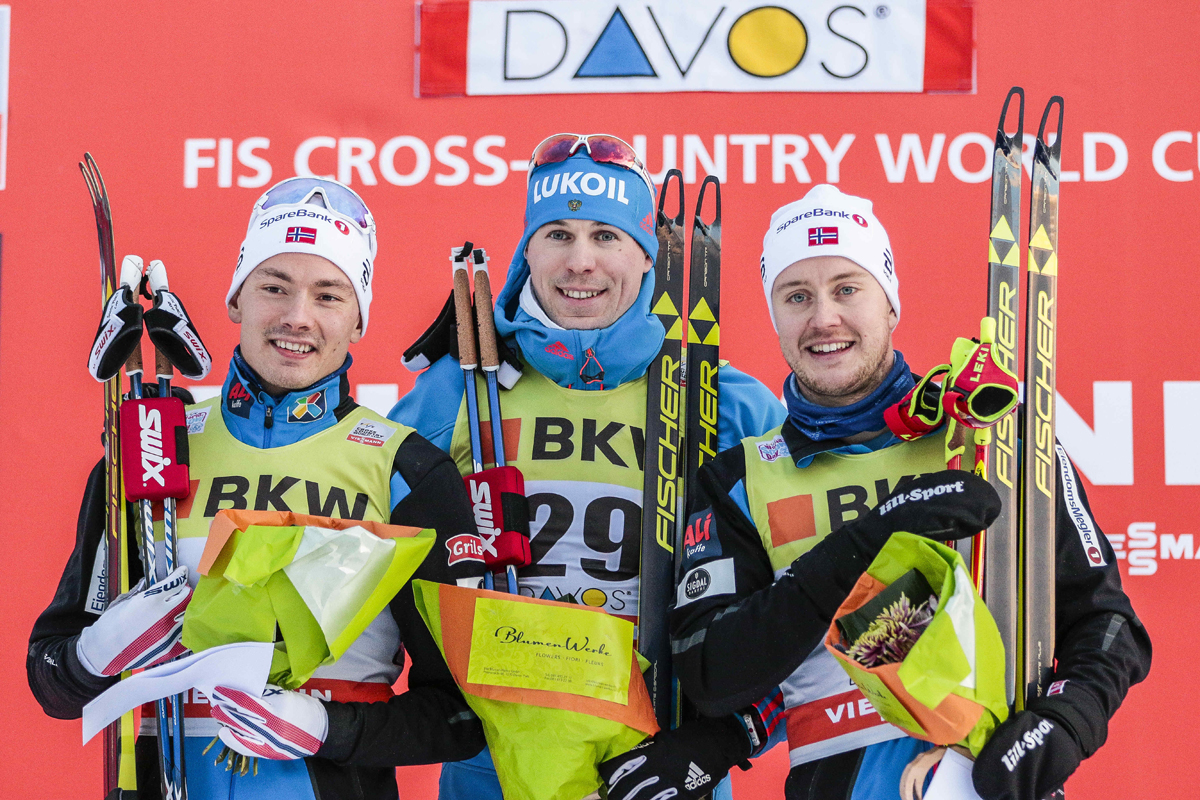
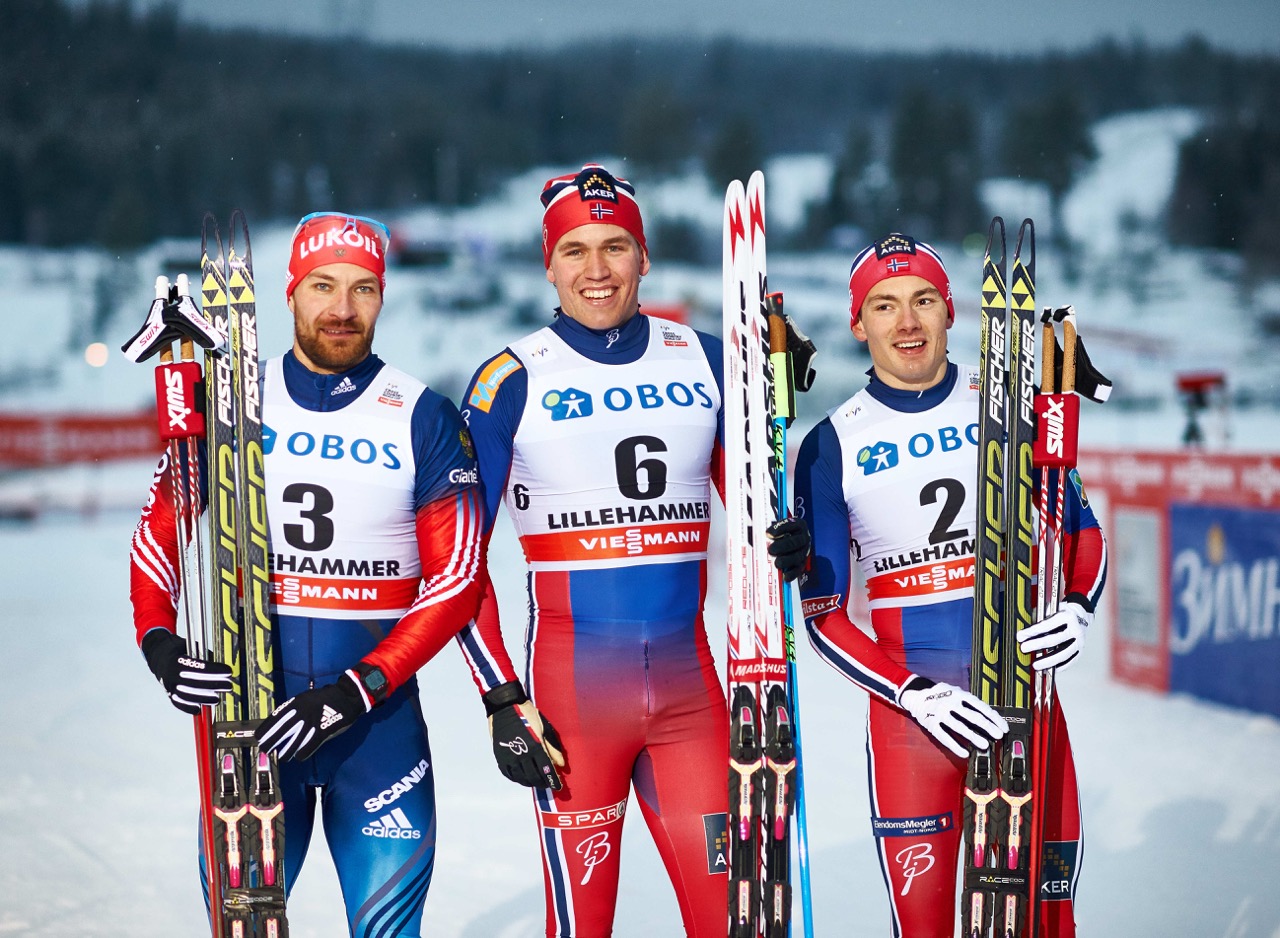
    Left to right: Norway's Finn Hågen Krogh, Russia's Sergey Ustiugov, and Norwegian skier Sindre Bjørnestad Skar on top of the podium for the men's 1.6-kilometer freestyle sprint on Sunday in Davos, Switzerland.  (Photo: Fischer/NordicFocus.com)
    Left to right: Norway’s Finn Hågen Krogh, Russia’s Sergey Ustiugov, and Norwegian skier Sindre Bjørnestad Skar on top of the podium for the men’s 1.6-kilometer freestyle sprint on Sunday in Davos, Switzerland. (Photo: Fischer/NordicFocus.com)

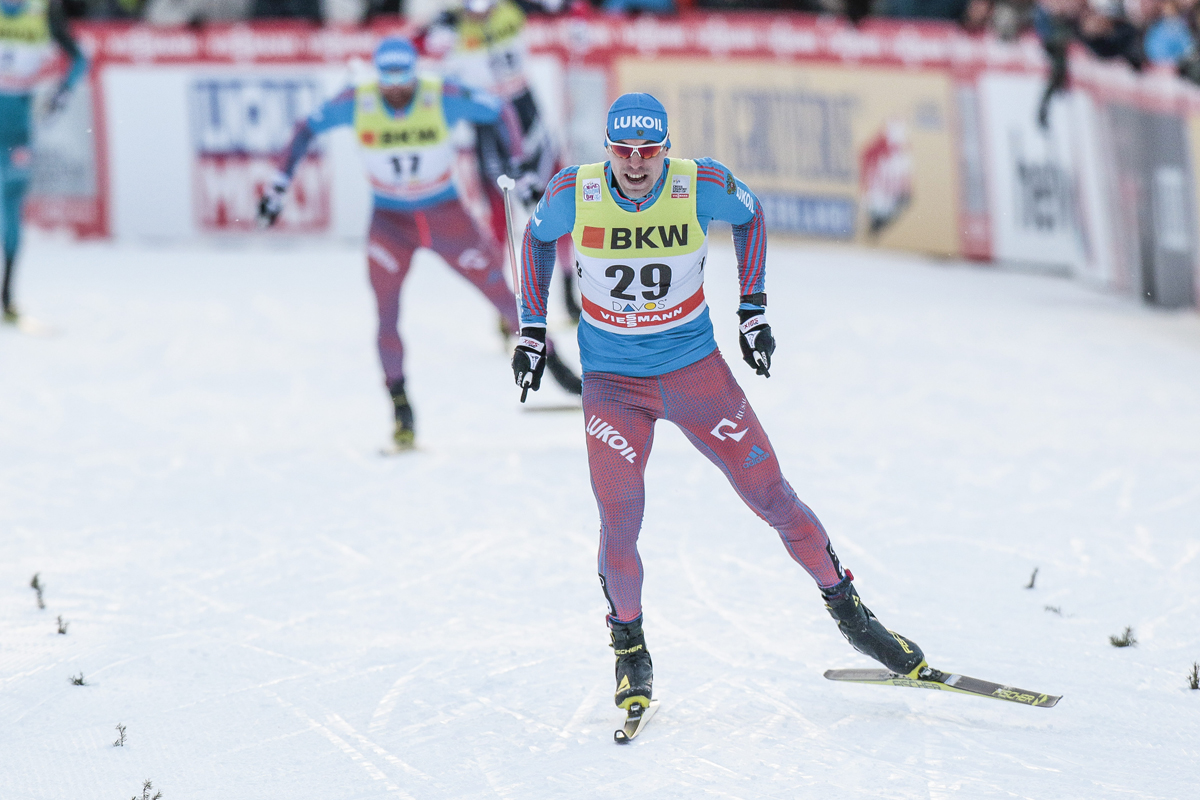
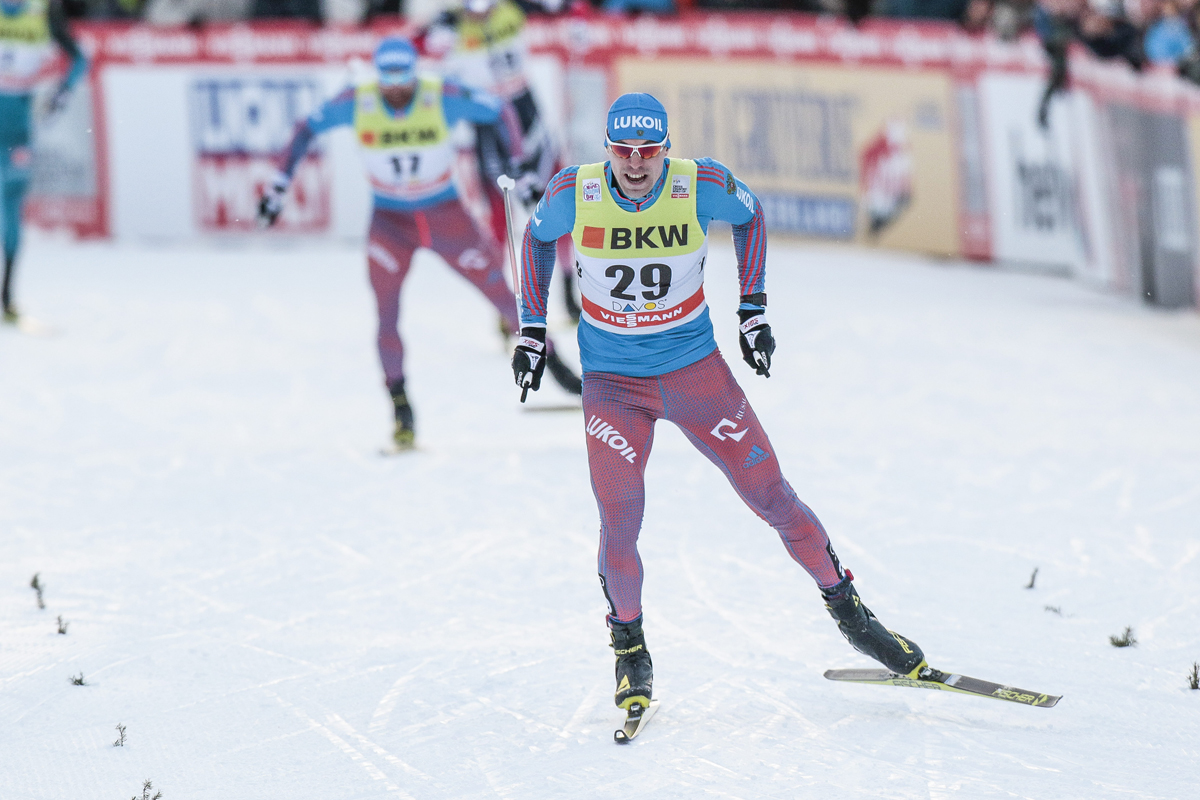
    Prior to the start of the men’s 1.6-kilometer freestyle sprint final on Sunday in Davos, Switzerland Sergey Ustiugov pointed to his chest. In bib 29, the eventual overall race winner had just barely qualified for the heats–had his qualifying time been fifteen hundredths of a second slower, he would have cooled down and watched the final from the sideline.

    But the 24-year-old eked into the rounds, qualifying 4.28 seconds back from Lucas Chanavat of France’s first place qualification time of 2:20.78.

    The Russian continued to leave the leading to the rest of the field throughout the day, racing in the back of the pack during most of his quarterfinal and semifinal.

    Russia's Sergey Ustiugov tops the men's 1.6-kilometer freestyle sprint podium on Sunday in Davos, Switzerland.  (photo: Fischer/Nordic Focus)
    Russia’s Sergey Ustiugov tops the men’s 1.6-kilometer freestyle sprint podium on Sunday in Davos, Switzerland. (photo: Fischer/Nordic Focus)

    In fact, by the first descent of his quarterfinal, Ustiugov was in sixth, with a close to 50-meter gap between his skis and those of Norway’s Sindre Bjørnestad Skar, the quarterfinal’s frontrunner.

    The Russian’s waiting tactic worked, however, and by the final climb, Ustiugov had enough energy to not only move around all five skiers in front of him, but distance himself from Skar and Italy’s Federico Pellegrino by 15-meters in the finishing stretch. He took the quarterfinal win and advanced automatically to the semifinals.

    A similar scenario went down in Ustiugov’s semifinal, with his Russian teammate Alexey Petukhov taking the lead from the start and Ustiugov lurking in the back of the pack through the course’s first hairpin turn, major climb and major descent.

    Once again, Ustiugov moved from sixth to first by the final major course climb, leaving the rest of the semifinalists, including Skar and his Norwegian teammate Finn Hågen Krogh, scrambling. Ustiugov safely crossed first, while Krogh crossed second and Petukhov and Skar’s times earned them lucky loser spots in the men’s final.

    By the start of the men’s final, Ustiugov’s bib gesture gave viewers a visual reminder that his come-from-behind tactic for the day was working.

    “I did not have the best qualification but I felt much better in the heats,” Ustiugov said according to an International Ski Federation (FIS) press release. “I knew I had power to win. It is great to win here in Davos.”

    In the final, however, Ustiugov switched strategies. The Russian took to the front from the start, skiing in second behind France’s Chanavat for the first half of the final.

    By the final course climb, Ustiugov overtook Chanavat, with Krogh following closely behind. Heading into the final 50-meters, Chanavat lost steam and Ustiugov and Krogh began the battle for first.

    Krogh pulled hard to the Russian’s right, and with 20-meters to go it appeared the Norwegian would take the win. But two V2 poles later, Ustuigov proved too powerful for Krogh, and the Russian edged the Norwegian by fifty-nine hundredths of a second for his first sprint victory of the season in a time of 2:24.65.

    Sindre Bjoernestad Skar (NOR) sprints to the men's podium in Davos (SUI).  (Photo: Fischer/NordicFocus.com)
    Sindre Bjoernestad Skar (NOR) sprints to the men’s podium in Davos (SUI). (Photo: Fischer/NordicFocus.com)

    “[Ustiugov] did pretty much the same in every heat,” Krogh told FasterSkier. “So I knew that would be the guy to follow and I tried to be first in the last uphill…[and] I kind of did, but not enough to take him in the final stretch. He was just stronger today.”

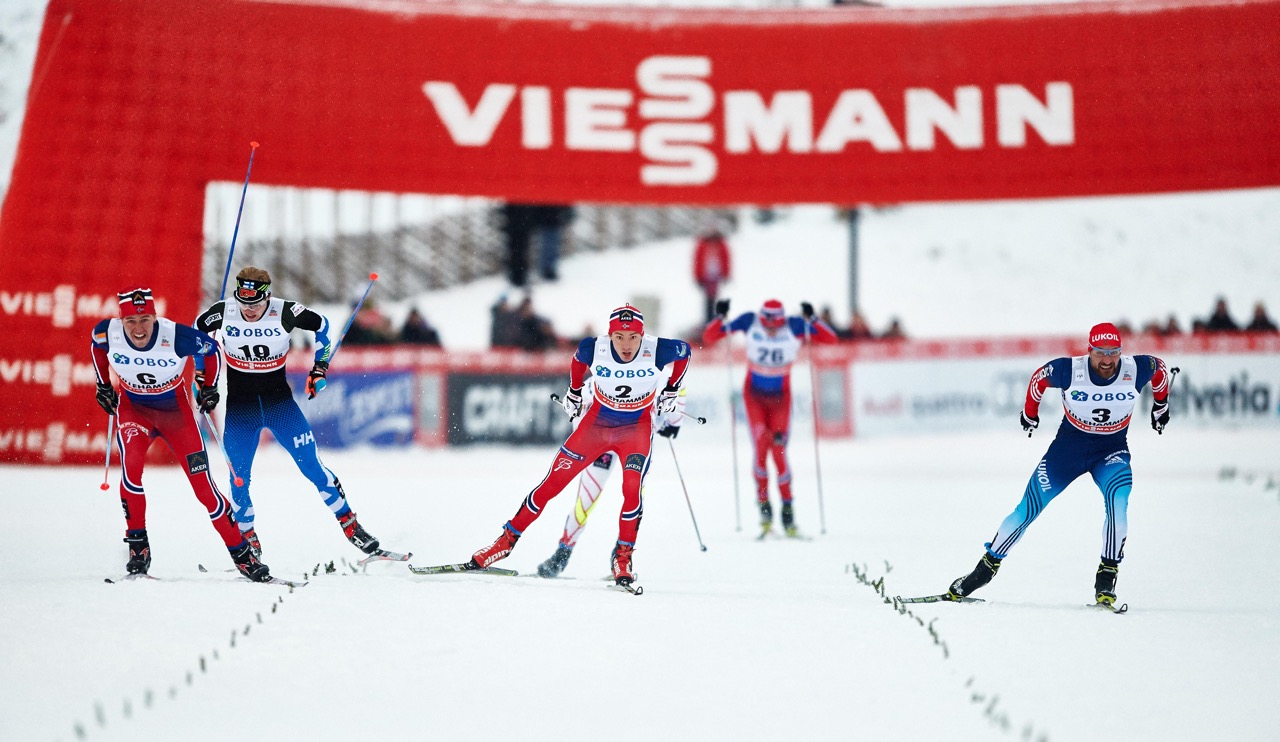
    Ten meters behind, a second Russian versus Norwegian head-to-head ensued between Petukhov and Skar for the final podium spot. In a photo finish, Skar outlunged Petukhov by eighteen hundredths of a second, securing third place overall (+3.29) and a second Norwegian name to the podium.

    Petukhov took fourth (+3.47) and rounding out the top six of the men’s sprint final was Norway’s Emil Iversen in fifth (+5.52) and Chanavat in sixth (+11.48).

    Valjas Finishes 14th Overall, Hamilton 23rd

    After qualifying 12th and 24th respectively, Canada’s Lenny Valjas and U.S. Ski Team (USST) A-team member Simi Hamilton were entered in the same quarterfinal–the only two North American men who advanced to Sunday’s sprint rounds.

    Not getting the start he hoped for in his quarterfinal, Valjas decided to race in the back of the pack for the first half of his race.

    “It’s a tough course–it’s all work,” Valjas said during an in-person interview. “So as soon as I realized my start wasn’t very good…I tried to then conserve…[and] happily sat in the back.”

    The Canadian managed to move around Hamilton as well Finland’s Ristomatti Hakola coming into the final stretch, crossing his quarterfinal in third, just fifty-four hundredths of a second off of advancing to the semifinal.

    “I was happy with it, unfortunately didn’t get the lucky losers spot,” Valjas said. “But I’m happy with another solid weekend for me.”

    Coming off of an illness, Hamilton described his race as a “step in the right direction,” indicating that working on his speed will be his focus for the next few weeks.

    “[My] speed right now is definitely not where I want it to be,” Hamilton said during an in-person interview. “So I think Christmas break will be a great chance to just work on my speed a bit and just get that gear back… I know I am just going to keep feeling better throughout the season and I’m psyched for the rest of it.”

    USST Head Coach, Chris Grover agreed with Hamilton, explaining that as both Hamilton and USST A-team member Andy Newell–who just missed qualifying on Sunday and finished in 36th overall–continue to recover from illness, speedwork will be a primary focus for the two.

    “They’re technically very efficient, but they’re just missing a little bit of the high end firing and pop right now,” Grover said during an in-person interview. “Good for Simi to see him in the rounds today…It’s coming and I think you know, by Tour de Ski time and right after the Tour those guys, they’ll be ready.”

    Canada’s Alex Harvey was left just outside advancing in 33rd overall. Devon Kershaw ended the day in 49th, Knute Johnsgaard 60th, Bob Thompson 67th, and Andy Shields 73rd. Jesse Cockney did not finish the race.

    The third American to race on Sunday, Erik Packer, finished in 95th overall.

    Results: Qualifier | Final

  • Sunday Rundown: Davos, Pokljuka & Sovereign Lake (Updated x3)

    Sunday Rundown: Davos, Pokljuka & Sovereign Lake (Updated x3)

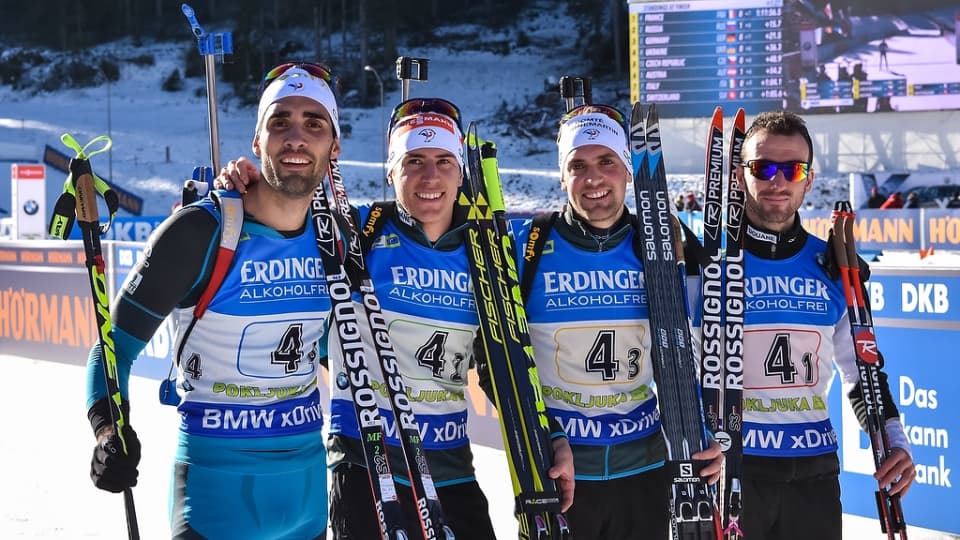
    The French men's relay team after their IBU World Cup win on Sunday in Pokljuka, Slovenia, with (from left to right) Martin Fourcade, Quentin Fillon Maillet, Simon Desthieux, and Jean-Guillaume Béatrix. They beat Russia by 15.7 seconds for the win. (Photo: IBU)
    The French men’s relay team after their IBU World Cup win on Sunday in Pokljuka, Slovenia, with (from left to right) Martin Fourcade, Quentin Fillon Maillet, Simon Desthieux, and Jean-Guillaume Béatrix. They beat Russia by 15.7 seconds for the win. (Photo: IBU)

    Welcome to The Rundown, your quick primer of need-to-know information about the day’s racing. We’ll be updating this digest as the day goes on with additional results, photos and quotes. The Rundown is NOT a race report; stay tuned for complete race reports later today with interviews from the day’s top racers.

    ***

    Note: This recap has been updated to reflect the correct positions each of the four Canadian women exchanged in during Sunday’s 4 x 6 k IBU World Cup relay. 

    IBU World Cup in Pokljuka: Men’s & Women’s Relays

    Germany and France reached the podium in both the men’s 4 x 7.5-kilometer and women’s 4 x 6 k sprints on Sunday, the final day of the International Biathlon Union (IBU) World Cup in Pokljuka, Slovenia.

    France won the men’s race by 15.7 seconds over Russia with a total of seven spare rounds and zero penalties. Jean-Guillaume Béatrix started off by putting the French team in fourth, then Quentin Fillon Maillet elevated them to first, a position both Simon Desthieux and Martin Fourcade held for the victory in 1:11:56.5.

    “When we started the relay, we thought that winning was possible,” Béatrix said, according to an IBU press release. “At the same time, the competition was very tough. There were many strong teams today.”

    “I was very happy to tag Martin with a 20-second lead,” Desthieux said. “This is good for my confidence.”

    Russia placed second with Maxim Tsvetkov, Anton Babikov, Matvey Eliseev, and Anton Shipulin, the four of which combined for one penalty (on Eliseev’s third leg) and six spare rounds.

    Germany rounded out the podium in third, 21.5 seconds behind France, with Erik Lesser, Matthias Dorfer, Benedikt Doll, and Simon Schempp. In ninth after Lesser’s first leg, Dorfer brough the team to eighth and Doll raced them into second before Schempp lost one place to end up third. They used a total of 11 spares but avoided the penalty lap.

    Canada placed 10th of 22 teams, 1:44.7 out of first with one penalty and seven spares. Christian Gow started the team out with clean shooting and tagged off in sixth at the first exchange, and his older brother Scott Gow also shot clean without any spares to move up to fourth at the second tag. Macx Davies required three spares and had to ski a penalty lap on his prone stage, then used another spare to clean standing and tagged off in 14th place. Brendan Green anchored the Canadians to 10th, using three spares but avoiding a penalty in prone, then cleaning standing without any spares.

    “I had a somewhat disappointing pursuit race yesterday, and my goal for today was to refocus on the range and push the ski speed as much as possible,” 28-year-old Scott Gow told Biathlon Canada, according to a press release. “I was happy with the overall performance I was able to put forward for my leg of the relay, and I was especially happy with another clean shooting day.

    “Today was an acceptable result for the team,” he added. “Christian and I are very proud of our results so far this season. We worked very hard all year to try and elevate our racing abilities to the next level, and we saw our hard work pay off today with great skiing and perfect shooting for both of us. It’s also a big confidence boost going forward with the season knowing we are capable of competing among the best.”

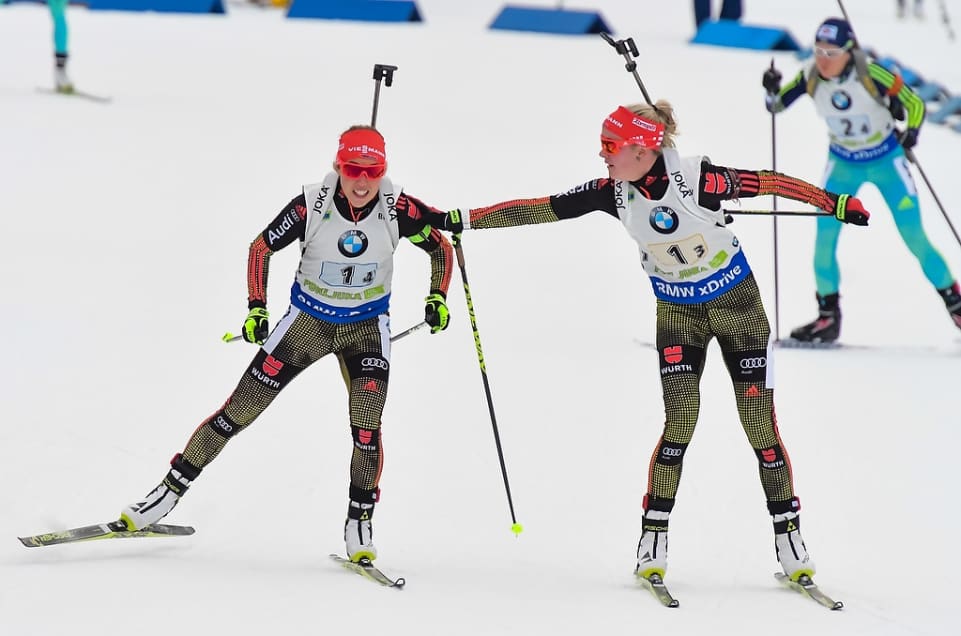
    Germany's Karen Hammerschmidt (l) tagging her teammate Laura Dahlmeier in second place at the final exchange of the women's 4 x 6 k relay at the IBU World Cup in Pokljuka, Slovenia. Dahlmeier anchored the team to the win by 10.1 seconds over France. (Photo: IBU)
    Germany’s Karen Hammerschmidt (l) tagging her teammate Laura Dahlmeier in second place at the final exchange of the women’s 4 x 6 k relay at the IBU World Cup in Pokljuka, Slovenia. Dahlmeier anchored the team to the win by 10.1 seconds over France. (Photo: IBU)

    In the women’s relay on Sunday, Germany took first by 10.1 seconds over France, using nine spares but no penalties.

    Vanessa Hinz started the Germans out and tagged off in fifth, and second-leg Franziska Hildebrand moved them up into second by the halfway point. Karen Hammerschmidt held that position, which was enough for Laura Dahlmeier who anchored them to the win in 1:11:31.1.

    “This was a brutally beautiful race today,” Dahlmeier told German broadcaster ZDF after her third win in as many races in Pokljuka. “It was very fun, and I was very relaxed because I knew we were competing as a team. Even if you don’t have as much power left there are still three others. I was on top of my game and just enjoyed it. I really looked forward to the race, although yesterday I was knocked out. But on the course I had a good feeling right from the start.”

    France in second and Ukraine in third (+37.7) both required just three spare rounds and no penalties per team. France secured second place with Anais Chevalier (who initially tagged off in 11th), Justine Braisaz (who picked off eight places to move into third), Celia Aymonier (who tagged off in first), and Marie Dorin Habert (who cleaned without any spares but came up 10 seconds short of Dahlmeier at the finish).

    Ukraine reached the podium with Iryna Varvynets, Yuliia Dzhima, Olena Pidhrushna, and Anastasiya Merkushyna.

    Canada placed 11th (+3:33.1) with a total of just four spares and no penalties. Sarah Beaudry initially tagged off in 23rd, Rosanna Crawford skied them into 18th, Megan Tandy shot clean without any spares and tagged off in 14th, and Julia Ransom anchored them to 11th out of 23 teams.

    The U.S. did not field a men’s or women’s relay team, with just three men and three women in Pokljuka.

    Results: Men | Women

    ***

    FIS Cross-Country World Cup in Davos: Freestyle Sprints

    In the men’s 1.6-kilometer freestyle sprint on Sunday it was Russia’s Sergey Ustiugov who emerged victorious, besting Finn Hågen Krogh of Norway and his Norwegian teammate Sindre Bjørnestad Skar for first.

    After qualifying 29th overall, Ustiugov crossed first in his quarterfinal and held the led through his semifinal and into the final, winning in a time of 2:24.65. Krogh crossed 0.59 tenths of a second behind him for second place and Skar took the final podium spot, crossing 3.29 seconds after Ustiugov.

    Also in the sprint final was Russia’s Alexey Petukhov, who finished just off the podium in fourth (+3.47), Norwegian Emil Iversen in fifth (+5.52) and France’s Lucas Chanavat — who won the qualifier — ended the day in sixth (+11.48).

    Lucas Chanavat of France had the fastest men's qualifying time in the Davos World Cup freestyle sprint on Sunday.
    Lucas Chanavat of France had the fastest men’s qualifying time in the Davos World Cup freestyle sprint on Sunday.

    Canada’s Lenny Valjas was the top North American finisher for the day, qualifying 12th and advancing to the quarterfinals where he finished in 14th overall. No other Canadians made the sprint heats, with Alex Harvey left just outside advancing in 33rd, Devon Kershaw ending the day in 49th, Knute Johnsgaard 60th, Bob Thompson 67th, and Andy Shields 73rd. Jesse Cockney did not finish the race.

    Simi Hamilton led the U.S. in 24th (+3.88). Andy Newell was just outside the heats in 36th, and Eric Packer placed 95th (+21.62).

    In the women’s 1.6 k freestyle sprint, Maiken Caspersen Falla of Norway took the overall win, crossing in a time of 2:44.63. Just 0.53 tenths of a second behind Falla was her Norwegian teammate Ingvild Flugstad Østberg in second place overall. The final women’s podium finisher, Hanna Falk of Sweden was 0.60 tenths of second off Falla in third.

    U.S. Ski Team member, Jessie Diggins made the final, racing to a fifth place overall (+5.91), behind Sweden’s Jonna Sundling in fourth (+1.04) and ahead of Russia’s Natlalia Matveeva in sixth (+6.80).

    The United States put three other women into the heats, including Sophie Caldwell who finished 11th, Sadie Bjornsen 15th, and Ida Sargent 20th.

    American Caitlin Patterson ended the day 47th, Kikkan Randall 58th, and Liz Stephen 61st.

    Dahria Beatty was the top Canadian on Sunday, finishing in 25th overall. Cendrine Browne ended the day 53rd and Sophie Carrier-Laforte 59th.

    Qualifier Results: Men | Women

    Final Results: Men | Women

    ***

    NorAm/SuperTour at Sovereign Lake: 10/15 k Freestyle

    [UPDATE] It was Americans owning the podium again Sunday at Sovereign Lake, and a little bit more. It was warmer on Sunday, -7 Celsius, and snowed lightly throughout.

    The men’s 15 k freestyle was first on the schedule.  APU’s Scott Patterson won in 40:00.2, followed by Saturday’s A-finalist Matt Gelso at 13.2 seconds and Vail’s Tad Elliot at +26.6.

    The top Canadian was Team R.A.D.’s Russell Kennedy in ninth, at 1:38.8 behind.

    In the women’s 10 k freestyle, the podium was owned by APU’s Chelsea Holmes in 30:42.9. SMS Elite’s Katharine Ogden was second at 13.4 seconds, also winning the junior category. Her teammate Erika Flowers was third, 36.4 behind.

    AWCA’s Olivia Bouffard-Nesbitt was the top Canadian for the second day, placing 13th at 1:51.8.

  • Iversen Capitalizes on Northug’s Weakness for Second World Cup Win

    Iversen Capitalizes on Northug’s Weakness for Second World Cup Win

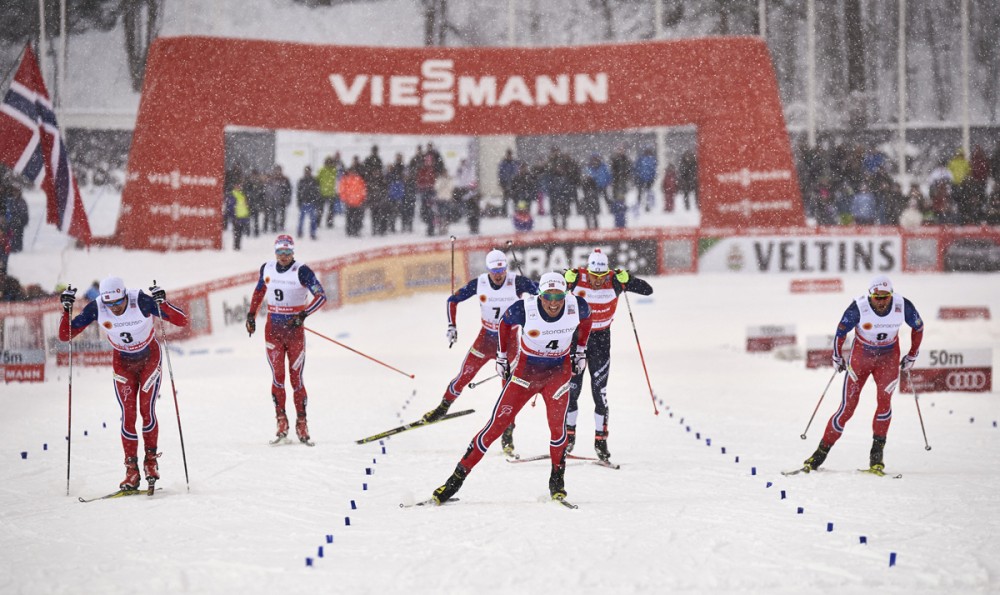
    Left to right: Norwegians Finn Hågen Krogh, Eirik Brandsdal, Sindre Bjørnestad Skar, Emil Iversen, Italian Federico Pellegrino, and Norway's Petter Northug during the men's 1.6 k freestyle sprint final on Saturday in Lahti, Finland. (Photo: Fischer/Nordic Focus)
    Left to right: Norwegians Finn Hågen Krogh, Eirik Brandsdal, Sindre Bjørnestad Skar, Emil Iversen, Italian Federico Pellegrino, and Norway’s Petter Northug during the men’s 1.6 k freestyle sprint final on Saturday in Lahti, Finland. (Photo: Fischer/Nordic Focus)

    Logging hours upon hours of ski training is one thing. Logging hours upon hours of ski training with Norway’s nordic icon, Petter Northug is another. At least, so suggests Norwegian Emil Iversen, winner of the men’s 1.6-kilometer freestyle sprint on Saturday in Lahti, Finland.

    “I have trained too much with him now I think,” Northug said during a post-race press conference, referring to his Norwegian teammate, Iversen.

    “He has found my weakness … He beat me in Obsterdorf, he beat me here and we will not train together next year, I can tell you now,” he added with a laugh.

    With another World Cup sprint title under his belt, 24-year-old Iversen did not disclose his superstar teammate’s sprinting soft spot.

    “I can’t tell that to you,” Iversen said at the press conference regarding Northug’s weakness. “But yeah, for sure, I know what that is, so I’m going to use it also next year.”

    Whatever secrets Iversen knows, he put into action during Saturday’s sprint.

    He qualified fourth, the second Norwegian — one-tenth of a second behind teammate, Finn Hågen Krogh — and 2.41 seconds back from Finland’s Martti Jylhä, the top qualifier in 3:04.15. Iversen went on to win his quarterfinal, semifinal and eventually the final, besting not just Northug, but Italy’s sprint prodigy, Federico Pellegrino as well.

    “The Norwegians now have seen how I behaved [in prior races],” Pellegrino, 25, told the Italian Ski Federation, according to a translation. “So in the final they put a man in front of me preventing me from doing my game.”

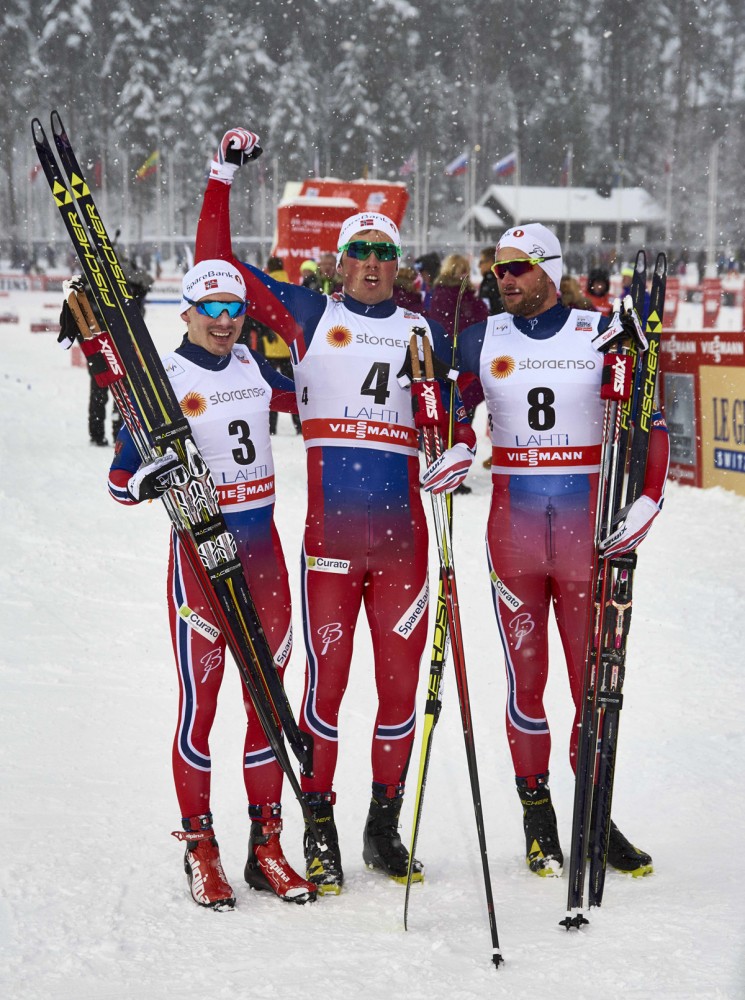
    An all Norwegian podium with (left to right) second place finisher Finn Hågen Krogh, first place finisher Emil Iversen, and third place finisher Petter Northug for the men's 1.6 k freestyle sprint final on Saturday in Lahti, Finland. (Photo: Fischer/Nordic Focus)
    An all Norwegian podium with (left to right) second place finisher Finn Hågen Krogh, first place finisher Emil Iversen, and third place finisher Petter Northug for the men’s 1.6 k freestyle sprint final on Saturday in Lahti, Finland. (Photo: Fischer/Nordic Focus)

    The Final

    The lone non-Norwegian in the final, Pellegrino found himself sandwiched between Norway’s Krogh and Eirik Brandsdal from the start until the top of the second climb.

    Prior to the course’s second major downhill, Brandsdal cornered by Pellegrino on the inside of a sweeping lefthand turn, inching the Italian into third place by the descent. Northug coasted at the pack’s back, sitting behind teammates Sindre Bjørnestad Skar and Iversen.

    As the six finalists ascended the third-and-final major course climb, Pellegrino and Iversen maneuvered to the left of Krogh, Northug and Brandsdal. Emerging first through Saturday’s snowfall were the yellow gloves and navy suit of Pellegrino.

    However, by the end of the last downhill into the stadium, Pellegrino was lost in a sea of red; his opportunity for a podium spot swallowed by the full force of Norway. Iversen and Krogh tuck skated to the right of Pellegrino, with Iversen cinching his winning spot just 0.25 seconds ahead of teammate Krogh in a time of 3:08.41.

    “I tried to have a good position on the last climb, but I was fifth or so,” Hågen Krogh said during a post-race press conference. “I should have been two more spots going forward in the field. But…I was very happy to be on the podium,” the overall second place finisher added.

    While Iversen and Krogh tucked past Pellegrino on the right, Northug came up on the left, with a turnover in the final 100 meters that out-motored that of the Italian. In a lunge for the line, Northug nabbed third (+0.69) and secured the final spot for the all-Norwegian sprint podium.

    “We train a lot in Norway and I think that’s the answer,” Iversen said regarding Norway’s sprint sweep in the men’s competition. “I think it’s the training we do. You have to train hard all year long.”

    Hamilton in the Heats, 17th Overall

    Though he did not advance beyond the quarterfinal, American Simi Hamilton’s performance on Saturday proved his progress this season as one of consistency.

    “Obviously, every weekend you want to go out and you want to be on the podium, but you take what you can get,” Hamilton said during an in-person interview. “Being able to consistently ski in the teens each sprint. I’m happy with that.”

    American Simi Hamilton raced to a 17th overall in the men's 1.6 k freestyle sprint on Saturday in Lahti, Finland. (Photo: Fischer/Nordic Focus)
    American Simi Hamilton raced to a 17th overall in the men’s 1.6 k freestyle sprint on Saturday in Lahti, Finland. (Photo: Fischer/Nordic Focus)

    After qualifying in 10th (+3.42), the top American for the day said his body “felt really good” and gave him confidence to work the longer course during his quarterfinal.

    “I think this course has a lot that plays to my strengths. Some very different climbs and a couple very technical corners,” he said. “The first two thirds of the course you’re really working the entire thing, so I wanted to conserve my energy and then kind of pin in it the last third.” 

    As the U.S. skier made his way into the final major climb, however, he had trouble getting into position.

    “I tried to make a move there and got really tangled with a couple different people on that climb,” he explained.

    Jumping in behind Russia’s Alexey Petukhov, Hamilton manage to draft speed during the final downhill into the stadium.

    “I got a pretty good slingshot coming into Petukhov, but I went left into some slower snow right before the final corner and kind of got pushed back again,” Hamilton said. “So I just had to settle for getting behind Petukhov and then try to do something in the finishing stretch.  Unfortunately I stumbled a little bit coming into the finish.”

    With motivation for more than a top 20, Hamilton is ready for his next series of races: the Ski Tour Canada.

    “I’ll carry that [momentum] with me into Canada,” Hamilton said. “Really looking forward to a couple good skate sprints there and a classic sprint in Canmore and all the other races.”

    Saturday’s other U.S. male starter, Reese Hanneman, is also looking forward to the Canadian World Cup races after finishing 51st overall in the Lahti sprint. 

    “I’m hoping to keep feeling better and use this last block or races as a springboard to some good ones in Canada,” Hanneman, who will head back to the U.S. early Monday, wrote in an email.

    While Hanneman remained happy with the amount of power and movements he executed on course during Saturday’s sprint qualifier, he also acknowledged areas where he could have made up time.

    “I lost a second or two in the crux of each of the big climbs,” he wrote. “There are two big climbs, each ending in a short steep pitch. I felt like I was able to maintain good momentum up until about the final couple meters of each of those pitches, where I slowed down and had to dig. The top guys were just zipping all the way over.”

    The seconds he lost, he said, were not due to his skis — despite fresh snowfall during Saturday’s event in Lahti.

    “My wax tech Eli Brown, and all of the US techs did an incredible job with my skis today,” he wrote. “They felt great on snow that could’ve been really challenging. I definitely want to thank those guys for all their hard work.”

    — JoJo Baldus and Harald Zimmer contributed reporting

    Results: Qualifier | Final

  • Fossli Wins First World Cup; Newell Fourth in Ruka Classic Sprint

    Fossli Wins First World Cup; Newell Fourth in Ruka Classic Sprint

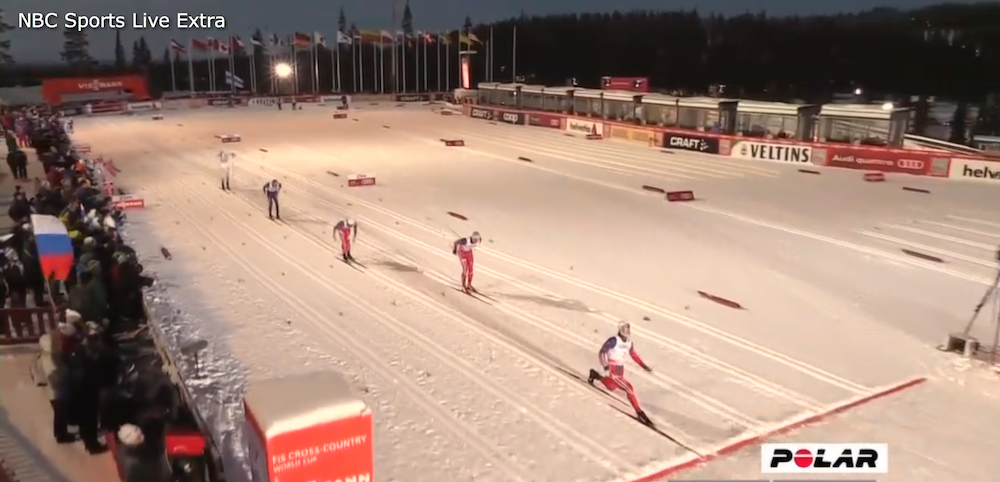
    Norway's Sondre Turvoll Fossli, 22, crosses the line first for his first World Cup victory in the first World Cup of the 2015/2016 season in Kuusamo, Finland. His teammates Eirik Brandsdal (second from r) and Petter Northug (third from r) placed second and third, and American Andy Newell (l) was fourth in the first of the three-day Ruka mini tour.
    Norway’s Sondre Turvoll Fossli, 22, crosses the line first for his first World Cup victory in the first World Cup of the 2015/2016 season in Kuusamo, Finland. His teammates Eirik Brandsdal (second from r) and Petter Northug (third from r) placed second and third, and American Andy Newell (second from l) was fourth in the first of the three-day Ruka mini tour.

    A quick glance of the men’s final results in Friday’s classic sprint — the season-opening World Cup in Kuusamo, Finland — reveal the same old story: a Norwegian podium sweep.

    But look closer. At age 22, Sondre Turvoll Fossli won his first World Cup and American Andy Newell placed fourth for his best World Cup result since he finished fourth in a classic sprint three seasons ago in Davos, Switzerland.

    While Fossli took charge and won the 1.4-kilometer sprint final in 2:33.07, ahead of fellow Norwegian World Cup sprinter Eirik Brandsdal in second (+1.03) and all-around skier Petter Northug in third (+1.65), Newell was 1.11 seconds off the podium in fourth.

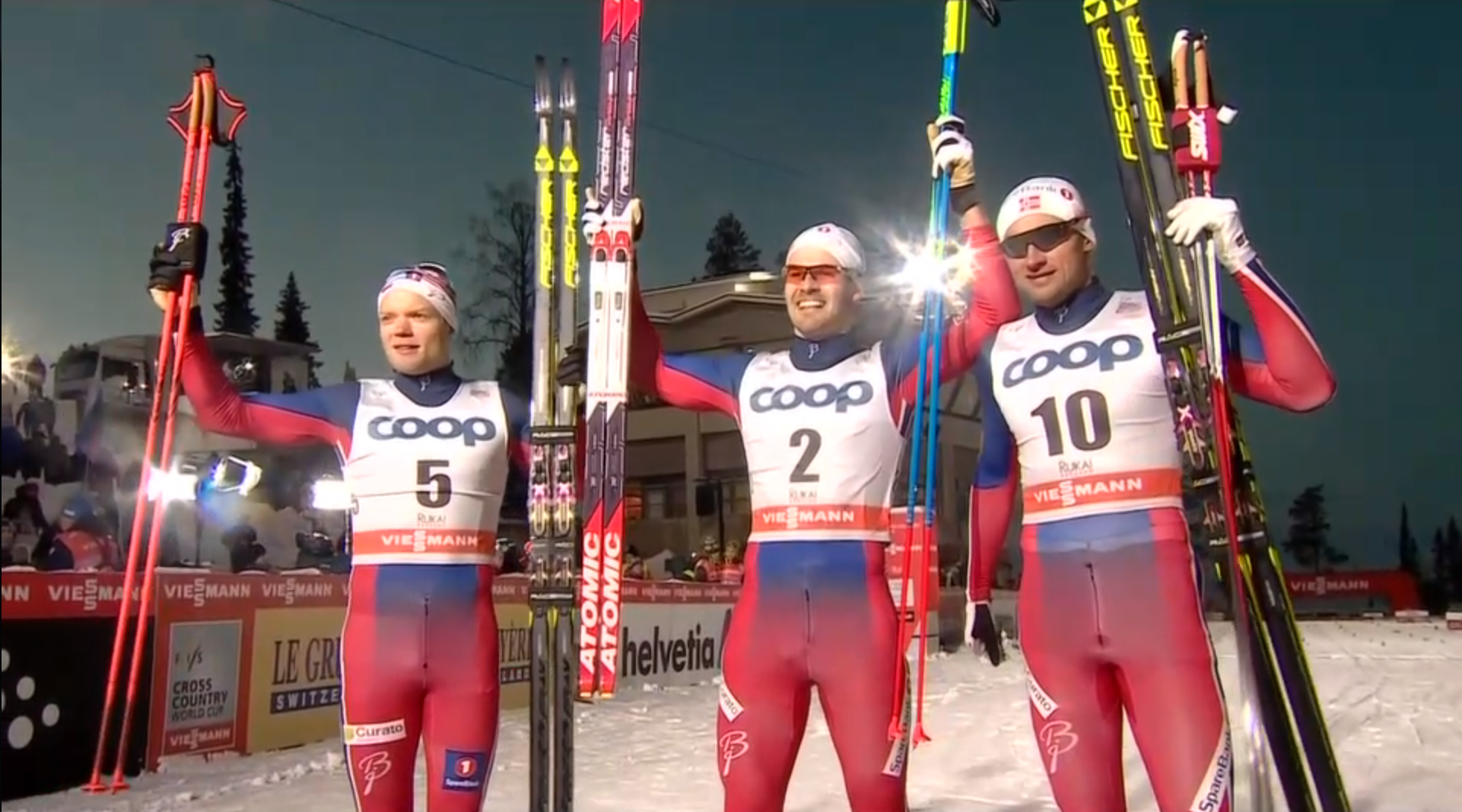
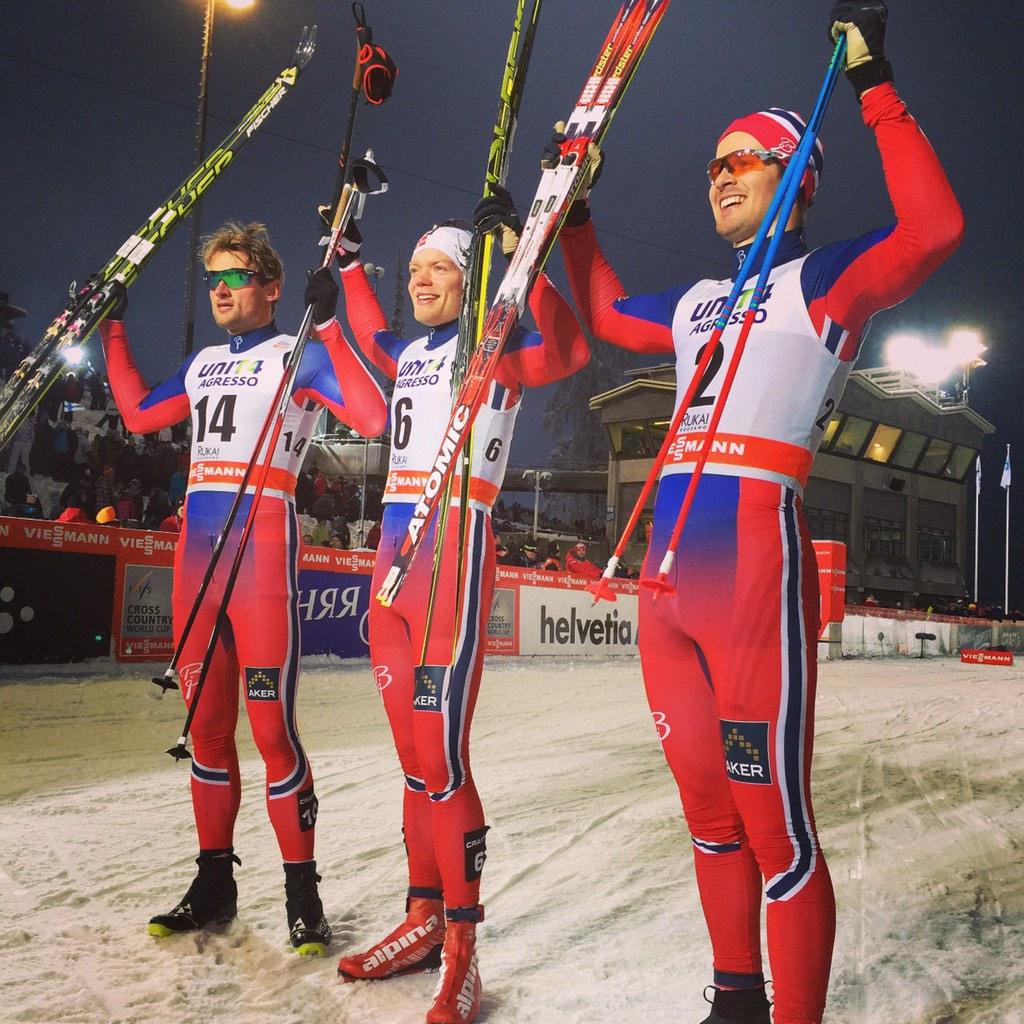
    The all-Norwegian men's Ruka classic sprint podium on Friday in Kuusamo, Finland, with winner Sondre Turvoll Fossli (c), runner-up Eirik Brandsdal (l) and Petter Northug in third.
    The all-Norwegian men’s Ruka classic sprint podium on Friday in Kuusamo, Finland, with winner Sondre Turvoll Fossli (c), runner-up Eirik Brandsdal (l) and Petter Northug in third.

    The 31-year-old U.S. Ski Team sprinter reached the final by the slimmest of margins as a lucky loser two times over. In a photo finish for third in his quarterfinal, Newell ended up 0.03 seconds behind Russia’s Alexey Petukhov. Yet both advanced to the semifinals based on time.

    Then, in the first semifinal, against Fossli, Brandsdal, Sweden’s Emil Jönsson, Russia’s Nikita Kriukov, and Finland’s Matias Strandvall, Newell nipped Jönsson for third — another photo finish separated by 0.03 seconds. Both Newell and Jönsson advanced to the final as lucky losers behind Fossli and Brandsdal, who placed first and second in that heat.

    In the final, Fossli pushed the pace early and initially led with Sweden’s Teodor Peterson. By the final hill — an infamously tough climb back up to the Ruka stadium —  Fossli was in a league of his own, ahead of the field and charging for the win.

    At the bottom of the climb, Newell followed Fossli in second with Brandsdal and Northug closing on him from behind. They passed him along the long ascent to the top, and Newell hung on for fourth, finishing about a second ahead of Peterson in fifth. Jönsson placed sixth, 22 seconds behind the winner.

    “I think Kuusamo is one of the toughest sprints of the season,” Newell told FasterSkier in a phone interview after the race. “So I know if I can have a shot at the podium here I can have a shot at the podium any race this year, and I’m excited about that.”

    After the finish, Fossli, who learned Monday that he would race the opening sprint in place of Ola Vigen Hattestad, gleamed over his first World Cup victory. Hattestad and his girlfriend, Slovenian skier Katja Višnar, welcomed the birth of their first child earlier this week, according to FIS.

    “It was great, third last year and first place now,” Fossli told FIS after his stage win on Friday. At this same venue last year, he placed third in the Ruka classic sprint, behind Brandsdal and Northug, respectively. “I’m really happy and I hope I will stay there.”

    Stay tuned for complete report, along with a recap of the U.S. women’s finishes, led by Ida Sargent in seventh.

    Results: Men | Women

  • Norway’s Brandsdal Wins Crash-Filled Lahti Skate Sprint, Newell Eighth for U.S.

    Norway’s Brandsdal Wins Crash-Filled Lahti Skate Sprint, Newell Eighth for U.S.

    FIS world cup cross-country, individual sprint, Lahti (FIN)
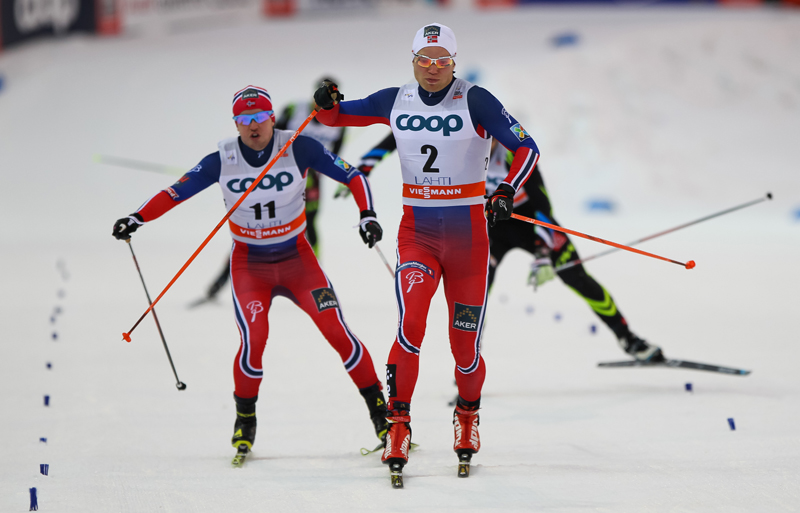
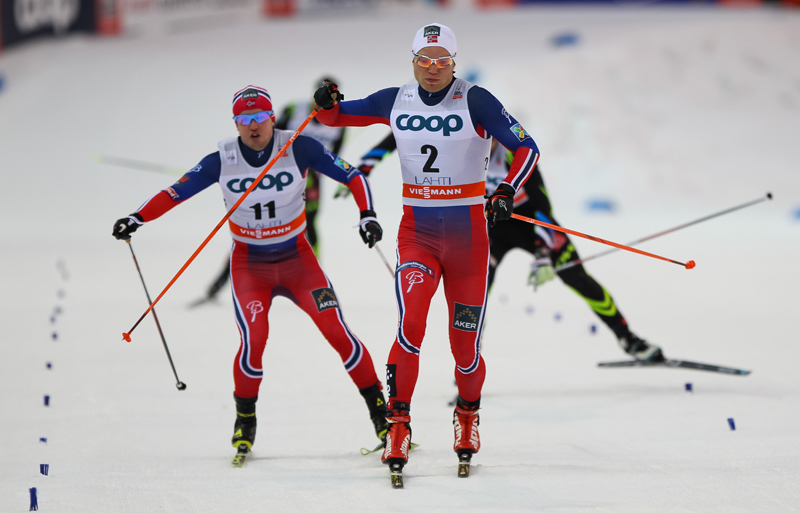
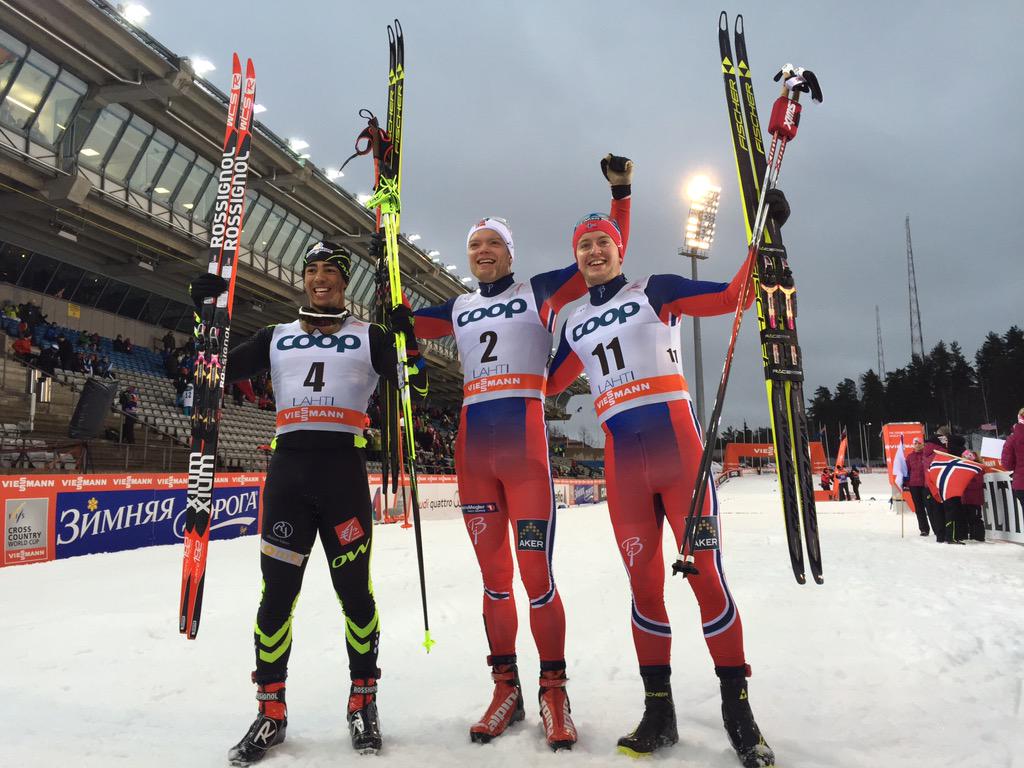
    Norway’s Erik Brandsdal (2) celebrates the win as he crosses the line first, ahead of fellow Norwegian Sindre Bjørnestad Skar (11) in the World Cup freestyle sprint final on Saturday in Lahti, Finland. (Photo: Fischer/Nordic Focus)

    One week after World Championships ended in Falun, Sweden, there wasn’t much time for rest for those headed into this weekend’s World Cup in Lahti, Finland. All the big names entered in the 1.5-kilometer freestyle sprint trying to get valuable International Ski Federation (FIS) points as the season winds down.

    Heading into Saturday’s sprint, Norway’s Finn Hågen Krogh was leading the overall Sprint World Cup with 398 points, ahead of Federico Pellegrino from Italy who had 356 points and Alexey Petukhov from Russia with 284 points. However, none of the top-three point leaders was a factor Saturday, opening the door for Norway’s Eirik Brandsdal, sitting in fourth, to gain valuable points and move up in the season-long sprint competition.
    The 1.5 k course in Lahti was very technical compared to the courses the competitors have faced this season. It was a mixture of hills and tricky turns that took their toll on some big-name competitors. Norway seemed to fare the worse, as Martin Johnsrud Sundby, Ola Vigen Hattestad, Sondre Turvoll Fossli, and Petter Northug all fell during Saturday’s sprint. Northug had a moment he probably would like to forget, falling flat on his face at the start of his semifinal heat.

    Norway’s Petter Northug (r) doesn’t even get out of the gate during his semifinal heat in the World Cup freestyle sprint on Saturday in Lahti, Finland. (photo: Fischer/Nordic Focus)

    Krogh was relegated during his semifinal for a rules violation and thus didn’t advance to the final.

    Throughout the rounds, Brandsdal was very consistent in his strategy, getting out in front and staying out of trouble.

    “I knew there were some issues with soft snow on the course and I wanted to be in front of the heat and I managed to control my heats,” he told FIS.

    After Sweden’s Johan Edin won the qualifier in 2:41.14, Brandsdal qualified second, 0.19 seconds back, and Krogh posted the third-fastest time (+1.44). Andy Newell was the lone North American to make the heats, qualifying in 13th (+3.02). Fellow U.S. Ski Team member Simi Hamilton missed advancing in 33rd, 0.32 seconds out of 30th. Also racing in the stars and stripes, Dakota Blackhorse-von Jess placed 55th in the qualifier and Erik Bjornsen was 57th.

    Among the Canadians, Lenny Valjas finished 48th, Alex Harvey placed 63rd, Jess Cockney was 68th, and Micheal Somppi 74th.

    Northug qualified in 10th and went on to win the first quarterfinal in 2:42.22, ahead of Finland’s Martti Jylhä in second (+0.42). The second quarterfinal featured Norway’s Sindre Bjørnestad Skar, who won in 2:40.71, and Brandsdal (+0.15) advancing. Newell topped the third quarterfinal in 2:39.80, ahead of Norway’s Håvard Solås Taugbøl (+0.12). France’s Richard Jouve won the fourth quarterfinal in 2:42.27, over Norway’s Anders Gløersen (+0.40), and another Frenchman, Baptiste Gros won the fifth quarterfinal in 2:40.35, while Edin advanced in second (+0.48). The lucky losers were Norway’s Mathias Rundgreen and France’s Renaud Jay.

    Brandsdal went on to win his semifinal in 2:42.88, and Skar finished 0.18 seconds back in second.  Jouve topped the second semifinal in 2:41.90, edging Taugbøl in a photo finish, while Jay and Gros in third (+0.22) and fourth (+0.14) made the final as well as lucky losers from that heat.

    Newell Makes Semis for Season Best

    Andy Newell (U.S. Ski Team) racing to 10th in the men's 1.4 k classic sprint qualifier on Thursday, the first official day of 2015 World Championships in Falun, Sweden. He went on to place fourth in his quarterfinal for 17th overall. (Photo: FlyingPointRoad)
    Andy Newell (U.S. Ski Team) racing to 10th in the men’s 1.4 k classic sprint qualifier at 2015 World Championships in Falun, Sweden. He went on to place fourth in his quarterfinal for 17th overall. (Photo: FlyingPointRoad)

    Newell narrowly missed advancing to the finals, finishing fourth in the first semifinal, 0.46 seconds behind Brandsdal and 0.12 seconds after Rundgreen, who was third. He ended the day in eighth overall for his best result of the season.

    “I’m finally feel like myself again sprinting so I’m excited for that,” Newell told USSA. “I really felt like I belonged in the final today, and it’s a good feeling to be back at that level.”

    It was the first time Newell had made the semifinals this season after posting a previous best of 12th in the World Cup classic sprint on Feb. 14 in Östersund, Sweden. There, he placed third in his quarterfinal to miss the semifinals by one place.

    Earlier in the day, Newell had qualified in 13th. He wrote in an email to FasterSkier that the fast course made qualifiers especially fun.

    “There are always a ton of skiers here at these World Cups so it can be a competitive field to qualify in,” he wrote.

    In terms of strategy on Saturday, Newell said he noticed several skiers were “sitting back and trying to attack the last half of the race.

    “That became my strategy and it worked out perfectly in the quarters and I was able to come in to the lead in the stadium and win the heat,” he explained. “I tried to do the same thing in the semis, but the pack was just a little too tight and wasn’t able to slighshot into the top two in the stadium.”

    “I’m happy with eighth but really felt good enough for the podium,” he wrote. “But most of all I’m stoked to be feeling much better at the end of the season than I did in the beginning.

    A Norway-France Final Showdown

    The final featured three Norwegians; Brandsdal, Skar and Taugbøl matched up against three Frenchmen: Jouve, Gros and Jay.

    Norway's Eirik Brandsdal (c) won Saturday's 1.5 k freestyle sprint at the World Cup in Lahti, Finland, ahead Norway's Sindre Bjørnestad Skar (r) and France's Richard Jouve (l), both of which achieved their first-ever World Cup podiums. (Photo: FIS Cross Country/Twitter)
    Norway’s Eirik Brandsdal (c) won Saturday’s 1.5 k freestyle sprint at the World Cup in Lahti, Finland, ahead Norway’s Sindre Bjørnestad Skar (r) and France’s Richard Jouve (l), both of which achieved their first-ever World Cup podiums. (Photo: FIS Cross Country/Twitter)

    Out of this unique final matchup, featuring three Norwegians and three Frenchmen, Brandsdal had the most experience, after recording a podium in Davos, Switzerland, and winning the World Cup opener in Kuusamo, Finland, at the start of this season.

    At the start, Brandsdal double poled his way into the lead and never lost it. He was followed closely behind by Skar, who was also racing for a personal-best finish. As the race unfolded, it was shaping up to be an all-Norwegian podium. With the three Norwegians skiing together, Skar and Taugbøl worked for Brandsdal to keep the French off the podium. The wall was finally broken about 200 meters from the finish when Jouve was able to glide past Taugbøl and into the top three.

    Brandsdal crossed the line first to win in 2.42.75, Skar was 0.21 seconds back in second, and Jouve finished 0.52 seconds behind in third. These were personal-best finishes for Skar and Jouve.

    “My goal today was to make it to the finals for the first time in my career,” Skar told reporters. “To finish on the podium in second place is pretty cool. I skied behind Eirik in the quarterfinal and semifinal. I managed to stay out of trouble also in the final.”

    A relative newcomer, Jouve, 20, has only competed in two other World Cups, both classic sprints, where he finished 49th in Otepää and 19th in Östersund earlier this season.

    “It was a very good day for me. I am very happy for third place,” Jouve told FIS. “It was my third World Cup appearance in my career and I did not expect this to happen. I am very proud to be on the podium. I felt very good in the qualification.”

    As a result of his win on Saturday and the 100 FIS points that go along with it, Brandsdal has moved into third overall in the Sprint World Cup. Krogh still leads with 399 points, Pellegrino is 33 points behind in second and Brandsdal 57 points back in third.

    There is only one sprint race left this season, a classic sprint on Wednesday in Drammen, Norway.

    Notes:

    There was a change to how the athletes were ranked for their qualification heats. FIS tested a new system this week and plans on doing it in next week’s classic sprint as well, in which qualified athletes choose their own quarterfinal matchups. The athletes ranked in the first top 11 positions after qualifying select their heat matchups first in reverse order, meaning the 11th-fastest qualifier selects first and the top qualifier selects their position last of that group. The athletes in 12th through 30th select the remaining quarterfinal positions in numerical order.

    Results

  • For Krogh and Northug, Team-Sprint Gold Strictly Business in Falun

    Petter Northug (c) celebrates Norway's freestyle team-sprint gold, which he won with teammate Finn Hågen Krogh on Sunday for his second title of 2015 World Championships in Falun, Sweden. (Photo: FlyingPointRoad.com)
    Petter Northug (c) celebrates Norway’s freestyle team-sprint gold, which he won with teammate Finn Hågen Krogh on Sunday for his second title of 2015 World Championships in Falun, Sweden. (Photo: FlyingPointRoad.com)

    FasterSkier’s coverage of the 2015 FIS Nordic World Ski Championships in Falun, Sweden, is brought to you by the generous support of L.L. Bean, now featuring a complete line of Kikkan Randall training wear.

    FALUN, Sweden — Why waste time when you can get the job done? That was Petter Northug’s mentality on his second of three laps in the men’s 6 x 1.4-kilometer freestyle team sprint at 2015 FIS Nordic World Ski Championships on Sunday.

    Already on a roll with one gold in the World Championships classic sprint three days earlier, Northug was on a quest for another in the only event he had yet to win at worlds: the team sprint.

    With Norwegian teammate Finn Hågen Krogh, the two built an early lead in the final, and Krogh kept them in first on his second lap, handing off to Northug 2.79 seconds ahead of Sweden in second. Soon after, Northug attacked on the longest of the course’s two steep climbs, leaving Sweden’s Teodor Peterson behind.

    “In the final, I looked for things to do pretty early,” Northug said in a press conference. “We thought that Sweden wanted high speed in the final when they put Calle [Halfvarsson] on the first leg. I was prepared to fight with [Peterson] on the last leg, but he was sitting on the bike when we were skiing fast.”

    As Northug warmed up into his accelerated pace, Russia’s Nikita Kriukov led the chase, heading out six seconds after him. Teammate Alexey Petukhov had tagged him in third, just ahead of Italy and about two seconds in front of France and Germany, and Kriukov proceeded to lead Italy’s Federico Pellegrino and Germany’s Tim Tscharnke in pursuit of Peterson.

    They caught the Swede on the second uphill, and the four descended into the stadium and second-to-last exchange together, led by Peterson about eight seconds after Northug.

    One lap later, Krogh had increased Norway’s first-place cushion to nearly 16 seconds, while Italy’s Dietmar Nöckler and Halfvarsson raced behind him in second and third, respectively, up the first climb.

    On the second uphill, Russia’s Petukhov was back in contact with the chase group, along with Germany’s Thomas Bing, Finland’s Ville Nousiainen, France’s Robin Duvillard, and the Czech Republic’s Ales Razym. Another five seconds back, American Andy Newell led a second group in ninth.

    Krogh cruised into the final exchange in first, while Bing led the seven-man pack through 15.68 seconds later.

    “Petter didn’t leave me much choice,” Krogh said in the conference about the lead. “When I saw he had the gap, I only had one thing on my mind, it was go hard the rest of the race.”

    From there, Northug went through the motions, skiing the third-slowest anchor leg and looking back before the last rise in the stadium to see if anyone was charging from behind.

    Nope.

    The 2015 World Championships freestyle team sprint podium, with Norway (c) as the winners (Finn Hågen Krogh/Petter Northug), Russia (r) in second (Nikita Kriukov/Alexey Petukhov), and Italy (l) in third (Federico Pellegrino/Dietmar Nöckler). (Photo: FIS/Twitter)
    The 2015 World Championships freestyle team sprint podium, with Norway (c) as the winners (Finn Hågen Krogh/Petter Northug), Russia (r) in second (Nikita Kriukov/Alexey Petukhov), and Italy (l) in third (Federico Pellegrino/Dietmar Nöckler). (Photo: FIS Cross Country/Twitter)

    On that same stadium hill several seconds later, Kriukov attacked one last time to move into second ahead of Tscharnke and Pellegrino. He left both of them behind, securing silver for Russia, 5.64 seconds after Northug and nine-hundredths of a second ahead of Pellegrino, who claimed bronze for Italy.

    “We lost only five seconds to Petter, but while we was [waving] the flag and drinking coffee, what can you say,” Kriukov said through a translator in the press conference. “The Norwegians were the best. We are really happy for them.”

    The defending world champions in the 2013 freestyle team sprint in Val di Fiemme, Italy, Kriukov and Petukhov were also pleased with themselves.

    “I’m happy today,” Petukhov said in the conference through a translator. “Because this silver medal, I have to work hard for it, but of course if you win the race, then you are even higher above, but still I am very happy.”

    Tscharnke was 0.38 seconds short of the podium in fourth, which was Germany’s second wooden medal of the day after Nicole Fessel and Denise Herrmann placed fourth in the women’s team sprint.

    Finland’s Martti Jylhä finished another 7.55 seconds back in fifth, 13.66 seconds after Northug, and the Czech Republic placed sixth with Dusan Kozisek coming through 16.73 seconds after the winners.

    While Simi Hamilton skied the fourth-fastest anchor leg for the U.S., the Americans placed seventh (+17.48) ahead of Poland in ninth (+26.46), Sweden in 10th (+47.43) and France in 10th (+1:01.04).

    Petukhov inadvertently took out Sweden — the silver medalists in the 2013 World Championships team sprint — when he came into the last exchange with such high speed that he fell and broke Peterson’s pole as Peterson was about to start on his last lap.

    “I could not have done anything differently; I went to Teodor and apologized from the bottom of my heart,” Petukhov told Aftonbladet, according to a translation. “I cannot speak English so I do not know what he said, but I think we understood each other.”

    “He arrived and apologized. There is no evil in him, but he knows he did wrong,” Peterson told Aftonbladet.

    After breaking a pole in Saturday’s skiathlon, in which he placed sixth, Halfvarsson called the bad luck “just crap.”

    “Why is this happening? I broke a pole yesterday and now we break a pole on the last lap. It is pure bad luck,” he said to Aftonbladet.

    France also fell out of contention in the men’s final, after Duvillard had skied up to fifth at the halfway point behind Krogh. One lap later, they were still in the mix with Baptiste Gros in sixth, and Duvillard tagged them in seventh for the last lap, which was where they ran into trouble.

    Coming down the last descent into the stadium, Gros crashed suddenly at the bottom; his ski popped off and he sprawled out on the ground for several moments. He ended up finishing, nearly 14 seconds after Sweden.
    Earlier in the afternoon, France placed second to Italy in the first semifinal, one-hundredth of a second ahead of Sweden in third. While Italy and France automatically advanced, Sweden ended up moving on as well as one of the six-fastest lucky loser times among 28 teams. Finland and the Czech Republic also ended up advancing out of that semifinal.

    Norway won the second, slower semifinal after Northug set the pace for that heat on his second lap and forced everyone else to contend for a top-two finish to guarantee a spot in the final. Russia placed second in that heat, ahead of the U.S., which also advanced in third, and Germany and Poland made the final as well.

    Kazakhstan, which took bronze in the 2013 World Championships team sprint, did not advance to the final and placed 18th overall. Norway didn’t reach the team-sprint final in Val di Fiemme, where Pål Golberg and Northug finished 11th.

    “We had a really bad team sprint in Val di Fiemme and also in Oslo [in 2011 where] we lost the team sprint in the last meters to Canada,” he said in the press conference. “So it feels really good to win the World Championships in a team sprint — it’s good to have checked off all the distances.”

    With three races to go and 11 World Championships golds to his name, he’s still looking for more.

    “I milk [my] base for all its worth,” he told NRK, referring to his altitude training before and after Norwegian nationals late last month. “That makes racing really fun, and I’m planning on riding that flow the coming week as well.”

    Results

  • Pellegrino Delivers Much-Needed Win for Italy in Davos Skate Sprint

    Pellegrino Delivers Much-Needed Win for Italy in Davos Skate Sprint

    Pellegrino celebrating his win with Italian supporters. Photo: Liberec2013.
    Federico Pellegrino (r) two seasons ago, celebrating his classic-sprint win with Italian supporters at the 2013 U23 World Championships in Liberec, Czech Republic. (Photo: Liberec2013)

    There was no shortage of action in the men’s 1.3-kilometer freestyle sprint on Sunday as 24-year-old Federico Pellegrino fought his way to his first-ever World Cup win and Italy’s first victory in four years.

    The Italian sprinter took charge in the last half of the men’s final in Davos, Switzerland, and earned the win (and his sixth World Cup podium), while Russia’s Alexey Petukhov slid across the finish line to snag second ahead of Norway’s Finn Hågen Krogh in a photo finish for the podium.

    “It’s a great day. I have been working for the World Cup victory for so long,” Pellegrino told FIS after the race. “It feels amazing to reach this goal. I hope that my victory will help the Italian Cross-Country team to good results.”

    With his best World Cup results coming at altitude, Pellegrino rocketed to first in last weekend’s freestyle-sprint qualifier. He went on to place 11th exactly a week ago after finishing sixth in his semifinal.

    Federico Pellegrino (r) after his first World Cup victory on Sunday in the 1.4 k skate sprint in Davos, Switzerland. (Photo: FIS Cross Country/Twitter)
    Federico Pellegrino (r) after his first World Cup victory on Sunday in the 1.4 k skate sprint in Davos, Switzerland. (Photo: FIS Cross Country/Twitter)

    On Saturday amid fast conditions with an ample amount of manmade snow, Pellegrino advanced to the final as a lucky loser — the fourth man in a fast heat — and ended a slow start to the season for Italy. The young Italian was last out of the gate, but quickly made up ground to put himself in third by the first turn.

    Petukhov led early, up and over the first hill, where Pellegrino sat in second. The Russian accelerated in an effort to drop him, but Pellegrino hung close. By the time the last climb on the second lap rolled around, the Italian made his move — surging past him and creating a large gap on Petukhov and the rest of the field (with Norway’s Krogh and Sondre Turvoll Fossli, and Sweden’s Calle Halfvarsson and Emil Jönsson) before the final turn into the straightaway finish.

    Petukhov gained ground back on the descent into the stadium with fast skis, and Krogh came like a bullet from behind through the last turn to challenge Petukhov to the finish.

    While Pellegrino edged Petukhov by 0.24 seconds in 2:19.36, the Russian slid across the line two-hundredths of a second ahead of Krogh for second place — his second World Cup podium this season.

    “Last week, I was also in the final but I chose the wrong tactics,” Petukhov told FIS, referencing his fourth-place finish last Sunday behind three Norwegians: Krogh in first, Anders Gløersen in second, and Eirik Brandsdal in third. “Today I did everything right but my legs felt little bit heavy. I was able to close the gap on Pellegrino, but the finishing straight is so fast I could not beat him.”

    After winning last Sunday’s sprint, Krogh advanced from the back of the pack to the podium in the final meters after struggling to stay with the pack for most of the final. Krogh admitted that the pressure to perform affected him during the race.

    “It is always tough to come back on the course where I have won. I felt the pressure, and it is good to be on the podium,” Krogh said to reporters after the race, explaining that he didn’t manage to get himself a very good position.

    “I had a not-so-good start, and I had to find a good position in the field. I gained some places in the uphill and I gave it all in the last corner,” he said, adding that he was very happy to make the podium.

    Fossli had the fastest qualifying time in 2:17.43 and advanced easily through the heats, but fell short in the final and ended up fifth (+1.43), behind Halfvarsson in fourth (+1.01), who was ninth in the qualifier. Jönsson finished last in the final (+11.02), but had the fourth-fastest qualifying time. Krogh was third in the qualifier, Petukhov advanced to the heats in 10th, and Pellegrino qualified fifth in the qualifier and won his quarterfinal.

    “Today, I beat all the Norwegian guys,” Pellegrino told NRK. “All of them.”

    “I wanted this victory with all my strength,” he told the Italian broadcaster RAI, according to a translation. “This victory comes at a negative period for our team, I hope it can serve to raise ourselves. I am very happy because I had not won anything and this time I did.

    “I dedicate the success to all those who have followed me since childhood: coaches , physiotherapists and [wax technicians], and all those who were close to me, including my girlfriend Greta Laurent who lack a bit of confidence in this period,” he added. “I hope it’s a good omen. … I hope it is the first in a long series of triumphs.”

    Results | by heats

  • Krogh Proves Superior in Davos Sprint, Earns First World Cup Victory

    Krogh Proves Superior in Davos Sprint, Earns First World Cup Victory

    Finn Hågen Krogh lunging in Saturday's 10 k freestyle individual start. He ended up second, just 2.2 seconds behind Norwegian teammate Martin Johnsrud Sundby. (Photo: Fischer/NordicFocus)
    Finn Hågen Krogh lunging in last week’s 10 k freestyle individual start in Lillehammer. In Sunday’s freestyle sprint in Davos, Switzerland the 24-year-old earned his first true World Cup victory. (Photo: Fischer/NordicFocus)

    Finn Hågen Krogh had what he called a perfect race Sunday in Davos, Switzerland.

    After placing third in the qualification round of the 1.3 k freestyle sprint, the Norwegian rapidly progressed through his quarterfinal, semifinal, and ultimately the final to earn his first World Cup victory.

    Krogh won the freestyle sprint in the Lillehammer mini tour earlier in Decemeber, but as the race was a Stage World Cup, he had yet to win a true World Cup until Sunday.

    Speeding around a relatively short course on the high-altitude trials of Davos, Krogh sustained a pattern of starting hard off the front to lead the majority of each race. Many skiers would try to hold their own against the up-and-coming Norwegian, but they often paid the price.

    In the final, Krogh fought to earn a spot at the front of six men despite a strong challenge from Calle Halfvarsson of Sweden. As the meters progressed Krogh and Halfvarsson left the remaining competitors behind, but by the time they entered the second lap of the sprint course, Halfvarsson’s energy was spent and the other men overtook him. With Halfvarsson out of the way the race was Krogh’s.

    Although fellow Norwegians Anders Gløersen and Eirik Brandsdal gained on Krogh in the final meters, there were no challenges to his strength as he crossed the line with a time of 2:18.16. Gløerson and Brandsdal placed second and third, 0.62 and 1.07 seconds behind their teammate.

    In a post race interview with FIS, Krogh said the key to his success was his fitness. “It was a perfect race. I am in a great shape. My tactic was to ski in the front and control the race. It is amazing to win a World Cup,” he said.

    The race marked another Norwegian podium sweep – a regular occurrence so far in the 2015 season. After the Davos World Cup, Norway has won 12 of 14 races and earned 34 of 42 podium positions.

    In a post-race interview Gløerson told FIS that he felt pressure heading into Sunday’s race because of the success his team has experienced in the prior weeks.

    “So many of our guys have skied well this year. I felt under pressure to do a good result today. I think I was lucky. I found a good rhythm and I am very satisfied with today,” he said.

    The final corner leading into the stadium proved troublesome for several skiers including Brandsdal. As he entered the turn, he tripped and almost fell. Brandsdal was forced to the outside of the corner as he attempted to stay on his feet, losing momentum into the stadium. While he was disappointed in his tactical error, Brandsdal said he was proud of his teammates and the Norwegian podium sweep.

    “I was angry about myself about how I skied the last curve. I wanted the victory so much that I lost my head. I am proud of my teammates, they did a great job. I felt strong but the finish did not work as I hoped,” he said to FIS.

    Federico Pelligrino of Italy also fell victim to the corner. Pelligrino skied a strong qualifier for the fastest time of the day, and, like Krogh, maneuvered his way to a win in his quarterfinal. In the semifinal however, Pelligrino made a wrong move on the corner and moved from second position to last.

    The remaining men in the final were Alexey Petukov of Russia (+1.35), Halfvarsson (+2.06), and Norweigian Tomas Northug (+2.29). Northug, the younger brother of the famed Petter Northug, earned his second-best World Cup result after finishing sixth. His best result is a fifth place from a March 2013 Stage World Cup classic sprint in Stockholm, Sweden.

    Petter Northug finished his day in 19th position after what some commentators called an obstruction by Brandsdal in his quarterfinal. Northug placed fourth in the quarterfinal.

    Rounding out the top-ten, were Martii Jyhae of Finalnd, Baptiste Gross of France, Maciej Starega of Poland, Ola Vigen Hattestad of Norway, Pellegrino, and Joeri Kindschi of Switzerland.

    The top North American finish of the day came from Lenny Valjas who qualified in 10th position and eventually placed 13th. It was the first time in roughly a year-and-a-half that Valjas qualified in a sprint, after earning several podium spots in 2012 and 2013 World Cups. Andy Newell was the only other North American in the finals and placed 15th.

    After the weekend of World Cup racing, Martin Johnsrud Sundby of Norway is the overall World Cup points leader with 491 points. Sundby placed 31st position in the sprint, missing qualification by 0.06 seconds. Inching towards Sundby is Krogh, who currently sits in second place with 409 points. Halfvarsson is ranked third with 275 points.
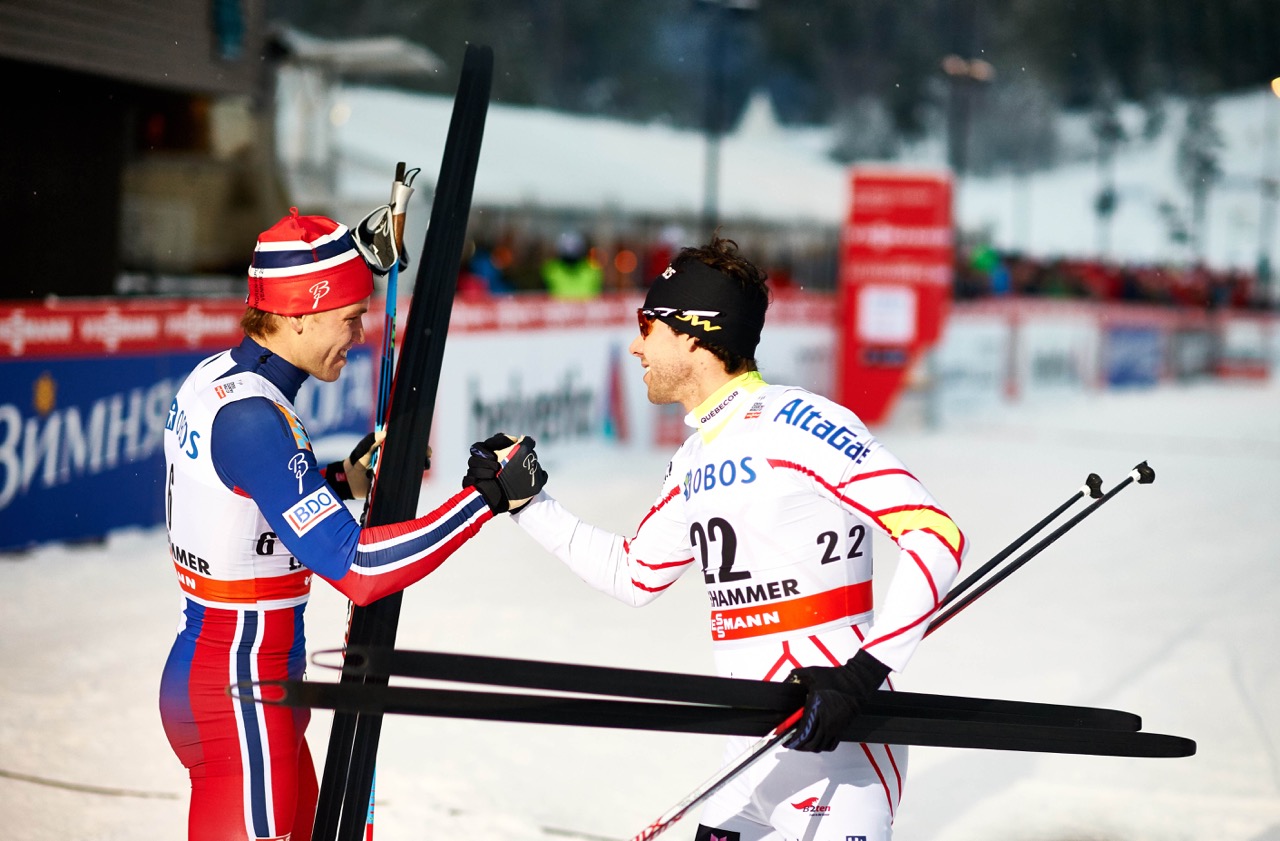
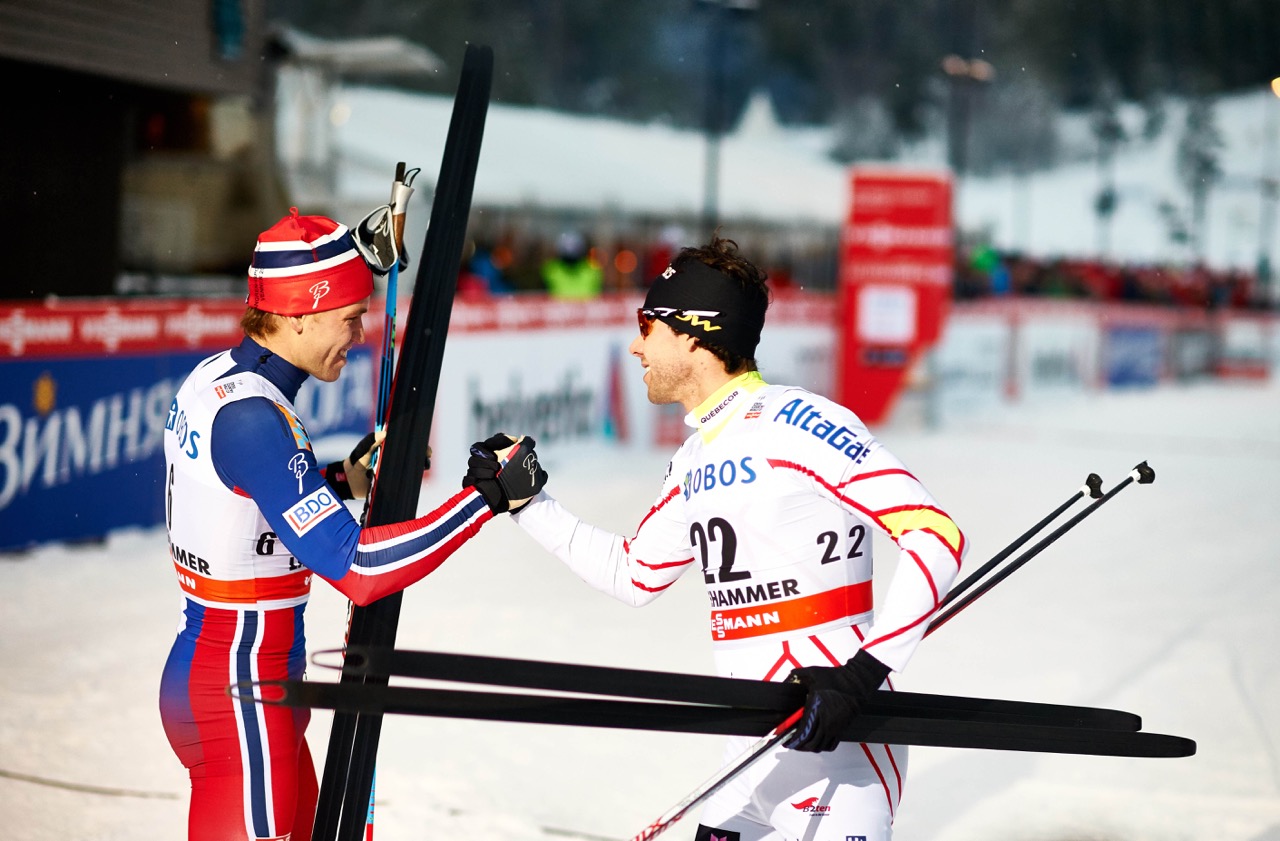
    The World Cup returns to Davos next weekend as scheduled races in Las Clusaz, France were cancelled due to poor snow conditions. With another freestyle sprint planned for Sunday, competitors will have a chance to either defend their results or improve.

    Men’s results

  • Golberg Trusts Skis for the Win, Harvey Fifth in Lillehammer Skate Sprint

    Golberg Trusts Skis for the Win, Harvey Fifth in Lillehammer Skate Sprint

    Canada's Alex Harvey (r) congratulates Norwegian winner Pål Golberg at the finish of Friday's 1.5 k freestyle sprint final. Harvey placed fifth for a season best. (Photo: Fischer/NordicFocus)
    Canada’s Alex Harvey (r) congratulates Norwegian winner Pål Golberg at the finish of Friday’s 1.5 k freestyle sprint final. Harvey placed fifth for a season best. (Photo: Fischer/NordicFocus)

    If you don’t count the Norwegians, most everyone’s skis in Friday’s 1.5-kilometer freestyle sprint were relatively even in terms of speed, according to men’s finalist Alex Harvey of Canada.

    But the reality is, Norway is a big part of essentially every World Cup race, let alone one in Lillehammer, Norway. Their often-superior skis can be pivotal to their success, but they’re not the only thing they rely on.

    Unless you ask Pål Golberg.

    The men's 1.5 k freestyle sprint podium on Friday at the World Cup mini tour in Lillehammer, Norway, with Norway's Pål Golberg (c) in first, Russia's Alexey Petukhov in second (l) and Norway's Finn Hågen Krogh in third. (Photo: Fischer/NordicFocus)
    The men’s 1.5 k freestyle sprint podium on Friday at the World Cup mini tour in Lillehammer, Norway, with Norway’s Pål Golberg (c) in first, Russia’s Alexey Petukhov in second (l) and Norway’s Finn Hågen Krogh in third. (Photo: Fischer/NordicFocus)

    After winning the men’s skate sprint — the first of three races in Lillehammer’s mini tour — by 0.24 seconds over Russia’s Alexey Petukhov, Golberg said in a press conference that his skis were so good, he simply had to believe he could win.

    While that was easier said than executed, the 24-year-old Norwegian’s thought process worked.

    “I have a past as a sprinter, so I should be doing well here,” Sundby told NRK. “But it’s fun to prove that I can do both [sprint and distance].”

    Golberg stood as the sixth-fastest qualifier behind Russia’s Sergey Ustiugov, who clocked the fastest time of 3:14.99. In the qualifier standings, he followed his teammate Finn Hågen Krogh in second, Petukhov in third, Norway’s Petter Northug in fourth, and Sweden’s Calle Halfvarsson in fifth. Ten Norwegians qualified in the top 30, including several distance specialists: Sjur Røthe (in ninth), Martin Johnsrud Sundby (13th) and Niklas Dyrhaug (20th).

    But Golberg, who’s notched seven World Cup podiums in sprints and won a 15 k classic in Lillehammer in 2013, went on to win his quarterfinal on Friday in a photo finish with Norwegian U23 Team member Emil Iversen. He beat out Sweden’s Emil Jönsson, Norway’s Ola Vigen Hattestad, Halfvarsson, and Great Britain’s Andrew Musgrave, in that order, with the second-fastest quarterfinal time of the day in 3:18.56.

    Far from done, Golberg squeezed out another victory in his semifinal, this time over Finland’s A-team sprinter Juho Mikkonen in second and Ustiugov in third in a three-way photo finish. (Northug was relegated from fourth behind Ustiugov to last after cutting off Ustiugov in the finishing straight. Jönsson received a warning for a similar action in the quarterfinal, after impeding Iversen.)

    Krogh won the other semifinal after dominating his quarterfinal as well — initially beating out France’s Jay Renaud by 0.22 seconds, Harvey (+0.36) and Mikkonen (+0.48), then winning his semifinal in 3:19.57, about 1.7 seconds faster than Golberg. He topped Petukhov (+0.11), Iversen (+0.37), Harvey (+0.59), Larkov (+0.66), and finally, Jay (+1.61) to do so.

    Despite finishing third and fourth, Iversen and Harvey advanced to the final as lucky losers with the next-fastest semifinal times. For Harvey, it was his second time advancing in that fashion after doing the same with Mikkonen in the quarterfinal.

    From there, teammates Golberg and Krogh would meet in the final, along with 23-year-old Iversen — and Petukhov, Mikkonen and Harvey.

    “I knew I had good glide,” Golberg recalled in a translated interview with NRK. “If I managed to keep my back to Finn, I knew I was the only one who stood between myself and the finish. My skis were so good they almost did the job on their own.”

    That kind of confidence allowed Golberg to sit patiently behind until the final climb, when he caught a ride out of the sharp lefthand-downhill corner and glided into the start of the long hill. Positioned around fourth with Petukhov and Iversen in tow, Golberg and Petukhov swallowed Harvey in third coming out of the bend. Golberg carried his momentum and attacked for second place by the top, trailing Krogh into the stadium. Petukhov went with him.

    Pål Golberg (l) takes on Krogh (2) and Petukhov (3) for the win in Friday's 1.5 k freestyle sprint at the Lillehammer World Cup. Golberg won it by 0.24 seconds. (Photo: Fischer/NordicFocus)
    Pål Golberg (l) takes on Krogh (2) and Petukhov (3) for the win in Friday’s 1.5 k freestyle sprint at the Lillehammer World Cup. Golberg won it by 0.24 seconds. (Photo: Fischer/NordicFocus)

    With a downhill into and around the final curve before the finish, Golberg and Petukhov put the pressure on Krogh — an early leader in the final. Golberg trusted his skis once more and powered past Krogh, winning in 3:20.51 while Krogh and Petukhov duked it out for second. Petukhov emerged on the better end of the photo finish, five-hundredths of a second faster than Krogh for second and 0.24 behind Golberg.

    After taking a gutsy leap to the front out of the start, Mikkonen held strong for fourth (+0.56) and Harvey ran out of gas but pushed for fifth (+1.13) ahead of Iversen in sixth (+4.15).

    “Right after the finish I was not so satisfied,” Krogh told FIS after cameras caught him shaking his head in disappointment. “I wanted to win, but now I am happy. My plan was to gain a gap before the final stretch, maybe if the gap was bigger I could have won.”

    Petukhov explained he knew he had to catch Krogh and Golberg if he wanted a shot at the win.

    “I think I could have skied better tactically today, but I am happy for the second place. Pål was very strong today,” he told FIS.

    Harvey had similar respect for Petukhov and Krogh.

    “I knew from the beginning that the last uphill was crucial,” he said in a phone interview with FasterSkier. “Finn Hågen has won skate sprints on big uphills and Petukhov is a beast on skate sprinting up big hills, so I knew what their move would be even before I skied with them, and I knew I had to make a move there, but for me it’s hard. I feel good coming into that last uphill, but I just can’t go, I just don’t have it yet. I knew I had to position myself first, second or third before the last downhill, but I just couldn’t do it because I didn’t have the jam in there.”

    Day 1 put Golberg in the mini-tour lead by 2 seconds over Petukhov. Krogh is 4.9 seconds back in third, Mikkonen 10.2 in fourth, Ustiugov 11.5 in fifth (thanks to bonus seconds from his qualifier win), and Harvey 11.8 seconds back in sixth.

    “It set me up good now I have to make sure I stay in the top five,” Harvey said. “After tomorrow, a couple of the guys ahead of me will slip after the 10 k [freestyle]. I think I’m in a good position, something like 15 seconds clear of Sundby and [6.6 seconds ahead] of Petter so I have to use that to my advantage tomorrow.”

    Sundby, who was third in his quarterfinal (behind Golberg and Iversen) for 14th overall on Friday, is currently 15th in the mini-tour standings, 27 seconds behind Golberg. Northug, who ended up 12th after being relegated to last in his semifinal, sits in 10th, 18 seconds back from the leader.

    “Martin has put himself in a good position [for the mini tour], but I have the best [position],” Golberg told VG with a smile.

    “Tomorrow what matters is not the position, it’s the time behind the leader or maybe be the leader,” Harvey said. “Just be able to start in a good group on Sunday. I couldn’t have asked for a much better position than I am now. Any time you make a final in a mini tour or a Tour de Ski, you get a lot of advantage [in that mini tour] compared to other distance skiers.”

    Seventh Last Weekend, Harvey Up to 5th

    The only North American man to qualify for the rounds in 22nd, 6.26 seconds off the top qualifying time, Harvey went on to experience the angst and joy of being a lucky loser twice.

    Third in his quarterfinal behind Krogh and Jay, he said he could tell their heat was a fast one based on the way it felt and information from his team’s wax technicians.

    “I knew we had a chance of lucky loser already because I knew the first three heats were pretty slow — the techs said they were just crawling up the hill,” Harvey said. “Then I had a good finish, but already I could tell that I was missing some push, some power on the last uphill. Like in offset [V1] on the steep stuff, I was feeling fresh entering that uphill, but I could never have enough speed as the sprinters, but I was lucky to have a fast-enough finish.”

    Krogh led their quarterfinal early on, and Poland’s Maciej Starega put himself in second early just ahead of Røthe. Harvey moved from fourth to third, eventually behind Krogh and Røthe, on the long descent before Jay attacked on the climb and Harvey slipped to fifth. The Canadian recovered, pushing into the stadium for third, 0.12 seconds ahead of Mikkonen, who came on late for the last lucky loser spot into the semis.

    In the semifinals, Harvey knew his heat had to be faster than the first if he wanted to make the final.

    “I knew that the first semi had gone really slow, so the plan was if I could take the lead, I would just go full blast and try to clock a decently fast time to give me a better chance at making the final,” he said. “With a mini tour like that, you get a lot of bonus seconds [for making the final].”

    And that was his overarching goal. More bonus seconds meant a more competitive position for the second day of racing.

    So, to the Eurosport announcers’ surprise, the usually calm-and-collected Harvey took control out of the start of his semifinal. From their estimations, he was “trying to conserve energy whilst leading” and did so all the way into the base of the big climb before the finish.

    However, Krogh and Petukhov shot passed him on the way up it, and Harvey entered the final straight in fourth behind Iversen.

    Regardless of his place, his tactic worked. Harvey heard a split after the first climb, around 40 seconds into their semifinal, that they were two seconds faster than the first heat. If they held up that pace, he knew he could finish outside the top two and still make the final.

    “I’m usually pretty slow at the start so sometimes that’s my plan, to go to the front and push the pace, but it’s not every day that it happens,” he said.

    In the final, Harvey said he looked back for the first time all day because he couldn’t hear anyone behind him — when he was in third behind Krogh and Mikkonen.

    “About two-thirds of the way, we had a little gap,” he said. “[I looked back and] I saw that Petukhov was like four or five meters behind. I thought maybe we had a chance to break away and we did.”

    Heading into the big hill, which he described as not as steep but longer than Kuusamo’s final 240-meter climb at around 315 meters, Harvey struggled to stay with the pace once again. It didn’t help him that fresh snow overnight made the track slower, and required V1 instead of the V2 he had been able to use to ski up it on Thursday.

    “I felt good; I didn’t feel like I was spent or anything,” he said of his last time up that hill. “[Golberg and Petukhov] were side by side with me when we hit the really steep stuff, and when I switched to offset, I was going as hard as I could and I was still in a good position. Had I been strong, I would’ve been able to crest over the top in second place.

    “It’s really my weakness in skating,” Harvey added. “I’m working on it, I improved a bit, but I’m still not the world’s best. To make a move like that when you’re in the final and you’re against two, three other dudes that are really good, you have to really be one of the best to make a difference there.”

    Regardless, it was Harvey’s best result of the season so far. “Last year, I had three wins, and they were all in skating. … I think my best performances over time are in skating,” the 2013 World Championships classic-sprint bronze medalist said.

  • Brandsdal Defends Kuusamo Sprint Title, Norway Takes Top Four with Russia in Hot Pursuit 

    Brandsdal Defends Kuusamo Sprint Title, Norway Takes Top Four with Russia in Hot Pursuit 

    An all-Norwegian men's podium on Saturday at the 1.4 k classic-sprint World Cup opener in Kuusamo, Finland. Eirik Brandsdal (c) won it, Petter Northug (l) was second and Sondre Turvoll Fossli notched a career-best third in his first World Cup final. (Photo: FIS Cross Country/Twitter)
    An all-Norwegian men’s podium on Saturday at the 1.4 k classic-sprint World Cup opener in Kuusamo, Finland. Eirik Brandsdal (c) won it, Petter Northug (l) was second and Sondre Turvoll Fossli notched a career-best third in his first World Cup final. (Photo: FIS Cross Country/Twitter)

    The World Cup season got off to a blistering start on Saturday in the northern reaches of Finland with a 1.4-kilometer classic sprint. Eighty-seven men toed the line for the prologue on a gray day in Kuusamo, Finland.

    Alexander Panzhinskiy of Russia put down the best qualifying time of 2:38.35, two-tenths of a second ahead of Norway’s Sondre Turvoll Fossli in second place and 5 1/2 seconds faster than the last man to make it to the heats, Martin Jaks of the Czech Republic.

    Norway managed to put eight men into the heats with host nation, Finland, grabbing seven of the 30 qualifying slots.  Three North Americans — Simi Hamilton (USA), Alex Harvey (CAN), and Andy Newell (USA) — qualified in 16th, 17th and 24th, respectively. Harvey went on to place 14th, Hamilton was 26th and Newell 28th after being eliminated in the quarterfinals.

    Just-below-freezing variable conditions combined with the hilly course made for difficult waxing conditions, which were evident through the day as the skiers attacked each round.

    When asked how the conditions affected wax choice on Saturday, U.S. Ski Team wax technician Gus Kaeding wrote, “Finding kick wasn’t a problem, managing icing with [a] mix of dry powder and ice was. It took a combination of wax, correct application, athletes skiing the conditions, and patience to pull off good skis.

    “When everything comes together we see a career best! Congrats Ida!” he added, referring to American Ida Sargent’s career-best fifth-place finish in the women’s sprint.

    Two memorable moments from the men’s race came from Fossli and Italy’s Federico Pellegrino in the quarterfinals. Fossli was leading the fourth quarterfinal coming into the last turn before the finishing straight, when it appeared that his pole or strap broke leaving him to cover the last few hundred meters with a single pole.  Striding hard nonetheless, he watched his teammate Finn Hågen Krogh pass him, and Krogh seemed to consider, if only for a moment, letting Fossli win.  Better safe than sorry, and he led Fossli into the finish in first and second, and the two moved on to the semifinals.

    The second moment came with Pellegrino as his heat entered the final climb before the stadium. Sitting in sixth at the base of that hill, Pellegrino swung to the outside and put in some extremely fast and hard striding, opening up a sizable gap between himself and the rest of the field by the top.  He was unable to repeat his performance in the semifinal and finished third in that heat for seventh overall.

    The final turned out to be a battle between Norway and Russia with four Norwegians and two Russians in the mix. The finalists jumped out to a clean start with the Norwegians leading the Russians into the first corner.  At the bottom of the first climb, Russia’s Sergey Ustiugov put in a brief kick to attempt to take the lead, but settled into third at the crest.

    Norway’s Petter Northug, whose technique and power had been less than stellar in his previous two heats, seemed to put it together on the final climb, looking strong and composed while powering from fourth to the front as the Russians faded.

    Northug’s teammate, Eirik Brandsdal led Fossli, Ustiugov and Northug, the last two of which were side by side, in the flat before the climb, followed by Russia’s Alexey Petukhov and Krogh. Northug moved up at the base, passing Ustiugov and Fossli. Brandsdal remained in the lead and the Norwegians kept charging ahead while the Russians appeared to lose steam with a not as much kick.

    Rising up and over the top, Northug inched ahead of Brandsdal, who slipped on his kick momentarily. Fossli moved to third ahead of Krogh. Around the last turn, Northug and Brandsdal skied alongside each other, and Brandsdal held stronger to the finish — winning in 2:34.84 by 0.47 seconds.

    Saturday's winner, Brandsdal congratulates fellow Norwegian Fossli, who placed third, at the finish of the men's classic sprint final in Kuusamo, Finland.
    Saturday’s winner, Brandsdal (l) congratulates fellow Norwegian Fossli, who placed third, at the finish of the men’s classic sprint final in Kuusamo, Finland.

    Norway swept the podium with Fossli placing third (+1.18), and Krogh took fourth (+1.69) ahead of Petukhov in fifth (+4.54) and Ustiugov in sixth (+14.63).

    For the second-straight year, Brandsdal, 28, won the Kuusamo classic-sprint (last year beating Russia’s Anton Gafarov and Sweden’s Teodor Petterson, respectively). It was his sixth World Cup victory.

    “I felt from the beginning it was my day,” he told FIS after the race. “I had also perfect skis. I struggled a little bit in the quarterfinal when I did not ski up the hill as I had planned, but the semifinal was much better. In the final I managed to keep calm and go for the victory. Sprint World Cup is one of my goals and it is great to start the season with the victory.”

    Brandsdal won both his quarterfinal (by 0.5 seconds over Sweden’s Teodor Peterson) and semifinal (by nearly two seconds over Northug). And for now, he’s in the lead for the overall 2014/2015 World Cup.

    “I saw the eyes of Peter. It will be tough next time,” Brandsdal told VG. “He is set on the [overall] yellow jersey.”

    Northug was probably the most talked about athlete competing today.  After a summer of legal battles and a 50-day jail sentence stemming from a drunk-driving incident in May, he stepped onto the course with intensity.

    “It’s good to get a good start. I was only double poling in Beitostølen,” he said of his FIS classic-sprint win in Norway last week. “Today I was on grip wax and it is a tough course, and I am happy to be on the podium. On the last climb I did not have any power left. When Eirik attacked I could not react, but I am happy for the second place.”

    Fossli, 21, was excited about a podium in his first World Cup final, and told FIS he felt strong all day.

    “I was lucky in the quarterfinal to make it to the semifinal with one pole,” he said. “It feels great to be on the podium. I was second in Beitostølen and it is great to start the World Cup season with a podium.”

    The World Cup continues Sunday in Ruka with a 10/15 k classic and then moves to Lillehammer, Norway, for a series of three races next weekend.

    Results | Heats

    ***

    About the author: Tommy is a former Stratton Mountain School and Middlebury College skier.  After college, he took a different route from skiing and spent nine years flying attack helicopters for the Marine Corps. After too many winters spent in hot dusty climates, he left the Marines and is back in Vermont where he couldn’t be happier.  

  • Weekend Roundup: Back on Track

    Weekend Roundup: Back on Track

    U.S. teammate Kikkan Randall (l) and Sophie Caldwell celebrate the first U.S. double podium in Saturday's World Cup skate sprint in Lahti, Finland. (Photo: Fischer/Nordic Focus)
    U.S. teammate Kikkan Randall (l) and Sophie Caldwell celebrate the first U.S. double podium in Saturday’s World Cup skate sprint in Lahti, Finland. (Photo: Fischer/Nordic Focus)

    Were the Olympics just a dream? After a whirlwind couple of weeks on the ground in Sochi, Russia, it certainly feels so for us. However, just because the Olympics are over doesn’t mean the season has ended, and as this past weekend proved, we may have some of the most exciting skiing of the season ahead of us.

    World Cup action kicked off with Saturday’s freestyle sprint in Lahti, Finland, where the women of the U.S. Ski team made history. For the first time two American women sat upon the podium, with Kikkan Randall in first and Sophie Caldwell in third.

    For Randall, the win was redemption for a disappointing two weeks in Sochi where she finished 18th in the freestyle sprint, an event she was favored to win.

    Fellow U.S. Ski Team members Kikkan Randall (l) and Sophie Caldwell after finishing an unprecedented first and third, respectively, in the Lahti World Cup freestyle sprint on Saturday in Finland. (Photo: Fischer/Nordic Focus)
    Fellow U.S. Ski Team members Kikkan Randall (l) and Sophie Caldwell after finishing an unprecedented first and third, respectively, in the Lahti World Cup freestyle sprint on Saturday in Finland. (Photo: Fischer/Nordic Focus)

    For Caldwell, it was her first World Cup podium. The podium adds to what has been a momentous season for the 23-year-old, who placed sixth in the Olympic sprint. In doing so she achieved the top result for an American woman at an Olympic Games.

    Completing the podium was Slovenian Katja Visnar, who finished second, placing her in the middle of an American sandwich.

    On the men’s side, Canadian Alex Harvey pushed through his post-Olympic 50 k exhaustion to place seventh. American’s Simi Hamilton and Andy Newell also placed in the top 30 in 20th and 28th. Hamilton, who suffering from illness, and Newell, who lost both a pole and a ski in his heat, were unable to advance from the quarterfinals.

    The race was eventually won by Norwegian Paal Golberg. He was followed by Russian Alexey Petukhov and Norwegian teammate Eirik Brandsdal.

    Sunday’s World Cup races were dominated by Norwegians fighting to become the overall World Cup Champions. For the women, Marit Bjørgen skied a smart and controlled race to finish first in the 10 k freestyle by a whopping 26.9 seconds. Behind her was Charlotte Kalla in second and a frustrated Therese Johaug in third. While Johaug still holds the overall World Cup lead, Bjørgen is closing in with every race.

    Randall was the top North American in 21st followed by teammate Liz Stephen in 32nd.

    In the 15 k individual freestyle, overall World Cup leader Martin Sundby of Norway extended his lead by outpacing second place finisher Daniel Richardsson of Sweden by over ten seconds. On the podium for the second day in a row, Petukhov placed third.

    Harvey took 8th place, proving that he’s still on form and hungry for results in the final weeks of the World Cup season. The Canadian said it was the result he was most proud of in the season so far. 

    U.S. Olympian Sean Doherty (c) tops the podium in the first race of the 2014 IBU Youth World Championships in Presque Isle, Maine. Doherty won Friday's 7.5 k sprint ahead of Germany's Marco Gross (l) in second, and Russia's Dmitri Shamaev in third. (Photo: Craig Cormier)
    U.S. Olympian Sean Doherty (c) tops the podium in the first race of the 2014 IBU Youth World Championships in Presque Isle, Maine. Doherty won Friday’s 7.5 k sprint ahead of Germany’s Marco Gross (l) in second, and Russia’s Dmitri Shamaev in third. (Photo: Craig Cormier)

    This weekend also marked the start of the IBU Youth World Championships in Presque Isle, Maine where American Sean Doherty claimed gold in both the 7.5 k sprint and 10 k sprint. This marks the third Youth World gold medal for the 18-year-old, who was fresh off his first Olympic start in the 4 X 7.5 k in Sochi.

    American Maddie Phaneuf placed fourth in the women’s 5 k sprint and finished 24th in the 7.5 k pursuit. Canada’s Danielle Vrielink was the top North American in the pursuit with a 15th place finish.

    The Vasaloppet also took place this weekend in Sweden. John Kristian Dahl waited to the last minute to make his move, chasing down fellow Norwegian Laugaland to win his first Vasaloppet. Laila Kveli of Norway won the women’s race in an impressive of display of double poling strength to become the first women to win the race without kick wax.

    FIS Cross Country World Cup, Lahti, Finland

    Saturday’s 1.5 k freestyle sprint women’s report | men’s report | North American men’s report | newcomers report

    Sunday’s 10 k and 15 k individual freestyle women’s report | men’s report | American report | Canadian report 

    IBU Youth World Championships, Presque Isle, Maine

    Saturday’s 5 k and 7.5 k sprint report

    Sunday’s 7.5 k and 10 k pursuit report

    Vasaloppet, Mora, Sweden Report

  • Golberg Wins First Sprint Race, Hattestad Falls, Harvey 7th in Lahti World Cup

    Golberg Wins First Sprint Race, Hattestad Falls, Harvey 7th in Lahti World Cup

    FIS world cup cross-country, individual sprint, Lahti (FIN)
    Lahti World Cup men’s podium: (L-R) runner-up Alexey Petukhov (RUS), winner Pål Golberg (NOR), and third-place finisher Eirik Brandsdal (NOR) (Photo: Fischer/Nordic Focus)

    The World Cup returned to Lahti, Finland, on Saturday with a fast 1.55-kilometer sprint course through soft, artificial snow. With little climbing and a course that took just over two and half minutes for the men to complete, it favored the true sprinters, and those that could stay on their skis.

    In the first quarterfinal heat, Teodor Peterson of Sweden led the race from start to finish, wearing bib No. 1 as the fastest qualifier of the day, and never appeared to be under pressure. Behind him, and challenging for the second qualifying position, was Sergey Ustiugov of Russia who started intentionally slow but then quickly caught up. In the end, it was Germany’s Josef Wenzl who took second, with Estonia’s Peeter Kümmel in third.

    The second quarterfinal heat was led by the tall Swedish skier Johan Edin, who stumbled briefly as he skied over a rise, allowing Alexey Petukhov of Russia and Alex Harvey of Canada to move past him and finish in that order.

    The third quarterfinal heat saw Norway’s Sondre Turvoll Fossli push the pace for much of the race, no doubt trying to put distance between himself and sprint stars Ola Vigen Hattestad of Norway and Emil Jönsson of Sweden. Nevertheless, both Hattestad and Jönsson were faster than Fossli, who finished in third but was quick enough to earn a lucky loser place in the semifinals, along with Ristomatti Hakola of Finland.

    Finland’s Martti Jylhä lead most of the fourth quarterfinal race, until the final few hundred meters when Norway’s Haavard Solaas Taugboel, the second fastest qualifier, took the lead and outsprinted the finish duo of Jylhä and Matias Strandvall, who finished in second. Germany’s Sebastian Eisenlauer fell coming into the stadium nearly taking out Simi Hamilton of the U.S., who stumbled but didn’t fall to finish fourth in his heat.

    Emil Jönsson. Photo: Fischer/NordicFocus
    Emil Jönsson. Photo: Fischer/NordicFocus

    The fifth and final quarterfinal promised to be a battle between Andy Newell of the U.S., Nikita Kriukov of Russia, and a four-man Norwegian contingent of Pål Golberg, Eirik Brandsdal, Finn Hågen Krogh, and Sindre Bjørnestad Skar.

    Trouble began, though, as soon as the gun went off. Kriukov, who was skiing to the left of Newell, took an early skating stride after leaving the double pole lane and his right ski went under Newell’s foot.

    With Kriukov’s right ski caught, the Russian was yanked back, spinning him clockwise and bringing his left ski directly into the path of Newell who was still on his feet. Newell lept high to avoid Kriukov’s sweeping ski, an impressively agile move that would have worked had his right ski not fallen off. Forced to turn around and reattach his ski, Newell was way out of contention as was Kriukov who tried, but was unable to recover from his early fall. The rest of the heat was a purely Norwegian contest with Brandsdal leading and taking first and Golberg in second.

    The first semifinal heat was led from the gun by Peterson, until just before the sharp left corner into the stadium where Petukhov cleverly cut into the lead. Behind the Russian were Peterson, Jönsson, and Harvey. Jönsson tried to move past Harvey on the inside lane and appeared to ski into the Canadian, sending Harvey wildly off balance and breaking Jönsson’s pole. Harvey regained himself, though not enough to advance to the finals. Petukhov won the heat and hurried off to prepare for the final, with Peterson finishing in second.

    It was a disappointing day for Jönsson, who has won the World Cup sprint race held in Lahti for the past three years. Jönsson was also looking for the opportunity to make history at his best venue by setting a new record for the most freestyle sprint victories. Currently he is tied with Tor Arne Hetland’s old record of seven wins, but with no remaining freestyle sprints on the World Cup calendar, Jönsson must wait until next season to try and break the record. Jönsson acknowledged his string of bad luck lately with a translated Twitter post that read, “Last three World Cup races, I have fallen / broken rod, in the Olympics, I stood up. Maybe will try to continue with that tactic #wisely #GrattisPål”

    FIS world cup cross-country, individual sprint, Lahti (FIN)
    Golberg, Petukhov, and Peterson at the finish. Photo: Laiho/NordicFocus

    The second semifinal heat was an all-Nordic affair, with four Norwegians and two Finns. Hattestad took early control of the heat, with Brandsdal and Golberg skiing alongside of him. Despite the Norwegians control of the race from the starting gun, the heat moved quite fast, with Hattestad and Brandsdal pushing the pace and finishing first and second, respectively. Behind them, Finland’s Strandvall closed his race with a strong burst of skiing after looking trapped behind the Norwegians for much of the race. Golberg finished fourth, but, like Strandvall, was fast enough for a lucky loser position.

    The final heat was led out of the gates by Peterson, who jump skated up the first slushy hill, and cornered tightly, controlling the race and keeping the pace high. Behind him at first was Strandvall, who was quickly passed by Hattestad who skied patiently behind Peterson, waiting for his opportunity.

    As the course gradually descended into the stadium through slushy snow, first Strandvall went down in the back of the pack, then an instant later, Hattestad fell skiing in second place. Both men appeared to fall simultaneously, and without cause or relation to each other. Brandsdal had to move out of the way of a falling Hattestad which put him slightly behind the now leading three of Peterson, Golberg, and Petukhov.

    In the final few hundred meters, Golberg stormed past a tiring Peterson who’s early efforts seemed to catch up with him. Petukhov tried to challenge Golberg but didn’t quite have enough power to match the 23-year-old Norwegian, and finished in second. Brandsdal, too, had a late burst of energy left and he managed to just get ahead of a steadily fading Peterson to take third, with the Swede in fourth.

    Strandvall applauded the Finnish fans in the stadium before shaking his head as he crossed the line in fifth. The good natured Hattestad smiled as he finished in fifth, looking a little amused and sheepish about his fall, and congratulated Golberg and Brandsdal on their results.

    Norway's Pål Golberg smiles while sitting in the leader's chair on Saturday, after watching Russian Alexander Legkov finish 22.2 seconds off his winning time in the 15 k classic individual start at the Lillehammer World Cup.
    Norway’s Pål Golberg in a race earlier this season.

    Golberg, for his part, appeared somewhat surprised at his victory and perhaps a little confused about how he should acknowledge it, as he skied a cool down lap in front of the stadium, stealing furtive glances at the crowd while the second place finisher Petukhov waved heroically to the crowd.

    Golberg won with a time of 2:32.29, Petukhov was 0.55 seconds behind, and Brandsdal was 1.3 seconds slower than Golberg.

    It was Golberg’s second career World Cup victory after winning Lillehammer’s 15 k classic race in December. Golberg told NRK after the race Saturday, “The way the victory came on today was probably a bit lucky, but such is skate sprinting, and today it was my turn.”

    Golberg told FIS, “It’s been a while since I won in Lillehammer. I was sick afterwards and out for almost a month. The Games did now work out well so I am happy to be back on the top of the podium today. It was a crazy final with two falls. I was bit lucky I could avoid a crash, but luck belongs to sport. For tomorrow I do not know what to expect from myself as I have not raced 15 km free a while.”

    Petukhov looked pleased with second place, and told FIS after the race, “Last two season have been quite difficult for me. Of course I am a bit disappointed I could not win but I am happy for the second place. The organizers did a great job with the course. It was quite soft but so it was also in other venues. I have to congratulate to Pål and Eirik. They are great athletes.”

    Brandsdal took the sprint leader’s bib today from Wenzl, who trails by a mere four points. Hattestad sits in third in the World Cup sprint standings, thirty points behind. With just two sprint races left in the World Cup, both in classic technique, it will be a close contest to see who hoists the crystal globe in Falun, Sweden, in two weeks time.

    Results

  • An Exhausted Harvey Barely Misses Lahti Final; Hamilton Races Through Chest Cold for 20th

    An Exhausted Harvey Barely Misses Lahti Final; Hamilton Races Through Chest Cold for 20th

    Canadian Alex Harvey races to a 14t place finish in the men's 1.5 k freestyle qualifier in Lahti, Finland. Harvey would later finish seventh overall after a small collision in his semifinal. (Photo: Fischer/Nordic Focus)
    Canadian Alex Harvey races to a 14th in the men’s 1.5 k freestyle qualifier in Lahti, Finland. Harvey would later finish seventh overall after a small collision in his semifinal. (Photo: Fischer/Nordic Focus)

    It was a long and tiring journey to Lahti, Finland for Alex Harvey. After suffering cramps in the Olympic 50 k, excessive travel, a lack of training gear, and general exhaustion, the Quebec native bounced back for a top ten finish in Saturday’s World Cup 1.5 k freestyle sprint, placing seventh.

    “I was a bit tired,” said the 25-year-old in a phone interview after his finish. “My quads were just sore from cramping in the 50 k and rough travel days and running a bunch. It’s just a bad combo. I was pretty confident with my shape, but I didn’t really know [what would happen]. I’m happy to be back in the top ten.”

    After wrapping up Olympic racing in Russia less than a week ago, Harvey and the rest of the Canadian squad embarked on their journey to Finland, which ended up being “super long.” Their bags were checked all the way through to Helsinki, and when they were forced to spend the night in Frankfurt they were left without their essential gear. Arriving in Lahti late on Wednesday, they only had time to go for a quick run.

    “I’ve done a lot of running since the 50 k and my legs are pretty sore from running that much,” said Harvey.

    But the Canadian didn’t let the exhaustion damper his desire to succeed. Heading into Saturday’s race, Harvey said he was “hungry” for a top finish.

    Harvey, who finished 14th in the qualification round skied smoothly through the quarterfinals, finishing second behind Russia’s Alexei Petukhov for an automatic advancement to the semifinals.

    In the semifinals he looked just as strong headed into the finish as part of a three-way battle for second with Swedish teammates Teodor Peterson and Emil Jönsson. That was when misfortune got the best of the Canadian.

    Peterson, who was skiing behind Jönsson, stepped on his teammates pole. With a broken pole and the prospects of advancing slim-to-none, Jönsson did what any teammate would have done: moved out of the way for Peterson. Unfortunately for Harvey, this meant that Swede headed in his direction, almost causing a hard collision.

    “I thought for sure I was going to crash,” said Harvey. “I went out of balance and that’s how I missed the way to the final. I was coming with a lot of speed into that final corner, but even after that stumble I was able to reaccelerate and hold of [Josef] Wenzl who was coming up.” Finishing third in his heat, his time wasn’t fast enough to earn him a position as a lucky-loser in the final.

    No one will know whether or not Harvey would have advanced without the hindrance, but Harvey had no ill feelings toward the Swede who prevented him from finding out.

    “I think for Jönsson it was the right thing to do. He was out of the race with a broken pole and his teammate was right behind him. You can’t stay there and let your teammate get blocked so you’ve got to go out, but I’m the one who got skied on,” said Harvey.

    Overall, Harvey was “super happy” to see that he could perform well even while fighting fatigue, adding with a laugh that “when you are on the top ten in the World Cup you get paid, and anytime you get paid to do cross country ski racing it can’t be a bad day.”

    Andy Newell of the U.S. Ski Team skied to a 23rd place in Saturday's qualification round of the 1.5 k freestyle sprint in Lahti, Finland. After loosing both a ski and a pole in his quarterfinal, the 25-year-old finished 25th. (Photo: Fisher/NordicFocus)
    Andy Newell of the U.S. Ski Team skied to a 23rd place in Saturday’s qualification round of the 1.5 k freestyle sprint in Lahti, Finland. After loosing both a ski and a pole in his quarterfinal, the 29-year-old finished 28th. (Photo: Fisher/NordicFocus)

    Two other North Americans qualified for the finals with the U.S. Ski Team duo of Andy Newell and Simi Hamilton finishing 23rd and 29th.

    Hamilton, who was dealing with a chest cold, wasn’t sure he would enter today’s race but woke up Saturday morning deciding to give the sprint a shot.

    “Maybe not the smartest call, but I’m feeling somewhat okay now and just looking forward to getting totally healthy before Drammen,” wrote Hamilton after ending his day in 20th position. “I knew after my qualifier that I had very few matches to burn for the quarter, so I just tried to stay relaxed and conserve energy, especially after I got tangled with another racer right out of the start lanes. I fought hard knowing that places for points count right now as World Cup Finals gets closer.”

    Newell, who is also recovering from illness, had some trouble in his quarterfinal after attempting to avoid a collision with Russian Nikita Kriukov at the start he bumped into a Norwegian. Loosing both a pole and a ski in the process, Newell was taken out of contention from the very beginning. With the setback, Newell finished 28th overall.

    “It’s really frustrating when stuff like that happens especially toward the end of the season when we’re fighting for world cup points. So I had to ski back to get my missing ski and finish off the heat,” Newell wrote in an email.

    Newell, who suffered from a debilitating sickness in the men’s relay “bounced back a couple days ago,” according the U.S. Ski Team women’s coach Matt Whitcomb. Even with the status of his health improving, it’s been a hard few week for the American sprinting veteran.

    “It’s been a little bit of a tough go for a guy that’s ready to rip,” said Whitcomb.

    World Cup action in Lahti continues Sunday with a 15 k freestyle for the men.

    Men’s 1.5 k freestyle sprint results

  • Ustiugov Claims First World Cup Win

    Ustiugov Claims First World Cup Win

    Sergey Ustiugov (RUS) celebrates his sprint victory. Photo: Fischer/NordicFocus
    Sergey Ustiugov (RUS) celebrates his sprint victory. Photo: Fischer/NordicFocus

    Twenty-one-year-old Sergey Ustiugov of Russia started his sprint day in Nove Mesto, Czech Republic by winning the qualification by an astounding 3.51 seconds over American Andy Newell.

    He ended it just as much the victor, powering away in the final to capture his first career World Cup victory.

    The lanky former World Junior Champion won each of his heats on the way to the win, and overcame challenges from Italian Federico Pellegrino and teammate Alexey Petukhov, who finished second and third respectively.

    Norwegian Eirik Brandsdal took an early lead in the final with three Russians – Ustiugov, Petukhov and Nikolay Morilov bringing up the rear.

    Usitugov moved up rapidly on the first climb, and just missed squeaking by Brandsdal before the hairpin turn at the top.

    He dropped into second with Pellegrino just behind for the descent.

    On the next climb, Petukhov came back hard, reprising the patience of the his first two heats, where he quickly moved through the field from the back of the pack to take control.

    He couldn’t get by Ustiugov, however, and had to settle for third heading into the final descent toward the stadium, Brandsdal, Swede Teodor Peterson, and Morilov struggling to keep up.

    The top three held a comfortable gap into the homestretch, with Ustiugov running in pole position entering the final 100 meters.

    Pellegrino initially closed up , leaping off the snow with each V2 alternate stroke, but Ustiugov would not be denied, and accelerated to keep the lead constant to the line.

    Pellegrino stood on the podium for the fifth time in his World Cup career, matching his best-ever finish.

    “It’s been an incredible day. I felt very strong already in the qualification,” Ustiugov told FIS news. “In the heats I was confident I can always make it through. In the finals Federico was following and was quite close but I am happy I could win my first World Cup.”

    Gunning for Olympic gold in the sprint, Pellegrino was pleased with his seocnd-place, though the near victory left him confident.

    “Ustiugov was very strong today but I think I could beat him,” Pellegrino said. “There are still some skate sprints this season but my goal is to win the one in Sochi.

    Pethukhov, who hadn’t been on the podium since last December, was happy to be back in the top-3, and pleased to see the Olympic host nation put three skiers in the final.

    Results