Tag: Alexey Poltaranin

  • Amidst Finnatics, Niskanen Strides to 15 k Gold; Bjornsen Notches 18th at World Champs

    Amidst Finnatics, Niskanen Strides to 15 k Gold; Bjornsen Notches 18th at World Champs

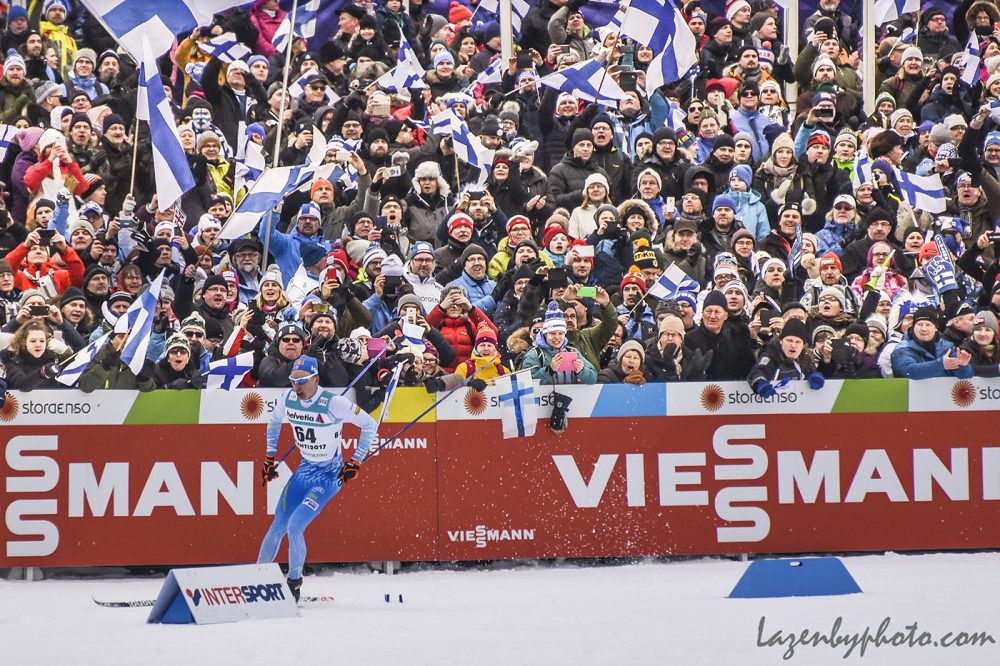
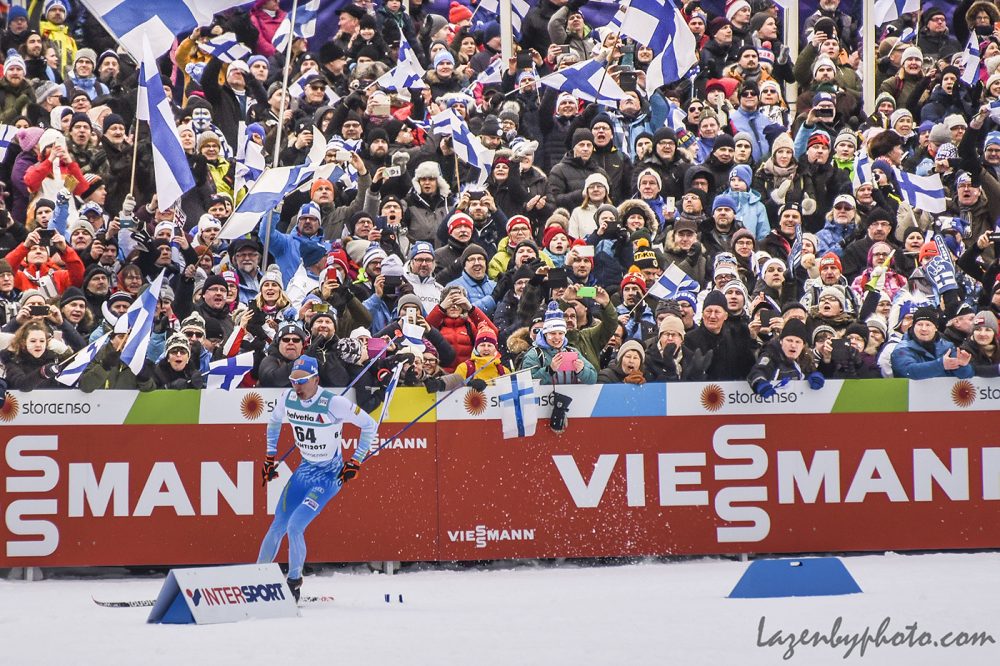
    Amidst a sea of Finnish flags, Finland’s Iivo Niskanen turns the final corner on his way to gold in the men’s 15 k classic individual start on Wednesday at 2017 Nordic World Championships in Lahti, Finland. (Photo: John Lazenby/Lazenbyphoto.com)

    LAHTI, Finland — Through the first seven medal races of 2017 Nordic World Championships, the hometown Finns came close. There was Krista Parmakoski’s skiathlon silver. There was the spectacular Finn non-win when Finland’s Iivo Niskanen and Norway’s Emil Iversen tumbled 200 meters from the line during Sunday’s classic team sprint. At the moment of the tangle, Niskanen was primed to pass Iversen for what appeared to be a golden performance.

    Instead of a cheer concluding the sprint, a collective exhale deflated the crowd: Niskanen and teammate Sami Jauhojärvi ultimately settled for bronze. While it wasn’t the result they had hoped for, it remained the 25-year-old Niskanen’s first World Championships medal.

    Another race on Wednesday brought another Finnish opportunity. On a 34-degree Fahrenheit day with moist tracks and low-hanging clouds, gold was up for grabs.

    During the men’s 15-kilometer classic individual start, Niskanen channeled whatever bitter taste remained from his team sprint near-win into a controlled and sufficient pace. After 1.5 k, Niskanen ranked fourth — from then on, he was the fastest through every remaining timing point, and first when it mattered most. Niskanen won in 36:44 minutes.

    Norway’s Martin Johnsrud Sundby finished 17.9 seconds off his time for silver. Sundby’s teammate Niklas Dyrhaug clocked in 31.3 seconds back for bronze, his first-career individual championships medal.
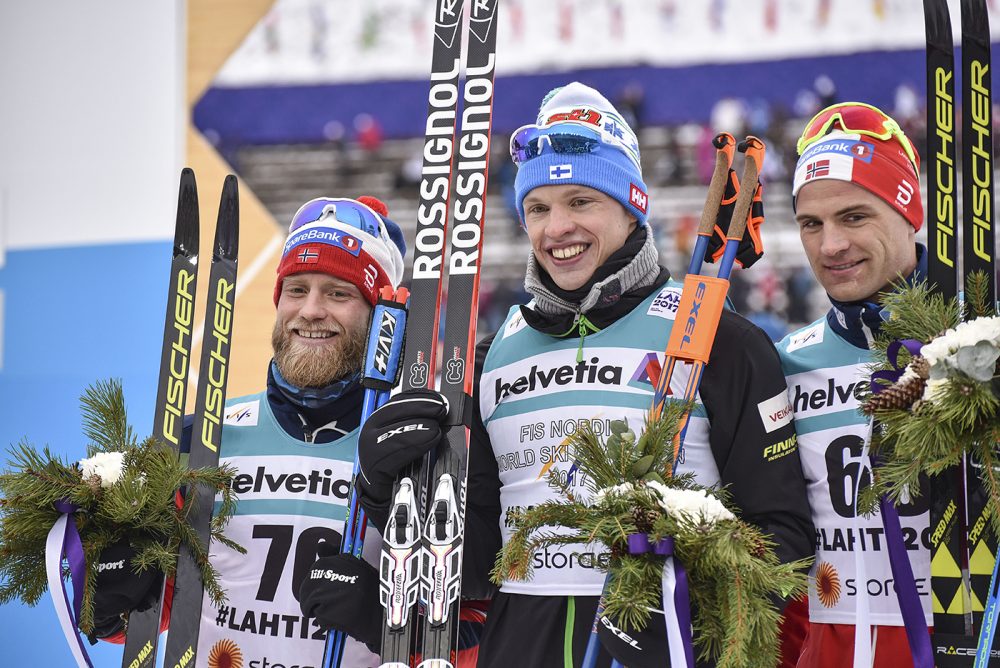
    The men’s 15 k classic podium at 2017 Nordic World Ski Championships in Lahti, Finland: (from left to right) Norway’s Martin Johnsrud Sundby (l) in second, Finland’s Iivo Niskanen (c) in first, and Norwegian Niklas Dyrhaug (r) in third. (Photo: John Lazenby/Lazenbyphoto.com)

    “It’s for sure a really good team, Norway, and it’s a hard fight in all the places for every distances,” Dyrhaug said at the post-race press conference about making Norway’s 12-man World Championships team. “I have been a reserve for the skiathlon and the team sprint. I have been here since Otepää — ten days now. I have been ready so when I got the chance in the 15 k, yeah, I am happy to show everybody that I am in really good shape and I have something in world champs to do.”

    The 15 k classic appears an odds maker’s nightmare. It remains a fickle distance and technique with a million and one variables. There’s the course profile, the athlete’s classic technique to consider — do they thrive on headwalls or stridable terrain, double poling? The wax. The snow type. The venue’s altitude. Then there’s the pacing — go out hard? Look for negative splits? Ski it like a true distance race, not an elongated sprint?

    A single 15 k classic win at a championship or World Cup level evidently doesn’t mean more will come your way. Of the 133 starters on Wednesday, Finland’s Matti Heikkinen remains the only athlete who had won a 15 k classic at a World Championships or Olympics (at 2011 World Championships in Oslo, Norway, he won the gold in this event). Not since the ’54 and ’58 championships has an athlete won two world titles in this event.
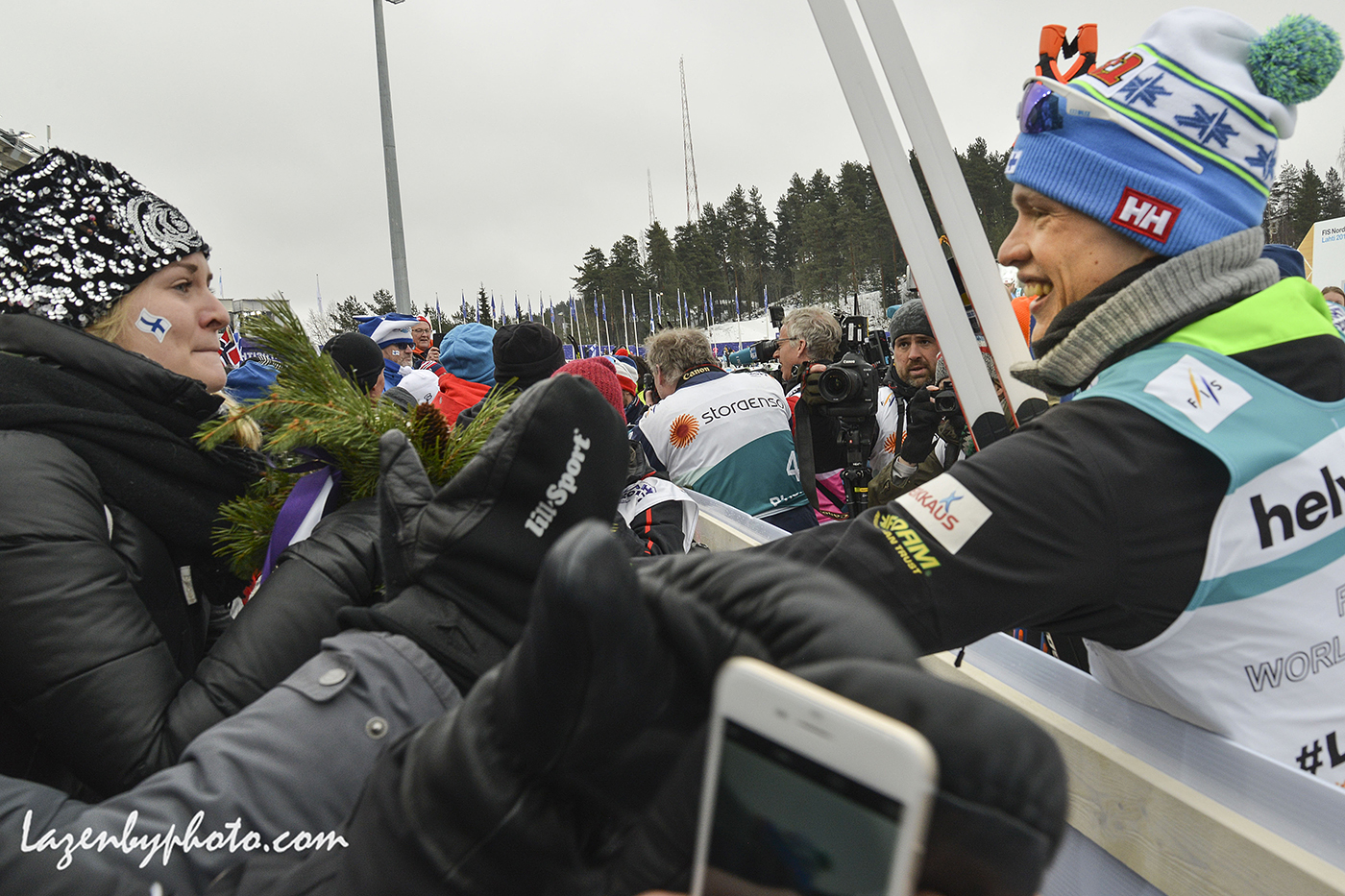
    Finland’s Iivo Niskanen (r) celebrates his 15 k classic win with loved ones at 2017 Nordic World Championships in Lahti, Finland. (Photo: John Lazenby/Lazenbyphoto.com)

    Niskanen and the 15 k classic are sympatico and eventually he may buck the consecutive-winner’s curse. Niskanen has three career World Cup podiums: all in the 15 k classic. There’s two wins — both in Kuusamo, Finland, and a second place at the last pre-championship World Cup race last month in Otepää, Estonia.

    That doesn’t mean the Finn isn’t flawless.

    “Many times, in many races I have started too hard for the first two kilometers,” Niskanen said after the race.

    His too-early, hot-pacing issues were remedied Wednesday as he left nothing to chance. Niskanen suggested he’d had a Lahti champs dress rehearsal to test his pacing strategy.

    “It was good to race here before on the Scandinavian Cup and learn the track, today I’m ready,” Niskanen said.

    Back on Jan. 8, Lahti hosted a Scandinavian Cup 15 k classic. Like today, Niskanen won over another Norwegian, Johannes Høsflot Klæbo (+5.8).

    “Today I planned to do a half kilometer and push hard,” Niskanen said on Wednesday. “After a kilometer and a half, I was quite fresh and got quite easily a gap and pushed as hard as I can. Everyone is cheering you and so then you don’t actually feel the lactate as normal. I had a difficult last kilometers, but it was one and a half to go I just thinking about myself, ‘Now we are not going to lose 20 seconds anymore.’ ”

    That losing 20-seconds remark referred to his Scando Cup race. During that 15 k, he was 17 seconds up on Klæbo with 3 k remaining. He actually lost 12 seconds to Klæbo on that final sector, not 20, but Niskanen recognized the trend — slowing down in the final push.
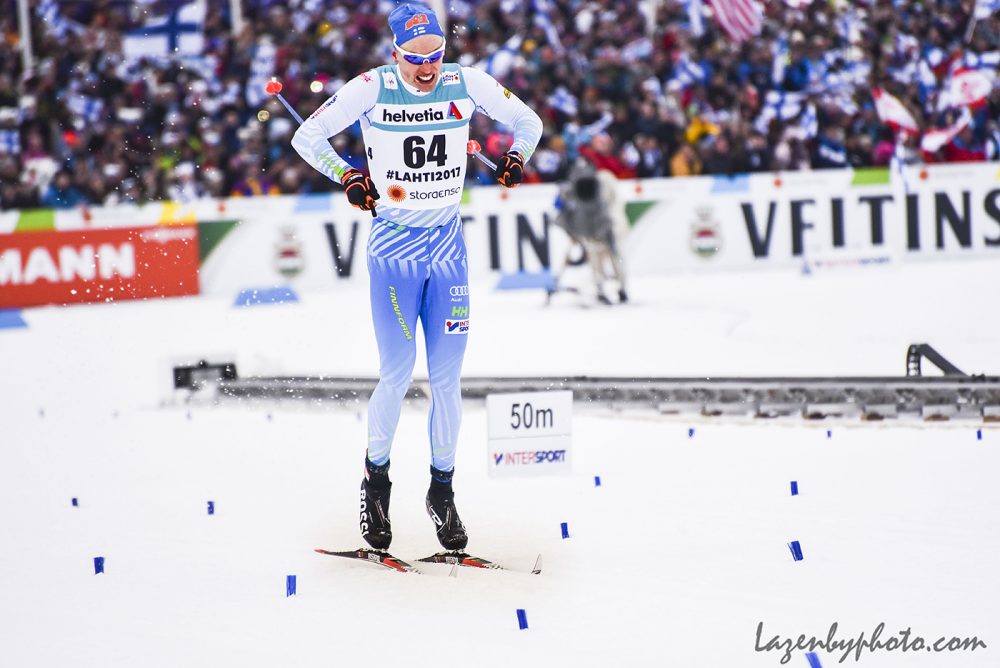
    Finland’s Iivo Niskanen powers down the finishing stretch en route to gold in the men’s 15 k classic at 2017 Nordic World Championships in Lahti, Finland. (Photo: John Lazenby/lazenbyphoto.com)

    Although young, Niskanen has struggled with repeated sickness and overtraining. Promoted as a potential World Cup overall contender, Niskanen’s three 15 k classic victories remain the sole podiums highlighting his World Cup resume.

    “It has been many hard years and I said when I wake up, ‘I feel healthy today and I have hope’,” Niskanen said. “I have gotten easily sick for many years and over training, maybe I have been training too much and too hard during the last years. But this year I have trained more than ever, but I have not raced in every weekend.”

    The higher-volume, limited-racing recipe worked. This season, the Finn tailored his race schedule — not too much, not too little. To date, he’s raced 11 World Cup races.

    “The goal was to win here in Lahti and be in the best shape here and we see it with my gold,” Niskanen said.

    Norway’s Sundby remains a World Cup benchmark— he’s a mutiple overall Crystal Globe winner and leads this year’s standings. But for the reigning overall World Cup winner, an individual championship gold (at world champs or the Olympics) still eludes him.

    “I think my race was really good, I felt so fast out there,” Sundby said after the race. “And then I was 20 seconds behind, I don’t believe it. It was tough for the mind to motivate myself for fighting today, but I did what I thought was one of my best race ever at this distance.”
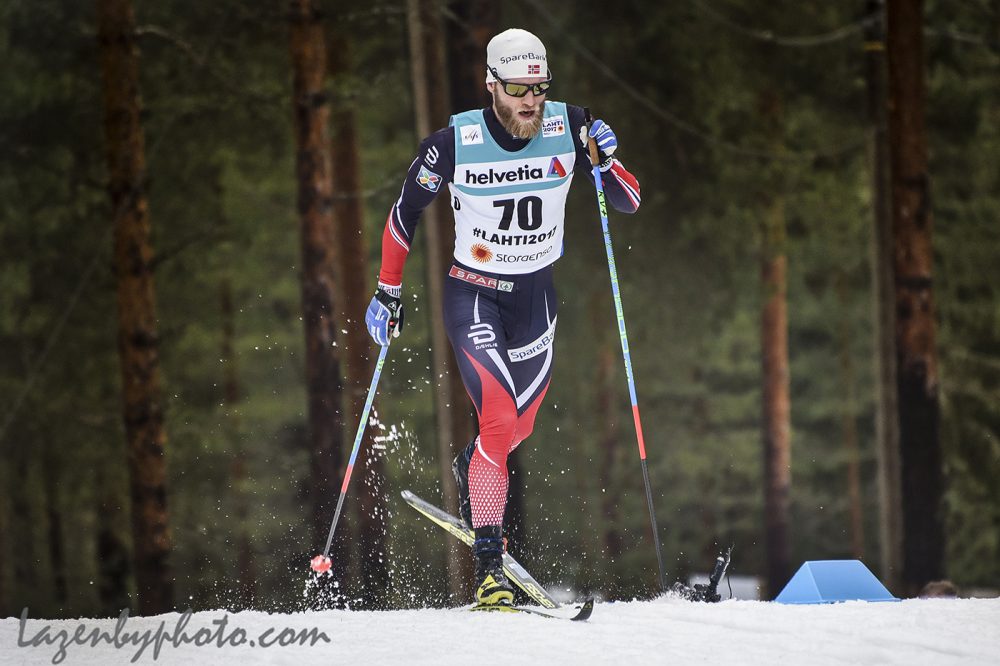
    Norway’s Martin Johnsrud Sundby on his way to second place in the 15 k classic at the 2017 Nordic World Championships on Wednesday in Lahti, Finland. (Photo: John Lazenby/lazenbyphoto.com)

    Asked if he felt demoralized knowing he was 20 seconds down grinding away on Lahti’s wooded tracks, Sundby explained how he attempted to remain in the hunt.

    “It is not so difficult in the World Champs … [Niskanen] did the race here in the Scan Cup a few months ago, where he for sure lost a lot of seconds in the last 3.75,” Sundby added. “And I tried to motivate myself. I said, ‘He will meet the wall, he will meet the wall, you just have to push.’ I felt good, I felt good all the way and tried to gain seconds but it was nearly impossible today.

    “It is an amazing performance Iivo showed us today, everybody,” Sundby said of his Finnish protagonist. “You have to appreciate a really good sportsman. Also with some things that happened before here in the world champs, maybe in the team sprint, and it’s called karma. Today he showed everybody.”

    Best World Champs Finishes for Bjornsen in 18th, Bratrud in 33rd

    While Niskanen took the overall victory on Wednesday, American Erik Bjornsen walked away with a win of his own. Two days earlier, the 25-year-old Washington native had raced to a historic fifth place in the classic team sprint with his U.S. Ski Team (USST) teammate Simi Hamilton for the best team-sprint result for the U.S. men’s program. Before that, the team’s best was seventh place in 2015.
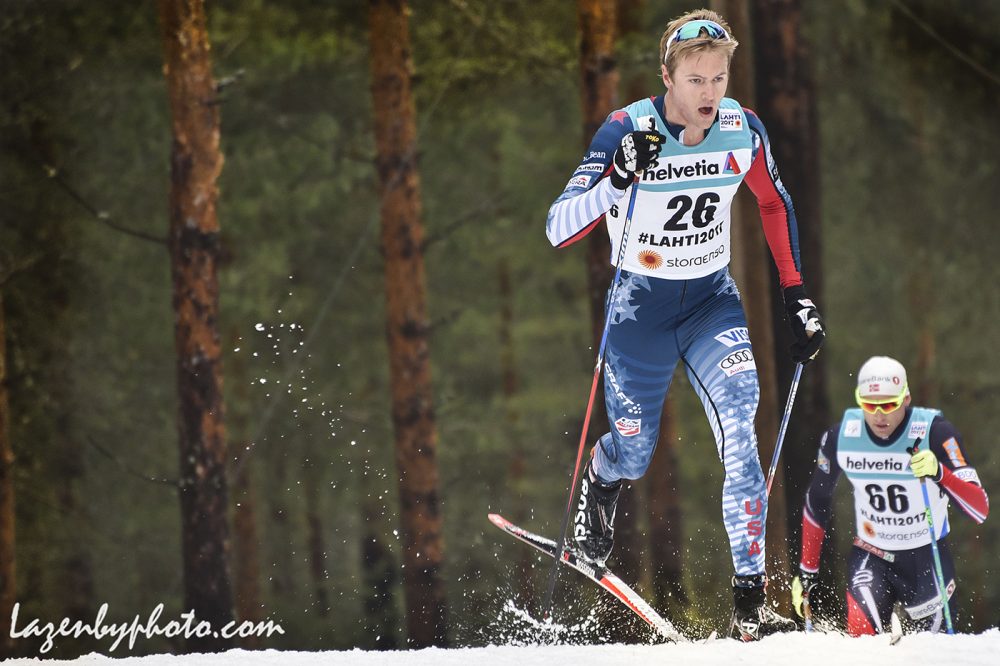
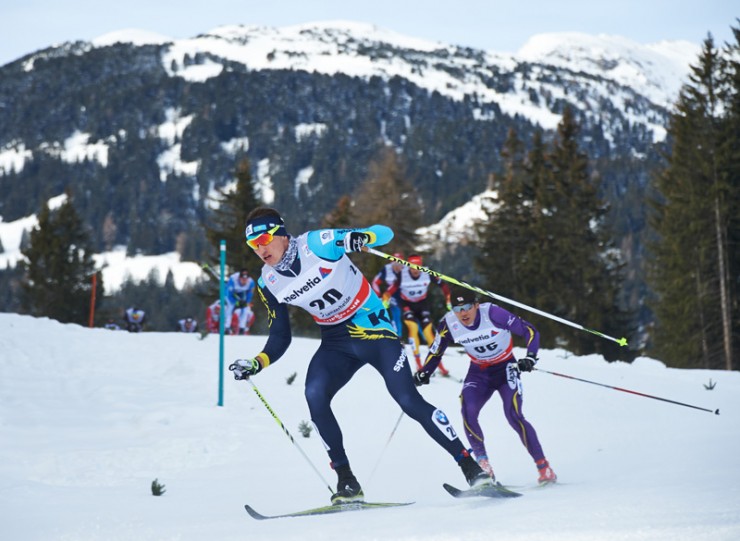
    U.S. Ski Team member Erik Bjornsen (26) skiing ahead of Norway’s Niklas Dyrhaug (66) during the men’s 15-kilometer individual start at the 2017 Nordic World Championships on Wednesday in Lahti, Finland. Bjornsen went on to place 18th, while Dyrhaug captured third place for bronze. (Photo: John Lazenby/lazenbyphotography.com)

    Bjornsen had raced the anchor leg for the U.S., challenged by names like Norway’s Johannes Høsflot Klæbo, Russia’s Sergey Ustiugov and Wednesday’s eventual 15 k winner, Niskanen.

    Despite some of the heavy hitting names that challenged Bjornsen on Sunday, he found himself in the mix (two of his laps were the fifth fastest and one the fourth fastest of all second-leg skiers).

    “In the team sprint the other day, you saw some of the best skiers, I mean, I was skiing with Iivo Niskanen, who has a good shot at winning today, and I felt pretty comfortable skiing with some of those guys,” Bjornsen after Wednesday’s race. An early starter in bib 26, he initially finished third before being bumped 15 places to 18th (+1:56.7).

    “I definitely went into the [15 k] race with quite a bit of excitement from the team sprint,” he said.

    Bjornsen added that the energy he was able to find during the team sprint is something he sees as working it’s way into his longer-distance efforts.

    His performance in the 15 k appears to prove that, as he finished in the top 20 for his best individual World Championships result. The finish also ties his best individual World Cup result — he placed 18th three years ago in a 15 k in Toblach, Italy. The finish was also the best championships result of an American in the men’s 15 k classic since Kris Freeman placed fourth at Liberec world champs eight years ago. 

    Bjornsen explained that a slight bonk toward the end of his first lap caused him to put on the brakes briefly, though he found he was ultimately able to pick his pace back up before finishing.

    “I went for it in the beginning, for sure, and I think I had a pace for the first lap that would have been pretty similar to some guys in the top ten,” Bjornsen said. “Then I kind of hit a little bit of a wall there, a little bit through the first lap, and struggled for a couple of kilometers … then I was able to pick up a little bit of steam before the finish.”
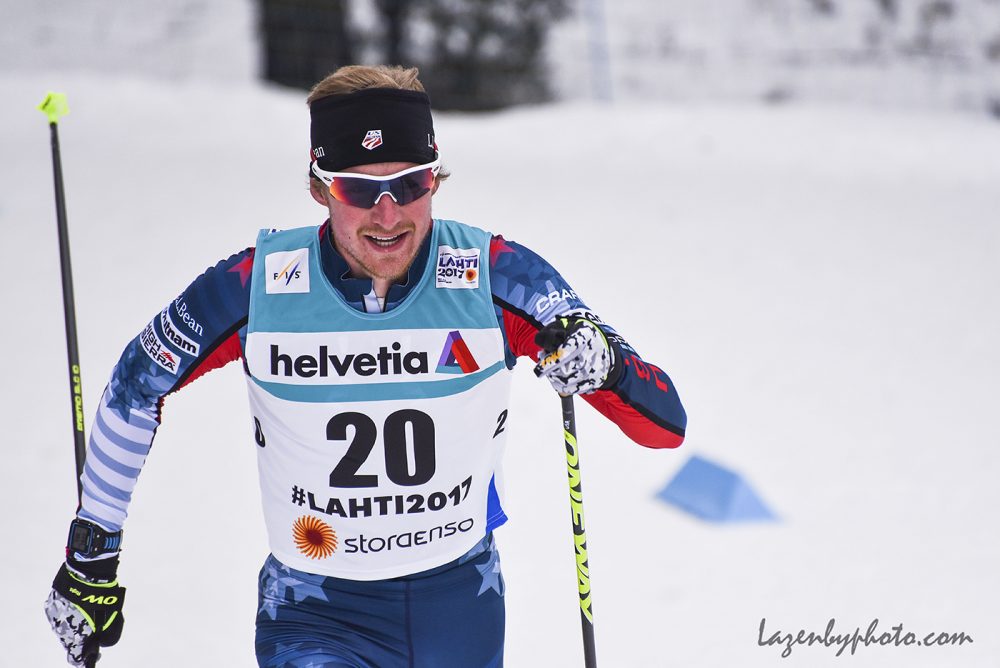
    American Kyle Bratrud (CXC Team) racing to a career-best 33rd in the men’s 15 k classic at 2017 Nordic World Championships in Lahti, Finland. (Photo: John Lazenby/lazenbyphoto.com)

    “I mean hopefully I can just continue to improve and be able to keep that pace up the whole way and then I think it can come together for me,” he added.

    The second American to finish on Wednesday was Kyle Bratrud in 33rd (+3:11.5). Bratrud’s result was 20.7 seconds out of the top 30 and marks his best individual result at his second World Championships and career best at the World Cup level.

    Seeing himself as a stronger skater, Bratrud, 24, of the CXC Team, entered Wednesday wanting to test his ability to push his classic-technique limits.

    “I think I’m a little more confident in skate skiing, so classic I figured I had nothing to lose,” Bratrud said after. “I basically just went as hard as I could from the gun … to see if I could hang on.”

    While the decision resulted in Bratrud having to ease up during some of the climbs, he indicated that managed to recover well enough on the descents to regain control.

    “The course is pretty rolly and I was dying a lot on the uphills,” he said. “On the downhills I was getting some recovery and and all of a sudden I’d feel good again, but I’d get to the next hill and I’d be totally dead.

    “It was kind of a roller coaster of energy, but I just tried to keep my legs moving as fast as I could,” he added.

    With Wednesday also being his mother’s birthday (both his parents made the trek to Lahti to watch him race), Bratrud was thankful for the opportunity to race before throngs of fans, even if the names most were yelling didn’t belong to him.  

    “This is pretty awesome to not even be able to hear yourself breathing because it’s so loud,” Bratrud said “I love when people are cheering, even if it’s not for me.”

    Two other Americans competed on Wednesday, with Andy Newell (U.S. Ski Team) finishing 50th (+4:21.7) and Ben Lustgarten (Craftsbury Green Racing Project) 55th (+4:56.9).

    With his USST teammate Noah Hoffman out due to sickness, Newell explained that he was then slotted to race Wednesday’s classic event.

    “It was fun to get a 15 k in at the championships like this, it’s unfortunate that Hoff wasn’t feeling good so I had to come in and take his spot,” Newell said after.

    Adding that much of his goals are geared towards races scheduled to take place next season –particularly the 2018 Olympics in PyeongChang, South Korea — Newell is not too concerned with numerical results.

    “I felt OK in a few places, but definitely lost too much time out there. I’m just kind of going after a feeling. It wasn’t a great day, but I didn’t feel awful, either,” Newell said. “I’m hoping to build on this year and kind of use this year as a platform to be at my best by the Olympics. I’m not worried too much about results, just trying to feel good when I can.”

    Lustgarten indicated that he had been dealing with a bout of food illness prior to Wednesday. Unable to eat much in the days leading up to the race, the 24 year old had difficulty tapping into his normal race speed.

    “I was just blown. I tried to ski really smooth and then on the the steep stuff, I tried to ski really light and I tried not to throw up,” Lustgarten said. “I’m probably at 70 percent right now and I’m just trying to ski as well as I can here. … It’s a great experience and it was cool to hear the crowd going, I just wish I could ski like I was a month ago.”
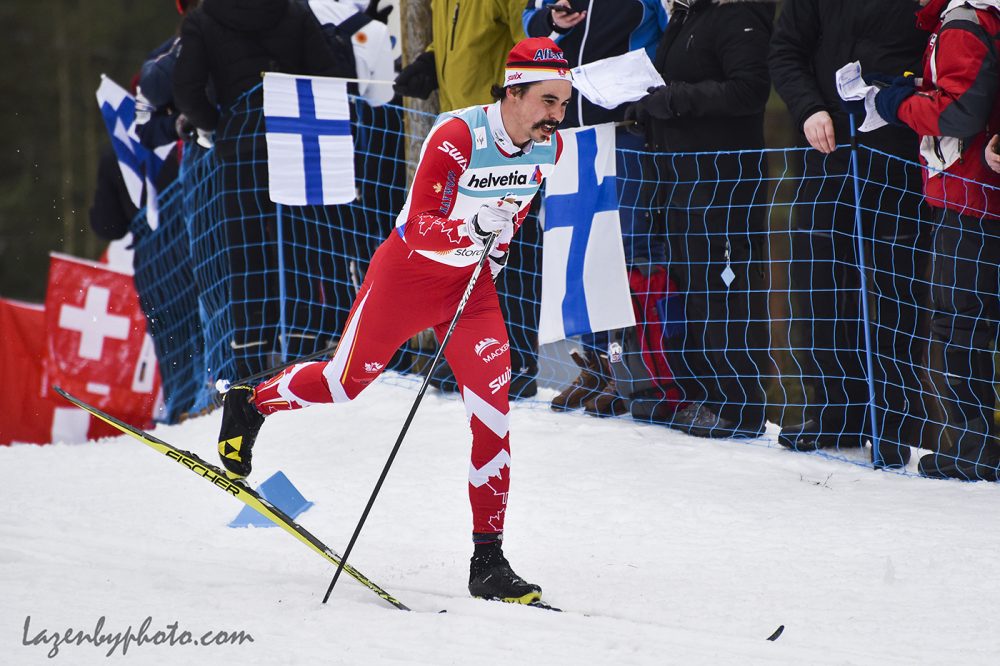
    Canada’s Jess Cockney racing to 65th in Wednesday’s 15 k classic at 2017 Nordic World Championships in Lahti, Finland. (Photo: John Lazenby/lazenbyphoto.com)

    Canada was led by Devon Kershaw in 35th (+3:24.8). The next Canadian to finish was Knute Johnsgaard in 56th (+5:00.7), followed by Jess Cockney in 65th (+6:20.7).

    “I don’t think I pushed as hard as I should have. … Mentally, maybe I wasn’t totally zoned in, but I was happy to do a distance race in front of a big fan base like this in Finland for the hometown favorites, so that was good,” Cockney said.

    This being Johnsgaard’s first world champs experience, the 24 year old was happy with how he race his third individual event of the week.

    “I just went out at a pace I thought I could sustain for 15 k and kept that pace pretty steady I think and was able to push hard and kind of sprint up the last hill,” Johnsgaard said. “I felt like I paced it as well as I could, so I’m pretty satisfied with my race.”

    Results

    — Gerry Furseth and Harald Zimmer contributed
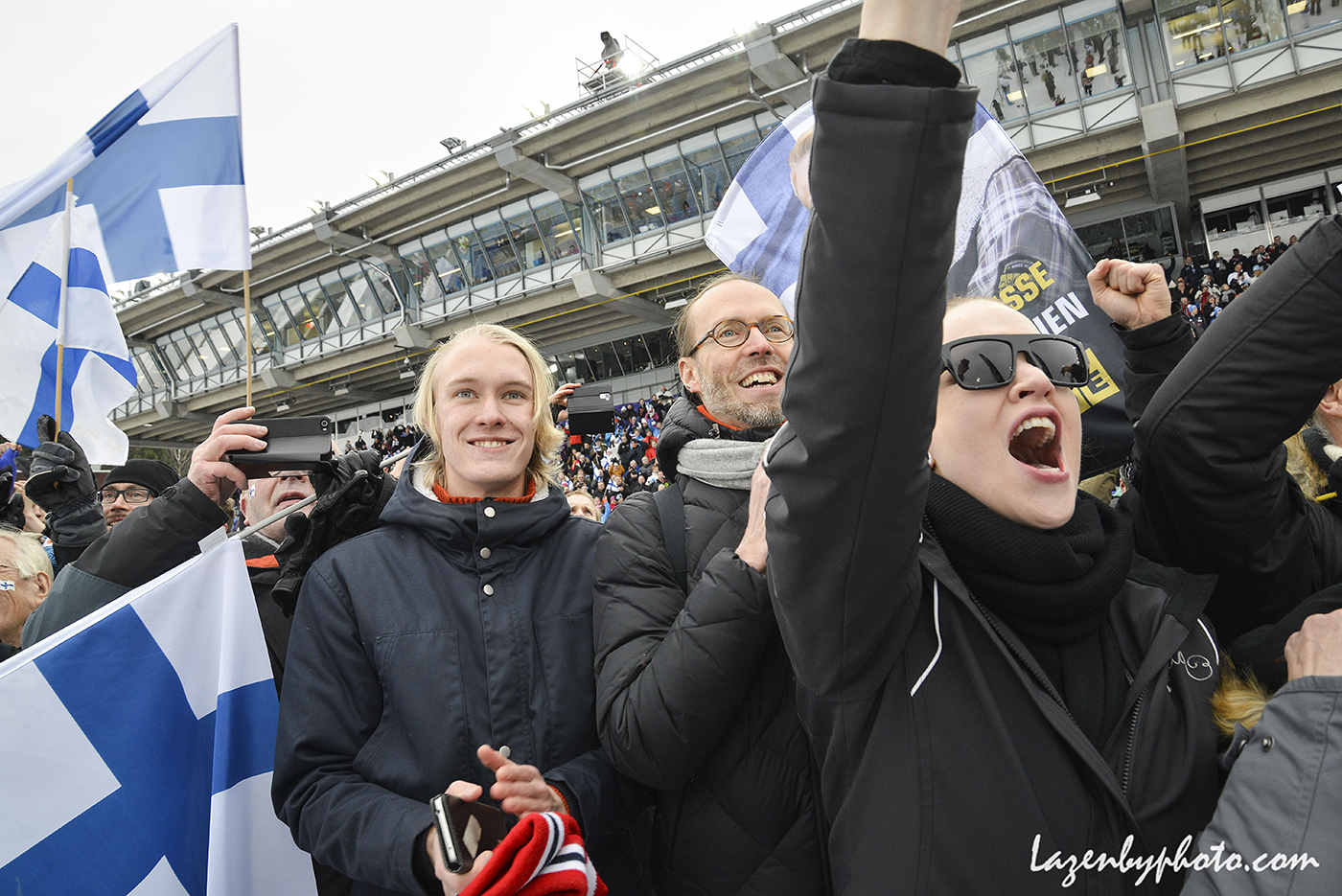
    Finnish fans celebrate Iivo Niskanen’s gold medal in the men’s 15 k classic at 2017 Nordic World Championships in Lahti, Finland. (Photo: John Lazenby/Lazenbyphoto.com)
  • Sundby Clinches Third Tour de Ski Title; Harvey Finishes Climb 14th Overall

    Sundby Clinches Third Tour de Ski Title; Harvey Finishes Climb 14th Overall

    A Victorious Martin Johnsrud Sundby (Photo: Fiemme World Cup)
    A victorious Martin Johnsrud Sundby of Norway at the top of Alpe Cermis on Sunday after winning his third-consecutive Tour de Ski in Val di Fiemme, Italy. (Photo: Fiemme World Cup)

    Within the first 1.8-kilometers of the 9 k freestyle pursuit up Alpe Cemis in the final stage of the Tour de Ski on Sunday, Martin Johnsrud Sundby padded his lead by 16 seconds, up to 3:07.5 minutes over his closest competitor, Alexey Poltoranin of Kazakhstan.

    Just over seven kilometers and nearly 407 meters of vertical climbing later in Val di Fiemme, Italy, the 31-year-old Norwegian crossed the finish line with ease, capturing his third consecutive Tour de Ski title by a record-breaking margin of 3:15.7 ahead of second place, Norwegian teammate Finn Hågen Krogh.

    As Sundby started 2:51 ahead of the field (with teammate Petter Northug heading out second) and raced himself up the mountain, a battle for the final podium spots took shape behind him. At the start, the four skiers starting behind Sundby — Northug, Poltoranin, Russia’s Sergey Ustiugov, and Krogh, respectively — all went off within ten seconds of one another. These four remained close through the flats and into the beginning of the climb, around 5.75 k.

    Just after the 7.1 k time split and into the steepest pitches of the climb, things got interesting. Krogh moved to the front of the pack with Ustigov as Northug and Poltoranin yo-yoed off the back.

    By 8.1 k, Krogh’s move split the group and put a little over five seconds between himself and Ustigov. Now down 30 seconds to Ustigov, Northug — visibly distressed and previously on record with Norwegian media as saying he will never win the tour because of this last stage — tossed his sunglasses, gritted his teeth and clung to Poltoranin.

    Norway's Finn Hågen Krogh rose from fifth to second overall in the Tour de Ski after placing second to teammate Martin Johnsrud Sundby (not shown) in the final 9 k freestyle climb in Val di Fiemme, Italy. (Photo: Fiemme World Cup)
    Norway’s Finn Hågen Krogh rose from fifth to second overall in the Tour de Ski after placing second to teammate Martin Johnsrud Sundby (not shown) in the final 9 k freestyle climb in Val di Fiemme, Italy. (Photo: Fiemme World Cup)

    Less than a kilometer later, Krogh widened his lead over Ustiugov to a little over 20 seconds. The 23-year-old Russian looked strong, but Krogh’s snappy skiing in the steepest sections separated him from the pack. The 25-year-old Norwegian’s final time for the stage would be the fourth-fastest of the day, only 14.3 seconds behind Sundby’s.

    In a post-race interview with NRK, Krogh discussed his drive to finish second.

    “Taking second place is the only thing that stood in my head,” he said. “I’ve thought about it all night and struggled to get to sleep. I was excited and did not particularly [have an] appetite this morning.”

    At the finish Krogh was met with an embrace from his teammate Sundby, who had finished 3:15.7 earlier with a winning time of 30:47. Not only the winner of the pursuit, Sundby also set the fastest time of the day — mostly notable considering he skied uncontested from start to finish.

    Rounding out the overall podium was Ustiugov, 3:43.8 behind Sundby and 28.1 seconds behind Krogh.

    A reward for their efforts, Sundby earned 100,000 Swiss francs (CHF) by winning the final stage of the Tour: more than $100,500 U.S. dollars. Krogh took a little over half that amount in second (57,500 CHF, or $57,800) and Ustiugov claimed 35,000 CHF ($35,200 dollars) in third, according to the International Ski Federation (FIS) prize money list. So far this season, Sundby has racked up 215,500 CHF ($216,700) in World Cup prize money alone.

    Despite finishing nearly 52 seconds off the podium in fourth (4:35.6 behind Sundby), Northug still received 20,000 CHF (about $20,000) for his result in Stage 8. Collapsing into a heap just after the finish, Northug maintained his streak of placing in the top four of the overall Tour standings to eight years. In fifth, less than three seconds behind Northug, was Poltoranin.

    The overall 2016 Tour de Ski podium with winner Martin Johnsrud Sundby (c) and runner-up Finn Hågen Krogh, both of Norway, and Russia's Sergey Ustiugov (r) in third. (Photo: Fischer/NordicFocus)
    The overall 2016 Tour de Ski podium with winner Martin Johnsrud Sundby (c) and runner-up Finn Hågen Krogh, both of Norway, and Russia’s Sergey Ustiugov (r) in third. (Photo: Fischer/NordicFocus)

    At the finish, Sundby told FIS, “It has been a perfect Tour for me. I had one bad day. But everything has been perfect.”

    Not only did Sundby take the overall Tour title, he also won the fastest time of the day. Frenchman Robin Duvillard posted the second-fastest time, 7.2 seconds back, and Finland’s Matti Heikkinen was third (+11.8).

    Seven Norwegians occupied the top 10 of the final Tour standings. On this accomplishment, Sundby told NRK, “This is a job that [has] many [people] behind it, I’m proud of this team. There is no one-man show. We work 200 days a year to become the world’s best cross-country nation, and I am so happy for the guys.”

    Harvey 14th Overall; Babikov 11th Fastest Up the Climb 

    With five North American men racing the final climb, one landed in the top 15 overall and two posted top-15 times of the day.

    Canada’s Alex Harvey finished the Tour in 14th overall (+6:57.3) after starting 12th. His teammate Ivan Babikov posted the 11th fastest time of day (31.9 seconds behind Sundby) to secure 29th (+12:42.2) after starting 29th.

    American Noah Hoffman maintained his consistency in the final stage, moving up from 26th to finish 22nd (+10:44.3) with the 15th-fastest time (+56.4).

    For Harvey, it was his third time completing the Tour de Ski and first time back on Alpe Cermis since finishing 40th there in 2012. In the years that followed, he skipped the final climb because of a blood-flow issue in his legs, which worsened with skate climbing. He had surgery to repair this past spring to remedy the problem.

    After Sunday’s race, the 27-year-old Canadian remarked on the phone that although his Tour had not gone as well as he’d hoped, his legs finally felt good up the climb.

    “On the climb I really felt good; my legs were not seizing up, and that’s the first time ever that’s not happened to me,” Harvey said.

    Alex Harvey (Canadian World Cup Team) placed 37th in the 10 k freestyle at Stage 6 of the Tour de Ski to drop five places to 15th overall in the Tour. (Photo: Fischer/NordicFocus)
    Alex Harvey (Canadian World Cup Team) placed 37th in the 10 k freestyle at Stage 6 of the Tour de Ski to drop five places to 15th overall in the Tour. (Photo: Fischer/NordicFocus)

    In the past, he hit the climb and not been able to move. This year he found himself in a unfamiliar situation. “I actually had a bit too much left in the end,” he said. “I didn’t know what to expect because over the years it has been so bad with my legs.”

    Despite this, he finished with the 16th fastest time of the day (+1:07.4).

    Looking back on his fourth completion of the Tour de Ski, Harvey expressed dissatisfaction.

    “I’m not going to lie, I am pretty disappointed about the Tour, but I am really happy that the legs are working just as well as anyone else’s, so at least I am competitive on the climb. This is a big positive,” he said.

    Going forward, gaining trust in his legs will prove essential when the Ski Tour of Canada kicks off in March.

    “If I have a good tour like I did two and three years ago, I think it’s possible to fight for the top five and maybe podium on the climb,” he said. “It’s not something I believed before this year. I am really excited about that.”

    The Ski Tour Canada, a brand-new, eight-stage series scheduled for March 1-12, ends with a 15 k classic pursuit.

    Climbing Specialists

    While Harvey’s freestyle climbing may be a newfound skill, Hoffman and Babikov typically thrive on hill climbs. At the 2014 Tour de Ski, Babikov posted the third-fastest time in the final stage. Hoffman said on the phone that he entered Sunday with the belief that this stage is “really built around my strengths.

    Noah Hoffman (U.S. Ski Team) racing to 19th in the 10 k freestyle at Stage 6 of the Tour de Ski in Toblach, Italy. (Photo: JoJo Baldus)
    Noah Hoffman (U.S. Ski Team) racing to 19th in the 10 k freestyle at Stage 6 of the Tour de Ski in Toblach, Italy. (Photo: JoJo Baldus)

    “The plan was to go out relax and let those guys come to me [the wave starters],” Hoffman said of his plan for the early flat terrain. As he transitioned to the climb, he focused on staying “as clean, and as efficient and as relaxed as possible.”

    Despite skiing the 15th-fastest time of the day and moving up four places overall, Hoffman did not think he skied to his full ability.

    “I had high hopes for myself,” the 26 year old said. “It’s a good result; it’s not a great, breakthrough result.”

    Reflecting back on the tour, Hoffman continued, “I’m really happy with the way I moved from stage to stage. I was quite consistent throughout the Tour, which is definitely a big goal.”

    He went on to mention that although consistent, he still remains without a notable finish.

    “I didn’t have that big breakthrough result I was really hoping for, but there’s lots more racing to go this season,” he said.

    Ivan Babikov (Canadian World Cup Team) placed 59th in the 1.2 k classic sprint qualifier at Stage 4 of the Tour de Ski in Oberstdorf, Germany. (Photo: Marcel Hilger)
    Ivan Babikov (Canadian World Cup Team) placed 59th in the 1.2 k classic sprint at Stage 4 of the Tour de Ski in Oberstdorf, Germany. (Photo: Marcel Hilger)

    Babikov, 35, skied the 11th-fastest time to finish in the top 30 of his seventh-consecutive Tour de Ski.

    He started the day aiming to push through the flats and move up during the climb, “By the time the hill starts, you got to be up front to not get yo-yoed or dropped,” Babikov explained on the phone.

    This is only Babikov’s second top 30 of the season, and he considered Sunday a positive step.

    “It’s not my best result of course. Considering my shape, I think it’s quite good; I’m happy with it,” he said.

    He added that this year’s Tour was great prep for the upcoming tour of Canada.

    “For me, it’s really good prep. The more I race, the better I get,” he said.

    The third Canadian in his 10th Tour de Ski — as many as Northug — finished 32nd (+13:47.7) after starting 33rd. In the opinion of Canadian Head Coach Justin Wadsworth, the final stage went well the team.

    “All the guys skied really well today. It was good to finish out the Tour with some solid skiing with everyone on the team,” Wadsworth said.

    This was a change from their overall Tour performance, which Wadsworth described as, “more not-so-good than good,” while adding, “There was some good races by the guys; everybody had their moments where they skied well.”

    Wadsworth said the team is looking forward to the season-ending tour on home soil. “Our big focus is the Ski Tour of Canada, so hopefully we can rest up from this and put it together at home when it really counts,” he said.

    Also for the U.S., 24-year-old Erik Bjornsen in his first Tour de Ski placed 41st (+17:51.4) after starting 42nd.

    Racing resumes next weekend with a World Cup weekend of sprinting in Planica, Slovenia.

    Overall results | Time of day

    Martin Johnsrud Sundby of Norway celebrates the fruits of his labor over eight stages of the Tour de Ski (TdS), after winning the final climb on Sunday for his third-consecutive TdS title in Val di Fiemme, Italy. (Photo: Fischer/NordicFocus)
    Martin Johnsrud Sundby of Norway celebrates the fruits of his labor over eight races in 10 days of the 2016 Tour de Ski (TdS), after winning the final climb on Sunday for his third-consecutive TdS title in Val di Fiemme, Italy. (Photo: Fischer/NordicFocus)
  • Russians, Canadians and Germans Dominate 15 k Mass Start in Szklarska Poręba

    Russians, Canadians and Germans Dominate 15 k Mass Start in Szklarska Poręba

    FIS world cup cross-country, mass men, Szklarska Poreba(POL)
    Russian Maxim Vylezgzhanin leads Hannes Dotzler of Germany in the men’s 15 k mass start in Szklarska Poreba, Poland. Vylegzhanin won the race ahead of teammate Evgeniy Belov. (Photo: Fischer/NordicFocus)

    Fog blanketed the hillsides of Szklarska Poreba, Poland, as the men of the World Cup lined up for the start of the 15 k. In a field that lacked the esteemed Scandinavian racers, the predictions of who might win were about as unclear as the visibility on course. The gun was fired, and the racers were off on the 2.7 k course that they would complete five times. After a slow first three laps, the field started to splinter. Soon as the racers made their way into the finishing stretch, spectators witnessed seven skiers suddenly emerge from the fog: two Russians, a Kazak, a Canadian, and two Germans.

    In the end, it was Russian Maxim Vylegzhanin who claimed the victory with a time of 35:39.0. He was followed by teammate Evgeniy Belov (+2.2) and Alexey Poltoranin of Kazakhstan (+2.3) in second and third. Canadian Alex Harvey finished fourth with 5.2 seconds back, followed by Germans Hannes Dotzler and Tobias Angerer.

    FIS world cup cross-country, mass men, Szklarska Poreba(POL)
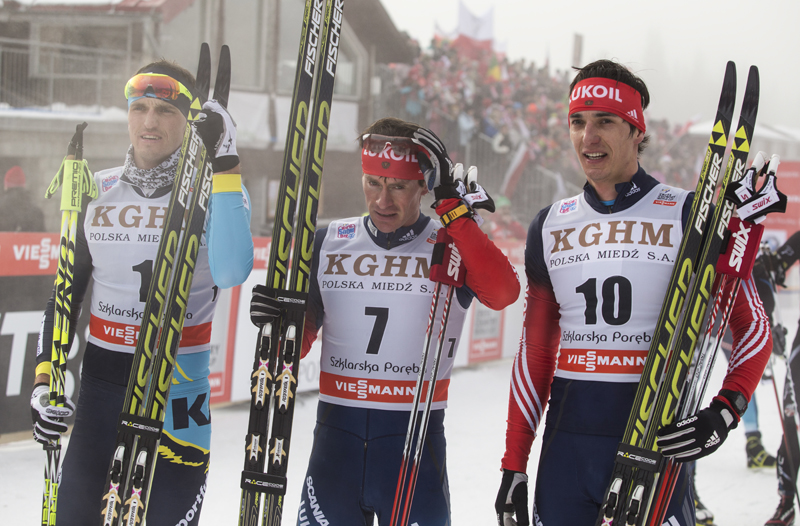
    The men’s podium in the 15 k classic mass start: (l-r) Alexey Poltoranin (KAZ), Maxim Vylegzhanin (RUS), and Evgenliy Belo (RUS). (Photo Fischer/NordicFocus)

    The Russians, Canadians, and Germans dominated top ten, with three members from each country all finishing within roughly twenty seconds of each other.

    The race started out at an extremely slow pace and the pack stayed tightly packed together. It wasn’t until bonus points were at stake at the top of the largest climb of the course that the Russians started to push the pace. From there they continued to open up the lead with the Kazak, Canadians, and Germans in pursuit.

    “I planned to go away from the pack in the second last lap. I felt good and confident I could make it,” said Vylegzhanin in a press release.

    Vylegzhanin, who won the team sprint in Nove Mesto, Czech Republic and was part of the victorious Russian relay team in Lillehammer, Norway, has had few World Cup start this year and sat out the Tour de Ski .

    Teammate Belov was pleased with his effort, not only because it was his first podium of the season, but also because of the implications his result carried.

    “It’s been a great day for me. Everything worked just perfect. I had fast skis, my shape was very good,” he said. “It’s my first podium of the season and I am excited it happened today. I just earned my ticket for Sochi.”

    Poltoranin, who gained his fourth podium of the season thought that he could have done better, but was happy with the effort.

    “I hoped for victory. I fought to the finish with Evgeniy (Belov) but he was more powerful,” he said. “Today’s result gives me good energy for the final preparation phase before the Games.”

    FIS world cup cross-country, mass men, Szklarska Poreba(POL)
    Canadian Alex Harvey leads a pack in the men’s 15 k classic mass start in Poland. Harvey would go on to place fourth. (Photo: Fischer/NordicFocus)

    Winner of yesterday’s sprint race, Harvey crossed the line roughly three seconds behind the Kazak. Despite giving it his all in the previous day’s sprint, the 25-year-old felt like he had sufficiently recovered for the 15 k.

    “I felt good in the morning. I like the format. 15 k mass start classic is been something I’ve had a good amount of success in,” Harvey said. “I was pretty psyched for the race today, especially after the race I had yesterday. I knew that [my] recovery was good.”

    The Canadian, who started in second position, skied near the lead for the first three laps on the narrow course. “I was trying to stay in front of the groups and out of trouble, and I did that the whole race,” Harvey said.

    Then in the fourth lap he got pushed back to roughly twentieth position, but stayed determined to hold on to the Russians who had broken away. By the last lap he was speeding by his competition. “I had a really good last lap. I went from the twenties to fourth at the line.”

    Unfortunately for Harvey, he was unable to make contact with the leaders. “I could not follow,” he said of the Russians.

    Coming into this weekend of World Cup racing, Harvey was happy that the success he found at the Tour de Ski continued into this weekend.

    “It was a really good weekend after the [racing at the] Tour de Ski. The tour, in the last four years, has always been a really good trigger for the rest of the season. It’s a really good intensity stimulus and it’s really putting me in a good position for the rest of the season.”

    A key to Harvey’s success this weekend was the break that he took to recuperate after the Tour, that had him skip the World Cup races in Nove Mesto, Czech Republic. This year he spent time in Zermatt, Switzerland for his “mini-vacation” after spending last year’s in Nice, France. “It doesn’t take many days, but it’s good to be in a place where you’re not training but also not thinking too much about training,” he said. “You can really recover and put yourself in a good position after that for the games.”

    Harvey wasn’t the only Canadian to find success in Szklarska Poreba. Devon Kershaw and Ivan Babikov finished eighth and ninth, both roughly 20 seconds behind Vylegzhanin.

    Justin Wadsworth, Canadian Head Coach, was ecstatic that his teams training plan was coming into fruition. After initially worrying that the conditions in Poland may not be up to par, Wadsworth was glad the team had made the trip. “Going into the games this is the trend you are looking for,” he said.

    Austria's Bernhard Tritscher (21) and Canada's Alex Harvey (2) lead the pack in Sunday's 15 k classic mass start in Szklarska Poreba, Poland. (Photo: Fischer/NordicFocus)
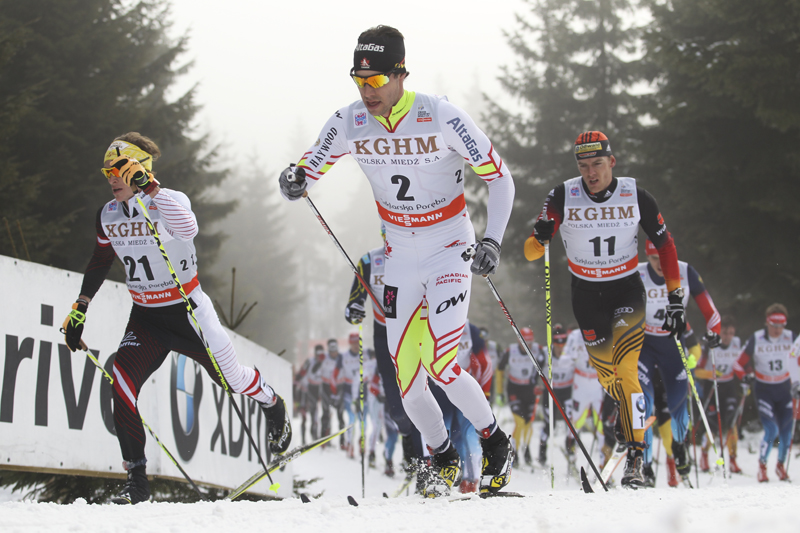
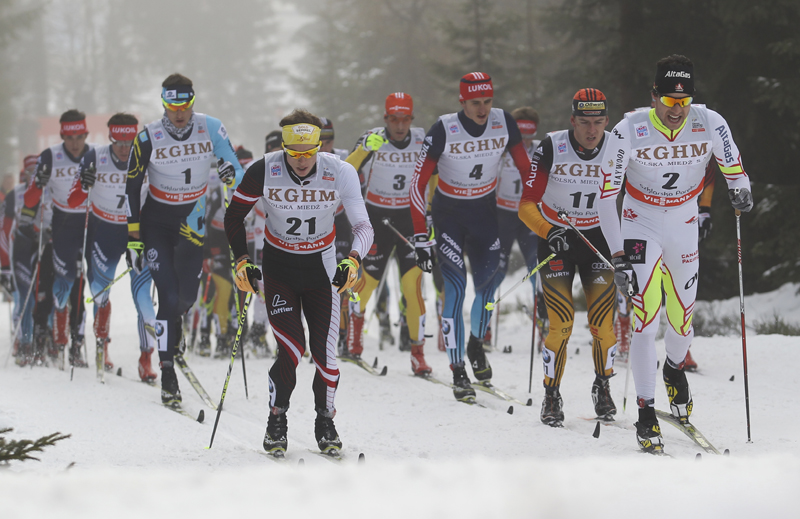
    Austria’s Bernhard Tritscher (21) and Canada’s Alex Harvey (2) lead the pack in Sunday’s 15 k classic mass start in Szklarska Poreba, Poland. (Photo: Fischer/NordicFocus)

    Kershaw, who has been frustrated with the majority of his results thus far this season was happy to see himself in the top ten once again after finishing second in the prologue of the Tour de Ski in Oberhof.

    The frustration continued into this weekend after the 31-year-old failed to move past the quarterfinals in Saturday’s 1.5 k sprint, despite feeling close to the best he has felt all season.

    “I was really frustrated with yesterday. I was really boxed out and just couldn’t get around anyone and just ended up finishing my quarterfinal feeling like it was level two. I’m really frustrated because it was a really dirty messy heat that I was in and I was in the wrong end of that.”

    Kershaw said that while he felt much better in the sprint than he did in Sunday’s 15 k, the distance race served as great training and a confidence booster before going to the Olympics.

    Going into the mass start, Kershaw was feeling apprehensive about his classic skiing for “the first time in my career,” he said. Soon the apprehension lifted as skied through the first three laps of the course.

    In the fourth lap, he found himself at the front of the pack with an open track, and decided to go for the bonus points. “Since I had been feeling bad in classic and the pace had been easy I decided that I would try and test my shape and see how as I was doing,” he said.

    While Kershaw was unable to obtain the bonus points, he felt he was going in the right direction. “I’m still not in tiptop form because I was missing a bit on the big steep hill and that’s when the guys got in front of me,” he said. “It’s a good step in the right direction, and the energy was good, and most important to me was that the technique was back to where it should be.”

    Kershaw is feeling optimistic for the Olympics, which will be held in two and a half weeks. “There are may opportunities there (at the Olympics) and I feel better now than I did at the tour so let’s hope it continues in a positive direction.”

    Babikov, who finished just behind Kershaw in ninth, was happy with both his and the Canadian team’s efforts. “As you can see from the results it went really well for the whole team. We all ended up in the top ten. The skis worked well and our team worked well,” he said.

    From Szklaska Poreba the Canadians are headed to Italy for a week and a half to get a last minute training camp in before the Olympics. They leave Poland satisfied with a good weekend of racing.

    “I think the main thing is that the guys are in good shape. The shape of the team is coming together now and that’s been the goal the whole time,” said Wadsworth of his team.

    Results

  • Tour De Ski Stage Four Photo Gallery

    Tour De Ski Stage Four Photo Gallery

    Check out photos from Wednesday’s 10 k and 15 k classic races in Lenzerheide, Switzerland, the fourth stage of the 2013/2014 Tour de Ski.

    Want to know what happened? Check it out here: Men’s Report | Women’s Report 

    Results: Men Women

  • Defending Olympic Champ Kriukov Holds off Poltaranin for Classic Sprint Victory

    Defending Olympic Champ Kriukov Holds off Poltaranin for Classic Sprint Victory

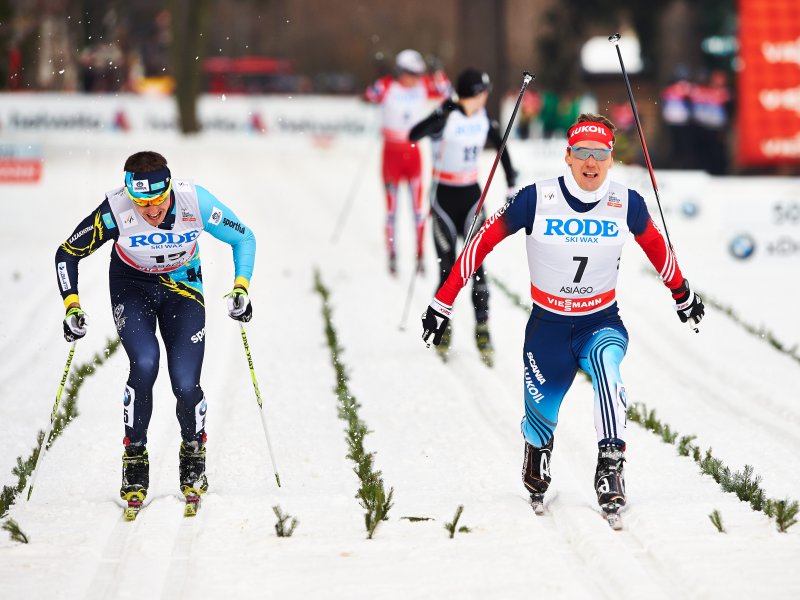
    NIkita Kriukov (RUS) edges Alexey Poltaranin (KAZ) for the victory in the classic sprint in Asiago, Italy. Photo: Fischer/Nordic Focus
    NIkita Kriukov (RUS) edges Alexey Poltaranin (KAZ) for the victory in the classic sprint in Asiago, Italy. Photo: Fischer/Nordic Focus

    Showing strong form as World Cup period I winds down, Russian Nikita Kriukov held off Kazakh Alexey Poltaranin at the line to take the win on a soft and slow course in Asiago, Italy.

    Kriukov, who won the freestyle sprint at the 2010 Olympics in Vancouver, Canada, qualified in seventh in today’s classic event, and looked strong throughout the day on a twisting course in the Italian Alps.

    He overcame a late move by Poltartanin, who briefly took the lead entering the homestretch, and earned his fourth World Cup victory, all in classic sprints.

    Switzerland’s Gianlucca Cologna, the younger brother of injured superstar Dario, made his first World Cup podium appearance in his twelfth start at the highest level.

    The loop, which took the men well over four minutes, featured several long gradual climbs, but not enough elevation to deter most of the men from double poling on skate skis.

    Just one, Federico Pellegrino, racing for the host nation, kicked on classic gear, albeit with little success. He was never in the running in his quarterfinal, unable to make up enough ground on the steeper climbs.

    The Asiago course, a thin ribbon of snow, winding through small sections of woods and open terrain on an Italian golf course, featured stunning vistas of the surrounding mountains. The athletes, of course, had no time to admire the view.

    Despite the lack of steeper hills, there was plenty of terrain, and a number of technical corners, including a big sweeping left hander that claimed American Andy Newell in the quarters.

    The extended gradual climbs, soft snow and relatively long sprint distance made for a challenging race.

    Skiers took different approaches, with some attempting to break off the front early and hold a gap, while others were more content to follow. There was no consistent pattern, with a mix of heats breaking apart and others closely contested.

    Kriukov advanced out of his quarter, finishing second to Norwegian classic specialist Eldar Rønning, and ahead of teammate Alexey Petukhov.

    Petukhov led early in the heat, and even opened a gap. But Rønning closed up on the most aggressive climb, and took over the lead.

    The few hundred meters leading to the homestretch were critical. Consisting of several quick twists on flat terrain, this section proved a game changer in many heats. Positioning and choice of line could alter the race in moments, unusual for such a mellow grade.

    Rønning took advantage, and cemented his potion in front, with Kriukov clear behind.

    The third quarter was more closely contested, coming down to a photo finish, with third just out of the running. Eventual runner-up Poltaranin was edged by another Russian, Alexander Panzhinskiy, and a strong Ales Razym of the Czech Republic was the unlucky loser.

    Cologna demonstrated exceptional double poling power, and a excellent strategy in winning the fourth quarter. The 23-year-old bided his time through the first half of the course before attacking up and over the top of one of the bigger climbs.

    The course swung right as the crest approached, and Cologna powered by on the inside, moving from the back up into second behind Emil Jönsson of Sweden.

    The defending Sprint Cup champion, Jønnson has been off to a slow start, struggling last week in Davos, Switzerland. He was back in form today, however, posting the second fastest qualifying time. He led the heat early, pushing hard, but still rounding into race shape, was unable to hold his lead.

    After the long sweeping downhill, Cologna moved again on the steepest hill, moving by the Swede, and quickly opening a significant lead. As the pitch increased, Cologna pulled away further, leaving Jönsson at the front of the chasers.

    Despite a gap of more than 15 meters, the race was not over. On the flatter sections, Jønsson came back, and when he caught Cologna in the homestretch, the Swiss skier let up, unthreatened by anyone else, and choosing to conserve energy for the later rounds.

    Kriukov matched up with Poltaranin, Rønning and top qualifier, Norwegian Ole Vigen Hattestad in the first semifinal.

    Hattestad set the pace early, but had little chance of pulling away. The group stayed closely packed through the first climbs and descents, before Rønning moved into the lead up the final big hill. Kriukov was right there, however, and Poltaranin and Hattestad would not be shaken.

    Kriukov won pole position heading into the final twists, and held first step into the homestretch. Poltaranin, barely ahead of Rønning, made a nifty move, switching tracks cleanly, to cut off the Norwegian, and ensure a spot in the finals.

    Cologna and Jönsson matched up once again in the second semi, with the Swiss reprising his quarterfinal attack. He dropped the hammer in the same place, earning the top position, a spot he would cement on the bigger hill.

    After the race Cologna told FIS News that he wanted to ski from the front.

    Jönsson led Panzhinskiy and yet another Russian, Anton Gafarov back up as the race wound down. The four men finished in a line, with little drama at the end, the times reflecting a fictionally closer finish.

    One lucky loser came from each semi, giving Rønning and Panzhinskiy a spot in the finals.

    Despite his always powerful double pole, Jönsson appeared to be missing his top gear, but never even had a chance to prove otherwise in the finals. On the tricky downhill corner, he crashed after appearing to be through safely. As he poled out of the turn, taking a skate stride, he went down hard, taking out a trailing Panzhinskiy, and leaving a four-way fight for the podium.

    Cologna had tried his now-signature move yet again, but could not find the space to get into the lead before the big climb. This time it was Kriukov in command, and when Rønning tripped just before the homestretch, only the order of the top-3 was left to be determined.

    Kriukov looked to be in control, but Poltaranin executed the twists into the homestretch perfectly, and slipped by into the lead. But the Russian would not be denied, accelerating in the final 50 meters to take the win.
    “I liked the course but the snow conditions were not that good for me,” Poltaranin told FIS News. “In the finals I chose to double pole. We worked a lot during the summer on the upper body. Unfortunately I was not as strong as Nikita [Kriukov].”

    For his part, Kriukov was ecstatic about his win. He already has both Olympic and World Championship gold medals, but had not yet earned a the top spot in a non-stage World Cup race. Per FIS rules, stage race wins do not technically count as World Cup victories, so by that measure Kriukov’s performance was another milestone for the Russian veteran.

    Cologna faded at the end, and had to be satisfied with third, still an impressive benchmark as he joins the elite sprinters.

    With World Cup period I ending on Sunday with a team sprint, rankings are set. Kriukov currently leads the Sprint Cup with 159 points, 35 ahead of Poltaranin.

    Martti Jylhae of Finland is a close third, three points back of Poltaranin. He was twentieth in today’s race.

    Of Note:

    – Yunichi Onda (JPN) broke a pole on the first climb of his quarterfinal, ending any hope of a spot in the semis.

    – All eight Norwegians in the race qualified for the heats, with three advancing to the semifinals.

    – John Kristian Dahl (NOR) awl relegated to last in his quarterfinal for skating.
    – Several written reprimands were given out for not skiing on the marked course.
    – The top Italian was Dietmar Noeckler in 19th.

    – Maciej Starega of Poland advanced to his first World Cup sprint semifinal. Starega placed ninth. The 23-year-old is a sprint specialist at this point in his career.
    – Tomas Northug (NOR), younger brother of Petter, finished tenth, looking strong, though he obviously lost the battle of famous younger brothers to Cologna.

    – Robin Bryntesson (SWE), who like Kris Freeman (USA) has Type I diabetes, place twenty-fourth.

    – Canadian Alex Harvey and Czech Ondrej Horyna were disqualified in qualification, giving Pellegrino a spot in the heats.

    Results


  • Olsson Skis Race of His Life for World Championships 50 k Gold

    Olsson Skis Race of His Life for World Championships 50 k Gold

    Sweden's Johan Olsson celebrates his victory in Sunday's 50 k classic mass start at the 2013 World Championships in Val di Fiemme, Italy. It was his first individual gold and Sweden's first at this year's championships.
    Sweden’s Johan Olsson celebrates his victory in Sunday’s 50 k classic mass start at the 2013 World Championships in Val di Fiemme, Italy. It was his first individual gold and Sweden’s first following six silvers at this year’s championships.

    FasterSkier’s coverage of the 2013 FIS Nordic World Ski Championships in Val di Fiemme, Italy, is brought to you by the generous support of Fischer Sports.

    VAL DI FIEMME, Italy – Had it been anyone else, the veterans in Sunday’s 50-kilometer classic mass start would have thought Johan Olsson was crazy. But the 32-year-old Swede had been racing long enough to know better than to blow a race that long less than a quarter of the way in. Or did he?

    Three-time overall World Cup and Tour de Ski winner Dario Cologna couldn’t be too sure. Unlike those who broke away earlier in the mass start – like Swiss teammate Curdin Perl, who did so in the first kilometer (and later in the first of six laps, a group of five led by Sweden’s Anders Södergren) – Cologna decided Olsson’s breakaway around 11 k was worth worrying about.

    Leading up the first hill in Sunday's 50 k mass start at 2013 World Championships (from left to right), Kazakhstan's Alexey Poltoranin, Switzerland's Dario Cologna, Norway's two-time defending champ Petter Northug and Sweden's Johan Olsson. The Swede went on to ski alone for nearly 30 kilometers and win his first individual gold by 12.9 seconds over Cologna.
    Leading up the first hill in Sunday’s World Championships 50 k mass start (from left to right), Kazakhstan’s Alexey Poltoranin, Switzerland’s Dario Cologna, Norway’s two-time defending champ Petter Northug, and Sweden’s Johan Olsson. Olsson went on to ski alone in the lead for nearly 30 kilometers and win his first individual gold by 12.9 seconds over Cologna.

    Six seconds back, Cologna caught the 2010 Olympic relay champion around 12.5 k, and the two skied together for the next 8 ½ kilometers. Meanwhile, Russia’s Maxim Vylegzhanin and Alexander Legkov worked to close the gap from behind, coming within 11 seconds of the leaders at the 20.5 k checkpoint.

    Moments later, Cologna crashed on the infamous descent athletes call the “elevator shaft.” He was trailing Olsson, caught off balance and fell alone. Initially stunned, Cologna picked himself off the ground before being swallowed by the chase group.

    Led by Legkov and Vylegzhanin, the pack was giving Olsson some leeway early in the race. Few thought he could hold it, but they were going to respect him nonetheless and conserve for their own purposes of getting through a hot and sunny afternoon, with temperatures soaring above 12 degrees Celsius (53 Fahrenheit). Meanwhile, the Swede willed himself up front, pushing harder to extend the gap.

    Halfway through the race, Olsson had 28 seconds between him and Kazakhstan’s Alexey Poltoranin. There were another 25 men just behind Poltoranin, but Olsson didn’t care. He kept his mind blank, he said, and focused on his own race.

    Sweden's Johan Olsson (r) leads Dario Cologna of Switzerland early in Sunday's 50 k classic mass start at the 2013 World Championships in Val di Fiemme, Italy. Cologna crashed on a downhill around 21 k, and Olsson skied away for the win.
    Sweden’s Johan Olsson (r) leads Dario Cologna of Switzerland early in Sunday’s 50 k classic mass start at the 2013 World Championships in Val di Fiemme, Italy. Cologna crashed on a downhill around 21 k, and Olsson skied away for the win.

    At one point, Olsson did think about the 50 k at the 2010 Olympics, where he took third, one second behind Norwegian winner Petter Northug and Germany’s silver medalist Axel Teichmann. But that was completely different. Olsson was having the race of his life on Sunday, skiing alone in the front, and if he could hold it, he’d be thrilled.

    It wasn’t until 500 meters before the finish that Olsson truly believed he could win it.

    Olsson had challengers, notably Lukas Bauer of the Czech Republic, who came within 27 seconds of the Swede with 15 k remaining. Olsson’s teammate Daniel Richardsson opted not to change skis before the last lap and came within 12 seconds of him, but Olsson was confident his own skis were better. If not, he’d use whatever energy he had left to help his teammate win. Sweden needed a gold badly in these World Championships, and Olsson was determined to secure it in some form.

    As it turned out, neither Bauer nor Richardsson posed a threat, as their separate efforts drained them both. Legkov consistently led the chase group, which remained around 20-strong for much of the race, and came within 25 seconds of Olsson with less than five kilometers remaining.

    Still, it wasn’t enough. Olsson refused to relent throughout the entire last lap, pushing all the way into the finish.

    Entering the stadium alone, the Swede didn’t let off. Just a hundred meters or so before the finish, he put his hands to his lips and kissed the sky, then took a few strides across the line. After 50 k, he didn’t have the energy nor the demeanor to showboat, and he simply stood soaking up the moment.

    “I was so happy when I finished; I saw no reason to lay on the ground,” Olsson said at a post-race press conference. “Maybe I can catch a cold or something.”

    Cologna, who took the lead at the start of the last lap then conserved within the pack, positioned himself in second for the last two kilometers. Cruising down the second-to-last downhill, he extended his gap on Legkov, Rønning and Poltoranin, respectively.

    The four chased him up the hill, and the group challenged one another for the podium. Far enough ahead, Cologna claimed silver without much trouble, 12.9 seconds behind Olsson, who won in 2:10.41.4. Poltoranin outsprinted Legkov by 2.7 seconds for third (+16.8).

    For Olsson, it was his first individual victory at World Championships, and his third medal of the week after taking second in both the 15 k freestyle and 4 x 10 k relay. Both times, he had been a runner-up to Norwegian favorite Petter Northug, who had won the 50 k at the last two World Championships. Olsson predicted Northug could be unbeatable again, which was part of the reason he seized the chance to pull away early.

    Sweden's Johan Olsson holding his own way off the front in the World Championships 50 k classic mass start Sunday in Val di Fiemme, Italy.
    Sweden’s Johan Olsson holding his own way off the front in the World Championships 50 k classic mass start Sunday in Val di Fiemme, Italy.

    Swedish men’s coach Arild Monsen told NRK he instructed his guys to go hard early and raise the average speed of the race.

    “The plan was to avoid that Northug would have the opportunity to win,” Monsen said. “It has happened too many times.”

    At the same time, Northug was never really a threat, skiing within the group for most of the race and finishing 21st, two minutes behind Olsson.

    “It was going hard from the start,” Northug told NRK. “I had hoped it would go quiet, at least the first three kilometers. I lacked that little extra today, and [then] it became heavy.”

    Even Olsson didn’t expect to take off like he did.

    “I felt pretty good so I just thought that, ‘OK this might be a really bad move, but I’m going to try to be offensive today and make something of this race,’ ” he said.

    Skiing alone for nearly 30 k, he said the most stressful part about it was when his lead stopped growing. Less than a minute wasn’t enough, he thought.

    “I thought that this gap is too small, and at least I’m gonna try to make them work to catch me  in the last lap,” Olsson said. “It was just like, ‘I don’t want any other medal than the gold so I don’t care.’ I just went for it and that felt really good because I felt like I almost had nothing to lose.”

    When he finally secured gold, he said it meant everything.

    “I think the 50 k is the finest thing you can win in the World Championships,” Olsson said. “I think still my performance today means more than the gold medal, what I did out there, that I could go solo and just finish first.”

    Like most everyone who witnessed it, Norway’s coaches were impressed. Team director Vidar Løfshus told NRK that he’s never witnessed anything like it: a man going it alone for most of 50 k on a flat-out hot day.

    Sweden's Johan Olsson soaks up his first individual gold at World Championships on Sunday after the 50 k classic mass start in Val di Fiemme, Italy.
    Sweden’s Johan Olsson soaks up his first individual gold at World Championships on Sunday after the 50 k classic mass start in Val di Fiemme, Italy.

    “I think it almost is the greatest 50-kilometer achievement what we’ve seen today,” Løfshus said, according to a translation. “When you go [30 k] in front of this slush, as it says something about that man there.”

    Watching Olsson, Løfshus was confident the group would catch him on the last lap. So was Norway’s service chief, Knut Nystad.

    “I was pretty sure that Olsson should be obtained,” Nystad said. “It was awesome that he did.”

    Cologna said that once he started skiing with the pack, he knew Olsson would be tough to catch unless he started to fade.

    “I know that he can ski very fast for a long time,” Cologna said. “I thought, ‘If he’s not very tired in the end, it would be hard to get him.’ … It wasn’t possible to win the gold medal, but he deserved to win today. It was a very strong race by Johan.”

    Olsson dedicated the race to his wife and former teammate, Anna Olsson (formerly Dahlberg), a 2006 Olympics team sprint champion.

    “Getting the win is something you dream about,” he said. “This gold medal is for my family, my wife, who takes care of our child while I’m here. She makes it possible for me to still be an elite skier.

    “This is our first individual gold medal and I don’t think she’s going to make a comeback,” he said with a laugh.

    For Sweden, it was the first gold after six silvers in this year’s World Championships.

    Norway failed to make the podium for the first time in an individual event all week, with Rønning leading the team in fifth (+20.2). Tord Asle Gjerdalen was sixth, Petter Eliassen 14th, Sjur Røthe 17th and Northug 21st.  Germany’s Hannes Dotzler skied a solid race from start to finish, placing seventh (+32.7). Vylegzhanin was eighth, Jens Filbrich of Germany ninth and Richardsson 10th. Bauer ended up 16th, one minute out of first.

    Results

  • Poltaranin Wins 15k With a Lunge, Denies Bessmertnykh

    Alexey Poltaranin (KAZ) has officially shifted from a an early-season flash to a consistent World Cup podium threat, winning his third race in four starts by overtaking Russian Alexander Bessmertnykh at the line.

    Poltaranin came on strong at the end of the Tour de Ski, winning the 5k classic prologue and 15k classic mass start, before placing 11th overall. He skipped the sprint weekend in Liberec, but demonstrated today that he is still in top form.

    On the wide-open fields in La Clusaz, France, the 25-year-old never slipped far from the front of the pack in the 15k classic event, picking up an additional 22 World Cup points for his work in the two intermediate bonus sprints.

    “I like all distances when it is classic,” Poltaranin told FIS News after the race. “I had a good rest after the Tour de Ski and I am happy that my shape was good today.”

    The main pack never fractured, but the pace was high enough on the final climbs to spread out the field a little bit.

    Dario Cologna (SUI) spent most of the race in customary position — toward the front, controlled and content to let others lead. He took over headed into the last shorter climbs, several times switching tracks to remain right in front of overall World Cup leader Alexander Legkov (RUS).

    But Bessmertnykh, who has been knocking on the World Cup podium door of late, attacked over the crest of the final hill and opened a five meter gap.

    Driving a hard double pole, Cologna pulled back up, with Poltaranin, Legkov and a surprising Didrik Toenseth (NOR) on his tails.

    The Russian, however, held the edge on the hairpin turns in the stadium, and had the first step into the homestretch.

    Cologna was unable to muster a sufficient kick while Poltaranin found a higher gear, blasting by on the outside and taking the victory with a superior lunge at the line.

    Bessmertnykh still earned his first World Cup podium and just his third top-10.

    He placed 7th and 9th in the final two classic events of the Tour de Ski.

    The Russian did not push at the front early, perhaps learning form an ill-fated break in the Canmore 30k, but worked into position when it counted.

    Entering the day Cologna had been hoping for his first win of the season, but told FIS News he was satisfied with third.

    “It was a tough course and I wasn’t sure how I would feel after resting from the Tour de Ski,” he said.

    While he missed out on the podium, the story of the day was Toenseth.

    The 21-year-old entered the day with all of four World Cup starts under his belt, each coming last season.

    His best finish was a 17th in the 15k classic in Oteppaa, Estonia.

    Starting with bib 44, Toenseth slowly worked his way up through the field, eventually moving in to the lead at the 13k mark.

    He held position in the top-5 for the remainder, and had the finishing speed to hold of Legkov at the end.

    “It was unreal,” Toenseth told Norwegian broadcaster NRK after the race. “This I had not imagined. It feels like a victory.”

    A member of the winning relay team at the 2010 World Junior Championships in Hinterzarten, Germany, Toenseth has inserted himself in the World Championship discussion after besting Norwegian veterans Martin Johnsrud Sundby and Eldar Roenning.

    A member of the Norwegain National Development Team, Toenseth will ski the second leg in Sunday’s 4×7.5k relay.

    Poltaranin jumped into second in the World Cup distance standings, just four points behind Legkov. Cologna is third.

    Legkov held his position in the overall, losing just one point to Cologna today after the bonus sprints were factored in.

    Results


  • Poltaranin with Back to Back Wins, Canadians Roll in Historic Performance

    With the 2013 Tour de Ski winding down, Alexey Poltaranin (KAZ) has turned on the afterburners, winning his second consecutive stage.

    The Kazakh’s charge up the standings comes too late for a run at the overall podium, but his victory in the 15k classic mass start puts him in 5th place, and in position to take advantage of any implosions by those ahead.

    The finish came to down to a tight sprint amongst six men, and while Poltaranin took the top spot, the Canadian men packed the rest of the podium with big Lenny Valjas coming from behind to take second besting teammate Alex Harvey at the line.

    The Val di Fiemme mass start was shortened in this version of the Tour de Ski, dropping from 20 to 15 kilometers in length, and the number of bonus sprints slashed as well, with the goal of creating a tighter field on the Final Climb.

    With Petter Northug (NOR) holding a small lead over rival Dario Cologna (SUI) and Russians Alexander Legkov and Maxim Vylegzhanin, every second could prove critical.

    After Friday’s prologue, Northug claimed he would not be challenging for early bonus sprints in the mass start, clearly a red herring.

    With the first points available at the top of the biggest climb, just five minutes in, Northug attacked on the inside, running out of the tracks, powering by Vylegzhanin, before slowing to a walk as he crested the top.

    First blood for the Norwegian, but the day would rapidly head south for the overall World Cup leader.

    Daniel Richardsson (SWE), fourth through the preem, did not slow and Northug would have no time to recover.

    The climbs are steep and the descents fast and technical on the Val di Fiemme courses. Rest is hard to find, and hills are easier to come by than a cheap and delicious cappuccino in these Italian mountains.

    As the race headed down through the stadium at the completion of the first of three five-kilometer laps, Finn Hagen Krogh pulled teammate Northug up along the outside and back in position.

    Northug had been lagging toward the back of the pack, in no place for a run at the next upcoming preem.

    He would, however, have been better served to have handed Krogh his bib for all the good the ride did him.

    He did not challenge for the next bonus sprint, slipping well back in the pack, looking severely fatigued. He would eventually straggle across the line in 28th, 29 seconds behind Poltaranin.

    To his credit, Northug never let up fighting to minimize the damage in the overall standings.

    Canadian head coach Justin Wadsworth told FasterSkier that his skiers were planning to avoid any effort for the first preem, so early on.

    “That first bonus sprint, we knew not to go for that one,” he said. “It pretty much ended Northug’s race.”

    At the finish, Northug lay for minutes in the snow, as the rest of the racers flowed in. He told Norwegian broadcaster NRK that he felt tired from the get-go, and opted to contest the first preem to try to earn some seconds — get while the getting is good.

    Canadian Devon Kershaw told FasterSkier that it appeared Northug did not have great kick, and spent much of the climbs running outside of the track.

    “His skis were just not competitive,” Kershaw said.

    Races without Northug at the front are still very much races, however, and certainly no one felt pity for the oft-brazen Norwegian.

    Vylegzhanin took the second preem, closely followed by Legkov, who did not fight at the front the first time around.

    The Russians overcame a bold attack by Lukas Bauer (CZE) early in the loop. The veteran opened a ten-meter gap, but could not get away, or even hold his margin through the bonus.

    The pace overall appeared fast enough, but Kershaw described it as “crawling”.

    It dropped even more headed out on the final loop, and the pack, strung out by the pressure of the preems, closed back up, even allowing the faltering Northug to regain contact, albeit at the back.

    Headed up to the final bonus, Alexander Bessmertnykh (RUS) accelerated and created a small gap. But as he approached the 100-meter mark before the sprint, he backed off, allowing teammates Legkov and Vylegzhanin to come by.

    Those two Russians grabbed the top two spots while an uncharacteristically tired-looking Cologna managed a push for 5th.

    After the fast and sweeping descents, just two hills remained before the run to the line. The pace increased on the first, but the crux was the second. It was there that Poltaranin, who had moved up to the front of the pack earlier in the loop, made his move.

    He attacked up and over the top, the ageless Giorgio DiCenta (ITA) on his heels. Legkov responded, as did Harvey, Valjas and Tobias Angerer (GER), leaving the rest of the field to fight it out for what seconds they could.

    With six finish tracks, there was room to move. DiCenta and Poltaranin held the early edge, but Valjas swung wide, initially moving up outside of the track as he rode the slingshot off the draft.

    He shot by DiCenta, and missed out on the victory by no more than 12 inches.

    Harvey used a superior double pole to keep DiCenta off the podium and earn his second podium in this event in two years.

    Legkov crossed the line next, but he ended up in between two tracks, and bumped into Angerer. The Russian was penalized for obstruction and given a 15 second penalty, dropping him to 17th on the day.

    Perhaps more importantly, instead of wearing the red Tour leader’s bib and starting 8.5 seconds ahead of Cologna in the Final Climb, he is 6.5 back in second, with Northug and Vylegzhanin five and ten seconds behind respectively.

    Canadian head coach Justin Wadsworth was not surprised to see Valjas on the podium, pointing to World Cup Finals last season where he finished third in this same race.

    “15k classic, he is one of the best in the world in a mass start or pursuit start style,” Wadsworth told FasterSkier in an interview. “It is just nice to see it validated again that he can ski distance.”

    Valjas executed his pre-race plan of ignoring the preems, and spent most of the race back in the pack.

    He started moving up in the final lap, and was in position to respond to the final attack on the last climb.

    “I just stuck to the skis in front of me, and was able to slingshot down into the finish,” he said.

    Recognizing the importance of the homestretch on the Val di Fiemme course, Valjas said he chose a slightly longer pair of poles to aid his double pole.

    “There is no bigger game-time skier that I have ever seen,” Kershaw said of his teammate. “I have seen him in a lot of workouts — it is ugly a lot of the time…and then when he puts the bib on he is there. He is just so darn talented and such a good racer.”

    Kershaw was in the mix until the final hills, where once again, he was unable to shift into a high gear.

    “When I need to tap into the power…I go from feeling very comfortable to nothing, there is no power in my body,” Kershaw explained. “The next thing you know you are 18 seconds down and struggling in.”

    Kershaw ended up 21st, and fourth on the Canadian team.

    Ivan Babikov skied to a career-best classic result of 7th, in the mix for the entire race.

    Wadsworth said he has been working all year with Babikov on double poling “to set him up so when he is going up the uphills, he can be fresher.”

    Increased fitness and the improved double poling support Babikov’s always strong technique according to Wadsworth.

    “He is showing he is just really good in classic. He has always skied well — technically well – Russian style of classic skiing,” Wadsworth said.

    Babikov now sits in 17th overall, and 5th place is not out of reach, especially for a skier who has won the Final Climb in the past.

    Valjas starts in 11th while the 12th ranked Harvey will not race the last stage due to a leg issue that makes climbing difficult.

    “By pushing it sometimes with that injury, it can shut down for periods of time or get more constricted for the rest of the season,” Wadsworth explained. “We just don’t want to take any chances there.”

    Kershaw is 18th, but has no illusions of grandeur.

    “It’s not going to be pretty but I am going to try to make it up there the best I can,” he said.

  • Poltaranin Takes Tour Stage 5, Northug Adds to Lead

    The Flying Kazakh, Alexy Poltaranin overcame Tour-induced fatigue and a men’s field clawing for every second to post a convincing win in the 5-kilometer classic prologue in Toblach, Italy.

    Poltaranin posted a time of 12:37.9, exactly eight seconds ahead of Petter Northug (NOR), who entered the day leading the overall Tour standings.

    Northug’s chief rival, Dario Cologna (SUI) was third, just .2 seconds out of second. With 15 bonus seconds awarded for first, 10 for second, and 5 for third, those .2 cost Cologna a bit more.

    He is now 16.1 behind Northug in the overall, with Alexander Legkov (RUS) in 3rd, +23.4.

    On a tricky waxing day on the gradual hills of Toblach, most of the men looked fatigued racing for the 5th time in seven days, and less than 24 hours after completing the 35k pursuit form Cortina to Toblach.

    “After yesterday’s race I didn’t sleep well but the feeling was good today,” Poltaranin said after the race.

    He is already looking ahead to Saturday’s mass start classic, and hopes to continue climbing the standings.

    “Five kilometer or fifteen kilometer are good for me as long as the competition is in classic,” he said.

    Poltaranin is in 6th overall, just one second behind Czech Lukas Bauer.

    Northug, looking to build a lead headed into the Final Climb, managed to add some seconds, but will need to do more in the mass start if he has a chance at victory.

    “It cost a lot today. I had to chase, chase, chase all the way. I was right under my max limit,” Northug told Norwegian broadcaster NRK.

    As the leader headed into the race, Northug started last and thus received splits on course. He accelerated in the later part of the competition, moving up in the final kilometers.

    Following the race he said his performance means he won’t have to contest for sprint bonuses early in the mass start, though he will work to be in position to respond to attacks by others.

    Northug leads the Tour sprint standings by 23 seconds over teammate Finn Haagen Krough.

    Historically Northug has performed well in the Tour mass start in Val di Fiemme, but he will be hard pressed to get enough time to have a realistic shot at winning the entire event.

    He calls Alexander Legkov “the big favorite,” and said the Russian “knows that if he does not make mistakes in the morning, he wins the Tour de Ski.”

    Legkov is third in the overall, +23 seconds after placing fifth in the prologue.

    This may be selling Cologna short. Last year Legkov sat in third entering the Val di Fiemme mass start, but imploded in spectacular fashion in part due to ski issues, dragging to 27th in the race, and eliminating any hope of a podium finish.

    He bounced back to win the Final Climb and place 5th in the overall Tour.

    Legkov put over a minute on Cologna in the Climb, but with the Swiss skier securing victory on the first part of the hill, he was not pushed to the line.

    Some drama has emerged with Cologna telling NRK and other journalists he is sick following the completion of the prologue.

    Swiss head coach Guri Hetland says that Cologna is merely playing games with his rival Northug, answering the question of his health as the Norwegian walked by.

    Hetland also noted that Cologna is routinely afflicted by a post-race cough, and that there is nothing to be concerned about.

    “Dario attempted a bluff. He is not sick at all. He’s fit as a fiddle and will be tomorrow,” Hetland told NRK.

    Results

  • Kriukov Steals Spotlight from Northug in Kuusamo Sprint

    Kriukov Steals Spotlight from Northug in Kuusamo Sprint

    The scene has played out so many times before — Petter Northug (NOR) biding his time in a pack, staying comfortably out of trouble, then throwing down a crushing move, usually on a steep climb and executed with ferocious tempo, to open a gap and set up-for the homestretch.

    The script can vary somewhat — the main alternative includes a ridiculous double pole finish to conquer all challengers in the final 100 meters. When Northug is on, while the stage and supporting actors may change, the denouement is usually the same.

    Petter Northug (NOR) striding to victory in last year’s Kuusamo Mini-Tour (Photo: Fischer/NordicFocus)

    The last time Northug lost out in a final sprint to the line?  Two yeas ago in La Clusaz, France.

    On the first day of the annual Ruka Triple in Kuusamo, Finland, however, Nikita Kriukov (RUS) decided it was time for a rewrite.

    On a now familiar classic sprint course, under cold and dark northern skies, Kriukov beat Northug at his own game.

    The defending Olympic Champion in this event, the Russian watched as Northug easily advanced out of the both his earlier heats by attacking on the steep and lengthy final hill up to the stadium.

    In the quarters, Emil Joensson (SWE) bested the Norwegian, but with the top two advancing, this was of little consequence. Joensson may be one of the few men on the circuit who employs a quicker classic stride than Northug on the steep terrain, and the two met again in the semis.

    After tangling with Gleb Retivykh (RUS) on an early downhill corner, Joensson found himself out of the race, and the event was Northug’s to lose. He took the semis with ease, coasting across the line casually looking over his shoulder at the rest of the heat, setting up the final showdown.

    Exiting the stadium in last in the final, Northug began making his way to the front on the smaller climb midway through the course. He slipped by teammate Eirik Brandsdal to move into third place behind Kriukov and Dmitry Japarov (RUS).

    The two Russians, pushing the pace, had opened up a solid ten meters as they headed across the flat toward the last climb. Northug visibly shifted gears extending into a version of his finish double pole and cut the lead in half by the base of the hill.

    He did not pause, and as the terrain necessitated a switch to striding, he sped by. Japarov never had a chance. Halfway up, in an effort to keep pace, he missed several kicks and was instantly out of the running.

    Kriukov, however, aware of Northug’s climbing prowess responded. He couldn’t stay right on the Norwegian’s tails, but limited the damage to just a few meters.

    The Kuusamo sprint course features a hard 180-degree turn at the back of the stadium, entering the homestretch. This turn tends to compress the field, and Kriukov regained contact through the corner.

    Northug still held the edge, but Kriukov’s quill was sharp and he put pen to parchment with authority, looking to scribe an ending both Chekov and Vaelbe would find pleasing.

    Kriukov in his last World Cup victory — 2012 Tour de Ski

    The pair accelerated to top speed, Kriukov inching up on Northug, but for a moment, appearing too slow and too late to close the gap.

    Down to 50 meters, Kriukov found another gear, strongly and smoothly erasing the final meter and powering by. Northug attempted to respond, his body stretching upward and forward at a seemingly impossible angle, his technique losing any semblance of crispness as he tried to eke out just a few more watts.

    The effort was in vain and Kriukov had a new final act, relegating Northug to the role of fading aristocracy, at least for one day.

    The Russian was elated at the finish, celebrating at a level the seemed disproportionate for the holder of Olympic gold. But Kriukov, despite three times cracking the top-10 in the Sprint Cup, had just two previous World Cup victories, and was not going to miss an opportunity to savor this one.

    Back down the course, Japarov was unable to hold off a hard-charging Brandsdal for third. Alexey Poltaranin (KAZ), always a force in early-season races, placed 5th, with Kalle Lasilla (FIN) representing the home team in 6th.

    Despite the “loss,” Northug is in strong position in the mini-tour. Primary rivals Dario Cologna (SUI), Alexander Legkov (RUS) and Marcus Hellner (SWE) all failed to qualify for the heats, while sprinters Kriukov and Brandsdal, among others, are withdrawing from the competition to travel to Canada.

    At the post-race press-conference, all three men on the podium expressed satisfaction with their respective races.

    Kriukov obviously couldn’t have hoped for more, while Brandsdal recognized the two ahead of him were the better skiers on the day.

    “The two guys ahead of me were stronger,” Brandsdal said. “I think I got the best out of the day.”

    Northug pointed to the bonus seconds earned as the biggest positive, noting that while he felt strong he couldn’t find “the right flow” at the end.

    Racing continues on Saturday with a 10km individual start skate race. The mini-tour concludes on Sunday with a 10km classic pursuit.

    Results

    Of Note:

    –       All five of Alexey Poltaranin’s World Cup podiums have come in November and December, including two in Kuusamo.

    –       According to FIS, Kriukov has yet to officially win a World Cup race. All three of his podiums have come in Tour events, which FIS does count as normal World Cup races.

    –       Russia placed four skiers in the top-12 and Norway had six in the top thirty.

    –       Sami Jauhojärvi (FIN) a home team favorite, advanced to the semifinals. Strong on the climb, he struggled in the double pole finish and was eliminated. He was third in this race back in 2010, the last time he stood on a World Cup podium.

    –       Norwegian Oystein Petersen crashed in the quarterfinals and placed 30th. At the airport to fly to Canada in preparation for next weekend’s World Cups, Petersen tweeted, “After a shitty day it is just perfect that the flight to Helsinki departing at 22.35 is delayed by an hour… #myday…”

    –       Joensson looked in top form, qualifying 1st and winning his quarterfinal. It was hard to see who was at fault in his crash, but it appears Retivkyh may have stepped on the Swede’s ski.


  • Odds + Ends From Kuusamo

    Annsi Pentsinen

    Doogiski over at NordicXplained asked how Pentsinen’s 4.3 second win in qualification on Friday stacks up historically. Quite impressively, it turns out.

    That’s the second largest qualifying round winning margin for the men’s field in WC, OWG or WSC races. The only larger one was almost 10 years ago, with a 4.7 second victory by Björn Lind in a freestyle sprint in Germany in December of 2001. So we’re reaching back to the very beginning years of sprinting here.

    Ola Vigen Hattestad came close to this once last season, winning qualification by 3.86 seconds.

    A winning margin greater than 4 seconds in qualifying has happened more often with the women: six times. And it’s basically a who’s who of dominant female skiers over the past decade: Skari, Neumannova, Bjørgen (twice), Kowalczyk and Majdic. Skari’s is particularly absurd. She won qualifying in a WC sprint in Italy way back in the day (December 2001 again) by 8.4 seconds! It was classic, so maybe waxing was an issue, or maybe Skari was just that fast. Interestingly, the woman she beat that day be 8.4 seconds was Petra Majdic.

    More generally, the typical winning margin in qualification is just under a second for the men and about 1.5 seconds for the women.

    Marit Bjørgen

    And how is Bjørgen faring so far this year?

    She’s certainly still winning everything in sight, but she’s not really faster than last year. Although, that’s not surprising, since “regression to the mean” would lead us to believe that she’s regress a least a little this season.

    Assorted Men

    A few of the men who had strong weekends:

    Eldar Rønning ended up doing very well in the overall mini-tour thanks to some very strong classic skiing on the last day. But overall, his skiing hasn’t been out of this world, and might even be a bit of a step back from last season. Remember that overall tour placings are heavily dependent on the specific events. In this case, strong classic skiers had a lot more space to make up ground, and so the overall tour may have favored classic specialists somewhat. If the techniques had been reversed, Rønning may not have fared so well.

    On the other hand, Clara, Olsson and Poltaranin have all skied somewhat better so far this season overall. It’s particularly exciting to see from a guy I think a lot of people didn’t have on their radar (Clara), an older skier coming off a few bad-ish seasons (Olsson) and a guy from a “different” country (Poltaranin).

    I plan to talk about sprint heat times when I can, but FIS messed up the heat times royally (at least, the times that are available online), so not this week. Maybe next time. I’ll have words about the North Americans on Wednesday…

    Related posts:

    1. <Flashback: Kuusamo Sprint
    2. <TdS Classic Sprint: North Americans
    3. <Odds and Ends after Otepää


  • Signs Of Kazahk Greatness To Come?

    I’m continuing to pick and choose which nations in Fasterskier’s countdown to write about. The US and Canada I’ll cover later in more detail, and I’m written about Japan a fair bit in the past.

    A couple of comments in their write up about Kazahkstan stuck out to me. The first was the comment about Alexey Poltaranin being the next Vladimir Smirnov. (I realize their posts are written partly in fun, and not always entirely seriously.) This is hard for me to assess with data, since so much of Smirnov’s younger days took place prior to 1992. But here’s a rough comparison of their major international results by age, using standardized percent behind the median skier:

    While that seems to suggest a smooth transition, keep the x axis scales in mind. There’s a 3 year gap there. Also, be careful about trends at the end points, since age can be split across two different seasons, as in Poltaranin’s case. One little exercise for you is this: carefully cover up Poltaranin’s one excellent race from last year (his best). How much is that one point influencing the visual impression of a steady improvement?

    The other skier mentioned that caught my eye was Anastasia Slonova, who’s had some strong results as a junior. Although, I only have 29 FIS races on record for her including both sprint and distance events. She hasn’t had any stellar results yet in the handful of WC’s that she’s done, topping out at around 40th or so. But she is still quite young.

    If you look at her cohort graph, that compares her FIS points to women who went on to record a top ten finish in a WC race, you see that she’s mostly on track in distance events:

    So her distance FIS points are right in the middle of where you want to be if you’re aiming for WC success.


    Related posts:

    1. <Most Improved: Women’s Distance
    2. <Prediction Game: Who’s Gonna Podium In Their Very Next Race?
    3. <USST Preview: Liz Stephen & Morgan Arritola


  • Signs Of Kazahk Greatness To Come?

    I’m continuing to pick and choose which nations in Fasterskier’s countdown to write about. The US and Canada I’ll cover later in more detail, and I’m written about Japan a fair bit in the past.

    A couple of comments in their write up about Kazahkstan stuck out to me. The first was the comment about Alexey Poltaranin being the next Vladimir Smirnov. (I realize their posts are written partly in fun, and not always entirely seriously.) This is hard for me to assess with data, since so much of Smirnov’s younger days took place prior to 1992. But here’s a rough comparison of their major international results by age, using standardized percent behind the median skier:

    While that seems to suggest a smooth transition, keep the x axis scales in mind. There’s a 3 year gap there. Also, be careful about trends at the end points, since age can be split across two different seasons, as in Poltaranin’s case. One little exercise for you is this: carefully cover up Poltaranin’s one excellent race from last year (his best). How much is that one point influencing the visual impression of a steady improvement?

    The other skier mentioned that caught my eye was Anastasia Slonova, who’s had some strong results as a junior. Although, I only have 29 FIS races on record for her including both sprint and distance events. She hasn’t had any stellar results yet in the handful of WC’s that she’s done, topping out at around 40th or so. But she is still quite young.

    If you look at her cohort graph, that compares her FIS points to women who went on to record a top ten finish in a WC race, you see that she’s mostly on track in distance events:

    So her distance FIS points are right in the middle of where you want to be if you’re aiming for WC success.


    Related posts:

    1. <Most Improved: Women’s Distance
    2. <Prediction Game: Who’s Gonna Podium In Their Very Next Race?
    3. <USST Preview: Liz Stephen & Morgan Arritola


  • Signs Of Kazahk Greatness To Come?

    I’m continuing to pick and choose which nations in Fasterskier’s countdown to write about. The US and Canada I’ll cover later in more detail, and I’m written about Japan a fair bit in the past.

    A couple of comments in their write up about Kazahkstan stuck out to me. The first was the comment about Alexey Poltaranin being the next Vladimir Smirnov. (I realize their posts are written partly in fun, and not always entirely seriously.) This is hard for me to assess with data, since so much of Smirnov’s younger days took place prior to 1992. But here’s a rough comparison of their major international results by age, using standardized percent behind the median skier:

    While that seems to suggest a smooth transition, keep the x axis scales in mind. There’s a 3 year gap there. Also, be careful about trends at the end points, since age can be split across two different seasons, as in Poltaranin’s case. One little exercise for you is this: carefully cover up Poltaranin’s one excellent race from last year (his best). How much is that one point influencing the visual impression of a steady improvement?

    The other skier mentioned that caught my eye was Anastasia Slonova, who’s had some strong results as a junior. Although, I only have 29 FIS races on record for her including both sprint and distance events. She hasn’t had any stellar results yet in the handful of WC’s that she’s done, topping out at around 40th or so. But she is still quite young.

    If you look at her cohort graph, that compares her FIS points to women who went on to record a top ten finish in a WC race, you see that she’s mostly on track in distance events:

    So her distance FIS points are right in the middle of where you want to be if you’re aiming for WC success.


    Related posts:

    1. <Most Improved: Women’s Distance
    2. <Prediction Game: Who’s Gonna Podium In Their Very Next Race?
    3. <USST Preview: Liz Stephen & Morgan Arritola


  • Poltaranin Turns Tables on World Cup Elite

    Poltaranin Turns Tables on World Cup Elite

    Two weeks ago, young Alexei Poltaranin (KAZ) stood on the start line in Kuusamo wearing bib two. The race was the final event of the Ruka Triple, a World Cup mini-tour in Kuusamo, Finland.

    Powered by strong results in the preceding classic races, Poltaranin was in position to battle for the overall podium. And battle he did, but despite holding position through the early part of the race, he was dropped by the leaders, swallowed by the hard-charging chase pack, and relegated to a solid, yet unsensational, 15th overall.

    Poltaranin waiting in the leaders chair.

    But back to his preferred classic technique, the 23-year-old, dropped the hammer on the best distance skiers in the world, powering to a narrow .9-second victory over Russian Alexander Legkov in the 15km classic race in Davos, Switzerland.

    Veteran Lukas Bauer (CZE) edged hometown favorite Dario Cologna (SUI) by a mere .3 seconds for the final podium spot.

    Poltaranin, starting early in the A-seed, would not be getting splits off his top competitors. It was Legkov, as the World Cup distance leader who held the pole position at bib 61.

    And it was Legkov who led the race at the five-kilometer mark, powering through the soft conditions brought about by a significant pre-race snowfall, to lead Cologna by 3.9 seconds.

    Poltaranin, looking relaxed and smooth, was in no hurry, passing the 5k time check in 6th, 12 seconds down on Legkov.

    This time Poltaranin would not slide back through the field. His pace remained even, and his face showed little signs of strain, even on the tough herring-bone sections of the course – this in contrast to the tense grimaces of many of his competitors.

    Five kilometers later, Legkov still was fastest, but the Kazakh now sat in 3rd closing the gap to five seconds.

    Meanwhile, another Russian, Maxim Vylegzhanin flew around the second lap to move from 9th to 2nd, and Cologna, Bauer, Sami Jauhojärvi (FIN), Martin Johsnrud Sundby (NOR) and Jean Marc Gaillard (FRA) all were with within ten seconds of the lead.

    Hindsight may allow us to reduce the race to the fight between Legkov and Poltaranin, but two-thirds of the way through, any of those eight men were in position to take the win.

    Smart money, however, would be on Legkov, given his performance in Kuusamo – one does not easily forget the man who drops Dario Cologna on the final climbs of a 15km freestyle.

    Such would not be the case in today’s individual start event. Vylegzhanin kept the hammer down, and over the next 1.6km actually took over the lead and opened a 3.7 second gap on his teammate. You cannot question the courage of Vylegzhanin’s aggressiveness, but he ended up a case study for “too-much-too-soon” fading hard over the last kilometers, and turning the race over to the strongest of the group.

    Poltaranin brought the race home in fine form as the sun broke through the grey Swiss sky. Driving a powerful double pole down the finish stretch, he took over the fur-draped leaders chair, getting comfortable for the inevitable waiting of individual start racing.

    Jauhojaervi was not in the A-seed, and the man Poltaranin replaced in the chair. He would have to be satisfied with 5th, his best World Cup distance result since winning the 50km classic in Trondheim in 2009.

    And so Poltaranin sat, watching the rest of the field cross the line, their times flashing on the scoreboard, always some seconds off his pace.

    First came Johnsrud Sundby, 9.5 seconds back, ultimately good for 6th, a strong race for the classic specialist.

    Next was Vylegzhanin, now 13.8 down, the last 3.4 kilometers dropping him from 1st to 9th.

    Poltaranin continued to look unconcerned in his seat, even as his main challengers approached the stadium. He had done what he could, and in a few minutes all would know if it was enough.

    Defending Tour de Ski Champion Bauer made the next run, coming up four seconds short. Cologna was just behind, entering the stadium to the roar of the passionate Swiss crowd. Their exhortations could not drive him ahead of Bauer, and he, like Poltaranin, could only wait for Legkov to see if his effort was worth a podium spot.

    Legkov exhausted at the finish.

    Legkov crested the final climb and dropped into the backstretch. All with an eye on the clock knew it would be tight, and the seconds ticked by as the Russian came around the final hairpin and shifted into a full sprint. He lunged for the line, collapsing in exhaustion in the soft snow.

    As he was helped up and led form the finish corral, he held up two fingers in answer to a question – second place and Poltaranin had his first major international victory.

    Interviewed in English following the race, Poltaranin struggled with the language, but said enough, repeating “I am very happy!”

    Later, through a translator, Poltaranin told FIS, “I felt strong today and my skis were very good as well.” He described his race as his “best ever.”

    Legkov was happy for Poltaranin and satisfied with his second place effort, his first race wearing the overall World Cup leaders bib.

    With temperatures just below freezing, and the new snow, waxing presented a challenge. Both Poltaranin and Legkov were happy with their skis, and Bauer, despite making a final call on wax just three minutes before the start, did fine.

    The Czech was pleased to ski so well in the classic race, noting he was not pleased with his technique in the previous World Cup events.

    Devon Kershaw (CAN) led the North Americans with a strong 9th place finish, skiing up after a slow start.

    Kris Freeman (USA) was 23rd.

    Petter Nothug (NOR) made his World Cup debut, placing 13th, 38.5 seconds down.

    Northug raced two FIS events in Norway last weekend to get his 2011 season back underway after a delay due to illness.

    In a post-race interview Northug described his race as “ok,” and telling reporters “I need some races to get in shape…I feel good.”

    His training has been going well, and he is looking to return to the podium fight next weekend in La Clusaz, France.

    Men’s 15km Classic – Complete Results

  • Hellner Leads Swedes to Relay Gold

    Hellner Leads Swedes to Relay Gold

    Gold for Sweden

    Whistler, British Columbia – The heavy snow had stopped, and as Marcus Hellner made his way around the stadium, the clouds broke. For the first time in two days, the sun shown down on Whistler Olympic Park, revealing a golden afternoon for the Swedish men’s cross-country team.

    It took 22 years and a return to Canadian soil for Sweden to regain the top step of the podium in the 4x10km relay.  And for the Anders Soedergren, the veteran of five World Championships and two Olympics, the wait after his third leg was nerve-wracking.  Sweden was deadlocked with France and the Czech Republic, with pursuit gold medalist Hellner on course.  And while Martin Koukal for the Czechs and Emmanuel Jonnier for the French were both strong skiers, the real danger was lurking 30 seconds back, in the form of Petter Northug (NOR).

    Hellner brings it home

    The gap seemed too large at the last tag, but upon exiting the stadium after the first of three 3.3km laps, Northug put the hammer down.  Over the next 1.7 kilometers he shaved 10 seconds off the lead, appearing poised to pull off the impossible yet again.

    This is what Soedergren feared—the Olympic gold torn from his grasp by the unstoppable force of Northug in the final kilometers of a race.  He needed more faith in the quiet champion carrying Swedish hopes through the last ten kilometers.

    “I never lose 35 seconds in such a short while…I knew it would be enough,” said Hellner.  Soon the rest of the world would as well.  He had been skiing controlled for the first two laps, and exiting the stadium with just 3.3km to victory, he accelerated to a new level.  Koukal and Jonnier tried to respond, but the day would not belong to them.

    Northug still managed a comeback of epic proportions, closing the final meters on the podium spot halfway up the final climb before throwing down his patented finish sprint—bringing Norway a silver that seemed impossible 45 minutes earlier.

    Koukal held on for the upset bronze, while Jonnier, so close to bringing France the desperately-sought-after medal, covered his face with his bib as he crossed the line and collapsed, head in hands, as the medalists celebrated around him.

    How it Unfolded

    The day started with the weather that has been hyped—but not yet witnessed—thus far during these Olympic Games.

    It was raining in Whistler, with heavy, wet snow at the venue, the flakes outrageously large. Low-hanging fog was an indicator of the dripping humidity.

    32 degrees Fahrenheit, new snow, and a classic race to be run.  The waxers would finally earn their keep.

    The pace was fast but manageable out of the start, and the 14 skiers stayed together through the first lap.  Two times through, the only casualty was the Estonian Algo Karp, struggling mightily on the steep climbs.

    Out of the stadium and up the big climbs for the final time, Jean-Marc Gaillard (FRA) finally succeeded in stringing out the pack.  Finland, Switzerland, Slovakia, Czech Republic, USA, and Kazakhstan struggled to stay in contact over the steepest pitch of the largest hill.  And Canada, as Devon Kershaw, desperately trying to keep the home skiers’ medal hopes alive, slipped off the pace.

    Olsson at the front in the 2nd classic leg

    Back to the stadium for the first handoff, Finland had rallied, while Italy lost ground.  Kershaw was done, unable to produce the first leg he has become known for.

    While he had sat out the 15k freestyle during the first week of the Games in order to stay fresh for the latter half, the relay was still Kershaw’s third race in five days. He said that he felt “terrible” out on the course.

    “I’m obviously not recovered from [Monday’s] team sprint,” he said.

    So, just 10km into the race, the lead group was already down to five: Finland, France, Sweden, Germany and Norway.

    Behind, Harvey had gotten the tag from Kershaw with a thirty-second deficit, and with his country’s hopes for a cross country medal in the balance, he took off in a desperate bid to pull back the front group. With the five teams in front all working together ahead, the Canadian had his work cut out for him.

    Harvey pinned it for the first of his three laps, cutting the gap to the leaders in half, to just over 12 seconds. But that was as close as he could get. Spent from the effort, Harvey faded fast, losing forty seconds over the last six kilometers of his leg.

    “I started really hard,” he said. “That ended up being too much for me…But if we do the same race tomorrow, and I’m in the same position, I’d do exactly the same. I don’t regret that, because we’re not racing for fifth today—we’re racing for the podium.”

    In his effort to bring back the leaders, Harvey had been dragging a number of skiers behind him, including one wily Czech, Lukas Bauer.

    Seeing that Harvey was on a mission and jazzed by the home crowd, Bauer said that he let the Canadian pull him along for their first lap, before turning on the jets and bridging up to the leaders.

    “It’s like I launched him,” Harvey said.

    At the front, Vincent Vittoz had taken over for France. A veteran of four Olympics, a World Champion, and one of the top skiers of his era, Vittoz had yet to lay claim to an Olympic medal.  He focused exclusively on the Olympics this season, designing his racing and training with the sole purpose of a top performance in Whistler. But thus far, he had still been shut out, compromised by bad skis in the pursuit and a crash by his teammate in the team sprint.

    France ran Vittoz second, an unexpected move, but one that immediately paid dividends.  He drove the pace from his first lap, before temporarily giving way to Sweden’s Johan Olsson.  But he was back at the front again for the final loop.

    Vittoz’s efforts were not in vain.  The pack continued to splinter, as Norway’s Odd-Bjorn Hjelmeset, Germany’s Axel Teichmann, and Finland’s Matti Heikinen began losing ground.

    By the end of his leg, Hjelmeset had lost thirty seconds. He was contrite in the press conference, telling journalists that he had “f—ed up.”

    With heavy snow falling at the start of his leg, the 39-year-old classic specialist had opted for hairies (skis with bases that can be sanded to bring up hairs that stick to the snow). When he got them, the skis weren’t kicking well, so Hjelmeset said he sanded them a little more, which caused them to ice up during his leg in the dry snow on the top of the course. Even though he had the legs to stay with the leaders, the skis ruined Hjelmeset’s day.

    Only Bauer and an impressive Alexey Poltaranin (KAZ) could make up ground on Vittoz.  The Kazakhs were too far out, though Poltaranin was able to catch the chase pack. But Bauer was on fire.  Two thirds of the way through his leg, he had reached the leaders, posting the fastest leg time by 8.8 seconds.

    Soedergren Sets the Table

    With the skaters ready to go, the lead group of Bauer, Vittoz, and Olsson held a commanding 30-second lead over the chasers Germany, Norway, and Kazakhstan.  Russia and Canada remained in striking distance, another 15 seconds behind.

    Soedergren, who worked hard to help his teammates to gold and bronze in the pursuit, took over for Sweden.  Maurice Magnificat followed for France, and Jiri Magal for the Czech Republic.

    Soedergren

    Norway could only hope that biathlete Lars Berger could bring them close enough for Northug to work his magic.

    The 24-year-old Magnificat reached the World Cup podium for the first time this season, and was a strong 6th in the 15km.  He quickly took the lead from Soedergren, and the two did the heavy lifting for the rest of the leg.

    At one point, the two could be seen slowing and gesturing for Magal to do his share, but the Czech veteran knew his limits.  He has never been on a World Cup podium, and before a 9th in this year’s Tour de Ski Final Climb, he had not been in the top-10 since March of 2007.

    He was hanging on, pushing the pace would mean disaster.  He continued to ride the draft, aided by good skis.

    Manificat and Magal

    The chase group could do nothing, and as the kilometers ticked by, the gap went up.  At the final exchange, Germany, Finland and Norway were 37 seconds down. The Swedes and French had accomplished their goal: get well clear of Norway and Northug.

    Behind them, Ivan Babikov (CAN) fought hard to bring Canada back into medal contention.  He dropped Pietro Piller Cottrer (ITA) like a ton of Pecorino, putting 17 seconds on the 15km silver medalist in the last 1.8 kilometers.  He moved the Canadians into 7th, closing to within 13 seconds of the chase pack.

    Taking the tag from Soedergren, Hellner controlled the pace, taking it easy for the first 3.3 k. That allowed Northug to make up ground, as the Norwegian shaved ten seconds off  the lead.

    On the last lap, Hellner finally attacked—making his move decisive and devastating.

    Northug stopped gaining for a time, but that was likely due to the fact that Jonnier and Koukal tried to hang with Hellner.  Once they lost them, Northug again began to close, a specter stalking the fading pair through the fog.  The crowd was glued to the video board in the stadium, and each time the racers passed a new camera, Northug could be seen creeping closer.  The crowd roared, demanding an epic finish that would place this event forever in the annals of Olympic cross-country skiing.

    Northug on the hunt.

    And as Hellner cruised into the stadium, taking a Swedish flag for the homestretch, Northug did not disappoint.

    Catching Koukal and Jonnier on the final climb, he immediately moved into the lead over the top and dropped the pace.  Down around the sweeping curve into the stadium, and sprint was on.  Northug immediately accelerated, high in his V2.  Koukal fought to stay on him, but the Frenchman, Jonnier, was lost.

    Throughout his leg, Jonnier was between a rock and a hard place. He could have attacked and pushed the pace, most likely dropping Koukal. But Hellner would have had no problems staying behind him.

    Jonnier, crushed.

    “I didn’t want to take the lead, because I knew Hellner was strong,” a dejected Jonnier said afterwards.

    But with a poor sprint, Jonnier also knew that Northug and Koukal were faster finishers, and if he left it until the line, he’d be out of the medals. When he couldn’t match Hellner’s acceleration on the last lap, Jonnier upped the pace himself, doing his best to shake Koukal. But the Czech hung tough.

    “I knew that the way to the medal was to beat the French guy,” Koukal said.

    Powerless to do anything about the hard-charging Northug, Koukal just sat in, until the top of the final hill.

    When Northug came by, Koukal hopped in behind, following the Norwegian’s sprint to boost himself to third—the Czech Republic’s first relay medal since it also won bronze in Calgary in 1988.

    “I can’t catch [Northug], but actually, he pulled me from the French guy,” Koukal said.

    At the line, Northug crossed clear of his two chasers, avoiding the pile of Swedes already celebrating as he collapsed to the snow.

    Bauer was the first Czech to Koukal, hugging his teammate on the ground, before lifting him to his feet.

    Another relay come and gone.  Sweden has now won Olympic gold five times in the event—a record, breaking a tie with Norway and Finland. With the silver, Northug added another line to his ever-growing list of legendary finishes.

    The Czech Republic’s bronze was the surprise of the day, as they upset Germany, France, Italy, and Canada.

    The Canadians crossed in 7th, George Grey holding his position, and skiing away from Maxim Vylegzhanin (RUS) and Christian Zorzi (ITA) in the stadium. Simi Hamilton (USA) dropped Estonia’s fourth skier on his last lap to take 13th.

    Ivan Babikov