From the FasterSkier archive — posts syndicated from athletes’ and coaches’ own blogs between 2004 and 2012, kept online as published. Current coverage is at fasterskier.com.
On April 8, Estonian news outlet ERR published an article revealing more details about doping by Estonian cross-country skiers Andreas Veerpalu and Karel Tammjärv. The two skiers both previously admitted to autologous blood doping — the process of removing blood from one’s system and re-injecting it at a later time for a performance boost.
The doping came to light in 2019 when the two Estonians, Kazakhstan’s Alexey Poltoranin, and Austria’s Max Hauke and Dominik Baldauf, were arrested by Austrian police during the 2019 Seefeld Nordic Ski World Championships for their involvement in an organized doping program. The doping was facilitated by German physician Mark Schmidt. EER’s recent piece sheds new light on the athletes’ doping.
The article states Veerpalu and Tammjärv were also administered human growth hormone (hGh), a substance banned by WADA. The FIS summary regarding Poltoranin’s case implicates him with hgh use. Human growth hormone can benefit athletes seeking a boost in power and endurance: hGh has been found to help build muscle and speed recovery.
Along with the April 8 piece, ERR linked to the FIS summary of decisions for Veerpalu, Tammjärv, and Poltoranin. (We have direct links to the documents below.) The athletes have all been banned from competition for four years. Poltoranin’s FIS summary states he underwent “blood treatments” by Dr. Schmidt at the 2018 Olympics.
None of the three athletes, Veerpalu, Tammjärv, or Poltoranin, flagged a positive doping test. They were able to avoid a positive despite the use of an ABP, or “athlete biological passport”, in FIS level competitions. ABPs, for example, provide anti-doping authorities with a longitudinal profile of an athlete’s biological markers that may indicate doping.
The Estonian branch of the doping operation was led by ski coach Mati Alaver. According to the news report, Alavar advised his athletes to consume salt-water and albumin to avoid a positive test. Alaver admitted to facilitating the doping program for his Estonian athletes — Poltoranin was known to train with Alaver’s group. Alaver is serving a four-year coaching ban, and a criminal penalty handed down by an Estonian court.
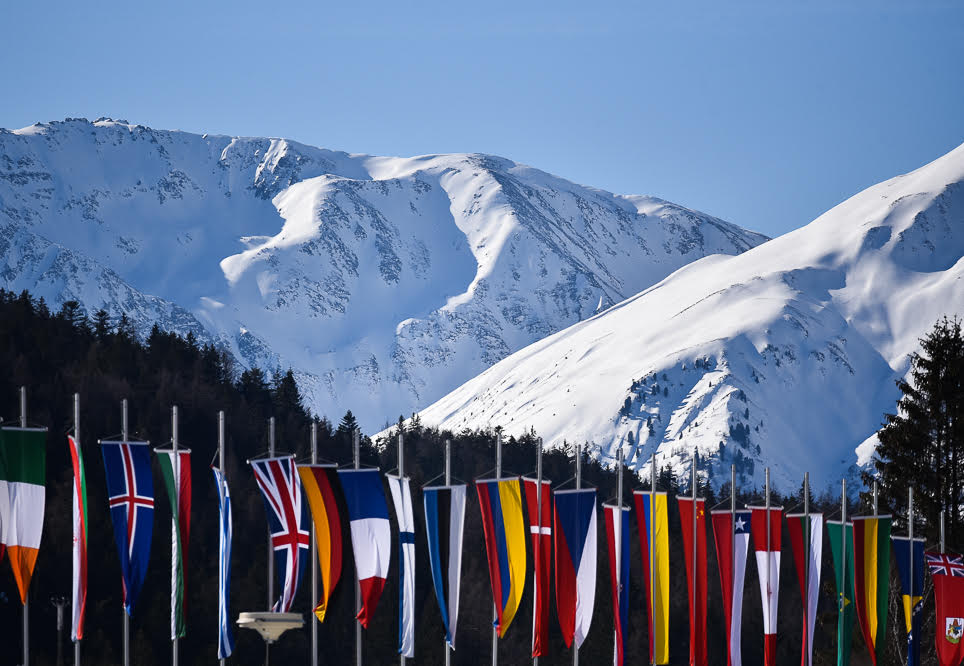
Flags from each nation fly over the stadium in Seefeld, Austria for the 2019 World Championships. (Photo: John Lazenby/lazenbyphoto.com).
As the Seefeld World Championships faded as of Sunday with the conclusion of the men’s 50-kilometer freestyle, here are some news gaps related to the recent arrest last week of five cross-country skiers.
Here are the basics. Several cross-country athletes were arrested in Seefeld as part of a German and Austrian effort to curb doping in sport. Austrian athletes Dominik Baldauf and Maz Hauke, Kazakhstan’s Alexey Poltoranin, and Estonia’s Karel Tammjärv and Andreas Veerpalu were the cross-country athletes arrested. Several other arrest were made including Dr. Mark Schmidt, a German doctor considered to be the leader of the doping efforts. Doping and enabling doping activity is criminalized by law in both Germany and Austria.
Estonian public broadcaster ERR news reported that during a press conference given by Tammjärv on March 1, upon his release from the Austrian authorities, he had admitted to doping in sport. Tammjärve stated he had begun doping in 2016 and was initially put in touch with Dr. Schmidt by Mati Alaver, the former director of the Estonian ski team.
Tammjärv also confirmed that Andreas Veerpalu and his father Andrus Veerpalu were aware of the doping program. Andrus Veerpalu is a former Estonian cross-country athlete who in the past has been implicated with doping. He has been a coaching consultant to the two Estonian athletes involved and is also an adviser to Poltoranin. The older Veerpalu is a three-time Olympic medalist.
Anti Saarepuu, the official Estonian cross-country ski coach for both Tammjärv and Veerpalu, denies knowing that athletes under his watch had been involved with doping.
Thus far, Poltoranin has not commented publicly about his involvement.
Velonews reported this morning that Austrian cyclist and three-time national time trial champion, Georg Preidler, admitted to illegal doping activity. Preidler, had been a member of the French WorldTour team Groupana-FDJ, but is no longer with the team. Over the weekend, Austria’s ex-pro cyclist Stefan Denifl is reported to have admitted to doping.
A screenshot from a video posted to Twitter of Austrian cross-country athlete Maz Hauke during his arrest on Wednesday. Hauke can be seen in the video receiving a blood transfusion. (Photo: @yohanroblin twitter screenshot)
Overnight a video was leaked of Austria’s Max Hauke as he was arrested during a police raid conducted earlier this week. Hauke is seen in the video receiving a blood transfusion. The police officer who provided the video to the media is now under investigation by Austrian authorities.
The release of the video featuring Hauke prompted Austrian cross-country coach Trond Nystad to resign effective on Sunday after the conclusion of the World Championships. Norwegian tabloid VG first reported the news of Nystad’s departure. The forty-eight-year-old Nystad is Norwegian but has been coaching the Austrian cross country team for several years.
“The two boys have done something completely illegal,” Nystad said according to a translation of the VG article. “When there are people who are kidding with such things, I have no desire to work with the Austrian ski club anymore. It was not difficult. It was a shock. One thing is to hear about things that have happened. Suddenly watching the video of it made me sad. I just got even sadder and upset.”
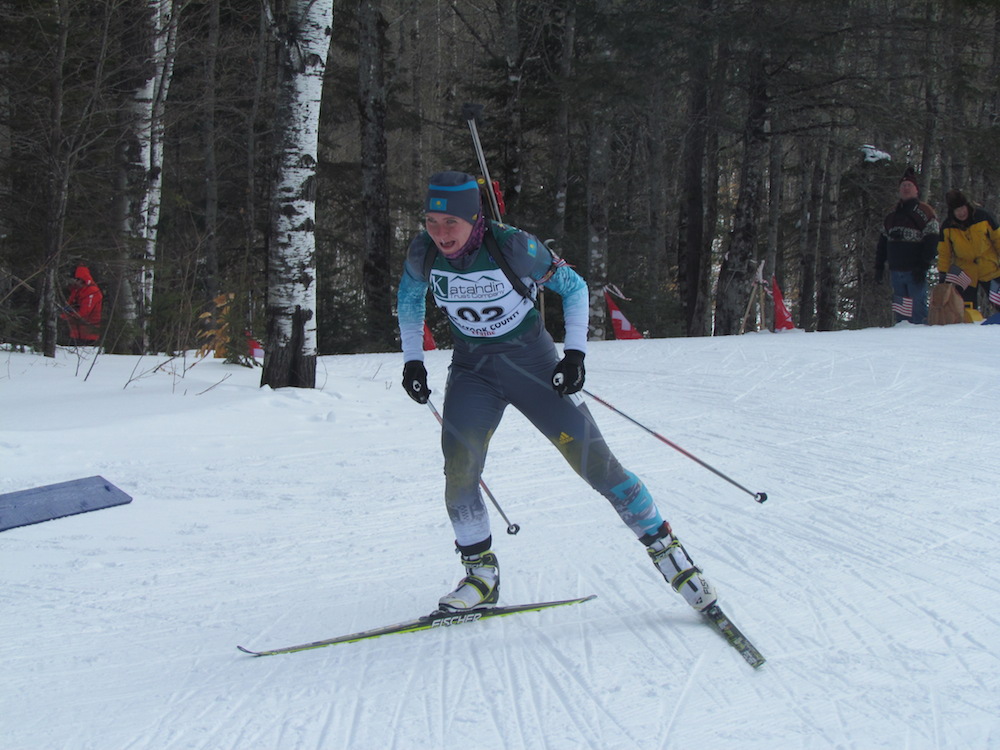
Kazakhstan’s Galina Vishnevskaya on her way to winning the pursuit at 2014 IBU Junior World Championships. (Photo: Katrina Howe)
About a week before the upcoming 2018/19 World Cup Season kicks off, the International Biathlon Union (IBU) announced in a press release on Thursday, November 22nd, that it has provisionally suspended a group of nine female and male athletes representing Kazakhstan from all IBU-sanctioned events with immediate effect, due to alleged anti-doping rule violations. The list of names includes a former Junior World Champion as well as Universiade gold medalist and World Cup podium finisher, a number of recent Olympians for Kazakhstan, and notably also the wife of well-known cross-country skier Alexey Poltoranin.
Prior Suspicions Against The Team
The IBU also announced that the sanctions are based on criminal investigations by authorities in Austria and Italy. On February 8th, 2017, the eve of the 2017 IBU World Championships in Hochfilzen, Austria, federal police raided the hotel of the Kazakh national team seizing medical products and medications for further investigation. Blood and urine samples were also taken, but no immediate adverse analytical findings were announced. All athletes on location were allowed to compete in those World Championships. The Kazakh team failed to achieve any individual top results, with an 11th place in the mixed relay their best finish. Although, that 2017 World Championship roster though was comprised of four athletes who have now been suspended.
The Hochfilzen investigation, in turn, had been triggered a month earlier in January 2017, when members or staff of the Kazakh national team travelling in a team van had been observed discarding a carton box with a suspiciously large amount of medical products at a gas station rest stop in eastern Tyrol. The box’s contents included syringes, infusions and handwritten notes that hinted at medical treatments prohibited under sports anti-doping regulations. The box reportedly also contained official accreditations for IBU race events, which allowed authorities to trace them to the Kazakh biathlon team.
Presumably the IBU as well as the respective national police authorities have had a watchful eye on this team ever since, and now acted on their findings.
The athletes that were provisionally suspended as named by the IBU are (in alphabetical order):
Women:
Anna Kistanova, 28. She has started in 59 IBU World Cups, and competed for Kazakhstan at the 2015, 2016 and 2017 World Championships, with an eighth place in the women’s relay at the 2016 event in Oslo as her best result. She has not competed in the Olympic Winter Games, and has not started at the World Cup level since the 2016/17 season.
Darya Klimina (née Ussanova), 29. She represented Kazakhstan at the 2012, 2013, 2015, 2016 and 2017 IBU World Championships, as well as at the 2014 and 2018 Olympic Winter Games. Her best result in those events was also the eighth place in the 2016 Oslo relay, as well as a 27th place in the sprint during those championships.
Olga Poltoranina (née Dudchenko), 31. Her father is a national team coach. According to IBU data, the veteran athlete has represented Kazakhstan at eight World Championships beginning at age 16 (2003, 2004, 2007, 2008, 2011, 2012, 2015, 2017), as well as at four Youth and Junior World Championships. She did not compete on the IBU World Cup between the 2012 and 2016 seasons. Most recently she started for her country at the 2018 Olympic Winter Games in PyeongChang, South Korea, her first, recording a 63rd place in the sprint, 46th place in the individual race and a 14th place in the women’s relay as her so far final race at an IBU event.
In her private life, according to multiple news reports and her Wikipedia page in several languages, she is the wife of Kazakh cross-country skier Alexey Poltoranin, who has competed on the FIS World Cup circuit since 2005.
Alina Raikova, 27. She represented Kazakhstan at the 2013, 2015, 2016 and 2017 World Championships, as well as the 2014 and 2018 Olympic Games. A solid shooter, her best result was a 29th place in the Individual event at the 2016 World Championships in Hochfilzen, Austria. At Youth and Junior World Championships she represented her country four times, achieving a sixth place, also in the Individual in Kontiolahti in 2012.
Galina Vishnevskaya, 24. Arguably the most successful Kazakh athlete now suspended, she was a highly accomplished junior athlete, highlighted by becoming the 2014 IBU Junior World Champion in the pursuit discipline in Presque Isle, USA, and winning three more silver and a bronze medal at the 2014 and 2015 editions. She also achieved bronze and silver medals at the 2012 Winter Youth Olympics in Innsbruck, Austria. She became a two-time gold medalist in sprint and mass start at the 2017 FISU Winter Universiade (often dubbed the Student Olympics) at home in Almaty, Kazakhstan, along with winning two additional silver medals.
Her best results on the senior elite IBU World Cup level were a third place in the single-mixed relay in Östersund, Sweden, to start off the 2017/18 season, and a fourth place in a mass start in Oberhof, Germany, during the 2016/17 season. Most recently she also became a 2018 Summer Biathlon World Championships bronze medalist in sprint and pursuit (albeit in an event not attended by many of the best athletes competing in the winter season).
Men:
Maxim Braun, 25. He represented Kazakhstan at the 2015, 2016 and 2017 World Championships, and most recently also at the 2018 Olympic Winter Games. For his best result at the World Cup level he reached the podium together with his partner Vishnevskaya in the single-mixed relay mentioned above.
Anton Pantov, 27. He started for Kazakhstan at the 2012, 2015, 2016 and 2017 World Championships, and at the 2014 Olympic Winter Games in Sochi where he achieved a 27th place in the individual event. In this discipline he also finished fourth at the 2012 Junior World Championships. At the 2017 Winter Universiade, at home in Almaty, he won a silver medal with the mixed relay and a bronze medal in the men’s mass start.
Vassiliy Potkorytov, 24. He represented Kazakhstan at the 2015, 2016 and 2017 World Championships, and at the 2018 Olympic Winter Games. His only top-20 finishes have been in relays and mixed relays.
Yan Savistsky, 31. He reportedly represented his country at a total of ten biathlon World Championships over the course of a decade from 2007 to 2017, as well as at the 2010 Olympic Winter Games in Vancouver, Canada, and 2014 in Sochi. His best championship results were in the Individual discipline, where he twice finished 11th in 2013 in Nove Mesto and in 2016 in Oslo. He also helped his team win a gold medal with the men’s relay at the 2011 Asian Games, together with three athletes not named by txhe IBU in relation to this investigation. On the World Cup he achieved a fifth place in a single-mixed relay in Kontiolahti during the 2016/17 season together with the above-mentioned Vishnevskaya.
The IBU will now hold hearings with the suspended athletes to give them a chance to explain the allegations, and will then decide on further proceedings and potential longer suspensions.
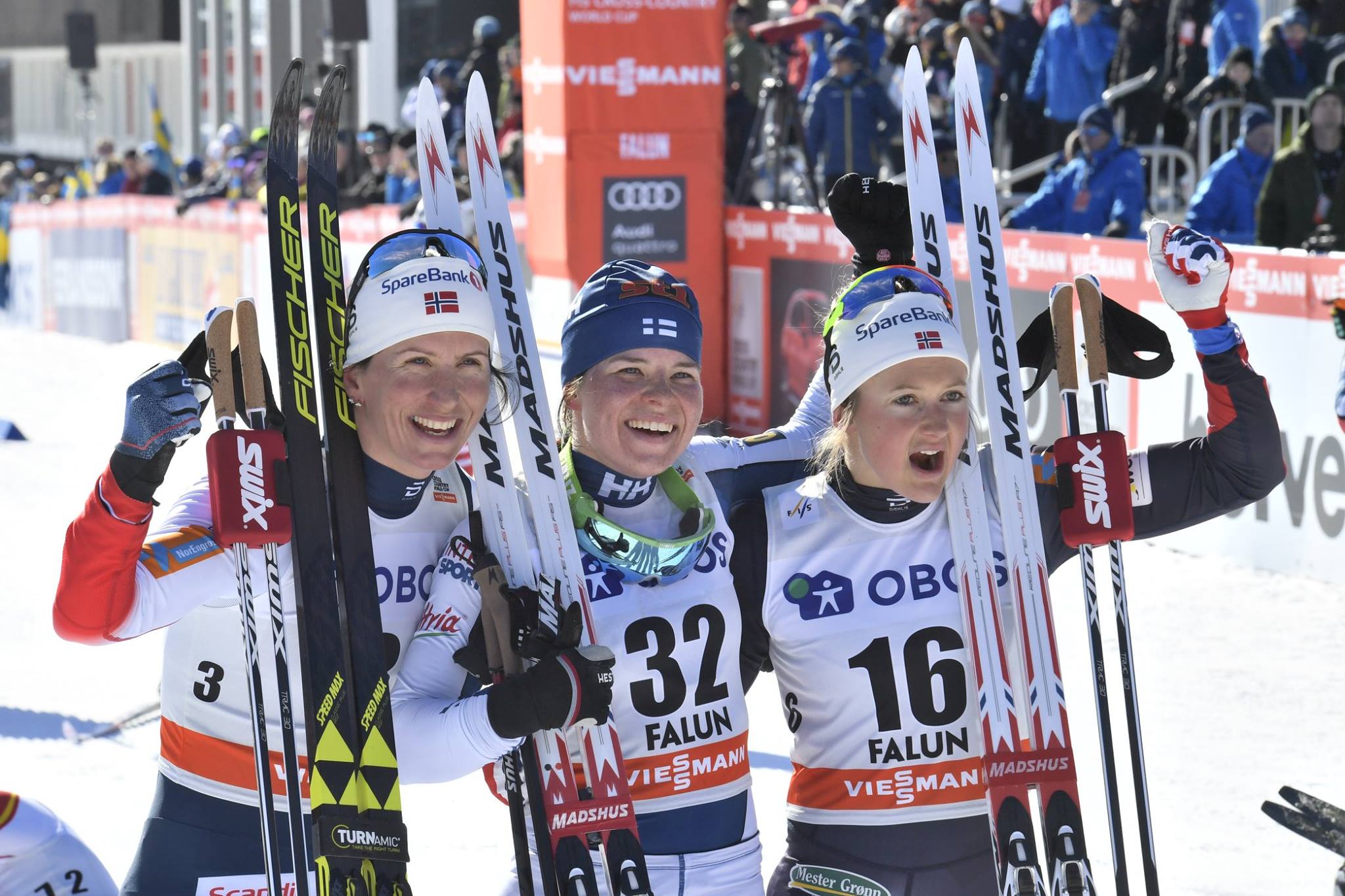
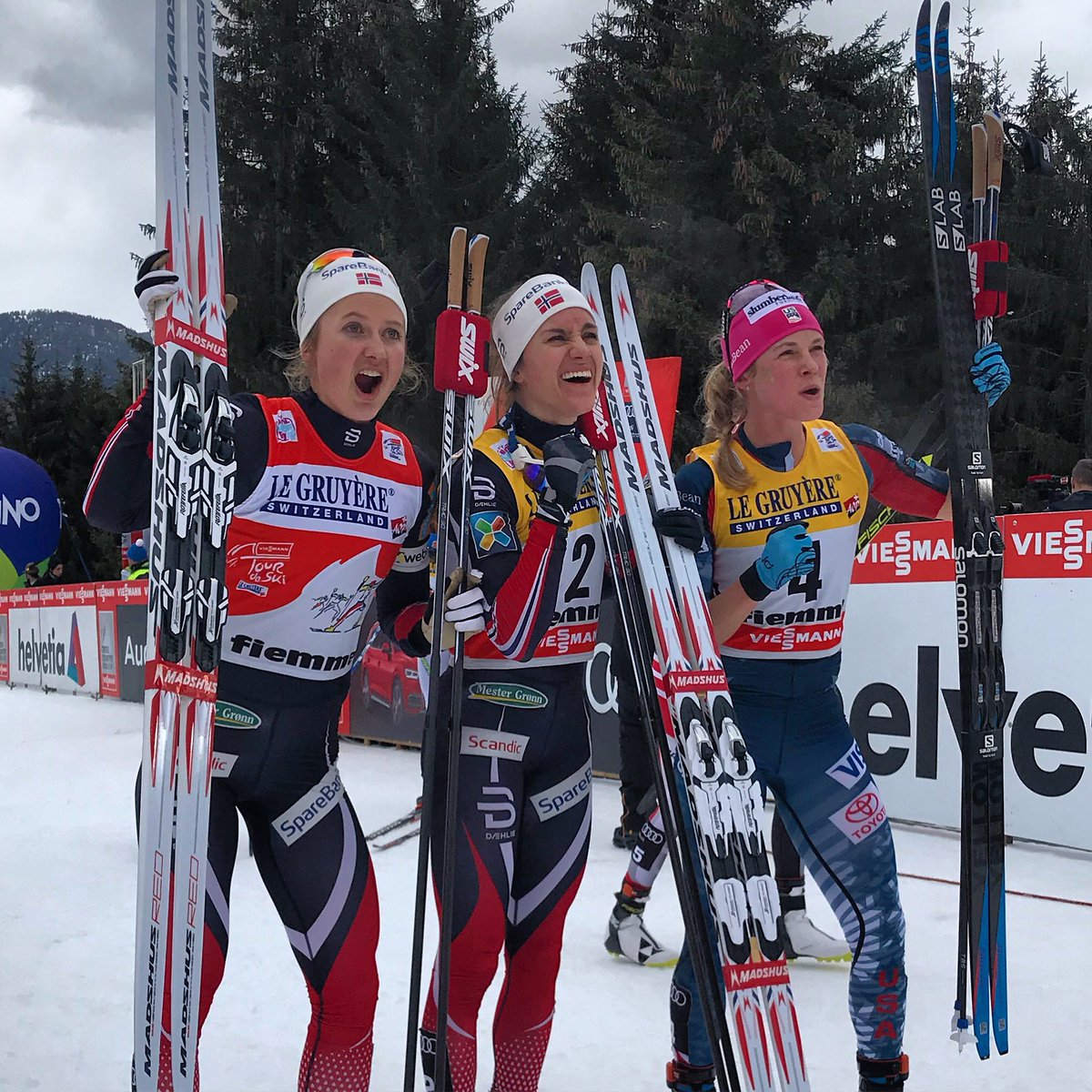
The women’s 10 k classic mass start podium at 2018 World Cup Finals in Falun, Sweden, with Finland’s Krista Pärmäkoski (c) in first, Norway’s Marit Bjørgen (l) in second and Ingvild Flugstad Østberg (r) in third. (Photo: FIS World Cup Svenska Skidspelen/Facebook)
FIS Cross Country World Cup Finals (Falun, Sweden): 10/15 k classic mass starts
Day 2 of World Cup Finals in Falun entailed 10- and 15-kilometer classic mass starts on Saturday, and in the first race of the day, Finland’s Krista Pärmäkoski pulled out a thrilling finishing-sprint victory over Norway’s Marit Bjørgen.
After American Jessie Diggins led early in the first 2.5 k loop, Bjørgen set the tone from the front for most of the race. With less than a kilometer to go, Norwegian powered up the final horseshoe-shaped climb in first, with Pärmäkoski and Bjørgen’s Norwegian teammate Ingvild Flugstad Østberg just behind her. The three had dropped the field while lapping through the stadium around the 7.5 k.
While Østberg fell off the pace on that final uphill, Bjørgen accelerated as she took a few quick strides over the top, gaining a few meters on Pärmäkoski as they headed into the descent. The finishing stretch is long in Falun, and Pärmäkoski was able to come on strong just before she and Bjørgen entered the final 100 meters before the finish. There, Pärmäkoski’s double-pole speed not only matched Bjørgen, but beat her, as Pärmäkoski passed her with several meters to go and took the win by 0.2 seconds in 26:00.5 minutes. It was Pärmäkoski’s second win of the season and fourth of her career (including time-of-day pursuit stage wins).
Just behind Pärmäkoski and Bjørgen, who congratulated each other immediately at the finish, Østberg finished 5.1 seconds back in third. Five women fought for fourth place, with Sweden’s Ebba Andersson taking it (+14.5) ahead of Japan’s Masako Ishida in fifth (+14.8), Sweden’s Charlotte Kalla in sixth (+15.2), Austria’s Teresa Stadlober in seventh (+15.4), and Diggins in eighth (+15.5).
Norway’s Astrid Uhrenholdt Jacobsen was the next finisher across the line in ninth (+24.8), then Finland’s Kerttu Niskanen in 10th (+26.2) and American Sadie Bjornsen in 11th (+26.3).
Canada’s Emily Nishikawa was the next North American in 36th (+1:31.1), and she led her teammates Cendrine Browne, who placed 50th (+2:05.7), Dahria Beatty in 61st (+2:46.6) and Zina Kocher in 69th (+6:12).
For the U.S., Sophie Caldwell finished 41st (+1:36.1), Rosie Frankowski 44th (+1:43.7), Caitlin Patterson 47th (+1:54.8), Ida Sargent 52nd (+2:10.2), Liz Stephen 54th (+2:20.0), Kikkan Randall 57th (+2:34.1), and Kaitlynn Miller 64th (+2:50.7). Rosie Brennan did not start.
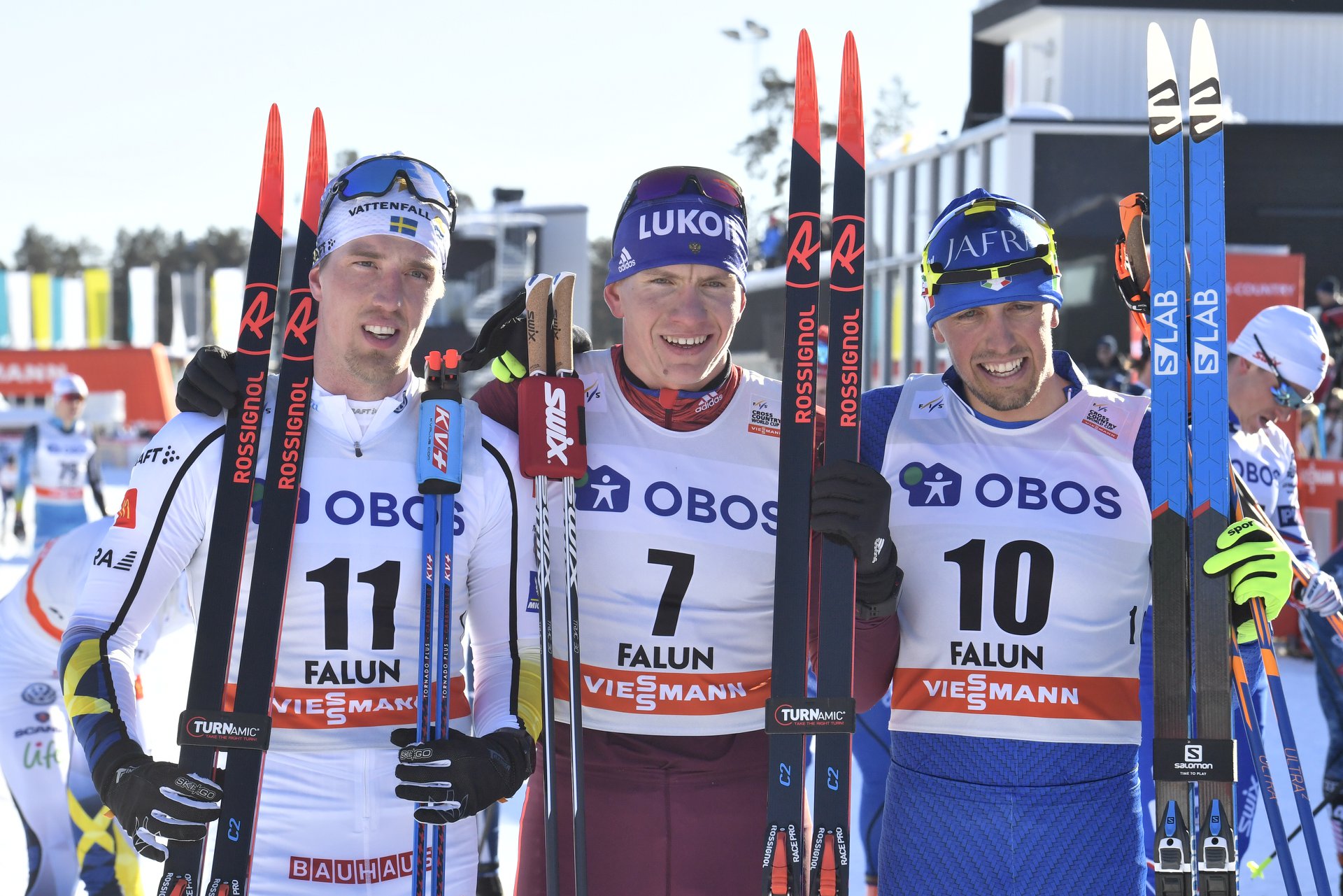
The men’s 15 k classic mass start podium at 2018 World Cup Finals in Falun, Sweden, with Russia’s Alexander Bolshunov (c) in first, Sweden’s Calle Halfvarsson (l) in second, and Italy’s Francesco de Fabiani (r) in third. (Photo: : FIS World Cup Svenska Skidspelen/Facebook)
In the men’s 15 k classic mass start on Saturday afternoon, Russia’s 21-year-old Alexander Bolshunov notched his first-career World Cup win after reaching the podium seven other times this season (placing third in six of those seven races).
Bolshunov hung in the pack and took the lead at the start of the final lap at 11.25 k, ahead of four of his Russian teammates, Alexey Chervotkin in second, Evgeniy Belov in third, Andrey Larkov in fourth, and Maxim Vylegzhanin in fifth. Behind them, Switzerland’s Dario Cologna skied just ahead of Norway’s Martin Johnsrud Sundby and Canada’s Alex Harvey, who were among 29 skiers within four seconds of first.
While Sweden’s Calle Halfvarsson led the final climb before the stadium, Bolshunov caught him on the downhill and out-double-poled him in the finishing stretch, taking first by 1.3 seconds in 36:59.8. Halfvarsson finished second and Italy’s Francesco de Fabiani scored his second World Cup podium of the season in third (+3.1).
Kazakhstan’s Alexey Poltoranin missed the podium by 0.6 seconds in fourth (+3.7), Chervotkin followed in fifth (+5.2), ahead of Cologna in sixth (+5.6) and Italy’s Federico Pellegrino in seventh (+5.6), after they finished together. Sundby and his Norwegian teammate Niklas Dyrhaug also crossed the line at the same time in eighth (+6.3) and ninth (+6.3), respectively, just 0.1 seconds ahead of another one of their teammates, Sjur Røthe, in 10th (+6.4).
Less than five seconds later, Harvey finished 20th (+10.7), ahead of Norway’s Johannes Høsflot Klæbo in 22nd (+13.6). Klæbo slipped out of contention on the third of four laps, as he dropped from fourth to 22nd in less than two kilometers.
Canada’s Devon Kershaw finished 26th (+14.6) for his fourth-straight race in the top 30 (including his 26th-place finish in the Olympic 50 k classic mass start), Graeme Killick placed 41st (+1:13) and Julien Locke was 81st (+3:29).
Erik Bjornsen was the top American man in 52nd (+1:47.1), Simi Hamilton finished 62nd (+2:06.4), Kevin Bolger was 69th (+2:27.1), David Norris 70th (+2:31.2), Scott Patterson 71st (+2:40.6), Paddy Caldwell 75th (+2:52.7), and Andy Newell 86th (+4:47).
World Cup Finals conclude with 10/15 k freestyle pursuits on Sunday.
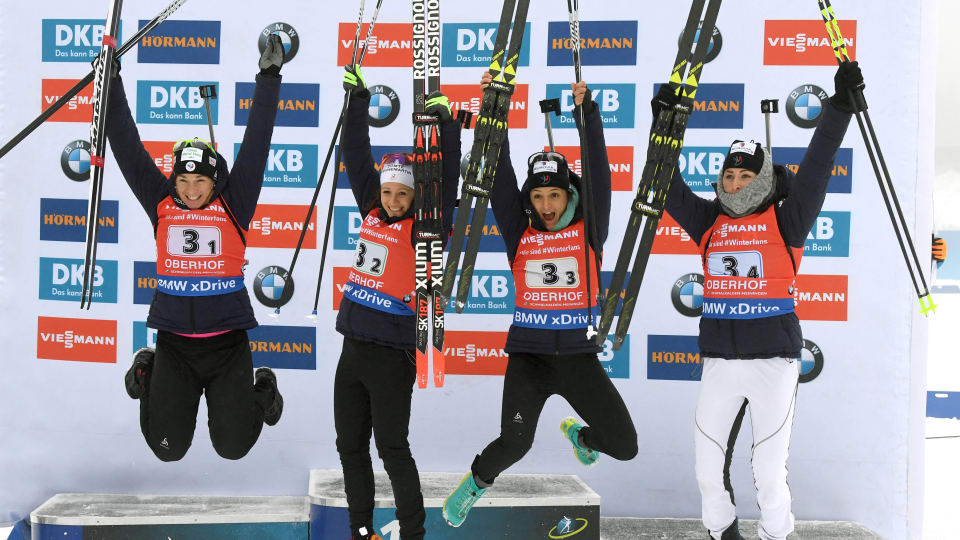
France won the International Biathlon Union (IBU) World Cup women’s 4 x 6 k relay to start the day at Holmenkollen, ahead of Germany and Italy, while the Canadian women’s team (Sarah Beaudry, Julia Ransom, Emma Lunder, and Rosanna Crawford) placed 11th and the U.S. (Clare Egan, Susan Dunklee, Joanne Reid, and Emily Dreissigacker) came back from 21st to finish 15th.
In the men’s 12.5 k pursuit that followed, France’s Martin Fourcade won his 10th race at Holmenkollen, putting himself 49 points ahead of Norway’s Johannes Thingnes Bø with three individual races in Tyumen, Russia, remaining. US Biathlon’s Sean Doherty tied his second-best result this season in 17th and his teammate Lowell Bailey raced up to 28th with the 19th-fastest time of day. Leif Nordgren placed 40th and Tim Burke was 47th, while Canada’s Scott Gow finished 51st and Christian Gow was 54th.
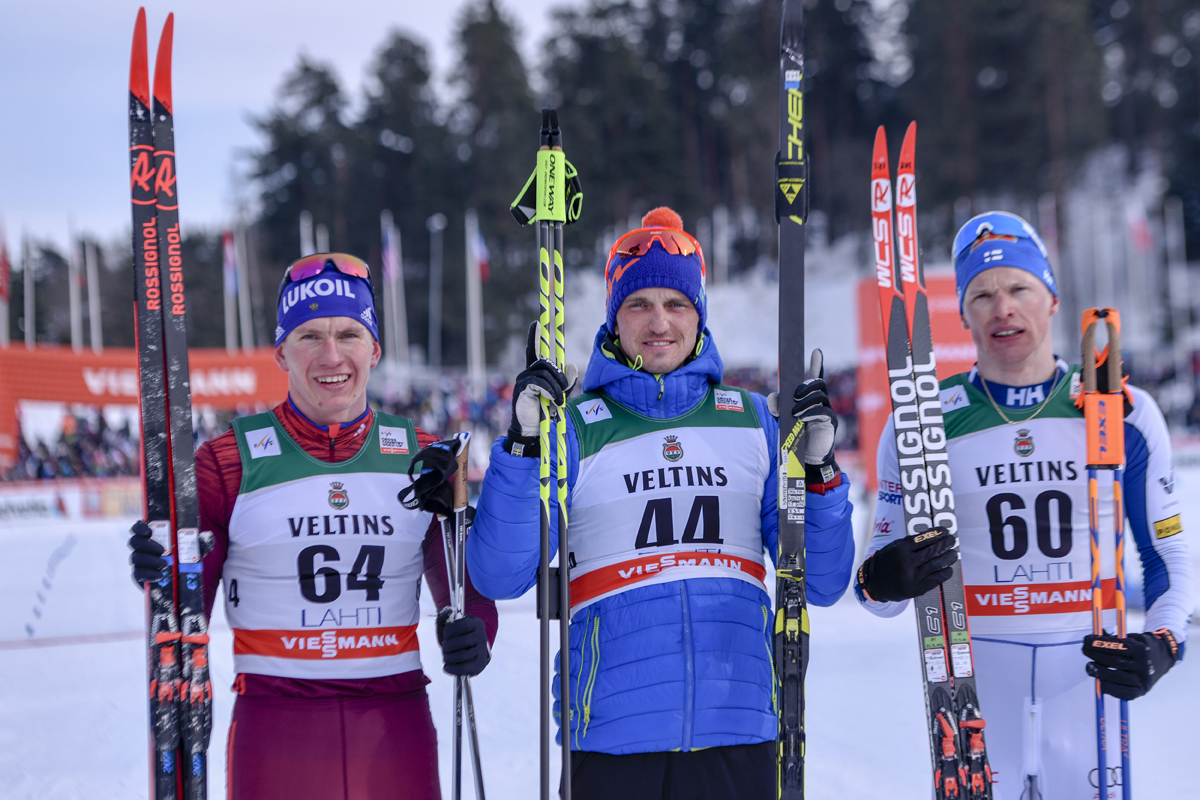
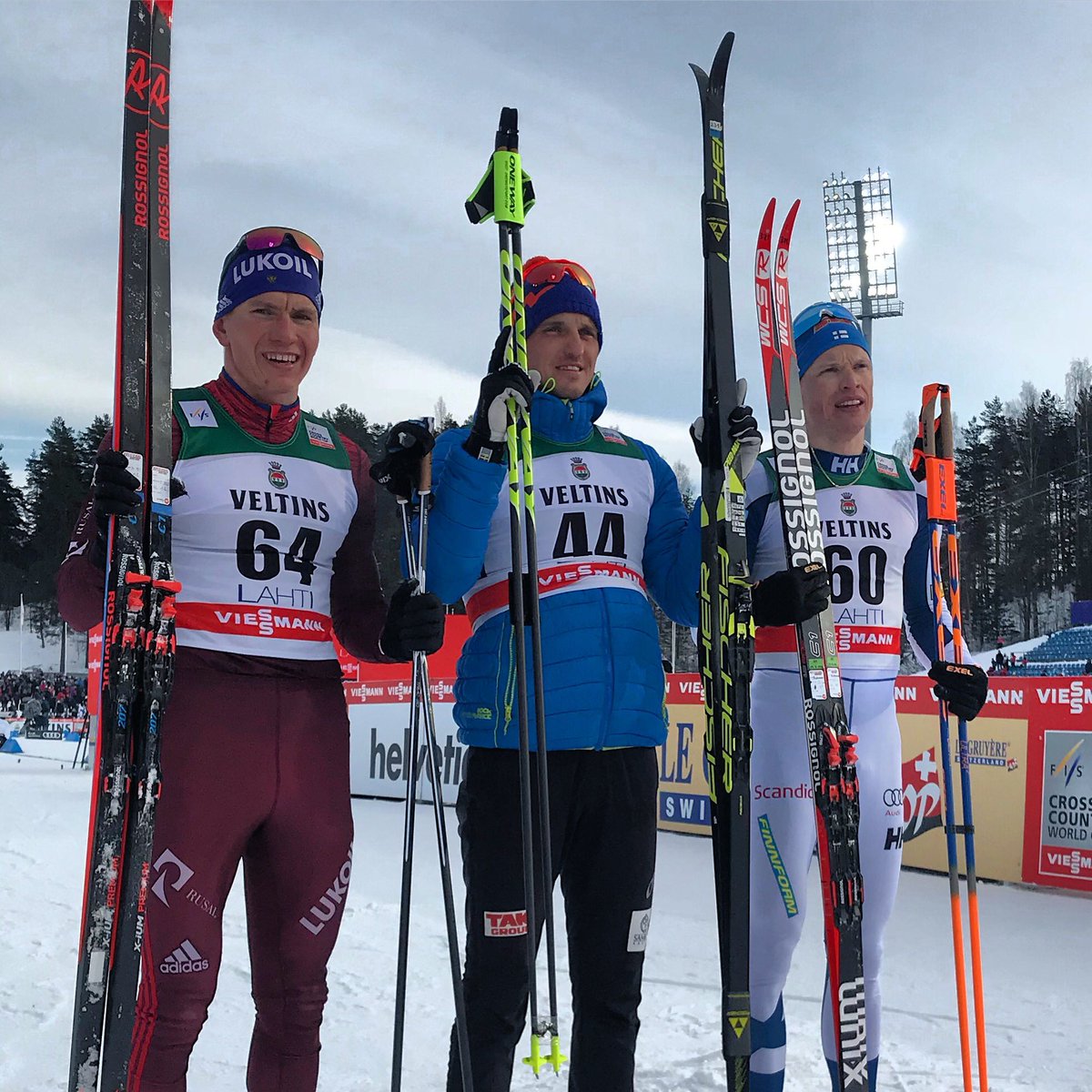
The men’s 15 k classic podium at the World Cup in Lahti, Finland, with Kazakhstan’s Alexey Poltoranin (c) in first, Russia’s Alexander Bolshunov (l) in second and Finland’s Iivo Niskanen (r) in third. (Photo: Fischer/NordicFocus)
You could call him a specialist. An all-around contender in classic distance races, Alexey Poltoranin of Kazakhstan has proven time and time again that he has the 15-kilometer classic individual start figured out.
On Sunday in Lahti, Finland, he set a new World Cup record by winning his eighth-career 15 k classic (including both individual and mass-start formats). He had previously tied Swedish legend Gunde Svan’s mark of seven with a win in the last 15 k classic contested in Planica, Slovenia.
Three of Poltoranin’s 15 k wins have come this season, and all of his 11 career World Cup victories have been in classic races. Two were of shorter distances: a 5 k classic stage race in 2013 and a classic sprint that same year.
But in the last men’s race of the 2018 Olympics last Saturday in PyeongChang, South Korea — the 50 k classic mass start — the 30-year-old Poltoranin only had about 30 k of full-tilt speed in him. For 29 valiant kilometers, he had stalked Finland’s Iivo Niskanen, who was leading the race.
But then, the wheels started to come off. In less than a kilometer, Poltoranin was passed by Russia’s Alexander Bolshunov and lost more than 10 seconds to Niskanen. By about 33 k, he was no longer able to keep up with Bolshunov as he continued the race in the dreaded position of no man’s land, skiing alone in third. The chase pack eventually caught him with 5 k to go, and he slipped to seventh. He ultimately finished 15th, more than 5 minutes behind Niskanen in first.
But that was over a week ago. By Sunday, Poltoranin was back in familiar territory at a venue he had raced at multiple times in the last 13 years, but never placed better than second at in Lahti.
He started 44th out of 71 in the men’s field and came through each timing point with some of the best, if not the best, splits over the three-lap course. But one man who started behind him was faster at every checkpoint — Bolshunov, wearing bib 64— and as Poltoranin sat in the leader’s seat at the finish, watching the rest of the race unfold, it was the Russian he was likely most nervous about.
Niskanen was looking strong, too, but as the Finnish Olympic champion skied in bib 60, a couple of minutes ahead of Bolshunov, his times were consistently about 5 seconds slower.
When Niskanen finished, he was 20.9 seconds shy of Poltoranin’s time. Then Bolshunov, who had led through the 11.1 k checkpoint where he was almost 7 seconds faster than Poltoranin, came into the stadium, yet ended up 9.1 seconds short of the win.
Poltoranin’s finishing time of 33:11.9 proved unbeatable on Sunday, and he pumped his fist as he realized the win was his.
“It’s great to win again,” Poltoranin told the International Ski Federation (FIS) after, according to a press release. “I won in Planica before the Olympics and this is a much better feeling than last weekend’s result in the Olympic 50 k.”
Bolshunov, who finished second to Niskanen in the Olympic 50 k, 18.7 seconds from the gold medal, placed second again on Sunday.
“I was disappointed after the Olympic 50 k and was a little bit tired but I am happy with how I skied today,” the 21-year-old Bolshunov, who won silver or bronze in all four races he competed in at his first Olympics, told FIS. “Thanks for the service team for great skis. Good to get another podium for Russia.”
Niskanen, 26, was a clear crowd favorite in Lahti, with several fans holding up gigantic cutout photos of his face. While he was an early race leader, Niskanen’s split times were second to Bolshunov from 3.7 k on.
“It was an OK race for me,” Niskanen told FIS. “I have had a busy and emotional week after the gold medal in PyeongChang. I think I have not fully recovered yet. I felt my muscles were quite stiff. It was a very hard race for me. I wanted to finish on the podium and it would have been nice to win in front of the home crowd.”
Note: Poltoranin is currently second in the Distance World Cup standings, 39 points behind France’s Maurice Manificat (who placed 21st on Sunday) in first. Norway’s Martin Johnsrud Sundby (who placed fifth behind teammate Emil Iversen in fourth on Sunday) is just 5 points behind Poltoranin in third in the distance rankings. Sundby is second in the Overall World Cup, 228 points behind his Norwegian teammate Johannes Høsflot Klæbo (who placed seventh on Sunday).
Kershaw in the Points in 25th
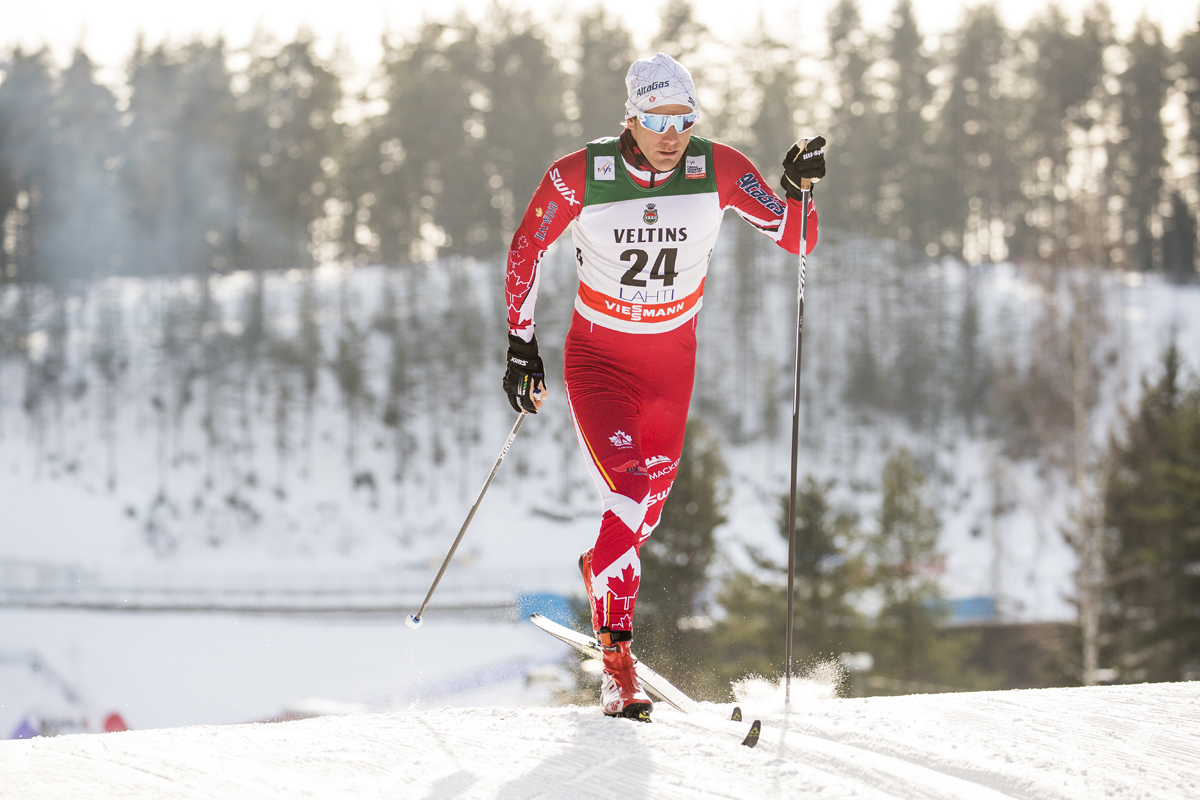
Devon Kershaw racing to 25th in the men’s 15 k classic at Sunday’s World Cup in Lahti, Finland. (Photo: Fischer/NordicFocus)
After placing 26th in the Olympic 50 k, Devon Kershaw led four Canadians in Sunday’s 15 k in 25th (+1:43.2). An early starter in bib 24, his split times were relatively consistent throughout the race, ranging from 20th at 1.1 k to 26th with about 4 k to go.
“I was actually really excited for this race,” Kershaw wrote in an email to FasterSkier. “15km classic is my favourite race we do. Also, Lahti was peaking. It was about -10, sunny (I know?! In Finland) and the track conditions were 10/10. When you love classic skiing like I do, the World Cup rarely offers conditions like we had here. I loved it. Motivation-wise, I have never really struggled too badly with that after championships if the calendar has races I enjoy and know I can be good in. With this 15km classic and then a mass start 15km classic in Falun, it makes it easier to keep motivated. Also, racing in the Nordic nations to end the year is always awesome. Good, knowledgeable fans and nice venues. I love it.”
After struggling with “major lung/breathing issues” at the Olympics, Kershaw explained that he felt much better leading into Lahti. He spent a few days after the Olympics at home Norway with his wife Kristin Størmer Steira and their 13-month-old daughter, whom he hadn’t seen in two months.
“I had some tough days for sure with that mentally,” he wrote of his time away from family before and during the Games. “But when I got home and the first time I saw my daughter in 2 months she crawled right up to me with a big smile on her face and knelt there putting her arms in the air (for me to pick her up) – that was the highlight of my winter right there. It has been great to see them again.”
While he was pleased with what he called “a solid race” on Sunday, Kershaw added that he was also disappointed that he didn’t have anyone to ski with and finished within 10 seconds of the top 20.
“But – I skied a very consistent race,” he wrote. “My pace felt like I was moving at the same speed at km 2 as I was at km 14. That’s a nice feeling. And what you strive for if you are alone in an individual start. I was missing that last gear to attack the last lap, but I didn’t die either, and was able to keep my speed, so I am satisfied. When you pace a race like I did – even if it leaves you wanting more – it shows you did do a good job managing your speed alone for 15km. And that feels good.”
Kershaw’s best result so far this season was 19th in the 30 k skiathlon in Lillehammer, Norway. At the Olympics, he competed in three events with a best result of 26th in the 50 k.
“I was massively disappointed with the Olympics,” he continued. “… 25th isn’t anything stellar or fireworks worthy, but it’s in the points and close to a season’s best for me – which is still something I’m looking to accomplish,” Kershaw added.“I have some more chances, mainly in Falun, but I’ll drag my ass around Holmenkollen this coming weekend because I have such a big respect for the race. I hope I can continue to feel good body-wise and have good energy like I feel now. I hope my lungs can continue to slowly get better and if they are better in Falun then they are now then that won’t hurt!”
Also for Canada, Graeme Killick placed 39th (+2:22.9), Julien Locke was 69th (+4:56.6) and Andy Shields 70th (+5:42.1).
Leading the U.S. men was Erik Bjornsen in 32nd (+2:06.6). After clocking the 53rd-ranked split at 1.1 k, Bjornsen sped up throughout the race to come within about eight seconds of the top 30.
Noah Hoffman finished 40th (+2:24.0), Paddy Caldwell was 45th (+2:40.5), Scott Patterson 50th (+2:58.7), Kevin Bolger 54th (+3:09.5), and David Norris 57th (+3:23.5).
With three World Cup stops remaining, the circuit continues in Drammen, Norway, this Wednesday with city classic sprints followed by the Holmenkollen 30/50 k freestyle mass starts next weekend. World Cup Finals will take place the following weekend, March 16-18, in Falun, Sweden.
Krista Pärmäkoski of Finland (center) won her second straight 10 k classic, to the delight of the crowd in Lahti. Natalia Nepryaeva of Russia (left) finished second and Marit Bjørgen of Norway third. (Photo: FIS Cross Country/Twitter)
FIS Cross Country World Cup (Lahti, Finland): 10/15 k classic
Racing at home in Finland, Krista Pärmäkoski picked a good time to collect the second World Cup victory of her career, and again in a 10 k classic. Pärmäkoski’s first win came in the 10 k classic in Planica, Slovenia, earlier this season.
In second was Russia’s Natalia Nepryaeva, who picked up her first World Cup podium. The current U23 standings leader, Nepryaeva’s time was 20.9 seconds slower than Parmakoski. Both she and Marit Bjørgen of Norway, who finished third (+26.7), used a steady pace to reach the podium. At the 5 k split, Heidi Weng of Norway – wearing the yellow bib of the overall World Cup leader – was in second at the halfway point but faded to finish fifth (+43.3), and Kerttu Niskanen of Finland was in third place but she dropped to fourth by the finish, +27.0. Austria’s Teresa Stadlober finished sixth (+52.4).
Sadie Bjornsen placed seventh (+57.6) to lead the American team. Caitlin Patterson was next, just missing the World Cup points in 32nd (+2:02.7). Ida Sargent and Sophie Caldwell finished 40th (+2:21.9) and 42nd (+2:24.2), respectively. Rosie Brennan finished 48th (+3:02.1) and SuperTour leader Kaitlynn Miller placed 51st (+3:09.1).
Liz Stephen of the U.S. Ski Team did not start due to illness.
Canada started only two women: Emily Nishikawa finished 41st (+2:22.2) and Dahria Beatty 44th (+2:40.7).
The men’s 15 k classic podium at the World Cup in Lahti, Finland, with Kazakhstan’s Alexey Poltoranin (c) in first, Russia’s Alexander Bolshunov (l) in second and Finland’s Iivo Niskanen (r) in third. (Photo: FIS Cross Country/Twitter)
In the men’s race that followed, Alexey Poltoranin of Kazakhstan got some redemption after a major bonk in the Olympics 50 k last weekend, winning the 15 k classic individual start in Lahti.
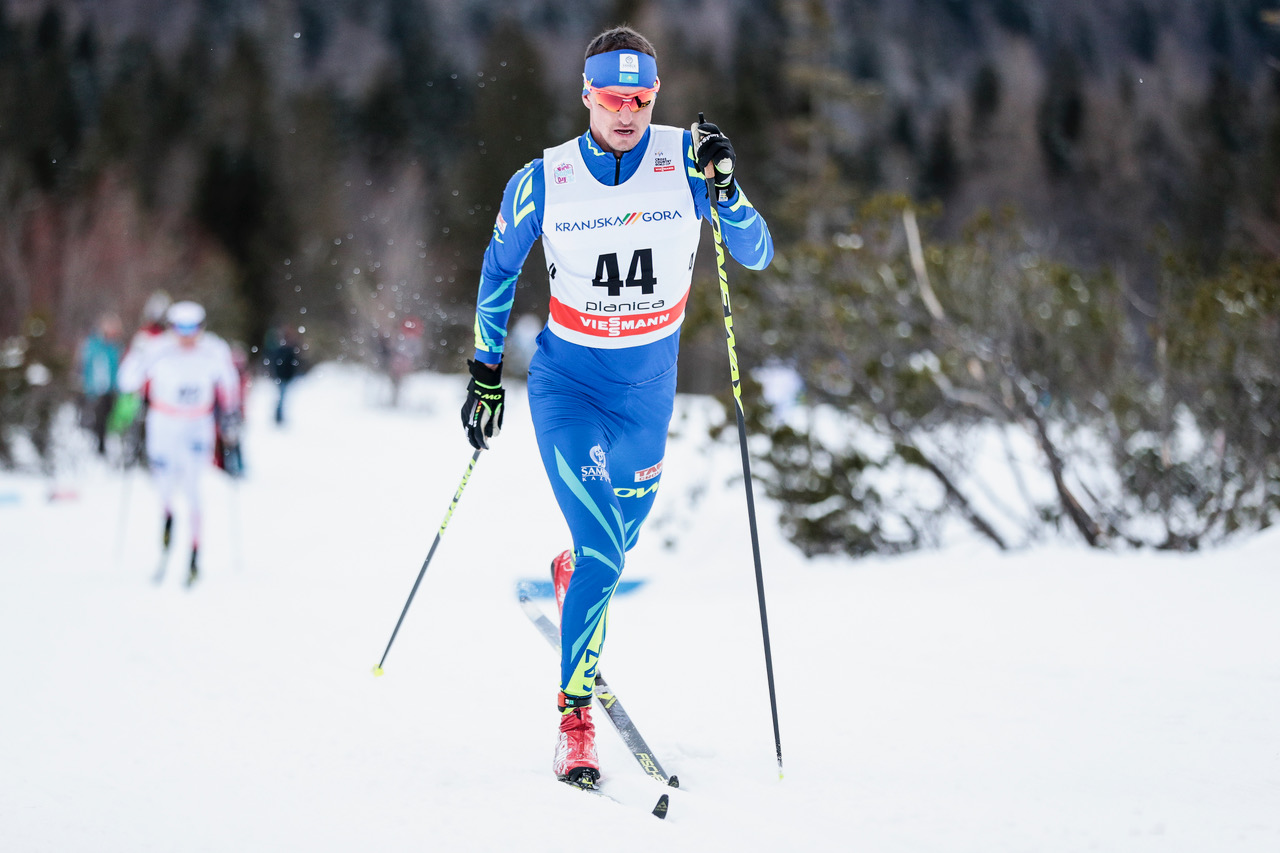
Starting in the middle of the field in bib 44 (out of 71), Poltoranin paced it perfectly, skiing a steady race with some of the top split times and then turning it up another notch over the last several kilometers to take the win in 33:11.9 minutes. His biggest threat was Russia’s Alexander Bolshunov, who started 64th and clocked faster splits at every timing point throughout the three-lap race except the one that mattered most — the finish. There, Bolshunov came up 9.1 seconds short of Poltoranin’s time to place second, and Finland’s Iivo Niskanen — the Olympic 50 k champ — placed third, 20.9 seconds out of first.
Norway took fourth through seventh, with Emil Iversen in fourth (+28.8), Martin Johnsrud Sundby in fifth (+39.9), Niklas Dyrhaug in sixth (+50.1), and Johannes Høsflot Klæbo in seventh (+1:00.3). Russia’s Alexey Chervotkin placed eighth (+1:08.3), Germany’s Thomas Bing was ninth (+1:08.5) and Sweden’s Daniel Rickardsson finished 10th (+1:09.2).
Canada’s Devon Kershaw led the North Americans in 25th (+1:43.2), and Erik Bjornsen was the top American in 32nd (+2:06.6).
Four Canadian men raced, with Graeme Killick placing 39th (+2:22.9), Julien Locke 69th (+4:56.6) and Andy Shields 70th (+5:42.1).
The U.S. was represented by six men, with Noah Hoffman placing 40th (+2:24.0), Paddy Caldwell 45th (+2:40.5), Scott Patterson 50th (+2:58.7), Kevin Bolger 54th (+3:09.5), and David Norris 57th (+3:23.5).
The World Cup picks back up again this Wednesday with classic sprints in downtown Drammen, Norway.
Alex Harvey (2) follows Kazakhstan’s Alexey Poltoranin (5) at the front of the pack during the during the men’s 50 k classic mass start at the 2018 Pyeongchang Olympics in South Korea (Photo: Flyingpointroad)
PYEONGCHANG, South Korea —Not even three kilometers into the men’s 50-kilometer classic mass start on Saturday, Canada’s Devon Kershaw was an S.O.S. skier. The Canadian’s ski pole had snapped and he singlesticked for almost a kilometer before he received another. By the time Kershaw was handed a spare, many of the bibs he started with were striding away; any hope he may have harbored for a podium dashed away with them.
But in his fourth and final Olympics, the 35-year-old Kershaw will be the first to tell you there were other reasons he committed to four more years of Winter Games preparation following Sochi.
“I really stuck around to see if I could push Alex [Harvey] — I do push Alex in training — and to see him get an Olympic medal,” Kershaw told FasterSkier in person after Saturday’s race.
PyeongChang is also, allegedly, Canadian Alex Harvey’s final Olympics. He has stated his plans to retire after the 2019 World Cup Finals in Québec City.
“I was just so motivated to be around to see the first Olympic medal for men get hung around a [Canadian] neck. That’s what drove me every day,” Kershaw reflected.
Canadians Devon Kershaw (r) and Graeme Killick during the men’s 50 k at the 2018 Pyeongchang Olympics in South Korea (Photo: Flyingpointroad)
Coming into the 2018 Winter Games, Harvey, 29, was the favorite for a country that has yet to claim an Olympic medal in men’s cross-country. Harvey’s closest finish until Saturday was seventh in the men’s 15 k freestyle, just 12.5 seconds away from bronze. Earlier in the PyeongChang Games, the Québec native placed eighth in the men’s 30 k skiathlon, and 32nd in the classic sprint. Last year at World Championships in Lahti, Finland, Harvey was crowned the 50 k freestyle mass start world champ.
On Saturday in PyeongChang, while Kershaw waved one half of his ski pole in search of a whole, Harvey hammered away up front in an attempt to earn hardware for Canada.
Harvey, Russia’s Andrey Larkov, and Norwegians Martin Johnsrud Sundby and Hans Christer Holund, skied in a chase pack behind Finland’s Iivo Niskanen, Kazakhstan’s Alexey Poltoranin and Russia’s Alexander Bolshunov, the three of which had gapped the field around the race’s halfway point.
For close to 20 k, Harvey, Larkov, Sundby, and Holund appeared to be racing for fourth through seventh place. With less than 8 k to go, the four men began gaining ground on Poltoranin skiing in third.
“We knew that going with Niskanen is such a hard pace and some of these guys would pay the price later on,” Harvey told FasterSkier of the lead group’s fast pace.
As Harvey, Larkov and Sundby exchanged leads, the time gap to third shrank from 1 minute and 15 seconds at the 30 k mark to 26 seconds by the 43 k mark. Around 45 k, Poltoranin had slowed to a shuffle and stepped aside to let Larkov, Sundby, Harvey, and Holund pass.
With 5 k to go, Harvey was visibly working hard. Afterwards, he told reporters he was unabashed about the demands he put on his body.
“The last laps, my quads were cramping, my biceps, my calves, my stomach, too,” Harvey said. “You just focus on the process, the present, on your technique. If there’s somebody ahead of you, you just focus on his skis; just stay on his tails.”
Three Norwegians leading the pack, with Hans Christer Holund (3), Emil Iversen (12) and Martin Johnsrud Sundby (4) looking to see if anyone else wants to take a turn up front during the men’s 50 k classic mass start at the 2018 Olympics in PyeongChang, South Korea. Canada’s Alex Harvey is directly behind Iversen. (Photo: FlyingPointRoad)
Harvey skied within centimeters of Sundby, Larkov and Holund until the final headwall climb. As the four strode up to the hill’s halfway point, Larkov made his move. The Russian put close to three seconds on the Canadian and the Norwegians by the crest of the hill. That gap widened by the time they made their final descent to the stadium.
Larkov propelled himself into third, 2:37.5 minutes after Niskanen crossed the line first in 2:08:22.1 hours. Second went to Russia’s Bolshunov (+18.7). Harvey sprinted into the finishing stretch with Sundby at his side and outlunged the Norwegian for fourth. All said and done, the Canadian missed a medal by just 6.1 seconds.
In his final Olympics, Harvey’s emotions were heavy as he approached the press. Given the dark cloud that surrounds the 2014 Games, Harvey weighed in tacitly about Saturday’s 50 k podium, which included two Russians.
“You want to believe in the new generation of Russians, so you’ve got to give them the benefit of the doubt, for sure,” Harvey said. “It’s so hard to be fourth with two Russians in front. I do believe these younger guys are doing it clean, but with everything we’ve seen … in the back of your mind there’s a bit of doubt.”
After reflecting on all three of his Winter Olympics, Harvey hoped he and his teammates are a harbinger for Canada’s future cross-country scene (Harvey and Kershaw have been a staple for more than a decade, bringing Canada its best Olympic team result after placing fourth in the 2010 Vancouver team sprint).
Canada’s Alex Harvey after giving his all in the men’s 50 k classic mass start at the 2018 Olympics in PyeongChang, South Korea. He placed fourth for the best individual Olympic result for a male Canadian cross-country skier. (Photo: FlyingPointRoad)
“I think with my teammates, Devon [Kershaw], Ivan [Babikov], George [Grey], we were able to raise the bar for men’s cross-country skiing in Canada,” Harvey said. “… To realistically have expectations set for ourselves of believing in the podium, that was never done before, so I think that’s good for the future generations. To believe that it’s possible, to fight for the top ten, top five, week in [and] week out in the World Cup, at the World Championships, at the Olympics. That’s something that I’m really proud of.”
Harvey’s fourth place now ranks as Canada’s best individual men’s cross-country performance at a Winter Games. The previous best individual result was Kershaw’s fifth in the Vancouver 50 k freestyle. On Saturday, Kershaw was the second Canadian across the line in 26th (+9:27.).
As both close out their Olympic careers, they seem grounded. Not every Olympic dream has to end with medals. Rather, it’s about reaching the limits they push themselves to, once they are there.
“It’s a hard position to end up in,” Harvey said of his fourth place. “But it’s all I had today; there’s no regrets.”
Patterson 11th for Best U.S. Men’s Result Since 1976
Just as the U.S. women crushed a decades-old record earlier this week, American Scott Patterson raced to the best individual distance finish for a male U.S. cross-country skier since Bill Koch placed second and sixth at the 1976 Winter Olympics in Innsbruck, Austria. A first-time Olympian, Patterson placed 11th (+4:52.1), 15.2 seconds outside of the top 10 and 31 seconds back from Switzerland’s 15 k gold medalist Dario Cologna in ninth.
“Early on, I was with that second chase pack just trying to ski relaxed, ski well,” the 26-year-old Patterson said.
He had been skiing around 20th for the first 20 k, but moved up into 15th by the 23 k mark. In another 2 kilometers, Patterson was up to 13th. He pulled with Germany’s Andreas Katz and Russia’s Denis Spitsov — the 15 k freestyle bronze medalist — eventually dropping both.
American Scott Patterson (29) racing to 11th in the men’s 50 k classic mass start at the 2018 PyeongChang Olympics in South Korea. In doing so, he tallied the best American men’s result in an individual Olympic cross-country race since Bill Koch placed second and sixth at the 1976 Olympics. (Photo: Flyingpointroad)
Patterson worked his way past Norway’s Niklas Dyrhaug, Russia’s Alexey Chervotkin, and Poltoranin (who had been in contention for the bronze medal), before ultimately taking 11th.
“It was exciting for the last 5 k when people were starting to dangle in front of me,” Patterson said. “Probably a couple of k out when I got Dyrhaug, and then coming by Poltoranin, too, who I think was skiing pretty far up there early on there in the race. I just wanted a few more k to get [Norway’s Emil] Iversen and get into the top 10, maybe Cologna, too.”
The next American finisher on the day was Noah Hoffman in 33rd.
“Every race has gotten better at these Olympics and I would have loved to have been top 30,” Hoffman, a two-time Olympian, said. “In Sochi I was looking for big results and here I haven’t been close to that and it’s disappointing, but I’ve processed all of that. It’s been four years since I’ve really skied the way that I’ve wanted to and I’m pretty just excited to be here. I’m living up these Games trying to take it all in.”
American Noah Hoffman during the men’s 50 k classic mass start at the 2018 PyeongChang Olympics in South Korea (Photo: Flyingpointroad)
Three more North Americans competed in Saturday’s race, with Canada’s Graeme Killick finishing 27th (+10:06.7), American Tyler Kornfield placing 48th (+16:14.4) and Canada’s Russell Kennedy 49th (+16:54.5).
Despite getting sick Friday, Killick entered the race and finished with his best performance of the Games.
“My energy felt pretty decent and I’m really happy with that race,” Killick said. “I had to fight really hard for the last lap, because I had a group coming back on me and I was kind of in no man’s land. I’m really happy I was able to hold them off.”
The 50 k start was Kornfied’s second race of his first Olympics. Just last month, the 26 year old made his World Cup debut. Reflecting on his recent experiences, Kornfield was perceptive of the idea that racing takes time.
Canada’s Graeme Killick (48) leading his teammates Russell Kennedy (49) and Devon Kershaw in the men’s 50 k classic at the 2018 Olympics in PyeongChang, South Korea. They went on to place 27th, 49th and 26th, respectively. (Photo: FlyingPointRoad)
“I didn’t get the opportunity to race the World Cup until this year and a lot of times that got me down, frustrated me and felt like I wasn’t progressing with a lot of the other athletes in the nation and internationally as well,” Kornfield said. “I just had to be patient and know that eventually it’s going to click.
“It’s been a breakthrough season, but it hasn’t been above and beyond what I’ve done in the past,” he added. “So it’s just being patient and waiting your turn and knowing that it’s going to come, you just need to put your best race you can each day.”
Kennedy will head to a training camp in Japan, before returning to PyeongChang for the 2018 Winter Paralympics March 9-18 as one of Brian McKeever’s guides for the visually impaired races.
“I was feeling really good, I just didn’t have it in the end, the last two laps. I blew up pretty hard,” said Kennedy, a 26-year-old first-time Olympian. “It was still fun, and I, you always learn something from a 50 about what your body can do and where the limit is.”
The final cross-country 2018 Olympic event, the women’s 30 k classic mass start, takes place Sunday.
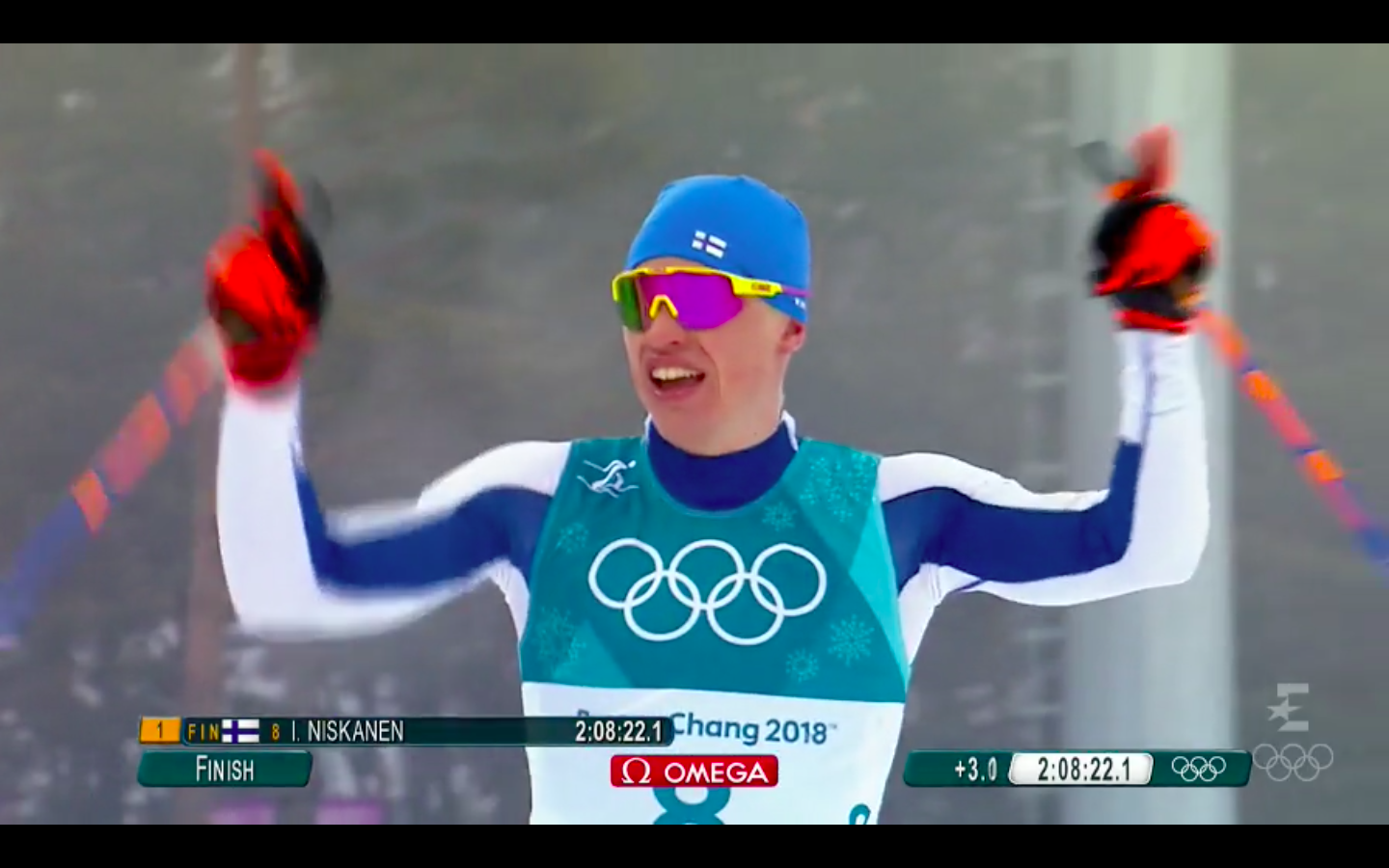
Finland’s Iivo Niskanen after winning the men’s 50 k classic mass start at the 2018 Winter Olympics in PyeongChang, South Korea. (Photo: FlyingPointRoad)
PYEONGCHANG, South Korea — Sun, clouds, fog, and snow. At the Alpensia Cross-Country Skiing Center on Saturday, the men’s 50-kilometer classic mass start transpired like a 50 k should. There was the break-the-pack pace from the start. There was the hard-man up front trying for a solo break. Of course there were chasers: one of whom blew up and faded and another that latched on for a silver-medal ride. And eventually there was a group of four that closed in on a single medal that eventually left three athletes unsatisfied. This was solid Olympic 50 k racing.
For Finland’s 26-year-old Iivo Niskanen, the plan worked. Burning through the 68 other starters began right away. As the 2 p.m. unfettered sun warmed the tracks, the kilometers ticked off with the favorites coalescing in the front. They included Martin Johnsrud Sundby of Norway, Kazakhstan’s Alexey Poltoranin, Alex Harvey of Canada, and the Olympic Athletes from Russia’s (we’ll just call them Russians) Alexander Bolshunov — a 21-year-old star of the Games, if you’re a medal counter (with two silvers and a bronze before Saturday’s race).
This is the 50 k classic, a race usually suited for the well-established and the well-conditioned. This was Niskanen’s day.
The switch flipped at 17.5 k when the Finn was set to fly. Sundby skied 1.4 seconds back, Poltoranin +2.3, Russia’s Alexey Chervotkin +3.4, Bolshunov +4.3, Russia’s Andrey Larkov +5.4, Norway’s Hans Christer Holund +5.7, and Harvey +6.0. These were the names that topped the course’s time checks.
Bold. Daring. Tempting fate. All these words could describe the noticeable uptick in effort from Niskanen at 22.36 k that cracked the field. Unike the tale of the frog in boiling water unaware of it’s slow demise — Niskanen’s pacing shakedown was abrupt. Although not exactly a punch of effort, there was no subtlety to it.
Passing through 27.2 k, Bolshunov trailed the Niskanen-Poltoranin duo by 20.9 seconds. Niskanen soldiered as the consummate soloist except Poltoranin was velcroed on. A look to the side here, another look to the side there from Niskanen could not convince Poltoranin to take a pull up front.
Norway’s Niklas Dyrhaug leads a mass of skiers during the men’s 50 k classic mass start on Saturday at the 2018 Olympics in PyeongChang, Sourth Korea. (Photo: FlyingPointRoad)
A second and third plot line developed behind. Bolshunov surged. Sundby, Holund and Harvey solidified into a core that would slowly bleed time to the leaders. In their own eventual fight for bronze, Harvey’s group fended off every racer except for Russians Larkov and Chervotkin.
Up ahead, Bolshunov flaunted his 21-year-old verve. There was no stage fright. He caught, passed, and gapped Poltoranin. At 33.32 k, only Bolshunov could muster the fight and locked in on Niskanen. As much as Bolshunov was the 50 k’s yin at this point, Poltoranin was its yang. His valiant chase of Niskanen early on smudged out by his crash and burn. Poltoranin was eventually caught by the Harvey group and finished 15th (+5:15.0).
Late in the race, the temps had cooled below freezing and flurries fell. The sun-to-cloud swap also came with a fog bank reminiscent of March in Holmenkollen. Through the stadium at 37.5 k, neither Niskanen nor Bolshunov exchanged skis. Again, like with Poltoranin, Niskanen pulled up slightly. Bolshunov wouldn’t take the invite. He continued drafting the Finn.
Finland’s Iivo Niskanen leads Alexander Bolshunov of the Olympic Athletes from Russia during the men’s 50 k classic mass start at the 2018 Olympics in PyeongChang, South Korea. (Photo: FlyingPointRoad)
That dynamic changed as Bolshunov led down the sweeping turn into the stadium area around 40 k. With the Russian 0.6 seconds ahead, Niskanen changed into his third pair of skis for the day, taking advantage of his ability to swap skis twice during the race. (This is important and we’ll come back to this point: Bolshunov exchanged skis only once.)
With Niskanen’s gear swap and Bolshinov’s power-double-pole, the Russian led out of the stadium.
“I saw the gap appear,” Niskanen said in the post-race press conference. “There’s is no penalty loop like in a normal exchange area — often there is an extra meters when you are going to change skis. So of course, it’s a guess about the dirty snow, and here the snow is so dirty that it’s a big difference between fresh and old skis.”
Niskanen gambled. So, too, did Bolshunov. Eleven seconds opened as they both rolled the dice. This was not, as it first appeared, a gold-medal move for Bolshunov. Less than two kilometers later, Niskanen was there to taunt Bolshunov with noticeably faster skis.
“I could catch him quite easily,” Niskanen recalled. “Then the only tactical plan was to wait and wait and use better skis when it is possible and the best place to use them.”
The best place was the final headwall. The body worked. The skis flew. Niskanen won the 50 k in 2:08:22.1 as he pulled away from Bolshunov in the race’s closing moments. A dejected Bolshunov earned his fourth medal of the 2018 Games (after silver in the relay and team sprint, and bronze in the individual classic sprint) placing second, 18.7 seconds back.
A medal still hung out there for Larkov, Harvey, Sundby, and Holund. Like Niskanen on the final climb, Larkov stung the group first while Harvey and Sundby punched too late. Larkov took bronze, 2:37.5 minutes behind Niskanen. Harvey shut down Sundby on the final stretch to secure fourth (+2:43.6). and Sundby placed fifth (+2:43.7).
The Russians were first to the press conference. Through an interpreter, Bolshunov hinted at his frustration at being so close to gold.
“Obviously I am a little bit disappointed because I could have won this race,” Bolshunov said. “There was a small problem that affected my result.”
Norway’s Martin Johnsrud Sundby leads Finland’s Iivo Niskanen (8), Kazakhstan’s Alexey Poltoranin (behind Niskanen), and Canada’s Alex Harvey (2) early in the men’s 50 k classic mass start at the 2018 Olympics in PyeongChang, South Korea. (Photo: FlyingPointRoad)
That small problem, Bolshunov clarified, were his skis. “Basically the small problem was with the fact that it got much colder and the skis were not as slippery as they should have been. So my result was affected,” he said.
Larkov, too, said his skis were off. “Basically just like my teammate I am also a little bit disappointed,” Larkov, 28, said. “I had some problems with my skis because the weather got colder as we were racing and I had to change my skis. After I changed skis I thought I basically I had no chance but I managed to get to third place.”
Bolshunov and Larkov were the only two skiers in the top 31 to swap skis once. Every other racer took the two allowed ski exchanges. (Four other skiers total among the finishers changed skis a single time.)
Bolshunov entered the optional ski exchange area slightly ahead of Niskanen when the Finn swapped at 40 k. Asked by FasterSkier why he chose to ski on, Bolshunov claimed he wasn’t in position.
“Basically I was on the right and I was not in the right position to change the skis,” Bolshunov said. “I would have changed them but I could not do it in time, so I had to go on like that.”
During the press conference, neither Niskanen nor the Russians acknowledged each other. After learning that the Russians blamed skis as their demise and Niskanen’s gift, the gold-medal winner tried to set the record straight as he and Bolshunov share the same ski sponsor.
“Skis were really really good,” Niskanen said of his own planks. “Maybe you can see the reason here in the result list. The Russian guys have changed skis only once, but that has been their tactic. Also my tactic was to use third and second best pair at the beginning of the race and leave the best pair at the end. It’s the same series skis for me and one of them. We have brother pairs.”
Niskanen’s win was the first gold for Finland (across all sports) in PyeongChang. As the reigning 15 k classic world champion, Niskanen said that he has embraced a selective peaking strategy. For the last two years he has focused on two championship classic races: the 15 k in Lahti, and Saturday’s 50 k.
“Two years after Sochi, I trained so hard and tried to do too many things and have too much races and I got easily sick,” Niskanen said. “And then last two years I want to be the best shape at the right time. Maybe someday my main goal in the season is to win the World Cup overall, but last two years, the only goal has been one race because at the moment, I am so much better in classic. Everything, like the skiathlon [here], they have been preparation races for me to improve the shape.”
If the skiathlon was a training run for Niskanen, as he claimed, it worked. Yet his fortunes were much better Saturday. During the skiathlon, Niskanen strung out the field during the classic leg. He faded to finish in 19th. His hot start in the 50 k, Niskanen acknowledged, made for an anxious Finnish coach.
“Maybe my coach was a bit nervous to watch the race because I often start too hard too early,” Niskanen said. “This time I suffered well, but you just need to live the moment and play the game. If you don’t try you cannot win. This time I was the strongest man.”
The men’s Olympic 50 k classic podium in PyeongChang, South Korea, with (from left to right) Alexander Bolshunov (l) of the Olympic Athletes from Russia (OAR) in second, Finland’s Iivo Niskanen (c) in first, and Andrey Larkov (OAR) in third. (Photo: FlyingPointRoad)
The strongest man on Saturday was undeniably the strongest man. For the second consecutive Olympics, Russia has stepped onto the 50 k podium. With that comes the spectre of doping. Russia went 1-2-3 in the 50 k in Sochi amidst evidence later uncovered about state-sponsored doping. In PyeongChang the Olympic Athletes from Russia (OAR) went 2-3. With that, of course, comes questions. At the 2018 Winter Olympics, even with the increased scrutiny since Sochi, two Russian athletes have been flagged for doping: a curler and bobsledder.
“I don’t know if I can answer this question because I’m only starting to compete on this level,” Bolshunov, who was invited to these Olympics as an OAR athlete because he was not associated with the Sochi debacle, said when asked if he and his 2018 Olympic teammates have any affiliation with Sochi’s taint. “I cannot really compare what happened four years ago with the athletes that are here. I am my own man and they were their own team. So we just do the best we can and we move ahead.”
The 26-year-old Finn, skiing in his second Olympics, broke away from a well-credentialed chase pack at the 17-kilometer mark of Saturday’s Olympic 50-kilometer mass start classic race, then skied a courageous race from there to take the gold nearly 90 minutes of racing later.
He had some company, as Olympic Athlete from Russia Alexander Bolshunov made an equally gutsy move to bridge the gap up to Niskanen by 36 k. But Niskanen used a well-timed surge on the final uphill to come round Bolshunov with 1.1 k to go, and take the convincing win by the finish. Behind him, Olympic Athlete from Russia Andrey Larkov made a similar move on the final hill 2 ½ minutes later to come clear of a chase group and take the bronze.
But let’s back up. A field of 69 racers began the 50 k classic at 2 p.m. local time under cloudy skies, which ultimately gave way to heavy mist and light snow as the floodlights came on around 3:30 in the afternoon. It was the 23rd running of a race first held at the 1924 Olympics in Chamonix. Boldface names such as Bjørn Dæhlie, Gunde Svan, and Thomas Wassberg are among its historical champions. A Finn had not won this race since Kalevi Hämäläinen in 1960.
Norwegian Martin Sundby led a 23-racer pack through the end of the second lap, roughly 17 k and 42 minutes into the race. Niskanen was in seventh at this point, 2.5 seconds off the lead.
Less than a kilometer later, with nearly two-thirds of the race still ahead of him, Niskanen headed to the front. Moving quickly, he soon opened up a small gap over much of the rest of the field. Roughly five minutes later, around the 19-k mark, he began pushing the pace in earnest.
The field began to spread out almost immediately. Niskanen was closely followed by Alexey Poltoranin of Kazakhstan.
Niskanen and Poltoranin skied together throughout lap 3, their advantage soon growing to 20 seconds over the chase group. By 26 k, they had a gap of 25 seconds to Bolshunov in third.
At 27 k, Bolshunov set off on a courageous solo effort to reel in the two athletes in front of him, leaving Sundby to lead the chase group. Seven minutes later, Bolshunov had made up 25 seconds over less than three kilometers; he moved around Poltoranin, and set out to track down Niskanen.
Finally, at the 36 k mark, after roughly 10 k of solo work, Bolshunov had caught up to Niskanen. The two men skied together throughout the fifth and penultimate lap, Niskanen still in the lead until he finally moved aside, all but forcing Bolshunov to come round him and take the lead.
Bolshunov led through the second half of lap five, and appeared to be pulling away while Niskanen seemed to be tiring from the solo effort as well as fighting slick skis. As the two came through the stadium for a final time, 42 k into the race, they were over a minute clear of a fading Poltoranin, and more than two minutes up on the Sundby/Alex Harvey/et al. chase group. The final order of the medals was still up in the air, but gold and silver, in some order, seemed very likely to go to the two men in the breakaway.
Bolshunov led through the stadium the final time, where he did not avail himself of a final ski exchange. Behind him, Niskanen pulled over for new skis. Bolshunov, sensing the Finn’s absence, immediately put in a surge, and gapped Niskanen by roughly 11 seconds early in the final lap. But 8.3 k per lap is a long way, and Niskanen steadily worked to close the gap without panicking. By the 44 k mark, 2.3 k into the final lap and with a full 6 k yet to go, Niskanen had pulled back even with the Olympic Athlete from Russia.
The two men skied together for the next 4+ kilometers. Bolshunov appeared stronger, and is the better sprinter of the two, but Niskanen had experience. And fresh skis.
Suddenly, Niskanen went. With 1.1 k to go, going up the final hill for the final time, he surged hard, and immediately opened up a gap of several meters over his rival. Behind him, Bolshunov stood up as he crested the hill, nearly coming to a stop.
An exultant Niskanen skied in unchallenged, crossing the finish line in a final time of 2:08:22.1. A deflated Bolshunov followed 18.7 seconds later for silver, slamming his pole to the ground as he crossed the finish line.
Behind them, Poltoranin had been caught midway through the final lap, ultimately fading to finish 15th. Coming into the final uphill it was Sundby, fellow Norwegian Hans Christer Holund, Harvey, and Larkov, four men fighting for one final spot on the podium. Much as Niskanen had done 2 1/2 minutes earlier, Larkov pushed ahead on this hill, opening up a gap that he held all the way to the finish. He took third, 2:37.5 behind Niskanen.
A few seconds later, Harvey outlunged Sundby for fourth, +2:43.6 to +2:43.7. Holund was sixth (+2:50.1), Daniel Rickardsson of Sweden another minute back in seventh (+3:50.4), Czech Martin Jaks eighth (+4:10.5), Switzerland’s Dario Cologna ninth (+4:21.1), and Norwegian Emil Iversen tenth (+4:36.9).
One spot later, Scott Patterson led the way for the Americans in eleventh (+4:52.1), after consistently skiing in the teens throughout much of the race. It is the best men’s Olympic distance result in generations.
For the Americans, Noah Hoffman followed in 33rd (+10:42), and Tyler Kornfield was 48th (+16:14.4).
Harvey’s fourth led the way for Canada. He was followed by Devon Kershaw in 26th (+9:27.3), Graeme Killick one spot back in 27th (+10:06.7), and Russell Kennedy in 49th (+16:54.5).
The final race at this year’s Winter Olympics is the women’s 30 k classic mass start, tomorrow afternoon local time.
Johannes Høsflot Klæbo of Norway moments before crossing the line for Norway’s first Olympic men’s 4 x 10 k relay victory since 2002 in Salt Lake City, Utah. (Photo: FlyingPointRoad)
PYEONGCHANG, South Korea — Conversing in the native tongue of the men’s 4 x 10-kilometer relay winner of Olympics past and present requires a world map and an aptitude for language acquisition. 1952 Oslo Games: Finland wins. 1956 in Cortina: the Soviets win. 1968 in Grenoble: France wins. 1984 in Sarajevo: Sweden prevails. 1992 in Albertville: Norway wins.
The previous two Olympics in Vancouver, British Columbia, and Sochi, Russia, — Norway took a hit. The nation’s simultaneously self-righteous and justifiable claims of cross-country-ski-racing dominance fell hollow on the men’s Olympic relay stage. In a country where it’s win and nothing else, the years between the last two Olympic cycles, 2010-2018, have been fraught with relay angst and foreboding.
Sweden won the men’s 4 x 10 k relay in Vancouver and Sochi. Norway placed second in Vancouver. Within the Norwegian singularity of win or lose, that’s a Norway loss. In 2014, Norway placed fourth. Fourth place. Can you imagine the Norwegian disgust?
Start of the scramble leg during the men’s 4 x 10 k Olympic relay on Sunday in PyeongChang, South Korea. (Photo: FlyingPointRoad)
“I knew some of those teams, like Russia, was going to try to spread it out,” Andy Newell, the Americans’ scramble-leg skier told FasterSkier after his first leg in Sunday’s Olympic 4 x 10 k relay. “I knew Poltarainen was going to try to spread it out because he’s such an amazing classic skier.”
For the full 10 k on the scramble leg, Kazakhstan’s Alexey Poltoranin monopolized camera time. His killing form dragged Andrey Larkov, of the Olympic Athletes of Russia, close behind as he stuck to Poltoranin’s tails. Unable to keep pace, and bleeding time already were Italy (+10.0) and France (+10.8) in third and fourth. Norway tagged off in fifth (+18.2), Sweden sixth (+36.9), and Finland seventh (+1:02).
Surely Norwegian social media was rife with eyeroll and poop emojis. And for Norway’s waxing boss, Knut Nystad, most recently featured in a New York Times piece, another debacle like Sochi would cost him.
With Kazakhstan’s team expected to drop off during the next three legs, Alexander Bolshunov of Russia used Larkov’s Poltoranin-pull as a springboard.
Norway has a reliable steady — and over the last three years that has been Martin Johnsrud Sundby. Like Poltoranin, Sundby is a kick-and-glide master. On paper at least Sundby would cut Norway’s losses to the steal-the-show Russians.
Norway’s Martin Johnsrud Sundby (1), Italy’s Francesco de Fabiani (8) and Kazakstan’s Yevgeniy Velichko (9) during Leg 2 of the men’s 4 x 10 k Olympic relay on Sunday in PyeongChang, South Korea. (Photo:FlyingPointRoad)
Since the 2014 Norwegian relay breakdown in Sochi, there have been six 4 x 10 k relays on the World Cup and World Championships combined — Norway won them all. Sundby was in five of those six Norwegian relay lineups. Through thick and thin, Sundby appeared to be the winning missing link.
Yet, a little more than halfway through his leg, Sundby’s and all of Norway’s fate resembled the second leg of the women’s Olympic 4 x 5 k relay on Saturday when Norwegian Astrid Uhrenholdt Jacobsen fell adrift of the front skiers. Both were haunting Sochi déjà-vu moments.
Passing his 6.6 k checkpoint Sundby looked spent. He uncharacteristically let France and Italy take over the pacing. By then, Bolshunov had gapped the chasing trio by a full 41 seconds.
In the post-race press conference, Bolshunov explained he had been hospitalized in the weeks before the Olympics.
“I have fever over 40 degrees [104 Fahrenheit] and I spent like a week in a hospital,” Bolshunov said of his illness. “But like two weeks ago I began my preparation for the Olympic games. It was not very easy but I am very glad I got myself in a good shape and that I could compete on the same level as my contenders.”
Chervotkin took over for Russia on the third leg. Skating away up the first climb alone was Russia, followed by Italy (+24.5), France (+28) and Norway (+32.1) as they tagged off for the first of two skate legs.
The moment Norway’s Simen Hegstad Krüger, already a two-time medalist here, gold in the 30 k skiathlon and silver in the 15 k skate, glided away on his leg, the Norwegian fans in attendance vigorously waved their once-limp flags.
Krüger took control by reeling in France, Italy, and eventually Chervotkin of Russia. By the 10 k mark, when Krüger tagged Norway’s now-and-future relay anchor, Johannes Høsflot Klæbo, France hung tight with Norway, while Russia tagged off in third (+16.2).
Klæbo and France’s anchor, Adrien Backscheider, backed off the pace intermittently as Klæbo appeared reluctant to make a too-early move. Russia’s Denis Spitsov caught Norway and France from behind with less than half the leg remaining.
Denis Spitsov of the Olympic Athletes from Russia leading Norway’s Johannes Høsflot Klæbo (1) and France’s Adrien Backscheider (7) during the fourth leg of the men’s Olympic 4 x 10 k relay in PyeongChang, South Korea. (Photo: FlyingPointRoad)
Backscheider faded as Klæbo and Spitsov danced. Klæbo went where he was expected to go: in a flurry of red-white-and-blue lycra up and over the final headwall. With enough time to grab a Norwegian flag and undo eight years of wait, Norway won the day, crossing the line in 1:33.04.9. Of the eight gold medals awarded so far in these Games, Norway has won five. Sunday also marked Sundby’s first Olympic gold in his third Olympics.
“Today Didrik and I are very happy that we’re on the same team as Simen and Johannes,” Sundby told Eurosport after, according to a translation. “We have a fantastic team and I would at the same time like to send a greeting to all of the other guys on the team. There are a lot of guys who could have skied here today.”
“I think for all of us it’s an unbelievable feeling to be able to take part of this great team,” Klæbo said at the press conference. “I think that we have people back at the hotel we also could have this relay with us. I think that we have done something right the last couple of years and to be part of this team is quite cool. I think we are all grateful for that.”
Russia secured silver as Spitsov came through 9.4 seconds after Klæbo, and France’s Backscheider was next across the line for bronze (+36.9).
Norway’s 2018 Olympic 4 x 10 k relay winners: the country’s first Olympic gold in the event since 2002. From left to right, Didrik Tønseth, Martin Johnsrud Sundby, Simen Hegstad Krüger, and Johannes Høsflot Klæbo. (Photo: FlyingPointRoad)
“This is a great achievement also for my country,” Spitsov said of his team’s silver at the press conference, through a translator. “We are a young team represented here while a majority of athletes were not able to attend and participate in the Olympic Games. We are very young, but still we proved that we are able to achieve great result and we are happy about that.
France’s Manificat made it clear the bronze medal was no disappointment. “For sure its a bronze medal, but for us it’s like gold,” Manificat explained. This is France’s second consecutive 4 x 10 k relay bronze after finishing ahead of fourth place Norway in Sochi.
“To do it again it’s really important,” Manificat reflected. “We are a lot of generation in this relay — old guys in term of dates and young’ ones. But they are really strong. In all the legs we were really strong and we knew that we could play the game and it was perfect.”
Finland placed fourth (+1:40.5), Sweden fifth (+2:05.6), Germany sixth (+2:08.2), Italy seventh (+2:35.2), and Kazakhstan eighth (+3:31.4). Canada was ninth (+3:41.0) to tie its second-best Olympic relay result (with Len Valjas, Graeme Killick, Russell Kennedy, and Knute Johnsgaard), and the U.S. finished 14th (+9:24.2), out of 14 teams, with Andy Newell, Reese Hanneman, Scott Patterson, and Noah Hoffman.
Racing continues Wednesday with the men’s and women’s team sprint.
Johannes Høsflot Klæbo anchoring the Norwegian men’s 4 x 10 relay to gold on Sunday at the 2018 Olympics in PyeongChang, South Korea, while Denis Spitsov (background) celebrates silver for the Olympic Athletes for Russia. (Photo: FlyingPointRoad)
For a while in the men’s 4 x 10-kilometer relay on Sunday, it looked like the Russians might run away with the win. But that was just two classic legs and 20 k into the race, with a lot more racing to come.
While Kazakhstan’s Alexey Poltoranin had handed off in first at the first exchange, just ahead of Andrey Larkov of the Olympic Athletes from Russia, Italy, France and Norway skied together behind them, with Norway’s Didrik Tønseth trailing off the back, 18 seconds behind.
On the next classic leg, Russia’s Alexander Bolshunov put a hurt on the field. Within the first 3.3 k lap, he was 25 seconds ahead of Kazakhstan’s Yevgeniy Velichko in second, who was followed closely by Italy, Norway and France in third through fifth. Sweden’s Daniel Rickardsson had fallen farther behind to more than a minute back in sixth place, after his teammate Jens Burman lost contact with the lead group on the first leg.
By the second exchange, Russia was 24.5 seconds clear of second place, while Italy’s Francesco de Fabiani tagged Giandomenico Salvadori in second, France’s Maurice Manificat tagged Clement Parisse in third (+28.0), and Norway’s Martin Johnsrud Sundby tagged Simen Hegstad Krüger in fourth (+32.1). Kazakhstan’s Velichko had fallen off the pace and was another 19 seconds back in fifth.
Over the next 10 k, the first skate leg, Krüger and Parisse reeled in Russia’s Alexey Chervotkin, catching him before the end of their second lap. One lap later, Krüger came through the final exchange in first, tagging Johannes Høsflot Klæbo 0.4 seconds ahead of France in second. Chervotkin tagged Russia’s anchor Denis Spitsov in third, 16.2 seconds back, while Finland’s Matti Heikkinen passed Italy’s Salvadori on the last climb to put Finland in fourth (+58.6).
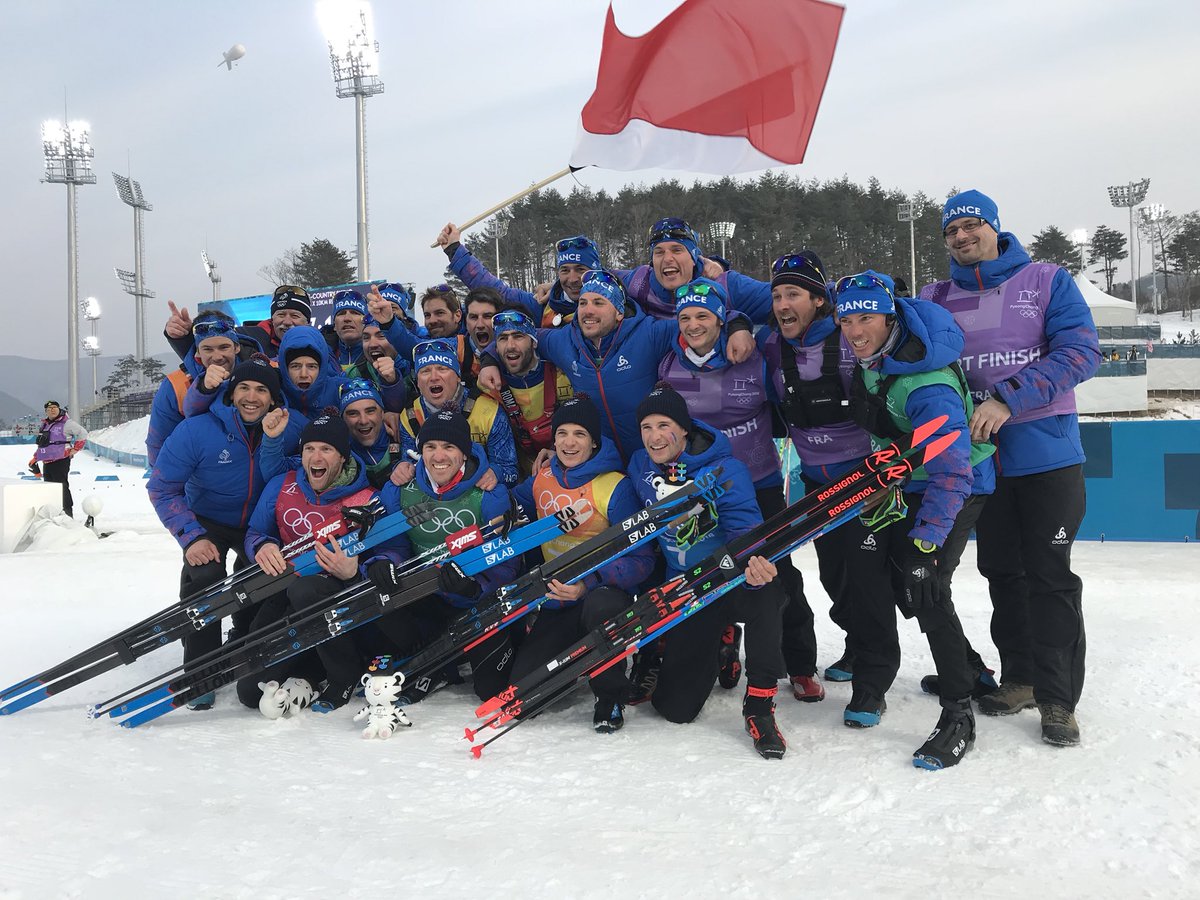
Team France celebrates its bronze-medal finish in the men’s 4 x 10 k relay at the 2018 Olympics on Sunday in PyeongChang, South Korea. (Photo: FIS Cross Country/Twitter)
Early in the final leg, France’s Adrien Backscheider took the lead ahead of Klæbo. The two held Spitsov off until the end of the second lap, where Spitsov came through the stadium first to start the final loop. Spitsov and Klæbo soon upped the pace, dropping Backscheider, and shortly after the 8.27 k checkpoint, Klæbo truly put the jets on to accelerate away from Spitsov. He dropped the Russian on a climb just before the final uphill, where it was clear that the gold was Norway’s.
As he sped down into the stadium, Klæbo relaxed his arms, skied to the sideline and took a flag from the stands. He looked back for a moment and then crossed the finish line first in 1:33:04.9 hours, while Spitsov followed 9.4 seconds later for silver for Russia. Backscheider held on for bronze (+36.9) as his team exuberantly celebrated with him at the finish.
Finland placed fourth (+1:40.5), Sweden fifth (+2:05.6), Germany sixth (+2:08.2), Italy seventh (+2:35.2), and Kazakhstan eighth (+3:31.4). Canada was ninth (+3:41.0) for its second-best Olympic relay result (with Len Valjas, Graeme Killick, Russell Kennedy, and Knute Johnsgaard), and the U.S. finished 14th (+9:24.2), out of 14 teams, with Andy Newell, Reese Hanneman, Scott Patterson, and Noah Hoffman.
France’s Martin Fourcade lunging for his second gold of the 2018 Olympics in PyeongChang, South Korea, winning the men’s 15 k mass start on Sunday. (Photo: FlyingPointRoad)
Martin Fourcade is the champion once again. Six days after he won the 12.5-kilometer pursuit for his first gold in PyeongChang, the 29-year-old Frenchman did it again in the men’s 15 k mass start on Sunday, winning in a photo finish at the line.
He took charge on the first loop, leading the field into the range for the first prone shooting. There, Fourcade shot a penalty and slipped to 19th, but it wasn’t over.
Clean shooting on the second prone brought him up to eighth, 9.4 seconds out of first. Germany’s Benedikt Doll took that lead at that point after his second stage without a miss. Meanwhile Norway’s Johannes Thingnes Bø shot three misses on that second stage and dropped out of contention.
One loop later, Fourcade moved into first with a clean standing. He left the range about 1 second ahead of Germany’s Simon Schempp and 2 seconds ahead of Germany’s Erik Lesser, after both made it through the first three stages without a miss. Doll missed one to slip to seventh, almost 30 seconds behind.
After Fourcade and Schempp exchanged leads over the next loop, Lesser moved into first just before the final shooing, Going head to head, Fourcade and Schempp both missed one while Lesser missed two. Fourcade and Schempp still left the range in first and second, respectively, separated by 0.4 seconds, while Lesser slipped to fifth, 22.5 seconds back.
Doll left the range in third (+19.2) after cleaning and Norway’s Emil Hegle Svendsen moved into fourth (+21.9) with a clean standing stage as well.
In the end, Fourcade outlunged Schempp for the win in 35:47.3 minutes, with Schempp finishing less than a tenth of a second behind for silver, and Svendsen beat out Lesser in the finishing stretch by 0.4 seconds to claim bronze, 11.2 seconds behind, while Lesser settled for fourth (+11.6). Doll followed them in fifth (+18.8), Austria’s Julian Eberhard placed sixth (+30.7) with three penalties, Norway’s Erlend Bjøntegaard seventh (+32.1) with two misses, Norway’s Tarjei Bø eighth (+34.6) with three penalties, Sweden’s Jesper Nelin ninth (+34.6) with two misses, and Slovenia’s Jakov Fak 10th (+36.1), just ahead of the Czech Republic’s Ondřej Moravec in 11th (+36.3), with one miss each.
Kazakhstan’s Alexey Poltoranin racing to the win in the men’s 15 k classic at Sunday’s World Cup in Planica, Slovenia. (Photo: Fischer/NordicFocus)
Sunday’s World Cup 15-kilometer classic in Planica, Slovenia was a coupling of efficiency, power transfer and patience. Three laps of the course on which skiers climbed roughly 650 feet per 5 k cycle required the low-revving thump-thump-thump of a diesel engine and just the right timing for speed bursts to close time gaps.
Kazakhstan’s Alexey Poltoranin covered the 15 k distance in 36:45.7 and won the race by 13.2 seconds over overall World Cup leader, Norway’s Johannes Høsflot Klæbo. Calle Halfvarsson of Sweden, who did not finish Saturday’s classic sprint after crashing into netting in his quarterfinal, placed third (+42.8) for his second World Cup podium of the season. Emil Iversen of Norway missed out on his second podium of the weekend (he had placed second to Klæbo in the classic sprint) striding to fourth place (+54.7) on Sunday.
Norway’s Johannes Høsflot Klæbo finishing the men’s 15 k classic on Sunday at the World Cup in Slovenia. He finished second to Kazakhstan’s Alexey Poltoranin. (Photo: Fischer/NordicFocus)
This season Klæbo has barnstormed — he’s podiumed in every race entered with the exception of a 10th place in a 15 k skate in Toblach, Italy. He’s won the most World Cup distance races of any skier with three this season. The Klæbo buzz is worthy and justified.
Yet Sunday marked a historic moment for Poltoranin. He tied the longtime mark at seven wins in the 15 k classic held by Swedish legend Gunde Svan. Klæbo may be center stage, but Poltoranin is no simple supporting actor. Revered as a classic specialist, but proving his all-around capacity by placing fourth in this year’s Tour de Ski (TdS), Poltoranin is not one dimensional.
As he kicked and strided on Sunday, Poltoranin made clear why he holds the record (15) for 15 k podiums. His tall and muscular frame epitomize clean classic strides that belie the amount of wattage produced.
Poltoranin was never first through any of the time splits until the finish line. Through 3.9 k, 6.9 k, 8.9 k, and 11.9 k, it was Klæbo with the fastest times. Klæbo began in bib 42, Poltoranin began a minute back as the 44th starter. With the knowledge of Klæbo’s splits, however, Poltoranin could wait until the final lap to punch the speed.
At 3.9 k, Poltoranin was 5.5 seconds back with the second-fastest split. By 11.9 k, he was right on par with Klæbo, as 0.3 seconds separated the two skiers. In the next three k, the 30-year-old Poltoranin was able to gain 13.5 seconds on Norway’s 21-year-old for the win.
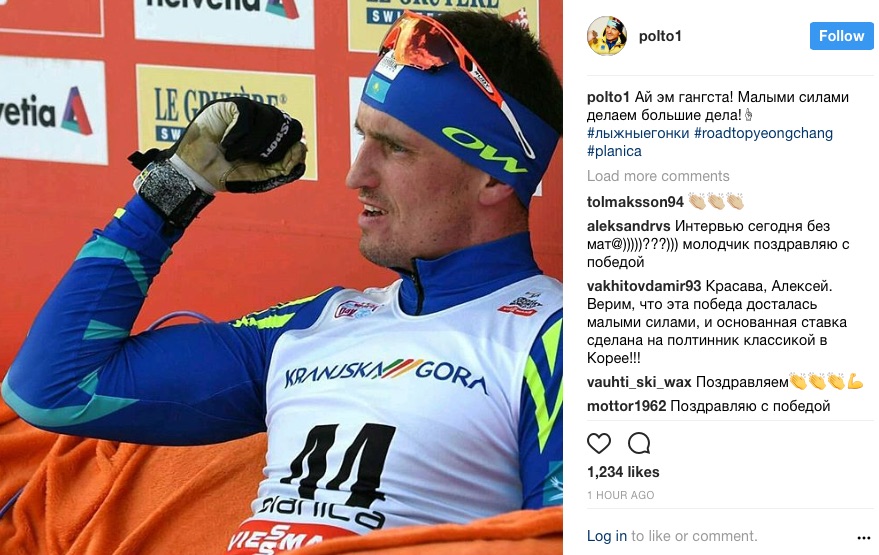
Men’s 15 k classic winner in Planica, Slovenia, Kazakhstan’s Alexey Poltoranin flexes his muscle in the leader’s chair. (Photo: Alexey Poltoranin/Instagram)
Flexing his bicep for the cameras in the leader’s chair, Poltoranin showed, for now, who’s the 15 k classic boss.
“I am really happy to win,” Poltoranin said, according to an International Ski Federation (FIS) press release. “This is a good course for me and I had very good skis and want to say thank you to my service team.”
Klæbo, a press-conference regular this season, paid respects to Poltoranin with his comments.
“It was a very hard course,” Klæbo said, according to the release. “I had great skis on the downhills, but was a bit light for kick on the climbs. Polto was so fast from 12 k and I couldn’t match his pace.”
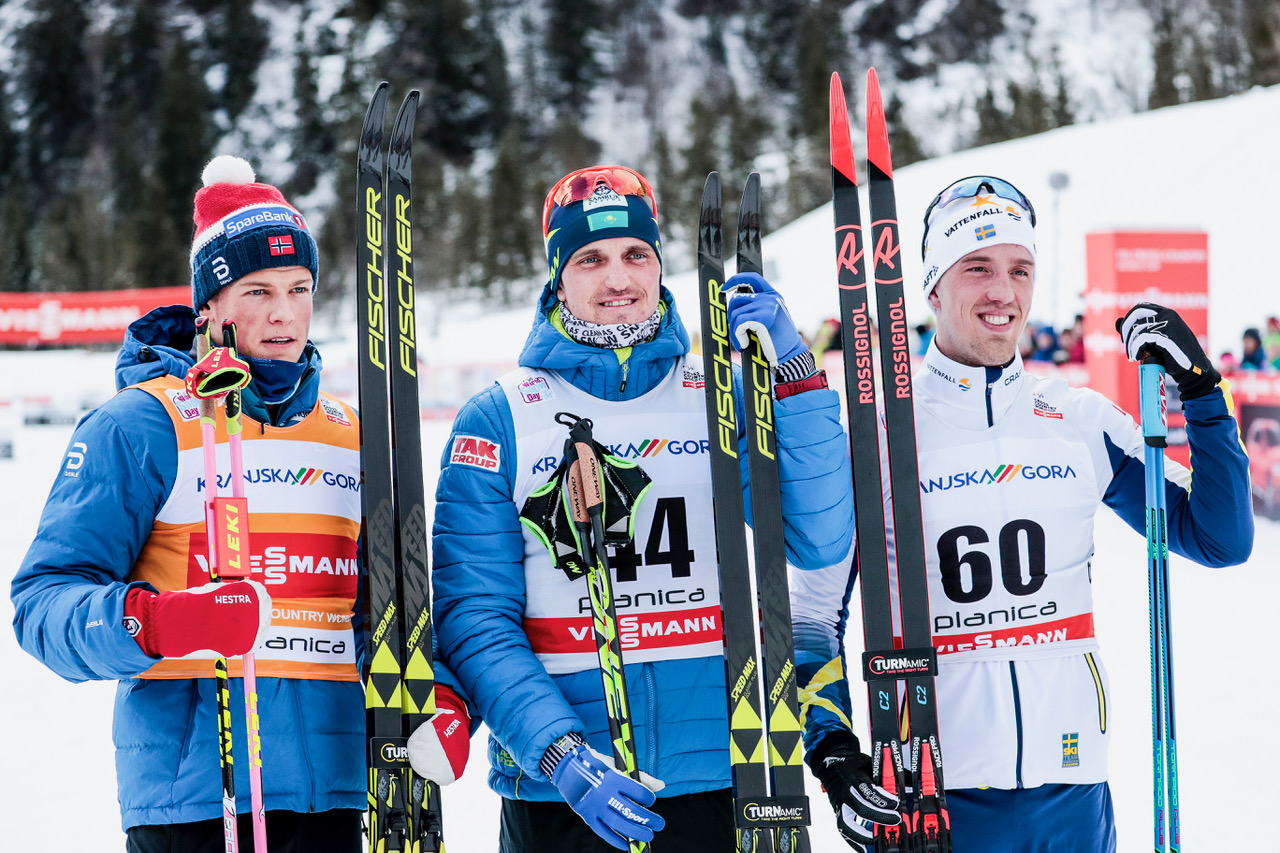
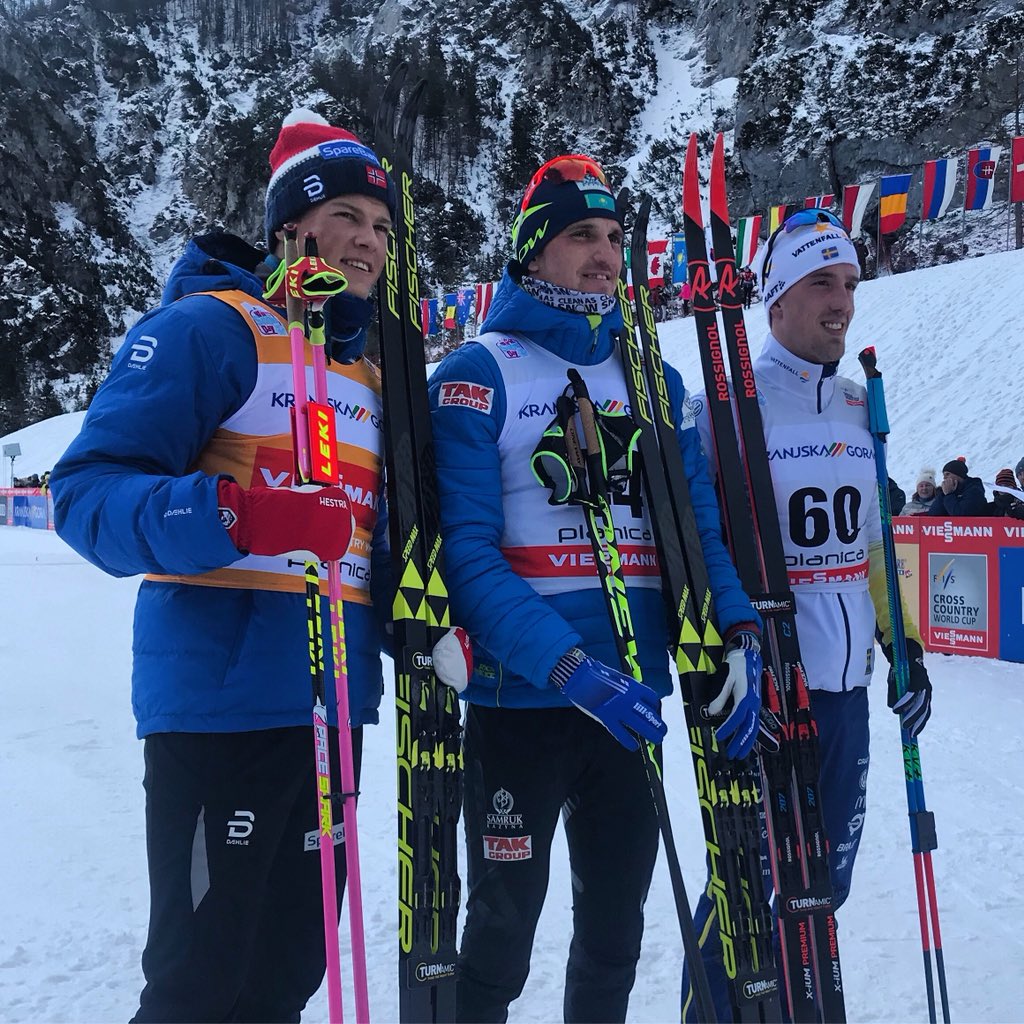
The World Cup men’s 15 k classic podium on Sunday in Planica, Slovenia, with Kazakhstan’s Alexey Poltoranin (c) in first, Norway’s Johannes Høsflot Klæbo (l) in second, and Sweden’s Calle Halfvarsson (r) in third. (Photo: Fischer/NordicFocus)
After Sunday’s race, Klæbo leads the World Cup overall with 1012 points, while teammate Martin Johnsrud Sundby, who did not contest the weekend’s races, sits in second with 875 points.
Scott Patterson (U.S. Ski Team) was the top North American in 43rd (+2:56.2). In his first race back in Europe since racing at U.S. nationals in Anchorage, Alaska, where he won the 15 k freestyle, Patterson told FasterSkier in Planica that he was recovering from a post-national bout with bronchitis.
“This was kind of building back and see what I could do,” Patterson said. “Didn’t feel great out there, it was a race to build a little experience.”
Patterson also commented on the nature of the Planica course’s long hills which kicked up gradually.
“It was a deceptively hard course,” Patterson said. “You never felt like you were going that hard, but it just wore you down over time. You almost want to double pole them, but not really.”
Patterson said he plans to race in next Sunday’s 15 k freestyle mass start, the last World Cup race before the Olympics, in Seefeld, Austria.
Ben Lustgarten (Craftsbury Green Racing Project) was the next best American finishing 46th (+3:04.9). Lustgarten earned World Cup starts as the Period 1 SuperTour leader.
After Sunday’s race, Lustgarten recalled focusing on relaxed skiing and maximizing his effort.
“We all know the hills are long,” he told FasterSkier. “It was a good race. I didn’t feel amazing, to be honest, but I felt like I pushed as hard as I could. And I really worked the technique. I might have lost some time on the transitions and cresting hills because I was so dead. … But I don’t think I could have gone any harder because my whole body was maxed out on the top of the climbs.”
Also on the American side, Tyler Kornfield (Alaska Pacific University) was 57th (+4:03.7). Andy Newell did not finish.
“For sure not our best weekend,” U.S. Head Coach Chris Grover told FasterSkier in Planica. “That said, classic weekends are usually our best. But at the same time, I thought some of our skiers looked a little bit flat — probably to be expected, we have some athletes obviously who just got here, some who came out of U.S. nationals, some who are just coming back to skiing after the Tour de Ski. And some of those athletes that are coming from the Tour de Ski are feeling good, like one-hundred percent back, others are ninety percent back, and are not quite there I think. … Also, a few that are getting over some illnesses, and we also have some that are kind of in the middle of a training block to get ready for the Olympics — kind of a mixed bag.”
Canada’s Devon Kershaw (58) leads Italy’s Dietmar Nöckler in the men’s 15 k classic at the World Cup in Planica, Slovenia. Nöckler went on to place 38th and Kershaw 44th. (Photo: Fischer/NordicFocus)
But Grover also noted that in the end, the weekend proved positive.
“A couple of great performances,” Grover added. “Jessie’s fourth yesterday, that is her best classic sprint result of all time. Really cool to see her making that progress. I thought it was a great race yesterday out of Logan Hanneman to be that close to qualification, he just got over here this week from the U.S. Similarly, a really nice qualification out of Tyler Kornfield yesterday. Same deal. Just got over here. Those were some silver linings for sure.”
Canada’s Devon Kershaw returned to the circuit and placed 44th (+2:57.1), Bob Thompson (NTDC Thunder Bay) was 64th (+5:05.0), and Dominique Moncion-Groulx (Alberta World Cup Academy) was 70th (+6:11.7).
Racing continues next weekend with a freestyle sprint and 10/15 k freestyle mass start.
Canada’s Dominique Moncion-Groulx (55) with Slovakia’s Peter Mlynar (2) during the World Cup men’s 15 k classic in Planica, Slovenia. Mlynar went on to place 48th and Moncion-Groulx finished 70th. (Photo: Fischer/NordicFocus)
Finland’s Krista Pärmäkoski after winning her first non-stage World Cup on Sunday in the women’s 10 k classic in Planica, Slovenia. She bested Sweden’s Charlotte Kalla’s time by 3.6 seconds. (Screenshot: ARD broadcast)
FIS Cross Country World Cup (Planica, Slovenia): 10/15 k classic
Just when it looked like one of those Charlotte-Kalla days, Finland’s Krista Pärmäkoski swooped in and topped the Swede’s time by 3.6 seconds in the women’s 10-kilometer classic individual start on Sunday for her first-career outright World Cup win.
Outright meaning non-stage; Pärmäkoski has two World Cup wins to her name for setting the fastest time of day in 2016 pursuit races.
But Sunday’s 10 k in Slovenia saw her rising to the challenge and besting Charlotte Kalla’s time of 27:12.3, which was at least 39 seconds faster than the first 57 starters. Kalla had started 32nd and beat the previous top time set by Swedish U23 skier Ebba Andersson (bib 28) by 48.6 seconds.
Austria’s Teresa Stadlober started later in bib 56 and clocked the second-fastest time to Kalla, 39 seconds back.
But it was Pärmäkoski in bib 58 who beat them all. Even Norway’s Heidi Weng, who started 60th, couldn’t come close, as she finished 33.5 seconds off Pärmäkoski’s winning time for third place. That put Stadlober in fourth and Andersson in fifth at the end of the day.
Finland’s Kerttu Niskanen placed sixth (+49.4), Norway’s Kari Øyre Slind took seventh (+49.5), Poland’s Justyna Kowalczyk (who’s more of a marathon skier these days) placed eighth (+1:02.1), Norway’s Kathrine Rolsted Harsem (who placed second in Saturday’s classic sprint) finished ninth (+1:03.2), and American Jessie Diggins was 10th (+1:05.4).
Another American, Caitlin Patterson, of the Craftsbury Green Racing Project (CGRP), broke through with her second-best individual World Cup result in 20th (+1:45.2). (Last year, she finished seventh in the pre-Olympic PyeongChang World Cup 15 k skiathlon in a notably small field.)
Kikkan Randall (U.S. Ski Team) followed in 23rd (+1:50.4), and her teammates Sophie Caldwell placed 31st (+2:17.2), Liz Stephen 35th (+2:34.9), and Ida Sargent 37th (+2:37.5).
For the second-straight weekend, no Canadian women competed.
The World Cup men’s 15 k classic podium on Sunday in Planica, Slovenia, with Kazakhstan’s Alexey Poltoranin (c) in first, Norway’s Johannes Høsflot Klæbo (l) in second, and Sweden’s Calle Halfvarsson (r) in third. (Photo: FIS Cross Country/Twitter)
In the men’s 15 k classic, Kazakhstan’s Alexey Poltoranin tallied his second win of the season and first in a race against Norway’s Johannes Høsflot Klæbo on Sunday, winning by 13.2 seconds over Klæbo in 36:54.7.
Poltoranin, 30, started 44th and a minute behind the 21-year-old Klæbo. When Klæbo finished, he bumped Russia’s Ivan Kirillov, also 21, out of the leader’s chair by 43.3 seconds. Then Poltoranin finished 13.2 seconds faster, but Klæbo held onto second when Sweden’s 60th starter, Calle Halfvarsson, finished third (+42.8). It was Halfvarsson’s second podium of the season after placing third in the classic sprint at the November World Cup opener in Kuusamo, Finland. In Saturday’s classic sprint in Slovenia, Halfvarsson qualified second but crashed out of the quarterfinals to finish the day in 30th overall.
Norway’s Emil Iversen started 66th and ended up fourth (+54.7) and Kirillov scored his first World Cup top 10 in fifth (+56.5). Russia had four in the top 10 with Stanislav Volzhentsev in sixth (+57.8), Andrey Larkov in eighth (+1:02.2) and Andrey Sobakarev in ninth (+1:03.4). Norway’s Mattis Stenshagen finished seventh (+1:00.8) and Finland’s Iivo Niskanen took 10th (+1:10.1).
Scott Patterson (U.S. Ski Team) was the top North American in 43rd (+2:56.2), Ben Lustgarten (Craftsbury Green Racing Project) finished 46th (+3:04.9) and Tyler Kornfield (Alaska Pacific University) was 57th (+4:03.7). Andy Newell did not finish.
Canada’s Devon Kershaw returned to the circuit and placed 44th (+2:57.1), Bob Thompson (NTDC Thunder Bay) was 64th (+5:05.0), and Dominique Moncion-Groulx (Alberta World Cup Academy) was 70th (+6:11.7).
Russia’s Stefaniya Nadymova outsprinting Japan’s Ayane Miyazaki at the finish for the win at the inaugural women’s Nordic Combined Continental Cup competition on Saturday in Rena, Norway. (Photo: FIS/Romina Eggert)
FIS Nordic Combined Continental Cup (Rena, Norway): First-ever women’s competitions
Fourteen women, including American Gabriella Armstrong, made history this weekend by competing in the first women’s Nordic Combined Continental Cup in Rena, Norway (after the scheduled opener in Jan. 6-7 in Otepää, Estonia, was canceled), with back-to-back days of individual large hill/5-kilometer Gundersen start races.
On Saturday, Russia’s Stefaniya Nadymova took the win in 16:26.9, just 0.6 seconds ahead of Japan’s Ayane Miyazki in second. Germany’s Jenny Nowak joined them on the podium in third, 16.6 seconds out of first. Armstrong finished 12th (+6:24).
Nadymova, 23, had kicked off the event by jumping to first in the provisional round, which was used for the jumping results, and began the 5 k with a 10-second head start on Nowak in second place. Miyazaki jumped to third and started 14 seconds back. Armstrong jumped to 14th and started 4:08 out of first.
On Sunday, 15-year-old Miyazaki took the win in 16:23.2, swapping places with Nadymova, who finished second, 11.7 seconds back. Nowak, also 15, repeated in third, but finished over a minute and 21 seconds back out of first.
Miyazaki had jumped to first place earlier in the day and started the 5 k with a 20-second cushion to Nadymova in second. Nowak jumped to third and started 1:08 minutes back.
Armstrong, 19, of the New York Ski Education Foundation, jumped to 11th and finished 11th, 4:26.1 after Miyazaki.
Several U.S. Nordic Combined men also competed in Rena, with Taylor Fletcher placing fourth in Saturday’s individual large hill/10 k, 2.7 seconds behind Austria’s Thomas Joebstl in first. Fletcher had skied up from 25th and 2:17 back after the jump with the second-fastest course time.
Also for the U.S., Adam Loomis placed 33rd (+2:30.7) after jumping to 45th with the 12th-fastest course time. Grant Andrews finished 41st (+3:28.7), and Jared Schumate 43rd (+4:10.1).
Fletcher reached the podium in Sunday’s individual large hill/10 k in third behind two Austrians. After jumping to 19th, he skied the fourth-fastest course time to finish third, 3.7 seconds behind Dominik Terzer in first and 2.7 seconds behind Martin Fritz in second.
Loomis improved to 29th (+1:40.9), up from 35th in the jump, and Andrews finished 37th (+2:36.4) and Shumate 40th (+2:57.9).
The men’s large hill/4 x 5 k team event podium on Sunday at the Nordic Combined World Cup in Chaux-Neuve, France, with Norway (c) in first, Germany (l) in second, and Finland (r) in third. (Photo: FIS/NordicFocus)
FIS Nordic Combined World Cup (Chaux-Neuve, France): Saturday & Sunday
Four American men competed at the Nordic Combined World Cup this weekend in Chaux-Neuve, France, with three of them racing in Saturday’s individual large hill/10 k Gundersen and all four racing Sunday’s large hill/4 x 5 k team event.
Norway’s Jan Schmid was the big winner this weekend, racking up an individual win on Saturday and a team victory on Sunday. He won Saturday’s competition after jumping to fourth and starting 27 seconds behind jump leader Akito Watabe of Japan. Schmid worked his way up to first in the 10 k with the third-fastest course time, crossing the line 1.4 seconds ahead of Watabe in 23:32.7.
Watabe finished second and Finland’s Ilkka Herola placed third (+21.5), just ahead of Austria’s Lukas Klapfer in fourth (+21.8).
Ben Loomis led USA Nordic in 37th (+2:49), after jumping to 37th, Stephen Schumann finished 45th (+5:17.0) and Ben Berend 46th (+5:22.2).
On Sunday, Schmid teamed up with Espen Andersen, Jarl Magnus Riiber and Jørgen Graabak to win the 4 x 5 k team event in 47:22.5 by 13.1 seconds. Germany followed in second, with Eric Frenzel, Fabian Rießle, Johannes Rydzek, and Vinzenz Geiger, and Finland placed third (+20.5) with Leevi Mutru, Arttu Maekiaho, Herola, and Eero Hirvonen.
Norway had led after the jump and started the relay 1:03 minutes ahead of Finland in second. France jumped to third and ended up fourth (+47.4), after being passed by Germany, which had started the relay in fourth.
Japan placed fifth (+2:50.9), Italy sixth (+3:59.9), Austria seventh (+4:06.8), Poland eighth (+5:22.1), Estonia ninth (+5:52.1), Russia 10th (+6:41.2), and the U.S. (with Schumann, Loomis, Berend, and Jasper Good) 11th (+6:52.4).
Western Canadian Championships (Red Deer, Alberta): Relays
Nine men’s teams and six women’s squads contested the open relays on the last day of the NorAm Western Canadian Championships on Sunday in Red Deer, with Ontario’s Team “O” (Scott Hill, Michael Somppi and Andy Shields) winning the men’s 3 x 5 k and Alberta 1 (Annika Hicks, Emma Camicioli and Zina Kocher) winning the women’s 3 x 5 k.
For Shields and Hicks, it was their second win of the weekend after they won their respective classic mass starts on Saturday.
Team “O” posted a 19.9-second win over B.C. Storm (Remi Drolet, Tallon Noble and Greg Kilroy), finishing first in 36:22.6. Alberta 5.1 (Sebastien Boehmler-Dandurand, Sam Hendry and Russell Kennedy) placed third (+52.3).
In the women’s relay, Alberta 1 beat out B.C. Fast, Furious & Freakin’ Awesome (Katie Weaver, Michaela McLean and Kaia Andal) by 2 minutes and 37.8 seconds, winning in 43:17.2. Alberta had two teams on the podium with the Kit Kats (Ember Large, Molly Jane Strum, and Sara McLean) in third (+4:25.8).
APU’s Tyler Kornfield (126) leads APU’s Eric Packer (118) and DU’s Eivind Romberg Kvaale (124) to the line in the men’s 30 k classic mass start at 2018 U.S. Cross Country Championships on Sunday in Anchorage, Alaska. Kornfield, Packer, and Kvaale finished first, second and third, respectively. Kris Freeman (10, second from left) was fourth overall and the third American.
U.S. Cross Country Championships (Anchorage, Alaska): 20/30 k classic mass starts
Sweden’s Hedda Bångman denied Caitlin Patterson of her first outright victory of the week at 2018 U.S. Cross Country Championships, but Patterson as the first American racked up her third-straight national title in the women’s 20-kilometer classic mass start at Kincaid Park on Sunday in Anchorage, Alaska.
The top-three Americans in the women’s 20 k classic mass start on Sunday at 2018 U.S. nationals in Anchorage, Alaska, with Caitlin Patterson (1) of the Craftsbury Green Racing Project (CGRP) in first, Rosie Frankowski of APU (l) in second, and Kaitlynn Miller (r) of CRGP in third.
Bångman, a 22-year-old freshman at the University of Colorado Boulder (CU), pulled off a 15.9-second win in the mass start, crossing the line in 1:00:55.3 hours. Patterson, of the Craftsbury Green Racing Project (CGRP), finished second, but was the top American in the event for the third time this week, and Rosie Frankowski, of Alaska Pacific University (APU), notched third (second American), 19.6 seconds back.
Rounding out the top 10 was Jessica Yeaton, who trains with APU and races for Australia, in fourth (+44.1), Kaitlynn Miller (CGRP) as the third American in fifth overall (+1:13.5), Alayna Sonnesyn of the University of Vermont (UVM) in sixth (+1:25.3), Chelsea Holmes (APU) in seventh (+1:55.4), Norwegian CU skiers Christina Rolandson and Anne Siri Lervik in eighth (+1:55.7) and ninth (+1:56.1), respectively, and Erika Flowers of the Stratton Mountain School (SMS) Elite Team in 10th (+2:14.6).
The men’s 30 k classic mass start was incredibly close, with APU’s Tyler Kornfield taking his first-ever distance national title (he was the 2012 classic sprint national champion) in 1:21:43.6. He edged his teammate Eric Packer by 0.7 seconds at the line, and Eivind Romberg Kvaale, a sophomore at the University of Denver (DU), finished 1 seconds back in third.
Kris Freeman (Caldwell Sport) was just off the overall podium in fourth (+1.6), but was the third American. Another DU skier, Dag Frode Trollebø, also from Norway, finished fifth (+2.0), and APU had three in the top six with David Norris in sixth (+2.5). Noah Hoffman (Ski & Snowboard Club Vail) finished seventh (+2.6), Scott Patterson (APU) eighth (+3.6), and Craftsbury’s Adam Martin and Ben Lustgarten followed in ninth (+14.7) and 10th (+14.9), respectively. With Brian Gregg (CXC/LNR/Team Gregg) in 11th (+16.1), the men’s top 11 were separated by less than 17 seconds.
IBU World Cup (Oberhof, Germany): Men’s and women’s relays
Racers on the range during the men’s 4 x 7.5 k relay on a foggy Sunday at the IBU World Cup in Oberhof, Germany. (Photo: IBU/Biathlonworld)
The Swedish men’s team and French women won the second relays of the International Biathlon Union (IBU) World Cup season on Sunday, with Sweden winning the men’s 4 x 7.5 k relay by 1:10.8 over Italy, and France besting Germany by 32.4 seconds.
Notably, most of the top teams didn’t start all of their “A” teamers.
In the men’s race, Sweden’s Martin Ponsiluoma, Jesper Nelin, Sebastian Samuelsson, and Fredrik Lindström combined for their first win together — and the first win for most of the members on the team.
“It is a dream when you are a kid to compete in a World Cup,” Samuelsson said, according to an IBU press release. “To have a win is really amazing!”
The Swedish women’s team also landed on the podium in third (+48.2).
“What a race by the whole team,” said Lindström, who also has one non-relay World Cup win (from 2012) to his name. “It could not be better.”
Conditions could not have been much more difficult for shooting on Sunday, with the fog that had descended early in the day for the women’s race worsening for the men’s race. When there wasn’t fog, there was wind.
Misses were common throughout the two races, and even with racers being able to use three spares per shooting stage to clean, there were a high number of penalty laps.
But the Swedish men kept their penalties to a minimum, with just one for the entire team and a total of nine spare rounds used among them. After Ponsiluoma came through the first exchange in sixth, Nelin skied them into third, Samuelsson picked off another place despite skiing a penalty after his standing stage to put them in second, and Lindström anchored them to first.
“The conditions today were so special. Somehow I felt not so nervous, I was calm and had luck on my side,” Lindström said at a post-race press conference about his nearly flawless shooting (0+0; 0+1).
“I have never [been first] before,” he added. “Not like this in a relay at least. That’s really fantastic.”
“I had to look up to see if I was aiming the right way,” Nelin said after cleaning prone (0+0) then using two spares to clean standing (0+2). “I had no idea where I was aiming, so it was really difficult. But I hit, and it was good. Maybe these conditions fit me and I should never see anything.”
Italy placed second with Thomas Bormolini, Lukas Hofer, Dominik Windisch, and Thierry Chenal combining for two penalties and 11 spares. Hofer had skied them up from eighth to second, and Windisch then took the lead on the third leg to put them in first at the final exchange, 1 minute ahead of Sweden. But Chenal slipped with the seventh-fastest last leg time and a penalty after standing.
“Being on the podium with the team is always a special feeling,” Hofer said at the press conference. “For Thierry, it’s the first year in the World Cup, and he does a really good job, not just today. I am really happy that he could close out this relay. Second place is like a win for us.”
Norway placed third (+2:04.6) with Vetle Sjåstad Christiansen, Henrik L’Abée-Lund, Lars Helge Birkeland, and Tarjei Bø. Together, they had three penalties (two from L’Abée-Lund and one from Birkeland) and 14 spares.
“I grew up on Holmenkollen so I practiced a lot there [in fog],” L’Abée-Lund said. “But today was really really hard, I didn’t see anything in prone. Standing was OK, but prone was really difficult.”
“It’s great to be on the podium,” Christiansen said. “Of course Norway always wants to win, but today we are very happy for our brothers in our neighbor-country Sweden.”
The Canadian men placed 10th (+6:23.1) out of 25 teams with Christian Gow, Scott Gow, Brendan Green, and Carsen Campbell having a combined six penalties and 20 spares. Three of those penalties came on Scott Gow’s second leg, two from Campbell’s anchor leg, and one on Christian Gow’s first leg.
After a penalty on his first prone stage (1+3), Christian cleaned standing with a spare (0+1) and tagged Scott in 11th, 53 seconds out of first. Scott then had two penalties in prone and three in standing, but managed to improve to eighth given how much everyone else was struggling with the shooting as well. Green kept them in eighth with two clean stages (0+2, 0+3), and Campbell, in his first World Cup relay, cleaned prone (0+2) but had two standing penalties (2+3) to put the team in 10th at the finish.
In an interview with German broadcaster ARD halfway through the race, Canadian coach Matthias Ahrens called the range conditions, which ranged from thick fog to unpredictable wind, “very hard to assess.”
“… To be honest, the good thing was that conditions were very bad,” he later added. “So regarding visibility, almost everyone was on the range at the same time [with the same irregular conditions]. They had to wait very long, and of course had bad conditions to shoot, but much of the field was there at the same time.”
The French women’s team, of Anais Bescond, Anais Chevalier, Celia Aymonier, and Justine Braisaz, celebrate their relay victory on Sunday at the IBU World Cup in Oberhof, Germany. (Photo: IBU/Biathlonworld)
In the women’s race, with better shooting visibility, France’s Anais Bescond, Anais Chevalier, Celia Aymonier, and Justine Braisaz took the win in 1:12.42.4, with one penalty and 10 spares. After Bescond put them in first through the first exchange, 6 seconds ahead of Italy in second, Chevalier had to ski a penalty loop after prone but cleaned standings (1+3, 0+0) and tagged off in second, 23 seconds behind Italy, now in first.
One loop later, France was back in first thanks to Aymonier, who cleaned with just two spares (0+0, 0+2), and they extended their lead from 0.8 seconds at the last exchange to 32 seconds at the finish with Braisaz, who shot 0+1, 0+3, and skied the fastest anchor leg.
“I know that it’s always good for Justine to start in the first position, so I really wanted to pass the relay to her in that,” Aymonier said in a press conference after.
“I was nervous, too,” Braisaz said. “That kind of shooting turned my mind upside down, actually. The crowd was very loud, and … I wasn’t very focused on what I did. It was a bit foggy, too, so that made it harder. But finally it was a French day, maybe.”
“In my mind the whole team is really strong, and really able to get the first place,” Bescond said. “After years and years and years behind Germany’s team we finally did it. So just Oberhof spirit I think.”
Germany placed second with Vanessa Hinz, Denise Herrmann, Franziska Preuss, and Maren Hammerschmidt. They combined for two penalties and 13 spares; with a penalty on Hinz’s first leg and one more on Hammerschmidt’s last shooting. After being tagged in 14th, Herrmann skied them into fourth, 40 seconds out of first, and Preuss elevated them to second, which Hammerschmidt held onto.
“I was struggling a little bit in the prone shooting,” Herrmann said. “But the skiing was good today, and also the standing [shooting]. I tried to go fast on the track and catch some girls.”
Sweden, with Linn Persson, Anna Magnusson, Elisabeth Högberg, and Mona Brorsson, avoided the penalty loop and used eight spares to reach the podium for the first time in six seasons. In sixth place at the first exchange, they slipped one place to seventh on the second leg, but Högberg raced them up to fourth with near-perfect shooting (0+0, 0+1) with one leg to go. Brorsson then anchored them to third with clean shooting (0+2, 0+1) and the third-fastest last leg.
“It’s just super nice for us! I am super happy,” Magnusson said. “We were very emotional at the finish.”
When Brorsson was asked if she believe she could fight for the podium, she responded, “Not really. But I said to Linn, ‘Maybe it is our day today. Please let it be our day today.’ ”
The Canadian women finished 14th (+6:37.5), out of 20 teams, with two penalties and 13 spares. Sarah Beaudry initially put them in 15th after shooting 0+1, 0+2, then Julia Ransom had a standing penalty (0+2, 1+3) to slip one place to 16th. Megan Tandy picked off three places with clean shooting (0+0, 0+2) and tagged Emma Lunder in 13th, and Lunder had a penalty in prone but cleaned standing (1+3, 0+0) to finish in 14th.
The men’s overall 2018 Tour de Ski podium atop Alpe Cermis after the final Stage 7 hill climb: with Switzerland’s Dario Cologna (c) in first, Norway’s Martin Johnsrud Sundby (l) in second and Canada’s Alex Harvey (r) in third. (Photo: FIS Cross Country/Twitter)
Dario Cologna of Switzerland added a fourth Tour de Ski (TdS) title to his list of accolades on Sunday, winning the 2018 edition of the race in dominant fashion, with a 1:26.5-minute win over Norway’s Martin Johnsrud Sundby. And Canada’s Alex Harvey scored his first TdS overall podium in third.
The 31-year-old Cologna started the 9-kilometer freestyle pursuit up Alpe Cermis 1:15 ahead of Kazakhstan’s Alexey Poltoranin in second. Russia’s Sergey Ustiugov, slated to start third, did not start due to a back injury. Thus Harvey was the third man off the start line, 1:23 behind Cologna.
(Sweden’s Marcus Hellner, 13th after Saturday’s Stage 6, also did not start the Tour’s final stage.)
Early on, Cologna started putting time into his competitors, extending his lead on Poltoranin to 1:20.5 and Harvey to 1:24 at 1.8 k.
By 4 k, however, Harvey had used his speedy skiing on the flatter portions of the race leading up to the climb to catch Poltoranin, and the two clocked through that checkpoint 1:19.4 behind Cologna. Behind them, Russia’s Alexander Bolshunov skied just ahead of Sundby, another 21 seconds and 22 seconds back, respectively, in fifth and sixth.
While Harvey clawed back a few more seconds on Cologna, he was still 1:17.8 back at 6.2 k, with Poltoranin just 0.7 seconds behind him in third.
Harvey remained in second until around 8.5 k; with just a half kilometer to go, Sundby had caught both Poltoranin and Harvey, passing them both. Sundby held that position and finished second, 1:26.5 behind Cologna, who won in 28:52.1.
Harvey stayed strong for third (+1:30.6) while Poltoranin dropped off the Canadian’s pace in the final half kilometer and finished fourth (+1:41.7). Norway’s Hans Christer Holund placed fifth (+2:17.8), Bolshunov lost a spot to finish sixth (+3:09.7), France’s Jean-Marc Gaillard finished seventh (+3:16.7), Sweden’s Daniel Rickardsson eighth (+3:20.8), and Russia’s Alexey Chervotkin and Andrey Larkov took ninth (+3:33.5) and 10th (+3:37.8), respectively.
France’s Maurice Manificat, known for his strength in freestyle hill climbs and pursuit races, rose from 14th to 11th (+3:45.7) with the second fastest time of day, 12.8 seconds slower than Sundby as the time of day winner in 28:36.4. Cologna’s time was fourth fastest (+15.7), behind Russian U23 skier Denis Spitsov in third (+14.3) (Spitsov started 20th and finished 13th). Holund’s time ranked fifth (+20.6) and Harvey’s time was sixth fastest (+23.6) of the 43 men that finished the race.
The lone American man to complete this year’s Tour, Paddy Caldwell (U.S. Ski Team) skied the 22nd fastest time of day for 38th overall (+11:54.8).
Heidi Weng (center) celebrates her second Tour de Ski victory, with teammate Ingvild Flugstad Østberg second and the U.S. Ski Team’s Jessie Diggins third. (Photo: FIS Cross Country/Twitter)
In the women’s hill climb that kicked off the day, Heidi Weng raced to her second consecutive TdS title. The Norwegian started the day within two seconds of teammate Ingvild Flugstad Østberg, and the two skied together for the flat section of the nine-kilometer stage of the competition. But when the climbing got steep on Alpe Cermis, Weng left her teammate behind and eventually racked up a 48.5-second win.
The battle for third was less predictable. Jessie Diggins of the United States started the day in fourth, but made up the ten seconds to third-place KristaPärmäkoski of Finland in the first few kilometers. The pair climbed together for a while before Diggins attacked. Pärmäkoski tired on the final sections of the Alpe Cermis and Diggins took the podium in definitive style, 2:23.2 behind Weng and 24 seconds ahead of Pärmäkoski. It’s the first overall Tour de Ski podium for Diggins or any American athlete.
Teresa Stadlober of Austria finished fifth (+3:09.4), Kerttu Niskanen of Finland sixth (+4:17.0), Russia’s Anastasia Sedova seventh (+4:49.6), and Switzerland’s Nathalie von Siebenthal eighth (+4:56.1).
Sadie Bjornsen started eighth and slipped one spot to finish ninth (+6:15.0), giving the U.S. two top-ten finishers in the Tour de Ski for the first time. Liz Stephen finished 16th (+8:25.8) and Rosie Brennan 24th (+10:59.6).
En route to her win, Weng notched the fastest time of the day on the 9 k stage. Stadlober’s time was second, Diggins third, Østberg fourth, and Stephen fifth.
32 women finished this year’s edition of the Tour de Ski.
Switzerland’s Dario Cologna (c) celebrates his fourth Tour de Ski overall title, which he won Sunday and was joined by Norway’s Martin Johnsrud Sundby (l) and Canada’s Alex Harvey (r) on the podium in second and third, respectively. (Photo: Fischer/NordicFocus)
The 2018 Tour de Ski is a wrap. On Sunday in Val di Fiemme, Italy, the final Stage 7 hill climb was a mirage of sorts as Switzerland’s Dario Cologna soloed in for his fourth overall Tour de Ski (TdS) victory. The stage, a 9-kilometer freestyle pursuit “final climb” ascends an alpine ski-area slope for the final three k’s as it climbs 425 meters from race start to finish.
Not once did the 31-year-old Cologna look ready to crack. He was cool and calm during another hallmark performance for a skier who, before this year’s TdS, hadn’t stood atop a World Cup podium in three years (he broke through by winning the second stage of this year’s Tour: the 15 k classic in Lenzerheide, Switzerland). Cologna crossed the line Sunday atop Alpe Cermis in 28:52.1 minutes and recorded the fifth-fastest climb time of the day.
“Yes, it worked out very well,” Cologna said to Swiss broadcaster SRF, according to a translation. “I am very happy to arrive up here in first place, six years after the last time. It feels very good. It was a super Tour de Ski.”
Prior to the season, despite his past success, was considered a long shot for numerous podiums. In recent years, Cologna’s star appeared to be in slow-fade mode.
“You couldn’t expect it to work out like this,” Cologna told SRF of his overall win. “I had a good feeling, only the start of the season didn’t work out so well. But since the first race the sprint in the Tour things opened up for me, and after that, it worked out pretty well. No weaknesses, I could pull it through. And that in the end, it worked out so well with such a lead, I wouldn’t have expected that.”
Switzerland’s Dario Cologna finishing the men’s final climb, Stage 7 of the 2018 Tour de Ski, in first for his fourth TdS title atop Alpe Cermis in Val di Fiemme, Italy. (Photo: Fischer/NordicFocus)
With his three-year podium drought only satiated last week, Cologna is savoring the moment.
“It’s always beautiful,” Cologna said of winning his fourth TdS. “After the first year, they came quickly after each other. The first one surely was special. But as I said before, it’s also nice having to wait for a victory. So I am enjoying this one very much. I am happy that I could come back like this, and that I can still win big races.”
Post-Tour — although several World Cup weekends remain before the PyeongChang Opening Ceremony on Feb. 9 — in the overall calculus of who might arrive in form and a serious medal threat, add Cologna to that list.
“Of course that I am back, that I can beat everyone,” Cologna said of his form. “That surely is a good sign for myself, that everything is all right, and now it’s about preserving and showing this form at the Olympics.”
Cologna, wearing the red bib as the TdS leader skied off first on Sunday with a 1:15-minute gap on second placed skier Alexey Poltoranin of Kazakhstan. Canada’s Alex Harvey started third (+1:23) followed by Russia’s Alexander Bolshunov fourth (+1:40) and Norway’s Martin Johnsrud Sundby fifth (+1:42). Coming into the stage, last season’s TdS overall winner Russian Sergey Ustiugov was third overall (+1:22), but he did not start the final climb.
According to a translation of an SRF interview with Russian coach Markus Cramer, Ustiugov could barely move his head back and forth as a result of his crash during the Stage 5 mass start in Oberstdorf, Germany. Cramer claimed the injury was again aggravated in Saturday’s Stage 6 classic mass start in Val di Fiemme.
The opening kilometers of the race feature higher-speed, slightly descending terrain with a few rollers in the opening k. Clear from the start was that Cologna wouldn’t cede any seconds as he approached the climb, which begins to kick up around 6.2 k.
The facts are Cologna skied with such poise that his performance seemed almost quotidian. The Swiss skier was never challenged. At 6.2 k, Harvey and Poltoranin were paired 1:17.8 minutes back, in second and third. Sundby and Bolshunov came through 22 seconds later.
This was the real drama — the battle for the second and third steps on the podium — Cologna was a lock all along for his final bow across the line. None of the four chasers tempted the folly of trying to gap up to the Swiss skier and risk blowing up before the finish.
Poltoranin, winner of Saturday’s 15 k classic mass start, is hyped as a classic specialist. If anyone waited for the 30 year old to collapse early on the Alpe Cermis’s flanks, it did not happen. He stuck on Harvey as the Canadian set the tempo. And just behind, at 7.1 k, Sundby’s podium hunting looked more real as he pulled Bolshunov and himself near the tails of Poltoranin’s skis.
Through another kilometer of gradients measuring 26.5 percent, 14.3 percent, and then 24 percent — climbs steep enough on the skinny skis to check for a malfunctioning inclinometer — Sundby matched Harvey, and Poltoranin matched Bolshunov. The foursome came through the time check with a four-second difference from Harvey to Poltoranin.
Norway’s Martin Johnsrud Sundby (6) leads Canada’s Alex Harvey (behind) toward the finish line of the Stage 7 final climb of the 2018 Tour de Ski. Sundby finished second overall and Harvey placed third for his best Tour de Ski overall finish. (Photo: Fischer/NordicFocus)
“I knew Sundby would come by us at one point,” Harvey said on the phone after. “The plan was to hopefully hit the base of the hill away from Sundby, and hit it at my own pace to not have to go his pace right away. Because last year I was skiing with Manificat and Heikkinen, for example, and Cologna was like 20 seconds ahead of us maybe at the base of the hill, and they just started charging so hard that it just put me in the red too early. So the plan was to just go my own pace at the base of the hill and then whenever Sundby catches me be ready to react to that.”
Sundby caught Harvey in the first third of the climb and paced behind the Canadian. At 8.5 k, moving through tight switchbacks, the 21-year-old Bolshunov broke — his redlining engine defaulted to a more moderate gear. Bolshunov lost 20 seconds quickly as Sundby, Harvey and Poltoranin forged ahead, all fighting for second and third place.
“Sundby stayed behind me until the halfway point of the climb and then took over took the lead,” Harvey recalled. “By then I was feeling OK. I just had to stay strong and stay on him. When I saw Bolshunov was getting dropped it was really motivating for me. You are suffering so bad by then at least you are thinking there is another guy who are suffering even more than me.”
Cresting the steeps on the Alpe Cermis climb with about a kilometer to go, Poltoranin had faded back.
“When finally I actually saw that Poltoranin was getting dropped as well, I thought this is really good,” Harvey said. “But then I was also starting to feel pretty tired. I still tried to go by Sundby at the end, he had a little bit more than me. It is good terrain for him, a steady climb like that. He is such a strong climber — it was simply good I was able to just hang onto him until the end.”
It was Sundby and Harvey left to parry. Harvey is a closer. But on this day, Sundby held out for second place (+1:26.5) and Harvey third (+1:30.6).
Poltoranin placed fourth (+1:41.7), Norway’s Hans Christer Holund fifth (+3:09.7) and Bolshunov suffered an epic slow down to finish in sixth (+3:09.7). Bolshunov skied the 34th-ranked climb time (out of 43 finishers) in 17:40.6 minutes.
Harvey’s third place marks a big step in his TdS performances. In 2016, the 29-year-old Quebec native was 14th overall and had the 16th-fastest time on the final hill climb stage. The 2017 TdS saw Harvey seventh overall with the 25th-fastest climb time. On Sunday, Sundby clocked the fastest climb time in 15:58.3 and fastest time of day on the entire course in 28:36.4. Harvey skied the seventh-fastest climb time (+26.7) and sixth-fastest course time (+23.6).
“I thought it was probably the best year for that,” Harvey said about his TDS podium prospects. “But I mean, that climb has been just so bad for me over the years. It was kind of best-case scenario. But honestly, I don’t know how much I believed in it.”
Before that, in 2011, Harvey started the final stage seventh overall and finished 20th. In 2012, Harvey began the final hill climb pursuit in sixth overall — he ended the day and the Tour 40th overall.
“I am just so bad on the climb. I was hoping for [a podium], but it was just hard for me to fully believe in it because of all the previous experience,” Harvey explained. “I have been well-ranked up until the last stage a few years in a row, but just never been able to quite do it on the last stage. I knew the shape was more solid than ever, but there was still a bit of a question mark for me for the Alpe.”
Alex Harvey at the finish of Stage 7 of the 2018 Tour de Ski. Harvey finished third overall for his best-ever finish on the Alpe Cermis and overall in the Tour. (Screenshot: ARD broadcast)
On Sunday, that question for Harvey was answered. Harvey will take a two-day recovery period in Val di Fiemme and then begin a 10-day altitude camp with Canadian teammate Devon Kershaw in Seiser Alm. Harvey said he would then train in Livigno as part of his pre-Olympic altitude camp.
For the U.S., Paddy Caldwell was the only male skier remaining in the TdS. He began the day ranked 44th overall of 46 skers. Although he was 10:53 minutes behind at the start, Caldwell began in a wave of skiers released en-mass 10 minutes after Cologna. Caldwell ended his first TdS having moved up to 38th overall (+11:54.8) after skiing the 20th fastest climb time in 17:04.7 (and 22nd-fastest pursuit time, 1:18 behind Sundby).
With the conclusion of the Tour de Ski, racing continues next weekend in Dresden, Germany, with a skate sprint Saturday and skate team sprint on Sunday. The next distance race on the World Cup will be a 10/15 k classic in Planica, Slovenia, on Jan. 21.
Alexey Poltoranin of Kazakhstan (c) celebrates his first World Cup win in two seasons, as Russia’s Andrey Larkov (l) takes the first podium of his career. Alex Harvey of Canada (r) was third for his first podium of the season. (Photo: Salomon/NordicFocus)
Saturday’s 15 k classic mass start in Val di Fiemme, Italy, began as many expected: with aggressive skiing from Sergey Ustiugov and his Russian teammates.
Ustiugov, last year’s Tour de Ski champion, started the day ranked second, 53 seconds behind Switzerland’s Dario Cologna, himself a three-time Tour de Ski champion. Ustiugov was obviously trying to make up some of that time in a bid to challenge Cologna for the title: he skied hard from the start and won the bonus sprints at 3.6 and 8.6 kilometers, and teammates like Alexander Bolshunov, Alexey Chervotkin, and Andrey Larkov were often surrounding him at the front of the race.
Early in the men’s 15 k classic mass start at Stage 6 of the 2018 Tour de Ski on Saturday in Val di Fiemme, Italy, with (front row, chasing, from left to right) Canada’s Alex Harvey (4), Russia’s Alexey Chervotkin, Kazakhstan’s Alexey Poltoranin, Norway’s Hans Christer Holund. (Photo: Salomon/NordicFocus)
Those bonus sprint seconds alone took 12 seconds out of Cologna’s overall lead. But the strategy appeared to backfire.
After the second bonus sprint, Ustiugov slowed to catch his breath. The man who had crossed the timing carpet just behind him, Alexey Poltoranin of Kazakhstan, just kept going. Behind him, Cologna and Canada’s Alex Harvey quickly latched on. It was a breakaway.
For several kilometers, their gap to the chasers hovered around two, three, or four seconds. Russia’s Larkov caught on. So did Norway’s Didrik Tønseth, but then he fell of the back of the pack again.
Poltoranin kept pushing the pace, and Harvey and Cologna took turns leading, too. The group was clearly trying to put some time on the men around them in the Tour standings.
“I knew some guys were struggling so I was really trying to lead the pace today,” Harvey, who also led for a kilometer or so around the 6 k mark, said in a Cross Country Canada (CCC) press release. “I was feeling good and I took my responsibility because I really wanted to make it hard and keep the speed high in the front for some of those guys struggling.”
And it worked. As the distance wore down towards the finish line, it was a group of four, with the rest of the field increasingly stringing out behind them. Ustiugov lost more seconds, and more. So did Norway’s Martin Johnsrud Sundby, who had come into the day ranked third in the Tour.
“In Val di Fiemme, our team has always managed to perform well in the classic mass start,” Larkov said in a Russian ski team Instagram post, according to a translation. “Today, from the very beginning of the race, the speed was almost maximum. After four laps of six, a group of leaders began to thin out. I saw all [my teammates] are behind us. I couldn’t slow down my opponents, so I went and got in behind them.”
Coming into the final downhill, Poltoranin led in one track, and Harvey in another. But Harvey’s skis appeared to be the tiniest bit slower than his competition’s.
Canada’s Alex Harvey en route to third — his first podium of the season — in the men’s 15 k classic mass start on Saturday at Stage 6 of the 2018 Tour de Ski in Val di Fiemme, Italy. (Photo: Salomon/NordicFocus)
“I went for more grip to have perfect kick,” Harvey, who had been able to stride up the final climb while Larkov and Poltoranin had to jump out of the tracks and herringbone, said in a FIS press release. “I knew the other guys had a little bit faster skis.”
That kick had put him in a great position for 14.5 kilometers and allowed him to be in podium position, but in the race’s final meters it turned into a drawback. Larkov pulled around him to follow Poltoranin to the finish, ending up just 0.4 seconds back for the first World Cup podium of his career.
“I watched [how] their skis work,” Larkov said in the Instagram post. “For Harvey and Cologna, the skis were slightly worse. I paid attention to this.”
Harvey double-poled with all his might and hung onto third (+0.9). Cologna realized he didn’t have the finish sprint, and crossed the line a weary fourth (+2.3).
It is Harvey’s first podium of the season – he has been fourth three different times – and also his first classic podium since 2015 World Championships.
“This was a good result, especially in classic,” he said. “To do it on a really hard course here is really good.”
Alexander Bolshunov of Russia finished fifth (+15.0) and Daniel Rickardsson of Sweden sixth (+20.2).
Sundby finished 11th, 28.9 seconds back.
“It’s terribly bad,” he told Norwegian broadcaster NRK, according to a translation. “Not good at all… We have nothing to blame on… but that’s the reality. I’m not in better shape. Being out of it in a 15 k classic is unusual… As of today, this is far too bad.”
Cologna may not have been on the podium today, but he held onto and even extended his Tour de Ski lead. Going into Sunday’s final stage, the climb up the Alpe Cermis, he has an advantage of 1:14.4 over Poltoranin, who vaulted from sixth into second place in the Tour standings with his win.
Kazakhstan’s Alexey Poltoranin leads Russia’s Alexey Chervotkin on a downhill during the men’s 15 k classic mass start at Stage 6 of the Tour de Ski in Val di Fiemme, Italy. Poltoranin went on to win the stage and put himself second in the Tour with one stage remaining. (Photo: Fischer/NordicFocus)
For Poltoranin, it is a return to form as he has quite a large collection of World Cup wins and podiums, but his last win had come two years ago in a Tour de Ski stage in Oberstdorf. Almost all of his best results have been in classic, and today was his day. Not only did he push the pace in a move that ended up defining the race, but he was able to claim the win, too.
“Second place is a new record for me [in the Tour de Ski],” Poltoranin told FIS’s Jeff Ellis in a stadium interview. “Of course I’m really happy I won.”
Ustiugov had been uncertain of starting Saturday’s race, after sustaining a mild back injury in one of his several crashes in the mass start in Oberstdorf, Germany, on Thursday.
He is now ranked third in the Tour de Ski, 1:21.5 back, and only the slimmest of margins ahead of Harvey, who is fourth 1:22.7 back. Then there is Bolshunov, +1:39.4, and Sundby +1:42.2. While Cologna, who last year had the fifth-fastest time up the big climb, is looking good to claim his fourth overall Tour de Ski title, the podium places are still wide open.
“The goal tomorrow will be to not work too much on the flats, but keep at it,” Harvey said in the CCC press release. “I don’t want to save my energy as much as I can for the climb, and not get caught by the guys behind me. It’s not my best event but the guys around me are all in the same boat.”
In last year’s edition Sundby had the 12th-fastest climb time, Harvey the 14th-fastest, and Ustiugov the 16th-fastest. The previous year, however, Sundby clocked the best climb time. In the past few years, when Poltoranin has finished the Tour he has never had a top-15 time up the Alpe Cermis. And Bolshunov has never competed in the Tour de Ski before.
In the 15 k mass start, the lone U.S. starter, Paddy Caldwell, finished 48th, +3:38.6.
The men’s 15 k freestyle pursuit podium at Stage 3 of the 2018 Tour de Ski on Monday, with Switzerland’s Dario Cologna (c) in first, and Russia’s Sergey Ustiugov (l) in second and Alexander Bolshunov (r) in third in Lenzerheide, Switzerland. (Photo: Fischer/NordicFocus)
The Tour de Ski (TdS) theater was treated to a solo-skier drama during the Stage 3 men’s 15-kilometer freestyle pursuit on Monday in Lenzerheide, Switzerland.
On New Year’s Day, it was a homegrown skier, Switzerland’s Dario Cologna, who stole the show winning the race in 34:56.6 minutes. Cologna is a three-time Tour de Ski winner, who until Saturday’s 15 k classic stage win, hadn’t won a World Cup race in three years.
“It was an amazing day already yesterday,” Cologna told the International Ski Federation (FIS) in a post-race interview. “Today I didn’t plan to already go away [from Ustiugov] on the second loop, but I felt very good. It was amazing with the crowd again here, with a home crowd it gives you so much energy. The last loop was very tough, Sergey came back strong, but I was just pushing and really wanted this win. It was one of these amazing days.”
Russia took the remaining podium spots with Sergey Ustiugov in second, 17.6 seconds behind Cologna, and U23 skier Alexander Bolshunov in third (+45.5). The lone Canadian in the race, Alex Harvey, outsprinted a six-man group to finish in fourth (+46.8). Kazakhstan’s Alexey Poltoranin was fifth (+47.1), Norwegians Martin Johnsrud Sundby sixth (+48.1) and Hans Christer Holund seventh (+48.2), Russia’s Alexey Chervotkin eighth (+49.9), Finland’s Iivo Niskanen ninth (+51.5), and Sweden’s Marcus Hellner 10th (+1:21.7).
For the last day in 2017 and the first in 2018, Cologna is ringing in the new year with a vigorous resurgence. On paper before the race, Cologna’s potential top spot on the podium seemed possible, but based on recent stats, uncertain. Yes, Stage 2’s win was a statement, but a horde of would-be winners and chasers weren’t far back from Cologna at the start.
Russia’s Sergey Ustiugov racing to second in the Stage 3 men’s 15 k freestyle pursuit at the 2018 Tour de Ski on Monday in Lenzerheide, Switzerland. (Photo: Fischer/NordicFocus)
As the red-bibbed Tour leader, Ustiugov started first with only a 0.01-second wisp of time before second skier, Cologna, skied away. One-two, they were gone, with Bolshunov 12 seconds back, and the likes of Sundby and Harvey 39 seconds and 53 seconds behind, respectively.
In a quote to media after his Saturday win, Cologna noted he was hoping to pace together with Ustiugov from the start to keep the chasers at bay. The duel-with-Ustiugov tactics looked like they might play out for the duration — Ustiugov is known as a near-impossible skier to break.
At 2.7 k, it was a Cologna-Ustiugov tandem; they were separated by 0.4 seconds. But the impressions of the physical strain on 25-year-old Ustiugov were apparent — the strained facial expressions, the suddenly faltering technique. Cologna, on the other hand, looked like he had turned back the clock to his old dominating ways — the 31 year old’s skiing was big, smooth, and powerful.
At 4.7 k, Ustiugov was 7.3 seconds back. In the next k, Cologna pulled ahead. By 5.8 k, the time gap to Ustiugov had ballooned to 19.3 seconds. And with no apparent flaws evident in Cologna’s skiing, it was game over — Cologna eventually skied across the line on a blue-sky Swiss day waving to the home crowd.
“I was surprised myself. It really was my tactic to ski together exchanging in the lead, and initially that worked very well,” Cologna told Swiss broadcaster SRF, according to a translation. We regularly exchanged, and then he suddenly couldn’t quite keep up. I had thought that he started extremely fast, I barely could hang on at the beginning, but then he paid a little for that. I was surprised myself. But later he was able to recuperate and kept the gap constant. For me, it worked out great.”
The Tour takes a rest day on Tuesday and will ramp up again for a Stage 4 classic sprint in Oberstdorf, Germany, on Wednesday. After that, the distance races reign until the Tour concludes with the Stage 7 final climb in Val di Fiemme, Italy.
“It’s looking good right now,” Cologna told SRF. “Classic sprint is surely my weakest discipline in this tour. Ustiugov will try to win again and then he might be ahead. But then we have three distance races again, and I have shown that I can hold up. The starting position is better than ever. And now I’ll try to pull through.”
Swiss skier Dario Cologna makes it two wins in a row after a three-year a World Cup victory drought. Cologna won Stage 3 men’s 15 k freestyle pursuit at the 2018 Tour de Ski on Monday.(Photo: Fischer/NordicFocus)
For now, Cologna asserts with understated confidence that he can crack last year’s TdS winner Ustiugov.
“I think when you are in this position that has to be the goal. It won’t be easy, the day after tomorrow you can win another minute [in bonus seconds] and that rather will go to Ustiugov than to me. So it’s still very wide open. One also knows that he can rest up very quickly. And the others are also not out of the picture yet, there are some very strong athletes behind who will try everything they have, but I will also give it my best.”
Harvey 4th, Bjornsen 22nd
As the ninth starter in a sea of podium-shot skiers, Harvey had to ski strategically from the go. Sundby, starting sixth and 14 seconds in front, was a world-class rabbit to chase. Soon after, by 2.1 k, Harvey had locked onto Sundby.
“I talked with Holund just before the race and since I was starting just ahead of him, like a second, we agreed that I would just start fast and try to reel in Chervotkin first and then do the first 2 k in the front,” Harvey explained on the phone about his race plan. “Then [Holund] said he was going to help if he felt good, so he was able to help to close the last I don’t know 6 seconds to Sundby. … I was expecting Sundby go a bit hard. I don’t know if he was playing it conservative knowing that the course bites you in the ass on the last lap with the slow snow condition, or if he felt a little tougher today, but it was a bit unexpected to be coming back on him. At like 3 k we were back on him — it was fairly fast to close 15 seconds on him.”
At 6 k, Harvey was part of a strong group of seven skiers, all of whom except Finland’s Ristomatti Hakola, were glued together until the final straight. Beyond Harvey and Hakola, the group included Holund, Poltoranin, Sundby, Niskanen, and Chervotkin.
“The group was working well, but it was kind of such slow snow on the climb that no one was feeling good enough to do really good pulls,” Harvey said. “We would do a pull, and then your legs would get so tired and people would move over but it was the same for everybody. … It was really hard actually. The snow on the climbs especially was cold and dry, and then the downhills were a bit faster, but it was really hard, especially muscularly on the legs.”
“I was trying to help a bit on the sections I am the best, and I had really good skis,” Harvey said. “I was trying to, on the flatter sections where it’s more high speed, take some lead, and on some downhills push some baskets if I am following. I know on the steep terrain, the long grindy hill is maybe not my strength compared to Sundby — they were doing a lot of the work there — I was trying to push it on the flat and the more high-speed sections. … when you are in a pack with Sundby, it is kind of up to him to try to break us. I think everyone knew he was the strong man of the group, he is not the World Cup overall leader now, but he still is still one of the favorites, he is top-three overall.”
Canada’s Alex Harvey (9) and Norway’s Hans Christer Holund (10) during Stage 3 men’s 15 k freestyle pursuit at the 2018 Tour de Ski on Monday. Harvey placed fourth in the race. (Photo: Salomon/NordicFocus)
In the closing kilometer, Bolshunov’s gap on the Harvey pack was closeable. Perhaps with a few more meters and coupled with Bolshunov’s fade starting around 13 kilometers, Harvey could have snagged the last podium spot. Harvey showed he’s still a standout finisher by outsprinting his cohort and nearly catching Bolshunov as he captured fourth place — 1.3 seconds behind Bolshunov.
“I knew with the good skis, I could have a good kick at the end if I was feeling OK,” Harvey said. “So my card was more to be in good position for the last two k instead of trying to break the group.”
Harvey plans on finishing the Tour. The Quebec native explained he’s being treated well after the other Canadian who started the Tour, Devon Kershaw came down with an illness and withdrew after Stage 1.
“We still have five wax technicians; I still have seven total staff working just for me,” Harvey said. “It’s actually pretty sweet. With the small group it is really quick to turn around, we drove out of the hotel 15 minutes ago and we saw the French guys pulling in, so they hadn’t showered yet, they hadn’t packed their bags so we are probably 30 minutes in front of them. It makes it good for the recovery and more seamless for all the transitions. I am really lucky.”
With time bonuses factored in, Cologna leads the Tour standings with 1:12:46.6 hours of cumulative time. Ustiugov is in second, 22.6 seconds back, Bolshunov third (+55.5), and Harvey fourth (+1:01.8).
Harvey is joined by several skiers closely separated from fifth to ninth. Poltoranin is fifth overall (+1:02.1), Sundby sixth (+1:03.1), Holund seventh (+1:03.2), Chervotkin eighth (+1:04.9), and Niskanen ninth (+1:06.5). Hellner sits in 10th (+1:36.7).
For the U.S., Erik Bjornsen’s distance skiing remains a highlight. He kept his personal streak of skiing into the top 30 in every distance race he’s entered this season alive. Bjornsen notched a 27th in Saturday’s classic pursuit, a result that set him up for success on Sunday. He started one spot and 11 seconds behind World Cup overall distance leader, France’s Maurice Manificat.
Right away, Manificat set a too-hot pace. By 2 k, the Frenchmen had moved up to 19th place (+1:37.0), while Bjornsen bumped to 26th (+1:57.7). Manificat, in fact, skied the fastest time of day, covering the 15 k in 34:41.8 minutes.
The U.S. Ski team’s Erik Bjornsen (blue suit near the finish) about to toe the line during the Stage 3 men’s 15 k freestyle pursuit at the 2018 Tour de Ski on Monday. Bjornsen placed 22nd. (Photo: screenshot from SRF)
Bjornsen soon found his groove and his mates for the remaining kilometers.
At 10 k, Bjornsen skied in 28th place in a dense ski train of approximately 11 skiers. The group accounted for places 32nd through 23rd.
For another 2 k, Bjornsen seemed married to his 28th spot. But, seeking an opportunity, Bjornsen, along with Sweden’s Calle Halfvarsson and Britain’s Andrew Musgrave, moved to the front and pushed the pace of what would be a line of close-in-contact chasers.
In the final kilometers, the Bjornsen group closed nearly ten seconds on Cologna. With his constant up-tempo pressure and smart skiing, Bjornsen finished in 22nd place (+2:20.7) with the 26th-fastest time of day.
Bjornsen goes into the rest day now placed 22nd in the Tour and 2:35.7 minutes behind Tour leader Cologna.
“He’s really consistent,” U.S. Ski Team Head Coach Chris Grover said on the phone from the U.S. “He is really strong every event whether in a distance race, sprint, classic, skate. I think he wanted a little bit more out of the classic a day ago, I know it was a tough waxing day for all of those guys.”
Bjornsen is now faced with deciding if he stays or goes as it relates to the Tour. Grover stated Bjornsen will contest the Stage 4 sprint in Oberstdorf, but will then determine his race plan.
“He can have some great races in Oberstdorf,” Grover noted. “He will be one that is actually trying to make the decision, that at what point coming out of Oberstdorf where it makes sense to complete the entire Tour or whether it makes sense for him to stop and race in Dresden.”
The Dresden World Cup weekend runs Jan. 13-14 and features a freestyle team sprint. That team sprint in Dresden is the only opportunity to contest that event before the Olympics. (The team sprint is also an Olympic event and Bjornsen is targeting the team sprint at the Games.)
“He is the one that is keeping his eye on that possibility,” Grover explained. “He’ll make his own determination after the next two days of racing which path he wants to go on. Both of them are great ways to go. It just depends whether he wants to really try to move up in the last few of the TdS standings or if he feels like it is more valuable for him to be in a tactical sprint experience of the team sprint.”
Also for the U.S. Ski Team on Monday, Simi Hamilton placed 48th (+4:13.9), Paddy Caldwell 68th (+6:04.4) and Andy Newell 74th (+8:15.6).
After Sunday’s racing, Caldwell, who had intended to finish the whole Tour, sits 51st in the Distance World Cup standings. For the 23-year-old Caldwell to meet the objective criteria for an Olympic spot, he’ll need to be in the top 50.
“He knew the deal going in,” Grover said of Caldwell’s decision to race the Tour. “He knew that he would have to qualify using World Cup or he would have to qualify using U.S. National Championships and racing SuperTour in the fall. For him, he felt like it was more valuable to race World Cup to gain the experience and have a lot of starts during this period. He has weighed the options and he fully realizes that he may not qualify for the Olympics if he chooses what could be the more difficult path. He really felt like the World Cup was the more valuable experience for him because he wants to be a World Cup skier in the future and he wants to be someone who is having good results on the World Cup in the future.”
Grover also recognized Caldwell’s presence at the Tour as beneficial in the long run.
“As the youngest guy on the team, he’s skiing all of these races, in all of these venues for the very first time,” Grover said. “For him, it is about building experience for the future. If you can just go and learn these venues and learn these course, learn how to manage his energy in a Tour de Ski, in a seven-stage, nine-day event, that is really critical. That will be the kind of preparation he needs for the future.”
Tuesday is a rest day for Tour skiers. Racing resumes on Wednesday in Oberstdorf with a classic sprint.
The women’s freestyle pursuit podium at Stage 3 of the Tour de Ski, with Norway’s Ingvild Flugstad Østberg (c) in first and Heidi Weng (l) in second and American Jessie Diggins (r) in third on Monday in Lenzerheide, Switzerland. (Screenshot: ZDF broadcast)
Tour de Ski Stage 3 (Lenzerheide, Switzerland): 10/15 freestyle pursuits
In the first three stages of the Tour de Ski (TdS), three different American women have reached the podium. Jessie Diggins became the latest in Monday’s New Year’s Day 10-kilometer freestyle pursuit in Lenzerheide, Switzerland.
Heading into Stage 3, the last one in Switzerland before the Tour moves to Oberstdorf, Germany, Diggins ranked third overall in the TdS. She started the pursuit in that place, 1:05 minutes after Tour leader Ingvild Flugstad Østberg of Norway. More than 30 seconds ahead of her, another Norwegian Heidi Weng headed out of the start in second place, 33 seconds after Østberg. And 10 seconds behind Diggins, her U.S. teammate Sadie Bjornsen started fourth, 1:15 out of first and just two seconds ahead of Russia’s Natalia Nepryaeva in fifth.
The women’s race then became a demonstration of strength and grit as Østberg kept herself out of reach, leading by a comfortable margin at every checkpoint and securing her second-straight win in 26:48.1 minutes. Weng could see her, and Diggins could see Weng, but neither linked up, as Weng finished second, 27.8 seconds after Østberg, and Diggins held onto third (+1:16.9) for her first podium of the season.
Behind Diggins, Finland’s Krista Pärmäkoski rose from eighth and 1:35 back at the start (starting behind her Finnish teammate Kerttu Niskanen in sixth and American Sophie Caldwell in eighth), to fourth at the finish, 1:45.9 out of first. Pärmäkoski outlasted Bjornsen by 0.3 seconds and Niskanen by 0.7 seconds at the finish to put herself in fourth overall in the Tour standings with four stages remaining, while Bjornsen placed fifth (+1:46.2) and Niskanen sixth (+1:46.6).
Norway’s Astrid Uhrenholdt Jacobsen moved up from 15th at the start to seventh at the finish (+1:59.9) with the fifth-fastest time of day. Austria’s Teresa Stadlober won the time of day, covering the course in 26:20.6 and improving from 22nd to 11th.
The U.S. had three finish in the top 20 with Caldwell placing 18th (+2:59.2) after skiing with a group of nine, led by Jacobsen and Switzerland’s Nathalie von Siebenthal, until the last of three laps. Caldwell fell off the pace around 7.5 k and skied the remainder of the lap alone to put herself 18th overall in the tour.
Liz Stephen started 37th and moved up to 31st (+4:07.7) with the 26th-fastest time of day (1:27.2 behind Stadlober). Rosie Brennan started 33rd and finished in that position (+4:17.9), and Ida Sargent finished 55th (+6:09.2) after starting 31st. Sixty-one women remain in the tour with four stages to go.
Cologna Takes Control
The men’s 15 k freestyle pursuit podium at Stage 3 of the 2018 Tour de Ski on Monday, with Switzerland’s Dario Cologna (c) in first, and Russia’s Sergey Ustiugov (l) in second and Alexander Bolshunov (r) in third in Lenzerheide, Switzerland. (Photo: FIS Cross Country/Twitter)
[UPDATED]
One second wasn’t enough for Russia’s Sergey Ustiugov to keep Dario Cologna at bay on the Swiss skier’s home turf, as the two started the men’s 15 k freestyle pursuit in first and second, respectively, with just 1 second between them on Monday in Lenzerheide.
Cologna took the lead after the first lap, around 3.7 k, and never relinquished as he scored his second-straight stage victory in Stage 3 of the Tour de Ski. Cologna previously won Sunday’s 15 k classic, but was second based on time back in the overall Tour standings to Ustiugov.
Between 3.7 and 4.7 k, Cologna put about six seconds into the Russian and was more than 19 seconds ahead of him by the 5.8 k checkpoint. Ustiugov skied around 22 seconds back at 10 k, still 15 seconds clear of another Russian Alexander Bolshunov in third and 43 seconds ahead of another one of his teammates Alexey Chervotkin in fourth.
Meanwhile, Canada’s Alex Harvey skied in fifth place with the six-man chase group Chervotkin was leading. Norway’s Martin Johnsrud Sundby took charge of that group by 13.3 k, while Harvey remained in fifth.
At the finish, Cologna took the win by 17.6 seconds over Ustiugov, crossing the line in 34:56.6. Ustiugov placed second and Bolshunov third (+45.5), while Harvey charged hard for the podium and placed fourth (+46.8). The Canadian beat Kazakhstan’s Alexey Poltoranin by 0.3 seconds for fourth, while Poltoranin settled for fifth (+47.1), Sundby sixth (+48.1), Norway’s Hans Christer Holund seventh (+48.2), Chervotkin eighth (+49.9), Finland’s Iivo Niskanen ninth (+51.5), and Sweden’s Marcus Hellner 10th (+1:21.7).
Cologna leads the Tour by 22.6 seconds over Ustiugov, Bolshunov is 55.5 seconds back in third, and Harvey 1:01.8 minutes back in fourth, just ahead of Poltoranin in fifth (+1:02.1), Sundby in sixth (+1:03.1) and Holund in seventh (+1:03.2).
Erik Bjornsen is up to 22nd in the Tour standings with four stages to go, 2:35.7 out of first, after placing 22nd on Monday and finishing 2:20.7 behind Cologna. The U.S. Ski Team’s leading man started 25th and skied the 26th-fastest time of day.
Can you guess who won the men’s time of day? France’s Maurice Manificat, who has a tendency to win these FIS points races, with a course time of 34:41.8. Manificat started 24th and skied up to 14th at the finish. Harvey’s time ranked fourth, 7.8 seconds slower than Manificat’s, while Holund was fifth fastest (+8.5) and Cologna sixth fastest (+13.2).
Four American men raced the third stage of the Tour, with Simi Hamilton finishing 48th (up from 54th at the start), Paddy Caldwell finishing 68th (up from 74th), and Andy Newell finishing 74th (after starting 69th). Overall, Hamilton, a sprint-focused skier who hadn’t planned on racing the whole Tour, according to U.S. head coach Chris Grover, is 48th in the Tour, 4:28.9 out of first. Caldwell is 68th (+6:19.4), and another sprinter, Newell 74th (+8:30.6) out of 77 men remaining in the TdS.
Switzerland’s Dario Cologna after winning the Tour de Ski Stage 2 men’s 15 k classic on Sunday in Lenzerheide, Switzerland, for his first World Cup win since January 2015. (Screenshot: ZDF broadcast)
Tick-tock. An appropriate intro in a place like Switzerland — a nation and culture known for accurate timepieces and punctuality.
Depending on how you look at it, for 31-year-old Swiss skier Dario Cologna, one of two things has been on-the-dot: his three year slide in results since winning the 2014/2015 World Cup overall and his battle with both injuries and an ascendant Martin Johnsrud Sundby; Or his rejuvenated Lenzerheide, Switzerland Tour de Ski (TdS) Stage two kick, glide, and pole performance in the 15-kilometer classic individual start on Saturday.
In the final 100 meters, the clocked ticked down precious seconds for Cologna as he attempted to keep his grasp on a hair-thin margin over classic ski specialist from Kazakhstan, Alexey Poltoranin. Until Cologna’s appearance near the finish line, Poltoranin looked locked in the leader’s chair.
But as Cologna came into the home stretch, with the Viessman markers indicating 100m, 75m, 50m and 25m before him, the clock read -13.7 seconds. For Cologna to win. Thirteen point six of those 13.7 seconds could tick off for the Swiss skier to win.
As the time passed, it looked physically impossible for Cologna to cover the ground fast enough — the seconds seemingly ran off faster than the meters covered.
With his toe crossing the line and the Swiss flags waving, Cologna won with a margin of 0.6 seconds over second place skier Poltoranin. For most, a razor-thin time margin for a 15 k race. But in Switzerland, coming in on the good side of a 0.6 second win might as well be an hour cushion— early is early, late is late, and a win is a win.
Cologna covered the 15 k distance in 35:29.5 minutes, winning the second stage of the 2018 Tour de Ski for his first World Cup victory in three years. Poltoranin placed second (+0.6), and Norway’s Martin Johnsrud Sundby scored his first podium since early December. Sundby placed third, 13.1 seconds out of first.
“After a sprint, it is always a little harder to get going again,” Cologna told Swiss broadcaster SRF, according to a translation. Cologna placed 14th in the TdS Stage one sprint. That was Cologna’s best sprint result since a 13th in last seasons TdS opening day sprint.
“But I already showed yesterday that I am well on my way, that I could race a good prologue, and today it worked out great,” Cologna continued. “I had good material. And I think I could make a good race towards the finish. It’s amazing, the first victory in Switzerland. I think it’s my 22nd, but the first one at home, which is very beautiful. And after a two-year break, it really is a great satisfaction.”
The race wasn’t only a contest between Cologna and Poltoranin. With Cologna starting in bib 62 and Poltoranin in bib 27, the time stamps for success had been laid down. Starting six spots back behind Cologna was Russia’s Alexander Bolshunov in bib 68.
Bolshunov started hot and sustained that pace for the first two laps. On the other hand, Cologna began a bit more tempered, posting the ninth fastest split at 2.5 k. Cologna then throttled up and posted the fastest splits at 6 k, 8.5 k, and 10 k. Those times held up until Bolshunov steamrolled through.
The Russian U23 skier posted the fastest splits until the finish. Bolshunov began the last lap at 10 k with a 7.4 second lead on Cologna but faded on the final lap to place fourth, 14 seconds behind the winning time.
“I felt good and I think I paced myself well,” Cologna said in the SRF interview. “In the beginning, I didn’t feel that I was going so fast, but the split times were alright, never far away (off the pace), and in the end, I could really push the tempo again. Especially the long climb out of the stadium, I timed that well and never over-paced there, that worked out perfectly. And surely the equipment was also super until the end.”
Another Russian U23 skier, Alexey Chervotkin skied to fifth (+16.2). Norway’s Hans Christer Holund was sixth (+21.2), Finland’s Iivo Niskanen seventh (+22.9), Italy’s Francesco De Fabiani eighth (+27.2), Norway’s Didrik Tønseth ninth (+37.1), and Russia’s Sergey Ustiugov 10th (+37.1).
Despite his 10th place, Ustiugov remains the TdS leader. On Monday’s 15 k freestyle pursuit, Ustiugov will ski off first, followed by Cologna in second (+1.6), while Bolshunov will ski off third, 13.1 seconds behind.
This position, just behind the leader Ustiugov, appears to suit Cologna heading into stage three.
“The starting position, I think just one or two seconds back, that is pretty much optimal,” Cologna said to SRF. “Then I can ski with Ustiugov from the start, and I hope we will be fast. That is really ideal. If I was ten seconds ahead that wouldn’t help much, I probably would just get caught quickly. This way, we can work together right from the beginning. It’s going very well so far, and I hope it will continue like that.”
Cologna is a three-time winner of the TdS — having placed first overall in 2008/2009, 2010/2011 and 2011/2012. Asked by SRF if he felt like he is back to his old form, Cologna expressed hope that the old self is the new self.
“I hope so! I also had a good feeling at the beginning of the season, always close… but it never fully worked out, and today it didn’t,” Cologna said. “In the finish, the six-tenth of a second were on my side for once. And yeah, I hope I am back.”
Alex Harvey on his way to 20th place in the Tour de Ski Stage 2 men’s 15 k classic on Sunday in Lenzerheide, Switzerland. (Screenshot: ZDF broadcast)
Having never left the top-end of the sport is Canada’s, Alex Harvey. After placing seventh in Saturday’s sprint, and coming into Sunday’s race ranked 6th overall in the TdS, Harvey began as the 48th starter. The race did not play out to Harvey’s liking
“It was just a bad day,” Harvey said according to a Cross Country Canada press release. “The 15 kilometre classic is my weakest event, but I was still expecting something better today. I just have to forget about today and focus on tomorrow.”
Harvey was 15th, 17th, and 18th at the 6 k, 8.5 k, and 10 k marks respectively. He finished in 20th (+57.9).
“The beginning was good, but I just didn’t ski well and struggled the rest of the way,” Harvey told Cross Country Canada. “I didn’t blow up or explode. I was just bleeding time the whole way. It is a really hard course with a bit of altitude and I think I lost most of my time on the climbing sections.”
After Sunday’s race, Harvey slipped from seventh to ninth place in the overall standings. He’ll start Monday’s pursuit 53 seconds behind Ustiugov and 14 seconds back from sixth overall skier Sundby.
Canada brought two skiers to the TdS, Harvey, and teammate Devon Kershaw. Kershaw has started all 12 TdS editions.
“I had the 2nd most starts in stages, but now Jean-Marc Gaillard (FRA) will pass me and I will be 1 or 2 down on Petter (Northug),” Kershaw wrote in an email “ If you look at the stats, it’s incredible that Petter has started and finished 10 Tours, and has been top 4 in all those. That’s amazing. He’s missed here.”
On Sunday, Kershaw did not start due to illness. According to the skier, early Friday morning, he was “rocked hard” by a stomach illness.
“Friday I was in bed all day long and could not eat anything except for two pieces of white bread at about 19:00 and about 1L of sport drink… It was agony,” Kershaw emailed.
“I tried to race on Saturday (in hopes of just getting through the sprint in case I bounced back fast), but obviously I was completely empty. In the sprint I had no energy and no power whatsoever,” Kershaw explained. “But by Saturday after the race I was eating some “actual” food again, so I was hoping for a miracle today. This 15km classic was a target race of mine when the World Cup calendar came out, so it was hard to let go of. I went up to the stadium, tested my skis, and skied with Ivan some kilometres to judge how I was feeling. The verdict was depressing: I just had zero power in the body, and felt so empty again, so I couldn’t justify starting. Now it’s time to eat as much as I can, and drink a ton to get back feeling normal again.”
Kershaw now plans on traveling to Davos for some training until Jan. 4. After, Kershaw will begin his Olympic prep with a three week altitude block in Seiser Alm, Italy.
“With me missing these vital races, I will change my plans a bit and most likely race in Planica, SLO on the 21st weekend,” Kershaw added. “The main thing now is to fill up the tank again. I am so disappointed and sad to miss my favourite event – I love the Tour de Ski and it’s been good to me in the past. Not much I can do now, it was horrible timing to get a stomach bug, but I should be a-ok in a few days and back on track after taking a decision like this (to stop).”
On the U.S. side in Saturday’s 15 k classic, Erik Bjornsen led the U.S. men in 27th (+1:22.4). Bjornsen was Sunday’s third starter and as such was in a virtual time-split void.
“I would prefer to start around the seeded guys, just to have a better idea of where I’m at in the overall, but it was fine to start bib three,” Bjornsen said over Skype. “I started behind two French guys that I kinda followed their results in the past. So it was fun to have a rabbit out there that I really wanted to catch. I got some feedback, but nothing super-useful because it’s hard to give splits to someone who’s starting so far up in the pack. They’re able to give me splits at like 6K when I was finishing, and it sounded like I was in a pretty decent spot so, yeah, I mean, the splits weren’t super-useful today.”
Erik Bjornsen of the U.S. Ski Team in the Tour de Ski Stage 2 men’s 15 k classic on Sunday in Lenzerheide, Switzerland. Bjornsen placed 27th in the race. (Screenshot: ZDF broadcast)
This is Bjornsen’s third Tour and being an Olympic year and the possibility that he’ll contest the sprints in Dresden on Jan. 13 and 14, he’s still unsure he’ll race until the Tour’s final stage.
“I guess finishing this tour is still a little bit up in the air, which, I think, in the past two years, I went into the Tour thinking I would for sure finish,” Bjornsen said. “I guess that’s a little bit of a different mindset going into it. But the approach is still the same, I mean, hopefully, I hope to be competitive every day, work hard at trying to make sure I’m recovered after every race, and prepared for the next one.”
Bjornsen will begin Monday’s pursuit ranked 25th, 1:46 minutes behind Ustiugov. This time around, it will be a controlled mass start in ways and Bjornsen will have plenty of rabbits to chase. French standout and World Cup distance list leader, Maurice Manificat, starts in bib 24, nine seconds ahead of Bjornsen.
It should also be noted that Bjornsen is on a distance race roll. He has started five World Cup distance races of seven and scored World Cup points in each. (The top-30 skiers score points.)
“I’m pretty excited that I’ve actually finished top-30 in every distance race I’ve started this year, so hopefully that’ll be the goal again for tomorrow,” Bjornsen added. “I was definitely hoping for a little better result today–I tend to be a little better classic skier. But, I mean, tomorrow, just kinda hold the position. I haven’t looked at which guys I’m around but I’m sure it’s pretty tight. So hopefully we can have a good group to work with and, yeah, I mean, definitely stay top 30 is the big goal.”
Other U.S. finishers were Simi Hamiltonin 58th (+2:41.8), Andy Newell was 71st (+3:11.5), and Paddy Caldwell 75th (+3:36.2).
Eighty-five men finished the second stage of the Tour de Ski.