Tag: Alexey Slepov

  • Lunder 19th in Sjusjøen; Beaudry and Campbell Fourth in IBU Cup Relay

    Lunder 19th in Sjusjøen; Beaudry and Campbell Fourth in IBU Cup Relay

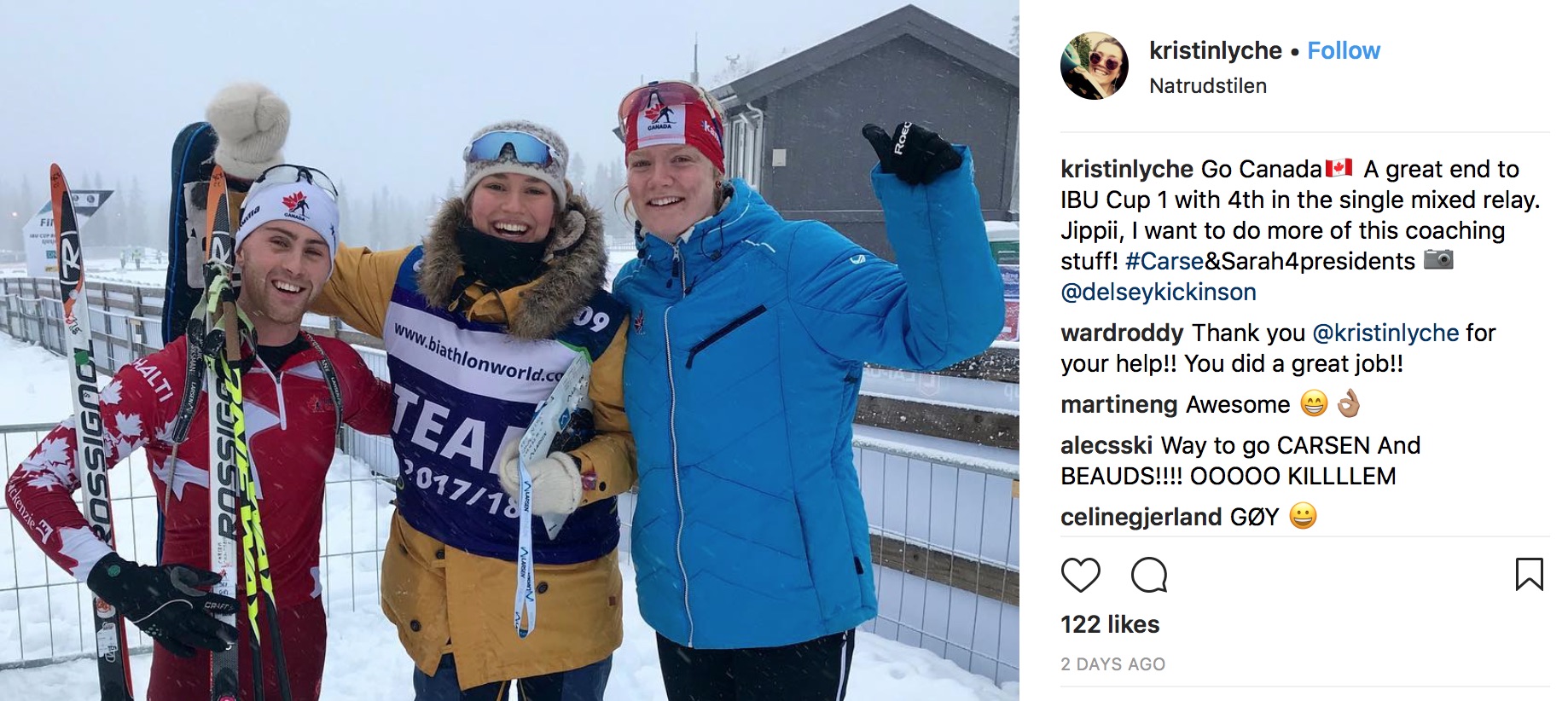
    Carsen Campbell and Sarah Beaudry (Photo: Kristin Lyche Instagram)

    Three Canadians and one American competed at last week’s International Biathlon Union (IBU) Cup opener in in Sjusjøen, Norway, with Canada’s Emma Lunder posting an individual top 20 and her teammates Sarah Beaudry and Carsen Campbell teaming up to place fourth in the single mixed relay on Sunday, Nov. 26.

    In an email, Biathlon Canada High Performance Director Roddy Ward explained that Canada did not send its full IBU Cup team to the season-opening races, as IBU Cup #1 was not part of the national team’s plan.

    “Current [national team] athletes were sanctioned to race, at their own expense, if they felt it would prepare them better for the season,” Ward wrote.

    That created some additional legwork for those three athletes, as well as fellow national-team members Scott and Christian Gow and Brendan Green, who arrived in Europe on Nov. 12 to race at Norwegian trials Nov. 18-19 in Sjusjøen.

    “Scott Gow was in charge of booking accommodations for everyone, and we ended up in an awesome little cabin in the woods quite close to the venue [in Sjusjøen],” Lunder, a 26-year-old Senior National Team member, wrote in an email. She and Campbell, of the National “Z” Team, arrived in Europe on Nov. 16 in an effort to get some early season racing in as well.
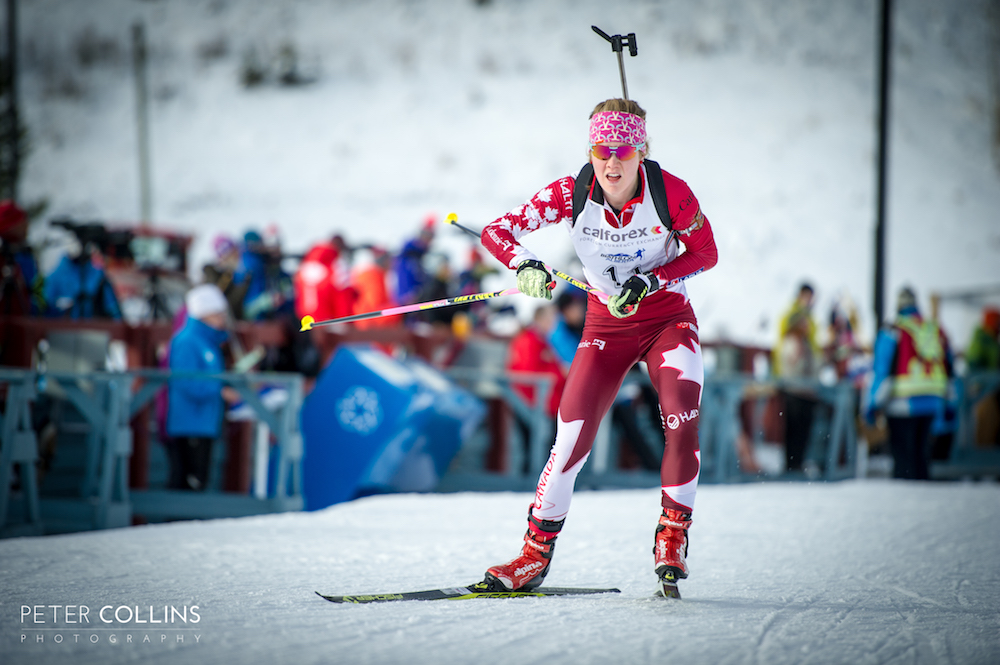
    Emma Lunder (Biathlon Canada Senior National Team) racing to second in the women’s modified sprint on Friday, Nov. 10, the last day of Biathlon Canada’s team trials. After reaching the podium three times in three races, she was selected to the IBU World Cup team for the first trimester. (Photo: Peter Collins/petercollinsphoto.com)

    “I also wasn’t sure whether I’d qualify for [World Cup] or IBU Cup from our Canadian trials, so just having the trip booked was some security for me, knowing that no matter what happened with trials, the next goal was to go and perform well in Sjusjoen which definitely helped me feel less pressure at trials,” added Lunder, who earned one of two remaining women’s spots on Canada’s World Cup team based on her results at team trials earlier this month in Canmore, Alberta.

    On Thursday, Nov. 23, Lunder placed 19th in the IBU Cup’s opening 7.5-kilometer sprint. After that, she headed to Östersund, Sweden, to prepare for the first World Cup of the season. In Östersund, she was part of Canada’s team that placed 15th in the mixed relay on Sunday.

    “Emma had a solid first race considering travel,” Ward noted of her IBU Cup performance. “The plan was for Emma to go early and race one IBU Cup before heading to Ostersund. 19th was definitely a good showing but I believe we’ll see more from Emma this season.”

    Lunder wrote that she was pleased with her sprint result on Thursday, especially considering the weather, which she described as “extreme fog and also a lot of wind.”

    “During our zero the coaches couldn’t even use their scopes – they closed the range so coaches could run down, grab the paper that had been shot at, and then athletes made corrections off of that,” Lunder reflected. “I was happy that through all of it I was quite relaxed, even thought it was a very different situation than I’m normally used to pre-race!”

    With three penalties, two in her prone shooting stage and another in standing (2+1), Lunder finished 2:18.5 behind Russia’s Uliana Kaisheva, who won in 21:49.8 with clean shooting (0+0).

    “Of course I hoped to hit a few more targets, but I think given the conditions I did an okay job,” Lunder wrote. “My skiing felt pretty strong, and it was nice to get the season started in a low-stress environment.”

    Norway’s Thekla Brun-Lie placed second in that race (+41.9; 0+1), and Russia had two on the podium with Olga Iakushova in third (+1:18.8; 0+1). In fact, Russia had four in the top five in the women’s opening sprint.
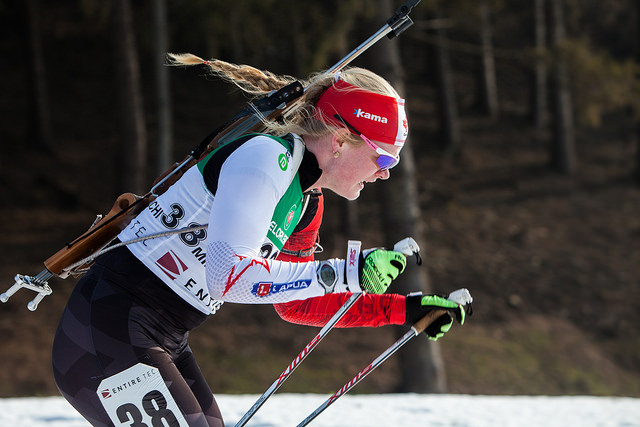
    Sarah Beaudry racing in 2015 (Photo: Jake Ellingson)

    Beaudry, who will be starting her season on Canada’s IBU Cup team, finished 49th (+3:57.1) with five penalties (4+1). American Kelsey Dickinson placed 76th (+6:05.0) with six penalties (3+3), out of 97 women.

    “My first sprint just wasn’t so great,” Beaudry, a 23-year-old Senior National Team member, wrote in an email. “I didn’t have a great zero and found it pretty hard to see in the fog and missed 4 prone and then crashed in the penalty loop. … I was happy with my effort and got to shake out the early season jitters in some challenging conditions.”

    Thursday kicked off with the men’s 10 k sprint, in which Campbell, also of Canada’s IBU Cup team, finished 35th with one penalty (0+1), out of 128 men. His time was 2:00.1 minutes behind French winner Emilien Jacquelin, who won in 25:26.1 with one standing miss as well (0+1). Jacquelin won by 5.7 seconds over Germany’s Johannes Kuehn, who placed second after skiing three penalty laps (0+3). Russia’s Alexey Slepov placed third (+8.1) with one miss in each stage (1+1).

    Two days later on Saturday, Nov. 25, it was back to more sprinting for the men and women. Beaudry raced to 23rd in the women’s 7.5 k sprint (+1:15.5) with a single standing miss (0+1) and Dickinson finished 86th (+3:56.6) with three penalties (1+2). Campbell placed 76th in the men’s 10 k sprint (+3:21.3) with four penalties (2+2).

    “I am happy with my second sprint,” Beaudry wrote. “I felt really good skiing but I think there is still room for improvement as the season goes on. I was also pretty happy with my shooting except kinda pissed that my miss was my last shot.”

    “Sarah’s second sprint was very strong,” Ward noted. “Time back from leader was very good. Sarah made big gains this offseason and I know she’s happy with it but looking for more. Carsen had a good first race and then struggled in the 2nd race. Carsen has been looking solid all fall and I’d like to see him score some top 20 results.”

    Germany’s Denise Herrmann won the women’s sprint in 20:43.9 with two penalties (1+1). Austria’s Katharina Innerhofer hit all 10 of her targets (0+0) to place second (+4.0), and Brun-Lie shot clean as well to reach the podium for the second-straight race, this time in third (+15.8).

    Norway went 1-2 in the men’s sprint with World Cup biathlete Tarjei Bø beating Fredrik Gjesbakk by 23.7 seconds in 23:00.1. Both had one standing miss (0+1), and Russia’s Eduard Latypov shot clean to finish third (+31.2).

    On Sunday, while Lunder was racing the mixed relay in Östersund, Beaudry and Campbell raced to fourth in the single mixed relay in Sjusjøen, missing the podium by 13.2 seconds and finishing 1:10.9 out of first. Together, they used five spares and avoided the penalty loop (0+5).
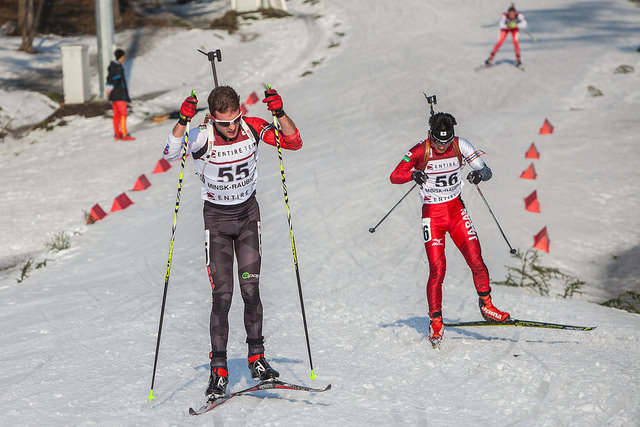
    Carsen Campbell (l) racing in 2015. (Photo: Jake Ellingson)

    “Carsen and I definitely put together a really strong relay and had some really good shooting which is key in the single mixed relay,” Beaudry wrote.

    She used three total spares to clean, two of which were in her first prone stage. Campbell used two spares: one in each of his prone stages.

    “I was very happy with my shooting today,” wrote Campbell, who turns 23 on Dec. 9. “My standing was as close to perfect as I have ever done and I made it through the prone with no major issues. I was near the front for the whole race so I felt a lot of pressure not to blow the good work Sarah had put down. It was nice to see that I was able to handle it without cracking.

    “Hopefully we get the chance to try again in Lenzerheide, I think we could make the podium,” he added, referring to the next IBU Cup in Switzerland, which opens Dec. 8 with relays.

    Ward explained that a relay podium was a realistic goal for Beaudry and Campbell.

    “Single mixed is a bit of a different race and hard to completely compare to traditional race distances,” Ward wrote. “Sarah was born for this race, she has unbelievable speed in short distance and is a quick and accurate shooter. Carsen is also great in the range and can hold his own on course. I knew in the weeks leading up that they had a shot at the podium, and they were close.”

    France’s Julia Simon and Antonin Guigonnat won the single mixed relay after leading from the first leg. Despite Guigonnat having to ski one penalty lap on the last leg, they won by 36.7 seconds in 37:33.1, with one penalty and seven spares (1+7). Sweden, with Elisabeth Hoegberg and Tobias Arwidson, placed second with no penalties and five spares (0+5), and Austria captured third place (+57.7) with Innerhofer and David Komatz (1+9).

    “My plan since the summer has been to come here to get the bugs out and be ready to go 100% by Lenzerheide,” Campbell explained. “Having a good relay today was a bonus! My sprints need some work but that’s why I’m here. Overall I’d say IBU Cup 1 has been a success for me and I’m excited for the next one!”

    “With last season being a really hard year for me I definitely went into the season nervous,” Beaudry explained. “I didn’t have any specific expectations I was just hoping for better feelings then last year. Considering I already have had a better IBU cup race result then last season and my best relay result on the IBU cup, I can say I am happy with how the season is starting.

    “This trip to race the IBU cup 1 was on our own and I definitely owe a big thanks to Carsen and Emma for organizing it all and letting me tag along last minute, as well as our Norwegian friend Kristin Lyche for hosting, coaching and taking care of us here in Norway,” Beaudry wrote, referring to a Norwegian friend whom they spent several months training with in Canmore this summer.

    Lyche housed Beaudry upon her arrival in Sjusjøen, and Lunder and Campbell moved from their cabin rental to Lyche’s place on Nov. 23.

    “And to the Italian team for waxing my skis all week,” Beaudry added. “Going to races without an official team can definitely be a little more challenging but I think it has been super beneficial and I am really happy that I came to Norway.”

    “I had contacted the Italian team back in the fall,” Lunder explained, “and when Sarah Beaudry booked her trip last minute after trials, they also agreed to support her which was great. The race skis they prepared for me for Thursday’s sprint were really, really fast, so I was extremely grateful to them! … Overall it wasn’t as stressful as I expected to organize our own trip, and I would plan on doing something similar again next year if need be!”

    IBU Cup 1 results: 

    Day 1 sprint: Men | Women

    Day 2 sprint: Men | Women

    Day 3 relays: Single mixed | Mixed

    https://www.instagram.com/p/Bbraua1gBZQ/?taken-by=emmalunds

  • Wednesday Rundown: IBU Open European Championships

    Wednesday Rundown: IBU Open European Championships

    Russia's Alexander Loginov racing to the win in the men's 20 k individual on Wednesday, the first race of 2017 IBU Open European Championships in Duszniki-Zdrój, Poland. (Photo: IBU)
    Russia’s Alexander Loginov racing to the win in the men’s 20 k individual on Wednesday, the first race of 2017 IBU Open European Championships in Duszniki-Zdrój, Poland. (Photo: IBU)

    IBU Open European Championships (Duszniki-Zdrój, Poland): 15/20 k individual

    The Open European Championships, a five-day International Biathlon Union (IBU) sanctioned event, opened Wednesday with the men’s 20-kilometer and women’s 15 k individual races in Duszniki-Zdrój, Poland.

    Russia took first and second in the women’s race, with 29-year-old Irina Starykh — coming off a two-year ban for EPO use — winning by more than a minute over her teammate Svetlana Sleptsova. Starykh hit all 20 targets en route to the victory 44:24.7 minutes, which was 1:03.8 faster than Sleptsova, who had one penalty (0+1+0+0) in second. Ukraine’s Anastasiya Merkushyna placed third (+1:05.0) with one penalty as well (0+1+0+0).

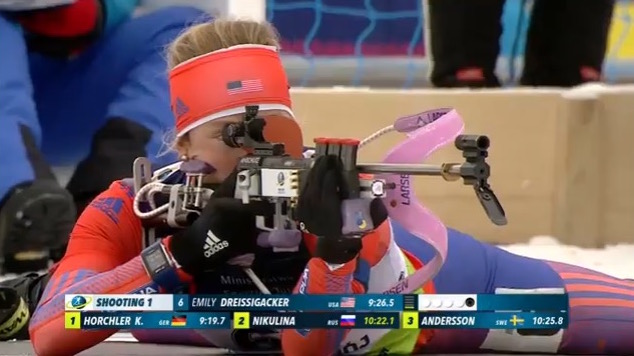
    American Emily Dreissigacker shooting clean during her first prone stage of the women's 15 k individual on Wednesday at 2017 IBU Open European Championships in Duszniki-Zdrój, Poland. She finished 41st.
    American Emily Dreissigacker shooting clean during her first prone stage of the women’s 15 k individual on Wednesday at 2017 IBU Open European Championships in Duszniki-Zdrój, Poland. She finished 41st.

    Emily Dreissigacker led the two U.S. women in the race in 41st (+7:47.6) with four penalties (0+1+1+2). Hallie Grossman finished 52nd (+9:06.1) with four misses as well (1+1+2+0).

    Canada’s Leilani Tam von Burg finished 58th (+9:54.2) with two penalties (0+0+1+1), and Erin Yungblut was 60th (+10:13.4) with three misses (0+2+0+1).

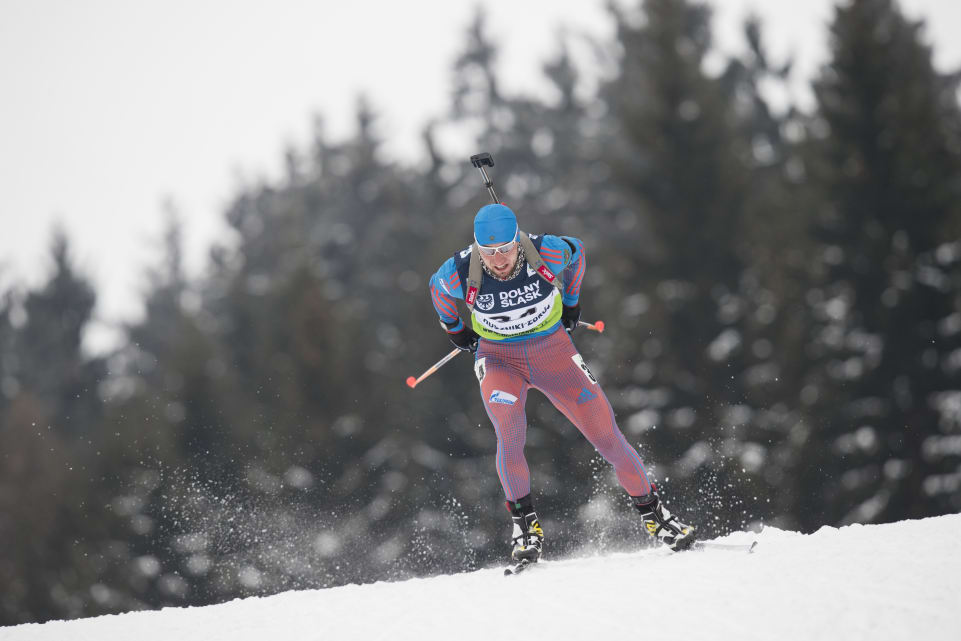
    Russia took first in the men’s 20 k as well, with 24-year-old Alexander Loginov — who also recently served a two-year ban for testing positive for EPO — winning by 11.4 seconds in 44:54.9. He had one penalty in his first prone stage (1+0+0+0) but cleaned the next three stages. Bulgaria’s Krasimir Anew cleaned (0+0+0+0) for second (+11.4), and Russia had two on the podium with Alexey Slepov in third (+53.6), with clean shooting as well.

    Russia swept fourth through six, putting five in the top six.

    Russell Currier led the American men in 51st (+5:42.5) with five penalties (2+2+0+1). Paul Schommer placed 57th (+6:02.5) with five misses as well (2+0+1+2), Max Durtschi was 62nd (+6:44.2) with two misses (1+0+1+0), Alex Howe 79th (+8:46) with three misses (0+1+0+2), Jakob Ellingson 87th (+10:11.3) with seven misses (2+4+1+0), and Michael Gibson 94th (+11:58.3) with six penalties (1+1+1+3).

    Carsen Campbell was the top Canadian in 64th (+6:58.2) with two misses (0+1+1+0). Matthew Neumann finished 68th (+7:26.0) with three misses (0+1+0+2), Aidan Miller was 72nd (+8:07.9) with two miles (0+1+0+1), Matthew Hudec 98th (+12:29.5) with seven misses (1+1+2+3), and Pearce Hanna 101st (+14:07.1) with seven misses (2+2+2+1).

    Racing continues Friday with the men’s 10 k and women’s 7.5 k sprints.

    Results: Women | Men

  • Schempp Holds Steady with Pursuit Win; Burke Back in Top 10 in Ninth

    Schempp Holds Steady with Pursuit Win; Burke Back in Top 10 in Ninth

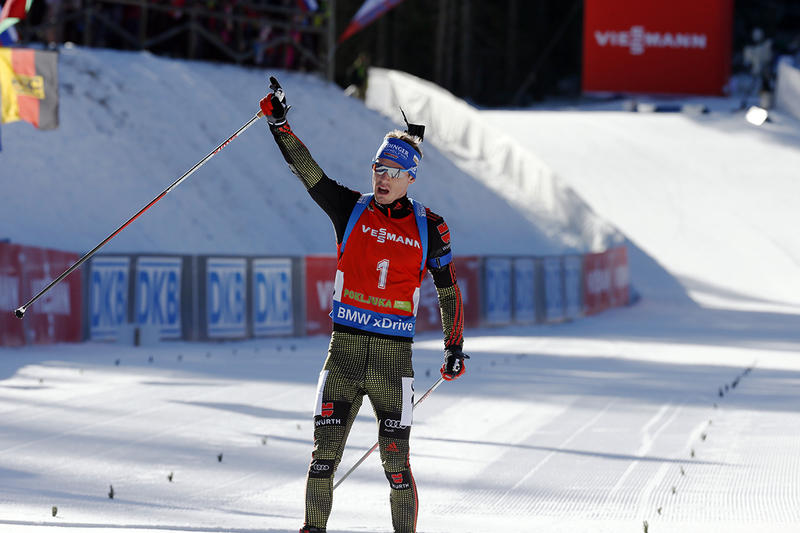
    Simon Schempp of Germany celebrates his second-straight win at the men's 12.5 k pursuit in Pokljuka, Slovenia. (Photo: IBU/Kvetoslav Frgal)
    Simon Schempp of Germany celebrates his second-straight win at the men’s 12.5 k pursuit in Pokljuka, Slovenia. (Photo: IBU/Kvetoslav Frgal)

    Perfection in a pursuit. That’s what’ll get you ahead and keep you there, as Germany’s Simon Schempp demonstrated on Saturday at the International Biathlon Union (IBU) World Cup in Pokljuka, Slovenia.

    Two days after winning the men’s 10-kilometer sprint, Schempp started the 12.5 k pursuit with a 15-second head start on Norway’s Ole Einar Bjørndalen in second. Twenty-five and 26 seconds back in third through fifth, respectively, Russia’s Evgeniy Garanichev and Alexey Slepov and France’s Martin Fourcade set out after Schempp.

    After placing third in the sprint, Garanichev fell out of contention for another podium with a miss in the first prone stage. He went on to clean the next two stages, but missed another on the final standing to end up sixth overall.

    Slepov fared worse, with two penalties in each of the first two prone stages, then one in each standing for a total of six penalty laps. He placed 25th at the end of the day, while Schempp controlled the race from start to finish, winning with perfect 20-for-20 shooting in a time of 30:46.5.

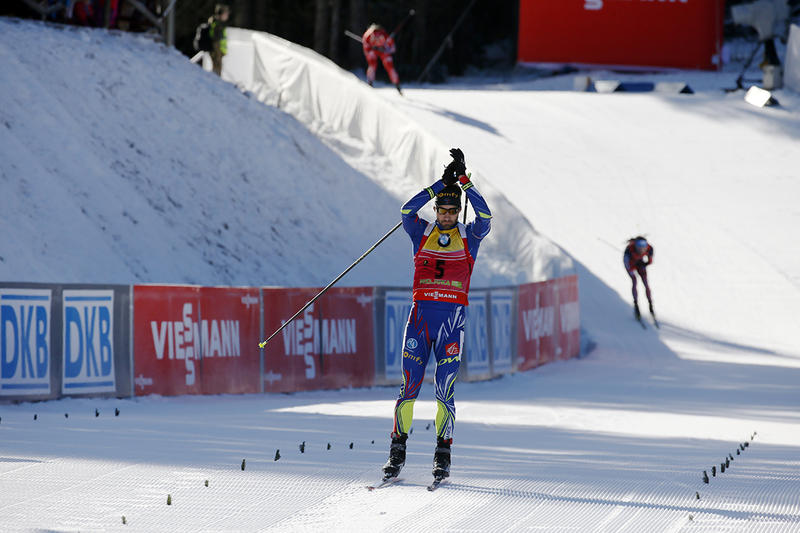
    Martin Fourcade of France finishing second in the IBU World Cup pursuit on Saturday in Pokljuka, Slovenia.  (Photo: IBU/Kvetoslav Frgal)
    France’s Martin Fourcade finishing second in the IBU World Cup pursuit on Saturday in Pokljuka, Slovenia, while Russia’s Anton Shipulin enters the finishing straight for third. (Photo: IBU/Kvetoslav Frgal)

    Only Fourcade, the fifth starter, came close, rivaling Schempp with clean shooting through the first three stages. The Frenchman missed one on the last standing, which put him 18.4 seconds back leaving the range after a costly penalty loop. He finished 16.6 seconds after Schempp in second, and Russia’s Anton Shipulin rose from sixth to third with the fastest course time.

    Shipulin finished 23.4 seconds after Schempp with two penalties (0+1+1+0), besting Norway’s Tarjei Bø, who was 1.8 seconds off the podium in fourth. Bø posted the second-fastest course time to pick off five places after starting ninth.

    Only three out of 59 finishers cleaned the four-stage race: Schempp, France’s Simon Fourcade (who placed 10th), and Sweden’s Fredrik Lindström (14th).

    “Maybe the last 200 meters were easy. Everything else was extremely hard,” Schempp said in an post-race interview with ZDF. “I didn’t quite have my best day out on the course today, and except for one loop with Martin, I always had to ski in front alone. That was quite energy-sapping.”

    Fourcade was the fastest out of the start early on, racing from fifth up to third behind Schempp and Bjørndalen as they entered the range for the first time. There, all three men cleaned and Bjørndalen left the range nine seconds after Schempp in second while Fourcade was another 10 seconds back in third.

    Second prone was more of the same, with the three leaders cleaning, yet Schempp maintained his distance with a 10-second cushion to Fourcade and Bjørndalen skiing together in second and third.

    On the third loop, Fourcade, 27, dropped the 41-year-old Norwegian and entered the range right behind Schempp, where the top two cleaned all five targets once again. They set out on the penultimate loop together, where Fourcade made clear that he did not want to take the lead. Despite shooting faster, he waited for Schempp to go ahead of him.

    Germany's Simon Schempp and his smoking gun. Schempp shot 100 percent on Saturday to win the men's pursuit at the IBU World Cup in Pokljuka, Slovenia.  (Photo: IBU/Kvetoslav Frgal)
    Germany’s Simon Schempp and his smoking gun. Schempp shot 100 percent on Saturday to win the men’s pursuit at the IBU World Cup in Pokljuka, Slovenia. (Photo: IBU/Kvetoslav Frgal)

    “That was the same as last week, he just didn’t want to go in front,” Schempp said of Fourcade. “He had shot faster, then he stepped to the side and wanted to let me pass. I just yelled ‘Together!’ to him, and then he nodded and we changed back and forth. At first there was a bit of a disagreement, but then that calmed down…”

    “I don’t really understand why he does that sometimes,” Schempp added. “We were in front, but the others are pressuring from behind, and if you work together, you should be faster and can create a small gap. My opinion is that you should work together, except for the last loop of course, but before that, yeah, I just have a slightly different opinion than him.”

    “We collaborated a lot …,” Fourcade said in a post-race press conference. “It was a good solution. We were making sure we had positions one and two.”

    In the final standing stage, Fourcade shot quickly, but missed the fourth shot, while Schempp cleaned.

    “In the last shooting, I thought his second shot had missed. At least it sounded that way,” Schempp recalled.

    “Before the race, I thought that I would try to do all I can to be first,” Fourcade said in the press conference. “Simon was a little calmer at the last shooting. He had his own rhythm.”

    Fourcade came out of the penalty lap with an 18.4-second deficit, which proved insurmountable. He skied what appeared to be comfortable pace to the finish for second, 6.8 seconds ahead of Shipulin. After the race, Fourcade and Schempp hugged each other. It was Schempp’s eighth World Cup victory, his third win this season, and the third time he won both a sprint and the following pursuit in the same venue.

    While Shipulin secured third on the final loop, he overcame a couple penalties. One miss in the second stage dropped him to eighth, and he left the range after another penalty in the third stage in sixth. When Bø missed one in the final shooting, Shipulin seized the opportunity and cleaned when it counted, leaving the range in fourth, three seconds behind Bø and passing him on the final loop to avoid a sprint to the finish.

    “After the second penalty loop, I thought it was possible,” Shipulin said in a press conference. “I was hoping to shoot clean and thought I had a chance to get on the podium.”

    According to the IBU website, with one race to go — Sunday’s mass start — Shipulin is eager to see his newborn son.

    “I want to go home and see my son, but I try to stay motivated and focused on the upcoming competitions,” he said.

    Burke Cracks Top 10

    American Tim Burke (14) during one of his last two standing stages, while shooting alongside a German, Slovenian, and Russian. (Photo: IBU/Kvetoslav Frgal)
    American Tim Burke (14) during one of his last two standing stages, while shooting alongside a German, Slovenian, and Russian. (Photo: IBU/Kvetoslav Frgal)

    After starting 14th and 55 seconds behind Schempp, American Tim Burke improved to ninth with a single penalty (0+0+1+0), finishing 1:21.9 behind the German winner.

    “[I’m] really happy with today; I had a really simple game plan with my shooting to try to stick to my few key words,” Burke said in a post-race phone interview. “I felt really comfortable out there.”

    He skied alone for most of the race, which he found both odd and challenging. Burke started 9 seconds behind the 13th starter, Simon Desthieux of France, and four seconds ahead of US Biathlon teammate Lowell Bailey.

    After cleaning the first prone stage, Burke had made his way up to 11th and 50.7 seconds behind Schempp, while Bailey had slipped one spot to 16th, 1:02 back. Both Americans cleaned the first shooting, but Bailey went on to miss one in each stage thereafter (0+1+1+1) and ended the day in 29th (+2:46).

    “Not a bad day for me, but without near perfection, it’s hard to compete with this field,” Bailey said in a US Biathlon press release. “There was great overall shooting in the men’s field today so I lost a few places with penalties in each of the last three stages.”

    Meanwhile, Burke cleaned the second prone and missed one on the third shooting to hover in the top 10 throughout the race. After hitting all his targets on the final standing, he left the range in ninth. Simon Fourcade trailed him by almost seven seconds in 10th at the beginning of the last loop, while Norway’s Emil Hegle Svendsen was almost 18 seconds ahead in eighth.

    Tim Burke (US Biathlon) racing to ninth in the men's 12.5 k pursuit on Saturday at the IBU World Cup in Pokljuka, Slovenia. (Photo: USBA/NordicFocus)
    Tim Burke (US Biathlon) racing to ninth in the men’s 12.5 k pursuit on Saturday at the IBU World Cup in Pokljuka, Slovenia. (Photo: USBA/NordicFocus)

    That left Burke in no-man’s land once more. On the first loop, he had worked hard to catch the group that was fighting for top-10 results, and while he bridged the gap 500 meters before the range, he exited the range just far enough behind those skiers that he remained alone, one loop after another.

    “It was a little bit tougher for sure,” he said of the solo race. “I was hoping I’d be able to tuck in on the second loop and catch a little bit of a break.”

    Burke worked especially hard the first couple loops to catch those ahead of him and said he felt the effects of that effort later in the race. Still, he held on and most importantly held it together for the last shooting.

    “So much can change on the last shooting…,” Burke said. “I was hoping that people would finally start making mistakes there on the end. The last shooting, I shot on point 11 and shot zero and moved up one place. I was really happy to move back into the top 10; it’s the best race I’ve had in a while.”

    At the same time, he reflected on how tight the race was. Given the race he had, with 19-for-20 shooting and the 19th-fastest course time, Burke would have guessed he would have finished in the top six. Not the case when the fastest guys don’t have to ski many penalty laps.

    “It’s a fairly easy approach to the range here of so a lot of people shoot well here,” he noted.

    Burke will be one of three North Americans starting Sunday’s 15 k mass start, with Canada’s Nathan Smith in bib 12, Bailey in 19th and Burke in 26th out of 30. Three seasons ago, Burke placed third in the Pokljuka mass start.

    “I think it’ll be a great opportunity for me,” Burke said. “Typically I do well at the end of these trimesters … these three weeks of racing.

    “At this point, fatigue definitely plays a big role for everyone, both mentally and physically,” he added. “A lot of people want to get home at this time. … For me, it’s one more race. I need to focus for 40 minutes out there and I think I can handle that.”

    On Monday, the day after the Pokljuka World Cup ends and the IBU World Cup goes on holiday break, he’ll fly home to Lake Placid, N.Y.

    While Bailey was the second man for the U.S. in 29th, Brendan Green was the top Canadian in 30th (+2:53.3). After starting 46th and cleaning the first three stages, Green missed two on the last standing and fought for a top 30 on the final loop.

    For the first time in history, five Canadian men started the pursuit. Smith finished 35th (after starting 24th) with three penalties (1+0+2+0). Scott Gow started 35th and finished 45th with four misses (1+1+2+0), and Macx Davies slipped from 34th to 57th with six penalties (3+2+2+1). Despite skiing in the top-30 for a portion of the race, Christian Gow, in bib 37, did not finish.

    “On my fourth lap I developed a debilitating cramp and had to stop the race,” Gow wrote in an email about his DNF. “I really wanted to finish, especially since I was having a good race, but I simply couldn’t. It is disappointing for me, but sometimes these things are out of your own control.”

    “It was a tough day for our team,” Biathlon Canada’s High-Performance Director Eric de Nys said in a press release. “The coaches are thinking there may be a bit of a flu bug going around. Nathan and Rosanna [Crawford] both felt off today. Christian completely cramped up and Megan [Tandy] blacked out on the course. It was an off day, but they will review the day with the athletes and bounce back from this.”

    American Leif Nordgren made up a few spots in 49th (after starting 52nd) despite four penalties (0+1+2+1).

    Results | Mass start extended start list

  • Schempp Rolls to Perfect Sprint Victory in Pokljuka; Burke 14th, Bailey 15th for U.S.

    Schempp Rolls to Perfect Sprint Victory in Pokljuka; Burke 14th, Bailey 15th for U.S.

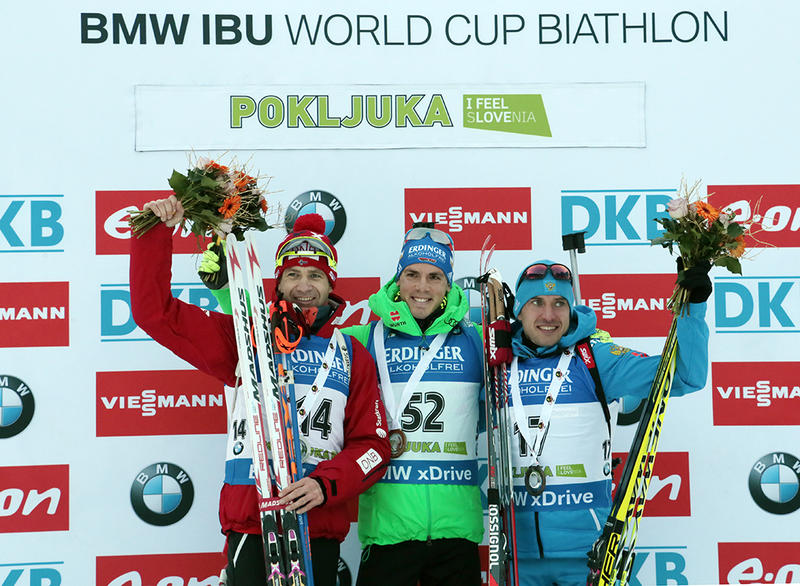
    The men's sprint podium at the IBU World Cup in Pokljuka, Slovenia, with winner Simon Schempp (c) of Germany, Norway's Ole Einar Bjørndalen (l) in second, and Russia's Evgeniy Garanichev (r) in third. (Photo: IBU/Kvetoslav Frgal)
    The men’s sprint podium at the IBU World Cup in Pokljuka, Slovenia, with winner Simon Schempp (c) of Germany, Norway’s Ole Einar Bjørndalen (l) in second, and Russia’s Evgeniy Garanichev (r) in third. (Photo: IBU/Kvetoslav Frgal)

    Does anybody remember when Simon Schempp placed 77th in the first International Biathlon Union (IBU) World Cup sprint of the season two weeks ago in Östersund, Sweden? The German missed four out of five targets in each of two shooting stages for an insurmountable eight penalties. That was three days after he placed second in the 20-kilometer individual race, in which he hit 19-of-20 targets.

    As the best biathletes know, sometimes you’ve got it, sometimes you don’t.

    Lowell Bailey (US Biathlon) cleaned the IBU World Cup sprint to place 15th on Thursday in Pokljuka, Slovenia. (Photo: USBA/NordicFocus)
    Lowell Bailey (US Biathlon) cleaned the IBU World Cup sprint to place 15th on Thursday in Pokljuka, Slovenia. (Photo: USBA/NordicFocus)

    However, Schempp, 27, appears to be on something of a streak after winning his second-straight sprint in the last two World Cup weekends: he fired on all cylinders and cleaned to win in Hochfilzen, Austria, then topped Norway’s Ole Einar Bjørndalen with some blazing-fast loops in Pokljuka, Slovenia, to win the men’s 10 k sprint on Thursday.

    With a winning time of 23:02.5, Schempp shot 100 percent with the best of them: Bjørndalen in second (+15.2) also cleaned, as did the two Russians in third and fourth — Evgeniy Garanichev (+25.1) and Alexey Slepov (+25.3), respectively.

    France’s Martin Fourcade was fastest with a single miss (0+1) and ended up fifth (+25.6).

    “I just felt good again today,” Schempp told the German broadcaster ZDF after the race. “Everything worked well on the shooting range again. The conditions for shooting were very good. … I felt good on the track, and of course it’s crazy if it was sufficient again today.”

    For Schempp, the World Cup victory was his seventh in his career and it came on a day with practically invariable conditions. The sun was shining in Pokljuka and there wasn’t much wind, helping nine of the eventual top-15 finishers hit all of their targets.

    Norway’s Tarjei Bø racing to ninth on Thursday at the IBU World Cup sprint in Pokljuka, Slovenia. (Photo: IBU/Kvetoslav Frgal)
    Norway’s Tarjei Bø racing to ninth on Thursday at the IBU World Cup sprint in Pokljuka, Slovenia. (Photo: IBU/Kvetoslav Frgal)

    While Schempp started 52nd and picked off his biggest rivals for the win, including Bjørndalen in bib 14, Garanichev in bib 17 and Fourcade in bib 20, with the second-fastest overall course time, US Biathlon’s Lowell Bailey started seventh and cleaned both stages for his moment in the spotlight.

    Albeit briefly, Bailey was initially first at the finish after holding off Norway’s Tarjei Bø on the final loop. Bø started 30 seconds behind Bailey, and ultimately bested the American’s time by 22.2 seconds. With a single standing penalty (0+1), Bø placed ninth overall (+36.9), while Bailey settled into 15th (+59.1).

    “Although I started out fairly slow in the first lap, I was happy that I was able to keep Tarjei off my back for the final loop,” Bailey wrote in an email. “He’s in great shape right now and I wasn’t sure I could keep him behind me until the finish!”

    Bailey explained the Pokljuka course is one of his favorites on the circuit, with long gradual uphills — totaling 336 meters (1,100 feet) of climbing per loop — and several transitions. He chose the early start as he and his coaches thought the tracks would be fastest at the beginning of the race.

    There were some icy patches, as Fourcade nearly crashed on the first loop on a steep downhill where racers approached 70 kilometers per hour. Fourcade narrowly avoided skiing off the trail and finished the race 0.5 seconds off the podium.

    Germany’s Arnd Peiffer fell at the end of his first loop while approaching the range, breaking the sole of his boot and costing him valuable time. Despite clean shooting, he ended up 42nd  (+1:38.6).

    Tim Burke (US Biathlon) leads Norway's Emil Hegle Svendsen (21) on Thursday in the men's IBU World Cup 10 k sprint in Pokljuka, Slovenia. Svendsen placed 11th and Burke finished 14th. (Photo: USBA/NordicFocus)
    Tim Burke (US Biathlon) leads Norway’s Emil Hegle Svendsen (21) on Thursday in the men’s IBU World Cup 10 k sprint in Pokljuka, Slovenia. Svendsen placed 11th and Burke finished 14th. (Photo: USBA/NordicFocus)

    Bailey’s teammate, Tim Burke set out on the course in bib 37, cleaned prone and missed one standing to place 14th, 4.5 seconds ahead of Bailey. It was Burke’s first top 20 of the season.

    And Bailey, like Schempp, had recovered from 68th in the Östersund sprint (with six penalties), to place 12th in Hochfilzen with perfect 10-for-10 shooting.

    “I was really happy with the way that shooting went [today],” Bailey wrote on Thursday. “I didn’t feel 100% on the tracks, but it wasn’t bad either.”

    While Bailey had the fifth-fastest shooting time (and 41st-ranked course time), Burke was 13th-fastest on the course.

    “This is definitely one of my favorite courses,” Burke wrote in an email. “I think it suits my strengths well with long, sustained gradual climbs. I am able to V2 most of the course, which is definitely my best technique.”

    He explained he focused on his race plan rather than a specific result. In two previous sprints this season, Burke placed 30th in Hochfilzen (and 27th in the following pursuit), and 45th in Östersund. Thursday marked his best shooting in an individual race this season.

    “Of course I always want a better result but I am satisfied with my time back,” he wrote. “In the sprint last week and this week, I had the skiing to make it to the podium with clean shooting and that’s where I want to be.”

    Nathan Smith led the Canadians in 24th with 90-percent shooting (1+0). He started ninth and finished 1:15.9 back from Schempp, notably with the second-fastest shooting time and third-ranked range time of 102 finishers.

    Burke, Bailey and Smith all qualified for Saturday’s pursuit, along with four other Canadians, including Macx Davies in 34th (+1:28.8), and Scott Gow in 35th (+1:30), both with a single penalty. Christian Gow cleaned to place 37th (+1:31.3) and meet the top-60 pursuit criteria, as did Brendan Green, who had two prone misses en route to 46th (+1:47.3). American Leif Nordgren finished 52nd (+2:02), with one standing penalty, and his teammate Sean Doherty placed 71st (+2:31.3) with four misses (3+1).


    Men’s sprint results

  • Russian Coach, Barred from National Team, Still Working with Athletes

    Russian ski coach Anatoly Tchepalov. Photo, Ivan Isaev, Russian Ski Magazine.

    The Russian Ski Association (FLGR) has received high praise over the last two months for its work to combat performance-enhancing drug use. After being fined more than $180,000 this spring, the country escaped a second round of penalties at meetings of the International Ski Federation (FIS) in early November, thanks to its anti-doping efforts—which included changes in officials and coaches affiliated with scandals.

    “We know they are on the right track,” Gian Franco Kasper, the FIS president, told the Associated Press.

    But while nearly ten individuals have been barred from employment by the Russian national team, at least one coach, Anatoly Tchepalov, continues to work with athletes racing and training at an international level. Tchepalov was spotted in early November at events in Finland sanctioned by FIS, where one of his athletes, Sergei Shiriaev, skied to a victory over stars like Pietro Piller Cottrer, Tobias Angerer, and Kris Freeman.

    “He was there,” said Pepa Miloucheva, the coach of the Vermont-based Craftsbury Green Racing Project, in an e-mail. Miloucheva’s team was racing in Finland at the time.

    Tchepalov is the father and former coach of Olympic champion and convicted doper Julia Tchepalova, who was caught using the blood-boosting drug EPO at a race in 2009 and banned from the sport for two years.

    Tchepalov also coaches Shiriaev—who served a two-year ban for EPO use that ended in 2009—and Vassili Rotchev, an Olympic medalist who is married to Tchepalova.

    In a press release earlier this month, the FLGR stated that Tchepalov would not be engaged as a coach of Russia’s national team for the next four years, due to his involvement in past doping cases.

    But according to Andrey Kondrashov, a Russian Eurosport commentator, Tchepalov broke his contract with the national team two years ago—and there is nothing that the FLGR can do to keep Tchepalov from continuing to coach Shiriaev, Rotchev, and others.

    “The sports federations have no rights to disqualify coaches under the Russian Constitution and labor legislation,” Kondrashov wrote in an e-mail to FasterSkier. “That is why coaches are prohibited from working with the national team only.”

    Shiriaev and Rotchev were asked if they wanted to join the national team last spring, but in an interview with the Russian newspaper Kommersant in November, FLGR President Elena Vyalbe said that the two athletes made a decision to work with Tchepalov instead.

    The FLGR did not respond to a request for comment about Tchepalov’s status. But according to FIS Secretary General Sarah Lewis, skiers like Shiriaev and Rotchev are free to pick their own support staff.

    “According to the information received by the Russian Ski Association, Mr. Tchepalov has been removed from any coaching function within the Russian Ski Association,” Lewis wrote in an e-mail. “Athletes that are not part of the national team…can choose the coach(es) they want to train with.”

    The FLGR suspended eight other coaches aside from Tchepalov, but he is not the only one to remain in the sport. Former national team head coach Yuri Charkovsky is now the squad’s manager, while according to Vyalbe’s interview with Kommersant, another coach, Victor Smirnov, is working as a technician for the Kazakhstan team.

    Asked whether she foresaw any action to be taken against Tchepalov or other coaches in similar situations, Lewis said that issue was in the hands of the FLGR.

    “This is a matter for the Russian Ski Association to follow up as to whether the officials they have dismissed are breaching the terms of their dismissal,” she said.

    But according to Kondrashov, there is not much more that the FLGR can do. Tchepalov, he said, “works independently, without financial support from the state and federation.”

    “Tchepalov [is] not deprived of a job [as] coach, and therefore has the right under Russian law to appear in any field,” Kondrashov said.

    Kondrashov said that there are several other athletes on Tchepalov’s team, most notably 23-year-old Alexey Slepov, who took fourth at one of the races in Finland earlier this year.

    So far this winter, Tchepalov’s highest-profile skiers have competed solely in second-tier races—not on the World Cup, where thousands of dollars of prize money are at stake at each competition. But in the Kommersant interview, Vyalbe said that Shiriaev and Rotchev could make an appearance at World Championships in Oslo, if they qualified.

    Criteria for making the Russian team for that event would be released in December, Vyalbe said.