From the FasterSkier archive — posts syndicated from athletes’ and coaches’ own blogs between 2004 and 2012, kept online as published. Current coverage is at fasterskier.com.
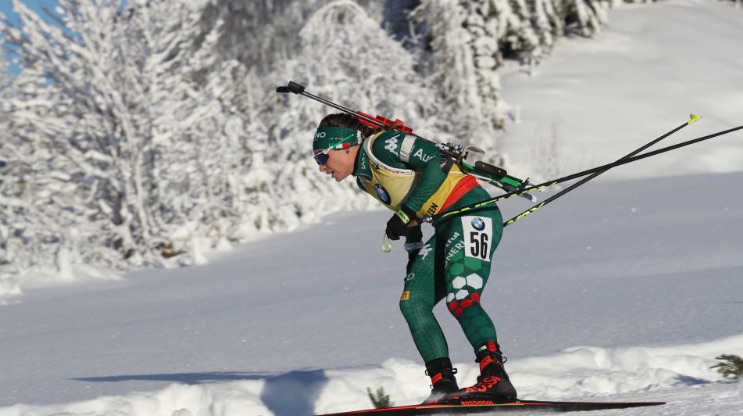
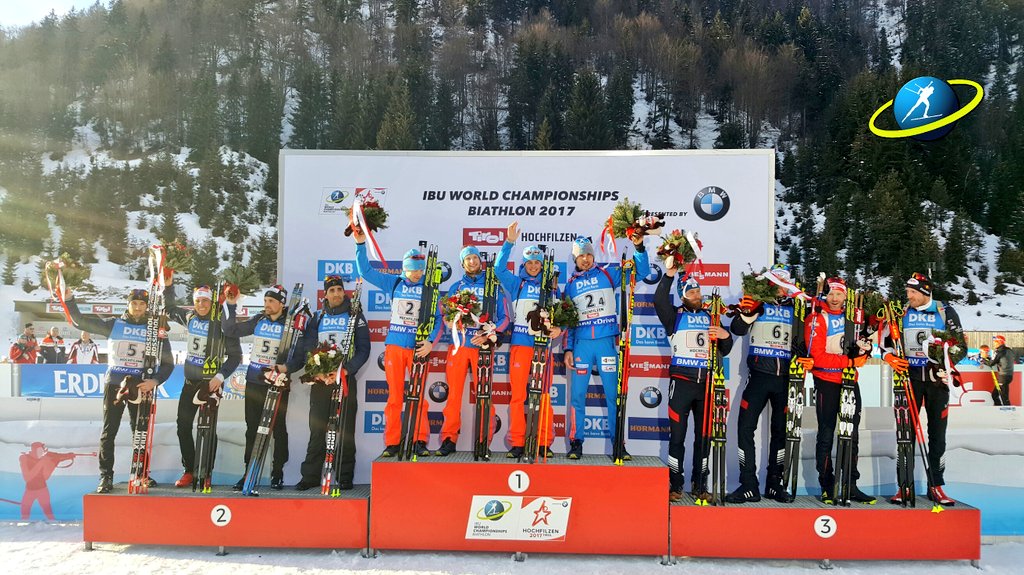
Dorothea Wierer of Italy won Thursday’s sprint in Hochfilzen, Austria in a time of 21:04.9 minutes. (photo: biathlonworld.com)
Today in Hochfilzen, Austria, Dorothea Wierer of Italy won the sprint in a time of 21:04.9 minutes. Wierer missed one shot standing for a single penalty during the race. Kaisa Mäkäräinen of Finland was close behind in second, 0.6 seconds back. Mäkäräinen also had one missed target standing. Third place went to Russia’s Ekaterina Yurlova-Percht, finishing 24.4 seconds behind. Yurlova-Percht short clean in the race.
Susan Dunklee was the best placed American in 34th (+1:33.0, 0+2). Joanne Reid was 44th (+1:48.3, 0+1), and Clare Egan 65th (+2:22.1, 2+2).
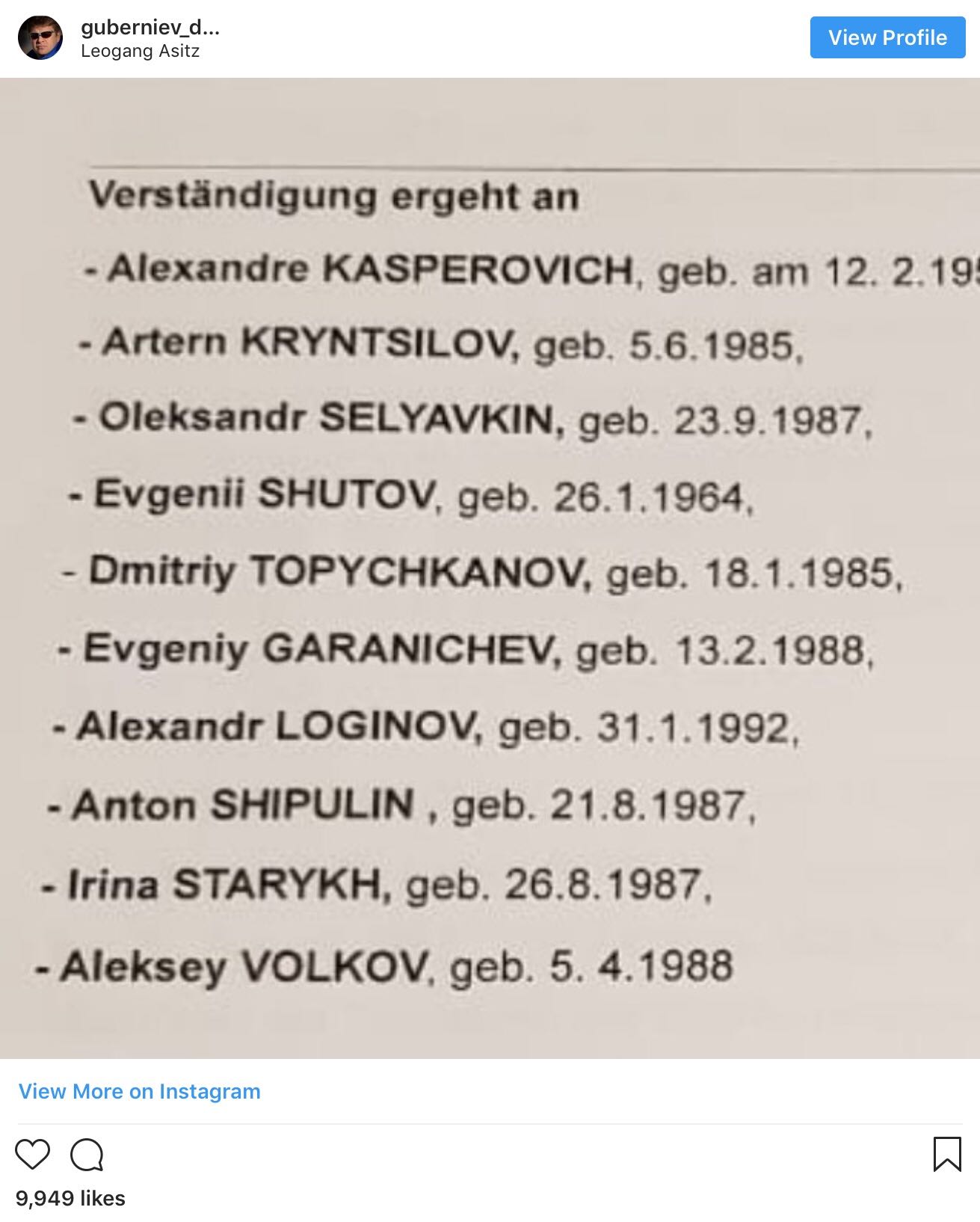
On the non-racing front, the IBU released a statement about “Austrian state authorities” investigating five Russian biathlon officials and five biathletes due to their connections to doping. The IBU stated that the possible infractions occurred during the 2017 Hochfilzen IBU World Championships.
Russian sports journalist Dmitry Guberniev has posted the names of the individuals under investigation. According to tass.com, a Russian news site, Guberniev the following people: “Among athletes accused of violating anti-doping rules are 2014 Olympic champion Anton Shipulin, Evgeny Garanichev and Alexander Loginov. The list also includes biathletes Alexey Volkov, Irina Starykh, former coach of the Russian national team Alexander Kasperovich, doctors and massage therapists Artyom Kryntsilov, Alexander Selyavkin, Evgeny Shutov and Dmitry Topychkanov,” tass.com reported.
List of people under investigation according to Russian journalist Dimitri Guberniev (Screenshot from @guberniev_dmitry)
FasterSkier will post updates about this developing story as more information is discovered
– Harald Zimmer contributed
***
NorAm and U23/JW World Championships Qualification, Canmore, Alberta
The Canadian NorAm series continued Thursday in Canmore, Alberta, with a combined NorAm and trials for U23 and Junior World Championships.
The three race weekend kicked off with classic sprints, run from the biathlon stadium which offers an uphill finish in place of the traditional long descent into the finish straight.
The selection criteria are involved, but it appears that each day four athletes will earn a spot in U23/JW World Championships in Lahti, Finland. The top athlete of each gender in U23 and junior each day should be automatically selected.
There are also World Cup period 2 (Tour de Ski) and period 3 starts on the line, with the possibility of Canadian women in the Tour de Ski for the first time since Sara Renner finished 16th in 2010.
Dahria Beatty (CNST) won the open women’s category in style, winning the qualifier in 3:51.06 by 4.96 seconds before winning all three heats by large margins.
Katherine Stewart-Jones (CNST) finished second in the A final in 3:49.60, 2.20 seconds behind Beatty after finishing second in the qualifier and winning her earlier heats. Maya MacIsaac-Jones (CNST) completed the podium, finishing 5.37 back.
Marie Corriveau was the top U23, finishing 6th in the A final after qualifying in 6th. Corriveau has struggled with results for two seasons, but her first race of the season is a very positive sign.
Anne-Marie Petitclerc (Mont Sainte Anne) won the qualifier and quarterfinal on her way to the junior win in 4:01.71. Molly Miller (Black Jack) was second at 0.68 seconds back and Anna Pryce (Foothills) took third at 7.25 seconds.
Bob Thompson (TBay) won the men’s A final in 3:19.43 by 2.31 seconds. Angus Foster (TBay) outstretched top qualifier Julien Locke (CNST) by 0.01 seconds for second. Graham Ritchie (Big Thunder) was the top U23 in 4th, 2.36 back after qualifying 6th.
Remi Drolet (Black Jack) won the junior A final in 3:31.94, after winning the qualifier and all his heats. Foothills teammates Tom Stephen and Xavier McKeever were second and third, 2.08 and 2.51 seconds back respectively. Stephen has two future seasons as a junior while McKeever has three.
All results, including live timing for the rest of the weekend.
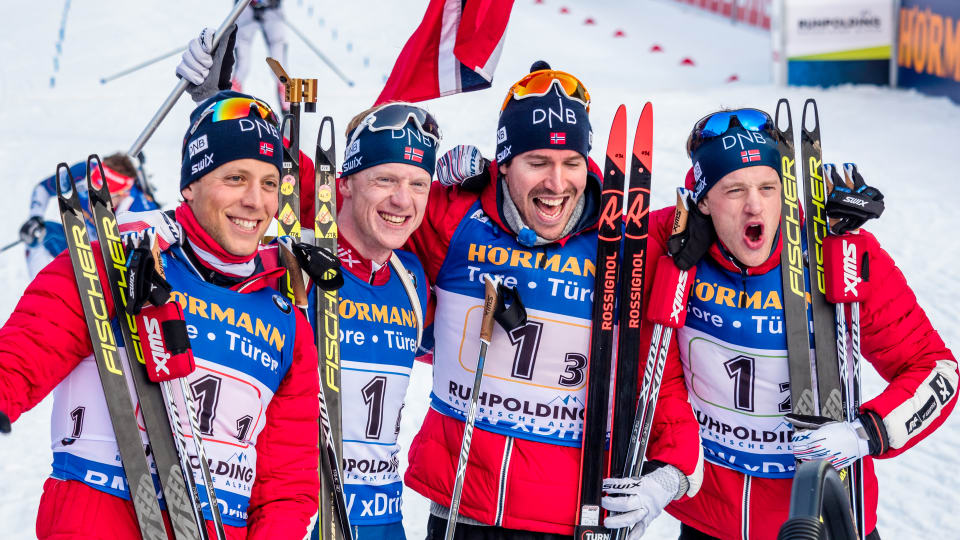
The Norwegian men’s relay after winning the 4 x 7.5 k on Friday at the IBU World Cup in Ruhpolding, Germany, with Lars Helge Birkeland (l), Tarjei Bø (far r), Emil Hegle Svendsen (second from r), and Johannes Thingnes Bø (second from l). It was their second win of the season (after winning with Ole Einar Bjørndalen, Henrik L’Abée-Lund, and Erlend Bjøntegaard, and Birkeland in the first men’s relay of the 2017/2018 season in Hochfilzen, Austria. (Photo: IBU/Biathlonworld)
IBU World Cup (Ruhpolding, Germany): Men’s 4 x 7.5 k relay
Less than a week after Sweden won the men’s 4 x 7.5-kilometer relay in Oberhof, Germany, with an up-and-coming group, Norway posted its second win (in three relays) this season, with an all-star lineup on Friday in Ruhpolding, Germany.
Lars Helge Birkeland, Tarjei Bø, Emil Hegle Svendsen, and Johannes Thingnes Bø took the lead during Johannes Bø’s anchor leg and ultimately the win in 1:13:11.1 hours, 24.9 seconds ahead of France in second and 53.4 seconds ahead of Russia in third.
On a bluebird day with no wind in the range, according to an International Biathlon Union (IBU) press release, the Norwegians avoided the penalty lap and used seven spares to clean. First-leg skier Birkeland put them in second with near-perfect shooting (0+0, 0+1), just 0.4 seconds behind Germany’s Erik Lesser, who cleaned without any spares, in first. (Birkeland was also on the Norwegian team that won the first relay of the season in Hochfilzen, Austria.)
Norway remained in second during Tarjei Bø’s second leg, in which he had to use three spares to clean prone (0+3, 0+0). He tagged Svendsen in second, 0.6 seconds behind Italy, which had risen to first thanks to Lukas Hofer’s fast skiing and solid shooting (0+0, 0+2).
Svendsen slipped slightly to third place by the final exchange despite only needing one spare to clean (0+0, 0+1), but was still just a second out of first at the tag. France had moved into first place with a predictably strong third leg from Martin Fourcade (0+0, 0+0), in which he brought the team from seventh to first place, just ahead of Italy’s Dominik Windisch and Norway’s Svendsen.
Johannes Bø skied the third-fastest anchor leg and cleaned prone and used two spares in standing (0+0, 0+2) to overtake France’s Antonin Guigonnat and Italy’s Thierry Chenal, who slipped to second and seventh, respectively, by the finish.
Guigonnat shot well, requiring just one spare (0+1, 0+0), but finished nearly 25 seconds after Bø for second place. Russia reached the podium with Anton Shipulin picking off two places, after being tagged in fifth.
In all, France had zero penalties and six spares, with Simon Desthieux, Quentin Fillon Maillet, Fourcade, and Guigonnat, and Russia used a total of just four spares and had no penalties with Alexey Volkov, Maxim Tsvetkov, Anton Babikov, and Shipulin.
Germany finished fourth (+1:26.5) with zero penalties and 10 spares, with Lesser, Benedikt Doll, Arnd Peiffer and Simon Schempp. After Doll dropped to fifth on the second leg, they skied in fourth on the last two legs.
Austria took fifth (+1:39.8) with zero penalties and six spares, with David Komatz, Simon Eder, Daniel Mesotitsch, and Dominik Landertinger. Sweden followed in sixth (+1:50.6) with zero penalties, six spares and three of the same men who won last Sunday’s relay (Sebastian Samuelsson, Martin Ponsiluoma and Fredrik Lindström) with new member Torstein Stenersen. Italy finished seventh (+1:58.5) with one penalty and 11 spares.
Of 26 teams in the relay, Canada placed 14th (+3:22.3) with one penalty and 10 spares, and the U.S. finished 24th (+16:21.6) with eight penalties (four of which stemmed from cross-firing) and 13 spares.
Notably, the U.S. had been fourth and just 3 seconds out of first after Lowell Bailey’s first leg, which he cleaned without any spares (0+0, 0+0). Leif Nordgren then dropped to 22nd with a penalty in each of his shooting stages (1+3, 1+3) and the 25th-ranked second-leg time. Tim Burke as the team’s third leg had to ski two penalty laps as well (0+2, 2+3), and anchor Sean Doherty was penalized for cross-firing in his last standing stage (0+1, 4+1), according to a US Biathlon press release, and the team was hit with four additional penalties.
“We have a solid team and I know we didn’t show our true potential today,” Bailey said, according to the release. “But the most important relay is still to come. We’ll just have to wait until then.”
“I was happy to put together a good race on the track and in the range,” he said. “The first lap was a bit of a roller derby with no easy way to get to the front. I was fortunate to clean without extra rounds because this allowed me to leapfrog up to the lead pack exiting the range. I tried to keep an even pace for loop two and I thought I would be able to hang in second or third, but no one wanted to pass so I had to lead for most of the loop.
“I had struggled in standing in the previous race so I wanted to get back to taking good shots in standing,” he added. “Although I didn’t shoot as quickly as some of the other guys, I felt good about the stage and the fact that I didn’t have to use extras. It was a fight to catch the lead group on the last loop, but fortunately I had some help from [Italy’s Thomas] Bormolini (of Italy) and we worked together to get back in contact with the lead group.”
Canada finished 14th with Christian Gow, Scott Gow, Macx Davies, and Brendan Green. On the opening leg, Christian Gow put them in 11th with clean prone shooting and just one spare needed to clean standing (0+0, 0+1), but they slipped one spot to 12th with a penalty on Scott Gow’s second leg (0+0, 1+3). Davies then dropped two more places to 14th despite avoiding the penalty lap (0+3, 0+1), and Green held that position to the finish (0+1, 0+1).
The women’s 4 x 6 k relay will be held Saturday in Ruhpolding, with Canada starting Emma Lunder, Julia Ransom, Sarah Beaudry, and Rosanna Crawford. For the U.S., it will be Susan Dunklee, Clare Egan, Emily Dreissigacker, and Joanne Reid. Watch it live on the Olympic Channel at 8:30 a.m. EST.
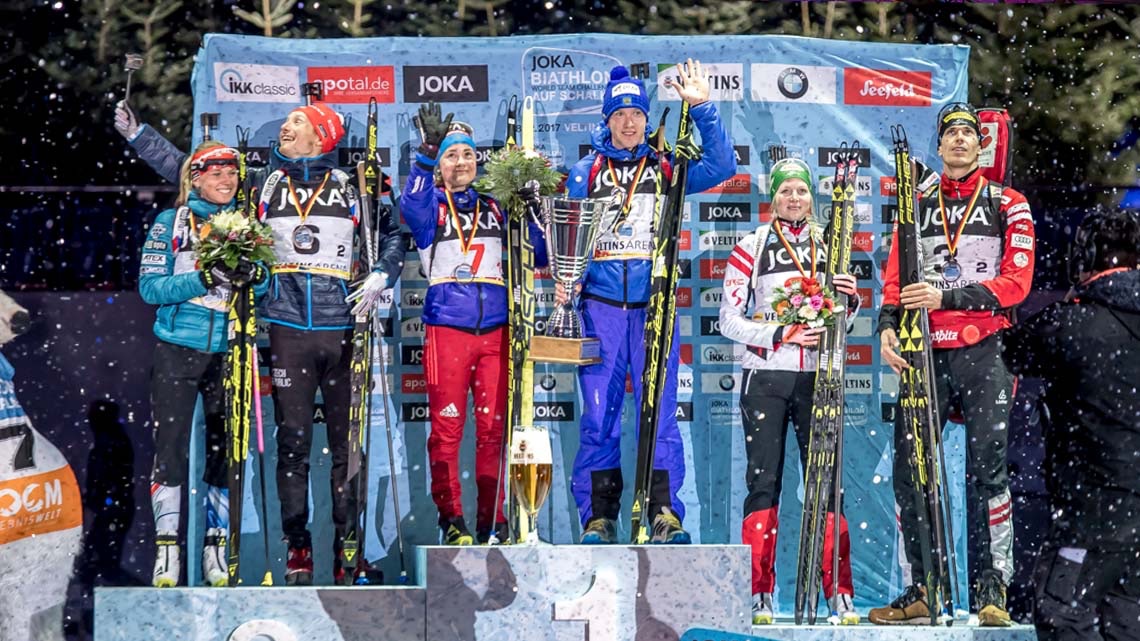
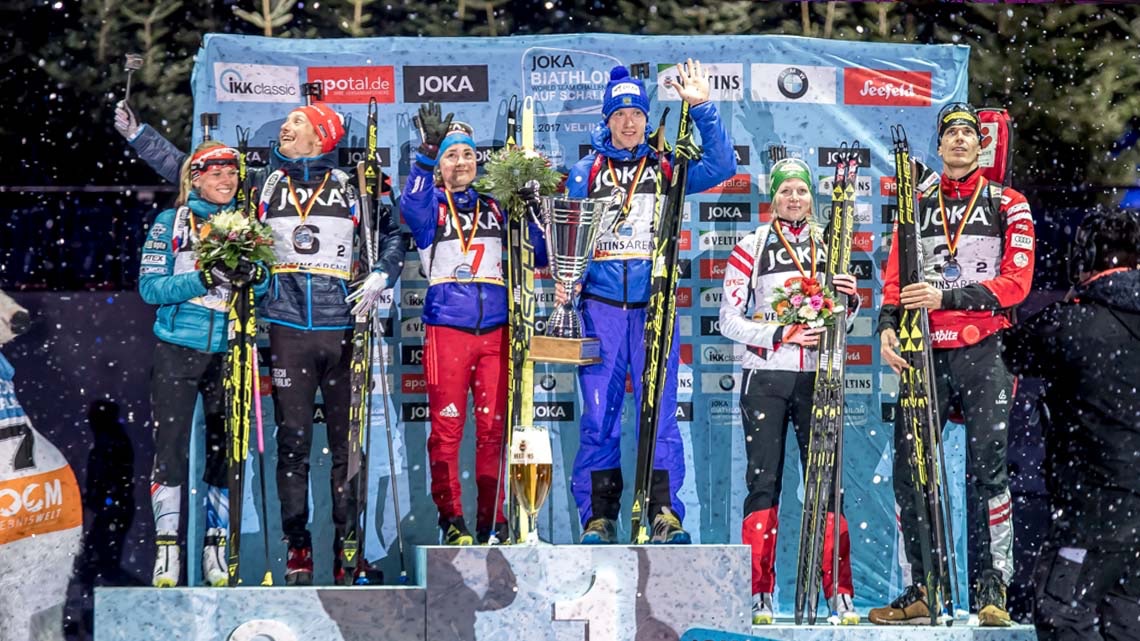
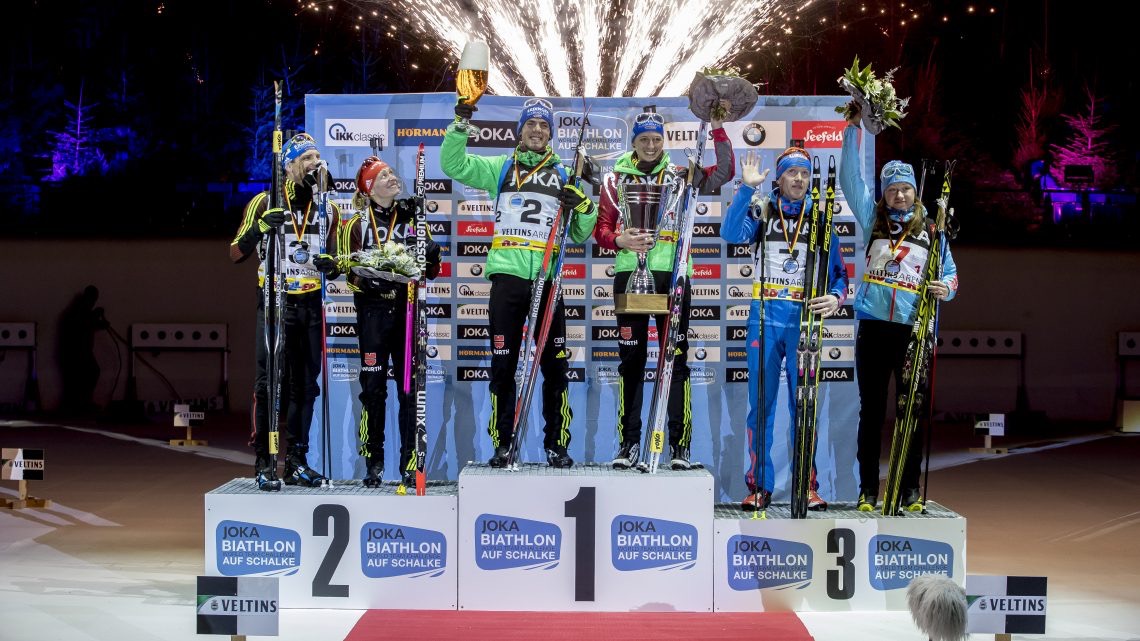
Russia’s Ekaterina Yurlova-Percht and Alexey Volkov (center, first place), Czech Republic’s Eva Puskarčíková and Ondřej Moravec (left, second place) and Austria’s Lisa-Theresa Hauser and Julian Eberhard (right, second place) on the podium of the 2017 JOKA Biathlon auf Schalke invitational race. (Photo: biathlon-aufschalke.de)
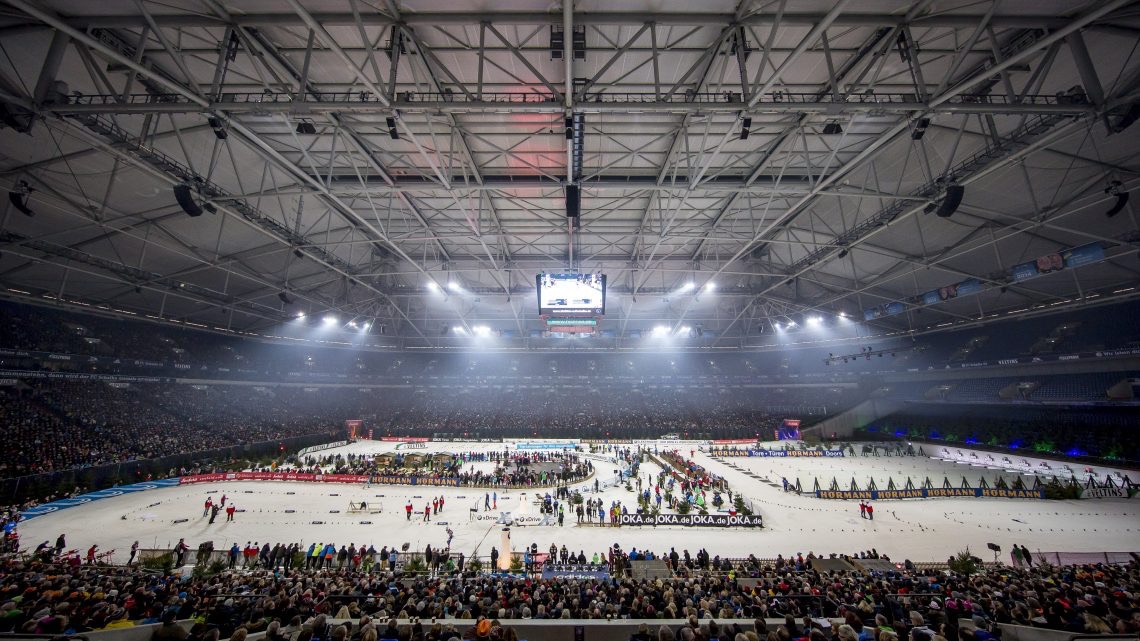
Picture some 45,000 rambunctious fans, loud music blaring, a course comprised of 10,000 cubic feet of machine-made snow, a shooting range surrounded by bulletproof glass, 1,300 fir trees as decorations, and 10 biathlon teams representing their nations, all packed into a huge stadium with a retractable roof that’s home to soccer team Schalke 04 in Gelsenkirchen, Germany. That’s the setting for the annual “Biathlon auf Schalke” two-person mixed relay show race, also known as the World Team Challenge.
Many international biathletes enjoy the event’s party atmosphere and use it as a fun way to keep their race shape sharp during the holiday break. The outdoor portion of the course meanders through a so-called “winter village” Christmas market, with the smell of food stands for the fans. Trees inside the domed arena form little forests to delineate the track and shooting range. There is entertainment like a “shoot-out” to determine the starting order, an unofficial “Snowball Fight World Championship”, fireworks, and multiple live pop-concert performances.
The 2017 edition took place this Thursday, Dec. 28, and this year marked the second time a Canadian relay was at the start, with Biathlon Canada represented by Rosanna Crawford and Brendan Green. Last year, Megan Tandy and Macx Davies teamed up for Canada in the mixed relay event.
Far away from the Alps in a flat region of the country previously known for its coal mining, “Biathlon auf Schalke”, while not an International Biathlon Union (IBU) sanctioned race, in its 16th season has become an annual fixture during the holiday break, bringing biathlon from the mountains to fans in the city. Each year, it has drawn a huge audiences, both in person and via television in Germany, as well as in a number of other countries where the event is also broadcast live.
“A few years ago Rosanna and I had talked about how fun it would be to race Schalke together, but it never quite fit in well with our schedule,” Green wrote in an email to FasterSkier. “This year the team stayed in Europe over Christmas and we were able to make it work.”
The World Team Challenge relay race is executed in a special format, with the main event split into two “halftimes” (as the organizers call it, borrowing a term from soccer) of a mass start race followed by a pursuit, held the same night after just a very short break.
In both races, one woman and one man form a team and exchange repeatedly, each skiing a short 1.3-kilometer loop and then having to clean a prone or standing shooting stage while not being allowed to use spare bullets — or else ski a shorter-than-normal 75-meter penalty lap — before tagging off to their teammate again. This mode of competition is comparable to the new single mixed relay format in biathlon or the team sprint in cross-country, though the pace might be even more frantic.
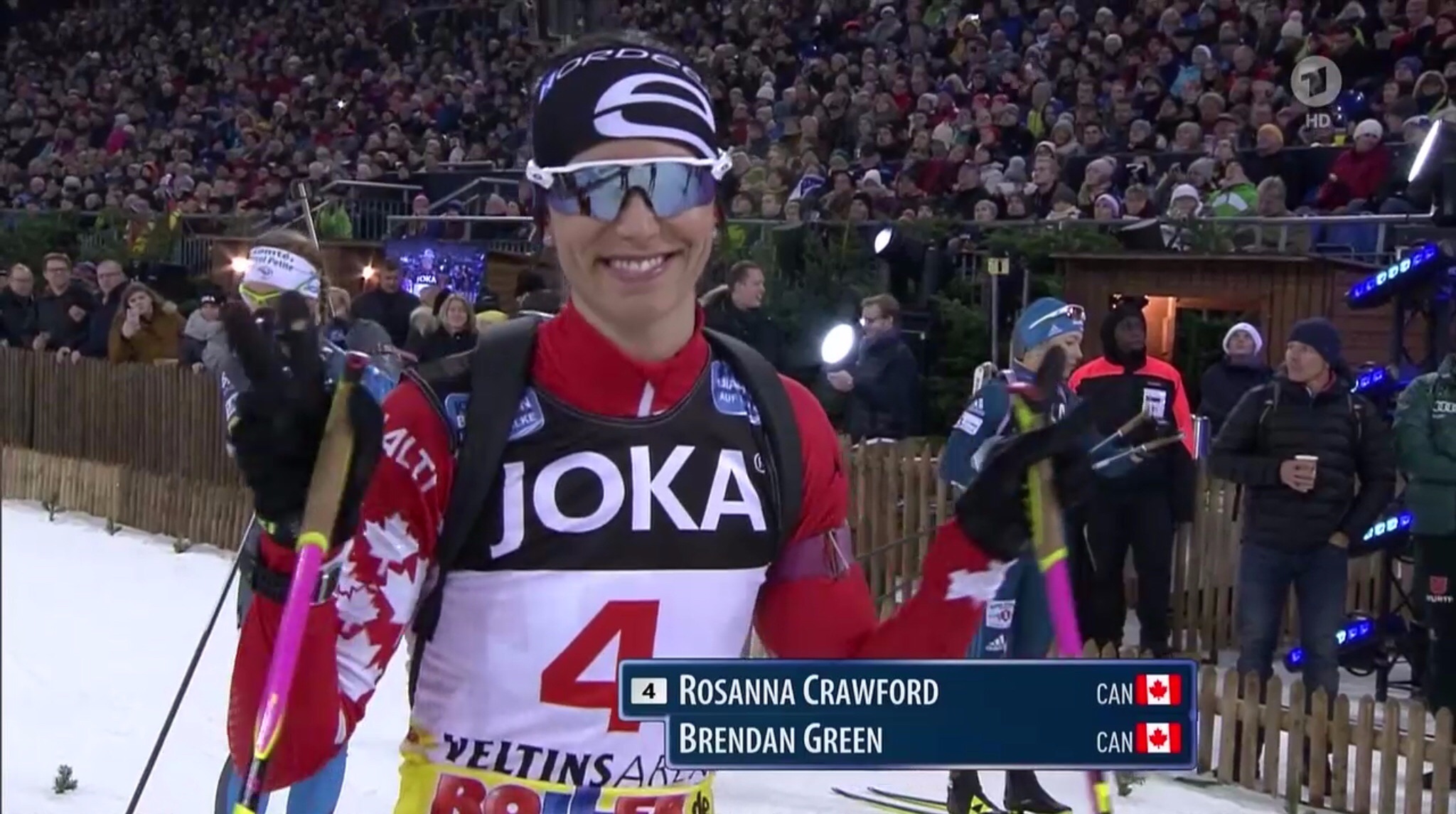
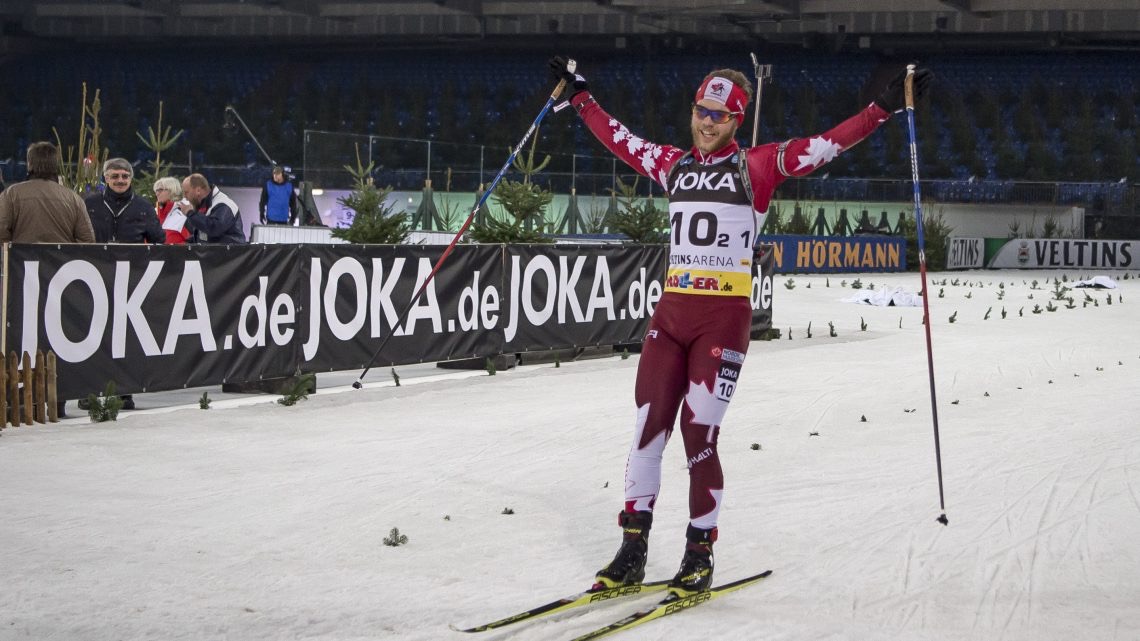
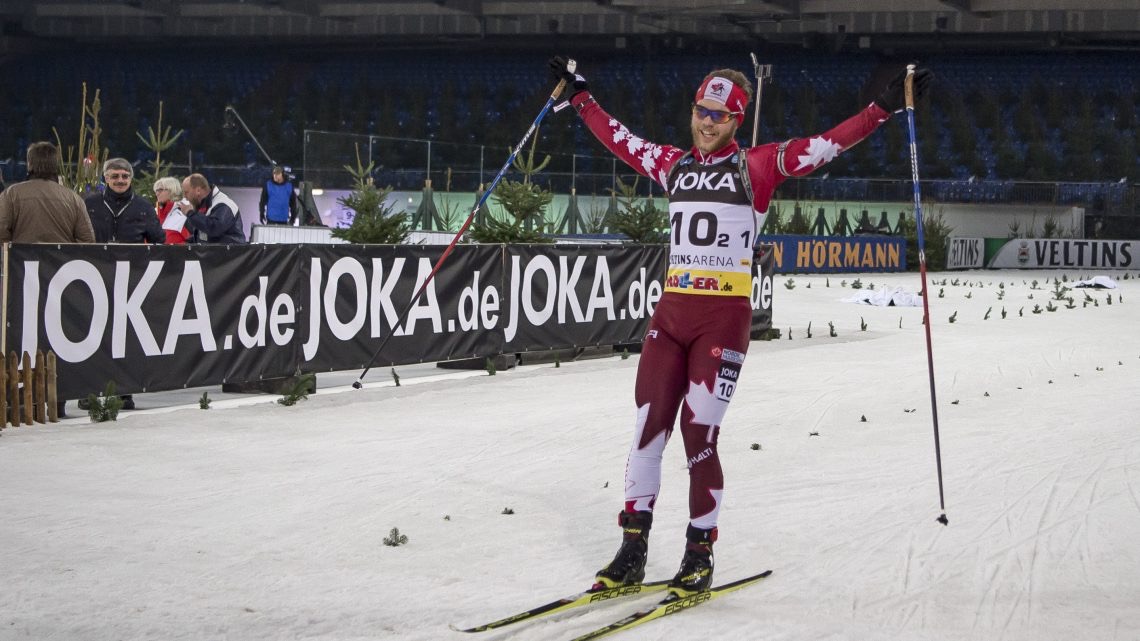
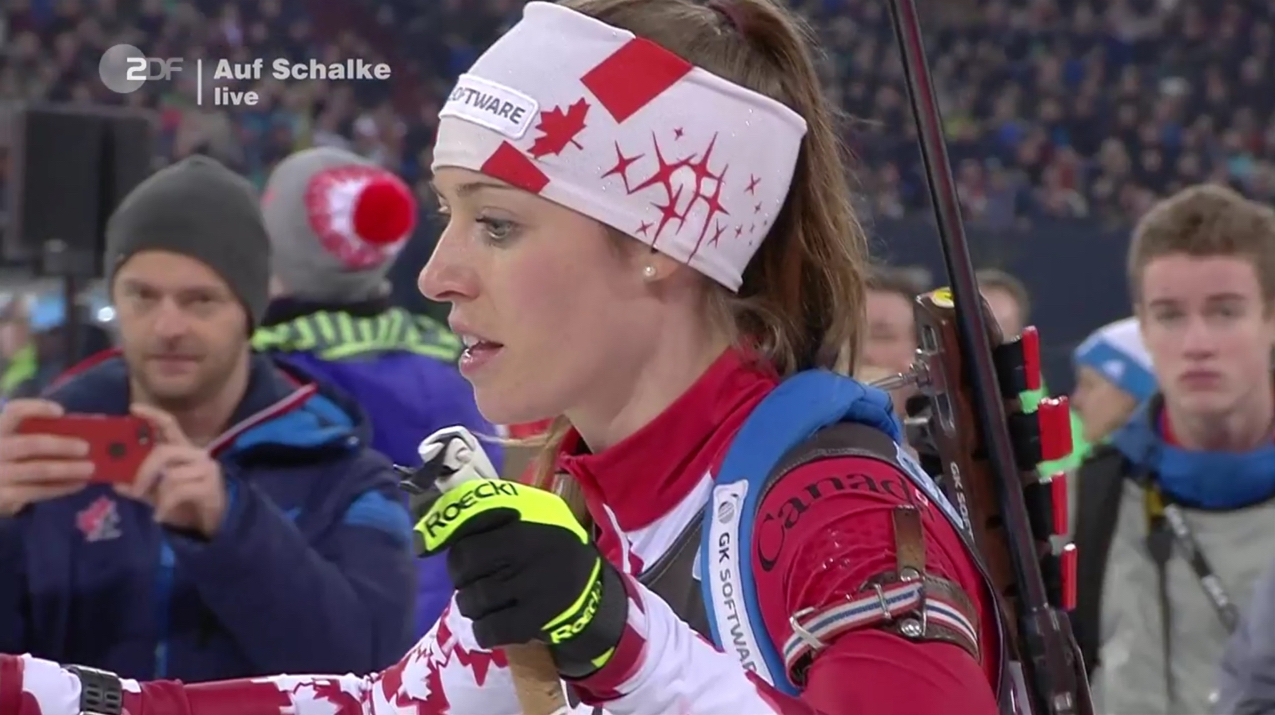
Rosanna Crawford at the start of the 2017 Biathlon auf Schalke invitational race. The Canadian relay team with her partner Brendan Green went on to finish seventh. (Screenshot: ARD broadcast)
“The course was tough, harder than it looked I think,” Crawford wrote. “This race is different to a single mixed relay, where you race for about 12min and then get 12min rest, this was race for about 4min and get 4min rest. Then there was only 15min in-between the two races, so it was quite difficult!”
“The pace you entered the range with skiing full gas on a shorter loop, with the added adrenaline from the crowd, I think for me was the most challenging aspect,” Green reflected in an email on Friday. “I just looked at my heart rate file and it peaked at 188 which is high for me. It never gets that high during a normal race format.”
With the women starting the “first half” pursuit race to a loud cannon boom, the event immediately began with a bit of a mishap for some teams, though Crawford got through it mostly unharmed.
“The first lap was pretty tricky, [Germany’s Franziska] Hildebrand changed lanes right on the very steepest climb and that caused me to ski into her, which then caused a pile up behind me,” Crawford wrote. “It’s a tricky course with not a lot of snow and not a lot of room to pass people, pretty much whoever leaves the range first will be leading the loop.”
Due to a number of penalties by both Crawford and Green early on, the Canadian pair initially fell back to the ninth position, before improving a little bit again when Green finally recorded his first clean shooting stage.
“The shooting atmosphere is different,” he wrote. “You don’t have to deal with certain variables such as wind [due to the closed arena], but instead have to deal with a lot of noise, bright lights, and other stimulus. It took a bit of getting used to.”
In the first years of “Biathlon auf Schalke”, the course was a rather flat loop, but in redesigns during the last few iterations the organizers added longer climbs and a fairly steep downhill section leading into a sharp right turn on the part of the track that is winding through the “winter village” outside the arena. It is supposed to now more closely resemble what athletes would see on the World Cup level.
Using artificial snow mostly coming from a permanent ski hall in a nearby city, every loop is 1.3 k long (adding up to more than 10 k throughout the event for each athlete) with about 25 meters of vertical elevation on a climb nicknamed the “Ruhrpott Glacier”, before the athletes enter the pitch inside the arena again via a tunnel, and then having to shoot in front of the 45,000 fans, often with additional music and the noise level amplified in a heated atmosphere.
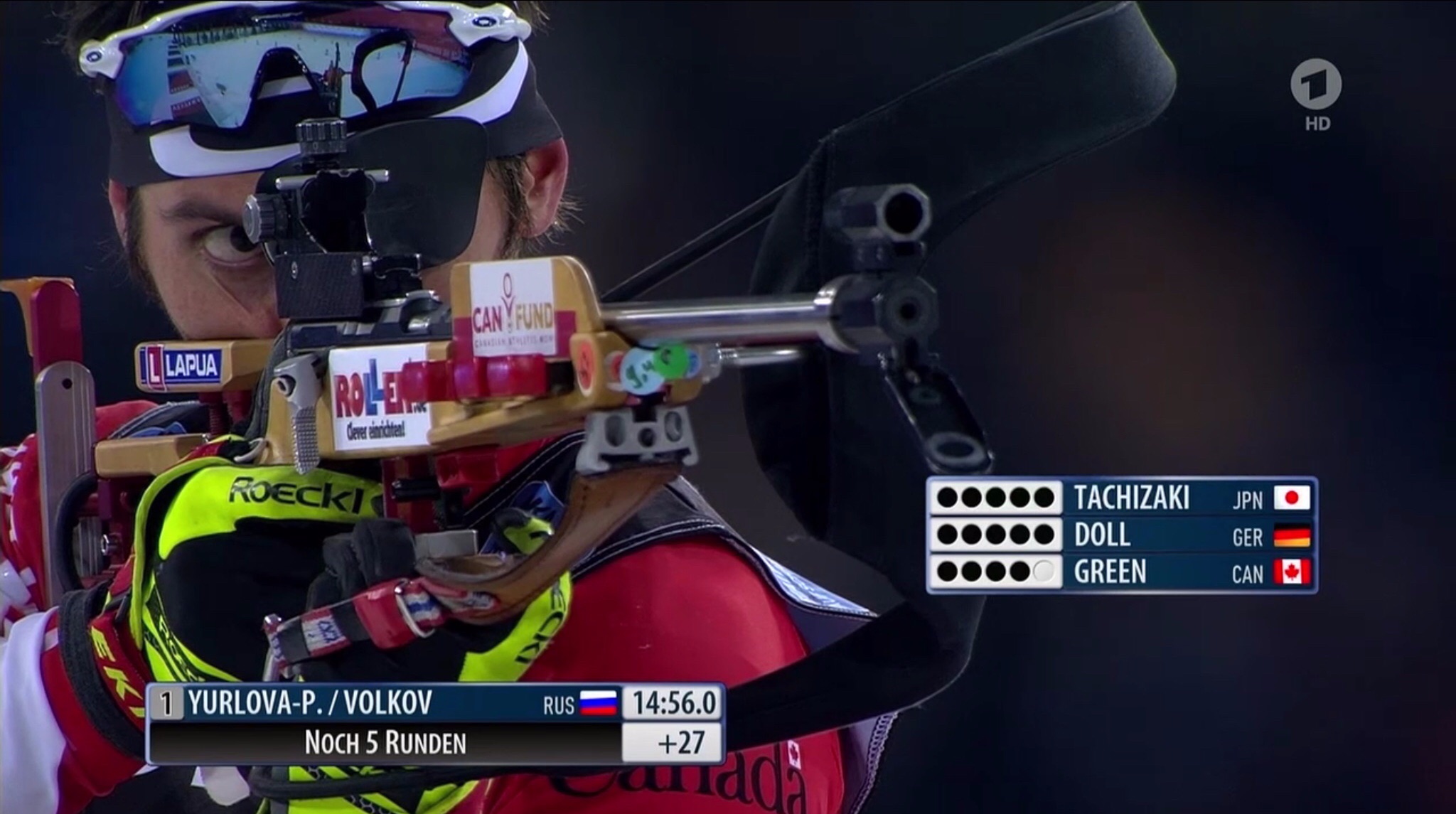
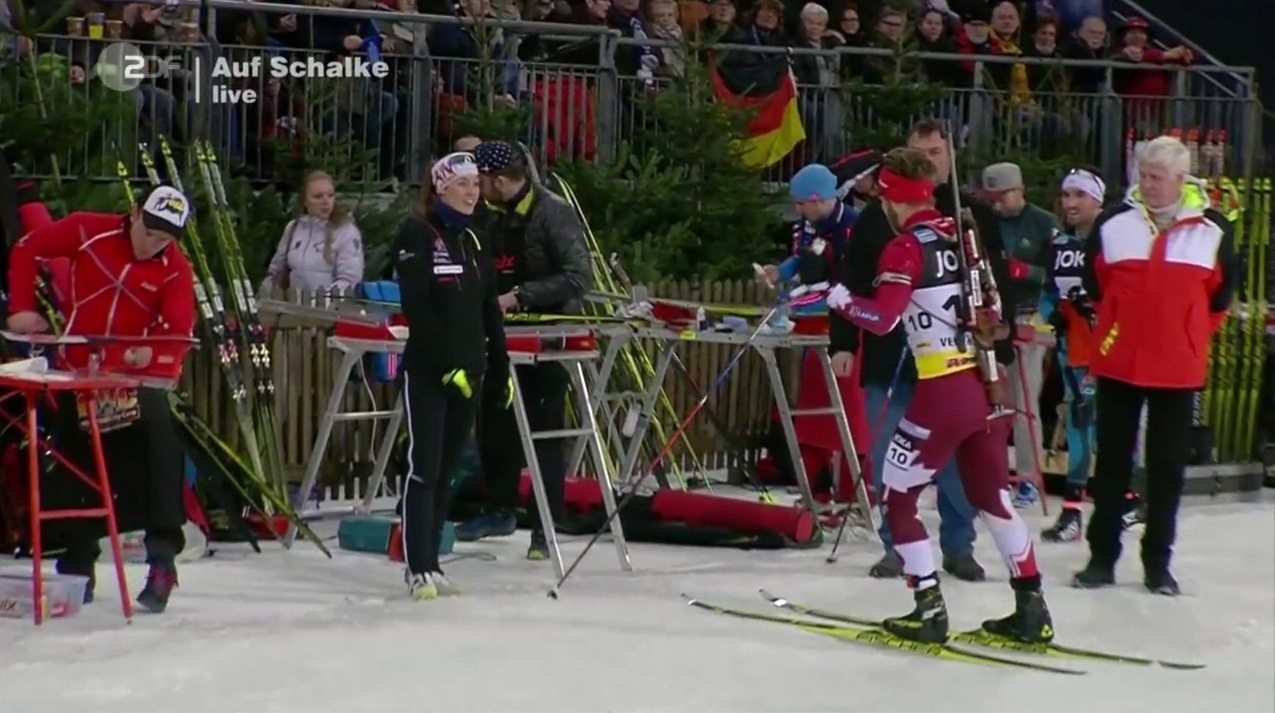
Biathlon Canada’s Brendan Green shooting a clean stage with five legs to go in the pursuit mixed relay race during the 2017 Biathlon auf Schalke invitational event. Together with his partner Rosanna Crawford, the Canadian relay finished seventh. (Screenshot: ARD broadcast)
“The course was quite challenging but it skied well and had surprisingly good flow,” Green wrote. “I anticipated that it was going to be quite physically demanding, but was still surprised at how punishing the racing was on the body.”
While one athlete was out on the track, crews of service technicians hurried to clean and prepare the skis of the athlete who was resting briefly. Unlike in most biathlon formats, where the shooting range is a no-coaching zone during a race, teams were also allowed to receive instructions after each leg and during the short 15-minute intermission between the mass start and pursuit.
“It was great to have Matthias [Ahrens] there, so he would run over to us after each shooting and show us our shots,” Crawford wrote. “Andrzej Lesnik was our wax tech and he did a great job with the skis.”
“We received feedback for our shooting from Matthias, and during the break in-between the races Rosanna and I spoke quickly about our own observations,” Green added. “In the end I think it came down to being a bit more attentive in the range and staying as focused as possible despite what was going on around us.”
The Canadians completed the first part of the event in eighth place, 1:24.1 minutes behind Russia in first.
Green came into the finish just a second behind Germany’s Benedikt Doll, who formed a team with Nadine Horchler (in place of Laura Dahlmeier, after Dahlmeier had to withdraw from the event just the day before due to illness. Organizers had previously hyped up Dahlmeier’s participation, after she had just been voted the German “female athlete of the year” as the first biathlete since Magdalena Neuner).
Pursuit Final
For the “second half” pursuit, the gaps to first place were halved respectively capped at a maximum of 45 seconds, so even the teams that had completed the mass start at the back of the field should still have a realistic shot at the top positions.
The coaching hints and adaptations on the range seemed to help, as both Canadians began the pursuit with a series of clean shooting stages, steadily moving up in the field. After her penultimate leg, Crawford tagged off in fourth position.
“Both Brendan and I felt better in the second race,” Crawford wrote. “It was too bad we had so many shooting mistakes in the mass start, would have been good to start closer to the leaders for the pursuit race. But after getting out the jitters we were able to shoot much better.”
In close head-to-head shooting duels for the positions on or just behind the podium, both Green and Crawford missed two targets in the next stages, falling back a bit again.
At the end of the pursuit, Green was beaten by inches — or 0.4 seconds — in a finish sprint with Germany’s Erik Lesser (forming the second German team with Hildebrand) and Belgium’s Michael Rösch (starting as a replacement for Slovenia’s Jakov Fak in a mixed-nation team with Ukraine’s Yuliia Dzhima) to finish the race in seventh place, the second-best result for a North American team.
“The last loop was tough,” Green remembered. “I was able to close a small gap to Lesser and Roesch on the last lap which ended in a sprint finish. I kept waiting for an opportunity and thought something might have been possible once we entered back inside the arena towards the finish, but in the end there just wasn’t enough space and we had to settle for 7th.”
“For the finish loop Brendan did a great job closing the gap to Lesser and Roesch, but there is just no room to pass!” Crawford, who had observed the scene from the sideline after completing her last leg, wrote in her email. “6th or 5th would have been amazing, but we are happy to finish 7th!”
Russian Team in Control in Both Stages
Knowing that accuracy on the range was more important than ski speed on a fairly short and narrow course, the Russian team entered two very secure shooters into the event with 2015 individual-discipline world champion Ekaterina Yurlova-Percht and Alexey Volkov, a member of the men’s gold medal-winning relays at the 2014 Olympic Games and 2017 biathlon world championships. The duo incurred the fewest penalties of all teams, only missing four of 80 targets on their road to winning both the mass start race and the following pursuit.
“With Alexey Volkov as my partner I expect everything, and I knew that Alexey is really really fast on the shooting range, and it can bring us the really good result,” Yurlova-Percht said at a post-race press conference.
At the “halftime” the Russian duo in first seemed within reach of a few other teams that were only about ten seconds back, yet in the pursuit they steadily increased their lead. After he had hit his final shot to clean the last stage to secure the victory, the otherwise subdued Volkov celebrated by raising his fist and looking to the stands in a gesture reminiscent of France’s perennial World Cup leader Martin Fourcade. He then rounded the final loop at a relaxed pace before skiing into the arms of the equally excited Yurlova waiting for him at the finish line.
“Our team was working highly focused on the shooting range today, that surely was our big advantage,” their coach Ricco Groß — himself a past winner of the World Team Challenge for Germany in an earlier iteration — told broadcaster ARD in a TV interview right after the race had concluded, according to a translation. “They solved that really well, and accordingly also won in pretty convincing fashion. … The athletes really did a great job today, that should also push our whole team, giving us some momentum and self confidence for the tasks ahead in January and February. … The atmosphere in the stadium here is gigantic, it is just crazy and incredibly fun here.”
“I want to say thanks a lot to all spectators who visited this competition today,” Yurlova added in the press conference. “This was an amazing atmosphere, and perfect feelings of support. I am really happy that all spectators were supporting not just their teams, but they were supporting everybody. And also when me and Alexey were shooting everybody was supporting us the same like the German teams.”
Both athletes had previously raced at Schalke, with Yurlova winning in 2012 with partner Anton Shipulin and placing fourth in 2015 with partner Evgeniy Garanichev as her best results, and Volvok placing third a year ago with Olga Podchufarova.
“I already thought before the start that we could win,” Volkov said, via a translator. “I have to say the course was very good, not at all flat, and if you take some risk going into the downhill anything can happen. … Today before the start I was trying to find an empty seat in the stands before the start, and I couldn’t see any. This is not just about motivation, this is a celebration [of biathlon]; you just have to be there.”
Looking over to the German team sitting next to him as the local representatives, Volkov added. “I am sure Erik [Lesser] shot faster than me today, but you know how statistics are, sometimes it’s better to shoot two seconds slower and hit everything.”
With nearly as solid shooting performances as the Russian team, the Czech Republic represented by Eva Puskarčíková and Ondřej Moravec stood in second after the mass start, behind Yurlova and Volkov (+9.2 seconds), then held that position in the following pursuit (+24.0).
Austria with Lisa-Theresa Hauser and Julian Eberhard (replacing Simon Eder on short notice) finished the World Team Challenge in third place (+43.5).
After the mass start they had been in fourth position (+10.3) just behind the Czechs and the French team of Anaïs Bescond and Emilien Jacquelin in third (+9.7). In the pursuit race Eberhard secured the position on the podium in the final shooting stage when he hit all targets standing on the range in a duel against Germany’s Lesser and France’s Jacquelin, who incurred more penalties. France finished fourth (+58.4), also slightly hampered by a fall and broken pole for Bescond during the race.
Crawford and Green were the sixth North American team to be invited to the “Biathlon auf Schalke” race and the second Canadian one. In 2008 and 2009, Lanny Barnes and Jay Hakkinen represented the US (placing ninth and sixth for the best finish by a North American team to date), in 2010 Tracy Barnes-Coliander and Tim Burke (10th), in 2012 Susan Dunklee again with Tim Burke (10th), and in 2016 Megan Tandy with Macx Davies for Canada (10th).
“Brendan and I really loved competing in Schalke!” Crawford summarized their experience. “It was like nothing we’d ever done before! There have been big crowds at World Cups and World Champs, like Nove Mesto and Oslo … but this was so different with having 45 000 people all packed into a soccer stadium! … I am really glad Brendan and I got to compete in this race once in our careers!”
While the International Biathlon Union (IBU) has adopted the mixed and single mixed relay formats in the last years as new disciplines to make the sport more attractive, “Biathlon auf Schalke” is an invitation-only race not promoted or hosted by the IBU, so there were no World Cup points to win in the event. However about €156,000 ($185,000 U.S. dollars) in prize money was awarded.
The regular IBU World Cup will resume on Thursday, Jan 4, in Oberhof, Germany, with a women’s sprint race.
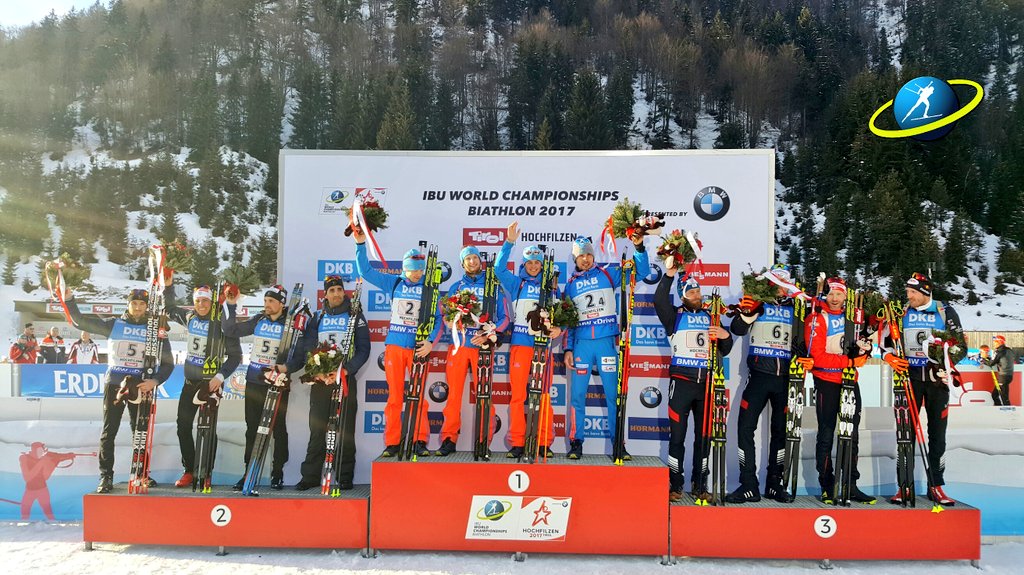
The men’s 4 x 7.5 k relay podium at 2017 IBU World Championships on Saturday in Hochfilzen, Austria, with Russia (c) in first, France (l) in second, and Austria (r) in third. (Photo: IBU World Champs/Twitter)
IBU World Championships (Hochfilzen, Austria): Men’s relay
[UPDATED] Russia’s four-man relay team hit nearly every target on Saturday, using a total of just three spares to clean 40 targets, and stayed out of the penalty loop to capture gold in the men’s 4 x 7.5-kilometer relay at the International Biathlon Union (IBU) World Championships in Hochfilzen, Austria.
It was the last team event and the second-to-last day of the championships, with the men’s and women’s elite mass starts remaining on Sunday. Anton Shipulin anchored the Russians to first, 5.8 seconds ahead of France’s Martin Fourcade, after Shipulin cleaned his prone stage and used one spare in standing to hold onto the lead his team built. Fourcade cleaned both stages to secure silver for his team, and Austria took bronze (+20.1) with anchor Dominik Landertinger.
After Russia’s Alexey Volkov used one spare in each of his shooting stages and came through the exchange in seventh, Maxim Tsvetkov and Anton Babikov both cleaned without any spares to bring the team into fourth, then first, respectively.
France’s first leg Jean-Guillaume Béatrix shot clean as well and tagged Quentin Fillon Maillet in second. Fillon Maillet then needed one spare in prone, but cleaned standing to take the lead, tagging Simon Desthieux in first. Desthieux used three spares in prone, but avoided the penalty lap before tagging Fourcade in third, 12 seconds behind Austria in second. Fourcade closed the gap and clinched second, and France combined for a total of just four spare rounds.
Austria achieved bronze in front of a home crowd with Daniel Mesotitsch, Julian Eberhard, Simon Eder, and Landertinger combining for 10 spares and no penalties.
Finishing 8.5 seconds after Austria, Germany placed fourth. Italy was a minute and a half out of first in fifth, Ukraine took sixth (+1:41.3), and the U.S. placed seventh (+1:50.5) with Lowell Bailey, Leif Nordgren, Tim Burke, and Sean Doherty. Bailey initially put the team in fourth at the first exchange, 12.4 seconds out of first, then Nordgren tagged Burke in sixth, 17 seconds behind. Burke used four spares to clean and tagged Doherty in seventh, about a minute back. The Americans used a total of eight spares but had no penalties.
Canada finished 13th (+3:35.5) with Christian Gow, Scott Gow, Macx Davies, and Brendan Green. They were 39 seconds out of first and in 12th place after Christian Gow’s first leg, then slipped to 14th before Davies moved them back into 12th by the last exchange. Canada had a total of 10 spares and zero penalties.
FIS Cross-Country World Cup (Otepää, Estonia): Freestyle sprint
In the last World Cup before the upcoming 2017 International Ski Federation (FIS) Nordic Ski World Championships next week in Lahti, Finland, five U.S. women qualified in the top 12 of the women’s 1.3-kilometer freestyle sprint, and Jessie Diggins reached the final on Saturday in Otepää, Estonia.
Diggins started the day by placing 12th in the qualifier, 3.93 seconds behind Sweden’s Stina Nilsson in first (and her U.S. teammates Kikkan Randall in third, Sophie Caldwell in fourth, and Ida Sargent in 10th) before winning her quarterfinal and semifinal. In the final, Diggins wad gapped by the leaders on the final climb and finished fifth (+6.82).
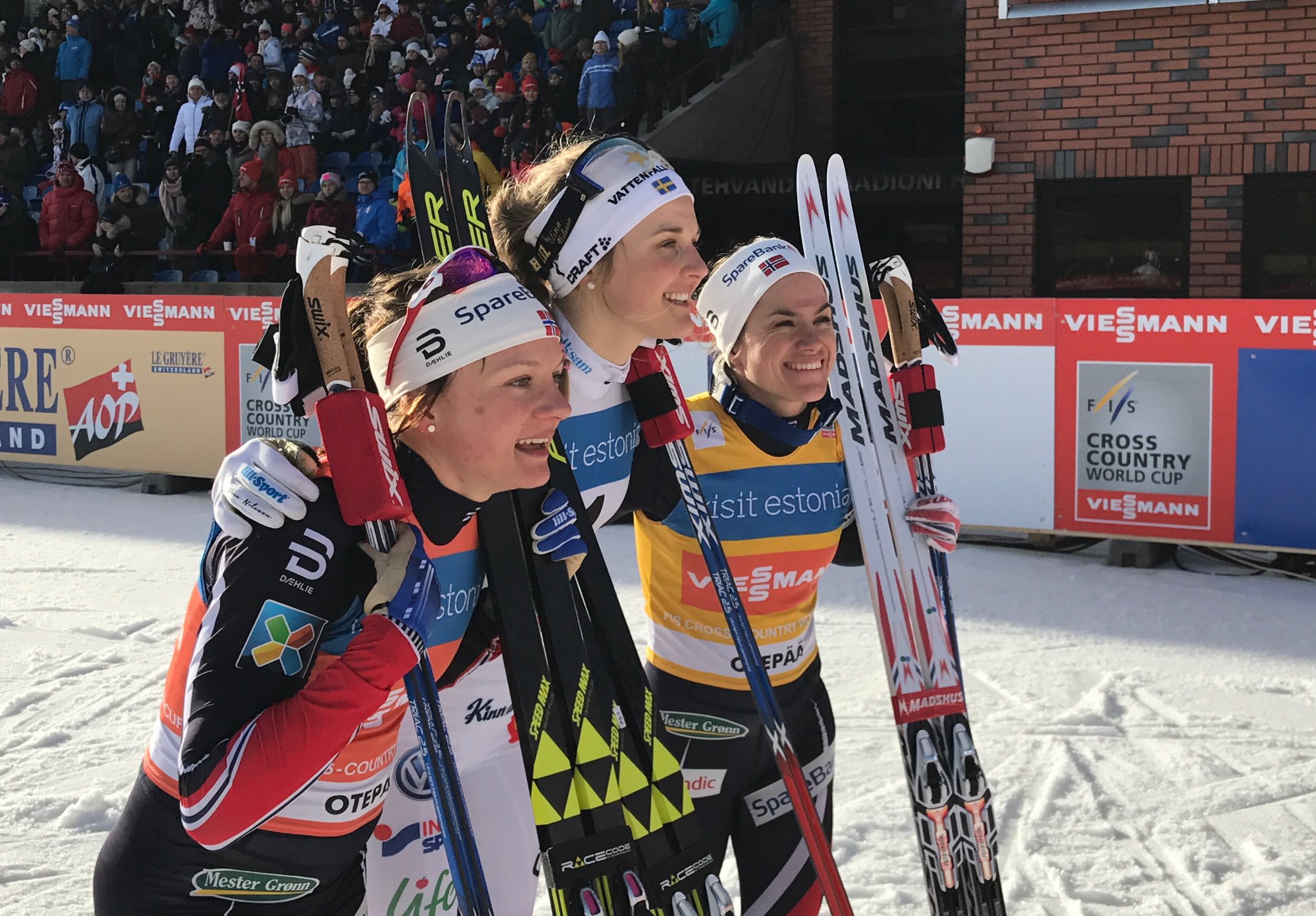
The women’s freestyle sprint podium at the Otepaa World Cup on Saturday in Estonia, with Swedish winner Stina Nilsson (c), Norway’s Maiken Caspersen Falla (l) in second and Heidi Weng (r) in third. (Photo: FIS Cross Country/Twitter)
Nilsson won the final in a time of 2:49.96 minutes, just ahead of Norway’s Maiken Caspersen Falla (+0.27) who lost her balance and her speed with it on the last corner. The two had broken away from third place and Nilsson led into the final straightaway and held Falla off for the win. Norway took second through fourth with Heidi Weng in third place (+3.75) and Astrid Uhrenholdt Jacobsen in fourth (+4.91).
Randall initially finished her quarterfinal in third position and would have been out, but advanced when Russia’s Natalia Matveeva was relegated to last for obstruction. In the same semifinal as Diggins, Randall fell cresting a small hill over a tunnel and finished fifth (+13.30) for ninth overall on the day.
Caldwellplaced second in her quarterfinal heat behind the day’s winner Nilsson, then stumbled halfway up a climb early in her semifinal, but stuck with the pack to finish fifth (+1.83) for 10th overall.
Sargent raced in the same quarterfinal as Falla and narrowly missed advancing to the semifinal in third place, fewer than 0.2 seconds behind Switzerland’s Laurien van der Graaff in second and 0.35 seconds behind Falla, who won that heat. Sargent placed 13th on the day.
Sadie Bjornsen qualified 25th and finished fourth (+2.82) in the same quarterfinal as Randall for the 25th overall.
Canada’s Dahria Beatty also qualified for the sprint heats in 30th place, and finished sixth in her quarterfinal for 29th overall.
Also for Canada, Cendrine Browne finished the qualification in 48th place and Katherine Stewart-Jones was one position behind in 49th.
Also for the U.S., distance specialists Chelsea Holmes and Rosie Brennan placed 58th and 60th, respectively.
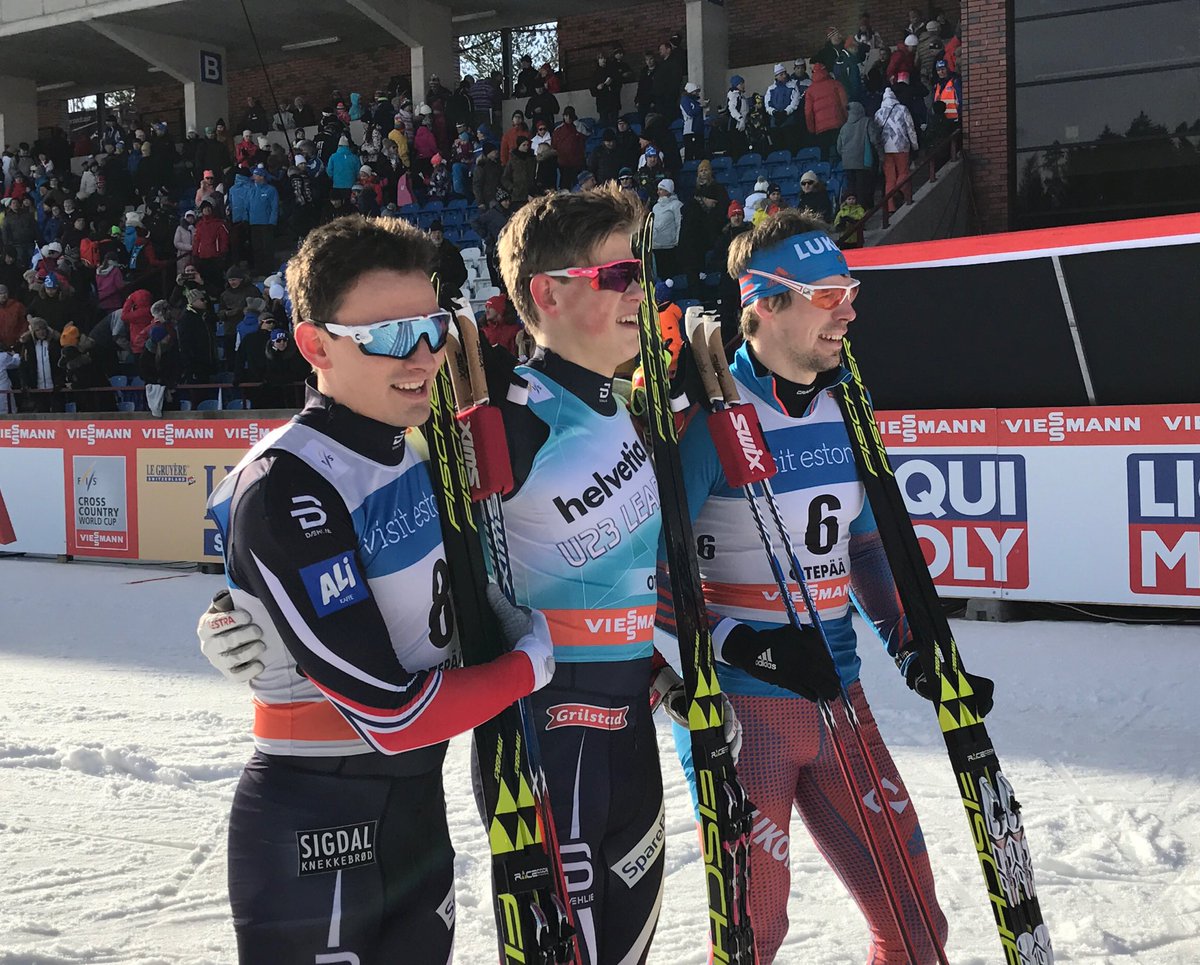
The men’s freestyle sprint podium on Saturday at the World Cup in Otepaa, Estonia, with Norway’s Johannes Høsflot Klæbo (c) taking his first World Cup win, Norway’s Finn Hågen Krogh (l) in second, and Russia’s Sergey Ustiugov (r) in third. (Photo: FIS Cross Country/Twitter)
In the men’s 1.6-kilometer sprint, Norway’s Johannes Høsflot Klæbo achieved the first World Cup victory of his career in a time of 3:06.53 minutes, holding onto a lead he had created with an attack right out of the start gate in the final. His teammate Finn Hågen Krogh placed second (+0.60), taking the inside lane in the last turn to push reigning Tour de Ski winner Sergey Ustiugov of Russia to third (+1.0).
For the North Americans, it was a day of narrow misses.
For the U.S., Simi Hamilton started his race day by qualifying in seventh position, and placed second in his quarterfinal. He then closely missed out on the final after placing fourth in his semifinal in a four-way sprint photo finish (+0.33), just 0.04 seconds behind the third place and lucky loser time of Norway’s Håvard Solås Taugbøl, who advanced. Hamilton ended the day in eighth overall.
Canadian World Cup Team member Alex Harvey snuck into the sprint heats in 29th place in the qualifier, then just missed out on advancing from his quarterfinal in a photo finish for second with Great Britain’s Andrew Young, who took it by 0.04 seconds. Harvey finished third in that heat, 0.6 behind Italy’s Federico Pellegrino, for 15th for the day. Young went on to finish sixth in his semifinal for 12th overall, and Pellegrino advanced as a lucky loser from the same semifinal and was fourth in the final (+4.77).
American Andy Newell qualified 16th and finished sixth (+1.89) in his quarterfinal for 27th overall.
Canada’s Len Valjas missed qualifying for the heats in 40th place, as did his teammate Devon Kershaw in 50th.
American Erik Bjornsen was 53rd, and for Canada, Jesse Cockney 54th and Knute Johnsgaard 56th. In his World Cup debut, Benjamin Lustgarten placed 64th in the qualifier.
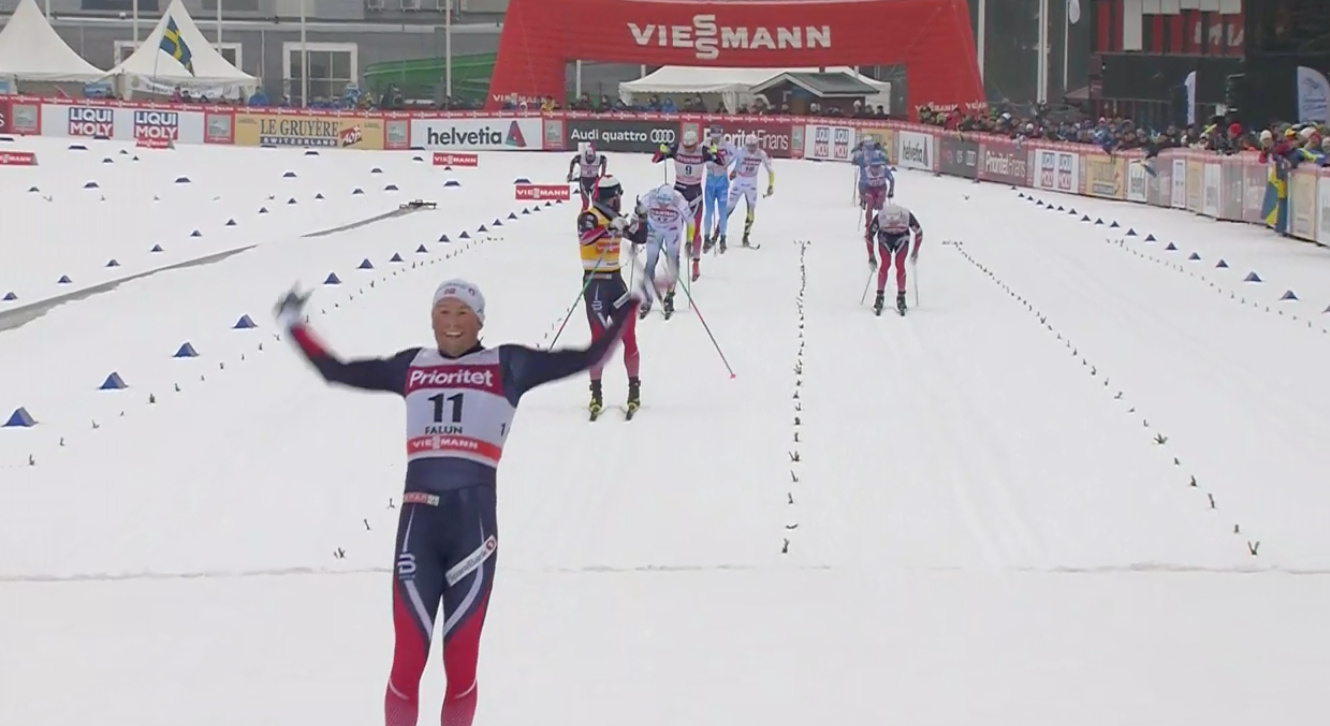
Emil Iversen celebrates his win in the 30 k classic mass start in Falun, Sweden, on Sunday. Norwegian teammate Martin Johnsrud Sundby finished second and Sweden’s Calle Halfvarsson third.
FIS Cross-Country World Cup (Falun, Sweden): 15 / 30 k classic mass start
In the women’s 15-kilometer classic mass start on Sunday, Norway swept the podium with Marit Bjørgen taking the win in a time of 41:28.8 in Falun, Sweden. Crossing just half a second behind her was her teammate, Ingvild Flugstad Østberg in second place. Rounding out the podium was Heidi Weng in third (+8.1).
American Jessie Diggins was the first to cross the line for the U.S. in 10th (+1:37.5). Three other U.S. women finished in the top 30, with Sadie Bjornsen finishing 21st (+2:43.6), Rosie Brennan 24th (+2:57.0), and Liz Stephen in 29th (+3:24.5).
Just outside of scoring World Cup points was American Caitlin Patterson in 32nd (+3:47.6) and Ida Sargent in 34th (+4:02.8). Canada’s Cendrine Browne finished 46th (+5:41.4) and American Liz Guiney 49th (+6:22.6).
After losing the skate sprint yesterday in a photo finish to Italy’s Federico Pellegrino, Emil Iversen ascended to the top step of the podium in the men’s 30 k classic mass start on Sunday in Falun.
The Norwegian was often near the front, but hadn’t tried to lead a breakaway like his teammates Martin Johnsrud Sundby and Sjur Røthe did earlier in the race. In the final two kilometers, Sundby – the overall World Cup leader – put in a sprint to try to drop the field. But Iversen caught up, drafting his veteran teammate into the stadium. In the final up-and-over before the finish line, Iversen made a pass and then accelerated down the finishing stretch to beat Sundby by 1.14 seconds.
“I got motivation from yesterday’s last 20 meters,” Iversen told FIS in a finish-line interview. “So today I fought all the way, and I was really stronger. It is amazing for me to be second yesterday and first today. I’m really proud of that.”
Calle Halfvarsson, who had been falling off the back of the lead pack just a few kilometers earlier, managed to get back to the front and claim third place for Sweden (+1.72 seconds) in a photo finish with Røthe (+1.76 seconds). Niklas Dyrhaug was next (+2.52 seconds) to give the Norwegian men’s team four in the top five.
In his return to the World Cup stage, Norway’s Petter Northug finished 31st (+3:10.6).
Alex Harvey was the lone Canadian on the start line. After skiing near the front of the field for the early part of the race he was dropped by the lead pack in the final kilometers, finishing 15th (+1:17.5).
Erik Bjornsen and Noah Hoffman took 35th and 37th places for the United States, finishing +3:30.8 and +3:59.8, respectively. SuperTour leader Matthew Gelso — familiar with the Falun course after competing in 2015 World Championships — finished 44th (+5:23.6), and Andy Newell placed 53rd (+7:45.3).
IBU Open European Championships (Duszniki-Zdrój, Poland): Single mixed & mixed relay
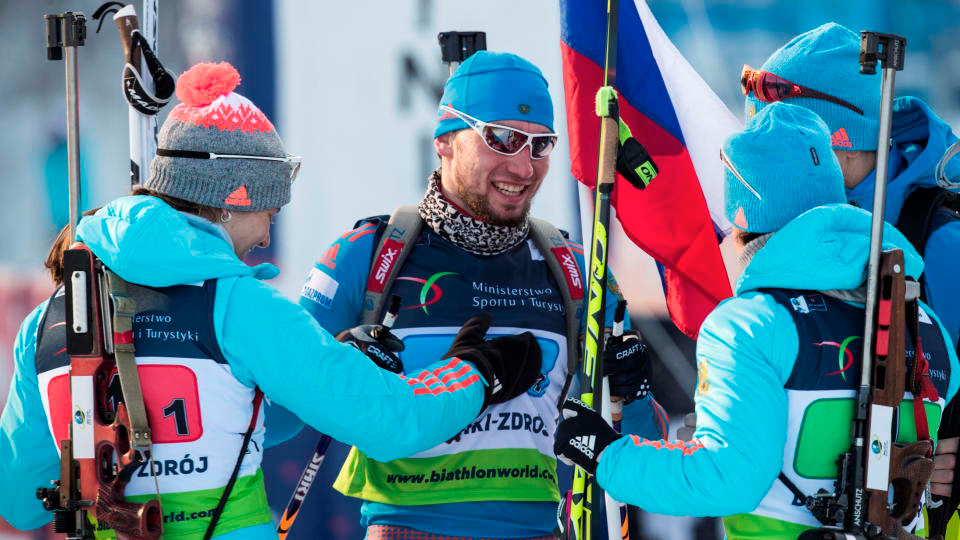
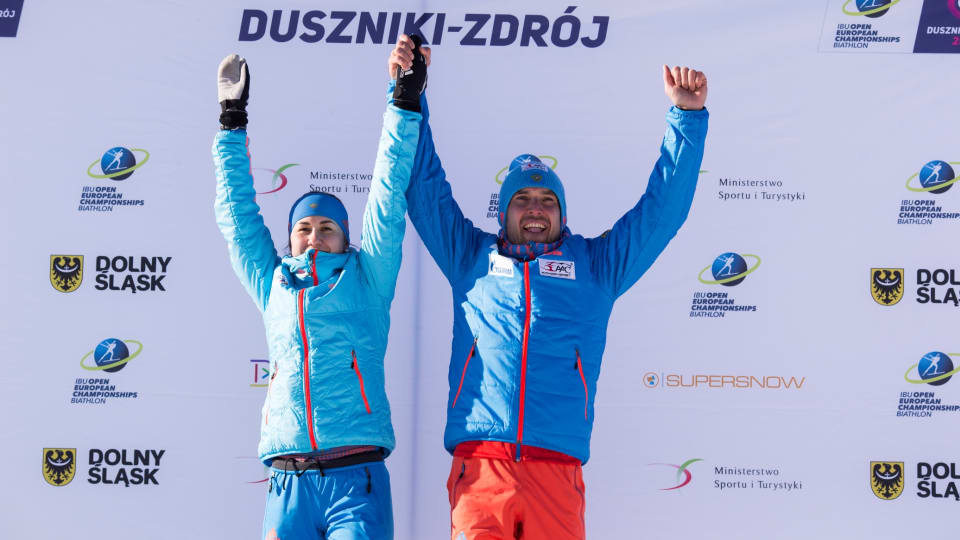
Russia’s Alexander Loginov (center) is greeted at the finish by his teammates Irina Starykh, Svetlana Sleptsova and Alexey Volkov after anchoring his team to the gold medal in the mixed relay at the 2017 IBU Open European Championships in Duszniki-Zdrój, Poland. (Photo: IBU)
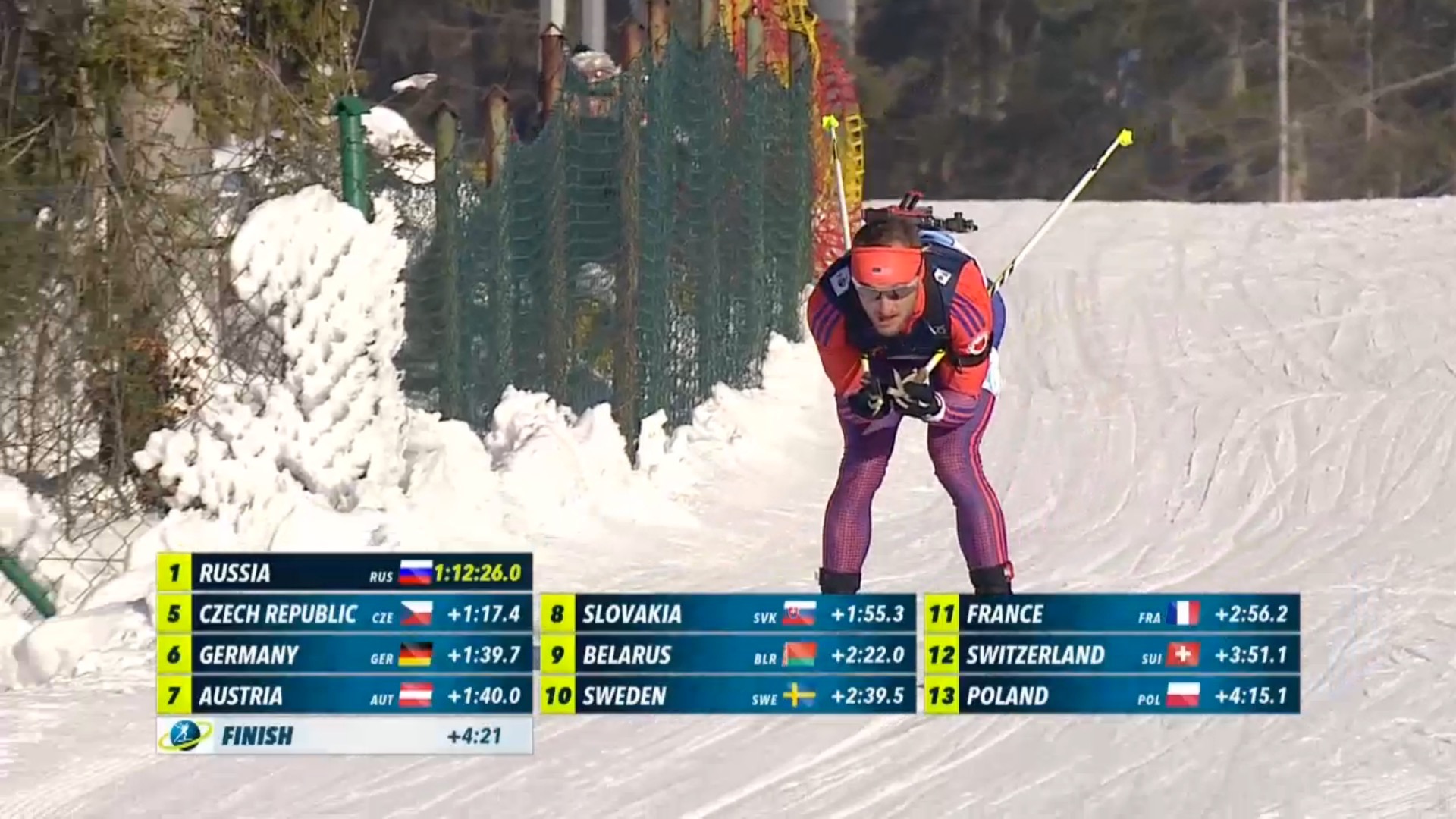
[UPDATED] The Russian victory in the final 2 x 6 + 2 x 7.5-kilometer mixed relay event of the 2017 International Biathlon Union (IBU) Open European Championships in Duszniki-Zdrój, Poland, was only briefly in doubt, when Alexander Loginov skiing the anchor leg required all spares in his prone shooting stage. But with his final shot he managed to also hit that target to avoid the penalty lap, leaving the range with a lead of more than 30 seconds.
Loginov then did not need any spares in the last standing stage, and could take his time on the final loop. Unlike Russia’s Evgeniy Garanichev earlier in the day during the single mixed relay, he also managed to pick up a flag for the final meters of the race, crossing the line in a time of 1:12:26.0 hours.
The Russian team with Irina Starykh, Svetlana Sleptsova, Alexey Volkov and Loginov led from the first exchange and required only six spares with zero penalties.
With this medal, the 28-year-old Volkov became the most successful athlete in history at European Championships, according to an IBU press release, surpassing the retired Polish biathlete Tomasz Sikora. Russia was the most successful team of the 2017 Open European Championships with six gold, four silver, and three bronze medals.
Behind them, a number of teams vied for the positions on the podium. Sweden initially looked like a strong contender exchanging in second place after the women, but fell back with three penalty laps to only finish 10th.
Still six seconds back after the final shooting, Norway’s Fredrik Gjesbakk caught up to and outsprinted Ukraine’s Ruslan Tkalenko in the finishing stretch to claim the silver medal (+36.4) with the bronze left for Ukraine (+37.1).
“I thought that I made sufficient gap to win silver,” Tkalenko told the IBU. “But in the end, on the final downhill before the finish, I was very surprised when the Norwegian guy passed me, I truly did not expect that.”
The Norwegian team with Karoline Erdal, Marion Rønning Huber, Erlend Bjøntegaard, and Gjesbakk needed nine spares and had no penalties.
Ukraine with Anastasiya Merkushina, Yulia Dhzyma, Oleksander Zhyrnyi (who originally started for Russia before making the switch in 2014) and Tkalenko required six spares, and Dhzyma had to ski a penalty lap only temporarily setting the team back.
Bulgaria finished fourth (+1:16.4), with its anchor Vladimir Iliev narrowly beating Czech Republic’s Lukas Kristejn (+1:17.4) in the finishing stretch. Both teams needed 11 spares and had no penalties.
Jakob Ellingson skiing the anchor leg for the U.S. mixed relay at the 2017 IBU Open European Championships in Duszniki-Zdrój, Poland. The U.S. team finished 14th. (Photo: IBU/Eurovisionsports.tv screenshot)
Starting at the back of the field in bib 20, US Biathlon’s Emily Dreissigacker got her team off to a strong start with a clean prone shooting and one spare round in standing, exchanging in 10th, a minute behind the leaders. Hallie Grossman needed one spare in each of her stages, tagging off to the men in 14th position and now 2:39 behind. Max Durtschi also had one miss each in prone and standing, coming into the last exchange still in 14th position, but another minute back. Jakob Ellingson required all three of his spares in his prone shooting stage narrowly avoiding the penalty lap, and one more in his final shooting stage. As the team from Finland was racing over a minute behind the Americans, he was able to keep the 14th position into the finish (+4:47.4), with a team total of nine spares and no penalties overall.
For Biathlon Canada, Erin Yungblut starting in bib 19 shot clean in her prone stage and required two spares in her standing shooting, tagging off in 18th position and more than two minutes back from first. Leilani Tam von Burg stayed clean in her prone shooting stage and needed one spare in standing, moving up two positions to exchange in 16th place, yet more than four minutes behind the leaders. After the exchange to the men, both Matthew Neumann and anchor Carsen Campbell managed to shoot clean in all of their stages, but lost additional time on the course to finish 16th (+6:39.9) ahead of four lapped teams.
Canada had the best shooting result of all 20 teams starting the relay, with just three spares and no penalty.
Russia’s Daria Virolaynen (l) and Evgeniy Garanichev after winning Sunday’s single mixed relay at the 2017 Open European Championships in Duszniki-Zdrój, Poland. (Photo: IBU)
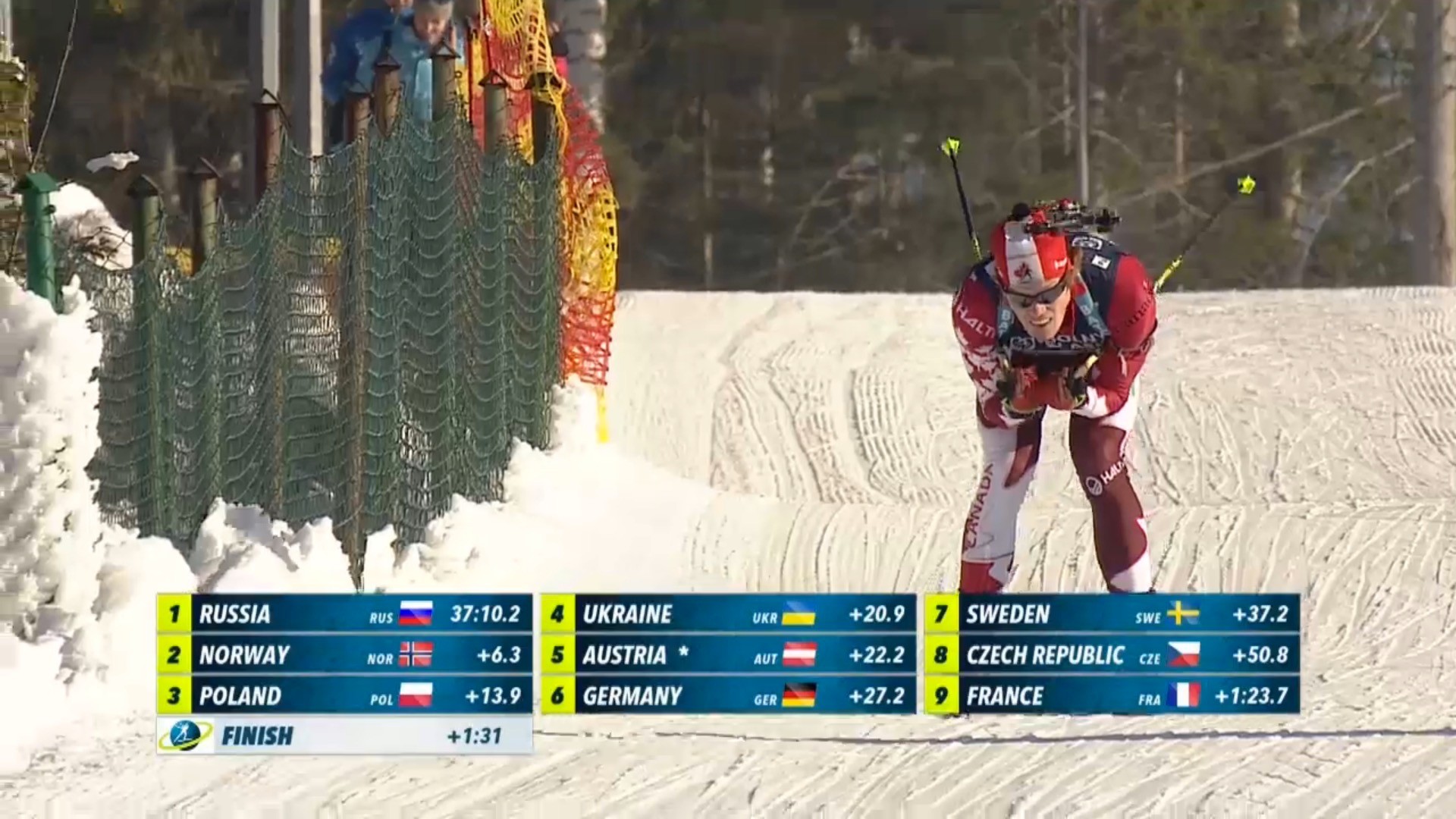
Earlier on Sunday, pretty much the only thing that went wrong for Russia’s Daria Virolaynen and Evgeniy Garanichev in the single mixed relay happened on the last meters of the finishing stretch, with Garanichev gesturing for a Russian flag he wanted to cross the line with. But the handoff was too short and the flag dropped past his outstretched hand to the snow. He glanced back, weighing if his lead was big enough to ski back, but decided it was not worth the risk, instead skiing into the arms of his partner waiting for him behind the line in a time of 37:10.2 minutes.
Russia needed seven spare rounds and incurred zero penalties. Garanichev secured the victory in the final shooting, when he only needed one spare – albeit fumbling a few seconds to insert it – while his direct opponents standing next to him required more time to hit their targets.
“Probably, I took some risk at the last standing,” Garanichev said, according to an IBU press release. “I wanted to shoot fast and clean, but missed with the last shot. But in general, I felt very comfortable; came and worked at the range in my rhythm.”
6.3 seconds behind, Norway with the team of Ingrid Landmark Tandrevold and Vetle Sjåstad Christiansen placed second, with seven spares and zero penalties.
“These are very short loops,” Christiansen commented on the fairly new, single mixed relay format. “You feel the pressure from the crowd and to shoot fast every time.”
The 20-year-old Tandrevold previously earned three bronze medals, including one in the single mixed relay, also with Christiansen, at last year’s Open European Championships in Tyumen, Russia.
To big cheers from their home crowd fans who had come out to the Duszniki Arena in beautiful but cold weather, the Polish husband-and-wife team of Krystyna Guzik and Grzegorz Guzik placed third with just five spares and zero penalties (+13.9), not quite able to keep up with Christiansen on the final loop after leaving the range together within a second.
“It is so nice to win a medal here in Poland,” Krystyna Guzik said. “We were both very disappointed with all of our mistakes in the other competitions. So today, we were relaxed and laughing before the competition, hoping not to have those mistakes again. We did not … and now have a medal.”
It was the first medal for Poland at these championships.
Ukraine with Iryna Varvynets and Andriy Dotsenko finished fourth, also with five spares and zero penalties (+20.9).
Biathlon Canada’s Aidan Millar skiing the final loop of the single mixed relay at the 2017 IBU Open European Championships in Duszniki-Zdrój, Poland. With teammate Sarah Beaudry, Canada finished 13th (Photo: IBU/Eurovisionsports.tv screenshot)
For Biathlon Canada, Sarah Beaudry and Aidan Millar required seven spares during their race and had no penalty, just like the winning Russians and Norwegians, but could not quite keep up with the best teams on the course in the fast-paced race format with short loops somewhat comparable to a team sprint in cross-country.
Beaudry cleaned her first shooting stage and then needed one spare to hit all targets in standing. At the first exchange Canada was 10th, 35.8 seconds behind the then leading team from Poland.
Millar missed one shot in his first prone stage, leaving the range again in ninth position. Then he needed two spares in his standing shooting on the way to exchanging back to Beaudry in 11th (+56.4).
On her second leg, Beaudry had one miss in prone and required two spares in standing, falling back a bit to exchange in 13th (+2:12.0).
On his final leg, Millar was able to shoot clean in both stages, reducing the time gap to the top but not able to make up another position, and finished in 13th place (+1:56.1).
US Biathlon is only represented with two women at the Open European Championships in Poland, and decided to forgo a start in the single mixed relay, instead entering a team in the mixed relay later on Sunday.
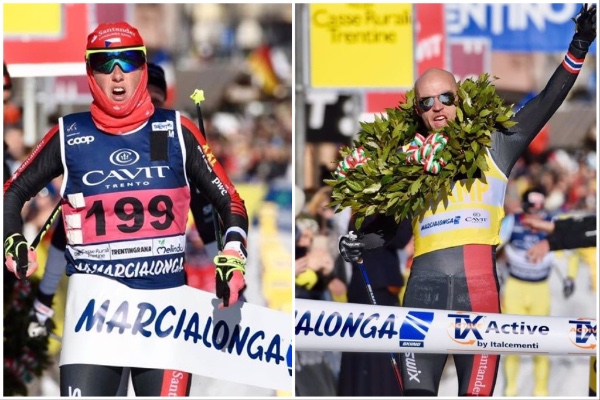
Katerina Smutna (left) and Tord Asle Gjerdalen (right) of Team Santander won the 2017 Marcialonga. (Photo: Visma Ski Classics)
Tord Asle Gjerdalen won the Marcialonga, a Worldloppet and Swix Ski Classics marathon for the third time – in a row. This year was on a shortened course, “just” 57 rather than the traditional 70 kilometers.
The Team Santander athlete finished in two hours, eight minutes, and 36 seconds, edging Johan Kjølstad (Team United Bakeries) and Morten Eide Pedersen (Team BN Bank) in a sprint finish by 2.6 and 2.9 seconds, respectively.
Tyler Kornfield and David Norris of Alaska Pacific University finished 43rd (+5:03.8) and 66th (+10:43.1). Canadian Paralympian Brian McKeever finished 57th (+9:13.5) and guide Graham Nishikawa 81st (+12:56.5), followed by Ian Murray in 85th (+13:37.5) and Erik Carleton in 111th (+17:50.2).
In the women’s competition, Katerina Smutna, also of Team Santander, won her third straight Ski Classics competition. She crossed the line in two hours, 22 minutes, and 46.4 seconds. Britta Norgren of Team Lager 157 was second by just 0.8 seconds, and Sara Lindborg (Team Serneke) third, +4:22.2. University of Utah alum Maria Graefnings was tenth, +10:35.8.
Sweden’s Stina Nilsson celebrates her second-straight World Cup sprint victory on Saturday after winning the 1.4 k freestyle sprint at home in Falun, Sweden.
FIS Cross-Country World Cup (Falun, Sweden): Men’s & women’s freestyle sprints
[UPDATED] Kikkan Randall reached the final for the first time since March 2015 on Saturday in the women’s 1.4-kilometer freestyle sprint at the World Cup in Falun, Sweden. The American qualified 26th and went on to advance in second out of her quarterfinal and semifinal to reach the six-woman final, where she ended up fifth.
Sweden’s Stina Nilsson won the final by one-hundredth of a second over Norway’s Maiken Caspersen Falla, finishing in 3:00.24 minutes. Nilsson had started the day by qualifying in sixth, 2.52 seconds behind Norway’s Marit Bjørgen, who won the qualifier in 3:00.64. This is Nilsson’s second-straight World Cup sprint win after skipping the freestyle sprint in Toblach, Italy, following the Tour de Ski.
While Bjørgen went on to win her quarterfinal, she finished fifth in her semifinal to end up ninth on the day.
Norway had two on the women’s podium with Heidi Weng in third, 1.88 seconds behind Nilsson. Finland’s Krista Parmakoski placed fourth (+1.99), and Randall was fifth (+2.56) for her best result in two years (she took last season off to have a baby). Sweden’s Jonna Sundling reached the final as well and finished sixth (+8.02).
Five U.S. women qualified for the heats, with Jessie Diggins qualifying fifth and ultimately crashing in her semifinal, where she finished fifth. That put her 10th overall on the day. Sophie Caldwell qualified third and finished fourth in her quarterfinal for 16th on the day, Sadie Bjornsen qualified 17th and also finished fourth in her quarterfinal for 19th overall, and Ida Sargent made the top-30 qualifying cutoff in 30th, then placed fifth in her quarterfinal for 25th overall.
Bjørgen topped the freestyle sprint qualifier on Saturday morning, clocking the fastest time around the 1.4 k course by just 0.08 seconds over Hanna Falk of Sweden.Caldwell qualified third (+1.23),Digginsqualified fifth (+2.39),Bjornsen17th (+5.04),Randall26th (+6.64), andSargent 30th (+8.28). Rosie Brennan (U.S. Ski Team) missed the cut in 37th (+10.90) and Liz Guiney finished 56th (+32.87). The lone Canadian woman racing on Saturday, Cendrine Browne placed 46th (+14.02).
In the men’s 1.4 k freestyle sprint final, Italy’s Federico Pellegrino held off three Norwegians and two Swedes to win in 2:45.77. The defending Sprint World Cup champion qualified second and went on to win his quarterfinal and semifinal before taking the final by six-hundredths of a second.
Norway took the remaining spots on the podium with Emil Iversen in second (+0.06) and Sindre Bjørnestad Skar in third (+0.47). Sweden’s Oskar Svensson was three-hundredths of a second off the podium in fourth (+0.50). The fastest qualifier in 2:34.49, Norway’s Johannes Høsflot Klæbo reached the final and ultimately took fifth (+1.32), and Sweden’s Teodor Peterson placed sixth (+2.08).
Canada’s Len Valjas was the top North American in 10th. He qualified 20th, advanced in second from his quarterfinal and finished fifth in his semifinal.
American Andy Newell was 16th after qualifying in 25th and finishing third in his quarterfinal. U.S. teammate Simi Hamilton followed in 18th, after qualifying 13th and finishing fourth in his quarterfinal.
In the men’s qualifier, Klæbo was 1.05 seconds faster thanPellegrinoand another 0.02 seconds faster than Russia’s Sergey Ustiugov in third.
For the U.S., Hamiltonqualified 13th (+4.52) andNewell qualified 25th (+6.74). Erik Bjornsen placed 43rd (+9.30) and Matt Gelso 59th (+13.12).
Valjaswas the lone Canadian man to make the heats, qualifying 20th (+6.22). The only other starter, Alex Harvey, placed 46th (+9.71).
IBU Open European Championships (Duszniki-Zdrój, Poland): Men’s & women’s pursuits
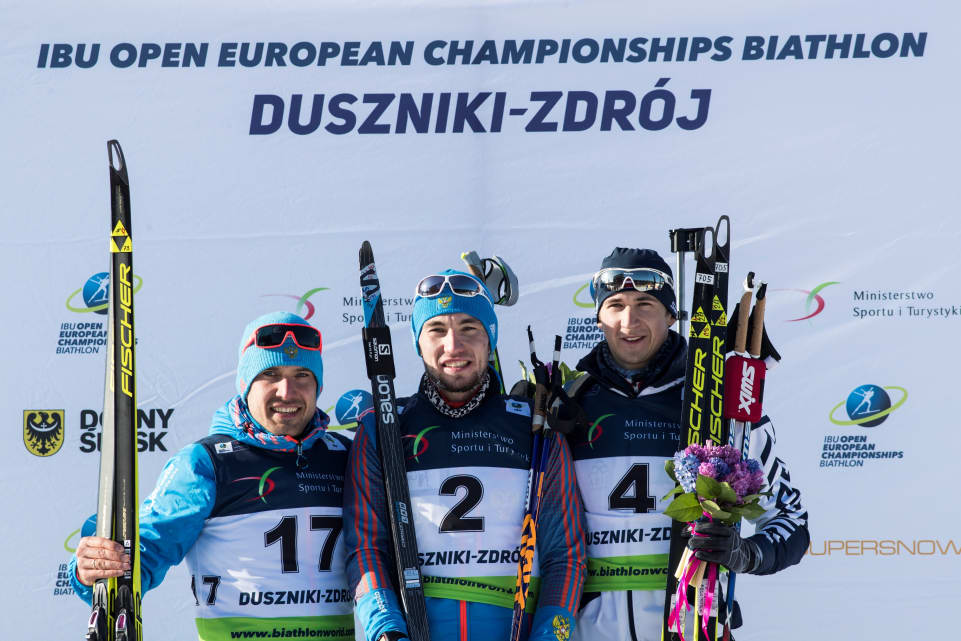
The men’s pursuit podium at 2017 IBU Open European Championships on Saturday in Duszniki-Zdrój, Poland, with Russia’s Alexander Loginov (c) in first, Evgeniy Garanichev (l) in second, and Latvia’s Andrejs Rastorgujevs (r) in third. (Photo: IBU)
Russia’s Alexander Loginov racked up his second win of the 2017 International Biathlon Union (IBU) Open European Championships on Saturday in the mens’ 12.5-kilometer pursuit in Duszniki-Zdrój, Poland.
After starting second, 5 seconds behind Bulgaria’s Vladimir Iliev, who won Friday’s sprint, Loginov proceeded to clean three straight stages before missing one on his final standing to cross the line first in 31:46.2 minutes.
“It was not as easy as it seemed, because from the first loop Vladimir set a really good speed,” Loginov said, according to an IBU press release. “Today we had great sunny and windless weather again, so I managed to shoot well. Probably that is why it [looked] so easy.”
Russia took first and second place with Evgeniy Garanichev following 27.8 seconds later, after starting 17th (56 seconds out of first) and shooting 19-for-20 (0+0+1+0).
“After yesterday’s sprint, I managed to work well and to show good result in pursuit, so I’m sure glad to win the silver medal,” Garanichev said, according to the IBU.
Latvia’s Andrejs Rastorgujevs improved on his fourth place in the sprint to reach the pursuit podium in third (+59.5) despite four penalties (0+1+1+2).
“On the last loop I had the information about the guys who were behind me and in front of me,” Rastorgujevs said, according to the IBU. “I was just fighting and did all I could do to get to the podium.”
Bulgaria’s Krasimir Anev, who started third, slipped to fifth (+1:28.6) with two penalties (0+1+1+0), behind Russia’s third man in the top four, Alexey Volkov in fourth (+1:01.6). Iliev as the first starter ended up 11th (+1:41.7) with six penalties (2+2+0+2).
The two Americans who had qualified for the pursuit by placing in the top 60 of Friday’s sprint, Paul Schommer and Alex Howe improved to 48th (+5:07.1) and 51st (+5:42.3), respectively.
Schommer started 58th, just ahead of Howe in 59th, and missed five targets, all in his first two prone stages (3+2+0+0). Howe accumulated four penalties (1+2+1+0).
No Canadians qualified for the pursuit.
[UPDATED] In the women’s 10 k pursuit that followed, Russia’s Irina Starykh picked up her second win and third consecutive podium of the championships, with clean shooting en route to a 19.8-second victory in 30:04.4.
Starykh started third, 38 seconds behind Ukraine’s Juliya Dzhyma and 11 seconds after her Russian teammate Svetlana Sleptsova, respectively. Dzhima missed two on her last two standing stages (0+0+1+1) to slip to second, and Sleptsova dropped one place to third (+32.1) with one prone penalty (0+1+0+0).
Veronika Vítková of the Czech Republic improved from seventh to fourth (+47.8) with two penalties (0+1+1+0), and Russia’s Svetlana Mironova moved all the way up from 13th to fifth (+1:29.6) with three misses (0+1+1+1). Just 0.2 seconds behind her, Poland’s Monika Hojnisz improved from 16th at the start to sixth (+1:29.6) with one penalty (0+0+0+1).
No North Americans qualified for the pursuit.
Open European Championships conclude Sunday with the single mixed and mixed relay.
Canada’s Macx Davies celebrates as he is cheered on by 42,000 fans during the final lap of the 2016 Biathlon auf Schalke invitational race. The Canadian relay team, with his partner Megan Tandy, finished 10th. (Photo: Biathlon-aufschalke.de)
A biathlon relay with athletes skiing around and through a huge soccer arena in a city with no snow seems like a crazy idea.
But in the 1990s, the German cross-country skier and biathlete Herbert Fritzenwenger, who had retired from active sports after competing in the 1988 Calgary Olympic Games, believed there had to be some way to make biathlon even more attractive for viewers. He wanted to mix sports and entertainment bringing the sport out of the forest and closer to the people, the way city sprints are now doing it for cross-country. He also believed a discipline where women and men compete together would be more interesting to watch.
Thus the World Team Challenge was born, a two-person mixed relay invitational, with each team representing a country. In 2002, Frizenwenger took the next step to bring that race to an even higher level of awareness. Together with the then-manager of first-league soccer team Schalke 04, he moved the event to the team’s newly constructed Veltins Arena in Gelsenkirchen, Germany. Only problem: The arena, which features a retractable roof, is located in a flat region of the country far away from any mountain range with predictable snowfall. But using manmade snow from a nearby ski hall to create a course just for this race every year the concept instantly worked, and has drawn some of the biggest crowds for any biathlon event in the world ever since.
Now in its 15th year, the “Biathlon auf Schalke” race has become a Christmas holiday break tradition on TV in Germany, also broadcast live in several other countries. Many biathletes love the event for its atmosphere in front of 42,000 raucous fans in the arena, and as an interesting way to keep the race shape sharp during the break.
This year’s edition took place on Wednesday evening, and it was the first time a Canadian relay was at the start, with Megan Tandy and Macx Davies teaming up to represent Canada in a show event that combines a mass start with a pursuit after a short “halftime” intermission.
In both races, the Canadian pair quickly incurred a number of penalty laps (unlike in other relays the athletes are not allowed to use spares in the fast-paced competition) and slipped to the back of the field of 10 teams, tagging off to the partner after each shooting stage to chase once more over the 1.3-kilometer course around the arena.
But Davies finished the event to huge cheers, with the audience elated by a victory of the home teams seemingly not wanting the show to be over yet, and screaming until he had crossed the line.
“The atmosphere was GREAT!!!” Davies wrote in an email to FasterSkier. “Very loud and very fun crowd. They even cheered most of our shootings! (When we were the only ones in the range.) It was amazing to ski through the tunnel the last time to such a big ROAR from the stadium.”
The arena was rocking particularly loudly as Germany’s fan-favorite Simon Schempp entered the finishing stretch for his first victory at Schalke with his partner Vanessa Hinz, crossing the line in a time of 33:11.4 minutes (with four penalties).
Originally, the German coaches hadn’t selected Hinz to compete at Schalke, but she replaced her sick teammate, Franziska Preuss, to team up with Schempp. Last year, Hinz and Schempp had placed third in the World Team Challenge, with Hinz also subbing in at the last moment. This year, it was their time on the top of the podium.
“Yeah, this is pretty crazy,” Schempp told German TV broadcaster ZDF after the race, in an interview that was heard throughout the arena. “That must be how soccer players feel every week. The atmosphere is gigantic. This is much more extreme than in a biathlon arena because there is a roof. I don’t know how many exactly, but I believe 40,000 people are here and it’s just crazy fun. [Cheers in the arena] You can hear it, craziness.”
The announcer asked Hinz how she stayed so calm in front of her home crowd on the shooting range.
“That’s what we do all year, but in front of such an audience your knees get weak,” she said. “It’s just brutal. We just want to say many thanks, because to experience something like this is unique.”
The audience in the arena was happy to hear that, erupting in huge cheers again. Germany last won the event in 2013 with Laura Dahlmeier and Florian Graf. Dahlmeier, the current women’s overall IBU World Cup leader, took a break this year, as did the defending World Team Challenge champions Marie Dorin Habert and Martin Fourcade of France.
The 2016 Biathlon auf Schalke podium on Wednesday night, with (from left to right) Germany’s Erik Lesser and Franziska Hildebrand (second place), Germany’s Simon Schempp and Vanessa Hinz (first place), and Russia’s Olga Podchufarova and Alexey Volkov (third place). (Photo: Biathlon-aufschalke.de)
Despite usually entering multiple teams at Schalke, Germany had not been able to claim first and second on the podium — until this year, which sent the arena into frenzy.
For Germany’s second team, Franziska Hildebrand teamed up with Erik Lesser for the second-straight year after the duo finished seventh in 2015. They came close to the overall victory this time, winning the mass start by 15 seconds ahead of Hinz and Schempp, and later staying in their vicinity throughout the pursuit. But Lesser missed his final standing shot when he still had a small chance to catch up to Schempp in first.
“Of course [the atmosphere] is pushing me,” Hildebrand had told ZDF at halftime, after the mass start. “It’s such an incredible audience. It’s so beautiful when you come into the arena as a German athlete and experience such a loud support. That is always a total buzz, a breathtaking moment.”
On the first loop of the pursuit Lesser broke his pole after stepping on it, and did not receive a replacement until after the exchange to Hildebrand.
“For the shooting I don’t need a pole, and afterwards that half-a-second I lost I can deal with that, before someone runs over and probably breaks his foot,” he told ZDF after the race, causing a big laughter in the arena. “Such a great atmosphere. The spectators are really picking it up. And that’s why I am here.”
At times more than a minute ahead of the field, the German teams made the race relatively close again with two laps to go, when standing next to each other both Hinz and Hildebrand shot two penalties despite their otherwise almost-flawless shooting performances.
The third place on the podium went to Russia’s Olga Podchufarova and Alexey Volkov (who won gold with the men’s relay at the 2014 Olympics), narrowly edging out France’s Anaïs Bescond and Jean-Guillaume Béatrix (+42.6), Austria’s Julia Schwaiger and Simon Eder (+43.0) and Norway’s husband-and-wife team of Fanny Horn Birkeland and Lars Helge Birkeland (+43.3) on the final loop and finishing sprint.
Long Day on a Challenging Course
Originally, Tandy — who trains and lives in Germany for part of the year — had planned on racing with Biathlon Canada teammate Nathan Smith, but Smith returned to Canada after struggling in the initial World Cup races of the season with unclear symptoms, which he has since been trying to resolve.
“After Nathan went home I was talking with Megan and [coach] Matthias Ahrens about if it would be possible to race,” Davies explained. “Because I have been watching this race for a long time now and always thought it would be an awesome event to compete at, which it is! So I changed my plans so we could start an all-Canadian team and I am very happy to have raced the World Team Challenge!”
View of the indoor section of the ski track and the shooting range inside the domed Veltins Arena during the 2016 Biathlon auf Schalke invitational. (Photo: Biathlon-aufSchalke.de)
Even more so than a regular IBU World Cup, the race is held in a huge party atmosphere, with athletes skiing through a winter village park with food stands and sponsor exhibition tents lining the artificial snow track around the huge soccer arena, before entering the pitch inside the arena again via a darkened tunnel with light effects. And then having to shoot in front of the 42,000 fans, frequently with loud music blaring, and the noise level amplified indoors many times.
The World Team Challenge relay race is also executed in a special format, with one woman and one man forming a team and exchanging repeatedly, each skiing a loop of about 1.3 k and having to clean a shooting stage — or ski a shorter-than-usual 75-meter penalty lap — before tagging off to their teammate again. While one athlete was out on the track, crews of wax technicians hurried to clean and prepare the skis of the athlete who was receiving a short break. This mode of competition is fairly similar to the new single mixed relay in biathlon or the team sprint in cross-country.
It was a long race day for the athletes, with a “shootout” followed by the main event split into two “halftimes,” as the organizers called it, borrowing the terms from soccer. At first a nine-loop mass start (the women skied four loops, the men five including the final loop) on the 1.3 k course, followed by a pursuit race of that same length after just a short intermission. Thus the women had to ski about 10 k in total, while the men had to ski 13 k.
The gaps to the best team in the mass start were halved respectively, capped at a maximum of 45 seconds for the pursuit, so even the teams at the back of the field like Canada could still have a realistic shot at the podium.
Prone and standing stages interchanged with each partner shooting twice in prone and twice in standing per race, and because the loops were comparatively short and intense, like a sprint, shooting accuracy was at least as important as in regular World Cup races.
“I really like the format of this race, and think maybe it should replace the Single Mixed relay,” Davies explained in his email. “But maybe only race once, doing both was very challenging. But it is a fun event nonetheless!”
In the first few years of the Biathlon auf Schalke event, the course was a relatively flat loop, but after a redesign last year added longer climbs and a downhill section on the part of the track that meanders through the park outside the arena, it is supposed to more closely resemble what athletes would see “on the World Cup level,” as the organizers announced in a presentation before the race.
Using artificial snow mostly coming from a ski hall in the nearby city of Neuss, every loop is now 1,300 meters long, featuring 30 meters of vertical climb nicknamed the “Ruhrpott Glacier”, which added up to about 300 meters for the men and 240 for the women for the whole race day.
“It’s really not just a show race,” Schempp told broadcaster ZDF. “The legs are really burning very much. Because you have those short individual loops, but that just makes it even worse because you just ski that kilometer even faster than at normal competition speed. And because of that it is really challenging, but still is a lot of fun.”
“The course is really good for what they have,” Davies wrote in his email. ”The stadium is exciting with all the corners and I think the track is decently difficult, though below World Cup level. I think they did a better job on the downhill corner this year, because it was easier to ski, the athletes don’t like to see crashes.”
The athletes had fewer problems with that downhill section leading into a sharp-right hairpin turn than during the prior year when that was introduced, but the Czech Republic’s defending World Cup winner Gabriela Koukalová fell this year, grimacing and rubbing her thigh as she got back up. She finished seventh with her partner, Michal Šlesingr, after placing second with Ondrej Moravec in 2015.
“We just saw [a replay of] Gabriela slipping out there,” Hildebrand told ZDF when questioned about her more conservative downhill snowplow technique. “I wanted to avoid that at all costs, so I chose the safety version.”
After some years where the organizers experimented with rifles using a laser-aiming system, the athletes now use their own rifles with real ammunition on the 10-position range again, with bulletproof glass walls and an empty section behind it to protect the audience.
The difficulty of the course was once again evident during the races. Despite the indoor shooting range with almost no wind influence, many athletes who are known as good shooters incurred more misses and thus had to skate more penalty loops than they normally would in a World Cup.
“The shooting range was good, no wind, which is nice, but you are skiing very hard into the range and must shoot fast and accurately to stay with the leaders,” Davies commented.
2016 World Team Challenge Results
Germany I (Vanessa Hinz/Simon Schemp) 33:11.4
Germany II (Franziska Hildebrand/Erik Lesser), +16.7
Russia (Olga Podchufarova/Alexey Volkov), +40.2
France (Anaïs Bescond/Jean-Guillaume Béatrix), +42.6
Canada’s Megan Tandy at the start of the pursuit race during the 2016 Biathlon auf Schalke invitational event. (Photo: ZDF broadcast)
Tandy and Davies became the fifth North American team to be invited to the Biathlon auf Schalke event, and the first Canadian one. In 2008 and 2009, Lanny Barnes and Jay Hakkinen represented the U.S., placing ninth and sixth for the best finish by a North American team to-date. In 2010, Tracy Barnes-Coliander and Tim Burke finished 10th, and in 2012, Susan Dunklee teamed up with Burke for 10th.
“What a fun event last night,” Davies summed up his experience on his Facebook page. “I am very thankful to have been able to compete in the Biathlon World Team Challenge and I hope to be invited back to show you how good Canada can be! (Unfortunately we didn’t do very well this time…) Till next year.”
“I second everything Macx wrote ☺ ☺ ☺,” Tandy commented on his status.
Pre-Race Events with a Farewell to a Former World Champion
Before the two main races of the evening, Russia’s Volkov won a “shootout” event among all participating women and men, narrowly edging out Austria’s Eder, who is known for his fast shooting performances on the World Cup circuit, with Germany’s Hildebrand finishing third and Schempp fourth. Tandy and Davies had not qualified for the final of that event.
In this competition the athletes — while not wearing skis — were required to run up to the shooting mats and hit 20 targets as fast as possible (5 prone, 5 standing, 5 prone, 5 standing), using as many spare rounds as necessary.
The organizers also used the shootout event as a farewell to Germany’s national team member Daniel Böhm, men’s relay gold medal winner at the 2015 World Championships in Kontiolahti, Finland, and silver medalist in the relay at the 2014 Olympics in Sochi, who announced his retirement from biathlon earlier this month. He qualified for the final round of the shootout, where he finished fifth. Böhm plans to begin a training program to become a helicopter pilot with the German federal police.
“In the shootout I was a little bit shaky,” Böhm told ZDF. “It is something very special to compete here at Schalke. And I think there is nobody who can completely tune this out. It’s crazy what the fans are doing here, and great that I am allowed to say goodbye on this stage. That is a special honor, and now I can enjoy it looking on from the outside.”
While the IBU has adopted the mixed and single mixed relay formats in the last years as attractive new disciplines, Biathlon auf Schalke is an invitation-only race not hosted by the IBU, so there were no World Cup points to win in the event. However about €168,000 ($175,000 dollars) in prize money were awarded.
The IBU World Cup will resume next week Jan. 5-8 in Oberhof, Germany, with sprint races, pursuits and mass starts.
Canada Biathlon’s Megan Tandy (in black) greets her relay partner Macx Davies in the tech service area after the mass start race during the 2016 Biathlon auf Schalke invitational event. (Photo: ZDF broadcast)
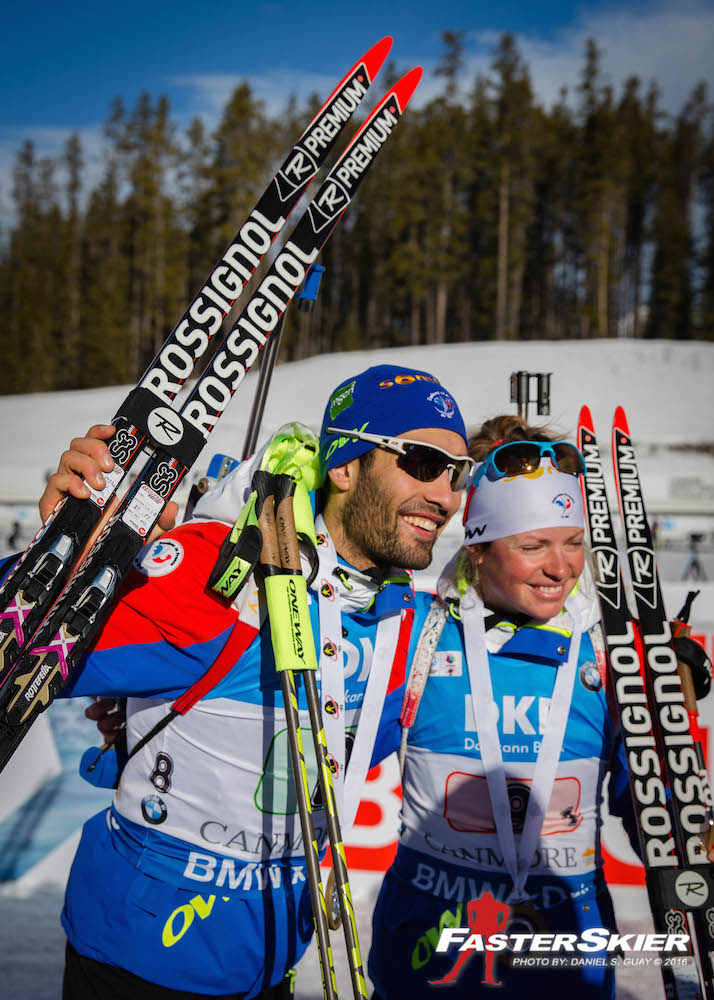
Teammates in the single mixed relay on Sunday, France’s Martin Fourcade and Marie Dorin Haber after winning the first of two relays on the last day of the IBU World Cup in Canmore, Alberta. (Photo: Daniel S. Guay)
France was determined to win the International Biathlon Union (IBU) World Cup 13.5-kilometer single mixed relay on Sunday in Canmore, Alberta, using their best athletes with men’s overall World Cup leader Martin Fourcade and Marie Dorin Habert, who ranks third in the women’s standings. And they succeeded in convincing fashion, finishing first in 37:58.0 minutes, with four spares and no penalties.
The first time the new race format was on the calendar this season at the World Cup in Östersund, Sweden, the French duo of Dorin Habert and Martin’s older brother Simon Fourcade thought they had won the race, but because Fourcade had not fired a shot during the competition the team was slapped with a four-minute penalty, putting them back to 21st place.
On Sunday morning, France made no such mistakes and didn’t leave the other teams any chance in nearly a start-to-finish victory. Dorin Habert took the lead out of the arena, stayed there for most of her leg and tagged narrowly in first place, before both Fourcade and Dorin Habert expanded their lead on the next three legs with good shooting and fast skiing. Fourcade put an exclamation mark on the victory by sprinting into the finish despite knowing he had a comfortable lead of more than half a minute on the final loop.
“It was a really exciting race. I like these kind of short races. I tried to be as strong as Martin, it’s an honor to run with him,” Dorin Habert said at the post-race press conference. “It was in our head before the competition to win, but this is biathlon and everything can happen on the [shooting range].
“I tried to train the finish, I think that was a good opportunity,” Fourcade explained during the press conference. “But I actually didn’t compete the full last loop,” he added with a smile. “I only did for some parts, the ones in front of the TV.”
“Today I was satisfied even if I needed two extra shots, two too much,” Fourcade later told the IBU in an interview. “It was a good competition for both of us.”
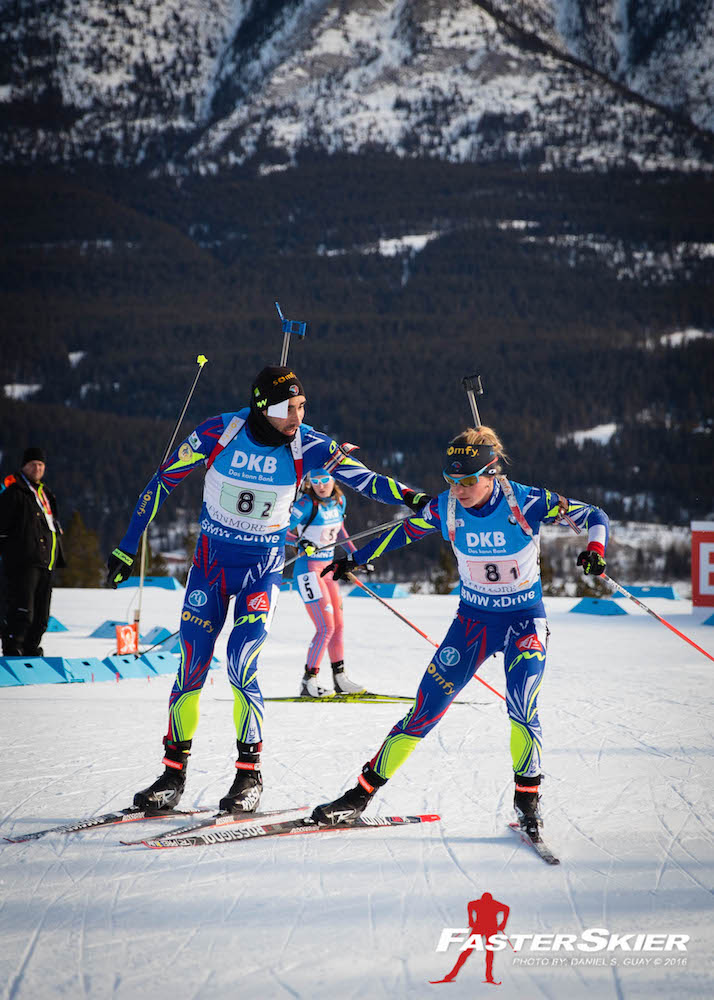
France’s Martin Fourcade (l) tags teammate Marie Dorin Habert for her the third of four legs in the single mixed relay at the IBU World Cup in Canmore, Alberta. They ended up winning by 45 seconds. (Photo: Daniel S. Guay)
Second place went to the Austrian duo Lisa Therese Hauser and Simon Eder, 45.2 seconds back, with eight spares and no penalties. It was Hauser’s first World Cup podium.
Norway’s Hilde Fenne and Lars Helge Birkeland secured the third spot on the podium, 55.3 seconds back, with seven spares and no penalties. Birkeland defended his lead on the final loop, coming into the finish two seconds ahead of Russia’s Olga Podchufarova, who teamed up with Alexey Volkov to finish fourth (+57.3), with no penalties and just two spares.
New since the 2014/2015 season and only held for the third time at the World Cup level on Sunday, the single mixed format was established by the IBU to have another action-packed event and give “smaller” biathlon nations a shot at the podium. For some countries, it presented an opportunity to start a team event. It is not yet a part of Biathlon World Championships or Olympic Games.
“The single mixed relay is interesting for smaller nations, because they maybe don’t have five women and five men who can compete with the top, but maybe one or two,” Canadian head coach Matthias Ahrens told German TV broadcaster ZDF in an interview before the race. “Then you can use those in the mixed or single mixed relay, thereby potentially getting a chance to reach the podium, which worked pretty well for us at the season-opening in Östersund [where Canada placed second].”
On Sunday, some teams, such as France — though not an example for a “small” biathlon nation — Austria and Latvia (in eighth place), made use of that by putting their best racers in the event. Other teams decided to focus on the “normal” mixed relay, with two women and two men on each team, that followed later on Sunday in Canmore.
The single mixed relay features the shortest loops in biathlon, with the athletes skiing a 1.5-kilometer loop between each shooting stage, then immediately exchanging after the standing shooting. After the female team member starts and shoots one prone and one standing stage, she exchanges to her male teammate, then the woman gets tagged again to ski the third leg (six kilometers total), and the man closes out on the fourth anchor leg racing an additional 1.5 k after the final standing shooting, which adds up to the odd 13.5 k distance. The athletes are allowed to use three spare rounds per shooting like in a normal relay, and the penalty lap is also shortened to 75 meters (usually 150).
Thus the whole race is extremely fast-paced, and rather resembles a cross-country team sprint than a traditional biathlon or cross-country relay.
“This was a new start for me in the World Cup, because I never did a single mixed relay before,” Fourcade said at the press conference. “I already did it a lot during the show competitions like Schalke [World Team Challenge in late December] or Moscow or Tyumen [Race of Champions, another invitational at the end of the season]. I really love that. But it was different today … with the pressure of the World Cup… I think the single mixed relay is really good for biathlon.”
“The single mixed relay is a super fun race format, but you really have to shoot well to have a chance,” U.S. Biathlon’s Annelies Cook wrote in an email.
“Certain abilities are demanded, especially ‘shooting efficiency,’ ” Ahrens told ZDF. “That means you need athletes who, first of all, can shoot well and hit, but also shoot very fast.”
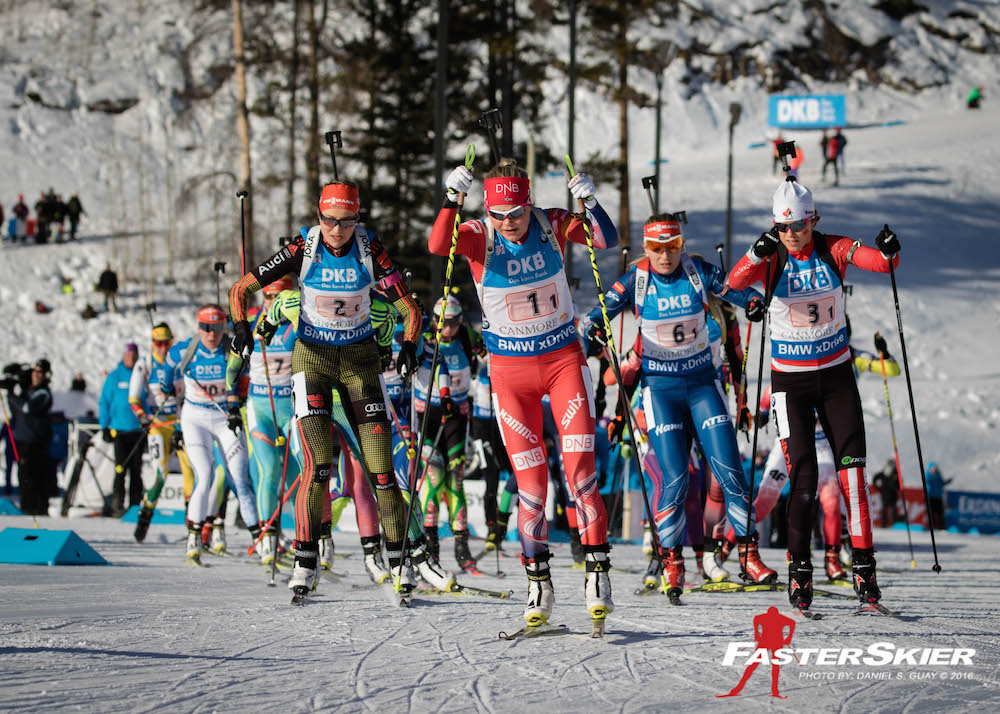
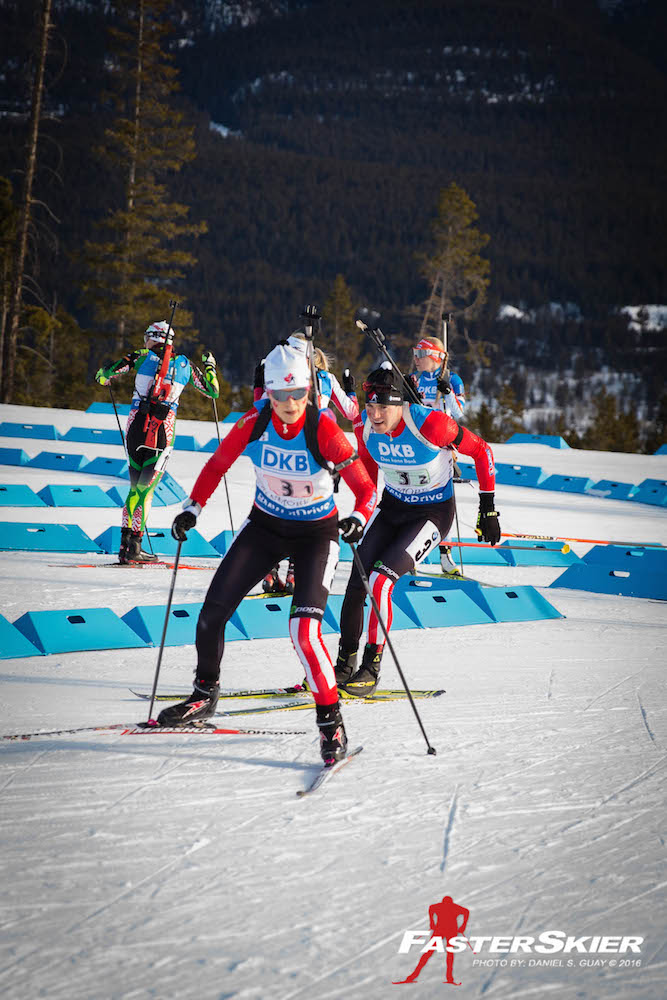
Germany’s Luise Kummer (2), Norway’s Hilde Fenne (1) and Canada’s Julia Ransom (3) early in the single mixed relay at the IBU World Cup in Canmore, Alberta. Norway went on to place third, Germany seventh and Canada finished 12th. (Photo: Daniel S. Guay)
Conditions on Sunday were good throughout the race, with calm winds and the sun shining in the Canadian Rocky Mountains, after the athletes had struggled with snowfall and strong gales in the previous days.
“I think we were all satisfied to know that it would be fair and beautiful conditions. It’s the [kind of] biathlon we love,” Fourcade said in an interview with the IBU.
“Today was the best snow conditions of the week. There was a light wind, but it seemed pretty consistent,” Canada’s Nathan Smith wrote in an email.
France steadily expanded its lead throughout the race. At the first exchange, Dorin Habert tagged Fourcade in first, just 0.4 seconds ahead of Sweden. Fourcade slightly expanded that lead to 6.5 seconds over Russia in second place by the next exchange, and then Dorin Habert cleaned both shooting stages on her second leg to balloon the gap to 50.1 seconds over Norway in second. Essentially, Fourcade just needed to go through the motions on his last leg to lock up first.
Before the final shooting, Germany’s Erik Lesser had been in second place behind Fourcade. But unable to clean his targets and running out of spares, Lesser incurred a penalty lap and ended up seventh (+1:29.6), as teams passed him with better shooting. Lesser and teammate Luise Kummer combined for one penalty and eight spares.
This brought back some painful memories from the first time a single mixed relay was held in a year ago in February 2015 in Nove Mesto, Czech Republic. Lesser and Kummer had been in the lead before the final shooting, then Lesser slipped into fourth with a penalty.
After Sunday’s race, suffice to say Lesser wasn’t happy.
“Does anyone still want to see that? I don’t!” Lesser quipped when the interviewer in the mixed zone asked him to take a look at a replay of his targets in the final shooting stage. “It really doesn’t matter where those [shots] went, I just didn’t hit, fired four really poor shots,” he added after taking a glance at the fairly close misses. “If Mark [Kirchner, men’s head coach] wants to chew me out for that, I hard-earned it.”
“On the first spare I was already thinking, ‘Oh great, this is going the same way as last year,’ ” Lesser continued. “On the second leg I struggled, I tried to keep the others at bay on the course so they would not catch up, but I somehow didn’t move well, got tense on the shooting range, and then the misses happened. I am completely annoyed, mega-disappointed… This is the World Cup level, so you should also be able to hit with tired legs.”
Kummer used four spares and was also disappointed, but didn’t pin the blame on Lesser.
“A [single mixed] relay is comprised of two people, everything has to work out, and that mistake can happen to everybody,” she told ZDF. “You are always happy yourself to get through [a relay shooting stage] unscathed, so that shouldn’t be a problem…. I still think it’s a very exciting competition for the spectators, very fast-paced exchanges. It doesn’t have the same standing as a relay or mixed relay yet, but one can see that it is developing.”
Lesser’s troubles allowed Austria’s quick-shooting Eder to pass him and secure second place, after he and Hauser had been just outside the podium ranks for most of the race.
“I am really happy about this podium today. It’s my first one. I dreamed about it, and today it worked,” the 22-years-old Hauser told reporters at the press conference. “My shooting was not so good especially in prone. Simon and I are both fast shooters and also good shooters, but today it was not the best.”
“I felt great on the course, I always could keep up or even close gaps,” Hauser added in an Austrian Ski Federation press release. “On the shooting range I let the stress get to me a little bit, that caused the spares. But of course I am overjoyed by the podium finish.”
“The first turn did not go according to plan on the shooting range. I had problems with my ski poles and used too many spares,” Eder, 32, said in the press release. “But the second turn went all the better, I could really push the tempo also on the shooting range. Finally we have a place on the podium also in a mixed relay.”
In the absence of their usual stars that are skipping the North American World Cups in the leadup to 2016 World Championships at home in Oslo, the Norwegians still reached the podium with Fenne and Birkeland, who both improved on their second legs to move from seventh at the first exchange to third at the finish. (Birkeland also won the first single mixed race of the season, though with Kaia Woeien Nicolaisen as his partner.)
“I am not sure why, we just always try to do good races,” Fenne said during the post-race press conference when asked why Norway seems to do so well in the single mixed relay. She added that the coaching staff picked the lineups for Sunday, so she didn’t know why she was put on the single mixed relay instead of the four-person mixed relay.
Canada 12th, U.S. 16th
Representing Canada at home in Canmore, Julia Ransom, who is competing in her first full World Cup season, teamed up with veteran Nathan Smith, who raced to second in the Östersund single mixed relay with Rosanna Crawford.
Canada’s Nathan Smith (behind) coming through the exchange zone to tag teammate Julia Ransom during single mixed relay at the IBU World Cup in Canmore, Alberta. (Photo: Daniel S. Guay)
This time, the Canadians ended up nearly two minutes off the podium in 12th (+1:54.3), with 10 spares and no penalties.
On her first leg, Ransom used one spare round in her first prone, but then required all three spares in standing to narrowly avoid a penalty lap.
“It was hard, very hard,” Ransom said in a Biathlon Canada press release. “I haven’t done that format before. I felt that one for sure. This is the first time I’ve done a relay with Nathan so it was lot of fun for me, and a great experience.
“I was bouncing around at the start and maybe nerves got to me a little bit because I didn’t know what to expect,” she added. “The techs just told me to ‘reel it in.’ ”
After the first 1.5 k, she tagged Smith 47.0 seconds behind in 19th of 23 teams. On his first leg, Smith cleaned prone without any spares and only required one spare in standing to keep his distance to the top, handing off to Ransom 49.2 seconds back in 11th.
“We unfortunately fell back pretty early in the race. Julia had some difficulty in the range,” Smith wrote in an email to FasterSkier. “The time lost loading spares is even more penalizing when the loops are so short. The format itself is pretty fun to race, and quite a bit different from traditional races. It’s almost more like two races back to back with a little break. It suits my quick shooting speed really well.”
Ransom cleaned her next prone stage as she had done repeatedly in recent weeks, but with two more spares in standing, she lost a minute to the top.
Still in 11th when he received the tag, Smith again hit all targets in his prone stage, but required three spares in his last standing to avoid the penalty lap, approximately holding his gap to the leaders.
“Other than my last standing my [two relay] legs went really well. Prone felt amazing. Probably almost the best ever. Just fast, easy and accurate,” Smith wrote. “I ended up battling a lot with [Latvia’s] Rastorgujevs. He surprised me by matching my shooting speed. He’s always one of the fastest out there. It was too much for me to hang on to on the last lap.”
“It was my best race this week. The legs felt a lot better today. Not amazing, but quite good until that last lap,” Smith said in the team press release. “One of the toughest things to do is race at home with the pressure we put on ourselves with our friends and family watching all the volunteers we know out here. I obviously wanted to peak here and do well but there are so many factors that come into play. It was a great experience racing at home that we’ll be able to take with us.”
For the U.S., Cook teamed up with Leif Nordgren. In Östersund, their teammates, Clare Egan and Sean Doherty finished 15th in the single mixed relay. This time, the Americans finished in the same range in 16th place (+3:20.1), with one penalty and 14 spares.
Annelies Cook (US Biathlon) during one of her two standing stages in Sunday’s single mixed relay at the IBU World Cup in Canmore, Alberta. She teamed up with Leif Nordgren to place 16th. (Photo: Daniel S. Guay)
After using just one spare in her first prone stage, Cook incurred a penalty in her first standing stage, quickly disappearing out of the focus of the TV cameras, tagging Nordgren in 20th, about 1:05 behind the leaders.
“I felt good on skis and was in the mix, but I had a hard time holding back in the skiing and was probably breathing too hard to shoot well in standing,” Cook wrote in an email. Her course time ranked seventh fastest of the first-leg skiers. “My penalty in standing took us too far from the top to have contact.”
Nordgren needed two spare rounds in prone and another one in standing, losing about another 30 seconds to the top teams on his leg (+1:41.3) as he tagged Cook in 18th.
“This format is for sure a little different than a typical relay,” Nordgren explained in an email. “The pace is usually fast right from the start, and because the loops are so short it really puts all the focus on the shooting since its hard to really break away on such a short loop. It’s nice to have that difference, but you really have to be on top of your game in the shooting to be competitive.”
On her second leg, Cook again emerged from prone with just one spare, but needed another three spare rounds to clean her final standing stage and avoid another penalty. When she exchanged back to Nordgren, the U.S. was 3:04.7 out of first in 20th.
“The race does feel like a cross country sprint. But what makes it hard is knowing that you still have to hit targets, and finding the balance between all out sprinting and going just at the level where you can manage to hit your targets is tricky,” Cook wrote. “I just tried to make up time lost on the range by catching up on skiing as best as I could. There were a few of us together each lap, so it felt like a competition between that group of people.
“I had a hard time holding back because I really love sprinting, and that probably kept me from hitting in standing,” she added. “That put Leif on a position where he had to try and chase people down. He did a really good job of that and I was proud of him for catching people in the last loop.”
On the anchor leg, Nordgren mirrored his performance from his first round, again requiring two spares in prone and one in standing, but only lost 15 more seconds to the leaders and leapt to 16th by overtaking Romania, Slovenia, Belarus and Finland.
“Today neither Annelies nor I really had a great day on the range so we had a hard time to stay with the top teams,” Nordgren concluded. “The tracks were in perfect shape today which is always nice. Our techs did a great job to give us fast material, but we weren’t able to put it to good use.”
Staying Warm
In the exchange zone, several teams could be seen using spinning bikes to keep warm and stay loose during their race breaks while their teammate was out on the course, something the Norwegians pioneered for the single mixed relay in Östersund, though the Americans and Canadians opted for a traditional warmup.
“I just ran around to keep warm,” Cook wrote. “It’s not a big break and we don’t have a team bike. But running was totally fine for me.”
“During the break both of us just opted to jog around, being that it’s such a short race, it’s more important to stay warm any way possible,” Nordgren wrote. “Today was the first day in a several that the wind was pretty low, so that made staying warm a little easier.”
“I just jogged around while Julia was doing her second leg,” Smith explained in his email. “I considered using a spin bike but decided it would be best to practice like at World Champs.”
Moving on to Presque Isle
Nathan Smith (Biathlon Canada) during Sunday’s single mixed relay at the IBU World Cup in Canmore, Alberta. He teamed up with Julia Ransom to place 12th. (Photo: Daniel S. Guay)
The IBU World Cup now moves east to Presque Isle, Maine, with sprints for the women and men on Thursday, followed by pursuit races on Friday, and traditional relays on Saturday (men) and Sunday (women).
“Today was the best I’ve felt in a couple weeks. I hope my shape continues to return to normal through Presque Isle,” Smith wrote.
While Smith continues to work to hold his own in the overall World Cup standings (he’s currently 19th), the rest of Canada’s A-team, those pre-qualified for World Championships, will skip the Presque Isle World Cup and train in Canmore until Feb. 22, according to Crawford. That includes Crawford, Ransom, Sarah Beaudry, Brendan Green, Scott Gow, Christian Gow, and Macx Davies.
Smith and a women’s contingent of Emma Lunder, Zina Kocher, Audrey Vaillancourt, and Erin Yungblut will head to Maine, and after those races, the Canadian team will select its fourth woman for World Championships.
“I think we’re … looking forward to racing next week on home soil in Presque Isle,” Nordgren wrote on behalf of the U.S. team. “I haven’t raced there for about 5 years, so it will be fun to be back!”
In the four-person mixed relay that followed Sunday afternoon, the U.S. notched a team-best fourth with Susan Dunklee, Hannah Dreissigacker, Tim Burke, and Lowell Bailey, while Canada tied its previous best of sixth, with Crawford, Beaudry, Davies, and Green. Stay tuned for a separate report.
Note: Presumably due to a software bug, the IBU’s competition analysis report for the single mixed relay contained erroneous ranks for data such as course and shooting times, with higher numbers than the 23 teams that started in this race, so no such information was used for this article.
A 41-year-old Norwegian legend shot 20 perfect shots and skied faster than all but nine men on the biathlon World Cup circuit today. Ole Einar Bjørndalen claimed his 95th World Cup win.
Just hours before Wednesday’s 20-kilometer individual competition in Östersund, Sweden, Ole Einar Bjørndalen was expressing doubt about his season.
He wasn’t sure he would be selected for Norway’s World Championships team, he told Norwegian broadcaster NRK. The 41 year old lost six weeks of training this summer due to a respiratory infection.
But come race day – the first individual World Cup race of the season – the winningest Winter Olympian in history was back on his game.
Bjørndalen shot 20 for 20 and won the 20 k individual competition by 27.1 seconds over Simon Schempp of Germany, who had one penalty. Alexey Volkov of Russia was third, 38.2 seconds back, also with clean shooting.
His roadside companion: Ole Einar Bjørndalen’s 20-ton RV, which includes a rollerski treadmill and enough room for a shooting range. Read more here. (Photo: WTVY screen shot)
It’s his 94th World Cup win in a notoriously up-and-down sport.
“It’s the best thing I could have done,” Bjørndalen told NRK after the race. “Everything works, so I’m very happy today.”
Inititial counts had taken this as his 95th victory. But the International Biathlon Union changed its rules prior to the 2014 Olympics so that Olympic gold medals are no longer counted as World Cup victories.
That means that Bjørndalen’s five individual Olympic gold medals from previous Games are counted in his tally, but his most recent one from Sochi is not.
“The [Olympics] are in many aspects, a different event than the typical World Cup event,” the IBU wrote in a press release explaining the situation. “The biggest difference is the number of athletes on the start. So called start quotas are not the same as in the World Cup circuit. For example: in biathlon, the top five nations in our sport (based on Nations Cup Score) are entitled to start up to 6 athletes but only 4 will get the right to start at the OWG… Bottom line: Bjørndalen has 94 official World Cup Biathlon victories.”
The veteran had a good race going, leading through three clean stages. He took his time on the final shooting stage, drawing a few deep breaths before taking the fourth shot. The King of Biathlon was cautious.
The fourth target was knocked down.
Another few deep breaths.
The fifth and last target fell.
Bjørndalen let out a shout of satisfaction before leaving the shooting range with a nearly 20-second lead on Volkov. While Schempp was able to move from third to second over the final four kilometer loop, Bjørndalen held his own and took the win comfortably.
Ole Einar Bjørndalen: ready for another new season – and maybe more? (Photo: Madshus)
His ski time was the 10th-fastest on the day.
“I had not expected that I would do so well, but I know I’m in good shape,” Bjørndalen told NRK. “I don’t have too many secrets. I have strong motivation. Maybe that’s the secret.”
Bjørndalen pumped his fists and celebrated at the finish line, a more emotional display than he sometimes puts on.
He had started with a late bib, as had Volkov, which meant that when Schempp crossed the finish line it had been with a big lead – well over a minute. At the time, a victory for the German had seemed very possible.
He had bumped out Norway’s Emil Hegle Svendsen and France’s Quentin Fillon Maillet, who ended up tied in a dead heat for fourth, 1:44 back from Bjørndalen and both with two penalties.
Bjørndalen had announced that he would retire after World Championships this season, which will be held in Oslo.
He had been thinking of calling it quits after the 2014 Olympics in Sochi, Russia, where he won a gold medal in the sprint as well as in the mixed relay. But the home Championships were too tempting.
Ole Einar Bjørndalen out on the trails at the 2014 Olympics, where he trounced the decades-younger competition.
Now? His teammates think he could even go for one more Games.
“That’s impressive,” teammate Johannes Thingnes Bø, himself a World Champion, told Norway’s VG newspaper. “I cannot fathom him. It is unexpected that he wins, but in a way it’s not, either. He is Mr. Biathlon and is at home wherever he is in the world. I would not be surprised if he continues to 2018 either. Now he tastes the blood on his teeth.”
Bø’s older brother Tarjei agreed. Assumed to be the fittest and strongest Norwegian coming into Wednesday’s race, Bø instead finished 22nd and gave kudos to his older teammate.
“What is there to say?” he asked VG. “I am proud to be teammate Ole, with such a hard guy as he is. He comes back time and again. Today it is particularly impressive with the first races of the season, it’s challenging conditions and he has had a tough break in summer.”
Martin Fourcade of France says he’d believe anything.
“Before Sochi I said I didn’t think he could get gold anymore,” he told NRK. “I had to shut my mouth and apologize. So I won’t say anything anymore… To be honest, I think he’s going to continue until the Olympics in 2018. But he knows it’s not going to be every day that he wins races and gets the yellow bib. It must be a huge dilemma for him if he should continue or not.”