From the FasterSkier archive — posts syndicated from athletes’ and coaches’ own blogs between 2004 and 2012, kept online as published. Current coverage is at fasterskier.com.

Tag: Alexis Boeuf

  • Canadian Men Sixth Despite Shooting Errors in Chaotic Relay Snowstorm; France and Fourcade Prevail

    Canadian Men Sixth Despite Shooting Errors in Chaotic Relay Snowstorm; France and Fourcade Prevail

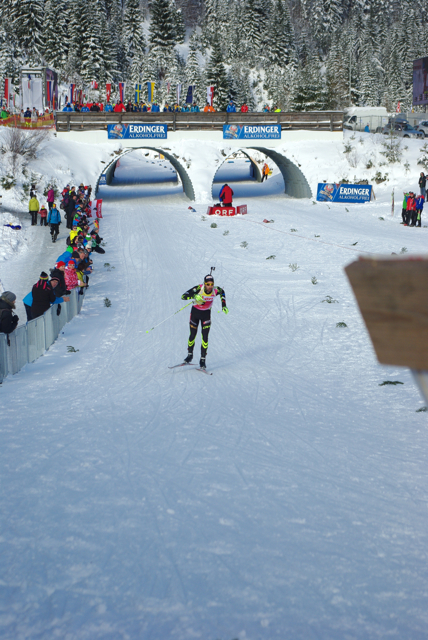
    Martin Fourcade (FRA) racing earlier this season in Hochfilzen, Austria. Today he turned in a strong anchor performance to help the French men to a World Cup relay win.
    Martin Fourcade (FRA) racing earlier this season in Hochfilzen, Austria. Today he turned in a strong anchor performance to help the French men to a World Cup relay win.

    Weather in the mountains is unpredictable, and that certainly affected the World Cup biathlon field in Antholz, Italy, today.

    At 11:45 in the morning, the women’s relay field set off, in unassuming weather; by the time the second-leg skiers had come into the range for standing, a massive fog had rolled in that made it impossible to see the targets. The race was cancelled, mid-go.

    A few hours later, the men’s relay was delayed for 30 minutes and eventually started at 2:45 in the afternoon.

    “First the zero was delayed because fog similar to what the girls faced rolled in,” Canada’s Scott Perras explained. “They knew the race had to start by 3 otherwise they would run out of day light, and Antholz is not like some of the other tracks that have night races. There are no lights on the course.”

    It began raining when the men were zeroing – then it began to snow. Canada had as strong a start as anyone, with Jean Philippe Le Guellec cleaning all ten targets with no spare rounds. He left his standing stage in first place, but was overtaken by Germany, Norway, and France and tagged off in fourth place.

    “My training block over Christmas had been cut short with the extreme colds out east,” Le Guellec explained in an e-mail. “As such, top race form wasn’t the priority for today and I definitely felt it on the last lap! Talk about red lining an engine… That was pure suffering.”

    Le Guellec hopes that treating the race like training will allow him to tag off still in first if he’s in the same position in the Olympics.

    “Peak form will be the goal for Sochi and if I have the luxury and honor to lead a lap, I’m sure hoping that my form will carry me to the wire then,” he wrote.

    By the time the second-leg skiers like Perras took over up, thick flakes were falling all around them, slowing the track and obscuring targets. The difficult skiing took a double toll on the range.

    “It was not easy shooting today,” Norway’s Henrik L’Abee-Lund told NRK television. “My legs were like jello.”

    Andreas Birnbacher of Germany was in the lead coming into the standing stage, but used all of his spare rounds trying to knock down two pesky targets and still ended up skiing a penalty loop. L’Abee-Lund used two spare rounds and Perras all three.

    “I missed my targets in standing because I was little excited and the shooting seemed more solid than I expected, so I put three shots quickly too high,” Perras said. “From there I just told myself to calm down and make sure I have stopped on the target before pulling the trigger.”

    L’Abee-Lund moved into second behind Alexis Boeuf of France, the only one of the first group of racers to shoot clean. Despite using all three spare rounds, Perras escaped still in third position. It would have been surprising if he had been paying attention to his competitors, which he luckily was not.

    “Honestly I was pretty focused on myself in the range,” he said. “I was aware that the others were missing when I was shooting, but there is no way to know if they would have penalty loops or not. There was pressure but we are getting more and more used to this situation which is great!”

    As the skiers hit the trails, where snow was piling up in serious fashion, Boeuf looked especially beleaguered. He’d had the second-fastest first loop and the fastest second loop, but his final loop was just the 16th-fastest, more than 55 seconds slower over 2.5 k than Bjorn Ferry of Sweden, who had the fastest split. Known more as a shooter, Ferry was indeed perfect on the range, but was also the strongest skier and moved Sweden from 14th into fifth place.

    “The start of my race was very good, but I had a big problem on my last lap,” Boeuf said in the press conference. “I hope it will be better in Sochi, we will see. Today it was just a personal problem.”

    L’Abee-Lund blew by Boeuf to a 35-second lead by the handoff just 2.5 k later. Meanwhile, Perras tried to hold off Birnbacher, who finished up his penalty loop and made a move towards the front. He eventually passed Perras, who stuck with him until the exchange.

    “On my last lap I had a big smile at first, not because I was happy with my shooting but the relief from hitting that last shot felt exhilarating,” Perras said. “I was happy to still be in the game I didn’t think too much about what place I was in. I didn’t know hat Birnbacher was coming but I could not have done much more. I was gassed from skiing the first two laps on my own and trying to catch the leaders. When he went in front I just focused on keeping up.”

    The penalties continued to come fast and strong; on the third leg, Martin Eng took Norway out of the running with two penalty loops. On the fourth leg, Nathan Smith took two penalty loops of his own for Canada.

    Instead, at the front, it was France and Sweden who battled it out on the anchor leg, with both Martin Fourcade and Carl Johan Bergman shooting perfectly.

    “It was a really good fight,” Fourcade told the IBU in a video interview with the rest of the French team. “I wanted to drop him before the last loop, but Carl Johan was really strong on the shooting range, so I had to push really hard on the last loop.”

    Bergman didn’t get demolished by the powerful Frenchman (who said that “my legs and my skis weren’t the best of the year today”), but he couldn’t overtake him either. France took a 2.6-second win in the relay.

    Germany finished third, +38.8, and Norway fourth, +1:34.6. The Norwegian team was a “B” squad, as was the Russian team; the best racers from both countries are sitting out to prep for the Olympics.

    “I’m just happy to have done well today, but you can’t forget that two of the best teams in the world (Norway and Russia) were not here,” Martin Fourcade told French newspaper L’Equipe. “The important thing, that will be in two weeks in Sochi. We will fight for the gold.”

    Canada finished sixth, a best in the careers of any of the men involved. The team had been in fourth place at each of the first three handoffs (by Le Guellec, Perras, and Brendan Green) before dropping to sixth with Smith’s shooting woes.

    “I think in general we are happy with today,” Perras said. “We had never made a prize ceremony and our previous best was a 7th place. So far this year we have been 9th, 8th and 6th so we are happy with the trend. I think the biggest thing we will take away from today is that we prevailed despite all the chaos, and we put a little more high pressure experience in the bank.”

    Le Guellec agreed.

    “Considering a lot of spares, two penalty loops and that our skis weren’t great either: it’s an amazing result,” he said. “This is by far the best battle laid out by the team yet… this is a new level (girls and boys). You can tell everyone has worked very hard in the summer to bettering themselves and it has hugely paid off. I don’t think anyone was expecting such strong performance though! Again: fuel going into Sochi.”

    The U.S. did not field a team.
    Results


  • Russian Bears Continue Biathlon Dominance, Malyshko and Garanichev 1-2 Again in Oberhof

    Russian Bears Continue Biathlon Dominance, Malyshko and Garanichev 1-2 Again in Oberhof

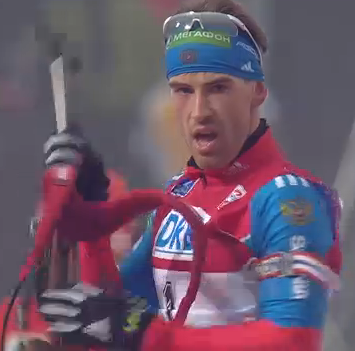
    After starting first and never missing a single shot on the range, Dmitry Malyshko of Russia was unchallenged as he skated his way to his second career victory in Oberhof on Sunday.

    Pursuits sometimes seem like an unfair race format: after all, good results on day one mean a better chance at doing well on day two. Without giving athletes a clean slate, is it really fair to assign two sets of World Cup points so heavily dependent on a single day of racing?

    It’s a good argument, but that’s biathlon and there are two rebuttals. The first is that anything can happen in biathlon, and sometimes athletes can move up many places in a pursuit – fifteen or twenty if they have a bad sprint but shoot well the next day.

    The other possibility is that the strongest athlete will sweep both races, and that was certainly true for Russia’s Dmitry Malyshko this weekend. He started Sunday’s 12.5 k pursuit in Oberhof with a 12.6-second lead over teammate Evgeniy Garanichev, but hardly needed any advantage to claim his second win a row, and the second of his career.

    “This was probably the best race that I ever ran,” Malyshko said of a phenomenal weekend that saw him also anchor the winning relay team on Thursday.

    No matter the format, it seemed that nothing could stop Malysko in Oberhof. In the first two races of the series, he won on speed, turning in the second-fastest anchor leg on Thursday and the fastest ski time on Saturday. But in the pursuit, he didn’t even have to push himself to that level. Shooting perfectly through all four stages, the competition never came within 15 seconds of the Russian after the start. Alone on the range in every stage, he knocked down all twenty targets and won by 42 seconds.

    Malyshko, focused on the range.

    “Winning the relay gave me a lot of confidence and I held again today,” Malyshko said through a translator in a press conference. “But before I came here, I never expected this… I want to keep this high note next week in Ruhpolding, but it is too early to think about the World Championships.”

    Clean shooting was the requirement of the day after the women’s pursuit was marred by high penalty counts. Behind Malyshko, Garanichev and Alexis Bouef of France were also clean through three stages and skiing together, while Ondrej Moravec of the Czech Republic, who had started in 11th, was also clean and moving through the ranks.

    He was caught on the fourth lap by Emil Hegle Svendsen of Norway, who had been trying to climb into podium position after two penalties in the first stage but had been knocked back by another penalty in the third stage. The two had Garanichev and Boeuf in their sights and Svendsen in particular worked hard and made up 15 seconds in the final 500 meters before entering the shooting range the final time.

    Garanichev set up the fastest and missed his final shot; three targets into the set, Boeuf missed as well, so as Svendsen began shooting it seemed like he had an opportunity. But he collected two penalties, as did Boeuf. Instead, it was Moravec, coming onto the range a bit behind them, who shot clean. The Czech hit the trails in second place, just as Garanichev was exiting the penalty loop.

    “I now know that I am capable of staying focused at the shooting range,” Moravec said of his effort, clearly somewhat in awe of his perfect record in the pursuit.

    Garanichev, however, flew past him on the trails and into second place, repeating his result from the sprint.

    “It is great for the fans and my people at home,” he said of the Russians efforts this weekend, with a relay victory, three wins, and two second-place finishes. “That takes away a bit of pressure; beating guys like Fourcade and Svendsen gives me a lot of confidence.”

    Despite flagging on the last loop – he had just the 35th-fastest time there – Moravec was pleased to be on the podium for a second time this season. His second-place finish in the sprint in Pokljuka, Slovenia, before Christmas was the first podium of his career.

    “These results are a good motivation for the World Championships,” Moravec said in a press conference. 2013 World Championships will be on his home turf in Nove Mesto.

    Svendsen turned in the fastest loop time on the last lap and moved into fourth, fifteen seconds off the podium. He now trails Martin Fourcade of France, who had four penalties and finished 14th, by less than 50 points in the World Cup total score.

    Benjamin Weger of Switzerland placed fifth, Evgeniy Ustyugov of Russia sixth, and Boeuf seventh after tiring on his penalty loops. Alexei Volkov of Russia, Klemen Bauer of Slovenia, and Michal Slesingr of the Czech Republic rounded out the top ten.

    The U.S. team had not been thrilled with their sprint results, but couldn’t manage huge improvements in the pursuit. Tim Burke dropped from 26th to 30th; after having shot clean in the prone stages and skied his way into the top 20, he collected two penalties in each standing stage. Lowell Bailey also had four penalties, but moved from 52nd up to 41st. Leif Nordgren dropped from 36th to 48th with six penalties.

    While the Americans had hoped to build on their fifth-place relay result, the gargantuan effort put in to garner that finish may have emptied their tanks a little more than they realized.

    “I was definitely a little tired in the sprint,” Burke told FasterSkier in an e-mail. “My legs felt OK but I just had really low energy throughout the entire [sprint] race. I think the relay probably took a little out of me.  Normally this would not be a problem but I think the hard effort combined with trying to get over jet-lag was a bit too much for me.”

    For Canada, Marc-André Bédard moved from 57th up to 37th with just two penalties and Jean-Philippe Le Guellec moved from 55th up to 49th with the same shooting score.

    In an e-mail to media and supporters, Bédard wrote that it was “possibly the best pursuit of my life” and it was “too bad I started with such a handicap.”

    Results

  • Le Guellec Stays Calm, Seizes Windy Ostersund’s ‘Window of Opportunity’ to Claim First World Cup Victory

    Le Guellec Stays Calm, Seizes Windy Ostersund’s ‘Window of Opportunity’ to Claim First World Cup Victory

    Jean Philippe Le Guellec of Canada does a video interview after claiming his first World Cup win, an 18-second victory in Ostersund, Sweden.

    ÖSTERSUND, Sweden – The way some people look at it, today definitely didn’t present ideal conditions for biathlon. With gusty, raging wind that flapped at the international collection of flags here in the stadium and chilled athletes and spectators alike, shooting was a challenge.

    Emil Hegle Svendsen of Norway and Martin Fourcade of France, who dueled through last season in pursuit of the overall World Cup crown, each missed three shots. Lowell Bailey of the United States missed two, but said that unlike any other race, he wasn’t disappointed – he was actually happy.

    Then there was the cold, which only arrived recently to Sweden. The temperature was officially listed as around 15 degrees Fahrenheit, but with the wind it felt much colder. While that would be tough enough for skiers, biathletes can’t wear mittens or thick gloves because it impedes their trigger fingers, and they have to raise their glasses to shoot.

    “It is [hard on] the fingers and the eyes, the feet, everything,” said Alexis Boeuf of France. “So we have to find a solution.”

    But rather than consider the difficulties presented here in Östersund, Jean-Philippe Le Guellec of Canada looked at the conditions a little differently.

    “When it’s windy, it’s always a window of opportunity,” he told FasterSkier after finishing the World Cup10 k sprint. “Luckily that arose today.”

    The Quebec native seized the bull by the horns and shot clean, one of only two men in the 103-athlete field to do so. Not only that, but he skied well – well enough to land in first place, with a sizeable 18.1-second lead over Boeuf.

    “If this hangs on, it’s going to be a huge day,” Le Guellec told FasterSkier when there were still racers finishing.

    Le Guellec was just the 38th starter, but the 2/3 of the field that started after him was unable to match his performance. Alexis Boeuf of France, who finished just a minute before, was able to come close – he skied faster – but had collected a penalty in standing and was left in second. Christoph Sumann of Austria, starting back in bib 75, also had a penalty in standing, but was able to eke out third place, 6.7 seconds behind Boeuf.

    As Le Guellec related in the press conference, he didn’t actually know he was in the running; through two laps his coaches only told him “good job” and that he was having a good race.

    “I didn’t know actually, leaving the range,” he told FasterSkier at the finish. “When I passed my coach over there after the range, Tom was saying – I didn’t hear the position, but he said something about five seconds. And then when I was near the top a bit further, he said, ‘You’re in first, you’ve got five seconds!’ And then…”

    Despite only having five seconds early in the 3.3 k loop, he managed to extend that lead significantly – perhaps because Florian Graf of Germany faded. After being in podium position, Graf slipped to fourth place. Boeuf, on the other hand, put in a hard charge like Le Guellec’s and moved from being ranked sixth leaving the range to finishing as the runner-up.

    “Today it was windy,” Boeuf said in the press conference. “I decided before the race to be as calm as I could be, and I worked really hard to put the bullet in sight. To finish with four and five, I’m okay with this.”

    It was just the fourth World Cup podium for the 26-year-old Frenchman, whose sole victory came at lightly-attended races in Fort Kent, Maine, in 2011.

    A decade older and the owner of an Olympic silver medal, Sumann seemed even happier than Boeuf to be on the podium. Over both the short and long term, his results have been bouncing around: last season was a disappointment for the entire Austrian team, and on Wednesday he placed 34th in the 20 k individual, despite shooting the same score as the winner, Martin Fourcade of France.

    “I had a quite good relay on Sunday, good skiing, and then a really disgusting performance on Wednesday that I couldn’t explain,” Sumann said in the press conference. “It was horrible from the beginning on, the shooting was good but the skiing… not. But today was better than the days before. And the speed was good. It was more than I expected.”

    Along with teammate Dominik Landertinger’s second-place performance on Wednesday, the Austrian team is off to a much better start this year, which is a relief for everyone involved.

    “It’s very important,” Sumann said. “We had a really, really bad season last year. The whole season was not the best we’ve had, but there were a lot of changes this summer. A new coach, a new system with just one team, so we’re going hard. But every year you don’t know where you are at the beginning, and it’s a good feeling that you’re back.”

    But the day belonged to Le Guellec, who earned Canada its first ever win by a male biathlete. The previous best, according to Biathlon Canada, was a sixth-place finish by Glen Rupertus back in 1993.

    And Le Guellec was showing some relief of his own to finally be having a good season, much like Sumann. He contracted mononucleosis after the Vancouver Olympics – where he finished sixth in this same event – and as he told FasterSkier this spring, he’s finally feeling like he’s 100 percent again, two seasons later.

    “Physically – how can I put this – the strain feels the same [now],” Le Guellec explained at the finish line. “I’m pushing just as hard as I did last year, as I did two years ago. But the speed that you’re going, that’s different. It’s like comparing a Ferrari to a Hyundai Accent. They’re both going at 3,000 rpm, but one is going 200 miles an hour. So that’s the difference.”

    That’s how he managed to gain so much ground on the last loop – a feeling he is not familiar with from the last few seasons.

    “I don’t know what happened there!” Le Guellec laughed.

    As for how he managed to knock down all ten targets, the Canadian shrugged. He just tried to pretend it was practice, he said.

    “I stayed totally relaxed through my standing,” he reported. “Especially since I had struggled in standing in [Wednesday’s] individual, so I thought, just do what you usually do in training. Stay relaxed and just shoot ‘em down. I was still trying to ski really relaxed on the last lap. At that point it’s a definite good race, and so I wanted to get in there and work hard, and get into the finish having given everything.”

    Stay tuned for more on Le Guellec’s race and the significance for the Canadian team.

    Results

  • Norway Won That Other World Championships Relay Today, Also

    The eyes of the ski world may have been focused on Oslo today, where the Norwegian women ran away with the win in the 4 x 5 k relay, but the biathlon world is focused on Khanty-Mansiysk, Russia, where World Championships kicked off today with a mixed relay.

    And while the result was the same – Norway on top by a solid margin – the route to victory was a lot more challenging for Norway’s biathletes. Tora Berger scrambled and predictably came into the tag zone in the lead. But Magdalena Neuner turned the tables on the favored Norwegians, and after two clean shooting stages, the Germans were in the lead. Meanwhile, Ann Kristin Flatland of Norway used two spare rounds and worked herself into a twenty-second hole.

    When the men took over, both Arnd Pfeiffer of Germany and Ole Einar Bjorndalen of Norway used three spare rounds, and the gap remained almost the same. The legendary Bjorndalen is a hero in his country, but was unable to do a hero’s work today.

    “I had some problems with sickness in January, and had to take some days off,” he explained to IBU News. “I stayed at home the whole time after that and had some very good training. I think that was a good strategy for me… Today was a very good race for me.”

    While he wasn’t able to overtake Pfeiffer, he did all that was needed: he gave anchor leg Tarjei Boe a gap small enough to close.

    The 22-year-old Boe, who wears the yellow overall World Cup leader’s bib, was set up for a battle with German veteran Michael Greis. But Greis did him a favor by using two spare rounds in the first shooting stage, while Boe cleaned. Because he had to load the spare rounds, Greis took 14 more seconds to shoot than Boe, and most of the catching up came with no effort to the Norwegian. Coming out of the range, Boe had a 14-second lead, which he extended through the second shooting stage and all the way to the finish.

    While the Norwegians were favored simply by the fact that all four of their racers had won World Cup races this year, they haven’t always been strong in mixed relays in the past.

    “It was very important for us to win today,” Bjorndalen said. “We have had problems in the mixed relay before with good teams. So it was good to be ahead of teams that have had success in this competition like Sweden and Germany.”

    The French team of Marie Laure Brunet, Marie Dorin, Alexis Boeuf, and Martin Fourcade finished third, thanks to Fourcade’s clean shooting and second-fastest anchor leg ski time. The team was fifth at the last tag, passing Sweden and Finland en route to the podium.

    Boeuf was particularly enthusiastic about his team’s finish.

    “This is my first medal,” he said. “And it is cool.”

    The Americans finished 13th, in a performance that had plenty of positives but more than enough frustrations as well.

    “The mixed relay was, well, mixed for me,” said leadoff skier Sara Studebaker. “I felt great skiing and had a really solid leg in that regard, but the shooting was tricky.”

    Studebaker used five spare rounds to put the team in 15th place.

    “The wind on this range can really come and go and often comes from behind which can trick you into thinking there is less wind then there actually is,” she said. “After my first five shots in prone I took a couple clicks and that made all the difference in hitting my three spare rounds. But with so many spare rounds, it’s tough to really be in it.”

    Laura Spector skied next, and used four spare rounds. She dropped the team to 17th place.

    But luckily, the men were able to come to salvage the day for the Americans. Jay Hakkinen used a single spare round to move the team up to 16th, and then Leif Nordgren went on a tear, passing three teams despite using four spare rounds. He had the fourth-fastest second loop and the eighth-fastest finishing loop of all the anchor skiers.

    “I had a pretty good race today, not great, but not bad,” he said of his effort. “The skiing felt really good so I was happy with that part. We knew from the beginning World Champs was late this year, so that was kind of our plan for me to be skiing fastest now. I’m definitely excited for the next couple of races. Anything can happen in biathlon, so if I can put together a good day on the range and on the tracks, who knows what can happen!”

    Some of Nordgren’s strongest performances this year have come in relays.

    “I’m not really sure why they’ve been the best this year,” Nordgren said. “I really like the head to head races that you get in a relay. I think I just perform a little better when I’m under that pressure direct from others. Most of my races this year have been either sprints or individuals, and the only real pressure there to do well is from myself.”

    While the result was a large improvement on the Americans’ 18th-place mixed relay at the 2009 World Championships in Pyeong Change, South Korea, Studebaker said that the team was still disappointed.

    “I think we were hoping things would have gone a bit better,” she said. “Jay and Lief both had excellent legs, and perhaps with a few less spares from Laura and I we could have been top-ten.”

    Head coach Per Nilsson agreed.

    “We are okay with the result for the mixed relay,” he said. “We finished right in the middle of the field, which is pretty much where we are ranked also. The shooting was okay, it’s always a little windy here and in general everybody used a little more extra rounds. The best team had 0+7 and we had 0+14, so also here we were in the middle of the field. So we can look forward to the next races. We are aiming for better biathlon performances when you both shoot and ski well, which also will bring better results.”

    Regardless of the finish, the mixed relay was a good way to start the Championships. Both Studebaker and Nordgren are skiing in their first senior World Championships.

    “It was a great way to get into race mode again,” Studebaker said. “This is my first World Championships, and coming off some great results in the U.S. World Cups I was a little nervous. It was nice for me to have today’s race to kick the nerves out a bit and relax. I feel like this was perfect preparation for me for the sprint race on Saturday.”

    And Nilsson pointed out that it was good for the service team to have a practice run, too.

    “The snow is a little different here than in other places,” he said. “We have [developed a lot of grinds] through our stonegrinding project with Muck Bauer in Schlessing, Germany. And through the hard work from our technicians Nicola Cantoni, Petr Garabik and Christian Sieler, we have make sure that all the different waxes are tested for these conditions.”

    Full results

  • French Biathlete Boeuf to Race World Champs Sprint in Oslo

    French Biathlete Boeuf to Race World Champs Sprint in Oslo

    Alexis Boeuf in Sunday's World Cup biathlon pursuit race in Presque Isle. Afterwards, Boeuf told FasterSkier that he plans to race in the sprint at the cross-country World Ski Championships later this month.

    Alexis Boeuf didn’t have to sprint to win Sunday’s World Cup biathlon pursuit in Presque Isle, since his margin of victory was a decisive 10 seconds. But if the event had come down to a last-minute drag race, it’s unlikely that Boeuf would have had much trouble dispatching his competition.

    The 24-year-old Frenchman is a talented sprinter. How talented? Well, in December, he raced in a cross-country World Cup sprint in Davos, Switzerland, and qualified for the heats, ultimately finishing 20th on the day. And, he told FasterSkier after his win on Sunday, he will travel to Oslo in late February to contest the sprint at the World Ski Championships.

    “I like the sprint,” Boeuf said. “For me, it is possible to do both…I don’t want to make a difference between biathlon and cross-country skiing.”

    The World Championships for the two sports are offset on the calendar this year, so Boeuf will be able to race in Oslo on February 24th before hopping a plane for Khanty-Mansiysk in Siberia—the site of this season’s biathlon worlds.

    According to Siegfried Mazet, one of the French team’s coaches, biathlon is still the first priority for Boeuf. But Mazet also said that since he was a junior, Boeuf has successfully dabbled in cross-country racing as well—especially in sprints.

    Elite biathletes have competed in cross-country skiing in the past, most notably in the case of Norwegian Lars Berger, who won gold in the 15 k skate at the 2007 World Championships in Japan, then helped his country’s relay team to silver in the 2010 Olympics.

    More recently, Emil Hegle Svendsen, another biathlete, was named last week to the Norwegian team for Oslo, where he will likely race one of the skate legs in the country’s men’s relay.

    Svendsen and Berger both raced in longer events, not sprints, and few, if any biathletes have contested that discipline in cross-country. But according to Mazet, Boeuf is cut out for short-distance racing.

    “He is able to accelerate very, very, very fast,” Mazet said. “He is able to catch many seconds in the short time.”

    Mazet said that in the future, Martin Fourcade, an even bigger French name than Boeuf, could one day take a shot at some cross-country racing—perhaps with a spot on France’s relay team.

    In the mean time, though, Boeuf will have to suffice as his country’s lone representative in Oslo. After his modest success in Davos, there’s no reason to discount his potential for the World Ski Championships—especially with his first career win on Sunday showing that his fitness is at an all-time high.

    “I think the biathlon training is really good for me in sprints,” Boeuf said.

  • Boeuf Steals Pursuit Win After Peiffer Implosion; Bailey 16th

    Boeuf Steals Pursuit Win After Peiffer Implosion; Bailey 16th

    France's Alexis Boeuf wins the 12.5 k pursuit in Presque Isle.

    For three quarters of Sunday’s 12.5 k pursuit in Presque Isle, Arnd Peiffer had the biathlon race locked up. The German started the day in bib one, with a 16-second advantage over France’s Martin Fourcade, and grew his lead to more than a minute in the first half of the race—thanks to strong skiing and just one penalty over three shooting stages.

    To his competitors, Peiffer seemed untouchable—each time they entered the range, he was already gone.

    “I didn’t see him at all,” said Sweden’s Carl Johan Bergman, who was the closest to Peiffer in the latter stages of the race.

    But with a stiff wind blowing through the Presque Isle range, and nine inches of fresh snow overnight turning the skiing into a slog, Peiffer came into the range for the last time with his legs sapped of strength, his confidence shaken. He missed three of his last five shots, leaving a big opening.

    While Bergman couldn’t convert, France’s Alexis Boeuf could. At 135 pounds, he had no problems in the powder, and seized the opportunity to take his first-ever World Cup win, moving up from his starting position of ninth and making up a minute and 13 seconds on Peiffer over the course of the race. Russia’s Ivan Tcherezov was second, with Bergman third.

    Lowell Bailey was the top American, adding a 16th place to his string of strong results from past few weeks. Jean Philippe Leguellec and Brendan Green led the Canadians in 35th and 36th, respectively.

    A dejected Arnd Peiffer (GER) at the finish.

    After a big dump of snow overnight, the sun was already shining through the clouds by the time the pursuit started, at 10:00 a.m. But that didn’t make the skiing any easier for the 58 men’s starters. Groomers had been hitting the course since the snow started late at night, but there was no way they could keep up, and the trail’s surface for the race was a chunky, powdery mess.

    “When you get a foot of snow overnight, there’s just no way to make the track hard. They did a good job, considering the weather,” Bailey said.

    When the surface is that messy, though, “everything gets thrown out the window, as far as technique,” Bailey said. He wasn’t the only one that felt that way—even the top men resorted to unconventional methods of propulsion, including double-poling and V1 on flat sections.

    “You just have to fight,” said Norway’s Tarjei Boe, who ended up sixth.

    Still, Peiffer seemed to be having no trouble. Tall and stocky, Peiffer is no Boeuf, but he was smooth on the climbs and shot clean and quickly in his first two shooting stages. That left him a full minute and 18 seconds up on Bergman, his nearest challenger.

    But the pursuit, with four trips through the range, leaves plenty of time for implosion, as Peiffer now knows. The initial cracks in his armor appeared on his third stage—the first standing. That was the first time the breeze picked up while Peiffer was in the range, and despite taking plenty of time, he still missed one shot. Bergman had no misses, and by the time Peiffer was back in the stadium for his last shooting stage, his lead had dwindled to 30 seconds.

    Peiffer declined to answer questions in English after the race, but Jan Wuestenfeld, the German team doctor, told FasterSkier that Peiffer was again struggling with the wind. And by that point, Wuestenfeld added, “he felt so tired…that it was hard for him to even do the shooting.”

    With the race on the line, Peiffer choked, missing three shots. While he left the range still sitting in second, he was totally cooked; Tcherezov and Bergman both overtook him on the final lap, relegating the German to fourth place.

    “He was pretty disappointed,” Wuestenfeld said. “It was a good race except for one shooting.”

    Bergman was the next man into the range—he arrived with just enough time to see three of Peiffer’s targets still standing. He appeared to be on his way to the win when his first three rounds were on the mark, but he couldn’t nail the final pair.

    “I thought, ‘now is my chance,’” Bergman said, “until the final two shots…It was difficult—I was lucky that I hit so many, because it was windy, and I did many good shots. But the final two—perhaps I didn’t fight.”

    Boeuf was only 18 seconds behind Bergman heading into the range, and when the Frenchman missed just one target, the race was his. He left the stadium with a 12-second lead on Peiffer, and while both Tcherezov and Bergman made up some time on the final loop, it wasn’t close.

    Boeuf said he thought his chances for the win were “finished” in the middle of the race, when Peiffer had such a big lead. He chalked up the victory to his ability to keep his concentration—especially with the gusts blowing through the range.

    “You have to look at the wind; you have to stay strong,” Boeuf said. “It is not every time, but today, I stayed focused.”

    Boeuf had raced in Presque Isle before, at the Junior World Championships in 2006, where he won gold as part of the French relay squad.

    “It was great for me,” he said. “I like the U.S.—for us, it is a new place, and it is a new experience.”

    On Sunday, the Presque Isle fans were once again fervent, but their numbers had dwindled somewhat, perhaps due

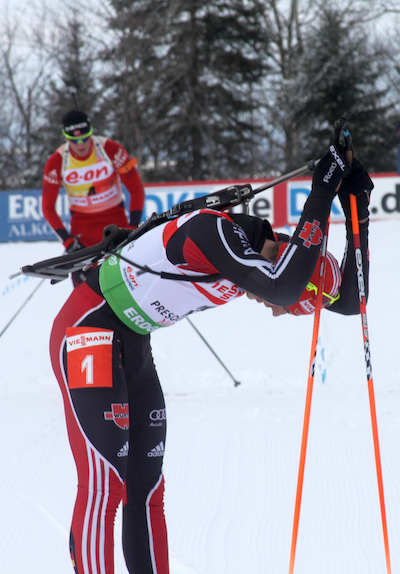
    American Lowell Bailey at the start of the race.

    to the overnight snowstorm. A mere 300 saw the men’s race, in which Bailey raced to 16th, the fifth-best World Cup result in his career.

    Bailey had set himself up well with his 25th in Friday’s sprint, which determined his start position in the pursuit. He raced well early on Sunday—just one penalty over the two prone stages moved him up to 14th place. But in his first standing, he missed three targets, falling all the way down to 30th, a blunder he blamed on the breeze.

    “I let it intimidate me,” he said. “I was a little tentative, and thinking about the wind instead of thinking about hitting targets. That definitely put me back.”

    On the final stage, though, Bailey fought back, capitalizing on a sheltered range position on the far left to hit all five targets. He moved back up to 16th, and thanks to a gutsy finishing sprint against Poland’s Tomasz Sikora—which saw Bailey breaking into a V1 to plow through the heavy snow—he held the position to the line.

    Per Nilsson, the head American coach, said that Bailey is in his “best-ever” form this year, after backing off some of his more challenging workouts.

    “He’s skiing against the best, and he’s competitive,” Nilsson said. “We have changed a little bit in his training plan—he’s a real pusher, so maybe we have pushed a little too much [in the past].”

    Nilsson said he was especially pleased with Bailey’s final shooting stage—a strong end to a “roller-coaster race.”

    “Mentally, for him, this was really important,” Nilsson said. “I think he was a little fatigued in the third stage, but then he came back and just did his game plan. There was no question [in the final shooting]—it was five solid hits.”

    After a big block of volume training, Nilsson said that Bailey still has some room to improve his fitness before World Championships kick off in Russia in early March. Same with Jay Hakkinen, the next American finisher in 27th. After struggling with illness in the early-season, Nilsson said that Hakkinen is “coming a little bit, step-by-step.”

    “He’s for sure a man for World Championships,” Nilsson said.

    Link to full results.