From the FasterSkier archive — posts syndicated from athletes’ and coaches’ own blogs between 2004 and 2012, kept online as published. Current coverage is at fasterskier.com.
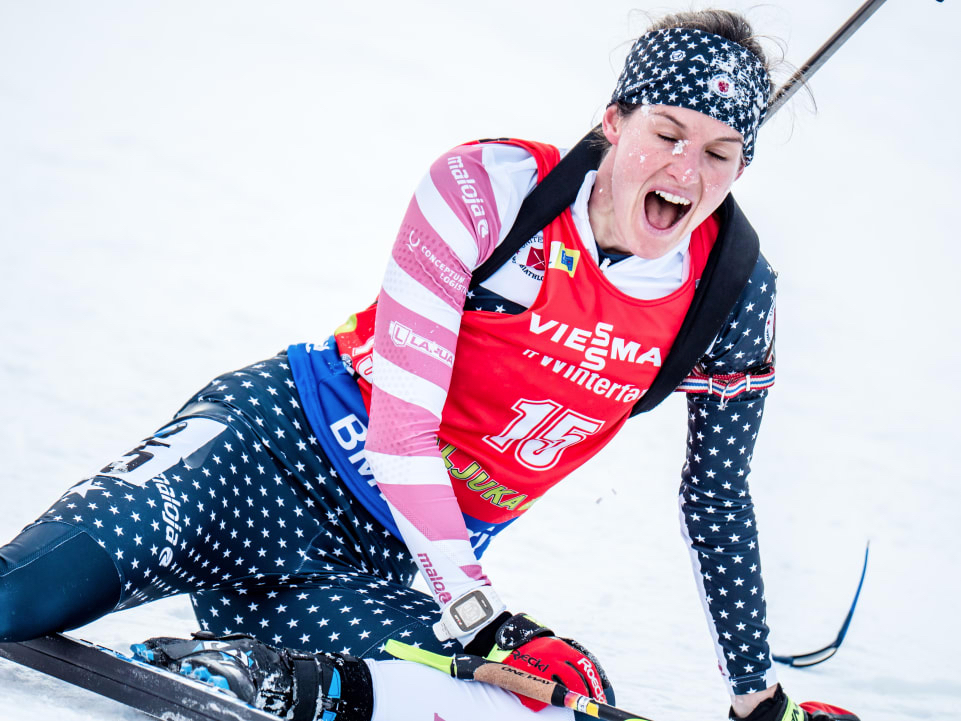
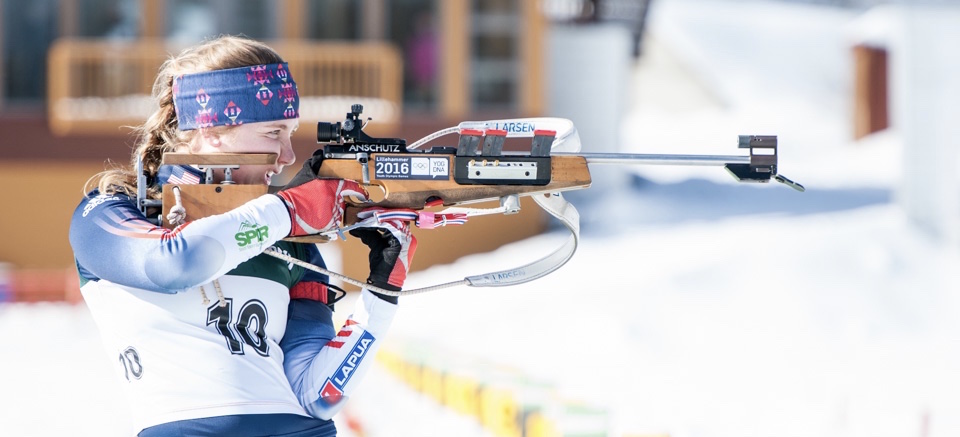
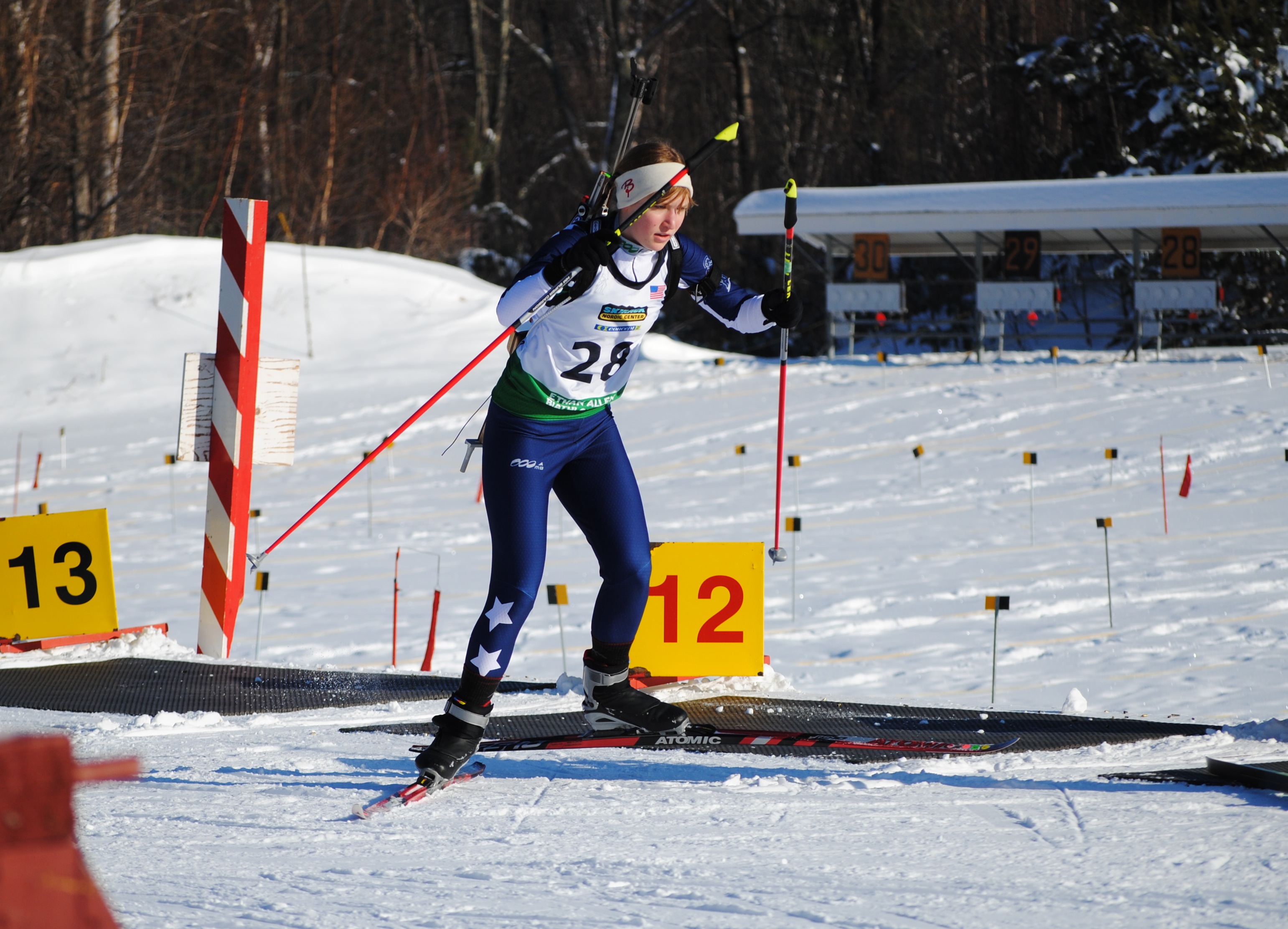
Clare Egan after placing sixth in the IBU World Cup’s 10 k pursuit in Pokljuka, Slovenia. (Photo: Biathlonworld.com)
Over the weekend in Pokljuka, Slovenia U.S. Biathlon’s Clare Egan marked a breakthrough. During the IBU World Cup’s 10-kilometer pursuit on Sunday, with a single shooting penalty, Egan placed sixth (+1:22.4, 0+0+1+0). She also raced the fastest time for the ski portion of the race.
Kaisa Mäkäräinen of Finland won the race in a time of 29:16.9 minutes.
Prior to her sixth place, Egan’s top result was a 13th place during last season’s IBU World Cup sprint in Kontiolahti, Finland.
If Egan, who has been in the sport since 2013, needed a boost to remain committed, this weekend was it. Before she placed sixth on Sunday, Egan was 15th in Saturday’s 7.5 k sprint. Again, in that race, she was able to match her blistering ski speed with near flawless shooting— Egan had one penalty in the sprint.
Fans of the sport might be surprised to find an American name other than Susan Dunklee’s so high in the standings. It appears Egan might be too.
“I am frankly amazed with my skiing,” Egan wrote in an email to FasterSkier. “I knew I was in great shape, but this week my ski times were 11, 6 and today 1st. I think small changes and improvements in my training are coming together to make this big difference. The most important factor in my performance is our new women’s coach, Armin Auchentaller. He is the right coach for me.”
As any biathlete can attest, the variables within the sport are many. Small changes here and there — minute tweaks that may account for a modest percent change in mental and physical performance. That can mean a jump from say a 16th place to a sixth place.
One stat jumps out already for Egan. She has vastly improved her accuracy on the shooting range. According to the IBU’s data, in 2015-2016 she shot 79 percent. The next two seasons trended downward with a 78 percent in 2016-2017, then 74 percent last year. In Pokljuka, although the sample size is small with just a short series of races to draw from, Egan shot with 84 percent accuracy.
“There are a lot of things- some are major structural changes like having a camp schedule rather than training daily in Lake Placid, others are more nuanced like having more fun doing my sport with Armin and a galvanized and unified team,” Egan wrote about some of the new concepts U.S. Biathlon embraced this past off season.
Egan’s results on the IBU World Cup have improved since she began in 2014-2015, her first year on the circuit. Since then, she has been ranked 96th, 67th, 56th , and most recently, 63rd last year. During each one of those four years, Egan showed promise.
She has had six top-30’s outside her 16th during the 2015/16 season, and the already mentioned 13th last season. Steady progress and intermittent nuggets of top-20 success were enough hope to sustain Egan through another cycle of training loads, recovery, and shooting sessions.
Sunday’s 6th place, flower ceremony, fastest ski-time of day in Pokljuka, Slovenia remains the medicine of the fickle sport of biathlon. Egan scored her dose.
“I was not expecting this,” Egan wrote. “But my first Biathlon coach, Algis Shalna, told me that it usually goes best with 0% expectation and 100% focus.”
The focus hasn’t shifted. Expectations may have changed.
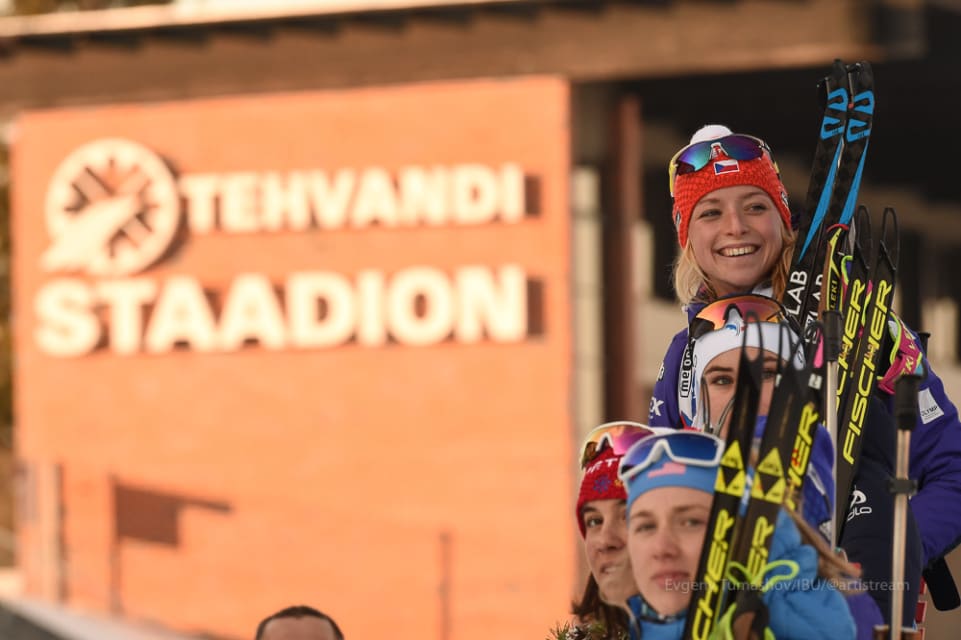
Some of the top-six finishers in the junior women’s 10 k pursuit at the post-race flower ceremony at 2018 IBU Junior World Championships in Otepää, Estonia, including the Czech Republic’s Markéta Davidová (top) and American Chloe Levins (bottom), who finished first and sixth, respectively. (Photo: IBU/Biathlonworld)
(Note: This article has been updated to include comments from Leo Grandbois.)
The 2018 International Biathlon Union (IBU) Youth/Junior World Championships went out with a bang on Sunday, with four pursuit races in Otepää, Estonia.
Several North Americans had banner days, with American Chloe Levins racing up one spot to sixth place in the junior women’s 10-kilometer pursuit and Canada’s Megan Bankes and Nadia Moser placing eighth and 11th, respectively, in that same race.
In the youth men’s 10 k pursuit, Canada’s Leo Grandbois had his best result of the week, placing 15th (up from 33rd) at the start.
Starting with the junior women’s pursuit:
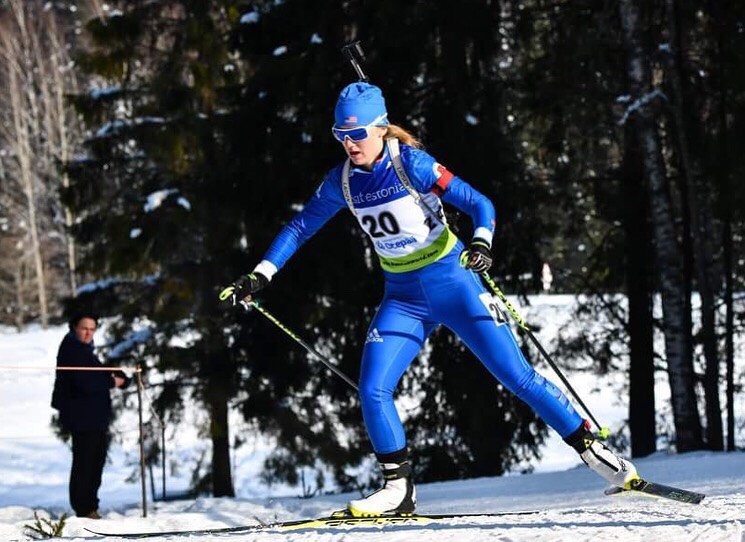
Levins started the race 1:32 minutes back in seventh, based on her sprint result on Saturday. She went on to clean three-consecutive shooting stages, working her way up to fourth after leaving the range for the third time, then missed two targets on the final standing to end the race in sixth. Levins finished 1:51.4 behind the winner, Markéta Davidová of the Czech Republic, who finished first in 32:52.6 with four penalties (1+0+2+1).
Chloe Levins racing to seventh in the junior women’s 7.5 k sprint on Saturday at IBU Junior World Championships in Otepää, Estonia. (Courtesy photo)
“In pursuit races in the past, I’ve come from behind,” Levins, who placed fourth in last year’s Youth Worlds pursuit, wrote in an email to FasterSkier on Sunday. “Today, it was a new learning experience for me to be in the mix for the duration of the race. My plan was simple from the start: enjoy being in the mix and trust your preparation.
“I found the zone today, which is what you dream about,” she continued. “I don’t remember much about the last stage. All I know for sure is that I went for it today…and I have no regrets.”
Asked what she’ll remember most about these championships, Levins explained that the U.S. team’s “happy and dedicated staff” made for a fun week.
“We are always joking and laughing in the wax room which helps keep the mood light during potentially stressful races,” she wrote. “It was really special and important for me to have this experience with my coach, Algis Shalna, behind the scope. We’ve worked together for a long time. I will cherish the competitions we get to share forever.”
While the championships didn’t turn out exactly as she’d hoped, Levins explained that she had a lot of positive takeaways for her final biathlon races of the season.
“Now, it’s time to go back to school and start preparing for golf season at Middlebury!” she wrote. “… I can’t wait to start training again.”
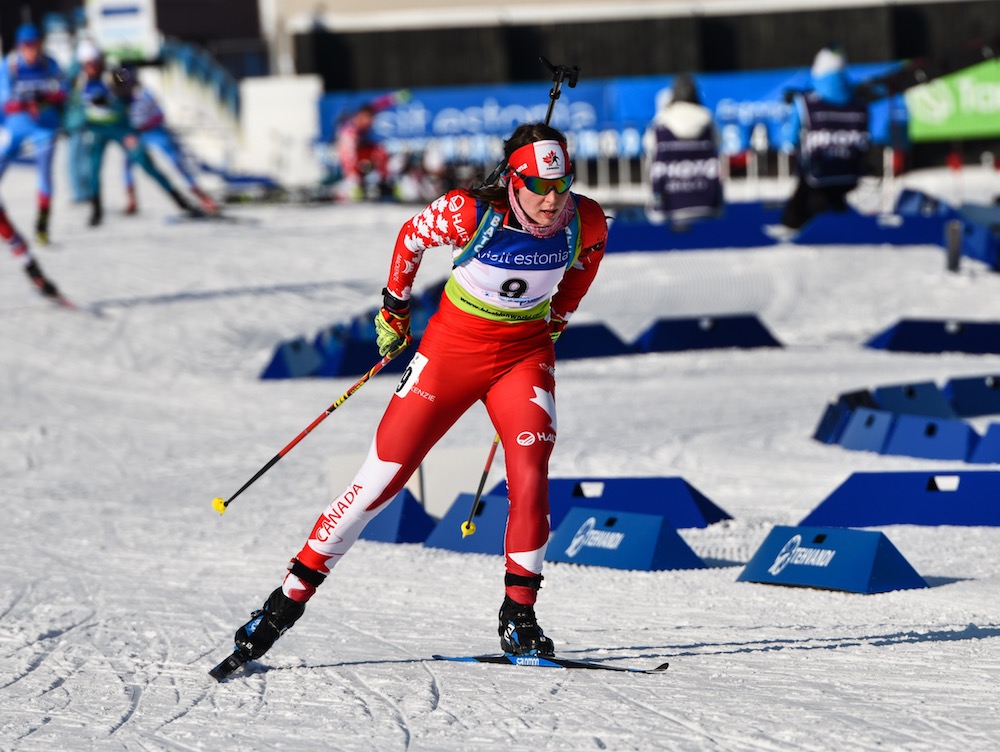
Megan Bankes racing to eighth in the junior women’s 10 k pursuit at IBU Junior World Championships on Sunday in Otepää, Estonia. (Photo: Bryan Dickson)
Bankes started ninth on Sunday and made up one place to finish eighth (+2:52.6) after placing ninth in three previous races at Junior Worlds. She had two penalties in both the first and the last shooting stages (2+0+0+2) and posted the ninth-fastest shooting time and ninth-fastest overall course time.
“Heading into today’s race, my goal was to try and shoot well and make up places. It was also my last international junior race so i wanted to try and have a good one!” Bankes, 20, wrote in an email. “To start, I knew that I could catch the Norwegian girl who started in front of me, and after I caught her, my goal was to make up time on everyone else in front of me.”
She described the wind on the range as “pretty strong” and variable.
“I was zeroed for a decent left to right wind, but when I came in for my first prone the wind had died and was blowing towards me for my first shot, and then it picked up again to be a little more than my zero wind, and I corrected back but didn’t correct enough for it,” Bankes wrote. “After cleaning the middle 2 bouts I really wanted to clean my last bout and there was definitely a little pressure going in with the Russian girl [Emma Timerbulatova, who was skiing just ahead of Bankes]. I actually thought that she had only missed one, so I was a little disappointed in myself when we went into the penalty loop, but when she didn’t leave after the first loop, I was determined to pass her and beat her to the finish.”
Like Bankes, Timerbulatova had two penalties in the last standing. She started the final loop just 0.1 seconds ahead of Bankes, and Bankes passed her to finish eighth.
“I’m overall super happy with my performance this week,” Bankes, a 2017 Youth Worlds gold medalist in the 10 k individual, concluded. “Definitely my most consistent European racing ever! I would have liked to have shot better overall this week though, I did give up some stupid shots, but I was super stoked with how I felt skiing. I’m also pleased that I was able to have consistently good races over the course of the week, which is something I definitely could not have done in the past.”
Nadia Moser racing to 11th in the junior women’s 10 k pursuit at IBU Junior World Championships on Sunday in Otepää, Estonia. (Photo: Bryan Dickson)
Moser picked off 10 places to finish 11th (+3:45.4). She started the pursuit in 21st and shot 18-for-20, cleaning the first two stages (0+0+1+1) and contending for the top 10 before finishing about 12 seconds out of 10th place. It was her second-best result of the week after placing eighth in the junior women’s 12.5 k individual.
“A top 10 finish was definitely the big goal for the pursuit, but I knew that was only possible if I shot really well and skiied well,” Moser wrote in an email. “Unfortunately, I missed my goal by one place.
“There were some pretty large time gaps in the starters today so it was a challenge to pick up places for me,” she continued. “For the most part I just tried to catch up with the people in front of me, or keep up with the people who passed me. I knew my best chance to move up was in the shooting range. … I was focused and trusting in my skills on the range today, and that is how I was able to hit most of my targets.”
She knew she was in 10th for her third shooting when she was shooting in lane 10.
“I was really happy that I had moved up as many places as I did, although slightly dissapointed that I was not able to reach the top ten,” Moser added. “I am satisfied with today’s pursuit. Moving up 10 positions is better than I’ve ever done before. Some things could have gone slightly better this week, but overall I am content with what I was able to achieve.”
Emily Dickson scored her first non-relay top 30 of the week in 26th (+5:31.6), up from 36th at the start, after missing just two targets (1+0+0+1). She had previously placed 36th in both the sprint and individual races, and ninth with Bankes and Moser in the 3 x 6 k relay.
After starting 26 seconds ahead of Davidová, Poland’s Kamila Żuk finished second in the pursuit, 28.1 seconds behind Davidová, after incurring six penalties (1+2+3+0). France’s Myrtille Begue placed third (+53.8) for the second-straight day after shooting 17-for-20 (0+1+1+1).
Onto the junior men’s 12.5 pursuit:
A day after placing third in the sprint, Norway’s Sverre Dahlen Aspenes shot clean in Sunday’s four-stage pursuit to take the win in 34:16.7. He finished 1:21.1 minutes ahead of France’s Martin Perrillat Bottonet, who placed second with one penalty (0+0+1+0). Norway’s Johannes Dale scored his first non-relay podium in third place (+1:46.4) with four misses (0+0+2+2).
Canada’s Adam Runnalls tallied his third individual top 30 of the week, placing 29th (+6:04.7) with six penalties (2+1+1+2). He had started the pursuit in 26th, based on his sprint result, and had previously finished 29th in the junior men’s 15 k individual.
His teammate Trevor Kiers started the pursuit in 16th and slipped to 34th (+6:44.4) with 10 penalties. Canada’s third man in the race, Teo Sanchez finished 57th (+10:32.5) with five misses (1+0+1+3) after starting 54th.
Cody Johnson was the lone U.S. skier in the junior men’s pursuit, racing to 48th (+7:40.0), after starting 37th, with five misses (2+0+2+1).
In the youth men’s 10 k pursuit:
Leo Grandbois racing to 15th in the youth men’s 10 k pursuit on Sunday at IBU Youth World Championships in Otepää, Estonia. (Photo: Terri Dickson)
Grandbois, a gold medalist at last year’s Youth Worlds in the 12.5 k individual, had his best race of the 2018 championships in 15th. After starting 33rd, he cleaned the first two stages to put himself in 16th halfway through the race, then missed two on each of the final two shooting bouts (0+0+2+2). But he didn’t lose much ground, leaving the range in 17th after the last shooting and passing two competitors to end up 15th (+3:37.2). Grandbois had previously raced to 24th in the 12.5 k individual this week and 16th with Canada’s youth men’s 3 x 7.5 k relay team.
“For the first bouts the wind was calm but for the second prone the wind picked up,” Grandbois explained in an email. “So I had to do some corrections that worked perfectly. I am really happy about it. First standing I came way too hard in the range and I could not manage to be precise. The last shooting was going well but the pressure to go faster made me miss again.
“I think that with a better standing shooting I could have done a top 10, but I was starting pretty far away so I am satisfied with my 15th,” he wrote.
“What I take back from those championships is that my ski speed is good but I will have to work hard next summer to keep it that way and to get it even better, for sure,” Grandbois added. “It wasn’t a good week for me in the range. I will have to work on my shooting speed and constancy. Those two things are my biggest weakness.”
Leading the U.S. men was Vasek Cervenka in 24th (+4:20.8). Cervenka had started the race in 24th and held his position despite six penalties (0+3+1+2) with the 19th-fastest course time. It was his third individual top 30 of the week after placing 27th in the 12.5 k (as well as ninth with his relay team).
Canada’s Rory Gilliland moved up 11 places to finish 41st (+6:12.2) with two penalties (0+0+1+1). His teammates Thomas Hulsman and Ryan Elden followed in 45th (+6:45.9) and 49th (+6:56.8) after starting 35th and 59th, respectively. Hulsman had six penalties while Elden had five (1+0+2+2).
For the U.S., Garrett Beckrich and Eli Nielsen finished 46th (+6:48.7) and 47th (+6:54.7), respectively. Beckrich had started 46th and incurred five penalties (1+1+1+2) while Nielsen slipped five places after starting 42nd and missing six targets.
After winning gold in the relay, Russia’s Andrei Viukhin notched his first individual podium and gold medal at his first Youth Worlds, winning the pursuit in 29:31.2. He had started seventh and missed four targets (1+1+1+1) yet led his teammates in a Russian podium sweep.
Viukhin handed his teammate Mikhail Pervushin his first loss of the week, as Pervushin settled for second, 16.8 seconds back, with four penalties as well (1+0+2+1). Aleksei Ogorelkov, who had not raced in Russia’s 3 x 7.5 k relay, finished third (+1:12.1) with two late penalties (0+0+0+2) for his first Youth Worlds podium.
Last but not least, the youth women’s 7.5 k pursuit:
Canada had three women finish in the top 40 of this race, with Benita Peiffer leading them in 30th (+4:28.2). She had started 51st and skied the 21st-fastest course time to pick off 21 places. Peiffer shot 17-for-20 (1+0+1+1).
Her teammate, Pascale Paradis slipped from 15th to 35th (+5:05.8) with eight penalties, while Jenna Sherrington improved from 46th to 39th (+5:28.1) with four misses (2+0+2+0).
For the U.S., Emma Stertz finished 48th (+5:58.0), up from 52nd at the start, with four penalties (1+0+2+1), and Grace Gilliland placed 57th (+7:21.0), after starting 55th, with four misses as well (1+1+1+1).
Russia’s Anastasiia Goreeva won her first individual gold at Youth Worlds, racing up from fourth at the start to cross the finish line first in 24:24.0 with three penalties (0+0+1+2). Germany’s Franziska Pfnür placed second for her first Youth Worlds podium, 17.5 seconds behind Goreeva, with just one penalty (0+1+0+0). In her second Youth Worlds, Switzerland’s Amy Baserga achieved her first podium as well, placing third (+29.0) with two penalties (0+0+1+1).
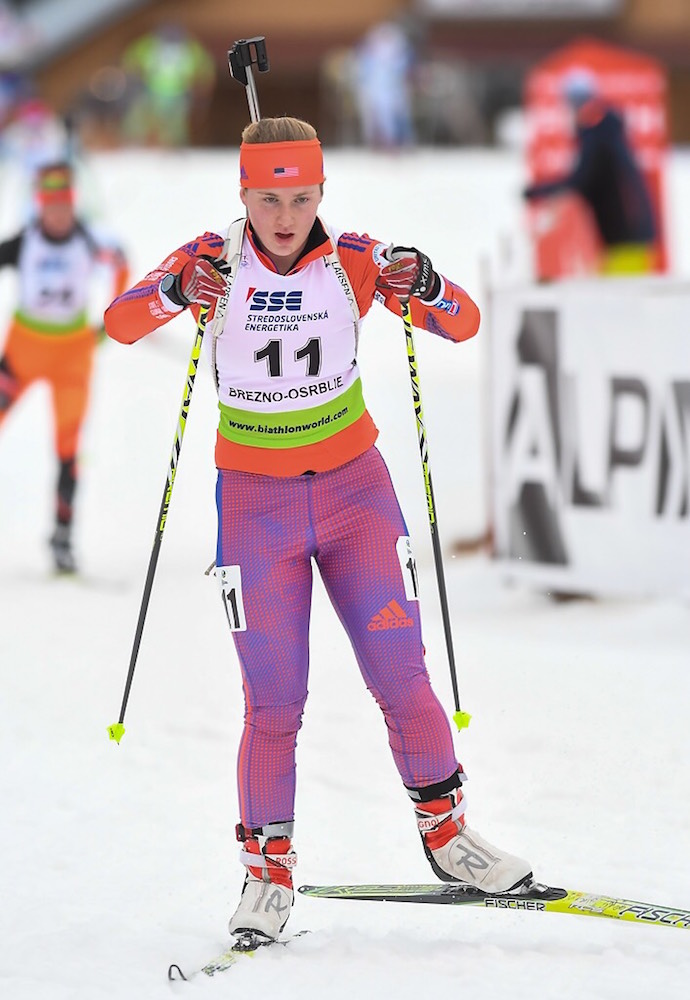
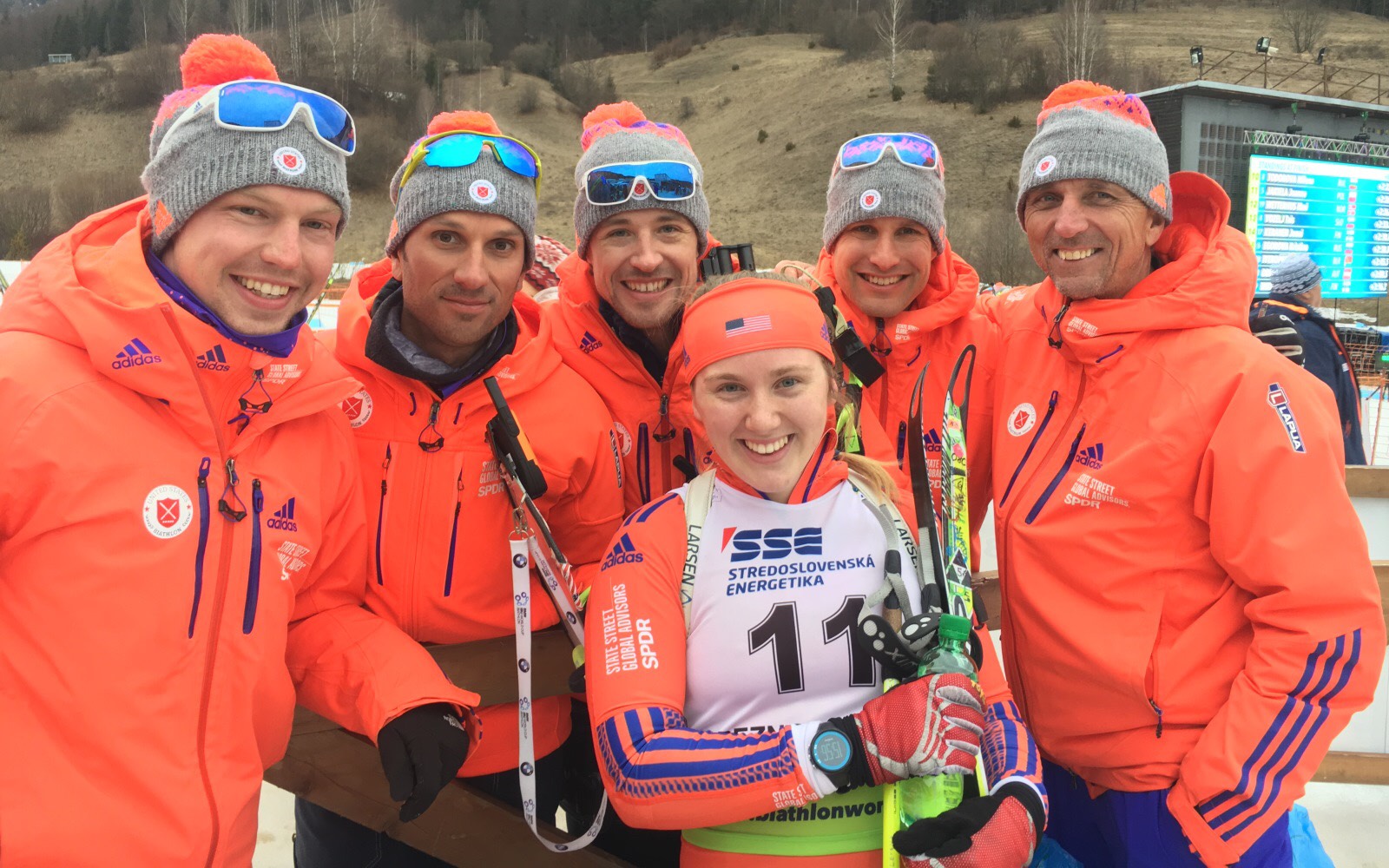
Chloe Levins (11) with her US Biathlon support team (from left to right: Erik Lewish, Travis Voyer, Mathias Zacherl, Robert Gorgos, and Algis Shalna) after her fourth-place finish in the youth women’s 7.5 k pursuit, her career best in her third IBU Youth World Championships, on Sunday in Osrblie, Slovakia. (Photo: USBA)
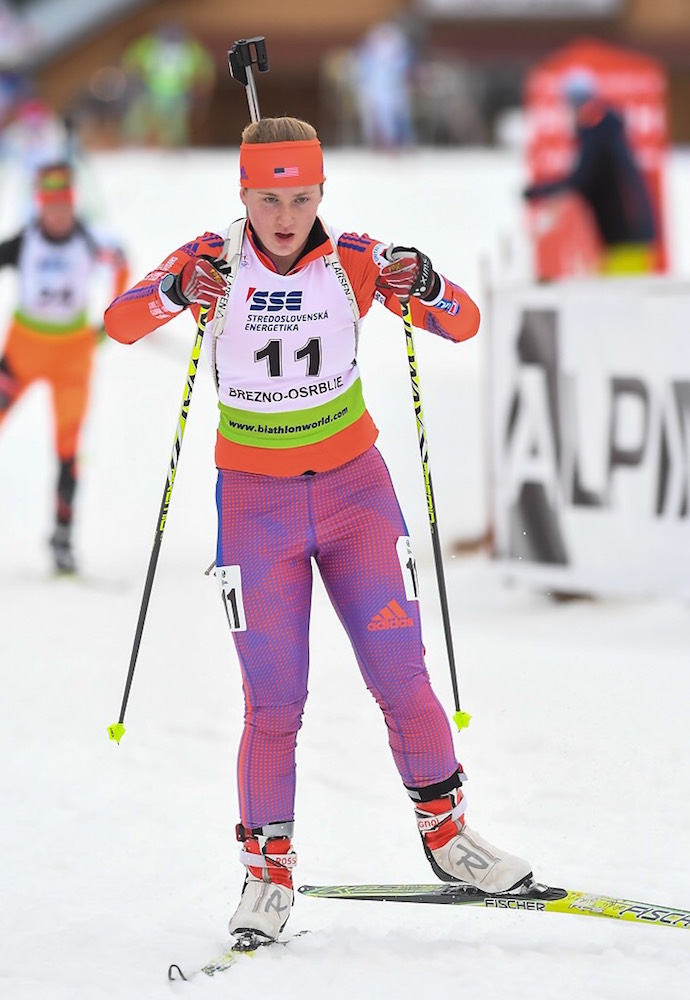
At just 18 years old, Chloe Levins has the wisdom of a seasoned veteran when it comes to biathlon. She accepts the inevitable ups and down of her sport, works hard to focus on herself and no one else, and treats every race as a learning experience.
All of the above are often easier said than done. But Levins seems to have her head in the right place and the results are following. In three individual races over the past week at Youth World Championships in Osrblie, Slovakia, she’s finished in the top 15. On Sunday in the youth women’s 7.5-kilometer pursuit, she rocketed to fourth — tying her career-best result in an international race.
“In my mind, I’m still a baby in this sport,” Levins wrote in an email on Sunday. “As we saw last week, Lowell [Bailey] prepared for two decades before winning a World Championship title. Today’s race was simply more preparation for the future. Every race is a learning experience, and every race that you’re in contention is an even better learning experience. So for now, I’ll keep learning.”
A Middlebury freshman who plays collegiate golf in the spring and fall, Levins had previously finished fourth at last year’s Youth Olympic Games in Lillehammer, Norway. There, she started the pursuit in 22nd and rocketed to fourth, one spot off the podium. On Sunday, she started 11th, based on her sprint result on Friday, and shot 18-for-20 to finish fourth, 1:55.5 minutes out of first and 47 seconds out of third.
Levins started the race by skiing around 11th for the first loop, then missed her first and last shots in the first shooting stage. That put her back in 17th heading out on her second loop, and she proceeded to clean the next three stages to work her way up to seventh before her final loop. There, she passed three more competitors to end up fourth.
“After missing two, I got out of my own way and went back to basics,” Levins recalled. “My coach, Algis Shalna, always says, ‘Do what you normally do.’ The trick is believing that what you normally do will be good enough. Today, it was really close.”
“There’s a fine line between being too cautious and perfectly aware in shooting,” she added. “That was the difference between my first shooting and the last three today.”
American Chloe Levins racing to fourth in the youth women’s 7.5 k pursuit on Sunday in Osrblie, Slovakia, for her best result at her third IBU Youth World Championships. (Photo: USBA)
She attributed her fast skiing (with the 11th-fastest course time) to “lightning” skis.
“The wax guys have been making fantastic skis all week, and I can’t thank them enough,” she said of US Biathlon’s staff. “The team staff gave me some information on the last loop, but I didn’t hear them. I was in a different world, fighting for a medal in my mind’s eye. Honestly, I’m not quite sure when I passed the three girls who left the range in front of me. The track was really crowded with competitors that were on their fourth loop. If I were to guess, I passed one girl on the first hill out of the stadium and the other two on a flat .25k before the finish.”
Ahead of her, Italy’s Irene Lardschneider secured her second-straight gold medal after winning Friday’s sprint and starting 1 minute and 7 seconds ahead of anyone else in the pursuit. She had four penalties, which came in the last two standing stages (0+0+2+2), but held onto first in 26:57.1. France’s Lou Jeanmonnot-Laurent finished 24.4 seconds later after skiing up from fourth at the start to second place, with a single miss (0+0+1+0). For the second-straight race, Italy’s Samuela Comola claimed bronze (+1:08.5) after starting third and shooting two penalties (1+0+1+0).
Then there was Levins, who started 1:40 out of first and was one of six women to shoot 90 percent or better.
“It kills me to come short of medal for the second year in a row, but it also makes me that much more hungry for next opportunity to compete,” Levins wrote. “Even though there’s no medal around my neck, shooting 90% and having the fastest ski time on the last loop are things to smile about.”
“I smile about the fact that I set three consecutive personal bests this week at Jr World Champs,” she wrote on Sunday. “It’s the ‘what ifs’ that give me motivation for the next. I’m leaving Slovakia with more drive than ever. There are many areas in shooting and skiing I can improve upon for next season. I’m really looking forward to getting down to work.”
Levins led four North Americans in the youth women’s pursuit, with her U.S. teammates Amanda Kautzer and Grace Gilliland finishing 42nd and 53rd, respectively. Kautzer started 59th and picked off 17 places despite missing four targets (1+0+2+1) and finished 6:16.2 back. Gilliland started 55th and improved two places with six penalties (2+3+1+0), finishing 8:32.1 out of first in 53rd. Canada’s Shilo Rousseau followed in 54th (+9:02.1) with eight misses (3+1+2+2) after starting 45th.
The youth women end the championships with the 3 x 6 k relay on Monday. Canada is entering Frédérique Pérusse, Rousseau, and Anna Sellers, while the U.S. team is Levins, Kautzer and Gilliland.
Also on Monday, the youth men will race a 3 x 7.5 k relay. Thomas Hulsman, Adam Runnalls and Leo Grandbois are listed to start for Canada, and Vasek Cervenka, Jacob Pearson and Alex Kilby are listed for the U.S.
Sprint Top 20 for Bankes, Ellingson; Bankes 16th in Pursuit
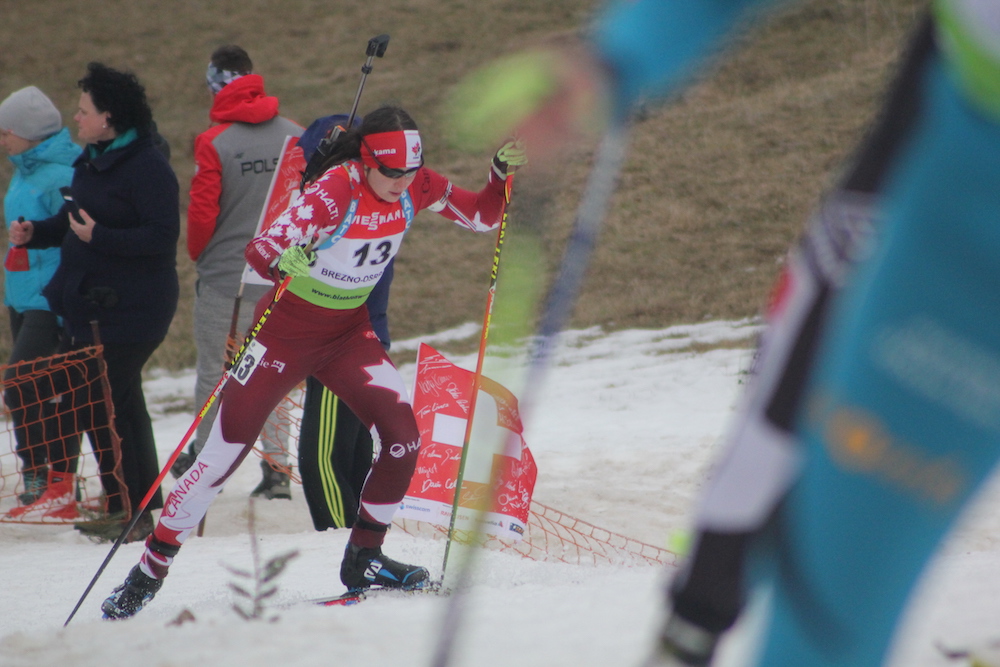
In the junior women’s 10 k pursuit, Canada’s 19-year-old Megan Bankes capped off her gold-medal week with her third top 20. Bankes previously won the 12.5 k individual last Thursday, then finished 13th in Saturday’s 7.5 k sprint.
Megan Bankes racing to 16th in Sunday’s junior women’s 10 k pursuit at IBU Junior World Championships in Osrblie, Slovakia. (Photo: Jacqueline Akerman)
Going into Sunday’s pursuit, she made a goal to stay calm and focused and “overall just have a fun time racing the pursuit, and see how much I can move up!”
She started 1:25 minutes behind the leader, Italy’s Michela Carrara, the winner of the sprint who left the pursuit starting gate with a 15-second head start. After cleaning the first prone stage, Bankes was up to ninth and 54 seconds out of first.
Over the next three stages, Bankes missed four targets and had to ski four penalty laps as a result. The first miss on the second prone stage put her in 11th, then she slipped to 19th with two misses in the first standing. On the final standing stage, Bankes missed one more to leave the range in 20th. Before the finish, she picked off four skiers to take 16th place across the line. She finished 2:15.8 minutes behind Russia’s Valeriia Vasnetcova, who won the race with clean shooting. Vasnetcova was the only woman in the field to do so; in fact, she was the only racer — woman or man — that hit all 20 targets between four races on Sunday.
Vasnetcova had started the pursuit in 24th, 1:52 out of first, and taken the lead by after cleaning the last stage. She posted the fastest course time as well and notched a 10-second victory, finishing in 31:49.5 minutes for her first medal of these championships (she also won gold in the relay last year with her Russian team at Youth Worlds in Romania).
Carrara ended up second after missing three (1+1+1+0), and Norway’s Ingrid Tandrevold also picked up her second-straight medal, after starting second and finishing third (+10.8), with two penalties (0+0+1+1).
While Bankes could not be reached for comment after Sunday’s race, she was pleased with her 13th place on Saturday.
“My skiing felt pretty solid, and only 2 misses is pretty good for a sprint for me,” she wrote of her s8-for-10 shooting (1+1). “13th place is still pretty stellar…”
Asked what it’s been like coming off a world-championship win, Bankes, who hails from Calgary and trains with the Biathlon Alberta Training Centre in Canmore, Alberta, explained she’s received a fair amount of media attention, “especially from back home, or at least way more than I’m used to!” she wrote on Saturday. “I’ve just been trying to focus on the next races, it’s still fairly surreal for me to be Junior World Champ for the individual, so I’m still fairly excited about that, but i’m trying not to get caught up in that and look forward to the next races as well.”
American Siena Ellingson racing to 18th on Saturday in the junior women’s 7.5 k sprint in Osrblie, Slovakia, for her best result in her fourth IBU Youth/Junior World Championships. (Photo: Erik Lewish)
The second North American in the top 20 of Saturday’s sprint, Siena Ellingson of the U.S. posted the first individual top 20 of her career in her fourth Youth/Junior Worlds. She finished 18th, 1:38.7 out of first, with a single standing penalty (0+1).
In an email on Saturday, the 20-year-old Ellingson, of Minnetonka, Minn., explained that she had a tricky zero, which is the standard pre-race target practice.
“The wind was switching back and forth so it was hard to get a good confirmation, I had to leave it where it was and start the race,” she wrote. “Having confidence in shooting is hard after a zero like that, but you just can’t worry about it.”
She was pleased to find her first prone stage had wind similar to what she experienced zeroing, and she was able to hit all of her targets without making any adjustments.
“Standing there was a bit of wind, but the miss was just a miss, not a problem with the wind,” Ellingson wrote. “I crossed the line in 6th, but I had only started bib 19, so there were quite a few fast girls still to finish. It’s always hard to guess where you’ll end up, but I was hoping to stay top 30.
“I’m pretty happy with the race today, but there’s a lot I need to work on in the training season coming up,” she added.
“An impressive result for Siena in a very competitive junior field,” US Biathlon assistant coach Erik Lewish wrote in an email. “Great skiing and shooting even with a crash during the race before her last shooting stage didn’t deter her. I was really proud that she could make her best result ever (and hopefully improve upon it tomorrow) here at her last junior worlds.”
For the pursuit, she wanted to shoot well and enjoy the race. On Sunday, Ellingson started out with a miss in her first prone, then missed six more on the next three stages to end up 41st (+5:24.7), just outside the points, with seven penalties (1+2+1+3).
Two other Canadians qualified for the pursuit, with Nadia Moser starting 31st and Emily Dickson 47th based on their sprint results. In the pursuit, Moser raced to her best result of the week in 30th (+3:43.5) with three penalties (0+1+0+2). Dickson repeated in 47th (+6:29.9) with four penalties (1+0+1+2).
The junior women will race a 3 x 6 k relay on Tuesday, along with the junior men in the 4 x 7.5 k, to conclude the 2017 Youth/Junior World Championships. Start lists were not yet posted.
Chloe Levins (Ethan Allen Biathlon Club) racing at 2016 U.S. biathlon championships last March in Fort Kent, Maine. (Photo: Pete Freeman Photography)
In another 20-something-question, fill-in-the-blanks series, we checked in with the world-class U.S. and Canadian biathletes that will be competing at 2017 International Biathlon Union (IBU) Youth & Junior World Championships Feb. 22-28 in Osrblie (also known as Brezno-Osrblie), Slovakia.
Here’s 18-year-old Chloe Levins, of the Ethan Allen Biathlon Club, who will be representing the U.S. at her third Youth Worlds. On Wednesday, Levins finished 14th in the youth women’s 10-kilometer individual for her best non-relay result at Youth Worlds.
***
“My full name is Chloe, but you can call me Chlo. I was born in Elmira, N.Y., raised in Rutland, Vt., and one thing you should know about my hometown is that the Lincoln Memorial was made from marble that comes from a quarry near my house.
I started cross-country skiing when I was 2 and started biathlon when I was 13, thanks to Algis Shalna, Max Cobb, and my mother. I currently train at Mountain Top and Jericho with Ethan Allen Biathlon Club.
If I’m not skiing, you might find me shooting. If I had to pick a favorite book, it would be ‘Born to Run‘.
One of the things I’m most excited about for Youth/Junior World Championships in Brenzo-Osrblie is the opportunity to compete.
This will be my third Youth/Junior World Championships, and this year, I’m competing as a youth. One race I’m especially targeting there is the next one.
The best advice anyone ever gave me about skiing or racing was to smile.
One of the best race memories I have is from the Youth Olympic Games in Lillehammer, Norway.
If I could meet one World Cup skier, it would be Tarjei Bø.
If I don’t end up being a professional skier, I’ll try to be a professional golfer (she’s on the Middlebury golf team).
I’m missing too many days of school to be here, and my professors are probably thinking, ‘Good thing we have the technology to make this work.’
Chloe Levins of Rutland, Vermont, used clean shooting to skate her way to 18th place in the 6 k sprint at World Youth Championships in Raubichi, Belarus, on Friday. (Photo: U.S. Biathlon)
When 16-year-old Chloe Levins of Rutland, Vermont, arrived in Belarus for the International Biathlon Union’s World Youth Championships, it wasn’t under the best of circumstances.
Levins had won the U.S. Biathlon Association’s trials race series in Mount Itasca, Minnesota, at the end of December and was thus the top pick for the U.S. team to the Championships. But since then, she competed in some high school ski races but got sick and missed a block of training.
In the opening competition of the Championships, a 10 k individual race, Levins missed eight of 20 shots and finished 55th.
“The individual competition was a very challenging race for me mentally and physically,” she wrote in an e-mail. “It was difficult to expect myself to be fast on the skis and sharp on the shooting range because of the lack of ideal preparation. I was not intimidated by the competition, but more internally hesitant. I missed 8 targets and did not ski up to par.”
But Levins is a fierce competitor: besides being a winning cross country skier and biathlete, she is also a state champion golfer. She mentally reset for the sprint competition scheduled for Friday.
“My goal was to stay focused on the process as much as possible,” she wrote.
The result was a success: Levins knocked down all ten targets and finished the 6 k sprint 18th, one minute and 35 seconds behind race winner Darya Blashko of Belarus and the top North American.
“It was surreal to clean today!” she wrote. “It was my first time shooting clean in a race! I wasn’t very surprised to clean-maybe because I imagined myself hitting all of the targets last night. Also, I have shot well in previous sprint competitions, so it was a reasonable possibility.”
She was one of only six women to clean the competition, despite describing that conditions on the range were calmer than in the individual competition.
Levins competing in the 2014 North American Rollerski Championships 7.5 k sprint at Ethan Allen Firing Range in Jericho, Vt.
Levins skis for Mountain Top Nordic Ski Club and her high school in Rutland. Her brother built her a one-point range in their backyard, but for the rest of her biathlon training she has to travel over an hour and a half – each way – to Jericho, Vermont, the home of the Ethan Allen Firing Range.
“I train at Ethan Allen, but I am not a part of Ethan Allen Biathlon Club,” Levins explained. “Algis Shalna is my shooting and skiing coach. This is my third year training with Algis. I meet him in Jericho about 2 times a week during the winter. It is a lot of travel, but I learn at least one new thing every time I train with Algis, so it is worth the car ride. For the days that my mom and I aren’t in Jericho, I follow Algis’s training plan.”
Shalna has a history of taking athletes with no strong biathlon club in their hometown and teaching them towards international success; he also coached New Hampshire native Sean Doherty, who finished 14th in the junior men’s individual race on Thursday.
Doherty is a multiple gold medalist from previous seasons when he was a youth competitor, has the most World Championship medals of any U.S. biathlete in history, and competed at the 2014 Olympics. He’s also headed to his first senior World Championships in Finland in March.
So it was the process-based focus preached by Shalna and the rest of the U.S. staff that led Levins to her clean shooting in the sprint.
“I controlled the things that I could control very well, and the things out of my control cooperated nicely,” Levins explained. “It was the best I could do today, but not the culmination of my skiing potential.”
In Sunday’s 7.5 k pursuit, Levins will be in a good position to move up the results sheet if she can continue her clean-shooting ways.
“It will be a 1.5k loop that we will complete 5 times, so shooting well will be very important,” she wrote. “It is difficult to make up skiing time on such a short loop. Beyond that, I am going to stay dedicated to my process and have some fun!”
Levins’ teammates Amanda Kautzer (Loppet Nordic Racing/Minnesota Biathlon) and Siena Ellingson (Mount Itasca/Minnesota Biathlon) finished 39th and 41st, with two and three penalties, respectively, and Hannah Streinz (Maine Winter Sports Center) finished 54th. All four will appear in the pursuit.
Bryn Robertson led the Canadian youth women in 40th place, accruing two penalties and finishing 2:45.1 behind Blashko. Megan Bankes was close behind in 45th. Both athletes compete for Foothills Nordic.
In the youth men’s 7.5 k sprint, Jonas Uglem Mobakken picked up a ten-second win. The top North American finish belonged to Canada’s Pearce Hanna (Rocky Mountain Racers), who placed 34th, two minutes and 19 seconds back with two penalties. He was the only Canadian entered in the event; with Canada Games running concurrently in Prince George, British Columbia, only a skeleton team was sent to Belarus.
For the U.S., Paul Everett (Methow Valley) led the way in 36th, four seconds behind Hanna.
The rest of the American team will miss the top-60 pursuit cutoff. Sam Zabell (Auburn Ski Club) placed 69th, and Cam Christiansen (Nisswa NW) 81st and Alexander Kilby (Skiku Biathlon) 82nd.
Racing continues on Saturday with junior men’s and women’s sprint competitions.
Clare Egan (r) and Canada’s Emma Lunder (l) in the range in the 2014 North American Rollerski Championships 7.5 k sprint at Ethan Allen Firing Range in Jericho, Vt. Egan went on to place third for her career-best biathlon result.
JERICHO, Vt. — Clare Egan knows a thing or two about the fast track. In college at Wellesley outside of Boston, the high-school standout started a nordic team and qualified for 2010 NCAA Skiing Championships. The next winter, she made NCAAs agin as a graduate student at the University of New Hampshire, and in the spring of 2011, was named to the Craftsbury Green Racing Project as a promising cross-country skier.
Three years later, Egan, 26, has reached the national-team development ranks in a slightly different sport: biathlon.
“I didn’t switch to biathlon because I was bad at skiing — I switched to biathlon because I was good at skiing and because I like money, European men and the smell of a smoking gun,” she said with a laugh after placing third at the North American Biathlon Rollerski Championships in mid-August in Jericho, Vt.
Clare Egan, of the U.S. Biathlon Development team and Craftsbury Green Racing Project, early on in the 7.5 k sprint at the 2014 North American Rollerski Championships at Ethan Allen Firing Range in Jericho, Vt.
The same time last year, Egan sat out the North American summer championships in Jericho because of a concussion. She had picked up her new sport that spring.
“It was a real drag last year; I fell leading up to these races and I got a concussion, and this year to commemorate the one year anniversary of my concussion, I fell in the exact same manner and scraped my chin and hip on the same day, August fifth,” she explained.
But this year, she didn’t get a head injury. Instead, she bandaged herself up and came out for the junior championships Aug. 9-10 and won both races: the sprint and the pursuit. Racing as a senior, she wasn’t eligible for a medal, nor were three other women who took second through fourth behind her (Tara Geraghty-Moats, Elizabeth Izzo and Hanne Guthrie, respectively).
But for Egan, it was the tuneup she needed to get the results she wanted the following weekend.
On Aug. 16, Egan shared the podium with her Craftsbury teammate Susan Dunklee, the winner and U.S. Biathlon (USBA) A-teamer, and Canadian national-team biathlete Rosanna Crawford in second. Like Dunklee, Crawford and one other competitor, Katrina Howe, she missed just twice for the best shooting of the day.
“I’m really excited about how things went; it’s probably my best race ever for biathlon so far,” Egan said. “I shot 80 percent, which is definitely my best shooting … I’m really glad I came and did [the junior competition the weekend before] and sort of got some things out my system, some bad shooting out of my system, so I felt much more confident going in…”
While it was a little strange to have two weekends of races in the heart of summer, the latter of which counted toward International Biathlon Union (IBU) World Cup starts this winter, Egan said she was ready to go for the senior races on Aug. 16-17 and would follow them with a high-volume training block to balance the intensity.
“It’s nice to start with something fresh where you learn something literally every day.” — Clare Egan, Craftsbury Green Racing Project (GRP) skier and U.S. Biathlon development-group member in her second season as a biathlete
One of U.S. Biathlon’s newest additions as part of its National Development Group this season, Egan splits her time between training in Craftsbury and with the national team in Lake Placid, N.Y. Between USBA’s new development coach Jean Paquet and USBA women’s coach Jonne Kähkönen, the national team supplies her training plan, but she works with personal coach Algis Shalna whenever she can.
“I’m doing a lot more solo training in Craftsbury, which is less fun, but I try to adjust my schedule when I can to train with the rest of the GRP,” she explained. “I have been going back and forth to Lake Placid and that’s been an amazing experience because I’m training with all these people that are at a really, really high level. When I’m there I notice that I learn a lot and improve a lot and I try to take those things back to Craftsbury and keep working on them until my next camp.”
Clare Egan racing to first in the the 2014 North American Rollerski Championships junior pursuit at the Ethan Allen Firing Range in Jericho, Vt. (Photo: Gordon Vermeer/Flickr)
First drawn to the sport by her Craftsbury teammates, Dunklee and Hannah Dreissigacker, leading U.S. biathletes who competed at the Sochi Olympics, Egan said training with them and seeing their national and international success kept her committed. And the learning curve was steep.
“You’re starting at square one, and that’s actually really motivating because if you’ve been cross-country skiing for ten years and you work for a month to make one tiny improvement, it’s nice to start with something fresh where you learn something literally every day,” she said. “I was working with Algis Shalna, and he is so excellent so I think I have the best coaching and that’s why I improved a lot.”
Now in her fourth year of full-time training, between nordic skiing and biathlon, she’s finally getting used to it.
“I’m actually feeling good now with the training,” she said. “My skiing’s just going to keep getting better, I’m really excited about that, and with the shooting I have to just put in the time. I’m impatient. I want to hit all my targets all the time, but I’m not there yet. It’s a lot of dry firing at night and just working on the range every day or most days and listening to my good coaches, trusting them.”
Vermonter Tara Geraghty-Moats (center) after winning the junior sprint at Swedish Biathlon Championships for the I21 Biathlon Club, based out of Solleftea. Courtesy photo.
By the time Tara Geraghty-Moats leaves Sollefteå, Sweden, next month, it will have been almost a year – a year marked by ups and downs, new friends and new places, a disappointing World Junior Championships and then a turn at Swedish National Championships that netted her a gold medal.
So did the Vermont native, a former nordic combined athlete who has since switched to biathlon and now made three trips to World Juniors, become a Swede?
Well, no.
“It was really fun to train with everyone this year, we obviously all do biathlon and all train together, but I’m still ‘the American’,” she laughed in a Skype interview on Thursday.
But that didn’t change the fact that the year presented not only ramped-up racing opportunities, but an entirely different training environment – one where she actually had a full-fledged team, with all of the training benefits and camaraderie that comes along with it.
“I’ve trained with Craftsbury and Ford Sayre, which are really small clubs,” she said. “So it was nice to have a group to train with that were my age, and also a bigger group all winter long. To have a consistent schedule and people to train with almost every day was great.”
The move to Sollefteå’s biathlon gymnasium came about after earaghty-Moats and several other top American juniors did an exchange with the National Sports Academy last spring, a trip that was organized by U.S. Biathlon head coach Per Nilsson. With the dramatic change in venue, Geraghty-Moats said her goals were to keep her skiing speed the same, but to make improvements in her shooting. And that happened, thanks to the training environment. For young biathletes in the U.S., there’s really nothing that compares to a gymnasium. There’s barely as many athletes who compete at trials races as there are on a team in Sweden.
“I definitely got more consistent shooting training than I’ve ever gotten before, and it really paid off towards the end of the season,” she explained. “Hopefully I can carry that through to next season.”
A hip injury in January had sidelined her for a significant chunk of valuable training time; earlier this winter she told FasterSkier that it was “frustrating to go to Junior Worlds and not be able to do what I had been capable of earlier in the winter.” She finished in the 60’s in both the sprint and individual competitions. Geraghty-Moats was also picked to represent the U.S. in the junior races at Open European Championships, where she was “still not feeling awesome skiing, but [had] regained enough fitness to feel more in control of my races, which is a relief.”
After that trip though – to Bansko, Bulgaria – a scraped elbow while running led to a surprising, but luckily not too serious, blood infection. That cost the biathlete, who turned 20 this spring, yet another week of training.
“It would have been nice if it hadn’t happened, but it turned out not to be a big deal,” she admitted.
Because the cherry on top of the Sweden experience came in the junior sprint at national championships. After a year of racing, Geraghty-Moats said she was definitely not expecting to win a race. Starting the two-stage sprint with two penalties in prone knocked her expectations back even further.
“The history of Swedish junior national champions from I-21 skidskytte klubb,” Geraghty-Moats posted on Facebook. “Definitely the coolest list I’ve ever been on. It was an honor to be part of such an awesome club this season!”
“I was really hoping for a podium, that was my goal,” she said. “And I knew that if I missed more than one [after that] I wouldn’t have a chance at even making the podium… and that even if I missed one but didn’t shoot fast, I still wouldn’t be able to make the podium. Going into the last hill I was five seconds behind Chardine [Sloof] and my coaches were just going crazy. I tried to ski really fast and surprisingly enough I was able to make up the last few seconds.”
Sloof, a World Junior Champion last season, was relegated to second, and Geraghty-Moats collected top honors.
As she tweeted later this spring, by winning the sprint she joined an impressive list of athletes from Sollefteå’s I21 club to win a junior title. Among them are many who currently represent Sweden on the World Cup, as well as two-time World Champion and 2009 World Cup overall winner Helena Ekholm.
That thrill added to the general atmosphere at Swedish nationals, which is quite different than any domestic race Geraghty-Moats ever encountered in the America.
“It was obviously really fun,” she said. “Sweden is a big biathlon country, not like the U.S., so there were a lot of different clubs. It was a lot more like an international competition than like what we would think of as nationals in the U.S. Chardine Sloof, who actually competes for the Netherlands on the international circuit, was competing, so there was a bit of an international side to it. It was fun.”
So far this spring, Geraghty-Moats is back training with the ski gymnasium. She has about another month left in Sweden, so has been skiing, rollerskiing, and running with her team and coaches. The opportunity to get on snow at this time of year, she says, is special.
“We’re rollerskiing again already, and running,” she said. “We have a skiing camp next weekend. That should be fun. I’m looking forward to getting back on snow – we’ve had a taste of rollerskiing, and it definitely made me miss skiing.”
When she returns to Vermont, she’ll be living back home in West Fairlee, a small town of about 700 people on just off the Connecticut River, and training with Vermont Collegiate Biathlon coach Algis Shalna. She expects the general schedule to include two-week training camps in Jericho, Lake Placid, and Craftsbury, with rest periods at home.
Although it will be a return to a more solitary ski life, Geraghty-Moats is looking forward to it. She’ll rejoin not only Shalna and the other Vermont Collegiate athletes, but Sean Doherty, a teammate who recently became a Youth World Champion at the same event that left Geraghty-Moats disappointed. Despite the duo’s success, she said, she has no more confidence than before – because she already knew the program was a perfect fit. Saying that she was more positive now would imply that she had doubts before, which was emphatically not true.
“I’m really proud of Algis and Sean and their successes, but I’ve always thought Algis’s programs work great for me,” Geraghty-Moats said. “I think he does a really good job of having us all train at the same time, but having us focus on what each of us needs to focus on.”
Her goals for the next season focus on World Juniors, which will be at home (relatively speaking) in Preque Isle, Maine. In the meantime, she’ll continue to take classes online from the Community College of Vermont, as she has for more than a year, working towards her Associates Degree.
“There’s a certain amount of work I have to do every week, but there’s not set schedule that I have to do it on,” she said of her school schedule, which is ideal for an athlete. “That’s really nice. It can be a little iffy with the internet in Vermont though.”
Sean Doherty (USA) had the third-fastest course time of the day, which coupled with strong shooting in the second half of the race brought him a silver medal. Photo: US Biathlon/NordicFocus.
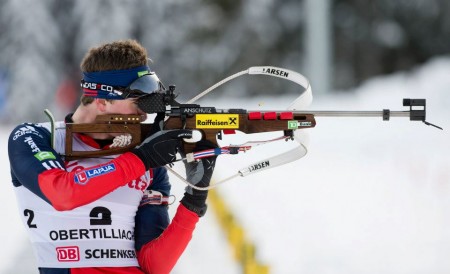
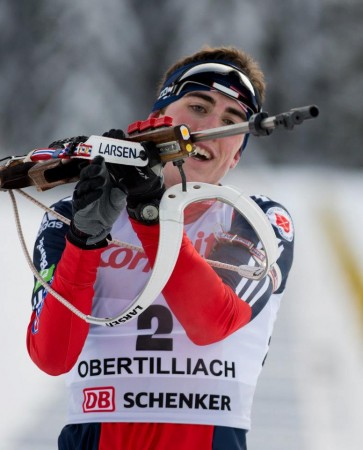
Just as he had in Sunday’s sprint race, Sean Doherty of the U.S. got off to an inauspicious start in Tuesday’s youth individual race at World Youth and Junior Championships in Obertilliach, Austria. After earning silver and gold in the previous two races, Doherty quickly collected two penalties.
Missing two shots in the first stage is especially punishing in the individual format, where each target that doesn’t turn which is penalized with a minute of additional time. Just 2.5 k into the 12.5 k competition, Doherty was already in a hole, 1:48 behind the leader, at that time Aslak Nenseter of Norway. (Penalties later piled up for Nenseter, who finished 26th.)
Ranked 52nd after that initial prone stage, Doherty was quick on his skis and made up some of the time. But a stage later, he missed another shot and fell to 2:13 behind the new leader, Aristide Begue of France. At this point, however, other racers had also begun missing, and the American’s fast skiing pulled him up to 24th.
It wasn’t great, but it was something.
“It’s not uncommon to have first or second or any stage go wrong for top competitors at any level,” Doherty’s coach Algis Shalna wrote in an e-mail to FasterSkier. “Sean is especially good at not giving up or losing confidence. After first two shooting stages I was nervous – I thought a few times the medal is gone, but believed he will stay focused and shoot well last stages and he did. Just watching him on the course after he missed those first shots he looked like he felt he is still in the game, but just had a late start.”
Doherty on the podium for the third time this week. Photo: US Biathlon/NordicFocus.
Doherty, who was unavailable for comment, put his head down and got it done. Over the next two stages he was flawless, not only hitting all ten targets but doing so more quickly than anyone else in the field. By the time he left the range the last time he was sitting in second, 18.5 seconds behind Begue.
“We coaches tell athletes before every race to focus until last stage of shooting because the game is not over until everyone is through the range and done shooting and results are posted,” Shalna said. “There is always a case someone misses targets at the begging of the race and someone at the end.”
Doherty nearly did the impossible and snagged the win, making up 12 seconds on Begue in the final 2.5 kilometers. But he was left with his second silver of the weekend, while Begue claimed his second title in this event in as many years.
It was an emotional day for Begue, whose coach Matthieu Rouveix died this summer at age 32. The sharpshooting Frenchman missed a single shot out of 20 to claim his title.
“I competed for my late coach Matthieu today and dedicate this gold medal to him,” Begue told the IBU press service after the race. “I was happy at the finish because I had a good race. If Sean was faster or not was not so important, there is always next year.”
Anton Myhda of Ukraine earned bronze, like Begue missing only one shot. He was 35 seconds behind Doherty in the first podium of his international career.
It was a strong day for the Americans across the board, with Jakob Ellingson finishing 21st with three penalties, Jordan McElroy 46th with six, and Brian Halligan 54th with seven. That’s a huge improvement over earlier in the week, when Doherty was the only American to make the 60-man pursuit.
Depth on the team and excellence at the top: that’s something that the U.S. can celebrate. So is the fact that Doherty became the first American biathlete ever to earn three medals in youth and junior racing.
After the hubbub surrounding his first silver medal and the subsequent gold in the pursuit, it would be easy for a 17-year-old athlete to get distracted. But Shalna marveled at Doherty’s resolve.
“Overall his confidence is very stable,” he wrote. “It’s a gift… the emotions are high and me, personally, I am trying not to think what just happened but think what is the next thing I need to get done and do everything the same way, to stay on track for preparation for the next race. I know Sean does pretty much the same thing. He makes the plan in his head and sticks with it until it’s done.”
Focus like that is what can bring an athlete back from such an early deficit – and it’s what Shalna has been trying to teach Doherty to do in the off-season, through hard work at shooting ranges in northern Vermont.
“When we do shooting drills, I teach athletes not to think about what happened but focus on the next task,” he explained. “I say whether you had good shooting or bad, keep your focus on the next task and just forget what happened before, positive or negative, in order to have the next task done good quality. I believe worrying too much becomes distraction and lowers the confidence.”
That’s no problem for Doherty, who has taken the words of Shalna – who, as a relay gold medalist in the 1984 Olympics, knows a thing or two about pressure himself – to heart.
“I thought of nothing, really,” Doherty told the IBU press service of his time on the course. “The coaches told me that I was doing okay, that I should not give up on the competition. So I focused on the second half of it.”
* * *
In the youth women’s 10 k individual, Anna Kubek of Mount Itasca again led the U.S. team, placing 38th with six penalties. Aleksandra Zakrzewska and Mikaela Paluszek finished 72nd and 79th.
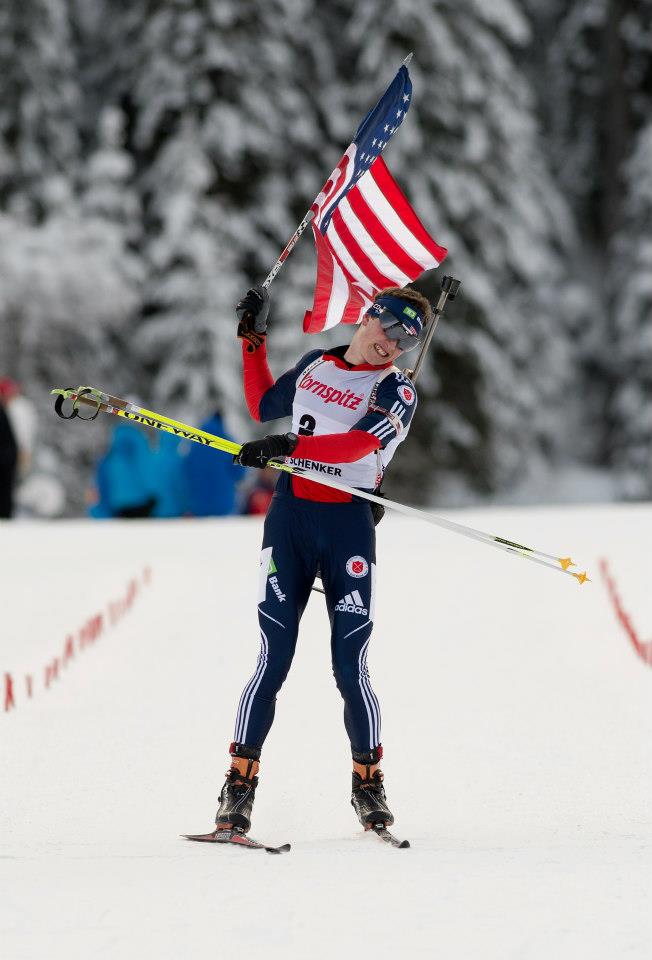
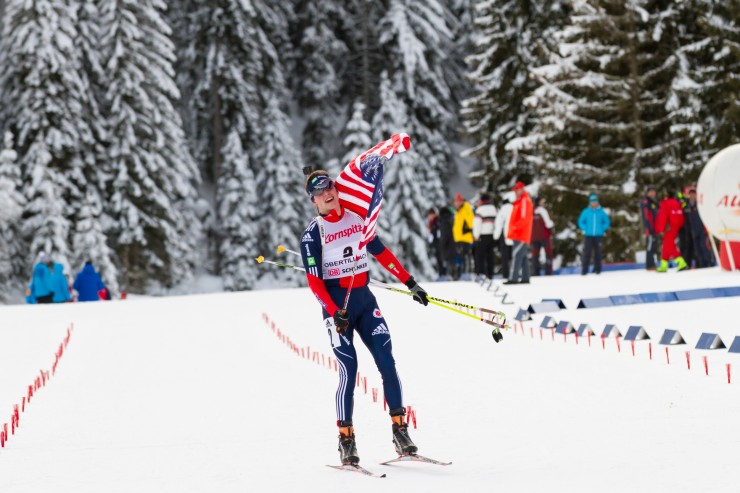
Sean Doherty enjoyed every second of his time carrying the American flag across the finish line as a World Champion. Photo: UBSA/NordicFocus.
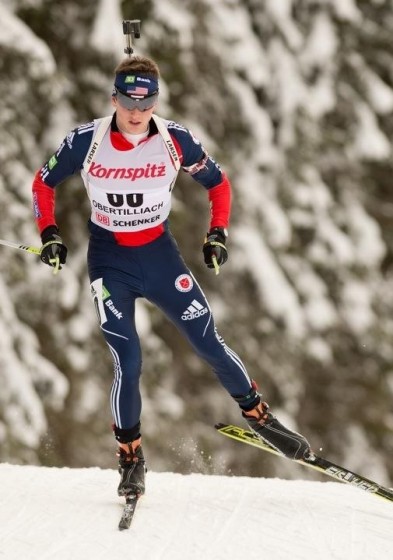
On Friday, Sean Doherty won the first U.S. medal at biathlon World Youth and Junior Championships since 2009, when Grace Boutot won silver. The drought to a male medal was one year longer, back to 2008, when Leif Nordgren earned bronze.
And going into the 10 k pursuit on Sunday, it seemed like another medal was, well, not a guarantee, but definitely a strong possibility. Doherty, who lives in Center Conway, New Hampshire, but trains with the Vermont Collegiate Biathlon/Ethan Allen program in northern Vermont, started only 3.6 seconds behind sprint winner Fabien Claude of France.
Things didn’t get off to a great start, though, when Doherty missed two shots in the very first prone stage and dropped to fourth, 30 seconds out of the lead, which had shifted to Rene Zahkna of Estonia.
“When I was in the wax cabin before the race, thinking over my plan, that was not how I planned it,” Doherty laughed over the phone from Obertilliach, Austria. “But if there’s any time in the race to have not your best shooting stage, the first one is okay, because there’s plenty of racing to work back from that. And I feel like I did that very well. I wasn’t too worried about it at the time because I didn’t drop back too far, and I knew I still had three shooting stages to work with and focus on.”
Doherty on the range, where he didn’t let nerves rattle him as they had earlier leaders. Photo: USBA/NordicFocus.
That kind of calm and maturity propelled 17-year-old Doherty – who remarkably still has another year of youth eligibility – steadily upwards. By the third stage, he hadn’t collected any more penalties and took the lead. Leaving the last standing stage, he had a 33-second advantage over Zahkna, and had sealed the deal on the first gold for the United States since Jay Hakkinen’s in 1997.
In a somewhat sloppy four-stage pursuit, very few racers shot better than Doherty; only three beat his three penalties, which wouldn’t usually be characterized as exceptional. Couple that with the 15th-fastest ski time, and you’ve got yourself a World Champion.
“It was really cool to have a good race when it really counted,” Doherty told FasterSkier.
His late-in-the-game cool was all the more impressive considering what had happened in the previous races. In the junior men’s race, which had finished just 20 minutes before the youth men began, Russians Alexandr Loginov and Maxim Tsvetkov came into the range the last time in first and second, then missed three and two targets and handed the win to Johannes Thingnes Bø of Norway.
That wasn’t going to happen to Doherty.
“With the standing shooting, I just knew that I had to do what I was trained to do,” he said. “Not change anything. I’ve seen it a lot from watching the World Cup online and racing experience: people hesitate and miss. So I just went with my pace and how I felt. It worked out just fine for me.”
After clinching the victory, he was able to take enough time to grab an American flag in the finishing stretch and ski it across the finish line.
Doherty’s single penalty in the last stage left him smiling: the win was clinched. Photo: USBA/NordicFocus.
“It was incredible,” he said of the last lap of skiing. “I wasn’t getting any splits, but it was just amazing to know that it was locked up. That I was going to be able to grab the flag at the end – all the stuff that I just see people do at big World Championship type races, and then all of a sudden, wow, I’m going to be able to do that.”
In a single weekend, Doherty became the most decorated young biathlete in U.S. history. While Hakkinen can match his gold, never before has an American won multiple individual medals at the Youth and Junior Championships. (Lanny Barnes won bronze and relay silver in 2002.)
For Doherty – who has been training hard all year with coach Algis Shalna, himself an Olympic gold medalist for the Soviet Union in the relay in 1984 – the medals had seemed like a possibility, but hardly something to check off a goal sheet.
“I went in knowing that I was capable of a podium, but it’s very hard to plan this type of result, I think,” he said. “I was going in hopeful, but not necessarily like, we have a major goal to get on the podium.”
Besides training, which takes him tow or three hours from home to places like Jericho or Craftsbury, Vermont, for weekends with his coach and teammates, Doherty has prepared by doing a few biathlon races in North America and some ski races as well. Earlier this winter in Craftsbury, he was the third junior and first J1 in a 12 k Eastern Cup race, right in with several racers who earned trips to U23’s.
But as a biathlete, Doherty turned heads when he crushed the World Juniors qualification field, typically winning by two or three minutes. That can give an athlete confidence, but it’s also completely different than competing against a strong field at an event like World Junior Championships.
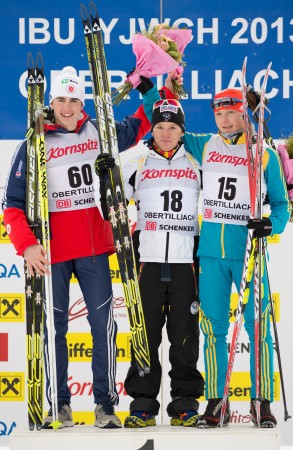
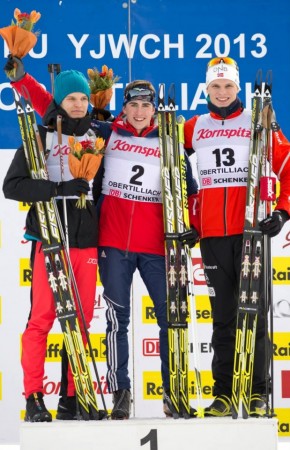
On the podium for the second time this weekend. With second-place Rene Zahkna of Estonia (left) and third-place Fredrik Roervik of Norway (right). Photo: USBA/NordicFocus.
Luckily, Doherty has been to two previous Championships, as well as the Youth Olympic Games. And he also has Shalna’s guidance.
“It’s just a lot of good coaching,” Doherty said of his preparation for big races. “Algis and Vlad [Cervenka] and the whole staff is really great. So it’s relying on some previous experience and trusting that my coaches have a good plan for me. That’s really all you can do. Maybe you can watch some online and get a feel for the environment, but it’s nothing compared to when you’re actually there.”
Doherty will have one more chance to add to his medal tally at these Championships, in the individual race on Tuesday. With no other American men qualifying for the 60-racer pursuit, a team relay medal seems unlikely.
After Obertilliach, Doherty will focus on the junior races at Open European/U26 Championships, to be held in Bulgaria later this winter. In previous seasons he has also raced at home for Kennett High School, but with his biathlon focus growing every year that’s no longer a possibility.
“Unfortunately, because I’m traveling so much I’m not actually doing the high school races,” he said. “I feel like I can’t really be a part of the team because I’m not there enough. I’d love to, but I’m not doing that this year.”
Instead, he’s soaking up an experience that only a few Americans are lucky enough to earn: racing in Europe, and carrying that flag home across the finish line.
Following World Championships in Germany, the biathlon circus packed onto 3 different charter planes headed for central Russian and the final World Cup competitions of the season. I was excited for the chance to see Khanty-Mansiysk after hearing so much about it, but I was also very tired from the previous week’s racing. I couldn’t help but feel like I traveling 5 timezones in the wrong direction. However, the racing has been awesome, the temperatures have been reasonable, the food is (somewhat) edible and Russia’s oddities have kept us plenty entertained.
Many athletes haven’t bothered to adjust to the time change, especially since all the competitions are in the evening. The bright white lights of the stadium extend normal daylight hours and I keeping forgetting that it is well past sunset when I cool down from my races. Sara and I have watching movies late at night (starting around 11:00) to help us fall asleep and we’ve been sleeping-in until well past 9.
Where in the world are we? At an oil boom town in Siberia
Some of athlete housing: a tropical paradise. I can almost imagine the snow as a white sandy beach.
Adventures at the grocery store, where the vodka aisle is the same size as the vegetable aisle
Hungry? With the wide selection, you should to be able to find some type of canned meat to your liking. I was also very excited to find some white cheddar in the cheese section, but it didn't live up to my high Vermont standards.
Since the tap water is not safe to drink, we've been going through lots of bottled water. Don't worry, we are finding ways to be green and reuse all those plastic bottles. Photo: Sara Studebaker
A fur vendor who set up in the lobby of our hotel
This beautiful church sits on top of the hill overlooking downtown
A familiar face. Posters featuring Russian and Soviet superstars from years past line the road to the venue. Walking by the signs one day, Sara commented "That one looks like Algis!" and it was indeed. Algis Shalna, formerly of Lithuania, now lives in Vermont and coaches many local biathletes, including our Craftsbury crew.
Reindeer and sled on route to the stadium to pick up medalists for a victory loop. Seconds after I took this picture, these animals ran wild knocking their driver off the sled and dragging him into the woods. I started wondering if any of the medalists would survive to race in the next day's pursuit.
For all its quirks, Khanty has one of the most professional and state-of-the-art race venues I have ever seen.
Canada's Emma Lodge and U.S. biathlete Kimberly Del Frate on course in Kontiolahti. Photo: Judy Geer.
Despite the presence of several former champions in the field, a new gold medalist rose to the top at biathlon’s World Youth and Junior Championships in Kontiolahti, Finland on Saturday: Elena Ankudinova.
The diminutive Russian was perfect on the range and collected an eight-second victory in the junior women’s 7.5 k sprint. She bested, among others, Tuesday’s individual champion, Chardine Sloof of the Netherlands; last year’s youth individual champion, Thekla Brun-Lie of Norway; and teammates Elena Badanina, who won both the youth sprint and pursuit in 2010, and Olga Galich, that year’s youth individual champion, who also tied for the youth sprint title in 2009.
It may not have had quite the story of Sloof’s first-ever Dutch victory earlier this week, but Ankudinova’s dominance was definitely a surprise. This is her first trip to the Championships, and after finishing 17th in the individual race she hadn’t even been selected for Russia’s relay team on Thursday.
Ankudinova told the IBU that her win was a relief to the whole team. The Russian women had previously received only one medal in these Championships, a third-place finish by Badanina in the individual, and both their youth and women’s teams placed fourth in the relays.
The team tripled their medal count on Saturday, with Margarita Phillipova taking home bronze 16 seconds behind Ankudinova. The teammates were separated by Anais Chevalier of France, who told the IBU after the race that she has gold in her sights on Sunday’s pursuit.
And looking back? Perhaps the Russians wish they’d put Ankodinova on the relay team, after all.
Vaillancourt 16th for Canada
Keely MacCulloch en route to 40th place. Photo: Judy Geer.
For the second time this week, Audrey Vaillancourt led the Canadian contingent with a result in the mid-teens. After finishing 15th in the individual race, the Quebec City native almost repeated her performance in the sprint, placing one spot down the ladder in 16th. Vaillancourt had a single penalty and finished a minute and a half behind Ankudinova.
“I indeed had a very good race today,” Vaillancourt wrote in an e-mail. “My plan was to have a strong start and try to keep that pace all the way through the race, so I had a very fast first lap. Unfortunately in my last lap I couldn’t push the pace any faster, so I just made my way to the finish line with the very little energy I had left! It was worth going as fast as possible from the beginning though; every second counts in a sprint.”
Vaillancourt’s penalty came in her prone stage, but she said the error did not affect her confidence, and that she was pleased with only a single penalty.
Emma Lunder and Keely MacCulloch placed 39th and 40th, just over three minutes out of the win. Canadian coach Richard Boruta said that “the current ski speed is not quite where it needs to be for this level of competition.”
But the result was actually a strong showing for MacCulloch, for whom this is the first international race trip.
“It has been such an exciting experience,” MacCulloch told FasterSkier. “Honestly I didn’t have a clear goal set up for World Juniors because I was just thrilled that I even made the team. Finishing in 40th place today was exhilarating especially since I wasn’t able to race the relay, not to mention I moved up ten places from the individual.”
After the individual race, where she placed 50th, MacCulloch did have a tiny bit of experience to draw on, and used it to stay focused. Like Vaillancourt, she ran out of gas on the last loop.
“I left the penalty loop ahead of several of my competitors and tried to ski as fast as I could for the last lap… I think most of those I’d left in the range caught up to me on the downhill,” MacCulloch said. “The course has one long, steep hill that competitors must go down and then back up. Going up that hill the final lap as fast as I could was extremely tiring, and I do wish I could have pushed myself a bit harder.
“However it was still a terrific experience and I’m so glad it went as well as it did.”
Emma Lodge will join the team in the pursuit after placing 56th.
Tough Day for U.S. Women
Kimberly Del Frate racing down the finishing stretch. Photo: Judy Geer.
The Americans were dismayed that, Kelly Kjorlien, who had placed 39th in the individual race, encountered major equipment problems and had to drop out of the sprint.
“Our top athlete Kelly Kjorlien’s rifle started malfunctioning for prone shooting, and then stopped firing during standing,” said U.S. coach Algis Shalna. “Kelly had to stop the race. The biggest disappointment for Kelly and us was that she is not in the pursuit now, and competition is over for our top junior woman.”
The other U.S. entrants were Alaskan twins Kimberly and Amanda Del Frate, who missed four and five shots to place 55th and 60th.
“We do not consider it a big success to just to make pursuit, but for them being their first time at Worlds, it’s a respectable performance,” Shalna said.
Kimberly Del Frate told FasterSkier that her experience so far had been “eye-opening.”
“I guess for today’s race you could say I’m not unhappy with my shooting because it could have been worse, but it also could have been better,” she said. “I try to take each race as it comes and not stress the small things too much. Biathlon being what it is, you can’t really focus too much on what has happened or what you want to happen. You just have to trust your training, be confident, and focus only on what you can control. That’s really all you can do.”
Sean Doherty fighting for seconds at the end of his 13th-place sprint effort. Photo: Judy Geer.
In the first four days of racing in Kontiolahti, Finland, American hopes for its biathletes just hadn’t panned out. In race after race at the World Youth and Junior Championships, the U.S. racers were held back by one thing after another. They notched a few finishes in the high 20’s and 30’s – and mostly placed far lower on the results sheet.
On Friday, two Americans broke out of the slump and raced into the top-twenty, collecting the best results of their careers so far.
“Just got back from the venue and definitely with more of a smile on my face,” U.S. coach Algis Shalna told FasterSkier after the race.
Sean Doherty of Conway, New Hampshire placed 13th in the youth men’s 7.5 k sprint and Tara Geraghty-Moates of West Fairlee, Vermont placed 18th in the youth women’s 6 k sprint.
Geraghty-Moates clocking in the ninth-fastest ski time of the day. Photo: Judy Geer.
“I’m stoked,” Geraghty-Moates told FasterSkier in an e-mail. “Everything has been going smoothly: the coaching staff here has been completely on their game, the wax has been fast, the weather is warmer than we predicted… I’ve just been having a stellar week so far, and I’m hoping to keep the trend going.”
Doherty, who could not be reached for comment, missed a single shot and finished 1:48 behind winner Johannes Thingnes Bø of Norway. Bø, whose older brother Tarjei won the overall World Cup last season, raced to a colossal 50-second victory. Behind him, the field was tightly packed; Doherty was 56 seconds from the podium and eight from the top ten.
“Great shooting and fast skiing put him in a competitive position for pursuit race,” Shalna said of Doherty’s performance. “The pursuit will be very challenging for all of them and will require a lot of effort to control the emotions on the range and speed control on the skiing course.”
The result was reminiscent of Doherty’s other successes this year, including 12th– and 14th-place finishes and a strong relay leg at the Youth Olympic Games.
For Geraghty-Moates, the 18th-place finish is a big improvement. She had placed 44th in Monday’s individual race, and her top finish at 2011 World Youth Championships was 57th. In those races, she had been plagued by poor shooting, but on Friday she only missed two of ten targets.
Sam Dougherty, 35th place. Photo: Judy Geer.
“I’ve been pretty happy with my shooting so far,” Geraghty-Moates wrote. “All my races are consistent with the results I’ve been having so far this year – all way better than last year.”
A former standout nordic combined athlete who has a cross-country background, Geraghty-Moates picked up biathlon in 2010. Shalna, who is one of the Vermonter’s coaches back in the States, was impressed with how far she’d come in a short period of time.
“Tara had an excellent performance that exceeded my expectations,” he said. “Most importantly her shooting performance was beyond my goals for this race. Considering the level of competition and being only her second year in biathlon, 80 % shooting is a very solid performance.”
Predictably, Geraghty-Moates, who has a history of top-five finishes at cross country junior national championships, was quick on her skis.
“She had 9th-fastest course skiing time, and it was only 54 seconds from the winner and nine seconds from the [second-fastest skier],” Shalna said. “This is a pretty good example how a competitive former skier can get among the best in the world in biathlon if you have skiing speed, even with the the short amount of time for shooting.”
Of course, things didn’t go perfectly. After being thrilled to clean her prone stage, Geraghty-Moates succumbed to pressure in standing.
“I was in sixth coming in to the standing, but I made the mistake of looking at the result board coming into the range before standing and realizing that if I cleaned I had a shoot at the medals,” she wrote. “Of course then I proceeded to miss two shots, but that was predictable.”
Nick Proell, 40th place. Photo: Judy Geer.
Both Doherty and Geraghty-Moates have had to get creative with their training this year, given the lack of snow in New England (as with many other parts of the U.S.). While competing against the best biathletes in the world might be intimidating when on-snow training has been scarce, Geraghty-Moates said that in a way, it had prepared her well.
“I think the shitty conditions we’ve had back east actually ended up helping me because I’ve been skiing up Storrs Hill [alpine] ski area for a lot of my training,” she explained. “This means that the hills here don’t look über huge even when they’re half a kilometer long.”
Geraghty-Moates had said after the relay that the course suited her, and that the hills “kept me on my toes.” Friday’s conditions made her even happier.
“Today it was warm and a little icy which made the fast course even faster, a plus in my book,” she said.
The rest of the U.S. team struggled to keep up with Doherty and Geraghty-Moats. Anna Kubek, who had led the U.S. women in the individual with a 30th-place result, missed half of her shots and placed 67th, missing the 60th-place cutoff for Sunday’s pursuit. The result was an unexpected blow to the American squad.
“The race did not go well for Anna, who is a great young athlete,” Shalna lamented. “Her shooting was not as good what she is capable of, but biathlon can be a roller coaster and the less experienced you are, the more roller coaster rides you get.”
Mikaela Paluczek and Melissa Manning will be joining Kubek as spectators on Sunday after placing 65th and 71st. Both are first-time international competitors.
“None of the last three girls made the pursuit race on Sunday, but for all of them the races over the last week were a priceless experience for becoming better biathletes in the future,” Shalna said.
On the men’s side, Sam Dougherty and Nick Proell placed 35th and 40th after missing two and one shots respectively. They are separated by just 12 seconds – less than the time it takes to ski a penalty loop – and Dougherty is just 13 seconds from the top thirty and less than a minute from the top fifteen going into Sunday’s pursuit.
Jake Prince rounded out the squad, placing 80th with five penalties.
The start of the youth men's 3 x 7.5 k relay in Kontiolahti, Finland on Wednesday. Photo: Judy Geer.
On Wednesday, Kontiolahti, Finland, became a venue that was hospitable for biathlon for the first time in perhaps several weeks.
After the bitter cold of the World Cup races two weeks ago, a general lack of sunlight, and a persistent wind that has dogged even the best shots at World Youth and Junior Championships this week, today’s balmy sunshine was a welcome reprieve.
Geraghty-Moates in action. Photo: Judy Geer.
“Today was an amazing bluebird day and there was almost no wind,” U.S. racer Tara Geraghty-Moates told FasterSkier in an e-mail. “We couldn’t really have asked for better conditions. My favorite thing about Finland so far is the snow – unlike at home we have a ton of it here!”
No team capitalized more on the relative calm than the Ukrainian youth women, who over eight shooting stages, or a total of forty shots, missed just four and thanks to the use of spare rounds avoided the penalty loop completely. Yuliya Zhuravok, Yuliya Bryhynets, and Anastasiya Merkushyna raced to a 58-second win in the 3 x 6 k relay, besting runner-up Sweden by a landslide.
Bryhynets took the lead after her first shooting stage, and by the time she tagged off to anchor Merkushyna had amassed a lead of almost a minute – which actually intimidated her teammate.
“It was very difficult to go with such a big lead,” Merkushyna told the IBU news service after the race. “My legs were shaking; that is not normal. My hands were shaking and my head stopped working. I only thought ‘please shoot as normal as possible.’”
Good shooting was the order of the day for the women’s race: the Swedes used six spare rounds and the third-place Austrians five. The same could not be said of the youth men’s x 7.5 k relay, where only three of the 22 teams used fewer than ten spare rounds and most ended up in the penalty loop at least once.
While the French led the men’s relay from start to finish and ultimately won by 38 seconds, that outcome didn’t seem certain when the racers entered the range the final time. French anchor Aristide Begue, who won the individual competition on Monday, needed all three spare rounds to clean his targets, and almost all of the leaders missed with at least one bullet.
That was what saved Begue, who was able to leave the range with a 22-second lead and then extend it in the last loop of skiing to hang onto the win for teammates Clement Dumont and Florian Rivot.
The Swedish youth men’s team placed second and the Germans third; the most exciting finish of the day came when Kazakhstan, Italy, and Belarus sprinted to the line for fourth-place honors, with the Kazakhs beating out the Italians by just 0.1 seconds.
Top-Ten Finishes For Both Canadian Teams
Sarah Beaudry anchoring the Canadian women to eighth place. Photo: Judy Geer.
The Canadian women placed eighth today and the men ninth; coach Richard Boruta was satisfied with the results, but no more.
“I think it has been a relatively good day, probably reflecting our current position in this category in the world,” he told FasterSkier in an e-mail.
The women used only six spare rounds, all in prone. Rose-Marie Cote used two in the opening leg, and tagged off in 13th, roughly a minute and a half behind the leadrs.
“Rose-Marie had a good shooting day, but her ski speed this week is not quite there,” Boruta said.
The performance of the day came from Julia Ransom, who is fresh off a top-ten finish in the individual race. Using a single spare round in prone and cleaning her standing stage, Ransom also excelled on the trails, turning in the third-fastest time for second-leg skiers and moving the team up to eighth. Sarah Beaudry held the team’s position despite hitting the penalty loop once.
“Julia actually had a really good race,” Boruta said. “She was third overall in her leg and she had a good shooting performance as well. And for Sarah, her ski speed is fine, but her shooting seems to suffer this winter a little bit.”
Albert Bouchard. Photo: Judy Geer.
In the youth men’s race, both Stuart Harden and Christian Gow turned in strong performances, and after two legs the Canadians were sitting in sixth place, just 30 seconds behind the winning French team – despite having already used eight spare rounds. After anchor skier Albert Bouchard was stuck skiing three penalty loops, the team dropped to ninth.
“It was a very interesting race for first two legs and both Stuart and Christian raced up to their potential,” Boruta said. “Christian has been skiing really well and he has a good chance to do very well in the sprint race.”
Gow placed 11th in the opening individual race, and after that effort told FasterSkier that he was looking forward to races that placed more of an emphasis on skiing rather than shooting.
“Looking at the results though I am happiest at the potential I see moving foward into the upcoming races,” Gow explained. “I now know that I am very competitive with the top of the competition. I think that in the sprint, pursuit, and relay to come I will be able to really push on the skis, and I would consider my skiing to be my strength in biathlon.”
Gow mixes straight cross country races into his competition schedule in Canada, so he knew that he’d be ready in that regard.
“I have done more biathlon than cross-country races [this year], but not much more,” he said. “I find that doing the ski races helps to keep myself in check with my ski speed; they are the best test to see how fast I am going at any point in the season.”
Young Americans Gain Experience With Relay Finishes
Anna Kubek kicking things off for the U.S. Photo: Judy Geer.
If the Canadians were lukewarm about their relay results, then the Americans were luke-cold after placing 13th in the women’s relay and 15th in the men’s.
“I can’t say we are happy with their results, but we are happy seeing kids racing hard and giving their best,” U.S. coach Algis Shalna told FasterSkier.
The women’s team matched their result from the 2011 event, but second-leg skier Geraghty-Moates pointed out that the Americans had actually skied a better race, despite being comparatively younger than last year’s squad.
“There was a much larger field from last year, so I think our overall performance was much better,” she wrote. “Last year we were close to 13 minutes off the pace, this year we were only 6:53 off the pace. When Anna tagged me she was a minute back. I was able to hold her tenth place, but I lost some more time off of the leaders.”
In Shalna’s view, that’s not bad given that leadoff racer Anna Kubek and Geraghty-Moates are both relatively new to the sport, having started in 2010, and anchor Melissa Manning is at her first World Junior Championships.
Kubek coming in for the tag to Geraghty-Moates. Photo: Judy Geer.
“Two girls had good performances, especially Anna, who shot well – no penalty loops – and skied well, tagging to Tara in tenth place one minute back from the leader,” Shalna said. “Tara skied very strong but had a penalty in prone, but she is second year in biathlon and this is a very respectable performance. Her range times were slower than top biathletes in the world, but she just needs more practice time and experience racing.”
Manning also hit the penalty loop, and dropped the team to 13th.
“Melissa, as a first year on the team, worked hard to keep us where we were,” Shalna said. “Is not easy to compete at this level the first time, with a lot of excitement and a fair amount of pressure.”
Geraghty-Moates was honest in her assessment of the team’s performance, but still positive.
Sean Doherty awaiting the handoff. Photo: Judy Geer.
“We are definitely off the European pace but we’ve made huge progress from last year,” she said. “For me it’s important to keep it all in perspective and just focus on making improvements one at a time.”
The youth men finished 15th after a promising start by Sam Dougherty, who hovered around tenth place for most of his leg.
“The boys could have done a little better and placed around tenth to twelfth place, but few penalties did not favor them,” Shalna said. “The best race was for Sam who had good start, them cleaned his prone shooting and used only one extra round to clean the targets. It was solid performance for him skiing and shooting.”
Sean Doherty kept the momentum going and lost only one place over the course of his leg despite hitting the penalty loop twice; Nick Proell replicated Doherty’s shooting errors, and the team eventually slipped to 15th.
“Sean skied well but struggled on both shooting staged and had one penalty on each,” Shalna said. “He was making time on skiing, but the extra time on the range to use spare rounds kept us from getting any closer [in the last two legs].”
Christian Gow of Canada (bib 19) catches his breath after an 11th-place finish. Photo: Judy Geer.
The U.S. team at biathlon World Youth and Junior Championships in Kontiolahti, Finland, is hoping that things will heat up in the next few days – both literally and figuratively.
“It has been pretty cold all week but it warmed up today,” American racer Anna Kubek told FasterSkier.
At World Cup races one last weekend, the Finnish venue flirted with legal temperatures and athletes swaddled themselves in layer upon layer of clothes, as well as rendering their faces expressionless with protective physio tape. For most of the juniors’ training days, similar conditions prevailed.
Today, temperatures were listed in the balmy mid-20’s Fahrenheit at race time, and the trend should continue for the rest of the week.
Kontiolahti provided plenty of other challenges on this opening day of competition, however. The youth biathletes, who were contesting individual-format races, had to contend with strong and shifting winds as well as uncharacteristically soft snow.
Julia Bartolmaes of Germany and Aristide Begue of France had no trouble racing through the powder, besting fields of over 90 athletes each, all born no earlier than 1993, en route to collecting wins of 18 and 47 seconds respectively in their 10 and 12.5 k races.
New Hampshire racer Sean Doherty leading the U.S. in 26th place. Photo: Judy Geer.
For the U.S., the individual races weren’t a wash – but they weren’t spectacular either.
“Today was pretty good day for us and better than last year when we started World juniors,” said U.S. Biathlon Association coach Algis Shalna, who also works at the Ethan Allen Biathlon Club in Jericho, Vermont, and with Vermont Collegiate Biathlon. “The championships just started and we’re hope for more good results.”
The team was hampered by poor shooting, with the best shooter, Sam Dougherty, missing five shots and the worst, Jake Prince, twelve of a possible twenty. Plenty of racers struggled on the range – only the winner had a single penalty, and only the runner-up had just two – but the U.S. was left wishing it had shot better.
“With the increased psychological element of a one minute penalty for each missed shot, it’s easy to look back with a woulda-shoulda-coulda attitude,” Dougherty told FasterSkier, before adding that he was relatively happy with his performance given the conditions.
The top two results, predictably, came from two similarly-named Americans who had attended the championships last year: Sean Doherty of Conway, New Hampshire, and Dougherty, who is a native of far-away Anchorage, Alaska. Doherty placed 26th and Dougherty 28th after missing seven and five shots, respectively, and receiving an additional minute of time for each penalty.
“These results we are considering pretty good for our youth group,” Shalna said.
Doherty and 55th-place Nick Proell are the youngest members of the U.S. men’s squad, but they both already have international experience this season after representing their country at the Youth Olympic Games last month.
Dougherty charging down the finishing lanes. Photo: Judy Geer.
Doherty in particular was expected to succeed in Kontiolahti; as the top qualifier to the Youth Olympic Games, he hadn’t even attended World Junior trials. And in Innsbruck, he finished 12th and 14th in the sprint and pursuit races before turning in a seminal leg of the third-place U.S. mixed-sport relay.
In Kontiolahti on Monday, seven penalties were too much for Doherty to overcome; his ski time was the 27th-fastest, and he ended up just under six minutes behind Begue
Dougherty, who also competed at World Juniors last year, was 17 seconds and two places behind him. Both collected their best World Juniors finishes to date.
“This time around at World Juniors has been a lot more relaxed for me. I know what to expect so I can now focus solely on performance,” Dougherty said.
Dougherty, who in his last year as a youth is considerably bigger than some of his competitors, said that the conditions weren’t ideal for him – “I had to muscle my way through the course a little more than the smaller racers” – and that he considers the individual his weakest discipline, so he’s hoping to improve on his finish in the upcoming races.
As for the wind, which is always a factor in Kontiolahti? It didn’t faze him.
“I’ve become accustomed to shooting in all types of wind from my years in Anchorage, and I’m comfortable with making mid-race sight adjustments,” he explained. “This came in handy today with the wind being so erratic.”
Unlike Doherty, Dougherty hasn’t competed in any high-level biathlon races this year. In fact, he’s barely done any biathlon races in general. A student at Montana State University, Dougherty tried to walk on to the varsity ski team, but was turned down.
Gow on course. Photo: Judy Geer.
“The majority of my training this season has been on my own. It wasn’t an ideal situation, but I’m happy that this hasn’t slowed me down any,” he said. “I’m a firm believer that nordic performance above all is key to being a good biathlete, and with that mentality I’ve entered every nordic race available to me this season.
“Due to school I haven’t been able to travel for Nor-Ams or any other upper-level races this year, so my biathlon racing experience this year has been extremely limited,” he continued. “One day I will have the time and funding to establish myself on the Nor-Am circuit.”
Dougherty’s fellow Alaskan, Prince, rounded out the scoring by placing 83rd.
The Canadian team was led by Christian Gow, who placed 11th; he could not be reached for comment. Gow was followed by Albert Bouchard in 36th, Stuart Harden in 38th, and Carsen Campbell in 41st.
Aleksandra Zakrzewska leaves the range during a race at biathlon World Junior Trials in Jericho, Vermont last winter. Photo courtesy of Zakrzewska.
(Note: This is the fourth in a series of interviews with athletes who will be competing at the first-ever winter Youth Olympic Games in Innsbruck, Austria this winter. The first interview was with Sean Doherty, the second with Anna Kubek, and the third with Nick Proell.)
When the Youth Olympic Games kick off in Innsbruck, Austria this January, one American biathlete will have a lot of experience on her side.
It’s not her own experience: neither of the two girls named to the U.S. squad has raced internationally before.
But Aleksandra Zakrzewska, a high school student from South Burlington, Vermont, has been spending more time with a very knowledgeable coach since she qualified for the team. Algis Shalna won Olympic gold representing the Soviet Union in 1984, and he happens to coach the Vermont Collegiate biathlon team, which like Zakrzewska trains out of Jericho, Vermont. Shalna has been helping the young athlete out more since she learned that she was Olympic-bound.
Even though Zakrzewska doesn’t have any international experience of her own, a little inspiration and a lot of focus fuel her drive to the top. This is apparent in other parts of her life, too. Even though Zakrzewska is just starting her junior year of high school, she’s balancing a workload that would make even college students crings: advanced placement classes, high school teams, the school band, and an hour-long round-trip drive to biathlon practice.
It might seem like lot for a young woman to handle, but Zakrzewska has proven herself in all of her endeavors. For two years in a row, she’s finished in the top fifteen of the statewide math talent search, and she also won several high school ski races last winter. That level of focus – which she displays on a daily basis – is what will ultimately determine her success in Innsbruck.
FasterSkier caught up with the Vermont native last week to see how her training was going.
FasterSkier: Can you tell me a little bit about your history as a skier – did you ski when you were growing up?
Aleksandra Zakrzewska: When I was 4, my family started cross country skiing. My sister and I joined the local Bill Koch League (BKL) club and started racing the next winter. Unfortunately, after about two years, the program was moved to right after school, and since I lived over half an hour away, I couldn’t come to the practices anymore. I still skied once in a while with my parents, but I didn’t train for racing. I started training again in eighth grade with the high school and have been doing that since.
FS: What made you want to take up biathlon?
AZ: I did a BKL race at the end of one winter that was a paintball biathlon. I found it really cool and a few months later my mom found a running biathlon race at Jericho. I went, missed every single target, but still liked it. That day we also found out that there was a club that I could join to start training biathlon, so I did.
FS: When did you start shooting, and how is that portion of the sport coming along?
AZ: That running biathlon race was the first time I had ever held a gun. I started shooting when I started training with the Ethan Allen Biathlon Club (EABC). I have been skiing for a lot longer than I have been shooting, so that part of biathlon has always been easier for me. I did two training camps over the summer, though, and my shooting has been getting a lot more consistent.
FS: Who do you train with?
AZ: I train with EABC in Jericho. I’m lucky to have a range to practice at so close to home, where there is a club to train with and where they hold races like NorAm’s. It’s too bad that there aren’t more places like this around, because it prevents a lot of people from joining the sport.
FS: I am assuming that you also do high school races for skiing. How do you balance ski training and biathlon training? How do you find time for everything?
AZ: I split practices – I go to Jericho on Mondays and Wednesdays, and train with my school on other days, and then I have to miss some high school races for biathlon. My ski coaches don’t really mind – they know I am still skiing. The problem for me is not with balancing nordic and biathlon, those fit in pretty nicely together, but with balancing the rest of my life. I take school very seriously and play two instruments. It’s difficult to coordinate the time commitments that each of these pieces of my life require.
FS: Have you ever raced internationally before?
AZ: No. This will be a first for me.
FS: Is it intimidating to think of racing against athletes from all over the world? Is that something you are thinking about at this point?
AZ: I’m not thinking about it too much yet, but when I do, I guess it is a little intimidating, but also really exciting. A race is a race, not matter who is in it.
FS: Has getting named to the Youth Olympic Games team changed your plans for the summer, fall, and early winter at all?
AZ:Yes, it has. First, I had to change my summer travel plans so that I could be in Jericho for the final qualifying races. Now that I qualified for the team, my training has changed, too. I normally run cross country in the fall. This year I am still on the team, but I’m doing a lot less training for running and a lot more for biathlon, including some more personalized training with Algis Shalna, a former Olympic coach and champion. I’m only racing at a few of the bigger meets to score for my XC team, but running has fallen a lot on the priority list. I’m also already planning for missing midterms and two other weeks of school. I’m taking four AP classes this year, so I really need to be planning ahead for that.
FS: What are you looking forward to most about the trip?
AZ: I am really excited about the whole thing. I’m honored that I qualified to go, I love traveling to other countries, and I am really looking forward to meeting athletes from other countries. I’m nervous about racing at such a big event, but I think it will be a great experience. I can’t wait.
Note: This is part of an ongoing series on junior and collegiate racers in the U.S. and beyond. The nordic sports are certainly not the largest, but there are still thousands of great stories. We will be picking athletes out of this pack to feature – nominations for outstanding or interesting nordic skiers can be sent to alex@fasterskier.com. We are looking for unique stories, not necessarily the fastest skiers. Nominations should include a brief explanation of why we should profile the athlete.
GLENS FALLS, N.Y. — Sitting inside a coffee shop with an iced drink to divert her attention, Carly Wynn looked down to collect her thoughts. As she toyed with a straw, the 18-year-old from Queensbury, N.Y., smiled. In fewer than three years, the three-time New York State nordic ski champion had learned a lot about herself.
Courtesy photo — Carly Wynn
For one, she wasn’t sure she wanted to stick with nordic — or maybe not in the long run.
With three straight state titles under her belt by her junior year, Wynn decided to switch to biathlon. She had dabbled in the two-pronged sport, but wanted to devote all of her training and resources to it. That meant leaving her high school team for her senior season.
At the time, she dreamt of becoming an Olympian or World Cup competitor. A few weeks ago in August, Wynn as a member of the U.S. Biathlon Junior National Team held similar aspirations, but ultimately wanted to ski in college.
Upon sorting through schools and speaking with several coaches, Wynn discovered biathlon at the collegiate level wasn’t exactly an option. College ski teams wanted cross-country to be the focus and understandably so, she said.
A conversation with the Dartmouth College head women’s coach, Cami Thomson, changed her outlook. Several of Thomson’s skiers practiced biathlon and competed on their own in the past, Wynn said. If she wanted to, she could as well.
“Dartmouth was absolutely the best option because there’s a (shooting) range right there in Hanover, (New Hampshire),” said Wynn, the top U.S. female qualifier at the Youth World Biathlon Championships last year. “It’s an ideal support system.”
With all those options, Wynn emphasized the importance of narrowing her scope. She wanted to make the college’s six-person carnival team and with nearly 20 others vying for spots, she knew it wouldn’t be easy.
After two seasons of biathlon, in which she earned a fully funded trip to the Czech Republic for worlds and won two races at the 2011 Junior Nationals, Wynn resolved to commit to cross-country skiing and she where it takes her over the next year — or four years.
Carly Wynn competes in the Youth World Biathlon Championships in Nove Mesto, Czech Republic, in January 2011. She finished 52nd in the 7.5 k pursuit (shown here), and was 43rd in the 10 k individual race and 53rd in the 6 k sprint. Photo courtesy Judy Geer.
“Every biathlete wants to be a fast skier, so I kind of see that as an added bonus,” Wynn said. “It’s not like gymnastics where you have one shot at making the Olympics and it’s got to be when you’re 17. I’m thinking 2018 right now.”
Her coach, former U.S. Biathlon head coach and five-time Olympian Algis Shalna, hadn’t exactly agreed with her decision to put her Olympic goals on hold, she said. He believed she could continue her biathlon training uninterrupted and shoot for the world trials or 2014 Olympics.
“I just think that if I put the time into that that would be required, I would miss out on the college racing experience,” Wynn said.
So she’s settled, at least for now. The opportunity to practice biathlon is always there, she said, and she planned to keep working with Shalna, a collegiate and regional development coach based out of Vermont.
If the carnival scene doesn’t pan out, she might go back to biathlon entirely. Either way, Shalna said he would support her.
Almost four years after he discovered her at an Eastern Cup race in Lake Placid, N.Y., the 52-year-old former Lithuanian skier said Wynn had the potential to be among the one of the nation’s best biathletes. He remembered the 5-foot-3 sophomore whiz by as he watched a 10 k nordic race. He followed to observe.
“I was really impressed with her ability for endurance and how she was able to … stay in the group and stay with those good skiers,” Shalna said. “I thought she (had) good pain tolerance and I thought, ‘I really want to talk to this girl and see if she wants to do biathlon.’ ”
Once she started training with him and shooting at targets, he saw Wynn was good enough to require more attention. He reached out to the U.S. Biathlon Association and insisted she was worth the time and gas money, and he drove nearly 300 miles round trip from Williston, Vt., to meet her regularly at the Saratoga Biathlon Club in northeastern New York.
“I knew it was going to work,” Shalna said of his intention to turn the fast, athletic skier into a biathlete. “My worry was: is she going to commit to biathlon?”
He learned that her mentality suited the sport. Not only was she calm and confident, but Wynn acted like a professional and took her training seriously, Shalna said. Over time, her shooting improved as did her already-good skating technique.
In the end, Shalna was pleased she chose Dartmouth, but said she needed to keep working on biathlon. Of the seven athletes on the Junior National Team and others he trained in the northeast, he said several joined collegiate nordic teams.
“It’s all a matter of how much training and time she can commit,” he said. “She is going to be a top racer in the country.”
For Wynn, it’s all about the process – a concept that she didn’t readily accept. It wasn’t until she understood the discipline of biathlon that she was able to step back and relax.
Wynn, 18, while hiking Algonquin Peak in the Adirondacks in July. Photo courtesy Elizabeth Izzo.
“I’m learning a lot about how to think in order to get the best out of myself,” she said. “Biathlon’s really taught me how to do that, how to focus on exactly what you’re doing right then and not have expectations.”
Shalna’s advice and Wynn’s willingness to listen helped her in life beyond skiing and biathlon, she said. A few weeks ago, Wynn said she nearly had a panic attack when she considered the high number of valedictorians at Dartmouth. Despite ranking third in her graduating class, she worried she would be overly challenged.
She talked herself down, rationalizing that she didn’t have to decide her major until the spring of her sophomore year. She anticipated studying exercise physiology, but was mostly excited about skiing, first in college and then beyond the NCAA scene.
“It’s worked really well integrating biathlon into my program,” Wynn said. “At this point for my future, I’m thinking that if I take any sport to the Olympic or World Cup level it will definitely be biathlon.”