Tag: Alison Crocker

  • Grab a Map and Go! U.S. Ski Orienteering Nationals Recap from Stowe

    Grab a Map and Go! U.S. Ski Orienteering Nationals Recap from Stowe

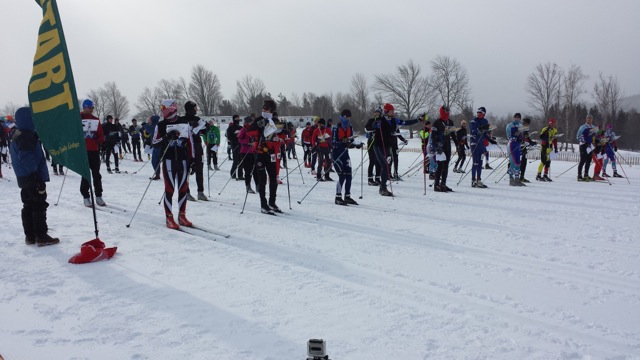
    Long distance mass start at 2014 U.S. Ski Orienteering National Championships in Stowe, Vt. (Photo: Barbara Beall)
    Long-distance mass start at 2014 U.S. Ski Orienteering National Championships March 14-16 at Trapp Family Lodge in Stowe, Vt. (Photo: Barbara Beall)

    “This is the world of Ski Orienteering, one of the more obscure and mentally challenging Nordic ski racing disciplines.”

    STOWE, Vt. — Imagine a Nordic ski race where you cannot preview the course, don’t know where you will be going, how long you will be skiing or how many hills you will have to climb.  A race where you can go anywhere you want on skis, including down snowshoe trails or through uncharted glades.  Where you can even take off your skies and run with them.  This is the world of Ski Orienteering, one of the more obscure and mentally challenging Nordic ski racing disciplines.

    The U.S. Ski Orienteering National Championships, a biennial event, were held this past weekend at the Trapp Family Lodge Ski Center in Stowe, Vt.  Approximately 100 skiers, ranging in age from 10 to nearly 80 attended the three-day competition, featuring a Sprint and Middle Distance race (with individual starts) and a Long Distance race with a mass start.  Different age classes are on different courses, with varying technical and physical difficulty.

    Skiers received the map 15 seconds before the start, and were required to find the correct controls (those orange-and-white fabric markers you might see in the woods) in the right order, registering electronically at each one with a timing chip carried on their finger. At the end of the race, skiers download that information and are given their split times to each control.
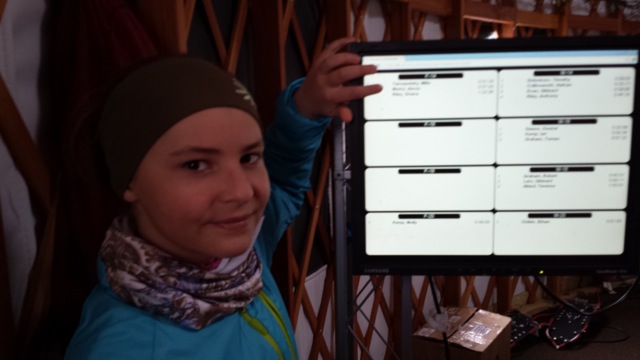
    Alexis Merka, 10, the youngest competitor at 2014 U.S. Ski Orienteering National Championships in Stowe, Vt. (Photo: Barbara Beall)
    Alexis Merka, 10, the youngest competitor at 2014 U.S. Ski Orienteering National Championships in Stowe, Vt. (Photo: Barbara Beall)

    In the mass start, the courses were “forked,” meaning skiers ultimately skied the same distances and climbs, but not necessarily in the same order as their competitors, in order to prevent following.  Race designers set up the courses to specifically challenge skiers on route choices, forcing them to decide, for example, whether it is faster to stay on a large trail or to follow a narrow trail only groomed by a snowmobile.  The courses also challenge skiers to maintain contact with their maps, and to not become upset by climbing up and skiing down a hillside a couple of times.

    Alexis Merka, age 10, was the youngest competitor at the event.  She is from Maryland, and her mother and father are both orienteers.  She competes in both ski-O and foot-O (which involves running rather than skiing). When asked what happens when she gets lost, she said “I say to myself, don’t panic, stay calm, look at the map.”

    Larry Berman, who with his wife Sara Mae Berman started the Cambridge Sports Union and has been involved with ski orienteering since the early 1970s, said that he loves the challenge of finding that control right where it is suppose to be based on the map … and if the control is not there, clearly the map is wrong.

    “I say to myself, don’t panic, stay calm, look at the map.” — Alexis Merka, 10, youngest racer at 2014 U.S. Ski Orienteering National Championships

    For male and female skiers in the elite classes, the U.S. National Championships also identify those skiers who may be named to the USA National Ski Orienteering Team, qualifying them to go to World Events.  The top U.S. female skiers were Alison Crocker (1st), Alexandra Jospe (2nd) and Anna Voegele (3rd).  Top U.S. male skiers were Adrian Owens (1st), Greg Walker (2nd) and William Frielinghaus (3rd for Middle and Long Distance) and Ari Ofsevit (3rd Sprint).  For full results go to: http://www.neskio.com/results/

    Results: Sprint | Middle distance | Long distance
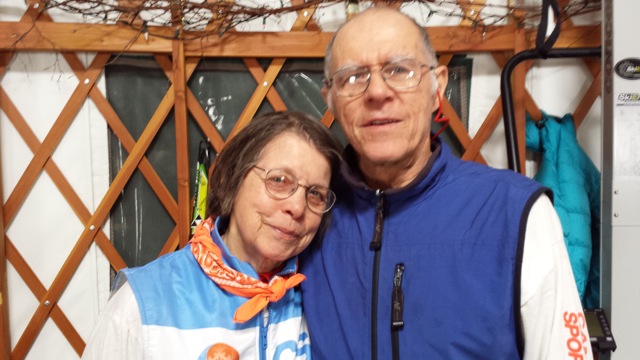
    Larry and Sara Mae Berman at the 2014 U.S. Ski Orienteering National Championships in Stowe, Vt. (Photo: Barbara Beall)
    Larry and Sara Mae Berman, founders of the Cambridge Sports Union, at the 2014 U.S. Ski Orienteering National Championships in Stowe, Vt. (Photo: Barbara Beall)
  • Ski Orienteering World Championships: US Team Led by Crocker’s Record 8th

    Ski Orienteering World Championships: US Team Led by Crocker’s Record 8th

    The U.S. Ski Orienteering Team sent seven members to the 19th Ski Orienteering World Championships, in Tänndalen, Sweden.  The team had one of its most successful championships in its history, headlined by Alison Crocker’s 8th place finish in the Long distance and the women’s 8th place relay finish.  Alison is now ranked 33rd in the world, and Alexandra Jospe is now ranked 59th.

    The U.S. Ski Orienteering team just returned from one of their most successful years ever at the Ski Orienteering World Championships (Ski WOC), in Tänndalen, Sweden.  Ski orienteering combines orienteering with cross country ski racing, adding a thinking component to a pure horsepower event. It’s basically a “choose-your-own-adventure” race: there are sets of points you must visit, in order, but how you get there is up to you to decide.

    The Americans fielded seven racers: Alison Crocker (CSU), Alexandra Jospe (CSU), and Cristina Luis (TOC) for the women, and Nikolay Nachev (COC), Adrian Owens (Craftsbury), Scott Pleban (QOC), and Greg Walker (CSU) for the men.

    Our first race of the week was the “sprint” distance.  The men raced 4.1km, and the women raced 3.1km, on a beautiful sunny spring day, except for a 10-minute snow squall, which opened up just as the women’s red group was starting, penalizing the top seeded skiers.  The Americans had a stellar day, especially on the women’s side: Alison finished 18th, and Alexandra finished 24th (of 52).  This is by far the best result the U.S. has ever had in international orienteering, so we were all pretty excited.  The men had solid results, led by Greg Walker in 51st (of 76).

    MIddle Distance Map

    Ski orienteering in Europe is unique in that the races consist of about 70% narrow trails, that are set to the width of a snowmobile, in a fashion to make the map as confusing as possible.  The difficulty lies in interpreting the narrow trail mazes, and deciding what to do at each junction, at top speed.  And in blizzards, things become particularly challenging as the little trails steadily disappear under the new snow… On the map, the solid lines represent wide ski trails, and the dashed lines represent narrow snowmobile-width trails.  Middle distance races are the most technically challenging ski-o races, in terms of navigation.  In this map, there are 21 decision points between control 3 and 4.  Given that the leg from 3 – 4 only took 6.5 minutes, those decisions come up really quickly.

    Adrian after finishing the middle distance – it’s a bit snowy out there!


    Adrian after finishing the middle distance – it’s a bit snowy out there!

    The middle distance was the second race, and by then the weather had gone from partly cloudy with chance of blizzard to mostly blizzard with chance of whiteout.  The organizers pulled off the race anyway, but it was a tough day to be skiing, not to mention attempting to navigate at the same time.  Alison delivered again, with another 18th place, and Alexandra slipped back to 29th, with Cristina rounding out the team in 44th.  For the men, Greg led the way again in 50th, followed by Scott (59th), Adrian (61st), and Nikolay (66th).  We were all quite relieved to be back inside eating our Swedish meatballs under IKEA lighting after that race – tough day to be outside.

    The wind didn’t calm down much overnight or the next day, which was the mixed-gender sprint relay.  Based on their results from earlier in the week, Alison and Greg formed the team, and with the rest bravely cheering in the tempest, Alison and Greg skied to a very impressive 12th place finish (of 23), ahead of teams like Germany, Belarus, and Slovakia.

    Long Distance Map

    Long distance ski-o races typically contain a bit more skiing than navigating, and Alison showed that day that she could ski with the best in the world, and navigate with them, too! (For anyone unfamiliar with Alison Crocker, she grew up skiing in NENSA programs, raced on US teams at both World Juniors and U23s and made all-American at NCAAs skiing for Dartmouth College).  Alison finished in 8th place, beating many skiers from top ski-o countries like Sweden, Norway and Finland. This is hands-down the best result we’ve ever had at any international orienteering race. She was a complete darkhorse, so dark that the organizers didn’t even have a GPS tracker on her, since she hadn’t been ranked high enough prior to the start to be in the top 20 who get GPS units (these make spectating the race a lot more fun, with a giant screen in the stadium showing the progress of the top racers).   Alexandra followed with a consistent 25th place, and on the men’s side, Scott led the way in 52nd, with Nikolay in 55th and Greg in 56th.  Adrian totaled a ski out there, breaking off both the tip and the tail while trying to take a shortcut.

    The US Women – Alexandra Jospe, Alison Crocker, and Cristina Luis after their 8th place relay finish

    Buoyed by Alison’s awesome finish, the U.S. team went into the relay with high spirits.  The men had been racing consistently, and were quietly showing what hard work can accomplish, despite being a bit overshadowed by the women’s results.  The men’s relay went off first, and Scott, Greg, and Adrian fought hard, finishing in 15th – one of the best placings we’ve ever had in the men’s relay at a World Championships.  The women went next, and Alison led the charge, coming to the tag in 6th, just behind Finland, and ahead of Sweden.  Alexandra took the reins and picked up a place, coming to the tag in 5th.  Cristina, the least experienced skier on the squad, lost some time, but managed to hold on for 8th place, one of the highest finishes, out of the most number of countries ever competing, that the U.S. has ever had.

    With the 19th Ski WOC in the books, planning for next season’s World Cups is well underway. In another first, the U.S. is hosting 4 World Cup races at Lake Tahoe, which will be combined with the U.S. championships next winter (January 27th – February 5th 2012: http://www.baoc.org/wiki/2012Ski-o_tour), and promises to be the biggest U.S. ski-o event of the winter.

    Sprint Relay