Tag: Allan Serrano

  • Mt. Van Hoevenberg’s Snow Factory a ‘Game Changer’

    Mt. Van Hoevenberg’s Snow Factory a ‘Game Changer’

    The stadium at Mount Van Hoevenberg as seen on April 1, no joke, thanks to the TechnoAlpin Snow Factory. (All photos: Peter Minde)

    When it came to investing in snowmaking, New York State’s Olympic Regional Development Authority (ORDA) went with the go-big mentality, leasing a TechnoAlpin Snow Factory for the Mount Van Hoevenberg nordic center and using the technology throughout the 2016/2017 winter season.

    Following the previous 2015/2016 season, in which Mt. Van Hoevenberg, “Van Ho” for short, was open 37 days, according to ORDA’s annual report, the authority acquired and installed a self-contained snowmaking system at Van Ho, the 1980 Winter Olympic venue in Lake Placid, N.Y.
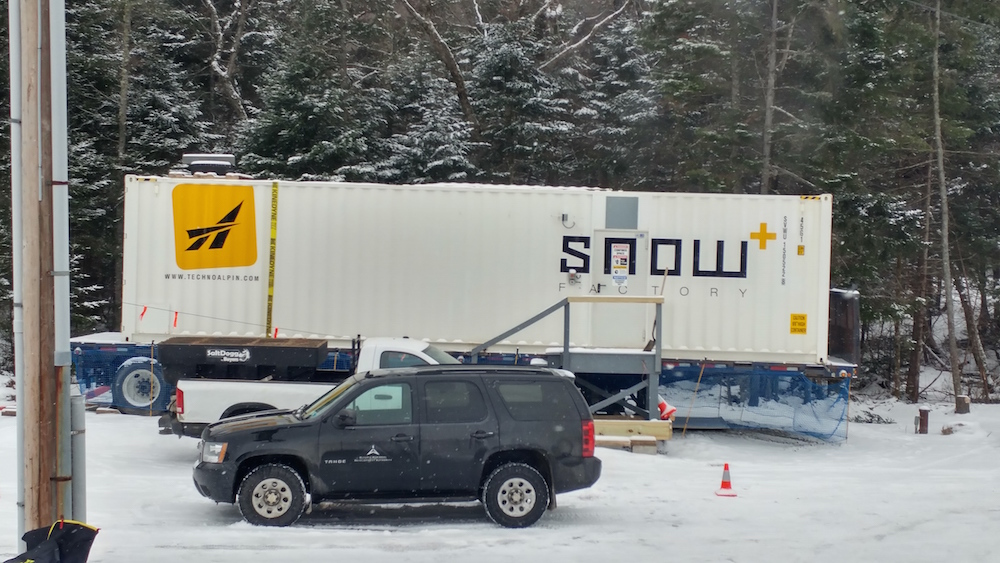
    The Snow Factory at its current home at the Mount Van Hoevenberg nordic center in Lake Placid, N.Y. (Photo: Peter Minde)

    The Snow Factory was put in place, just behind the cross-country lodge, just before Thanksgiving.

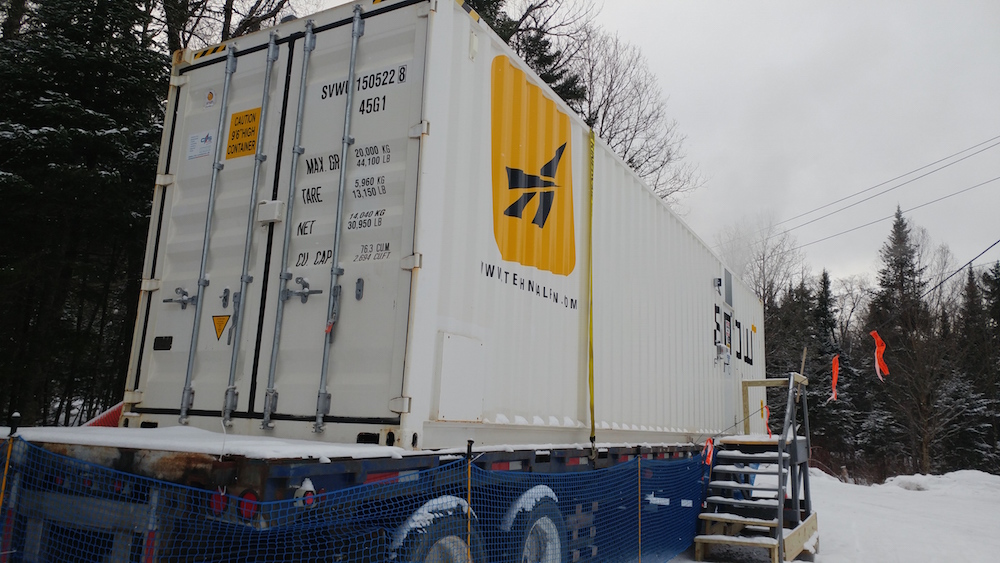
    This machine isn’t your grandfather’s snowmaking setup, where snow guns are positioned strategically along trails. Mounted on a flatbed trailer, a 40-foot ocean shipping container holds compressors and ice-making equipment. A blower sends crystals through a segmented orange hose up to 600 feet in length.

    The Snow Factory hasn’t budged from its original position near a parking lot, yet the snow it has produced has been spread throughout the stadium and on trails up to 1.5 k away from its starting point.

    According to Robin Smith, TechnoAlpin’s Colorado-based business manager, the Snow Factory has been in production for the last four years, but its technology isn’t brand new. IDE, an Israeli company that specializes in water desalination, developed a warm-weather snowmaking unit with different technology than the Snow Factory uses.

    Smith explained that the Snow Factory at Van Ho is the only one in the U.S. and one of only 19 in the world. The best part? The Snow Factory will make snow in temperatures up to 80 degrees Fahrenheit.
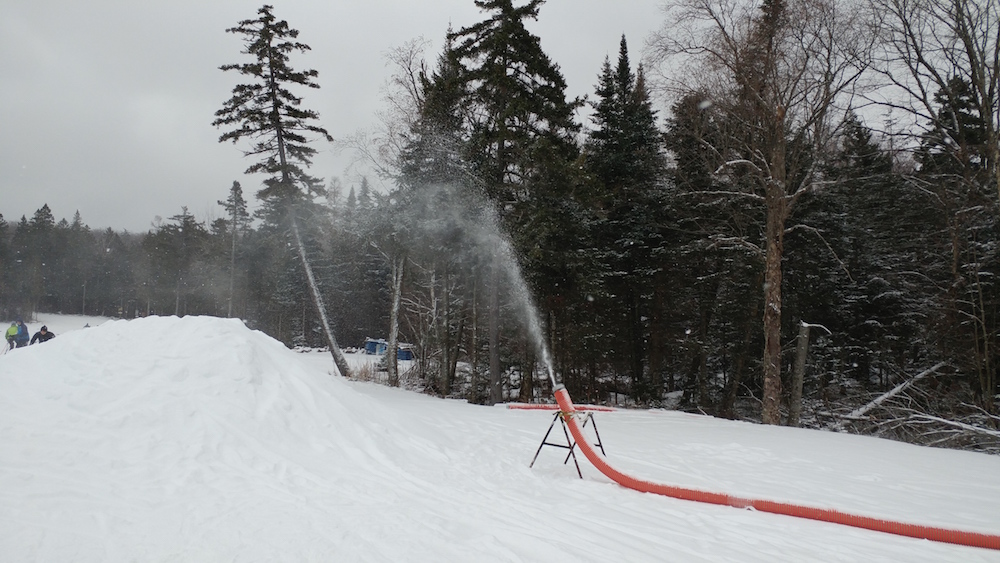
    Blowing snow into the stadium, made by the Snow Factory, at Mt. Van Hoevenberg in late December. (Photo: Peter Minde)

    Both Whiteface and Gore mountains, two of the alpine ski resorts that ORDA manages, use TechnoAlpin snow guns.

    “Probably a year ago, we began a conversation with the success they [TechnoAlpin] were having in northern California with the machine that we ended up leasing,” explained Kris Cheney Seymour, Mt. Van Hoevenberg’s manager. “ORDA has its full attention and interest in the future of nordic sports at Mount Van Hoevenberg.”

    When Seymour first spoke with FasterSkier on the phone in late January, the nordic center was dealing with changeable weather.

    “Lake Placid has had a fairly light snow year and a fair amount of very heavy rain,” Seymour explained. “Traditionally, the stadium gets blasted in poor weather. This winter, we would have had a similar winter to what we had last year: no snow, ice conditions in the stadium. We’ve pretty much been open all but one day since Thanksgiving. The reason is the Snow Factory.”

    Without the Snow Factory, Van Ho wouldn’t have been able to host St. Lawrence University’s Winter Carnival, Junior National qualifier races and other events, he said.

    ORDA acquired the Snow Factory from TechnoAlpin after an alpine resort in California used it for a year. Arriving by truck the day before Thanksgiving, it took five days to haul from California at a cost of $7,000 dollars. According to ORDA’s Communication Director Jon Lundin, ORDA is leasing the Snow Factory for one year for $90,000 dollars.

    In an email, Lundin explained that if ORDA decides to purchase the Snow Factory, it will pay a total of $500,000 dollars: $410,000 plus the amount already paid this season.

    “We’ll make the decision later this spring as to whether or not we purchase the Snow Factory,” he wrote. “We’ll look at how it performed and how the cross-country venue benefited from its use.”
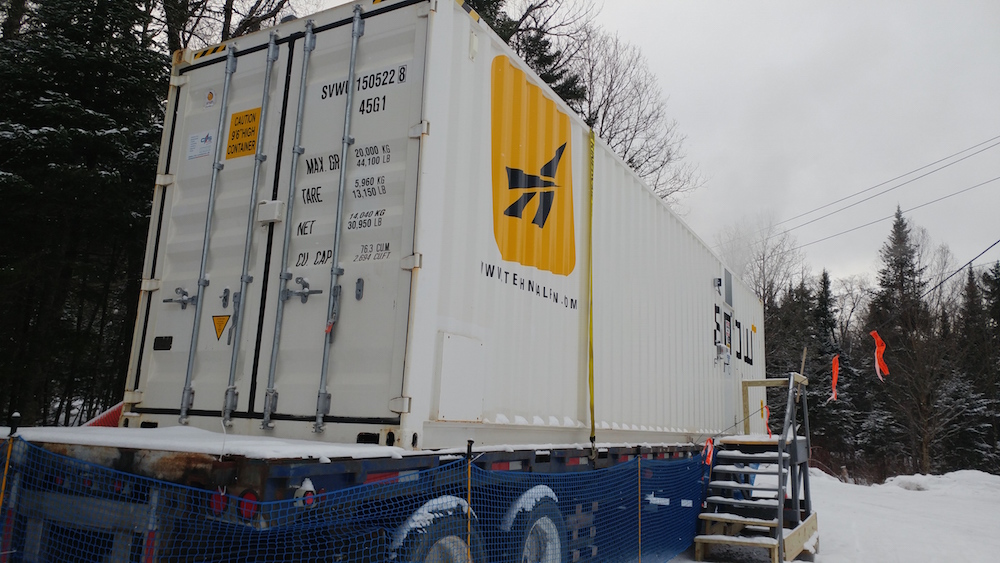
    The Snow Factory in place at the Mt. Van Hoevenberg nordic center in Lake Placid, N.Y. (Photo: Peter Minde)

    So how does this thing work?

    Inside the shipping container are three icemakers, refrigeration equipment, a cooling tower, and a blowing system. The blowers move snow through a segmented orange hose. One can add segments to blow snow up to 600 feet away from the Factory.

    “Other [traditional] snowmaking systems require a temperature and humidity component,” Reese Brown, executive director of the Cross Country Ski Areas Association, said on the phone. “Generally, 22 to 27 degrees and below is good snowmaking weather. The Snow Factory doesn’t require any conditions to make snow, because snow is generated inside the container and then spit out the hose. With the others, snow is made when it hits air temperature.”

    “Snow is created within the shipping container,” Seymour said. “You can effectively make snow with 100-percent efficiency up to 60 degrees Fahrenheit. You’ll have diminished productivity, but you can make snow up to 80 degrees.”

    Running on electricity, the Snow Factory draws from the ski lodge’s well, using 11 gallons of water a minute. The icemakers can be optimized for various climates. Seymour pointed out that northern California has a much drier climate than Lake Placid.
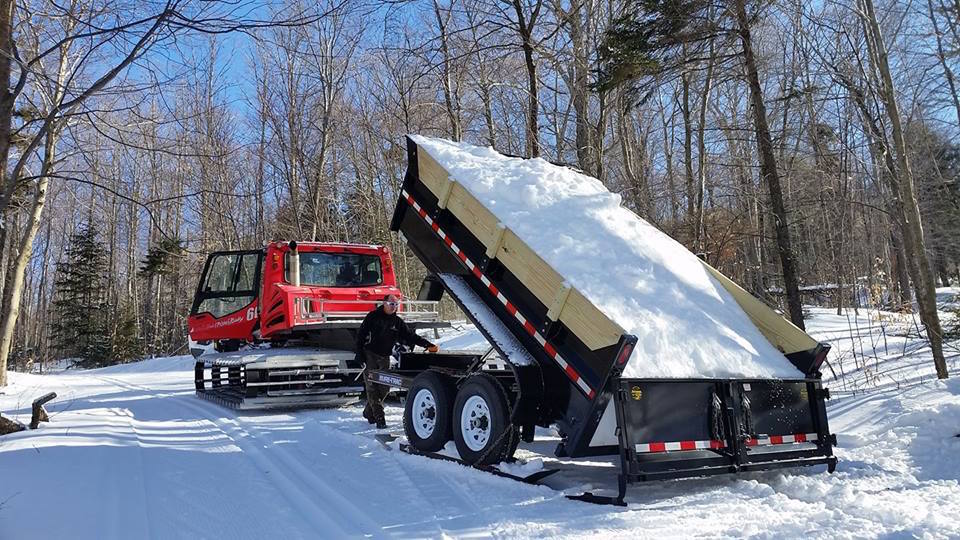
    Dumping snow onto the trails at Mount Van Hoevenberg this winter. (Photo: Mt. Van Hoevenberg/Facebook)

    Leading up to U.S. Junior Nationals, held in Lake Placid from March 3-11, FasterSkier asked Seymour about the Factory’s capability to cover a 5-kilometer loop if the ground was bare. With snow already on the ground, Seymour reframed the question.

    “It works differently than a traditional snow system, and you need to use it and plan for it in a different way,” he said. “The Snow Factory makes a known quantity of snow: two tons per hour. Depending on what our needs are for snow coverage and where we want to go with it, we need to work backwards and give ourselves enough time to blow that amount of snow.”

    While the Factory is mounted on a trailer, the trailer hasn’t moved from its home behind the lodge. The primary locations for its manmade snow have been the stadium, the Innerloopen 3.3 k homologated ski loop, and the beginner trails close to the lodge.

    Days before Junior Nationals, ORDA decided to move the weeklong event to the 2.5 k loop at the Olympic Jumping Complex, also known as the MacKenzie Intervale Ski Jumping Complex, closer to downtown Lake Placid.

    “Six weeks out, we were aware that the long-term forecast had two almost weeklong periods that we were going to have very warm weather,” Seymour said in a follow-up interview after Junior Nationals (JNs).

    Leading up to the championships, the Factory had been cranking almost around the clock. Seymour estimated that once a week, ORDA would shut it down for maintenance. Otherwise, it ran 24/7.
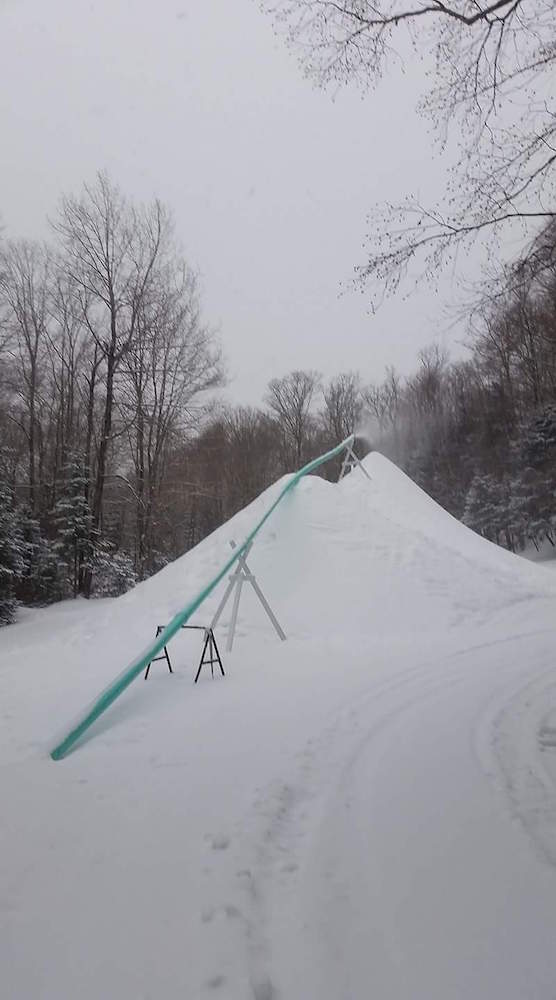
    A large pile of snow produced by the Snow Factory this winter at Mt. Van Hoevenberg in Lake Placid, N.Y. (Photo: Bob Maswick)

    The stadium was covered a mix of natural and manmade crystals, 2 1/2 feet deep. The next focus was the sprint loop and the 3.3 k loop.

    “We were moving snow 10 to 14 hours a day,” Seymour said. A PistenBully hauled snow in a 16-foot dump trailer to where they needed it. ORDA bought the trailer specifically for Van Ho.

    Two weeks before JNs, groomers had buffed the 3.3 k loop to a 28-inch average depth with a mix of natural and manmade snow. Then, “We had really warm weather,” Seymour said. A warm three-day period with high winds and heavy rains reduced the base depth to 12-18 inches.

    Then, starting Feb. 24, another three-day thaw cost precious base depth. A week before the championships, the race courses were down to an average depth of 4 to 8 inches.

    The death blow came one night later. Driving rain and 50 mile per hour winds wiped out weeks of intense work. Wednesday morning, they inspected the courses. Not only was snow melting, but water was “flowing all over the place,” Seymour said. “We had large portions of the race trail that were totally washed out. There were sections of the trail that were lovely and totally groomable. But we also had a 100-meter section of the trail that was totally gone, like, 100 percent gone from pouring water.”

    That morning, Van Ho still had snow stockpiled in the stadium out near the 3.3 k loop. But the forecast for Sunday through Wednesday of championship week called for temperatures in the mid 40s.

    The forecast was accurate.

    “We could have rebuilt the course so that it had four to six inches of snow everywhere,” Seymour said. “We knew that Mount Van Hoevenberg couldn’t survive a third major thaw in a four-week period.

    “We had a course that was mostly built at the jumps,” he explained.
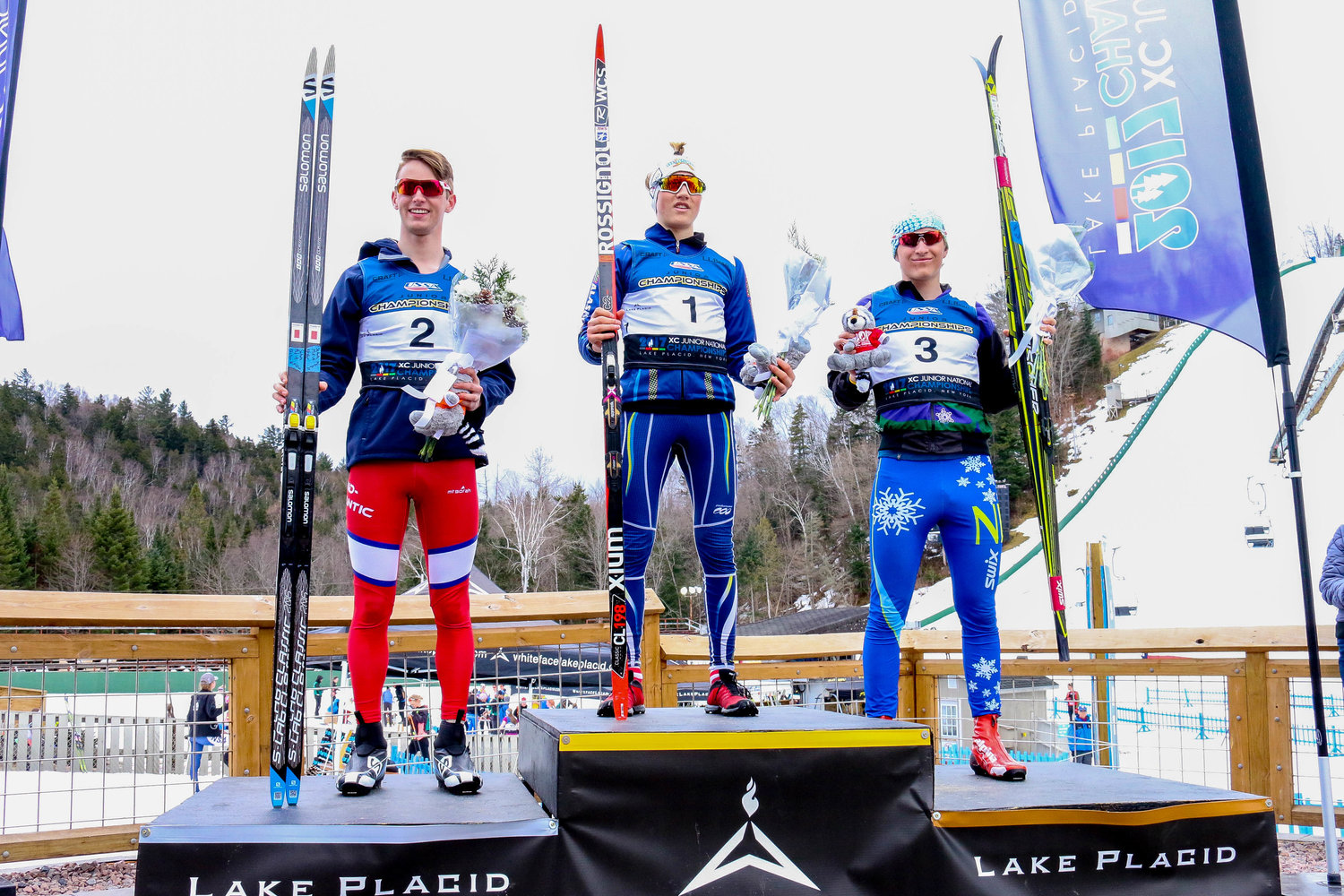
    The U18 boys’ classic sprint podium at U.S. Junior Nationals, held at the Olympic Jumping Complex in Lake Placid, N.Y., with Gus Schumacher (c) of Alaska Winter Stars in first, Scott Schulz (l) of the New York Ski Educational Foundation in second, and Adam Glueck (r) of Ford Sayre in third. (Photo: XCJuniorNationals2017.com)

    Blowing snow on site for 30 hours and working around the clock, ORDA employees also moved all the snow from the in-run of the ski jumps and the in-run and landing areas of the freestyle training area, which had a depth of eight feet. With that and the snow made on site, the Intervale loop was covered to an average depth of 2 1/2 feet for a successful Junior Nationals.

    As a result of the venue change, there was only one adjustment to the schedule. Coaches, jurors and organizers agreed to switch the classic mass start to an individual start because of a narrow spot for two-way traffic midway through the loop.

    While the Snow Factory ultimately didn’t play a part in JNs, it continued to blow snow at Van Ho, which remained open while the races happened took place at the jumps. Teams arrived early and trained on the trails, some choosing to cool down or train on off days at Van Ho.

    “That was 100-percent Snow Factory,” Seymour said.

    Besides the Factory, there have been other significant improvements to Van Ho. According to Allan Serrano, the FIS technical delegate who worked with ORDA to homologate Van Ho’s race trails, the stadium exit, along with much of the Interloopen portion of the Ladies’ 5 k loop, was widened.

    “Most importantly they have been able to do rehabilitation work on the Ladies 5k, leveling and improving the water management so that it skis and grooms much better,” Serrano wrote. “They are able to have a high quality ski surface with lower snow.”

    He added that Van Ho’s grooming capacity has also improved since its courses were certified in 2012.

    “At that time the venue did not have a dedicated snowcat with track setters and now they have a machine with double track setters,” he wrote.

    As race season winds down, what’s next? With the ability to make snow in warm temperatures, Seymour was intrigued by the opportunity to provide skiing on short loops in the offseason. He’s got the attention of John Farra, the high-performance director for U.S. Paralympics Nordic Skiing.

    “We have found that it is most valuable for sit skiers especially to have access to snow in the ‘off season,’ ” Farra wrote in an email. “The nature of maneuvering a nordic sit ski on turns, downhills and out of the track is not something that can be duplicated on roller skis, so we have found [snow] much more valuable for sit skiers in advancing their technical skills. We are very interested in the Snow Factory project that ORDA has invested in and have been in touch with Kris about the possibility of getting our National Team to Lake Placid to take advantage of their new Snow Factory snow in this coming Games season.”

    “Part of skiing currently is having a viable snowmaking option,” Seymour said. “The Snow Factory will guarantee the ability to open the venue when we want to and hold races as they’re scheduled; we can be counted on as a world-class venue. It’s a game changer.”

  • Dismal Winter Produces Nifty New Venue in Northeastern N.Y.

    Dismal Winter Produces Nifty New Venue in Northeastern N.Y.

    A look at the newly homologated Ski Bowl in North Creek, N.Y. (Photo: Mike Pratt)
    A look at the newly homologated Ski Bowl in North Creek, N.Y. (Photo: Mike Pratt)

    NORTH CREEK, N.Y. — Last winter was, one fears, a taste of what we will see more of as the planet warms: record global temperatures translated into an eastern season where brown was the dominant color. The parking lots at Breadloaf, Craftsbury and the few other venues capable of making snow filled with cars from around the region, and diehards got used to skiing the same few kilometers.

    The parking lot at North Creek’s Ski Bowl started filling up, too — and the result, beginning this year, will be an unexpected but very welcome treat for eastern skiers: a new homologated race course, with full-on snowmaking, not to mention lights. From last year’s disastrous washout, in other words, may have sprung one of the nation’s most exciting new courses.

    The Bowl is historic skiing territory. Back in the 1930s, North Creek was one of the country’s first ski “areas.” Skiers arriving by train from Grand Central would climb into the pack of pickups, and locals would drive them to the top of a nearby ridge, where they’d plunge down woodsy trails and end up in the Bowl, where trucks waited to carry them back up.

    The “Ride Up Slide Down” system ended when the state opened big Gore Mountain adjacent to the Ski Bowl in the 1960s — along with Lake Placid’s Whiteface Mountain, it’s one of the Adirondack’s two premier, state-run alpine areas. The big new area, however, effectively orphaned the old Ski Bowl, which over the years has seen rope tows, chair lifts, even a tubing park, but never really recovered its old glory.

    Until last winter, when the snow drought meant that high schoolers across the region had no place to race. Gore Mountain boss Mike Pratt, who’d been making limited snow for high-school and masters racers at the Bowl (which has had lights and snowmaking since 2002), doubled down and opened the area for nine high-school races. The Bowl became a scene: bonfires and cheering crowds of spectators following the buses from high schools two and three hours away. Impressed by the enthusiasm, Pratt and his team set to work over the summer homologating a 2.5-kilometer sprint loop, and a 3.3 k race loop.

    The Bowl became a scene: bonfires and cheering crowds of spectators following the buses from high schools two and three hours away.

    “The Nordic network benefited from our decision to suspend our tubing and use that terrain to expand our Nordic system,” Pratt explained. “We invested close to $12,000 in regarding and modifying our trail network.”

    While the work is complete, the grand opening will line up with the opening day of Gore Mountain.

    “… Right before or the day after Thanksgiving, as long as we have the temperatures to make snow,” Pratt said.

    Nordic day passes are $16 dollars.

    Water for snowmaking won’t be a problem — the Hudson River flows nearby, providing essentially unlimited quantities, and Gore has won a series of environmental awards for its efficient pumps and guns.

    When skiers arrive — at the latest for the Nordicfest masters and New York Ski Racing Association (NYSSRA) races planned for the weekend of Dec. 16-18 — they’ll find what amounts to a nordic playground, says Steve Tomb, head coach of the Johnsburg high-school nordic team and one of the real movers behind the new area.

    “I mean, it’s going to be like Friday Night Lights here,” he says — including the lights, installed when the area was being used for tubing in recent years. In fact, the area is so wired that Tomb says there will soon be dedicated Wi-Fi cameras installed throughout the loop.

    And it’s not just his team that’s excited about the development.

    “We are psyched in NYSPHSAA Section 2!” Tomb wrote in an email. “FIS 2.5 km and 1.5 sprint courses as well as a nordix cross loop..all with lights, snowmaking and Piston Bully grooming…we finally have a venue where we know that we can train and race…

    “The irony for our team (Johnsburg) and Section 2 skiers is that they don’t know yet how incredible this is for them, the sport and the future of nordic skiing in New York State,” he added.

    “I mean, it’s going to be like Friday Night Lights here.” — Steve Tomb, head nordic coach at Johnsburg Central School in North Creek, N.Y., on the newly homologated Ski Bowl

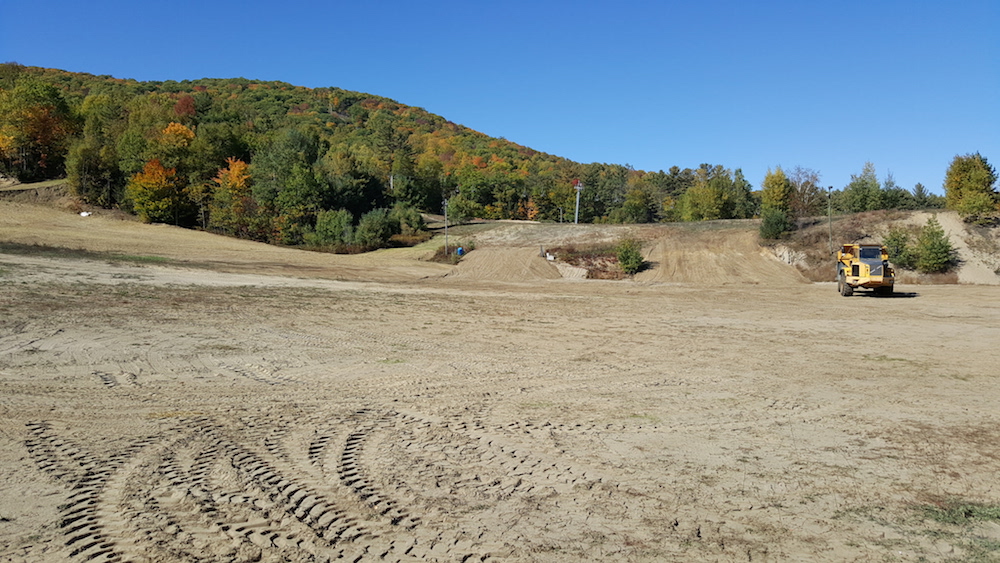
    Allan Serrano, event director for the American Birkebeiner, is also a FIS homologator for eastern areas, and he arrived at the Bowl in early autumn to oversee final plans. Several things impressed him, he said, including the equipment and expertise that the Gore crew brought to bear. Nordic ski areas rarely have easy access to bulldozers, or to highly developed sandy slopes that can be easily re-graded for a perfect ski course—it’s a “unique circumstance,” he said, and the result is a course that will be nine meters wide in many places with powerfully banked turns, almost all of it visible to spectators at the bottom.

    “One of the issues we have in this sport is tough barriers to entry,” Serrano said. “And they’re breaking them almost all down here. As much as those of us who have grown up skiing like going through the woods, working the challenge of snow conditions — as much as we’re used in New England to narrower, tighter, turnier trails — that’s a challenge for those who are new. These trails are wide, and there’s a variety of terrain, but there’s not the narrow, steeper type of trails that can be an impediment to grooming firmer tracks. It definitely has a different feel than most East-Coast stuff.”

    The course meets FIS standards (Tomb and others are already dreaming of luring national and even international races), and Serrano says “it will be a pretty challenging course” for top level junior competitors, though not as tough as the most intimidating European courses. “As far as terrain and difficulty it’s right where it should be, right in the middle range. The climbs aren’t too easy, but they’re not super difficult either. It some technical downhills — and it also has some places where you can groom some cutoffs.”

    The main A-climb, he says, is “almost out of the textbook.” It goes up the old tow rope, cuts across a short, level patch, and then surges up a steep wall. “That’s where you’ll really see the separation,” Serrano predicts. And at the top of the hill, there’s a section of rolling flat instead of an immediate flat, so there will be no chance for instant recovery.

    Location means that the area will offer skiers the best of all worlds. For those looking for some of the prettiest old-school trails in the East, Garnet Hill is just a few miles drive away (and in recent years locals have rehabilitated the original North Creek trails that spill out in the bowl, if you want a day of sublime telemarking.) The Bowl’s other advantage, however, is that it’s closer to civilization than most cross-country ski areas: the town of North Creek is a few hundred yards away, full of taverns and restaurants including barVino, the classy but down-home eatery whose stools were the site of much of the planning for the new area.

    “I think the setting is really something,” says Serrano. “It’s very European there, the way the Bowl is located so close to the village. It’s really got that European resort feel to it. I think it will do well as the total package.”

    — Alex Kochon contributed

  • American Birkebeiner Appoints 
New Director of Race Operations

    Allan Serrano to Take on Race Operations of Largest Ski Race in North America


    Allan Serrano and family
    Allan Serrano and family

    HAYWARD, Wisconsin (July 21, 2014) – The American Birkebeiner Ski Foundation (ABSF) has appointed Allan Serrano as its new Director of Race Operations. Serrano will replace Shellie Milford—who served in various capacities for 13 years and then Director of Race Operations for the past 15 years—announced her retirement earlier this year. Serrano and his family will be relocating from New Paltz, NY. He assumes the ABSF position on September 15, 2014, and will work with Milford until her departure in March of 2015.

    “Allan comes to the Birkie with a wealth of knowledge of Nordic ski racing. As we continue the tradition of excellence that the Birkie is known for, Allan’s skills will be put to good use immediately. We look forward to welcoming Allan and his family to our community,” said Sue Scheer, Board President, American Birkebeiner Ski Foundation.

    Serrano brings to the American Birkebeiner his experience in leadership and management needed to be a successful Race Director. “I have a sense of the pride and ownership embodied in the greater community surrounding the Birkie. The brand is successful due to the diligent work of staff and volunteers over the years. I see the critical mission of this position is working with the Chiefs and volunteers to uphold the tradition and values, as well as developing changes to keep the experience current for all of the constituent groups,” Serrano said.

    Previously, Serrano has served as an International Ski Federation (FIS) Technical Delegate which has created opportunities for him to work with race organizers and regional event staff. Serrano’s technical, communication, and organizational skills have grown to the point where he has been involved at the highest international level as a technical delegate and homologation inspector, working with organizers in Asia, Europe, and North America.” Serrano was appointed as the TD for the 2014 American Birkebeiner.

    Originally from Anoka, MN, Serrano said, “I bring the passion and attention to detail that I had applied in many years of coaching to event organization. I regularly work collaboratively with a variety of organizers, focusing on operations from the point of view of the key constituent groups: participants, organization staff, spectators, and sponsors. I have worked with many historic events, applying an outsider’s perspective that I believe is critical in creating opportunities for positive growth.”

    Serrano’s background consists of a Bachelors of Science in Forestry from the University of Vermont School of Natural Resources. He added that he “could provide trail development and design, to assist ABSF Trail Manager, Chris Campbell, and his crew with trail maintenance or issues pertaining to the homologation and the trail’s integrity. The Birkie trails are fantastic. It is the greatest race course; challenging with all the hills. It’s tough to improve on that. ”

    “I’m really excited to have Allan joining the Birkie team,” commented Ben Popp, Executive Director of the American Birkebeiner Ski Foundation. “His wealth of international experience, along with his passion for the sport will be great for the Birkie’s future.” Of his newly acquired position, Serrano said, “It is an honor and a privilege to be a part of this historic, significant event. My experience and skills will help keep up the tradition, yet make it relevant with the times.”

    Allan, his wife, Natalie Cartwright—former ski contender for the Olympics in 1994 and 1998, and currently a mathematics professor—and their three daughters are looking forward to their new Wisconsin adventure. “My family and I are excited to transition into the ski lifestyle and become part of the community.”