From the FasterSkier archive — posts syndicated from athletes’ and coaches’ own blogs between 2004 and 2012, kept online as published. Current coverage is at fasterskier.com.

Tag: Allie Ostrander

  • October 31 News Roundup: Skiers Running Fast

    October 31 News Roundup: Skiers Running Fast

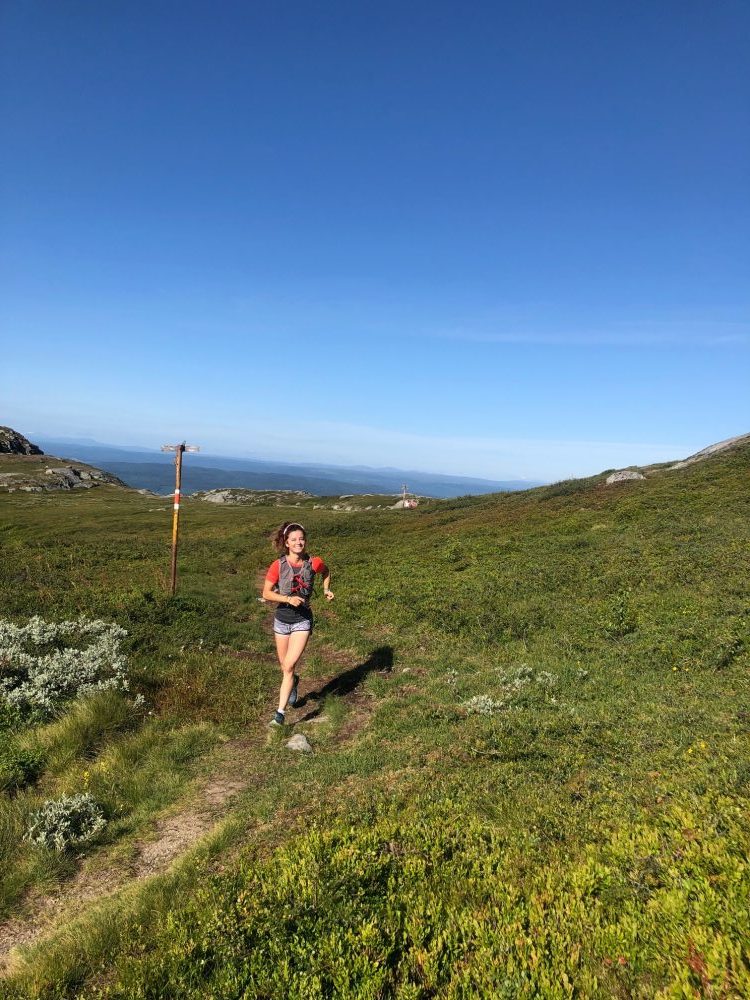
    Kendall Kramer running in Sweden in summer 2019. (Photo: Courtesy Kendall Kramer)

    It’s no secret that skiers spend a lot of time running as part of their ski training. And even if it’s not their “real” sport, some of them become quite good at it. Hence Scott Patterson wins Alaska’s Crow Pass Crossing backcountry marathon six times (and counting), Erika Flowers takes the victory in The Rut 50k in Montana, or Therese Johaug runs a 10km on the track in 32:20.86 to win the 10,000m at the Norwegian National Championships for track and field. In her first time on a track in 11 years. While wearing normal running shoes as opposed to track spikes.

    In this news roundup, FasterSkier surveys three skiers doing well in their “other” sport.

    Kendall Kramer takes third Alaska state xc championship, Mt. SAC individual title

    Kendall Kramer is featured in the "Faces in the Crowd" section of the Oct. 21-28, 2019, issue of Sports Illustrated.
    Kendall Kramer is featured in the “Faces in the Crowd” section of the Oct. 21-28, 2019, issue of Sports Illustrated.

    Earlier this month, Kendall Kramer, a senior at West Valley High School in Fairbanks, Alaska, captured her third consecutive Alaska high school cross-country running title. On a perfect day for running, with temperatures in the 40s and yellow leaves on the trees, Kramer led a field of 81 Division I (large schools) athletes off the starting line at Bartlett High School in northeast Anchorage on October 5. She was leading at 1km in, leading by more at 2km, and had no one in sight by the halfway mark. She ultimately took the win by 32 seconds over Sadie Tuckwood of Juneau–Douglas High School.

    Kramer’s time, 17:38.3, marked the second-fastest girls time ever on a hilly course used for the Alaska state xc championships since the early 2000s, behind only the 17:06 clocked by Allie Ostrander in 2014. Ostrander went on to win three consecutive NCAA steeplechase titles for Boise State, represented America at the 2019 World Track and Field Championships in Qatar, and now runs professionally for Brooks.

    Kramer, 17, spoke eloquently with FasterSkier this summer about her own future, including both career plans and the balance between her two sports of running and skiing. Following her win at Bartlett, she more recently told the Anchorage Daily News, “You can be such an amazing athlete [at cross-country running] just by working out an hour and a half a day, and with just your shoes.”

    The win marked Kramer’s eleventh individual Alaska state high school championship, including three cross-country running titles, two cross-country skiing titles, and the 1,600m/3,200m double at all of the 2017, 2018, and 2019 state track and field championships. Other three-time cross-country running state champions include Olympic skiers Kikkan Randall and Betsy Haines.

    Three weeks later, Kramer was continuing her winning ways at the Mt. SAC Cross Country Invitational in Walnut, California, which bills itself as “The world’s largest cross country invitational” and has been held annually since 1948. Running in difficult conditions – hot with the threat of wildfire smoke – Kramer covered the 2.93-mile course in 17:36 to destroy a competitive field and take the win in the Girls D–III/IV/V Individual Sweepstakes race by 34 seconds.

    https://www.instagram.com/p/B4D-CAaByRk/

    Kramer’s West Valley Wolfpack team, which was second to South Anchorage at this year’s Alaska state meet by 2 points, captured the D–I/II team title at Mt. SAC in 2017, DyeStat reported.

    Kikkan Randall to run New York City Marathon

    Kikkan Randall will be among the roughly 50,000 athletes toeing the starting line on Staten Island Sunday morning for the 2019 New York City Marathon. Among the sizeable field, she will be the rare runner plausibly targeting a sub-3-hour finish for her first marathon. Among the sub-3 finishers who also have an Olympic gold medal, and/or who were only recently finished with chemotherapy this time last year, and/or who were still receiving infusions through July of this year following radiation, Randall presumably stands alone.

    As reported by NBC Sports, Randall had planned to compete in last year’s race before her diagnosis of Stage 2 breast cancer, and the accompanying treatment, complicated her plans. She traveled to New York City anyway, and watched former USST Liz Stephen finish the 2018 race in 2:58:40. Randall will be wearing an Aktiv Against Cancer charity bib alongside Stephen and Ida Sargent. Also in the field, Brian Gregg will also be racing, through not affiliated with Aktiv. 

    https://www.instagram.com/p/Bz_zCNFhKvH/

    Randall posted about her marathon training on Instagram throughout this summer, including long runs in Anchorage, training runs on the deck of a cruise ship, and 800 repeats at her ancestral training grounds of the high school track at East Anchorage High School. On October 20, she clocked a 1:23:47 to take the women’s victory in the Okanagan Half-Marathon in Kelowna, British Columbia.

    Randall was included in a recent Runner’s World piece, “Celebrities Running the 2019 NYC Marathon.” Randall was the only athlete for whom a recent race time was mentioned, as well as the only celebrity on the list whom this reporter had heard of.

    Randall has raised over $10,000 for AKTIV Against Cancer, a group that “works to ensure physical activity will become an integral part of cancer treatment” with which she had been associated even before her diagnosis, through the sale of “It’s Going to be OK” socks from her website.


    Adam Martin runs 14:34 for road 5k

    https://www.instagram.com/p/B4K9hJ1JuH4/

    The headline pretty much says it all – Saturday morning, Adam Martin took first place in the Great Bay 5k in Stratham, New Hampshire, with a blistering time of 14:34. (The course is described on the race website as “mostly downhill” and “wicked fast.”) Martin, who skis domestically for Craftsbury Green Racing Project, will be starting in two distance races in Period I of the 2019/2020 World Cup season, in Lillehammer and Davos.

    Martin has previously run a half-marathon in 1:06:18, which puts him within flirting distance of the 1:04:00 standard required to qualify for the 2020 U.S. Olympic Marathon Trials. In his cross-training sport.
  • ‘Why Not Go Again?’ Patterson Makes Mt. Marathon His Own One Year Later

    ‘Why Not Go Again?’ Patterson Makes Mt. Marathon His Own One Year Later

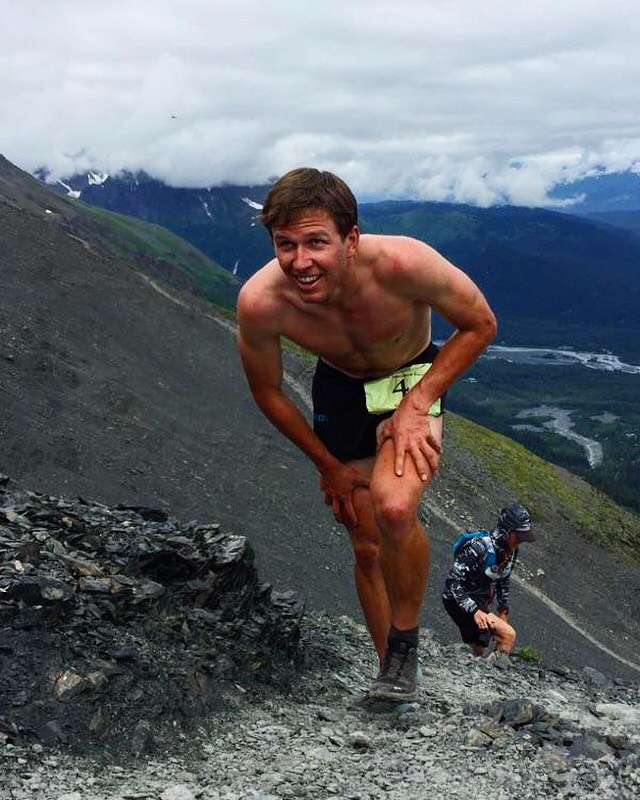
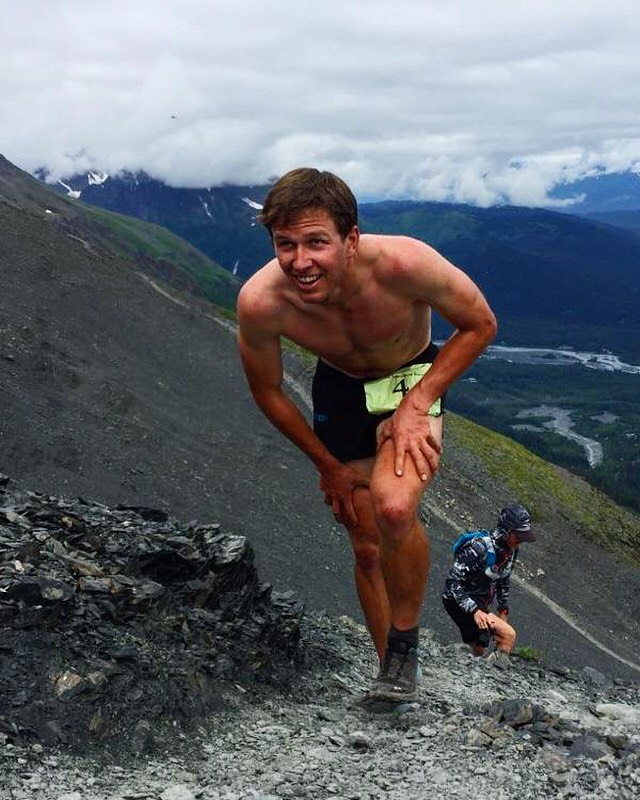
    U.S. Ski Team B-team member and Alaska Pacific University skier Scott Patterson scaling his way to the top of Mt. Marathon in Seward, Alaska on July 4, 2017. (Photo: Rob Whitney)

    As with other epic modern-day adventure race series, the fabled origin of Seward, Alaska’s annual Mount Marathon — held every July 4 — began with beer and a bet: who among us can run from the streets of downtown to the top of the 3,022-foot mountain crowding Seward’s skyline, then back to the bottom the fastest? What about within the hour?

    While the footrace race has evolved massively since the port town’s pioneer miners took on the challenge, clambering up its craggy course in woolen pants and workman’s boots nearly 90 years ago, it holds no less prestige for the millennial athletes or spectators who partake nowadays. To many Last Frontier residents, it is their Olympics. An estimated 30,000 outsiders annually inundate the town’s (population 2,500) sidewalks just to watch the event.

    “It’s Mount Marathon. It’s Alaska. It’s my Fourth of July,” Allie Ostrander, the 2017 women’s overall race winner and a Soldotna, Alask. native, told Alaska Dispatch News reporter (and former FasterSkier editor) Nat Herz after the competition. “Fourth of July feels empty without Mount Marathon.”

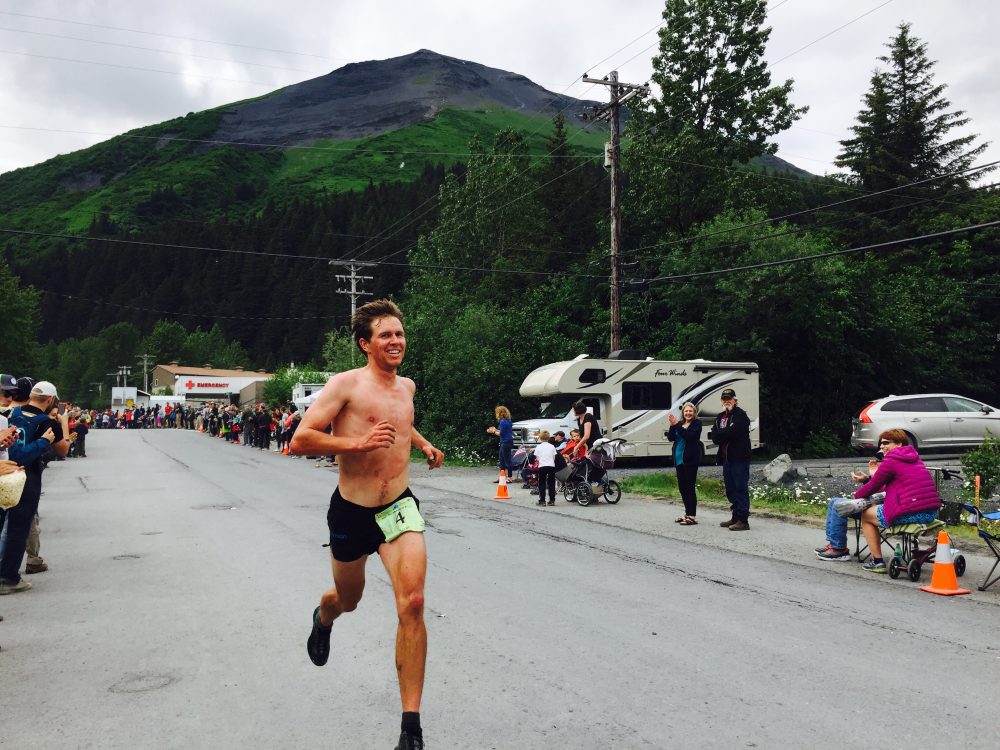
    Scott Patterson on his way to winning the 2017 Mt. Marathon running race on July 4 in Seward, Alaska. (Photo: Holly Brooks)

    Despite the obvious risks associated with careening down a mountain at top speed, stories of close encounters with kidney failure, brain-damaging falls, and disappearance deterred a few from re-entering this year’s version of the event.

    The upcoming 2018 PyeongChang Winter Olympics was reason enough for the current Mt. Marathon course-record holder and last year’s overall male champion, David Norris, to watch from the sidelines. His Alaska Pacific University (APU) teammate, Scott Patterson, who also recently earned a U.S. Ski Team (USST) nomination, however, did not.

    “It’s a big deal up here. I just figured why not go again?” Patterson, an Anchorage native, explained on the phone.

    In his debut Mt. Marathon race, Patterson had twisted his ankle and ultimately finished fourth last year. This year, as he weighed out his risk in racing, he arrived at a far less insidious calculation.

    “There’s definitely always a risk, that downhill is tricky,” Patterson said. “But I think looking at the competition beforehand, I knew that I could probably have a pretty good lead at the top and stake the downhill at my own speed; not really have to duke it out with someone down the hill.”

    With that, Patterson entered the 2017 event aiming for the win, but not the record. Norris was not on the start list, nor Kilian Jornet, the 2015 record holder and a professional ski mountaineer and ultramarathon  runner, not to mention Patterson had recently returned from the men’s USST training camp in Park City, Utah, which ran from June 26-July 5. Patterson departed the camp early to return for the race. 

    “Everyone was saying going into it that it was my race to lose,” the 25-year-old Patterson said. “The other guys who could really challenge me on the uphills this year skipped it, so it was kind of just me just out there on my own.”

    Patterson completed the 5-kilometer race in a time of 44:30 for the win, just over three minutes off the course record. The closest male finishers behind Patterson were Erik Johnson in second place just under a minute back (+0:52), and Kenneth Brewer in third, a little over two minutes behind (+2:23). Patterson’s first-place finish at Mt. Marathon is nothing unheard of among cross-country skiers. A number of other nordic athletes have been crowned the overall champion, including current USST A-team member Kikkan Randall, former USST athlete and Olympian Holly Brooks, APU nordic coach Eric Strabel, and Norris.  

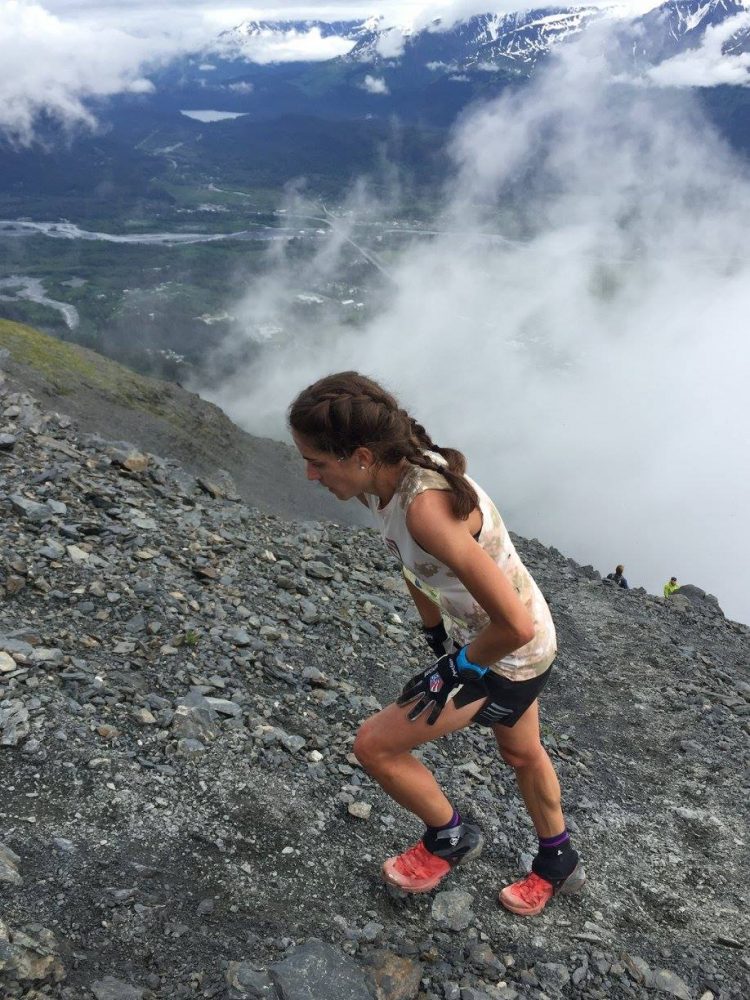
    Morgan Arritola scaling her way to the top of Mt. Marathon in Seward, Alaska on July 4, 2017. (Photo: Rob Whitney)

    The runner-up in this year’s women’s event, Morgan Arritola, was also a member of the 2010 Vancouver nordic Olympic squad and skied competitively for over six years before she made the switch to mountain running in 2012. In her debut Mt. Marathon race, Arritola, 31, finished second in a time of 51:09, a minute and fifty seconds behind the 20-year-old Ostrander, who won in 49:19.

    While Arritola did preview the course once, she also indicated that she didn’t hold a whole lot over herself in terms of expectations and outcome going into race. Ultimately her goal coming into her first Mt. Marathon event was to “take it all in.” In discussions with her former teammates and champions, Randall and Brooks, the advice remained fairly simple: enjoy the atmosphere.

    “I didn’t really pre-race research. That’s not really my style,” Arritola, of Ketchum, Idaho, wrote in an email to FasterSkier. “Everyone has their own way of handling racing and I tend not to overthink.

    “I would love to come back next year,” she continued. “If there was a race-specific goal it would be to know the route I’m taking better. I asked for directions a few times 🙂 and be more confident on the downhill. I haven’t raced that kind of downhill and I just never got into a good rhythm.”

    While Arritola has three U.S. Mountain Running Championship titles to her name and a World Mountain Running bronze medal, mountain running is not where she is indelibly focused. She is currently going back to school for a degree in respiratory therapy and working various jobs to help fund her racing, such as The Rut 50 k in Big Sky, Mont., which she is registered to race in September.

    “I’m not running full time like with skiing,” Arritola wrote. “I am in my last year of school and running just keeps me sane. I don’t overthink it, I do what I want with it, and I enjoy it.”

    Finishing behind Arritola to round out the women’s top three was mother of three and three-time Mt. Marathon champion, Christy Marvin, in third place with a time of 52:22.

    In the junior race division of the event — in which racers run approximately halfway up the mountain before turning around for the descent — APU’s Luke Jager won the boys’ race in a time of 29:09, marking Jager’s second junior title in a row. Jager was followed by Gavin Block in second in a time of 29:32 and Ali Papillon in third in a time of 30 flat. The junior girls title went to Molly Gellert (Alaska Winter Stars) in a time of 32:53, also for the second year in a row. Behind Gellert in second was Ruby Lindquist finishing in a time of 33:55. Kendall Kramer (FXC) came in third, finishing in a time of 35:06 for the girls race.

    Results

  • Mt. Marathon Rookie, Norris Blasts Course Record

    Mt. Marathon Rookie, Norris Blasts Course Record

    Fairbanks resident David Norris, who skis for Alaska Pacific University (APU), won Monday’s Mount Marathon Race outside Seward, Alaska, in record time.  The 5-kilometer race — which takes racers from the shores of Resurrection Bay up 3,022 feet to the summit of Mt. Marathon and back down again, on slopes as steep as 60 degrees — was first held in 1915 and is among the country’s oldest footraces. A crowd estimated at 30,000 people crams into Seward (pop. 2,500) each July 4 to watch a race that has been described as the “Olympics of Alaska.”

    The former men’s course record was 41:48, set last year by Killian Jornet, a man widely acknowledged as the world’s best mountain runner.

    On Monday, at the 89th edition of the race, Norris took 22 seconds off that time. Running alone for most of the race, Norris was first to the halfway mark of the ascent, first to the turnaround at Race Point (elevation 3,022′), and first across the finish line (elevation approximately 20′, depending on how high the tide is).  He finished in 41:26.

    Jornet tweeted his congratulations to Norris within minutes of the race’s conclusion.  His Twitter feed made it apparent that he had been watching the live feed of the race.

    Three-time champion Eric Strabel, a former APU skier and current APU coach, was third in 44:19.  Scott Patterson, Norris’s teammate on the APU Elite Team, finished fourth in 44:43 after reaching the turnaround point in second.

    In the days leading up to the race, Norris and his teammate Patterson, both race rookies at Mt. Marathon, were marked by the local mountain running community as strong climbers but unproven downhill runners. There was also a suspicion that they might hold back slightly on the descent, in deference to their professional ski careers and out of a desire to avoid injury.

    APU's David Norris ascends Mt. Marathon en route to a course-record time, above Seward, Alaska, on Monday. (Photo: Rob Whitney)
    APU’s David Norris ascends Mt. Marathon en route to a course-record time, above Seward, Alaska, on Monday. (Photo: Rob Whitney)

    Speaking on live television soon after the finish, Norris acknowledged that this was his race strategy.

    “I had enough of a lead that I knew I could take it easy [on the descent] and not hurt myself,” Norris said in his interview with Anchorage’s KTVA Channel 11.

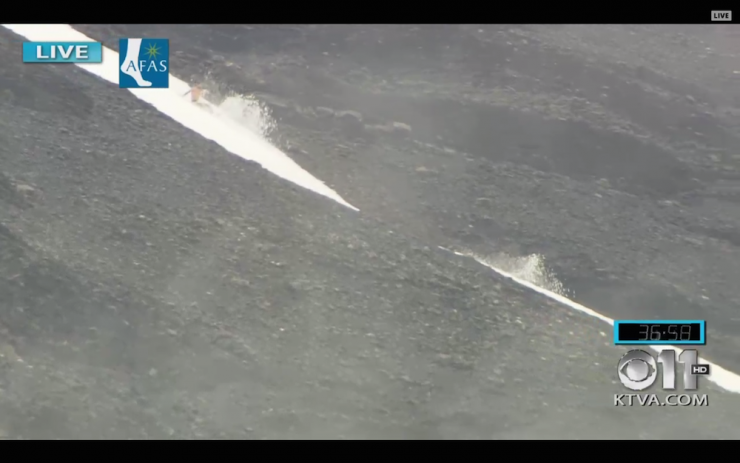
    Describing his descent, in which he lost 3,000 vertical feet in roughly 10 1/2 minutes, Norris recounted sliding down a snowfield for roughly 250 meters near the top: “The snow was totally out of control, the scree was fine,” he said.

    Norris admitted that he had not come in expecting to break the record.  “I thought that my down would be so slow,” he said, “that even if I had a good up, it wouldn’t even matter.”

    But as things turned out, Norris said, “I felt awesome.”

    So was there anything that marred his performance on a day in which Norris set a course record in a century-old footrace?  “I crashed into the willows right in front of the crowd at the bottom,” Norris recalled.  “Other than that it was a perfect race.”

    Other nordic skiers in top ten in the men’s race included former University of Alaska Fairbanks (UAF) skier Kenneth Brewer in ninth. Sixth-place finisher Lyon Kopsack, a current member of the UAF cross-country running team, has also competed in local ski races.

    Women’s race

    Christy Marvin, a stay-at-home mother of three from Palmer, Alaska, won the women’s race in similarly dominant fashion. Competing in the prime-time afternoon spot for the first time – the men’s and women’s races began alternating their positions this year, after decades’ worth of the men getting the most prestigious last race of the day – Marvin ran away from pre-race favorite Yngvlid Kaspersen, a Salomon-sponsored professional mountain runner who flew over from Norway just for the race, early on and never looked back.

    Much like Norris before her, Marvin was first to reach halfway on the uphill, first to the turnaround point, and first to the finish. She collected her second Mt. Marathon victory, and first since 2013, in a personal record time of 51:02. Kaspersen finished over two minutes back in 53:22, followed by Denali Strabel in 53:40, giving Eric and Denali a pair of third-place finishes on the day.

    Notable skiers in the top 10 included Anchorage’s Ann Spencer (daughter of former Olympian and long-time Mt. Marathon course record holder Bill Spencer), who currently skis for Middlebury, in fifth and Seward native and former FasterSkier reporter Aubrey Smith in seventh.

    Junior race

    Nordic skiers dominated the podium in the first race of the day, the junior race that goes roughly halfway up the mountain before turning around and returning to downtown Seward. Luke Jager, an APU junior skier from Anchorage who won the U16 10 k skate race at this year’s Junior Nationals, won the boys’ race for the second year in a row, this time in 27:29. He was followed by fellow APU junior skier and Anchorage resident Hamish Wolfe in 28:01. Anchorage’s Trent Fritzel, who skis with Alaska Winter Stars, was third in 28:49.

    Both genders race together in the junior race; in 2014, Allie Ostrander beat the boys to finish first overall.  This year, Molly Gellert was first in the girls’ race in 31:55, good for 10th overall. Gellert, of Anchorage, skis with Alaska Winter Stars and has podium finishes at both Junior Nationals and Alaska’s Besh Cup to her name. Second place went to Riana Boonstra of Ninilchik, last year’s junior girls’ champion, in 33:11.  (Riana Boonstra’s father, former Olympic skier Todd Boonstra, is a four-time champion of the men’s race.)  Local Ruby Lindquist, who runs and skis for Seward High School, was third in 34:02.

    Results

  • Photos from Mount Marathon 2015

    Photos from Mount Marathon 2015

    The Mount Marathon Race is one of the oldest continuously run races in North America and is known as the Super Bowl of Alaska. Though only five kilometers long, the course climbs a grueling and treacherous seaside mountain for 3,022-feet, before turning around and plunging back down to the start line in town. After professional mountain runner Rickey Gates told his friend and teammate Kilian Jornet that he couldn’t beat the locals on their home turf, Jornet, who holds countless speed records throughout the world, showed up to turn up the heat.

    Though Mount Marathon is famous in Alaska, its home in Seward is far from my home in Fairbanks, and I had never been to watch. This year I promised my friend Nick Elson that if he got in, I would go to support him. I knew it would be fun. It was.

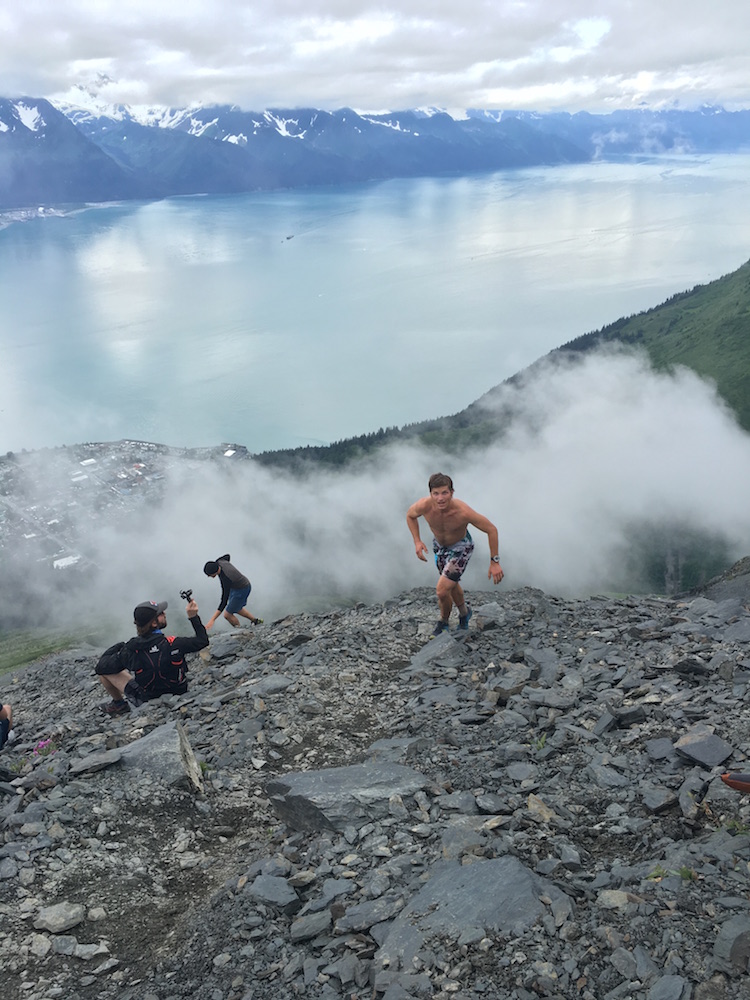
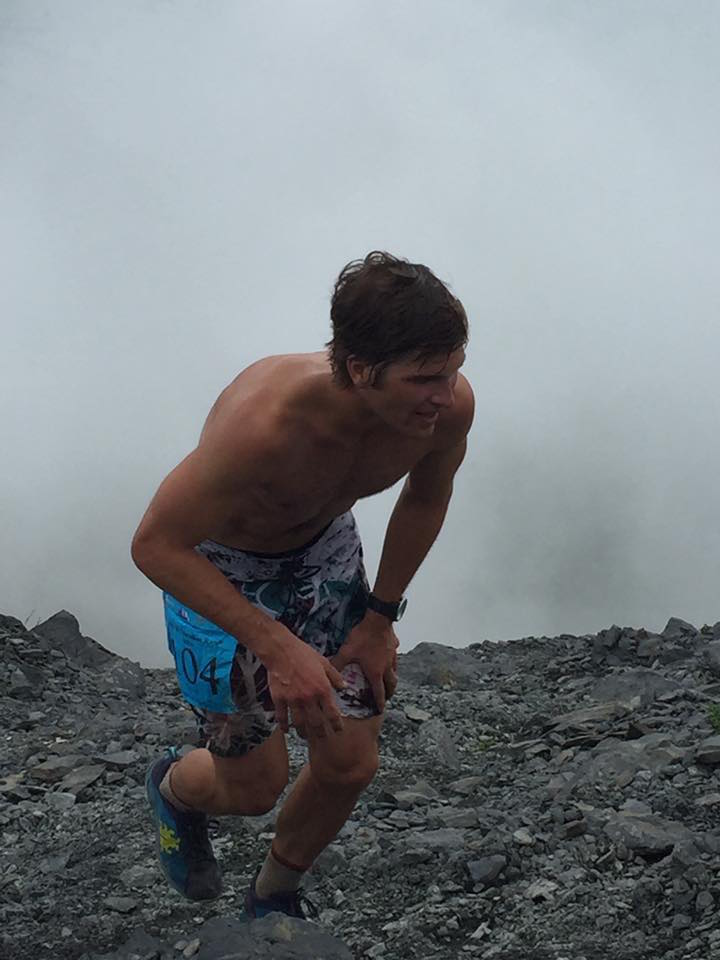
    The race results are available on FasterSkier, but here are some photos.