
From the FasterSkier archive — posts syndicated from athletes’ and coaches’ own blogs between 2004 and 2012, kept online as published. Current coverage is at fasterskier.com.

Tag: Alpe Cermis 2023

  • Diggins Wins Tour de Ski as Laukli Soars Up Alpe Cermis

    Diggins Wins Tour de Ski as Laukli Soars Up Alpe Cermis

    This coverage is made possible through the generous support of Marty and Kathy Hall and A Hall Mark of Excellence Award. To learn more about A Hall Mark of Excellence Award, or to learn how you can support FasterSkier’s coverage, please contact info@fasterskier.com.

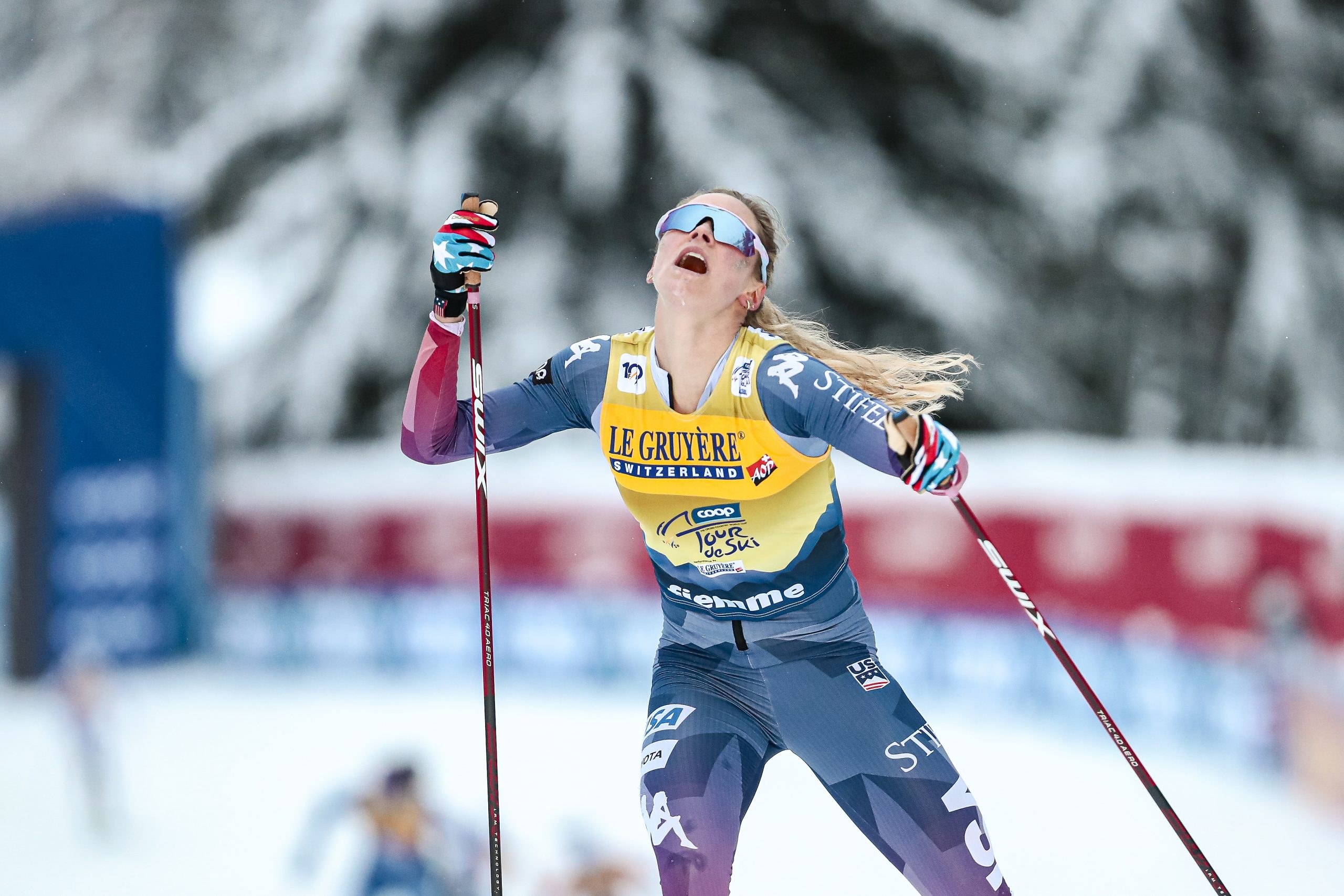
    Jessie Diggins (USA) needed to give it everything she had up Alpe Cermis to hold off Heidi Weng (NOR). Weng, in turn,  made the race for the overall standings a little too close for comfort. (Photo: NordicFocsu)

    If there’s one true thing that can be said of Jessie Diggins (USA), it’s that she is willing to pay the price. Today, on the unforgiving slopes of Alpe Cermis, her willingness to pay that price was on full and glorious display. For ten grueling kilometers, Diggins matched and managed the best efforts of a group of world-class rivals—keeping one in sight and the rest in check—as she  ascended toward the overall championship of the Tour de Ski.

    Over the course of nine exhausting days, racers from around the world have contested the Tour de Ski: the most grueling multi-day spectacle in the cross-country ski world. Back on December 30th, in Toblach, Italy, 70 women lined up for Stage 1. Today, only 30 remained at the start. The reward for those 30 hearty souls was a 10 kilometer, lung-busting, head-splitting race up Alpe Cermis, with its average climbing gradient of 11.6 percent. The FIS’s (International Ski Federation) calendar simply lists today’s race as 10 kilometer Mass Start Freestyle Final Climb. With a gradient of over 28 percent at spots, that’s like labeling an ascent up Mount Everest as, nice walk up a big hill.

    For the last several years, the climb of Alpe Cermis has been a mass start format. For Jessie Diggins (USA), that format could work to her advantage. Going into the race, she held a 43 second lead over Jonna Sundling (SWE), 44 seconds over Frida Karlsson (SWE), and 49 seconds over Kerttu Niskanen (FIN). The mass start might allow Diggins to have the help of the group during the race’s initial flat section, allowing her to conserve energy before they began to power up the mountain, and helping her to keep track of the competition.
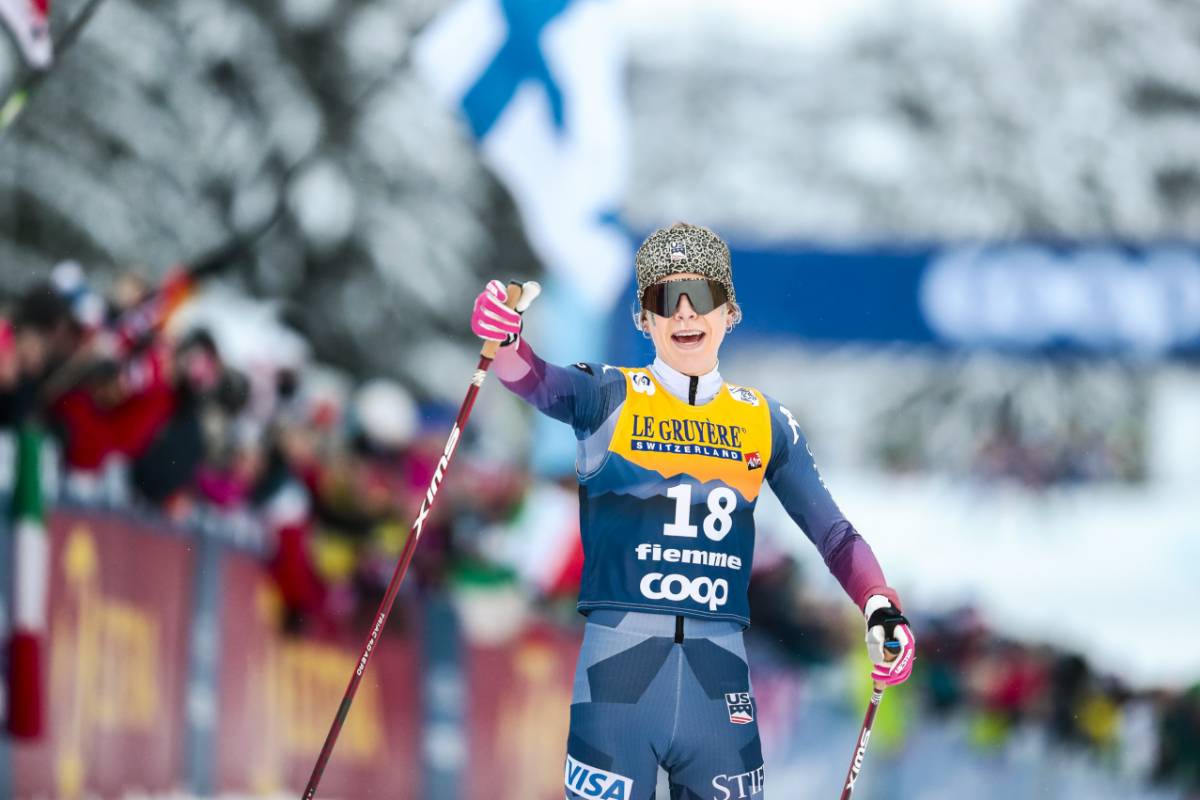
    The longer and tougher the race, the more it’s to the liking of Sophia Laukli (USA). Improving on her third place from last year, Laukli took the stage victory on Alpe Cermis. (Photo: NordicFocus)

    Last year, Diggins finished fifth on the climb, 17 seconds behind Niskanen, who was a pre-race favorite to give Diggins one of the toughest runs for her money. But the women lurking behind her read like an all-star cross-country list, including perennial Alpe Cermis star Heidi Weng (NOR). The threats to Diggins lead were many and significant.

    It was also an important day for Rosie Brennan (USA) who had steadfastly worked her way up to ninth place at the start of the day, 1:24 away from the final podium. It was a wide margin to overcome: unlikely, but not impossible.

    Sophia Laukli (USA) hoped today would be her Tour highlight. The longer and more difficult the event, the more it is to Laukli’s liking. Last year she finished third up Alpe Cermis, behind only Delphine Claudel (FRA), and Weng. Today she would be in her element with the uncomfortable Sprints now far behind her.

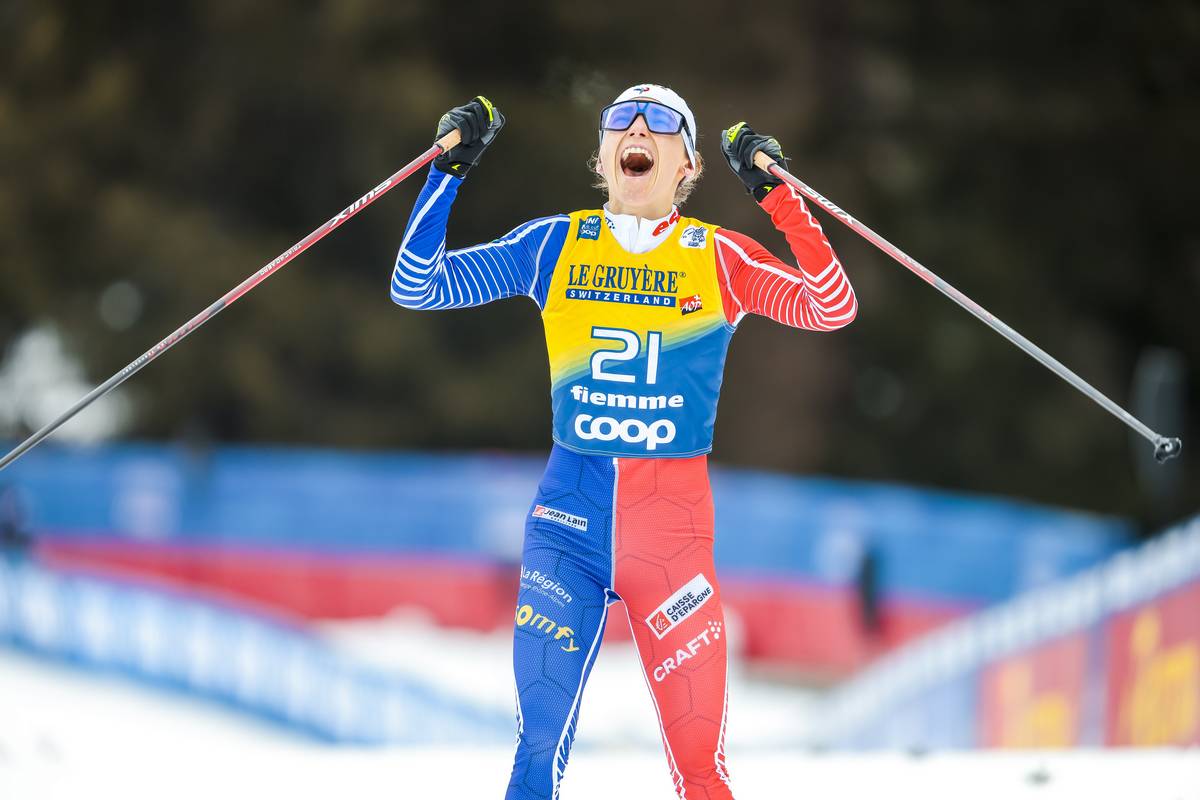
    After the brutal climb was over, it was Laukli delivering a dominating performance to take first place. Weng was second with Claudel finishing third. Diggins finished sixth, 48.5 seconds behind Laukli, and most importantly, 31 seconds behind Weng, which was enough to earn Diggins the Tour de Ski victory.

    Weng’s impressive performance moved her up to second in the overall standings, and Niskanen ended up third.

    Other American finishers were Rosie Brennan finishing 12th in the stage, and Sammy Smith (USA) finished 23rd.

    After the race, Laukli expressed her satisfaction with the results. “I didn’t want too high of expectations today,” Laukli continued. “I don’t know if I fully believe it. I was really excited for today. I’m definitely going to savor it.”

    For Diggins, it was a huge achievement in her career. Today was her second TDS overall victory and moved her up in the rankings of top skiers of her generation. Most obvious in her dominant victory this year was her improvement in Classic races. It has been an incremental, but noticeable change punctuated this year with two podium finishes in the three TDS Classic stages. In past years the quick synopsis on Diggins’ pre-Tour chances would be something along the lines of, “if she’s able to hold on in the Classic races, she’ll do well.” That parenthetical clause is now gone. It’s now hard to tell whether Classic or Freestyle is her real strength!

    The same can be said of Brennan’s Classic prowess; if not for one off-day, she might also be sitting on the podium. She had a podium finish and fourth place in two of the three Classic races, so it really is time to dispense with the idea that Americans are skate-only skiers.

    Jessie Diggins (USA) stayed with the leaders up most of the climb, but Weng’s strong performance at the front kept the outcome in doubt. (Photo: NordicFocus)
    Alpe Cermis

    Pre-race, Diggins was her normal loose self, smiling and rocking while waiting at the start line. As the race began, it was Diggins at the front with Heidi Weng (NOR) beside her. Weng sat 1:03 behind Diggins in overall standings, but only 20 seconds off the podium. As they left the stadium, Laukli moved to the front of the pack with Sundling at her side. An early Bonus Point sprint briefly separated the field, though it quickly reconsolidated.

    As the race entered the countryside, Teresa Stadlober (AUT) moved to the front with Jonna Sundling behind her. Frida Karlsson tucked in behind her teammate as the skiers tried to push the pace. At this point, Laukli was seventh, right in front of Diggins. Last year’s Alpe Cermis winner, Claudel, also put in a push and moved up to join the leaders.It was a tricky part of the course that narrowed considerably and had deep ruts from the lead snowmobile transporting the television cameras. Racers needed to proceed cautiously.

    Stadlober continued to lead on the approach to the mountain’s base. As they started the climb, Sundling was still right behind her, but as the course widened Weng moved to the front. Laukli marked her as Diggins continued to stay on Laukli’s tails. It was Weng, Karlsson, Sundling, Laukli, and Diggins pressing the pace. Diggins was not content to hang in the middle of the pack and made her presence felt at the front. U.S. coach Kristen Bourne told FasterSkier that Diggins was receiving splits on her overall lead during the race. So she was in the favorable position of being able effectively manage her race.

    Heidi Weng (NOR) was on everyone’s radar going into the stage, but no one predicted how tight she would make the overall race. (Photo: NordicFocus)

    At 7.5 k, Weng was out front with Margrethe Bergane (NOR) moving into second and Diggins third, but the steepest section of the climb hadn’t started. When the steep parts began, Weng stayed out front and was pushing extremely hard making a bit of a gap on the field. But, Laukli shot forward and followed her as the two quickly created a serious gap. At one point in the twisting switchbacks, Laukli tripped over an errant pole plant and fell. She quickly jumped back up, but had to put in extra effort to reel Weng back in. It didn’t appear that much damage had been done.

    As the skiers hit the 24 percent grade, it was Weng, Laukli, and Diggins. Diggins had widened her lead over Karlsson and Sundling, but had lost valuable time to Weng who was now less than a minute behind Diggins in real-time overall standings.

    Niskanen joined the hunt and crept up on Diggins. But it looked like the writing was on the wall as Diggins was sucessfully managing the overall race—suffering, but managing. She was in third place on the stage, having dispatched all of the overall challengers except Weng and Niskanen. Niskanen was with Diggins, and Weng was still in sight.

    Delphine Claudel (FRA) is always dangerous up Alpe Cermis, and finished third. But she started too far back to affect the overall standings. (Photo: NordicFocus)

    The race for the stage victory had become a game of cat and mouse between Weng and Laukli with Laukli marking every move that Weng was making. As the two leaders were fighting it out, Niskanen moved up on Diggins and passed her. But Diggins stayed right behind Niskanen and the Finn wasn’t able to inflict much damage on Diggins’ lead.

    At the 22 percent grade section, Weng was still eating in Diggins’ lead, but Diggins had started with over a cushion of over a minute ahead of Weng; while there was a threat, it didn’t look like Weng would have enough real estate to erode Diggins’ margin, though that margin had dwindled to 39 seconds.
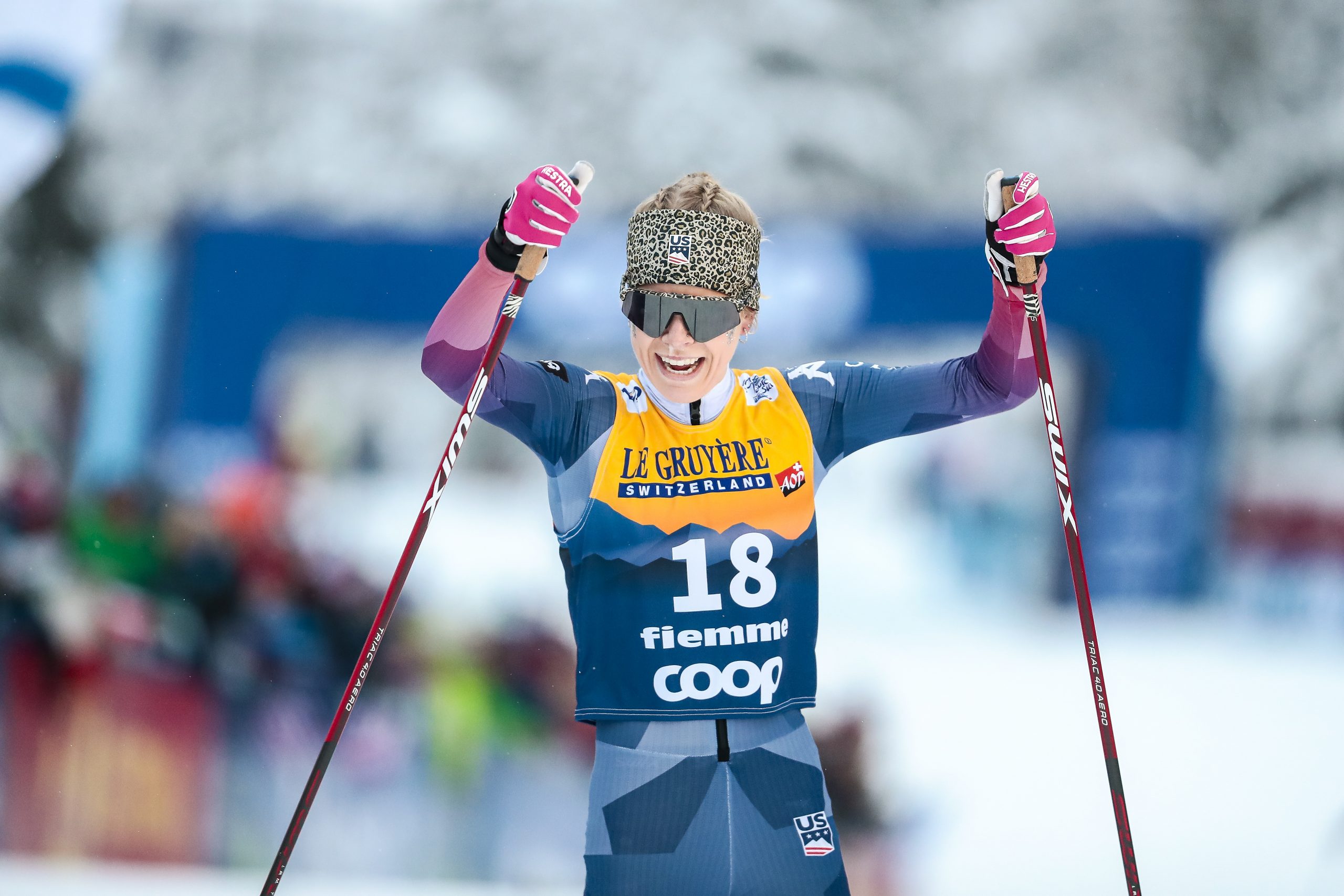
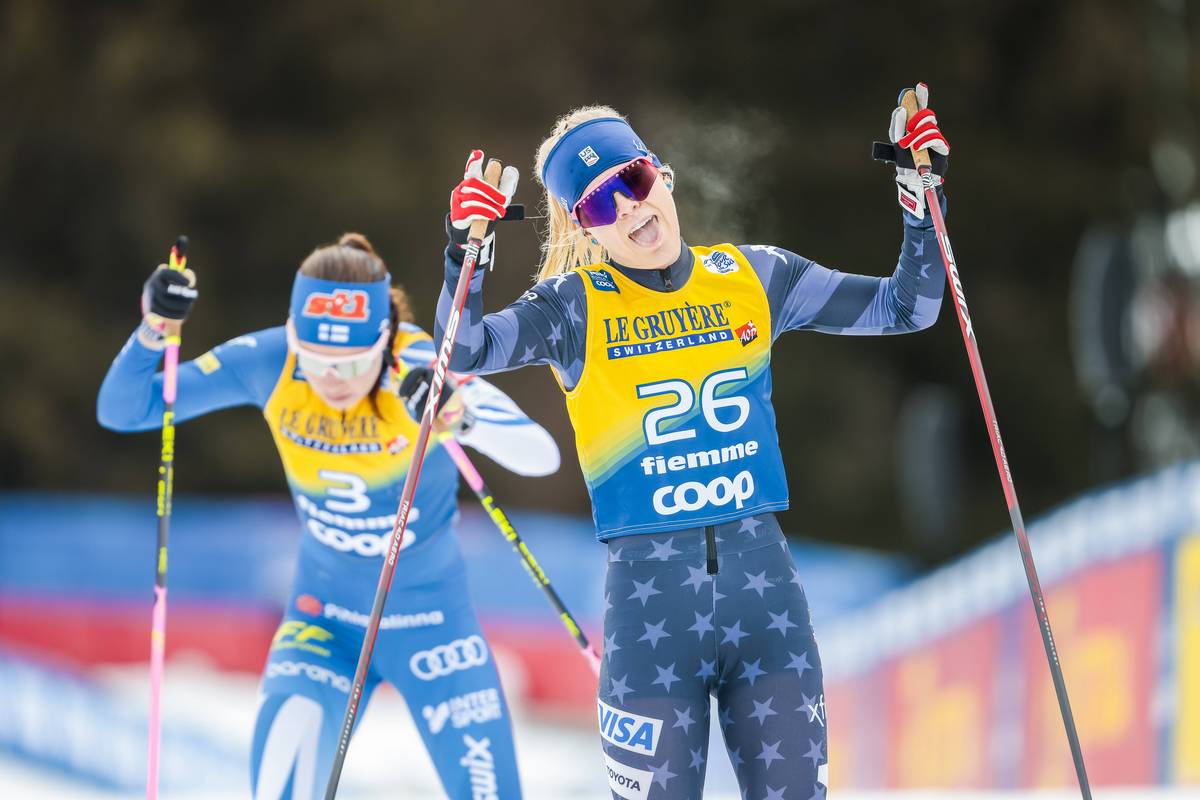
    Sophia Laukli (USA) stayed with Heidi Weng (NOR) until the final stretch when she put in an incredible burst to easily pull away. Laukli looked controlled and relaxed as she crossed the finish. (Photo: NordicFocus)

    As they approached the flatter finishing stretch, Laukli speeded past Weng, an amazing burst of speed that left Weng in the dust. Laukli continued to relentlessly V2 to the finish and put more and more time over Weng who struggled to try and catch her, but was way too far back.

    Laukli took the win looking remarkably fresh, notching her first World Cup victory. Weng was second with Claudel finishing third.

    Diggins’ finished 48 seconds behind Weng; enough to keep the lead and take the Tour de Ski win!

    Jessie Diggins (USA) gave everything she had to hold off Heidi Weng (NOR). The end result: Diggins second career Tour de Ski overall victory. (Photo: NordicFocus)

    It was a signature victory for Diggins and an incredible day for U.S. skiing with one American taking the TDS victory, and another taking the stage victory.

    Forgotten in all of the TDS buzz is that, after today’s race, Diggins and Brennan sit first and third in the World Cup overall standings. They are also are first and second in the distance category. Diggins has a comfortable cushion in her fight for the overall, but Brennan is in a tight race for the third place overall standing. The competitors get a mere 11 day respite before resuming the World Cup season in Oberhof, Germany.

    Stage 7, Alpe Cermis RESULTS

    Tour de Ski FINAL STANDINGS

    Return to FasterSkier throughout the day for updates on this story.

    Jessie Diggins (USA) captured her second overall Tour de Ski victory with a sixth place stage-finish atop the Alpe Cermis. (Photo: NordicFocus)
  • Sophia Laukli’s First World Cup Podium as Karlsson and Klaebo Win Tour de Ski on the Slopes of the Alpe Cermis

    Sophia Laukli’s First World Cup Podium as Karlsson and Klaebo Win Tour de Ski on the Slopes of the Alpe Cermis

    Sophia Laukli (USA) crosses the finish line on the top of the Alpe Cermis for 3rd place, her first career World Cup podium. Laukli highlighted a day in which the Americans put three in the top ten. (Photo: NordicFocus)
    The Alpe Cermis

    When the Grand Tour of skiing—the Tour de Ski—was dreamed up by Vegard Ulvang and Jurg Capol in 2006, one of the first definitive decisions was that it would need a Queen Stage: a stage that sought to distill the essence of ski racing—the brutal beauty of the slog—to its purest state. The Tour de France had its Alp d’Huez, and the Tour de Ski would have the Alpe di Cermis.

    Through seventeen editions of the Tour de Ski, the climb of Alpe di Cermis has become nothing less than iconic in Nordic Skiing. This is where Therese Johaug and Marit Bjoergen cemented their legends in tandem, year-after-year, battle-after-battle, racing up the fall line. This is where Johannes Hoesflot Klaebo lost the 2020 Tour to Alexander Bolshunov on the final day. Martin Johnsrud Sundby, Petter Northug, Dario Cologna, Jessie Diggins, Heidi Weng: all have played prominent roles in past hill climbs. In 2015, it’s where Liz Stephen notched a 5th place, and kicked off the breakout World Cup season for the American women, culminating in the team’s first ever distance World Championships medals (That Falun 10 k where Jessie Diggins and Caitlin Gregg were 2nd and 3rd).

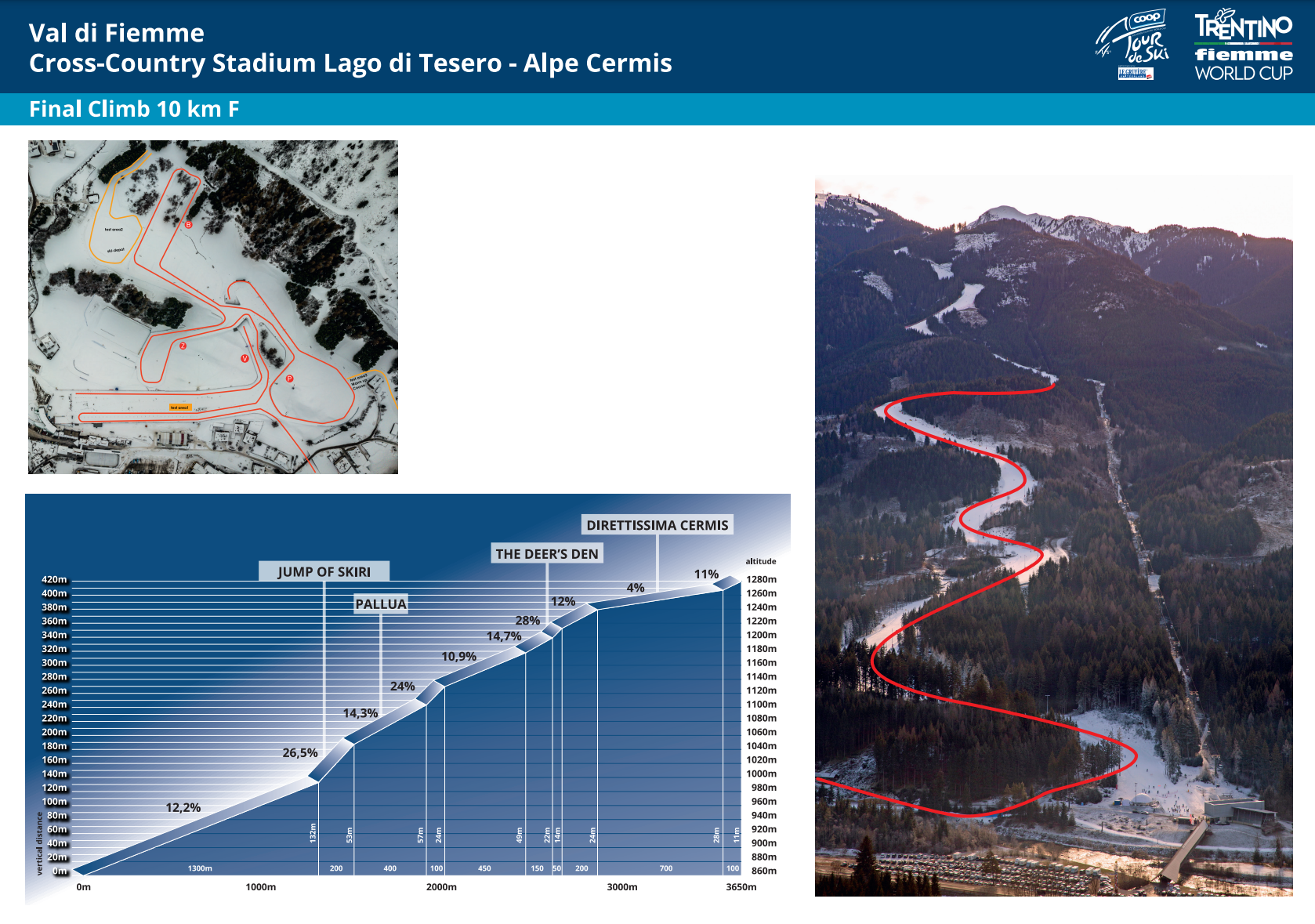
    Course Profile for Tour de Ski Stage 7 at the Alpe Cermis. (Photo: Fiemme World Cup)

    The Alpe is the culmination; it is also the main event. Things were no different for this year’s Tour de Ski. On the women’s side, Frida Karlsson hoped to arrive at the summit in possession of the Yellow Bib. On the men’s side, Klaebo looked to do the same, but with ghosts of Alpe’s past haunting his each and every stride. Both Karlsson and Klaebo had dominated over the course of the first six stages, but both, remarkably, remained vulnerable. Karlsson (2:31:16.0) held an advantage of 1:12 over second place Tiril Udnes Weng, while Klaebo carried a 1:02 advantage over second place Calle Halfvarsson in the men’s field. Simen Hegstad Krueger—winner on the Alpe in 2021—held fifth place overall at 1:45 back. In a normal ski race, those margins would have all but guaranteed victory for the leaders. But in a race up the Alpe de Cermis—where the final kilometers stretch out time gaps with every meter gained—no lead is ever safe.

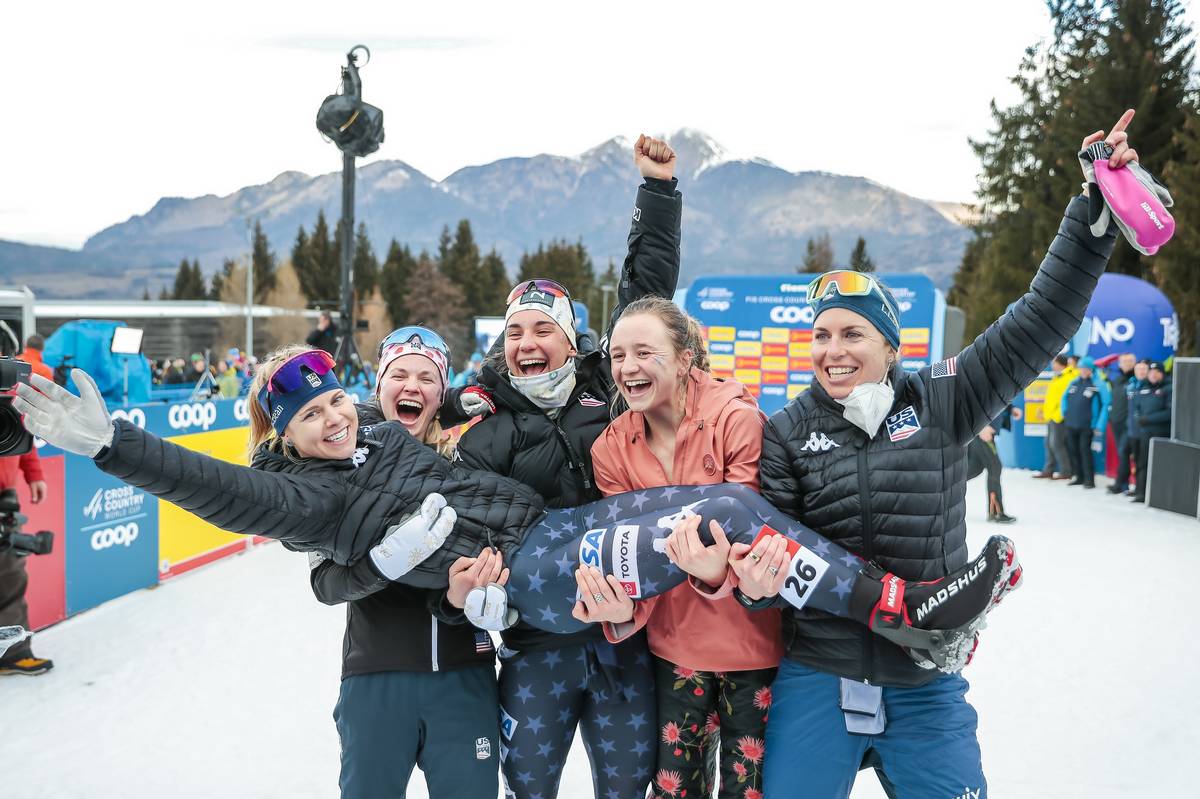
    The American woman hold up Sophia Laukli after her 3rd place finish on the day. The Americans had three in the top ten, as Laukli was joined by Jessie Diggins in 5th and Rosie Brennan in 6th place. (Photo: NordicFocus)
    Laukli Highlights Women’s Race with First Podium

    Sophia Laukli spent the past year seeking out the most challenging propositions in endurance sports, and learning to make them her specialty. Last year on the Alpe, she recorded a 5th place finish alongside teammate Novie McCabe in 7th that marked a definitive breakout. Already then, the goal was set. Return to the Alpe in 2023, and seize it. In the interim, she has run and skied her way to the top of climbs around the world, winning the Lysbotn Opp rollerski climb last July ahead of Heidi Weng and Delphine Claudel, who were 1st and 3rd up the Alpe, respectively, last year. Through highs and lows in this Tour, she was able to keep sight of her “big goals for today” as she put it in post-race comments.

    When it comes to the unexpected, however, one can only prepare just so much: “Right before the climb started, I got tripped up and lost all the positions I had made up [by working the flat section],” she said. “I was back to being in the back of the pack going into the climb.” 

    Her experience on the climb told her two things: “Tactically, it’s very difficult to pass people, and [the Alpe] is a long climb.” Laukli held it together. She found her teammates, Jessie Diggins and Rosie Brennan, climbing in 5th and 6th place through the crux of the Alpe. Laukli held her emotions in check, saying she, “[didn’t go] full-on panic mode, and [it] saved me today.” There was poise. There was patience. And there was also a whole lot of power. It appeared impossible that she could climb back to the podium, and yet Sophia Laukli had taken that word and controlled it: it was impossible how well she was skiing. 

    That fact became most apparent in the final 200 meters of the race. Having begun the day at the back of the pack, Laukli had raced herself into position to stand on the podium for the first time in her World Cup career. None of that would come easy; she crossed the finish line and folded over in the snow. Five minutes later, she stepped onto the podium in third place. The 22 year old Maine native, and current University of Utah skier, became the first of her new generation of American women to achieve that milestone.

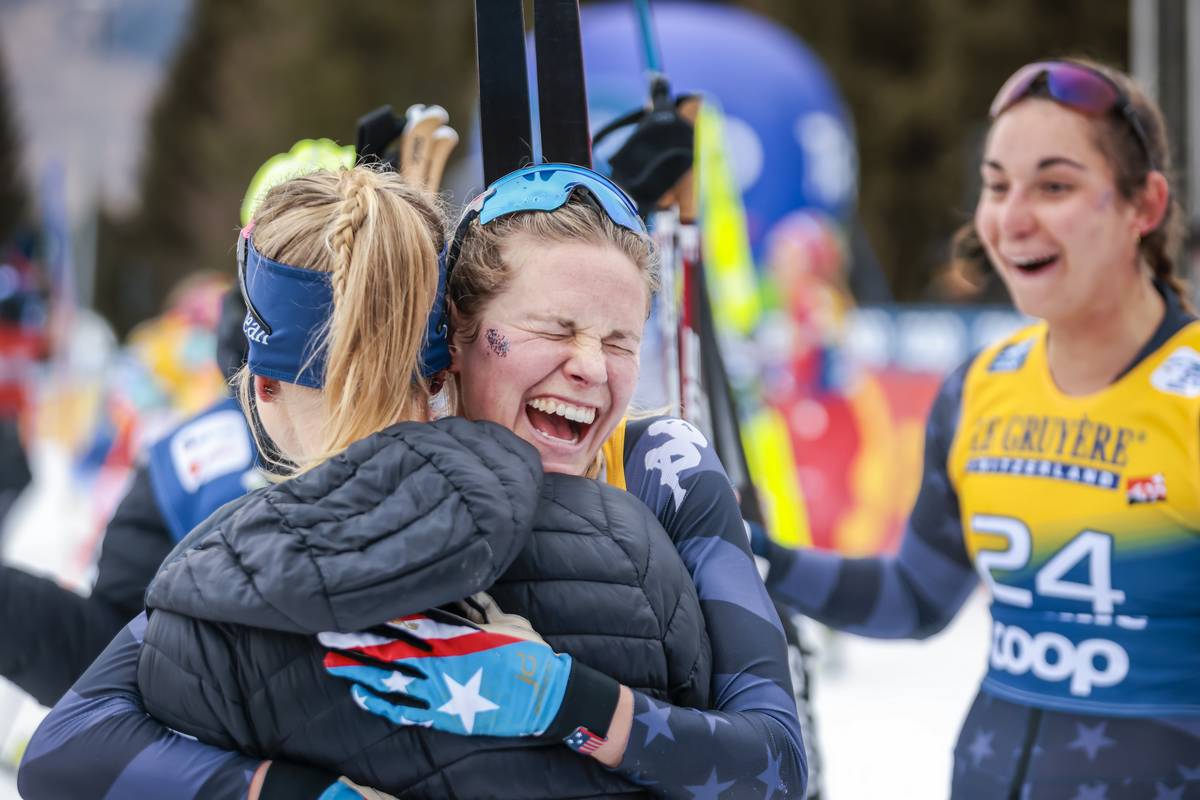
    Jessie Diggins (USA) hugs Sophia Laukli (USA) on top of the Alpe di Cermis. (Photo: NordicFocus)

    In the end, Laukli’s finish was just 35.7 seconds behind French climbing specialist Delphine Claudel. Claudel entered the steepest sections of the climb behind Frida Karlsson, the overall leader. At a hairpin 1.5 k from the finish, a brief tangle between Karlsson and Heidi Weng allowed Claudel to establish a gap, and Weng was the one who followed. But none were able to surpass Claudel at the finish line where the Frenchwoman claimed her first World Cup victory, and her first win on the Alpe di Cermis. 

    Delphine Claudel (FRA) crosses the line for the first World Cup win of her career atop the Alpe di Cermis. (Photo: NordicFocus)

    For her part, Laukli seemed to search beyond herself to explain her astounding performance. “I lucked out I guess,” she said. “My tired was less than other people’s tired, and so it was enough.” Laukli’s achievements on the day could have overshadowed what other American women accomplished: one of the team’s best days ever, putting three in the top ten. There was the tenacity of Jessie Diggins, pushing to the front of the race early on in the Alpe climb, working “through disappointments but never losing belief” as she would say after the race. Then through the middle part of the climb, Rosie Brennan had joined Diggins, pushing to improve her Overall 5th place standing on the day. It all came together: “[It felt surprisingly] nice and comfortable,” Brennan said. “Usually [on the Alpe], you are alone and work on just keeping a rhythm, but today is was like ‘now I gotta stay with them.’” The American women had come together for the toughest test in ski racing.

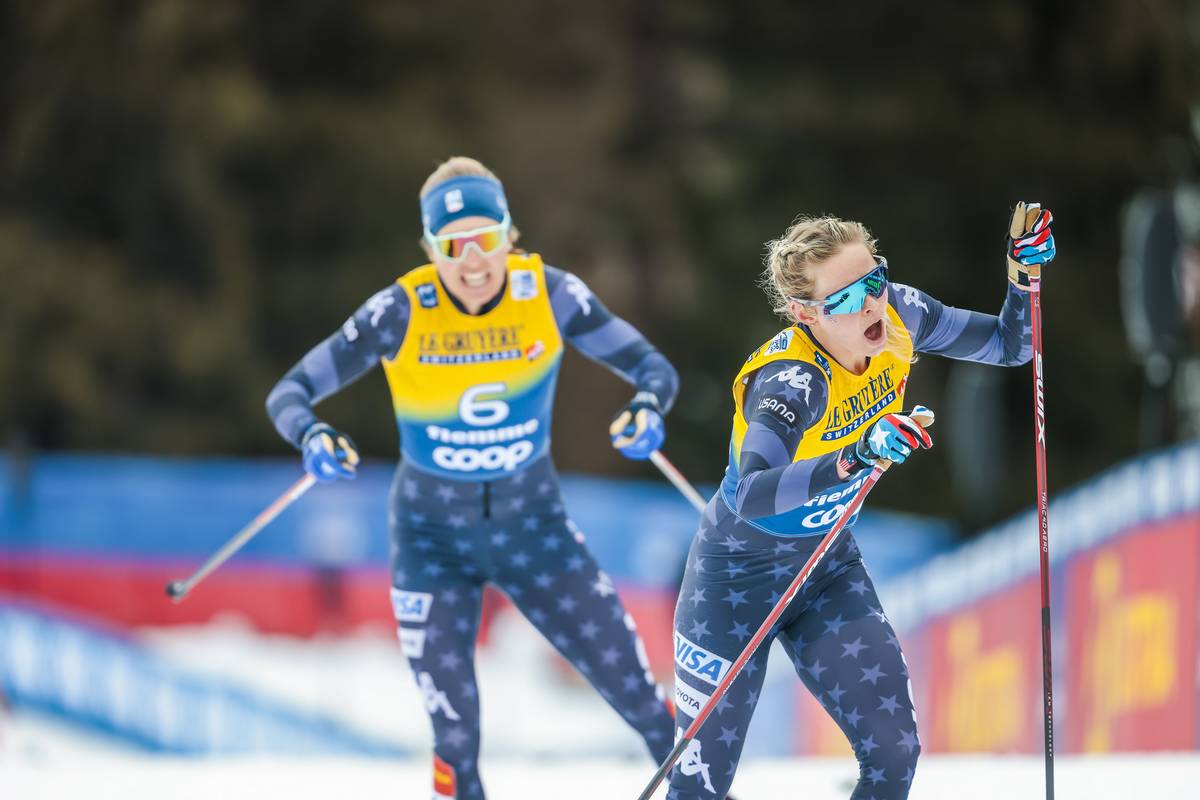
    Jessie Diggins (USA) and Rosie Brennan (USA) push up the Alpe Cermis together, finishing 5th and 6th on the day. (Photo: NordicFocus)

    As Laukli pushed for third, Diggins and Brennan stuck together to finish fifth and sixth on the day. Brennan moved up to fourth Overall, her best Tour de Ski overall finish ever. “[The World Cup] has been a hard start for me this year, and I’m starting to come around. [This Tour de Ski] was a good sign for the future.”

    With her race today, Jessie Diggins moved up to 11th Overall in this year’s Tour de Ski. Diggins commented that she is “more proud of how I handled this Tour than any other one. I just didn’t stop believing and kept going. Now it’s time to recover, and keep training.”

    Diggins did add that she would undertake some post-race evaluation on how she was recovering: “I’m not 100% sure when my next race will be,” she said. 

    Karlsson won the 17th edition of the Tour de Ski with a 15th place finish on the Alpe, remaining 33 seconds ahead of Niskanen and Tiril Udnes Weng. The finish culminated a week in which Karlsson continuously bolstered her reputation as the dominant distance skier in the women’s field. Karlsson’s win also marks another milestone for the current generation of Swedish women skiers, delivering the first Overall Tour de Ski win since Charlotte Kalla won in 2008.

    Krueger Wins Day, Klaebo Wins Tour in Men’s Race
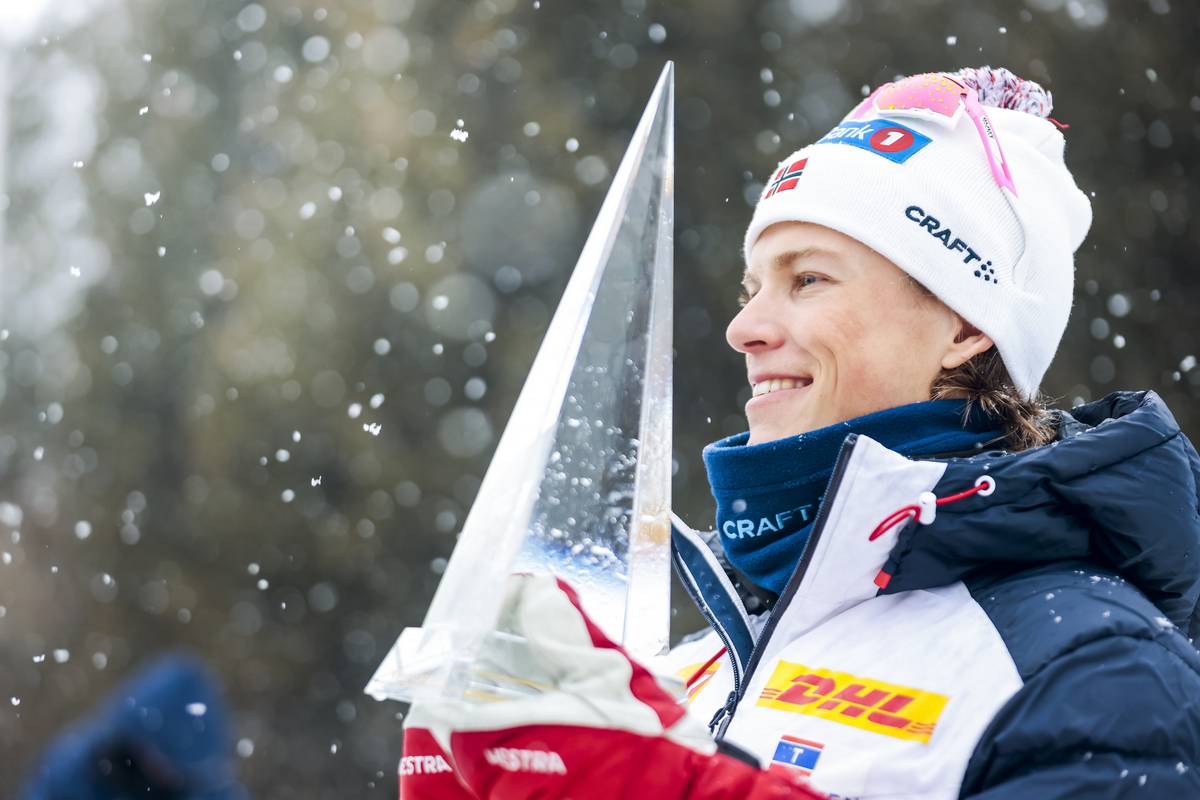
    Johannes Hoesflot Klaebo lifts his 3rd Tour de Ski trophy of his career. (Photo: NordicFocus)

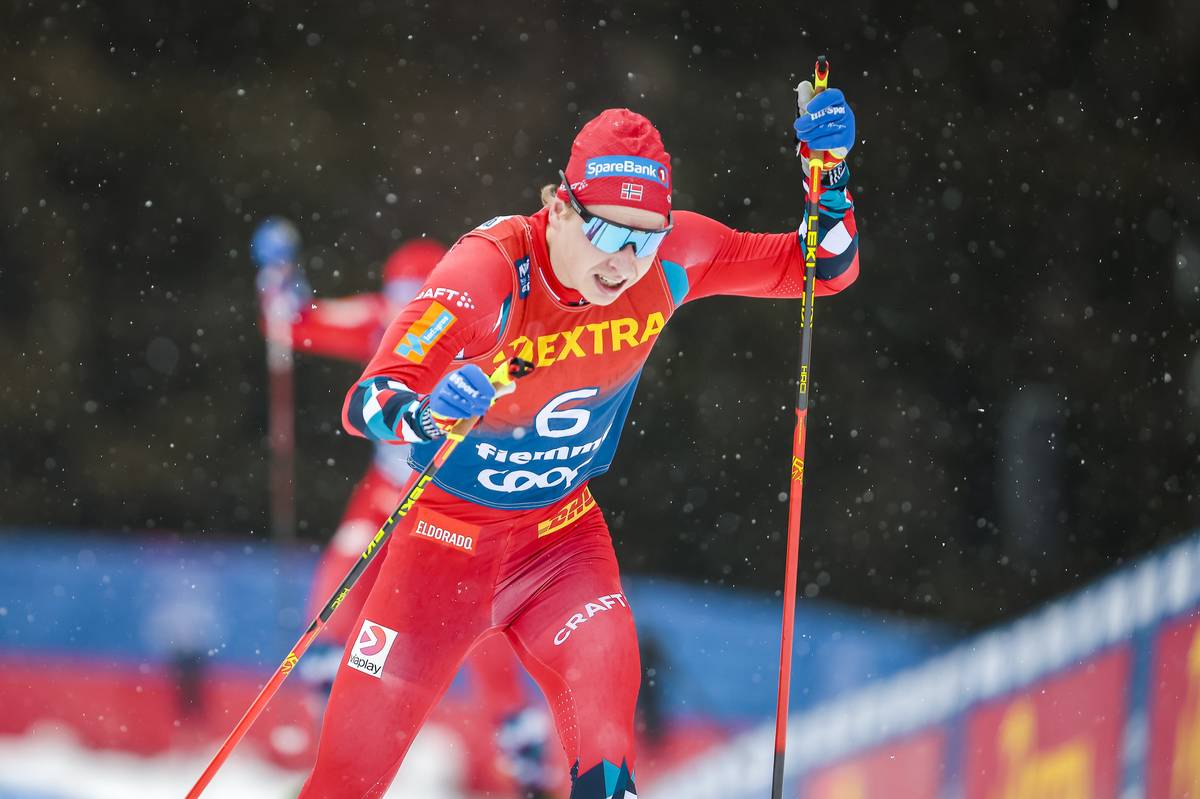
    Part of the emerging legend of the Alpe Cermis is that it has been the only arena capable of diminishing the otherwise-unstoppable force of Johannes Hoesflot Klaebo. Klaebo entered the day having won all six of this year’s Tour de Ski previous stages, another of the many accomplishments that only he can claim in the sport of skiing. Even so, there was almost no speculation that Klaebo would make this year’s Tour a clean sweep with a win on the Alpe di Cermis. The Alpe has made appear Klaebo human before; it would most likely do so again.

    The lingering question was whether he could avoid a repeat of 2020 when Alexander Boshunov and Sergey Ustigov successfully wrested the yellow bib from Klaebo on the climb. With previous Alpe di Cermis winner, Simen Hegstad Krueger, in fifth place—1:45 behind Klaebo—there was still a possibility that the climb could prove to be Klaebo’s undoing yet again.

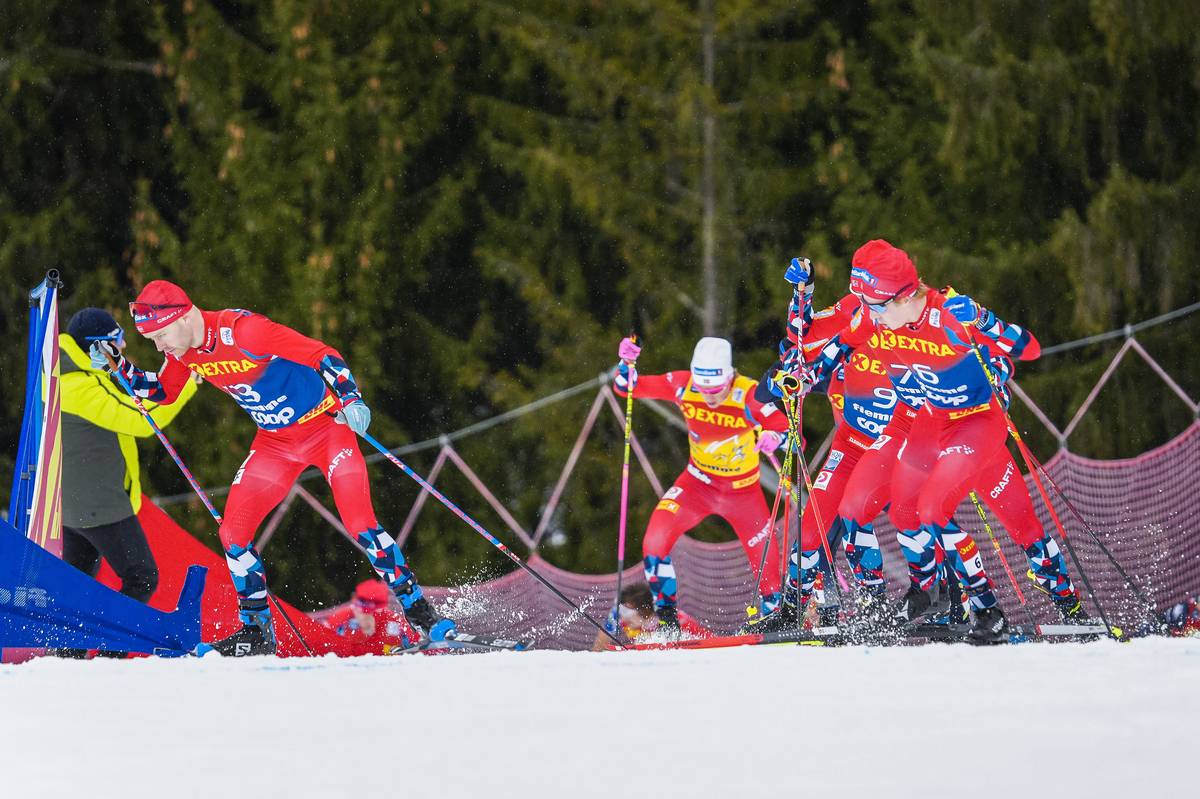
    That possibility turned into real tension when Krueger initiated a move at the base of the climb, opening a gap in the field. A group of Norwegian men quickly formed, but without Klaebo. Sjur Roethe, Hans Christer Holund, and Didrik Toenseth moved up with Krueger. Klaebo was still within reach, but his lack of push to stay with the field indicated a concession from him; he would let the climbers go and focus on keeping the yellow bib on his back at the finish.

    Klaebo, wearing the yellow bib, in behind the lead pack of his countrymen at the base of the Alpe Cermis climb (Photo: NordicFocus)

    Krueger set a blistering pace up the steepest sections of the climb, dropping both Toenseth and Roethe (last year’s Alpe winner). Hans Christer Holund was the only one up to the task of marking Krueger, with Krueger doing the bulk of the work as he searched for seconds on Klaebo. Between the 8 k and 9 k mark, Krueger trimmed 47 seconds from his 1:45 gap to Klaebo. The math was evident: it would be hard, but not impossible, for Krueger to win the Tour. The aggressive push from Krueger meant that some of those who had tried to keep with him didn’t just lose touch with the pack when they went, but really fell off. That allowed skiers who had been more conservative through the early section to challenge for the final podium spot, including Frenchman Jules Lapierre and German Friedrich Moch. Klaebo kept to himself through their machinations, and Lapierre soon had established a gap over the other challengers.

    In the end, Krueger crossed the finish line only five seconds ahead of Hans Christer Holund to win the Alpe for a second time. The Frenchman Lapierre crossed with the most emphatic celebration on the day: his first World Cup podium. Krueger’s celebration was perhaps a bit subdued: he had looked back to find that Klaebo had put in a remarkable second effort over the final kilometer. The Alpe, it turned out, did manage to expose Klaebo’s humanity, but the struggle also revealed his character. A skier who appears so often to win by virtue of talent and tactics earned a special victory today by racing with his heart.

    Simen Hegstad Krueger crossed the finish line in first in his 2nd career win on the Alpe Cermis climb. Krueger moved up to 2nd place in this year’s Tour de Ski. (Photo: NordicFocus)

    Part of the Alpe’s legend is in posing a challenges to skiers, but it also appears that the Alpe di Cermis has a sense of justice. Klaebo has clearly been the best skier in this Tour de Ski; with his third Overall victory, he moves a step closer to becoming its most successful skier of all time. That he has not already notched that title speaks to both his youth (we often forget how young Klaebo is), and to the prowess of the skier he chases: Dario Cologna, who during his career earned four Tour de Ski titles. 

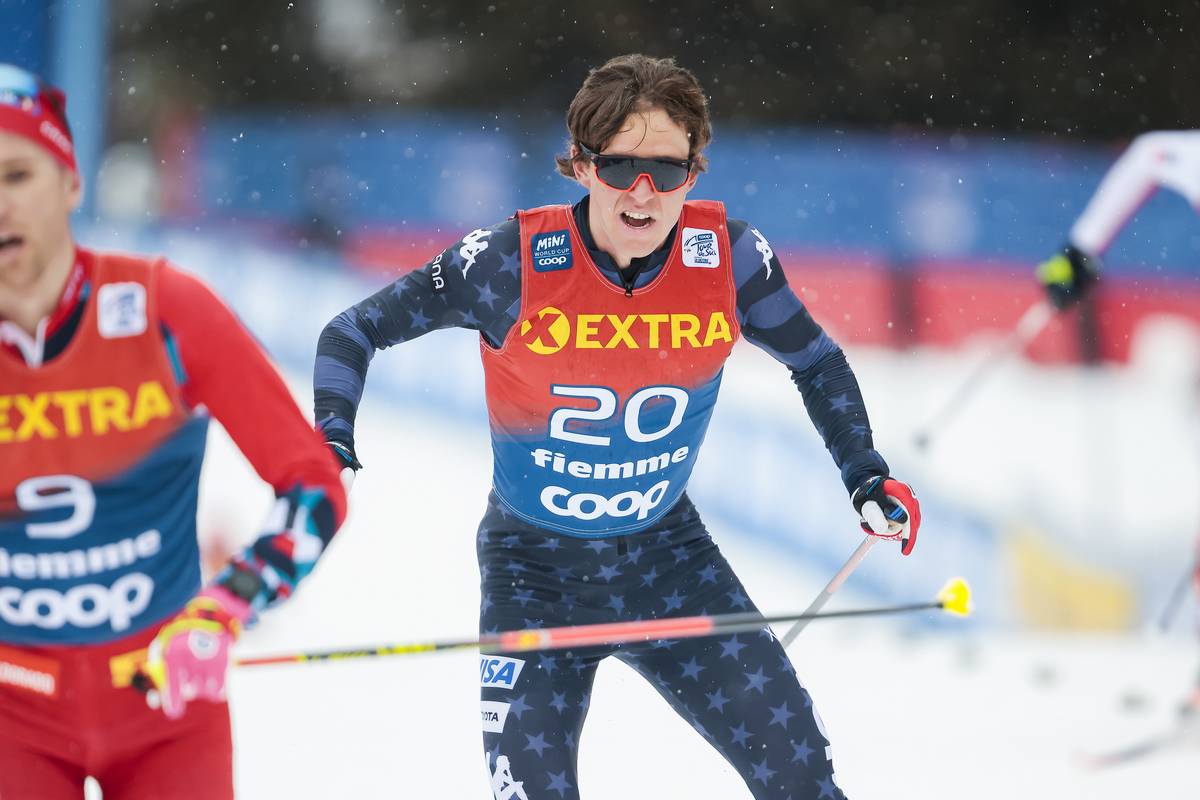
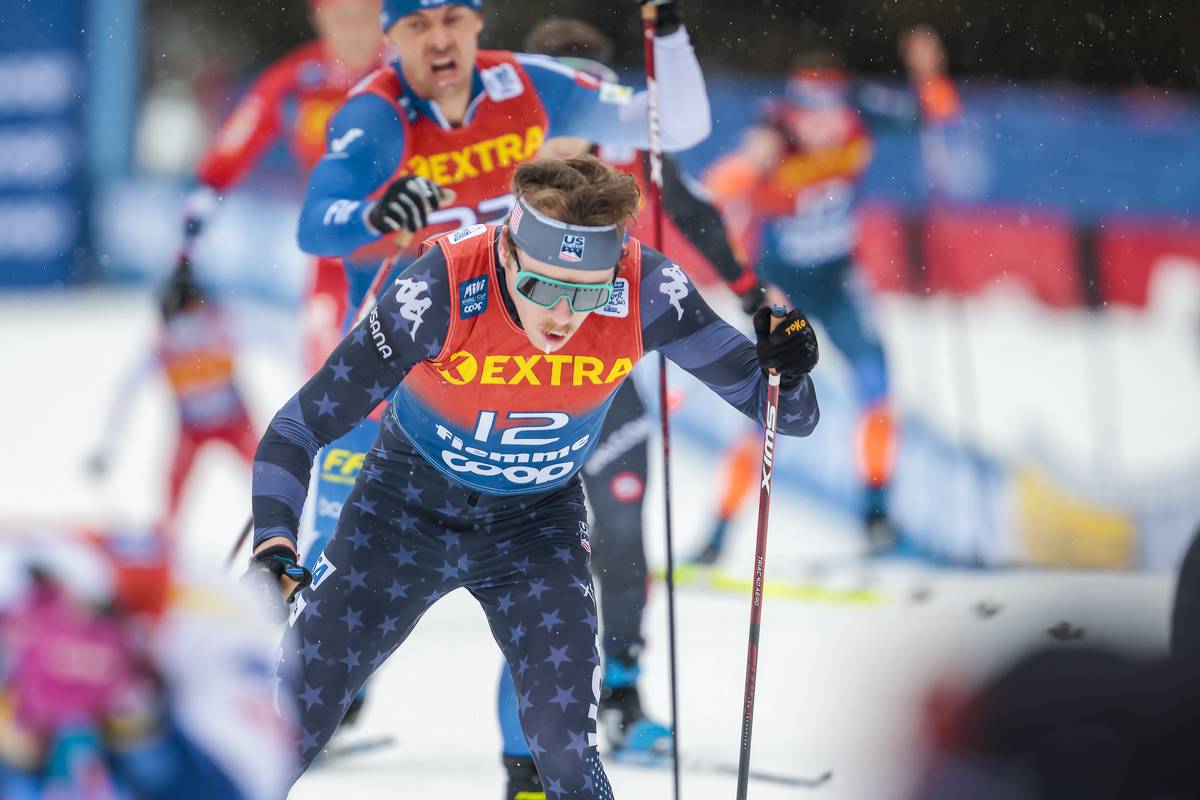
    Scott Patterson finished 14th on the Alpe Cermis, earning the distinction of top American on the day. (Photo: NordicFocus)

    Behind the Norwegian battle at the top of the Alpe Cermis, the American men were busy continuing their steady climb toward the top of the World Cup. Scott Patterson was the top finisher for the Americans, finishing 14th in his second climb of the Alpe (he was 38th last year). Patterson said in post-race comments that the result marked a high point for him at this Tour de Ski, and that he is, “looking forward to the focus on the longer races later in the season,” including the 50 k in Holmenkollen.

    Ben Ogden was the top American finisher in the Overall Tour de Ski standings, finishing 13th after a 24th place finish in his first climb of Alpe di Cermis.

    Ben Ogden, the top-placed American man in this year’s Tour de Ski at 13th Overall. (Photo: NordicFocus)
    Conclusion to the 17th Tour de Ski

    With that, the 17th edition of the Tour de Ski comes to a close. World Cup Skiing departs the slopes of  Alpe di Cermis, leaving more stories etched in the snow on each steep hairpin. It reminds us once again of all that makes ski racing beautiful when the time is right, when the skiers are prepped, and when and all of our eyes watching.

    The World Cup takes a collective rest for the next two weeks, before resuming in Livigno, Italy on January 21st. From all of us at FasterSkier, thanks for following along for another edition of the Tour de Ski!

    Women

    Final Overall Tour de Ski Standings | Stage 7 Results

    Men

    Final Overall Tour de Ski Standings | Stage 7 Results

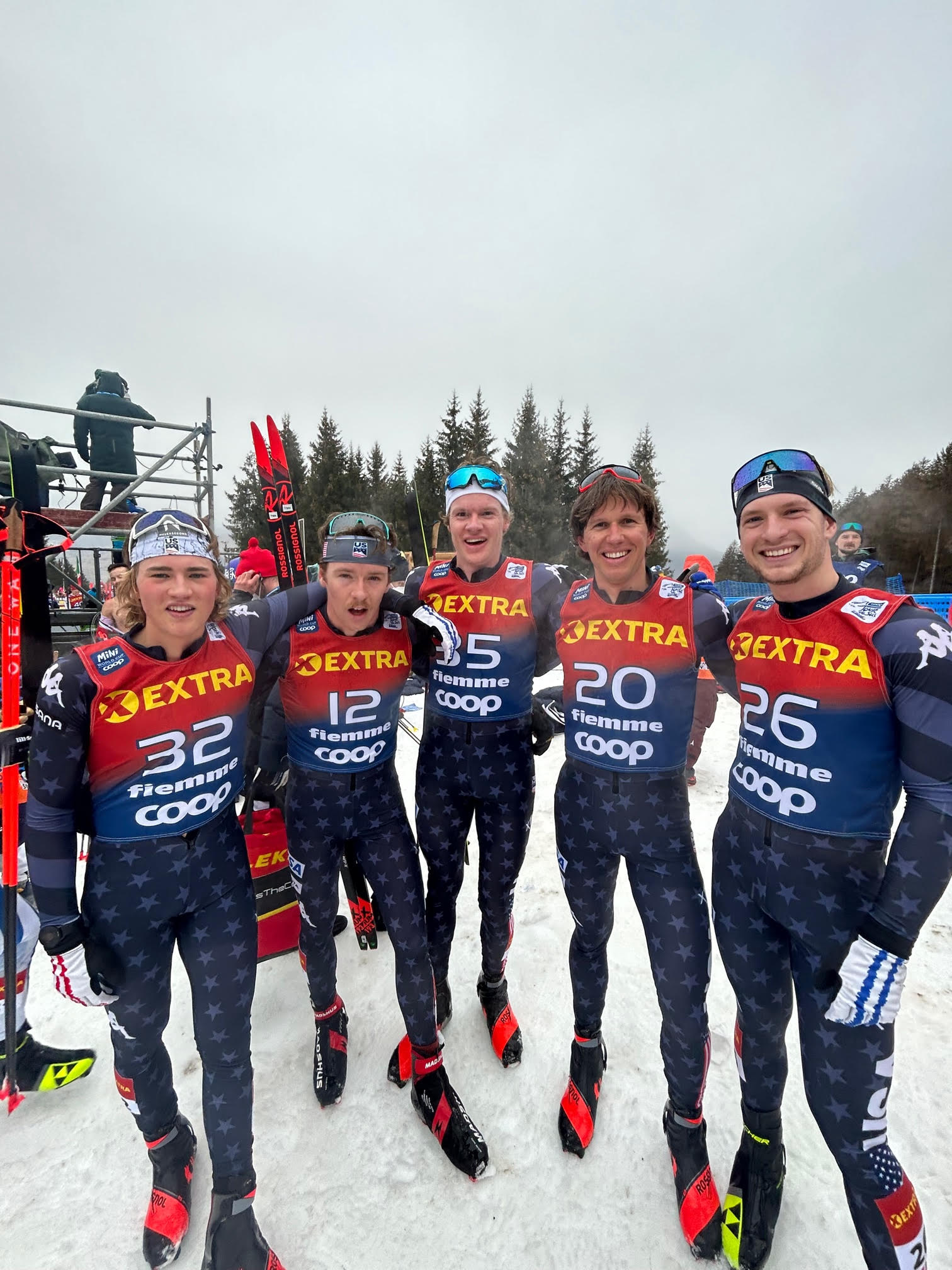
    The American men at the top of the Alpe Cermis. (L-R) Gus Schumacher, Ben Ogden, Finn O’Connell, Scott Patterson, and Hunter Wonders. (Photo: Tom Horrocks/USSS)