
From the FasterSkier archive — posts syndicated from athletes’ and coaches’ own blogs between 2004 and 2012, kept online as published. Current coverage is at fasterskier.com.

Tag: Alpensia Biathlon Center

  • Belarus Nabs First Olympic Gold in Women’s Relay; Canada 10th, U.S. 13th

    Belarus Nabs First Olympic Gold in Women’s Relay; Canada 10th, U.S. 13th

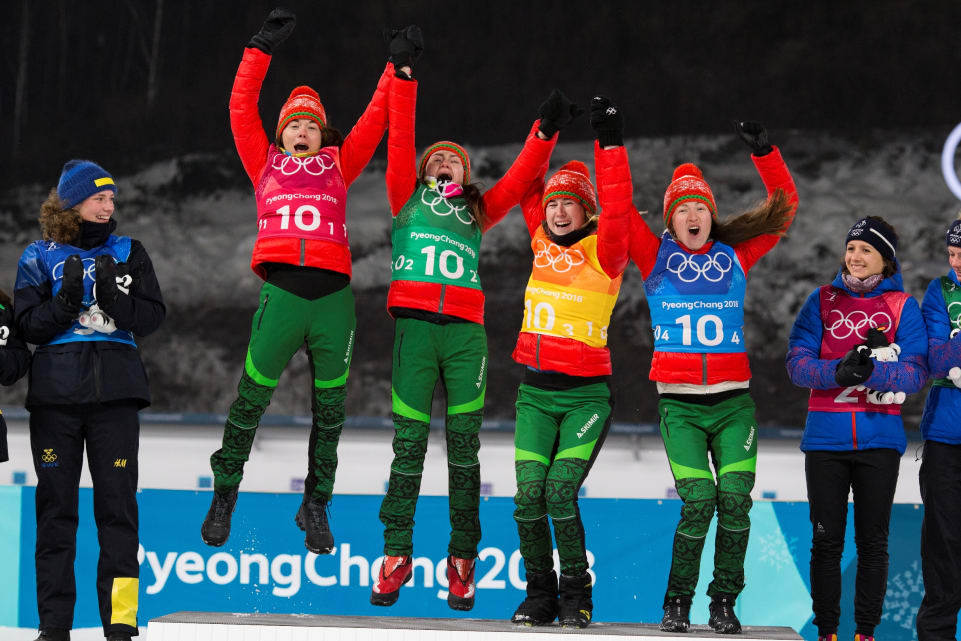
    The Belarusian women’s biathlon team, with (from left to right) Nadezhda Skardino, Iryna Kryuko, Dzinara Alimbekava, and Darya Domracheva, celebrates winning a historic gold for their nation in the 4 x 6 relay at the 2018 Olympics in PyeongChang, South Korea. They were ranked 10th coming into the day. (Photo: IBU/Biathlonworld)

    FasterSkier would like to thank Fischer Sport USA, Madshus USA, Concept2, Boulder Nordic Sport and Swix Sport US for their generous support, which made this coverage possible.

    PYEONGCHANG, South Korea — Some things were the same on Thursday night: the attention-grabbing biathlon stadium announcer generating an atmosphere of stoke, thumping house music, and shivering yet engaged fans. Making it feel like true winter, a heavy snow squall settled in over the Alpensia Biathlon Center for the women’s 4 x 6-kilometer relay.

    Ultimately, Belarus won gold in a time of 1:12:03.4 hours with Nadezhda Skardino, Iryna Kryuko, Dzinara Alimbekava, Darya Domracheva. Sweden’s Linn Persson, Mona Brorsson, Anna Magnusson, and Hanna Öberg took silver (+10.7), while France’s Anaïs Chevalier, Marie Dorin Habert, Justine Braisaz, and Anaïs Bescond claimed bronze (+17.6).

    For the first few legs, however, all three medaling teams seemed an outside shot at the podium. On a windy and, for the first time at the Olympics, snowy evening, the win was up for grabs from the start.

    After the first lap, a rainbow of suits came into the shooting range together, 7.8 seconds separating the leader from the field’s tail. America’s lead-off skier, Susan Dunklee, skied out of the range first after shooting clean in prone. The U.S. skier was followed by Ukraine, 2.9 seconds back. And Canada’s Sarah Beaudry had also cleaned without any spares to put her team in third, 7.1 seconds back.

    Dunklee held her lead through the 2.9 k checkpoint and by 3.6 k, she was up to 8.1 seconds ahead of Japan chasing in second. Canada had fallen to 12th, 14.9 seconds back. With dumping snow and blustery wind before their second shooting round, it was Dunklee all entering the range all alone that was featured on the stadium’s jumbotron.

    For her standing stage, Dunklee missed one target, but cleaned it with one spare. She left the range 5.2 second behind Italy’s Lisa Vittozzi, who had also cleaned with one spare. After the first leg’s final shooting stage, the field started to spread out. Beaudry used three spares to clean standing and avoided the penalty lap, returning to the course in 13th, 50.5 seconds out of first.

    Susan Dunklee skiing the first leg of the mixed relay on Tuesday at the 2018 Olympics in PyeongChang, South Korea. She tagged the team in fifth and they went on to place 15th. On Thursday, she skied the U.S. women’s 4 x 6 k relay into second by the first exchange. (Photo: FlyingPointRoad)

    “There’s some, as a friend of mine would call it, Disneyland snow, falling from the sky so it makes it exciting in the relay,” Beaudry told FasterSkier after her race. “Everyone shoots at the same time so I wouldn’t say anything is unfair. It makes opportunity. So hopefully my teammates can take advantage of that.”

    Dunklee came through the 5.6 k checkpoint trailing Vittozzi by 7.2 seconds. At the first exchange, Italy tagged off first and Dunklee handed off to Clare Egan 7.6 seconds back in second. 

    “It has been a tough Games. We came in here with a lot of expectations and certainly haven’t really lived up to them,” Dunklee told FasterSkier after her leg. “It’s extremely frustrating. To think about every decision you make in your life over four years, with your best training in mind and your best performance in mind, and then getting sick at the wrong time is tough. The guys have struggled.

    “We have had some bright spots with the girls; Emily and Joanne have carried us, they have had PR’s here. That is exciting,” Dunklee added, before looking up at the screen to see Egan skiing in third. “And this is exciting today. This is really exciting! Anything is possible.”

    Beaudry tagged Canada’s Julia Ransom in 15th, 1:15 minutes out of first.

    “I was really happy with my first lap and my prone,” Beaudry said after her first Olympic relay. “I tried to keep with the group on my second lap and I think that left me a little shaky in standing. I’m not too pleased with my two spares, but I mean, I missed three and I didn’t miss a spare, so at least shoot a spare, hit a spare.”

    After the first loop of the second leg, Italy was still in first, with Dorothea Wierer at the helm. In prone, there was a reshuffling of leaders as Slovakia’s Anastasiya Kuzmina cleaned with one spare to move into first, 15.3 seconds ahead of Norway’s Tiril Eckhoff, who had cleaned with a single spare, in second. Egan cleaned without a miss and left the range in third (+17.3). Meanwhile, Wierer still had two targets standing after using all three spares, leaving her with two costly penalty laps and 1:11 minutes back in 13th.

    Finland’s Kaisa Mäkäräinen shot clean to put her team in fourth, 23.9 seconds behind Kuzmina. France was sixth (+32.6), and Belarus ninth (+46.6). Canada’s Ransom shot clean without any spares and left the range in  12th (+1:08.3) while Sweden was 15th (+1:16.4).

    While Kaisa Mäkäräinen moved into second behind Kuzmina on the next loop, Eckhoff and Egan followed them into the range in third and fourth, respectively. There, during an especially blustery standing stage, Kuzmina missed her first three shots and ended up with a penalty lap, which put her 20 seconds back in eighth. Wierer cleaned to reclaim first for Italy, just 0.9 seconds ahead of Mäkäräinen in second, who used two spares to avoid a penalty. Belarus’s Kryuko shot clean to leave the range in third (+7.9), and Egan hit five more shots without any spares to follow her in fourth (+10.7).

    Ransom used three spares to avoid the penalty lap and headed back on the course in 10th (+44.2) for her final 2 k loop.

    “Oh my gosh, I was really due for this,” Egan said after. “It’s by far my best race of the season so I couldn’t be more happy with my race.”

    By the time the skiers came in for the second exchange, the order had changed again. Finland handed off in first, Italy second, 14.2 seconds back, Slovakia third (+16.1) and U.S. fourth (+16.8). Canada came through in 10th (+1:09.5).

    “Kuzmina kept being behind me and then passing me,” Egan reflected. “I think every lap Kuzmina passed me so there is a lot of really fast skiers, most teams put their fastest skiers on their second legs. I tried to stay with them, but I can’t always do that. I did have people around me the whole time though so I was able to keep fighting.”

    “All you can do is just leave it all on the track no matter what it is,” Ransom said of her race. “My standing was a little bit precarious, missing three from the clip. But I’m happy I was able to hit the precious spares. It was very gusty.”

    Egan tagged off to Joanne Reid for the third of four legs. Reid slipped to sixth on her first loop and during her first prone shooting, she used three spares and had to ski a penalty lap, returning to the course in ninth, 33.6 seconds behind Italy’s Nicole Gontier, who cleaned with three spares, in first. Gontier skied just 0.4 seconds ahead of Slovakia’s Terezia Poliakova, who used one spare to clean. 

    Belarus had moved into third (+2.4), France into seventh (+19.2), while the Swedes sat in 11th (+1:33.6) and Canada, with Emma Lunder who had to ski a penalty, was still in 12th (+1:45.7).

    As the leaders came in for their standing bout, it was Italy, France, Belarus, Norway, Finland, Slovakia, Poland, and U.S.A. Belarus’s Alimbekava took the lead after using one spare, Poland chased in second (+6.2), Slovakia was next, followed by Italy. The U.S. was back up to fifth (+28.1) after Reid used one spare to clean. France was sixth (+29.2) and Sweden eighth (+1:10). Lunder cleaned to put Canada in 11th (+1:24.7).

    “I had a pretty good standing, but we need every second we can get,” Reid said after. “You never know what will happen in the next stage and the wind picking up. So even if we’re in fifth you never know. I was just trying to hang on on that uphill and give it everything I had.”

    “I didn’t feel amazing, skiing, but I ripped off my standing with no spares, like, record fast, so I was really pumped about that,” Lunder reflected. “I moved up like a ton in the range there. So I think I tagged Rosanna in a decent position to be with some girls and fight a bit.”

    Poland’s Krystyna Guzik caught Belarus’s Alimbekava and by the final exchange, it was Poland in first, France in second, Italy in third, and Belarus in fourth. Reid handed off to Emily Dreissigacker in sixth (+21.4) while Lunder tagged Rosanna Crawford in 13th (+1:22.6). Sweden exchanged in eighth (+59.1)

    The skiers had maintained their order as they approached the range for the seventh round of shooting. Belarus’s anchor leg, Domracheva, shot clean to take the lead. France was now in second, Poland third, and the U.S. in seventh (+41.1), after Dreissigacker used two spares to clean. Sweden was back in ninth (+41.9), while Crawford cleaned with one spare and out for her second loop in 12th (+1:28.6).

    Coming into the final shooting shooting round, Belarus teetered on a lock for gold, 24.8 seconds ahead of France in second. Poland still clung to third, 34.5 seconds back, while Sweden was now ranked seventh, 56.4 seconds back. The U.S. had moved back to tenth, while Canada was right behind them in 11th.

    Domracheva missed three targets standing, but used three spares to clean and avoid any penalties to hang onto first. France’s Bescond needed three spares to clean but stayed out of the penalty lap and headed out on the final loop in second (+6.4). Sweden’s Öberg cleaned her second-straight stage without any misses to move all the way up into third (+10.9). 

    For the U.S., Dreissigacker used her three spares to clean standing, but experiencing unsteady winds, took her time to steady her shot and left the range in 12th (+1:20.2). Canada’s Crawford used one spare to clean and moved up to 11th (+1:19.9).

    “It was really windy for my standing,” Crawford noted. “I really waited it out.”

    “It wasn’t great,” Dreissigacker, a first-time Olympian, said of her race. “I didn’t feel that great skiing, might’ve went out a little hard, and the shooting just wasn’t good either. I was happy to at least hit them all with my spares, but standing especially, I took all three spares and the wind came up like crazy, right before I started shooting my spares, so I had to like stand there and wait out the wind, which cost me a lot of time.”
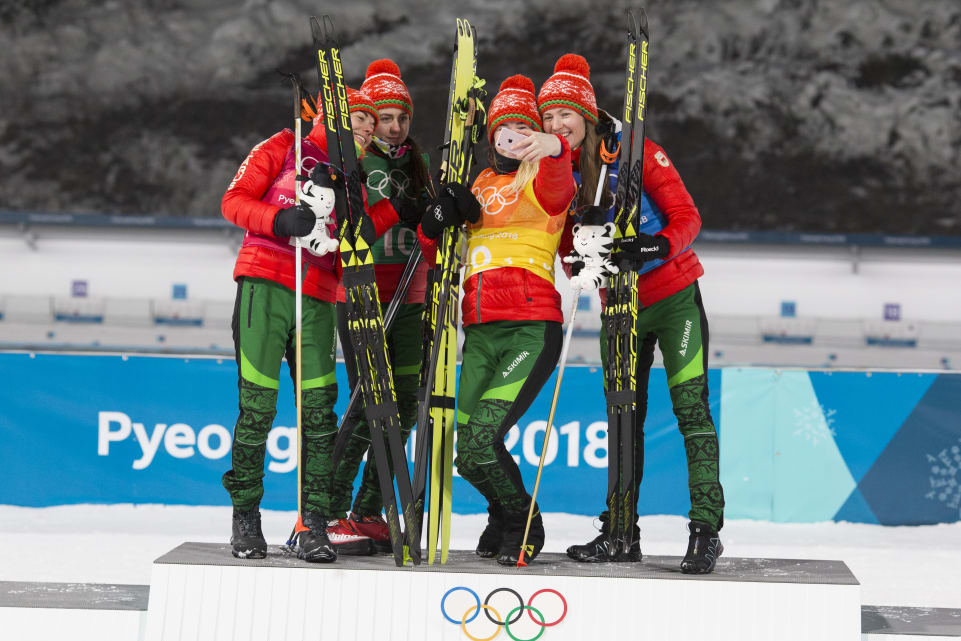
    The Belarusian women’s biathlon team, with Nadezhda Skardino, Iryna Kryuko, Dzinara Alimbekava, and Darya Domracheva, snaps a podium selfie after winning their first relay gold on Thursday at the 2018 Olympics in PyeongChang, South Korea. (Photo: IBU/Biathlonworld)

    Over the last 2 k of the race, Domracheva kept her competition behind her and crossed the line first for Belarus’s first relay gold in 1:12.03.4 (after its mixed relay team placed fifth two days ago). 

    Öberg passed Bescond to claim silver for Sweden, 10.7 seconds back, while Bescond anchored France to bronze (+17.6), ahead of Norway in fourth (+29.7), Slovakia in fifth (+38.4), Switzerland in sixth (+43.5), Poland in seventh (+43.6), Germany in eighth (+53.9), Italy in ninth (+1:04.1), and Canada in 10th (+1:33.4). The U.S. finished 13th (+2:01.9) of 18th teams.

    With the first-place finish, Domracheva is the most decorated female biathlete in Olympic history, with six medals (four golds, a silver and a bronze) between three Olympics. Her husband, Ole Einar Bjørndalen of Norway, is the most successful Olympic biathlete of all time with 13 medals. 

    “I didn’t think that before you said it,” Domracheva, 31, said of her medal record during the post-race press conference. “Of course it was a lot of challenges for me on the way. Such days and such medals mean that it’s important to believe in yourself, important to believe in your team and overcome some difficulties, and then all doors are open for you.”

    In the last four Winter Olympics, France has claimed three relay medals. Before Thursday’s bronze, their most recent was silver in 2010 and prior to that, bronze in 2006.

    Sweden’s silver medal was its first in the women’s 4 x 6 k relay at the Olympics.

    “This team worked together really hard for the last couple of years,” said Öberg, who won her first medal — gold — in the 15 k individual race earlier in the Games. “That we are here today is unbelievable. I’m really happy to share this medals with the rest of the girls.”

    Crawford caught Ukraine’s Anastasiya Merkushyna in her final lap to anchor Canada to 10th while the U.S. finished three places later in 13th.

    “My last loop I could hear Julia [Ransom] and Sarah [Beaudry] all around the course,” Crawford told FasterSkier. “They managed to be everywhere really cheering me on, and that fueled me to catch the Ukrainian.

    “I’m just so proud of this women’s team,” Crawford added. “We fought so hard out there today. We’ve been through a lot this summer and really supported each other. And I’m just really proud of the team and I think biathlon in Canada has the potential to have a bright future.”

    Results

  • Peiffer’s Bad Day Turned Golden; Bailey 33rd in PyeongChang Sprint

    Germany’s Arnd Peiffer (front) on his way to winning the men’s 10 k sprint at the Alpensia Biathlon Center on Sunday at the 2018 Olympics in PyeongChang, South Korea. The German was one of just four men to shoot clean in windy conditions. (Photo: FlyingPointRoad)

    FasterSkier would like to thank Fischer Sport USA, Madshus USA, Concept2, Boulder Nordic Sport and Swix Sport US for their generous support, which made this coverage possible.

    ***

    Arnd Peiffer’s race day before the men’s 10-kilometer sprint at the 2018 Olympic Winter Games in PyeongChang began anything but ideal, not giving any indication that it would end as one of the luckiest days in the athletic career of the German, standing at the top of the podium and flanked by Michal Krčmář of the Czech Republic in second and Italy’s Dominik Windisch in third place.

    “Shortly before ski testing, the bolt on my rifle broke. Then I slipped outside the wax cabin [on a flight of stairs] and badly bruised my elbow,” Peiffer told German broadcaster ARD about a series of mishaps that also included a cut to his hand, a forgotten key for his rifle storage locker and a poor warmup. “Somehow nothing was really working as planned, but then in the race everything did.”

    About an hour before the race during dry firing target practice (without loaded ammunition clips), the bolt on Peiffer’s rifle that triggers the shots just snapped. On short notice the weapon had to be disassembled and the bolt replaced with the help of men’s head coach Mark Kirchner (a successful biathlete himself with a gold medal in the sprint and two in relays at the 1992 and 1994 Olympics), a problem that according to Peiffer “happens about once every six months to a year… That’s not so bad, but something you don’t really want to occur right before a race”.

    “I am generally not superstitious at all,” Peiffer recounted during an interview with ARD in the Olympic broadcasting center late Sunday night. “But Mark told me, ’22 is a good bib number, I once became world champion with that… And [teammate Erik Lesser] also had a broken bolt before the individual race at the [2014] Olympics in Sochi when he shot clean four times and won silver, that was surely a good omen.’ I was like, yeah, that won’t help me today either.”

    Yet after he had started his race, Peiffer was indeed the lucky one, hitting 10-for-10 shots in every bit as difficult wind conditions as the day before during the women’s sprint when his teammate Laura Dahlmeier won gold, while the presumed favorites such as France’s Martin Fourcade and Norway’s Johannes Thingnes Bø missed too many targets to contend for the medals.

    In his prone shooting, Peiffer reacted correctly to a strong gust of wind from the left side of the range, adjusting his sights with several clicks on his rifle. Then in the standing shooting he took advantage of manageable conditions to shoot in rhythm and again remained clean. On the final loop he skied the 10th-fastest time (18th overall), crossing the line in a time of 23:38.8 minutes. That mark would not be beaten anymore by the 65 athletes starting behind him.

    “I have waited a long time for this individual medal,” he said during his in-studio interview with ARD. “I won one in 2011 [at IBU World Championships] and since then had a few chances that I didn’t take advantage of, and sometimes didn’t have any chance at all. So that it worked out today, with a pretty mediocre course time, is a gift that I am very grateful for.”

    It was Peiffer’s first individual medal at Olympics, following a silver medal in the men’s relay in Sochi and no podium in Vancouver in 2010. Most of the World Cup successes for the 30-year-old biathlete have been in sprints, and he won the title in this discipline at the 2011 World Championships in Khanty Mansiysk, Russia. His first World Championship medals also came in PyeongChang, back in 2009, when he took bronze with the relay and mixed relay, which he fondly remembered.

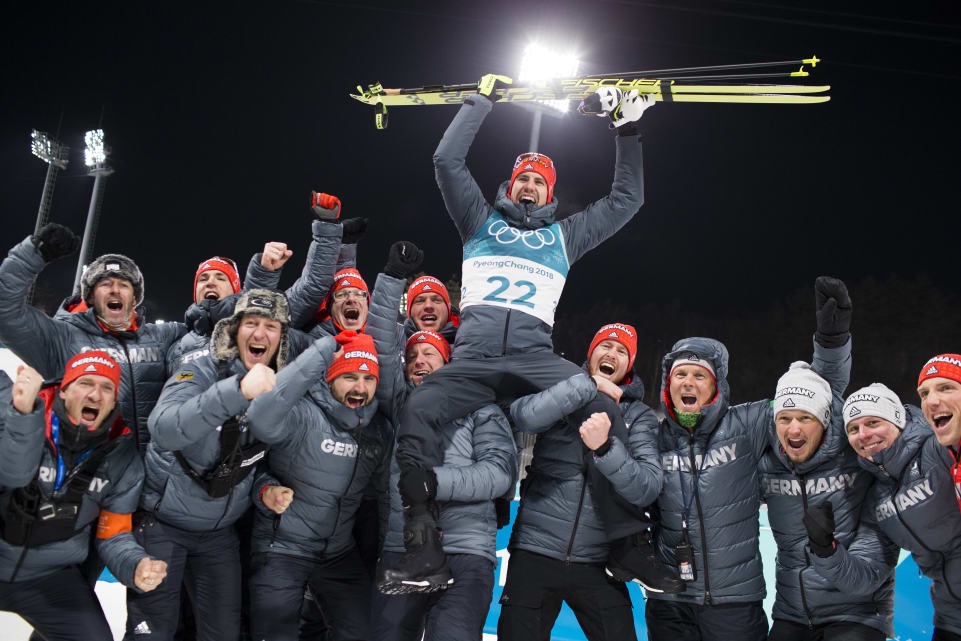
    Germany’s Arnd Peiffer is hoisted up by his coaches, staff and teammates, celebrating his victory in the men’s 10-kilometer sprint on Sunday at the 2018 Olympic Winter Games in PyeongChang, South Korea. (Photo: IBU/Biathlonworld.com)

    “I am honestly completely surprised that my result was so amazing, that I am standing at the very top,” he had told ARD right after the race. “I am just happy about my performance, because in Vancouver and Sochi I twice had a bad sprint [finishing outside the top 30]… So for today I just was determined to have a good one, have a good shooting performance, and if it had been a sixth place I’d also have been happy.”

    The silver medal in Sunday’s sprint went to Krčmář, who also hit 10-for-10 and finished 4.4 seconds shy of Peiffer’s time. Starting behind Peiffer in the middle of the field, that clean shooting performance opened a window of opportunity to wedge himself between the times set by Peiffer and Windisch, who ultimately placed third (+7.7) with one penalty.

    “For me, it was very hard in the last loop,” Krčmář said at the post-race press conference. “I [had no] power in last loop and my teammate on the track said to me, ‘You are five seconds behind Arnd’. I do maximum [went as hard I could], but Arnd [was really] better today.”

    He made up 2.4 seconds on that final loop, but could not catch up to Peiffer’s time. It was the first sprint podium for the 27-year-old Krčmář at the World Cup or championships level, and at these Olympics it came just at the right moment.

    “It’s true, for me a big, big medal. First in career,” Krčmář said. “It’s for me [a] very surprising day because I [felt bad] in the training here. My shooting in training [was] not so good. And now, zero-zero. I am lucky man today because I [had] very good condition in standing shooting and on the track.”

    Windisch missed one target in his standing bout, and came back on the course 12.2 seconds behind Peiffer’s time and 5.4 seconds behind Krčmář. He narrowed that gap on the final loop, but it wasn’t enough to catch either one.

    “The wind was not easy because it continued to change … but maybe it was the best for me because I had something to think about and to be concentrated on my work,” Windisch said at the press conference. “I didn’t think about results, and maybe that was my secret today.”

    For Windisch, 28, it was the second Olympic medal of his career after he held Italy to bronze in the mixed relay in Sochi four years ago.

    “The relay is always a tough race because you are racing also for your friends or for three other persons. Maybe it’s more pressure there,” Windisch said when asked to compare the two achievements. “But to win an individual medal [means] a little more because it’s really hard to reach it, because there are so many different good athletes. I think the emotions are really big. But also [for the] relay the emotions are maybe bigger because the whole team celebrates the medal.”

    Down On Their Luck

    Having started in bib 5, Austria’s Julian Eberhard led the race early on until Peiffer beat his time, and in the end he just missed a medal by 0.7 seconds when Windisch bumped him off the podium to fourth place (+8.4, with one penalty).

    During the race, Eberhard, who has three World Cup victories to his name, broke a pole on the loop after prone shooting and had to ski about 300 meters before receiving a spare. But he couldn’t explain why he lost time on the final downhill before the finish.

    “I definitely started today with the goal to get the victory. I did my job, and it was very close. Only eight seconds are missing, so of course this is very bitter now,” Eberhard told Austrian broadcaster ORF, according to a translation. “Especially considering that before the downhill 500 meters before the finish I was clearly in second place … Those are the little details that have to work out for a gold medal.”

    Norway’s Erlend Bjøntegaard led the race after the prone stage with his time and in the end finished fifth (+17.4), also just missing the podium after he missed two targets in his standing stage (0+2). He had been selected as the final athlete on the Norwegian men’s Olympic roster, effectively replacing biathlon legend Ole Einar Bjørndalen, a decision debated controversially in his home country. But on Sunday, Bjøntegaard, 27, justified his start.

    “It feels incredibly strange when you put it that way,” Bjøntegaard told Norwegian broadcaster NRK when told he might have been one miss away from the podium, according to a translation. “It slowly dawns on me that I was so close to an Olympic medal and the gold. There is a lot of buzzing in my head. I’m happy, but also a little disappointed and mad at myself. It’s strange to look at the results list. Very strange. I’m struggling to take it in, but it’s slowly coming to me that I was so close.”

    A number of athletes could have echoed same feeling, including three of Peiffer’s teammates.

    Benedikt Doll, the defending sprint world champion, placed sixth (+17.6) after missing his final shot. Mass-start world champion Simon Schempp came almost as close in seventh (+21.4, with one penalty), and Erik Lesser, whose past rifle troubles had served as a positive example for Peiffer, was not far behind in 11th place (+31.9, also missing his final shot), despite starting the race with a bruised ribcage.

    “I am rooming with Arnd and lost our team-internal duel. So that totally annoys me,” Lesser jokingly told ARD.

    “I think that is the hallmark of our men’s team. Today I was the lucky one who got through. From my point of view, it could have been any one of the other three as well. I am not just saying that, I truly believe that,” Peiffer told ARD.

    “I will definitely drink a small beer with my coaches, wax techs and teammates, I won’t let myself be denied of that,” he added with a laugh, although it was already past midnight local time. “And then I’ll be looking forward to [the pursuit], because now the pressure is gone. We have a great starting position, the others also did a great race even if that won’t be at the center of attention now. We can be really proud of that.”

    As for the presumed “Big Two” race favorites who have dominated the International Biathlon Union (IBU) World Cup this season, with France’s Fourcade standing on the podium in every individual race he started and Norway’s Johannes Bø having won eight races including three sprints, on Sunday they looked like mere mortals for once.

    While Peiffer was approaching the finishing stretch, Fourcade, who had started in a later group in bib 54, missed three prone shots. He came out of the penalty lap with a split time that ranked 56th overall. That setback would have taken just about any other athlete completely out of contention, but with a clean standing shooting and the fastest overall course time of the day, Fourcade limited the damage and rose to eighth at the finish (+22.1).

    Bø, currently ranked second behind Fourcade in the World Cup Total Score, also missed three shots in prone and another one in standing (3+1), crossing the line 1:12.7 back in 31st.

    Their uncharacteristic days left openings and opportunities for the three podium finishers.

    “I think on these conditions, it’s possible for everything and nothing, so today it was our lucky day and maybe not the day for Bø and Fourcade,” Windisch said at the press conference. “It was really difficult to shoot, and I think they will have many other chances at these Olympic Winter Games and they will be here [at the press conference] the next time.”

    “I don’t know how this could happen,” Peiffer said at the press conference, still a bit incredulous about the outcome. “The other two [Fourcade and J.T. Bø] were dominating the season in ski times and on the range, so I didn’t expect that anyone would be in front of them, for sure not me.”

    Four North Americans Qualify for Pursuit

    American Lowell Bailey racing to 33rd in the first men’s race of the 2018 Olympics, the 10 k sprint, on Sunday in PyeongChang, South Korea. (Photo: FlyingPointRoad)

    The best North American in the difficult conditions was US Biathlon’s 2017 individual-discipline world champion Lowell Bailey, who began his race by cleaning all his prone targets, leaving the range with a split time that ranked him in eighth overall.

    Then Bailey was shown on the international broadcast as one of the last remaining podium contenders still out on the course when he came into the range again for his standing shooting, in which he missed the fourth shot and thus had to ski through the 150-meter penalty lap.

    That set him back to 24th place, and after losing about 30 more seconds on the final loop he crossed the line 1:15.6 out of first in 33rd.

    “I had a good performance on the range, I was happy with the shooting but, unfortunately, I just didn’t have it in the legs,” Bailey said, according to a US Biathlon press release. “I just haven’t had the ski shape that I had last year. I haven’t gotten the speed going this year and that’s the way biathlon is. It wasn’t a bad race. I had a really good first lap, I just didn’t have it on the second and third laps. With any luck I’ll feel better and better as the Games go on.”

    Tim Burke (US Biathlon) en route to 47th in the men’s 10 k sprint at the 2018 Olympics in PyeongChang, South Korea. (Photo: FlyingPointRoad)

    His teammate Tim Burke finished 47th (+1:47.5) with four penalties (2+2).

    “Physically I felt descent. It wasn’t a bad start,” Burke told FasterSkier after the race. “Shooting was tough. I had four penalties. It was real tricky today; it’s a bit of a lottery and that’s the way it goes. … I thought I had similar wind [to zeroing] when I was shooting prone, but what makes it really tough here is it switches literally from one shot to the next. I am really curious to talk to the coaches and see where I was at because I felt totally fine and normally I don’t miss all these shots.”

    “It’s a tough course because you have longer climbs,” he said of the course at the Alpensia Biathlon Center, after skiing the 28th-ranked time of the day. “A lot of biathlon courses today, the climbs are only 30 seconds long before you get a break and here you have a couple climbs that are significantly longer than that, so that suits me well.”

    Leif Nordgren (US Biathlon) en route to 58th in the men’s 10 k sprint at the 2018 Olympics in PyeongChang, South Korea. (Photo: FlyingPointRoad)

    Leif Nordgren will join them in Monday’s pursuit after finishing 58th (+2:10.2) with a missed shot in each of his shooting stages (1+1).

    “I’m satisfied that I made the pursuit and there’s another [race] day tomorrow, but yeah, the shooting was quite tough today and the wind,” Nordgren said after. “I made two mistakes and that was too much to have a great race today.”

    Asked about the challenging conditions, he added:

    “The wind was obviously number one, but actually the cold is another thing. If your hands ever get cold, it impacts the shooting tremendously. If you pause just for a second to even think about how cold your hands are that can throw off the shooting right away. So little things like that. It doesn’t take much to really lose that focus.”

    Sean Doherty (US Biathlon) racing to 65th in the men’s 10 k sprint at the 2018 Olympics in PyeongChang, South Korea. (Photo: FlyingPointRoad)

    The fourth American starter Sean Doherty missed four of his five prone targets, having to shoot about in the middle of the lane positions on the wind-exposed range. The penalties set him back almost 2 minutes, and even a clean standing shooting was not enough to overcome that deficit. He ultimately finished 65th (+2:16.4, 4+0), only about 2.5 seconds out of the top 60 needed to qualify for the pursuit.

    “The wind today is very highly variable and I really thought I had a handle on it in zero [target practice],” Doherty said after. “I had a good zero, I had a good shooting warm up. I had pretty good confidence in what I am doing with things. I came in and I thought I had it under control and obviously something is off. … When I came in I did not assess the wind to be that severe, I guess I didn’t give it enough credit. … But everything else went well. The skiing feels strong. Standing shooting was fine.”

    Doherty skied the 48th-ranked course time for the day.

    “The course is skiing well,” he said. “It’s very fast and firm and this is a good hard course. … I am happy with the skiing, I felt fairly energetic and I am pretty encouraged with that, but it’s just the range. You leave a lot out there when you miss four.”

    The Canadians also struggled with the windy conditions and demanding course.

    Nathan Smith was able to cope best, shooting clean in prone before having to ski one penalty lap in his standing bout (0+1) to finish 44th (+1:43.5).

    “I was happy with my shooting,” Smith said of his race. “Nine out of ten so that’s good for the windy conditions. … My shooting has been really good this year. Whenever I race I’m probably like 90 percent average or something. I usually shoot pretty quick and this year I haven’t been afraid to slow down when I need to be to hit those targets.”

    On the course Smith only skied the 77th-ranked time of 87 starters, after he missed every World Cup race since the sprint in Annecy, France, before Christmas.

    “Skiing was hard,” Smith said. “I haven’t raced for two months so it’s hard to jump into the top level of racing when you have just kind of been racing by yourself for a bit after getting sick … When you’re not feeling tip top, I think the biggest difference is when you’re going over hills and stuff, you’re tired and you’re just like, ‘Oh yeah, I’m getting to a downhill,’ and you can’t really push hard through all those transitions.”

    Unfortunately he was Biathlon Canada’s only team member to qualify for the pursuit, while others missed the top 60 by mere fractions of a second.

    Scott Gow missed four shots in his prone stage before cleaning all targets in standing (4+0), finishing 2:14.0 back in 61st place. That was just 0.1 seconds behind Romania’s Cornel Puchianu, who had incurred just one penalty, and finished 60th.

    Gow told FasterSkier he took special care to bundle up before the race to keep warm fingers and a feeling for the trigger, but when he reached the prone stage, the wind had changed directions from the zeroing target practice, posing yet another problem.

    “I had a fairly consistent wind from the left I would say, then when I came in to shoot in the race, it had switched directions,” Gow said. “So I thought I had accounted for it and I could hear that I was actually, we call it splitting, but hitting like half the target there and I didn’t want to chance making an overcorrection. So it was disappointing. I think luck-of-draw type of thing. It was too bad.”

    The four penalty laps set him back two minutes and all the way to 84th place at the split time, and despite hitting all his targets in the following standing stage, Gow couldn’t quite make up that deficit.

    On the course he skied the 46th-ranked time of the day overall and the 29th-ranked final loop.

    “It’s a really hard course,” Gow said. “It’s basically three big hills with a couple downhills in-between. There’s no transitional areas, there’s no flatter spots. So it feels like you’re always grinding up a hill just to go back down and have to go up it again. … I felt like I could go a little harder on the first two-thirds of the course, and then just make sure I drop back a little bit on the last climb before you come back into the stadium just for the shooting sake. Then also with the wind, especially the headwind, to try and ski behind people if possible to get a good draft. … Overall I would say I did a fairly solid job with my race plan.”

    Christian Gow (Biathlon Canada) racing to 62nd in the men’s 10 k sprint at the 2018 Olympics in PyeongChang, South Korea. (Photo: FlyingPointRoad)

    His brother Christian Gow was just behind him in 62nd, 2:14.7 back with three penalties (2+1). Thus he also was less than a second out of the top 60.

    “The conditions are tough today,” Christian said after. “It’s windy. It’s not nearly as bad as it was this afternoon, that was crazy. But regardless, it’s changing a lot, which I think is the hardest thing.”

    “I corrected in prone and so I have to talk to the coaches and see if it was me or if I missed the correction, where those misses were,” he said of his shooting performance. “Then standing I think was a bit more my fault than anything. Shooting on lane 30 here, it’s quite sheltered. It blocks most of the wind, so it was pretty calm when I shot there and I still came away with a miss.”

    Christian skied the 61st-ranked course time, acknowledging that he was impacted by the cold temperatures and wind.

    “Today I felt a bit heavier than I would have liked to on the track,” he said of his skiing. “It’s a tough course for sure, really big climbs in it, and you’ve got to manage your energy so that you can do them time and again. … The wind, absolutely you get thrown around by it, but I kind of figure that everyone is getting some of that at some point.”

    Brendan Green (Biathlon Canada) en route to 82nd in the men’s 10 k sprint at the 2018 Olympics in PyeongChang, South Korea. (Photo: FlyingPointRoad)

    The fourth Canadian starter Brendan Green cleaned prone and was also shown on the international broadcast as a potential late contender when he came into the range for his standing shooting. But with strong wind he then missed three shots, ultimately finishing the race in 82nd place (+3:09.2, 0+3).

    “It was a tough day,” Green said. “The conditions were obviously very challenging. But on a day like today that … opens up the door a bit, there’s a good opportunity, but I just was not able to put together a solid performance today. … Standing I just had a lot of gusts, just couldn’t quite overcome the wind for standing.”

    “It’s a very challenging course,” he said of the conditions. “The cold weather and the wind. The snow is very dry and very slow, kind of like a sandpaper feel to it. But hopefully the weather starts to cooperate and things start to warm up a bit and the wind drops.”

    The biathlon competitions in PyeongChang continue Monday with pursuits for the women at 7:10 p.m. local time (5:10 a.m. EST) and men at 9 p.m (7 a.m. EST). The times back to the winner from the sprint carry over into the pursuit race.

    Both races can be streamed in the U.S. at Stream.nbcolympics.com.

    Results