From the FasterSkier archive — posts syndicated from athletes’ and coaches’ own blogs between 2004 and 2012, kept online as published. Current coverage is at fasterskier.com.
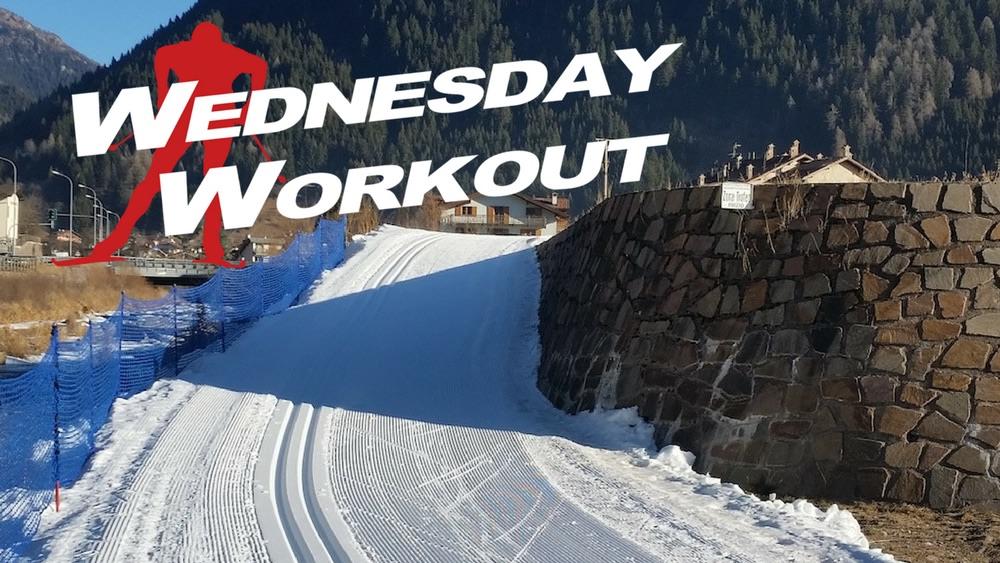
The Marcialonga course follows the rivers in Italy’s Fiemme and Fassa valleys for the first 67 kilometres. (Photo: Ian Murray)
Double poling is an increasingly important part of cross-country skiing and it pays to be good at it. If watching World Cup stars double pole short races on television doesn’t have you convinced, take a look at the races you might enter. Most loppets, marathons and citizen races feature flatter courses with a lot of double-poling time. Even in skating, the three main techniques all include slight variations on double poling.
When five Canmore skiers decided to make the 70-kilometer Marcialonga in Italy (part of the Ski Classics marathon series) their major target for this season, they decided to emphasize one technique in their preparation.
“Pretty much the whole elite field will [double pole the Marcialonga without grip wax],” Erik Carleton, a longtime Canadian Para-Nordic Ski Team guide, explained. “It’s all about getting to the last uphill, and then it’s 3 k pretty steep and you just try and survive that.”
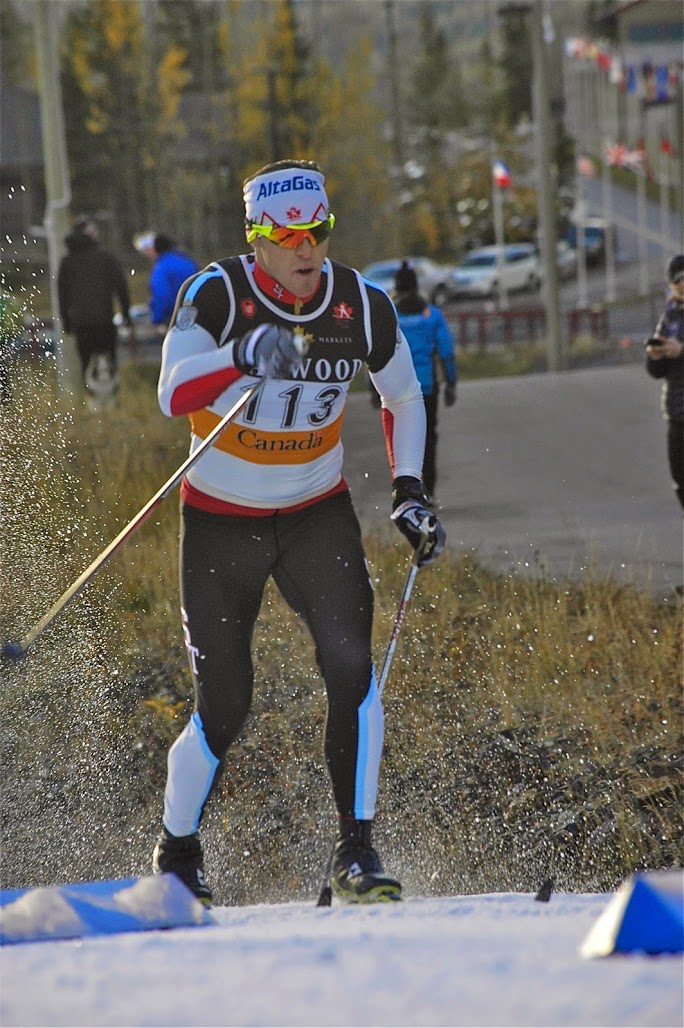
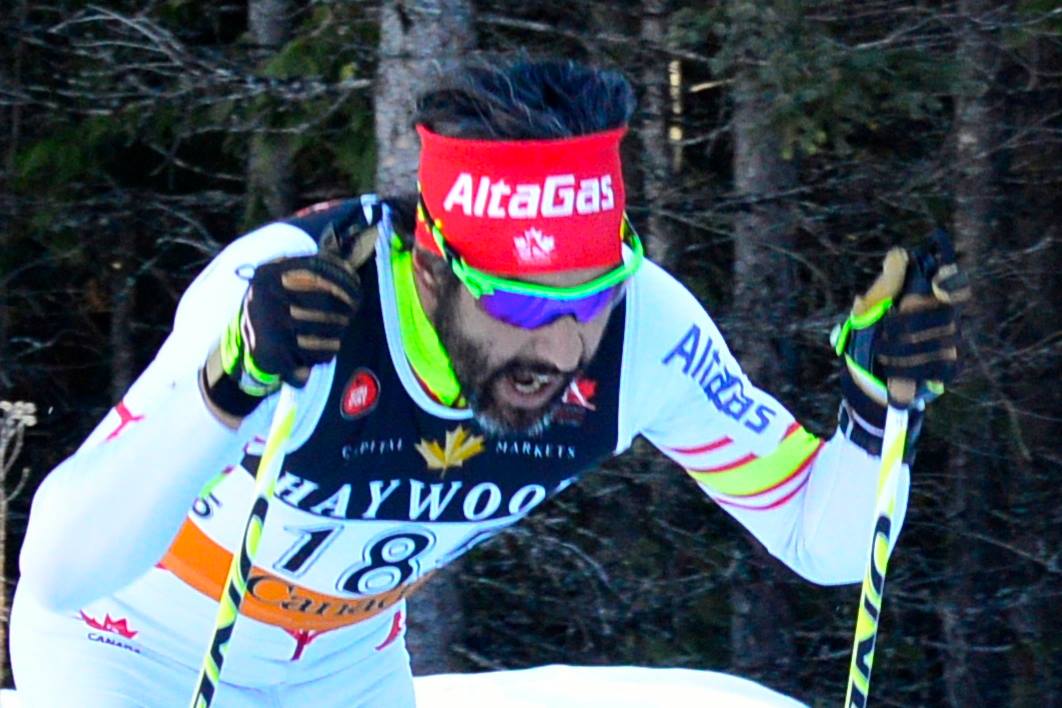
Here are three of the workouts that the 38-year-old Carleton and his Canmore-based training partners, including Canadian Para-Nordic veteran Brian McKeever (age 37), his other guide Graham Nishikawa (33), Ian Murray of North Highlands Nordic (38), and Jon Arne Enevoldsen (54), a former Norwegian biathlete who now runs a coaching business, used to prepare. Each of these five athletes had a different mix of goals for the season and shared workouts were just a part of their individual preparation. FasterSkier has suggested variations for those of us who are less than elite.
Workout 1: Go to a local classic loppet/marathon/citizen’s race and don’t bring kick wax.
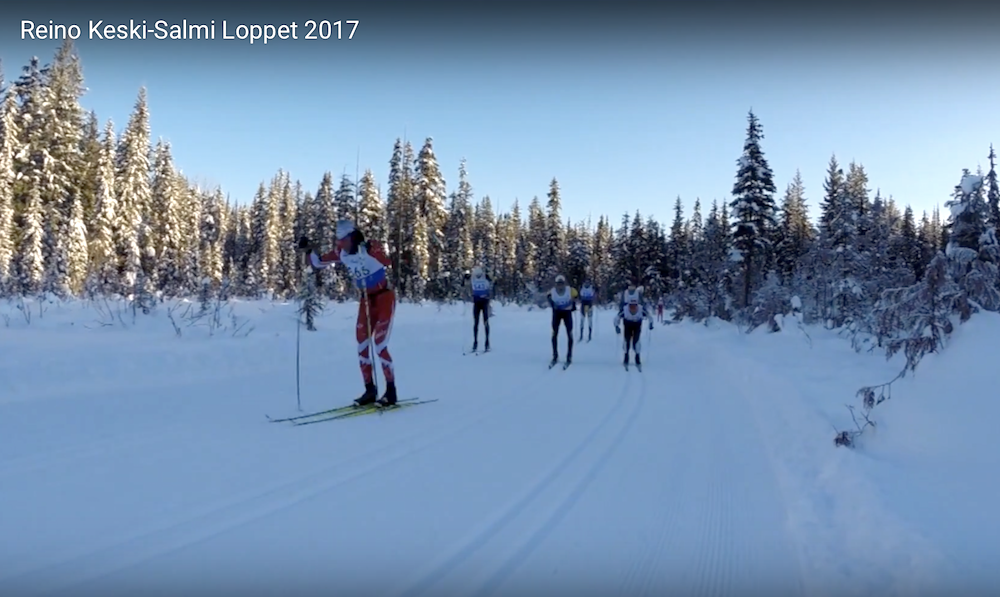
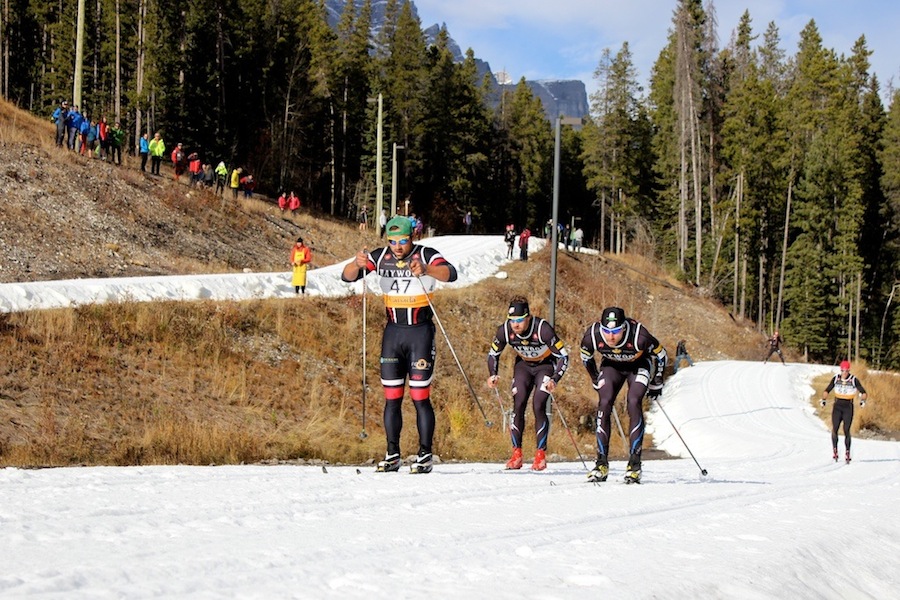
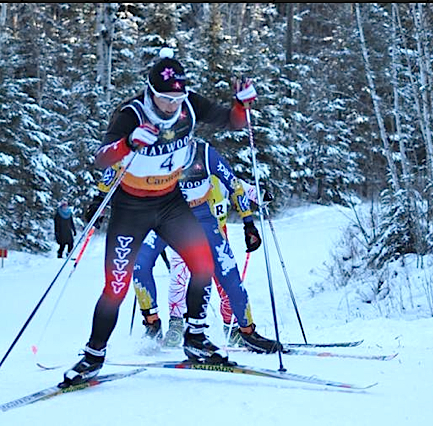
Erik Carleton leads a group through Bilbo’s Bog at the 2017 Reino Keski-Salmi Loppet at the Larch Hills trails in Salmon Arm, B.C. (Photo: Larch Hills Nordic)
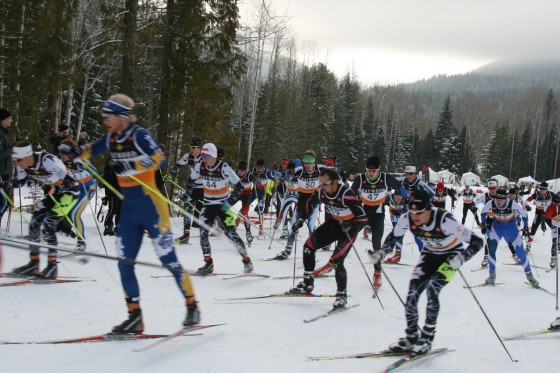
The Canmore crew chose the Reino Keski-Salmi loppet, a 34 k race at the Larch Hills trails in Salmon Arm, B.C., known to locals as the RKS. This event is a typical regional loppet: the long course is relatively flat with a little over 600 metres of climbing, the demographic is dominated by kids and retired people, and most of the 396 finishers were solidly focussed on having fun on snow.
Before the race, Enevoldsen correctly predicted that local skiers with grip wax would easily beat anyone double poling on squeaky -17 Celsius snow. Their goal was not to win, but to get some quality DP training done two weeks before the Marcialonga.
In the end, Larch Hills local Thomas Hardy cruised to victory on grip wax in 1:38:52, just four days after placing 18th at the U.S. nationals 30 k classic mass start at Soldier Hollow in Utah. McKeever and Nishikawa returned from Soldier Hollow ill and didn’t start.
Carleton was feeling the effects of his 15th at Soldier Hollow, finishing the RKS 4:03 minutes behind Hardy. Carleton said afterwards, “It felt good off the start and I tried to push the pace a bit, but then the body was — not today.”
Murray and Enevoldsen were fresher but still treated the RKS as a training workout, finishing at 1:32 and 9:00 respectively to win their age groups.
If it seems wrong to go to a race and not push for the best possible finish, these guys weren’t alone in looking past the result sheet. Retired Canadian national-team member Alysson Marshall returned to her hometown event with her new husband Chris Hamilton to have fun on the trails she grew up on.
Variations:
Choose a race to suit your needs. McKeever and Carleton have double poled 50 k races in the past, but your local weeknight 10 k might be a better fit.
Split a race in two. If you aren’t ready to double pole the full race that fits your calendar, choose a point on the course where you will pretend you have switched to skate skis and double pole to the finish.
Workout 2: Long DP rollerski with race pace at end
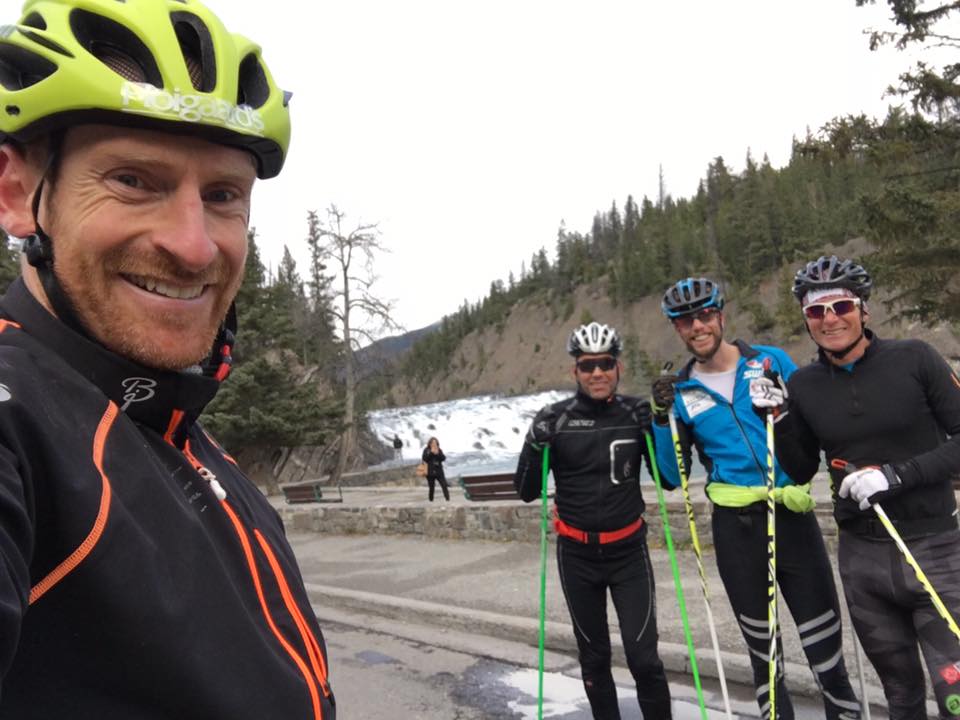
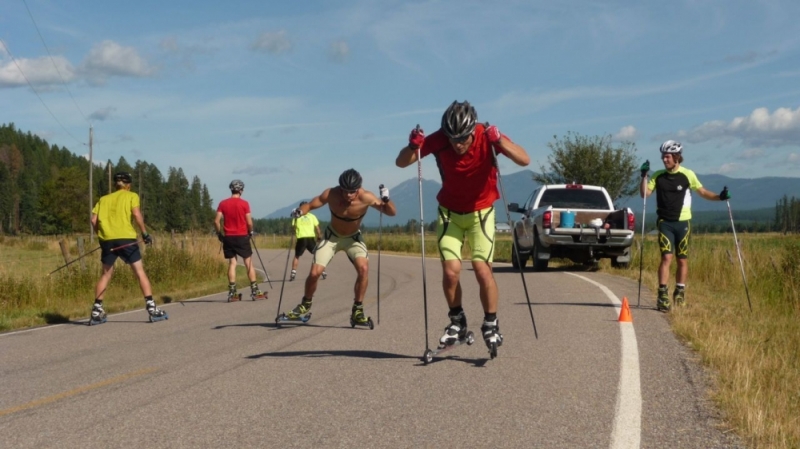
(From left to right) Brian Gregg, Jon Arne Enevoldsen, Erik Carleton, and Ian Murray during a double-pole rollerski from Canmore to Banff, Alberta. (Photo: Brian Gregg)
Roughly every two weeks, the crew would get together for a long Zone 1 (Level 1, or easy chat level) double-pole ski followed immediately by 30 to 60 minutes in Zone 3 (loppet race pace).
“The idea is you tire out your body and then try and push it a bit more,” Carleton said, “so that it will give you that endurance double-poling at the end of loppet races.”
For this crew, the long easy session was two to four hours.
While this workout could be done on snow, it was a rollerski favourite because of available trails. “We’ve got this nice legacy trail to Banff and it’s good flat terrain for that,” Carleton said. Few ski areas can provide flat trails suitable for a four hour ski without excessive laps.
Variations:
Adjust the times. Starting out, one hour of Zone 1 followed by 30 minutes of Zone 3 might be hard enough.
Use your legs for the Zone 1 part. If you don’t have enough flat terrain to stay in Zone 1 double poling, stride or skate as needed in the first part of the workout. For the second part, hilly terrain is less of a problem in Zone 3.
Workout 3: 4 x 45-minute intervals
Double pole 45 minutes in Zone 3, followed by four hours of rest between.
Murray came up with this workout after getting good performance gains from doing mountain bike relay races like ’24 Hours of Adrenaline Canmore’ and ‘Golden 24’.
“Some of my friends give me a hard time, saying this is too difficult,” Murray wrote in an email. “But the mountain bike races are far harder.”
Variations:
Don’t do this. While this workout seems unnecessarily hard, it is clearly working for Murray. Maybe we can all think outside the box to build new workouts from races, events, or long backcountry days that produced good results.
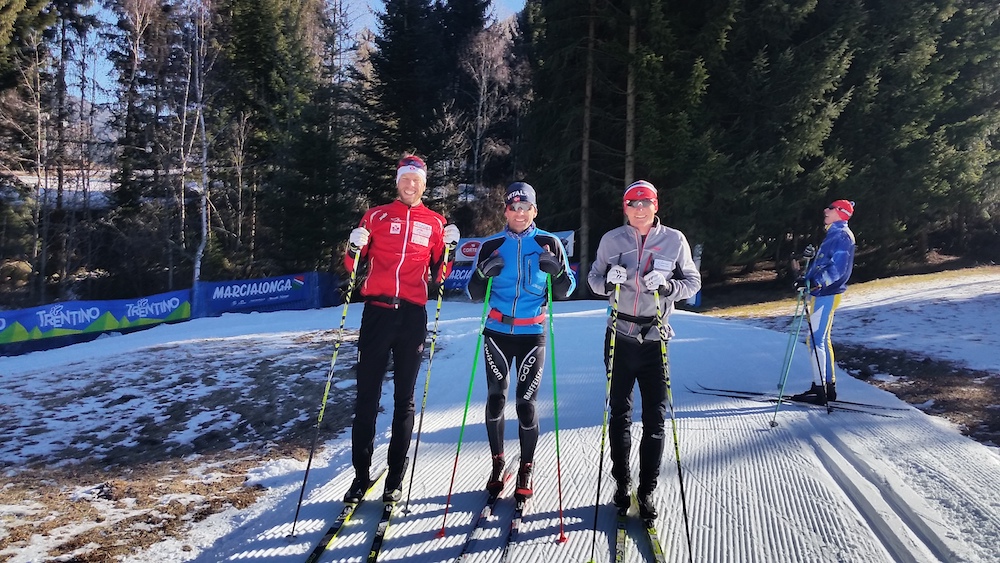
(From left to right) Erik Carleton, Jon Arne Enevoldsen and Ian Murray previewing the Marcialonga course. (Courtesy photo)
Conclusions:
So how did these five fare in the Marcialonga after all the preparation?
McKeever was the fastest of the group (and fastest Canadian), finishing the shortened 57 k course in 2:21:32.5 hours, 9:13 minutes behind the winner Tord Asle Gjerdalen for 57th overall. Nishikawa was next, 81st at +12:56, then Murray (86th, +13:37), Carleton (113th, +17:50), and Enevoldsen (160th, +22:14).
Murray was pleased with his personal best at a Ski Classics event, writing “The double pole training has worked out well. I was able to hold a hard effort for the first 50km although I faded a bit in the last 7km.”
Murray’s event highlight: “Being so close to the lead for the first part of the race. Also skiing down the streets of 4 old Italian towns along the 57km track. I didn’t get to soak in that aspect of the race during the event but rather in the pre-skis and post race ski it was fantastic.”
And how much did the double-pole preparation pay off? Considering there were 5761 finishers including many former world cup stars like Gjerdalen, Anders Aukland, Toni Livers, and Østein Pettersen, top 200 is impressive.
Norwegian Anders Host shows off the Team Leaseplan stripes on his way to 29th place. (Photo: Graham Longford)
Graham Nishikawa takes a feed. Note that bib 52 in the background is striding! (Photo: Graham Longford)
Nishikawa entering the stadium in Tesero. If the background looks familiar this is the Val di Fiemme venue used in the Tour de Ski every year. (Photo: Graham Longford)
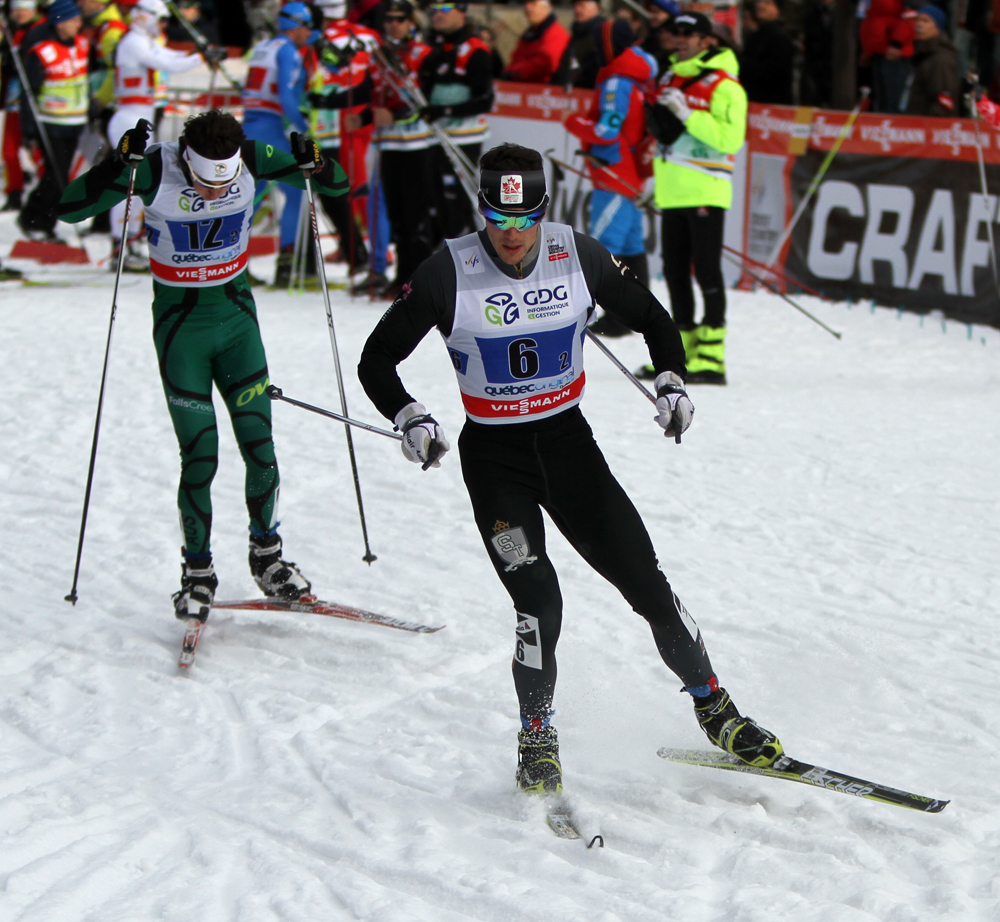
Brian McKeever jumping in front of Norway’s Petter Kaarby just before the final climb. (Photo: Graham Longford)
Tord Asle Gjerdalen (yellow bib) launching the winning attack on the final climb to Cavalese. (Photo: Graham Longford)
While the attention is on the elite skiers, thousands of people are enjoying the scenery and temporary ski tracks through the many towns on route. (Photo: Graham Longford)
Alleys and byways can be ski trails too. (Photo: Graham Longford)
‘Passeggiata’ is the evening stroll through ‘la citta’, the centre of town. Many of the skiers at the back of the group will stop in a cafe for a drink and a pastry in one of the small towns. (Photo: Graham Longford)
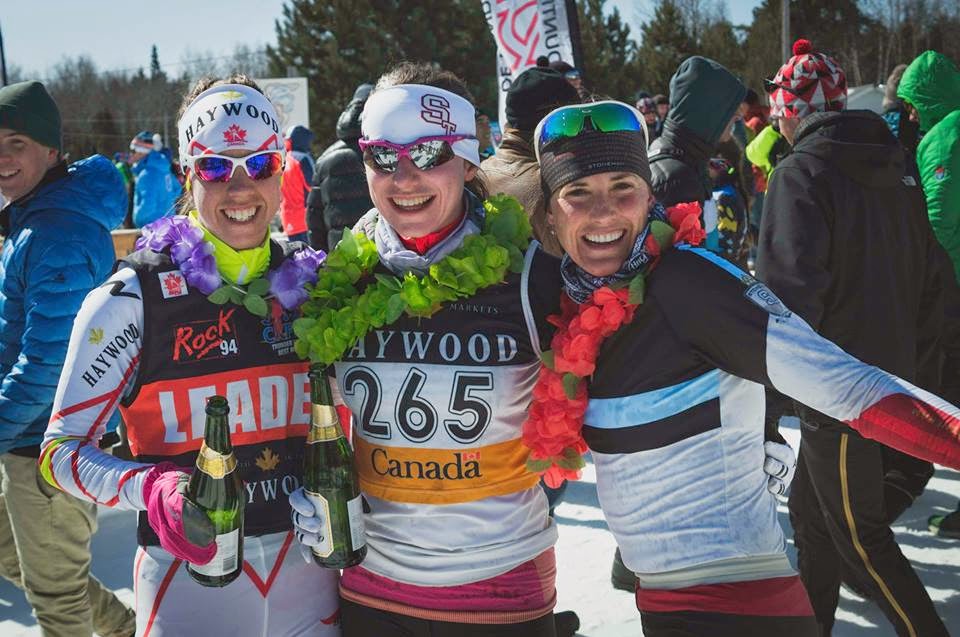
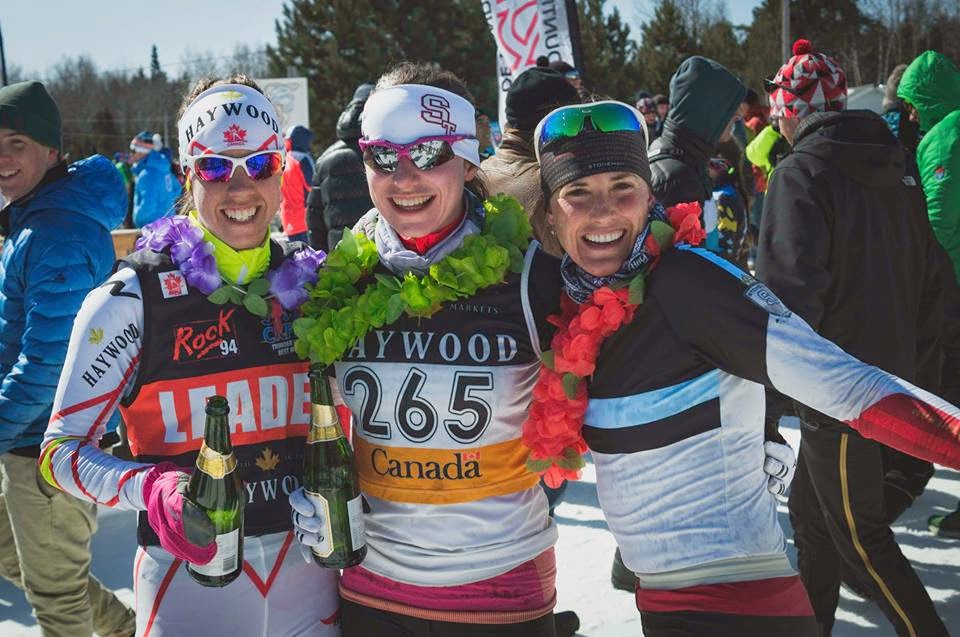
Alysson Marshall (c) with two other “retirees,” Perianne Jones (l) and Brittany Webster (r) at their last race at 2015 Canadian nationals in March. (Photo: Russell Kennedy/alyssonmarshall.blogspot.com)
After six years of skiing at the highest level — in more than 40 World Cup races, two U23 World Championships and Junior World Championships— Alysson Marshall announced on her blog this spring that she’s retiring from professional racing.
The recently engaged, 27-year-old athlete from Salmon Arm, British Columbia, decided to start a new chapter in her life, with plans to start medical school in the next few years with a focus on biology.
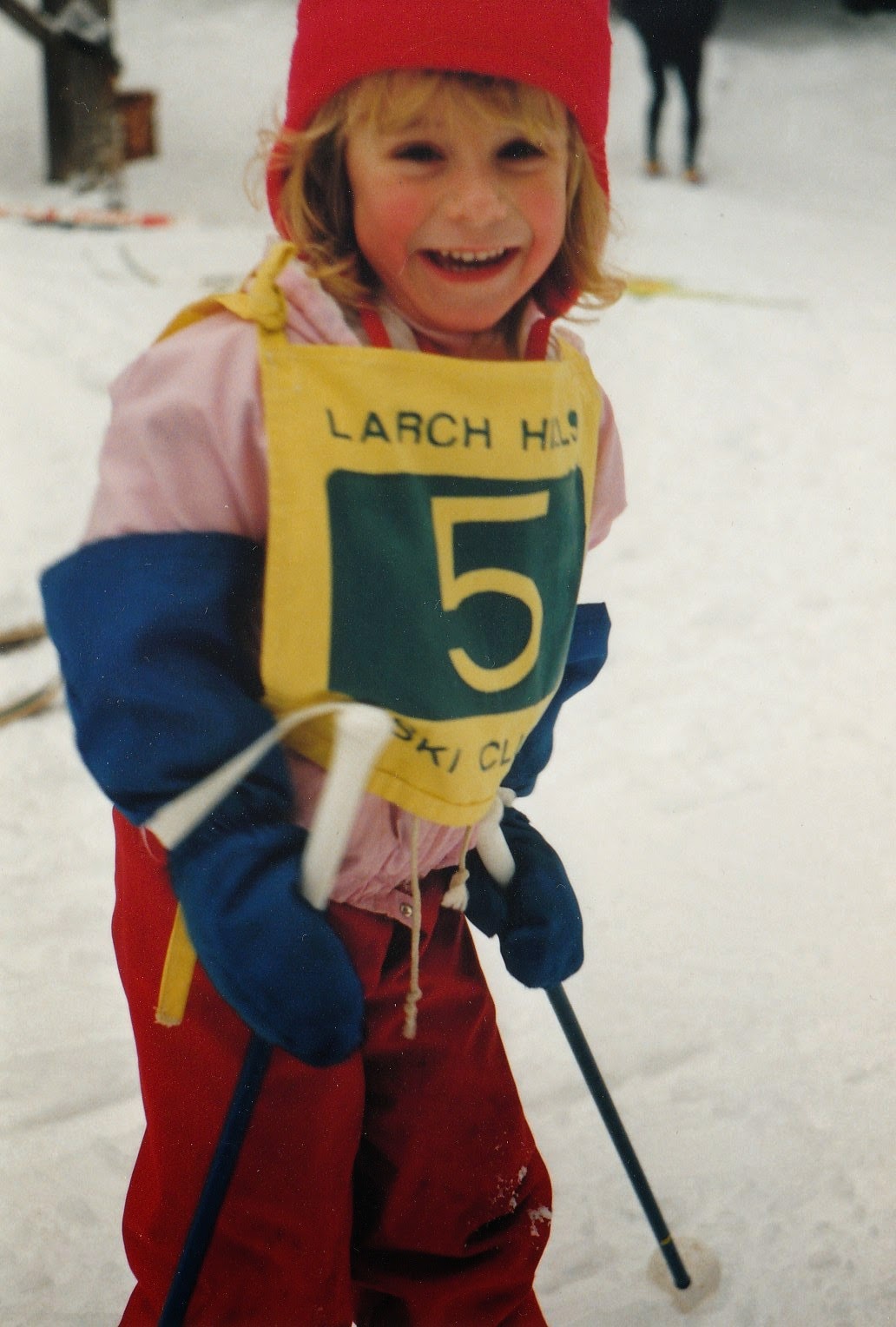
Alysson Marshall got started with the Larch Hills Ski Club. “I did my first loppet at age 4 (6km) and apparently loved it!” she wrote of this photo her blog. (Photo: alyssonmarshall.blogspot.com)
She first took up cross-country skiing on single-track trails at Larch Hills, playing in the powder before making major strides in the sport. Her move to Sovereign Lake in Vernon, B.C., and subsequently the BC Ski Team marked her more serious introduction to racing. In 2008, when the Alberta World Cup Academy was established, Marshall was one of the first to join and she remained on the national-training-centre team until the end of her career.
She was selected to the Canadian national team in 2009, after the disqualification of a Russian athlete for doping elevated her to a 12th-place result in the classic sprint at the 2009 U23 World Championships in Praz de Lys Sommand, France. She took her spot on the Senior Development Team, traveling in Europe and competing at nearly a dozen different World Cup venues over the next two years.
Health issues during the 2012/2013 season derailed her preparation for the following Olympic year. After missing the cut for the 2014 Winter Olympics in Russia, she approached her final training year and race season differently, taking two months off from skiing in the spring of 2014. While December marked a positive start and encouraging results, Marshall struggled with fatigue and saw her performances slip later last winter.
“While letting go of a dream is never easy I have come to terms with it,” Marshall wrote in mid-April. “The last few years of racing have been tough for me and although I’ve had glimpses of success, I am not consistent and there have been more tough races then good ones. I have struggled with my health and feel like I can no longer handle the level and quality of training necessary to achieve my athletic goals. I have truly learned so much from my time in the sport. The people, experiences and personal strength I have gained is invaluable and I feel like it has made me a better person.”
In an in-person interview in June at Sovereign Lake and follow-up phone interview with FasterSkier, Marshall reflected on her ski career and shared her thoughts on retiring from racing and what’s next for her.
FasterSkier: What was your favorite ski-related moment?
Alysson Marshall: [Laughs] It’s a hard question to answer, but I think I’m going to go with the World Cup [classic] sprint in downtown Stockholm [in 2012], where I got my first World Cup points in front of the Royal Palace! I loved the city and it was my best result so far. [She placed 28th.]
FS: When and how did you make the decision to retire?
AM: I think I knew mid-winter. I wanted to give myself another year after the [2014] Olympics to try to come back and see if I could get myself feeling good again. By mid-winter, I realized that that wasn’t really happening. I definitely wasn’t where I needed to be to succeed internationally, so that made the decision. I was happy to complete the season with races in Europe and end it with Nationals.
FS: You mentioned not feeling well two seasons ago — were you struggling with illness or fatigue or something else? How did you manage to recover from it?
AM: I started having thyroid related health issues in the 2012/2013 season and I feel like I never fully bounced back from that. We put our bodies under a lot of stress and I think I hit a point where my body rebelled and my thyroid was my weakest link. I may have been able to come back from that if I had given myself enough rest after that season but the next season was an Olympic year and though we adapted my training I still pushed my limits and I wasn’t able to fully recover and race at my best.
AM: It was fun! My fiancé [Chris Hamilton] was there so being with him was nice. Thunder Bay is such a great ski community. It was a great place to have my last nationals.
FS: You’ve had a pretty long career, starting as a club skier and moving up. How was the experience of working your way up to the World Cup level?
AM: It took a while for sure [laughs]. I wasn’t someone who came out immediately and was doing really well internationally. It took some time to get more confidence. I think we missed opportunities probably when I was a U23. We weren’t given as many opportunities then as we would have been today. It’s a point where I could of made a bigger jump, but with my fair amount of international experience afterwards, it was definitely a good run.
FS: How did you get from being a skier with Larch Hills to being someone who got to go to U23 World Championships?
AM: One step at a time I guess. I chose Sovereign Lake, then BC Ski team, climbing up the ladder one step at a time and kept focusing on the next big thing, whether it was nationals, world juniors or the World Cup. There was always something to go after.
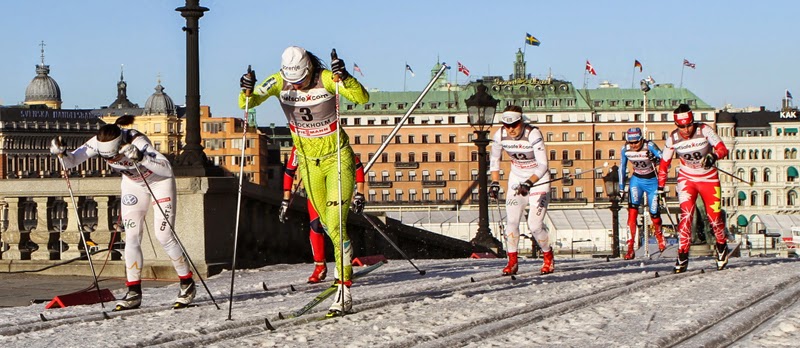
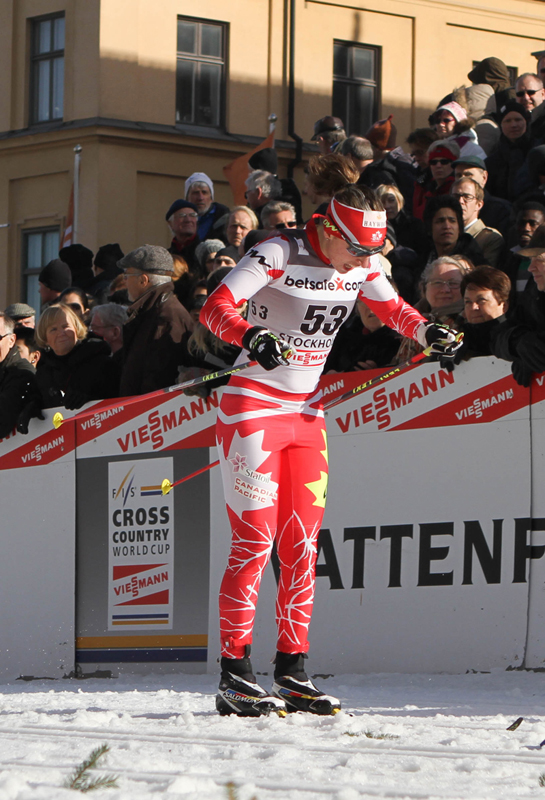
Alysson Marshall (r) racing in a World Cup sprint heat in 2012 in Stockholm, Sweden.
FS:You spent some time at various levels of the national team. How was that experience and how do you think it differed from other cohorts?
AM: I was never really part of a stand-alone national team because my cohort was always embedded into the training centre. In 2012, we had the most camps with the national team. That probably wasn’t the best setup because it’s hard being part of two different programs and switching back and forth from different coaching philosophies. The national team was there for support, but not so much for day-to-day training. It was more the [Alberta World Cup] Academy filling that role.
FS: The Alberta World Cup Academy looks like it changed a lot since last year, with people leaving, new coaches. Can you tell us anything about that?
AM: I think it’s good to have a younger team. I’m not really a fan of the way it’s been the last few years … with the B-team training outside of the academy framework. … In terms of the other older athletes, that’s more a problem with the broader Canadian skiing situation going on right on. It’s very expensive for international opportunities, and I think people are debating whether it makes sense to continue racing when the focus is completely on the next generation of younger skiers. That’s why you see so many older athletes leaving.
FS: The opportunities in Europe have changed a lot during your career, from not many to a lot, to more-again-but-you-have-to-pay. Which era do you think was working the best?
AM: Honestly, we haven’t had any success transferring anyone on the World Cup, other than last year. But really, in the entire time I’ve been racing, it has been the same group of people on the World Cup, and we haven’t transitioned many others. We haven’t figured out the correct way of doing it, so it’s kind of a hard spot we’re in right now.
FS: There was a time when senior racing really only existed on a self-funded basis. Do you see any way to get from here to a system where people can progress?
AM: It’s hard to pinpoint what the exact problem is. I think we just need to get a strong group of people that are supported and given the time to develop, instead of always having that big crunch where you have to perform at this event this year, otherwise you’re going to loose your funding or your spot on the team. Honestly, it’s more a support culture that we need, where we really believe in our athletes and we provide the framework to let people succeed.
FS: How difficult was funding your skiing career?
AM: Not easy, that’s for sure [laughs]! My parents helped me out a lot. I had a few good sponsors, with Buff Canada being my best corporate sponsor. They’ve been amazing to me, but it still wasn’t an easy thing to do! It’s hard having to rely on the family to help pay the trips. It’s not a cheap sport, that’s for sure.
FS:If you’re looking at the younger people just getting going to late teenagers, are you going to tell them to dive in and see what they can do, or start looking at the financials?
AM: That’s a hard one! I’m a big believer in doing school while skiing and making that more possible and feasible. I think that’s a good way of doing it because then, you have a few more years to see if you really want to commit and you can actually get some education when you’re done, before fully committing to the expenses of the ski world. It’s not a very encouraging environment for a 18 year old looking to become a skier. It’s a little daunting looking at the potential costs for a ski career!
FS: You headed up the Canadian Excellence Fund last season: how and why did you get involved, and how effective was it?
AM: As the NST athlete representative, I was frustrated with the expense that was being put on development athletes. It was at the point where I felt like I couldn’t justifiably advise a promising high school student to pursue skiing as the cost is so high for so long. I started the fund hoping to get community support for the development level. The fund had a late start and due to some charitable donation rules, it ended in December so we had a small window for last season. Hopefully the new marketing director for CCC will support it for next season as I think it has the potential to make a ski career more attainable for young athletes and help maintain a healthier base of strong skiers in Canada.
FS: During your ski career, how much time were you able to dedicate to school? How do you feel about how the education component is set up within the training centres?
AM: I was lucky in that I had a good setup in Vernon with their club team after high school so that when I moved to Canmore I had already completed two years of my degree at Okanagan College. I picked up some courses in Calgary in the early years on AWCA but the 1-and-a-1/4 hour commute each way made it really difficult. I am grateful that I was able to do as much as I did early on. It was always positive for me to have another focus in addition to skiing. The Eastern training centres have been doing a good job encouraging academics and I hope that all the training centres continue to move towards facilitating school, especially for younger athletes.
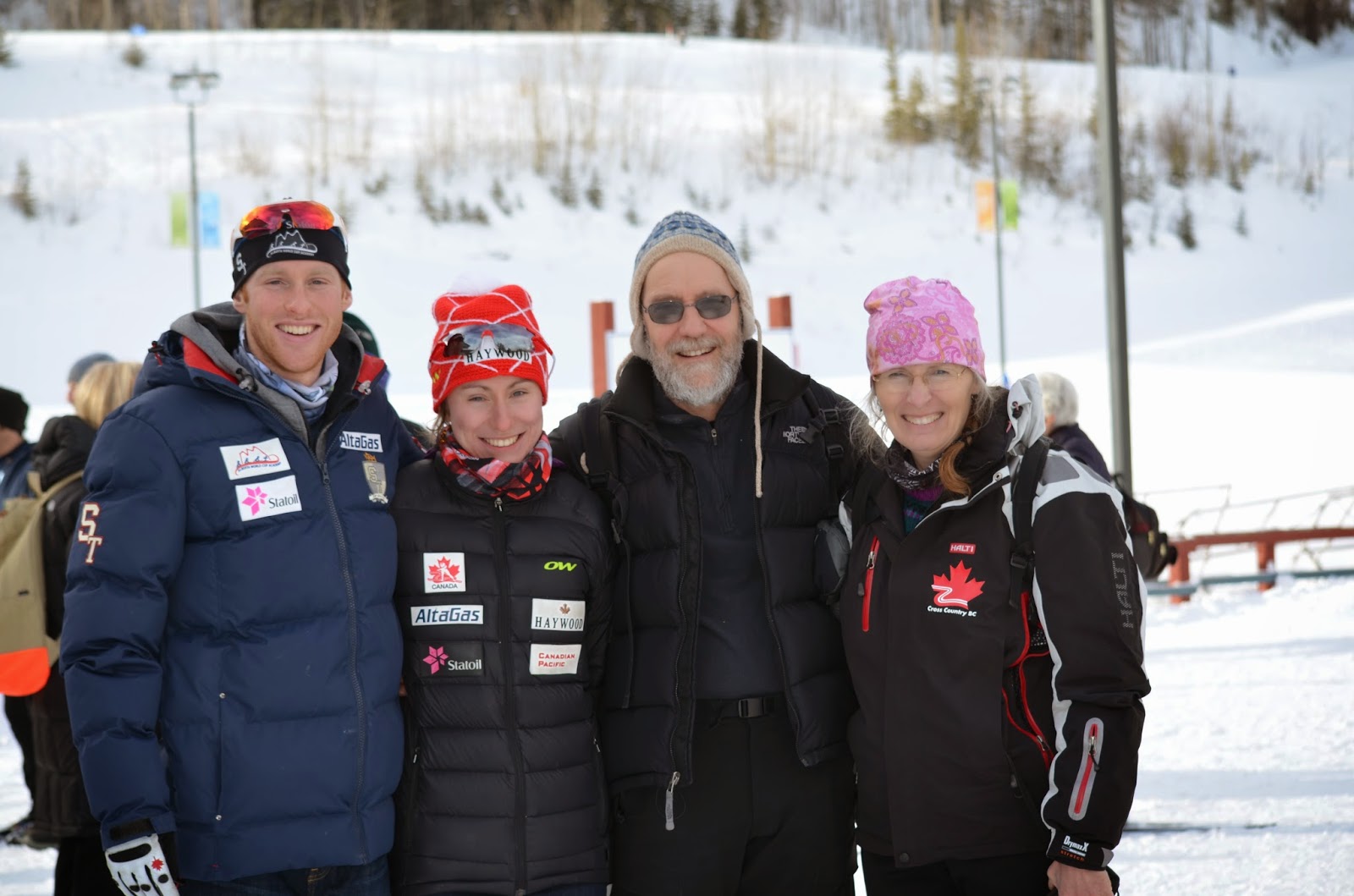
Marshall (second from l) with her support crew: her parents and fiance, Chris Hamilton (l). (Photo: alyssonmarshall.blogspot.com)
FS:Who were some of the people who had the biggest impact on your career?
AM: My parents and family, obviously! I’ve had many good coaches, from my club coach to Doug Egan in Vernon, and all the Academy coaches have been really great as well. They all had a big impact, playing a different role in my career. There’s not one that was more important than the other.
FS: What are you going to do next?
AM: I’m [taking the] MCAT [Medical College Admission Test] exam in June. I’m going back to school in Thunder Bay in September to keep working on my undergrad [in biology], and then I’ll try getting in medical school in the next two years.
FS: What sort of medicine are you interested in?
AM: Family medicine. I really like the idea of a relationship with people over their lives, rather than a specialist who doesn’t necessarily have as much follow-through with patients.
AM: I’m planning to stay involved … I wouldn’t say I’d be coaching necessarily, but I definitely want to stay involved in the clubs, maybe at the provincial level programs. Growing up, I really appreciated having national-team athletes at training camps. That made a big impact on me, so I want to try getting more involved with the next generation, especially when B.C. got some really strong results at nationals, and there are strong athletes coming up. It’s nice to actually know them instead of just seeing their names on the results list.
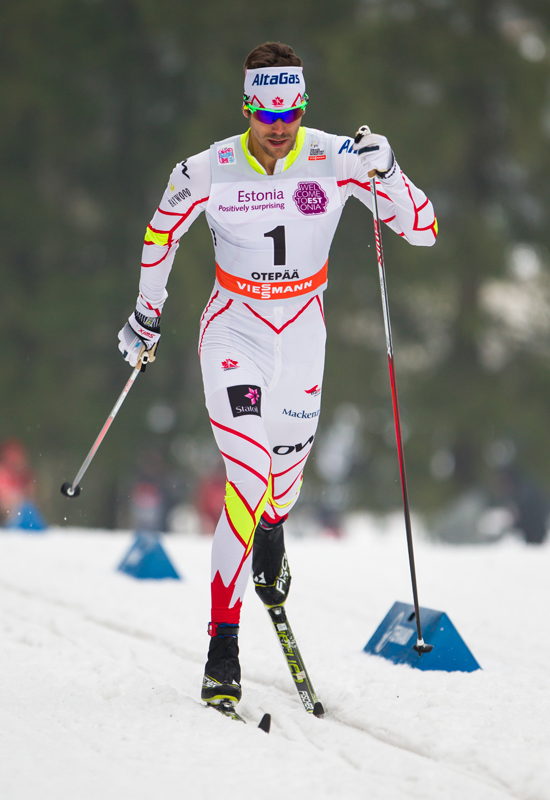
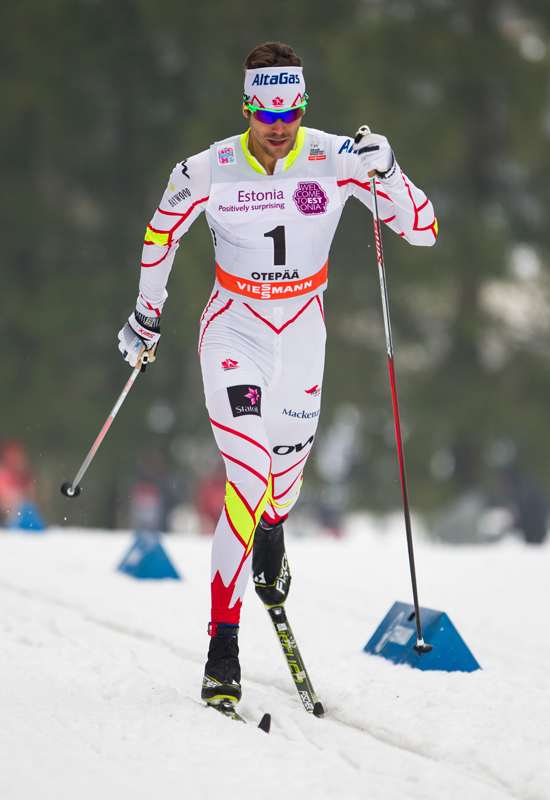
Lenny Valjas placed 45th in the men’s 1.5 k classic sprint qualifier on Saturday in Otepää, Estonia. (Photo: Fischer/NordicFocus)
In her first World Cup of the season and best result since the 2012 World Cup freestyle sprint at home in Canmore, Alberta, Alysson Marshall launched back into international-racing action on Saturday and placed 44th in the women’s 1.2-kilometer classic sprint in Otepää, Estonia.
The NorAm, or Continental Cup, leader for Period 1, she was one of two Canadian women selected to this weekend’s Otepää World Cup. The other, Perianne Jones, opted to stay home and race at Western Canadian Championships in Lake Louise, Alberta.
“It’s great to be back on the World Cup!” Marshall, 26, wrote in an email on Saturday after finishing 44th in the qualifier, 15.67 seconds back from the qualifier winner, Ingvild Flugstad Østberg of Norway, and 6.42 seconds out of the top 30 needed to advance to the heats.
Marshall, a national development-team member, most recently placed fifth in a classic sprint at last weekend’s NorAm in Duntroon, Ontario. Last Saturday after the sprint, Alberta World Cup Academy teammates Marshall, Jess Cockney and the men’s NorAm leader Patrick Stewart-Jones flew to Estonia for a Sunday arrival.
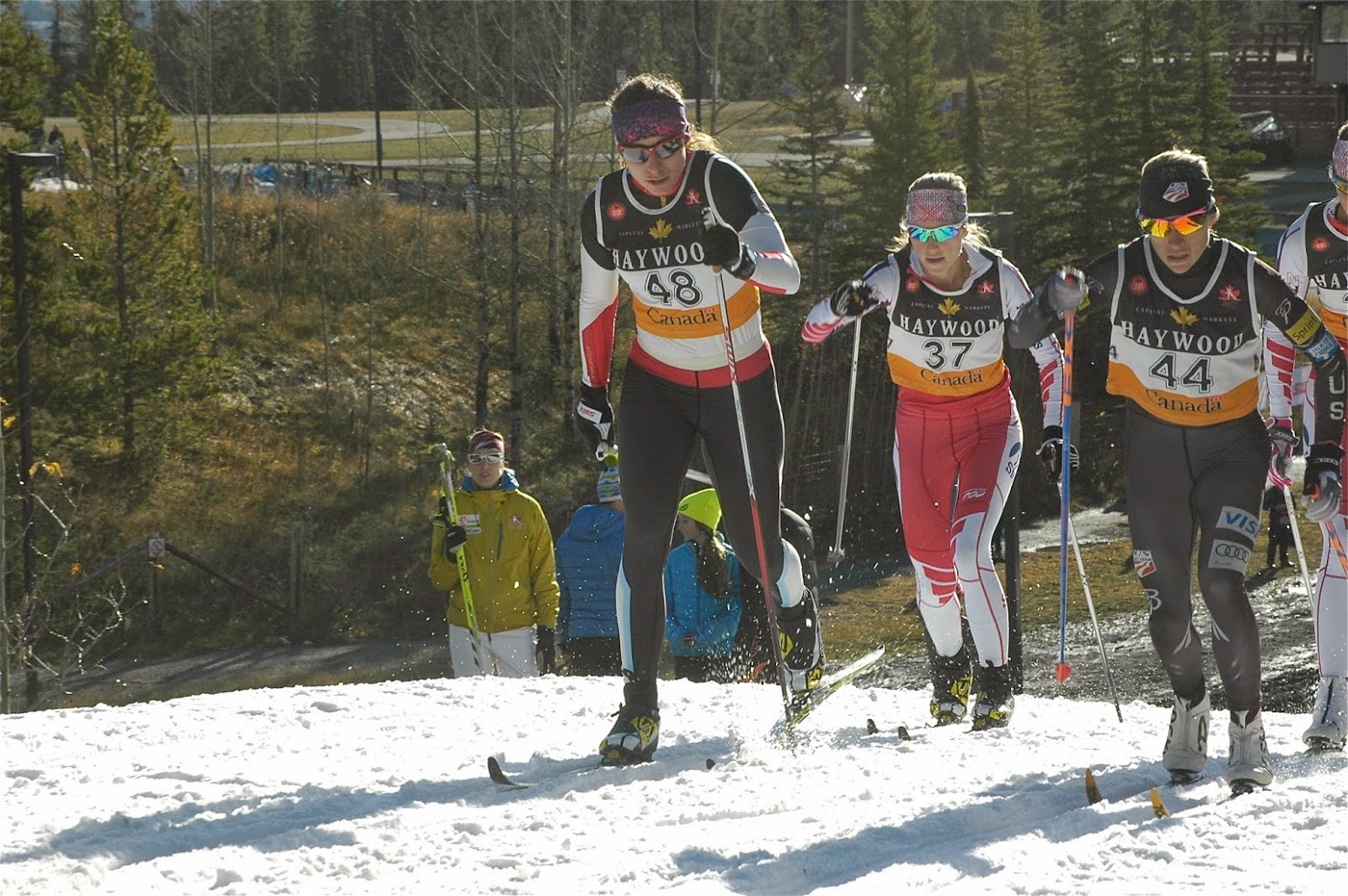
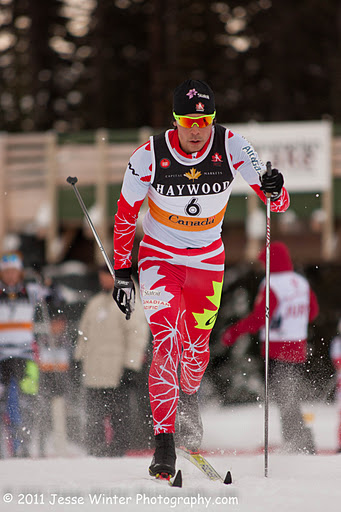
Alysson Marshall (48) racing alongside Americans Liz Stephen (44) and ahead of Erika Flowers (37) at the Frozen Thunder classic sprint on Oct. 24 in Canmore, Alberta. (Photo: Angus Cockney)
“I’m just starting to feel like I have adjusted to the time change,” Marshall explained. “I am definitely disappointed with today, I started well but body wasn’t 100% and I couldn’t maintain the pace over the top of the course. Hopefully next weekend will go better!”
Without another Canadian woman on the circuit, she won’t be racing Sunday’s freestyle team sprint. Marshall plans to next race the freestyle sprint on Saturday, Jan. 24 in Rybinsk, Russia.
Canadian World Cup Team member Lenny Valjas finished 45th in the men’s 1.5 k classic sprint on Saturday, 12.1 seconds back from the top qualifying time set by Norway’s Pål Golberg, and 3.83 seconds out of the top 30.
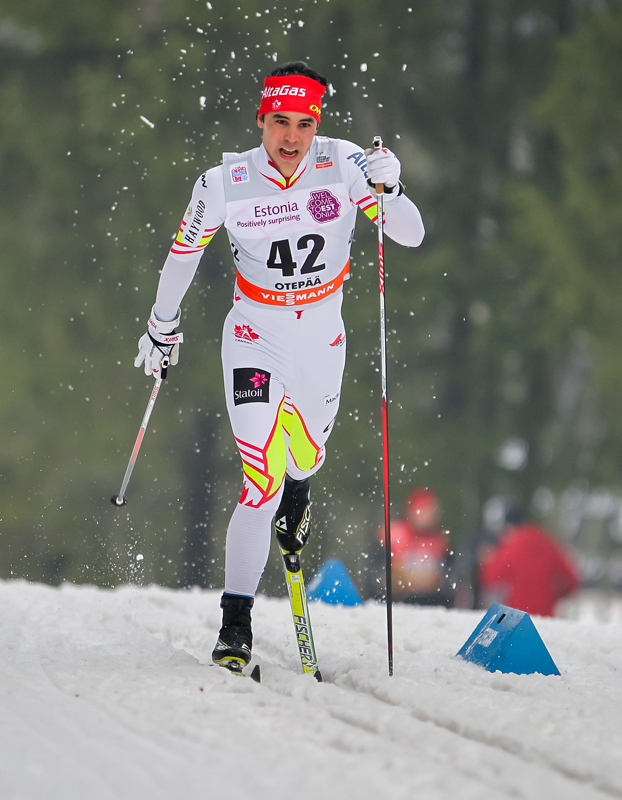
Jess Cockney placed 61st in the men’s 1.5 k classic sprint qualifier on Saturday in Otepää, Estonia. (Photo: Fischer/NordicFocus)
Cockney, of the national development B-team, placed 61st in the qualifier after winning the NorAm classic sprint in Duntroon last week. Back in 2011 in Otepää, Cockney placed 61st in a classic sprint as well.
Stewart-Jones, who was second in the Duntroon sprint, finished 62nd on Saturday in his first international World Cup, and first World Cup since 2012 in Canmore.
According to Sunday’s start list, Cockney and Valjas will team up in the 6 x 1.5 k freestyle team sprint.
Alex Harvey, Devon Kershaw, Ivan Babikov, and Graeme Killick are taking the weekend off to recover and train in Seefeld, Austria, before traveling to Rybinsk on Wednesday.
Kris Freeman on his way to winning the 30 k freestyle interval start by more than a minute and a half on Dec. 20 at the Sovereign Lake NorAm in Vernon, B.C. (Photo: Frances Weeks)
Canada’s NorAm circuit is what the International Ski Federation (FIS) calls a Continental Cup series, similar to the U.S. SuperTour. The name NorAm is short for North American, a hold-over from when Canada and the U.S. had a combined race series. These races are critical to the elite racers, with guaranteed World Cup starts, national-team positions, and trips to Junior/U23 World Championships in Almaty, Kazakhstan, on the line.
Or to put it another way, it would take a major event to cancel a NorAm race — like perhaps a record-breaking storm in a unusually snowless early season.
As organizing committees secured the final details for the first two NorAm weekends, a major storm was expected to bring heavy rain to most of southern British Columbia.
By the end of the four-day storm, a Vancouver suburb had declared a state of emergency, heavy rain at 12-degree Celsius (54 Fahrenheit) had closed numerous ski resorts across B.C. (including Whistler Blackcomb). Seattle set weather records, and 220,000 people were without power in California.
While all this was going on, organizers in La Clusaz, France, canceled their World Cup and later moved it to Davos, Switzerland, a venue which had previously avoided canceling its original race weekend because of a huge snow-moving effort largely funded by a retired alpine skier.
The first NorAm weekend this year was scheduled for Dec. 13-14, hosted by the Black Jack Ski Club in Rossland, B.C. Outside the province, Black Jack is best known as the club that produced George Grey (top-10 finisher at the 2010 Olympics) and the current home of long-time national team coach Dave Wood.
When low snow, warm weather and predicted rain made the club’s homologated courses unsuitable for skiing, the club decided to move the opening races up to the biathlon trails, more than 200 meters (650 feet) higher in elevation. As the four-day storm progressed, the freezing level was up to 2,000 meters (6,500 feet) in the area, well above the 1400-meter(4,590-foot) elevation of the biathlon trails.
When rain made the sprint loop unskiable two days before the race, the organizing committee didn’t give up. Club members, neighbours and team coaches spent hours shoveling snow onto the course. When another wave of rain destroyed the sprint course overnight, the organizing committee switched to two individual-start classic distance races and volunteers headed out again to shovel more snow onto the distance course.
After four days of rain and a move to a higher venue without electricity or a timing building, the races were held. Generators provided power, live results were available on the internet and the event was generally agreed to be up to the Continental Cup standard. Some 140 official volunteers plus an unknown number of shovelers made this possible.
“We estimate we did about 130 man-hours of shovelling this week,” Chief of Competition Ian Sibbald wrote in an email.
Unsolicited athlete quotes from the Black Jack NorAm
“The volunteer base is incredible. That is an astounding number [of volunteers] since only 3,500 people live in Rossland. Given the lack of snow, the conditions were great.” — Kris Freeman (Team Freebird)
“Conditions were good! A few twigs poking through here and there, but tracks were fast and hard. Big thanks to the volunteers and organizing committee for working hard to run these races!” — Michael Somppi (Alberta World Cup Academy/Canadian Development Team)
“Conditions were remarkable, especially considering the challenging weather the Black Jack Ski Club has been dealt. One would hardly know that though skiing the course, unless you look closely and notice all the shoveling marks on the side of the trail.” — Brian Gregg (Team Gregg/Madshus)
“Conditions were much better than I expected, the organizers and groomers did an amazing job making the race happen with tough conditions and the tracks today were great!” — Alysson Marshall (AWCA/National Development Team)
“Conditions today were amazing considering the weather … The race organizers and many volunteers from the town have worked hard to get a good track to make these races happen.” — Andrea Dupont (Rocky Mountain Racers)
“The crew at Black Jack did an amazing job on the course, it was close to perfect considering what they had to work with. The tracks were great, I was very impressed.” — Dahria Beatty (AWCA/National U23 Team)
“The course held together exceptionally well, due to the work of the volunteers and the slightly colder weather that appeared day of.” — Jennie Bender (Bridger Ski Foundation)
Callaghan Valley Cross-Country
Callaghan Valley Cross-Country (CVXC), the host of the second NorAm weekend, isn’t so much a ski club as it is a consortium of four clubs based in the Vancouver/Whistler area: Nordic Racers, Whistler Nordics, Hollyburn Jackrabbits, and Spud Valley Nordic. Squamish Nordic contributes, as do a number of other clubs from the province. For higher-level events, volunteers from other clubs commonly join in, either to add expertise to help the host club earn the event, or gain experience and knowledge so their own club can host similar events in the future.
Scheduled the weekend before the holiday break, CVXC was on track with 85 volunteers with two weeks to go. Snow is rarely a problem at Whistler Olympic Park. In 2010, no provision for snow making was made and the Olympics were held on natural snow despite a seven-week block of rain that ended a week before the Olympics started.
With very little snow and the forecast of the storm earlier this month, the organizing committee had to make a decision to commit, cancel or move the NorAm races with 12 days to go. On decision day, 100 millimetres (4 inches) of rain was forecast for the race venue.
At this point, much of the sponsorship money had been spent, hundreds of volunteer hours had been invested, and teams had booked lodging and flights well in advance.
With heavy rain falling at the venue, few people were surprised when organizers announced they were moving the races to Sovereign Lake in Vernon, B.C.
Once the decision was made, the logistical headache began. The new venue is more than 400-kilometers away, which meant the existing volunteers wouldn’t be sleeping at home. Many of the teams had booked flights leaving Vancouver on Sunday night. With two mountain passes and six-driving hours separating Sovereign from the airport, there wouldn’t be time to hold the planned events on Sunday. Moving the races to Friday and Saturday solved the travel problem, but made the volunteer issue more difficult.
At this level of competition, there are strict rules about roles and responsibilities. The assistant technical delegate, Sharon Clarke, was no longer eligible, as the new host was her home club. Clarke and the chief of competition, Sherryl Yeager, swapped roles before tackling the rest of the changes.
“Having to change the event at such a late date due to weather is heartbreaking,” Yeager, also the CVXC vice chair, explained in an email. “All the work that went into planning, arranging sponsors, maps, courses, setting up run sheets, the race notice, registration, accommodation, food, the website and more is largely of no use.”
Andrew Pohl of the New Zealand Ski Team crossing the line in 15th in the men’s NorAm 30 k freestyle interval start on Dec. 20 at Sovereign Lake, B.C. (Photo: Frances Weeks)
Sovereign Lake Nordic Club
Sovereign Lake is a perennial NorAm host, using trails built for a World Cup event in 2005. The trail system is interconnected with Silver Star Mountain Resort, which leaves most visitors a bit confused. In recent years, the division is simple: race at Sovereign, sleep at Silver Star, ski at both.
Sovereign was hosting a CPL race (one level below Continental Cup) when the possibility of moving the NorAm was raised. With 80 volunteers on site, it was easy for the organizers to quickly find out how many might be available for a potential NorAm and make the commitment to offer the venue.
The shift from Saturday/Sunday to Friday/Saturday was essential for the teams, but difficult for the organizers. More of the CVXC volunteers were unable to help and many of the Sovereign volunteers were unable to get a day off work at short notice.
Without a sprint in the first NorAm weekend of racing, Sovereign’s first day became a classic sprint, requiring another rewrite of the race notice. Ultimately, the merged organizing committee was able to get about 100 volunteers over the two days, including some from neighboring clubs.
Several racers generally viewed the event as a typical NorAm, with more comments on the challenges of heavily falling snow than the logistical obstacles of the event move.
While athletes, coaches, families, and race-day volunteers have moved on, the two organizing committees are sorting out how to share the entry fees and sponsorship money to cover their extra expenses.
The Result
After two weekends and four races, more individuals volunteered than raced. Athletes got crucial early season race time into their legs. Several athletes have positioned themselves to race in Europe later this season.
Was it all worth it? Dahria Beatty, Raphaël Couturier, Annah Hanthorn, and Philippe Boucher pre-qualified for Junior/U23 World Championships in early February in Almaty, and based on his NorAm results, Patrick Stewart-Jones earned his spot at the World Cup sprint in Otepää, Estonia, from Jan. 17-18.
American Brian Gregg (l) and Canadian Andy Shields of the Thunder Bay National Development Centre ski alongside each other in the 11 k classic individual start last weekend at the NorAm opener in Rossland, B.C. Gregg went on to place fifth and Shields was 12th. (Photo: FRESH cafe & apres/Facebook)
While the opening weekend of the U.S. Super Tour marked the start of the North American race season in late November, Canada’s NorAm circuit kicked off last weekend in Rossland with two classic distance races, held despite challenging conditions and a lack of snow.
The second stop of the NorAm circuit was originally scheduled for Whistler this Friday and Saturday, but once again, warm weather and insufficient snow led the races to be moved further inland to Sovereign Lake in Vernon, British Columbia, better known as Silver Star.
This season, the NorAm will visit six venues, wrapping up at the Lappe Nordic Centre in Thunder Bay, Ontario, for Canadian Ski Nationals. The circuit attracts many of the most competitive Canadian and American domestic cross-country skiers, juniors and seniors alike, all trying to earn their stripes and log top results in an effort to get to Europe.
Canadians Alysson Marshall and Heidi Widmer, teammates at the Alberta World Cup Academy (AWCA) in Canmore, Alberta, and on the national development team — also based in Canmore, started the winter off with strong results at the SuperTour opener in West Yellowstone, Mont. Marshall won the first sprint of the season, and Widmer placed second.
In the 10 k freestyle the next day, Widmer again broke into the top 10 with a ninth-place finish, and Marshall finished 17th.
Patrick Stewart-Jones (AWCA), Bob Thompson (Thunder Bay NDC), Michael Somppi (AWCA/NST D-team), and Andy Shields (AWCA) were among several Canadians racing in West Yellowstone. There, Shields made the sprint A-final, but finished sixth after breaking a pole. In the 15 k, Stewart-Jones led the Canadians in 17th.
One week later, Stewart-Jones emerged as the winner of the classic sprint in Bozeman — the second SuperTour stop in Montana. Marshall placed fifth in the women’s A-final, and the next day in the 10 k classic mass start, she finished 14th, just ahead teammate Dahria Beatty (AWCA/NST U23) in 15th. In the men’s 15 k classic mass start, Somppi was the top Canadian man 13th.
Rossland’s opening NorAm races challenged organizers with difficult conditions, but quality racing still took place thanks to the hard work of the staff and volunteers. Warm weather and rain previously wreaked havoc on the snow, but below-freezing temperatures last weekend made for hard-packed, icy conditions for the two distance races. Leading up to the races, organizers ruled the course unsafe for a sprint and added another classic distance race to the schedule instead.
Yukon’s Annah Hanthorn racing to third on the opening day of the 2014/2015 NorAm season, in the women’s 7.5 k classic in Rossland, B.C. (Photo: FRESH cafe & apres/Facebook)
Marshall swept both races, as did American Kris Freeman. Somppi hit the podium in third in last Saturday’s 11 k classic, and was again the top Canadian in fourth in the following 15 k classic. Andrea Dupont (Rocky Mountain Racers) placed second to Marshall in the 7.5 k sprint on Day 1, and junior Annah Hanthorn (Yukon Territory Ski Team) placed third, then second in the women’s 11 k on Day 2.
Following an Olympic year, there have been some shifts in the key Canadian players: Dasha Gaiazova, Amanda Ammar and Zoe Roy were three of the nation’s top women last season and retired this spring. Graham Nishikawa, the reigning overall men’s NorAm leader, has re-committed his focus to guiding Canadian Para-Nordic teammate Brian McKeever at International Paralympic Committee (IPC) World Cups and 2015 World Championships.
Many of the top athletes are aiming for top results in order to qualify for later World Cups, U23 and Junior World Championships, and potentially senior World Championships in Falun, Sweden.
“Making the transition from domestic to World Cup racing is what everyone on the development team is trying to achieve, me included,” Somppi wrote in an email. “Experience is certainly helpful. The more international racing you do, the more comfortable you get with it and the better you perform.”
Women to Watch
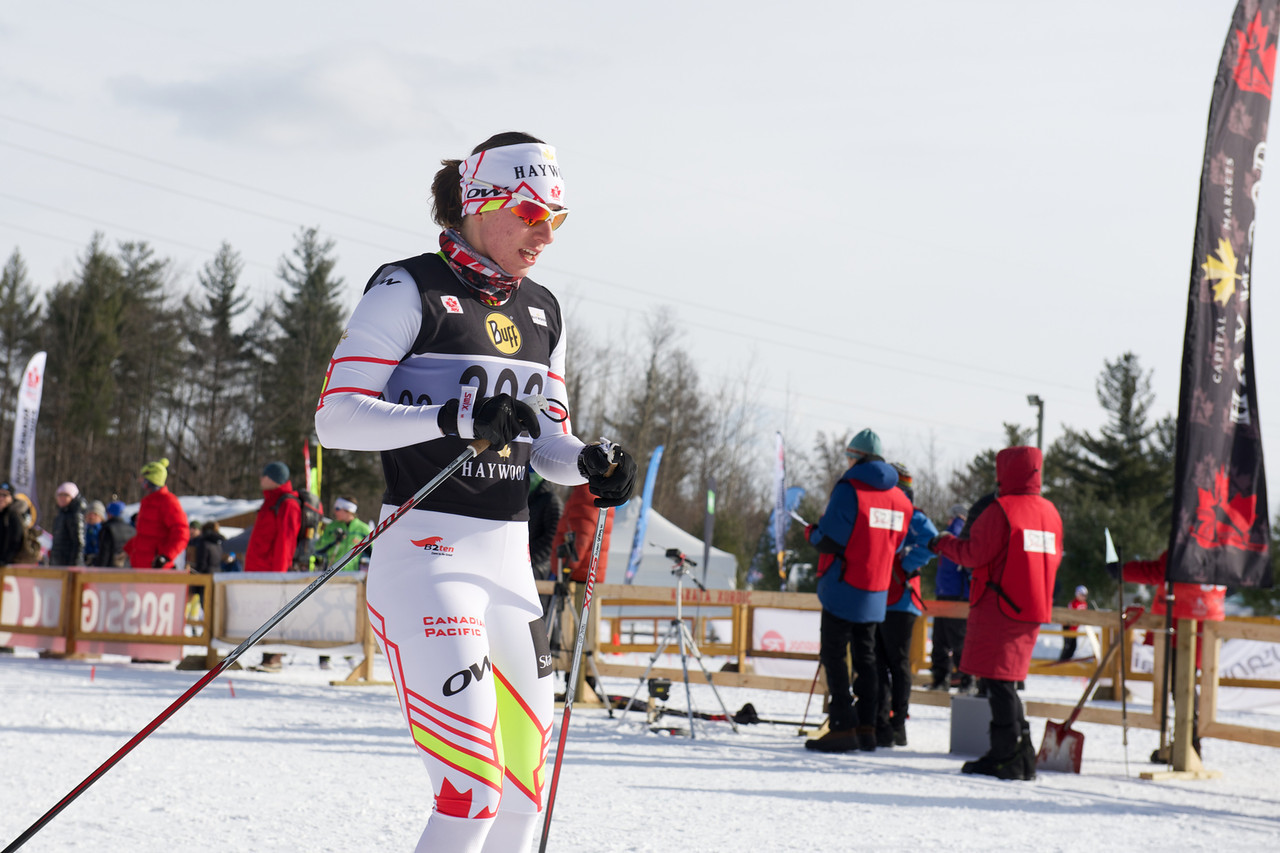
Alysson Marshall at the last season’s Canadian Eastern Championships in Cantley, Quebec. (Photo: Canadian Eastern Championships)
Heidi Widmer (AWCA/NST D-team) – With last year’s overall NorAm cup winner Emily Nishikawa starting her season in Europe on the World Cup, Widmer is one favorite in the running for an overall NorAm title this season.
The 23-year-old Sochi Olympian already has a podium under her belt from West Yellowstone, where she also posted the fastest women’s qualifying time in the sprint. In late October before the season officially started, she qualified fourth in the Frozen Thunder classic sprint among U.S. Ski Team members and other top Canadians, and then edged Nishikawa in the distance skate to finish ninth.
Alysson Marshall(AWCA/NST D-team) — In six races so far this season, Marshall, 26, has won half of them. Marshall and Widmer have already been battling back and forth; neither has beaten the other in consecutive races this season (although Widmer did not race in Bozeman or Rossland). Marshall, 26, has been consistent in distance and sprinting, a critical asset in the run the overall NorAm title. Last season, she finished third in the NorAm standings behind Nishikawa and Widmer, respectively.
Dahria Beatty (AWCA/NST U23 team) – One of the youngest threats on the circuit, Beatty, 20, is a first-year senior who proved as early as the Frozen Thunder classic sprint that she’s able to ski with the best. There in October in Canmore, she qualified second behind former Olympian Perianne Jones.
Andrea Dupont (Rocky Mountain Racers) – After finishing fifth overall in the 2013/2014 NorAm (behind Ammar in fourth), this 34-year-old distance veteran is looking to lift herself to World Cup starts.
A sprint specialist, Dupont stressed in an email the importance of dominant qualifiers, while adding that racing well in the heats and advancing throughout each round is important as well. But more than anything else, she wants better qualifiers than last season.
“It isn’t enough to just get into the heats in Canada; you have to win the qualifier here if you want to have a chance of qualifying in Europe,” she explained.
Despite her sprinting preference and sickness early in the season, Dupont claimed second place in Rossland’s 7.5 k classic race.
Cendrine Brown (CNEPH/U23) – This 21-year-old member of the Pierre-Harvey Training Centre (CNEPH) in Quebec, made the junior-national team last season and competed at U23 World Championships in Val di Fiemme, Italy.
This year, after focusing on speed to improve her sprinting, Brown has already recorded fourth- and sixth-place finishes in Rossland, and will continue to shoot for another U23 World Championships in Almaty, Kazakhstan. The first three NorAm weekends serve as trials for Canada’s U23 and World Junior teams.
Brittany Webster(AWCA) — A two-time Olympian and veteran to high-level racing, Webster, 27, started her season off in 15th in the Bozeman classic sprint. She didn’t race in Rossland, but Webster has been busy this offseason; competing in her first off-road triathlon World Championships, where she won the amateur division.
Also this fall, she launched a pursu.it crowd-funding campaign in September and has raised over $19,500 to help cover the cost of what she anticipates to be an expensive international race season.
Men to Watch
Michael Somppi (AWCA/NST D-team) racing in the Frozen Thunder classic sprint on Oct. 24. (Photo: Angus Cockney)
Michael Somppi (AWCA/NST D-team) – Third overall in the NorAm last season; Somppi, 26, is eager to build on his past performances. For now, he’s focused on superb racing before the end of December.
“At this point in my ski career, I’m 26 and if I want a shot at being a World Cup competitor I need to be able to podium at home,” Somppi wrote in an email. “So every time I step on the start line I’m looking to finish on the podium.”
He was the top Canadian in both classic distance races in Rossland last weekend, claiming a bronze medal in the 11 k classic and finishing fourth in the 15 k.
Raphaël Couturier (CNEPH/U23) – In August, Couturier, 21, was the only Canadian not part of the World Cup Team invited to come down from Quebec to train with the team at a dryland camp in Stratton, Vt. He ranked fifth overall in the NorAm last year, and has started the season in seventh and 10th in Rossland.
Patrick Stewart-Jones (AWCA) – Wrapping up the 2013/2014 NorAm season in sixth overall, Stewart-Jones, 23, will be looking to improve his placing. Last winter, he posted some of his best results of the season at Canadian Olympic Team trials in Janaury (where he was third in the freestyle sprint and sixth in the 15 k classic), and was able to race at U23 World Championships as well as Scandinavian Cups in Latvia and Estonia.
In six races, he has two top 10’s: one win and an eighth-place finish in the 11 k classic last weekend.
Knute Johnsgaard(Independent) – Likely one of the biggest dark horses at the beginning of this season, Johnsgaard spends most of his training hours without company in the Yukon.
Despite his training partner leaving for school, having limited time with his coach, and developing his own training plan with the help of Graham Nishikawa, Johnsgaard is confident in his training, the work he has done and how it will translate on the tracks.
“I’m always really focused and motived to just get out and go by myself,” he explained. “It’s a little lonely sometimes but I don’t need anybody to ‘push’ me.”
Johnsgaard, 22, added he likes being off the radar and not having anyone knowing how his training is going. To that end, he joked that he’s won every single time trial he’s done this year. He’s hoping to continue this streak and claim victories at NorAm races.
Andy Shields (Thunder Bay NDC) – Last season, Shields finished ninth overall on the NorAm, yet his early season results indicate he’s had a successful summer of training that could put him closer to the top overall this time around. So far, the 23 year old has posted two sixth-place results: first in the West Yellowstone sprint and also in the 15 k classic last weekend.
Wild Cards
World Cup Academy teammates Kevin Sandau (NST D-team), Jesse Cockney (B-team), and Graeme Killick (B-team) were among the most competitive on the NorAm circuit last season, finishing second, fourth and seventh overall, respectively. Cockney and Killick earned Olympic spots for Sochi based on the mid-season NorAm races and all three have started their seasons on the World Cup in Europe.
In an email, Sandau described his excitement to race on the World Cup and some of his expectations: “Davos is a very unique race and I think it plays well with my strengths with it being a longer distance and a course with longer climbs than most other world cups,” the 26 year old wrote. After some tuneup FIS races in Switzerland earlier this month, he placed 70th in the 15 k classic last weekend in Davos.
“At the end of the day it really is the final result that counts, but more than anything I want to cross that line and just have that feeling of it being the perfect race,” he wrote.
Multiple-time Paralympic gold medalist, Brian McKeever races to 13th in the Rossland NorAm 11 k classic on Dec. 13. (Photo: FRESH cafe & apres/Facebook)
Last year’s overall NorAm leader, Graham Nishikawa is backing away from domestic racing to fulfill his commitments to the Para-Nordic Tea, although he confirmed he would take part in one or two NorAms to prepare for IPC World Cups. Despite the races not being his focus, Nishikawa, 31, is a potential treat if he makes it to the start line.
His younger sister Emily matched him as the women’s overall NorAm winner last season. She is currently racing on the World Cup, where she posted a career-best 29th last weekend in Davos.
“The major difference between racing on the World Cup and domestically is the depth of the field,” Emily Nishikawa explained in an email. “If you lose a few seconds, you will lose a few places as well. This probably won’t happen when racing domestically because the field is just that much smaller.”
Annah Hanthorn and Maya MacIsaac-Jones, both 19-year-old juniors, finished third and fifth respectively in last weekend’s 7.5 k classic (and Hanthorn was second in the following 11 k classic). Then there’s always Perianne Jones, a perennial World Cup staple, who could make NorAm waves should she return to Canada.
Already, it’s shaping up to be another exciting year of racing. Some athletes are most competitive in distance races, others sprinting, and a myriad of possible contenders can take the victory on any given day. Stay tuned for NorAm updates via the Continental Cup blog: http://blogs.fasterskier.com/continentalcup
Jennie Bender of the local Bridger Ski Foundation (r) leads Stratton’s Erika Flowers (second from l) and Cendrine Browne (l) into the stadium during the second quarterfinal of the women’s 1.5 k SuperTour classic sprint at Bohart Ranch near Bozeman, Mont. Bender went on to place second to APU’s Rosie Brennan in the women’s final.
BOZEMAN, Mont. — On a 45-degree day with spring-like conditions, Rosie Brennan of Alaska Pacific University (APU) cruised to first place in the women’s 1.5-kilometer classic-sprint final at Bohart Ranch on Saturday, the first day of the Bozeman SuperTour.
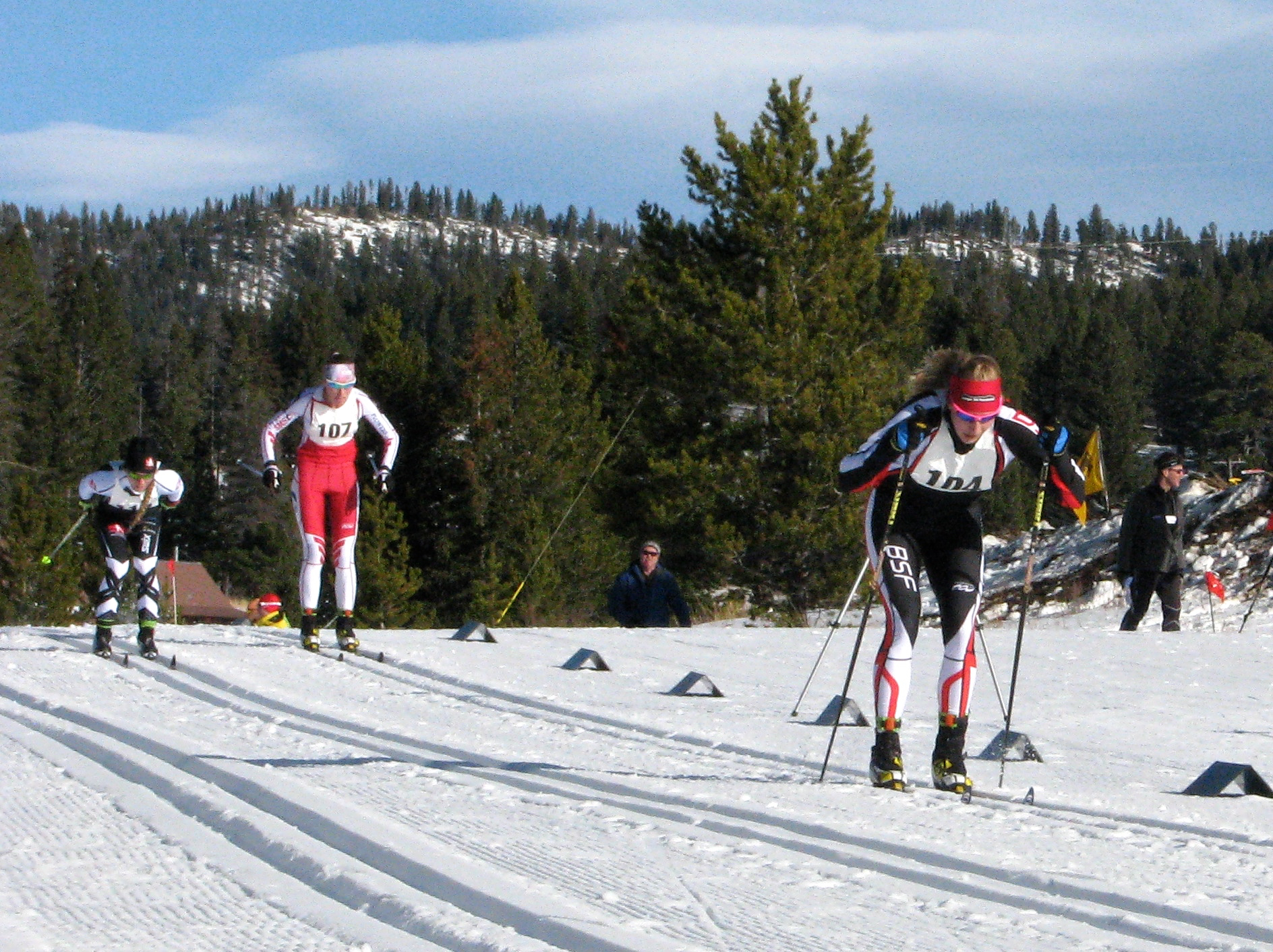
While 26-year-old Brennan crossed the line in 3:55.83, a small crowd cheered for Jennie Bender of the local Bridger Ski Foundation (BSF) as she powered her way to second, 5.4 seconds behind Brennan, for her second-straight podium in as many SuperTour sprints. Caitlin Patterson (Craftsbury Green Racing Project) took the final podium spot in third, 9.44 seconds back.
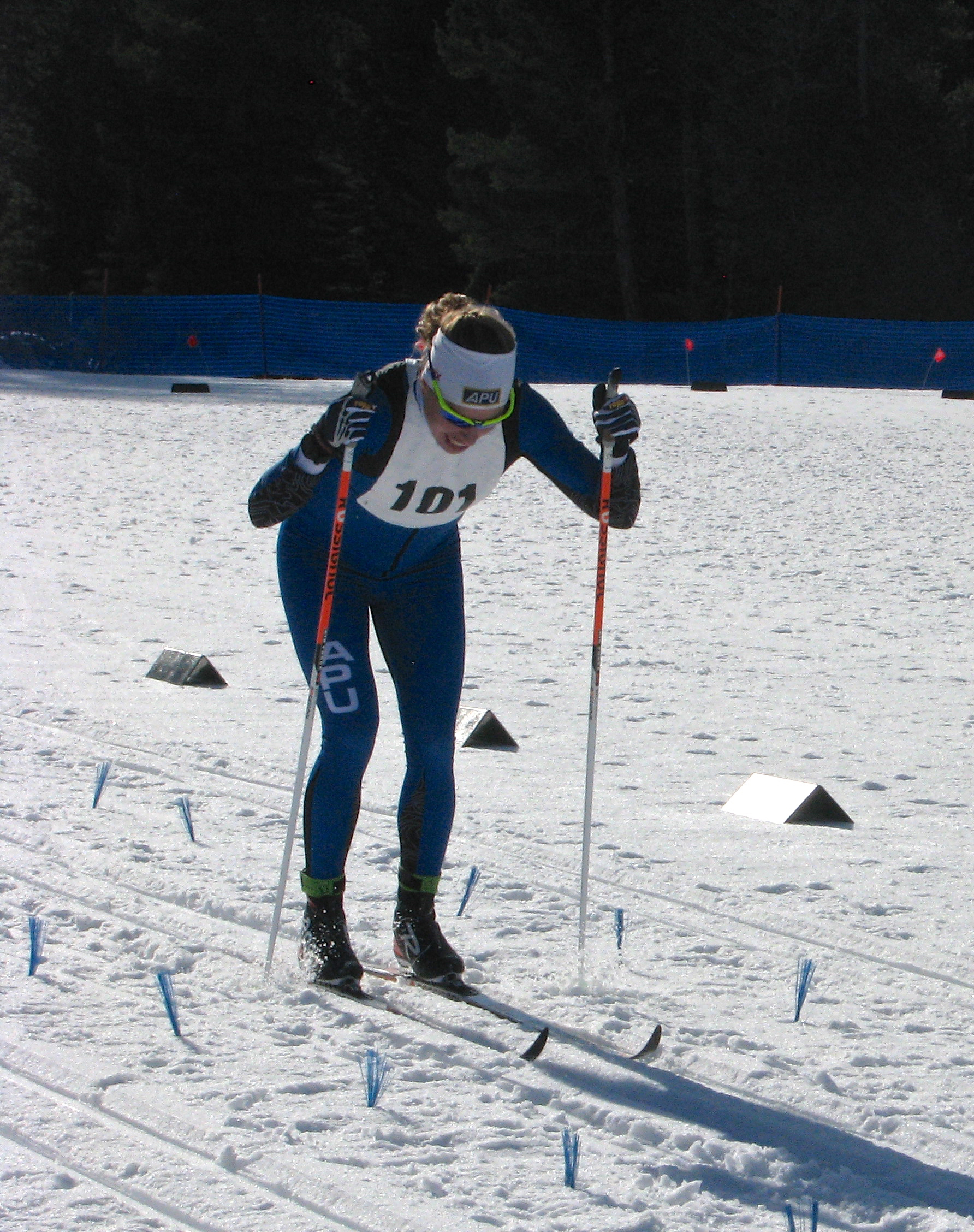
Patterson placed fourth in last weekend’s SuperTour 10 k skate in West Yellowstone, Mont., the distance opener of the season, which Brennan won. Rounding out the final was Russian Natalia Naryshkina (CXC Team) in fourth (+17.35) and Alysson Marshall (Alberta World Cup Academy/National Development Team) – who won last week’s West Yellowstone SuperTour skate sprint – in fifth (+17.40). Becca Rorabaugh (APU) was relegated to last in the final and sixth overall based on a jury decision.
Rosie Brennan (APU) double poling to first in the women’s SuperTour classic-sprint final at Bohart Ranch near Bozeman, Mont.
Unofficial results following the race had listed Rorabaugh in fourth after Patterson. But a jury decision relegated her to last in the final for sixth.
According to Rorabaugh, she found that it was faster skiing outside the tracks and was double poling between the tracks through the upper stadium.
“As I was double poling next to the tracks, I turned too aggressively into the upper hill, and course officials decided it was worth bringing up,” she wrote in an email. “The funny part is that it wasn’t advantageous for me; in retrospect I should have been striding to try and accelerate into the hill. People say you learn something new every day, and now I really know how I should ski that transition!”
“Since technical limits aren’t actually the ones that we’re supposed to push as skiers, and I crossed the line on that one, it makes sense that I was relegated to the back of the A final,” she added.
After the clear-cut win, Brennan said her strength is “working the uphill sections,” and the difficult, hilly Bohart course certainly played to her advantage. She explained her strategy was to use her strengths “to tire people out and then just go for it.”
Brennan’s tactics were effective, as she was the top qualifier by 0.53 seconds over Marshall in 3:51, and Brennan went on to win her quarterfinal and semifinal. In the final, she grabbed the lead from the start and maintained it throughout the race, while none of the other skiers could match her speed and strength.
Brennan said she had fast skis and was not too worried about being caught on the course’s downhill sections, which included a steep hill halfway through the course that was immediately followed by a sharp, precarious curve. This curve gave skiers trouble throughout the day, particularly during the qualifier before the sun rose over the mountains and icy patches were still present.
Patterson was one of those skiers who had a close call.
“In my qualifier, I went way past the V-board and didn’t make the turn very well,” she said. “I think two people had to jump out of my way.”
Patterson managed to qualify in 11th before successfully navigating her way to the final (after placing second to Brennan in the quarterfinal and third behind Brennan and Bender, respectively, in the much-faster semifinal). After all that, Patterson was satisfied with third.
“I’m getting a lot better at sprinting than I used to be, and typically it wasn’t exactly my forte,” she said. “But I had a good fight with the other competitors and I’m pretty happy with how I did.”
Patterson recalled being in fifth or sixth after the first downhill and going into the first uphill, but switched tracks and passed a few others on the inside of a corner. By the time the group reached the halfway point – the tall hill before the steep downhill section – Patterson was third behind Bender, and the two would remain in those positions through the finish.
Ultimately, no one was able to catch Brennan.
“[She] was really good today, just about untouchable,” Patterson said.
Caitlin Patterson (Craftsbury Green Racing Project) in qualifying. She went on to place third in the women’s Bozeman SuperTour classic-sprint final.
Bender was excited about her second-place result and said she’s looking forward to “battling it out” with Brennan in the future. “She’s looking strong, and I was psyched about how our final heat flew,” Bender said.
Starting on the outside, she said she was “boxed out” right away and pushed to the back of the pack. However, she “punched it on the first hill” and spent the rest of the race trying keep up with Brennan.
Unsurprisingly, there was a lot of hometown enthusiasm at the finish for Bender. “It’s so fun with all the home crew … a lot of people cheering me on, that means a lot,” she said, smiling.
Despite her strong finish, she explained that she has a lot of work to do moving forward, and that there is always something she can change or improve upon.
“I was psyched about today, but it’s just the tip of the iceberg,” she said.
The Bozeman SuperTour continues on Sunday with the 10 and 15 k classic races at Bohart Ranch.
Ida Sargent racing to a career-best fifth in the classic sprint at the World Cup opener last Saturday in Kuusamo, Finland. She placed 51st in the 10 k classic the next day. (Photo: Fischer/Nordic Focus)
Ruka and West came and went like the went, but the biathletes are just getting things going in Östersund, Sweden. The 2014/2015 International Biathlon Union (IBU) World Cup season kicked off Sunday with the mixed relay, where the U.S. pulled out its best performance in the last several years in seventh.
And Susan Dunklee, Annelies Cook, Tim Burke, and Lowell Bailey were just 17 seconds off fourth.
“I don’t remember our exact place here last year, but we definitely weren’t that close to a podium finish,” Burke said. “We were in it all the way until the end. It gives us good confidence going forward.”
The men get after it again in Östersund on Wednesday in the 20-kilometer individual race, starting at 17:15 CET (11:15 a.m. EST). The women’s 15 k individual will be held Thursday at the same time.
But before we launch into more biathlon, then more cross-country World Cup in Lillehammer, Norway (with three days of action Friday through Sunday) and SuperTour stop No. 2 in Bozeman, Mont., here’s what happened in the last week — starting with West Yellowstone on Friday, Nov. 28.
Dakota Blackhorse-von Jess holds off Mads Strøm during the A-final of the SuperTour men’s skate sprint in West Yellowstone, Mont. (Photo: Toko)
Things got a little stalled on Day 1 at the Rendezvous Trails with timing, but at the end of the day, Dakota Blackhorse-von Jess and Alysson Marshall emerged as the definite winners.
“West Yellowstone’s a hard place,” Blackhorse-von Jess said of the early-season race, after edging the University of Colorado’s Mads Strøm by 0.9 seconds in the men’s skate sprint. “I’m tired, everybody’s tired.”
Then there were two Canadian women that dominated the women’s sprint: Marshall in first and Heidi Widmer in second, teammates on the Alberta World Cup Academy and Canadian National Development Team. Marshall won the 1.5 k final by a boot length.
Day 2 saw Rosie Brennan outlast 17-year-old Katharine Ogden in the women’s 10 k individual start, and the win meant everything to her after facing some tough times this summer. In the men’s 15 k, Matt Gelso put himself in contention for domestic World Cup starts in just over a month with a nearly 10-second win over Brian Gregg.
The International Ski Federation (FIS) Cross-Country and Nordic Combined World Cup seasons also got rolling last weekend at the Ruka venue in Kuusamo, Finland. There, Ida Sargent was the biggest thing going for North America after a career-best fifth in the classic sprint — the U.S. Ski Team’s first race of the season. The next day, Sadie Bjornsen skied to 17th to lead the Americans in the opening 10 and 15 k distance races.
“Finland loves Ida Sargent and I know that Ida loves Finland!” former U.S. Ski Team member Holly Brooks wrote on Facebook. “So impressed w/ @sadzarue who skis fast & studies hard! Currently presenting senior thesis while racing WC in NOR!”
Alex Harvey put down two top-15 performances for Canada, including seventh in the 15 k classic, and teammate Devon Kershaw wasn’t far behind him in 14th on Sunday. Canadian development-team member Emily Nishikawa struck a career-best World Cup result in Europe, placing 38th in the 10 k.
Noah Hoffman did not finish a race for the first time in his career after crashing hard off the trail and into a fence with slightly less than 2 k remaining in the 15 k. After seeking immediate medical attention, he learned he broke his fibula, according his blog post, and headed home to the U.S. on Monday for further evaluation.
Also in Ruka, the NoCo guys got after it in the large-hill individual competition and team sprint, where Bryan Fletcher led the U.S. in 17th on Day 1 and was 13th with brother Taylor Fletcher on Sunday.
Alysson Marshall (AWCA/NST) in bib 4 and Heidi Widmer (AWCA/NST) in bib 1 lead (from l-r) Rosie Brennan (APU), Eva Severrus (UNM), Chelsea Holmes (APU) and Jennie Bender (BSF) in the women’s A-final of the 2014 West Yellowstone SuperTour freestyle sprint. Marshall won the event with Widmer and Bender finishing second and third.
WEST YELLOWSTONE, Mont. — Alysson Marshall had plenty of opportunities to practice her finishing lunge in Friday’s SuperTour freestyle sprint in West Yellowstone.
The Canadian National Development Team member, who skis for the Alberta World Cup Academy (ACWA) in Canmore, Alberta, barely earned an automatic qualifying spot in her quarterfinal after outlunging Stratton Mountain School (SMS) T2 skier Erika Flowers for second place in the heat.
Alysson Marshall (AWACA/NST) racing to a fourth place finish in the qualification round of Friday’s SuperTour freestyle sprint in West Yellowstone, Mont. Marshall went on to win the event.
In the semifinal, Marshall was neck-and-neck with University of New Mexico’s Eva Severrus, but was able to eke out a position in the A-final despite finishing in fourth behind her competitor. Both Severrus and Marshall earned the lucky loser positions as their times were faster than the second semifinal’s third-place finisher, Becca Rorabaugh of Alaska Pacific University (APU).
When it came to the last heat of the day, Marshall positioned herself in third for most of the A-final. When she reached the finishing stretch into the stadium, however, she surged past APU’s Chelsea Holmes to go head-to-head with fellow AWCA and Canadian national team member Heidi Widmer. As the two approached the finish, Marshall did what she had been doing all day and lunged for the win.
Her practice paid off as she edged Widmer by 0.28 seconds.
“In sprint races, I tend to get stronger as it goes on, so I felt good in the final and had enough in the final kick,” Marshall said.
Marshall, who has competed in both the Canadian and international World Cup circuits, said that the result was an indication that she was on the right track for her season goals. While she considered Friday’s sprint a warmup and acknowledged that anyone in the A-final could have nabbed the top spot, she said that her win was a confidence boost that would serve her well in future races.
Just a boot length behind Marshall, Widmer lost steam in the finishing stretch of the 1.5-kilometer race.
“I felt really strong but I’m a little disappointed that I lost in that little finishing stretch there… It’s nice to have it under the belt and get into the rhythm of ski racing,” the 2014 Olympian said after finishing the A-final.
Heidi Widmer (AWCA/NST) racing to a first place finish in Friday’s SuperTour freestyle sprint qualification round. She finished second in the A-final behind teammate Alysson Marshall.
Widmer started the day with a strong finish in the qualification round, where she placed first ahead of Annie Pokorny (SMST2) and Rosie Brennan (APU), who were second and third, respectively.
The qualification result propelled Widmer throughout the heats as she won both her quarterfinal and semifinal by healthy margins.
Like Marshall, Widmer said that the result added to her confidence but had no concrete significance regarding her season goals – racing on the World Cup and skiing at the 2015 World Championships in Falun, Sweden.
Despite the significance of the race, Widmer said the American competition was refreshing, as Canadian sprint heats are often only competitive in the final.
“It is always good to practice skiing in the heats… getting used to that kind of stuff, especially when we can come down to the states and ski in more competitive heats,” she said. “In Canada we have great skiers, but often it won’t really come together until the final, so we won’t have a competitive heat until the final.”
Two-time U.S. National sprint champion Jennie Bender (Bridger Ski Foundation), agreed, saying that the competition, especially in the A-final, was “stacked.”
Bender, who finished in third position as the top American, fought back after 17th in qualification to handily win her quarterfinal and semifinal.
Once in the A-final, Bender said that it was one most competitive heats she has ever raced, with all six women jostling for a strategic position the entire 1.5 k.
“It was fun and awesome, but scary because you’re in self-preservation mode and you’re trying to hold your line,” she explained. “That was one of the closest finals I’ve had in a long time — just five of us right there.”
Bender, who was in fifth as the skiers crested the final hill into the stadium, looked to find an opening in which she could make her move.
All that was open between the five skiers was a gap to her far right. Although she had to use precious time to place herself into the opening, Bender explained that she believed it was better than the alternative of sitting in behind another athlete.
“You pick [an opening] and you go for it, there’s no time to really jump in behind anyone in my opinion,” she said.
Jennie Bender (BSF) was the first American in Friday’s SuperTour freestyle sprint in West Yellowstone, Mont. She finished the day 3rd overall. (Photo: Toko)
Bender was happy with her third-place finish, but acknowledged that she needed to improve if she wanted to accomplish her season goal of making World Championships.
“I have high expectations for myself, and this is what I wanted to do,” she said. “So, a podium’s good – it’s okay, but it’s not first.”
Just five-hundredths of a second behind Bender was Holmes, positioned in second before Marshall and Bender passed her in the finishing stretch.
Holmes, who qualified in seventh and is traditionally a stronger distance skier, said she was excited to perform well in sprinting and explained that it was a testament to the work she has put into her training the past year.
She said that what set her apart from much of Friday’s field was her ability to climb the final hill into the stadium.
Her teammate, Brennan was also in the hunt for a position on the podium. The 2014 national champion in the classic sprint was a favorite for the top spot and skied both a strong quarterfinal and semifinal to make her way into the A-final.
Brennan said that she was happy with her fifth-place finish and explained it was a victory in itself that she was racing Friday because of the many difficulties she has dealt with in the previous months.
Rounding out the A-final was Severrus, a Slovenian who skis for University of New Mexico. She finished sixth, 1.8 seconds behind Marshall.
Despite the high spirits of the SuperTour racers, there were several organizational issues that caused the day to be longer than planned.
As skiers prepared for their second round of heats, several coaches, including Sun Valley’s Rick Kapala and Stratton’s Patrick O’Brien noticed that the semifinal lists were incorrectly ordered. While the issue was eventually fixed, racing was postponed, leaving skiers in the cold wind while they waited for their start order.
The incorrect order of the men’s semifinal would soon become the least of the organizers’ worries as it was soon discovered that they had incorrectly placed Hailey Swirbul (Aspen Valley Ski Club) into one of the women’s semifinals.
Swirbul had placed fourth in the quarterfinal, 3.03 seconds behind Flowers, but the results read that Swirbul had instead finished ahead of Flowers.
Flowers and several other members of SMST2 alerted organizers of the mishap, but it wasn’t until Swirbul herself came forward that the timers reversed the placement and gave Flowers a position in the semifinal.
When all was said and done, the schedule was delayed by more than 40 minutes.
Flowers said she understood that mistakes happen and explained that the best ski racers are the ones who can work past such setbacks.
“There are a million things that can affect you on race day and that’s just something you have to be prepared for,” Flowers said after placing fifth in the B-final for 11th overall. “The best racers are the ones who can roll with it and that’s always something I can work on so this was good practice of that. It’s frustrating but everyone’s trying to make the best outcome. I think ultimately it worked out even if it added some delays.”
Other athletes were equally as graceful, with Marshall joking that the delays had made her “ready for lunch.” She explained that her key to staying warm and snappy during such a long waiting period was to do a signature running shuffle — a move that often draws the laughter of her teammates.
The SuperTour women will continue competition Saturday with a 10 k freestyle individual start.
The men’s 20 k classic mass start on Sunday at the 2014 Canadian Eastern Championships in Cantley, Quebec. (Photo: Cross Country Canada)
As all eyes shift to the fast-approaching Olympics in Sochi, Russia, the domestic-racing show resumed in Cantley, Québec, where nearly 700 skiers competed at the three-day Canadian Eastern Championships last weekend. The NorAm was back in full swing after a short break, which gave time to those who didn’t qualify for the Olympics to regroup and return stronger and faster.
***
The championships started with freestyle sprints on Friday. Raphaël Couturier of the Pierre-Harvey National Training Centre (CNEPH) topped the field in the men’s 1.5-kilometere qualifier in 3:20.35, 5.7 seconds ahead of Graham Nishikawa (Canadian Senior Development/Para-Nordic Team) and another 0.09 seconds ahead of Michael Somppi (Alberta World Cup Academy), who advanced in third. In the final, it was the same trio who took the podium spots in the same order.
“I had great skis prepared by [Skinouk coach Pierre-Olivier] Dorego and I felt that I had a lot of energy to give, especially in the sprint where I gave everything from the start, opening a gap over the rest of the guys,” Couturier wrote in an email.
Despite the absence of some of the best Canadian skiers, who were racing the World Cup in Italy, Couturier was “very happy to be back in good shape. I did a lot of volume in the last two weeks and it seems to have worked well. It is a relief and it gives me confidence for the races to come!”
In his first year as a senior, the victory was his first in a senior NorAm competition.
In the 1.4 k women’s sprint, Andrea Dupont (Rocky Mountain Racers) set the fastest qualification time in 3:45.63, 1 second ahead of Alysson Marshall (AWCA/NST). A junior, Jennifer Jackson (NDC Thunder Bay) was third, another 1.52 seconds behind, in the qualifier.
At the end of the day Marshall took the victory, Dupont finished second and Erin Tribe (NDC Thunder Bay) took the last spot of the podium for her best result of the season.
“The weekend was good. I love racing out east,” Dupont wrote in an email. “It is fun coming back and racing in some of the places I did when I was younger. The east has great snow this year and trails were in amazing condition. Nakkertok always puts on a good race and I always look forward to the Montreal style bagels at the end :)”
Saturday was middle-distance day with individual starts. In the women’s 10 k freestyle, Dupont started fast then hung on with the third-fastest second lap to beat Zoe Roy (Team Ninja) by 17.8 seconds in 28:37.3. Tribe outsprinted teammate Alannah Maclean (NDC Thunder Bay) by 0.3 seconds for third, 38.2 seconds behind Dupont. Marshall, who skied the fastest second lap, placed fifth (+45.5).
In the men’s 15 k freestyle, Nishikawa led from start to finish to top Couturier by 13.4 seconds in 36:28.5. Somppi once again took bronze, 31.1 seconds after Nishikawa. Kevin Sandau (AWCA/NST) was nearly another minute behind in fourth (+1:29.0).
“I felt great last weekend at Easterns — lots of energy,” Nishikawa, who’s headed to the Sochi Paralympics in March, wrote in an email. “It was nice to feel good racing again. Pretty cool to see how many skiers participated.”
“The 15K skate was again a great race,” Couturier wrote. “I had a fast start and I managed to keep up the speed.”
Fifteen to 20 centimetres of fresh fell overnight before Sunday’s classic mass starts. In the men’s 20 k, Nishikawa outlasted Somppi by nearly 30 seconds for the win in 58:52.1. Somppi held off Christopher Hamilton (AWCA) by a toe in a photo finish for second (+29.3). Hamilton took third, and Sandau placed fourth, another 17.4 seconds back.
Marshall picked up where she had left off on Friday to capture her second win of the mini tour in 52:33.6. Dupont placed second, 6.7 seconds back, and Roy was third, 9 seconds after Marshall. Another 1:03.5 behind, Tribe and Maclean tied for fourth.
“I was super happy with my distance results this weekend,” Dupont wrote. “I haven’t had much chance to race distance this year, so it was fun to take my focus off of sprinting for the weekend.
“My weekend went very well,” Somppi wrote. “I am happy to have been able to hit the podium in every race. I was really hoping for a victory, but hats off to Graham and Raphael, they were both really strong this weekend. My racing shape is continuing to improve and I feel my best is not far away now.”
Next Stop: Europe
Cross Country Canada is organizing a European racing tour mid-February, and while no official announcements have been made yet, some athletes will head over the pond to gain international experience. For those that don’t make it overseas, the next NorAm races will be the Western Canadian Championships Feb. 13-16 at Caledonia Nordic in Prince George, B.C.
“I had decided of regardless what happened this weekend I was going to head over to Europe and race some OPA’s,” Dupont wrote. “Now, there might be some other opportunities for me. I am waiting to hear about the CCC OPA trip and maybe some World Cup starts in March.”
“I will be departing next week to Europe for Scandinavian cup races and hopefully the Lahti World Cup,” Somppi explained. “I’m really looking forward to racing in Europe and hopefully having my best races of the season while I’m there.”
(L-R) Emily Nishikawa, Alysson Marshall, and Andrea Dupont head into the finishing stretch of Sunday’s classic sprint at the NorAm opening weekend at Sovereign Lake in Vernon, B.C. (Photo: Peggy Hung)
A day of cold and windy sprinting — with temperatures around -17 degrees Celsius — wrapped up this weekend’s NorAm races at Sovereign Lake. After all was said and done, Andrea Dupont (Rocky Mountain Racers) and Patrick Stewart-Jones of the Alberta World Cup Academy (AWCA) emerged as victors in the classic sprint.
In the women’s race, Andrea Dupont skied a tactical-and-controlled race to win the A-final after squeaking through the semifinals as a lucky loser. Alysson Marshall of the AWCA and Canada’s Senior Development Team (NST) and Emily Nishikawa (AWCA/NST) were close behind in second and third, respectively. Rounding out the A-final was Heidi Widmer (AWCA/NST) and Ninja teammates Amanda Ammar and Zoe Roy.
Dupont leading Marshall (c) in the finishing stretch of the Sovereign Lake NorAm sprint. Dupont won, Marshall was second and Emily Nishikawa placed third. (Photo: Peggy Hung)
After sitting out Saturday’s 10 k freestyle as a precaution to protect her lungs from temperatures around -18 degrees Celsius, Dupont explained in an email that Sunday morning “was a bit of a shock to the system racing in the cold.”
That said, she was happy with her final and her ability to “relax and work tactics (something that is not always my strength),” she wrote. “We had really great skis from our club parent volunteers, and I was able to use that extra bit of glide heading into the final climb, which was the defining point for the course.”
With most of the pack together until the final hill, Dupont explained her skis helped her feel “super fresh” heading up it.
“I came out of the climb first and it gives you a huge advantage heading into the finishing straight,” she wrote.
Marshall was also pleased with her runner-up result, and concurred that the race was quite exciting.
“The A-final was tight for most of the race,” she wrote in an email. “There are lots of corners and transitions so a fair amount of contact and lane switching going on but luckily no crashes. Andrea and I got into the lead on the final climb and Andrea lead into the finish. I was gaining on her but couldn’t quite catch her before the line.”
On the men’s side, Stewart-Jones captured his first NorAm victory, which he wrote in an email he was “pretty excited about.”
“I came close to winning a few times last year but never pulled it off,” he added.
Phil Widmer (AWCA/NST) and Graeme Killick (AWCA/NST) placed second and third, and Knute Johnsgaard (Yukon Elite), Raphaël Couturier of Pierre Harvey National Training Centre and NST, and Simon LaPointe (Skinouk) rounded out the rest of the A-final.
Patrick Stewart-Jones (AWCA) racing in the Sunday’s classic sprint qualifier at the Sovereign Lake NorAm. (Photo: Peggy Hung)
Qualifying in fifth, Stewart-Jones explained that he felt the effects of Saturday’s 15 k freestyle, in which he placed fourth.
“My plan for the heats was to ski as efficiently as possible to try and get to the final using the least energy possible,” he wrote. “I knew my finish was strong so I was just trying to get to the last few hundred metres in a position where I could challenge for the win.”
Widmer (AWCA/NST) complimented Stewart-Jones on his race. “It was a cold, slow day of racing and I have to say I’m satisfied with the result,” Widmer wrote. “Patrick was very strong in the final and I wasn’t able to make up any ground on him in the finishing straight.”
Next weekend’s NorAm, hosted by the Black Jack Ski Club in Rossland, B.C. will feature a freestyle sprint and 10/15 k individual starts. The fields will be much larger due to the addition of many stateside Americans heading up north to race, without a SuperTour next weekend.
Marshall, for one, is looking forward to the challenge. “It will be fun to have some Americans at the races next weekend!” she wrote. “I’m really focusing on sprinting this year and it’s always nice to sprint against different skiers since we get used to the strengths and weaknesses of the girls we race against all the time.”
“[The Americans] were fast last time we raced on Frozen Thunder and deeper fields are always more fun to compete in!” Widmer wrote.
Additionally, Widmer is looking for some redemption next weekend. During his last race there, Widmer explained he “fell and came as close as I ever have to seriously hurting myself in a race. I was taken out and flew into a log jam at the side of the trail. It could have ended up much worse than it did as I walked away with only a broken pole and some scratches. Needless to say I’ll be looking for a much better result this time around!”
VERNON, B.C. — Photos from the season-opening NorAm at the Sovereign Lake Nordic Centre, with 10/15 k freestyle followed by classic-sprint races in temperatures near -18 degrees Celsius on Saturday and Sunday, respectively. All photos by Gerry Furseth and Peggy Hung.
Dec. 7: Women’s 10 k and men’s 15 k freestyle individual starts (Race report | results)
Heidi Widmer (AWCA/NST) en route to winning the women’s 10 k freestyle individual start in 33:14.7, 26.3 seconds ahead of Amanda Ammar (not shown) in second.
Emily Nishikawa (AWCA/NST) halfway through her 10 k freestyle race on Dec. 7, in which she placed fifth in the NorAm opener at Sovereign Lake, B.C.
Brian Gregg (Team Gregg/Madshus) on his way to winning the 15 k freestyle individual start, in the Sovereign Lake NorAm races last month.
Matt Liebsch (XC United/Team StrongHeart) racing to second in the Sovereign Lake NorAm 15 k freestyle on Saturday. He finished 3.3 seconds behind winner and friend Brian Gregg (Madshus/Team Gregg).
Kevin Sandau (AWCA/NST) early on in his 15 k freestyle race, in which he placed fifth.
Sandau at the end of his second lap.
Heidi Widmer finishing with the fastest 10 k freestyle time by more than 26 seconds in 33:14.7.
Emily Nishikawa (AWCA/NST) and Anne-Marie Comeau of the Pierre-Harvey Training Centre (c) at the finish.
Graham Nishikawa (CNST) was the top Canadian in third.
Kevin Sandau (AWCA/NST) after finishing 15 k freestyle at the Sovereign Lake NorAm, which started in temperatures around 18 C on Saturday afternoon.
Happy Ninjas, teammates Amanda Ammar (l) and Zoe Roy, after placing second and third, respectively.
A “unicorn” Ninja makes her way to the podium.
Heidi Widmer (AWCA/NST) after winning Saturday’s 10 k freestyle individual start at the opening NorAm at Sovereign Lake, B.C. Two Team Ninja skiers, Amanda Ammar (l) and Zoe Roy (r) placed second and third, respectively.
Top three Canadian men in the Sovereign Lake NorAm 15 k freestyle individual start on Saturday: Graham Nishikawa (c) was third overall, Patrick Stewart-Jones (l) placed fourth, and Kevin Sandau was fifth.
Dec. 8: Women’s 1.2 k and men’s 1.4 k classic sprints (Race report | results)
Early morning at the Sovereign Lake Nordic Centre on Dec. 8, before the men’s and women’s NorAm classic sprints.
Amanda Ammar (Team Ninja) racing to the fastest 1.2 k classic qualifying time of 3:06.4 at the Sovereign Lake NorAm on Dec. 8.
Andrea Dupont (Rocky Mountain Racers) qualifying in second, 2.2 seconds behind Amanda Ammar (not shown), who was fastest in the NorAm 1.2 k classic sprint qualifier at Sovereign Lake, B.C.
Emily Nishikawa (AWCA/NST) qualifying in third, 5.8 seconds out of first at the NorAm 1.2 k classic sprint qualifier at Sovereign Lake, B.C., on Dec. 8.
Heidi Widmer (AWCA/NST) qualifying in fourth, 8.2 seconds out of first at the NorAm 1.2 k classic sprint qualifier at Sovereign Lake, B.C., on Dec. 8.
Alysson Marshall (AWCA/NST) qualifying in fifth, 9.7 seconds behind Amanda Ammar (not shown), who was fastest in the NorAm 1.2 k classic sprint qualifier at Sovereign Lake, B.C.
Raphaël Couturier (CNEPH/NST) putting down the fastest qualifying time of 3:28.6 in the men’s 1.4 k classic sprint the Sovereign Lake NorAm on Dec. 8.
Knute Johnsgaard (AWCA/NST) qualifying in third, 3.6 seconds behind Raphael Couturier (not shown), who was the fastest qualifier in 3:28.6 in the men’s 1.4 k classic sprint the Sovereign Lake NorAm on Dec. 8.
Patrick Stewart-Jones (AWCA) qualifying in 13th in the men’s 1.4 k classic sprint the Sovereign Lake NorAm on Dec. 8
Graeme Killick (AWCA/NST) qualifying in seventh in the men’s 1.4 k classic sprint the Sovereign Lake NorAm on Dec. 8
Julien Locke (Black Jack) qualifying in 13th in the men’s 1.4 k classic sprint the Sovereign Lake NorAm on Dec. 8
Women’s quarterfinals
Andrea Dupont (l) and Brittany Webster (second from l) trail two Canadian Senior Development Team skiers in their semifinal of the NorAm 1.2 k classic sprint at Sovereign Lake on Dec. 8. Dupont qualified in third as a lucky loser, and went on to win the final.
The women’s A-final cruises down a hill along the 1.2 k classic sprint course at the Sovereign Lake Nordic Centre in Vernon, B.C. Andrea Dupont (RMR) won it ahead of Alysson Marshall and Emily Nishikawa.
Dupont leading Marshall (c) in the finishing stretch
(L-R) Emily Nishikawa, Alysson Marshall, and Andrea Dupont head into the finishing stretch of Sunday’s classic sprint at the NorAm opening weekend at Sovereign Lake in Vernon, B.C.
Alberta World Cup Academy skier Patrick Stewart-Jones (second from r) leads teammate Phil Widmer in some quick sprints during an August dryland camp in Whitefish, Mont. (Photo: AWCA)
Note:This is the fourth and final preview giving an inside look at Canada’s national training centres. We asked coaches to tell us what’s new, whom to look out for and their outlook for the season. Teams were presented in no particular order.
Team: Alberta World Cup Academy (AWCA)
Coaches: Mike Cavaliere (program director/men’s coach), Chris Jeffries (women’s coach), Stefan Kuhn (assistant coach)
Athletes: Jess Cockney, Chris Hamilton, Russell Kennedy, Graeme Killick, Yannick Lapierre, Alex Mahoney, Kevin Sandau, Michael Somppi, Patrick Stewart-Jones, Sebastien Townsend, Phil Widmer, Ezekiel Williams; Dahria Beatty, Annika Hicks, Marlis Kromm, Alysson Marshall, Emily Nishikawa, Rebecca Reid, Heidi Widmer.
With 19 athletes (12 men and seven women), the AWCA is down one from last year, but still boasts quantity and quality with eight skiers on the National Senior Development Team (Cockney, Killick, Sandau, Somppi, Phil Widmer, Heidi Widmer, Marshall, and Nishikawa).
Who’s new: Two former Callaghan Valley Training Centre athletes – Lapierre and Townsend – both originally from Quebec. Mahoney hails from Lethbridge in southern Alberta, but has been living in Canmore for the last three years, formerly training with Rocky Mountain Racers. Williams comes from Nakkertok and the Gatineau, Quebec, area.
Who’s missing: Kate Brennan retired and is now working as a manager at the Paintbox Lodge in Canmore, owned by Sara Renner and Thomas Grandi. According to Jeffries, Brennan “was plagued by many health problems in her final years, from which she seems to be recovering from very well,” he wrote in an email. “She was engaged to former ski racer Phil Wood this summer.”
Janelle Greer moved back to Whitehorse, Yukon, and was considering attending nursing school next fall, Jeffries wrote. Suzanne Stevenson is studying at Montana State University, and Jeffries didn’t think she was ski racing, and Brittany Evans is also pursuing undergraduate studies at the University of British Columbia.
Former men’s team leader, Graham Nishikawa – still on the Senior Development Team – has been training with Canada’s Para-Nordic program in the leadup to the 2014 Olympics. Brent McMurtry retired and is studying at the University of Victoria. Matt Wylie also retired and is attending the University of Calgary.
An AWCA coach for a month and a half last season, Mike Vieira took a new job this spring as Cross Country Canada’s manager of coaching development.
“We all resumed our roles from last year and have not missed a beat,” Jeffries explained. “[Former AWCA skier and national-team member] Drew Goldsack was contracted for a week this summer to coach the women during a training camp here in Canmore, which gave the girls a fresh perspective and allowed me time to coach the girls of the Alberta Ski Team.”
The team also brought on an intern, Lars Hanel, a former racer studying to become a coach in Germany. According to Jeffries, he arrived in October and will assist the Academy through the 2013/2014 season.
Top results last season:
Jesse Cockney of the Alberta World Cup Academy and Senior Development Team (2) leads Finland’s Anssi Pentsinen (12) and the rest of his quarterfinal in last year’s World Cup 1.3 k skate sprint in Canmore, Alberta. Cockney won the heat and went on to place ninth overall for a personal best in his fifth World Cup start.
Cockney, 24, had a breakout season starting at the Canmore NorAm, where he placed second in the 15-kilometer classic to earn his way to the Quebec and Canmore World Cups last December. In Canmore, Cockney wowed local supporters and international competitors with the second-fastest qualifying time in the World Cup skate sprint, and went on to place ninth overall.
He notched several other podiums throughout the NorAm season, made the top 50 in the Lahti World Cup skate sprint (in 50th), and placed fourth in the classic sprint at Canadian Nationals in Whistler, B.C.
Phil Widmer, who turned 30 last month, and Emily Nishikawa, 24, both earned trips to World Championships in Val di Fiemme, Italy, where Widmer placed 49th in the classic sprint. Earlier in the season, Widmer finished 15th in the Canmore World Cup skate sprint, racked up several NorAm victories, and placed third in the classic sprint at nationals.
At 23, Nishikawa pulled off 57th in both the classic sprint and 10 k skate at World Championships, despite an unusually rapid heartbeat that turned out to be benign. At the Canmore World Cup in December, she placed 34th in the 15 k skiathlon and 48th in both the 10 k classic mass start and freestyle sprint. She ended the season in 46th at World Cup Finals in Falun, Sweden.
After placing 34th in the Canmore World Cup sprint, Heidi Widmer also qualified for U23 World Championships in Liberec, Czech Republic, where she notched 28th in the 10 k skate (and subsequently made the senior devo team in the spring). The 22 year old medaled twice at nationals, placing third in the 5 k and 30 k skate races in Whistler.
Coach’s comments:
According to Jeffries, all went as planned throughout the summer and fall, with athletes hitting personal best in field tests and showing “good fitness” on the rollerski-treadmill incremental tests.
Sebastien Townsend (AWCA) prepares for a rollerski-treadmill test at the Bill Warren Training Centre in Canmore, Alberta. (Photo: AWCA)
The women’s team held seven training camps from May through November, most of which took place around Alberta and British Columbia, but also included trips to Whitefish, Mont., and Whitehorse. The men ventured to similar places, with a total of six camps, including one at home on Frozen Thunder.
Even in an Olympic year, the team’s goals are generally the same.
“As always, we want to qualify athletes for international trips (WJC, U23s, Olympics, World Cup, Scando Cup) and ultimately graduate athletes to national teams (World Cup, SDT),” Jeffries wrote. “One of our big goals as a team is to have athletes positioned on the NorAm to win the FIS regional spots, allowing them to race World Cups. If you ask our athletes what they need to make performance gains internationally, their number one answer is World Cup starts. The FIS regional spot is the most predictable way to earn those starts in a year.”
Looking at the men’s team, Jeffries stated their athletes are “healthy and performing at a very high level.”
“The group is a little more diverse than in previous years, which has likely contributed to a very healthy team environment,” he added. “We have 6 U23 athletes who are all chasing after the older boys, getting stronger in the process. The non-U23 men are very focused as they work towards being in shape for the Olympic trials in January.”
The reigning FIS regional leader, Cockney gets to start this season in Europe with Canada’s World Cup Team.
On the women’s side, Jeffries explained they’ve had a drop in numbers last year: from 12 to seven.
“As a result, the group is very focused this year and more mature,” he wrote. “Dahria is our only junior, but her drive to be successful internationally puts her more in the category of team veteran as she pushes the other girls and keeps them on their toes.”
While the group’s general fitness is “very high,” Jeffries stated their women have suffered more injuries than usual. Hicks has been on an adjusted program waiting for compartment-syndrome surgery on her lower legs this fall. “She raced through a lot of pain last winter and we had her diagnosed this spring,” he explained.
In early September, Heidi Widmer crashed rollerskiing and ended up with her third concussion. She took a few weeks off and was back in action later this fall. “Heidi brought in a great level of fitness from last winter that she has continued to build on this summer, so we are confident it won’t take her long to get ready for the start of race season and the U23/Olympic trials in January,” Jeffries wrote.
“As a coaching team, we are all very competitive people, so we are always looking internally on how we can become better. Our overall philosophy though is pretty simple and helps us maintain perspective. We ultimately try to keep things simple, looking at finding ways to do hard training with high quality, which we generally just refer to as “regular training.” The attitudes and commitment of the athletes is what I think allows us to try and raise the bar each year. We have a great group of athletes with a lot of talent who work extremely hard, which allows us to have success annually.”
With one lap to go, Dakota Blackhorse-von Jess (Bend Endurance Academy) leads the men’s A-final of the Frozen Thunder classic sprint at the Canmore Nordic Centre in Canmore, Alberta. U.S. Ski Team and Stratton Mountain T2 teammates Simi Hamilton and Andy Newell follow, along with Sam Naney (Methow Olympic Development). (Photo: Pavlina Sudrich)
Note: This article has been correct to recognize Sophie Caldwell (USST/SMST2) as the women’s qualifier winner.
CANMORE, Alberta – The 2013-14 ski season unofficially kicked off Thursday with a classic sprint on snow at Frozen Thunder in Canmore, Alberta. While a fairly low-key event overall, it served as a tune-up race for many of the skiers as they head into the World Cup races in Finland or U.S. SuperTour openers in West Yellowstone, Mont., in late November.
Racing two laps around a shortened version of the 2.2-kilometer Frozen Thunder loop, skiers completed the course in 4 to 5 minutes for the women, and roughly 30 seconds faster for the men, making for a long sprint course to start the season.
Katerina Smutna of Austria leading the women’s A-final at the Frozen Thunder classic sprint on Thursday in Canmore, Alberta. U.S. Ski Team members Ida Sargent and Sophie Caldwell chase to finish second and third, respectively. (Photo: Pavlina Sudrich)
As Caitlin Gregg of the Methow Olympic Development team in Washington explained, the variety of terrain on the course, with plenty of uphills, downhills and turns, made for a quality course. However, the two-loop experience made for a unique mental challenge of staying psyched for big hills the second time around.
To deal with possible crowding issues in the qualifiers, race organizers used a unique starting strategy. After the first five skiers, they left a larger time gap than usual before starting the next of five racers to space out the field.
The field of 34 women raced first. Sophie Caldwell of the U.S. Ski Team (USST) and Stratton Mountain School T2 Team (SMST2) won qualification by just over a second, followed by Austrian Katerina Smutna and Ida Sargent (USST/Craftsbury Green Racing Project) rounding out the top three.
The men’s field was somewhat larger with 54 racers, and like last year, saw a combination of skate and classic equipment used among the top racers. Andy Newell (USST/SMST2) won the qualifier on skate skis by more than 3 seconds. SMST2 teammates Skyler Davis and Simi Hamilton (USST) followed up in second and third.
Only 16 men and 16 women moved onto the heats. As a result, many of the less sprint-endowed racers came up with alternate plans for their workout that day. Some moved on to interval sessions, while others simply decided to save up energy for Friday’s classic-distance time trial. However, many skiers were impressed with the organization of the sprint.
Sargent appreciated the trademark low-key, high-organization style of an event run at the Canmore Nordic Centre. “The race this morning was very chill but also very well organized and well run,” she said. “They did a great job keeping the schedule rolling which can be tricky with a two-lap course.”
After leading much of the A-final, Smutna ended up with the win, while the Americans showed their strength, with Sargent finishing second, Caldwell placing third and Liz Stephen (USST) in fifth. Alysson Marshall of the Canadian National Senior Development Team and Alberta World Cup Academy was the top Canadian in fourth, with Olivia Bouffard-Nesbitt took sixth and 2013 World Championships team member Andrea Dupont was seventh. American Jessie Diggins (USST/SMST2) did not race due to a cold, and Canadian World Cup team member Perianne Jones did not start. Her Canmore-based teammates, Lenny Valjas and Ivan Babikov were not on the start list, and Dasha Gaiazova is in Quebec.
On the men’s side, several skiers were strong on Thursday. Dakota Blackhorse-von Jess (Bend Endurance Academy) looked especially strong in winning the A-final by a large margin on classic skis. He was the only one of the top three on classic skis. Both Newell and Simi Hamilton used skate skis for the qualification and final to end up second and third, respectively.
Across the board, U.S. and Canadian skiers appreciated the chance to mix it up on snow before the season starts in earnest.
“It was really great to have everybody in town with the US skiers and even some Austrian skiers in the race,” Dupont said.
On the significance of an October race, Sargent said, “I was less concerned with results than trying to go hard and get out some of those racing tweaks like remembering how to warm up, test wax, and stay fueled on between sprint heats.”
Finally, as a footnote to a race well run, several teams showed off their new season’s spandex. The U.S. team showcased their new uniforms with electric blue accents for men and pink accents for the women, while Team Ninja, the band of independent skiers based out of Canmore, showed up in suits adorned with pink and white snowflakes, and ninjas.
Alysson Marshall (l) of the Canadian national team and Alberta World Cup Academy and Jennie Bender of the Bridger Ski Foundation (r) lead their quarterfinal in the Frozen Thunder classic sprint on Thursday at the Canmore Nordic Centre in Canmore, Alberta. Chandra Crawford (second from l) and Annie Pokorny (SMST2) follow. (Photo: Pavlina Sudrich)
Sophie Caldwell (USST/SMST2) leads her semifinal in the classic sprint at Frozen Thunder on Thursday. Olivia Bouffard-Nesbitt chases, along with Canadian Senior Development Team member Alysson Marshall (AWCA) and Crawford (not pictured). (Photo: Pavlina Sudrich)
In the men’s quarterfinals on Thursday, Phil Widmer (CNST/AWCA) leads teammate Jesse Cockney (second from l), Dakota Blackhorse-von Jess (Bend Endurance Academy) and Canadian Para Nordic skier Brian McKeever (r). (Photo: Pavlina Sudrich)
In the men’s quarterfinals on Thursday, Phil Widmer (CNST/AWCA) leads teammate Jesse Cockney (second from l), Dakota Blackhorse-von Jess (Bend Endurance Academy) and Canadian Para Nordic skier Brian McKeever (r). (Photo: Pavlina Sudrich)
In another men’s quarterfinal, Andy Newell (USST/SMST2) leads Patrick Stewart-Jones (NST/AWCA), Eric Packer (SMST2), and Sebastian Townsend (AWCA). (Photo: Pavlina Sudrich)
Katie is a Canadian contributor at FasterSkier. Hailing from Minnesota, she raced for Dartmouth College and Sun Valley before turning her energies to climbing (and becoming the fastest known woman to ascend Mt. Rainier in Washington). Now based in Canmore, Alberta, she is an athlete ambassador for Millet and works as a mountain guide in Alaska, Washington and South America.
Dasha Gaiazova leads Switzerland’s Bettina Gruber in Thursday’s 1.4 k classic sprint A-final at Canadian Nationals in Whistler, B.C. Gaiazova won the final ahead of Gruber and Canadian World Cup teammate Perianne Jones, respectively. (Photo: Martin Kaiser)
WHISTLER, B.C. – On another sunny day at Whistler Olympic Park, Canadian World Cup team members Dasha Gaiazova and Lenny Valjas set the standard, earning national titles in their favourite event – the classic sprint – on Thursday. Both won their respective 1.4- and 1.6-kilometre qualifiers at Canadian Nationals on fast, icy snow before delivering once more in the soft-and-slow finals.
Racing started early, as the para-nordic skiers and more than 300 younger racers competed in the sprints on Wednesday. By the time 75 women and 117 men finished the qualifiers on the Olympic courses, the crunchy, fast snow of Thursday morning was already turning to a thin layer of slush.
Dasha Gaiazova smiles as she cruises across the finish in first, claiming her second-straight title at 2013 Canadian Nationals in Thursday’s 1.4 k classic sprint in Whistler, B.C.
The women’s event was fairly straightforward with Gaiazova leading each heat most of the way around before finishing the 1.4 k course with a clear gap. In the final, Gaiazova coasted in with a big smile, followed by Swiss National Team skier Bettina Gruber comfortably in second. Gaiazova’s teammate, Perianne Jones over-powered Alysson Marshall of the Alberta World Cup Academy in the final stretch to take the silver medal.
“Classic sprinting, I love it!” Gaiazova said. “I had a great qualifier and it went really well in the heats.”
Still struggling with jet lag, Gaiazova came to the venue on Wednesday to watch the younger racers and award medals.
“It could be almost more fun than winning medals because you just see the joy on the faces of those people,” she said. “I got a chance to give out medals to para-skiers. It is so inspiring to see them race and fight.”
Gruber, who was second in the same event at Swiss Nationals earlier in the month and is headed to U.S. SuperTour Finals next week, was happy with her day.
“Pretty good, I would say, for just coming over to Canada,” she said. “Qualifying felt no so good; it was hard fight.”
“Qualifying was pretty icy, hard packed conditions are not my favourite,” Gruber said. “Right now, it’s pretty good, it’s a little slushy but still kind of good track.”
The second Canadian, Jones was happy with her performance. “It was really fun, and I am really happy that my season is over now,” she said.
Signing autographs before Thursday’s medal ceremony, Jones also handed out awards on Wednesday.
“It was great to be up here and see the kids race and give out medals at the end of the day,” she said. “That’s why we’re here, to see that next generation come up. It’s nice to see them race super-hard and then get to shake their hands at the end.”
Marshall collected her third individual bronze of these championships, putting a strong finish on a challenging season.
“I was feeling strong, and I was pretty close to Peri, so I am happy with that,” she said.
Marlis Kromm and Heidi Widmer took fifth and sixth for the Academy, making the A-final after winning Saturday’s team sprint.
Marshall and Gruber will be racing Saturday’s 30 k freestyle mass start, while the other podium finishers take a break. Gaiazova will be going to Russia in two weeks for a sprint race, and is resisting the temptation to do the distance race.
“The race organizers have done a great job and it’s a great venue,” she said. “It’s a pleasure to race here, for sure.”
Emily Nishikawa (AWCA), who also made time to give out awards on Wednesday, opted out of the sprints coming off some fatiguing races at World Cup Finals.
Vajlas Takes Control
In the men’s 1.6 k sprints, Valjas relied on tactics to collect his third national title in his only race at this year’s championships.
Lenny Valjas of the Canadian World Cup Team leads Phil Widmer of the AWCA (l) and Knute Johnsgaard of the Yukon Elite Squad (r) in Thursday’s 1.6 k classic sprint A-final at Canadian Nationals in Whistler, B.C. Valjas went on to beat Graham Nishikawa and Widmer, who were second and third, respectively, for the title. (Photo: Martin Kaiser)
His tall build and slick skis allowed him to move to the front on every downhill. With marginal grip, he judged his efforts on the climbs and finished comfortably in the top two in the quarterfinal and semifinal. In each heat, he led into the finishing straight, taking the fastest lane in the increasingly wet snow.
In the final, Phil Widmer (AWCA) followed Valjas into the stadium and moved over a lane to start the double-pole battle. In the slower lane, Widmer was unable to stay with Valjas, and his teammate, Graham Nishikawa, took advantage of the faster tracks to steal second, nearly running over Valjas, who slowed at the line.
“I was just out here to enjoy the day and have fun,” Valjas said. “It’s been a long season and I’m happy with how it ended up.”
Asked about his backup plan for the finish, he said, “I had one extra, tiny, gear if someone did show up beside me.”
A man of few words, Nishikawa answered a question about whether he expected to get a medal in the classic sprint with “No,” and a laugh. On tactics, he was more verbose.
Graham Nishikawa (AWCA) trying not to crash into Thursday’s sprint winner Lenny Valjas (l) after the A-final.
“A lot of guys [had] superfast skis,” Nishikawa said. “I think mine were right in the middle, good kick and decent speed, I got passed on the first downhill by some guys with fast skis but my strength is striding so I need the good kick.”
Widmer could have played it safe and followed Valjas for a near-certain silver, but chose to put it all out there, to the delight of the crowd.
“It is the end of the season, and the body is feeling it a little bit, but for the most part it was good,” Widmer said after the race. “It’s nice to have Lenny here and the Americans.”
Jess Cockney (AWCA) took fourth, after poor grip in the final caused him to lose ground on each of the climbs. Cockney saved his energy for a fast finish in the quarter and semi, but wasn’t close enough in the final to use his speed.
Rune Ødegärd of the University of Colorado-Boulder took fifth ahead of a breakthrough performance by Knute Johnsgaard (Yukon Elite Squad).
Two Norwegians, Ødegärd and his Colorado teammate Trygve Markset, who was ninth, were the only men to try double poling on skate skis and qualified in 16th and ninth, respectively.
After the race, Ødegärd said they made the decision so they wouldn’t have to re-wax after the qualifier. Without a support team, they skied all three heats on the same wax. Ødegärd had great skis in the quarter, gliding up from the back of the group to win, but reversed the process in the final, losing places on each downhill.
Americans Torin Koos (Bridger Ski Foundation/Rossignol) and Dakota Blackhorse-Von Jess (Bend Endurance Academy), who qualified in second and third behind Valjas, took advantage of those results in the quarters, knowing that a third place would guarantee them a lucky-loser spot.
NorAms and nationals use untimed heats to reduce the number of volunteers required. This changes the way that lucky losers are chosen from the best two times among third- and fourth-place finishers to the two lowest bib numbers who placed third.
Koos reported to the jury that he was obstructed in the semifinal and requested a spot in the A final. The jury reviewed the video and decided that there was “no evidence of obstruction.” After a 10-minute delay, the A-final was run without Koos being added as a seventh starter. He ended up 12th and did not start the B-final.
Heidi Widmer (AWCA) on a mission to capture her first individual national title at 2013 Canadian Nationals on Sunday in Whister, B.C. There, she was the top Canadian and third overall in the 5 k freestyle individual start.
WHISTLER, B.C. – Heidi Widmer of the Alberta World Cup Academy (AWCA) didn’t win Sunday’s 5-kilometre freestyle individual start at Canadian Nationals outright, but she took home her first individual national championship at the age of 22.
American Caitlin Gregg of Central Cross Country (CXC) made the trip to Canada and took the overall win in 12:02.9 on a fast-and-warm day at Whistler Olympic Park. She was happy with her race and is feeling that this event will be good preparation for the U.S. SuperTour Finals in April.
Caitlin Gregg (CXC) en route to the overall win in Sunday’s 5 k freestyle individual start at Canadian Nationals in Whistler, B.C.
University of Colorado-Boulder senior Eliska Hajkova took second place, 10.9 seconds behind Gregg. Along with some Colorado teammates, she decided to celebrate spring break in Canada this year. A Sochi hopeful, she wanted to test herself against an international field before returning home.
Hajkova was excited by her race, particularly enjoying the fast snow and low elevation (900 metres compared to Boulder’s elevation of 1,650 m).
“The [course] has hard uphills and tricky downhills, but it is so fun to race,” she said. “The trails here, oh my God, this is really a heaven for skiing.”
The fastest Canadian, Widmer was third overall, 22.4 seconds behind Gregg.
“It was definitely a lung burner, but I am very happy and ecstatic,” she a day after winning the team sprint with Marlis Kromm. “It is my first Canadian championship, so I am really happy with that.”
“It was a really fast course today and good conditions, but different than we expected,” she added. “I wanted to finish stronger than I started. Five k is about pushing right from the beginning and trying to hold off that blow up as long as possible.”
Nakkertok’s Alana Thomas was second Canadian and fourth overall (+32.7) and Alysson Marshall (AWCA) brought some upside to a rough season, collecting the bronze less than two seconds behind Thomas.
“It was a pretty decent distance race for me,” Marshall said. “I am happy with how it turned out.”
Asked what her season highlight was, she responded “Later this week!” A sprint specialist, she is looking forward to the classic sprints on Thursday and the classic interval start on Tuesday to provide that highlight.
Julia Ransom (Biathlon Alberta) was the top Junior Woman in eighth (+48.9). She was not the top biathlete on the day, edged out by Canadian national-team biathlete Rosanna Crawford, also from Canmore.
Fresh off Sochi, McKeever notches first Canadian title
Brian McKeever (Canadian Para-Nordic Ski Team) after notching his first national title at Canadian Nationals on Sunday in Whistler, B.C. There, he won the 10 k freestyle individual start just days after flying back from IPC World Cup Finals in Sochi, Russia.
In the men’s 10 k freestyle individual start, Canadian Para-Nordic Ski Team member Brian McKeever collected his first national title in 21:18.1.
A perennial winner in International Paralympic Committee (IPC) events with 10 Paralympic medals and an unbeaten streak on the World Cup this season, the 33-year-old visually-impaired skier started fast on Sunday. He posted one of the fastest splits up the opening climb and kept up the tempo.
Graeme Killick (AWCA) started faster, but faded on the second lap to concede the silver medal to teammate Graham Nishikawa, who was 14 seconds behind on the first climb.
“You never really know how you are going to feel after getting off the plane from Russia,” McKeever said after flying from IPC World Cup Finals in Sochi just 48 hours prior.
“First national championship win in my career,” he said. “I am really happy about that.”
About 10 seconds behind with three kilometers remaining, Nishikawa finished strong, 11.6 seconds behind McKeever.
The 5 k ‘blue’ loop, best known as the second loop of the 2010 Olympic 50 k course, has a testing final kilometre, with the steep climb from ‘Way Out’ followed by a rolling section into the Hermodt’s hill before the drop into the stadium. Many racers bled time on the apparently easy Hermodt’s on the second lap, Killick included. With 3 k remaining, Killick was close to McKeever.
“I lost a lot of it probably coming to the stadium here,” Killick said.
Coming off two golds at IPC World Cup Finals and two at IPC World Championships this season, Brian McKeever returned to Canada to claim his first national title on Sunday in the 10 k freestyle individual start in Whistler, B.C.
Hearing how McKeever one-skated the final climb, Killick laughed and said that wasn’t an option for him. Killick held on for bronze, 23.0 seconds out of first.
“It was super-fast conditions,” Nishikawa said. “Just go from the gun and a lot of pain. I usually start slow and hopefully pick it up. I am happy with my effort, it hurt a lot so that’s a good thing.”
Nishikawa’s also coming off some intense racing at World Championships in Val di Fiemme, Italy, but said he’s recovering.
“[Today] feels better than yesterday, so I am looking forward to Tuesday a lot,” he said.
Killick was also upbeat, saying “it was good for a skate race.” In a 10 k individual start, “you have to keep your speed up all the time, and I think I was almost there, but not quite.”
Like the others, Killick enjoyed the conditions, describing them as “nice and fast, good speed. It held up better than when we were testing yesterday.”
While the men’s podium was all-Canadian, the U.S. took fourth and sixth with Sylvan Ellefson (Ski & Snowboard Club Vail/Team HomeGrown) and Bryan Gregg (CXC), respectively.
Marc-André Bédard (Biathlon Canada) led a good showing of biathletes, placing fifth overall and fourth Canadian (+30.4) to match his result at Canadian Nationals last year, where he was fourth in Quebec.
2013 Canadian Nationals 10 k freestyle men’s podium, with winner Brian McKeever (third from r), Graham Nishikawa in second (second from l), Graeme Killick in third (second from r), Sylvan Ellefson in fourth (second from l), Marc-Andre Bedard in fifth (r) and Brian Gregg in sixth (l).The top-three Canadian women in Sunday’s 5 k freestyle individual start at Canadian Nationals in Whister, B.C., with Heidi Widmer (c) in first, Alana Thomas (l) in second and Alysson Marshall in third.
Graeme Killick (AWCA/CNT) racing earlier this season at the West Yellowstone SuperTours.
The Canadian Noram series wrapped up with the Western Canadians mini-tour in Grande Prairie, Alberta. Graeme Killick (AWCA) and Alana Thomas (Nakkertok) crossed the finish line first on Sunday to take the overall victory.
Competition was intense despite the reduced field, with most of the racers from eastern Canada avoiding the travel and four of the usual suspects busy in Val di Fiemme.
In Friday’s classic sprint, Heidi Widmer (AWCA) crossed ahead of Alysson Marshall (AWCA) and Kate Brennan (AWCA). Widmer was thrilled with the win; Marshall on the other hand was a bit frustrated crossing the line in second.
Thomas (Nakkertok) leading Zoe Roy (RMR) and Emily Nishikawa (AWCA) in the 15 k skathlon at the Lappe Nordic NorAm on Jan. 3 in Thunder Bay, Ontario. (Courtesy photo)
“Friday went okay for me, I didn’t feel great in my qualifier but started feeling better as the heats went on,” she told FasterSkier. “I didn’t ski the final as tactically well as I wanted to but I was satisfied with the final result.”
Jess Cockney (AWCA) outsprinted Brent McMurty (Foothills) and fastest qualifier Andy Shields (Thunder Bay NDC) in the men’s final. Michael Somppi (AWCA) narrowly missed out on the podium to shields after what he called “a mixup in the finishing lanes.”
Saturday was classic distance interval starts in tricky waxing conditions. Amanda Ammar (AWCA) finished in 31:56.0 to beat Thomas by 49 seconds, with Annika Hicks (AWCA) a further ten seconds back in the 10km event.
“I was out on a mission,” Ammar told FasterSkier. “These trails were tailored perfect for me. Lots of striding, many exchanges, and technical downhills. I went out hard and made a gap early. It was a fantastic race, and I was pumped to have two classic podiums in a row.”
Thomas, though, was happy with her race too.
“I felt pretty good but had AMAZING skis thanks to help from the Foothills coaches, conditions were a little tricky so this played a big part,” she reported.
Killick led the men’s 15km race in 40:27.1, with Kevin Sandau (AWCA) 41 seconds behind and Cockney at 1:01.
Sunday’s 15km skate pursuit began with Ammar starting 12 seconds ahead of Thomas and 15 seconds ahead of Hicks. Widmer skied the fastest in 43:24.46 to move from sixth to third and the final podium spot for the weekend. Thomas quickly caught Ammar and won the sprint for the mini-tour title, with Thomas also taking the second fastest time for the day ahead of Ammar in third.
The men closed out the weekend with a 30km skate pursuit. Killick began the day with a 37 second lead and finished with 45 seconds, earning the second fastest time for the day with 1:14:06.6. Cockney started in second and was caught by fourth starter Michael Somppi (AWCA). Cockney edged Somppi at the line to take second overall with third starter Sandau sliding back to fourth overall while taking 5th for the day.
FasterSkier contacted the podium finishers, and got comments about their races as well as the weekend on the whole and the wrap-up of the Canadian NorAm season.
Overall Thoughts
Widmer: I am really happy with the way my body responded this weekend. I haven’t done that much consecutive racing yet this season and have missed it! It’s such a fun and demanding format and having two skate races worked well for me. It is great to be able to stand on a podium again as well as traveling with the whole team together feels great. It’s been awhile since we’ve travelled with this big of a team this season and feels great – especially when everyone is doing so well!
Hicks: As a whole, the weekend was really good. Two out of three races were really good, so I’m happy about that. I’m disappointed Sunday didn’t go better, because it would have been nice to fight for a podium position in the overall standings, but sometimes the body won’t let that happen. I was happy to hang onto 5th.
Ammar: These mini tours are great fun! Obviously I would of liked to have done better in the sprint, but I’m so pumped about how good my classic race went. I’ve been feeling quite strong in this race, and it’s nice to see that it’s becoming consistent. Overall, this was a great weekend!
Shields: Westerns was a great set of races for me. I wasn’t planning on making the long trip of Grande Prairie, but I decided to go around two weeks ago when I found out the flights were so cheap. Thunder Bay didn’t sent any coaches to this event so I got race support from the Augustana Vikings and their coach Les Parsons.
Somppi: Overall it was a good weekend of racing. It felt good to be on the podium for the mini-Tour this time instead of finishing one step off in fourth like I did at Eastern Canadian Championships.
Sprints
Widmer: Sprint day was my focus and I wanted to put everything on the line in the qualification to see what would come of it – I was pleased to have it pay off on a speedy course. There was a lot of time between heats because there were a lot of racers to get through with the Juniors as well, so I did my best to conserve energy and not let my mind get too far from ski racing. The final was really fun – I just hammered from the gate and hoped I wouldn’t see anyone in my peripheral. My goal for the weekend was to take the win in the sprint and it’s my first NorAm title of the season so a great early birthday present!
Thomas: I was pumped to make my first A-final of the year on Friday, unfortunately I crashed myself out of contention but felt awesome so was stoked for the rest of the weekend.
Hicks: I had one of the best sprints of my life. I made the A final for my first time as a senior so that was exciting. I felt a little out of place standing on the start line in the final. I just tried to stay with the leaders as long as possible, but ran out of steam at the end. I can’t complain about a 5th place in a sprint though!
Ammar: I was very disappointed with the sprint. I unfortunately fell in the qualification, and ended up having a high bib number, and since they weren’t timing heats, I ended up in a stacked first heat and didn’t even making it into the semi’s.
Shields: The Mini-tours started off with one of my best sprint qualifiers of my career and I was able to make it to the A-final without too much trouble. In the final I was able to squeak onto the podium with a lunge. It was my first Senior NorAm podium of my career.
Interval
Widmer: The classic day was tough. It was really abrasive and transformed snow with a glazed track which meant a lot of running for me. Although it wasn’t my strongest race and didn’t play to my strengths, I came away with a lot of lessons learned about my ski selection as well as my body in classic skiing.
Hicks: The 10km classic the next day went really well too. The conditions were really challenging. It was really icy and abrasive. I think everyone struggled a little with grip, but the Academy especially. Our glide was great, though. I was slipping a lot right off the start and thought “Oh no, this is not going to go well” but I just tried make it work and kept pushing. I crashed pretty hard on one of the downhills, which was unfortunately right when Amanda passed me, so I didn’t get a chance to ski with her. I was a little surprised I finished 3rd because I didn’t feel smooth at all, but I knew I put in a good effort.
Marshall: Saturday was pretty rough, I was tired and struggled for kick on some sections so the race felt like a slog. I have been dealing with some ongoing health issues with my thyroid and have been tired and having trouble recovering. I decided not to race on Sunday to give my body a chance to get back on track and not get too beat down from three days of racing on tired legs.
Somppi: The classic distance wasn’t great. I started well, skiing a strong opening 5km lap, but couldn’t hold the pace and crashed towards the end of my second lap.
Pursuit
Thomas: Sunday was just a total blast. I started 12 seconds down on my good friend Amanda and worked to catch her asap in the first few kilometers. From there we skied together and let it come to a sprint finish. I’ve never won a NorAM before so it was really great to do it on such a fun day!
Widmer: The 15k Skate race went really well for me. I’ve done a lot of work on skating, especially one skate, this past training season and I have come to rely on it in the distance races. I started 6th, 1:08 back from the lead and after finding out Alysson was a scratch I knew I wanted to get Zoe and Annika in my sights as soon as possible on the winding race trails so that I would be motivated to catch them. It’s like hunting season in the pursuit races! A really fun format. After about 7km I caught Annika and Zoe, Annika had a crash so Zoe and I skied the second half of the race together and she gave me an awesome push. I put my head to the ground in the last 1.5km and did everything in my power to knock off as many seconds as possible to secure a 3rd place overall on the weekend and my first ever distance NorAm win.
Hicks: The 15km skate was the biggest disappointment of the weekend. Usually, it’s my favourite race because I’m generally a stronger skater, and I was in a really good position (only 27 seconds back of Amanda in first). Unfortunately, my legs had nothing left in them, and I knew it right off the start. I really struggled to keep my turnover high, my legs were so heavy. I crashed on the downhill again, which really didn’t help matters. The whole race was just a struggle.
Ammar: I’m happy with the skate race, with me skate races can go two ways, good or really really bad. Luckily Alana and I worked together kept the pace consistent, got a big enough gap that no one was a threat to catch us, then we battled at the last 100meters to the finish. I didnt race a gutsy race like the classic, but tried for a more tactical. Alana got me by a boot, and even though I was so close to winning, I still have to be happy with this result.
Somppi: I started the final pursuit race in 4th place, much further behind the leader than I would have liked to be. I had a tall task of making up 1 minute and 4 seconds on tour leader Graeme Killick. Fortunately it was a skate 30km, which is a good race for me, so I figured I had a chance. Graeme ended up skiing a very good race and held off all the challengers to win the mini-Tour. I did my best to pace the 30km well and finish fast. The final 6km I emptied the tank completely and was able to catch Jesse a few hundred metres from the finish line. Knowing Jesse’s sprinting abilities I executed the best strategy I could think of, blowing by him on the final short climb and trying to hang on to a small gap to the finish line. Unfortunately I didn’t get enough of a gap and he was able to tail me into the finish lanes then ski up beside me and win in an photo finish.
Full results are at zone4, with separate sprint qualifying and heats results, individual-start results, and then final-stage times and overall standings.
Jess Cockney (AWCA/NST) at last season’s Sovereign Lake NorAm in Dec. 2011. Cockney won his first mini-tour title at the 2013 Eastern Canadian Championships on Sunday, edging teammates Brent McMurtry and Graham Nishikawa in the 30 k classic pursuit. (Photo: Jesse Winter / jessewinterphotography.com)
Heading into Sunday’s NorAm 30-kilometer classic pursuit in Cantley, Quebec, Jess Cockney knew he’d have to rely on some pretty smart skiing to get him through. The 23-year-old Alberta World Cup Academy (AWCA) skiers had more than half a dozen teammates to contend with, and he really wanted the Eastern Canadian Championships mini tour title.
Racing against guys who know your strengths and weaknesses is hard enough, but try outdueling them over a six-lap course. Traditionally known as a sprinter, Cockney started first, just 2 seconds ahead of distance specialist and AWCA teammate Graham Nishikawa. More of Academy men were close behind: Brent McMurtry started six seconds back in third and Michael Somppi went 12 seconds after Cockney in fourth.
Skiing in a pack for much of the race, all the top guns wanted the same thing and predicted what it would come down to. Cockney executed as planned, winning the sprint finish by 0.4 seconds over McMurtry and 0.8 ahead of Nishikawa in second and third, respectively. Somppi was 2.3 seconds off Cockney’s winning time of 1:20:14.9, and another teammate, Graeme Killick, skied the fastest 30 k in 1:20.00.3. Killick crossed the line in fifth, 1:14.4 after Cockney, and helped the AWCA sweep the top seven with Chris Hamilton in seventh (+1:52.1).
“It felt great today,” Cockney wrote in an email. Throughout the long weekend at Nakkertok Ski Club, he was fourth in Friday’s classic sprint and third in Saturday’s 15 k freestyle.
“I’m so happy to put together three days and win a mini tour for the first time,” he continued. “The tactics were pretty straightforward today as I just wanted to make sure to help the pace of the group and be in a good spot for the sprint finish. Next thing for me is some training in Canmore and a few weeks from now we’ll face again at Westerns.”
Canada’s next NorAm, the Western Canadian Championships will take place Feb. 22-24 at Wapiti Nordic in Grande Prairie, Alberta. The last mini-tour of the season, they’ll include skate sprints, 10/15 k classic interval starts and 15/30 k freestyle pursuits.
While McMurtry couldn’t be reached for comment, Nishikawa – who made the podium twice at Easterns in both distance events – described it as “a very tactical race as the course was on the easy side.”
Eleventh in the classic sprint and second in the 15 k, Nishikawa tried to push the pace at times, as did McMurtry (the third-fastest of the day), but neither had much luck. Ultimately, it came down to a sprint – which Cockney excelled at.
Somppi posted the second-fastest time for fourth overall in the mini tour, which was just short of the podium he had hoped for.
“I felt good skiing today and was able to close down the margin on the guys starting in front me pretty easily,” Somppi wrote in an email. “Unfortunately I crashed on an icy corner just before starting the 3rd lap and used up some energy closing down the 10 second gap that opened. … I’m happy I stayed with the guys to the end and had the 2nd fastest time for the day, but I’m a little disappointed.”
Fresh off a trip to U23 World Championships, Colin Abbott of the Yukon Elite Squad tied his a personal-best NorAm result in seventh and was the top U23.
“I felt relaxed, smooth and powerful for the whole race,” Abbott wrote. “I’m really excited about this result! it’s one of a handful of races that I’ve really been competitive with the best guys in Canada. … To be top 6 in both a sprint and 30k was beyond my expectations. In retrospect, my time in Europe for the U23 championships felt like a good training camp for this weekend.”
Raphaël Couturier of the Pierre-Harvey Training Centre (CNEPH) was the top junior in eighth. He and several other CNEPH juniors raced as seniors to garner more FIS points and secure better starting positions next year.
David Greer (YES) placed ninth, and Patrick-Stewart Jones (AWCA) made the top 10 for the second time this week after placing second in Friday’s sprint.
In the women’s 15 k classic pursuit, Emily Nishikawa (AWCA/NST) came out on top despite battling a cold throughout the week. After starting in second, 14 seconds after mini-tour leader and teammate Kate Brennan, Nishikawa caught Brennan on the second of three laps with the help of Amanda Ammar (Canmore), who started nine seconds behind Nishikawa in third.
The three skied together for the final lap, and Nishikawa attacked on the second-to-last climb to finish first in 45:30.3, 5.5 seconds ahead of Brennan in second. Ammar was third (+6.8), but posted the fastest time for the open 15 k win.
“I am starting to feel better from my cold now, and I’m really happy with my result today!” Nishikawa wrote in an email. “I’m really excited to head to Europe now. I’m hoping to keep building momentum and have my best results at the world champs.”
While Brennan could not be reached for comment, Ammar described the weekend as “really draining” in the cold weather with temperatures around -10 Celsius on Sunday.
“I just tried to push as hard as I could without absolutely dying out there!” Ammar wrote. “I can’t remember the last time I was first on a Senior Noram, so today is a great day! I’m happy with the overall weekend, I tried to ski smart, and just be consistent. The first day was unreal though, I’m not known for my sprinting abilities, and I’m really pumped about making the A-Final, that was another first in many many years.”
Ammar was fifth in the classic sprint and fourth in Saturday’s 10 k skate.
“Em put an amazing surge on the last hill, and I fought to keep her in sight, while Kate snuck up beside me in the double pole finish,” she explained Sunday. “But I was still able to claim the fastest time of the day, and that’s all I really wanted.”
After placing 13th on Saturday, Alysson Marshall (AWCA/NST) made up some ground from starting seventh, improving to fourth (+1:21.3) with the fourth-fastest time.
“It was really nice to have a solid distance race. I still want to be back fighting for gold but I feel like my body is coming around,” she wrote. “The skate race yesterday was rough for me but I was happy to finish the weekend as well as I did as I’ve been fighting a cold all weekend.”
Zoe Roy (Rocky Mountain Racers) placed fifth (+2:15.1), and Cendrine Browne of CNEPH was the top overall U23 (another junior who raced as a senior) in sixth (+2:18.1).
“I am really, really happy. I never had a good result like this in a classic race,” Browne wrote. “Classic isn’t my strength but maybe it’s becoming it! My coaches told me to find someone to ski with: it was a hard course and if you skied alone, you would get tired. So I stuck with a pack of girls, repeating to myself over and over again: don’t lose them, stick with them. That’s what I managed to do and it really helped me to stay focused and to have a great result.”
Andrea Lee (NDC-Thunder Bay) placed seventh, Anne-Marie Comeau (CNEPH) finished ninth and Nakkertok’s own Alana Thomas notched her third top-10 of the weekend in 10th.
After starting fourth, 33 seconds behind Brennan, Brittany Webster (Highlands Trailblazers) did not finish because of illness.
“I came down with a bug,” she explained. “I felt pretty heavy and run down before I started today. Then in the warm up I started to feel dizzy and nauseous. Started the race and by 7.5 k I had to pull out- I felt just terrible. … Hopefully I won’t be sick for long. It’s going around though- there were 1/2 a dozen racers that came down with something. I’m optimistic some good rest will do the trick.”
Alysson Marshall (AWCA/NST) racing at the 2012 World Cup finals in Falun, Sweden, last March.
Alysson Marshall could feel it coming, and she couldn’t believe it was happening.
Burdened with a cold the night before the Eastern Canadian Championships, she thought back to all the other times she hadn’t felt well this season. She started the season in Europe and had to sit out the first races over there because of a cold.
Upon returning back to Canada, jet lag took a major toll on the Alberta World Cup Academy (AWCA) and Senior Development Team skier. Last year’s NorAm winner, Marshall couldn’t find those good vibes at the Canadian World Cups and struggled to get back on top of the NorAm podium.
Friday morning, she wasn’t even sure she was going to race the 1.6-kilometer NorAm classic sprint at Nakkertok Ski Club in Cantley, Quebec. She decided to see how she felt warming up and proceeded to try her luck in the qualifiers. There, Marshall was second to teammate Kate Brennan by 1 ½ seconds. Not bad, she thought.
Marshall, 24, went on to win her quarterfinal and semifinal, refining her tactic of dropping her competitors on the course’s two major climbs. In the final, she did more of the same, tucking behind Brennan out of the flat start then finding an open lane up the first hill. She created a gap and kept pushing, lengthening her lead for a comfortable victory – her first of the NorAm season.
“It wasn’t a full-on sprint to the finish,” Marshall said on the phone Friday. “I knew I had it a little ways out.”
Three of her AWCA teammates raced for second, with Rebecca Reid slipping by on the downhill ahead of Brennan in third and Emily Nishikawa in fourth, respectively. Amanda Ammar (Canmore) was fifth and Alannah MacLean (NDC-Thunder Bay) placed sixth in the final.
“Twenty-four hours ago I was pretty upset and not very impressed with how things were going so I was really happy to get a good result in,” Marshall said. “I’ve had some bad luck and just tired, just haven’t had a break yet this season, so today was really nice.”
Second in the Thunder Bay classic sprint and third in the same race in Duntroon, Ontario, at Canada’s World Championships trials last month, Marshall narrowly missed a trip to Val di Fiemme, Italy. Team selections were announced earlier this week, and Marshall resolved to move on and learn from her experiences.
“I don’t really have any opportunities to go to Europe now so I’m going to focus, restart, figure out what I need to do to be fast the rest of the season,” she said. “Figure out what I need to work on, what’s going on and try to have a good [Western Championships] and nationals. … I’m going to do some training, figure out my weaknesses and hopefully finish off the season better than it started.”
Thinking about ways she could improve as well, Reid, 20, placed second for her best NorAm result and second career podium, which she sought at the World Championships trials last weekend.
“I got inched out of a podium last weekend in Duntroon where I was fourth in the classic sprint and I really wanted to build on that result this weekend,” Reid wrote in an email.
After qualifying in seventh, she was happy with her position but continued to strive higher. Reid went on to win her quarterfinal and finished second to Brennan in the semifinal.
“I was ranked fourth going into the final and it went smoothly for me. I was feeling confident and I knew I had wicked fast skis on my feet so I was patient and came through in the finishing straight,” she wrote. “I was pretty excited that it wasn’t just a good day for me, having the Academy girls take the top-4 spots in the final made for a really fun day!”
AWCA racing director Mike Cavaliere was pretty impressed.
“Rebecca has been skiing stronger and stronger,” he wrote in an email. “I think she is starting to settle into life as a senior and getting more comfortable and aggressive.”
Brennan and Nishikawa sprinted to the finish for the third podium spot, which Brennan narrowly took. After sitting out last Sunday’s NorAm distance race in Duntroon, Nishikawa wrote that she was still recovering from a cold.
“I’m still not 100% but all things considering I was happy with how things went today,” she said, describing the final as fast to start with the four Academy women skiing together before Marshall gapped the field. “Feeling better everyday, so I’m looking forward to tomorrow!”
Saturday features 10 and 15 k freestyle interval starts on the second of the three-day Eastern Championships. Racing ends Sunday with 15 and 30 k classic pursuits.
Friday’s 1.6 k men’s sprint results looked similar to the women’s with the AWCA sweeping the top four. Phil Widmer led the group in first with his second victory in the last three NorAm classic sprints.
Phil Widmer (AWCA) at the Québec City World Cup freestyle team sprint on Dec. 7. He and teammate Brent McMurtry placed 20th.
Widmer crossed the line first last weekend in the Duntroon final as well, but was relegated to sixth for an infraction before the finish. Without the penalty, he would’ve swept the last three NorAm sprints. Regardless, he had won the qualifier in both sprint trials to secure a trip to the upcoming World Championships.
However on Friday, Widmer wasn’t first, at least not initially. The 29-year-old was third in the qualifier behind Academy teammates Brent McMurtry and Patrick Stewart-Jones. That didn’t sit well with Widmer, and he resolved to do better in the heats.
He did, winning his quarterfinal and placing second to Stewart-Jones in the semi. In the final, the two dueled to the finish, where Widmer outlunged Stewart-Jones in a photo finish. McMurtry was third after leading early.
“Neither Patrick or I were sure who won,” Widmer said. “After we crossed the line, the announcer thought Patrick won, but I guess after reviewing the photo, I got it.”
Widmer opted to follow McMurtry and Stewart-Jones up the herringbone climbs, conserving energy on the steeper terrain.
“I knew my strength was in the finish with the double pole,” he said. “My climbing on that steep stuff isn’t amazing. I was just trying to hang with the stronger guys like Brent and Patrick and hope that I could out-doublepole them.”
The three broke away from the pack when Jess Cockney (AWCA) and Colin Abbott (Yukon Elite Squad) fell about halfway through the final. With Abbott’s teammate, Knute Johnsgaard, the three finished behind the leaders with Cockney in fourth, Abbott in fifth and Johnsgaard in sixth.
For Abbott, it was a career-best finish in his first NorAm final just a few days after flying back from the Junior World Championships in Liberec, Czech Republic.
“I didn’t know what to expect,” Abbott wrote in an email. “I was back in Canada two days ago and I only got one real ski in before racing today. I felt like today was my best day of racing all year which was a nice surprise.”
Incident-free up front, Stewart-Jones explained that he made a point to lead early and keep the pace high.
“I was leading coming into the end but ran out of juice in the last 15 meters and Phil got me on the lunge,” the Chelsea, Quebec, native and Nakkertok club member wrote. “I’m happy with second and very happy with my qualifier yet a part of me is disappointed I didn’t pull off the win on my home course.”
McMurtry, who won the qualifier by 2.7 seconds over Stewart-Jones, knew he was off to a good start in what isn’t always his signature event. “I haven’t won many qualifiers in my career so I was pretty happy with how that went,” he wrote in an email.
He went on to win both his quarterfinal and semi, and tried to lead the final as well.
“I didn’t have the energy that I was hoping to,” McMurtry wrote. “I was able to stay at the front but just didn’t have the power for the double pole sprint to the line. Climbing was definitely a strength of mine today so I think it was a bit of a disadvantage for me that it was all herringbone.”
Behind him in fourth, Cockney described his crash as a “small tangle” shortly after catching up to the three leaders.
“There was a full 180 corner and I got tangled with Colin Abbott and we both fell,” Cockney wrote. “I lost contact with Phil, Patrick and Brent and never caught them again. I felt great in the final and it was a real waste of good shape but on to the next one.”
Coming into Easterns, Cockney explained that he struggled with some disappointing news.
“I’ve been down mentally after the decision to not bring me to World Champs,” he wrote a few days after being named the sprint alternate. “I was really hoping to make today a day that I could make the selection committee regret not taking me but it was pretty far from that.”
Outlined in the decision, Cockney was granted some World Cups starts in March.
“I really can’t wait to get back to Canmore and start a small training block for the spring World Cups,” he wrote. “It’s a great opportunity to race the World again even if it’s not on the World Championship stage.”
Even for someone like Widmer, who qualified for worlds, being mindful now is more important than ever.
“My goal is always to try to win but it’s also about finding ways to improve, which for me today was in the qualifying round,” Widmer said. “Plan is for me [to race] tomorrow and not do the 30 k just because we don’t have a ton of time at home in Canmore.
“I think we’ve only got five or six days of training before I fly to Europe so I would rather, instead of doing a 30 k race, channel that energy into some good training, stay healthy and head to Europe with good energy.”
The start of the NorAm men’s 15 k freestyle mass start last December in Rossland, B.C.. It could be chaos this weekend at the NorAm opener in Canmore, Alberta, with hundreds of Canadians vying for World Cup starts.
Last weekend in West Yellowstone, Mont., the U.S. SuperTour opener drew a grand total of about two Canadians, which isn’t to say the races weren’t competitive. With nearly 300 entered in the distance race, including a couple Norwegians, Australians and even a Brazilian, they were.
So why no representation from the neighbors to the north? Well, up in Canada there’s a little thing called the World Cup that’s about to take place in 10 days, and its qualifiers start Saturday when the NorAm circuit kicks off in Canmore, Alberta.
While SuperTour skiers continue to seek World Cup starts at their qualifiers Thursday through Sunday in Bozeman, Mont. (U.S. quota spots are awarded based on SuperTour standings after West Yellowstone and Bozeman), the Canadians will be shooting to make their national quota in just two races this weekend.
The difference is Canada as the host nation of the Québec and Alberta World Cups (Dec. 7-8 and Dec. 13-16, respectively) can enter 14 athletes per gender per individual race. The U.S. gets nine. Of those, four will be World Cup team members from each country, leaving up to 10 openings for domestic skiers in Canada and five in the U.S. for each competition.
In Canada, nine skiers have already prequalified for certain races (after meeting national criteria last season), and most already accepted the starts. According to Cross Country Canada (CCC) High Performance Director Tom Holland, the rest can decide whether they’ll race the Canadian World Cups after this weekend’s qualifiers in Canmore.
Of the nine, national biathlete Rosanna Crawford turned down cross-country World Cup sprints in both Québec and Alberta to chase a chance to race at Biathlon World Championships this winter. National Senior Development Team/Alberta World Cup Academy (AWCA) member Kevin Sandau, who’s already in Europe taking advantage of World Cup starts he earned on the NorAm last year, qualified for every Canadian World Cup race (with the exception of Québec’s team sprint). Even so, he planned to skip the Québec sprints and fly directly home to Canmore to prepare for the World Cup distance races there.
In an email, Sandau wrote that he might do the Sovereign Lake NorAm, the second on the circuit Dec. 8-9 near Silver Star, British Columbia, instead. It all depends on his energy, he explained.
Last year’s overall NorAm winner, Brent McMurtry (AWCA/NST) also won starts in every Canadian World Cup (as did women’s leader Alysson Marshall and her AWCA/NST teammate, NorAm runner-up Emily Nishikawa). Despite McMurtry’s strengths in distance over sprints, he plans to race all the Canadian World Cups in an effort to notch a top 12 in one of them. Why the lofty goal? McMurtry, like so many other Canadian development skiers, wants to qualify for World Championships in late February/early March.
“That means that I’ll need to be racing really fast at the World Cups in Canmore,” McMurtry said. “Top twelve is a pretty big result, but a lot of it depends of the field of guys who are here. There’s lots of factors, but I think that’s within my reach.”
There’s a lot of pressure riding on these first races of the season, and even prequalified skiers like McMurtry are feeling it. He will race for the first time this season in Canmore this weekend, and less than a week later, will have to get the World Cup jitters out in Québec.
What someone would give to race at the Canadian World Cups in the first place. At most, they only come every two years with the last one taking place right before the 2010 Olympics in Canmore.
That’s where these first NorAms come in. While the favorites mostly come from national training centres, like the World Cup Academy (see also: Thunder Bay, Pierre-Harvey and Callaghan Valley), there are a few independent/other racers (think Amanda Ammar of the Canmore Nordic Centre and the Yukon elite skiers) who are also gunning to finish atop the NorAm sprint and distance races this weekend.
Here’s a brief breakdown of last year’s NorAm leaders and who to watch this year:
Top 6 Men
1. Brent McMurtry (AWCA/NST) Formerly of the Pierre-Harvey NTC (CNEPH) in Québec, he’s been training in Canmore since he was a kid and is now part of the Academy with perennial rival Kevin Sandau. This year, he and Sandau once again have the same goals: race internationally as much as possible.
2. Kevin Sandau (AWCA/NST) He didn’t exactly win last year’s NorAm title, but he essentially took the cake by leading pivotal periods and thus earning World Cup starts. He started and ended last season in Europe and finished with personal best results at World Cup Finals, so there’s no reason to think he’ll aim for anything else this winter.
3. Jesse Cockney (AWCA/NST) Another senior development skier, Cockney is known for his sprinting prowess, but he hung in for seventh at the Canadian Nationals 50 k classic mass start in March in Mont Sainte-Anne, Québec. And that was 10 laps.
4. Graeme Killick (AWCA/NST) Are we seeing a trend? Expect the Academy men to once again hog the NorAm podium throughout the season. Killick won two races last year: the West Yellowstone SuperTour 10 k classic and the Mont Orford NorAm 15 k freestyle. While he didn’t notch a victory at nationals last year (World Cup members Alex Harvey and Devon Kershaw took care of that), Killick has two national titles from 2010 and two silvers from 2011 in distance races.
5. Pate Neumann (Canmore Nordic Ski Club) Not on the Academy this year, Neumann’s a bit of an unknown. He’s been busy as the Haig Glacier coordinator in Canmore, but he’s also known to bust out NorAm podiums once the racing season starts. Last year was one of his best with two second-place results and a third in NorAm distance races.
6. Graham Nishikawa (AWCA/NST) You might recognize this guy from as a World Cup racer last year and several seasons before that. While he didn’t win last year’s NorAm to secure overseas starts in the first period of this season, he’s good to go in Canmore after prequalifying for the Alberta World Cup skiathlon. This is someone you shouldn’t rule out of any race: he’s won both NorAm sprints and 30+ k distance events.
Also:
Erik Carleton (Para-Nordic World Cup Team) Prequalified for Alberta World Cup 15 k classic mass start and 30 k skiathlon. Technically fifth on the 2011/2012 NorAm standings (behind Sandau, McMurtry, Cockney and Nishikawa) he was second to World Cup skier Ivan Babikov in the 10 k classic interval start at Canadian Nationals last year and seventh in the 15 k skate the next day. Won’t be racing many NorAms because of his international race schedule as a guide for Brian McKeever on the IPC World Cup (the two swept IPC World Cup Finals last year), but is someone to watch when he does find time to race in Canada.
Michael Somppi (AWCA/NST) Formerly of Thunder Bay, the ninth-place NorAm finisher last year is trying something new with the Academy and has ramped up the intensity in doing so. First, he’s shooting to qualify for the Canadian World Cups and if he does that, aiming for a top 30 there. This is another one that could pull out a stellar result in either a distance or sprint race; he’s been known to do both. Third in 10 k classic at nationals last year.
David Greer (YES) Previously raced for CNEPH, now with the newly formed Yukon Elite Squad (with Colin Abbot, Knute Johnsgaard, John Parry and Fabian Brook). Fourth in the 15 k skate at nationals last year.
Phil Widmer (AWCA) Prequalified for all the World Cup sprints after winning being a top qualifier at nationals last year. Also strong at the 10 to 15 k distances, with a fourth-place finish in the 15 k skate at nationals.
Alberta World Cup Academy women, including Alana Thomas (back left), Alysson Marshall (second from back left) and Emily Nishikawa (second from front right) during a summer hike up Centennial Ridge near Canmore, Alberta. (Alana Thomas courtesy photo)
Top 6 Women
1. Alysson Marshall (AWCA/NST) A World Cup racer who appeared on the circuit at the beginning and end of last season, Marshall made it into the points last year when she placed 28th at a World Cup classic sprint in Stockholm. The sprinter missed the first non-World Cup races this season due to a cold, but has otherwise been healthy this training season and has her sights set on qualifying for World Championships. In an email, she confirmed she planned to race all the Canadian World Cups she prequalified for.
2. Emily Nishikawa (AWCA/NST) Marshall’s teammate and main contender on the NorAm last year, Nishikawa joined her for training camps with the Canadian women’s World Cup team throughout the summer. This season, she’s looking to build on the momentum from last year, which included a national title in the 10 k skate and multiple NorAm distance wins.
3. Amanda Ammar (Canmore Nordic Ski Center) An independent skier last year, Ammar trained with World Cup members Chandra Crawford and Perianne Jones throughout the offseason. An Olympian who’s trying to make a go of it in World Championships year, expect big things out of Ammar, especially in classic distance races.
4. Kate Brennan (AWCA) Brennan notched her first NorAm victory last season in a 5 k classic race at Mont Orford and was seventh in the 5 k classic at nationals. If she’s healthy again this year, there’s no reason to expect her to reach the NorAm podium.
5. Andrea Dupont (Rocky Mountain Racers) Dupont’s got a new teammate in Zoe Roy (formerly of XC Oregon and Stella Racing), which could translate into continued success after some NorAm podiums and a pair of sprint-qualifier wins last season.
6. Andrea Lee (NDC Thunder Bay) Tenth in the 30 k at nationals last year, this U23 won the Mont Orford NorAm 15 k skate last year and placed fourth in a skate sprint in Whistler. The term “up-and-coming” doesn’t exactly do this racer justice.
Also:
Alana Thomas (AWCA) New to the Academy, this former Nakkertok skier has been gearing up for the World Cup skiathlon in Canmore, which she prequalified for by placing third at a NorAm 15 k skiathlon (a trials event) at Whistler last year. While it’s one of her favorite races, Thomas also wants to secure other World Cup starts, so look for her to come out firing this weekend.
Marlis Kromm (AWCA) The fourth Canadian in the skate sprint at nationals (seventh overall) with a couple of NorAm sprint podiums, she’s also finished in the top 10 of distance races.
Heidi Widmer (AWCA) At just 21, she’s one of the Canada’s best domestic skate sprinters with a podium or close to it in every NorAm freestyle sprint. Enough said.
Zoe Roy (RMR) A Canadian citizen who’s back from Oregon (and the University of Utah), Roy should be a staple on the NorAm circuit this year – if she doesn’t get over to World Championships first.
Canmore, Alberta: Dec. 1-2 (skate sprint & 15/20 k classic races = World Cup qualifiers for Québec and Alberta races the following two weekends)
Sovereign Lake in Vernon, British Columba: Dec. 8-9 (same weekend as the World Cup skate sprints in Québec City, but race organizers at Sovereign Lake are expecting higher numbers – between 300 and 500 – for the event, which also includes the B.C. Cup.) Includes 10/15 k classic mass start & 10/15 k freestyle
Thunder Bay, Ontario: Jan. 3-6 (first mini tour of the season with 15/20 k skiathlon, classic sprint & 10/15 k freestyle)
Highlands Nordic in Duntroon, Ontario: Jan. 26-27 (classic sprint & 10/15 k freestyle)
Eastern Championships hosted by Nakkertok at Mont Orford, Québec: Feb. 1-3 (mini tour: classic sprint, 10/15 k freestyle, 15/30 k pursuit)
Western Championships hosted by Wapiti Nordic at Grande Prairie, Alberta: Feb. 22-24 (mini tour: freestyle sprint, 10/15 k classic, 15/30 k skate pursuit)
Haywood Ski Nationals at Whistler, B.C.: March 23-30 (team sprint, 5/10 k freestyle, 10/15 k classic, classic sprint, 30/50 k freestyle mass start)
With so much happening in Gällivare, Sweden, this weekend, we didn’t have the chance to put quite everything into our main feature stories. Here are some leftovers from the races, as well as some small pieces about the U.S. men’s and Canadian women’s relays.
Women’s Relay
When asked about the U.S. women’s relay podium, Development Coach Bryan Fish initially didn’t get too specific… he was just impressed. “That was exciting to watch,” he told FasterSkier in a classic understatement. “One of the things, Jessie just really dug deep to get that third place. That was awesome. It was certainly a team effort. It’s really exciting.”
A little-known fact from that relay is that Holly Brooks fell down during her opening-leg effort for the U.S. Her teammates didn’t even realize it until she was telling FasterSkier about the incident at the finish line: “On that first hard corner you come up a short hill with a lot of speed and you have to go into a herringbone, and I don’t know what happened, but I went down. I got up pretty fast, but I had been in fourth or third. Luckily it was an uphill. But then it was hard to get that position because that was right when they accelerated.”
Nevertheless, Brooks was happy with her performance and said that being the scramble skier was a lot of fun.
“It was a great start position, and that scramble leg, it is scrappy,” she said. “You have to be a total bulldog. You’re out there with [Ida] Ingemarsdotter and Vibeke [Skofterud], so it’s scrappy and they make their presence known. I had a blast. Of course I would have liked to have come in a little faster, but I felt like I kept us in there and then these girls really poured it on.”
Meanwhile, the Canadian women were quietly having a solid race of their own. According to the FIS results database, the last time a Canadian women’s team finished a regular World Cup relay was at this same race series…. in 2004. And it wasn’t a completely Canadian team, with Sara Renner instead joining up with three Germans. While the Canadians regularly field relay teams at championship events like the Olympic Games and World Championships, to have four racers competing on Sunday was a landmark.
Perianne Jones racing the second leg for Canada.
“It was fun to be out there, racing with everyone, for sure,” Perianne Jones told FasterSkier. “It was my first World Cup of the season, and I think it’s a huge success for us to have a relay team. We finished, and there were people behind us, so those were all positive things.”
Expectations weren’t sky-high, she said: “All of us are sprinters.” Coach Justin Wadsworth had confirmed to FasterSkier the day before that sprinting has their full focus. But the ladies were happy with their performances; Alysson Marshall won a photo finish against Kazakhstan to net the team 14th place out of 18 finishers.
“I was kind of lonely for most of it,” anchor skier Marshall said. “I could tell that those two girls were working together to catch me, so it was kind of fun once they caught me that I could just stay behind them and ski with them until the finish. I think I got the sprint finish. So that was fun.”
Men’s Relay
Not as happy with their performances were the U.S. men. After an anchor leg from Andy Newell that left them in eighth place, 13 seconds behind the leaders, Noah Hoffman and Tad Elliott struggled to find their pace on the short 7.5 k loops – a new format this year, since men’s relays have always been 4 x 10 k. Although Kris Freeman turned in the seventh-fastest anchor leg, he was only able to gain a few spots, and finished 15th, a second behind Sweden II.
“I got tagged pretty far back there,” he told FasterSkier. “I started out with a group of three and I wasn’t expecting that Swede to be as strong as he was – I’m curious who he was, because he was skiing very well. The Finn dropped off pretty quick, and we were reeling a couple of guys in, but there just wasn’t enough course.”
The Swede Freeman was referring to was Calle Halfvarsson, a Swedish national team member who finished fourth in the opening 15 k skate in Sjusjøen last season. Like Freeman, he was probably hoping to receive the tag a little further up in the field. But the two turned out to be good allies.
Kris Freeman about to make a pass as he anchors the U.S. 4 x 7.5 k relay.
Freeman, however, was disappointed with the distance change: “I think that every time skiing makes a change for TV, it’s really bad for the sport,” he said with a smile that was difficult to interpret.
Hoffman was slightly more diplomatic.
“It’s hard for me,” he said of the change. “But I think it probably makes it more exciting, and I understand why they did it.”
Despite the fact that the distance change without a doubt made it tougher for Hoffman – or Elliott or Freeman, since all are distance specialists – nail a good relay leg doesn’t mean that he wasn’t frustrated. He believes he can do much better. “Disappointing” was the first word he used to describe his performance.
“Newell skied awesome,” Hoffman said. “I was super impressed and psyched that he handed off to me basically with the pack. And then I just struggled. It’s fast – 7.5 k goes really fast, and the pace went out really hard. I just couldn’t hang onto those guys.”
When the World Cup was last in Gallivare two years ago, the U.S. had a strong run through three legs. Newell skied an almost identical opening leg, before Freeman skied the team into fifth. At that time just 21 years old, Hoffman had attacked the third leg and kept the team in contention, sitting in sixth place. (He tagged off to SuperTour leader Chris Cook, and the team dropped to 17th by the finish.)
While that performance was skating, which had been Hoffman’s stronger technique, he didn’t feel that he should have done any worse classic skiing now in 2012.
“I believe I can ski better than I did today in any leg in the future,” he said. “I’ve really worked hard on both techniques and trying to stay balanced in both, so I don’t really have a prefrence at this point. So whatever the team needs me to do, I hope to be able to produce a good result for it.”
Newell, despite having one of the stronger performances on the team, was merely ambivalent about his performance: he’d been hoping for something a little better. His strategy was to be at the front when “the move went down,” but he was stuck behind a French skier and unable to respond for just a moment, meaning that he then had to play catch-up. While the deficit to the leaders wasn’t much by the time he tagged, “I would have liked to have been closer to the top three or four,” Newell said.
Women’s 10 k
More from Brooks, who was surprised with her fifth-place performance, but says that she now knows what it takes to do well at the World Cup level: “There were some really, really high speed corners, and I don’t know – you just gotta go for it. If there’s anything I’ve learned, it’s that if you hold back at all on anything – and I did, I was a little bit of a wuss on some of the hills, and I was three seconds from the podium. So I have no regrets at all, but every second out here counts. Every second, every half a second.”
Canada’s Chandra Crawford on the corners that took out Stephen and Diggins: “It’s really dark up here in the afternoons, so I’ve been skiing around on this course when it’s really dark. Some parts of it have no lights. I was really glad about that when I got out there, because I could ski all the downhills with my eyes almost closed.”
Teammate Dasha Gaiazova on the FIS policy, new in the last few years, to alternate the seeded group with unseeded skiers (she is the latter): “I really liked that, for sure. As a slow person, I loved that. It was definitely good to see those fast girls. To see Vibeke [Skofterud, of Norway] go by, and to see that with just a little more on the hills, I’d be able to stay with her longer and get in a few more positions.”
Men’s 15 k
Hoffman of the U.S. wasn’t thrilled with Saturday’s race, either, where he placed 38th: “Yesterday was a little disappointing place-wise, I was hoping to do better, but it was so tight and so fast, 30 ½ minutes for [winner Martin Johnsrud] Sundby, which is really fast, so I was feeling like I wasn’t that far out of the points, 15 seconds or so, and I was only 45 seconds out of the top ten, so I think that it’s a good place to start from. I’m hoping to build on it.”
This year, a big focus for Hoffman has been technique work and gaining efficiency in both disciplines. How did all of the changes work in a race setting?
“I think it’s an improvement,” he told FasterSkier on Sunday. “Last week in Muonio and yesterday were both challenging conditions for me, and I think I handled them better than I have in the past, so I think that’s a good step in the right direction. But obviously there’s a lot of work still to go.”