From the FasterSkier archive — posts syndicated from athletes’ and coaches’ own blogs between 2004 and 2012, kept online as published. Current coverage is at fasterskier.com.

Tag: American Birkebeiner

  • Legends of the Birkebeiner (not the ones you think)

    Legends of the Birkebeiner (not the ones you think)

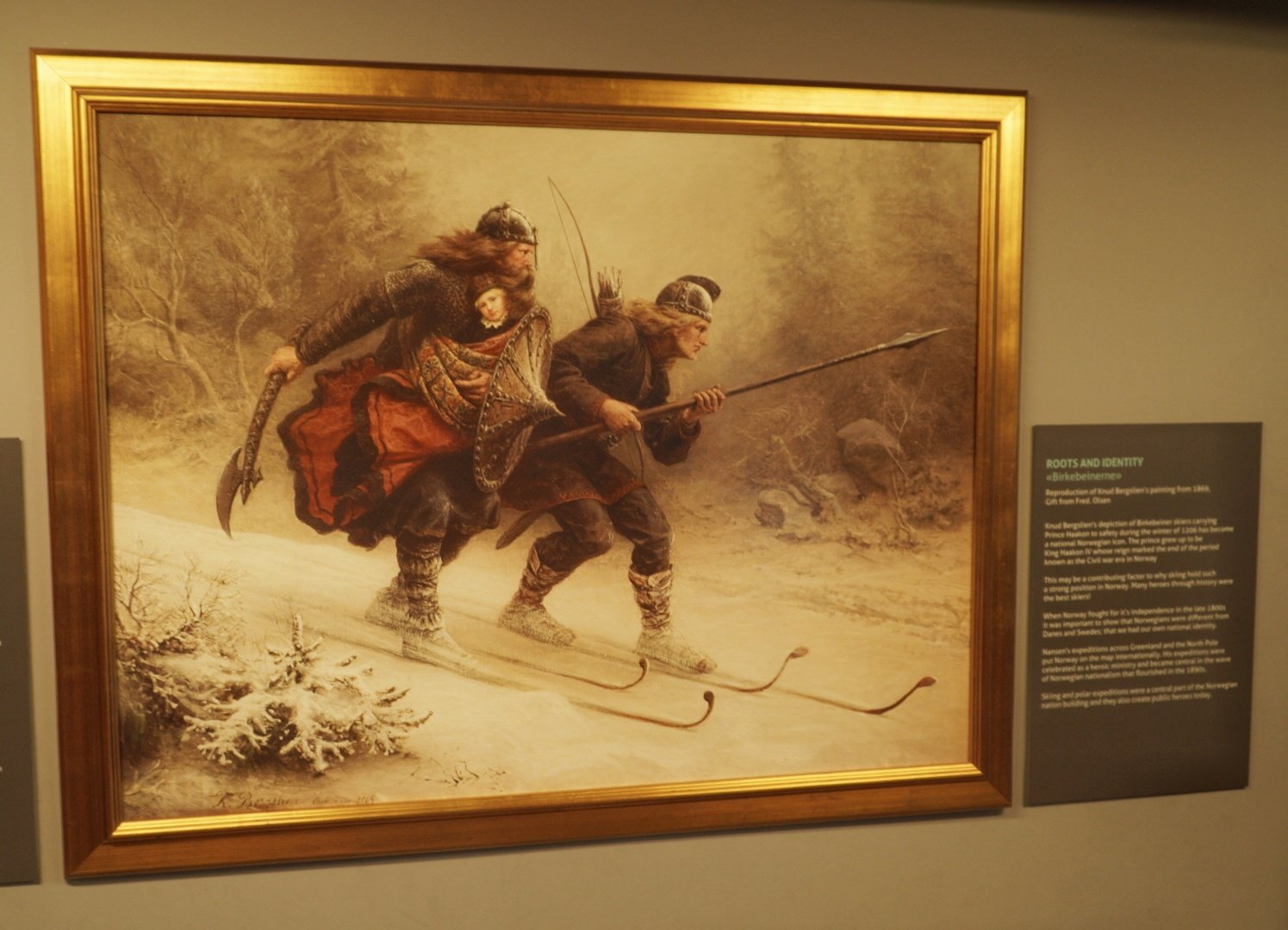
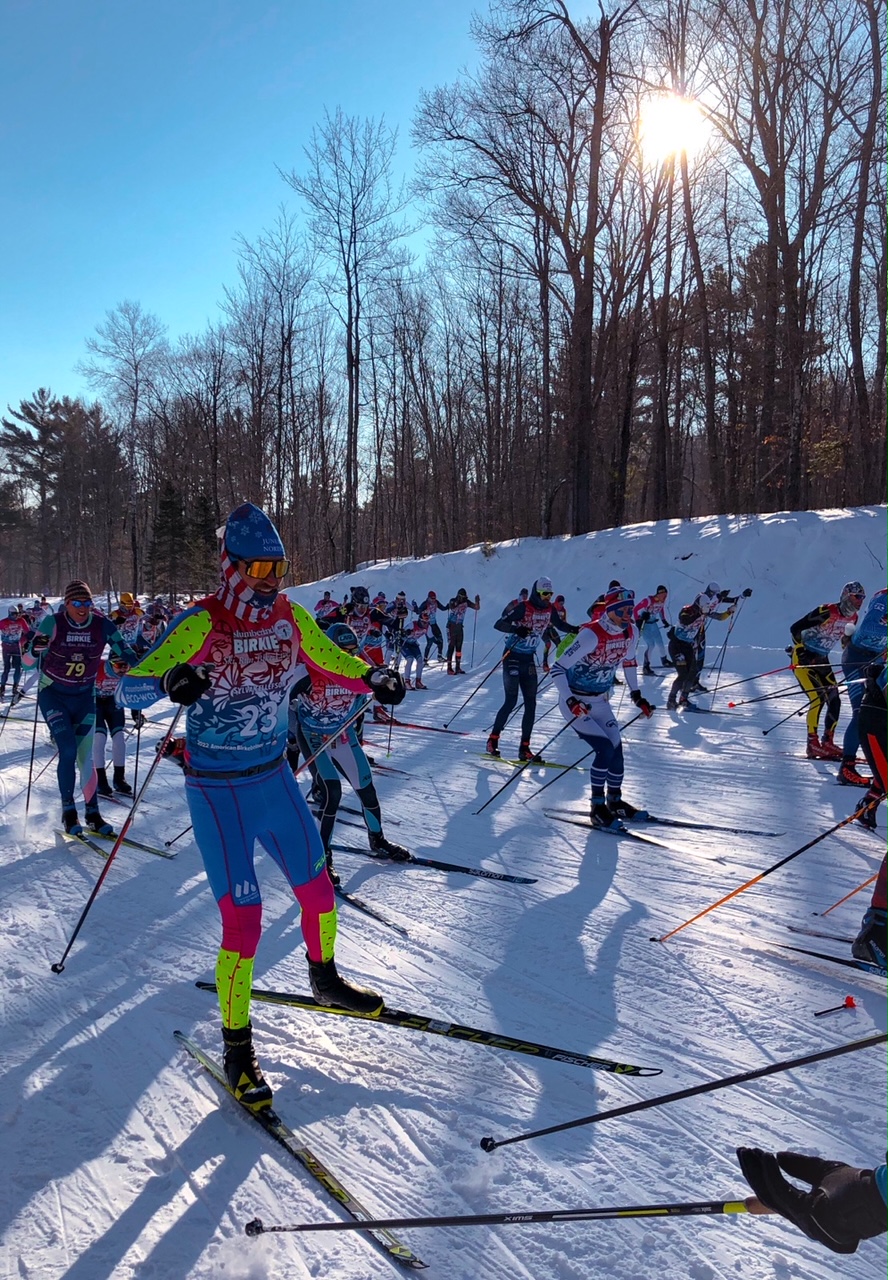
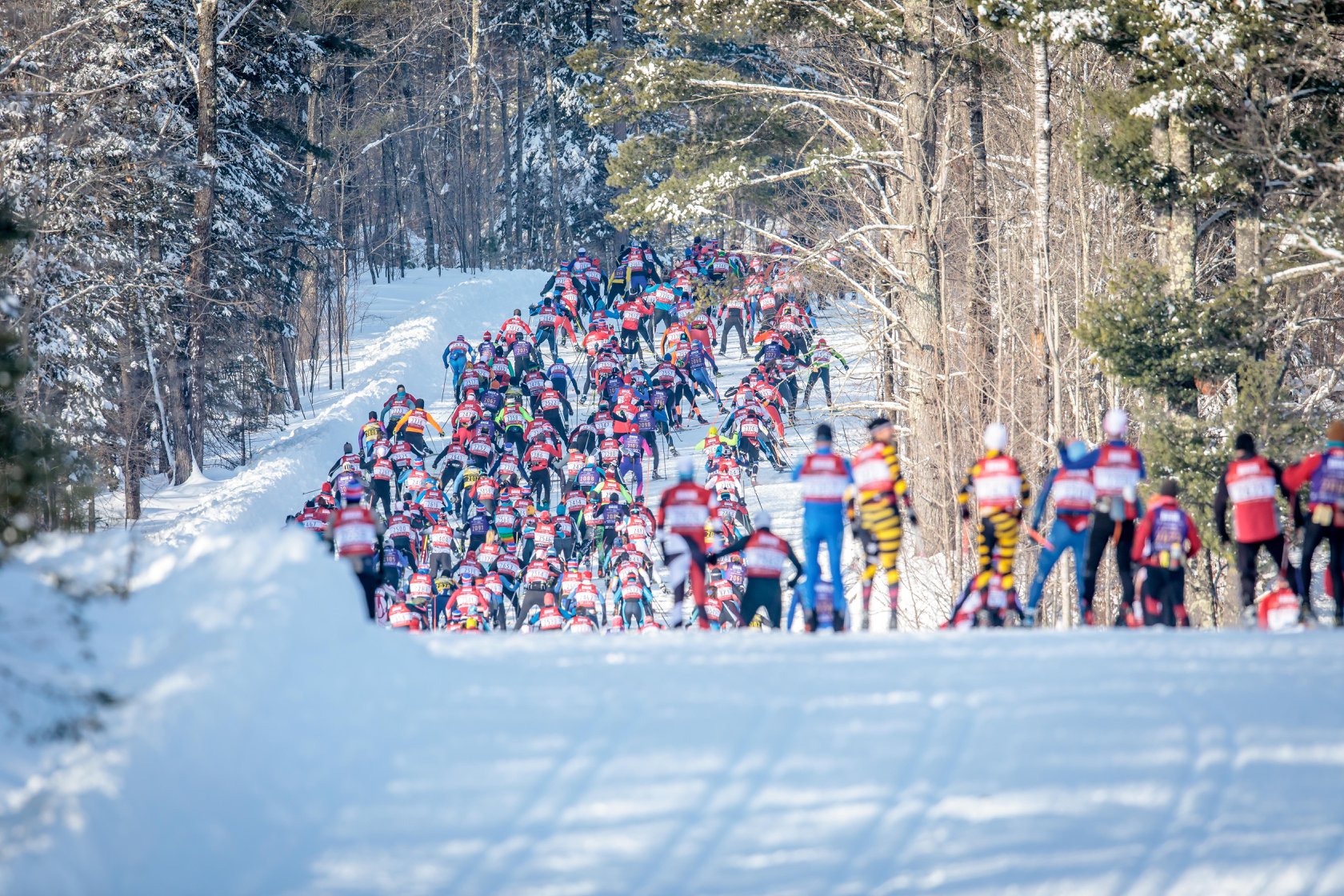
    We’d been promised powdered sugar donuts. We’d need them . . . it was a long, long way to the finish line. A bit over 50 kilometers (the original race-distance, before it got shortened to a nicely rounded 50 k), plenty far enough to test the will, the patience, and the endurance of even the hardiest skiers. It’s as far (so we’re told) as the original Birkebeiners carried the young Prince Haakon across the mountains to safety during the murderous ragings of the Norwegian Civil War. That young prince’s survival is the reason, today, that Norway is a stable Scandinavian monarchy. It’s the reason, today, that Norway is absolutely bonkers about cross country skiing. It’s their sport, it’s their tradition, it’s their passion, it’s their national origin story. Cross country skiing belongs to Norway in a manner unrivaled by any other northern nation; the legend of the Birkebeiners is how it started.

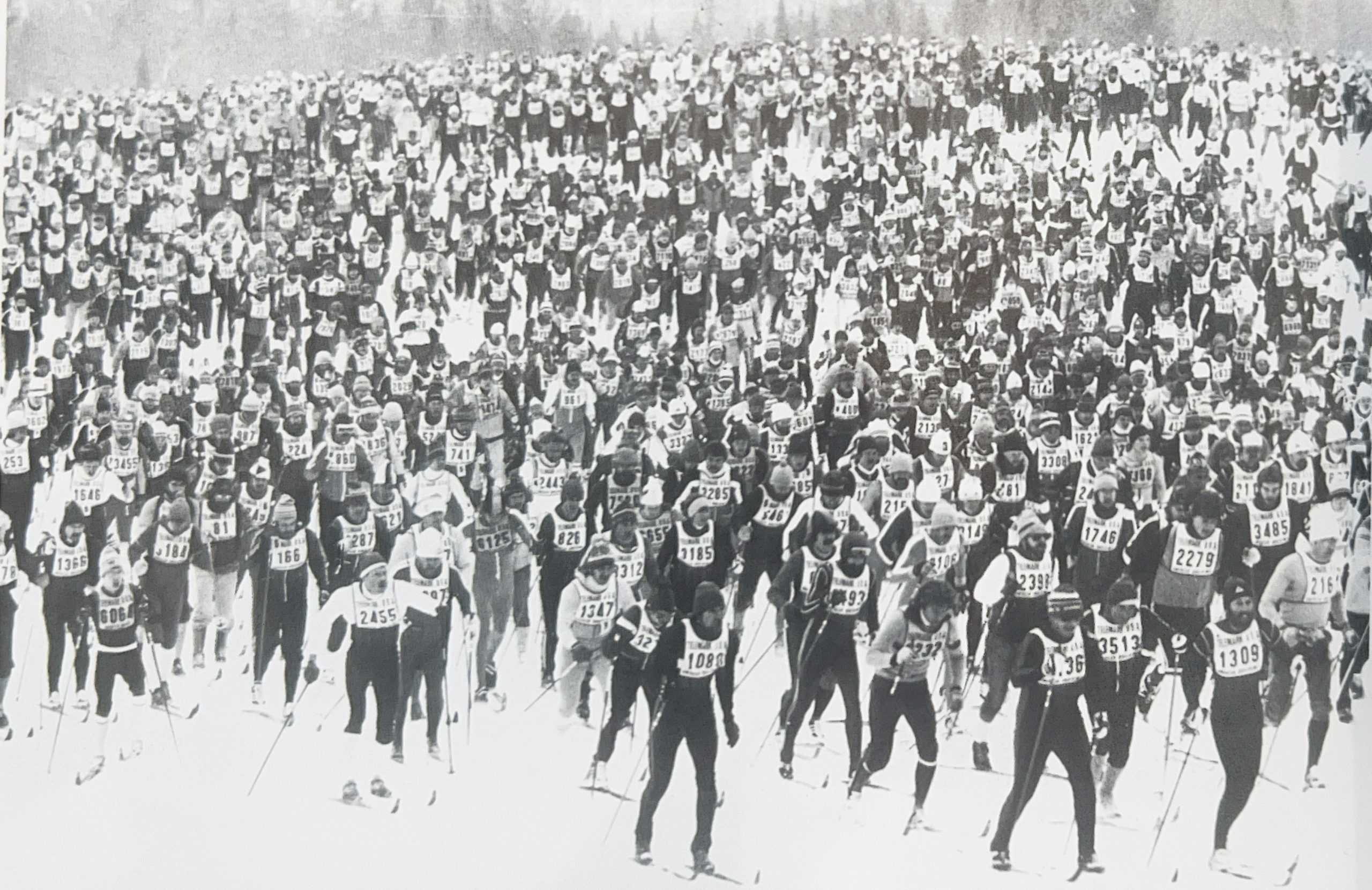
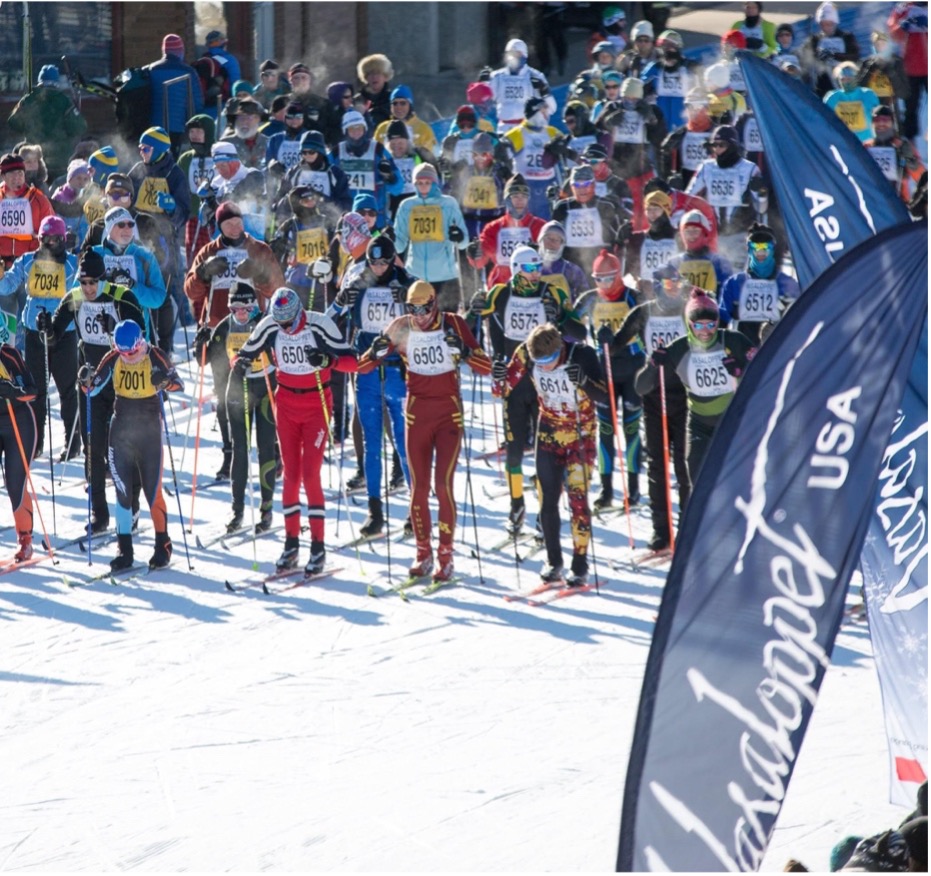
    Back to the donuts; they’re never far from memory. In 1981 (or 1982, I can’t remember which), we lined up to be part of a still-evolving neo-tradition in the north woods of Wisconsin. The American Birkebeiner was the fairly wacky brainchild of a fairly wacky individual (the inestimable Mr. Tony Wise) who sought to develop public fascination in an underdeveloped sport on the trails of an underdeveloped resort (Telemark Lodge). Somehow, it worked. By 1981, the race had become a legitimate stop on the World Loppet tour (an associated grouping of the world’s great ski marathons: Norwegian Birkebeiner, Sweden’s Vasaloppet, Switzerland’s Engadin, Italy’s Marcialonga, etc.). Wise developed the American Birkebeiner to appeal to Midwestern sensibilities: the race was too far, the course was too hard, the weather was too unpredictable, and the venue was just too far away. The Midwest ate it up. Nearly 7,000 showed up on the starting line in 1981 (or ’82, I can’t remember which). I was among them. All I knew was that we’d been promised powdered sugar donuts at each of the race’s feed stations. I could eat a lot of donuts . . . and if there were enough of them available trailside, I might just be able to finish that race. I did finish, but in a manner that left certain marks, certain scars, certain memories, certain pride. And I never did get any donuts (that’s the “scars” part). Even so, my little story left a skiing legacy that affected more than just me . . .

    Randy “Jabo” Jablonic had been Head Coach of the University of Wisconsin Crew Team since 1968, guiding his teams to NCAA championships in 1972 and 1975. There was no lightweight crew in those days, no junior varsity. There was one big boat filled with eight big guys (and a tiny little coxswain). Jablonic’s job was to build them into a team that could make an eight-man rowing shell fly. But no one grew up rowing in Wisconsin: no rowing clubs, no youth programs, no prep schools. Heck, the waters of most Wisconsin lakes are only ice-free for six months a year. the UW needed rowers, and recruiting was going to prove to be something of a challenge. Fortunately, Jablonic considered rowing to be a sport, while dependent on exacting technique, that could be learned by near-adult athletes. If they could sit up straight, if they could drive the legs without “shooting the slide,” if they could apply full power to the oar without “catching a crab,” then any strong farmer kid could learn to row for the UW. In order to find them, Jabo stalked the autumn class-registration lines on the UW campus. Clipboard in hand, he signed up any boy 6’2″ or taller. I know because I was in the line when Jabo and his hulking captains came along. They signed up the kid in front of me in line. They signed up the kid behind me. Their captains looked right over the top of my head, searching for other candidate cowlicks bobbing above the crowd, but I grabbed hold of the clipboard and added my name to the list (though at my first practice, an assistant coach whispered to me that he worried I was too tall to be a coxswain). I wasn’t really what the UW Crew Team was looking for. What was needed were guys with more reach—and more talent—than I had. What was needed were a few freaks of nature with lungs the size of beer kegs and fairly wide athletic mean streaks. I was like a terrier among the clydesdales, but I was strong and fit. And the rough waters of Lake Mendota left space in the boat for a light-weight, light-handed man in the bow seat. I’d be able to stay with the team through the autumn and winter, until serious selections were made for the smooth-watered season of spring championships. And winter is when things got interesting. That’s when Wisconsin’s team of clydesdales put on the cross country skis . . .

    Randy Jablonic employed some old-fashioned training strategies (not entirely original or revolutionary, just quaint by modern standards), including the circuit training on the ramp of the boathouse, the 10 mile run (which varsity crew members were expected to complete in under an hour—pretty fast running for some pretty big guys). The final element in the Randy Jablonic’s training strategy was cross country skiing the rough trails through the UW Arboretum. He figured if it was hard, if it got your heat pumping, if it worked up a sweat, then it was good for his rowers. Skiing fit the bill.

    Not enough snow fell in 1981 (or ’82, I cant remember which) for the UW Crew Team to have any days on the trails, so the entire holiday season passed with no way to try out our skis. November passed, December, January, February—while our training remained confined to the steamy rowing tanks inside the boathouse on the south shore of Lake Mendota. When finally the snow arrived, there was only enough time to enter the famous Birkebeiner race, and drive north.

    I had never been on cross country skis . . . the results were predictably awful on that day, predictably comical all these decades later. A tragically ill-advised klister mix, the spread-eagled snow-ball on nearly every downhill, the UW Athletic Department cotton sweatshirt and sweatpants that weighed 200 pounds by the finish line, and not one powdered-sugar donut left at any of the feed stations. Bits, corners, and shards of powdered-sugar donuts lay strewn in the klister-spoiled snow of every feed station, winter’s white stained lurid green with the splashings of emergency-gatorade. Even all these years later, I think a part of me is still out on that trail.

    I thought mine was a pretty unique story. Turns out, it’s a fairly common every-year occurrence. Over time, the odd American Birkebeiner tradition that’s developed among practitioners of endurance sports is one in which athletes from non-skiing sports strap on skis and take on the American Birkebeiner . . . thinking it’s just a test of endurance (of which those athletes have plenty). I think most of their stories end very much like my own: prolonged suffering, gritty endurance, and lasting memories.

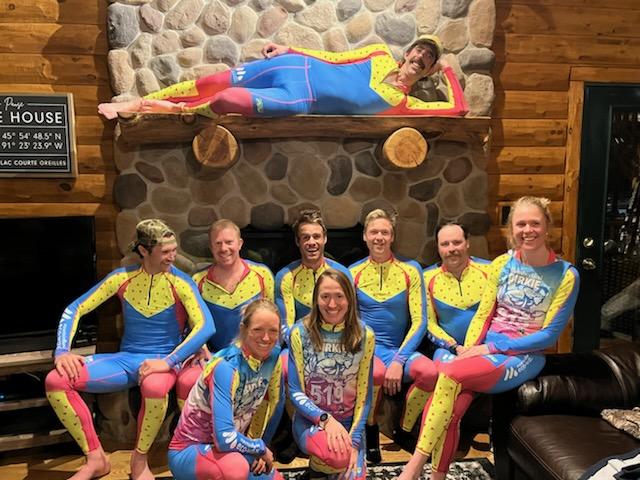
    My old friend Tanner. He’s a force of nature. (Photo: FasterSkier)

    I’ve been a writer, a teacher, and a coach of young athletes for many years, and my “Crew Team Birkie” is a story I’ve related to so many young minds who populated my teams. Every few years, one of them takes the bait. 2025 was one such year.

    Tanner is a force of nature: brilliant, playful, fearless, and possessed of a wacky quality of which Tony Wise would’ve been proud. He was a part of my school’s cross country ski team in high school—a 6’4″ senior walk-on who had never skied before. He flailed gleefully through that transformative season, then hung up the skis for good, replaced by the oars of Dartmouth’s varsity heavyweight crew. He’s stayed on the water ever since, even claiming victories at last year’s Master’s Championships. But skiing was far in his past. Until 2025.

    I received a text from Tanner a month ago—seeking advice on how to prepare for the Birkebeiner. He and some rowing friends were getting ready for it, and they hoped a few pointers would allow them to use their fearsome  rowers’ fitness to fly toward the finish line. Well, anyone who’s ever learned to cross country ski knows things just don’t work that way. It’s an exactingly technical sport that puts a high value on balance and timing . . . a somewhat different set of demands from a sport (rowing) where the athletes are literally sitting down. Rowers are definitely tough and fit—it’s a brutally hard sport—and they’d need all that toughness and fitness just to make it to the finish line.

    “You should write about all these guys Greg Myhr brings out here for the Birkie,” Tanner said. “They’re all rowers who have never been on skis. We bought two guys gloves today, and three guys did a “try on their skis and slide around on the lake. They were wearing jeans . . .”

    Tanner did make it to the finish line, though he described his before and after photos as a “do-it-yourself Portrait of Dorian Gray.”

    “It wasn’t that bad,” he said. “I realized with 5k to go that I should have gone harder!” Rowers . . . tough kids.

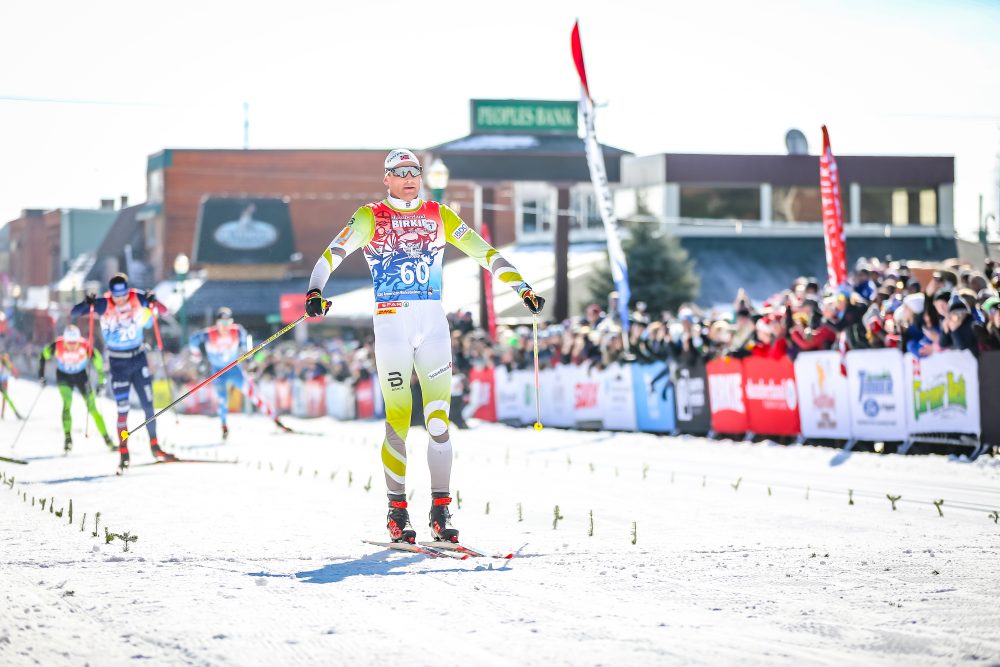
    Traditions abound in Wisconsin’s northwoods, none more enduring than the American Birkebeiner. And Legends of the Birkebeiner persist, perhaps in more forms than we originally realized. Jessie Diggins and Gus Schumacher won last year’s 50th American Birkebeiner in glorious victory laps following the Minneapolis World Cup of 2024. This year’s winners were Gérard Agnellet and Sydney Palmer-Leger, who wrote their names into the book of Birkebeiner champions.

    2025 American Birkebeiner, Men’s

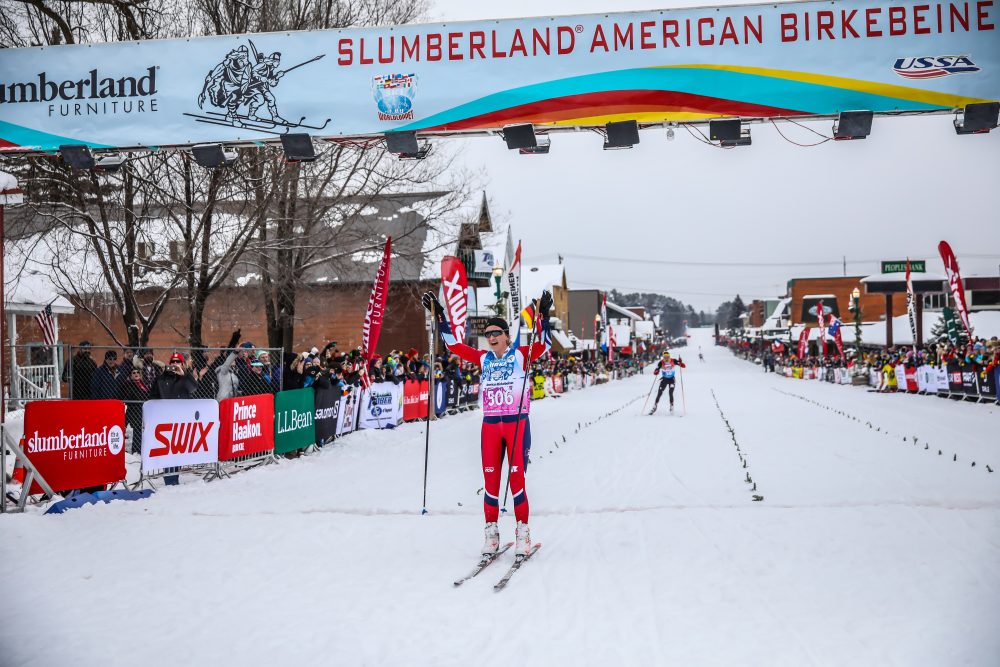
    1. Gérard Agnellet, 2:03:01.1
    2. David Norris, +1:30.6
    3. Michael Earnhart, +2:10.2

    2025 American Birkebeiner, Women’s

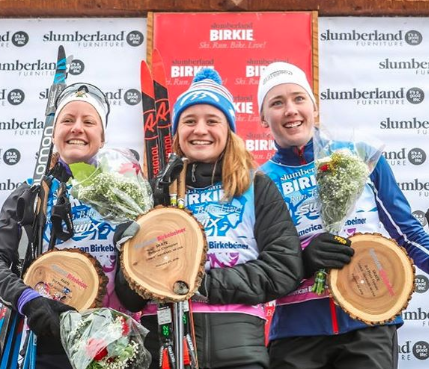
    1. Sydney Palmer-Leger, 2:25:06.7
    2. Jessica Yeaton, +1.6
    3. Lauren Jortberg, +3.0

    Tanner’s follow-up text arrived son after the finish: “166 heart rate for five #%&*@ hours!” he said. “Those good guys have it easy. It’s over so fast!” In the 2025 Birkie, the fastest skier (Agnellet) finished in 2:03.01. Back in 1981 (or ’82) I wouldn’t even have been to the disappointment of the first donut stop yet . . .

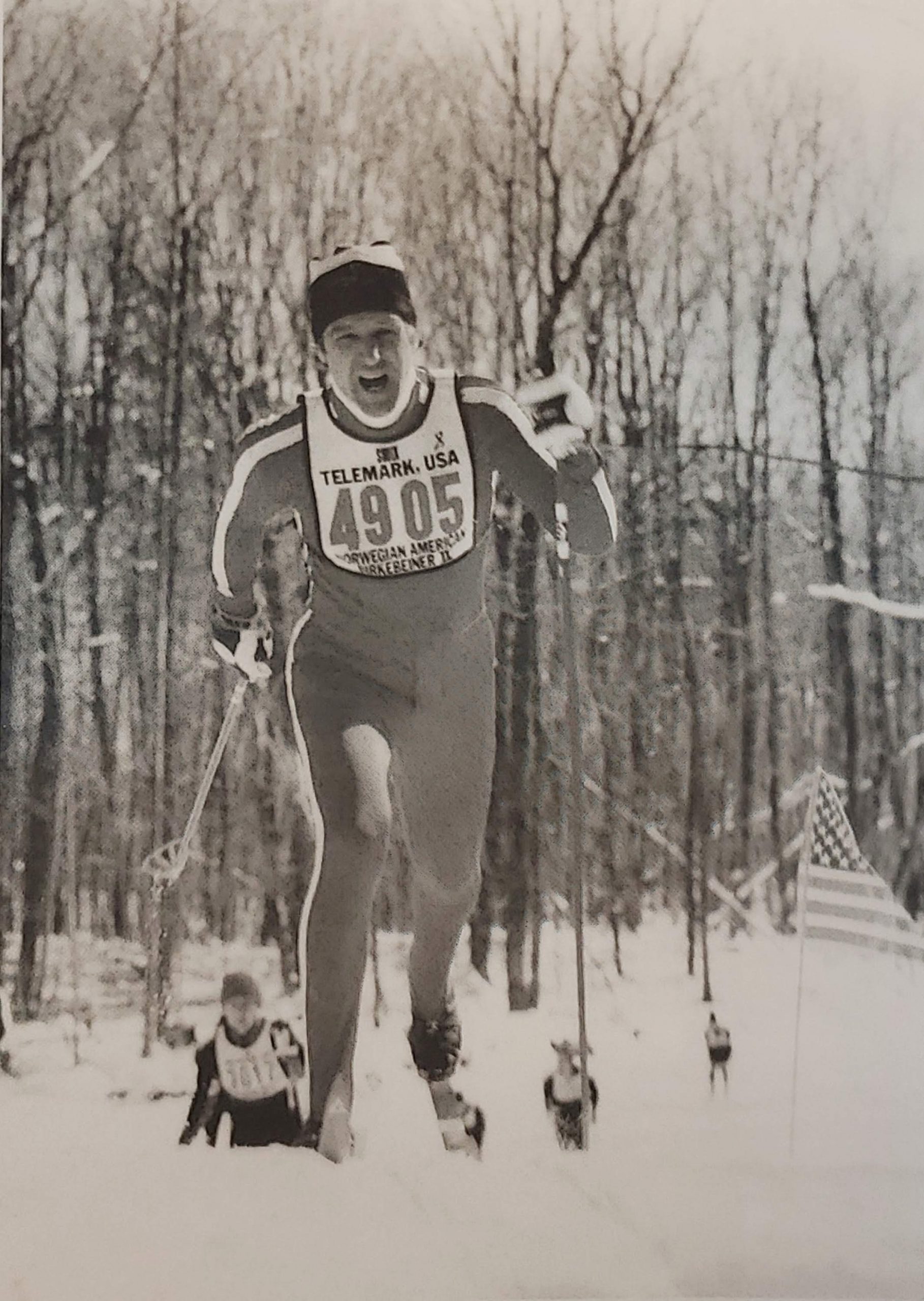
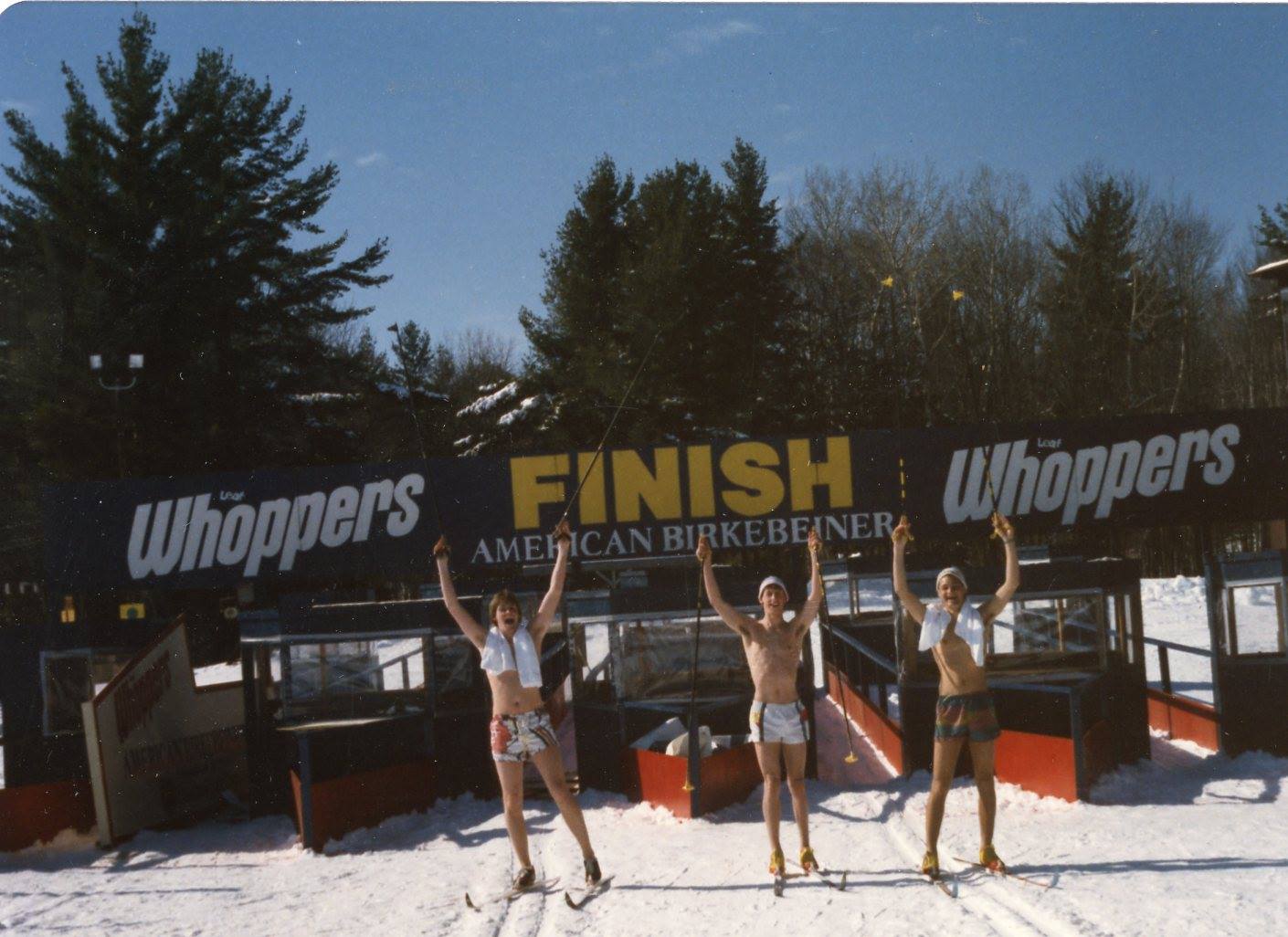
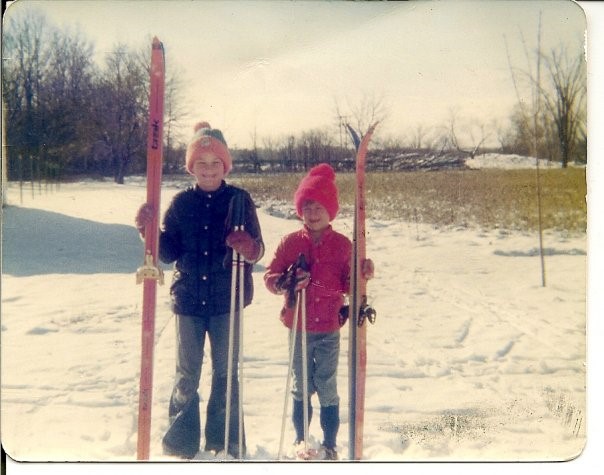
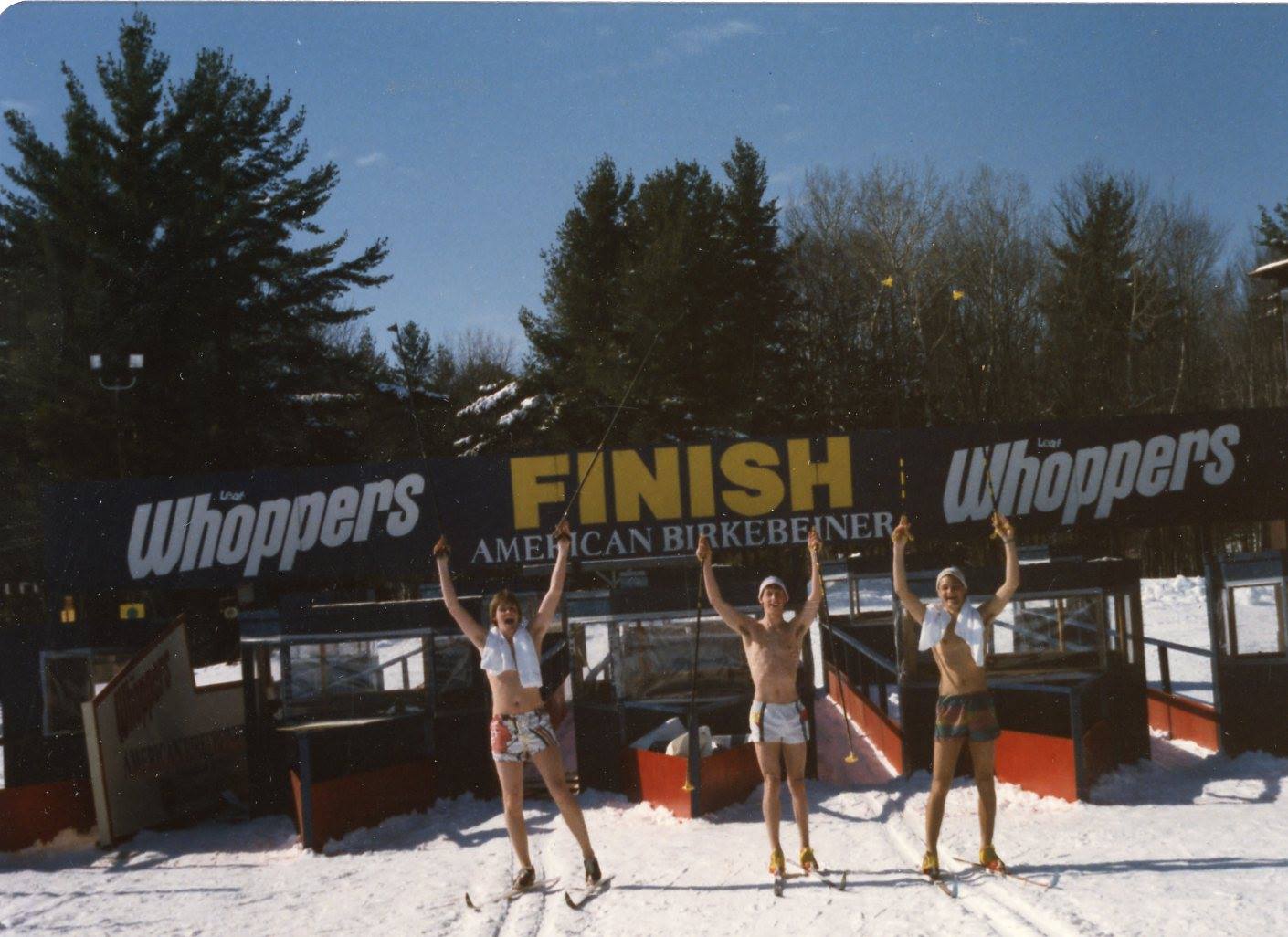
    The author, engaged in his more familiar winter sport, 1981 (or ’82).
  • The Birkie Dedicates New Mt. Telemark, George Hovland Trail

    The Birkie Dedicates New Mt. Telemark, George Hovland Trail

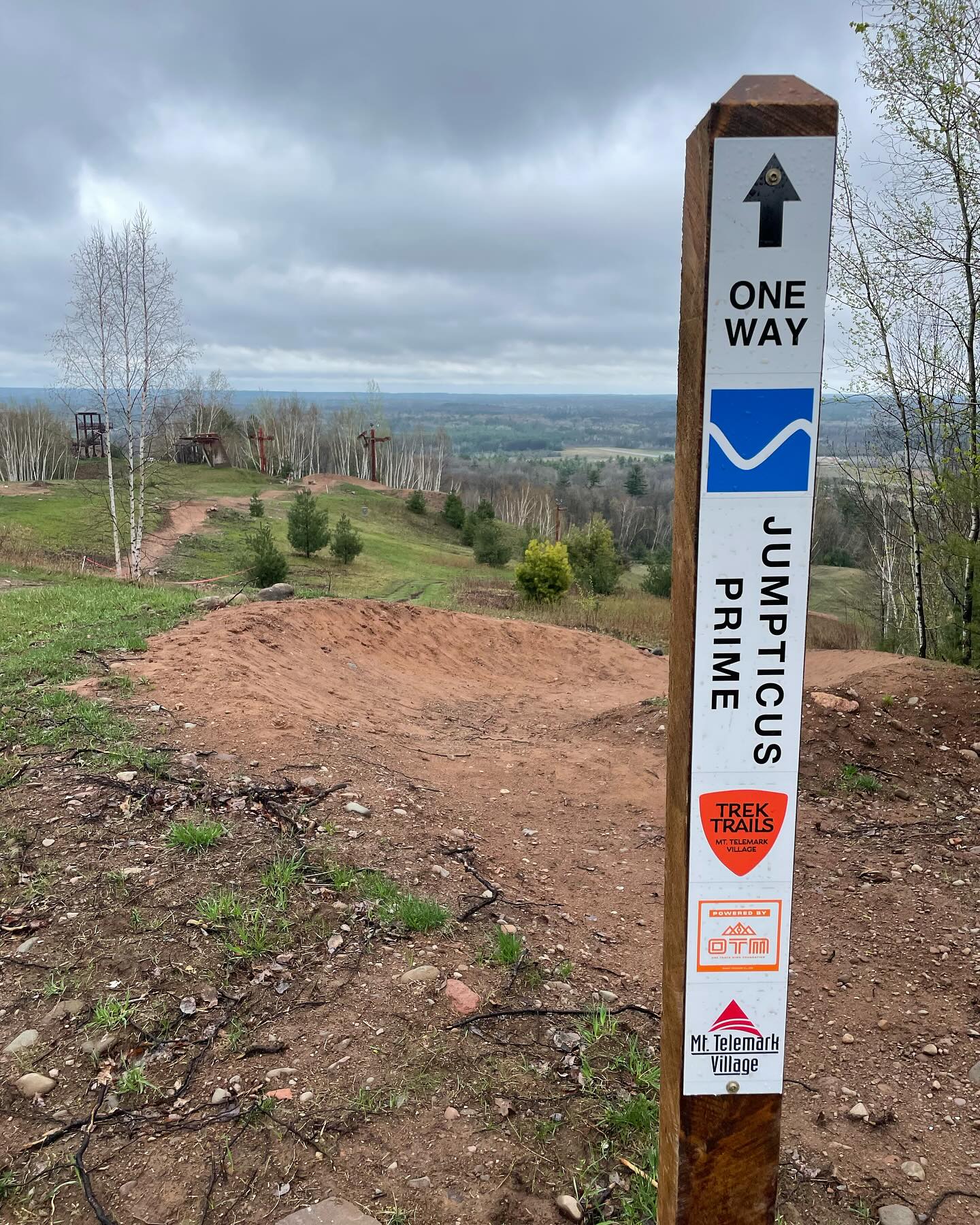
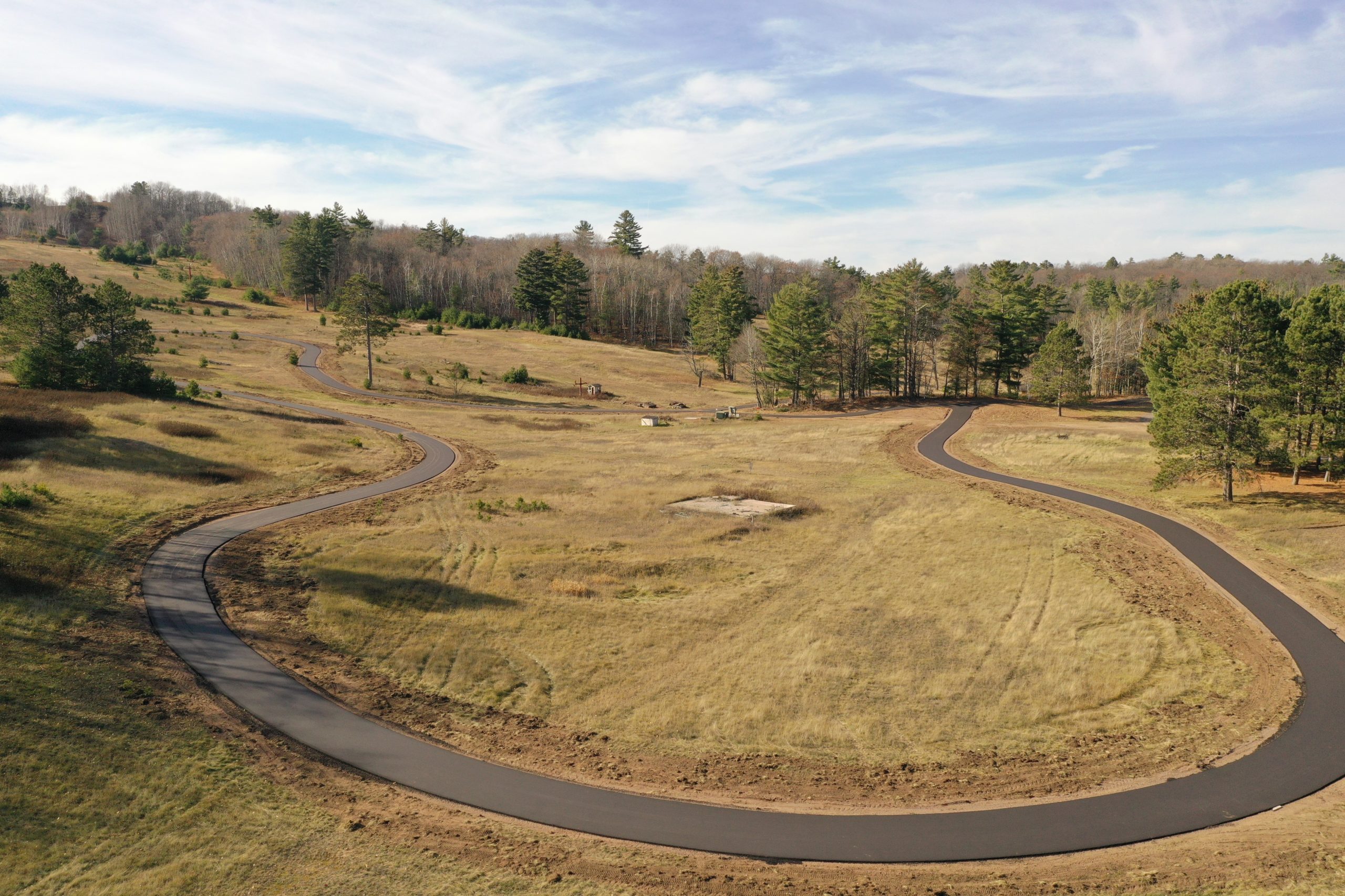
    Atop one of the new Trek trails at Mt. Telemark, with the old lift towers from Telemark-past still visible. (Photo: American Birkebeiner Ski Foundation)

    For the American Birkebeiner Ski Foundation (the Birkie) it’s been a long time coming.

    The dedication ceremony held Saturday for the new projects that encompass the Mt. Telemark Village, the former site of the legendary Telemark Lodge, have been in the works for five years. All together, Mt. Telemark Village is “the biggest thing the American Birkebeiner has ever done.” Its $10.2 million dollar capital campaign, though, doesn’t capture what, for skiing, might just might be priceless. Up in the woods outside of Cable, Wisconsin, the Birkie has been busy figuring out how to commemorate a little glacial knoll that’s played an outsized role in the history of skiing while making it a vital place for more of that history to happen.

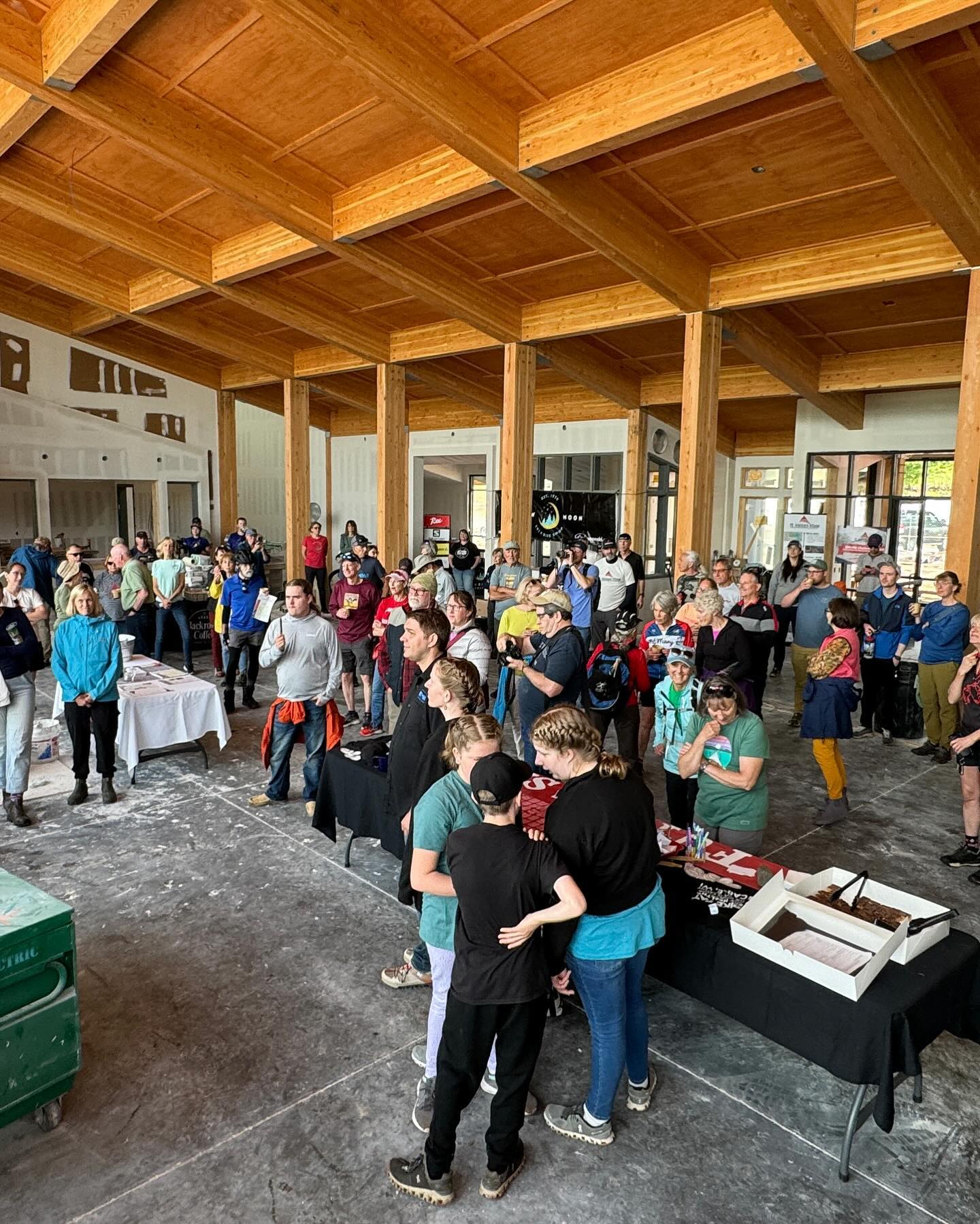
    Inside the new Mt. Telemark Community Center, the Birkie community celebrates the dedication of new ski and bike trails. (Photo: American Birkebeiner Ski Foundation)

    The dedication ceremony on Saturday featured two main draws that illustrate that delicate balance at the heart of Mt. Telemark Village. The first was the official dedication of the paved rollerski loop to George Hovland, a name linked to the deep past of skiing in North America. The second was the opening of a new mountain bike trail system sponsored by Wisconsin-based bicycle manufacturer, Trek, building on another of Telemark’s legacies as a key site in the development of the sport of mountain biking. In addition, the on-going, glass-plated construction of a new base lodge promised the realization of a vision that’s been in the works for the Birkie and Telemark the past five years.

    Telemark and Tony Wise

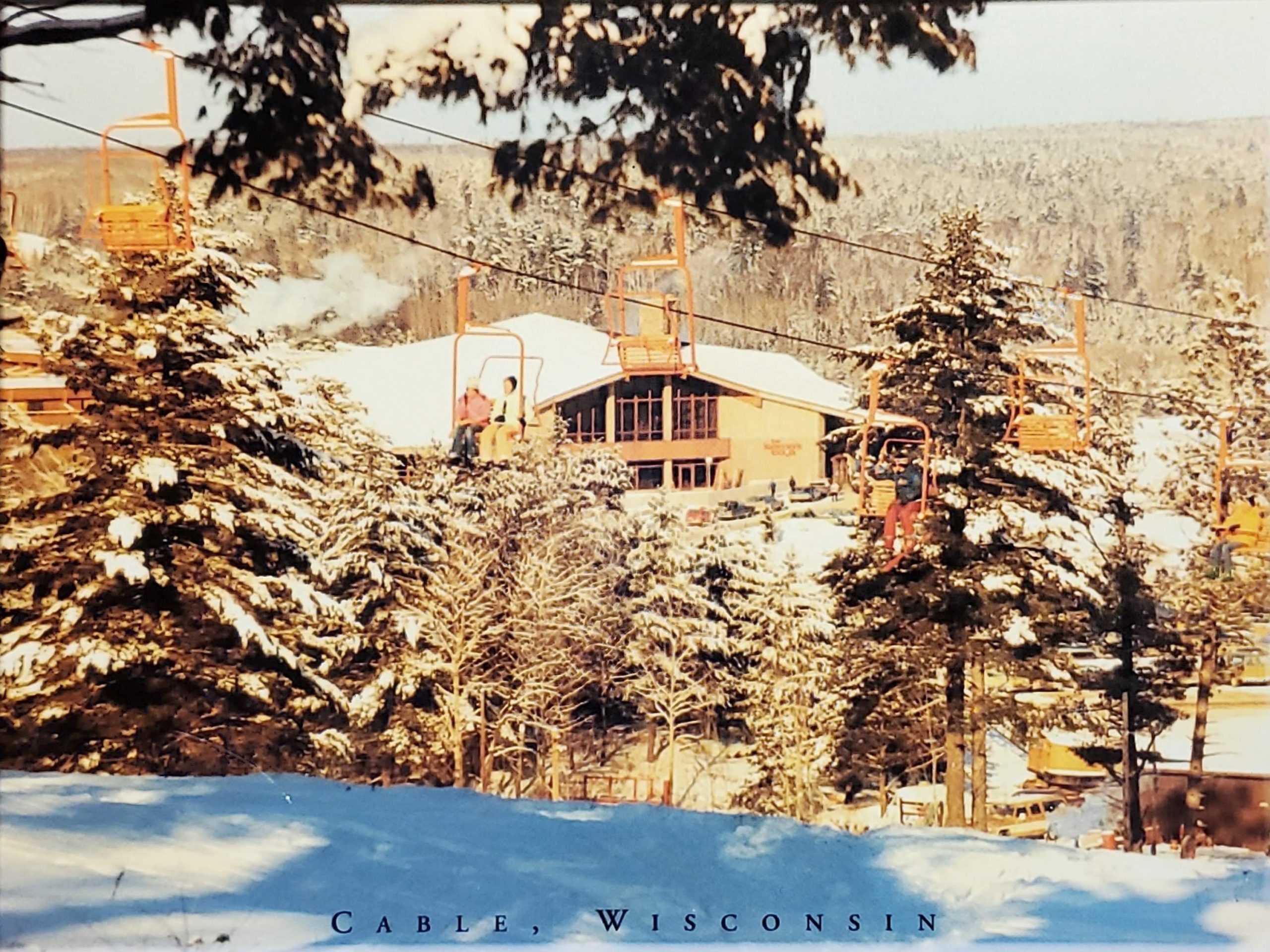
    Mt. Telemark Village, itself, is a re-birth of a long-lived Midwestern legend. Telemark was set up in 1947 by local entrepreneur Tony Wise. The downhill ski area made all it could of its ~300 ft of vertical descent set upon a glacial erratic. Wise, an ebullient character, seemed to derive inspiration from that terrain, making Telemark a cultural erratic, a place for Governors, Musicians, and Packers (the biggest celebrities on offer in Wisconsin) set in rural northern Wisconsin. He did so unrelentingly, building the giant 200-room Telemark Lodge that was too big for its own good. In the glory days, Telemark was a flame whose influence burned over thousands of miles of Northland. After bankruptcy in the 1980s, the embers of Telemark continued to glow primarily in the American Birkebeiner, Wise’s cross-country ski race from Telemark to Hayward that became the largest in North America.

    The Telemark Lodge as pictured from the top of Mt. Telemark in Cable, Wisconsin on a 1970s postcard. (Photo: Telemark Education Foundation).

    The Birkie was Telemark’s first foray into cross-country skiing, but the race’s momentum in the 1970s led to the resort playing an outsized role in the development of modern cross-country skiing in the United States, and beyond. The first World Cup race ever was held on a trail system laid out in 1978 by American skiing pioneers John Caldwell, coach Marty Hall, and Olympic medalist Bill Koch.

    The legacy of Telemark limped along on its own legend for years following Tony Wise’s bankruptcy and surrender of the property in the 1980s. Numerous owners passed through. Central Cross Country Skiing (CXC) briefly made it a home for its Elite Team in the early 2010s, before Telemark closed for good in 2014. The Lodge sat abandoned for years.

    In 2020, the Birkie started to piece together a new vision for the property: Mt. Telemark Village. The Lodge was demolished in 2021, the vision that has played out since is the Birkie’s community-oriented project to honor the whirlwind of history that emanated from the little patch of Wisconsin woods, and make it a site to take a central role, again.

    George Hovland at the American Birkiebeiner in 1982. (Photo: Sawyer County Record Archive)
    George Hovland Trail

    Saturday’s dedication ceremony celebrated the success of the new Birkie venue linked by a number of trails to Telemark.  It also linked the new venue to a giant of Midwestern skiing: George Hovland.

    George Hovland’s name looms large in his hometown of Duluth, Minnesota, where the 1952 Olympian had a hand in founding nearly all present-day fixtures of Zenith City’s ski scene including Spirit Mountain, Snowflake Nordic Center, and the North Shore In-line marathon.

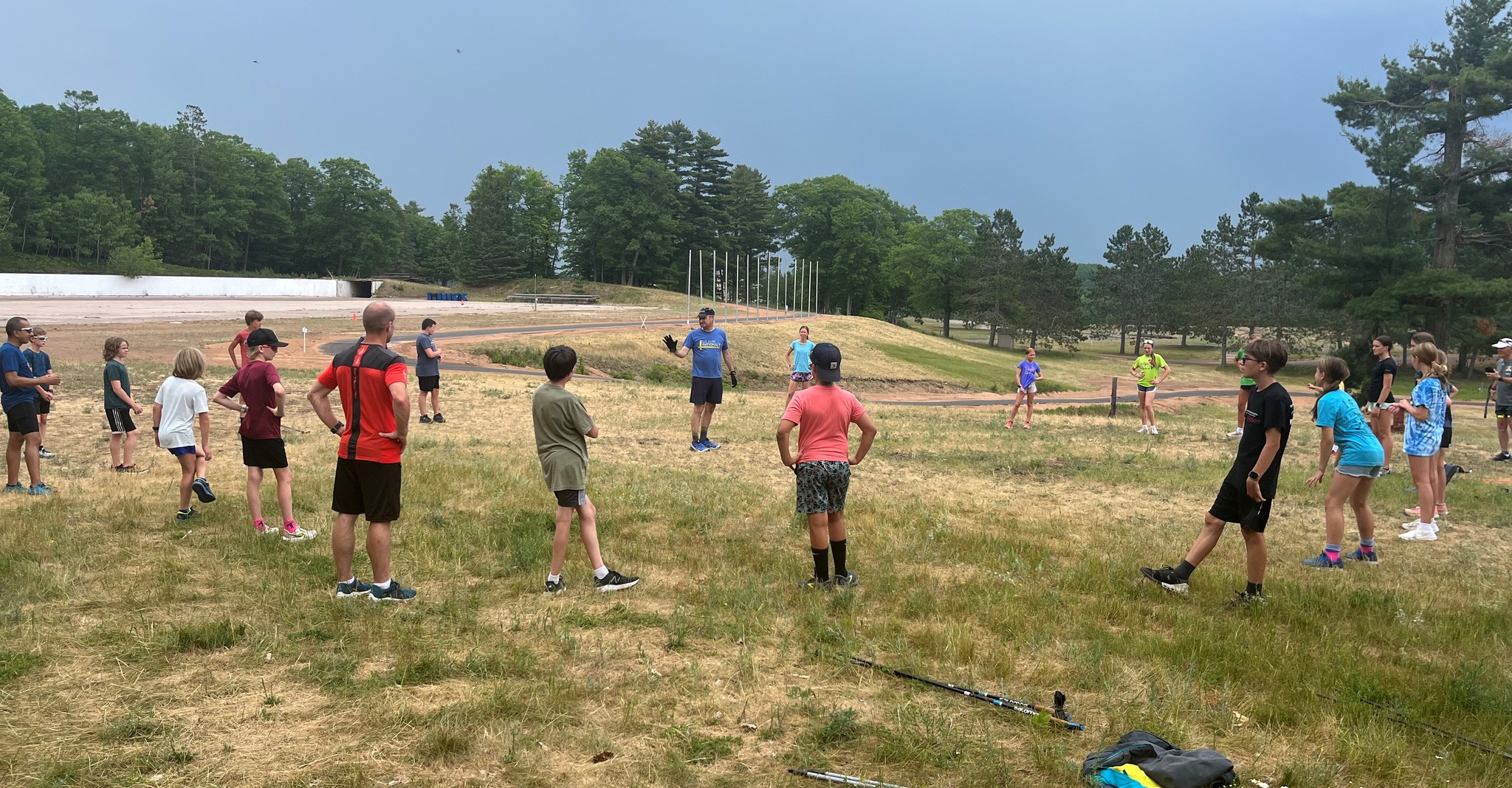
    Hovland’s legacy as a ski pioneer in the wider-Midwest is being celebrated by the Birkie in dedicating its 5 k training loop. A friend of Tony Wise, Hovland competed in every Birkie from 1974 to 2012. In the years prior to his passing in 2021, Hovland was the vital link to a deep, essential past of Midwestern skiing. Hovland took to the sport of skiing as a boy in the 1940s when jumping was nordic’s premier discipline and Chester Bowl in Duluth was still populated by the Scandinavian immigrants who brought the sport to America. He skied his last kilometers after Minnesotan Jessie Diggins and Kikkan Randall combined to earn the first Olympic gold in US skiing history. The George Hovland Trail will play an active role in developing Midwestern ski racers this summer, with CXC hosting its Developmental Camps, and Team Birkie looking to utilize the resource.

    “George was such an amazing man and an influence on our sport,” said Ben Popp, American Birkebeiner Ski Foundation Executive Director. “George loved training and this will forever be a medium to get people training and faster!”

    Trek Trails Lay New Lines Down Mt. Telemark

    Before snow fills the George Hovland Trail next winter, there will be plenty of treads on trails of another type: biking.

    Telemark was the site of some early movement in the sport of mountain biking. As the sport first advanced beyond riding klunkers in the West in the early 1980s, one of the first flat-land homes it found was the Birkie trail at Telemark. The Chequamegon Fat Tire Festival, one of the oldest extant mountain bike races in the country, was dreamed up in 1983 with the proposition, “What if we did a bike race on the American Birkebeiner trail?”

    While the Chequamegon was based out of the nearby Lakewoods Resort for most of its formative years, a trail system was quickly developed on the Telemark property, and eventually linked via the CAMBA trail system. For years, the Telemark portion of the CAMBA system stood out as a kind of staid testament to those early days of mountain biking as a sport. The trails cut through the woods between logging roads. In the days before slack frame geometry, 29 inch wheels, and full suspension made riding downhill more joy than hazard, the singletrack was laid out to get from point A to B more so than to get from feature to feature.

    In more recent years, Mt. Telemark itself started to look ripe for the new-look crop of mountain bike trails that were being built around the Midwest at places like Spirit Mountain Duluth, MN, or Copper Harbor, MI.

    When the Birkie took over the property in 2020, those in the Wisconsin biking community took notice. That included Trek, based in southern Wisconsin, which was willing to provide funding for the development of a trail system that utilized the whole of Mt. Telemark’s terrain and set it up to be a central host for mountain biking in the same way that Telemark had long served for skiing.

    An additional grant from nonprofit group One Track Mind set the Trek Trails at Telemark in motion. Now in development, 16 additional miles of trail will eventually play host to training and racing for cross-country, enduro, and downhill racers alike.

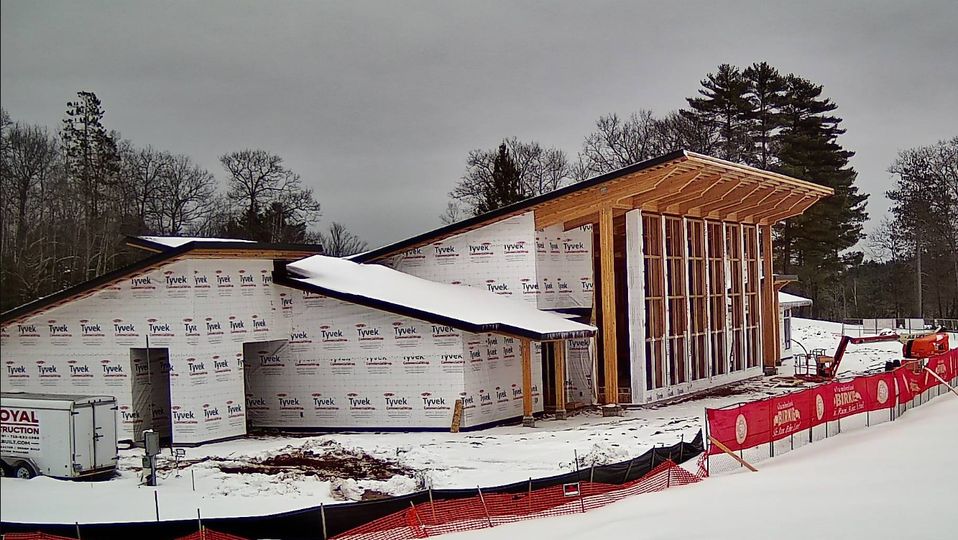
    The new Mt. Telemark Village Base Camp under construction last winter. (Photo: American Birkebeiner Ski Foundation)
    Mt. Telemark Village Gets a Base Camp

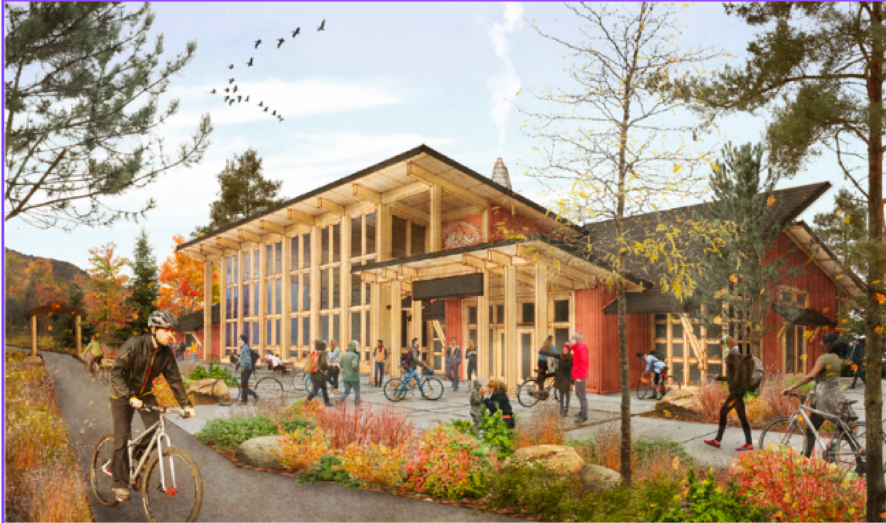
    What’s next? A successor for the old Telemark Lodge. While the Birkie gathered its community together on Saturday, the site of a new building under construction where the legendary lodge once stood seemed an apt harbinger.

    The “Base Camp” Community Center still looks erratic against the fields and forests that surround it. But in terms of decadence, Telemark seems to have a matured sense of stature. The three-floor fireplace that once greeted visitors in the lobby of the old Lodge isn’t making a comeback. Emeril Legassi is unlikely to be in this version of Telemark’s kitchen (he was, in fact, in the old one).

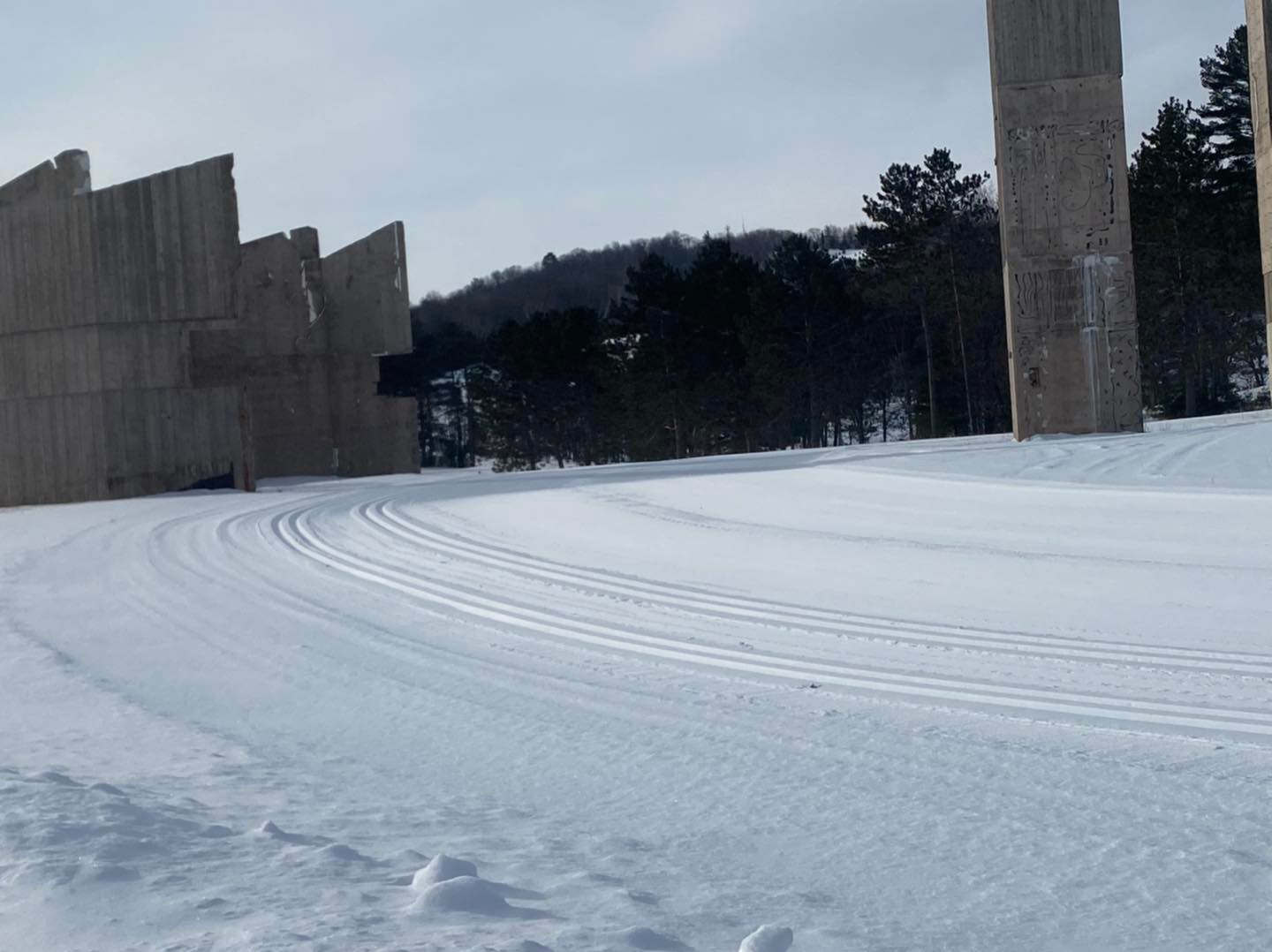
    This new community center doesn’t include the giant concrete walls that are still visible on site from the old Lodge, but it seems to impart that this version of Telemark, after a half-decade of dreaming, is starting to be set. 

  • Skiing is Worth Saving

    Skiing is Worth Saving

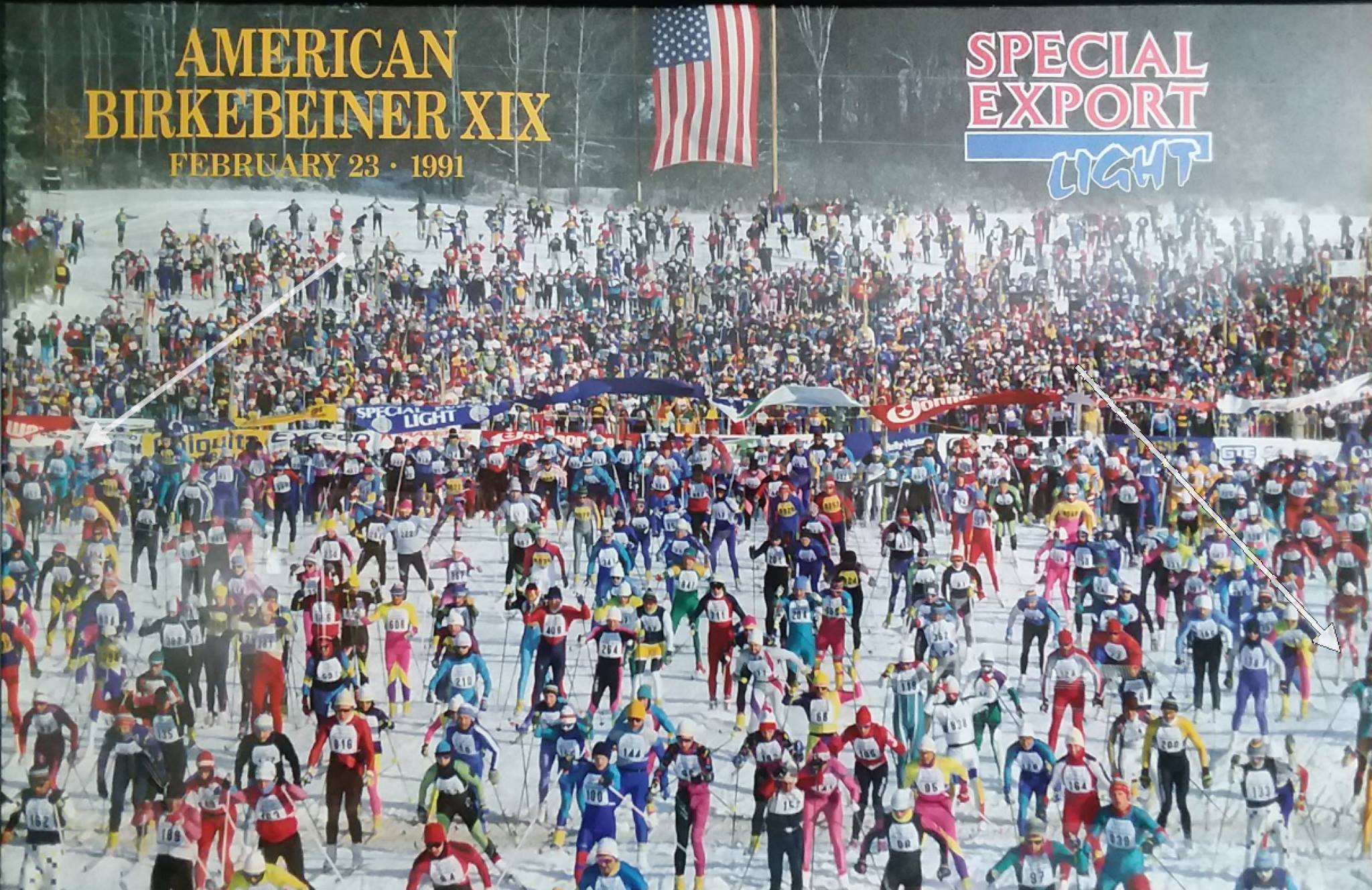
    The official American Birkebeiner poster from 1991, when the race started in “Rosie’s Field,” located near the present-Fish Hatchery trailhead outside of Hayward, Wisconsin (Photo: American Birkebeiner Ski Foundation)

    By Charlie Cobb

    Months ago, I drove seven hours to Boston’s Logan Airport, boarded a plane to Minneapolis, drove 3.5 hours to Wisconsin to ski 1 hour and 19 minutes: my first American Birkebeiner. I have done a lot of ski races in my life, but the Birkie was truly unique. Like many in the American nordic ski community, I was still riding the high of seeing (through my laptop screen) both a male and a female distance podium on the same day on home snow. It felt like a true watershed moment: after so many years of striving, the US has now become one of the top nations in nordic skiing. The fact that many of these same American World Cup skiers would be sticking around to race the Birkie—on the same course that I and thousands of other citizen racers would be racing—only added to my excitement and further underscored the strength and connectedness of the American nordic ski community. Though I wasn’t at the Minneapolis World Cup, I was excited to see some World Cup skiers race the Birkie.

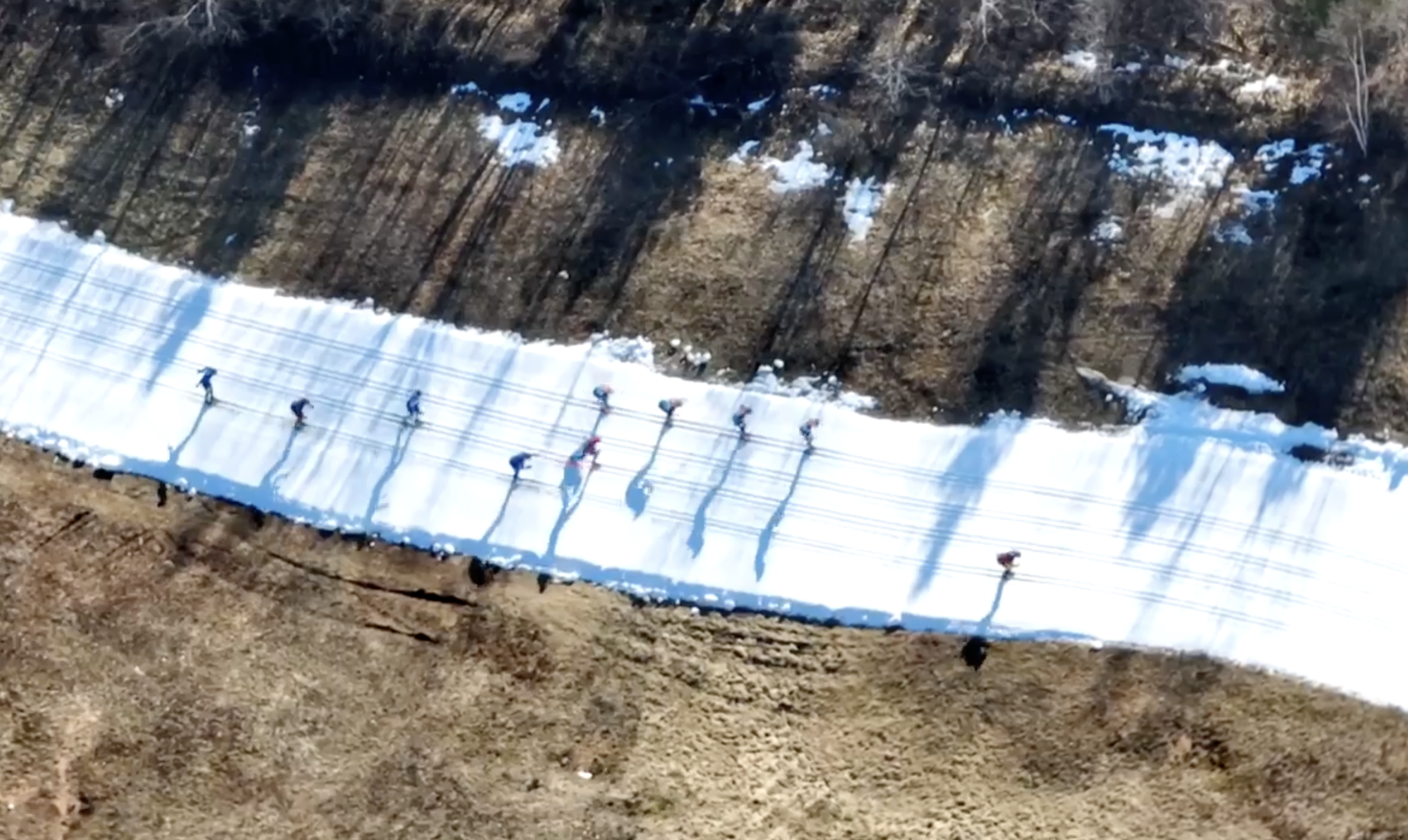
    The 2024 American Birkebeiner was held on a 10-kilometer loop of man-made snow. (Photo: American Birkebeiner live stream)

    The 2024 Birkie was also unique because of the weather. What was typically a 55km point to point race winding through the woods had been reduced to a 10km ribbon of man-made snow winding over barren brown grass during one of the warmest, driest winters the midwest has ever seen. Despite this, people turned out in droves. I don’t know the final count of the race, but I estimate that there were over 5000 people who raced over the course of five days, and probably at least 1000 on Saturday alone.

    My race was anything but normal. I was racing on borrowed skis, got to the start a little on the later side, basically had no warm-up, and started well towards the back of the start queue. I spent the first six kilometers of the race working through a crowd to make my way up to the front of the field. Eventually, I got to the front, and realized that I felt good enough to break away and see if I couldn’t bridge up to the next skier in front of me. As it turned out, I couldn’t, but I felt good enough to hold off the pack behind me, and really had so much fun skiing on fast snow on a beautiful day. As a true New Englander, I’ve skied a lot of manmade snow loops in my life, but to have 10km laid out in a flowy rolling loop was pretty spectacular. It really made for great racing; however, the biggest highlight for me was the whole spectacle of the event. Spectators turned out for my race despite the 7am, 11 degree F start. By the time the elite wave started, there must have been over 1000 spectators. Many stuck around to watch hundreds more skiers take to the course for waves 3-10 later that afternoon. The whole thing felt a little like a giant nordic ski party, complete with beer, brats, lycra, and a sauna. It was awesome.

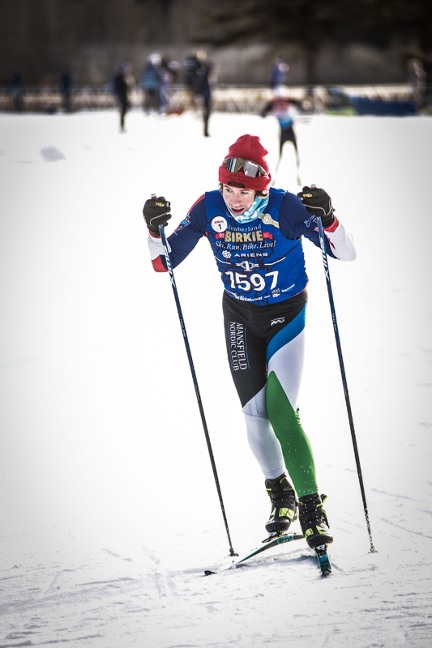
    The author racing the 2024 American Birkebeiner.

    The Monday after the race I flew out of Minneapolis where the high temperature for the day had risen to 65 F. As I walked around the city before my flight, I couldn’t help but wonder about the future. Are 60-degree days in February and manmade ribbons of snow over bare ground the future of the sport? If the Birkie is 50 now, will it make it to 100? What will the Birkie look like for the kids who watched the Minneapolis World Cup last weekend?

    In the past, I’ve felt guilty that one of the major reasons I care about climate change is to save my favorite sport. When so many have, and will continue to lose homes and loved ones to the climate crisis, my potential loss of cross country skiing seems so trivial; however, I now see that for myself and all those who have participated in the Birkie, or watched the Minneapolis World Cup, or been to the New England Bill Koch Festival, skiing is so much more than a sport. It’s an expression of true joy. It’s something we do with our friends and family. It’s part of our culture and identity. It’s something we look forward to every year because nothing quite compares to the feeling of skate skiing on a fast, icy day, or classic striding in firm tracks with extra blue kick wax. It’s the best feeling in the world; is that not worth preserving? Is preserving the things that make us happy, the things that make life worth living, not as important as preserving the basic necessities?

    In many ways, I feel like the climate crisis is a lot like a ski marathon. A marathon where you fall and break a pole at the start, or miss the start completely, or come into it with a cold. Your best possible result is out of reach from the moment you really get going, but the race is long; if you don’t give up—if you put your best foot forward—then you might just achieve a decent result. But you’d better get going . . .
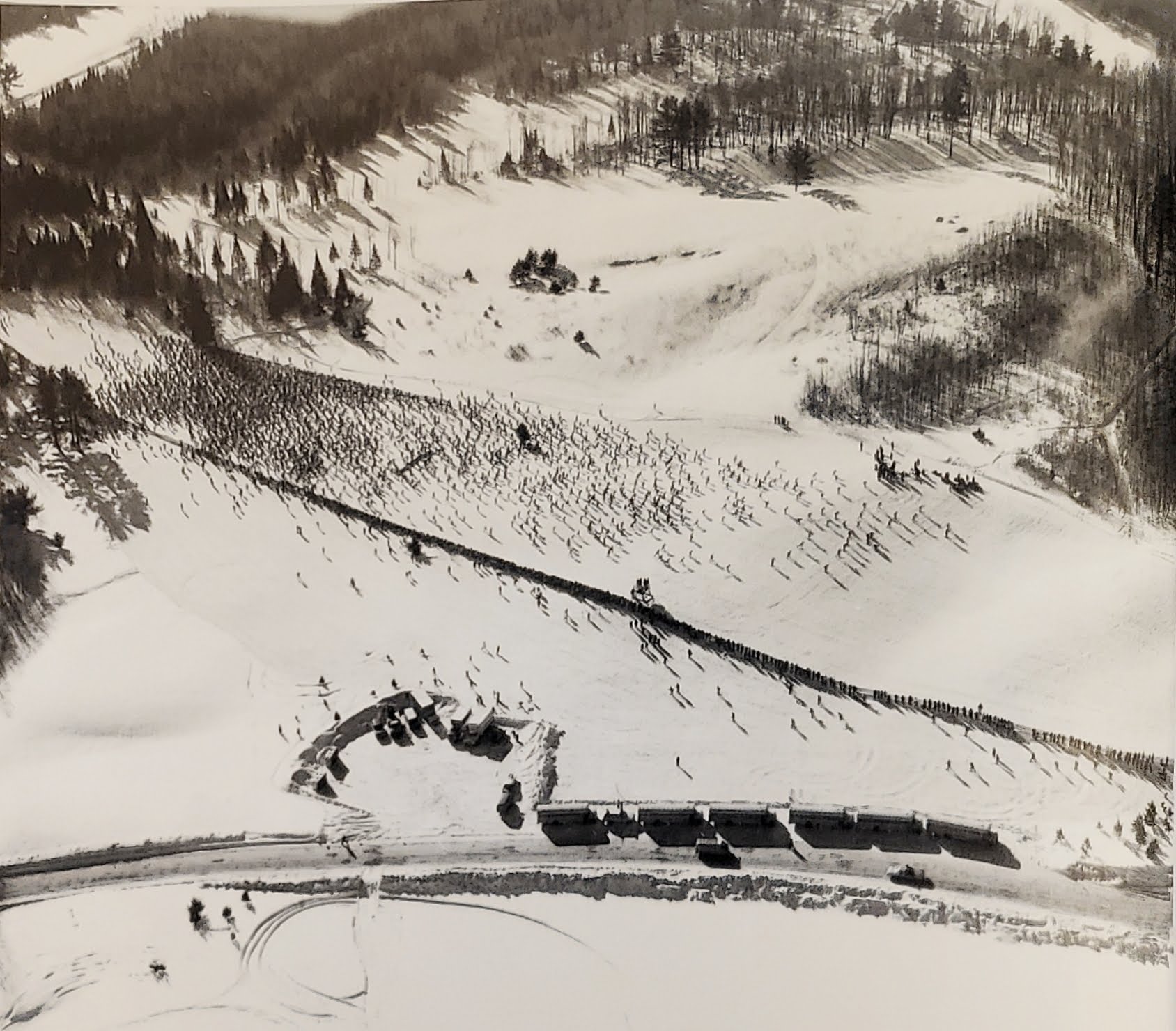
    American Birkebeiner VIII in 1981, when the race began by cresting the top of Mt. Telemark.  (Photo: American Birkebeiner Ski Foundation)
    Getting Involved?

    Well, the first place to start would be to join a group that concerns itself with the issues and discussions of climate change. As with ski training, you can only go so far alone, and climate groups need your support and membership. From Protect Our Winters. to Sunrise Movement, to Third Act, to Sierra Club, there are a plethora of groups out there; it’s pretty easy to make a donation and at least get on their email list.

    Another important action would be to vote. It’s a big election year, and if we want a chance at preserving this sport for the next generation, we need to elect people who advocate strong and proactive climate policies.

    After having taken these steps, it can be a little harder to know what to do. It’s easy for me to say “go join a climate group,” but maybe there’s not one in your area, or you’re really busy, or you’re antisocial and not comfortable with it. And that’s okay! Much like ski training, there’s no one single way to fight climate change. Whatever you choose to do, you have to make sure that you enjoy the process enough for your effort to be sustainable. We all have unique skills and resources that we could put to use to help fight climate change. Maybe you’re a really good writer: you could write op-eds in support of climate policies. Or, maybe you’re a mediocre writer like me: you could still write about climate change. Maybe you’re a professional athlete: you have a big following that you could encourage to vote for climate friendly candidates. Maybe you’re a race organizer: you could organize a race as a fundraiser for a local environmental group. The possibilities are endless, and it doesn’t matter what kind of action you take just as long as you do it and do it fast!

    As with predicting one’s race results next year, it’s difficult to predict how the climate fight will play out. We have warmed the planet 1.17 degrees C on average (though the average for the past 12 months was an anomalously warm 1.58 degrees C), and already we are seeing drastically warmer, rainier winters. I don’t think there have been many (or any) studies done to pinpoint the temperature threshold at which cross country skiing will no longer be viable as an outdoor sport, and honestly, would it really be helpful to know? It’s pretty clear that warmer = worse for winter, so really we should just try to reduce emissions as fast as possible and limit warming as much as we can. It’s a monumental task. At times, fighting climate change can feel futile and hopeless. But if I’ve learned anything from racing, it’s that no matter the odds or the circumstances, all you can ever do is put your head down and try your best. And if I’ve learned one thing from a lifetime of skiing, it’s that this sport is so worth saving.

  • The American Birkebeiner at 50

    The American Birkebeiner at 50


    The official American Birkebeiner poster from 1991, when the race started in “Rosie’s Field,” located near the present-Fish Hatchery trailhead outside of Hayward, Wisconsin. (Photo: American Birkebeiner Ski Foundation)

    “You’re skiing along, and you look up at the green of the pines and look down and see golden tamarack needles peeking out of the Wisconsin snow, and you find yourself gliding along thinking, ‘my gosh, how lucky can one guy get…and Go Packers too!” – Grandpa Theyerl, Wisconsinite, Birchlegger.

    The American Birkebeiner turns 50 years old this weekend. And although it didn’t ask for it, I’m doing some reflection on its behalf.

    At 26 years old, I’ve only been around for half of the history of the “Birkie.” I was born and raised in Wisconsin. Never knew it without the Birkie. I was also born into a family whose name has appeared in the Birch Scroll for 45 of the Birkie’s 50 years. Somewhere out there amongst those forested knolls, the Birkie became intwined in my family tree. The quintessential American ski race, and my quintessential family experience.

    And why not? The yearly ritual spending a day skiing 50 kilometers from Cable to Hayward has thrown muskie-sized ripples into our lives every other day of the year. Slowly, year-over-year, it’s plotted the course of my family’s collective life over generations. And though the magnitude may vary, the experience is typical. The Birkie is all about the ties that bind: a physical exercise with ontological overtones.

    There are two kinds of dreams: aspirational and retrospective—the Birkie has been both. The aspirational dream is when you look into the future and decide what you want to see there. That was Birkie dream of Tony Wise, the ebullient Northwoods businessman who planned to give his hometown an economic engine, and a way to spin a mythology out of snow, pines, and skinny skis.

    The other type of the dream is the one you find in retrospect; the momentary circumstances and connections that point towards something that feels like home. That’s been my Birkie dream. I’ve had a lot of great skis in my life, but the best great skis have all been on the Birkie trail. I’ve had a lot of good fortune in my life—making a living in this sport, growing up among the Northwoods of Wisconsin, my parents meeting and starting a family—but so much of that luck began with my Grandpa signing up for the American Birkebeiner 45 years ago.

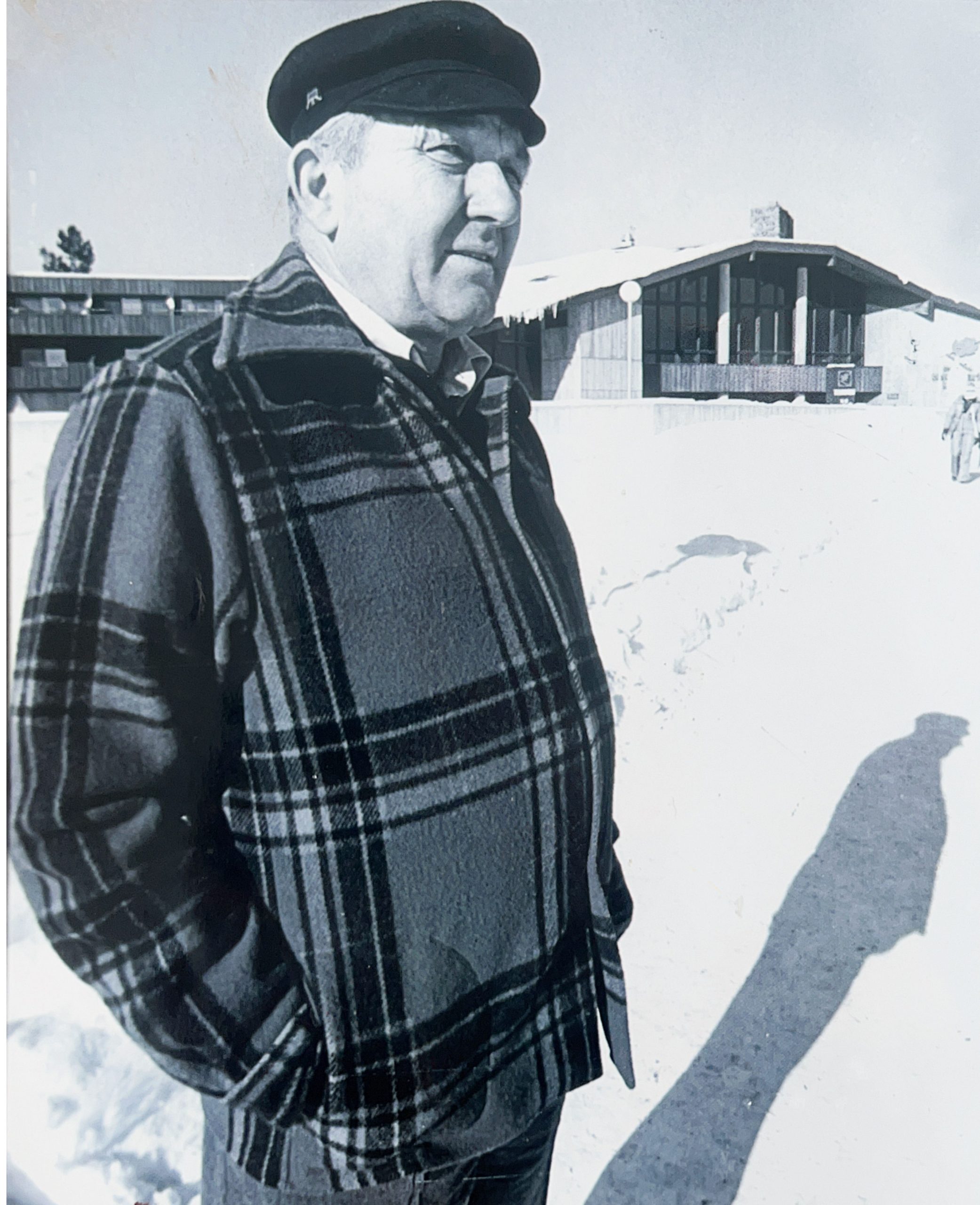
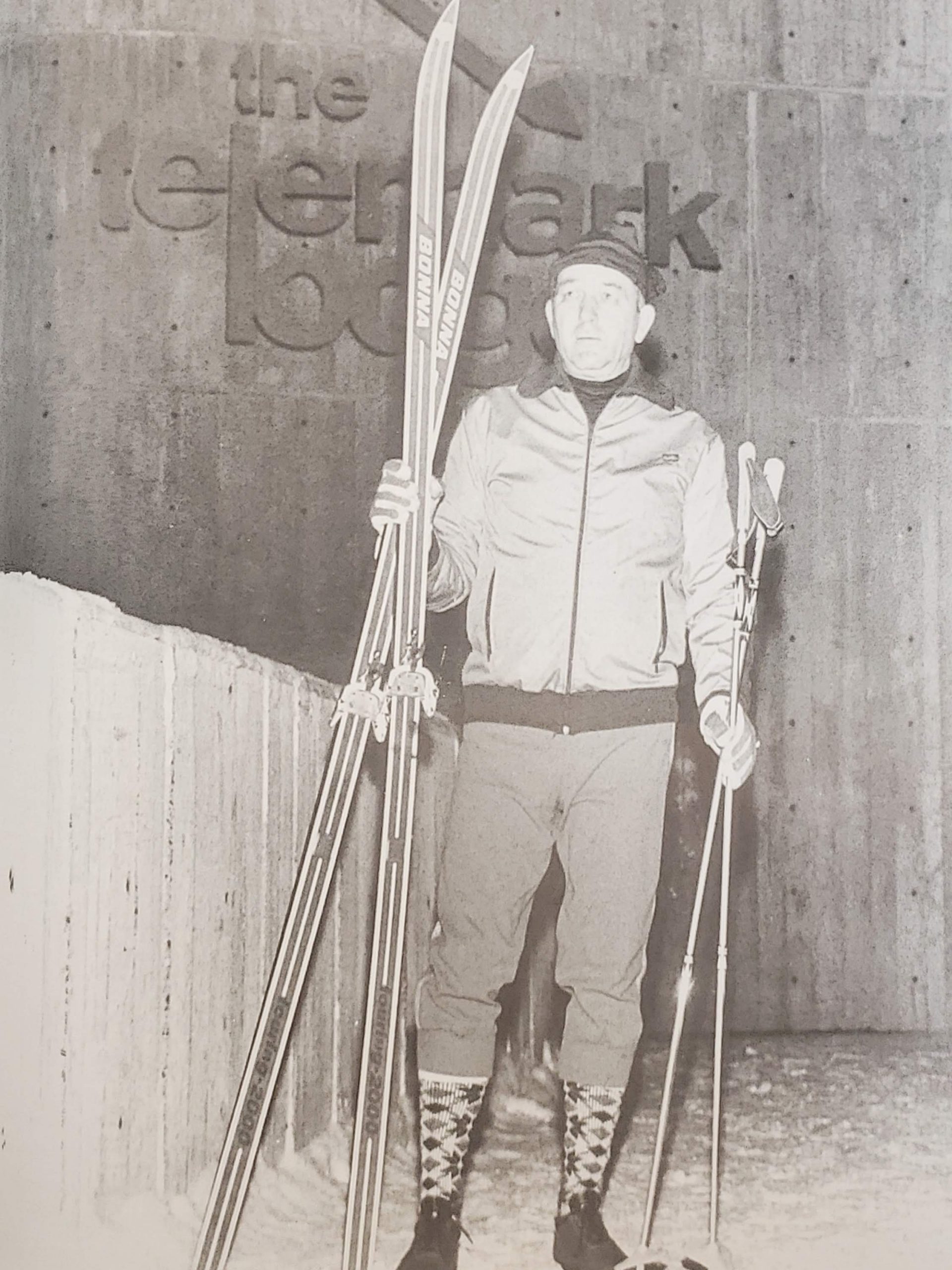
    Tony Wise, the “brains, brawn, inspiration, energy source, and grand imagination” behind Telemark Lodge, and the Founder of the American Birkebeiner. (Photo: Telemark Educational Foundation).
    Tony Wise, Telemark, and the Birkie Idea

    The Wisconsin Northwoods are a vast region. Endless pines, countless lakes, and the frigid omnipresence of Lake Superior. They beckon every human soul to dream outstretched dreams. The lucky few that are comfortable dancing in their low, endless expanses earn a typically understated moniker, a character.

    Tony Wise was a character. “The brains, brawn, inspiration, energy source, and grand imagination behind [Telemark], a bulky excitable fellow who talks with the chattering speed of a machine gun and apparently thinks the same way,” as a profile on Wise in Ski Magazine put it in 1977.

    Wise built his Telemark Resort while living in the same Hayward tar-paper shack in which he’d lived his entire life. His 1995 obituary in the Star Trib (The Minneapolis Star Tribune) concluded that Wise “built Telemark from a dream, and it did what he said it would do. It brought life and vibrancy and entertainment stars and international athletes and development to what had been a depressed area of Wisconsin.” At the same time, the lede on the same article also declared “Wise’s bank account showed $0.00 when he died Thursday.” Tony Wise, in life, emptied the tank.

    He was a born during the lean years after the Wisconsin timber boom went bust. Went off to war as young man, a tank commander during World War II. During the waning days of the War, he was introduced to Alpine skiing in the Bavarian Alps, and decided he’d bring it all back home.

    Wise founded Telemark Ski Resort in Cable, Wisconsin on a 300-foot vertical run with a nothing more than a surplus Jeep engine. The resort rounded out the fishing-summer-hunting tourism economy underfoot in the Northwoods after the War, providing year-round tourism dollars and jobs to an entire community.

    The Telemark Lodge as pictured from the top of Mt. Telemark in Cable, Wisconsin on a 1970s postcard. (Photo: Telemark Education Foundation).

    Things hummed along for some thirty years, before Wise could see the writing on the wall. He had just built his Telemark Lodge in 1973, but could also see the limitations of what he was working with in Wisconsin for Downhill skiing. Airfare to the American West—where old mining towns had took on second lives as ski resorts by simply putting up a lift on the nearest mountain with a 3,000 foot run—was beginning to become feasible for the middle-class. Wise started to look to other options.

    The dense thickets of the Northwoods mask an endlessly undulating set of kettles and moraines, left from the last retreat of the Wisconsin glaciation 10,000 years ago. A cross-country ski race would help bring people in on the secret; in 1973, Wise stitched together a path of snowmobile trails, old logging cuts, and hunting footpaths from the Lumberjack Bowl in Hayward to the base area of the Telemark Lodge in Hayward: 55 kilometers. For a name, he leaned into the Norwegian heritage present in the area—and his own myth making at “Telemark”—taking the legendary story of the Birkebeiners from the Norwegians, and dubbing his event the American Birkebeiner.

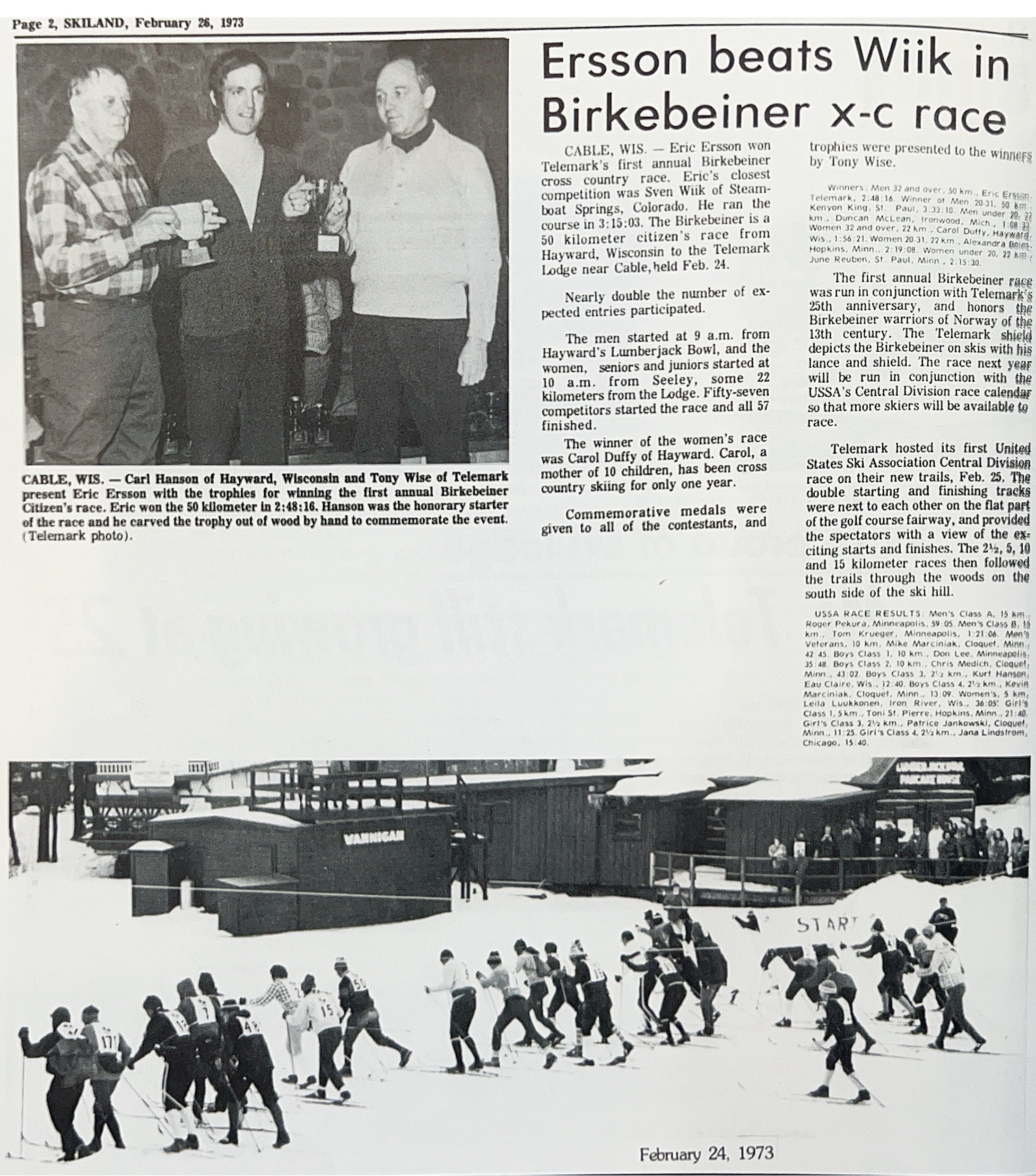
    The first running of the American Birkebeiner took place on February 24, 1973. 57 racers competing across two events. Thirty-four men and one woman, Jacque Lindskoog, completed the entire 50 kilometer course. Eric Ersson, a Swedish skier Wise had enlisted to add to the Scandinavian heritage aspect (he was doing this a lot in the early years), beat out the legendary Swedish-American ski coach Sven Wiik. Another nineteen competitors completed a half-distance course that was won by Hayward local Carol Duffy. Starting in the mid-way outpost of Seeley, this proto-event would become the Korteloppet, the Birkie’s half-distance cousin.

    The Sawyer County Record’s report on the very first American Birkebeiner in 1973. (Photo: Sawyer County Record Archive).

    Humble beginnings, but the architecture for what the Birkie is today was all there in its inaugural year. The point-to-point course through the county forests of both Sawyer County and Bayfield County. The name. The perfectly perched late February date making the Birkie the last true gasp of winter before hopes of spring could start to bubble forth.

    The People’s Race

    The most important aspect of Wise’s first Birkie was that it cut a wide swatch through cross-country skiing. In 1973, it didn’t take many people to represent the whole of the American ski community. In truth, the sport was probably in its lowest moment of the last century in the United States. The grand wooden ski jumps (the more popular form of nordic skiing at the time) which had been the preferred form of Midwestern after-church Sunday entertainment before the Minnesota Vikings started playing football were starting to rot and be torn down. From Chester Bowl in Duluth to Theodore Wirth Park in Minneapolis. Numbers in the Minnesota High School Ski League, long the greatest holder of young ski talent in the country, were diminishing. American skiing was three years away from its competitive high-water mark for the next 50 years with Bill Koch’s 1976 Olympic medal at the Innsbruck games. But Koch came from a separate, more-focused, tradition of cross-country skiing that had taken shape in the prep schools and liberal art colleges of New England. The more populist tradition of nordic skiing in America—having started out among the Scandinavian diaspora with miners, farmers, and lumberjacks—was already fading out.

    American Birkebeiner VIII in 1981, when the race began by cresting the top of Mt. Telemark. (Photo: American Birkebeiner Ski Foundation)

    The group that started that first Birkie—the now-famous red-bib-wearing “Founders”—turned around the popular participation in cross-country skiing. The ski community which exists today is the ski community they kindled back in the Lumberjack Bowl. The Birkie revolution was a quiet one, and one inspired by even more humble actors. Most were local Wisconsinites and Minnesotans who had found their way to cross-country skiing by accident or by heritage.

    There was Ernie St. Germaine, a local Wisconsin schoolteacher and tribal chief for the Lac du Flambeau band of the Ojibwe, that as of writing is the only person to have completed every edition of the American Birkebeiner. St. Germaine ought to—and I believe would prefer to—always have his childhood Dave Langraff accompany him in his telling of how they did the first event on a whim, and then saw it change their lives for good. For his part, Dave Langraff was as radiant a skier as you’d ever find out on a trail. He was another teacher, operating out of the “Jump Rope Capital of the World,” of Bloomer, Wisconsin. My few memories of him are all exuded joy, and all on skis. There’s an unadulterated patch of Birkie fever found on the Hickory Ridge trails Langraff helped cut outside Bloomer, where there’s “more lakes than kilometers to ski!” Every sharp jutting corner and fast-running downhill re-asserts a love that resonates down the years.

    Other founders include John Kotar, who hung up the skis a decade ago and since has helped shepherd the Birkie into a new era of growth as a member of its Board of Directors. There was also Karl Andresen, a Geography Professor in my hometown of Eau Claire, Wisconsin who founded the Eau Claire Ski Striders. In my youth, he played a kind of Midwestern Falstaff for all that was good about the sport of nordic skiing, regaling us with tales of this Birkie race and the little features of it that had taken on their own mythos: the Power Lines, the Fire Tower, “Double-OO.”

    These “Founders” glowed with a quiet, unassuming fire through the Midwestern ski community. Close in their tracks would be others who got in on the action as quick as they could. Through Minnesota Youth Ski League clubs and high school teams they’d coach and give back to sport which had sent them out into the great Wisconsin woods. Most of us who learned to ski in the Midwest in the last 50 years have someone who did the Birkie to thank for setting us down on tracks. Through a child’s eye, the accolade of “Birkie” skier was everything. In my mind’s eye now, I recognize the little gleam in our local ski coaches eyes when they’d talk about the race that had sparked their own love for the sport. With the Birkie spirit coursing through the community, we were all operating from a level plane.

    The author’s father celebrates after a warm Birkie finish sometime in the late 1980s. (Photo: Courtesy Image/Ted Theyerl)
    A Family Tale

    The Birkie has remained true to its intention: adventure, first and foremost. Growing from 57 racers, the legions number in the hundreds of thousands on participants who have discovered qualities within themselves by venturing out there on skis. Things caught on quick. By the fourth Birkie in 1977—the one my Grandfather first hopped in—the Birkie field had grown from 57 to 2,000 racers.

    Twenty years in, the American Birkebeiner Ski Foundation (ABSF), noticed that there was a unique staying power to the Birkie. Through the massive changes in a human life that come about over decades, A growing group was had been back year-after-year. The observation resulted in the establishment of the Birchleggers club. Membership requirement: twenty Birkie’s completed. Reward: a famous Purple bib (then gold, after 30 Birkies, then red, after 35).

    The Birchleggers now number in the hundreds. Within their ranks, there are just as many Birkie stories, and many of them key in on one particular metaphysical quality. Though the Birkie race course has remained a relative constant for them, the lived experiences they bring to the race each year, and the experiences lived during the race each year, continue to offer something close to constant discovery.

    My father—Ted Theyerl—who is 34 Birkies in at the time of this writing, signed up for his first Birkie as soon as he turned 18 in 1986. He earned an elite wave placement based off placing second in the Korteloppet the previous year. He completed the race that year skating, but still had kick wax underfoot because “no one could believe you could climb without it!” From there, through college, and well into his days as the fittest coach on my little league baseball roster, he’d consistently place in the top two-hundred, earning a bid in the Birkie’s elite wave the next year.

    One year in the early 1990s, he was out early-season training near his home in Milwaukee, Wisconsin, fell, and fractured his leg. In need of rehabilitation to keep his Birkie total on track, he turned to a Physical Therapist name Denise. They hit it off, got married, and here I am, their son, recounting the story.

    The author (l) and his family (L-R), mom Denise, brother Christian, and dad, Ted, on an early 2000s excursion to the Telemark Lodge, site of the former Birkie finish line. (Photo: Courtesy Image/Ted Theyerl)

    When Dad finally left the elite wave, it was in another crash. In 2010, my mother and I were mingling in the crowd at Angler’s Pub after my first Korteloppet, when the wave of Birchlegger elite wave finishers that my Dad usually finished with started to filter into the scene telling us he had taken a hard fall. Dad had separated his shoulder near the unofficial half-way point at County “OO” in Seeley.” He stopped off at the aid station, discarded a broken pole, took up a sling, and proceeded to skate towards Hayward. “I remember thinking, well, this will be different,” he recounted. “I don’t have to sprint across the Lake now!”

    Eventually, we found him wandering on Main St. in Hayward among the thousands of people he’d smiled, greeted, and had conversations with throughout his long, slow, one-pole skate to Hayward. He remembers that as one of his most enjoyable Cable-Hayward treks, where the kilometers lay long and thick with connections to other skiers behind him. Dad eventually slipped out of the elite wave permanently, and then took up skiing with my brother, or sister, as they started to forge their own Birkie journeys.

    Admittedly, I haven’t pulled my weight in the family Birkie legacy, having spent most of my adult life far-flung from the Northwoods of Wisconsin and with only two American Birkebeiner finishers to my name. There’s irony in that: because of the Birkie, I’m now in a spot where I can’t do the Birkie, and will be spending this year’s Birkie Saturday at a wax bench in Colorado coaching the Crested Butte Nordic Team. It’s a circumstance I count as a blessing, not unlike the example of my aunt, Tracey Cote (nee Theyerl), who left the Birkie twenty-six years ago to take up the helm of the Colby College Ski Team. She’s been spending the last weekend in February on the collegiate carnival circuit ever since. Time and distance haven’t diminished my love of a race that has directed where I’ve gone and who I’ve known in life.

    Gathering Around for Winter Vespers

    I can still evoke the feeling I had during my first Korteloppet when I turned the corner three kilometers into the race. I saw the Power Lines stretching out before me, laden with zig-zagging masses of skiers and supporters. I felt like I’d arrived at a familiar haunt. I’d spent the first 13 years of my life envisioning what that moment would be like. In reaching it, I reached that rare state where you truly can appreciate the miracle of every lived moment. I’ve been in a coasting of sorts ever since that moment.

    The other instance I hold onto from that first experience was one of inheritance. During that first Korte, I was biding my time in the line up one of the first big hills when a man wearing one of the red “Spirit of 35” Birkie bibs pulled up next to me, and shouted, “Ben!” I looked over, and got an introduction, “I’m Jim O’Connell, your Grandpa and I used to be out here together,” and in an instant, the Birkie Trail seemed to stretch before me to a different, looser, sense of time construed not around some linear march through life, but instead by the connections you make in it.

    I choose to believe there’s a reason there have been so-many repeat Birkie winners. There must be a logic behind why Caitlin Gregg, Matt Liebsch, David Norris, Alayna Sonneysn and those others who come back to compete for the top step of the Birkie podium every year. I choose to believe it’s probably along the same lines as those who are pulling over to breathe in the pines, and thank the volunteers, and make their way to Hayward from Wave 8, and 9 and 10.

    The real power of the Birkie is in repeating the ritual. Every February, a whole sport heads to one neck of the woods. Popping through old sawmill towns, gaining that first view of the Namekogan river on the drive to Hayward, the bridge welcoming you into Birkie-land which has always read “SPOONER BLOWS” in your rearview mirror. The “Viking Warriors” in full regalia still make their way to Hayward. The Sawmill Saloon in Seeley with its Birkie Bash, and seeing snowmobilers and Birkie champions, alike, gain equal purchase over a fish fry and a good ol’ can of Leinie’s O.’

    Through the many seasons of our lives, the Birkie has become communion: a gathering around for each winter’s vespers. In skiing that fifty kilometers, we’re reminded that the winter can be warm. It can make you shed a few layers. The harsh cold is no match for the warmth that human souls, pointed together in the same direction, can provide. And that, burning brightly, is the source of “Birkie Fever.”

    The Birkie: a dream dreamed, a dream realized, and a dream that skis on.

    The author’s father, Ted Theyerl, and aunt Tracey Cote (nee Theyerl) prepping for their first trip to the American Birkebeiner in winter 1977. (Photo: Courtesy Image/Ted Theyerl)
  • A Tale of Two Birkies

    A Tale of Two Birkies

    The original 1869 oil painting of Knud Larsen Bergslien’s “The Birkebeiner” is on display at the Holmenkollen Ski Museum in Oslo. (Photo: Lumi Experiences)

    Most Birkie skiers are familiar with the legendary story of the original Norwegian Birkebeiners and how that inspired the famous cross country ski race in Norway, from Rena to Lillehammer; which in turn inspired the American Birkebeiner from Cable to Hayward.

    But what is the Norwegian Birkebeiner like today? I skied my first American and Norwegian Birkies last year and took away many impressions.

    “Wait, what?!” you ask. “Garrott, you lived in Hayward for 5 years and have never skied the Birkie?” Well, okay. I skied the Birkie once in 2007, but it finished at OO that year. The Birkie’s timing in late February always overlapped with World Cups or Olympic Games. After retiring in 2011, I moved away from Wisconsin. Last year was my first year back, as my company, Lumi Experiences, had a booth at the Expo, sharing stories from the Worldloppet events where we run cross country ski vacations.

    Spectators cheering on Birken skiers. (Photo: Lumi Experiences)

    On Birkie Saturday, I couldn’t pass up the opportunity to ski from Cable to Hayward and actually finish on Main Street. Finally, I checked off one of my bucket-list items as a ski racer.

    Three weeks later, I found myself standing in Rena, Norway getting ready to classic ski 54 km from Rena to Lillehammer, carrying an 8 pound backpack representing baby prince.

    Spectators provide extra sustenance to skiers between the official aid stations. (Photo: Lumi Experiences)

    Håkon Håkonsson. The three-week gap between the two events was enough to recover from one and carry good fitness into the next.

    Our group was staying in Lillehammer, so it was an early morning bus ride to get to the start in Rena. The race course takes you on a direct path over the mountains, but the roads have to go around the mountains. In order to arrive at the start by 8:00 am, the bus left Lillehammer at 5:30 am. I was expecting a very dark start to the morning, but when I opened the blackout curtains and daylight came in, I thought I had slept through my alarm. This should not have surprised me, as we were just two days from the Spring Equinox and only 5° south of the Arctic Circle.

    Ski trails in every direction. (Photo: Lumi Experiences)

    The start of the Birken is basically in a farm field with temporary warming tents without any permanent infrastructure. The colloquial name for the Birkebeinerrennet was one of the biggest surprises for me. I’ve grown up in the US calling it the Norwegian Birkie, but in Norway, it is unequivocally referred to as the “Birken.” This terminology makes it easy to differentiate the American “Birkie” from the Norwegian “Birken.”

    The start itself was one of the most civilized starts I have ever experienced. The ~ 10,000 starters are split into 14 waves. As a wave 1 Birkie skier, my Birkie time was good enough to be seeded in the 4th wave at the Birken – a wave placement which seemed surprisingly accurate, given the pace of the skiers around me. Ample tracks and a gradual uphill start kept everyone spread out without any accidents. It seemed like everyone understood they had 54 km to ski and no one needed to win the first kilometer.

    Sunshine and blue skies. (Photo: Lumi Experiences)

    In fact, as early as one kilometer into the race, skiers were already stopping to work on their kick wax. Conditions were surprisingly tricky, as the course starts only 1000 feet above sea level, then climbs to about 3000 feet of elevation. The weather warms throughout the day and a skier may go through three or four different wax conditions.

    I waxed with a thin layer of klister, covered with hardwax. This combination is tricky because you have to keep your skis moving to prevent icing in the powder at higher elevations, but it provided great kick for the first 20 km of climbing up to the plateau in Raudfjelllet. It was also durable enough to last for my entire 54 km race. I just stopped once to switch skis half-way through the race in Kvarstad. This meant the wax that had worn off the inside edges of my skis was now on the outside edges, giving me better glide and kick for the second half of the race.

    The spectators really help make a ski race fun for participants. The Marcialonga in Italy and the Engadin in Switzerland both go through many villages, so it’s easy for people to cheer from their balcony. The Birkie and Birken courses are much more rural, so they’re harder for spectators to access. However, the spectators that make it out onto the course are there to have fun and bring a lot of enthusiasm for the racers. There were so many spectators at the Birkie this year that I thought I was already at OO when in fact, I was only at Boedecker Rd. By the time I was actually at OO, skiing over the Key Log Bridge, I was in awe at all of the new infrastructure and enthusiastic spectators. My favorite spectators, however, are the snowmobilers. They are often in the harder to reach corners of the course and seem to be there more to cheer on the agony of defeat than the thrill of victory.

    Skiing into the Birkebeiner Stadium. (Photo: Lumi Experiences)

    The Birken goes through a protected region, high on the plateau, so there are no snowmobilers. Somehow, though, spectators figure out how to bring couches to the trailside, build huge bonfires and offer homemade aquavit or Jagermeister to skiers passing by.

    Speaking of aid stations: each Worldloppet event seems to have its own unique treats, like Comte cheese in France, dark chocolate in Switzerland or blueberry soup in Sweden. In Norway, it’s lefse. Seriously. The rolled lefse dough filled with cinnamon and sugar looked a little dry to me, but I was hungry at the first aid station and took a bite. It turned out to be one of the best tasting race foods I have ever eaten. After that, I made sure to take a buttery lefse at each aid station. Yum!

    Unlike the Birkie, which is mostly wooded from start to finish with lots of rolling trails, the Birken is mostly on a high open plateau with long, sustained climbs and long, gradual descents. I often found myself looking out over the wide expanses and admiring the views throughout the race.

    We were fortunate to have ideal weather conditions for this year’s Birken, save for a headwind somewhat reminiscent of crossing Lake Hayward at the Birkie this year. There are years, however, where the weather on the plateau can be much less ideal. Besides the symbolism of the backpack, there is also the practical consideration that you can carry warm, dry clothes with you. Not only does the backpack need to weigh 8 pounds, it also needs to store a windproof jacket, pants, long underwear, hat, gloves and balaclava.

    One of the best parts of the Birken is the final 15 km from Sjusjøen to Lillehammer. Rather than big climbs and a lake leading to the finish, the last 15 km of the Birken is a long, gradual downhill. Before the race, I learned that a special award is given to finishers who cross the line within 25% of their age group winner’s time. I’m not sure if the Birkie still has a 25% Club award, but the tradition lives on in Norway. I train far less than I did as a racer, but still have a competitive spirit. Achieving the 25% Club award in the Birken is not easy. When I realized I may still be in the running at the last time check, I tried to make up as much time as I could on the downhill to Lillehammer, relying more on my ski skills than on my fitness.

    Lumi guests Bill and Meg celebrate at the Birken finish. (Photo: Lumi Experiences)

    The Birken finishes at the Birkebeiner Stadium, which hosted the 1994 Lillehammer Olympic Games and still has one of the most challenging trail networks on the World Cup circuit. 

    Fortunately, the Birken finish does not take racers on any of the World Cup course. Instead, skiers cruise through the flat stadium and into the finish. After a quick backpack check, skiers are awarded their Birken medal and Worldloppet passport stamp, recognizing their achievement.

    For me, one of my favorite aspects of completing a big event like the Birken is sharing the experience with friends. After the race, everyone gathered to share stories about their journey from Rena to Lillehammer and to cheer on the new friends they had made during the week. Skål!

    If you’d like to ski the Norwegian Birkebeiner, check out the Lumi Experiences Norway Birken Trip and receive the early booking discount of $300 per person when you secure your spot before March 31. We would love to have you along. Reach out to see the itinerary!

    See you on the trail soon,
    Garrott Kuzzy

    garrott@lumiexperiences.com


  • Racing to Save a Ski Season . . . Adaptations and Impacts of Virtual Racing: Part II
    Racing to Save a Ski Season . . . Adaptations and Impacts of Virtual Racing: Part II
    Some times, the races couldn’t be held. Other times, not everyone could get to the races. Such was the case for Nordic skiing during the pandemic. If such limitations occur again in the future, will virtual racing become a viable alternative? (Photo: Tornow/Muniz, American Birkebeiner)
    White-knuckled, we caravanned down I-94 from St. Cloud to Minneapolis in the midst of a bomb cyclone of wind, snow, and ice. Braving the conditions, we crawled toward our destination: the 2021, hybrid City of Lakes Loppet at Theodore Wirth Park. Due to the COVID-19 pandemic—and a hearty desire to stay healthy for the remainder of the ski season—we decided to drive separately. Now, we were inching our way to a late start for our Thursday morning staggered start times of 9:00 and 9:02. There was no way we’d make it on time.

    As race directors presented various solutions for completing their races during the winter of 2020-2021, many Nordic skiers were scrambling to salvage a season that had been fractured by a global pandemic. Previously, we had gathered en masse at venues in Minneapolis, Hayward, Calumet and numerous other host towns for days of socializing, racing, and celebrating.  Now we found ourselves with virtual starts at different times and venues scattered across North America. Armed with smart watches, cell phones, or (in some cases) witnesses willing to testify to distance and time, cross-country skiers raced their way to another successful event completion. As we all uploaded our times and compared our performances, we were left wondering about the legitimacy of these “virtual” races: were we really racing? Against whom? These questions got us thinking whether these virtual race formats—including skiing different venues, at different times, or even substituting an activity other than skiing—are viable long-term solutions to hosting Nordic ski events in the face of climate change, where winters are getting warmer and the ski season is getting shorter with less predictable snowfall.

    To address these issues, we developed a survey to gather the insights of Nordic skiers across North America. With the help of the American Birkebeiner Ski Foundation, the Loppet Foundation, and Stearns and Wright County Parks, we received feedback from over 1,300 participants. In our first article, we addressed the question of how we self-identify as cross-country skiers and how this relates to culture, diversity, and opportunity in our sport. In part two, we focus on skiers’ perceptions of virtual ski events, our likes and dislikes, and whether these are legitimate forms of racing. To address these questions, we evaluated a subset of our survey participants: the 829 cross-country skiers who completed at least one virtual ski event during the 2020-2021 ski season. Thus, while our survey results aren’t necessarily a reflection of the entire Nordic ski community, they do represent the voices of skiers who experienced firsthand the pros and cons of virtual racing.

    Racing? Virtual?

    As we try to better understand how our cross-country ski community responded to the COVID-19 race schedule—and what it means as we move into a world of less predictable winters—two terms become particularly important: “virtual” and “racing.” Although we may all have a general idea about what these terms mean, neither is particularly straightforward as we look at the myriad opinions regarding the “virtual race” schedule of the 2020-2021 race season. For our own purposes, as skiers who practice anthropology, the two terms vary in how they are defined. Although countless articles have been published on the philosophy of racing and what constitutes a race, the term “racing” in our study is one that we left to our survey participants to define. This means that we are not going to provide a definition of “race” or “racing,” at least not yet. Instead, we teased the meaning of cross-country ski racing from the responses that our Nordic ski community provided in the survey. Thus, “racing” is defined internally, by the skiers. We own it.

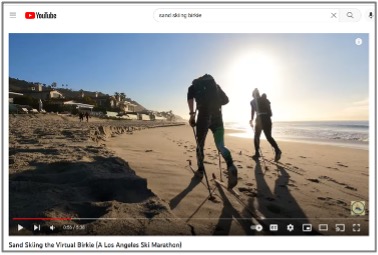
    Figure 1: Virtual Birkie skiers sand skiing on a Los Angeles area beach. (Photo/Video: youtube.com)

    On the other hand, the term “virtual” is one that was defined for all of us, at least as it applied to the COVID race season of 2020-2021. And the definition of “virtual” might have strayed a bit from what we normally think of as “virtual.” For the most part, the virtual options presented to us for completing our annual ski marathons didn’t involve pulling out the VR headsets or hopping onto the treadmill or trainer for a Zwift or Rouvy session—though in some cases, it might have. Instead, virtual options included such things as actually skiing on snow, but in a different location than the original race, or skiing at the official race venue but on a different day than the traditional start. For some races, such as the American Birkebeiner, other activities such as running, cycling, swimming, rowing, or roller skiing could be substituted for skiing on snow (Figure 1).  Regardless of activity choice, substrate, and location, distance and time were measured using a GPS watch or app, or the testimony of a witness who could verify time and distance. We got to choose how we completed our events given a range of “virtual” options that were made available to us.  Although COVID is not currently the threat it was two years ago, at least some event organizers are still offering virtual options this winter.  The virtual option could turn out to stick around longer than many of us anticipated.

    Do we dislike virtual events?

    As we perused our survey results, we were struck by the wide range of responses, both positive and negative, that skiers had with the various alternative cross-country ski formats subsumed under the term “virtual.” We noticed that, given the opportunity to discuss both their likes and dislikes of virtual racing, positive responses (n=864) outnumbered negative responses (n=613) by over 30%. A look at these results allows us to get a handle on how we, as a community, define racing as well as our attitudes about whether virtual cross-country ski events can be considered legitimate races. We’ll begin our discussion with the dislikes that virtual skiers expressed about the events they participated in.

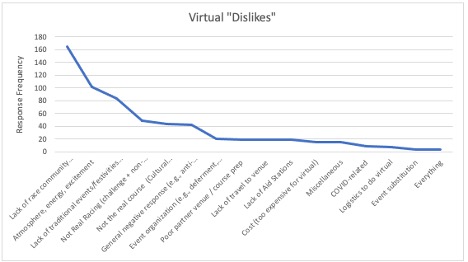
    Figure 2: Patterns of things virtual skiers disliked about virtual cross-country ski races.

    Figure 2 summarizes the 613 individual, negative responses that virtual ski participants provided. Overwhelmingly (> 55%) the dislikes about virtual cross-country ski events focused on the lack of social interactions, energy, and festivals that surround typical Nordic ski races. The single, most common dislike (n=165) that skiers expressed was that they missed the community and camaraderie that surrounds these events. This was followed by the lack of atmosphere, energy, and excitement (n=101), and lack of traditional events and festivities, including things like gear expos, after-parties, and “Main Street” finishes. Following these first three dislikes, we see a drop in responses.

    Coming in at number 4 in the list of dislikes, with 9% (n=49), was the critique that virtual events, in one way or another, are not real racing. Although only 17 of the 629 dislikes explicitly stated that virtual events used during the COVID-19 pandemic did not constitute real racing, we identified several additional responses that are closely related to this category. These additional “not real racing” responses do two things: 1) they provide valid critiques of virtual events; 2) they identify important elements of a ski race that allow us to tease out the definition. Fifteen respondents argued that virtual events lack competition. Additional critiques include non-comparable times (n=10), no official, mass start time (n=4), and that virtual event participants ski on different courses in different places (n=3). This mix of responses highlights some key elements that define a cross-country ski race: a competition between skiers where times are legitimately comparable because of a scheduled start time on a designated course using official timing.

    Figure 3: The authors, Matt Tornow (left) and Mark Muñiz, celebrate their completion of the hybrid City of Lakes Loppet.

    So, when we (M&M; Figure 3) were slipping down I-94 to ski the hybrid City of Lakes Loppet, would we be racing? Technically, we missed our start times, so that criterion might be compromised. However, we were still allowed to race, and we certainly skied within the open window for the event. When we got to the start on Wirth Lake, it was empty except for a volunteer starter who explained the course, and particularly the finish, where we were instructed to do two laps around the stadium. We were competing with the clock, but also with other skiers that we might have seen on the course. We also compared our finishing times with those who completed the event at different times and on different days. Whether or not we skied the same course is a sticking point. By the time we got to the final 10k around the stadium, the conditions had degraded to the point where drifting snow and downed course markers had made identifying the intended course impossible. Tornow’s two laps differed slightly from each other, as evidently he missed a turn at some point. Muñiz did the same lap twice to finish his race. This resulted in different distances: 30.5k for Tornow and nearly 34k for Muñiz. While the official race distance was recorded as a 30k, other racers recorded different distances too. Maps posted to Strava show that Olympians Caitlin and Brian Gregg each skied 31.2k to complete their hybrid Loppets. While some differences in distance are almost certainly the result of different recording devices (e.g., watches, phones) and related apps, it’s also evident that Tornow, Muñiz, and the Greggs all skied slightly different courses for the same race. Without analyzing the maps of all participants in the 2021 hybrid City of Lakes Loppet, we really don’t know how our times compared with the other racers. Similar concerns might arise from skiing the same course at different times. Our late start on Thursday morning resulted in more accumulated snowfall on the course and more drifting. We’re not making excuses, but those who skied the race earlier in the week or the following day would have had very different (better) conditions.  Apply this complexity to events that allowed skiers to use entirely different courses (e.g., Virtual Birkebeiner and Virtual Vasaloppet) and we can quickly see that the race criteria of legitimately comparable times and distances are easily violated for virtual events.

    Rounding out the top five dislikes, skiers did not like the fact that they were not skiing on the real course. This is a sentiment that, like the top three responses, relate to the social aspects of the event by focusing on the traditional place and cultural landscape where cross-country ski events occur. These top five responses (72%; n=443) all focus on the social meaning of the event, whether it be interpersonal relationships, competition between ski racers, or interaction with a traditional, cultural landscape.

    Rather than focusing on the cultural meanings associated with cross-country ski events, the remaining 28% of dislikes shift the focus of critique to the mechanics of virtual racing. The sixth most common dislike was a general, “virtual stinks” kind of response. While not explaining why they disliked virtual events, these 42 responses express a general dissatisfaction with the substitution of virtual events for traditional, in-person, mass-start races.

    There is a sharp drop in the number of responses following the “virtual stinks” critique. Twenty virtual skiers were dissatisfied with the organization of their virtual events. These dislikes ranged from a lack of communication and dissatisfaction with virtual interaction to the inability to defer their registrations to future, in-person events. There was a three-way tie for the eighth most common dislike between: dissatisfaction with partner venues and course prep; the lack of aid stations; and a desire to travel to the host town for the event. Rounding out the dislikes were the high cost of virtual events (n=15), a general dissatisfaction with the situation surrounding COVID-19 (n=9), figuring out logistics (n=8), and event substitution (n=4). There were also fifteen “miscellaneous” responses that included things like not winning a raffle, missing foreign culture, and lack of motivation.

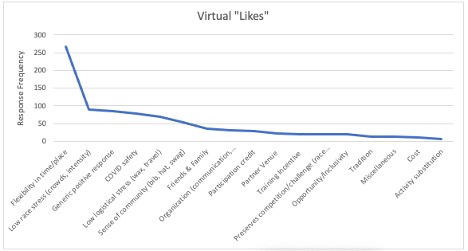
    Figure 4: Patterns of things virtual skiers liked about virtual ski races.
    What was there to like, then?

    With all of the negative feedback, we’re left wondering if there was anything we actually liked about these virtual events. It turns out, that there was a lot to like, and skiers had about 30% more good things to say about their virtual races than bad things. Figure 4 shows that about a third of survey participants (n=266) said that they liked the flexibility that virtual ski options provided regarding when and where the event could be completed. For virtual events offered during the pandemic, skiers could choose their own venue and could complete their races at any time. This was clearly a bonus to many skiers. The next most common like (n=89) was the lowered race stress that comes from virtual events. Although many skiers disliked the fact that virtual racing wasn’t real racing, a greater number of skiers indicated that they liked the lower stress, less-crowded trails, and lower intensity of virtual race formats. Following a general “virtual is great” response and an appreciation for COVID safety (which came in third and fourth, respectively), the lower logistical stress afforded by not having to travel, figure out wax, and get to the starting line on time rounded out the top five. Thus, three of the top five likes of virtual racing were related to the fact that the virtual events were fundamentally different than typical races and were generally less stressful.

    Although the top three dislikes of virtual events revolved around missing the sense of community that big cross-country ski events provide, not all virtual racers saw it this way. The sixth most common thing that skiers liked about virtual events was the sense of community that they created.  The sense of community resulted from seeing others skiing their virtual events in their race bibs or displaying the swag that comes with participation in hallmark ski events. For many racers, wearing Birkie swag publicly associates them with finishing one of the toughest ski marathons in North America.  Whether or not they finished the race on the course in Wisconsin or on a local trail in some other state is a secondary talking point.  Others also appreciated the opportunity to ski with friends and family who had different abilities (7th ranked). Thus, virtual options provided a real sense of community, albeit different from that found with traditional mass gatherings.

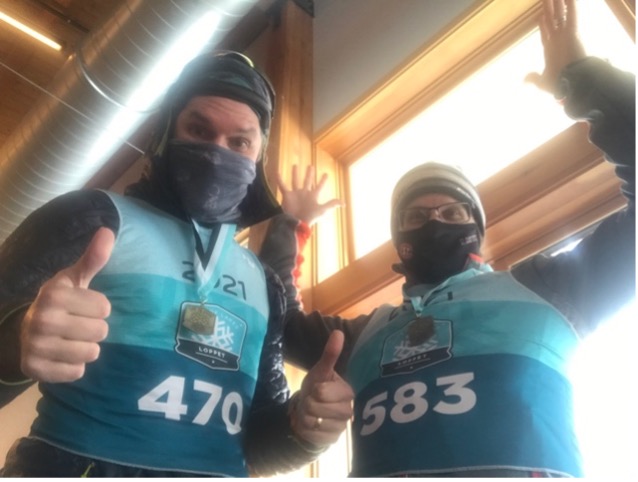
    Figure 5: Skiing virtually during the COVID-19 pandemic allowed many skiers, such as these long-time Birkie skiers, the chance to maintain tradition and share their experiences with others through social media.

    There were a number of skiers who were happy that, during the middle of the COVID pandemic, races were held at all, and many of these folks (n=31) gave ‘shout-outs’ to the organizers who pulled these virtual events together, maintained communications, and provided platforms for reporting results. In addition to praising the race organizers, 23 skiers also gave kudos to partner venues, who provided certified, groomed courses to use specifically in completing the virtual Birkie. Squeezed between organizer and partner venue shout-outs, the ninth most common like about virtual racing was getting credit for participating. This sentiment ties into the fourteenth ranked like (n=14): preserving tradition. For many skiers, participating in these events is steeped in tradition, and the chance to participate in a COVID-safe, socially distanced format provided skiers the opportunity to keep the tradition alive (Figure 5).

    Although very few positive responses explicitly called their virtual events “races,” the racing sentiment is expressed in some of them. Twenty-one skiers liked that the virtual options available to them provided impetus to continue their race training. An equal number of skiers liked that virtual events preserved the challenge and competition of a race experience. Thus, while about 9% of virtual participants thought of virtual racing as “not real racing,” 5% liked the racing aspects of virtual events.

    Just as virtual events provided skiers the opportunity to ski with friends and family with different abilities, they also provided opportunities for skiers to take part in events that they might not otherwise have been able to participate in. Our data indicate that about 10% of our total number of respondents (127/1300) had never completed a sanctioned, Nordic ski event prior to the COVID-19 pandemic. Of these 127 skiers, 42 (33%) indicated that they took part in a race during the 2020-21 season and 34 of them chose a virtual option. Whether the virtual option provided impetus for these first-time cross-country ski racers to participate in these events is unclear. What is clear is that 20 skiers indicated that they liked the opportunity to participate that the virtual options provided. Thus, for these 20 skiers at least, virtual races provided the opportunity to participate in ways that otherwise might not exist.

    Aside from cost and a number of miscellaneous responses such as adjusted, shorter distances, or positive memories associated with a chosen alternative venue, the likes are rounded out by those who appreciated the opportunity to substitute an activity other than skiing to complete their event. This was a big bonus to skiers who found themselves on a snowless landscape during the COVID-19 pandemic.

    Our questionaires revealed that gathering at the venue and socializing as cross-country ski athletes is perhaps an important part of race participation. How well will virtual races be able to fill that fundamental need?
    So where does this leave us?

    If we look at the sheer numbers of likes versus dislikes, it’s clear that virtual skiers had more good things to say about virtual events than bad. Does this mean that virtual skiers liked their respective events? Maybe. There were certainly things to like about the opportunities provided to “race” under the social distancing guidelines of COVID-19. Simply the fact that we could ski at all was enough to make many skiers happy. Add to that the flexibility, inclusivity, low stress, and opportunities to socialize and compete, and the virtual response to COVID seems like a success. Of course, the lack of community, excitement, and celebration seemed to weigh heavily on virtual ski participants.  While many skiers liked the lack of stressors and logistics that come with virtual racing, many of those same skiers disliked the fact that these virtual events weren’t “real races.” So, what is it about a “real race” that is so appealing and motivates us?  It’s something more than just legitimately comparable times because of standard starts on a designated course using official timing.  Real races require honest head-to-head competition between us as we strive to do our best, that pushes us to be even better than we could ever be on our own.  If virtual races cannot provide this, then they fall short for many people.

    Holding our ski events virtually during a time when hosting mass gatherings was neither practical nor safe was probably the best solution. As Ben Popp, Executive Director of the American Birkebeiner Ski Foundation, said “while it isn’t as good as an in-person event… it was still something that you planned around, talked about and went and did.  It kept you engaged in a larger community and working towards a goal.” But, as winters become more irregular, with warmer temperatures and less predictable snowfall, is this format something that skiers would accept on a more regular basis? What would a transition to virtual ski events do to our sense of community? To our desire to compete? These are questions that we’ll address next, as we explore the impact of virtual events on the Nordic ski community and culture and consider the ways that event organizers can maintain or even grow participation in our sport in light of climate change.


    Mark P. Muñiz, PhD, is a Minnesota transplant who grew up in Florida, but enjoys a cold snowy winter over a hot humid summer any time. His cross-country ski adventures have included loppet races and volunteer coaching for the Minnesota Youth Ski League. In the warm season he loves cycling and is still a little wary of jumping on rollerskis. He currently teaches as a Professor in the Dept. of Anthropology at St. Cloud State University, MN.


    Matt A. Tornow, PhD, is a Professor of Anthropology at St. Cloud State University in Minnesota. His research interests focus on primate adaptation and behavior, including that of humans. As a native of central Illinois, he spent much of his youth and early adulthood driving north to seek out the snow. Now he spends his winters skiing the local trails and doing a little racing. When there’s no snow on the ground, you can find Matt running through the woods somewhere.

  • Tradition and Transformation: The Birkie Plans its 50th Anniversary

    Tradition and Transformation: The Birkie Plans its 50th Anniversary

    American Birkebeiner VI in 1979. The “Birkie” will celebrate its 50th anniversary next February. (Photo: Telemark Education Foundation).

    Tony Wise could see 10,000 years at once. The last ice age had sent a glacier down over Wisconsin, and then tore it back. In the process, the landscape and lilt of a place emerged. Deep-pocketed kettles, ridges, gentle and subtle rolling hills, all draped in the needly green of the pines. Gaze at it, and time didn’t seem like something that moved forward, but instead danced within the bounds of a whole epoch. A 400ft moraine that rose up from the Superior Upland outside of Cable, Wisconsin: the Ojibwe called it kawabaming—the place to look out from. Look out, and it kept going. Time stretched out and blurred, forward and back. Ten thousand years didn’t seem like much.

    Wise was a local boy who had just returned from serving as a tank commander overseas during World War II.  During his service in Europe, he’d found himself in the Bavarian Alps, where he’d been introduced to a way of moving across the Earth that filled the metaphysical space found on top of the local hill he now stood on. Skiing was an ancient way to front the winter, and a wholly new thrill in each and every turn. Hopes and histories were about to mix as Wise sought to purchase a piece of Wisconsin land to develop into a sking destination. Wise carved a number into one side of birch tree. Walt Kliszcz—a local railroad man who held the deed—carved a number into the other side. They met in the middle: $750.00. Wise renamed the hill Mt. Telemark, then built a ski hill, a lodge, a race, and a dream.

    Tony Wise in 1972 outside of the old Telemark Lodge in Cable, Wisconsin. (Photo: Telemark Education Foundation).

    Everything that successively unfurled was united by the understanding of time and place that Wise found at the top of Mt. Telemark. In transformation, there was always tradition. In 1973, when Wise set out to start a cross-country ski race, he simply adopted a Norwegian legend from 1206—the Birkebeiners—who saved the country by ushering the baby Prince Haakon to safety on skis. In its first year, the American Birkebeiner had 35 participants. In 2023, the “Birkie” was up to 13,000. In each ski stride over each glacial ridge and valley in the interim, the Birkie began to be interwound with the place Wise had set it in. The challenge was always there. Ski 50 kilometers. Like no other race out there though, people could find themselves having quickly done twenty or thirty Birkies over as many years. Soon, there were so many in that category they started a club for them all, the Birchleggers. It all added to the legend of Wise’s race, starting out there in the shadow of the place to look out from.

    Which all leads to the big irony for the American Birkebeiner in 2023. For a race in a place that has staked itself on blurring the very concept of time to match the place it exists in, there is one span that is all anyone around the Birkie can talk about these days: 50 years. The American Birkebeiner is starting out on its 50th anniversary year.

    Tony Wise himself now belongs to the realm of Paul Bunyan and the Birkebeiners—legends out there among the Northwoods. His careful balance of plotting out the new in the landscape is being heralded by a whole cadre of dedicated staff, volunteers, and skiers at the American Birkebeiner Ski Foundation (ABSF). At the helm is Ben Popp, ABSF Executive Director since 2013. He’s another homegrown local who has inherited Wise’s ebullient energy and community-focused spirit.

    When FasterSkier caught up with Popp to talk all things Birkie, he put the passage of fifty years right back into Birkie terms. “It’s been on the horizon for fifty years,” he said. “And yet, it feels like it came up super-fast!” Which is to say that the Birkie remains comfortable dancing within multiple timelines. While shovels hit the ground in one place, the groundwork is being laid out for the race’s biggest milestone yet come February 2024.

    Popp’s way of directing all that energy follows what he calls a “three-step filter: 1) what is the history behind what we want to do? 2) Does what we’re doing build on that history in a way that’s good for what we define as the “Birkie” community, and 3) Can we do it sustainably?” What that has yielded during the first ten years of Popp’s tenure is a bolstered Birkie Trail system, including a new start area, increased participation in the Birkie’s now year-round event schedule, and a larger staff, presence, and place for the Birkie in the Hayward, the Northwoods, and the ski community writ large.

    The filter is starting to be reflexive in time. The two big projects ahead for the Birkie in its semicentennial include looking back and figuring out the right way to mark the occasion at next year’s American Birkebeiner event, while also transforming Mt. Telemark and the remnants of the former resort into a world-class ski facility.

    The ski trail affectionately dubbed “Tele-henge,” the ABSF’s ski trail through the old lobby, and future site of Mt. Telemark Village. (Photo: ABSF)
    Telemark Looks Out Again

    It was the “only place where the Lodge is bigger than the hill,” said Olympic gold medalist Alpine skier Billy Kidd at the opening of Tony Wise’s Telemark Lodge in 1970. With 400 rooms, the hotel offered more rooms than the ski hill outside had vertical feet. The Lodge was an outstretched behemoth that was demolished in 2021. All that now remains are towering old brutalist walls, deemed “Tele-henge” by the skiers down the hill at the new Birkie start line area. The meandering tale of how the Telemark Lodge got to Stonehenge status though, had left specters that still glowed with life. Mainly, the Birkebeiner, and the sport of cross-country skiing that it had helped build in the United States.

    Which has got the Birkie Foundation dreaming big. After years of unstable ownership, the lodge was acquired by ABSF in 2018. Once the Lodge was condemned and demolished two years ago, the creative energies started to flow.

    “For Telemark, there’ll be three big pieces: the ski trails, the mountain bike trails, and the Base Camp building” says Popp. A partnership with Wisconsin-based Trek Bicycles, along with a major grant from the One Track Mind Foundation promises to build an additional 17 miles of single-track mountain bike trail on top of the existing Chequamegon Area Mountain Bike Association (CAMBA) trail network over the next three to four years. Rock Solid Trail Contracting, the builders behind the renowned trails in Copper Harbor, Michigan, are on the job. “Four miles are already done, and by the end of this summer, we’ll have nine miles added on,” says Popp.

    The new rollerski loop at the base of Mt. Telemark, outside of Cable, Wisconsin. (Photo: ABSF)

    Over at the Birkie start-line, the pavement of a new 5-kilometer rollerski loop—the first of its kind in the Midwest—is “just now starting to cure,” says Popp. The loop is laid through the old remnants of the Telemark base area and is giving skiers from everywhere access to Birkie terrain year-round for the first time. The loop is slated to host Central Cross-Country Skiing’s (CXC) Regional Elite Group (REG) camp later this summer, and just hosted its first Igor Legacy U14 camp this summer. The trail also become a favorite multi-use trail. “We get some older folks just strolling out there,” said Popp. “Hard place for a walk!”

    As for the winter ski trails themselves, the ABSF’s focus isn’t so much on building new trails, but rather restoration of trails. Down at the base of Mt. Telemark, in view of abandoned Alpine ski lift towers, are the cuts and juts of a trail designed by American ski pioneers Marty Hall, Sven Wiik, and John Caldwell. These trails once hosted the Gitchee Gami Games with fields that included not just the best American skiers of the era, Bill Koch, Martha Rockwell, Stan Dunklee, Tim Caldwell, but notable names from ski history like Oddvar Bra and Arto Koivisto. A contemporaneous Sports Illustrated article on the 1977 edition reported that it was part of a then “controversial series” put on by the International Ski Federation (FIS), what would become the World Cup. An aged wooden sign between two tall maples identifies these as “The Telemark World Cup Trails.” With some clearing and modifications for grooming, skiers will be able to take to them again. The World Cup trails have an outsized place in the purpose of the whole Telemark Village project. While not the most resource-intensive, the project drives, or rather, skis, to the heart of the sport the Birkie community ultimately comes together around, and also represents the unique dance of making, and re-making, the energy of Telemark and all it stood for.

    The resource-intensive side is there though, in the form of the planned “Telemark Base Camp Building,” an estimated $3.5 million nordic center that will come fully equipped to welcome World Cup athletes and first-timers alike. “I think the heart of what Telemark represented could be captured by the idea that on a given afternoon back in the day, you might have Bill Koch and a kid who’d never heard of the sport an hour before in the same place, and we want to get back to that,” says Popp on the essence driving the Base Camp’s purpose.

    The Telemark Village Base Camp building is the next priority in the Birkie’s major restoration of the former Telemark Lodge site. (Photo: ABSF)

    The plans call for a full-service nordic center—rentals, changing rooms, spaces for local business partners to sell coffee and food—while also acting as a jumping off point to experience the unique history of Telemark. Key to that is using the remnants of the Lodge to build a park-like plaza, where a collaborative project with the local Cable history museum will lay out Birkie history back to when Tony Wise carved his number into an old Birch tree.

    The final piece of the project is up at the top of Mt. Telemark where an observation tower is being built out of recycled lift towers from Wise’s original alpine ski operation. The tower will act as a capstone on the Telemark project that Popp says tells Birkie they’re doing things right, “There’s a throughline in that project that really reiterates how there really is a rootedness in the values of honoring our history, and the history of this place. There were two people down in Spooner, Wisconsin who donated to make the tower possible, which included the naming rights, and they asked that it honor the original Ojibwe name of the area. So how do we make that happen? Well, the person to naturally ask is an Ojibwe Tribal Historian, and it just so happens that the only guy to do all fifty Birkie races, Ernie St. Germaine, is the preeminent Ojibwe historian.”

    The former Telemark Lodge stadium hosts CXC’s U14 Igor Legacy Camp last weekend. (Photo: Ted Theyerl)

    In other words, the drive of this version Telemark is to keep all that was contained in the old Telemark going. The ABSF capital campaign around it totals $10.5 million, with Popp saying, “we’re about half-way there on fundraising, and we feel like have about half of what we want to build done.” The purpose though, remains clear, “ultimately, that money isn’t ours. It’s an amalgamation of a whole lot of people and communities that value what the Birkie is. When you think about all 250,000 people that have completed the race since 1973, plus many more who touch our trails, or volunteer, or touch us in some other way, it’s a lot of angles that we want to make sure we’re covering in any single project. It’s pretty cool to have that presence, and to have that responsibility.”

    “Celebrate in the Right Way” at the 50th Birkie

    Just how expansive the Birkie community has become in 50 years makes for a big proposition come next February: “With the 50th, we really want to do justice to the countless people that have taken part in anything we have done over the past half century” says Popp, “The guiding question is what is a meaningful way to make sure that we represent what this thing, the Birkie, really means?”

    The Birkie start line area in Spring 2023. (Photo: ABSF)

    For the Birkie Foundation, those preparations started well in advance of the coming anniversary year, and included, at least at first, a kind of disappointment. In keeping with the kind of full circle nature that the Birkie paints with time, plans were underway to make the 50th Birkie the first World Cup ski race in Cable since Wise’s Gitchi Gami Games in 1977. A joint bid was underway with the Loppet Foundation in Minneapolis, Minnesota to make the World Cup’s 2023 North American tour one that covered city style racing in the Twin Cities, paired with the US’ most prominent international ski event. “At some point though,” says Popp, “we had to make a decision that was best for the Birkie organization, and we decided we couldn’t take on that financial risk without it potentially leading to us not being able to do the community-oriented projects that are already underway.”

    The Loppet’s World Cup bid was accepted, which means the World Cup will visit the Midwest Friday February 17th to Monday, February 19th, one week before the 50th running of the American Birkebeiner on Saturday, February 27th. “It’s going to create an unbelievable atmosphere within the Midwest,” says Popp, “for ten days, no matter how you engage with cross-country skiing, all roads will lead here.” The Loppet Foundation, on its part, has also alluded that while the official World Cup joint bid may have passed, the spirit of the World Cup’s return to the United States will be bonded to the celebration of the Birkie’s 50th anniversary.

    If registrations are any indication, the roads leading to the Midwest will be busy come February. “The pace has been incredible, we’ve had Birkie start wave after wave fill so far,” says Popp. In planning out what those registrants will experience, there’s been an approach to plot out change carefully. After all, says Popp, “if what the Birkie is has gotten us to fifty years, we want to make sure that we’re not messing with it!” The overall approach to race planning then, is one that is looking to accentuate the best aspects of the Birkie, rather than change them wholesale.

    While no official announcement is expected until August, Popp says that the Birkie has “secured some agreements to keep some of the best World Cup athletes in the Midwest to do the Birkie.” It’s a step taken to help honor the marked competitiveness that has been set the race apart in American skiing throughout its history. “We’ve had Bjorn Daehlie, Vegard Ulvang, and what I’m willing to bet is the majority of American Olympic cross-country skiers, do the race, and we want to build on that legacy next year,” says Popp.

    The Men’s elite field starts at the American Birkebeiner in 2023. (Photo: ABSF)

    The Birkie is also looking to honor the kinds of characters and legends who have all added to the races lore. “One of the first groups we always go to plotting our next steps is the Birchleggers—those who have done 20+ races— because that really represents the beating heart of what we do” says Popp. In initial outreach, the Birchleggers returned a clear essence that the Birkie will key in on in the year approaching the 50th anniversary race. “What stuck out is that there was two paradoxical ideas which really play well together: they were saying, 1) My experience with the Birkie is unique to me, and that’s why I keep doing it, and 2) I want new people to be able to come to the race and form their own unique experience too.”

    What does that look like in practice? Popp finds anecdotal evidence in the king of the Birchleggers, Ernie St. Germaine. The only active “Birkie founder,” one of the original 35 racers in 1973, St. Germaine plans on being the only skier to complete all 50 races come next February. St. Germaine has dutifully made the fifty-kilometer trek every February, but in recent years, has done so sans the crowded field on race day as part of the Birkie’s “open track” option. “It was something that fell into our laps with COVID, right?” says Popp, “but we realized was one way to allow some of our most dedicated skiers to continue being part of the race. Yes, most are going to want to be part of Saturday, but for some, the time, the space, and the camaraderie afforded doing so on the Wednesday before opens up a whole new way to engage.”

    St. Germaine has continued on the spirit of inclusivity beyond just his racing as well. He has been a key part of the ABSF’s “Birkie One” initiative to “to reduce barriers and increase participation in skiing, running, and biking for marginalized groups in communities near and far.” An active member of the Ojibwe tribe, St. Germaine has helped bridge the Birkie with the local Anishinabeg people, including initiatives to restore trails on the Lac Courte Oreilles College campus outside of Hayward. The initiative has also helped the Birkie see where the existing infrastructure around the race, and the places people use to train for the race, can be more accessible. The paved rollerski loop at Telemark, for example, was officially designated mixed-use when it opened, to allow trail access to those who otherwise might not be able to access unpaved roads.

    And finally, there are plans for the 50th Birkie to be a Birkie. For thousands to front the powerlines, then climb to the high point, flow through “OO,” over and with the terrain. For each individual to take on climbing “B**** Hill,” and over Fish Hatchery, and the Lake, and the International Bridge onto Main St., Hayward, Wisconsin, before swapping the thousands of stories that form in the ridges and creases of the land between.

    It’s out there where the Birkie still dances within the bounds of some kind of glacial time, surrounded by glacial terrain. A new fixture of the place that Tony Wise once dreamed of among the tamaracks and pines. Over 50 years, the stories have multiplied, the time blurred and stretched, the particular feeling becoming something ever more complicated. Best not break its power into pieces. It’s all got coined under one tent, one community, this thing called the “Birkie.”  Best to keep it there, and say what has been said on Main St. Hayward, Wisconsin at the end of February a thousand times before: “Can’t wait for next year!”

    Birkie finishers celebrate in 1991. True to Birkie form, all three are still involved in the race in 2023. (Photo: Ted Theyerl)
  • The mountainFLOW Eco Wax team takes on the Birkie: Part 2

    The mountainFLOW Eco Wax team takes on the Birkie: Part 2

    Sadie Maubet Bjornsen takes fifth at the 2022 American Birkie. (Photo: ©2022 American Birkebeiner Ski Foundation)

    Just over a month ago, the American cross country ski community descended upon the small town of Hayward, Wisconsin. Skies were clear, the snow was cold and firm, and lycra was everywhere. But one set of race suits stood out, both because of the noteworthy athletes wearing them and for their bold neon colors. It was the MountainFLOW Eco Wax race team of Simi and Sophie Hamilton, Sylvan Ellefson, Sadie Maubet Bjornsen, Erik Bjornsen, Matt Gelso, and Liz Stephen. 

    While most reading FasterSkier will recognize these names without introduction, this is a “band” of retirees who have each, at minimum, raced on the World Cup. Five are Olympians, and one has a collection of top-10 results in World Championship and Olympic sprint results. In short, they’re good skiers who also happen to be good friends. 

    Racing the Birkie wasn’t about stacking a fast team; leading into the event, mountainFLOW founder Peter Arlein said it would be “super fun, and maybe not super serious.” As the photos suggest, a lot of fun was had, but some fast racing – on skis waxed with mountainFLOW products – happened too.

    The mountainFLOW eco wax team was “all business” at the Birkie. (Courtesy photo)

    “A trip down memory lane,” wrote Erik Bjornsen after the race. “Super fun to get a crew together and pretend to be athletes again. We are all at different fitness levels, one thing in common though: far from our best. It was fun to try and forget that for a weekend, and go live the athlete lifestyle. It’s been a busy winter in the retail industry, so it was nice to have a little break from work and hang out with friends. No beers were consumed… nothing but business at the mountainFlow house.”

    (Side note: they may have been spotted at the Moccasin Bar post race.)

    Erik Bjornsen crosses the line in 9th at the 2022 American Birkie. (Photo: ©2022 American Birkebeiner Ski Foundation)

    As he alluded, there was a range of fitness levels and race objectives, but the prominent theme seemed to be that becoming some of the best American cross country skiers of their generation correlates strongly with good technique and a high level of residual fitness.

    Taking the top result was Sadie Maubet-Bjornsen, who finished fifth in the women’s race, just over two minutes behind winner Alayna Sonnesyn. Erik Bjornsen was the top male racer in 9th (+2:59.05), with Simi Hamilton finishing roughly four minutes behind in 16th. The remaining skiers finished in pairs, with Sylvan Ellefson crossing with Matt Gelso in 121st in the men’s division, and Sophie Hamilton finishing alongside Liz Stephen in 123rd and 124th.

    “It was amazing to get the band back together!” wrote Maubet-Bjornsen. “My husband’s family is from Hayward, so after visiting them this summer, we were already committed to doing the Birkie simply to be considered valid members of the Berrard family. When Simi mentioned he was forming a fun team with some of my favorite previous teammates, I was all in. Having jumped full force into this new life, preparing for a 50k couldn’t have been more different than it would have looked in the past. My new way of exercising is waking up at 5:30AM, and hitting the ski trails from my doorstep from 6-7AM. 

    Sadie Maubet Bjornsen takes fifth at the 2022 American Birkie. (Photo: ©2022 American Birkebeiner Ski Foundation)

    “Two weeks [before the race], I called in Rosie Brennan to give me some last minute interval workouts to train my brain to accept physical pain again. Four interval sessions later, I showed up and joined the dance. It was pretty fun to ski with the girls, and just witness the gift of fitness that comes out of all those years of hard work. As the top ladies skied away about 35 k in, I no longer could fake the fitness anymore, but still enjoyed every second of skiing it home.”

    Adding to the message that more so than lingering fitness, these athletes have maintained a love of the sport and the friendships made through their time immersed in it, Maubet-Bjornsen continued, “I look forward to many more years ahead of joining various classic American races throughout the country that I never had the chance to participate in [while racing on the World Cup]. I feel lucky that my ‘band’ and family that I created in the past ten years is just as excited to jump into a 50 k race, despite the fact we are no longer the pro athletes we were before.” 

    Sylvan Ellefson in the wild, wearing his neon mountainFLOW race suit. (Courtesy photo)

    “For me, cross country ski racing transcends so much more than competition,” wrote Ellefson post-race. “I’ve formed my family and life around the experiences I’ve had and the friends I’ve made along the way. To me the Birkebeiner is an event that encapsulates this cross country ski culture in the US. The people racing at the Birkebeiner are truly the backbone of the ski community and I think for them to see former World Cup and Olympic level skiers helps affirm that in the US, this sport is one giant family.” 

    The mountainFLOW Eco Wax team carboloads for the Birkie. (Courtesy photo)

    Commenting on the mountainFLOW products and ethos, Ellefson added, “Our waxes were fantastic and I’ve loved using something other than what we’ve been accustomed to using for so long. I’ve tested a couple out now and they truly are not just a great wax, but also a great brand. Getting to spend time with Peter and Brian showed me the culture mountainFlow is trying to create in a space in the industry that is much needed.” 

    Matt Gelso prepares his skis with mountainFLOW cold wax at the 2022 American Birkie. (Courtesy photo)

    More to come, as the coach of non-affiliated French athlete Celine Chopard-Lallier, who took sixth in the women’s race, shares his review of mountainFLOW products, on which Chopard-Lallier also raced at the Birkie. Note that this content is not sponsored by mountainFLOW. 

  • Environmental consciousness without performance compromise: the MountainFLOW Eco Wax team takes on the Birkie

    Environmental consciousness without performance compromise: the MountainFLOW Eco Wax team takes on the Birkie

    A team of familiar faces is soon headed to the American Birkebeiner, and rumor has it, their race suits will be something to behold. 

    Spearheaded by brand ambassador Simi Hamilton, the team of Sophie Hamilton (Caldwell), Sadie Maubet-Bjornsen, Liz Stephen, Matt Gelso, Sylvan Ellefson, and Erik Bjornsen will be racing as members of the mountainFLOW Eco Wax team.

    “We’re gettin’ the band back together!” This familiar team of retired skiers is headed to Hayward to represent mountainFLOW eco wax at the American Birkie. (Photo: mountainFLOW)

    Based in the Roaring Fork Valley of Colorado, where Hamilton grew up, mountainFLOW Eco Wax is the maker of a line of plant-based ski waxes and bike maintenance products that spare the environment without compromising the performance skiers and riders expect. The company officially began in 2016 after years of tinkering in founder Peter Arlein’s kitchen. Experimenting with various plant-based alternatives to the petroleum based products that the ski industry has historically relied upon, Arlein ultimately concocted a solution that he felt checked all the boxes. 

    Why consider an eco-friendly wax? 

    “It’s a classic micro-pollution problem where you can’t see the wax coming off [your skis],” Arlein explained in a call. “It’s not like you’re littering and you can see what you threw on the side of the road, but in aggregate, it becomes a big issue. And all of these pollutants are collecting and accumulating in the rivers because they melt in the snow, and then that melts, and then it all flows down into the local watershed.”

    Arlein, who has worked in the ski industry for more than 20 years as everything from a fry cook to a patroller, explained that prior to mountainFLOW, he had tried all the available eco-friendly products, but was never satisfied with the performance relative to the traditional petroleum based products on the market.

    The pillars of mountainFLOW products: 100% plant based and petroleum free, without compromising ski speed and performance. (Photo: mountainFLOW)

    “Eco waxes, for a while, were really bad,” Arlein said simply. “So we’re here to show, first and foremost, our waxes are high performance — and they happen to be non-petroleum and made from plants. Because it can be as green as possible, but if it’s slow, then it’s not a very good product.”

    He explained that most eco-friendly products had historically relied on soy wax as a main ingredient, which is readily available, relatively cheap, and easy to work with.

    “But it’s also super soft,” he said “So, in anything colder than 30 degrees. It’s just too slow.”

    Through experimentation and research, mountainFLOW has developed a set of recipes that use a variety of plant-based waxes to account for the variation in moisture and friction of different temperature ranges, with which cross country skiers are well-accustomed. The ingredients they landed on had traditionally been used in the organic health and beauty industry, which is ultimately where mountainFLOW sources them. 

    “We’ve tweaked the ratio of plant waxes, and the different types of plant waxes that we’re using, to mimic the qualities of a traditional wax. You can measure hydrophobicity, you can measure hardness, which are the main characteristics that a normal wax has.” 

    mountainFLOW’s basic line of ski waxes, akin to Swix Performance line, features three temperature ranges, plus an all-temperature wax to keep the bases of your cross country, alpine, and touring setups fast and protected. (Photo: mountainFLOW)

    Expanding well-past Arlein’s kitchen, the company began to take off in 2019 after appearing on ABC’s Shark Tank.With patents on the wax formulas in hand, mountainFLOW eco waxes quickly found their way into over 600 doors. The products are now sold at retailers nationwide and now reach as far as New Zealand and Europe. Demonstrating commitment to protecting the environment, mountainFlow is a Certified B Corporation with all USDA Certified biobased products, with biodegradable and 100% post-consumer recycled packaging materials to boot.

    With the harmful effects of fluorinated waxes and how to halt their use at the forefront of discussions in the cross country ski community for the last several years, the concept of eco-friendly alternatives should pique the curiosity of environmentally conscious skiers. But what the elimination of fluoros has also perhaps highlighted is that cross country skiers are reluctant to compromise when it comes to ski speed on race day.

    Arlein explained how mountainFLOW has stepped up to this challenge in creating its line of race waxes, innovating with materials developed for purposes well-beyond the scope of sliding around on skinny skis as quickly as possible. 

    “We were able to source this ceramic nanopowder that mimics qualities of fluoros, but it’s totally non-toxic and biodegradable,” Arlein shared. “It was actually developed by the Department of Defense for use in bulletproof vests, because it’s really durable and hard. But it also happens to be super hydrophobic and slippery, so then it started being used to coat runners for luge and bobsled. We found this little lab that was making it in the Midwest, and we licensed the rights to use it for ski wax. And so that’s what we’re putting in our non-fluoro race wax, and that’s what everyone will be skiing on at the Birkie.”

    MountainFLOW Eco Wax has created a biodegradable plant-based line of race waxes, allowing skiers to have fast race skis without the harmful environmental impacts of petroleum based products. (Photo: mountainFLOW)

    The mountainFLOW race wax lineup includes three temperature ranges – cold, cool, and warm – which they’ve tested against comparable products from companies like Swix and Toko. 

    “We’ve found that the wax works especially well in cold temperatures with hard abrasive snow.”

    The mountainFLOW team is in luck. Temperatures in Cable, WI the three nights prior to the American Birkebeiner on Saturday the 26th are currently predicted to be -8, -6, and -1 Fahrenheit.

    Arlein comes from an alpine ski background and says his progression with cross country skiing began last year when he headed out with his wife on skate skis. “We did not go very far. And I was dying. And I looked terrible,” he laughed.

    Luckily, he was already connected with Simi Hamilton, whose older sister had grown up with Arlein’s wife. Knowing the mountainFLOW products would perform just as well on cross country skis as they did on alpine and backcountry boards, he called Hamilton from his car that day hoping to rope him in for some guidance.

    Simi and Sophie Hamilton out for a classic ski near their home in Aspen, CO. (Courtesy photo)

    “I was like, ‘Simi, I need help. I don’t know what I’m doing. I’m not good at this sport. And I don’t know enough about it to speak from an authentic place. Can you help?’”

    Hamilton, who has been a long-time ambassador for Protect Our Winters and spokesperson for environmental policy, quickly agreed. Hamilton paired technique advice with perspective on mountainFLOW’s ability to meet the demands of committed cross country ski racers. Having spent decades racing on the best and most expensive waxes, filled with some of the harshest chemicals, he can speak better than most to the performance of mountainFLOW’s products relative to alternatives. 

    “I’ve been super impressed at how well their waxes have performed,” Hamilton wrote in an email. “I haven’t had a chance to try any of their products in super wet or dirty snow yet (after all, this is Colorado), but I really think the moly is going to work awesome for those springtime conditions. We’ve had a pretty wild winter here with huge temperature fluctuations and periods of big snowfall followed by seemingly endless dry spells, and all of the waxes I’ve used thus far have performed just as well if not better than the fluorinated paraffins I’ve used in the past for hard training sessions, etc. Because I’ve been able to get out on my alpine and backcountry skis more than normal this year, I’ve definitely been better about keeping my gear in good shape with somewhat regular waxing. Without a doubt, I can say that arcing turns in powder or on groomers is way more enjoyable with some fast planks under your feet.” 

    Though Hamilton says he has used mountainFLOW products since the early days of tinkering in Arlein’s kitchen, it was not until this summer when he joined the team as an ambassador and consultant, first testing some of their bike lubes and cleaning products.

    “I was super impressed right off the bat with their stuff. Like the ski waxes, it worked just as well, if not better, than the very best traditional (petroleum-based) lubes and cleaners I’ve found. I’ve gradually become more involved with the company over the last handful of months mostly because I really believe that what they are doing is making a difference in our ski and bike communities. They are throwing out the conventional belief that the petroleum-based products that are already out there are the only products that work well.

    “MountainFLOW is showing the outdoor industry that we can venture into the mountains and use products that are both 100% sustainable and enrich the important mountain experiences we seek,” Hamilton emphasized.

    “And perhaps most importantly, they’re just an awesome company with some incredible people at the helm who love to share the stoke they have for being outside and doing really fun things.” 

    Simi Hamilton enjoying retirement while out for a backcountry ski near his home in Aspen, CO. (Courtesy photo)

    As the two schemed ways to reach the cross country ski market with mountainFLOW products, bringing a team to the Birkie seemed like an obvious choice. Arlein said the team would be “super fun, and maybe not super serious.” Perfect for a group of retirees looking for an excuse to get together. 

    “I was immediately psyched about the idea mostly because Peter’s number one objective was to just go have a great time at what is probably the most iconic ski event in the country. I think cross-country skiers in general are some of the most attentive people out there when it comes to climate change and other important environmental issues, so to be part of a team that can introduce this company, their ethos, and their standard-setting products to a community of people who want to be a part of the solution and not the problem, is super cool. Not to mention it’s just going to be a heck of a good time to hang out with [my former teammates] for a few days. We’re gettin’ the band back together and I couldn’t be more psyched about all these pieces falling into place!”

    Those heading to Hayward this week can find the mountainFLOW team at the Birkie expo, where you can chat with Arlein and the race team about the products and race-day wax recommendations, buy waxes and tools, or have your skis waxed – for free! – by the crew. Otherwise, find mountainFLOW online or at a retailer near you, and try knowing there is a 100% money back guarantee should the products fall short of your expectations. 

  • Borah Epic Donated to American Birkebeiner (Press Release)

    Borah Epic Donated to American Birkebeiner (Press Release)

    After nine years, the Borah Foundation is passing ownership of the Borah Epic to the

    American Birkebeiner Ski Foundation

    Hayward, Wi. – August 5, 2021 – The Borah Epic was founded in 2013 with the intent of hosting an unforgettable mountain bike race on the pristine singletrack trails between Cable and Hayward, Wisconsin. Since its start in 2013 with less than 200 participants to its most recent 2021 event with close to 1,000 riders, the Borah Epic has paid tribute to some of the Midwest’s best trails.

    The ABSF is flattered to be selected to take what the Borah Foundation has built and nurture that into the future.   Two very important parts of the ABSF mission are to host World Class Events and help people of all ages get outside and lead a healthy active lifestyle.

    Photo: James Netz/American Birkebeiner Ski Foundation

    “It is enormously flattering to be selected to nurture the Epic event into the future.  Our entire staff and events crew is ready to dig in to make sure that we propel the event positively.  We will endeavor to honor the past while providing an expanded future for the event,” noted Ben Popp, Executive Director of the ABSF.

    The ABSF is excited for the future of its Bike brand with the popular Fat Bike Birkie on the famous American Birkebeiner ski trail, the Telemark Ascent going into its 2nd year with a combination of singletrack and ski trails that expose riders multiple times to the incredible views from the top of Mt. Telemark, and now with the addition of the historic Epic event – one of the most important singletrack races in the Upper Midwest.

    “Ski, Run, Bike, Live are all equally important elements of the ABSF brand, and the Epic will be a foundational element of the Bike brand into the future,” says Joe Vadeboncoeur, COO of the ABSF. “Our family of cycling events and the MTB trails project at Mt. Telemark will all help expand the ABSF bike brand to it’s potential.”

    The Borah Foundation and the Epic event, have provided a donation to the CAMBA trails organization in the past, and as the new owners of the event, the ABSF intends to continue to contribute to the CAMBA trails via the proceeds from the Epic Singletrack event.

    Photo: James Netz/American Birkebeiner Ski Foundation

    “We could not be more excited about transitioning the Epic to ABSF, I’ve witnessed firsthand the ABSF’s ability to host world-class events,” Chris Jackson says of ABSF. “I am extremely confident in their ability to take the Borah Epic to even greater heights, continuing to build upon what we have started.”

    ABSF is currently preparing for the 10th annual race and will be releasing more details soon. Interested riders can find more information at www.birkie.com.

    ###

    About the American Birkebeiner® Ski Foundation and Birkie® Events
    Located near Hayward and Cable, Wisconsin, the American Birkebeiner Ski Foundation, a 501(c)(3) organization, is known for its signature American Birkebeiner Ski Marathon held each February. Today, the Birkie brand has grown to over 45 different events spread over 13 different weekends and to encompass a year-round lifestyle that provides healthy, active events for thousands of outdoor fitness enthusiasts of all levels. www.Birkie.com

    About Borah Teamwear

    Borah Teamwear is one of the leading custom sports apparel companies in North America, producing high-quality custom gear for cyclists, runners, triathletes, and skiers. All of Borah’s products are 100% custom-made at the company’s solar-powered headquarters in Coon Valley, WI, where the latest technological advancements in sustainable apparel design and production are utilized.

    Media Contact

    Kate Barido

    Marketing and Communications Director

    kate.barido@birkie.com


    Partnership Contact

    Jeff Hommes

    Sponsorship Director

    Jeff.Hommes@birkie.com

  • FasterSkier Explains: How to Clean the Fluoros Off Your Skis So You Can Race the Birkie

    FasterSkier Explains: How to Clean the Fluoros Off Your Skis So You Can Race the Birkie

    (Photo: NordicFocus)

    What: Fluoros, aka perfluorinated waxes, aka ski waxes containing per- and polyfluoroalkyl substances (PFAS), aka the really expensive waxes that you put on for big races, in some or all of block, liquid, or powder form.

    What they do: Make your skis go really, really fast, particularly in the wet or dirty snow conditions that sadly characterize more and more high-end races in an era of artificial snow and climate change.

    What else they do: Exposure to certain perfluoros is associated with thyroid disorders, hypertension and preeclampsia during pregnancy, and testicular and kidney cancer, as well as statistically improbable rates of illness and death for people exposed to it in high quantities. PFAS chemicals have been found in the drinking water in multiple states. Lawsuits have been filed; over a billion dollars in settlements have been paid.

    What’s their status for ski racing: It’s complicated. For the past few decades, fluoros were ubiquitous in high-level ski racing. Then, in November 2019, the International Ski Federation announced that fluorinated waxes would be banned in all FIS races, including the World Cup, effective this race season. Nations began testing fluoro-free alternatives from major wax manufacturers. FIS began working on a workable and efficient fluoro-detection machine. Much upheaval ensued.

    Work on the fluoro-detection device did not go as efficiently as planned. At the eleventh hour, in mid-October of this year, slightly more than a month before the first World Cup race of this season, FIS announced that the fluoro ban would be postponed by a year, and would not go into effect on the World Cup (or at, say, the 2022 Winter Olympics) until July 1, 2021. “Stay tuned,” FasterSkier wrote last month.

    What did Devon Kershaw think about this: He was not a fan of FIS’s lack of competence or professionalism.

    Canadian wax technicians Mike Mappin (l) and Camille Cheskey (r) hard at work during the 2016 Winter Youth Olympic Games on Feb. 10 in Lillehammer, Norway. Yes, they should really have some form of respiratory protection. (Photo: Jon Buckle for YIS/IOC)

    No, really, what’s their status for ski racing: Simply put, fluoros are allowed in FIS races in this country this season, as in any FIS race in any country this season. They are not allowed in races sanctioned by U.S. Ski & Snowboard. (These were formerly known as USSA races. They are also known as NRL races, or National Ranking List races, that is, a points system used to rank domestic athletes.)

    That’s nice, but I’m your average master skier in this country. I’m not a USSS member, and I’m not racing any high-level races. Other than the general health and safety considerations, why do I care about this? Ever hear of a little thing called the American Birkebeiner?

    Yes, the one true ski race for Master Blasters everywhere. But what does that have to do with fluoros? They’re banned at the Birkie, starting this year.

    Really? Really. Here’s American Birkebeiner Event Director Kristy Maki, in an email to FasterSkier this November:

    “The 2021 Birkie Events will be fluoro-free. We are working on determining how testing will be implemented and right now, our goal is to do testing on a limited number of skiers. We have been working on the basic planning of Birkie Events, but I will be updating the Participant Rules soon.

    We have announced previously that we would be fluoro-free in 2021, but it has not gotten a lot of attention lately.”

    Okay, I’m listening now. How do I get the fluoros off my skis so I can race the Birkie without breaking the rules? The short version is that you need to clean your skis; de-fluoro your skis; and then wax your skis anew with fluoro-free wax. Here is an excerpt from a longer document prepared by FIS:

    If hot waxing more than 10 times does not seem like enough work, the full document also explains how to clean/purify your iron, scrapers, brushes (but you should really just buy new brushes), roto fleece, wax apron (wash on high “several times”), files and file guides, ski bags, and wax room.

    Wow, that sounds really involved. Do you have a shorter version of what I can do and still achieve some sort of good-faith compliance with these new rules? Thankfully, yes. Here’s what USSS sent out in an email to all members in mid-November:

    The main difference is that it involves far fewer repetitions of the cleaning step, specifically “two times” rather than “more than 10.” (Granted, that’s twice through a normal wax application in which the wax cools each time, rather than 10 times hot scraping, so that’s a little apples to oranges.) But this was sent out by Adam St. Pierre on behalf of U.S. Ski & Snowboard, so this would seem to have USSS’s imprimatur behind it. Also, this accords with the “two layers of NF” protocol used by EISA teams over the past few seasons.

    Bigger picture, USSS seems to envision this as something you could do if if you’re transitioning between, say, USSS and FIS races multiple times this season (or USSS and no-holds-barred citizens races), while the FIS protocol is probably more applicable to making a permanent transition from a fluoros to a no-fluoros world. Which is clearly coming soon, but, depending on where you live and the viewpoints of your local ski club, may not be here yet – citizen races in southcentral Alaska, for example, remain very much fluoro-friendly this season.

    Okay, I did all this, but I don’t trust my competitors to do this at all. What type of oversight is there going to be at races this season? Probably some but not much. As Maki with the Birkie said, they will be targeting “a limited number” of entrants. Or here’s St. Pierre, in the same mid-November email quoted from above, describing random testing at “select” USSS races this season:

    Full details on the testing protocol (brief version: the ski is swabbed in two places on the glide zone; sample is sent in for analysis; results come back in 10-14 days) may be found here. St. Pierre also explains the possible sanctions for evidence of fluoro use, up to and including disqualification. He adds, “Remember: Testing can indicate the degree of fluoro contamination. Our intention is to catch intentional and unethical fluorocarbon use; the goal is not to sanction individuals for traces of fluorocarbons from prior waxing, those present in the ski base, or the environment.”

    What do you have to say about all this, USSS official site? Here you go: “In order to provide U.S. Ski & Snowboard members, coaches and officials guidance with the [no fluoros] policy, we are providing the following information: …

    Fluorinated Wax Testing: Testing procedures and protocols will be forthcoming.”

    Oh.

    What do you have to say about all this, American ski community? Here’s CXC, writing about its new wax policy for this year’s events (emphasis in original): “Our CXC Cup Wax Policy is first and foremost an honor system, but athletes at Salomon CXC Cup NRL Events are subject to random ski testing for illegal wax by representatives of U.S. Ski and Snowboard. It should also be recognized that ski waxing, especially with non fluoro waxes, is quite variable and often two similarly waxed pairs of skis can have large differences in glide based upon non wax factors such as flex and structure/grind. All competitors and coaches should adopt a culture of compliance, and all our membership should presume their fellow competitors are acting ethically and legally, rather than pointing fingers based upon a subjective idea that someone has fast skis from illegal waxing.”

    Or here’s Boulder Nordic Sport’s Roger Knight, writing in this winter’s version of the BNS catalog, which was prepared at a time when fluoros were going to be completely barred this season, and so was partially obsolete by the time it was printed: “Where does [the absence of widespread fluoro testing] leave us? With an honor system. Will some people cheat? Undoubtedly. Do you want to be one of those people? Only you can answer that question. One thing that we essentially have never had here in the US is a stain of cheating on our cross-country skiing culture. We hope that this continues at all levels of the sport.”

    Ollie Burruss, chief of competition at the 2019 US Nationals in Craftsbury. (Photo: Craftsbury Outdoor Center)

    Finally, here’s FasterSkier writing last month about Craftsbury nordic race director Ollie Burruss: “In Burruss’ estimation, racing at the Outdoor Center is de facto fluoro free. … The Outdoor Center asks you not to use fluoros. That decision, according to Burruss, will be based on trust and a hardened value system relying on people doing the right thing, not necessarily the fastest thing.”

    Burruss added, “We don’t have a community in New England where it’s fraught with suspicion, backstabbing, and people trying to one up each other. We really have, I think, a really tight-knit supportive ski community. And so when we planned on having FIS racing, we weren’t going to test.”

    I’m sorry, but I’m still skeptical that some of my competitors are going to comply with a largely honor system-based protocol, when the advantages of fluoro use in some conditions are so great, and widespread testing or enforcement is not really an option yet. Am I alone in this concern? You are not. Although it was admittedly unscientific, an informal poll conducted on FasterSkier last fall suggested that large portions of the 160 respondents were less sanguine than Burruss or CXC leaders about the ethics of their competitors. (N.b., there was likely no practicable, quick-turnaround, fluoro-detection device on the market at that time. To be fair, there still isn’t.)

    One of the questions in the 2019 survey was, “If a fluoro ban was put in place, would you trust that the field was ‘clean’ with regards to fluorinated ski bases?” Only 25% of respondents answered “yes.”

    Narrative comments made in response to this question included, “A 20%+ advantage in some snow conditions? Yeah, that’s a big incentive. I can’t imagine [a ban] working.” (For perspective, and back to the Birkie for a second, a 20-plus-percent improvement is the difference between qualifying at the back end of the Birkie Elite Wave and making the podium at SuperTours or U.S. Nationals. That’s a pretty big difference.)

    Also, “If there isn’t a simple compliance test, no doubt some people will cheat to win.” Also, “I would like to trust that the field was ‘clean’, but I think I would struggle to do so if it were to actually happen. Furthermore, I think that any stellar performance by an athlete would be subject to suspicion, regardless of whether or not they were ‘clean’, and that this would be unfortunate.” Also, “I am sure several masters racers with large wax stores would still use them until they were depleted; I would expect races to be clean in several years and primarily clean in the interim.”

    Also, and more optimistically: “At the World Cup level, I probably wouldn’t trust the field to be clean, because there is a lot at stake, and some people already dope, so I’m sure they’d have no qualms about fluoro doping. However, at the US level, I have a lot more faith in the nordic ski community and I honestly believe that anybody that is seriously competing to win super tours and represent the US at world championships would do so honestly.”

    In response to other questions, 64% of respondents stated that they would continue to use their existent stock of fluorinated waxes. 56% of respondents stated that they foresaw some sort of black market developing for banned wax products. Again, you can find the full poll results here if you are curious. You may also note this narrative comment, which speaks volumes: “I hate the poison but feel non-competitive without it.”

    Swix would be glad to help you restock your wax bench: Swix Pro Marathon Fluoro Free. (photo: screenshot from current BNS catalog)

    So after I clean off my skis, what do I buy to wax with instead? Most wax manufacturers have developed fluoro-free analogues of most of their fluorinated products. Your local ski shop will be well-versed in your new options.

    What else should I buy? Maybe some new skis, or at least some new structure tools. As USST wax tech Chris Hecker wrote, summarizing his testing of World Cup-level non-fluoro waxes during the 2019/2020 season, “I am very impressed with how good some of the non-fluoro alternatives have been. In colder, dry conditions I find a number of brands have found competitive alternatives to fluoro top coats, but when it comes to warm, wet snow days the gap is still fairly large. On warmer days with non-fluoros being present, skis, hand structure and ski grinds will become ever more important.”

    This article has been edited to remove a link to a table of waxes approved for CXC races, because it represented only a portion of fluoro-free waxes currently available.

  • 4x National Champion Kyle Bratrud Retires From Professional Skiing (With Audio Interviews)

    Kyle Bratrud placed 31st in the 15 k classic at the 2019 World Championships in Seefeld, Austria. (Photo: John Lazenby/lazenbyphoto.com)

    On February 18th, four days before the American Birkie, Kyle Bratrud (SMS T2) announced that the race would be his final competition as a professional skier. The news caught many by surprise as Bratrud seemed to be having a strong season, following a solid season in 2018/19. 

    Last season, the 26-year-old Minnesota native won the 15-kilometer classic and took second in the 30 k free at U.S. Nationals in Craftsbury and ended his season as the 2019 Overall SuperTour winner. 

    Internationally, he raced at the World Championships in Seefeld, Austria where he finished 31st in the 15 k classic. He also earned his first FIS points by popping a 26th place result in the same event in Cogne, Italy. 

    “Kyle has been an athlete that has always had a very clear understanding of what he needed to do to succeed, especially when it came to championships, and winning national titles,” said Pat O’Brien, head coach of the SMS T2 program. “He was fantastic at that. His track record was, anytime you came into a World Championship year, more often than not, he was the guy that was winning those championship level races.”

    Being the SuperTour winner, Bratrud was granted his first Period 1 World Cup starts this season, which O’Brien explained they planned to target. They recognized that it can be very hard for a distance skier to find success in Period 1 as international athletes are also using these starts to prove they belong on the World Cup squad — every on-the-cusp racer desperately seeking the top-30. 

    Kyle Bratrud (APU) placed 38th during Sunday’s 15 k skate in Davos, Switzerland. (Photo: NordicFocus)

    “The World Cup is a tricky one, because you don’t have the luxury of picking and choosing,” O’Brien explained. “You have to spend some time over there to learn the venues and figure out how to live on the road with your teammates over there for support.”

    The first two weekends in Ruka and Lillehammer were not what Bratrud was hoping for, but he placed 38th in the 15-kilometer freestyle in Davos. He was the top American, just ten seconds outside of the top-30, and less than two minutes behind winner Simen Hegstad Krüger of Norway.

    Though he was offered starts for the Tour de Ski, Bratrud headed back to the US after Period 1 to race the distance events at Senior Nationals in Houghton, Michigan. There he repeated his 2019 results with a 15 k freestyle win and second in the 30 k classic. 

    Bratrud explained that the venue in Houghton is special for him as it is where he won his first national championship back in 2015 during his senior year at the University of Northern Michigan. 

    That 2015 was not just a win. He burst onto the scene and took the 15 k freestyle by 50 seconds, followed by third in the 30 k classic four days later. These results instilled belief that he could ski at the professional level and opened doors for him to ski at the FIS U23 World Ski Championships in Almaty, Kazakhstan, where he took 19th in the 15 k skate. Bratrud was also given World Cup starts the following week for a distance race in Östersund, Sweden and again at the World Ski Championships in Falun.

    Rather than his recent results motivating him to continue, Bratrud explained that it felt like the pieces were fitting together in a way that allowed him to walk away on a high note. Though he still loved the process, the lifestyle had worn on him and he was ready for a change.

    “The time in between [training and racing], used to not bother me at all, and now I’m feeling kind of restless and like I want to do something different and engage my brain in a different way and help other people.”

    O’Brien recounted his conversations with Bratrud following his performances in Houghton about a transition in his career. They discussed taking a break and evaluating the weights of the variety of passions that were calling to Bratrud. 

    “It’s an interesting dynamic,” O’Brien said. “When you’re a young, hungry athlete, you want nothing more than to have the opportunity to have these at bats racing over in Europe and trying to become a World Cup ski racer. I think for the first time in his life, it was like, ‘Okay. I’m at an age where I’ve gotten to experience World Championships, I’ve gotten to experience the World Cup, I’ve succeeded at a level that very few people have. 

    “And I’m actually at a point in my life where it’s great to know that I have those options available to me, but maybe the sacrifices that I didn’t view as sacrifices when I was 21, 22, 23, I start getting older and I realize, I just don’t know if that’s really what I want to throw myself back into.’ It’s a very difficult crossroads to be at as an athlete, but it’s also very important to acknowledge that something you’ve pursued for a long time — it doesn’t mean that it doesn’t still inspire passion in you, but it may start looking different and feeling different.”

    Bratrud spent some time in Boulder, Colorado with his girlfriend, Kelsey Phinney, and her family. He also raced in the RMISA races in Steamboat Springs, winning the 10 k skate and taking second in the 20 k classic, and won the 42 k skate at the Alley Loop in Crested Butte. 

    Ultimately, Bratrud decided he was ready to step away mid-season. Being from the Midwest where the Birkie reins supreme, he selected it as the “perfect opportunity” to ski his final race as a professional. 

    “More people ask me how I’ve done in the Birkie than about any of my World Cup results, which I think is a little funny, but that’s kind of how the culture is,” he laughed.

    After burning a few too many matches responding to Niklas Dyrhaug’s early moves, Bratrud lost contact with the lead pack and crossed the finish line in Hayward in 10th (+1:47). 

    In this conversation, Bratrud talks about his day at the Birkie and the experience of skiing across the lake, over the international bridge, and up Main St. knowing it would be his last professional race. He also reflects on his career highlights and gives an honest answer to the National Team and World Cup selection criteria for domestic skiers. 

    Since the call, Bratrud has moved to Boulder and has accepted a position with the 20th Judicial Court in the Court Clerk’s office. Here he can apply his undergraduate degree in criminal justice, and the experience will support his interest in pursuing law school. 

    Interview with Kyle Bratrud discussing his retirement after the 2020 American Birkie.

    Kyle Bratrud during the 30 k skiathlon in Lillehammer, Norway. (Photo: NordicFocus)

    In addition to providing further insight into Bratrud’s season and decision to retire, O’Brien also discussed how he advises his athletes in terms of meeting age-weighted criteria, a charging group of juniors who are achieving international success, and the balance of their career with other pursuits. 

    “It’s also incredibly difficult. If you are an older athlete who has not made an A or B-Team age weighted criteria, the expectation is that, yes, you can earn World Cup starts through various pathways… but it’s difficult as an athlete who’s not fully funded on the A-Team or supported on the B-Team. There’s the higher financial costs, there’s a lot more logistics involved, so it becomes difficult and at some point in time, it’s very hard for those athletes to figure out how they can continue to balance — ‘How am I going to financially support my ski racing? And also, every year that goes on is another year that I’m not entering a normal job market.’ 

    My feeling and approach to it has always been that I’m fully supportive of whatever athletes decide and whatever their passions are. If it’s 100% skiing, then that’s what they should pursue. If it’s like, ‘This is what I want and I’m going to chase this dream for as long as I possibly can.’ That’s fantastic. But if they get to a point where they’re starting to say, ‘Okay, this is something that is still a passion of mine that I’m going out and pursuing, but I’m starting to think that my time pursuing this at the highest level might be coming towards an end or I’m starting to look at what’s out there and available to me.’ Then I think it’s important to recognize that this sport isn’t something that you do forever…

    “I think the most important thing is that whether they decide that they’re going to be completely done with ski racing or try to find a different balance between skiing and pursuing a job on the side, there’s no right or wrong. It has to be an individual decision and it has to feel right.” 

    Interview with SMS T2 head coach Pat O’Brien.

  • Doing Things Her Own Way, Erika Flowers is Third at the American Birkie

    Pushing the final meters of a crowded Main Street, Erika Flowers takes third at the 2020 American Birkie. (Photo: ©2020 American Birkebeiner Ski foundation)

    At the end of the 2018 season after being on the wrong side of the cusp of making the Olympic team, Erika Flowers made a transition in her ski career. She left her Stratton Mountain School T2 training group and returned home to Bozeman, MT where she began a role as the Associate Director at Profitable Ideas Exchange. However, Flowers did not hang up her skis — it was not retirement, just a transition and a new work-life-training balance to navigate. 

    And she has done so swimmingly. It has been one of her career best seasons, including a sprint and distance podium performance and racing in the final of three additional sprints. Flowers currently sits in second in the overall SuperTour standings, less than 30 points behind leader Kaitlin Miller (CGRP). 

    Most recently, Flowers was the top American and third overall at the Birkie 50-kilometer skate with a time of 2:15:00 (+1:39.4). After Jessica Yeaton charged off the front at OO (roughly 20 k in), Flowers worked with a chase pack that included Riitta-Liisa Roponen and Kaitlynn Miller.

    Additionally, in the Minneapolis SuperTour events the week before the Birkie, Flowers popped the fastest qualifying time in the freestyle sprint and ended the day second overall, and was just off the podium in 4th in the 5 k classic. 

    In this conversation, Flowers shares further insight into how she fits her training, which she plans with her husband Andy Newell, into her work schedule and discusses what she has learned through this transition. She explains that the saying “happy skiers are fast skiers” has given her a sense of freedom to do things a different way that she was accustomed to. 

    “There’s so many things that the athletes who are racing full time do to perform at that level and I think that you have to do those things to some degree. But I’m someone who always did things by the book and if someone told me to do eight intervals of this type, I would always do eight and maybe nine. That made me very fit, but I think it also maybe sacrificed some of the flexibility that’s also required to be a good athlete, and maybe at times, I was not as happy doing it that way as I could have been.” 

    Flowers also discusses her goals for the remainder of the ski season, which include racing in the Minneapolis World Cup sprint and the World Cup finals in Canmore. 

    We also discuss her summer plans to continue challenging herself in mountain running races, including her the 50 k at Run the Rut in Big Sky, MT. She also shares that she has recently received a nomination to the North Face trail running team and is currently looking through additional race options with them. Thanks for listening.

    Interview with Erika Flowers following the 2020 American Birkie.

    All smiles after 50 k with perfect conditions. From left to right, Ida Sargent, Kikkan Randall, Caitlin Gregg, and Erika Flowers. (Photo: ©2020 American Birkebeiner Ski foundation)


  • A Memorable First Postpartum Birkie For Caitlin Gregg (With Audio Interview)

    A Memorable First Postpartum Birkie For Caitlin Gregg (With Audio Interview)

    Caitlin Gregg takes 5th at the 2020 American Birkebeiner. (Photo: ©2020 American Birkebeiner Ski Foundation)

    Two hours and twenty minutes after leaving the starting gate in Cable, Caitlin Gregg crossed the finish line on Main Street in Hayward, her eighth journey through Wisconsin’s north woods during the American Birkebeiner. Five of these resulted in the win, but this year, Gregg was the fifth woman across the line. Butt was still a first — her first Birkie as a mom, just over one year after giving birth to her daughter, Heidi, last February. 

    When I last spoke with Caitlin in mid-summer, she was in the midst of a seemingly effortless return to form postpartum. She had lined up great resources for pelvic floor and core retraining, taken a gradual and conservative approach to increasing her intensity and volume, and she and Brian had found a happy rhythm of using their KidRunner chariot or bringing Heidi to the gym to include her in their afternoon training sessions. She had even won the 25-kilometer skate at the Fossavatn Ski Festival in Iceland in May at roughly three months postpartum.

    It was no secret that she was not hoping for fifth at the 2020 Birkie. She wanted to win and, for the most part, her training and racing leading into the race indicated that she was primed to do so. 

    But the path was not linear. There were setbacks — major setbacks. Namely, tearing one of the four muscles in her right hamstring off the bone in late September, which faced her with a decision of whether to undergo a surgery with an 18-month recovery process and results that are not guaranteed. The surgery would also put her in a full-leg cast, unable to sit or drive, let alone carry or play with her baby. 

    Luckily, after trying five weeks of intensive physical therapy focused on strengthening the remaining three muscles in the group to sufficiently compensate, the surgeons agreed she did not need the surgery. Though she has not been able to run, skiing has felt great, so her training was not inhibited for long. 

    In December, Gregg won the 10 k skate at the Nor-Am/SuperTour race weekend in Canmore, and she was just off the podium in fourth (third American) in the same event a week later in Sun Valley. 

    Then, just before U.S. Nationals in January, Caitlin and Brian’s heads collided while they dressed their wiggly baby, leaving Caitlin with an untimely concussion. Though it was mild, it inhibited her performance at an event that might influence whether she would be nominated for World Cup starts later in the season.

    In this conversation, Caitlin discusses these challenges and shares her experience fighting through her illness to finish strong at the Birkie. We also explore the rollercoaster of balancing parenting and life as a professional athlete, and her goals and race plans for the remainder of the winter. 

    Interview with Caitlin Gregg following the 2020 American Birkie.

    Caitlin Gregg embraces former Olympic teammate Ida Sargent after the 2020 Birkie. (Photo: ©2020 American Birkebeiner Ski Foundation)
  • A Norwegian in Hayward: Niklas Dyrhaug Wins The American Birkie (With Audio Interview)

    A Norwegian in Hayward: Niklas Dyrhaug Wins The American Birkie (With Audio Interview)

    The men’s 5o k skate podium at the 2020 American Birkebeiner:(l to r) American Ian Torchia second, Norway’s Niklas Dyrhaug first, and France’s Robin Duvillard third. (Photo: ©2020 American Birkebeiner Ski Foundation)

    Several inches of new snow five days out, a cold-snap that sent temperatures in Hayward plummeting to -24 degrees Fahrenheit two nights before the race, and a bluebird day with temperatures in the high teens at the start, climbing to mid-30s in the early afternoon. Firm tracks, perfect groom, and fast snow. You could not have asked for a more perfect day to showcase the trails linking Cable to Hayward, WI at the 2020 American Birkebeiner.  

    Among the first-timers leaving the Northwoods in awe of the event was Norway’s Niklas Dyrhaug, who took control of the pace early and won the 50-kilometer skate in a long sprint battle from Lake Hayward over the International Bridge to the top of Main Street in a time of 1:59:01.7. 

    The 32-year-old Trondheim native has a solid track record in distance racing. He was 2nd at the famed Holmenkollen 50 k classic in 2016 and placed in the top-ten there on three additional occasions. He has over 100 World Cup starts, three of which resulted in a podium finish, and was a member of the Norwegian team at the 2018 Olympics, where he was 13th in the 50 k mass start classic.

    Niklas Dyrhaug (NOR) leads the final sprint up Main St. through the cheering crowd in Hayward. (Photo: ©2020 American Birkebeiner Ski Foundation)

    In a post-race conversation after returning to Norway, Dyrhaug explained that the American Birkie has been on his radar for some time, and he was excited the opportunity arose this year. He also shared his thoughts on the quality of the event and competition, and of course the feverish Birkie crowds. 

    Dyrhaug discussed how he spent the remainder of his time in the U.S. Apart from racing in the SuperTour sprints at the Birkie trailhead three days prior to the marathon, qualifying in second and finishing ninth, he also attended a Minnesota Wild game. Though he has not raced much on the World Cup this season, he adds that he now has his eyes on some of the upcoming distance races, including a return to the Holmenkollen.

    Post-Birkie interview with Niklas Dyrhaug.

    Niklaus Dyrhaug wins the 2020 American Birkebeiner. (Photo: ©2020 American Birkebeiner Ski foundation)


  • Amidst Full-Time Physical Therapy School, Yeaton Wins the American Birkebeiner

    Amidst Full-Time Physical Therapy School, Yeaton Wins the American Birkebeiner

    And they’re off. The elite women’s field takes to perfect tracks on a bluebird day in Cable, WI. (Photo: ©2020 American Birkebeiner Ski foundation)

    When we reviewed this year’s results for the elite women’s field at the American Birkebeiner, we did a double take. Jessica Yeaton sets a new course record and beats Riitta-Liissa Roponen of Finland, a favorite for the win, by over 40 seconds. 

    The surprise was not because Yeaton’s name didn’t belong there; the 28-year-old Perth, Australia native who has skied for APU has a list of SuperTour podiums and a wealth of international racing experience that includes the 2018 Olympics. Last year, she was 22nd in the 7.5/7.5 k skiathlon at the World Championships in Seefeld, Austria and finished 30th in Holmenkollen 30 k classic. 

    Along the way, she has also demonstrated her prowess in mountain running, winning the 2018 Mount Marathon race in Seward, AK and the Alyeska Cirque Series race. 

    This year, however, Yeaton was a relative unknown as she began full time Physical Therapy school at the University of New Mexico in Albuquerque this fall. As such, her race schedule has been squeezed into the school calendar, keeping her out of the SuperTour and racing significantly less than previous years. 

    In fact, Yeaton’s trip to the Birkie was a prime example of this. After taking an exam in the anatomy lab last Friday, she hopped on a plane and flew to Minneapolis, arriving in Hayward the evening before the race. She flew back the day after, heading into a week full of five additional exams.

    Yeaton’s other domestic race experience this season was a 5 k skate in West Yellowstone during her Thanksgiving break, where she took second. She also spent a few weeks in Europe during her winter break training and racing in Austria, followed by finishing 38th overall in the Tour de Ski. 

    During the interview, Yeaton shares how she has adapted her training to accommodate the demands of her schooling and the lessons she has learned through the process. 

    Of course, we also talk about how the race unfolded and whether she caught the fever in her first year at the Birkie. Thanks for listening.

    Post-race interview with full time student and Birkie champ Jess Yeaton 


    The women’s 50 k skate podium at the 2020 American Birkebeiner: (l to r) Finland’s Ritta-Liiisa Ropopnen second, Australian-American Jessica Yeaton first, and American Erika Flowers third (l-r). (©2020 American Birkebeiner Ski Foundation)
  • Sponsored: Steve Morales Talks the Early Days of Skiing, The Birkie and Having A Ski Shop in Hayward

    Sponsored: Steve Morales Talks the Early Days of Skiing, The Birkie and Having A Ski Shop in Hayward

    Sponsored Content

    As Birkie Fever is fully here with the 2020 race starting in just eight days, Hayward’s Steve Morales brings us back to the early days of the race and the beginning of New Moon Ski and Bike Shop.

    Steve Morales – New Moon Bike and Ski Shop – Hayward, Wisconsin from New Moon Ski & Bike on Vimeo.

  • Marathon Fueling Tips with Alayna Sonnesyn

    Marathon Fueling Tips with Alayna Sonnesyn

    SMS T2 skier Alayna Sonnesyn with the 2019 American Birkebeiner win. (Photo: James Netz)

    The countdown is on. Marathon season is underway and we are inside the final two weeks before the American Birkie. At this point, “the hay is in the barn” when it comes to training, but there is still time to dial in a nutrition plan to stay fueled and all the way from Cable to Hayward. 

    For pro tips, FasterSkier reached out to last year’s Birkie winner, Alayna Sonnesyn (SMST2), for insight into the system that powered her performance. This season, 23-year-old Minnesota native earned three podiums at U.S. Nationals in Houghton, Michigan: 2nd in the 10 k skate, 3rd in the classic sprint, and 2nd in the freestyle sprint. She also earned her first European World Cup starts in Nové Město and Oberstdorf, improving on the results from her first World Cup starts in Quebec City the previous season.

    “My dream came true.” An emotional Alayna Sonnesyn after winning the 2019 Birkie. (Photo: Screenshot asonnesyn.com)

    For Sonnesyn, the Birkie has always been a family affair. In a blog post, she recalled watching through the fence as racers flew by like “superheroes.” All four members of her family raced the 2019 Birkie; her sister, Marit, took 7th, her mom was 72nd, and her dad 180th.

    While bottle hand offs and extra supplies may not be a luxury available to the recreational skier, Sonnesyn’s fueling plan embodies the “eat and drink early and often” wisdom, finding a product that sits well and meets your needs, and erring on the side of over prepared. 

    Pre-Race Fueling:

    The night before the race, I ate a ton of Rigatoni pasta (which contained beef for protein) that my mom made along with a salad. 

    On the morning of, I had a big bowl of oatmeal with a spoonful of Greek yogurt and a sprinkle of protein powder. I’ve found that extra protein before a big race can give me that extra energy to really dig deep later in the day. I also drank A LOT of coffee that morning, sipping it all the way until the start line.

    During the Race:

    Last year I carried a water bottle that had Tailwind Nutrition electrolyte mix in it. I’ve been using Tailwind for two years now and I LOVE IT! It’s so easy on your stomach and doesn’t taste overly sugary like Gatorade or Powerade. I prefer the “Naked” flavor which is essentially flavorless but also really like the Berry flavor. I know it’s sold at Gear West!

    At about 15k I took a gel and chased it with water at one of the aid stations. It’s nice to know the trail so well that I could anticipate the aid stations well in advance.

    My goal was to have finished my first water bottle by the time I got to OO (kilometer 20.6) where I dropped my bottle and received a new one from my Rossignol rep. This second water bottle contained more Tailwind Nutrition mix and also a crushed up caffeine pill. Not sure if the caffeine pill helped much but I felt great!

    At about 35k I took another gel that contained more caffeine and followed this up with water from an aid station. I had the option of getting another water bottle from my Rossignol rep at this point but I was feeling good and didn’t think it was necessary.

    Finally, before crossing 77 (6 k to go), I received a “flat coke” feed from another Rossi rep, dropped my drink belt and put the hammer down!

    Overall, I didn’t have a “calories/hour” goal but I wanted to take feeds early and often so that I could prevent any bonking. I’m not a fan of gels so I really wanted to be sure I had water after taking these to make sure I got them down well. Also, food and blocks are too much for my stomach during a race like that so I kept things relatively liquid. 

    The elevation profile of the American Birkebeiner. (Photo: Screenshot birkie.com)

    The Race Logistics:

    I was fortunate enough to have INCREDIBLE support from my Rossignol team. I gave a Rossi rep a spare set of poles that would be available about 10k into the race in case I needed them. Another Rossi rep had spare poles at OO. Luckily, I didn’t need to use these!

    My aunt was also available at OO with extra everything. Poles, gloves, water, food… again though, I was lucky not to need any of this.

    My race suit doesn’t have any pockets but my water bottle carrier did. I stored three gels in this pocket that I knew would be plenty to get me through the race (I used two of them). Last year it wasn’t too cold so I wasn’t worried about my feeds freezing, but keeping them close to my body made sure they would stay warm just in case.

    Overall, I wanted to be over prepared rather than under. I made sure that if anything went wrong, I was prepared for it. Two days before the race, I practiced skiing at high speed with a water bottle carrier and taking a feed from it. Practicing this helped me feel way more confident in the procedure and all of the logistics for the race.

    The women’s podium of the 2019 American Birkebeiner. Alayna Sonnesyn took first ahead of Anja Gruber and Katie Feldman. (Photo: Screenshot Instagram @asonnesyn)


  • First Tracks as a New Parent: Caitlin Gregg [Part 1]

    First Tracks as a New Parent: Caitlin Gregg [Part 1]

    The “First Tracks” series highlights the pregnancy, postpartum, and parenting experiences of noteworthy athletes in cross-country skiing in various stages of their professional careers. The sharing of these experiences can benefit athletes in any stage of their career, whether they are an elite or recreational skier, by demonstrating that it is very possible to return to skiing, competition, and an active lifestyle with a growing family. The series will include the physical challenges of being an athlete during and after pregnancy, balancing family life with skiing, and the joy that starting a family can bring. So far, this series has highlighted Kikkan Randall (Part 1 | Part 2) and Holly Brooks (Part 1 | Part 2).

    In October, 2018, FasterSkier spoke with Caitlin and Brian Gregg, the Olympian husband and wife dyad of Team Gregg, about the transitions in both of their lives following the PyeongChang Olympics. The couple had also recently announced that they were expecting a baby girl in February of 2019. 

    Caitlin and Brian Gregg announced their pregnancy on social media in August 2018. (Photo: Instagram @caitlincgregg)

    At the time of the interview, Caitlin was about 24 weeks pregnant and undergoing treatment for the blood clots that she had experienced early on in the pregnancy. Brian was working full time in finance while completing coursework to become a financial planner, in addition to training. He has since placed second in the 2019 Birkie and passed both the Series 7 and Series 66 exams, certifying him as an investment advisor or securities agent. 

    In this conversation, Caitlin shared a deeper look into how the blood clots impacted her both physically and emotionally and recounts her training during pregnancy and her recovery postpartum.

    For Olympic caliber athletes, conception can include tracking more than just the cycles of mother-to-be; the quadrennial cycle of the Olympics is also taken into account. Caitlin explained that she and Brian had always hoped to have a family of their own. The Greggs have cherished their work as mentors of kids ages 6 – 13 for the In-the-Arena Organization, a nonprofit which connects at-risk youth in their community with elite athlete mentors, as well as their time coaching juniors at the Loppet Foundation. However, before embarking on the journey to create their own family, they wanted to first explore their limits as athletes and also take advantage of the opportunities to race internationally.  

    “We wanted to see if we could get the training, racing, and travel bug out of our system first,” Caitlin explained in a call. “So after the 2018 Olympics, we decided, ‘Okay, this is when we’re going to try.’”

    She elaborated that they were mentally prepared that the conception process might not be simple, based on the experiences of her former Olympic teammate, Holly Brooks, and other friends who had shared their difficulties. While optimistic, the Greggs were open-minded to all possibilities of what “a family” might look like, including adoption or simply continuing to be mentors and role models for lots of children without one of their own. 

    The Greggs approached the 2018 season with the goal of competing together at the Olympics in PyeongChang and their race performances landed them both on the cusp. However, neither were selected for the team. Caitlin

    went on to win her fifth Birkie, then the couple wrapped up their season competing at Canadian Nationals.

    While parenting roles can be shared, there is no denying that the creation of a baby takes a much greater role on the mother than the father. In any pregnancy, there are plenty of unknowns, especially in regard to how much training an elite athlete might be able to sustain while gestating. Caitlin explained that while she was eager to have a baby, the idea of being pregnant and putting her athletic goals aside for an indefinite amount of time was daunting.  

    “Initially, I mentioned to Brian that as soon as we found out about the Olympics [it would be time], meaning if we didn’t make the Olympics, we would start trying. And then I got kind of cold feet and I kept saying, ‘Oh, you know, the Birkie is coming up and I don’t think I want to be pregnant for the Birkie,’ and ‘Oh, there’s Grandma’s Marathon, I’ve always wanted to run a marathon.’”

    As she was encroaching on “advanced maternal age”, Brian gently nudged her that they may not want to delay the process for too much longer. They began “trying”, but as the timeline of when she might become pregnant was vague, she continued to train, focusing on marathon-specific road running. Despite not cutting back, Caitlin fell pregnant quickly and the Greggs found out that they were expecting a baby girl just two weeks before the next Birkie. 

    “We realize that we are really fortunate. I was 37 at the time, training a lot. I had kind of convinced myself it wasn’t going to happen [right away], which maybe then took the pressure off, so that was the caveat to it all.”

    Caitlin captioned this photo: “regnancy…from the first couple of weeks to the last couple of weeks!!! I am in awe of what the female body can do! From pushing the limits of physical capacity to growing another human…I am humbled and proud to be a woman! Here’s to many more years of being fearless and spreading my passions to our daughter.” (Photo: Instagram @caitlincgregg)

    The Greggs were “super excited” that they were on their way to a family so quickly. As Grandma’s Marathon in Duluth, MN was imminent and Caitlin was still feeling like herself, she decided to race but switched to the half, finishing in 1:31:38, an average pace of about 7 minutes per mile. A few weeks later, after a long car ride back from Thunder Bay, Ontario where she had cheered for Brian in a rollerski race, Caitlin felt a sharp pain in her calf, which was later diagnosed as a blood clot.

    “What I think I’ve learned about pregnancy is that if it isn’t one thing, there’s another thing. Everyone has good and bad experiences. For us, getting pregnant wasn’t a problem, but then I developed blood clots in my left leg, which was really scary for me.”

    During the first trimester of pregnancy, women are in a hypercoagulable state as their blood volume increases by 40 to 50 percent to support the growing baby. This change in blood volume also increases cardiac output — essentially how hard the heart is working — and the likelihood of developing a blood clot. A blood clot poses a threat to both the mother and the baby, as the risks include heart attack, stroke, pulmonary embolism, and miscarriage. 

    Her doctors started her on anti-clotting medications, which she learned to inject into her belly twice each day throughout the pregnancy and for the first six weeks postpartum. She immediately reached out to the ski community, contacting Holly Brooks about her experiences with high-risk pregnancy and Kikkan Randall, who had experienced a blood clot in 2008. She recounted that their support and advice were essential in helping her through the stressful news.

    “[Talking to them] was key for me to have a much better experience overall.”

    In the few days following the formation of a clot, there is a risk that the clot may dislodge from the blood vessel, which could be life threatening. Because of this, doctors advise avoiding intense activity until the clot hardens enough that the risk of embolism is much lower. 

    “I went from feeling great and being able to do everything I was doing before and coaching and having fun, to really scared, like ‘Oh my goodness, what does this blood clot mean? I don’t want it to dislodge or embolize or anything like that.’ And my doctors really couldn’t tell me if I should train, if I shouldn’t train, if activity was good – because, in theory, activity helps circulate the blood, but at what point is the clot stabilized? So there were a couple of weeks that were pretty nerve-wracking where I couldn’t get answers and didn’t know what I was supposed to do.”

    Caitlin recalled talking with her doctors and reading as much as possible before coming to the decision to take two weeks completely off, during which the clot would stabilize and the medication she was taking would dissolve the clot, though not fully. It was an abrupt change, but for better or worse, the anxiety she felt about her health kept her mind off the training hours. 

    “For me, those two weeks were a combination of being very scared and anxious about what the blood clot meant, which overrode the, ‘Oh my gosh, I’m not training.’ Then as I started training again, there were a lot of unknowns going forward as to, ‘Okay, what does this mean with the blood thinners?’ And I kept trying to be optimistic about it and say, ‘Oh, I can probably keep doing things and just be conscientious.’ But what the doctors said, ‘You can’t ride a bike. You can’t rollerski.’ And not because of the pregnancy, but because the risk of falling while on blood thinners was so dangerous.”

    She explained that it would not be the road rash or scrapes from a fall that would cause problems. Rather, if she took a hard fall on her abdomen or hit her head, there would be a very high risk of internal bleeding. 

    Though pregnancy and training while pregnant were shaping up much differently than she envisioned, the need to cut back did not take as much of an emotional toll as she thought. It simply required a change in approach.

    “When everything was great at the beginning, I was like, ‘I’m going to have this awesome summer of fun adventures while pregnant.’ And all of a sudden it was like, ‘Whoa, I’m going to have to navigate things differently now.’”

    Though biking and rollerskiing were cut out, she continued to run and bound. She also sought out a strength training coach, Andrea Claassen, who specializes in working with prenatal athletes to ensure that she was moving in ways that were safe for her changing body. 

    She also joined Blooma, a group that offers pilates, yoga, and barre classes for expecting and postpartum women in addition to childbirth education classes and body work. Adding new faces to her support system helped prevent Caitlin from feeling as though she was missing out on the training partners she might otherwise be logging hours with. 

    “That was awesome because all of a sudden I had a new community that I could exercise with,” she said. “And some of the groups that I had been training with here in the twin cities, I could still run and bound with them. So that helped normalize what I was hoping for in my pregnancy.”

    Caitlin Gregg demonstrates a hanging row with her pregnancy “weight vest”. (Photo: Instagram @caitlincgregg)

    As her belly grew and her body changed, Caitlin became conscious of her exercise routine in hopes of avoiding diastasis recti, or the separation of the rectus abdominis muscles. Grateful for the professional athletes who have spoken out about this topic, including professional runner Stephanie Bruce and Olympic Gold Medalist in Triathlon Gwen Jorgensen, Caitlin was aware that strategies and devices existed to reduce the strain on these muscles during exercise. 

    “One of the strategies I used was the FitSplint to help alleviate that expansion, especially when I’m training and trying to really give my body as much support as I could.”

    Designed by Celeste Goodson of ReCORE Fitness, a pre and postnatal trainer who experienced diastasis recti herself, the FitSplint band wraps snugly under and around the belly, lifting gently to relieve some pressure on the bladder and strain on the low back. The band also reduces bouncing and offers structural support, relieving the abdominal muscles from some of the work they would otherwise be responsible for. 

    Caitlin wore the band daily from 17 weeks onward. She especially felt it benefitted her during running or bounding sessions but used it regardless of the activity. She also explained that she changed the types of exercises she was doing while strength training to avoid moves that heavily recruited the core. 

    “I really worked with my strength coach to really avoid any ab work that would put strain on those muscles and to sort of let the abs that I had disappear so that there wasn’t that extra force there.”

    While reducing training did not have much emotional toll, Caitlin did struggle with the lifestyle change from traveling regularly for training and racing to suddenly needing to stay put in Minneapolis. 

    “One of the things that was really different for me was that I was unable to travel as much as I had envisioned. That was something I was really excited about – being on the road and supporting Brian while he was racing. That was tough, for sure. I missed that part of our life, for the last twelve years what we’ve been doing together. I had to tell myself that I could do it in the future and be patient.”

    She recalled missing Brian while he was away and also the experience of being in different places and taking part in events. 

    As the weeks ticked by and winter approached, running became more and more uncomfortable for Caitlin. Luckily, in early November, temperatures in the Midwest dropped and snow began to fall. To the week, when Caitlin was ready to retire her running shoes, she was able to slip into ski boots and begin skate skiing on a 400 meter loop. 

    Caitlin Gregg loved being able to skate ski on natural snow during the later months of her pregnancy with her daughter Heidi, born February 2019. (Photo: Instagram @caitlincgregg)

    “I was just on cloud nine. It felt so great to skate ski. I was a little nervous to classic ski because I was unsure with my balance with my belly and kicking, and I just didn’t want to mess around with hitting an oak leaf and falling.”

    Because she has spent so much of her life skiing, she and her doctors agreed that it was safe so long as she took it easy and remained confident that she wouldn’t fall. 

    “The motion was just so perfect and it was nice to mix it up again and be back moving how I love to move.”

    Caitlin was thankful that both she and her baby were healthy throughout pregnancy, despite being labeled high-risk because of her age and the blood clot. She explained that blood thinners can sometimes cause babies to have a low birth weight, but at each of the regular growth checks, baby Gregg measured perfectly. Because of the medication she was taking, her doctors advised scheduling an induction at 38.5 weeks. This allowed her medical team to gradually wean her off the blood thinners in time for the delivery without prolonging the amount of time she was without the medication. 

    “I was really scared about the delivery on the blood thinners,” she recalled.

    Most women experience some apprehension about delivery, but Caitlin felt especially concerned since if she went into labor earlier than her induction date, the blood thinners would still be in her system, increasing the likelihood of severe bleeding. 

    “At that point, I had a lot of friends who were pregnant that [delivered] early, and that was what I was most scared about. What if she decides to come a week or two early?” 

    Though she had confidence in her doctors and in the advice they provided, that remained her biggest fear. However, as the date of the induction drew near, Caitlin felt no signs of impending labor.

    Caitlin Gregg seen “nesting” in the nursery in the final days before the birth of her daughter, Heidi, who arrived in February 2019. (Photo: Instagram @caitlincgregg)

    “She wasn’t ready,” she laughed. “She had no intention of coming out, so we went in for a scheduled induction, which was kind of different knowing that you are just going to pack your bags and head to the hospital at a specific time to have a baby. For people who like schedules, that’s great.”

    One of the many pregnancy resources Caitlin sought out was a doula who helped her and Brian understand their options for pain management during the birth. Caitlin was apprehensive about getting an epidural, as there is a slightly increased risk of needing a c-section among other risks. She was also concerned about simply having a needle placed in her spine. Ultimately, her priority was delivering a healthy baby and remaining healthy herself throughout the birth. 

    As she thought about her birth plan, Caitlin found herself reading about the birth experiences of other athletes who had shared their stories, eventually finding an article in Runner’s World by pro runner Lauren Fleshman. Here’s an excerpt:

    “My goal was to have a natural labor. Not to be on some moral high ground against the use of medical technology, but because I wanted to know what it felt like. Call it old-fashioned curiosity. Part of my job as a pro athlete is believing in my body’s ability to do amazing things, and I wanted to test its limits. Experiencing a natural birth was a challenge and an opportunity to feel a bond to all the women around the world since the beginning of time. But when talking to my doulas, I made one thing clear: I’m not interested in heroics. If I’m having what’s considered an average birth experience, I want to be coached to persevere, but if things move toward the extreme, I’m open to the help of modern medicine.”

    Reading this section helped Caitlin to reflect on her own response to pain and helped her become comfortable with the idea of getting an epidural to help her relax during labor. 

    “As athletes, we have very strong pelvic floors, and that can be really hard to release,” she explained. “So one of the things I thought a lot about is this concept of, ‘When I feel pain, do I tense up or do I relax?’ And I definitely am someone who when I am racing or training hard, when things get tough, I grit my teeth and try to push through it. That’s just my mentality. So what we talked with our doula about is that childbirth is the opposite. As soon as you feel that pain, you need to relax and let it go.”

    When she went in for her induction, her plan was to see how her body responded to the pitocin and to labor, then ask for the epidural when she felt that she needed it. 

    “As soon as I started getting to the point where every contraction I started fighting it, and I was gritting my teeth and trying to be tough, I knew that it wasn’t going to work, I needed the epidural. And I had no qualms requesting it and I think that was the best decision I made.”

    However, there was a chance that she would not be able to have the epidural because of the anti-clotting medication. If the concentration of the blood thinners remaining in her body was above a certain level, it would be unsafe for an epidural to be administered since it could cause a spinal epidural hematoma, a bleed inside the spinal canal which can cause an injury to the spinal cord, potentially resulting in paralysis. Luckily, when the doctors tested her before delivery, the concentration was at a safe level. 

     “So there were a couple of things that had to come together at the right moment. I couldn’t be too far dilated or too far along. I couldn’t be too anticoagulated. So when they came in and said, ‘Alright, you’re in a good spot. Do you want the epidural?’ And I was like, ‘YES!’”

    Because she was able to relax and allow her body to progress through labor comfortably, neither she nor the baby showed any signs of distress. She also expressed that the epidural contributed to a positive overall experience.

    “It took away so much anxiety. I had anxiety about the needle and the side effects, but in the moment, it helped me be more present.”


    Stay tuned for Part 2 of this conversation in which Caitlin discusses her recovery from pregnancy and birth and Team Gregg’s adventures navigating parenthood, travel, and training.

  • The Worldloppet Cup Comes to an End; Ben Popp Discusses the Results of the Worldloppet Annual General Meeting

    The Worldloppet Cup Comes to an End; Ben Popp Discusses the Results of the Worldloppet Annual General Meeting

    On June 17th, an update was posted on the Worldloppet International Ski Federation website following the annual general meeting in Isafjordur, Iceland to announce the end of the FIS Worldloppet Cup series. While skiers will still be able to earn FIS points in each of the individual marathon races across the globe, the series will no longer be sanctioned by FIS, meaning cumulative points earned by the winners will no longer be totaled and there will no longer be an overall Cup champion each year. The Worldloppet Ski Federation believes that this will shift the focus away from the recruitment of elite skiers toward better serving the larger popular ski community.

    “In order to meet our vision of being the voice of popular skiing, we feel like we have to strengthen our focus on the popular skiers,” said Epp Pall, the CEO of Worldloppet in the announcement.

    Ben Popp (American Birkebeiner Ski Foundation courtesy photo)

    FasterSkier spoke with Ben Popp, the Executive Director of the American Birkebeiner Ski Foundation (ABSF), about the background of the Worldloppet Cup, the discussions that took place at the meeting and the impact this decision will have on the American Birkie and more broadly, on the Worldloppet. 

    The History

    Popp explained that twenty years ago, the Worldloppet Ski Federation was approached by FIS about running a marathon championship series, as FIS was responsible for running the shorter World Cup events. The FIS sanction did not include monetary resources, but Worldloppet accepted the proposal. It seemed to be an opportunity to unite popular skiing and elite skiing by having recreational skiers line up with World Cup level athletes at marathons around the world. 

    “The interesting thing about the Worldloppet is that it’s sort of the funding of skiing when you look at it,” explained Popp. “There are about 140,000 people that ski the different Worldloppet races a year that are paying full price for skis or watching [the World Cup] on TV. They really are the economy of skiing. So it was this concept of maybe this is the first step in marrying the elite World Cup skiers to the popular skiers, which are driving it financially.”

    However, despite a strong concept, the Worldloppet did not feel that the cup was achieving what it set out to do by taking that first step, partly due to the amount of money available to support the Cup. 

    “In concept it’s great, but in reality, the prize money is not that great,” stated Popp. “It varied anywhere between $25-40,000 euros per year based on how many teams were in it. Sometimes there were seven cup races, sometimes nine, so that fluctuated. And the reality was that it was a struggle to get athletes.”

    12,500 racers participated in the 90-kilometer classic race at the Vasaloppet in Mora, Sweden in 2019. (Photo: vasaloppet.se)

    Because each race had a limited budget and trade teams were unable to fund athlete travel to the different races, the race organizers were couldn’t draw sufficient depth in the elite field, in particular, for the overall cup standings which were a cumulative result of multiple races. Last year, only four women raced four or more of the seven World Loppet Cup races, and only eight did so for the men. Like the World Cup, the winner of a race earns 100 points, 80 for second, 60 for third, and so on. Because of the lack of depth, an athlete who won one event would place in the top-10 in the overall, as was seen in the men’s results this year. 

    “So the competition wasn’t there, and I think overall, the cup was not doing what it was designed to do, which was to draw high-level athletes to the popular ski races to try to marry popular skiing with the best skiing in the world,” Popp explained. “So that was the premise and it wasn’t really happening.” 

    Because of this, the Worldloppet decided it would be best to reallocate the resources focused on recruiting elite athletes and issuing prize money into better serving the popular ski community. Popp described this as “an evolutionary time for the Worldloppet” and an opportunity to reconsider the purpose of the federation. 

    “FIS does a great job of managing and overseeing World Cup skiing at the highest level,” stated Popp. “Which is awesome. What is that the Worldloppet does? We’re really good at popular skiing and marathons where there are lots of people. So maybe our role is not so much trying to manage and somehow marry elite level skiers who are the best in the world to popular skiing. Maybe we should just be the voice for popular skiing and the resource for popular skiing. Whether that’s calendars or travel or whatever it is to make those events more accessible for more people to travel around the world and ski. Maybe that’s our role.”

    He added that some of this reevaluation reflects adapting to the needs of a more modern ski community. When the Worldloppet was started in 1978, there was little opportunity for popular skiing, air travel was more difficult, and access to the internet was limited. 

    “It was a great first step at creating opportunity for popular skiing,” said Popp about the inception of the federation. “Now, travel and information is much more accessible and easy. I think the shift from the Worldloppet standpoint is going to be a good one because it allows the Worldloppet to focus its energy and resources on what kind of things can we provide for popular skiers around the world that will enable them to ski more races. And to really bring that ski community together, similar to what FIS does for the World Cup level of races.” 

    Erika Flowers of the SMST2 Team (r) racing to third in the 2016 American Birkebeiner in Hayward, Wis., ahead of Italy’s Elisa Brocard (l) and Klára Moravcová of the Czech Republic in fourth and fifth, respectively. (Photo: Worldloppet)

    The Impact on the American Birkie

    As the American Birkebeiner has not consistently been a member of the Worldloppet Cup Series, the cessation of the cup does not have a significant impact. Popp explained that ABSF was spending about $10,000 per year to be a member of the series on the years they were included, which he thinks could be better used to recruit domestic skiers.

    buy temovate online

    “If the goal was to bring elite level skiers here, we’re better off using our dollars to pay the Kikkan Randall’s and Alex Harvey’s and those athletes to come,” he said. “Because they are what really draw our tie to the [North American] popular skiers.” 

    Popp illuminated that the majority of Worldloppet Passport holders are in fact from the United States. 

    “So that tells us that at the Birkie what we need to do as part of the Worldloppet is: how can we educate the American skiers or give them the information they need to go ski overseas?” he questioned. “Whether that’s at the expo or by using our distribution list. So the loss of the cup wasn’t so important so much as it helped tell us what the skiers might want or need.”

    Further Discussions at the Worldloppet Meeting

    Participants in the 2019 Birkie had the option of purchasing this reusable gear bag as part of the American Birkebeiner Ski Foundation’s green initiatives. (Photo: birkie.com)

    Apart from the FIS Worldloppet Cup decision, participants in the Worldloppet Annual General Meeting collaborated on other topics including green initiatives to make the Worldloppet events more environmentally friendly. In recent years, the ABSF has introduced a custom reusable gear bag manufactured by SWIX which is available for purchase at registration for Birkie events. This bag can replace the plastic bags previously issued to hold participants warm up clothing and additional gear that needs to be transported from the start in Cable to the finish in Hayward. 

    The Worldloppet members are considering designing a Worldloppet gear bag for the same purpose, which could be used at any Worldloppet event. Not only would this reduce plastic usage, it would also be another way to unite popular skiers participating in the races.

    Popp concluded that he walked away from the meeting in Isafjordur inspired by the unity in the goals of the Worldloppet Ski Federation, despite the drastic differences between the size of different ski communities or number of participants in events. The Ushuaia Loppet in the Southern Patagonia region of Tierra del Fuego, Argentina drew approximately 250 racers to its races, while the Vasaloppet which finishes in Mora, Sweden hosted over 12,500 skiers in the 90-kilometer marathon alone (see second photo above). 

    “You have this huge disparity of infrastructure, business structure, and all those things, and yet, it’s pretty unanimous when everyone gets together,” said Popp emphatically. “’How do we get more people skiing and racing and loving the sport, knowing that it’s really still a small fragment of the population?’ So it’s always really energizing to come away from the meetings with that sort of excitement and new or different ideas.”

    The start line of the Ushuaia Loppet, a 50-kilometer classic race in Tierra del Fuego, Argentina (Photo: ushuaialoppet.com/)