The role of a wax technician seems both secretive and extremely public. As spectators, we don’t see what happens on race day inside a wax truck or trailer. We aren’t privy to the tips and tricks that are employed to work magic on an athlete’s skis. Conversely, when the wax is off for a racer, that error is on full display for the public as we watch an athlete struggle through a race on skis that aren’t competitive. Though we often don’t see much of the wax techs, as they are busy testing or preparing skis, another observation to be made about the profession is that it is largely male-dominated.

Earlier this season FIS made a behind-the-scenes video, highlighting Vale Veurich, the only long-term female wax technician on the World Cup circuit. Gender representation among wax techs is not the only area of inequality in the cross-country world but there are groups working to change this.

One example is the Women Ski Coaches Association which launched in 2019 with the goal to “develop, retain, and advance women in ski coaching leadership.” While the WSCA is primarily focused on representation in coaching, as part of this work they hosted a wax webinar in the fall of 2020 titled “Waxing Skis & Waning the Gender Gap. Prior to the event, they conducted a survey which showed that seventy-six percent of participants did not have access to information that made them feel successful as a wax tech. Fifty percent responded “Yes” to the question: “Do you ever feel like you are at a disadvantage obtaining wax product or process information because of your gender?”
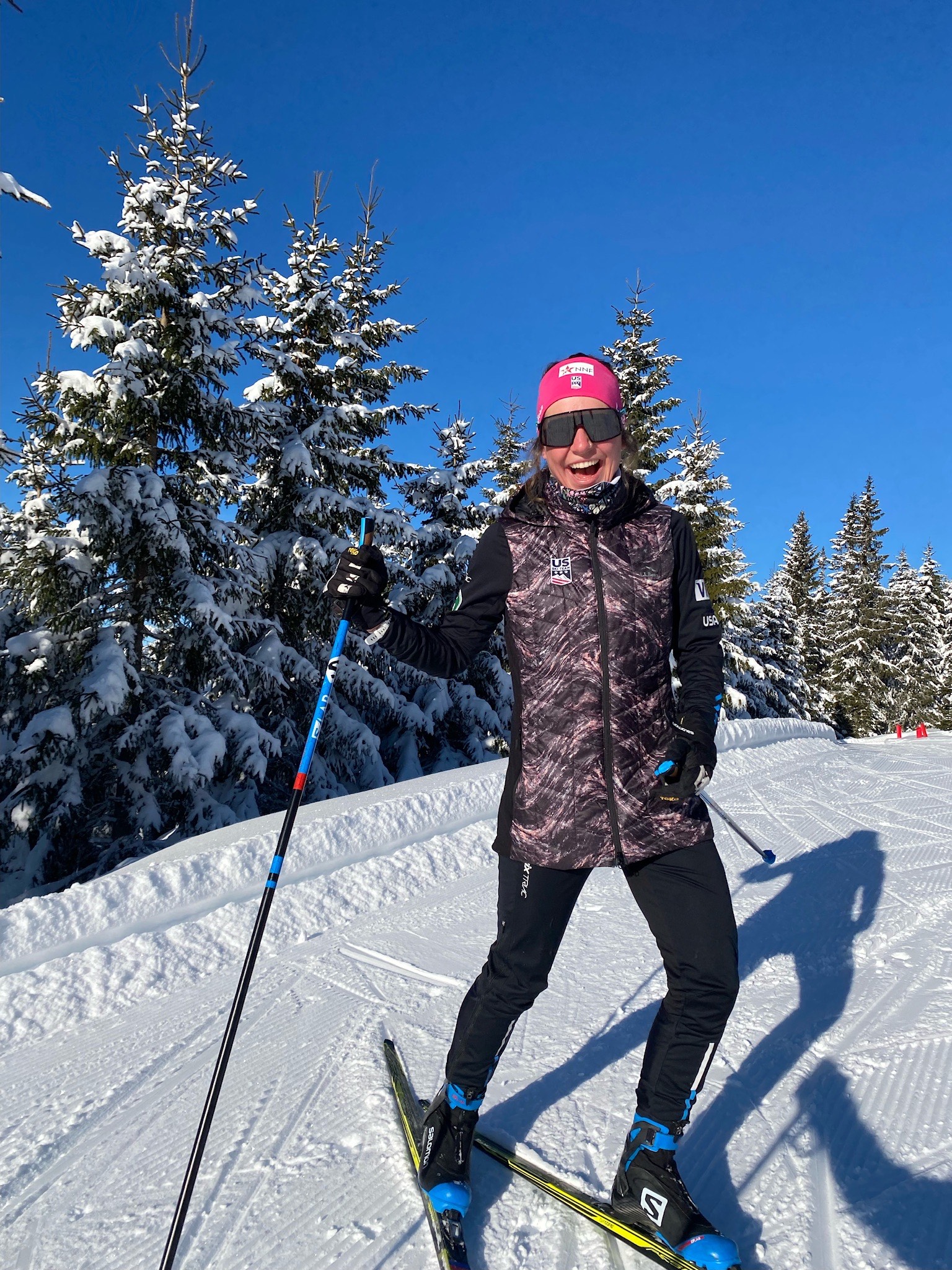
Systemic change takes time but there is no time like the present. At World Juniors in Lygna, Norway a few weeks ago the US contingent had five female staff members, including two female wax-techs. Both Lizzie Larkins and Julia Hayes spent the week learning and working as techs for the junior racers. FasterSkier caught up with Larkins to hear more about her involvement and perspective on this experience.
The following interview has been edited slightly for clarity.
FasterSkier (FS): Can you fill us in a little on your background?

Lizzie Larkins (LL): When I reflect on my experience coaching thus far, I think, “Well, that escalated quickly!” I graduated in 2020 from UVM with a degree in Nutrition and Food Science and a lot of love for the sport of nordic skiing. Between graduating from UVM in a pandemic and moving to Bozeman, I lived in my hometown of Truckee, California. I started coaching full-time for Auburn Ski Club (the club I skied for in high school). I primarily coached the high school-aged comp team, but I also coached the Master’s team, middle school team, and did technique clinics. In August of 2021, I accepted the assistant coach position at MSU, moved to Bozeman, and I have not looked back since!
FS: What drew you to the position at MSU?
LL: As a recent college graduate and someone who understands the demands of being a student-athlete, I was drawn to coaching at the college level because I know what it feels like to be in the athletes’ shoes. I very recently had them on. I was also drawn to this position because of its location. Bozeman is a nordic hot-spot, but it is also an ideal place for work-life balance. I love that I can coach in the morning and spin Bridger laps with friends in the afternoon. It is wonderful to be exploring this mountain playground and living in a college town once again.
Working with [head coach] Adam St. Pierre was also a factor in my decision to come to MSU. Adam cares so much about this team, goes above and beyond for every athlete he works with, and graciously shares his enthusiasm and knowledge for this sport, this community, and the future of US Skiing. I am extremely grateful to have the opportunity to be a part of the MSU Ski Program. It’s a great fit!
FS: Can you explain what the application process was like to join the World Juniors trip?
LL: In the late fall, I saw an email from Greta Anderson with the call for staff for both World Junior/U23 Championships as well as the U18 trip. While at our Thanksgiving Camp in Canmore, I compiled a coaching resume, wrote a cover letter, and emailed in my application. I heard back in December while home in Truckee for the holidays.
Throughout the process, one constant for me was self-doubt. I questioned whether I should apply while completing each step of this process. I am very fortunate that Adam saw this as a huge opportunity for professional development and encouraged me to apply in the first place. Even with his support, I had to dig deep to believe in myself and ignore the imposter syndrome. It was a huge leap outside my comfort zone, but I am really glad I licked the envelope and sent it. I encourage others to do the same especially if you find you are riding the same wave of uncertainty.
FS: So you joined the staff as a wax tech, what has the learning process been like for that?
LL: The learning process for waxing has been one of the steeper ascents on the coaching learning curve for me. Don’t get me wrong, I love going uphill, but I was humbled by how much there is to learn about waxing in my transition from athlete to coach. One of the major keys to my learning process is being a nordic sponge in the wax cabin and on race day. I try to soak it all up and tune into all of the little steps in the testing, application, and decision-making process. I still have a ways to go before I am comfortable calling myself a wax-tech, but I am deeply motivated to keep learning and growing in this realm. I am also very grateful to have the hands-on learning opportunity in Lygna alongside a very talented service staff.
FS: Can you talk through what a race day looked like for you?
LL: In Lygna, we had seven races in six days with no days off in between, so a typical day was packed to the brim. Wake up, put on ski clothes, fuel up at breakfast, chug coffee, drive to the venue, inspect track conditions, prep skis for athletes who were training, drink more coffee, help with prepping test skis, do glide outs and necessary testing, help athletes test, run skis to start, retest if necessary, run more skis to start, cheer on athletes, eat lunch and Norwegian chocolate, zero test fleets, clean kick wax, prep training and race skis for the next day, eat a late dinner as a tech staff, pack a backpack for the following day, sleep hard, and get ready to do it all again!
FS: If you had to pick one highlight from the trip what would it be?
LL: The highlight of my trip was watching Sammy Smith advance through the sprint heats on the final day of competition. Sammy skied with heart, determination, and most importantly, she was having fun. I love watching athletes exceed their expectations and enjoying the experience of racing. Sammy was doing just that and it was awesome to be there cheering her on.
FS: What has been the biggest challenge of this experience?
LL: One of the biggest challenges was seeing athletes lose sight of why we do this sport and the associated disappointment. On social media, we only see the highlights, so it was hard for me to watch extraordinary athletes be unrelentingly hard on themselves and define their experience solely from results. There are an abundance of reasons to pursue this sport and love it. At major events like this, it is easy to get sucked into the numbers and lose sight of the successes along the way.
FS: Among the US staff it seems like the split was pretty even in terms of male/female, were you able to get a sense if this was the case for other countries too?
LL: Truth be told, this was not at all the case for other countries. Once the racing began, it became quite obvious that Julia Hayes and I were the only two female techs at this event. There were a number of female coaches and staff members at the event, but in the testing depot and after the racing concluded, Julia and I noticed frequently that we were the only females there. Prior to this event, I knew we needed more female coaches and techs. Now, I understand how far we have to go before this becomes less of a male-dominated industry at the higher levels.
FS: Any final thoughts you want to share?
LL: A few nuggets of wisdom from Coach Lizzie:
- Rocket ships need rocket fuel. Eating enough as an athlete should be a priority for health, wellness, and longevity in sport.
- Have fun, be authentic, and be kind to yourself and others.
- Fast is smooth, smooth is fast. Happy skiers indubitably go faster 🙂
After returning from Norway, Larkins will be rejoining the MSU team and preparing for NCAAs in Soldier Hollow happening this weekend from March 9-12th.