
Tag: Amy Caldwell

  • Caldwell Sport: Ski Factory Impressions

    Caldwell Sport: Ski Factory Impressions


    This article is a paid advertisement by Caldwell Sport, a ski-grinding service and new-ski retail shop operated by Amy and Zach Caldwell in Putney VT. It’s busy season in the ski industry and we’re cranking away at selling and grinding skis, so we’re recycling an article that Amy wrote for our website in late August. How many of you were paying attention in late August? OK – then this will be new material for you!


    This summer I was fortunate enough to visit several different ski factories in Europe with Zach. After our first year back in operation as Caldwell Sport, we felt that investing in my understanding of skis from the ground up was important for our business. We’re a small business, and it’s necessary for both of us to have a high level of expertise in all aspects of the operation. There is no better way to learn about skis than to go to the source and handle skis every day for a few weeks with no distractions. I am pretty sure this is Zach’s idea of heaven.

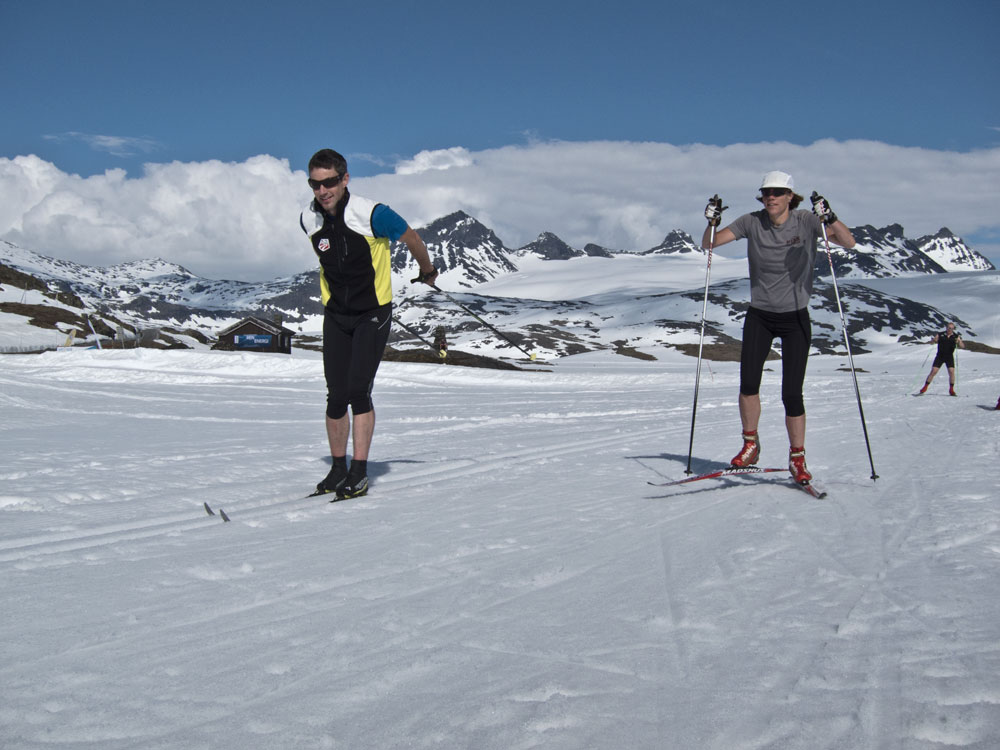
    Our first trip of the summer was to Norway. Zach planned the trip so that we could spend a few days skiing on the snow at Sognefjell, about a 3 hour drive north of Lillehammer, with some of the US Ski Team guys that he coaches. Sognefjell is a remote mountainous area located above the Sognefjord. Its elevation is about 4500ft and holds snow well into the summer. There is a hostel-like lodge there that serves five very carbohydrate rich meals a day. They salt and groom a 7km winding loop (with hills and turns) twice a day.

    When we were there, all of the major ski companies were testing their products along with some of the Norwegian National Team, German Biathlon, United Bakeries Marathon Team and a host of other teams from Norway, Sweden and Finland. Because all of the major ski companies are based out of Europe, this ends up being a relatively close testing area for them. While we were there, we were able to test some prototype products that are really interesting ideas. If all goes well, these products will be brought to market over the next few years. We were able to get a sense of what concepts ski companies were working with and what direction they are headed.

    After 15 hours of skiing in 6 sessions at Sognefjell, we headed back to Lillehammer to spend a week picking skis at the Madshus factory in nearby Biri. I have become a bigger and bigger fan of Madshus skis over the past few years, so I was really looking forward to going to the factory. Although any factory setting is far from glamorous, the Madshus factory was a totally impressive facility. They take extreme care selecting all of the materials that go into their skis and have built some of the most exact machines in the industry. They are so exact that they have to make slight adjustments during a production cycle so that not every pair of skis is identical! Anyway, after a week of drinking the Madshus “Kool Aid”, I left Madshus feeling even more excited to test their skis this season.

    After Madshus, the next stop on the ski pilgrimage for me was to the Salomon Headquarters in Annecy, France in August. While Salomon produces their skis in Altenmarkt, Austria; their World Cup service team is based out of Annecy and all their development and prototyping happens there. They actually have a press in Annecy where they can produce a new ski to test without having to halt the whole production line in Austria. It was a great opportunity to spend a little time with Patrice Frisson-Roche, one of the Salomon World Cup service guys, to learn a bit about what skis they have been testing and liking on the World Cup.

    Over the next two days, which also happened to be a weekend, we spent 10 hours on road bicycles near Annecy biking several of the roads and Cols that the Tour de France often visits. Thanks much to Alex Haas, the Salomon international marketing director, and his good friend who is the marketing director for German soccer for showing us some incredible riding around Annecy. In spite of very sore bums and legs, it was an amazing three days.

    From Annecy we went to the Salomon ski factory in Altenmarkt, Austria. Salomon shares a factory with Atomic which are both owned by Amer Sports. It is interesting to see two totally different ski companies working side by side. They have two separate design teams that work independently of one another. Most of the factory workers are working for Amer and not directly for either ski company. Jean-Marc Draeyer works for Salomon and is very involved with ensuring the quality of every pair of Salomon skis.

    Overall, my impressions of the Salomon factory were very positive. Although Salomon hasn’t been making skis for all that long compared to the other ski companies out there, they’ve done a good job bringing in some very hard working and knowledgeable people.

    Riding in Annecy, France.

    We were also very fortunate to have 2 free days in Altenmarkt due to an Austrian holiday and another weekend day. Zach and I took advantage of the nice weather and the Austrian Alps and did 2 fantastic hikes from Ramsau, one of them taking us up and around the Dachstein glacier. Although the Dachstein is used as a summer ski training venue, August tends to be its low point for good skiing during the year so we were happy to be hiking instead of slogging around on dirty, very slow glacier ice.

    Dario Cologna’s skis at Fischer.

    Also, during our week in Austria, we were able to squeeze in a day visiting the Fischer factory in Ried. Although Ried is unfortunately not located in the beautiful Austrian Alps, it was a great opportunity to get to take a look inside the factory that has been the leader in making cross country skis over the past few decades. The Fischer factory certainly did not disappoint. It is definitely the largest of the factories and it is clear that they continually reinvest in their machines and technology. It was also great to see into the racing department and see a whole bunch of Dario Cologna’s skis get dropped off for grinding. Thanks to Andy Forstner (another World Cup service guy) for showing us around.

    In all, I learned a lot about the different ski brands we carry this summer. One of the biggest lessons that I learned was that to be truly knowledgeable with skis, one must be a continuous and eager student of skis. Ski companies are constantly trying to refine their skis and make them lighter and faster. They come up with new concepts, develop them and then test them over and over again. I know one thing that I will do this winter is use every ski as a ski testing opportunity. Knowledge comes with hard work. Fortunately, like all of our customers, I don’t mind this type of “hard work”.

  • Caldwell Sport on CSU’s Success

    Caldwell Sport on CSU’s Success

    The Cambridge Sports Union (CSU) waxing staff (Caldwell Sport photo)

    This article is a paid advertisement by Caldwell Sport, a ski-grinding service and new-ski retail shop operated by Amy and Zach Caldwell in Putney, Vt. We ride the coattails of any successes that we can claim an association with. This week we’re taking credit for the astonishing successes enjoyed by the Cambridge Sports Union (CSU) in recent years.

    Last spring, USSA named Rob Bradlee domestic coach of the year, recognizing the rapid ascent of the Cambridge Sports Union to the upper ranks of U.S. Junior clubs. Rob is quick to point out that the award may be in his name, but it recognizes the contributions of many coaches, volunteers and athletes. CSU has about 55 kids involved in the program, and 20 to 25 of them regularly attend Eastern Cup (Junior Olympic Qualifier) events. Six years ago they placed no skiers on the New England JO Team. Then, for a couple of years they got two kids onto the team. Then seven, and nine, until last year they claimed 12 spots on the perennially strong NE team. At JOs last year they had the top girls club, and second overall club score. They had three individual JO champions, and five all-americans.

    CSU is the only major club in the greater Boston area. The skiers are the normal brand of bright stars that we see involved in Cross Country everywhere, multiplied by the intensity of a major urban environment. Skiing competes for attention with a huge number of scholastic sports and extra-curricular activities. They ski primarily on short loops of manmade snow at the Weston Ski Track. In a time when standard complaints and excuses from clubs all over the country are focused on bad snow and too many other commitments, CSU makes you wonder what most other clubs in the country are waiting for. How do they do it?

    CSU head nordic coach Rob Bradlee (Caldwell Sport photo)

    It’s the skis.

    No, it’s not actually the skis. But the CSU approach to skis gives some insight into the way the club is organized and how they have formulated their recipe for success. And while skis may not be the key to success, CSU does a great job, week after week, of competing with various ski academies and eastern colleges. It’s notable these days when they don’t have among the best skis in the race. And they do it with a big team, using an army of volunteer parent-waxers. There is no top secret wax-guru mixing up fancy solutions in the background. There is, instead, a system.

    This might be a good time to introduce Jim Stock. Jim is a quiet and intense guy with a brain that is wired to create order out of chaos. He is a Harvard professor of economics, and in his spare time he quietly shapes global macro-economic policy. No, really, he does. In his other spare time he coaches the Eastern Mass BKL group, otherwise known as the CSU farm-team. In the ski world he’s better known as Chris and Corey Stock’s dad.

    I don’t actually know how the system was developed, but I’ve been involved picking and grinding skis for the club for the past four or five years. I imagine that Rob and Jim sat down and made a list of variables, assets and liabilities. The liabilities are what most clubs offer as excuses; we don’t have any waxing gurus, we don’t have great opportunities to test, we’ve got a ton of kids with a limited number of skis, we’ve got to get wax on all these skis really quickly. These liabilities got recast as limitations – the framework within which the club had to operate to produce good skis. And the most important thing they did was make a creative assessment of their assets. What do they have a lot of? Parents.

    Normally, in junior ski racing, parents find themselves in the role of helpless bystander, and potential liability. I can’t count the number of times I’ve seen one or two coaches scramble to get kick wax on skis for a dozen kids while a dozen parents hover nearby hoping that everything works out. CSU parents are involved with their kids, and concerned for their success. In different circumstances we’d be talking about an epidemic of helicopter parents. But at CSU the parents find themselves in the “assets” column, and they have klister on their hands. How do you get 25 kids waxed for an Eastern Cup race? You deputize parents as waxers! The CSU waxing juggernaut can race-wax 25 pairs of skis in 40 minutes. And they’re loud and boisterous – quite obviously having a great time. In the noise contest it’s a toss-up between the Dartmouth girls and the CSU waxers.

    Cambridge Sports Union (CSU) hard at work. (Caldwell Sport photo)

    In order for relatively inexpert (at least at first) parents to do good work waxing skis, there have to be clear instructions. And this is where the CSU system really shines. Starting four or five years ago, Jim and Rob have clearly defined what they’re looking for in skis. When we started working together they were quick to point out that they often need to deal with klister, and that really soft classic skis were hard to work with. The majority of the CSU kids have one pair each, skate and classic, and so we worked together to define, specifically, what a single-pair CSU classic ski needed to be.

    And then, with help from Chris Li at Bikeway Source in Bedford, Mass., we developed a way to quantify and mark the pockets. CSU was among the first clubs to identify, appreciate, and utilize residual camber as a  characteristic in their classic ski. They developed a standardized system of marking skis so that they could give specific instructions to parents for precisely how to wax whichever pair of skis was on the bench in front of them. And it worked! The skis come from one source, they are selected to fit one system, they are measured and marked using one system, and chaos has been given a time-out.

    It’s not just classic skis and kick waxing either. Rob has been a Toko guy for years, and had no desire to change to a completely different system. But he asked for suggestions on specific products that could broaden the range of wax possibilities for glide, and he introduced them, a couple at a time, to a contained testing process. He bought test skis, and a Finite Finish structure tool, and we discussed basic standard structure modifications. And then we standardized grinds for the whole club. As I type this we are processing final structure on some of the 154 pairs (including some for Masters) of CSU skis that we’re grinding this Fall. On any given race day the CSU waxers should be working with only one or two different structures, so testing hand structure and modifying skis is a controlled and sensible process.

    In part, the CSU approach to skis and ski service is representative of a willingness to invest. As a rule, the kids going to Eastern Cup races all have top-of-the-line hand-picked skis that are up to date. This costs money, and parents are expected to support the system. But because there is a system, the investment in equipment isn’t a leap of faith – it’s an integrated part of the program. We do a huge amount of work with teams from all over the country, and often we’re grinding a mish-mash of skis that have been assembled from various brands and various sources over the past decade. When we work on these skis it’s no mystery to us why CSU might have more success than some of these clubs. CSU is one of our most satisfying partnerships because their systematic approach and willingness to invest makes our work look good.

  • Caldwell Sport Summer “Work”

    Caldwell Sport Summer “Work”

    This article is a paid advertisement by Caldwell Sport, a ski grinding service and new ski retail shop operated by Zach and Amy Caldwell in Putney Vermont. Caldwell Sport only does skis, and we have much more fun in the summer than those poor suckers who have to sell bikes as well.

    Since 2007 we have made an average of three trips a year to Europe for ski-related work. A lot of that has been coaching and ski service at events ranging from OPA cups and World Junior Championships to World Cups, Tour de Ski and World Championships. But well over half of the days spent in Europe during that whole time have come in the summer. Since FasterSkier is reduced to reporting on multi-sport events, we thought we’d take the opportunity to provide a little content and brag about how much fun we have in the summer.

    Kikkan at Sognefjell. Kikkan is BIG right now, so we’re definitely using a picture of her.

    Our goal is to provide our customers with access to the highest level of knowledge and understanding available. Doing World Cup ski service keeps us in touch with what is happening in the service world at the highest levels of ski racing. But providing the best available skis to our customers requires more than an understanding of World Cup service. We also need to know the skis, inside and out. So we go to the ski factories to learn.

    World Cup service is all about making the best of available materials (skis and wax) in a short amount of time. It’s hard work with a great deal of time pressure. In the summer we slow things down, examine materials closely, and ask a ton of questions. We talk to the factory race service guys about what other teams have had success with, and what direction they’re going in the future. And we look at (and select) a lot of skis.

    Original ideas are very rare. We can count the number of truly original ideas we’ve had on one hand. Almost everything we know and do with skis is learned, borrowed, adapted or flat-out stolen from something we’ve seen somewhere else. Summer trips to ski factories account for a huge portion of our stolen ideas. There are some amazing people working in the ski industry, and we’re lucky to be able to mine them for understanding.

    Browsing skis at Madshus.

    Our June trip this year is shaping up to be especially fun. Kris Freeman and Noah Hoffman will be flying to Norway at the beginning of June to join the Norwegian National Team for their on-snow camp on the Sognefjell snow fields. Amy and I will fly over to join them for three days on snow at the tail end of their camp, before heading to Lillehammer and Biri to work in the Madshus factory. Noah will also grab a day at Madshus to get an inside look at how his skis are made.

    Sognefjell in June is a scene worth checking-out. It’s not a glacier, but high snowfields near the top of a pass in the Jotunheim mountains, not far from the tip of the Sognefjord, the largest fjord in Norway. There’s not much up there – only what you need for a perfect summer ski training operation. A hotel with great meals, trails groomed and salted twice a day (fresh tracks for classic skiing after lunch), and a measurable portion of the world’s best skiers.

    Sognefjell also happens to be an easy drive from Lillehammer, and Biri, the headquarters of Madshus. Most of the ski companies conduct some ski testing with many of their top athletes at Sognefjell in June, but it’s almost like a home base for Madshus – they can come and go with new materials as they like, and it affords them a great opportunity to test new ideas for wet-snow skis.

    I was last there in June of 2010 with Nathan Schultz and Erik Nilsson for a couple of great days of skiing and testing. Per Wiik of Madshus had made all our arrangements, but was too busy with product and marketing meetings to come up skiing with us, so he asked Thomas Alsgaard to take us out for dinner on the company. I’m pretty sure Per figured we’d go get a pizza, but Thomas had a different idea. He booked us for a phenomenal meal at a restaurant owned by the chef who cooked for the Norwegian National Team when Thomas was racing. So we had a great meal with Thomas, Jorgen Brink (he’s won the Vasaloppet three times in a row now, but had just won it once at the time), and Stian Grønås, one of the Madshus racing guys (former Factory Team waxer, and Norwegian National Team waxer), and Peter Hale.

    During the meal Stian told us a funny story about how they found a pair of Thomas’s skis in the factory – the pair he used to win the relay gold for Norway at the 1998 Nagano Olympics. They mounted NIS plates, put a fresh grind on the skis, and put them out with a batch of new skis for Thomas’s next testing session without telling him anything. We all looked at Thomas for the conclusion of the story.  “So, how were the skis?” “I can’t believe I ever skied on such crap”, he said.

    After dinner, Thomas holding his “crap” gold-medal skis from 1998.

    Marketing-message interpretation aid for those of you who are not susceptible to subliminal messages:

    1 – Caldwell Sport is incredibly cool.

    2 – You should go to Sognefjell sometime.

    3 – If you’re still skiing on skis from 1998, even if they were the best skis in the world, it’s time for something new.

    4 – Order your new skis soon.

    http://www.caldwellsport.com/


  • Caldwell Sport: Incremental Gains – A case for new skis

    Caldwell Sport: Incremental Gains – A case for new skis

    This article is a paid advertisement by Caldwell Sport, a ski grinding service and new ski retail shop operated by Zach and Amy Caldwell in Putney Vermont. Caldwell Sport has recently returned to Vermont after a four-year adventure pursuing coaching, ski service and business opportunities in British Columbia and Colorado.

    Our recent return to Vermont has reacquainted us with many friends and customers from before our departure in 2007. It’s been quite a lot of fun to see skis that we selected and ground five or six years ago come back for a new grind. In part, it’s good to see that the skis we were picking back then were pretty good, and the grinds continue to serve people well for quite a number of years! It’s great to see how many of our customers love their skis, and take great care of them. It has also reminded us how much progress has been made in new ski design in the past four years. The bottom line is that skis have gotten better, and they’ve gotten better in tangible and specific ways. Since we’re in the business of selling skis, and we currently have a good inventory of hand-picked new skis, we figured it might be a good time to make a case for the excellence of the new materials!

    Ski companies generally change their cosmetic appearance every two years, but most of the ski racing public is sophisticated enough to recognize that these are cosmetic changes – not new ski designs. Sometimes a tangible, visible change is made and a new product is launched. The hole ski; the new Madshus shape from two years ago; the Soft Ground ski from Salomon this year. But all of this misses the continual, ongoing incremental changes in ski design that add up to true progress.

    To put it in perspective, Fischer has produced skis from their 610 mold for over two decades, yet the current skis bear almost no resemblance to the original 610. The process of refinement is ongoing, and remains highly significant. At a World Cup level it’s rare to see skis more than two or three years old getting used in races. There are notable exceptions – particularly on the classic side of things, but those exceptions are rare enough so that they serve to underline the general rule. It was striking to see Marit Bjoergen racing with an old RCS model skate ski in Gallivare last November, instead of a ski with a hole in the tip. And that’s because, in general, the new skis are better.

    In the past four years it seems that all of the manufacturers have been working hard to develop better active skiing speed in their skate skis. The straight-ahead gliding speed of skis in 2006 and 2007 was quite good, and really hasn’t been surpassed. In fact, some of the skis from that era still have a more slippery feeling than many of the skis produced today. However, the newer skis help to produce speed in motion, and result in higher skiing speeds.

    This phenomenon is well illustrated by the experience of my friend Mike Temkin, from Troy Michigan. Mike is a crazy Russian engineer who works for Chrysler on the proving grounds – designing tests for cars. I know he’s crazy because one year he decided to drive out to VT from Michigan to pick up his skis, and he spent a couple of days working in the shop with me. We had him visit in Boulder our first year there as well – another long drive to pick up some skis! Mike bought a pair of used demo Fischers from me in 2005, and we have struggled over the years to find skis to match that pair. We did pretty well with a pair of 610s in 2008, but that 2005 pair remained something of a standard. Last year I sent him a new pair of 610 hole skis, but this time I sent him some instructions as well. I told him not to make up his mind about the new skis until he compared his times between the new and old skis on a loop of several Ks. We even put the same grind on the new skis and the old skis so he would have a fair test. I was picking Gunnar up from school when I got the call on my cell phone – Mike was still out of breath from his test and I could hardly understand him between the Russian accent and all the huffing and puffing. “Zach! It’s Incredible! I felt for sure that the old skis were faster, but I made the test anyway. 10 kilometers, and I am skiing one minute faster with the new skis! How is this possible?”

    How is it possible? Well, I think it’s mostly a question of balancing priorities. To build good energy return into the skis it’s necessary to emphasize the strength and elasticity of the materials under the foot, and to place the load higher on the camber. In 2006 we were normally mounting a pair of 192cm 610s at 870 to 880 mm from the tail of the ski. Now the 610s are being mounted  at 890 to 900mms in order to take best advantage of the materials and the design. This puts a greater load on the forebody of the ski, and you can feel the difference. But the skis are fast by any measure, and faster than ever when you measure their average speed in a loop. All of the brands have a different design concept and a different feeling. Anybody who has been a Rossignol skier can tell you that the concept of an active ski is hardly new. I see the most successful brands converging on a certain common ground in terms of balancing speed and action with ever-increasing levels of refinement and excellence.

    We have quite a lot of specific information on the brands that we carry on our website at http://www.caldwellsport.com/ and we invite you to read through that information, and pass along any questions you might have.


  • Caldwell Leaves BNS, Heads Back to Vermont

    Zach Caldwell, one of the premier ski technicians in the US has decided to leave Boulder Nordic Sport (BNS) and return to Southern Vermont to reestablish his own grinding and ski selection business with his wife Amy.

    Caldwell initially left Vermont to run a ski testing program for the US Ski Team in the Callaghan Valley as part of the lead up to the 2010 Olympic Winter Games, following Amy to the Whistler area after she took a coaching position at the Callgahan Valley Training Center.

    After the Olympics, Caldwell signed on with Boulder Nordic Sport, relocating to Boulder, Colorado. Nathan Schultz, the owner of BNS is sorry to see Caldwell leave.

    “We are not going to be able to replace Zach,” Schultz wrote in an email to FasterSkier.  “But I look forward to the challenge of finding people who we can coach into filling his shoes a few years down the road.”

    Schultz notes there was no drama surrounding Caldwell’s departure.

    “It is tough to lose Zach’s expertise,” Schultz said, “but his return to Vermont is more about him returning to what makes him happiest than any sort of split between us.”

    Schultz also stated he hoped to continue work with Caldwell on grinds, while Caldwell wrote in an announcement on the Caldwell Sport website that he welcomes future collaboration with BNS.

    Caldwell returns to Vermont with his Tazzari RP23 grinding machine, leaving BNS with a single Tazzari RP13.

    Schultz told FasterSkier that he would be spending significant time this summer examining options for a new machine, noting the efficiency gains of having two grinders, and the benefits of state-of-the-art equipment.

    The original Tazzari RP13 was purchased from Caldwell in 2006 when Schultz started BNS.

    Both Caldwell and Schultz have worked with the US Ski Team over the past years, providing waxing and grinding services both domestically and abroad.

    In the short run, Schultz will step into the hole left by Caldwell’s departure, spending more time working with skis, grinds and wax.

    Caldwell returns to Vermont, a place he still refers to as “home,” despite his four-year absence. He re-starts his business with a new system for describing grinds, and will focus on grinding and high-end ski selection – not retail.

    “Our return to Vermont will mark a return to a more narrowly defined business model focusing on our strengths – race ski selection and ski stonegrinding,” the Caldwell Sport website reads.

    Caldwell is also the personal coach for US Ski Team standout Kris Freeman.

    In addition to Caldwell’s departure, BNS Race Service Director, Eric Pepper, has taken a job with Ski Club Vail, and is leaving the shop.

    “My philosophy has always been to find good people and build the business around their unique strengths,” Schultz said. “Zach and Amy came to Boulder the same year Roger Knight came on board and we launched BNS East. We changed things around radically based on the new team’s expertise and pursued directions that made sense given the personalities and knowledge we had. Now, we’ll have to reconfigure things based on our new team. “

    BNS has already hired former Denver University assistant coach Hennie Kashiwa as BNS Brand Manager, and retain Stone Grinding and Service Technician Tom Troutner.

    “That leaves us looking for a retail manager for the Boulder shop and one or two full-time people who will focus on Stone Grinding and Race Service,” Schultz said.

    The positions will be posted soon on the BNS website, and resumes can be sent to jobs@bouldernordic.com.

  • USST Announces Coaches for 2011 JWC & U-23 Worlds

    This trip marks one of the premier steps of the elite athlete and coach development pipeline in the U.S.  The U.S. Ski Team is pleased to announce the 2011 staff:

    Matt Whitcomb, Trip Leader, Junior Head Coach U.S. Ski Team
    Bryan Fish, U23 Head Coach, U.S. Ski Team
    Randy Gibbs, Head Service, U.S. Ski Team
    Andrew Johnson, Service, University of Vermont
    Casey Fagerquist, Service, Alaska Pacific University
    Justin Beckwith, Service, Green Mountain Valley School
    Amy Caldwell, Coach, Boulder Nordic Sport
    Daniel Weiland, Coach, Ski and Snowboard Club Vail

    The trip will launch on January 16th. The team will live in Vierumaki, Finland at a pre-camp from January 17th-23rd, and will then drive and ferry to the race venue in Otepaa, Estonia for six days of competitions. The team will depart from either Tallin, Estonia, or Helsinki, Finland on February 1st. Qualification criteria for this trip can be found at: www.ussa.org and by clicking “sports” – “cross country” – “advancement”.

    This trip receives a combined $20,000 in support from the NCCSEF and the U.S. Ski Team.