
From the FasterSkier archive — posts syndicated from athletes’ and coaches’ own blogs between 2004 and 2012, kept online as published. Current coverage is at fasterskier.com.

Tag: Amy Glen

  • After Roll-Run-Row, Craftsbury Skiers Primed for Season Ahead

    After Roll-Run-Row, Craftsbury Skiers Primed for Season Ahead

    Start of the Craftsbury Outdoor Center’s Roll-Run-Row, a race which tested the program’s elite skiers against its elite rowers, on Oct. 3 in Craftsbury, Vt. (Courtesy photo)

    It downpoured across much of the Northeast on Wednesday. Those at the Craftsbury Outdoor Center in northern Vermont hardly noticed. Owner Judy Geer called it “drizzle.”

    That morning, about 20 Craftsbury Green Racing Project (CGRP) athletes and coaches participated in the second annual Roll-Run-Row race, which pitted the some of the nation’s best nordic skiers against top-tier rowers. All belonged to the same program, but the idea was to have some competitive fun while pushing individuals out of their comfort zones.

    This summer, the Outdoor Center started an elite-level rowing team similar to the nordic one. The result was an increase in high-level athletes for a total of 14 skiers and five rowers, most of which live and train there.

    According to Geer, the skiers spent time before the race teaching the rowers how to rollerski. In turn, the rowers provided some pointers on Hosmer Pond. The field included one rower, Peter Graves, who represented the U.S. at the London Olympics this summer as well as Lynn Jennings, a three-time World Champion in cross-country running.

    The race itself involved point-to-point rollerskiing, running and rowing legs, which took the winner, rower Kyle Lafferty, about 30 minutes to complete.

    Craftsbury Green Racing Project skier Gordon Vermeer (front) finishing up the rollerski portion of the second annual Roll-Run-Row in Craftsbury, Vt. (Courtesy photo)

    Craftsbury’s nordic coach Pepa Miloucheva estimated the uphill rollerski was about 2 kilometers long, the run was about 3.5 k, and the row was about 2 k with two 90-degree turns.

    “There were some big gaps between the winning and last times in the rollerski and the rowing legs, but was a hard effort for all for sure,” she wrote in an email.

    There were no gender or age categories; finishers classified as overall. Craftsbury skier Clare Egan placed second and Gordon Vermeer represented the nordic guys in third.

    Vermeer is one of four newcomers to the Craftsbury’s elite cross-country team. This spring, he graduated Dartmouth College and, like his teammates, began the transition to full-time training.

    According to Miloucheva, she couldn’t ask for much more from athletes like Vermeer, including former University of Vermont (UVM) grads Alex Howe, Caitlin Patterson and Amy Glen.

    “The new athletes this year are great,” Miloucheva wrote. “All were able to adjust to the new training regimen without a problem and make some good fitness and technical improvements. … We have a big team this year, but it has been great to see them challenge and enjoy pushing each other, during practice.”

    Some highlights this summer included hosting the New England Nordic Ski Association (NENSA) Regional Elite Group and J2 national camps in Craftsbury, and training with the U.S. Ski Team in mid-September in Lake Placid, N.Y. According to Miloucheva, most of her athletes have stayed healthy and avoided serious injuries, and enjoyed a productive and busy training season.

    “Right now we are into a hard training block before we leave on our first big trip this winter,” she wrote of the entire team’s departure for on-snow training in Canmore, Alberta, on Oct. 25. “[We’ll go] straight to Yellowstone from there for the first [SuperTour] races of the season.”

    ***

    A few weeks ago in Lake Placid, FasterSkier caught up with two CGRP rookies: Patterson and Glen. Here’s what they had to say about their season so far:

    Former UVM skier Caitlin Patterson (Craftsbury Green Racing Project) during the Roll-Run-Row in-house event on Oct. 3 in Craftsbury, Vt. (Courtesy photo)

    FasterSkier: What’s it like being part of a new team?

    Caitlin Patterson: It’s been great. I think it’s easy to get used to the atmosphere of the team. It’s a good group of people and the training is similar to what we’ve done before.

    FS: But it’s got to be different from college skiing, right?

    Amy Glen: It’s definitely different. Your job is your work now. And then we do work [at the Outdoor Center] in our free time, but it’s more, like, for fun almost.

    FS: How’s the transition to full-time training?

    CP: For me it hasn’t been very tiring at all, probably less so. In past summers, I was doing a lot more. Last summer I was working almost a full-time job and training full time and this is a lot more laid back. At Craftsbury, we eat all our meals in the dining hall so we don’t have the food-prep piece, so it’s been pretty relaxing.

    FS: How did you approach two weeks of training in Lake Placid with the U.S. Ski Team?

    CP: I think it’s kind of a fun opportunity to train with other people. It doesn’t really matter if your first, even in [a] sprint situation, or certainly not in a workout. As long as you can have fun and talk to some people who you haven’t seen in a while or maybe get to know some of the juniors who are here, that makes it fun. To ski on different terrain, that helps keep the excitement up.

    Former UVM skier Amy Glen, who won an NCAA title in the 15 k classic race on March 9 at Bohart Ranch in Bozeman, Mont.

    FS: What are some of your goals for the racing season?

    AG: Ski as fast as I can.

    CP: Changing to a new training program coming out of college, you have high expectations, but you can’t be unreasonable about it. It’s not the end of the world if things don’t go quite as well as they could. But I’d like to be optimistic that it should go well for all of us because of the training program.

    There’s the early season races and then West Yellowstone and Bozeman and leading up to the World Cup, certainly it would be great to qualify for those. I think for any of us on this team, it’s a realistic possibility. From there hopefully we have some Europe trips planned and nationals and U23’s for any of us still in the age group. All sorts of fun stuff.

    FS: How would you describe your team?

    AG: Funny.

    CP: Lots of humor on a daily basis. Everyone’s really serious about training, too, but we can be serious at the same time as your having constant competitions. The guys are having a lot of competitions, strength and whatever else. I think we laugh a lot and have good fun with it.

    ***
  • Jones, Thomas Run Away with Team Sprint at Canadian Nationals

    Jones, Thomas Run Away with Team Sprint at Canadian Nationals

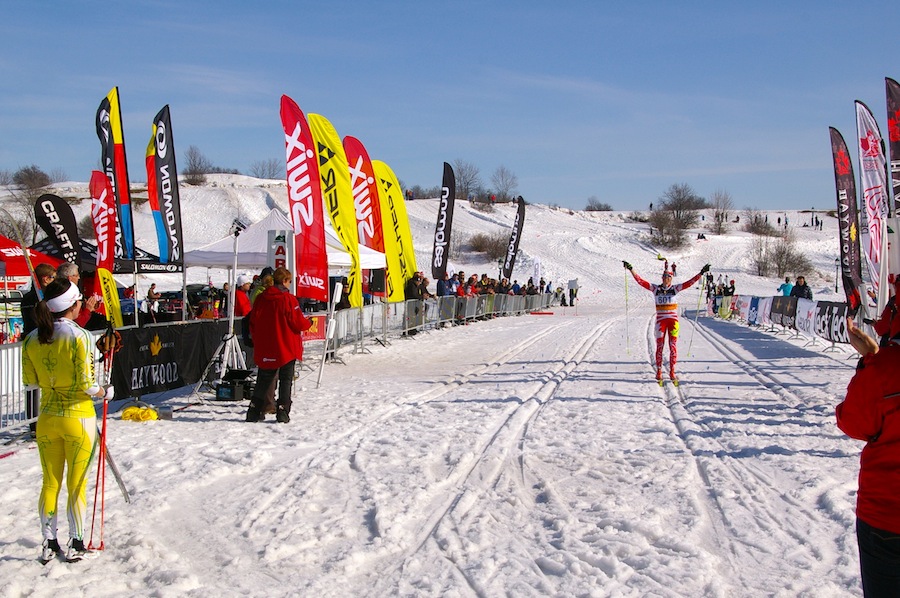
    Canadian National Team member Perianne Jones (r) celebrates winning the classic team sprint at the 2012 Canadian Ski National Championships on Saturday as Nakkertok teammate Alana Thomas (l) awaits her arrival at the finish on the Plains of Abraham in Quebec City.

    QUEBEC CITY – As Alana Thomas stood in the finish pen on the Plains of Abraham and looked back beyond the line, she smiled as Perianne Jones cruised down the final stretch.

    The Canadian National Team member was going to win by a mile – or maybe a kilometer, figuratively speaking in Canadian terms.

    While Jones didn’t quite have a full lap on the 11 other teams in the open classic relay at the Canadian National Ski Championships on Saturday, she finished in 17:59.6, more than 24 seconds ahead of anyone else with the help of Thomas, her Nakkertok teammate in the club event.

    Nakkertok teammates Alana Thomas (at left) and Perianne Jones (CNST) celebrate winning the team sprint at Canadian nationals on Saturday.

    “We drove here together this morning and we talked about kind of what we wanted to do,” said Jones, who flew into Quebec the night before from Canmore, Alberta. She previously spent a full season on the World Cup circuit in Europe.

    “We were going to build into it,” Jones added. “I think we executed pretty well.”

    They beat runners-up Amy Glen and Caitlin Patterson of the University of Vermont (+24.2), and Annika Hicks and Amanda Ammar of Canmore Nordic finished third overall (+31.4).

    Jones and Thomas also won their first heat, nearly two seconds ahead of Hicks and Ammar. Hicks passed Thomas on the final leg of the 3×1 k race, (in which each racer competed three loops in the city park, tagging off in between), but Jones reeled in Ammar as the anchor.

    While they worked hard in the qualifying round, the Nakkertok women made sure they had plenty left for the final. Jones said they planned to push hardest on the last lap while skiing relaxed throughout. Both did so and built a nearly 22-second gap by the end of the second leg.

    Thomas said she was trying to hang in the pack and ski smart. She also skied ahead, and most importantly, managed to stay on her feet. Heidi Widmer and Marlis Kromm of Foothills Nordic had been in second place for most of the final, but Widmer fell victim to the slushy conditions about halfway through her last lap. She tagged off to Kromm, who finished 1 second behind Ammar in fourth place.

    When Widmer slipped, Glen scooted around her and tagged off to Patterson in second. With Jones nearly 25 seconds ahead, Patterson held the position and clinched silver.

    “We’re definitely more distance skiers,” Patterson said. “We’ve been doing a lot of 5 k’s, 10, 15. So in general, we feel like we’re skiing pretty consistently. We just have the endurance to take us to the third lap still strong.”

    Open women's team sprint podium at 2012 Canadian nationals: 1. Nakkertok (Thomas, Jones); 2. University of Vermont (Patterson, Glen); 3. Canmore Nordic (Ammar, Hicks)

    Fresh off a trip to the NCAA championships in Bozeman, Mont., the two helped UVM notch its first national skiing title since 1994. Glen became the second woman in UVM history to win a U.S. crown in the 15 k classic race.

    After all that, Patterson said they jumped at the chance to race in Canada, about four hours away from their campus in Burlington, Vt.

    “Our college season had ended, we were just out in Montana and had come back, [had a] little bit of school to tend to,” Patterson said. “Why not come up here?”

    “I wanted to come check out the skiing at Mont-Sainte-Anne,” Glens said. “And this [city sprint], this is a huge draw.”

    The two planned to race Monday and Tuesday in the interval starts and then head back to Vermont to prepare for the SuperTour finals in Craftsbury, which start next weekend.

    While the relays didn’t count for much besides pride at Canadian nationals, several racers said they participated because of the atmosphere.

    “Team sprints are special,” Thomas said. “I usually only get to do one a year so this is a nice day.”

    Jones was a World Cup team-sprint veteran, but said the race was still her favorite and probably one of the toughest on the circuit because of its lack of recovery time. She found it especially fun at home.

    “I’m pretty pumped,” Jones said. “The club brought me to where I am, so I love to come race today with Nakkertok; to do it with Alana is awesome.”

    Perianne Jones (Nakkertok/CNST) ahead of the pack in the qualifying round of the team sprint at Canadian nationals
    Start of women's open team sprint final at Canadian nationals with Alana Thomas (Nakkertok) up front

    Open women’s final results

    Complete results

  • Havlick and Glen take NCAA classic titles in closely contested races

    Havlick and Glen take NCAA classic titles in closely contested races

    Miles Havlick (UU) leads group early in race (photo: Stuart Jennings)

    The second and final nordic race of the 2012 NCAA’s was held on a blue-bird Bozeman day which reached 60 degrees by race’s end.  Spectators who witnessed the 15 and 20 kilometer mass start classic races on Friday were treated to non-stop action and nail-biting finishes in both the men’s and women’s events, as the title for both races ended in a two-way sprint to the finish line.

    In the men’s 20k  it was a battle between University of Utah’s Miles Havlick and Montana State’s  David Norris.  Though Norris had a Montana crowd cheering him around the course, Havlick had enough of a finishing kick in the last twenty meters to steal the line by 1.5 seconds, crossing with a time of 56: 24.3.  Franz Bernstein of the University of Vermont finished third with a time of 56:40.

    In the women’s race it was UVM and Dartmouth all the way, the two teams grabbing the entire first six finish places.  The finish finale was given by UVM’s Amy Glen and Dartmouth’s Sophie Caldwell, the pair entering the stadium together, duking it out down the last 200 meter stretch of stadium striding and then lunging toward the line simultaneously.    It was only after extensive review of video that the jury awarded Glen the victory, and Caldwell second place. Lucy Garrec (UVM) finished third.

    Dartmouth had been leading the team scores after the first nordic race, but UVM pulled ahead after the first alpine race.  The classic races further pushed UVM into the lead, with a 92 point advantage over Utah and another 12 points over Dartmouth.

    *          *          *

    Early morning tracks entering and leaving the stadium at Bohart Ranch

    Men’s 20 k Mass Start Classic

    The sun broke through morning clouds with the nearing of the men’s race at 9am.  Despite start-line temperatures that were 40 degrees and rising, the track was hard and the downhill S-turns were icy-swift.

    After the first lap the entire field was still fairly tight, but that changed quickly in the second lap as the starting pace, steep hills, altitude, and realization that they had to complete three more grueling laps combined to slow many of the racer’s tempo.

    “All you had to do today is try to stay relaxed as long as you could, and continuously people were falling back,” said  UVM’s Franz Bernstein. “I don’t think there were a lot of moves in there, it’s just the pace was pretty high off the start.”

    The race’s top two competitors – Utah’s Miles Havlick and Montana State’s David Norris –  were quick to establish themselves at the front of the lead pack.

    “The first couple laps, it’s just trying to protect yourself, limit crashes and broken poles and stuff,” said Norris, “I just wanted to ski into it and if it felt right I thought I’d go for it on the hills.”

    Norris, who hails from Fairbanks, Alaska but is a (sophomore) at Montana State, admitted that having the home-course crowd in attendance was a big motivator.

    “It was awesome, having that crowd,” said Norris, “they are as into it as we are as racers, so it’s a lot of fun.”

    By the third of four laps, the field had strung out into clumps of racers who were just trying to pick up an extra spot or not lose their own.

    Bernstein explained, “David [Norris]and Miles [Havlick] looked very strong today and they put up a couple of small moves but other than that people were just trying to stay together and hold on tight.”

    By the last lap the field had spread out into clumped groups of two and three competitors, driving each other to the finish.

    “I knew if everything went right I could be the strongest skier, so I just tried to hammer that last lap,” said Norris.  Despite the fact Havlick experienced a couple mishaps during the race  Norris said his competitor “kept hanging on.”

    On one corner, Havlick caught his ski tip in a snowbank and got spun around and went down.

    “I just got up, tried to stay relaxed and positive and work my way back up there,” said Havlick.

    Then he broke a pole.  Fortunately the break occurred as he was poling through the stadium and he quickly got a replacement from a coach.

    So it was Havlick and Norris who emerged from the wooded downhill alone.

    David Norris (MSU) leads Miles Havlick (UU) in the final kilometer of the race

    Up the first hill into the stadium the pair stepped into adjacent tracks and started to double pole in unison.  Together, they sprinted down one side of the stadium, around the corner, and into the finishing stretch.  Havlick had just enough strength to pull off the front in the final 20 meters, and it was the Utah senior who crossed the line in first with a time of 56:24, Norris just 1.5 seconds behind.

    “I knew I’m not the best sprinter so I knew it would be a struggle,” said Norris, who then smiled and said of the tight race, “but – yeah – it was great.”

    For Havlick, a sophomore at Utah, the win was an end to a string of near-misses.

    “Everything came together today,” said Havlick. “It was kind of a frustrating season  – I kept getting 2nd and 3rd places – but today everything came together.”

    Havlick said his win felt “Amazing. It’s been my goal for a long time, it just feels great to do it when it counts most.”

    Next across the line was Bernstein, who was 25 seconds back from the lead pair.  The senior from UVM was happy to end his career on this note.

    “I am super happy about the race – more than happy about the race, said Bernstein.  “So much fun out there today – perfect tracks, perfect skis – – – now I’m ready for retirement.”

    Fourth across the line was Dartmouth’s Eric Packer, in a time of 57:05.  Two seconds later came a sprint for fifth between Patrick Johnson of Middlebury and Didrik Smith of Utah, Johnson winning fifth and  Smith placing sixth. In seventh through tenth finished Rune Oedegaard (CU), Andrew Dougherty (DU), Sam Tarling (DAR), and Sjur Prestseater (UNM).

    Women’s 15k Mass Start Classic

    By the start of the women’s race at 11am the air temperature was already 56 degrees and the snow was at 32 Fahrenheit.  The firm tracks that greeted the first morning’s race were now turning towards mush.

    The rapidly warming snow sent many coaches scrambling to apply last-minute layers of klister, even as the announcer called a 10, and then 5 minute race-time warning.  For some teams and athletes, there wasn’t enough time for adjustment, and the consequences were huge.  Around the first of the three lap race it was apparent that some women had very slick skis, as they herringboned and double poled as well as they could.

    Annie Hart (DAR) and Sophie Caldwell (DAR) lead the pack up a steep climb

    But even the skiers at the front of the race did not have perfect skis, as glide was traded for kick up the hills.  After one lap most of the UVM and Dartmouth teams were near the front, joined by Wednesday’s race winner, Utah’s Maria Graefnings, CU’s Eliska Hajkova adn MSU’s Ase Carlson.

    Lucy Garrec of UVM said that her skis were “Great for climbing, very jerky on downhills”, but emphasized,“kick was definitely more important.”

    Dartmouth’s Sophie Caldwell, who raced on no-wax skis, said that different skis were running well in different places on the course, but that snow conditions were so slow it evened things out.

    Caldwell and teammate Annie Hart led much of the first lap, Caldwell explaining “we didn’t want to waste our energy so we went pretty easy.”

    Feeling good about her first lap, breathing in control and skiing relaxed, Garrec took over on the second lap,  but her strategy was similar to Caldwell’s and she did not want to push the pace; when her teammate Amy Glen took the lead Garrec gave it up readily.

    “We definitely compiled our efforts,” said Glen of the way the UVM and Dartmouth teams worked together during the race.  Glen said that racing such a strong group of competitors week after week in the East had helped them all achieve a pace consistent with the strongest Western and Central competitors.

    Amy Glen (UVM) and Sophie Caldwell (DAR) approach a sprint finish (photo: Stuart Jennings)

    It was Glen and Caldwell who finally established themselves as the frontrunners for the victory, and the two emerged together, Glen skiing in front and Caldwell matching her stride as they skied up the hill into the stadium.  At first, it looked as though Glen was the stronger sprinter, a small gap opening as they turned the far corner of the stadium.

    Caldwell said it was at that moment she decided she wasn’t giving up.

    “All of a sudden I was like, ‘Wait a second, I can still do this!’” said Caldwell. “I didn’t know if I had a chance, but then I got a little extra energy and just went for it.”

    The competitors were pole to pole down the line, lunging across simultaneously to a cacophony of screaming spectators.  As their bodies lay strewn out just past the finish mark, a photo finish was pronounced, and the jury began to review the high definition footage of the finish.

    Sixteen seconds after the exciting finish, Garrec crossed the line for third place.  Behind her in fourth place was Dartmouth’s Annie Hart, and in fifth finished Caitlin Patterson of UVM.  Dartmouth’s Erika Flowers and Maria Graefnings had a close sprint at the finish, Flowers gaining the edge and placing sixth to Graefnings seventh.   In eighth through tenth were Makalya Cappel(DU), Annie Pokorny (MID), and Eilska Hajkova (CU), respectively.

    The rest of the women’s field finished during the agonizing wait for the reported champion, the time gap between the first and the 38th finisher a margin of eight minutes.  Finally, the review came back and Glen was awarded the victory, Caldwell securing second place.

    “It was a little nerve-racking,” described Caldwell of the long-awaited judgment, “but I would obviously be happy either way. I am psyched for Amy and it is pretty sweet to have the east be in the top six, too. . .I think we’re all thrilled with that –  it was probably the most fun I’ve ever had in a race.”

    For Amy Glen, who is a senior on the UVM team from Anchorage, Alaska, this was both her last college race and her very first college win.    When asked what made victory possible for her today, Glen said, simply, “Everything.”

    Glen listed, “My team, my coaches gave us awesome skis, I worked with my teammates  –  and I just felt really relaxed and just went for it.”

    Glen said that her connection with her teammates was the biggest motivator.  She never felt she was racing as an individual or for an individual title.

    “I always felt my teammates with me, “said Glen, “it was never just me.”

    Results

    NCAA video

    Related article: Wednesday’s 5/10k skate

    NCAA Men All-Americans, 20k Classic

    1  HAVLICK, Miles UU 56:24.3
    2  NORRIS, David MSU 56:25.8
    3  BERNSTEIN, Franz UVM 56:40.8
    4  PACKER, Eric DAR 57:05.2
    5  JOHNSON, Patrick MID 57:07.1
    6  SMITH, Didrik UU 57:07.5
    7  OEDEGAARD, Rune CU 57:32.3
    8  DOUGHERTY, Andrew DU 57:34.3
    9  TARLING, Sam DAR 57:41.8
    10  PRESTSEATER, Sjur UNM 58:00.4

    NCAA Women All-Americans, 15 k Classic


    1  GLEN, Amy UVM 53:32.1
    2  CALDWELL, Sophie DAR 53:32.2
    3  GARREC, Lucy UVM 53:48.7
    4  HART, Annie DAR 53:58.3
    5  PATTERSON, Caitlin UVM 54:10.1
    6  FLOWERS, Erika DAR 54:33.2
    7  GRAEFNINGS, Maria UU 54:34.0
    8  CAPPEL, Makalya DU 54:37.5
    9  POKORNY, Annie MID 54:45.8
    10  HAJKOVA, Eliska CU 55:15.2


  • Norway Takes Women’s Relay; Americans Seventh

    With a squad composed of four individual medalists, the Norwegians skied to victory in the women’s relay at the World Junior Championships on Monday.

    The Norwegians were trailing slightly to Germany after a tough first leg by Ragnhild Haga.  But Martina Ek Hagen took over, closed the gap, and handed the race off to Heidi Weng, who broke the Russian and Swedish teams with a big attack on the skate course’s steepest, toughest climb in Otepaa, Estonia.

    Weng tagged to Kari Oeyre Slind, who held off Russia’s Elena Soboleva, with enough time to celebrate with her country’s flag on the homestretch.

    Russia was second, 22.6 seconds back, and Germany’s anchor, Hanna Kolb, skied her country to bronze, another 12 seconds down.

    The American team of Amy Glen, Kinsey Loan, Jessie Diggins and Joanne Reid finished seventh, bettering last year’s finish by one place.

    “We got in contact, played around with six, seven, eight,” said Matt Whitcomb, one of the American coaches. “These girls worked really hard—every single skier on the team protected and stayed in contact with six, seven, eight, nine or ten. The girls skied phenomenally.

    Diggins capped an excellent championships by posting the second fastest time on the third leg.

    Canada was 11th, just missing the top-10. In one of the closest finishes of the day, French anchor Celia Aymonier bested her Canadian counterpart Heidi Widmer by less than three seconds. Widmer did close the gap by 14 seconds over the loop, but ran out of course at the end.

    Janelle Greer scrambled for the Canadians, tagging off to Heather Mehain in 13th place. The team moved up from there as Annika Hicks climbed to 10th. A strong leg, second fastest for the anchor skiers, by Kazakh Anastasia Slonova dropped the squad to their final position.

    Overall the field spread out quickly, despite the relatively short course. By the end, none of the top-10 finishes had much drama in the finish stretch.

    Conditions in Otepaa were foggy and cooler than in the last few days, with fast, firm tracks.

    The Norwegian junior women had already had a successful championships, collecting seven medals in their three races. But they weren’t taking anything for granted, especially with each of their women skiing just a single, short 3.3-kilometer loop.

    “We can’t take the victory in front of the race—almost every year it is tight,” Slind said. ““We know that we are one of the favorites, so we feel the pressure.”

    The Germans and Russians made them work for it, but in the end, neither team had the depth to contend. Norway has now won the last five women’s junior relays, dating back to 2007 in Italy. Both Weng and Slind were part of last year’s championship team in Hinterzarten, Germany.

    “Last year we were 5th and this year 2nd,” said Russian anchor Elena Soboleva. “Next year we will catch the Norwegians and we will be the world champions.”

    Slind explained that her strategy was to start her leg conservatively to save energy for the final push. “I was very nervous during the race that Russia would come and get me, but I made it,” Slind said at the post-race press conference.

    Her concerns were for naught as she skied the fastest anchor loop of the day.

    “I’m going to celebrate this win with two pieces of chocolate!” said Slind.

    Link to full results