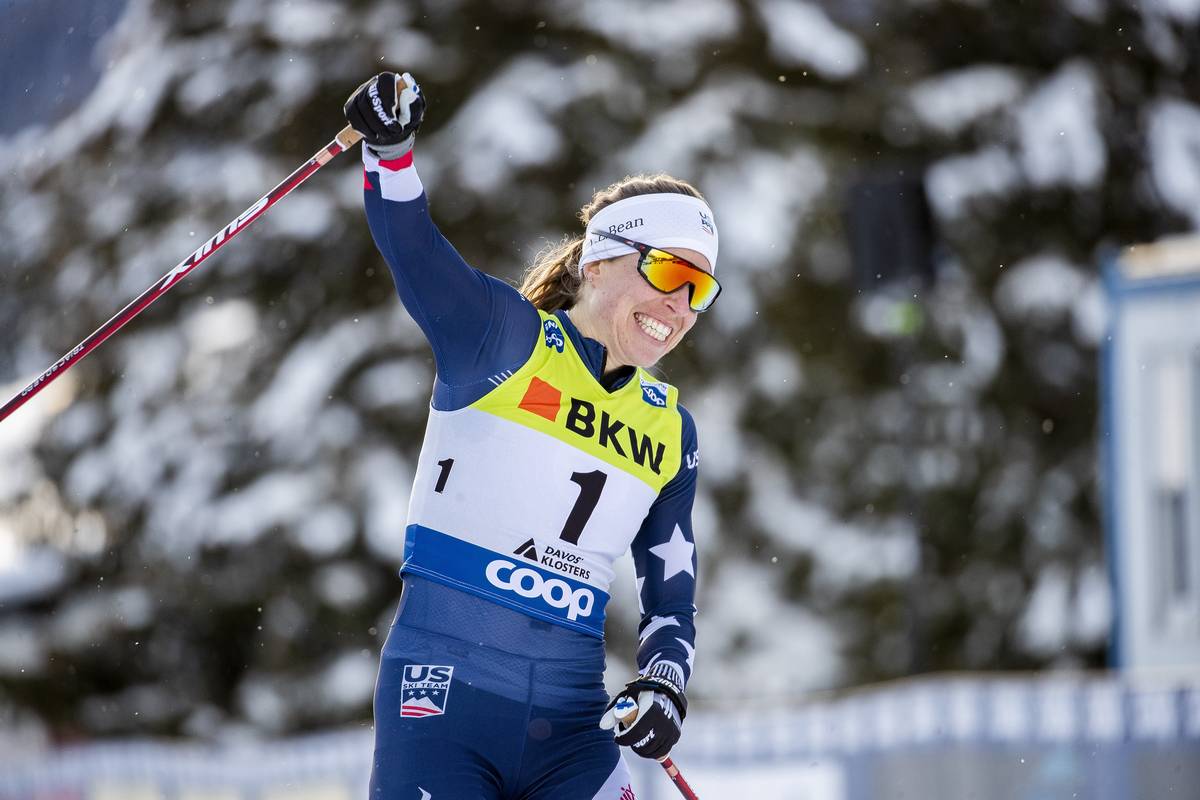
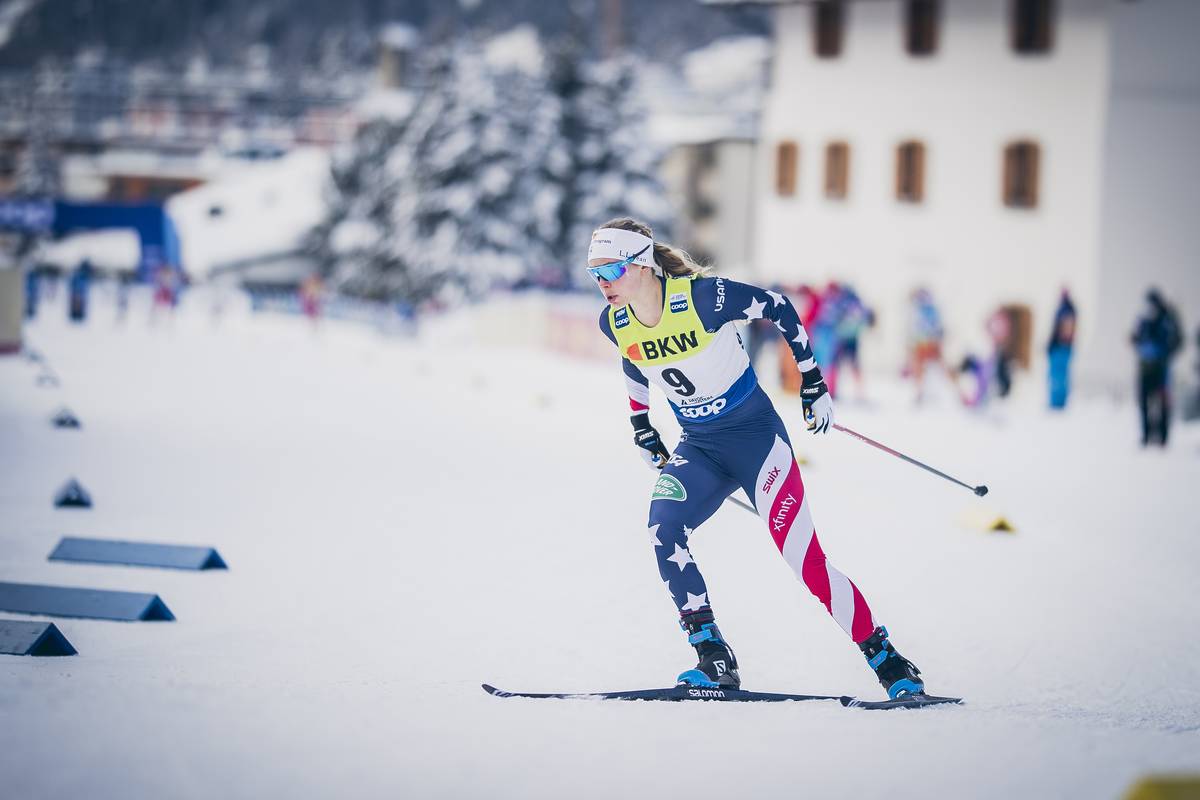
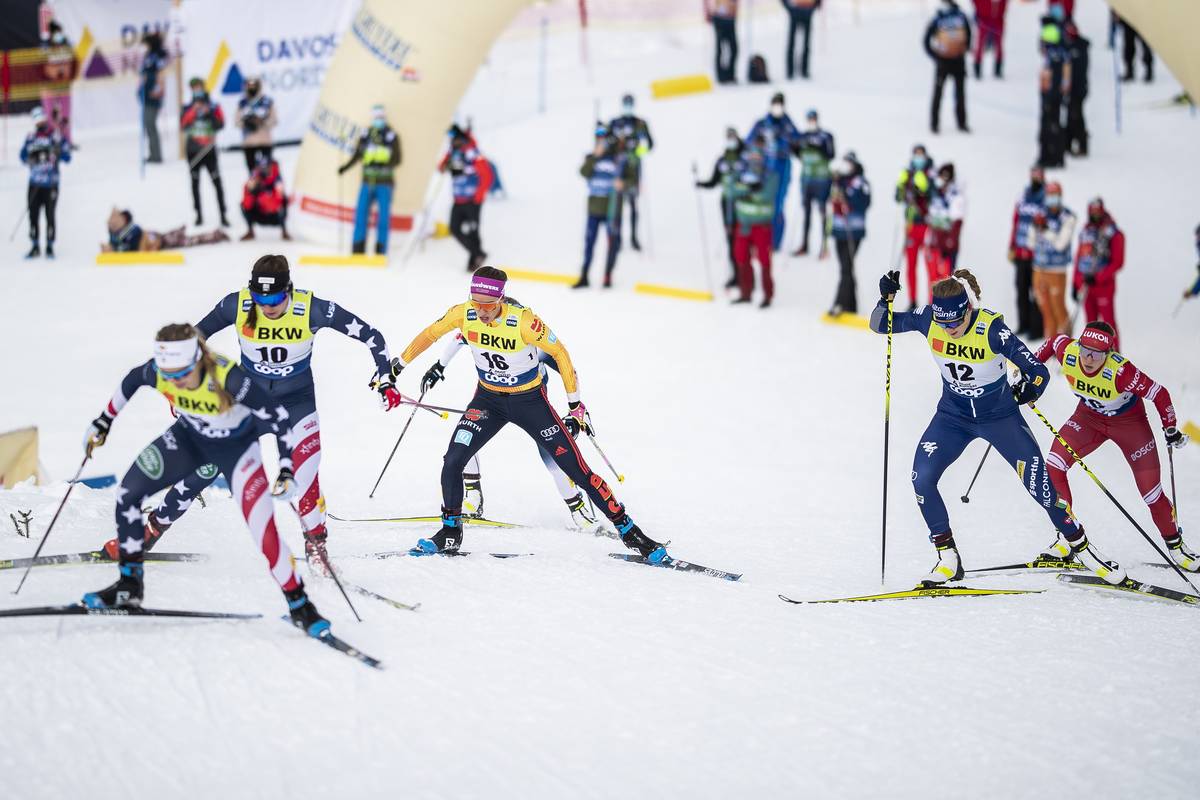
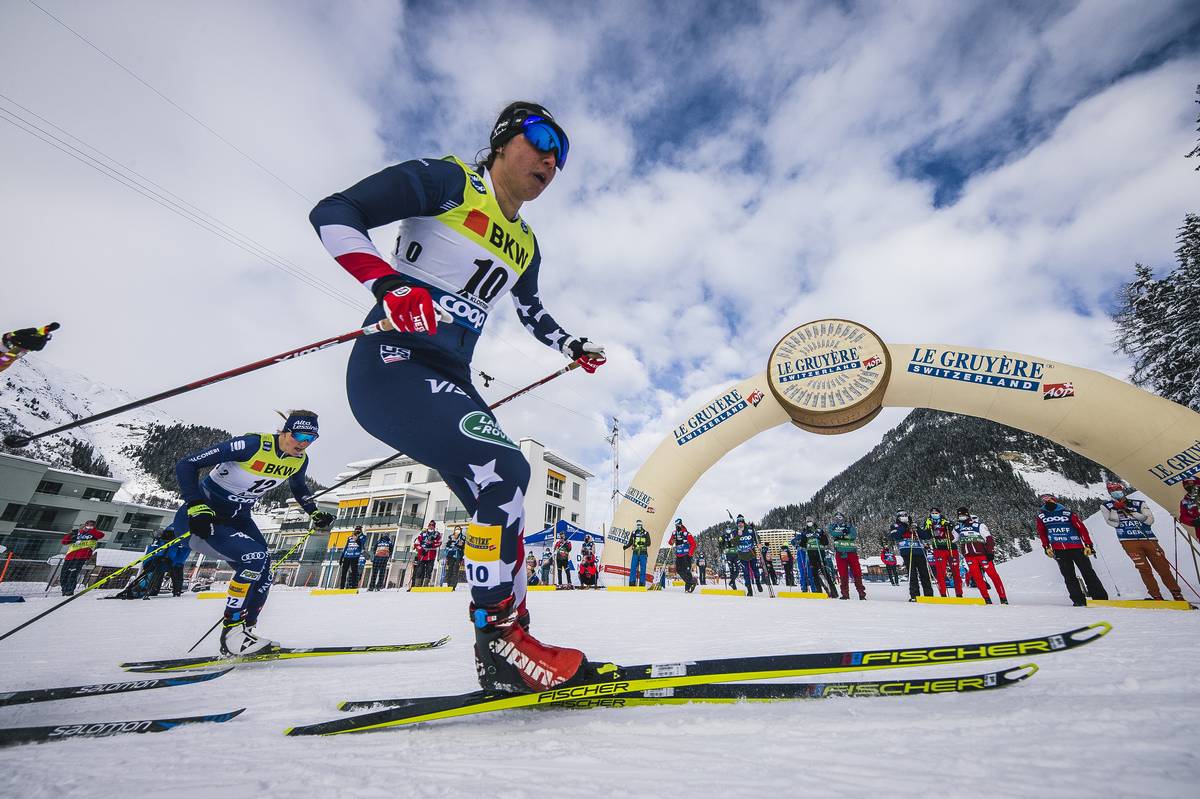
From the FasterSkier archive — posts syndicated from athletes’ and coaches’ own blogs between 2004 and 2012, kept online as published. Current coverage is at fasterskier.com.
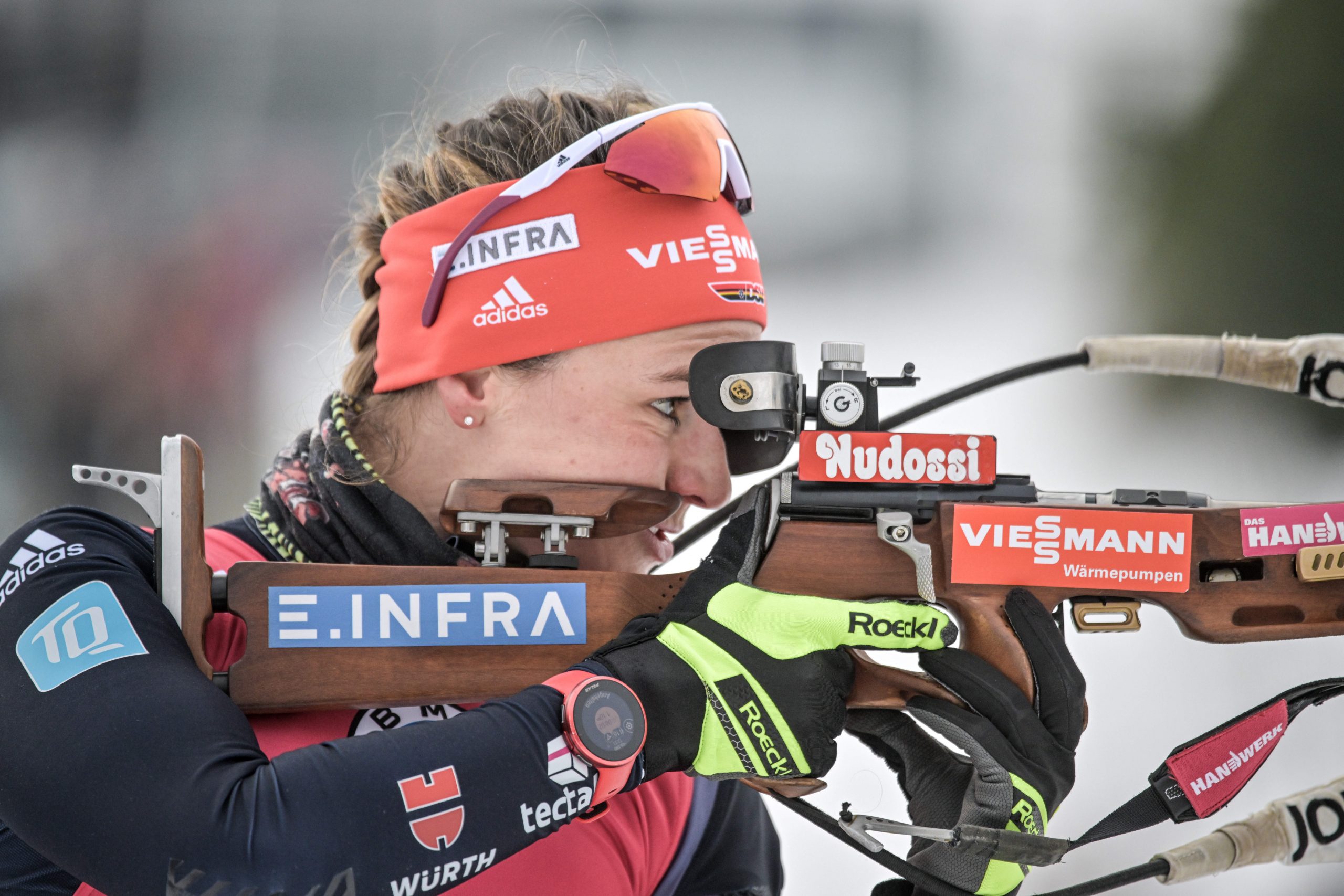
Denise Herrmann-Wick (GER) shooting from the standing position at the IBU World Championships Sprint in Oberhof, Germany. (Photo: NordicFocus)
Biathlon fans anticipated that the women’s 7.5km Sprint would be one of the most tightly-contested races of the BMW IBU World Championships, and it did not disappoint. In the end, only 2.2 seconds separated the new World Champion, Denise Herrmann-Wick of Germany, from the silver medalist, Hanna Oeberg of Sweden. Oeberg’s teammate, Linn Persson, finished third. These athletes will start at the front of Sunday’s 60-person Pursuit and try to stave off the chasers for another chance at a World Championship medal.
Hanna Oeberg (SWE) leaving the range in the lead of the IBU World Championships Sprint in Oberhof, Germany. (Photo: NordicFocus)
Fourteen women from seven nations have landed on the podium this winter. But among all those contenders, arguably no one had more pressure on them today than hometown favorite, Denise Herrmann-Wick. Ranked first in the World Cup Sprint standings, the 34-year-old revealed in Wednesday’s Mixed Relay that she has peaked perfectly for these races. Even with nine out ten hits, Herrmann-Wick is skiing fast enough that she could have a chance at a podium finish, but today she left nothing chance. Unfazed by tens of thousands of spectators cheering in unison after each shot, Herrmann-Wick steadily cleared ten out of ten targets. One word came to mind: impressive.
But the race wasn’t over. A few minutes later, Hanna Oeberg of Sweden managed the same perfect shooting, leaving the range for the final 2.5km loop with a nine second advantage over Herrmann-Wick. A hush of collective anxiety came over the full stadium of German fans. By the top of Oberhof’s signature Birxsteig climb, Oeberg’s advantage had dwindled to a near tie. It wasn’t until the final meters of the race, when Oeberg’s time ticked above Herrmann-Wick’s winning mark of 21:19.7, that the Thuringen Arena burst into cheers.
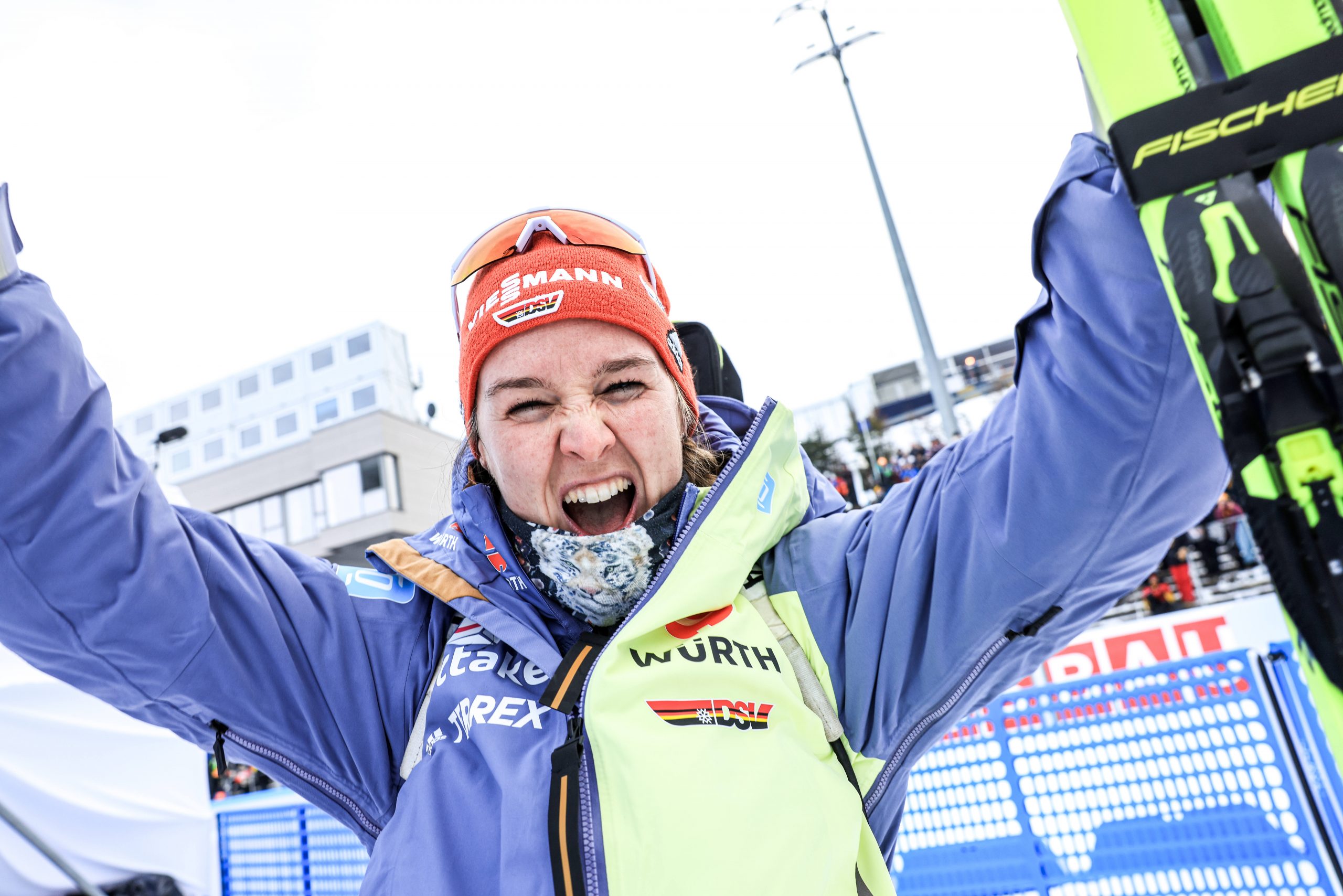
Denise Herrmann-Wick (GER) celebrates after winning the IBU World Championships Sprint in Oberhof, Germany. (Photo: NordicFocus)
The battle for gold was not limited to those two athletes. Wearing bib number two, Anamarija Lampic of Slovenia cleaned her prone targets, leaving the audience wondering if today might be the day for the former cross-country skier to break onto her first podium. But that kind of biathlon magic wasn’t to be; Lampic’s inexperience came through when she missed four targets in standing. With the 17th-ranked course time, she narrowly managed to qualify for Sunday’s Pursuit in 58th. It was Lampic’s teammate, Polona Klemencic, who stepped up and shined for Slovenia with the perfect shooting score to take her first career top-10 in 8th place.
Ingrid Tandrevold of Norway led the race after Shooting 1, showing once again that her ski speed and prone shooting skills are there. But the standing shooting slump which has been bothering her since January persisted and she missed two on her way to a 14th place finish. Lisa Vittozzi of Italy missed just one in standing but skied fast enough to briefly take the lead from Marketa Davidova of Czech Republic, who had hit 100% as she so often does in championship races.
The defending Olympic Champion in the Sprint, Marte Olsbu Roeiseland, was sitting way back in 26th after missing one in prone, but with a clean standing bout and the second-ranked course time, she pulled her way back to fourth, just five seconds shy of the bronze medal. She’ll be motivated for more in the Pursuit. The World Cup Overall leader, Julia Simon, was well on her way to a podium finish with eight hits before she missed the last two. Simon thrives in head-to-head races and will be a threat in the Pursuit even starting 1:02 back in 10th place.
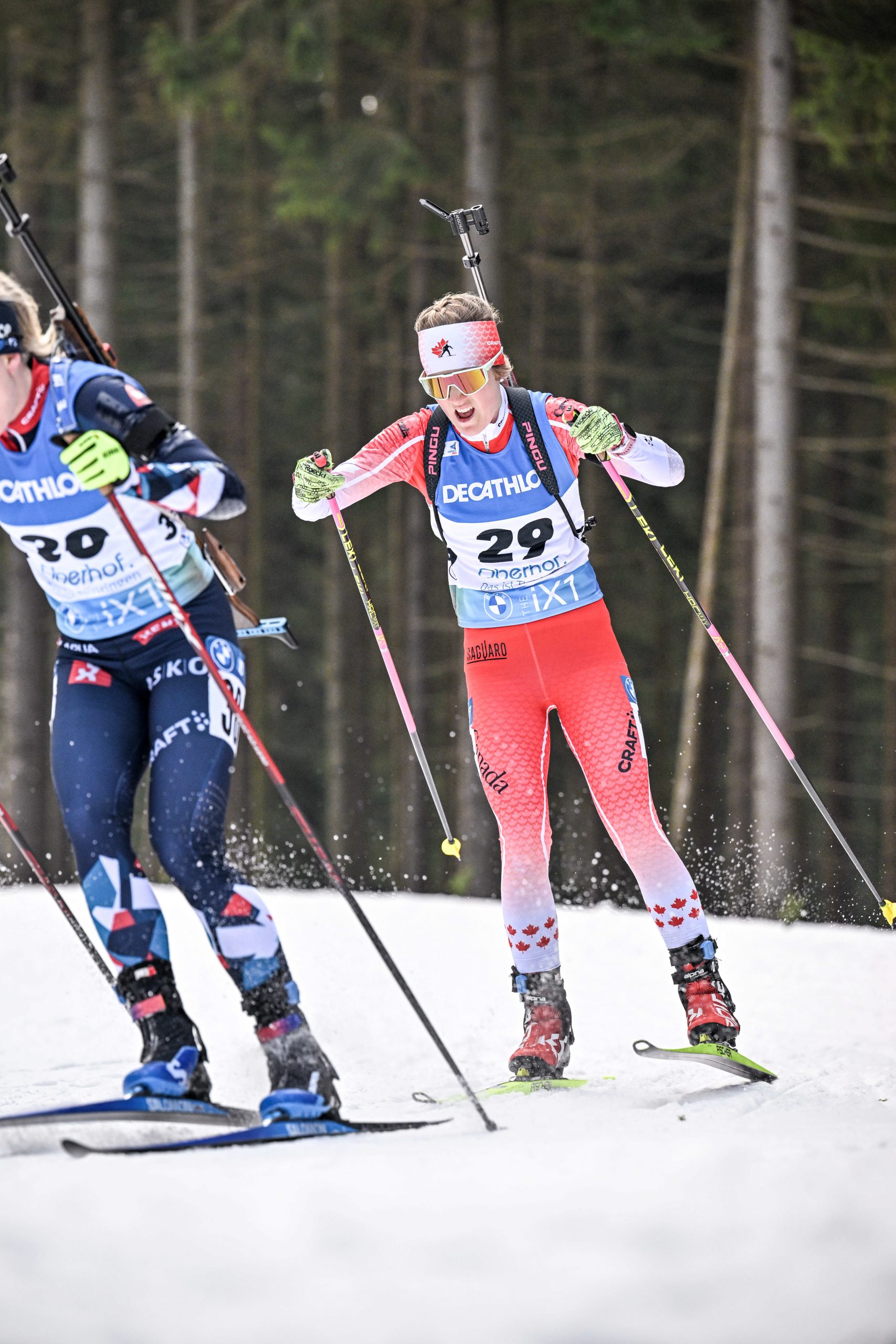
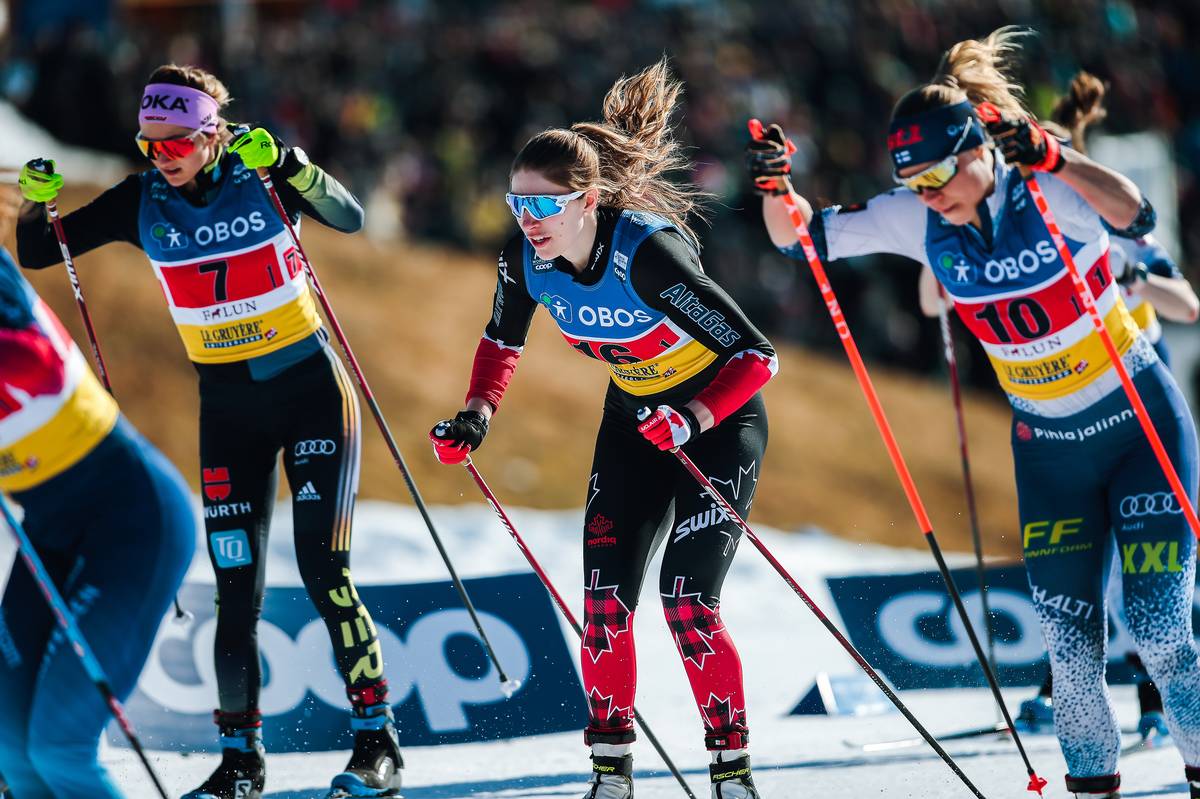
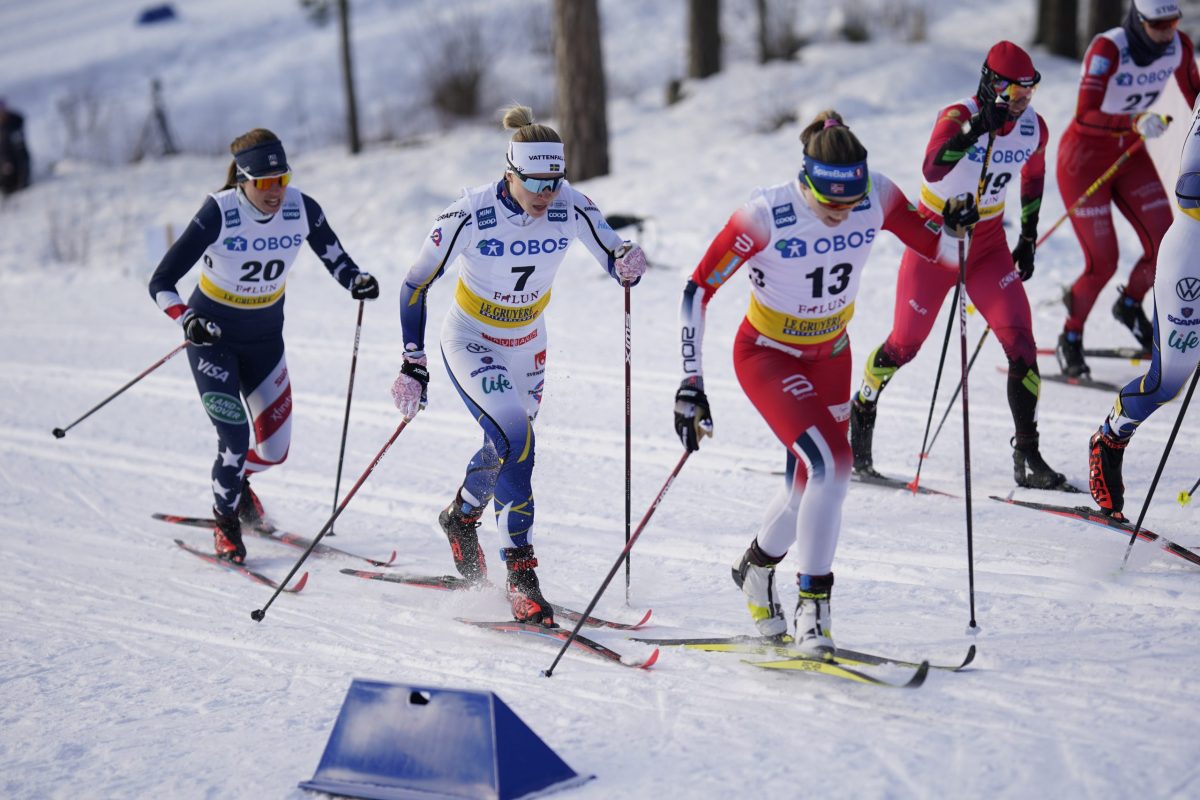
Emma Lunder (CAN) following Marte Olsbu Roiseland (NOR) in the IBU World Championships Sprint in Oberhof, Germany, where they finished 11th and 4th, respectively. (Photo: NordicFocus).
Less than one second behind Simon, Emma Lunder of Canada posted her best-ever Championship result in 11th. After a season-best ski performance on Wednesday in the Mixed Relay, Lunder knew anything was possible in today’s Sprint. “I was a bag of nerves,” she said. “I was more nervous for this than the Olympics, because I knew I had a chance.” Once she started, her good preparation kicked in and with a clear mind she executed to near perfection, with just one prone miss and a top-15 course time. Lunder attributes her excellent shape to staying healthy. She hasn’t been sick since last year’s Olympics, so she has been able to train continuously and make steady gains. She also credited her ski technicians for fast skis. In Sunday’s Pursuit, only 1:03 will separate Emma from Herrmann-Wick. To the podium, it’s just 37 seconds.
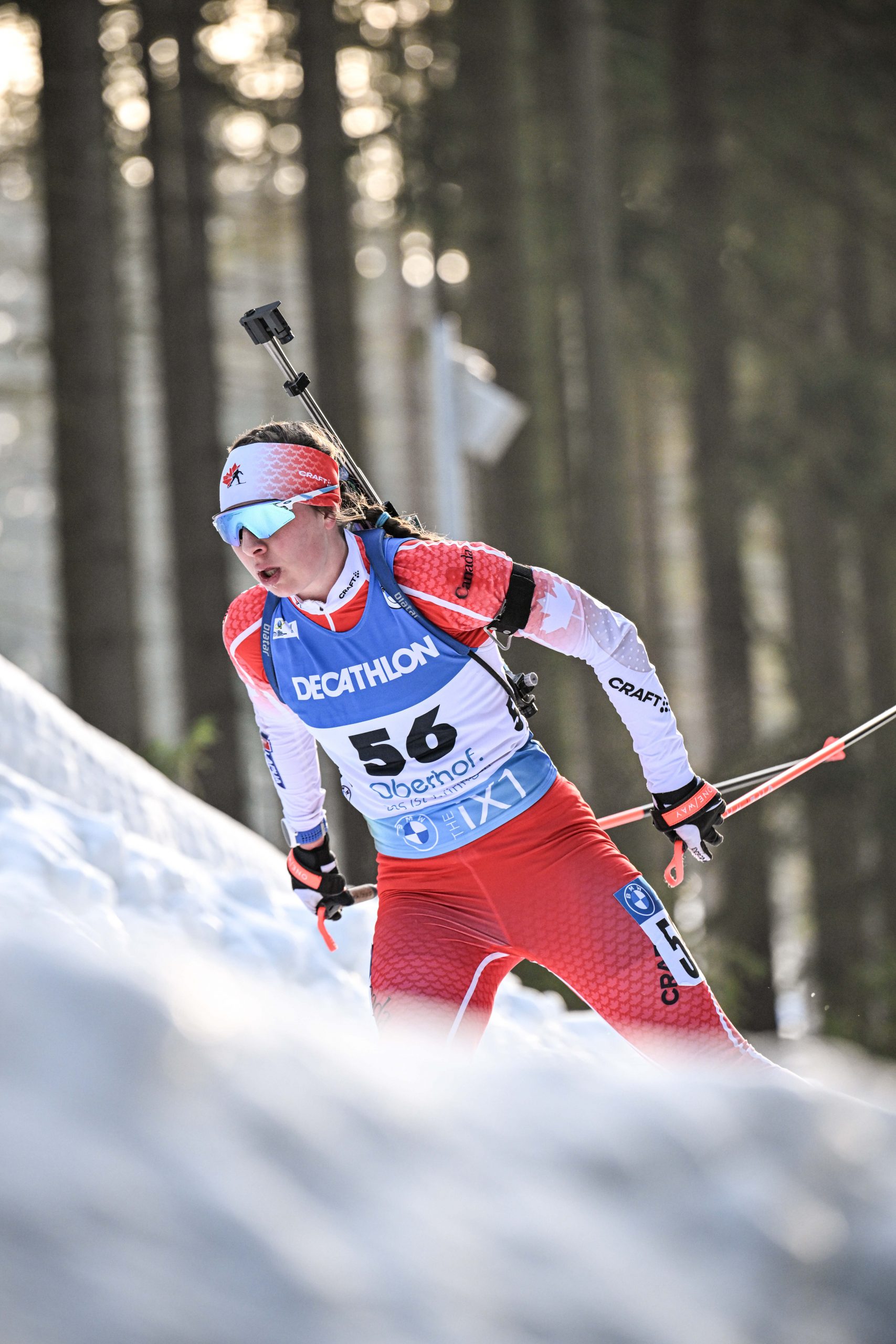
Nadia Moser (CAN) on her way to 48th in the IBU World Championships Sprint in Oberhof, Germany. Photo: (NordicFocus)
Two other North Americans qualified for the Pursuit. Nadia Moser (CAN) finished 48th with one penalty, and Deedra Irwin (USA) finished 55th with two. “I’ve barely trained for the last two weeks,” said Irwin after the race, referencing a sickness she came down with in January which required a round of antibiotics. “And this course is so hard. The headwind on that straightaway was brutal.” Some athletes were luckier than others, finding themselves in position to draft for the 500m windy straightaway approach to the range. Lunder put in a hard sprint to catch someone there. Chloe Levins, the second American today in 73rd, was alone every time on that section, but she performed well on the range, hitting nine of ten.
Joanne Reid (USA) shot clean in prone but suffered three penalties in standing to finish 75th. Competing in her first biathlon World Championships race, former Nordic Combined athlete Tara Geraghty-Moats (USA) similarly cleaned prone but struggled in standing, missing four to finish 86th. Canada’s Benita Peiffer rounded out their squad, missing five to finish 93rd.
Chloe Levins (USA) hit nine out of ten to finish 73rd in the IBU World Championships Sprint in Oberhof, Germany. (Photo: NordicFocus)
The women will be back in action on Sunday, but first it’s the men’s sprint, Saturday at 8:30AM Eastern Time.
IBU World Championships women’s Sprint podium: Denise Herrmann-Wick (GER) in first, Hanna Oeberg SWE) in second at left, and Linn Persson (SWE) in third. Oberhof, Germany. (Photo: NordicFocus)
This World Cup coverage is made possible through the generous support of Marty and Kathy Hall and the A Hall Mark of Excellence Award. To learn more about A Hall Mark of Excellence Award or to learn how you can support FasterSkier’s coverage please contact info@fasterskier.com.
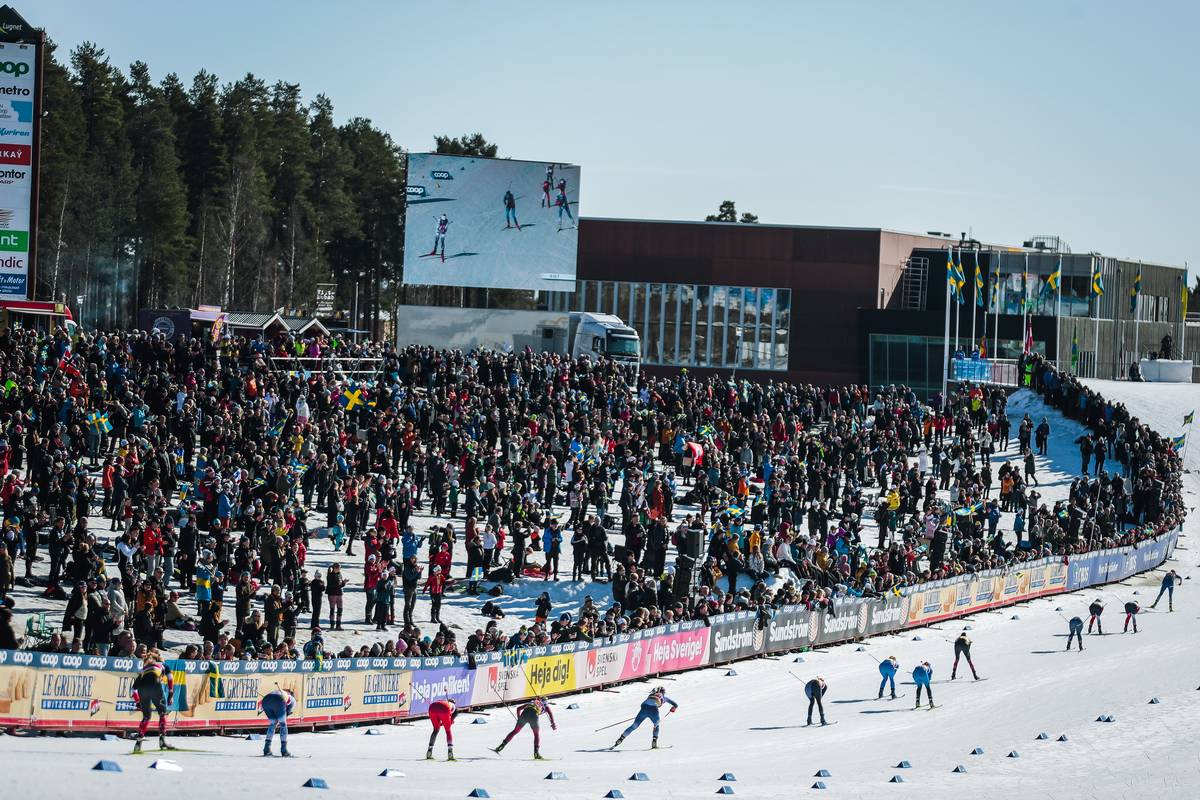
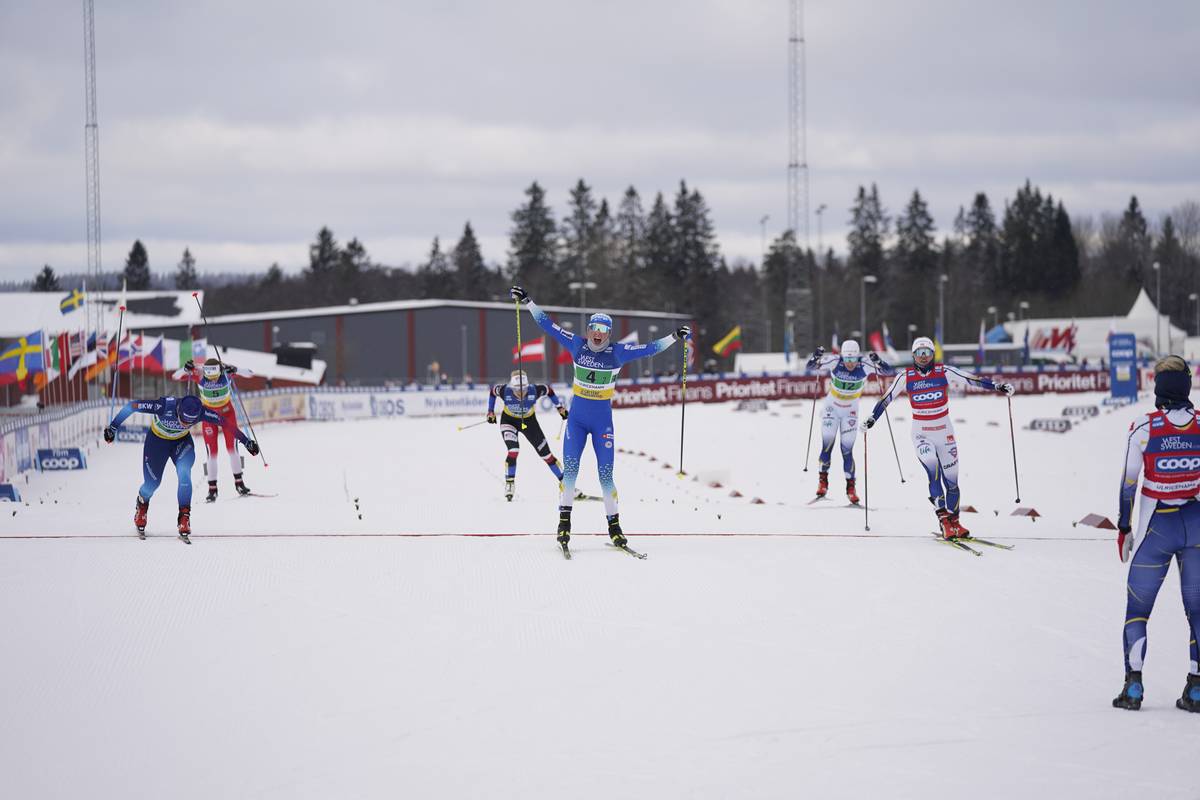
A packed stadium for the final day of World Cup racing in Falun Sweden (Photo: NordicFocus)
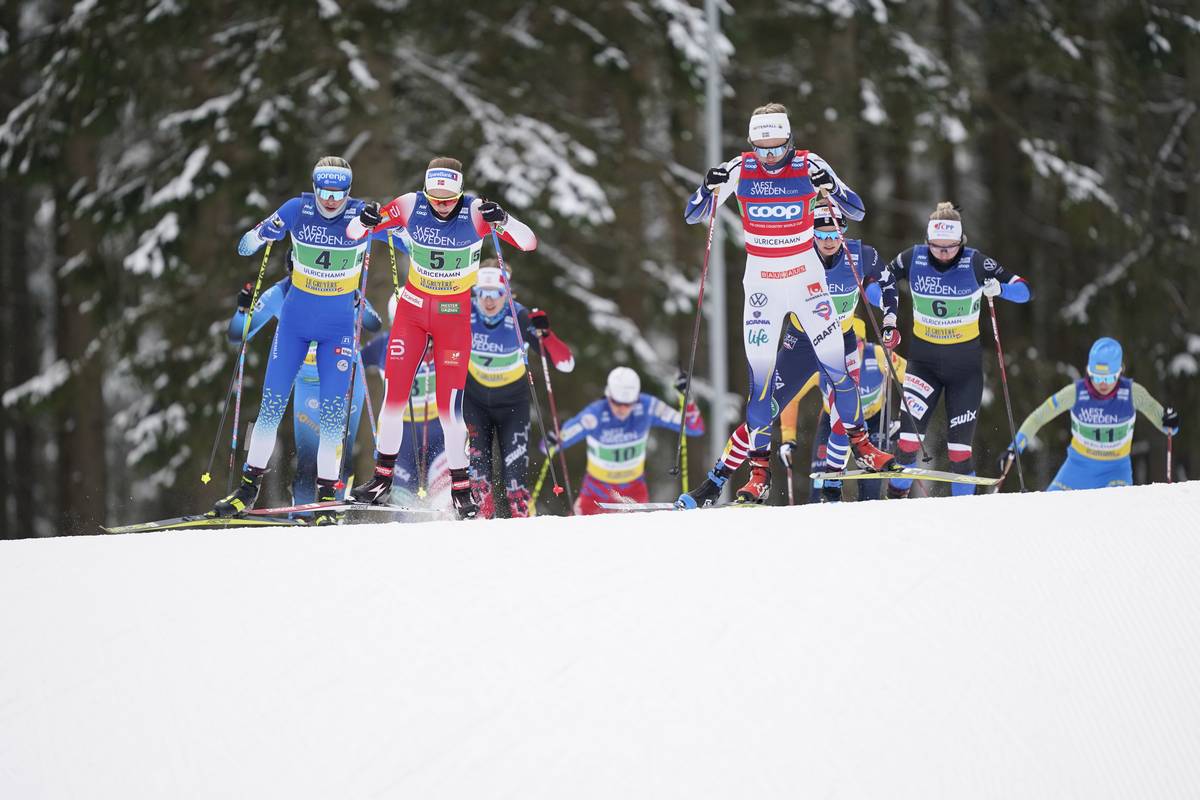
We’ve arrived at the final event of the 2021/22 World Cup Season and the second new event of the day. It was a fast and furious mixed team sprint in Falun, Sweden, happening just hours after the mixed team relay which ran in the morning. In the first iteration of this event, teams composed of one woman and one man raced six laps of a 1 k course each, making for 12 k of skiing total.
To keep things spicy, the last two teams in the exchange after the even-numbered laps 2 -10 were eliminated. So although seventeen teams started the competition, only seven made it to the finish. In order to limit the chaos, given the number of teams, there was no tagging in the exchange, just a finish line and a start line for the athletes to gauge themselves.
The atmosphere in the Lugnet Ski Stadium was festive as fans enjoyed the 45°F degree weather and sunshine. “I think this is very nice to be together with the men,” said Nadine Fähndrich of Switzerland, “it makes more team spirit between the men and the women.” She alluded to the feeling of both the athletes and the spectators during the mixed team relay in which Team USA I took the gold in an exciting race. “I’m excited for the [race] and to [enjoy] the atmosphere here,” she concluded.
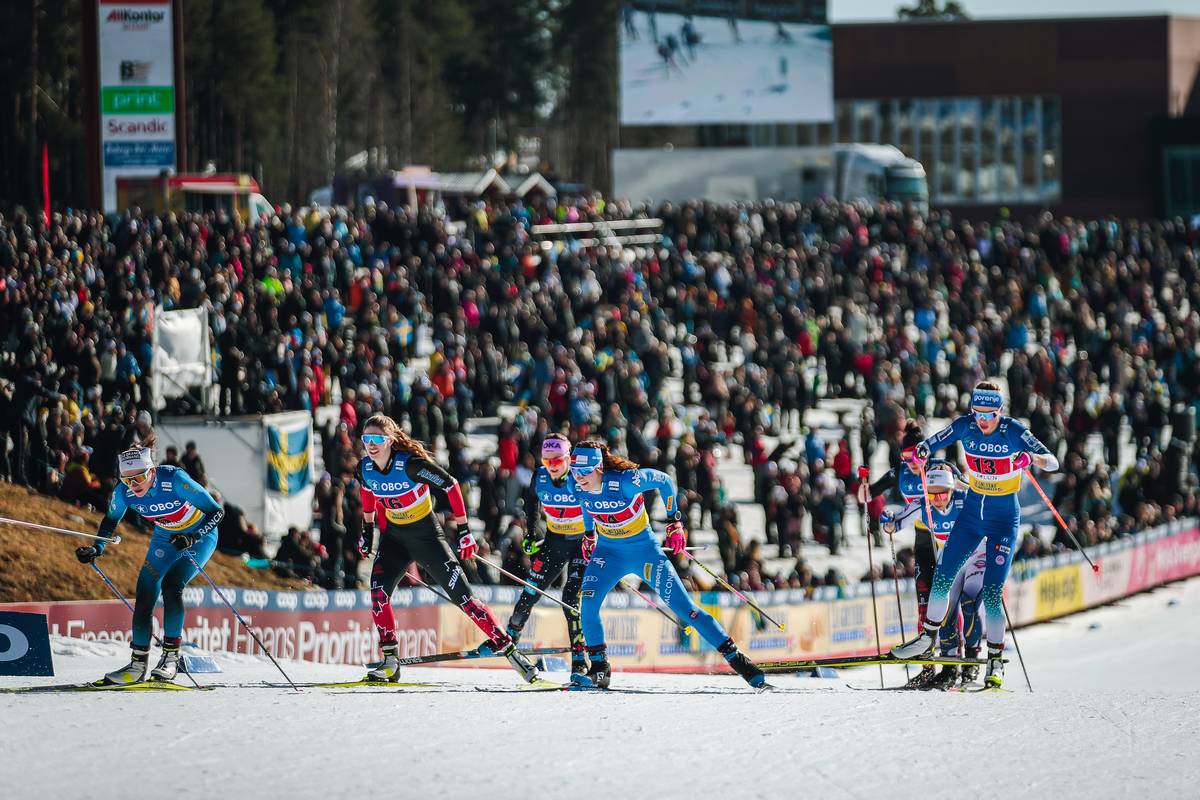
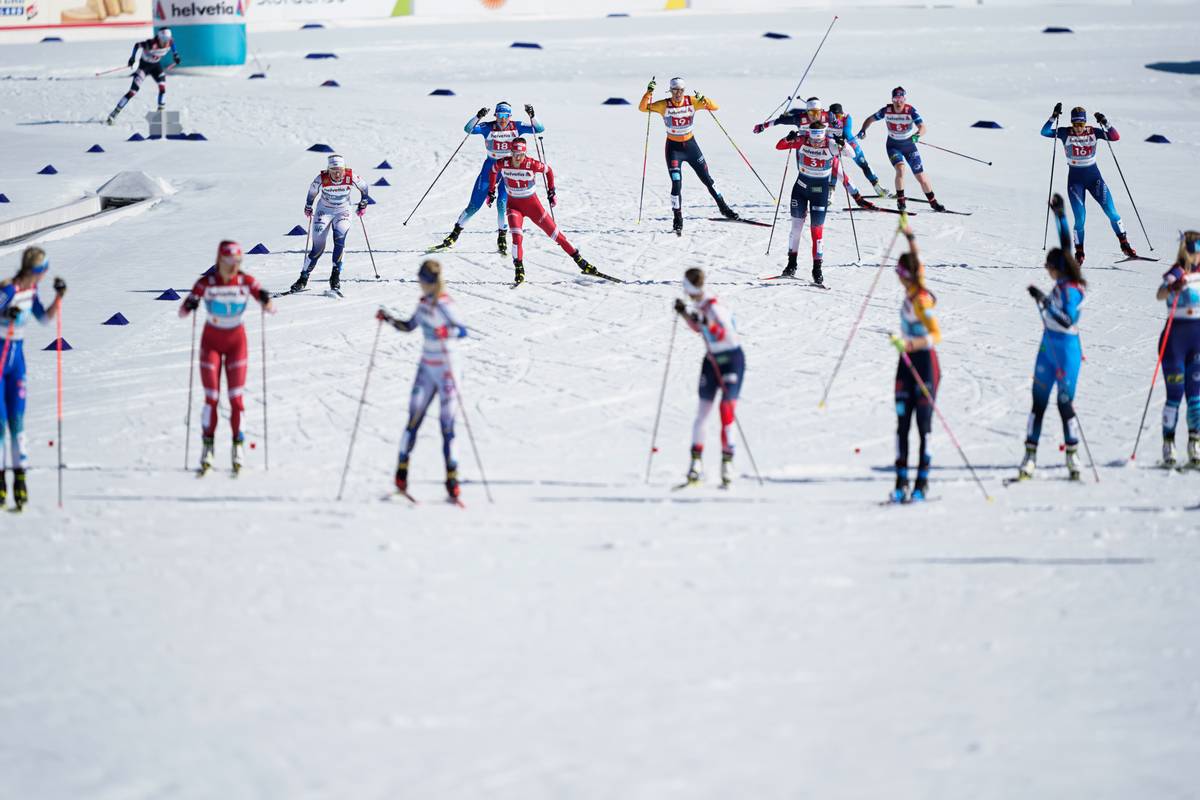
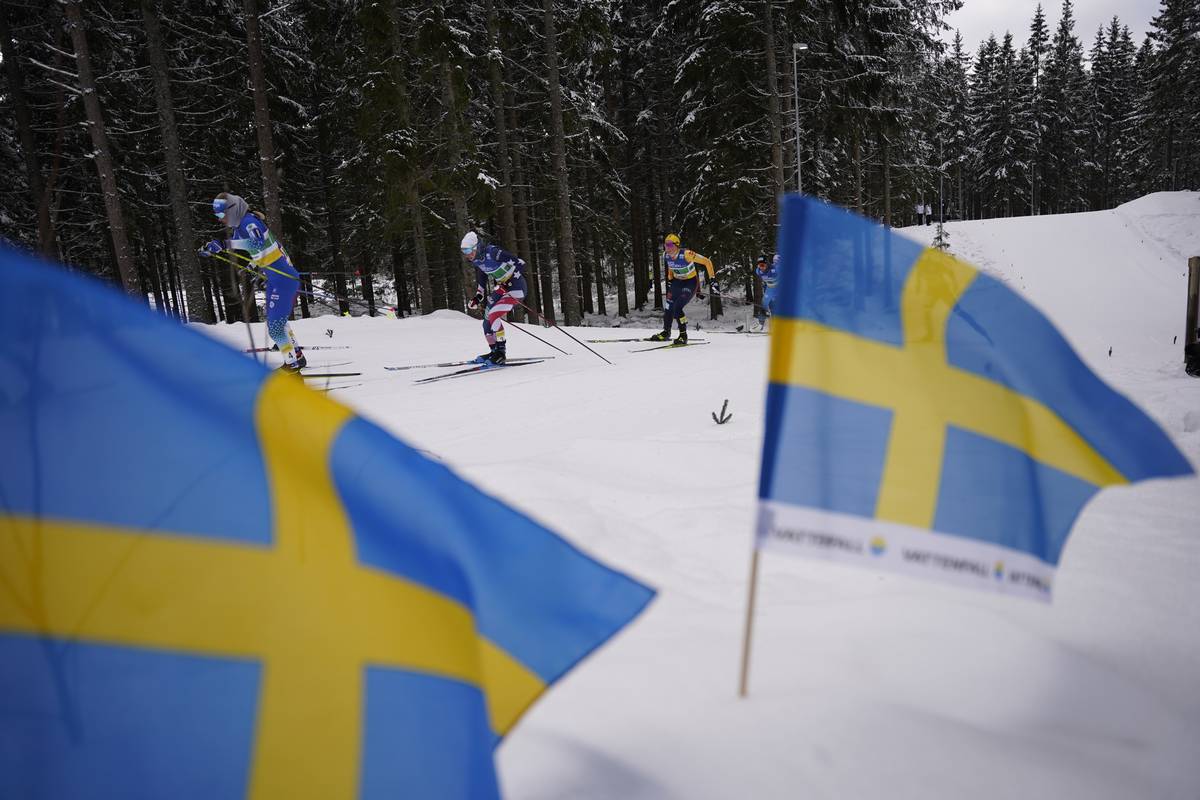
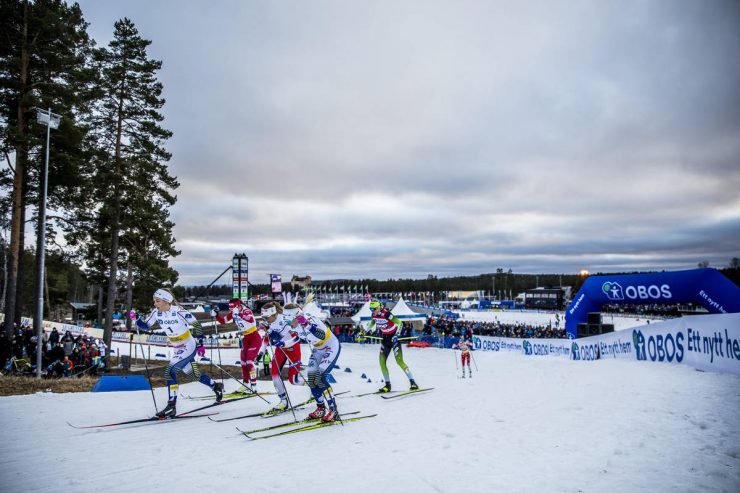
The women head out for one of six laps for the mixed team sprint event (Photo: NordicFocus)
With Team USA I taking the victory and Team USA II coming in 14th, the Americans did not enter a team in the mixed sprint event. Out of the seventeen teams that started, twelve nations were represented in the start list and only five nations made it to the finish.
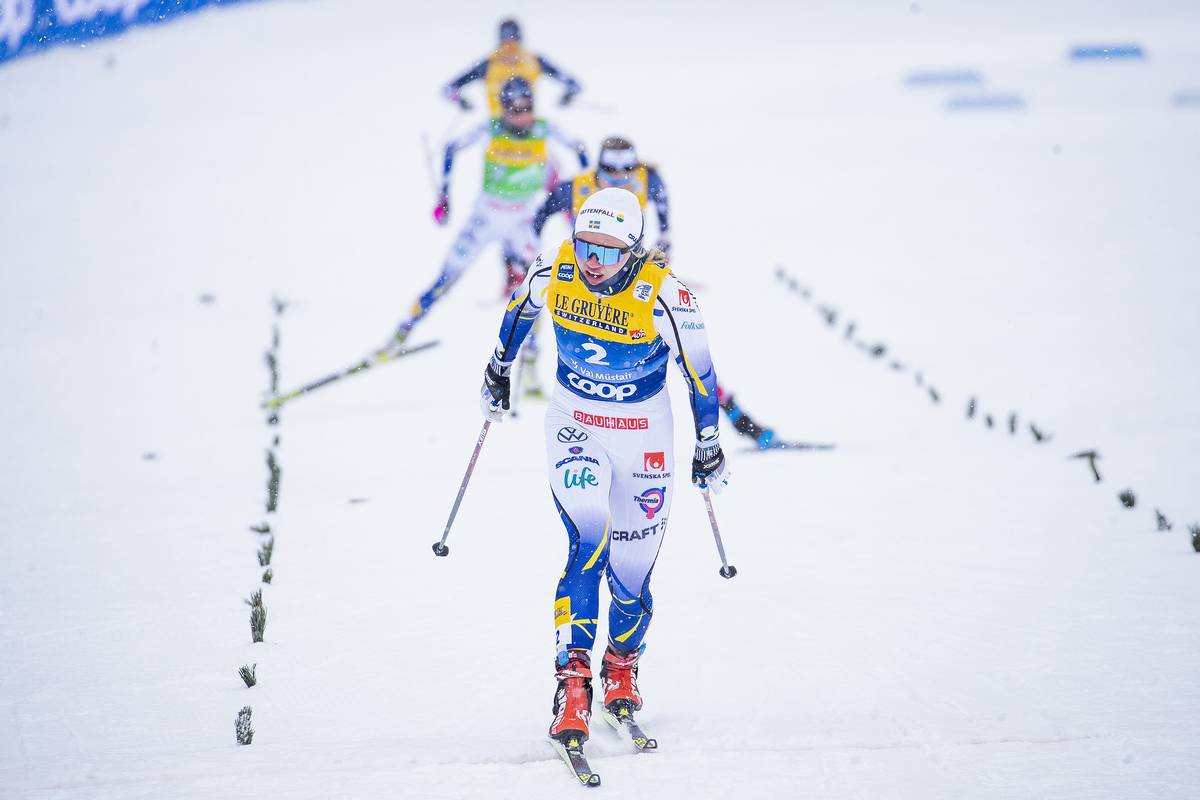
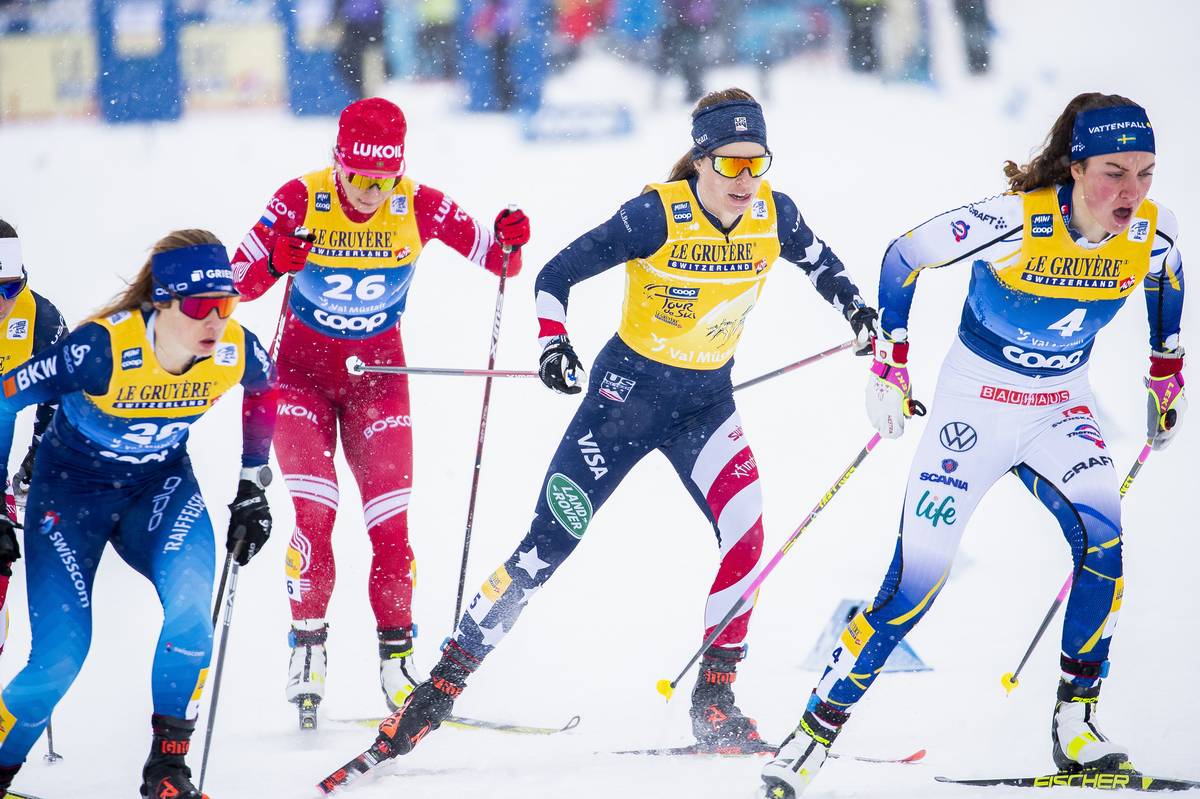
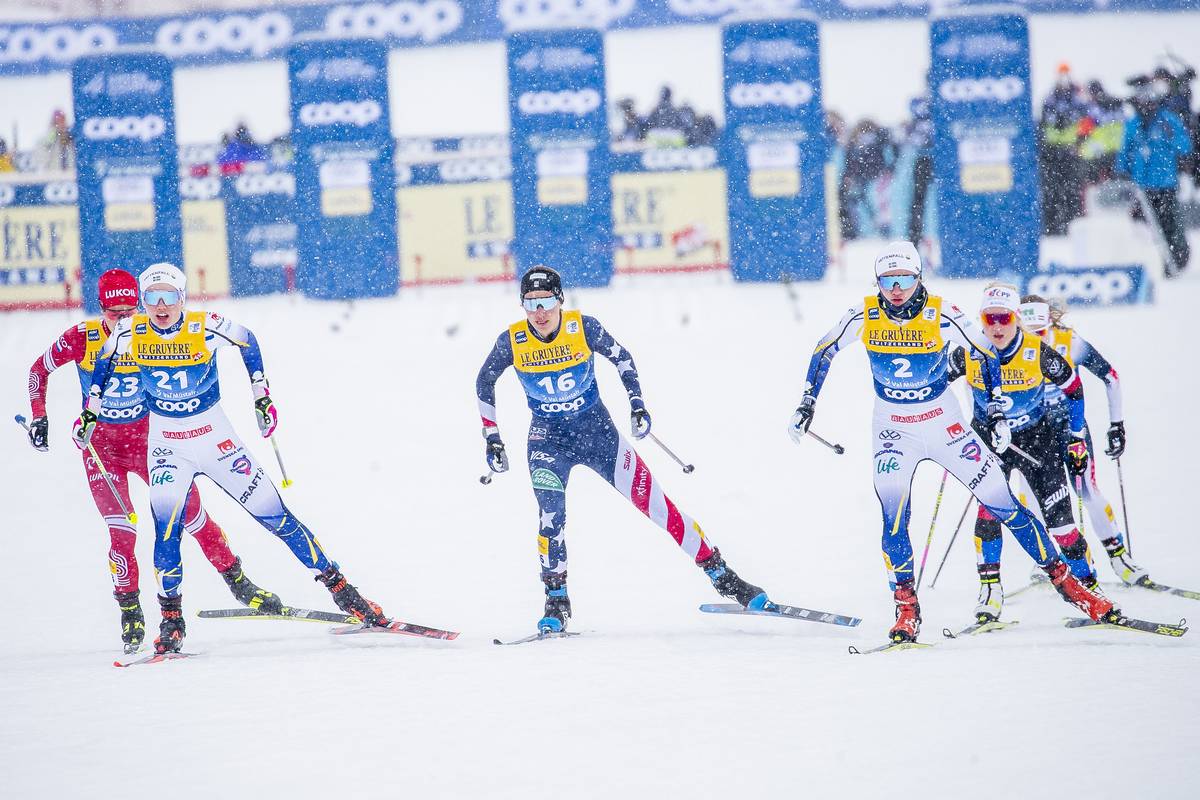
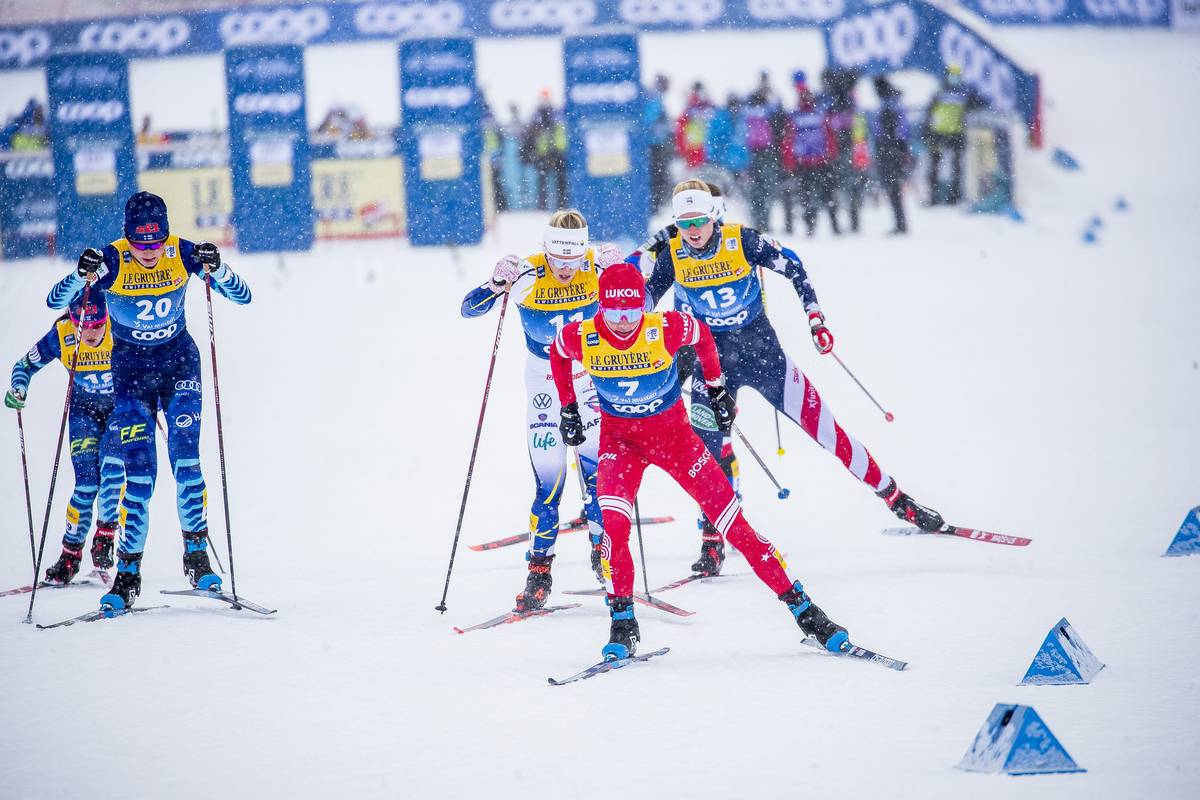
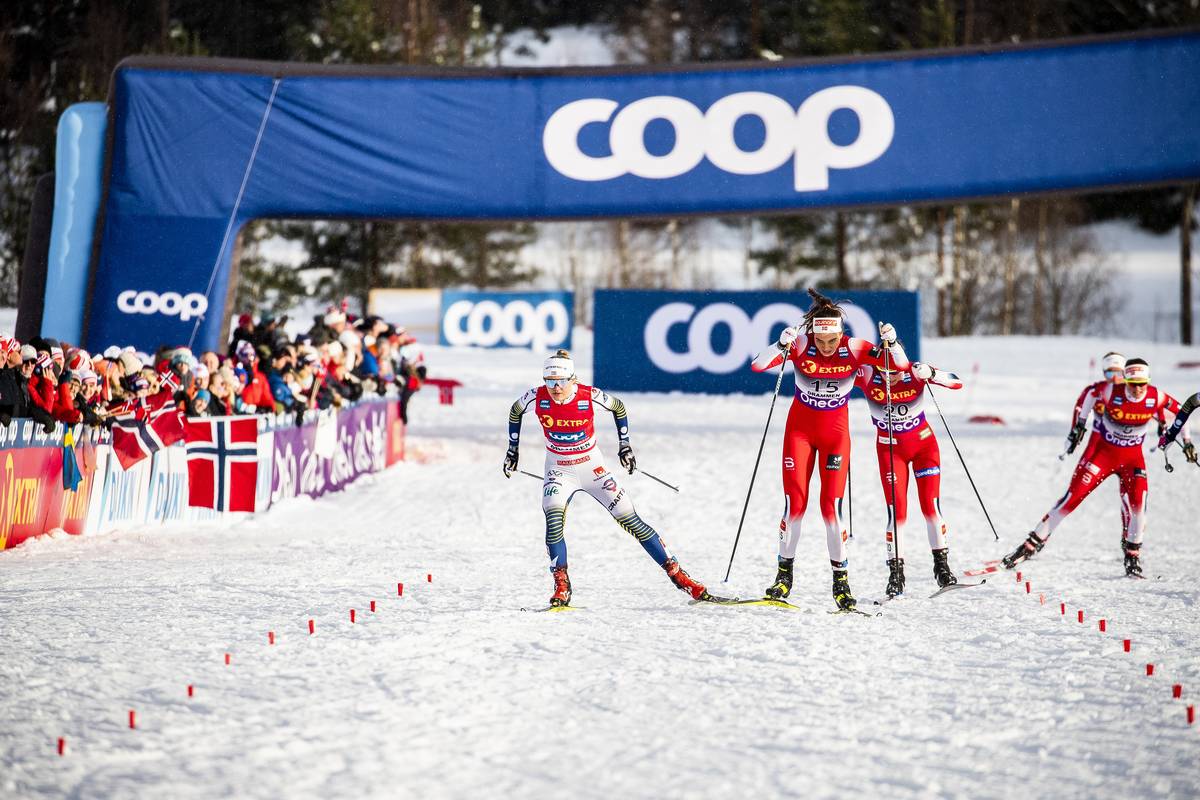
The women started and as would be expected, Jonna Sundling skiing for Sweden I, was at the front. She was paired with Calle Halfvarsson who earned his first podium finish since 2018 in the 15 k freestyle on Saturday.
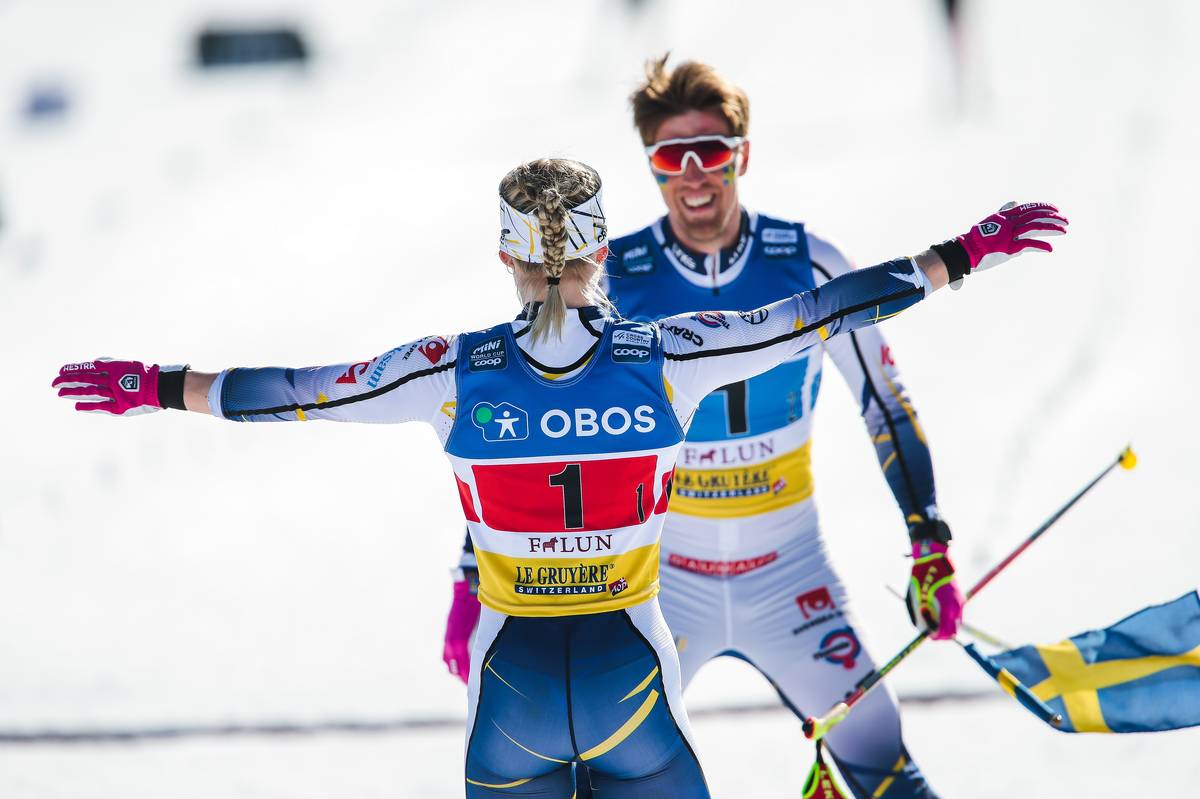
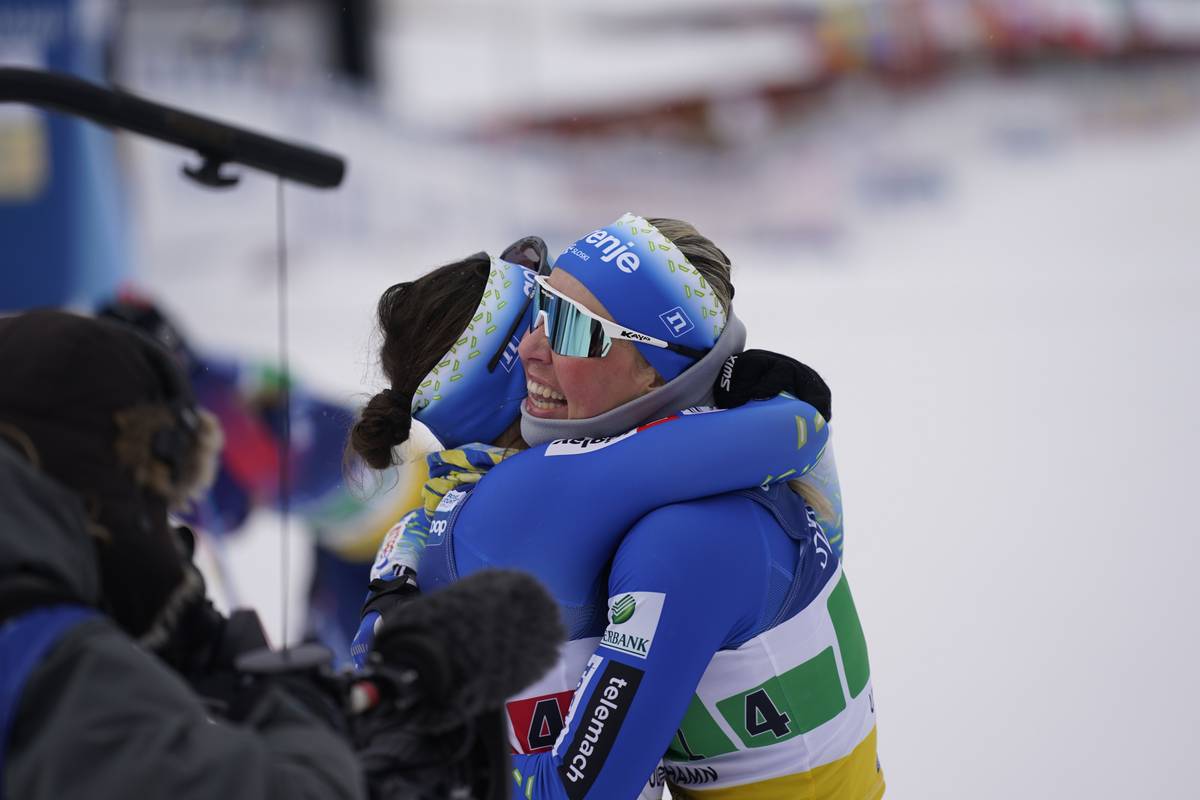
Celebrations for Team Sweden I after dominating the mixed team sprint (Photo: NordicFocus)
The first round of eliminations at 2 k took Estonia and France II out of the running. As Sundling concluded her second lap, she had created a +2.1 second gap and Halfvarsson seized this opportunity. Instead of waiting around for the rest of the field, he pushed hard and grew the gap to +3.84 seconds on his next 1 k lap. This same lap saw Benjamin Moser of Austria fly off the course on the corner descending into the stadium, taking himself and his teammate Teresa Stadlober out of the race. Latvia was also eliminated in that round.
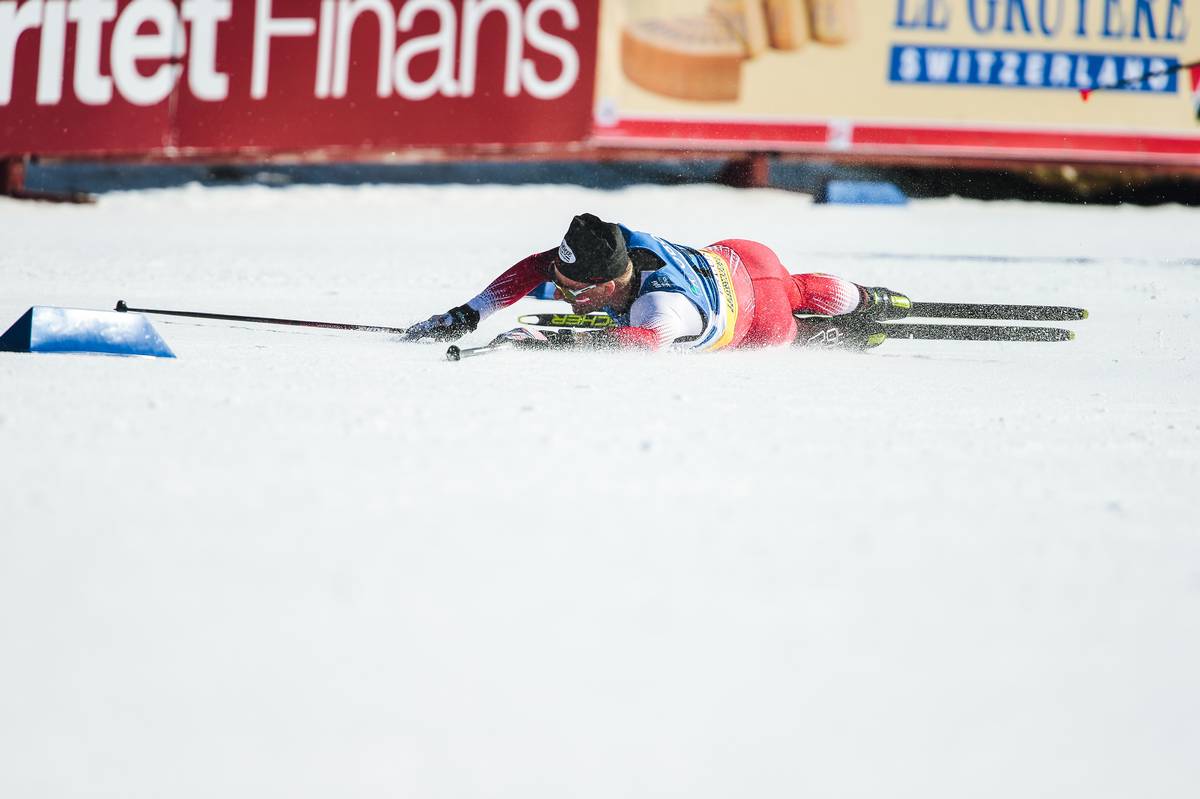
Benjamin Moser (AUT) slides out on a fast corner (Photo: NordicFocus)
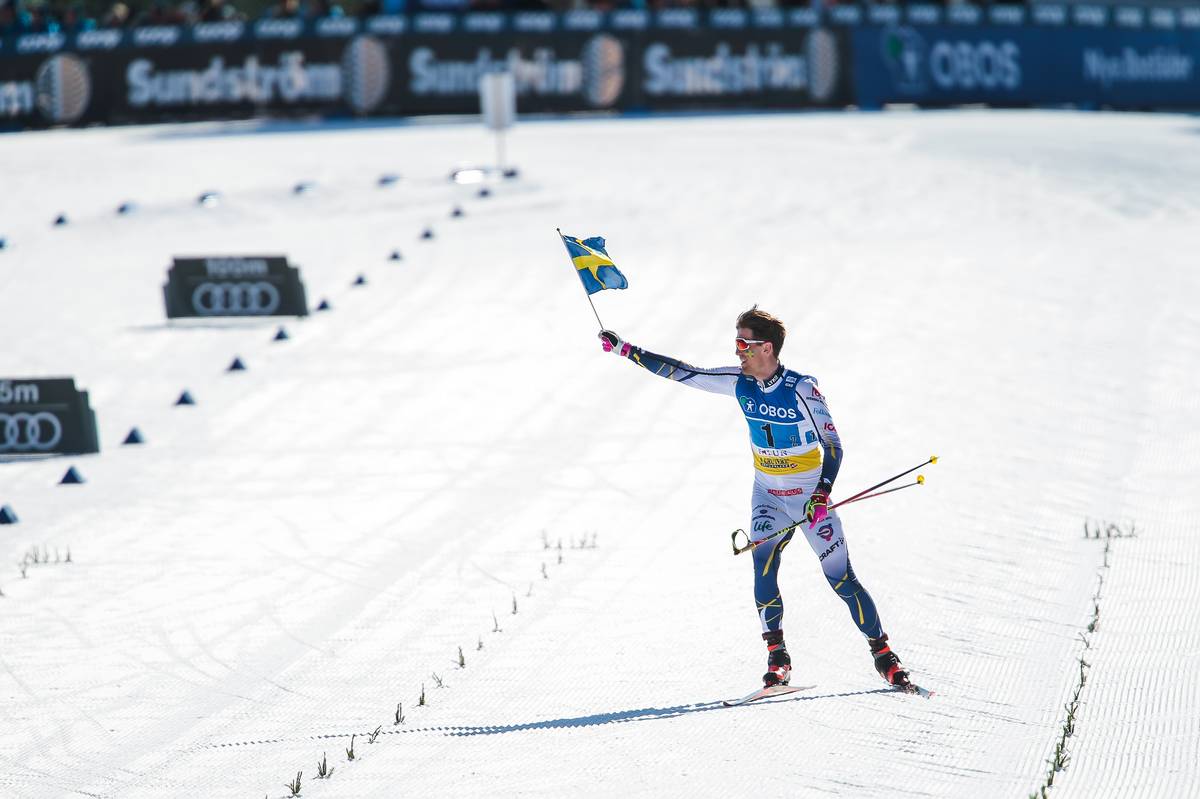
Once Sweden I had made their move, it stuck. At 5 k they were +9.61 seconds ahead, at 7 k they were +22.2 ahead, at 11 k the gap was up to +26.84. After 23:05.91 of cumulative race time, Halfvarsson crossed the finish line waving a Swedish flag.
“It’s easy when I go with Jonna [Sundling],” he said to FIS after the race, “she is so fast, it’s no match.” For her part, Sundling said, “It was a little bit exciting before the race, how to ski, how should our tactic be… but it felt like we did a really good race and ended up first so it’s really fun.”
Calle Halfvarsson enjoys a big time cushion as he and Jonna Sundling take gold in the first ever mixed team sprint event (Photo: NordicFocus)
Rewinding a bit, the women’s third lap saw Fähndrich shoot off the course in the same fashion as Moser. Minutes later, Joni Maki of Finland I and Harald Østberg Amundsen of Norway I both went down on the corner entering the exchange area. A quick recovery by Amundsen ensured that his team stayed in the race but Maki and his partner Jasmi Joensuu were eliminated, along with Fähndrich and Janik Riebli for Switzerland.
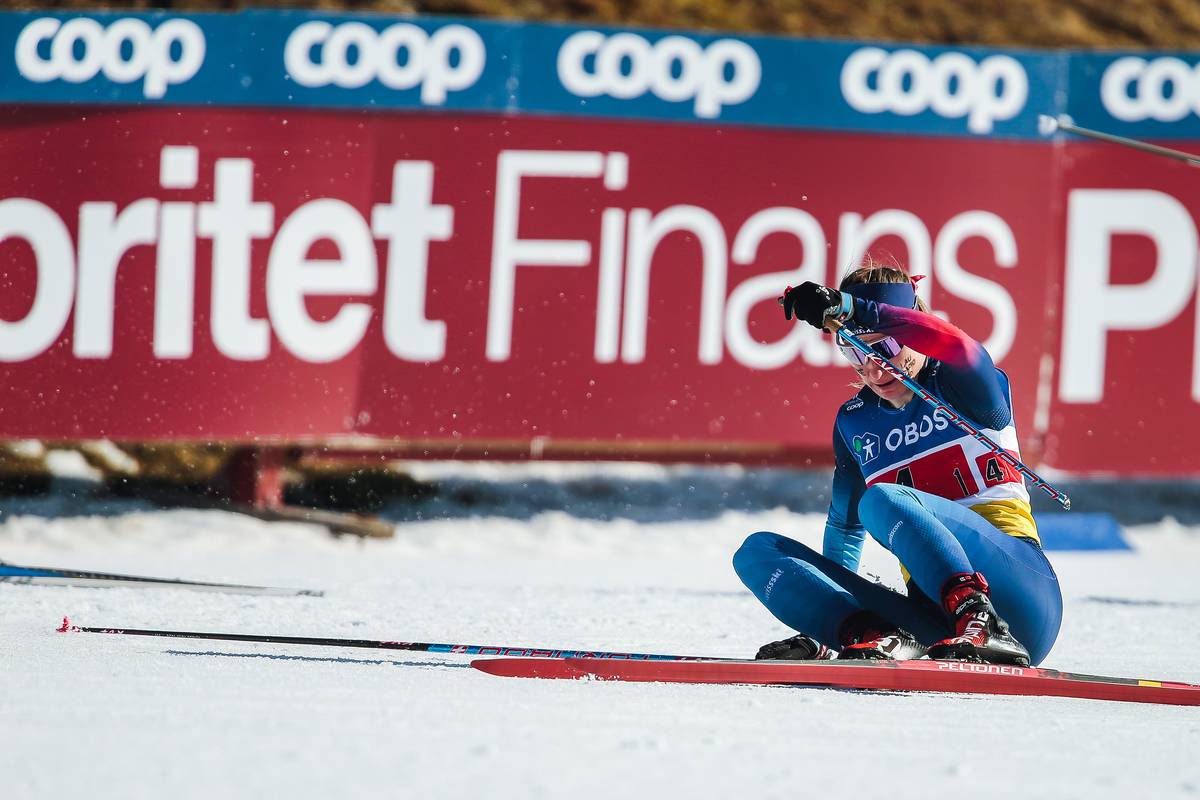
Nadine Fähndrich (SUI) picks herself up after a fall during the mixed team sprint event (Photo: NordicFocus)
The fourth round of elimination took out Slovenia and Finland II, though due to the tight nature of the eliminations, the women were starting unless it was clearly evident that they were one of the last two. Thus we saw Anamarija Lampic (SLO) battling Tiril Undes Weng of Norway II for second, even though Slovenia had already been eliminated.
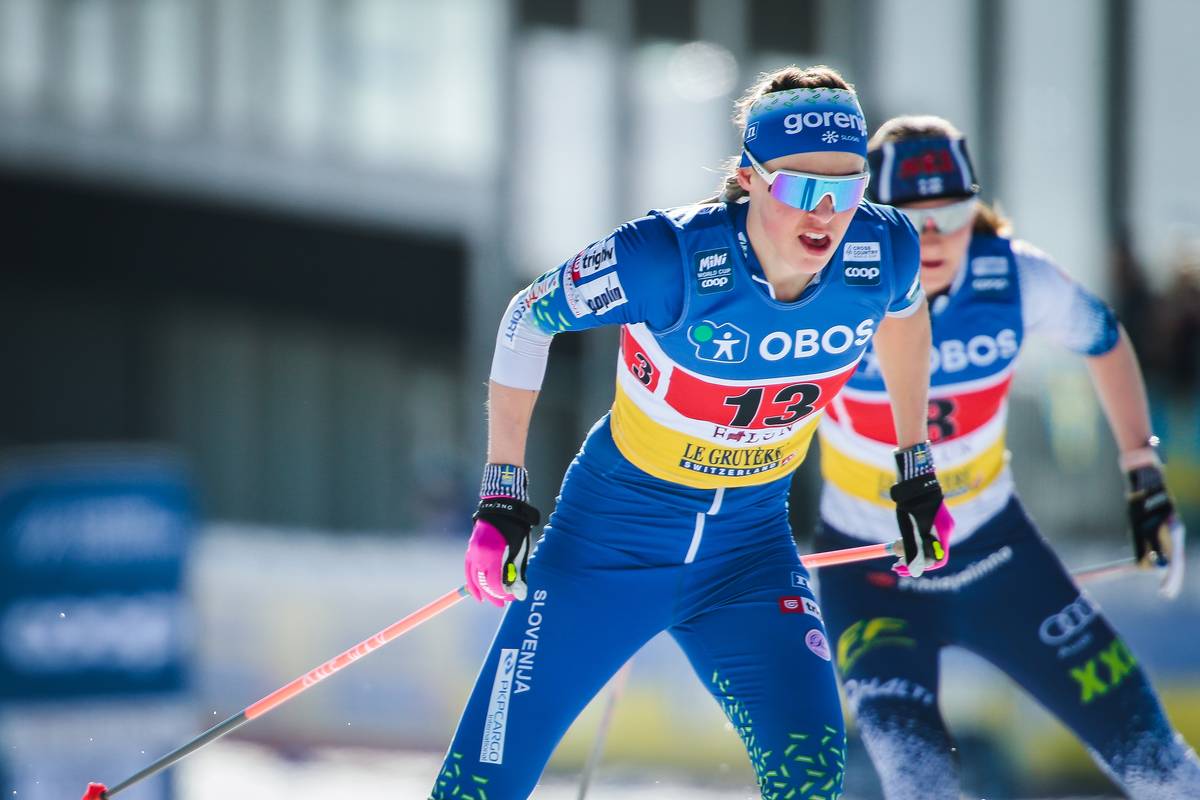
Anamarija Lampic (SLO) teamed up with Vili Crv (SLO) for the mixed team sprint (Photo: NordicFocus)
Entering the 10th exchange and the fifth elimination, Sweden I was 19 seconds ahead, with Norway I and II duking it out behind. This meant that it was the twins, Tiril and Lotta Udnes Weng battling each other for their final lap.
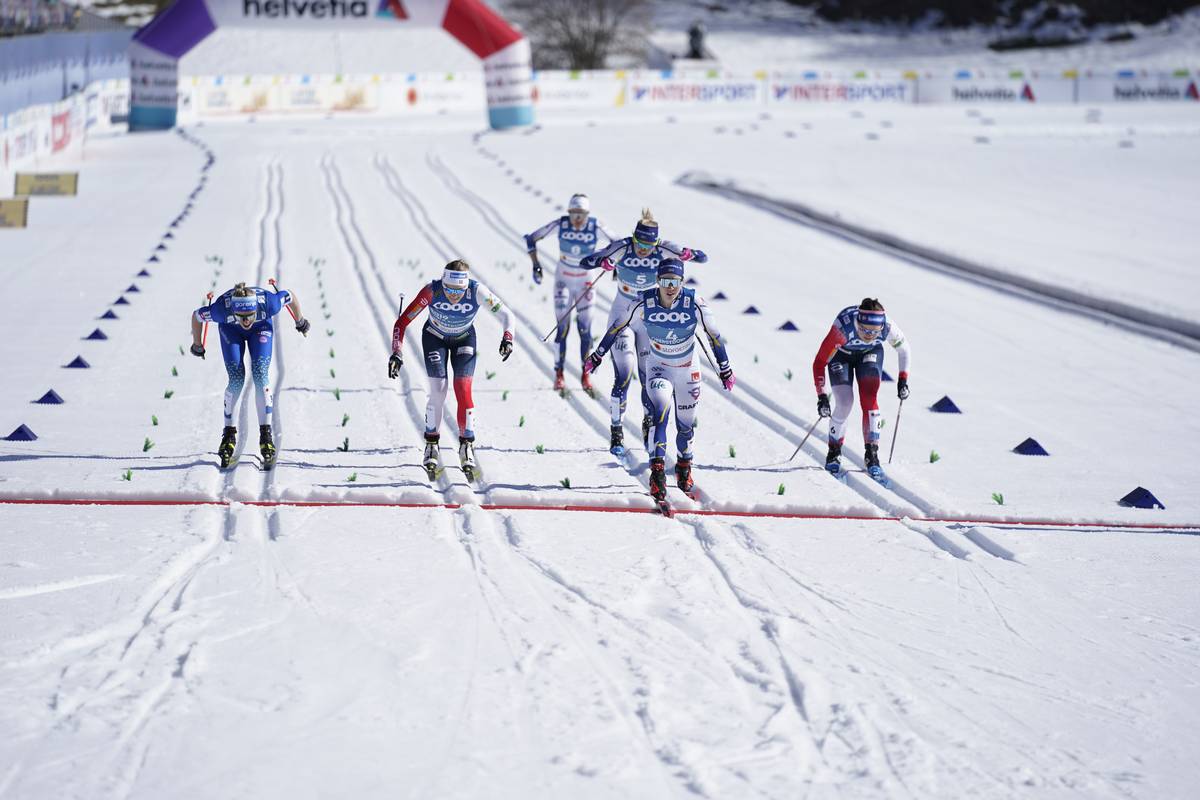
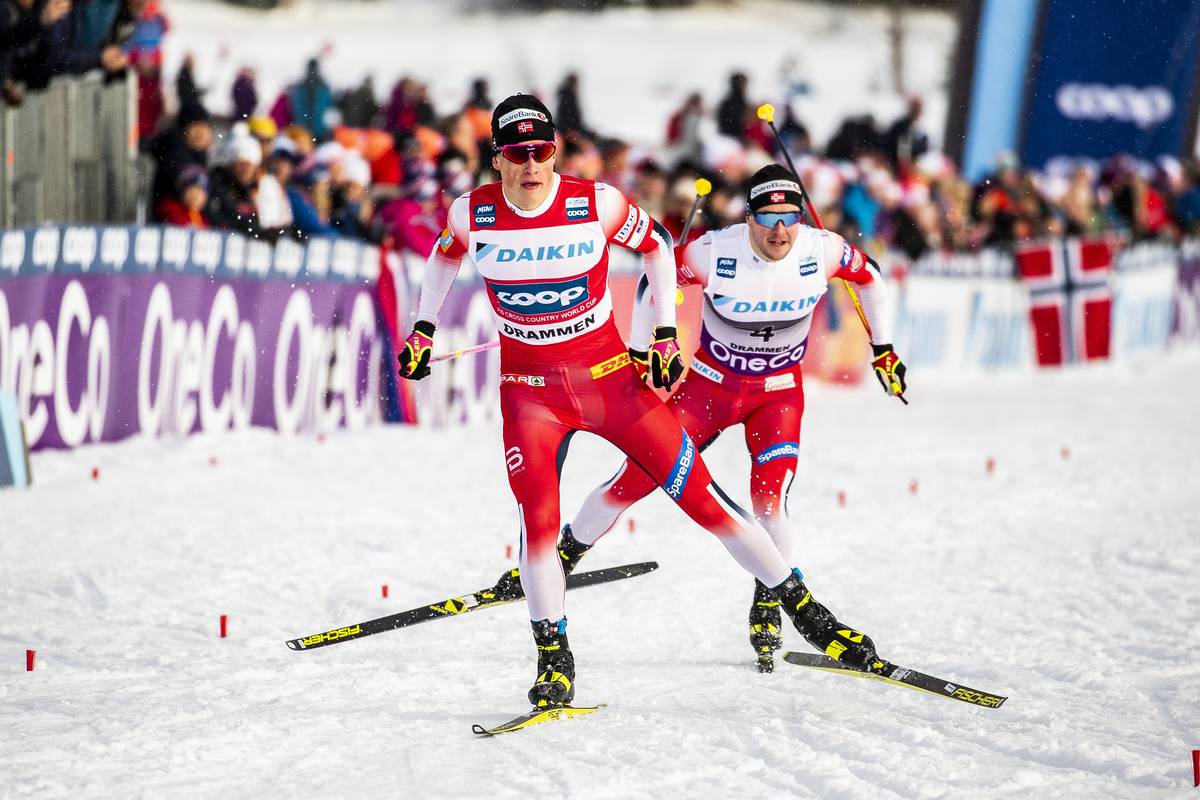
With Canada II and France I eliminated, the men took off for their sixth and final lap. Amundsen of Norway I was just ahead of Martin Nyenget of Norway II, though entering the stadium Nyenget used the slip stream to move in front of his compatriot. With Sweden I well across the line in gold medal position, a tight sprint between the two Norwegians ultimately went to Nyenget, meaning Norway II earned silver and Norway I came away with the bronze.
Harald Østberg Amundsen (NOR) and Martin Loewstroem Nyenget (NOR) during the early stages of the mixed team sprint (Photo: NordicFocus)
Italy with Nicole Monsorno and Federico Pelligrino finished fourth. Sweden II ended up fifth, and Germany I came in sixth. Canada I (Dahria Beatty and Graham Ritchie) were the last team to avoid elimination and finish in seventh.
Dahria Beatty (CAN) and Graham Ritchie came in seventh in the mixed team sprint (Photo: NordicFocus)
With the last race of the day complete, the World Cup season has come to a close. For North-American ski fans, Canadian Nationals will be combining with US Super Tour Finals for a culminating event series in Whistler, Canada. The racing begins March 20th and you can find more details about the event here.
This World Cup coverage is made possible through the generous support of Marty and Kathy Hall and the A Hall Mark of Excellence Award. To learn more about A Hall Mark of Excellence Award or to learn how you can support FasterSkier’s coverage please contact info@fasterskier.com.
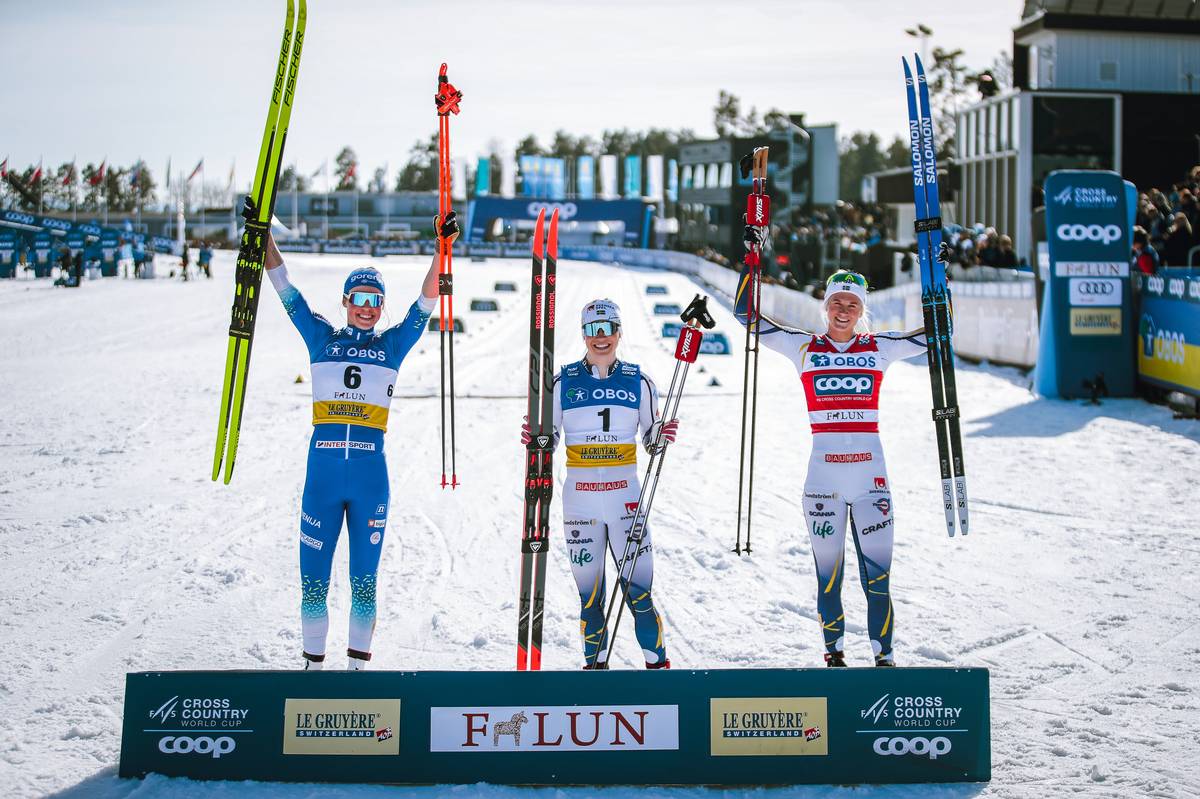
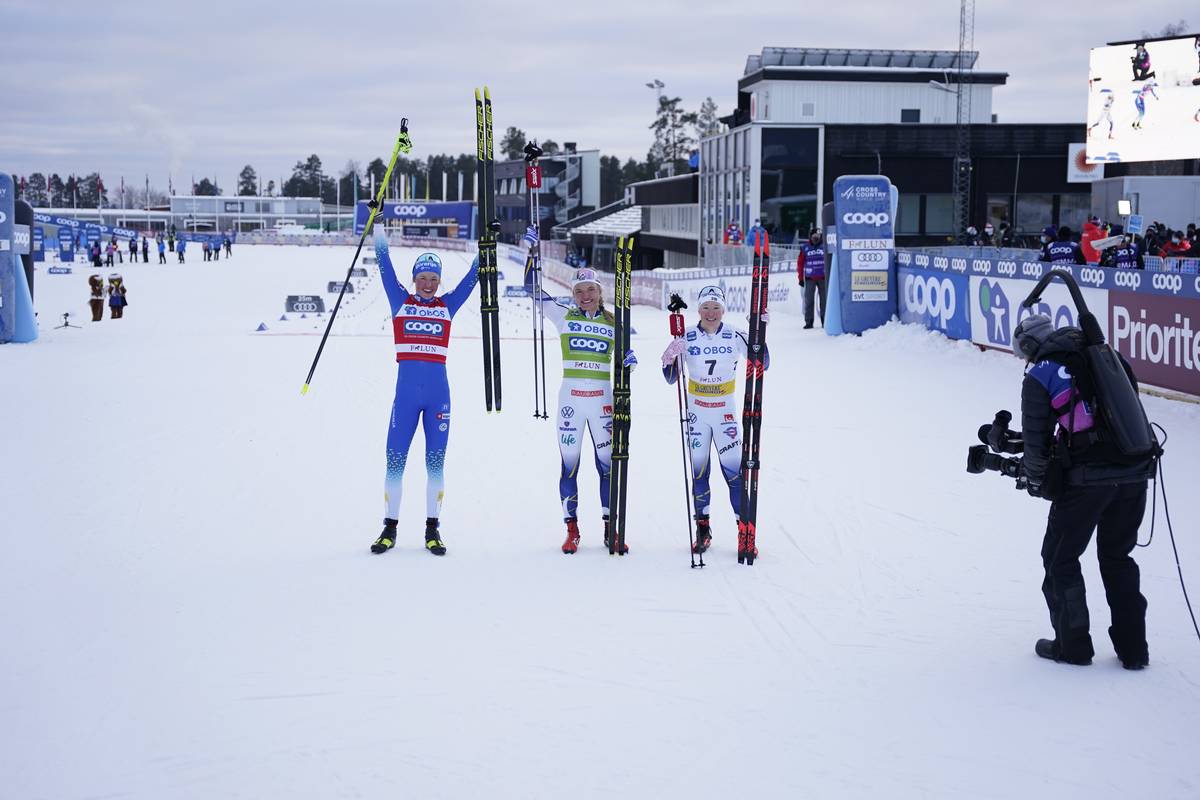
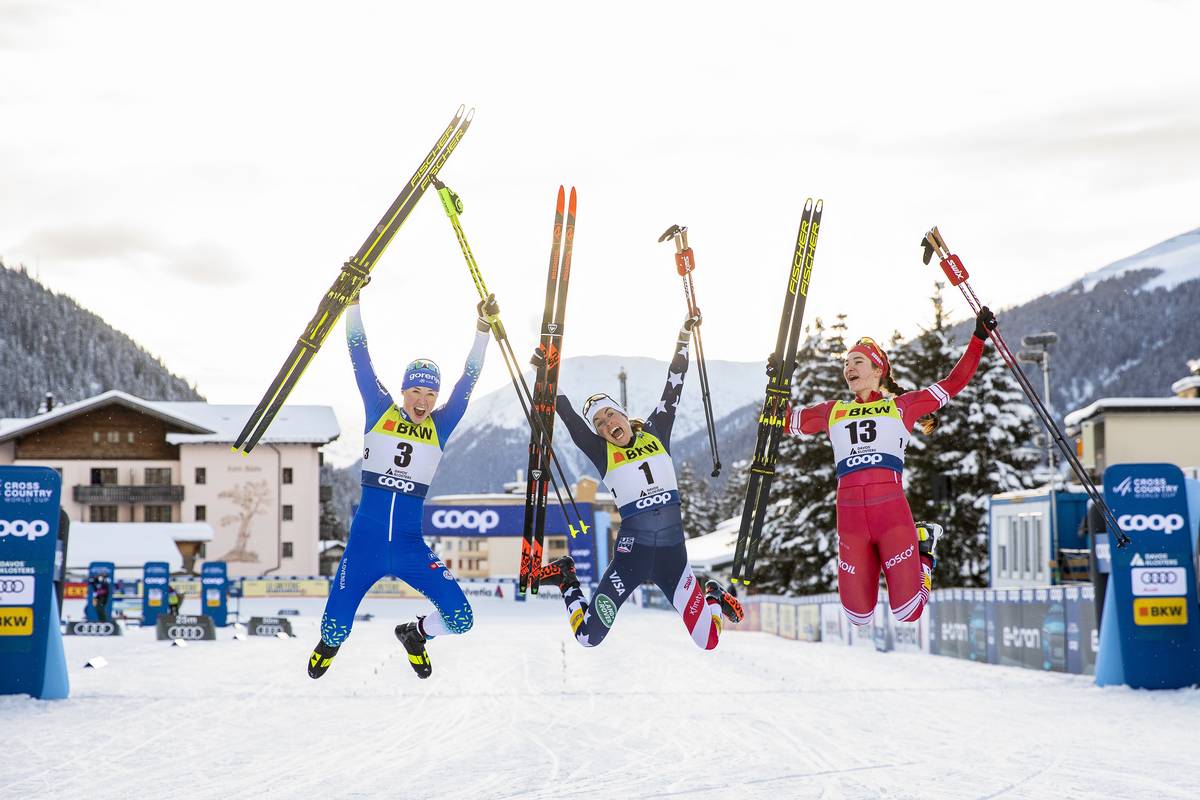
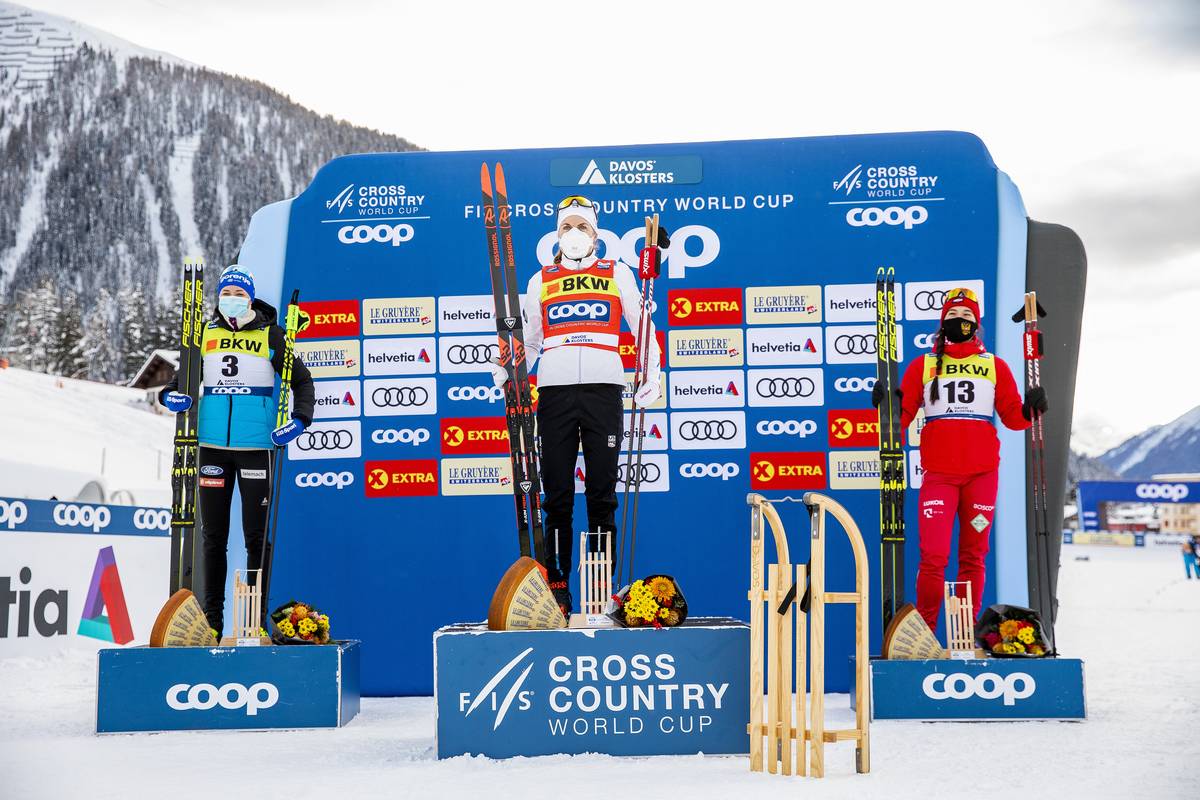
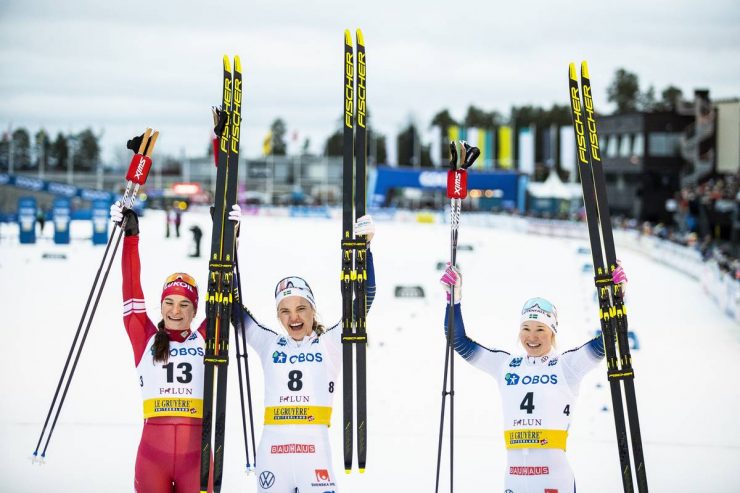
Women’s 1.4 k classic sprint podium in Falun, Sweden: Jonna Sundling (SWE) took the win ahead of Anamarija Lampic (SLO) and Maja Dahlqvist (SWE). (Photo: NordicFocus)
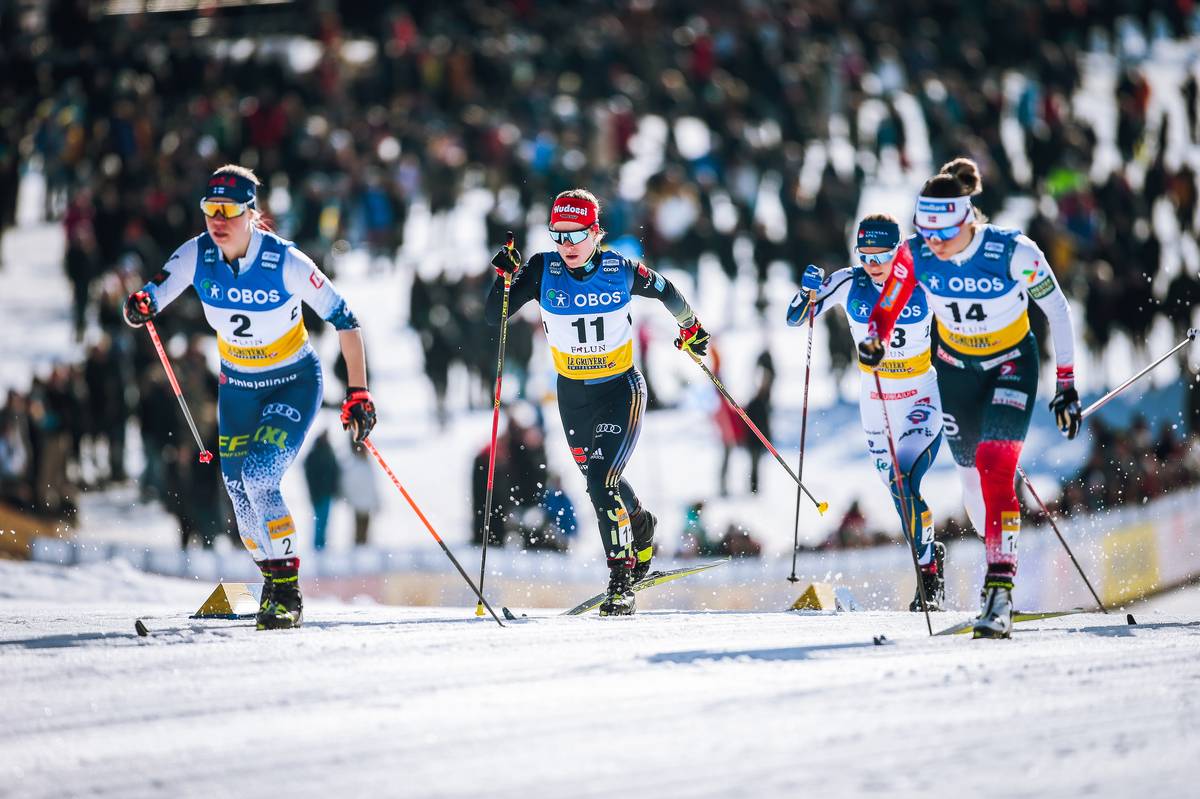
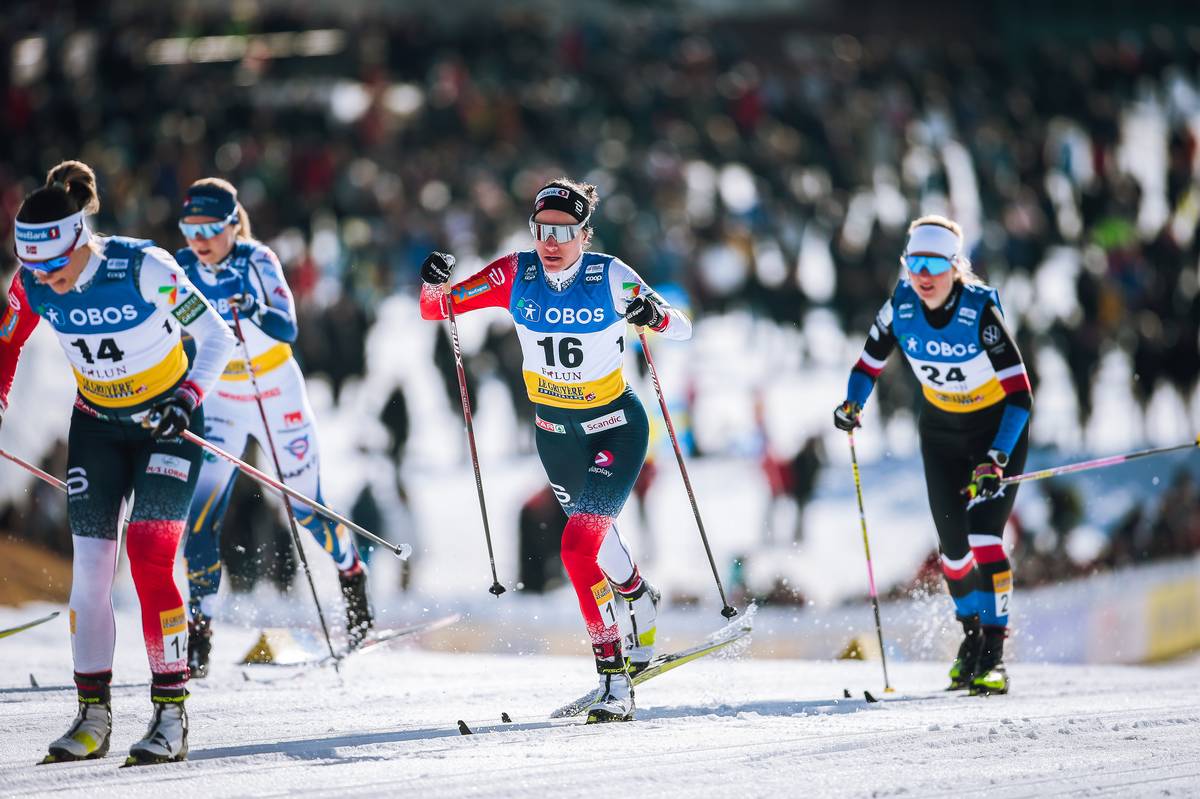
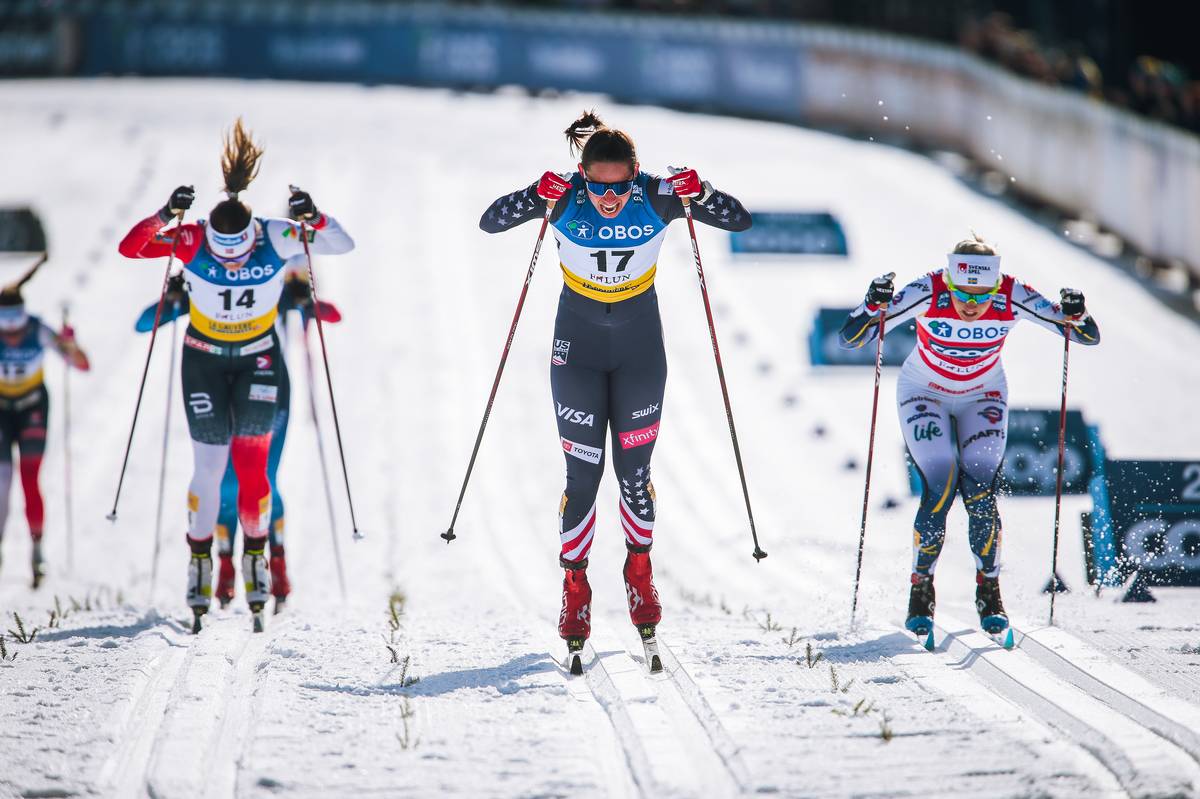
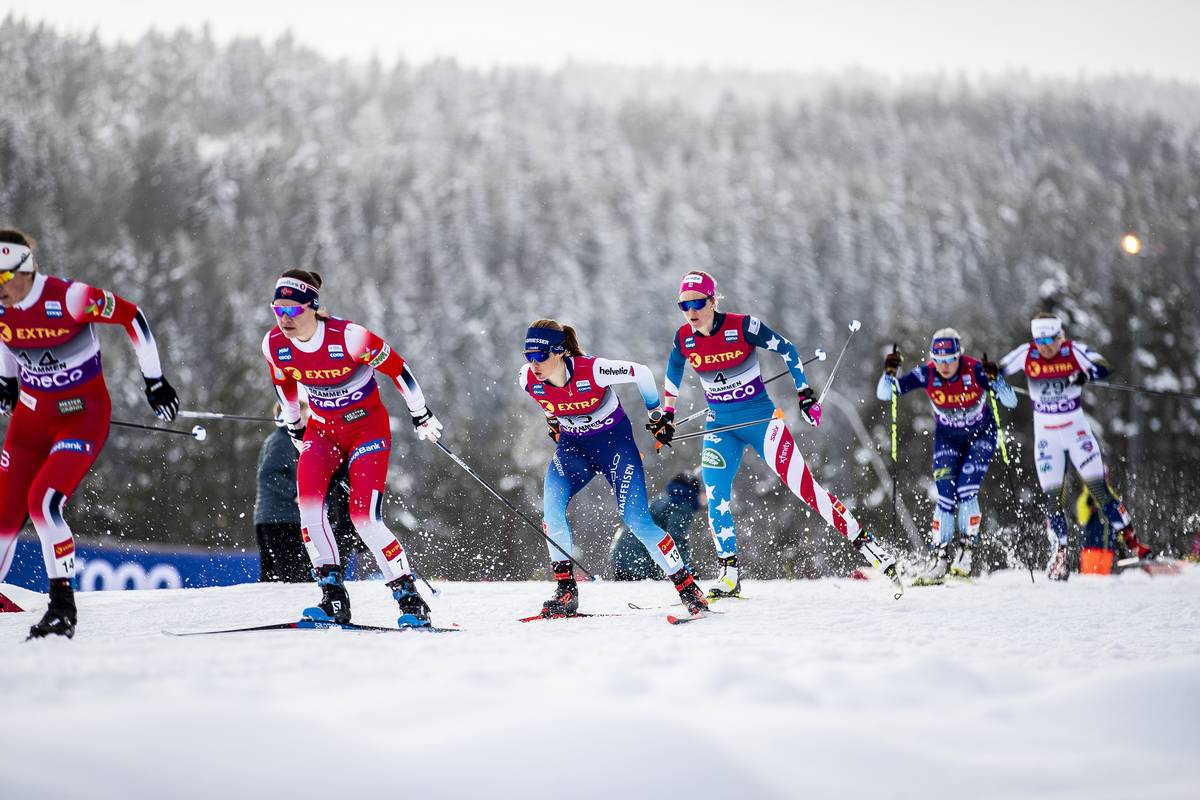
We’ve arrived at the final weekend of World Cup racing. After the cancellation of the finals scheduled to take place in Tyumen, Russia and the difficulty of finding a last-minute replacement, these three days of racing in Falun, Sweden will be the culmination of the 2021/22 World Cup season. On a warm sunny day, in full spring conditions, the women executed an exciting classic sprint on the familiar 1.4 k Falun sprint course. With this being the last sprint of the season, it was also a day to cement the places in the running for the overall women’s sprint globe (none of the team events happening Sunday will influence the rankings).
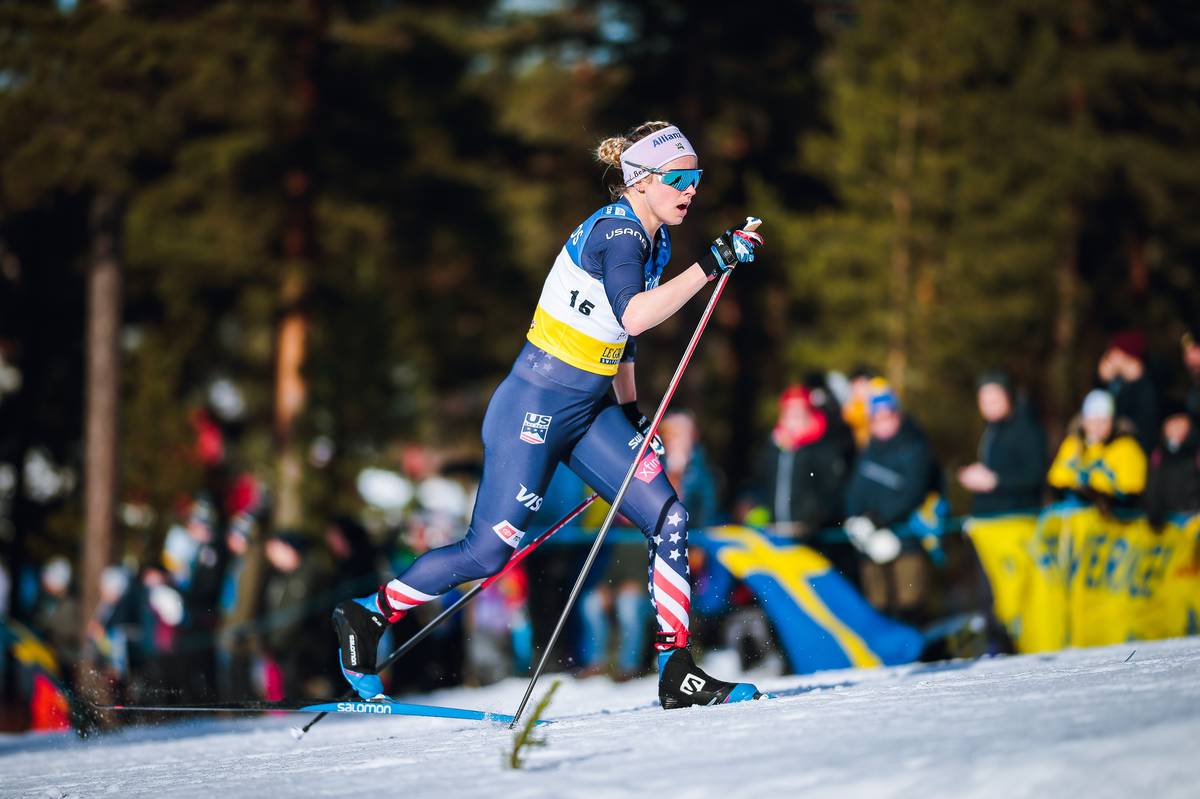
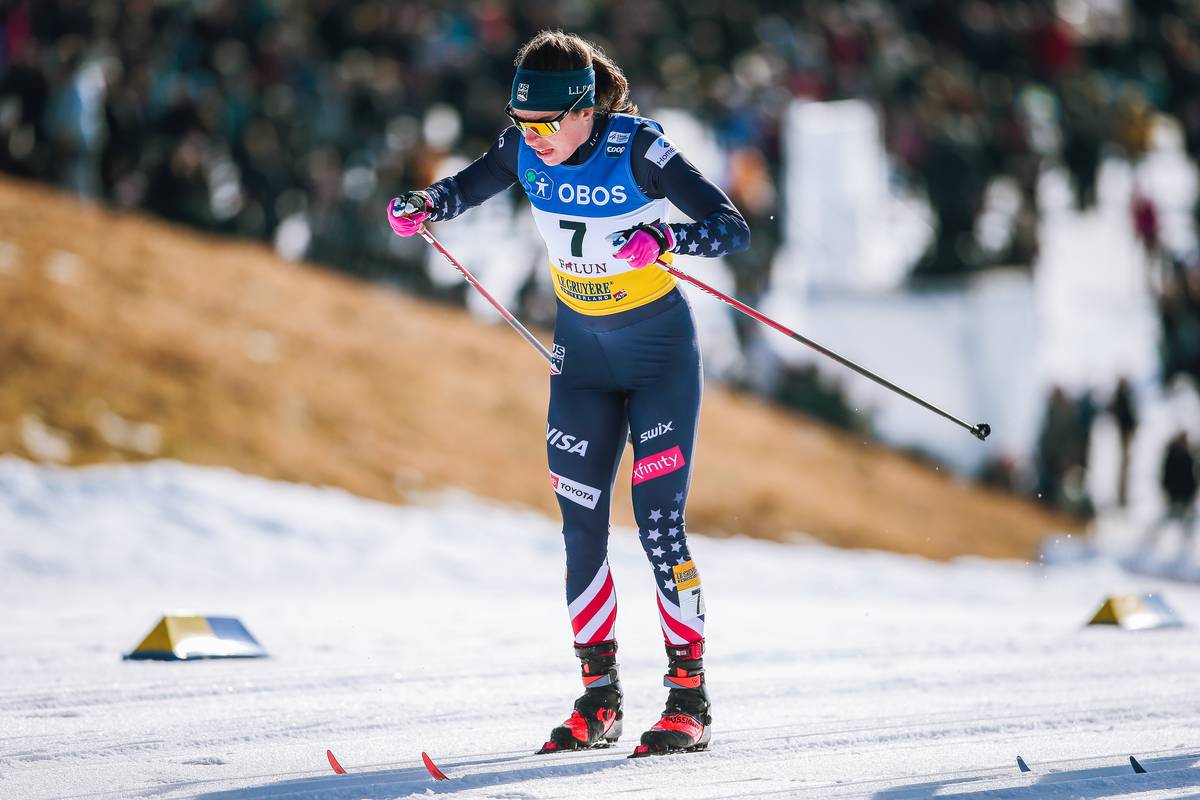
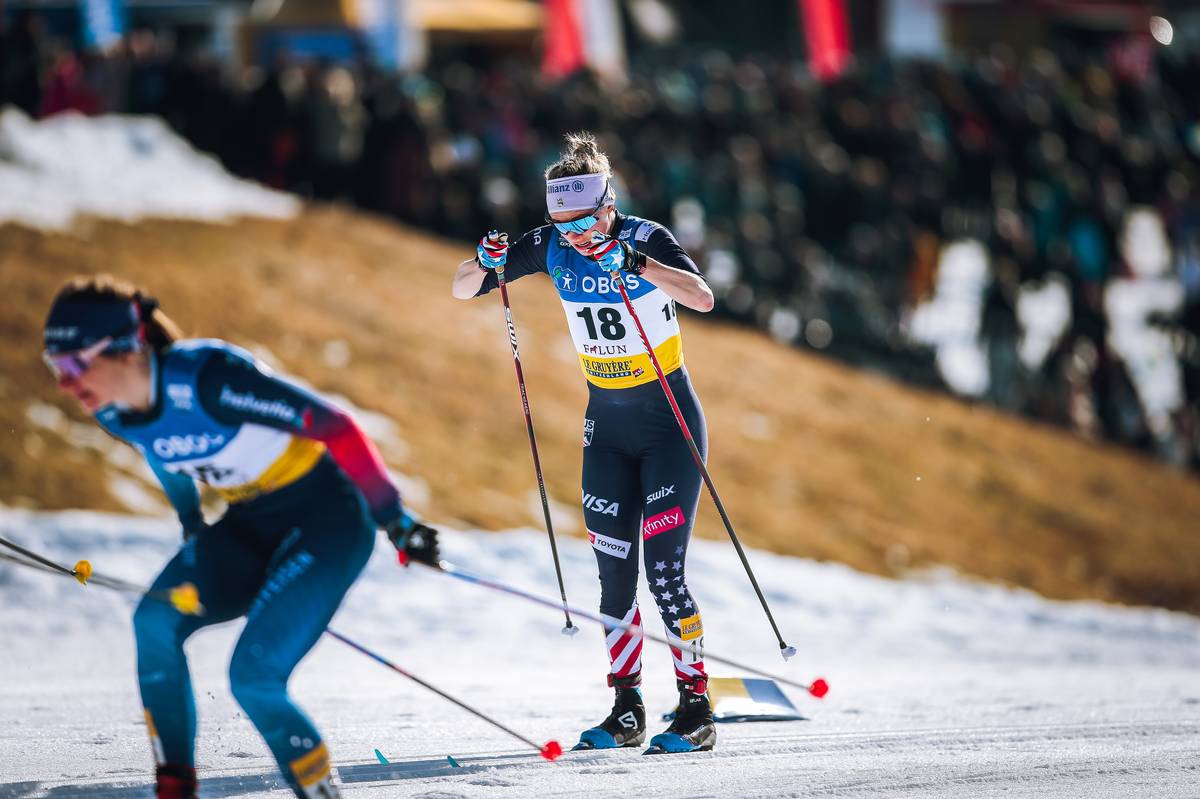
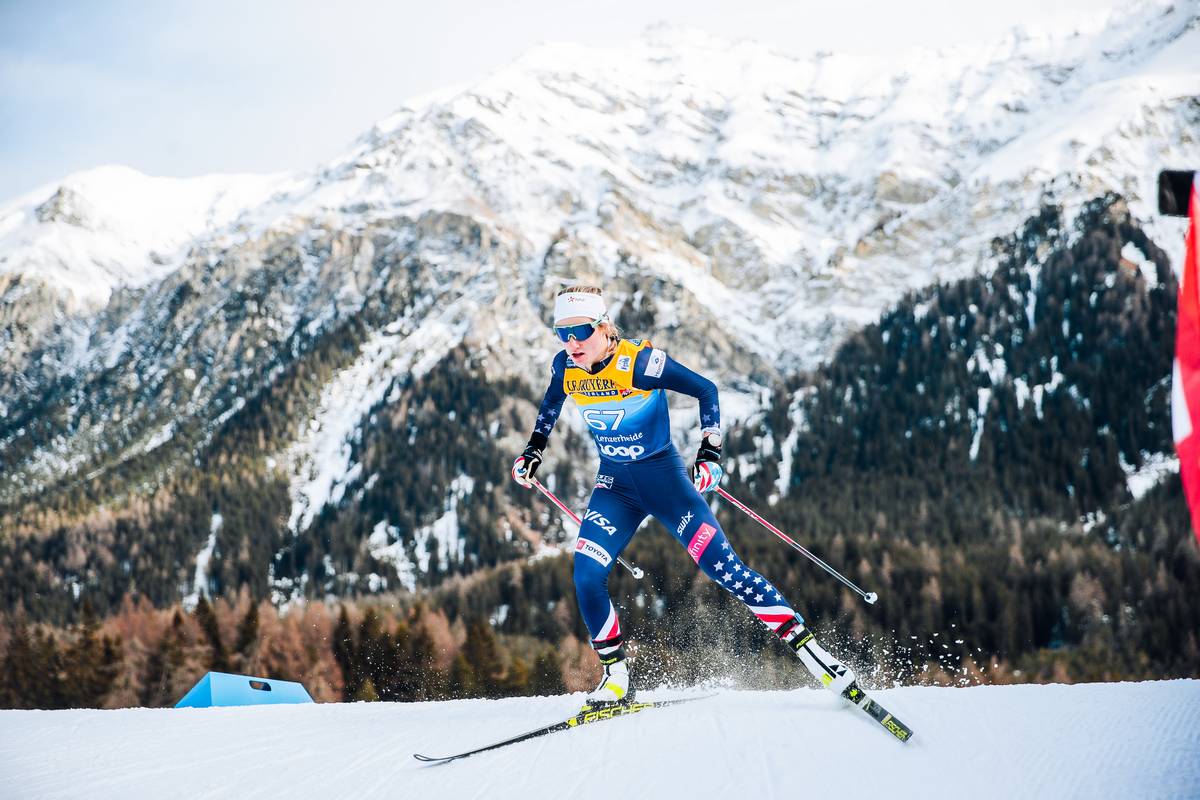
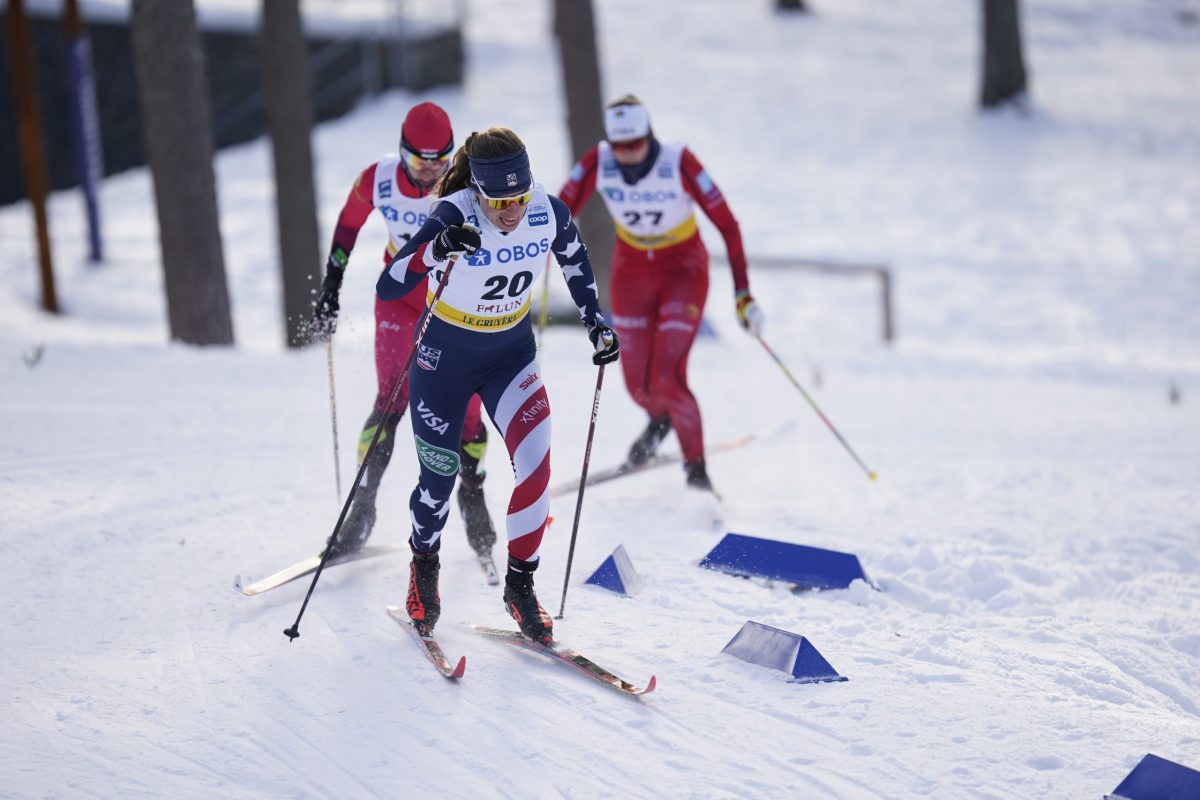
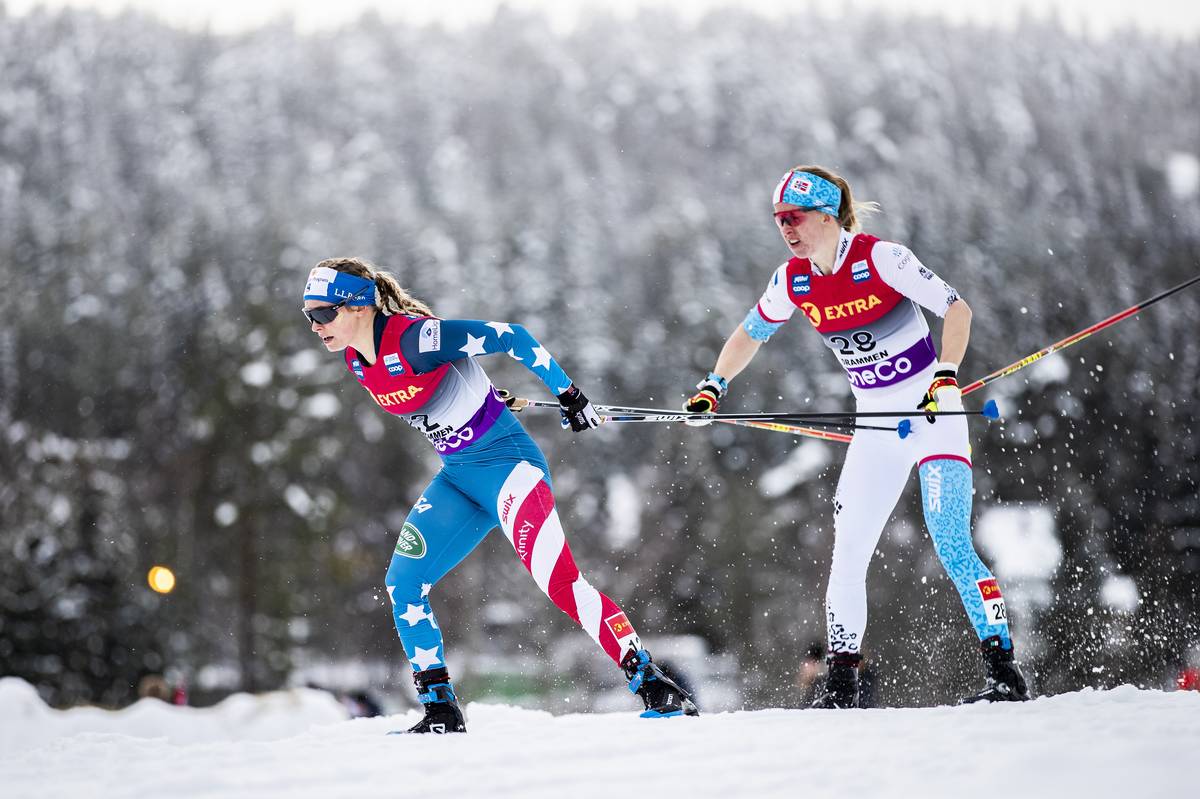
Starting with a bang, Jonna Sundling of Sweden won the qualifier by an astonishing margin of +8.41 seconds, ahead of runner up Jasmi Joensuu of Finland. The American’s put three women into the quarter-finals, led by Rosie Brennan in 7th (+9.61). Julia Kern qualified in 17th position (+12.30), followed by her teammate and roommate, Jessie Diggins in 18th (+12.49).
Jessie Diggins on her way to 18th place in the qualifier. Diggins ultimately ended her day 19th. (Photo: NordicFocus)
These were the only three American women competing today as unfortunately some late-stage positive covid tests barred the rest from competing. Having made it through a winter of international travel, living, and competing during the Omicron surge, Hailey Swirbul and Katherine Ogden announced on Monday that they had both tested positive in Norway. Lauren Jortberg, who had her World Cup debut in Lahti, Finland two weeks earlier, came directly to Falun to prepare for this weekend, only to test positive on Wednesday.
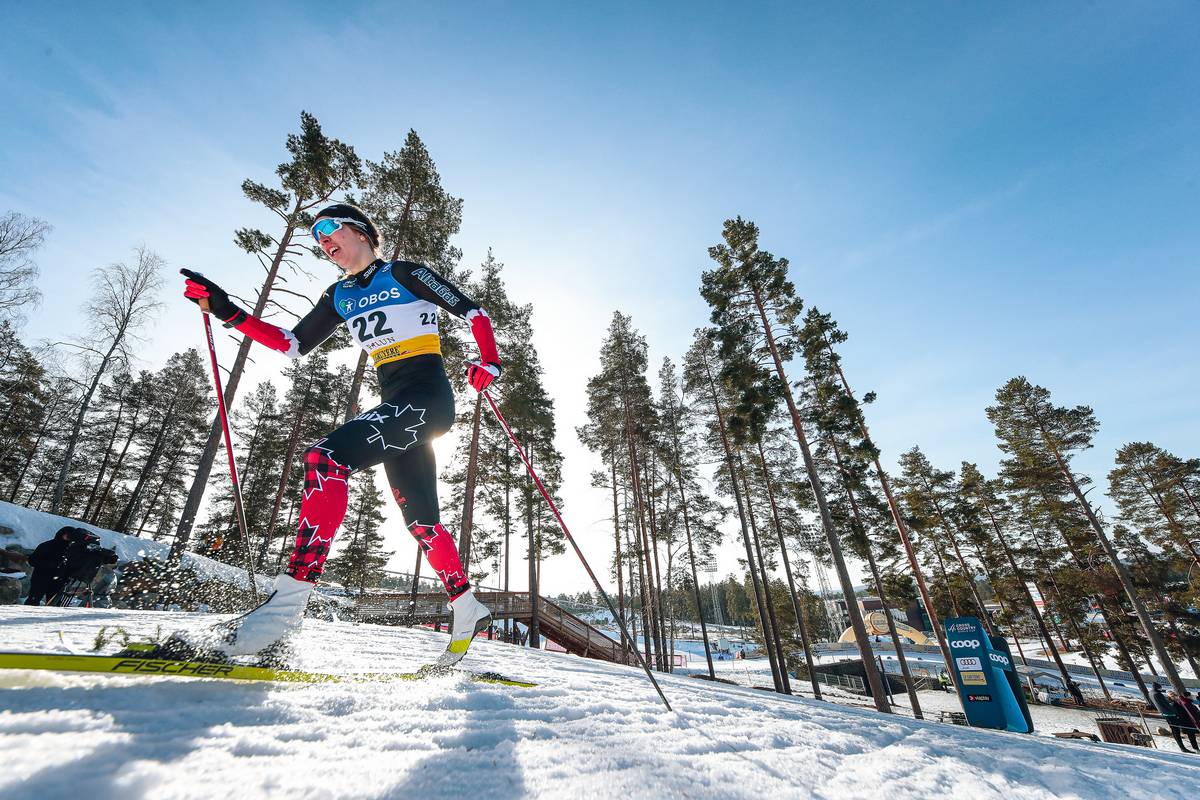
No Canadian women made it into the top thirty, their first finisher was Olivia Bouffard-Nesbitt in 32nd (+17.54). Katherine Stewart-Jones led a string of fellow country-women, finishing 37th (+19.49), followed by Dahria Beatty in 38th (+19.75) and Jasmine Drolet in 39th (+20.08). After competing at World Juniors in Lygna, Norway, Drolet joined the senior women and made her first World Cup appearance in the Holmenkollen 30 k last weekend where she finished 42nd.
Dahria Beatty (CAN) racing to 38th in the classic sprint qualifier on Friday (Photo: NordicFocus)
As crowds of fans gathered, the women’s quarterfinals kicked off at 12:15 local time. In the first heat, a fast pace bought three women tickets to the semi finals, led by Anna Svendsen of Norway. After winning the classic sprint qualifier in Drammen, Norway last week only to fall in the quarter finals, Johanna Hagström (SWE), skiing on a home course, made it safely through in second. Kerttu Niskanen of Finland took third but with a fast enough time to snag a lucky loser position.
Heat two was controlled entirely by Sundling as she skied easy out front, spreading the rest of the field. Behind her came Johanna Matintalo of Finland and Julie Myhre of Norway who made it to the semis as the second lucky loser. Brennan (USA) finished fourth, +3.39 behind Sundling, ending her day in 16th overall.
Rosie Brennan races the quarterfinal after qualifying 7th. (Photo: NordicFocus)
“It was warm and wild out there today,” wrote Brennan after the race. “This course is quite technical and has some challenging downhills which has made it a tough course for me in the past so I was ready to make some progress today. I had a good qualifier and that gave me some confidence for the heats. I had a very stacked heat which can go either way for me. I struggled finding space to move on the uphills which is my strength and that ultimately cost me moving on to the semi-finals by less than a second. In the bigger picture, I do think I made some strong progress on some of my weak spots on this course and I am really excited about that. I am also still feeling good and excited to race which bodes well for the rest of the weekend.”
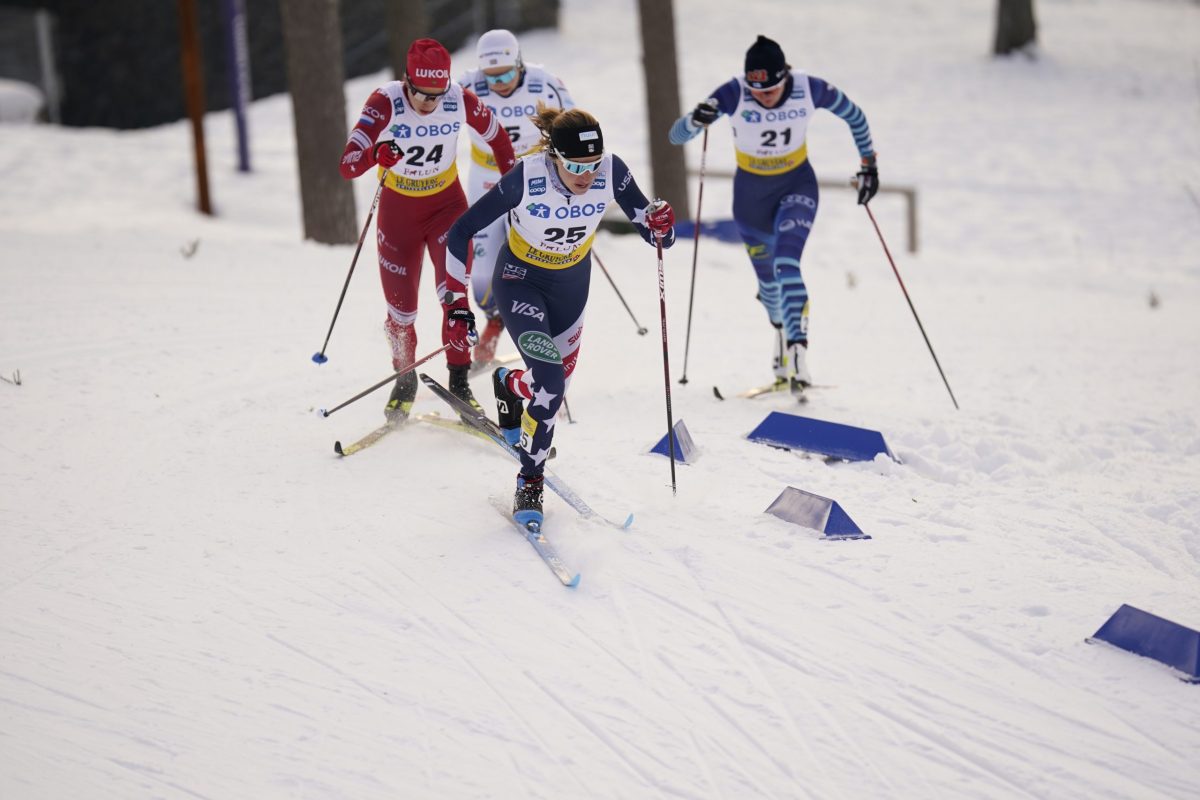
In heat number three, Anamarija Lampic of Slovenia took on the lead, as Diggins and Moa Lundgren of Sweden chased. Entering the final straight Nadine Fähndrich of Switzerland employed her blistering finish speed to surpass both Diggins and Lundgren, and nearly overtake an unsuspecting Lampic. This left Diggins in fourth place in a heat that was not quick enough to make lucky loser. Diggins ends the sprint season in fourth place in the overall sprint standings with 351 points; having entered the day in third with 339 points, she was bumped off the podium by Sundling.
Jessie Diggins races in heat number three in the 1.4 k classic sprint in Falun. (Photo: NordicFocus)
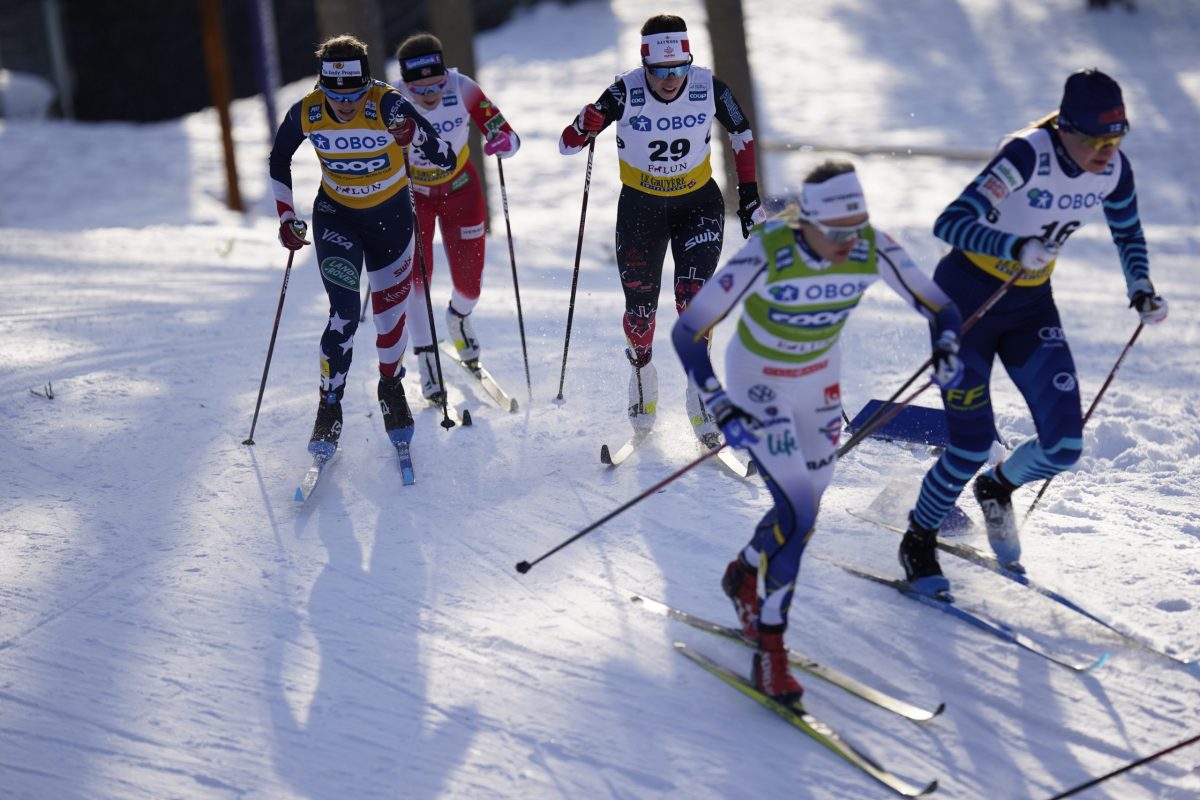
Heat four saw an easy pace from the gun, with the pack largely staying together. With all six athletes still in touch as they crested the big climb, Kern navigated into third place on the ensuing tight downhill corner. An injection of speed from Maja Dahlqvist (SWE) over the next rise split the pack as Lotta Udnes Weng (NOR) shadowed, followed by Kern still in third. In the long downhill glide-out, Weng overtook the Swede, entering the final corner in first. Right with her were Kern, Dahlqvist and Laura Gimmler of Germany. A close finish saw Kern out double-pole Dahlqvist to take the win, with Weng coming second. However, a disqualification for Weng bumped Dahlqvist into second and thus have her a ticket to the semi-finals.
Jasmi Joensuu (FIN) and Maiken Caspersen Falla (NOR) duke it out in the quarter-final (Photo: NordicFocus)
After a redeeming win in Drammen last week, Maiken Caspersen Falla of Norway charged off the startline for heat five. Joensuu (FIN) and Heidi Weng (NOR) took up the chase and eventually overtook Falla on the long descent back into the stadium. Together the two Norwegians pulled away from the Finn as Joensuu faded slightly. Falla finished first and Weng, with a scream of satisfaction, crossed in second.
Heidi Weng (NOR) racing in quarterfinal heat number five (Photo: NordicFocus)
Echoing her moves from the quarter-final, Sundling (SWE) approached semi-final number one in the same manner, skiing smooth and easy out front. Lampic (SLO) followed with some occasional slips on a mushy course. Those front two continued to pull away, Sundling making it look easy as she found herself well clear of the rest of the competition. Lampic maintained second position and Matintalo (FIN) came in third, though was not quick enough to move onto the final.
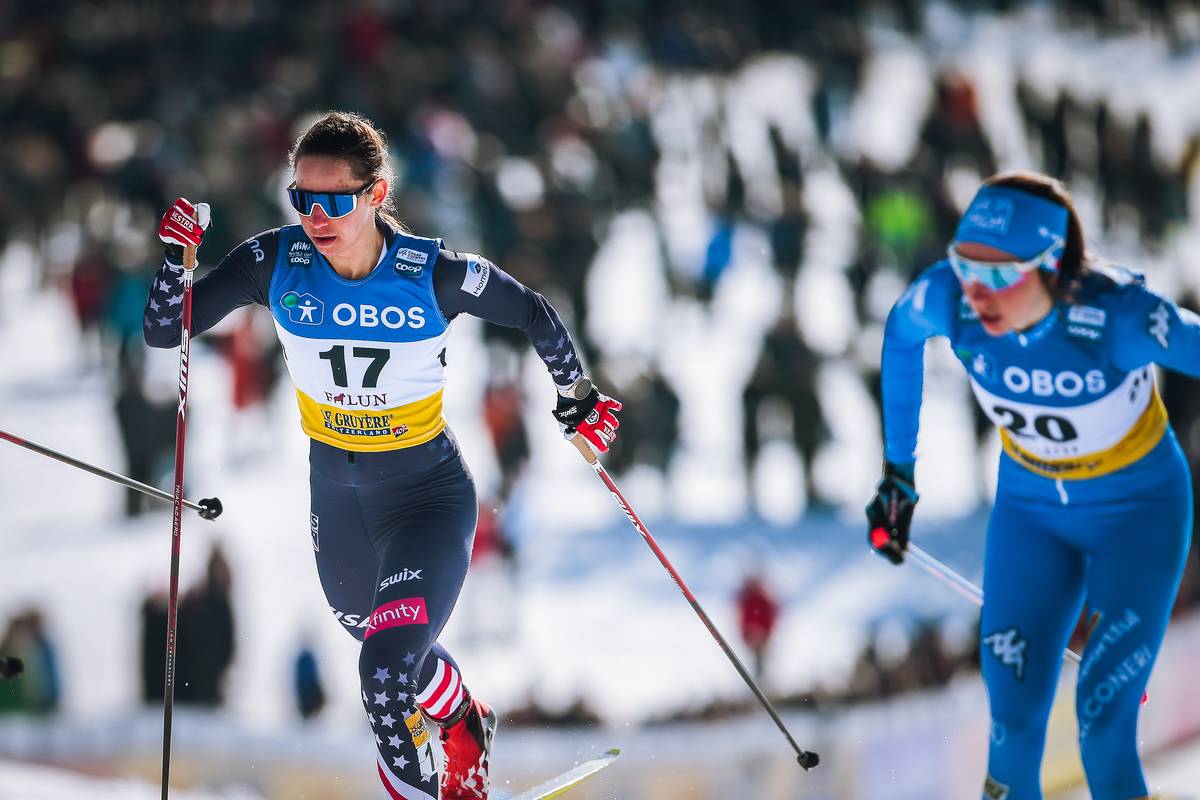
In the second semi-final, Falla (NOR) took the lead, again trailed by Weng (NOR). Once again, Kern (USA) moved into third position on the tight middle downhill portion, setting herself up well. A fall from Weng on the next hill took her out of contention as Dahlqvist (SWE) moved into second position, Kern still in third. Switching tracks, Dahlqvist stumbled but managed to stay on her feet as Kern took the lead into the final corner. Kern held onto first position with some strong double poling and behind her Dahlqvist, Falla and Fähndrich all qualified for the final in second through fourth positions respectively.
Julia Kern, closing out fast (Photo: NordicFocus)
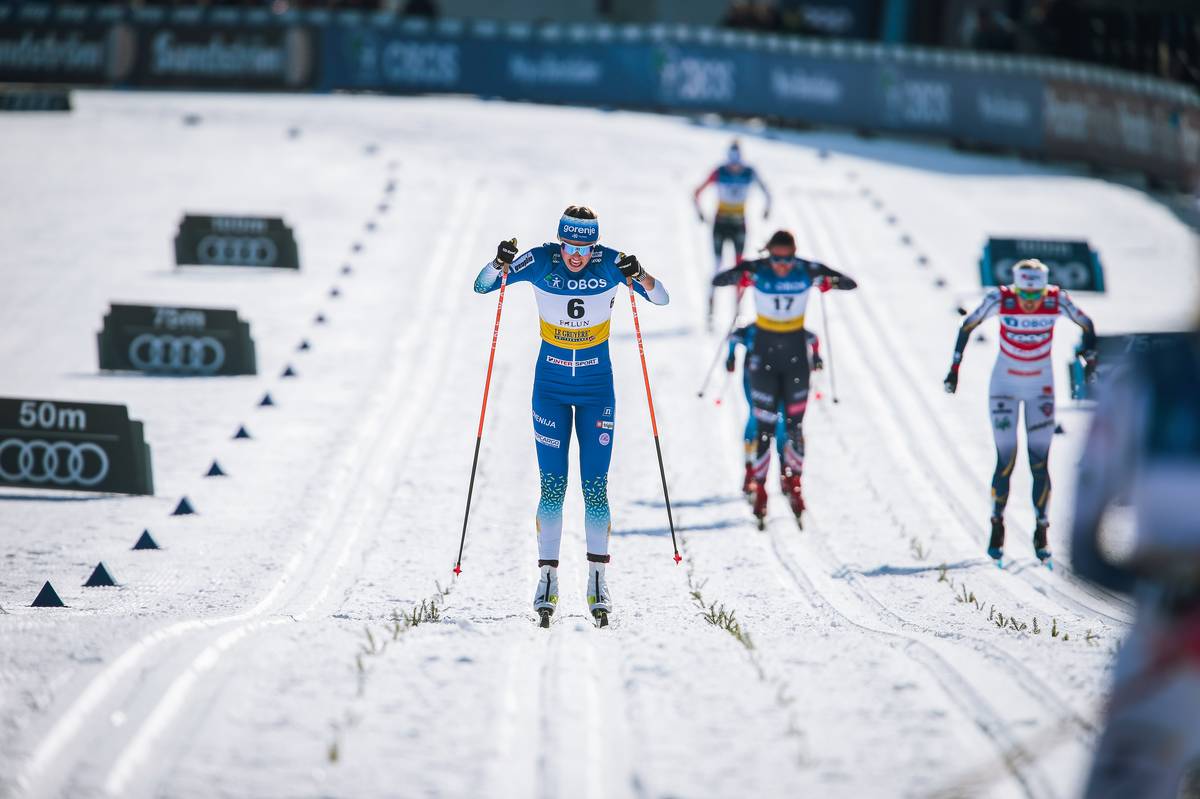
Making her first sprint final since a stage race in Lenzerheide, Switzerland in December, Kern was all smiles on the start line as the athletes lined up for their final round. Right away, Sundling and Lampic began to pull away from the rest of the field. Up the A-climb, Sundling broke into a herringbone, clearly moving fast as she increased her lead. Dahlqvist who had been in third was overtaken by Kern who topped the hill in third. Lampic was holding strong in second, though being chased by Kern. Navigating the remaining corners and descents, Sundling cruised easily to the finish with enough of a lead to give a celebratory wave before crossing the line.
No challengers around, Jonna Sundling cruises to victory. (Photo: NordicFocus)
Coincidentally, Sundling won by the same margin over Lampic (+8.41 seconds) as she had on second-place qualifier Joensuu (FIN) earlier this morning. “I don’t know what is behind this result today, but the last weeks I’ve been feeling really good and it’s nice to keep the shape still,” said Sundling after her dominant victory. She added, “I didn’t compete so much in the beginning [of the season] because of injury but my motivation is on top and so is my shape, and it’s just fun to ski right now.”
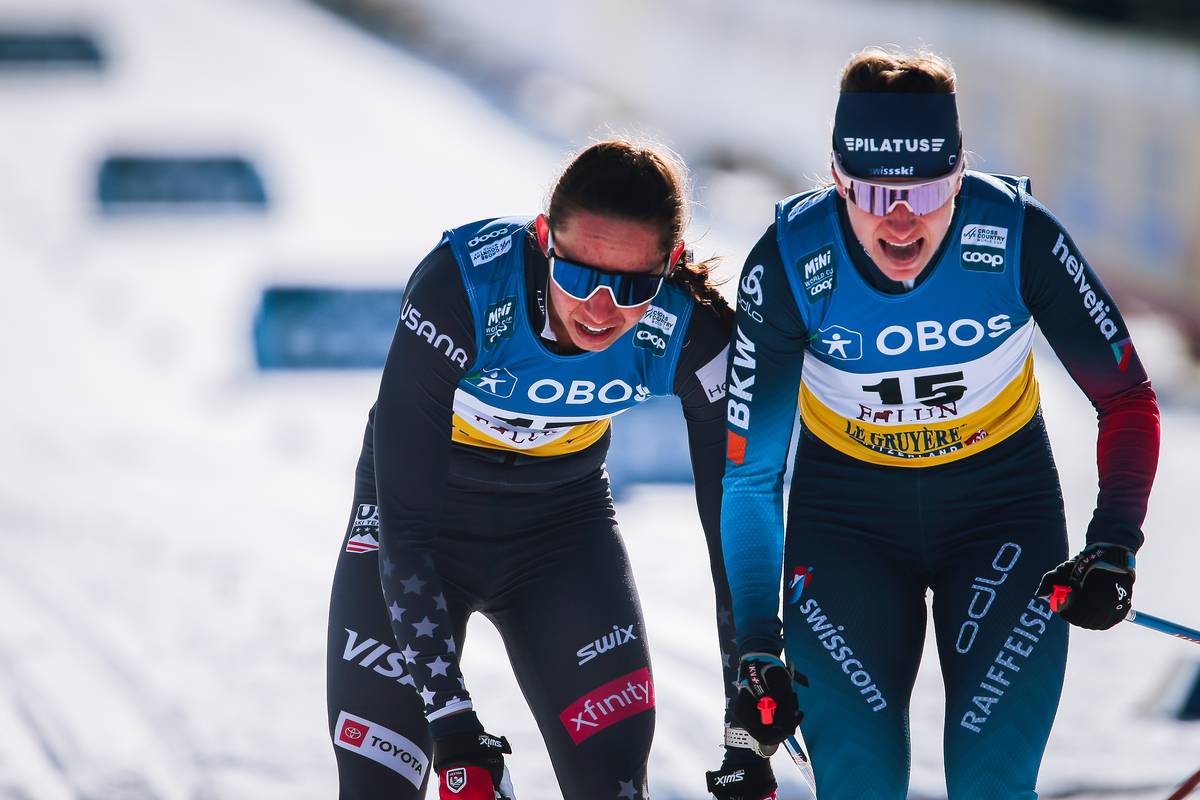
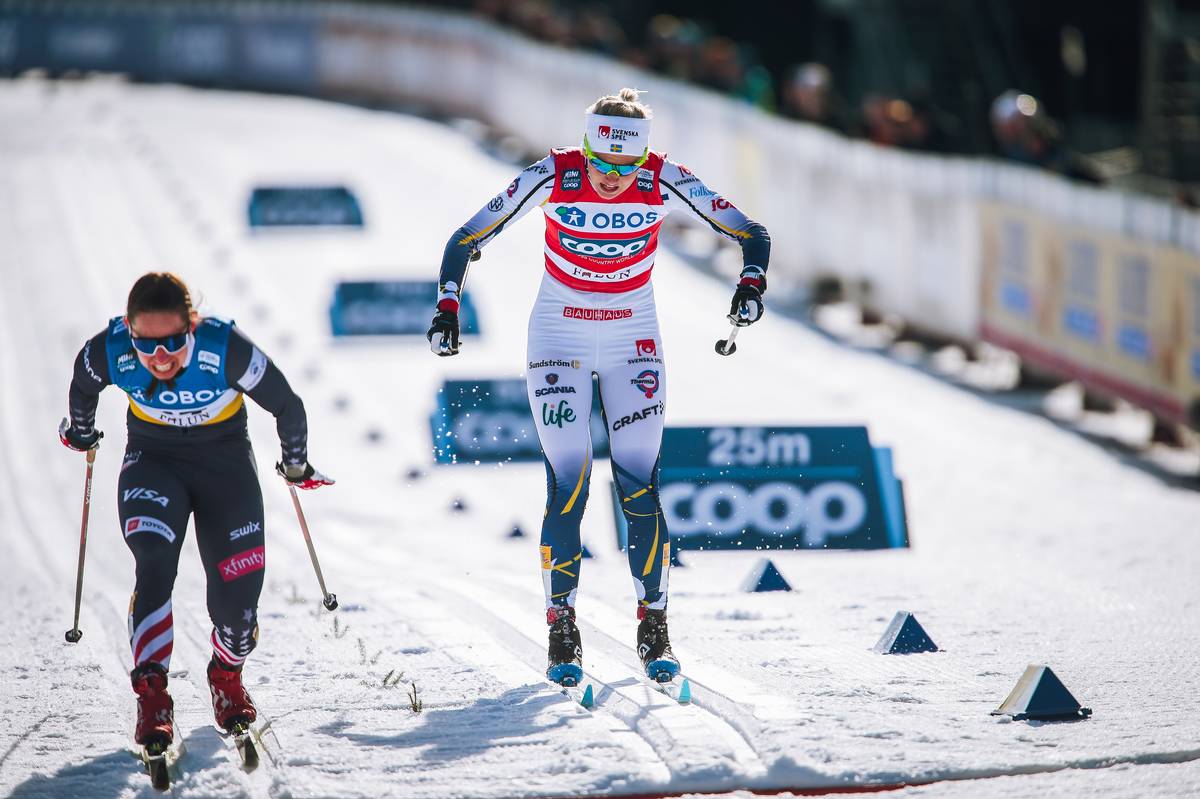
Behind them, Dahlqvist was finding a second wind in the finish straight and overtook Kern to finish in third. Kern finished fourth, matching her season personal-best from Lenzerheide where she also finished fourth, in a skate sprint.
Anamarija Lampic (SLO) heads towards a silver medal as behind her Maja Dahlqvist (SWE) overtakes Kern (USA). (Photo: NordicFocus)
“[Kern] was really smart through the quarters and semis,” reflected coach Matt Whitcomb, “where she would ski really smooth through the first climb, and position herself really well. And normally what was happening is she was both being smart tactically and feeling very good today and that just led to a break between positions 3 or 4 and allowed her to get away. And her doublenpole punch at the end was as good as I’ve ever seen her today.”
Julia Kern after fending of Nadine Fähndrich (SUI) to finish fourth in the 1.4 k classic sprint. (Photo: NordicFocus)
Regarding the final in which Kern seemed to have a lock on third but lost out in the closing stages Whitcomb said, “We talked about if there was a big mistake she made and we decided she could do the same thing 10 times and maybe land on the podium four or five times. She had some stumbles, had those things not happened, it would have been a little bit closer between her and Maja [Dahlqvist], but I don’t want to discredit Maja, she had all kinds of fire in the finish today.”
He added, “It was cool, Julia’s parents are out here today, she has raced well when her parents are watching. It’s important to point out that she was fourth and not fifth, she fended off a hard-charging Fähndrich and we’re really happy with her performance today.”
Listen to the full interview with U.S. Ski Team Head Coach Matt Whitcomb here.
Julia Kern races through the heats in Falun. (Photo: NordicFocus)
Kern has put together a string of strong performances in the final period of World Cup racing, placing in the top-10 in each of the last three sprints. These results come on the tails of a first Olympic appearance that left her wanting more, after having rebounded early-season from a 2020/21 season she had described as challenging.
“It’s a bit of a bittersweet ending,” Kern said in a call. “We’ve been on the road for so long now that, after the Olympics, especially, I was feeling excited to go home. But now when things are going well and I’m feeling really good, I don’t want to go home and I don’t want the season to end. I’m happy to end on a high note and find my stride after a frustrating Games. It’s just kind of reminded me how important having some sense of normalcy is, and I’ve kind of embraced that more after the Games. I think that’s paid off, plus some hard work, and I’ve had a little extra fire from the frustration after the games. Happy to end the season this way, and [we have] another shot tomorrow, so I’m excited for that race.”
Commenting on how these strong results and better energy feed momentum, Kern discussed a mid-week training session she felt primed her for today’s sprint.
“Now that I’ve been having really good energy in training… I have to give a big shoutout to our staff. On Tuesday this week, I did an interval workout here on the courses. I had Matt, Kate [Barton], and [tech] Chris Hecker out there with me, racing me around the course doing speeds, throwing elbows, pulling tactical moves, practicing the slingshot. Those types of sessions are super valuable for me when I put the energy to put in a good interval session. I learned so much from that session, and it gave me the confidence here today to ski well in the heats and be ready for anything.”
Kern continued with a laugh that her family is her fourth place good luck charm, as they also watched her race to fourth in Lenzerheide, SUI during the Tour de Ski, ending with a comment on the American team as the season draws to a close.
“I think our team has done a really incredible job, working through all the different colleges this season has brought. When things get tough, we bring out humor and come together. I just feel more and more appreciation for the team. My wax tech Eli and I have worked really hard all season together to start linking together some classic performances. We’ve had four classic races in a row now, and pretty much all personal bests, so that’s been a really fun relationship to build and [I appreciate] all the hard work the wax team puts in.”
Full post-race interview with Julia Kern. Apologies for the bad echo — working through the kinks as we work our way along the audio learning curve.
Julia Kern edges out Maja Dahlqvist (SWE) in the classic sprint semifinal in Falun. (Photo: NordicFocus)
Dahlqvist already had the sprint globe on lock, but her third place finish today only reinforced her strength in sprint racing this season as she racked up 638 points throughout the year. She began the season with four straight wins and earned a silver medal in the Olympic skate sprint last month. A fourth place finish in Drammen was the only time this season in which she did not finish on the podium in a sprint event.
“It feels really really, super duper good,” said Dahlqvist about taking home the globe. “I’m super happy with that.”
Sweden’s Maja Dahlqvist is the 2022 World Cup sprint champion. (Photo: NordicFocus)
Last year’s sprint globe winner, Anamaria Lampic (SLO) finished second this year with 506 points. After today’s victory, Sundling (SWE) overtook Diggins (USA) to move into third in the sprint standings with 442 points. Delaying her start to the season after sustaining an injury in an early-season FIS race, Sundling’s first World Cup start was Dresden in mid-December where she finished second in the individual skate sprint. She did not take part in the Tour de Ski, but returned to the World Cup circuit in dominant fashion, after collecting three Olympic medals, one of each color, and taking fourth place in the 30 k.
In the final three weekends of World Cup racing, Sundling landing on the podium in four out of the five races she entered, including a third place finish in the legendary Holmenkollen 30 k classic last weekend.
Anamarija Lampic (SLO) congratulates the days winner, Jonna Sundling (SWE) (Photo: NordicFocus)
Racing continues tomorrow with a 10 k skate interval start for the women. Sunday will feature two new team events, with a mixed relay happening in the morning followed by a mixed team sprint in the afternoon.
After officially canceling the World Cup Finals scheduled for Tyumen, Russia on February 25th the International Ski Federation (FIS) announced in a brief press release today (see below) that no replacement venue has been found, and thus the upcoming three-day race weekend in Falun, Sweden will instead absorb the event, ending the season one week prematurely.
No schedule changes have been made to the event in Falun, leaving a classic sprint, a 10/15-kilometer skate, and two new mixed gender events, a relay and a team sprint, left to conclude the 2021/22 race season.
The cancellation of the final weekend of World Cup racing solidifies Johannes Høsflot Klæbo (NOR) as the 2021/22 World Cup overall winner. (Photo: NordicFocus)
In terms of overall athlete rankings, these mixed events are not World Cup point scoring opportunities. This means a maximum of 300 World Cup points remain on the table following this weekend’s races at the Holmenkollen, assuming the point-schedule planned for the World Cup Finals is applied to the race weekend in Falun: 50 points each for the individual sprint and distance races, plus a maximum of 200 bonus points for the overall winner of the weekend. It has not yet been made clear how the mixed relay and team sprint will factor into determining the overall winner of this year’s World Cup Finals for men and women.
As such, Johannes Høsflot Klæbo (NOR) will win the men’s overall World Cup given his margin of greater than 400 points to the next competitor. In the women’s standings, Natalia Nepryaeva (RUS) currently stands 252 points ahead of Jessie Diggins, and 285 points ahead of Ebba Andersson (SWE). As the Russian team has been banned from remaining competitions, Nepryaeva has no further opportunities to increase her point totals, instead waiting for the outcome of the remaining World Cup events to decide her fate.
Sweden’s Maja Dahlqvist leads the sprint standings by 155 points over Anamarija Lampic (SLO), while Klæbo leads the men’s standings by 95 points over Richard Jouve of France. While these standings will not change given there is one event remaining worth just 50 points, the distance standings are less certain.
Heading into the 30/50 k races at the Holmenkollen in Oslo, NOR, this weekend, Therese Johaug leads the women’s distance standings by 17 points ahead of Frida Karlsson and 107 points to Andersson, both of Sweden. Alexander Bolshunov (RUS) leads the men’s distance standings by 5 points ahead of Klæbo, who may not compete again this season as he recently tested positive for COVID. Next is Iivo Niskanen of Finland, a favorite for this weekend’s 50 k classic, sitting 84 points back.
Natalia Nepryaeva celebrates her win of the 2021/22 Tour de Ski, helping land her atop the overall World Cup standings. (Photo: NordicFocus)
World Cup racing resumes tomorrow with the women’s 30 k classic, followed by the men’s 50 k classic on Sunday. Stay tuned for FasterSkier’s coverage of these races.
(Press Release) FIS Cross-Country World Cup finals to take place in Falun (SWE)
FIS Cross-Country together with various National Ski Federations evaluated a possible replacement of the cancelled World Cup event of Tyumen (RUS). Despite big efforts and interest of various National Ski Federations, no replacement for the World Cup final events was found.
This means that the scheduled World Cup event in Falun (SWE) from 11th to 13th March 2022 will be the final events of the FIS Cross-Country season 2021/22. The schedule will not be adjusted and follow the originally planned competition formats.
Click here for the Falun World Cup weekend schedule.
There’s a war going on in Ukraine, and we touch on its impacts on the World Cup. But ski racing is also continuing, so we’re forging on, with respect for and acknowledgment of the tragedy that’s unfolding in Europe. For a few hours at least, on Thursday, the classic Drammen city sprint provided one heck of a distraction, and Devon and Nat are back to break down some performances for the ages by Norway’s Maiken Caspersen Falla, the French men and China’s Wang Qiang.
This World Cup coverage is made possible through the generous support of Marty and Kathy Hall and the A Hall Mark of Excellence Award. To learn more about A Hall Mark of Excellence Award or to learn how you can support FasterSkier’s coverage please contact info@fasterskier.com.
Snapping back after a week away from racing, the World Cup resumed in wintery Lahti, Finland with a 1.6 kilometer freestyle sprint. The American women made their presence immediately known, landing three of five athletes in the top-five in qualification, with four in the top-30.
Rosie Brennan skis to fifth in qualification in Lahti. (Photo: NordicFocus)
On the heels of a bronze medal in the event, Jessie Diggins was second in qualification, +6.71 behind the time of 3:17.37 posted by Sweden’s Olympic champion Jonna Sundling. Julia Kern was next for the U.S. in fourth (+7.59) behind Russia’s Natalia Nepryaeva, with Rosie Brennan just behind in fifth (+8.61). Hailey Swirbul also raced into the heats, skiing to 26th in qualification (+16.56).
Jessie Diggins posts the second fastest time in qualification during the freestyle sprint in Lahti, FIN. (Photo: NordicFocus)
Leading the Canada team Cendrine Browne raced to 29th in qualification (+17.37), advancing to the heats.
Racing in heat five, Diggins moved to the front of the pack inside the first minute of racing, with Kern on her tails heading up the first climb, with Julia sliding back to third in the following descent. Nevertheless, the Americans maintained control of the heat heading up the climb and around the course’s hairpin turn, where cheers could be heard from the sidelines, urging “Alright, Jessie! Alright, Julia! Hard over the top! Hard over the top! Come on, push, push, push!”
Rounding the final bend to the finish, the Americans were side by side at the front, with Sweden’s Anna Divyk looking for an opportunity to sneak through from their draft. Kern was on the inside of the bend, stepping powerfully to maintain her momentum as the threesome headed into the final 100 meter sprint. Still right alongside her teammate, Kern led the boot throw to win the heat, with Diggins +0.1 back, and the Swede on their tails to cross the line +0.39 seconds back in third. As the fifth heat proved to be the fastest of the quarterfinal, Czech athlete Katerina Janatova also advanced as a lucky loser after finishing in fourth, just over a second behind Divyk.
Julia Kern and Jessie Diggins take to the course during the quarterfinals of Lahti’s freestyle sprint. (Photo: NordicFocus)
In the first semifinal, it was Sundling and Dahlqvist at the front, with teammate Emma Ribom and Nepryaeva jockeying for the third and fourth positions through the first half. The Swedes rounded the hairpin in first through third, but Nepryaeva, Nadine Fähndrich (SUI), and Janatova remained close on their heels. Coming into the finish lanes, it was Sundling in front, with Ribom nipping Dahlqvist at the line by 0.11 seconds. Nepryaeva crossed fourth, 0.6 back from Dahlqvist, leaving the two awaiting the outcome of the next semi to determine their fate heading into the final round.
The Americans raced in the second semi, along with an additional two Swedes, Divyk and Johanna Hagström, plus Slovenia’s Anamarija Lampic and a German, Coletta Rydzek.
Julia Kern tucks into Jessie Diggins draft during the freestyle sprint heats in Lahti, FIN. (Photo: NordicFocus)
Heading up the climb to the hairpin, it was Diggins at the front, with Hagström on her tails and Lampic maintaining contact. The group had thinned, leaving the remaining three women trailing behind on the descent with a gap between each.
In the adrenaline-filled final meters, it looked like Hagström would hold the advantage to the line, but a high tempo Diggins and accelerating Lampic were closing fast. Throwing their boots three abreast, the women crossed the line dead-even for a three-way photo finish.
A slow motion replay of the slide showed that it was Lampic who crossed first, with Diggins .03 seconds behind, and Hagström in third, separated by an additional 0.01 second. With Lampic’s time clocked roughly 0.7 seconds slower than Nepryaeva’s in the first semi, only the top two women advanced, leaving Hagström just off the mark.
Kern crossed fourth in the heat (+1.94) to end her day in eighth overall.
“Today was a lot of fun,” Kern said in a U.S. Ski & Snowboard press release. “The conditions were great, the stadium and course were filled with lively spectators and I was really excited to get back to racing the World Cup! I felt like I had a lot of great energy today, skied well, and enjoyed the awesome atmosphere while racing side-by-side with Jessie in the heats! I was stoked to put down maybe my best World Cup qualifier and see that my body is ready to fire after the Olympics.
“I have only raced two races in the last two months,” Kern continued, “so I have been excited for Period 4 World Cups with lots of racing opportunities. I am someone who loves to race. I had a blast skiing with Jessie in the heats today, we train together all year long, working hard and pushing each other, and also rooming together, so it is fun to ski well together and take charge of the heats. ”
Julia Kern races to eighth place in Lahti’s freestyle sprint. (Photo: NordicFocus)
Sundling looked to leave nothing to chance in the final, gapping the field before the halfway point, with Lampic and Ribom leading the chase group a few seconds back.
Descending from the hairpin, the Swedes were in first through third, with Sundling still well off the front. Diggins had moved up onto Dahlqvist’s tails in fourth, which she held heading around the final bend into the stadium and into the lanes.
Jonna Sundling (SWE) cruises through the final to win the 1.6 kilometer freestyle sprint in Lahti. (Photo: NordicFocus)
While Sundling cruised cross the line for the win in 3:12.86, it was Ribom and Dalqvist fighting for the second and third spots to determine the order of a Swedish podium sweep. It was Ribom in second at the line (+3.28), fending off Dahlqvist in third (+3.67), interrupting her streak of World Cup wins this season.
Diggins held her ground close behind the Swedes in fourth (+3.93), with Lampic closing fast for fifth (+4.01). Nepryaeva closed out the women’s final in the sixth spot (+4.69).
Jessie Diggins throws her boot for fourth in the final round of Lahti’s freestyle sprint. (Photo: NordicFocus)
Following the race, Diggins said she was happy to be feeling like herself again following the brief post-Olympic break. It was just six days ago that Diggins fought through food poisoning induced fatigue, cramping, and delirium to earn a silver medal in the 30 k skate.
“I was incredibly tired after the Olympics,” Diggins said in a post-race audio clip, embedded below. “That 30 k took more out of me than maybe any race in my entire life. So I was just feeling lucky to be out there and racing and able to feel like my body is back.”
In addition to providing insights into how things shook our for her, Diggins commented on the experience of watching newer members of the team earn their first World Cup starts, specifically Lauren Jortberg, Bill Harmeyer, and Logan Diekmann.
“Happy to be part of that rite of passage. That was really, really fun.”
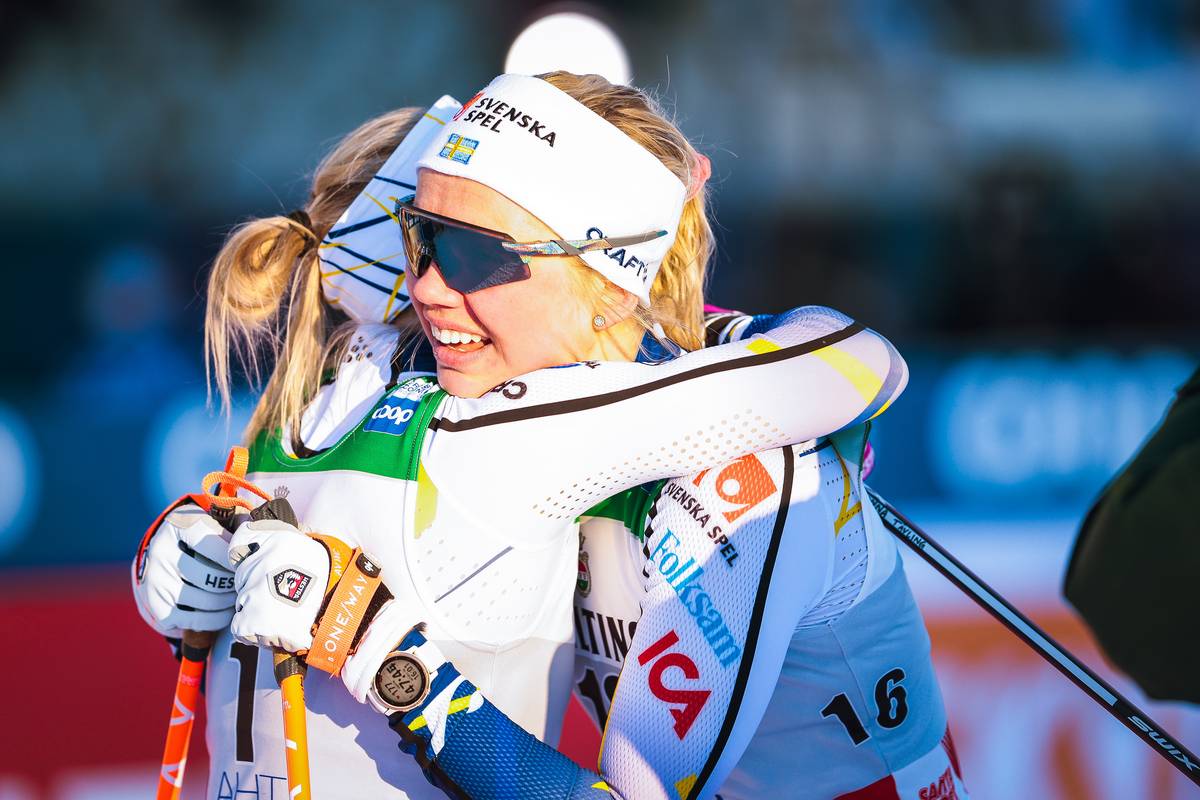
Sweden’s Jonna Sundling hugs Emma Ribom (right) after finishing one-two in the freestyle sprint in Lahti, FIN. (Photo: NordicFocus)
“I feel amazing right now,” Sundling said of her win in a post-race interview with FIS at the finish. “I think I’m in a good place in my career and it feels really good to ski right now. Today, I just tried to trust my skiing and it went really [well], so I’m happy.”
When asked about the Swedish podium sweep, Sundling broke into a wide grin. “I’m so happy, and for Emma, it is her first, so it’s really good.”
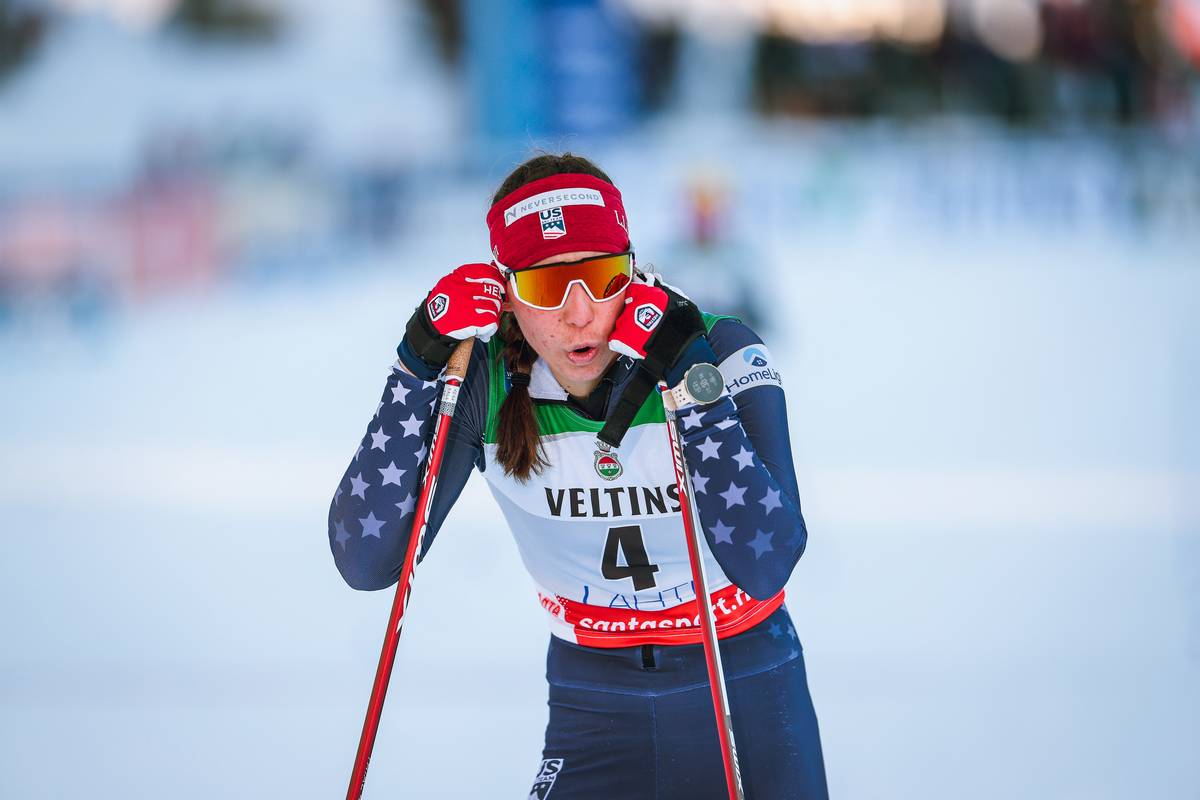
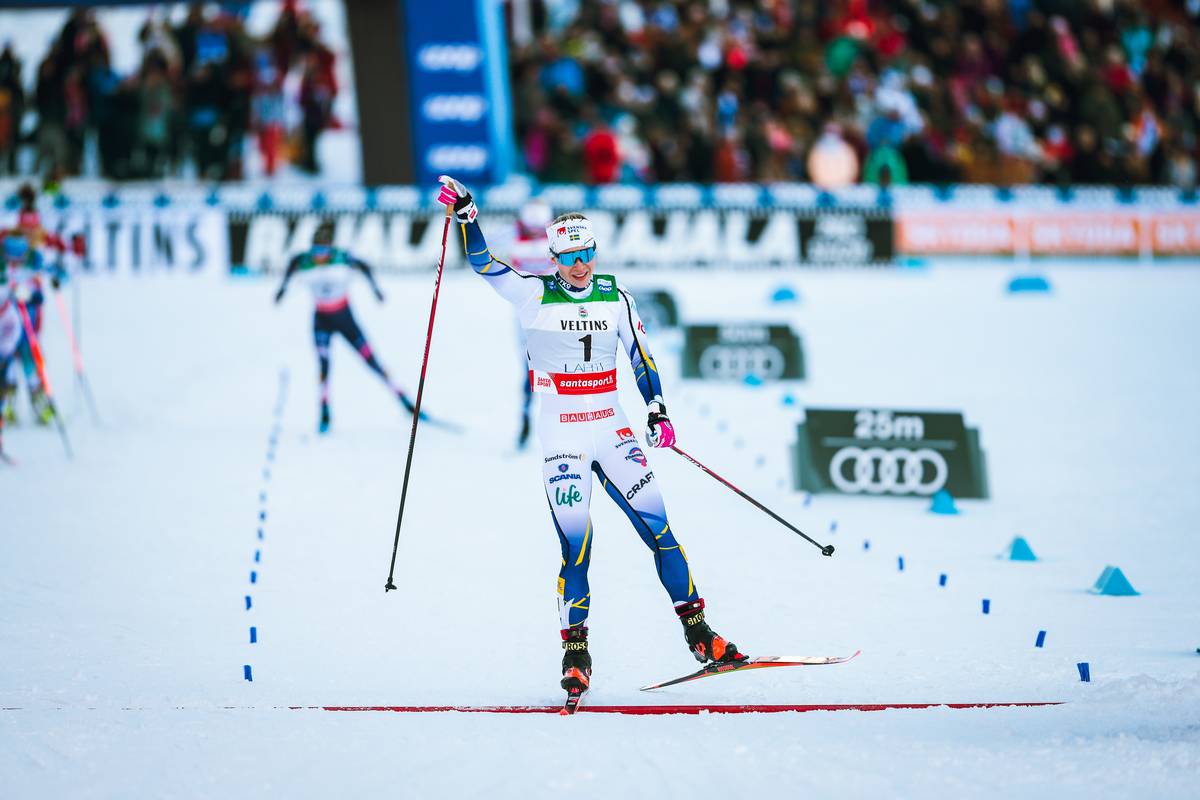
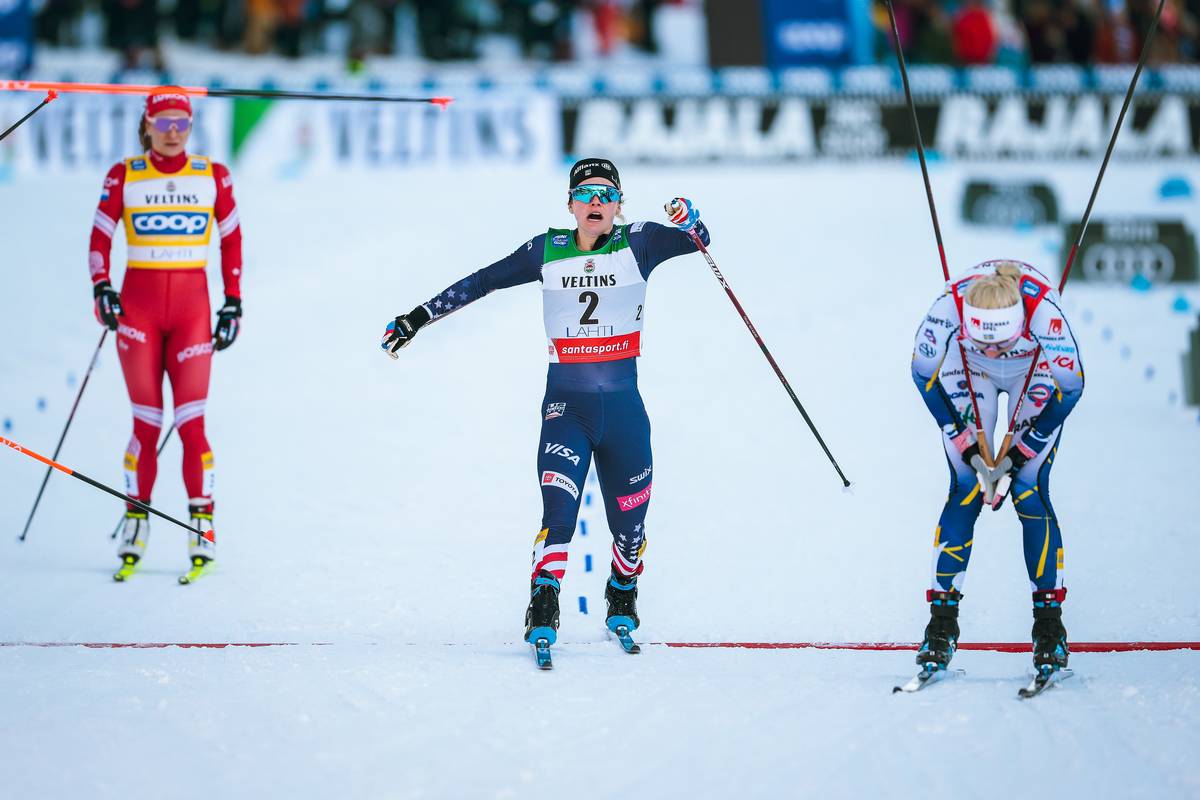
A Swedish podium sweep in Lahti, with Jonna Sundling taking the top spot ahead of Emma Ribom and Maja Dahlqvist. (Photo: NordicFocus)Rosie Brennan races in the fourth quarterfinal heat in Lahti, FIN. (Photo: NordicFocus)
After sharing the lead with Slovenia’s Lampic through the second half of the fourth quarterfinal, Brennan rounded the final bend into the finish in second position, moving to Lampic’s right with 50 meters to go. While Lampic maintained a lead by several meters, Germany’s Rydzek crept up alongside Brennan, throwing her boot at the line to edge out the American by 0.04 seconds. As the third heat saw times roughly four seconds faster than the fourth, Brennan was unable to advance as a lucky loser and ended her day in 13th.
Crossing in sixth in heat one of the quarterfinal, which saw Sundling and Nepryaeva go one-two, Swirbul finished 28th today. Swirbul maintained contact with the lead pack through the hairpin turn, where Sundling and Nepryaeva accelerated off the front to thin the pack.
Hailey Swirbul races in the first quarterfinal heat in Lahti. (Photo: NordicFocus)Cendrine Browne (CAN) races in the second heat of the quarterfinals in Lahti, FIN. (Photo: NordicFocus)
Canada’s Browne also ended her day in the quarters after racing in heat two. Browne was +2.19 behind Sweden’s Maja Dahlqvist who comfortably won the heat, with the Canadian in sixth to end her day in
Also racing for the U.S., BSF Pro Team’s Lauren Jortberg raced was pulled up from the SuperTour for her first World Cup appearance. Jortberg is ranked 11th overall in the SuperTour standings and is third on the sprint list behind APU’s Rosie Frankowski and Becca Rorabaugh, both of whom opted to race the American Birkie this weekend.
Lauren Jortberg (BSF Pro) makes her first World Cup appearance in the 1.6 k freestyle sprint qualifier in Lahti, FIN. (Photo: NordicFocus)Olivia Bouffard-Nesbitt (CAN) races the 1.6 k freestyle sprint qualifier in Lahti, FIN. (Photo: NordicFocus)
Outside the top-30 for Canada, Olivia Bouffard-Nesbitt was 33rd today, less than a second away from the heats, with her teammate Dahria Beatty just 0.25 seconds behind her in 34th. Laura Leclair was the final Canadian racer in the women’s field, finishing 54th in qualification (+25.41).
Women’s racing continues tomorrow in Lahti with a 10 k individual start classic.
Spectators line the course in Lenzerheide, Switzerland for the first stop of this year’s Tour de Ski. (Photo: NordicFocus)
This World Cup coverage is made possible through the generous support of Marty and Kathy Hall and the A Hall Mark of Excellence Award. To learn more about A Hall Mark of Excellence Award or to learn how you can support FasterSkier’s coverage please contact info@fasterskier.com.
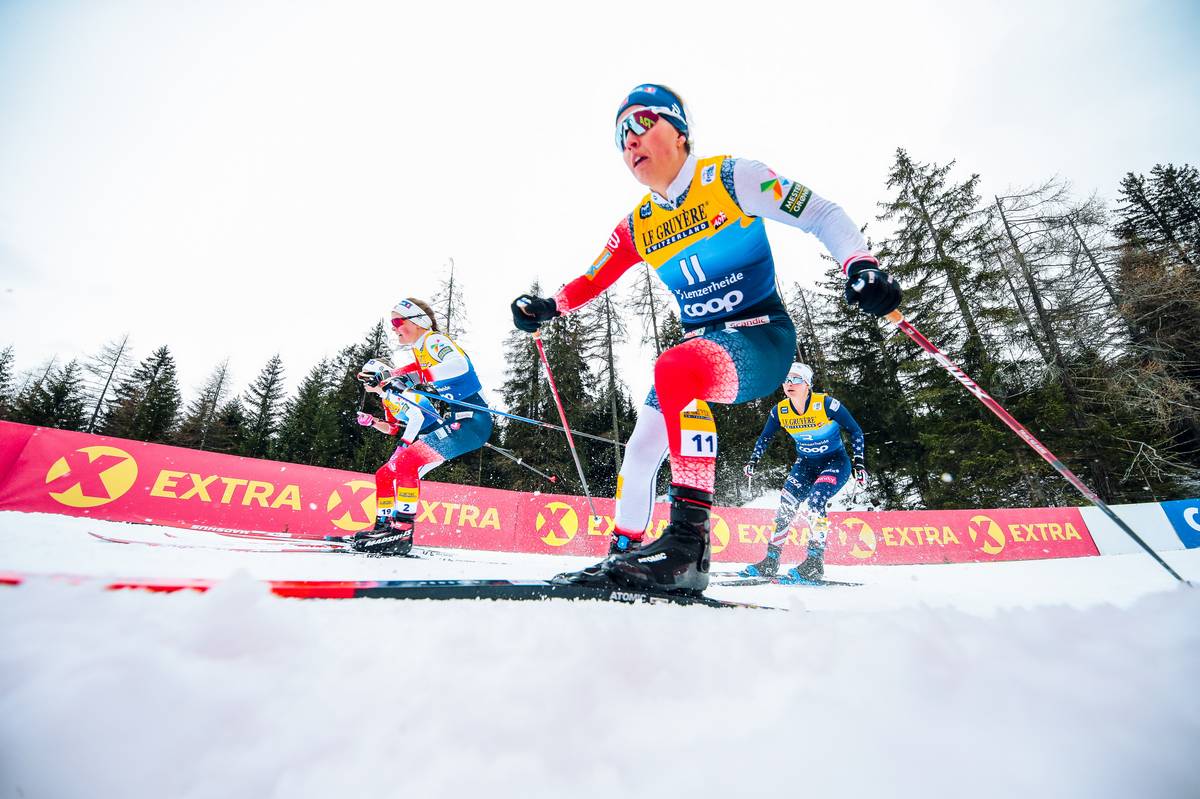
The 16th edition of the Tour de Ski kicked off today in Lenzerheide, Switzerland, beginning with a two-lap 1.5-kilometer skate sprint. In past years, the Tour has been a longer event with eight or more stage races. This year’s edition however, has six stages taking place over the course of eight days, to accommodate preparations for the upcoming Olympics in Beijing.
As a reminder to readers who may have forgotten over the course of the past twelve months, Jessie Diggins claimed the overall victory in last year’s Tour de Ski, making her the first non-European athlete (male or female) to achieve that title. After a convincing win in today’s first stage event, Diggins looks to be in contention for the overall win once more in 2022.
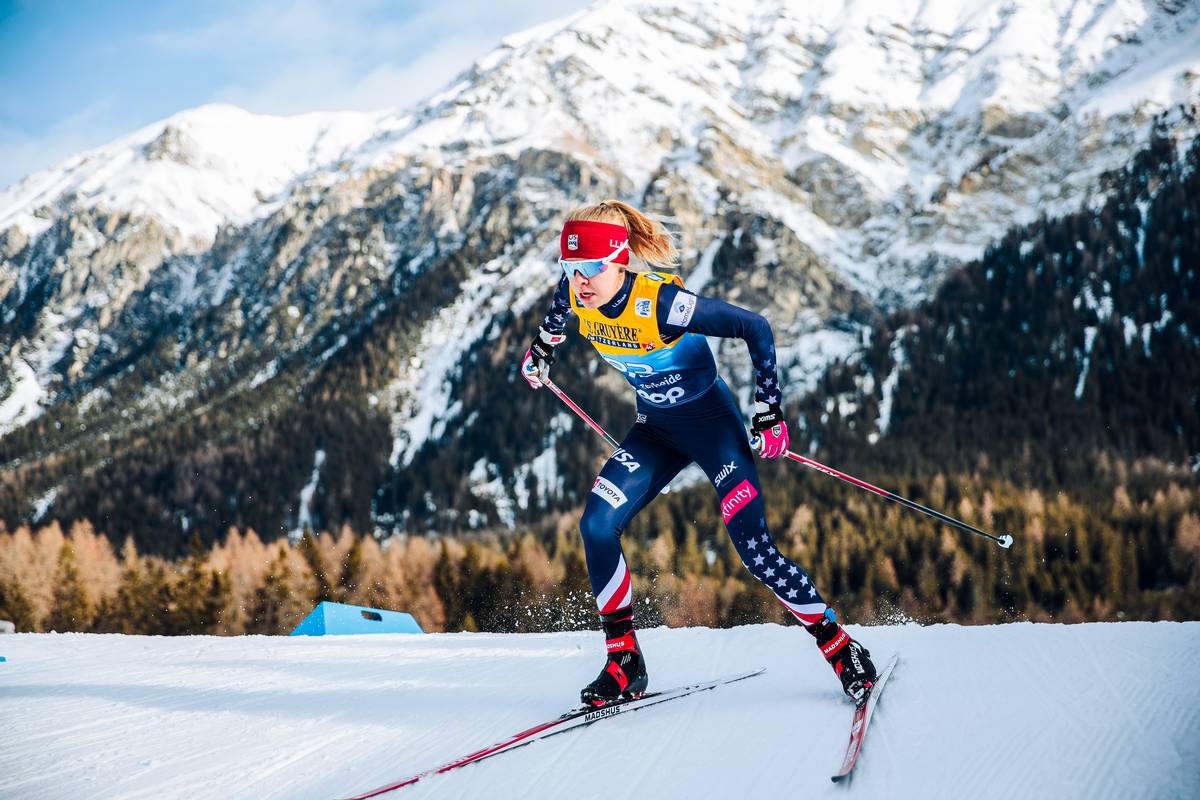
Jessie Diggins (USA) all smiles after finishing first in the 1.5 k skate sprint (Photo: NordicFocus)
The Tour last visited Lenzerheide in the 2019/20 season where Slovenian Anamarija Lampic earned her first World Cup victory, with Diggins finishing fourth. The sprint course is a 2 x 0.75k loop, with a climb out of the start, leading into a long downhill on the back stretch of the course, and a fast corner into the lap/finish lanes. Looking at the surrounding mountains and meadows, there seemed to be little snow and the temperature hovered around freezing as the sprint rounds began.
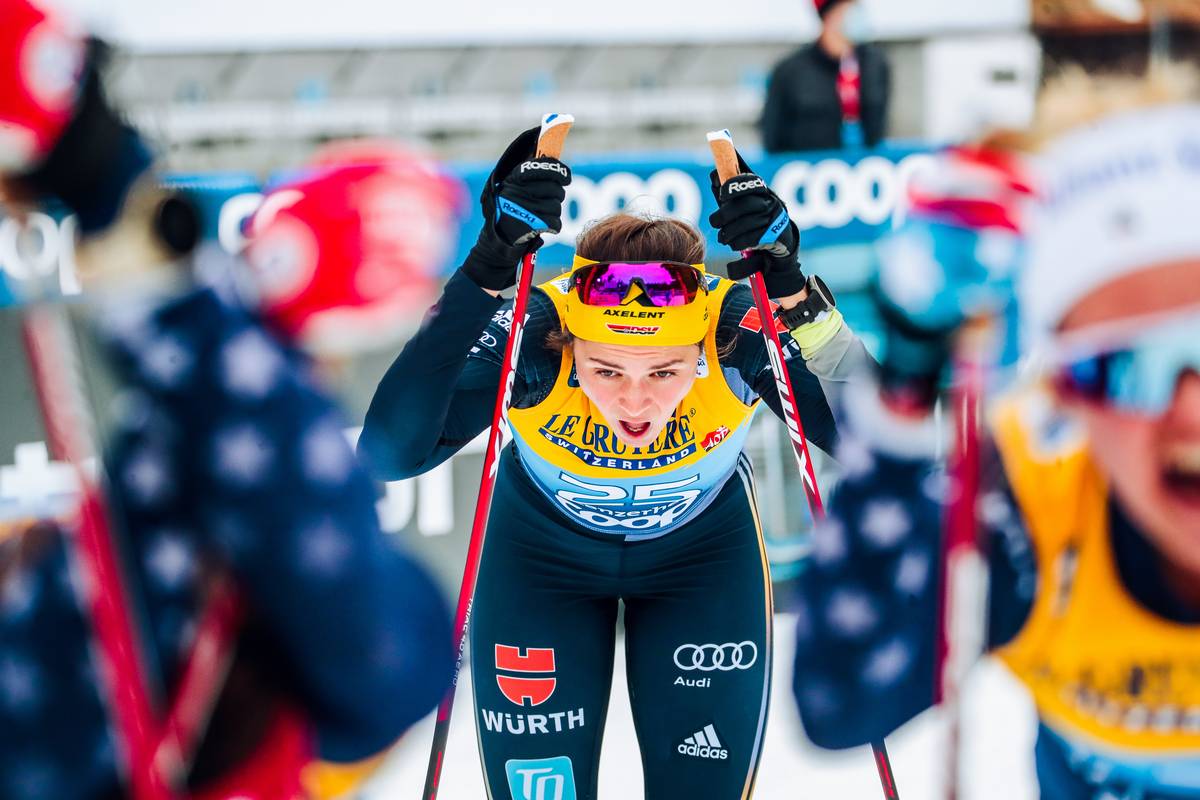
With three American women in the top thirty in qualification, the first quarter-final heat featured two of them, Jessie Diggins, who qualified 3rd with a time of 3:03.4 and Hailey Swirbul who qualified in 27th (3:09.49). Also in the first heat was Nadine Fähndrich of Switzerland, who posted the fastest qualifying time of the day (3:02.54). Swirbul, Fähndrich and Diggins were quick off the line with Diggins gaining the lead over the crest of the hill. Heading down, Fähndrich used the draft to gain speed and draw even with Diggins. As they rounded the corner heading towards the lap Fähndrich lost her balance and fell, sliding wide and taking out Swirbul in the process.
Nadine Fähndrich (SUI) leads Hailey Swirbul (USA) in the first quarter-final, before a fall. (Photo: NordicFocus)
With two competitors down, Diggins held the lead for most of the second lap, using her freeskate to gain space on the descent though once again, she was overtaken as Anne Kjersti Kalvå of Norway slingshot around Diggins and claimed first. Diggins finished second and both advanced to the semi-final rounds.
Hailey Swirbul (USA) racing in the quarter-finals (Photo: NordicFocus)
“I felt I raced my best today,” wrote Swirbul after the race. “I did not have the build up to the Tour that I had planned due to some unforeseen stresses, but that’s the way life goes sometimes. That won’t stop me from giving my best every day and leaving it all out there. I am really excited to hopefully build into the Tour this year and follow the strong skiing set by my teammates today! I thought our team skied really well overall, and our service team and medical/nutrition staff were top notch.”
Reflecting on her quarter-final, Swirbul wrote, “I had a surprisingly good start for myself and found myself in a good position early on. I tried to stay on the leaders the best I could but flew into the side-boards at the bottom of that first downhill… ouch! I’m glad to be okay, just a bit scraped and bruised. Looking forward to tomorrow.”
The second quarter-final heat saw an easy pace and a tight pack with Mathilde Myhrvold (NOR) and Johanna Hagström coming through as the fastest two.
In heat three, the Czech skier Katerina Janatova led most of the two laps, only to be passed by Anna Dyvik (SWE) and Tiril Udnes Weng (NOR) on the descent. Entering the finish lanes, Natalia Nepryeava of Russia turned on the pace and passed Dyvik to finish 2nd, though the Swede advanced to the semis as well given the fast time of the heat.
Katerina Janatova (CZE), Anna Dyvik (SWE) and Natalia Nepryaeva (RUS), (l-r) in quarterfinal number three. (Photo: NordicFocus)
In heat four, Laurien Van Der Graaff of Switzerland, a crowd favorite, followed a similar tactic to that of Janatova from the previous heat. Once again, this proved not to be the best strategy as Lampic (SLO) used the draft to pass Van Der Graaff on the final corner and easily take the win. Laura Gimmler of Germany came from behind and out-lunged Van Der Graaff to take the second qualifying position.
The final quarter-final heat featured the third American, Julia Kern who qualified in 9th position with a time of 3:05.24. This heat only had five racers as Eva Urec of Slovenia, who qualified in 16th, did not start the rounds. Moa Lundgren of Sweden led the first lap while Kern sat in fourth. As they headed through the lap, Kern made a move to the front and crested the hill in the lead. Despite a slight loss of balance on the corner, Kern was able to break the pattern from the previous four heats and became the first person to lead on the final downhill and hold onto that lead all the way to the finish line. Coletta Rydzek of Germany finished second behind Kern and Kerttu Niskanen of Finland earned the final lucky loser spot.
Julia Kern (USA) follows Coletta Rydzek (GER), (l-r) in the semi-final rounds. (Photo: NordicFocus)
As the men raced their quarter-final rounds, course conditions appeared to be getting faster and it got cloudier and the temperature dropped. When the women returned for the semi-final heats, Diggins was once again in the first heat. This time she stayed in the pack, near the back for the entire first loop. Taking a wide lane through the lap she gained the lead and created a gap to the rest of the field over the hill. With the pack strung out behind her Diggins held her lead and finished first, with Myhrvold of Norway taking second.
Tiril Udnes Weng (NOR) navigates a corner with Mathilde Myhrvold (NOR) on the outside (Photo: NordicFocus)
In semi-final number two, Lampic (SLO) had an early lead while Kern followed in second. Rounding the corner for the first time, Kern overtook the Slovenian and upped the pace. These two held off other challenges to secure first and second qualifying positions and thanks to the fast time of their heat, Rydzek (GER) and Dyvik (SWE) also came through as lucky losers.
Thus, the final featured two Americans (Diggins and Kern), one Slovenian (Lampic), one Norwegian (Myhrvold), one Swede (Dyvik), and a German (Rydzek). Out of the start gate the pace was conservative, nobody really wanting to be the leader on the first descent. Heading into the second and final loop, Diggins found space through the middle of the pack while Kern worked wide, both Americans coming to the fore. Up the hill, Lampic worked her way into second, Kern in third with Myhrvold (NOR) close behind. Diggins held the lead, taking a good corner and fending off a challenge from Myhrvold at the last minute.
Jessie Diggins (USA) pushing hard towards the finish with Myhrvold (NOR) to her right (Photo: NordicFocus)
With first place going to Diggins, the twenty-three year old Myhrvold earned her first World Cup podium in second place. Lampic out-sprinted Kern to finish third, with Kern coming in fourth. Dyvik (SWE) came in 5th and Rydzek (GER) finished 6th, her best World Cup finish to date.
Coletta Rydzek (GER) finished sixth, her first time making a sprint final. (Photo: NordicFocus)
“The rounds today were definitely tactical,” wrote Kern after the race, “but also rewarded just skiing hard. The track got faster as the day went on after some light precipitation before the qualifier, which glazed the track a bit as the temps got warmer. There was definitely a draft on the downhill, but skating really hard into the downhill and being in the front position was the most important, which made the tactics a bit tricky with both leading and following. I felt strong all day, my skis were ripping fast, and body was feeling good!”
Kern sat out in Davos due to a stomach bug and she wrote, “Dresden allowed me to rebuild that momentum that I was feeling after Lillehammer. After the Dresden weekend, I didn’t even want a break, I just wanted to keep rolling so I was very much looking forward to today.”
Anticipating tomorrow’s 10 k classic she wrote, “I am really excited to finally get to classic ski again after eight skate races in a row. I haven’t done a classic race since the opener in Ruka so I am curious to see how my classic skiing is coming along, and also how my fitness carries over to some distance racing after a few weeks off from distance racing as well. Overall, the team energy is great, we have an awesome support staff and I am excited for more races to come!’
Diggins, whose parents and sister were at the venue in Lenzerheide, was all smiles after the race. “Thanks to my family for the cheering,” she said in a post-race FIS interview, “I’m just in a really happy place, and for me happiness is fast.” When asked about her preparation for the next few days of racing she said she plans to “eat a lot, sleep a lot, and see how it goes.”
Here are some additional post-race comments from Diggins and Kern, interviewed by Tom Horrocks, U.S. Ski & Snowboard Cross Country communications manager, who will be on-site through the Tour.
The Tour continues tomorrow with a 10 k classic on tap for the women. Diggins currently holds the lead ahead of Myhrvold (NOR) by +0:05 seconds.
Novie McCabe (USA) racing to 46th in her first Tour de Ski competition (Photo: NordicFocus)
Also competing in the Tour for the Americans is Novie McCabe, who finished 46th (3:12.89), and Katharine Ogden who was 55th (3:14.74). SuperTour leader who recently joined the American squad in Europe, Alayna Sonnesyn skied to 58th (3:15.11), with Sophia Laukli rounding out the American women in 76th (3:20.43). There are no Canadian women taking part in this year’s TdS.
Post-race interview with Matt Whitcomb on the course in Lenzerheide, which has suited Americans well over the years, along with additional comments on the men’s and women’s races.
Sophia Laukli (USA) finished 76th in her first TdS event (Photo: NordicFocus)
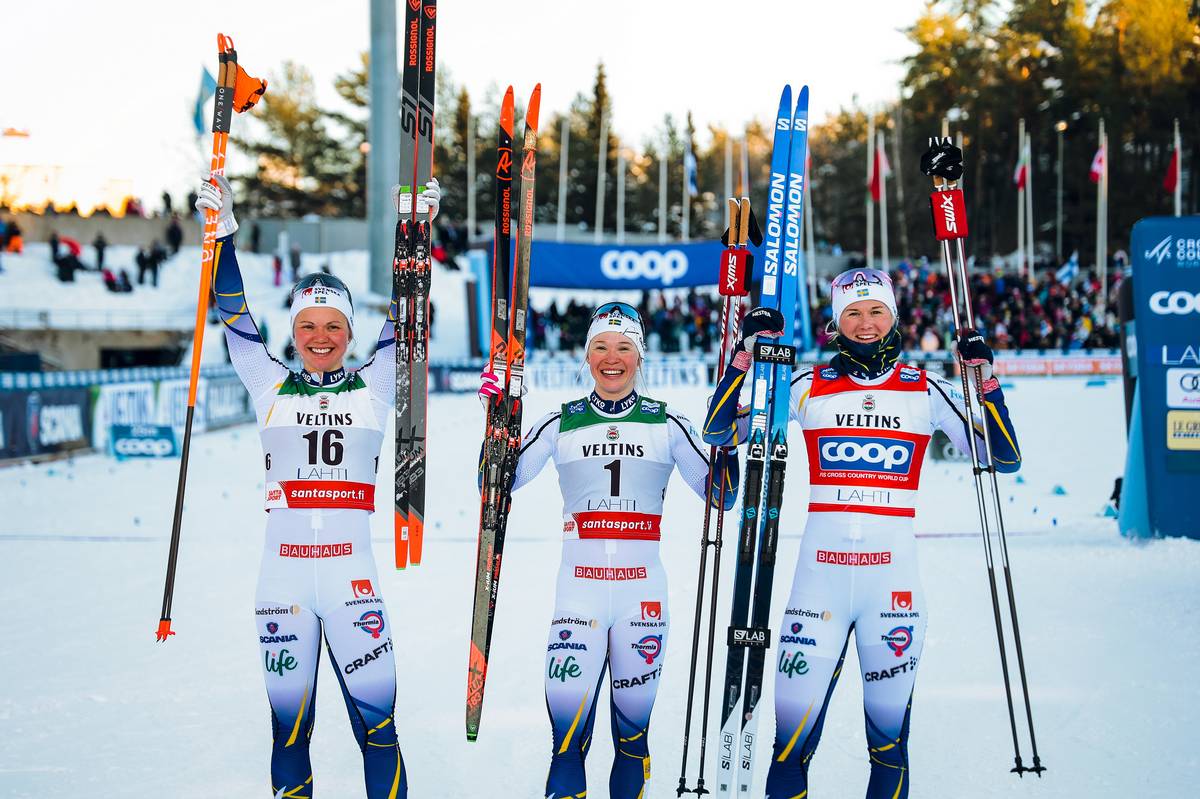
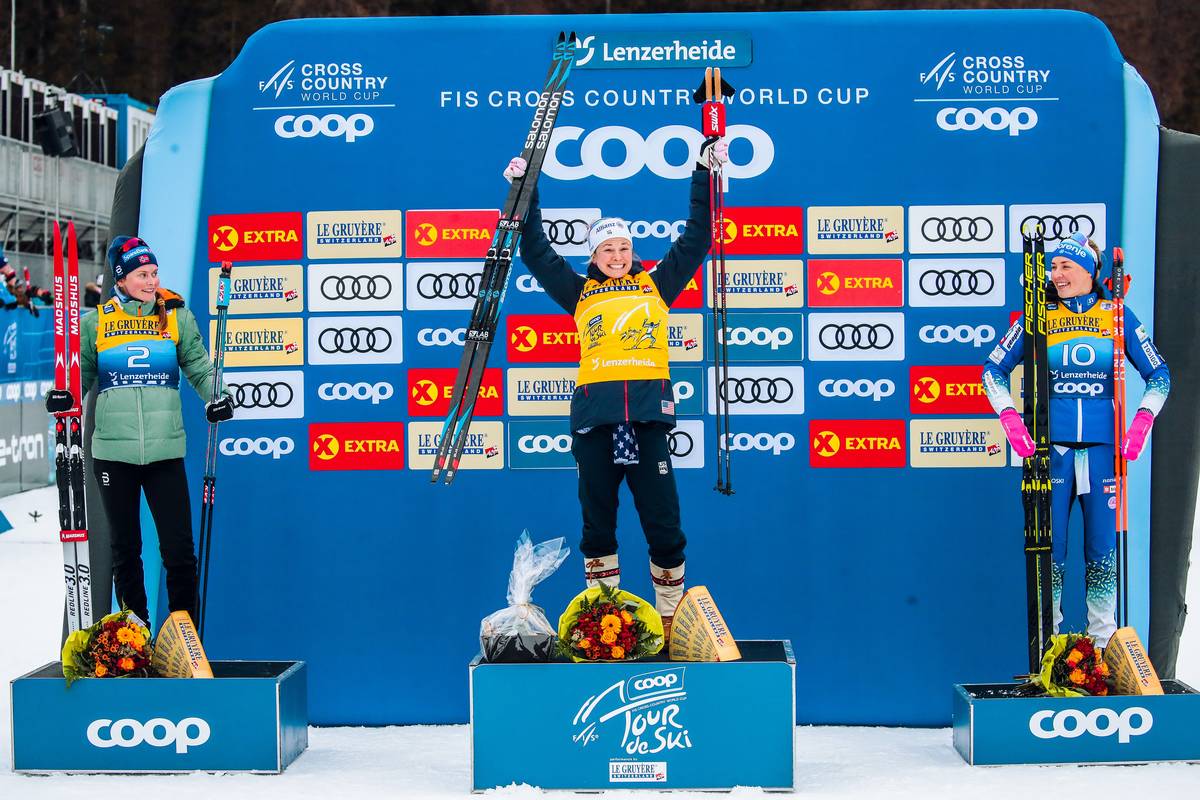
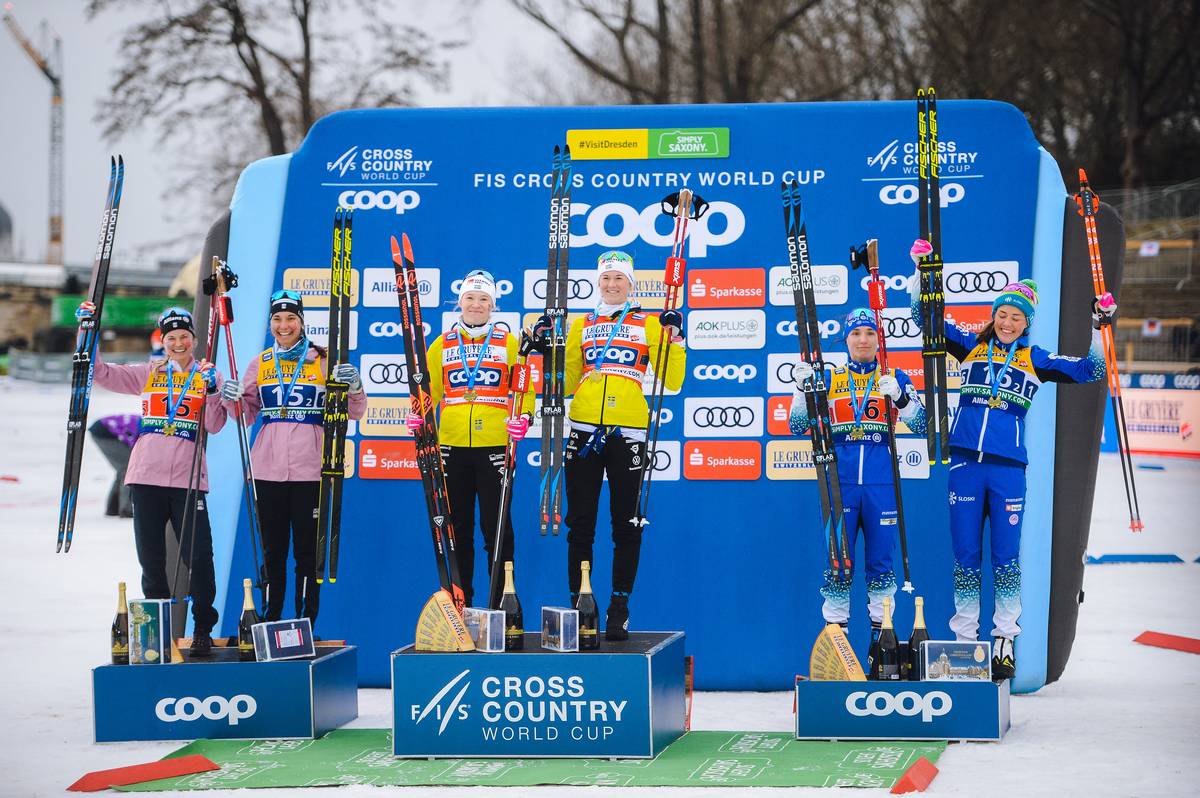
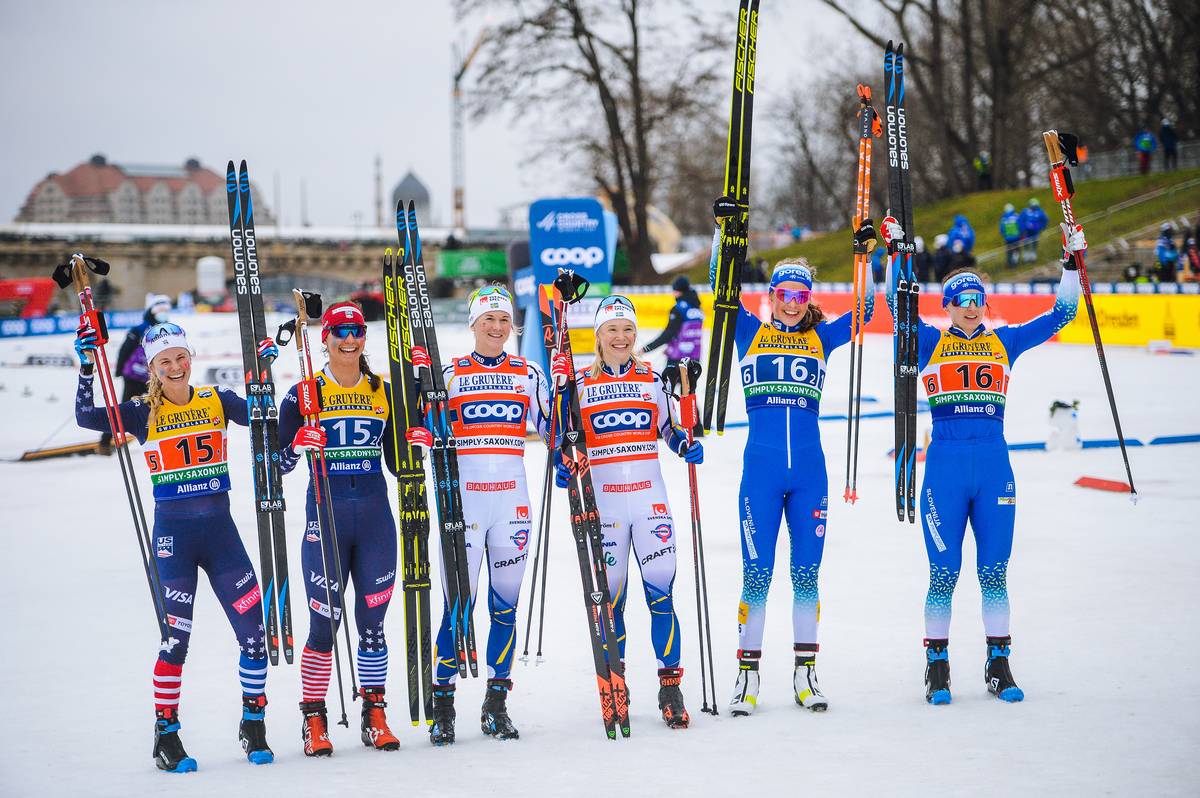
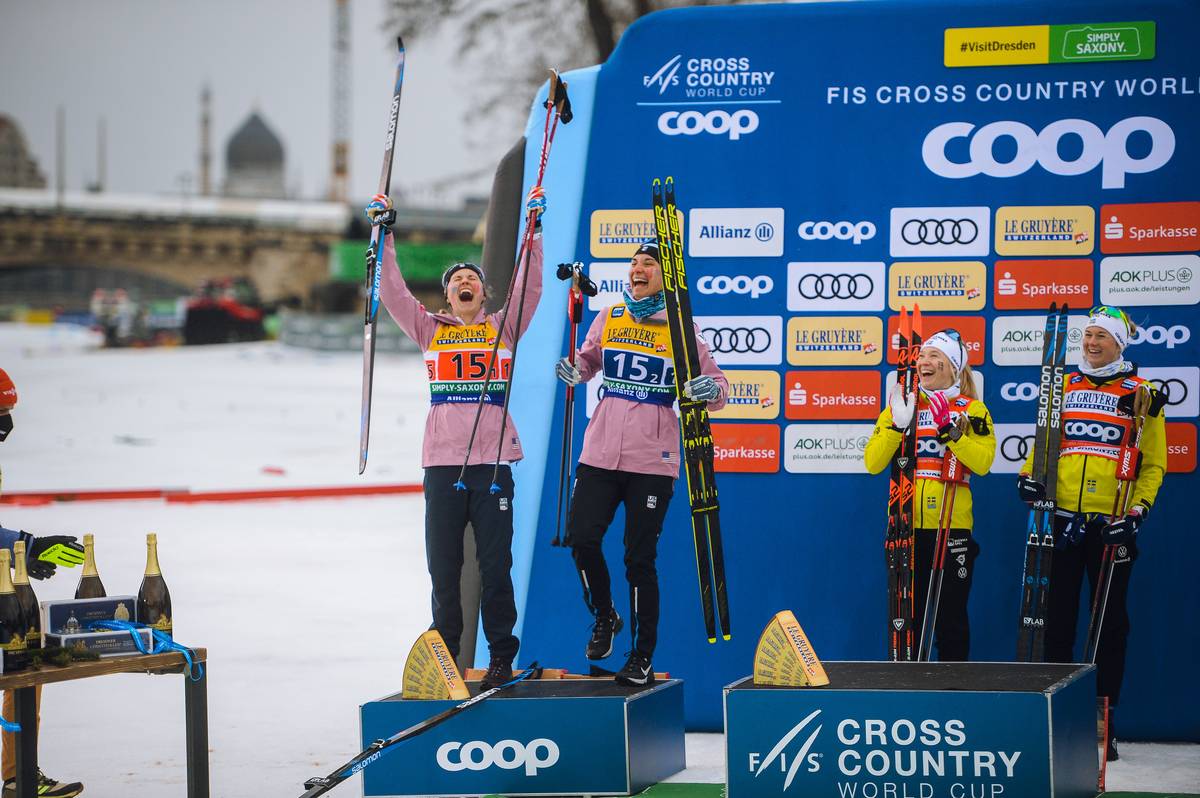
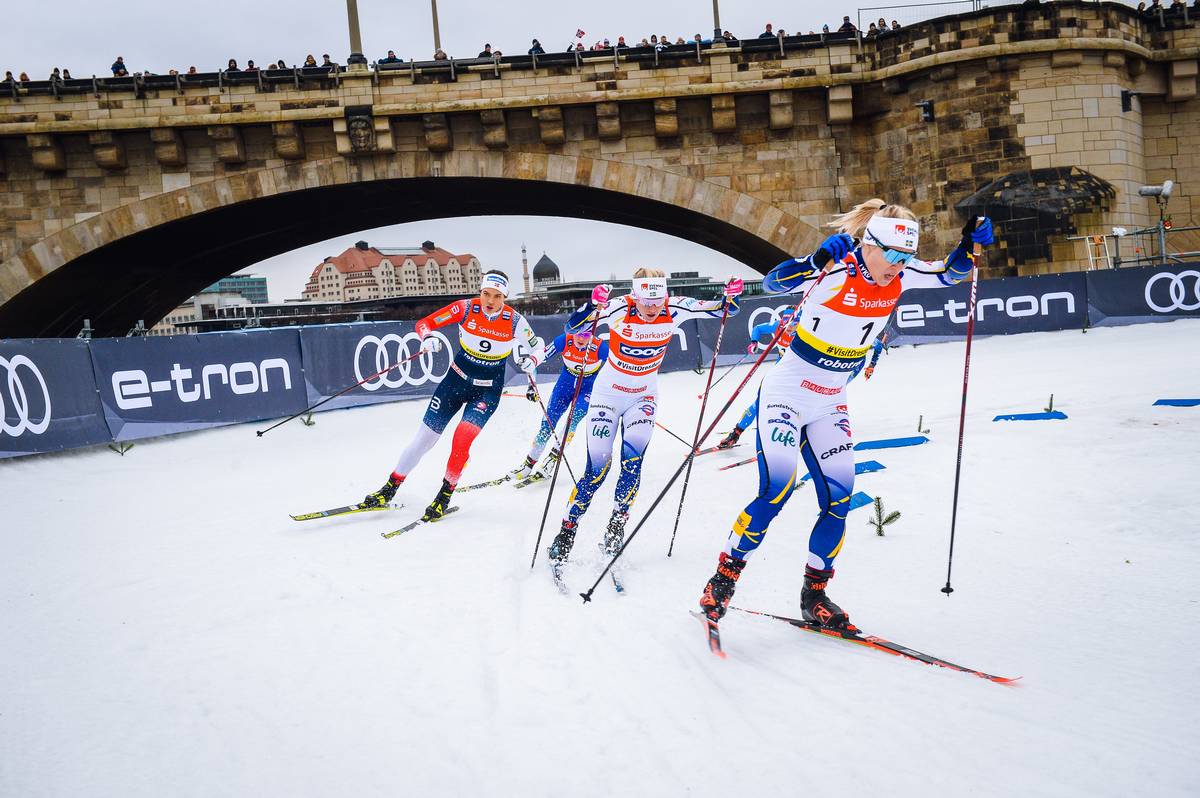
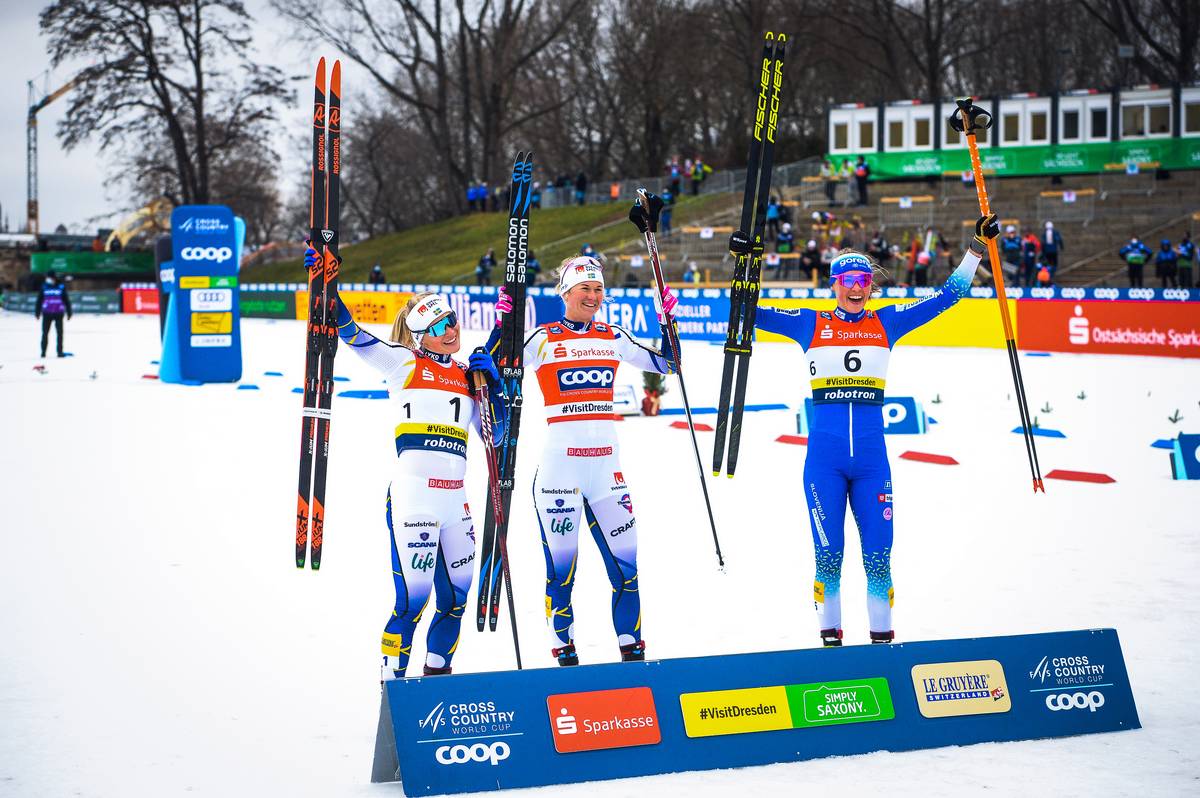
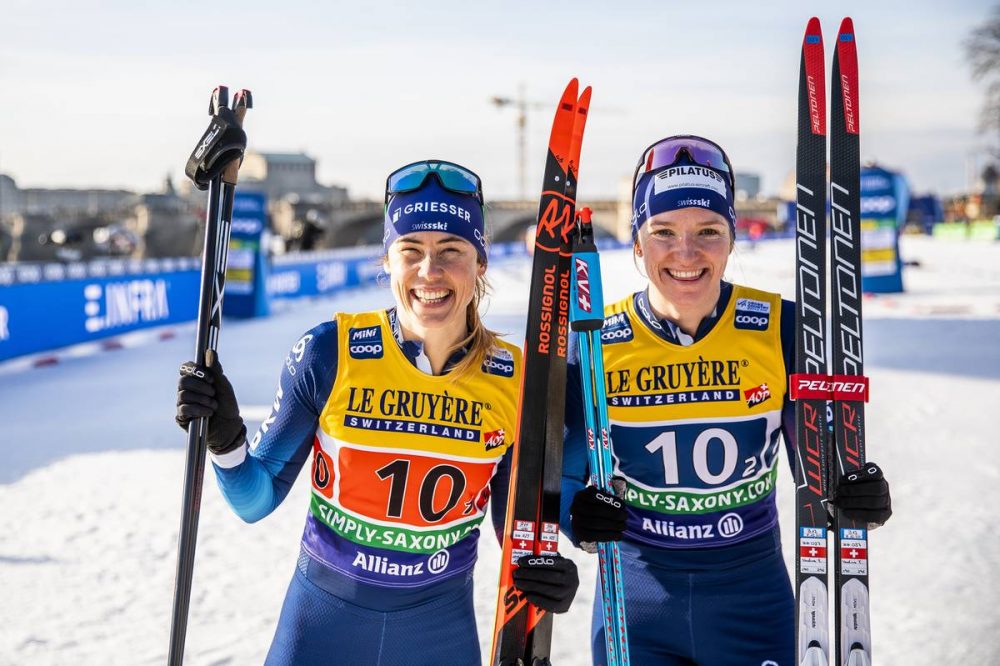
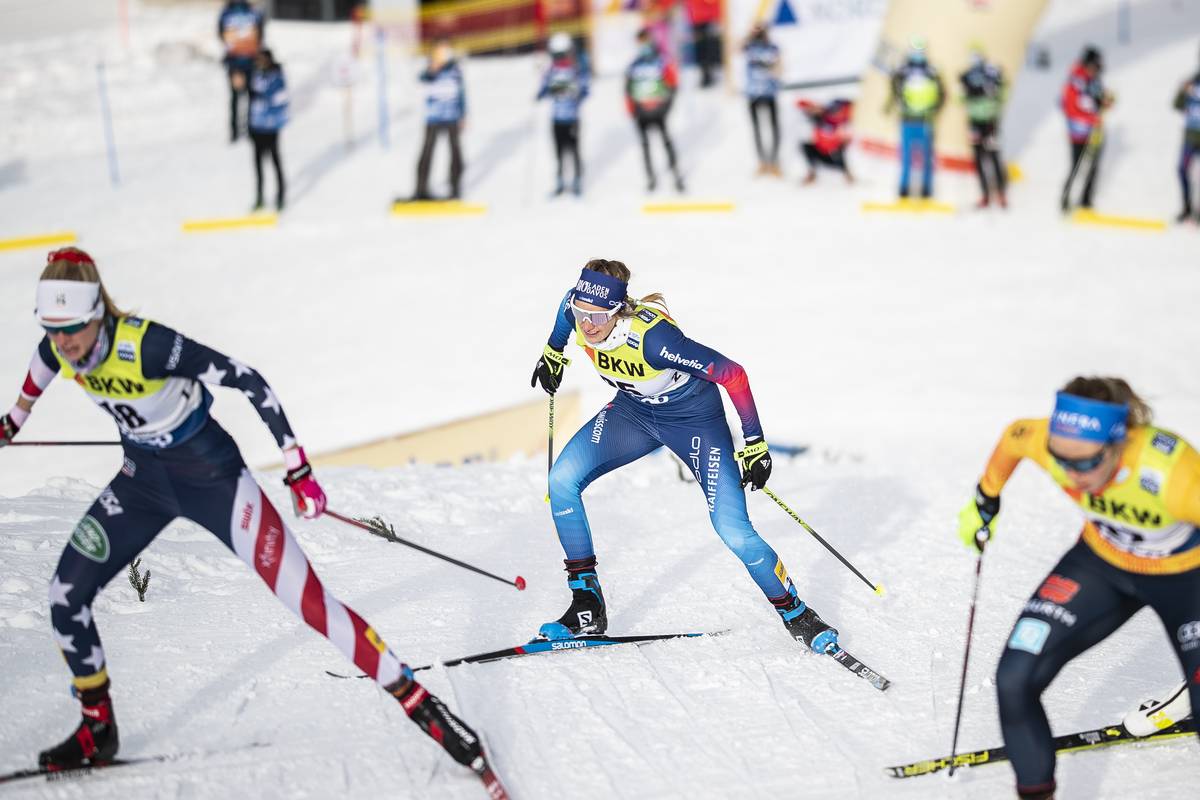
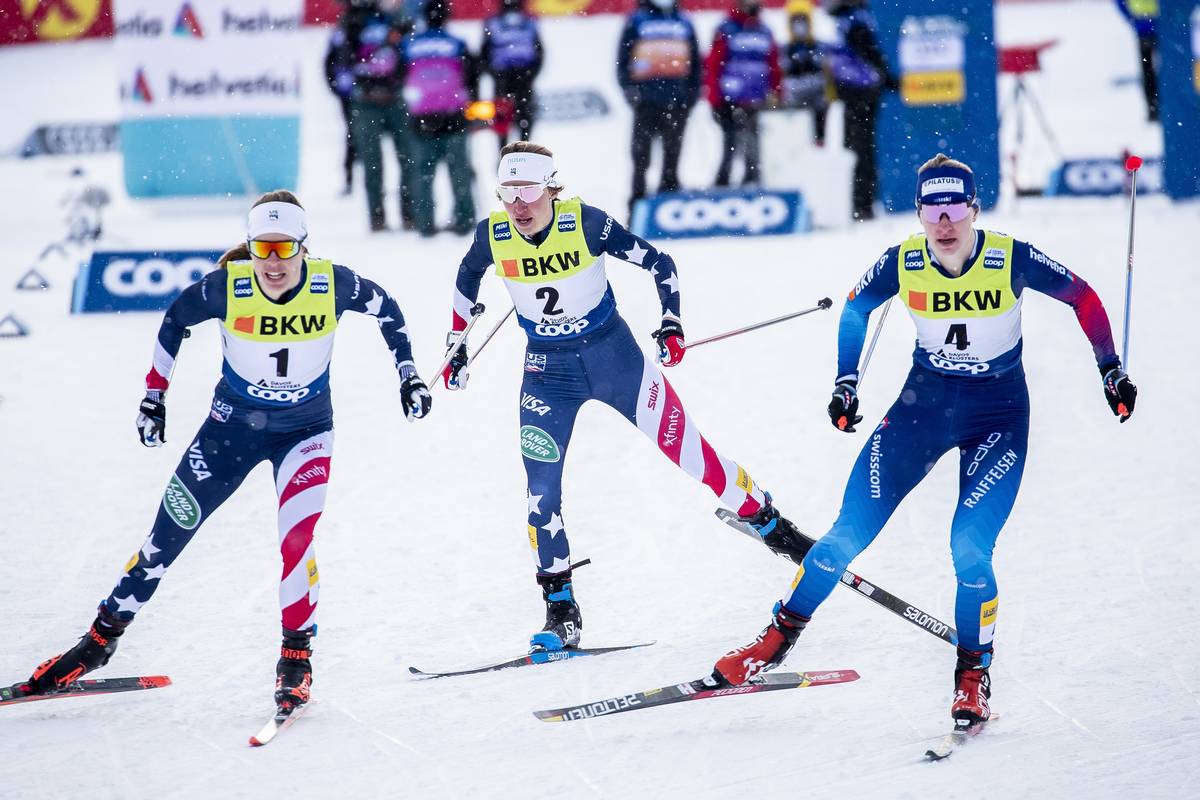
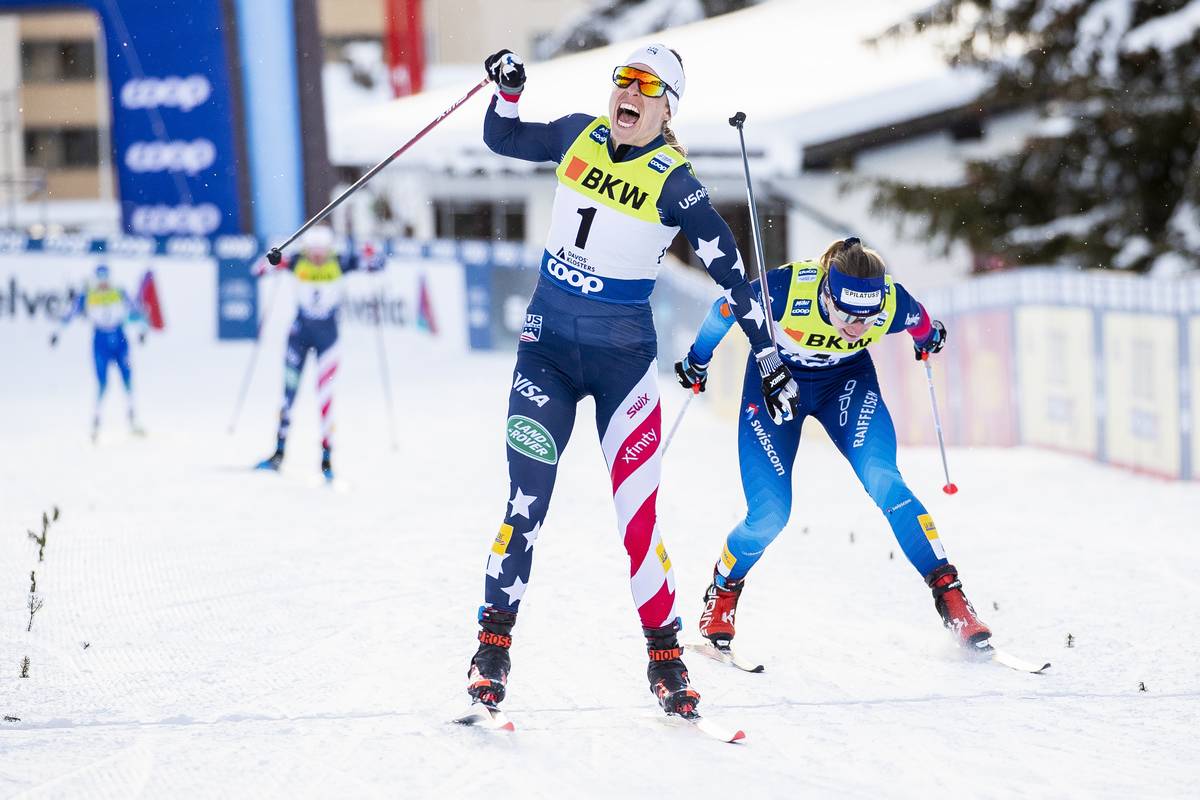
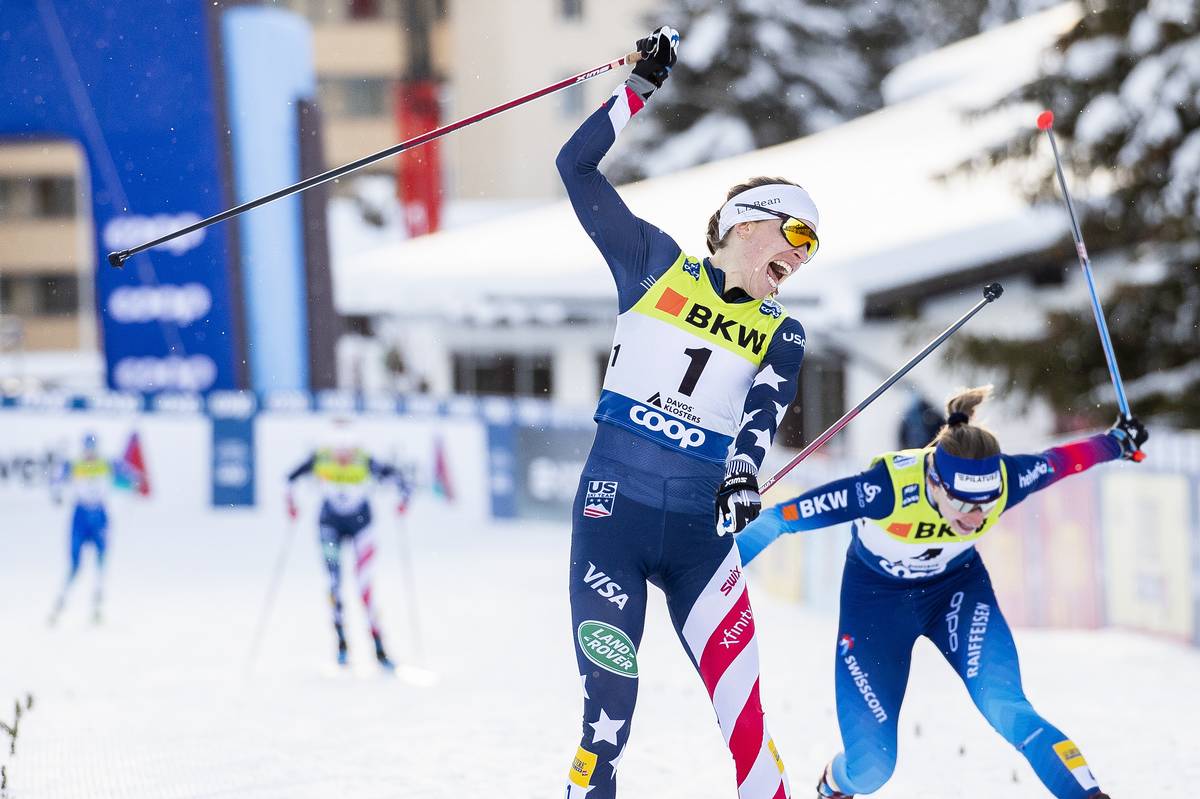
The women’s team sprint podium in Dresden: The Sweden I duo of Jonna Sundling and Maja Dahlqvist took the win ahead of USA’s Jessie Diggins and Julia Kern, with Slovenia’s Eva Urevc and Anamarija Lampic in third. (Photo: NordicFocus)
This World Cup coverage is made possible through the generous support of Marty and Kathy Hall and the A Hall Mark of Excellence Award. To learn more about A Hall Mark of Excellence Award or to learn how you can support FasterSkier’s coverage please contact info@fasterskier.com.
By Ryan Sederquist
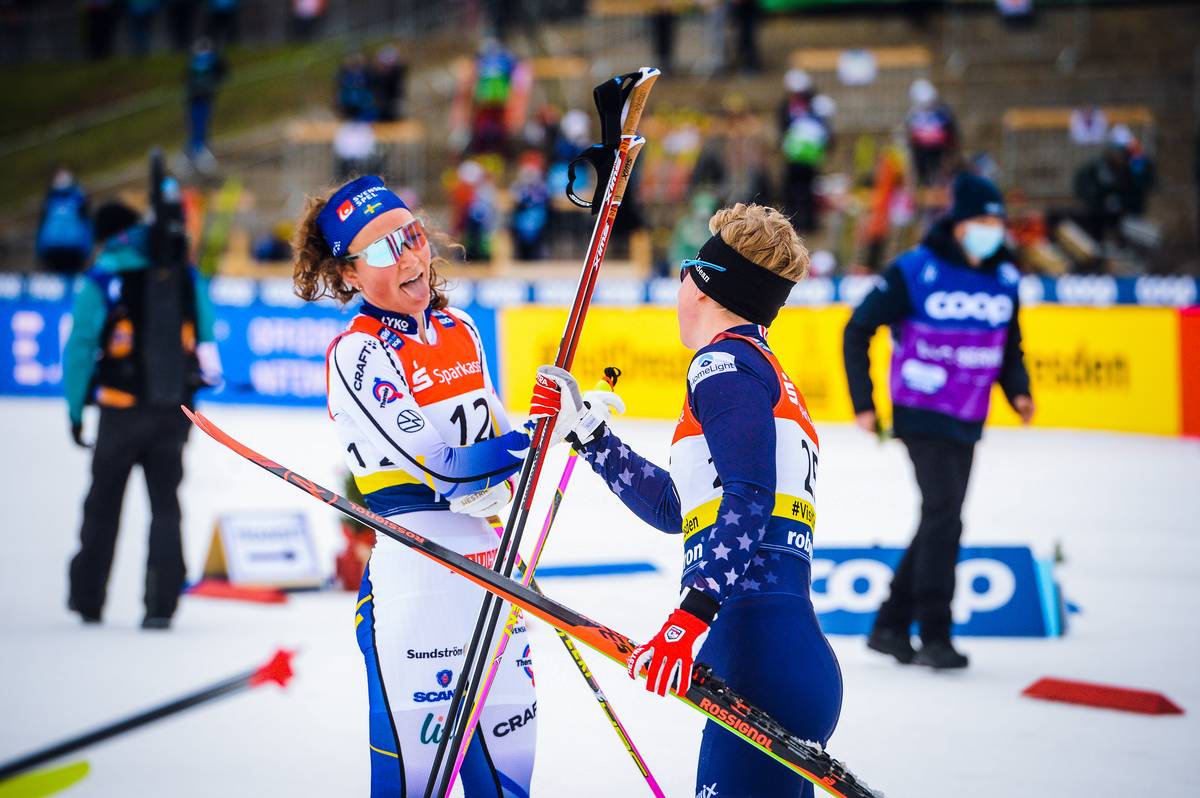
Defending team sprint world champions Maja Dahlqvist and Jonna Sundling continued the Swedish women’s sprint dominance with a polished performance and confident victory Saturday morning in Dresden on day two of World Cup action in the German city.
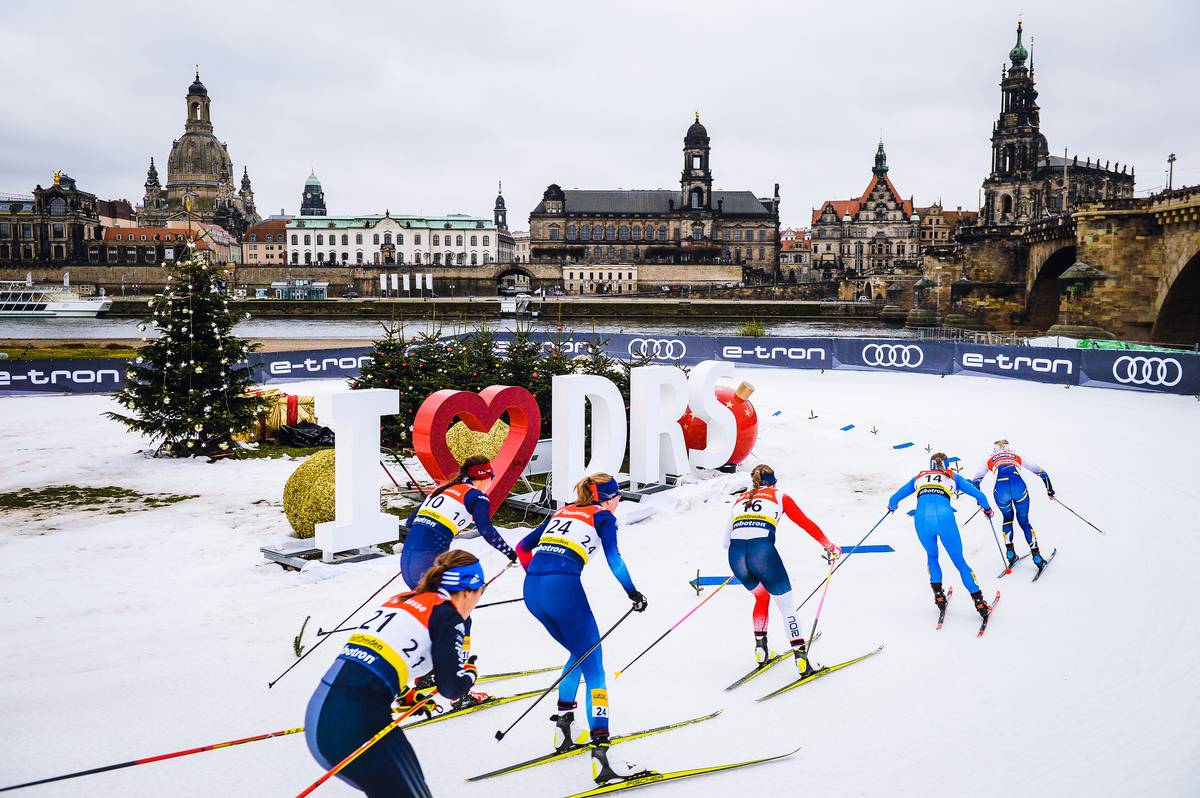
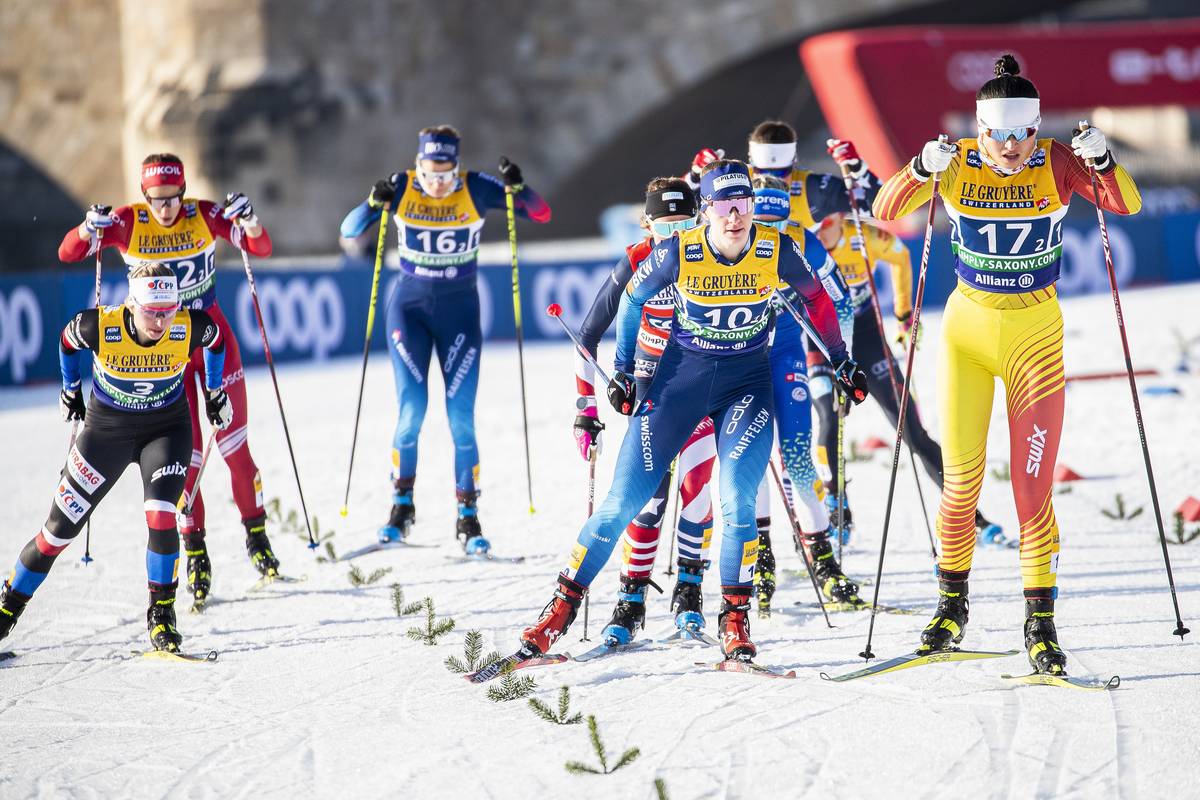
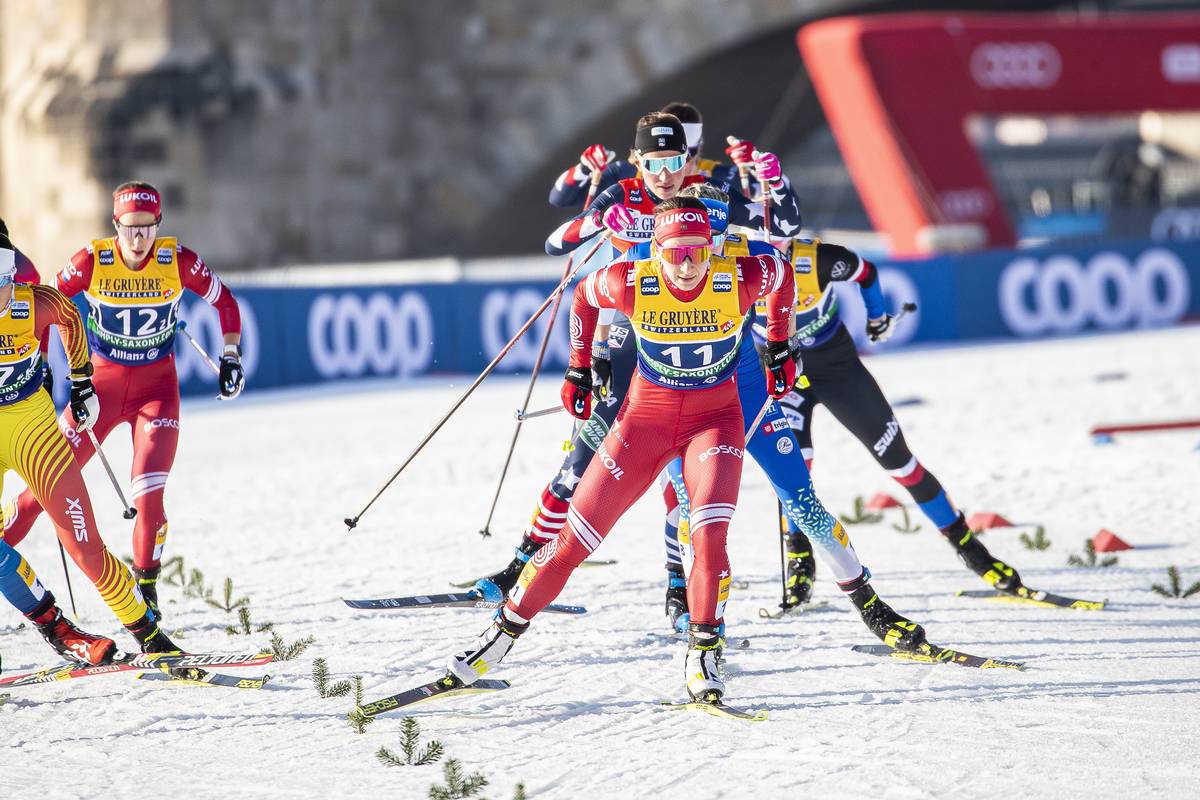
“We just want to be in front because it’s a tight course,” Dahlqvist told a FIS reporter after the race. With athletes taking six turns each on the 644-meter course, which contains a maximum climb of 14 meters and a total height difference of just 4 meters, opportunities to pull away were low and the chances of crashing were high. In order to stay focused on their job, maintaining a lead was crucial for the dynamic duo.
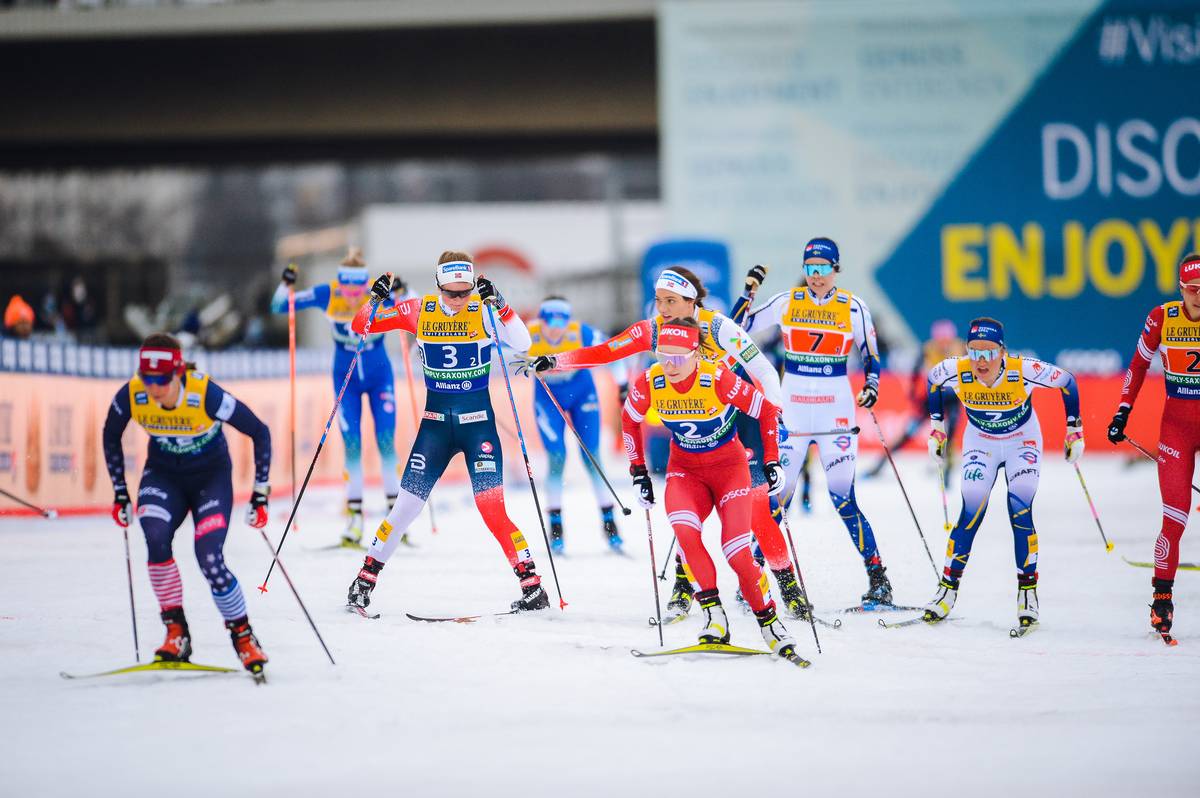
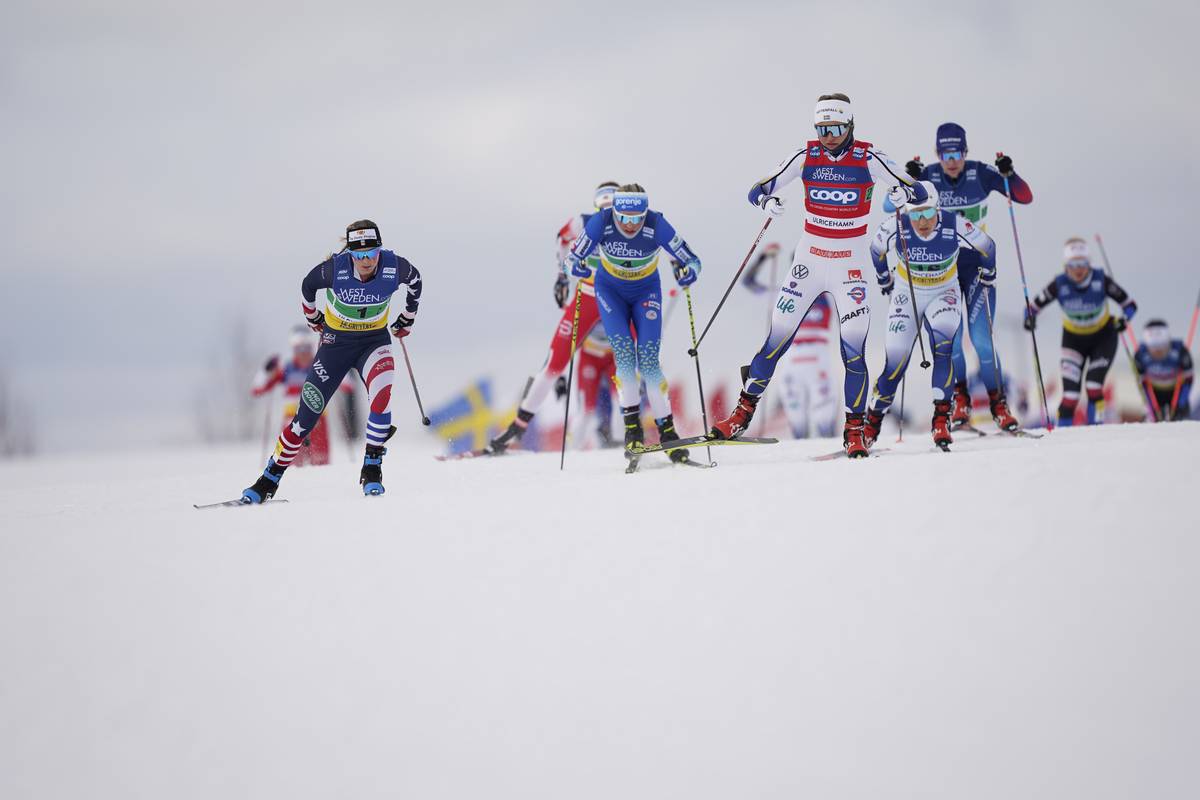
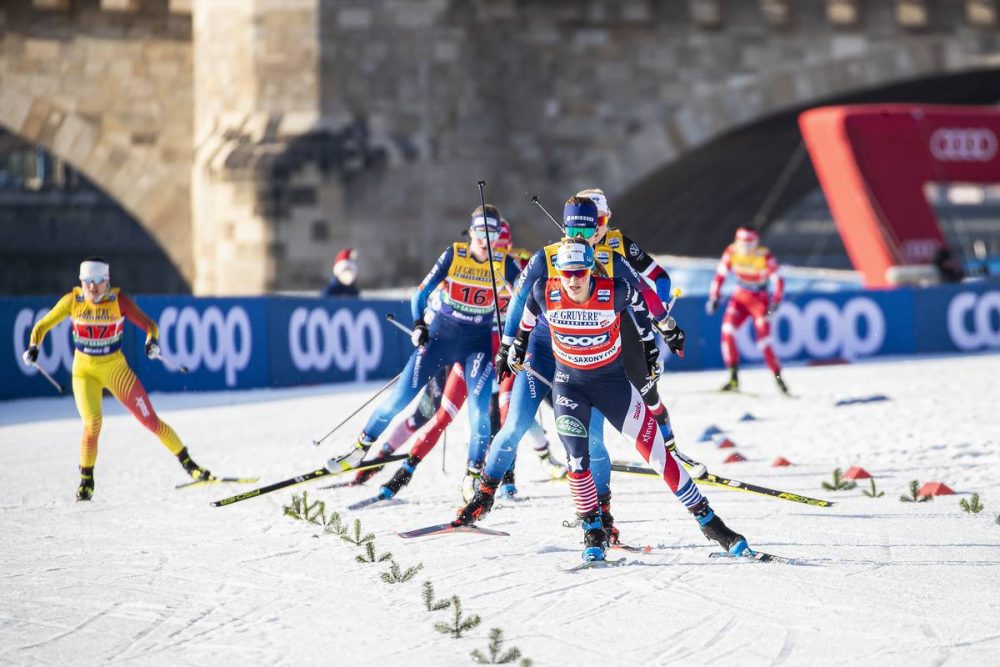
Body to body being the name of the game, Maja Dahlqvist tags her teammate Jonna Sundling as the women set pace during the team sprint in Dresden. (Photo: NordicFocus)
“It’s difficult because [there are] people everywhere,” Sundling said when asked how she and Dahlqvist kept their calm in the bunched-up chaos. “The equipment – you want to keep it like it is – no broken poles and stuff. So, it’s difficult to focus on the right thing, but when you’re in the front, it’s easier.”
The Swedes did have some company at the front throughout the 11 exchanges. One of the early challenges came from the Jessie Diggins – Julia Kern pairing, who qualified with the top time out of semifinal B.
Kern explained post-race that staying near the leaders was part of their strategy heading into the team sprint.
“Jessie and I focused a lot on executing clean and fast tags, and tried to remain as far front in the pack as possible,” Kern said. “There is so much traffic and tangles that we wanted to avoid as much of that as possible. There was a strong headwind which made leading more costly, but it still is advantageous especially given how fast and firm the track was.”
Another surprise at the front was from Finland. The team of U23 athletes, Jasmi Joensuu and Jasmin Kahara, nabbed the final automatic qualifying spot in the first semifinal. Despite squeaking into the final, the young women made their presence known throughout the race, moving alongside Sundling and Dalqvist into second at the end of the tenth lap before ultimately finishing in fourth.
Jessie Diggins heads into what would be later become a dicy turn. (Photo: NordicFocus)
With Sundling leading off, Sweden set the pace through the first four laps, with different nations taking turns at their shoulder. Russia I took lap two, Norway II took lap three, and Slovenia, led by Anamarija Lampic, who was third in the individual yesterday, popped in on lap four. The Americans, who placed Diggins as their lead-off skier, patiently bided their time, content to sit in the tight grouping and stay on their skis. Unfortunately, a wrench was about to be thrown into that plan.
On lap five, Diggins moved into second place. Coming around the penultimate turn, she swung to the outside and was tangled up with Eva Urevc of Slovenia, who tumbled over the top of the 2018 Olympic gold medalist in the event. Diggins kept her cool, quickly rose to her feet, and skied hard to the next exchange. She tagged off to Kern 4.1 seconds back.
“I got back our places as quickly and efficiently as I could,” Diggins told FasterSkier after the race. She also noted that she is headed into Christmas break with a fresh set of bruises to go along with her podium cheese.
“I’m always proud of the ‘never give up attitude’ and I think it really paid off for us today. We didn’t panic, we just skied as smooth and smart and hard as we could.”
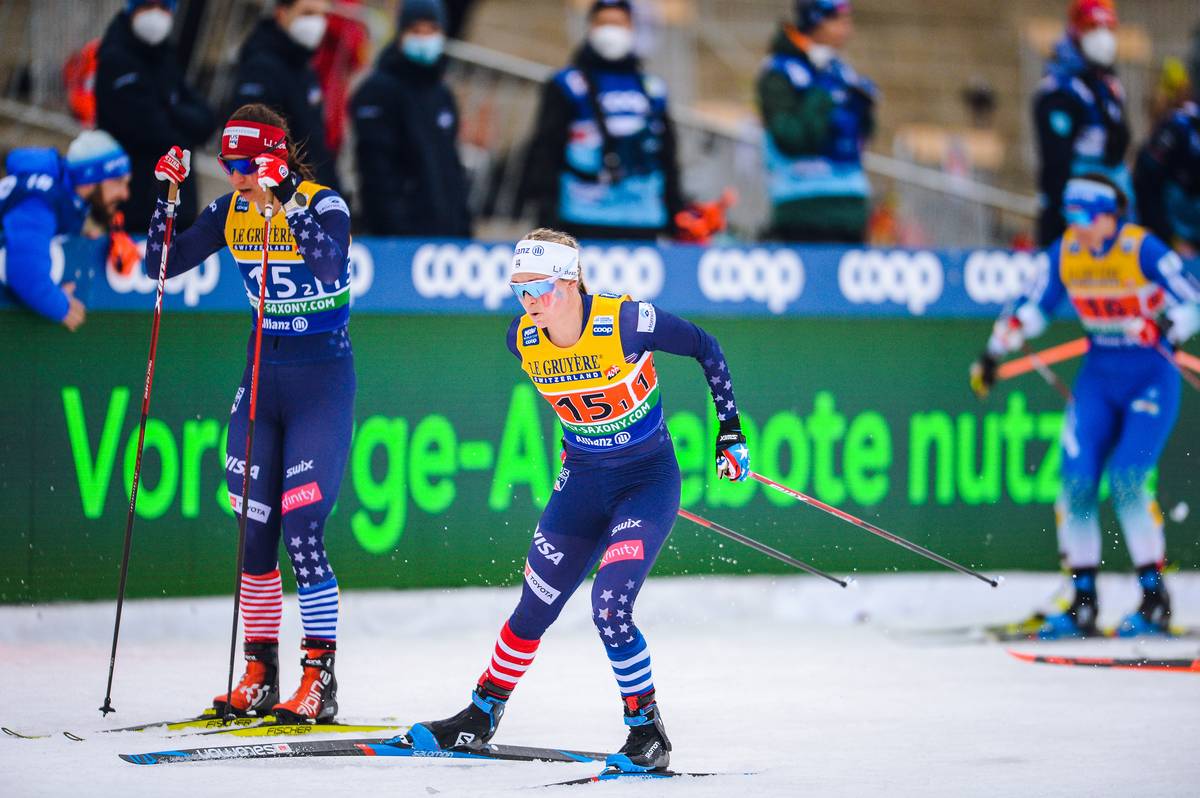
Julia Kern powers into her leg during the team sprint in Dresden. (Photo: NordicFocus)Julia Kern navigates fast curves on course in Dresden. (Photo: NordicFocus)
After the crash, Kern and Diggins kept their composure and gradually crawled back into contention. Kern explained post-race that Diggins had also crashed in the semifinal, which evidenced how they could rebound.
“I think the crashes actually lit the fire for Jessie and I,” Kern wrote in a text. “It got us ready to fight back. I had full confidence in Jessie that she would ski right back on to the group in the semifinal and that is exactly what she did. We remained very calm in the process which was key. So come the finals when it happened again, I just smiled a little since I wasn’t worried one bit and knew we would just do the same thing as the semi finals. I had confidence in how we were both skiing and feeling out there, and crashes are almost always a part of the game in Dresden.”
By the next exchange, Kern had already lopped off 1.8 seconds of the deficit. By lap eight, Diggins was just 1.5 seconds out of the lead, which still belonged to Sweden. Going into lap nine, all of the major contenders were back. Trailing Sweden were the upstart Finns (+0.3), the United States (+0.6), and Russia (+1.1). The only key player seemingly out of the running was Slovenia, who sat 4.7 seconds out of the lead.
On the final lap, Sundling, the 26-year old two-time World Championship gold medalist, rocketed from the exchange zone with a stern tempo. Diggins matched it, slipping behind the sprint specialist.
Jessie Diggins heads out after receiving a tag from Julia Kern. (Photo: NordicFocus)
At the final exchange, Diggins handed off to Kern 0.5 seconds from Sweden. Slovenia, with Lampic to close, was in fourth, a mere 1.9 seconds back.
In the final lap, Dahlqvist, who was a member of the pairings that won the team sprint World Championship title in 2019 and 2021, bided her time, happy to cruise through the first straightaway. After the first hairpin turn, she accelerated to a comfortable lead, leaving the competition in the wake of her strong V2-alternate strides.
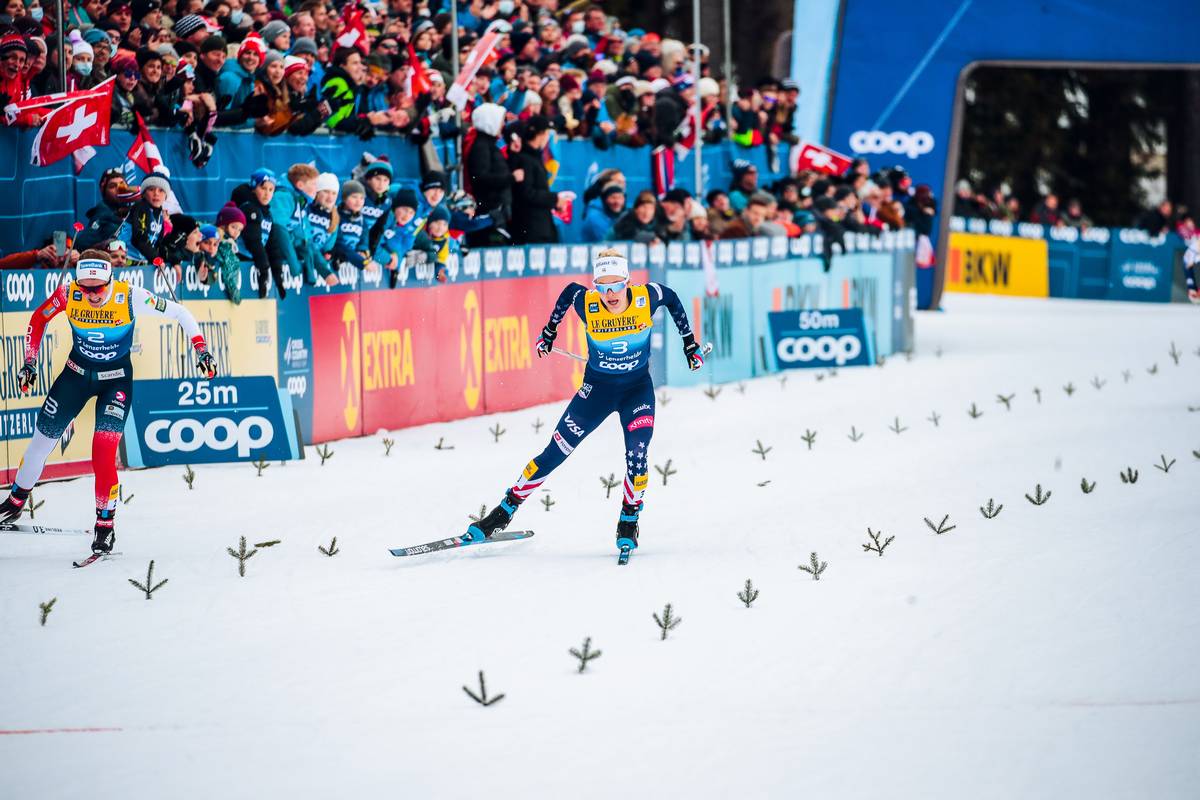
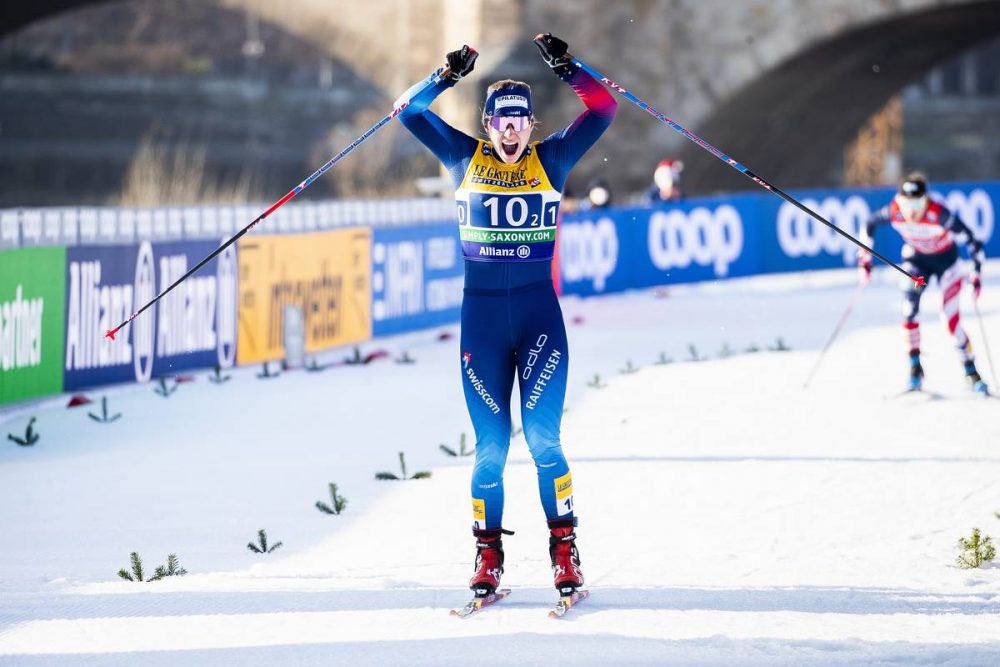
Coming into the homestretch, Dahlqvist coasted across the line in first (15:45.81). Meanwhile, Kern was being challenged by Lampic, who had moved in front of Finland on the final bend. A great sprinter on the flats, Kern held off the three-time World Championship medalist, stretching her boot forward at the line for second (+1.11), with Lampic rounding out the podium to put Slovenia in third (+1.21).
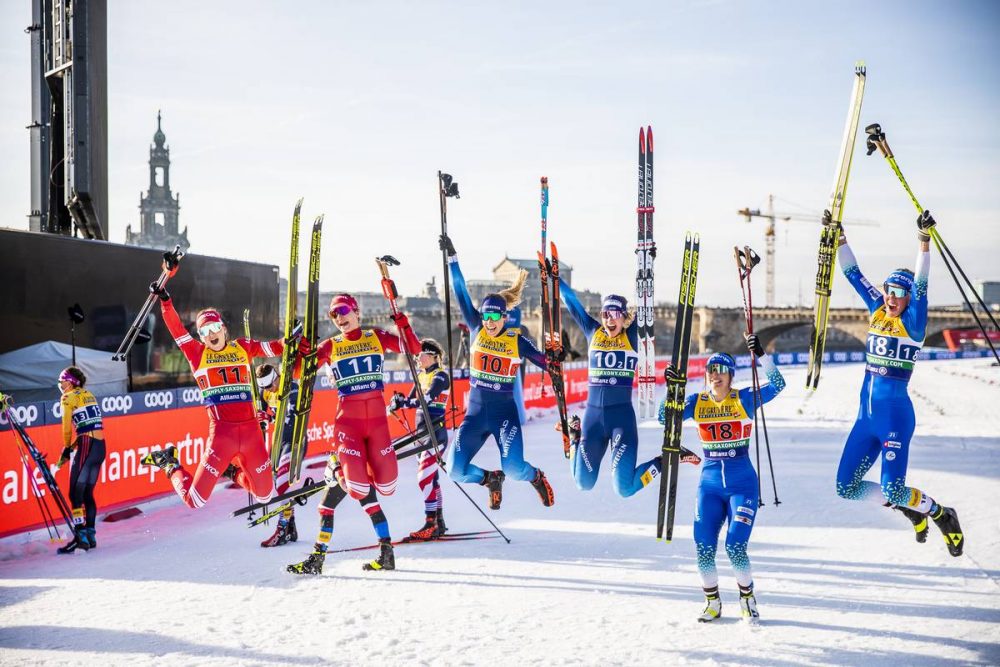
The women’s team sprint podium in Dresden: The Sweden I duo of Jonna Sundling and Maja Dahlqvist took the win ahead of USA’s Jessie Diggins and Julia Kern, with Slovenia’s Eva Urevc and Anamarija Lampic in third. (Photo: NordicFocus)
We’ve seen Kern excel on fast and flat courses before, and asked whether 24-year-old identified this style of racing as a strength.
“I think flat courses have been more of an advantage for me the past, but I feel my fitness is better this year so I actually enjoy the hills too,” Kern explained. “But given my background growing up skiing at the Weston ski track [outside of Boston, MA] on a golf course growing up, skiing on a flat, turny, manmade snow course, I always feel right at home in Dresden.”
On approaching this style of racing, in comparison to typical World Cup courses with more climbing, Kern explained how she modifies her focus.
“I don’t necessarily change my technique on the flatter course, but focus on staying stable and trying to use my legs as much as possible. I played around with a few different technique cues during training this week since the hardest part on the salted, icy fast snow is generating speed without wobbling or rushing the motions.”
Jessie Diggins and Julia Kern rebounded after two crashes to take the second step of the podium in the women’s freestyle team sprint in Dresden. (Photo: NordicFocus)
Diggins, a veteran in the event, spoke highly of her partner’s efforts in Dresden.
“Wow – I’m so proud of Julia. She was confident and smooth,” said Diggins fondly. “It was a bit of a battlefield out there. You really had to fight for position and she did so with such grace and poise and power and speed. I’m really, really proud of her.”
Here’s the full audio clip from Diggins:
A second American contingent of Hailey Swirbul and Hannah Halvorsen skied to 8th (+2.74) in a tight Semifinal A, but did not advance into the final.
Hailey Swirbul (bib 9) comes in for the tag during the semifinal of Dresden’s team sprint. (Photo: NordicFocus)Hannah Halvorsen wrist-bumps Sweden’s Moa Lundgren after the semifinal round of Dresden’s team sprint. (Photo: NordicFocus)
As Period 1 draws to a close, we take a look at the current World Cup standings. Diggins now sits in fifth place in the overall standings, trailing teammate Rosie Brennan by nine points in fourth. Maja Dahlqvist is the overall leader with 464 points. Dahlqvist, who has won every sprint this season, also leads the sprint standings, more than doubling the points of second place Lampic from Slovenia. Diggins in the third-place position in sprinting heading into the Tour de Ski.
After period 1, Maja Dahlqvist leads both the overall and sprint World Cup standings. (Photo: NordicFocus)
This World Cup coverage is made possible through the generous support of Marty and Kathy Hall and the A Hall Mark of Excellence Award. To learn more about A Hall Mark of Excellence Award or to learn how you can support FasterSkier’s coverage please contact info@fasterskier.com.
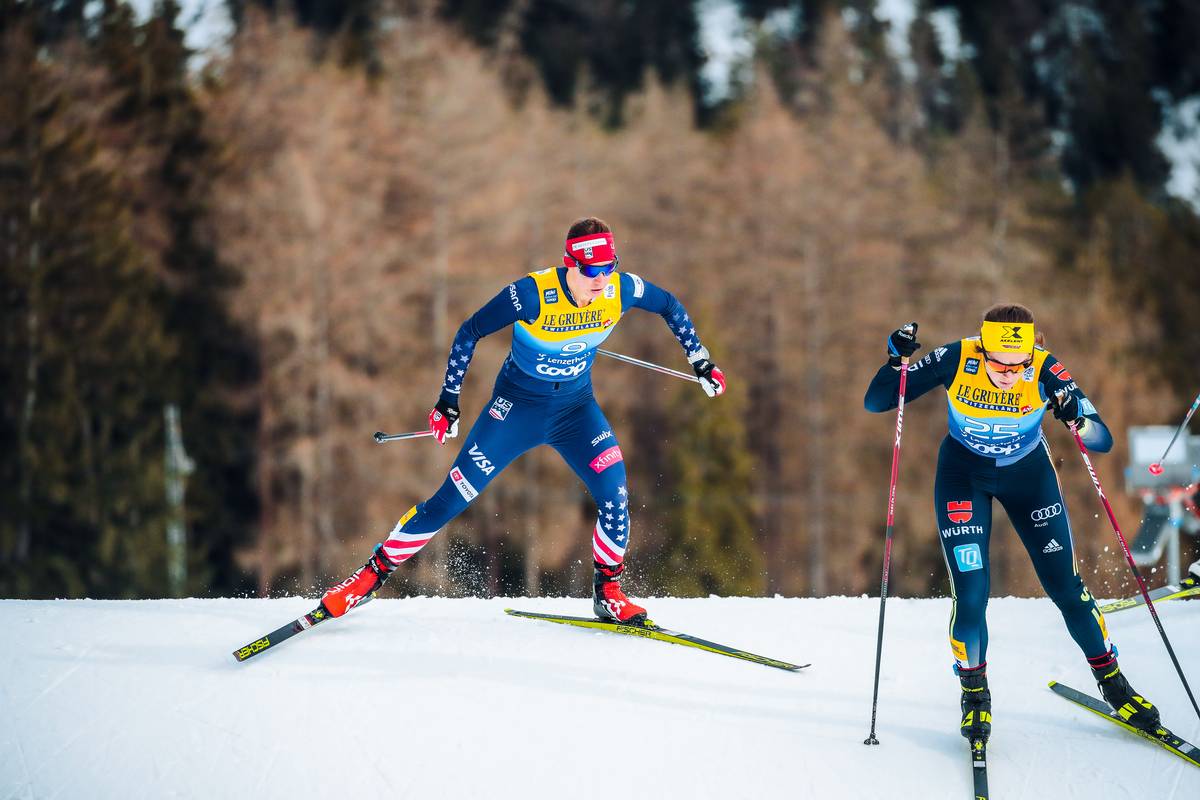
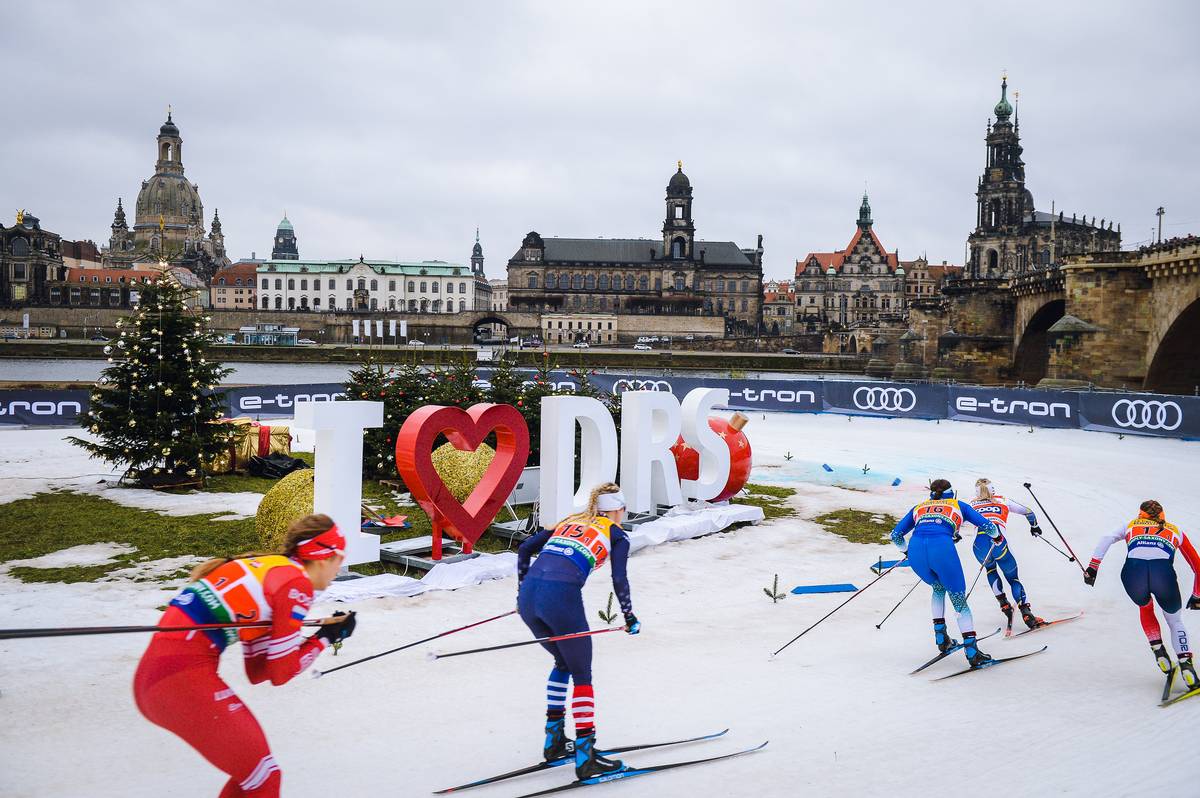
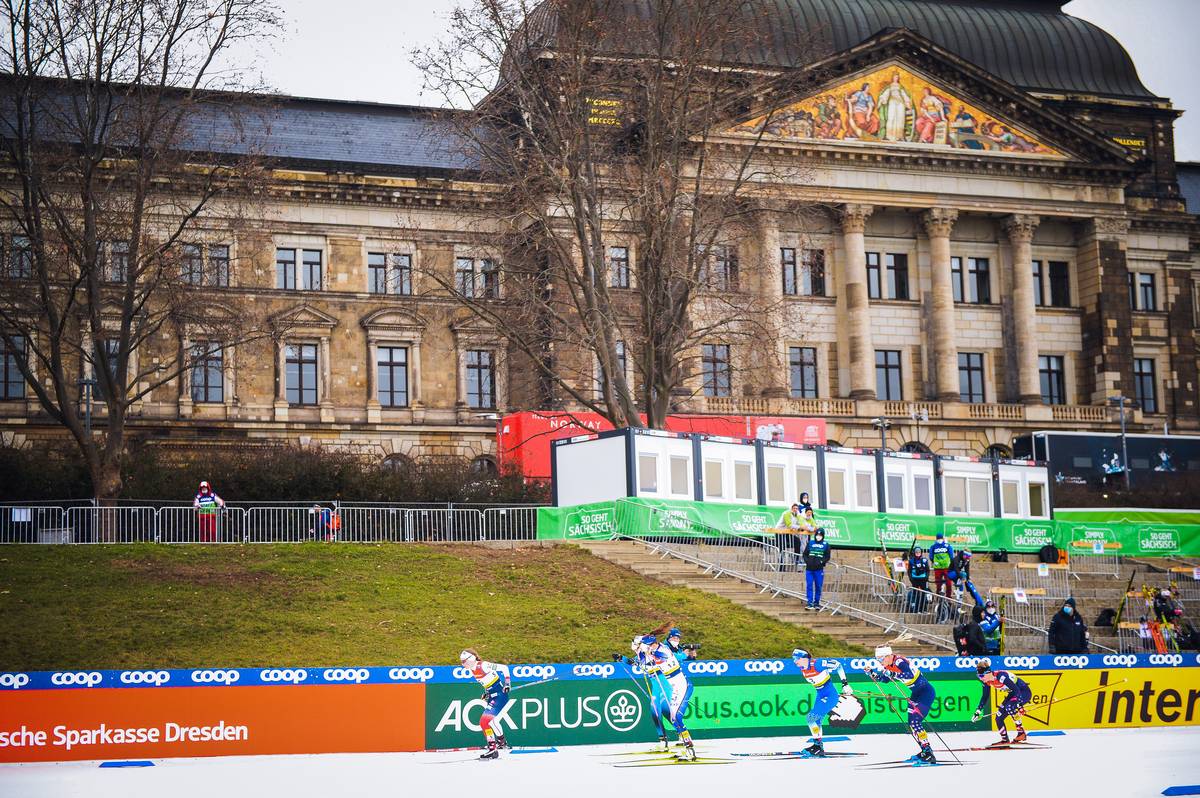
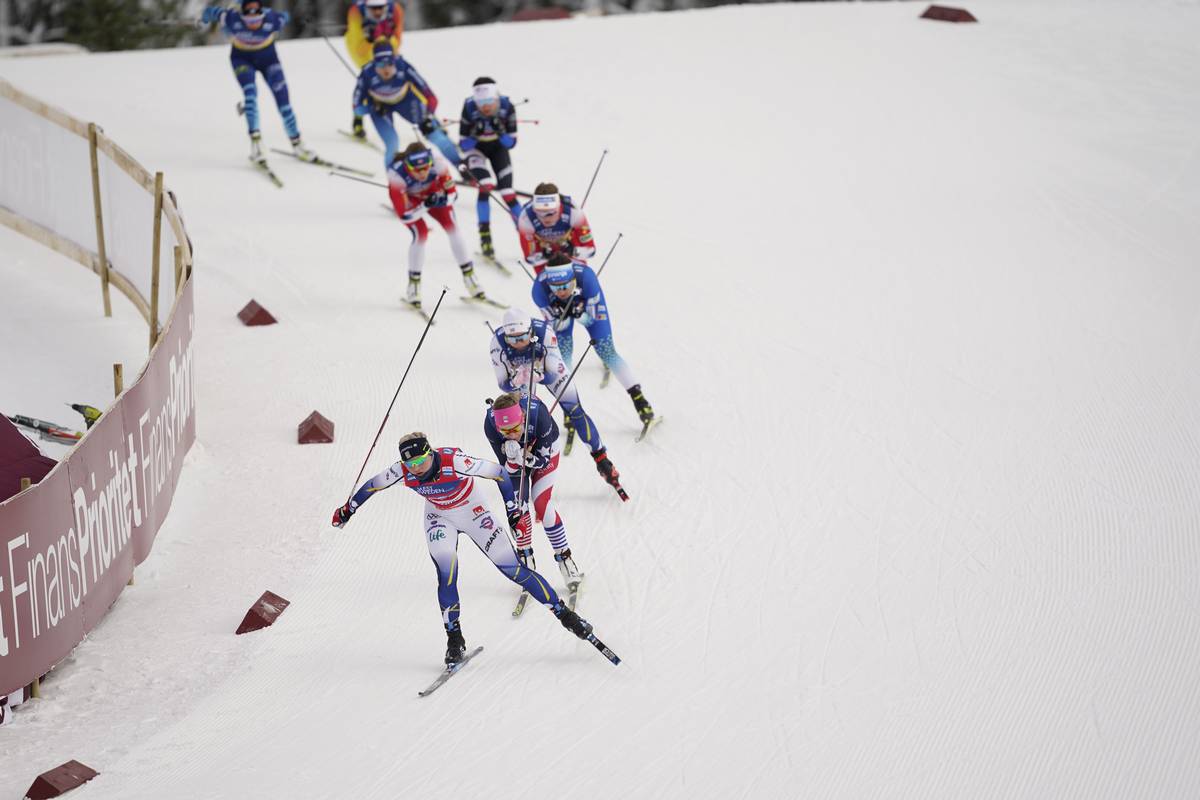
For the fourth year in a row, the city of Dresden, Germany was ready to host an exciting city Freestyle sprint on a 1.3-kilometer course. A race that usually attracts fans from all over the world, for the second year in a row could not allow spectators on the course due to Covid. The last race before the holiday break, the skiers were ready to have fun, and enjoy the challenging and icy course.
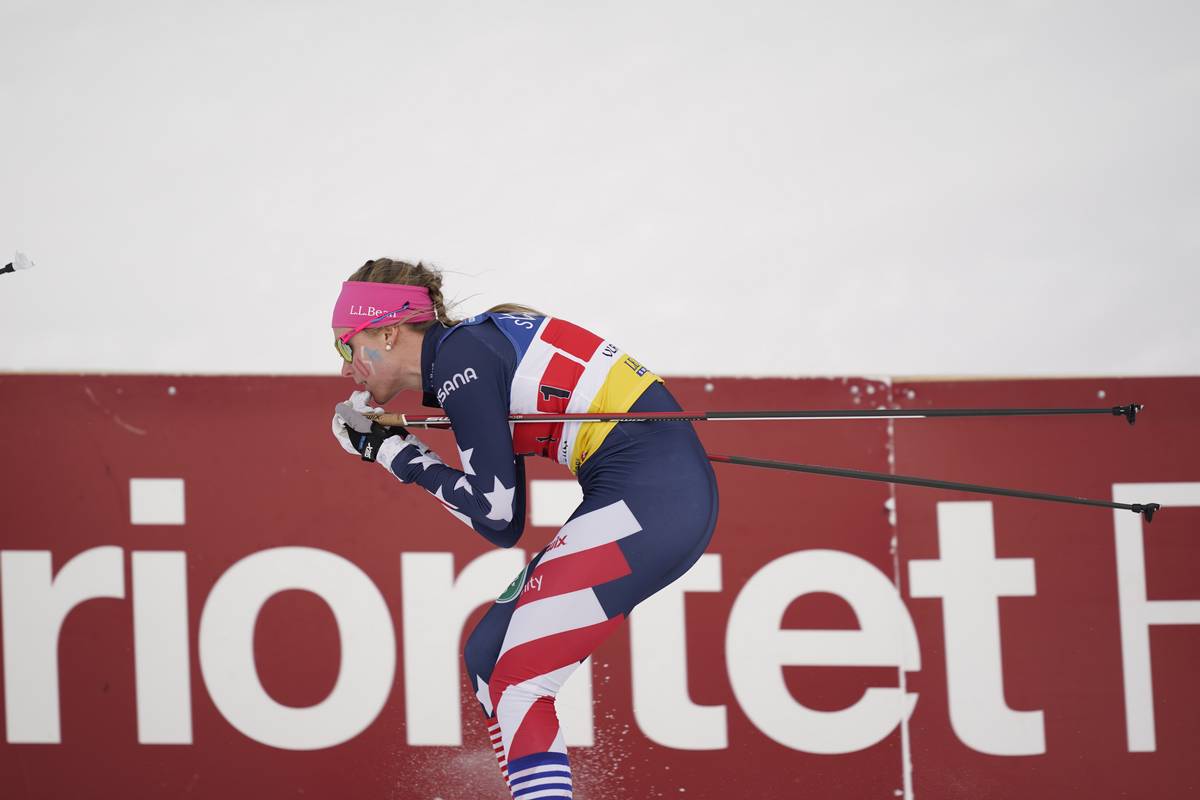
Julia Kern (bib 10) takes the inside around a curve in Dresden. (Photo: NordicFocus)
“It is so amazing, it is one of my favorite races of the year. I love it, it’s fast and furious. it is going to be an exciting day of racing,” Julia Kern told FIS before the heats started. Kern’s family has roots in Germany, and she is often celebrated in Dresden as if she were a native.
On the women’s side, World Cup Sprint Leader, Maja Dahlqvist (SWE) was ready to continue her great start to the season. On a win-streak, has been on the top step of the podium in each of the last four individual sprint races, including the first three of this season. A fifth win would make Dahlqvist the second woman to win five consecutive individual sprint events in the World Cup, after Norwegian legend Marit Bjørgen, who won 11 in a row from December 2003 to January 2005.
Sweden’s Jonna Sundling set the mark in the qualifier, finishing the top spot in a time of 2:29.52. The American women placed four in the top-30 in qualification, with Hailey Swirbul leading the way in 7th(+2.39), followed by Kern in 10th (+3.49), Jessie Diggins in 17th (+4.87), and Hannah Halvorsen in 25th (+6.82).
The top American qualifier in Dresden, Hailey Swirbul races the quarterfinal. (Photo: NordicFocus)
In the first heat of the women’s sprint, Swirbul stayed in contact with the lead pack until the final 100 meters. In the final straightaway, Swirbul pushed to the line to cross fourth in her heat. Anamarija Lampic (SLO) and Kristine Stavås Skistad (NOR), who qualified in 6th and 9th, respectively, were the top two finishers in the heat.
In the second heat, Kern (USA) raced alongside Dahlqvist, who comfortably cruised through the heat to take the win ahead of Italy’s Greta Laurent. Kern solidly maintained her position within contact with the leaders throughout the two-lap course, but finished fifth in the heat, unable to advance.
Hannah Halvorsen advanced from the quarters to the semis in Dresden. (Photo: NordicFocus)
In the third heat, Hannah Halvorsen (USA) faced the top qualifier, Sundling, who won the classic sprint at last year’s World Championships in Oberstdorf, GER. Navigating through chaos, Halvorsen was able to stay on her feet after a crash between Nathalie von Siebenthal (SUI) and Magni Smeedas (NOR) leaving a group of three to fight for the top two spots. Sundling was able to cross the finish line comfortably in first, with a photo finish between Halvorsen and Jasmin Kahara (FIN) behind her. Halvorsen was able to outstretch Kahara in the bootslide, taking the second spot in her heat, and punching her ticket to the semi-final.
Diggins (USA) raced in the final quarter-final heat, staying with the main pack throughout the laps, pushing up from 5th to 3rd as they headed into the final stretch. Diggins finished third in the heat but was able to advance to the semi-finals as a lucky loser. Lena Quintin (FRA) and Moa Lundgren (SWE) were the two automatic qualifiers from this round.
Fast racing on icy tracks in Dresden makes staying upright and balanced an accomplishment of its own. (Photo: NordicFocus)
In the first semi-final, Sundling and Dahlqvist set a steady-pace with the pack staying together throughout both laps. Pulling to the front in the final 500 meters, Dahlqvist and Sundling cruised to the finish, crossing first and second, respectively. On their tails, Lampic and Skistad slid over the line in a photo finish, just 0.35 seconds behind Dahlqvist. Both these women advanced to the final as lucky losers.
The two Americans, Diggins, and Halvorsen both raced in the second semi-final heat, which featured the inevitable twists and turns of sprinting. At the lap, 23-year-old Lea Quintin of France, who had qualified in second, snapped her left pole, leaving her searching for a new one while the pack skied away.
Turning it up in the final stretch, Jessie Diggins and Hannah Halvorsen race the semifinal in Dresden. (Photo: NordicFocus)
Meanwhile, Diggins and Halvorsen patiently waited near the back of the pack until the final straightaway where both made strong moves to contend for a spot in the final. Halvorsen powered from fifth place into a position to fight for second, but ended up just 0.27 seconds behind Eva Urevec of Slovenia who took the second automatic qualifier position. Diggins crossed a ski length behind Halvorsen, each less than a second behind Mathilde Myhrvold (NOR) who won the heat.
The final consisted of two Norwegians, two Swedes, and two Slovenian skiers fighting to claim the Dresden sprint title.
Dahlqvist follows Sundling on course in Dresden. (Photo: NordicFocus)
Racing was tight and tactical, with all six women skiing together through the first loop. Dahlvquist and Sundling led the whole way, controlling the pace at the front. In the final 100m, Dahlvquist started to make her move, creating a small gap between herself and the field, to win in a time of 2:33:36. Sundling crossed just behind (+0.43) with Lampic closing fast for third (+0.64) to round out the top 3. Skistad ended her day in fourth (+1.64), with Myrhvold in fifth (+3.03) and Urevc in sixth (+6.15).
The women’s individual sprint podium in Dresden. Maja Dahlqvist (SWE) wins her fourth straight this season (of four), ahead of teammate Jonna Sundling and Anamarija Lamic (SLO). (Photo: NordicFocus)
The Americans put together an outstanding day overall with all four women finishing inside the World Cup points. After final rounds were decided, Halvorsen ended her day in seventh, a career-best result. Coming off a horrific accident in November, 2019, Halvorsen showed she is back on form in Dresden.
Introspective and progress-oriented, Halvorsen spoke to her day in Dresden, and how it helped her take a step forward with confidence in her ability to race into the semis and beyond.
After strong work in the semifinal, Hannah Halvorsen and Jessie Diggins end their days in 7th and 8th, respectively. (Photo: NordicFocus)
Diggins finished right behind Halvorsen in 8th place in the final rankings, while Swirbul ended her day in 16th and Kern ranked 22nd.
Two Canadian women raced the qualifier but did not advance into the rounds. Maya Macisaac-Jones led the Canadians in 52nd (+11.31), while Dahria Beatty finished 58th (+14.16).
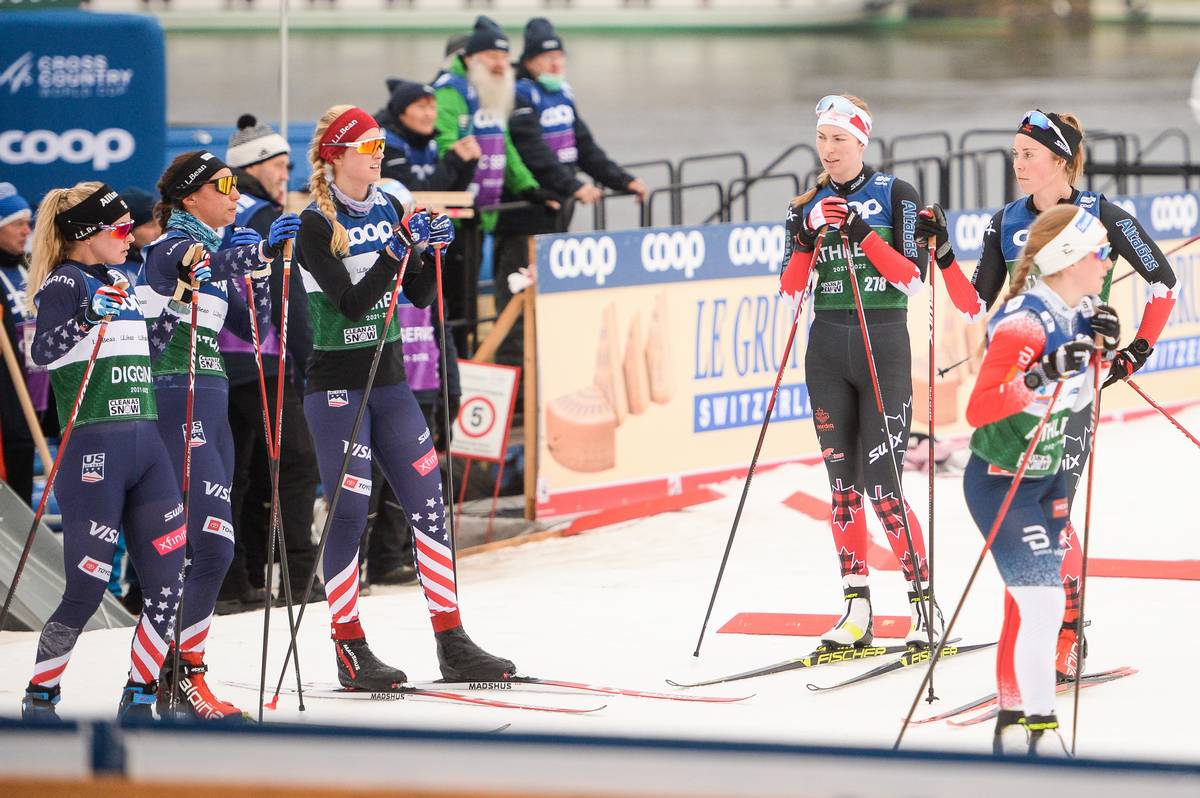
The Americans and Canadians debrief the qualifier in Dresden. (Photo: NordicFocus)
With the win, Dahlvqist has taken over the overall World Cup lead from teammate – and roommate – Frida Karlsson (SWE). Diggins currently sits in 5th, behind teammate Rosie Brennan who ranks 4th. Now with a week off for Christmas, the teams will get some rest as they gear up for the Tour de Ski which starts on December 28th.
When asked about taking over the World Cup Lead from her teammate and best friend, Dahlvqist said in a FIS interview, “The most important thing is that it is still in our room”
Looking good in Period I, Maja Dahlqvist wins five in a row. (Photo: NordicFocus)
This World Cup coverage is made possible through the generous support of Marty and Kathy Hall and the A Hall Mark of Excellence Award. To learn more about A Hall Mark of Excellence Award or to learn how you can support FasterSkier’s coverage please contact info@fasterskier.com.
By: Ben Theyerl
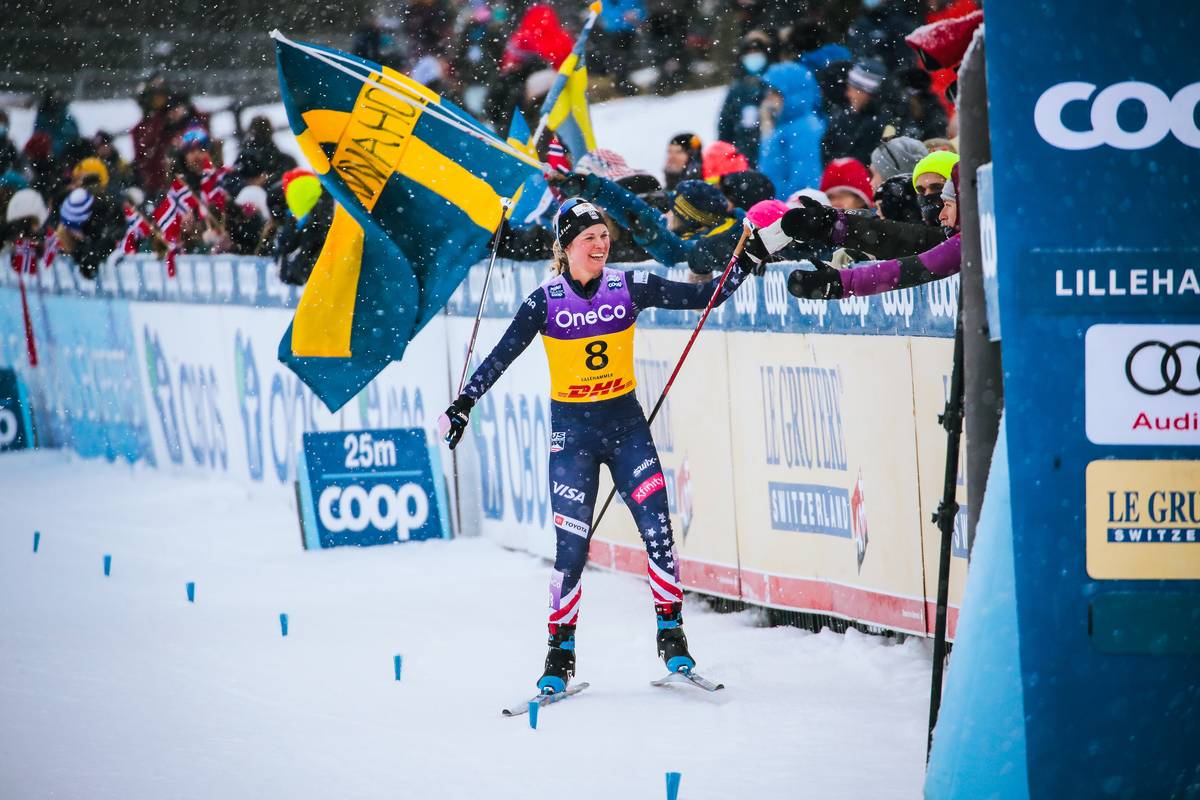
For ski fans whose parents were smart enough to record the 1994 Winter Olympics on VHS tapes, Lillehammer will forever be a World Cup venue carrying the shadow of thousands of fans waving Norwegian flags as Bjørn Dæhlie did his signature “spin move“ on the way to Olympic glory.
Fast-forward to 2021, where the course has been reworked and modernized, the lycra is decidedly less exciting, and the multitude of Norwegian flags flying were interjected by a whole lot of Swedish and American ones.
Today, in the Birkiebeiner stadium – that quintessential home of Norwegian skiing – chances of victory blowing in from Sweden were very high. Going in, they had won the last 5 straight World Cup freestyle sprints, and 14 of the last 20 overall. The Americans too, looked to continue their history of success in the freestyle sprint. Of the 16 wins that the Americans have had in sprint events, 15 of them have come in freestyle, with two of those previous winners, Jessie Diggins and Rosie Brennan, in the field on Friday morning.
In qualifying there were hints that as the field narrowed, it would be Sweden, Norway, and the United States whose skiers would fill the semifinal and final slots. Maja Dahlqvist continued her strong start to the season, winning the qualifier in a time of 3:11.59. She was joined by Tiril Udnes Weng (+1.38) and Nadine Faehndrich (+2.84) in the top 3 spots.
The U.S. team placed three inside the Top 10, with Julia Kern the top qualifier in seventh (+4.90), followed by Jessie Diggins in eighth (+5.08), and Rosie Brennan in tenth (+5.49). Hannah Halvorsen rounded out the qualifiers for the heats in 21st (+8.18).
Hannah Halvorsen (USA) sprints to 21st place in sprint qualifying in Lillehammer. (Photo: NordicFocus)
Three strong national contingents then went to the quarterfinals. Norway with seven skiers, Sweden with five, and the United States with four. There they would face each other on a new 1.6k Sprint course that left little to be deciphered about what would be the deciding feature on the day. On this course, there was an A-climb, and after doing it once, they would loop back around and do it again.
The Americans took a different approach to heat selection this week than they did in Ruka, where they raced late in the quarterfinal heats. Kern and Diggins lined up in the first heat together, joined by Tiril Udnes Weng. Kern led out the pack and raced consistently throughout, leading the first time up the climb with her teammate Diggins in tow.
A scene from the first heat of the quarterfinals, which included Julia Kern (Bib 7) and Jessie Diggins (Bib 8). (Photo: NordicFocus)
For Diggins, the quarterfinal established the pattern that she would look to repeat throughout the day on the tough course. At the foot of the climb in the second loop, Diggins moved through to the outside of the pack and then powered to the front. By the time she was in the stadium, only Weng was left behind her, and that’s how they finished. Kern, meanwhile, sprinted to 3rd place, and after all the quarterfinals were settled, was just a tenth of a second out of a lucky loser slot for the semi-finals (which went to the Finnish skier Jasmi Joensuu). Kern ended her day in 13th overall.
The other lucky loser slot was filled by Rosie Brennan in the second quarter-final. Brennan’s tactical approach to the course mirrored Diggins. In the second heat, Brennan matched up against Maiken Caspersen Falla and Nadine Faehndrich, and would finish just off the two to take third place in the heat, and first in the lucky loser slots.
In the semifinal, Diggins found herself alongside three Norwegians, matching up against T.U. Weng, L.U. Weng, and Caspersen Falla. The heat saw the best execution of her tactical approach to the course all day, as she followed the first move up the climb from Jasmi Joensuu, then shot around the outside to carry speed into the downhill, before moving in a perfect swoop off the apex of the turn to the outside that allowed her to power up the final climb joined by T.U. Weng and Falla. At the finish, Diggins crossed in first again, with T.U. Weng right behind.
The two would be joined by four skiers from the other semi-final. The Swedish pair of Dahlqvist and Ribom executed their tactical approach to the course to a tee, leading out the first part of the course and establishing a sprint that would be devoid of any posturing, then staying with any moves that occurred on the second-time through the climb – which came in this heat from Brennan – before finishing strong in the stadium sprint. Dahlqvist finished first, Ribom second, and Brennan came out the lucky loser for the second time on the day, advancing to the finals.
Rosie Brennan (USA) rounds the corner in front of Anamarija Lampic (SLO) during the final in Lillehammer. (Photo: NordicFocus)
The final field represented the Swedish and American fronts, who fully established themselves as the dominant force in Lillehammer. Two Swedes, two Americans, and just one Norwegian. Plus, Anamarija Lampic of Slovenia too.
The two leading countries’ different approaches to the course were most stark the first time up the climb, where Diggins and Brennan took the outside, and Ribom led the rest of the field on the inside track. At the top of that first ascent, the Americans took the animating action, Diggins shooting around the outside to lead the descent.
Brennan followed, reflecting her initiative to create an ideal position for the final climb: “I made a move early in the final to try to see what I had and unfortunately, was passed on the downhill into the last uphill” she said in an email to multiple news outlets.
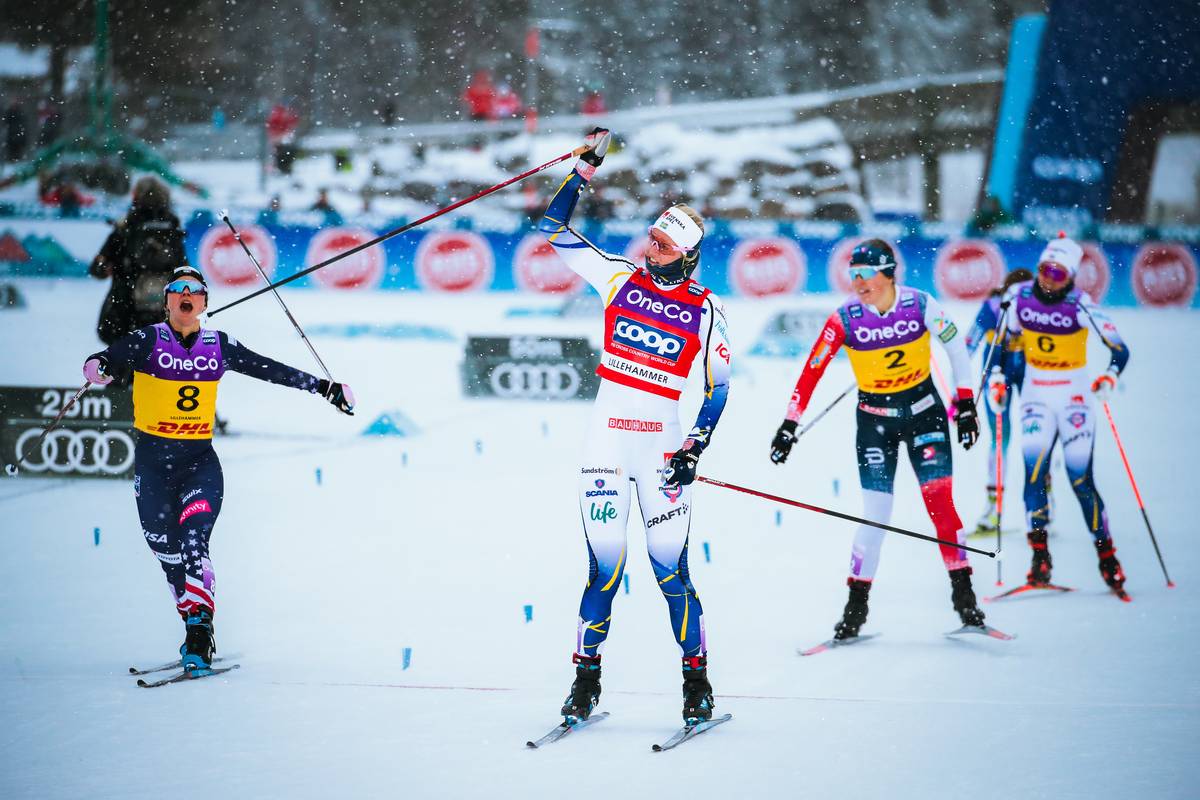
With Brennan back in the pack as they took to the second climb, what had been alluded to throughout the day gained clairvoyance – Dahlqvist and Diggins were the strongest in the field. As they crossed the finish line, what was clear became a result. Dahlqvist won her second sprint of the young World Cup season, as Diggins earned her first podium finish of the year. T.U. Weng rounded out the podium in 3rd, with Ribom finishing 4th and Brennan in 5th on the day.
Maja Dahlqvist (SWE) wins 3rd straight sprint, followed by Jessie Diggins (USA) and Tiril Udnes Weng (NOR). (Photo: NordicFocus)
If Ruka was an exciting first burst of energy for the World Cup season, then Lillehammer today was an indication that long-term trends do hold. Last year’s World Cup champion Jessie Diggins has her first podium of the season. Maja Dahlqvist is now on a three-win sprint streak going back to last season, and the most ascendant sprinter on the women’s circuit. And in the freestyle sprint, it’s the Swedish and American women who continue to rise to the top, with Norway, on their home turf, putting up an ever-valiant defense of their dominance on the world stage.
Oh, and Americans can start dreaming of Jessie Diggins doing her best Bjørn Dæhlie impression in Beijing come February, as her second-place finish today means one-half of the Gold Medal highlight from the last Winter Olympics in 2018 is officially qualified. Diggins is the second American to qualify for this season’s Olympic team, joining Brennan (top-8 in both today’s sprint and last weekend’s 10 k classic) as objective qualifiers.
Here’s Jessie’s post-race comments to FasterSkier:
Jessie Diggins on her first podium of the season after finishing 2nd in Lillehammer. (Photo: NordicFocus)
Stepping back into the quarterfinals, Hannah Halvorsen skied strong in the fourth heat of the quarterfinals, which included Dahlqvist and Lampic. Losing contact toward the finish, Halvorsen finished sixth in her heat, which put her in 28th place in the final standings.
“I felt good today on the course,” Halvorsen wrote in a post-race email. “It was fun to have things come together. It was awesome to see our team put so many people in the top 30 this early in the season! I can’t wait to see what the season will bring for the US with so much potential in the mix!”
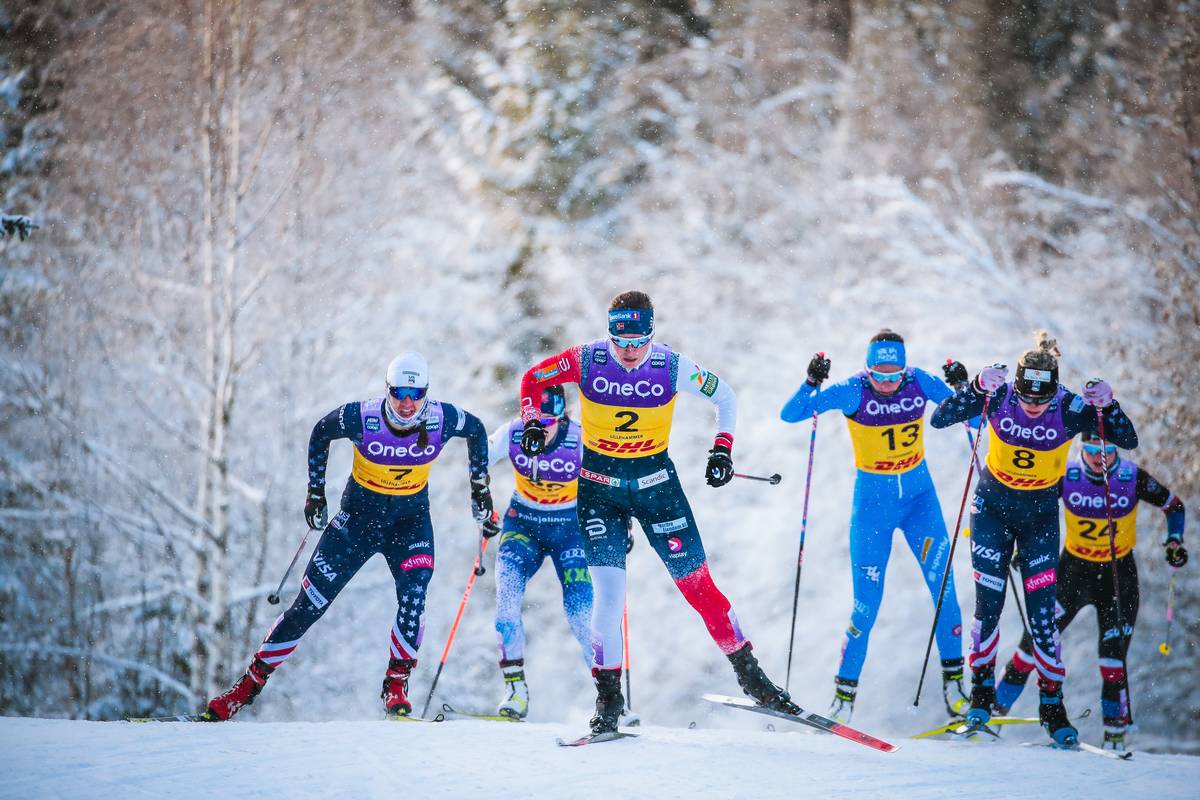
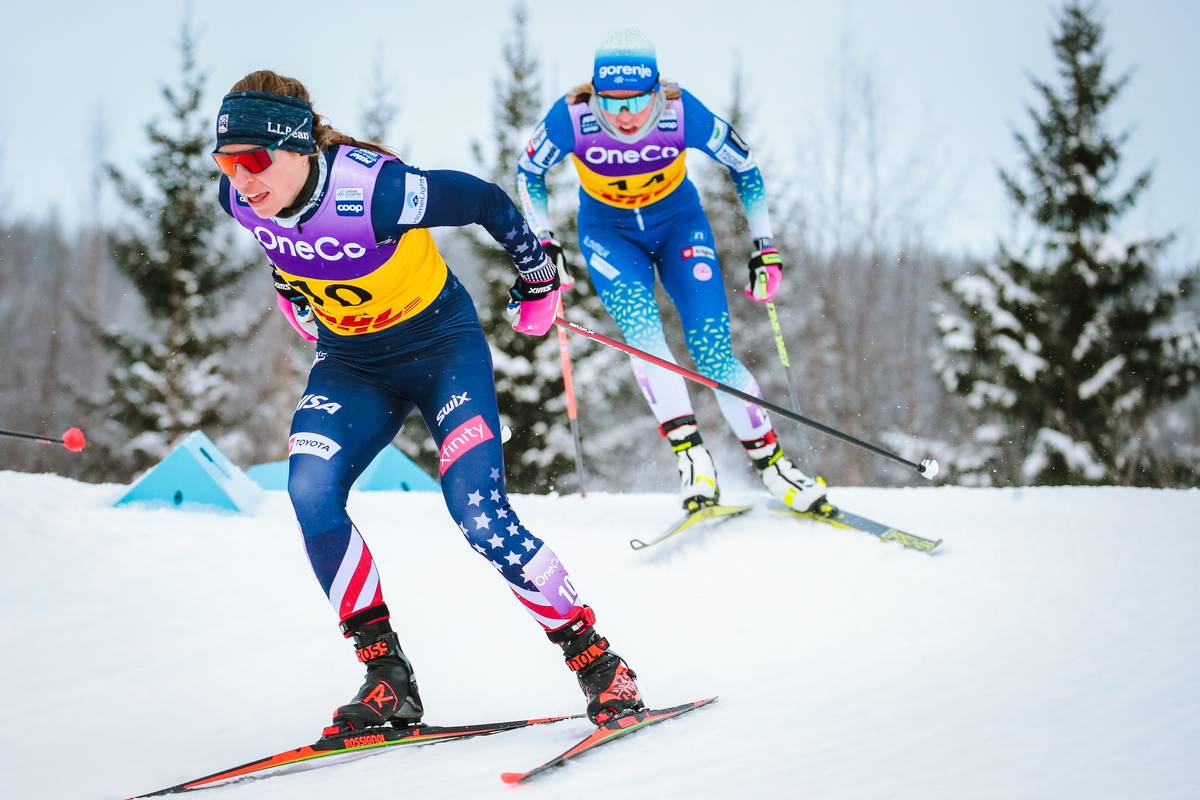
Elsewhere in the results, North American women had a strong showing. Hailey Swirbul (USA) finished 42nd (+12.50), with Cendrine Browne (Canada) in 52nd (+14.63), Dahria Beatty (Canada) in 53rd (+14.73), and Katherine Stewart-Jones (Canada) in 55th (+15.34). Novie McCabe (USA) finished 56th (+15.34), Maya MacIsaac-Jones (Canada) finished 60th (+19.21), Katharine Ogden (USA) finished 61st (+19.89), and Sydney Palmer-Leger (USA) finished 62nd (+19.89).
In a post-race interview, U.S. Ski Team Head Coach Matt Whitcomb answered a variety of questions on the men’s and women’s races in Lillehammer, including comments on the new course and the approach to heat selection this weekend relative to Ruka. He also shared his perspectives on the rounds, and an explanation of why qualification is a skill that athletes must learn, in reference to comments made by Sadie Maubet Bjornsen and Devon Kershaw on the post-Ruka episode of The Devon Kershaw Show. Have a listen.
The scene from an exchange during the World Championship team sprint in Oberstdorf, Germany. (Photo: NordicFocus)
This World Championship coverage is made possible through the generous support of Marty and Kathy Hall and their A Hall Mark of Excellence Award. To learn more about A Hall Mark of Excellence Award or to learn how you can support FasterSkier’s coverage please contact info@fasterskier.com.
And now for something completely different. The skate team sprint.
Three roughly 1-kilometer loops each for 7.2 k total, relatively flat with just two brief upticks per lap, winding back and forth along the valley floor in Oberstdorf, Germany. Would the terrain be enough for one team to pull away from others or would it be an empty-the-tank last two laps, fighting for every centimeter?
From semifinal A, advanced the Swedish team of Maja Dahlqvist and Jonna Sundling, who won their heat by nearly two seconds ahead of the Russian Ski Federation (RSF), represented by Yulia Stupak and Natalia Nepryaeva, Norway, and Finland. Three teams finished within a second in Semifinal B, with Slovenia’s Eva Urevc and Anamarija Lampic edging out Rosie Brennan and Sadie Maubet Bjornsen for the U.S., and the Swiss Women, Laurien van der Graaff and Nadine Fähndrich. Germany and the Czech Republic also advanced from the second wave of semis.
Note that four teams advanced from each heat of the semifinals with the next two fastest times, a change from the usual top two teams plus six fastest times. This change was made based on the weather and conditions on the course.
Rosie Brennan marks Russia’s Yulia Stupak during the World Championship team sprint in Oberstdorf. (Photo: NordicFocus)
So far in this World Championship, Brennan had only raced the classic sprint qualifier and Maubet Bjornsen not at all, perhaps leaving them fresh for this competition. American voices could be heard shouting words of encouragement as the women toiled around the course as a large group through the first four exchanges. At the third exchange at 3.6 k, the US was sitting in fifth, 2.3 seconds behind Sweden in the lead and in contact.
Slowly, Sweden began to turn up the dial, building intensity. However, as the final laps took off, any ground Dahlqvist gained on her competitors was closed as they descended off the first roller and headed into the primary climb of the course. It was here that RSF’s Stupak began to challenge, duking it out with Dahlqvist but unable to pull away.
Sweden’s Dahlqvist leads the way in the World Championship team sprint in Oberstdorf, Germany. (Photo: NordicFocus)
After the final change, it was Sweden and RSF at the front, with a small gap to Norway, the U.S., and Switzerland with Slovenia a few meters back.
In the final lap, the tempo accelerated, poles whipped through the air, and any predictions of what might happen were laid wayside.
As Sundling tried to pull away, Fähndrich quickly closed the gap to the front, skiing at the Swede’s hip. Nepryaeva began to fall off the pace, and was being caught by Maubet Bjornsen and Lampic. Though Sundling and Fähndrich held ground at the front, the podium was within reach for each nation.
Rosie Brennan (USA) tails Eva Urevc (SLO) and Yulia Stupak (RSF) during the World Championship team sprint in Oberstdorf, Germany. (Photo: NordicFocus)
At the top of the intermediate climb and on the outside of the left-hand curve, Maubet Bjornsen ski was caught in a tangle, dropping her to her knee and stalling her momentum at an inopportune moment. The American rebounded quickly but was no longer able to fight for the top spots.
Making their way for the last time up the primary climb, Sweden and Switzerland, alone up-front, created a small gap to Nepryaeva. Meanwhile, Lampic of Slovenia was closing in and looking strong.
The final moments of the World Championship team sprint in Oberstdorf, Germany. (Photo: NordicFocus)
Sundling was first into the final lanes, with Fähndrich a ski length behind, matching but not able to overtake the Swede. The women soared to the finish with Sweden holding its ground for the win, Switzerland finishing just under a second behind for the silver medal.
Sweden’s Jonna Sundling and Maja Dahlqvist take home World Championship gold in the team sprint. (Photo: NordicFocus)
“It was so fun to race today,” Dahlqvist told FIS after the race. “But it was hard too, the conditions were a little warm. It was easier in the qualification.”
Sundling was asked whether she knew how close behind Fähndrich was in the final meters.
“I heard there was someone behind me, but I just had my focus on the finish line and to cross it first.”
Fighting for bronze, Lampic out-sprinted Nepyraeva to bring home a medal for Slovenia (+3.46), leaving RSF in fourth (+3.95).
The women’s podium at the World Championship team sprint in Oberstdorf. Sweden took the win ahead of Switzerland and Slovenia. (Photo: NordicFocus)
The women of Sweden have made their sprint prowess well known this season and were favored to win their third World Championship medal in this event, piggybacking on the 2019 World Championships in Seefeld, Austria. Dahlqvist led the team there too, with Stina Nilsson as the anchor. Both members of today’s Swedish team were coming off of strong results in the opening classic sprint, where Sundling collected a gold medal.
The winners, Sweden’s Maja Dahlqvist and Jonna Sundling, take in their team sprint victory in Oberstdorf. (Photo: NordicFocus)
However, a medal for Switzerland and Slovenia, while not unexpected, is perhaps a more novel result. The duo of Van der Graaff and Fähndrich won the team sprint in Dresden, Germany earlier this season, but this is the historic first Swiss medal in the event and the first women’s medal for Switzerland since 1987, a bronze earned by Evi Kratzer in the 5k classic.
Laurien Van Der Graaf (SUI) watches her teammate, Nadine Fähndrich, bring home a silver medal for their team. (Photo: NordicFocus)Laurien van der Graaff and Nadine Fähndrich take silver for Switzerland. (Photo: NordicFocus)
“We always said we want that medal,” Van der Graaff told the Swiss news outlet SRF. And now it’s there! No idea, the emotions are there. It’s incredible.”
Commenting on when they knew they could celebrate, Fähndrich replied, “I was only really sure when I crossed the line. She had tagged off to me in a great position, with only a little bit of a gap to [positions] one and two. Then I felt that those athletes around me tried a little to play tactical games, but I just thought no, I had to risk it because I felt good. I just knew ‘all out now’!”
Laurien van der Graaff and Nadine Fähndrich celebrate with their tech after earning a World Championship silver medal in the team sprint. (Photo: NordicFocus)
Despite the size of their team and country, the Slovenian team of Urevc and Lampic took 3rd in Dresden and won the most recent World Cup team sprint in Ulricehamn, Sweden. Slovenia also took silver in the 2019 Championships in Seefeld. Taking home her second medal of this Championship, 25-year-old Lampic also leads the overall World Cup sprint standings.
Eva Urevc and Anamarija Lampic of Slovenia bring home a World Championship bronze medal in the team sprint in Oberstdorf, Germany. (Photo: NordicFocus)Sadie Maubet Bjornsen helps the Americans to a 5th place finish at the World Championship team sprint. (Photo: NordicFocus)
Finishing alone, Maubet Bjornsen brought the American women home in fifth (+5.83), matching the team’s result in this event at the 2019 World Championships.
When asked if they were left wanting, Brennan gave an optimistic and grateful response:
“I’m actually really happy with it,” she said. “It’s been, quite literally, a career-long dream to do a team sprint with Sadie. She’s been a best friend and training partner for the entirety of my professional career, so I was just so happy and excited to even get this opportunity. I know that we are capable of more on any given day, but that’s ski racing — you go out there and you give it your all. Some days you win, some you don’t. But it was honestly a pretty special day for me.”
Rosie Brennan marks Russia’s Yulia Stupak during the World Championship team sprint in Oberstdorf. (Photo: NordicFocus)
Perhaps envisioning the hang-up in the last lap, Maubet Bjornsen discussed the degradation of the course between the semifinal and final. She explained that the tracks were fast, firm, and tactical in the final, becoming more dangerous as the transformed snow began to break down and accumulate on the surface. In these deeper conditions, Maubet Bjornsen explained that a skier must be aware of their equipment at all times to stay upright and powerful.
However, reflecting on their performance, she too focused on the positive, commenting on the years and hours the two have spent training and racing together throughout their careers, beginning as juniors.
Rosie Brennan and Sadie Maubet Bjornsen prepare for the World Championship team sprint in Oberstdorf, Germany. (Photo: Tom Horrocks/USST)
“I feel like we skied an awesome race,” Maubet Bjornsen said. “Unfortunately, I got stepped on the first uphill which took me out of the draft and I couldn’t quite find the gear to come back to [the group]. Which is a bummer because my skis were incredible and I feel like if I would have been with those girls over the top of the second climb it could have been a medal day, but like Rosie said, you can never count on that, but I think it’s pretty cool that my number one training buddy and me were in a fight for a medal. That’s pretty neat. If you would have asked us that at 14-years-old, beating on each other, we would have laughed at you. So I think if we brought our 14-year-old selves here, we’d be pretty darn proud.”
A trip down memory lane. (Photo: Instagram @sbjornsen)
Jonna Sundling of Sweden wins the women’s classic sprint at the 2021 Oberstdorf World Championships. (Photo: NordicFocus)
This World Championship coverage is made possible through the generous support of Marty and Kathy Hall and their A Hall Mark of Excellence Award. To learn more about A Hall Mark of Excellence Award or to learn how you can support FasterSkier’s coverage please contact info@fasterskier.com.
After qualifying events on Wednesday, World Championships kicked off in earnest in Oberstdorf, Germany with the Classic Sprint event Thursday morning. Due to unseasonably warm temperatures, the start times were pushed earlier in the day to optimize course conditions and hopefully preserve snow for the remainder of the competition.
The women raced a 1.2 k course, with Johanna Hagström winning the qualifier in a time of 2:39.33. After her qualifier, Hagström said, “it felt really great, I was focused on being calm and do[ing] fast skiing by good technique so I think I got it.”
Johanna Hagström of Sweden during the women’s classic sprint qualifier. (Photo: NordicFocus)
Jumping ahead to close the day out, top honors went to her Swedish teammate, Jonna Sundling, who won the final in a time of 2:36.76.
On a salted course, which despite the sun’s radiation held up, the sustained final climb proved to be an effective make-it or break-it moment in terms of dictating the results narrative. Throughout the quarter-final rounds, gaps formed as the leaders crested the hill well ahead of their competitors. Notably, after two false starts at the beginning of Heat 5, one for technical issues and the second the result of Tatiana Sorina (RSF) jumping the gun, a crash by Johanna Matintalo of Finland forced Sorina well off-course to avoid a tangle though she seemingly was not disqualified for her deviation. Observers of the sport will note that Russian athletes are representing the Russian Ski Federation and not “Russia” during these championships. This is the result of a recent Court of Arbitration for Sport ruling.
Sophie Caldwell Hamilton of the U.S.s racing in qualification. (Photo: NordicFocus)
Two U.S. women qualified for the heats, Jessie Diggins in 23rd and Sophie Hamilton Caldwell in 26th. Hamilton Caldwell raced in quarterfinal number two where she finished 6th, concluding the day in 29th position. Diggins chose heat four and finished 5th for an overall place of 24th.
After her race, Diggins shared with the U.S. Ski Team, “I am really really excited to be here, first of all, I feel like really lucky that we are getting to race at all. I think this is pretty incredible when I think back to how we were looking at this season back in November, the fact that we have made it here to World Champs and they are happening is really really cool. For me personally, I came into this World Champs feeling like I have prepared the very best that I could. I even tried to acclimate to the heat as much as possible because it is super super hot and sunny here.”
Johanna Hagström (SWE), Jessie Diggins (USA), (l-r) racing in the heats. Diggins went on to place 24th overall. (Photo: NordicFocus)Katharina Hennig (GER), Jessie Diggins (USA), (l-r) during the fourth heat in Oberstdorf. (Photo: NordicFocus)
Regarding today’s race Diggins said, “So today, in the qualifier, just went out and I think I definitely was still waking up my body I think from pre-camp so it definitely felt like I need to find that next gear. But was happy to have made it into the heats. And then in my heat, I felt like I did a good job not overheating staying out of the sun when I could. Getting a great warm-up and skis dialed in with Cork. And I think we had very competitive skis. On the last uphill, I definitely was mentally trying to churn the legs and get the gears going and I just felt like my body just ran out of energy. I know I prepared the best I could and now am just focused on hydrating, fueling, getting out of the snow and getting ready for a lot of races up ahead. I am really proud of my effort, I felt like I pushed as hard as I could and I don’t have any regrets.”
Maiken Caspersen Falla (NOR), Maja Dahlqvist (SWE), and Jonna Sundling (SWE), (l-r) finishing a tight first semifinal. (Photo: NordicFocus)
In a stacked first semi-final heat, Sundling of Sweden and Maiken Caspersen Falla of Norway advanced automatically with both lucky losers also coming from this heat, Norway’s Ane Appelkvist Stenseth and Slovenia’s Anamarija Lampic. A false start at the beginning of semi-final number two resulted in a yellow-card for Hagström though she still qualified in second place. Lotta Udnes Weng of Norway had a stumble and fall at the top of the first climb, nearly taking out her sister and fellow competitor, Tiril Udnes Weng (NOR). Tiril Udnes Weng recovered to win the semi-final ahead of Hagström.
For the final, three Norwegians, two Swedes and one Slovenian lined up to complete the first medal event of the 2021 World Championships. For the first climb, the group stayed largely together but as they entered the second and final hill Sundling turned on the burners. Gapping the field, she crested over the top alone, with Falla some paces behind. Entering the final straights, Sundling was unchallenged as she swept across the line, arms raised, to claim her first-ever championship medal.
Sundling soloing in for the win. (Photo: NordicFocus)
With the win, Sundling scores her first career championship gold. (Photo: NordicFocus)
Behind her, a battle for second and third position was playing out as Lampic was quickly closing in on Falla. Both skiers threw their feet forward for a photo-finish lunge that ultimately went to Falla, leaving Lampic with bronze. Hagström finished fourth, Stenseth fifth and Tiril Udnes Weng (NOR) placed sixth.
Throwing toes at the line, Anamarija Lampic (SLO) and Maiken Caspersen Falla (NOR), (l-r). Falla placed second with Lampic third. (Photo: NordicFocus)
Sundling has three individual World Cup victories to her name, all coming from freestyle sprint events. At the Seefeld World Championships in 2019 she finished fourth in the skate sprint. After her victory today Sundling said in an interview with FIS, “I am so so happy, I have dreamt of this and to get this victory, it’s amazing. I’m really really happy.” When asked about the rest of the field she said, “[my competitors] were so strong, it is a fast and tough track and I think everyone did a really good job today and I’m really satisfied to be the first over the finish line of course.”
Falla, the 2019 and 2017 Sprint World Champion, takes home her fifth individual championship medal after placing second. This is Falla’s second international race of the year as she sat out much of the season. For Lampic, this third-place finish marks her first individual World Championship podium. In Seefeld in 2019, Lampic placed second in the team sprint with teammate Katja Visnar.
Rosie Brennan racing in qualification. (Photo: NordicFocus)Julia Kern racing in qualification. (Photo: NordicFocus)Dahria Beatty was the top Canadian placing 38th. (Photo: NordicFocus)
Racing continues Saturday with a 15 k skiathlon for the women. Looking forward, when asked about her feelings going into the skiathlon Diggins said, “sometimes after a camp especially at altitude, you need to do a hard effort to just sort of blow the rust out of the gears. And so I think that was really great, and yeah it is kind of nice because in skiathlon it is a very different energy system than a sprint. I am really excited to again just send it with everything I have. That is all I can promise, is that I am going to cross the line being totally gassed.”
Finals action with Maja Dahlqvist (SWE) leading Sadie Maubet Bjornsen (USA), (l-r). (Photo: NordicFocus)
This World Cup coverage is made possible through the generous support of Marty and Kathy Hall and their A Hall Mark of Excellence Award. To learn more about A Hall Mark of Excellence Award or to learn how you can support FasterSkier’s coverage please contact info@fasterskier.com.
It was a rather cloudy day as the athletes circled Ulricehamn’s sprint loop again and again for Sunday’s freestyle team sprint, urged forward by the cheering of recorded crowds piped through a trailside loudspeakers. After first contesting a semi-final round earlier in the morning, the ten quickest teams moved onto the final, each athlete racing three laps for a total of 7.2 k (each loop being 1.6 k).
Anamarija Lampic (SLO), Mathilde Myhrvold (NOR), Linn Svahn (SWE), (l-r). Svahn’s team placed second overall, while Lampic was part of the winning Slovenian team. (Photo: NordicFocus)
The pace was steady for the first few laps, as the women’s final progressed. Echoing her tactic from the semi-finals, Jessie Diggins skiing for USA I exited exchange three with a high tempo, pushing the pace to stretch out the pack. Diggins, who leads the overall World Cup and placed third in yesterday’s sprint, tagged her teammate, Sadie Maubet Bjornsen for her final lap with a lead of +0.3.
Sadie Maubet Bjornsen (USA) tucks tight into the stadium (Photo: Nordic Focus)
Maubet Bjornsen led out front, shadowed by two Swedes competing for Sweden I and Sweden II. This was Maubet Bjornsen’s first team sprint of the season. In her young 2020-2021 World Cup campaign, she was right in the mix with Sweden’s powerhouse sprinters. Maja Dahlqvist, representing Sweden I with teammate Linn Svahn, took the lead into the final exchange. With the rolling and working course, one that remained tough for athletes to break away on, the sharp end group of skiers tagged off in a dense pack.
Jessie Diggins (USA), Anamarija Lampic (SLO), Linn Svahn (SWE), (l-r) heading out for a final lap. (Photo: Nordic Focus)
All out for the final lap, a group of eight athletes mostly stayed together. The podium was to be decided in the final few hundred meters. Navigating the corners as they descended into the stadium for the final time, Diggins was boxed out on the outside. With powerful no-pole skating, four athletes entered the finish straight in an all-out battle for the top position. Out lunging the others, Anamarija Lampic took the win for Slovenia. Svahn took second for team Sweden I and Nadine Faehndrich of Switzerland just nicked a boot in ahead of Diggins (USA) to claim third in a photo finish.
“I had a lot of fun being Sadie’s team sprint buddy today! This was a really hard course because it played to none of my strengths; it was windy, no big climbs, and pretty much impossible to drop people or even tire them out because the draft was so big,” Diggins wrote in an email. “So I played the cards I had and tried to push the pace, then tucked in to prepare for a sprint finish but ended up too boxed in. However, I was proud of how we skied a good hard race and left nothing on the table, and it was great practice for team sprints in the future! I was really stoked watching Sadie ski – with grace, power and confidence, and it inspired me to work my very hardest for her! ”
Diggins, along with the U.S. Ski Team will be in Davos, Switzerland preparing for World Championships which begin February 24.
Maubet Bjornsen expressed that World Cup sprints were something she’s reacquainting herself with.
“It was a wild and close team sprint out there today! After feeling a little shy getting back to the full contact world cup sprint racing yesterday, I was feeling extra lucky to have six more chances to ski that course smarter today.
“The semi finals were all about playing it smart, being in the right position, but saving energy for when it mattered most. We tried to learn as much as we could for the finals. That meant leading some laps, attempting some attacks, and sitting behind on some laps. We did a solid job of taking notes for the final. With such a strong head wind, it was a tough position to lead from the front. My mission was to stay in the front and out of trouble, and then attack on leg 3. On such a drafty, tactical course- Jessie and I had to get creative with our strengths. We would have loved to attempt to stretch people from the gun, but the wind was not in our favor.
“After finishing fourth by a photo finish, we both of course left wanting a bit more, but also felt like we did the best we could with our strengths. Even if I am 31 years old, I still feel like every race is a learning lesson, so there are no losses.”
Anamarija Lampic (SLO) celebrates her victory as the remaining athletes lunge for the line. (Photo: Nordic Focus)
Lampic is currently leading the World Cup sprint standings with 377 points, 96 points ahead of Faehndrich who is in second. For Lampic’s teammate, Eva Urec, today’s victory represents her first career WorldCup win. “It was amazing, it’s my first victory so it feels amazing” said Urec in a post-race interview with FIS.
Happy Slovenians, Anamarija Lampic and Eva Urevc hug in the finish pen after placing first in Sunday’s team sprint. (Photo: Nordic Focus)
Also competing for the U.S. was team USA II, Sophie Caldwell Hamilton and Julia Kern, who dropped back in the final lap of semi-final B and finished 6th (+14.8), not quick enough to advance.
Sophie Caldwell Hamilton (USA), Coletta Rydzek (GER), (l-r) racing in the team sprint semifinals. (Photo: NordicFocus)
After being briefly obstructed during semi-final A when Victoria Carl, skiing for Germany I, lost a ski and went down, team Canada I (Cendrine Browne and Maya Macisaac-Jones) faded to finish seventh. In semi-final B, Canada II (Katherine Stewart-Jones and Dahria Beatty) finished 8th, +46.6 back from Sweden I (Linn Svahn and Maja Dahlqvist) who won the heat.
Racing continues on the World Cup in Nové Město, Czech Republic on February 20 with a classic sprint.
Rosie Brennan charges up the first and longest climb on the sprint tracks in Falun, Sweden. (Photo: NordicFocus)
This World Cup coverage is made possible through the generous support of Marty and Kathy Hall and their A Hall Mark of Excellence Award. To learn more about A Hall Mark of Excellence Award or to learn how you can support FasterSkier’s coverage please contact info@fasterskier.com.
If you had any question about the strength and depth of the Swedish sprint team, look no further than the qualification list from today’s classic sprint in Falun. Led by Johanna Hagström with a time of 3:14.18, Sweden put six women in the top-10. This number was repeated in the semi-final, leading into a half-Swedish final round on home soil.
The sprint tracks featured the longest climb first, followed by a spiraling curve to send the women up the second climb. A sharp left turn and a roller brought the athletes back toward the stadium and into the final stretch. As the heats unfolded, this looked like a series of uphill sprints out of the track, some furious double poling, and some powerful cornering.
The profile of the sprint tracks in Falun, Sweden. (Photo: https://skidspelen.se/)
Of the Americans in the heats, Jessie Diggins was the top qualifier in 15th, with Rosie Brennan 20th and Sophie Caldwell Hamilton, back from her mid-season Vermont training camp, in 25th.
During the first heat of the quarters, Diggins looked confident in her tactics, sitting in the middle of the pack. Making assertive moves to seize optimal tracks, she swung wide in the final curve to set herself up to capitalize on her double pole as she sprinted her way from fourth to first. Diggins ceded time at the line to Sweden’s Linn Svahn to finish comfortably in second.
Jessie Diggins skis to 8th in the classic sprint in Falun, Sweden. (Photo: NordicFocus)
Racing in the first heat of the semis, Diggins looked to be employing a similar tactic of patiently waiting to pounce in the back half of the loop. Heading up the second climb in the 5th spot, she began to hammer, but by that time, Svahn and Norway’s Tiril Udnes Weng had created a small gap she could not close. Challenging Anna Dyvik of Sweden, Diggins powered over the final roller and worked her double pole, but was unable to make up any ground and finished 4th.
This ended Diggin’s day, putting her in 8th place overall.
“Whew, today was exhausting!” wrote Diggins after the race. “I think all the all-out efforts in the cold finally started to catch up to me, as I was definitely getting pretty tired in my semifinal. But I was really proud of how I skied today – especially in really tricky kicking conditions with steep hills and tracks that were deteriorating, and a ton of herringbone out there! It’s a very encouraging step forward in my classic technical skiing. We also had great skis which is always important!”
Advancing from the second heat of the semis, Slovenia’s Anamarija Lampic took the lead to pull the group through a fast heat. A few meters back, Sweden’s Jonna Sundling edged out Ane Appelkvist Stenseth and fellow Swede Hagström in a tight finish, which allowed all three women to advance to the final.
Poling in sync, the final round of the classic sprint in Falun takes to the tracks. (Photo: NordicFocus)
Let’s regroup. Three Swedes, two Norwegians, and one Slovenian in the final: Svahn, Sundling, Hagström of Sweden; Weng, Stenseth of Norway; and Lampic of Slovenia. The two semifinal leaders, Svahn and Lampic, pushed the pace from the front, up and over the two significant climbs. Sitting in a tuck to conserve energy for a final sprint over the roller and toward the lanes, Svahn was on the tails of Lampic, with Sundling just behind. The Swedes gained ground over the roller, setting up an exciting race down the finish lanes.
Anamarija Lampic and Linn Svahn push the pace during the final round of the classic sprint in Falun, Sweden. (Photo: NordicFocus)
With the line just moments away, Svahn simply attacked the ground with her double pole, pulling ahead for a back-to-back win in Falun.
Just behind, Lampic and Sundling were virtually tied as they crossed the line in a photo finish. Though times were the same to the hundredth of a second, Lampic was declared second and Sundling third.
Linn Svahn takes back-to-back wins in Falun, while Anamarija Lampic and Jonna Sundling slide in for the remaining podium spots. (Photo: NordicFocus)Anamarija Lampic (SLO) edges out Jonna Sundling (SWE) for second place in the classic sprint in Falun, Sweden. (Photo: NordicFocus)
“I’ve been feeling a little bit tired since yesterday’s race, but it’s so fun to compete in Falun. I really enjoy racing on a home course, so it was a good day,” Svahn told FIS at the finish.
Despite her age, this is 21-year-old Svahn’s 7th individual win in a World Cup sprint, split almost equally between skate and classic. It is also her second consecutive classic sprint victory on the Falun tracks, as she stood atop the podium in February 2020, also alongside Sundling third place.
The women’s classic sprint podium in Falun. Linn Svahn nailed her second consecutive win on the course, with Anamarija Lampic (SLO) second, and Jonna Sundling (SWE) third. (Photo: NordicFocus)
Svahn was also asked about the close finish and whether she was sure of her win in the moment.
“I’m never sure of a victory until I pass the finish line first, but it’s cool to see how many strong girls we are competing in sprint races. I think the levels are really high now and it’s tough to win each race, but I’m really glad I managed to do that today, especially in a classic sprint, because it’s my goal this year.”
Looking back, Brennan raced in heat 4 of the quarter finals, where she finished 4th, unable to advance. This left Brennan in 19th overall.
Powering uphill, Rosie Brennan skis her way to 4th in her quarterfinal in Falun, Sweden. (Photo: NordicFocus)
After a conservative start, Caldwell Hamilton skied her way into 2nd position at the top of the intermediate climb. Looking strong as she transitioned from double pole into diagonal stride over the last roller, she held her position around the final curve and into the finish lanes. Swinging around her and quickly closing the gap with her double pole, Sweden’s Hanna Falk overtook the American in the final meters. As the second heat ended up the fastest, Caldwell Hamilton was not able to advance and ended her day in 16th.
“Today was a really solid race for me,” wrote Caldwell Hamilton in a post-race email. “It wasn’t my best, but it was my first time skiing the heats in a classic sprint this year (actually probably in 11 months) and after a qualifier that felt so-so, I was happy with how I skied my quarter. Falun is a very tough course with some big climbs and technical downhills, but I like those features in a classic course.”
Sophie Caldwell Hamilton crests the intermediate climb on the sprint tracks in Falun, Sweden. (Photo: NordicFocus)
“After the first few races of the tour, I took the opportunity to spend a few weeks at home in Vermont during a time where I wouldn’t be missing many sprints,” Caldwell Hamilton continued. “It was such a nice break and I had skiing at the nordic center our neighbors own, Wild Wings, that I could ski to from my house, so I was a pretty happy camper to just spend some time at home doing some solid training and taking a break from the World Cup scene. Now I feel mentally and physically recharged and ready to take on the last couple months of the season! My qualifier today felt a little like I hadn’t done an effort like that in awhile, but I think every race effort will help make that feel a little more normal.”
Jessie Diggins and Canada’s Katherine Stewart-Jones (bib 29) climb side by side during the first heat of the quarterfinals in the classic sprint in Falun, Sweden. (Photo: NordicFocus)
After qualifying in 29th, Canada’s Katherine Stewart-Jones landed in the first heat of the quarterfinals with Diggins. Stewart-Jones held strong with the lead group through the second climb, but fell off the pace to finish last in the heat, just behind Norway’s Anna Svendsen. Stewart-Jones was 30th in the final results.
Outside the rounds, Julia Kern qualified in 35th (+12.95), Hannah Halvorsen 56th (+22.59), and Alayna Sonnesyn 65th (+30.2).
Maya Macisaac-Jones (CAN) races to 54th in the qualifier of the Falun, Sweden classic sprint. (Photo: NordicFocus)
Racing for Canada, Dahria Beatty qualified 48th (+17.29), Maya Macisaac-Jones 54th (+21.77), and Laura Leclair 58th (+24.77).
Sweden’s Linn Svahn winning the first stage of the 2021 TdS in Val Müstair, Switzerland. (Photo: NordicFocus)
This World Cup coverage is made possible through the generous support of Marty and Kathy Hall and their A Hall Mark of Excellence Award. To learn more about A Hall Mark of Excellence Award or to learn how you can support FasterSkier’s coverage please contact info@fasterskier.com.
Out with 2020, in with 2021. Here in the world of multicolored lycra and skinny skis, we are kicking off the new year with the opening of the Tour de Ski on the sprint track of Val Müstair, Switzerland. As snow fell lightly but steadily, the usually remarkable mountain backdrop was veiled, narrowing our focus to the athletes as they embark on the grueling eight stages over ten days that is the TdS.
The two-lap 1.4-kilometer sprint course in the alpen valley featured two punchy climbs per lap leading down into fast and tight S-turns. Small rollers after these turns kept the skiers on their toes as they charged around the course.
Though the Norwegian athletes remain absent from the World Cup and TdS, the Swedish women are back in full force. They made their sprint prowess known in the qualifier, with 26-year-old Maja Dahlqvist setting the fastest time by nearly three seconds in 3:30.86. Seven members of their squad qualified for the heats, with an additional three in the top 10: Linn Svahn in 2nd, Moa Lundgren 4th, and Frida Karlsson in 8th. Though Karlsson is normally known for her distance racing (in particular besting Norway’s dominant Theresa Johaug at last year’s Holmenkollen 30 k), her possession of the green U23 Overall World Cup leader bib evidenced that she was not to be dismissed as a contender for the stage.
Wearing the yellow Overall World Cup leader bib, Rosie Brennan was the top American qualifier in 5th (+4.38), followed by Hailey Swirbul in 13th (+8.65), Jessie Diggins in 14th (+8.96), Sophie Caldwell Hamilton in 16th (+9.77), and Julia Kern in 25th (+12.61).
Brennan raced in a stacked first heat of the quarterfinals, racing against two of the top Swedes, Dahlqvist and Lundgren, in addition to Russia’s Natalia Nepyaeva, teammate Kern, and Switzerland’s Laurien van der Graaff. Brennan stayed near the front and in position to advance from the get-go, but couldn’t break from the lead group of four. She finished in a three-way photo finish with Nepyraeva and Lundgren, taking third but snagging a lucky loser spot allowing the threesome to all advance into the semis.
Jessie Diggins finding her form in Val Müstair, Switzerland where she placed second overall in the TdS stage 1 sprint. (Photo: NordicFocus)
Also advancing from the quarters from the fifth heat, Diggins held a position near the front throughout her heat, showing with her lightning-fast tempo that she intended to advance. She pushed Karlsson and Italy’s Greta Laurent break from the remainder of the group. In the second lap, Diggins had the fastest V1 cadence on the climbs and stayed smooth in the descents, priming herself for good positioning in the final sprint to win the quarter.
Ending their day after the quarters, Caldwell Hamilton marked Swedes Svahn and Emma Ribom. In her usual calm, cool, collected manner, she skied smoothly through the S-turn and tucked in comfortably on Ribom’s tails. Despite great position coming into the final lanes, Caldwell Hamilton could not quite overtake Ribom and finished centimeters behind for third in the heat. Swirbul stayed close to the leaders but was unable to fight for the top two and ultimately ended the heat in third also. Neither heat was fast enough to obtain a lucky loser spot.
Sophie Caldwell (bib 16) qualified in 16th and placed 16th overall in Friday’s skate sprint. (Photo: NordicFocus)Hailey Swirbul, here in bib 13 during stage 1 of the 2021 Tour de Ski, placed 15th overall. (Photo: NordicFocus)
On to the semifinals. Racing on home soil in the tight first heat, Nadine Fähndrich (SUI) edged out her opponents for the win in a three-way photo finish with Slovenia’s Anamarija Lampic and Sweden’s Dahlqvist. Considering Lampic and Fähndrich both finished in the top four of the last two freestyle sprints in Davos and Dresden, this result serves as a testament to the depth of the sprint field in those venues despite the lack of Swedes, Finns, and Norwegians.
Brennan and Diggins took off in the second heat, marking Swedes Svahn and Karlsson who held the front in the first lap. In the second lap, Brennan upped the tempo on the climbs, while Diggins pushed over the top and worked the downhill, free skating out of the rollers and putting herself into position to charge down the lanes ahead of Karlsson to hold onto the second position and a secure advance to the final.
Frida Karlsson (SWE), Jessie Diggins (USA), Greta Laurent (ITA), (l-r) during stage 1 of the 2021 TdS. (Photo: NordicFocus)
Fighting for millimeters, Karlsson and Brennan were just behind in third and fourth. Both squeaked through as lucky losers, but only just as Brennan’s time was a mere 0.1 seconds faster than the next fastest time.
The pace stayed hot and the pack stayed tight in the first lap of the final. Diggins and Brennan stayed in the mix near the middle of the pack and in contention for the podium.
As the racers rounded the bend into the second lap, Svahn began firing on all cylinders, taking off at the front with Lampic and Fähndrich marking her from a couple ski lengths back. Just when the top-3 positions seemed locked up, Lampic and Fähndrich brushed skis in the downhill S-turn causing Fähndrich to crash, losing sight of the podium. Svahn continued to hammer, flying down the final stretch to take the win with Lampic nearly a second behind her.
Seizing the opportunity, Diggins nimbly dodged around the downed Fähndrich, hopping over her pole and hitting the gas to drop a chasing Karlsson and snag third.
Linn Svahn during qualification in Val Müstair, Switzerland. (Photo: NordicFocus)
“I didn’t know how I’d feel in high altitude,” Svahn told FIS after the race. (Val Müstair sits above 4000 ft.) “I tried to take the first lap to get into my own zone and technique, then I tried to push all I had in the last uphill since the other girls were going really strong beside me.”
FIS also asked about Svahn’s goals for the tour ahead.
“I try to focus on each race, and now I’ll just focus on getting my legs working again after these tracks,” Svahn said with a tired laugh.
After a lengthy review, during which Diggins demonstrated the importance of staying on top of nutrition during the arduous tour by refueling with a bowl of pasta on the sidelines, Lampic was deemed to have interfered and was disqualified. This moved Diggins into the second position on the podium, with Karlsson stepping into third.
“Today was a fun way to start 2021,” wrote Diggins in a post-race email to FasterSkier. “But I think it’s important for me to say that I’m equally as proud of my all-out effort and our team today as I am when I’m not on the podium! It was just another day of giving it my absolute best effort, but the patience and trust in the training plan that Cork and I set down together has been paying off and my race form is coming into sharper focus now.”
Jessie Diggins finishing second overall on Friday’s stage 1 sprint. (Photo: NordicFocus)
So far this season, Diggins had a near miss at the podium with a 4th place at the individual sprint in Dresden and was unable to advance from the quarterfinals in Davos after getting boxed out on a curve just before the final straightaway. Today marks her first podium of the season in sprint or distance.
“The final was exciting, for sure,” she wrote. “I fell behind a bit on the steep climb, and was working my way down the downhill sections with as much speed as I could when I saw Nadine go down and slide around the corner in front of me. I didn’t want to hit her (or break her equipment, or my own) so I jumped over her pole while rounding the corner! In sprinting you can get lucky or be the recipient of incredibly bad luck, and today the luck definitely came my way (and I’m grateful for it).
“It was so exciting to have Team USA be 1/3 of the women’s final,” concluded Diggins. “And for myself, it was exciting to be out there having fun, not putting pressure on myself but still skiing with confidence and enjoying the banked turns and rollers all at the same time.”
Rosie Brennan (l) and Jessie Diggins in Val Müstair, Switzerland after the first stage of the TdS. (Photo: NordicFocus)
“It was a surreal day to be starting the Tour de Ski with the yellow bib,” Brennan wrote in a post-race email to multiple news outlets. “My one goal was to fight with what I had and I felt I did that well so I am proud of my effort out there today. I still have to remind myself just how far my sprinting has come and not change my expectations so quickly. This was only my second final ever and I am just so excited by the gains I’ve made.
“This might be the hardest sprint course I have ever raced,” Brennan continued. “It’s long, at altitude, and had some slow snow out there today. With that in mind, I tried to keep things under control, but also use my strengths. I had a near miss in the quarterfinal and was really happy about my quick acceleration in the finish after getting stopped up. I worked hard in the semi to keep the pace high to ensure our heat would have lucky losers which I then benefited from. However, I was pretty beat by the time we got to the final. I tried to open up on the second lap, but there wasn’t much there. I stayed out of trouble and for that was rewarded another two places. That’s a sprint race for you…That was a tough start to the Tour so the focus will now be on recovery to get ready for tomorrow and all the races to come. It’s also very cool to note that we had our 4th different girl on the podium in just 4 weeks of racing. Our team is really working hard to get through this tough season together and support one another as we navigate the world.”
Outside the top 30, Katharine Ogden finished 49th in the qualifier (+20.07), followed by Caitlin Patterson in 57th (+22.25).
Jessie Diggins leads the pack during the team sprint in Dresden, Germany. (Photo: NordicFocus)
This World Cup coverage is made possible through the generous support of Marty and Kathy Hall and their A Hall Mark of Excellence Award. To learn more about A Hall Mark of Excellence Award or to learn how you can support FasterSkier’s coverage please contact info@fasterskier.com.
Another lovely spring-like day in Dresden, Germany with vibrant green grass contrasting the ribbon of man-made snow along the Elbe River bank. On course in the women’s team sprint final, a ten-team affair became a relative runaway as it concluded.
For the uninitiated and new to the team sprint concept, two-athletes form a team, and they tag off to one another six times each. In other words, each athlete races a .65 k lap (one time around the Dresden course) and tags off to their partner. Each partner races six 0.65 k laps for a total of 7.8 k for the team. It is dizzying. And yes, it can seem like a blur of Lycra and skis and poles. Roller derby meets cross-country ski refinement is one way to describe it.
At the race’s midpoint, the racing blur was led by an upstart team from China, pulling the pack along in their yellow and red highlighted suits. Switzerland I, U.S. I, Slovenia, Russia I, and Germany I were separated by 2.8 seconds. Just enough time back for those in the rear to keep hope alive, and for viewers to see that no real breakaway and podium locks had been determined. We’ll call it semi-scrum in its organization.
Dinigeer Yilamujiang of China leads the women’s pack halfway through the team sprint in Dresden, Germany. (Photo: NordicFocus)
5.2 k into the race, at the eighth exchange, Russia I played their hand as they burned fuel upfront. The race became a four-team affair with Russia I setting the pace, and Switzerland I, Slovenia, and the U.S. racing in the slipstream. This trend continued with the U.S. falling off slightly at 6.5 k, 1.4 seconds back. Not much time, but in a team sprint event, when drafting and maintaining a lock on those in front are key, it can appear to be a mighty gap.
Russia I continued it’s work up front and the pattern was set on the final tag. With 0.7 k to go, the Russians were up 2.3 seconds on the Swiss, 2.5 seconds on Slovenia, and 2.6 seconds on the U.S.
Natalie Nepryaeva of Russia takes charge in the second half during the team sprint in Dresden, Germany. Caldwell Hamilton tucks in just behind. (Photo: NordicFocus)
In that final lap, Fähndrich for the Swiss, reeled in Russia’s Nepryaeva, who at the onset seemed uncatchable, seized control of the front and took the win in 16:38.34 minutes. Nepryaeva crossed 0.32 seconds back to secure second for Russia I. Lampic crossed 1.12 seconds back for Slovenia’s third place. Caldwell Hamilton, slightly off the pace, finished in fourth (+3.01) for U.S. I.
Switzerland’s Nadine Fähndrich celebrates bringing home a team sprint victory with partner Laurien Van Der Graaff. (Photo: NordicFocus)
“I felt very good and saw that Natalia [Nepryaeva] was already a bit tired and I could catch up a lot from behind. So I had a very good feeling, and was hoping and fighting to make it happen today,” said Fähndrich to Swiss broadcaster SRF about her team’s last loop.
Laurien Van Der Graaff and partner Nadine Fähndrich take the win for Switzerland in the team sprint in Dresden, Germany. (Photo: NordicFocus)
Van der Graaff, Fähndrich’s teammate, added, “I knew I had to send off Nadine in a good position. So I fought and suffered on my last leg, and talked to myself the whole time ‘come on, just a little bit more until I can tag off to her’. We already saw yesterday that she’s in great shape, she’s the strongest athlete at the moment. And I knew in the end she’d make it.”
The women’s podium of the team sprint in Dresden Germany. Switzerland’s Laurie Van Der Graaf and Nadine Fähndrich took the win with Russia’s Yulia Stupak and Natalia Nepryaeva in second, and Eva Urevc and Anamarija Lampic of Slovenia in third. (Photo: NordicFocus)
Sophie Caldwell Hamilton marks the leader around the bend during the team sprint in Dresden, Germany. (Photo: NordicFocus)
“We fought hard out there, and I am so proud of all our teams for giving it out best effort!” wrote Diggins in a post-race email. “Personally I struggled a bit with positioning on such a short and tactical loop, but I was proud of how I held my own in city sprinting on a course that challenged me in different ways! I thought we had great skis and it’s nice to feel that we’re working our way into better and better racing form.”
Both Caldwell Hamilton and Diggins were coming off of strong performances on the course in yesterday’s individual sprint event, finishing 2nd and 4th, respectively. Both seemed well matched for the flat and spicy course, with tight corners where the manmade snow crumbles to a dicey sugar.
Jessie Diggins in control over the rollers during the team sprint in Dresden, Germany. (Photo: NordicFocus)
“It was fast and furious out there today, as Dresden always is,” emailed Caldwell Hamilton. “I think Jessie and I both wanted to fight for a podium today and knew we were capable of it, but this race is a wild card and I think overall we skied quite well. For me personally, I always look back at these Dresden team sprints and wish I had skied more aggressively, but with so much carnage out there, you’re riding a fine line between aggressive and risky, so that sweet spot can be tricky to find. In hindsight, we can always find a small thing or two we would have done differently, but it’s still an effort I’m proud of and any time I get to team up with Jessie is an honor. Dresden hosted an exciting weekend as usual and now I’m looking forward to a little Christmas break in Seefeld!”
Jessie Diggins and Sophie Caldwell Hamilton celebrate a 4th place finish in the team sprint in Dresden, Germany. (Photo: NordicFocus)
Hannah Halvorsen and Julia Kern placed eighth in the final, 12.35 seconds off the winning time. The duop advanced to the final after placing fifth in the first semi-final. The top five teams from each semi advance to the finals.
Hannah Halvorsen faces off with Germany’s Laura Gimmler during the team sprint in Dresden, Germany. (Photo: NordicFocus)
A quick look to the overall standings as Period 1 draws to a close: Despite sitting out the city sprints in Dresden, Rosie Brennan is still in charge of the yellow bib with 377 points. Missing this World Cup stop was part of Brennan’s season plan. Russia’s Tatiana Sorina trails by 41 points in second (334 pts), followed by Norway’s Therese Johaug in third (301 pts).
Rosie Brennan was all smiles after her first World Cup victory and podium in Davos, Switzerland. Photo: NordicFocus
This World Cup coverage is made possible through the generous support of Marty and Kathy Hall and their A Hall Mark of Excellence Award. To learn more about A Hall Mark of Excellence Award or to learn how you can support FasterSkier’s coverage please contact info@fasterskier.com.
With a thick, fresh coat of fluffy white snow that fell over the last week, Davos, Switzerland looked regal as ever despite the smaller field and lack of spectators for today’s 1.5-kilometer freestyle sprint. FIS described conditions as hard-packed, elevating what Sophie Caldwell Hamilton, who landed on the podium in Davosthe last two years, called in a pre-race interview with FIS as a “technical and tactical” two lap course. Pumping music and cheering coaches, though perhaps a muted version of the norm, made the stadium feel significantly more full than the no-spectator reality.
With the Scandinavian teams out of the running as they withdrew from the December rounds of the World Cup due to Covid-19 concerns, it would be easy to focus on who did not in Davos. Let’s instead focus on who did.
Rosie Brennan during the skate sprint qualification in Davos, Switzerland. Brennan won the qualifier – a career-best for the American. (Photo: Nordic Focus)
On a roll this season, Rosie Brennan won the qualifier by 1.75 seconds in a time of 2:40.03. Rounding out the Americans in the finals, Caldwell Hamilton took second, Diggins fifth, Julia Kern 10th, and Hailey Swirbul 18th.
Jessie Diggins racing to 5th in the Davos sprint qualifier. (Photo: Nordic Focus)
In the quarterfinals, Caldwell Hamilton faced off with Switzerland’s Nadine Fähndrich in what would be the fastest heat. The pack stayed together in the first lap, but the two peeled off to finish comfortably off the front, Fähndrich in the lead.
The next heats were much closer. Brennan finished second in a pack of four behind Slovenia’s sprint star Anamarija Lampic in heat two, and after taking the lead in the second lap, Kern won the third heat.
Jessie Diggins (left) leads Julia Kern (bib 10) at the front of the group during the quarterfinal of the 1.5 k sprint in Davos, Switzerland. (Photo: NordicFocus)
Dropping into a tuck on the last descent and on Kern’s tails in the fast and furious final turn into the stadium, Diggins was in a tough position. Rather than putting herself in position for the sprint to the finish, she maneuvered to avoid tangling skis with Kern and lost some of her momentum. Despite powering down the straightaway and throwing her boot, she took third in the heat and was not fast enough to earn a lucky loser spot.
Round the bend, Julia Kern in the lead heading into the final straight during the quarterfinal of the 1.5 k skate sprint in Davos, Switzerland. (Photo: NordicFocus)
Swirbul was also eliminated in the quarters after taking fourth in her heat.
Hailey Swirbul climbs amidst the pack during the quarterfinal of the 1.5 k skate sprint in Davos, Switzerland. (Photo: NordicFocus)
In the semis, the three remaining American women lined up together in a stacked first heat with Lampic and Fähndrich. Brennan and Caldwell Hamilton held strong in the middle of the group while the Swiss and the Slovene set the pace. The foursome stayed tight, jockeying for positions in the second lap.
It was anyone’s game in the final straight, but Fähndrich held the others off on home turf to win the heat with Lampic and Brennan in a photo finish for second and third, respectively, behind her and Caldwell half a ski length further back in fourth. Both were able to secure lucky loser positions to advance into the final. Kern was eliminated after finishing 6th in the heat.
To the line, Rosie Brennan (L) leads Switzerland’s Nadine Fähndrich and teammate Sophie Caldwell Hamilton in the final sprint during the semifinal of the rounds in Davos, Switzerland. (Photo: NordicFocus)
Eva Urevc of Slovenia and Natalia Nepryaeva of Russia advanced from the second heat of the semifinals.
Fähndrich and Lampic again took the pace out hot in the final round, but Brennan kept herself in the mix. Challenging Fähndrich, she powered into the lead on the final climb, cresting the hill in front and dropping into a tuck on the downhill. Brennan held her lead out of the final turn and into the straightaway, but Lampic, Fähndrich and Nepryaeva were close on her tails.
Adrenaline pumping and poles lashing, Brennan held her lead by a narrow margin, pumping her fist in the air as she crossed the finish line in 2:37.36, breaking into a wide grin as she gasped for air.
Rosie Brennan celebrates her victory and first World Cup podium after the freestyle sprint in Davos, Switzerland. (Photo: NordicFocus)Rosie Brennan celebrates her victory and first World Cup podium after the freestyle sprint in Davos, Switzerland. (Photo: NordicFocus)
“It’s wild,” Brennan told FIS after the race. “I’ve never considered myself a sprinter, so to find myself on the podium is something I couldn’t even dream of.”
Lampic finished on her tails in second (+0.28), with Nepryaeva and Fähndrich in a photo finish for the final podium spot. They finished third (+0.49) and fourth respectively (+0.53).
The women’s podium at the 1.5 kilometer skate sprint in Davos, Switzerland. (Left to right) Anamarija Lampic (SLO) 2nd, Rosie Brennan (USA) 1st, Natalia Nepryaeva (RUS) 3rd. (Photo: NordicFocus)
After losing contact with the lead group, Caldwell Hamilton finished fifth (+6.83), with Urevc behind in sixth (+15.58).
FasterSkier spoke with Brennan while she awaited a blood draw at antidoping. Still euphoric, Brennan recounted her day and a result that she called “pretty unbelievable” and hadn’t fully set in. In fact, she thought there may have even been a mistake in the timing when she saw her name at the top of the qualifying list. Brennan also discusses training separately with clubs throughout the season, then coming together as a full American squad in Europe.
Post-race interview with Rosie Brennan.
Exhale. Sophie Caldwell in the mix during the heats of the 1.5 k skate sprint in Davos, Switzerland. (Photo: Nordic Focus)
In a post-race interview, Caldwell Hamilton discussed her own strategy to keep herself out of risk of becoming tangled up with other skiers while staying in contention throughout the heats. She also shared how significant today’s results are for the team as a whole, regardless of the presence of the Scandinavian teams.
Post-race interview with Sophie Caldwell Hamilton.
Hannah Halvorsen, qualifying in 38th, in her first World Cup since suffering devastating injuries when she was hit by an automobile in 2019. (Photo: Nordic Focus)
Returning to the World Cup just over a year after being struck by a car and sustaining severe injuries, Hannah Halvorsen placed 38th in today’s qualifier. Halvorsen provided an optimistic comment on how she feels after her first race.
“It was such a thrill to be able to get back on the race course,” wrote Halvorsen in an email. “I was both nervous and excited going into today’s race because I wanted to put down my best race. Everything went really well today so I am quite happy. Thanks to the coaches and wax techs, I had great skis and support. This feels like a great starting point, and I hope to improve off of this as the season continues. It is such an opportunity and honor to be here. The US team performed incredibly well today, and I couldn’t be more proud to be a part of this team.”
Post-race interview with U.S. Head Coach Matt Whitcomb.
Perhaps unsurprisingly, the Norwegian men showed up on form for today’s freestyle sprints in Konnerud, just outside the city of Drammen. As the venue was used for the Norwegian National championship at the end of January, most of the team has already had a dress rehearsal racing on the windy course.
Johannes Høsflot Klæbo of Norway, where he is found most often: winning down the stretch. (Photo: NordicFocus)
It seems that Johannes Høsflot Klæbo, who sat out the national championships, did not need a dress rehearsal. He won the qualifier by a margin of nearly four seconds, continuing easily through the rounds to win the overall. This is Klæbo’s eighth sprint win of the season, matching last year’s record, and his 14th career World Cup freestyle sprint victory, the most of any male athlete.
Racing in the final with Klæbo were four of his teammates: Håvard Solås Taugbøl, Eirik Brandsdal, Sindre Bjørnestad Skar, and Erik Valnes, each of whom also raced in the national championship final on January 31st (and finished in a very similar order). Interrupting the all-Norwegian field was Alexander Bolshunov of Russia.
In the final, Klæbo hovered in the middle of the pack marking his teammates, with Taugbøl in the lead. When Brandsdal took control on the primary climb of the course, Klæbo swung outside of the group to move into second before tucking into the last downhill. As they passed under the arch and headed into the final straightaway, Klæbo engaged his unmatchable top gear, with Taugbøl and Brandsdal chasing.
After crossing in a photo finish, Taugbøl was deemed second (+0.65) — a World Cup career best individual result — with Brandsdal third (+0.69). Skar took fourth (+0.94), followed by Bolshunov in fifth (+1.92) and Valnes a late arriving sixth (+12.79).
Simi Hamilton (bib 24) during his quarterfinal in Konnerud. (Photo: NordicFocus)
Simi Hamilton was the only American sprinter racing in Konnerud. He qualified in 24th and raced in the fourth heat of the quarterfinals, where he finished fifth, ending his day ranked the same in the overall as in his qualifier.
The looping sprint course around the ol’ church in Drammen, Norway will have to wait another year, or at least until sufficient snow: the iconic city sprint was moved to Konnerud due to insuffient snow in Drammen. Winter, please, pretty please, return to places such as Drammen.
Powering home for the Konnerud win: Jonna Sundling of Sweden. (Photo: NordicFocus)
Although deep in Norway, but not so far from Sweden as the planes fly, Sweden took the win and third place in the World Cup’s relocated 1.2 k skate sprint in Konnerud. Jonna Sundling won the final in 2:38.41 — a toe and perhaps the tail of a ski ahead of Switzerland’s Nadine Faehndrich in second (+0.24). It was a photo finish for second through fourth. Linn Svahn, a U23 skier forgoing those championships, placed third (+0.39). Norway’s U23 Kristine Stavaas Skistad was fourth (+0.97), Sweden’s Maja Dahlqvist placed fifth (+5.70), and Anamarija Lampic of Slovenia sixth (+26.04).
Sundling powered down the final sraight outpacing Faehndrich in the final 100 meters. Sundling advanced to the finals as a lucky loser in the semis.
Sadie Bjornsen (bib 4) during her quarterfinal heat in Konnerud. (Photo: NordicFocus)
Sadie Bjornsen of the U.S. was the top American in 16th overall. Bjornsen qualified in fourth, 1.2seconds behind the top qualifier, Katja Visnar of Slovenia. Bjornsen placed fourth in the second quarterfinal and did not advance.
Jessie Diggins was the only other American to qualify.After qualifying in 12th , she placed sixth in the first quarterfinal, to end her day ranked 27th. Also for the U.S., Kaitlynn Miller placed 50th, and Becca Rorabaugh 54th.
Jessie Diggins sprinting in Konnerud. (Photo: NordicFocus)
Of note, Swedish sprinter, Hanna Falk, who suffered a back injust prior to the season, started her first World Cup of the year. She finished in 30th.
Racing continues Saturday with the women’s 30 k classic mass start. The men race a 50 k in Oslo on Sunday.
The women’s podium in Falun, Sweden. Linn Svahn (SWE) took the win ahead of Natalia Nepryaeva (RUS) and Jonna Sundling (SWE). (Photo: NordicFocus)
Not the backdrop one might expect from Scandiavia in mid-winter, rather, green grass, bare ski jumps, and a ribbon of snow were found in Falun, Sweden. However, what was lacking in snow was made up for by a densely packed crowd of cheering fans, erupting as athletes flew by in the women’s classic sprint.
An occurrence that might meet our expectations is that the Swedish women showed up on home turf. Johanna Hagström won the qualifier in 3:15.96, followed by Anna Dyvik. Sweden also took 4th, 5th, 8th, 9th, and 10th. Yes, seven of the top ten qualifiers were from Sweden. Only Sophie Caldwell, Ane Appelkvist Stenseth of Norway, and Anamarija Lampic of Slovenia in 3rd, 6th, and 7th, respectively, were the outliers from other nations.
Sophie Caldwell chases Anna Svendsen (NOR) and Jonna Sundling (SWE) during the quarterfinal of the classic sprint in Falun. (Photo: NordicFocus)
Five of the seven continued on to the semifinals, along with four Norwegians who weren’t going to back down easily. To round out the remaining three nations, Sophie Caldwell advanced to the semis as a lucky loser after a photo finish with Sweden’s Jonna Sundling in the first heat, which was won by Russia’s Natalia Nepraeva. Lampic moved on by taking second in the next heat.
Fast racing in the semi-final of the 2020 classic sprint in Falun, Sweden. (Photo: NordicFocus)
The intensity ramped up in the stacked first heat of the semi: Nepryaeva, Lampic, Hagström, Jonna Sundling (SWE), Maiken Caspersen Falla (NOR), and — perhaps unexpected in a sprint semi — Therese Johaug. Nepryaeva led the charge with Sundling and Hagström. The pack took the troublesome corner fast, but the women kept their composure, with Nepraeva shooting out of the turn with high speed. She held the lead all the way into the stadium as a group of Lampic, Sundling, and Falla duked it out for the remaining spots in the final.
In the final sprint, Lampic and Sundling created a gap to Falla, surging to a photo finish. Lampic took second, Sundling third, and Falla crossed a second behind in fourth. As the pace was hot, all four women moved on.
Sophie Caldwell matches Sweden’s Jonna Sundling stride for stride up the climb in Falun. (Photo: NordicFocus)
For Caldwell, the next round was spicy. With a misstep on a punchy climb, Sweden’s Anna Divyk dropped to her knee, catching Caldwell’s arm and pole with hers and robbing some of the American’s momentum. Climbing halfway, Caldwell was trapped on the inside of a left turn. Skis were stepped on, racers were slipping, but she made it through. Calm and collected, she dropped into a tuck and glided into third as they headed for the final climb.
Attacking the double pole sprint down the straightaway, Caldwell challenged Norway’s Astrid Jacobsen for the second guaranteed spot in the final. Caldwell threw her boot early, with Jacobsen’s foot matching hers at the line for a photo finish. After review, the two could not be differentiated. It was declared a perfect tie, down to the hundredth. Though their times were too slow for a lucky loser, both women advanced, making it a final of seven women.
Captured. A perfect tie between Sophie Caldwell and Astrid Jacobsen during the semifinal of the classic sprint in Falun. (Photo: Screenshot FIS-ski.com)
Six women across, with the second lucky loser, Falla, in the second row behind Svahn. And off they went.
The two Swedes, Svahn and Sundling, led the charge into the first climb, Lampic occupying the outside lane. Around the sweeping turn they went unscathed, Sundling continued to push the pace up the next climb, with Lampic losing grip alongside her. The lead group was four deep in the final climb and into the downhill towards the stadium.
Three across, Svahn, Sundling, and Nepryaeva powered down the final stretch as the crowds leaned in with bated breath. In the final meters, Svahn crept just ahead of the other two, throwing her boot for the win in 3:23.54. At her heel, the boots of Sundling and Nepryaeva slid across in a photo finish. It was deemed that the Russian was 0.02 seconds ahead of the Swede, taking the second spot on the podium. Both women were within a tenth of a second of Svahn.
By a boot, Linn Svahn takes her third World Cup victory as Johnna Sundling crosses just behind. (Photo: NordicFocus)
Linn Svahn takes the win in Falun, Sweden. (Photo: NordicFocus)
“It’s fantastic. I wanted to win so, so much today,” gushed an out of breath Svahn during her interview with FIS. “I pushed so hard on the final, and managed to win. Before the start, I saw Maiken behind me and I thought, ‘What is happening?’ So it was special, but so nice to compete in my hometown and to win. And to get Jonna on the podium as well, we are a strong team.”
A unique statistic, Svahn is the second woman to win three individual World Cup sprints before her 21st birthday, which she celebrates in September.
Lampic took the fourth spot in the final (+0.93), followed by Falla in fifth (+3.70). Jacobsen and Caldwell had fallen off the pace by the halfway mark. They finished sixth (+7.00) and seventh (+8.46), respectively.
After the race, Caldwell discussed her three week training block in Seefeld, Austria, interrupted by the races in Oberstdorf, Germany, where she finished fourth. She also spoke to the tangle with Divyk and how she stayed relaxed in order to ski the downhill well in order to reconnect with the group. She also discussed the evolution of her career and the effect of her plans to head back to Vermont after the FIS Ski Tour, missing the city sprints in Drammen, Norway to focus on the sprints in Quebec and Minneapolis.
Post-race interview with Sophie Caldwell.
Three victories before her 21st birthday, Linn Svahn strikes again in Falun, Sweden. (Photo: NordicFocus)
Three other Americans headed into the heats with Caldwell. Sadie Maubet Bjornsen qualified in 11th. Racing in the 4th heat, Maubet Bjornsen tucked into the middle of the group. As they reached the swooping icy found along the downhill halfway, the women began pumping the brakes to stay upright, and Maubet Bjornsen was nearly slingshot off course into the banner lining the outer edge of the turn. She regained her composure and made it through the remaining turns with more speed. However, she was not able to catch the leaders and finished 4th in the heat, 17th overall.
“I always struggle a bit in these conditions, so I didn’t have a star performance, but felt proud that I fought back even after coming dangerously close to falling on the fast, crazy corner,” Maubet Bjornsen emailed after the race. “At one point I feel like I skied the side of the fence, so I sure hope Bode Miller was watching me try to reinact his famous move!
“Despite a 17th place classic sprint, I am still believing in my body’s ability to feel sharper and shaper going into the Tour de 2020. Sometimes when I have been training at altitude, it takes my muscles a bit to get firing on high speed. The Swedes sure managed to find that speed today, so I will have to kick it into gear quickly to keep up! I look forward to another wild ride tomorrow for the 10k mass start. My goal is to stay on my feet, and find some of my gears that I know are in there!”
Jessie Diggins fights through the quarter final of the classic sprint in Falun, Sweden. (Photo: NordicFocus)
Jessie Diggins was the next American qualifier in 25th. She too finished 4th in her heat, ending the day in 20th. In a post-race call, Matt Whitcomb explained that Diggins was fighting a “tweaked neck”, but with the help of Zuzanna Rogers, the team therapist, it is showing improvement.
Whitcomb provided further insight into Diggins’ day, her likelihood to rebound tomorrow, and how the course and conditions affect the type of athlete that can excel on the tracks of Falun.
Post-race interview with Matt Whitcomb.
Hailey Swirbul qualified just behind Diggins in 28th for her third set of World Cup points. She landed in the top-30 on both days in Davos, Switzerland. Swirbul raced in the first heat with Caldwell, where she finished 5th in the heat and 25th for the day.
Hailey Swirbul charges the hill for the 28th fastest qualifying time in Falun, Sweden. (Photo: NordicFocus)
“I am learning so much with every World Cup race this season,” wrote Swirbul in a post-race email. “I thought my skis and support were great today on the tricky course. It was sweet to race in a heat with Sophie and learn from the best in the world up those climbs! I hope to get another opportunity to mix it up in the heats soon.”
Outside the points, Alayna Sonnesyn qualified in 46th (+23.45), followed by Caitlin Patterson in 47th (+23.50).
For Canada, Maya Macisaac-Jones qualified in 23rd and raced in the fifth heat, which was won by Svahn. She was fifth in the heat, ending her day in 24th.
Canada’s Maya Macisaac-Jones chases Katri Lylynpera (FIN) during the quarterfinal of the classic sprint in Falun. (Photo: NordicFocus)
Also bearing the maple leaf, Dahria Beatty qualified in 37th (+17.03), followed by Cendrine Browne in 43rd (+22.96), and Katherine Weaver in 48th (+23.62).
The speedy women of Oberstdorf. Natalia Nepryaeva (RUS) won the classic sprint ahead of Anamarija Lampic (SLO) and Jessie Diggins. (Photo: NordicFocus)
Onward and upward. Day two in Oberstdorf, Germany featured a 1.5-kilometer classic sprint with three sharp toothlike climbs. Seemingly riding the edge of their capability inside the tracks, athletes pumped their way up each pitch before wrapping around a bend and descending an equal grade back toward the stadium.
Wolf jaw or race course? The Obesrtdorf sprint loop in profile. (Photo: Screenshot FIS Broadcast)
After what Matt Whitcomb called an “off day”, the Americans demonstrated their ability to rebound. To not let the sensations or disappointment from one day percolate into subsequent races. Onto the next.
This was clearly demonstrated in the qualifying round: three, four, nine, eleven. Diggins was the fastest of the crew finishing 2.24 seconds behind top qualifier Natalia Nepyaeva of Russia, who stopped the clock at 3:38:08. Diggins was 0.8 seconds behind Anamarija Lampic of Slovenia, who won both sprint events, skate and classic, during the Tour de Ski, and took second the weekend after the Tour in the freestyle sprint in Dresden. Lampic also popped the second fastest qualifying time of the day.
Sadie Maubet Bjornsen nearly matched Diggins time in fourth (+2.35), followed by Sophie Caldwell in ninth (+5.38), and Rosie Brennan in eleventh (+5.90). The only other country to put three athletes in the top ten was Norway, a testament to the strength of the American women on a day where our expectations meet reality.
Striding it out in Oberstdorf, Caitlin Patterson skis to 61st in the qualifier. (Photo: NordicFocus)
Also starting for the U.S., Caitlin Patterson took 61st (+24.18), and Alayna Sonnesyn finished 66th (+26.7).
In the quarterfinals, Maubet Bjornsen wore the lowest bib number in the first heat, which is curious as this is often the choice of the top two qualifiers (see Diggins comments on heat selection below). Maubet Bjornsen took second in a tight finish with Lotta Udnes Weng and Astrid Uhrenholdt Jacobsen of Norway, moving with Weng into the first wave of semis.
Caldwell won the third heat of the semis in a photo finish with Ane Appelkvist Stenseth of Norway. Brennan was eliminated after finishing fourth in the fourth heat to finish 16th for the day, a top result in the event.
“Sprint is always such a bitter sweet event for me,” Brennan emailed. “While today was the best classic sprint of my career, I still felt that I made some mistakes and didn’t ski as well as I felt. The course here is long and has some good striding which I was really excited about. I know there are probably some sprinters that aren’t excited about the length but I felt the course did a good job of including all kinds of skiing and really rewarding good skiers. I am really happy with my feelings and for sure have a little list of things to work on moving forward.”
Diggins charged full gas through the fifth heat of the quarters for the win, beating out Sweden’s Linn Svahn who advanced alongside her.
Jessie Diggins leads Sweden’s Linn Svahn during the quarterfinal in Oberstdorf. (Photo: NordicFocus)
In the first semi, Caldwell and Maubet Bjornsen took it out with the leaders, matching Nepryaeva’s long powerful bound up the climbs and the speedy out-of-the-track tempo of Anna Svendsen of Norway. Coming into the final downhill, Svendsen, Nepryaeva and Caldwell pulled ahead, creating a small gap to the remaining women. Caldwell held her tuck longer than the other women, collecting herself for a spicy double pole sprint to the finish. Sliding across the line at the heels of Nepryaeva, Caldwell stayed ahead of the Norwegian to take second in the heat. Maubet Bjornsen finished fifth between Nadine Faehndrich of Switzerland and her opponent from the quarters, Weng.
“It was one heck of a thrill out there today on the courses for next year’s World Championships,” wrote Maubet Bjornsen in an email to several outlets. “This is certainly one of the hardest sprint courses I have sprinted on, but I really enjoyed it! My legs felt a lot stronger than last weekend, but still not quite recovered enough to put together the race I was dreaming of today. Finishing 9th is still and achievement, but I know I am capable of more when I have my full strength.
“My tactic today was to race at the front of the group, even if it required a bit more energy, because then I knew I wasn’t going to get stuck behind anything. I always feel most confident skiing that way. In the final climb of the semi’s, I think I paid the price a bit.”
Sadie Maubet Bjornsen matches Astrid Uhrenholdt Jacobsen (NOR) up the climb in Oberstdorf. (Photo: NordicFocus)
Striding hot out of the gate, Diggins also held a position at the front, matching Lampic, who dictated the pace, up the climbs and tucking into her draft on the descents. On the last and longest climb, Diggins was overtaken by Svahn and Heidi Weng of Norway and she was unable to regain her position on the subsequent downhill. Though her tempo was faster than her opponents in the final double pole sprint, she finished fourth. As her time would have won the previous heat, Diggins and Svahn advanced with Lampic and Weng as the lucky losers.
Again taking the reins from the start-beep, Lampic surged to the front of the group and stayed there, though she could not drop the strong group of women in her wake. Up the final climb, Nepyaeva matched Lampic stride for stride, her long powerful pushes keeping her alongside the Slovenian’s green and black suit.
Like a slingshot, Nepryaeva sped around Lampic as they rounded the final curve into the straightaway. The duo duked it out double poling in perfect synchrony, but Lampic recovered no ground on the Russian. Nepraeva stopped the clock at 3:27:08, the fastest split of the day.
Down to the final meters, Natalia Nepraeva (RUS) and Anamarija Lampic (SLO) sprint to the line with two Americans on their heels. (Photo: NordicFocus)
Winning by centimeters, Natalia Nepryaeva (RUS) celebrates her accomplishment. (Photo: NordicFocus)
Racing for the last podium position, Diggins and Caldwell flew into the final straight in neighboring tracks, with Svahn not far behind. Firing on all cylinders, Diggins pulled ahead of Caldwell to take third by just over a second (+2.44). After being left behind by the Americans, Svahn finished fifth (+5.16), followed long after by Stenseth (+30.20). The Norwegian had fallen off the pace midway through the round, ceding her chances to contend with the pack.
Jessie Diggins takes third in Oberstdorf, with Sophie Caldwell just behind. (Photo: NordicFocus)
Two up, one down. Anamarija Lampic (SLO), Natalia Nepyaeva (RUS), and Jessie Diggins celebrate their top results in Oberstdorf. (Photo: NordicFocus)
Due to poor WiFi connection, athletes chose to send comments via email. Reflecting on her performance, Diggins expressed that she “loved” the long sprint course.
“You had time to try out different tactics and that last hill saw some moves, for sure. We had awesome skis today so I was able to use a little bit of a slingshot to get into good position in the finishing lanes, and I just worked to stay smooth and calm in the first half, while looking for openings to get into better position.”
Diggins explained that heat selection is variable, and did not feel today’s variance from a usual bracket was explained by the length of the course. Her choice to race in the fifth quarter and second semi were based simply on her perception of the opportunity to advance.
“I chose the latter heat because it was wide open, and seemed to be a good path forward out of the quarters. But you never know how it’s going to go, and I was happy to secure lucky loser time in the fast semifinal!”
Gasping for air after an effort Diggins can be proud of in Oberstdorf. (Photo: NordicFocus)
After finishing 22nd in the skiathlon, some might question from the comfort of their couches whether Diggins is on the same form that we have seen in previous years. As was discussed with Matt Whitcomb, “success breeds expectation.” We expect to see Diggins at the top of the results sheet day in and day out, and that pressure can creep into an athletes self-expectation as well. When asked how she handles this, Diggins explained that she does not dwell on what is on the paper or posted in the comments.
“That’s a great question about handling expectations and pressure…and my plan for that has always been to set really concrete process-oriented goals, work as hard as I can to meet them, and then regardless of the result on paper I can decide if it was a “good” day for myself or not based on my effort, focus, technical progress and strategy.”
In her post-race remarks, Caldwell offered an insightful perspective that took into account her strengths as a sprint specialist versus an all-arounder like Diggins or Maubet Bjornsen.
“This sprint was definitely one of our longest ones, and for sure the longest one of the year. I think it’s really exciting to have varying sprint courses throughout the year and this is about as far from the Dresden course as you can get. I used to think short and flat suited me best, but now I don’t really know what I like, especially for classic, but I try to be excited for any kind of sprint so I don’t count myself out before it begins. That said, I do think that there are already a lot more distance races than sprints, so when it gets much over 3 minutes, it’s starting to favor distance skiers more, which is fine to do sometimes, it’s just too bad when there are already so few sprints if too many of them start getting really long. But I personally really enjoyed the course and the race today. I don’t think it’s too much different for recovery for me whether the course is 3 mins or 3:30, but I think for the men it is probably harder because if they’re in the second half of the bracket, they have a lot less recovery. I usually just try to move around until I’ve flushed my legs out and then relax for a little bit and then start moving around again before my next heat!
“Today was a really awesome day for our team. I was psyched to make my first classic final in years, and I think only my third ever. I’ve now had three 4th places in the last four races, which is a little bittersweet, but it’s important to remind myself that 4th is still a really strong result, especially in a tough classic sprint. It was great to ski with Sadie in my semi and I know she’s bouncing back from giving her all in the tour, but is getting stronger each day and a good result today is a huge step in the right direction. And Jessie was on fire all day and it was awesome to see her get another classic podium. So really fun to have such a strong day for our women and even though it was a tough day for the guys, I know they will be fighting back in Falun!”
Sophie Caldwell skis to 4th place in Oberstdorf. (Photo: NordicFocus)
Between the city sprints in Dresden and today’s event in Oberstdorf, Caldwell headed to Austria for an altitude camp. She explains the role this plays in balancing training and recharging, and how the sprinters use an altitude stint to build fitness without losing their top end speed.
“Simi and I just took a little break in Seefeld during the distance weekend in Nove Mesto and it’s was really nice both physically and mentally. The schedule this year is very demanding, with almost no weekend off, so we felt it was important to find in a couple times to work in a break, remove ourselves from the World Cup, and take some time for ourselves. I was really tired right after Dresden and didn’t realize it until I allowed myself to take a break, so it was nice to have a few days of true recovery and then I felt I was able to train really well for 9 or 10 days before coming here. Seefeld is at mild altitude, but I think it’s only at 3,700 ft, so as long as I keep my easy skis easy, I don’t feel too many effects of altitude and don’t worry about not being sharp when coming down a little in elevation.”
Maya Macisaac-Jones posted the top qualifying time for Canada in 35th. (Photo: NordicFocus)
Racing for Canada, Maya Macisaac-Jones posted the top qualifying time in 35th (+14.28), followed by Dahria Beatty (+15.79), Katherine Stewart-Jones in 50th (+18.58), and Katherine Weaver 65 (+26.08).