From the FasterSkier archive — posts syndicated from athletes’ and coaches’ own blogs between 2004 and 2012, kept online as published. Current coverage is at fasterskier.com.

Tag: Anastasiya Merkushina

  • Gold for German Women’s Biathlon Relay; U.S. 14th, Canada 16th

    Gold for German Women’s Biathlon Relay; U.S. 14th, Canada 16th

    Germany’s Vanessa Hinz leading the first leg of the women’s relay, followed closely by France’s Anais Chevalier and Norway’s Kaia Woeien Nicolaisen on Friday at IBU World Championships in Hochfilzen, Austria. (Photo: Glen Crawford)

    HOCHFILZEN, Austria — Coming into the women’s 4 x 6-kilometer relay at World Championships, there was certainly one overwhelming favorite: Germany.

    Not only had the German women won every relay in the World Cup season so far, but the German mixed relay team won gold to kick off the Championships. Plus, anchor leg Laura Dahlmeier had two individual gold medals to her name and one silver so far.

    “As a team we tried to put no additional pressure on us, at least not more than we already had,” Maren Hammerschmidt told German broadcaster ARD. “For me, I can say that it was not easy to resist the pressure today. I think that was similar for my colleagues.”

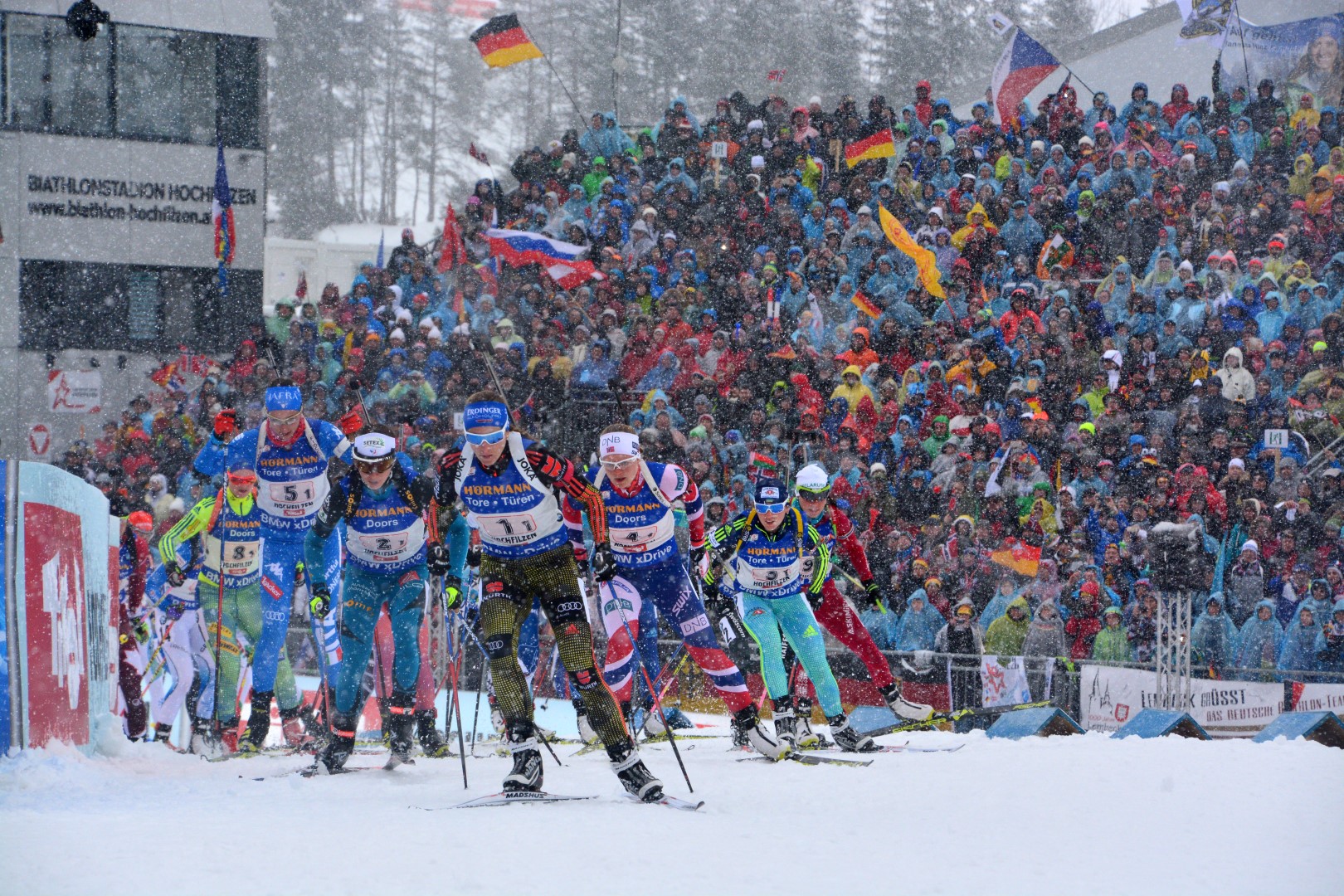
    While the weather in Hochfilzen changed today from the hot, bright sun athletes had adapted to all week – instead, a snowstorm dumped wet flakes onto the course and slowed down the skis — the German team weathered the storm and again came out on top.

    It hadn’t seemed like a given. On the first leg of the relay, it looked like it was going to be a fight.

    Vanessa Hinz led the race out of the start and cleaned prone, just like you would expect from the best team in the world. Then she used two spare rounds in standing, which provided an opening for other teams.

    “In standing the second miss annoyed me greatly,” Hinz told ARD. “I just wanted to do it too fast because I noticed Anais [Chevalier] next to me had already begun shooting, so I got too distracted by that. At least I managed to hit the spares so it was alright.”

    France’s Chevalier used only one spare round, leaving the range in first place. Lisa Vitozzi of Italy also used just one spare, and left 6.3 seconds back. Chevalier, the bronze medalist from the sprint, extended her lead by another 1.2 seconds by the time she tagged off.

    “For sure everybody wants to hand over first, but not everybody could,” Hinz said in a press conference. “With ten seconds back, it was quite okay.”

    Hammerschmidt received the tag in third place, and despite four spare rounds, pulled the Germans into second.

    That was partly because the previous leader, Celia Aymonier of France, struggled, using all three spares to hit her standing targets, and slowly.
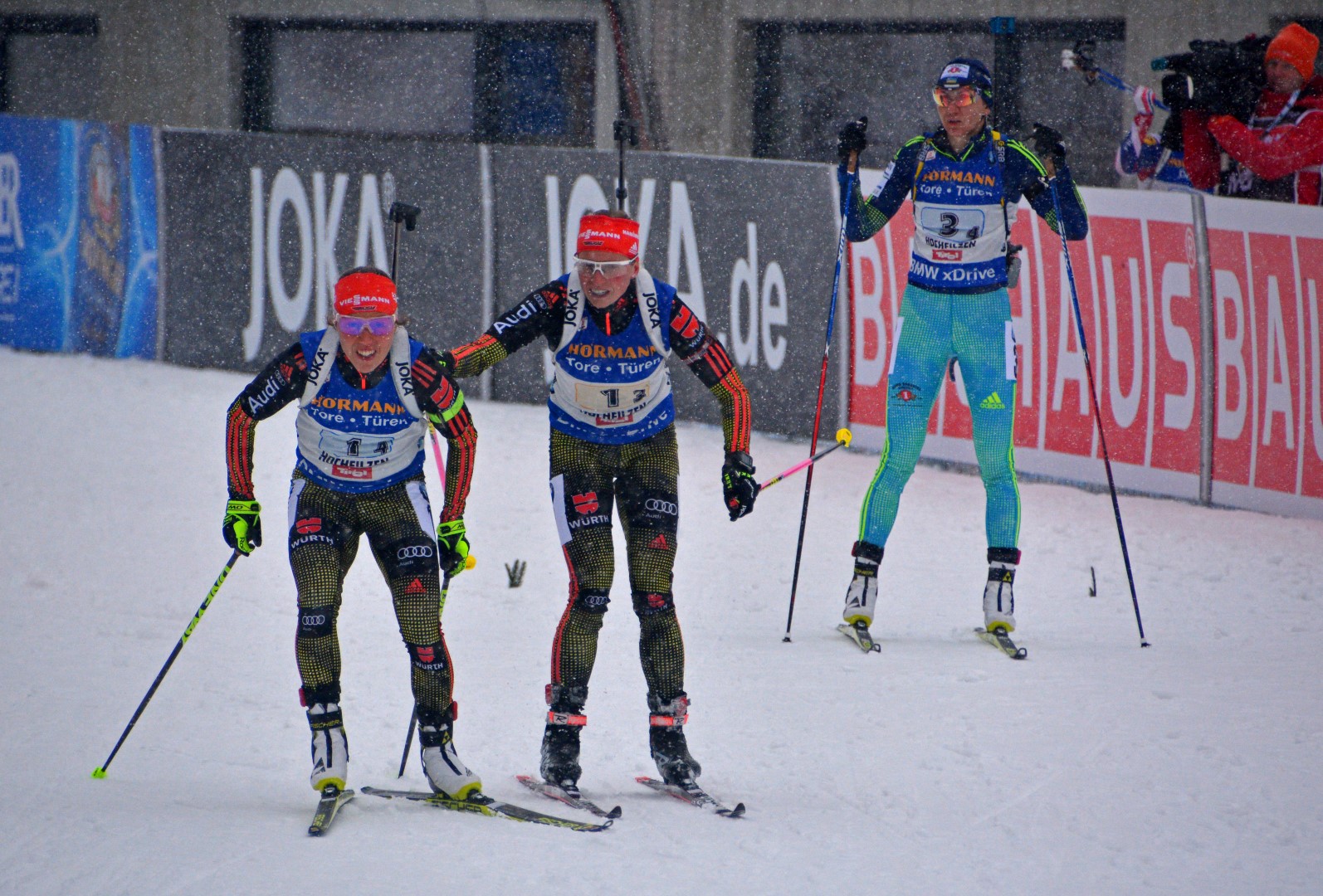
    Germany’s Franziska Hildebrand (c) tagging her team’s anchor Laura Dahlmeier (l) in first during the women’s 4 x 6 k relay on Friday at IBU World Championships in Hochfilzen, Austria. (Photo: Glen Crawford)

    “I’m in good shape, but on the last shooting my leg was shaking and the mat was wet, so I [slipped] a little bit,” she said of the snowfall. “So it was really hard for me to shoot. But I am happy to put all my extra [bullets] in, so it’s okay, it’s enough for my teammates. They are strong.”

    On the third leg, Alexia Runggaldier – the bronze medalist in the pursuit – faltered on the range, losing Italy’s lead with two spare rounds in prone. That gave Germany’s Franziska Hildebrand all the room she needed. With two clean sheets, she moved her team into the lead and they never looked back.

    “I was very happy to shoot two times clean and I could give a little bit of time forward to Laura,” Hildebrand said.

    Laura: the one everyone was waiting for. Dahlmeier didn’t disappoint, skiing the fastest anchor leg despite already being in the lead. She used three spare rounds, but even then held the lead and delivered another gold medal for Germany – and her fourth of the Championships, a feat no other German biathlete has ever accomplished.
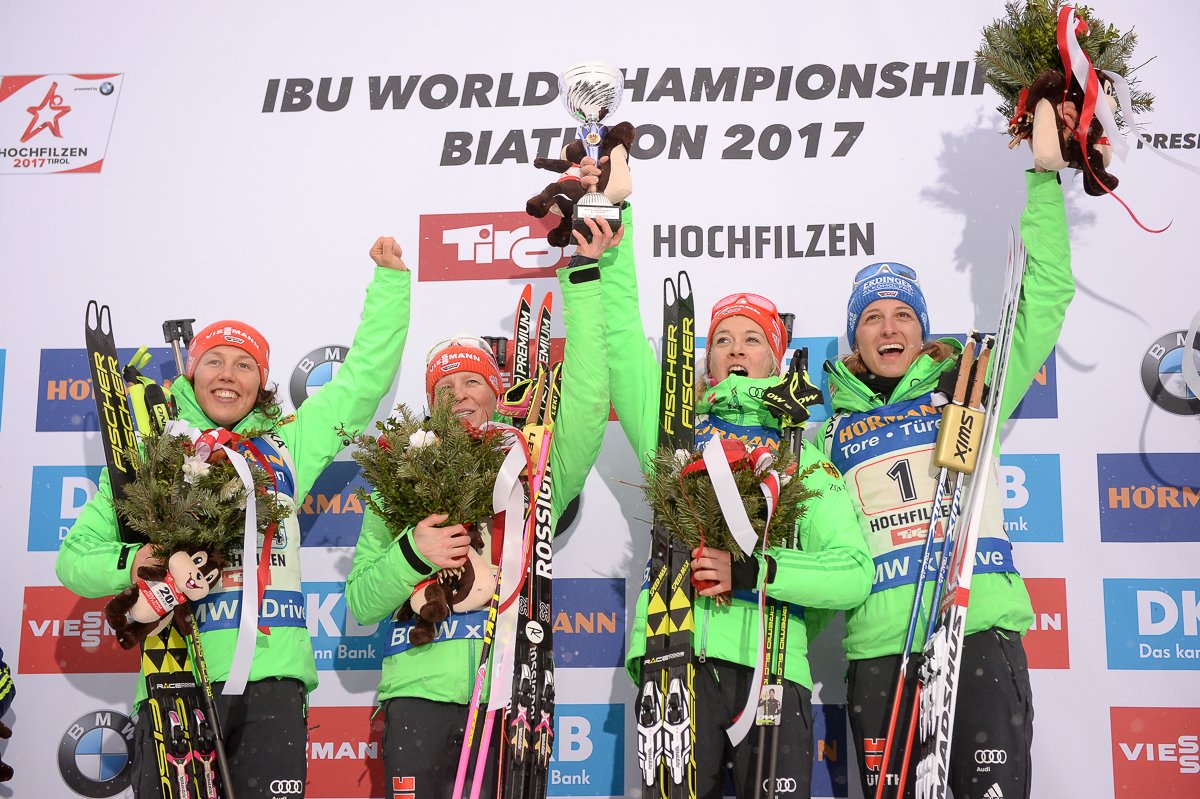
    The German team of (l-r) Laura Dahlmeier, Franziska Hildebrand, Maren Hammerschmidt, and Vanessa Hinz celebrate World Championships relay gold. (Photo: Evgeny Tumashov/IBU/Twitter)

    “Of course that is gigantic,” Dahlmeier told ARD. “But I mostly want to point out that we were a really really good relay today, like already during the whole season. It’s just a lot of fun that we are now on the podium together, a great day for us.”

    The other Germans agreed, and emphasized that despite the high expecatations, they were simply happy to work together.

    “I think we are a strong team, and we had very good results in the past during World Championships,” Hildebrand said. “We can do it all together and have fun.”

    While Italy had faded to just out of the picture, the fight for silver was intense. Gabriela Koukalova of the Czech Republic, Olena Pidhrushna of Ukraine, and Marie Dorin Habert of France all left the final stage within 10 seconds of Dahlmeier, and more than that, within four seconds of each other.

    “During the last loop I was remembering the last year all the time,” Pidhrushna said. “In every relay last year, it was the fight on the last loop for me.”

    The three women skied together for about half a loop, until Pidhrushna’s skis proved superior on a downhill and she glided past the other two. She took the opening and put in a surge up the next hill. Koukalova dropped first, undone by seemingly slower skis, and Dorin Habert couldn’t hang on either. Silver belonged to Ukraine.

    “When I overtook the girls under the bridge I realized, this was my chance and now I have to jump for a medal,” Pidhrushna said. “And so I did, and it worked and I’m really happy.”

    She finished 6.4 seconds back. France earned bronze (+8.1) and the Czech Republic was left in fourth place (+14.0).

    “I’m very happy about this medal with all the team,” Dorin Habert said in a press conference. “It was very stressful for me. I know that Olena is a very good finisher. And of course Gabi is just crazy, she is the top this season, so in my head it wasn’t very easy to make it. So I’m happy to get this.”

    Perhaps the happiest woman on the podium was Anastasiya Merkushina of Ukraine. Just 22 years old, she was appearing at her first senior World Championships.

    “I have no words because it’s too much emotions for me,” she said in the press conference. “I cannot believe that this is my first World Championships and silver medal, it’s too big. I did not expect this result. Of course I believe in my team, but it’s really great.”

    U.S. 14th, Canada 16th

    Neither the U.S. nor Canada had perfect shooting days, with 13 spare rounds apiece; Canada also had two penalty loops.
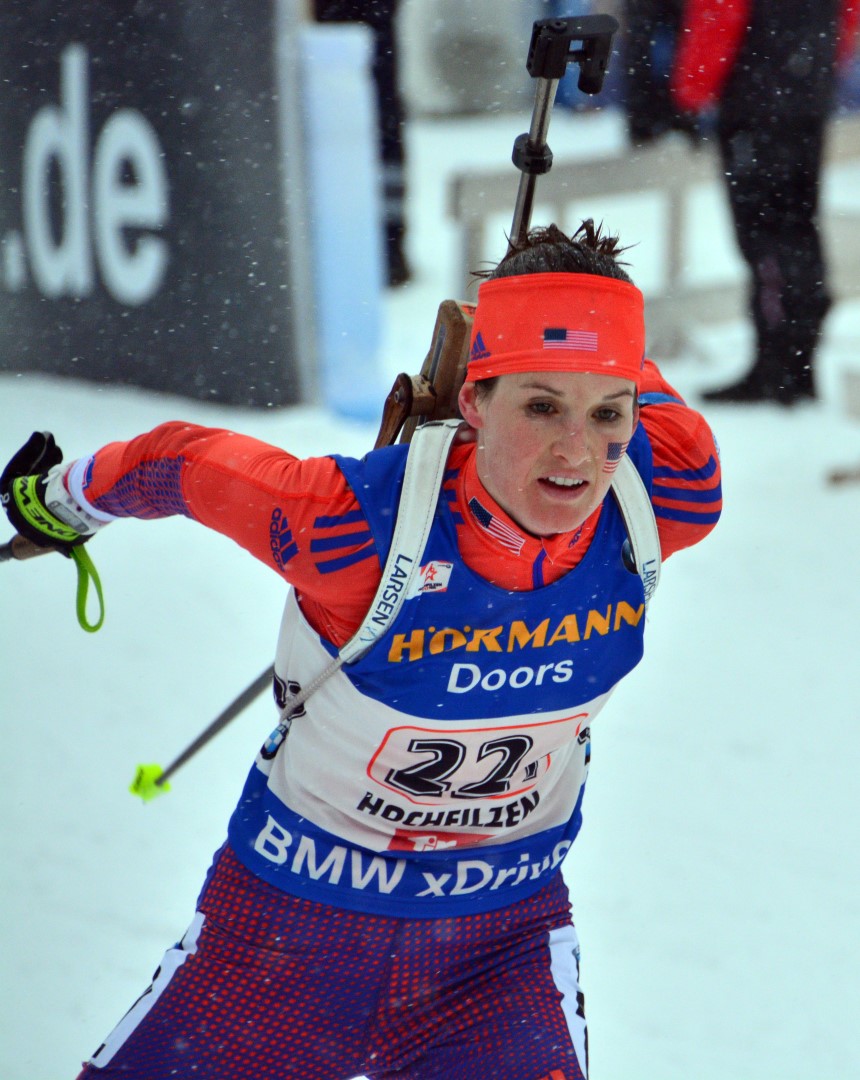
    Clare Egan racing the first leg of the U.S. women’s 4 x 6 k relay at IBU World Championships on Friday in Hochfilzen, Austria. (Photo: Glen Crawford)

    Both teams had good, yet frustrating starts.

    The U.S. started in bib 22, after they did not field relay teams for the first part of the season and thus lost out on team ranking points.

    “The first leg, it’s so slow [with the new snow] to pass and it takes so much energy that my coaches basically said, ‘Unless there’s room in a good track to go around, don’t bother’,” Clare Egan said. “So I looked at it almost as a 4 k race after the first stage.”

    She used one spare round in prone, and then took all three in standing. Despite that, she managed to move up on the trails on every single loop, and tagged off in 16th.

    “I was really hoping to clean the prone so that I would be in a good position for that second lap, but I missed my first shot,” Egan said. “Then standing, maybe that 4 k approach meant I was a little over the redline in my shooting. I went really slowly [with the shooting], that was the problem, but I hit my targets. I missed two and then I missed the first spare. Then I had two targets, two bullets, and I’m just really happy that I managed that situation well.”

    Susan Dunklee took over and skied the fastest second-leg time among all teams, cleaning prone and then using two spares in standing. Like Aymonier, she struggled with the copious wet snow falling on the range.

    “The standing, the mats are really slippery, and I almost fell over just trying to stand up on the mat,” Dunklee said. “Then I just didn’t really take the time to set up in my position, I just felt like my legs were going out from under me the whole time.”

    By the time her work was done the U.S. was in seventh place, and had moved from 1:20.7 back to just 36.7 seconds back from the lead.

    “I really like having big packs of people in front of me,” Dunklee said. “It’s just really thrilling to chase them down. The course… it’s one of those glazed days where your shin muscles get all tight and it is hard to sprint. So you have to stay right in the middle where people have skied. I had to be a little patient, and when I went I had to go hard, 100%, for a few cycles just to get around people.”
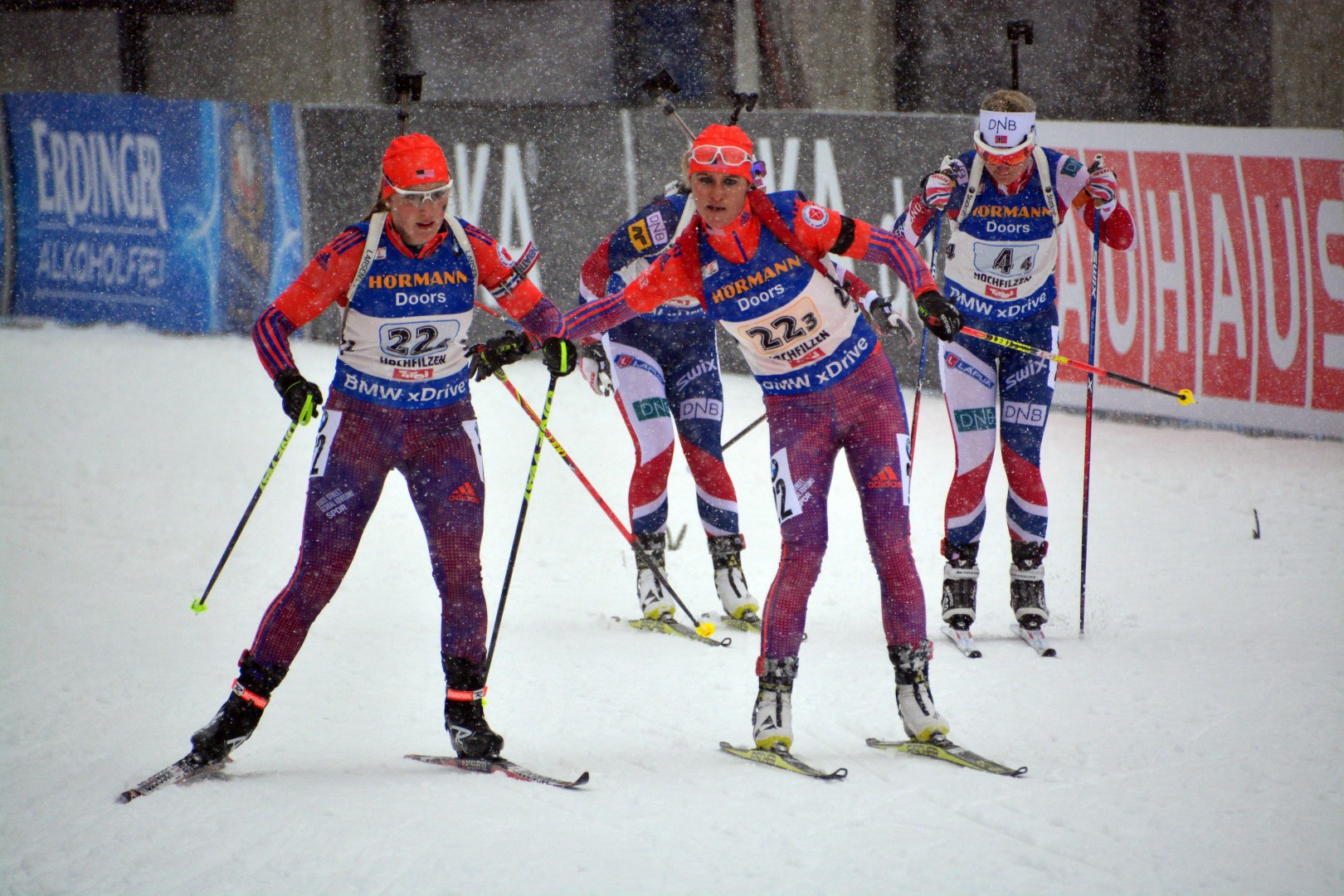
    Joanne Reid (r) tagging U.S. teammate Maddie Phaneuf (l) in 12th during the final exchange of the women’s 4 x 6 k relay on Friday at IBU World Championships in Hochfilzen, Austria. (Photo: Glen Crawford)

    Joanne Reid took over, using four spares, then Maddie Phaneuf used three spares on the anchor leg. The team finished +3:37.0.

    “The last loop was so hard,” Phaneuf said. “The snow was just so slow compared to every other day this week. The Swiss girl [Elisa Gasparin] I was with when I left the range did one long impulse up a hill when she passed me and I didn’t have any energy to stay with her. I tried, but nope. I knew there was nobody behind me anywhere, so I just tried my hardest to get to the finish line.”

    For Canada, Rosanna Crawford kicked things off by using just two spare rounds, and shot fast, but was tripped up on the trail.

    “I was pretty angry on my first loop,” she said. “I had moved up quite a few spots and then the Austrian [Dunja Zdouc] kind of shoved into me, and I spun around facing the wrong way so I lost a lot of time on that first loop, which I’m super pissed about. But the rest was good and the last loop was good, I was catching some girls.”

    Austria was later disqualified when Julia Schwaiger used four spare rounds in her prone shooting stage; only three are allowed.
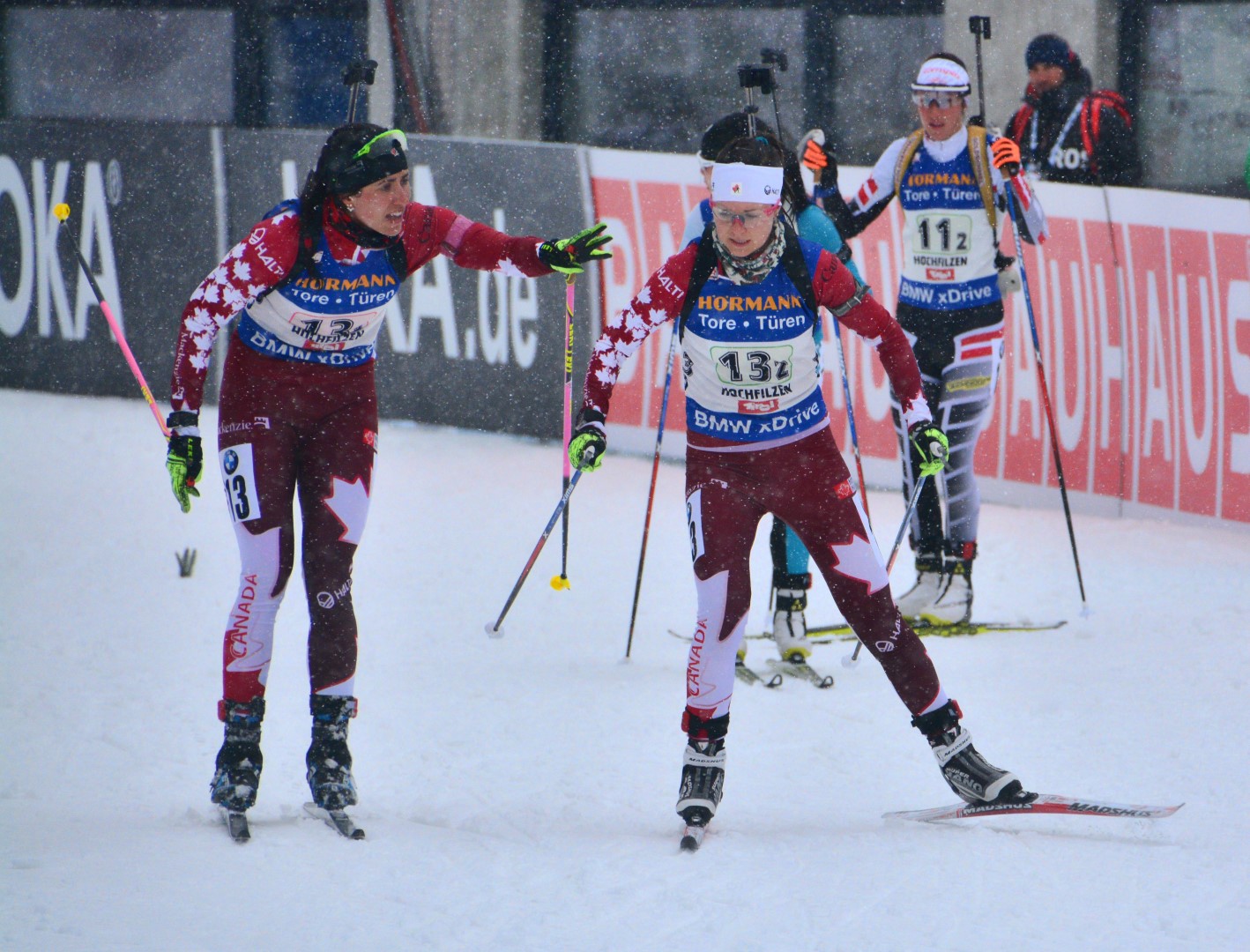
    Canada’s Rosanna Crawford (l) tagging her teammate Julia Ransom in 13th in the women’s 4 x 6 k relay on Friday at IBU World Championships in Hochfilzen, Austria. (Photo: Glen Crawford)

    Crawford tagged off in 13th. But with Julia Ransom skiing two penalty loops in standing, the team dropped to 20th. Megan Tandy pulled Canada back to 16th, and Emma Lunder regained 16th after slipping to 17th after a few more spare rounds on the range. The team finished +5:59.4.

    “Even though we weren’t in an amazing position, it was still my first World Championships relay, so I wanted to make sure I enjoyed it,” Lunder said. “Last year here at the World Cup in the relay we were 10th. And we also had a 10th in Ruhpolding this year where we shot super well. But I think maybe it just wasn’t there for everyone today. Korea is our last chance this year, so we’ll see what we can make happen.”

    — Harald Zimmer and Alex Kochon contributed

    Results

  • Sunday Rundown: Falun, Duszniki-Zdrój, & The Marcialonga (Updated x4)

    Sunday Rundown: Falun, Duszniki-Zdrój, & The Marcialonga (Updated x4)

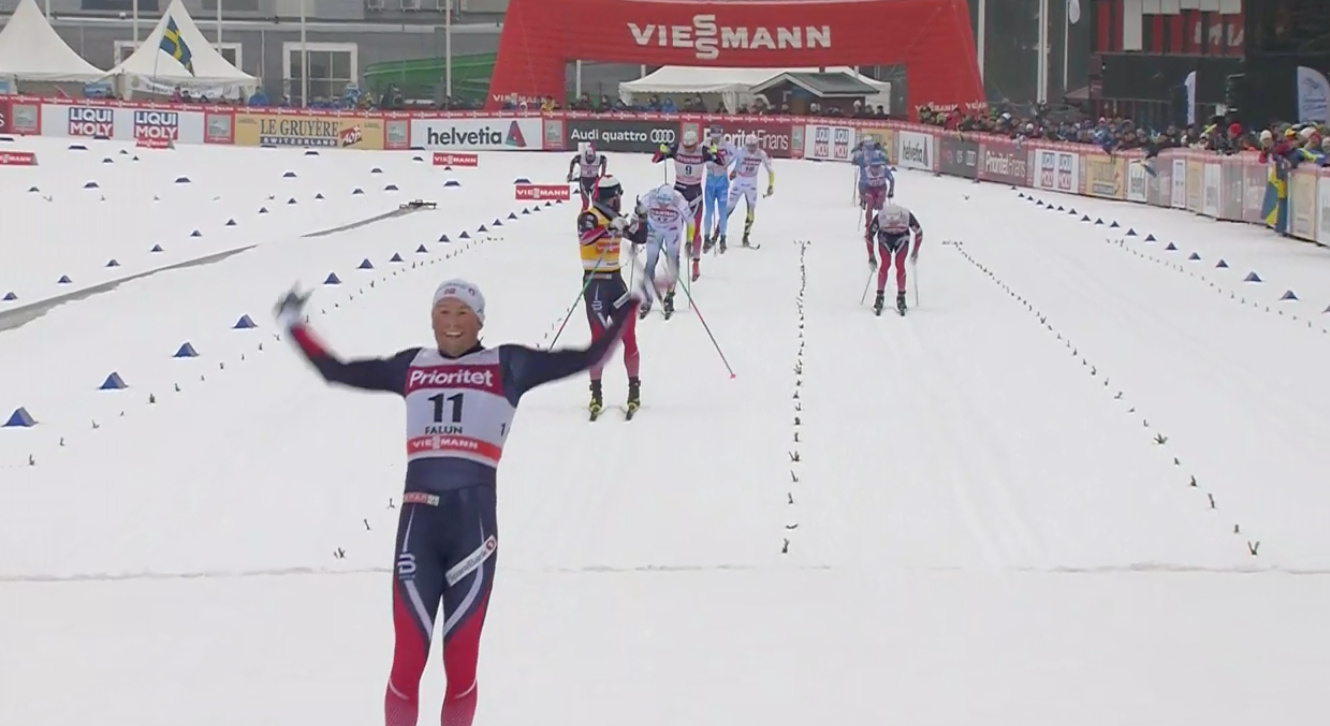
    Emil Iversen celebrates his win in the 30 k classic mass start in Falun, Sweden, on Sunday. Norwegian teammate Martin Johnsrud Sundby finished second and Sweden's Calle Halfvarsson third.
    Emil Iversen celebrates his win in the 30 k classic mass start in Falun, Sweden, on Sunday. Norwegian teammate Martin Johnsrud Sundby finished second and Sweden’s Calle Halfvarsson third.

    FIS Cross-Country World Cup (Falun, Sweden): 15 / 30 k classic mass start

    Women’s report | Men’s report

    In the women’s 15-kilometer classic mass start on Sunday, Norway swept the podium with Marit Bjørgen taking the win in a time of 41:28.8 in Falun, Sweden. Crossing just half a second behind her was her teammate, Ingvild Flugstad Østberg in second place. Rounding out the podium was Heidi Weng in third (+8.1).

    American Jessie Diggins was the first to cross the line for the U.S. in 10th (+1:37.5). Three other U.S. women finished in the top 30, with Sadie Bjornsen finishing 21st (+2:43.6), Rosie Brennan 24th (+2:57.0), and Liz Stephen in 29th (+3:24.5).

    Just outside of scoring World Cup points was American Caitlin Patterson in 32nd (+3:47.6) and Ida Sargent in 34th (+4:02.8). Canada’s Cendrine Browne finished 46th (+5:41.4) and American Liz Guiney 49th (+6:22.6).

    After losing the skate sprint yesterday in a photo finish to Italy’s Federico Pellegrino, Emil Iversen ascended to the top step of the podium in the men’s 30 k classic mass start on Sunday in Falun.

    The Norwegian was often near the front, but hadn’t tried to lead a breakaway like his teammates Martin Johnsrud Sundby and Sjur Røthe did earlier in the race. In the final two kilometers, Sundby – the overall World Cup leader – put in a sprint to try to drop the field. But Iversen caught up, drafting his veteran teammate into the stadium. In the final up-and-over before the finish line, Iversen made a pass and then accelerated down the finishing stretch to beat Sundby by 1.14 seconds.

    “I got motivation from yesterday’s last 20 meters,” Iversen told FIS in a finish-line interview. “So today I fought all the way, and I was really stronger. It is amazing for me to be second yesterday and first today. I’m really proud of that.”

    Calle Halfvarsson, who had been falling off the back of the lead pack just a few kilometers earlier, managed to get back to the front and claim third place for Sweden (+1.72 seconds) in a photo finish with Røthe (+1.76 seconds). Niklas Dyrhaug was next (+2.52 seconds) to give the Norwegian men’s team four in the top five.

    In his return to the World Cup stage, Norway’s Petter Northug finished 31st (+3:10.6).

    Alex Harvey was the lone Canadian on the start line. After skiing near the front of the field for the early part of the race he was dropped by the lead pack in the final kilometers, finishing 15th (+1:17.5).

    Erik Bjornsen and Noah Hoffman took 35th and 37th places for the United States, finishing +3:30.8 and +3:59.8, respectively. SuperTour leader Matthew Gelso — familiar with the Falun course after competing in 2015 World Championships — finished 44th (+5:23.6), and Andy Newell placed 53rd (+7:45.3).

    Results: Men | Women

    ***

    IBU Open European Championships (Duszniki-Zdrój, Poland): Single mixed & mixed relay

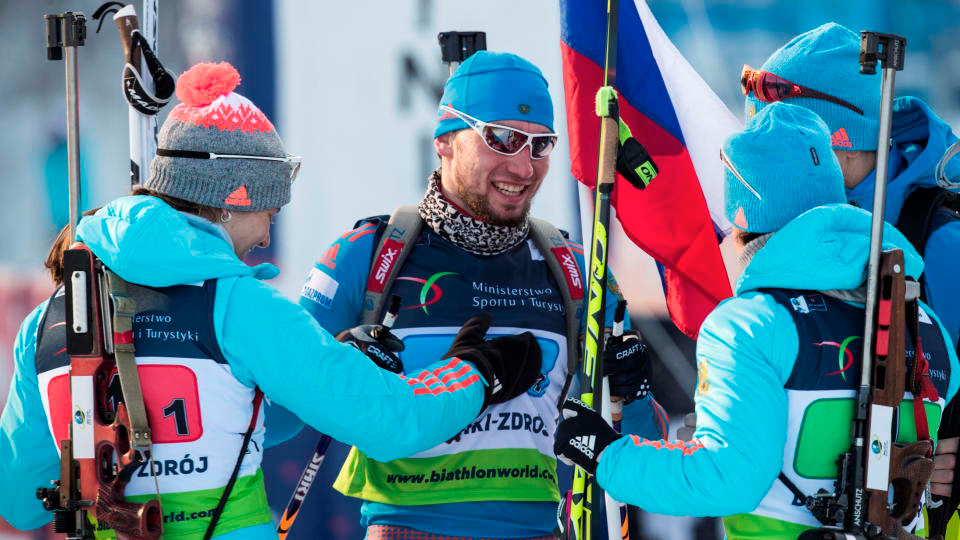
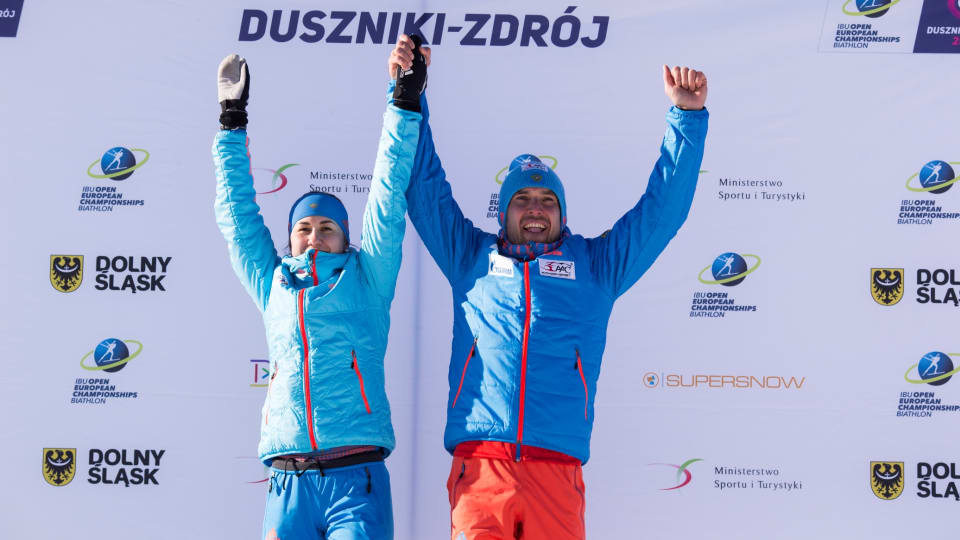
    Russia’s Alexander Loginov (center) is greeted at the finish by his teammates Irina Starykh, Svetlana Sleptsova and Alexey Volkov after anchoring his team to the gold medal in the mixed relay at the 2017 IBU Open European Championships in Duszniki-Zdrój, Poland. (Photo: IBU)
    Russia’s Alexander Loginov (center) is greeted at the finish by his teammates Irina Starykh, Svetlana Sleptsova and Alexey Volkov after anchoring his team to the gold medal in the mixed relay at the 2017 IBU Open European Championships in Duszniki-Zdrój, Poland. (Photo: IBU)

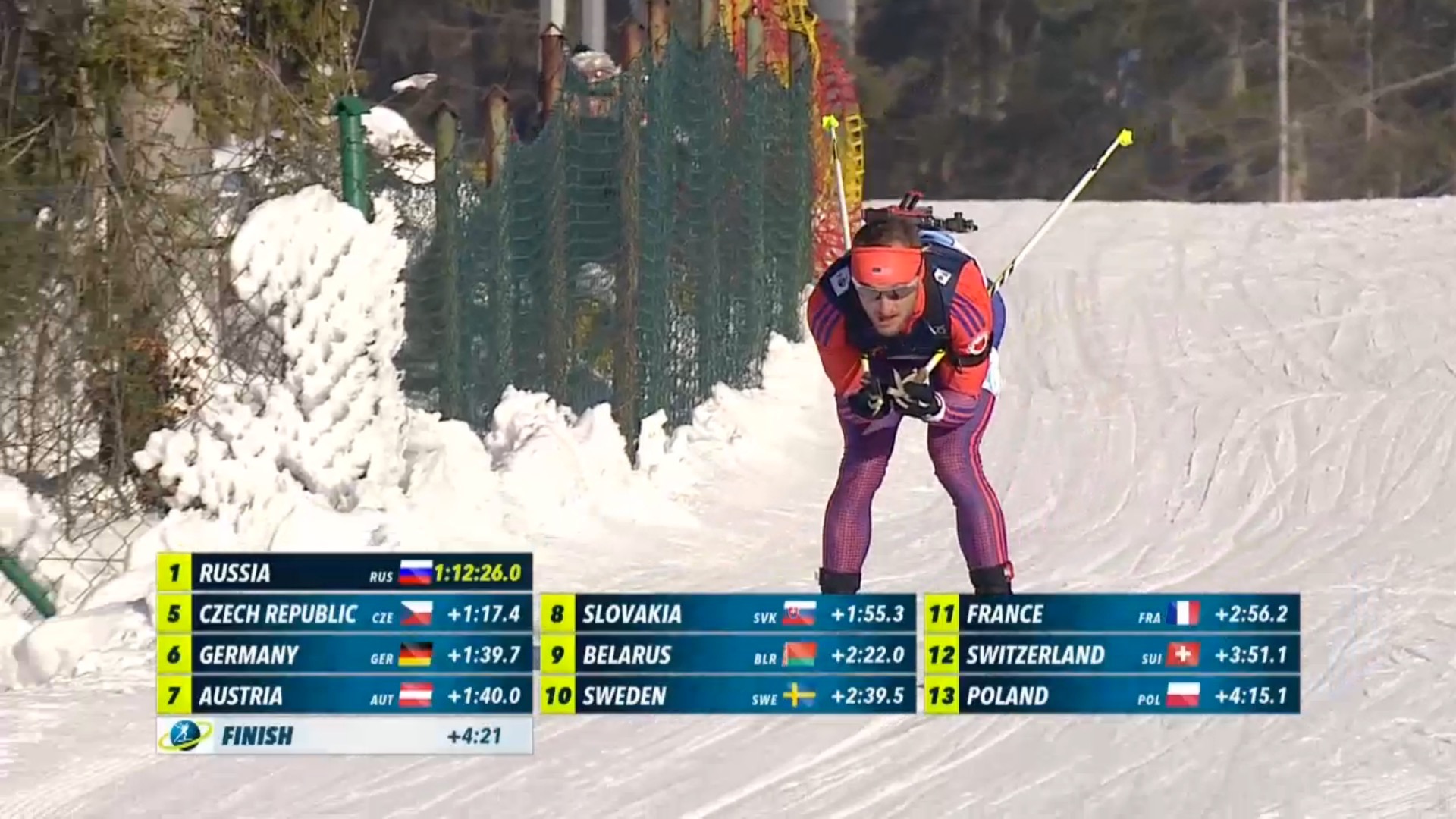
    [UPDATED] The Russian victory in the final 2 x 6 + 2 x 7.5-kilometer mixed relay event of the 2017 International Biathlon Union (IBU) Open European Championships in Duszniki-Zdrój, Poland, was only briefly in doubt, when Alexander Loginov skiing the anchor leg required all spares in his prone shooting stage. But with his final shot he managed to also hit that target to avoid the penalty lap, leaving the range with a lead of more than 30 seconds.

    Loginov then did not need any spares in the last standing stage, and could take his time on the final loop. Unlike Russia’s Evgeniy Garanichev earlier in the day during the single mixed relay, he also managed to pick up a flag for the final meters of the race, crossing the line in a time of 1:12:26.0 hours.

    The Russian team with Irina Starykh, Svetlana Sleptsova, Alexey Volkov and Loginov led from the first exchange and required only six spares with zero penalties.

    With this medal, the 28-year-old Volkov became the most successful athlete in history at European Championships, according to an IBU press release, surpassing the retired Polish biathlete Tomasz Sikora. Russia was the most successful team of the 2017 Open European Championships with six gold, four silver, and three bronze medals.

    Behind them, a number of teams vied for the positions on the podium. Sweden initially looked like a strong contender exchanging in second place after the women, but fell back with three penalty laps to only finish 10th.

    Still six seconds back after the final shooting, Norway’s Fredrik Gjesbakk caught up to and outsprinted Ukraine’s Ruslan Tkalenko in the finishing stretch to claim the silver medal (+36.4) with the bronze left for Ukraine (+37.1).

    “I thought that I made sufficient gap to win silver,” Tkalenko told the IBU. “But in the end, on the final downhill before the finish, I was very surprised when the Norwegian guy passed me, I truly did not expect that.”

    The Norwegian team with Karoline Erdal, Marion Rønning Huber, Erlend Bjøntegaard, and Gjesbakk needed nine spares and had no penalties.

    Ukraine with Anastasiya Merkushina, Yulia Dhzyma, Oleksander Zhyrnyi (who originally started for Russia before making the switch in 2014) and Tkalenko required six spares, and Dhzyma had to ski a penalty lap only temporarily setting the team back.

    Bulgaria finished fourth (+1:16.4), with its anchor Vladimir Iliev narrowly beating Czech Republic’s Lukas Kristejn (+1:17.4) in the finishing stretch. Both teams needed 11 spares and had no penalties.

    Jakob Ellingson skiing the anchor leg for the U.S. mixed relay at the 2017 IBU Open European Championships in Duszniki-Zdrój, Poland. The U.S. team finished 14th. (Photo: IBU/Eurovisionsports.tv screenshot)
    Jakob Ellingson skiing the anchor leg for the U.S. mixed relay at the 2017 IBU Open European Championships in Duszniki-Zdrój, Poland. The U.S. team finished 14th.
    (Photo: IBU/Eurovisionsports.tv screenshot)

    Starting at the back of the field in bib 20, US Biathlon’s Emily Dreissigacker got her team off to a strong start with a clean prone shooting and one spare round in standing, exchanging in 10th, a minute behind the leaders. Hallie Grossman needed one spare in each of her stages, tagging off to the men in 14th position and now 2:39 behind. Max Durtschi also had one miss each in prone and standing, coming into the last exchange still in 14th position, but another minute back. Jakob Ellingson required all three of his spares in his prone shooting stage narrowly avoiding the penalty lap, and one more in his final shooting stage. As the team from Finland was racing over a minute behind the Americans, he was able to keep the 14th position into the finish (+4:47.4), with a team total of nine spares and no penalties overall.

    For Biathlon Canada, Erin Yungblut starting in bib 19 shot clean in her prone stage and required two spares in her standing shooting, tagging off in 18th position and more than two minutes back from first. Leilani Tam von Burg stayed clean in her prone shooting stage and needed one spare in standing, moving up two positions to exchange in 16th place, yet more than four minutes behind the leaders. After the exchange to the men, both Matthew Neumann and anchor Carsen Campbell managed to shoot clean in all of their stages, but lost additional time on the course to finish 16th (+6:39.9) ahead of four lapped teams.

    Canada had the best shooting result of all 20 teams starting the relay, with just three spares and no penalty.

    Russia’s Daria Virolaynen (l) and Evgeniy Garanichev after winning Sunday's single mixed relay at the 2017 Open European Championships in Duszniki-Zdrój, Poland. (Photo: IBU)
    Russia’s Daria Virolaynen (l) and Evgeniy Garanichev after winning Sunday’s single mixed relay at the 2017 Open European Championships in Duszniki-Zdrój, Poland. (Photo: IBU)

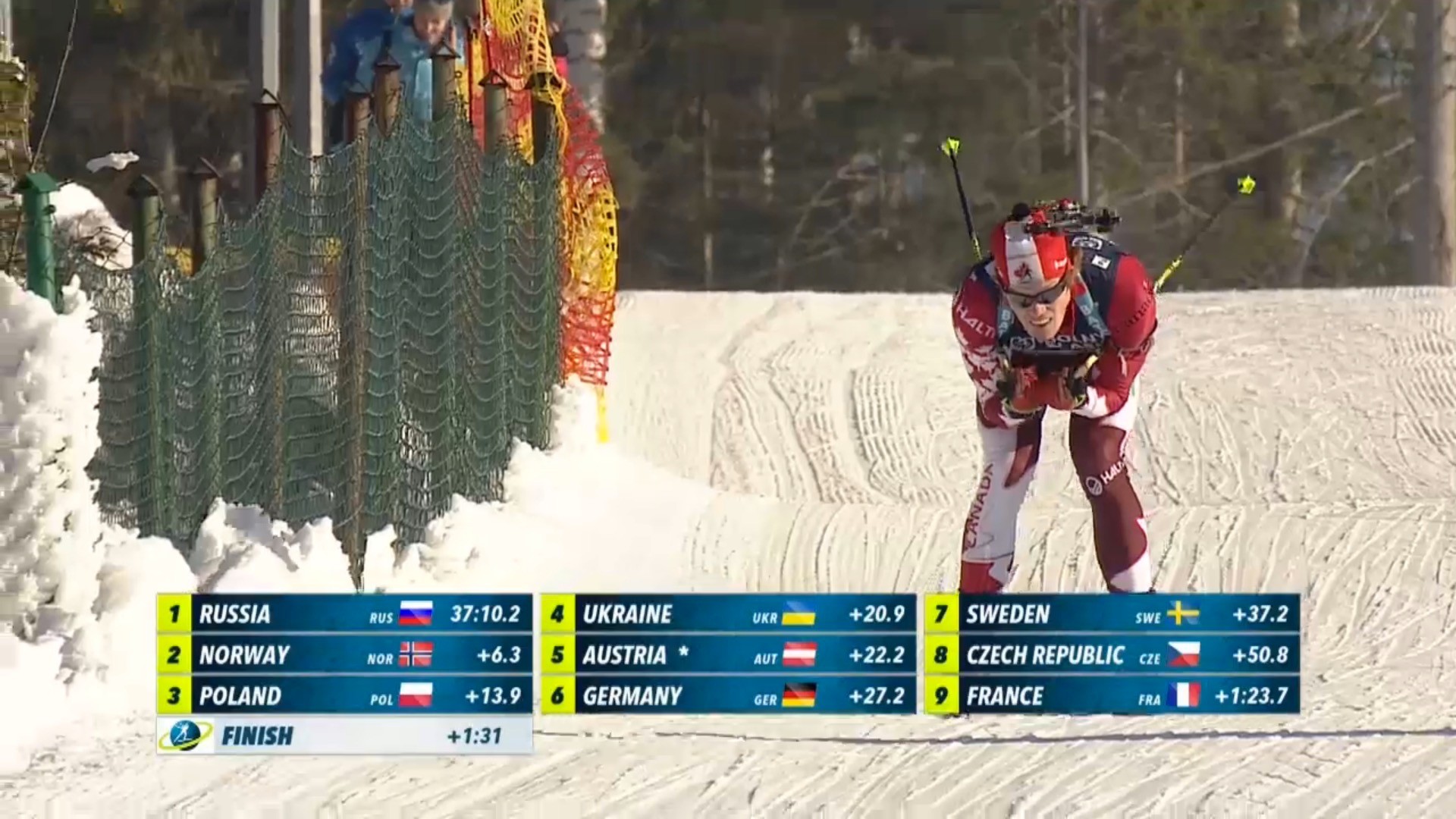
    Earlier on Sunday, pretty much the only thing that went wrong for Russia’s Daria Virolaynen and Evgeniy Garanichev in the single mixed relay happened on the last meters of the finishing stretch, with Garanichev gesturing for a Russian flag he wanted to cross the line with. But the handoff was too short and the flag dropped past his outstretched hand to the snow. He glanced back, weighing if his lead was big enough to ski back, but decided it was not worth the risk, instead skiing into the arms of his partner waiting for him behind the line in a time of 37:10.2 minutes.

    Russia needed seven spare rounds and incurred zero penalties. Garanichev secured the victory in the final shooting, when he only needed one spare – albeit fumbling a few seconds to insert it – while his direct opponents standing next to him required more time to hit their targets.

    “Probably, I took some risk at the last standing,” Garanichev said, according to an IBU press release. “I wanted to shoot fast and clean, but missed with the last shot. But in general, I felt very comfortable; came and worked at the range in my rhythm.”

    6.3 seconds behind, Norway with the team of Ingrid Landmark Tandrevold and Vetle Sjåstad Christiansen placed second, with seven spares and zero penalties.

    “These are very short loops,” Christiansen commented on the fairly new, single mixed relay format. “You feel the pressure from the crowd and to shoot fast every time.”

    The 20-year-old Tandrevold previously earned three bronze medals, including one in the single mixed relay, also with Christiansen, at last year’s Open European Championships in Tyumen, Russia.

    To big cheers from their home crowd fans who had come out to the Duszniki Arena in beautiful but cold weather, the Polish husband-and-wife team of Krystyna Guzik and Grzegorz Guzik placed third with just five spares and zero penalties (+13.9), not quite able to keep up with Christiansen on the final loop after leaving the range together within a second.

    “It is so nice to win a medal here in Poland,” Krystyna Guzik said. “We were both very disappointed with all of our mistakes in the other competitions. So today, we were relaxed and laughing before the competition, hoping not to have those mistakes again. We did not … and now have a medal.”

    It was the first medal for Poland at these championships.

    Ukraine with Iryna Varvynets and Andriy Dotsenko finished fourth, also with five spares and zero penalties (+20.9).

    Biathlon Canada’s Aidan Millar skiing the final loop of the single mixed relay at the 2017 IBU Open European Championships in Duszniki-Zdrój, Poland. With teammate Sarah Beaudry, Canada finished 13th (Photo: IBU/Eurovisionsports.tv screenshot)
    Biathlon Canada’s Aidan Millar skiing the final loop of the single mixed relay at the 2017 IBU Open European Championships in Duszniki-Zdrój, Poland. With teammate Sarah Beaudry, Canada finished 13th (Photo: IBU/Eurovisionsports.tv screenshot)

    For Biathlon Canada, Sarah Beaudry and Aidan Millar required seven spares during their race and had no penalty, just like the winning Russians and Norwegians, but could not quite keep up with the best teams on the course in the fast-paced race format with short loops somewhat comparable to a team sprint in cross-country.

    Beaudry cleaned her first shooting stage and then needed one spare to hit all targets in standing. At the first exchange Canada was 10th, 35.8 seconds behind the then leading team from Poland.

    Millar missed one shot in his first prone stage, leaving the range again in ninth position. Then he needed two spares in his standing shooting on the way to exchanging back to Beaudry in 11th (+56.4).

    On her second leg, Beaudry had one miss in prone and required two spares in standing, falling back a bit to exchange in 13th (+2:12.0).

    On his final leg, Millar was able to shoot clean in both stages, reducing the time gap to the top but not able to make up another position, and finished in 13th place (+1:56.1).

    US Biathlon is only represented with two women at the Open European Championships in Poland, and decided to forgo a start in the single mixed relay, instead entering a team in the mixed relay later on Sunday.

    — Harald Zimmer

    Results: Mixed relay |  Single mixed relay 

    ***

    Marcialonga (Val di Fiemme, Italy)

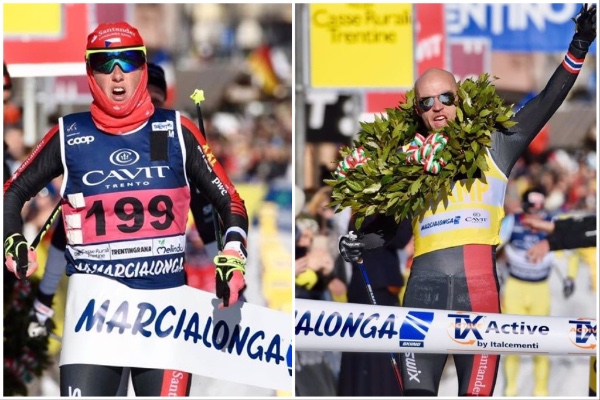
    Katerina Smutna (left) and Tord Asle Gjerdalen (right) of Team Santander won the 2017 Marcialonga. (Photo: Visma Ski Classics)
    Katerina Smutna (left) and Tord Asle Gjerdalen (right) of Team Santander won the 2017 Marcialonga. (Photo: Visma Ski Classics)

    Tord Asle Gjerdalen won the Marcialonga, a Worldloppet and Swix Ski Classics marathon for the third time – in a row. This year was on a shortened course, “just” 57 rather than the traditional 70 kilometers.

    The Team Santander athlete finished in two hours, eight minutes, and 36 seconds, edging Johan Kjølstad (Team United Bakeries) and Morten Eide Pedersen (Team BN Bank) in a sprint finish by 2.6 and 2.9 seconds, respectively.

    Tyler Kornfield and David Norris of Alaska Pacific University finished 43rd (+5:03.8) and 66th (+10:43.1). Canadian Paralympian Brian McKeever finished 57th (+9:13.5) and guide Graham Nishikawa 81st (+12:56.5), followed by Ian Murray in 85th (+13:37.5) and Erik Carleton in 111th (+17:50.2).

    In the women’s competition, Katerina Smutna, also of Team Santander, won her third straight Ski Classics competition. She crossed the line in two hours, 22 minutes, and 46.4 seconds. Britta Norgren of Team Lager 157 was second by just 0.8 seconds, and Sara Lindborg (Team Serneke) third, +4:22.2. University of Utah alum Maria Graefnings was tenth, +10:35.8.