Tag: Anchorage Alaska

  • Hunter Wonders, Flying by Instrument

    Hunter Wonders, Flying by Instrument

    This article was made possible through the generous support of our voluntary subscribers.  If you value coverage like this, please support FasterSkier with a voluntary subscription.  

    Hunter Wonders (USA) racing the Skiathlon at the 2023 World Championships in Planica, Slovenia. (Photo: Modica/NordicFocus)

    When U.S. Ski & Snowboard released its roster for the 2026 Olympic Winter Games, Hunter Wonders’ name appeared without emphasis. No asterisk. No parenthetical explanation. Just another line in a list that had already absorbed months of speculation, anxiety, and arithmetic.

    To most readers, the name represented a straightforward outcome: an athlete peaking at the right moment, a season resolved by results. But the roster line masked a career that did not move in a single direction. Wonders’ path bent, paused, and restarted. At one point, it appeared to end entirely.

    Understanding how he arrived at the Olympics requires starting far from the Games themselves — in a place where progress is quiet, repetition matters more than recognition, and development happens long before it is visible.

    Hunter canoe racing with his dad in Michigan. (Photo: Courtesy Photo)

    Alaska, Not Michigan

    Hunter Wonders is sometimes misidentified as a Midwestern skier. His parents are from Michigan — his father from Grayling, his mother from Traverse City — and the family returned there most summers to visit grandparents. Wonders spent long stretches canoe racing in Michigan and maintaining close ties to extended family.

    But Alaska is home.

    “My parents were originally from Michigan… And yeah, they moved to Alaska. It was supposed to be like a two-year thing for my dad’s work,” Wonders said. “And he just knew, like, nope, we’re not going back. I’m staying here.”

    That decision happened decades before Wonders had any agency of his own. By the time he was born, Alaska was already permanent.

    “I’m definitely from Alaska and have lived there my whole life,” he said.

    In American cross-country skiing, place is not just a backdrop. It is infrastructure. Alaska exists at the edge of the domestic system — geographically distant from centralized camps, expensive to travel from, and easy to overlook. Athletes there develop without constant reference points, often without external validation.

    For Wonders, that isolation became formative.

    Hunter Wonders, Hailey Swirbul, and Chip Schoff (former APU skier and wax tech) on a multi-day hut trip. (Photo: Courtesy Photo)

    Alaska, Off the Circuit

    In Alaska, training is often solitary. Progress is built through lifestyle and repetition rather than comparison, and improvement is measured internally long before it is confirmed externally.

    The winters matter. So does the darkness. Training extends into hours when daylight is no longer guaranteed, when motivation cannot depend on atmosphere or audience. You go out because it’s how you choose to live and enjoy your life.

    That rhythm shaped Wonders’ relationship to skiing early. He did not grow up racing for recognition. He learned to train for alignment — the quiet sense that body, terrain, and effort were moving together. Alaska not only accelerated his trajectory. It birthed it.

    Hunter Wonders (APU/Alaska) takes the lead in the U16 Boys Mass Start Freestyle race at the US Junior National Championship in Stowe, Vermont in 2014. (Photo: Voisin/FasterSkier)

    A Childhood of Rotation

    Wonders grew up chasing his older siblings — twin brother and sister, five years ahead — through a constantly shifting landscape of sports. Alpine skiing. Motocross. Soccer. Ski jumping. Biathlon. Mountain biking.

    “Anytime I started getting into a sport, my family shifted away from that one,” he said.

    The pattern was not neglect, but necessity. Supporting multiple competitive sports for multiple children eventually became unsustainable.

    “My parents were like, all right, we can’t do all this stuff. We gotta limit it. And they chose to Nordic ski. And so naturally, I was kind of dragged into that scene.”

    Nordic skiing, at least initially, was not a calling. It was what remained once the family consolidated its energy.

    Wonders’ first encounter with skis reflects that informality.

    “It was my dad playing with me on my back deck in 2001. And I’m not really skiing that much, but that was kind of my first encounter with it.”

    There was no mythology attached to that moment. No sense of destiny. Skiing entered his life as play, then habit, then gradually — almost without announcement — as a central structure.

    Hunter Wonders (APU/Alaska) winning the U16 Boys Mass Start Freestyle race at the 2014 US Junior National Championship in Stowe, Vermont. (Photo: Voisin/FasterSkier)

    Stowe, Vermont

    The first moment when that structure revealed competitive meaning came far from Alaska.

    Wonders qualified for Junior Nationals in Stowe, Vermont, in 2014. He did so narrowly, selected as the fifth or sixth skier on Team Alaska.

    “I barely made Team Alaska. But it was a big goal for me as a U16,” he said.

    What followed surprised nearly everyone, including Wonders himself.

    “And just out of nowhere, I ended up getting a second place in the individual start race and first place in the mass start. And that was just like, whoa, where did that come from?”

    The results did not instantly rewrite his trajectory. But they altered his internal calculus.

    “I think it kind of clicked for me that, okay, I can do this. I can be competitive.”

    The significance of that realization was not the result itself, but permission. Permission to imagine a longer horizon.
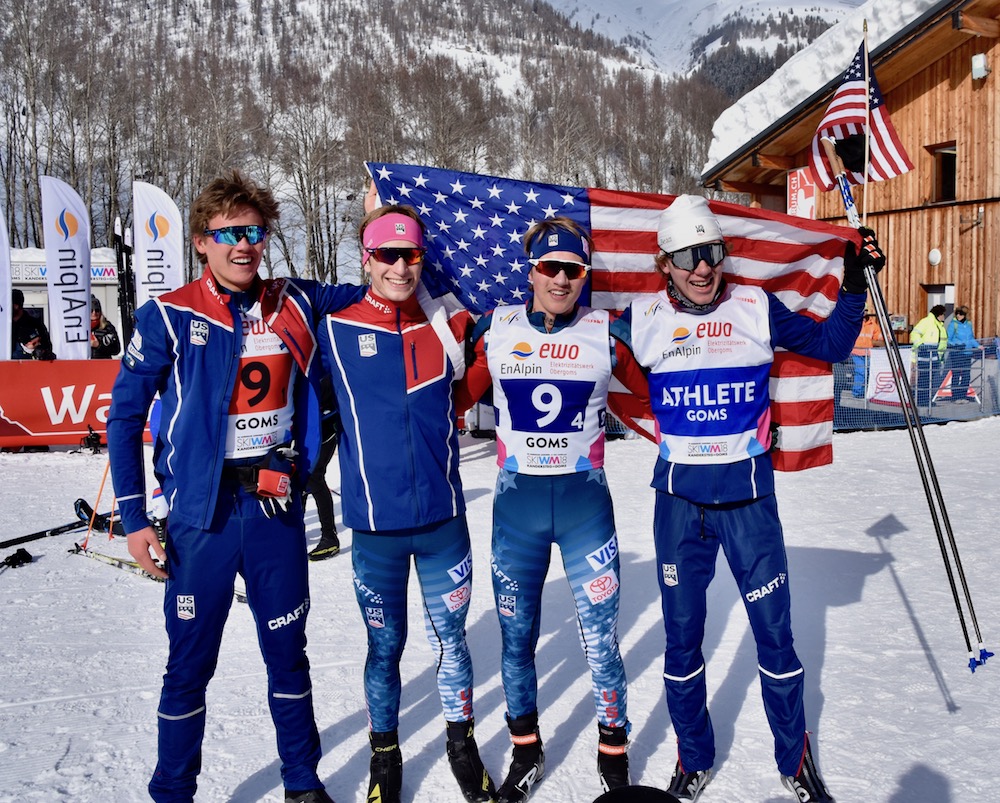
    The U.S. men’s silver-medal relay at the 2018 Junior World Championships in Goms, Switzerland, with (from left to right) Luke Jager, Hunter Wonders, Gus Schumacher, and Ben Ogden. (Photo: Julia Kern)

    The Long Middle Begins

    What followed was not a rapid ascent, but a prolonged middle years defined by steady development, incremental gains, and results that suggested promise without announcing arrival.

    On the World Cup, Wonders often raced from the margins. Finishes in the 50s and 60s gave way slowly to finishes in the 30s. The progress was real, but it did not demand attention.

    In American men’s skiing, where depth is both strength and complication, that middle can be unforgiving. Selection is rarely guaranteed. Criteria shift. Opportunity compresses.

    Wonders responded the way he had learned to respond in Alaska: by focusing inward. Training remained central.

    “For me, training has always been kind of the fun part… The training and living that lifestyle is really, really big to me.”

    That orientation would become essential later — when the question was no longer how to improve, but whether improvement was still worth pursuing.
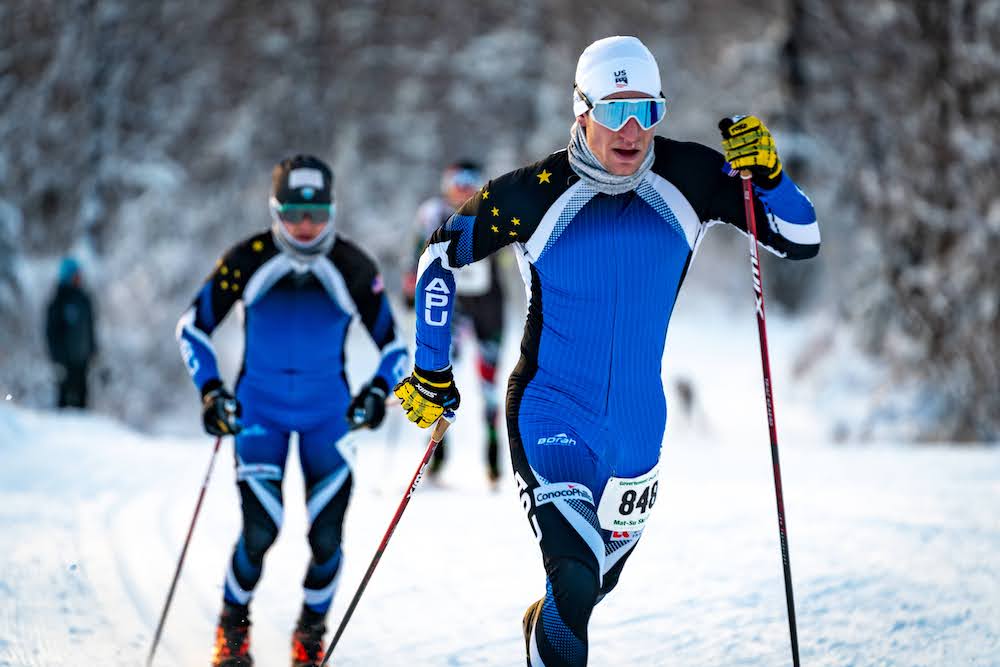
    Hunter Wonders races at Government Peak Recreation Area, Palmer, Alaska, Nov. 14, 2021, in the season-opening Race to the Outhouse #1. (photo: Eric Strabel for APUNSC)

    APU and Staying Put

    Alaska Pacific University provided continuity during those years. It was neither a junior factory nor a national-team satellite. Its athletes often arrived through unconventional paths and stayed longer than expected.

    For Wonders, APU offered stability without stagnation. Coaching relationships endured. Autonomy was preserved. Expectations were internal before they were external.

    Progress was allowed to be slow.

    That patience would later prove critical — because when Wonders eventually left the sport, and then considered returning, there was no system to rebuild, no trust to reestablish. The ground remained where he had left it.

    Hunter Wonders (USA) on his way to 16th place in the 10 k Classic in Beitostolen, Norway in 2022. (Photo: NordicFocus)

    Proof, Finally

    The breakthrough season arrived quietly, without spectacle or announcement.

    During the 2022–23 World Cup season, Wonders recorded the strongest international results of his career: a 16th-place finish in Beitostølen, Norway an 11th-place finish in Oberstdorf, Germany and a 23rd-place finish at Holmenkollen. The trajectory was unmistakable, even if it did not demand attention.

    “For me, that was a big jump from spending my time in the 50s, 60s,” he said.

    The significance of those results was not external. They did not alter his standing overnight or change how the sport viewed him. Their impact was internal.

    “It felt good. To prove to myself that I could ski with some of the best out there.”

    For years, that belief had existed as conviction rather than certainty. Now it had evidence. The question of whether he belonged — the one that had quietly governed training blocks, selections, and seasons — no longer needed answering.

    What remained was not ambition, but choice.

    Hunter Wonders (USA) on his way to 23rd place in the Holmenkollen 50 k Freestyle in Oslo, Norway in 2023. (Photo: Modica/NordicFocus)

    Leaving Without Collapse

    Retirement in endurance sport is often framed as inevitable. Bodies fail. Results decline. Motivation erodes. The decision arrives trailing visible causes.

    Hunter Wonders’ retirement did not follow that pattern.

    When he stepped away from World Cup racing in the spring of 2023, his career was not unraveling. It was consolidating. The season behind him had not forced his hand; it had freed it.

    “My planned last World Cup… it was right after a really good season for me,” he said.

    The timing mattered. He was not leaving with questions unanswered. He was leaving with a sense of completion.

    For a long time, Wonders had believed he could compete at that level. Now he knew it. And that knowledge altered the logic of staying.

    With the central doubt resolved, the future opened in unexpected ways. Instead of sharpening ambition, success created space to consider what life beyond skiing might look like, and whether the cost of continuing still made sense.

    “I thought I was content. I thought I was, you know… ready to move on.”

    The decision was not driven by exhaustion or dissatisfaction. It was driven by certainty — and by the rare freedom that certainty can bring.

    Crust ski in the spring time (Wonders’ all time favorite form of skiing). (Photo: Courtesy Photo)

    What It Means to Leave While Improving

    Leaving while things are going well carries a specific psychological weight. There is no obvious decline to explain the decision. No external force to blame. The athlete leaves not because the door is closing, but because it remains open.

    Improvement, once experienced, does not fade quietly. The body remembers what alignment feels like — when training, racing, and confidence converge. Walking away at that moment does not resolve ambition; it suspends it.

    Wonders framed his retirement as closure. But closure in elite sport is rarely permanent. The unanswered questions tend to return first, often in subtler forms.

    In his case, the unresolved question was not whether he could ski at the highest level. That had been answered. The question was whether he wanted to continue building a life that revolved so completely around it.

    From Seasons to Paychecks

    After stepping away, Wonders entered a different rhythm entirely.

    “That whole following summer, I worked construction, learned a lot of new skills. That’s when I got my pilot’s license.”

    The change was not symbolic. It was practical. Construction offered tangible progress — work that produced visible results and predictable compensation.

    “Even when skiing was going well, I just wanted to get out of it and work a normal job, get the normal paycheck, things like that.”

    The appeal of normalcy was not rooted in dissatisfaction with skiing. It was rooted in adulthood. After years of living season to season, the idea of stability carried weight.

    At the same time, Wonders had recently completed his degree at Alaska Pacific University.

    “I graduated with a bachelor’s in business administration,” he said.

    What followed was a transition many elite athletes experience but rarely articulate.

    “I found a really hard transition when I graduated from being a student athlete to just an athlete. I felt like I wasn’t progressing elsewhere in life. And that was pretty hard for me.”

    Without coursework, semesters, or academic milestones, skiing existed in isolation. Progress on snow no longer corresponded to progress in life. The imbalance unsettled him.

    The Second Discipline

    Aviation entered that gap not as a hobby, but as a parallel discipline.

    “I have my pilot’s license now, and I’ve been working on my instrument rating,” Wonders said.

    He described the training with precision.

    “Being able to fly only using what’s on the dashboard of the plane. Basically, no looking outside the plane.”

    Instrument flight is unforgiving. It demands trust in systems over instinct, procedure over perception. For Wonders, it offered a structure that mirrored elite sport without duplicating it.

    “It’s been giving me something to work on outside of skiing, which has been really nice.”

    More importantly, it offered psychological margin.

    “It’s a very important thing for me, I think, to not feel trapped.”

    The word matters. Trapped implies more than fatigue or burnout. It implies a loss of agency — the sense that leaving would erase identity rather than expand it.

    Aviation gave Wonders a way to be committed to skiing without being consumed by it.

    A Life That Almost Fit

    For a time, the other life worked.

    Construction days were long and direct. Progress was visible. Paychecks arrived on schedule. Flight training offered complexity, mastery, and forward motion.

    The pace was different. The stakes were different. The feedback was immediate.

    Skiing receded into the background — not as a regret, but as a completed chapter.

    Yet even in that distance, the sport did not disappear entirely. It remained embedded in routine, in memory, in the body’s sense of what effort felt like.

    Wonders did not describe missing racing. He described missing the calendar.

    In November of 2022 Hunter Wonders (USA) was on his way to 30th place at the opening World Cup weekend in Ruka, Finland, but a year later he was home in Alaska. (Photo: NordicFocus)

    November

    “When everyone started peacing out to go race, I was like, man, what am I doing?”

    November arrived the way it always does in elite skiing — as a turning point. Training blocks gave way to travel. Preparation became exposure.

    For athletes still inside the system, November is movement. For those who have stepped away, it is absence.

    The routines disappear first. Then the shared language. Eventually, the calendar itself feels unfamiliar.

    Wonders’ realization was not emotional. It was logistical.

    “I can always be installing insulation in some random house someday, but I can’t be skiing forever.”

    November clarified something Wonders had not fully confronted while working construction or studying flight manuals: skiing was not just a job he had left. It was a window with an expiration date.

    The question was no longer whether another life was possible. That had been answered. The question was whether he was prepared to let the skiing life close while it remained viable.

    APU Head Coach Erik Flora, Chip Schoff, and Oscar Flora after getting the PistenBully running on Eagle Glacier last spring. (Photo: Courtesy Photo)

    The Conversation That Changed the Direction

    Wonders began talking again with his APU coach, Erik Flora. The conversations were not urgent.

    “He was very enthusiastic about my getting back into skiing. And so that just made that step a little easier.”

    There was no pressure to return immediately. No demand for proof. The space remained open.

    What followed was not an impulsive comeback, but a deliberate reconstruction.

    Fishing trip on the Gulkana river this last September with close friends. (Photo: Courtesy Photo)

    A Three-Year Calendar

    Rather than simply resuming his previous life, Wonders built a framework designed to prevent the same tension from reemerging.

    “I just planned out this three-year calendar kind of to right now,” he said.

    The calendar was not about training volume or race targets.

    “I blocked off weeks that I was like, okay, these chunks of time, I’m not going to be thinking about ski racing.”

    Those blocks were non-negotiable.

    Moose hunting with his father and brother. Fishing weekends on the Kenai Peninsula. Commitments that anchored him to a life beyond snow.

    “There are certain things I was willing to give up and certain things I wasn’t.”

    The decision to return was conditional. Skiing would be central again, but not all-consuming.

    Moose hunting camp with his dad and brother in interior Alaska. (Photo: Courtesy Photo)

    The Return, Without Announcement

    When Hunter Wonders returned to full-time racing, there was no formal reintroduction. No narrative reset. No expectation that the sport should receive him differently than it had before.

    He did not return as a project. He returned as a person who had already tested the alternative.

    The first season back was uneven by his own account — fitness arriving in pieces, rhythm coming and going — but the framework held. The calendar he had built remained intact. The boundaries were not abandoned under pressure.

    “Coming back from retirement wasn’t the easiest. Not… not the most productive thing,” he said.

    The difference this time was not performance. It was posture. He no longer treated each result as a referendum on identity. He had already stepped outside the system once and learned what waited there.

    That knowledge altered how he handled uncertainty.

    Hunter Wonders (USA) during the 10 k Freestyle in Les Rousses, France of January of 2025. (Photo: Authamayou/NordicFocus)

    Progress Without Urgency

    As the return season unfolded, improvement came incrementally — the way it always had for Wonders. There was no single race that announced transformation. Instead, there was accumulation: training blocks completed, races absorbed, effort normalized.

    The quiet confidence that had once been provisional now appeared settled. Racing no longer felt like a test of belonging. It felt like execution.

    That distinction matters in Olympic years, when urgency can distort judgment. Athletes often feel pressure to force form, to manufacture moments that prove readiness. Wonders did not describe that impulse. He described a narrowing focus.

    “I really tried to narrow the focus. And limit some distractions in the last year. I just wanted to go all in.”

    The phrase carried none of its earlier desperation. “All in” now meant presence rather than sacrifice — committing fully to skiing while refusing to let it consume everything else.

    Hunter Wonders (#369 – APU) on his way to winning the opening race, a 10 k Individual Start Classic, at the US National Championships in Lake Placid, New York, at the beginning of January. (Photo: Nancie Battaglia)

    The Olympic Winter, Reframed

    Olympic selection seasons tend to magnify everything. Results are scrutinized more closely. Criteria are parsed more aggressively. Small margins carry exaggerated meaning.

    For athletes who have never stepped outside the system, that pressure can feel total. For Wonders, it did not.

    He had already lived the other version of his life — the one with construction hours, flight manuals, and normal paychecks. He knew that version was viable. He also knew it was incomplete.

    That knowledge changed how the Olympic Winter Games landed.

    The selection process did not define him. It tested him.

    Hunter Wonders (USA) racing the 10 k Classic in Oberhof, Germany on the final weekend of racing that was considered for making the US Olympic Team. (Photo: Authamayou/NordicFocus)

    Selection as Consequence

    When the Olympic team was named, Wonders’ response did not resemble arrival. It resembled recognition.

    “My parents are coming over. I’m very excited about that,” he said.

    Their presence mattered more than the announcement itself.

    “Regardless of whether I made the Olympics or not, they were going to be supportive and proud.”

    That certainty allowed the moment to settle without drama.

    Still, the meaning was clear.

    “To me, making the Olympics is kind of like paying them back… like, I finally made it.”

    The phrasing was not triumphant. It was relational. The Olympics were not framed as destiny fulfilled, but as acknowledgment earned — proof that the years of logistics, travel, and patience had resolved into something concrete.

    Hunter Wonders (USA) during the 20 k Classic Mass Start in Goms, Switzerland, the weekend after he had been named to the US Olympic Team. (Photo: Authamayou/NordicFocus)

    After the Goal

    The days after selection often reveal more than the selection itself. For many athletes, the achievement creates a vacuum. The central question disappears, replaced by a quieter one: Now what?

    Wonders articulated that shift immediately.

    “Now it’s hard. I’ve been kind of thinking about now, what are my goals going forward?”

    Qualification had resolved the season’s largest uncertainty. It also removed the shelter of pursuit.

    “I don’t want to look like a bum at the Olympics… that’s not why I came here.”

    The bluntness mattered. Making the team had never been the end of the story. It was a threshold — one that demanded a different kind of clarity.

    Wonders taking his friend, who’s also a pilot, on a flight while he visits Alaska. (Photo: Courtesy Photo)

    Flying by Instruments

    The metaphor that runs quietly through Wonders’ story — though he never names it as such — is aviation.

    “Being able to fly only using what’s on the dashboard of the plane,” he said, describing his instrument rating.

    Instrument flight requires a specific discipline. When visibility disappears, instinct becomes unreliable. The pilot must trust systems rather than sensation, training rather than impulse.

    That discipline mirrors the way Wonders has navigated his return. He has learned not to chase feelings — not to react to noise — but to trust the structures he has built.

    In an Olympic year defined by margins, criteria, and scrutiny, that trust is rare.

    When these two embrace each other next, they will have gone from this first ski on the back deck all the way to the Olympics. (Photo: Courtesy Photo)

    A Different Kind of Olympic Story

    Hunter Wonders will arrive at the Olympic Games as a first-time Olympian. He will not arrive as someone who chased the Olympics at all costs.

    He has already lived the alternative. He knows what it means to step away, to build another life, to find meaning beyond the sport. That knowledge changes how the Olympics function in his story.

    The arc matters because it resists simplification. It does not fit neatly into the narratives elite sport prefers — prodigy, burnout, comeback. It occupies a quieter space: adulthood.

    Wonders did not return because he had nothing else. He returned because he chose skiing again — deliberately, with boundaries intact, with the instruments checked and trusted.

    In endurance sport, where careers are often defined by urgency and fear of loss, that choice may be the rarest qualification of all.


    Help Support Our Olympic Coverage!

    FasterSkier will have our own Nat Herz on the ground at the Olympics, which, to be honest, is a very big financial lift for us. If you value the thoughtful work and access FasterSkier provides at championships like this one, please consider becoming a Voluntary Subscriber. Your support directly fuels the work we do to cover the people, places, and moments that make our sport special.

    Join the FasterSkier community!


    If Hunter Wonders (#302) earns an Olympic start this February, hopefully, it will be a little less chaotic than the start of the US Junior National Championship in Stowe, Vermont, in 2014. (Photo: Voisin/FasterSkier)
  • Caitlin Patterson Takes Third National Title of Week; Sweden’s Bångman First Overall

    Caitlin Patterson Takes Third National Title of Week; Sweden’s Bångman First Overall

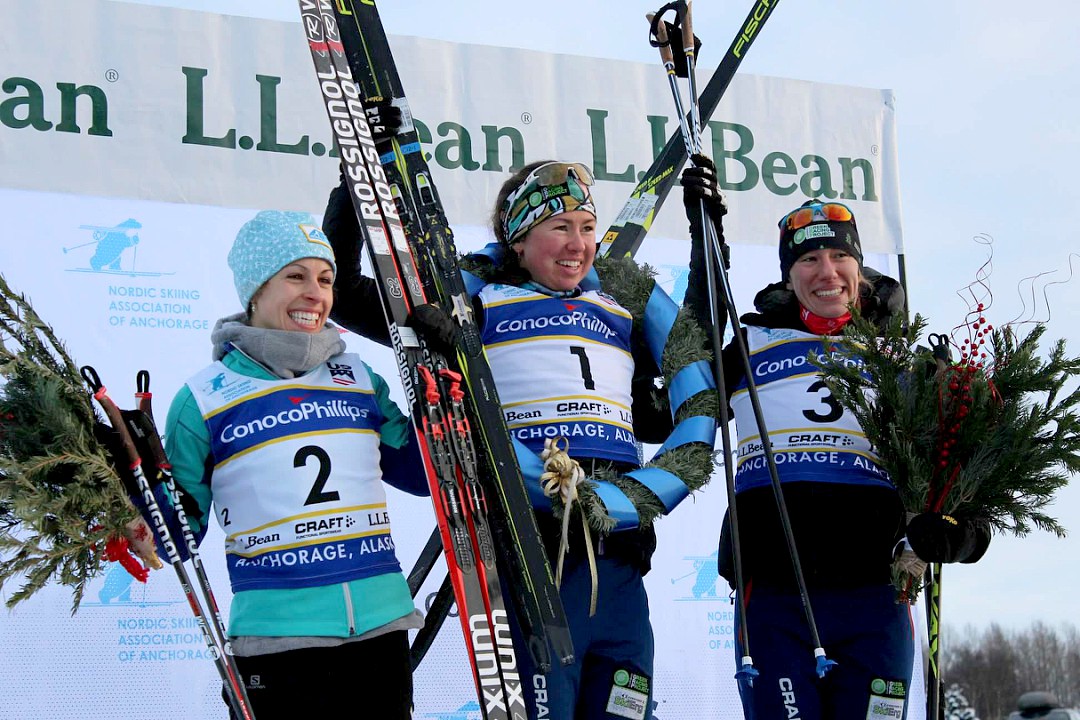
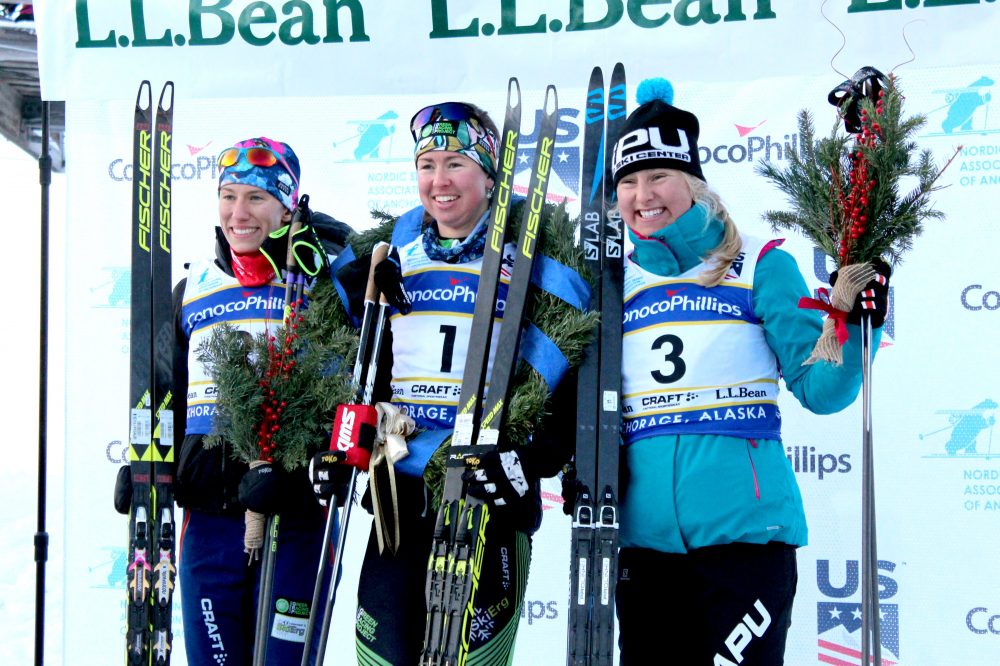
    The top-three Americans in the women’s 20 k classic mass start on Sunday at 2018 U.S. nationals in Anchorage, Alaska, with Caitlin Patterson (1) of the Craftsbury Green Racing Project (CGRP) in first, Rosie Frankowski of APU (l) in second, and Kaitlynn Miller (r) of CRGP in third.

    ANCHORAGE, Alaska — It turns out that Caitlin Patterson does have a weakness: Swedes. The 27-year-old Craftsbury Green Racing Project (CGRP) skier was denied her first outright victory of the week when she crossed the finish line second to Hedda Bångman, a former member of Sweden’s U23 National Team who now skis for the University of Colorado Boulder (CU), in the women’s 20-kilometer classic mass start at the 2018 U.S. Cross Country Championships on Sunday morning at Kincaid Park. But as the first American, Patterson captured her third national title in as many races.

    Rosie Frankowski, of Alaska Pacific University (APU), was the third athlete across the line and second American. She was followed by Jessica Yeaton, who competes domestically for APU, but is an American-Australian dual citizen and competes internationally for Australia. Kaitlynn Miller, also of CGRP, was the fifth athlete across the line to round out the domestic national championship podium.

    Bångman crossed the finish line of the four-lap, technically 22-kilometer course in 1 hour, 55.3 seconds, 15.9 seconds clear of Patterson in second. It was the first time all day that Bångman had enjoyed such an edge.

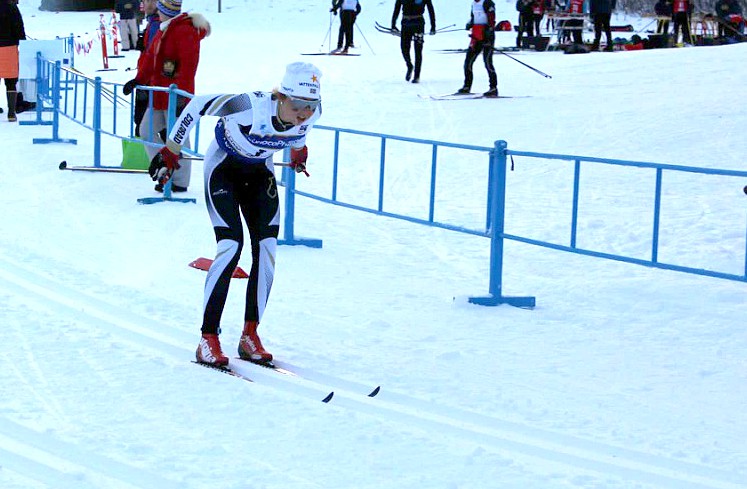
    CU’s Hedda Bångman on her way to win the women’s 20 k classic mass start at 2018 U.S. Cross Country Championships on Sunday in Anchorage, Alaska.

    The field of 42 skiers left the Kincaid Stadium at 10 a.m. on another perfect race day, the temperature around 16 degrees Fahrenheit and an approaching sunrise about to reveal mountains shimmering in all directions.

    Wednesday’s fresh snow had allowed race organizers to come up with a compromise between the snowmaking loop and the full International Ski Federation (FIS) distance courses, a 5.44-k loop that began with an A-climb up Elliott’s Climb, descended most of the way back to the stadium, covered all the hills on the snowmaking loop, then traversed the 1.5 k Lekisch Loop before finishing in the stadium. The hills on the course were relatively front-loaded, with the single largest climb coming in the start of the loop and smaller (but still steep) hills over the final four-plus kilometers. The final kilometer was predominantly downhill from the high point of the 1.5 k Lekisch into the finish.

    Snow coverage off of the manmade loops appeared to be good to very good, albeit with a relatively abrasive and icy base in the bottom of the tracks.

    The first time up Elliott’s, Frankowski led a large group of 30-plus women (effectively the entire field) up to the top of the A-climb roughly 1.3 k into the race. She was closely followed by APU’s Chelsea Holmes to her left, and Bångman and Miller to her right.

    The second time up Elliott’s, little had changed. Frankowski led a group of 10 women, with Bångman, Yeaton, and Holmes immediately behind her, and Patterson a few strides farther back.

    The third time up Elliott’s, it was yet again Frankowski in the lead, followed yet again by Bångman, Yeaton and Holmes, with Patterson yet again appearing to lag back slightly on the uphill.

    Rosie Frankowski definitely deserves a shout-out for leading the train a whole lot out there and really pushing the pace,” Patterson told FasterSkier in a finish-line interview.

    Four kilometers later, the athletes lapped through the stadium a final time as they headed out on their fourth loop. At this point, Frankowski, Bångman and Patterson, in that order, were still within one second of each other, with Yeaton around seven seconds back in fourth and Miller in fifth 12 seconds behind Yeaton.

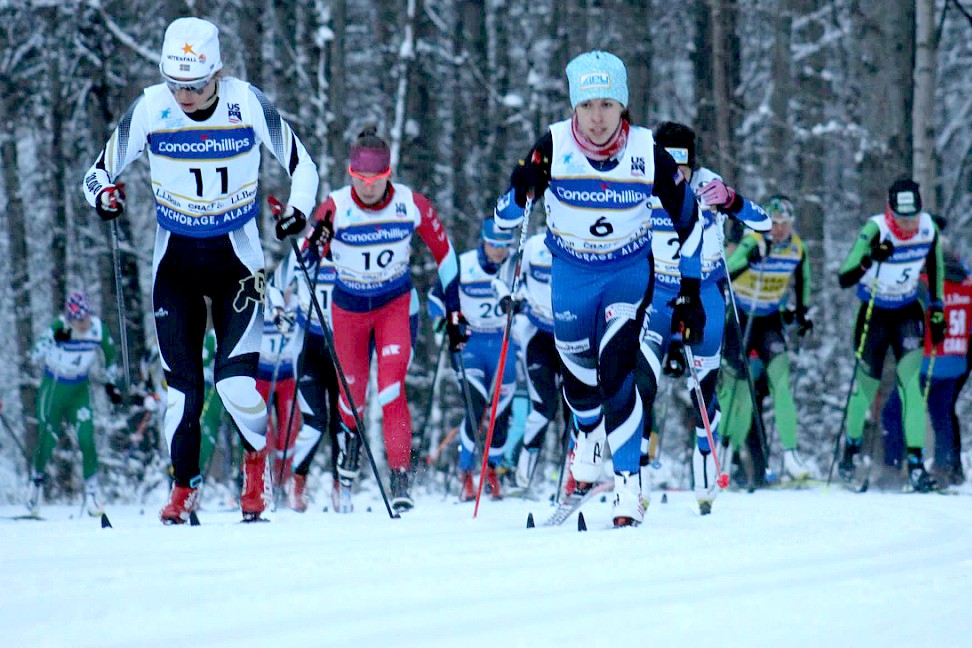
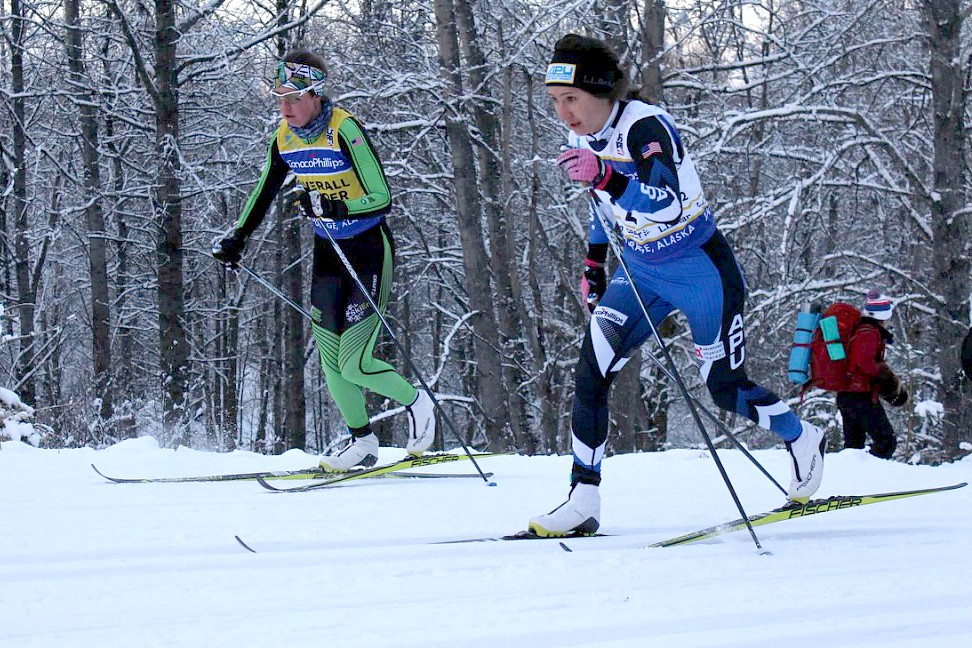
    APU’s Rosie Frankowski (6) and CU’s Hedda Bångman (11) leading the charge up Elliott’s Hill in the women’s 20k classic mass start at the 2018 U.S. Cross Country Championships in Anchorage, Alaska.

    If the lead pack was going to avoid a three-woman sprint to the finish, something was going to have to give. And the final time up Elliott’s, it did.

    “The fourth lap is where it really splintered apart,” Patterson said. “At the top of Elliott’s, that last really kicker hill, the herringbone hill.”

    At that point, Patterson, who grew up in Anchorage, recounted that Bångman had “really good skis, like stay-in-the-track that whole way up good. All the rest of us were running outside [the tracks] flailing around a bit, so she gapped us there. And she skis the downhills very well, so she closed a gap there across the World Cup [start area] flat out there, and we never closed that down. Frankie and I were chasing her on Rollercoaster, but I think she held her gap about the same from there all the way to the finish.”

    As Bångman, 22, told FasterSkier after the race, “I didn’t have a plan before [the race], but I knew I was the strongest. So when we went out on the last lap, then I realized, ‘I can really make this race.’ So in the first hill on the last lap, I started to push harder, and then I left the others behind me. And then it was just to push as hard as I can to the finish line.”

    By the time the three-woman lead pack came around the edge of the stadium again, midway through their final lap, Bångman had a significant lead, roughly 12 seconds. She stretched it to 15.9 seconds by the finish, finally allowing herself to slow slightly, look around, and celebrate in the final meters before crossing the finish line.

    Behind her, a battle for top American was shaping up between Frankowski, who had never stood on a national championships podium, and Patterson, who had been there twice already this week.

    Coming through the edge of the stadium, Patterson held a lead of two to three seconds over Frankowski as the two of them approached the wall-like climb up the Gong Hill for the final time. Patterson began heading up on the left side of the trail, Frankowski a few meters behind her on the right, herringboning with stunning alacrity for being 20 kilometers into a 22-kilometer race.

    Then Frankowski caught a pole tip on her ski and fell into the sugar snow on the uphill. It took her several seconds to get up. While she extricated herself, Patterson skied away and up and over the top of the Gong Hill.

    “The real cool thing that came out of that fall,” Frankowski told FasterSkier after, “was that I actually had my pole stuck under my ski, and I had to literally think, ‘Relax, and figure this out and stand up.’ While in the past I would have been so frantic I probably would have dropped more places than I did.”

    “So I basically was just trying to get up,” recalled Frankowski, a 26-year-old Minneapolis native. “And when I got up someone yelled, ‘Don’t give up.’ And immediately I felt like, well, I am going to try to catch Caitlin, and if I could I would, but I didn’t. She is so strong right now; I tried and got close, but I didn’t do it.”

    Frankowski’s travails were news to Patterson when told about this after the race.

    “I had no idea,” Patterson said of her fall. “But that makes sense because it confused me because I was certain that as I ran up on the wall on the left side I was certain that there was someone just by me on the right side. But then I could hear on the downhill that there was no one close and then people were cheering for her 10 meters back, so I didn’t see that during the race.”

    Frankowski’s fall came midway through the last lap, roughly 2.1 kilometers before the end of the race. After giving chase over the Lekisch Loop, she made up roughly the time she had lost in the fall before running out of real estate, crossing the finish line 3.7 seconds after Patterson for third overall and second American.

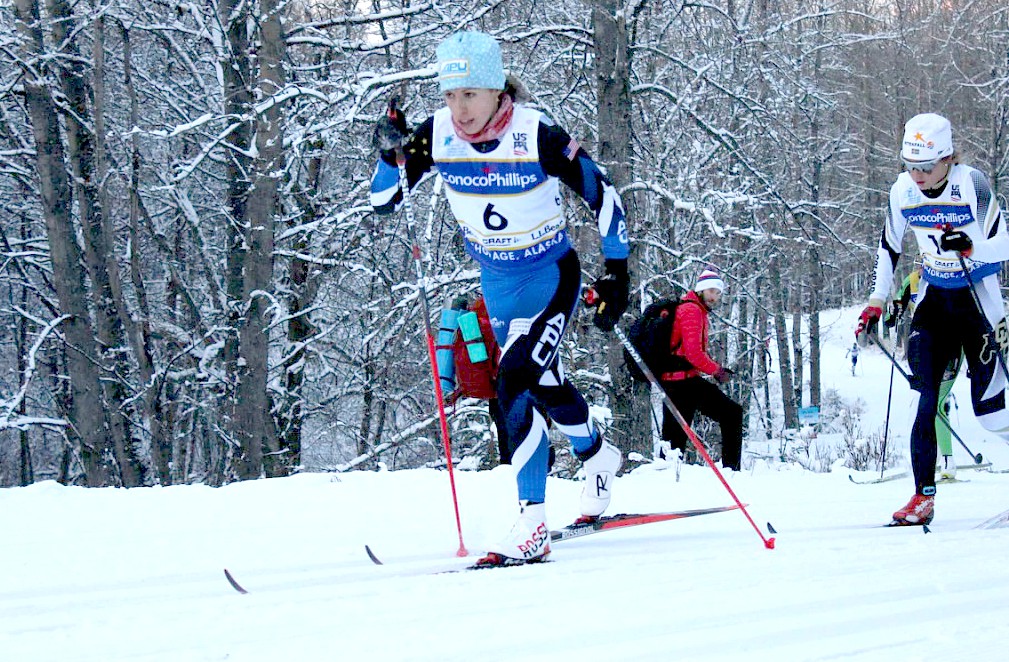
    Rosie Frankowski (APU) leads CU’s Hedda Bångman (11) up Elliott’s Hill in the women’s 20 k classic mass start at the 2018 U.S. Cross Country Championships in Anchorage, Alaska.

    Yeaton, 26, who was born in Perth, Australia, and moved to Alaska at age 12, skied into the finish alone 24 seconds later for fourth overall. Miller followed another 29 seconds later for fifth overall and third American. Alayna Sonnesyn, a University of Vermont junior, was the second college skier and second U23 skier in the top six.

    “I felt so strong today,” said overall first-place finisher Bångman. “It was a so-good race, I’m so happy. My skis were perfect, and my body felt so good.”

    Patterson is now three-for-three for national titles this week, but this one didn’t come easy.

    “I am pretty excited about this third one, but it was the toughest of them all,” she said.

    “It was a real struggle to hang with the people who were pushing the pace today,” she added, crediting Frankowski for her work at the front.

    “I know especially how I am racing right now that I just need to hang on and the end can be good, and it was fairly good today,” Patterson added. “So I am really happy with the national title.”

    Patterson said that she had opted to prioritize glide over kick on Sunday in light of the course profile, “because I feel like a lot of those walls are steep enough where I would be running anyway.”

    “I probably erred a little too much on the glide side,” she continued. “Which is my fault with some testing … so I was herringboning like every single one of those technique zones, every kind of big hill, just had to keep moving. And luckily because the skis were so fast and I know these downhills so well, I was able to catch up on a lot of the downhills when I did get gapped on several uphills, almost every lap.”

    Each lap featured three of the technique zones that Patterson had mentioned, in which doublepoling was forbidden. For the Anchorage readers, or anyone else familiar with the Kincaid trails, one was at the top of Elliott’s Climb; one was at the southern end of Dark Alley, approaching the lower tunnel; and one was the entire climb up to the Gong Hill from the north/back side of the snowmaking loop just a few hundred meters later.

    (There had been a fourth zone marked during Saturday’s course preview, Patterson recounted, in the first uphill on the Lekisch Loop, which features a stair-step climb with a slight saddle or depression between the two steps. “There was a technique zone that they tried to put there,” she said, “and it literally had a downhill in it, but luckily the coaches protested that and they took it out.”)

    After 22 k of skiing and 12 careful trips through each technique zone, Frankowski finished 3.7 seconds behind Patterson. It was the first national championships podium of her career.

    Her sole strategy coming into the start of the race had been to “push every uphill,” Frankowski explained. “I have raced at Kincaid enough to know that you recover at every single downhill, and so for someone who doesn’t have a sprint at the end, I needed the pace to be hot at the beginning. So right when we started, immediately out of the start I realized that our skis were incredibly fast, and honestly comparable to or better than anyone else’s in the field, and so I felt, well I am going to doublepole as much as I can and then every downhill, especially the ones I struggle on, just tuck behind and try to be relax and know that I can catch back up.”

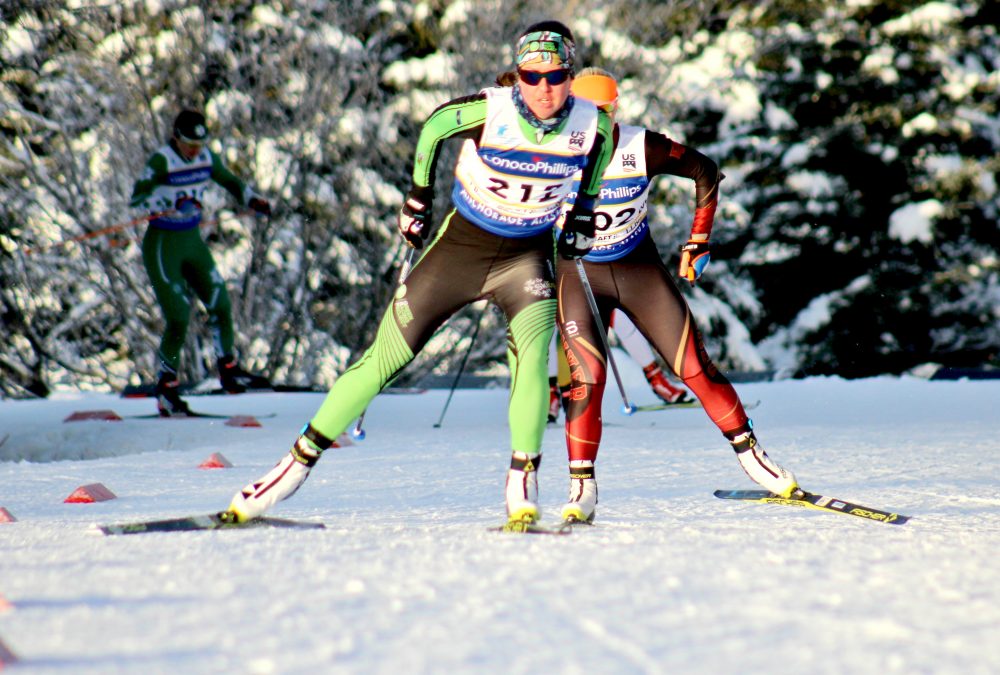
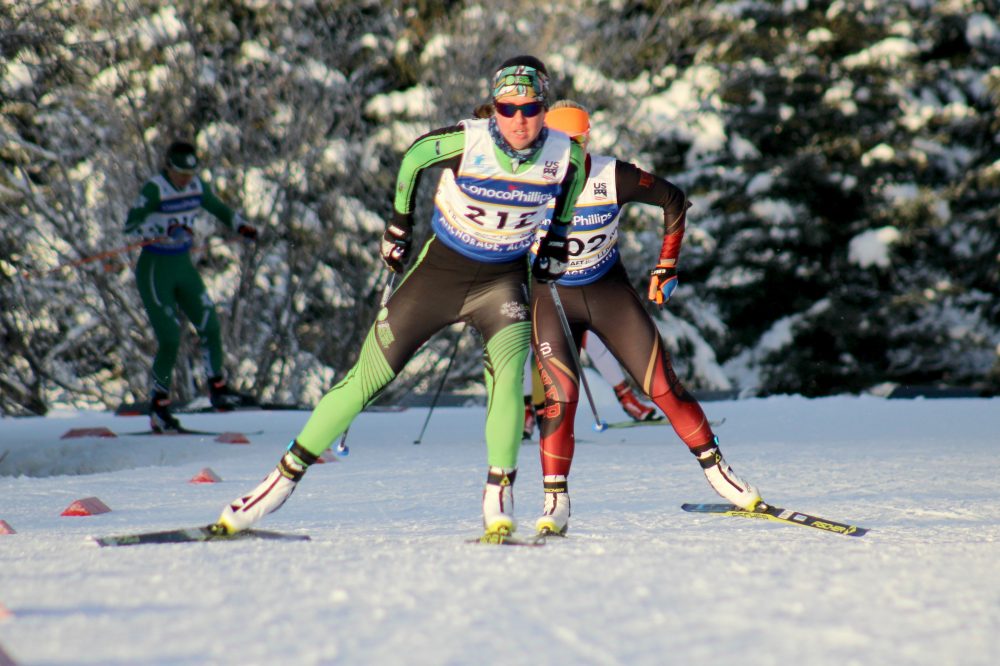
    Craftsbury skier Caitlin Patterson (l) with APU’s Chelsea Holmes during the the women’s 20 k classic mass start at the 2018 U.S. Cross Country Championships in Anchorage, Alaska.

    Frankowski made clear that, like Patterson, she had gone thin to win when it came to choosing how much kick wax she wanted. “The course here,” she said, “except for maybe Elliott’s, all these hills are running hills so you really had to Klæbo it up or herringbone and just know that you are not going to have perfect striding today, and if you do, your skis are going to be too slow through the stadium to be in the mix.”

    Frankowski, whose public social media profile frequently features paeans to the consumption of Thai food, also clarified, “I would say the key to success is that last night I had Tom Yum soup and Pad Thai for dinner, and lots of cookies, so I think that helped also.”

    Fellow APU skier Yeaton was the fourth skier across the finish line, 24.5 seconds behind Frankowski and 44.1 seconds back from Bångman.

    Yeaton pulled no punches when asked if she had been expecting this result.

    No,” she said. “Not even close. Nowhere in the ballpark. … I was hoping, like on a great day, maybe I’d get top 10. I never thought I’d get fourth.”

    Yeaton’s fourth wrapped up a strong week of domestic racing for the Australian-American dual national, who is known more as a sprinter rather than a distance skier. Indeed, her next races will be Dresden, Germany, to compete for Australia at next weekend’s sprint-centric World Cup stop. Yeaton is presumptively qualified for the Australian Olympic Team in the latest FIS Olympic Points List simulation.

    29.4 seconds behind Yeaton came Craftsbury’s Miller in fifth overall, but the third American across the line after Patterson and Frankowski. She had been “in contact with the lead group until about the third lap when a gap formed on Elliott’s [Climb] that I was unable to bridge,” Miller wrote in an email to FasterSkier after the race.

    “I’m very pleased with my race and it was very exciting to see my teammate, Caitlin Patterson, place second,” she added. “I was very impressed with the 5k course that the organizers put together for the event. It was a fun course to race on.”

    Sunday marked Miller’s fifth time on a national championships podium, and second in this week, following a second on the American podium in Friday’s freestyle sprint.

    Sonnesyn filled out the rest of the top six. The 21-year-old Vermont college skier identifies as a distance skier and had been hoping for a better result in Wednesday’s 10 k skate, she told FasterSkier at the finish.

    I was excited for that, but unfortunately I didn’t have the race I was hoping for,” Sonnesyn said. “But I came back with a really strong sprint, which kind of surprised me. And I was feeling so great that I came into this race today pretty confident. So I was excited for it this morning, and I’m really happy with the way it went.”

    Hannah Halvorsen Wins Junior Race

    While junior women (U20 skiers and under) raced alongside the senior/master field in Wednesday’s 10 k freestyle individual start, Sunday saw the juniors get their own starting time and course for the 5-kilometer classic mass start race. One lap, 92 starters, 5.5 kilometers, go!

    Before long, a pileup ensued. But “I only heard about it from quite a few girls,” junior winner Hannah Halvorsen, of APU and the U.S. Ski Team, told FasterSkier after. “I was right in front of it; I got lucky.”

    Halvorsen, 19, covered the one-lap course in 15:07.8. Second place went to Hailey Swirbul, a University of Alaska Anchorage sophomore, 10.4 seconds back.

    Third place on the all-Alaska podium went to an athlete with four years’ less experience and one fewer Junior World Championships medal to her name, U16 athlete Kendall Kramer. Kramer, who finished 4.4 seconds behind Swirbul, skis for the Nordic Ski Club of Fairbanks/Fairbanks XC (NSCF-FXC), as well as West Valley High School. She had competed in only one other FIS race in her life before this week.

    Halvorsen was second on the junior girls podium in Wednesday’s distance skate race, and third overall among American women in Friday’s sprint race. Swirbul was the top junior woman on Wednesday and reached the quarterfinals of the senior women’s sprint on Friday.

    Halvorsen had high praise for Sunday’s race course: “Super-fun course, up and down, kind of rolling,” she said. “Good places to find speed and carry momentum, time to rest and do different transitions. Just, like, a fun course.”

    It probably doesn’t hurt that she won. “It felt good,” said Halvorsen, who grew up in Truckee, California. “I was tired this morning, but it doesn’t really matter how you feel, you just get out there and go for it. I had really good skis, really good support; my dad’s here, my brother’s here. It’s a beautiful day to be racing; really fun racing out there.”

    — Gabby Naranja and Ian Tovell contributed reporting

    Results: Women’s 20 k | Junior women’s 5 k

    Highlights video from Max Romey Productions

  • Two-for-Two: Patterson Wins Second-Straight Race at U.S. Nationals; Hart Takes Qualifier

    Two-for-Two: Patterson Wins Second-Straight Race at U.S. Nationals; Hart Takes Qualifier

    Caitlin Patterson of the Craftsbury Green Racing Project leads Jasmi Joensuu (University of Denver) during their semifinal of the women’s 1.5-kilometer freestyle sprint on Friday at the 2018 U.S. Cross Country Championships in Anchorage, Alaska.

    ANCHORAGE, Alaska — For the throng of spectators who lined up along the colorfully flagged sprint course at Kincaid Park on Friday, Mother Nature had donned a new look: an earl-gray sky and a rising sun, making the white snow-dusted base of the state’s Tordrillo Mountains (known locally as the “Ghost Range”) if ever so faintly distinguishable to the southwest.

    Less than 48 hours had passed since the opening race of the 2018 U.S. Cross Country Championships at Kincaid Park, but the slushy trails and snowy skies that had prevailed Wednesday were tucked away in the closet.

    The second day of racing found athletes and onlookers embracing the end of the sun’s bereavement; a few blinking in wonder and questioning if it was indeed, the same place they had ventured to two days before.

    While the weather had transposed into an alter ego, one competition-day facet remained virtually unchanged: the name of the eventual winner.

    Caitlin Patterson, who races for the Craftsbury Green Racing Project (CGRP) and grew up in Anchorage, is proving herself a force to be reckoned with this week; the event weather and discipline may change, but her desire to finish first apparently does not.

    From left to right: Kaitlynn Miller (Craftsbury Green Racing Project), Caitlin Patterson (CGRP) and Hannah Halvorsen (APU) on top of the American women’s 1.5-kilometer freestyle sprint podium on Friday at the 2018 U.S. Cross Country Championships in Anchorage, Alaska.

    The 27 year old won Friday’s 1.5-kilometer freestyle sprint final in a time of 3:20.9 minutes and now holds four U.S. national titles. One of those came in Wednesday’s 10 k freestyle and the other two from 2016 U.S. nationals, in the 10 k classic individual start and 20 k freestyle mass start races. Friday’s victory was her first sprint national title.

    Though she has been on a U.S. nationals sprint podium once before — she finished third in the 2016 freestyle race — Patterson was slightly surprised with the margin by which she won Friday. She finished the final with a definitive win, the next closest finisher 3.56 seconds behind.

    “I expected, especially in the final, that someone would really have a push on the top of that hill, but maybe everyone was getting a little bit tired or maybe I just went for it a little harder than I realized I could,” Patterson reflected after.

    But she was especially wary of Finland’s Jasmi Joensuu, the University of Denver junior who had finished second right behind Patterson in both the quarterfinal and semifinal.

    “In our quarterfinals [Joensuu] was extremely strong at the top of the major uphill, hop skating, really putting a push over that I could barely match,” Patterson said.

    Joensuu, 21, had been punching the pace in the front through the first climb for most of the day, leading Patterson out during both their quarterfinal and semifinal. In the early heats, the CGRP skier tended toward the back through the first third of the course.

    “I was really strong in the uphill. That’s what I think was my strength today,” Joensuu said after.

    “I’m a slow starter,” Patterson explained. “In the semifinal I found myself in the very back of the heat.”

    It was in the downhill returning to the stadium and the final uphill hook back toward the finish that Patterson tended to regain ground; that is how she held off Joensuu in the finish of both the quarterfinal and the semifinal (they went one-two in both heats, respectively).

    The final was not much different. Joensuu was still at the front of the charge off the start, but this time alongside the University of Colorado Boulder (CU) senior Petra Hynčicova, a 2017 NCAA double champion, who hails from the Czech Republic.

    The University of Colorado Boulder’s (CU) Petra Hynčicova leads Craftsbury Green Racing Project (CGRP) skier Kaitlynn Miller back into the stadium during their semifinal of the women’s 1.5-kilometer freestyle sprint on Friday at the 2018 U.S. Cross Country Championships in Anchorage, Alaska.

    “The first part was definitely the best part for me,” Hynčicova said after. I knew I had really good skis … I tried to go in the beginning. I think it was the right move.”

    The two international college skiers continued in the front through the first descent running along the backside of the course. There, Patterson made her move. Tucking for speed, she slungshot her way from fourth to second, moving around Joensuu and her CGRP teammate Kaitlynn Miller, heading into the major climb side-by-side with Hynčicova.

    Through the climb, Patterson tried to stay as quick as possible, reaching the top before the rest of the finalists. Pressing to keep up were Joensuu, Hynčicova, Miller, Hannah Halvorsen, of Alaska Pacific University (APU) and the U.S. Ski Team D-team, and Kelsey Phinney of the Sun Valley Ski Education Foundation (SVSEF).

    “I was pretty tired by the final and didn’t have the legs to vie for a top spot but so it goes sometimes,” Phinney wrote in an email.

    “I’ve still got to work on getting my extra sprint gear,” Phinney continued. “But it was great to have a really competitive final with everyone holding their own and jockeying for spots at different parts of the course, that’s always fun!”

    As Phinney and the rest raced to catch up, Patterson focused on maintaining a gap. Now that she was in front, there was no turning back.

    “I could feel people behind me but I was never looking back,” Patterson said. I knew that since I was going to be in front, I was not going to be drafting anyone on the downhill, so I better get out of there as fast as I could and then I just sent it on the downhill.”

    Patterson cruised down back toward the stadium, Joensuu now the only one within proximal striking range, about five meters behind. Following Joensuu was Hynčicova and Halvorsen, then Phinney and Miller. The group looped into the final incline to the finish Patterson still leading the way, Miller having moved around Halvorsen during the course of the corner.

    “I think you can always look at where you can improve and a lot of those girls were skiing that final U-turn a lot better, carrying more speed out of it than I did, so I’d like to work on that in the future,” the 19-year-old Halvorsen said.

    Joensuu and Hynčicova had carried speed, but not enough to catch Patterson. The Finn claimed second 3.56 seconds behind, while Hynčicova earned third, 4.19 seconds back. In fourth, was Miller as the second American, 4.35 seconds out of from the win and 0.16 seconds out of third.

    “It’s always exciting in the heats to keep moving up, especially when you feel like you gave it your all in the qualifier,” Miller said after the final.

    Stratton Mountain School (SMS) Elite Team member Anne Hart (201) leads her teammate Erika Flowers during their quarterfinal of the women’s 1.5-kilometer freestyle sprint on Friday at the 2018 U.S. Cross Country Championships in Anchorage, Alaska.

    “I definitely tend to have better results in classic, so for me, I just like to see improvement in my results, feel like I’ve done well,” added Miller, who was the 2016 classic sprint national champion and placed third in last year’s classic sprint. She also placed second in the 2016 classic 10 k individual start.

    “I’m pretty happy with it,” she added of earning her first freestyle podium as the second American woman across the line.

    Just missing the final and the winner of Friday’s qualifier was Anne Hart of the Stratton Mountain School (SMS) Elite Team in seventh. Earlier this season, Hart raced the opening International Ski Federation (FIS) races in Beitostølen, Norway, where she finished in the top 20 in the 10 k freestyle. She also won this year’s opening SuperTour freestyle sprint in West Yellowstone, Montana.

    “I’m feeling overall good about the race, with a little bit of regret for what could have been.” Hart wrote in an email. “I had a really disappointing 10 k skate race for me — I had been hoping for a much better result, but unfortunately the course and conditions ended up not suiting my style of skiing.

    “Both Pat O’Brien (SMS coach) and Max Lipset (strength coach) were talking to me after the 10K, and encouraging me to bring my best possible self to today’s effort, and throw a metaphorical punch that I would be proud of,” Hart continued. “With that mindset, some good energy, and great skis I was able to put together probably my best qualifier to date. I’ve never won a high-level full field qualifier, so while they don’t give flowers for that I am counting it as a definitive personal victory, and an affirmation in the training I’ve done.”

    Hart won the qualifier in a time of 3:22.10 (Patterson qualified in 12th, 5.76 seconds back, and later won in a time of 3:20.9). The SMS skier advanced to the quarterfinals before getting eliminated in her semifinal after finishing third behind Miller and Hynčicova.

    “My quarterfinal was good, although in retrospect I think I may have burned a little too much energy early on leading from start to finish,” Hart wrote. “I took a different tact in the semi-final to try and utilize the draft into the finish, but unfortunately followed the wrong person up the big hill and got a little further back than I would have liked to be.”

    “So I put in my best effort to close the gap to the top two women, and came up less than a hundredth of a second short.” Hart continued. “So that stings a little bit to be so close to the final on a day when I know I could have been competitive in that last effort, but that is ski racing— for better or for worse— and I’m excited for the two races yet to come!”

    Two races remain with a 20 k classic mass start on Sunday and a classic sprint on Monday.

    In the junior women’s freestyle sprint on Friday, the win went to Sydney Palmer-Leger (SVSEF) in a time of 3:36.05. Callie Young of the Craftsbury Nordic Ski Center claimed second, while Kathleen O’Connell skiing for Montana State University took third.

    Also in the junior’s final was Annika Hanestad in fourth, Sarah Morgan of Wasatch Nordic in fifth, and Kelly Koch of Loppet Nordic Racing in sixth.

    Results: Qualifier | Senior women’s final | Junior women’s final