From the FasterSkier archive — posts syndicated from athletes’ and coaches’ own blogs between 2004 and 2012, kept online as published. Current coverage is at fasterskier.com.
The first flakes had finally settled on the branches behind Rosie Brennan’s window in Anchorage. “Yeah, finally,” she said, turning from the screen toward the light outside. “God, it was slow to come, but we are getting there.” Snow matters in November for any cross-country skier. Still, for Brennan—now entering her fifteenth season on the U.S. Ski Team—it has always represented something deeper: familiarity, grounding, the landscape she moves through on her own terms.
Independence, more than victory or longevity, is the quiet force running through her career. Long before she became an Olympian or a World Cup all-arounder, before the podiums and the endurance of her late-blooming rise, she was a kid in Park City who needed space—space to move, explore, test herself, figure out where she belonged. Ski racing would give her a path, but the structure of the World Cup would also challenge the part of her that had always craved autonomy.
Rosie Brennan (USA) celebrates after finishing 2nd in the 10 k classic race in Ruka, Finland in 2023. The result was Brennan’s first classic World Cup podium of her career. (Photo: Nordic Focus)
“I’m a very independent person,” she told me. “So to suddenly be told what your day is gonna look like every single day is mentally… exhausting for me.” It’s the kind of line that quietly explains everything: her training, her rituals, her late-career resilience, and the internal negotiations required to live five months of every winter inside a system built around tight schedules, shared spaces, and routines she cannot control.
That independence—both threatened and defended—shapes the story of Brennan’s life in skiing as much as any result sheet.
“From the FasterSkier Archives: While I never actually went cross country skiing with my Dad, he was incredibly influential in his love for the outdoors and ability to truly enjoy life. My dad taught me to alpine ski and mountain bike, both were activities in which he challenged me and was always up for a race. I don’t know if my mom will ever get over just how much I ski like him. My dad had a great ability to do things in a big way in order to maximize the enjoyment out of each adventure and he did so with incredible passion. I can’t say I have fully learned this yet, but his spirit and enjoyment of life certainly are in me and I think often about how to embrace this a little more each day. At the very least, I have learned to be very passionate about the things I love. My favorite place in the world is the Southern Utah desert and I think my love for the desert stems entirely from family fun, particularly with my Dad.”
A Childhood of Motion
Brennan grew up in Park City, not in some improbable ski-wilderness origin story, but in a family that valued movement the way others emphasize music lessons or math tutoring. “Everyone did outdoor activities,“ she said. “We were pretty typical in that sense.“ Winters were alpine ski weekends. Summers meant hiking and biking. Gymnastics arrived because she liked the conditioning. Soccer came because she could run “a whole game.”
She was athletic but not yet an athlete. “I participated in soccer,“ she said, without pretense. “I won’t say I was crazy competitive in that. And same with gymnastics—I didn’t compete at all, but I really loved it.”
What she loved about gymnastics, specifically, she said, was the work:
“I think it was more, actually, just the strength component… the actual conditioning part. That’s what I really liked.”
The shift toward cross-country skiing came from her mother, whose winter rule was simple: pick an activity. “She was the one who just kept suggesting, ‘You should try the Nordic team,‘” Brennan said. “Finally, I was like, well, I got no better idea, so fine, I’ll try it.”
If her mother’s persistence nudged her toward snow, the 2002 Salt Lake Olympics made the possibility feel real. Brennan was in seventh grade. Her family hosted a Nordic combined athlete. Youth camps sprang up everywhere across Utah.
“I think a lot of it was subconscious,“ she said. “But that obviously had a massive impact on my wanting to pursue other things.”
Then came the moment that still feels slightly mythical in her telling: she found skiing, and skiing made sense to her in a way nothing else had.
“I could see the path forward,“ she said. “It was just… really motivating to me.”
The First Signs of Something
Her early results were small but decisive. “I actually won my first race, but there were only two people in it,“ she said, laughing. “But I honestly think that was kind of powerful for me. Like, oh—if I can beat one person, I can probably beat some other people.”
Within two years, she went from missing Junior Nationals to winning all the distance races at JOs. She remembers calling her mom.
“Mom, I won.” “No, you didn’t.” “No—really, I did.”
When Brennan made World Juniors and cracked the top ten, she earned her first spot on the U.S. Ski Team. It felt surreal, but the reality is that she wasn’t fast because of some stroke of talent. She was fast because she’d been training with boys for years, trying to keep up. “It was one of those social situations in which it’s like, keep up or don’t have friends,“ she said. “So I was like, all right, I’m keeping up.”
Her team was small, her training unorthodox. “I did quite high intensity for junior,“ she said. “But very low volume.“ Meanwhile, she ran fall seasons because running was what she could control.
Autonomy was already the central language of her development.
Rosie Brennan (DAR) Lake Placid SuperTour 2011
The Dartmouth Choice
By the time she visited colleges, Brennan had become a known junior—national team member, World Juniors top-10 skier, and a real recruit. Her first choice was Colorado. They didn’t offer a scholarship. Dartmouth didn’t offer scholarships either, but it did offer something better: Cami Thompson-Graves.
“Her investment was in me and not, like, an NCAA title,“ Brennan said. “That was very obvious… she was willing to help me manage all of it.”
Dartmouth gave her what she needed: an independent women’s team after training primarily with men, a coach who saw the whole person, and a program flexible enough to accommodate a U.S. Ski Team schedule. She raced all four years, graduated in the traditional four, absorbed the mentorship of teammates like Ida Sargent, Sophie Caldwell, and Erica Flowers, and even shared training space with Susan Dunklee.
Dartmouth let her remain the version of Rosie that worked.
But the World Cup—its structure, its relentless pacing—would test that.
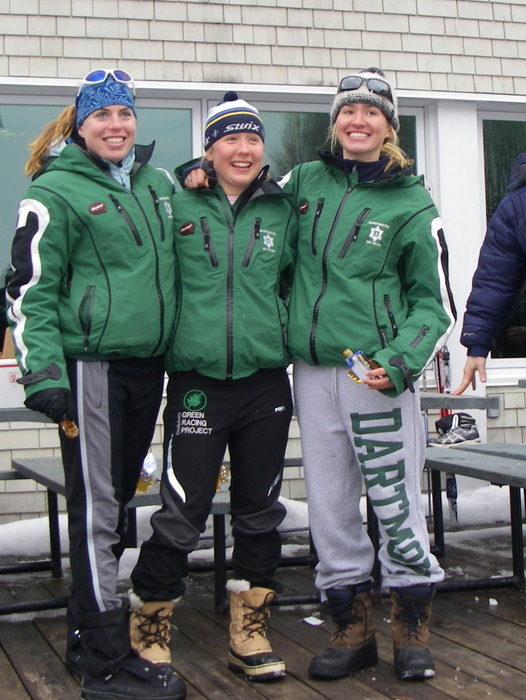
Rosie Brennan, Ida Sargent and Sophie Caldwell of Dartmouth, March 2010
Learning to Live in Europe
Her early World Cup years were steady—no fireworks, no collapses. She attributes the eventual breakthrough to something simple: time. “If you think about someone who starts at five,“ she said, “they’re good at 22. That’s the same number of years it took me. It just skewed by a decade.”
But the other part of her progression came from learning how to survive Europe.
“I mean, I finally had trained at a consistently high volume,“ she said. “But I also found it just took a long time to figure out how to manage in Europe.”
What was so hard about it? Not the racing. Not the waxing. Not the altitude.
It was the loss of personal freedom.
“To suddenly be told what your day is gonna look like every single day is exhausting for me,“ she said. “The freedom of being able to jump in your car and go somewhere—that’s gone for like five months.”
The World Cup removes the choice of when you sleep, where you eat, andhow you move through your day. Athletes share hotel rooms, team vans, dining halls, training sessions, and travel itineraries. It works beautifully for some. For Brennan, it was disorienting.
There were no models for how to do it differently. “The example they have is Jessie,“ she said. “She thrives on the road. She’s happy as she can be living in a bag for five months.“ But if you are not Jessie Diggins, Brennan said, “that’s really hard.”
So she began—to use her word—to “navigate.”
“I learned to get pretty good at the bus schedule,“ she said. She found bakeries in every town. She found grocery stores that sold the one piece of candy she liked in that country. She found trails “maybe off the beaten path“ that she returned to each year. She learned to take mountain days, not for training but for sanity.
These rituals were tiny, private rebellions—the things she could choose inside a world where most things were selected for her.
Rosie Brennan and coach Erik Flora (APU) ski on the World Championships sprint course in Trondheim on Wednesday, February 26, 2025. (Nathaniel Herz/FasterSkier)
A Coach Who Understands Her
If Europe tested her independence, her relationship with APU Head Coach Erik Flora reinforced it.
“He has been, like, everything for me,“ she said. “He’s kind of saved my life many times over.”
What she means is that Flora understands her wiring. He sees what she cannot always express.
“He has this ability to just watch you train and know exactly what’s going on in your life,“ she said.
That sensitivity carried her through some of the most challenging years of her career. During Covid, Flora couldn’t travel much; last season he could only watch occasional race film. It wasn’t enough. Brennan needed someone who knew her patterns—her real patterns—not just her splits.
“When I was in the thick of it last winter,“ she said, “he wasn’t there… that’s why ultimately I did end up coming back [to Anchorage]. I needed some of that support.”
Their relationship—its longevity, its trust—became essential when her body began to unravel.
Rosie Brennan (USA) after finishing the 10 K Classic at the FIS Nordic World Ski Championships in Trondheim (NOR). (Photo: Modica/NordicFocus)
A Year the Body Wouldn’t Cooperate
For a year now, Brennan has dealt with a medical mystery—post-viral symptoms likely tied to Epstein-Barr reactivation. “It just, like, really screwed up a bunch of my internal systems,“ she said. “My endocrine system has been shot.“ The effects were unpredictable: inability to push hard, severe inflammation, poor recovery, andmuscle shutdown during intensity.
“Last season I was struggling with… I just had zero ability to use my muscles to push hard,“ she said. “I was just racing on base fitness.”
It wasn’t one bad race. It was the absence of the feeling she loved most that was most frustrating.
The Training Fix
She and Flora tried to solve it through training, but even threshold sessions wiped her out. “It was more the duration part that was killing me,“ she said. They tried sub-threshold work. They tried controlled sessions. Nothing stuck.
So they invented something new: Sub-one-minute Level 4 efforts, hundreds of them, designed to keep neuromuscular pathways awake without triggering overload.
“Basically, what I’ve been doing is what I call micro intervals,“ she said. “I do go level four, but under a minute, many times.”
Strength? Gone. “Strength was destroying me,“ she said. “So I haven’t done any weight-room strength.”
Endurance? Reduced to what she could handle. “I got to a place where I was like, all right—I’ll have to be super excited when I get to go for an hour.”
Most of the battle, though, wasn’t physical.
“There were many times this last year that I have seriously contemplated walking away,“ she said. “I actually tried pretty hard to in August.”
But Flora kept calling—checking in, refusing to let her disappear into the uncertainty.
“I guess I’m not getting away that easy,“ she said.
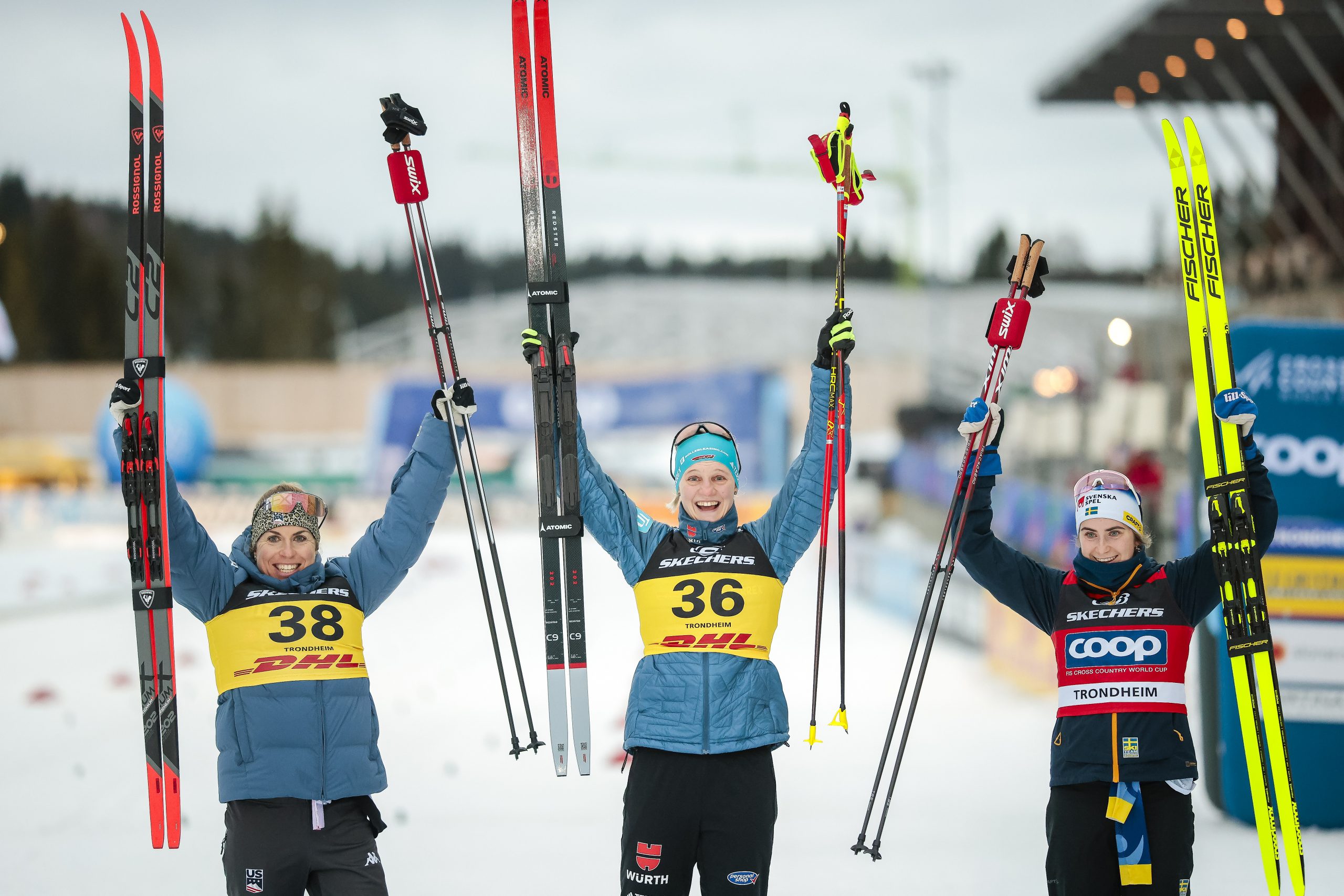
Brennan took second in the 10-k Classic in Trondheim in 2023. Rosie Brennan (USA), Victoria Carl (GER), Ebba Andersson (SWE), (l-r) 10km podium in Trondheim (NOR). (Photo: Modica/NordicFocus).
Why She Keeps Going
When asked what pulls her back to the sport each day, Brennan didn’t talk about results, medals, or even the Olympics.
She spoke of the feeling.
“I truly love the feeling of being able to push myself,“ she said. “It gives me this sense of freedom that I can’t find anywhere else.”
Freedom—that word again. Not competition. Not performance. Not success. Freedom.
It’s the sensation she’s chased since she was a kid, running entire soccer games simply because she could. It’s the sensation skiing first gave her at 14. It’s the sensation the World Cup often constrains, and the sensation her body has withheld for a year.
But it’s also the sensation that makes her keep trying.
She has leaned heavily into mental work this year. Meditation, mindset projects, and conversations with a U.S. Ski Team sports psych, as well as a teammate who has faced similar issues.
“I was very motivated by her,“ Brennan said. “It was cool that she was taking this time to strengthen her brain, too.”
The process has made her reflective, grounded, andmore self-aware than at any point in her career.
Rosie Brennan (USA), shares a podium moment with coach Matt Whitcomb in Ruka, Finland in 2023. (Photo: NordicFocus)
Leaving for Finland, and What Comes After
Now, on the eve of the World Cup opener, Brennan is set to travel to Finland. She will not race everything. “Maybe two races a weekend,“ she said. They’ll experiment. Observe. Adjust. She plans to return to Utah for Christmas, meet with her medical team, and decide what the rest of the season should look like.
“It’s possible I try to race, and it’s a disaster,“ she said. “We may have to totally redo the plan.”
She won’t do the Tour de Ski—too risky. The goal is simply to get to the Olympics “in the best way possible.“
The million-dollar question, of course, is whether this will be her last year.
“I don’t really know,“ she said. “Most likely something will look different next year. Whether that involves racing or not, I’m not totally sure.”
But she’s proud of the career she’s built. Proud of navigating Covid. Proud of her longevity. Proud that she became a true all-arounder.
“That was definitely a big career project,“ she said. “When I finally did that, it felt really big.”
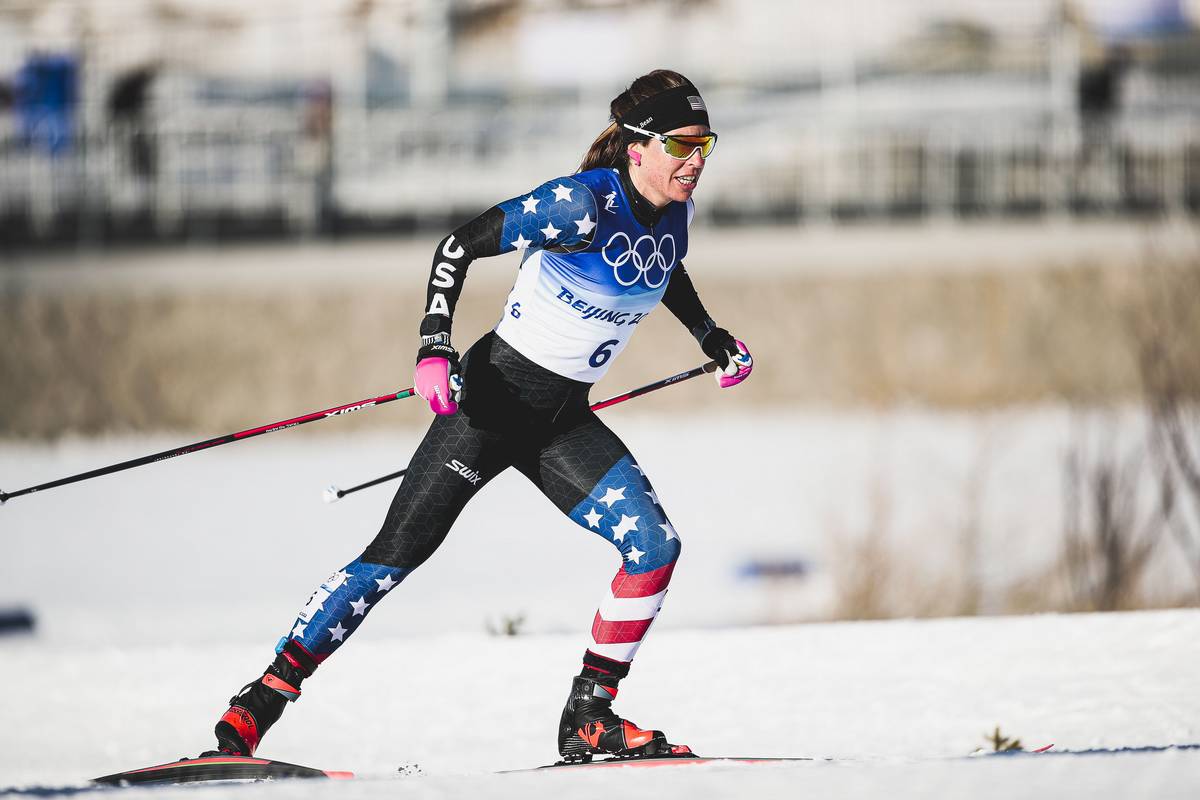
Rosie Brennan races the individual freestyle sprint qualifier during the 2022 Olympic Winter Games in Zhangjiakou. (Photo: NordicFocus)
Holding Her Own
What emerges from Brennan’s story isn’t a tale of triumph or decline. It’s the portrait of a person who has made peace with the complexity of the life she leads.
She has learned how to navigate Europe—not by loving it, but by building rituals that let her remain herself within it. She has learned to trust her body even when it betrays her, and to trust her coach when she doesn’t trust herself. She has learned that the World Cup isn’t designed for independence, and that independence—her independence—is worth defending.
She has also learned that racing is only part of who she is. She’s a geography major who loves the Arctic for its unique beauty, a mountain person who seeks out quiet trails, and a traveler who can always find a town’s best bakery.
And she’s someone who, after a year of medical uncertainty and near-retirement, still wants one more chance at the feeling she can’t find anywhere else.
That, ultimately, is why she’s boarding the plane.
Because even in a world that demands structure, she is still defining her own path.
Love Stories Like This? Help Keep Them Coming.
Feature interviews like this one take time, access, and care to produce. If you value thoughtful storytelling and independent ski journalism, please consider becoming a Voluntary Subscriber. Your support directly fuels the work we do to cover the people, places, and moments that make our sport special.
We don’t yet know if this season is Brennan’s final curtain call, where she will ski off into the sunset, but we do know she has nothing left to prove.. (Photo: Nordic Focus)
When JC Schoonmaker talks about his earliest memories of ski racing, he doesn’t begin with speed or snow conditions, or the particular magic of gliding across winter trails. He starts, instead, with raffles. “I just remember as a kid, there’d be raffles after every race that I would be so stoked for,” he says. “Trying to get a prize, like a new pair of gloves or a hat.” It is an unexpectedly tender snapshot of a skier now known for his explosive starts and the sharp, angular drama of World Cup sprint heats. But it is also revealing. Long before Schoonmaker was on national team radars, long before he was analyzing sprint tactics or refining breathwork, he was simply a boy who loved showing up at races, surrounded by friends, snow, and the possibility of leaving with a hat.
Schoonmaker grew up in Tahoe, a place where winter sport is woven into the fabric of childhood. Yet unlike many of the region’s rising athletes, he was not funneled into Alpine skiing or a single disciplinary track. Instead, he moved constantly—and in every direction. “Both my parents were super athletic, into sports,” he says. “So from a really early age, I was just doing tons of different stuff: soccer, downhill skiing, andNordic skiing. I played lacrosse. A little bit of baseball.” The variety shaped him in ways he didn’t appreciate at the time: balance from soccer, strength from downhill, elasticity from lacrosse, and a developing sense of rhythm from all of it.
Meanwhile, the Nordic community in Tahoe was small enough to feel intimate yet substantial enough to provide him with peers, mentors, and a place to grow without suffocation. “Joining a Nordic team for me was super fun because I got to go out and ski with friends,” he says. “It was kind of my first experience racing.”
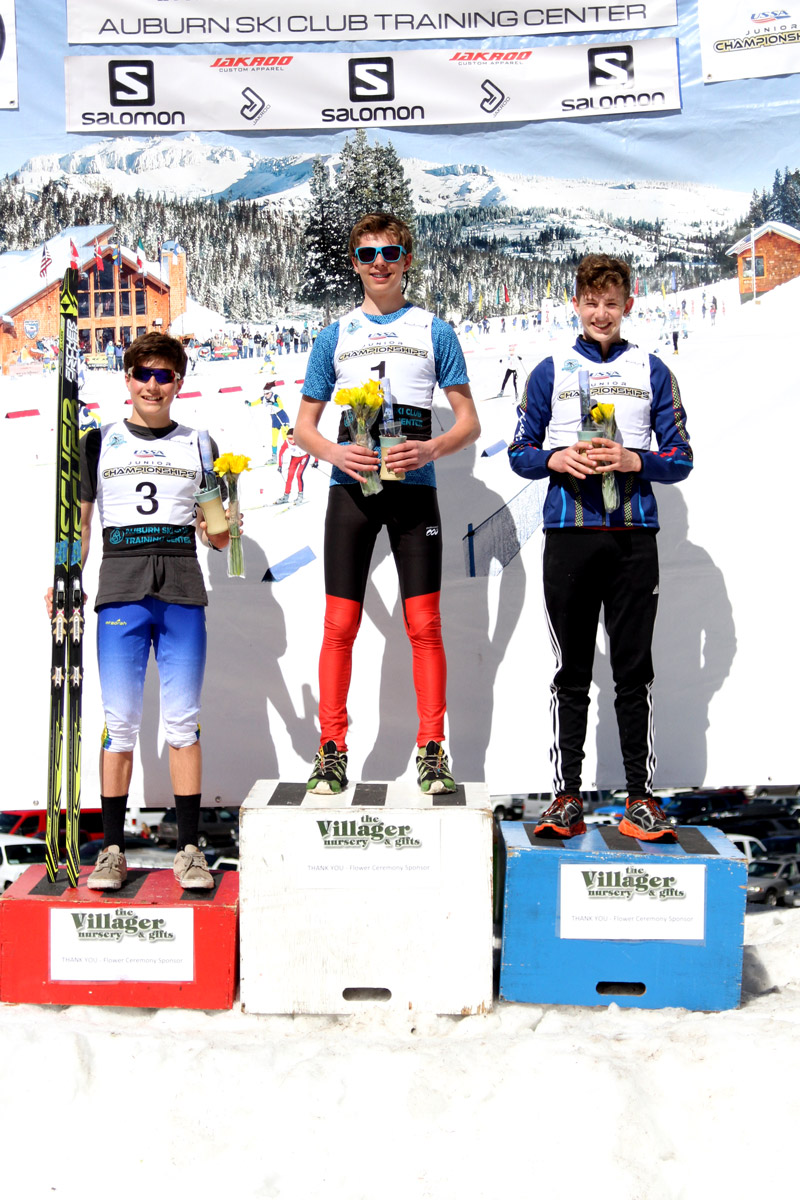
The U16 men’s podium from the 5 k Classic Mass Start at 2015 U.S. Junior Nationals at Auburn Ski Club in Soda Springs, Californial. JC Schoonmaker took home third place. (Photo: Mark Nadell/MacBeth Graphics)
Early Validation in Soldier Hollow and Truckee
It wasn’t until he traveled outside his region that Schoonmaker realized how he measured up. On a Far West trip to Soldier Hollow—his first time racing beyond his local bubble—he surprised himself. “I think I got third in the first race… then I won the second one,” he recalls. “I didn’t even really know it was a big deal, but all the older kids on the trip were… really excited for me.” Their reaction revealed something he hadn’t yet recognized: that his potential extended well beyond his local podiums.
A similar revelation arrived at Junior Nationals in Truckee, where home snow became a proving ground. He had hoped to earn All-American status, although the early races had gone poorly. “All the first races didn’t really go super well,” he says. “I had high expectations.” Yet in the final individual race before the relay, he stepped onto the podium. “Somehow onto the podium and got third,” he says. “That gave me a bunch of confidence… really helped me.” It was not just affirmation but a directional sign. Skiing was becoming more than an activity. It was becoming a path.
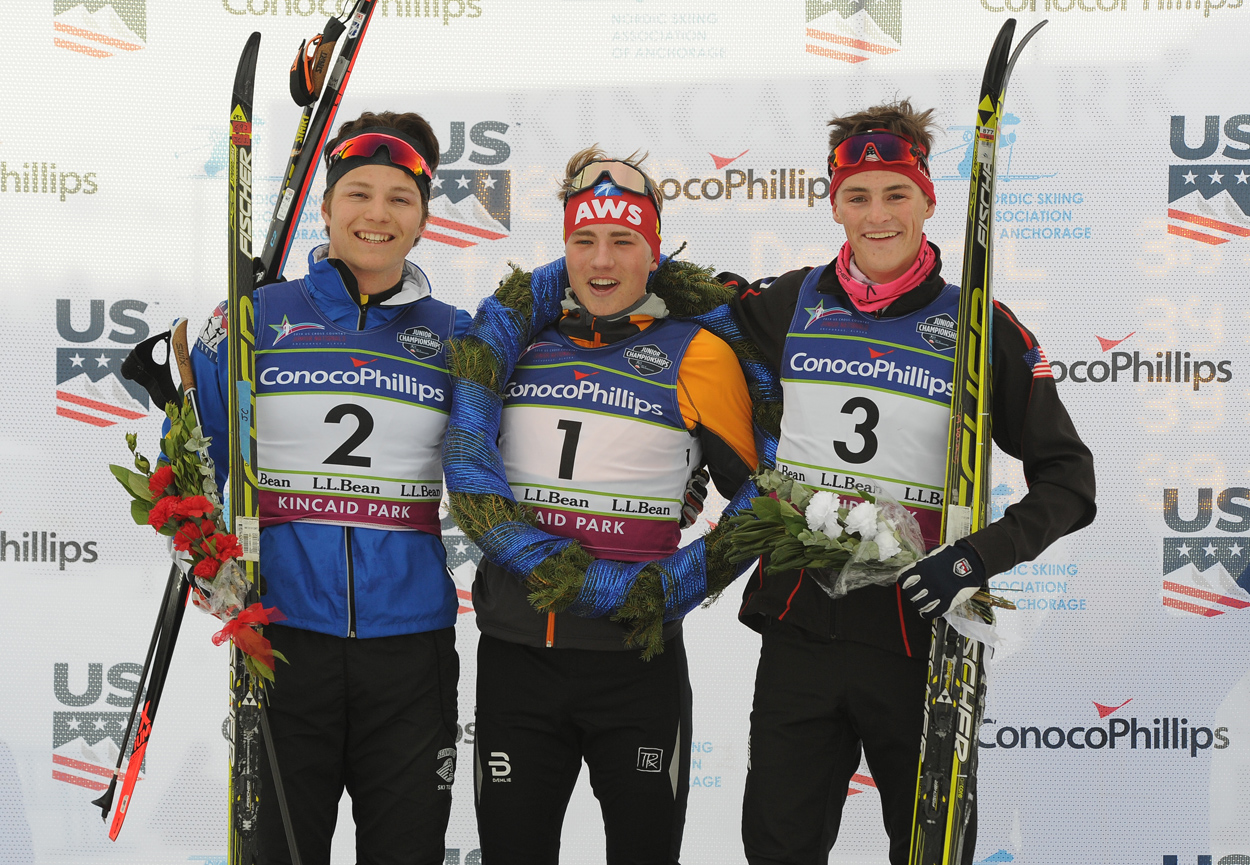
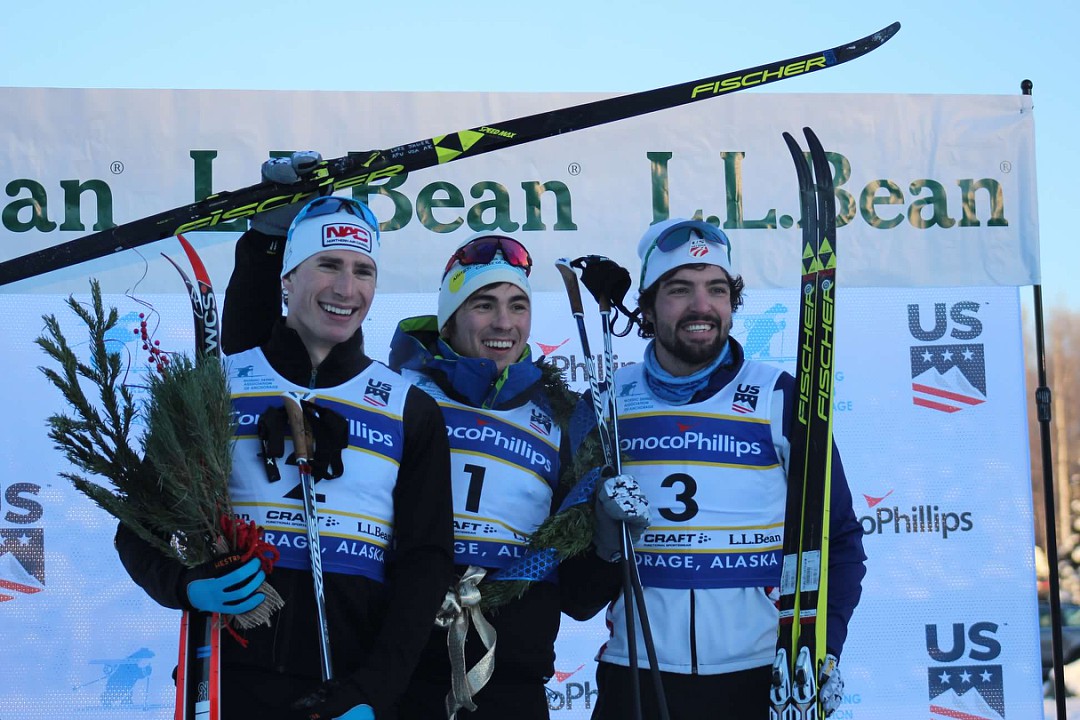
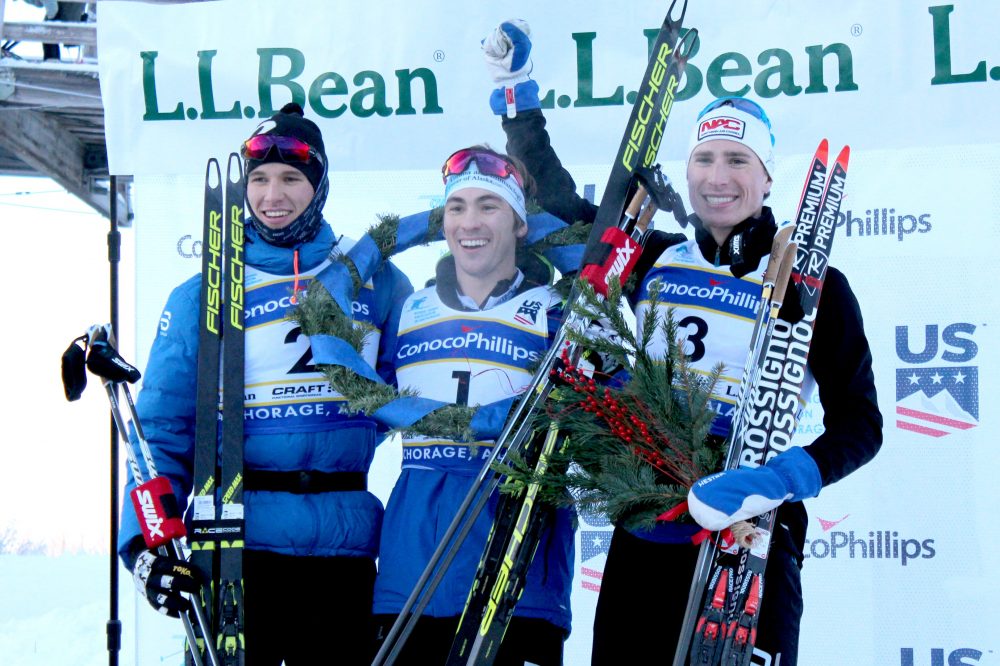
Gus Schumacher (Alaska Winter Stars/Team Alaska), center, won the U20 men’s 15K classic mass start race at the 2019 U.S. Ski & Snowboard Cross Country Junior National Championships at Kincaid Park. J.C. Schoonmaker (UAA-Auburn Ski Club/Far West), left, was second, followed by Cameron Wolfe (Ski and Snowboard Club Vail/Rocky Mountain), right. (Photo: Michael Dinneen)
Choosing Anchorage and the Power of the Right Environment
Despite his junior successes, Schoonmaker’s college recruiting process was sobering. His age cohort was stacked—Gus Schumacher, Luke Jager, Canyon Tobin—and their achievements overshadowed many strong skiers. “My top choice was UVM, and I just didn’t get a spot there,” he says. “I didn’t have a ton of options.” But an unexpected opportunity appeared when a Tahoe friend encouraged him to consider the University of Alaska Anchorage. He visited, and something clicked. “I’d say that’s the best decision I ever made,” he says. “I ended up coming to an excellent team… It’s an awesome place for skiing.”
Anchorage wasn’t glamorous, but it was grounding: clear air, big terrain, and a training culture built on consistency rather than spectacle. Under coach Trond Flagstad, Schoonmaker’s skiing matured—his engine, his technique, and his confidence—all while laying the foundation for a collaborative coaching story that would shape his rise.
A Uniquely Collaborative Coaching Path
Schoonmaker’s development is defined by the unusually harmonious network of coaches who supported him. In Tahoe, he trained with Will Sweetser, whose workout creativity brought nuance to his summer training. At UAA, Flagstad built his fall rhythm with threshold work and bounding. In the winter, U.S. Ski Team coaches—Matt Whitcomb, Kristen Bourne, and Chris Grover—stepped in with race-day craft and a national pipeline. And now, in Anchorage, he works with Eric Flora at APU, whose daily presence has brought structure and clarity.
“I feel like I didn’t even really have to do much in the way of balancing that,” he says. “Trond, Will, and Matt… kind of just took that on themselves.”
That kind of multi-coach collaboration is rare. Instead of conflicting philosophies, Schoonmaker received overlapping layers of expertise, each building on the others. He remembers one of Sweetser’s signature interval sets with particular fondness: “Twenty seconds L5… forty seconds rest… forty seconds L5… then six minutes of threshold. A cool blend… essential for getting you ready for doing sprints on the World Cup.” Flagstad brought heavy doses of fall bounding at L4. Whitcomb and Bourne added race sharpness. Flora, finally, aligned everything. “Having him at World Championships last year made it feel like just a practice in Anchorage,” Schoonmaker says.
JC Schoonmaker (bib #1) at the 2020 Senior Nationals in Houghton Michigan. (Photo: Reese Brown)
The Unexpected World Cup Start That Changed Everything
The first moment when Schoonmaker truly understood the trajectory he was on came suddenly. At U.S. Nationals in Houghton, Michigan, in 2020, he won the sprint qualifier. It was exciting, but he didn’t assume it meant anything beyond that day’s result. Then his assistant coach, Marine Dusser Bjornsen, approached him with unexpected news. “She was like, ‘Oh yeah, you’re gonna get World Cup starts from that,’” he recalls. “And I was like, ‘What? No way.’” His passport was expiring, his bags were unprepared, and within days, he was on a plane to Dresden.
Stepping into the World Cup for the first time felt surreal. “I wasn’t even really worried about those being my first World Cups,” he says. “I was mostly just hoping to get to go over there.” The qualifiers felt manageable; the heats were startling. “Racing against those dudes in the heats… was just a whole other level. A different beast.” Still, he never felt crushed by the moment. “We were just having fun,” he says. “It wasn’t crazy high expectations.” That experience didn’t instantly transform him, but it recalibrated his sense of where he belonged.
APU: A Training Collective That Became Home
When Schoonmaker finished college and committed to training full-time in Anchorage, it wasn’t only because of Flora’s coaching. It was because the environment felt like home. “Luke coming back… Gus joining… Zan and Michael… it was such a good team,” he says. “A lot played into it… but mostly that stuff.” APU is one of the few places in the country where the majority of the national team trains together throughout the year, creating a rare sense of continuity on the World Cup.
Yet even in a group that suits him so well, Schoonmaker knows he needs occasional solitude to stay balanced. “I definitely find times during the summer where I’m pretty excited to do an interval session by myself,” he says. “I grew up training alone in Tahoe.” Winter, of course, is different. “You’re living with this group of people for the entire winter,” he says. “Sometimes it is hard to find time to yourself.” But the team understands him. “Everyone knows whatever’s best for you is what’s best for the team.”
A New Kind of Training: Mindfulness and Sprint Awareness
This year, Schoonmaker added something he had never practiced formally: daily mindfulness training. “Some breath holds… super simple, just five minutes of mindfulness,” he says. “Focusing on my breath, trying not to let my thoughts wander.” The shift wasn’t driven by physical shortcomings, but by an honest assessment of where he needed to grow tactically. “In sprint heats… I’ve tended to have my head down, thinking about my technique… rather than, ‘I need to get this position around this corner.’”
Mindfulness gave him a way to sharpen his presence during races and training. During intervals, he began noticing moments when his focus drifted. “My mind starts thinking about what I’m gonna have for lunch,” he admits. “I’m getting better at bringing myself back… loosen up, ski relaxed.” The work is subtle, internal, and mostly invisible, yet deeply connected to the kind of racer he wants to become.
Passing It On: What He’d Tell the Next Generation
If Schoonmaker were speaking to a group of juniors in Tahoe today, he would know exactly what he would emphasize. “I love this puzzle of trying to get better every day,” he says. “Focus on the small things you can control… let the cards fall where they fall.” But he would also add a piece of training wisdom gained from experience. “I almost feel like I got a little too caught up in L1 and L3,” he says. “Walking up hills on classic skis isn’t getting you better at classic skiing. You have to ski fast to get better at skiing fast.” It is the kind of message that cuts through both trends and dogma.
Life on the Road: Davos, Oslo, and a Simpler Suitcase
Schoonmaker’s favorite destinations reflect a balance of beauty and familiarity. Davos stands out. “I’d love to go there when I’m not getting ready for the Tour de Ski… explore it a little more,” he says. He also holds a soft spot for Oslo. “That’s a special spot. I always feel like I’m having a really good time there.” On race mornings, he keeps things simple: “Probably a couple eggs and a few pieces of toast with jam.” And he no longer travels with the heaviest item from his early career. “I brought over an Xbox… took up, like, 12 pounds in my bag,” he laughs.
Schoonmaker and girlfriend, Emma Ribom (SWE). (Photo: Courtesy Photo)
Olympic Season: Ambition, Clarity, and the Calm Before the Heats
Despite the stakes of the Olympic year, Schoonmaker hasn’t reinvented his approach. “I honestly haven’t been doing anything different,” he says. “I’m more excited to be healthy and head into Period 1 feeling good.” But his goals are not small. “My goals would be to win a medal,” he says. “That’s what I’m shooting for.” A chance to race the relay again is just as meaningful. “The relay in Trondheim was super fun,” he says. “I would love to get another chance.”
As for the individual sprint, his ambition is both grounded and bold. “If I could make the final… that would be a solid day,” he says. “But I do feel like I can win a medal.” Few athletes can express that kind of aim with such composure. Schoonmaker delivers it as calmly as if he were describing a morning ski.
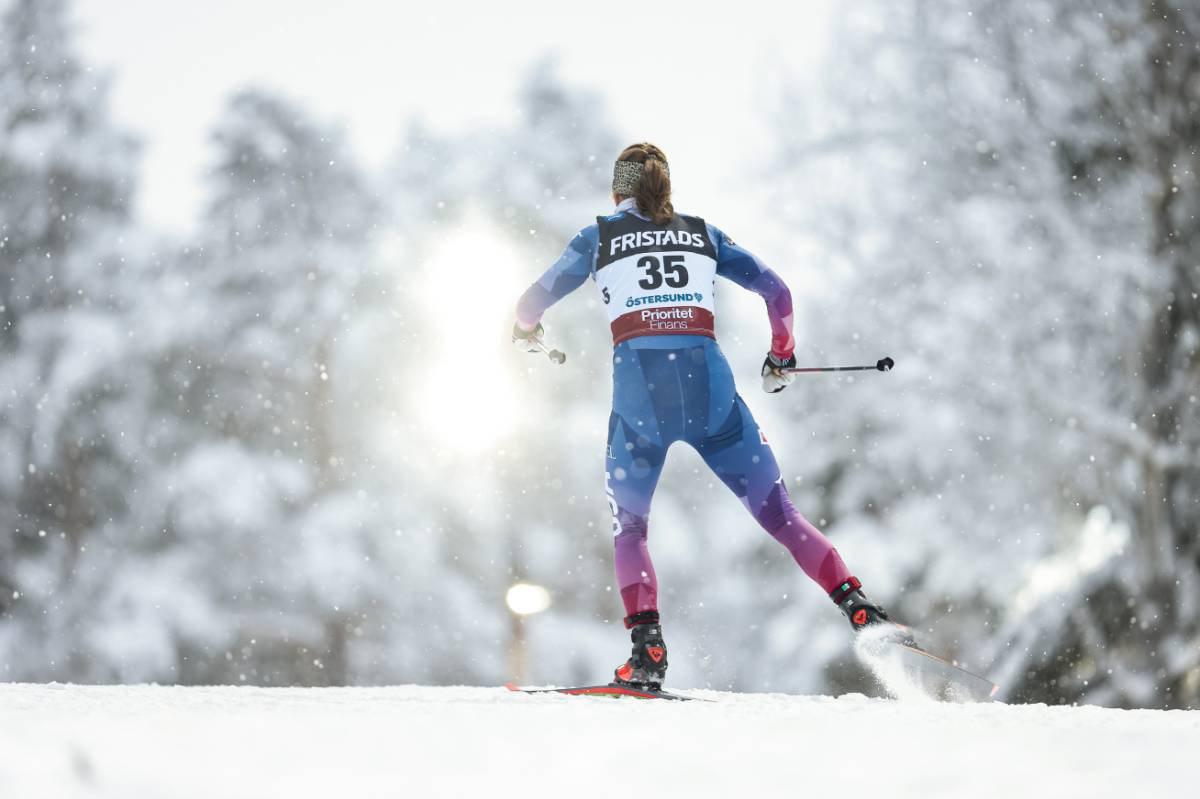
JC Schoonmaker (USA) had a breakout day in Oestersund (SWE) in 2023, reaching the podium for the first time. The American took third place. (Photo: NordicFocus)
Where He Stands Now
What stands out most about Schoonmaker at this moment is not bravado, but clarity. He is no longer the boy who raced for raffle prizes, nor the college skier unsure of his place, nor the rookie dragging an Xbox through European airports. He has become something steadier, more self-aware, and more intentional. A sprinter with composure. An athlete with perspective. A competitor capable of holding his ambition lightly without losing its sharpness.
Presence, for Schoonmaker, is not stillness. It is an ongoing process of tuning himself to the shifting rhythms of a sprint heat, listening to what his mind and body are telling him, and moving through the season with intention rather than urgency. If he keeps his head up—literally and figuratively—this may be the season when the skiing world begins to see not only what he has built, but why it was built this way.
Love Stories Like This? Help Keep Them Coming.
Feature interviews like this one take time, access, and care to produce. If you value thoughtful storytelling and independent ski journalism, please consider becoming a Voluntary Subscriber. Your support directly fuels the work we do to cover the people, places, and moments that make our sport special.
This World Cup coverage is made possible through the generous support of Marty and Kathy Hall and A Hall Mark of Excellence Award. To learn more about A Hall Mark of Excellence Award or to learn how you can support FasterSkier’s coverage please contact info@fasterskier.com.
Gus Schumacher and J.C. Schoonmaker on Eagle Glacier last month. (Photo: Matt Whitcomb)
When Gus Schumacher talks about training these days, he sounds more like a craftsman than a workhorse. There’s less emphasis on grinding and more on rhythm — on knowing when to push and when to back off. “I think I’ve just gotten better at kind of knowing what is worth my energy,” he says. “Every day matters a lot, but every day doesn’t have to be as hard or as perfect as the schedule would beg.”
At 25 years old, Schumacher is entering his athletic prime with a perspective that feels both grounded and ambitious. A native of Anchorage, Alaska, he’s already made history: in 2020, he became the first American male to win an individual gold medal at the FIS Junior World Cross-Country Championships, and in 2024, he captured his first World Cup victory — a breakthrough 10 k Freestyle win in Minneapolis that electrified the home crowd and made him the youngest American man ever to win a World Cup distance race and the first U.S. man to win a distance World Cup event since Bill Koch in 1983.
Those milestones bookend a journey defined not by burnout or obsession, but by evolution. Schumacher has traded maximum volume for sustainable excellence, chasing consistency instead of chaos.
From Peaks and Valleys to a Smoother Rhythm
Three years ago, Schumacher’s training logs told a story of wild swings — massive weeks followed by deep recovery troughs. “In the past, I was probably in the 90-hour range (total training hours for a four-week block) pretty frequently,” he says. “Now it’s more in the lower 80s … my balance was more like 20, 23, 35, 10 to 12 hours a week … and now it’s 18, 21, 25, 15, 16 … just a smoother process.”
It’s a subtle but meaningful shift: fewer rest days, less volatility, and a steadier tempo. “I don’t take as many off days, either,” he adds. “When I was younger … it was helpful to have those big stimulus days. But as I’m older … if I do a really big day, it’s maybe harder on me.”
The old model — massive stimulus followed by deep rest — has given way to something more balanced. “I want to feel good most of the time, not just occasionally amazing and then wrecked for days,” he says. “It’s more of a steady hum than a spike.”
Off into the Alaskan wilderness. (Photo: Rudy Schumacher)
Consistency Over Carnage
One of the most evident signs of Schumacher’s maturity is his decision to stop “thrashing” himself in pursuit of arbitrary numbers. “In the past, I would come to a priority day and it would be super hard … and I’d still want to hit an hours goal, cramming training into places where it maybe wasn’t appropriate,” he says. “Now … I’m less inclined to do that and more inclined to just drop an afternoon session and not worry that much about the two-hour hit on weekly volume.”
He’s also embraced a more intuitive recovery model. “The feel comes before those things,” Schumacher says of his data tracking. “Sometimes I’ll feel a little off … and then a day or two later the HRV (Heart Rate Variability) will come down … so the first feelings while you’re training are important.”
Over time, that awareness has become central to how he navigates fatigue. “HRV is objective, but sometimes it’s low because of other things,” he explains. “It’s good to recognize why you might feel a certain way and how to change that.”
Utah Camp and a Smooth Summer
When we spoke, Schumacher was three days into a two-week U.S. Ski Team camp in Utah, training alongside his APU teammates JC Schoonmaker, Luke Jager, Zanden McMullen, and Michael Earnhart. “We’re on our third day of National Team camp,” he said. “It’s great energy here.”
That steady energy mirrors his summer. After illness derailed his 2024 training for nearly six weeks, this year brought the opposite: uninterrupted rhythm. “Last year I was sick for six weeks in August and September, and this year it’s been going really smoothly,” he says. “My health has been super good … I’ve been doing a lot more breathwork … and that’s helped quite a bit.”
The contrast is stark — and instructive. For Schumacher, staying healthy through the summer is no longer just luck; it’s the product of restraint, awareness, and self-trust.
Gus Schumacher with his girlfriend, Olivia Carrier, enjoying the Alaskan view during a workout. (Photo: Amy Schumacher)
Hard Work, Soft Edges
Even as he’s refined his volume and recovery, Schumacher hasn’t softened his competitive edge — just redirected it. “Not a lot of days to really redline it,” he says. “In the summer … I just don’t feel like it’s that worth it. … I’ve definitely stayed away from having a full session that’s just full power.”
He describes one workout — 10 × 1-minute efforts — as emblematic of his current philosophy. “It’s not about dying at the end of each rep,” he explains. “The first one we did, I felt super good and did sort of go ballistic … and I was fried in the afternoon and for a day or two.”
The lesson? “When you feel really good, holding back a little bit … because that good feeling is not necessarily gonna come through in the recovery,” he says. “To get the stimulus from a 10 × 1-minute workout, you don’t need to be on your hands and knees. Having an interval or two where you really push is good … but it shouldn’t be always.”
Fueling with Intention
Schumacher’s fueling strategy mirrors his training philosophy: steady, structured, and practical. “I probably do 30 to 60 grams an hour for two-to-three-hour workouts,” he says. “Our races aren’t really long enough to be super dependent on that … but in training it’s really important just to keep the glycogen stores up.”
For long races, he’s methodical. “During a 50 k, I’ll definitely go for at least 60 grams an hour … I’ve done even 90 for 50 k’s,” he says. And sprint days have their own rhythm: “I’ll do a gel after I do my warm-up intensity … eat a solid meal after the qualifier … and definitely gel before the quarters … and then one in between everything.”
Spear fishing. (Photo: Alex Lee)
Season Goals and the Long View
This fall marks Schumacher’s sixth full World Cup season. He’ll depart for Europe on November 18, with an eye toward the Skiathlon, Team Sprint, and 10 k Skate as his primary Olympic events. “Those are probably my big three,” he says.
He’s also keeping perspective on success. “There are a lot of ways to be successful,” Schumacher says. “To go and be healthy would be a big success … it’d be really cool to ski well for the people who’ve already planned on being there.”
And the reward. (Photo: Olivia Carrier)
That balance — ambition without anxiety — defines his approach. “I’ve definitely got my mind on a medal at the Olympics,” he admits, “but that doesn’t define success for me. Being in the top 10 overall would be cool … but I’m sort of not loving defining it too much. … I just want to be executing as well as I can and keeping healthy and cool-headed.”
After the Tour de Ski, Schumacher plans a 10-day reset at home in Alaska before returning to Europe for altitude training and the final push to the Olympics. “Getting away from the madness for a bit,” he says, “makes me hungrier when I come back.”
Learning to Flow
“I want to keep going as long as it feels reasonable,” Schumacher says when asked about his future. “The next phase is learning more about how my mind and body are at their best. What makes my mind happy is often what makes my body feel good too.”
That mindset — introspective, curious, and confident — underscores everything he’s building toward. “I feel like I’m learning myself more every year,” he says. “Everything gets easier, but I keep getting faster … better at getting into flow state.”
He pauses, then adds: “There are more times now where I just feel like I’m doing a workout that’s hard or long, and I’m able to really relax and enjoy it. I’m excited to bring that to racing.”
Is Gus looking at flow state? (Photo: Olivia Carrier)
Advice for the Next Generation
When asked what he’d tell younger skiers chasing their own dreams, Schumacher smiles. “A big part is just going through the motions and making the mistakes,” he says. “To do that, you have to be happy and enjoying it — having good friends around and making sure it’s not just every day you show up dreading how hard it’s going to be.”
He insists that skiing well starts with loving the process. “The day-in, day-out is not that painful or difficult,” he says. “If you’re doing it right … it should be enjoyable pretty much all the time.”
And perhaps his most mature insight: “Not every day has to be perfect … those bumpy days … that’s what leads to the good days down the road.”
Toward Flow & Beyond
Gus Schumacher’s transformation is not a retreat from ambition — it’s its maturation. At 25, he has already built a resume many would envy: Junior World gold, a landmark World Cup win, and upward movement in the World Cup standings. But he now embraces an athletic philosophy that values rhythm over rupture, feeling over forced, and resilience over recklessness.
“Those best days happen when you’re just kind of there for the game … to keep that going … to enjoy it … and not lose track of these times before they’re gone,” he says.
It’s a voice of calm in a sport often defined by extremes. Whether or not the Olympic hardware arrives, Schumacher’s style — grounded, evolving, and rooted in joy — already feels like a victory.
For Gus Schumacher, exploring the mountains of Alaska isn’t training, it’s a lifestyle. (Photo: Gus Schumacher)
Erling Bjoernstad, a Norwegian freshman racing for University of Alaska Anchorage, climbs a hill toward the stadium at U.S. Nationals Thursday. (Nathaniel Herz/FasterSkier)
ANCHORAGE — Kate Oldham wasn’t expecting to win Thursday’s opening race of the U.S. National Championships.
It was her first competition of the season, after focusing on training in December, and she’d never placed better seventh at previous national championships.
Her coach at Montana State University, Adam St. Pierre, had other ideas about the 22-year-old senior — though he was keeping them to himself.
“I have been predicting Kate as a dark horse national champion for a couple of weeks now,” St. Pierre said. “But not talking about it with her, because she races best when expectations are low.”
Kate Oldham racing at the U.S. National Championships in Anchorage on Thursday, January 2, 2025. (Nathaniel Herz/FasterSkier)
Oldham, St. Pierre said, is a superb glider on her skis, with a “killer instinct” — which apparently served her well Thursday on the rolling, blazing fast, 10-kilometer course at Anchorage’s Kincaid Park.
Oldham won her first-ever national championship, edging local favorite Kendall Kramer of University of Alaska Fairbanks to win the individual-start, time trial-style skate event by 11 seconds.
University of Utah’s Erica Laven was third, 28 seconds behind.
“I did not wake up thinking that was going to happen today,” Oldham said afterward, as she fended off bear hugs from teammates and rivals. “It’s surprising. But it’s also awesome, and makes me cry happy tears.”
Erica Laven on her way to third place. (Photo: Tobias Albrigtsen / @untraceableg)
If Oldham’s win fell somewhere between a surprise and a shock, John Steel Hagenbuch’s victory in the men’s race was hardly unexpected — though that event was much tighter.
Hagenbuch, a 23-year-old senior at Dartmouth College, already has several national titles to his name, along with solid results last season on the international World Cup circuit.
Hagenbuch held off Andreas Kirkeng, a Norwegian racing for the University of Denver, by a fraction of a second. Walker Hall, who races for the University of Utah, was third, 15 seconds behind.
Thursday’s races were the first of three national championship events at Kincaid Park, with two more to follow over the weekend — plus a non-championship race next week.
While temperatures in Anchorage have dipped recently, to single digits Thursday morning, a rainy, low-snow December required extra work from organizers to pull the races off. Kramer, in fact, was part of a battalion of volunteers, including numerous racers, who spent some of last weekend shoveling clean snow onto dirty patches along the course.
Kramer said she planned a long ski workout that day and kept her watch going while she pitched in on a little shoveling.
“It was kind of like playing in the snow,” she said. “I don’t want to take too much credit, because I wasn’t out there for the whole four hours people were doing it. But I am very grateful, and I was inspired by all of the people who were there.”
Kramer, 22, was in the hunt for the win Thursday, with coaches telling her at one point during the race that she was in the lead.
Kendall Kramer crests a hill in Thursday’s race. (Nathaniel Herz/FasterSkier)
But Oldham had the fastest times for each of her two five-kilometer laps, according to official splits. Laven was just one-tenth of a second behind her at the halfway point, though she faded on her second lap.
Oldham grew up in Colorado and spent her holiday break from school training at home, taking advantage of “incredible skiing” in Aspen instead of entering season-opening races, she said.
That plan is geared toward not peaking too soon, so she can notch her best results at the collegiate national championships toward the end of the season, in March. That plan made Thursday’s win even more of a “pleasant surprise,” Oldham said.
“I didn’t really sharpen for it,” she said. “It’s an intimidating way to start the season, because you kind of have no idea (what level) you are coming in. But it’s also really nice to go home and enjoy the holiday and just focus on training.”
Hagenbuch’s approach to the season has been sharply different: He began racing more than a month ago, on the World Cup circuit.
But after a breakout season last year — one in which he won a bronze medal at the World Under-23 Championships and also recorded a top-15 finish in a World Cup race — this year’s efforts have been uneven.
Hagenbuch started the season at World Cups in Finland and Norway, but failed to crack the top 30. Then, he returned to the U.S. and notched four straight podiums on the domestic circuit.
One challenge he faced in Europe, Hagenbuch said Thursday, was that he was having a breathing problem that appears to be a condition called exercise-induced laryngeal obstruction — where, he said, his larynx and vocal cords “seize up and close” during races.
John Steel Hagenbuch works his way up Elliott’s climb at the U.S. National Championships in Anchorage on Thursday, January 2, 2025. (Nathaniel Herz/FasterSkier)
The first time it happened, in Finland, was “definitely pretty scary — I couldn’t breath really at all, and I couldn’t speak for 15 minutes after the race. Couldn’t say a word.”
“It’s kind of multifaceted in what causes it, but I’ve been working through it and trying to figure it out and keep all those muscles relaxed, because it isn’t something you can really address by taking medication,” he said. “It’s something that has to do with controlling your muscles and reducing your stress.”
Hagenbuch said he had a little bit of breathing trouble Thursday, but managed to keep it under control.
He had the fastest first lap of the five-kilometer course, giving him a slight edge over Kirkeng.
But on the second lap, the Norwegian started creeping back.
A 24-year-old senior studying finance at the University of Denver, it’s unlikely Kirkeng would be in contention for a national championship in his home nation, the global cradle of cross-country skiing.
But in the U.S., it’s hardly unusual for European athletes to dethrone their American competitors at marquee races: In fact, Kirkeng won the 10-kilometer distance race at the U.S. National Championships in each of the past two years.
John Steel Hagenbuch on his way to winning the national title. (Photo: Tobias Albrigtsen / @untraceableg)
As Hagenbuch neared the finish line, coaches along the course were giving him split times that showed Kirkeng closing the gap — even though Hagenbuch had started the race conservatively.
“I underestimated how hard it was going to get,” Hagenbuch said. “I thought I was going to lose it — I was hearing the splits go from eight seconds up on Andreas, to six seconds to three seconds to even.”
Kirkeng skied his last lap four-and-a-half seconds faster than Hagenbuch. But in the end, that wasn’t quite enough: Hagenbuch’s first lap was five-and-a-half seconds faster than Kirkeng’s, and he held on to win by eight-tenths of a second.
“The margins were not on my side today. But that’s how racing is,” Kirkeng said afterward. “And it’s been the other way around a couple of times.”
Andreas Kirkeng on his way to second place on the day. (Photo: Tobias Albrigtsen / @untraceableg)
Kirkeng is likely in the twilight of his career — he said he expects to retire after this season and, hopefully, find a finance job on Wall Street or in Boston. If not, he’ll probably return to Norway and enjoy more time with his family.
Hagenbuch’s career, meanwhile, is still taking off.
He said he’s looking forward to the rest of the races in Anchorage, which he expects to follow with more competitions in the U.S. — domestic SuperTour events and the college circuit, culminating in the NCAA championships.
Going back to the international World Cup circuit, he added, probably doesn’t make sense this year, especially after he missed substantial stretches of school while he traveled to races last season.
But even if this year’s European campaign didn’t pan out, Hagenbuch said, he’s not disheartened.
“I know I’m in good shape, and I had a good season of training — the hay is in the barn, if you will,” Hagenbuch said. “It’s just going to take some time for that to show itself.”
Erik Bjornsen, Sadie Bjornsen Maubet, and Rosie Brennan enjoy a very different race atmosphere at NordicX. (Photo: Eric Maurer / NordicX)
What comes to mind when you think of a cross country ski race? Depending on your location and how you choose to interact with the sport, there are likely a variety of answers to the question, but it’s likely that there are some common themes.
“Cross country events are pretty much all the same when you boil them down, you know?” said retired US Ski Team member and 2018 Olympian Reese Hanneman. “It’s a test of endurance and speed over a set course, and it’s timed, and you’re usually out there in the woods alone. And I mean, that’s what cross country [racing] always will be, but I always felt like there was room for more.”
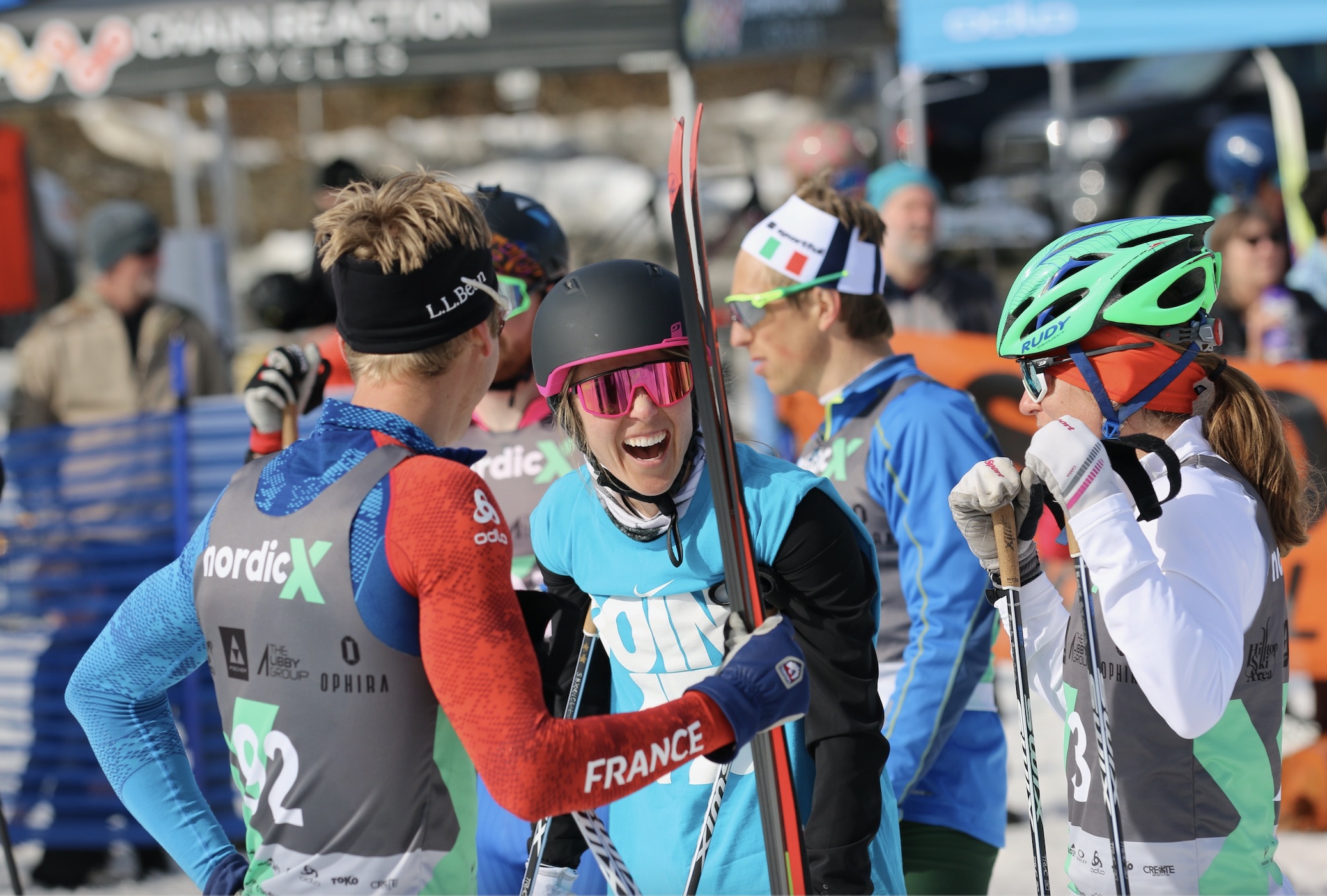
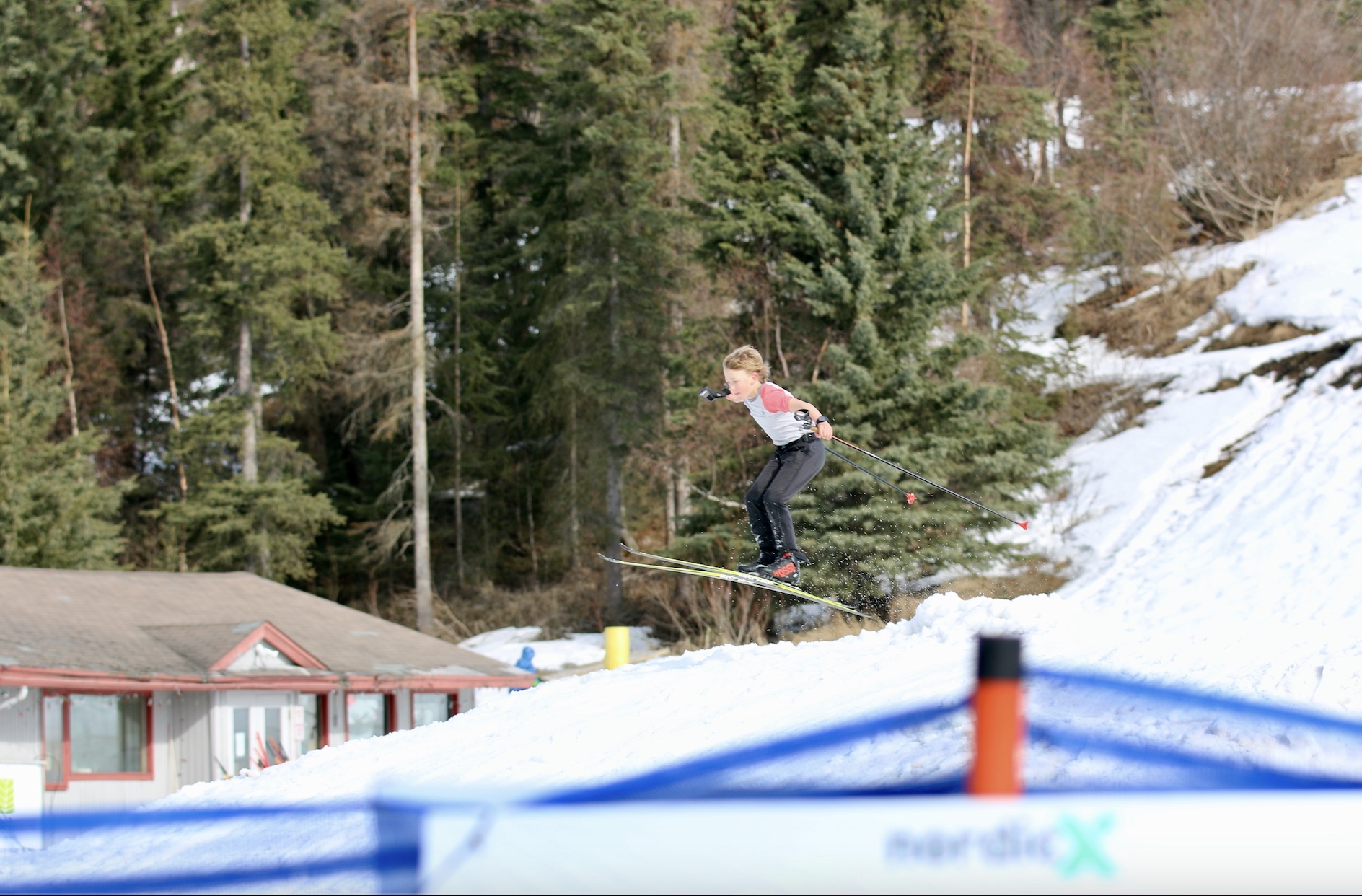
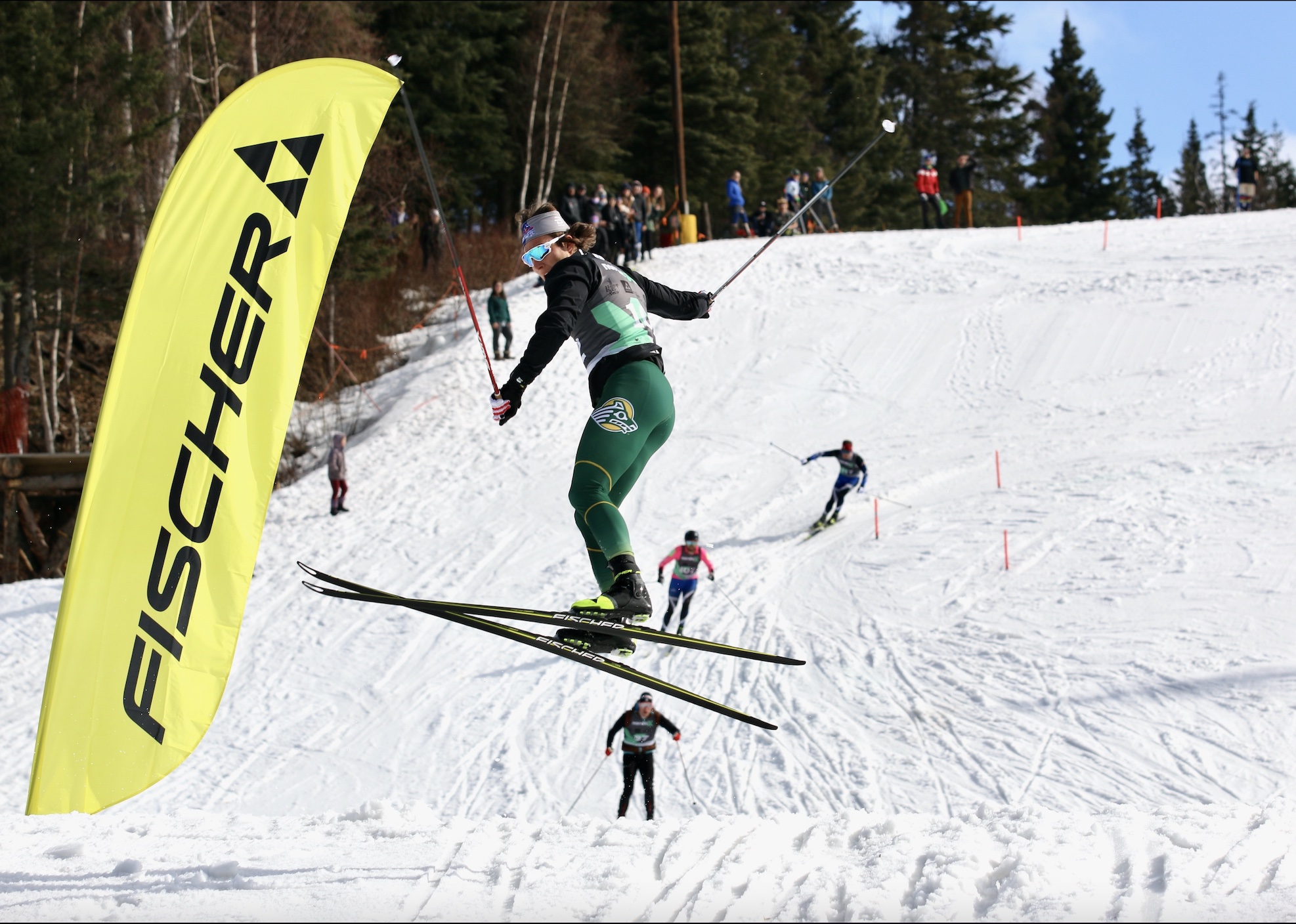
In what he described as “living out [his] 10 year old dream”, Hanneman set out to break this mold. His dream came to fruition on April 2nd in his home of Anchorage, Alaska, as cross country skiers from the junior level to recent Olympians careened down the slopes at Hilltop Ski Area, rounding tight turns, skating uphill, and catching air – with some not-so-graceful landings – off of jumps before finishing amidst a festival atmosphere at the base. The event was NordicX, an untimed, head-to-head “nordic-cross” event where style points on the final kicker into the finish might earn you a lucky loser spot in the next round.
“I knew that there was a lot of appetite for [an event like] that because every time I coach kids, which has been quite a bit over my career, I see that same energy and excitement for hitting jumps and sessioning little whoopty-dos or tabletops. And basically, there’s no cross country event that caters to that.”
One of many kids enjoying the features on course and in the Kiddie Cross terrain park at NordicX. (Photo: Eric Maurer / NordicX)
While Hanneman wanted a non-traditional event, he was not looking to eliminate the character or skills of cross country skiing altogether. He pulled from his experience competing in the 2016 Red Bull Nordix event at Lake Louise in Alberta, where he raced against other top international skiers including Norway’s Petter Northug and his US Ski Teammate Andy Newell.
“It was so fun and it was so crazy and scary and fast. And I was like, ‘Man, I need to bring this to Alaska.’”
In creating his own event, he said he wanted to navigate the “delicate balance of new, exciting, and extreme, but also staying true to cross country skiing. It’s one thing to build a little booter next to the xc ski trail and ski ’round and ’round hitting it with your friends, and it’s another to try and package that experience into a full-on event that offers excitement for all ranges of skills and ages.”
JC Schoonmaker does a 360 into the finish at NordicX. (Photo: Eric Maurer / NordicX)
“I knew it needed the right venue,” Hanneman continued. “I wanted something ‘net downhill’ because otherwise I felt like it would be too similar to other xc races, a loop with the same start and finish meant that in order to have a huge downhill you would need a huge uphill. But I also wanted it to be ‘cross country’, so that it truly rewarded good cross country skiers, and so that cross country skis were truly the best tools for the job.”
As the course and conditions hinged on both the weather and Hilltop’s grooming, an official course map was never set. To ensure the event catered to skiers beyond the nucleus of elite skiers based in Anchorage, an A-, B-, and C-Line was established on each of the features, making air-time not requisite and allowing athletes to select a route that felt safe, at the expense of simply forgoing the fastest line, which might pay off in the end if it kept the racer upright with equipment intact.
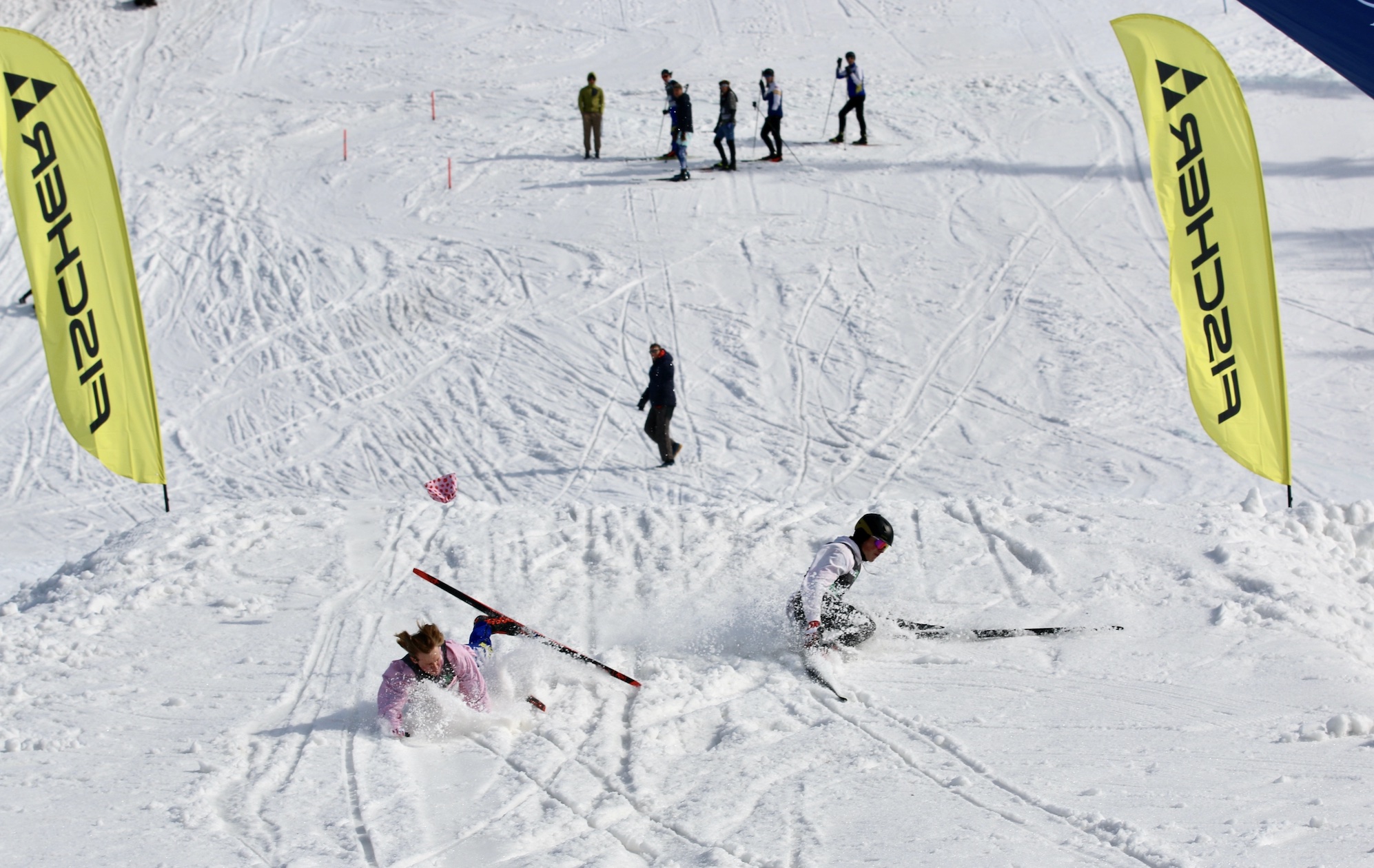
Holding to the spirited theme of the event, Hanneman described it as “a freestyle event in both feel and in practice,” meaning there were no official course maps, no timing, and plenty of subjectivity in the results. Get sendy and try to 360 off the final kicker into the finish only to crash and stall out before the line? Style points – you just became the lucky loser and can move on. Flooded legs from the uphill sprint section cause you to catch an edge off the drop and yard sale? The crowd loved it – lucky loser spot for you also.
Not everyone stuck the landing at the finish of NordicX… (Photo: Eric Maurer / NordicX)
No official prologue seeded athletes; after a few hours where skiers could preview the course, the event simply kicked off with heats of six in the quarterfinal, splitting the 100 athletes between open and junior men’s and women’s categories. Among the field were six Olympians: alphabetically, Erik Bjornsen, Rosie Brennan, Hannah Halvorsen, Logan Hanneman, Sadie Bjornsen Maubet, and JC Schoonmaker, most of whom ended up on the podium at the end of the day. Next year, Hanneman hopes to include additional categories for parents, masters skiers, etc.
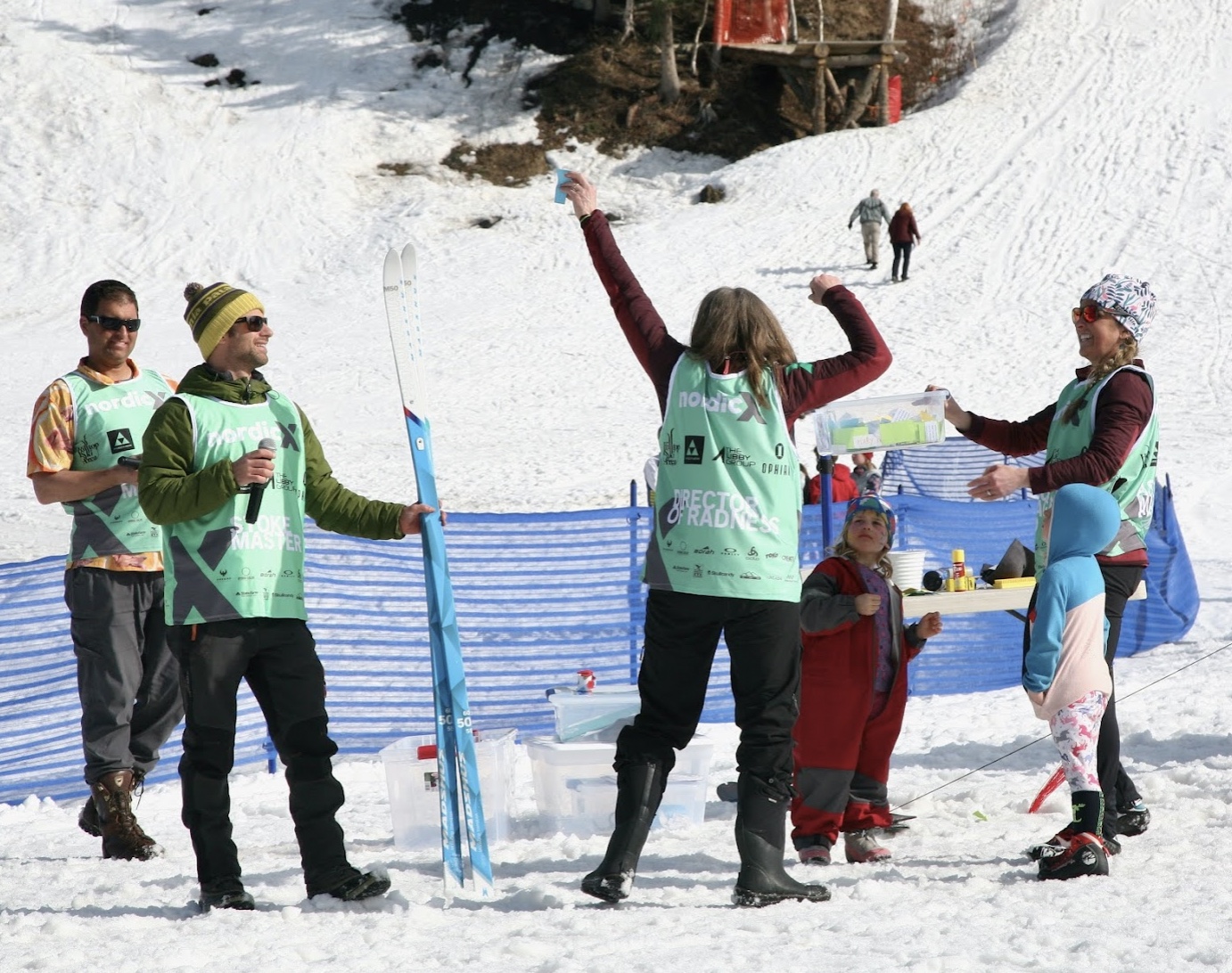
For those who weren’t up for racing or couldn’t quite match the on-ski agility of Maubet or Schoonmaker, a continuous stream of raffles offered plenty of alternative opportunities to win. A DJ fed the energy at the base, while emcees Rob Whitney and Lee Bolling kept the momentum alive between heats, announcing the winners of numerous prizes from sponsor companies like Odlo, Fischer, Oakley, Skull Candy, Toko, and more.
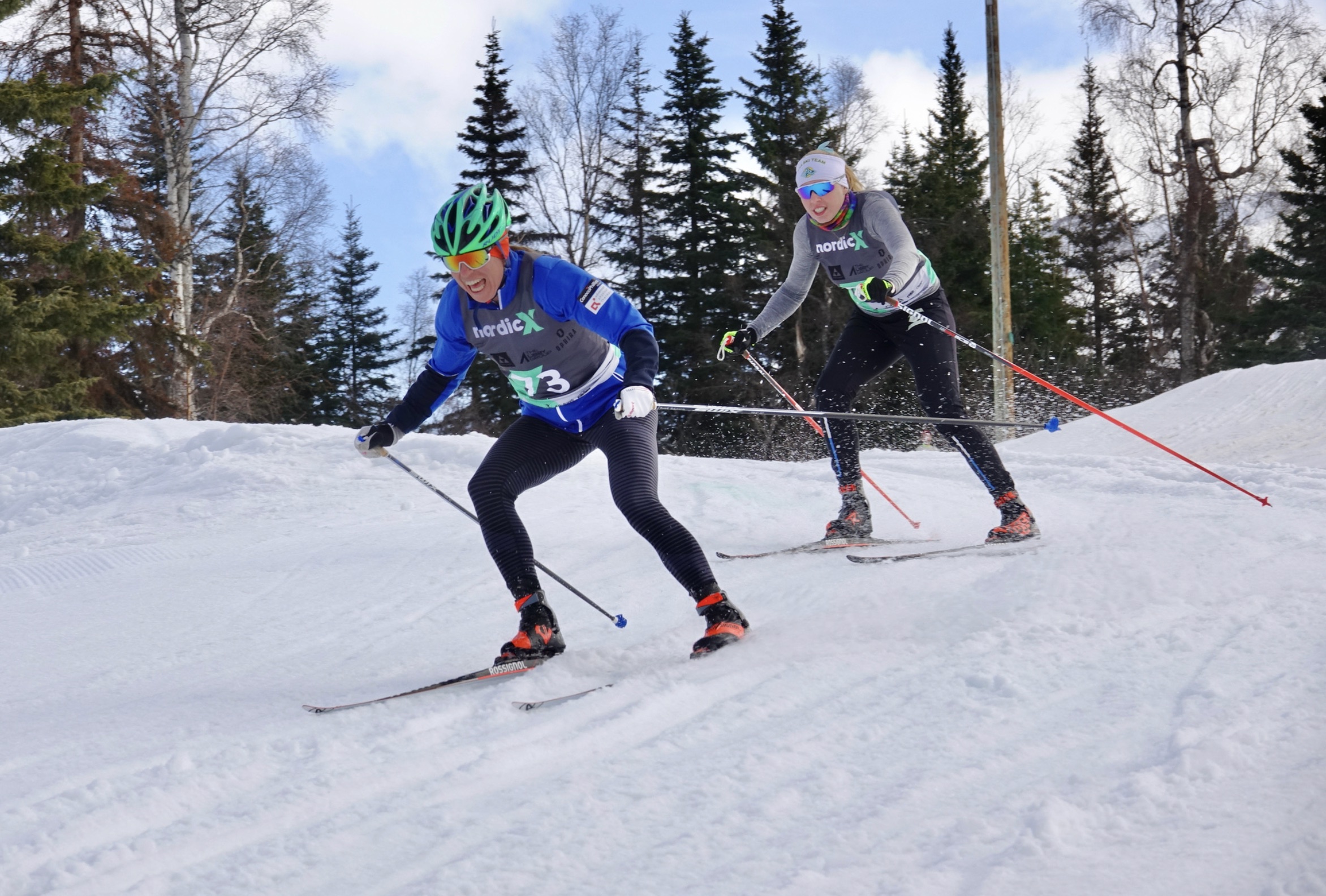
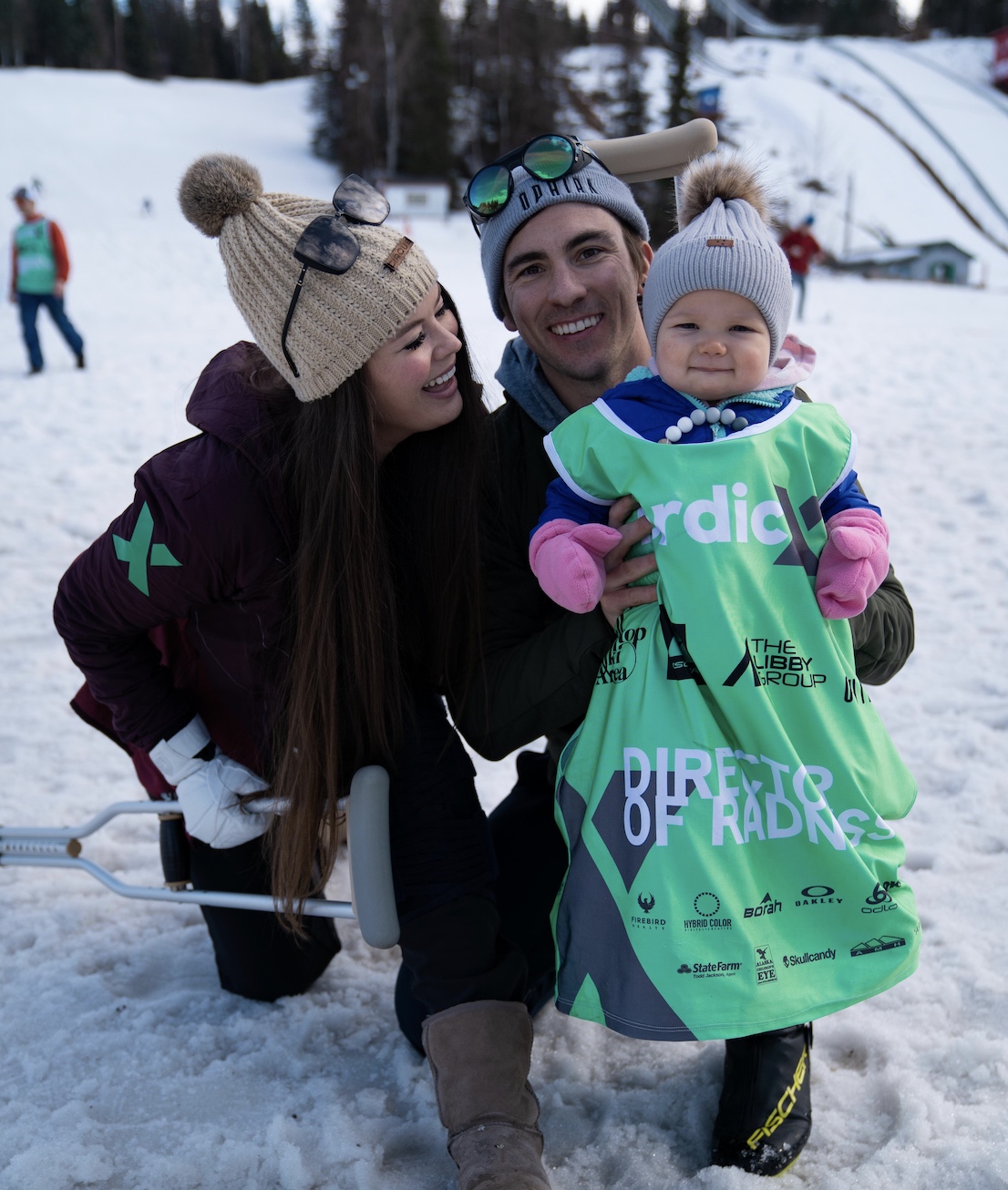
Emcees, director of radness, associate director of send: keeping the energy high at the base with continuous prize drawings. (Photo: Eric Maurer / NordicX)Rosie Brennan charges around a tight turn as she races through the heats at NordicX. (Photo: Russell Hood / NordicX)
Though these factors added to the festival atmosphere at the base, spectating alone was plenty exciting. In particular, the finish of the senior men’s final was one to watch.
“You couldn’t have scripted a better finish,” Hanneman laughed. “You had JC Schoonmaker, who’s one of the fastest sprinters in the world right now, and Erik Bjornsen, who was just on fire all day back from retirement. [They were] just completely sending it and just flying through this final steep slalom section, and Erik is trying to catch JC, and JC is trying to hold him off. They go to the finish, over this big table top, and everyone’s holding their breath. JC goes off it and does this massive spread-eagle.”
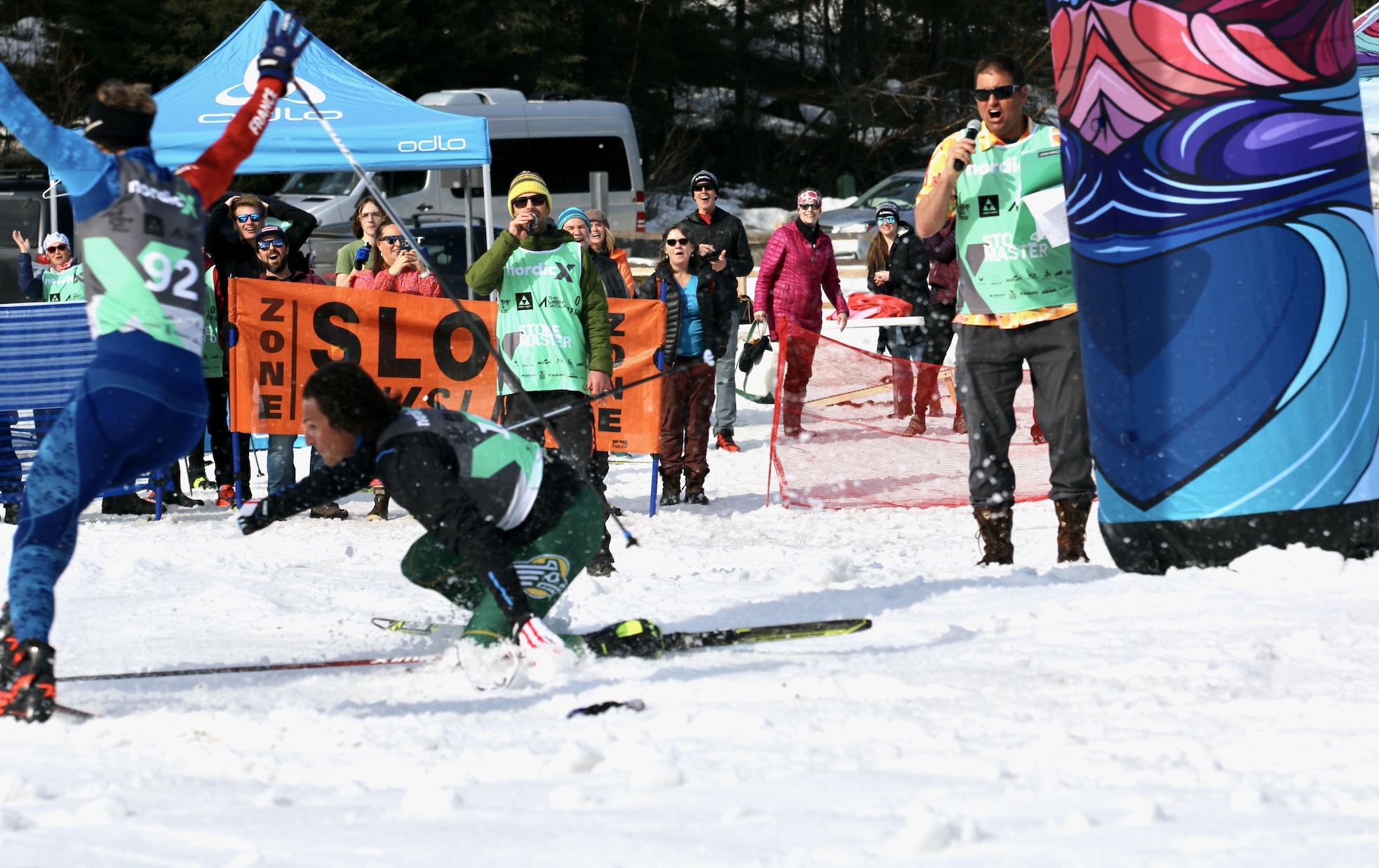
But he didn’t stick the landing. Landing a little too far in the backseat, Schoonmaker’s skis washed out from underneath him, leaving him sliding across the snow toward the inflated archway that marked the finish. He stalled out just before reaching the line.
“Erik is coming at Mach 50, about to beat him to the line. JC has to roll over and, like, flops [his skis] over the line.”
Erik Bjornsen sticks the landing, but JC Schoonmaker flops over the line first for the win.a (Photo: Eric Maurer / NordicX)
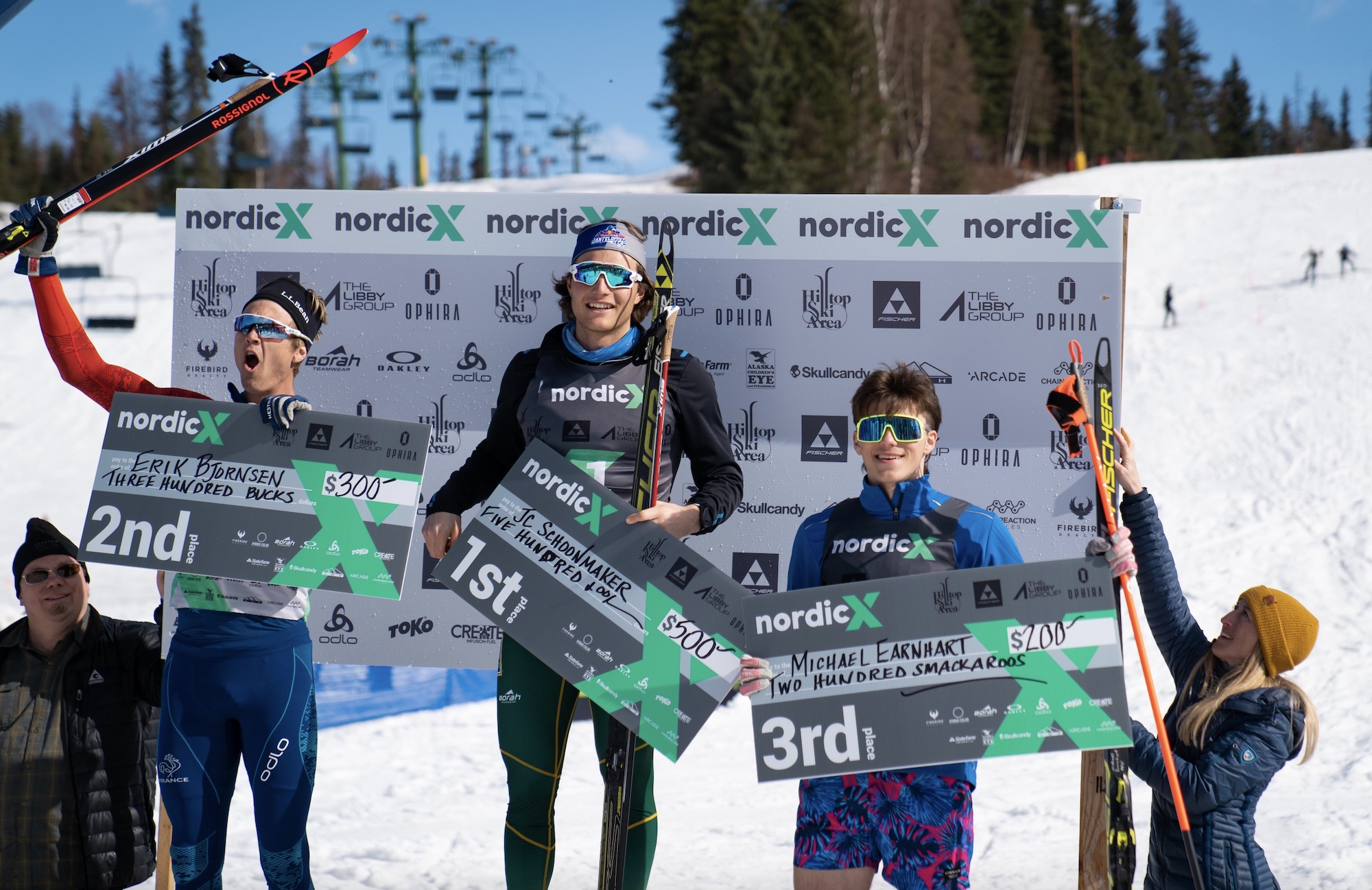
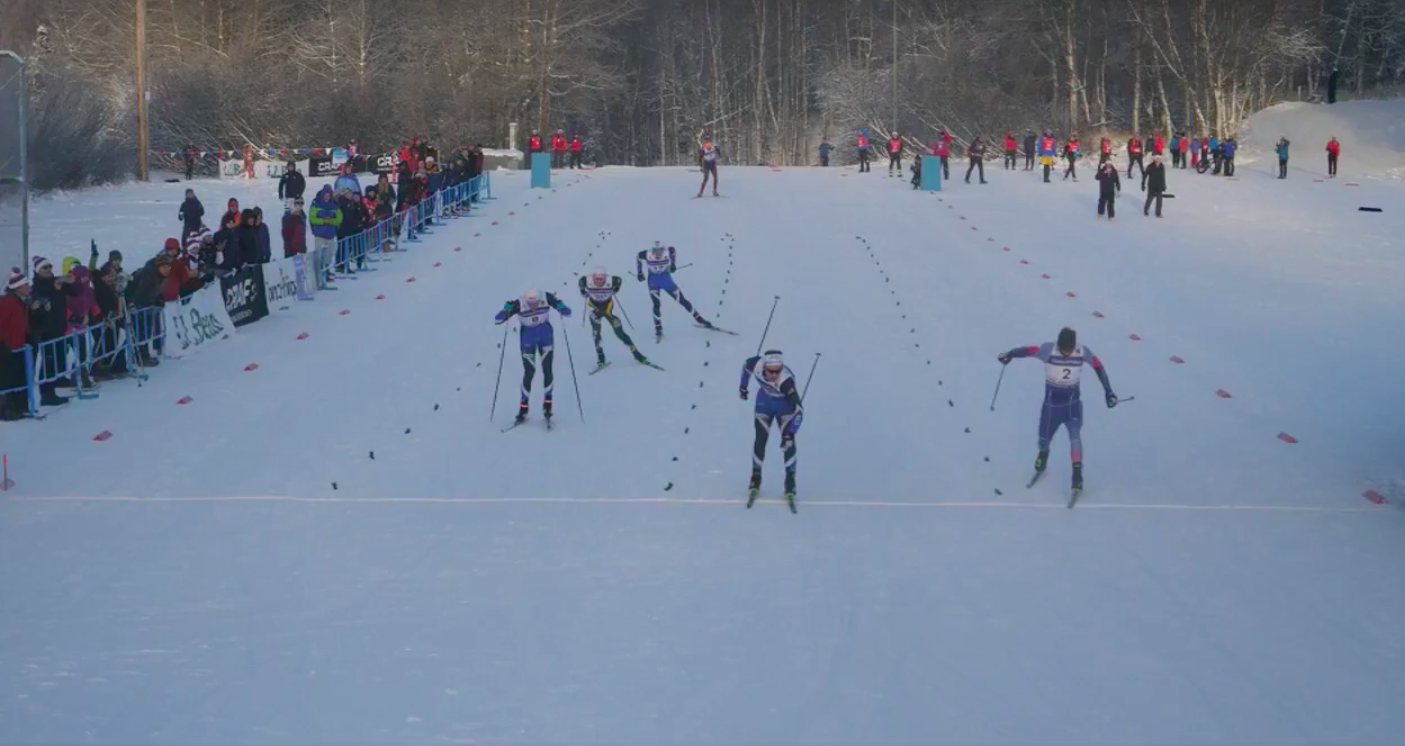
From a photo finish, Schoonmaker was awarded the victory, with Bjornsen narrowly taking second. U20 APU athlete Michael Earnhart skied to third, taking the final podium step.
“NordicX was one of the most fun races I’ve participated in,” wrote Schoonmaker after the event. “It took me back to middle school building jumps with my friends and seeing how far we push the skinny ski boundaries. Everyone who took part in putting the race on did a great job and with the spectators who came out, it really just had a good vibe to it. Everyone was having a great time and I’d definitely like to do it again. My highlight was watching some of the younger skiers before the race who were hitting the last jump doing 360’s and backflips and seeing how pumped up they were to be there.”
The men’s NordicX podium: JC Schoonmaker came out on top in a dramatic photo finish with Erik Bjornsen, while Michael Earnhart took third. (Photo: Ophira Group / NordicX)
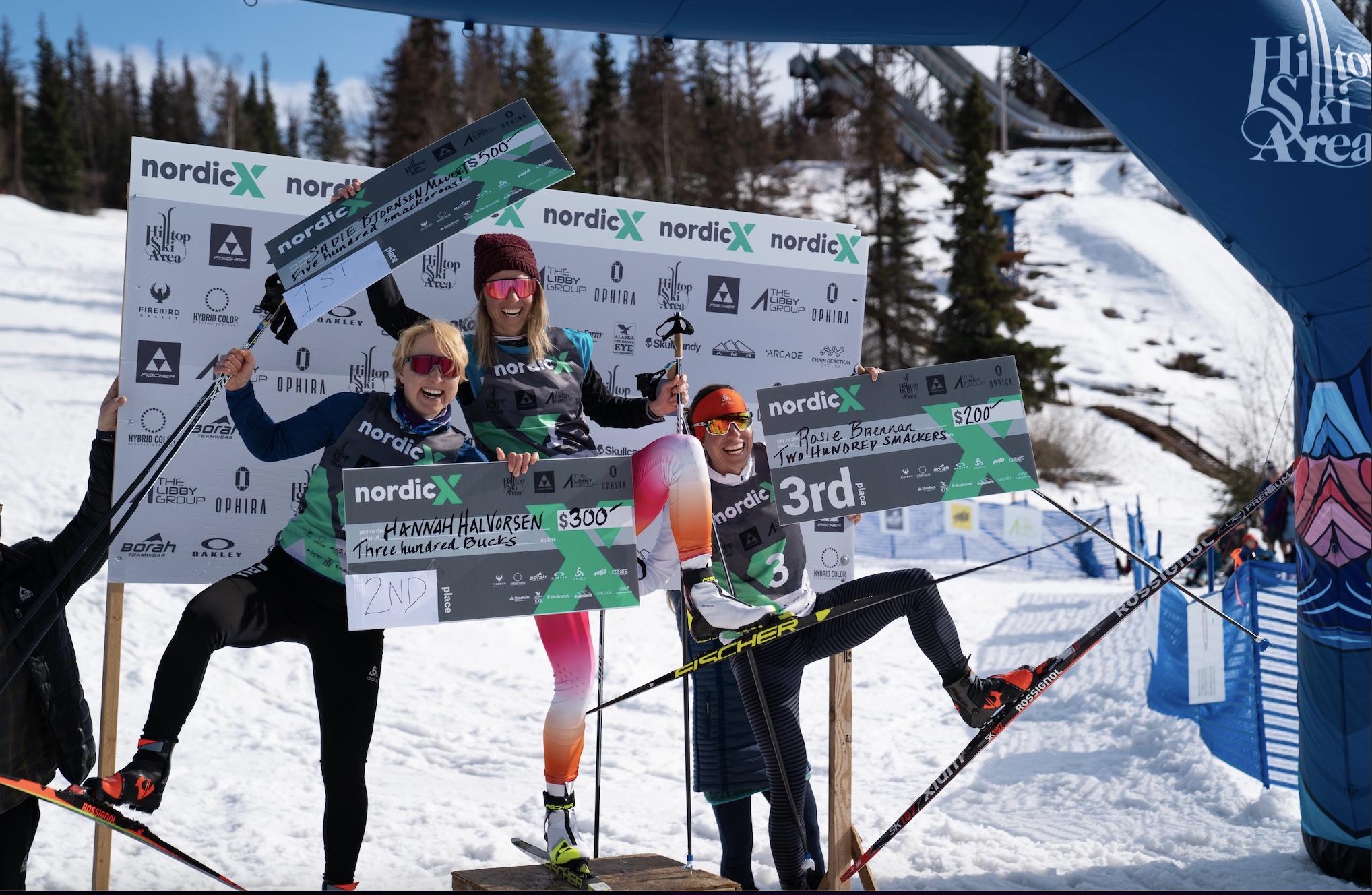
In the senior women’s senior division, it was a current and former APU athlete sweep, with Sadie Bjornsen Maubet taking the win ahead of Hannah Halvorsen in second and Rosie Brennan in third.
“Nordic X was a super fun event, with a fun new twist to nordic skiing, and nordic ski spectating,” wrote Bjornsen Maubet. “Reese did an amazing job of dreaming up this super fun and social way to share our sport with our community… I relied on my thirty years of spending most of my days on nordic skis to attempt to gracefully make it down the little jump park. Though incredibly inspired by all the young kids catching tons of air, and throwing font and back flips, I figured I better save those moves for another life. The day was full of tons of laughs, cheers, and excitement. It felt special to put a bib on beside my previous teammates, and participate in the fun.
“I look forward to watching this spectator friendly event grow in the Anchorage Community. I think my husband had the most fun of us all, as he showed up with his chainsaw without the blade, some flares, and wearing a hat that said ‘Make the Bjornsen’s Great Again’. He was the cheering squad of the day, representing his French blood and the famous French Team Valoche cheering squad.”
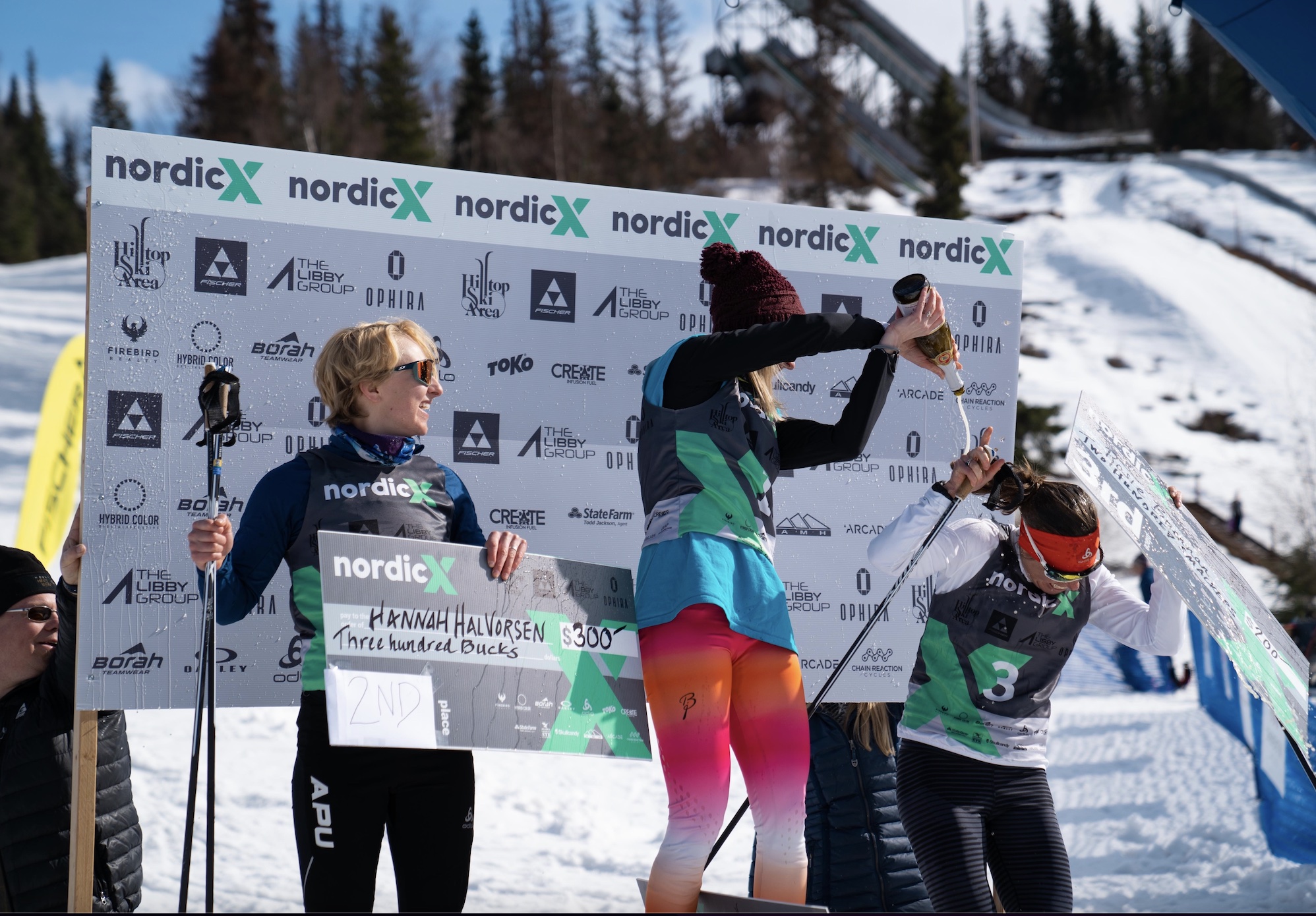
The women’s podium at NordicX: Sadie Bjornsen Maubet took the top spot ahead of Hannah Halvorsen and Rosie Brennan. (Photo: Ophira Group / NordicX)When you can’t spray, pour. Winner Sadie Bjornsen Maubet shares a champagne celebration with third place Rosie Brennan. (Photo: Ophira Group / NordicX)
For Hanneman, there were also a number of smaller highlights he’s enjoyed looking back on. While marking the course with food coloring, he loved watching skiers riding the lift to the top of the course on their skinny skis, and seeing athletes from 13-year-olds to veteran racers sessioning the course to dial in their lines and strategize. During the heats, he watched a number of young athletes gain confidence, and perhaps some additional skills, after working through initial trepidation surrounding the new race experience.
“There were some juniors who you could see at the start of the day were pretty intimidated by the last part of the course, which was really steep and had some sharp slalom turns,” Hanneman explained. “It was definitely challenging their skill level. And by the end of the day, like they were coming through and just ripping, and they were having so much fun and you could tell they had gotten a lot better just in a couple hours.”
One of many kids enjoying the features on course and in the Kiddie Cross terrain park at NordicX. (Photo: Eric Maurer / NordicX)
For those 12 and under and too young to compete on the full course, there was a “Kiddie Cross” course, which included banked turns, tabletops, a rhythm section, and a number of other terrain park features for kids to play on and session.
“The parents love it, right? Because the parents are just sitting there in the sun, watching their little kids just love cross country skiing.”
He commented that he had friends who had been trying to sell their child on cross country skiing but felt like it was a hard sell compared to downhill skiing. “They were like, ‘Oh, man, I’ve been trying to get her out on their cross country skis all year and they don’t want to go,’ and they brought him to this event and their kids were like on their on their cross country skis just doing laps up the hill 1000 times so they could go back and hit the jumps again. So for me, that right there is like the essence of this event.”
A pair of NordicX racers ride the chairlift with their skinny skis. (Photo: Andre Horton / NordicX)
In reflecting on the event and its impact on the local cross country ski community, Hanneman felt it added “a shot of energy… I mean, there’s so many cool races out there, but this is just a little bit different. And I think it gets people excited.”
While the biggest air and most impressive skill was seen from the elite racers, Hanneman kept coming back to the youth participating in the event, highlighting that it really was his boyhood dream to see an event like this in Alaska.
“Something like this would have probably excited me for a whole year like knowing that it was coming. And I think the more people that we get excited about cross country skiing the better, because I think it can be a really fun sport, but, let’s be honest, sometimes it has this perception of being kind of slow and boring, and hard.”
He described it as the type of event that could nudge skiers with that perception to give it a try, opening their eyes to what’s possible and how fun the sport can be. While there are perhaps other locations in the US that might be a candidate to host, Hanneman also explained why Anchorage is an ideal location for NordicX.
Spectators catch the NordicX action from the base of the Hilltop Ski Area in Anchorage. (Photo: Eric Maurer / NordicX)
“We have a huge ski market here, massive participation in high school skiing, and obviously a ridiculous number of elite-level racers here.”
On all accounts, the first year of NordicX was a success, which begs the question: what are the plans for next year?
“So many people came up and were like, ‘I can’t wait for next year.’ And I’m like, ‘Oh, man, I don’t know.’ I haven’t necessarily committed, you know? This was a crazy undertaking.”
Since retiring from professional ski racing, Hanneman has been investing his time and energy in starting and serving as CEO for the PR agency, Ophira Group. He and his wife also welcomed a baby girl in March, 2021, and he’s remodeling their family home. He expressed that pulling off the inaugural event was already “pushing the limits” of what he should take on.
Balancing CEO and family life with NordicX planning, Reese Hanneman hosts the xc ski event of his childhood dreams. (Photo: Ophira Group / NordicX)
“I do want to say thank you to the team that we put together which includes Lauri Bassett (exec. administrator at Cross Country AK) and Rob Whitney, and the people at Hilltop, because without them, this absolutely would not have happened.”
As for next year, “people are too excited about it for it to not happen again.” And he wants to see it happen for a second year. To pull it off, he anticipates putting together a larger team to more evenly distribute the workload, “just so that we can all maintain a healthy NordicX-life balance.”
But the earliest on-snow dates in these articles are October 6, October 14, and October 15. How would you like to read that same article, but set in – *record scratch* – September?
All of which is to say, it snowed in Anchorage over the weekend. A lot. Like, up 16 to 20 inches a lot. Like, knee-deep on Reese Hanneman a lot. As the local National Weather Service office explained, “moisture from [Cook Inlet and the] Gulf of Alaska was pushed against the Chugach Mountains in what is called upslope flow. The cooling of the air as it moves up the terrain, combined with a steady influx of moisture and upper level support, created the large spread in snow totals over the eastern side of town and into the Chugach Front Range.”
Local skiers, from Olympians to weekend warriors, knew what to do with the results of ample moisture plus cool air. Friday morning’s practice for the APU Elite Team became a 2-hour on-snow classic ski. Saturday afternoon, Scott Patterson and David Norris logged a 3.5-hour classic ski OD over the Hillside trail system. For their second workout of the day. Many athletes went nordic skiing on Friday then alpine skiing on Saturday, skinning up the slopes at Arctic Valley before bombing down through nearly two feet of fresh snow. As former FasterSkier reporter Nat Herz captioned a Saturday Instagram story from Arctic Valley, in a nod to less salubrious real-world concerns, “Alaska: Highest Covid counts in the country. Best damn September skiing anywhere.”
If race-ski skiing in September while all Alaska hospitals are rationing care and patients die for want of ventilator space was surreal – and it was – then so was looking down from the Hillside ski trails, on the eastern edge of Anchorage, and seeing nothing but bare ground on the west side of town. Due to some meteorological quirks in an area with mountains and ocean in close proximity and the potential for remarkable microclimates, it snowed literally zero inches anywhere west of the Seward Highway, which roughly bisects Anchorage. The views of snow-covered mountains from Kincaid Park, the city’s other main nordic area, were world-class, but none of that snow reached sea-level Kincaid.
Geographically speaking, the distance from “Trace” of snow on this map to “16.5 inches” is around eight miles as the crow flies, with each endpoint on that line readily visible from the other. Practically speaking, you could ski in the morning beneath snow-encrusted trees, then run, or mountain bike, or even rollerski in the afternoon, on dry trails beneath gorgeous full colors. (Most of the leaves are still on the trees, save those that recently collapsed under the heavy snow load. Because it’s still September.) It was like Bend in the spring, but without the altitude or sunscreen.
Finally, a brief history lesson. On September 24, 2000, an aspiring pro nordic skier named Cory Smith reveled in a fall snowstorm that let him ski in loops on a Park City golf course before it melted away on a 60° day. “A three hour OD on snow in September! Unheard of,” Smith raved on his proto-nordic blog.
In the intervening two decades, Smith would come close to but not ultimately make the 2002 U.S. Olympic team, found an obscure website called FasterSkier.com, retire from pro skiing, and move to Anchorage, where he would code a simple but effective and widely used website for user-generated ski trail reports. On September 24, 2021, he would write on snowio.com, “Hillside is very skiable. It’s slushy, so waxless rock skis are the way to go. But if you want a true September WTF (winter’s truly fantastic) experience, head up a little higher. There is about 2 feet of snow and a nice skied-in track from Upper O’Malley trailhead to Glen Alps.”
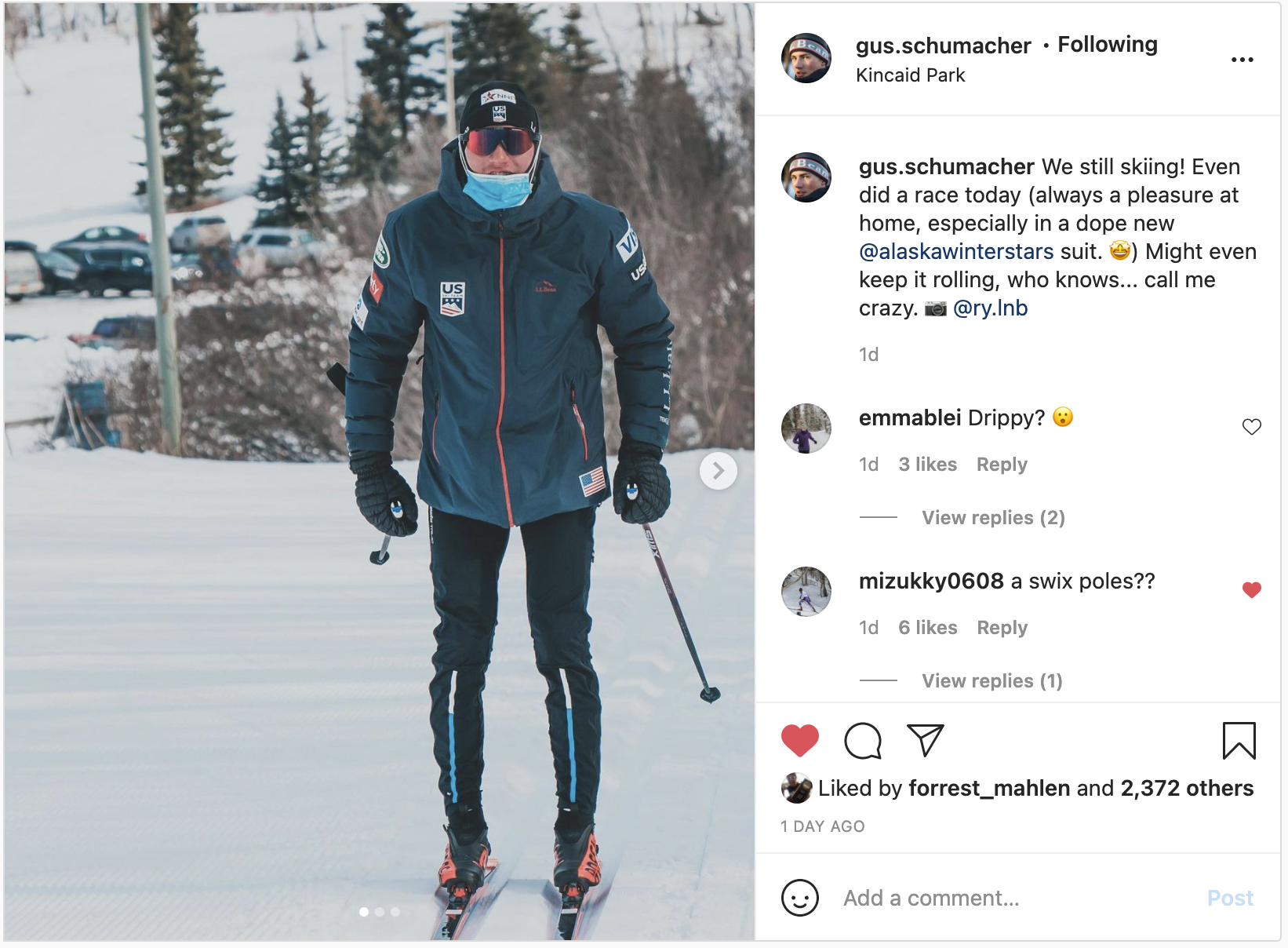
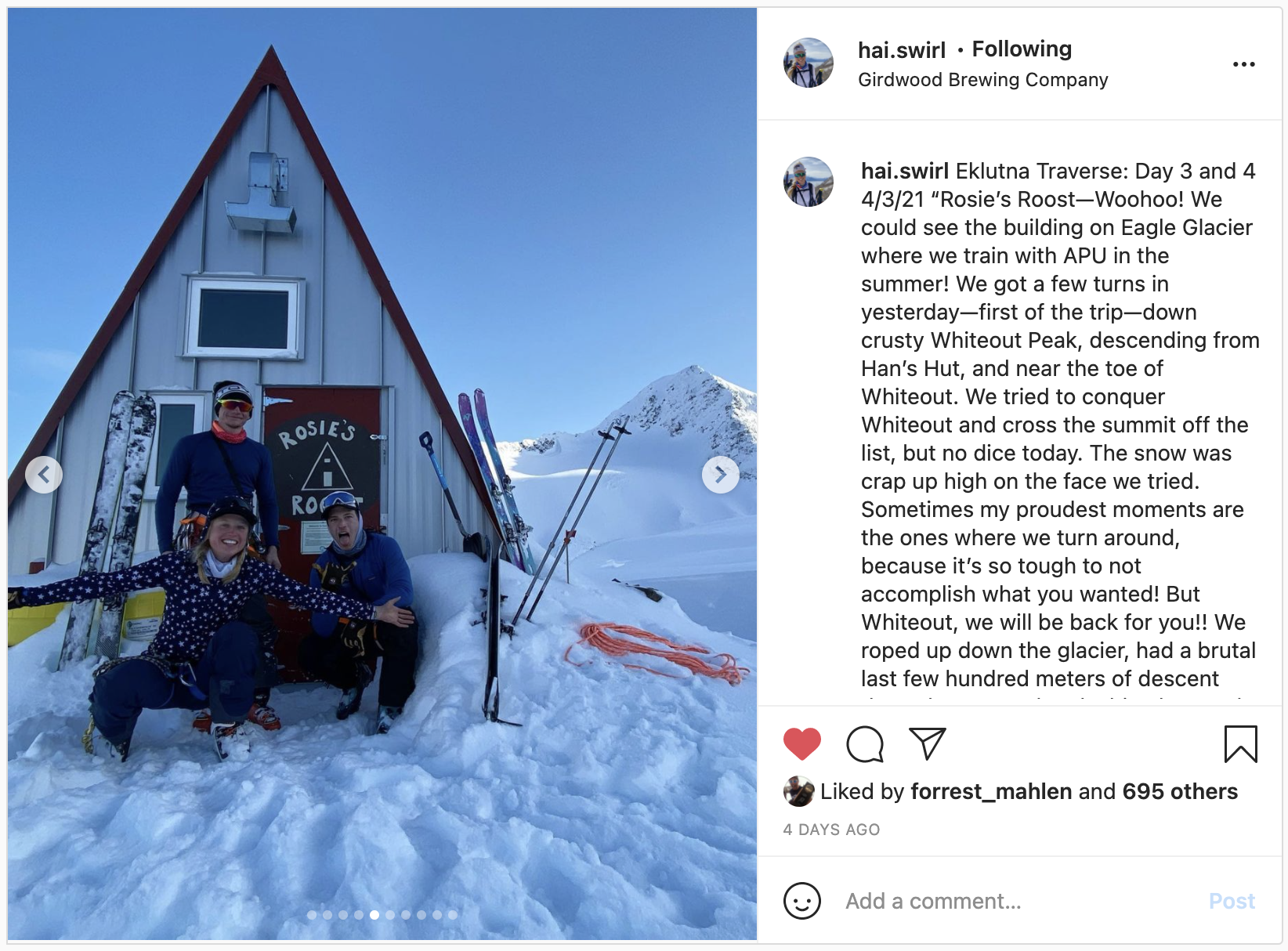
Please enjoy this selection of recent photos from a truly fantastic winter experience in Anchorage (plus two bonus on-snow photos from Fairbanks at the end). All images are screenshots from their respective Instagram photos or stories, posted at some point between Friday and Sunday.
ANCHORAGE — The calendar said April, but the thermometer said January, as a small but well-credentialed field of athletes competed in a pair of FIS races at Anchorage’s Kincaid Park over the weekend. The April 10 and 11 events appear to have been among the latest FIS races held in this country in the past 30 years.
Saturday morning in Anchorage dawned clear and cold. Anchorage broke its all-time temperature record for April 10 with a 5° F (-15 C) reading at the official weather station, just a few miles east of the venue, around dawn. By the time the race came around, technical delegate Matt Pauli annotated the results with an official air temperature of -10 C, snow temp of -12 C. It had snowed a few inches the day before. It did not feel particularly vernal.
While conditions evoked mid-winter, athletes’ training regimens did not. Within the week leading up to race day, a brief survey of social media reveals, roughly half the pro skiers in the field went crust skiing; Scott Patterson went backcountry skiing; and Hailey Swirbul, Hunter Wonders, and Chip Schoff completed the Eklutna Traverse, a classic local mountaineering route, over four days. Oh, and Gus Schumacher, JC Schoonmaker, and Finn O’Connell logged a 200-kilometer, 10-hour day on Wednesday, before gorging on Moose’s Tooth pizzas at the edge of the Kincaid parking lot. Travel on Monday, intervals on Tuesday, race prep on Friday, this was not.
Chip Schoff (top), Hailey Swirbul, and Hunter Wonders outside the Rosie’s Roost hut, midway through the Eklutna Traverse.
The mountaineering trip seems to have been fine training, as both Wonders and Swirbul won their races on Saturday. In the men’s 10-kilometer interval-start classic race, Wonders posted the fastest time in a field of 25 athletes, 25:02.2, to take the narrow victory. Patterson (+.8) and Schumacher (+14.1) were not far behind.
Hunter Wonders racing to the win in Saturday’s 10 k classic race. (Photo: Adam Verrier)
In the women’s 5 k interval-start classic race, held over one lap of the men’s course (aka the Junior Nationals distance course, for any readers who raced at Kincaid in March 2019), Swirbul started first in the reverse-seeded field and set the fastest time in a field of 17, 14:20.6, by a substantial margin. Hannah Halvorsen (+41.9) was second, with Tuva Bygrave third (+46.5).
Hailey Swirbul, skiing here in her APU gear, won Friday’s 5 k classic in Anchorage. (Photo: Adam Verrier).
Wonders, Patterson, Swirbul, and Halvorsen ski domestically for Alaska Pacific University, or APU. Schumacher skis for Alaska Winter Stars. Bygrave skis for University of Alaska Anchorage, or UAA. All podium finishers save Halvorsen competed at this year’s World Championships in Obsterdorf, and all save Bygrave are on the U.S. Ski Team (Bygrave has Australian and Norwegian citizenship). It was a well-credentialed field.
Relatedly, the winner of the men’s race each day recorded a 22.76-point FIS race, making these, mathematically speaking, by far the most competitive races of all the FIS races held in the country this year. (Lower points are better. For perspective, the deepest races at 2020 U.S. Nationals were only good for 26.70 FIS points for the winner.)
Sunday’s skate races brought somewhat more temperate weather (-3 C, wrote Pauli on the official results), and another UAA skier on the podium.
In the women’s 10 k interval start (two laps of Saturday’s course), UAA athlete Astrid Stav set the pace in 26:42. She was followed by Anna Darnell of APU (+18.6) and UAA teammate Bygrave (+1.00.7). Stav was second in the distance skate race at this year’s NCAA Championships in New Hampshire.
UAA skier Astrid Stav won Sunday’s 10 k skate. (Photo: Laarni Power)
In the men’s 15 k interval start (three laps of the same course), Patterson paced a field of redoubtable distance skiers with the day’s best time of 33:26.5. He was followed by Schumacher (+27.7) and David Norris (+1.10.6) in second and third. All three athletes have been on a national championship or SuperTour podium in this event.
Scott Patterson won Sunday’s 15 k skate. (Photo: Laarni Power)
The weekend’s FIS races capped a domestic race season that, like many aspects of life over the past year, has had high highs and low lows. In Alaska, highs included race skis-good trails at sea level for five full months, and counting, and a robust local race schedule. In the Lower 48, races were held with strong regional fields in many areas, and cancelled in others. There were no national championships, no SuperTour, and no Junior Nationals. Some athletes completed an essentially normal race schedule. Some athletes did no races at all. Everyone probably did more interval-start races than they were accustomed to, and fewer sprint heats. Discretion was used widely in selecting athletes for international competition.
A memorable season of high-level racing came to a close with this bit of trivia: The weekend’s races appear to be among the latest FIS-sanctioned races held in this country within the modern era of the online FIS calendar (early 90s to present). They are tied with the final two races of the 2013 Spring Series (women’s 30 k and men’s 50 k), held in more traditionally spring-like conditions in Truckee, California, on April 10 and April 11, 2013. Temperatures there approached 60° F, and the snow was so slow that the winning time in the 30 k was nearly 1:42.
Andy Newell skis through deep slush in the 2013 Spring Series 50 k. (Photo: Mark Nadell/MacBeth Graphics)
Official racing in Alaska concludes next weekend with a hill climb up the alpine runs at Girdwood’s Alyeska Resort, which promises a Tour de Ski-esque gain of approximately 2,030 vertical feet or 619 meters (the final climb in Val di Fiemme appears to be “only” 418m). The athlete with the lowest combined times from this weekend’s two races, plus the hill climb, will be awarded the title of SkiMeister, wrapping up the inaugural Tour de SkiMeister three-race series.
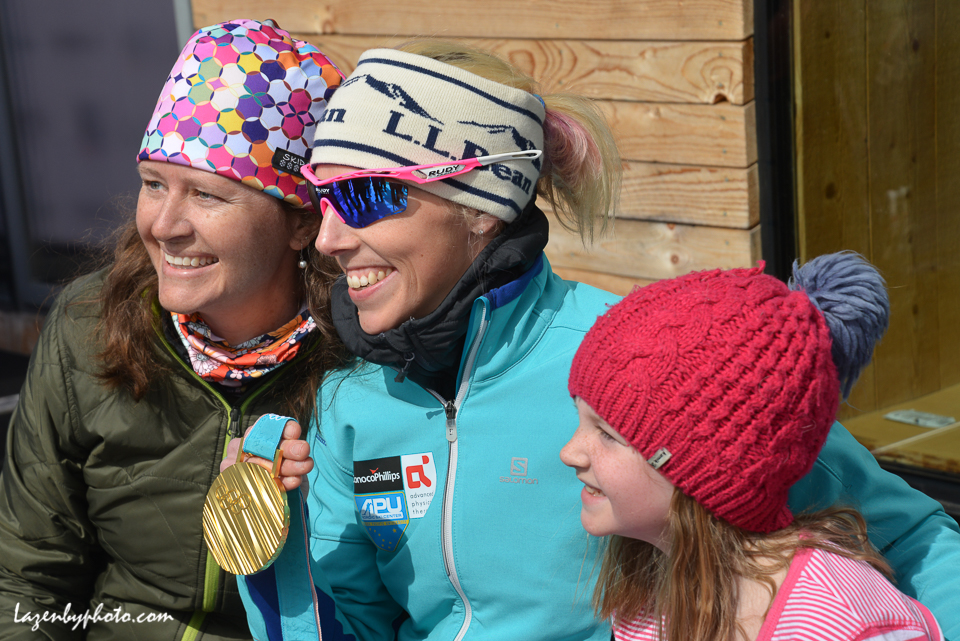
Kikkan Randall (c) with young fans and her Olympic gold medal after the 10 k freestyle mass start at 2018 SuperTour Finals in Craftsbury, Vt., this past March. (Photo: John Lazenby/Lazenbyphoto.com)
On Wednesday, Kikkan Randall went public with the news that she was recently diagnosed with breast cancer.
“Although we caught it early and the prognosis is good, my life will change quite a bit in the coming months,” she wrote on Facebook.
Randall received her first round of chemotherapy on Monday at the Providence Alaska Medical Center in Anchorage, Alaska, the city where she grew up. After winning Olympic gold in February with U.S. teammate Jessie Diggins then retiring from the U.S. Cross Country Ski Team this spring, she and her husband, Jeff Ellis, and their 2-year-old son, Breck, moved to Penticton, British Columbia. Jeff had a new job, and they hoped to expand their family there, according to the Anchorage Daily News (ADN).
As she spoke with the ADN inside her parents’ Anchorage home on Wednesday, shortly after announcing her diagnosis on social media, Randall, a 35-year-old three-time World Championships medalist, three-time Sprint World Cup champ and 13-time World Cup race winner, remained optimistic. While doctors won’t know the scope of the cancer until they operate, they believe its in an early stage, Stage 2, she said.
The ADN reported that Randall will have six rounds of chemotherapy with one infusion every three weeks. She rode her bike to the hospital on Monday wearing her rainbow-colored “happy shoes” and is hoping she can use a treadmill or stationary bike during future infusions, which take hours. She already emailed her oncologist to see if that was permissible.
Kikkan Randall (l) and Jessie Diggins embrace after the finish of the women’s 10 k freestyle mass start on March 24 at 2018 SuperTour Finals in Craftsbury, Vt. Diggins won and Randall placed third. That was Randall’s second-to-last race before retiring from skiing. (Photo: John Lazenby/Lazenbyphoto.com)
“I haven’t heard anything back yet but if they’re open to it, I’d be willing to try it,” Randall told the ADN.
After chemo, she’ll have surgery, but Randall was unclear what that would entail. It could be anything from a lumpectomy to a double mastectomy.
In her interview with the ADN, Randall explained that she doesn’t have a family of breast cancer. Between chemo sessions, she’s hoping to return to her new home in B.C.
Since discovering two pea-sized lumps on her breast on Mother’s Day, May 13, Randall underwent a mammogram, an ultrasound and a biopsy, then received the news that she had cancer while in Sweden for a wedding less than a month later. In that time, she told the ADN she’s felt everything from “denial and disbelief and frustration, but I always come back to the same skills I’ve used in my athletic career,” she said. “I need to focus on what I can control. I need to be positive and optimistic.”
“… It’s so surreal for me because I just won a gold medal four months ago and I just was feeling on top of the world,” she said. “Life is going to kind of forever change.”
Kikkan Randall after placing third in the freestyle sprint at 2017 World Championships. (Photo: Fischer/NordicFocus)
Randall is widely recognized for her trademark pink hair, a color she wrote “has taken a on new chapter in my life” and one she plans to keep throughout treatment, even in the form of wigs. Randall has been involved in breast cancer awareness projects in the past, but previously used her pink locks to attract attention to her sport. Then pink became her good-luck charm.
Looking forward, she’s already coined a term for herself post-treatment: “Kikkan 2.0”.
“I’ll take this on like I have taken on anything else,” she told the ADN. “I think Kikkan 2.0 could be pretty awesome.”
She noted on social media that she’ll be using her blog, Kikkan.com, to provide updates during her “upcoming journey,” as she put it.
(Update: On Thursday, Randall’s friends started an online fundraiser to help with her medical costs. As of Friday, they had raised nearly $17,000 toward a $45,000 goal. For more information, visit www.gofundme.com/support-kikkan039s-fight)
Kikkan Randall (l) and Jessie Diggins listening to the U.S. national anthem after being awarded their 2018 Olympic gold medals from the freestyle team sprint in PyeongChang, South Korea. (Photo: FlyingPointRoad)
Kikkan Randall competed in her first World Cup race in 2001, and her last in 2018. In between, she won 14 World Cup races, three Sprint Cup Crystal Globes, three World Championships medals, and one Olympic gold medal accompanied by one very enthusiastic broadcast call from Chad Salmela. She appeared in television ads, received the Skis to the City from the mayor of Anchorage, and had an ice-cream flavor named after her. And long before she brought cross-country skiing to the attention of The New York Times and The Guardian, she was mentioned on FasterSkier over 2,000 times. (The first-ever hit on this site seems to date to November 2002, a two-paragraph recap of the West Yellowstone sprint. Other podium finishers included Brooke Baughman for the women, and Lars Flora and then-junior skier Andy Newell for the men.)
This is presumably not Randall’s final appearance in FasterSkier; if nothing else, tune in next week for Part 2 of this interview. But it may be one of the last times she talks with FasterSkier while she still appears on the “current World Cup athletes” page of the International Ski Federation (FIS) site.
Note: The following story is based on an in-person interview with Randall in late April. FasterSkier’s narrative is in bold; everything else is a direct quote from Randall.
Let’s go back to the beginning, way back. Randall has said that she was all of five years old when, sitting in her grandparents’ living room, she “decided right then and there I wanted to go to the Olympics.”
But where does that drive come from? What makes a kindergartener form such a belief, even one with Olympian role models within the family? (Randall’s aunt and uncle, Betsy and Chris Haines, were American nordic Olympians in 1976 and 1980.) To answer this question, Randall goes even farther back, to 1983, to a time when the infant who would one day become the world’s fastest woman on skis was experiencing the first tantalizing glimpses of mobility on her hands and knees.
I gotta think there’s some innate thing in my personality that orients me [toward being that driven]. My parents have a story of being at a picnic when I was just learning to crawl and putting me down on the grass, and there was a playground about 200 feet away. And I just started crawling toward the playground. And my parents were like, Well, we’re going to see how far she goes, expecting that I’d get a little ways and then look back.
And I never looked back. I went all the way to the playground. And at another point, some woman from the picnic went over and picked me up, and was like, ‘I can’t believe you’re letting this kid go off.’ And my parents were like, ‘We just wanted to see how far she would go.’
Kikkan Randall (bib 136) runs in a community race in Anchorage, Alaska, in the mid-1980s. (Photo: KTVA 11 screenshot)
So there’s obviously something, I think in my personality, that makes me want to go after what I want. But I also grew up with amazing role models. I mean, within my own family, my aunt and uncle went to the Olympics, so I already had a great example of what the Olympics was, how possible it was. And then my parents, who always supported me, told me to chase after what I wanted to do, to not really put limits on it, and then allowed me to kind of chase after what I was interested in.
But then instilling along the way that once you commit to something, you do it and you don’t give up, and the most important thing is giving your best and all those things.
And then growing up in a place like Anchorage, where I grew up doing all these different activities, and around people where as a girl I never felt like I had less opportunity, that there was anything less possible. If anything, because I saw so many strong women athletes around me, I wanted to be a strong woman athlete myself, and set an example for others. So when no American woman had won a medal, it’s like, Well, we need a women’s medal. We gotta be on par with the men.
So really, just a great supportive environment and always just a drive. And always a lot of self-confidence. I’m not sure where that came from, exactly, I think I just developed that over time, but that really helped, too.
To find the first FIS race of Randall’s career, it helps to set the FIS database to show 100 results per page. And even then, you have to click through to the sixth page of results to find the beginning. That’s right: Randall competed in, loosely defined, nearly 600 FIS races in her career (counting sprint qualification and finals results separately, as the database does).
The first-ever FIS race was a 15-kilometer interval start classic race at U.S. Nationals held at “Wasatch State Park,” better known as 2002 Winter Olympics site Soldier Hollow. It was January 10, 2000. The Y2K Bug had thankfully not caused the world to end 10 days earlier. The Billboard Hot 100 number one song was “Smooth,” by Santana. AltaVista, valued at roughly $2.3 billion, was the dominant internet search engine, though challenges from an ascendant young company named Google were on the horizon.
From left to right: Nina Kemppel, Jim Stray-Gundersen and John Farra gathering with Team USA for Opening Ceremony at the 1992 Olympics in Albertville, France. (Photo: Peter Hale)
Randall had just turned 17 years old. She was in her junior year of high school, and had never raced this distance before. Nonetheless, she finished 12th out of 59 FIS finishers.
The podium in this race was made up of Beckie Scott, Nina Kemppel and Rebecca Quinn (now Dussault). Kemppel was born in 1970, and once raced against Nancy Fiddler. Other finishers in this race were born in the 1960s. Every finisher had a FIS number that starts with a 1. Randall’s been doing this for a long time.
Randall is handed a results sheet that dates from the Clinton administration, and is asked if she remembers anything about this race. The reminiscences immediately begin.
Oh yeah, my first time at senior nationals. It was my first 15 k ever. And I started second to last. And because I had never raced 15 k before, and it was individual start, I was quite intimidated. And it was one 15 k loop; that was one of the last times they had such a long loop.
It was a classic race, and I remember skiing up the first k, and noticing that there were chunks missing from the track. It happened to be one of those conditions where, right around freezing, are you klister, are you hardwax? And the reason why there were chunks missing is because people are icing so bad that they would have to stop.
And so, I was just like, Oh man, am I going to survive this 15 k? And I skied around, and thankfully we got the skis pretty well; I never had any major icing issues. And at points I lost kick, but I made it through. It was a pretty exciting first experience, and then I was pretty amazed to finish so well. [Randall came down to earth slightly in her second-ever FIS race, a 5 k skate two days later, finishing 48th.]
Fast forward just over a year later, to January 2001, when Soldier Hollow was again the setting for Randall’s first-ever World Cup race, a skate sprint. Czech skier Kateřina Neumannová had the fastest time in qualifying; Norway’s Bente Skari won the final.
Randall notched a 24th in qualifying, which at the time left her eight spots out of making the heats. She was the third American in the 53-racer field, behind Kemppel in 17th and Tessa Benoit in 20th. Benoit’s final entry in the FIS database is from 2002. Again, Randall has been doing this for a long time.
Randall is once again handed a printout of the results sheet, and asked what she remembers.
I scored World Cup points, and that was pretty exciting. And that’s when they only took the top-16 into the finals [of a sprint race]. So I was pretty happy with 24th; of course I wanted to be in the heats. I do remember that as my first World Cup. But it’s crazy that it was 17 years ago.
[A reporter notes, upon looking at the results, that Randall’s competitors in this race included Ukrainian skier Irina Terelia, who was born in 1966 and is now 52 years old.]
Norway’s Bente Skari (l) and Mathias Fredriksson of Sweden with their crystal globes after winning the 2003 Overall World Cup. (Photo: Flickr Creative Commons)
Wow. I mean, what’s pretty impressive, though, is like these were some of the biggest names that I grew up hearing about in the sport, that I got to race against. So I remember getting Bente Skari’s autograph, Stefania Belmondo’s autograph, like on my hat at this World Cup. So, pretty fun. And all of a sudden people are looking at the results listing [and seeing Randall’s 1982 birth year] going, ‘Oh my god, ’82, that’s so old.’
While the first World Cup race, at age 18, proved an auspicious beginning, there was nonetheless a learning curve involved in making the jump to international competition. Randall’s second-ever World Cup start, a classic team sprint at Torino four years later in January 2005, was respectable enough; she and teammate Wendy Wagner went out in the semifinals, but avoided placing last by finishing 12th out of 14 teams.
But the following month brought the third World Cup start and first World Cup distance race of Randall’s career, a 10 k interval start freestyle in Reit im Winkl, Germany. Randall was one of two Americans in the race, along with Rebecca Dussault. Randall started with bib 6 in a field of 70, reflecting FIS distance points that were not particularly low. (Marit Bjørgen started last.) Randall finished 70th out of 70, dead last, behind athletes from China, Japan and Lithuania. She was 80 seconds back from 68th place, and nearly 5 minutes back from the winner over 10 k. It was a 154-point FIS result. “It was a rough day for the North American teams,” FasterSkier observed.
It was raining.
So even Randall has finished a race dead last, and questioned herself along the way. (As the saying goes, DFL is better than DNF. But the latter status prevailed at World Championships later that month; Randall did not get the chance to anchor the women’s 4 x 5 k relay team when the Americans were lapped and pulled from the course during the third lap of four. The American women are now consistent relay podium threats. Randall’s been doing this a long time.)
Randall is asked what her thought process was at the time – not what she thinks now, 13 years later, when success was eventually achieved and her whole career can now retrospectively follow a ready narrative arc of struggle and redemption, with Olympic gold as the final chapter. But rather what she thought then, when there was no U.S. women’s ski team, and she was spending her winters going back and forth between North America and Europe, working to build a path that didn’t really exist yet.
Initially it was fine to get those kinds of results, because I had this approach that, OK, well, I’m gaining experience, I’ve still got more training to do, and I am going to get there someday. But then after you’d been around it a little while, it did feel hard, and that result in Germany, finishing last… I mean, I remember just being kind of in a really miserable state at that point and just – I was missing home, I wasn’t enjoying the racing, I fought with myself that whole race to keep myself from quitting. And just wondering if this is what I really wanted to continue doing.
But thankfully, within all those kind of tough results, there were always a couple of high points that encouraged me that I was making the right progress. And I think that progress is what just kind of kept me going, OK, let’s see this out a little bit longer, let’s go a little bit more.
And I was really enjoying the lifestyle of it, I was able to start getting sponsors, which allowed me to make it a lifestyle, so it wasn’t a complete sacrifice. I was doing school along the way. It took a lot of convincing of my grandfather over the years, that this was a worthwhile pursuit, because he was supportive of me making the Olympics, but then once I did it was more like, ‘You’ve made the Olympics, now it’s time to finish your degree and become a professional.’ And I had to keep saying, ‘No, I think I can be good at this, I want to keep trying.’
Randall, in her second Olympics, just before the finishing stretch of the classic sprint at the 2010 Winter Games in Vancouver, British Columbia.
And I kept pushing the ski team to develop more of a woman’s team. And I would say — I always had this 10-year projection, which was going to be like the Vancouver Olympics — that by Vancouver, I want to be in a position to win a medal. And even when it was just a few years away, and I still wasn’t even that close, somehow I was able to just stay patient and stay motivated and keep going.And I really think, being able to just pull out those small successes – I kept this Excel spreadsheet of my FIS points of races, and I would put in the FIS points that I got, the time back from the leader, comments about the race. And at the end of every season I could see, like, well maybe the results weren’t that spectacular, but I’m progressing, I’m moving forward. So I used things like that also, to just kind of help keep me pushing forward.
And I just also had this – I don’t know where I got it from, but just kind of this thinking that it was all building. That every year you train, the platform gets stronger and you keep going. And at some point you do hit a tipping point, and you start to break through. And that was so true.
“I just had this thinking that it was all building. That every year you train, the platform gets stronger, and you keep going. And at some point you do hit a tipping point, and you start to break through. And that was so true.”
I would say, prior to 2006, I was starting to wonder, but then in 2006 I had that breakthrough that then carried me another few years before the next breakthrough, and then it just kind of kept going. And now the younger athletes that are coming in – well, we just have such a better system, a better understanding, just the confidence that it’s possible. So I feel like the athletes now don’t have to go through it quite like I did, and have to really go, ‘Can I do this?’
But I had to remind a lot of these girls when they first came on the scene, when they would get their high-flying result and then go back to being in the fifties or whatever, and going, ‘Ah, you know, I’m not successful.’ It’s like, ‘No, this is a long game, and just be focused on making steady progress, and you’ll get there.’ And they have.
Despite this perspective gained through experience, Randall largely demurs when asked now what advice she would impart to a mid-2000s Young Kikkan. Rather, she suggests that the journey itself was important, and that the need to experiment along the way to figure out what worked best helped her with the rest of her career.
We’ve obviously learned a lot now about what’s possible in the realms of training, and kind of what types of training and what experience is the most important, and maybe I knew some of it early on, but a lot of it was experimentation. I maybe could have put myself in a position to be more successful earlier in my career had we known then what we know now – but at the same time, I think it was so important for me to go through that experimentation, and it really maybe helped with the longevity of my career, to have been able to do it this long.
So I would love to go back and have a conversation with Young Kikkan, and just get to hear firsthand the ambition and the thought of what was it gonna be like back then, because you kind of lose that exact memory of what you were feeling back then over the years. But I just think it’s so cool that, despite not knowing, I just had all those ideas, and it would just be so fun to see that now. But I don’t know that I would have a lot of advice, other than just, ‘go for it.’
Randall is asked what she is proudest of, other than results, as she looks back on her career. She immediately identifies as the highlight her role as one of many in contributing to a culture shift in American skiing.
(Randall is perhaps being somewhat modest here; it has been the thesis of several publications, including FasterSkier, Outside Magazine, and Peggy Shinn’s new book, that, while Matt Whitcomb’s coaching was certainly important in bringing about this change, it was Randall’s consistent drive that singlehandedly elevated the level of American skiing, raising expectations and creating a path for others to follow.)
I’m proudest of the culture shift that I think we created in American skiing. The women’s team gets kind of the most attention, and what we’ve been able to do with that, just raising the level of every single person on the team, to a point where we are just so competitive internationally now.
I’m not going to take total credit for that, because I think there were a lot of important things that came together, and Matt Whitcomb’s leadership has been super important in that, but playing a role in helping make that happen is a super-special part of it for me.
Matt Whitcomb with Sadie Bjornsen and Sophie Caldwell in Seefeld, Austria, this winter. (Photo: Garrott Kuzzy / LumiExperiences.com)
And then also seeing the effect it’s had for all of our young skiers – like I said, they’re coming into a world now where just their confidence is so much higher, our understanding of the training is so much better, our support system in Europe and all that’s really well developed. And just kind of helping build that – beyond just the results, I’ve always been interested in how to make our sport better, and so being able to do some leadership on the FIS Athlete Commission, being able to work together with our coaching staff, the U.S. Ski Team staff, to develop more resources, and just make it a better system overall.
And I think that’s why, coming into this fifth Olympics, while I was excited to have another shot at a medal, the medal was not the end goal. It was more about, like, Hey, look how far we’ve come. I could feel incredibly proud of that, I get to be a part of this one more time. So just remembering to take it all in and enjoy it, because it’s almost over.
[Randall is asked whether that, perhaps counterintuitively, made it easier to win a medal.]
Probably, yeah. Because in Sochi, in contrast, I was under so much pressure, both from outside expectations and also from myself, that I was figuring out how to manage it for the first time. I had no one to look to to figure out how to do it, you know, we didn’t have a system created to deal with it. And it was all about the medal, and only about the medal. So this time it was just, like, Yeah, there’s a shot at a medal, we know it’s a possibility, but I’m just happy to be here, and going to take every chance I get to race and make the most of it. And no matter what happens, I can end my career feeling really good about it.
Randall is asked the obvious follow-up question: what she is proudest of from her career among the category of results. Tellingly, her answer to this question is one-half the length of the non-results question that preceded it, and is similarly focused on team accomplishments over individual accolades.
Randall (l) and Bjornsen (second from r) on the podium after taking silver in the World Cup team sprint in Düsseldorf, Germany, in December 2011. (Photo: Kieran Jones)
I mean, that first relay in Gällivare, in 2012 – that one stands out as just such an amazing memory, just because of watching all the team members come together, and what that meant for everybody, and following it up in Lillehammer a year later with another relay podium, those were amazing. Starting to get on the team-sprint podium with Jessie and Sadie, because Sadie and I got on the podium in Düsseldorf, I think in 2011. It’s always the team things that come to mind.
I mean, the individual things were really exciting there for a while, like winning a World Cup, winning the World Championships medal, but the team events have taken precedence far beyond that. So the gold medal from Val di Fiemme five years ago has really been the highlight, and now we just get to add an Olympic gold medal to it.
Speaking of team events, and of gold-medal success, it is worth noting that both international championship golds, Val di Fiemme and PyeongChang, came in team sprints. The symbolism is obvious, almost too perfect for a team that has elevated team above all else. Randall is asked what it means that both those medals came in team events.
I think it’s a greater accomplishment than any individual medal we could have won, because it takes developing a team to be able to make that happen. And our approach on the U.S. Ski Team has always been that there’s such a team aspect. We all just celebrate and know just how much effort it takes from so many individuals to come together. It’s not just the athletes, it’s the coaching staff, it’s the technical staff, it’s the club systems that are supporting us all along. So to win a medal in a team event is just so validating and appropriate because it just represents the work that has collectively happened to bring that medal forward.
And the individual results have been fun too, but like I said, it just means so much more. And it’s so fun to go through the process of winning a championship like that, and you get to share it with somebody. You know, you get to go through, ‘Oh my god, can you believe we’re doing this?’ And you get to be up there, and holding the flag together, and sharing the story from multiple points of view. So I think it’s the best we could have had, because now that can go out and inspire a continuation of this culture we’ve kind of created.
It’s so fun to see your teammates succeed and do well, whether it’s an individual or when we collectively come together and do well. And in cases when I’ve been on the sidelines, been not on the team, and just going out and cheering my teammates on.
And that was what was so amazing about our Olympic gold in PyeongChang is that our entire team was lined up along the fence there. And any one of those girls could have been in our place. It was a really tough decision to decide who the team was going to be, and so the fact that they came out and supported us so hard, when I know it was tough for some of them to not be on the team, but they were able – they knew what an important part they played in making that medal happen, and they were there to celebrate with us. And that just means the world to Jessie and myself.
And finally, speaking of teams, Randall is asked what her domestic team, Alaska Pacific University Nordic Ski Center, has meant to her and her career. The answer reveals the perhaps unexpected role that an Anchorage estate planning attorney played in the development of domestic and international cross-country skiing over the past 20 years… if Randall’s mother had been working somewhere else in spring 1999, then Erik Flora’s program might not have sent 10 athletes to PyeongChang in spring 2018.
It’s fun to look back and think about the fork in the road essentially that I was at at the end of my sophomore year [of high school]. Because up until that point I was on the running track. I wanted to run NCAA Division I, and I was training every December for Foot Locker U.S. Nationals, and it was at the end of my sophomore year that my running coach was moving out of town, and therefore I needed a new training group in the summer.
And it just so happened that my mom was working as an attorney with Trigg Davis, who had happened to become friends with Jim Galanes, and knew that Jim was starting a new program. And he said, ‘Hey, I think Kikkan should meet Jim,’ and then Jim ended up hiring Frode Lillefjell, who was fresh off of his NCAA career, to help start this new program. I was going to join [Alaska] Winter Stars, and I ended up joining APU instead.
Kikkan Randall during a high-school track race in Anchorage, Alaska, in the 1990s. (Photo: KTVA 11 screenshot)
And right away, Frode was a coach that just made you feel like anything was possible and just taught us – it was my first time ever rollerskiing, and he made us doublepole only that first summer, which crushed me at the beginning, but then I got really strong.
Right away, too, Jim was just like, ‘You know, I think U.S. skiers can be successful, but I think we’re going about it in the wrong way. When skiers do NCAA, they just can’t train enough, and we think if you stay in an environment where you can focus on – where training and race experience is the number one goal, and then you fill in school where it fits, we think this can be a new model that can be successful.’
And so, by chance, kind of getting hooked into that system, and then when I graduated from high school, my first goal was to make the Olympics, and then I was going to go to school somewhere else. And then Jim and the coaches at the time were like, ‘Why don’t you consider taking classes at APU, and doing things here?’ And I entertained that idea, and started some classes here in the fall, and within a couple months I realized what a perfect fit it was for me. Because I was interested in the international track. Even though there was no path of success, I just felt like, ‘That’s what I want to try to chase, but I love that I can go to school along the way.’
And so getting pulled into that, and then really being in a such supportive environment, where I had coaching day to day, I had training partners, I had access to the glacier, I had early skiing in the fall, late skiing in the spring, and I got to do it all where I grew up. So I had this amazing support system already in place.
And there was a lot of work that Jim did early on behind the scenes, when the U.S. Ski Team was excited about my results, and wanted me to come and live in Park City, and Jim said, ‘No. She’s got a great system up here, we’re going to keep her here where we know things are working.’ And he advocated and provided that support, and I was able to continue here.
And then when Erik took over the program in 2006, we just kind of kept that going forward. And I’ve always loved the idea of being a part of a team and a club that I can be with when I’m training, and then there was kind of this seamless transition to then go be a part of the national team, and be able to pursue those kinds of races, but always have this connection to APU.
And I’ve loved that it’s – it’s not just a 10-member Elite Team, it’s a community program. I’ve always enjoyed the Masters in the program, who really took the financial burden of supporting the program early on, and still contribute so much. And then of course I was part of the Junior program, which has then developed even further down [to the Devos], and knowing that those kids now get to be in a great program that then has a connection to what’s possible. So it’s been cool, and I’ve been happy to see the program really just develop and flourish, because I just really believed in the concept of it from the start.
Coming next week: ‘The Exit Interview (Part II): Looking Forward’
* * *
Disclosure: The author is an Alaska Pacific University masters skier who grew up in Anchorage in the same generation as Randall; they skied together in Anchorage Junior Nordic in the early 1990s.
Tour of Anchorage 50k men’s winner Jack Novak tops the final hill to win the race Sunday, March 4, 2018. (photo: Michael Dinneen)
ANCHORAGE, Alaska — Hannah Rudd had never raced a 50 k before. Jack Novak was doing his second one in as many weekends. They took different paths to get there, but both ended up in the same place on Sunday afternoon: first in the flagship 50-kilometer freestyle race of the Tour of Anchorage.
The 30th annual Tour (pearl anniversary!) set off from Service High School, beneath the foothills of the Chugach Mountains at the eastern edge of metropolitan Anchorage, on Sunday morning amidst essentially perfect conditions: 20 degrees Fahrenheit, no wind, and clouds giving way to sunshine by race’s end. It was a far cry from 2017, when temperatures were 4 below at the start, dipping to -12° F a few kilometers down the trail in a notorious icebox spot in the black spruce forest of Campbell Tract.
While 2017 saw successful early solo breakaways for both the men’s and women’s champions, the strategy for this year’s winners was much more typical for a race that has hills at the start and at the end, but about 25 k of flat skiing in the middle: Join a pack near the start, ski with the pack over the flats, break away from the pack approaching the finish, don’t look back.
For Novak, who was racing on Sunday in Anchorage just eight days after a top-50 finish in the American Birkebeiner in Wisconsin last Saturday, that break came a gutsy six kilometers out from the finish at Kincaid Park.
Tour of Anchorage 50k men’s winner Jack Novak skis in a pack early in the race Sunday, March 4, 2018. (photo: Michael Dinneen)
He was skiing with APU teammate Forrest Mahlen and local master skier Seth Downs at that point, Novak recounted in a post-race interview with FasterSkier. He and Mahlen had gone off the front by 10 k into the race, but realized that Downs was catching up to them, so purposefully slowed until he caught them. The three of them then skied together for the next 30+ kilometers… until Novak made the impetuous decision that it was time to go.
“As we entered the Sisson Loop” at around the 44 k mark, Novak recounted of the point at which racers leave the flats of the Coastal Trail for the rolling hills of Kincaid Park, “I had just taken a pull on the front, so I moved back to third, and was just cruising in the back recovering. And right as we entered Sisson, Seth pulled over and decided it was time to feed, so he pulled his bottle out, and Forrest at that point thought it was a good idea to feed as well. And I took my waterbottle halfway out of my belt, but then realized that this was a great opportunity, so I shoved it back in and just went around on the edge of the trail, and just charged as hard as I could for the next six k all the way to the finish. And I was a little nervous, because I thought either this was going to be a winning move, or it was going to be a third-place move. And I was a little nervous, but I decided that I had to fully commit, and just go for it.”
Going for it worked for Novak. By the time he crested the final climb up to the hilltop finish outside the Kincaid chalet, ice crystals flecking his eyebrows and caking his lumberjack beard, he was over a minute ahead of Downs (+1:05.7) and nearly two minutes up on Mahlen (+1:41.5), who had himself been top-40 in the Birkie last weekend.
Rudd had a similar journey to Kincaid, initially skiing in a pack of several women occasionally joined by some of the slower first wave men. (Wave 1 at the Tour is the top 50 men, Wave 2 is a dozen or so elite women, then the remaining waves are co-ed. Much like at the Birkie, the lead women can keep apprised of their competition by virtue of the common start, but also often end up skiing with some men who started two minutes ahead of them in the first wave.)
As late as the Chester Creek greenbelt, roughly midway through the race, Rudd was skiing with a lead pack of women that included Michaela Keller-Miller, Shalane Frost, and Alison Arians. But eventually the lead pack dwindled down to a lead pair, just Rudd and her University of Alaska Anchorage teammate Keller-Miller.
Tour of Anchorage 50k women’s winner Hannah Rudd tops the final hill to win the race Sunday, March 4, 2018. (photo: Michael Dinneen)
Rudd skied with Keller-Miller for some time, then made her move “with about 3 k to go,” the 19-year-old sophomore told FasterSkier after the race.
Much like Novak’s surge before her, Rudd’s push may not have been easy, but it was effective. Rudd would ultimately cross the finish line in 2:38:54.4. Keller-Miller (+1:15.7) followed over a minute back in second, with Frost (+4:56.2) third. Frost had finished second to 2018 Olympian Rosie Frankowski in last year’s icy sufferfest.
Rudd had never raced a 50 k before Sunday, but count her a fan. “I really like 50 k’s,” said. “I like the distance. It was really fun.”
Rudd, who remains undefeated in lifetime 50 k races, had nothing but praise for her overall experience on the day: “It was really great. It’s an amazing trail system, beautiful day. Phenomenal course.”
The only thing that gave her pause was the question of whether she could accept the prize given to the first-place finisher in the 50 k ($1,000 and a roundtrip ticket on Alaska Airlines), in light of NCAA regulations that generally proscribe accepting prize money greater than the costs of participating in a competition.
“That’s still up in the air,” demurred the UAA student-athlete when asked about this immediately after the race. “Our Athletic Director is going to check on that.”
Novak had no bar to accepting the money, but his plans for the windfall reflected the realities of life as a 24-year-old professional cross-country ski racer. “It’s probably just going to be put toward racing,” Novak said. “Pay the bills.”
While Novak’s aims for his prize money were quotidian, he made it clear that it had still been a special day for him.
“Today feels really good,” he reflected after his win. “It’s been a rollercoaster ride of emotions for the Tour over the past couple years, with shortened courses, changed courses, cold weather, warm weather, all that stuff… so it’s really nice to be able to put everything together, and get the victory.”
Getting the win this year after earning the wooden medal for fourth the year before probably didn’t hurt. Neither did being born and raised in Anchorage — Novak graduated from South Anchorage High School, and placed seventh at State (behind Olympian Scott Patterson) in 2010 and fourth (behind Olympian Logan Hanneman) in 2011 — then finally winning the citizens race that has long served as the unofficial Alaska state championship.
Reflecting the high level of skiing in the state, a dozen different Olympians, most of them locals, have won the Tour of Anchorage over the past 30 years, according to an email from race organizers: Adam Verrier, Sue Forbes, Audun Endestad, Kevin Brochman, Todd Boonstra, Lars Flora, Laura McCabe, Suzanne King, Abby Larson, James Southam, Holly Brooks, and Rosie Frankowski. The number only goes up if you count second- and third-place finishers — Reese Hanneman, Tyler Kornfield, Rachel Steer, Justin Freeman, and Ben Husaby among them — and should actually be fourteen for victors alone, counting skier Betsy Youngman and biathlete Jay Hakkinen.
Hannah Rudd (2067) follows Alison Arians (2064) midway through the 2018 Tour of Anchorage. (photo: Michael Dinneen)
(2018 Australian Olympian Casey Wright was seventh among women on Sunday. Less than four minutes behind her came Brooks, a 2010 and 2014 Olympian for the U.S., who now describes herself as “a new mom of infant twins and a new business owner.” While Brooks raced the 50 k on Sunday, her husband, Rob Whitney, covered the entire route — including the 100-meter gain hors catégorie max climb of the Spencer Loop — towing a double Chariot with both six-month-olds inside. Plus diapers and snacks.)
New dad Whitney may not have used the phrase “just cruising around” to describe his heavily laden trip across town, but it seemed appropriate for the unencumbered Novak.
“Conditions today were phenomenal,” Novak said after the race, “sunny, 20 degrees — can’t complain about that. It was fun to just be out there skiing with my best friend, and Seth [Downs], and just be out there cruising around.”
The change in weather conditions from 2017 didn’t hurt, either.
“This year was so much more pleasant than last year,” Novak said after skiing on a day that was literally more than 30 degrees warmer than the last time he had done this race. “Last year I was wearing two long johns, and two long johns on top, and a vest, and two buffs, and I was still cold. And this year I was wearing just one long john top and bottom, and I was totally comfortable the whole time. And it was wonderful to just be out there, and just be skiing, and just not have to worry about freezing.”
Inside the results and other races
A total of 740 racers finished on Sunday, a sizeable field but down from a high of 2,050 in the mid-2000s, when the Tour was consistently the second-largest ski race in the country behind the Birkie. They ranged in age from 8-year-old girl Reine Soule and 8-year-old boy Jack Leveque (2:08 and 2:19, respectively, for the 25 k skate), to 88-year-old Reno Deprey (3 hours even for the 25 k classic).
While the Tour of Anchorage draws the lion’s share of its competitors from, well, Anchorage, the rest of the state put in an appearance as well. Finishers hailed from throughout the road system, from Homer to Fairbanks, as well as from Galena, Gambell, Juneau, Nome, and Sitka. (While athletes in all five communities had to board a plane to make it to Anchorage, and Galena, pop. 470, is no metropolis, Gambell is likely the most notable home for any entrant in Sunday’s race. It is “a roadless Eskimo village,” says the local church, situated on St. Lawrence Island in the Bering Sea. It is closer to Siberia than to mainland Alaska.)
A smattering of racers came up from the Lower 48 as well, enjoying a notable local sports weekend that features the Iditarod start on Saturday and a ski race on Sunday. The top Outside finisher in the 50 k at this year’s Tour was Hannah Smith of California, sixth among women. And Erik Pieh of Minnesota was 18th in the men’s 50 k.
Three other races were also held on Sunday, although prize money was awarded only to the winners of the 50 k ($1,000 and the plane ticket for first, $500 for second, $100 for third). In the 40 k, which skips the hills of the Spencer Loop and most of the Hillside trails before proceeding through greenbelts to Kincaid, Lisa Anglen prevailed in a tight finish in the women’s race to take first place in 2:10:13.7. She was followed by Meredith Noble (+12.8) and Naomi Kiekintveld (+16.5).
In the men’s 40 k, 13 of the top 17 finishers were junior boys; the 40 k often becomes a chance to unofficially see who is the fastest local junior not selected for Team Alaska for Junior Nationals. (One has to be 18 years old to race the 50 k.) The fastest junior this year was Thomas Bueler, 15, but he was 10:31 back from Andrew Boone, 36, in first (1:47:46.2). Third place went to David Funatake, 29 (+11:51). Next among junior boys were John-Mark Pothast in fourth (+13:17) and Jack Cater in fifth (+13:18).
The 25 k skate, which goes from Alaska Pacific University to Kincaid, also had a strong youth movement feel as 12 of the top 14 finishers were junior boys, led by winner Joel Power, 15, in 1:15:39.8. Crashing the youth brigade wereGary Di Silvestri, 50, in second (+3.6) and Kevin Donley, 52, in third (+20.5). The unofficial juniors podium was filled out by Niko Latva-Kiskola in fourth (+6:04) and Hayden Ulbrich in fifth (+6:15).
In the women’s 25 k skate, Homer skiers carried the day, with Emily Lints first in 1:30:39.1 and Hanna Young third (+38.5). Becky Butler of Anchorage was second (+14.0).
And the 25 k classic, finally (same route as the 25 k skate), saw youth in the women’s race and experience in the men’s race. In the women’s race, former UAF skier Hannah Rowland, 22, led the way in 1:47:06.0, followed by 17-year-olds Avery Mozen (+17.7) and Kellie Arthur (+7:31.0). And in the men’s race, Gary Snyder paced an all-40-something podium in 1:27:16.4, followed by Cory Smith (+40.5) and Ben Arians (+4:50.3). Snyder and Arians are locals who raced against each other in Anchorage high school competition decades ago, and for most of the 25+ years since. (Snyder was first on the 25 k podium in 1990, then again in 2008 and 2010.) Smith transplanted to the area following a systematic search for the best ski town in the early 2000s, and also found time to found a humble ski news website called fasterskier.com.
Next year’s Tour of Anchorage is tentatively scheduled for March 3, 2019.
Alaska’s Helen Wilson on the shooting range. (Photo: Jim Pasek)
In an effort to showcase the North Americans competing at this week’s International Biathlon Union (IBU) 2018 Youth and Junior World Championships in Otepää, Estonia, we asked those qualifying athletes several questions about themselves — actually, we had them fill in the blanks. Here we have 16-year-old Helen Wilson, who is representing the United States at her second Youth World Championships.
On Monday, Wilson finished 74th in the 10 k individual, and she placed 18th with the U.S. youth women’s relay team in Wednesday’s 3 x 6 k.
***
“My full name is Helen Wilson but you can call me lawyer.
I was born and raised in Eagle River, Alaska, and I learned to ski at Junior Nordic.
I spent the time between World Youth/Junior trials and Worlds adjusting to reasonable temperatures, aka not Minnesota, only to arrive here in Otepää to experience those atrocious temperatures again.
The most frightening workout I did in the last training year to prepare for this was classic skiing away from a momma moose.
Helen Wilson racing in the 10 k freestyle at U.S. National Championships in Anchorage, Alaska. (Photo: Pat Cooper)
One thing I’m working on this season to improve my biathlon skills is learning how to shoot with numb digits.
This is my first time in Estonia and sixth time racing internationally, and so far it’s been way better than staying at home.
One difference I’ve noticed between Estonia and the United States is the people here speak Estonian.
One of the things I’m most excited about for World Youth/Junior Championships in Otepää is getting to glide on Susan Dunklee’s old boards.
One race I’m especially targeting there is the warm up. The winner of the warmup is clearly the fastest skier.
Watching the Olympics in the leadup to my own races was exhausting because they starred in the wee hours of the morning. One of my most shocking moments of the Games was when Martin Fourcade didn’t land on the podium in the sprint. I want to be like Martin Sundby because having his beard would have kept me warm at trials in Minnesota.
At Worlds, I really hope I can chat/make friends with someone from Norway and ask if they want to trade race suits.
My favorite thing at the breakfast where we are staying is the warm milk, that is half a degree away from curdling.
Before this trip, if you said “Estonia”, the first thing I’d think of would have been Africa.
Now that I’m here, I’m pretty sure something I’ll always remember will be how I sat on my friends lap in a snowbank in between the merging of two roads because I was afraid there was dog pee under the snow while a car drove by.
If I had a totally free day here and didn’t have to worry about race fitness or training, I’d spend it watching people suffer going up the “wall”. Good times, good times…
The best way to follow me on social media is on snapchat @biathlete.”
Thomas O’Harra (Alaska Pacific University) racing at 2018 U.S. Cross Country Championships last month at Kincaid Park in Anchorage, Alaska. (Photo: Ariana O’Harra)
In an effort to showcase the North Americans who competed at last week’s International Ski Federation (FIS) 2018 Nordic Junior/U23 World Championships in Goms, Switzerland, we asked those qualifying athletes several questions about themselves — actually, we had them fill in the blanks. Here we have 21-year-old Thomas O’Harra, of Alaska Pacific University, who represented the U.S. at his first U23 Worlds (after competing at three Junior Worlds).
Last week in Goms, O’Harra placed 43rd in the 15 k classic and 64th in the freestyle sprint.
***
“My full name is Thomas O’Harra, but you can call me Thomas.
I was born and raised in Anchorage, Alaska, and I learned to ski at the age of 5.
I spent the time between U.S. nationals and Junior/U23 Worlds training and getting ready for school.
The chase for third place during men’s 50 k freestyle at the 2017 U.S. Distance Nationals last March in Fairbanks, Alaska. Thomas O’Harra (123) leads, followed by Patrick Caldwell (103), Adam Martin (105), Eric Packer (119), Tyler Kornfield, and Tad Elliott. (Photo: Max Kaufman)
This is my second time in Switzerland and seventh time racing internationally, and so far it’s been fantastic.
One difference I’ve noticed between Switzerland and the U.S. is the chocolate is much better.
Skiing and racing in the Alps is pretty great. Usually racing at altitude is fun for me because I enjoy steady grinding. There are many mountains around where I live.
One of the things I’m most excited about for Junior/U23 Worlds in Goms is the opportunity to race against this level of competition again.
One race I’m especially targeting there is the 30 k skiathlon (specifically, the second half).
I really hope I can chat/make friends with someone from Norway and ask them if they think Klaebo is as cool as most Americans.
My favorite thing at the breakfast where we are staying is I can eat as much as I’d like.
Fondue is bread and cheese, my friend. The cheese here is stinky. And the chocolate is milk.
If I had a totally free day here and didn’t have to worry about race fitness or training, I’d spend it taking pictures and taking the tram up to the mountaintops.
The best way to follow me on social media is on Instagram @thomasoharra.”
Canyon Tobin (APU) racing in the classic sprint B-final at a Junior Nationals qualifier/Besh Cup in Fairbanks, Alaska. (Courtesy photo)
In an effort to showcase the North Americans who competed at last week’s International Ski Federation (FIS) 2018 Nordic Junior/U23 World Championships in Goms, Switzerland, we asked those qualifying athletes several questions about themselves — actually, we had them fill in the blanks. Here we have 18-year-old Canyon Tobin, of Alaska Pacific University (APU), who represented the U.S. at his first Junior Worlds.
Last week, Tobin raced to 37th in the 10 k classic and 41st in the freestyle sprint.
***
“My full name is Canyon Tobin, but you can call me Tyler Kornfield.
I was born and raised in Anchorage, Alaska, and I learned to ski at Junior Nordic.
I spent the time between U.S. nationals and Junior/U23 Worlds skiing 😊.
The bestest workout I did in the last training year to prepare for this was bicep supersets with my comrade in training, Luke Jager.
This is my second time in Switzerland and second time racing internationally, and so far it’s been just really, really great, man.
One difference I’ve noticed between Switzerland and the U.S. is a much weaker Gross Domestic Product here.
Skiing and racing in the Alps is honestly really hard. Usually racing at altitude is honestly really hard for me because I’m a man of the sea. There are Alaskan mountains around where I live.
One of the things I’m most excited about for Junior/U23 Worlds in Goms is the JNs dance.
One race I’m especially targeting there is the 10 k individual classic race.
I really hope I can chat/make friends with someone from Brazil and ask them how it be.
My favorite thing at the breakfast where we are staying is the orange-mango juice…it’s to die for.
Fondue is cheese. The cheese here is smelly. And the chocolate is not as good as Hershey’s®.
If I had a totally free day here and didn’t have to worry about race fitness or training, I’d spend it Swiss cow tipping.
The best way to follow me on social media is on Instagram @cktobs.”
Molly Gellert (Alaska Winter Stars) racing in the freestyle sprint on Sunday, Jan. 28, at 2018 Junior World Championships in Goms, Switzerland. She placed 18th overall on the day. (Photo: Glenn Gellert)
In an effort to showcase the North Americans who competed at last week’s International Ski Federation (FIS) 2018 Nordic Junior/U23 World Championships in Goms, Switzerland, we asked those qualifying athletes several questions about themselves — actually, we had them fill in the blanks. Here we have 17-year-old Molly Gellert, of Alaska Winter Stars, who represented the U.S. at her first Junior Worlds.
Last week in Goms, Gellert qualified for the freestyle sprint heats in 21st and went on to place 18th overall. She also placed 40th in the 10 k skiathlon.
***
“My full name is Margaret, but you can call me Molly.
I was born and raised in Anchorage, Alaska, and I learned to ski at 7 years old.
I spent the time between U.S. nationals and Junior/U23 Worlds explaining to my teachers why I’d be missing two weeks of their class.
The hardest workout I did in the last training year to prepare for this was bounding intervals with my team and coach Jan.
This is my second time in Switzerland and third time racing internationally, and so far it’s been grand.
One difference I’ve noticed between Switzerland and the U.S. are the duvets.
Skiing and racing in the Alps is picturesque. Usually racing at altitude is tough for me because I live at sea level. There are beautiful mountains around where I live.
One of the things I’m most excited about for Junior/U23 Worlds in Goms are the challenging courses on real snow.
One race I’m especially targeting there is the skiathlon.
I really hope I can chat/make friends with someone from Norway and ask them to adopt me.
My favorite thing at the breakfast where we are staying is the bread.
Fondue is not my favorite. The cheese here is authentic. And the chocolate comes in huge bars.
If I had a totally free day here and didn’t have to worry about race fitness or training, I’d spend it starting my homework.
The best way to follow me on social media is on Instagram @molly.gellert.”
The U.S. men’s silver-medal relay on Saturday at 2018 Junior World Championships in Goms, Switzerland, with (from left to right) Luke Jager, Hunter Wonders, Gus Schumacher, and Ben Ogden. (Photo: Julia Kern)
In an effort to showcase the North Americans competing at this week’s International Ski Federation (FIS) 2018 Nordic Junior/U23 World Championships in Goms, Switzerland, we asked those qualifying athletes several questions about themselves — actually, we had them fill in the blanks. Here we have 18-year-old Luke Jager, of Alaska Pacific University (APU), who’s representing the U.S. at his first Junior Worlds.
“My full name is Luke Jager, but you can call me Gus Schumacher.
I was born in Redding, California, and raised in Anchorage, Alaska, and I learned to ski at Anchorage Junior Nordic League.
I spent the time between US. nationals and Junior/U23 Worlds reminiscing about beating Gus Schumacher at the season opener middle school race in 8th grade.
The funnest workout I did in the last training years to prepare for this was easy 30-minute shakeout run/walk with my thoughts.
Luke Jager (Alaska Pacific University) during a training day in Goms, Switzerland. (Courtesy photo)
This is my first time in Switzerland and second time racing internationally, and so far it’s been transcendent.
One difference I’ve noticed between Switzerland and the U.S. is a lot less freedom.
Skiing and racing in the Alps is hard. Usually racing at altitude is hard for me because here is less air. There are hella mountains around where I live.
One of the things I’m most excited about for Junior/U23 Worlds in Goms is the gentle kiss of the swiss sun on my soft, tender skin.
One race I’m especially targeting there is junior men’s relay.
I really hope I can chat/make friends with someone from Alaska and ask them what it’s like there.
My favorite thing at the breakfast where we are staying is orange mango juice. Mom if you’re reading this please buy some thank you love you.
Fondue is yellow. The cheese here is also yellow. And the chocolate is not yellow.
If I had a totally free day here and didn’t have to worry about race fitness or training, I’d spend it in bed Snapchatting Cole Morgan.
The best way to follow me on social media is on Instagram @lukejageryo.”
The U.S. men’s team tasting their silver medals after placing second in the 4 x 5 k relay on Saturday at 2018 Junior World Championships in Goms, Switzerland. (Photo: Julia Kern)
The Sadie System, as in the Sadie Bjornsen system, is the topic in this episode of Nordic Nation. That system involves a basic understanding of how hard and long to train and how to recover effectively, a question many athletes struggle to answer. But Bjornsen, a U.S. Ski Team all-arounder, has overcome chronic foot injuries and arrived on the World Cup scene this year poised for podiums. She has three World Cup podiums so far in the 2017/2018 season and she’ll be competing at her second Olympics this February. And she does have some bronze bling from last year’s World Championship team sprint with Jessie Diggins.
When asked about interesting media exposure she’s had during the run up to the Olympics, Bjornsen mentioned a Twitter exchange the U.S. Ski Team’s women had with Paula Poundstone of NPR’s Wait Wait. Rule of thumb: it’s a bad idea to dis World Championship medalist.
U.S. Ski Team member Sadie Bjornsen (4) racing to fifth in the women’s 10 k freestyle pursuit at Stage 3 of the 2018 Tour de Ski in Lenzerheide, Switzerland. She went on to finish ninth overall in the Tour. (Photo: Fischer/NordicFocus)
We caught up with the 28-year-old Bjornsen on the phone on Jan. 18, a few days before last weekend’s World Cup races in Planica, Slovenia. The skier originally from Washington’s Methow Valley, who trains with Alaska Pacific University (APU) in Anchorage, Alaska, is a model of perseverance, goal setting and getting things done.
Sadie Bjornsen (l) catches her teammate Jessie Diggins after they placed third in the women’s classic team sprint on Feb. 26 at 2017 FIS Nordic World Ski Championships in Lahti, Finland. (Photo: John Lazenby/Lazenbyphoto.com)
Left to right: Tyler Kornfield (APU), Reese Hanneman (APU) and Ben Saxton (SMS) as the top three finishers in the men’s 1.6 k classic sprint final on Monday, the last day of 2018 U.S. Cross Country Championships in Anchorage, Alaska.
ANCHORAGE, Alaska — No two races are exactly alike, the saying goes, and there’s a lot of truth to this cliché. But if you step back just a little bit, two race days can start to look awfully similar to one another.
For example, for the second time this week, a Hanneman brother won the sprint qualifier, Reese Hanneman won the final, and Alaska Pacific University (APU) put three athletes in the final and two on the podium on a perfect day for sprinting at Kincaid Park. That was the story on Monday, when Reese Hanneman led teammate Tyler Kornfield and Ben Saxton of the Stratton Mountain School (SMS) Elite Team across the line in the men’s classic sprint at 2018 U.S. Cross Country Championships. But it was also the case on Friday, when Reese was first and Kornfield was third in the freestyle sprint. It’s been a good week for the Hanneman family.
The classic sprint, the final race of this year’s U.S. nationals, had a slightly more subdued feel than the three that preceded it.
The fields were 50 percent smaller; a combined 160 athletes skied in the qualifier on Monday compared to 337 on Friday, as many juniors opted out of a race whose results did not bear on qualification for international trips and championship teams, and some athletes had already left town. The spectator numbers were smaller, measuring in the dozens rather than the hundreds after three days of packed parking lots and raucous crowds, as the first day of school following winter break sent local students back to the classroom. And the athletes were tired, too, after a full week of racing.
“I was just running on fumes out there, especially after the 30 k yesterday,” fifth-place finisher Kevin Bolger, of the Sun Valley Ski Education Foundation (SVSEF) told FasterSkier after the men’s final.
But cross-country skiers are nothing if not resilient, and so, just after 10 a.m., Dakota Blackhorse-von Jess (Bend Endurance Academy) once again led 95 men out onto the qualifying course at 15-second intervals. The temperature was 10 degrees Fahrenheit, according to the display on the stadium scoreboard. The sun had yet to rise and start burning off the morning’s dense fog. It felt cold.
“It’s a very quintessential Alaskan day,” women’s domestic podium bronze medalist Becca Rorabaugh (APU) said after. “It’s like an Alaska temperature, and I feel like a lot of the Alaskan teams have great skis, it’s hard-wax skiing, and it’s just a classic race day. It’s very Alaskan.”
Hanneman Brothers Headline Qualifier
https://www.instagram.com/p/BdsyQTkB945/
APU skiers did very well in the time-trial portion of the morning, which has added, if not exclusive, significance for Olympic qualifying purposes slightly a month before the 2018 Winter Olympics begin in PyeongChang, South Korea.
Reese Hanneman, 28, who grew up in Fairbanks, covered the brand-new, 1.6-kilometer sprint course in 3:21.93, a time good for the fastest qualifying mark on the day. And he did so by nearly three seconds. Next best was his APU teammate and younger brother, Logan Hanneman, 2.84 seconds back. Third was his APU teammate Tyler Kornfield, 4.23 seconds off Reese’s mark.
Alaska Pacific University’s Reese Hanneman during the men’s 1.6-kilometer classic sprint heats on Monday at 2018 U.S. Cross Country Championships in Anchorage, Alaska. Hanneman won the qualifier and eventually, the final for the national title.
In light of the bonus points awarded for U.S. nationals podium performances, FasterSkier’s unofficial calculations put Logan first on the 2018 Olympic Winter Games domestic sprint qualifying list, with 80 points (45 for first at U.S. nationals and 35 for second), and Reese second, with 71 points (45 for first and 26 for third).
In Monday’s classic sprint, Benjamin Ogden (SMS) was fourth in qualifying, 5.12 seconds back. Blackhorse-von Jess was fifth (+5.16), Zak Ketterson of Northern Michigan University sixth (+7.56), Cole Morgan (SVSEF) seventh (+7.61), David Norris of APU eighth (+7.85), Saxton ninth (+7.88), and Bolger tenth (+9.09).
Just like the skate sprint, Brian Gregg, of Central Cross Country (CXC), Loppet Nordic Racing (LNR) and Team Gregg, was the final athlete to make the heats, 16.53 seconds back in 30th.
“I would say all the top sprinting guys, everyone’s focusing kind of on the qualifier, more so than normal,” Reese said on Friday after he had qualified third in the skate sprint. “There’s no margin for error, and you just have to ski it absolutely as fast as possible. It’s definitely different tactics than in the heats… but if you’re fast, you’re fast.”
Reese Hanneman Wins Everything En Route to Final
On Monday, Reese was pretty darn fast. He won his quarterfinal, the first of the day, as well as his semifinal, the first of the day, to make the final with the maximum amount of rest possible. And then, of course, he won the final as well for his fourth national title — and second of 2018 nationals.
In the day’s first quarterfinal, Reese was in the lead by the first turn at 200 meters, followed closely by Bolger. The two of them had a big lead by the time they were coming off Gong Hill. The rest of the field caught up to them somewhat by the finish, but Reese and Bolger still took the top two spots with relative ease.
In the second quarterfinal, U18 skier Ogden led the field into the first turn, with Morgan and Bill Harmeyer, of the University of Vermont, right behind. Ogden was still into the lead coming back into the stadium, but Kris Freeman (Caldwell Sport) had caught up into third. Coming into the finish, Freeman won a four-way lunge for second over Thomas O’Harra (APU), Ben Lustgarten (CGRP), and Harmeyer. O’Harra’s third place in a fast heat was good enough to send him on to the semifinals with the day’s first lucky loser spot.
In the third quarterfinal, Andrew Egger (Colby College) took the lead out of the stadium, but it was Blackhorse-von Jess in the top spot by the time they came back. Blackhorse-von Jess entered the finishing stretch with a 10-meter lead. Ketterson took second, 1.2 seconds back, with Egger another second back by the finish.
From left to right: Logan Hanneman (APU), Like Jager (APU), Ben Saxton (SMS Elite Team) Nick Michaud (BSF), Scott Patterson (APU), and Jack Hegman (SVSEF) at the start of their quarterfinal in the men’s 1.6-kilometer classic sprint on Monday at 2018 U.S. Cross Country Championships in Anchorage, Alaska.
In the fourth quarterfinal, Saxton and Logan Hanneman left the stadium with the early lead, alongside a quick-starting Luke Jager (APU), one of three U18 skiers who made the senior heats. It was Saxton in the lead coming back to the stadium two minutes later, with Logan leading Jager. Saxton came into the finishing stretch with a healthy lead, but Logan made a powerful move to pull around him and come alongside. Saxton won the heat by 0.37 seconds over Logan. Yesterday’s medalist, Eric Packer (APU), was out in third.
The fifth quarterfinal was heavy on local pride, with three APU skiers and a fourth from University of Alaska Anchorage. Erik Axelsson (Montana State University) led Kornfield and Logan Diekmann (University of Utah) into the first uphill. But two minutes later it was all APU, with Kornfield, David Norris and Forrest Mahlen with a sizeable lead on the rest of the field. Kornfield took the win; Mahlen came around Norris for second, but Norris moved on with the day’s other lucky loser spot. Axelsson was nearly five seconds back of Norris in fourth.
In the first semifinal, Blackhorse-von Jess flashed his ski speed and momentum by dropping into a tuck within the first 200-meter straightaway in the stadium, then still led the field over the top of the first, smaller climb. Ogden and Reese Hanneman were nearby. When they returned to the stadium, Reese had a 20-meter lead over Ogden on the downhill. As happened throughout the day, though, that lead shrank to half that size by the time the skiers entered the finishing stretch. But Reese still had the lead, which he held to the finish. Bolger was second, 0.32 seconds back. Ogden was relegated for obstruction.
The second semifinal featured a predominantly blue color scheme, between four suits from APU and the blue accents on Saxton’s SMS suit. Saxton again led out of the stadium, with Ketterson and Kornfield close by. By the time they came off Gong Hill two minutes later, it was Kornfield in the lead, with Ketterson close behind him. Kornfield led into the finishing stretch, but Ketterson overtook him to place first in the heat.
Behind them, Logan Hanneman made a strong push for third. He closed down Saxton, edging him by 0.04 seconds for third behind Ketterson and Kornfield. In practice, both Logan and Saxton advanced to the final as lucky losers; Norris’s fifth place in this heat would have won the day’s first semifinal by nearly a second.
Reese Hanneman Wins Final, Again
Slightly after 2 p.m., six men lined up in the south end of the Kincaid Stadium. From racer’s left to right, it was Logan, Kornfield, Ketterson, Reese, Bolger, and Saxton in the starting blocks. The sun was out, the temperature was in the high teens, and the course was firm and fast. There was no wind. Conditions were once more basically perfect.
The field had a clean start at the sound of the starter’s pistol, double poling in six separate lanes over the first 200 meters slightly downhill through the stadium. As the racers turned right to go up the first hill it was the Hanneman brothers in the lead, with Kornfield immediately behind them and Ketterson to Kornfield’s right. The pack double poled up the first part of the climb, then strode up and over the top of the hill.
A quick descent followed, then a high-speed, double-pole section leading to the start of the course’s main hill. Reese pushed the pace going up the hill, and not everyone was able to respond.
“I basically started at the base of the big climb,” Reese recalled of the 24-meter vertical gain B-climb in the middle of the sprint course. “I just kind of led in the climb and then just threw down the hammer and just tried to drop everyone going up that thing, and just continue to pound it over the top and take it all the way home.”
The largest climb on the course is “tough for classic skiing,” Bolger explained. “That hill definitely adds a different dynamic to your whole approach to every heat you do. To be able to ski up that hill four times, strong, it’s a challenge.” (Bolger added that he didn’t think anyone would have attempted to double pole a hill of that size, saying that “it’s a challenging enough hill to where it’s going to rule out double poling for anyone.” But just to be sure, race organizers placed a no-double-pole technique zone up the entire length of the climb for both the qualifier and the heats.)
By the time the field descended the waterfall downhill back into the stadium, Reese had a substantial gap over Kornfield, who in turn had a sizeable lead over Ketterson.
Kornfield made up some of this gap going down and around the final 180-degree turn, but Reese still entered the final straightaway with a sizeable lead. Saxton had moved into third, ahead of Ketterson, by the time they reached the 100 meters to go mark.
Reese Hanneman (1) of Alaska Pacific University celebrates his second sprint title of the 2018 L.L.Bean U.S. Cross Country Ski Championships on Monday with a win in the classic sprint final, just ahead of teammate Tyler Kornfield (r) in Anchorage, Alaska. Ben Saxton (SMS Elite Team) rounded out the podium in third. (Photo: Michael Dinneen Photography)
Kornfield barreled down the slight uphill of the finishing straight with grace and fury, closing in on Reese with each extension of his lanky frame. But he was still in the same finishing lane as his APU teammate, getting closer to Reese, but still immediately behind him. With roughly 20 meters to go, Kornfield moved one lane to his left, then lunged as he approached the finish. But Reese’s lead was still too much, and he crossed the finish with his second sprint national title of the week.
Reese’s time for the final was 3:20.62. Kornfield was 0.2 seconds back in second.
Some distance behind them, Saxton crossed the finish line in third, 4.78 seconds back of Reese, with a slight lead over Logan and Bolger. Ketterson finished sixth, 6.83 seconds back, in his second sprint final of the week.
“He is obviously on super-good form right now,” Reese continued. “I just have to know that I have a little more speed than he does. … But he’s really cranking right now. He is skiing great, but it definitely motivated me to know to just drive that thing so hard in the final.”
The second national title in as many races was “an answer to a lot of prayers from this morning and in the heats,” Reese said. “I just feel really lucky and stoked that I could put it together and be in such good form right now in January. It was a great day, an amazing day.”
Tyler Kornfield leads his APU teammate Forrest Mahlen in the men’s 1..6 k classic sprint on Monday at 2018 U.S. Cross Country Championships in Anchorage, Alaska.
Although Kornfield was second today, he “probably got the all-around performance of the week for the men,” Reese said of his teammate. Kornfield reached the podium in every race this week save the opening 15 k freestyle individual start, where he was 14th.
Kornfield’s race series was “a dream come true a little bit,” Kornfield told FasterSkier, “a little unexpected, but I knew I had it in me. The start of the season didn’t go as planned, I got sick for a month before it started, I also sprained my wrist for another month and so I was pretty frustrated with the lack of performances, but I knew there was something there and it was just a matter of time.”
“In this sport there are a lot of ups and downs,” he continued, “and it’s really easy to get caught up in the downs and not realize that just because you have a few bad races doesn’t mean you lose your ability to succeed, so just have to keep your head up and keep trying and hoping for the doors to open.”
When it comes to possibilities for potential Olympic selection, “I don’t know anything,” Kornfield said. “I can let you know in a couple weeks.”
Mathematically speaking, Kornfield currently ranks second to APU teammate Scott Patterson on the most recent version of the Olympic selection distance points list, which reflects both distance races from U.S. nationals.
For now, Kornfield plans to leave Alaska on Tuesday (that is, today) for a previously planned trip to Austria. He plans to work out precisely what races he will contest soon; he had planned on racing a Ski Classics marathon, but is currently uncertain where he will be racing next.
While Kornfield’s week at U.S. nationals exceeded his expectations, Monday’s third-place finisher, Saxton, didn’t have the week he was hoping for.
“I came here, like many people, with goals of heading to Korea and representing the country racing in the Games,” Saxton said after the final. “I fell short of that this week and that’s nothing to be ashamed of, but I was really disappointed I wasn’t in the mix as much as I would have hoped to be. This week was difficult because I don’t feel like I put forth a representative effort.”
Saxton was quick to offer sincere congratulations to the skiers who had had more success this week.
“I am incredibly proud to know and am happy for Logan and Scott and Reese and all of the other champions from this week,” he said, “and incredibly happy that those are going to be the skiers going to over to represent us. I think it’s just, from a personal standpoint, people can understand I was disappointed not to feel like I had my absolutely best days out there, but I am really proud to end the day on a podium, representing the hard work that all my teammates and my coach and the program at Stratton have done all year, and to reward them for that work and that effort is a great feeling.”
Saxton also enjoyed the “playground mentality” of the sprint day.
“I think a lot of the times racing we can get lost in the technical aspects of it,” he mused, “but one of the reasons I love racing heats so much is, it just kind of reminds me of being back in elementary school and pointing to something in the far end of the playground, basketball hoop, or whatever it is, and just saying, ‘Let me race you there.’ And there’s no rules, there’s no anything, it’s just the feeling of you and the other person just going all out, and that’s a beautiful way to live and that’s a beautiful way to compete, and sprints are a wonderful thing like that.”
Strong Alaska Performances Throughout the Week
What a difference a year makes. One year ago this week, in the classic sprint at Soldier Hollow, APU didn’t put any athletes into the heats for the first time in at least a decade, done in by a combination of illness, seeding, weather conditions, and wax choice. This time around, head coach Erik Flora’s squad sent eight men through to the heats, six to the semifinal, three to the final, and two to the podium.*
The classic sprint capped a successful week for APU, and for Alaskan skiers more generally. Caitlin Patterson, who skis for CGRP, took all four gold medals for the women. Then APU skiers took all four golds on the men’s side, between Scott Patterson on Wednesday, Reese on Friday and Monday, and Kornfield on Sunday. Chelsea Holmes, Kornfield again, Hannah Halvorsen, Rosie Frankowski, Eric Packer, Becca Rorabaugh, and Kornfield again also stepped on the domestic podium for APU. All told, that’s 15 out of a possible 24 medals going to athletes who hail from or ski in Alaska.
(Although if you slice the data another way, there were also seven out of 12 possible medals in women’s races won by CGRP, between Patterson’s quadfecta and Kaitlynn Miller’s trifecta.)
This week’s results “just show the depth” of the team, Reese told FasterSkier after his race. “It speaks to the hard work of our coaches, especially Erik Flora. That guy will not be outworked, he just puts so much into us. I’m just really happy that we can have a week like this and go four for four in the men’s with APU, just to show that what he is doing works and how hard he works for us. … To get to this point that we can do that and crush all week and just give them a good show is really rewarding.”
“We’re all Alaska born-and-raised,” Reese added of the APU men. “Can’t beat that.”
*(Full disclosure, this reporter skis on the APU Masters team, and receives direct coaching from Flora roughly once a year at Masters Camp.)
APU’s Tyler Kornfield (126) celebrates as he crosses the finish line first in the men’s 30-kilometer classic mass start at 2018 U.S. Cross Country Championships on Sunday at Kincaid Park, Anchorage, Alaska. It was Kornfield’s second national title, first one since 2012 and first in a distance race.
ANCHORAGE, Alaska — It could have been mistaken for the finish of a sprint final — except for the fact that almost 10 skiers were in the hunt until the end, most of which were distance specialists.
As it were, the last 100 meters of the men’s 30-kilometer classic mass start at 2018 U.S. Cross Country Championships on Sunday involved eight men double poling in four lanes. Two of those men were past national classic-sprint champions.
“Honestly of all the people in the race, I did not want to be sprinting against Tyler Kornfield and Eric Packer to the finish because I know they’re really good sprinters,” Kris Freeman, of Caldwell Sport, said after the race. “That being said I also didn’t expect to be sprinting against them.”
Kris Freeman (r) leads Ian Torchia (NMU/U.S. Ski Team) during the men’s 30-kilometer classic mass start at the 2018 U.S. Cross Country Championships in Anchorage, Alaska.
Given their track record — Kornfield, who races with Alaska Pacific University (APU), has a 2012 national classic sprint title and Eric Packer, also from Anchorage and APU, has one from 2016 — not many skiers would want to find themselves up against either APU skier, let alone both, in the final 100 meters of a classic race.
But as Sunday’s six-lap men’s race progressed, and athletes continued to ascend Elliott’s Climb, it became more and more clear that the off chance of that happening was actually, fairly high.
Kornfield’s Calculations
Clipped into his race skis, Kornfield, 26, towers above many of his competitors, at close to 6-foot-2. Given his stature, the Anchorage, Alaska native is hard to miss on Kincaid Park’s ski trails.
APU’s Tyler Kornfield (l) and Eric Packer (r) hug after the men’s 30 k classic at U.S. Nationals at Kincaid Park in Anchorage, Alaska.
Yet when he raced toward the front of the pack in the first lap of Sunday’s mass start, wearing bib 126, it went fairly unnoticed. There were still five laps to go and most figured the charge would come later, from APU’s Scott Patterson (who had won the 15 k freestyle race earlier in the week by almost a minute), or from 2014 Olympian and three-time national champion Noah Hoffman.
“Honestly I was expecting Scott and Noah to break away,” Packer said during a post-race interview. “My goal today was to hang with them. They pushed the pace the first three laps and were putting in effort to break away. But right around Lap 3 or 4, when we were still grouped together, I think I started realizing personally that it was going to be a tight finish.”
While Packer’s enlightenment may have come at the same time for many of the spectators at Sunday’s event, Kornfield might have saved them the suspense had he been given an opportunity before the start of the race.
“I was looking at the course yesterday and in my mind I was picturing how I was going to win it,” Kornfield said after the race.
With Saturday being an official training day without any races, Kornfield took the time to learn every curve of the 5 k loop that made up the men’s course, the map of which was released Friday evening. Having grown up skiing and racing at Kincaid didn’t hurt the Service High School graduate’s confidence either.
“I’ve done that hill so many times in sprint racing,” Kornfield said of Gong Hill, which was also featured in Friday’s freestyle sprint and was about 3.5 to 4 k into the 5 k loop.
“So at like 2 k out I thought, ‘You know what? I feel fresh. If I don’t go, I’m going to regret this for the rest of my life,’ ” Kornfield reflected.
Packer’s Motivation
Many who had ventured to Anchorage for U.S. nationals awoke Thursday morning, poured a cup of coffee and proceeded with the championships’ first official training day/off day. Some, perhaps, even slept in.
When Packer, a 27-year-old former Dartmouth skier who attended South Anchorage High School, arose Thursday morning, it was to grave news: he learned his grandmother had unexpectedly passed.
He, his family and mother were shaken as they mourned their loss. The pull of commemoration was also in tow.
“It’s really interesting to be in the middle of the Olympic trials, you’re in the pressure cooker and then you have family come up and it helps remind you what’s important, and that’s the people and your family,” Packer said.
“On the skate sprint day, I was skiing for her and today on the start line, I said to myself, ‘This is for my grandma,’ ” he continued. “I think that just helped keep it in perspective, that the race isn’t for me, it’s for my family and community and everybody.”
With unseen weight, but light feet and a fire within him, Packer started Sunday’s mass start in bib 118, racing toward the back of the lead pack for the first two laps and moving to the middle for the next two.
Noah Hoffman leads early on in the the men’s 30-kilometer classic mass start at the 2018 U.S. Cross Country Championships in Anchorage, Alaska.
“The pack was churning the whole time,” Packer said. “The entire time I was telling myself to just relax. Stay in contact and relax.”
That lead group consisted of Packer, Kornfield, Freeman, Hoffman of Ski & Snowboard Club Vail (SSCV), and Patterson (APU), as well as APU’s David Norris, Kevin Bolger of the Sun Valley Ski Education Foundation (SVSEF), Ian Torchia of Northern Michigan University (NMU) and the U.S. Ski Team, Norwegians Dag Frode Trollebø and Eivind Romberg Kvaale of the University of Denver (DU), Adam Martin and Ben Lustgarten (last year’s 30 k classic champion) of the Craftsbury Green Racing Project (CGRP), Tad Elliott (SSCV) and Brian Gregg (CXC/Loppet Nordic Racing/Team Gregg). Each time they reached Elliott’s Climb, the lone A-climb on the 5 k loop, those in front would accelerate.
Often the acceleration came from Hoffman, who paced most of the uphills and often Elliott’s.
“Noah Hoffman, I feel like he was up there trying to push the pace all the way,” Kvaale, a 23-year-old DU sophomore, said after the race. “He’s not the fastest sprinter so I guess that natural for him, but the downhills are so long and you draft so well here, so it’s hard to get away.”
“I was thinking, ‘When is this going to break up?’ ” Hoffman reflected on Sunday, the day before his 29th birthday. “I kept pushing the pace. I tried to make it hard at times, but not only was it coming back together, it was also a massive group. I mean, it’s one thing if you go and three or four guys come with you, but it was way more than that.”
APU’s David Norris (105) leads up Gong Hill as Ian Torchia (114), Tad Elliott (107) and Kris Freeman (110) chase him during men’s 30-kilometer classic mass start at the 2018 U.S. Cross Country Championships in Anchorage, Alaska.
The group remained a pack of 14 through five and half laps, with the lead exchanging from Hoffman to Kvaale, to Martin and Norris.
“It didn’t really matter how fast people climbed, it always came back together,” said Norris, a Fairbanks native, who sat out Wednesday’s distance race due to illness and was still feeling under the weather on Sunday. “You could tell early that Noah was trying to break away. If anything it looked like he was working harder, but not doing damage.”
While at the top of Elliott’s Climb, gaps would form that Freeman described as being up to five seconds between him and Hoffman and the rest of the pack. But when the group reached the bottom of Gong Hill, all 14 racers were continually rejoined.
The Sprint Finish
By the time the group began descending toward back toward the stadium for the last time, apprehension filled within the spectators standing behind the colored flags lining the course and the athletes corralled on the inside.
A gap had parsed out a few skiers, though eight still remained within range of the win.
“I was debating the entire last lap, ‘When do I go? When do I go? When do I go?’ ” recalled Freeman, a 37-year-old four-time Olympian from New Hampshire. “Then Tyler went and I reacted rather than dictating.”
APU’s Tyler Kornfield (126) celebrates as he crosses the line first in the men’s 30-kilometer classic mass start on Sunday at 2018 U.S. Cross Country Championships in Anchorage, Alaska. Eric Packer (118) finished second and Denver University’s Eivind Romberg Kvaale (124) placed third.
The group had been climbing the final hill together when Kornfield made his move. He pushed around to the outside edge to the front leading into the descent and through the tunnel. As all eight rounded the final corner to the finish, Kornfield put his head down and did what he did best, double poling in an outright sprint to his first-ever U.S. nationals distance win.
“I knew the only way I could win as a sprinter was to conserve energy and try to stay with pack and wait for the final push,” Kornfield said. “In the finish I just kept pushing and watching that finish line come closer and closer. I’ve never had emotions like that after a race. ”
Kornfield crossed in a time of 1:21:43.6 for the overall win. Packer crossed 0.7 seconds back in second and Kvaale crossed 1 second out of first for third overall. Freeman, 1.6 seconds back, was the third American in fourth overall.
“We have a group of guys who are training as much as or more than anyone else in the country and sometimes it takes a while for that fitness to come around,” Packer said. “I think we were a little bit nervous in West Yellowstone and Silver Star [at the December SuperTours] and didn’t have our best races, but it’s great to have things come together at the right time.”
Finishing out the top 10 was Trollebø in fifth (+2.0), Norris in sixth (+2.5), Hoffman in seventh (+2.6), Patterson in eighth (+3.6), Martin in ninth (+14.7), and Lustgarten in 10th (+14.9).
“I had very good glide on my skis so I knew I was able to gain a lot on the other guys,” Trollebø said after. “But it was only two tracks at the end so, it’s almost like in a bike race, you have to stay well positioned to be there at the end.”
Right to left: APU’s Tyler Kornfield leads SSCV’s Noah Hoffman, APU’s Eric Packer, SSCV Kris Freeman, and DU’s Eivind Romberg Kvaale heading out of the stadium tunnel and toward the finish for the men’s 30-kilometer classic mass start at the 2018 U.S. Cross Country Championships in Anchorage, Alaska.
In terms of the U.S. Olympic points list, Patterson is ranked first, followed by Kornfield, Hoffman, Packer, and Gregg (Gregg finished Sunday in 11th, 16.1 seconds back).
“We’ll see what they do for naming a team. It’ll be interesting,” Hoffman said.
“I haven’t seen the math yet, but I have not figured many scenarios where I could be third and still make the Olympic team,” Freeman noted. “So it’s a bittersweet day.
“But that’s what happened and I’m happy for those guys,” Freeman continued. “They’ve been working at this for a long time. I’m not sure that they’re going to make the team but if they do, good luck to them.”
Wonders Wins Junior Race
APU’s Hunter Wonders (301) winning the junior men’s 10 k classic mass start, just ahead of Ben Ogden (SMS) at U.S. nationals at Kincaid Park on Sunday Anchorage, Alaska.
A junior men’s 10 k classic mass start was also run on Sunday, with APU’s 19-year-old Hunter Wonders claiming the win in a time of 26:07.1. Stratton Mountain School (SMS) skier Ben Ogden finished second, 0.6 seconds back, and Canyon Tobin (APU) placed third (+23.4).
“I’m extremely thrilled I was able to hold my bib position,” Wonders said after the junior’s race. “I crashed going down roller coaster on the first lap and lost some time, then I was fighting to get back to where I was, so I hammered until I was back with that lead pack. I felt good so I just kept trying to go for it and it paid off.”
Racing continues Monday for the final event of 2018 nationals, the men’s and women’s classic sprints.
Reese Hanneman (c) of Alaska Pacific University celebrates his win in the men’s freestyle sprint final on Friday at 2018 U.S. Cross Country Championships. He finished 0.08 seconds ahead of Kevin Bolger (r) of the Sun Valley Ski Education Foundation for the win at Kincaid Park in Anchorage, Alaska. (Photo: Michael Dinneen Photography)
ANCHORAGE, Alaska — Friday was a good day for Team Hanneman and its friends. Younger brother Logan Hanneman won the qualifier, older brother Reese Hanneman won the final, and Alaska Pacific University (APU) put three skiers in the final and two on the podium in the men’s freestyle sprint on a bluebird day at Kincaid Park on Day 2 of racing at the 2018 U.S. Cross Country Championships.
A long day of sprint racing got underway with the men’s qualifier at 10 a.m., precisely 10 minutes before the official sunrise. But it was already brighter then than at any point during the day on Wednesday, when a sodden snowfall blotted out most of the daylight and APU skier Rosie Frankowski openly mused about wearing a headlamp during her warmup.
Friday, by contrast, brought light fog in the morning, burning off to reveal full sunshine during the heart of the day and bring actual warmth to the hundreds of fans lining the sprint course around Kincaid Stadium and up and down the Gong Hill. Temperatures had reached as low as 14 degrees Fahrenheit during the night before, and were never much above 19 degrees during the day Friday. The course of mostly manmade snow, with a mixture of natural snow from the roughly three inches that fell on Wednesday, was firm and fast. There was no wind. In stark contrast to the slush racers experienced on Wednesday, conditions were essentially perfect.
Logan Hanneman Fastest in Qualifying
Dakota Blackhorse-von Jess (Bend Endurance Academy) led out the field of 191 men with bib No. 1 for the qualifier. Less than an hour later, APU skier Logan Hanneman had proven fastest in the individual time-trial portion of the day.
The Hanneman brothers after Friday’s skate sprint at 2018 U.S. Cross Country Championships in Anchorage, where they live and train with Alaska Pacific University. Reese Hanneman (l) won the men’s final and younger brother Logan (r) won the men’s qualifier.
Logan’s time on the 1.6-kilometer course was 3:07.40. The 24 year old was followed, on the imaginary but meaningful “qualifier podium,” by Kevin Bolger, of the Sun Valley Ski Education Foundation (SVSEF) in second, 0.48 seconds back, and Reese Hanneman in third, 1.13 seconds behind.
The rest of the qualifying top 10 were Nick Michaud (Bridger Ski Foundation) in fourth, Martin Bergström (University of Utah) in fifth, Dag Frode Trollebø of the University of Denver (DU) in sixth, Cole Morgan (SVSEF) in seventh, Tyler Kornfield (APU) in eighth, Eivind Romberg Kvaale (DU) in ninth, and Gus Schumacher (Alaska Winter Stars), Wednesday’s top junior in the distance race, in 10th.
Brian Gregg, representing Central Cross Country (CXC), Loppet Nordic Racing (LNR) and Team Gregg, took the coveted 30th and final qualifying spot, 8.82 seconds back from Logan. Nicholas Sweeney (DU) was another second-plus back in 31st.
This laundry list of results is of more than academic interest if you are a male sprinter trying to make the U.S. Olympic team for next month’s Olympic Winter Games in PyeongChang. As FasterSkier recently explained, the points list for Olympic selection “will only consider qualification-round finish placing,” and not an athlete’s final position based on racing in the heats. Notably, while both Logan Hanneman (fifth in his semifinal) and the day’s fastest female qualifier, Anne Hart (third in her semifinal), did well, neither of them made their respective final.
APU’s Logan Hanneman (l) leading the University of Vermont’s Bill Harmeyer in the men’s 1.6-kilometer freestyle sprint quarterfinals on Friday at the 2018 U.S. Cross Country Championships in Anchorage, Alaska. After winning the qualifier, Hanneman was eliminated in the semifinals.
If there was one person who had seen Logan Hanneman’s speedy qualifying time coming, it was his older brother.
“He’s one of the best qualifiers,” Reese, 28, said of Logan before this season began. This was true on Friday even though Logan was racing with a dislocated rib, according to Kornfield.
“So the fact that he won the qualifier is unbelievable,” Kornfield said after.
The added significance of the qualifier result for U.S. Olympic selection purposes, coupled with the desire to still have enough energy left to ski well through three rounds of heats, was on the radar of all three eventual podium finishers.
“I would say all the top sprinting guys, everyone’s focusing kind of on the qualifier, more so than normal,” Reese said on Friday. “There’s no margin for error, and you just have to ski it absolutely as fast as possible. It’s definitely different tactics than in the heats… but if you’re fast, you’re fast.”
According to Bolger, who finished second in both qualifying and the final, the significance of the qualifier “absolutely” affected his approach to the day overall.
“Definitely wanted to go into the qualifier and have a strong result,” Bolger said. “I was happy with being second, just barely behind Logan, which I was bummed about but also super happy – there’s a lot weighing on it. So to be able to have a good qualifier, and then still be able to, I think, ski strong throughout the heats, and then into the final – I think that says just as much. So overall I’m really happy.”
“All the pressure was on the qualifier,” echoed Kornfield, who finished third in the final after qualifying in eighth. “I’m normally not very good at qualifying, so the chance of me making that [No. 1 qualifying] spot would have been a moonshot, but I was happy with how I qualified. I know that if I qualify well, then my heats go well, so I was just, after qualifying well, trying to get back and focus on the heats.”
Reese Takes First Throughout Heats
Of the three podium finishers, Reese and Bolger had the smoother paths throughout the day. Reese was first in his quarterfinal and first in his semifinal to automatically advance to the final, winning each heat by less than 0.2 seconds. Similarly, Bolger won his quarterfinal, then was second to Reese in a fast semifinal, 0.17 seconds back.
Left to right: Eivind Romberg Kvaale (University of Denver), Nick Michaud (Bridger Ski Foundation), Reese Hanneman (APU), Kevin Bolger (SVSEF) and Tyler Kornfield (APU) during their men’s 1.6 k freestyle sprint semifinal on Friday at the 2018 U.S. Cross Country Championships in Anchorage, Alaska.
Kornfield skied fast enough in his semifinal to earn a lucky loser bid for the final in fourth, after finishing second behind Reese in his quarterfinal. The top-four men in that second semifinal all finished within less than a second of Reese as the winner, and both lucky losers — Kvaale in third and Kornfield — came from that heat.
Throughout the rounds, Reese skied fairly close to the front throughout the day. In his quarterfinal, the men’s fifth of the day, he was one of three skiers near the lead as the pack took a righthand turn heading up and out of the stadium. He was second coming off the course’s largest downhill back into the stadium, then turned on Beast Mode, approaching the final straightaway to pull into the lead and take the win in 3:10.62. Kornfield was second, 0.19 seconds back.
In the semifinal, similarly, Reese skied in the top three throughout the race, ultimately leading the four-man group sprint to the line for first.
Reese Hanneman Holds Off Bolger
Nearly four hours into the day, six men lined up for the final, now under bright sunshine. From skier’s right to left, it was Eric Packer (APU), Zak Ketterson (Northern Michigan University), Bolger, Reese, Kvaale, and Kornfield lined up across the south end of the capacious Kincaid Stadium.
That’s three APU skiers with national titles to their name, last year’s classic sprint national champion in Bolger, one skier whose previous best at U.S. nationals was 15th (Kvaale), and a 20 year old whom the livestream announcers called a “surprise finalist” (Ketterson).
The field had a clean start off the line, and into the slight-downhill straightaway through the Kincaid Stadium. After approximately 200 meters, the racers took a righthand turn up to the base of a gradual, all-V2, two-stage uphill. At this point it was Ketterson in the lead, with Kvaale and Reese tucked in immediately behind him, and the other three athletes following no more than a ski length further back.
By the top of this climb, it was still Ketterson in front, with Reese following and Packer up into third position.
Roughly one minute later, it was Ketterson in front coming down the waterfall downhill back into the stadium at high speeds. There was a gap of five meters back to Kornfield and Reese, who jostled slightly on the descent but did not fall, and Bolger and Packer immediately behind them. Ketterson was technically still in front, but five meters’ separation at those speeds meant little, and the lead pack was effectively still five athletes strong.
By the time the racers had negotiated a broad 180-degree turn and climbed back up into the stadium, Hanneman was in the lead coming around the final curve. Bolger was second, with Ketterson and Kornfield just off to his left.
Reese Hanneman (c) takes first, roughly half a ski length ahead of Kevin Bolger (r), with Tyler Kornfield (l) third. Zak Ketterson (second from l) and Eric Packer (third from l) are immediately behind Kornfield, with Eivind Romberg Kvaale farther back. (Screenshot: U.S. Ski & Snowboard live stream)
Hanneman came into the final straightaway with a slight lead, and took the middle lane. He skied smoothly through the finish, but Bolger was coming on strong to his left in the outer lane.
Reese kept his slight lead all the way to the finish. Bolger lunged better, but Reese skied faster. Bolger’s lunge got him to within less than half a ski-length of Reese by the finish, but Reese took the victory.
To Reese’s right, Kornfield led Ketterson and Packer in the next lane to the inside. Kvaale skied in leisurely at the back after suffering an untimely broken pole.
Reese’s winning time was 3:11.33 for the 1.6 k course. Bolger was 0.08 seconds back, with Kornfield another 0.8 seconds behind him for third. There was a gap of over a second to Ketterson and Packer, then another 12 seconds back to Kvaale.
Reese aimed to continue his frontrunning ways in the final, he explained to FasterSkier in a post-race interview.
“Everyone’s fighting for the front half because you know that’s kind of where you’ve got to be,” he said. “Everyone’s too fast; you know you’re not going to come from sixth. So I just fought really hard to stay kind of in the front half, throw down the move on the last hill coming into the finish, and it paid off.”
The men’s freestyle sprint podium at 2018 U.S. Cross Country Championships, with Reese Hanneman (c) in first, Kevin Bolger (l) in second and Tyler Kornfield (r) in third on Friday in Anchorage, Alaska.The men’s freestyle sprint podium at 2018 U.S. Cross Country Championships, with Reese Hanneman (c) in first, Kevin Bolger (l) in second and Tyler Kornfield (r) in third on Friday in Anchorage, Alaska.
Reese said he was thrilled by a day in which he won the national title — his third — and Logan won the qualifier.
“He’s one of the best in the country,” Reese said of Logan, “and he and I have been going back and forth in the sprints for a while now. He’s the defending champion in this event from last season, so I knew he was a factor. He’s a powerful skier, and it’s awesome to see him do well. I think we’re both better because we’ve been fighting with each other for years.”
Bolger explained he approached the final differently than his other heats.
“Honestly, I just tried to stay relaxed,” the 24-year-old Wisconsin native said. “I tried to kind of keep an open mind and not put too much into it, overthink it. … I wanted to ski kind of my own race and let things unfold in front of me, and then take chances where I could.”
In practice, this put Bolger in fourth coming off the big downhill back into the stadium. But he trusted his skis, and his finishing skills, and was able to move back into second within just a few hundred meters.
“I kind of got, not pushed to the back a little bit, but kind of toward the back,” he recounted. “But coming toward those last few corners I was right in there. And I was confident in my skiing and I knew I was strong, I felt strong, so I was kind of able to push those corners hard.”
Kornfield, similarly, said, “This is a hard course, so you just had to keep pushing to the finish.”
“The way the course starts, it doesn’t start too hard, it’s pretty flat for the first part. And the uphill is so big that – for some reason you can’t break away on that,” Kornfield added of Kincaid’s brand-new sprint course. “You couldn’t gain that much time; I think people were just conserving until that last 200 meters. It always bunched up with about 200 meters to go, and it was only about who had the best kick and who got lucky with the hole shot. If you tried to get yourself in good position by the final, you would have a good go at the finish.”
Reflecting on the vagaries of sprint racing, he noted, “This is an incredibly fair course. It’s incredibly wide, and it was a lot of fun, but we don’t race those kind of back-and-forth heats that often. So I was just pretty relieved to make the podium, because anything could have happened. You could have snapped a pole easily, you could have fallen. It was kind of a relief just to make it to the final in the first place, and then to make it on the podium was unbelievable.”
Kornfield, 26, who was born and raised in Anchorage and has raced at Kincaid Park dozens of times, summoned the same adjective when asked if he had ever seen a crowd like this at Kincaid for a ski race before.
“This is unbelievable,” Kornfield said. “I remember back [at U.S. nationals at Kincaid] in 2010, and I felt like it was just a wave of noise coming in. This is even more. It’s incredible that people were here and out here. I’m so excited that Reese and I could make the podium and make ’em proud.”
(A sportswriter for the local Anchorage Daily News with 30 years’ experience called it “One of the biggest spectator crowds ever to gather at Kincaid Park.”)
Kornfield likely has fond memories of 2010 for many reasons; he won his first national title then. Friday’s third-place finish marked his seventh time on a U.S. nationals podium, including two national titles. Reese, similarly, took home his third national title (after the 2014 classic sprint at Soldier Hollow in Utah and 2016 skate sprint in Houghton, Michigan), and recorded his eighth national podium. And Bolger notched his second-career podium finish at U.S. nationals, after winning the classic sprint at Soldier Hollow last year.
New Sprint Course Meets with Rave Reviews
As FasterSkier recently explained, Friday marked the debut of the new sprint course at Kincaid. And the athletes approved.
“It was a great course,” Reese said. “Really hard – I would say probably the hardest sprint course we’ve had at nationals in a while. It rivals Fairbanks last year. But there’s a big hill, something you would see on a World Cup, or [World] Championships, so that made it hard. Super-fast downhills. … I think it’s one of the best courses we’ve had in a while. There’s some gradual terrain, there’s a hill, an A-climb, one of the biggest climbs I’ve seen on a sprint course in the U.S., probably ever. I think it’s a great course. It’s fair, everybody likes it, it’s fun. But it skis really well, it’s fast. You can’t get too much better than that.”
“It’s a good course,” concurred Bolger. “It’s really fun. Good hills, good downhills, good cornering. I think it kind of gets at, you’ve kind of got to be a good all-around skier to kind of be able to go from the qualifier to the final.”
“This is an incredibly fair course, it’s incredibly wide, and it was a lot of fun,” said Kornfield.
Athletes will get another shot at it on the final race day of U.S. nationals, the classic sprint on Monday. Classic distance races (20/30 k mass starts) are the next races up, starting at 10 a.m. Sunday morning.
The Hanneman brothers after Friday’s skate sprint at 2018 U.S. Cross Country Championships in Anchorage, where they live and train with Alaska Pacific University. Reese Hanneman (l) won the men’s final and younger brother Logan (r) won the men’s qualifying round.
U.S. Cross Country Championships (Anchorage, Alaska): Freestyle sprints
Caitlin Patterson racked up her second-straight national title at this year’s 2018 U.S. Cross Country Championships and Reese Hanneman topped the men’s freestyle sprint final on Friday at Kincaid Park in Anchorage, Alaska.
In the first of two sprints at 2018 U.S. nationals, Patterson, the Craftsbury Green Racing Project (CGRP) skier who won the women’s 10-kilometer freestyle on Wednesday, posted a 3.56-second win in the women’s 1.5 k freestyle sprint final on Friday.
After qualifying 12th, 5.76 seconds back from Anne Hart of the Stratton Mountain School (SMS) Elite Team, who won the qualifier in 3:22.10, Patterson won both her quarterfinal and semifinal, both times ahead of University of Denver (DU) junior Jasmi Joensuu in second.
The two advanced to the final, where Patterson reached the finish line first once more in 3:20.93, about 3 1/2 seconds ahead of Joensuu in second and 4.19 seconds ahead of Petra Hyncicova, a senior at the University of Colorado Boulder, in third. Craftsbury had two in the final with Kaitlynn Miller placing fourth (+4.35). U20 skier Hannah Halvorsen of Alaska Pacific University (APU) and the U.S. Ski Team (USST) finished fifth (+7.66), and Kelsey Phinney of the Sun Valley Ski Education Foundation (SVSEF) placed sixth (+9.78).
Hart won her quarterfinal then placed third in the first semifinal, behind Miller, who won that heat, and Hyncicova in second, to miss advancing to the final. Hart had won the qualifier by 1.78 seconds over Joensuu in second.
In the men’s 1.6 k skate sprint, Logan Hanneman (APU) won the qualifier in 3:07.4. Kevin Bolger (SVSEF) qualified in second (+0.48), and older brother Reese Hanneman (APU) was third (+1.13).
In the quarterfinals, Reese won his heat by 0.19 seconds ahead of his teammate Tyler Kornfield, and Logan finished second, 0.42 seconds behind U18 skier Gus Schumacher (Alaska Winter Stars), as the winner of the first quarterfinal. Bolger won the fourth quarterfinal.
Reese raced to another win in the second semifinal, 0.17 seconds ahead of Bolger in second. APU’s Eric Packer won the first semi, 1.66 seconds clear of Zak Ketterson of Northern Michigan University (NMU) in second. Logan finished fifth in that semifinal, 4.48 seconds out of first, trailing Dakota Blackhorse-von Jess (Bend Endurance Academy) in third and Schumacher in fourth.
In the final, which included three APU athletes out of six total, Reese nipped Bolger by just eight-hundredths of a second for the win in 3:11.33. APU had two on the podium with Kornfield in third (+0.88). Ketterson finished fourth (+1.92), Packer was fifth (+2.34), and DU sophomore Eivind Romberg Kvaale was sixth (+14.08).
U.S. nationals racing continues Sunday with the 20/30 k classic mass starts.
The men’s classic sprint podium at 2018 Canadian NorAm Trials on Friday at Mont Sainte-Anne, Quebec, with Julien Locke (second from r) in first, Russell Kennedy (r) in second, Bob Thompson (c) in third, Evan Palmer-Charrette (second from l) in fourth, and Dominique Moncion-Groulx (l) in fifth. (Photo: Canmore Nordic Ski Club/Instagram)
Canada’s NorAm Olympic trials opened Friday at Mont Sainte-Anne in Beaupré, Quebec, with Dahria Beatty (Canadian World Cup Team/Alberta World Cup Academy) winning the women’s 1.35-kilometer classic sprint and Julien Locke (Canadian U25 Team/Black Jack) topping the men’s 1.35 k classic sprint final. While Beatty has already secured her spot at the 2018 Olympics in PyeongChang, South Korea, Locke has not — but the win didn’t ensure he’ll be selected to the team. In a tiebreaker, it looks like he is second on the men’s sprint list at trials to Russell Kennedy, of Canmore Nordic/Team R.A.D.
Based on its published nomination procedures for the 2018 Olympic Games, Cross Country Canada (CCC) will consider both qualifying and final results in its “sprint selection ranking process”. In the men’s qualifying round on Friday, Kennedy qualified first (in 3:02.81 minutes) and Locke followed in second (3.06 seconds back). Kennedy later placed second to Locke in the men’s final. Effectively, that meant they were tied, should CCC select another male sprinter to its Olympic team. But the tiebreaker is the qualifying round, which Kennedy won.
To reach the final, Kennedy placed second in his quarterfinal, behind Ricardo Izquierdo-Bernier of the Pierre-Harvey National Training Centre (CNEPH), and Locke was second in his quarterfinal as well, behind Andy Shields of Lappe Nordic. All four automatically advanced to the semifinals, where Kennedy posted a 1.12-second win over Bob Thompson, of the National Team Development Centre (NTDC) Thunder Bay, and Locke edged Jess Cockney (of the Canadian World Cup Team, who prequalified for PyeongChang) by 0.34 seconds.
In the final, Locke notched a 1.17-second win over Kennedy, crossing the line first in 3:04.16. Thompson took third (+2.49), Evan Palmer-Charrette (NTDC Thunder Bay) was fourth (+5.74), Dominique Moncion-Groulx (AWCA) was fifth (+7.2) and Cockney sixth (+55.97). Len Valjas, who is recovering from a shoulder injury and is prequalified for PyeongChang, won the men’s B-final for seventh overall.
In the women’s race, Beatty qualified first in 3:41.55, then won both her quarterfinal and semifinal before topping the final as well in 3:45.02, 0.64 seconds ahead of Maya MacIsaac-Jones (U25 Team/Rocky Mountain Racers) in second. Katherine Stewart-Jones (U25 Team/NTDC Thunder Bay) finished third (+1.2) in the final, Cendrine Browne (U25 Team/CNEPH) was fourth (+4.58), Annika Hicks (AWCA) fifth (+10.21), and Andrea Dupont (RMR) sixth (+12.18).
Browne posted the second-fastest qualifying time, 3.13 seconds back from Beatty. Olivia Bouffard-Nesbitt (RMR) qualified third (+8.08), but was disqualified in her quarterfinal. MacIsaac-Jones qualified fourth (+8.49), putting her total points for the day — based on CCC’s selection ranking — at 6. Browne scored 6 points as well (for qualifying second then finishing fourth overall), but with the better qualifier, Browne is expected to be deemed the winner of that Olympic sprint spot. Laura Leclair (CNEPH) qualified fifth (+10.57), and Stewart-Jones ranked fifth (+13.8) in the qualifying round.
NTDC Thunder Bay’s Katherine Stewart-Jones (l) and CNEPH’s Cendrine Browne, both the Canadian U25 Team, after the NorAm Trials classic sprint at Mont Sainte-Anne, Quebec. (Photo: Mario Walker/NorAm MSA 2018 Facebook)
Browne won her quarterfinal by 1.5 seconds over Hicks, and the two met again in the semifinal, which Browne also won, this time by 2.81 seconds over Hicks. MacIsaac-Jones posted a 0.25-second quarterfinal win over Dupont, then finished second in her semifinal, 0.22 seconds behind Beatty.
Fresh off racing Period 1 of the World Cup, Browne, 24, is best known as a distance skier, but she’s been on the NorAm sprint podium before. She last won a sprint qualifier and finished second overall at two years ago at the Canmore NorAm in December 2015.
In an email, CCC High Performance Director Thomas Holland confirmed Browne and Kennedy were the sprint-selection winners next in line for Olympic quota spots.
“Cendrine has officially been named the winner of the Olympic sprint selection event.
The only catch is that Cross Country Canada’s official selection cannot be announced until FIS (the international ski federation) announces its final quota re-allocation at the end of January.
The most recent version of the FIS quotas, dated yesterday morning (Friday) allocates only eight quotas for Canada. IN THEORY, that quota could be lowered further still, in which case certain named athletes could be left out.
Which is why Cendrine will have to wait until late January to shout her news from the rooftops!
Her victory in the sprint selection is doubly important as it puts her in the Number 3 spot on the women’s team, behind Dahria Beatty and Emily Nishikawa, according to Amendment #2 of Cross Country Canada’s Olympic selection criteria.
If the FIS quota were to be lowered to 7, for example, it would be the women’s distance winner who would lose out.”
The NorAm trials for Olympics as well as Junior and U23 World Championships resume Monday with skiathlons, followed by skate sprints on Tuesday. Sunday’s 10/15 k classic individual starts were postponed to Wednesday.
Tim Burke shooting clean in standing for his second-straight stage en route to a fourth-place finish in the men’s 10 k sprint on Friday at the IBU World Cup in Oberhof, Germany. (Screenshot: ARD broadcast)
In his first race of the new year, Tim Burke raced to fourth — his best result in four years — in the men’s 10-kilometer sprint at the International Biathlon Union (IBU) World Cup in Oberhof, Germany.
The 35-year-old American started 22nd out of 103 and shot clean to cross the finish line in third, 20.1 seconds behind France’s Martin Fourcade, who also shot clean and finished in 25:03.3 minutes — a time that would hold up against the entire field as the fastest and give the Frenchman his second win of the season.
Fourcade had bumped early race leader Norway’s Johannes Thingnes Bø to second, after Bø missed two targets on his initial prone stage then cleaned standing (2+0), but skied the fastest overall course time to reach the podium. Burke’s time was 9.9 short of Bø’s.
Ultimately, Norway’s Emil Hegle Svendsen as the 58th starter bumped Bø to third and Burke off the podium, finishing second, 8.1 seconds behind Fourcade, also with clean shooting.
Canada was led by Scott Gow in 32nd (+1:48.7), who had a single standing penalty (0+1), and his brother Christian Gow finished 36th (+1:50.3) with one standing miss as well (0+1). Brendan Green was 57th (+2:30.4) with three penalties (1+2), and in his first European World Cup race, Carsen Campbell finished finished 94th (+4:05.3) with two misses (2+0).
The U.S. started two men on Friday, with Sean Doherty finishing 84th (+3:24.4) with four penalties (3+1).
The Oberhof IBU World Cup continues Saturday with the men’s and women’s pursuits.