From the FasterSkier archive — posts syndicated from athletes’ and coaches’ own blogs between 2004 and 2012, kept online as published. Current coverage is at fasterskier.com.
The International Biathlon Union (IBU) had a busy week at its headquarters in Salzburg, Austria, as evidenced by a number of announcements made through press releases.
First came the news of the IBU Congress’s executive board nominations. Notably, one man and one woman made the final cut for position of IBU president: Olle Dahlin, a current executive board member and chairman of the Swedish Biathlon Federation, and Baiba Broka, president of the Latvian Biathlon Federation.
Anders Besseberg previously served as president of the IBU since its inception in 1993, but stepped down this past April as a result of a police investigation related to accepting Russian bribes in exchange for concealing Russian biathlon doping cases. Secretary General Nicole Resch was suspended as a result of the scandal as well, but both have denied any wrongdoing, according to Inside The Games.
The IBU’s board and committee elections will be conducted Sept. 5-9 at the 13th Regular IBU Congress in Porec, Croatia. Two current North American board members, Dr. Jim Carrabre of Biathlon Canada (who ran for IBU president in 2014) and Max Cobb of US Biathlon, are running for re-election. (Scroll down for complete list of candidates.)
The current IBU vice president for development, Dahlin is considered the favorite for the IBU presidency.
“I have chosen to stand for election because I believe I can make a great contribution to the IBU’s vital development work and, because I have been a member of the IBU board recently,” Dahlin said in late May, according to a press release. “I have a clear image of what needs to be done. This means the start-up phase will be short. I have led different types of change processes throughout my career as a business leader, so I feel certain that I can provide good leadership in this. We will produce and get support for an operating/strategic plan in the IBU’s fields of activity and develop and adapt the organisation to ensure it is implemented.
“Many of the member nations have great confidence in Sweden, and we are represented at different levels within the IBU,” he continued. “The work we have carried out in the Swedish Biathlon Federation over the last few years is also experience that will be beneficial when producing an operating plan for the IBU. I can also see that there is potential to increase the level of transparency and democracy in the IBU’s activities.”
In addition to serving as president of the Latvian Biathlon Federation for the last four years, Broka is a politician and jurist who was Latvia’s minister of justice in 2014. She is also a member of the IBU legal committee.
“At the moment, there is a need for change,” Broka told SportaCentrs.com, according to a loose translation. “I have been working in the Legal Committee of the IBU for four years, I have seen a lot of problems between Sochi and PyeongChang. I have seen a lot of things to do, many of my suggestions to change in the statutes have already been taken into account, the situation with doping scandals, in terms of good governance of the organization. To a great deal, the IBU has so far not paid attention and now it is apparent that it is missing. My legal experience would be useful.
“We have done a lot and there is still a lot to do,” she continued. “The environment must be created around the athlete so that he entrusts the federation, and the Member States want to see what the structure is and how decisions are made about the finances.”
On Wednesday, the IBU publicized that it had been cut off financially by the International Olympic Committee (as a result of the Besseberg/Resch scandal) and was onboard with steps toward reform, including an external audit of its anti-doping program.
“The International Biathlon Union (IBU) was informed by the International Olympic Committee (IOC) that it will not receive any direct financial payments from the IOC until certain requirements concerning IBU’s governance are fulfilled,” a June 13 press release stated. “The IBU regards the decision by the IOC as an encouragement to implement the governance reform steps it has already agreed on in its IBU Executive Board Meetings. These include an external audit of the IBU anti-doping program conducted by the Institute of National Anti-doping Organizations (iNADO) and the establishment of an IBU Ethics Commission (see press release here). The IBU is confident that the requested reports about IBU’s anti-doping programme, its governance reforms and the summary of actions taken by the IBU Independent Working Group, regarding the Moscow LIMS and related data disclosed by WADA, will be to the satisfaction of the IOC.”
Candidates for 2021 and 2023 IBU World Championships were also announced. Only Pokljuka, Slovenia, bid for 2021 World Championships, as opposed to two cities bidding for 2023: Nove Mesto, Czech Republic, and Oberhof, Germany.
Candidates for IBU President (all in alphabetical order):
BROKA, Baiba (LAT), Latvian Biathlon Federation
DAHLIN, Olle (SWE), Swedish Biathlon Federation, current EB Member
Candidates for IBU First Vice-President:
BOYGARD, Tore (NOR), Norwegian Biathlon Association
HAMZA, Jiri (CZE), Czech Biathlon Union
MAYGUROV, Victor (BLR), Biathlon Federation of Belarus, incumbent
LEHOTAN, Ivor (SVK), Slovak Biathlon Association, current EB Member
Dr STEINLE, Franz (GER), German Ski Federation (DSV)
Candidates for IBU Vice-President Finances:
LÄHDESMAKI, Kalle (FIN), Finnish Biathlon Association
Dr LEISTNER, Klaus (AUT), Austrian Ski Federation (ÖSV), incumbent
Candidates for IBU Executive Board (6 seats):
BOYGARD, Tore (NOR), Norwegian Biathlon Association
BROKA, Baiba (LAT), Latvian Biathlon Federation
BUDZISHVILI, Nikoloz (GEO), National Biathlon Federation of Georgia
Dr CARRABRE, James (CAN), Biathlon Canada, current EB member
COBB, Max (USA), United States Biathlon Association, current EB member
FARCNIK, Tim (SLO), Ski Association of Slovenia
Dr FLANAGAN, Grant (AUS), Australian Biathlon Association
GERASIMUK, Dagmara (POL), Polish Biathlon Association
HAMZA, Jiri (CZE), Czech Biathlon Union
Dr KASASHI, Kumiko (JAP), Japan Biathlon Federation
KIM, Nami (KOR), Korea Biathlon Union, current EB Member
LÄHDESMAKI, Kalle (FIN), Finnish Biathlon Association
LEHOTAN, Ivor (SVK), Slovak Biathlon Association, current EB Member
MAYGUROV, Victor (BLR), Biathlon Federation of Belarus, incumbent First Vice-President
PALLHUBER, Erika (ITA), Italian Winter Sport Federation (FISI)
Dr STEINLE, Franz (GER), German Ski Federation (DSV)
VOLODYMYR, Brynzak (UKR), Biathlon Federation of Ukraine
Bid venues for the 2021 IBU World Championships:
POKLJUKA, Slovenia
Bid venues for the 2023 IBU World Championships:
NOVE MESTO, Czech Republic
OBERHOF, Germany
Candidates for the IBU Technical Committee (10 seats):
BERGER, Franz (AUT), current TC Member
BERNAT, Tomas (POL)
HÖNIG, Gerald (GER)
ILIEV, Ventzeslav (BUL)
KORDEZ, Matej (SLO), current TC Member
KORPELA, Kari (SWE), current TC Member
LEE, Keunno (KOR)
LEITGEB, Lorenz (ITA), current TC Member
NAZAROVA, Olga (BLR)
RICARDAS, Griaznovas (LTU)
RIIHIVUORI, Tomi-Pekka (FIN)
SAENGER, Max (USA)
SIMOCKO, Radovan (SVK)
VASSALLO, Christophe (FRA), current TC Chairman
VLASTIMIL, Jakes (CZE), current TC Member
ZAHKNA, Hillar (EST)
Daniel Böhm (GER) has already been confirmed as the athletes’ representative in the IBU Technical Committee.
Bids to host the 14th Regular IBU Congress 2020:
Czech Biathlon Union, Prague
Biathlon Union of Serbia, Zlatibor
The two incumbent elected auditors, Ray Kokkonen (CAN) and Juha Viertola (FIN), are the only two nominations for the 2018-2022 term for this position.
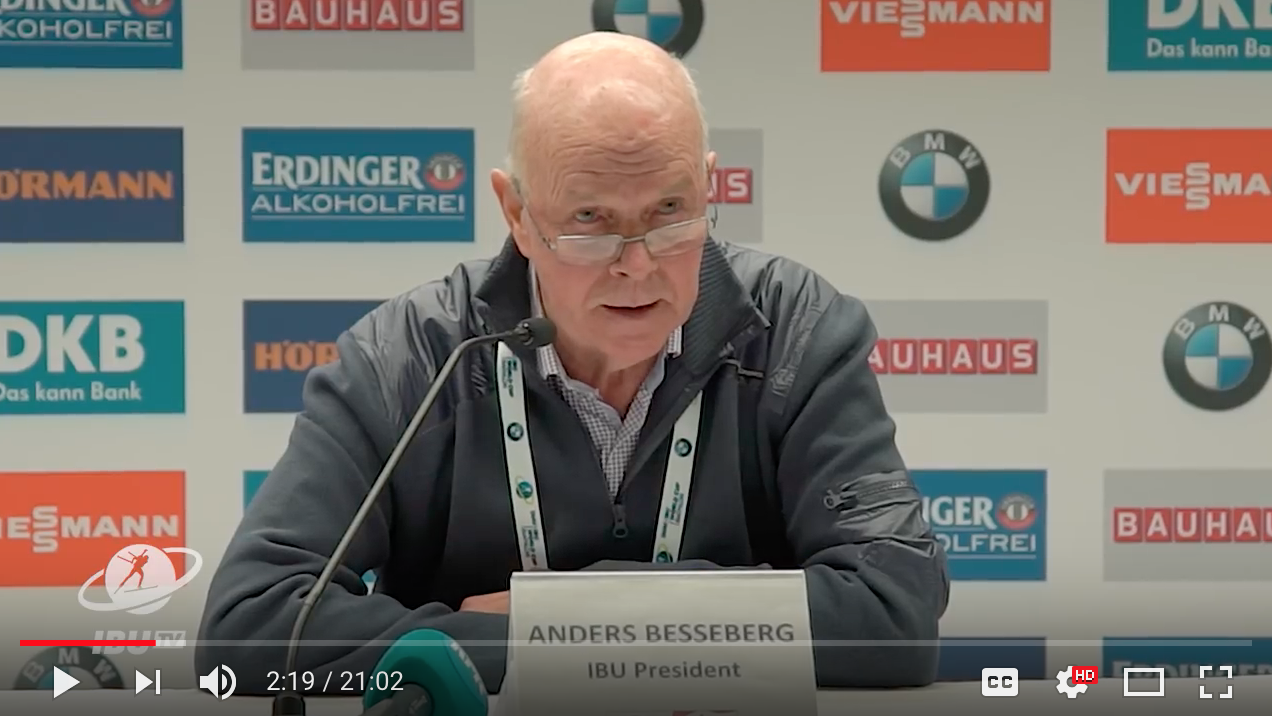
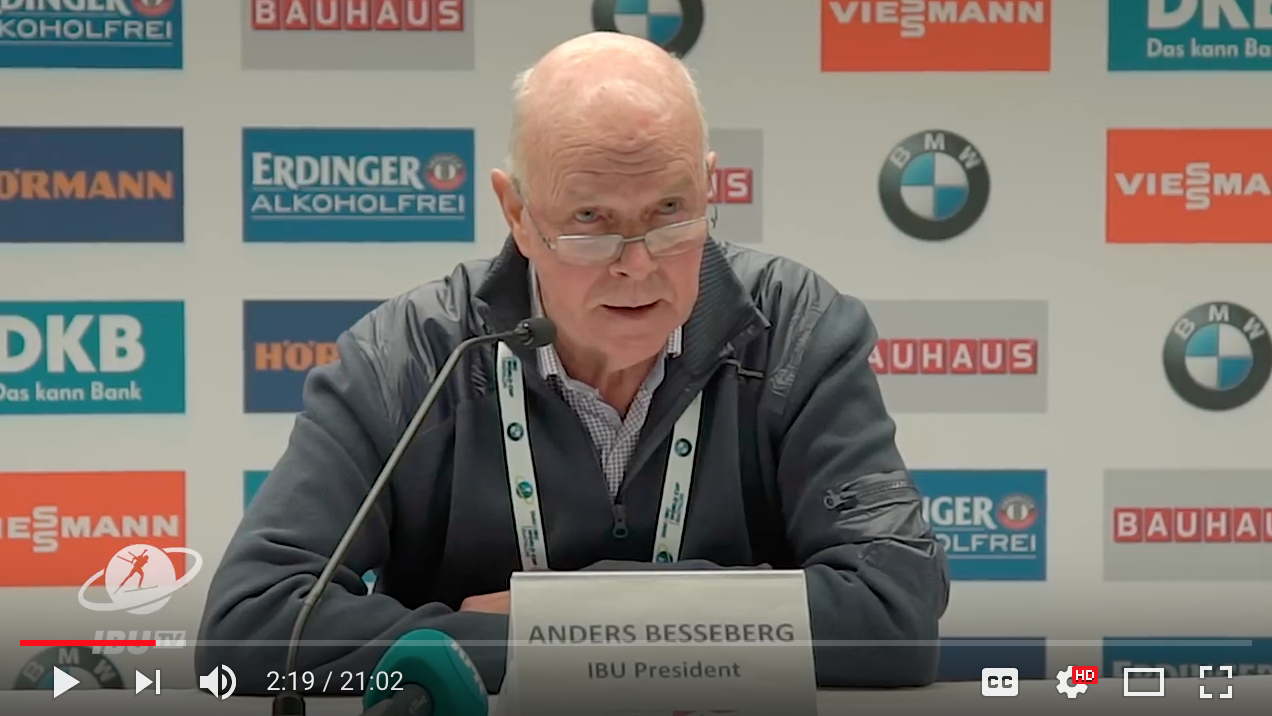
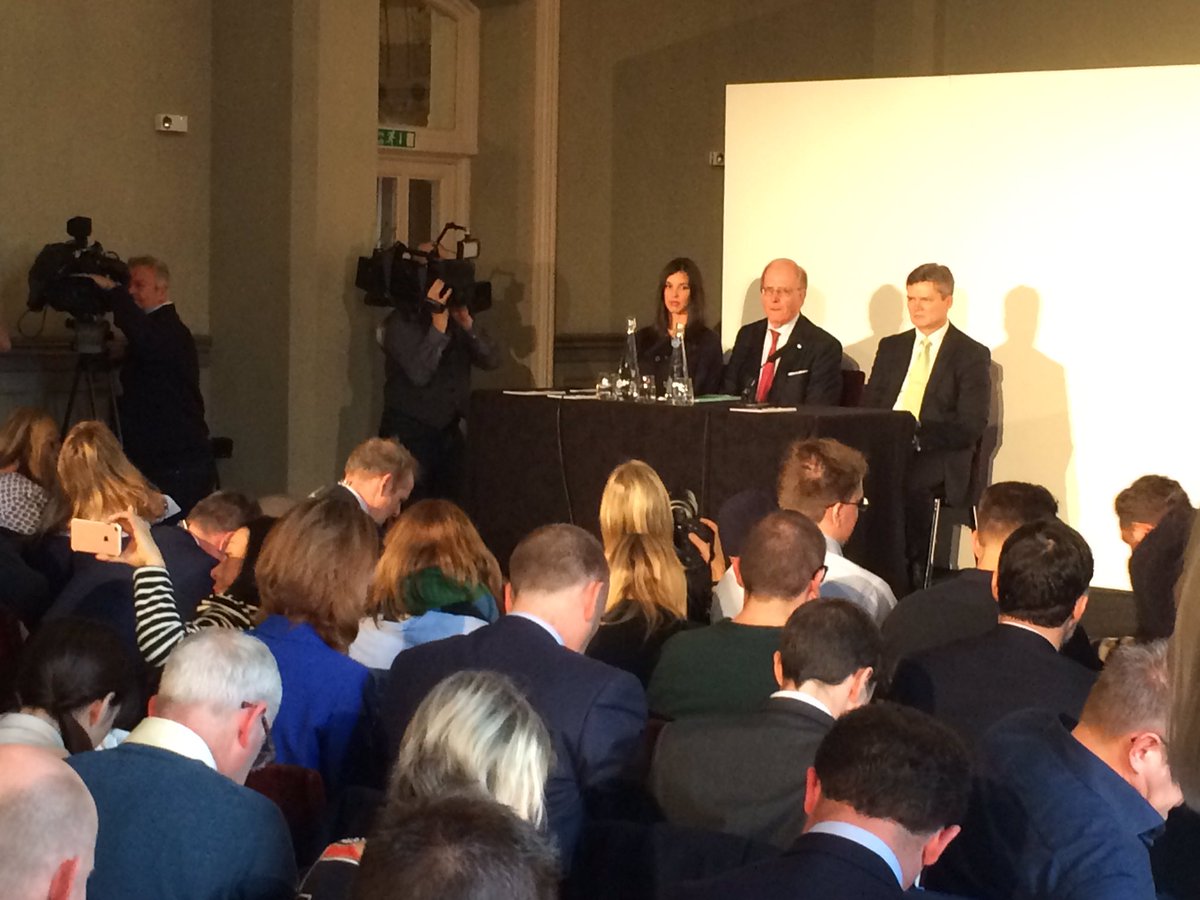
IBU President Anders Besseberg speaking at a press conference in 2017. (Screenshot: IBU TV)
Note: This article has been updated with information about bribes as reported by Le Monde on Wednesday.
Austrian police raided the headquarters of the International Biathlon Union (IBU) in Salzburg on Tuesday night and into Wednesday. According to Austrian press, the investigators were acting on behalf of the Business and Corruption Prosecutor’s Office and were particularly concerned with computer evidence.
The IBU released a statement on Wednesday, revealing that the search was part of an investigation into President Anders Besseberg and Secretary General Nicole Resch. Resch has taken an immediate leave of absence, and Executive Director Martin Kuchenmeister has taken over as Acting Secretary General.
Full details into the reason of the investigation remain unclear, but it is at least tangentially related to doping.
On Wednesday, the French daily Le Monde broke new information it obtained from a 16-page confidential World Anti-Doping Agency (WADA) report, which was released in late 2017. Besseberg and Resch are being investigated for accepting Russian bribes in regards to the nation’s doping case. The bribes were to the tune of a few hundred thousand dollars, and Alexander Kravtsov, the Russian Federation’s chef de mission at the Sochi Olympics, is quoted as saying that a suitcase can hold up to $400,000 dollars. The Russian Federation also allegedly promised members of the IBU Congress between $25,000 and $100,000 Euros.
In that report, WADA cited the following: “Mr. Besseberg’s unalterable support for Russian interests, the suspicious management of the biological passport’s obligations by Ms. Resch and the initial allocation of World Championships from 2021 to Russia.”
WADA communications director James Fitzgerald confirmed to Norway’s NRK broadcaster that WADA’s Intelligence and Investigations unit had exchanged information with Norwegian and Austrian police, as well as Interpol. He stated that as a result, police were also involved in Norway (Besseberg’s home country) on Tuesday.
“The European Commission can confirm that on 10 April 2018 its officials carried out unannounced inspections in several Member States at the premises of companies active in the distribution of media rights and related rights pertaining to various sports events and/or their broadcasting. The Commission has concerns that the companies involved may have violated EU antitrust rules that prohibit cartels and restrictive business practices (Article 101 of the Treaty on the Functioning of the European Union). The Commission officials were accompanied by their counterparts from the relevant national competition authorities.”
According to the Le Monde article, the IBU has emphasized that it is taking these investigations “extremely seriously” and “cooperating fully”. Resch, 42, was reportedly suspended from her office at her request. The head of the IBU since 1992, Besseberg recently announced that he would not seek re-election at the 2018 IBU Congress in September.
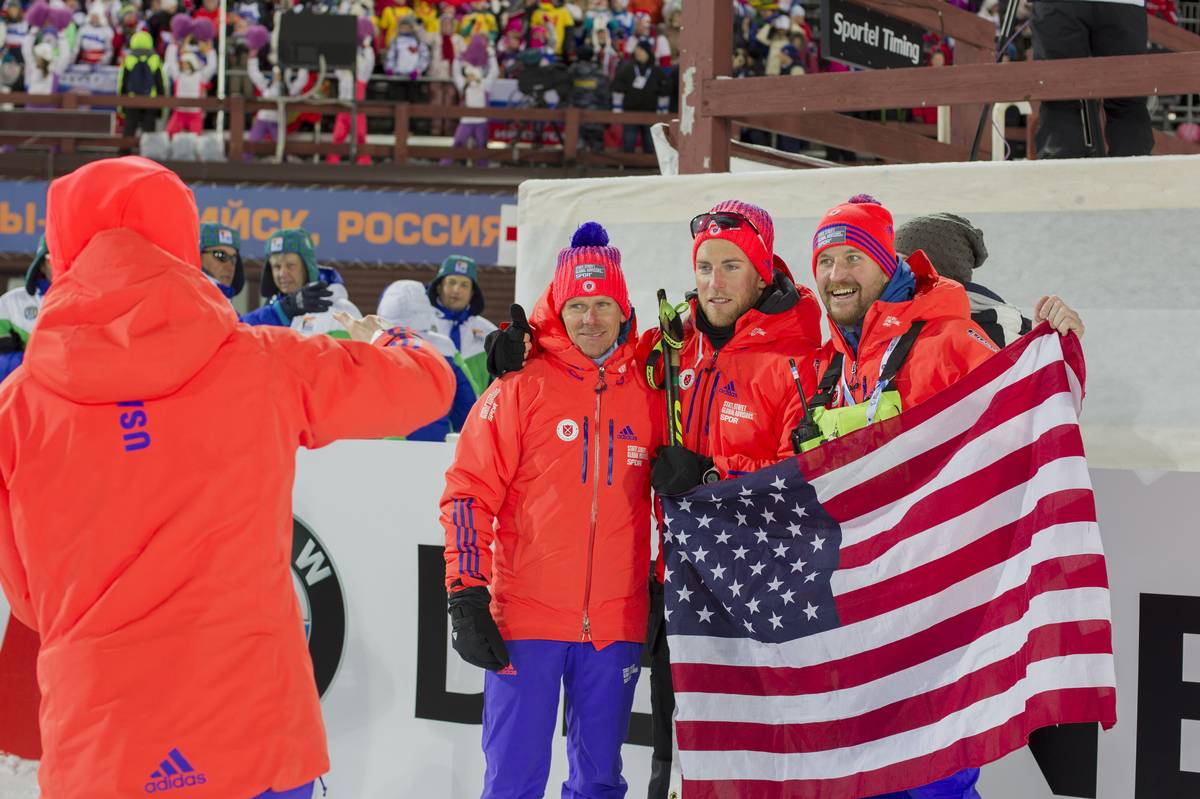
The US Biathlon coaching staff, poses for a photo following the men’s World Cup sprint in Khanty-Mansiysk, Russia, in 2016. The US will not attend this year’s World Cup final in Tyumen. (Photo: USBA/NordicFocus)
In December, Biathlon Canada announced that it would not attend World Cups slated for Tyumen, Russia, in March, due to the doping scandal that has consumed Russian sports. Russia is still not in compliance with the World Anti-Doping Code, and, Biathlon Canada stated, “the integrity of anti-doping procedures in Russia is still very much uncertain, given the current situation in which RUSADA remains non-compliant with WADA.”
This caused little reaction from the International Biathlon Union (IBU) at the time.
The United States and the Czech Republic have now also announced their intentions to boycott the event, and other individual high-level athletes also do not plan on attending.
“I am really discouraged by our international federation, the IBU,” Lowell Bailey said after the men’s relay at the Olympics on Friday. “Our President, Anders Besseberg… at every turn when he has the chance to defend clean sport, he has turned the other way. And it’s not fair to clean athletes. The latest decision by the IBU was to send the World Cup tour to Tyumen, Russia, for our World Cup final. Team USA is boycotting. The Czech team is boycotting. Canada is boycotting. We are trying to rally more support. I know that as an Athletes’ Representative, almost every country had athletes that wrote letters to the IBU [about the World Cup final].”
The Czechs know that they will lose Nations Cup points, and possibly World Cup quota spots, by skipping a weekend of racing, but said that it was worth it.
“We have taken a certain stance, with some sacrifices, and it would be wrong to give it up now,” Czech Biathlon Union President Jiří Hamza told iDNES, a Czech news agency, according to a translation.
“If you are convinced something is not right, you should keep that stance,” shooting coach Ondřej Rybář said in the same article. “If the other countries talk about RUSADA being noncompliant and that they should not have international races in Russia, but they eventually go there, that’s their issue. We clearly stated that we do not agree with what is happening in Russia. We therefore want that the work did in the fight against doping isn’t lost.”
And in the meantime, the IBU had apparently received private feedback from athletes who wanted the World Cups to be moved to a Code-compliant country.
“The outcry from our fellow athletes around the world has been respectful, strong, and definitive,” the U.S. biathletes wrote in a joint statement that they each posted to social media platforms (for example, here). “In addition to the dozens who expressed their opinion to the IBU Athletes Commission members ahead of the meeting in January 2018, the IBU received letters representing over 30 athletes, from eight countries, and included three 2018 Olympic Champions… ”
French star Marie Dorin Habert, a four-time World Championships gold medalist, has announced that she will retire after the World Cup weekend in Oslo – which by definition means that she won’t be going to the final weekend of competition in Russia.
Teammate Martin Fourcade, however, reportedly will attend the races in order to fight for the World Cup crystal globe, which he currently leads by just 54 points over Johannes Thingnes Bø of Norway.
“My position on doping and on Russians who have cheated is clear, but my position on Russia is different,” he said, according to the German Press Agency via a translation. “The country is a fan of biathlon, and I think the Russian public should not be eternally punished for the actions of some of its officials and athletes.”
Sebastian Samuelsson, a Swede who won silver in the Olympic pursuit and then gold in the relay, also expressed his dissatisfaction with the IBU’s handling of the situation.
“Hugely disappointed with the [IBU] decision today to, despite considerable pressure, to keep the [World Cup] in Russia,” he tweeted, according to a translation.
Samuelsson was rewarded with numerous twitter replies from Russian accounts telling him to stay home, one of which called him a baby and another of which said he was “not welcome in Russia”. He was then attacked on Instagram, with obscenity-filled threats and more sober ones, like, “your whole family will die.”
And that’s something that the Americans mentioned in their open letter explaining why they wouldn’t be traveling to Russia: safety.
“I’ve got online threats because of things I’ve said,” Canada’s Rosanna Crawford told Norwegian broadcaster NRK after the Canadians announced their boycott in December. “There are people who say they can’t wait until I come to Russia, ‘we’ll see what happens to you then’.”
It’s something the Czechs are intimately familiar with, too. After their 2014 women’s relay team celebrated being awarded Olympic bronze after the Russian relay team was disqualified for doping – several relay members’ cases are now pending at the Court of Arbitration for Sport – they were attacked as well, with hundreds of comments on social media calling the women “pigs” and “prostitutes” and threatened that if they did come to Russia, their anti-doping samples would be sabotaged.
And indeed, the first comment on U.S. biathlete Susan Dunklee’s Instagram post announcing the boycott was sexually-explicit and degrading insult, the only part of which can be written on a family-friendly website was the part calling her “ugly”. More obscenity-laden comments followed.
“Thank God the Americans won’t come!” another commenter wrote. “If you came to us, I’d throw you tomatoes.”
“You’re not an athlete,” added a third.
“American coward,” mocked another.
Bailey did not post about the boycott on Instagram, but commenters went there anyway, flocking to his most recent post – from nearly a year ago – to call him a doper.
“… the protection of clean athletes and the fight against doping are of the highest priority,” the IBU wrote in a September press release regarding the Russian doping investigation.
But when it comes to online threats against the athletes competing in their sport, the federation has so far been silent.
In response to Canada’s boycott announcement in December, Anders Besseberg said, “It’s not mandatory for anyone to attend, let’s put it that way.”
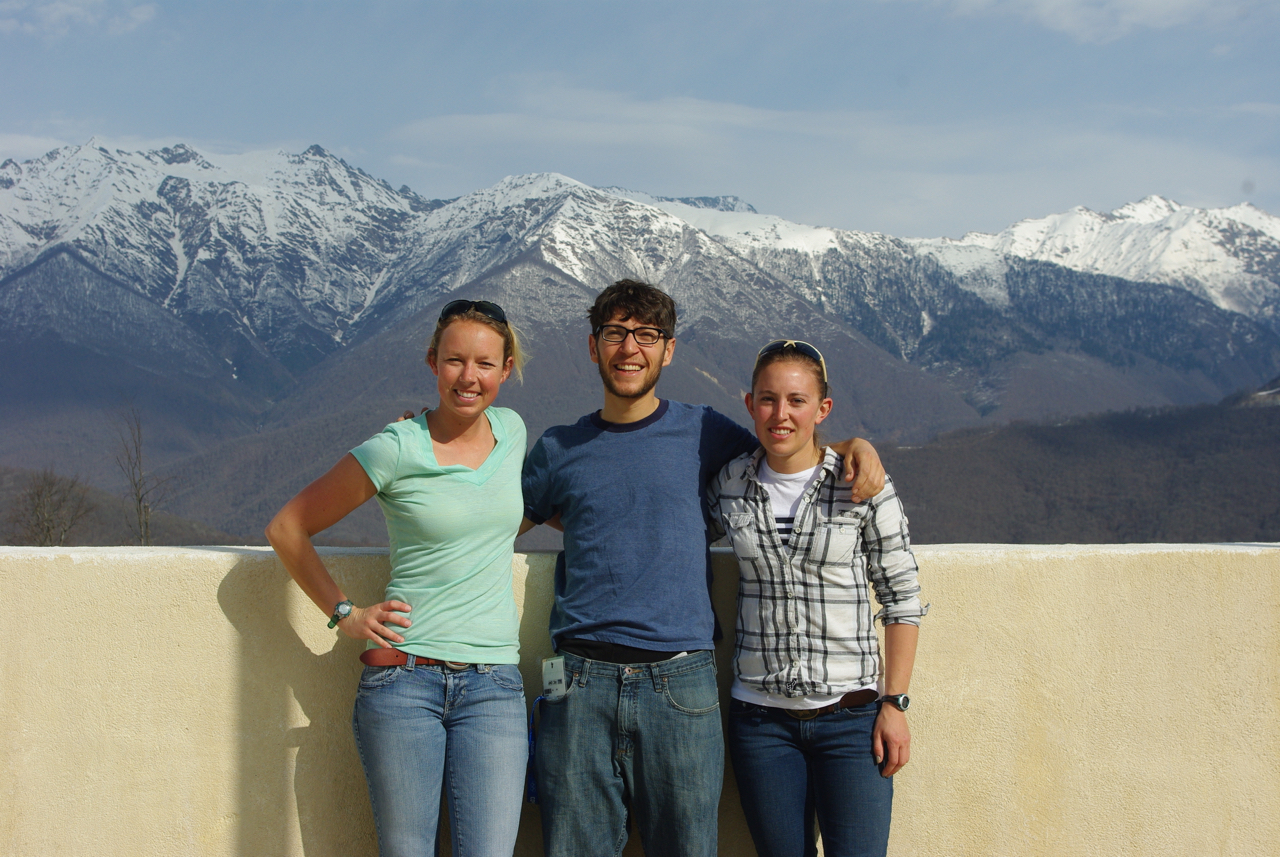
FasterSkier’s Alex Kochon, Nat Herz, and the author (Chelsea Little) at the 2014 Olympics in Sochi, Russia. Little did we know what was going on behind the scenes of those Games. Looking back at our coverage of the 2014 Olympics, I’m very proud of the work we did. But I’m not too proud to say that while we thought we had a realistic understanding of international sports governance, we were still naive to its incredible inertia.
The following is an editorial written by FasterSkier’s Editor-at-Large Chelsea Little, who has been covering doping in sport, specifically cross-country and biathlon, for the better part of the last decade. The opinions expressed are her own and do not necessarily reflect those of other FasterSkier staff.
The athletes had been disqualified from the 2014 Games by an International Olympic Committee (IOC) Commission. This was after more than 18 months of buildup in which the world learnt of systematic manipulation of the anti-doping process by the Russian state security apparatus at those Olympics.
I was both shocked, and not shocked. When all these athletes had been disqualified by the IOC and handed lifetime bans from Olympic competition, I knew in my heart of hearts that it would be undone (I’ll explain why below). But I hadn’t, somehow, put any thought into how exactly that would come to pass. So on one level, I was surprised, even if on another level I wasn’t.
When the news broke, I had written a profanity-laced all-caps message on our company Slack channel. On Twitter, I wrote, “I am so tired. That means that they have won.” That’s about all I could muster.
“I’m sure you are extremely disappointed by the CAS ruling,” one member of my extended family wrote in an email, knowing how many nights and weekends I had spent covering this story, how many hours and days of my personal life I had erased to chase it, because doing so does not pay the bills if you work for a cross-country ski website in America.
And I was disappointed.
I had thought that those nights and weekends would help make a better sporting world, help bring cheating to light, help hold the powers that be in sport accountable and call on them to do a little better.
But it felt like all that work had accomplished nothing, not changed a single thing to make nordic sports more fair.
I can only imagine how the athletes felt. The ones who found out that they would not be receiving medals after all, medals that they felt had been stolen from them by cheaters, medals that they had been slated to finally receive but now would never see.
I can only imagine.
More than anything, I was disappointed because I didn’t understand. I’m an analyst. No analysis I could do would explain to me just what had happened because CAS did not release a reasoned argument for their decision, which, as USADA General Cousel Bill Bock pointed out, is ludicrous. So at the moment we don’t know why these athletes were cleared; we only have speculation and hearsay.
In that decision, an arbitration panel wrote that they trusted the statements of whistleblower Grigory Rodchenkov and investigator Richard McLaren.
That testimony that is widely speculated to have been found untrustworthy by the arbitration panel which more recently cleared the athletes.
There is a difference between provisional suspensions and rule violations, and maybe that’s the root cause (or maybe it’s not; one day we will find out).
But if two different arbitration panels can come to two completely different conclusions about whether evidence is trustworthy, then what is the point of a “high court” of arbitration? That’s disappointing.
On the other hand, maybe the new panel did believe that the whistleblower testimony was true, but that witness statements alone are not enough to prove a doping violation. We’ll set aside for a moment all the forensic evidence [see footnote 1].
If that’s the case, it’s even more disappointing. It means that all of the rhetoric over the last few years about putting more resources into investigations will not actually result in cleaner sport, unless there is a positive test or the presence of drugs or medical equipment (see: Austrian skier Wurm, Russian skier Pankratov).
It would mean that the World Anti-Doping Agency’s new “secure digital platform” for whistleblowing — and statements by athletes and doctors and team staff — are all useless to anti-doping unless they are followed by physical evidence of prohibited substances or methods.
But we don’t know the panel’s reasoning. This is all just speculation.
I was tired and disappointed because my job as a journalist is to take complicated things, and make them make sense to our readers.
Here, there was nothing to work with. There was nothing to explain.
A second suggested storyline is that the IOC set up the cases to fail, so that it would look like they tried to do something heroic, but in the end nothing would change.
To some extent, that is absolutely the case. Lifetime bans for doping have been attempted by the IOC before. Every time, they have been overturned. There was a zero percent chance it would work this time, either.
Did the IOC go further than that in “set up to fail”? Both storylines may be true. Neither may be true. But each of these storylines is far too myopic in their attempts to explain what happened with this CAS decision.
The reason that, in my heart of hearts, I knew that things would turn out just fine for most of these seemingly disqualified athletes, is that far more than CAS is broken [2].
Broken would imply that at some point the system worked. When was that, again?
This scandal has been going on for years. And in both it and other, non-Russia-related doping scandals, organizations have dragged their feet at every turn. There is no political will to keep sport clean. Ensuring clean sport would be hard. Nobody wants to do hard work. Universally, these organizations just want to run sporting events and for fans to be happy.
“We need to stop pretending sport is clean,” International Ski Federation (FIS) President Gian Franco Kasper [3] famously told New York Times reporter Rebecca Ruiz. “It’s a noble principle, but in practice? It’s entertainment. It’s drama.”
People were mad when Kasper said this, but it was an especially revealing comment. Maybe it is a testament to our optimism that we quickly moved on, focusing on how we would try to “solve” the problem of doping.
There have been individuals and groups who have worked passionately to uncover the truth, and done an admirable job. Beckie Scott at WADA [4] is one who comes to mind. But their work is always prevented from reaching its logical conclusion.
Let’s first look at the IOC, which has deservedly gotten a bad rap for dragging its investigations out for as long as seems humanly possible.
The IOC has certainly not put the resources or good-faith effort into looking under every stone, or doing so quickly. That’s how we got the first Sochi disqualifications – like Legkov’s – being announced in November of 2017. Most of the criticism leveled at the organization on this front is absolutely justified.
In all the time between May 2016, when the Sochi scandal was first broken by the New York Times, and November 2017, the IOC did very little. The decision banning Legkov relied mostly on the same evidence that had been in the McLaren Report.
The IOC Commission asked new experts to revisit the issues of scratches on sample bottles and salt content of urine samples. Basically, they repeated a lot of work which had already been done, expanding it to a larger number of samples but taking longer to do so by insisting on using different experts, who nonetheless came to the same conclusions.
For Legkov, all of this resulted in the same evidence that had been in the McLaren Report: that Legkov’s sample bottle from after the 50 k, which he had won, showed signs of being tampered with.
Sure, the IOC Commission got testimony from Rodchenkov. But that only at the last minute, perhaps because they were publicly shamed when it was revealed that they hadn’t contacted him.
It’s fair to criticize the IOC for its anemic investigation, but this is not just an IOC problem, just like the disqualifications being overturned is not really a CAS problem.
Look further. Since the McLaren Report, few other governing bodies have been doing better.
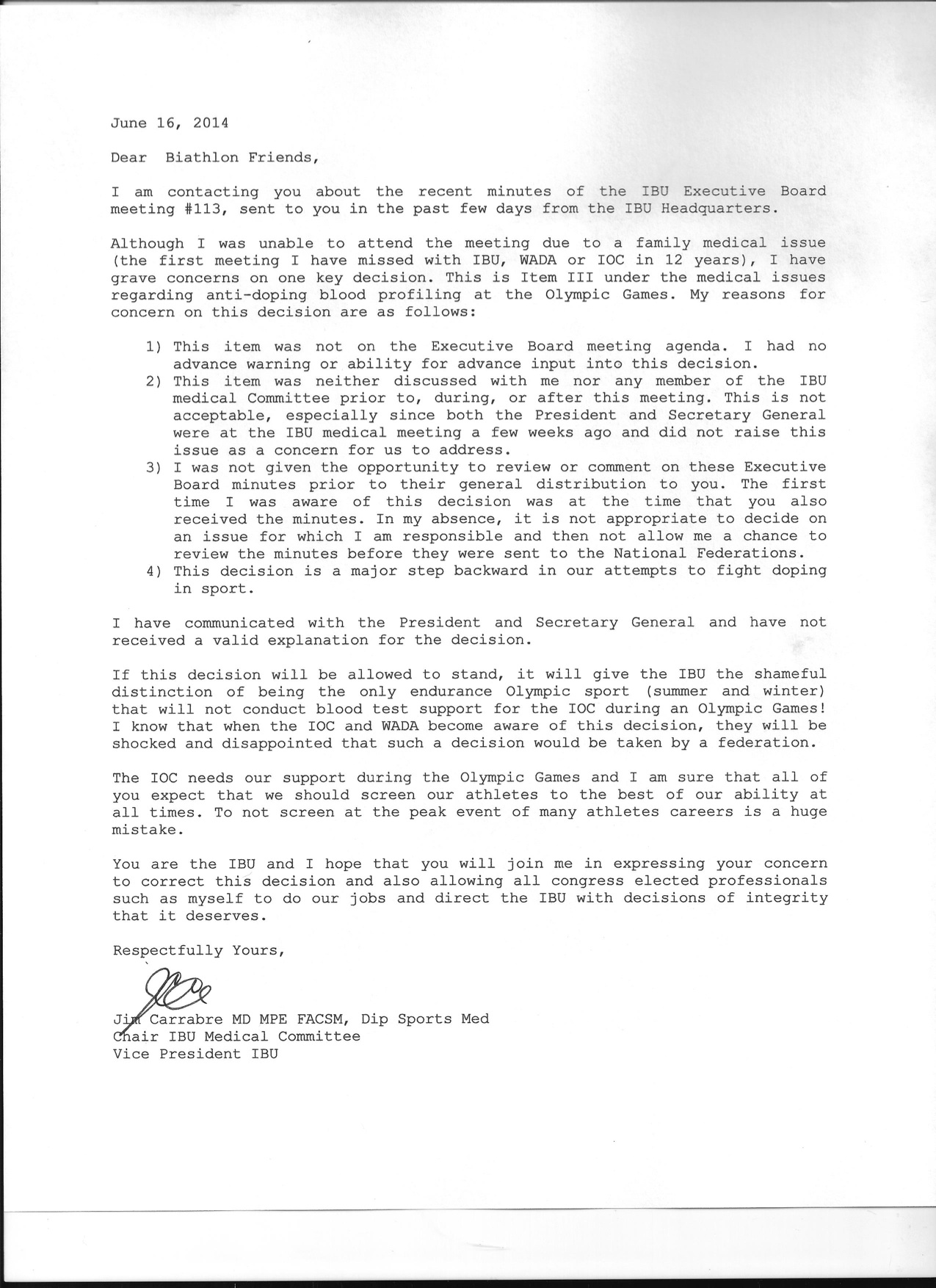
“We like to play coy, like the cat wagging its tail when the mouse runs in front,” IBU Vice President for Medical Issues Jim Carrabre told me back at the 2014 Olympics, in an interview that led to the IBU’s media chief calling me into his office at the press center and dressing me down for talking about things that he would rather journalists didn’t ask his organization’s board members.
“It goes by once or twice, and then the third time it gets bitten,” Carrabre said at the time.
He was referring to blood profiles, a topic that has recently gained prominence.
For years I have been told by various people that the IBU has cases in the works, that soon I will hear about them, that they know some people are doping and are about to catch them.
I don’t doubt that Carrabre is a true believer in the anti-doping fight. He gets pretty fired up about things, as does fellow Executive Board member Max Cobb.
But the cases that I heard rumors of, even promises of, have never materialized.
The Athlete Biological Passport (ABP) was supposed to revolutionize anti-doping and indicate if athletes had been blood doping even when no illicit substance was detected. That sure would have been handy due to the drugs’ short detection windows and athletes’ and doctors’ strategies of “microdosing.”
But there have been no doping bans on the basis of ABP in skiing or biathlon [5]. I don’t think that even the most optimistic of fans really believes that this is because there is no blood doping going on.
What does that mean? That ABP doesn’t work, that it wouldn’t hold up in arbitration? Or that something else is going on?
It would be hard to look at IBU President Anders Besseberg’s behavior in the last two years – for instance, the IBU’s continued insistence that it’s totally fine to hold events in Russia, or his demeanor and statements during meetings with athletes – and conclude anything other than that he is sympathetic to Russia and would even more generally like to simply pretend that there was no scandal in his sport.
Having a few true anti-doping crusaders on a governing board does not clean sport make. I don’t want to put words into their mouths, but probably, it just makes these crusaders even more frustrated.
“When the McLaren Report first came out, I thought that doping was the greatest threat to our sport,” U.S. biathlete Susan Dunklee told FasterSkier in January 2017. “However after watching the last few weeks play out, I believe that the IBU’s reluctance to meaningfully act to prevent doping is the greatest threat to our sport.”
Then there is FIS. As I’ve repeatedly pointed out, there were 46 skiers implicated in the McLaren report. Not all of them, obviously, were at the 2014 Olympics or Paralympics, yet as far as anyone can tell, FIS has done nothing to investigate the other cases, some of which include alleged anti-doping rule violations.
(Which, by the way, how can I get in on that? Hi? I’m over here! I know a lot about doping in skiing and I also how to do statistics!)
The data is interesting, but nothing can really be done with it, as it is old and from the days before ABP was a policy. Without the journalists or their experts explaining how they decided what an “abnormal or highly abnormal” blood profile is, it’s impossible to judge what percentage of the athletes they identify as potentially having doped actually were likely dopers.
But perhaps this indicates that someone within FIS is frustrated with how things are going. If you cared about skiing being clean, cared about doing your job well, and listened to Kasper say things like “sanctioning entire countries is purely political and I do not agree with this,” you might be frustrated too.
And here’s the last thing. In this whole scandal we are talking about one country. That’s Russia, and it has led to a lot of ideological discussion.
But it’s not really about Russia.
Yes, the IOC and the IBU and FIS want to keep Russia happy, because their sports are popular in Russia, the Russian athletes are talented and popular even outside the country, because Russia is great at hosting events, and because Russian fans travel all over to watch competitions. That’s part of it.
And yes, some commentators have complained that athletes are being punished just because they are Russian. They have complained that this is a U.S.-led effort reviving Cold War hostilities. That we are Russophobes. That we are hypocrites because American sports stars dope too, and/or that lots of countries dope but we just haven’t found out about it.
But again, that’s being far too myopic about things, and believing that this scandal is only a thing unto itself, not part of the bigger problem.
If this scandal had taken place with Norway, Sweden, Germany, the United States, or any other country at the center – the outcome or the (lack of) speed of its resolution probably wouldn’t have been much different [6].
I – yes, I’m among those journalists accused of being hypocritical and anti-Russian, I’ve even been compared to Nazis, gee that was fun – I would chase this scandal just as hard if it had arisen in any of these other countries.
In fact, I would have investigated it with even more fervor if these were American or Canadian skiers and biathletes we were talking about. And presumably most of the evidence would have been in English, so I could investigate more effectively, without translating things I was looking for into Russian, searching the internet or evidence documents, and then translating the Russian back into English, in a crappy game of “telephone”.
I think that the North American athletes I routinely interview are aware that if I found out they were cheating, I would have no remorse and they would have nowhere to hide.
Just as I’m not a hypocrite, these sports organizations aren’t, either – well, they are, but not in this way, not when it comes to nationality. The claims that various decisions just come from Russian money and bribes are missing the point.
Whether coming from Russia or elsewere, these organizations don’t want a big scandal. They don’t want to rewrite their results sheets. The athletes who missed out on medals they probably should have taken home? These organizations don’t really care about athletes.
They are just an unfortunate bit of collateral damage, but oh well.
Time will march on. A new race will be held. It will be an exciting race! We will all be caught up in it.
Maybe Pellegrino will upset Klæbo.
Maybe an American will finally win a medal.
Maybe Fourcade will mess up his first stage, but then climb back to gold anyway.
Maybe Makarainen will mess up all her shooting stages, and we will all watch rapt to see whether she can pass 15 people on the final loop. Maybe she can.
Maybe Harvey will finally truly become the Prince of Quebec, crowned with an Olympic medal.
Maybe the breakaway will succeed.
Or maybe the favorite will win, but we will be enthralled until the final moment, watching to see whether they will pull it off.
Soon, we will forget about those athletes whom we were wondering about, the ones who maybe probably should have a medal stashed in their safe deposit box somewhere and a whole lot more sponsor money than they have now.
Those athletes will slip farther and farther to the back of our minds. In the forefront will be the day’s competition – so amazing! – and the big happy family that is sport.
Actual clean sport is not, and never was, these organizations’ goal.
*****
Footnotes:
[1] On the topic of skiers who were cleared by CAS: Maxim Vylegzhanin’s sample from Sochi also had scratches on it and had an incorrectly reported specific gravity; the two other members of the men’s relay team also had marks on their sample bottles, and one had a sample whose specific gravity was too high to be believable; two sprinters had marks on their sample bottles and for one, there as also a foreign fiber inside the bottle. Julia Ivanova, whose ban was not overturned by CAS, had an impossibly high salt value in her urine sample.
[2] I actually think CAS does work. CAS handles far more than doping cases – they handle contract disputes, team selection, trades, anything you can think of that would need arbitration. And as far as I know, they do a good job. This is the first CAS decision that has left me truly baffled.
[3] Term limits, man. We really, really need term limits.
[4] I’m not going to talk in much detail in this piece about WADA, which alternatingly does the right thing and the wrong thing, and often does the wrong thing for a very long time first. But at least in the last year or so, WADA is no worse than any other group, and indeed maybe a bit better.
[5] Blood profiles have certainly led to targeted testing, which caught athletes before the 2014 Olympics. But nobody bothered to try an ABP case, that we know of. Nor, seemingly, did the biathletes that the McLaren Report alleges were doping – Olga Vilukhina and Yana Romanova – fail their ABP’s. Either ABP is not being used, or it is not being successful and the details of the cases are never made public.
[6] If the perpetrator of this scandal hadn’t been Russia, I think the main difference might have been the reaction within that different country. I don’t think the Norwegian public would react the same way the Russian public has. Each place has its own culture around sport and what it means, and government also plays various different roles in supporting and controlling sport. But the reaction from the international organizations? Things would probably be much the same.
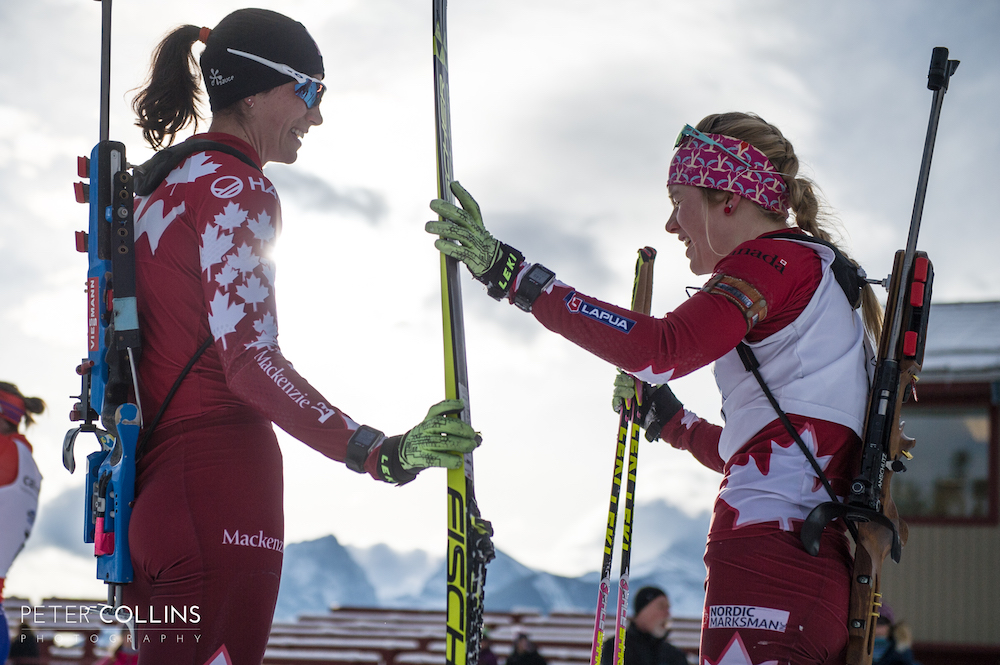
Emma Lunder (r) with fellow Biathlon Canada national-team member Rosanna Crawford after the women’s modified sprint at Biathlon Canada’s team trials in November in Canmore, Alberta. (Photo: Peter Collins/petercollinsphoto.com)
Despite the RBU’s less-than-full IBU member status, Russia is still scheduled to host the final IBU World Cup races of the season from March 20-25 in Tyumen and the IBU Cup 7 & 8 in Uvat and Khanty-Mansiysk.
In an open letter sent to IBU President Anders Besseberg and IBU Secretary General Nicole Resch dated Dec. 8, 2017, Biathlon Canada’s President of the Board of Directors Murray Wylie stated Biathlon Canada will not be sending athletes to the IBU-sanctioned events in Russia in March.
In the letter, Wylie gives the following reasons for his determination:
“The occurrence of high-level IBU events in Russia is inconsistent with the IOC decision of 05 December to disallow participation by the Russia Team in the PyeongChang Olympics:”
“the integrity of anti-doping procedures in Russia is still very much uncertain, given the current situation in which RUSADA remains non-compliant with WADA.”
“This is actually the third letter,” Wylie said (full interview in related podcast). “The first letter was sent the first part of last January and then there was a second follow up letter in May, and this is the third one. I think the importance of this one was it was after the announcement by the International Olympic Committee and their stance on the systemic doping with Russia and we were very pleased to see that. Basically, it was an opportunity. We knew there was an executive board meeting in Hochfilzen, and that is typically the vehicle for us to voice our concerns.”
IBU President Anders Besseberg speaking at a press conference regarding the IBU’s decision to relegate the Russian Biathlon Union to provisional membership on Sunday, Dec. 10. (Screenshot: IBU TV)
This past weekend’s IBU World Cups were held in Hochfilzen, Austria, and the IBU’s decision to relegate Russia to provisional membership was announced in there on Sunday.
“This is sort of a repeat of our stance that we issued in May with respect to the selection, if you will, of the World Championships in Tyumen in 2021…,” Wylie said. “This situation is a bit related to the IOC, but we have a nation whose anti-doping organization is non-compliant, WADA code non-compliant in the Russian Anti Doping Agency. So our pitch has been — Biathlon Canada, the Canadian federation — if you are WADA non-compliant, then you should be not hosting any IBU events, major IBU events. And there are the World Cups and the IBU Cups and that is something within the purview of the international federations. We voiced that quite strongly and that essentially is what we are saying.”
Wylie also said he is unsure if other national federations will make the stance to boycott the Russian IBU competitions scheduled for March.
At this point, he said Canada’s athletes might be jeopardized by competing in Russia and exposing themselves to potential sample tampering when it comes to anti-doping testing.
“Even though they have an alternate agency, I believe it’s the UK Anti Doping agency is actually contracted to do that, we have a nation that has been a non-compliant anti-doping agency,” Wylie said. “If one of our objectives, the IBU’s objectives, is to foster and promote doping-free sport, it is sort of non-congruent that you would actually hold or allow them to host IBU events as they have a non-compliant anti-doping organization. … It happens to be directed to Russia, but we have actually said that any national federation that is non-WADA code compliant should not be allowed to host any IBU events simple as that.”
Wylie explained he is interested in modifying the IBU bylaws to include detailed language that states a national biathlon federation with a provisional membership, like the Russian Biathlon Union, should categorically not be allowed to host major IBU events.
On Wednesday, Nordic Nation reached Biathlon Canada President Murray Wylie to discuss an open letter he signed on behalf of his organization and sent to the leaders of the International Biathlon Union.
Despite the RBU’s less-than-full IBU member status, Russia is still scheduled to host the final IBU World Cup races of the season from March 20-25 in Tyumen and IBU Cup 7 & 8 in Uvat and Khanty-Mansiysk.
In an open letter sent to IBU President Anders Besseberg and IBU Secretary General Nicole Resch dated Dec. 8, 2017, Wylie stated Biathlon Canada will not be sending athletes to the IBU-sanctioned events in Russia in March.
In the letter, Wylie included the following reasons for this declaration:
“The occurrence of high-level IBU events in Russia is inconsistent with the IOC decision of 05 December to disallow participation by the Russia Team in the PyeongChang Olympics:”
“the integrity of anti-doping procedures in Russia is still very much uncertain, given the current situation in which RUSADA remains non-compliant with WADA.”
Listen for more from Wylie, as told to FasterSkier on Dec. 13:
In a wide-ranging press conference on Saturday in Hochfilzen, Austria, International Biathlon Union (IBU) President Anders Besseberg noted that there were only four active Therapeutic Use Exemptions granted among the 1000+ biathletes competing internationally.
A common refrain is emerging from teams embroiled in sports doping scandals: that they are being unfairly persecuted, because other countries are engaging in ‘legalized doping’ by way of Therapeutic Use Exemptions.
TUE’s, as they are called, allow athletes with documented health issues to use some medications that would otherwise be prohibited by the World Anti-Doping Agency (WADA). Some common examples are asthma inhalers, glucocorticoids to treat injuries, and, for American athletes, medication to treat attention deficit hyperactivity disorder.
Sometimes, a TUE might help an athlete regardless of their illness: for instance, Ritalin or other drugs can increase concentration, which can be particularly helpful in some sports.
But in other cases, it’s not clear that a TUE always equates to a competitive advantage. Glucocorticoids, for example, are not banned out of competition anyway, meaning that many athletes could use them frequently to treat injuries during training without even needing a TUE. And for other medications, like asthma inhalers, it’s unclear whether a healthy athlete seeking a fraudulent TUE would even get a benefic from the drug.
In any case, the shout of ‘But TUE’s!’ is becoming more common. During the recent Russian doping scandal, Vladimir Putin called for athletes requiring TUE’s to be kept out of competitions. A hacking collective released athlete medical records during the 2016 Summer Olympics, saying that the TUE’s showed that these athletes were doping.
Chris Froome, a British cyclist, was revealed by the hackers to have been granted two TUE’s for prednisone. His pro team, Team Sky, has increasingly been discussed in the context of doping in cycling, with many saying that the team is pushing the limits of what is ethical in terms of medical practice. In response, Froome argued that his TUE’s were legitimate, but that cycling’s TUE system needs to examined because it open to abuse.
Biathlon has its share of scandals. At least four Russian biathletes are currently suspended: Ekaterina Iourieva, for three different EPO offenses; Olga Vilukhina and Iana Romanova, provisionally suspended as the International Olympic Committee (IOC) investigates sample manipulation at the 2014 Olympics; and Ekaterina Glazyrina, suspended by the International Biathlon Union (IBU) after follow-up work by their Working Group relating to the 2014 Olympics and the McLaren report.
In addition, six more Russian athletes are under active investigation by the IBU and 22 more are marked as of interest, with investigations de-prioritized but able to be re-opened at any time.
“The work of the Working Group is continuing, and also the two commissions of the IOC are continuing their work,” IBU President Anders Besseberg said in a press conference on Saturday. “The big problem is how are we able to get the necessary to get the necessary evidence and proof on the table to make the sanctions on either athletes or the Russian Biathlon Union, if they have been involved in something. This work… will continue as long as there is a chance to clarify this situation.”
Biathlon faced another scandal when the Kazakhstan National Biathlon Team was detained by Austrian police on Feb. 8 as part of a criminal investigation into doping.
So far, the team has passed urine and blood tests, which cleared them of using banned substances in the direct lead-up to World Championships, but the Austrian police are still investigating whether cheating occurred earlier in the season, or involved prohibited methods like blood transfusions, which would not be detected by drug tests.
And as soon as that news broke, TUE’s were brought up.
“It is necessary to prohibit the use of prohibited substances for so-called ‘illnesses’,” Russian Olympic champion Dmitry Vasiliev told Russia’s RIA news service after the Kazakhstan scandal broke. “It’s perverse. Practice has shown that about 70 percent of these patients win all the medals. And as long as this situation does not change, nothing will be good in the sport world. That’s where we should start. They actually legalized doping… otherwise, this testing is just patching ouse-holes.”
But when it comes to TUE’s, this is one place where biathlon is not exactly at the epicenter of doping discussions.
“There are always questions about Therapeutic Use Exemptions,” Besseberg said in the press conference. “In a lot of sports there are granted a lot of such [TUE’s]. I am very glad to report to you that among the approximately 1,000 biathletes who are competing at the international level…. including the 350 here… we are only having four TUE’s. Which is a very very low number.”
That means that the number of total TUE’s granted in biathlon is equal to the number of provisional or adjudicated suspensions for doping cases just from one country. In other words: for biathlon, doping continues to be a bigger issue than TUE’s.
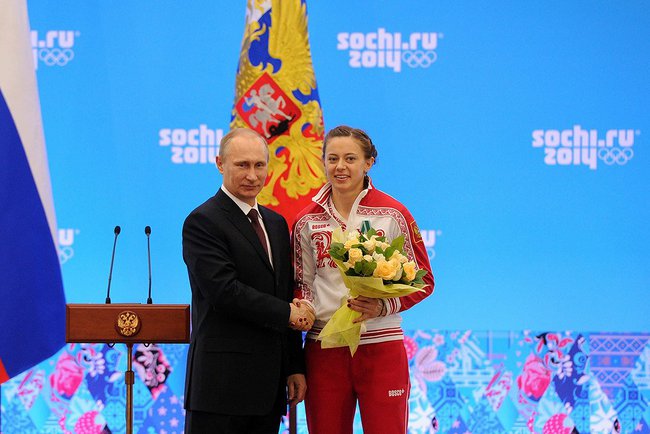
Russian President Vladimir Putin with biathlete Olga Vilukhina on February 24, 2014. (Photo: www.kremlin.ru/Creative Commons)
After an Executive Board meeting today to discuss doping in Russia, the International Biathlon Union (IBU) has provisionally suspended two athletes. The federation opened anti-doping investigations into 29 more.
Meanwhile, the Russian Biathlon Union voluntarily gave up their hosting rights for two events: 2017 Youth and Junior World Championships, slated for Ostrov, and a World Cup stage slated for Tyumen.
Two Suspensions from the 30+ Cases
The IOC has jurisdiction over all anti-doping activity at Olympic Games. That means that any samples collected between Jan. 31 and Feb. 22, 2014 which tested positive for banned substances or showed signs of tampering are the responsibility of the IOC rather than a relevant international sports federation like the IBU.
The IBU noted in its press release that the IOC had opened proceedings against two athletes. The press release did not name the two athletes, but noted that the IBU would suspend them.
Meanwhile, Norway’s NRK broadcaster is reporting that the two athletes were medalists in Sochi. That leaves nine possibilities. Evgeny Garanichev won bronze in the 20 k individual, and Olga Vilukhina silver in the 7.5 k sprint. Vilukhina was joined by Olga Zaitseva, Yana Romanova, and Ekaterina Glazyrina for silver in the women’s relay. And Alexey Volkov, Dmitry Malyshko, Evgeny Ustiugov, and Anton Shipulin won gold in the men’s relay.
At least four biathletes appeared to have “protected” status at the 2014 Games, according to evidence files from the McLaren report. One of those athletes, Romanova, had sample bottles with marks that seem to indicating tampering.
In addition, the IBU is opening investigations into 29 more athletes mentioned in the McLaren report.
The IBU will notify both the athletes and the Russian Biathlon Union. Both entities can comment on the allegations. At the same time, a working group formed by the IBU will continue to investigate. Then the working group will decide whether the case needs to be referred to an Anti-Doping Hearing Panel, which will ultimately decide whether suspensions are required.
The IBU noted only that they would set a deadline for receiving comments from the affected athletes. But otherwise, they did not specify a timeframe for the investigations. Because World Cup racing resumes January 5, 2017, in Oberhof, Germany — just 14 days from today — that means that if any of the 29 biathletes are competing on the World Cup, they will likely continue to do so.
Many in Russia, and outside, were pleased with the decision.
“A balanced decision has been taken,” Deputy Prime Minister Vitaly Mutko told the TASS news agency. “It gives an opportunity to make conclusions in an unhurried manner, not the ones based on the abstract statements or conclusions of just one person… I’m confident our federation will show the majority of athletes [who misused doping] have already been punished.”
The IBU press release noted that in only one case was an athlete already suspended for the same positive test that was noted in the McLaren report.
Several athletes had positive tests explicitly mentioned in different evidence documents. In at least five cases, anti-doping staff reported positive results as negative ones in the World Anti-Doping Agency’s test management database. As a result, the athletes never served suspensions for their violations. One such case occurred at an IBU Cup competition in Ostrov in 2013.
Alexander Tikhonov, a board member of the Russian Biathlon Union and a former Olympic champion, lauded IBU President Anders Besseberg.
“Well, biathlon is not affected,” he told sports.ru. “A positive decision.Besseberg showed that he is our man.”
Russia Gives Up on Hosting Two 2017 Events
Momentum has been growing for an international boycott of biathlon events in Russia. The Czech Republic and Britain led the way by declaring that they would not compete in Russia until the country had a clean bill of health from anti-doping authorities. The Norwegian Biathlon Association expressed support for this position.
Ultimately, such a move will not be necessary. The IBU mentioned in their press release that the Russian Biathlon Union has given up the two events.
“Under the circumstances, [RBU] considers it impossible to conduct the Biathlon World Cup and Junior World Championship, to be held in Tyumen and Ostrov respectively…Determining the place for these activities is up to the IBU,” the Russian Biathlon Union wrote on its website. “The competition should take place in an atmosphere of celebration, and not among suspicions and rumors.”
The IBU has yet to decide where they will be moved to.
“The relocation of both … events will be decided upon later,” the IBU said.
“This is a first important step by the Russian Biathlon Union to show to the IBU and to the world of sport that the current situation is taken very seriously,” Besseberg said, according to the press release. “This will now allow the international biathlon family to focus on biathlon during these events.”
Some in Russia are still upset about the boycott threat.
“These calls for boycotts should entail punishments for athletes,” Mutko told TASS. He elaborated that he thought those advocating for a boycott were in violation of the Olympic Charter.
Athlete Reactions
Some international athletes have also reacted to the decisions.
Punishing the fans instead of real culprits… What a sanction… 👎🏼
Anna Bogaliy-Titovets, who won relay gold with Russia in 2006 and 2010 and now competes for South Korea, had a more nuanced view.
“If the Executive Bommittee IBU made such a decision it means that its members have a good reason, and evidence of Russian athletes involved in doping,” she told sports.ru. “Depriving the whole team of the right to race in international competitions would be extremely unfair.We must respect the decision in the way the IBU presented it.I do not think this is a conspiracy – the Executive Board consists of representatives from different countries. Severe punishment for no reason would not be possible.”
“The IBU has done a solid job,” Norwegian Biathlon Association President Erlend Slokvik told NRK, according to a translation. “And it is good that Russia withdraws.It’s a signal that they have understood the seriousness of the situation.”
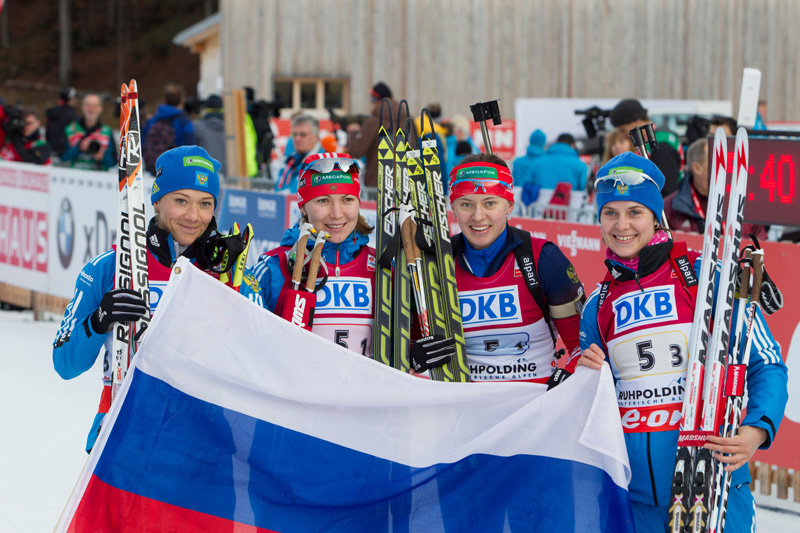
Olga Zaitseva, Ekaterina Glazyrina, Olga Vilukhina, and Irina Starykh celebrate their IBU World Cup biathlon relay victory in Ruhpolding, Germany in January 2014. (Photo: Fischer/Nordic Focus)
The International Biathlon Union (IBU) has received a list of 31 Russian athletes involved in doping, IBU President Anders Besseberg told Norway’s VG newspaper.
“Some of the 31 athletes are already banned, others have retired, but the most urgent thing is to assess the biathletes who are now participating in our international competitions,” Besseberg said. “I reckon that we on the board will make recommendations within a week… of those athletes who the Committee believes should be provisionally excluded.”
Some information about the athletes, however, can already be gleaned from the McLaren report.
For example, one document in the Evidence Disclosure Packet (EDP) failed to redact the names of four biathletes and replace them with alpha-numeric code identifiers. The four athletes were the planned roster for the women’s 4 x 6 k relay at the 2014 Olympics in Sochi, Russia: Olga Zaitseva, Olga Vilukhina, Yana Romanova, and Irina Starykh.
While the document identifying the women and their code numbers did not contain any evidence of doping, it means that any references to their code identifiers in other evidentiary documents can be connected to them.
For instance, such cross-referencing reveals that one of several samples deemed to be too dilute to be an authentic urine sample by the Drug Control Centre at King’s College London, used by the investigation for external analysis of suspicious samples, belonged to Romanova.
The team – with Ekaterina Shumilova replacing Starykh – won silver in the 4 x 6 k relay in Sochi.
Zaitseva retired after Sochi, as she had long planned to do. Romanova retired after the 2014/2015 season. Vilukhina took that year off and made an unsuccessful return last season, before announcing her retirement on November 14 of this year.
Nine other unnamed biathletes were shown in various documents to have tested positive for banned substances. In at least four of these cases, the results of the test were reported to the World Anti-Doping Agency’s ADAMS reporting database to be negative tests.
And at least 20 more athletes in the report belonged to biathlon, although in those cases there is no specific information about what substances they may have used.
Here is an extensive list of all the biathlon athletes mentioned in central documents from the evidence disclosure packet.
About the Documents
Professor McLaren (c) addressing the media after the his second report on systematic, state-sponsored doping in Russian summer and winter sports. (Photo: WADA/Twitter)
EDP1162 and EDP1149: Professor McLaren describes this document in his report: “Alexey Velikodniy created a daily competition schedule that identified protected athletes. The schedule was continuously updated during the Games and included all those on the Sochi Duchess List and athletes added during the Games, such as the female hockey team.”
EDP1149 includes English translation of the original EDP1162, and on page 44 of EDP1149 the names of the women biathletes are not redacted. Why redaction was successful in all other parts of the document, but not there, is questionable. Additionally, the document still seems to have been a planning document, as Staryk is still listed as competing in the relay even though she had long been off the Olympic team.
EDP1156: A list of sample numbers and collection during or immediately before the 2014 Olympics in Sochi, from protected national team athletes. Some data about the urine tests, like pH and specific gravity, are included, indicating that this was not merely a planning document but that the tests took place.
EDP1141: Results of a study done at King’s College London assessing whether the sodium concentration and specific gravity of some doping control samples were abnormal. (They were: in some cases, though none in biathlon, sodium concentrations were consistent with having added a teaspoon of salt to a one-cup urine sample.)
EDP1155: Translations of emails involving Grigory Rodchenkov, the former head of the Moscow anti-doping laboratory who became a whistleblower and took his story to the New York Times.
EDP1166: A list of test numbers, mostly associated with athlete ID numbers, identified by the investigation. “The IP has identified more than 1231 samples where the Moscow Laboratory communicated the presence of a prohibited substance in a Russian athlete’s sample to the [Ministry of Sport] and later reported that sample as negative in ADAMS or did not report the sample at all.” This document lists those 1231 samples.
There are columns for which substances were positive in the sample (this column is often blank) and how the report was filed in the ADAMS database. Many samples were filed as “negative”, but this column is also often left blank. This may mean that the sample was never reported in ADAMS at all – as McLaren says was fairly common – or simply that there was no information about it.
In general, the investigation’s translations from Russian into English are not always smooth. This is particularly apparent in reference to competitions: the name or level of a series is hard to interpret. It’s possible that the anti-doping staff themselves were not familiar with the different race circuits because they were not necessarily biathlon experts, and worked more generally in all sports.
A further note: some documents are scanned and thus not searchable by text. Thus some names and numbers may be referenced in places where we have not yet found them.
The Biathlon Relay Team
A0944, Olga Vilukhina
Olga Vilukhina won a silver medal in the sprint at the 2014 Olympics.
Why do we know her name? Listed in position “1” on pages 44 and 45 of EDP1149, in the 4 x 6 k relay
Evidence of being a protected athlete? Yes, in multiple documents (although those documents may be redundant; without metadata, it is difficult to tell).
Evidence that positive tests were covered up? Maybe. In EDP1166, one of Vilukhina’s samples (2870741) is listed as being reported “negative” to the ADAMS database and referred to in a document titled (in Russian) “Biathlon 3”, indicating a date of 06.01.2014 for the sample. But there is no substance listed for this sample in EDP1166. Because this document was assembled to be a list of samples which were reported to the Ministry of Sport as being positive, it’s not clear what to conclude from this combination of facts.
Other tests? Besides that one sample, there are several other samples listed for Vilukhina: urine samples collected January 31, February 9, and February 16, 2014, and a blood sample collected February 15, 2014. While the urine samples are referenced in EDP1166, no substances were listed and the test does not seem to have been entered into ADAMS. February 9 was the day of the women’s sprint in Sochi, where Vilukhina won a silver medal. February 16 was the day before the women’s mass start, where Vilukhina placed 21st.
A0983, Olga Zaitseva
Olga Zaitseva blows kisses to the crowd as she brings Russia the gold in the Olympic biathlon relay in 2010.
Why do we know her name? Listed in position “3” on pages 44 and 45 of EDP1149, in the 4 x 6 k relay
Evidence of being a protected athlete? Yes, in multiple documents (although those documents may be redundant; without metadata, it is difficult to tell).
Evidence of positive tests? Maybe. In EDP1166, one of Zaitseva’s samples (2870735) is listed as being reported “negative” to the ADAMS database. But there is no substance listed for this sample or date of collection and it is not referred to in any other documents. Because EDP1166 was assembled to be a list of samples which were reported to the Ministry of Sport as being positive, it’s not clear what to conclude from this combination of facts.
Other tests? Besides that one sample, there are several other samples listed for Zaitseva. Around the time of Sochi, urine samples were collected January 31, February 14 and February 19, 2014, and a blood sample collected January 31, 2014. An additional undated urine sample is referred to in EDP1166. For these samples, no substances were listed and the test does not seem to have been entered into ADAMS. February 14 was the day of the women’s 15 k individual, where Zaitseva placed 15th, and February 19 was the mixed relay, where the Russian team including both Zaitseva and Vilukhina placed fourth.
A0714, Yana Romanova
Yana Romanova competing in Kontiolahti, Finland, in 2010. (Photo: Peter Porai-Koshits/Wikimedia/Creative Commons)
Why do we know her name? Listed in position “4” on pages 44 and 45 of EDP1149, in the 4 x 6 k relay
Evidence of being a protected athlete? Yes, in multiple documents (although those documents may be redundant; without metadata, it is difficult to tell).
Evidence of positive tests? The report from King’s College London indicates that one of Romanova’s samples (number 2889617, collected on February 2, 2014, just before the Sochi Olympics began, according to another document) was too dilute to be an authentic sample. In the report and the New York Times investigation, Rodchenkov described adding water or salt to samples that were being manipulated. The King’s College London test suggests that this may be one such sample.
In EDP1166, one of Romanova’s samples (2870745) is listed as being reported “negative” to the ADAMS database. But there is no substance listed for this sample or date of collection and it is not referred to in any other documents. Because EDP1166 was assembled to be a list of samples which were reported to the Ministry of Sport as being positive, it’s not clear what to conclude from this combination of facts.
Other tests? Besides those two samples, there are several others listed for Romanova. Around the time of Sochi, urine samples were collected January 31, February 2, 13, and 21, 2014, and blood samples collected February 14 and 15, 2014. An additional undated urine sample is referred to in EDP1166. For these samples, no substances were listed and the test does not seem to have been entered into ADAMS. February 14 was the day of the women’s 15 k individual, where Romanova placed 53rd, and February 21 was the day of the women’s relay.
A0856, Irina Starykh
Targeted testing based on data from the IBU’s Athlete Biological Testing program led to the suspension of Irina Starykh, above on her way to fifth place in the World Cup pursuit in Hochfilzen, Austria, in 2013, and another Russian biathlete for blood-doping. The IBU fined Russia for a cluster of doping cases.
Why do we know her name? Listed in position “5” on pages 44 and 45 of EDP1149, in the 4 x 6 k relay
Evidence of being a protected athlete? Yes, in multiple documents (although those documents may be redundant; without metadata, it is difficult to tell).
Evidence of positive tests? In EDP1166, two of Starykh’s samples (2870740 and 2870745) are listed as being reported “negative” to the ADAMS database. But there is no substance or date listed for either sample, and they are not referred to in any other documents. Because EDP1166 was assembled to be a list of samples which were reported to the Ministry of Sport as being positive, it’s not clear what to conclude from this combination of facts.
Other tests? No tests are listed for Starykh at the Sochi Olympics, because she was not there. However, there are five more samples of hers listed in EDP1166, for which no substances were listed and the test does not seem to have been entered into ADAMS.
Other Athletes with Positive Tests Described in Documents
Thirty-one other athlete ID numbers are associated with the sport of biathlon, and three additional mentions of biathletes which are not associated with any ID number. This means that they could belong to some of the 35 numbered athletes (the four named women plus the 31 unidentified, but numbered, athletes), or they could be completely separate cases.
Of those 31-34 other biathletes, here are the ones for whom positive tests for prohibited substances are explicitly mentioned in the documents.
A0241, female
Evidence of being a protected athlete? Maybe. This athlete was certainly competing internationally. By the time Russian anti-doping staff were discussing her case, she was in Ruhpolding, Germany, and then was set to travel to Antholz, Italy – consistent with the World Cup schedule – before checking into the Olympics. This plan does not seem to be jeopardized by her positive test, although the staff notes that she is at risk. After the positive test, Rodchenkov notes that “it is necessary to hide her immediately.”
Besides the four athletes named above, Shumilova competed in Sochi, along with Olga Podhufarova and Ekaterina Glazyrina. Several others were competing on the World Cup, but were unlikely to have been slated for Sochi participation because they did not have strong results so far in the season – the possible exception being Ekaterina Yurlova.
Evidence of positive tests? In EDP1166, this athlete’s sample (2866518) is shown as testing positive for methenolone, oxandrolone, and trenbolone, all anabolic steroids. The test was allegedly collected on 12.19.2013 in Izhevsk, Russia, at the biathlon championships.
How was the test handled? In the emails, which you can see in Russian here, this sample is given a “save” order, meaning that it should be reported as negative. And in EDP1166, the sample is shown as being negative in ADAMS. She may have additionally been quarantined: the anti-doping staff write in emails that if she was to be subjected to an international test (for instance, but the International Biathlon Union), she would certainly test positive and it would be “a very ugly situation for the lab if we ‘found nothing’ in such concentrations and for those substances.”
Other tests? In EDP1166, two of this athlete’s samples (2870746 and 2867708) are listed as being reported “negative” to the ADAMS database. But there is no substance or date listed for either sample, and they are not referred to in any other documents. Because EDP1166 was assembled to be a list of samples which were reported to the Ministry of Sport as being positive, it’s not clear what to conclude from this combination of facts. An additional blood test is listed in EDP1166 with no substances listed, and the test does not seem to have been entered into ADAMS.
Unnumbered Athlete, male
Evidence of being a protected athlete? No. The only other information about this athlete is that it was a man.
Evidence of positive tests? The emails refer to this athlete’s sample (2759623) being positive for 16a-hydroxyprednisolone (budesonide metabolite). Budesonide is a corticosteroid which is used in asthma medications such as Pulmicort inhalers, but it is also used in other forms: as pills, nasal sprays, and as a rectal foam to treat intestinal problems. The sample is written to have been collected on 11.1.2013 at in international competition in Ostrov, Russia. That day, IBU Cup sprints were held in Ostrov, with three Russian men (race winner Alexey Slepov, plus Sergey Korastylev and Sergey Klyachin) in the top six.
How was the test handled? There’s no information about how this test was handled. It is discussed in the email, but no conclusion is reached. It also does not appear in EDP1166.
Other tests? None listed.
A0028
Evidence of being a protected athlete? There’s no other information about this athlete.
Evidence of positive tests? In the emails, athlete A0028 is described as having tested positive for “methandienone circuit” at the Russian biathlon championships in Uvat on 31.07.2014. It’s unclear what “circuit” refers to – it may be an awkward translation – but methandienone is an anabolic steroid. In addition, the testosterone to epitestosterone ratio is listed as 6.2. A high ratio can indicate that an athlete was using exogenous testosterone, and a finding of a ratio above 4.0 triggers further investigation. The original email can be seen (in Russian) here.
How was the test handled? In the emails, the word “Quarantine” appears above the description of this athlete’s test results. This likely means that the athlete was kept in Russia until they could pass an anti-doping test. There’s no information about whether the test was reported to the ADAMS database or not.
Other tests? None listed.
A0179, female
Evidence of being a protected athlete? No. The only other information about this athlete is that it was a woman.
Evidence of positive tests? Document EDP1166 states that on 09.28.2014 at Russian biathlon championships in lzhevsk, a sample tested positive for isomers of amphetamines, which are banned stimulants. There is also discussion of the sample in the emails, with someone writing, “find out what she took!” The group seems to suspect that the substance came from a dietary supplement. The email (in Russian) can be seen here.
How was the test handled? In the emails, this case is listed with a “save” order: that means that a positive test should be turned into a negative one. Indeed, document EDP1166 states that this test was reported as negative to the ADAMS database.
Other tests? None listed.
A0461, male
Evidence of being a protected athlete? No. The only other information about this athlete is that it was a man.
Evidence of positive tests? EDP1166 shows that one of this athlete’s samples (2867705) tested positive for tuaminoheptane, a prohibited stimulant which is used in nasal decongestants. The emails (here) show that this sample was collected on 12.21.2013 at a Russian Cup race in lzhevsk.
How was the test handled? The emails are unclear, with someone writing, “and this one still does not have a decision (or I missed it).” However, in EDP1166 the test is listed as having been reported to ADAMS as negative.
One staff member, perhaps assumed to be Rodchenkov, writes this regarding the sample: “Alex, come on, I’ll close the whole shop… They are imprudent beyond measure… and then I will go to other laboratories after February 2014.”
Other tests? In EDP1166, two of this athlete’s samples (2918636 and 2870699) are listed as being reported “negative” to the ADAMS database. But there is no substance or date listed for either sample, and they are not referred to in any other documents. Because EDP1166 was assembled to be a list of samples which were reported to the Ministry of Sport as being positive, it’s not clear what to conclude from this combination of facts.
A0751, female
Evidence of being a protected athlete? No. The only other information about this athlete is that it was a woman.
Evidence of positive tests? EDP1166 shows that one of this athlete’s samples (2945500) tested positive for pthalates, which are plasticizers. They are prohibited because they are thought to indicate the use of blood transfusions, with the plasticizers being used to soften the plastic in blood bags and then diffusing into the blood. The emails show that this sample was collected on 09.28.2014 at Russian biathlon championships in lzhevsk, That email (in Russian) can be seen here.
How was the test handled? EDP1166 shows that this test was reported as negative to ADAMS.
Other tests? None listed.
A1244, male
Evidence of being a protected athlete? No. The only other information about this athlete is that it was a man.
Evidence of positive tests? The sample (2868394) is not listed in EDP1166, but only discussed in the emails (in Russian here). The emails refer to a positive test for trimetazidine, a metabolic modulator which protects against angina and heart problems, much like meldonium. According to the emails the sample was collected in Uvat at Russian biathlon championships on 6 April (assumed to be 2014).
How was the test handled? There’s no information about how this test was handled.
Other tests? None listed.
Unnumbered Athlete, male
Evidence of being a protected athlete? No. The only other information about this athlete is that it was a man.
Evidence of positive tests? In the emails, one of this athlete’s samples (2689927) is written to contain methylhexanamine, a banned stimulant common in dietary supplements (it is in fact the same substance which German biathlete Evi Sachenbacher-Stehle tested positive for at the 2014 Olympics). The sample was collected on 2012-12-17 at all-Russia competitions in Ekaterinburg.
How was the test handled? There’s no information about how this test was handled. In the emails, it is clear that nothing was done about the test until the following year (2013), but the final action is not discussed. It also does not appear in EDP1166.
Other tests? None listed.
Unnumbered Athlete, male
Evidence of being a protected athlete? No. The only other information about this athlete is that it was a man.
Evidence of positive tests? One of this athlete’s samples (2746493) is discussed in the emails as having tested positive for furosemide, a diuretic and masking agent. The sample was collected on 01/09/2013 at all-Russia competitions in lzhevsk.
How was the test handled? There’s no information about how this test was handled. Other than reporting the sample, there is no discussion of the test in the emails, and also does not appear in EDP1166.
Other tests? None listed.
Other Athletes Mentioned in the Documents
For the rest of the biathletes, sample numbers are listed in EDP1166, but no substances are listed and positive tests are not discussed described in any of the other documents. Because EDP1166 was assembled to be a list of samples which were reported to the Ministry of Sport as being positive, it’s not clear what to conclude about the samples.
Here is what we know about them.
ID Number
Gender
Samples reported as negative
Samples with no information about reporting
A0023
Male
2869722
A0136
Male
2870692
A0157
Male
2867964
A0201
Female
2869837
A0232
Male
2870747
2889906, 2890603, 2890739, 2944467
A0282
Female
2866843
A0321
Female
2868243
A0491
Male
2870733
857444 (blood)
A0508
Male
2868236
A0521
Male
2870742
857581, 857105, 857600
A0548
Female
2869752
A0567
Female
2867862
A0576
Male
2866527
A0579
Female
2870697
A0598
Female
2847214
A0639
Female
2869643
A0640
Male
2869203
A0687
Male
2867881
A0795
Male
2870739
2944657, 2890878, 2890855, 2889922, 2889808
A0804
Male
2869859
A0808
Female
2870743
857613 (blood)
A0930
Male
2870744
857573, 857440 (blood)
A0950
Male
2870748
A1031
Male
2869912
In addition:
A0142, male
Mentioned in EDP1166: Sample 2916590 is listed as having been reported as negative in the ADAMS database. There is no information listed about substances in the sample.
Other mentions: The same sample is described in an email which does not seem to have been translated into English. The sample was collected on 2014-07-17 in Toksovo, outside of Saint Petersburg.
(Note: This article has been updated to include a statement from the International Ski Federation regarding the most recent McLaren report, as well as comments from IBU President Anders Besseberg.)
The initial McLaren bombshell came in July when the World Anti-Doping Agency (WADA) disclosed its findings about alleged systematic state-sponsored doping in Russia.
McLaren’s investigative mandate was to further disclose the extent to which Russia’s anti-doping authorities manipulated doping-control samples and how they beat international testing protocols.
Friday’s report disclosed more evidence of systematic Russian doping that McLaren concludes dates back to at least 2011 and continued after the Sochi Olympic Games.
The major findings released today include this: more than 1,000 Russian athletes in more than 30 different sports were involved in the doping coverup. McLaren called it “a coverup that operated on an unprecedented scale” in his opening remarks.
Of those 1,000 athletes, 600 (84 percent) are summer athletes whereas 95 (16 percent) are winter athletes. Those 695 names were reported to 32 international sports federations. The remaining 305 were more or less special cases that could not be disclosed for confidentiality reasons, McLaren explained.
The report states that the “coverup” and “manipulation” of the doping-control process was fine-tuned during the 2012 London Summer Olympics, 2013 Universiade Games, 2013 Moscow IAAF World Championships, and the 2014 Sochi Winter Olympics.
On page 27, the report’s authors did not mince words when it came to describing the freedom to which some Russian athletes could affect a race’s outcome during the 2014 Winter Games:
“The Winter Olympics in Sochi debuted the ultimate fail-safe mechanism in the Russian’s sample swapping progression. A protected winter Olympics competitor likely to medal did not have to worry about his or her doping activities. They could dope up to, and possibly throughout, the Games as they could count on their dirty sample being swapped at the Sochi Laboratory.”
Specific violations that occurred during the Sochi Games were sample swapping and tampering.
“Two female hockey players’ samples contained male DNA … and eight Sochi samples revealed salt content not physically possible in a healthy human,” McLaren stated, explaining that Russian specialized agents, dubbed “magicians”, used salt and “Nescafé coffee granules” to manipulate the samples.
More specifically, McLaren’s team found “physiological impossible” salt readings in two Russian athletes that were “winners of 4 Sochi Olympic gold medals” and a female silver-medal winner.
“Twelve medal winning athletes (including the above 3) from 44 examined samples had scratches and marks on the inside of the caps of their B sample bottles, indicating tampering,” the report stated. “Six winners of 21 Paralympic medals are found to have had their urine samples tampered with at Sochi.”
For Russian doping authorities, the process of preventing samples from testing positive became a nimble and evolving cat-and-mouse game. Russia’s infrastructure put in place to beat the testing protocol was able to evolve, “in response to WADA regulatory changes and surprise interventions,” the report stated.
“For every action by WADA, there was a Russian reaction,” McLaren said.
The first McLaren report detailed the intricate swapping of positive tests for clean tests during the Sochi Games. The second McLaren report alleges that the same protocol continued after the Sochi Games concluded and became a routine “monthly practice” at the Moscow Laboratory at the center of the doping coverup.
“After Sochi, the sample swapping happened approximately every month,” McLaren said. “The ‘magicians’ would be called to the Moscow laboratory to swap … about five to 20 samples … per month.”
How did they get away with tampering with supposedly tamper-proof bottles? According to McLaren, forensics experts determined that “thin strips of the metal were most likely used. They have to be flexible enough to bend and fit between the lid and the bottle, but also strong enough to pull up the metal ratchet ring.”
And who is responsible at the very top? While McLaren’s report does not name Vladimir Putin, it does include former Russian Ministry of Sport Vitaly Mutko (who has since been promoted to deputy prime minister). Mutko appointed Dr. Grigory Rodchenkov, the former director of the Russian anti-doping laboratory, for the job back in 2011 — when doping efforts were found to have begun ramping up for the 2012 London Olympics.
McLaren later explained that there was no evidence that Russian Olympic Committee members were directly involved. He also stressed that this “institutional conspiracy” dates back to at least 2011.
“It is impossible to know how far back the conspiracy goes,” he said. “… Sports fans and spectators have been deceived. It’s time that stops.”
Athletes affected by the post-Sochi sample swapping technique include elite summer and winter athletes. McLaren wrote that the report’s conclusions were established not by verbal testimony, but by testing physical evidence.
“The key findings of the first report remain unchanged,” he said. “Evidence does not depend on verbal testimony from anyone to draw a conclusion, but rather tests the physical evidence and draws a conclusion from the results.”
As of press time, neither McLaren, his report, nor WADA mentioned any athletes by name. McLaren said the evidence has been passed on to WADA, which is asking specific sport federations to handle specific athlete cases.
“It has not been put in the public domain. That will be up to sports federations who have received the information,” he said.
In a press release on Friday, WADA noted that the evidence, described by McLaren’s “Investigation Team as being ‘based on immutable facts’ will be of immediate value to the IFs [International Federations], the International Olympic Committee (IOC), the International Paralympic Committee (IPC) and other organizations — those that are responsible for the Results Management and Adjudication process related to potential anti-doping rule violations (ADRVs) under the World Anti-Doping Code (Code).
“In terms of next steps, the Investigation Team is providing WADA with an Evidentiary Summary for each athlete referred to in the Report by alpha-numeric code,” the press release continued. “Starting today, WADA will provide these Summaries to all IFs whose athletes are mentioned within the Report; as well as, to the IOC, the IPC and other relevant organizations. Once in possession of these Summaries, these organizations will be responsible for reviewing the evidence available for each case; and, for determining whether or not there are sufficient elements to pursue ADRVs or, whether further investigations are required. As is a requirement of the Code, WADA will monitor the Results Management that will be carried out by the relevant authorities.”
As McLaren explained: “It’s up to different parties, like the IOC and the federations [32 of which have reports] for them to make their decisions. They can rely on what’s in the reports and what’s on the website.”
While the IOC did not have an official statement on its website a few hours after the report was published on Friday, the International Paralympic Committee immediately responded with a press release, stating, “The full findings of the report are unprecedented and astonishing. They strike right at the heart of the integrity and ethics of sport. … We wholeheartedly agree with Professor McLaren that the best course of action is to work together to fix the broken and compromised anti-doping system in Russia.”
The IPC explained that it recently appointed a taskforce to work “closely” with the Russian Paralympic Committee (RPC) “to do just that.”
The IPC suspended the RPC in early August “due to its inability to fulfil its IPC membership obligations, in particular its obligation to comply with the World Anti-Doping Code (to which it is a signatory) and the IPC Anti-Doping Code.”
The International Ski Federation (FIS) relayed its official statement in an email to FasterSkier:
“FIS will study the details in the WADA McLaren Report in the coming days and thereafter act decisively, in accordance with the FIS policy of zero tolerance to punish anti-doping violations and the protection of clean athletes. Additionally FIS will coordinate with the IOC, as the responsible body for anti-doping at the Olympic Winter Games, and WADA, in order to address each organisation’s next steps.”
Also in the email, FIS Communications Manager Jenny Wiedeke noted, “Unfortunately, we cannot answer specific questions until we have had a chance to completely review all of the details of the report.”
The International Biathlon Union (IBU) president Anders Besseberg went on the record saying, “First of all you need proof that the Russian Biathlon Union was involved in this thing,” he told Sportschau.de. “Or was it something that went over the head of our federation member — at a state level so to speak, then it is a difficult question.
“But in my opinion that is the key question: if the Russian Biathlon Union was involved,” he continued.
Johannes Duerr (second from right) during the Tour de Ski’s 35 k pursuit from Cortina to Toblach, Italy, in December. The Austrian was since kicked out of the 2014 Olympics for doping.
Doping has been in the news again, with the International Olympic Committee (IOC) announcing on Thursday that 16 more athletes from the 2008 Summer Olympics in Beijing had tested positive for banned substances, then adding 12 more to that tally on Monday from the 2012 Summer Olympics in London.
That brings the total number of athletes disqualified for doping at those two Olympics to well over 100.
The World Anti-Doping Agency (WADA) also held its Foundation Board meeting in Glasgow, Scotland, this weekend, agreeing on a whistleblower-protection program as well as a system of graded sanctions for countries who do not comply to the World Anti-Doping Code.
“The decision by the Board to grant WADA authority to develop a new, meaningful graded sanctioning system is welcomed by athletes; particularly, as it provides a direct answer to the call made by athletes earlier this year for a stronger, meaningful system of consequences for non-compliance,” WADA Athlete Committee Chair Beckie Scott, a former Canadian cross-country skier, said in a WADA press release. “If we all agree that WADA should be independent and empowered as the regulator of doping in sport, then how could we not agree to equip WADA with the tools it needs to do its job fully… On behalf of athletes, I feel confident in saying that we are pleased that this decision has been made today in the interest of clean sport.”
The system will reportedly have three tiers of sanctions, with countries committing the most serious and recurring offenses being barred from hosting the Olympics, World Championships and other major events. That would be applied to countries where the government interferes with anti-doping work or manipulates the testing sytem.
The first level of sanctioning would be a result of administrative problems, and is proposed to bring in assistance from WADA in order to return to Code compliance. The second level of sanctions would apply when there are problems in testing procedures, at which point countries will be assessed a fine.
Five countries are currently deemed Code non-compliant: Russia, which has been out of compliance since November 2015, but which has not faced any of the sanctions suggested above, although athletes in some sports have been barred from competing by their individual sports federations; Spain, which has been noncompliant since March 2016; and Brazil, Azerbaijan, and Indonesia, which were declared noncompliant at the Glasgow meeting.
In the future, such countries could face sanctions. But International Ski Federation (FIS) President Gian Franco Kasper does not see it as WADA’s place to offer such punishments.
“Sanctioning entire countries is purely political and I do not agree with this,” Kasper told Insidethegames. “WADA should not be a body which gives sanctions.”
He also did not appear optimistic about the future of clean sport.
“We need to stop pretending sport is clean,” he told New York Times reporter Rebecca Ruiz. “It’s a noble principle, but in practice? It’s entertainment. It’s drama.”
Russia, which is currently non-compliant with the WADA Code, is hosting World Cups in multiple ski and snowboard disciplines later this season, and FIS has made no public show of moving them.
Similarly, the International Biathlon Union (IBU) will see Russia hosting World Cups in March 2017, and also recently awarded Russia the 2021 World Championships.
That was a topic of discussion at the WADA Foundation Meeting. The Compliance Review Committee is beginning action against the IBU, which it sees as having jeopardized its own compliance by awarding a major event to a country which does not comply with the Code.
The Code states that international federations like the IBU must “do everything possible to award World Championships only to countries where the Government has ratified, accepted, approved or acceded to the UNESCO Convention, and where the National Olympic Committee, National Paralympic Committee and National Anti-Doping Organisation are in compliance with the Code”.
The IBU has been given until January to offer a satisfactory explanation to WADA for why the Russian city of Tyumen was selected as the World Championships host site.
Russia’s Anton Babikov lunges across the line ahead of teammate Evgeniy Garanichev in the men’s pursuit race at the 2016 Open European Championships in Tyumen, Russia. The venue just won the hosting rights for 2021 World Championships. (Photo: IBU)
Note: In an interview with the Associated Press which was published the day after this story, IBU President Anders Besseberg suggested that if Russian biathletes’ anti-doping samples from the Sochi Olympics came back positive during the re-testing process, Tyumen’s hosting rights for World Championships 2021 could be revoked.
In July, the McLaren report dropped and the world learned that Russia had implemented a systematic doping program before the 2014 Winter Olympics in Sochi, Russia.
Then, there had been a parallel systematic program to cover it up, directed by Russia’s Ministry of Sport and its state security service. That had led to the infiltration of the International Olympic Committee (IOC) on-site anti-doping laboratory.
In the wake of the scandal, the IOC Executive Board suggested several guidelines for how to handle Russian winter sports. Among them was a call on “all International Olympic Winter Sports Federations to freeze their preparations for major events in Russia, such as World Championships, World Cups or other major international competitions under their responsibility, and to actively look for alternative organisers.”
And yet, over the weekend the International Biathlon Union (IBU) Congress, which includes 49 possible voting countries, voted to award 2021 World Championships to Tyumen, Russia. The venue in western Siberia will also host World Cup competitions in March 2017, and 2017 Youth and Junior World Championships in Ostrov, Russia, are also moving ahead as planned.
And the IOC did not object. What changed?
“Not only was it surprising, but it was also shocking that [Tyumen] got 25 votes,” Bernd Eisenbichler, chief of sport for the U.S. Biathlon Association (USBA) and the voting representative for the U.S. at the Congress, said in an interview on Tuesday. “I want to state that it is wrong. It is a very disappointing outcome of the vote.”
“It is a country that is under investigation and the IOC has in fact warned against giving new events to the country — that half of the delegates don’t understand what this means for the young international biathletes is disappointing,” Erlend Slokvik, president of the Norwegian Biathlon Federation, told his country’s NRK television station.
Public vs. private attitudes on Russia
Apparently, while stating one thing publicly – that plans for major competitions in Russia should be frozen – the IOC was telling winter sports federations something different.
A still from the candidature video of Tyumen, Russia, which won the hosting rights for 2021 Biathlon World Championships. The International Olympic Committee had previously recommended that no major competitions be awarded to Russia until it comes into compliance with the WADA Code.
“The IOC will not hesitate to take the toughest sanctions available against any individual or organisation implicated,” IOC President Thomas Bach said in July after learning about Russia’s widespread doping at the 2014 Olympics.
Once amongst its stakeholders, the IOC seems to sing a different tune, one which could hardly be described as the “toughest sanctions available.”
Last month, all seven international winter sports federations met with the IOC and World Anti-Doping Agency (WADA) in Rio de Janeiro, Brazil. All seven had competitions scheduled for Russia in 2017, and they wanted clarification about what to do.
What they got was the go-ahead to continue working with Russian organizing committees.
“They said, all competitions given to Russia which are taking place this winter, they should go on as planned,” IBU President Anders Besseberg told FasterSkier on the phone Tuesday. “This is what the IOC Sport Director clearly stated. About awarding them new competitions, the answer was also very clear. When they applied for this bidding process and it was in progress [before the McLaren report dropped], then this should also go the normal way.”
Secretary General of the International Ski Federation (FIS), Sarah Lewis confirmed this account of events in an email to FasterSkier.
Unlike competitions slated for this winter, 2021 is a long way off. World Championships easily could have gone somewhere else. Although the bid process was already started and Tyumen had filed its candidacy before the McLaren report came out, there were two other cities bidding, Nove Mesto in the Czech Republic and Pokljuka in Slovenia.
“There were three very correct candidates,” Besseberg said. “And there was a vote.”
When asked about how Tyumen had won the election given the ongoing discussion of sanctions, Besseberg objected.
“I am not the right person to ask,” he said. “It’s the Congress who is the highest authority in the IBU, it is the delegates in the Congress.”
Who voted for Tyumen?
And so, what did the delegates think?
In his remarks to the Congress at its opening, Besseberg explained that Tyumen’s candidacy was not against any IOC guidelines. That caused a stir.
Germany’s Florian Graf competing in the men’s 15-kilometer mass start at the 2016 Open European Championships in Tyumen, Russia, on his way to winning the gold medal. (Photo: IBU)
“This was very surprising because there was no official statement by either the IBU or the IOC before the congress,” Eisenbichler said. “I discussed with a few friends in other federations about this topic. I got the sense that we were pretty much in agreement.”
Regardless of IOC rules, some feel that biathlon and cross-country skiing should be especially wary of Russia, since they were acutely stung by the allegations in the McLaren report. That investigation implicated 10 biathletes and 13 cross-country skiers.
“The McLaren report is very clear and detailed about what happened in Sochi and mentions biathlon explicitly as one of the sports,” Eisenbichler wrote in an email. “As long as there are not clear signs, facts and proof about different future behavior, it is not time to have Russia get awarded a Biathlon World Championships.”
There has been no news on re-testing of the anti-doping samples in Sochi, and no revelation of which athletes might have been involved.
Clearly, however, there are two lines of thinking on the matter. There are those, like Eisenbichler and Norway’s Erlend Slokvik, who would never vote for Tyumen.
“The IOC letter, I disagree that the IOC took this step after [previously] declaring that the competitions should be frozen and should not be further planned on,” Eisenbichler said. “I’m not in favor of it. So that did not change anything, that I would vote for it or not.”
Murray Wiley, the president of Biathlon Canada, could not be reached for comment, but Canada’s national-team coach Roddy Ward said he was disappointed with the decision.
“Back here in Canada, we have been discussing where they would move [the Tyumen World Cup weekend] to this winter, given our assumption it must be moved after the McLaren report,” Ward wrote in an email. “After all, how can we race in Russia when that has come to light? However, not only does [the World Cup] remain but the IBU has now rewarded Russia with WCH2021!! This is a massive slap in the face to clean athletes.”
But then there are those who would vote for it.
“Western Europe understands that this is not good for the younger international biathletes,” Slokvik told NRK. “There are many nations that are distraught … It’s the small nations from Asia and the old East block that voted for Tyumen.”
Either way, minds appeared to be made up. After his presentation on the new IOC recommendations, Besseberg said he had welcomed discussion.
“They were asked if they had any questions about it and there was not a single question,” Besseberg said.
What now?
Eisenbichler had little doubt that the Tyumen organizing committee would do a good job with the championships.
The venue hosted 2016 Open European Championships, and although neither the U.S. nor Canada attended (nor a number of other countries), reports from those who did compete were positive. Tyumen also hosts a Champions show race, so many top competitors have been there for the cash-rich prize money. Simon and Martin Fourcade of France both tweeted their support for Tyumen along with Antholz, Italy, which was awarded 2020 World Championships.
The local organization is not what concerns Eisenbichler, who heads the U.S. national team along with domestic development.
“Hopefully the future will be showing us that Russia does a different job than they did in Sochi,” he said. “But the McLaren report is very clear. I just think that now, with all the news that we got from the report, it’s the wrong signal to the sports world, to the fans, to the youth athletes, to all the athletes who are fighting for clean sports, that it’s a very wrong signal to reward them right now with that event.”
The biathlon world is also waiting for the other shoe to drop, to find out whether or which of the Russian stars had doped in 2014.
“The McLaren report showed systematic doping in Sochi, with Russian biathlon and x-c implicated,” Ward wrote. “I have been waiting to hear from the IBU how they would respond to the report and I hoped it would be by throwing their weight behind clean sport and punishing Russia… The IBU have made it very clear now that Russia is above anti-doping, that they can get away with anything and that what they did in Sochi totally acceptable.
“Biathlon and all Olympic sport is in a dangerous time,” Ward concluded. “We are losing all credibility. IOC and IBU need to take a strong stand against doping and with the decision to award Russia with [World Championships] they have done the exact opposite.”
Olga Abramova after winning gold in the pursuit competition at Summer Biathlon World Championships in Romania in August 2015. She had also won the sprint. (Photo: IBU/Evgeny Tumashov)
Olga Abramova, a Ukrainian World Cup biathlete whose “A” sample from a January competition tested positive for the banned hormone mildronate, has waived her right to have the “B” sample examined.
That means that her case will proceed immediately to an International Biathlon Union (IBU) Anti-Doping Hearing Panel, which will decide whether and how to discipline the athlete.
Mildronate was added to the World Anti-Doping Agency’s Prohibited List effective January 1st, and Abramova’s sample was collected just ten days later. Originally designed as a growth-promoting hormone for livestock, mildronate is widely acknowledged to be performance-enhancing and is even advertised as such.
In the press release announcing the advancement of the Abramova case, the IBU also revealed that a second athlete had tested positive for the same substance at an IBU Cup competition in January. As the IBU Cup is a second-tier circuit, it is assumed that this means it is not a star athlete, but the IBU has not revealed the athlete’s name.
“The idea is to protect the right of the athlete until they either declare that they are indeed positive, or a B sample confirms this,” IBU Vice President for Medical Issues Dr. Jim Carrabre wrote in an email to FasterSkier. “Once this occurs then we truly have a positive finding. If we announce the athlete’s personal information before this and they deny the medication and the B sample does not confirm that we have a case, then we have a personal privacy violation.”
Meanwhile, Carrabre told Norwegian broadcaster NRK that he wanted to re-examine anti-doping samples from the 2014 Olympic Games in Sochi, Russia, given ongoing investigations into doping in the country and a WADA investigation which alleged Russian state security interference in the Sochi laboratory. The Russian Anti-Doping Agency, RUSADA, is currently not in compliance with WADA and testing has been outsourced to the United Kingdom.
“My point to NRK was that I would like to overview the tests that were done, the results of those tests, and integrate this as a total picture of things going on around the time of Sochi,” Carrabre explained in an email. “We would be remiss not to do this especially in light of the [WADA] Independent Commission’s findings and recommendations. As you know, there are many issues with Sochi including test sample destruction.”
“I must say that I’ll be very surprised if one laboratory managed to cheat,” Besseberg said.
Carrabre reportedly met with WADA officials to exchange information, however several in the biathlon community are questioning whether the IBU has any jurisdiction to do such an analysis since the International Olympic Committee (IOC) is responsible for testing at all Olympic Games.
Russia is also pushing back on the allegations.
“The International Olympic Committee has previously made a statement that they have no doubts about the transparency of the Olympic Games in Sochi in terms of doping,” Natalia Zhelanova, Advisor to the Russian Minister of Sports, told R-Sport News, according to a translation. “At the Games for anti-doping it should not be RUSADA and our laboratory- doping control was by the IOC.. This occurs at any Olympic games and only the IOC may decide to conduct further analysis of doping tests.”
The former Russian Biathlon Union director Sergey Kuschenko further asserted that his athletes had been clean.
“These charges are baseless,” he told R-Sport. “As for the Russian national team, at the time of the Olympic Games, we were confident that our athletes have no such problems.”
Tarjei Bø racing in Presque Isle, Maine, in February 2011. Finishing fourth and sixth in individual races there helped him claim the first overall World Cup title of his career, but this season he’s not excited to go back.
With seven months to go until the IBU World Cup arrives in Canmore, Alberta, and then travels to Presque Isle, Maine, international biathlon stars are already considering whether to skip the events.
“I wish the races were in Europe,” Norway’s Emil Hegle Svendsen told broadcaster NRK.
Roughly every five years, the World Cup travels to North America. The last time was in 2011, when the tour stopped in Presque Isle and nearby Fort Kent. At those races, most of the top stars vying for the overall World Cup title attended, but many of the others in the top 20 or 30 skipped the races. Field sizes were considerably smaller than for other World Cups.
The Norwegians’ main concern seems to be that the North American period of racing falls directly before World Championships, and they would rather prepare at home: Oslo is hosting the 2016 edition. At the very least, they would like to be in the right time zone.
“I hate that it’s set up like this,” Tarjei Bø, the most successful male athlete at the 2015 World Championships in Kontiolahti, Finland, told NRK.
“This is a headache for us all,” agreed his coach, Egil Gjelland.
But Max Cobb, the head of the IBU’s Technical Committee, which sets the World Cup Schedule, said in an interview that the committee had carefully considered whether there would be enough time for athletes to adjust back to being in Europe and prepare for the Oslo Championships.
After all, it’s not like athletes will fly directly to Oslo after Maine and start racing the next day.
“We looked at trying to maximize the amount of time between the North American World Cups and the World Championships,” Cobb said on Tuesday. “I think there’s two and a half weeks there, and that was a reasonable amount of time for preparation. If it had been a week less than that, then there would be a lot of teams considering not attending, or not sending their best athletes.”
In addition, he suggested that teams might even maximize that time by managing their rosters. For instance, the weekend competitions in Presque Isle are relays; teams could race their “B” squads in the relays, and send their “A” teams back to Norway or another home training base.
The first competition of World Championships is always a mixed relay, raced by only two men and two women from each country. That provides the rest of the athletes with even more time to train, adjust, and prepare.
“We felt like it was important to put Canmore first, so that teams could decide when to arrive in North America based on jetlag and altitude training and those kinds of things,” Cobb said of the scheduling decisions. “And Calgary being an international air hub, that they could choose exactly when they wanted to arrive with lots of direct flights from Europe. Do that, and then come back to Presque Isle two hours closer to Europe, and fly home from there.”
IBU President Anders Besseberg, himself a Norwegian, also wasn’t pleased with the threat of a boycott by the top Norwegians.
“The US and Canada have many good athletes who have to travel to Europe to compete here, and then I think it gets a little petty if one boycotts the races over there, so to speak,” he told NRK. “I think it is stupid if Norway does not compete with some of their best athletes.”
Cobb was slightly surprised to hear the criticism coming from the Norwegians, since he believed he had adequately addressed the situation with team staff when the schedule was set.
“I had some discussions with a couple of Norwegian coaches around the World Championships this year, and it sounded like they were reassured once they realized that there was in fact two and a half weeks,” he explained.
Still, the Norwegian men’s team made it clear that World Championship medals were the most important thing to them, and they’d consider staying at home in Europe for well over a month in preparation if that’s what it took.
“It is not often the United States has a World Cup, and then when you put it right before the World Championships it goes without saying that not everyone is going to go over there,” Johannes Thingnes Bø concluded.
Sergui Sednev of Ukraine competing at 2013 World Championships in Nove Mesto, Czech Republic. A sample collected on January 22, 2013 – before the Championships – has been re-analyzed and tested positive for a prohibited substance. All of Sednev’s results after that sample was collected may end up being scrubbed from the record books.
Ukrainian biathlete Sergui Sednev has been issued a provisional suspension after a sample collected January 22, 2013, was re-tested using a new analytical method and detected EPO. Sednev has declined to have his “B” sample opened.
Sednev is a two-time Olympian (2010 and 2014) who finished 10th in the pursuit in the 2010 Olympics in Vancouver, but scored just nine individual World Cup points last season.
The positive test comes as part of an effort to re-test suspicious samples from previous seasons using a newly-available analytical method. It already snared Russia’s Alexander Loginov at the beginning of the season; he was suspended in November for a sample that had been collected almost exactly a year earlier.
IBU President Anders Besserberg told Norway’s NRK broadcaster that at this point, all of the stored samples have been retested. That does not necessarily mean more bans will not be announced; there was a one-month lag between the analytical result for Sednev’s doping offense, and the announcement of his suspension. Many in the biathlon community are speculating that more suspensions may be on the way.
After all, Besseberg had told Norwegian media that doping suspensions from multiple countries were on their way. Technically, this promise has been fulfilled: Russian and Ukrainian athletes have now been issued provisional suspensions. But the buildup in the media after that interview left many fans wondering whether bigger names would be involved, and waiting for bombshell revelations.
The positive test unfortunately does nothing to clarify whether Sednev was doping throughout his career, or only at the end of it – as appeared to be the case for Finnish skier Tero Similä, a former World Cup skier who at age 34 had slid back to the middle of the Continental Cup results pages. Similä was caught using EPO at Finnish National Championships in 2014, where he had a stunning third-place result in the 10 k classic, likely in an attempt to make the Olympic team.
When 30-year-old Sednev started the 20 k individual at the first World Cup weekend in Östersund, Sweden, this season, it marked the start of his 11th year on the World Cup. He finished 83rd with the 90th-fastest course time. Instead it was his teammate Sergey Semenov who stood on the podium, finishing second behind Emil Hegle Svendsen of Norway.
Sednev did not compete again on the World Cup, nor did he appear at second-tier IBU Cup races. His Ukraine teammates continued to earn podiums in World Cup and IBU Cup racing.
But earlier in his career, Sednev had seen considerable success. In January 2010 he won a 20 k individual World Cup competition in Antholz, Italy, and had a dozen top-tens including three other podiums. His best more recent result was back in Antholz, where he finished eighth in the 12.5 k pursuit in January 2013.
Sednev was also part of three World Cup podium relay teams, as well as the bronze-medal men’s relay from 2011 World Championships in Khanty-Mansiysk, Russia.
At that same World Championships, the women’s team won silver in the relay. That medal was taken away when Oksana Khvostenko tested positive for the banned stimulant ephedrine, which she said that she accidentally ingested through cough medicine.
Sednev’s provisional suspension was dated December 15th of 2014; he announced his retirement on December 19th, although nobody made the connection at the time because a name had not been released with the suspension and Sednev was hardly a force to be noticed on the circuit.
Should his provisional ban be made permanent after his hearing with the IBU Anti-Doping Hearing Panel, all results from after the sample was collected in January 2013 would be scrubbed from the record. That includes two World Cup relays, a tenth- and an eleventh-place effort, and participation in the ninth-place mixed relay and the 14th-place men’s relay at 2013 World Championships.
The Biathlon Federation of Ukraine, in their announcement of Sednev’s positive test, implied that he had decided to retire independently, and that was the reason that he did not request to have his “B” sample opened (which would have cost 2,500 Euros): “But as Sednev had finished his career [sic] after the poor results over the past seasons, he decided not to conduct the further analysis,” the federation noted.
Along with Sednev’s test, four other positive samples were noted in the IBU press release. None of the names were new to followers of the sport: Russia’s Alexander Loginov was issued a provisional suspension at the end of November, the first of the re-testing results to be released, and at the same time it was made known that Russian teammates Irina Starykh and Ekaterina Iourieva had also had old samples show positive tests. Those two were already serving doping bans for EPO, which had been announced in January before the 2014 Olympics; the new results proved that they had certainly doped on more than one occasion.
That troubles IBU President Anders Besseberg, who told Norway’s VG news service that the federation might pursue action against the Russian federation.
“Personally I will be very surprised if the Executive Board of the IBU does not want to impose a penalty on Russia’s biathlon federation, given that all three are convicted,” he said, according to a translation. “We have the opportunity to give penance and simultaneously claim to cover legal costs…”
Reportedly, bylaws allow a federation to be fined as much as roughly $250,000 if more than one athlete has a positive test within a 12-month period.
Besseberg linked the four cases through the old Soviet Union.
“This is special because we have three athletes from one nation,” he told VG. “And one cannot hide the fact that 80 to 90 percent of positive doping tests in biathlon are from nations that previously belonged to the Soviet Union. There has been a culture there for so long and such culture one cannot reverse overnight.”
The positive tests are not surprising to German journalist Hajo Seppelt, whose documentaries aired this fall on ZDF and revealed widespread systematic doping and cover-ups in Russian sport, as well as in track and field more generally. He has repeatedly called on the World Anti-Doping Agency and the International Olympic Committee to thoroughly investigate his findings. In a recent interview with Germany’s ARD news service, he noted that IOC President Thomas Bach was in Oberhof this weekend at the biathlon World Cup – but neither Bach nor the IBU took this opportunity to jointly speak about biathlon’s doping problem.
“The question is now out there, whether the IBU is transparent and publicly declares the magnitude to which they can retrospectively analyze which substances,” he said. “Or if you pass statutes of limitations- then, the impression arises that one is not interested in negative publicity, and therefore prefers not too look too hard. The IOC is in this respect a sad example: it takes a billion dollars through television rights, so it would have enough money to retrospectively examine a large number of frozen doping samples again. Why it doesn’t it try to subject all samples to a major retest?”
In this respect, the IBU does appear to be far ahead of its peer federations. Besseberg explained to VG that the federation had held onto samples which, using its blood passport program, seemed suspicious. Then, when new methods were available, they re-tested all the samples.
“I am pleased that we have such a good system, that we manage to weed out those who should not be included in the competitions, and that we protect the clean athletes,” he said.
Alexander Tikhonov in Khanty-Mansiysk, Russia, in 2007. Photo: vow via creative commons.
A third candidate has joined the race for the International Biathlon Union (IBU) Presidency, to be voted on at the IBU Congress in December: Alexander Tikhonov, a legendary Soviet biathlete.
Tikhonov won relay gold in four straight Olympic Games, as well as racking up five individual World Championship titles between 1969 and 1977. His overall 11 gold medals at World Championship events put him a three-way tie for the most successful biathlete of all time, on par with Frank Luck of Germany and Emil Hegle Svendsen of Norway, but behind “King of Biathlon” Ole Einar Bjørndalen of Norway.
The former athlete has remained active in the biathlon world, holding the title of IBU Vice President for a time as well as helming the Russian federation in the mid-2000’s. Among other things, he has been the main driving force behind the Summer Biathlon World Championships.
The race is already heating up, with incumbent Anders Besseberg of Norway defending his policies. Besseberg has led the IBU ever since the position was established in 1993.
He has faced criticism from Dr. Jim Carrabre, a Canadian who lives in Minneapolis (USA) and is the IBU’s Vice President of Medical Issues. A longtime anti-doping advocate, Carrabre has claimed that the IBU lacks transparency under the leadership of Besseberg and Secretary General Nicole Resch. Carrabre announced his own run for the presidency in late June.
At the same time, Carrabre sent a scathing open letter to Besseberg deploring his decision to halt blood-passport testing at future Olympic Games, a call which was made without consulting the IBU’s own Medical Committee.
Besseberg appeared to be using his political wiles to the best advantage when he delayed responding to Carrabre’s letter until nearly a month later, timing his own response so that it was directly after the announcement of several long-awaited doping bans. In the response, which also took the format of an open letter, Besseberg defended his own work on anti-doping and touted his seat on the World Anti-Doping Agency Board.
But the race is getting even juicier with the addition of Tikhonov, who has rarely held back from voicing his opinions and has a colorful past.
In 2007, Tikhonov was convicted for conspiring to kill the governor of the Kemerovo Oblast, a region in Siberia. The incident had happened in 2000, when Tikhonov had allegedly connected some businessmen who wanted the governor dead, with his younger brother Victor, who helped them find hit men. Because Tikhonov was living in Austria at the time, he didn’t face trial for another seven years.
And though he was sentenced to three years in prison, he was immediately amnestied and never served any time.
His continuing involvement in the biathlon world has been looked down upon by many. In a 2010 New York Times article, both Carrabre and Besseberg lamented that Tikhonov’s involvement meant that people could legitimately say the sport was run by criminals.
In that article, Besseberg called it a “tricky and difficult” situation.
In an e-mail to FasterSkier this weekend, Carrabre was considerably more neutral.
“Not surprised to see him come back,” he wrote. “He has been the big supporter and influence for the summer biathlon world championships.”
Others are less charitable.
“I take a dim view of the situation if he is elected,” Tore B
Tikhonov had been particularly outspoken this year, commenting repeatedly on the Russian team’s successes and failures, as well as their doping scandal involving Irina Starykh and Ekaterina Iourieva. It was Tikhonov who alleged that two well-known “doping doctors” had been spotted at the World Cup in Hochfilzen, Austria, where Starykh was particularly successful.
In announcing his bid for the Presidency, Tikhonov has come out again in criticism of how the Russian team handles doping issues: he says they simply facilitate it.
“The worst thing is that none of our coaches or managers have ever paid for it, a bad situation that should be changed,” he told the Russian press, according to a translation. “You have to make a new law against doping. Look at Germany: half an hour after Sachenbacher-Stehle’s positive test, the police went and searched her parents’ house. We instead act like nobody cares.”
As for whether the Starykh scandal will affect his bid for the Presidency, Tikhonov claimed that the blame should be placed on Mikhail Prokhorov, the New Jersey Nets owner and outgoing head of the Russian Federation. There were no doping problems during his own tenure as the federation’s head, Tikhonov said.
But that’s not exactly true: there were two cases. Olga Pyleva won silver in the 15 km individual at the 2006 Olympics, but was subsequently disqualified for failing a drug test (the substance in question was the stimulant carphedon). Natalia Burdiga was later caught using the same stimulant.
And the Russian team was widely suspected of more broad doping offenses. Suspicions were to some extent confirmed when three more high-profile athletes (Ekaterina Iourieva, who recently tested positive for EPO a second time; Albina Akhatova; and Dmitry Yaroshenko) failed drug tests shortly after Tikhonov’s term ended – but Tikhonov claimed that they were innocent.
Nevertheless, he is running as another “hard on doping” candidate, along with several other priorities. According to the Russian website Championat, he wants to revive the Summer World Cup, which has languished since his departure from the Vice Presidency, and make more fast-paced race formats on the winter World Cup.
Tikhonov has in many ways made few friends for himself in the previous years. For instance, he recently claimed that German coach Wolfgang Pichler, hired in part to lend some anti-doping legitimacy to the Russian team but also because of his great success coaching the Swedes, had ruined the squad.
As such, few believe that he can win the election. Commentator Evginiy Slyosarenko wrote on Sportbox.ru that “there is no one (except perhaps Alexander Tikhonov), who believes in the success of the presidential campaign. Because the best biathlete of the 20th century after all the years of benefitting the biathlon world managed to alienate all of its key figures… the former director of the RRF Sergey Kushchenko, is another influential person in biathlon, and it is easier to imagine that the delegates vote for him than for Tikhonov.”
In fact, Tikhonov’s appearance on the ballot list is the result of some complex politics. Russia initially nominated him for President and Victor Maygurev for First Vice President. Allegedly, IBU Secretary General Resch sent the federation a letter stating that each country could only nominate one individual for one of the offices. Nobody could find evidence of such a rule existing, and Resch never produced it, but Russia complied. NRK reports that Tikhonov’s bid was instead supported by the Georgian federation.
Tikhonov himself said that he doesn’t believe he has any chance of winning – and that “it’s always tough when running against Besseberg,” perhaps a veiled implication that Carrabre may not fare so well, either.
For his part, Besseberg told NRK that he hadn’t decided to run for re-election until the day before nominations were due.
“For me it was important that the directors and the key biathlon presidents wanted me to continue,” he said. “I wouldn’t consider the other candidates.”
The International Ski Federation (FIS) is undergoing preliminary talks to harmonize its Olympic blood testing program with other federations and potentially hand testing responsibilities over to the International Olympic Committee (IOC), the organization says.
FIS has conducted its own blood screening at past Olympic Games, using hemoglobin cutoff values to implement no-start rules and in 2010 also using an Athlete Biological Passport (ABP) model to develop long-term blood profiles on its athletes. In 2014, FIS took about 150 ABP blood samples from cross country skiers and over 50 from nordic combined athletes, including at the Olympics.
The 2014 Olympic Games in Sochi were the first winter Games where the IOC also did ABP testing.
“At previous Games until Sochi 2014, the IOC did not conduct ABP testing and therefore pre-competition testing was carried out by FIS at the Games (which until 2010 was only screening),” FIS Anti-Doping Coordinator Sarah Fussek wrote in an e-mail to FasterSkier. “Since the IOC is now organising ABP testing at the Games, preliminary discussions have taken place to harmonise the ABP programmes.”
The issue was originally brought up when the Internatioinal Biathlon Union Executive Board voted to suspend its own Olympic blood testing program, a decision which was made without consulting its Medical Committee. IBU President Anders Besseberg later explained to FasterSkier that he was working based on requests from the IOC to bring blood testing protocols from multiple winter sports federations into line, and then hand the responsibility for implementing testing over to the IOC at future Olympic Games.
FIS, however, is not taking major steps so quickly. Fussek did not entirely support Besseberg’s assertion that he had been personally asked by the other winter sports federations to head up the effort, or that there was substantial communication with other federations.
“WADA stakeholders and especially the IOC as a major event organiser are in regular contact with FIS about harmonising the programmes and resources,” Fussek wrote. “The discussions take place between FIS and the IOC, as well as between the IFs [international federations]… Anders Besseberg is the AIOWF [Association of International Olympic Winter Sports Federations] representative on the WADA Executive Board, so he is regularly discussing anti-doping activities with WADA and the IOC in this capacity.”
Instead, Fussek implied that if the IOC did take over Olympic blood passport testing completely, it would free up FIS to deploy some of that sampling effort at other major competitions and throughout the year.
Across all disciplines, FIS carried out 1,379 out-of-competition tests last season, of which 723 – more than half – were ABP tests on cross country skiers. That complements the 635 total in-competition tests.
“Harmonisation – one of the main elements of the WADA Code and its stakeholders – is that programmes and testing shall be harmonised, even more under the new WADA Code coming into force on 1st January 2015,” Fussek wrote. “The IOC can set its own testing numbers, but they certainly take the available knowledge and input from the IFs into consideration. FIS continues to carry out own testing all year round with a special focus in advance of major events. And if the IOC will decide to enlarge their programme to a larger number of athlete passport testing pre-Games, then the FIS will adapt the programme to complement the testing at other times of the year.”
Fussek repeatedly emphasized that harmonization discussions were still in the very preliminary stages and that she couldn’t comment on what any final arrangement would be.
Dr. Arne Ljungqvist, until recently the head of the IOC Medical Committee and a longtime antidoping advocate and researcher, confirmed that this was the direction he would like Olympic testing to move in.
“It is a logical step in the evolution of what has been done since 2009,” he said in a phone interview in June. “Starting in Vancouver and then in London and in Sochi, we had the passport working… This is not at all a step in an alarming direction. It is just an addition to the evolution.”
An athlete has never faced an anti-doping violation because of blood passport testing at an Olympic Games; all the blood passport cases which have been prosecuted have come from individual federations like UCI, the cycling union.
After the International Biathlon Union (IBU) Executive Board published a sparsely-worded change to its Olympic blood screening procedures in the minutes of its last meeting, many in the biathlon world have been perplexed about why the organization would stop doing blood screening at the Games.
It also led the IBU’s Vice President for Medical Issues, Dr. Jim Carrabre, to send out a letter explaining that he was not present at the meeting (due to a family health emergency), was not consulted about the decision, and was not told about it until he received the Executive Board minutes along with the rest of the IBU members. The Medical Committee is responsible for overseeing antidoping efforts.
Reached by phone on Thursday evening, IBU President Anders Besseberg defended the decision, explaining that there are two reasons for the change, which will see the IOC taking over all blood screening. He also claimed that Carrabre had never tried to contact him about the issue before sending out his letter to the members, although e-mail archives show otherwise.
Rationale for the Change
The first reason that the IBU will no longer do its own Blood screening at the Olympics, Besseberg explained, is that in Sochi the IBU’s testing equipment was not functioning at the beginning of the Games, due perhaps to being jostled in transport. Instead, the organization had to use the World Anti-Doping Agency (WADA) lab. This was also the case four years earlier, in Vancouver.
“In Sochi we had to use the WADA laboratory because our machine was not functioning for the second time in four Olympic Games,” said Besseberg, who is a member of the WADA board. “We cannot go on like this. We must react and take action so that it can be effective… The alternative is that for 2018 we have to send the machines by plane and we risk not being able to do what we can.”
The IBU board decided that the best way to do this would be to hand all testing over to the IOC at Olympic Games, but “that we will help them with our experience and intelligence.”
Carrabre confirmed that the equipment had not been functioning at the beginning of the Games, but said that he didn’t believe that halting the IBU’s own testing was the right solution.
Besides the equipment problems, Besseberg said that another, larger factor was at play. The second reason to change the protocol was a request from the IOC to “harmonize” the procedures and testing standards between the different international winter sports federations which do their own blood screening. This includes The International Ski Federation (FIS) and the International Skating Union.
“It could even be a situation where an athlete could start in one discipline and not in another one,” Besseberg said. “It is important that this is harmonized. I have been tasked by the two other federations to bring this to the IOC. And the IOC also supports this. This is the wish of everybody who is involved in either blood testing or blood screening.”
For instance, FIS still employs “no-start” rules based on hemoglobin cutoff values, while the IBU does not do this at Olympic Games.
Lack of Communication
What the situation shows more than anything else is a troubling lack of communication between Besseberg, the IBU’s highest-ranking member, and Carrabre, who is responsible for its medical and antidoping efforts.
For instance, Carrabre wrote in his June 17th letter (which you can see here) to the member federations that he was never consulted about the issue and that Besseberg had not responded to his requests to explain the decision and where the proposal came from.
Besseberg, on the other hand, claims that Carrabre misunderstood the situation when he sent out the letter, and that furthermore he never tried to contact the president.
“He should get educated and explain it, instead of sending out this letter,” Besseberg said.“He was not at the meeting and it’s a complete misunderstanding from his side. He has absolutely not been communicating with me after the board meeting or even after the minutes were sent out. I am very surprised and disappointed that he has been sending this letter along… there is absolutely no telephone call, no e-mails, nothing has been going between us. I am very disappointed because he has created a lot of misunderstandings.”
Besseberg even said that someone could “look at his phone” to see that this was true.
However, Carrabre showed FasterSkier an e-mail which was addressed to both Besseberg and IBU Secretary General Nicole Resch dated June 12, in which he asked “who initiated the idea to discuss the Olympic blood testing at this meeting and why? What led to this proposal and decision?”
The next day, Resch replied to the e-mail saying she was forwarding the message on to Besseberg.
This followed earlier e-mails to Resch asking why the issue was not brought up at a Medical Committee meeting a few weeks earlier, where both Besseberg and Resch were present, before being presented to the Executive Board. Resch asked him to address questions to Besseberg.
The IBU President evidently did not respond to Carrabre’s questions.
But on Thursday he told FasterSkier that he did not consider the decision about blood screening to be a “medical issue”.
“He is not the one responsible for this,” Besseberg said of Carrabre. “It is the Executive Board which is responsible for biathlon issues.”
The Vice President for Medical Issues is a position elected by IBU Congress and which has a seat on the Executive Board.
Furthermore, although Resch did not answer Carrabre’s questions about who proposed the change of protocol or why, an internal Executive Board memo obtained by FasterSkier shows that the proposal was included, in great detail, in Resch’s report to the Executive Board at the meeting. Carrabre claims that this document was never sent to him.
For his part, however, Carrabre did not include Besseberg in the recipient list for his letter.
“I personally have not had it in my hands, but so many have called me like you and told me what it says,” Besseberg said. “I’m very surprised. I haven’t seen it myself. But I asked someone and they will copy me on this e-mail sometime in the next few days.”
Yet the letter was sent to over 100 other recipients (federations and individuals), and it seems hard to believe that in the nearly ten days since its initial release none of these people would have passed it along to Besseberg had he asked to see it.
Regardless of whether the decision turns out to be the correct one, when pressed Besseberg admitted that it should be better explained. Members of both the U.S. Biathlon Association and Biathlon Canada had told FasterSkier that they were perplexed and worried when they saw the Executive Board minutes, and did not understand the decision since it came with no justification.
“This I can understand,” Besseberg said when asked why the change was never explained clearly to members. “Usually we publish new protocols without explanations, but I see clearly that it’s necessary to have more here.”
Targeted testing based on data from the IBU’s Athlete Biological Testing program led to the suspension of Irina Starykh, above, and another Russian biathlete for blood-doping. The IBU will now no longer do the biological passport tests at all future Olympic Games.
At the most recent Executive Board meeting in Going, Austria, the International Biathlon Union voted to discontinue blood testing as part of antidoping efforts at all future Olympic Games.
“Based on the experience of the last two Olympic Winter Game editions for which the IOC has sole testing authority, the IBU EB decided: In the future the IBU will conduct no own blood screens at OWG, but assist the IOC [International Olympic Committee] with expert advice for their test plan,” read the minutes of the Executive Board meeting, which were given to FasterSkier by three separate sources.
No further explanation has been given to the federations regarding the reasoning behind the decision, and IBU President Anders Besseberg has not responded to FasterSkier’s requests for comment. However, internal Executive Board documents show that IBU Secretary General Nicole Resch advocated for the change in her presentation to the board.
The IOC is responsible for much of the antidoping testing at the Olympic Games. In Sochi this winter, the IOC administered over 2,400 tests across all sports. At first blush, this would indicate that the additional independent testing done by individual sports federations may be redundant.
At issue, however, are blood tests which are used for Athlete Biological Passport (ABP) programs, a scheme which tracks levels of different markers in athletes’ blood over many years. This allows medical administrators to detect spikes in oxygen-carrying capacity or other physiological parameters which may be due to prohibited substances for which there is no analytical test.
The ABP model was developed by WADA and adopted by its Executive Board in 2009. The blood “module” of the ABP has been approved by the Court of Arbitration for Sport, and the international federations for track and field and cycling have brought ABP cases to CAS.
The IBU uses several passport-type approaches in its blood tests.
“The first is to do a blood profile for the WADA blood passport,” IBU Vice President for Medical Issues Dr. Jim Carrabre told FasterSkier. “The second purpose is for our own internal program called Arietta, which allows us to identify athletes at higher risk for blood manipulation.”
The IBU also has a combined system of cutoff values for hemoglobin levels and the off-model score (hemoglobin value – 60√reticulocyte value) and does not allow athletes to start competitions when they are above both these cutoffs, but does not use this system at the Olympics.
The IBU has championed its passport program and its ability to target specific athletes for additional testing. This led to the suspension of Russian biathletes Irina Starykh and Ekaterina Iourieva this winter after targeted testing led to positive tests for recombinant erythropoietin, a common blood-doping drug.
Carrabre said that biological passport data belongs to the federations and that the IOC would not be able to catch athletes using this technique at the Olympic Games.
“We would grant them permission to have [the data] they wanted to have that,” Carrabre explained. “However, the IOC as a testing authority, the length of time at the Games, it’s not enough for them to develop a passport that is positive. Not enough time to get enough tests. So you will never see a positive passport come out of the [IOC at the] Olympic Games. It has to be from the federations.”
Dr. Arne Ljungqvist, the outgoing head of the IOC Medical Commission, confirmed that the ABP program has never led to a suspension at an Olympic Games. But he said that the IOC’s testing was sufficient. He explained that federations dropping “no-start” testing was a direction he urged to move in, and had discussed with Besseberg. However, Ljungqvist was not familiar with the IBU’s Arietta and ABP testing.
And inside a biathlon community which has seen four positive tests from World Cup athletes this past season, limiting the amount of testing done at the Olympics seemed to be a perplexing move. Nobody else contacted by FasterSkier had the same reaction as Ljungqvist, that this was a “logical step because of the WADA ABP.”
That begins with Carrabre. The IBU did not appear to have consulted its own medical committee, which is responsible not only for health of the athletes but also for antidoping work, before taking the decision. Carrabre was not present for the vote although he is a member of the Executive Board due to a family health emergency. A longtime antidoping advocate, Carrabre said that he was not contacted regarding the proposed change. He also said that Resch’s internal board memo was never sent to him, not even after the meeting.
Carrabre is running for the IBU Presidency this fall against incumbent Anders Besseberg of Norway, on a broad platform that includes, among other things, improving antidoping efforts and transparency.
Dr. Fabio Manfredini, an Italian doctor who is also a member of the medical committee, wrote in an e-mail to FasterSkier that he had no comments on the decision. Dr. Pierre Jeannier of France, another member of the committee, confirmed that the Executive Board had not sought his opinion, either.
“I am not sure that is a medical problem – as you probably know there is an important IBU Congress in September, and maybe there are some fights before this,” he wrote in an e-mail to FasterSkier. “I had no contact with any members of IBU board. Jim Carrabre is our chairman. He is VP for medical issues, and I trust him. For me the political problem is the main problem.”
However, as neither indicated that they had been contacted before or during the deliberations, it appears that the Executive Board excluded all medical committee opinions, not only those from Carrabre, the candidate against Besseberg for President.
“It just blew my mind,” Carrabre told FasterSkier. “Like, where did it come from? We had a Medical Committee meeting a few weeks before in Prague, and Anders Besseberg and [Secretary General] Nicole Resch were at that meeting and had a chance to discuss that topic if it was an issue for them.”
Adding to the confusion, the issue was not placed on the Executive Board agenda before the meeting. This was among the issues addressed by Carrabre in a letter that he sent to all of the national federations after he saw the decision in the minutes. According to Carrabre, he has still not been able to reach President Besseberg to discuss the reasoning and execution of the decision.
The whole board was not present for the vote. In addition to Carrabre’s absence, Vice President for Special Issues Nami Kim was not in attendance. Vice President for Development Václav Fiřtík died unexpectedly this spring, and his position has not yet been filled. That left seven of an intended ten-member voting body to decide the change. It is not clear which Executive Board member proposed the change.
The decision and its lack of explanation have left many members of the biathlon community confused.
“I am as mystified about that as anybody,” U.S. Biathlon Association CEO Max Cobb, who is the chair of the IBU’s Technical Committee but not a member of the Executive Board, told FasterSkier. “I obviously don’t understand it. I can tell you that the feedback that we had at the Games was that the nations really wanted blood testing and blood screening to be done at the Olympics, because it’s an integral part of IBU’s antidoping effort.”
Cobb said that the only way he could imagine this to be an appropriate decision was if some other body was taking over the testing responsibilities, but “that seems hard to imagine.”
Biathlon Canada High Performance Director Chris Lindsay also saw the decision in the Executive Board minutes, and said that while his organization has not yet contacted the IBU about the issue, Biathlon Canada is likely to do so because “there is some fallout from this Executive Board meeting that we have some concerns about.”
His was particularly interested in the fate of the Athlete Biological Passport program, which he said was important in ensuring clean sport.
“Biathlon Canada is a signatory to a Canadian program called True Sport… and while the process of testing for people who are trying to manipulate the system may be inconvenient, it is well-accepted and well-understood amongst everyone – the athletes, the coaches, and the officials in Biathlon Canada – that we need to do everything that we possibly can to support initiatives that insure clean sport,” Lindsay said. “And I would suggest that that is a primary driving force behind behind Biathlon Canada as we seek clarification on the decisions made by the Executive Board.”
Irina Starykh (RUS) on her way to a World Cup podium earlier this season in Hochfilzen, Austria.
Yesterday afternoon, the International Biathlon Union (IBU) issued provisional sanctions to three athletes who had “A” samples which tested positive for a prohibited substance. The federation did not release much more information, stating that the athletes were from Russia and Lithuania but declining to name them or specify which banned substance had been detected.
The news came on the heels of other positive tests: last week, 12 Russian athletes in seven different summer sports failed doping tests. And just this week, Alexandra Gulyaev, a junior national champion in the 1,500 meter run on the track, also failed a test.
Today, more details came to light as the Russian news site R-Sport alleged that two of the three athletes were Russian, and that they were Ekaterina Iourieva and Irina Starykh. The IBU has not confirmed the athletes’ identities and stated that it will not do so until after the “B” samples have been tested, which should be in roughly a week.
Iourieva, a World Champion in 2008 has already served a doping ban after testing positive for recombinant erythropoietin (EPO) in 2009. While not naming names, IBU Vice President Ivor Lehotan did confirm to R-Sport that it was the second offense for one of the athletes involved.
Starykh has never had a positive test. She is currently Russia’s top female athlete in the World Cup total score, sitting in sixth position. Starykh won the Continental Championships sprint last season, and received a single World Cup weekend of starts after that. This season, she has shot into the spotlight, starting every World Cup race and earning two podiums. Only once did she finish outside the top 30.
While Starykh was named to Russia’s Olympic squad, Iourieva was left off of it.
Both women are trained by Vladimir Korolkevich. Russia has an unusual setup for its women’s team: it is split into two groups, the second of which is trained by Wolfgang Pichler, a German who made his name as the head coach of the Swedish team. If the names leaked by Championat are correct, then none of Pichler’s athletes are implicated. When he took the position in Russia, he issued strong statements against doping and swore not to tolerate it on his squad.
Just one week ago, Korolkevich, who previously coached the USSR, Slovenian, and Ukrainian teams before returning to Russia and initially working with Iourieva as she returned from her ban, was promoted to head coach. That meant that he would supervise Pichler, limiting the German’s influence over his own squad.
Although the Russian Biathlon Union (RBU) held an emergency meeting of their anti-doping committee today, there is no news of whether Korolkevich will retain his position.
Instead, the RBU responded to outrage over the positive tests by condemning the invasion of athletes’ privacy.
“The Russian Biathlon Union urges the media and fans to respect the rights of athletes and to respect international regulations of anti-doping organizations,” the committee said in a statement posted to their website. “… neither the national federation, nor any other organization… has the right to disclose information or comment on the details, give the names of athletes, or especially to adjudicate. Moreover, until the publication of official information no one has the right to call an athlete guilty of doping.”
The executive director of the Russian anti-doping agency, Nikita Kamaev, took no responsibility for the situation in comments to the Russian website Championat.
“At the end of the training cycle for the biathlon team, all of the athletes were clean,” he said.
Meanwhile, some Russians are alleging a conspiracy to smear the host nation of the upcoming Olympic Games. Among them are Sergei Tchepikov, who competed in an astounding six Olympic Games ranging from 1988 to 2006, and won two individual and four relay medals in biathlon.
“It’s strange that the results of samples that were taken in December were just announced now, just before the Olympics,” he told “Soviet Sport”. “Apparently, this was done in order to destabilize our team.”
While he could not spill any details, IBU President Anders Besseberg was quite forthcoming in an interview with Norwegian newspaper VG.
“It is no coincidence that they were tested,” he said. “In this case, we had been aware of these athletes for a long time. This is what it takes… it would be unfortunate if cheaters compete in Sochi. I am very pleased to weed them out of the system before the Olympics.”
Athlete Reactions
Other World Cup and Olympic-bound biathletes were quick to condemn the positive tests, taking to twitter and facebook, and in some cases the media.
Emil Hegle Svendsen of Norway told VG that he had been tested seven times in two weeks.
“It’s perhaps a bit much,” he said. “But I would rather that WADA test too much rather than too little.”
Canada’s Rosanna Crawford echoed his observation.
“I know how much our team is tested and I can only hope that every other nation is tested just as much,” she told FasterSkier.
Others simply vented their frustration.
“Iourieva again!” Canadian coach Roddy Ward tweeted. “… Nice clean up job Russia (not!)”
“I’m disappointed to hear about more positive doping tests in biathlon. But at least the cheaters are getting caught! #cleanitup” tweeted U.S. star Tim Burke.
The North American women’s teams, who had spent the winter competing against Iourieva and Starykh, also offered up their thoughts. In some ways, they said that a positive test wasn’t a complete shock.
“The epic revelations of doping in the cycling world during the past couple years have been eye opening for all endurance sports,” U.S. biathlete Susan Dunklee wrote in an e-mail to FasterSkier. “It has made me wonder, just how clean are biathlon and xc skiing? I fully support the efforts of WADA, USADA and other such agencies. It is very disappointing to know that they do not have a fool-proof system yet, but I feel confident that their continuing efforts are creating a much fairer playing field. As an athlete, I can’t control what others do; my job is to simply focus on training hard myself and competing with integrity.”
Others, like Dunklee’s teammate Sara Studebaker, were discouraged about what the tests meant for the sport’s image leading up to Sochi, their biggest chance to reach viewers and fans in North America and elsewhere.
“While it’s great that the system is catching people and seems to be working, this is terrible for the image of biathlon, especially right before the Olympics,” Studebaker wrote in an e-mail. “I still believe that the majority of the people we’re racing against are clean, so a few bad apples that make us all look bad is really unfortunate.”
Crawford agreed, especially in the case of Iourieva.
“With the names that are being circulated it’s disappointing that one of them has already served a two year ban for doping,” she said. “This just proves that there needs to be a lifetime ban for testing positive.”
While the announcements could be a distraction for competitors honing their final preparations for Sochi, Crawford says the news will make her go even faster.
“It’s a sad truth that there will be athletes who get to compete at the Olympics who have either used performance enhancing drugs in the past or leading into the Games,” she said. “If you want you can use this as your excuse, or you can use it to fuel you to want to beat them even more. There’s no sense wasting energy worrying about it… Right now I will just focus on putting all my energy into my final training phase and leave it up to WADA to catch the cheaters.”