Tag: Anders Bystrom

  • How do you solve a problem like Johannes? The World Cup weighs in on how to dethrone him.

    How do you solve a problem like Johannes? The World Cup weighs in on how to dethrone him.

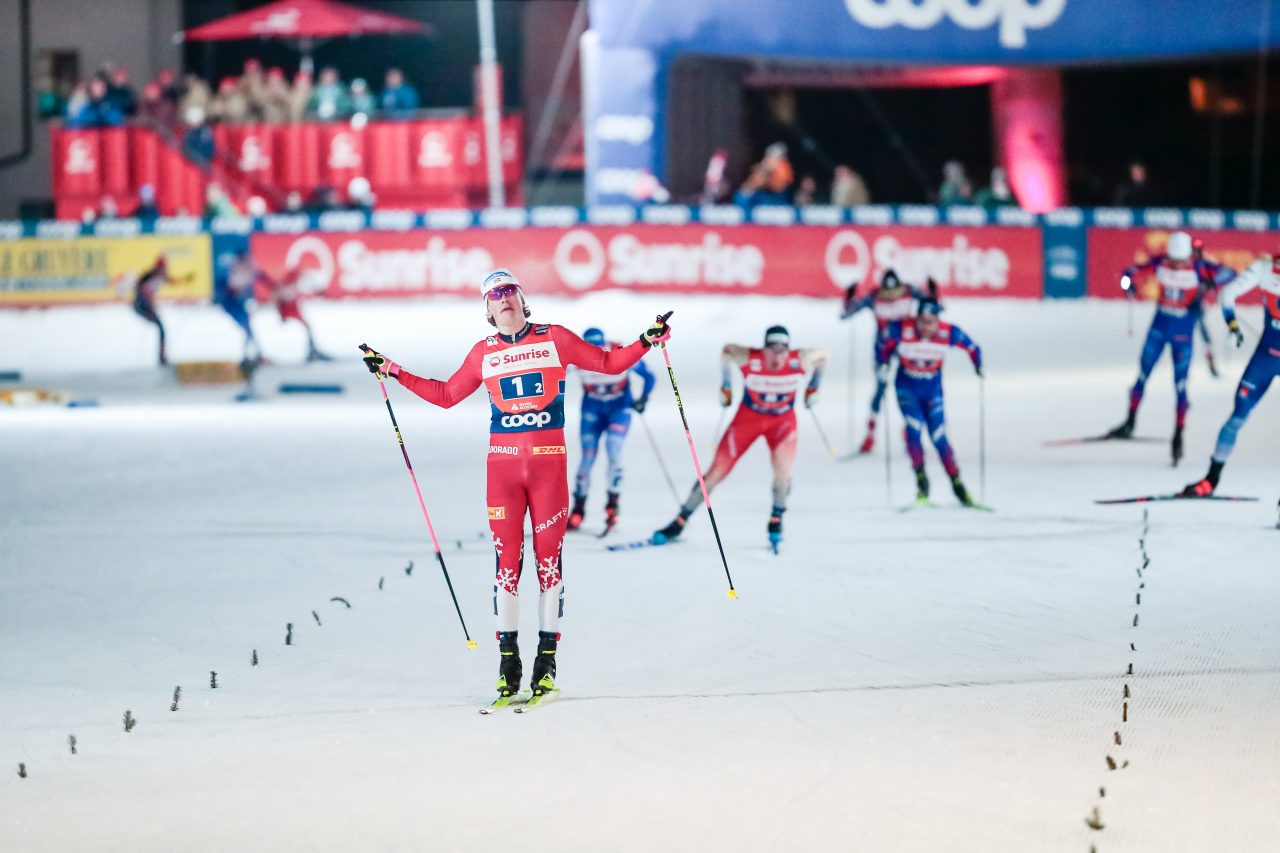
    Johannes Høsflot Klæbo, in typically dominating fashion, anchored the Norwegians to a victory in the team sprint in a World Cup in Switzerland earlier this month. (Photo: Modica/NordicFocus)

    In cross-country skiing, sprinting is a notoriously inconsistent discipline for a single competitor to dominate. The short distance leaves little time for racers to recover from even small mistakes; sharp corners and tight spaces often produce race-ending crashes.

    Which makes the track record of Norway’s Johannes Høsflot Klæbo almost impossible to comprehend.

    Klæbo, a five-time Olympic gold medalist, has won the last 10 straight sprint races he’s entered on the World Cup — the highest level of international competition. He often crosses the finish line far enough ahead of his rivals — if you can call them rivals — that he has time to unstrap his poles before crossing the finish line.

    Klæbo, 28, has won five out of the six Olympic and World Championships sprints he’s contested, and 52 of his 69 sprint World Cup starts — missing the World Cup sprint podium just once since 2018, according to data from the International Ski Federation.

    So: How do you beat this guy?

    FasterSkier, when the World Cup made its swing through Canada and Minnesota last season, decided to pose that question to an array of the circuit’s athletes and coaches. We’ve put together a kind of brief oral history below, seeking to appropriately describe Klæbo’s supremacy and the best ideas about how to take him down.

    Enjoy.

    What kind of tactics would you use to beat Klæbo in a sprint?

    Håvard Solås Taugbøl, a Norwegian World Cup racer and one of the nation’s (and globe’s) best sprinters: That’s the $1 million question. I have never managed to do it. 

    Swiss sprinter Valerio Grond: Maybe break his poles or something? I don’t know.

    French sprinter Lucas Chanavat: I mean, if I had the answer, I would have won the last one. You just focus on yourself, do the best race you can. It’s about my strengths. I think you have to be really perfect on every move you do. That’s the fun part about competing with him. It’s, like, you have to be perfect. And that’s really motivating.
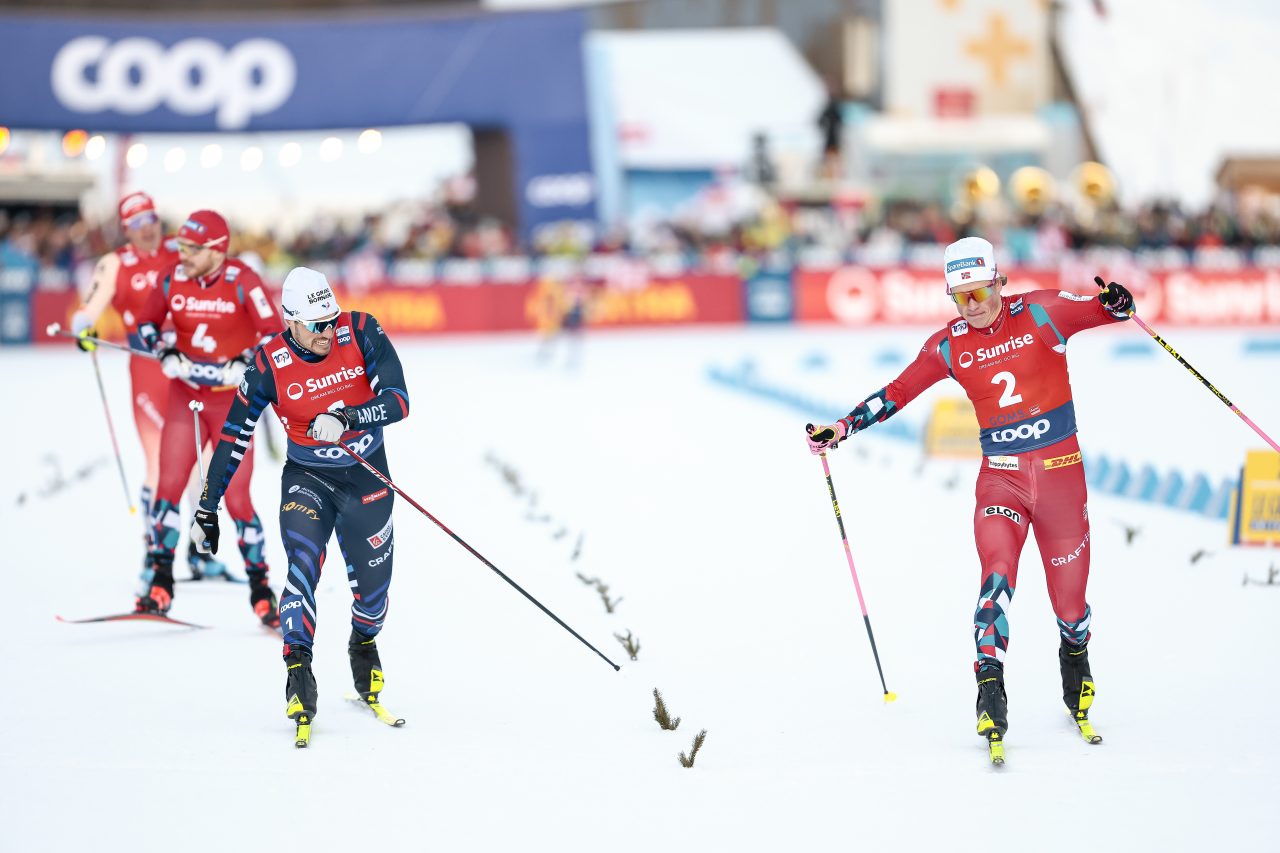
    Lucas Chanavat of France alllllmost beat Klæbo at a World Cup sprint race in Switzerland last year. But he didn’t. (Photo: Modica/NordicFocus)

    Sweden’s team manager, Anders Bystrom: I think, first of all, you have to mentally know that he’s not unbeatable. Because I think many people think so. He’s shown that he is almost unbeatable, so it’s fair that people think that. But we don’t talk about him like that.

    Jonna Sundling, the Swedish Olympic champion from 2022 in the women’s sprint: I would go hard from the start, and don’t leave any power. Just go, all that I have. I don’t think I could take him in the final meters — he’s too quick for me. The men, maybe they’re scared sometimes — I don’t know, I think they can do more than what they think they can do. Maybe.

    Maja Dahlqvist, a Swedish Olympic sprint medalist: I would try to sprint him down, like waiting til the end. But I guess a lot of people try to do that, and people are not so successful.

    Grond: If he’s in his top shape, he’s almost unbeatable. He’s really, really always in a good spot. But when he’s maybe not in the best spot, you have to take advantage of this and put in an attack.

    Canadian national team coach Robin McKeever: Break his pole? 

    Swedish sprinter Edvin Anger: I think we need to push him really hard, and take our chances. I don’t think I need to go hard early, but I think I need to have a good place. And when I take my chance, I really need to take my chance. And I need to push from the place in the track that I think is best for me. I can’t wait to see what he will do, because I need to do the thing first.

    Norwegian sprinter Erik Valnes: How to beat Johannes in sprint is all about him being in bad shape. [Laughs] I think maybe it’s about the finish — or, to be able to have a good finish after a high-speed final. There are many things that have to be right to beat him. You just need to start the finishing sprint before him, and be ahead. Because as long as you’re behind him, you’re one step behind him in the mind games as well.

    McKeever: I think the only way is by surprising him. And they’re trying.

    What makes Klæbo so good at sprinting?

    Chanavat: He’s strong in every aspect of the sprint race. He has, like, amazing turns, an amazing finishing sprint, he’s insane in stamina. He’s good at everything. He’s the GOAT [Greatest Of All Time]. 

    Grond: He’s so good in every technique and part of the race, and also tactically. He’s simply the best skier in history.

    Dahlqvist: He’s good in everything. He can go hard, he can wait, he can go from the start.

    Norwegian distance specialist Simen Hegstad Krüger: He often likes to control the heat and he gets a lot of respect. And you have — I think there’s a lot of guys that think there’s no chance to beat him so they just give him room and then they give it away to him. He has earned the respect but especially in sprint you can’t give anything away and you have to take your place and take your positions. And I think he’s the best in that but I think sometimes he gets the best positions a little bit too easily.
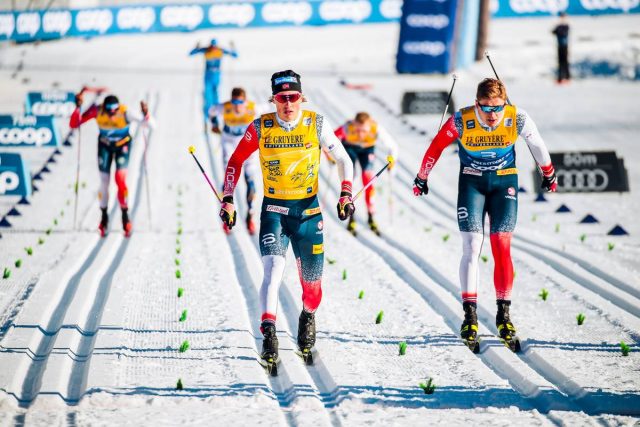
    Klæbo wins a Tour de Ski stage just ahead of his Norwegian teammate Erik Valnes. (Photo: Modica/NordicFocus)

    Valnes: I’ve been angry with myself sometimes because of bad tactical decisions. Because many times I’ve just, in my unconsciousness — you think, ‘Just follow him, and you’ll get a good result.’ But then you will not get past him.

    Bystrom: If you meet him in a heat, you almost adapt to what he’s doing. Because you have to see, ‘Okay, what’s Johannes going to do now?’ Because you know he has this X-factor in many parts of the course. 

    Does Klæbo have any weaknesses in sprinting?

    Chanavat: You should probably ask him. That would be the best.

    Klæbo: That’s going to be a secret. [chuckles] I don’t think I will tell everyone. I think I’ll keep that for myself and I’ll tell everyone when I’m done racing. That’s my answer.

    Norwegian sprinter Even Northug: Maybe none.

    Valnes: No. That’s the thing with him. He’s not having any weaknesses. You can say, like, maybe double-poling long flats. But he’s quite good there.

    Krüger: Not that I’ve seen so far. Even in distance races, it’s not so many weaknesses to find. 

    French sprinter Jules Chappaz: I think running [uphill], like in Ruka [the Finnish ski resort that hosts the season-opening World Cup races each year]. First it was the ‘Klaebo run,’ but now I think I’m really good at it. Maybe, hopefully next year in Ruka, I can run faster, beat him. [He didn’t.] He is sick a lot of times — maybe that’s sort of his weakness. 

    Klæbo coasts to the win in Ruka this year, beating everyone, including Jules Chappaz. (Photo: Modica/NordicFocus)

    Anger: It’s a hard question. But I think we need to push him and then make him a little stressed — that’s what I think.

    Bystrom: Mayyyyyybe it’s skating without poles — using your legs to be able to, maybe, go past him. But it’s really hard to say. He’s the best. He’s shown that many times. He’s so good in so many areas. It’s hard to say there’s one where you could beat him when there’s 28 areas where you can’t beat him.

    Are there ways athletes can train over the long-term, like over next summer or multiple seasons, to beat Klæbo?

    Chappaz: Just trying to focus on ourselves. This spring, I will compete in the Ski Classics [marathon races] to improve my double poling. To look to the Olympics, 2026, with the Val di Femme finish — I hope it will improve my double poling skills, to [be able to] beat him.

    Dahlqvist: Maybe they need another team like us, like the Swedish women, because you can use your team more. So, maybe a whole team needs to be stronger, to try to beat the Norwegian. They could do team tactics in a way, like everyone knows where they will go. 

    Anger: I’m still young — I’m just 21 years old. And he has a lot of training hours. A lot more than I have. With one or two years more, with good summers, also with a lot of hours, I think it will be better for me. And maybe I will be better in the final — I’m good in the quarters and the semis right now, but maybe I miss a little in the finals. I need to be a little harder and stronger.
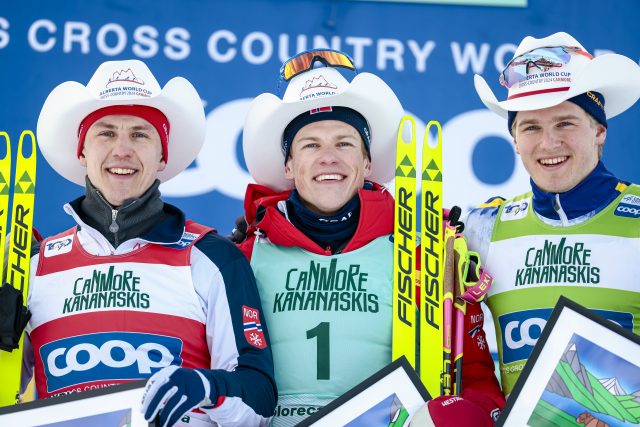
    Valnes, Klæbo and Anger pose for a podium photo after Klæbo won a World Cup sprint in Canada last year. (Photo: Modica/NordicFocus)

    Grond: We’ve just got to work hard. It’s also about learning how to ski against the best skier, for me. So, I’m trying, also, to get some experience on how they ski and where I can be better than them.

    Valnes: It’s more about improving the base level, the capacity, the VO2 max. If you have that base, from May until September, then you can build a little bit on that with specific training in October and November and just before the season starts.

    McKeever: The reality is, how do you beat Klaebo? Have him age out a little bit. 

    Northug: Training.

    Norwegian national team coach Eirik Myhr Nossum: You have to train, of course. But there were a lot of people training for the 100-meter dash, as well: Usain Bolt still won. So, if everybody in the world trains the best they can, still one will win — and it’s hard to beat Johannes. It’s possible, but he’s probably the best skier that’s ever been. And now it’s harder than ever, and he still wins.


  • Golberg Outsprints Klaebo to Claim Gold in Men’s 50 K, Patterson 16th

    Golberg Outsprints Klaebo to Claim Gold in Men’s 50 K, Patterson 16th

    This World Cup coverage is made possible through the generous support of Marty and Kathy Hall and A Hall Mark of Excellence Award. To learn more about A Hall Mark of Excellence Award, or to learn how you can support FasterSkier’s coverage, please contact info@fasterskier.com

    The long and winding road that is cross-country skiing’s World Championships came to an end today. The last stop: the men’s 50 kilometer Classic Mass Start. Throughout the men’s competitions, the story has been Norway; Johannes Klaebo’s domination, team Norway’s supremacy, and the competition amongst the Norwegian team members. Norway was expected to dominate again today, but there were many sub-plots within that expectation: one of the biggest was the performance of  Klaebo.  Touted by some as the greatest ever, but skeptics note that Klaebo hasn’t been nearly as impressive in distance events as other legendary skiers who came before. Klaebo has never been on the podium in a 50 kilometer race at a major event. To cement his name in conversations about G.O.A.T status, Klaebo would probably need to have a victory. He would also be trying to redeem himself after having been disqualified at the finish in the last World Championships 50 kilometer race when he interfered with Alexander Bolshunov (RUS).

    Standing in Klaebo’s way would be what appeared to be a busload of Norwegian men. Finnish Classic standout Iivo Niskanen—who always seems to perform well in major events—would also present a major roadblock, with his eyes firmly on the podium in a long Classic race: his forte. America would look to Scott Patterson to lead the way for team USA, with Patterson having previously placed in the top 10 at 50 k in the Olympics and World Championships.

    When the end of the World Championship Road was reached, it was Norway dominating again but with a somewhat surprising finishing order. Golberg finished first, out-sprinting Klaebo at the finish. William Poromaa (SWE) was third.

    Scott Patterson (USA) had another excellent distance race for team USA finishing 16th (Photo: NordicFocus)
    Men’s 50 kilometer Classic Mass Start

    In 40 degree weather (4.4 C), with slow wet conditions, it was apparent early that the seven lap course would make for a race of attrition. It was also clear that the single allowed ski change could play a critical role.

    As is typical in men’s distance racing, the skiers set out at an initially fast pace, then quickly settled down into the long grinding speed that would typify most of the race.

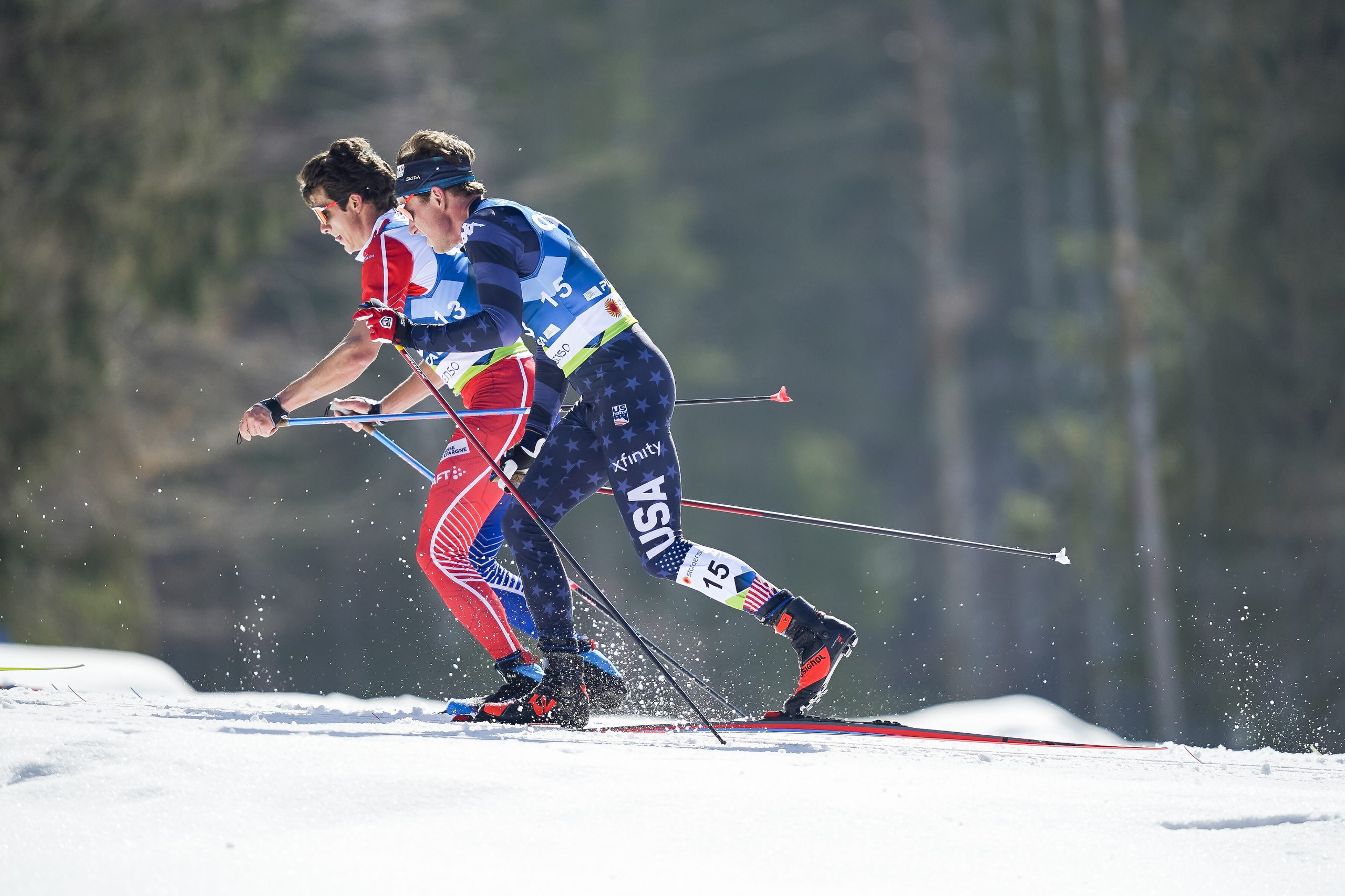
    Scott Patterson (USA), was able to hang with the leaders early on. (Photo: NordicFocus)

    At the 4.3 k mark, it looked good for team USA with Patterson at the front of the race. Also near the front was perennial crowd favorite, Andrew Musgrave (GBR).  But as the race ground on the favorites began to rise to the top, while the Americans and Musgrave drifted back.

    Much to everyone’s surprise, Johannes Hoesflot Klaebo (NOR) was out-sprinted at the finish. (Photo: NordicFocus)

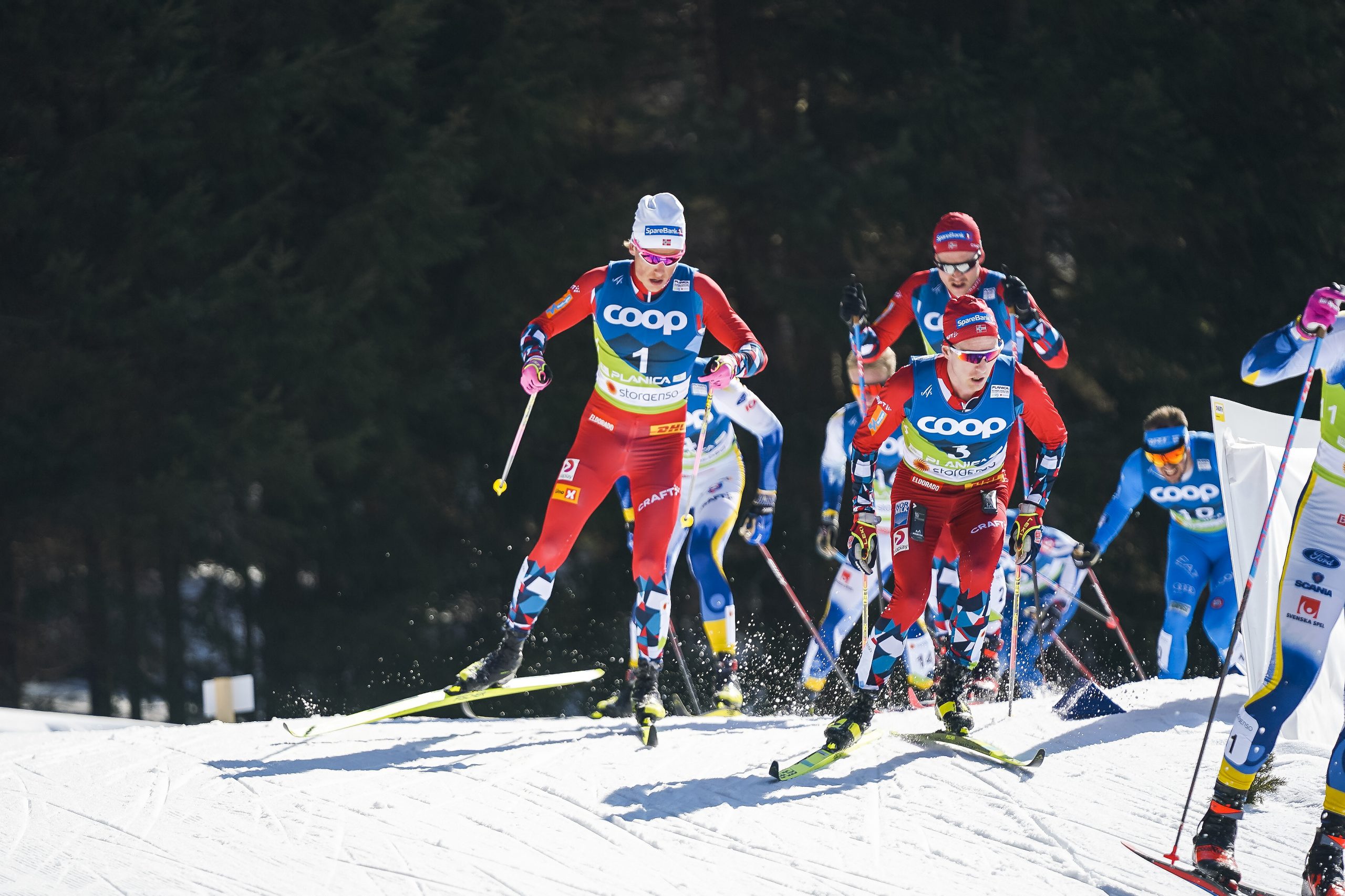
    At 6.4 k, two Italians—Federico Pellegrino and Francesco De Fabiani—joined Golberg at the front to quicken the pace. Klaebo was 23rd, but only 5.2 seconds back. At this juncture, Klaebo’s strategy became clear. He would not lead. Instead, he would be content to mark the leaders the entire way and then rely upon his devastating sprinting ability to bring in the win. It was a sound strategy for the strongest sprinter in the field, but one that would not pan out today.

    With the abundant heat and sun, the nutrition hand-ups were frequent, giving skiers an opportunity to make a move when others were being handed food and drink. This is exactly what Niskanen did at the 13 k mark; taking five skiers with him. This was the first time in the race when the field truly began to string out. But, during the next feed, the front of the race regrouped. This elastic effect continued throughout the next several kilometers with surges and contractions geared around hills, corners, and feed zones.

    It was at about the halfway point when the hot grind of an hour’s racing began to take its toll and a true lead pack of about 13 skiers established a gap with Golberg and Nyenget still setting the pace. Golberg had now been out front for the last five kilometers.

    David Norris (USA) finished 22nd having won the American Birkebeiner Saturday, then flew to Europe to race in the World Championships. (Photo: NordicFocus)

    The North American contingent was led by Wonders, Patterson, Gus Schumacher (USA), David Norris (USA) and, Oliver Leveille (CAN). All were in a chase group 14 to 22 seconds off the lead. Fans were eager to see how Norris would perform. He won the American Birkebeiner last Saturday and made the unprecedented decision to fly to the World Championships to race the marathon. After the race, Norris told FasterSkier that he had arrived Tuesday morning and was satisfied with the way his body had adapted. He forced himself to stay up late every night to adjust to jetlag. “I don’t think jetlag was affecting the race at all.”

    At 28.4  kilometers Toenseth made a push to the front. Klaebo, who still had not led, was just a couple of seconds behind the leaders. The grinding race of attrition continued and it became clear that the winners would come out of the lead pack of 13 skiers. A surprise skier in the lead group was Snorri Einarsson of Iceland. Einarsson would go on to have one of his best finishes ever, finishing 15th.

    With two laps remaining, every one of the now 11 lead skiers opted to stop at the ski exchange. During the exchange, there was a crash involving Niskanen and Jens Burman (SWE),when Niskanen cut in front of the Swede on his way into the ski corral. The tangle knocked Burman to the ground but didn’t seem to harm his time in the exchange or affect Niskanen.

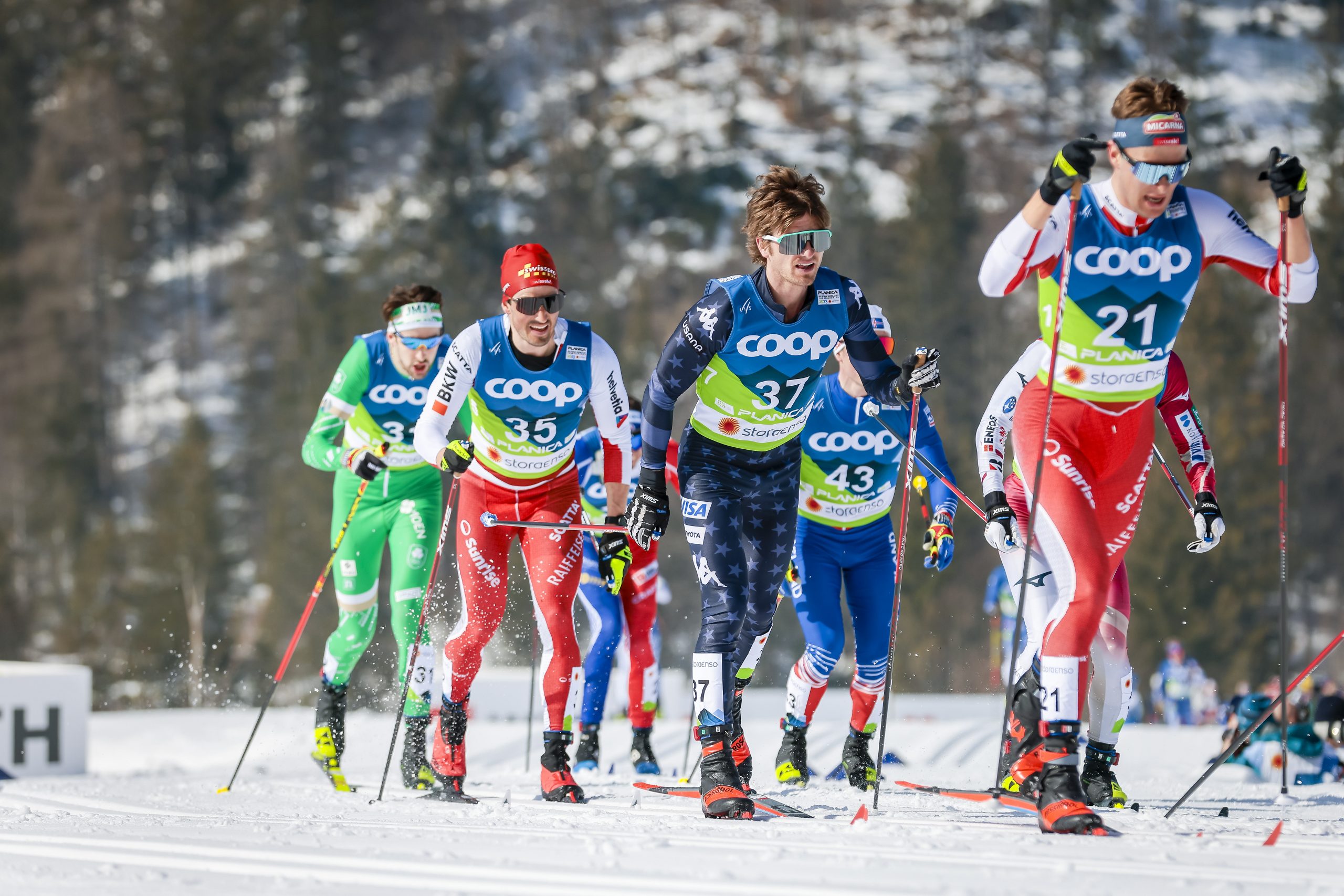
    David Norris (USA), Scott Patterson (USA), Gus Schumacher (USA), (l-r) were able to ski as a pack in the middle stage of the race. (Photo: NordicFocus)

    The biggest surprise in the lead group was the presence of 23 year old Frenchman, Theo Schely, who is somewhat of an unknown outside France. Schely does not have a top 20 finish in a World Cup distance race, but was seemingly undeterred by the pace. He ended up finishing ninth in what was unquestionably the second biggest surprise of the day.

    At about 43 kilometers the action livened up as Burman crashed in a corner, pushing him toward the back. At about the same time De Fabiani (ITA) broke a pole, and he was pushed out the back. With five kilometers left the race had boiled down to all the favorites with nine skiers lining up for finishing attacks. Toenseth dialed up the pace with Niskanen going along with him. Niskanen continued to push the pace—hard—but was unable to pull away from the chasers. But this reduced the field to only seven skiers, with Poromaa going with Niskanen at the front. Klaebo still sat in the middle of the pack, matching the leader’s moves but never leading.

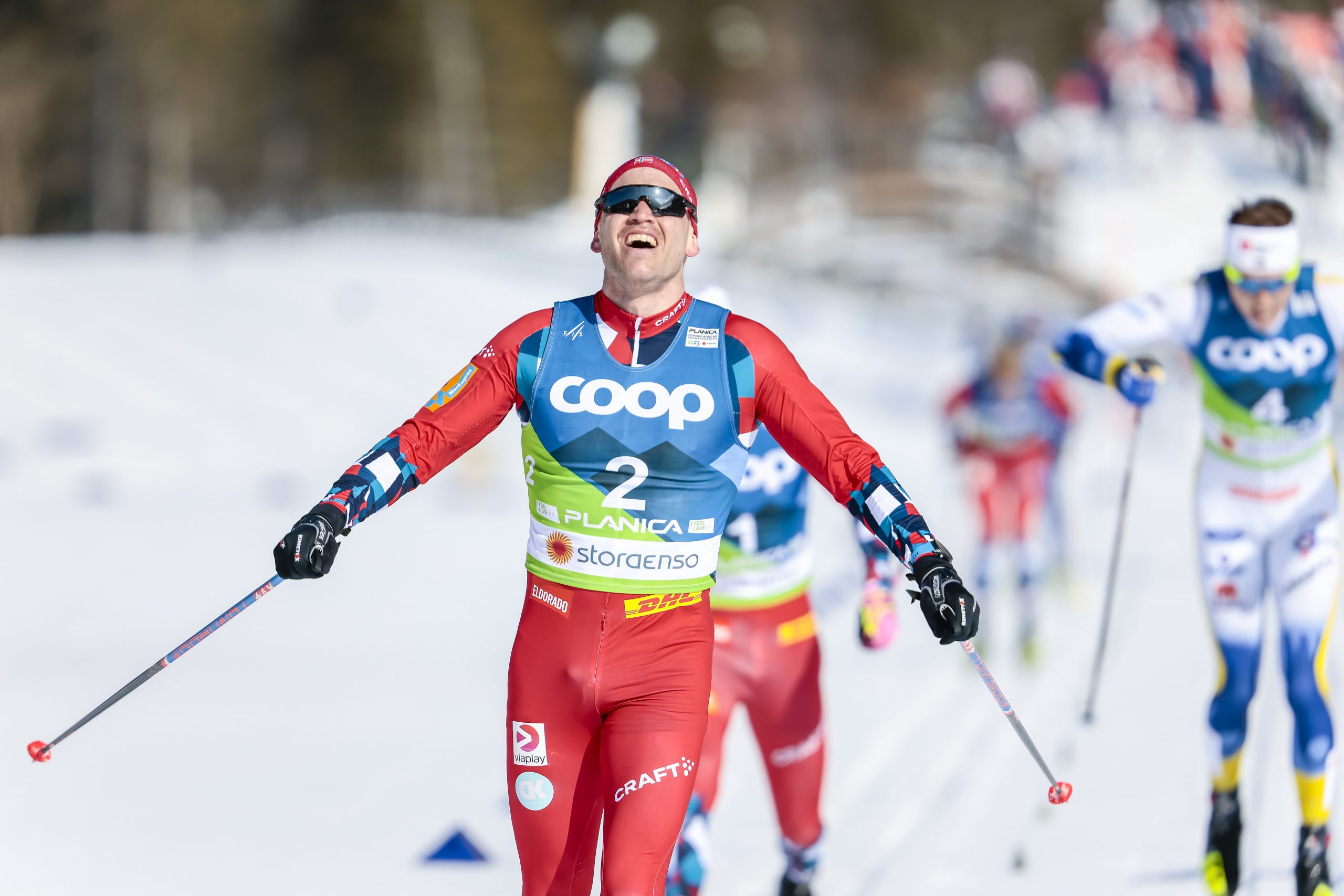
    Paal Golberg (NOR) celebrates at the finish having just shocked everyone—himself included—by sprinting past Johannes Klaebo (NOR). (Photo: NordicFocus)

    At the two hour mark, with one kilometer to go, the race turned into an all out sprint with Golberg pushing to the front and Klaebo going with him in second place. It was here where the biggest surprise of the day took place. The pace was blistering with Klaebo charging up the final hill. Everyone watching expected Klaebo to turn on his famous sprint and pull away. But Golberg had a devastating sprint which Klaebo could not match.  Klaebo faded in the last 100 meters and Goldberg surged, pulling away from Klaebo, putting him in second place, with Poromaa hanging on to finish third. After the race Golberg admitted his surprise in beating Klaebo. “I had amazing skis,” he said. “I didn’t think I could take Johannes.”

    Regarding the race’s finish Norwegian, coach Eirik Nossum said that he was “really impressed by Paal [Golberg]. He’s had such a good season, today is icing on the cake. Every guy who beats Johannes in a finish is shocking, but it’s hard to have a sprint after 50k. You can’t just order it…it’s hard…even for Johannes.”

    William Poromaa (SWE) ended Sweden’s medal drought, finishing third. (Photo: NordicFocus)

    It was also a big day for Sweden. Head coach Anders Bystrom told FasterSkier that, “finally we got the medal, and it’s so important for the whole sport in Sweden. The women are so great, the men have been in the shadow of the women, so this is really important.” Calle Halfvarsson, who finished fourth reiterated to FasterSkier the medal’s importance to Sweden. “We, the men, don’t yet have any medals,” he said. “It was really good that we could take [a medal].” Halfvarsson also commented on Klaebo’s performance in distance events: “Today showed that Klaebo is human. “

    After the race, Patterson told FasterSkier that he had missed a couple of crucial feeds. He also expressed dissatisfaction with his race tactics. “I should have swapped [skis] earlier.”

    Schumacher told FasterSkier that “My energy definitely tailed off towards the end, but I felt like I skied well the whole time.”

    At the end of the World Championship Road, Norway was still supreme with only the finishing order being a shocker: Golberg outsprinting Klaebo at the finish, stunning the crowd and completing the World Championships on a surprising note.

    Johannes Hoesflot Klaebo (NOR), Paal Golberg (NOR), William Poromaa (SWE) celebrate podium finishes to cap off the World Championships. (Photo: NordicFocus)

    World Championship Men’s 50 K Classic Mass Start RESULTS