Tag: Anders Gloeersen

  • Jönsson Strikes Again, Powers to Sprint Victory

    Jönsson Strikes Again, Powers to Sprint Victory

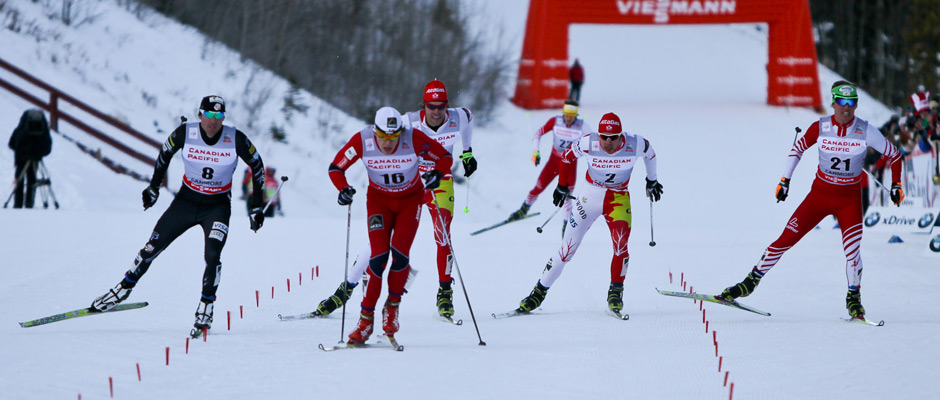
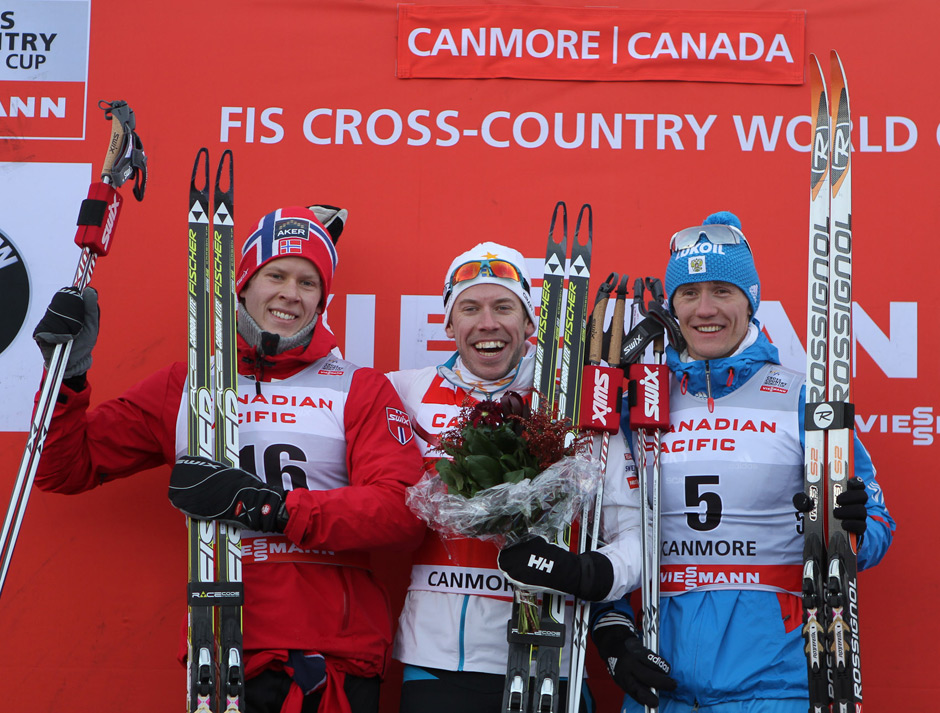
    Men’s Sprint Podium (l-r) – Anders Glöersen (NOR), Emil Jönsson (SWE), Nikita Kriukov (RUS)

    Coverage of the Alberta World Cup made possible through the generous support of Travel Alberta and Tourism Canmore.

    CANMORE, Alberta — Domination is a strong word, and one that is often overused when describing athletic performances, there is no better choice when Emil Jönsson (SWE) and Canmore, Alberta are concerned.

    With his victory today in the World Cup freestyle sprint, Jönsson has now won three of four sprint starts at the Canmore Nordic Center.  Add the fact that he also posted the fastest qualification time in each of those races and it is an understatement when he says, “I really like this place.”

    On a new Canmore sprint course that featured a series of tough climbs, followed by a long descent to the finish, Jönsson used patience and a devastating kick to ski clear in each of his heats.

    All World Cup races end the same way in Canmore — down a long, fast descent into a slight grade up to the finish. Generally head-to-head competitions will be settled here, and in the men’s sprint race, the first two-thirds of the race was virtually irrelevant.

    “In this course, it is definitely not over until the finish line,” said Anders Glöersen (NOR), who finished second to Jönsson. “If you are ten meters behind on the top, you can still be first in the finish.”

    Both men employed a similar strategy of hanging back up the hills, working to slot into a favorable drafting position before hammering the homestretch — though they came by it for different reasons.

    Jönsson told FasterSkier that he initially planned on attacking over the top of the final steep hill. The course then flattens for 100 meters before the descent, making it the perfect spot for a get-away.
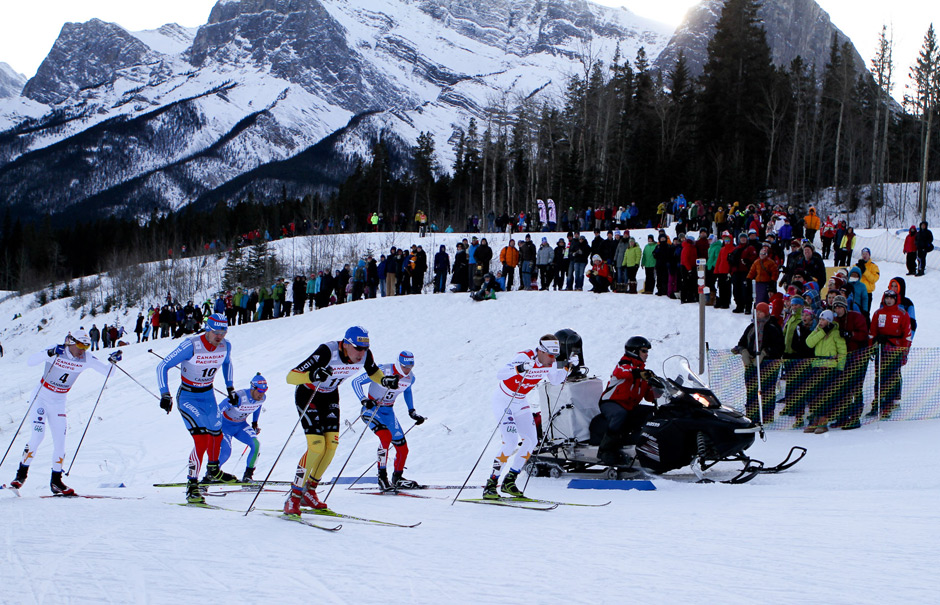
    Jönsson and Tim Tscharnke (GER) headed out in the semifinals. Jönsson would drop back before the downhill.

    But after watching the women’s quarterfinals he realized that being behind on the downhill was key.

    He aimed to be in second or third on the descent, and succeeded each time. As the grade flattened, he would step out and engage the afterburners, moving without apparent effort into the lead.

    The Swede had no more information than anyone else, yet others tried to ski from the front, with generally poor results. There were certainly exceptions, including Jesse Cockney (CAN), who led his quarterfinal wire to wire, but in a Groundhog Day moment, the same scene replayed over and over throughout the day — early leaders swallowed up in the homestretch, left to straggle across the line, perhaps ashamed at their audacity to think they could somehow be different.

    Glöersen said that over the past several years he has pushed the pace in sprint races, trying to tire out the opposition. This strategy has yielded him seven World Cup podium appearances entering today’s race, but when he felt poorly early in the day, he made an adjustment.
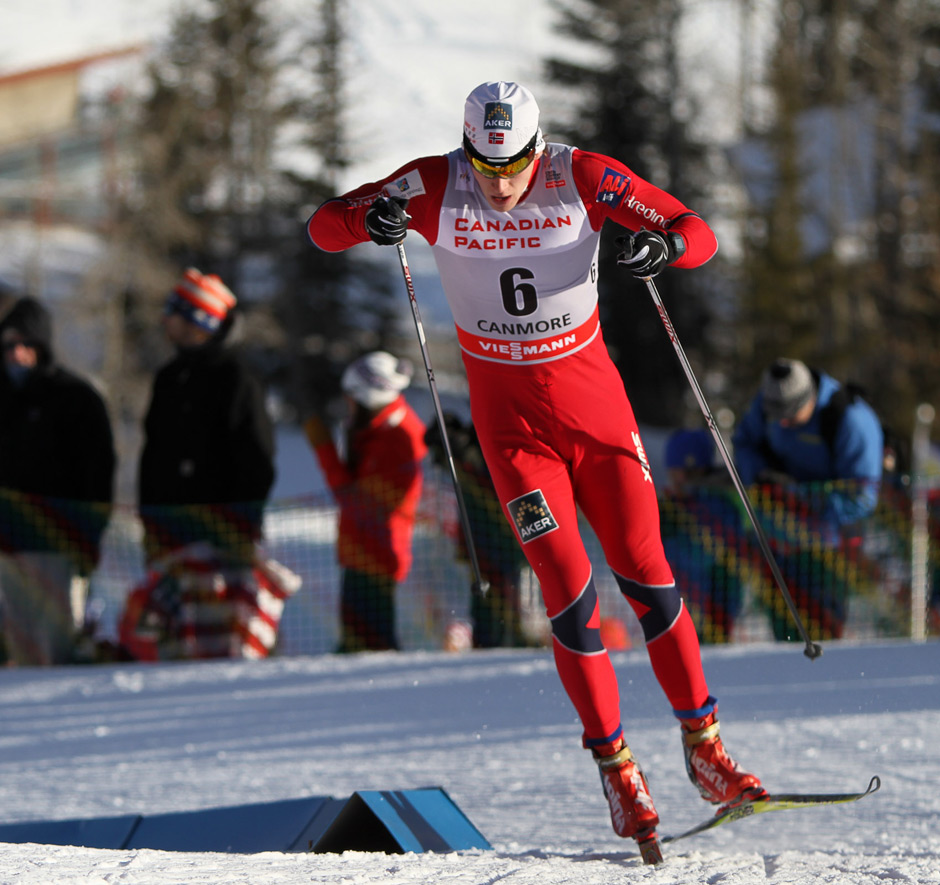
    Glöersen in qualifying. He posted the 16th fastest time.

    Like Jönsson he remained content to sit in the pack., conserving energy for the sprint to the line.

    The plan worked to perfection. He also won each of his first two heats, before running into Jönsson’s closing speed.

    “I never sprinted as good in the last 100 meters as I did today,” Glöersen said. “I am very satisfied with that.”

    Tim Tscharnke (GER) led out of the start in the final, pushing the pace, but it was the Water Boy, Federico Pellegrino (ITA), who poured it on over the top. Like those who came before him, however, he was doomed at the front.

    The entire heat came by, led by Jönsson, leaving the Italian in 6th. Nikita Kriukov (RUS) followed Glöersen to the line, edging Tscharnke for third.

    “No one,” Kriukov said in broken English, “have a chance to win before the last downhill.”

    While the likes of Pellegrino made the heroic, if foolish, attempt to break away, there was constant competition for the prime spots back in the pack.

    “It is pretty tough to get that spot,” Jönsson said. “It is a little different from what we are used to. Then everyone wants to be in first. Now everyone wants to be second or third.”

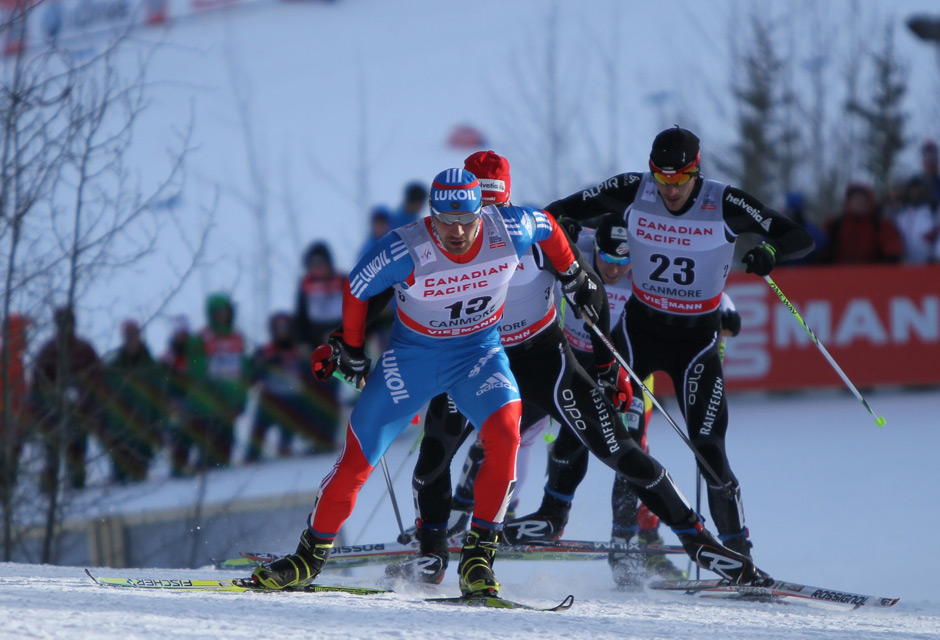
    Proper positioning entering the descent did not ensure success. With as many as six skiers heading down the finish straight together, and just four lanes, real estate was scarce.
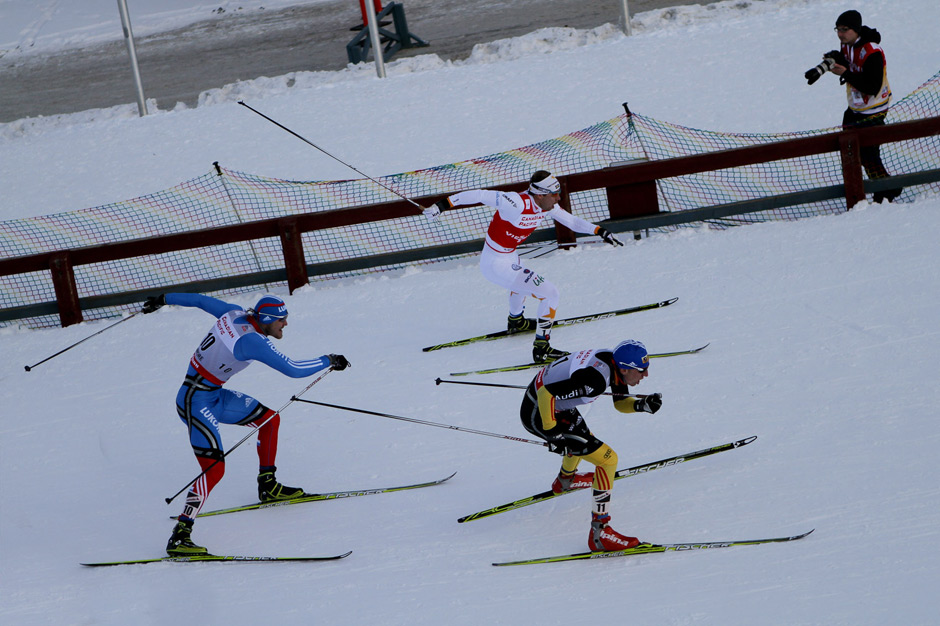
    Jönsson (top) headed into the finish stretch in the semis.

    Jönsson used his superior speed to find open space while Glöersen seemed to find a hole each time.

    He attributed this success to luck, and maybe some skill. Either way, when he got some space, he “went flat out,” and with power to burn from his conservative approach early on, none other than Jönsson could best him.

    Times clocked in at just over two-and-a-half minutes, short for a men’s sprint race, but both Jönsson and Glöersen were clear that this did not make for an easy race.

    The Norwegian commented that the snow, especially on the climbs, was not fast and Jönsson pointed to the altitude as another complicating factor.
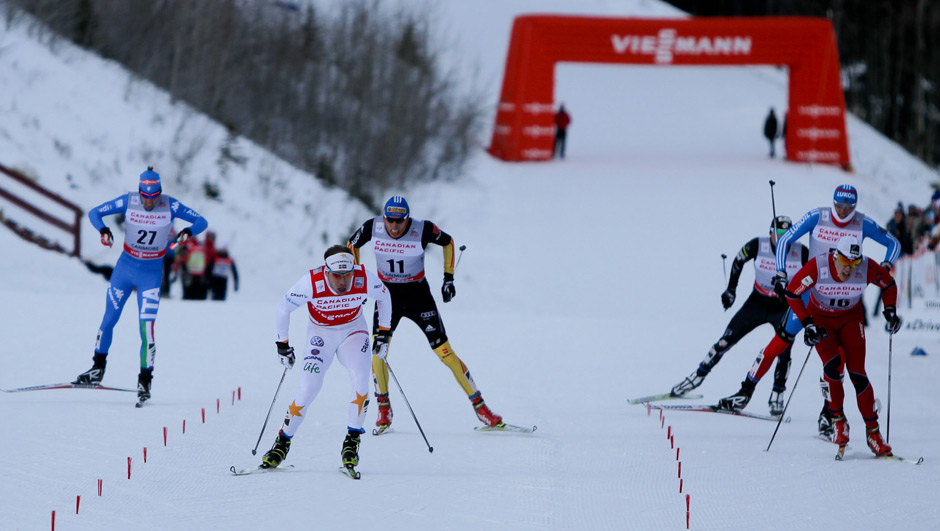
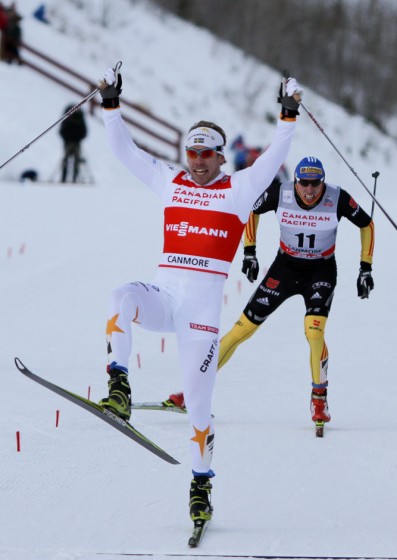
    Jönsson headed for victory.

    “You can feel it in the legs that you are not used to this,” Jönsson said. “If you go a little bit too hard up, then you are smoked. You have to listen to your body all the time and listen to your legs…to have some power left.”

    When asked if he if he likes the fast Canmore finish, Jönsson hesitated before laughing and saying “I must say yes…today I can’t complain.”

    He elaborated, adding that in the past he prefers a homestretch that is “a little tougher.” He pointed to Quebec and the steeper run to the line without a descent as an aid, a finish where “you need to struggle a little bit more.”

    Results

    Of Note:

    – The Swiss, who raced a NorAm sprint on this course two weeks ago, qualified five men, but none advanced out of the quarterfinals. They were generally agressive on the climbs, with little success.

    – Harald Wurm (AUT) placed 8th after crashing in Quebec and finishing the race on one ski. Wurm was joined in the semis by teammate Bernhard Tritscher, who placed 12th.

    – Russian Alexey Petukhov failed to advance out of the quarterfinals and placed 22nd.

    – 2012 Sprint Cup Champion Teodor Peterson (SWE) was 48th.

    – Six different nations were represented in the final.
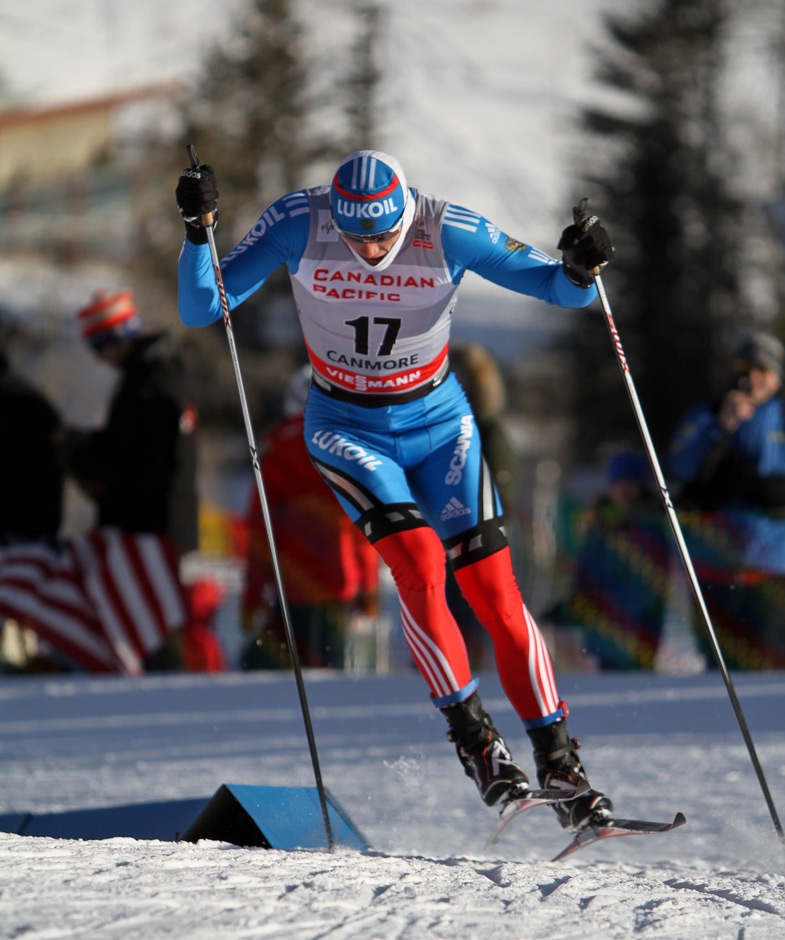
     

    Kriukov in qualifying. He was 5th.
    Glöersen winning his semifinal. Andy Newell is to the left and Jesse Cockney (CAN) to the right.
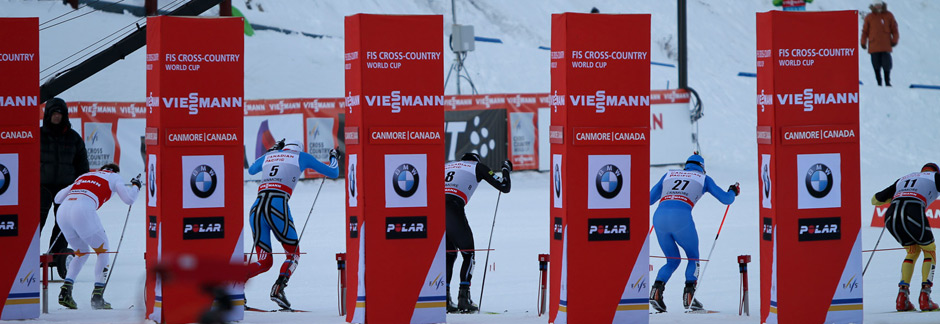
    Out of the start in the final.
    Mikhail Devjatiarov leads the second quarterfinal up the big climb.

    Emil Jönsson (SWE) celebrates his sprint victory in Canmore.
     

  • Kershaw Pushes Pace in Moscow Sprint; Peterson Wins

    Kershaw Pushes Pace in Moscow Sprint; Peterson Wins

    Moscow
    Devon Kershaw (CAN) en route to placing third in the World Cup 1.5 k freestyle sprint in Moscow on Thursday. (Photo: Fischer/Nordic Focus)

    (Note: This recap has been corrected to include that Devon Kershaw previously made the podium in a World Cup freestyle sprint in 2006.)

    Maybe it was the frigid temperatures that scarcely rose above 2 degrees Fahrenheit, -17 degrees Celsius, on Thursday. Maybe it was Moscow. Maybe it was Canadian head coach Justin Wadsworth’s promise of a Hawaii trip if all went well.

    Devon Kershaw said he wasn’t sure what possessed him on Thursday, but it likely wasn’t anything superficial. Throughout the World Cup 1.5-kilometer freestyle sprints in downtown Moscow, the 29-year-old approached each heat with a similar mindset and unwavering focus.

    To start, Kershaw jumped out of the gate to post the fastest qualifying time of 3:05. It was the second time in his career that he won a World Cup prologue. When it happened nearly three years ago, he went on to place 26th overall. This time, things played out differently.

    A commanding leader at the end of both his quarterfinal and semifinal heats, placing second in the latter by 0.1 seconds to Sweden’s Teodor Peterson, Kershaw chose to stick with his tactics in the final. Once again, he sprang several meters ahead toward the end of the loop, but Peterson recovered and hung on.

    About 100 meters before the stadium finish, Peterson pushed ahead and four others behind Kershaw closed in. With Peterson just ahead of Kershaw on the right side, Norway’s Anders Gloeersen passed Kershaw on the left and edged the Canadian for second.

    The men's podium at the World Cup 1.5 k freestyle sprint in Moscow: from left to right, Anders Gloeersen (NOR) in second, Teodor Peterson (SWE) in first, Devon Kershaw (CAN) in third. (Photo: Fischer/Nordic Focus)

    Peterson lunged for the win in 3:08.4 and Gloeersen was second by 0.1 seconds. Kershaw pulled off third (+0.6) for his second-straight bronze since the 15 k classic in Otepää, Estonia, nearly two weeks ago. It was his first time back on the podium in a World Cup sprint since 2006.

    “I have no idea why I’ve been feeling really good the last few weeks,” Kershaw said in a phone interview on Thursday. “It’s actually blowing my mind a bit right now.”

    His national team coach, Wadsworth was particularly impressed with Kershaw in his qualifier and quarterfinal, considering the slow snow on the flat course with little rest.

    “He crushed his quarterfinal,” Wadsworth said. “I’ve never seen him ski so fast in one of the rounds.”

    In a recent interview, Kershaw said he had been dealing with distractions, which he overcame while racing. Before placing third in Otepää, he finished fourth overall in the Tour de Ski in early January.

    “It’s been a really messed-up month and I don’t know why its been going so well, but I’ll take it,” Kershaw said.

    Pleased with how his body felt all around, especially in the qualifier, Kershaw said he might have been too aggressive in the final when he attacked the last of two small hills.

    “I thought I was strong enough to take the win that way,” he said. “My legs were feeling light and not filling up with lactic acid. It was working until it didn’t work. … Gloeersen and Teodor were just too fast in the last 50 meters for me.”

    Looking back, Kershaw said he might have timed his move around the single-file group wrong, but he needed to drop the others.

    “I didn’t want to leave it to the best sprinters in the world to take,” he said. “I wanted to at least take some people out of contention.”

    Coming off a classic sprint victory at Swedish nationals, Peterson had never won an individual World Cup freestyle sprint. At the start of the season in Düsseldorf, Germany, he won gold in the freestyle team sprint with Jesper Modin. Peterson later placed second in a skate sprint in Davos, Switzerland, and third in Milan, Italy.

    On Thursday, the 23-year-old played his positioning right, hanging toward the back and conserving energy as needed.

    “It felt really good today; I had very good skis and also knew that I was stronger for each heat,” Peterson said in a translated interview with Langd.se.

    Fifth in the qualifiers, 3.12 seconds behind Kershaw, Peterson went on to place second to Oeystein Pettersen of Norway in a neck-and-neck quarterfinal finish. He edged Kershaw in the semifinals, and the two set such a fast pace that Nikolay Morilov (RUS) and Gloeersen, who placed a respective third and fourth, advanced as lucky losers.

    Gloeersen similarly waited for the opportunity to strike late in the final, skiing in sixth for most of the race.

    “For a few seconds, I even thought I could win, but Teodor was too strong today,” he told FIS News. “However, I am really satisfied.”

    Russians Gleb Retivykh and Morilov led early, but it didn’t take long for John Kristian Dahl (NOR) to take over second behind Retivykh, the second fastest qualifier. Dahl later fell behind and was ultimately disqualified for obstruction.

    Morilov finished fourth, Retivykh placed fifth, and Dahl was relegated to sixth.

    With Kershaw’s podium, the Canadians continue a streak of nabbing a top-4 spot in every World Cup race since the Tour de Ski. Alex Harvey, who was ninth on Thursday, finished fourth in the classic sprint in Estonia to start the trend.

    Also qualifying for the semifinals in Moscow, Lenny Valjas went on to place 12th, making the Canadians the second-most dominant crew in the men’s sprint. Norway had four in the top 12; Canada had three.

    Despite falling shy of the top country, Kershaw said Wadsworth would likely take them to Hawaii at the end of the season regardless of future results.

    “Justin’s a softie,” Kershaw said. “He talks a whole lot of trash about not taking us to Hawaii in case we don’t get these World Cup podiums.”

    Men’s results

  • Cologna Dominates in Otepää for Classic Sprint Victory

    Cologna Dominates in Otepää for Classic Sprint Victory

    Cologna in early action during the 2012 Tour de Ski.

    From the qualifier through to the A-final, recently crowned Tour de Ski champion Dario Cologna (SUI) skied a “perfect” sprint day by all accounts in Otepää, Estonia on Saturday.

    The current overall World Cup points leader made a statement from the word get-go, posting the fastest qualifying time by an unbelievable 4.2 seconds in a 1.4 k classic. He then went on to decisively win his quarter, semi and final heats. Ola Vigen Hattestad (NOR) and Eirik Brandsdal (NOR), who finished second and third, both said that runner-up was the best they could hope for.

    “It was a perfect day for me,” Cologna said in a press conference after the race. “I had a good qualification and I got self-confidence for the heats.”

    Self-confidence may have been a factor in his victory, but the sheer force behind every plant of Cologna’s double pole was not to be messed with. If his tempo looked moderate, it was only because each stroke generated so much forward momentum.

    “I did not have a chance against Dario,” Hattestad said.

    Canada’s Alex Harvey lunged for the finish line in an effort for third, but crossed it just shy of the podium for fourth.

    While the women’s race featured a high-profile showdown between the two of the biggest names in cross-country, the men’s became, quite literally, an arms race. The compact, slow snow made for finicky kick conditions, and prompted a large majority of the men’s field to swap their classic skis for slicker skate equipment.

    If Cologna’s 4.2-second gap in the qualifier on skate skis didn’t prove that double poling was the way to go on Saturday, the first round of heats certainly did.

    Ola Vigen Hattestad (NOR) in action during the Tour de Ski earlier this month. He was second on Saturday.

    In the first quarterfinal, Cologna started off trailing Russia’s Anton Gafarov, but quickly closed the gap in the first few hundred meters. Several Russians decided to stride, and the mistake became apparent on the first uphill. Cologna gapped Gafarov with his double pole as the Russian’s kick faltered. Cologna’s strength may have been superior in any case, but throughout the heats, striders repeatedly lost time — on the uphills, no less — to those powering through with their upper bodies.

    For those who knew their arm strength was lacking, however, the choice to go with skate skis was more of a gamble. The third quarterfinal, which included Harvey and teammate Lenny Valjas (CAN), exposed those who had the muscle to efficiently push through an entire sprint course more than once and those who had spent everything they had in the qualifier.

    Peeter Kummel (EST) led Valjas up the first climb, with Harvey skiing just off their back. Going into the second hill, Harvey made up time on the front, and skied beside Kummel and Valjas. Down the other side, it looked as though fast skis might propel both Canadians onto the next round, but somewhere in the final straight, Valjas’s arms ran out of gas. Harvey double poled away to advance comfortably along with Kalle Lassila (FIN), while Valjas suffered through the finish on fumes in fourth, ending 21st overall.

    “I’ve never felt that way in a race before,” Valjas said of the pain he’d just experienced.

    The next quarterfinal featured the second-fastest qualifier, Gleb Retivykh (RUS) and Andy Newell (USA), who had the ninth-best qualifying time. Retivykh burst from the gate fast and led with a strong stride up the first hill with Igor Usachev (RUS) and Sami Jauhojaervi (FIN) in the chase. Newell skied off the back, but managed to gain ground steadily coming up the final hill, as striders lost ground to the double-polers. Retivykh developed an unbeatable gap down the other side, and Newell moved into third behind Johan Edin (SWE).

    In the final 300-meter straightaway, Newell’s stronger finishing tempo moved him through to the semis, his first shot past the quarters this season.

    “I’ve been feeling good all year, so it’s nice to have a clean quarterfinal,” Newell said.

    The fifth quarterfinal was the closest yet — Oeystein Pettersen (NOR) led out of the gate, and all six skiers double poled for the whole heat. Nikita Kriukov (RUS) slowly edged up on Petterson, and it came down to a photo finish between the two, with Kriukov barely nosing by. Anders Gloeersen (NOR) failed to make up the gap in time and was 0.1-seconds off the pace in third.

    As expected, racing got more furious in the semifinal round. Cologna continued to demonstrate his control, skiing from the front for most of the heat. Gafarov once again took the lead for a brief time, but Cologna led the takeover pack and put impressive distance between himself and the rest of the field on the second big climb. The real race was the one for second; Brandsdal eventually bested his teammate Hattestad.

    Harvey during the final climb of the Tour de Ski. He just missed the podium in Otepää, finishing fourth.

    Harvey, Pettersen, Kriukov, Newell, Alexander Panzhinskiy (RUS) and Gleb Retivykh (RUS) took to the line for the second semifinal — it was seemingly anyone’s race. Kriukov led the Russian trio out of the stadium, with Harvey just behind Petterson and Newell off the back.

    Up the first climb, Harvey clearly wanted to move by, but couldn’t immediately find an opening. Petterson shifted and Harvey moved through the hole, and from then on out steadily gained on the striding Russians — his real advantage came on the final downhill, as his skis were clearly faster. Harvey and Petterson went 1-2 through the final straight, with Kriukov in a close third.

    Behind them, Panzhinskiy and Retivykh tangled up and crashed right in front of Newell, who slipped by without falling, but not before getting his ski skewered by an errant pole. Momentum lost and base dragging, Newell crossed the line five seconds off the pace in fourth, but still finished a season-best seventh overall.

    The A-final featured a stacked lineup: Cologna, Harvey, Pettersen, Brandsdal, Hattestad and Kriukov. All six men were on skate skis, and double-poled their way up, down and around the course. The group remained virtually as one pack, Cologna always in the front, until the second climb, when the top four put a gap on Kriukov and Petterson.

    Cologna, Hattestad, Harvey and Brandsdal remained close down the final hill and into the stadium, drag racing out of the right-hand corner into the straightaway. All four turned on the backburners, and Cologna opened up just enough of a gap to comfortably raise his hands in triumph over the line. Harvey, who had been skiing even with Brandsdal and Hattestad, finished fourth despite a lunge for the finish.

    Brandsdal, 3rd in Otepää, shown qualifying in Milan last weekend.

    “It was a great day for me,” said Cologna of his execution. “I’ve been in good shape and recovered well from Tour de Ski.”

    The runner-up, Hattestad was complimentary of his competitor. “Second place is the maximum what I could achieve today,” he said.

    Harvey, though pleased with a top five, was disappointed to have just missed out on the podium.

    “That was a close one today,” he said in a press release. “Fourth is awesome, but it is a little heartbreaking too. … Pure sprinters train a lot more for double poling than distance skiers so I was a little nervous today because it is a really hard course.”

    Men’s competition resumes Sunday with a 15 k classic.

    Complete results.

  • Cologna Wins First World Cup Sprint, Primed For Tour

    Cologna Wins First World Cup Sprint, Primed For Tour

    With two overall World Cup titles, two Tour de Ski victories, and an Olympic gold medal, it is hard to believe that there is anything Dario Cologna (SUI) has not won.

    But before today, Cologna had never stood atop the podium in a World Cup sprint race.

    On a short yet challenging Rogla sprint course, Cologna showed he is in good position to defend his Tour de Ski title.

    Cologna placed second in the 14km mass start on Saturday, losing out in a sprint with rival Petter Northug (NOR). Today he did one better.

    With Northug opting to sit out, Cologna bested a strong field that included numerous sprint specialists, including Nikolay Morilov (RUS), who placed second, and Anders Gloeersen (NOR), who was third.

    Cologna kicked off the day on the right ski, qualifying in third, just ahead of Gloeersen and behind Sprint Cup leaders Alexei Petukhov (RUS) and Morilov.

    The course was ideal for the strong Swiss star, winding down for the first half, before climbing steeply to a long gradual uphill finish run.

    Cologna led early in a final that was made up of himself, Morilov and four Norwegians.

    Morilov took over and attacked hard on the steep hill, replicating his tactics from the earlier rounds. And while he was able to open a gap on the stampeding herd of red suits behind, Cologna was not to be shaken.

    They crested the hill, and once on the gradual terrain, Cologna extended his long, smooth stride and easily skied away for the win.

    Gloeersen came across well clear of teammates Paal Golberg, Ola Vigen Hattestad, and Erik Brandsdal, who got tangled early on and lost contact with the group.

    Cologna matched up with sprint specialist Hattestad in every heat. The Norwegian was on top in the quarterfinal, but Cologna was the best when it counted.

    “It was a great day,” Cologna said after the race. “It looks like I’m in good shape now in the right moment before Tour de Ski.”

    He closed the gap on Northug in the overall World Cup standings, and now trails the Norwegian by 92 points.

    Sprint Cup leader Petukhov was eliminated the semifinals. He was toward the back until the end, and the course was not conducive to his usual strategy of skiing off the front from the gun. He holds a 30 point lead in the sprint standings over Teodor Peterson (SWE).

    Despite the technical downhill, there was little obvious drama on course outside of good clean head-to-head racing. The only exceptions were Brandsdal’s mishap in the finals, and American Andy Newell getting pushed around in his quarterfinal.

    Newell qualified in a solid 10th, but was eliminated in the quarterfinal’s and placed 21st on the day.

    Simi Hamilton led all North Americans with his first World Cup top-10.

    Hamilton advanced to the semifinals as a lucky loser when he was out-lunged at the line, and then came up just short in the next heat. He showed good form, qualifying seventh despite participating in just his second sprint of the year due to illness.

    The Canadians qualified all three of their sprint threats—with Alex Harvey, Devon Kershaw, and Len Valjas all contesting the quarterfinals. None of them, however, was able to advance with Kershaw placing 15th, Valjas 18th and Harvey 19th.

    A full report on the North American men will follow.

    Complete Results

  • Petukhov Edges Swedes For Sprint Gold in Davos

    Petukhov Edges Swedes For Sprint Gold in Davos

    Alexey Petukhov (RUS) on his way to his first World Cup victory of the season. Photo: Fischer/Nordic Focus.

    Davos, Switzerland — The Russians are coming.

    On a beautiful blue-sky day in Davos, Switzerland, Russian sprint-specialist Alexey Petukhov picked up his first win of the season in the 1.5 k sprint freestyle World Cup.

    Petukhov skied clear of the competition, leaving Swedes Teodor Petersen and Emil Joensson scrambling for second and third, respectively.

    While Petter Northug (NOR) crushed the field by nearly a minute in the 30 k on Saturday and was considered by many to be the favorite in Sunday’s sprint, early in the day, it appeared an upset was in the making. After qualifying 20th, Nothug was placed in the first quarter-final, and barely managed to drag himself back into contention. He fired up his trade-mark finish stretch acceleration to nab second place in a close lunge with Denis Volotka (KAZ).

    The second quarter-final featured none other than Alexey Petukhov, the Russian who was dominant in Dusseldorf, as well as Canadian Len Valjas, who qualified in 14th, and strong early-season sprinter Teodor Petersen (SWE). On the very first lap the Russian made it clear that he didn’t want to be messed with, and attacked hard.

    Emil Joensson (SWE). Photo: Fischer/Nordic Focus.

    On the second lap, the congested 180-degree corner claimed its first victims of the day, as Valjas and Anders Gloeersen (NOR) collided, with both going down in a heap at a crucial point in the race. That opened the door for Petersen, who leapt into second place, advancing behind Petukhov, who cruised to a comfortable 1.8 second margin over the Swede.

    Emil Joensson made his much-anticipated debut in the third quarter-final of the day, and last years’ Sprint Cup winner appeared tentative in his first action, as the first lap was a slow pace.

    But then the tight turn swallowed another skier, as Finn Hagen Krogh (NOR) got tangled up with Italian Loris Frasnelli just as Joensson attacked the uphill. Only Nikolay Morilov of Russia was able to keep it close, finishing second and qualifying through to the semis.

    While every heat in Davos was jammed with fast men, the fourth quarter-final featured possibly the fastest six skiers, at least on paper.

    Home-town hero Dario Cologna (SUI) was joined by gigantic Swede Jesper Modin, David Hofer (ITA), and Canadian World Champion Alex Harvey.

    As would be expected given the calibre of the skiers, the heat was tight throughout. On the second lap, Cologna attacked on the uphill, but Harvey countered with a strong push over the top, gliding past the Swiss favorite on the downhill, while Hofer ate up the meters to leaders quickly. Harvey rounded the corner and headed for home well clear of the action, while Cologna withstood Hofer’s late challenge to secure second, to the delight of the crowd.

    Devon Kershaw on his way to 4th in Davos. Photo: Fischer/Nordic Focus.

    Meanwhile, in the final quarter of the day, North Americans faced off. Andy Newell (USA) had a blistering-fast 3rd-place qualifier, while Devon Kershaw (CAN) was at the other end of the spectrum, barely squeaking into the heats in 28th position. Paal Golberg (NOR), who notched a bronze medal in Dusseldorf last weekend, and young Italian Federico Pellegrino rounded out the group.

    After a terrifyingly slow start (if you’re a Canadian fan) Kershaw worked his way up the field behind Newell and Golberg, who were trading leads on the first lap.

    Golberg stretched out the field as they headed for lap two, and Pellegrino stayed with him, and the two stayed away from the others, finishing 1-2. Newell and Kershaw duked it out to the bitter end of the finishing straight in an epic battle that culminated with the Canadian winning the lunge to finish third ahead of Newell’s fourth.

    The distinction ended up being huge — Kershaw was awarded a lucky loser spot for his efforts, while Newell ended his day in 16th.

    The Canadian received some much needed-rest, as the first semi-final was packed with Russians Nikolay Morilov, Alexey Petukhov, and surprising Gleb Retyvkh, as well as Petersen and Northug.

    Petter Northug coming out of a corner. Photo: Fischer/Nordic Focus.

    In the initial stages, Petukhov again made it clear that he was leaving nothing to chance, getting to the front and controlling the pace before attacking with a big move heading into the second lap. Northug was languishing in sixth place at the back of the pack, but started to move up as the group attacked and then crested the hill. Running down to the finish, Northug charged again, eating up ground with his powerful hop-skate. However, after dispatching Volotka and Petersen, the Norwegian ran out of real estate, finishing third in a very close lunge with Morilov — but with a  good enough time to pick up one of the lucky loser spots.

    The second semi-final could easily have counted as a final on any given day on the World Cup. With Cologna, Harvey, Kershaw, Joensson, Golberg, and Pellegrino, and just two (potentially four) spots in the final on the line, it was clear that someone was going to go home disappointed.

    And in the first corner, the decision was made — Pellegrino and Harvey got tangled up rounding the bend, and while neither went down, it was enough to hold them back.

    While one Canadian struggled, the other shone. Kershaw hammered over the crest of the hill and glided to the front of the pack, and then put the hammer down as they headed into the second lap. Joensson responded, holding tight to Kershaw as they attacked the hill, and squeezed by the Team Sprint World Champion on his way to winning the heat. Kershaw finished second, placing him in the final for the first time this season, while Cologna finished 3rd — not good enough to put him through to the final.

    As the men lined up for the final, you could sense the disappointment in the stadium — with Cologna’s elimination in the semis, and Northug’s advancement via lucky loser, Norwegian fans sensed something spectacular was in the offing.

    And they were right, as Petukhov and  Morilov headed straight to the front following the gun, while Kershaw and his trademark slow start trundled out in sixth.

    Petukhov, triumphant. Photo: Fischer/Nordic Focus.

    By the end of the first lap, Petukhov was in the lead, and across the long straight the Russian hammered out a big gap, leaving two dozen meters back to his pursuers, Sweden’s Joensson and Petersen. But the bearded Russian faded as he headed to the home stretch, and it briefly appeared that the chasers might have a shot, but he held the lead to collect the gold.

    Behind him, Petersen and Joensson were caught in a tight battle for silver, in which Petersen emerged victorious, while Joensson had to settle for third. Kershaw finished fourth — his best placing on the World Cup this season — besting Northug, who tried desperately to close on the finishing straight.

    In his first race back on the World Cup after a serious leg injury, Joensson said he was worried about how the injury would affect his performance.

    “After my injury I was extremely nervous,” said Joensson in the post-race press conference. “I was very lucky to even be a little close today — I was extremely unsure of how I would respond.”

    Joensson said that for the last three months he had mostly trained with his girlfriend Anna Haag, a fellow World Cup skier on the Swedish team.

    “I have been beating her in training no problem,” he joked.

    For Petersen’s part, the young Swede was happy with his day, but surprised by the ferocity of Petukhov’s attack.

    “I didn’t expect the hard push he made,” Petersen said after the race. “I did what I could, but not strong enough.”

    Petersen also said he felt the course was tough, especially considering it was at altitude, and that he tried to ski as controlled as he could.

    “It was a great victory here,” said Petukhov after his decisive win. “I was glad that Petter was also in the final and that we could have a competition against each other.”

    Full results.

    Petersen, Petukhov and Joensson on the podium. Photo: Fischer/Nordic Focus.
  • Gloeersen Goes Wire-to-Wire in Oslo, Newell 10th

    Oslo, Norway – The Norwegian men may be lacking depth on the distance side, but in the sprint, they are still blessed with an abundance of riches.

    Anders Gloeersen won the Holmenkollen freestyle sprint in a preview of the 2011 World Championship course, despite being left off the Norwegian Olympic Team.

    Gloeersen’s Vancouver chances were hurt by the fact that he is a better skate sprinter – one of the best in fact, as he proved today.

    He won the qualifier by an impressive 2 seconds over Emil Joensson (SWE), a feat that is all the more impressive when you consider that only 7 seconds separated 1st and 30th places.

    He did not get a good start in his quarterfinal, and he found himself at the pack of the pack along with his opposite qualifier – Marcus Hellner (SWE) who took the final spot in the heats.

    With Frederico Pellegrino (ITA) setting a strong pace, the two had their work cut out for them on the narrow Holmenkollen course.  But the two men stayed calm and slowly made their way back toward the front, aided by a Nikita Kriukov (RUS).

    Hellner was first across the line with Gloeersen in a virtual tie.

    In the semis Gloeersen got off to a much faster start, leading early and holding position to advance to the finals.

    With favorites Joennson and Ola Vigen Hattestad (NOR) already eliminated, Gloeersen’s competition would come form Alexei Petukhov (RUS), also a freestyle sprint specialist, teammate Erik Brandsdal, Swedes Hellner and Jesper Modin, and Nikolay Morilov (RUS).

    Gloeersen again led out of the start, but Petukhov attacked on the first climb taking over the 1st spot.  Hellner countered and took the lead for himself.

    Modin and Brandsadal could not hold the pace and slipped off the back, leaving a four-way battle for the podium.

    Gloeersen made his move on the biggest climb, re-taking the top position, a spot he would not relinquish.  Petukhov made a last charge, but the Norwegian outlunged him to win his first World Cup of the season.

    The 24-year-old Gloeersen now has three career World Cup victories and one other additional podium finish, all in the freestyle sprint.

    “It was excellent race today,” Gloeersen said.  “Everything went well from the beginning, and It is an honour to win in Holmenkollen in front of my home crowd.”

    Hellner ended up 3rd, the first sprint podium ever for the Olympic gold medalist in the pursuit.

    Hellner, like many of the athletes, commented on the challenging course, a loop he found to his liking.

    “The sprint track here suits me very well.  It is difficult and tough.  I have always liked free technique, and sprints are good training for mass start competitions. Nowadays it is very difficult to win mass start without sprinting skills.”

    Hellner left Vancouver with two gold medals, and today’s performance was icing on the cake.

    “This season has been much beyond my expectations. To be on the podium in Holmenkollen is a great bonus to me.”

    Newell Lunges to 10th

    Andy Newell led the US in 10th, advancing to the semis before faltering.  Newell qualified in 23rd, a little back from his usual spot around 10th.

    “I felt decent today but was definitely lacking a little bit of pop in the legs,” Newell said following the race.

    He skied well in his quarterfinal, but just squeaked through.  He was back out of the start – right with the pack but in 5th.  He moved up on the big climb, appearing to be set for 2nd, but was pinched against the inside barriers holding him back in 3rd.

    He was still back, out of the top-2 as the pack hit the last 100 meters, and it looked like his day would end early.  But he accelerated down the homestretch and used an incredible lunge to get by Johan Kjoelstad (NOR) and move on to the semifinals.

    It looked as though every part of Newell’s body, except for his right foot, was still behind Kjoelstad as the two flashed across the line.

    “It was fun to have a strong finish in the quarterfinal, which is a positive sign of fitness,” Newell told Fasterskier.  “I think it was one of the better lunges I’ve ever had in a race.”

    “He used to be the guy a couple years ago who would get smoked in those lunges all the time,” said US Ski Team Sprint Coach Chris Grover.  He would be the guy who didn’t lunge and someone would come from behind and get him.  So for him to do that to someone else is perfect timing.”

    Newell faced a stacked semifinal, matched up with Joensson, Brandsdaal, Petukhov, Renato Pasini (ITA), and Finland’s Lasse Pakkonnen.

    The American, coming off his a career-best finish in the classic sprint just four days ago, and his third ever World Cup podium, did not look as strong the third time around the course.

    Joensson took control early as he is wont to do, and Newell maintained contact at the back of the pack.  But he appeared to be straining to keep up, and when he missed a pole plant on the big climb, he was done.

    “In the semi final I kind of got stuck in the back, and had some trouble getting around people,” he explained.

    He beat Pasini who crashed, and was still good for 10th, his fifth top-10 performance of the season.

    “Considering how I was feeling today I’m happy with a top-10, and it felt great to see the US on the podium for the second consecutive sprint day,” Newell added.

    “He wasn’t feeling it today,” added Grover.  “He qualified 23rd, which is pretty uncharacteristic…he wasn’t feeling like he had 100% energy out there.”

    Because the Olympic sprint was classic, Newell had been focused on that technique.

    “I don’t think I’ve done any skate intensity training since before Canmore.  It did feel a little weird to skate sprint today since the focus has been on classic.”

    Joensson slipped back, and failed to advance.  He ended 7th and clinched the overall Sprint Cup.

    Complete Results