From the FasterSkier archive — posts syndicated from athletes’ and coaches’ own blogs between 2004 and 2012, kept online as published. Current coverage is at fasterskier.com.

Tag: Anders Gloersen

  • Caitlin Gregg on Her Record-Setting Fifth Birkie Title: ‘I’m trying to set the bar pretty high’

    Caitlin Gregg on Her Record-Setting Fifth Birkie Title: ‘I’m trying to set the bar pretty high’

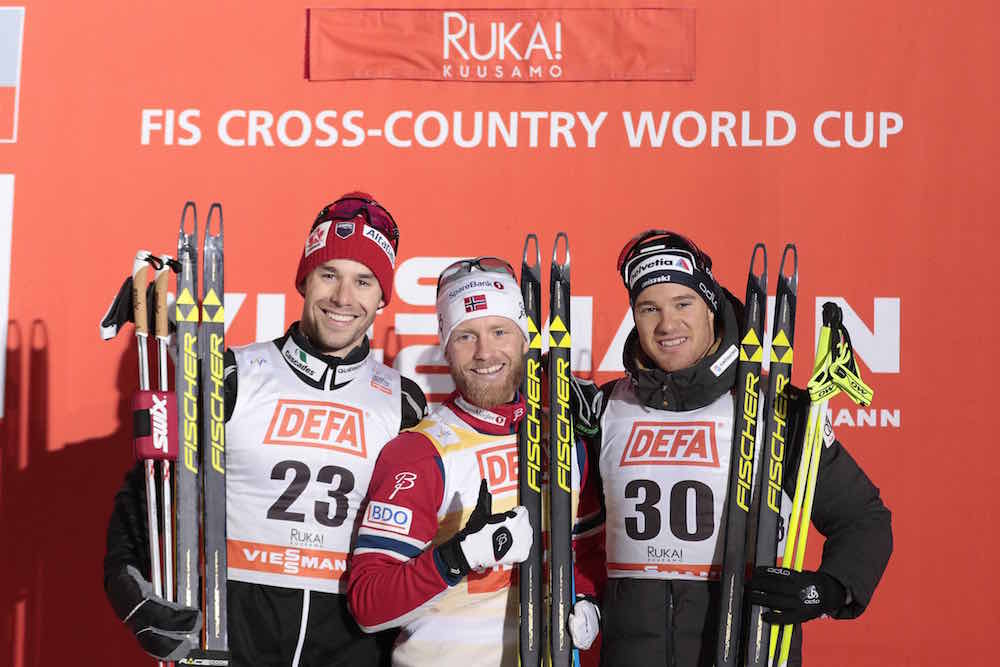
    The elite women’s skate podium at the 2018 American Birkebeiner on Saturday in Hayward, Wisconsin, with Caitlin Gregg (c) in first, Sweden’s Maria Gräfnings (l) in second and Chelsea Holmes (r) in third. (Photo: American Birkebeiner Ski Foundation 2018)

    Caitlin Gregg has raced the American Birkebeiner enough times — and won it more than anyone else — that she’s got the course down pat. Powerline, Big Bertha, High Point, Heckler’s, OO, Gravel Pit, Mosquito Brook, B*tch Hill, Hatchery, the lake, the bridge, the Main Street finish.

    But the conditions and the competition, that’s something that changes from year to year. The elite racers were among the first to start the 50-kilometer American Birkebeiner (“Birkie”) skate races on Saturday, giving them the edge in terms of firmer conditions over nearly 13,000 other racers behind them, but it was still not the fastest Birkie on record after six inches of new snow had fallen the day before.

    But away they went, jetting out of the Birkie’s new start line and embarking on the 50 k point-to-point course from Cable to Hayward, Wisconsin. The elite women’s skate race started at 8:30 a.m. followed by the elite men 20 minutes later.

    While the women remained in a large pack for the first 15 k or so, according to Gregg, they were down to six around 20 k.

    “I think this is one of the strongest fields that I’ve ever seen at the American Birkebeiner for the women,” Gregg recalled in a post-race press conference. “A lot of really fast ladies, a lot of depth, and so it was a pretty high-paced race the whole time. There were definitely five of us in that top six group taking leads and doing pulls, and we definitely worked together to kind of separate ourselves from the field behind us.”

    Three of those racers fell of the pace, which left Gregg, Sweden’s Maria Gräfnings, and Chelsea Holmes contending for the win. Gregg, 37, races for the Central Cross Country (CXC) Team, Loppet Nordic Racing and Team Gregg. Gräfnings, 32, is a former University of Utah skier, and Holmes, 31, races for Alaska Pacific University (APU).

    Just over 2 kilometers before the finish, as the three were skiing across Lake Hayward, the elite men’s race leaders caught them. Typically, the top elite women finish before the men.

    “I could hear another snowmobile, and I knew what that meant, and I kind of looked around at the women and I said, ‘Oh, the men are coming,’ ” Gregg reflected. “… When they caught us, it was actually kind of a surprise because a couple went by, and then they just kept coming.”

    The lead pack of men was still close to 30 strong at that point, just 2 k before the finish.

    “It was the weirdest thing I’ve even experienced in a race, where you just have this consistent line of guys coming and it was actually, really great,” Gregg continued. “Because the women, we raced our own race, we jumped in towards the back of that pack, but we stayed in our own pack.

    “At one point, I suggested maybe we should move over for the men,” she added. “I like these ladies; they were like, ‘NO. They can go around us. They can figure it out. We’re doing our own thing.’ So I thought that was pretty cool.”

    Gräfnings had been leading when the men caught them.

    “And then I thought ‘Now I can go with them,’ but, no, they were going really fast,” Gräfnings said at the press conference. “So, then I was leading the pack, the women’s, and I guess I was getting really tired when I was doing that…”
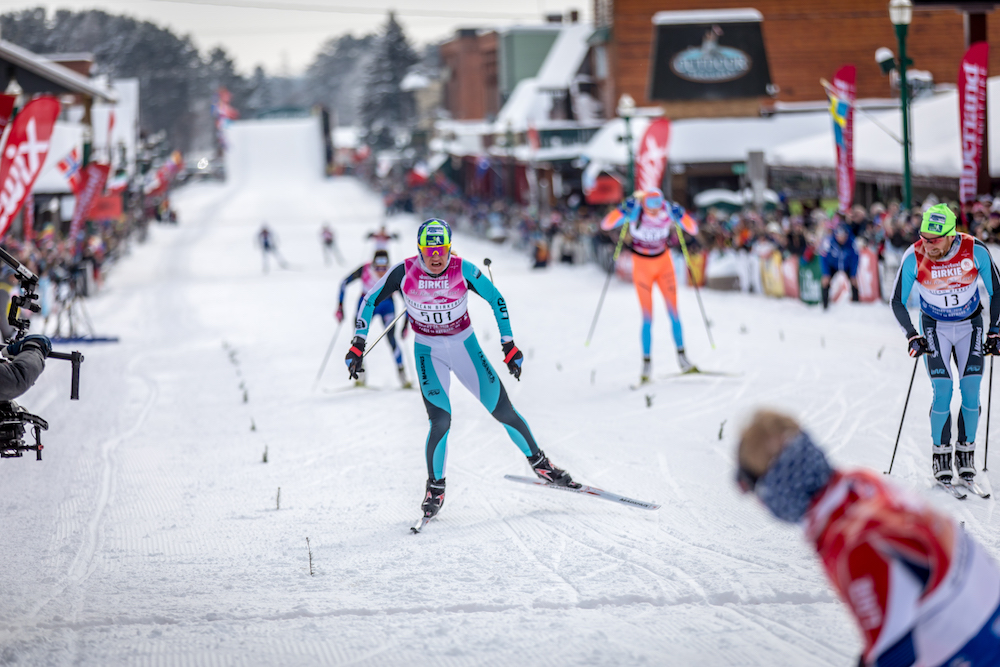
    Caitlin Gregg (501) winning her fifth American Birkebeiner on Saturday in Hayward, Wisconsin, while skiing alongside her husband Brian Gregg (13), who placed 22nd in the elite men’s skate race. (Photo: American Birkebeiner Ski Foundation 2018)

    Gregg took the lead just before the Birkie’s International Bridge and went on to hold off Gräfnings and Holmes for the win in 2:23:30.3 hours. Gräfnings finished second, 2.5 seconds back, while Holmes placed third (+3.8).

    “I was like, ‘No, I can’t give up this. I have to really try to sprint then,’ ” Gräfnings recalled. “I’m glad I could get the second place.”

    Gregg won the last American Birkebeiner contested in 2016 (last year’s race was canceled due to low snow) in 2:22:44. With Saturday’s win, she has most Birkie wins of any racer, male or female, with five victories (2011, 2013, 2014, 2016, and 2018).

    “I’m trying to set the bar pretty high for the next person to come along and break that [record], so it feels amazing to win my fifth,” said Gregg, who lives in Minneapolis, Minnesota. “The conditions were absolutely perfect today. The course was just in amazing shape and just beautiful out there, and this is definitely one of my favorite races, that’s why I keep coming back. Everything about it, between the organization and the volunteers makes this a special event for so many people, but, for myself, especially. So yeah, I was really happy year to be able to race again and feel good and really fight for the win.”

    Gräfnings said was pleased with her own race and glad to return to the U.S.

    “I was studying in the University of Utah and now I’m back in America and it’s so fun to meet a lot of friends and it’s really special for me,” she said.

    Holmes had previously raced the Birkie in 2014 and placed fifth, 3:45 minutes behind Gregg. She struggled with the cold and suffered in that race, she explained at the press conference.
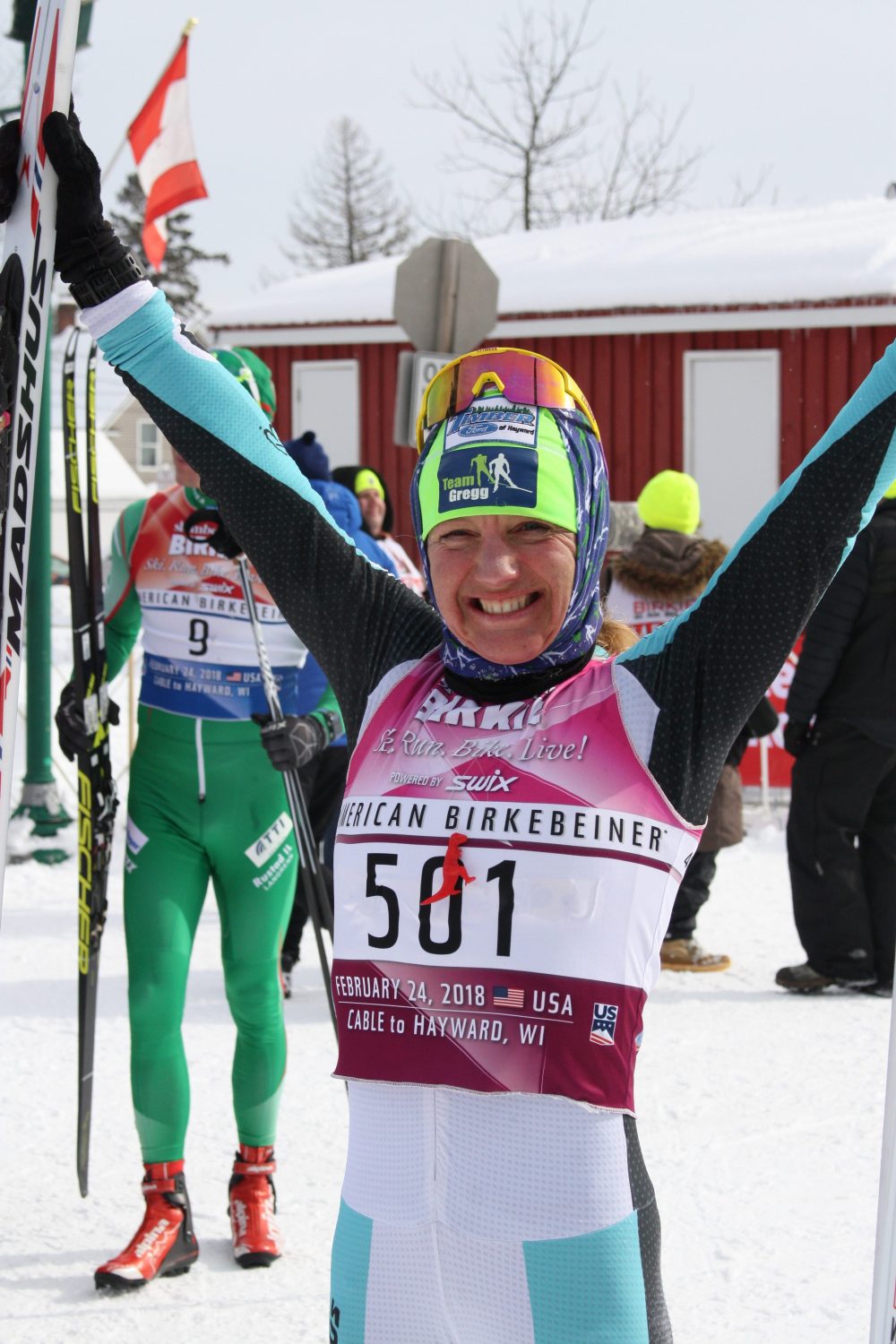
    Caitlin Gregg celebrates her fifth American Birkebeiner win on Saturday after winning the women’s 50 k skate race by 2.5 seconds over Sweden’s Maria Gräfnings in second place. (Photo: RJ Ochmann)

    “I was very worried today about surviving with enough feeds and being warm enough,” Holmes said. “In the beginning, it’s a strange feeling because it always feels a little bit slow, like a very different race pace than even a 30 k that you do at other times, and especially with less climbing, which, I miss the hills a little bit … so that’s a little bit hard for me sometimes to sit in. But I think we shared the lead fairly well.

    “It was … good for me always to remember to relax and be patient because even when you have 25 k, you’re only halfway there,” Holmes continued. “So it’s a unique experience, the 50 k, because sometimes it feels like you’re not working that much, and I felt quite good. And then when I got five meters from the finish line, my legs just, I basically walked across the line. So, clearly I was very tired, but that’s how it goes.”

    France’s Aurelie Dabudyk was the fourth woman across the line, 28.7 seconds behind Gregg, Anja Gruber of Bozeman, Montana, placed fifth (+2:44.6), and Erika Flowers of the Stratton Mountain School (SMS) T2 Team finished sixth (+3:30.1). Also in the top 10 were Liz Guiney of the Craftsbury Green Racing Project (CGRP) in seventh (+5:33.8), Hallie Grossman (CGRP) in eighth (+8:03), Hannah Bettendorf of Duluth, Minnesota, in ninth (+8:19.2), and masters skier Laura McCabe of Winthrop, Washington, in 10th (+8:20.6).

    The Birkie is the fifth of seven races on the 2018 FIS Worldloppet Cup calendar. Dabudyk now leads the overall standings by just 10 points over Gräfnings in second. In her first Worldloppet race of the year, Gregg ranks seventh.

    In the men’s overall standings, France occupies the top four with Gerard Agnellet in first, just 1 point ahead of Ivan Perrillat Boiteux in second, and 120 points clear of Loic Guigonnet in  third. Adrien Mougel ranks fourth, another 2 points behind, and Norway’s Anders Gløersen breaks up the French sweep in fifth, 3 points behind Mougel.

    Norris Makes the Move, Gløersen Takes the Win
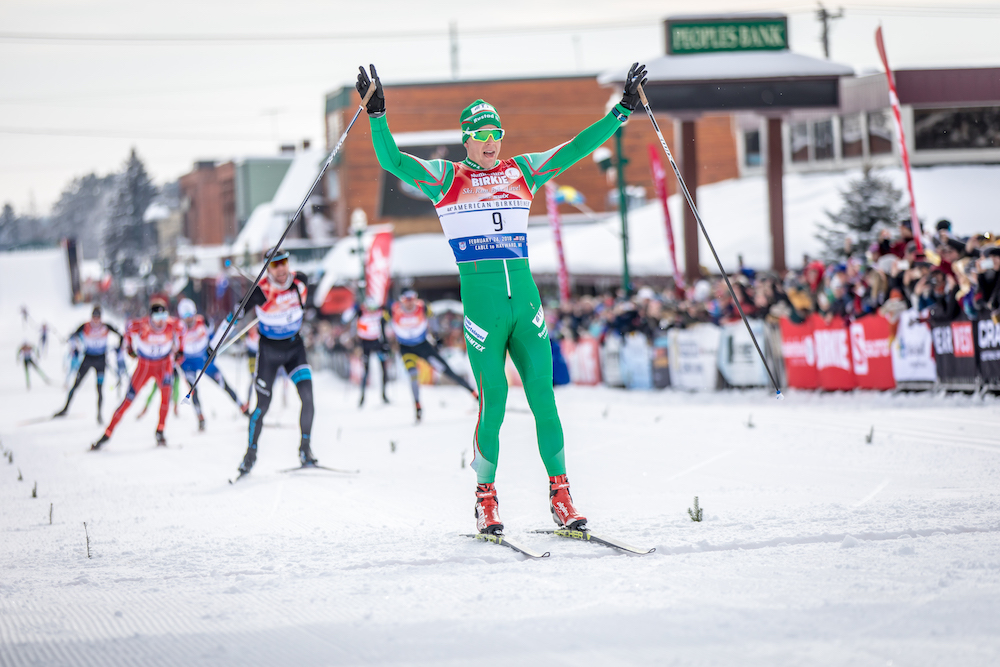
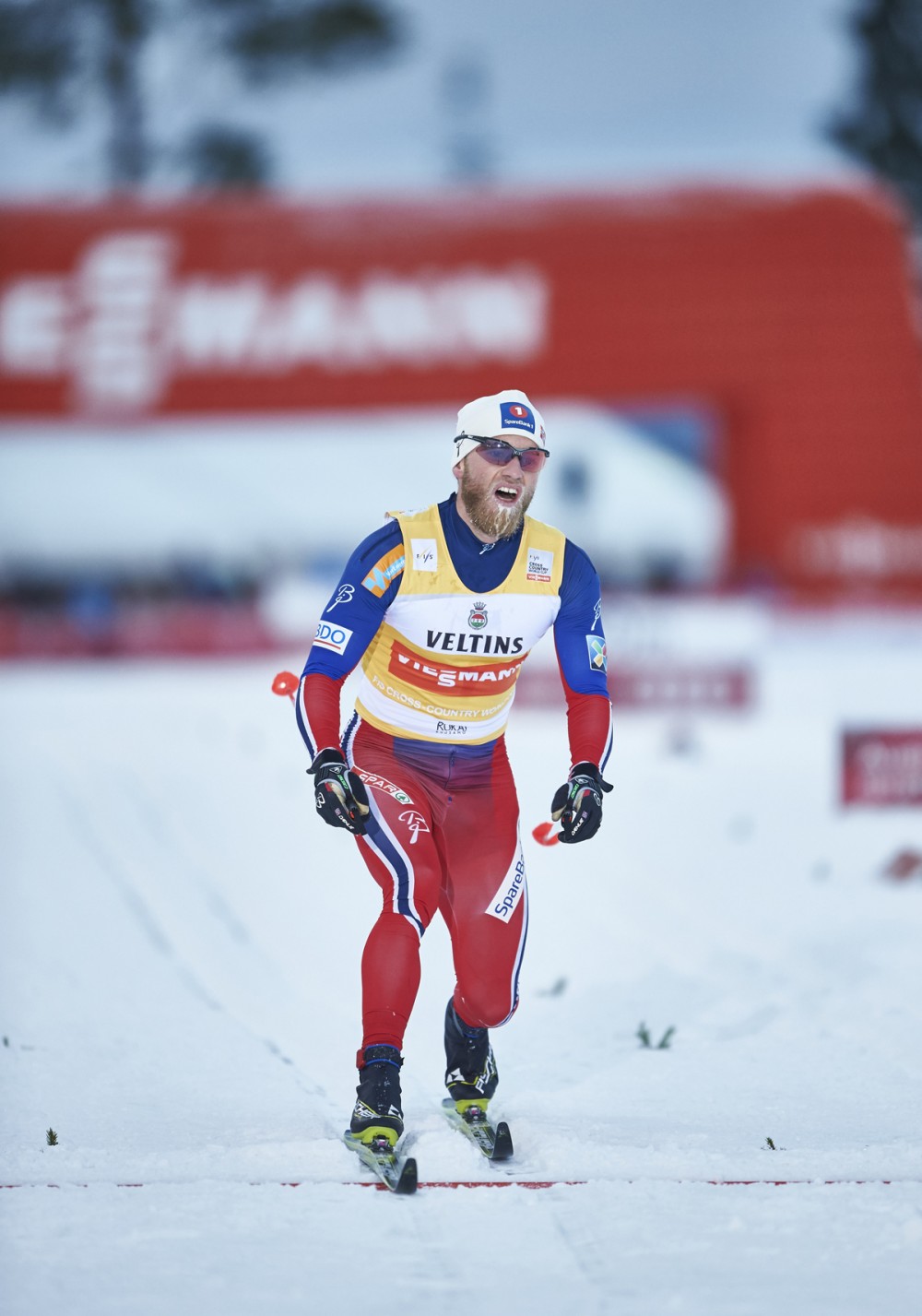
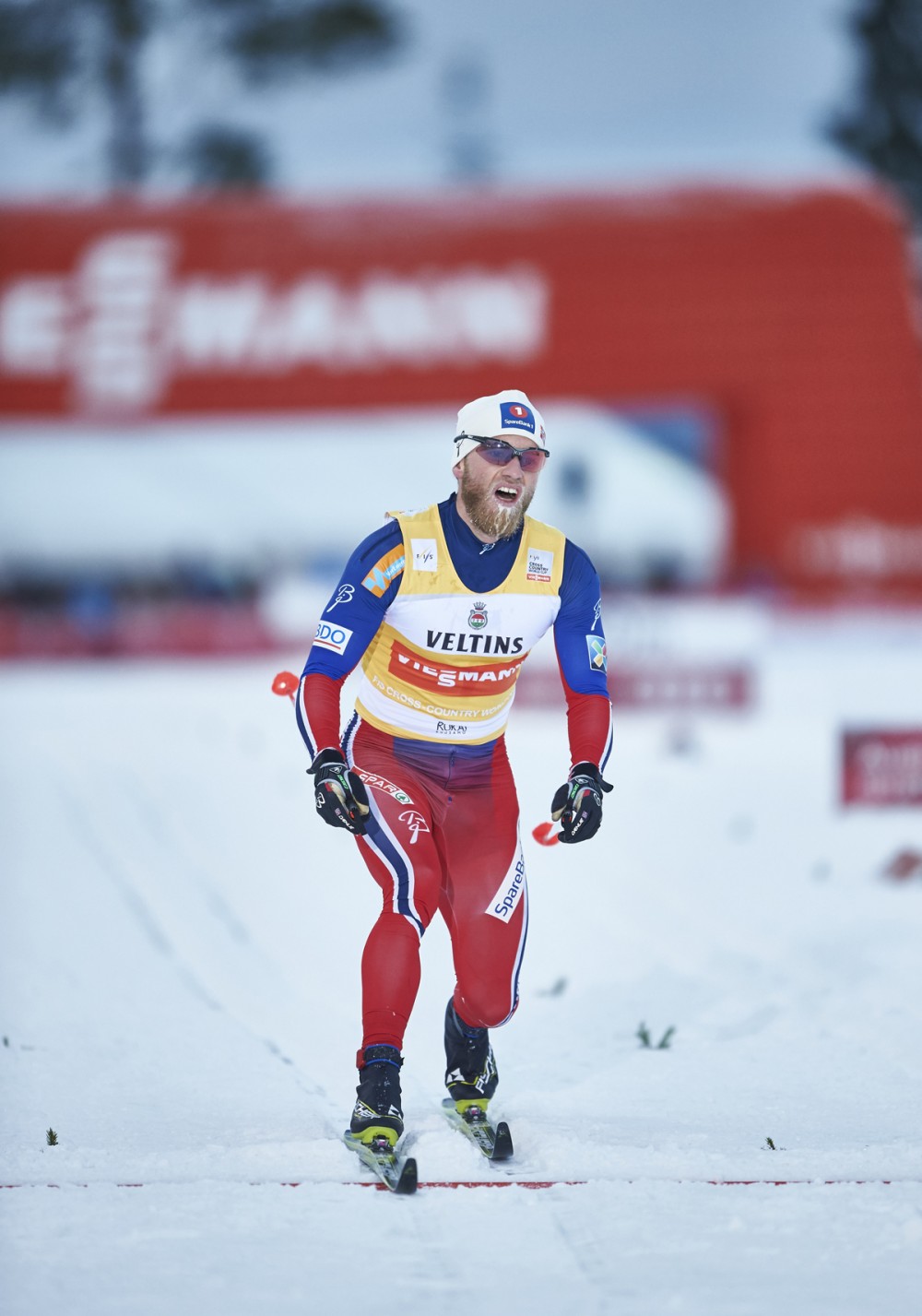
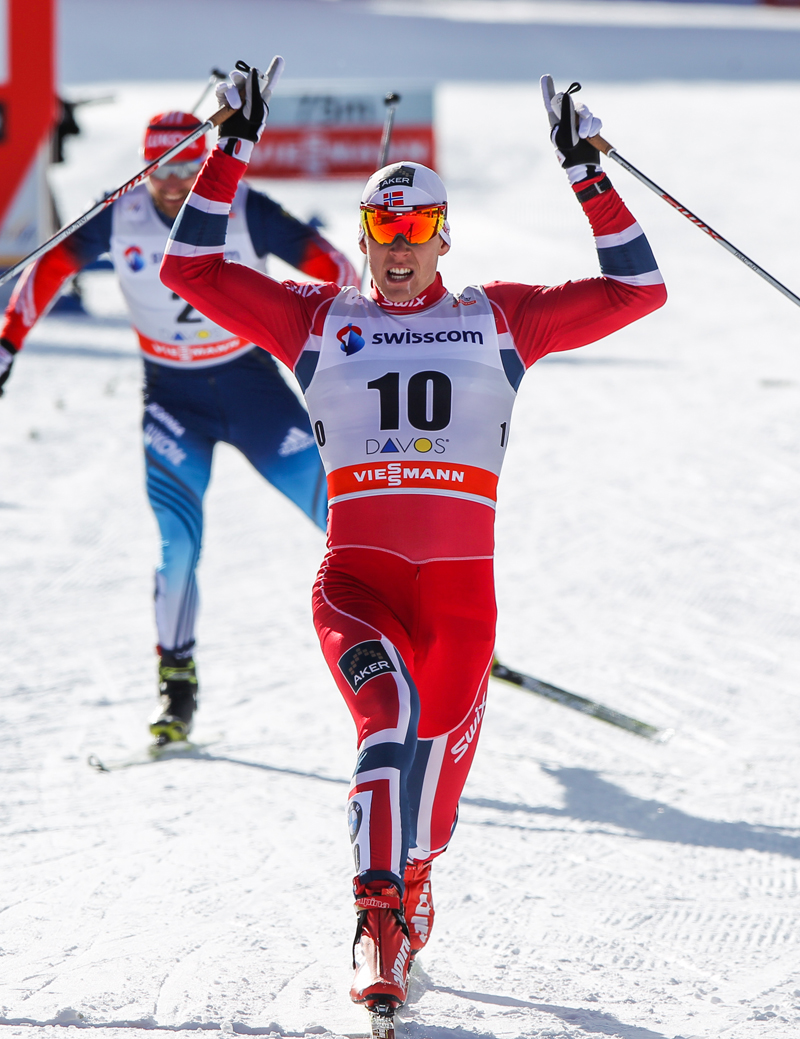
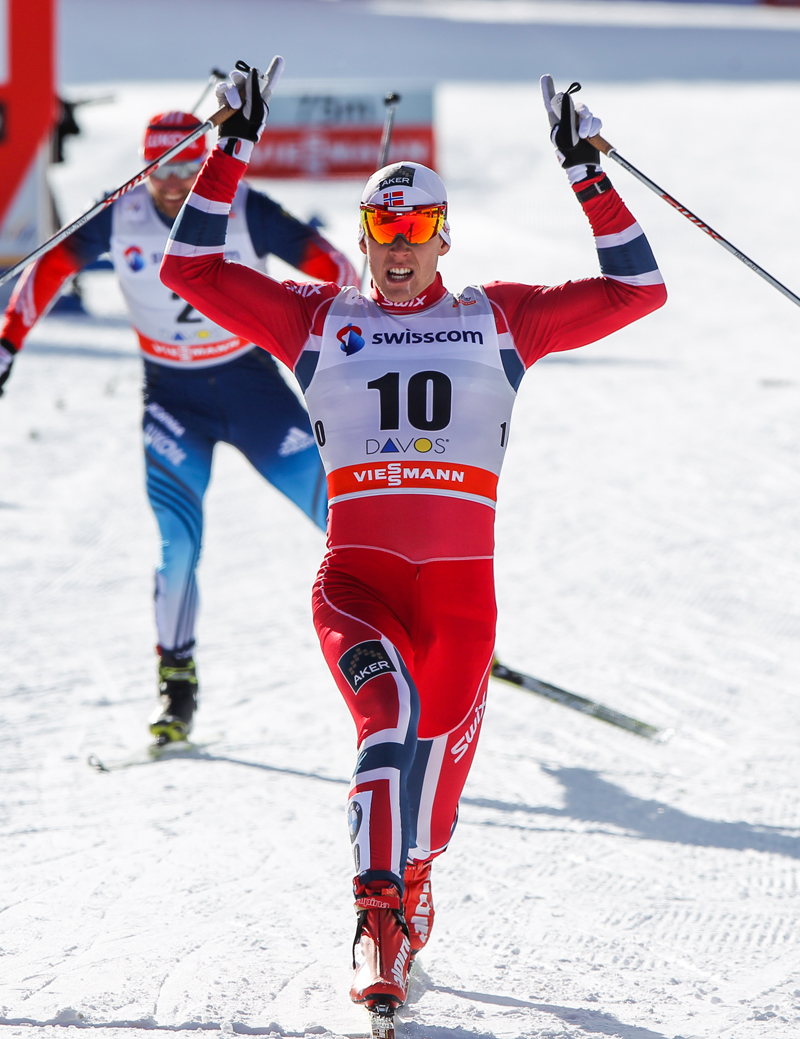
    Norway’s Anders Gløersen winning the American Birkebeiner elite men’s 50 k skate race on Saturday in Hayward, Wisconsin. (Photo: American Birkebeiner Ski Foundation 2018)

    Gløersen won the Birkie elite men’s skate race on Saturday in 2:02.29.6, just 1.9 seconds ahead of Perrillat Boiteux in second and 3.4 seconds ahead of American Kyle Bratrud (CXC Team) in third.

    After as many as 30 men stayed together up until the last 2 kilometers, the men’s pack began to string out after coming off the lake. According to Bratrud, it was David Norris who made the defining move at that point in the race. Norris had launched a similar attack two years ago, just before the bridge, to win the 2016 Birkie.

    “He started to string it out a bit and six or seven of us started to pull away from a line of about 30 of us,” Bratrud recalled at the press conference. “That’s kind of what led us to the break and ultimately to the sprint.”

    The top-10 men were within eight seconds of first, with Mougel finishing fourth (+4.4), Norris losing his lead and ending up fifth (+5.1), France’s Bastien Poirrier placing sixth (+5.5), and Agnellet following in seventh (+5.7). France had six in the top 11 with Guigonnet in eighth (+6.6) and Benoit Chauvet in 11th (+13.3). Americans Ben Lustgarten (CGRP) finished ninth (+7.0) and Jack Hegman of the Sun Valley Ski Education Foundation (SVSEF) placed 10th (+7.2).

    “It was a great race,” Gløersen, 31, said at the press conference. “Perfect conditions and nice weather. And it was a difficult to know how to do because I don’t know so many of the American skiers here, and I know the French guys … I had to watch out for them. So I just tried to stay in front of the big group to be ready if someone made an attack. It seemed like it was difficult to get away, and I was just glad when it was one kilometer left.”

    After Norris’s attack, Gløersen made a point to follow him.

    “I got the perfect position on the bridge here, just was number two and then had the perfect position going into the final 300 meters,” he said.

    Asked about passing the women late in the race, he said it didn’t affect the men’s race too much.

    “If it’s snowing, then it could make a difference because then you have the women making way, and when you pass them it’s going to be slower,” Gløersen said. “But today was quite good conditions so it was just fun to see when they catch them and to see who was in the group, but other than that, it doesn’t affect us much.”
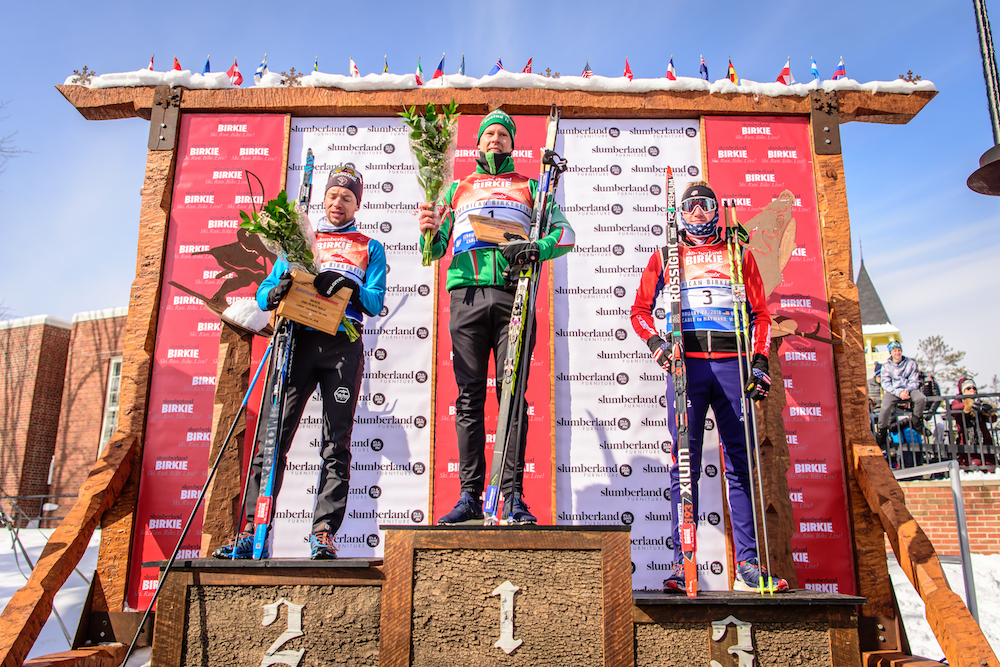
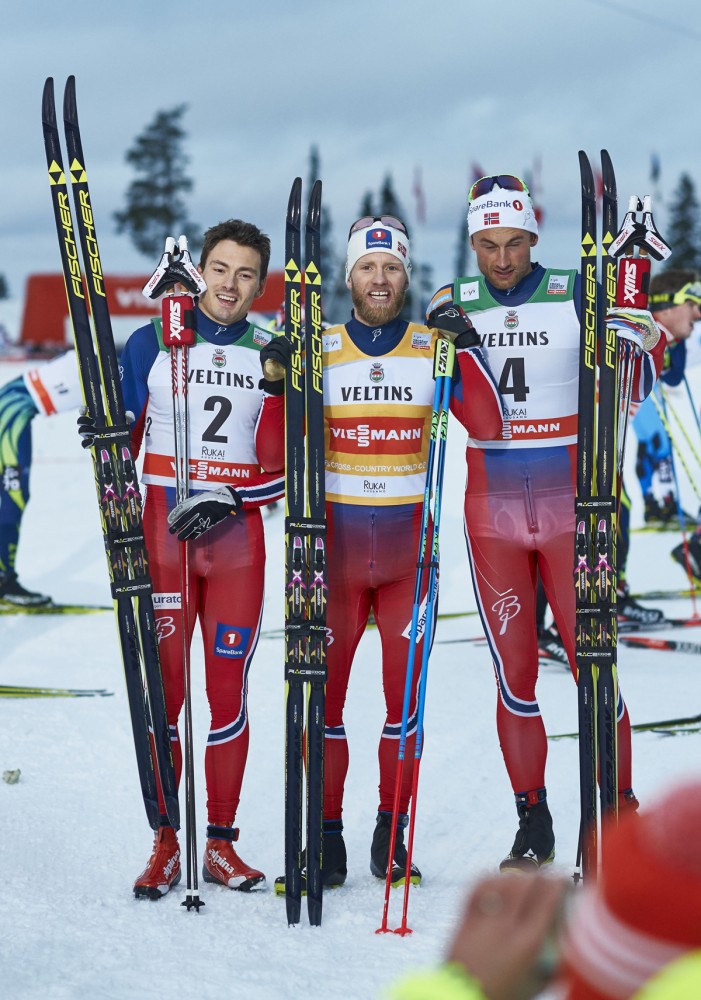
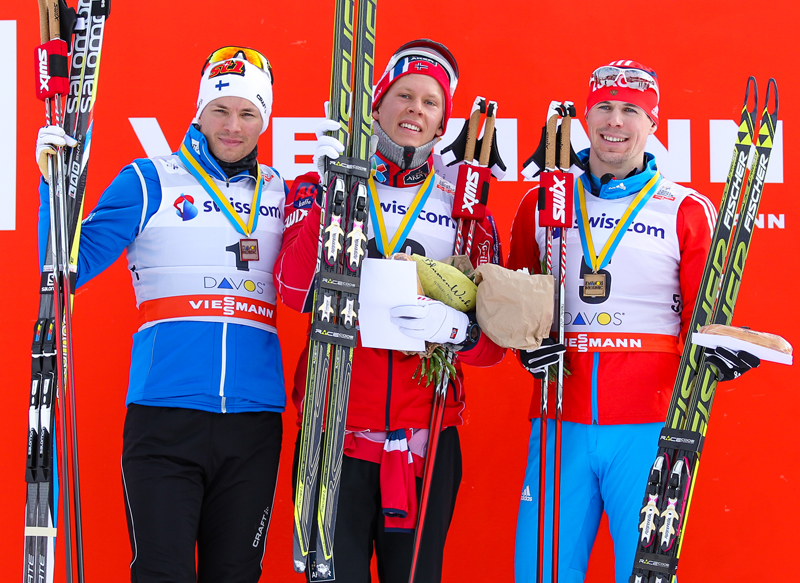
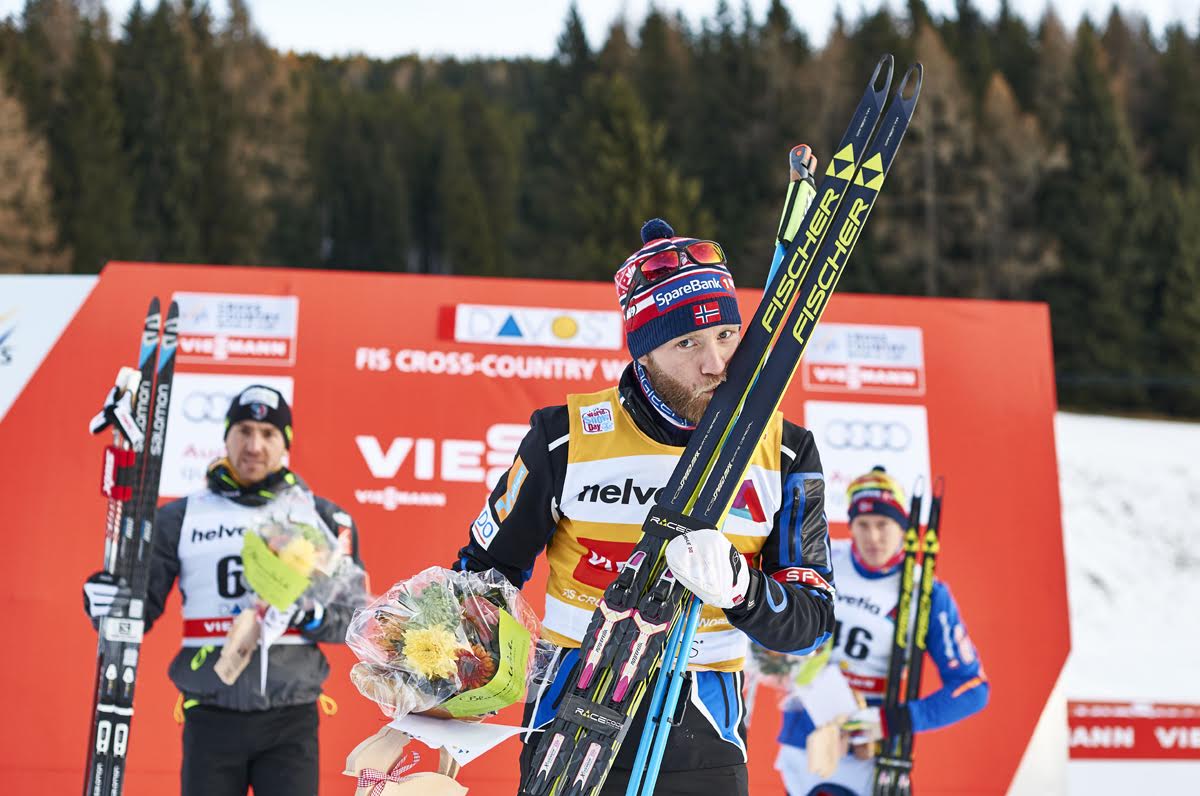
    The elite men’s skate podium at the 2018 American Birkebeiner in Hayward, Wisconsin, with Norway’s Anders Gløersen (c) in first, France’s Ivan Perrillat Boiteux (l) in second and American Kyle Bratrud (r) in third. (Photo: American Birkebeiner Ski Foundation 2018)

    While both Gløersen and Perrillat Boiteux are marathon regulars, this was the first American Birkebeiner for both of them.

    “The Birkie was a great race, well organized, and I loved it,” Perrillat Boiteux, 32, said through a translator at the press conference.

    Bratrud, 25, was born in Eden Prairie, Minnesota, and attended Northern Michigan University, yet this was his first Birkie. According to the FIS database, it was also his first marathon. Asked about skiing in such a large group for most of the 50 k race, he said it was a new experience, but it was likely because the field was so competitive.

    “There’s a ton of strong guys there and no one really wanted to pull the other person to a victory,” Bratrud said. “So it was a lot of kind of cat and mouse and looking at each other and people made moves, but with so many strong skiers, it was hard for anyone to get away.”

    In the 55 k Birkie Classic, Minnesota native Ben Saxton (SMST2) edged Cole Morgan (SVSEF) by 1.5 seconds at the finish for the win in 2:47:35.9. Mathias Rolid of Marquette, Michigan, followed in third (+6.1).

    Wisconsin native Felicia Gesior (CXC Team) won the women’s classic race by more than 10 minutes in 3:08:07.3. Brandy Stewart of Bozeman placed second (+10:54.8) and Josie Nelson of Medicine Lake, Minnesota, reached the podium in third (+11:20.9).

    $$$

    While the Birkie’s 50 k skate race is part of the FIS Worldloppet Cup and reserves most of its prize money for first- through sixth-place finishers in both the elite men’s and women’s skate races (with $7,500 dollars for each winner), the 55 k Birkie Classic awards $1,000 to its men’s and women’s winners.

    This year, there were also two $500 sprint bonuses in the Birkie skate race, which were awarded to the first male and female competitors to reach the intermediate sprint checkpoints. According to Gregg, the first “prime” was about 2 1/2 or 3 kilometers into the race, and the second came just before 20 k.

    “I was curious how aggressive the women would be to go for those [sprint] primes and they were very aggressive, very fun,” Gregg said. “I think the first prime kind of set the tone and kind of strung things out a little bit.”

    Results (top 25): Birkie skate | Birkie classic

    Full results

  • Birkie Rundown: Caitlin Gregg, Anders Gløersen Win 2018 Birkie Skate

    Birkie Rundown: Caitlin Gregg, Anders Gløersen Win 2018 Birkie Skate

    Caitlin Gregg (501) winning her fifth American Birkebeiner on Saturday in Hayward, Wisconsin, while skiing alongside her husband Brian Gregg (13), who placed 22nd in the elite men’s skate race. (Photo: ABSF/James Netz)

    2018 American Birkebeiner (Hayward, Wisconsin): 50 k freestyle

    Blog post (with start videos)

    The 44th annual American Birkebeiner took place Saturday on the world-famous course from Cable to Hayward, Wisconsin, with Minneapolis’s own Caitlin Gregg (CXC Team/Loppet Nordic Racing/Team Gregg) and Norway’s Anders Gløersen racing to victories in the elite women’s and men’s races, respectively.

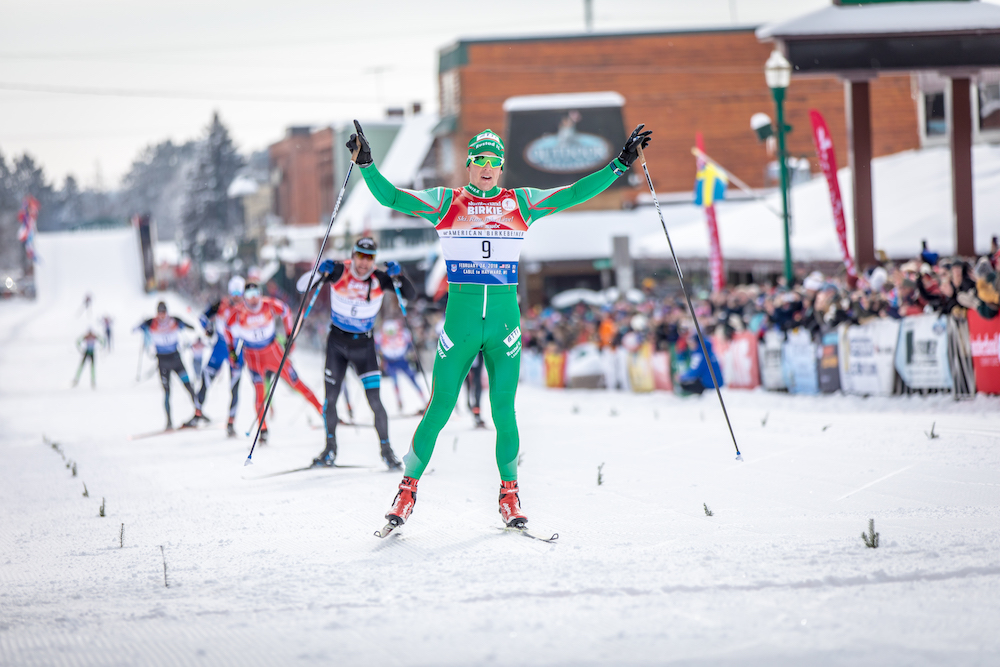
    Norway’s Anders Gløersen (9) winning the American Birkebeiner elite men’s 50 k skate race on Saturday in Hayward, Wisconsin. (Photo: ABSF/James Netz)

    Gregg finished in 2:23:30.3 hours, just 2.5 seconds ahead of Sweden’s Maria Graefnings in second and 3.8 seconds over Chelsea Holmes, of Alaska Pacific University (APU), in third.

    The Birkie win was Gregg’s fifth after taking the title in the 2011, 2013, 2014, and 2016 editions of the race as well. She won the last American Birkie contested in 2016, with a broken toe, in 2:22:44. (The race was canceled last year.)

    Gløersen was the first across the line, after passing the entire elite women’s field, with a winning time of 2:02.29.6. France’s Ivan Perrillat-Boiteux finished 1.9 seconds back in second, and Kyle Bratrud (CXC Team) was the first American in third overall (+3.4).

    The defending Birkie champion from 2016 (who won it in 2:05:35), David Norris (APU) placed fifth (+5.1).

    In the 55 k Birkie Classic, Minnesota native Ben Saxton, of the Stratton Mountain School (SMS) T2 Team, edged Cole Morgan, of the Sun Valley Ski Education Foundation (SVSEF), by 1.5 seconds at the finish for the win in 2:47:35.9. Mathias Rolid, of Marquette, Michigan, followed in third (+6.1).

    Wisconsin native Felicia Gesior (CXC Team) won the women’s race by more than 10 minutes in 3:08:07.3. Brandy Stewart, of Bozeman, Montana, placed second (+10:54.8) and Josie Nelson, of Medicine Lake, Minnesota, reached the podium in third (+11:20.9).

    Results (top 25): Birkie skate | Birkie classic
    Full results

    (Check back for more details about the elite race and photos)

  • Closing the Gap: Lessons in Risk Taking and VO2 ‘Maks’ Testing

    Closing the Gap: Lessons in Risk Taking and VO2 ‘Maks’ Testing

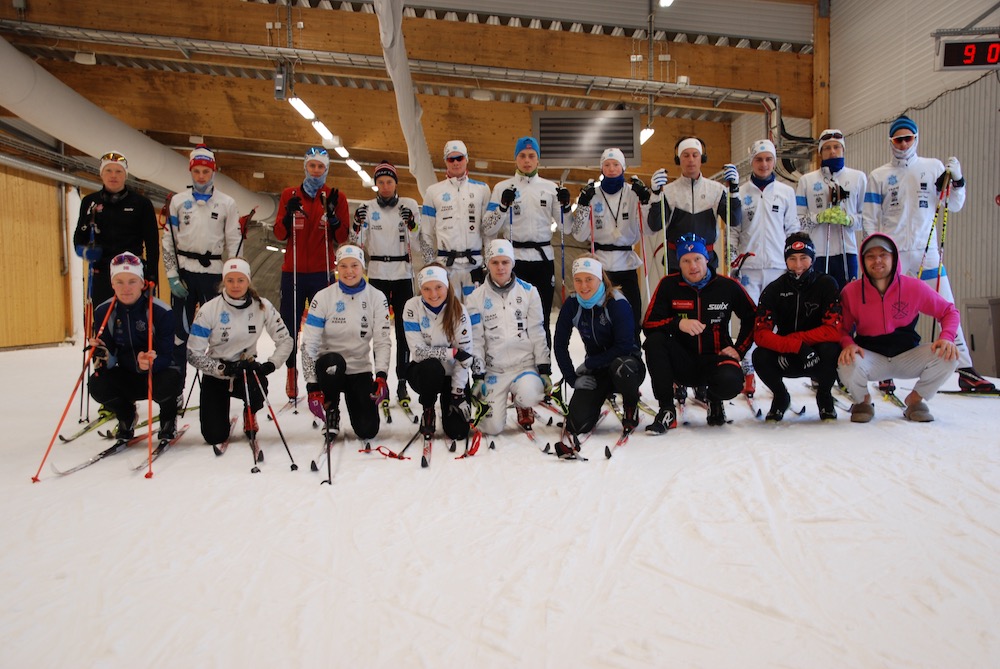
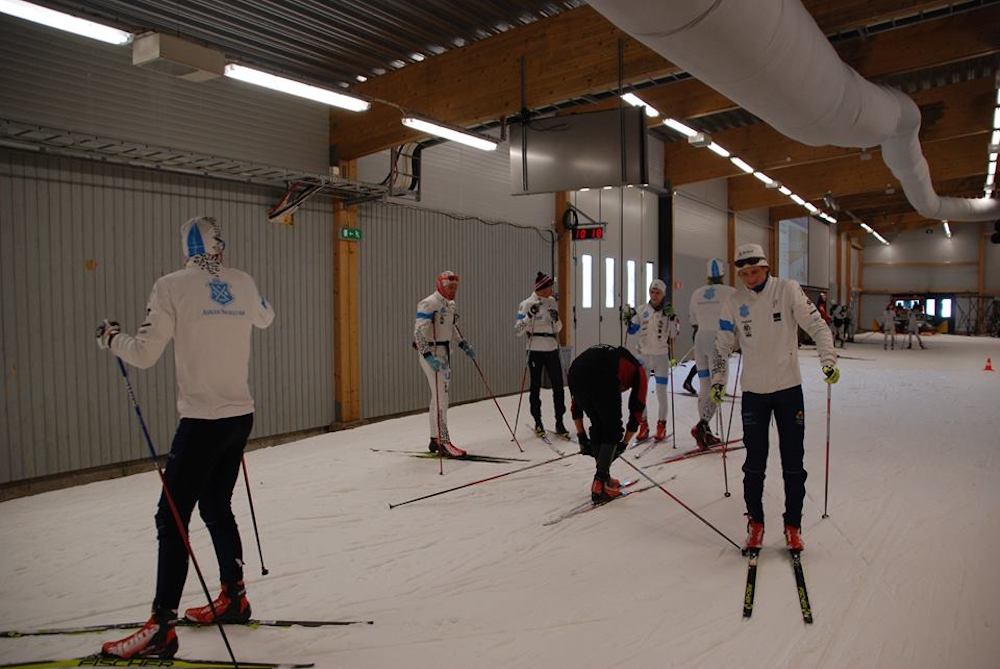
    Team Asker gets together for a group shot in the ski tunnel in Torsby, Sweden. (Photo: Johanna Lier)

    Editor’s Note: The following is the fourth post in a series proposed by Maks Zechel, a 20-year-old Canadian cross-country skier embarking on his first season training abroad. He recently made the big move to Norway, where he’ll be training and racing with Team Asker for the next nine months. Through these updates, Maks hopes to share his personal “observations, stories, and lessons learned” to help close the gap between North American and Scandinavian nordic skiing. Previous posts: #1, #2, #3, and #4.

    ***

    I never thought that on my 20th birthday I would be shivering at the top of a ski resort, a thick fog obscuring the spectacular view of Oslo, listening to 30+ Norwegians sing the Norwegian birthday song for me. But I guess turning 20 was bound to be different!

    “No more excuses,” was my first thought. Gone is the security of being a teenager. Rather than impressing people with maturity, it now feels like it is expected. I think it’s a good thing, but it doesn’t make being an adult any easier. My trip to Norway has been full of moments when I suddenly realized, “Oh, I guess I’ll just have to figure this out on my own.” My parents are no longer always present to make introductions, so now it is up to me to advocate for myself. Risks taken as an adolescent do not come with the expectation to produce results. “I’m impressed,” people say, and they applaud you just for trying. But adults are expected to see things through to completion.

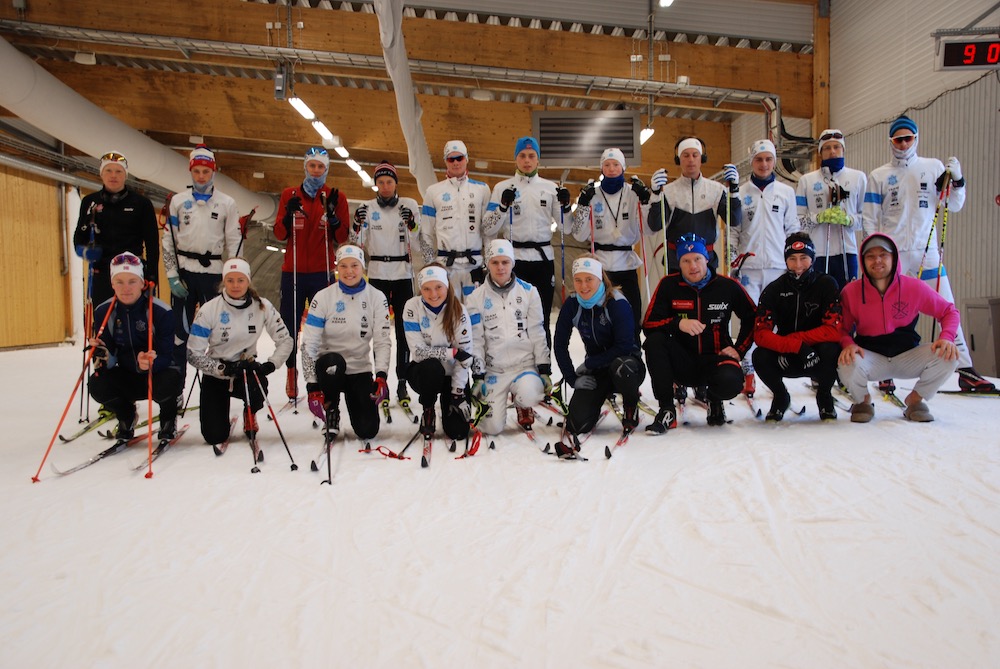
    Team Asker group core session after a ski in the tunnel in Torsby, Sweden. (Photo: Johanna Lier)

    Back on a cold, foggy Norwegian ski slope at the end of August, my teammates and I were about to tackle 6 x 6 minute Zone 4 bounding intervals. In Norway, bounding with poles is called elghufs, or “moose-hooves”. I had never done a bounding workout of this duration and intensity. Despite this, I decided to take a risk and stick with the best runner on the team, who was two and a half minutes faster than me on our last uphill running test. I stuck with him from the first interval, and stayed with him as he threw in big surges on the plateaus between climbs. He added these surges because he is trying to get better at working the flat sections of ski races in the winter, which happens to be one of my goals as well. We did the whole workout together, and I stayed with him until he got away on a downhill and a steep climb at the end. I took a risk in a workout, not caring if I blew up halfway through, and it allowed me to train at a higher intensity than I would have thought possible.

    Earlier this summer I listened to a “TED Talk” by Eduardo Briceño on “the learning zone and the performance zone”. At first it didn’t seem like a life-changing lesson, but since I arrived in Norway, his ideas have led me to think differently about my actions, and in particular, my training. Briceño discusses how people, from office workers to athletes, fail to improve at what they do, whether it is a hobby or a job, because they do not give themselves the opportunity to take risks, make mistakes and learn. In our society, the “performance zone” is the default; this is where we only do the things we are comfortable with, because we want things to be perfect, because that is how we envision our end goals to turn out. Briceño argues that we should encourage employees, athletes, and ourselves, to spend more time in the “learning zone,” where we break our ideal performance into the things we need to work on to get there. It is only here that we get better, because it is here that we allow ourselves to try things that we would otherwise never attempt for fear of failure. In the learning zone, risk and creativity produce the most astounding results. Having reached higher comfort levels, it is possible for someone to apply their repeated failures and lessons-learned to a better end result.

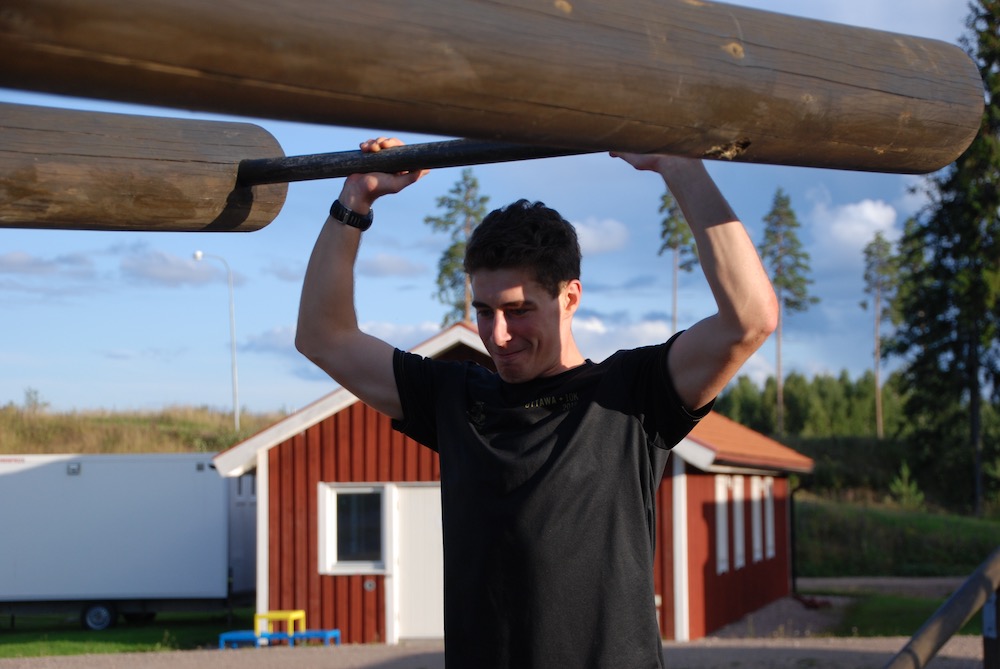
    Author Maks Zechel doing pull ups: “the most popular Norwegian strength exercise.” (Photo: Johanna Lier)

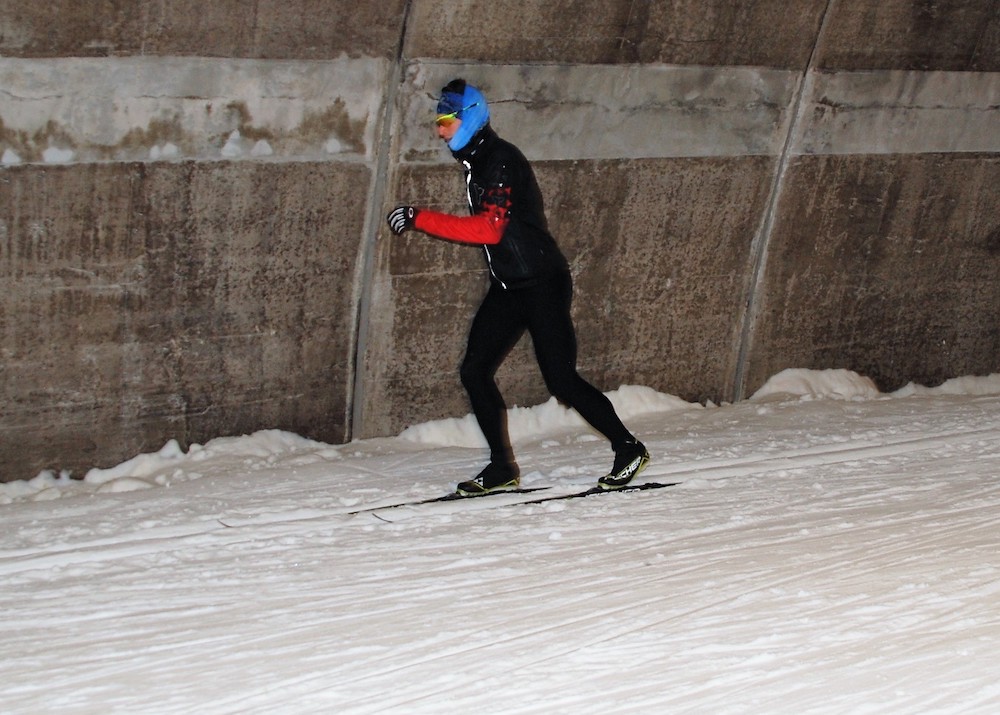
    A few days after “birthday elghufs”, Briceño’s ideas come back to me as I am training in the ski tunnel in Torsby, Sweden. I am back here for a long-weekend training camp with Team Asker. In the tunnel I confront a skiing related fear of mine, developed over a few years of poor performances in classic races. I dread the feeling of my grip giving way while striding up a hill. I am determined to become a better classic skier, the technique I was strongest in when I was younger, so I work hard at anything that I believe will make me a better classic skier: bounding intervals, core, double poling, hours of video technique work, and skiing without poles. If I can ski up a hill legs-only, then surely I can do it with poles in a race, right? Whenever I am on skis, I challenge myself to stride up the steepest hills without poles, but it becomes a challenge that I must perform to perfection, otherwise in my mind I have failed as a classic skier. The pressure that I put on myself leads me to shuffle stiffly and tentatively up hills, not allowing myself any room for error. The result is a poor imitation of the principles of classic skiing, lacking any weight shift, pop in the ball of my foot, or ankle compression. Sure, I made it to the top of the hill, but I didn’t summit the mountain.

    On our first morning in Torsby we have a distance classic ski in the tunnel. Rather than skiing slowly around the tunnel for a couple of hours, our coach has added some variety to our workout: one lap legs-only, one lap thinking about good striding on the hills (not thinking about heart rate), and one lap with a short “race pace” acceleration. The variety in this workout is important in early season skiing so that we can take advantage of our short time on snow to train our muscle memory to ski properly, getting rid of lazy habits developed while rollerskiing.
    Maks Zechel working on legs-only in the ski tunnel in Torsby, Sweden. (Photo: Johanna Lier)

    On my legs-only loops, I decide to take a risk. Instead of pressuring myself to make it up the entire hill, I ski as dynamically as I can, focusing on full commitment to each ski and compressing the wax pocket as if I had perfect grip. Although frustrating, I know that it is better for my development to ski properly up half the hill, than to shuffle up the entire thing. A few times I am rewarded with making it to the top, and other times I almost face plant spectacularly in front of the Norwegian junior national team coach.

    The risk of embarrassment is one that I am willing to take. I made a decision to escape my comfort zone when I left Canada, leaving behind family, friends, and a team that I have trained with for nine years. I left behind the chance at another year of racing on the NorAm circuit and seeing marginal, or perhaps substantial, improvements up the results board. I was sick of feeling like there was an order to things. If I beat a friend of mine during a race, that meant that I had had a good day, but if someone finished ahead of me who I was supposed to beat, then the day was unsuccessful. To me, this type of racing environment was toxic, as I struggled through a season of failed expectations. I am fortunate to have had the means to come to Norway, where simple training aspects, things that had lost their magic over the years, are now bringing back the same giddy excitement that skiing originally gave me. I am in a place filled with potential opportunities, but now I need to have the guts to seize them.

    Team Asker reparing for an intensity workout in the ski tunnel in Torsby, Sweden. (Photo: Johanna Lier)

    While training in Torsby, we were lucky enough to be there at the same time as the Norwegian junior national team and national recruit team (a step below the national senior team), as well as Anders Gløersen, Charlotte Kalla, Stina Nilsson, and Hanna Falk. I watched some of the members of the recruit team doing offset sprints, and it was the fastest I have ever seen someone sprint on skis in real life. Rather than being intimidated, I felt almost relieved to watch some of my idols skiing this fast. The mystery was gone; this is how fast you have to ski to be great, as simple as that, and now I could spend the entire weekend shadowing some of the best skiers in the world.

    On our first day in Torsby I had the opportunity to do two things for the first time in my life: rollerski on a treadmill and take a VO2 max test (maximum rate of oxygen consumption). Naturally, because of my name, I prefer to say it in Norwegian: VO2 maks.

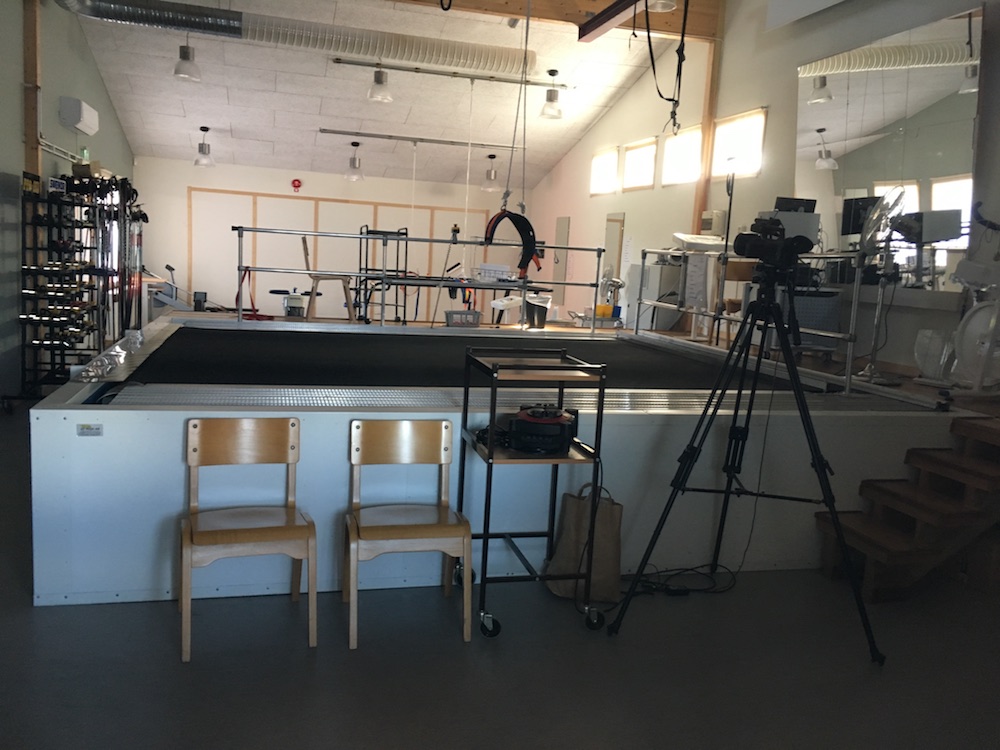
    After an initial stumble on the treadmill, I found it quite easy to classic rollerski on. Before the test started I warmed up on a few different gradients and speeds, unable to stop smiling at myself in the large mirror in front of me. Here I was, rollerskiing in the same laboratory that has tested countless World Cup skiers! The test began at a gradient of 10 percent and speed of 10 kilometers per hour, with the gradient increasing every minute until it reached 18 percent. This felt remarkably steep. From then on the gradient remained the same, but every 30 seconds the speed increased.
    The rollerski treadmill/testing lab in Torsby, Sweden. (Photo: Maks Zechel)

    During testing there is a harness around your waist so that you don’t fall off the treadmill, a heart rate monitor around your chest, and a mask strapped to your head to measure oxygen consumption. It’s a lot of gear hanging from your body, and your head has to remain relatively steady, but once the test started I found that the pain was an adequate distraction from all of this. Unfortunately, during my test a strap on my mask came undone and the mask fell off while I still had something left to give, so I was robbed of the chance to ski until collapsing (the skier’s dream). My VO2 max result was 74.5 ml/kg. Last year Harald Amundsen, the top skier on the team, reached a VO2 max of 85 ml/kg as an 18 year old (an exceptional result).

    Being in a new place, with a new team, and in close proximity to many of the world’s best skiers, there is a lot to take in. It is important for me to absorb as much as I can during my time here, but it is also important to stay consistent with things that I have been working on before I got here. If I jumped to apply every newly learned training philosophy to my training, I would be all over the place and have no chance to improve. I am allowing myself to take risks and make mistakes while staying true to some of the basics that got me to where I am. In the midst of so many talented and competitive skiers, I am trying to create a learning space for myself, devoid of expectations, so that I can learn without restrictions. When winter finally comes, I hope that I can translate my learning to some fast performances on skis. I have had a lot of practice translating after all…

    Norwegian Phrase of the Week

    Norwegian: Kan jeg få skyss?

    Translation: Can I have a ride?

    Norwegian: Kan jeg få et kyss?

    Translation: Can I have a kiss?

    *An important distinction that could add an unexpected twist to your ride to practice, as skyss and kyss sound almost exactly the same.*

    ***

    About Maks: Maks Zechel is a competitive cross-country skier who secretly wants to become a professional mile runner. He loves hiking and going on canoe trips with his family, as well as peanut butter cups in ice cream. Johan Olsson is his favourite skier and he hopes to race the Cortina-Toblach stage of the Tour de Ski one day. He enjoys writing about his experiences. Follow him on Instagram @makszechel.

  • An Air-Guitar Solo: Harvey Closes Out Championships with 50 k Win

    An Air-Guitar Solo: Harvey Closes Out Championships with 50 k Win

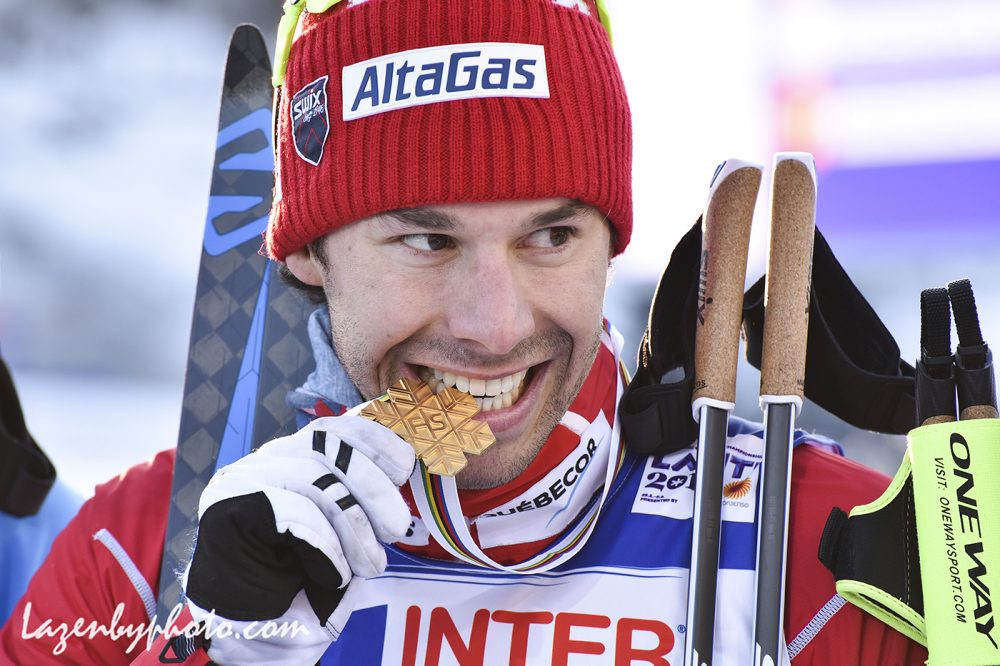
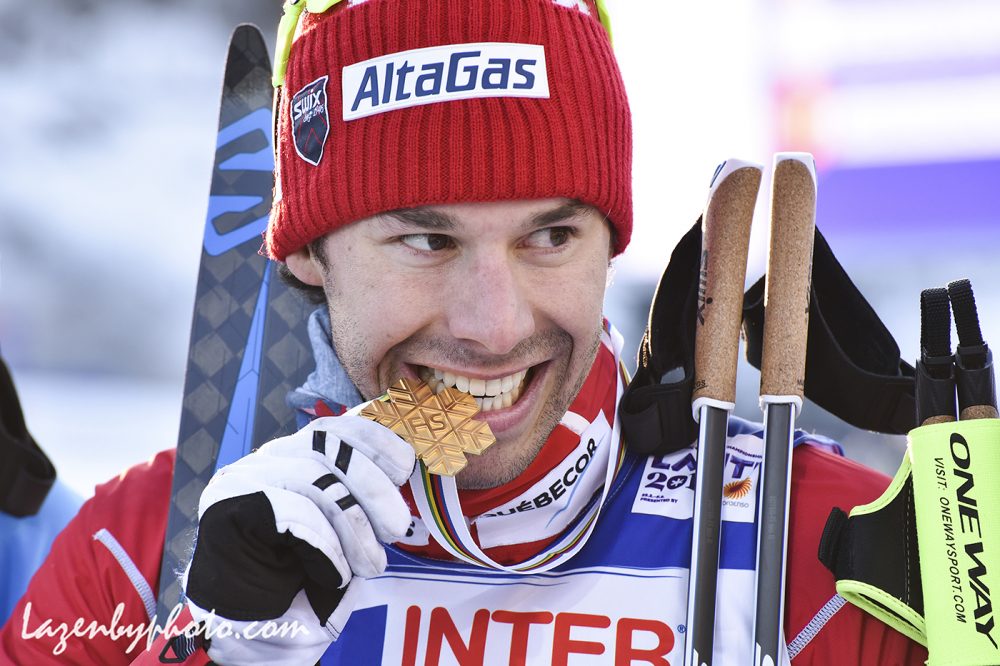
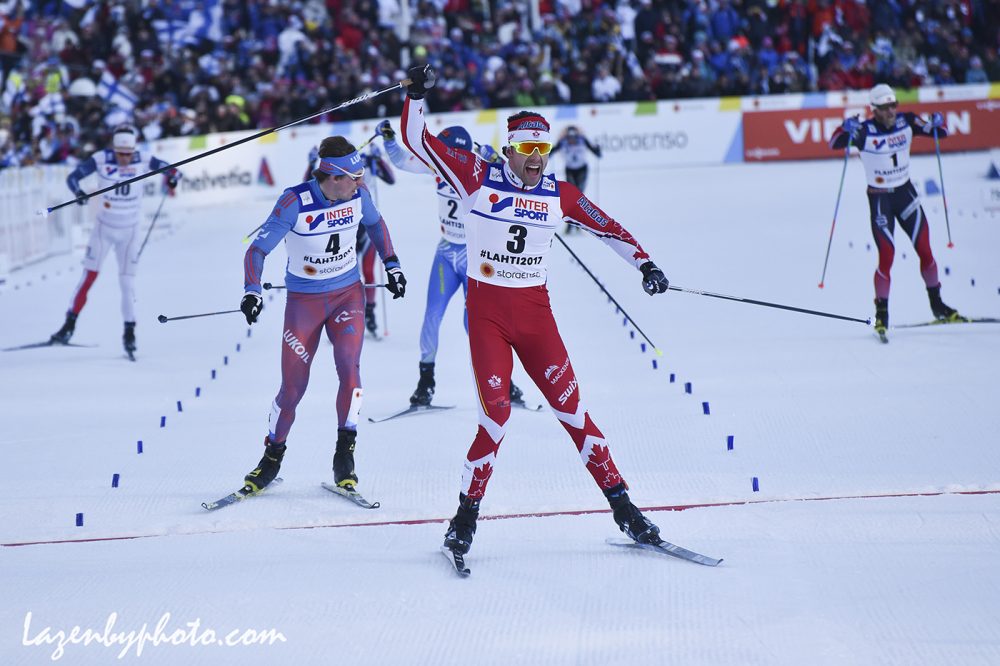
    It’s real. Canada’s Alex Harvey after winning gold in the men’s 50-kilometer freestyle mass start on Sunday at the 2017 Nordic World Championships in Lahti, Finland. (Photo: John Lazenby/Lazenbyphoto.com)

    LAHTI, Finland — Here’s the basics: fast and firm tracks, cloudless skies, and once again a stacked field for the final event of the 2017 Nordic World Championships: the men’s 50-kilometer freestyle mass start.

    Over the course of the 50 k, Canada’s Harvey had to think about one thing: be up front near the top three in order to shadow Norway’s Martin Johnsrud Sundby’s inevitable gut punch in the last kilometer. What he didn’t have to think about was playing catch up as a skier yo-yoing off the back, or his skis — they were rockets.

    In Sunday’s closing race of Lahti World Championships, Harvey was slotted in second, sliding around “Lahti Corner” just centimeters behind Sundby. Drafting off Harvey was 2017 championships legend, Russia’s Sergey Ustiugov, who had already racked up four medals previously in the week (skiathlon gold, team sprint gold, freestyle sprint silver and team relay silver). Pulling not far behind the three was Finland’s Matti Heikkinen and Andrew Musgrave of Great Britain. 

    After studying the women’s 30 k mass start on Saturday, Harvey had some cogent takeaways.

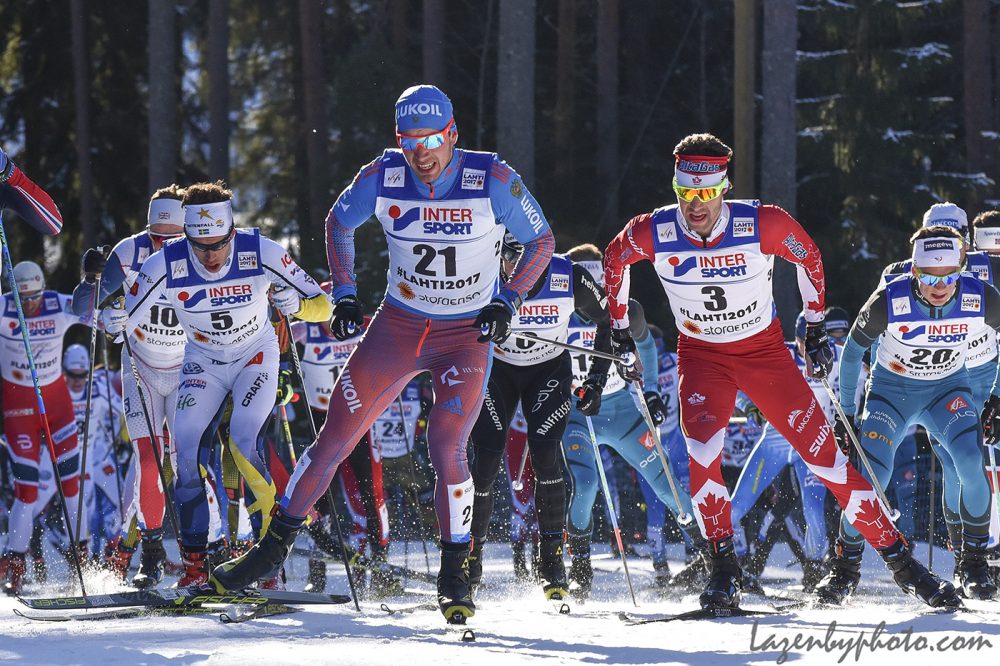
    Russia’s Alexey Chervotkin (21) leads Canada’s Alex Harvey (3) and Sweden’s Marcus Hellner (5) during the men’s 50 k freestyle mass start on Sunday at 2017 Nordic World Championships in Lahti, Finland. Harvey went on to win, Hellner placed 12th and Chervotkin 13th. (Photo: John Lazenby/Lazenbyphoto.com)

    “I saw the women’s race yesterday, and I figured if Marit Bjørgen could not distance herself from the other girls, then there is no way that the men will be able to do that,” Harvey said during Sunday’s post-race press conference. “I knew with the fast conditions, it was going to be a big group, and that leaves the potential for a lot of carnage, a lot of mayhem.”

    For the first 10 k, skiers from various nations took pulls up front, including Sundby and Ustiugov, and Norwegians Petter Northug, Hans Christer Holund, and Anders Gløersen. After testing the field and breaking away around 8 k into the race, Gløersen was still skiing alone up front, 20 seconds ahead of anyone else at 15 k.

    “Gløersen took off a bit and he was like, ‘What’s the gap? What’s the gap?’ ” Canadian World Cup coach Ivan Babikov said of Harvey. “He was always controlling the race and saving energy for the finish.”

    Eventually, the main pack surged to recover the lost time. Gløersen’s off-the-front-flier only earned him camera time. The catch came just before Lahti Corner returning to the stadium around 20 k in, where Russia’s Alexey Chervotkin took over. In another 2 k, Sundby, who had been stalking in the top 10, moved to the front as if the race were all of a sudden for real.

    Norway’s Anders Gløersen broke away early to lead the men’s 50 k freestyle mass start, skiing alone off the front for about 12 kilometers, on Sunday at the 2017 Nordic World Championships in Lahti, Finland. (Photo: John Lazenby/Lazenbyphoto.com)

    From then on, the size of the pack atrophied with each consecutive lap. At 30 k, the pack streaming through the stadium was 24 skiers long. At 45 k, the group winnowed to a train of 19. And within another 4 k, only 13 remained: Sundby, Ustiugov, Musgrave, Harvey, Heikkinen, Northug, Holund, Gløersen, Chervotkin, Sweden’s Marcus Hellner, Norway’s Sjur Røthe, Switzerland’s Dario Cologna, and France’s Maurice Manificat.

    “I wanted to be in the front, top three at least,” Harvey said, reflecting on his skiathlon tactics from last weekend, where he skied around fifth up until the final headwall and finished fifth, outside of the medals.

    “I knew that Sundby’s first chance to win gold was to break everybody,” Harvey continued. “I was expecting him to leave from kilometer 1 or 49.”

    Harvey guessed Sundby would be the only one who would try to break away. With that in mind he marked the Norwegian.

    “He knew it would be hard to break away [and that] it will be all about the finish,” Babikov said. “He was positioning himself perfectly up the last hill and just stayed on Sundby. That was his plan, ‘I’m just gonna stay on Sundby and if he changes skis, I’ll go change skis,’ but today conditions were perfect so he didn’t.”

    With ripping conditions and skis to match, Sundby never slowed nor switched skis. Neither did Harvey.

    “When he waited until the last lap, I knew exactly where he was going to do it: with a k and a half to go,” Harvey explained. “I was just lucky enough to have the legs to stick on him today and from then on it started playing more into my hands.”

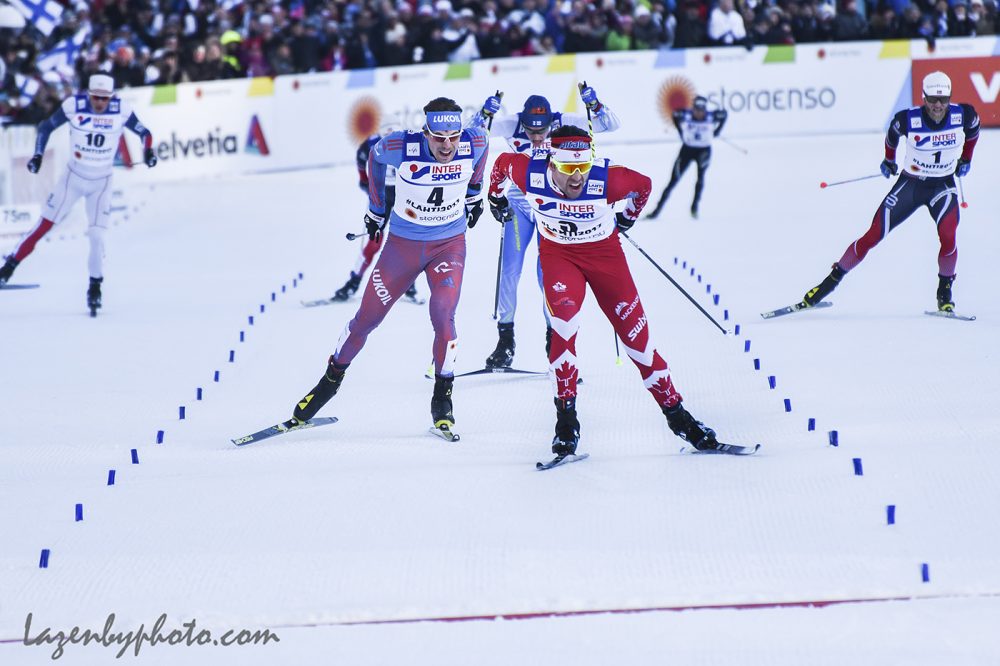
    Canada’s Alex Harvey (5) charging to the line ahead of Russia’s Sergey Ustiugov (4), Norway’s Martin Johnsrud Sundby (1), Great Britain’s Andrew Musgrave (10) and Finland’s Matti Heikkinen (behind Harvey) in the men’s 50 k freestyle mass start on Sunday at the 2017 Nordic World Championships in Lahti, Finland. (Photo: John Lazenby/Lazenbyphoto.com)

    In the closing moments of nearly every race of these world champs, the fate of winners seem come down to luck, and often someone else’s bad luck. As the leaders came into the stadium, it was as if every observer were about to witness an upset due to a tumble or a tangle.

    Harvey was clean around the final turn and unscathed down the stretch.

    “I wanted to hit the [Lahti] corner in second, right behind Sundby or whoever was in the lead,” Harvey said. “I knew I needed to do that in the skiathlon, too, and I tried to go around Finn Hågen Krogh there, but he’s a clever sprinter too. He knew he wanted to be second there.

    “In the skiathlon it didn’t work, but today it did,” Harvey continued. “I was second the whole time and then out of that corner I did one push more than Sundby. I had really fast skis, but used the draft to slingshot and then hit the final corner in first and from there, I knew it was mine to lose more than anything else.”

    Canada’s Alex Harvey (5) celebrates his first individual World Championships gold after winning Sunday’s 50 k freestyle mass start in Lahti, Finland, ahead of Russia’s Sergey Ustiugov (4), Norway’s Martin Johnsrud Sundby (1), and Finland’s Matti Heikkinen (2), respectively. (Photo: John Lazenby/Lazenbyphoto.com)

    And so Harvey earned the crown: 50 k world champion in 1:46:28.9 hours.

    It’s his first championships gold since winning the classic team sprint with Devon Kershaw at 2011 world champs, and fifth medal in four World Championships. 

    “He turned around these world champs for all of us,” Babikov said of the Canadian team. “He was solid. We were with no medals so far, and winning 50 k, he’s the king now.

    “This is the legit distance and he took it today,” he added.

    “It’s a long championship,” said Louis Bouchard, Harvey’s personal coach and Canada’s World Cup co-coach. “He feels every day his energy’s still there, so he knows today, if he’s good tactically, then he can do it.”

    Asked how nerve-racking it was watching the final 5 k unfold, Bouchard responded, “I was pretty nervous, too much maybe. But that’s OK.”

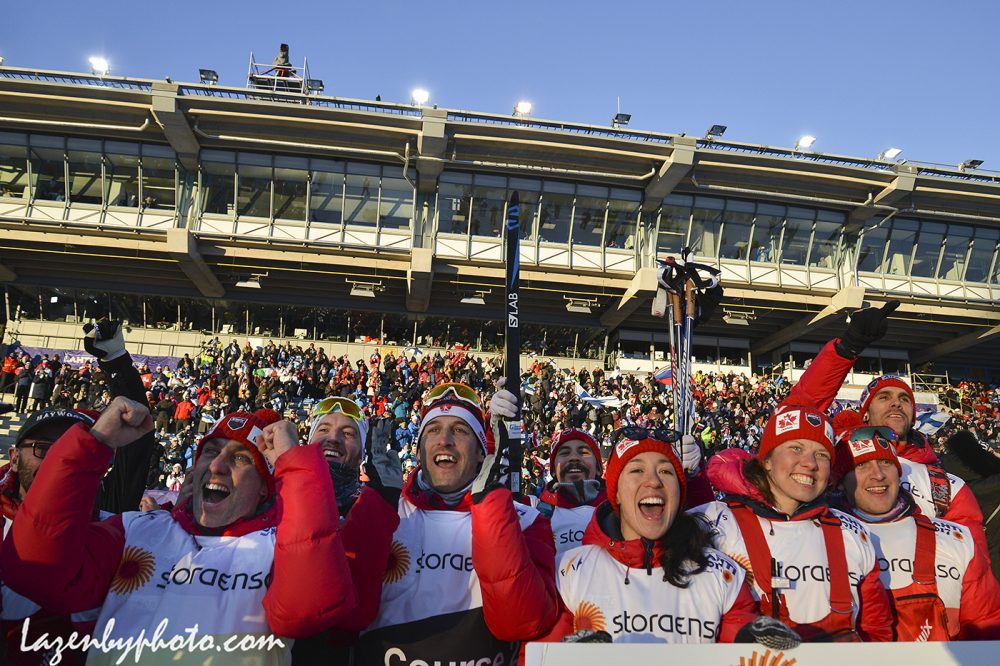
    Alex Harvey’s Canadian teammates, coaches and support team celebrate his win in the men’s 50 k freestyle mass start on Sunday at the 2017 Nordic World Championships in Lahti, Finland. (Photo: John Lazenby/Lazenbyphoto.com)

    For his fifth medal of these championships (and sixth world-champs medal of his career), the 24-year-old Ustiugov crossed second for his third silver of the week, just 0.6 seconds behind Harvey. Finland’s 33-year-old Heikkinen took third (+1.4) for his first medal since 2011 World Championships.

    “Today I skied within my own limits and at the end I was fresh enough to attack,” Heikkinen said in a press conference.

    Asked about his not-so-characteristic finishing kick on Sunday, Heikkinen said he remembered how he faded to 20th in the 50 k classic mass start at 2015 World Championships.
    “After Falun 2015 world champs, I was watching the race after and I was walking in front a mirror and I said, ‘I won’t ever again be like that after a 50 k,’ ” he said. “I’ve been training two years now at a high level [with my team] … and that’s why I’m top three in overall World Cup, so it was possible.”

    Behind him in a photo finish for fourth, Musgrave capitalized on Sundby slowing before the finish — probably after the Norwegian realized he had missed out on a medal — to place fourth (+2.9). For Musgrave, who turns 27 on Monday, it was his first World Championships top 10. For Sundby, who had been on a quest all week for his first individual championships goal — it was a bummer. The 2018 Winter Olympics in PyeongChang, South Korea, will be Sundby’s next opportunity.

    From a North American and perhaps international standpoint, American Tad Elliott skied the gutsiest of races. Halfway through the race, Elliott, a 28-year-old Colorado native and former U.S. Ski Team member, remained a not-too-far-off the back chaser, 27 seconds behind the lead group. His margin back slowly accrued over the remaining distance.

    “At 25 k, man, some guys were really struggling and they balled it up,” Elliott said afterward. “I should have sent it a little harder but that’s how it goes sometimes in that pack. I thought I could get there, but I just missed it.”

    Elliott, of Ski Club Vail, finished 27th (+3:16.8) for his best individual result in three World Championships. In recent years, Elliott has struggled with illness, which impacted his ability to train and peak. Those difficulties caused him to question whether or not his best years were behind him. Evidently not.

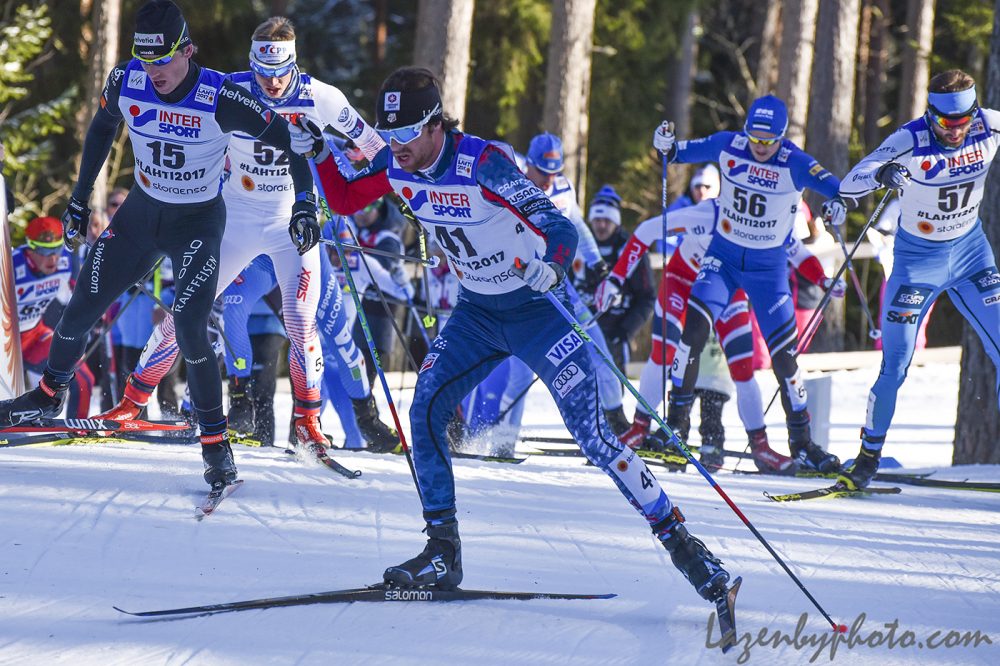
    American Tad Elliott (41) racing to 27th in the men’s 50 k freestyle mass start on Sunday at the 2017 Nordic World Championships in Lahti, Finland.. (Photo: John Lazenby/Lazenbyphoto.com)

    “I didn’t know if I wanted to come back [to skiing]. I was so sick. I was so bummed. I was like, ‘Am I ever going to get back? Am I ever going to get back to top-30 form?’ ” Elliott said. “We knew if everything went right, I would qualify for worlds … then to get top 30 here, man, I feel like I’m starting to get greedy. I’m starting to want more, I’m starting to want more opportunities. But I’m proud of this effort, I’m going to savor it a bit.”

    In the first few kilometers, Russia’s Petr Sedov skied too wide on a 180-degree corner and stalled out. American Kyle Bratrud, the next skier to round the turn, was unable to avoid the Russian and collided. Soon after, due to the impact, Bratrud was unable to complete the race.

    U.S. Ski Team member Noah Hoffman finished the day in 50th (+8:53.1).

    Devon Kershaw was Canada’s second skier on Sunday, crossing in 38th (+5:45.5). Also for Canada, Graeme Killick and Knute Johnsgaard finished in 43rd (+7:04.0) and 55th (+12:03.3), respectively.

    “[Alex’s performance] was incredible and such a big boost for our entire team,” Babikov said. “You should see all the techs, and Devon and Graeme and Knute, who didn’t really have a great race today, and they’re still so psyched for him.”

    Results

    — Gerry Furseth, Jake Ellis and Alex Kochon contributed

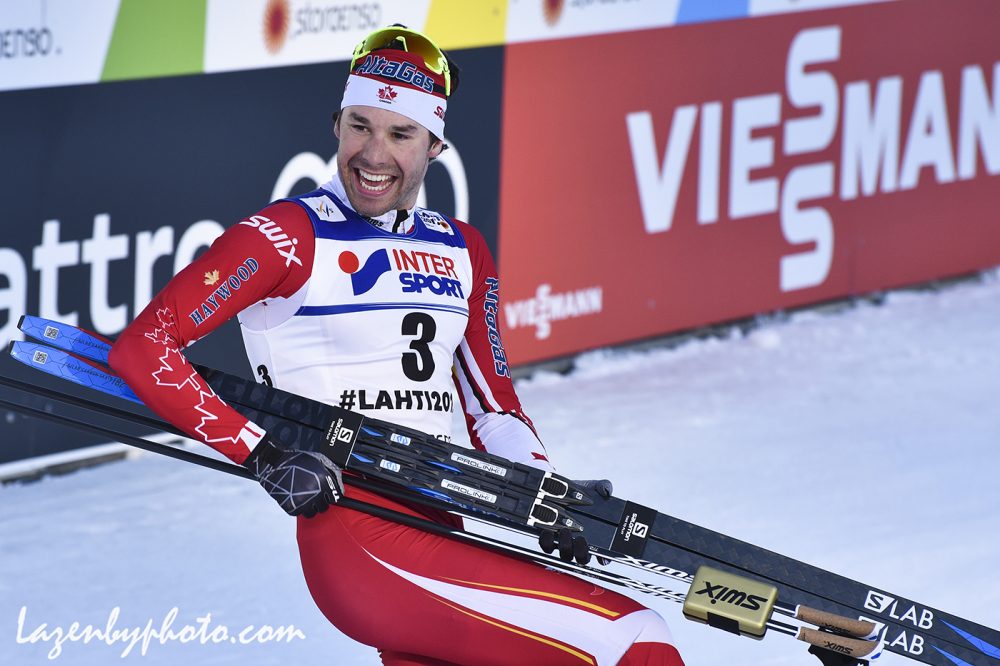
    Canadian air guitar: Alex Harvey performs his team’s signature move after winning the men’s 50 k freestyle mass start on Sunday at the 2017 Nordic World Championships in Lahti, Finland. (Photo: John Lazenby/Lazenbyphoto.com)
  • Sunday Rundown: Ulricehamn, Antholz, Chaux-Neuve, Whistler, & Truckee (Updated x3)

    Sunday Rundown: Ulricehamn, Antholz, Chaux-Neuve, Whistler, & Truckee (Updated x3)

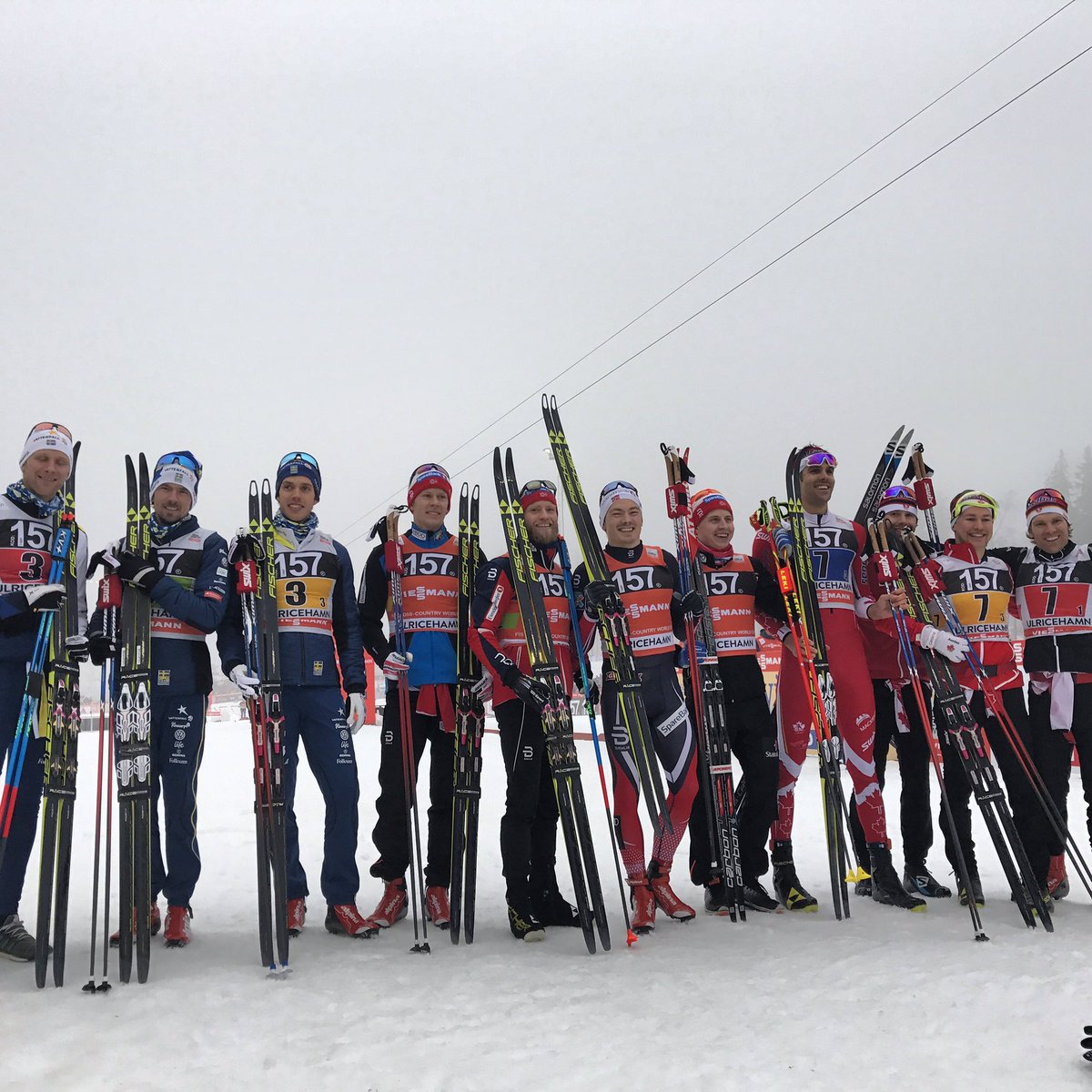
    The men's 4 x 7.5 k relay podium at the World Cup in Ulricehamn, Sweden, with Norway (c) in first, Sweden (l) in second, and Canada (r) with with its best-ever men's relay in third. (Photo: FIS Cross Country/Twitter)
    The men’s 4 x 7.5 k relay podium at the World Cup in Ulricehamn, Sweden, with Norway (c) in first, Sweden (l) in second, and Canada (r) with with its best-ever men’s relay in third. (Photo: FIS Cross Country/Twitter)

    FIS Cross-Country World Cup (Ulricehamn, Sweden): 4 x 5 k and 4 x 7.5 k Relays

    Men’s report | Women’s report

    Norway notched back-to-back team victories in the women’s and men’s relays on Sunday at the World Cup in Ulricehamn, Sweden, with Finn Hågen Krogh securing a win in the men’s 4 x 7.5 k relay by 0.5 seconds over Sweden’s Calle Halfvarsson and Canada’s Lenny Valjas. With two kilometers remaining, nine teams were within 3.8 seconds of first. Krogh outlasted both Halfvarsson and Valjas in the finishing stretch, as Sweden placed second and Canada third for its best-ever relay result, according to a Cross Country Canada press release, besting its fifth-place finish from 2012 (with then-anchor Ivan Babikov, now a Canadian World Cup coach).

    Krogh teamed up with Simen Hegstad Krüger, Martin Johnsrud Sundby and Anders Gløersen and finished in 1:06:47.5, while Sweden placed second with Daniel Rickardsson, Johan Olsson, Marcus Hellner, and Halfvarsson.

    For Canada, with Devon Kershaw, Alex Harvey, Knute Johnsgaard, and Valjas, it was Harvey’s third-straight World Cup podium, Valjas’s second-straight team-event podium, and national U25 Team member Johnsgaard’s first podium.

    “I have been waiting my whole career for this,” Kershaw said, according to a FIS press release. “All the guys did a great job today.”

    The U.S. placed 10th (+1:16.5) with Andy Newell, Erik Bjornsen, Noah Hoffman, and Simi Hamilton.

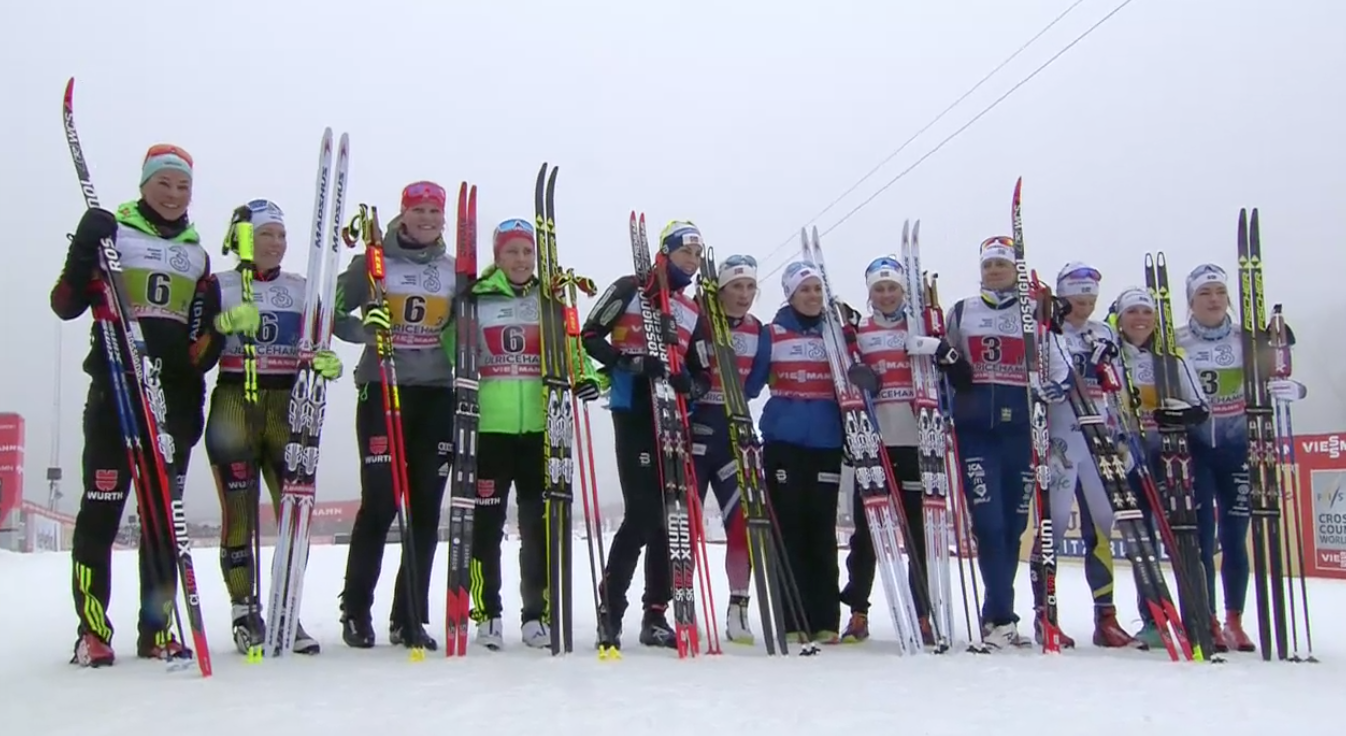
    The Norwegian women's team (center) won the 4 x 5 k World Cup cross-country relay in Ulricehamn, Sweden, by 8.8 seconds over Germany (left), with home team Sweden (right) edging the United States for third.
    The Norwegian women’s team (center) won the 4 x 5 k World Cup cross-country relay in Ulricehamn, Sweden, by 8.8 seconds over Germany (left), with home team Sweden (right) edging the United States for third.

    Earlier on Sunday, the women’s 4 x 5 k relay didn’t break apart until the second leg, but Norway still proved its dominance over the ski world with a win to start the day.

    After the group of Ingvild Flugstad Østberg and Lotta Udnes Weng (Norway), Ida Ingemarsdotter (Sweden), and Anamarija Lampic (Slovenia) more or less stayed together on the first relay leg, Heidi Weng made a break for it, giving Norway a 16.8-second lead at the second tag. The Norwegian team never looked back and after the race Weng and teammates Østberg, Astrid Jacobsen, and Marit Bjørgen were able to climb to the top step of the podium.

    The race for second place, though, wasn’t resolved until the finish line. Sweden, Slovenia, Norway’s second team, the United States, and Germany were all in contention at various points in the race.

    On the last leg, Jessie Diggins of the U.S., Sandra Ringwald of Germany, and Hanna Falk of Sweden battled it out, dropping Kari Øyre Slind of Norway. The three shot to the finish line together, with Diggins stuck behind the other two. Ringwald eventually won the sprint finish by 0.2 seconds over Falk, with Diggins another 0.2 seconds back in fourth.

    That gave Ringwald, Katharina Hennig, Stefanie Boehler, and Victoria Carl a second-place result, one of Germany’s best since taking silver at the 2010 Olympics. (The team won bronze at the 2014 Olympics.)

    Ingemarsdotter, Falk, Charlotte Kalla, and Sofia Henriksson took the third step of the podium. Rosie Brennan, Sadie Bjornsen, Liz Stephen, and Diggins were left to settle for fourth.

    The second U.S. team, of Kikkan Randall, Ida Sargent, Sophie Caldwell, and SuperTour leader Liz Guiney finished 12th after skiing in 8th and 9th earlier in the race.

    Results: Men | Women

    ***

    IBU World Cup (Antholz, Italy): Men’s mass start and women’s relay

    Men’s mass start report | Women’s relay report

    ***

    NorAm Western Canadian Championships (Whistler, B.C.): Relays

    [UPDATED] This season brought a changeup to the Western Canadian Championships with a three-person relay event in response to athletes’ request to add “fun” events to the NorAm series.

    While 146 teams finished in 17 categories, it was Ontario winning the open men’s 3 x 7.5 k in 50:32.9 (Bob Thompson, Jack Carlyle and Andy Shields) and B.C. dominating the open women’s 3 x 5 k in 41:09.47 with three juniors (Katie Weaver, Anna Goodwin and Hannah Mehain).

    The masters men and juvenile girls categories included the most teams, with 15 and 14, respectively.

    Results


    FIS Nordic Combined World Cup (Chaux-Neuve, France): Individual large hill/10 k

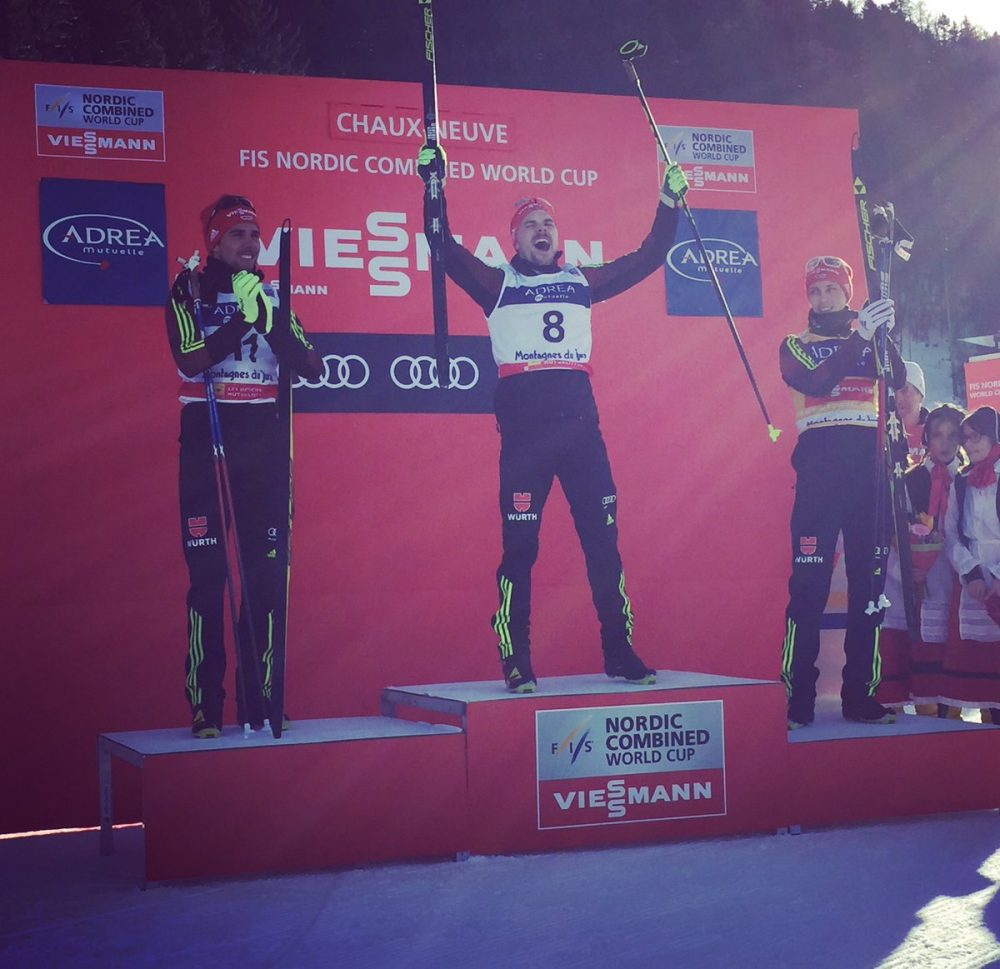
    Sunday's Nordic Combined World Cup podium in Chaux-Neuve, France, with German winner Fabian Rießle (c), German runner-up Johannes Rydzek (l), and Germany's Eric Frenzel (r) in third. (Photo: FIS Nordic Combined/Twitter)
    Sunday’s Nordic Combined World Cup podium in Chaux-Neuve, France, with German winner Fabian Rießle (c), German runner-up Johannes Rydzek (l), and Germany’s Eric Frenzel (r) in third. (Photo: FIS Nordic Combined/Twitter)

    On Sunday, after the large hill jump and 10 k ski, Germany swept the podium in the second event of the NoCo World Cup in Chaux-Neuve, France. Fabian Rießle placed first in 22:44, and his German teammates Johannes Rydzek skied to second only 2.2 seconds back, and Saturday’s winner Eric Frenzel was third (+7.9).

    (Frenzel leads the NoCo World Cup, Rydzek is second overall, Rießle is third.)

    Norway’s Jarl Magnus Riiber flew the farthest with 139.8 points. Franz-Josef Rehrl from Austria jumped to second with 135.7 points while his teammate Bernhard Gruber jumped to third with 131.7 points.

    Magnus faded to 23rd (+47.5) in the 10 k ski. Rehrl started 15 seconds back from Magnus and placed 17th overall (+31.5). Gruber maintained a top-ten, placing 9th (+13.5), after starting 32 seconds behind first place jumper Magnus.

    While the top three jumpers all dropped back in the ski, it was a day of catch up for the German’s after the jumping portion.

    Rießle ranked eigth after the jump and earned 128.7 points, he began the ski 0:44 back. Rydzek placed 11th in the jump with 126.9 points, while Frenzel jumped to fourth with 131.4 points.

    The only U.S. skier entered in Sunday’s event was Ben Berend. The U.S. Nordic Combined skier jumped to 13th with 126.8 points — starting the ski 0:52 behind Magnus. Yet Berend couldn’t capitalize on his strong jump, he dropped to 37th (+2:06) after the ski.

    The Nordic Combined World Cup continues next Friday in Seefeld, Austria.

    Results

    U.S. SuperTour (Truckee, Calif.): 10 k/5 k free 

    Events cancelled due to weather.

  • After 8 Years, France Finds Relay Podium Again; Norway Wins La Clusaz Men’s Relay

    After 8 Years, France Finds Relay Podium Again; Norway Wins La Clusaz Men’s Relay

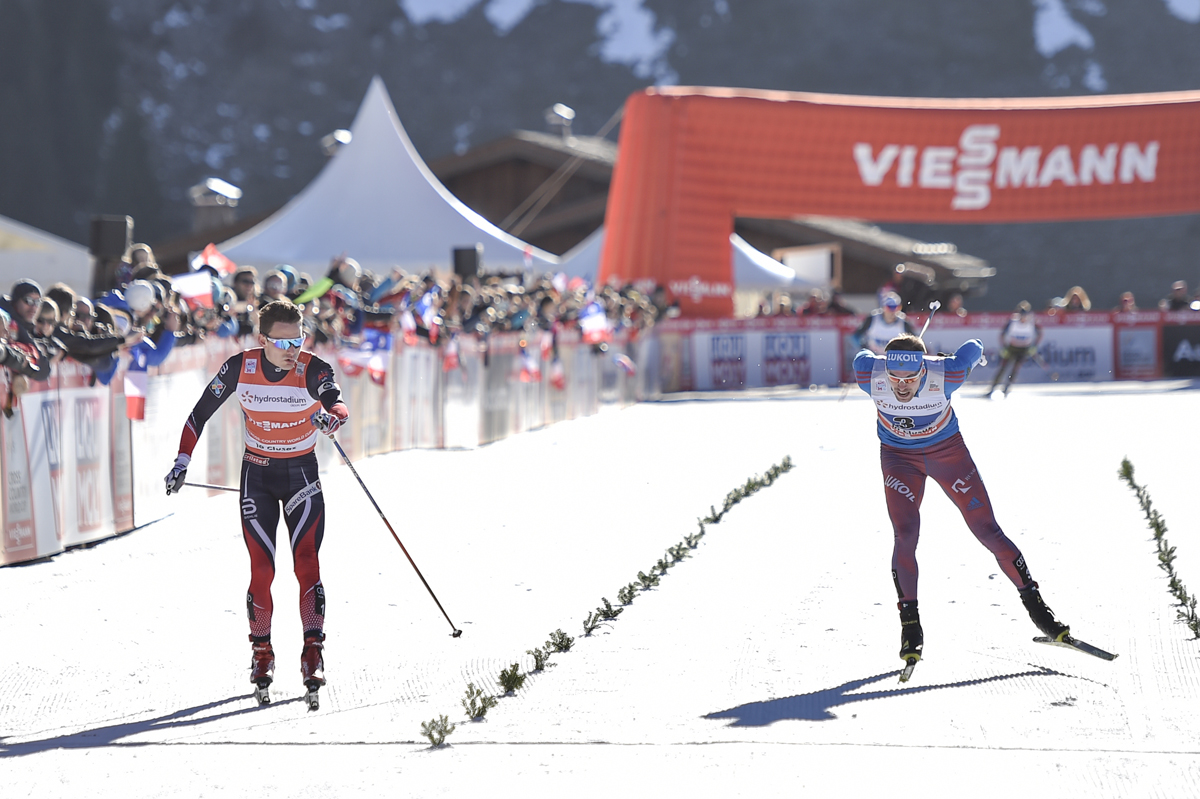
    Finn Hågen Krogh (l) crossing the line ahead of Russia's Sergey Ustiugov to give Norway the win in the men's 4 x 8 k relay, the first of the World Cup season, in La Clusaz, France. (Photo: Fischer/NordicFocus)
    Finn Hågen Krogh (l) crossing the line ahead of Russia’s Sergey Ustiugov to give Norway the win in the men’s 4 x 8 k relay, the first of the World Cup season, in La Clusaz, France. (Photo: Fischer/NordicFocus)

    Eight years ago, France’s Maurice Manificat and Jean-Marc Gaillard waved to the French cheers of their country’s fans as they climbed onto the men’s World Cup relay podium in La Clusaz, France. The two — along with their former national-team teammates, Vincent Vittoz and Emmanuel Jonnier — had secured the final podium spot by less than a minute, just barely missing out on second place.

    Little did they know as they climbed down that it would be close to a decade later before they would reach a relay podium again during the regular World Cup season.

    On Sunday, for the first time since December 2008, both Manificat and Gaillard — joined this time by their teammates and current French national-team members, Alexis Jeannerod and Clement Parisse — reclaimed their podium spot in the men’s 4 x 8-kilometer relay, once again against the backdrop of La Clusaz.

    “It was a great day for our team,” Manificat said, according to an International Ski Federation (FIS) press release. “Everybody did an awesome job on their legs. I knew Finn [Hågen Krogh] and Sergey [Ustiugov] would be the biggest opponents today on the last leg. My plan was to ski with them and eventually go away. Finn and Sergey were stronger but it is great to finish on the podium.”

    (Article continues below)

    Starting in Row 2 behind Russia’s Evgeniy Belov, Gaillard skied the first classic leg for France, holding tightly to a third place for much of the first part of his race, behind Belov and Norway’s Didrik Tønseth.
    By the 3.5 k mark, Pål Golberg of Norway’s second team and Sweden’s Emil Jönsson had overtaken the lead and Gaillard was getting pushed back to fourth then fifth and eventually seventh.

    Yet the Frenchman’s skis proved faster than most in the field and by 6 k he had regained his position in third. Belov had also found his way back to the front. As the group rounded for their final lap Goldberg charged the group to the exchange zone, putting Norway’s second team on the attack.

    Gaillard ultimately tagged off in sixth to Jeannerod for the second classic leg. Norway’s first team came through in seventh, handing off to Martin Johnsrud Sundby. Russia I tagged off in second to Alexander Legkov.
    It didn’t take long, however, for Sundby to put Norway’s first team back in the lead. By the 2 k mark it was his red bib that led the chase pack, with the Norwegian double poling on skate skis. Within the next 2 k, however, Italy’s Francesco de Fabiani, Legkov and Sweden’s Jens Burman had swallowed up Sundby, while Jeannerod now sat in seventh.

    With 2.5 k to go of the second leg, de Fabiani quickened the pace and Sundby struggled to keep up while double poling the course climbs.

    The second exchange came down to a battle between Italy and Norway’s second team, with Norway’s Niklas Dyrhaug outsprinting de Fabiani to be the first through. Russia’s first team exchanged in third, while France I was now positioned in fifth. Sundby was the last of the chase pack to come through in ninth, tagging off to Anders Gløersen for the first freestyle leg.

    “It’s necessary to take a proper stance for the classical diagonal technique,” Sundby said told VG. “I did that today by getting a real beating.”

    As the first freestyle leg began to unfold, it was Sweden’s Martin Johansson who led the charge, not far behind was Russia’s Alexey Chervotkin and France’s Parisse. Also working his way back into the mix — despite the 20 meters Sundby had lost on the lead group — was Gløersen of Norway’s first team.

    In fact, by the 3 k mark, Gløersen had propelled himself to the front and taken command of the lead.

    Norway's Ander Gløersen leading the third leg of the men's 4 x 8 k relay on Sunday at the World Cup in La Clusaz, France. (Photo: Fischer/NordicFocus)
    Norway’s Ander Gløersen leading the third leg of the men’s 4 x 8 k relay on Sunday at the World Cup in La Clusaz, France. (Photo: Fischer/NordicFocus)

    “Anders did a great job on his leg and put us back in contention,” Finn Hågen Krogh, the anchor for Norway’s first team, said according to a FIS press release.

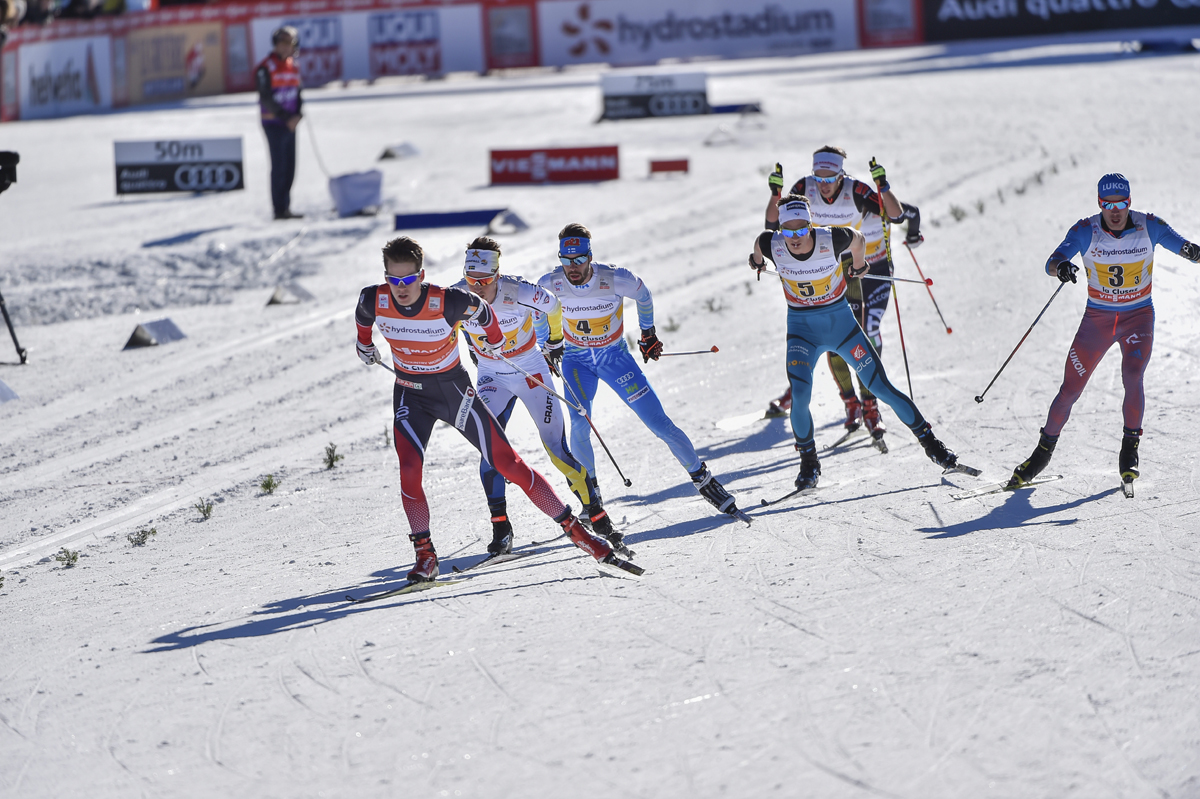
    With the lead returning to Norway, France, Russia, and Sweden were back in the hunt. The 4 k mark found a front group of seven nation’s relay teams — Norway I, France I, Germany, Sweden, Russia I, Finland, and Italy.

    Rounding the corner for the final exchange, it was Norway I, followed by Sweden, and Russia. Parisse, who tagged off to Manificat, came through in fifth.

    The anchor for Russia’s first team, Sergey Ustiugov, wasted no time moving to the front of the group to set the pace. The six other frontrunners followed closely behind, with Krogh and Germany’s Lucas Bøgl positioned in second and third respectively.

    Then came the waiting game. The group slowed, Ustiugov and Krogh casting a few glances over their shoulders to see who would make the first move. Ultimately it was Ustiugov first. The Russian began to push the pace around the 3 k mark, initiating a scramble. Yet within another kilometer, Ustiugov slowed giving the lead back over to Krogh.

    “In my leg I wanted to save some energy and gave everything in the last corner and in the finish stretch,” Krogh said, according to a FIS press release.

    The front group had now split in two, with Germany, Norway I, France I, and Russia I breaking away. Sweden, Finland and Italy had fallen behind.

    As they approached the final course climb, the real sprint began with Krogh and Ustiugov going head-to-head straight to the last 100 meters. In a lunge to the line, Krogh bested Ustiugov by two tenths of a second for the overall win in a time of 1:11:25.7. Crossing 7.7 seconds later was Manificat, securing France on the podium in third.

    “I gave everything I had in the finish,” Ustiugov said, according to a FIS press release. “The speed increased in the last two laps. It is always disappointing to lose, but Finn was very strong on the home stretch. But it is still a very good result to be second and to share the podium with my teammates.”

    Neither Canada nor the U.S. fielded a men’s relay due to illness. Racing will resume Dec. 31 in Val Mustair, Switzerland, for Stage 1 of the 2016/2017 Tour de Ski.

    Results

    — Aleks Tangen contributed reporting

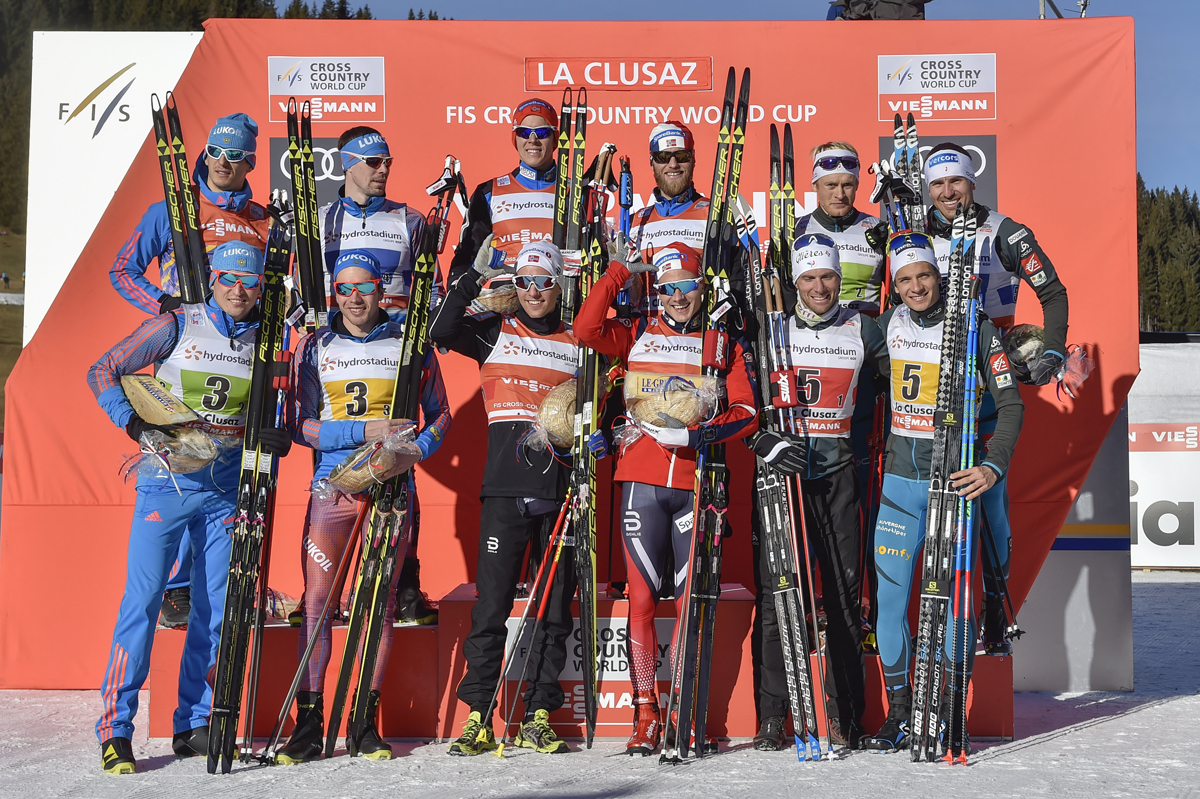
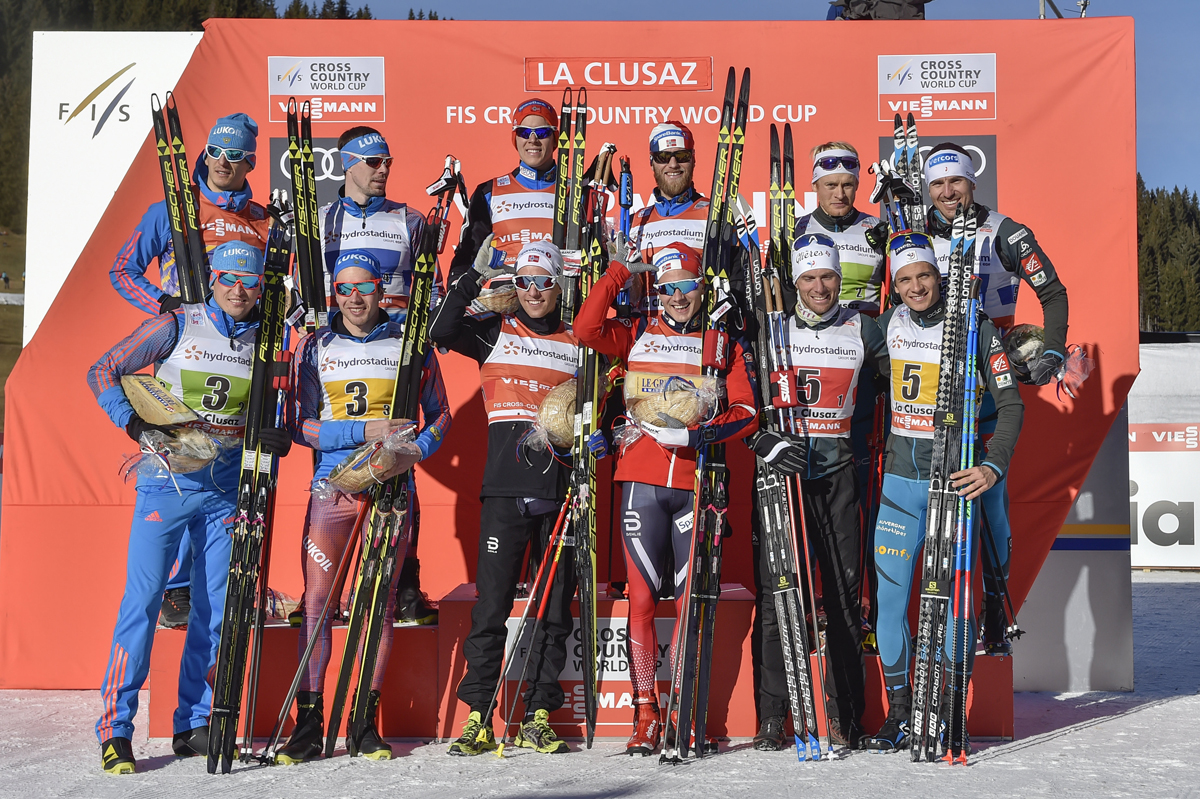
    The men's relay podium at the La Clusaz World Cup on Sunday, with Norway in first (c), Russia in second (l) and France with its first World Cup podium in eighth years in third (r). (Photo: Fischer/Nordic Focus)
    The men’s relay podium at the La Clusaz World Cup on Sunday, with Norway in first (c), Russia in second (l) and France with its first World Cup podium in eighth years in third (r). (Photo: Fischer/Nordic Focus)
  • Davos Notes and Quotes: The Men

    Davos Notes and Quotes: The Men

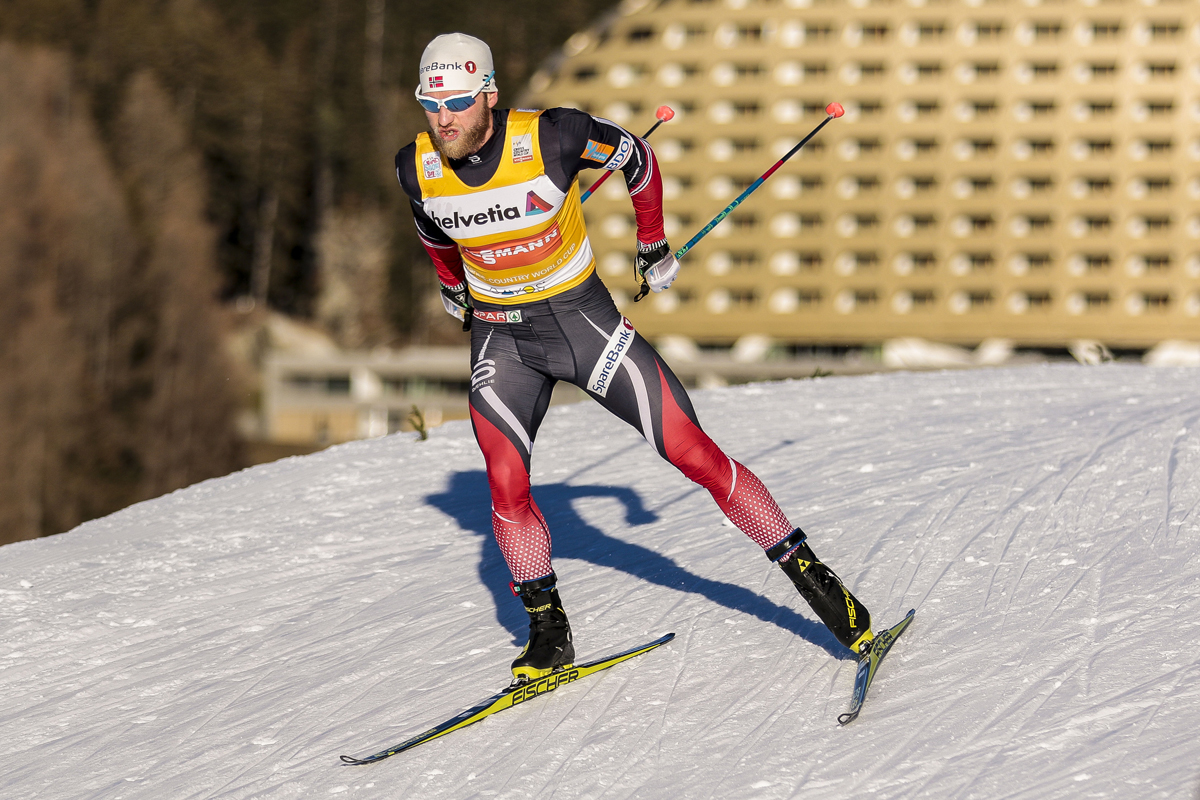
    Martin Johnsrud Sundby of Norway coming into the finish for a win in the 30 k skate in Davos, Switzerland. (Photo: Fischer/NordicFocus)
    Martin Johnsrud Sundby of Norway coming into the finish for a win in the 30 k skate in Davos, Switzerland. (Photo: Fischer/NordicFocus)

    Norway’s Martin Johnsrud Sundby took a win in the 30 k freestyle in Davos, Switzerland, this weekend, but on Sunday a new team had took a trip to the podium’s top step: Russia, whose Sergey Ustiugov notched his first victory of the season in the skate sprint.

    Here’s all the reporting – and there’s a lot – that didn’t make it into the race reports.

    On that awesome feeling in your legs

    “I love lactate.”

    -Matti Heikkinen, Finland (3rd in 30 k)

    “Not so much.”

    -Anders Gløersen, Norway (2nd in 30 k)

    On how to get through a rough patch

    “Alex [Harvey] came through with a group, with a young Swede, Jens Burman. He was going quite strong– I think he finished top ten today [note: Burman was sixth]. I joined that train and just kind of faked it through the top of the lap to try to get into the draft there and was able to recover a bit and stay with him though my last lap. It was a perfect group for me to finish with and it helped me have a good last lap there.”

    -Graeme Killick, Canadian National Ski Team (21st in 30 k)

    “The hardest part for me was the second lap. I had to go a few laps where I tried to just calm down and get rid of some lactate… when [Maurice] Manificat began to get tired, I wasn’t feeling great at the time so I didn’t want to go in front. I think that’s where I lost some seconds… All in all, that Martin wins today is like it should be, because I had so much help.”

    -Gløersen

    On avoiding our interview in the mixed zone

    “Yeah, I walked straight past. I was really really disappointed with yesterday. It was just a really hard race yesterday. I did 30 k all by myself. It was really bad and really hard.”

    -Devon Kershaw, Canadian National Ski Team (43rd place in 30 k), after the sprint (49th place)

    On 21-year-old Lucas Chanavat of France, top qualifier and sixth in the sprint

    “If you qualify first you know that your are feeling good that day. You have that confidence. You know that you have really good skis with you. So it is cool to see that, stepping up and taking advantage of the opportunity of being here. He skied hell of a qualifier and a hell of, a hell of quarterfinal so that’s cool to see. It’s sweet to see guys like that.”

    -Simi Hamilton, U.S. Ski Team (23rd place in sprint)

    On sprinting at altitude

    “I think [the qualifier] went well. I didn’t feel the greatest before my heat. The qualifier took a lot out of my lungs, same with Simi [Hamilton], like our lungs are wrecked warming up. The legs were a bit heavy, but I guess it is the same for everybody.”

    -Lenny Valjas, Canadian National Ski Team (14th place in sprint)

    On sprint strategy

    “Two years ago I did that, coming wide off the last turn and was about to pass two guys. But they were still a bit ahead of me so they took the left lanes and then you’re screwed. Today I was close beside them, so they couldn’t really cut me off completely. This time it worked, last time it didn’t.”

    -Valjas

    “Today, I just wanted to do the sprint and remember how to sprint with a tired body with the Tour de Ski coming. It wasn’t very good, but I wasn’t expecting a whole lot. I just wanted to focus on doing the best I could with what I had.”

    -Kershaw

    “There was definitely headwind coming down valley. So my kind of main strategy was to just get in a nice draft through the long gradual flats here. I felt great for a lap and you know still felt good coming through on my second lap.”

    -Hamilton

    On the first period of racing

    “To be honest, I wasn’t all that confident today. I’ve raced in Davos about five or six times, and I’ve gone really slow every time, so today is by far the best I’ve ever done. I’m fairly pleased. My main focus is the 30 k skiathalon at the World Championships, and then I’m hoping to go fast at the Tour de Ski as well. Those are the two things I’m aiming most for. So I’d like to have won a race, but it’s the best, most stable start I’ve had to a season so far in my career, so it gives me a little bit of confidence going forward. At the same time it’s a long season, so there’s plenty of time to start going slow.”

    -Andrew Musgrave, Great Britain (15th in 30 k, 61st in sprint)

    “Overall kind of a disappointing weekend here in Davos, but that’s okay. Overall it’s an okay start to the season. Nothing outstanding, but I feel like I’m building well towards the Tour.”

    -Kershaw

    On next weekend’s World Cups La Clusaz, France

    “We will just have four guys for the relay, so I am psyched to take a turn in that. I think it bodes well for me that they changed the distance race to a 15 k skate on a short kind of circuit loop. Psyched to jump into that hopefully too. And see what happens. I think right now it’s like, the more I can just get my body used to the hard efforts the better. So regardless of how I feel next weekend, it will be a good opportunity to get in a couple more hard efforts before a good solid training block over Christmas.”

    -Hamilton

    “I’m really excited to do the relay. It think Killick showed he’s obviously in great form, so I think we could have some fun in the relay. And 15 k skate mass start is fun if you can stay with the group. And that’s the goal.”

    -Kershaw

    “I feel good, but I’m nervous for the relay event. I don’t know where I am going to start either. It will be fun– I know the shape is good, I just guess it’s been a lot of racing. I have done all the distance except the 30 k. So I am going to try to get my speed back and I think it will go well.”

  • Saturday Rundown: Davos, Pokljuka & Sovereign Lake (Updated x3)

    Saturday Rundown: Davos, Pokljuka & Sovereign Lake (Updated x3)

    AWCA's Olivia Bouffard-Nesbitt leads the American train around the bridge corner into the finish straight in the A final (Photo: Peggy Hung)
    Olivia Bouffard-Nesbitt of the Alberta World Cup Academy (AWCA) leads the American train around the bridge corner into the finish straight in the A-final of Saturday’s NorAm classic sprint at Sovereign Lake in British Columbia. She went on to finish fourth behind Julia Kern (second from r), Liz Guiney (back left) and Kaitlynn Miller (l), respectively. (Photo: Peggy Hung)

    Welcome to The Rundown, your quick primer of need-to-know information about the day’s racing. We’ll be updating this digest as the day goes on with additional results, photos and quotes. The Rundown is NOT a race report; stay tuned for complete race reports later today with interviews from the day’s top racers.

    ***

    Canadian NorAm/U.S. SuperTour at Sovereign Lake: Classic sprint
    [UPDATE] U.S. skiers filled the open category podiums on the first fully North American NorAm event in recent years on Saturday at Sovereign Lake near Vernon, B.C. With NorAm points, SuperTour points and FIS points on the line there was a great turnout of the top skiers.

    In the open women’s 1.2-kilometer classic sprint, Julia Kern of the Stratton Mountain School (SMS) won in 3:17.04 after qualifying fifth. Liz Guiney of the Craftsbury Green Racing Project (CGRP) finished second, 0.67 seconds back, and her CGRP teammate Kaitlynn Miller rounded out the podium in third (+0.91). Olivia Bouffard-Nesbitt (Alberta World Cup Academy) was the top Canadian in fourth (+1.49) and the lone Canadian in the final. Jennie Bender (Bridger Ski Foundation) placed fifth (+3.8) and Heather Mooney was sixth (+19.84).
    On the same 1.2 k course, Reese Hanneman (Alaska Pacific University) made up for his 15th qualifying time to take the men’s final win in 2:38.08. Cole Morgan of the Sun Valley Ski Education Foundation (SVSEF) took second in the final (+0.87) after winning the qualifier, and Ben Saxton (SMST2) was third (+1.92). Matt Gelso (SVSEF) finished fifth (+3.88), after precipitating a semifinal crash that took three Canadians (Angus Foster, Simon Lapointe and Evan Palmer-Charrette) out of contention, but didn’t result in a protest. The lone Canadian man in the final, Antoine Briand (Pierre-Harvey Training Centre) placed sixth (+11.98).

    Sprint brackets

    IBU World Cup in Pokljuka: 10/12.5 k pursuits

    Susan Dunklee being hoisted up by her US Biathlon support team at the IBU World Cup in Pokljuka, Slovenia, after tying her career-best result in a pursuit. Dunklee placed fifth on Saturday for a season best as well. (Photo: USBA/NordicFocus)
    Susan Dunklee being hoisted up by her US Biathlon support team at the IBU World Cup in Pokljuka, Slovenia, after tying her career-best result in a pursuit. Dunklee placed fifth on Saturday for a season best as well. (Photo: USBA/NordicFocus)

    Women’s report | Men’s report

    Another day at the front of the pack, and another day of (nearly) perfect shooting for Susan Dunklee, who raced from 11th to fifth for her first flower ceremony (top six) of the season at the IBU World Cup in Pokljuka, Slovenia.

    Dunklee (US Biathlon) cleaned the first three of four stages in Saturday’s 10-kilometer pursuit to move into second with one standing stage remaining. In that final shooting stage, she had her first miss of the day, yet still left the range in second, 22 seconds behind Germany’s Laura Dahlmeier in first. Dunklee finished out the race with the 21st-ranked course time on the last loop (her first-loop time was the fastest in the 56-woman field) and placed fifth, 24.1 seconds behind Dahlmeier — who won her second-straight race in Pokljuka. Dahlmeier finished first in 30:43.1 despite two prone misses on the second stage, which put her as far back as fifth (0+2+0+0). Finland’s Kaisa Mäkäräinen finished second, 16.8 seconds back, with two penalties as well (0+0+1+1), and Eva Puskarcikova of the Czech Republic reached the podium in third (+18.7) with a single miss followed by three clean stages (1+0+0+0). One spot ahead of Dunklee, reigning World Cup champion Marie Dorin Habert of France clawed her way up to fourth (+18.8) after starting 17th, with one penalty (0+0+1+0).

    For Dahlmeier, it was her 10th World Cup victory and fifth in a pursuit.

    “My motto is ‘Scheiß da nix, dann feid da nix’,” Dahlmeier told Germany’s ZDF, which vaguely translates to “Don’t worry be happy,” or “Just do it.”

    “That was worth gold today. I was a bit surprised about my two misses in prone. Apparently I already had an aberration in the first stage, then I clicked [adjusted the sights] and was a bit surprised that the two misses still happened,” she added. “… Then came the standing shooting, and there I tried to keep calm again. The race is only over once you cross the finish line, and that became true again today. I am happy that the race flipped again like this.”

    Canada’s Julia Ransom cleaned three consecutive stages before missing two on the last standing. She finished 34th for the second day in a row, 2:33.5 behind Dahlmeier. Rosanna Crawford placed 49th with three penalties (2+1+0+0) and Clare Egan of the U.S. was 56th with six misses (2+0+1+3).  Canada’s Megan Tandy, with seven penalties (1+1+3+2) did not finish.

    In the men’s 12.5 k pursuit, the first man out of the start, Martin Fourcade of France, held his lead to the finish, hitting all 20 targets and winning in 30:27.4. Norway’s Emil Hegle Svendsen rose from fourth at the start to second at the finish (+6.0) with clean shooting as well, and Russia’s Anton Shipulin placed third for the second-straight day (+6.2), with one penalty in the last stage (0+0+0+1).

    Friday’s sprint runner-up, Johannes Thingnes Bø of Norway, ended up fourth (+48) with two misses on the last stage (0+0+0+2), Germany’s Simon Schempp placed fifth (+59.8) after starting sixth, and had one miss (0+0+1+0), and Michael Rösch of Belarus cleaned for sixth place (+1:21.0) after starting 16th.

    Lowell Bailey (US Biathlon) finished 18th (+2:01.6) for the second day in a row, with one prone penalty in the first stage (1+0+0+0).

    Biathlon Canada’s Christian Gow picked off two places for a new career best in 31st (+2:41.7) with a single prone penalty (0+1+0+0).

    Tim Burke placed 42nd (+4:09.8) for the U.S. (after starting 53rd) with five standing penalties (0+0+2+3), Canada’s Scott Gow finished 48th (+4:39) with five misses as well (2+1+0+2), and the third Canadian in the race, Brendan Green was 57th (+5:36.4) with five penalties (+5:36.4).

    Results: Women | Men

    ***

    FIS Cross-Country World Cup in Davos: 15/30 k freestyle

    Women’s report | North American women’s report | Men’s report

    Norway's Ingvild Flugstad Østberg (c) won her first World Cup race of the season on Saturday in the 15 k freestyle individual start in Davos, Switzerland. Joining her on the podium: Norway's Heidi Weng (l) in second and Finland's Krista Parmakoski (r) in third.
    Norway’s Ingvild Flugstad Østberg (c) won her first World Cup race of the season on Saturday in the 15 k freestyle individual start in Davos, Switzerland. Joining her on the podium: Norway’s Heidi Weng (l) in second and Finland’s Krista Parmakoski (r) in third.

    Norway’s Ingvild Flugstad Østberg is back on top of the podium after a 7.9-second win in Saturday’s 15-kilometer freestyle in Davos, Switzerland, over — you guessed it — her teammate Heidi Weng.

    Østberg started 38th (out of 59) and led at every split to take the win in 37:44.4, her first this season and her first in a 15 k. Weng started a minute ahead of her in bib 36 and ended up second, while Finland’s Krista Parmakoski notched third (+16.7) for her third podium of the season, ninth in her career and second skate podium.

    The next fastest woman, American Jessie Diggins finished 37.6 seconds off the podium in fourth (+54.3), ahead of Russia’s Yulia Tchekaleva in fifth (+1:00.5) and Switzerland’s Nathalie von Siebenthal in sixth (+1:05.6). Ragnhild Haga of Norway was seventh (+1:10.8), Finland’s Riitta-Liisa Roponen eighth (+1:21.4), Italy’s Ilaria Debertolis ninth (+1:32.2), and Sweden’s Anna Haag 10th (+1:35.5).

    The U.S. had two in the points with Liz Stephen in 28th (+2:17.5). Kikkan Randall was 2.3 seconds outside the top 30 in 33rd (+2:30.2), and Caitlin Patterson placed 44th (+3:21.6). Rosie Brennan did not start.

    Emily Nishikawa led Canada in 34th (+2:33.5) for her best result this season, Dahria Beatty was 42nd (+3:15.2), and Cendrine Browne 54th (+4:07).

    Weng remains the Overall World Cup leader by 70 points over Østberg, Parmakoski ranks third, and Norway’s Marit Bjørgen, who is not competing this weekend in Davos, is currently fourth.

    [UPDATE] In the men’s race earlier on Saturday, Martin Johnsrud Sundby racked up another victory in Davos’s 30 k freestyle, beating his fellow Norwegian Anders Gløersen by 13.7 seconds with a winning time of 1:07:31.6 hours. Gløersen took second for his first podium in a year (he was third in the Davos 30 k last December) and Finland’s Matti Heikkinen reached the podium for his second-straight race in third (+25.7).

    Canada’s Alex Harvey placed 12th (+1:29.4) and his teammate Graeme Killick notched 21st (+2:24.2) for his second-best World Cup result (after placing 19th in a skiathlon last March at the Ski Tour Canada).

    Devon Kershaw was the next top North American in 43rd (+3:52.9), six seconds ahead of the lone American in the race, Noah Hoffman in 44th (+3:58.9). Canada’s Andy Shields placed 64th (+6:33.9).

    Results: Women | Men


  • Sundby Returns as Distance King in Davos; Harvey 12th, Killick 21st for Canada

    Sundby Returns as Distance King in Davos; Harvey 12th, Killick 21st for Canada

    Martin Johnsrud Sundby leading a train in the men's 30 k freestyle individual start World Cup on Saturday in Davos, Switzerland, which he won by 13.7 seconds.(Photo: Fischer/NordicFocus)
    Norway’s Martin Johnsrud Sundby leading Finland’s Matti Heikkinen and others in the World Cup men’s 30 k freestyle individual start on Saturday in Davos, Switzerland, which Sundby won by 13.7 seconds. (Photo: Fischer/NordicFocus)

    DAVOS, Switzerland — Martin Johnsrud Sundby might not have had the fastest World Cup opener (by his standards), but two weeks later it’s clear who is king of the distance field: the same Norwegian who won the World Cup distance globe two of the last three years.

    “I did not feel my best the last weekend, but I was able to catch the tour victory after all,” Sundby said of the 3-day mini-tour held in Lillehammer, Norway, last weekend. “So I knew that if I was a bit stronger this weekend I would be able to fight for the first place.”

    He won, but it was a fight. After 30 kilometers and well over an hour of interval-start racing, just 13.7 seconds separated him from second-place Anders Gløersen, also from the Norwegian team.

    Sundby was one of the last starters of the field – number 70 out of 78. And that was by his own choice. With a six-kilometer loop skied five times, he initially tried to game the start order so that he would be able to ski with someone fast who was lapping through. But then he settled on a different strategy.

    “We did some math yesterday trying to find out which number it was good to have,” Sundby said. “I tried to get 28 numbers after Gløersen. That was not possible, so I thought it would be good to see the other intermediate times and have full control of the race. That’s helpful if you need to find the right speed.”

    Despite having complete information about his top competitors, Sundby didn’t lead from start to finish. In fact, the standings fluctuated substantially, with 13 different men having top-five times at at least one of the intermediate time checks.

    “It’s a strange place to do races,” Sundby mused. “You feel almost finished after two laps, and then the third lap feels great, and then you lose 10 seconds downhill, and you gain 10 seconds uphill, so the race is alive. You also have a lot of time thinking. So it’s an interesting race. I love to ski here in Davos. I’m happy about the win.”

    Anders Gløersen of Norway enjoyed some time in the leader's chair before Sundby bumped him out of first place.
    Anders Gløersen of Norway enjoyed some time in the leader’s chair before Sundby bumped him out of first place.

    For the first almost two laps, it was Maurice Manificat of France who was laying down the fastest time.

    Manificat won this race in 2013, and placed second in 2011 and 2015. But even years might be a curse for the Frenchman. After his hard start, he faltered, slipping to 11th by the finish, +1:27.8.

    “Always here in Davos it’s important to try to find the right speed from the beginning and have a lot of power for the last two laps,” Sundby said in the press conference.

    That could have been an admonishment for Manificat, but the Frenchman helped one man onto the podium, even if it wasn’t himself: right on his tail was Anders Gløersen of Norway, who took full advantage.

    “I was lucky to have Maurice Manificat just in front of me on my second lap,” he said in the post-race press conference. “He was skiing so fast I almost died. So I see here I lost 15 seconds between 18 and 24 kilometers. I think that’s when he also felt that he also may have started too fast.”

    But Gløersen was able to hold some sort of pace, even as Manificat was drifting back through the field.

    “My last lap was not so bad,” he said. “I’m very satisfied with second place today.”

    With so many laps, catching a ride with someone strong was the name of the game. Sundby spent some time skiing with Matti Heikkinen of Finland, who exploited their collaboration to get to third place, +25.7.

    “I had the pleasure to do some laps with Matti, so that was great,” Sundby said. “Matti probably felt it was sometimes going a bit too fast. But I think we did a good race together. He was helping on his last lap. On his last lap he did a great speed down to the stadium and we were able to catch some seconds on [Gløersen], so I think we did a good job together.”

    If that was a barb at the third-place Finn, Heikkinen made clear that he thought he had skied a good race, and that Sundby didn’t wear him out too much.

    “My tactic was to start quite fast, but then I knew that Martin would catch me,” Heikkinen said in the press conference. “So I skied with Martin, and then the last lap I made my attack. The split times the last few kilometers, I think I was skiing quite fast.”

    Indeed: his time through the 18 k checkpoint ranked just ninth, but Heikkinen dropped the hammer on his last kilometers, moving his way up through the field’s splits.

    Racing together with someone else can add additional challenges, though. Especially for Gløersen, who followed the fast-starting Frenchman.

    “I always like to go fast on the flats and not so fast on the steep uphills,” Gløersen said in the press conference. “That’s a challenge when you go together with people who don’t have the same pace on the flat but want to go faster on the uphills. That’s not an advantage. So you have to take into consideration what’s best for me, to go my own race, a steady pace, or to take it easy on the flats and then go on the lactate threshold on the uphills.”

    Another Norwegian, Simen Andreas Sveen, took fourth, +36.3; Russia’s Alexander Legkov was fifth, +48.4, after having the second-fastest split time through the middle of the race.

    Both Legkov and teammate Maxim Vylegzhanin (31st, +3:13.8) are under suspicion after the release of WADA’s newest McLaren report on Russian doping, but went through the mixed zone without taking questions from the media.

    Hitching his cart to Legkov’s wagon was Andrew Musgrave of Great Britain, who powered to 15th place (+2:00.7), his third top-15 finish of the season.

    “Yeah, that was lucky,” Musgrave laughed. “I wasn’t feeling amazing. I had done, like, one lap, and got caught by Legkov, and last year I learned that you can get pretty knackered if you do all the work. So I just stayed behind, didn’t do anything, and then felt alright on the last lap. So it was good. Getting pulled around by Legkov for 20 k was a bit of help, yeah.”

    Harvey 12th and Killick 21st; Hoffman Lone American

    Alex Harvey of Canada leading Noah Hoffman of the United States and Sweden's Jens Burman in the 30 k skate in Davos, Switzerland.
    Alex Harvey of Canada leading Noah Hoffman of the United States and Sweden’s Jens Burman in the 30 k skate in Davos, Switzerland.

    Skiing a steady race was Canada’s Alex Harvey, who ended up 12th, +1:29.4. It was his best distance result in Davos ever, despite contesting the event since 2009.

    “I was confident coming in,” Harvey said. “And I was here before Kuusamo to try and get adapted a little bit to altitude, so yeah, I was feeling confident that I would have a better start, a better result than before. But you always have to deliver, so I’m happy that the feelings were representative of the result.”

    He ended up skiing with Jens Burman of Sweden, who had a career-best result of sixth (+53.5).

    “I towed him for a lap and a half, and his last lap he took over because he was pushing hard for the finish,” Harvey said. “He’s pretty new to the scene, so I didn’t know that much about him, but he ended up beating me actually. So we both helped each other. That was good.”

    Teammate Graeme Killick made it two big improvements for Canada, clocking in 21st (+2:24.2). Killick was an early starter in bib 16, and when he lapped through for the first time, Sveen in bib seven was the only man who had gone faster.

    “I was surprised that,” Killick said in a phone interview. “I generally don’t open that hard. I knew it was maybe going to maybe be a decent race… I didn’t think I taxed myself too much on the first lap. Then going into the stadium I saw Hellner was in the starting gate as I was lapping through. Probably twenty seconds to [ski up] to me. So I just tried to ski conservatively and be ready for that ride. He caught me just coming up towards the bunker at the top of the course.”

    Hellner, who was on the podium in the 10 k skate in Lillehammer, wasn’t having his best day – he landed 13th, +1:34.4.

    “I was hoping for a lot more than this,” he said after the race. “Before this I had the goal to be on the podium. The feeling was not so great, so I don’t know, it didn’t happen.”

    Disappointed or not he was still one of the fastest men in the field, and Killick took advantage.

    “I skied with him and I thought the race was okay, but I had a little bit of a blow-up on the next lap because he told me to lead,” Killick said. “He pulled over and so I led that section into the wind, and it wasn’t crazy long but it was kind of rough… when he surged by me and I tried to keep with him, I had a little blow-up there. I lost him slowly through that next lap and then I just tried to recover and ski a decent pace on my own there through the middle section.”

    Like Harvey, Killick had set a best-ever result for the Davos race – his previous mark was 40th. And it was also the first time he had broken into the top 40 this World Cup season.

    “It’s really encouraging for me,” he said. “I’ve never had my best races in Davos and I think it’s always been a course that I have potential with being at altitude, where I tend to do a little better. But a skate race is always difficult for me. It was really encouraging to prove to myself that I can ski that pace with those guys and even just having those initial splits, while I was skiing on my own, being pretty decent–that was really encouraging too going into the Tour de Ski and preparing for World Championships. I am super encouraged by the result.”

    Other Canadian finishers were Devon Kershaw in 42rd (+3:52.9) and Andy Shields in 64th (+6:33.9).

    The lone U.S. man even starting the race was Noah Hoffman, who finished one spot behind Kershaw in 44th (+3:58.9).

    “My energy was actually pretty good,” Hoffman said. “I skied the race more or less the way I wanted to and I just wasn’t fast but ah, I don’t know I am left feeling optimistic still so I will take it. I am not sure why.

    Hoffman actually skied with Harvey for a time, but wasn’t able to hang on to the ride.

    “I had a perfect set up with Alex starting after I lapped through after one lap,” he said. “And I skied with him to the top of the course and then couldn’t hang on the down hill. I have struggled with the downhill before, and I’m frustrated by that. The uphill section–this is a unique course where it’s basically three and a half kilometers uphill, two and half kilometers downhill, and I’m always more competitive on the uphills, that is just the way I am built.”

    — Jason Albert and Jake Ellis contributed reporting.

    Results

  • With Manificat Breathing Down His Neck, Sundby Hangs Tough for Davos 30 k Win

    With Manificat Breathing Down His Neck, Sundby Hangs Tough for Davos 30 k Win

    Martin Johnsrud Sundby thanks his lucky stars after winning his fourth-straight individual race (and fifth race in a row) of the World Cup season on Saturday at the 30 k freestyle in Davos, Switzerland. He held off France's Maurice Manificat (l) and teammate Anders Gløersen (r) for the win. (Photo: Fischer/NordicFocus)
    Martin Johnsrud Sundby thanks his lucky stars (and skis) after winning his fourth-straight individual race (and fifth race in a row) of the World Cup season on Saturday at the 30 k freestyle in Davos, Switzerland. He held off France’s Maurice Manificat (l) and teammate Anders Gløersen (r) for the win. (Photo: Fischer/NordicFocus)

    If someone had to be a carrot, so to speak, Martin Johnsrud Sundby was the guy to go after in the men’s 30-kilometer freestyle individual start on Saturday at the World Cup in Davos, Switzerland.

    Maurice Manificat of France started a minute behind the Sundby — and interestingly 30 seconds after Canada’s Graeme Killick — in bib 60 of  83. By the first timing point at 2.2 k on the 5 k course, Manificat had already put himself in a position to rival Norway’s defending overall World Cup champion.

    But how long would it hold up?

    One kilometer later, Manificat was just a tenth of a second faster than Sundby with the lead, and by 5 k, the he remained 0.2 seconds ahead in first.

    Maurice Manificat pushed over every inch of the men's 30 k freestyle individual start on Saturday in an effort to beat Norway's Martin Johnsrud Sundby for the win.
    Maurice Manificat pushed over every inch of the men’s 30 k freestyle individual start on Saturday in an effort to beat Norway’s Martin Johnsrud Sundby for the win.

    “I started quite fast and had great skis,” Manificat told FIS after the race. “I was focused the entire time.

    Manificat’s fast start held up as the 29-year-old Frenchman matched Sundby’s times for two-thirds of the six-lap race. Most of the time, despite not actually being able to see Sundby, Manificat had the edge — except for when Sundby was 0.6 seconds ahead at 10 k and then 0.3 seconds up 10 kilometers later.

    That’s where Manificat’s race started to unravel. He later explained his back hurt for the final 10 k. By 22.2 k, he started to lose contact with Sundby, who was then eight seconds ahead at that checkpoint.

    Sundby extended that gap to 9.5 seconds 1 kilometer later, then was 10 seconds ahead with 5 k to go. At 27.2 k, it appeared the race was over and in Sundby’s control, as the 31-year-old Norwegian led Manificat by 20.8 seconds.

    Sundby went on to win by 20.7 seconds in 1:06.27.9, and Manificat held on for second place, 7.9 seconds ahead of Anders Gløersen of Norway. Gløersen won the shortened version of this race last year in Davos: the 15 k freestyle.

    Throughout Saturday’s full-distance signature event, even tougher because it’s at altitude 5,000-plus feet above sea level, Gløersen had been in the hunt for a podium, skiing the same speed as Norwegian teammate Chris André Jespersen early. Both were about 18 seconds behind Manificat and Sundby at 8.2 k. Two kilometers later, Gløersen’s time still ranked third but Jespersen had dropped to fifth behind France’s Robin Duvillard.

    An early starter in bib 22, Duvillard initially set the times to beat for the Norwegians following him. Duvillard’s teammate Jean-Marc Gaillard started 23rd and ultimately finished about 10 seconds faster than Duvillard, earning his seat in the leader’s chair until Norway’s Sjur Røthe in bib 34 crossed the line 1.3 seconds faster.

    Gløersen topped Røthe by almost 15 seconds to take the lead, then was finally bumped to third by Sundby and Manificat. Røthe ended up fourth, Gaillard placed fifth, Norway’s Petter Northug came on strong later in the race to finish sixth (+46.2), Duvillard was seventh (+54.3), and Jespersen finished eighth (+1:03.5). Hans Christer Holund was the sixth Norwegian in the top nine in ninth (+1:07.5), and Switzerland’s Toni Livers placed 10th (+1:13).

    Martin Johnsrud Sundby leads a train with some of his Norwegian teammates, including Petter Northug (56) on Saturday at the Davos World Cup 30 k freestyle in Switzerland. (Photo: Fischer/NordicFocus)
    Martin Johnsrud Sundby leads a train with some of his Norwegian teammates, including Petter Northug (56) on Saturday at the Davos World Cup 30 k freestyle in Switzerland. (Photo: Fischer/NordicFocus)

    At the finish, Sundby appeared content with what he’d done — winning his fourth-straight individual race in as many distance races this season — without much showmanship. Truth be told, he was tired.

    “I pushed a bit too hard the first 15 kilometers,” Sundby told FIS. “I did not feel that good after that. I was lucky I joined Sjur and Petter. Sjur did a great job in the fifth lap. I was able to catch some speed.

    “The races in Davos kill me every year,” he added. “The last two kilometres were almost impossible to ski. I tried to ski easy on the way to the top but I was tired…”

    “I’m glad that I won,” Sundby told VG, according to a translation. “This is the toughest [race] I’ve been in so far this year. This was no ‘walk in the park.’ ”

    He would have preferred to have completed the course — lap after lap — with “steel control”, Sundby added, but that wasn’t in the cards.

    “It was a tough race and Maurice had a hold on me…,” he said. “Today I had to fight. I luckily got good [skiing with] both Petter and Sjur the last two laps.”

    The men's 30 k freestyle podium at the World Cup in Davos, Switzerland, with winner Martin Johnsrud Sundby (c) of Norway, France's Maurice Manificat (l) in second, and Norway's Anders Gløersen (r) in third. (Photo: Fischer/NordicFocus)
    The men’s 30 k freestyle podium at the World Cup in Davos, Switzerland, with winner Martin Johnsrud Sundby (c) of Norway, France’s Maurice Manificat (l) in second, and Norway’s Anders Gløersen (r) in third. (Photo: Fischer/NordicFocus)

    Røthe explained he struggled to follow Sundby, but he stuck with the Norwegian train and it led him to fourth place.

    “I asked Martin if he would pull a bit, but got no answer,” Røthe told VG.

    Perhaps the most visibly gassed at the line, Manificat was initially frustrated with his 20-second loss, but he didn’t take long to recover, stand up and smile at the TV cameras. He had done his best and ended up on the podium.

    “It is crazy to be on the podium again. It was great fight with Martin,” Manificat told FIS. “In the last two laps I had pain in my back. I was losing seconds on Martin and then I let it go…”

    The last time Manificat reached the podium was last February in Östersund, Sweden, when he placed second in the 15 k freestyle at the pre-World Championships World Cup.

    “We are delighted to be joining the fight,” Manificat said to VG about his French teammates, with three French skiers in the top seven.

    As for what it will take to beat the Norwegians, he added, “We have to be in really good shape.”

    Results

  • Kershaw Keeps on Track, 20th in Davos 30 k Skate; Harvey 22nd

    Kershaw Keeps on Track, 20th in Davos 30 k Skate; Harvey 22nd

    Devon Kershaw (Canadian World Cup Team) racing to 20th in the men's World Cup 30 k freestyle on Saturday in Davos, Switzerland.
    Devon Kershaw (Canadian World Cup Team) racing to 20th in the men’s World Cup 30 k freestyle on Saturday in Davos, Switzerland.

    DAVOS, Switzerland — Davos can be postcard-perfect. For spectators of the men’s World Cup 30-kilometer freestyle individual start on Saturday, it was one of those days; a bit of sunblock and trendy sunglasses would have come in handy.

    For the racers, on the other hand, much of the 5 k course climbed and descended in the shade, leaving the accoutrements of the glamourous life in the valley totally useless. For a little over an hour, the reality for 80 finishers was stripped to basic endurance-induced pain. The Davos course was either up or down, the lungs seared in what is considered a high-altitude course some 5,100 feet above sea level.

    Even Norway’s superman, Martin Johnsrud Sundby, was reduced to human-scale statements.

    “The races in Davos kill me every year,” Sundby told FIS.

    Davos didn’t exactly terminate Sundby’s reign. He bested the men’s field, finishing first with a time of 1:06.27.9. France’s Maurice Manificat placed second, 20.7 seconds behind, and Norway’s Anders Gløersen took the third podium spot in third (+28.6).

    The top 10 was a crowded affair for France and Norway. Those two countries occupied all of the top nine positions. Only Switzerland’s Toni Livers broke their stranglehold, he squeaked into 10th (+1:13).

    Canada's Devon Kershaw (c) skis with Sweden's Daniel Richardsson (27) and ahead of Japan's Akira Lenting during the World Cup 30 k freestyle individual start in Davos, Switzerland.
    Canada’s Devon Kershaw (c) skis with Sweden’s Daniel Richardsson (27) and ahead of Japan’s Akira Lenting during the World Cup 30 k freestyle individual start in Davos, Switzerland.

    That type of top-10 monopoly meant a less-than-stellar day collectively for the North American men. Yet Canada’s 32-year-old Devon Kershaw proved his World Cup ski career may just be on an upswing, skiing to 20th (+1:57.7) as the top North American in the men’s race.

    But since 2012, when Kershaw finished second on the overall World Cup standings, Kershaw has struggled to match his consistency. Those negative stats may only be a blip, not a trend.

    So far this year, Kershaw has placed in the top 30 in every distance race. If you like steady state, then the 24th, 23rd and 23rd he posted in Kuusamo, Finland, and Lillehammer, Norway, the two previous World Cup weekends could indicate an athlete building towards the positive end of the Red Group; the culmination of the four-monthlong season favors the tortoise not the hare.

    Historically, Kershaw has skied well in 30 k freestyle races, albeit mass starts. Dating back to 2006, he placed 22nd in a freestyle mass start in La Clusaz, France, 12th in a 2008 skate mass start in Rybinsk, Russia, 25th in La Clusaz in 2009, and 13th again in La Clusaz in 2010.

    However, Saturday’s 30 k skate in Davos was a different problem for Kershaw to solve.

    “It’s my first 30 kilometre individual start skate race since 2004, and on that day in Italy it was my worst-ever World Cup race of my life where I finished third last,” he said in a Cross Country Canada press release. “To have some good feelings 11 years later, in an event I’ve been avoiding, was nice.”

    Considering he started fourth, the fact that Kershaw ended up 20th was even more of a feat, with hardly anyone to gauge off ahead of him. Seeded skiers who started later, like Sundby, Manificat and Norway’s Petter Northug, could get splits from coaches knowing exactly how much harder they needed to push to secure a top 10.

    When the timing wand pushed forward, Kershaw raced off into the unknown.

    “My strategy was to start a little bit more relaxed because of the altitude,” Kershaw told FasterSkier in an in-person interview after the race. “We’ve been only been here for six days so I started a little relaxed and picked it up from there. My legs felt good. The body felt good for skating.”

    Race strategy matters, and in this case, Kershaw’s tempered pacing paid dividends. At 5 k his time ranked 49th (+38.7). By 10 k he had improved to 39th (+1:05.5) and at 20 k, he was up to 27th, then 21st with 5 k to go.

    Alex Harvey (Canadian World Cup Team) leads a train with Germany's Jonas Dobler (8) and Kazakhstan's Alexey Poltoranin (30) racing to 22nd in the men's 30 k freestyle at the World Cup in Davos, Switzerland.
    Alex Harvey (Canadian World Cup Team) leads a train with Germany’s Jonas Dobler (8) and Kazakhstan’s Alexey Poltoranin (30) racing to 22nd in the men’s 30 k freestyle at the World Cup in Davos, Switzerland.

    With little timing information to work with, Kershaw kept a quiet mind. Keeping his speed, he focused on technique.

    “I just had two technique cues, like really trying to stand up on the one-skate and the two-skate, and quick and light and even pushes, side to side on the climbs. I just kind of repeated that mantra over and over and over. The next thing you know, the race is done,” Kershaw said.

    Asked about Kershaw’s race, Canadian head coach Justin Wadsworth said on the phone he was impressed with Kershaw’s ability to stay in the moment and not get caught up in red-lining it.

    “I think he just paced the race really well — Davos being at altitude and the kind course it is, which is mainly climbing followed by a long downhill,” Wadsworth said. “Each lap you just climb up and then you come down and so it is really the pacing on that course that is really important. If you just push a bit too much on the climbing aspect, especially early in the race, it can make you pay for it later.”

    Kershaw kept his energy reserves balanced.

    “No highlights or low-lights, just kind of a solid race,” he said. “Nothing spectacular, nothing terrible. Just solid.” 

    As for Alex Harvey, who finished in 22nd (+1:59.7), Wadsworth guessed the thin air may have factored into his result.

    “I would expect with the way [Alex] was skiing in Lillehammer, how he skated in Ruka, I was expecting today to be a bit better,” he said. “But 30 k is a hard race, and it’s on a day at altitude. That result is not horrible by any means. We keep going towards the season.”

    Ivan Babikov (Canadian World Cup Team) racing to 36th in the Davos World Cup 30 k freestyle on Saturday in Switzerland.
    Ivan Babikov (Canadian World Cup Team) racing to 36th in the Davos World Cup 30 k freestyle on Saturday in Switzerland.

    A third Canadian World Cup Team member, Ivan Babikov was 25 seconds outside the points in 36th (+2:47.6). In his post-race interview with FasterSkier, he noted something important about the individual-start format.

    “It’s all about the rides. If you have good people around you, you might be good. Unfortunately I didn’t have anybody but myself for more than half of the race,” Babikov said.

    Canadian Senior Development Team skier Graeme Killick placed 46th (+3:59.9).

    “[The] 30 k skate really puts you in the hurt locker,” Killick said afterward. “Hard climbs that flood the legs and tricky icy downhills. [I had] hoped to make up time on flats and ease off on climbs to help keep legs fresh.”

    Michael Somppi of the Thunder Bay National Development Centre finished 68th (+6:18.4).

    Top American, Hoffman Takes a Gamble

    The U.S. Ski Team started three men in Saturday’s race, with distance specialist Noah Hoffman heading out in bib 63, 2 1/2 minutes after Sundby, the eventual winner. Sundby’s split times set the standard, but as Hoffman ticked by the timing intervals, something special seemed to be transpiring.

    “Hoff definitely got a lot of the fans excited today,” U.S. coach Matt Whitcomb said. “He started the race with a train that had just gone by that he had to chase down and catch.” 

    That train provided a ride — one that would help Hoffman reach the top end of the timing-interval splits. At 5 k, Hoffman posted the sixth-fastest time (+11.7). A third of the way into the race at 10 k, he sat in 15th (+41.6).

    Noah Hoffman (U.S. Ski Team) racing to 52nd in the Davos World Cup 30 k freestyle on Saturday in Switzerland.
    Noah Hoffman (U.S. Ski Team) racing to 52nd in the Davos World Cup 30 k freestyle on Saturday in Switzerland.

    “He took a gamble and came up a bit short. I think he had to go out a bit hard,” Whitcomb said. “Shortly after that lap, he lost contact with that group and things kinda popped open and he started bleeding time.” 

    In recent years, risk taking — the calculated kind — has been encouraged on the U.S. team. Whitcomb explained that’s a quality he admires.

    “He went for it and I love that in a racer.  You never win if you don’t send it, if you don’t try,” he said. “You do fail quite a bit but that is part of it.”

    “It’s a tough course,” Hoffman said after the race. “I started really hard to go get on [Norway’s Didrik] Tønseth and I thought he’d be a great ride for me and he was. I just wasn’t strong enough once I got on him to stick with him for more than a lap. A disappointing result for sure.”

    Brian Gregg (Team Gregg/Madshus) on his way to 65th in the Davos World Cup 30 k freestyle on Saturday in Switzerland. (Photo: Madshus/NordicFocus)
    Brian Gregg (Team Gregg/Madshus) on his way to 65th in the Davos World Cup 30 k freestyle on Saturday in Switzerland. (Photo: Madshus/NordicFocus)

    Hoffman finished as the top American in 52nd (+5:00.1). Brian Gregg (Team Gregg/Madshus), who joined the U.S. squad in Europe 10 days ago, finished his first World Cup race of the season in 65th (+5:43.7).

    Catching up with the whirlwind of a multiple-time-zone switch, Gregg remained positive about his first foray of the season into World Cup speed.

    “It was fun to catch a ride behind different people, but you had to make sure to keep your own pace and not get too excited,” Gregg said. “It’s good to cheer [my wife] Caitlin on to the top 20.”

    The third U.S. male racing, Kris Freeman (Team Freebird) finished 67th (+6:15.1).

    “We expected more out of today,” Whitcomb said. “We feel like our team is in better shape than our results expressed today, but we are very comfortable with where everybody is, even those who did not put races together today.

    “There is no deep fatigue across the team,” he added. “No injuries, just small, chronic things that are typical for elite athletes. It is going well, but it is one thing to be feeling good and well prepared and another thing to put big results together.”

    Racing continues Sunday in Davos with freestyle sprints.

    Results 

  • Sundby Clinches Ruka Triple with 44-Second Pursuit Win; Harvey 7th Overall

    Sundby Clinches Ruka Triple with 44-Second Pursuit Win; Harvey 7th Overall

    Norway's Martin Johnsrud Sundby raced to an uncontested victory in the men's 15 k classic pursuit on Sunday, the final stage of the Ruka Triple in Kuusamo, Finland. He won the pursuit by 44 seconds and took the mini-tour victory in the season-opening World Cup weekend. (Photo: Fischer/NordicFocus)
    Norway’s Martin Johnsrud Sundby raced to an uncontested victory in the men’s 15 k classic pursuit on Sunday, the final stage of the Ruka Triple in Kuusamo, Finland. He won the pursuit by 44 seconds and took the mini-tour victory in the season-opening World Cup weekend. (Photo: Fischer/NordicFocus)

    Count them: six in a row.

    That’s how many World Cup tours Martin Johnsrud Sundby of Norway has won. He kept his streak alive in the final stage of the Ruka Triple mini tour on Sunday, the 15-kilometer classic pursuit in Kuusamo, Finland.

    With a 44.7-second win over Petter Northug, also of the Norwegian national team, Sundby, 31, illustrated he’s a world-beater and is primed to defend his World Cup overall title for the third-straight year.

    “It is a good start of the World Cup season. Today’s race was tougher than yesterday,” Sundby told FIS.

    The all-Norwegian men's podium after the Ruka Triple 15 k classic pursuit on Sunday at the World Cup in Kuusamo, Finland, with, Martin Johnsrud Sundby (c) in first, Finn Hågen Krogh (l) in second and Petter Northug (r) in third. (Photo: Fischer/NordicFocus)
    The all-Norwegian men’s podium after the Ruka Triple 15 k classic pursuit on Sunday at the World Cup in Kuusamo, Finland, with, Martin Johnsrud Sundby (c) in first, Finn Hågen Krogh (l) in second and Petter Northug (r) in third. (Photo: Fischer/NordicFocus)

    He won Saturday’s 10 k freestyle to take the mini-tour lead, then started Sunday’s pursuit with a 14-second head start on teammate Finn Hågen Krogh. While the two never skied together — and actually skied alone for most of the race — they both ended up on the podium.

    Krogh faded in the final third of the race, and Italy’s Francesco de Fabiani and Norway’s Didrik Tønseth caught him with about four kilometers to go. He stayed with them, then dug especially deep to edge de Fabiani by 0.1 seconds for third, less than two seconds behind Northug.

    “I was completely on the [brink] when [the chase group] overtook me,” Krogh told NRK.

    Norway took every spot on the podium, but de Fabiani in fourth kept the powerhouse nation from a top-six sweep. Norway’s Niklas Dyrhaug and Tønseth placed fifth (+48.5) and sixth (+50.6), respectively, and Alex Harvey of Canada was another five seconds back in seventh. In all, Norway put seven in the top 10.

    For Harvey, it was his best finish in the Kuusamo mini tour after placing 11th overall there in 2011. He was second in Saturday’s 10 k freestyle to put himself sixth in the tour heading into the final pursuit.

    “I am super satisfied with the weekend,” Harvey said in a Cross Country Canada press release. “I just felt I had something more in me today than seventh.”

    The Norwegian domination began at the outset. Sundby started alone ahead of Krogh, followed by another Norwegian, Anders Gløersen, 19 seconds back in third. Northug started fourth, 24 seconds after Sundby and a second ahead of Harvey and Switzerland’s Dario Cologna, who placed third in Saturday’s 10 k.

    While Harvey and Cologna headed out together 25 seconds back, the two formed a coalition to battle the elements, particularly the wind, and try to rein in Sundby. However, just before the 4 k mark, Sundby was already 44 seconds ahead of Krogh, 47 seconds ahead of Sweden’s Martin Johansson (who started seventh), and 48 seconds ahead of Cologna, de Fabiani, Harvey, and Gløersen, respectively.

    By 5 k, Krogh had successfully broken away from the rest of the field, skiing 13 seconds ahead of them and 42 seconds behind Sundby. Behind him, Harvey and Cologna stuck with the chase pack that remained seven-men strong by 6.4 k.

    With two laps remaining at 10 k, Cologna had fallen off the pace slightly and slipped to 16th, while Harvey skied in seventh, 15.5 seconds behind Krogh and 1:12 behind Sundby.

    When Tønseth, de Fabiani and Johansson accelerated at the start of the second-to-last lap to catch Krogh, the chase pack split and left Harvey, France’s Maurice Manificat and three Russians — Alexander Legkov, Sergey Turyshev and Maxim Vylegzhanin — in a group of their own. From there, Harvey had to fight for a top 10.

    Canadian Alex Harvey (l) placed second in Saturday's 10 k freestyle at the World Cup in Kuusamo, Finland, to share the podium with Norwegian winner Martin Johnsrud Sundby (c) and Switzerland's Dario Cologna  (r) in third. (Photo: CCC/NordicFocus)
    Canadian Alex Harvey (l) after placing second on Saturday in the World Cup 10 k freestyle in Kuusamo, Finland, to share the podium with Norwegian winner Martin Johnsrud Sundby (c) and Switzerland’s Dario Cologna (r). (Photo: CCC/NordicFocus)

    “It was a tough race for sure. I felt really good, in fact I think it was the best day I had physically, but it was really tricky waxing conditions,” Harvey explained.

    “Our skis really weren’t that bad. The speeds were average, but the difference was the Norwegians and Italians had the best skis,” he added. “I was right there until the final kilometer, but I think as the track started [deteriorating], I lost the group on the last downhill.”

    This Kuusamo course can be like shock therapy. The Ruka hills no joke for World Cup skiers in midseason form, let alone the opening races on this year’s World Cup circuit. A big climb marks the central portion of the 2.5 k loop that the men rounded six times.

    According to Canadian head coach Justin Wadsworth, his team approached the race with a straightforward mindset.

    “We didn’t talk about anything strategy wise before the race. We were so focused on the skis,” he said in a post-race phone interview. “I just told the guys that the only piece of advice that I could really offer was everyone is going to be in the same boat, and it’s going to be hard. So, that was the main thing. Just don’t worry if the skis don’t work everywhere because it’s going to be hard.”

    Although the Canadians had a relatively strong day, with Harvey in seventh and Devon Kershaw in 23rd (after starting 29th), Wadsworth said they may have come up short with ski prep.

    “We feel like we were scrambling a little bit on the skis. We were a bit slow. We could have a little bit more time for that, at least to test today,” he said. “I think maybe we focused a little too much on the the powder testing, some of the glide testing, and that pushed it a little bit later than we wanted. So we didn’t have have as much time as we like to test the kick, which is a priority because it was very, very hard day.”

    “We know what mistakes we made and the skis were a bit slow for all the athletes on the fast downhills, so that was definitely an issue,” Wadsworth continued.

    On a day with 92-percent humidity and temperatures just below freezing, no one’s skis worked everywhere. There was some striding, some ski-running, some herringbone.

    “It was one of the hardest World Cups I’ve ever watched as far as that nobody had the skis that they could run up everything and then glide well,” Wadsworth noted. “There were guys icing. They were slipping in the tracks, out of the tracks. It was a really tough race in that respect.”

    U.S. coach Matt Whitcomb reiterated the universal waxing conundrum. “The conditions today were very very difficult,” he said on the phone. “Picture some of the worst classic conditions you’ve skied in and it was pretty much that.”

    With the relentless climbs, a course profile that rarely backs off, coupled with the dicey kick, the race took a collective toll on the field.

    Meanwhile, lurking at the tail end of the top 20 with five kilometers to go, Northug kept the frontrunners within sight. In the final kilometers, he worked his way forward, eventually closing the gap on those ahead.

    With 2.5 k remaining, he was up to seventh behind Harvey. Then at 14 k, he began stalking Tønseth, de Fabiani and Krogh while skiing in fifth.

    Petter Northug powers to second in the men's 15 k classic pursuit on Sunday, the final day of the Ruka Triple World Cup in Kuusamo, Finland. (Photo: Fischer/NordicFocus)
    Petter Northug powers to second in the men’s 15 k classic pursuit on Sunday, the final day of the Ruka Triple World Cup in Kuusamo, Finland. (Photo: Fischer/NordicFocus)

    Sundby crossed the line in 37:10 without anyone in sight. Almost 45 seconds later, it was Northug who steamrolled ahead of Krogh and de Fabiani and left them fighting for third.

    Ever the tactical chameleon, Northug was clearly gassed at the finish. He lay prone on his back, lungs heaving. When he finally spoke to reporters, Northug explained his form and technique were not quite up to his liking.

    “I was tired. I’m not in shape to go with these guys yet … so I was [skiing] back there and I was annoyed at myself,” he said to NRK, according to a translation. “It was about being in the right place at the right time.”

    The duo that had hoped to gain places as a unit, Harvey and Cologna faded slightly in the end to finish seventh and 13th (+1:18.8), respectively.

    As is his style, Sundby remained humble.

    “The first two laps were hard, so I tried to maintain the pace the rest of the race,” he told NRK, according to a translation. “This weekend I have had wonderful fine skiing. Things worked out and I’m in good shape. This winter I think will be exciting and I think I get a lot of exciting duels with these guys here.” 

    “I wanted the other guys think they cannot catch me, but I started way too fast,” Sundby told FIS. “I got extremely tired. After 7.5 k, I did not know how to continue. I am happy I am leaving Ruka with the overall victory in the mini-tour.”

    The fastest time on the day belonged to Dyrhaug, who completed the course in 37:08.1, almost two seconds faster than Sundby.

    Erik Bjornsen (l) chases U.S. teammate Simi Hamilton  during Sunday's World Cup 15 k classic pursuit at the Ruka Triple mini tour in Kuusamo, Finland. Bjornsen led the U.S. men in 46th and Hamilton placed 68th. (Photo: Fischer/NordicFocus)
    Erik Bjornsen (l) chases U.S. teammate Simi Hamilton during Sunday’s World Cup 15 k classic pursuit at the Ruka Triple mini tour in Kuusamo, Finland. Bjornsen led the U.S. men in 46th and Hamilton placed 68th. (Photo: Fischer/NordicFocus)

    The top American male was Erik Bjornsen, who finished the Ruka Triple 46th overall (+2:10.3) with the  43rd fastest time of the day.

    In an email, Bjornsen wrote he feels like he’s building his form. “I know I have to be at the top of my game to post an impressive World Cup result and I’m just not quite there right now,” he wrote.

    Racing in massive fields with world-class talent, each World Cup weekend is a learning experience, the 24 year old explained. “Racing over here is just so different, I’m trying my best to learn from all these experiences.”

    Also for the U.S., Noah Hoffman finished the weekend in 52nd (+4:25), Simi Hamilton was 68th (+5:29), Kris Freeman 73rd (+5:44.2), and Andy Newell did not finish.

    “We had some big hits this weekend and some big misses,” Whitcomb said of the U.S. Ski Team’s overall showing in Kuusamo. In the women’s pursuit, Sadie Bjornsen led the team in 14th. “It’s the first weekend of World Cup racing and Kuusamo presents some of the toughest waxing and skiing conditions of the season. It’s an agressive introduction.”

    After Harvey in seventh and Kershaw in 23rd (+1:48.5), Ivan Babikov placed 50th (+4:17.2) for Canada, Graeme Killick was 55th (+4:38.9), Michael Somppi 81st (+ 7:08), and Len Valjas did not start Sunday’s race.

    World Cup racing continues next Saturday and Sunday with a skiathlon and relay in Lillehammer, Norway.

    Results | Winner of the day

  • Ustiugov Powers Russia to Otepää Team-Sprint Win; Canadian Men Eighth

    Ustiugov Powers Russia to Otepää Team-Sprint Win; Canadian Men Eighth

    Alexey Petukhov (r) tags Sergey Ustiugov during  the men's 6 x 1.5 k freestyle team sprint final on Sunday in Otepää, Estonia. The two went on to win by 0.4 seconds over Norway. (Photo: Fischer/NordicFocus)
    Russia’s Alexey Petukhov (r) tags Sergey Ustiugov during the men’s 6 x 1.5 k freestyle team sprint final on Sunday in Otepää, Estonia. The two went on to win by 0.4 seconds over Norway. (Photo: Fischer/NordicFocus)

    If the preceding women’s team sprint proved anything on Sunday it was that Norway could be beaten. Russia’s Sergey Ustiugov had all the motivation he needed after breaking a pole in the individual classic-sprint semifinal the day before at the World Cup in Otepää, Estonia.

    Sunday’s 1.5-kilometer course was the same course the used for the individual men’s classic race. It included two steep climbs that would be good places to attack if teams were looking to gain separation from the pack.

    Ten teams advanced from the semifinals to the 6 x 1.5 k freestyle team sprint final: Noway I (Anders Gløersen/Finn Hågen Krogh), Norway II (Ola Vigen Hattestad/Pål Golberg), Russia I (Alexey Petukhov/Sergey Ustiugov), Russia II (Andrey Parfenov/Nikolay Morilov), Italy (Dieter Nöckeler/Federico Pellegrino), Switzerland II (Roman Schaad/Gianluca Cologna), Canada (Jess Cockney/Lenny Valjas), Finland I (Matias Strandvall/Risomatti Hakola), Poland (Maciej Kreczmer/Maciej Strega), and Estonia I- (Raido Rankel/Peeter Kummel).

    Cockney and Valjas make the exchange after completion of a lap - www.nordicfocus.com. © Laiho/NordicFocus.
    Canada’s Jess Cockney (r) tags and Lenny Valjas during the men’s 6 x 1.5 k freestyle team sprint final on Sunday in Otepää, Estonia. (Photo: Fischer/NordicFocus)

    At the start of the final, the first two laps went out at a relatively leisurely pace. There weren’t any real attacks; any attempts were quickly countered and a pack reformed.

    The lead rotated between Russia’s Petukhov, Norway’s Gløersen, and Switzerland’s Schaad. At times, Poland’s Kreczmer was up front driving the pack, but Russia and Norway were always close behind. Canada’s Jess Cockney was near the back, but still in contact with the entire group.

    On the third lap before the third exchange, Petukhov and Gløersen continued to lead the pack. Norway’s second team was close, with Hattestad sitting in third position. Midway through the second downhill, Petukhov picked up the pace and attempted a small attack off the front. Gløersen was able to respond and bridge up to the Russian, and two other teams caught up by the exchange.

    There, at the halfway point, Gløersen tagged Krogh 0.3 seconds ahead of Norway II, and Russia was 0.6 seconds back in third. Russia’s second team was another 0.1 seconds behind in fourth, and Switzerland trailed by 1.2 seconds.

    As the laps went by, it took the top skiers less time to complete them. Eventually a team was going to make an attack and it all depended on who could counter and when. The attack finally happened on the fifth lap. Petukhov initiated it and Gløersen immediately responded to match his pace. The attack opened up a sizable lead heading into the final exchange. Russia came through 0.6 seconds ahead in first, Norway was second, and Russia II as the next-closest team was 7.2 seconds back in third.

    Sunday's podium in the men's World Cup 6 x 1.5 k team sprint: (from left to right) Norway I's Finn Hågen Krogh and Anders Gløersen in second, Russia I's Sergey Ustiugov and Alexey Petukhov in first, and Italy's Dietmar Nöckeler and Federico Pellegrino in third. (Photo: Fischer/NordicFocus)
    The Otepää World Cup men’s 6 x 1.5 k team sprint podium: (from left to right) Norway I’s Finn Hågen Krogh and Anders Gløersen in second, Russia I’s Sergey Ustiugov and Alexey Petukhov in first, and Italy’s Dietmar Nöckeler and Federico Pellegrino in third. (Photo: Fischer/NordicFocus)

    As Russia and Norway skated away and battled for first and second place, the fight for third place was just as intense. Italy, Switzerland, Russia and Norway’s second team were all in position for the final podium spot. Italy had the biggest deficit to regain, coming through the exchange 12.2 seconds back in sixth.

    After a clean exchange to start the final lap, Ustiugov and Krogh still remained squarely in the lead. Ustiugov had fresher legs as a result of crashing out of Saturday’s semifinal; Krogh reached the classic-sprint final and placed fifth.

    The pair skied together, each taking a turn leading. At the start of the last climb, Ustiugov attacked and it proved to be the winning move. His surge created enough separation from Krogh to build a gap he carried to the finish line. Ustiugov took the win for Russia in 19:39.1, and Krogh finished 0.4 seconds later in second.

    Russia's Sergey Ustiugov (in blue) works to hold off Norway's Finn Hågen Krogh (in red, behind) in the final meters of the men's freestyle team sprint, while Russia's Alexey Petukhov welcomes his teammate and the win.
    Russia’s Sergey Ustiugov (in blue) works to hold off Norway’s Finn Hågen Krogh (in red, behind) in the final meters of the men’s freestyle team sprint, while Russia’s Alexey Petukhov welcomes his teammate and the win in Otepää, Estonia.

    Italy’s Pellegrino skated a strong last lap to close down almost a 12-second deficit at the start of the lap to outsprint Norway II, Russia II and Switzerland II for third place, 12.9 seconds after Ustiugov.

    “It feels amazing to win in Otepää,” Petukhov told FIS after the race. “We like it here very much. The atmosphere was great both in the stadium and at the track. Sergey was very strong today. We were a great team.”

    Pellegrino also was extremely happy after rising from sixth to third on the final lap. “It’s fantastic to be back on the podium,” he said. “It is incredible to share the podium with Dietmar. It is great for the Italian Cross-Country Skiing”

    Cockney, Valjas Take Eighth

    A tight group of competitors round the final curving descent into the stadium during the World Cup freestyle team sprint in Otepää, Estonia. (Photo: Fischer/NordicFocus)
    A tight group of competitors, including Canada (back left), round the final curving descent into the stadium during the World Cup freestyle team sprint in Otepää, Estonia. (Photo: Fischer/NordicFocus)

    Canada finished eighth place, 22.8 seconds behind Russia. It was the first time Cockney and Valjas have raced together in a team sprint in Europe. They previously teamed up for a 10th-place finish at a World Cup in Quebec City two years ago. That was the last time Valjas made the final in a team sprint.

    On Sunday, they qualified with the third-fastest time in the first semifinal to earn a spot in the final. Six teams from that heat advanced to the 10-team final.

    “I was definitely eager to forget about yesterday’s race, and put up a good result this morning,” Cockney said in a Cross Country Canada press release, referring to his 61st place in the classic sprint. Valjas also missed qualifying in 45th on Saturday.

    “Personally I felt like I skied calmly and made good decisions tactically to help us – especially in the semifinal,” Cockney added.

    In the final, Cockney attempted to get closer to the leaders early on the first hill, but was stuck in seventh before the second climb. Regardless, he was within 1.8 seconds of the leaders at the first exchange, tagging Valjas in eighth.

    Valjas maintained the time back on the second leg but slipped one position, handing off to Cockney in ninth and 1.9 seconds out of first. At that point, all 10 teams were within two seconds of the lead.

    The Canadians found themselves in 10th at the third exchange, 3.9 seconds back, and had fallen nearly 10 seconds off the pace on the fourth lap.

    Cockney skied them up to eighth on his final time around, 16 seconds out of first, and Valjas held their position to the finish with the fourth-fastest anchor leg, crossing the line 22.8 behind Ustiugov.

    Neither Cockney nor Valjas could be reached by email for comment.

    — Alex Kochon contributed reporting

    Results

  • Gløersen Earns First World Cup Distance Victory as Alternate

    Gløersen Earns First World Cup Distance Victory as Alternate

    Norway’s Anders Gløersen celebrates his win as he crosses the finish line (Photo: Fischer/Nordic Focus)
    Norway’s Anders Gløersen won Saturday’s 15 k freestyle in Davos, Switzerland for his first World Cup distance win. Pictured here, the 28-year-old celebrates a 2013 sprint win. (Photo: Fischer/Nordic Focus)

    Anders Gløersen had planned to sit out Saturday’s World Cup 15-kilometer freestyle interval start in Davos, Switzerland in order to rest for Sunday’s sprint. However, as fate would have it, several teammates came down with illness and Gløerson was placed on the start list.

    It turns out fate was in the Norwegian’s favor, as he earned his first World Cup distance victory in convincing fashion.

    An early starter with bib 15, Gløersen maintained a consistent pace throughout the majority of the course. While his 2 k time put him in 49th position, the Norwegian was able to increase his speed to give him the fourth fastest time at 12.8 k. It was in the last 3 k, however, where Gløersen won the race.

    Crossing the line with a time of 34:27.9, the 28-year-old endured a long wait in the leader’s chair before he officially won. Although he had skied the race of a lifetime, the field’s strongest competitors were still to come, including teammate Martin Johnsrud Sundby, who won last week’s 15 k classic on the same course.

    But as time went on, one famed name after another – from hometown-favorite Dario Cologna to Petter Northug – failed to match Gløersen’s effort.

    In bib 81, Sundby was the last starter for the men and nearly equalled Gloersen’s times at each split. At the 12.8 k mark, Sundby was only 0.5 seconds off of his teammate’s time. However, as Sundby rounded the corner into the stadium it was clear that he was nowhere near Gløersen.

    Knowing that he had skied a near-unbeatable pace in the final kilometers, Gløersen started realize that the victory was his.

    “When I saw Martin Sundby behind me after 12.8 km I started to believe I could win. I knew I had a very good final part of the competition,” he said to FIS in a post-race interview.

    Gløersen, who has earned victories in four previous World Cup spirnts, said that he was surprised by the result, but that he had high expectations before Saturday’s race due to his increased distance training.

    “I have been training for 15 km free technique. This is my first victory in a distance competition and it means a lot for me,” he said to FIS.

    Behind Gløersen in second was Northug, who finished 4.8 seconds off the winning time. Northug skied in the top-ten through the majority of the race and then delivered a characteristic strong finish to overcome all but Gløersen.

    Northug also said he was surprised by his result.

    “I did not feel that good today and I did not think I was fighting for podium. My plan was to keep the high pace from the highest point to the stadium. I felt I had some power left after the two first laps. I had very good last 3 k,” he said to FIS.

    Northug told NRK Sport that he knew he was battling Gløersen and fifth place finisher Jean-Marc Gaillard throughout the race, but had no idea it was for the win – or even a podium position.

    The finish is Northug’s season-best in a distance race. His best previous finish this winter was in Lillehammer where he had the 14th fastest time in the 15 k classic to give him 15th overall in the mini tour.

    Unlike Gløersen and Northug, third place finisher Chris Andre Jespersen did not have a strong finish. At the 12.8 k mark he was the race leader, roughly five seconds ahead of Gløersen and Sundby. By the time he crossed the finish line, however, he was 10.4 seconds back.

    “I’m really satisfied with the third place but I was hoping for more. I have never had a good feeling in such a high altitude. The whole race was quite good for me but the last 2 km were really difficult,” he said to FIS.

    Jespersen told NRK Sport in a post-race interview that he placed his pole between his legs twice in the final kilometers, with both incidents resulting in a fall. Jespersen said that the falls may have cost him the win, but considering the time he lost, the 31-year-old was pleased to have finished on the podium.

    Following Jespersen was Calle Halfvarsson of Sweden in fourth (+11.6), Gaillard in fifth (+13.8), and Sundby in sixth (+14.9). Despite a strong start to the 15 k and a desire to gain his first World Cup victory in his native Switzerland, Cologna finished his day in 10th (+17.1).

    The 15 k was the last distance competition of period one racing on the World Cup. As skiers take a short break before starting the Tour de Ski, Sundby is the men’s World Cup leader followed by teammate Finn Hågen Krogh and Hafvarsson in second and third. After today’s race, Northug and Gløersen have advanced to fourth and ninth positions.

    Northug explained to NRK that he’s looking forward to the remainder of the season as he searches to find his top form.

    “Now I’ll relax and prepare for the Tour de Ski. After the Tour my shape will hopefully get better and better, and in Falun I will have a good feeling for the first time this season,” he said.

    World Cup racing continues Sunday in Davos with a 1.4 k freestyle sprint, where Gløersen will look to improve on his third place finish in the same event earlier this December.

    Results

  • Sundby 2 for 2 in Beito, Takes 15 k Skate Despite Feeling in Slow Mo

    Sundby 2 for 2 in Beito, Takes 15 k Skate Despite Feeling in Slow Mo

    Martin Johnsrud Sundby racing to his second-straight win in Beitostølen on Saturday in the 10 k skate FIS race. (All photos: Inge Scheve)
    Martin Johnsrud Sundby racing to his second-straight win in Beitostølen, Norway, on Saturday in the 15 k skate FIS race. (All photos: Inge Scheve)

    BEITOSTØLEN, Norway — Martin Johnsrud Sundby skied into his second victory in as many days in Beitostølen, winning Saturday’s 15-kilometer freestyle FIS race by 16.6 seconds over Petter Eliassen in second. Another Norwegian, Didrik Tønseth, who was second on Friday, placed third.

    Sundby covered the course in 32:22.2, and told reporters after that he gave it “an 82 to 87 percent of max effort.”

    After winning Friday’s 15 k classic by nearly 23 seconds, he had “a horrible long day,”, he told NRK, with a final drug test at 10:30 that night. That left him a little groggy heading into Saturday’s 15 k skate.

    “I didn’t have any good feelings,” Sundby, 30, said. “My legs felt as if they were well over 30 years old today.”

    “My legs felt as if they were well over 30 years old today.” — Norway’s Martin Johnsrud Sundby, after winning his second-straight race in Beitostølen on Saturday.

    But he found a way to lead very early on, starting last of 155 men on Saturday. Three seconds behind 2 k, he took control of the race and led by a comfortable margin for the remaining 13 k — increasing the gap as he went.

    “I just felt like every push was a slow-motion effort, but I was able to capitalize on my strengths,” Sundby told reporters afterward.

    “Technically, I stood well on my skis and won it,” he said to NRK.

    Deep and competitive field

    Petter Northug (Norway) on his was to 23rd in the FIS 10 k skate race on Saturday in Beitostølen, Norway. He finished more than a minute behind winner Martin Sundby.
    Petter Northug (Norway) on his was to 23rd in the FIS 15 k skate race on Saturday in Beitostølen, Norway. He finished more than a minute behind winner Martin Sundby.

    Behind him, there was a fierce fight for the remaining spots on the podium. Tønseth lost out on second to Eliassen by 2.7 seconds, and Norway’s Anders Gløersen and  Kristian Tettli Rennemo tied for fourth, 3.3 seconds after Tønseth.

    “I was one spot worse today, but it was really big for me to podium in the skate race,” Tønseth told FasterSkier. “I didn’t expect that.

    “It’s important to ski fast here in order to be named for the World Cup team next week, so now I just hope to maintain my performance until Finland next week,” he added.  “It’s always fun to ski fast, but it’s really just a prep for what’s coming next.”

    Norway occupied all of the top 10 with France’s Maurice Manificat placing 11th.

    Still a few pounds to go

    Norway’s Petter Northug finished 23rd, more than a minute behind Sundby, but he didn’t sound worried about the gap.

    “I still have a few steps and a few pounds to go in order to reach peak performance,” he told reporters after the race. “This is still training, but whenever you get a bib on, it becomes a tougher effort than just a hard intensity workout, and you see where you are in relation to your competitors.”

    “I still have a few steps and a few pounds to go in order to reach peak performance. This is still training.” — Petter Northug, after placing 23rd in Saturday’s 15 k skate in Beitostølen, 1:01.7 behind the winner

    Beitostølen’s races wrap up with a classic sprint on Sunday.

    Results

  • Gløersen Grabs First Sprint Win Since 2010; Jylhä Ecstatic in Davos

    Gløersen Grabs First Sprint Win Since 2010; Jylhä Ecstatic in Davos

    Norway's Anders Gløersen leading his quarterfinal in the World Cup men's 1.5 k freestyle sprint in Davos, Switzerland. Gløersen didn't win either his quarterfinal or semifinal, but took the victory when it counted in the final by half a second on Sunday.
    Norway’s Anders Gløersen (l) leads his quarterfinal in the World Cup men’s 1.5 k freestyle sprint in Davos, Switzerland. Gløersen didn’t win either his quarterfinal or semifinal — Finland’s Martti Jylhä (second from l) did — but the Norwegian took the victory when it counted in the final by half a second over Jylhä on Sunday.

    If you missed the 2 ½-minute men’s freestyle sprint final on Sunday in Davos, Switzerland, but caught a glimpse of the top three at the finish – you wouldn’t have a clue what happened.

    There was Finland’s 26-year-old Martti Jylhä exuberantly throwing his arms up and running around with unabridged excitement. Then you had Sergey Ustiugov, a 21-year-old Russian coming off multiple U23 World Championships titles, who captured his first World Cup podium on Sunday.

    Anders Gløersen, 27, was perhaps the most contained of the group – probably because he’s Norwegian – but even he was pretty psyched. He had just sealed his first World Cup victory since 2010, winning the 1.5-kilometer sprint by 0.58 seconds over Jylhä and a second ahead of Ustiugov in third.

    Like Ustiugov, “Poika” Jylhä had never achieved a World Cup podium before, but he was off to a good start with the fastest qualifying time by 0.84 seconds. Jylhä clocked 2:32.19 on the two-lap course – relatively flat with gradual rolling hills and one significant climb that required some V1 action.

    “Davos was not my favorite place before,” Jylhä said in a post-race interview. “It was the worst place for me to ski, but now I think I have to change the way how I feel about Davos.”

    Russia’s Alexey Petukhov qualified in second, Sweden’s Simon Persson was third fastest exactly a second behind Jylhä. Italy’s Federico Pellegrino qualified in fourth and Ustiugov advanced with the fifth-fastest time of 2:33.98.

    As usual, the heats ended up being a few seconds slower than the top qualifying time, with Jylhä winning his quarterfinal in 2:35.54, just ahead of Gløersen in second. The Finn edged Gløersen again in the semifinal, this time by 0.14 seconds in 2:34.32.

    Norway’s Anders Gløersen celebrates his win as he crosses the finish line (Photo: Fischer/Nordic Focus)
    Norway’s Anders Gløersen celebrates his win as he crosses the finish line (Photo: Fischer/Nordic Focus)

    Once the final rolled around, Gløersen had a pretty good read on Jylhä. The guy was gutsy, racing ahead and trying to break away on the main hill – which worked in his first two heats.

    Early on in the final, which started with a casual pace, Pellegrino tried to jump to the front, but couldn’t quite make it. Petukhov then tried his luck without a whole much, and finally it was Jylhä’s turn.

    Looking like someone who’s skied in World Cup sprint finals a time or two before, Jylhä took charge. Gløersen sat back, waiting for the anticipated downfall of the less-experienced Finn.

    Then again, Gløersen hadn’t won a skate sprint since 2010 in Oslo, Norway. He made the podium twice last season in the Canadian World Cup freestyle individual and team sprints in Canmore and Quebec, respectively, but that was a year ago. He was just as hungry for a win, which could secure his Olympic bid.

    Gløersen gave Jylhä a taste of his own tactic when he attacked up the same climb before the long descent toward the stadium. Jylhä held on and tried to draft him, while the two Russians – Petukhov and Ustiugov – hovered around third and fourth.

    As the group rounded the final corner into the finishing stretch, Gløersen turned up the jets and started to gap the field, ultimately finishing by a clear margin in 2:38.74. Jylhä was next across the line, then Ustiugov, who ended up edging Petukhov for third by 0.31 seconds.

    Petukhov finished fourth, Finn Hågen Krogh placed fifth (+2.14) and Pellegrino ran out of gas to place sixth (+11.81).

    “The finals went very well,” Gløersen told NRK on the anniversary of his first World Cup win, which he notched in six years ago in Rybinsk, Russia. “I was really tired when I started, but I thought the others were more tired. … I was lucky to go in the first heat in the quarter and semifinals.”

    “It was a long time since I won … too long,” he added. “So this was a real good feeling. It was time to step up again.”

    With the same amount of rest as Gløersen, Jylhä struggled to find his position in the final, but when he saw an opening, he said he went for it.

    “Anders worked very hard; I could not overtake him, but second place is like a victory,” Jylhä said.

    A smiling Ustiugov told reporters: “It feels great to be on the podium. … The course fit me very well in Davos. I tried to keep the pace high and stay in front. I gave everything I had in the home stretch.”

    Earlier in the day, Persson mimicked Jylhä’s strategy in the second semifinal and led from the start. Norway’s Krogh and Eirik Brandsdal chased the 22-year-old Swede, along with Russia’s Nikita Kriukov. About halfway through the race, Petukhov leapt to the front and held his position around the final corner, where Brandsdal and Persson collided and fell out of contention.

    The men's podium. Martti Jylhä, Anders Gloeersen, and Sergey Ustiugov. (Photo: Fischer/Nordic Focus)
    The men’s podium. Martti Jylhae, Anders Gløersen, and Sergey Ustiugov. (Photo: Fischer/Nordic Focus)

    Kriukov, who finished second to teammate Petukhov in the semifinal, was blamed for the penalty and disqualified as a result (keeping him from the final). But Norwegian news agencies sided with Brandsdal and blamed Persson, who stumbled earlier in the semifinal on one of the two climbs.

    “I don’t know what he did,” Brandsdal told NRK, according to a translation. “I feel he should have kept outer [lane] instead of cutting in.”

    Second-to-last in the heat, Brandsdal ended up eighth and Persson finished ninth overall.

    “This … happens,” Brandsdal said. “But I’ve had a good day, so I’ll take it with me.”

    In his first World Cup back since a long bout with illness, Sweden’s Emil Jönsson placed 22nd after finishing fifth in his quarterfinal (which Petukhov won). Jönsson told reporters he lost a lot of training and was unable to find his top gear on Sunday. Not too upset with the result, he said his goal was to come to Davos and see where he stood.

    “Out in the quarter is not the best there is …” Jönsson tweeted. “[Next] time!”

    — Chelsea Little contributed reporting

    Results

  • Newell Sixth in Beitostølen Sprint; Hamilton Keeps Energy High in 27th

    Newell Sixth in Beitostølen Sprint; Hamilton Keeps Energy High in 27th

    Andy Newell on his way to qualifying in fourth in the 1.4 k skate sprint FIS race in Beitostølen, Norway. (Photo: Noah Hoffmann/noahhoffman.com)
    Andy Newell on his way to qualifying in fourth in the 1.4 k skate sprint FIS race in Beitostølen, Norway. (Photo: Noah Hoffmann/noahhoffman.com)

    In his first skate sprint since August, when Andy Newell mixed it up in New Zealand at the NZ Winter Games, the U.S. Ski Team’s veteran sprinter made it all the way to the final on Sunday in Beitostølen, Norway. Newell ended up sixth in the 1.4-kilometer freestyle sprint, the last FIS race in a three-race series this weekend.

    Fourth in the qualifier, Newell was one of the top guys heading into the final after Norwegians Sondre Turvoll Fossli, Ola Vigen Hattestad and Anders Gløersen. The 20-year-old Fossli went on to win every heat, including his final in 2:33, just a tenth of a second faster than runner-up Finn Hågen Krough, also from Norway.

    A lucky loser in both his quarterfinal and semifinal, Newell finished 4.6 seconds behind Fossli in the final (and 0.2 seconds behind German fifth-place finisher Sebastian Eiesenlauer).

    “I was feeling ready to race leading into [the race], although I hadn’t done a real skate sprint since New Zealand,” Newell wrote in an email. “This course wasn’t too easy because of the wind … but it definitely wasn’t a World Cup course either with less climbing, only taking us about two-and-a-half minutes. So I knew I was going to have to be quick in qualification and aggressive in the heats.”

    He tried to get out front in each of his heats to avoid trouble and “also get some room to punch it on the uphill,” Newell explained.

    “My fitness and speed was feeling good so I think I was able to push a high pace in the heats, but just didn’t have my usual kick at the end,” he added. “This tends to be a recipe for Lucky Loser, which is what happened to me today.”

    A problem for most everyone, Newell said the wind was a factor in the men’s race.

    “We all stayed together up and over the final uphill but my legs were just a little too heavy to challenge in the lanes and the German skier and I duked it out,” he explained. “It’s still early and I want to be skiing my best in January and February … so I’m confident, but also not feeling much pressure.”

    With this coming Friday’s sprint part of the Kuusamo Ruka Triple mini tour, and a “double distance weekend” Dec. 7-8 in Lillehammer, Norway, Newell said the next two weeks will also be about building and “hopefully get me ready to rock once the real sprints start going off.”

    Simi Hamilton racing to 15th in Sunday's 1.4 k freestyle sprint qualifier in Beitostølen, Norway. (Photo: Noah Hoffman/http://noahhoffman.com/beitostolen-sprint-race/)
    Simi Hamilton racing to 15th in Sunday’s 1.4 k freestyle sprint qualifier in Beitostølen, Norway. (Photo: Noah Hoffman/noahhoffman.com)

    Newell’s teammate on the USST and Stratton Mountain School T2 Team (SMST2), Simi Hamilton was also looking forward to moving on after the FIS races in Beitostølen. He qualified in 15th on Sunday and went on to place 27th with a sixth-place finish in his quarterfinal.

    “I decided to make a move around [German] Josef Wenzel on the inside when we were coming around the last 180 turn before the finishing stretch,” Hamilton explained in an email. “I knew [I] could ski the corner better and faster than him, so I decided to go for it and see what happened. Wenzel is an aggressive skier and crashes occur in a lot of heats that he skis. When I was coming thru on his inside, I got nudged into the V boards and possible got my skis stepped on. It went down pretty quick.

    “I broke my pole and lost all my momentum coming into the finishing stretch, but rubbing is racing and I’m using it to fuel the fire for the upcoming World Cup sprints,” he added.

    Hamilton finished last in his heat, more than 19 seconds behind Wenzel, who went on to place eighth overall. Regardless, Sunday’s crash and an unlucky 15 k classic race on Friday didn’t faze Hamilton.

    “My energy felt really good going in to the day,” he wrote Sunday. “It was a good course for me… Pretty short time-wise and some good transition skiing on fast and hard conditions. During the qualifier I focused on skiing powerfully and getting that good skate sprint feeling going.”

    After the race, Hamilton said he did some mock sprint intervals. “I’m using that as a good sign of where I am fitness and speed-wise,” he wrote. “I’m psyched about that feeling, especially after such a frustrating day on Friday when I broke my pole after catching my kick pocket on a sheet of ice and just couldn’t get my body revved up to where I wanted it to be during that race.”

    Three other American men raced on Sunday, but missed qualifying for the heats. Torin Koos (Bridger Ski Foundation) placed 32nd, less than four-tenths of a second out of qualifying. Dakota Blackhorse-von Jess (Bend Endurance Academy) tied for 54th, and Mikey Sinnott (Sun Valley Ski Education Foundation) was 71st.

    “I felt optimistic going into [Sunday’s] race,” Sinnott wrote in an email. “Body was feeling sharp. I had a solid warm up and things seemed ready to go. I tried to ski longer and glide a lot during the race, which I believe I did. I never bogged down and had plenty left for a strong finish, which can be a weakness of mine.”

    Ultimately, Sinnott felt he should have been more aggressive.

    “I still had plenty left in the tank at the finish line,” he wrote. “This week was about relearning to race and assessing fitness, in that regard it was a success. I can have a tough time the first week in Europe, but I didn’t suffer the usual deep fatigue. I didn’t ski fast this week, but it was a low priority to do so. Mostly I wanted to have a test run.”

    “Now, I know where I need to work in the upcoming week,” Sinnott added. He’s planning to race all three races in Kuusamo. “I’m close to where I want to be next week, and I think you’ll see a big change.”

    — Alex Matthews contributed reporting

    ***

  • Northug Uses Brains and Brawn in World Cup Finals Prologue; Extends Overall Lead

    Northug Uses Brains and Brawn in World Cup Finals Prologue; Extends Overall Lead

    Norway's Petter Northug racing to his second-straight victory at 2013 World Cup Finals in Friday's 2.5 k freestyle prologue in Falun, Sweden. (Photo: Fischer/Nordic Focus and facebook.com/FIS Cross Country)
    Norway’s Petter Northug racing to his second-straight victory at 2013 World Cup Finals in Friday’s 2.5 k freestyle prologue in Falun, Sweden. (Photo: Fischer/Nordic Focus; facebook.com/FIS Cross Country)

    Petter Northug might not let others in on it all the time, but Norway’s favorite son is pretty calculated when it comes to racing.

    Friday’s prologue, the second stage of four in the World Cup Finals, was no different. Like everyone else, Northug hadn’t had a chance to preview the men’s shortened 2.5-kilometer course on Friday. There had been a lot of discussion about it the day before: organizers added some length to the already challenging Mörderbacken hill, and athletes wanted a safer descent.

    The two parties came to an understanding on Friday morning, removing the top part of the newly redesigned hill, which was altered for 2015 World Championships. Camera crews and organizers had to get out on course to make the changes, keeping competitors off it and essentially in question about how it would ski.

    The last of 53 starters, Northug let the men ahead of him test it out and quickly realized that going too hard too soon could lead to disaster. Northug had no way of knowing, but Russian Sergey Ustiugov, who started two minutes ahead of him, teetered over at the top of the infamous hill. The climb for the first half of the race was brutal, and if you didn’t have your legs in check, you might as well pray yourself to the bottom.

    “The plan was not to go out too hard in the first kilometer because people tend to pay at the end,” Northug told FIS after the race. “I wanted to carry high speed [in the] downhill into the finish.”

    Those were pretty wise words for the 27 year old, who often speaks without a filter. But with the last races of the season deciding whether he’ll be the 2012/2013 World Cup champion, Northug was all business.

    Sixth at near the height of the course at 1.2 k, Northug was 4.8 seconds down Finland’s Matti Heikkinen, the leader through that checkpoint. Just when it seemed the World Cup leader had erred in starting too conservatively, Northug hit the jets and soared down into the stadium.

    Norway's Petter Northug tops the podium for the second time in as many races at 2013 World Cup Finals on Friday after winning the 2.5 k freestyle prologue by 2.1 seconds in Falun, Sweden. (Photo: Fischer/Nordic Focus; facebook.com/FIS Cross Country)
    Norway’s Petter Northug tops the podium for the second time in as many races at 2013 World Cup Finals on Friday after winning the 2.5 k freestyle prologue by 2.1 seconds in Falun, Sweden. (Photo: Fischer/Nordic Focus; facebook.com/FIS Cross Country)

    He finished with the fastest time of 5:20.7 minutes, bumping teammate Pål Golberg out of first by 2.1 seconds and another Norwegian Anders Gløersen down to third (+2.9).

    After Sweden’s Calle Halfvarsson in fourth (+3.4), Norway took six of the top seven. Martin Johnsrud Sundby placed fifth (+4.0), Finn Hågen Krogh was sixth (+5.7) and Eirik Brandsdal was seventh (+6.8).

    Sweden’s Marcus Hellner finished eighth (+8.3), Northug’s World Cup overall rival Alexander Legkov of Russia placed ninth (+8.8), and Alexey Poltoranin of Kazakhstan took 10th (+9.2).

    Switzerland’s Dario Cologna was 9.8 seconds off Northug’s winning time in 11th to remain in third in the overall World Cup standings. Northug increased his lead to 56 points over Legkov and 69 points ahead of Cologna, and is currently 27.3 seconds ahead of Brandsdal in the mini-tour standings.

    But he’s not comfortable yet.

    “I do not feel that the lead is big enough to relax,” Northug told NRK, according to a translation. “But it’s clear I have faith in victory. If I [didn’t I’d be] sitting at home on the couch.”

    Cologna, however, told reporters he was feeling a little deflated.

    “Petter is in good shape, and I’m in too poor shape to close the gap,” he told NRK.

    Northug didn’t buy it. If he were the underdog, he’d be saying the same thing.

    Last year, Cologna won the coveted Crystal Globe by 750 points over Canadian Devon Kershaw. Northug was third, more than 1,000 points behind Cologna.

    The season before that, Cologna beat the Norwegian by 330 points, but in 2010, Northug won the overall title ahead of Lukas Bauer (CZE) and Hellner, respectively. Back then, Cologna was fourth.

    “I do not believe anything that he [Cologna] says,” Northug told NRK. “It is only tactical game to take the pressure away from himself.”

    Looking ahead to Saturday’s 15 k classic mass start, Northug knows it’ll be important to ski both fast and stay upright on Mörderbacken hill.

    “I’ll be on guard and stay away from Legkov and Dario,” Northug told NRK. “I hope to keep the lead until Sunday.”

    He is 1:14.6 ahead of Cologna and 1:22.9 up on Legkov in the mini-tour standings. World Cup Finals wrap up Sunday with the women’s 10 k and men’s 15 k freestyle pursuits.

    Results

  • Jönsson Strikes Again, Powers to Sprint Victory

    Jönsson Strikes Again, Powers to Sprint Victory

    Men’s Sprint Podium (l-r) – Anders Glöersen (NOR), Emil Jönsson (SWE), Nikita Kriukov (RUS)

    Coverage of the Alberta World Cup made possible through the generous support of Travel Alberta and Tourism Canmore.

    CANMORE, Alberta — Domination is a strong word, and one that is often overused when describing athletic performances, there is no better choice when Emil Jönsson (SWE) and Canmore, Alberta are concerned.

    With his victory today in the World Cup freestyle sprint, Jönsson has now won three of four sprint starts at the Canmore Nordic Center.  Add the fact that he also posted the fastest qualification time in each of those races and it is an understatement when he says, “I really like this place.”

    On a new Canmore sprint course that featured a series of tough climbs, followed by a long descent to the finish, Jönsson used patience and a devastating kick to ski clear in each of his heats.

    All World Cup races end the same way in Canmore — down a long, fast descent into a slight grade up to the finish. Generally head-to-head competitions will be settled here, and in the men’s sprint race, the first two-thirds of the race was virtually irrelevant.

    “In this course, it is definitely not over until the finish line,” said Anders Glöersen (NOR), who finished second to Jönsson. “If you are ten meters behind on the top, you can still be first in the finish.”

    Both men employed a similar strategy of hanging back up the hills, working to slot into a favorable drafting position before hammering the homestretch — though they came by it for different reasons.

    Jönsson told FasterSkier that he initially planned on attacking over the top of the final steep hill. The course then flattens for 100 meters before the descent, making it the perfect spot for a get-away.

    Jönsson and Tim Tscharnke (GER) headed out in the semifinals. Jönsson would drop back before the downhill.

    But after watching the women’s quarterfinals he realized that being behind on the downhill was key.

    He aimed to be in second or third on the descent, and succeeded each time. As the grade flattened, he would step out and engage the afterburners, moving without apparent effort into the lead.

    The Swede had no more information than anyone else, yet others tried to ski from the front, with generally poor results. There were certainly exceptions, including Jesse Cockney (CAN), who led his quarterfinal wire to wire, but in a Groundhog Day moment, the same scene replayed over and over throughout the day — early leaders swallowed up in the homestretch, left to straggle across the line, perhaps ashamed at their audacity to think they could somehow be different.

    Glöersen said that over the past several years he has pushed the pace in sprint races, trying to tire out the opposition. This strategy has yielded him seven World Cup podium appearances entering today’s race, but when he felt poorly early in the day, he made an adjustment.

    Glöersen in qualifying. He posted the 16th fastest time.

    Like Jönsson he remained content to sit in the pack., conserving energy for the sprint to the line.

    The plan worked to perfection. He also won each of his first two heats, before running into Jönsson’s closing speed.

    “I never sprinted as good in the last 100 meters as I did today,” Glöersen said. “I am very satisfied with that.”

    Tim Tscharnke (GER) led out of the start in the final, pushing the pace, but it was the Water Boy, Federico Pellegrino (ITA), who poured it on over the top. Like those who came before him, however, he was doomed at the front.

    The entire heat came by, led by Jönsson, leaving the Italian in 6th. Nikita Kriukov (RUS) followed Glöersen to the line, edging Tscharnke for third.

    “No one,” Kriukov said in broken English, “have a chance to win before the last downhill.”

    While the likes of Pellegrino made the heroic, if foolish, attempt to break away, there was constant competition for the prime spots back in the pack.

    “It is pretty tough to get that spot,” Jönsson said. “It is a little different from what we are used to. Then everyone wants to be in first. Now everyone wants to be second or third.”

    Proper positioning entering the descent did not ensure success. With as many as six skiers heading down the finish straight together, and just four lanes, real estate was scarce.

    Jönsson (top) headed into the finish stretch in the semis.

    Jönsson used his superior speed to find open space while Glöersen seemed to find a hole each time.

    He attributed this success to luck, and maybe some skill. Either way, when he got some space, he “went flat out,” and with power to burn from his conservative approach early on, none other than Jönsson could best him.

    Times clocked in at just over two-and-a-half minutes, short for a men’s sprint race, but both Jönsson and Glöersen were clear that this did not make for an easy race.

    The Norwegian commented that the snow, especially on the climbs, was not fast and Jönsson pointed to the altitude as another complicating factor.

    Jönsson headed for victory.

    “You can feel it in the legs that you are not used to this,” Jönsson said. “If you go a little bit too hard up, then you are smoked. You have to listen to your body all the time and listen to your legs…to have some power left.”

    When asked if he if he likes the fast Canmore finish, Jönsson hesitated before laughing and saying “I must say yes…today I can’t complain.”

    He elaborated, adding that in the past he prefers a homestretch that is “a little tougher.” He pointed to Quebec and the steeper run to the line without a descent as an aid, a finish where “you need to struggle a little bit more.”

    Results

    Of Note:

    – The Swiss, who raced a NorAm sprint on this course two weeks ago, qualified five men, but none advanced out of the quarterfinals. They were generally agressive on the climbs, with little success.

    – Harald Wurm (AUT) placed 8th after crashing in Quebec and finishing the race on one ski. Wurm was joined in the semis by teammate Bernhard Tritscher, who placed 12th.

    – Russian Alexey Petukhov failed to advance out of the quarterfinals and placed 22nd.

    – 2012 Sprint Cup Champion Teodor Peterson (SWE) was 48th.

    – Six different nations were represented in the final.


    Kriukov in qualifying. He was 5th.
    Glöersen winning his semifinal. Andy Newell is to the left and Jesse Cockney (CAN) to the right.
    Out of the start in the final.
    Mikhail Devjatiarov leads the second quarterfinal up the big climb.

    Emil Jönsson (SWE) celebrates his sprint victory in Canmore.


  • Brandsdal, Van der Graaf Speed to Victory at Bysprinten

    Brandsdal, Van der Graaf Speed to Victory at Bysprinten

    Laurien Van der Graaf (SUI), shown here in the Milan, Italy World Cup, won both women's events at Bysprinten on Saturday.

    No snow-speed records were broken at the sixth edition of Bysprinten, but the annual two-day ski festival on the streets of Mosjøen, Norway provided plenty of excitement for the 3,000 spectators who came out to see their favorite national team members ski as fast as possible. On Saturday, Eirik Brandsdal (NOR) prevailed in the men’s final sprint, and Laurien Van der Graaf (SUI) topped the women’s field.

    “I am very fond of Bysprinten. I often do it well and it’s fun to go with so many people in the streets,” said Brandsdal.

    Petter Northug, whose presence at the event was the most highly anticipated, provided a bit of drama in the semifinals when he tangled with Øystein Pettersen (NOR) and appeared to be out for the final. The jury ruled that Pettersen had blocked Northug, however, and sent him through. Northug ended up finishing fourth.

    The Norwegian celebrity made no excuses — “I’ve relaxed on the couch for three months, so my ass is getting a little wide. I am not quite in top shape today,” he told the NRK.

    In addition to the 1.5 k, the day’s program included a youth sprint, an elite 100 m individual sprint, and a “brothers relay” that set the Petter and Tomas Northug against Renato and Fabio Pasini (ITA) and Anders and Kristian Tettli Rennemo (NOR).

    The Northugs lived up to their promise to “defend the family honor,” and defeated the Pasinis in second and the Rennemos in third.

    In the 100 m dash, organizers had a radar gun on hand in anticipation of witnessing a new world record, but it was not to be — local newspapers reported that the direction of the straightaway was into the wind. Ola Vigen Hattestad (NOR) clocked in at 12.39 for the win over Petter Northug in second (12.60) and Anders Gløersen (NOR) in third (12.63).

    “It was really fun to go today. I was not as good technically, but I did everything I could,” said Hattestad to the NRK.

    Van der Graaf dominated the day from the get-go, taking the women’s 100 m in 13:48. Slovenia’s Katja Visnar took second (13.83) followed by Mari Eide (NOR) in third (13.96).

    “It has been really fun and I enjoyed myself,” said Van der Graaf.

    Men’s 1.5 k results

    Women’s 1.5 k results

    100 m results