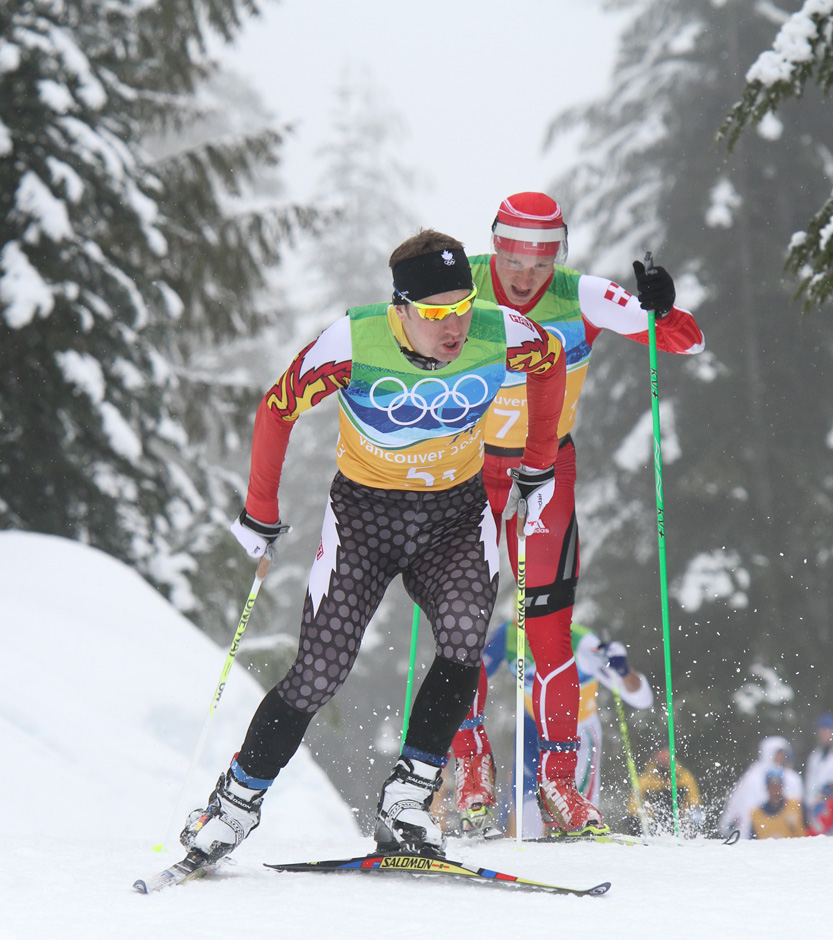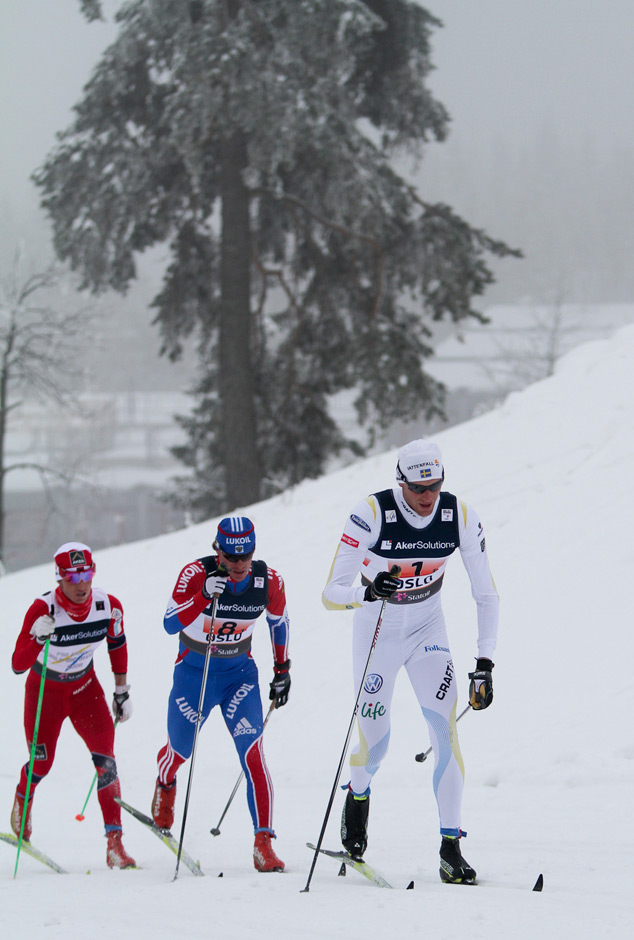
From the FasterSkier archive — posts syndicated from athletes’ and coaches’ own blogs between 2004 and 2012, kept online as published. Current coverage is at fasterskier.com.

Tag: Anders Soedergren

  • With Speed and Swagger, Northug Anchors Norwegians to Gold

    With Speed and Swagger, Northug Anchors Norwegians to Gold

    Norway celebrates relay gold.

    Martin Johnsrud Sundby and Eldar Roenning, the first two skiers for Norway’s 4x10km relay team sat in the Photo Press Center, eyes glued to one of the many television screens, watching the race unfold.

    The tension was high – no laughing or joking, not even a smile. Tord Asle Gjerdalen was on track for Norway, and he, along with Sweden’s Anders Soedergren, had just been reeled in by the chase pack. The race was now wide open with any of six teams in line for three medal spots.

    Twenty-six thousand Norwegian fans in the stadium, and an uncountable mass on the trails shared their nervousness. It may have been too much to hope for a clean break early, but one misstep at this point, and not just the gold, but silver and bronze could slip quickly away.

    The race gets under way – heading up to Midstubakken.

    Forty minutes later, the seats in front of the TV were empty, Johnsrud Sundby and Roenning now waiting in the finish area for anchor Petter Northug. The fears were for naught as the last ten kilometers of the race played out as though specifically choreographed for a Northug-led Norwegian victory.

    In what is considered the most prestigious race at any Championship event, Northug threw down what has become his classic move – waiting until the last climb around the back of the stadium to hit the accelerator.

    He attacked over the top, instantly opening a five meter gap on Sweden’s Marcus Hellner, and pulling away as he entered the homestretch, plenty of time to pull out a vintage 2007 Northug move, imitating Alex Harvey’s shushing of the crowd before stopping suddenly just before the line and waiting for Hellner, stepping over and claiming victory with the Swede just meters away.

    Tobias Angerer brought home the German team in third, the first medal of the Championships for Deutschland, and something of an upset.

    Rickardsson leads Vylegzhanin, and Johnsrud Sundby at 5.5km.

    The early part of the race played out exactly as expected. Big Daniel Rickardsson (SWE) set the pace from the get go, pushing hard. Just eight minutes into the race, hairline fractures began to appear in the pack, small cracks that quickly widened to substantial fissures.

    Halfway through the first leg, the big three of Sweden, Norway and Russia held a six second gap on the chasers, a margin that more than doubled on the climbs up the Midstubakken. The leaders looked strong and controlled, but the rest of the field had broken – faces twisted in pain, they struggled over the top of the climb.

    The gap continued to widen clearing the 30 second mark. The crowd, however, was riveted on the front – Sundby had broken, and Rickardsson and Russian Maxim Vylegzhanin pulled away on the final climbs up above the stadium. First seven seconds, then 12 – by the first exchange Sundby was a full twenty-two seconds back, a mere six seconds ahead of the chasers.

    “It was one Swede and one Russian who tried to kill me out there,” Sundby said of the hearty beating handed to him. “It was a tough race and I really had to try to do some damage control.”

    Sundby said he felt great during the warm-up, but he lost his legs much earlier than expected. “It was awful for me today,” he said, noting that he had excellent skis and that a relay scramble leg hasn’t gone so badly in several years.

    “I felt in control all the time,” Rickardsson said, though he couldn’t say as much for his ability to recall his race. He insisted that it was Roenning skiing for Norway, and claimed he put 20 seconds on the Russians as opposed to the Norwegians.

    Roenning heads out on the hunt.

    When the second-leg skiers took over, the big question was whether Eldar Roenning would be able to ski Norway back into the thick of things. And the answer was yes: while Johan Olsson of Sweden and Stanislav Volzhentsev skied fast, Roenning skied faster, and was able to catch onto them.

    “I saw that he took in a lot of time just in the beginning, and then I held him off for a little while, but then he came and I needed a little bit of rest from my pace,” Olsson said. “So I tried to recover so I had some extra power when he tried to push at the end. It was a little bit tactical, which was a little bit unusual for the second leg.”

    For his part, Roenning said that he knew he shouldn’t try to catch the leaders immediately.

    “It was twenty seconds or something, and I was telling myself that I am in good shape and I would not take a chance to rush out and take in two kilometers,” he said in a press conference. “I wanted to use the first lap… [after I closed the gap] I didn’t know what would happen.”

    Sundby was relieved when his teammate regained the lead, saying that he “could only hope that Eldar would have the best day of his life.”

    Roenning thought that Olsson would make a move as the second lap came to a close. But instead, the two skied to the finish together, dropping Volzhentsev along the way. When asked whether he felt he was lucky that Olsson didn’t increase the speed, Roenning laughed.

    “I don’t think I was lucky, I think I was better than them,” he said.

    The gap is almost closed – Roenning made up the remaining distance over the next 300 meters.

    By the time they reached the tag zone, the Russians, who had looked so strong just one leg earlier, were now only a few seconds ahead of the chase pack, which included Germany, Finland, Italy, and Japan.

    Anders Soedergren of Sweden and Tord Asle Gjerdalen of Norway were the first skiers to embark on the third leg.

    “[Gjerdalen] would not give a millimeter in the lead,” Soedergren said. “I knew I had to do the job by myself from the beginning.”

    He didn’t seem pleased with Gjerdalen’s stinginess, but the Norwegian said he should have seen it coming.

    “When you have [Petter Northug] on the last leg there is no need to keep up the speed,” Gjerdalen said in a press conference. “It is only to follow the other guys. It is quite an easy tactic.”

    Perhaps partly because Gjerdalen refused to push the pace or help Soedergren, the pair was caught by a chase pack that included teams from Finland, Italy, Japan, Germany and, temporarily, Russia.

    Alexander Legkov had quickly caught the leading Scandinavians, to nobody’s surprise. Legkov has had a stellar season so far; he has won the World Cup mini-tour in Kuusamo, Finland, and stood on the podium a few more times, including as part of the Russians’ second-place relay teams in Gallivare, Sweden and La Clusaz, France.

    Roenning leads Olsson and Volzhentsev in to the stadium 7.5km into the the second leg.

    But after chasing hard, he imploded, losing over a minute and a half to the leaders and dealing his team, which had been favored for a medal, a blow from which they could not recover.

    The pack back together on the third leg.

    With two kilometers to go on the third leg, the least familiar face in the pack made a move. It was Juha Lallukka of Finland, who despite being 31 years old has entered just six Olympic and World Championships races in his career. Since his debut in 2002 he has 23 World Cup starts to his name, and attended only two weekends on the circuit this year.

    “He’s a skating specialist who is only doing skating races,” Finnish head coach Magnar Dalen told FasterSkier. “He has had a very good season and his last entry for us was in La Clusaz, where he was in the relay and skied a very very good, very solid leg. I know that he is in shape, and that he can be very good on his best day. So it was not a very big surprise.”

    Lallukka handed off to teammate Matti Heikkinen with a three second lead over Italy – Roland Clara having been the only one able to even stay close to the Finn – while favorites Norway and Sweden were more than ten seconds behind.

    His move shattered the pack.

    “It was really hard the last two kilometers,” said Franz Goering of Germany. “I really just hoped I could give [Tobias Angerer] a chance for the medals.”

    Lallukka’s work turned out to be for naught. Heikkinen and Piller Cottrer went out together, but they weren’t away for long. Led by Hellner, the three chasers were quickly back in contact.

    Heikkinen leads out at the start of the anchor leg.

    None of the nations had any interest in doing any work for the first half of the leg. But with every kilometer the group traveled closer to the finish, the more the scales were tipping in favor of Northug and Hellner, the best sprinters in the field, who were lurking patiently at the back.

    “Nobody wanted to go hard on the first kilometers—it was pretty easy,” Hellner said.

    Finally, as the men headed out on their second of two five-kilometer loops, Piller Cottrer went to the front.

    A 38-year-old veteran, Piller Cottrer is a multiple Olympic medalist, but his speed is no match for Hellner or Northug in the closing kilometers.

    “I tried to push hard the whole 10 k, because I was the only one that wanted to stay alone in front, and not waiting [for] the finish line…I did everything I could,” he said. “Everyone was saving energy behind me, especially Angerer—hitting my skis and poles all the time.”

    Heikkinen, the winner of the 15 k classic on Tuesday, also had an interest in pushing the relay pace in the closing kilometers, but he said afterwards that his legs weren’t as snappy as they were earlier in the week.

    Hellner, Northug and Angerer set about tracking down the medals.

    “My plan was to go, but I was not strong enough today,” he said. “The body was not working perfect, and that’s why I was not strong enough in the last one-and-a-half kilometers.”

    After swinging back and forth around the stadium, the relay course’s closing kilometers sent the men in front of the crowd one last time, before dropping them down to the base of the Gratishaugen—the same hill where Hellner had launched his race-winning attack in the individual sprint earlier in the championships.

    In fact, Hellner’s performance on the climb was so impressive that locals had renamed it the “Hellnerbakken”—Hellner’s hill.

    He and Northug had pushed through the stadium and into the descent, and the two came into the climb side-by-side—a perfect time for Hellner to make another move. This time, though, Hellner said he was waiting.

    “My tactic was not to go so hard in that hill, and instead wait a little bit longer until the last uphill before the finish,” he said. (Afterwards, Northug said that if Hellner really wanted the hill to keep its new name, “he’s going to have to attack harder than that.”)

    Still, he and Northug were going hard—hard enough that only Angerer, the German, could stay with them. The three crested the Gratishaugen together; on the next flat stretch, Angerer put in a token attack, but nothing came of it.

    Afterwards, Hellner said that he’d been “a little surprised” that none of the other men had made a move earlier, since “they know that Petter is the dangerous one—and maybe me also.”

    But Piller Cottrer had already done his best, Heikkinen was having an off day, and Angerer said that he never had an opening—though he said afterward that he still didn’t think Northug is invincible.

    Killer Piller leading the way with 5k to go.

    “It’s difficult. But…Marcus beat him last week in the sprint, so it’s possible, and [Canadian Alex] Harvey did the same in Drammen two weeks ago,” Angerer said. “I wanted to go, but I was behind Petter and Marcus and had not a chance, and not a place to attack.”

    Northug has lost in plenty of sprints, but the number of times he’s been beaten in a drag race at the end of a distance race can be counted on one hand. So long as he’s still in contact with the leaders in the closing kilometers, there’s no one better.

    “When I have my tools and my skis with me, and it’s two kilometers left, I always have a good feeling,” he said.

    With 26,000 fans cheering him on in the stadium, there was only one thing left for Northug to do: shift into the gear that makes him “the best man, the best skier in the world,” as Gjerdalen put it.

    The acceleration, up the last small climb to a knoll running perpendicular to the homestretch, was textbook Northug: fluid and ferocious with crisp technique, each stride inching him away from the chasers.

    Hellner had nothing, Angerer had even less, and by the time Northug took the righthand turn to descend the small hill into the homestretch, he’d opened a lead of 15 meters. It wasn’t enough of a gap to repeat Marit Bjoergen’s flag-waving heroics from Thursday, but it did give him time for a couple of gestures.

    Piller Cottrer and Angerer setting the pace. Angerer is either trying to incite Petter with a monkey imitation, or he is adjusting his bib.

    First, as he entered the home stretch, he raised a finger to his lips to quiet the crowd. And then, just before crossing the line, he snowplowed to a stop, sliding his skis parallel to the finish as Hellner approached, before finally pushing across, into the arms of his teammates.

    Northug’s antics sent a predictable spasm through the journalists assembled at the finish—it seemed like every other finisher was polled on his response to the move. Heikkinen was diplomatic—“every person acts, and takes those results, [their] own way”—Soedergren was unperturbed—“he had a chance to do it in front of the home nation, and why not?”—and while Hellner was initially irritated, calling the move “typical of Petter—a little arrogant,” he said that he had bigger concerns than the gesture.

    More aggravating, Hellner said, is “that I lost the battle, and I didn’t make the gold.”

    “It doesn’t affect me what he is doing [at] the finish line,” he said. “We congratulated him that he was so good today, and we will go home and train and beat him next year.”

    Results

    Northug shushes the crowd.
    Petter slams on the brakes before crossing the line.
  • TDS Preview: Bauer Looks to Defend Title, North America Starts Five

    The 2010/2011 Veissmann Tour de Ski is nothing if not draining. Consisting of eight events in ten days in two countries, the fifth edition begins December 31st and runs until January 9th.

    The Tour begins with a freestyle prologue in Oberhof, Germany, on December 31st, followed by a classic pursuit start on January 1st. The Tour then moves to Oberstorf, Germany, for a sprint on January 2nd, and a pursuit on the 3rd.

    After a two day break, the Tour resumes in Toblach, Italy, for a sprint on January 5th and a point-to-point pursuit start from Cortina to Toblach on the 6th.

    The Tour de Ski wraps up in Val di Fiemme, Italy, as the Italians host a 10/15 k on January 8th, and then the final climb up Alpe Cermis on the 9th.

    The Favorites

    In the fifth edition of the event, all three top male finishers from last season are expected to contend. Lukas Bauer (CZE), Petter Northug Jr. (NOR) and Dario Cologna (SUI) are all registered, and while two have started the season quickly, the third – Northug – has only four World Cup starts to the season, having fallen ill just before the opener.

    The Czech Republic's Lukas Bauer racing at the 2010 Olympic Games.

    Bauer has come out swinging – the aging Czech distance specialist sits in seventh in the overall rankings, and has already collected two podium finishes, including a stage win in Kuusamo, Finland. He has finished in the top 30 in every distance race he has started (his one sprint wasn’t great, as he finished 104th, a full ten seconds away from qualifying).

    Given his hot start, the fact that he is the defending and two-time Tour de Ski champion (2007/2008 and 2009/2010), Bauer is undeniably the favorite.  While his utter lack of sprint skill is disconcerting, he has shown in the past that it is irrelevant, as in the two sprints on the Tour last year, he finished 54th and 60th. But Bauer recognizes that sprinting is still important – he has put extra time into improving his speed over the summer, and should be aiming to limit the damage during the two sprint stages.

    After Bauer, Switzerland’s Dario Cologna is a must-watch. In his short four year World Cup career, Cologna has already won the World Cup overall, the Tour de Ski (2008/2009), and currently sits in second in the overall standings, a mere 22 points from the lead.

    Cologna is dangerous because he is a true all-around skier, and more importantly, is extremely consistent. The last time Cologna finished outside of the top 30 on the World Cup was over a year ago, on December 12, 2009, in Davos. He has already stood on the World Cup podium three times this season, including a second place finish in the Kuusamo mini-tour, and a third place in the freestyle sprint in his hometown of Davos.

    Despite finishing runner-up to Bauer in last years’ Tour, winning the 2009/2010 Crystal Globe, and being the most recognizable cross country ski name on the planet, Petter Northug has to be considered a bit of a dark horse. The dynamic Norwegian is just bouncing back from illness, and his absence from the early World Cup has put him in a large hole in the overall standings, as he sits in 18th.

    Dario Cologna celebrating a victory at the Olympics

    While Bauer is the distance workhorse, and Cologna is the all-around consistent performer, Northug is the sparkplug. Love him or hate him, the Norwegian is without a doubt one of the most talented and entertaining skiers on the circuit.

    The question will be his health, and whether he has returned to his world-beating form. Over the last two World Cup weekends, Northug has done well, but not outstanding. The real concern should be with his famed sprint speed – his failure to win a sprint finish in the 30 k freestyle at the La Clusaz World Cup combined with his 28th place sprint in Davos the weekend before shows that his sprint is not where it has been in the past.

    Northug may need a few extra races to get back to where he needs to be, as it is inconceivable that a skier of his talent will be held down for long. Expect him to speed up over the course of the Tour, and a podium finish is completely realistic.

    The Chasers

    While most of the buzz is about the top three finishers from last year, both the Russians and the Swedes also have strong contingents hitting the start line.

    The Russians have nine men starting, headlined by Alexander Legkov and Maxim Vylegzhanin. Legkov currently sits atop the World Cup overall, and much like Bauer he is a sub-par sprinter, but an excellent stage racer.

    Winner of the Kuusamo mini-tour and runner-up in 2006/2007 Tour de Ski, Legkov has the potential to gut out a victory, as he has the tools to distance ski as well as almost anyone, and won’t lose much time in the sprints. The only area for concern is his Tour de Ski record in the past three years, as he has finished 20th, 33rd and failed to complete the event since his second place in 2006/2007.

    Legkov and Bauer.

    Maxim Vylegzhanin is ranked third in the overall behind Cologna and Legkov, and as one would expect, has had great start to the season. He has finished in the top 15 six times, including fifth in the Kuusamo mini-tour, and besting Northug in the 30 k freestyle in La Clusaz, which certainly bodes well. He has a decent record on the Tour (21, 15, DNF), but just can’t seem to make the breakthrough to finish in the top 10.

    The only surprise for the Russians is that 20 year old phenom Petr Sedov, who is currently 8th overall, will not be starting.

    The Swedes are bringing seven men to the party, and  could easily capture at the very least a couple of stage victories.

    Emil Joensson is the current world cup sprint leader, and is currently fifth in the overall. He is practically a lock to make the podium in both sprints, and he can ski a mean 10 or 15 k, especially classic. Unfortunately for Joensson, as the Tour goes on, his distance racing will be sorely tested, and he simply lacks the ability to compete in the longer events, so it is unlikely he will be able to contend for a podium spot in the final races.

    However, his team mate Marcus Hellner, who is fourth overall in the World Cup ranking has a much better shot. Often billed as Northug’s biggest rival, but not quite at the same level, Hellner started out the season strong with a home town win in Gallivaere, Sweden, but has been inconsistent since then, finishing fourth in Kuusamo, 33rd in the 15 k classic in Davos, seventh in the sprint, and finally 29th in the 30 k freestyle in La Clusaz.

    In the 2009/2010 Tour de Ski, Hellner was saddled with the wooden medal despite having a very strong final climb. To stay in contention for the podium, Hellner will have to avoid the inconsistent distance days, and if he is close going into Alpe Cermis, his strong skate climbing means he can pick up a few spots.

    Other strong Swedes include Daniel Rickardsson, a very good all around skier who will be in a position to crack the top 10, Johan Olsson, who hasn’t raced a World Cup since finishing 7th overall in Kuusamo, and the tough-as-nails Anders Soedergren.

    Sweden’s Scandinavian counterparts, Finland, lack a real shot at the Tour overall. Sami Jauhojaervi is their best hope, as he is ranked 19th overall, and has had success on the Tour previously, but his horrendously inconsistent skiing (think two top 10’s, and three races 50’s or higher) will prevent him from being a true challenger. Matti Heikkinen gets the nod as well, but like Jauhojaervi lacks the staying power required for the lengthy event.

    While the event is on home turf for both the Germans and the Italians, neither country has a skier competitive enough at the moment to challenge the top group.

    Seven Italians are pegged to start, including Giorgio di Centa, and on-form sprinters Fulvio Scola and Renato Pasini.

    Meanwhile, the Germans have only two men currently in the top 40 in the overall World Cup standings, but 13 men will start. Surprisingly Jens Filbrich and Tim Tscharnke are the two highest ranked German skiers, while stalwarts Axel Teichmann and Tobias Angerer are 46th and 58th respectively, and both will have to demonstrate a lot better form than they have thus far on the World Cup.

    North American Contenders

    This edition of the Tour will see five North American men fighting for position – and all five men bring their own unique set of skills to the event.

    American’s Andy Newell and Kris Freeman will both take to the start line, and will hope to continue the good early-season World Cup results with top results, regardless of stage. Freeman has jumped out to the best start of his World Cup career, and sits in 13th place Overall, as a result of collecting points in each of his World Cup starts thus far.

    Newell has had a decent start as he sits in 31st in overall on the back of his strong sprinting, in which he has earned points in all three of the sprints thus far on the circuit.

    Newell

    Both men have been typecast as specialists – Newell in sprinting, and Freeman in distance racing. However, both skiers have been working hard on diversifying their skiing, and have a bet running over who will score World Cup points first – Freeman in a sprint, or Newell in a distance race.

    The biggest question mark surrounding Newell is whether he will be able to distance race well enough to stay in contention.

    “I’m pretty excited to have a bunch of opportunities to do some distance races,” he said, “because I know I’m in good shape and I can distance race really fast — I just haven’t had the chance to show it.”

    Newell knows he has strengths and weakness in distance racing; “I know I’m a good mass start skier for sure,” he said.

    “I can ski well in packs but at the same time it’s like any time in a mass start race – you run the risk of blowing up,” he said, “It can be sometimes easier for sprinters like myself [to blow up] as you can build up so much lactic acid.”

    Both Freeman and Newell are relatively new to the Tour de Ski. Freeman has never competed in the event before, and Newell he completed three races last year before bowing out, and he felt that he has not gotten “a true Tour experience.”

    Regardless, Newell is going in confident; “I feel like I can be good at back to back to back races,” he said, “I think I’ve trained enough over the year that’s something I’ve gotten a lot better at.”

    Like many other racers on the Tour, Newell is targeting consistency, and is thinking about having good races each stage, rather than focusing on finishing as his end goal.

    While both Americans are working on their weaker race types, the best bet for top performances are their bread and butter events – the skate sprint for Newell, and something 15 k or longer for Freeman. It is difficult to imagine either skier truly contending for a place on the overall podium, but top 30 finish is a completely reasonable expectation.

    “Hopefully I’ll be able to hang in there for some distance races and score some distance races,” said Newell, “I’m going to need to score some bonus seconds in sprints [to have a chance in the overall standing].”

    The Canadian contingent showcases an all-around skier just coming into his prime, a young gun with loads of potential, and one of the best climbers on the circuit. Devon Kershaw, Alex Harvey and Ivan Babikov are all world class talent who had excellent results on the Tour de Ski last season, and look to build on that success. In charge of the three skiers is Head Coach Justin Wadsworth – a rookie on the Tour de Ski.

    “I think I’m pretty well organized,” said Wadsworth in an interview with FasterSkier, “and that’s key for keeping the nerves down.”

    While he has never been involved with the Tour before, Wadsworth is confident – he has been to all the World Cup venues before, and the three skiers he is in charge of will be well served. The Canadians have a large staff of five wax technicians as well as a massage therapist, the legendary ‘Wolfman’.

    Wadsworth is confident in his athletes ability to make the most of the Tour, and emphasized that Kershaw and Harvey have a shot in every stage, while Babikov will be able to take advantage of the difficulty of the last three stages, as he will be getting fitter every race.

    Kershaw going "freaking hard" at the 2010 Olympics
    Kershaw

    After one of the hottest starts of his career, in which he has consistently skied in the top 30 while hitting a few top 10 finishes, Kershaw is hitting his stride as an all-around skier.

    While he appears to be in form, and he is happy with how things went, Kershaw is still cautious about the event.

    “The Tour de Ski is completely different [from the rest of the World Cup season],” said Kershaw in a recent interview with FasterSkier, “a whole lot of things have to go right.”

    For Kershaw, having one or two really good days would make for a successful Tour, but his real ambition for the Tour de Ski is unrelated to results.

    “To be honest, the only big goal is to stay healthy,” he said, “Over the different Tours, we’ve had a lot of illness on the team, and I’ve been lucky to avoid it for the most part.”

    If he stays healthy, Kershaw has proven that he can race well in the Tour format. Last year he finished 16th in the event, benefitting from good sprinting, as well as six top 30 finishes.

    While he has traditionally had strong results in Tour de Ski sprints, including a podium, this year Kershaw isn’t so focused on the sprint.

    “The sprints are long days, and I don’t know how important they are in the overall,” he said. “[Lukas] Bauer won the Tour last year without ever qualifying for a sprint

    Unfortunately for Kershaw, his favorite and best event, the 10 k classic, has been eliminated from the Tour this year. As a result, he’s keeping his eye out for the 20 k pursuit in Oberhof, Germany in Stage 4.

    “The Tour really starts at the Pursuit in Oberstorf,” said Kershaw, “That’s the first place you’re really going to see some fireworks. Whether or not I’m looking forward to that, I have to be on my toes.”

    Kershaw said he may have pushed his training a little bit too hard during the last week, and as a result is feeling a little flatter than he would like, but with some dedicated rest, is hoping to be back in top shape come December 31.

    While Kershaw is still hoping to regain a little bit of energy, Alex Harvey is feeling well rested and ready to go, according to a recent interview with FasterSkier.

    Harvey is still relatively new to the Tour – this will be his second time tackling the event. And he learned a lot from last year, and highlighted two major things that he is hoping to improve on – staying calm, and proper feeding.

    The point-to-point race is something he is much more comfortable with the second time around. Last year Harvey described himself as “really nervous” prior to the start, as there was no opportunity to ski the course beforehand and he had a large gap he desperately wanted to close to the leaders. As a result, Harvey ended up with a severe diaphragm spasm, throwing off his rhythm. This time around, Harvey is a lot more comfortable, as he knows the course, and is aware that he needs to stay relaxed.

    Second, he recognized the increased importance of feeding on an event like the Tour de Ski. In the long classic race last year, Harvey was skiing strong at the front of the chase group when he bonked hard with one kilometer to go.

    “I didn’t feed enough during the day,” said Harvey, “you need to make sure your energy levels are always high, and it’s really hard to recover when you bonk that hard.”

    If there was one area Harvey really targeted for improvement this year, it was his sprinting.

    “On the sprinting side I was disappointed last year,” he said, “This year I wanted to make sure I can sprint well.” Last season Harvey managed to qualify just twice for a World Cup sprint. This season he has started just one, but finished ninth.

    Harvey has been confident with his shape all fall, and his strong start on the World Cup has increased his confidence. “I knew I would be more consistent this year, and I know I usually improve as the season goes on,” he said.

    And consistency is what Harvey is targeting for the Tour. While he has picked a few stages as key – the 20 k Pursuit in Oberstorf, the 36 k point-to-point, and the second last stage – he is confident in his shape regardless of the stage.

    “If I have a good day, any of the stages I can do well,” he said.

    As for the Final Climb, the 22 year old isn’t intimidated – he’s actually a little bit excited about it.

    “It’s not complicated,” he said, “you have to ski well technically, but it’s all about the climbing. It’s just how your body is doing, even the skis only matter for the first part.”

    While Harvey may not consider the Final Climb very complicated, that may be in part to being in close proximity with the man who is quite possibly the best at the event – team mate Ivan Babikov.

    The first few stages don’t suit Babikov, as he has struggled in prologues and sprinting, but as the days get longer and the Tour gets tougher, Babikov, who is widely regarded as one of the toughest athletes on the circuit, will shine. His specialty is the last stage – in 2009 he won the quad-busting climb outright, and in 2010 he finished fourth. If Babikov can stay close during the opening stages, his climbing skill means he may threaten for a podium spot.

    Both Canadians and Americans have spent the Christmas break in Davos, Switzerland, taking advantage of the high quality training location, and getting in large amounts of skiing and some good recovery as well.

    The group has gone alpine skiing, and taken advantage of the many excellent coffee shops in the Swiss town, but the teams are now in Oberstorf preparing for the first stage – a 3.75 k prologue.

  • Musgrave Trades Golden Boot For Shot At World Champs Success

    Musgrave Trades Golden Boot For Shot At World Champs Success

    Andrew Musgrave (GBR) racing in the team sprint at the 2010 Olympic WInter Games

    Andrew Musgrave has previously been tipped as a young gun to watch in the world of skiing. This season, despite racing only a single World Cup, Musgrave has recorded impressive finishes against top talent.

    In the Norwegian Cup races he started, he has faced stiff opposition – sprinting in Gaalaa, Norway, he was narrowly beaten by American Torin Koos, and finished far up the results sheet from Thomas Northug. In distance racing in Meraaker, Norway, he took on Petter Northug, and Anders Soedergren, finishing less than a minute behind both World Cup stars in a 30 k freestyle race. And in a 10 k classic, Musgrave finished 30 seconds back of none other than Odd-Bjorn Hjelmeset, one of Norway’s premiere classic skiers – so premiere he was brought to the Olympics to ski just the classic leg of the 4×10 k relay and the 50 k classic.

    A British national, Musgrave has a unique training situation. This summer, Musgrave made a move to Lillehammer, Norway, to train and race with Team Hovden, a Norwegian team which focuses on the Norwegian and Scandinavian Cup circuit.

    FasterSkier caught up with him between race weekends to find out how his season was progressing, and whether he was going to see a few more World Cup start lines.

    FasterSkier: It’s currently a mad snow storm in Great Britain – are you at home, and have you managed to get out skiing? Or are you in Norway? Are the guys at Huntly Nordic Ski Club making the most out of the snowfall?

    Andrew Musgrave: I am in Norway just now, so haven’t been able to make the most of the snow back in Britain! There is more snow at home than there is in Norway, and it isn’t often that happens! I think the guys back in Huntly have been making the most of the snow. Every year there is a competition to be the first person to ski around the longest trail in the local forest, and the winner of this wins a “golden ski boot” trophy. The first person to ski round the trails this year drove up closed roads so that he could beat everyone else! I was gutted to not be there, and in the running to win the boot!

    FS: It looks like you had a solid start to the season – two top 30 finishes in Beitostolen, Norway – sprinting and distance skiing well. How did your races go in Beito? Are the results where you want them to be?

    AM: I was fairly pleased with Beito. I wasn’t in the contention for winning any of the races, but it was very early in the season and I generally get better after a few weekends of racing. I felt like I could ski continuously fast, but like I didn’t quite have that top gear yet. Despite this I feel that my training has been going well, and that I just need a few weekends of racing to get my top speed back. I was pleased to qualify for the sprint knock-out stages. One of my goals this year is to improve in sprinting. Over the last few seasons I have occasionally been OK in the prologue, but my tactics in the knockout stages have always been a bit suspect. I also knew it was going to be a big step up from qualifying in junior races, to qualifying in senior races. It was good to know that I am not too far behind the level of the senior sprinters, and it was good to get a bit of experience in the heats.

    FS: The only World Cup race for you so far was the 15 k in Gallivaere, Sweden, where you finished 52nd in a strong field. Why only the one World Cup? And was that result what you were aiming for? When will we see you on the circuit again?

    AM: Gallivaere is probably going to be the only World Cup I will be doing before Christmas. I am going to be focusing more on Norwegian Cups. I feel it is better for my development to do races I can be more competitive in, and it limits the amount of travel I will be doing. Sometimes I cope really well with traveling, but other times I find it very tiring. In the New Year I will probably do a couple more World Cups; in Otepaa, Estonia, and in Drammen, Norway.  As for the race in Gallivaere, it actually went fairly well. I felt I was in much better shape than I had been in Beito, and was skiing much better in general. I didn’t really have any solid goals, I just wanted to go out and ski well. In the end I was just a bit over 30 seconds behind getting World Cup points. It would have been nice to go 30 seconds faster and get some points, but that is more competitive than I have been in World Cups before, so I can’t really be too disappointed.

    FS: You did pretty well in Gaalaa, Sweden – two top 10’s, just narrowly missing out on a podium in the sprint. Was this an indication of where things are headed for you? Are you aiming to race a lot of Norwegian races this winter?

    AM: Gålå was a pretty interesting weekend. The weather forecast had predicted that it was going to be very cold, and a lot of the Norwegian racers didn’t even bother to travel to the race, as they were convinced it was going to be cancelled. As it turned out it was warm enough for the races to be held. I didn’t think it was particularly cold, never dropping below -18C during the races, but a lot of people didn’t start, complaining that it was too cold to race. I can understand people not racing in the cold if they have problems with asthma, but it is a bit excessive when two thirds of the race field drop out. I think people need to man up, and remind themselves that it is a winter sport!

    Despite the large numbers of people dropping out, the races did go ahead, and they went quite well for me. In the sprint I had a good prologue and advanced easily to the semi-final. I was lucky to get through to the final with “lucky loser” time. In the final I was just edged out of third place by less than a boot length. I should really have come third, but I did the world’s most pathetic lunge across the line.

    My result in the classic distance was a promising one. I was in the top 10, and just over 30 seconds behind the winner. This is a big step forward for me in classic from last year, and a good sign that my technique training from the summer and early winter has been paying off. I have always found classic technique more difficult to master than skating, but hopefully now I am beginning to get there!

    FS: Are you training hard through this first World Cup period with your eye on a specific event before Christmas? Or are you mostly focused on the big events in the New Year?

    AM: The main races for me this season are not until February, but even so I will be racing a lot throughout the first part of the season. For me the best way to train is to get out and race as much as possible. During this early part of the season I am trying to maintain as high a volume of training as possible while still fitting all the races in. In January the volume of training I am doing will probably drop off a bit in the run up to World Under-23 Championships and the World Championships.

    FS: How has the training and racing experience in Norway been? Do you still travel and race with the other British skiers (Andrew Young, Callum Smith), or are you mostly with Norwegians?

    AM: Training and racing in Norway is going really well. I think everyone on Team Hovden [the Norwegian racing team Musgrave joined this fall] is in pretty good shape now, and we can be really good in the Norwegian and Scandinavian Cups coming up. I think this year we can definitely be one of the top teams from the whole of Norway. We have had a lot of training camps this year, and there has always been someone in really good form, pushing you to be at your best in every interval session. I think the amount of training we have been doing together is why we are all at such a good level now. In the first Norwegian Cup race in Meråker, Norway we were 1st, 2nd and 4th place amongst the U23 racers. Hopefully this will be 1st, 2nd and 3rd at the next Norwegian Cup!

    Up until now I have been mostly training with Team Hovden, but later on in the season I will be getting back together for racing and training with the British Team. Andrew Young and Callum Smith have both started at ski gymnasiums in Norway this year, so it will be interesting to see how fast they are skiing! A few of the other British guys have moved to Lillehammer [where Musgrave lives] for the winter, so even though I haven’t been on too many national team camps, I have been getting in quite a bit of training with some of the guys on the team.

    FS: What’s your target for this season moving forward? Have you had any hiccups in your training that have forced you to adjust your goals, or make changes on the fly?

    AM: So far this season my training has gone exactly to plan. Fingers crossed, it should keep going that way! The main races I am targeting are World U23s and World Champs. I would be really happy with a top 30 at World Champs and/or a podium at World U23s. That’s going to be difficult, but hopefully I will manage!

    One of the other guys on Team Hovden, Thomas Vestbø, and I always like to joke about who is the best, and who is going to win the next race. We have started keeping a running total of the times of all our races from the season. So far, after the five races that we have both done this season, including classic, skating, distance and sprints I am leading him by four seconds. The most important thing for me this year is to beat him over the whole season! He also did quite well at the World U23 Championships in his first year as a senior, and came in fourth. This year I have to be better than that, or I’ll never hear the end of it!

  • “The Spirit of Skiing is Dying”: An Interview with Marcus Hellner

    Marcus Hellner (SWE) at the finish of the men's 30k pursuit at the 2010 Olympic Games.

    In Las Vegas, where FasterSkier had the opportunity to interview Marcus Hellner, the Swedish skier was able to stay relatively undercover. At the card table, such was his anonymity that he had other players thinking he was a professional poker player, not a professional athlete. But in Europe, and especially in Sweden, Hellner is a star. At the Olympics in February, he vanquished rival Petter Northug, breaking the Norwegian’s pole on the way to winning the 30 k pursuit, then went on to anchor the Swedish team to gold in the relay. He was fourth in the Tour de Ski and third in the overall World Cup, collecting six podiums along the way.

    Fortunately, Hellner’s English is more than good enough to sit for an interview. He’ll occasionally bust out an impressive phrase—at the Olympics, he spoke of a “lust for vengeance” after finishing fourth in the 15 k—but for the most part, his speech matches his demeanor: relaxed and deliberate.

    FasterSkier: Can you start out by telling me about your training so far this year? Are you doing anything differently?
    Marcus Hellner: Not such big differences, but it’s more training, a little bit more focus on the double-poling, because I want to be better there—be a better classical skier. And also I’ll try to be more focused and think a little bit more about not pushing too hard, just so you don’t get injured or something like that. Sometimes I have trouble with my knee, and I have to be focused and do the right thing—not running too long if it’s starting to hurt a little bit. It has been good so far.

    FS: With the classic skiing—did you feel like you were having more trouble with it last season?

    MH: Yeah—I have some things to work on. I want to get better all around, and classic is my worst technique. I’m not as good as I could be, I think, because I have a good engine, but a little bit bad technique.

    FS: So what are you doing to improve it?
    MH: Last year I went in a lot for skating, and I tried to be stronger in the upper body. I did a lot of pull-ups, push-ups, double-poling on steep climbs, and I think that maybe I lost my timing, a little bit, on the flats. So this year, I’m going to do a little more on the flats to discover the timing again.

    FS: How many hours are you training this year?
    MH: I don’t know how many hours, really, but maybe 750 or 800, something like that.

    Hellner at the World Series of Poker in July

    FS: Is that comparable to what you’re been doing over the last few years?
    MH: It’s a little bit more. I always try to go up, and I feel that I have some room left. I always have felt that I could train a little bit more—I’ve never been feeling like I’ve trained too hard. It’s maybe 30, 40 hours more than last year. I think the most important thing for me is that I’ll train through the summer and the autumn—that’s the training season for me, and that’s when I’m counting hours. In the winter, it’s more like shaping up for the races. That’s not, for me, training season—I still train hard, but everything I do is for the competitions. It’s two parts for me, two goals.

    FS: So, your goals for next year—is the overall World Cup something you’re aiming for?

    MH: The goal is the ski championships in Oslo. That’s when I want to be in the best shape, but of course, I’m trying to be good in the whole season. Last season I tried to be good at the Olympics, but I also had good shape all the time.

    FS: Will you try for a second peak around the Tour de Ski?

    MH: I don’t think so—I will train pretty hard before the Tour de Ski. I will do it, but I will not try to be in the best shape. I think the Tour—it could be good for me to have a lot of competitions. It’s fun, and it’s good for the championships, also.

    FS: In Oslo, are there specific races you’re focusing on? The pursuit and the 15 k?

    MH: I don’t know—I like the 15 k most, but that’s my smallest chance of medals. Maybe the best chance is the relay, and maybe the 30 k or 50 k. It’s hard for me to tell, but I think I’ll have a good chance for medals if I’m in good shape that week.

    FS: Do you feel like the Swedish team has a lot of momentum after the Olympics?

    MH: Yeah—we have a good team spirit. They’re my buddies. We get along very well, we do a lot of training, and we hang out after the training as well. They’re my best friends, as well, and that’s very nice.

    FS: After the Olympics, between the pursuit and the relay, it seems like you guys maybe have the edge on Norway right now.

    MH: I think Norway, right now, has one person, and that’s Petter [Northug]. He’s very good. We have the four of us in the distance team—we are all people that can win a competition, so you have many skiers that are very good. Petter was the best last year—I was close, but he was a little bit better—and I think Norway depends on him very much in the relays and the other competitions.

    FS: Do you feel like there’s something specific that Sweden is doing a little better right now with its men’s team, whether it’s the training philosophy or development system, or something else?

    MH: I don’t know what Norway is doing, but I do know that the things we do are very good. We train hard and we have a good spirit—we want to be better. It’s a driving force all the time. We watch each other, and we share. If Johan [Olsson], for example, is better in classic, I watch him very much, and he allows me to do it. And when we’re doing races, we all push hard, and we always try to beat each other. It’s an honest situation—nobody’s trying to do anything to cover up, or to harm the team. Everybody’s thinking about the team, and I think that is very important. Even in cross-country skiing, it’s like a football [soccer] team, I think. If you can help each other, everybody gets better.

    FS: The 30 k pursuit at the Olympics—there were some people in the U.S. who watched that race and said it was one of the best ever. Can you just talk a little bit about that race? How much of that was strategy, and how much of that was things falling into place?

    MH: Wow, that’s flattering. We had an open mind—if there was a situation that opened to be able to help each other, we take it. That has always been our idea. We have never thought that this person will do this, this person will do that—plus, it’s only happened in the Olympics. It wasn’t a plan or anything—it

    Hellner with silver medal winner Tobias Angerer after the finish of the 30 k pursuit at the Olympics

    just happened. We talked during the race, and we decided we’d do it like this, and we did it all the way.

    FS: Like, you and Anders Soedergren? (Hellner and Soedergren appeared to block the chasers as their teammate Olson went on a solo breakaway.)

    MH: Yeah, we talked a little bit. We weren’t going to try to stop the other guys, but we weren’t going to help them. If we got in the front line, we were not going to pull hard to go on to Johan.

    FS: That’s one of the benefits of having four guys that are that strong, huh?

    MH: Yeah—you can do so. I’ve seen Germany do it before, a little bit—they’re trying to be helpful to each other. It’s hard in cross-country skiing because you don’t have the benefits like you have on a bicycle. You can’t slipstream that well, but you can do a little bit.

    FS: And it seems like that’s the way that the International Ski Federation is going, with more mass start events, and faster courses.

    MH: They want to have that, I think. I don’t know if I like it, myself. I don’t know if I want the races to be like that, because for me, cross-country skiing is still an individual sport, and I like it to be that way.

    FS: How about with all the tours? There’s the one at the beginning of the season, and then there’s also the new World Tour Championship.

    MH: I don’t know—I like the tours. There are some things I think they could do better, but it’s a good idea, I think. It’s many competitions, and I like to compete. But I think overall, there could be more individual competitions. I think there are too many mass starts.

    FS: So if you were to ask FIS to change anything, that’s what you’d ask them to change?

    MH: Yeah—I would like the 50 k to be individual [start]. I don’t like the mass start there. It’s not fun to watch, and it’s not fun to do.

    FS: So you think at Worlds, that’s how they should do it?

    MH: I think that’s definitely how they should do it, and I think there are many people that think like me. Anders does, and I think Johan, and Dan [Richardsson). I don’t know how the Norwegians feel—now that Petter is so good, they like it. I think the spirit of skiing is dying when they take away the individual, because that’s a very nice thing that we have.

    FS: Is there anything you feel like you can do to stop that shift?
    MH: Sadly, no. It’s hard. I think it’s very hard. I don’t know if there’s so much I can do about it.

    FS: It seems like the power of TV and spectators is maybe more powerful than that of the athletes, at least right now.

    MH: I think so. It’s a little bit sad. If all the competitors joined together…but I don’t know if all the competitors want the same as me. I can’t force anybody to feel like that, but maybe some day they will understand that it should be a 50 k individual.

    Hellner knows how to put it on the line in individual-start races–this is him at the finish of the 15 k at the Olympics, in which he placed fourth.
  • Södergren Frustrated By Evolution of XC Skiing

    Anders Soedergren helping his Swedish team to victory in the men's 4×10 k relay at the 2010 Olympics

    Anders Soedergren (SWE) is considered one of the best 50 K racers in the world, and has a first place from the venerable Holmenkollen 50 K on his resume.

    However, the Swede won’t have a chance to put his capacity to work on that distance in the upcoming World Cup season. The FIS Congress in Turkey nailed a World Cup schedule with no 50 K events for 2010-2011.

    The lack of a World Cup 50 K race has Soedergren frustrated. “XC skiing is well on its way to lose its identity and its character,” Soedergren said to zsport.se.

    The 50K during the 2011 World Championships in Holmenkollen will be the only race of that distance this season, and that event is a mass start, which typically have held no advantages for a skier like Soedergren. “There was an opportunity to make the World Championship 50 K an individual start race, but Norway vetoed the suggestion. They have Northug,” Soedergren said to the Swedish national TV station SVT.

    Soedergren is not afraid to speak his mind on what he thinks of the recent evolution of FIS-governed XC skiing. “I don’t mind changes, but not all of the changes have been for the better,” he concludes.

    From www.langrenn.com, June 22, 2010.

  • Northug Faces Piller Cottrer, World Elite at Home

    Petter Northug (r) racing at the 2010 Olympics in Whistler.

    Petter Northug Jr. is excited to welcome World Cup greats onto his home turf in Troendelag on June 25 through 26. The event, the Tour de Troendelag, consists of three races: a roller ski city criterium on June 25 in Trondheim, then a summer ski race on the Kirkebyfjellet mountain on the morning of June 26 and concludes with a roller ski pursuit race in the afternoon.

    “I’m excited to welcome Pietro Piller Cottrer (ITA), Anders Soedergren (SWE), Jaak Mae (EST) and other top World Cup racers to my stomping grounds. It will be fun to race against those guys in a slightly different setting,” Northug says to www.langrenn.com.

    Northug, the defending champion from last year’s Tour de Troendelag, will arrive at the race venue straight from a national team training camp and is prepared to fight. Northug will face a Piller Cottrer who is eager to make up for the painful loss to Northug at the Holmenkollen 50K this winter, and a Soedergren who is reported to be in killer shape these days. But Northug doesn’t think he’ll be at a disadvantage.

    “I’ll do my first workout that Friday with the national team in Sandane, then the Stjoerdal race as my second. I don’t fear racing after a flight,” says Northug.

    Former Olympic gold medalist, world champion and Norwegian national team member Frode Estil is among the event organizers. He is working hard to get both Alexander Legkov (RUS) and Axel Teichmann (GER) to compete next week, and is confident at least one of them will show. He regrets to report that Dario Cologna (SUI) won’t be coming, although it looked promising for a while. Among the local favorites are international stars including Eldar Roenning and Johan Kjoelstad, as well as Team Troendelag’s next generation of elite skiers.

    “This is one of the few arenas where juniors and the up-and-coming elite skiers can race with the best in the world. And the feedback is that they find it incredibly motivating,” says Estil, explaining that recruitment is one of the main goals of the Tour de Troendelag.

    Source: Langrenn.com

  • Northug Wins First Holmenkollen Title in Thrilling 50k

    Northug racing last month at the Olympics

    Oslo, Norway – Maybe it is ski switching, maybe the courses are harder, or most likely, the skiers are more aggressive.  Whatever the reason, the long mass start races that are now standard on the World Cup are becoming more and more consistently exciting.

    Last year the traditional Holmenkollen 50km was held in Trondheim due to construction at the Oslo venue, and the race set a new standard for a World Cup mass start race.

    Instead of the large pack stampeding around the course like a herd of enraged bison, each charging hard, but no individual willing to break away from the safety of the group, the race featured numerous attacks, breaks, and comebacks.

    The bar had been raised, aided by several clever decisions by FIS.  The addition of bonus World Cup points at intermediate distances manufactured attacks and despite many of the drawbacks of ski switching, the ability to stop and swap skis created another opportunity for strategy and breakaways.

    The 30km pursuit at the Olympics featured a gutsy break by Johan Olsson halfway through the race, and a heart-stopping finish.  The 50km was certainly not as thrilling as the Trondheim race, but close observation revealed an exciting race underneath the veil of pack skiing.  And depending on the conditions, the course, and even the time of year, mass start races will still feature large bunch finishes.  But it does appear that those races are becoming less prevalent, replaced by the type of competitions witnessed in Trondheim, and today in Oslo.

    If anyone had any doubt that Petter Northug (NOR) is the best all-around skier in the world, today’s race should provide final proof.  Northug withstood attacks from the French duo of Vincent Vittoz and Maurice Manificat and a stunning comeback by Pietro “Killer” Piller Cottrer to claim his 2nd 50km victory in a row.

    Just three days after finishing 2nd in the Drammen classic sprint, Northug won the race at the opposite end of the distance spectrum.  Vittoz and Manificat attacked hard near the 12 kilometer mark, immediately opening a gap.  Northug was the only one to respond, and the trio continued to push the pace.

    One of the criticisms of Northug (at least in the US) has been that he sits back in the pack letting others do the work.  But anyone familiar with bike racing knows that being in a three-man break when you are solo against two teammates is not an easy spot.  And the general rule is that if a team is two strong in a lead pack of three, you had better win.

    Northug withstood the efforts of the Frenchmen to tire him out, taking his turn at the front.

    “I tried to stay in the leading group from the start,” explained Northug.  “I felt there would be many attacks during the competition.  When the French attacked I just tried to stay with them.”

    The lead over the large chase pack grew steadily, reaching a maximum of 1:38 at 33 kilometers.  At this point the chase pack had dwindled to 14 skiers, though in another break from standard 50k protocol, this was not a result of slow attrition – fading skiers dropping off the back consistently over the course of the race.

    The leaders were aided by the work of Jean Marc Gaillard (FRA), who slowed the pace of the chasers to allow his teammates to pull away.

    At the 20k mark, the group chasing Vittoz, Manificat and Northug numbered only 13, with a gap of 20 seconds to the next pack.  And while the focus was on the front, efforts to bridge back up to the chase group provided secondary drama.

    With the large lead approaching two minutes, and just over 15 kilometers remaining, it seemed the podium was set.  But as is often the case in cycling, the pack stepped it up as the leaders began to lose the pace slightly.

    Between 33 and 35 kilometers, the chasers took 26 seconds out of the lead.  As each time check came and went, the gap closed steadily.  At 42k, the lead was down to 28 seconds, the chase pack of ten led by none other than Anders Soedergren, the Swede known for his aggressiveness in mass start competitions.

    Soedergren had done his part, but couldn’t hold the pace over the next two kilometers when the race completely blew up.  Manificat ran out of gas, losing contact with Northug and Vittoz while Piller Cottrer staged his own attack, quickly swallowing up the fading Frenchman and shattering the chase group.

    At 44k, Piller Cottrer was still 20 seconds back in 3rd.  Four kilometers later he was in the lead, pushing Vittoz and Northug.

    Vittoz, like Manificat before him, was spent, and couldn’t match the Italian veteran.  With just 1.4 kilometers to go, Vittoz was 10 seconds behind, and out of the race for the victory, though he still held a solid 30-second lead on 4th.

    Pietro Piller Cottrer racing in Canmore (Photo: Win Goodbody)

    Piller Cottrer and Northug sped past the .5k mark, still glued together.  Piller Cottrer, well aware of Northug’s famed finishing sprint, threw down one last attack on the final climb.  He was nearly successful, but “nearly” will never be enough when it comes to Northug.

    As he has done so many times before, the Norwegian star opened the throttle in the stadium, skiing clear of Piller Cottrer to claim his first victory at Holmenkollen.

    “When Pietro came he was really fast,” said Northug following the race.  “He almost killed me in the last uphill, but I made it and won.”

    Vittoz hung on for 3rd, crossing the line 25 seconds ahead of Soedergren.  The Swedes continued to show fine form, with Johan Olsson, the bronze medalist in the aforementioned 30km pursuit at the Olympics, was 5th,9 seconds behind his teammate.  They were joined in the top-10 by Marcus Hellner, who finished in a tie for 8th with Martin Bajcicak (SVK).

    Manificat blew up in stunning fashion, dropping a total of 2:35 on the leaders in the last 8.4km.  Despite his work for the majority of the race, he ended up 12th.

    Piller Cottrer, who won this same event 13 years ago was plenty satisfied with 2nd.

    “I won in Holmenkollen 13 years ago, so I know how it feels. I really wanted to live this feeling again.”  It wasn’t to be, but midway through the race Piller Cottrer believed he was out of contention completely.

    “In the beginning I was skiing in the chase group and was staying a bit behind.  At that time I thought the race was over for me, but after changing my skis I felt better and better, and my strength increased. When I caught Maurice [Manificat] it gave me extra kick and energy.  I am happy to be second!”

    Vittoz explained the French strategy, saying, “we did not speak before the race about tactics but we knew that if the pace is slow we do not have any chance for podium. Therefore we tried to set a high pace from the beginning.  It could seem to be crazy but it was working.”

    Vittoz was grateful to both Gaillard for his efforts slowing the pack and to the French service team who provided very fast skis.

    “You know without great equipment you cannot think of winning here,” Vittoz said.   “It was tough day for our service men with a lot of work…And Jean Marc [Gaillard] did a great job.”

    “It was a very exciting race today,” concluded Northug.  “It was not hard for me to find motivation as this is Holmekollen and I wanted to win this 50 km in front of the home crowd.”

    And Piller Cottrer wished the young Northug the same skiing longevity he has enjoyed.

    “I am happy to be second, and I wish Petter to win here again in thirteen years.”

    Complete Results

  • Hellner Leads Swedes to Relay Gold

    Hellner Leads Swedes to Relay Gold

    Gold for Sweden

    Whistler, British Columbia – The heavy snow had stopped, and as Marcus Hellner made his way around the stadium, the clouds broke. For the first time in two days, the sun shown down on Whistler Olympic Park, revealing a golden afternoon for the Swedish men’s cross-country team.

    It took 22 years and a return to Canadian soil for Sweden to regain the top step of the podium in the 4x10km relay.  And for the Anders Soedergren, the veteran of five World Championships and two Olympics, the wait after his third leg was nerve-wracking.  Sweden was deadlocked with France and the Czech Republic, with pursuit gold medalist Hellner on course.  And while Martin Koukal for the Czechs and Emmanuel Jonnier for the French were both strong skiers, the real danger was lurking 30 seconds back, in the form of Petter Northug (NOR).

    Hellner brings it home

    The gap seemed too large at the last tag, but upon exiting the stadium after the first of three 3.3km laps, Northug put the hammer down.  Over the next 1.7 kilometers he shaved 10 seconds off the lead, appearing poised to pull off the impossible yet again.

    This is what Soedergren feared—the Olympic gold torn from his grasp by the unstoppable force of Northug in the final kilometers of a race.  He needed more faith in the quiet champion carrying Swedish hopes through the last ten kilometers.

    “I never lose 35 seconds in such a short while…I knew it would be enough,” said Hellner.  Soon the rest of the world would as well.  He had been skiing controlled for the first two laps, and exiting the stadium with just 3.3km to victory, he accelerated to a new level.  Koukal and Jonnier tried to respond, but the day would not belong to them.

    Northug still managed a comeback of epic proportions, closing the final meters on the podium spot halfway up the final climb before throwing down his patented finish sprint—bringing Norway a silver that seemed impossible 45 minutes earlier.

    Koukal held on for the upset bronze, while Jonnier, so close to bringing France the desperately-sought-after medal, covered his face with his bib as he crossed the line and collapsed, head in hands, as the medalists celebrated around him.

    How it Unfolded

    The day started with the weather that has been hyped—but not yet witnessed—thus far during these Olympic Games.

    It was raining in Whistler, with heavy, wet snow at the venue, the flakes outrageously large. Low-hanging fog was an indicator of the dripping humidity.

    32 degrees Fahrenheit, new snow, and a classic race to be run.  The waxers would finally earn their keep.

    The pace was fast but manageable out of the start, and the 14 skiers stayed together through the first lap.  Two times through, the only casualty was the Estonian Algo Karp, struggling mightily on the steep climbs.

    Out of the stadium and up the big climbs for the final time, Jean-Marc Gaillard (FRA) finally succeeded in stringing out the pack.  Finland, Switzerland, Slovakia, Czech Republic, USA, and Kazakhstan struggled to stay in contact over the steepest pitch of the largest hill.  And Canada, as Devon Kershaw, desperately trying to keep the home skiers’ medal hopes alive, slipped off the pace.

    Olsson at the front in the 2nd classic leg

    Back to the stadium for the first handoff, Finland had rallied, while Italy lost ground.  Kershaw was done, unable to produce the first leg he has become known for.

    While he had sat out the 15k freestyle during the first week of the Games in order to stay fresh for the latter half, the relay was still Kershaw’s third race in five days. He said that he felt “terrible” out on the course.

    “I’m obviously not recovered from [Monday’s] team sprint,” he said.

    So, just 10km into the race, the lead group was already down to five: Finland, France, Sweden, Germany and Norway.

    Behind, Harvey had gotten the tag from Kershaw with a thirty-second deficit, and with his country’s hopes for a cross country medal in the balance, he took off in a desperate bid to pull back the front group. With the five teams in front all working together ahead, the Canadian had his work cut out for him.

    Harvey pinned it for the first of his three laps, cutting the gap to the leaders in half, to just over 12 seconds. But that was as close as he could get. Spent from the effort, Harvey faded fast, losing forty seconds over the last six kilometers of his leg.

    “I started really hard,” he said. “That ended up being too much for me…But if we do the same race tomorrow, and I’m in the same position, I’d do exactly the same. I don’t regret that, because we’re not racing for fifth today—we’re racing for the podium.”

    In his effort to bring back the leaders, Harvey had been dragging a number of skiers behind him, including one wily Czech, Lukas Bauer.

    Seeing that Harvey was on a mission and jazzed by the home crowd, Bauer said that he let the Canadian pull him along for their first lap, before turning on the jets and bridging up to the leaders.

    “It’s like I launched him,” Harvey said.

    At the front, Vincent Vittoz had taken over for France. A veteran of four Olympics, a World Champion, and one of the top skiers of his era, Vittoz had yet to lay claim to an Olympic medal.  He focused exclusively on the Olympics this season, designing his racing and training with the sole purpose of a top performance in Whistler. But thus far, he had still been shut out, compromised by bad skis in the pursuit and a crash by his teammate in the team sprint.

    France ran Vittoz second, an unexpected move, but one that immediately paid dividends.  He drove the pace from his first lap, before temporarily giving way to Sweden’s Johan Olsson.  But he was back at the front again for the final loop.

    Vittoz’s efforts were not in vain.  The pack continued to splinter, as Norway’s Odd-Bjorn Hjelmeset, Germany’s Axel Teichmann, and Finland’s Matti Heikinen began losing ground.

    By the end of his leg, Hjelmeset had lost thirty seconds. He was contrite in the press conference, telling journalists that he had “f—ed up.”

    With heavy snow falling at the start of his leg, the 39-year-old classic specialist had opted for hairies (skis with bases that can be sanded to bring up hairs that stick to the snow). When he got them, the skis weren’t kicking well, so Hjelmeset said he sanded them a little more, which caused them to ice up during his leg in the dry snow on the top of the course. Even though he had the legs to stay with the leaders, the skis ruined Hjelmeset’s day.

    Only Bauer and an impressive Alexey Poltaranin (KAZ) could make up ground on Vittoz.  The Kazakhs were too far out, though Poltaranin was able to catch the chase pack. But Bauer was on fire.  Two thirds of the way through his leg, he had reached the leaders, posting the fastest leg time by 8.8 seconds.

    Soedergren Sets the Table

    With the skaters ready to go, the lead group of Bauer, Vittoz, and Olsson held a commanding 30-second lead over the chasers Germany, Norway, and Kazakhstan.  Russia and Canada remained in striking distance, another 15 seconds behind.

    Soedergren, who worked hard to help his teammates to gold and bronze in the pursuit, took over for Sweden.  Maurice Magnificat followed for France, and Jiri Magal for the Czech Republic.

    Soedergren

    Norway could only hope that biathlete Lars Berger could bring them close enough for Northug to work his magic.

    The 24-year-old Magnificat reached the World Cup podium for the first time this season, and was a strong 6th in the 15km.  He quickly took the lead from Soedergren, and the two did the heavy lifting for the rest of the leg.

    At one point, the two could be seen slowing and gesturing for Magal to do his share, but the Czech veteran knew his limits.  He has never been on a World Cup podium, and before a 9th in this year’s Tour de Ski Final Climb, he had not been in the top-10 since March of 2007.

    He was hanging on, pushing the pace would mean disaster.  He continued to ride the draft, aided by good skis.

    Manificat and Magal

    The chase group could do nothing, and as the kilometers ticked by, the gap went up.  At the final exchange, Germany, Finland and Norway were 37 seconds down. The Swedes and French had accomplished their goal: get well clear of Norway and Northug.

    Behind them, Ivan Babikov (CAN) fought hard to bring Canada back into medal contention.  He dropped Pietro Piller Cottrer (ITA) like a ton of Pecorino, putting 17 seconds on the 15km silver medalist in the last 1.8 kilometers.  He moved the Canadians into 7th, closing to within 13 seconds of the chase pack.

    Taking the tag from Soedergren, Hellner controlled the pace, taking it easy for the first 3.3 k. That allowed Northug to make up ground, as the Norwegian shaved ten seconds off  the lead.

    On the last lap, Hellner finally attacked—making his move decisive and devastating.

    Northug stopped gaining for a time, but that was likely due to the fact that Jonnier and Koukal tried to hang with Hellner.  Once they lost them, Northug again began to close, a specter stalking the fading pair through the fog.  The crowd was glued to the video board in the stadium, and each time the racers passed a new camera, Northug could be seen creeping closer.  The crowd roared, demanding an epic finish that would place this event forever in the annals of Olympic cross-country skiing.

    Northug on the hunt.

    And as Hellner cruised into the stadium, taking a Swedish flag for the homestretch, Northug did not disappoint.

    Catching Koukal and Jonnier on the final climb, he immediately moved into the lead over the top and dropped the pace.  Down around the sweeping curve into the stadium, and sprint was on.  Northug immediately accelerated, high in his V2.  Koukal fought to stay on him, but the Frenchman, Jonnier, was lost.

    Throughout his leg, Jonnier was between a rock and a hard place. He could have attacked and pushed the pace, most likely dropping Koukal. But Hellner would have had no problems staying behind him.

    Jonnier, crushed.

    “I didn’t want to take the lead, because I knew Hellner was strong,” a dejected Jonnier said afterwards.

    But with a poor sprint, Jonnier also knew that Northug and Koukal were faster finishers, and if he left it until the line, he’d be out of the medals. When he couldn’t match Hellner’s acceleration on the last lap, Jonnier upped the pace himself, doing his best to shake Koukal. But the Czech hung tough.

    “I knew that the way to the medal was to beat the French guy,” Koukal said.

    Powerless to do anything about the hard-charging Northug, Koukal just sat in, until the top of the final hill.

    When Northug came by, Koukal hopped in behind, following the Norwegian’s sprint to boost himself to third—the Czech Republic’s first relay medal since it also won bronze in Calgary in 1988.

    “I can’t catch [Northug], but actually, he pulled me from the French guy,” Koukal said.

    At the line, Northug crossed clear of his two chasers, avoiding the pile of Swedes already celebrating as he collapsed to the snow.

    Bauer was the first Czech to Koukal, hugging his teammate on the ground, before lifting him to his feet.

    Another relay come and gone.  Sweden has now won Olympic gold five times in the event—a record, breaking a tie with Norway and Finland. With the silver, Northug added another line to his ever-growing list of legendary finishes.

    The Czech Republic’s bronze was the surprise of the day, as they upset Germany, France, Italy, and Canada.

    The Canadians crossed in 7th, George Grey holding his position, and skiing away from Maxim Vylegzhanin (RUS) and Christian Zorzi (ITA) in the stadium. Simi Hamilton (USA) dropped Estonia’s fourth skier on his last lap to take 13th.

    Ivan Babikov
  • Behind Strong Swedish Effort, Hellner Sprints to 30k Gold

    Behind Strong Swedish Effort, Hellner Sprints to 30k Gold

    Marcus Hellner (SWE) at the finish of the men's 30k pursuit

    With temperatures at Whistler Olympic Park over 50 degrees on Saturday, it was easily warm enough for a bike race. And that was basically what spectators got, as the racing, the strategy, and the cast of characters in the men’s 30 k pursuit could have been lifted straight out of a Tour de France stage.

    On the shoulders of his Swedish teammates, Marcus Hellner played the role of Lance Armstrong, outkicking a four-strong bunch in the final sprint for gold. He took the win over Germany’s Tobias Angerer, with another Swede, Johan Olsson, taking bronze.

    Hellner (l) and Tobias Angerer (GER, r) at the finish

    “They played their cards perfectly,” said Canadian Alex Harvey, one of the victims of Hellner and Olsson’s tactical brilliance.

    The pursuit features two successive 15 k legs—first classic, then freestyle technique. Today, it was only the freestyle that mattered.

    Despite the best efforts of Lukas Bauer (CZE) to break things open in the classic leg, the first half of the race was typically tepid. The Czech athlete made a couple of efforts to get off the front, but a slippery pair of skis and an attentive pack held him back.

    Not until after the gear exchange did things start to get interesting. After a pack of 25 skied in for the switch to skate equipment, Olsson seized an opportunity, attacking when he noticed he was the first man to ski out of the stadium.

    While Olsson posed a serious threat, having collected three World Cup podiums over the last year, nobody bothered to respond to the move. With his Swedish teammates patrolling the front of the group behind, Olsson’s gap grew over the next few laps to as much as 25 seconds.

    “When we saw that Johan was getting a gap…me and Anders [Soedergren] tried to keep the pace down a little bit,” Hellner said.

    Of the skiers behind the wall of white suits, some, like Alexander Legkov (RUS), were stymied by the Swedish tactics. He complained that Hellner and Soedgergren cut him off as he tried to move up.

    Others, like Harvey, were already stretched to the breaking point.

    “Personally, I couldn’t do anything—I was on the limit,” he said. “I was not in a position to give chase today.”

    With the kilometers to the finish ticking down and Olsson’s gap holding, Legkov tried to convince the rest of the group to work with him to wrest the race from the Swedes’ grasp. But he said afterwards that Bauer and the others wouldn’t cooperate.

    A poor sprinter, Legkov was running out of time. With just a couple of kilometers left, the Russian decided that he could wait no longer, coming around the Swedes and upping the pace to a level only that only Hellner, Angerer, and Petter Northug (NOR) could match.

    It seemed like things were unfolding for Northug to take a trademark sprint victory out of the small group. But with less than two kilometers to go, he tried to slot into position in front of Hellner, and inadvertently put himself where there was no room. The Norwegian emerged from the snarl with a broken pole, losing contact with the leaders. He faded and trailed in for 11th.

    Hellner said that he tried to move out of Northug’s way, but that he was too tired to be able to react quickly enough to avoid a collision. Still, Hellner was surprised Northug was unable to recover from the incident, given that he got a new pole quickly and the pace “wasn’t so hard.”

    Alexander Legkov (RUS) tries to close the gap to Johan Olsson

    As Northug fell back, the chasers were eating into Olsson’s gap, thanks to the efforts of Legkov. But the Russian still had some baggage with him, in the form of Hellner and Angerer. As the trio began climbing their way up the last rise, they edged closer and closer to Olsson. Midway up, Legkov they finally pulled even.

    “At first, I thought it was all over, because I didn’t know, really, what speed they would catch up,” Olsson said. “I realized as Legkov came up beside me that it wasn’t so bad.”

    Knowing that it would be tough to hold off the chasers for the full 15 k skate leg, Olsson said he had been conscious to leave some gas for the sprint by backing off on the flat section before the final climb. So instead of dropping anchor when the three chasers finally reeled him in, Olsson was able to match the pace.

    Johan Olsson (SWE) during his solo move

    “I saved a little energy,” he said.

    The four crested the hill as a group, but once they made it around the corner into the stadium, Hellner’s “lust for revenge”–which he said he’d felt after his bitter fourth place in Monday’s 15 k freestyle—finally took over. With clear track in front of him, he dropped the hammer, pulling away to take the win by a wide margin.

    The rest of the podium was decided on the backstretch, as Angerer pulled ahead of Olsson, who in turn held off Legkov. The Russian just didn’t have the speed to be competitive in the sprint, and he said afterwards that he probably should have started the chase earlier, which would have given him more time to break the group apart before the finish.

    Swedish Head Coach Joakim Abrahamsson told FasterSkier that he knew he had two chances for podiums today in Hellner and Olsson. With Soedergren in the mix as well, the team has cards to play when the pace is high from the gun, or when it comes down to a sprint finish.

    “You have Anders and Johan who want to go to very hard for the whole time, and Marcus, who gladly can let it go a little bit softer in the classic style…and rely on his very high speed in the end,” Abrahamsson said.

    He said that the team didn’t plan out any specific tactics before the race, but that they obviously cooperated once Olsson’s move started to play out.

    “It was teamwork,” said Emil Jonsson, one of the Swedish sprinters, who watched the race from the sidelines. “It was a perfect race for Sweden.”

    —Topher Sabot contributed reporting

    The Swedes celebrating after Hellner's gold and Olsson's bronze