From the FasterSkier archive — posts syndicated from athletes’ and coaches’ own blogs between 2004 and 2012, kept online as published. Current coverage is at fasterskier.com.
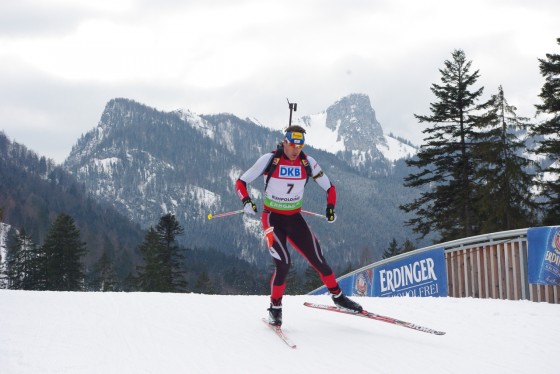
Christoph Sumann at last year’s World Championships in Ruhpolding.
Invincible? Meet vincible.
Down on your luck? Meet winner.
Just one day before the World Cup 12.5 k pursuit in Khanty-Mansiysk, Russia, Martin Fourcade of France showed once again why he is the best biathlete in the world when he took a 39-second win in the 10 k sprint. He shot clean; so did the next three finishers. It’s the combination of shooting and fast, fast skiing that has made Fourcade so unstoppable all season, and he showed no signs of letting up.
But in the pursuit, it was like a different Martin Fourcade showed up to the race. He missed at least one shot in each stage and five total, and didn’t have the fastest ski time. On the last lap he found himself chasing down older brother Simon, who had started a minute and a half back in 22nd place and is recovering from compartment syndrome surgery.
The younger Fourcade, the one in the yellow bib of the overall World Cup leader and the red bib of the Pursuit discipline leader, couldn’t do it.
Instead, Simon was second and Martin third. In first? By a huge margin – about the size of Fourcade’s from the day before – was Christoph Sumann of Austria. Like Simon Fourcade, he had cleaned all twenty targets, but starting from fourth position he had a bt of an advantage.
36-year-old Sumann, an Olympic and World Championship medalist with five prior career victories, hadn’t been on the podium since the very first World Cup weekend in Ostersund, Sweden. In the meantime, he had been left off his country’s World Championships roster for all but the relay.
Just two weeks ago, he was at home in Austria, competing in ski races. Not even skating ones – he placed second in a 15 k classic mass start FIS competition, his first since 2001.
Luckily for Summann, luck can change. He found himself back in his own sport and, today, at the top of the podium.
“This is a big surprise because I had a lot of troubles in the last weeks,” he said in the post-race press conference. “I started on the podium in Östersund and everything in between was not so good. I was thinking about quitting. It is a big surprise! It is big motivation to train hard one more year and then finish after Sochi.”
Despite Martin Fourcade’s woes on the range, it was a great day for France as the brothers were reunited again.
“This is the second time that Martin and I are on the podium together and the second time I am in front of him; that is great,” Simon Fourcade said. “But it is a great pleasure to be up here with him…I had really good feelings warming up today. I came back from 22nd place to the podium which I did not expect.”
Martin Fourcade actually tied for third, thanks to a disaster not of his own making. The race was marred by a cross-firing by Germany’s Andi Birnbacher, who was in fourth place in the third stage. But he fired on the wrong targets, instead knocking down those in lane three, which should have been Michal Slesingr’s. That left Birnbacher with five penalties for the stage, and Slesingr with problems of his own.
“The official had a very slow reaction to my raised hand,” Slesingr said. “The target needed to be cleared. Then he asked me what was wrong; ironically it was the Czech referee. I lost lots of time, probably more than the 25 seconds. I lost contact with the group when I spent such a long, long time standing. That affected my skiing. I felt my legs were more tired as soon as I left the shooting range.”
It undeniably affected the race to have Slesingr delayed on the range; he likely would have been a force in the fight for the win, although of course nobody knows for sure. In subtracting seconds from his race time, officials finally decided just to award him joint third place with Fourcade.
“The decision is fair for both of us,” Fourcade said.
Racing resumes tomorrow with mass start competitions.
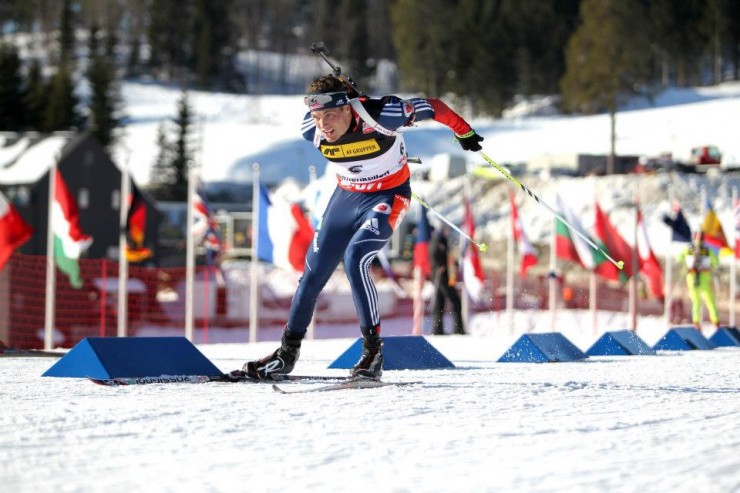
Tim Burke racing in Oslo last weekend. Photo: USBA/NordicFocus.
Starting nearly last out of 105 men in today’s 20 k individual race in Sochi, Russia, Martin Fourcade of France immediately hit a snag.
Right off the bat, the world’s best biathlete missed a target. Bam: one minute of penalty time.
“I saw that Andi [Birnbacher] shot clean, and he had a big advantage on the second loop,” Fourcade said. “I knew it would be hard with one mistake. Even after the last shoot, I didn’t think I could catch him.”
It was a return to the top for Birnbacher, who finished third in last year’s World Cup Total Score and won the Mass Start trophy. But he has had a middling mid-season, and hadn’t won a race since before the Christmas break.
“I didn’t expect a podium today, because my shape was not good in Oslo,” Birnbacher said in the press conference, referring to the last weekend of World Cup racing. “I didn’t feel good skiing, and shooting was also bad for me in Oslo. But when I came to these tracks and this shooting range on the first day of training it was immediately much better.”
Birnbacher knew that he could shoot clean – he had missed only one shot in several days of training – and said that it turned out to be “the key to getting on the podium.” But he also skied well, clocking the ninth-fastest ski time. That put him 25 seconds ahead of Serhiy Semenov of Ukraine, who also shot clean and ended up in third, the first podium in his career.
In fact, Birnbacher held onto his lead for a long time. The twelfth starter, he waited for more than 40 minutes in the leader’s chair before Fourcade crossed the line with a time seven seconds faster.
“On the last lap, I heard my coach tell me that I could catch him,” Fourcade said. “My mind turned over and I knew that I could be first. It was a really wonderful sensation, to know that there’s a lot of pain in your body, but it’s only positive pain because you know you will win. It’s only happiness.”
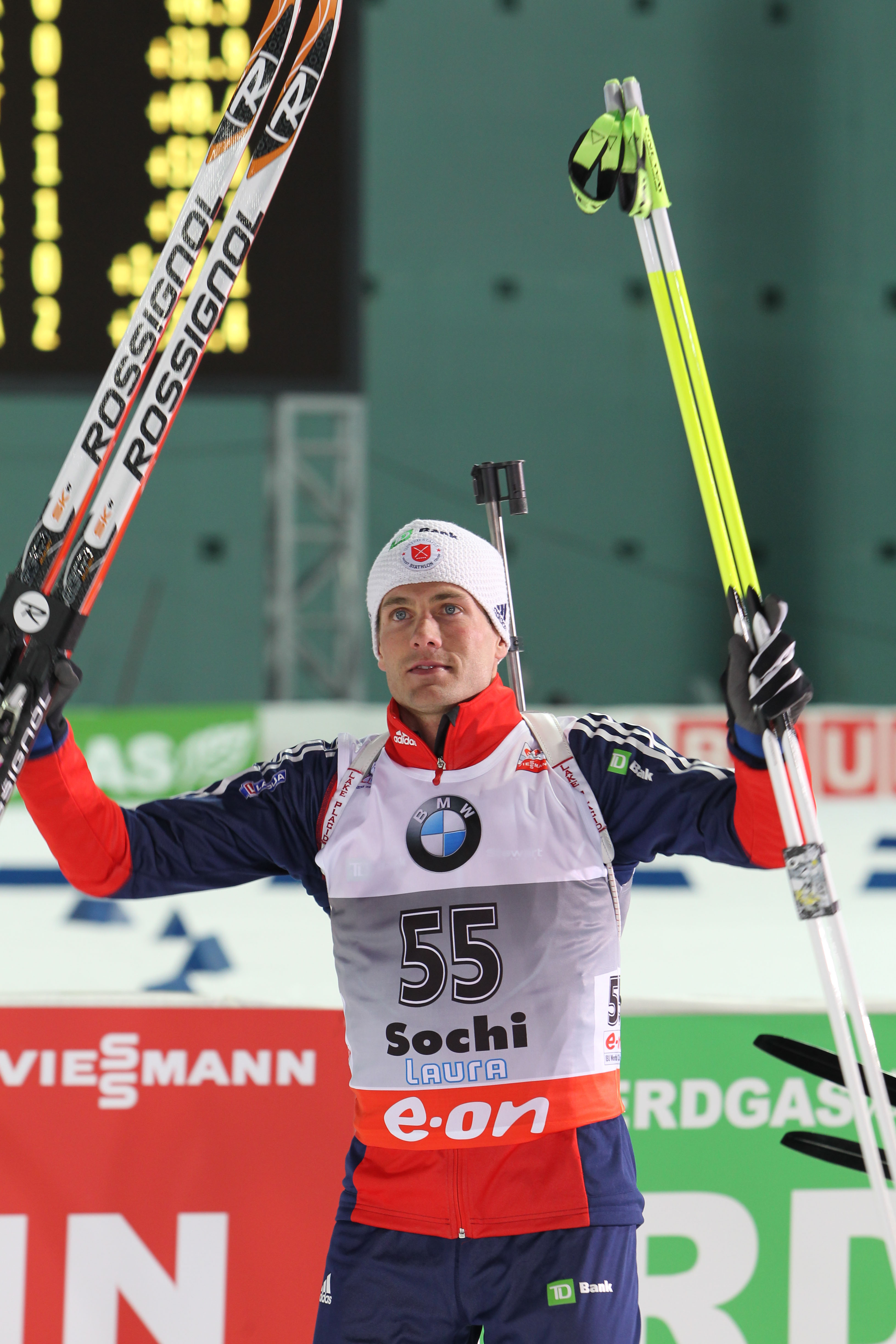
It was the second flower ceremony in as many races for Burke, who placed fourth in the mass start in Oslo on Sunday. Photo: USBA/NordicFocus.
While Birnbacher got his kicks on the range, which he said suited him well and was easy, Fourcade was pleased by the trails, which he said catered to the best skiers. And coming from a high region of the French Pyrenees, the altitude didn’t bother him, either.
“The tracks are really, really hard,” Fourcade said. “I think all the guys thought so, it was a tough race. But the track has been made and we can’t do anything about it, so we have to do it, and to do it well if we want to win.”
With Emil Hegle Svendsen of Norway sitting out these World Cups, as he did the last weekend in Oslo, Fourcade now pretty much has a lock on the season title (for an excellent explanation of the complicated scoring system, head to Real Biathlon).
“And now I have my gold medal from Sochi,” he joked at the press conference, holding up a medal he had been given in the podium ceremony. “Now I just have to come back and do it next year.”
Following a similar trajectory in the race was American Tim Burke, who also missed a target in his first shooting stage.
“That’s an awful way to start the individual, but being able to stay positive and saying you can shoot three zeroes, you can get yourself back in the race,” he told FasterSkier.
While Fourcade had the fastest ski time as he raced the clock to beat Birnbacher, Burke had the third-fastest, and quickly made up the places he had lost with his one minute of penalty time.
“I feel really good right now,” Burke said. “I think this is the best shape I’ve had all season. I’ve kind of kept it rolling from World Championships – it’s really nice going into the end of the season like that. I’m definitely looking forward to all the races, especially when it looks like a lot of guys are starting to tire and slow down.”
By the time he came into the final standing stage, Burke had climbed well within the top ten. As he entered the range he could hear the stadium announcer and knew that he was in position to have a good race.
Then, as he has done more and more often this season, Burke closed the race out strong, cleaning his last batch of targets. Being able to do that in an individual race, he said, mostly comes down to experience. Even a few years ago, it was something of a challenge. This year, he’s more confident.
Not that it was easy.
“It was a little bit tough because my legs were starting to cramp, from the icy conditions and tough course,” Burke said. “I was nervous they were going to start to shake or something, but luckily they didn’t end up being that bad.”
He left the range neck and neck with Latvia’s Anndrejs Rastorguyevs, who had a split two tenths of a second faster than his. The podium was probably out of reach – Semenov had a 30-second advantage at that point, although it slipped to 20 by the finish – but Burke gave it everything he had to try to snag fourth. In the end, he came up just short.
“I knew that it was really close, and on the first part of that last lap I lost some time, but was able to come back a little bit,” he said. “I’m obviously really happy with the race. It was tough to start out with a penalty in the first stage in the individual, so I’m really happy to come back and shoot zero in the next three stages and just to stay on my feet on the course.”
Burke’s teammates Lowell Bailey, Leif Nordgren, and Russell Currier struggled more on the range, and ended up 47th, 62nd, and 80th. But with Susan Dunklee finishing seventh and Annelies Cook 14th in the women’s race, it was nonetheless an excellent day for the U.S. team.
“It’s definitely beneficial,” Burke said of the boost he got from his finish. “The course here is super tough and I wasn’t sure exactly how it suited me after just skiing it easy in training. But today I know I had the course time, and that tells me that I can compete with the best guys here when I’m in shape. So I’m really happy about that.”
Just like the women – and Fourcade – Burke talked about how hard the trails were. Not only on the famed climbs, but also the downhills; he estimated that over 25 people had crashed in today’s race, and both he and Fourcade mentioned that they are somewhat fearful of what the corners will be like in a mass start.
“My worst loop on the downhills was the first time down, because I wasn’t quite sure what to expect with race skis,” he said. “When you have race skis on you’re just carrying so much more speed down the hill. I had some close calls on the first lap, but after that I was okay.”
As for the climbs, he believed they played to his strengths, which include V2’ing hard uphill. That gives him the ability to change techniques more than a skier who relies on V1.
“It is honestly the toughest loop that we have on the World Cup,” Burke said. “It’s brutal. I haven’t seen the full breakdown from today but I’m sure the time differences were huge. I think what makes it so tough is that the downhills have a lot of really sharp corners, so you never really just get a chance to just sit in a tuck and relax. The climbs aren’t overly steep, per se, but very sustained. You have to climb for a long time.”
The only place he could relax? On the range.
“I was a little surprised at how easy the approach was,” Burke said. “I felt like I was hitting the mat really rested. Since you’re going to see really good shooting from all the racers, from the field, you’re going to shoot really well if you’re going to want to be up there in the Olympics, for sure.”
Canadians Scott Perras and Scott Gow finished 61st and 63rd, and teammate Jean Philippe Le Guellec placed 77th.