Tag: Andre Lovett

  • Globetrotting Fritz & Kovacs Take Titles, Cash in Snowy Qaniq Challenge

    Globetrotting Fritz & Kovacs Take Titles, Cash in Snowy Qaniq Challenge

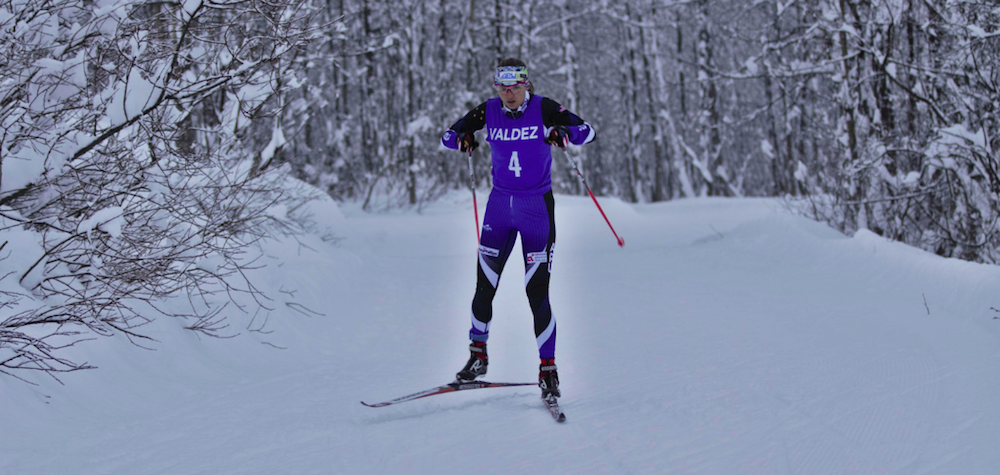
    Women's winner Lauren Fritz (APU) races in the 15 k freestyle in the Qaniq Challenge in Valdez, Alaska, Jan. 14, 2017. (photo: Calvin J. Fifarek)
    Women’s winner Lauren Fritz (APU) races in the 15 k freestyle in the Qaniq Challenge in Valdez, Alaska, Jan. 14, 2017. (Photo: Calvin J. Fifarek)

    VALDEZ, Alaska — Official Winter Storm Warnings for the state of Alaska are graded on a curve. In Fairbanks, which has a relatively dry winter climate and low snowfall totals, a forecast eight inches of snow in 24 hours are required before the National Weather Service (NWS) will issue a warning. In moister maritime Anchorage, that figure becomes 12 inches in 12 hours. But in Valdez, world-famous for its deep snowfalls and epic backcountry skiing in the Chugach Mountains, the standard is a full 24 inches in 12 hours before a warning will issue. It’s forecast to snow 18 inches before noon? Three feet by the end of the day? NWS doesn’t want to hear about it.

    All of which is to say that it was snowy in Valdez over the weekend for the third-annual Qaniq Challenge, but not historically so. Like, it only snowed roughly eight inches during the day on Friday, 14 inches Friday night, a few more inches Saturday, six or eight more inches on Saturday night into Sunday, and another foot or so on Sunday through Monday.

    Paul (PK) Kovacs of the Australian National Team and Lauren Fritz of Alaska Pacific University (APU) romped through the fresh snowfall to pick up victories in the third-annual Qaniq Challenge, a two-day, roughly 35-kilometer total classic and freestyle race series. Notably, first place earned each of them $2,000 dollars, the second-richest prize in domestic cross-country skiing, behind the American Birkebeiner. The Qaniq’s total purse, $10,000, also trails only the American Birkie.

    The Qaniq, whose name comes from the Alutiiq word for “falling snow,” has been held in a variety of formats during its three years of existence. This year’s race saw a 15.7 k freestyle individual start on Saturday, followed by an 18.6 k classic pursuit on Sunday. First racer to cross the finish line on Sunday wins.
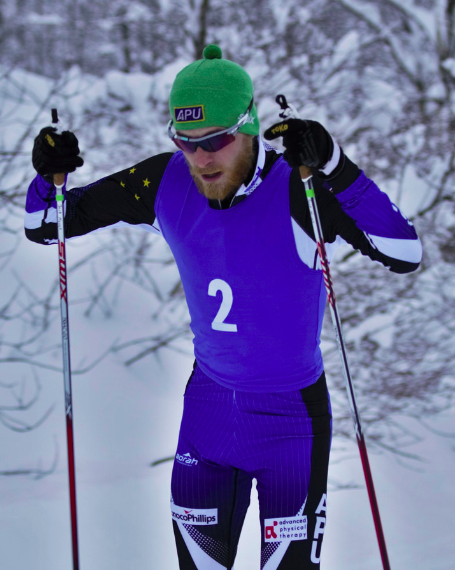
    Men's second-place skier Jack Novak (APU) races in the 15 k freestyle in the Qaniq Challenge in Valdez, Alaska, Jan. 14, 2017. (photo: Calvin J. Fifarek)
    Men’s second-place skier Jack Novak (APU) races in the 15 k freestyle in the Qaniq Challenge in Valdez, Alaska, Jan. 14, 2017. (Photo: Calvin J. Fifarek)

    On Saturday, that racer was Kovacs. The Australian national, who lives and trains in Anchorage but is a member of the Australian National Team, started in bib 5, 90 seconds behind APU skier Jack Novak and a minute behind APU skier Andre Lovett. But roughly 16 kilometers later, it was Kovacs who was the first to return to the starting area plowed out of the 14 inches of fresh snow near the Coast Guard Housing on the western edge of a residential Valdez neighborhood.

    Kovacs’s time for 15.7 k was a laborious 46:51.7. Novak (+2:11.7) and Lovett (+5:04.2) followed.

    In the women’s division, Fritz (APU) skied to victory in 55:51.7. Kate Backstrum (citizen racer, formerly of Montana State University) in second (+5:49.5) and Krista Heeringa (citizen racer, formerly of University of Alaska Anchorage) in third (+7:57.3) made up the rest of the Day 1 podium. Fritz started somewhat ahead of them in bib 4, then skied by herself for nearly the entire course.

    Saturday’s race was not easy for anyone, as a snow/rain/sleet mix falling on top of nearly two feet of recently groomed fresh snow, and temperatures around 34 degrees Fahrenheit with close to 100-percent humidity, made for slow going no matter how many fluoros were applied. Kovacs’s winning time on Saturday, for a 15.7 k skate race including 9 k of pancake-flat trail, was nearly 47 minutes. The previous month, at a Besh Cup race in Anchorage, he covered a much hillier, International Ski Federation (FIS)-certified 15 k course in 37:15. Last year he skied a World Cup 15 k in 39:10. Novak, in second, clocked a 35:40 for the Besh Cup skate, and a 49:03 in Valdez. Saturday was slow for everyone.

    Sunday brought somewhat less fresh snow, down to eight inches or so (plus more falling during the race), but more of the same on the results sheet, as both Kovacs and Fritz maintained their lead in the classic race to win the overall title.

    Novak had the fastest time on day on Sunday, pushing through the fresh snow in the classic pursuit start to finish in 56:52.0, 16 seconds faster than Kovacs. Lovett (+2:32.1) was again third. Those margins were not enough to change the overall podium based on combined times for both races: first Kovacs, then Novak (combined +1:55), then Lovett (combined +7:20).

    Sunday was once more all Fritz in the women’s race. The APU skier fought through jetlag and energy issues to ski the classic race in 1:06:12.4. Backstrum (+5:31.9) and Heeringa (+11:24.7) again followed. The final podium was the same: Fritz, Backstrum and Heeringa.

    If it’s Saturday, this must be Valdez

    Despite Fritz’s large lead throughout the weekend, she never felt that her victory was guaranteed. Fritz had raced in China from Jan. 1-9, completing six races in nine days. Then she played tourist in Beijing for a few days. Then she made the not-short trip back to Alaska, arriving at the Anchorage airport at 4 p.m. on Thursday. Then she woke up on Friday and drove more than 300 miles to Valdez.

    “I literally hadn’t skied in almost a week,” Fritz told FasterSkier of Saturday’s race.
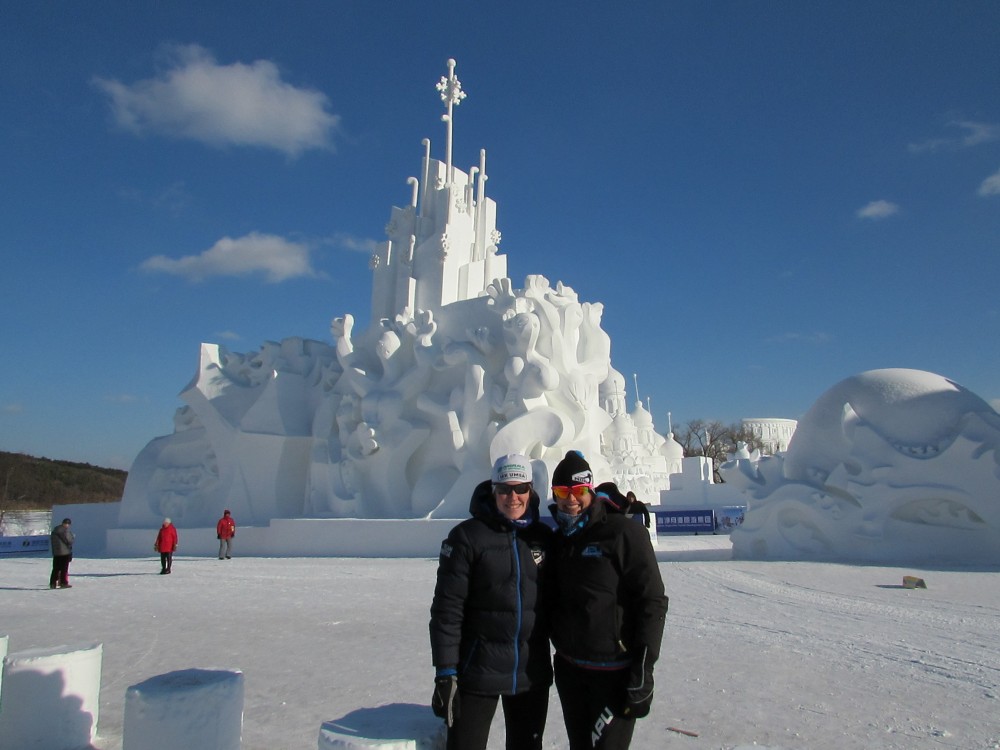
    Swedish skier and former University of Vermont athlete, Linda Danvind-Malm (l) and American Lauren Fritz (APU) stand in front of one of the many snow castles that line the lap lane to the 50 k classic Vasaloppet marathon during the 2016 China Tour de Ski in Changchun. (Photo: Lauren Fritz)
    Swedish skier and former University of Vermont athlete, Linda Danvind-Malm (l) and American Lauren Fritz (APU) stand in front of one of the many snow castles that line the lap lane to the 50 k classic Vasaloppet marathon during the 2016 China Tour de Ski in Changchun. (Photo: Lauren Fritz)

    I think my last race in China was like the 9th, which would have been the 8th here, and then after the race I spent a few days in Beijing, touring around, being a tourist, and didn’t run, didn’t ski. Didn’t have time when I got home. So literally [Saturday] testing skis, warming up was the first time I had been on skis or worked out in a week. And then with the delayed start, that kind of sucked, because I got kind of cold again. And I started, and I felt like I flooded on the first hill that was 500 meters out of the start, so I thought it was going to be a really, really rough race. But I think just having really good base fitness helps you keep it together.”

    Base and experience and a six-minute lead notwithstanding, Fritz was taking nothing for granted on Sunday. Not in some Bill Belichick coach-speak sense of anodyne platitudes about taking all competitions seriously and not celebrating too early, but rather in the very real sense that her international travel schedule and recent nutrition issues left her honestly concerned about her ability to complete a flat 18 k double pole course.

    “Don’t pass out on the side of the trail,” a relieved-but-tired Fritz said after Sunday’s victory. “That was pretty much my only strategy, because I was actually legitimately worried about something like that. Because I’ve been super low energy, because I lost a lot of weight in China, because it was like hard to eat a lot of stuff. So my energy stores are probably very much in a negative balance. So it was a legitimate concern, running out of energy, just falling over. But that didn’t happen.”

    Fritz was able to complete Sunday’s race despite a second day of challenging conditions – with two minutes between her and the preceding racer in the pursuit start, enough snow would fall in those two minutes to make it difficult to discern which track the leading skiers had taken – and the effects of international travel.

    “I definitely go through periods during the day where I get really, really tired and kind of, almost like dizzy and spacey, just really out of it,” Fritz said. “And then there will be like times in the middle of the night where I wake up wide awake for a like a couple of hours. So, this is definitely some pretty severe jetlag, I think.”

    While the jetlag was pronounced, Fritz was unphased by Friday’s 300-mile drive to get to the race start.

    “The, like, 5 1/2 hour drive from Anchorage to Valdez was – well, we did two five-hour drives, a 16-hour drive, and a 10-hour drive in China,” Fritz recounted of her recent travels for the China Tour de Ski. So “this was like pretty easy. It went by fast.”

    (Men’s second-place finisher Novak went from China to Anchorage to Valdez on the same schedule. Novak’s father drove him from Anchorage on Friday, while Novak fils slept the whole way.)
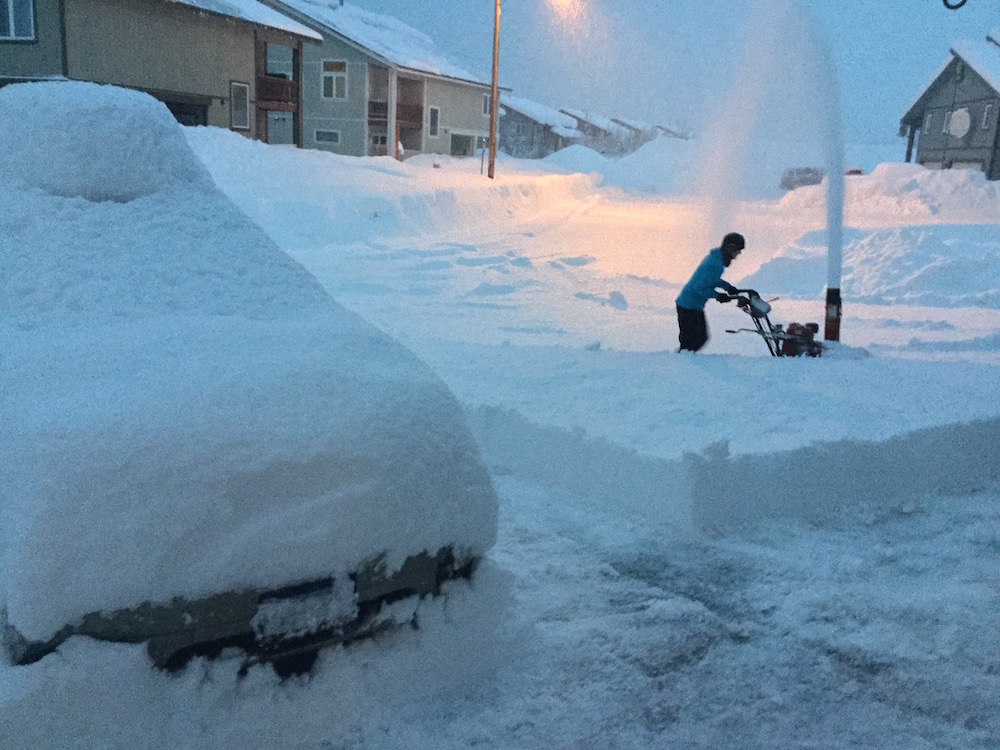
    This used to be a rocket box: digging out on Saturday morning after 14 inches of snow fell overnight in Valdez, Alaska, in January 2017. (Photo: Gavin Kentch)
    This used to be a rocket box: digging out on Saturday morning after 14 inches of snow fell overnight in Valdez, Alaska, in January 2017. (Photo: Gavin Kentch)

    Fritz is the only skier to make the podium in all three years of the Qaniq Challenge, logging a cumulative first, second, and third since 2015. That’s $4,000 combined lifetime winnings from this race, including $2,000 this year.

    So what does it mean for an American skier to win $2,000 in a ski race?

    “It’s pretty big money,” Fritz said. “It’s more than a national championship. So that’s sweet. I mean, it’s such a cool race; I really hope that it can grow over the years.”

    For Backstrum, meanwhile, a thousand dollars for second was apparently going to aid her with more quotidian concerns. “It  feels like I have a good amount of beer money now,” Backstrum joked. “No,” she continued, “I didn’t get my PFD this year, so it will be a nice replacement.”

    (The reference is to the Permanent Fund Dividend check, the payout given to all eligible Alaskans representing their share of the state’s sovereign wealth fund.)

    Backstrum had graduated from Montana State in 2014, and had trained sporadically since then. “This was a good inspiration to start training again” for ski racing, she said.

    For Kovacs, who also earned $2,000 for his victory in the men’s race, the cash prize was “huge.” It marked “the biggest paycheque I’ve ever received in any ski race,” Kovacs said. “It’s really helpful. I mean, that’s like four months’ rent back in Anchorage, or that will pay for all my flights to Europe and all my other flights in Europe for the season this year, which is just massive. So it’s a big help.”

    Kovacs surveyed other races in which he had won money, and concluded that he had not quite won $2,000 in all other races in his career combined. “Maybe,” he said. “Probably just under. So this has probably, like, doubled my entire career earnings.”

    The payout came in a race that Kovacs nearly did not enter. He had done some of the races at last week’s U.S. nationals, leaving Utah on Wednesday and returning to Anchorage only at 5 a.m. Thursday.
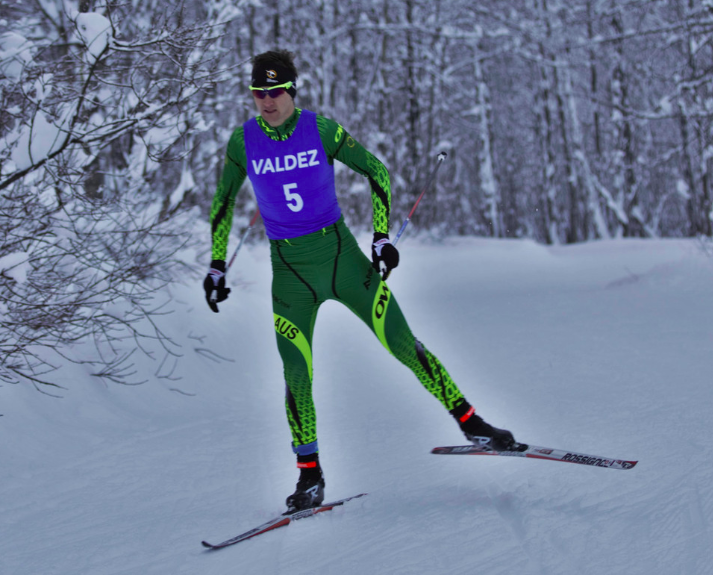
    Men's winner Paul (PK) Kovacs (Australian National Team) races in the 15 k freestyle in the Qaniq Challenge in Valdez, Alaska, Jan. 14, 2017. (photo: Calvin J. Fifarek)
    Men’s winner Paul (PK) Kovacs (Australian National Team) races in the 15 k freestyle in the Qaniq Challenge in Valdez, Alaska, Jan. 14, 2017. (Photo: Calvin J. Fifarek)

    “I then picked up Lauren [that afternoon],” Kovacs said, “And she said, ‘Hey, I’m going to go to Valdez,’ and I said, ‘OK, well I guess I’ll come.’ Because up until that point I wasn’t even coming. I had originally planned to just have a few days at home before I fly to Europe. … It was a very last-minute decision, and we kind of just got up the next day, after doing a bunch of washing the night before, and just packed gear and went.”

    Kovacs and Fritz have been an item for some time; on this trip, Kovacs was the more functional of the two. “I’ve been holding it together pretty well,” he said. “I’ve managed to get a lot more sleep than Lauren has. I know that Lauren’s been up at like midnight, and a few hours in the middle of the night the last few nights. But I definitely took a couple naps, for sure. We’ve been holding it together all right, but it’s definitely like, once we’ve finished today and tonight I think we’re going to take it easy for the next few days.”

    “This has probably, like, doubled my entire career earnings.” — Paul (PK) Kovacs on his 2017 Qaniq Challenge victory

    But not for too long – Kovacs flew to Europe today, for two weeks of training in Falun. He had World Cup starts lined up after that across Europe and Asia (Falun, Pyeongchang, and Otepää) before planning to race World Championships in Lahti.

    Back in Alaska, Kovacs found conditions for Saturday’s race “really challenging. I mean, we’d had a lot of fresh snow, almost two feet of fresh snow. And they’d done a fantastic job to pack it and groom it, but it still was pretty aerated pack, so it was pretty spongy. And then we’d had almost torrential rain on top. And so it was just kind of that mashed potato sludge.”

    Despite the trying conditions, Kovacs said, “I was fortunate, I had some really solid skis, and maybe coming from altitude … I was able to really attack it a lot harder, I think, than the other two guys. Who also had I think pretty bad skis.”

    In a gracious gesture, following Saturday’s race Kovacs formed “a gentleman’s agreement” with the two APU skiers immediately behind him, “and they all came over and waxed the same wax at my house, which was good.”

    Kovacs didn’t want to claim too much credit for nailing the wax on Saturday, saying, “Honestly, it wasn’t like I was a mastermind and figured it out.” (He then explained that he and Fritz had, in their jetlagged state, packed “just one or two” warm waxes, making their options easy to work through.)

    Rather, Kovacs credited his grind, a Caldwell VDF, which he called “exceptionally good – that’s a chevron grind, and it was able to, I think, flush out the liquid in the snow much easier.”
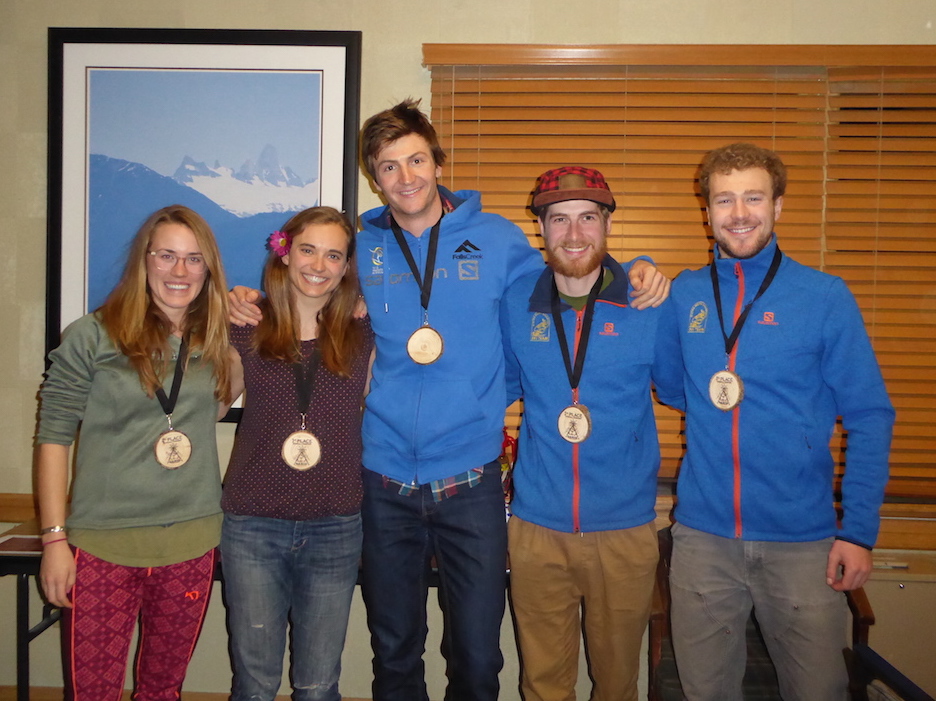
    The overall podium for the Qaniq Challenge in Valdez, Alaska, in January 2017: left to right, Kate Backstrum (former Montana State University), Lauren Fritz (APU), PK Kovacs (Australian National Team), Jack Novak (APU), Andre Lovett (APU). (Photo: Gavin Kentch)
    The overall podium for the Qaniq Challenge in Valdez, Alaska, in January 2017: left to right, Kate Backstrum (former Montana State University), Lauren Fritz (APU), PK Kovacs (Australian National Team), Jack Novak (APU), Andre Lovett (APU). (Photo: Gavin Kentch)

    Kovacs’s approach for Sunday, when he had a two-minute lead in the pursuit, was simple: “Basically the strategy was to go out as hard as I could. … With double poling you don’t quite blow up, or I find I don’t blow up, aerobically so much as my arms just blow up. And so I just wanted to see how hard I could go.”

    Being the first starter was disadvantageous in the fresh snowfall, but Kovacs benefited from a snowmachine that passed through moments before the race began, creating a firmer and less snowed-in platform than in either of the two set classic tracks. “My strategy was just to try and find fast snow,” Kovacs said, “And luckily a snowmobile had driven out some volunteers, and so I just skied on that.”

    Kovacs appreciated the chance to see Fritz during one of the loops of the course.

    “In a race like this, I definitely think about how Lauren is doing. I definitely was curious to see what was going on, and even just the fun things like racing against the master skier, and seeing how they’re going, because you know they knew each other, and how that was going duking it out, that’s fun. In other races I normally wouldn’t consider it; I do really try to just focus on my own race. But I guess in this race, because it just has more of a relaxed atmosphere, I let myself just think about other things a little bit more. So yeah, I was definitely curious to see how she was going. I mean, being so far out there, if you break a pole or lose a basket it’s a complete game-changer compared to a normal FIS race, where there’s a lot more people on the course that are able to give you equipment. So there’s more variables I guess here.”

    Looking to the future

    The Qaniq is universally beloved by those skiers who have made the trip to Valdez to race, reflecting quality organization and overwhelming community embrace of the event. But not that many skiers have made it: 31 in 2015, 37 in 2016, 33 this year.

    So will there be a fourth year? Maybe. Hopefully. Not certain. Race organizer Darryl Verfaille is nothing if not optimistic.

    The status of next year’s race is “truly undecided,” Verfaille told FasterSkier at the Sunday awards banquet, “but I’m going to do everything I can, even if I have to morph the format a bit. And we’re going to reach out – I’m going to do everything I can, including maybe seeking some external sponsors, maybe fundraisers. Some may change again with the political winds of Valdez, come next election, but I think we’ve got the city itself – the executive staff of the city of Valdez is in favor of this, because they recognize the true value, which is just exposing folks to Valdez in the winter. So I can’t say for sure we’re going to have it, but I’m going to do everything I can to make it happen for the fourth year.”

    Both Fritz and Kovacs addressed the room at the awards banquet in brief unscheduled remarks, praising the race organization and experience and hoping for its continued success.

    They also expressed similar sentiments in their comments to FasterSkier. “I think it’s a great race, and I hope they can keep it going,” Fritz said.

    “It’s an extremely fun event,” Kovacs echoed. “And I heard next year with U.S. nationals being in Anchorage that a lot more people will make the choice to come down here and really give this race kind of what it deserves. Because the volunteers put in a phenomenal effort, and it’s probably one of the best atmospheres of any race I do anywhere in the world. It just is really fun, and people should get involved.”

    The trip home

    Back in Valdez in January 2017, the APU skiers and Kovacs spent Monday morning after the race conducting a free clinic for the Valdez High ski team. The remainder of the field began their journey home on the only road out of town, where they were treated to an official NWS Blizzard Warning for their drive home through Keystone Canyon and Thompson Pass, including another 12 to 18 inches of snow and winds to 40 miles per hour. In a bit of meteorological ecumenicalism, the criteria for a blizzard warning (snow reducing visibility to less than a quarter-mile and winds gusting to 35 mph for four hours or more) are the same throughout the entire country.

    Results

  • Skiers Battle Warming Temps, Melting River Ice in Fairbanks’ Sonot Kkaazoot

    Skiers Battle Warming Temps, Melting River Ice in Fairbanks’ Sonot Kkaazoot

    FAIRBANKS, Alaska – As Mike Campbell famously said in The Sun Also Rises, he went bankrupt two ways: “Gradually and then suddenly.” Alaskan breakup – the season known as “spring” in other parts of the world – proceeds much the same way.

    A field of nearly 300 skiers experienced a little of both in the Sonot Kkaazoot family of races, held last Saturday, March 26, in Fairbanks, Alaska. At the end of the day, Fairbanks skier Rebecca Konieczny and Anchorage skier Seiji Takagi came away victorious in the flagship 50-kilometer skate races. But the real victory may have been that the races were held at all.

    Sonot kkaazoot comes from the Athabaskan (indigenous language group) words for “springtime” and “to slide your feet across the snow.” The race with this name has been held in Fairbanks on the last weekend in March every year since 1988. Reflecting the cold winter temperatures of Interior Alaska, as well as Fairbanks’s location at 65° N latitude, the race has never been canceled despite this late date (although the course has occasionally been modified).

    Traditionally, the race starts on the Chena River in the heart of downtown Fairbanks, travels 10 k east along the river, proceeds inland to Birch Hill Recreation Area, spends 30 k covering most of the trails in the renowned trail system, and then returns to the river to finish 10 k west in central Fairbanks. The 2016 race covered this full course. Barely.

    A field of 106 racers started the combined 40 k and 50 k races at 10 a.m. The first water hazard came approximately 300 meters into the race, as the field had to negotiate overflow several inches deep (the video shows the 20 k start). Once past the water crossing, a lead pack of a dozen racers quickly formed, including five skiers from the University of Alaska Fairbanks (UAF), five skiers from Alaska Pacific University (APU), and two junior skiers from Fairbanks’s West Valley High School.

    Takagi, a sophomore skier for UAF, set an honest pace from the start.

    “I know a lot of these guys will be mad at me for doing that but I kind of like doing that in mass starts, going out a little fast and then kind of settling,” Takagi told the Fairbanks Daily News-Miner in an in-person interview after the race.

    Takagi led for much of the initial 10 k down the river, occasionally trading off the lead with other skiers. Despite his desire to push the pace, the lead pack remained intact 10 kilometers and approximately 25 minutes into the race, as all 12 skiers who had made the initial break continued to ski in a pack.

    Shortly after leaving the river, the race course proceeds to the base of the Ft. Wainwright downhill ski area, then takes a series of switchbacks to the top of the alpine hill.

    Takagi put in a surge immediately upon reaching the base of the hill.

    “I just worked on trying to open that gap after that and maintaining it,” Takagi told News-Miner. Although his energy flagged considerably over the remaining 39 kilometers – “I had about less than 10 percent left, negative 10 percent left” by the finish, Takagi later said – he skied relatively unchallenged to the end. He would finish first by over two minutes in 2:20:30.2, taking the victory in his first time racing the Sonot.

    Behind him, there was heated competition for the remaining podium spots.

    “Soon after we started up the downhill resort the pace increased,” wrote eventual third-place finisher Fischer Gangemi of Takagi’s move. “As we rounded the first corner [going uphill] I could see Seiji already making a gap.”

    APU skier Andre Lovett, who would eventually finish fourth, tried to stick with Takagi. Two chase packs formed behind the leaders. Gangemi eventually bridged the gap to Andre Lovett and the two 40 k racers.

    “By that point,” he wrote, “Seiji had a considerable lead but we could still see him.”

    The next time Gangemi saw Takagi, he was at least 2 ½ minutes back of the UAF skier. Gangemi skied alone for some time, until he was eventually caught by UAF skier Nick Lovett (no relation to Andre).

    “We skied together [through Birch Hill, back to the river, and] all the way until the last 1 kilometer mark,” Gangemi wrote, “trading drafts regularly in the very hard push down the river and around the overflow. Both of us tried to make futile pushes a couple times. Finally Nick had much more gas in the last kilometer and slowly gapped me to the finish.”

    Nick Lovett finished second in 2:22:34.5, 2:04 back from Takagi. Gangemi was third in 2:22:45.0, roughly ten seconds behind. Andre Lovett came in fourth, nearly three minutes later.

    The top nine men’s finishers were split between UAF and APU, with five members of the UAF ski team and four from the APU university and masters teams. (The APU Elite Team was busy contesting its own slushy 50 k in Craftsbury.)

    (Story continues below)

    While Takagi skied away early for the solo win in the men’s race, the women’s race featured heated competition throughout. In a battle between UAF past and present, UAF past took the narrow victory. After 50 kilometers of head to head racing, Konieczny, a former Nanooks skier who now coaches for the Nordic Ski Club of Fairbanks, finished first in 2:42:00.7. Ann-Cathrin Uhl, a sophomore skier for the Nanooks from Mühlenbach, Germany, crossed the line less than six seconds back in 2:42:06.6. Third place went to Anchorage’s Sarah Freistone, who finished roughly eight minutes later in 2:50:07.4.

    Konieczny won the race for the third year in a row, but was thrilled to have some competition, and some company, this time. “I actually want to thank Ann Uhl,” Konieczny told the News-Miner. “Usually I follow the men for 20 k-ish, not even, and then I have to ski the whole race by myself. So it was really fun to ski with her and go back and forth.”

    Konieczny added, “I was excited to ski with a couple of the UAF ladies. Thought it would make it a little more fun for me.”

    Although Freistone finished some distance off the podium, she hardly had to ski by herself.

    “Throughout the race I was skiing in small packs of people,” she wrote in an email. “Whenever I felt the pack I was with was slowing down or if I thought I could go faster, I tried to make a move to the next group of people.”

    Freistone also had a personal source of motivation: “I was also trying really hard to catch my mom before the finish,” she wrote. “That kept me motivated when the skiing got rough and slow. She competed in the 40k and finished about a minute in front of me.”

    In the day’s other races, Maria Bray won the 40 k for the women in 2:21:21.7, with Jenna DiFolco second and Alyeska Daniels third. Local high school skiers Ti Donaldson and Benjamin Koenig were first and second in the men’s 40 k, with Donaldson setting a winning time of 1:52:29.3. Pete Leonard was third.

    Kaya Ratzlaff was fastest in the women’s 20 k, with Emma Jerome second and Anna Rix third. Mike Kramer, Jonathan Burrell and Jacob Moos were the top three in the men’s 20 k.

    Lynne Petersen was the winner, and only entrant, in the women’s 50 k classic race. Daniel Serventi won the men’s 50 k classic in an impressive 2:49:48.1 solo effort, with Bill Husby and Owen Hanley second and third.

    All skiers in all races had to contend with conditions that may charitably be described as variable. Fairbanks began experiencing a dramatic springtime freeze–thaw cycle somewhat earlier than normal this March. Temperatures on the Birch Hill section of the course were never lower than 36 degrees Fahrenheit during race grooming the night before, and were still as high as 52 degrees at 2 a.m., eight hours before the 10 a.m. start. They then fell to slightly below freezing by 6 a.m.

    Between the springtime conditions, the initial 10 k on the river, the groomed trails at Birch Hill, and the final 10 k back on the river, plus temperatures that climbed at least 15 degrees during the race, racers encountered a range of conditions. There was standing water, flowing water, sheet ice, bulletproof crust, melting snow, dirty snow, perfect midwinter corduroy, and what appeared to be midwinter corduroy but was in fact soft and painfully slow groomed snow. Then came the final 10 k on the river, when the sun came out, the morning’s ice broke down into slush, and even the top finishers faced a grinding trip to the end.

    Strategies for dealing with the range of conditions varied. One racer was heard muttering at the finish that he literally would have saved time had he skied with a Structurite tool in his water belt the entire way, then stopped before returning to the river to quickly hand-structure his skis.

    For her part, women’s winner Konieczny told the News-Miner, “My skis were fast when the conditions were right for it but then up at Birch Hill, especially, it got really really soft. It made it actually more interesting too because you had to be more tactical and find spots to pass.”

    Gangemi, who was on eponymous RCS Plus skis, was slightly less sanguine. He reported that he waxed with Holmenkol Betamix Red, plus “whatever structure tool Mike Hajdukovich from Trax [Outdoor Center] made available.” He added, “I think I should have used a graphite wax as well to improve the durability because it seemed they became slower as the race progressed not just because of variable conditions and fatigue.”

    The challenging conditions were reflected in the finishing times. Konieczny was more than 18 minutes off her course-record time of 2:23:40 from 2015. Takagi, similarly, was over eight minutes slower than last year, when APU skier Jack Novak won in 2:12:10.

    Three-time winner Konieczny was not the only frequent contender. Second-place skier Uhl had finished only one second off the podium in the Oosik Classic 50 k the weekend before. Third-place finisher Freistone was also third in the 2015 Sonot Kkaazoot, first in the Kachemak Nordic Ski Marathon earlier this month, and first in this winter’s season-long Anchorage Cup series. Among the men, Nick Lovett was third and Takagi fifth in last weekend’s Oosik, while Gangemi won the Kachemak Marathon.

    But the real story of the 2016 Sonot Kkaazoot was the weather. Despite race organizers’ assiduous attention to ice conditions in the days leading up to the race, including drilling at several sites to check for ice thickness near the start and delaying a final decision on whether or not to ski on the river until the morning of the race, everyone was surprised when a small portion of the Chena River experienced breakup during the race.

    (Story continues below)

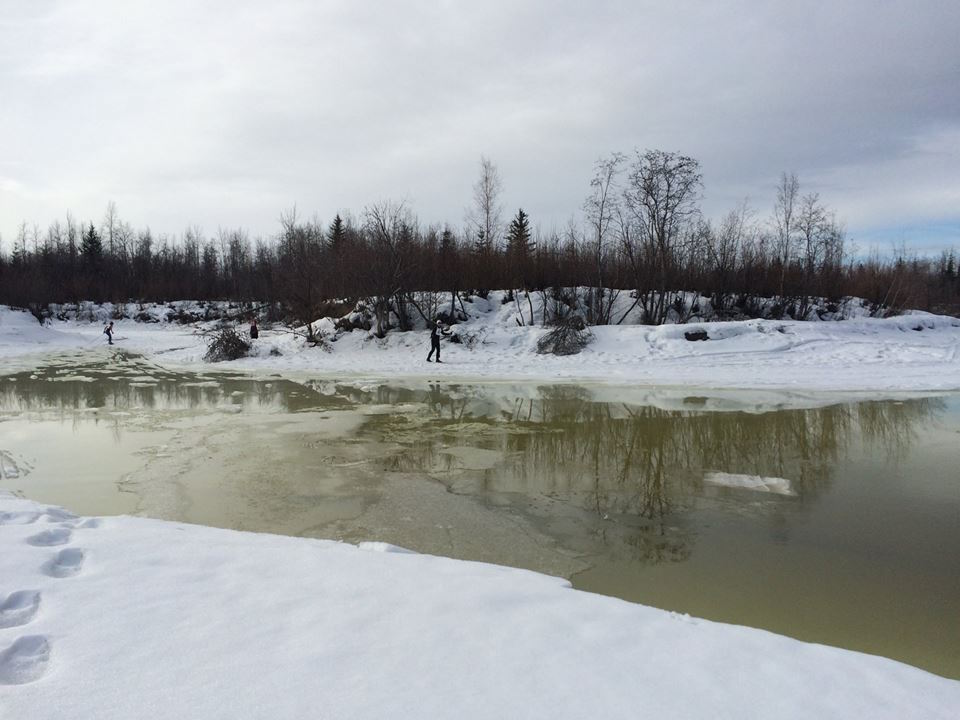
    Overflow on the surface of the Chena River, following a partial breakup of the Chena River in Fairbanks, Alaska, on March 26, 2016.  The groomed trail originally went through the foreground of this picture.  Two skiers can be seen in the background safely detouring around the overflow on the established detour route. (Photo: Stella Wisner)
    Overflow on the surface of the Chena River, following a partial breakup of the Chena River in Fairbanks, Alaska, on March 26, 2016. The groomed trail originally went through the foreground of this picture. Two skiers can be seen in the background safely detouring around the overflow on the established detour route.
    (Photo: Stella Wisner)

    A relatively small piece of ice went out at some point while the lead 50 k skiers were traversing Birch Hill. The Chena River promptly began flowing over the ice for a stretch of several hundred meters. While skiers had blithely skied down the groomed river trail earlier in the race, on their return they were met with a lengthy stretch of overflow.

    No one was injured. A detour route was quickly established, requiring returning skiers to head inland for approximately 100 meters, traverse around the farthest reaches of the overflow, step up on to some shore-fast river ice along the bank, duck under some alders, and return to the established race course on the far side of the overflow. (Two skiers can be seen on the detour route in the above picture.)

    In a blog post on the race website, race organizers wrote, “Huge thanks to David Frey, nordic ski coach at Tanana Middle School who alerted Sonot Kkaazoot officials of the major disruption of the Sonot Kkaazoot trail on the river and provided standby guides around the hazardous area until Sonot volunteers could set up an alternative course.” (Organizers declined further comment on the breakup incident.)

    As the race director told skiers in his pre-race remarks, imploring them to stay on the set course, “If you go off the course, you may die.” It appears he may have been correct.

    Or, as third-place finisher Sarah Freistone observed in an email, “I was really happy with how my race went this year despite the tough conditions.” She added, “I have never really worried about falling into a river in a ski race before, but I guess there’s a first for everything.”

    Complete results

    The reporter would like to thank local skier Max Kaufman for his sterling hospitality all weekend long, as well as for taking all the racer pictures in this story.

    About the Author: Gavin Kentch lives in Anchorage.  He skis with the Alaska Pacific University Masters team, plays with his two adorable daughters, and occasionally works as a solo attorney.  He was probably on snow this year before you were.

  • Norris Wins 10-Lap Anchorage Tour; Brooks Tallies Third Title

    Norris Wins 10-Lap Anchorage Tour; Brooks Tallies Third Title

    APU teammates Lauren Fritz (l) and Holly Brooks racing for the win at the 2016 Anchorage Tour in Kincaid Park on March 6. Brooks won and Fritz placed second. (Photo: Rob Whitney)
    APU teammates Lauren Fritz (l) and Holly Brooks racing for the win at the 2016 Anchorage Tour in Kincaid Park on March 6. Brooks won and Fritz placed second. (Photo: Rob Whitney)

    ANCHORAGE, ALASKA – A first-time racer and a former champion returning after a long absence skied to convincing victories in the Anchorage Tour Festival 30-kilometer race, née Tour of Anchorage 50 k, at Kincaid Park on Sunday. David Norris, last seen coming out of a group sprint to win the American Birkebeiner two weeks ago, and Holly Brooks, previously seen in two Olympic games but not at this race since 2009, each won by roughly three minutes on a sunny morning at Kincaid.

    The Tour of Anchorage is traditionally a 50-kilometer, point-to-point race, ranging from the Chugach foothills on the east side of town to Kincaid Park at the west edge of the Anchorage metropolitan area.  In between, racers traverse ski trails, city greenbelts, and bike trails until they reach the Coastal Trail multiuse trail, at which point they cover 15 k along the shores of the Pacific Ocean before ascending a hill to finish at Kincaid.  It is truly a tour through the heart of Anchorage.

    This year’s race, like every other race held under the auspices of the Nordic Ski Association of Anchorage (NSAA) in this snow-sparse winter, occurred exclusively on the snowmaking loop centered on the Kincaid Stadium.  This year’s Tour presented 10 laps around a 3 k course, making for a 30 k freestyle race.  It was more a Tour of the Snowmaking Loop than a Tour of Anchorage.  Conditions on the course were very good at the outset, with recent fresh snow mixed into a solid base of manmade snow, though the steepest uphills and downhills broke down into sugar snow over glare ice by midway through the race.

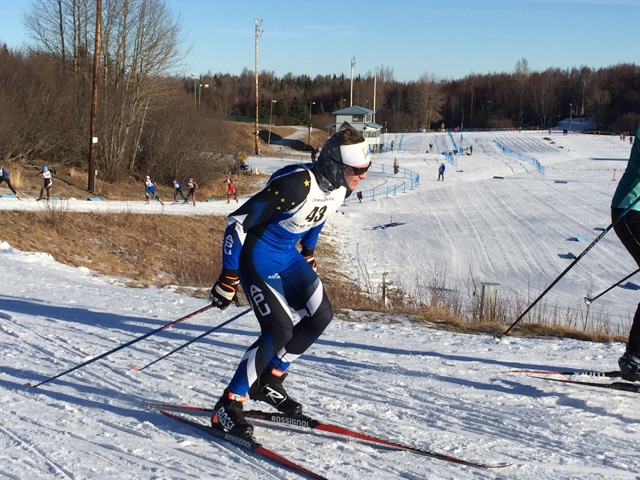
    David Norris (APU) racing to his first Anchorage Tour win at Kincaid Park on March 6. (Photo: Rob Whitney)
    David Norris (APU) racing to his first Anchorage Tour win at Kincaid Park on March 6. (Photo: Rob Whitney)

    Norris, who skis for Alaska Pacific University (APU) and who won the men’s race by nearly three minutes in 1:14:51.0, seemed undeterred in his first time racing the Tour of Anchorage.  In an email, he wrote, “This would have been my first year to do the actual Tour. … Due to the low snow year I was glad to have the Tour Festival 30km race on the manmade loop. I am glad the NSAA hosted the event even though we couldn’t do the formal course.”

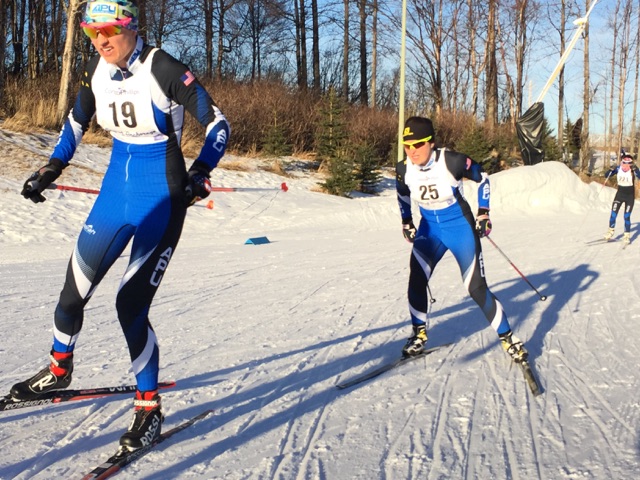
    The men’s podium was all APU blue.  Jack Novak was second in 1:17:32.9.  Andre Lovett followed roughly a minute later in 1:18:27.9.

    Norris skied most of the race by himself, after breaking away from Novak late in the first lap.  Norris wrote of his race strategy, “I went out hard from the start to practice that kind of effort. Jack stayed with me for almost the entire first lap before settling in.”

    Norris had no other immediate competitors for the remaining nine laps and 27 k.

    But with a field of 148 skiers on a 3 k loop (60 racers for the 30 kilometer race and 88 for the contemporaneously held 15 kilometer race), Norris had plenty of company out there.  As Norris graciously wrote, “I thought I skied steady and was able to re-accelerate through corners or after congestion due to all the different levels of racers on a short 3km loop.  I really apologize if I ever startled anyone while making a pass.  I tried to be really careful not to be a jerk while making passes today.”

    “I tried to be really careful not to be a jerk while making passes today.” — David Norris, after winning 2016 Anchorage Tour 30 k

    While Sunday was the first time in this race for Norris, a Fairbanks native, the 2016 Tour marked a homecoming of sorts for Anchorage’s Holly Brooks.  Brooks won the flagship 50 k Tour in both 2008 and 2009, at a time in her ski career when she was an APU coach first and a competitive skier second.  Better results, a spot on the U.S. Ski Team, and nomination to the 2010 and 2014 U.S. Olympic teams famously followed.  Brooks then spent last winter traveling the world, competing in the FIS Marathon Cup/Worldloppet series on three continents.  She is now pursuing a degree, buying a house, and likely training somewhat less.  But she is still winning ski races.

    Brooks, who remains affiliated with APU, finished first among the women in 1:24:46.1.  Her main competition came from fellow APU skier Lauren Fritz, who finished slightly less than three minutes back in 1:27:39.0.  Citizen racer Sally Hokanson was third in 1:40:21.4.

    While Norris went out hard from the start and gapped Novak early, Brooks and Fritz skied together for a majority of the morning.  Brooks started to pull away about three quarters of the way through the race, she recounted in an in-person interview.  

    “It might have been on lap 7 of 10.  It was on [the downhill on] the backside [of the course], because my skis were running pretty well,” she said. “I noticed I had a little bit of a gap.  I just put a few extra strides in and a good tuck and a big push, and opened up a little bit of a gap.”

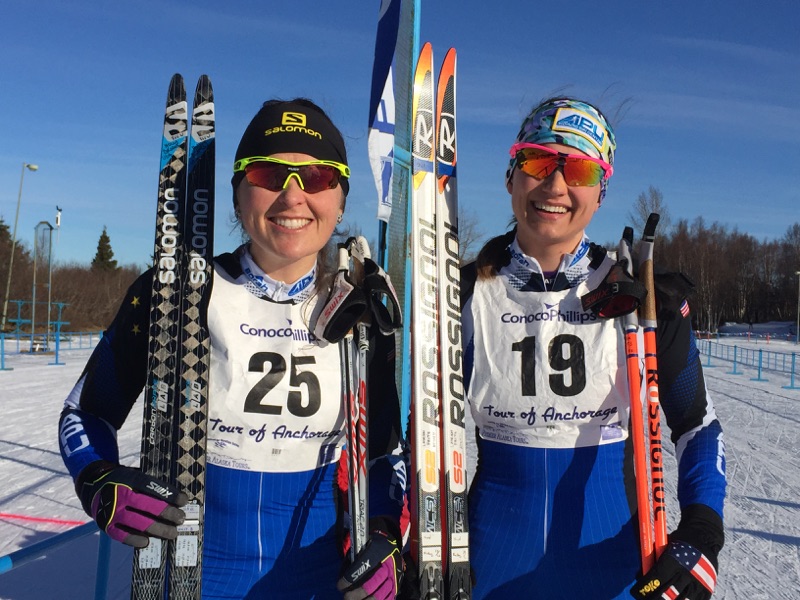
    Holly Brooks (l) and Lauren Fritz, both APU, after placing first and second, respectively, at the Anchorage Tour in Kincaid Park on March 6. (Photo: Rob Whitney)
    Holly Brooks (l) and Lauren Fritz, both APU, after placing first and second, respectively, at the Anchorage Tour in Kincaid Park on March 6. (Photo: Rob Whitney)

    Brooks kept her lead to the finish, aided by her own observations and splits from others.  

    “There’s a little out and back, where you can kind of get an idea if someone’s there or not, so I saw her there the first time after I’d made the move,” Brooks said.  “And then I got a couple of back splits after that that I had a little bit of a gap.”

    Brooks appreciated the chance to be back racing on home soil, after many winters spent skiing anywhere but in Alaska.  

    “It’s nice to be home,” she said.  “I had my husband out here giving me feeds, so that’s always fun, and a lot of local people out there on the course too.  There was a lot of traffic out there today, the 30 k and the 15 k on the same loop, and some of the downhills were a little sketchy with the traffic, but it was manageable.”

    A Kincaid lap race may not be particularly exciting, but it was certainly a change of pace from Brooks’ schedule last spring.  When asked where she had been one year ago this month, the peripatetic Brooks had to think for a while before answering.  

    “Last year I wasn’t home for another five weeks,” she finally said.  “Let’s see… I was at the Engadin this weekend last year I think.  And then after that I think there was the Norwegian Birkie. And then, I can’t remember if there was something between that and going to Siberia.  So, a much different year.”

    While Norris was racing the Tour for the first time, the rest of the day’s podium finishers were no strangers to this race.  Among the men, second-place finisher Novak won the race in 2015 (when it held as a criterium with a 50-minute time limit), and was third in 2014.  On the women’s side, second-place Fritz was also second in 2014.  And third-place Hokanson was second in the 2015 criterium, and (as Sally Johnson) won the 25 k classic race in 2008.

    So what are the winners’ plans for the rest of the season?

    “I will be training in Fairbanks until I leave for Spring Series in Vermont, which will conclude my season,” Norris wrote. “My season has progressed and I think I have made a good step forward. My goal at the beginning of the season was to earn a spot on the Canadian Tour World Cups, but with just average races in December and November I wasn’t able to secure a position.”

    Meanwhile, Brooks had upcoming spring marathon racing goals, including either the Kachemak Bay Nordic Ski Marathon in Homer or the Sonot Kkaazoot in Fairbanks. But as of early Sunday afternoon, standing in the Kincaid parking lot, the March sun finally taking the chill off what had been a brisk morning, she had more immediate plans.  “Oh, and I’m anxious for that sauna to get nice and hot,” she observed, gesturing toward a portable sauna that had been towed into the parking lot next to the beer garden.  “And the barrel hot tub.”

    Overall results