From the FasterSkier archive — posts syndicated from athletes’ and coaches’ own blogs between 2004 and 2012, kept online as published. Current coverage is at fasterskier.com.
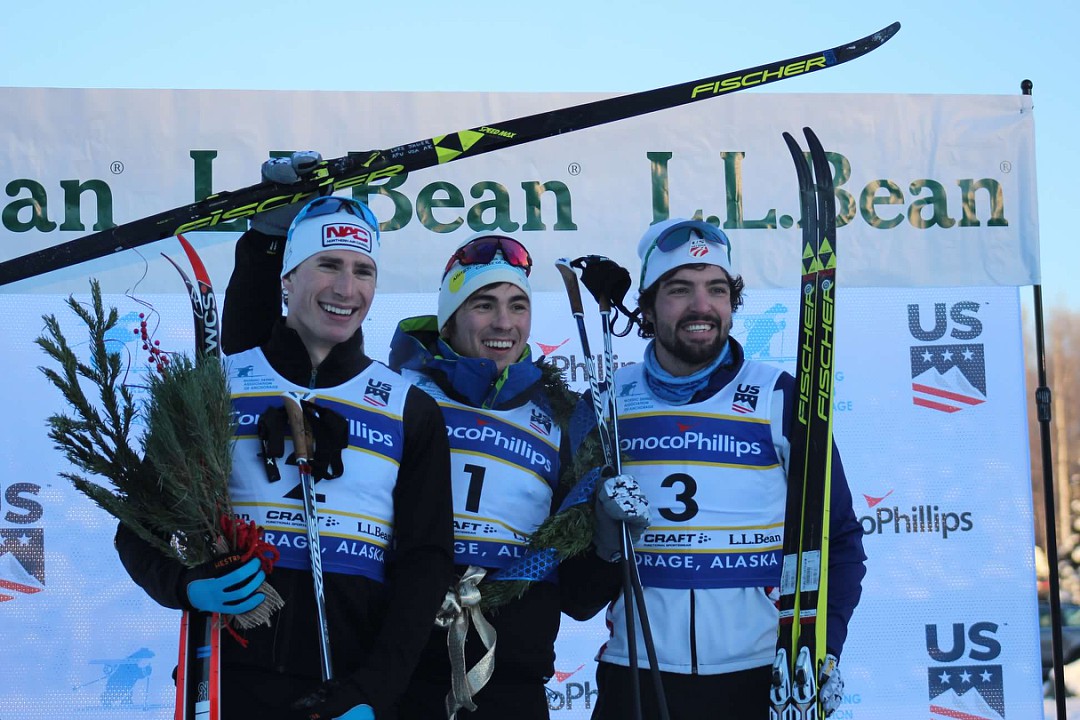
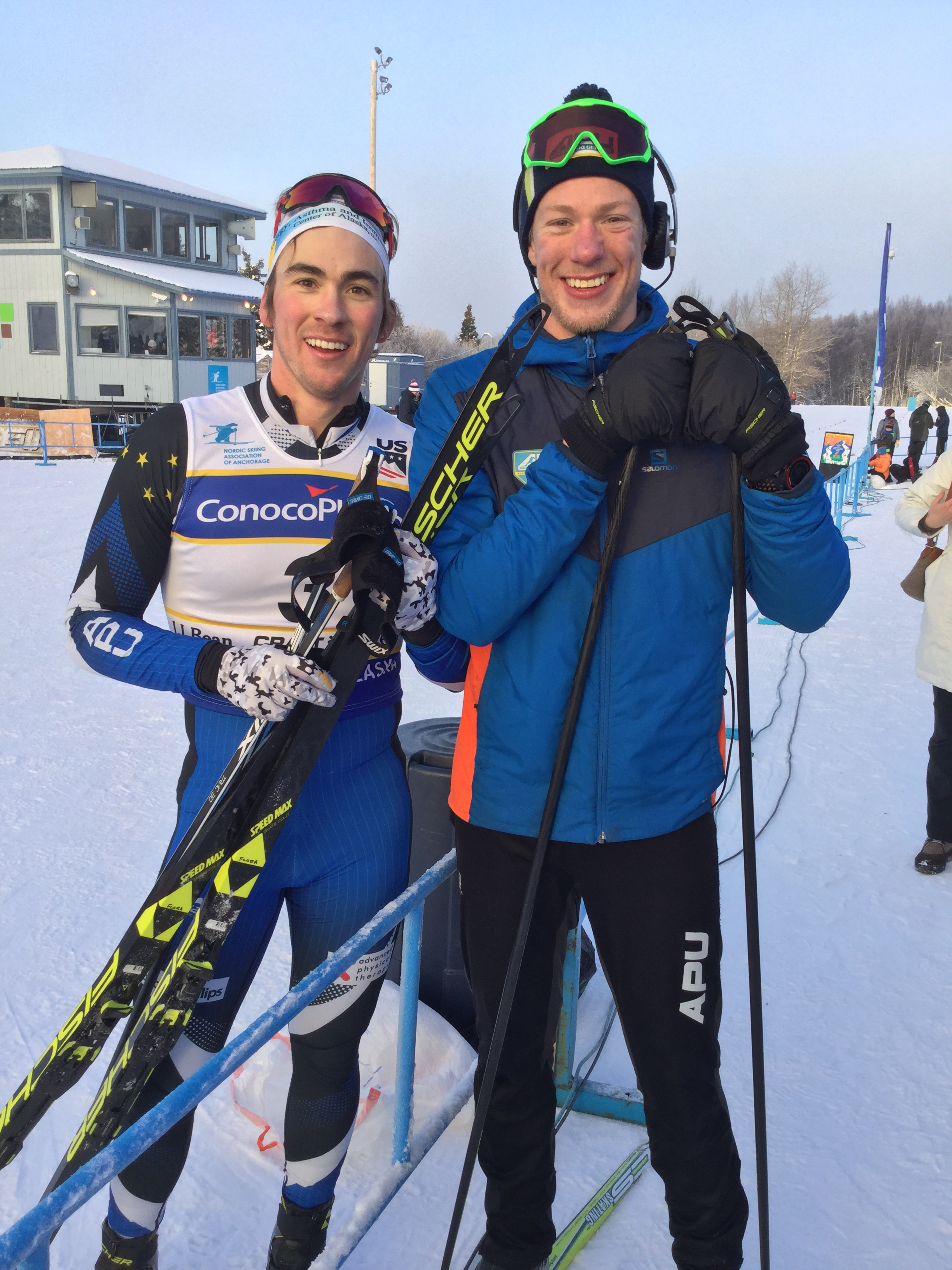
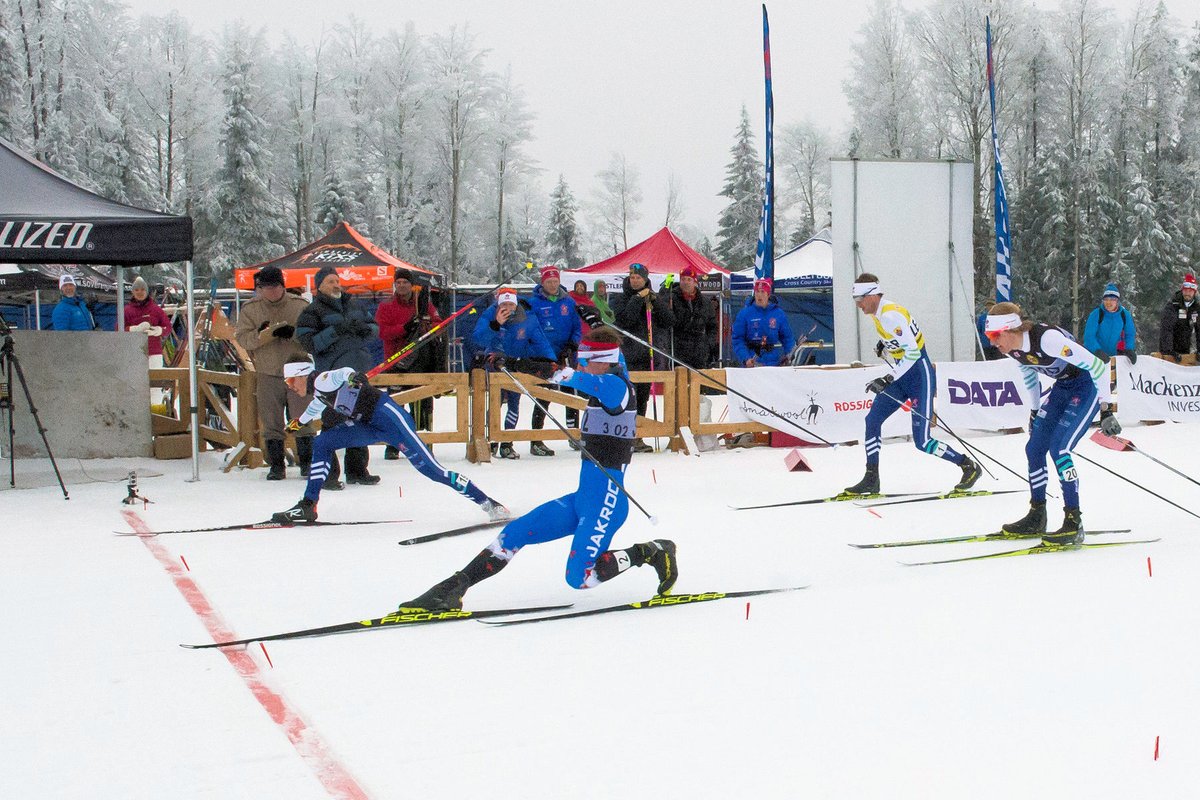
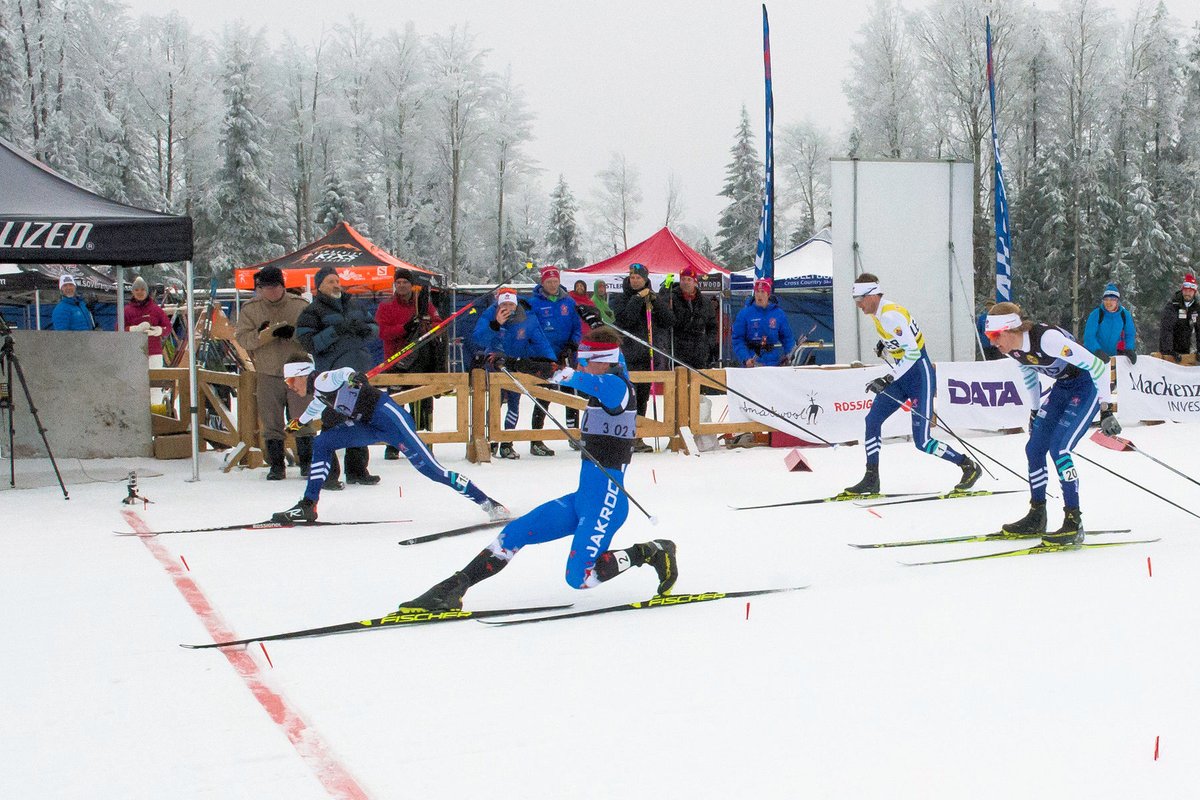
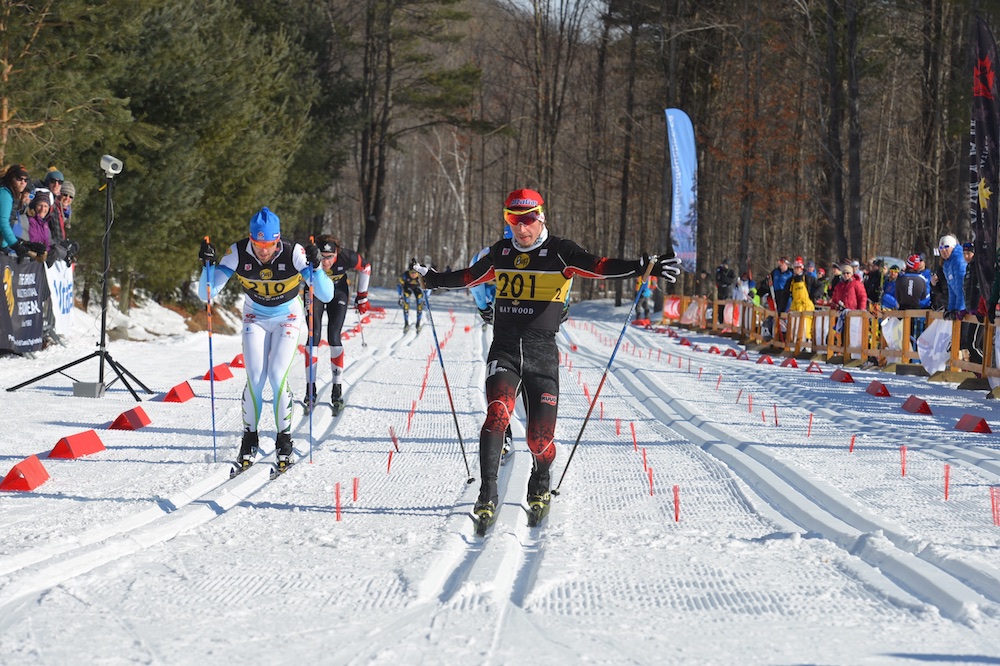
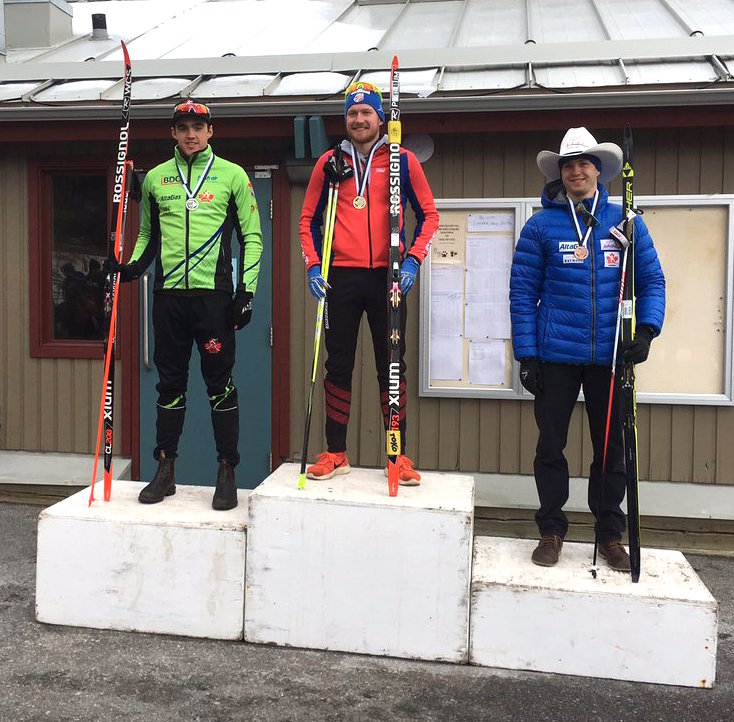
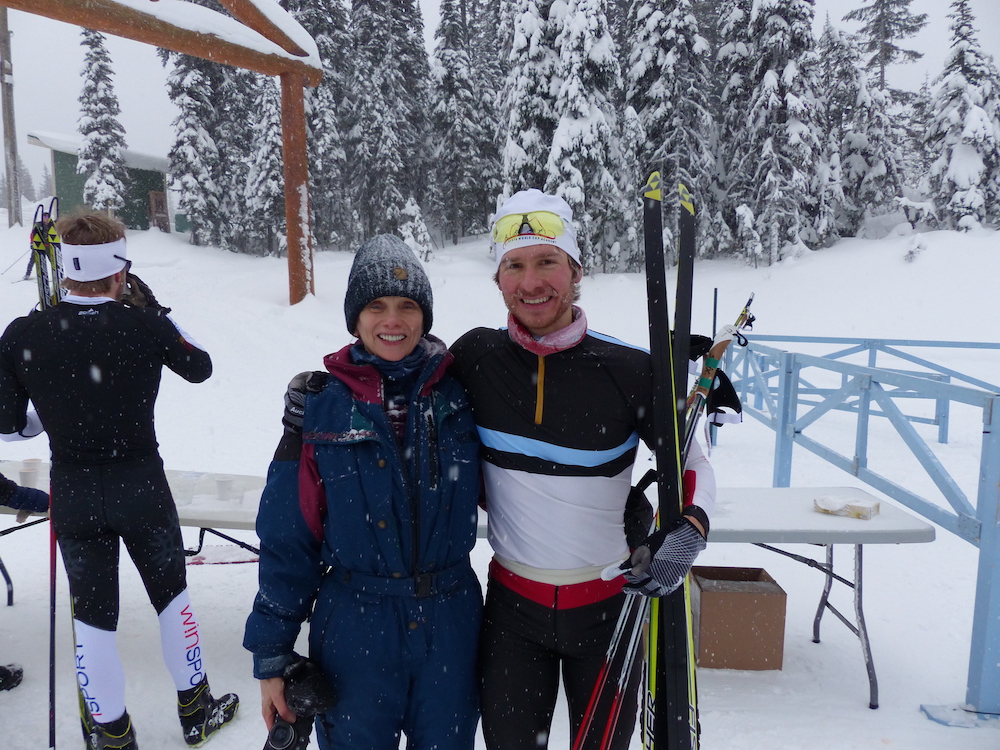
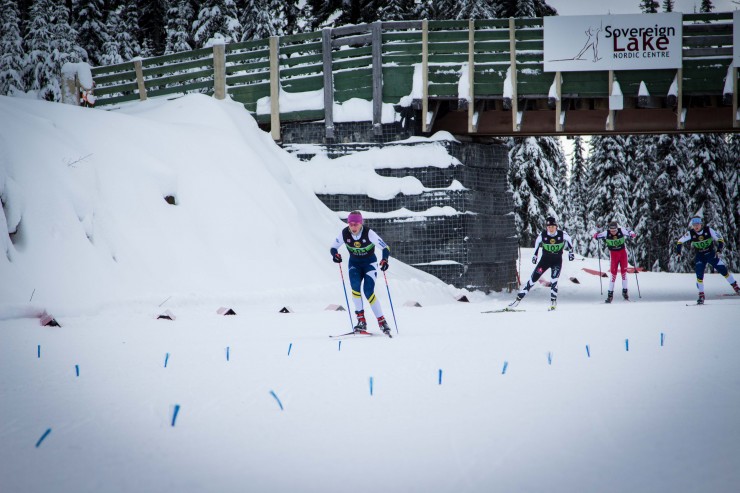
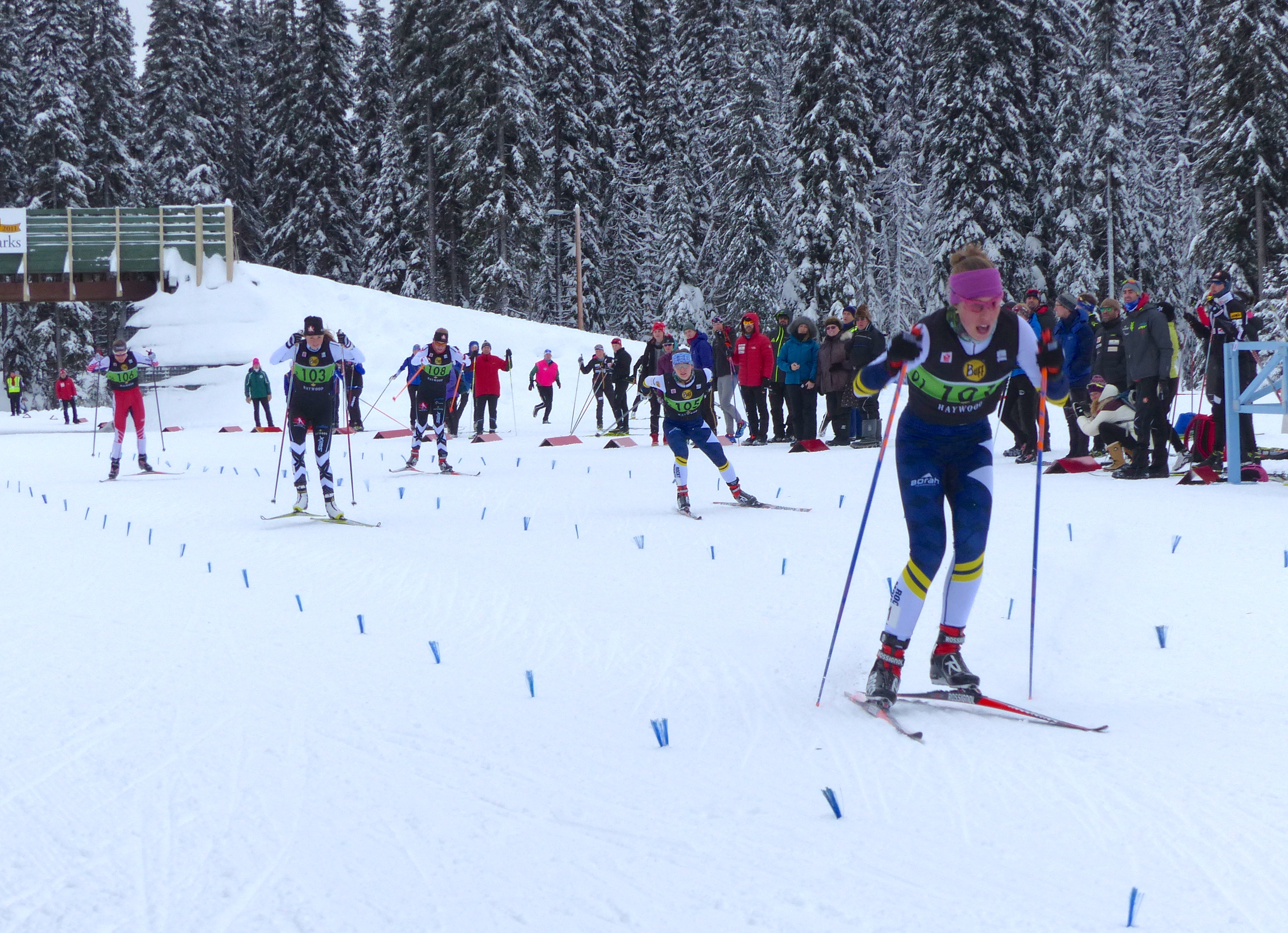
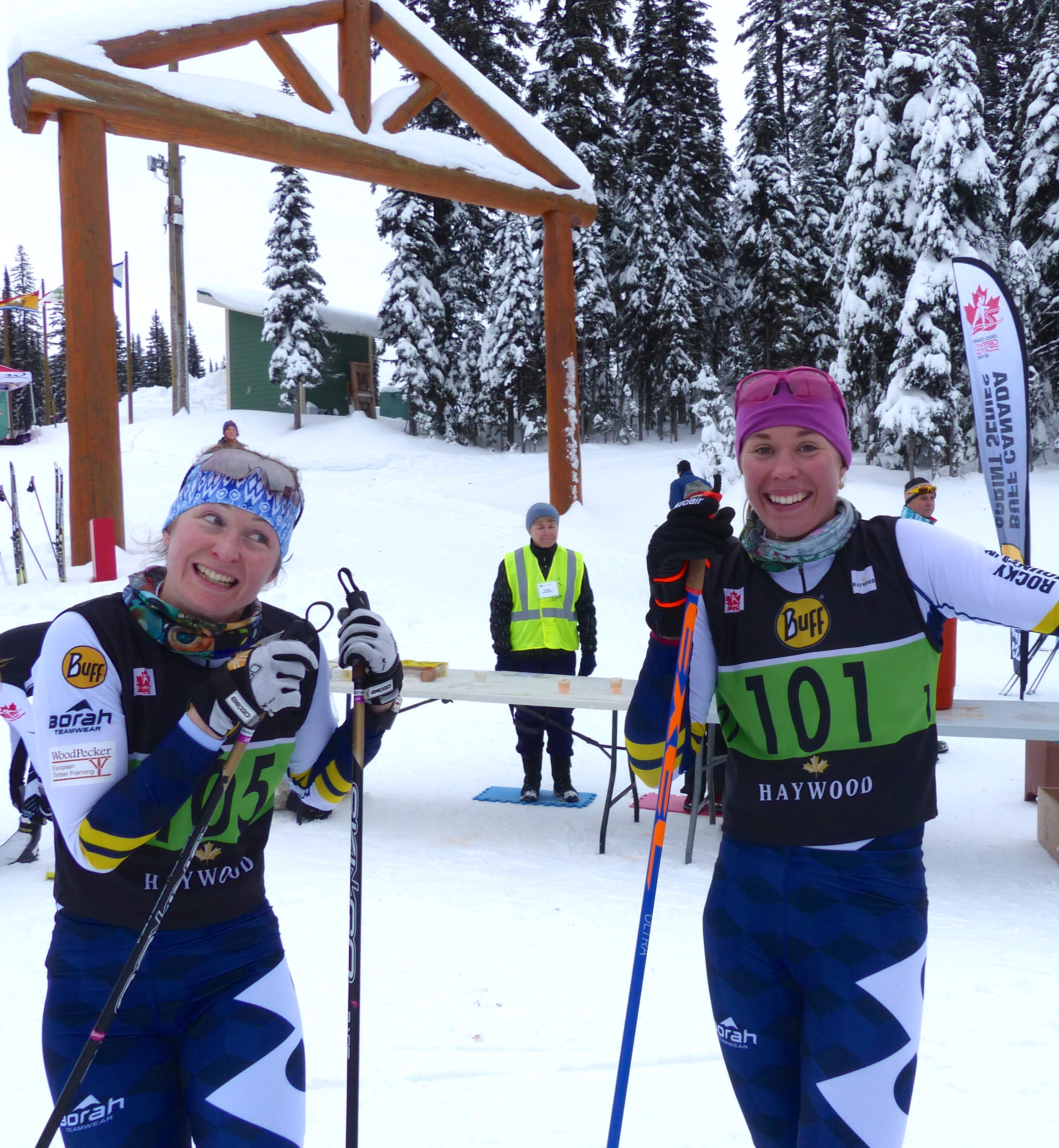
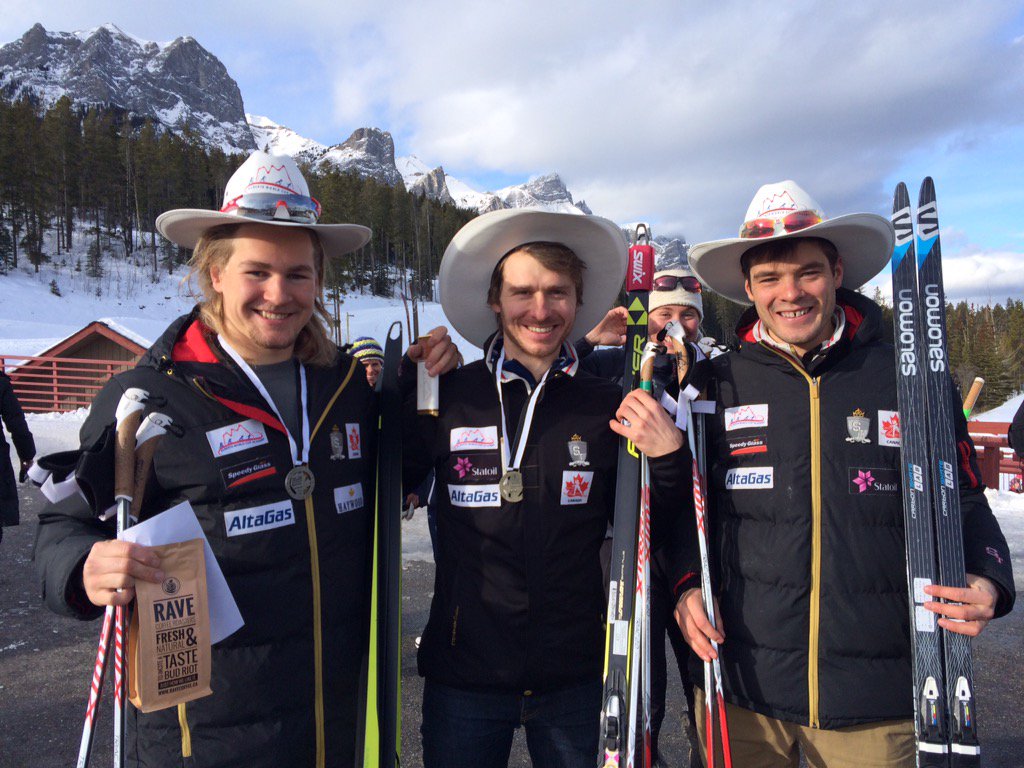
Left to right: Tyler Kornfield (APU), Reese Hanneman (APU) and Ben Saxton (SMS) the top three Americans in the men’s 1.6 k classic sprint final on Monday, the last day of 2018 U.S. Cross Country Championships in Anchorage, Alaska.
U.S. Cross Country Championships (Anchorage, Alaska): Classic sprint
Caitlin Patterson did it. With a classic-sprint win on Monday, she successfully capped off an undefeated 2018 U.S. Cross Country Championships, as the top American woman in all four races over the past week in Anchorage, Alaska.
Patterson, of the Craftsbury Green Racing Project, qualified seventh then won the women’s 1.5-kilometer final by more than 2 seconds in 3:39.58 minutes. Finland’s Jasmi Joensuu, a junior at the University of Denver (DU), won the qualifier and ultimately finished second in the final, 2.36 seconds behind Patterson.
Craftsbury once again had two on the podium with Kaitlynn Miller placing third overall (+3.9) as the second American. Becca Rorabaugh, of Alaska Pacific University (APU), was the top American in the qualifier in second overall, then placed fourth in the final (+9.92) and reached the U.S. podium in third.
Petra Hyncicova, a University of Colorado Boulder (CU) senior from the Czech Republic, placed fifth overall (+10.03), and Lydia Blanchet, a Dartmouth College U23 skier, finished sixth (+11.21) and was the fourth American woman.
Joensuu, 21, of Kuortane, Finland, started the day by winning the qualifier in 3:41.4, while Rorabaugh followed in second, 1.31 seconds back. Hyncicova qualified third (+1.85), CU’s Hedda Bångman (who won Sunday’s 20 k classic) qualified fourth (+2.92), and Miller qualified fifth (+2.93). Anne Hart of the Stratton Mountain School (SMS) Elite Team clocked the sixth-fastest qualifying time (+3.88), and Patterson followed in seventh (+4.77).
From there, Patterson won both her quarterfinal and semifinal, besting Miller and Joensuu in the latter by 0.66 seconds and 2.63 seconds, respectively. Blanchet placed fourth in that same semifinal (+5.15) and advanced to the final as a lucky loser with a fast-enough time, along with Joensuu (Patterson and Miller automatically advanced in first and second).
With her 4-for-4 record at 2018 nationals, Patterson is the most successful woman at U.S. Cross Country Championships since U.S. Ski Team member Jessie Diggins was the top American in all four races at 2012 nationals in Rumford, Maine.
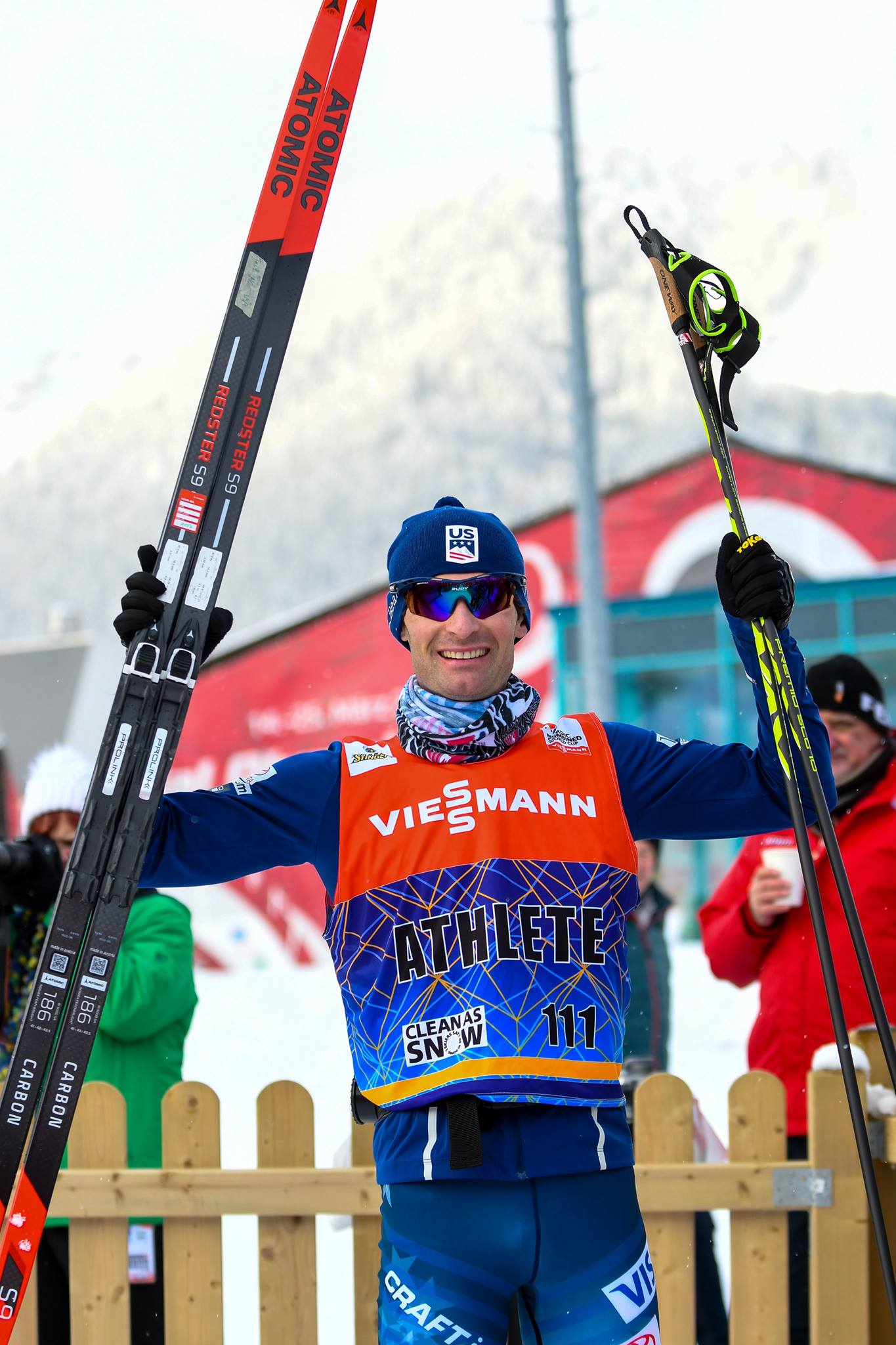
In the men’s classic sprint final, Reese Hanneman (APU) captured his second title in as many sprints this week (after winning the freestyle sprint on Friday). He won the qualifying round by 2.84 seconds in 3:21.93, and later the final by a 0.2 seconds in 3:20.62. Kornfield placed second, and Ben Saxton (SMS Elite Team) rounded out the podium in third (+4.78).
Logan Hanneman, the winner of Friday’s freestyle-sprint qualifier, finished second to his older brother Reese in Monday’s classic-sprint qualifier, then went on to reach the final and place fourth overall (+5.42). Kevin Bolger (Sun Valley Ski Education Foundation) placed fifth (+5.52), and Zak Ketterson (Northern Michigan University) was sixth (+6.83).
NorAm Trials (Mont Sainte-Anne, Quebec): 15/30 k skiathlons
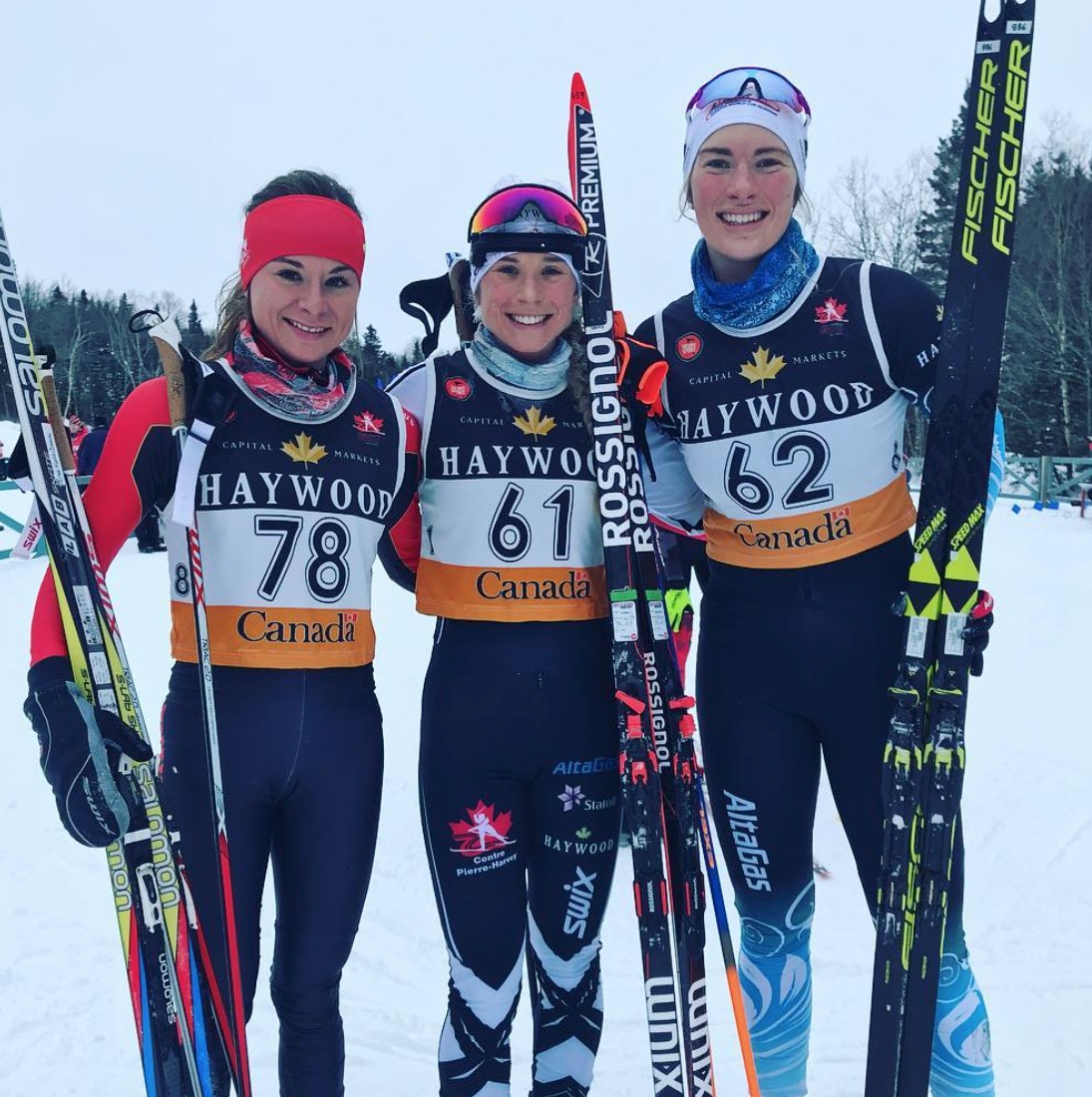
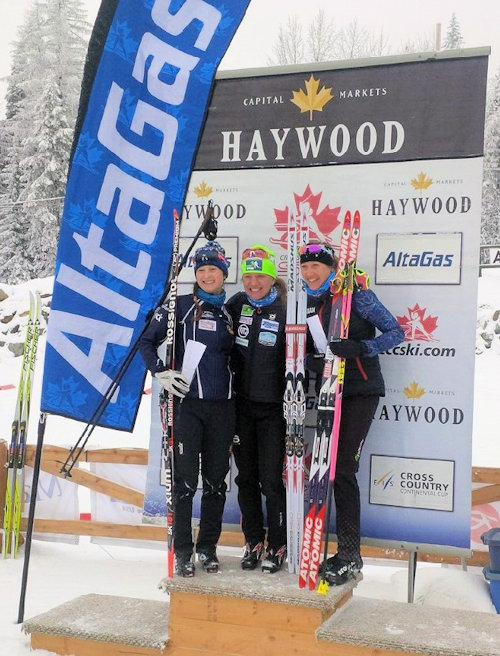
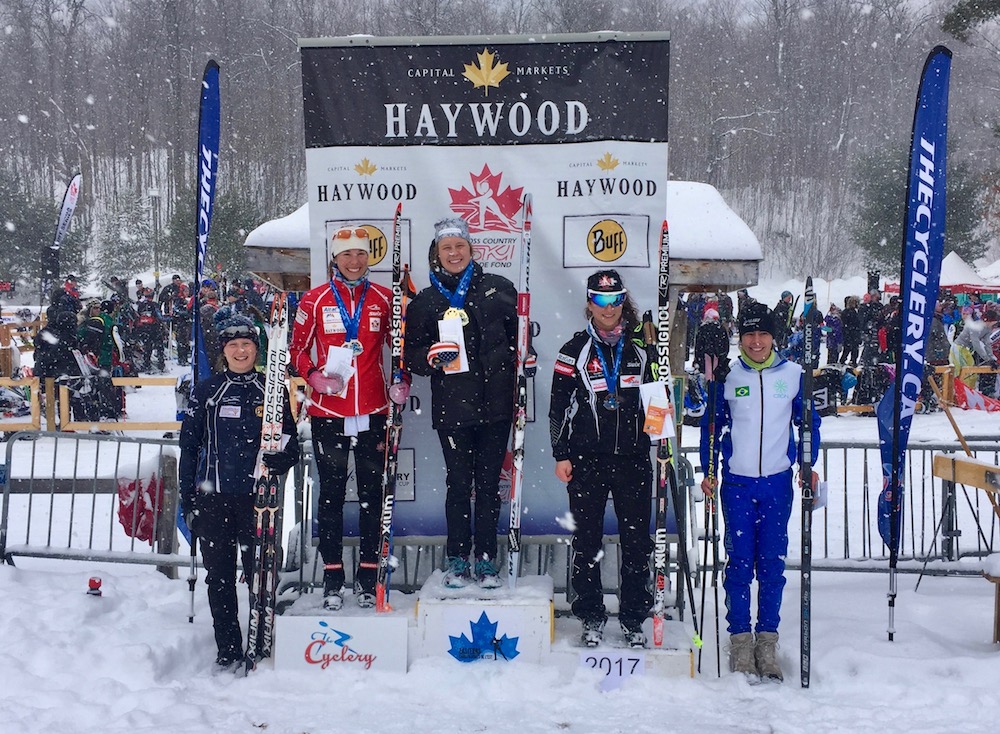
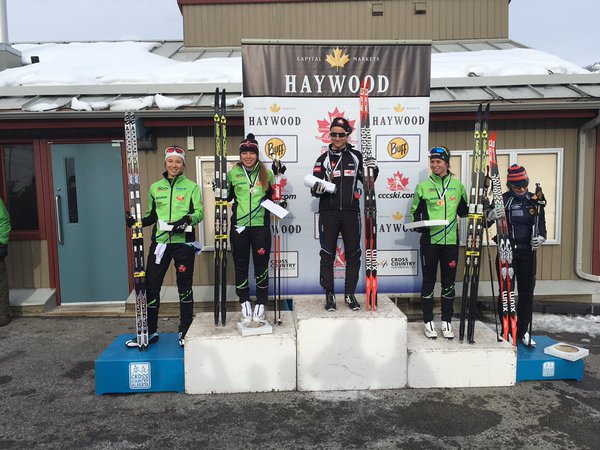
The women’s 15 k skiathlon podium on Monday at NorAm trials at Mont Sainte-Anne, Quebec, with Cendrine Browne (c) of the Pierre-Harvey National Training Centre (CNEPH) and Canadian U25 Team in first, Anne-Marie Comeau (l) of Laval University in second, and Dahria Beatty (Alberta World Cup Academy/Canadian World Cup Team) in third. (Photo: Cross Country Canada/Instagram)
Cendrine Browne won the women’s 15-kilometre skiathlon in 43:01.9 minutes on Monday at the Mont Sainte-Anne (MSA) ski trails to put an exclamation point on her presumptive selection for the PyeongChang Olympics. Browne, of the Centre National d’Entraînement Pierre Harvey (CNEPH)/Pierre-Harvey National Training Centre, which is based in nearby Saint-Ferréol-les-Neiges, broke away with Laval University’s Anne-Marie Comeau during the classic leg to take a 20-second lead that she held to the finish.
Comeau faded slightly to take second, 11.9 seconds back, qualifying for U23’s and putting her name in the hat for the upcoming 2018 Olympics. Either Comeau or the winner of Wednesday’s classic interval start should take that potential Olympic berth as Canada’s top female distance skier not already qualified. Browne has theoretically earned a spot as the top women’s sprinter, besides Dahria Beatty, who won the sprint and already met Canada’s Olympic qualifying criteria.
“It now has to go before the selection committee,” Cross Country Canada’s High Performance Director Thomas Holland wrote in an email on Friday.
After trials races were shuffled around due to extreme cold, with temperatures near -20 Celsius on Sunday at MSA, it warmed up to a balmy -8 degrees Celsius (17 Fahrenheit) by mid-afternoon on Monday. Both the women’s and men’s skiathlons were held, which not only served as one of two distance races for Olympic selection, but for Junior and U23 World Championships as well.
In the race for third place,Beatty outsprinted a group of four to take the final podium spot, 19.9 seconds behind Browne and 0.3 seconds ahead of their fellow Canadian National Team member Maya MacIsaac-Jones, of Rocky Mountain Racers (RMR) and U25 Team. Just 0.2 seconds out of fourth, Katherine Stewart-Jones, of the National Training Development Centre (NTDC) Thunder Bay and national U25 Team, placed fifth (+20.4) and CNEPH’s Laura Leclair was another second back in sixth (+21.4).
Almost 55 seconds passed before the seventh-place finisher came across the line, which was Zina Kocher (Foothills Nordic) skiing alone (+1:15.8). Another 49 seconds later, Jaqueline Mourao of Brazil’s national team placed eighth (+2:04.9), ahead of Zoë Williams (Carleton University) in ninth (+2:11.3), and Andrea Dupont (RMR) in 10th (+2:11.5).
In the junior women’s 10 k skiathlon, Whitehorse’s Natalie Hynes won in 30:19.8 to punch her ticket to Junior Worlds in Goms, Switzerland, from Jan. 28-Feb. 3. India McIsaac (RMR) finished 0.7 seconds back in second and Orford’s Alexandra Racine completed the podium in third (+32.8).
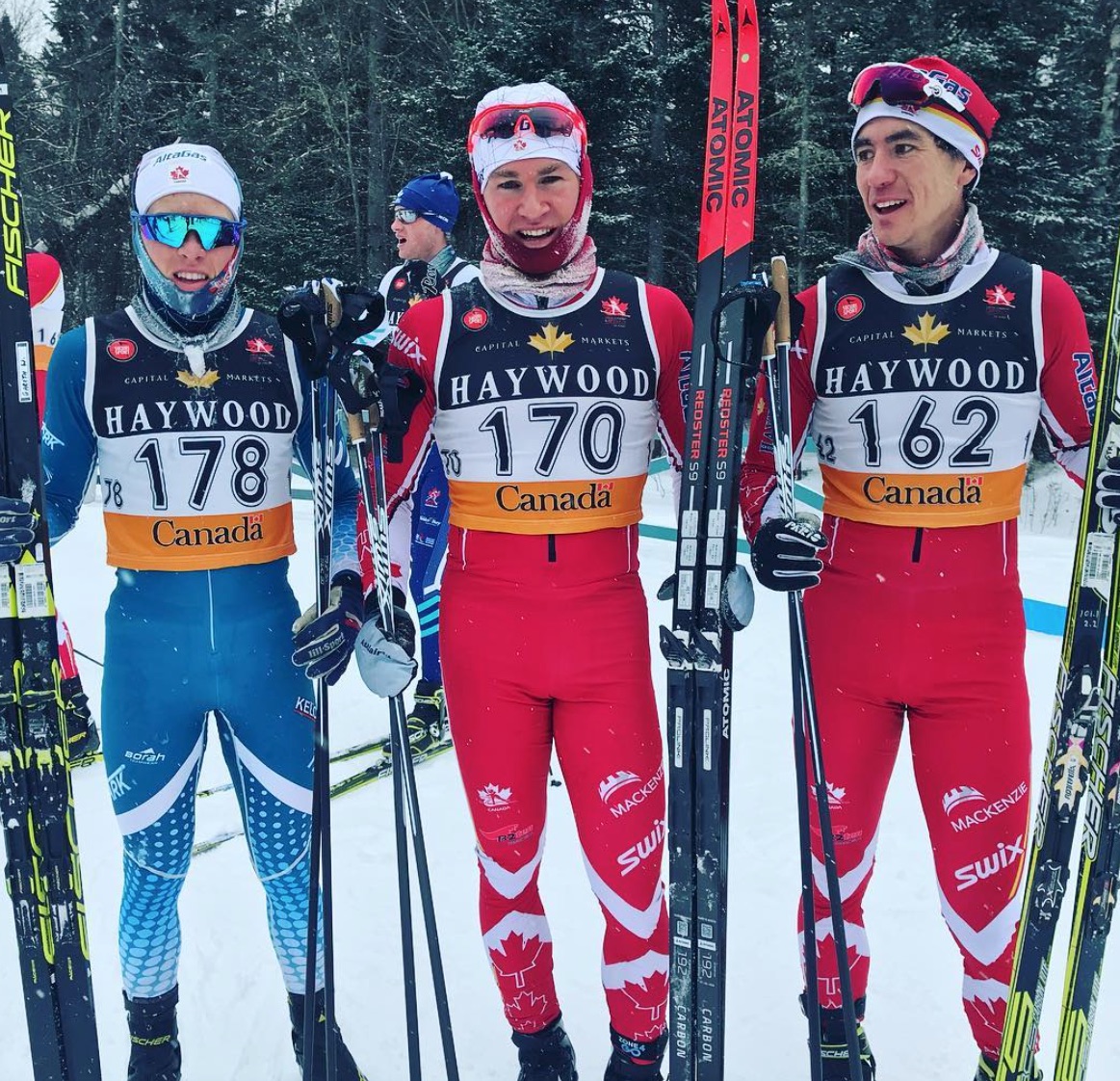
The men’s 30 k skiathlon podium at NorAm trials at Mont Sainte-Anne, Quebec, on Sunday, with Knute Johnsgaard (c) of Canada’s World Cup Team in first, Graham Nishikawa (r) of the Canadian Para-Nordic Team in second and Gareth Williams (Telemark Nordic/Canadian U25 Team) in third. (Photo: Cross Country Canada/Instagram)
On the men’s side, Canadian World Cup Team member Knute Johnsgaard, who met qualifying criteria for PyeongChang last season, shook off a slow start to the World Cup season with a win in the NorAm trials men’s 30 k skiathlon, finishing in 1:13:30.9.
Graham Nishikawa, who’s already destined for the PyeongChang Paralympics as a guide on the Canadian Para-Nordic Ski Team, finished 1 second back for second place. The 34-year-old Nishikawa edged out first-year senior national-team member Gareth Williams, 20, of Telemark Nordic and the national U25 Team, by 0.5 seconds. Williams was the top U23 athlete to qualify for this year’s U23 World Championships.
The top 6 finished within 41 seconds of the podium, with Jack Carlyle (AWCA) in fourth (+5.8), Philippe Boucher (CNEPH) in fifth (+13.9), and Scott Hill (BXC) in sixth (+40.7). World Cup Team member Len Valjas led the next group across the line in seventh (+1:28.6), followed by Bob Thompson (NTDC Thunder Bay) in eighth (+1:29.4), Alexis Dumas (CNEPH) in ninth (+1:35.5), and Ricardo Izquierdo-Bernier (CNEPH) in 10th (+1:35.7)
CNEPH’s Antoine Cyr won the junior mens 15 k skiathlon in 50:13.1 to earn a spot at Junior Worlds. Félix Longpré, of the local M.S.A. ski club, finished second (+15.7) and Thomas Manktelow was third (+49.0), just ahead of his Alberta World Cup Academy teammate Étienne Hébert in fourth (+49.3).
After Sunday’s racing was postponed due to temperatures well below the legal race limit, the remaining trials schedule includes freestyle sprints on Tuesday (for Junior and U23 World Championships qualifying purposes only), and classic interval starts on Wednesday.
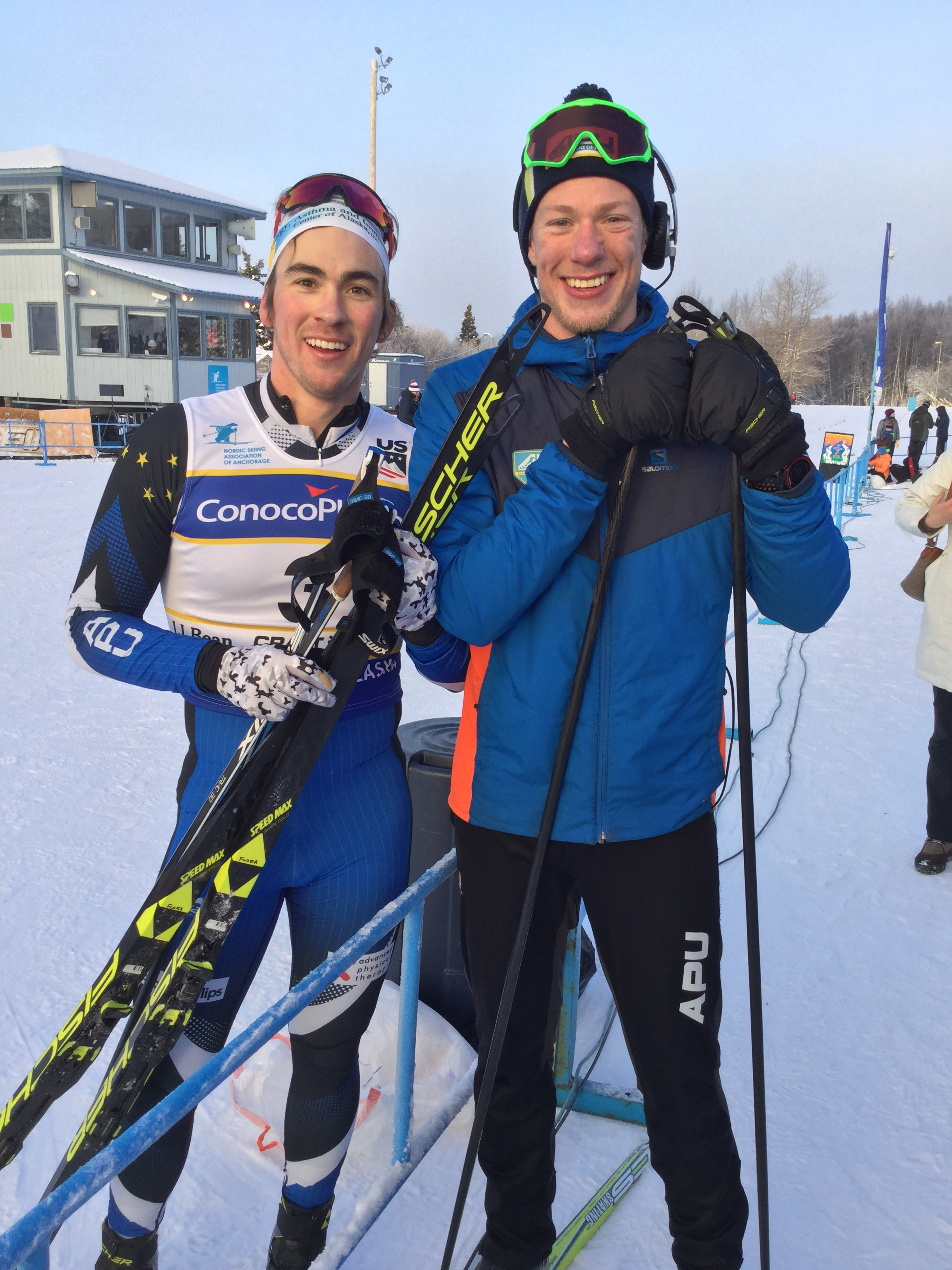
The Hanneman brothers after Friday’s skate sprint at 2018 U.S. Cross Country Championships in Anchorage, where they live and train with Alaska Pacific University. Reese Hanneman (l) won the men’s final and younger brother Logan (r) won the men’s qualifying round.
U.S. Cross Country Championships (Anchorage, Alaska): Freestyle sprints
Caitlin Patterson racked up her second-straight national title at this year’s 2018 U.S. Cross Country Championships and Reese Hanneman topped the men’s freestyle sprint final on Friday at Kincaid Park in Anchorage, Alaska.
In the first of two sprints at 2018 U.S. nationals, Patterson, the Craftsbury Green Racing Project (CGRP) skier who won the women’s 10-kilometer freestyle on Wednesday, posted a 3.56-second win in the women’s 1.5 k freestyle sprint final on Friday.
After qualifying 12th, 5.76 seconds back from Anne Hart of the Stratton Mountain School (SMS) Elite Team, who won the qualifier in 3:22.10, Patterson won both her quarterfinal and semifinal, both times ahead of University of Denver (DU) junior Jasmi Joensuu in second.
The two advanced to the final, where Patterson reached the finish line first once more in 3:20.93, about 3 1/2 seconds ahead of Joensuu in second and 4.19 seconds ahead of Petra Hyncicova, a senior at the University of Colorado Boulder, in third. Craftsbury had two in the final with Kaitlynn Miller placing fourth (+4.35). U20 skier Hannah Halvorsen of Alaska Pacific University (APU) and the U.S. Ski Team (USST) finished fifth (+7.66), and Kelsey Phinney of the Sun Valley Ski Education Foundation (SVSEF) placed sixth (+9.78).
Hart won her quarterfinal then placed third in the first semifinal, behind Miller, who won that heat, and Hyncicova in second, to miss advancing to the final. Hart had won the qualifier by 1.78 seconds over Joensuu in second.
In the men’s 1.6 k skate sprint, Logan Hanneman (APU) won the qualifier in 3:07.4. Kevin Bolger (SVSEF) qualified in second (+0.48), and older brother Reese Hanneman (APU) was third (+1.13).
In the quarterfinals, Reese won his heat by 0.19 seconds ahead of his teammate Tyler Kornfield, and Logan finished second, 0.42 seconds behind U18 skier Gus Schumacher (Alaska Winter Stars), as the winner of the first quarterfinal. Bolger won the fourth quarterfinal.
Reese raced to another win in the second semifinal, 0.17 seconds ahead of Bolger in second. APU’s Eric Packer won the first semi, 1.66 seconds clear of Zak Ketterson of Northern Michigan University (NMU) in second. Logan finished fifth in that semifinal, 4.48 seconds out of first, trailing Dakota Blackhorse-von Jess (Bend Endurance Academy) in third and Schumacher in fourth.
In the final, which included three APU athletes out of six total, Reese nipped Bolger by just eight-hundredths of a second for the win in 3:11.33. APU had two on the podium with Kornfield in third (+0.88). Ketterson finished fourth (+1.92), Packer was fifth (+2.34), and DU sophomore Eivind Romberg Kvaale was sixth (+14.08).
U.S. nationals racing continues Sunday with the 20/30 k classic mass starts.
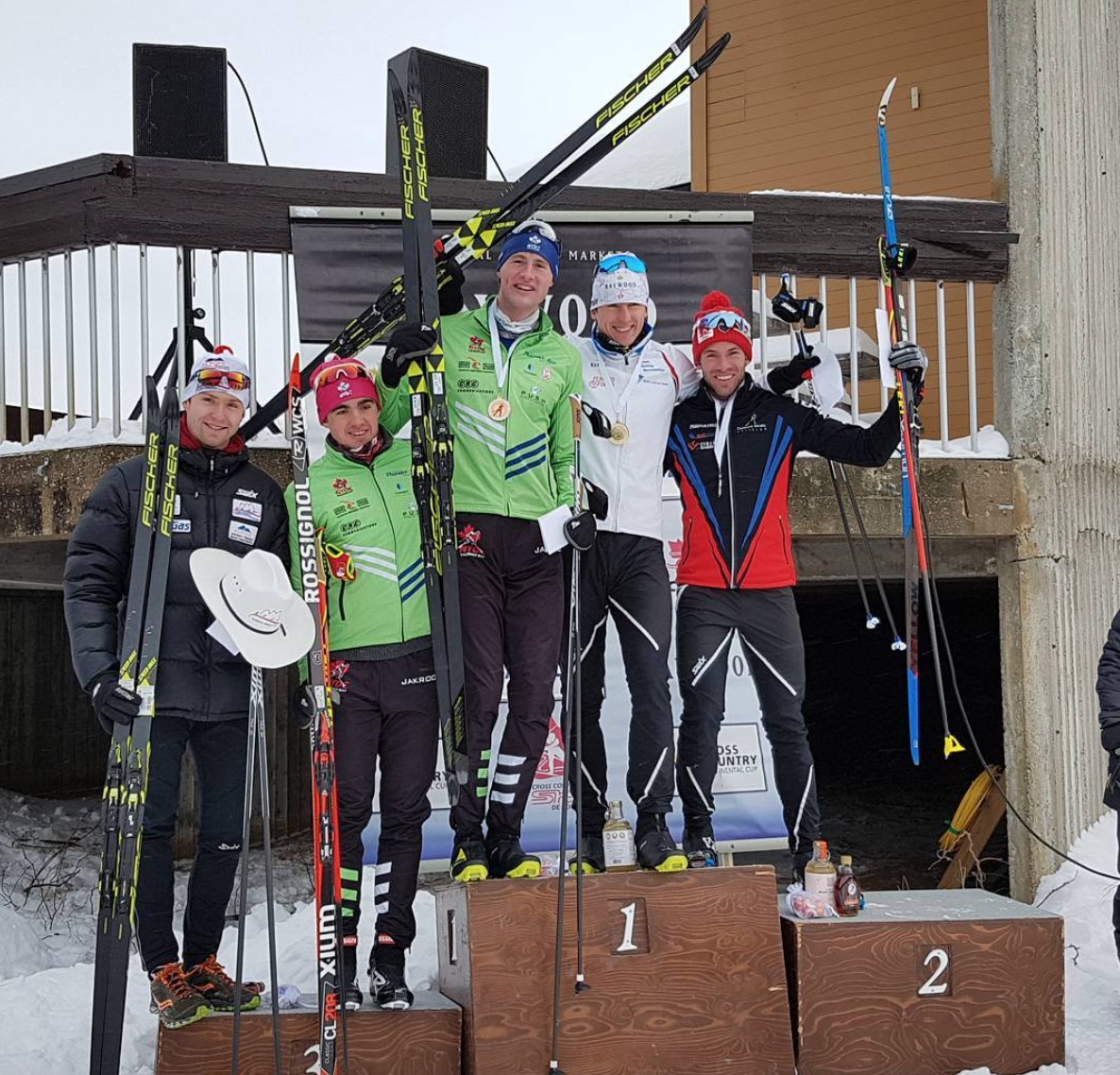
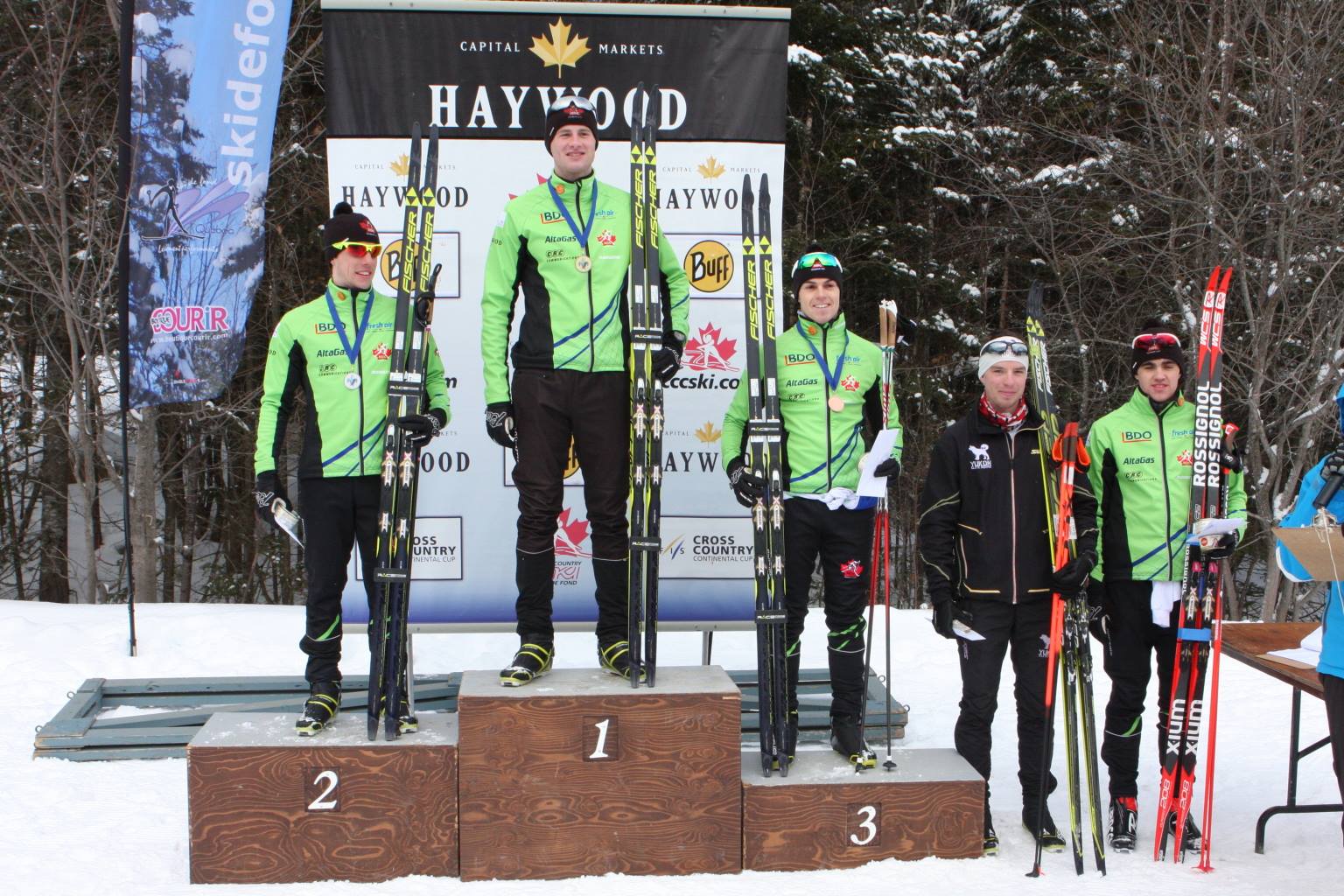
The men’s classic sprint podium at 2018 Canadian NorAm Trials on Friday at Mont Sainte-Anne, Quebec, with Julien Locke (second from r) in first, Russell Kennedy (r) in second, Bob Thompson (c) in third, Evan Palmer-Charrette (second from l) in fourth, and Dominique Moncion-Groulx (l) in fifth. (Photo: Canmore Nordic Ski Club/Instagram)
Canada’s NorAm Olympic trials opened Friday at Mont Sainte-Anne in Beaupré, Quebec, with Dahria Beatty (Canadian World Cup Team/Alberta World Cup Academy) winning the women’s 1.35-kilometer classic sprint and Julien Locke (Canadian U25 Team/Black Jack) topping the men’s 1.35 k classic sprint final. While Beatty has already secured her spot at the 2018 Olympics in PyeongChang, South Korea, Locke has not — but the win didn’t ensure he’ll be selected to the team. In a tiebreaker, it looks like he is second on the men’s sprint list at trials to Russell Kennedy, of Canmore Nordic/Team R.A.D.
Based on its published nomination procedures for the 2018 Olympic Games, Cross Country Canada (CCC) will consider both qualifying and final results in its “sprint selection ranking process”. In the men’s qualifying round on Friday, Kennedy qualified first (in 3:02.81 minutes) and Locke followed in second (3.06 seconds back). Kennedy later placed second to Locke in the men’s final. Effectively, that meant they were tied, should CCC select another male sprinter to its Olympic team. But the tiebreaker is the qualifying round, which Kennedy won.
To reach the final, Kennedy placed second in his quarterfinal, behind Ricardo Izquierdo-Bernier of the Pierre-Harvey National Training Centre (CNEPH), and Locke was second in his quarterfinal as well, behind Andy Shields of Lappe Nordic. All four automatically advanced to the semifinals, where Kennedy posted a 1.12-second win over Bob Thompson, of the National Team Development Centre (NTDC) Thunder Bay, and Locke edged Jess Cockney (of the Canadian World Cup Team, who prequalified for PyeongChang) by 0.34 seconds.
In the final, Locke notched a 1.17-second win over Kennedy, crossing the line first in 3:04.16. Thompson took third (+2.49), Evan Palmer-Charrette (NTDC Thunder Bay) was fourth (+5.74), Dominique Moncion-Groulx (AWCA) was fifth (+7.2) and Cockney sixth (+55.97). Len Valjas, who is recovering from a shoulder injury and is prequalified for PyeongChang, won the men’s B-final for seventh overall.
In the women’s race, Beatty qualified first in 3:41.55, then won both her quarterfinal and semifinal before topping the final as well in 3:45.02, 0.64 seconds ahead of Maya MacIsaac-Jones (U25 Team/Rocky Mountain Racers) in second. Katherine Stewart-Jones (U25 Team/NTDC Thunder Bay) finished third (+1.2) in the final, Cendrine Browne (U25 Team/CNEPH) was fourth (+4.58), Annika Hicks (AWCA) fifth (+10.21), and Andrea Dupont (RMR) sixth (+12.18).
Browne posted the second-fastest qualifying time, 3.13 seconds back from Beatty. Olivia Bouffard-Nesbitt (RMR) qualified third (+8.08), but was disqualified in her quarterfinal. MacIsaac-Jones qualified fourth (+8.49), putting her total points for the day — based on CCC’s selection ranking — at 6. Browne scored 6 points as well (for qualifying second then finishing fourth overall), but with the better qualifier, Browne is expected to be deemed the winner of that Olympic sprint spot. Laura Leclair (CNEPH) qualified fifth (+10.57), and Stewart-Jones ranked fifth (+13.8) in the qualifying round.
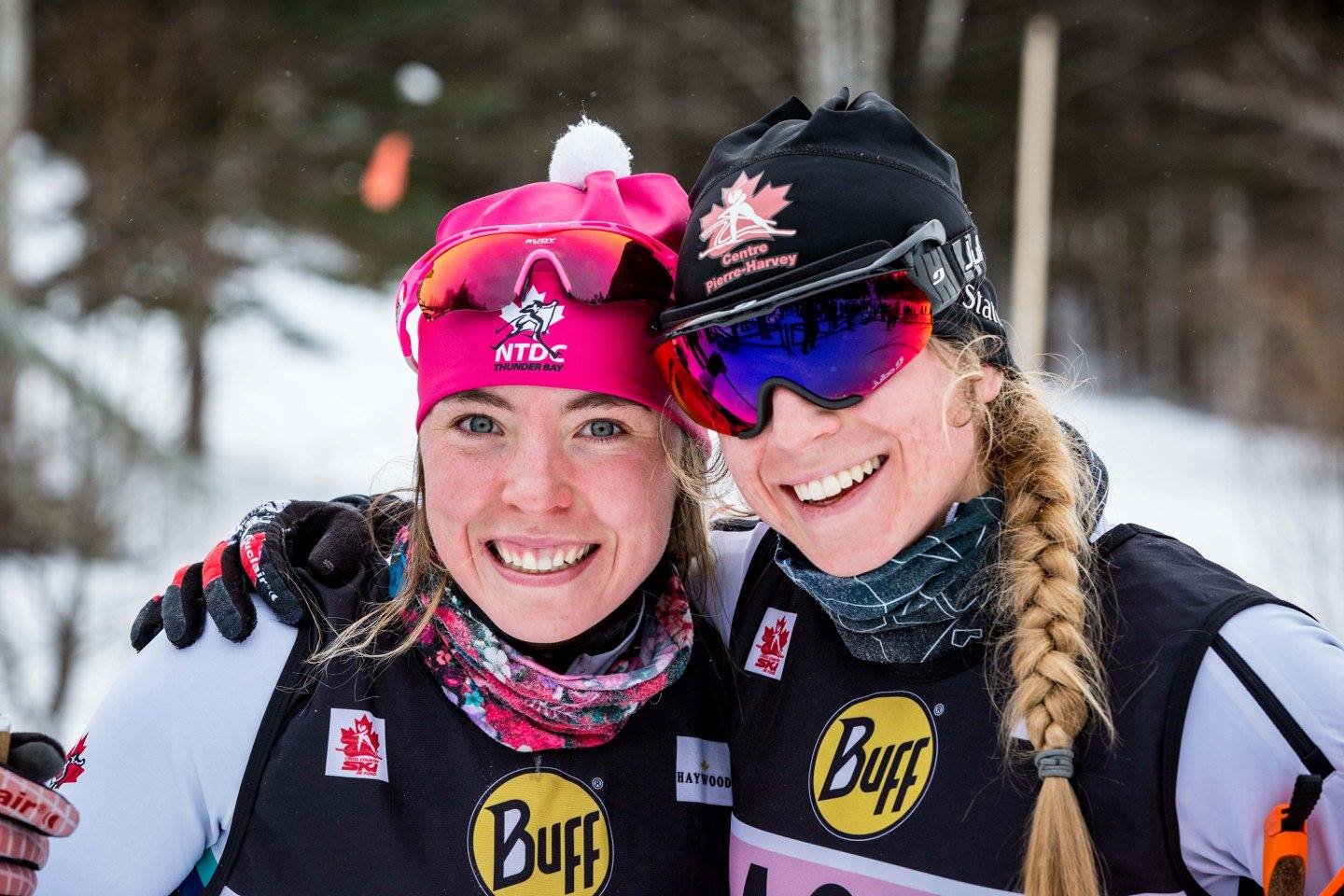
NTDC Thunder Bay’s Katherine Stewart-Jones (l) and CNEPH’s Cendrine Browne, both the Canadian U25 Team, after the NorAm Trials classic sprint at Mont Sainte-Anne, Quebec. (Photo: Mario Walker/NorAm MSA 2018 Facebook)
Browne won her quarterfinal by 1.5 seconds over Hicks, and the two met again in the semifinal, which Browne also won, this time by 2.81 seconds over Hicks. MacIsaac-Jones posted a 0.25-second quarterfinal win over Dupont, then finished second in her semifinal, 0.22 seconds behind Beatty.
Fresh off racing Period 1 of the World Cup, Browne, 24, is best known as a distance skier, but she’s been on the NorAm sprint podium before. She last won a sprint qualifier and finished second overall at two years ago at the Canmore NorAm in December 2015.
In an email, CCC High Performance Director Thomas Holland confirmed Browne and Kennedy were the sprint-selection winners next in line for Olympic quota spots.
“Cendrine has officially been named the winner of the Olympic sprint selection event.
The only catch is that Cross Country Canada’s official selection cannot be announced until FIS (the international ski federation) announces its final quota re-allocation at the end of January.
The most recent version of the FIS quotas, dated yesterday morning (Friday) allocates only eight quotas for Canada. IN THEORY, that quota could be lowered further still, in which case certain named athletes could be left out.
Which is why Cendrine will have to wait until late January to shout her news from the rooftops!
Her victory in the sprint selection is doubly important as it puts her in the Number 3 spot on the women’s team, behind Dahria Beatty and Emily Nishikawa, according to Amendment #2 of Cross Country Canada’s Olympic selection criteria.
If the FIS quota were to be lowered to 7, for example, it would be the women’s distance winner who would lose out.”
The NorAm trials for Olympics as well as Junior and U23 World Championships resume Monday with skiathlons, followed by skate sprints on Tuesday. Sunday’s 10/15 k classic individual starts were postponed to Wednesday.
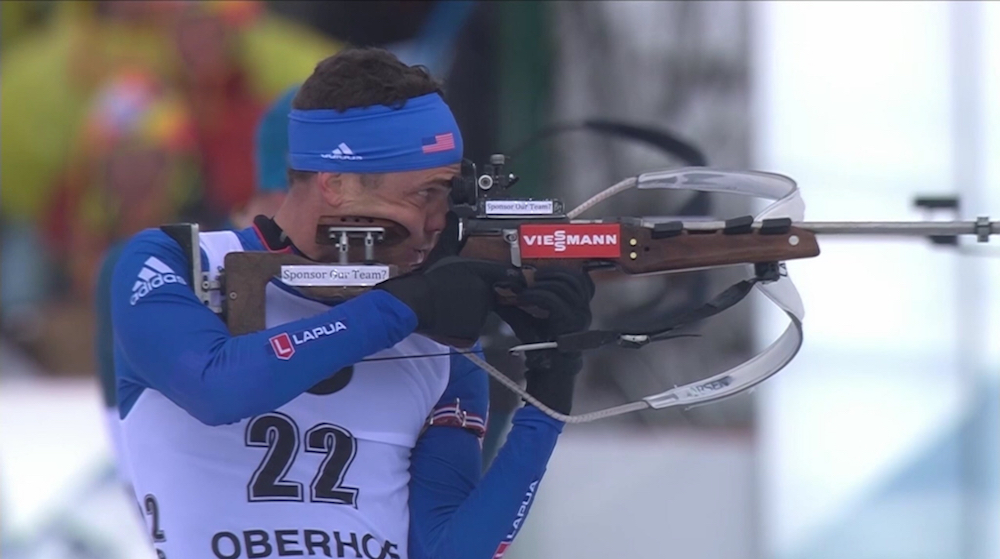
Tim Burke shooting clean in standing for his second-straight stage en route to a fourth-place finish in the men’s 10 k sprint on Friday at the IBU World Cup in Oberhof, Germany. (Screenshot: ARD broadcast)
In his first race of the new year, Tim Burke raced to fourth — his best result in four years — in the men’s 10-kilometer sprint at the International Biathlon Union (IBU) World Cup in Oberhof, Germany.
The 35-year-old American started 22nd out of 103 and shot clean to cross the finish line in third, 20.1 seconds behind France’s Martin Fourcade, who also shot clean and finished in 25:03.3 minutes — a time that would hold up against the entire field as the fastest and give the Frenchman his second win of the season.
Fourcade had bumped early race leader Norway’s Johannes Thingnes Bø to second, after Bø missed two targets on his initial prone stage then cleaned standing (2+0), but skied the fastest overall course time to reach the podium. Burke’s time was 9.9 short of Bø’s.
Ultimately, Norway’s Emil Hegle Svendsen as the 58th starter bumped Bø to third and Burke off the podium, finishing second, 8.1 seconds behind Fourcade, also with clean shooting.
Canada was led by Scott Gow in 32nd (+1:48.7), who had a single standing penalty (0+1), and his brother Christian Gow finished 36th (+1:50.3) with one standing miss as well (0+1). Brendan Green was 57th (+2:30.4) with three penalties (1+2), and in his first European World Cup race, Carsen Campbell finished finished 94th (+4:05.3) with two misses (2+0).
The U.S. started two men on Friday, with Sean Doherty finishing 84th (+3:24.4) with four penalties (3+1).
The Oberhof IBU World Cup continues Saturday with the men’s and women’s pursuits.
Canada’s Cendrine Browne finished 26th in the women’s 30-kilometer freestyle mass start at the 2017 Nordic World Championships in Lahti, Finland. She will be racing later this week more or less on her home turf at Mont Sainte Anne, Quebec, to try to secure her spot on the Canadian Olympic Team. (Photo: John Lazenby/Lazenbyphoto.com)
But in fact, that might be too many. Cross Country Canada (CCC) learned that they currently stand to receive a quota of nine team members (men and women combined) for PyeongChang, based on Canada’s recent international results. That is two quota spots less than at the similar time before the 2014 Olympics in Sochi, Russia.
The quota is likely to increase, as some of the teams given the largest roster possibilities will probably not use all of their roster space. If that happens, the free quota spots will be redistributed, although just how many additional spots Canada will receive depends completely on the actions of other teams.
Regardless, the current small roster size means that qualification will shake out differently than the national team had thought it would, CCC High Performance Director Thomas Holland said in a recent phone interview.
Canada’s Alex Harvey celebrates his victory in the men’s freestyle sprint at World Cup Finals in Quebec City. “I mean, it’s all about the Games and you know Alex is a big contender. We’re putting everything behind him, and making sure he’s got what he needs to get the job done in PyeongChang,” said Cross Country Canada High Performance Director Tom Holland.
“We based our criteria on what we had in Sochi,” Holland said of designing CCC’s selection process. “In Sochi, we had 11 [athletes initially], and with the reallocation we ended up with 13, so we kind of used that [to develop] the criteria. I guess our results aren’t where we would like them to be [this year] so we have nine, less than we expected.”
As a result, a revision of the Olympic qualification criteria has specified who is guaranteed a spot, which types of athletes will be picked at trials, and which athletes will be added later if Canada benefits from quota reallocation.
Specifically, Harvey, Valjas, Kershaw, Johnsgaard, and Cockney are definitely going, as they have met the “Primary Qualifying Criteria” by dint of a third-place World Cup relay or, in Cockney’s case, two 10th-place finishes in sprints, or in Harvey’s case, a whole lot of different top results.
The next priority is to field a four-woman team, so Nishikawa and Beatty are in, as the only two women to have achieved “Alternative Qualifying Criteria A” of three top-30 results. The trials will determine who will join them. The new amendment specifies that one female sprinter and one female distance skier will be selected.
That brings the team size to nine. If an additional quota spot materializes, Killick will get the call; he met “Alternative Qualifying Criteria A,” the only Canadian man to do so aside from those who met the primary criteria.
Should even more quota spots arrive, they would go to, in order, a male sprinter and a female distance skier. CCC has said for months that team size would be capped at 12 no matter how many quota spots are allocated to the team.
Race Formats and Qualification Scoring
The Olympic selection races will be held this Friday through next Tuesday, Jan. 9, in Mont Sainte-Anne, Quebec, as part of major competitions with NorAm points on the line and selections being made for Junior and U23 World Championships teams being done at the same time.
Among those racing at the trials will be Knute Johnsgaard, even though he is already qualified for the Olympics. (Photo: Fischer/Nordic Focus)
Some of the athletes already qualified for the Games will also be there competing as a tune-up: only one athlete, Harvey, is currently competing in the Tour de Ski, with Kershaw having intended to but falling sick after the first stage. Killick and Nishikawa are racing in Continental Cup races in Europe.
For the rest of the hopefuls, classic sprints will be contested on Friday, Jan. 5; 10/15 k classic interval starts on Sunday, Jan. 7; and 15/30 k skiathlons on Tuesday, Jan. 9.
(There will be an additional skate sprint on Monday, Jan. 8, but it will not figure into Olympic qualification. And a forecast of cold weather for Sunday means that more modifications still may come, although the organizing committee is sticking to the planned distance races on Sunday for now.)
While the distance interval-start race at the Olympics will be skating, Holland said that it would be a classic competition at the upcoming trials for several reasons, the main one being a time constraint that prevented the staging of every possible kind of race.
Former biathlete Zina Kocher likes skate distance more than classic sprints, and the selection race schedule might not work in the current NorAm leader’s favor. (Photo: Peggy Hung)
“We have a couple things going on at the same time,” he explained. “We have probably 18 athletes who will qualify for the World Juniors/U23 teams. We couldn’t get that [series] in any earlier, so we have about four days to do all the races… there is classic racing at the Olympics in the relay, in the 30k, that kind of thing, so that was the best scenario we could come up with.”
That is definitely a blow to skate-specialist athletes looking for an Olympic berth – in particular Zina Kocher, a former biathlete who currently leads the NorAm series (more on that later). But Holland says there hasn’t been much pushback on the classic-heavy schedule.
“I think they have known, and accepted it,” he said. “You have to ski both techniques at the Games, if you want to maximize the the number of races [an athlete can do]… It’s not ideal, but I guess, you know, we get to look at the skate race in the skiathlon.”
Sprint and distance ranking lists will be kept separately for men and women, although the distance list for men is something of a moot point as there are no additional male distance skiers set to be added to the team.
In each case, the list will be made up of only the athletes who have not met qualification criteria in that discipline – so, for example, Johnsgaard, who has met the distance but not the sprint qualification criteria, can be scored on the sprint list, while Cockney, who has met the sprint but not the distance qualification criteria, could be scored on the distance list.
“[If Johnsgaard qualified] for the sprint spot… the outcome would be that we would have four sprinters (Harvey, Valjas, Cockney, Johnsgaard) and the sprint quota would be full at four athletes,” Holland wrote in an email. “We would move onto a distance athlete as per the ranking in Amendment #2.”
That said, once at the Olympics, any team member could start any race regardless of whether they qualified via sprint or distance results.
“Once the athletes are at the Games it is the purview of the coaches and High Performance Director as to who starts in which races – there are no limitations; we will try to fill start positions,” Holland wrote. “Meeting the nomination procedures/criteria is another matter. Qualifying in a distance or relay event should not give an athlete the automatic right to take a sprint quota spot at the Games.”
For the female sprinter and the potential additional male sprinter to be selected in Mont Sainte-Anne, the requirement is clearly to “win” the classic sprint on Jan. 6, or at least be the top athlete who wasn’t already qualified for PyeongChang.
Sophie Carrier-Laforte charging the downhill on her way to third place in the NorAm women’s 5 k classic in Rossland, B.C. Carrier-Laforte has also had excellent sprint results so far this NorAm season. (Photo: Mark Richards)
But winning is a bit complicated: with only one spot up for grabs, CCC wants to consider both qualifying speed and final placement at the end of the heats. Thus, a combined score will be made, with 50 percent of points coming from qualifier position and 50 percent of points from final position. For each, one point will be given to the winner, two to the second-place finisher, three to the third-place finisher, etc. The athlete with the lowest combined point score from the day “wins”.
For female distance skiers, both the 10 k classic interval start and the 15 k skiathlon will be scored. If they are won by the same athlete, then it is clear that this woman will be named to the Olympic team. If two different women win the two races, then the woman with the better result in the race she didn’t win will be picked.
And if the same athlete tops both the sprint and distance list, then they will be given the designated sprint spot, and the second-ranked distance skier will also be selected for the team.
An “alternate” sprinter and “alternate” distance skier for both men and women will be named, who will go to the Games only if one of the qualified athletes becomes sick or injured and can’t compete.
Canada has a scary preview of that at the moment, as Valjas – who stood on the World Cup podium several times last season – returned to Canada in December to deal with injury issues.
Canada’s Len Valjas racing to second in the men’s classic sprint qualifier at the World Cup in PyeongChang, South Korea, last season. Values left the World Cup Period I early this year to deal with a neck injury, and will be racing at the selection races as part of his return to competition. (Photo: Fischer/Nordic Focus)
“He injured his shoulder, but it’s an injury that he had last year at the World Championships and it goes much deeper. It really felt like a shoulder injury, but until he came back this time and had an MRI, spent more time with doctors, we really got to the root of the cause,” Holland said. “It’s something that’s going to be there and has to be managed now. At least he knows what it is, and with therapy he can keep it under control. We’re just playing it safe at this point.”
He anticipates that Valjas will be back in more than enough time for PyeongChang.
“Now that we know what it is and that he knows how to treat it, with the exercises he has to do on an ongoing basis, and just the right therapy on an ongoing basis, he should be fine,” Holland said. “He’s pretty confident.”
Who To Watch For
Depending on quota reallocation, it’s not clear that any more men will be added to the Canadian Olympic team. From that perspective, some attention will be on who wins the men’s sprint – with Julien Locke and Bob Thompson perhaps the favorites to earn it if that quota spot opens up.
Julien Locke finished 36th in the skate sprint in Davos, Switzerland, tying his second-best World Cup result ever. (Photo: Reese Brown / U.S. Ski & Snowboard)
And for both men and women, it’s also an opportunity to see how the athletes who returned from World Cup Period 1 with somewhat disappointing results compete, as Holland expects their race fitness to be improving. Beatty, Cockney, Valjas, and Johnsgaard are all registered for the races, as are Locke and Russell Kennedy, who raced Period 1 via a Frozen Thunder sprint win and NorAm leader status, respectively. Finally, there’s Brian McKeever racing, who is always a possibility of shaking up the podium as he prepares for the PyeongChang Paralympics.
But in the selection races, most of the attention will be on the women.
Returning from the World Cup are Cendrine Browne, who was two-thirds of the way to her “Alternative Qualifying Criteria A” selection but never notched her third top-30, and Katherine Stewart-Jones. Browne finished 45th in both the 15 k skiathlon in Lillehammer, Norway, and the 10 k skate in Davos, Switzerland, in December.
“I think she didn’t race to her potential in December for whatever reason, but I expect her to come around here in Mont Sainte-Anne and be off to the Olympics,” Holland said of Browne.
Then there is fellow 2017 World Championships team member Stewart-Jones, who suffered a concussion in mid-September and had to miss more than a month of training. She jumped back onto the World Cup in Lillehammer and had a top finish of 55th in the Davos sprint.
Katherine Stewart-Jones has tried to continuously improve her results since rehabbing from a concussion. (Photo: Reese Brown / U.S. Ski & Snowboard)
“With the concussion she had — sometimes you have to make a decision,” Holland said of her return to racing. “Maybe it was too soon for the World Cup, but you know, [she had a] good training season, and there are more races. I expect her to come around. She has goals for the Olympics, but she’s still a U23 so she has some goals/objectives there as well. We’ll see what she does at the trials.”
Then there is Kocher, who has rarely competed against the previous two. A several-time Olympian for Biathlon Canada and previous World Cup podium finisher in biathlon, she also won the 5k skate at Canadian Ski Nationals last season and finished second to Nishikawa in the 30 k skate. She was the Canadian champion in the same event in 2013, where she finished behind Switzerland’s Bettina Gruber in the race.
Kocher is the current NorAm leader, but that has come on the strength of her skating: the top Canadian (in eighth) in the 10 k skate at the Sovereign Lakes NorAm, third in the skate sprint in Rossland, second in the overall minitour after a strong skate pursuit. But in the 5 k classic at the Rossland NorAm, she finished just 12th. A major question is whether he 20 k skiathlon gives her enough room to make up for her classic skiing, and whether she can do well enough in the 10 k classic compared to, say, Stewart-Jones, to earn a nod.
Second place in the NorAm standings belongs to Andrea Dupont, who finished second, and the top Canadian, in the Rossland skate sprint. She also won the qualifier there, which is an important skill given the sprint scoring system at Olympic trials.
First-year senior Maya MacIsaac-Jones (r) with her Rocky Mountain Racers teammate Andrea Dupont, currently second in the NorAm standings, after the two placed first and second in the NorAm freestyle sprint at Sovereign Lake. MacIsaac-Jones won for her first NorAm victory. (Photo: Gerry Furseth)
Annika Hicks was the first Canadian in the classic race in Rossland, and finished third overall in the minitour. She has had a strong start to the season and is currently third in the NorAm rankings, just a few points behind Dupont.
Sophie Carrier-Laforte, Frédérique Vézina, Maya MacIsaac-Jones, Laura Leclair, Anne-Marie Comeau, Alannah MacLean, and juniors Hannah Mehain and Lisle Compton also have top-five Canadian finishes from individual NorAm races.
“Maya MacIsaac-Jones, she’s had a rough time with injuries over the last year, but she might surprise us at trials, in sprinting,” Holland said.
Another racer who has had a tough time with injuries: 2015 World Championships team member Olivia Bouffard-Nesbitt, who hasn’t competed since sustaining a serious neck injury in February. But she’s on the start list for the trials races.
In the joint NorAm/SuperTour weekend in Sovereign Lake, Carrier-Laforte was the only Canadian to make the sprint final, surrounded by five Americans, after having qualified fourth (again the top Canadian); Dupont was the only other Canadian to finish in the top 10. The pair, along with MacIsaac-Jones, are perhaps the favorites to go up against Stewart-Jones in the classic sprint.
Bryan Fletcher (USA Nordic) jumping to 45th in the Nordic Combined World Cup on Sunday in Ramsau, Austria. In the 10 k that followed, he skied the third-fastest time to finish 14th overall. (Photo: Romina Eggert/USA Nordic Facebook)
NorAm mini tour (Rossland, B.C.): 10/15 k freestyle pursuits
Team Gregg ended the Rossland NorAm mini tour with another double win, with American Caitlin Gregg and her husband Brian Gregg winning the 10- and 15-kilometer freestyle pursuits, respectively, at the Black Jack Ski Club trails.
The women’s 10 k freestyle pursuit podium at the NorAm in Rossland, B.C., with American Caitlin Gregg (c) in first, and Canadians Zina Kocher (l) and Andrea Dupont (r), in second and third, respectively. (Photo: Cross Country Canada)
Caitlin capped the long weekend with her third-straight win, a 48.28-second victory over former Canadian biathlete Zina Kocher (Foothills Nordic). Caitlin started first and was first across the finish in 29:02.86, while Kocher started ninth and rose to second place for her second-consecutive podium (after placing third in Saturday’s skate sprint). Andrea Dupont (Rocky Mountain Racers) started fourth and finished third (+1:58.35) for her second-straight podium as well (she was second in the skate sprint behind Gregg).
Lisle Compton of the National Team Development Centre (NTDC) Thunder Bay and Canadian National Junior Team finished fourth overall (+2:07.03), Frederique Vezina of the Pierre-Harvey National Training Centre (CNEPH) was fifth (+2:16.10), and Annika Hicks of the Alberta World Cup Academy (AWCA) sixth (+2:16.51). Laura Leclair (CNEPH) placed seventh, Kaia Andal (Caledonia Nordic) was the top junior in eighth overall, Jaqueline Mourao (Brazil Ski Team) ninth, and Sophie Carrier-Laforte (Skinouk) 10th.
Brian, who won the Rossland men’s 10 k classic on Friday, also started Sunday’s 15 k freestyle pursuit first and finished in that position in 38:43.93. Andy Shields (Lappe Nordic) raced to second overall, 7.65 seconds back, after starting fourth, and Jack Carlyle (AWCA) reached the podium in third (+8.75) after starting 10th.
Evan Palmer-Charrette (NTDC Thunder Bay) ended the weekend in fourth (+17.68), Philippe Boucher (CNEPH) was fifth (+19.02), Brian McKeever (Canadian Para-Nordic Ski Team) sixth (+22.16), Michael Somppi (AWCA) seventh (+34.62), Alexis Dumas (CNEPH) eighth (+52.78), Bob Thompson (NTDC Thunder Bay) ninth (+54.76), and Julien Locke (Black Jack/Canadian U25 Team) 10th (+1:04.46).
FIS Nordic Combined World Cup (Ramsau, Austria): Saturday & Sunday individual competitions
Bryan Fletcher (USA Nordic) notched seventh in the Nordic Combined World Cup this weekend in Ramsau, Austria, for his best result since January 2016. (Photo: USA Nordic/Facebook)
After a bye week, the Nordic Combined World Cup resumed in Ramsau am Dachstein, Austria, with back-to-back individual normal hill/10-kilometer Gundersen starts on Saturday and Sunday.
On Saturday, American Bryan Fletcher posted his best individual result in nearly two years in seventh place, 32.6 seconds behind German winner Eric Frenzel.
Saturday’s individual competition on Ramsau’s 98-meter hill started out with Japan’s Taihei Kato going farthest in the jump portion, the Czech Republic’s Tomas Portyk jumping to second, and Frenzel jumping to third. Fletcher tied Japan’s Yoshito Watabe for 28th and the two started the 10 k race 1:02 minutes back accordingly.
While Frenzel picked off two places to finish first in 24:05.8 minutes, Fletcher moved up 21 spots to seventh place with the second-fastest course time of 23:48.4.
Germany had two on the podium with Fabian Rießle just 0.7 seconds back in second place, and Norway’s Jan Schmid finished third, 8.1 seconds behind Frenzel.
On Sunday, Rießle climbed to the top step on the podium, winning the weekend’s second normal hill/10 k in 26:12.5.
Norway’s Jørgen Graabak led after the jump portion, yet ultimately finished sixth, 9.8 seconds behind Rießle.
Rießle jumped to ninth and started 18 seconds out of first, then took the win on the four-lap course by just 0.3 seconds over Italy’s Alessandro Pittin. The Italian notched second place after starting 36th based on his jump and racing the fastest 10 k time in 25:00.8.
Finland’s Eero Hirvonen finished third (+1.5) after starting 10th, and Schmid was another 2 seconds back in fourth (+3.5) after jumping to seventh. Frenzel did not start.
Three Americans qualified for Sunday’s competition. Fletcher jumped to 45th and started 1:30 back, yet rose to 14th (+43.7) with the third-fastest course time. His younger brother Taylor Fletcher skied the second-fastest course time to finish 34th (+2:01.6), up 24 places after jumping to 58th. Adam Loomis finished 52nd (+4:38.6) after jumping to 59th.
The U.S. Nordic Combined team is headed back to the states to prepare for U.S. Olympic trials later this month, according to the USA Nordic Facebook page.
FIS Cross Country World Cup (Toblach, Italy): 10/15 k classic pursuits
Norway’s Johannes Høsflot Klæbo after winning the men’s 15 k classic pursuit for his seventh World Cup win of the season on Sunday in Toblach, Italy. With win No. 7, he has the most wins before the new year in FIS Cross Country World Cup history. (Photo: FIS Cross Country/Twitter)
If you thought Johannes Høsflot Klæbo was out, think again. After placing 10th in the men’s 15-kilometer freestyle on Saturday in Toblach, the 21-year-old Norwegian raced to his seventh victory of the season in the men’s 15 k pursuit on Sunday.
In doing so, Klæbo broke the record for the most World Cup wins before the New Year: he’s tallied seven in the last eight races he’s contested.
On Sunday, he started 10th, 36 seconds behind his Norwegian teammate Simen Hegstad Krüger, who won the 15 k freestyle and started first. Klæbo had worked his way up to third by 11.4 k, and at the finish, he edged Russia’s Sergey Ustiugov by 1.9 seconds for the win in 33:31.1 minutes.
Ustiugov, who started fifth, claimed second, and Kazakhstan’s Alexey Poltoranin rose from 14th to third place (+4.5), ahead of Russia’s Alexander Bessmertnykh in fourth (+9.7), Finland’s Matti Heikkinen in fifth (+9.8), France’s Maurice Manificat in sixth (+10.7), Norway’s Hans Christer Holund in seventh (+11.1), Switzerland’s Dario Cologna in eighth (+11.8), Canada’s Alex Harvey in ninth (+16.3), and Krüger in 10th (+24.0). Norway’s defending Overall and Distance World Cup champion, Martin Johnsrud Sundby placed 11th (+34.4) after starting 20th based on his result on Saturday.
Erik Bjornsen once again led the U.S. men, racing from 29th at the start to 26th (+1:43.1). Scott Patterson improved from 42nd to 39th (+2:37.2), Paddy Caldwell moved up from 52nd to 44th (+2:57.7), and Noah Hoffman slipped to 49th (+3:01.7) after starting 40th.
Canada’s Devon Kershaw moved up five places to 33rd (+2:02.8), Graeme Killick finished 50th (+3:42.0), Russell Kennedy 66th (+5:05.8), and Knute Johnsgaard moved up six places to finish 76th (+6:20.8).
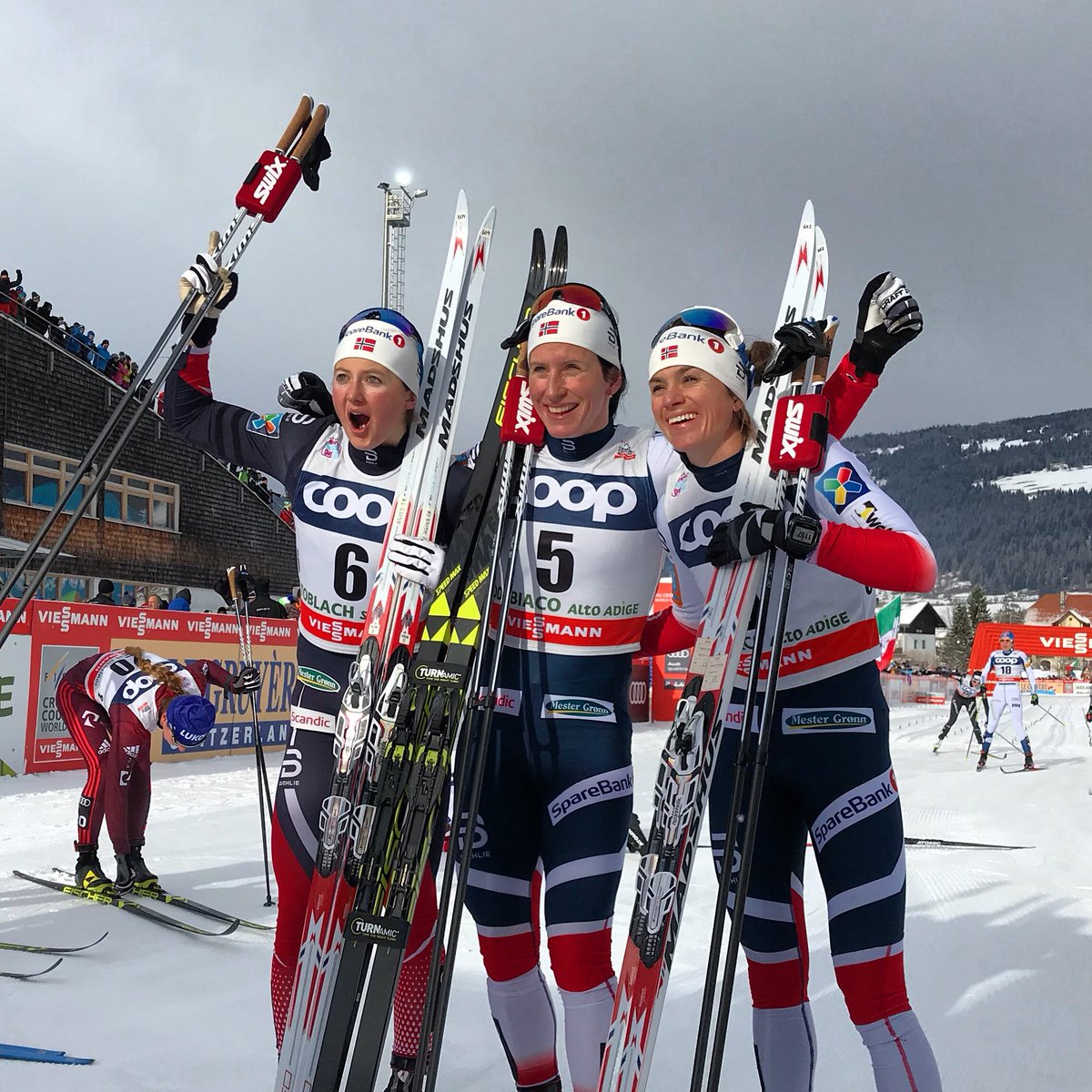
The all-Norwegian women’s 10 k classic pursuit podium on Sunday at the World Cup in Toblach, Italy, with Marit Bjørgen (c) in first, Ingvild Flugstad Østberg (l) in second and Heidi Weng (r) in third. (Photo: FIS Cross Country/Twitter)
In the women’s 10 k classic pursuit earlier in the day in Toblach, Norway’s Marit Bjørgen overcame a 22-second starting deficit to take the win by just 0.3 seconds over her teammates Ingvild Flugstad Østberg in second. It was an all-Norwegian podium with Heidi Weng in third (+0.8).
Bjørgen started fifth, 22 seconds behind Swedish race leader Charlotte Kalla, based on their results in Saturday’s 10 k freestyle individual start. By the 6.4 k checkpoint, Bjørgen led a pack of four other Norwegians and Kalla — all within 1.4 seconds of first. At 8.5 k, Bjørgen led Østberg in second and Weng in third, while another Norwegian Astrid Uhrenholdt Jacobsen skied another eight seconds back with teammate Ragnhild Haga in fourth and fifth, respectively. By that point, Kalla was skiing alone, another 11.7 seconds in sixth, while American Jessie Diggins led a group 25 seconds behind Kalla in sixth.
Ultimately, Bjørgen finished first in 25:19.3 and formed an all-Norwegian podium with Østberg and Weng, Jacobsen placed fourth, 21.5 seconds out of first and 20.7 seconds behind Weng in third.
Haga was fifth (+31.8), Kalla sixth (+41.9), Diggins seventh (+53.7), Russia’s Natalia Nepryaeva eighth (+54.2), American Sadie Bjornsen ninth (+55.2), and Austria’s Teresa Stadlober 10th (+55.6) in a photo finish with Finland’s Kerttu Niskanen, who placed 11th (+55.6).
For the U.S. Ski Team, Diggins and Bjornsen retained their starting positions of seventh and ninth, respectively, while Rosie Brennan started 19th and finished 25th (+2:14.6). Chelsea Holmes (Alaska Pacific University) finished 39th (+3:03.8) and Liz Stephen (USST) finished 48th (+4:05.2).
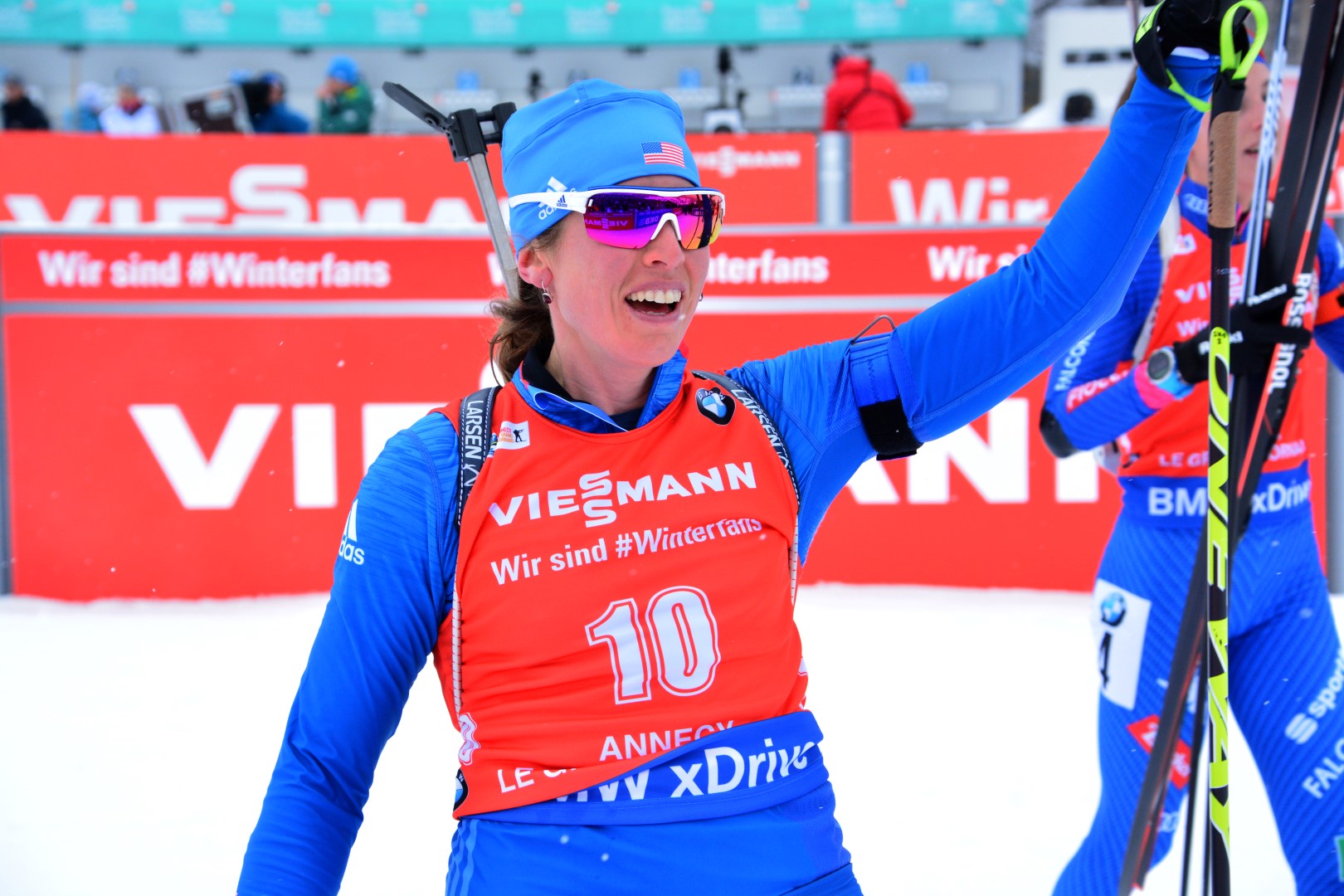
France’s Justine Braisaz won her first International Biathlon Union (IBU) World Cup race of the season on Sunday at home in Annecy, France, topping the women’s 12.5 k mass start by 11.2 seconds in 37:19.4.
While Braisaz shot 19-for-20 (0+0+1+0), Iryna Kryuko of Belarus cleaned the four-stage race for second place, her first World Cup podium. Germany’s Laura Dahlmeier, who won Saturday’s 10 k pursuit, placed third (+19.9) with two penalties (0+1+0+1).
Two North Americans qualified for the selective mass start, with Susan Dunklee (US Biathlon) racing to 20th (+1:16.3) with three misses (1+0+1+1), and Emma Lunder (Biathlon Canada) placing 28th (+2:21.4) with a single penalty (1+0+0+0).
In the men’s 15 k mass start that followed, France’s Martin Fourcade finally got the win he was looking for, shooting clean and beating his main rival Johannes Thingnes Bø of Norway by 3.9 seconds. Fourcade crossed the finish line first in 36:30.3, Bø settled for second after skiing two early penalty loops (2+0+0+0) and Germany’s Erik Lesser tallied his second podium in Annecy (after placing third in the sprint) in third place again (+6.2) with clean shooting.
Two Americans and a Canadian qualified for the mass start, with US Biathlon’s Lowell Bailey leading them in 23rd (+2:22.4) with three penalties, Sean Doherty following in 24th (+2:52.5) with four misses, and Biathlon Canada’s Scott Gow finishing 26th (+4:05.4) with five penalties.
OPA Cup (St. Ulrich, Austria): 10/15 k freestyle pursuits
On the final day of Alpen Cup (a.k.a. OPA Cup) racing in St. Ulrich, Ida Sargent of the U.S. Ski Team (USST) scored her third-straight top five with a fifth place in the women’s 10 k freestyle mass start. She previously placed third in the skate sprint and 5 k classic on Friday and Saturday.
Germany’s Julia Belger won the women’s mass start on Sunday in 28:33.6, while Saturday’s 5 k winner, Elena Soboleva of Russia placed second (+0.7). Russia had two on the podium with Mariya Istomina in third (+6.4). Germany’s Elisabeth Schicho finished fourth (+15.8), just ahead of Sargent in fifth (+15.9).
Germany’s Antonia Fräbel placed sixth (+17.1), followed by American Sophie Caldwell in seventh (+17.9). The USST had three in the top 10 with Julia Kern in 10th (+41.9), out of 60 finishers.
In the men’s 15 k freestyle mass start, Beda Klee of Switzerland took the win in 37:14.6, 2.4 seconds ahead of Germany’s Thomas Bing in second. Six-time Olympian Sergey Dolidovich of Belarus reached the podium in third (+4.5).
The U.S. had two men in the race, with Simi Hamilton finishing 14th, 16 seconds out of first, and Andy Newell finishing 71st (+2:25.2) out of 118.
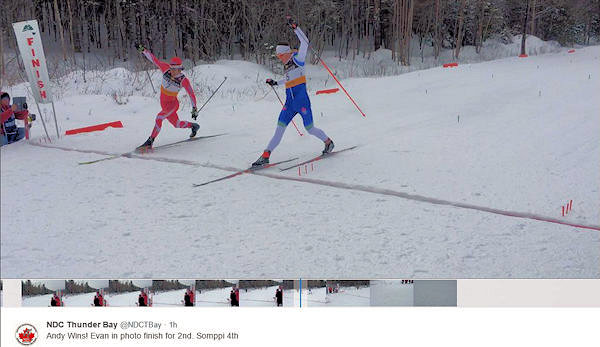
The photo finish for first in the men’s skate sprint final on Saturday at the NorAm in Rossland, B.C., with Julien Locke (near) outstretching Evan Palmer-Charette for first, and Julian Smith (r) taking third third ahead of Bob Thompson (yellow NorAm leader’s bib). (Photo: CCC/Twitter)
NorAm Mini Tour (Rossland, B.C.): Freestyle sprints
On Day 2 of NorAm racing in Rossland, British Columbia, Julien Locke, of the Black Jack Ski Club and Canadian National U25 Team, won the men’s 1.4-kilometer freestyle sprint final on his home trails by just one-hundredth of a second over Evan Palmer-Charrette, of the National Team Development Centre (NTDC) Thunder Bay, in 2:38.13. NTDC Thunder Bay had two on the podium with Julian Smith in third, 0.4 seconds behind Locke.
Locke started the day by qualifying second, just 0.06 seconds behind Bob Thompson (NTDC Thunder Bay), who won the qualifier in 2:39.49. Locke went on to finish second to Thompson in the first quarterfinal, then won the second semifinal while Thompson won the first semi.
In the final, Locke tallied his first NorAm win of the season, while Thompson, last weekend’s classic-sprint winner at Sovereign Lake, placed fourth (+0.43), missing the podium by three-hundredths of a second. Andy Shields (Lappe Nordic) finished fifth (+1.78) and Sebastien Boehmler-Dandurand (Canmore Nordic/Stefan Kuhn HP Team) sixth (+5.21) in the men’s final.
Also on Saturday, American Caitlin Gregg (Team Gregg/Loppet Nordic Racing) racked up her second-straight win in Rossland (after topping Friday’s 5 k classic), winning the women’s 1.4 k skate-sprint final in 3:03.36. Canada’s Andrea Dupont (Rocky Mountain Racers) finished 2.5 seconds later for second place and Zina Kocher (Foothills Nordic) scored her first podium of the season in third (+3.53).
Dupont won the women’s qualifier in 3:07.68, and Gregg qualified second, 0.87 seconds back. Dupont went on to win the first quarterfinal and first semifinal, while Gregg won her quarterfinal and semifinal as well. (Gregg’s quarterfinal had four racers, compared to five in Dupont’s quarterfinal, as only 21 women competed in the senior women’s heats.)
Also in the final, Laura Leclair, of the Centre National d’Excellence Pierre Harvey/Pierre-Harvey National Training Centre (CNEPH), finished fourth (+6.11), Maya MacIsaac-Jones (U25 Team) was fifth (+6.31) and Sophie Carrier-Laforte (Skinouk) sixth (+8.57).
On the second day of Alpen Cup (a.k.a. OPA Cup) racing in St. Ulrich, Ida Sargent of the U.S. Ski Team (USST) finished third in the women’s 5 k classic behind two Russians, Elena Soboleva and Natalia Matveeva, respectively.
Soboleva took the win in the individual-start race in 14:25.8, and Matveeva was 12.5 seconds back for second place. Just like Matveeva, Sargent reached the podium for the second-straight race in third (+18.1), after placing third in the freestyle sprint on Friday (Matveeva finished second in the sprint).
Germany’s Antonia Fräbel finished fourth (+21.0) and American Sophie Caldwell (USST), who won the sprint the day before, placed fifth (+22.7). The other USST member in the race, Julia Kern finished 15th (+53.5).
The men raced a 15 k classic, with France’s Alexis Jeannerod taking the win in 38:45.6. Germany’s Thomas Wick was 4.7 seconds back in second, and Russia’s Gleb Retivykh placed third (+11.3). The lone American man racing, Andy Newell (USST) finished 36th (+2:07.1) out of 125 finishers.
The three-day OPA Cup weekend in St. Ulrich wraps up Sunday with 10/15 k freestyle mass starts.
IBU World Cup (Annecy, France): Women’s and men’s pursuits
Susan Dunklee (US Biathlon) after placing sixth and reaching the flower ceremony in the women’s 10 k pursuit at the IBU World Cup on Saturday in Annecy, France. After starting 10th, sixth stands as a season-best for Dunklee. (Photo: Glen Crawford)
Germany’s Laura Dalhmeier captured her first win of the season, preventing Slovakia’s Anastasia Kuzmina from her third-straight win, and American Susan Dunklee raced to a season-best sixth in the women’s 10-kilometer pursuit on Saturday in Annecy-Le Grand Bornand, France.
Canada’s Emma Lunder achieved a career-best 18th after starting 34th, and her teammate Julia Ransom placed 27th after starting 39th.
In the men’s 12.5 k pursuit that followed, Norway’s Johannes Thingnes Bø started first, shot clean and fended off his competition to rack up his fourth-straight victory — winning by more than a minute.
And for the second-straight race, France’s Martin Fourcade finished second, this time 1:01.4 minutes behind Bø, who crossed the line first in 32:52.1. Fourcade had to ski two penalty laps later in the race (0+0+1+1), while Russia’s Anton Shipulin, who started sixth and had a single miss (0+0+0+1), rose to third place (+1:10.5).
American Lowell Bailey shot clean to race up to 14th (+2:13.9) after starting 35th. His US Biathlon teammate Tim Burke finished 26th (+3:03.1) with three penalties (1+0+1+1), after starting 10th.
Canada’s Scott Gow finished a second later for 27th (+3:04.1) after starting 16th and skiing four penalty laps (1+0+1+2). His brother Christian Gow moved up one spot to 29th (+3:06.6) after starting 30th and shooting 19-for-20 (1+0+0+0).
The U.S. had four men in the pursuit, with Sean Doherty placing 30th (+3:07.0) with three penalties after starting 17th.
Leif Nordgren improved to 48th (+4:54.9), up from 56th, despite three misses.
***
FIS Cross Country World Cup (Toblach, Italy): 10/15 k freestyle
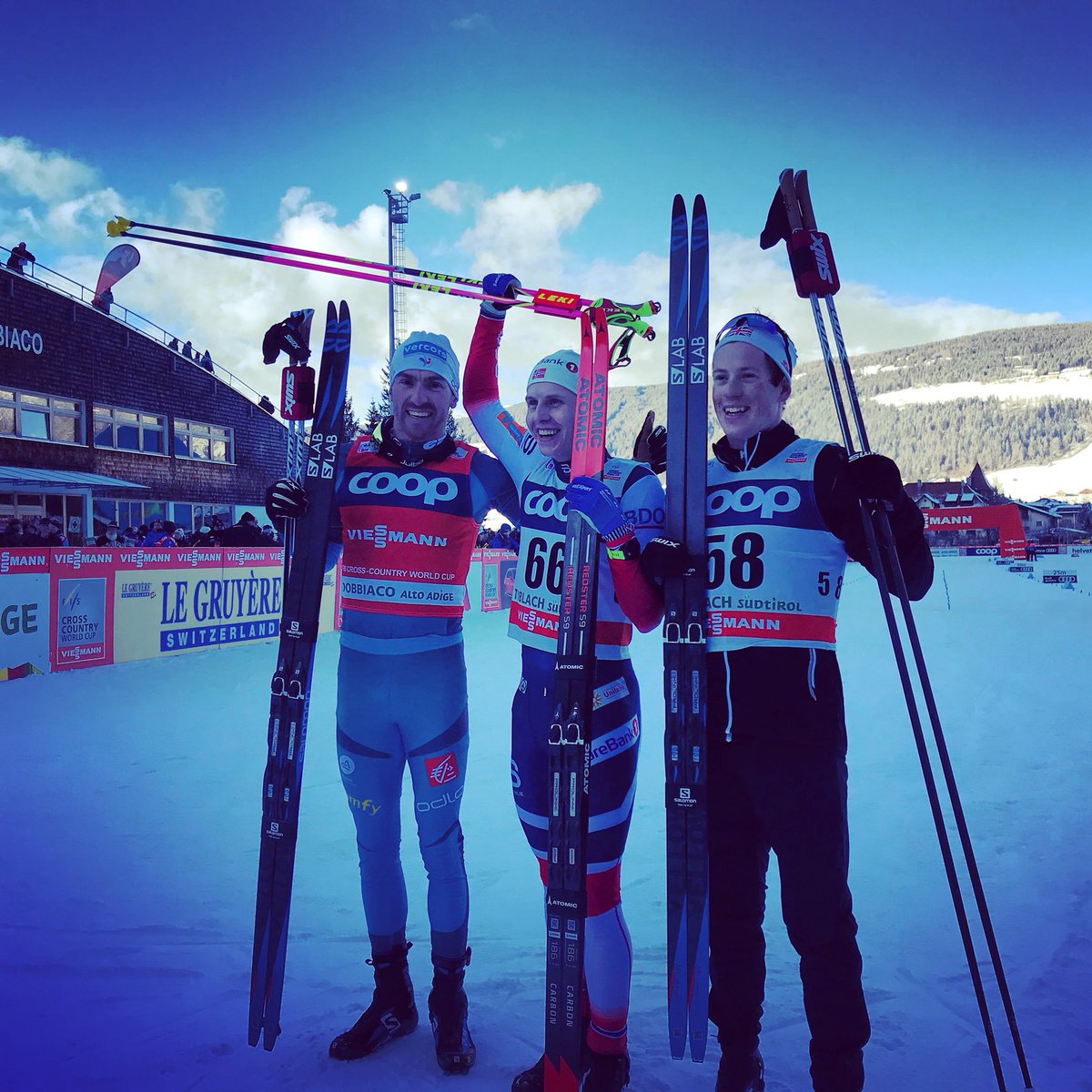
The men’s 15 k freestyle podium at the Toblach World Cup in Italy, with Norway’s Simen Hegstad Krüger (c) scoring his first World Cup victory in first place, last weekend’s winner Maurice Manificat (l) of France in second, and Great Britain’s Andrew Musgrave (r) in third. (Photo: FIS Cross Country/Twitter)
In the men’s 15 k freestyle on Saturday in Toblach, 24-year-old Simen Hegstad Krüger achieved his first individual World Cup victory in 29:58.8 minutes, and was joined on the podium by France’s Maurice Manificat in second (+10.6) and Great Britain’s Andrew Musgrave in third (+11.5).
Canadian World Cup Team member Alex Harvey missed the podium by 2.5 seconds in fourth place (+14.0), tying his best result of the season after finishing Ruka Triple mini tour in fourth place late last month in Kuusamo, Finland.
Russia’s Sergey Ustiugov followed in fifth, Norway’s Finn Hågen Krogh was sixth and Hans Christer Holund seventh, Finland’s Matti Heikkinen eighth, Switzerland’s Toni Livers ninth, and notably, Norway’s Johannes Høsflot Klæbo — who hasn’t lost a race all season (he sat out last weekend’s 15 k skate in Davos, Switzerland) — was 10th.
Erik Bjornsen of the U.S. Ski Team (USST) was the lone American in the points (top 30) in 29th (+1:09.6), Noah Hoffman finished 40th (+1:24.5), Scott Patterson (USST) was 42nd (+1:29.4), and Paddy Caldwell (USST) 53rd (+1:50.0)
For Canada, Devon Kershaw (World Cup Team) placed 38th (+1:22.1), Graeme Killick (World Cup Team) was 49th (+1:47.8), Russell Kennedy (Team R.A.D.) 60th (+2:13.2), and Knute Johnsgaard (World Cup Team) 85th (+3:28.3).
The women’s 10 k freestyle podium on Saturday at the World Cup in Toblach, Italy, with Sweden’s Charlotte Kalla (c) in first, and Norway’s Ragnhild Haga (l) and Heidi Weng (r) in second and third, respectively. (Photo: FIS Cross Country/Twitter)
In the women’s 10 k freestyle individual start in Toblach, Sweden’s Charlotte Kalla tallied her third win of the season in 22:40.1 minutes, ahead of five Norwegians and American Jessie Diggins.
Norway’s Ragnhild Haga was 5.8 seconds shy of Kalla’s time for second place, and her teammate Heidi Weng was another 8 seconds back in third (+13.8).
Norway occupied second through sixth place, with Astrid Uhrenholdt Jacobsen in fourth (+17.9), Marit Bjørgen in fifth (+22.6) and Ingvild Flugstad Østberg in sixth (+29.3). Diggins led the U.S. Ski Team (USST) in seventh (+40.5), with Finland’s Kerttu Niskanen close behind in eighth (+43.5) and the second U.S. woman in the top 10, Sadie Bjornsen, another 0.4 seconds back in ninth (+43.9).
The USST had three in the top 20 with Rosie Brennan placing 19th (+1:15.2) for her second-straight top-20 result (following a 17th place in last weekend’s 10 k freestyle in Davos, Switzerland). Chelsea Holmes (Alaska Pacific University) finished 36th and Liz Stephen (USST) was 47th.
Emily Nishikawa (Canadian World Cup Team) led her team in 51st, Cendrine Browne (Canadian U25 Team) followed in 55th, Dahria Beatty (World Cup Team) was 69th, and Katherine Stewart-Jones (U25 Team) 77th.
Canada’s Alex Harvey with his medals for placing second in the Distance World Cup and third in the Overall World Cup on the last day of World Cup Finals in Quebec City on Sunday, March 19. (Photo: John Lazenby/Lazenbyphoto.com)
After last weekend’s three-day World Cup Finals mini tour drew nearly 60 North American competitors and tens of thousands of spectators to Quebec City, it’s only fitting that we share the quotes from some of the athletes you haven’t heard from yet (and some you have). Here is a collection of some of the most interesting comments from the Canadian World Cup and Nation’s Group skiers at World Cup Finals. There were 30 in total. (Stay tuned for the U.S. notes & quotes version.)
And here are our race reports (with links to results at the bottom of each) from Friday though Sunday, March 17-19:
Canada’s 21-year-old Ricardo Izquierdo-Bernier, of the Pierre Harvey National Training Centre (CNEPH) racing his first World Cup during the men’s freestyle sprint qualifier at World Cup Finals on March 17 in Quebec City. (Photo: John Lazenby/Lazenbyphoto.com)
“I was surprised when I was selected, but I am very happy to be here.” — Ricardo Izquierdo-Bernier (CNEPH)
“I was stressing when they announced that, ‘The national group, maybe you will have the opportunity to qualify for your first World Cup.’ [My coach and I] just kind of put that to the back of our minds and decided that if it happened, it was going to be an incredible icing on the cake part of my race season, and it happened and it was super exciting. I was really just focusing on the process so I am super excited to be here, a little overwhelmed but really excited.” — Annika Richardson (Junior NST/NTDC Thunder Bay)
“I was just happy to be here. Last year I got my concussion in Montreal [during the Ski Tour Canada] so I didn’t actually get to race here so it’s a great place to come and race. I’ve raced here just a couple of times and it’s an incredible feeling to have the crowd behind you. … It’s really great because you don’t get that in Europe. You get lots of fans, but not people who know your name so it’s pretty cool.” — Andrea Dupont (Rocky Mountain Racers)
“I am really really excited to be here. I did the [Ski Tour Canada] last year and this is probably my favourite venue to race at in Canada, being in the city and it’s a beautiful day. Can’t really ask for anything more.” — Annika Hicks (AWCA)
“I didn’t reach my goal of qualifying for the World Championships, but to race at this level this weekend far exceeds all my expectations. I was a forerunner for the Tour of Ski last year, but now I’m actually racing. That makes me really happy!” — Laura Leclair (Junior NST/Chelsea Nordiq)
“It’s the cherry on the sundae. It’s good to go up against the best in the world, and it’s an opportunity to see what you have to work on for the next year, and try your hardest.” — Frédérique Vézina (CNEPH)
On racing in Canada:
“I thought last year was going to be my last chance to race internationally in Canada so I am really thrilled to be here.” — Devon Kershaw (Canadian World Cup Team)
“We are pretty lucky to have the end of the World Cup here in our own house, and it’s really exciting to be able to finish of the season here in Canada and it’s definitely convenient to be able to relax here after we are finished. We have Canadian nationals still, so I guess not complete relaxation … but it’s really fun to be back in Canada.” — Len Valjas (Canadian World Cup Team)
“It’s nice to be back here in Canada racing a World Cup. I think we are pretty lucky to have the opportunity as a group of Canadians, developing skiers, young guys, old guys like me just trying to get up there, but also seeing Alex skiing so well, world champion. I mean, what can you say? It’s awesome. It’s good for our sport right now.” — Brian McKeever (Canadian Para-Nordic Ski Team)
“The atmosphere here is really on par, today especially, with the races we do overseas, and especially being in a city center that we know so well like Quebec, it’s a really good energy.” — Jess Cockney (Canadian World Cup Team), after Saturday’s 15 k classic mass start
“It’s absolute incredible to come back to Quebec after last year and race something that’s familiar to us already, but slightly different because the race course, they change out the race course, which is always exciting. It’s amazing to race in front of Canadians and to have people cheering your name all around the course that actually personally know you, so it’s a pretty incredible experience to come out here and do that. “ — Alannah MacLean (NTDC Thunder Bay)
“It’s been great to finish the season at home. It’s been a really long season, though. I have been overseas way more than I ever have in my life so I think it’s taking a little bit of a toll on the energy, but I am just so excited to be able to race at home here and enjoy this amazing atmosphere.” — Dahria Beatty (National U25 Team/AWCA)
“I was pretty tired after such a long season, and I was really happy to be here and to able to finish the season on such a fun note, to ski a World Cup at home. It’s happened the last two years, but it doesn’t really happen that often, so it’s a unique opportunity. I gave it everything that was left in the tank, and I had a lot of fun.” — Katherine Stewart-Jones (NST U25 Team/NTDC Thunder Bay)
“This is huge for Canada, and I hope FIS can see that it’s really amazing to have races here, and I think the athletes like it, too, so I hope this becomes a staple even after our generation. There’s enough North American skiers that we should have this here every year. We’re winning medals too and Alex is up there in the overall, we deserve to make them travel a little bit. I’d love to see more races here.” — Valjas
On being cheered on by tens of thousands of fans:
“It started in warmup where you kind of would be skiing around and people recognized the National Development team jacket and yell, ‘Go Canada!’ and I was like, OK, just smile and keep going and trying to keep my focus, but it felt incredible to ski around and have everyone cheering for you and rooting for you because you’re Canadian. Definitely had to nail my focus today a bit more than usual because of that, but good practice.” — Richardson
Alex Harvey (Canadian World Cup Team) racing to fourth in the men’s freestyle sprint qualifier on the first day of World Cup Finals, last Friday, March 17, in Quebec City. He went on to win the final. (Photo: John Lazenby/Lazenbyphoto.com)
“Sometimes they’re cheering really loud and you know it’s actually not for you, it’s just the commentator mentioned Alex but then you’re just like, I’ll take it. I’ll pretend they’re cheering for me.” — Valjas
“It’s a beautiful day in Quebec and the crowds are pretty amazing. It just kind of keeps the intensity high the whole time so it’s a fun place to race.” — Dupont, after Sunday’s 10 k freestyle pursuit
“It was another absolutely beautiful day out here, lots of home crowd cheering us on, so it was a really perfect day at the races.” — Knute Johnsgaard (NST U25 Team/AWCA), after Sunday’s 15 k freestyle pursuit
“Today was not the greatest day in my skiing career, however, it was pretty amazing because the crowd was cheering me on the whole way.” — Julien Locke (NST U25 Team/AWCA), after Saturday’s 15 k classic mass start
“It’s funny that people recognize me and know my name. It’s heart warming to have all the public support me and the Canadian team. … It was really an amazing weekend, the atmosphere, the crowd, the conditions, everything was on point. I couldn’t of hoped for a better way to end the season.” — Cendrine Browne (NST U25 Team/CNEPH)
On making the jump to the World Cup:
“It was amazing. The first day it was a lot to take in with the crowd and such a high-level race and having such high-level skiers around, but then Saturday I was more used to it and I was able to really focus on my race and put in a good effort.” — Katie Weaver (Junior NST/Hollyburn)
“You’ve got a lot of fast guys, and you’re kind of going from being one of the faster guys to obviously to one of the slowest guys around, and that’s a cool feeling, actually.” — Gareth Williams (Junior NST/Telemark)
“It’s always intimidating, but once you’re on the starting line, it’s mostly exciting. I’m not expecting to lead the pack anytime soon, so all I can do is try giving my max effort.” — Sophie Carrier-Laforte (CNEPH)
“This was my first. I qualified for a couple in the winter but because of U23 [World Championships] I wasn’t able to take advantage of it.” — Evan Palmer-Charrette (NTDC Thunder Bay)
“This was my fifth [World Cup race]. I still feel like there’s a lot of work I can do to be more competitive in this field, but I think I’m getting more and more comfortable with it in general.” — Sadie White (NTDC Thunder Bay)
“I don’t think I’m at this level of competition yet, but I think it’s so fun to be here and see how the fastest people in the world race.” — Mia Serratore (NTDC Thunder Bay), at the end of her first World Cup weekend
“I mean, they’re so fast out there, but I love it because I get to see what level I need to get to. Racing in Quebec, it’s so fun. The crowd’s just crazy. It’s so good.” — Joey Foster (Team Hardwood), at the end of his first World Cup weekend
Russell Kennedy (Canmore Nordic/Team R.A.D.) racing to 36th in the men’s skate sprint qualifier at World Cup Finals in Quebec City on March 17. (Photo: John Lazenby/Lazenbyphoto.com)
On five Canadian men qualifying for the sprint heats in the top 30 (a first for Canada in a World Cup):
“I am really pumped for everyone and I think it’s really good for the sport to see that many people up there. We have been sprinting really well in a lot of races and have a lot of good sprinters so it’s good to see everyone get up there and do well. Hopefully they can carry it out in the heats and get a couple of those closer to the podiums.” — Russell Kennedy (Canmore Nordic/Team R.A.D.)
On sprinting:
“It’s about 89.5 k too short for me these days.” — Brian McKeever (Canadian Para-Nordic Ski Team), who also specializes in marathons
On conditions:
“The snow is perfect conditions. The snow is cold, but the sun is warm, and the track is holding up great, so good Canadian conditions.” — Beatty, after Friday’s sprint
“I guess it’s pretty tricky to get grip with hard wax in this stuff, and I think klister would’ve been too slow so I had a lot of speed on my skis but my grip was definitely lacking a bit in the sun. In the shade it was pretty good, but it was a lot of upper body today, which I think was the way to go anyways.” — Andy Shields (Lappe Nordic), after Saturday’s 15 k classic mass start
“The skis showed good grip. The technicians delivered today. The issue was more the skier!” — Carrier-Laforte, after Saturday’s 10 k classic mass start
“The snow was fine. It didn’t really even get that mushy on the course and the downhills were pretty glazed actually. It stayed nice and firm. My skis were just amazing today. I was drafting people and shooting by them no problem. It was really good, really competitive skis.” — Foster, after Sunday’s 15 k freestyle pursuit
On the course:
“It’s tough because there’s a lot of flats, so you’re always working, whether it’s gradually downhill or gradually uphill. It’s good. It’s a challenging course in its own way. It’s not your typical World Cup where you have a huge climb and then a big rest after that, you’re just working stead, so it hurts. It’s a different kind of tough.” — Valjas
On sunscreen:
“Today is the first day that warranted the sunscreen, but I put the zinc on every day. Gotta protect yourself.” — Cockney
On goals for World Cup Finals:
“My goals were just to ski relaxed and push my body as hard as I can. I’ve really been injured this entire season so I haven’t done really that much racing at all. I was able to get enough racing in to qualify for this World Cup, which was something that I didn’t think was going to be possible at the beginning fo the season when I got injured, but to be here and not be 100 percent, but to be able to race in this environment is something that keeps me in the sport.” — MacLean (who herniated a disk)
“I really want to push as hard as I can for each race. I think that is something that sometimes it is difficult to do in Canada on the NorAm circuit because maybe if you’re not having a good race, you could pull back a little bit and save yourself for the next day and come in seventh instead of fifth, but here, I will still probably be in the back of the field, but I really want to push and feel good every time I cross the finish line that I gave it my all and kept pushing.” –– Richardson
Cendrine Browne, of the Canadian U25 Team and CNEPH, after finishing 41st in the women’s 10 k classic mass start on Saturday at World Cup Finals in Québec City. (Photo: John Lazenby/Lazenbyphoto.com)
On digging deep:
“Somehow I found a bit of fight. I didn’t really do much of a warmup today. I opted for a conserving energy strategy and I think it worked well. We’ve done so much racing that my body didn’t really need a warmup to get going so I did as little as possible before the racing to save everything I had for this last effort.” — Beatty
“It’s been a lot of racing this week. I was down in Lake Placid doing U.S. Junior Nationals and then I came here and now we’re off to Canadian Nationals for another three races. It’ll be a lot of racing, but that’s what I love to do.” — Weaver
“[After] yesterday’s race, I wasn’t going to start today and then the physio said, ‘If I’m treating you, you’re going to start.’ And I was like, ‘OK, Let’s do this!’ And she actually fixed me and today was much better.” — Valjas, on his upper-back injury, after Sunday’s 15 k freestyle pursuit
“I felt really really good, but I’m just having so many problems with my shins and my calves this season so it just makes it really difficult to ski properly.” — Serratore
On Quebec City:
“Quebec City, as far as Canada goes, is probably the closest thing to Europe, but it’s still the same country, same food.” — Palmer-Charrette
On their season overall:
Devon Kershaw leads Canadian teammate Graeme Killick in the men’s 15 k classic mass start at World Cup Finals on March 18 in Quebec City. (Photo: John Lazenby/Lazenbyphoto.com)
“It has been a really good season. It has been my most consistent season to date, so I have been really happy with it, have had some really good races and I just think especially in sprinting, my bad races are way better than they have been in the past. The fluctuation is smaller so I am showing good signs for next year.” — Beatty
“I think the season for me was a little disappointing. I had some signs of the training paying off, but I think overall I might have overdone it through the summer in sections and from that I struggled with some sickness through a lot of the season. I think some races were OK for me and I’ll take that and try to fix some things for next year over the summer and see what I can do. I mean, today was a good reminder that skate is not there and I really need to work on it for next year.” — Graeme Killick (Canadian World Cup Team), after 15 k skate pursuit
On season highlights:
“It’s got to be those two relay medals, especially the 4 x 7.5 k, that was so cool because my whole career we’ve tried to get a medal there and I was honored to be the anchor and that was a huge moment in my career to be able to pull that off and secure a medal for the men’s relay was just awesome. And of course, the first win for me with Alex was also just as special. It’s been a good year. Lots of highs, some lows, and I’m ready for next year.” — Valjas, on historic third-place finish with men’s relay at World Cup in Ulricehamn, Sweden, and World Cup freestyle team sprint win with teammate Alex Harvey in Toblach, Italy
Emily Nishikawa (Canadian World Cup Team) racing to 38th on the final day of 2017 World Cup Finals on Sunday in Quebec City, the women’s 10 k freestyle pursuit. (Photo: John Lazenby/Lazenbyphoto.com)
“I think the relay in Lahti for us, it was one of our best women’s results since 2001 or something like that, so 16 years.” — Emily Nishikawa (Canadian World Cup Team), on the Canadian women’s team’s 10th place in the 4 x 5 k relay at 2017 Nordic World Championships
“For me, it would be Davos. I was really happy with my form there, and I think I never felt that good in a skate race. I like altitude, too, so that course kind of suits me. That was my best individual start ever so it’s good to have one of those. I was really happy with that day.” — Killick, referring to his 21st place in the World Cup 30 k freestyle individual start on Dec. 10 in Davos, Switzerland
“That’s hard to call. Probably the highlight of my season was my 26th was La Clusaz, getting my first distance top 30. That was something I wasn’t really sure I’d be able to bridge this season and to be able to ski into the top 30 in distance as well as sprint this year wasp pretty amazing so that was a big step for me forward in coming years.” — Beatty, on her 26th place in the World Cup 10 k freestyle mass start on Dec. 17 in La Clusaz, France
“Maybe this, watching Harv do well. The Holmenkollen was an amazing experience. It was hard and not my best finish ever, but it was a really, really cool experience and I can’t say enough how awesome it was.” — Kennedy, who placed 47th in the 50 k classic mass start at Holmenkollen in Oslo, Norway, on March 11
On the upcoming training season:
“I’m pretty relieved that this season’s over and really excited to kind of get a fresh start on next year and just take some time to reflect on this past season and look at the things that went well and things that I could improve on and hopefully use those as building blocks for next year’s training.” — Johnsgaard
“This summer, I’ll put in practice what I learned from my World cup experience. I’ll really focus on technique and work on my tempo. The only way to improve is to keep racing against the best.” — Browne
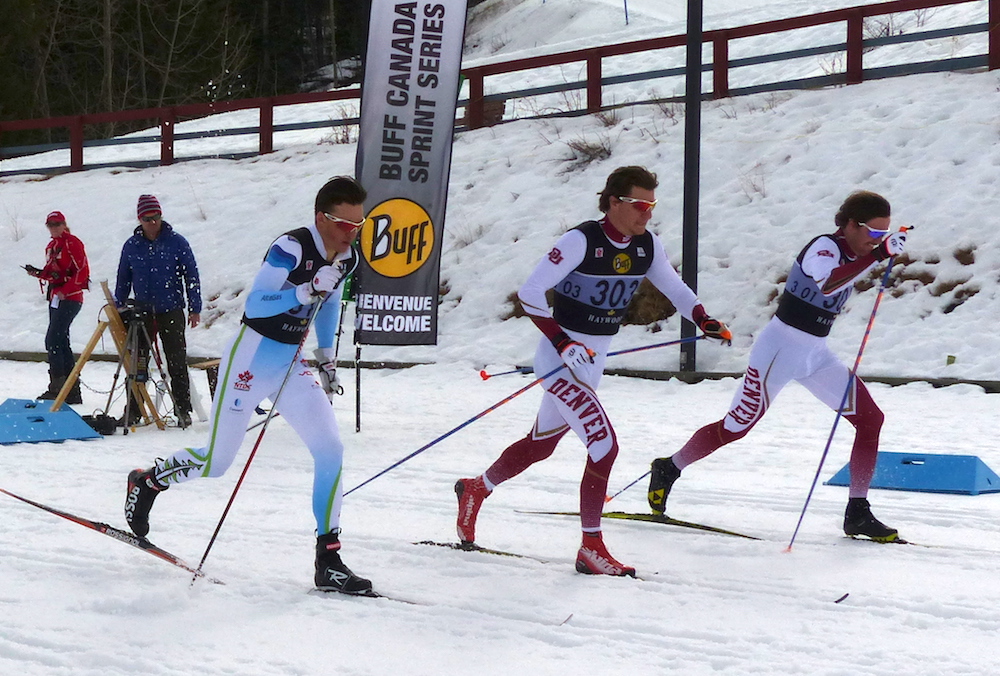
The start of the men’s 1.3 k classic sprint A-final at 2017 Canadian Ski Nationals on Wednesday in Canmore, Alberta, with Evan Palmer-Charrette (l) with the University of Denver’s Moritz Madlener (303) and Dag Frode Trollebø (301). Madlener went on to win, Trollebø placed second and Palmer-Charrette third. (Photo: Peggy Hung)
2017 Canadian Ski Nationals (Canmore, Alberta): Classic sprints
Emily Nishikawawon her second-straight race at Canadian Ski Nationals in Canmore on Wednesday, topping the women’s 1.3-kilometer classic sprint in slushy conditions for her second national title in as many days.
Emily Nishikawa (Canadian World Cup Team) racing to 38th on the final day of 2017 World Cup Finals on Sunday in Quebec City, the women’s 10 k freestyle pursuit. Wednesday at Canadian nationals marked her fifth race in six days. (Photo: John Lazenby/Lazenbyphoto.com)
Nishikawa, of the Canadian World Cup Team, initially posted the third-fastest qualifying time, 2.92 seconds behind qualifying winner Andrea Dupont (Rocky Mountain Racers), while junior Katie Weaver (Hollyburn Ski Club/NST Junior Team) qualified second (+0.43).
Nishikawa went on to win both her quarterfinal and semifinal before besting five others in the women’s A-final in 4:00.86 minutes. Dahria Beatty, of the Alberta World Cup Academy (AWCA) and Canadian U25 Team, finished 2.79 seconds later in second place and Katherine Stewart-Jones (NTDC Thunder Bay/NST U25 Team) followed in third (+3.14). Also reaching the A-final, Annika Hicks (AWCA) finished fourth (+21.37), and Sophie Carrier-Laforte, of the Pierre Harvey Training Centre (CNEPH) placed fifth (+45.63) and Alannah MacLean (NTDC Thunder Bay) did not start.
“Today with these soft, slushy conditions, it kind of played into my favour,” Nishikawa told FasterSkier in person on Wednesday. “I love classic sprinting, I always have. To pull enough energy together today was really great.
“It’s my fifth race in six days, so I’m really tired, but I couldn’t be happier right now,” she said. “To win two back to back national titles yesterday and today is really cool.”
In the junior women’s A-final, Annika Richardson (NTDC Thunder Bay/NST Junior Team) took the win in 4:05. Her Hollyburn club teammate, Weaver placed second (+4.48) and NTDC Thunder Bay teammate Lisle Compton finished third (+7.4). Also in the A-final, Zoë Williams (Nakkertok/NST Junior Team) placed fourth (+11.37), Hannah Mehain (Sovereign Lake Nordic/NST Junior Team) fifth (+25.75) and Catherine Reed-Métayer (Skibec/Quebec Ski Team) sixth (+1:05.44).
In the senior men’s 1.3 k sprint, Moritz Madlener beat his University of Denver teammate Dag Frode Trollebø by 0.5 seconds for the A-final win in 3:12.56. Madlener started the day by qualifying in third, 1.6 seconds behind Trollebø, the fastest qualifier, while Joey Foster (Team Hardwood) qualified second (+0.88).
Madlener went on to win both his quarterfinal and semifinal. So did Evan Palmer-Charrette (NTDC Thunder Bay), who qualified 14th and ended up third in the final, 3.76 seconds behind Madlener. With Madlener hailing from Germany and Trollebø from Norway, Palmer-Charrette was the top Canadian, ahead of Antoine Briand (CNEPH) in fourth (+10.53), Knute Johnsgaard (AWCA/NST U25 Team) in fifth (+12.65), and Michael Somppi (NTDC Thunder Bay) in sixth (+13.4).
“I tucked in behind the two guys from Denver,” Palmer-Charrette explained of his tactics in the final. “I knew they were going to put in a surge on the climb. I went inside to try and go past them, but they were smart, took the two outside tracks, which were still there; inside was really soft. I cut over to get behind them, but I lost a couple metres and just wasn’t able to get that back.”
Despite finishing behind them, Palmer-Charrette as the first Canadian earned his first national title at the age of 22, after rebounding from compartment-syndrome surgery last summer.
“[I] trained really hard after that,” he said. “It’s been a great year. … Awesome to be Canadian champion, surprise for sure in a classic sprint for me. Definitely not quite the Canadian field you’d see at a lot of Canadian nationals, a lot of guys sick and injured after World Cups on the weekend, but awesome nonetheless.”
Most notably, Canadian World Cup sprinter Len Valjas did not race.
Étienne Hébert (Quebec Ski Team/NST Junior Team) won the junior men’s A-final in 3:22.09, edging Nicolas Beaulieu (Orford/Quebec Ski team) by 0.55 seconds, and third-place finisher Larkin Wasmuth (Fort Saskatchewan Nordic Ski Club) by 0.68 seconds. Michael MacIsaac-Jones (AWCA) was in contention for a podium before crashing in the soft snow just before the finish. He ended up fifth (+11.63), behind American Nick Matelich (Bridger Ski Foundation) in fourth (+10.55) and ahead of Antoine Blais (Quebec Ski Team/NST Junior team) in sixth (+16.77).
The next senior races will be the long-distance freestyle mass starts on Saturday.
Alex Harvey racing in the men’s 15 k freestyle pursuit at Stage 4 of the Ski Tour Canada last year in Quebec City. (Photo: FlyingPointRoad.com/NNF)
For the second-straight year, the World Cup’s season-ending races will be held in Canada, with Québec City hosting 2017 World Cup Finals, this Friday through Sunday. Canada initially announced a roster of 30 (15 women, 15 men) for the three-day mini tour, and the U.S. selected 27 (15 women and 12 men), with both countries maximizing their Nation’s Group “home” quota for the event in downtown Québec City.
Note: On Tuesday, Cross Country Canada (CCC) announced it would be releasing a revised roster “due to some CPL points errors in calculations,” according to a press release. On Thursday, FasterSkier confirmed that the list included the same 15 women and 15 men that were originally published on FasterSkier.
And on Wednesday, Quebec organizers announced that the times of each race would be moved back an hour “upon FIS recommendation” to satisfy international broadcast schedules. The updated times are listed below.
2017 World Cup Finals race schedule (updated Wednesday):
(All times Eastern Daylight Time)
Friday, March 17: Freestyle sprint (qualifier starts at 11:45 a.m.; heats at 2:15 p.m.)
(Note: Jenn Jackson of Lappe Nordic declined her spot)
Men:
Alex Harvey (World Cup A-team)
Devon Kershaw (World Cup A-team)
Len Valjas (World Cup A-team)
Jess Cockney (World Cup B-team)
Graeme Killick (World Cup B-team)
Knute Johnsgaard (NST U25 Team/AWCA)
Russell Kennedy (Canmore Nordic/Team R.A.D.)
Gareth Williams (Junior NST/Telemark)
Andy Shields (Lappe Nordic)
Bob Thompson (NTDC Thunder Bay)
Joey Foster (Team Hardwood)
Julien Locke (NST U25 Team/AWCA)
Evan Palmer-Charrette (NTDC Thunder Bay)
Brian McKeever (Canadian Para-Nordic Ski Team)
Ricardo Izquierdo-Bernier (CNEPH)
USA
Women:
Kikkan Randall (U.S. Ski Team A-team/APU)
Sadie Bjornsen (USST A-team/APU)
Liz Stephen (USST A-team)
Caitlin Patterson (CGRP)
Rosie Brennan (USST B-team/APU)
Erika Flowers (SMS Elite)
Jennie Bender (BSF)
Julia Kern (USST D-team/SMS Elite)
Liz Guiney (CGRP)
Kaitlynn Miller (CGRP)
Chelsea Holmes (APU)
Becca Rorabaugh (APU)
Jessie Diggins (USST A-team/SMS Elite)
Sophie Caldwell (USST A-team/SMS Elite)
Ida Sargent (USST A-team/CGRP)
(Note: Katharine Ogden, of the SMS Elite Team and U.S. Ski Team D-team, declined her spot due to “ongoing stomach issues,” according to U.S. head coach Chris Grover. Guiney was the first alternate as she was next on the SuperTour list.)
Men:
Andy Newell (USST A-team/SMS Elite)
Noah Hoffman (USST B-team/Ski Club Vail)
Erik Bjornsen (USST B-team/APU)
Matt Gelso (SVSEF)
David Norris (APU)
Ben Lustgarten (CGRP)
Cole Morgan (SVSEF)
Patrick Caldwell (USST D-team/SMS Elite)
Jack Hegman (SVSEF)
Brian Gregg (Team Gregg/Loppet Nordic Racing)
Scott Patterson (APU)
Simi Hamilton (USST A-team/SMS Elite)
A view from the steep hill on the sprint course with the stadium area in background, as seen during training last year in Quebec City, one day before the third stage of the 2016 Ski Tour Canada. (Photo: John Lazenby/Lazenbyphoto.com)
Montériski’s Étienne Hébert (c) returned from WJC in Soldier Hollow in time to outsprint NTDC TBay’s Fergus Foster (l) in a classic-sprint quarterfinal at NorAm Eastern Canadian Championships at Nakkertok Nordic in Cantley, Quebec. (Photo: Dianne Galus)
The annual Eastern Canadian Championships are a special event in the Canadian winter. On paper, it is just another NorAm that provides opportunities to earn World Cup starts, national-team positions, and valuable International Ski Federation (FIS) points, but it has grown to be bigger than that.
While Western Canadian Championships and Canadian nationals change their host venue each year, Easterns has settled in at the Nakkertok South trail system for ten of the last eleven years. While Cantley, Quebec, is the nearest town, the national capital Ottawa and Gatineau are just twenty minutes away, providing a wealth of accommodation options and a major airport. With Toronto, Montreal and Quebec City all within a five-hour drive, a third of the Canadians competing were within easy driving distance.
With 835 athletes registered this year and more than 700 finishers each day, Easterns is likely to be larger than next month’s 2017 nationals in Canmore, Alberta. The American Birkebeiner (SuperTour #4) in Hayward, Wis., is the largest FIS points race this season in North America, with U.S. nationals at Soldier Hollow in Midway, Utah, ranking the fourth largest.
How do you put together a three-day event featuring an interval start with 736 finishers, including para-nordic, masters and university categories? It starts with 553 volunteers and a FIS request to test a no-double-pole zone. The open categories were slightly reduced by races happening simultaneously in PyeongChang, South Korea (World Cup), and Soldier Hollow (U23/Junior World Championships), but there were enough familiar faces to fill the podiums.
It ends with smiling faces, results, and a select few skiers who improved their FIS points and made their case for future selections. The photo gallery links are at the bottom, just keep scrolling past the quotes.
***
No-Double-Pole Zone
The classic sprint was Canada’s first test of the new FIS rule, and athlete opinions were not divided.
Double-poussée interdite: a new twist from FIS. RMR’s Andrea Dupont strides past the no-double-pole sign during the classic sprint qualifier. (Photo: Rob Smith)
“They started the no double pole zone on the gradual climb before the steep pitch, which made the flow of the course a bit annoying (in training yesterday they actually had it right at the bottom of the climb in a section that was too fast to stride, but the jury was really great about taking athlete feedback and moved it higher up the hill. I’m personally not a fan of the no double pole zone idea but I think they managed it as well as they could have on that course).”
— Angus Foster, NTDC TBay, 2nd
“I was not a fan of the no double pole section. I personally love striding and I hope striding can remain a part of our sport, but I think having no double pole sections or limiting pole lengths aren’t the solution for keeping striding a part of our sport (that being said, I’m still not sure what the solution is).”
— Maya MacIsaac-Jones, AWCA/NST U25 Team, 1st
“It was so unnecessary. Everyone I talked to would have strode that no DP zone anyway. It should have been a double pole only zone. That would have made it a challenge. I’d love to see these silly pole length and DP zone rules revoked. Let the sport evolve as it will.”
—Andy Shields, Lappe Nordic, 7th
“I didn’t think it would have made a difference. Classic was definitely pretty fast and so was the snow.”
—Russell Kennedy, Team R.A.D., 3rd
“For me those would have been striding sections anyways, so it had very little effect. I think it is an interesting issue — the development of double poling as a technique of its own and the repercussions for traditional classic skiing. I love to stride, so I think the best solution is to have courses that force striding. I don’t know too many people (boys included) who I think would have double poled that course, but the no double pole zone ensured that wouldn’t be a problem. It is exciting to see the sport changing and trying to adjust itself though!”
—Anne Hart, SMS Elite, 3rd
Nakkertok South and the Easterns Atmosphere
“Easterns is my favorite race of the year despite the zoo it always is. The courses are staples on the circuit and the Ottawa/Gatineau area is great. Plus I have a lot of family in the area so it’s great to visit with everyone.”
—Shields
“The atmosphere of the races is incredible, and I think that has a lot to do with all the participants- both older and younger. One thing I’ve noticed in particular here is that the race feels really important, which it is. I think often times if races aren’t a World Cup or some big European race people don’t put the effort in to make the race feel like a big deal. But for the senior athletes here the races are important, and for the younger kids maybe even more so, and it is much appreciated to have the reflected in the race quality. I’ve been so impressed with the organization and volunteers, and having racers starting every 30 seconds from 9 in the morning until 1 in the afternoon is awesome.”
—Hart
“Easterns is amazing, it has a great community vibe and there are so many teams out here and so many young skiers that are all super pumped to be racing!”
—Kennedy
“It is really inspiring to see all the young skiers here and makes me excited for the future of skiing in Canada. It was also a ton of fun for me because both of my siblings were racing Easterns!”
“The Montreal style bagels at lunch and the hundreds of young Nakkertok racers running around!”
—MacIsaac-Jones
“What I love about Easterns is the community. We are all working as a group. We get to work with the other clubs, get to know them. We are working as a region, really. It makes it special to be a volunteer at the Easterns. I love it because I get to talk to everyone.”
—Sue Holloway, Volunteer Organizer and first Canadian to compete in both Summer and Winter Olympics (1976)
“AMAZING. It has been an absolutely wild winter with rain, snow, blizzards, negative fahrenheit conditions…so to have some sun, hard tracks, and mild winter weather was just incredible. The Nakkertok club did an incredible job with the grooming and race set up, the volunteers were so friendly and helpful, and I must thank Nic from the Carleton University team for helping me out with wax last minute! I walked into the Fresh Air ski shop yesterday [Thursday] at about 2 PM, and asked if there might be anyway someone could help for the weekend of waxing. He offered immediately, and he did an amazing job.”
—Hart
Friday: Classic Sprints
Sophie Carrier-Laforte (101) leads Alannah Maclean (105) and Maya MacIsaac-Jones (104) towards the no-double-pole zone in the first women’s classic-sprint semifinal. (Photo: Elisabeth Fink)
The women’s 1.3-kilometre and men’s 1.4 k classic sprints were held on hard, cold tracks with the air warming up enough to allow a bit of glazing. With some of the younger racers stuck in school, this day had the smallest turnout of the weekend with 714 finishers.
“My qualifier today was OK, but I was really happy with my heats. I went into the day not knowing what to expect, especially with a fairly small field this year at Easterns in the Open categories, but was really happy to come out with a win!”
“In the final I basically tried to tuck in right behind Sophie. She has a really solid herring bone, so I knew I would have to push hard over the tops of the hills to stay with her. I was able to stick with her and got a good draft coming into the finishing straight, and was able to use that draft to pass her and pull ahead at the finish.”
—MacIsaac-Jones
“We had a very relaxed first 45 seconds- Maya got out in front and really just controlled the pace going into the first time up the hill. I pulled up next to her and we were both doing our best sprint herringbone, when Sophie came up between us in the most impressive herringbone-run I think I’ve ever seen. I was on the inside and got a little bit pinched in the corner, and by the time I got all of my ducks in a row both Sophie and Maya had taken off down the hill. I then tucked in behind Andrea, and used the draft and some double pole horsepower to get myself back into third!”
— Hart
Men’s classic sprint podium
Dominique Moncion-Groulx, AWCA, 3:14.84
Angus Foster, NTDC TBay, +0.07
Russell Kennedy, Team R.A.D., +2.75
“I decided to go really light on the grip and just run the first part of the striding zone, and with a lot of harringbone on the climb that was basically the only place you had to kick. I lost a bit of time on the climb but my skis were flying on the downhills, and I could make it back up in the finish pretty easily.”
“Going up the hill the last time in the final I was behind Dominique and Ricardo. Ric had pushed the pace pretty hard early, and i think was feeling it a bit going over the top. Dominique got away a bit and I couldn’t really get around Ricardo, so I lost touch with Dominique going into the last downhill and had to come from a long way back in the finish. Really put everything I had down to close the gap but ended coming up just short in the lunge.”
—Angus Foster
“I have never made an A final in a classic sprint so I was pretty pumped. I played the waiting game and slowly moved up to the front.”
—Kennedy
Saturday: 10/15 k classic
The 10/15 k classic interval starts provided lots of herringbone work (Photo: Rob Smith)
Saturday brought classic interval-start racing with 10 k for the women and 15 k for the men on a 5 k loop.
“I had only skied the 5K lap once before, so the first lap I definitely had some surprises (namely some downhills) and didn’t take the best line in a lot of places. Luckily the course was two laps so by the second lap I had a better idea of what was coming.”
“I think pacing was probably the biggest thing today! It’s always hard to gauge output versus recovery the first time racing a course, so I think if I could do it again I probably would have skied some parts a little bit harder. The herringbone sections are always tough when your legs get wobbly, so I think making sure you had enough in the tank to really execute those efficiently was important! Other than that I picked the right skis, and had great wax once again from Nic and the Carleton University team. I was really able to stride it out, and still have enough glide for some good double poling.”
—Hart
“I was really happy with my classic race. I was really happy with how I held it together mentally and kept my technique solid throughout. The Nakkertok 5km course is a ton of fun to race!” “I just tried to ski a consistent pace throughout. For skis, I went a bit lighter on the kick, because lots of the climbs are herring bone anyways, which made it really nice for the rolling double pole sections.”
—MacIsaac-Jones
Men’s 15 k classic podium
Andy Shields, Lappe Nordic, 39:14.7
Ricardo Izquierdo-Bernier, +0.7
Russell Kennedy, +34.6
“Tight race today but I wasn’t getting splits off Ricardo so I had no idea it was that close. I was able to close really hard over the last 1.5 km thinking that getting as big a margin over the field would be ideal in advance of tomorrow’s pursuit start. It the end that extra effort gave me the win today. I’ll have Ricardo to ski with tomorrow so we’ll be able to work to keep the rest of the field behind us.”
—Shields
“After my best sprint of the season Friday I was very confident going on today! A start fast and skiing power for the first 2 laps. In my last lap I was receiving some splits and that push me to finish strong!”
—Ricardo Izquierdo-Bernier, CNEPH
“I was pretty happy with my race it was definitely my best classic distance race and I think my classic has come a long ways this year alone.”
—Kennedy
Sunday: Freestyle Pursuit
The final day was a pursuit for the open categories and distance mass start for the rest of the skiers. The men did four laps for 20 k and the women three laps for 15 k. Fresh snow caught some of the skiers unprepared.
Anne Hart (SMS Elite) feeling it as the field chases her through heavy snow in the women’s 15 k freestyle pursuit on Feb. 5, the last day of Eastern Canadian Championships in Cantley, Quebec. (Photo: Rob Smith)
“Again, I am very pleased with my effort today. After a season of snow storms, the falling snow and soft tracks definitely didn’t catch me as off guard as they would have in November. The race was really fun, but also very hard. Going out first in a pursuit is always a little bit scary (while I’m happy to have won yesterday, I very much prefer being the chaser and not the chase-ee). This weekend was a chance for me to get three high quality races at sea level under my belt to prepare for the rest of the season, and they accomplished exactly that.”
“Having been the chaser before, I know that once a person is out of sight it is much harder to catch them. So I went out of the gate quite quickly, in an effort to put a big enough gap on Sophie and Maya that they couldn’t see me up the big hills. Plus going out quickly meant that if Sophie or Maya caught me, they would have to be going extra fast, which I figured would be to my advantage in the end. And looking at the splits and the ultimate result, I think my tactic was a good one. My first lap was very quick, and then from there I dropped my speed a little bit and just maintained. There are a couple of places I know I didn’t ski the most efficiently or effectively, but I really attacked as best I could and was quite relieved when the finish line came into sight!”
—Hart
“I’m really happy with my race today. I wasn’t sure how my body would handle three races in a row, but I was happy to see that my fitness is decent and I was able to have three consistent races this weekend. I started 11s behind Sophie, so I tried to make up that time on the first climb. The course has a long rolling section that I wanted to be able to draft her throughout, so I wanted to catch her before then. I pulled away after the first lap and did my best to pull back some of the time to Annie who was in front, but she had a really strong first lap so I think the splits between us basically stayed the same for the 2nd and 3rd laps.”
—MacIsaac-Jones
Men’s 20 k freestyle pursuit podium:
Russell Kennedy, 53:42.68
Jack Carlyle, AWCA, +1.68
David Palmer, Black Jack, +14.98
“I was really happy with my race today I felt very strong and had great skis. It was a pretty big snowfall today so tactics kinda went out the window and it became a hammer fest.”
—Kennedy
“Bit of a rough day for me. We had a lot more snow than was forecast but I had skis ready for it. But for some reason my new snow/soft track skis weren’t testing well before the race so I decided to race on my generic skis. Bad choice as I was outclassed on the downhills.”
—Shields
Overall
The snow kept falling on the open women’s podium at 2017 Eastern Canadian Championships. Left to right: Andrea Dupont, Maya MacIsaac-Jones, Anne Hart, Sophie Carrier-Laforte, and Jacqueline Mourao. (Photo: Rob Smith)
The Alberta Cup men’s podium in Sunday’s 8.1 k classic interval start, with winner Kyle Bratrud (c) of CXC Team, NTDC Thunder Bay’s Evan Palmer-Charrette (l) in second and AWCA’s Dominique Moncion-Groulx (r) in third. (Photo: NTDC Thunder Bay/Twitter)
Here’s one that didn’t make Sunday’s Rundown: the Alberta Cup’s opening distance races, which took place Nov. 26-27 in Canmore, Alberta.
***
The Alberta Cup kicked off this past weekend with several big names competing in the distance races at the Canmore Nordic Centre on Saturday and Sunday.
Brian McKeever, Kyle Bratrud, Chelsea Holmes, and Felicia Gesior picked up victories, with the latter three all hailing from the U.S.
In the men’s 13.5 k freestyle interval start, McKeever, of Canada’s Para-Nordic Ski Team, took first in the men’s open race, beating his teammate Graham Nishikawa by 3.6 seconds with a winning time of 30:01.8. A visually impaired skier, McKeever races with Nishikawa as his guide in Paralympic races. But not on Saturday.
Bratrud, of the CXC Team, placed third in the 13.5 k skate, two seconds back from Nishikawa and 5.6 out of first.
David Palmer (Black Jack) was the second Canadian in fourth overall (+20.0), Matthew Hudec, of the Biathlon Alberta Training Centre (BATC), was fifth (+36.3), and Brian Gregg (Team Gregg) took sixth (+50.1). Rounding out the top 10 (of 54 in the open men’s field), Russell Kennedy (Team R.A.D.) placed seventh, Erik Carleton (Canadian Para-Nordic Ski Team) was eighth, Evan Palmer-Charrette (NTDC Thunder Bay) ninth, and Dominique Moncion-Groulx, of theAlberta World Cup Academy (AWCA), 10th.
Holmes, of Alaska Pacific University (APU), won the women’s 8.1 k freestyle on Saturday, finishing nearly 45 seconds ahead of Caitlin Gregg (Team Gregg) in 21:10.7. Biathlon Canada’s Emma Lunder placed third (+52.1) and junior biathlete Megan Bankes (BATC) finished fourth (+1:08.4), ahead of another BATC junior Nadia Moser in fifth (+1:13). Andrea Dupont, of Rocky Mountain Racers (RMR) finished sixth (+1:19.6) and Katherine Stewart-Jones (NTDC Thunder Bay/National U25 Team) was seventh (+1:30.8), while Kathryn Stone (University of Alberta) placed eighth, Annika Richardson (NTDC Thunder Bay) was ninth, and India McIsaac (RMR) 10th out of 33 women in the open category.
On Sunday, CXC posted this photo and caption about its women’s winner Felicia Gesior (l), runner-up Caitlin Gregg (Team Gregg) (c), and Annika Richardson (r) (NTDC Thunder Bay) who placed second in the junior race in the Alberta Cup classic distance race: “Double CXC Team Win! Felicia Gesior double poles to a victory in the women’s classic race. Photo with the other two girls to double pole the race. These girls are STRONG!” (Photo: CXC Skiing Facebook)
On Sunday, Bratrud came out with a 9.9-second win in the men’s 8.1 k classic interval start over Palmer-Charrette. Bratrud won in 19:00.1, Palmer-Charrette was second, and Moncio-Groulx placed third (+29.2).
On his first of of four laps, Moncion-Groulx recorded the fastest lap time of the day.
“I didn’t know if I was in the game, but I was happily surprised when I was third,” Moncion-Groulx said of his finish, according to an AWCA press release. “It’s an improvement, and there are definitely some good guys racing. It’s a good confidence boost.”
Michael Somppi (NTDC Thunder Bay) was fourth (+32.5), Julian Smith (NTDC Thunder Bay) fifth (+45.7), and for the second-straight race, Brian Gregg finished sixth (+53.0). Nishikawa was another two seconds back seventh, Palmer was eighth, Kennedy cracked the top 10 for the second straight day in ninth, as did Carleton in 10th.
McKeever finished 11th, half a second behind Carleton, his other Paralympic guide, out of 26 in the men’s open race. After Sunday’s race, McKeever tweeted, “Vented personal frustration today. Mental error=inability to count laps in today’s race. Realize I’ve put a lot of stress on myself lately.”
In another tweet on Sunday, he wrote, “Congrats to Kyle Bratrud from @cxcskiing and the @NDCTBay boys for laying down the hammer on the field today! Cool to see!”
Also on Sunday, Gesior won the women’s 6.3 k classic and Caitlin Gregg repeated in second. Gesior put down the fastest time in 17:46.8, and Gregg finished 9.3 seconds back, while Olivia Bouffard-Nesbitt (AWCA/National U25 Team) placed third (+13.1).
According to the AWCA press release, Bouffard-Nesbitt is still recovering from a stress fracture and spent three months this summer on crutches. “I know I need to step up to the challenge. I feel the pressure and it’s helping me become a better athlete,” she said.
Stewart-Jones double poled to fourth (+23.3), Holmes placed fifth (+36.0), and Dupont was sixth (+54.1). Alannah Maclean (NTDC Thunder Bay) placed seventh, Emma Camicioli (RMR) was eighth, Delphine Duvernay Tardif (AWCA) ninth, and Ember Large (University of Alberta) 10th out of 18 women in the open field.
The opening ceremony at the 2016 Ski Tour Canada, held at the Grand Hall of the Canadian Museum of History in Hull, Quebec, just across the Ottawa River from Ottawa and a block for the sprint venue at Jacques Cartier Park. The evening included aboriginal dancers, Canadian Mounties, the introduction of athletes, and various speakers in front of a filled hall. (Photo: John Lazenby/Lazenbyphoto.com)
(Photo: John Lazenby/Lazenbyphoto.com)
(Photo: John Lazenby/Lazenbyphoto.com)
(Photo: John Lazenby/Lazenbyphoto.com)
(Photo: John Lazenby/Lazenbyphoto.com)
(Photo: John Lazenby/Lazenbyphoto.com)
(Photo: John Lazenby/Lazenbyphoto.com)
(Photo: John Lazenby/Lazenbyphoto.com)
With 49 North Americans competing at the Ski Tour Canada (26 Canadians and 23 Americans), there were a ton of tales to be told after the first two stages in Gatineau and Montreal, Quebec, respectively. FasterSkier did its best to check in with most of the North American racers.
Check out some of the best of our post-race interviews from Day 1 and 2 below (and a guide to team affiliations at bottom*).
For more on the top North American finishers, read our race reports:
“Being able to race in front of a home crowd and going around the course twice and hearing my name, like, left, right and center was pretty crazy. It was definitely just an incredible experience.” — Alannah MacLean (NDC Thunder Bay), after finishing 63rd in Gatineau sprint
“It was the loudest race I’ve ever done. It was crazy to hear all the noise. It was motivating.” — Olivia Bouffard-Nesbitt (CNST), 49th in sprint
“It was just really amazing to be at home and have so many people watching.” — Katharine Stewart-Jones (NDC Thunder Bay and originally from Nakkertok), 68th in sprint
“It’s really exciting because I get to race in front of my friends and family, which doesn’t happen very often, so that’s great to hear my name when I’m racing.” — Cendrine Browne (CNEPH/CNST), 55th in sprint
“It was an amazing atmosphere. So many people cheering, and I felt a little distracted…” — Dahria Beatty (AWCA/CNST), 45th in sprint
“The ambiance was pretty good and helped me a lot to do a good race.” — Simon Lapointe (Skinouk), 82nd in classic mass start
“Racing in front of a home crowd and just having so many fans out cheering for us is really special.” — Emily Nishikawa (CNST), 66th in sprint
“At every corner, at every point of the course there was a roar. It’s surreal racing in front of the home crowd. Looking to the crowd, and recognizing so many faces that are there to support you.” — Mark Rajack(Trinidad & Tobago/XC Ottawa), 86th in the sprint
“It’s just so great that we have such great volunteers and the organizing committees of all these places are really, ah, it’s fantastic.” — Devon Kershaw (Canadian World Cup Team), 50th in the sprint
“Having this many races here at home is a nice advantage for us, not having the jet-lag and [such]. It’s pretty special being able to race in front of the home crowd.” — Graeme Killick (CNST), 76th in the sprint
“Just tons of people cheering your name, and just cheering for Canada, so it’s really fun to be at home.” — Len Valjas (Canadian World Cup Team), 37th in the sprint
Americans:
Katharine Ogden (SMS/USST) racing to 59th in the women’s 10.5 k classic mass start in Montreal, Quebec, at the second stage of the Ski Tour Canada. (Photo: Flyingpointroad.com/NNF)
“It was exhilarating.” — Katharine Ogden (SMS/USST), 62nd in sprint
“It’s nice that people are speaking English and we can use our phones. There’s a lot more comfort involved than being over in like Finland or somewhere.” — Tad Elliott (SSCV), 81st in sprint
“The crowd is awesome. There’s so many Americans out here and it’s something special.” — Noah Hoffman (SSCV/USST), 74th in sprint
“Everything here is awesome. The fans are amazing, like half of them are from the U.S. I think, and the other half are from Canada so it’s pretty awesome to be here.” — Liz Stephen (USST), 59th in sprint
“I grew up in Vermont so it’s not that far. It really helps. It makes everything feel more comfortable. Any taste of home on the trail is amazing.” — Jennie Bender (BSF), 51st in classic mass start
“There were a lot of people cheering for us. A lot of Americans, a lot of Canadians. … Hope for even bigger crowds for the rest of the tour.” — Scott Patterson (APU), 75th in sprint
“It was awesome. You hear your name everywhere.” — Dakota Blackhorse-von Jess (Bend Endurance Academy), 54th in the sprint
Bonus: Great Britain
“There were a few people cheering me on, that was nice.” — Andrew Musgrave, 44th in sprint
What can you say about this opportunity?
“These are my first World Cups so I’m just going out here and learning as much as I possibly can and seeing what the next level of skiing is.” — MacLean, 64th in classic mass start
“It’s a really good team atmosphere. Everyone’s really stoked to have the opportunity to do these races in Canada.” — Michael Somppi (NDC Thunder Bay), 68th in sprint
“To have 12 girls here is just incredible. It’s really important for our women’s program.” — Nishikawa
“To have such a huge girls team is so awesome. I don’t think it’s ever been this big, and we’re all super supportive of each other. I think it’ll be a super-fun Tour.” — Annika Hicks (Canmore Nordic), 71st in sprint
“I’m racing against people that are four years older and have lots more experience than me so I’m here for more experience.” — Marie Corriveau (CNEPH/Canadian National Junior Team), 67th in sprint
“This is my first tour of World Cups, my first World Cups ever. So really every race is kind of a new adventure.” — Annie Hart (SMST2), 61st in classic mass start
How are you feeling?
Caitlin Gregg (Team Gregg/U.S. Ski Team) training on the course in Quebec City. (Photo: John Lazenby/Lazenbyphoto.com)
“I’m feeling really good. I have a ton of energy and I can tell that I want to just keep going and going and going, kind of that long-distance kind of style racing.” — Caitlin Gregg (Team Gregg/USST), 47th in classic mass start
“I’ve been getting over a chest cold after the last World Cup [in Falun]. I don’t know why, it was just a terrible recovery. I’ve been able to ski the last week, but I’ve only done two intensities and they both really sucked. So, all things considered, the lungs held up OK with the temperature, but I was just missing a bit of a snap.” — Valjas, after sprint
“I had a bit of issues with my back seizing. I’ve been struggling with that my last couple races.” — MacLean, 64th in classic mass start
“I had a couple crashes out there, broke a pole and my back seized on the second lap after the first crash. The first lap went really well actually, and I was right up there in the group and I felt like I was skiing well. After the tucking section, I came into the second lap and stood up and just, bam, my back completely seized. The last two laps were a real struggle.” — Beatty, 65th in classic mass start
“I don’t know what was going on, I was just so tired by the top [of the course]. …The body was doing something weird to me today.” — Andy Shields (NDC Thunder Bay), 76th in classic mass start
“I took a few spills, which sent me back a bit, but I felt good so I’m happy with that.” — Russell Kennedy (Canmore Nordic), 74th in classic mass start
What was your strategy?
“I took a lot of energy from the crowd and I just went out as hard as possible.” — MacLean, after sprint
“I really tried to stay composed. Everyone was rushing at the start. I kept my eyes opened, stayed on my skis and skied relaxed… Though I fell in the first lap like many others.” — Browne, 48th in classic mass start
“I just really wanted to survive it, you know, not get lapped. As silly as that seems, setting the bar pretty low, I haven’t had great classic races this year so it was a concern in the back of my mind and I’m happy to have survived. … I raced the first 3 k as if it was a 3 k race. I was kind of racing for my life out there, trying to get up as far up into the field as I could, as soon as I could to avoid crashes and bottlenecks and it worked.” — Bouffard-Nesbitt, 53rd in classic mass start
“I started really far back because I fell in the sprint … so it was just a matter of, let’s see how many spots I can move up, and I think I got about twenty so that was good.” — Bender, after the mass start
What were the course and conditions like in Montreal?
Kaitlynn Miller (Craftsbury Green Racing Project) on a cold training day in Quebec City on Thursday before the third stage of the Ski Tour Canada. (Photo: John Lazenby/Lazenbyphoto.com)
“It was a really technical course. The downhills were really icy and really hard to stay on your feet at some points, especially after some of the grueling uphills. I managed to stay upright and it was a success in that sense, but I wasn’t able to hang onto the group for as long as I would’ve liked.” — Knute Johnsgaard (CNST), 69th in classic mass start
“I started pretty far back. I was seeded 75th and I noticed right up the first hill that I was in dead last. I’m thinking, ‘Oh man, something didn’t go right with that start.’ It was kind of a weird course with sharp downhills that got skidded to ice so it just scraped off all your wax and then it was like, herringbone and double pole, herringbone and double pole.” — Patterson, 55th in classic mass start
“The downhills were very icy and very sketchy. Some of the most sketchy downhills I’ve had in a race. It was very icy around the turns and we were just all doing our best to stay on our feet and try not to get in any pileups.” — Eric Packer (APU), 67th in classic mass start
“It was a tough day. I think the conditions made the course and the race even more challenging. But it’s always a learning experience for me, only my second World Cup today so I’ll take what I can get.” — Jenn Jackson (NDC Thunder Bay), 63rd in the classic mass start
“I really enjoyed the course and just the energy of everyone cheering. My family and friends were there to watch so it was really fun.” — Kaitlynn Miller (CGRP), 39th in classic mass start
What are your goals for the Tour?
“I think all the Canadian girls are searching for those top 30s, and if a few of us can get it that’s gonna be great.” — Andrea Dupont (RMR), 56th in the sprint
“Definitely trying to stay in the competition every race. … My goal is really a top 30, and I hope to get it one of these races.” — Beatty
What race are you most looking forward to?
“Very excited about having two 15 k skates.” — Brian Gregg (Team Gregg), 83rd in sprint
“The pursuit in Canmore. It’s a course I know pretty well, and I had some great races on the exact course like for trials and other events. So I’m really excited to race the pursuit.” — Killick
“I’m excited to go back to Quebec, but I’m really looking forward to Canmore. For me that’s home. That’s a home venue.” — Blackhorse-von Jess (of Bend, Oregon)
“The classic sprint in Canmore. That suits me, that is my best event I think.” — Bob Thompson (NDC Thunder Bay), 52nd in sprint
“I think each event presents it’s own learning experiences and challenges, but a classic sprint in Canmore — I really enjoyed the classic sprint in Canmore on the NorAms — so hopefully we can have some good races there.” — Jackson, 58th in sprint
“Just getting to ski a lot of World Cups is a pretty awesome opportunity. Definitely looking forward to more of the distance races.” — Ogden
“I’m quite looking forward to the skiathlon in Canmore, but there’s going to be a lot of good stages, good crowd here, so I think all of the stages will be fun if the crowd is good the whole way.” — Musgrave, after the sprint
“The other athletes here worked their entire lives to be here. I literally started [skiing] three years ago and I just showed up. So my goal here is to come here and do justice to the sport and not erode the validity and integrity of the sport that these athletes worked so hard to create.” — Rajack, after the sprint
Also:
We missed NorAm leader Kevin Sandau (AWCA), but this video he made before the Ski Tour Canada sums up a lot (click here to view on YouTube)
*Guide to North American teams:
Canada:
– AWCA: Alberta World Cup Academy
– CNEPH: Pierre-Harvey National Training Centre (Centre National D’entraînement Pierre Harvey)
– CNST: Canadian National Senior Team
– NDC Thunder Bay: Thunder Bay National Development Centre
– RMR: Rocky Mountain Racers
USA:
– APU: Alaska Pacific University
– BSF: Bridger Ski Foundation
– CGRP: Craftsbury Green Racing Project
– SMS: Stratton Mountain School
– SMST2: Stratton Mountain School T2 Team (elite team)
One of many Alex Harvey cheering sections at the Canadian World Cup in Quebec City, which took place Dec. 7-8, 2012. The World Cup is returning to Quebec City and Canmore, Alberta, for the first time in four years early next month, with Ski Tour Canada stages also planned for Gatineau and Montreal.
The Ski Tour Canada starts on March 1 and we have a good idea of who will be on the start line for the two North American teams. As Canada is hosting the new World Cup tour, both Canada and the U.S. get an increased quota on top of the normal (larger) tour quota.
Canada planned to select 12 women and 14 men, and the U.S. can take up to 13 women and 11 men. With roughly 175 international athletes expected to start the eight-stage tour on March 1 in Gatineau, Quebec, the 50 North Americans will play a big role in the event.
Canada
Canadian World Cup Team members Alex Harvey (17) and Ivan Babikov (8) racing at the last World Cup in Canmore, Alberta, in December 2012.
Canada has chosen not to use discretionary picks and is using an entirely rule-based selection system. To oversimplify it, skiers with top-30 finishes this season on the World Cup are automatically selected, as are the Continental Cup (NorAm) leaders in overall, sprint and distance. The remaining places are chosen using a series of ranked rules using CPL (Canadian Points List) points, which are a variant of the FIS points list. World Cup races, U23 World Championships, and Continental Cup events from November to Feb. 21 all count towards the CPL rankings used.
The provisional selections are based on results up to Feb. 17, changes are possible from Western Canadian Championships this weekend in Prince George, B.C, and U23 World Championships next week in Rasnov, Romania.
The selection rules are a bit complicated and there is a defined selection order, making it difficult to be mathematically certain how much this could change before Feb. 22. More detail is available on the Cross Country Canada (CCC) website. The athlete order below is from CCC, but it doesn’t appear to be ranking order.
For the women, it is fairly likely that only one name will change, but there could be significant shuffling of the selection reasons, including the partially funded spot as NorAm overall leader.
For the men, the selection situation is more fluid, with more changes likely. As of Feb. 18, the provisional selection was:
Name
Affiliation
Selection Reason
Alex Harvey
NST/CNEPH
WC top 30
Devon Kershaw
NST
WC top 30
Ivan Babikov
NST
WC top 30
Lenny Valjas
NST
WC top 30
Graeme Killick
NDST
WC top 30
Kevin Sandau
AWCA
NorAm overall leader
Andy Shields
CNEPH
NorAm distance leader
Julien Locke
Black Jack
NorAm sprint leader
Knute Johnsgaard
NDST/AWCA
CPLS1
Brian McKeever
Para-Nordic ST
CPLD2
Russell Kennedy
Canmore
4C1
Colin Abbott
Whitehorse
4C2
Michael Somppi
NDC Thunder Bay
CPLD1
Jess Cockney
NDST/CNEPH
CPLS2
It is likely that only a few names will change based on the CPL, but there are at least five athletes that could find their way in.
Most of the World Cup team and some of the development team will be doing an elevation camp in the Lake Louise area. Ivan Babikov is doing the American Birkebeiner as final preparation. A number of athletes will race at Westerns this weekend, either to defend their selection, gain selection, or final intensity before STC.
Daria Beatty, Olivia Bouffard-Nesbitt and Kevin Sandau will race the first two days at Westerns and return to Canmore, Alberta, on Sunday. Carrier-Laforte, Jackson, Locke, Maclean, and Vezina all chose to attend U23’s in Romania, with a training stop in Austria on the way. Johnsgaard is choosing to train instead of race as his final preparation, as he did on the European B tour in January.
“The plan is to skip the Lahti World Cups this coming weekend,” Kershaw wrote in an email earlier this week from his home in Canmore. “The plan now is to train at altitude between Lake Louise, Canmore and up at a lodge up above Canmore [Engadine Lodge] for 10 days and then have some days at home here in Canmore before flying back to Ottawa two days before the whole SkiTour Canada begins!”
None of the Canadians planned to race in Lahti this weekend.
USA
The American team used a combination of discretion and criteria to select athletes, with only one spot still open.
Name
Affiliation
Selection Reason
Jessie Diggins
USST/SMST2
Top-30 Sprint and Distance World Cup
Sadie Bjornsen
USST/APU
Top-30 Sprint and Distance World Cup
Sophie Caldwell
USST/SMST2
Top-30 Sprint World Cup
Ida Sargent
USST/CGRP
Top-30 Sprint World Cup
Liz Stephen
USST
Top-30 Distance World Cup
Caitlin Gregg
USST/Team Gregg
Discretion
Anne Hart
SMST2
Discretion
Caitlin Patterson
CGRP
SuperTour Overall Leader
Chelsea Holmes
APU
Distance Leader 2 after Nationals
Katharine Ogden
SMS/USST
Distance Leader 3 after Nationals
Jennie Bender
BSF
Sprint Leader 1 after Nationals
Kaitlynn Miller
CGRP
Sprint Leader 2 after Nationals
Rosie Brennan
USST/APU
Objective Crit. (WC Points Jan. 16-Feb. 21)
U.S. Ski Team Head Coach Chris Grover explained the selections in an email.
“Adam Martin was the 3rd man on the distance list post Nationals but has declined his start spot due to the conflict with NCAAs,” he wrote of the Northern Michigan University junior. “We have left one position open on the men’s side for an outstanding performance at the U23 Champs. If we don’t have that, Matt Liebsch will be the next athlete named via the post-Nationals ST Distance CAN-Selection list. We’ll make a decision on the 25th (last day in Rasnov).”
Name
Affiliation
Selection Reason
Simi Hamilton
USST/SMST2
Top-30 Sprint World Cup
Andy Newell
USST/SMST2
Top-30 Sprint World Cup
Erik Bjornsen
USST/APU
Discretion
Noah Hoffman
USST/SSCV
Discretion
???
Discretion
Eric Packer
APU
SuperTour Overall Leader
Scott Patterson
APU
Distance Leader 1 after Nationals
Brian Gregg
Team Gregg
Distance Leader 2 after Nationals
Reese Hanneman
APU
Sprint Leader 1 after Nationals
Dakota Blackhorse-von Jess
BEA
Sprint Leader 2 after Nationals
Tad Elliott
SSCV
Distance Leader 4 after Nationals
Of the U.S. Ski Team members, Andy Newell, Liz Stephen, Rosie Brennan, and Caitlin Gregg returned to the U.S. early, skipping the Lahti World Cup, to prepare for the tour.
“Many of the sprinters will travel home on Sunday from Helsinki,” Grover explained of the rest of the team in Lahti. “Those doing the skiathlon will travel home on Monday. For the Alaskans, most will go to New England (Craftsbury) rather than going back to AK in a short window.”
Cost Estimates
The Continental Cup (NorAm or SuperTour) leaders have a quota spot, with accommodation and some costs covered by the organizing committee. Red Group members get the same cost reduction and most have additional financial support from their respective national team.
For the rest of the nation’s group skiers, at least in Canada, the costs have been estimated by CCC. Note that this information was published in November and was subject to change. U.S. dollars reflects the conversion rate.
Item
Note
Original currency cost
$ CDN
$ US
Mandatory FIS charter flight, Montreal to Calgary
Athletes will be transported from Quebec City to airport.
895 euro
$1362
$995
FIS food and accommodation
This is 14 days, optional in Canmore only.
125 swiss francs
$173/night
$126/night
Waxing
Canadian team price
$30 CDN/race
$240
$176
Shipping classic skis from Montreal to Canmore
Both Quebec City races are freestyle
$35 CDN
$35
$26
Total for Canmore residents
Only 7 nights food and accom.
$2848
Total for non-Canmore residents
$4059
$2961
Flight to Ottawa
varies by athlete
Flight from Canmore
Or location where the athlete leaves the tour.
varies by athlete
If an athlete drops out of the tour, through elimination, illness or disqualification, they pay their own way home from the last location they raced and will not be refunded for food and accommodation.
Two weeks out from the event, there was still some uncertainty on final costs and support levels for individual Canadian skiers.
“We didn’t receive any information yet,” Browne wrote in an email on Wednesday. “I think it will be pretty expensive though. But if I’m still noram leader after Westerns it’ll be less expensive for me.”
“We got a quote from the CCC administrator yesterday that the Eastern part of the Tour — including accommodation, the charter flight, and all race service fees will be just over $2000,” Jenn Jackson wrote on Friday. “Most people will be staying with friends and family in Canmore to reduce costs, but if not it’ll be about another $1000.”
“The fee does not, however, include the costs of travelling to Ottawa for the start of the Tour or back home from Canmore after – so another several hundred dollars there…” Jackson added.
In an email, Colin Abbott, of Whitehorse, explained that he will skip Westerns despite not knowing for sure whether he had qualified.
“I decided that in order to be rested for the tour I needed to take a break after Easterns,” he wrote. “I will race the tour if I qualify, hopefully I can survive the whole thing! Final costs are likely to be $3000-$4000 but haven’t been finalized yet.“
“My guess is between $2500 to $3000,” Alberta World Cup Academy Head Coach Chris Jeffries wrote of the total cost. “Western athletes in Canmore do not have to stay in the race hotel.”
Norway’s Therese Johaug celebrates her 14th World Cup victory in the 10 k freestyle mass start on Sunday in Falun, Sweden. Johaug led her teammates Heidi Weng and Astrid Uhrenholdt Jacobsen in a Norwegian podium sweep and American Jessie Diggins placed fourth. (Photo: Fischer/NordicFocus)
Note: This article has been updated to include comments from Liz Stephen and Caitlin Patterson.
Therese Johaug dared anyone to match her as she drove a punishing pace from the gun of the 10-kilometer freestyle mass start on Sunday in Falun, Sweden. But five other women, including American Jessie Diggins, took her up on the challenge and the race was on.
The fast pace from the gun strung out the 72 women in the field quickly and within minutes, a lead group of six was formed. Johaug was shadowed by her Norwegian teammates Heidi Weng, Ingvild Flugstad Østberg , and Astrid Uhrenholdt Jacobsen as well as Diggins and Sweden’s Charlotte Kalla as they ascended the infamous Mörderbacken climb in the first two kilometers of the race.
There was no trading of leads as Johaug churned away with her characteristic high tempo in the front. By 3.2 k, Johaug, Weng and Østberg had a five-second gap on Jacobsen and Diggins. Kalla fell back to the chase group, ceding the potential to repeat on the podium after she won the 10 k freestyle at Falun World Championships last year.
However, a day after notching fifth in the 5 k classic, Diggins was not going to let the Norwegian trio ski away without a fight. She took advantage of her strengths on the gliding sections of the rolling terrain the second half of the 5-kilometer lap. She overtook a fading Østberg and caught Jacobsen who tucked in behind her. She continued to hammer, bridging to Johaug and Weng.
Coming through the stadium after the first lap at 5 k, Diggins was just 3.6 seconds from the lead pair. However, when Jacobsen took her turn leading, she shifted gears to a pace Diggins couldn’t match. In pursuit of her teammates up the trail, Jacobsen put 11.2 seconds on Diggins in 1.7 k.
In contrast to Johaug’s usual untouchable domination, Weng shadowed her stride for stride for over half of the race. However, at 6.7 k, the second time up Mörderbacken, Johaug delivered an attack that Weng could not match.
Therese Johaug (r) leads Norwegian teammate Heidi Weng during the women’s 10 k freestyle mass start at the World Cup in Falun, Sweden. The duo went on to place first and second, respectively, while American Jessie Diggins (back left) placed fourth. (Photo: Fischer/NordicFocus)
Johaug entered the stadium clear of Weng, winning in 23:28.0 for her 14th World Cup win matching Norwegian Bente Skari’s record for the most wins in a season. Weng secured second place, 8.8 seconds back, and Jacobsen placed third (+13.9).
Meanwhile, Diggins skied alone in fourth place trying to hold off a charging chase pack. She made it to the line just four seconds ahead of the chase pack to secure fourth (+29.0). Norway’s Maria Rydqvist and Ragnhild Haga led the group behind her into the finish in fifth (+33.3) and sixth (+34.0), respectively.
Despite skiing in the lead pack early, the early pace took its toll and Østberg faded to ninth (+35.0).
After the race, Johaug explained she pulled off her race plan perfectly, although Weng held on longer than she anticipated.
“My goal was to go my own race, and go hard and smoothly from the start,”Johaug told NRK, according to a translation. “I would ‘punch’ to the last part of the hill, and it finally succeeded … I was a little nervous, for Heidi hung so well.”
According to Weng, Johaug “started like it was a sprint so there weren’t many of us from the beginning,” she told FIS. “I tried to stay with her as long as I could but my legs started to get stiff and I just focused on my technique to make sure that I still got to the finish in second place.”
Jacobsen described her battle with Diggins as mostly amicable. “We actually had some cooperation on the first lap. I have never really had that before,” she told FIS. “She told me that she would take the lead on the big downhill and then we start to catch Ingvild in the stadium and Jessie went by her quickly. I hesitated and Jessie got away, but I was able to catch her on the Mörderbacken and I pushed again on the final climb to stay ahead of her.”
Fewer than 10 seconds behind the chase group, American Liz Stephen finished 14th (+43.7), and 26-year-old Caitlin Patterson, of the Craftsbury Green Racing Project, placed 25th (+1:14.6) for her World Cup points in 11 starts.
“My strategy for the day was — I had a good race yesterday, I know I am in good shape — I am just going to go for broke and see what happens,” she said on the phone afterward.
Jessie Diggins charges to the finish of the World Cup 10 k freestyle mass start on Sunday in Falun, Sweden. Diggins held off a closing chase pack to secure fourth place. (Photo: Salomon/NordicFocus)
“I knew it was a little bit risky, but I was trying to hang with that lead group as long as I could,” Diggins said.
As long as she could turned into more than half the race as she trailed Johaug by just 3.6 seconds at 5 k.
“In a mass start, I’ve never been in this position before, it was so exciting,” Diggins said.
Although she was in contention for a podium at 5 k, she soon realized the effort wasn’t sustainable and decided to cut her losses.
“I was totally pegged, I was going as hard as I possibly could,” she recalled. “I thought I could try to hold on to Therese and Heidi but then I might blow up and lose twenty spots, but if I can race smart I could for sure get top five.”
Keeping her position meant holding off a charging chase pack of 15 skiers who were able to draft each other. Despite this advantage, Diggins was confident she could hold them.
“I wasn’t too concerned because the last couple kilometers are my strength and I usually close down a race hard,” she said. “I felt like I would be able to hold it, but still it was still motivating and I knew I just couldn’t make a mistake.”
U.S. Women’s Coach Matt Whitcomb commended Diggins’ gutsy racing.
“She gave herself a chance to win today, she believed that she could, and she did everything she could and fell just shy,” he said on the phone “But this is the kind of approach to racing that we just love to see — aggressive and full of the belief that she could make it happen.”
For Diggins, Falun remains one of her favorite places to race. “I’m so happy — I love racing here, the crowds are great, the atmosphere is fun, and I had wonderful skis,” she said.
In a World Cup schedule with few mass starts, Falun was the first freestyle mass start of the season so far. Although Diggins still considers individual starts to be her favorite format because it is just “you, your mind and the course,” she considers mass starts a fun change and a great learning opportunity.
“In some ways, it was more fun to ski it with other people because you can see where the leaders are and you can see where they are putting time on you,” she said. “It is a really good way to learn about your style of racing and how that fits into the field.”
Stephen Navigates Mass Start for Season Best
Although there are advantages to the immediate feedback in mass starts, they can also pose challenges for skiers starting farther in the back in the field. The congestion on the course presents frustrating, but surmountable challenges for skiers like Stephen.
Starting in the middle of the field in bib 23, Stephen had to navigate the field on a narrow course and look for openings. However, when the field opened up, Stephen delivered as she moved from 21st place at 5 k to finish in 14th for her best World Cup result this season.
“It is really good to see Liz looking like herself again,” Whitcomb said. “I think had today been an interval start race, you would have seen a really impressive result out of Liz. She struggled a bit with a later start, getting swallowed up, the course is a little bit narrow and she spent a lot of time waiting for an opening.”
“Today was a really good feeling to leave Europe on and take home with me to prepare for Canada. I had the best energy I have felt all year today,” Stephen said in a USSA press release.
Patterson in the points
Another highlight for the Americans included Patterson’s 25th place, her first World Cup top 30 and best result since placing 36th in the Holmenkollen 30 k classic mass start last weekend.
“We are really excited for that,” Whitcomb said. “In many ways, that is one of the real successes of the day when you see a new athlete score her first World Cup points. It’s not even one point, it is a handful of them with a really solid 25th place.”
Patterson’s aggressive start paid off as she was able to establish a position in the top 20 within the first three kilometers. “My game plan was to start fast and aggressively, always on the offensive to move up rather than getting shuffled back, cling onto packs or other skiers whenever possible, and ski efficiently but not afraid to push hard,” explained Patterson.
“I was actually astonished to find that the pace up the Morderbakken the first time seemed within reason, I could hold with people, and actually even still see Johaug way up ahead, which was exciting!” Patterson said.
The depth of the U.S. women’s field has been illustrated this year as Patterson was the seventh women this year to score points in a distance race. This is a testament to the progress of the U.S. women’s cross country skiing and bodes well for the future.
As Patterson shared, “I think now that I’m over here in Europe, it helps that I have trained with Ida, and with other USST women at fall camps, and to have seen that my fitness is close to theirs in training sessions, to help me convince myself that if I can ski with them, and they can ski with the best in the world, then maybe I can ski with the best in the world too.”
Rosie Brennan and Ida Sargent also represented the U.S., taking 48th (+2:05.4) and 67th (+3:26.3), respectively.
Canada’s Emily Nishikawa racing to 39th in the 10 k freestyle mass start at Sunday’s World Cup in Falun, Sweden.(Photo: Fischer/NordicFocus)
Canadian Emily Nishikawa was 14 seconds out of the points in 39th (+1:34.9) and Andrea Dupont (Rocky Mountain Racers) placed 69th (+3:46.5).
“The pack with the top 30 was just over 10 seconds ahead of me on the last lap, so it was a little frustrating that I didn’t have a little bit more in me to push and bridge up to that group,” Nishikawa wrote in an email. “Overall, it was much better than yesterday [in the 5 k classic], and I’m looking forward to going home to recharge before the Ski tour Canada where I hope to have my best races of the season.”
Maiken Caspersen Falla of Norway (center) won the World Cup sprint in Stockholm, Sweden, on Thursday, ahead of teammate Ingvild Flugstad Oestberg (left) and Sweden’s Stina Nillson (right). (Photo: Fischer/NordicFocus)
Thursday’s women’s 1.2 k classic sprint in Stockholm was a royal affair.
The World Cup, with all its high-tech wax and made-for-television city-style sprints, made its home for a day in the heart of the Swedish capital. The roughly U-shaped sprint course, which featured a straightaway that double backed on itself after a tight and deteriorating 180-degree corner, embraced the historic Stockholm Castle- official residence of the Swedish Royal Family.
Yet, when she finally toed the line, Norway’s Maiken Caspersen Falla was the day’s sprinting queen. After setting the standard as the first qualifier in 3:10.31, she won the final in a speedy 3:09.38.
“My self-confidence is very high in classic sprinting, but I never go into it and think I’ll win,” Falla told Norwegian daily VG. “Today I felt good.”
Teammate Ingvild Flugstad Østberg skied to second, a full 3.39 seconds back, while Sweden’s Stina Nilsson salvaged a host nation podium in third (+4.37). Sweden also secured fourth and fifth overall, with Hanna Falk (+5.22) and Jennie Öberg (+6.26). Russia’s Evgenia Shapovalova was the lone non-scandinavian in the final, skiing to sixth, 12.7 seconds behind Falla.
“She has a violent speed at the end,” Østberg told Norwegian broadcaster NRK of her winning teammate. “We others are not there.It is simply another league, but I’m satisfied with another second place.”
American Sophie Caldwell, currently sixth in the Sprint World Cup standings, was the best placed North American, finishing 11th. Her teammate Jessie Diggins skied to 15th on the day.
From the beginning, it was a tight qualifier. Only a single second separated first from eighth. And only 1.61 seconds back in ninth was the first North American qualifier, Caldwell. Diggins qualified 21st (+5.13). U.S. skiers Sadie Bjornsen in 37th (+8.32), Ida Sargent in 49th (+12.6), Jennie Bender in 56th (+18.5), and Caitlin Patterson in 58th (+20.77) were locked out of the heats, along with the lone Canadian, Andrea Dupont of Rocky Mountain Racers, who finished 52nd (+16.71).
Maiken Caspersen Falla (NOR) crosses the line in first in Stockholm, Sweden. (Photo: Fischer/NordicFocus)
Queen for a day
Falla, the Stockholm Castle’s sprint queen, finished the day with a flurry of 1’s on the result sheet. Qualifying first, first in her quarterfinal, first in her semifinal, and first overall, Falla never allowed the tactics of others or the deteriorating soft course to stymie her efforts.
Østberg won the first semifinal in 3:11.45. That pace, although not blistering for the day, produced the two lucky losers advancing to the finals, Falk and Shapovalova.
Falla’s semifinal, out of which only she and Nilsson advanced, ran even slower. Falla stopped the watch in 3:12.68.
That time was not indicative of Falla’s reserves. Come finals, Falla had enough spare energy to dominate — she would beat that time by 3.3 seconds.
Moments after the gun, it was three skiers across for the first one hundred meters — Öberg, Østberg, and Falla. Those three set the pace, still three across striding up the first hill. Down that hill, Falla began to pull away slightly, as the group entered the 180-degre turn. Falla led out while Østberg settled into the back three or four spots, looking momentarily gassed.
Up and over a bridge, while Østberg moved forward, is when Falla made it her race.
Coming off that hill, and into the long uphill striding drag to the finish, Falla skied like a sprint champion, crossing the line uncontested- although she still stretched for the line at the finish, as if to make an exclamation point. Østberg came in second, Nilson in third.
With the win, Falla won her fourth consecutive classic sprint and her fourth World Cup classic sprint of the past five. Not only did she steal Sweden’s show with the win, she supplanted Nilsson for the top spot in the Overall World Cup sprint standings.
And the drama didn’t end there: to snag second, Østberg slotted in ahead of Nilsson in the classic tracks, a move that some on the Swedish team felt was obstruction. The team filed a protest to have the Norwegian relegated, but it was denied.
“I will not be bitter, but I think that the rules should be the same for everyone,” Nilsson told VG. “But I’m not going to get hung up on this.I’m happy with my race.”
Consistent? Nilsson was sore because in the previous World Cup sprint, in Drammen, Norway, she was relegated off the podium for obstructing Finland’s Krista Parmakoski. The move was similar to the one Østberg made on Thursday.
“Actually, I think it’s what happens in the sprint,” Nilsson’s teammate Öberg told VG. “But Stina Nilsson was disqualified in the previous race, and it was almost the same incident.And now I think it is a bit strange to apply it for one individual and not for another individual.”
Despite Falla’s comfortable win, it remains a tight race for the sprint overall. Falla is in first with 480 points, Østberg in second with 476, and Nilsson now in third with 474. Norway’s Heidi Weng, who sat out Thursday’s sprint, sits fourth overall, with 252 points.
With the six points separating first through third for the overall, the sprint crystal globe won’t be decided well into the Ski Tour Canada.
In a post-race interview with FIS, Falla spoke of her sprint authority.
“I’m always really nervous and just kept trying to do my best- I’m always telling myself, always do my best,” she said. ” Today, I didn’t feel that my power was so good as in Drammen, I was just thinking and focusing on technique and try to do like big movements, I really had a good focus on the technique. And I think that’s what’s important today with all the soft conditions.”
“I can say that this is the first time that I have felt some fatigue from previous racing,” she told FIS. “The 30 km was tough last weekend and I think I felt it in the finals. I am happy for Maiken. She was better than I was today and I can’t believe that it’s another podium for me this season.”
Nilsson, who before this race was leading the Overall World Cup sprint standings, acknowledged Norway’s strength.
“It was great to race in front of the home crowd. I tried as hard as I could but Maiken and Ingvild were stronger, but I am happy with how it went today to be on the podium again,” Nilsson said according to the FIS press release.
If Nilsson remains in the overall hunt, in the 19 years since the inception of the sprint World Cup, she could be the first Swedish women to win the sprint crystal globe.
Sophie Caldwell strides to 11th overall in the FIS world cup cross-country, individual sprint, Stockholm (SWE). (Photo: Fischer/NordicFocus)
Peaks and Valleys for the U.S.
Caldwell led the U.S. results.
In an email, she wrote the Stockholm sprint course was a brute. “The course was extremely difficult not necessarily because of the terrain, but because of the lack of recovery. I liked that the hills were a little steeper and the flats were a little flatter than the course in Drammen. That played more to my strengths. Because of the slow conditions, you basically had to work all the downhills and there was very little time to recover.”
Her 11th overall included a win in her quarterfinal heat, further evidence that she is emerging as a top sprinter in any race. “My strategy in the quarter was to hop in behind someone fast and to try to conserve some energy for the final stretch. I think it worked out quite well, but it was a really hard effort.”
That first place quarterfinal effort sapped her. “I was definitely feeling a little tired in the semi,” Caldwell wrote.
“I chose to go with skis that kicked really well and I think that worked well in my quarter before I got tired, but in my semi it was a quick pace from the beginning and maybe my skis were gliding a little slower and kicking a little better than others, but I didn’t have the energy to stay with the fastest people on the flats and downs.” In the closing half-kilometer of her semifinal, won outright by Østberg, Caldwell faded — she finished sixth (+9.93).
Caldwell plans on racing this Saturday’s 5 k classic in Falun, then a skate sprint in Lahti, Finland on February 20th. After that, it’s a flight back Stateside for Ski Tour Canada prep. During all that time, while Caldwell focuses on what she can control, the FIS score keepers will be updating the tally for the sprint overall standings. “I try not to pay too much attention to the standings,” Caldwell wrote. “I feel like the best thing you can do is go out and race your hardest each week and getting hung up on things like points or rankings can only take away from that. I’ll be where I’ll be at the end of the season, but I’m more focused on each race as a new day than an overall ranking. Before this season, I sat down with Matt to write out some goals. I suggested top ten in the sprint standings at the end of the year and he said “how about top 5?”. I don’t know if I’ll end up in the top five at the end of the year or not, but knowing that I’ve been flirting with being in the top 5 at any point during the season is something that I will be proud of.”
Diggins, placing 15th, was also a qualifier. She remains happy with her improving classic skiing.
“I was psyched to qualify, especially as classic sprinting is traditionally my worst event and I’ve been working so hard to improve my technique and power,” Diggins wrote in an email. “I went for kick over glide today which was a gamble and the double poling was nuts as the tracks were falling apart- it made for an exciting day! … It’s always a good day at work when you get to race around a royal palace…can’t ever overlook how cool it is to be here!”
Bjornsen, who skied to 37th, felt her day could have been improved upon, but she remains forward thinking as her consistent season progresses.
“I have been struggling with my classic skis a lot this year, and today I tried a new approach,” Bjornsen explained in an email. “Unfortunately it didn’t work out, and I wasn’t able to get my brain to commit to the change. Sprint racing leaves no room for error, so I was on the wrong side of the error today.”
After the Stockholm sprints, Bjornsen sits 14th in the Overall World Cup.
“Fortunately, we have many races in the year, and so it is never effective to spend too much time focusing on a dip,” she wrote. “I know I classic ski in the top ten, and I know I know how to kick a classic ski. The two most important things to remember looking forward to what is coming next!”
Ida Sargent’s is a name usually in the points on classic sprints days. Having planned to start last Sunday’s Holmenkollen 30 k classic, she pulled out due to illness. In Stockholm, where she finished 49th, she was still recovering.
“Today was very frustrating for me and I was definitely hoping for more,” Sargent emailed. “I love racing in Stockholm and it’s my favorite city sprint but I unfortunately didn’t put one together today. I got sick last week and today was the first day back to training for me so I felt asleep during the qualifier. Normally I’m toeing the line of blowing up in the qualifier but today after not having done any intensity in over a week, I couldn’t get going and couldn’t find my normal pop. I also did not do a good job testing my skis today and struggled on the last uphill. I wanted to have fast skis with so much double poling in the course but I felt like I was spinning my wheels and running in place on the last uphill. Our techs did a great job with skis but I need to improve my ability to test my skis in the stressful situations of the city sprints. It was still a fun atmosphere and I’m looking forward to getting in some more training and racing this weekend to feel like my normal self again!”
Placing 58th, Caitlin Patterson explained in an email that she came away Stockholm with a learning objective. “I felt fairly good physically and had a good warm up, but during the race I allowed myself to get bogged down in the deep slush and I know I lost time on many of the transitions. It wasn’t my best of races but certainly there are many things I can learn from evaluating my own performance as well as watching the top athletes cruising around the course, making that slush look far more ski-able than it felt.”
Bumped up to the World Cup, Patterson steamrolls ahead in venues effusing both rarefied old world ski culture and the modern world’s quick urban tempo. “It’s hard to even describe it, such a juxtaposition of chaos with the structured format of a ski race, all with a spectacular old-city backdrop,” Patterson wrote of her time in Stockholm.
Racing continues on Saturday in Falun, Sweden with a women’s 5 k and a men’s 10 k classic.
Cendrine Browne, of the Pierre-Harvey National Training Centre and Canada’s national U23 development team, leading the women’s 10 k freestyle pursuit on Jan. 31 at the Mont Sainte-Anne trails in Quebec. She went on to win by nearly 1 1/2 minutes to take the NorAm leader’s bib. (Photo: CCC)
(Note: This article has been updated to include comments from Andy Shields on his pursuit win.)
The NorAm series continued last weekend with a two-day pursuit in Mont Sainte-Anne, Quebec. While this format hasn’t been used at this level in Canada for three years, the Ski Tour Canada in early March will have two pursuit days.
Cendrine Browne, of the national U23 development team and Pierre-Harvey National Training Centre (CNEPH), won Saturday’s 5-kilometre classic individual start in 14:37.3 to lead a U23 and CNEPH podium sweep. Sophie Carrier-Laforte finished 7.2 seconds back in second, followed by Frédérique Vézina at 30 seconds behind the winner in third.
Browne was the only European B-Tour skier to race this weekend after arriving back from Nove Mesto, Czech Republic (where she represented Canada on the World Cup), five days earlier on Monday, Jan. 25.
“I chose to race because I would have done intensity anyways on Saturday,” Browne wrote in an email. The convenience of racing on her home trails at Mont Sainte-Anne (M.S.A.) added to the appeal.
“I wasn’t sure if I would do Sunday’s race, but I’m in good shape so I’ll do it,” Browne wrote on Saturday. “The Noram points are also interesting if I win.”
Browne did win Sunday’s 10 k freestyle pursuit. With Carrier-Laforte not starting, she started 30 seconds ahead of Vézina and expanded her lead to 1:29.1 with the fastest time of the day in 27:51.3. Browne was ranked fifth going into the weekend and, with the top three in the overall NorAm standings absent, her convincing victory on Sunday will give her the leader’s bib for next weekend.
Vézina started second, with three other racers within 10 seconds of her. While she was happy with Saturday’s classic podium, noting “5km has never been my strong suit,” she was frustrated with her pursuit, in which she placed fifth, 2:29.1 behind Browne. “My skis were so slow that the girls passed me in the first downhill like I was stopped,” Vézina wrote in an email.
Olivia Bouffard-Nesbitt, of Canada’sU23+ Development Team, started sixth and pulled away from Annika Hicks (Canmore), who started fourth, to take second. Crossing the line nearly a minute and a half (1:29.1) after Browne, Bouffard-Nesbitt held off Hicks by 5.9 seconds for the second spot on the podium. Hicks placed third (+1:35).
“I initially wanted to work with someone to try and make time on the leader,” Bouffard-Nesbitt wrote in an email. “After gauging the willingness of the skiers around me to chase Cendrine, I decided that instead I would try to race tactically for second place. I shared the lead with Annika for most of the race as we distanced ourselves from 4th and 5th.”
Also on her hometown trails, Marie Corriveau (CNEPH) improved one place to finish fourth (+2:25.1), 4 seconds ahead of Vézina to repeat as top junior woman on Day 2 at M.S.A.
Thunder Bay National Development Centre swept the podium (top three) in the men’s 10 k classic on Jan. 30 with Bob Thompson in first, Andy Shields in second and Michael Somppi in third. Colin Abbott of the Yukon Elite Squad placed fourth (second from r) and a fourth NDC skier, Evan Palmer-Charrette (r) was fifth. (Photo: Skibec Nordique/Facebook)
NDC Thunder Bay All the Way
On the men’s side, Bob Thompson of the Thunder Bay National Development Centre (NDC) took his first NorAm distance win on Saturday, finishing the 10 k classic individual start in 26:12.2, just 0.3 seconds faster than teammate Andy Shields. Michael Somppi completed the Thunder Bay podium sweep, 14.5 seconds behind Thompson in third.
“[It] feels very good to get my first Distance NorAm win and share the podium with my teammates,” Thompson wrote in an email. “I enjoyed the course: it was challenging with some quick climbs and some longer more gradual climbing sections that you really had to focus to keep your speed up on.”
“The race today was good,” Shields wrote on Saturday. “I felt like I was in shape which is a feeling I’ve been missing up to this point. I could push hard and not pay the price in heavy limbs.”
Shields noted that he and Thompson would start the pursuit together, giving them the opportunity to work cohesively to stay ahead of Somppi, a strong skate skier.
However, on Sunday in the men’s 15 k freestyle pursuit, Somppi quickly caught the two frontrunners.
“Today, tactics were pretty simple,” Somppi wrote in an email. “I went out fast, caught Andy and Bob early. I put myself in a position to contend for the win, but I did not have the energy to make it happen.”
Somppi faded to fourth, posting the seventh-fastest time on the day. Thompson also struggled, eventually outsprinting a group of six to finish ninth.
“Bob led out the first km then I went to the front,” Shields explained in an email after Sunday’s race. “I figured the pace needed to be quite high to maintain the gap to the rest of the field so when I started to lead I picked up the pace. By 2km in I could hear Bob behind me dropping off the pace. I didn’t know at the time but Somppi caught us just as I was pulling away. I skied a nerve-racking 13km out front for the rest of the race with Somppi within 15 seconds of me for most of it. It was pretty stressful, but it ended up being the winning strategy.”
Andy Shields (NDC Thunder Bay) racing to a 45-second win with the fastest time of the day after starting second in the men’s 15 k freestyle pursuit at the NorAm at Mont Sainte-Anne in Quebec on Jan. 31. (Photo: CCC)
Shields held strong and skied uncontested to the win in 37:09.3, the fastest time of the day and 45 seconds ahead of second and third.
After starting the pursuit fifth and seventh, respectively, Evan Palmer-Charette (NDC Thunder Bay) and Brian McKeever, of the Para Nordic World Cup Team, separated themselves from the second chase group to fight for the podium. Palmer-Charette beat McKeever by the slimmest of margins to take second, 45 seconds behind Shields, while McKeever placed third with the same time. Somppi finish 11.1 seconds later in fourth.
McKeever could have been at the International Paralympic Committee (IPC) World Cup in Pyeongchang, South Korea, but according to Cross Country Canada, he opted to try for a Ski Tour Canada selection.
Somppi was disappointed with his energy and his fourth place.
“The trails were super and I enjoyed the skiing here,” he wrote. “I would prefer to be training right now and avoiding racing, however I have to qualify for the Tour and I believe I did enough to stay in contention this weekend.”
Canadian Para-Nordic World Cup skier Brian McKeever (l) and Thunder Bay’s Evan Palmer-Charette (r) in a photo finish for second at the men’s 15 k freestyle pursuit on Jan. 31 at the Mont Sainte-Anne NorAm in Quebec. Palmer-Charette had the edge and McKeever placed third. (Photo: CCC/NDC Thunder Bay Twitter)
***
The NorAm now moves to Gatineau in western Quebec, starting with sprint racing on Friday. Jess Cockney is back from Europe for his first North American races of the season. Of more than 780 registered racers, the only notable absentee is Andrea Dupont, who is slated to race for Canada on the World Cup in Drammen, Norway, this Wednesday as the NorAm leader.
Race winner Kevin Sandau (AWCA) in the leader’s bib ahead of Bob Thompson (NDC Thunder Bay) during the men’s NorAm 15 k freestyle individual start on Sunday in Vernon, British Columbia. (Photo: XTS Photography)
VERNON, British Columbia — Kevin Sandau of the Alberta World Cup Academy (AWCA) has no time for quitters, including himself. Despite not being renominated to the Canadian National Senior Team this spring, Sandau’s decision to carry on with his career as a professional nordic ski racer proved to be worthwhile as he won his third-consecutive distance race of the NorAm season (in as many races) on Sunday, the men’s 15-kilometer individual start freestyle race at the Sovereign Lake Nordic Centre.
“Going up the climbs, I felt super smooth with my V1 skate,” Sandau, 27, said during an in-person interview after winning Sunday’s race by 37.3 seconds in 39:05.9. “I made sure to push the flats using a strong V2 to keep the speed up. … It was one of those days where I just felt invincible.”
Though doubt shrouded Sandau’s ambition for the sport earlier this year, his latest performances appear to cast all queries aside.
After two weekends of NorAm races, the Canadian will head into the New Year with three distance titles already under his belt, which puts him in a position to potentially earn future World Cup starts as the NorAm (Continental Cup) leader.
“Third distance win in a row, I think that is a good way to end the 2015 year,” he said.
Part of Sandau’s first-place performance on Sunday stemmed from not just his in-race focus, but his pre-race routine and weekend training, he said.
Kevin Sandau and his mom after the men’s NorAm 15 k freestyle individual start on Sunday in Vernon, British Columbia. (Photo: Gerry Furseth)
“My warmup this morning felt bombproof,” Sandau said. “I also took [Saturday] off, didn’t do the sprint race, and did volume instead. … It [was] interesting to see how the body reacted to that.”
While Sandau sat out the sprint, his AWCA teammate and second-place finisher for the men’s 15 k, Knute Johnsgaard, of the national U23+ Development Team, competed both days, and reached the podium in second in both races.
“I thought I skied a good race and I am pretty happy with second,” Johnsgaard, 23, said. “But I’m still chasing that win.”
Johnsgaard’s podium on Sunday came from course knowledge and tact.
“I’ve skied this course so many times,” he said. “You’re able to push pretty hard on the uphills because there is quite a few tucking sections where you can recover after the climbs.”
While course experience was on Johnsgaard’s side, he left the Sovereign NorAm wanting a different kind of experience.
“I have a very large stack of silver medals now, and I’d like to get gold soon,” he said.
Just over 41 seconds behind Sandau, Russell Kennedy (Canmore) in third also craved the top spot on the podium.
“Everyone wants to win from the start, but I’m hoping to get better and better as the season goes on,” Kennedy said. “I feel like I’ve got a good stepping stone, and I’m going to try to keep building off of that.”
Kennedy spent most of his race getting splits for second behind Sandau, but and initially finished second 41.2 seconds after him. A later starter, Johnsgaard bumped Kennedy to third by 3.9 seconds.
On the women’s side, Dahria Beatty (AWCA/U23 Development Team) won the women’s freestyle distance race at Sovereign Lake for the second year in a row.
“I love this course,” the 21-year-old Beatty said after winning in 30:30.2, more than 32 seconds ahead of runner-up Jaqueline Mourao, originally from Brazil who trains with the Pierre Harvey Training Centre (CNEPH) in Quebec.
“I’ve been racing on this course since I was 15; I raced here with the Yukon [team when] I was a junior,” Beatty added.
With her course knowledge and Sunday’s snowfall during the race, she powered into the first climb.
Dahria Beatty (AWCA) in the leader’s bib during a snowy women’s NorAm 10 k freestyle individual start on Sunday in Vernon, British Columbia. (Photo: XTS Photography)
“A lot of people take the first climb conservatively because they are worried about blowing up,” Beatty said. “So I skied as hard as I could and as smooth as possible. I think that’s the key to this course, especially when it is snowing.”
On the podium for the second-straight day, Andrea Dupont, (Rocky Mountain Racers) finished third, 1:02.7 after Beatty.
“Today was okay,” Dupont, 25, said. “It was a bit of a slog because it really started dumping snow when the girls got on course.”
A sprint specialist, Dupont found pacing helped her to another top finish.
“I wanted to not go out too hard, because I’m definitely a sprinter and I characteristically go out too hard and can’t hold it,” she said. “[Sunday] I went out easy and tried to hold it … and I think I’m on track.”
Another sprint favorite, Beatty came into Sunday on the hunt for a win after missing out on Saturday’s A-final.
“I was a little disappointed with not making the A-final yesterday,” she said. “I wanted to come hard today and I knew that I could do well.”
After charging up the first climb, Beatty continued to get positive splits and raced to a 32.2-second win over Mourao.
“I kept getting splits saying I was 25 seconds up on second,” said Beatty, “When you get splits like that, it makes you ski faster because of the confidence boost,” she added.
A three-time Brazilian Olympian, Mourao also felt a confidence boost after her race.
“I’ve never thought about podiums,” said the 40 year old, who’s also competed in biathlon. “And now, with the right preparation, the right skis, the opportunity I’m having, I can dream more.”
Also an adept mountain biker, Mourao believed her time spent on the bike helped her during her time spent climbing on Sunday’s course.
“I’m a mountain biker and I like climbing so the course was perfect for me,” she said.
The last weekend of racing until the New Year (and the next NorAm Jan. 14-17 in Thunder Bay, Ontario) for many of the Canadians, most feel the Sovereign Lake NorAm races were a solid close to 2015.
“This is my last race of 2015,” said Beatty. “I won’t be racing until I head to Europe after Christmas [as the Continental Cup leader] and it’s nice to finish on a positive note.”
Andy Shields for his previous club–National Team Development Center Thunder Bay– in the NorAm skate sprint qualifier in Sovereign Lake in Vernon, British Columbia. (Photo: BUFF® Canada- M-Eve Bilodeau.C.)
(Photo: BUFF® Canada- M-Eve Bilodeau.C.)
(Photo: BUFF® Canada- M-Eve Bilodeau.C.)
(Photo: BUFF® Canada- M-Eve Bilodeau.C.)
(Photo: BUFF® Canada- M-Eve Bilodeau.C.)
(Photo: BUFF® Canada- M-Eve Bilodeau.C.)
(Photo: BUFF® Canada- M-Eve Bilodeau.C.)
VERNON, British Columbia — The NorAm youth movement continued into the second weekend of the Canadian domestic series on Saturday at the Sovereign Lake Nordic Centre, with three new athletes reaching the podium in the freestyle sprints.
In the women’s 1.275-kilometre sprint, first-year senior Maya MacIsaac-Jones of Rocky Mountain Racers (RMR) won the qualifier and her semifinal before taking a convincing victory in the A-final in 2:37.60. The 20-year-old finished 2.56 seconds ahead of her teammate, Andrea Dupont in second place, and 18-year-old junior Marie Corriveau, of the Pierre Harvey Training Centre (CNEPH) and national junior team placed third, 2.86 seconds after MacIsaac-Jones.
Maya MacIsaac-Jones (r) leads Rocky Mountain Racers teammate Andrea Dupont (second from r) and Marie Corriveau (CNEPH/NST Junior Team) into the finish for the A-final victory in the NorAm freestyle sprint at Sovereign Lake in Vernon, B.C. (Photo: Gerry Furseth)
“It was a goal of mine this season to win a a NorAm so I’m pretty stoked to have that achieved,” MacIsaac-Jones told FasterSkier after the race. “I had a really tough sprint last week at the Canmore NorAm and I was really glad to be able to come back both mentally and physically from that and have a good race today.”
A regular podium contender in the sprints, Dupont, 25, was less excited than her teammate.
“It was pretty decent, yeah,” Dupont said. “It was a good day for the club, both Maya and myself, and Olivia [Bouffard-Nesbitt] comes from our club, too.”
Bouffard-Nesbitt, of the National Senior U23+ Development Team, placed sixth in the final after winning her quarterfinal and placing second in her semifinal behind Dupont.
First-year senior Maya MacIsaac-Jones (r) with her Rocky Mountain Racers teammate Andrea Dupont after the two placed first and second in the NorAm freestyle sprint on Saturday at Sovereign Lake. MacIsaac-Jones won for her first NorAm victory. (Photo: Gerry Furseth)
“We were all tight,” Dupont said of the A-final. “I was chilling out and expecting the finishing kick would be enough to make it. Olivia and I unfortunately got tangled in the bottom of the course which put me out of the fight for the win.”
The final descent, sweeping right, and short climb into the finishing straight caused several challenges throughout the day, despite being more than 10 metres (33 feet) wide.
“I love the course,” Dupont continued. “It is a nice three-minute sprint, compared to last weekend that was almost five. As someone who really loves sprinting, the five minute [course] was just too long.”
Corriveau, a first-year junior, was excited to race with the senior women.
“It was a great challenge and really fun,” she said. “It was my first senior podium.”
The men’s 1.65 k sprint course shared the same start and final kilometre as the women’s, but had an extra loop that included two very short climbs.
Andy Shields of the Thunder Bay National Development Centre (NDC) dominated the men’s qualifier, his quarterfinal, and his semifinal on the way to A-final victory in 3:15.68. Sebastien Boehmler-Dandurand, 22, of Canmore, grabbed his first senior podium, 0.95 seconds back, and Knute Johnsgaard, of the Alberta World Cup Academy (AWCA) and U23+ Development Team, was visibly unhappy in third, another 0.28 seconds back. The Canmore NorAm sprint winner, Bob Thompson (NDC Thunder Bay) finished fourth, also 0.28 seconds behind Johnsgaard.
“I went to the lead right off the line,” Shields said, “which wasn’t exactly what I wanted to do. I wanted to follow [because] there’s some headwind sections in the first part of the course. When I got to the point when I wanted to make my move, I stretched it out and was able to stay pretty strong right to the end.”
Shields accelerated hard on the third last climb, with only Johnsgaard staying close. Johnsgaard allowed Shields a slight gap for the fast dip, but remained tight on Shield’s ski tails going over a narrow bridge — some 5 metres (16 feet) wide — leading into the final descent, turn and climb to the finish straight. On the final high-speed corner, Shields said he stayed clear ahead while Johnsgaard said he was impeded while trying to do an inside pass.
“I had a lot of speed and was starting to slingshot Andy,” Johnsgaard said. “He saw me coming and really shut me down on the inside.”
During Friday’s official training, Shields was seen taking one of the tightest exit lines on the corner. Shields and Johnsgaard never faced off until the final (after both won their respective quarterfinals and semifinals), and Shields likely skied his preferred-and-practice line while Johnsgaard expected him to take the more common line.
Dandurand took advantage of the tussle, carrying speed out of the second group to close the gap on Johnsgaard and edge ahead of him in the final metres for second.
“In the final, my goal was to be always in the front because I knew at the last [downhilll] turn I could slingshot past and have a good line into the finish,” Boehmler-Dandurand said.” I had confidence in the final sprint so, yeah, it worked out almost perfectly.”
He aimed to conserve energy in the quarterfinal, he explained, and finished second behind Angus Foster (NDC Thunder Bay). Boehmler-Dandurand then placed second in his semifinal after pushing “as hard as I could,” behind Shields in first. Their semifinal was slower than Johnsgaard’s (which he won) and Foster in third place did not advance.
Johnsgaard was still shaking off the emotions at the podium ceremony. “Third’s alright,” he said, “but I’ve been third and second and fourth and fifth so many times in the NorAms and I’ve never won one, so this is quite frustrating when this happens all the time.”
Waxing was not a significant issue, with -4 degrees Celsius temperatures (25 Fahrenheit) and fresh snow overnight, but no falling snow during the open categories’ races. Around 80 volunteers were on site to make the event happen.
Kevin Sandau in the NorAm leader’s bib sets the pace from the front of the pack in the men’s 16.5 k freestyle mass start on the second day of the NorAm opener in Canmore, Alberta. His Alberta World Cup Academy teammate, Knute Johnsgaard, chases him down. (Photo: Alberta World Cup Academy/Twitter)
You’ve seen it on the World Cup, and now it’s happening at the domestic level: double poling a classic distance race, as seen at Canada’s NorAm opener in Canmore, Alberta.
The top men went without kick wax for the 10-kilometer classic interval start on Saturday, Dec. 5, double poling around a 2.5 k biathlon loop.
Kevin Sandau of the Alberta World Cup Academy powered to the win in 24:42.9 minutes, edging his AWCA teammate Knute Johnsgaard (National U23+ Development Team) by 2.9 seconds. Ian Murray (Capital Region Training Group) skied the fastest last lap to edge Brian McKeever of Canada’s Para Nordic Ski Team by 3.5 seconds for third, 9.5 seconds back from Sandau.
In an email, Sandau, 27, explained that double poling was essentially a no-brainer on the Canmore Nordic Centre’s biathlon trails — flatter than the usual race course with shorter climbs.
“Off the start I knew I needed to be aggressive as it was going to be a fast race,” he wrote. “Just gunned it off the start and trusted my body could clear the lactate from my arms on the downhills. Felt pretty solid throughout so wasn’t a bad plan.”
Johnsgaard explained he would have preferred striding over double pole, so considering that, he was happy with second place.
“Of course I would have liked to be 3 seconds faster! I was being extra careful not to do any skate or step turns, perhaps too careful,” Johnsgaard wrote in an email. “I just tried to pace things right and find the fastest part of the track. I was outside the track almost the whole race.”
For Murray, third stood as his NorAm career best.
“At the age of 37 I guess you could say I am coming into my groove,” Murray wrote. “I was 22nd on the first lap which was a bit slower than I hoped to start. Kevin Sandau passed me when I was on my second lap and that kicked me into gear. I have been focusing on ski marathon racing the last couple of years so I’m still figuring out the pacing for the 10 and 15km races.”
McKeever explained that he tried to build into the race, but was missing a few gears. “[I] was overly cautious about not skating, and consequently was not aggressive enough,” he wrote in an email.
In his first time double poling a distance race, Colin Abbott (Yukon Ski Team) in seventh (behind CNEPH’s Alex Dumas in sixth) observed that the pacing is different.
“You don’t max out aerobically as easily so the concern for pacing is trying not to burn your arms too soon in the race,” Abbott wrote. “I went out maybe a bit faster than was ideal, and definitely slowed on the last lap but don’t think the end result would have changed much if I started slower.”
NDC Thunder Bay athletes (in green) took second, third and fourth in the women’s NorAm 5 k classic interval start, behind Sophie Carrier-Laforte (c) of the Pierre Harvey National Training Centre in first. Katharine Stewart-Jones (second from l) placed second, Alannah Maclean (second from r) with third, and Jenn Jackson (l) was fourth. Rocky Mountain Racers’ Andrea Dupont (r) placed sixth. (Photo: NDC Thunder Bay/Twitter)
In the women’s 5 k classic race, Sophie Carrier-Laforte of the Pierre Harvey National Training Centre (CNEPH) won the two-lap race in 14:31.5, followed by U23 Development Team member Katherine Stewart-Jones (NDC Thunder Bay), 10.3 seconds back.
Thunder Bay had two on the podium with Alannah Maclean in third, 17.9 seconds behind Carrier-Laforte, and another athlete in fourth: Jenn Jackson (+30.8)
“I was aiming for a podium this week but didn’t expect to get it today,” Stewart-Jones wrote in an email. “It’s a very short race so I planned on going out really hard and just try to hold on to the same pace. On the first lap, I focused on skiing efficiently and then just went as hard as I possibly could on the second [lap].”
She added that her double-pole work this summer appears to have paid off.
While Stewart-Jones’s first lap ranked fourth and second lap was second-fastest among the women, Carrier-Laforte skied the fastest last lap. Andrea Dupont (Rocky Mountain Racers) was fastest on Lap 1, but faded on Lap 2 to place fifth (+36.0). Maclean posted the second-fastest opening lap.
Kevin Sandau (c) and his Alberta World Cup Academy teammates Knute Johnsgaard (l) and Patrick Stewart-Jones (r) placed first, second and fourth, respectively in the men’s NorAm 16.5 k freestyle mass start on Dec. 6 in Canmore, Alberta. (Photo: Alberta World Cup Academy/Twitter)
On Sunday, Dec. 6, Sandau repeated with a win in the second race of the season: the men’s 16.5 k freestyle mass start. The races were once again held on Canmore’s biathlon trails, this time on a 3.3 k loop.
Sandau won it in 38:59.9, again ahead of Johnsgaard, who finished 36.6 seconds back in second. About a minute and 3 seconds behind Sandau, McKeever placed third, four-tenths of a second ahead of fourth-place finisher Patrick Stewart-Jones (AWCA).
For Sandau, the race and the victory were even better than the day before.
“The 15km skate played out a lot more to my strengths and really let me test out my fitness,” he wrote. “I knew before the start I just wanted to go full throttle right from the gun. It was a mass start, and there was a crazy westerly wind, so I knew this race was going to be easier to bunch up and make it harder to break away.”
He strategized his pace changes for the bottom of the five-lap course, where there were two “decent climbs,” he explained. His fourth time around, he broke away from Johnsgaard and skied the rest of the race alone.
“I knew once I could break away from anyone, I could really start to put some time in because they had to fight the wind just as much as I did at that point on,” Sandau wrote.
Johnsgaard anticipated that Sandau would be the man to beat, “so the two of us started hard right out of the gate to try and lose the field as soon as possible,” Johnsgaard wrote.
They broke away around 5 k, and while Sandau’s pace felt fast, Johnsgaard explained holding on until the last 3.3 k lap.
“By that time I was hurting pretty bad and lost a lot of time on my last lap,” he wrote. “I thought everyone would catch back up to me but luckily we had opened up a big enough gap earlier on.”
McKeever noted the superior shape of Sandau and Johnsgaard compared to him and the rest of the field. “It went as well as it could have,” McKeever wrote. “I played the tactics right and made the most of the day.”
Dahria Beatty of the U23 Development Team and AWCA charged hard on the last lap of the women’s 10 k freestyle mass start to win by 8.8 seconds in in 27:07.5. Frédérique Vézina placed second and her CNEPH teammate Cendrine Browne (NST U23 Development Team) took the final podium step in third, 13.7 seconds behind Beatty. Another CNEPH skier Jaqueline Mourao, originally from Brazil, was 1.4 seconds off the podium in fourth. Mourao turns 40 later this month.
“It’s always amazing to be able to win a race!” 21-year-old Beatty wrote in an email after her second senior NorAm victory. “I ended up leading most of the race. My original plan had been to sit back for the first lap in the pack and then if I felt strong push the long climb that was on both the second and third lap.”
As she approached the climb on the second of three laps, she explained she tried to keep the pace high to “string out the pack.”
“On the final lap on the same long climb I had a ski lengths gap coming off the downhill so I took advantage of that small gap and just skied as hard as I could without looking back,” Beatty wrote. “I didn’t let off at all until the final 500 meters when I finally checked to confirm the gap my coaches had been telling me I had.”
Vézina wrote that, while she made a race plan and executed it well, mass starts are a toss up.
“You can expect some things but at the end you can really make intelligent decisions once you are in the race,” Vézina wrote. “I’m happy with the way I managed my race.”
Despite a broken pole at the beginning of the race and losing contact with the leaders, Browne was pleased to see where she stacked up at the start of the season.
“You always ask yourself if you are in shape or not compared to the other skiers,” Browne wrote. “The tactics didn’t play out as planned … I was planning on leading with Dahria but it didn’t really work out because I had to make my way back to the front.”
Sunday’s 10/16.5 k freestyle mass start results:Men | Women
Women’s Canmore NorAm classic sprint winner Dahria Beatty (AWCA/NST U23 Development Team) after her A-final victory. (Photo: CCC/Twitter)
On Tuesday, the final day of NorAm racing in Canmore, Beatty went on to win the women’s 1.5 k classic sprint final by 2.51 seconds over Browne. Earlier in the day, Browne topped the qualifier in 4:36.2, and Beatty was 6.8 seconds off the pace to qualify in fifth.
Browne and Beatty both won their quarterfinals before facing off in the semifinal, where Browne took first by 1.62 seconds over Beatty in second. In the final, Beatty explained that for the first time in a race, she screamed in elation as she crossed the finish. It was her first senior sprint victory.
“Going into this race I wanted to ski in the top two in all heats to avoid being stuck at the back of an accordion-effect after the herringbone climb. In all my heats I was able to do that,” she wrote. “Everyone’s skis were icing after this climb so it was easy to lose time kicking it off at the top. For the final I asked my coach to put a less sticky wax on so I would ice less and I think that made a big difference. I was still able to make it up the hills but more importantly I was able to crest the hill super aggressively on both laps, thus carrying more speed into the downhill.”
With two big climbs separated by two downhills, Beatty explained that it made sense to push hard each time up. That made pacing simple; she simply wanted to be in front.
“When I came down the last hill in the lead I went into sprint mode and didn’t look back,” she wrote. “I had to look at the results afterwards to realize how far behind the others were.
Another great thing about today was the rain waited until the women’s race was over, bonus.”
Dahria Beatty (l) and Jenn Jackson after Tuesday’s NorAm classic sprint in Canmore, Alberta. Beatty won the race for her second-straight victory of the weekend, and Jackson placed third behind Cendrine Browne (not shown). (Photo: CCC/Twitter)
Browne was pleased to win a sprint qualifier for the first time in her career and did so by four seconds over Jenn Jackson. Later in the final, she edged Jackson by 0.25 seconds for second place. Jackson was third, ahead of Andrea Dupont in fourth, Vézina in fifth, and Marie Corriveau (CNEPH/National Junior Team) in sixth.
For Browne, 22, it was her second podium in a senior sprint.
“In the semi final, my plan was to climb the last hill faster then Dahria so I would have more speed than her in the downhill. I had the same plan in the A final but it didn’t work out as well,” she explained. “I had a pretty high level of energy today but I still tried to manage it in the quarter final and in the semi final. … My skis were great. I had great kick and my skis were fast, and that helped me a lot.”
Bob Thompson (Thunder Bay NDC) made the top 30 to qualify for the heats in the 1.5 k men’s sprint, but was more than 17 seconds off the pace in 20th. Johnsgaard set the time to beat in the qualifier in 3:51.05.
In the quarterfinals, Thompson placed second to Julien Locke (Black Jack), but came back to beat Locke in the semifinal by 0.15 seconds. Thompson went on to win the men’s final by 1.24 seconds over Patrick Stewart-Jones.
Cendrine Browne (CNEPH) edges Jenn Jackson (NDC Thunder Bay) for second in the women’s NorAm classic sprint final. (Photo: CCC/Twitter)
“Definitely great to finish the day and the weekend with a win, seems I’m becoming notorious for coming off a poor qualifier and then figuring things out in the heats,” Thompson wrote in an email.
After the quarterfinal, he switched from grip skis to zeros/rub skis, he wrote, “and they made a huge difference.
“I definitely let my skis do a bit of work so I tried to keep the first lap in control and just keep a solid position in second or third and then just make sure to stay close over the top into the downhill to get the draft,” he added. “Tough day to try and lead into the downhill and finish.”
“Bob was really strong in the finish today and I have to accept that,” Stewart-Jones wrote. “The final was a little bizarre because the pace started out fast, but then on the top of the climb on the second lap it slowed right down because it was so narrow and no one could get by the leader. The pack bunched right up and from there on it was pretty much a 6 way drag race to the finish.”
Andy Shields (NDC Thunder Bay) placed third, 1.35 behind Thompson. Sandau was fourth, Locke fifth and Johnsgaard sixth.
“The classic sprint was a big turnaround from how I was skiing on the weekend,” Shields wrote. “Distance skiing so far this year has felt terrible. Luckily my sprinting pep is still strong. I went on wax for the quarter and it was unbelievably fast.”
With wet snow and rain before his semifinal, Shields switched to zeros, “which had crazy grip but lacked a bit in glide,” he wrote. “The techs were able to tune my zeros for the final. … Happy with now having NorAm podiums in both skate and classic sprinting, as well as podiums in both skate and classic distance.”
The 2015/2016 Rocky Mountain Racers jump for joy for a team photo. (Photo: Maya MacIsaac-Jones)
This week’s workout comes from Maya MacIsaac-Jones of Rocky Mountain Racers in Canmore, Alberta. A dryland workout, it’s meant for strength-and-technique prep for snow skiing, if not now, hopefully in the very near future.
***
To get ready for on-snow skiing, Rocky Mountain Racers increase their power and efficiency by pulling their coaches on a bike, uphill, while coaches apply brakes. This is the RMR dryland Ski Specific Strength (SSS). The workout, which is legs-only and arms-only, helps coaches and athletes easily identify technique issues, and athletes are able to see the immediate effect of any technique changes.
Andrea Dupont, RMR athlete and last season’s NorAm Sprint leader, uses SSS to help her prepare for the season’s sprint races.
“I find SSS to be the best way to teach your body to generate max power in each push, which is critical in sprinting,” she says. “When you’re pulling your coach up a hill, if you aren’t generating a lot of power, you literally don’t move. It’s pretty black and white if your power is going in the wrong direction.”
The Workout: Ski Specific Strength (SSS)
What you need: Skate rollerskis and poles, 3-4 mountain bike tubes tied together in a line, and a coach on a bike.
Warmup: Prepare for SSS as you would for any hard interval workout; your warmup should be between 30- and 45-minutes long, and include some Zone 3 and Zone 4 intervals. It also helps to add some easy legs-only and double poling into your warmup, so that your legs, core and arms are warmed up and ready for the workout.
Workout:
For this workout, during each set, you will be pulling your coach uphill on a bike. Ideally, your coach should be applying the brakes, timing you and yelling encouragement.
– 5 x 15 seconds of max effort with 45 seconds rest between each, double poling.
– Rest 5 minutes.
– 5 x 15 seconds of max effort with 45 seconds rest between each, legs only skate.
– Rest 5 minutes.
– 5 x 15 seconds of max effort with 45 seconds rest between each, double poling.
– Rest 5 minutes.
– 5 x 15 seconds of max effort with 45 seconds rest between each, legs only skate.
Cool down: 30 minutes easy ski in Zone 1.
Other SSS Workouts:
As you become more confident in your leg and arm strength, you may want to progress to new SSS workouts. SSS progressions include:
Replacing legs only with one-skate.
Replacing legs only with classic striding.
Lengthening the interval time from 15 max-effort seconds to 45 max-effort seconds (you will likely need to increase the rest to 4-5 minutes between each interval).
Lengthening interval time to 2 minutes of controlled Zone 3 intensity, with 10-second sprints throughout (you will likely need to increase the rest time to 5 minutes between each interval).
Andrea Dupont (Rocky Mountain Racers) pulls a coach on a bike during a Ski Specific Workout in Canmore, Alberta. (Photo: Maya MacIsaac-Jones)
Canada’s Alex Harvey finished 17th in the men’s World Cup 15 k classic individual start in Lahti, Finland, on Sunday, 35.7 seconds off the pace of winner Francesco de Fabiani of Italy. (Photo: Fischer/NordicFocus)
Even after earning two medals at the 2015 World Championships, Canada’s Alex Harvey is still OK with a 17th-place finish in Sunday’s 15-kilometer freestyle individual start in Lahti, Finland.
“It wasn’t bad, but it wasn’t great,” he said in a phone interview.
In 17th, Harvey ended up 35.7 seconds behind Italy’s Francesco de Fabiani, who won in 34:51.2, and 31.1 seconds from a podium spot.
“I thought it would be a tight race and it was a really, really tight race,” he said. “I was never really in it, but never too far out of it, either.”
Harvey placed better in last year’s Lahti 15 k, finishing eighth, but was 55 seconds behind the winner and farther from podium contention than he was on Sunday.
Harvey had a good start – he was 10th at the 6.2 k point and just 9.5 seconds off the pace.
“I opened hard and thought that was the right speed to fight for the top five or top 10, and I just faded a bit near the end, but I didn’t completely blow up and the wheels didn’t completely fall off,” he explained, adding that he slowly lost time and position near the end.
“I was skiing on my own the whole time, so I knew I had to make the work on my own,” he said.
Harvey explained that he took quite a bit of rest in the last week since World Championships and that it typically takes him a while to get back into normal skiing shape.
“My body was kind of asleep this weekend, I think,” he said.
He had hoped for a top five or the podium in Lahti, but knew he would be affected after an exhausting World Championships and subsequent rest.
Canada’s Emily Nishikawa finished 23rd in the 10 k freestyle individual start in Lahti, Finland. (Photo: Fischer/NordicFocus)
Meanwhile, Emily Nishikawa of the Canadian Development Team notched a career-best 23rd, 2:01.6 off the pace of Norway’s Marit Bjørgen, who won in 25:27.8. Previously, Nishikawa’s World Cup best was 29th in the 10 k classic in Davos, Switzerland, earlier this season.
“I’m really happy with my race today,” she wrote in an email. “I started faster than I normally do and I think that made a difference in my result.”
However, she explained that she thought she might have started too fast, as she faded in the last two kilometers. At the 8.4 k point, she was in 18th and 1:42.4 minutes behind Bjørgen.
“I was really struggling to keep up my speed,” she wrote.
On the men’s side, Graeme Killick – who was 19th in the 50 k classic at World Championships – finished 41st (+1:36.6), and Ivan Babikov placed 48th (+1:59.8).
Alberta World Cup Academy (AWCA) teammates and national development team members, Kevin Sandau finished 61st (+3:09.3), while Michael Somppi was one place behind in 62nd (+3:17.4).
Graeme Killick (AWCA/NST-Dev. B) racing to 41st in the men’s 15 k classic on March 8 at the World Cup in Lahti, Finland. (Photo: Fischer/NordicFocus)
The other Canadian women racing included Cendrine Browne, of the Pierre-Harvey Training Centre, in 52nd (+4:10.7), Olivia Bouffard-Nesbitt (Rocky Mountain Racers) in 54th (+4:36.0), and Andrea Dupont (Rocky Mountain Racers) in 58th (+5:08.0).
“We had good skis yesterday and today,” Canadian World Cup Coach Tor Arne Hetland told Cross Country Canada, noting the soft snow and warm temperatures. “We saw good racing out of Alex – I expect him to do well in Drammen later this week, and in the 50 k in Oslo. Emily skied very well and came out with a personal best, and Cendrine should be happy with how she has skied the last two races.”
Despite feeling like he is “running on fumes,” Harvey said he was looking forward to the last two World Cup races of the season.
He is hoping for a podium finish on Wednesday at the classic sprint in Drammen, Norway, explained that the sprint in Drammen is always fun and that he has vastly improved his classic sprinting this season.
“I’m still really motivated; I’m hungry to race, but the body needs to be there, so it’s kind of hit and miss for the body by mid-March,” he said. “But I’m motivated so that’s important.”
After the classic sprint in Drammen, the 2014/2015 World Cup season ends next weekend in Oslo with the 50 k men’s and 30 k women’s freestyle mass start races.