Tag: Andreas Birnbacher

  • Béatrix Bests Svendsen for First World Cup Win; Smith 12th in Pokljuka Mass Start

    Béatrix Bests Svendsen for First World Cup Win; Smith 12th in Pokljuka Mass Start

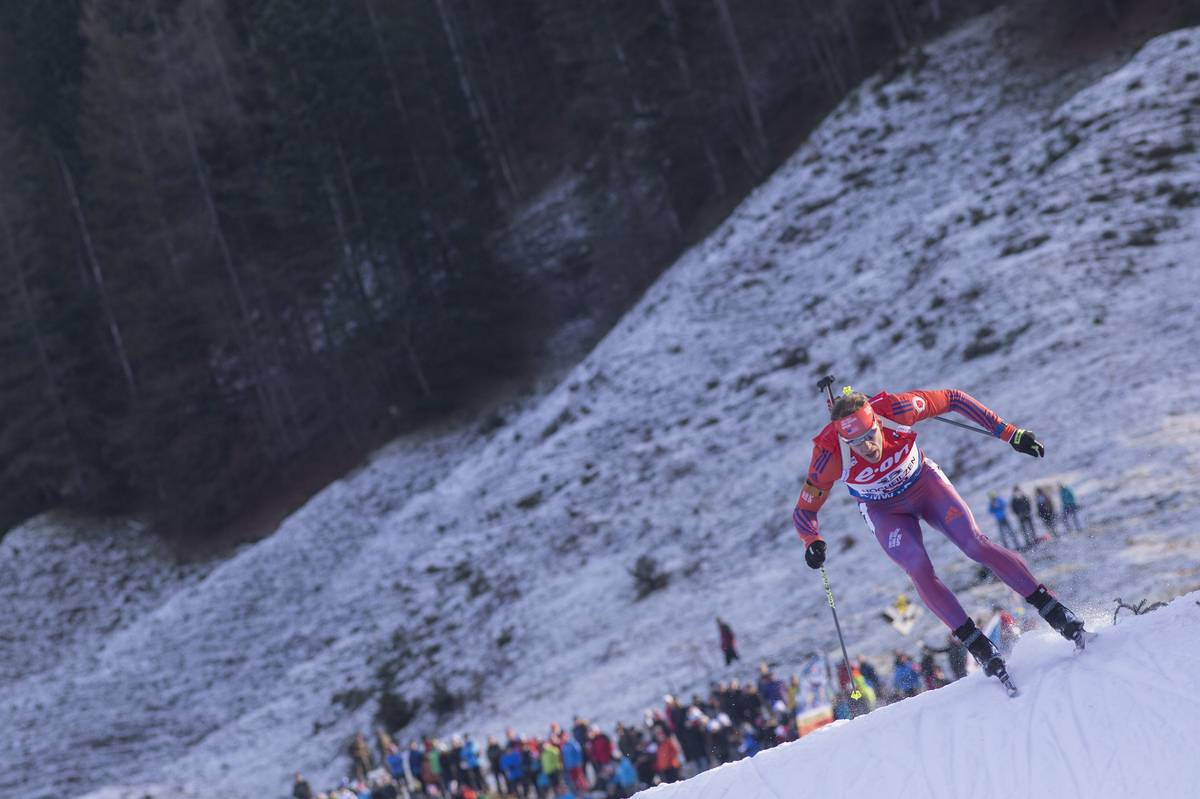
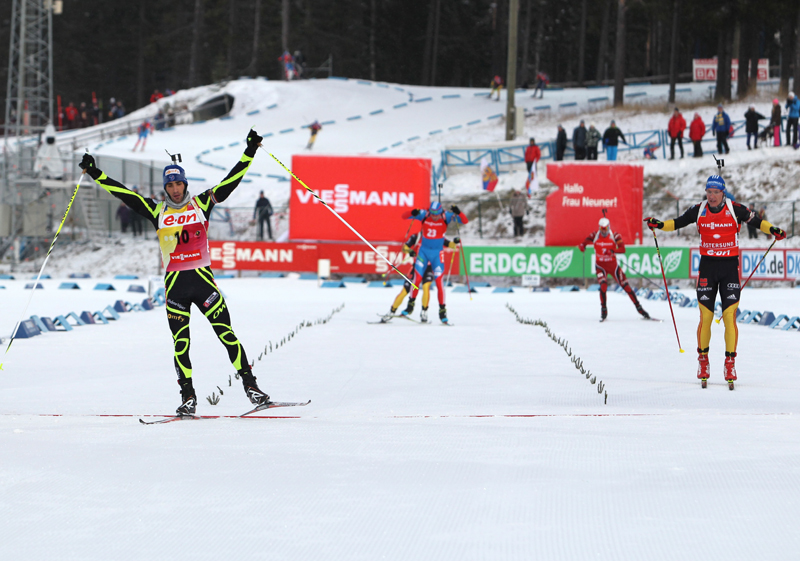
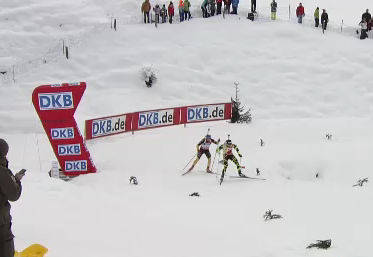
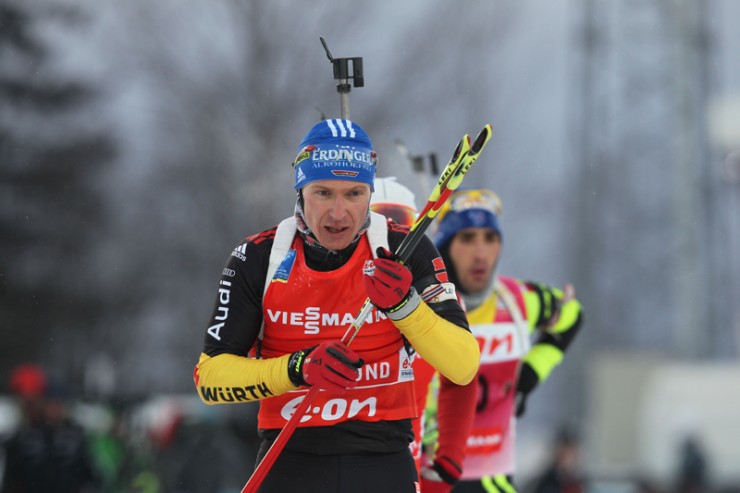
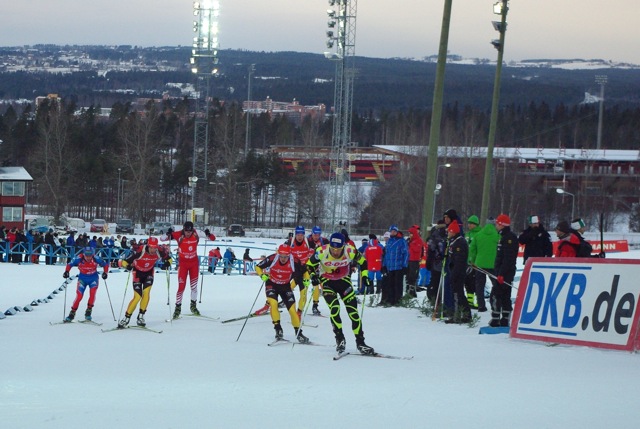
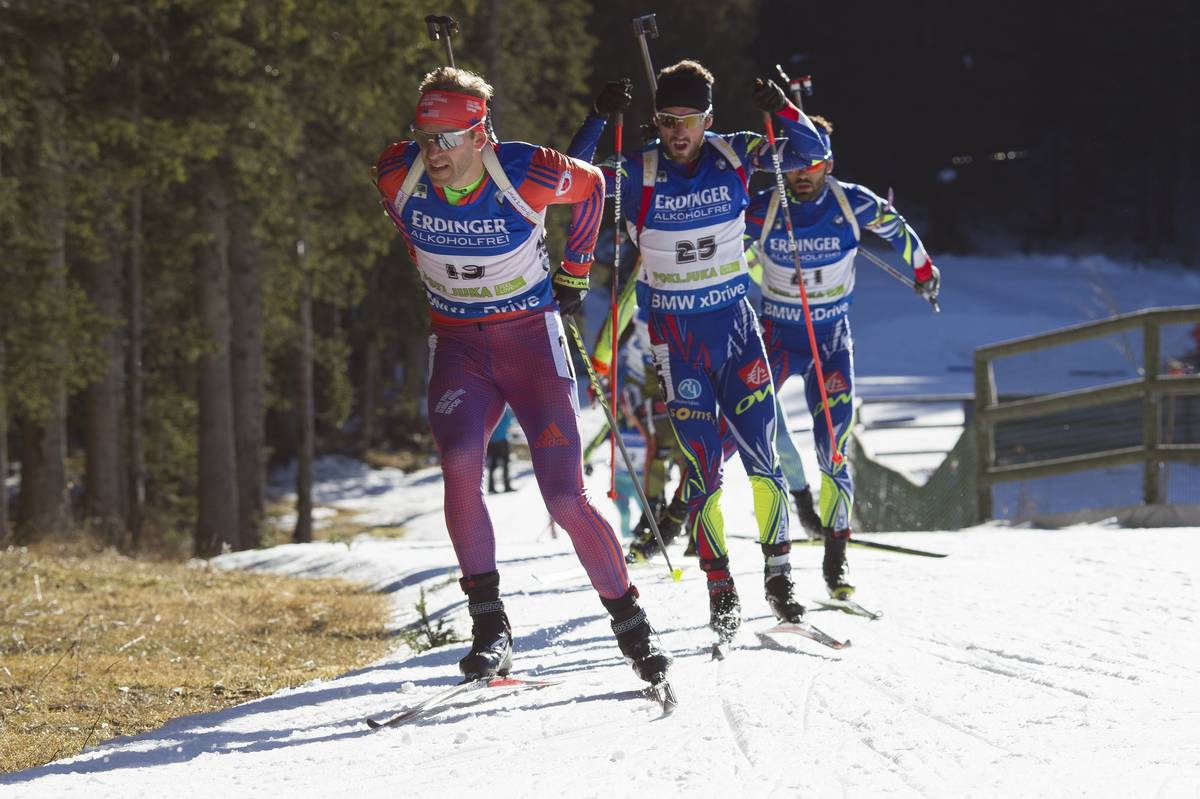
    American Lowell Bailey (l) leads eventual-winner Jean-Guillaume Béatrix (c) of France, and Simon Fourcade during Sunday's 15 k mass start at the IBU World Cup in Pokljuka, Slovenia. While Beatrix won by 0.3 seconds over Norway's Emil Hegle Svendsen, Bailey placed 23rd behind U.S. teammate Tim Burke in 22nd. (Photo: USBA/NordicFocus)
    American Lowell Bailey (l) leads France’s eventual-winner Jean-Guillaume Béatrix (c) and Simon Fourcade during Sunday’s 15 k mass start at the IBU World Cup in Pokljuka, Slovenia. While Beatrix won by 0.3 seconds over Norway’s Emil Hegle Svendsen, Bailey placed 23rd behind U.S. teammate Tim Burke in 22nd. (Photo: USBA/NordicFocus)

    On Sunday afternoon, French biathlete Jean-Guillaume Béatrix knew he was the luckiest man in Pokljuka, Slovenia, achieving the first International Biathlon Union (IBU) World Cup victory of his career in a men’s 15-kilometer mass start he hadn’t planned on racing. His place on the start list originally belonged to Austria’s Simon Eder, who qualified for one of 30 spots in the mass start based on his overall World Cup standing. But in the morning Eder did not feel well and had to decline his participation, with that start instead going to Beatrix as the highest-ranked athlete on a “standby reserve” list.

    Beatrix made the most out of the opportunity that was handed to him, cleaning all four shooting stages as the only athlete in the field, and beating out Norway’s Emil Hegle Svendsen by 0.3 seconds in the finishing sprint to win in 35:33.7.

    Third place just 2.5 seconds back went to Svendsen’s teammate, 41-year-old veteran Ole Einar Bjørndalen, who in turn beat Germany’s Simon Schempp in a photo finish by mere inches.

    In an up-and-down race closely watched by more than 6,000 spectators in the arena, many different athletes remained in contention for the podium for a long time, with the field sticking closely together due to excellent weather conditions that prompted few misses on the shooting range.

    “This [race] was a perfect advertisement for our sport once again,” commented Germany’s men’s head coach Mark Kirchner in a post-race interview with TV broadcaster ZDF, himself a three-time Olympic gold medalist in biathlon. “When you consider that on the third loop about twenty athletes were still together within 14 or 15 seconds, you know how hard it is to focus on the shooting range because you know every miss will throw you back behind the top 20.”

    At the halfway mark, US Biathlon’s Lowell Bailey was in second place, in part due to two perfect prone shootings. But he could not hold onto that position after he missed two targets in the first standing stage, and then added another miss in the final shooting, ultimately coming in 23rd (+1:29.5), one position and just 0.5 seconds behind his teammate Tim Burke, who had four misses (2+0+1+1) and placed 22nd.
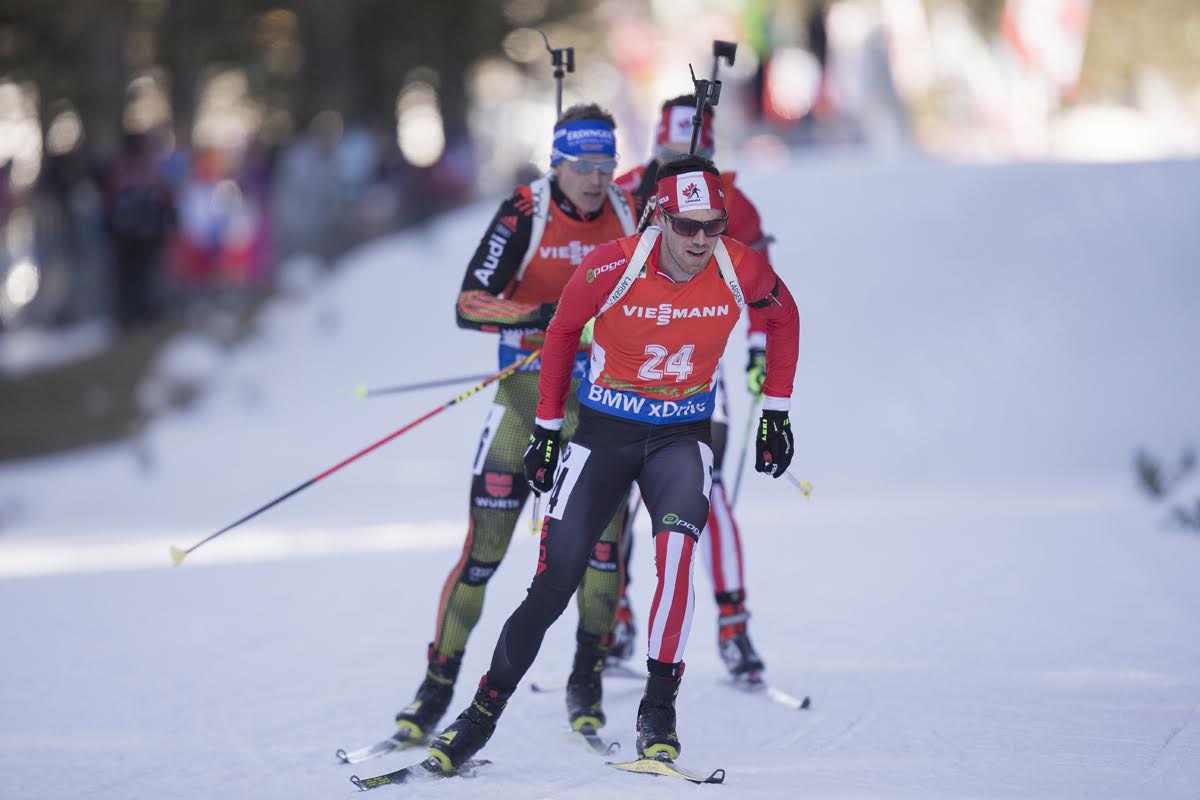
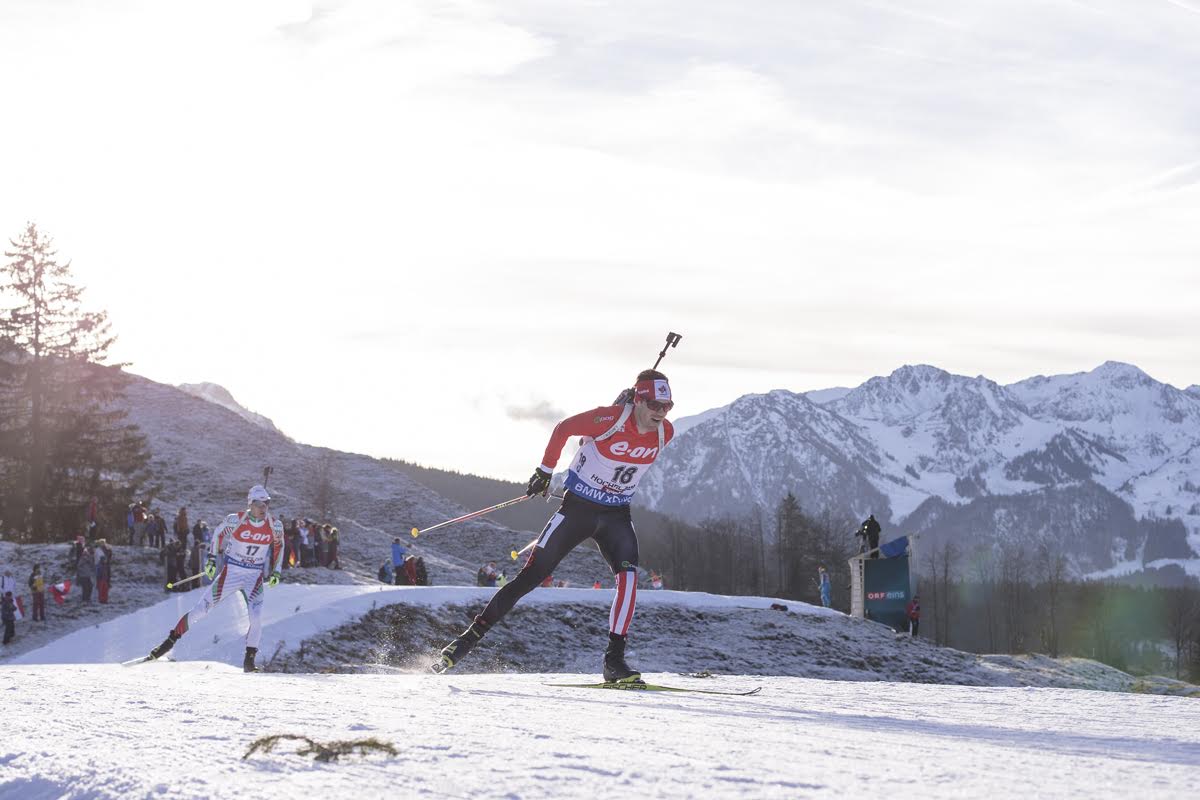
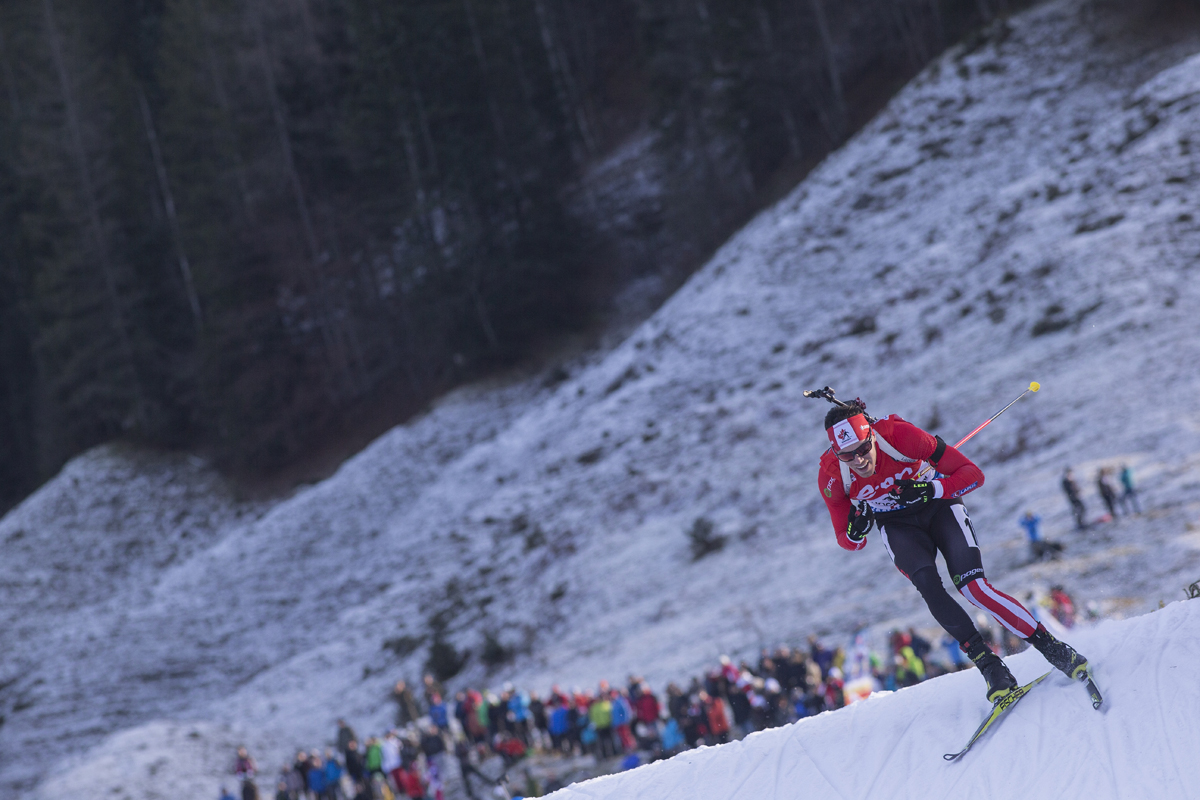
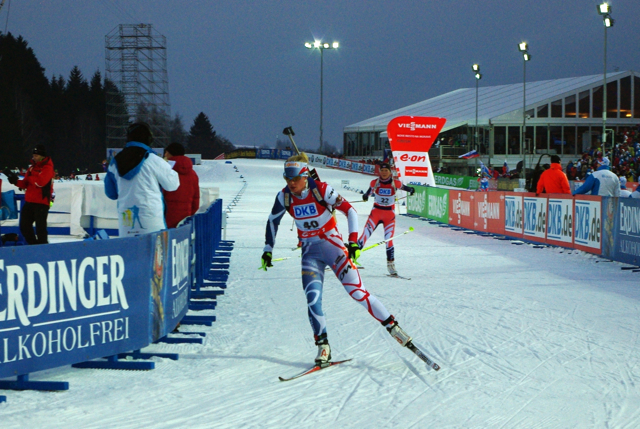
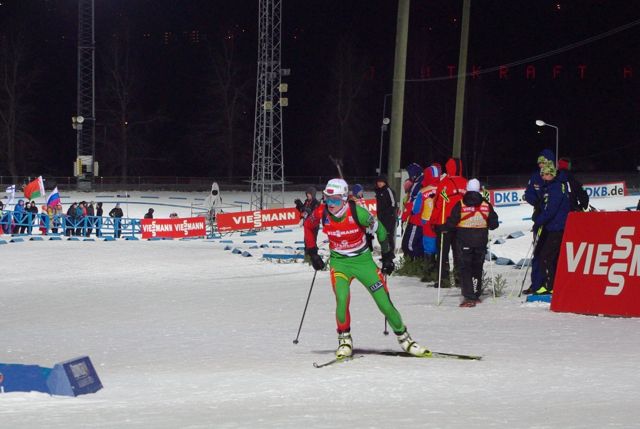
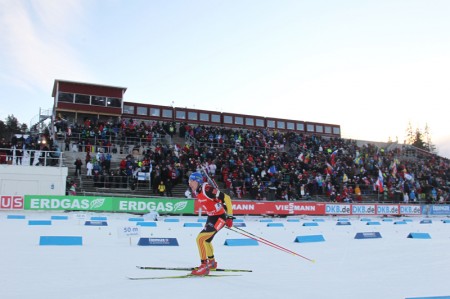
    Nathan Smith (Biathlon Canada) racing to 12th in the 15 k mass start at the IBU World Cup in Pokljuka, Slovenia. (Photo: Fischer/NordicFocus)
    Nathan Smith (Biathlon Canada) racing to 12th in the 15 k mass start at the IBU World Cup in Pokljuka, Slovenia. (Photo: Fischer/NordicFocus)

    “Today was a little bittersweet,” Bailey wrote in an email. “On one hand, I was psyched that my ski speed had improved and I was able to hang with the lead group. On the other hand, I have felt good about my standing shooting all season, so it was frustrating to throw my chances away in that first standing stage.”

    Canada’s Nathan Smith, who had placed ninth on the same course last season, also missed three targets (0+1+1+1) and finished 12th overall, 27.1 seconds behind Beatrix and 25 seconds off the podium.

    “It’s pretty much a fact in biathlon that in order to medal in a mass start you have to shoot clean in the final standing,” Smith said in a Biathlon Canada press release. “I had one miss, which left me a penalty loop behind at the end.”

    On the final loop after the last shooting, six athletes from three countries skied close together in a lead group, all vying for the podium after France’s Simon Desthieux had managed to close a small gap to his teammate Beatrix, Germany’s Andreas Birnbacher and Schempp, and Norway’s Bjørndalen and Svendsen.

    About halfway through the loop, Svendsen charged ahead to break up the group, and only Beatrix was able to stay near the tails of his skis. The two came together into the finishing stretch, with Svendsen took the middle lane and Beatrix skied to his left. As Beatrix pushed toward the finish with elongated glides and no poles, he bested Svendsen — an athlete widely respected among his peers for his ski speed and sprinting — by three-tenths of a second.

    This was Beatrix’s first World Cup win and fourth-career podium, after placing second in a pursuit in Antholz, Italy, and third in another pursuit in Sochi Russia, two seasons ago, and third in a sprint last season in Nove Mesto, Czech Republic.
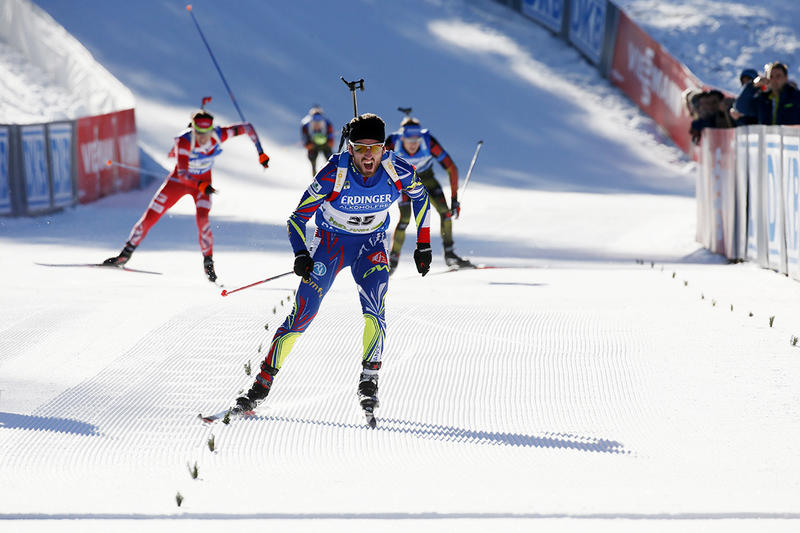
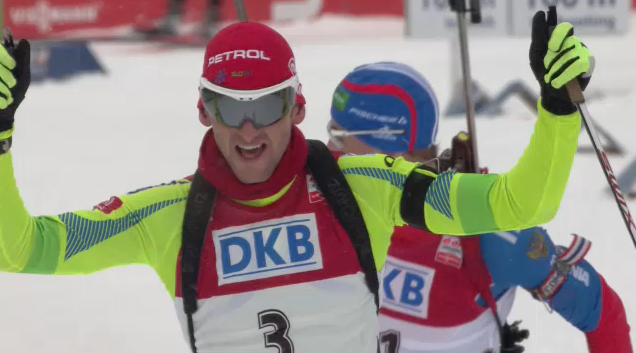
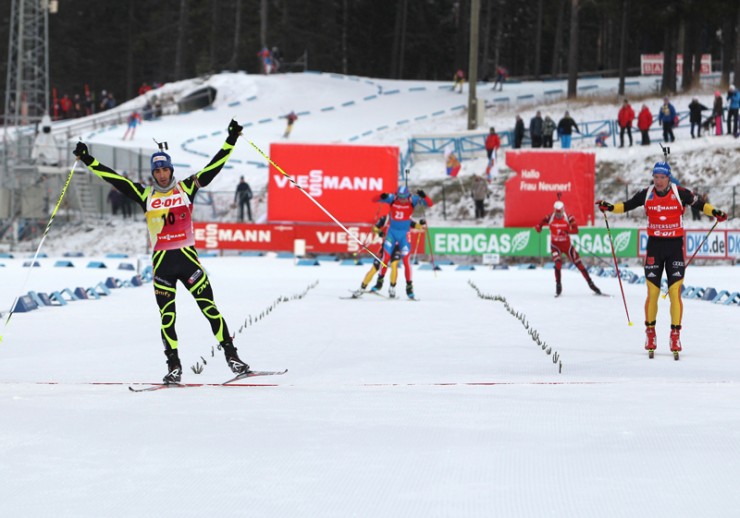
    Jean-Guillaume Béatrix of France winning Sunday's mass start for his first IBU World Cup victory in Pokljuka, Slovenia. (Photo: IBU/Kvetoslav Frgal)
    Jean-Guillaume Béatrix of France winning Sunday’s mass start for his first IBU World Cup victory in Pokljuka, Slovenia. (Photo: IBU/Kvetoslav Frgal)

    “I didn’t think I could win as Emil was strong,” Beatrix recounted when asked about the finishing push at a post-race press conference. “He looked a little tired on the last downhill though. Thanks to good skis, I managed to make a nice finish.”

    “It is nice to finish a year with a podium. It’s sad to lose on such a margin though,” Svendsen said. “I need some rest to be in my best shape, but mentally I am very motivated.”

    Bjørndalen used his extensive experience and skied a controlled race, making all but two of his 20 shots and staying clean in the decisive final shooting (1+0+1+0). At the end of the last round he could not quite keep up with Svendsen and Beatrix, but he still had some reserves.

    In a sprint for third place against Schempp, winner of the preceding sprint and pursuit in Poklujka who had also missed two shots in this race (0+1+1+0), Bjørndalen lunged across the line in what almost looked like a dead-even tie. The photo finish ultimately proved Bjørndalen beat Schempp by the tip of his boot for third. Both athletes were recorded as 2.5 seconds behind.

    “The last sprint was very hard. I focused on the third place, but Simon was so close to me,” Bjørndalen described at the press conference. “I saw his shadow on the finish line and tried to move out my feet.”

    “Right when I put forward my foot I noticed he was probably ahead of me,” Schempp told ZDF. “But still, this race was a nice conclusion [to the weekend], and now I’m looking forward to Christmas.”

    Schempp’s teammate Birnbacher placed fifth, 7.2 seconds back. It was his best result of the season. Asked whether team tactics came into play on the last loop, Birnbacher told ZDF with a laugh: “Well, unfortunately I didn’t have any power left on the last climb. Andi [German assistant-coach Andreas Stitzl] yelled to us, ‘Stay in two and three and attack out of the wind shadow,’ but I just wasn’t able to do that anymore”.

    France’s pursuit runner-up Martin Fourcade took seventh in the mass start, one behind his teammate Desthieux who was 11.4 seconds back, and also a bit behind his own expectations. Fourcade’s race got derailed early after he missed two targets in the first prone shooting, which set him back far in the field to 27th place. With two more misses later (2+0+2+0), and despite once again skiing the fastest course time of all athletes, he was never quite able to catch up to the leaders again, and finished 17.8 seconds back.

    In the overall World Cup standings, Fourcade still remains in the lead after the first trimester of races with 384 points, ahead of Bjørndalen (337) and Schempp (331). Also in the top 30, Smith is currently in 12th with 175 points, Bailey is 21st (128) and Burke is 27th (108).

    Misses Stunt North Americans

    Similar to Fourcade, Burke missed two shots in the first prone stage, setting him back all the way to the 30th in last position at that time, out of the focus of the TV cameras. He was unable to fully make up that early deficit despite steadily improving on the next loops to reach 24th before the final loop. He skied the 17th-fastest last loop to finish 22nd overall.
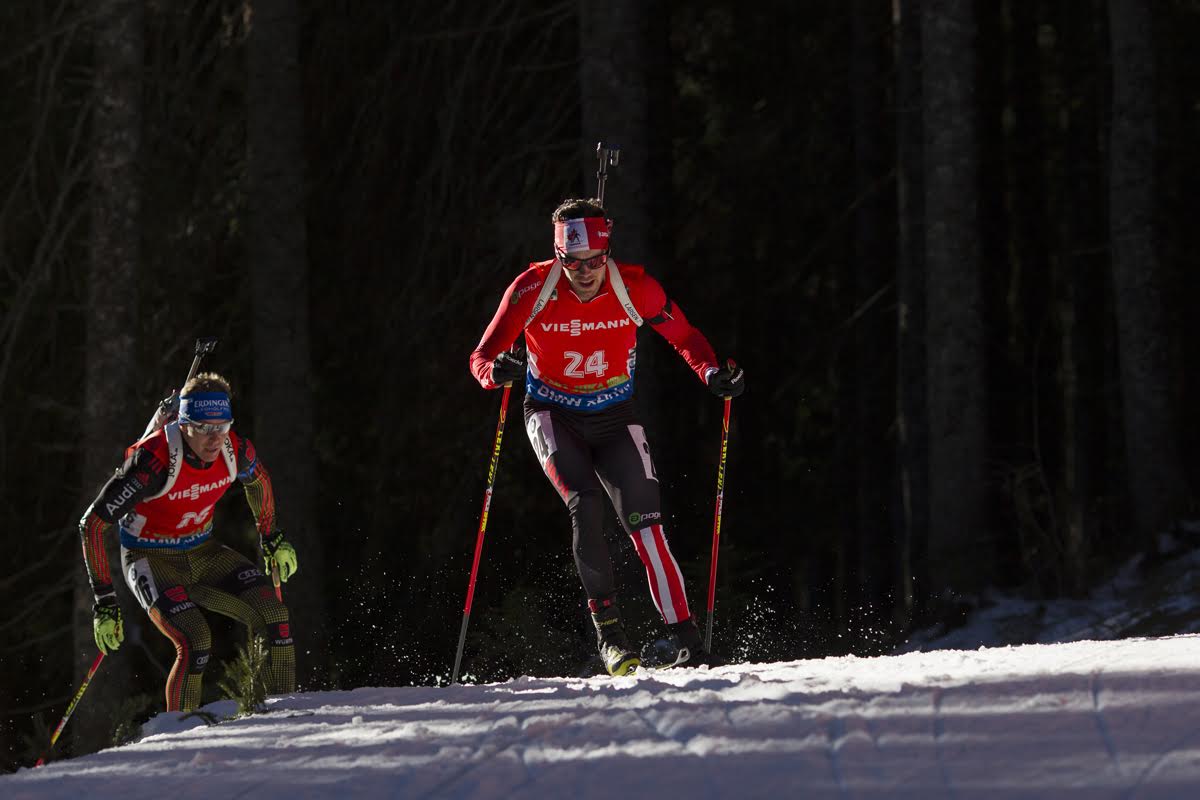
    Nathan Smith (Biathlon Canada) racing to 12th in the 15 k mass start at the IBU World Cup in Pokljuka, Slovenia. (Photo: Fischer/NordicFocus)
    Nathan Smith (Biathlon Canada) racing to 12th in the 15 k mass start at the IBU World Cup in Pokljuka, Slovenia. (Photo: Fischer/NordicFocus)

    His teammate Bailey and Canada’s Smith had more visibility on the broadcast, with Bailey moving to the front of the field for a while after he managed to clean the first two stages. On the third loop at 7.6 k he was skiing in second, just 0.5 seconds behind France’s Quentin Fillion Maillet, and entered the range in that position for the first standing. There, Bailey missed two targets and fell way back to 18th place, 49.1 seconds behind the leaders as he set out on his fourth loop.

    “The pace was reasonable at the front of the race and at several points. It even slowed as everyone was jockeying for position,” Bailey recalled. “So, I can’t blame the misses on coming in too hard. Sometimes you just miss!”

    After another miss on the last shooting stage set further him back, Bailey found himself in 22nd and 1:16.5 back, around where Burke had been skiing with throughout the race. On the final loop Burke caught up to him, then was able to narrowly beat Bailey by half a second to the line.

    “I’m satisfied with the first trimester; a few good results, a couple of missed opportunities, but overall, a solid start,” Bailey wrote.

    Smith skied fast on Sunday, with the 10th-ranked course time overall, despite one miss on each of the last three stages. After each penalty loop, he made up 10 seconds or more on the leaders to significantly reduce his time back on each loop. After the second shooting, he left the range in 13th place, 17 seconds out of first, then had already reduced that to 7 seconds by the first split time on the next loop and 5 seconds by the second timing point.

    “After the sprint and pursuit I was worried about how my ski shape would be today. I had been feeling really lethargic on course,” Smith wrote in an email. “Thankfully today I was able to put out some solid ski speed. I ate an entire Toblerone and a large serving of chips yesterday evening. I’ll give some credit to that.”

    But despite his fast skiing, the three penalties prevented Smith from making a push into the top 10.

    “I was fine with the couple penalties earlier in the race, but I know that in the final shooting of every mass start 5/5 is a requirement if you want a medal,” he wrote. “I missed one. That’s biathlon.

    “I was hoping to grab a top 6 or individual medal before Christmas, but on the other hand, the single mixed relay with Rosanna [Crawford] was a definite highlight,” Smith added. “My world cup overall ranking is also a lot higher than last year at this time. With a couple close opportunities already I think that I’m on track for a very successful next trimester. “

    Results

  • Fourcade Strikes Back in Hochfilzen Pursuit; Bailey Just Misses Top 10

    Fourcade Strikes Back in Hochfilzen Pursuit; Bailey Just Misses Top 10

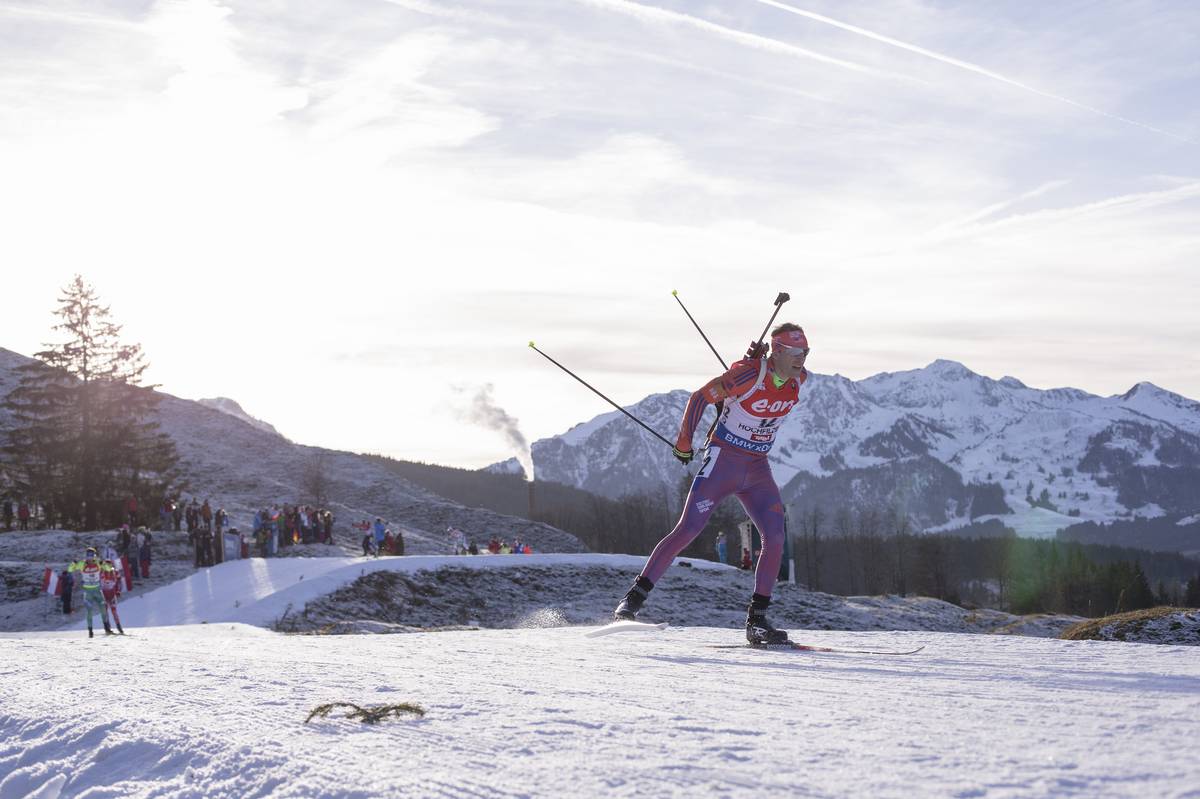
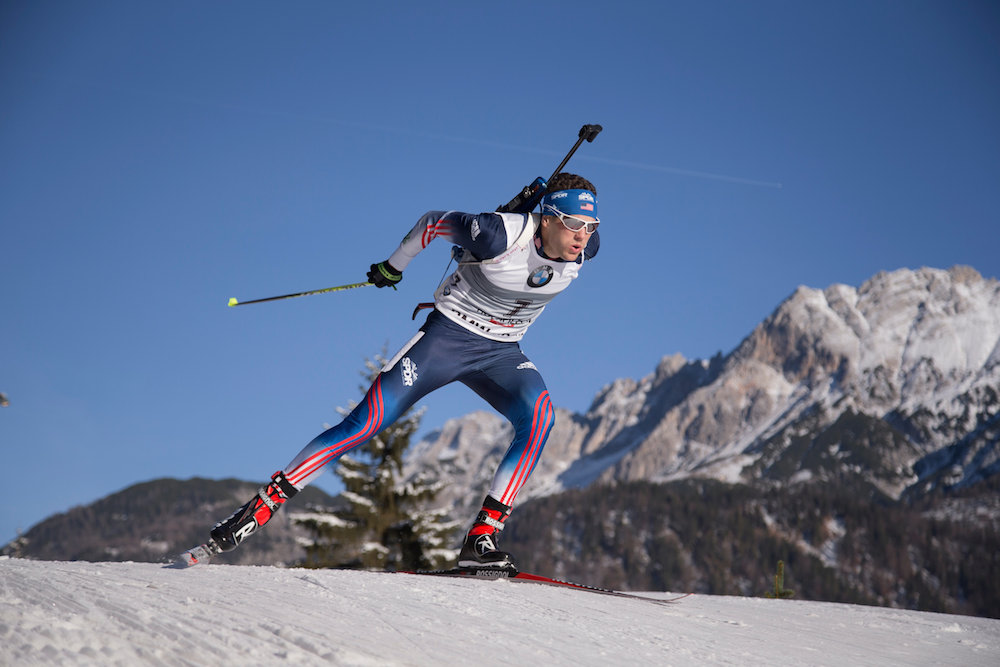
    Lowell Bailey on his way to 13th in the men's 12.5 k pursuit at the IBU World Cup in Hochfilzen, Austria. (Photo: USBA/NordicFocus)
    Lowell Bailey (US Biathlon) on his way to 13th in the men’s 12.5 k pursuit at the IBU World Cup in Hochfilzen, Austria. (Photo: USBA/NordicFocus)

    Despite the best efforts of his competitors, it appeared French biathlon star Martin Fourcade was almost his own worst enemy in Saturday’s 12.5-kilometer World Cup pursuit in Hochfilzen, Austria.

    In a scene reminiscent of Norwegian cross-country skier Heidi Weng’s mistake in Kuusamo earlier this season, Fourcade, who was being followed closely by Germany’s Simon Schempp and Russia’s Anton Shipulin, nearly skipped his final shooting stage. He was saved, though, because as he turned towards the finishing stretch, he saw his two competitors ski toward the range again. He very quickly realized his mistake, and followed them, keeping his focus to clean the final stage.

    After that he never looked back until he finished first in 31:19.9, pounding his chest and pointing to the crowd as he did so. Schempp finished 8.9 seconds later in second place and Shipulin was 19.1 seconds back in third to round out the podium.

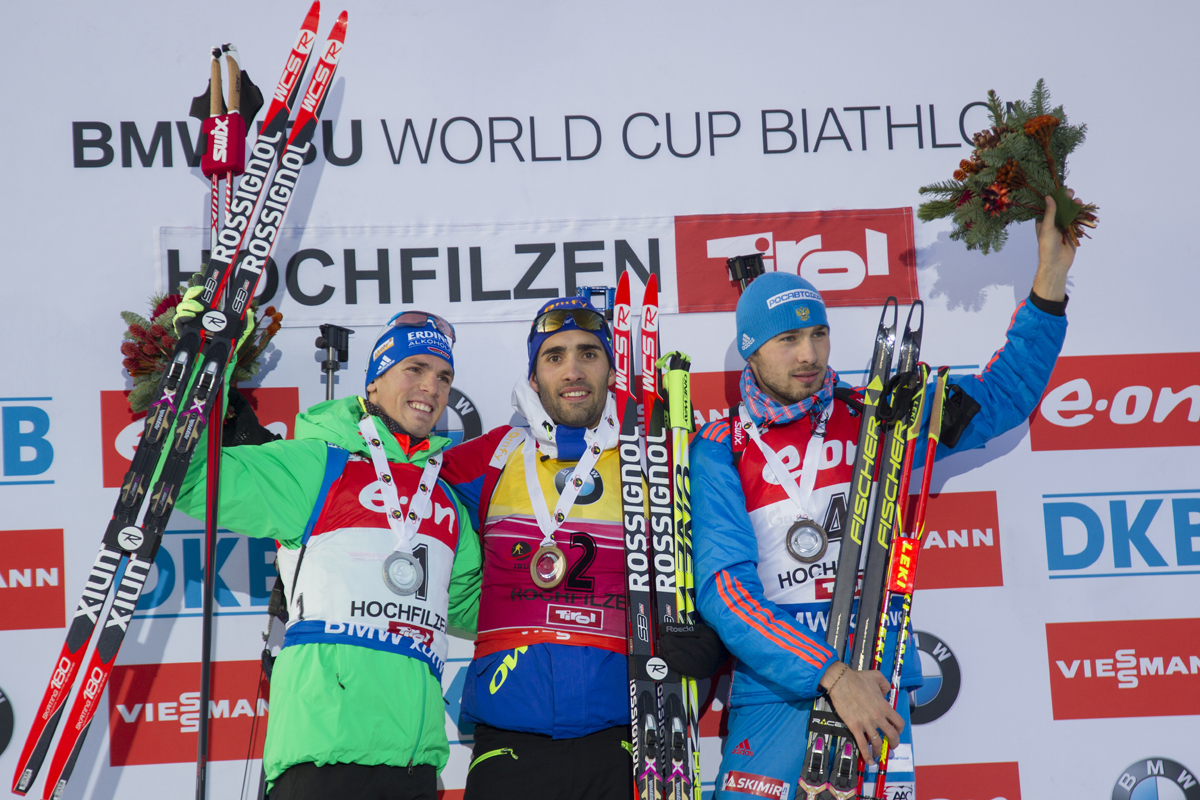
    After what runner-up Simon Schempp (l) of Germany called a "psycho race" Schempp, winner Martin Fourcade (c) of France, and Russia's Anton Shipulin (r) shared the pursuit podium at the IBU World Cup in Hochfilzen, Austria. (Photo: Fischer/NordicFocus)
    After what runner-up Simon Schempp (l) of Germany called a “psycho race” Schempp, winner Martin Fourcade (c) of France, and Russia’s Anton Shipulin (r) shared the pursuit podium at the IBU World Cup in Hochfilzen, Austria. (Photo: Fischer/NordicFocus)

    During a post-race press conference, Fourcade had no comment on his nearly-disastrous wrong turn. But Schempp, who suspected a mistake mused it might just have been a move by Fourcade to avoid having to go on the first position on the shooting range.

    “It was a wonderful victory at the site of the next [2017] World Championships,” Fourcade told the IBU. “My fan club, my family, is here, and it was a really good fight. I love to win, but I love to win more when the opponents are really strong. Today it was a great fight, which is why I’m so happy to succeed.”

    For most of the race, Friday’s sprint runner-up Fourcade had struck with or been within a few seconds of sprint winner Schempp and Shipulin, who started fourth. After taking the control of the pursuit, each with two clean shooting stages, Schempp and Shipulin at times slowed down considerably on the track, skating next to each other with Shipulin gesturing wildly for Schempp to take his turn in front, but the German was seemingly unwilling to set the pace.

    This posturing enabled a few athletes, including Fourcade, to close the gap to them again, after Fourcade had missed two targets in the second shooting. But he, too, didn’t want to take the lead.

    All three athletes managed to leave the crucial last shooting stage without a miss. Fourcade shot the fastest, and Schempp entered the final lap about five seconds later, with Shipulin 12 seconds behind. They tried everything in their power to catch Fourcade, but to no avail.

    “I am happy about the second place,” Schempp told the German broadcaster ARD, “but it was a complete psycho race. Like Martin not wanting to go in front, then attacking just ahead of the shooting, then he wanted to skate into the finish…”

    “It was not so easy for my brain. Topsy-turvy, but that’s part of the game,” he added. “It was a fine competition [for me] with one miss on the shooting range. And of course I’m happy with the second place.”

    Nathan Smith (Biathlon Canada) racing to 18th in the IBU World Cup pursuit in Hochfilzen, Austria. (Photo: Fischer/NordicFocus)
    Nathan Smith (Biathlon Canada) racing to 18th in the IBU World Cup pursuit in Hochfilzen, Austria. (Photo: Fischer/NordicFocus)

    Both athletes complimented their fierce competition afterward.

    “I gave all I had in the beginning of the loop,” Schempp said in the press conference. “The gap was the same a long time, but at the last hill, Martin was very strong, so I had to defend my second place to Anton.”

    Fourcade echoed those remarks after swapping positions with Schempp in two races between Friday and Saturday.

    “Simon showed me on the last lap it was necessary to do my best,” Fourcade said. “This week I had to give 100 percent. It was a great fight between us.”

    Shipulin also expressed his satisfaction with his first podium of the season.

    “I realized those are my conditions and I’m getting better and better compared to the first leg in Östersund,” he said through a translator. “I still have to work hard on my form, but I’m really glad this is the first podium for me, and I’m doing better and better race by race.

    “I have always loved pursuits,” Shipulin added. “Of course, I was a bit disappointed [Friday] with the fourth place, but I only tried to pay attention to today and in the end the podium is a good result.”

    Last week at the World Cup in Östersund, Sweden, Schempp struggled mightily with the windy range, missing the pursuit after placing out of the top 60 in the sprint.

    Asked before Saturday’s race how he coped and turned a difficult situation into a sprint victory on Friday, Schempp revealed his latest training secret to ARD: last week, he had worked with his home-team coach and assistant national-team coach Andreas Stitzl, using a leaf blower to simulate strong sudden gusts of wind.

    While he acknowledged Fourcade’s strong performance in the two Hochfilzen individual races, Schempp was not too pleased with a scene that happened during the final shooting stage. He claimed Fourcade, who was next to him, nicked Schempp’s ski poles on the mat between his legs while Fourcade left the range.

    “You have to be able to focus on yourself, but of course you notice what happens left and right,” Schempp told ARD. “I noticed Martin had hit everything in the last shooting, he was a little bit faster than me. And then when he was leaving, he hit my ski poles good, while I still had one shot. That brought me out of my rhythm a little bit, but thank God I hit it. Then on the last round I tried everything, but there was nothing left.”

    Schempp reiterated this irritation in his post-race interview with the IBU: “I was not calm every time. It was a psycho race. You have to be calm.”

    Norway’s Tarjei Bø, who had started the pursuit in third, always kept the leaders in viewing distance but couldn’t quite catch them in the end, finishing with two penalties (0+1+0+1) and missing the podium by 12 seconds (+31.2).

    With about 8,000 spectators in the stadium and lining the course in the Austrian Alps, local fan favorite Dominik Landertinger managed to move up eight positions with a single miss, finishing fifth place (+39.8), ahead of Norwegian stars Ole Einar Bjørndalen (+57.5) and Emil Hegle Svendsen (+59.5).

    Landertinger told the Austrian television broadcaster ORF that he’s been struggling with the recent death of his mother and wished she could have been there to see him.

    “Everything I had to go through in recent weeks, I can tune that out pretty well during the race,” he said. “I have a great family with everyone supporting each other, but this has been a hard time for me.

    “That was a very good race. I came through the shooting great. I achieved exactly what I had set out to do. Focus just on myself,” Landertinger added. “But for the podium I should not have had that miss. You’ve got to be satisfied, there are so many good guys here.”

    Bailey Just Outside Top 10

    Lowell Bailey on his way to 13th in the men's 12.5 k pursuit at the IBU World Cup in Hochfilzen, Austria. (Photo: USBA/NordicFocus)
    Lowell Bailey on his way to 13th in the men’s 12.5 k pursuit at the IBU World Cup in Hochfilzen, Austria. (Photo: USBA/NordicFocus)

    Of the eight North American men in Saturday’s pursuit, US Biathlon’s Lowell Bailey came closest to a top 10 after starting 12th and briefly moving into eighth with two clean prone stages. He skied the third lap in a fairly large chase group with six other athletes, but after missing a target in the first standing, Bailey fell back to 13th.

    From there, the 34-year-old Bailey pushed to hang on up two climbs on the course. After cleaning his final standing stage, he left the range for a last time in 10th place, just between Germany’s Andreas Birnbacher and Slovenia’s Jakov Fak. Bailey faded a bit on the last loop, and in the finish he had given up the positions he previously gained on the shooting range, ending the day in 13th place (+1:20).

    “Today was a great indicator of how strong the current men’s World Cup field is,” Bailey said in a US Biathlon press release. “I feel really good about my race today, but unfortunately I wasn’t able to hold or improve my starting place. Some days the field is just that strong and you just have to live with the result. Still, I’m happy with another top-15 and excited for the relay tomorrow.”

    Nathan Smith of Canada skates his way to 18th at the IBU World Cup pursuit in Hochfilzen, Austria. (Photo: Fischer/NordicFocus)
    Nathan Smith (Biathlon Canada) racing to 18th in the IBU World Cup pursuit in Hochfilzen, Austria. (Photo: Fischer/NordicFocus)

    Biathlon Canada’s Nathan Smith ended the day in 18th (+1:48.4) — the same position he had started in — with too many penalty laps preventing a better result. Smith missed two targets in the first shooting, then cleaned the next two stages before adding another two penalties in the last standing to his tally. His skiing remained strong, posting the fifth-fastest time on the final lap for the 13th-best course time overall.

    On Friday, Smith had predicted “some spectacular crashes” in the pursuit, due to the difficult snow conditions on the course. Crashes didn’t decide the outcome of Saturday’s race, but indeed, there were some victims. Germany’s Daniel Böhm careened off the course on the third lap in a downhill hairpin turn, then struggled back to his feet and onto the elevated track. Worse yet, in addition to the lost time, Böhm damaged his rifle in the crash and had to switch to the official reserve each team has in store during a race. However, as he explained after the race, that replacement rifle has a generic fit, rather than being fitted to any one athlete. Böhm went on to miss three shots between the last two standing stages, ultimately falling nine spots to 55th (+6:14.2).

    Tim Burke achieved another top 30 for the U.S., moving up three spots to finish the day in 27th (+2:38.5). He cleaned the first two prone stages, before missing three on the next two (0+0+2+1) and crashing, which set him back farther.

    “I had a great start to the race today with two clean prone stages and solid skiing,” Burke wrote in an email. “Unfortunately, I had a huge crash on the third loop and lost a lot of time.  This definitely took a little wind out of my sails.”

    He was cheered on by his wife, retired German biathlete Andrea Burke (formerly Henkel), who attended the race with a few friends from her national-team days.

    “Considering [the crash], I was very happy to still move up a few places,” Burke continued. “I was really happy with my skiing so far this week.  It was a big improvement from Ostersund and I feel like I am back to my normal ski form.

    “I am pretty banged up from the crash today,” he added. “But am hoping to feel better for the relay tomorrow.  Everyone seems to be in good shape, so anything is possible!”

    A third American, Sean Doherty started 45th and ended the pursuit in 35th (+3:24.8). He missed six (2+1+1+2) while skiing the 23rd-fastest course time. Leif Nordgren placed 52nd (+5:27.1) for the U.S., with three misses in the first shooting and five in all (3+0+1+1).

    Canada’s Christian Gow moved up 20 spots to finish 39th (+3:43.1) after having missed two targets and cleaning both standing stages (1+1+0+0), while his older brother Scott Gow missed six targets (2+3+1+0), and dropped 12 places to end the day in 45th (+4:23.8).

    Racing continues in Hochfilzen with the four-person relays on Sunday.

    Results

  • Thingnes Bø Pulls Out Fast-and-Flawless Hochfilzen Sprint; Burke Goes ‘All Out’

    Thingnes Bø Pulls Out Fast-and-Flawless Hochfilzen Sprint; Burke Goes ‘All Out’

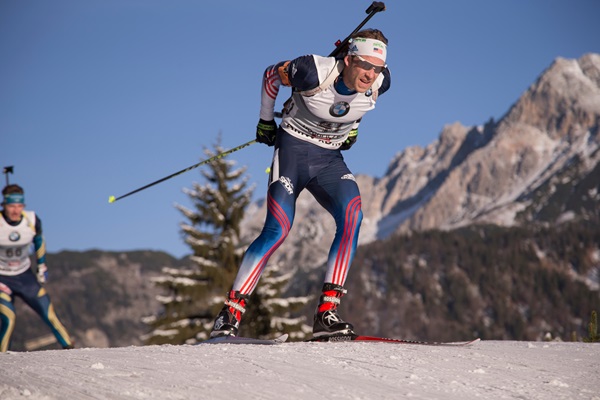
    Tim Burke racing to 13th in the men's 10 k sprint at the IBU World Cup on Friday in Hochfilzen, Austria. (Photo: USBA/NordicFocus)
    Tim Burke racing to 13th in the men’s 10 k sprint at the IBU World Cup on Friday in Hochfilzen, Austria. (Photo: USBA/NordicFocus)

    Note: This article has been updated to include comments from Canada’s Nathan Smith.

    Tim Burke knows you have to get a little weak in the knees to achieve the performance of a lifetime. Or something like that.

    Friday’s IBU World Cup 10-kilometer sprint in Hochfilzen, Austria, wasn’t exactly that race for the U.S. biathlete — he’s had plenty of top 10s and top 15s in his career — but it was headed in that direction.

    “One of my big goals this year is to really try to attack every race and give myself the best chance I can to get on the podium,” Burke said on the phone after Friday’s race.

    As the seventh starter of 105 men on an unusual 2.5 k loop (shorter because of Hochfilzen’s lack of snow; racers had to ski two uninterrupted loops between the first and second stages), Burke started fast and tried to hold it the pace throughout the three-lap race.

    He ended up cleaning prone and hitting every target but his last in standing.

    That was the one he wanted back — but he also acknowledged that he pushed himself to the brink.

    “I came into that last stage really gassed; I definitely went all out after the start,” Burke said.

    After organizers trucked in snow to hold the races, conditions were fast and solid on a just-above freezing, sunny afternoon. According to Burke, he experienced good conditions and no wind during his race. It was just a matter of fatigue when it came to the last stage.

    “After the third and fourth shot, I was starting to shake a little bit and couldn’t really hold it together for that last shot,” he said. “I feel like right now in men’s biathlon, it’s so competitive that there are always a bunch [of guys] who are going to take a gamble, and I realize that to get the podium now, I really need to get right to the edge and sometimes over the edge, and that’s the way I want to start every race.”

    That’s also the way he finished it. Glad to have just 2.5 k to go on his last lap, Burke crossed the line in Burke fourth. He would eventually end up 13th.

    “Even after the miss, I still thought I could be up there in the top-ten today,” he said. “Normally at this range, you see a lot of penalties because it’s a challenging approach to the range.”

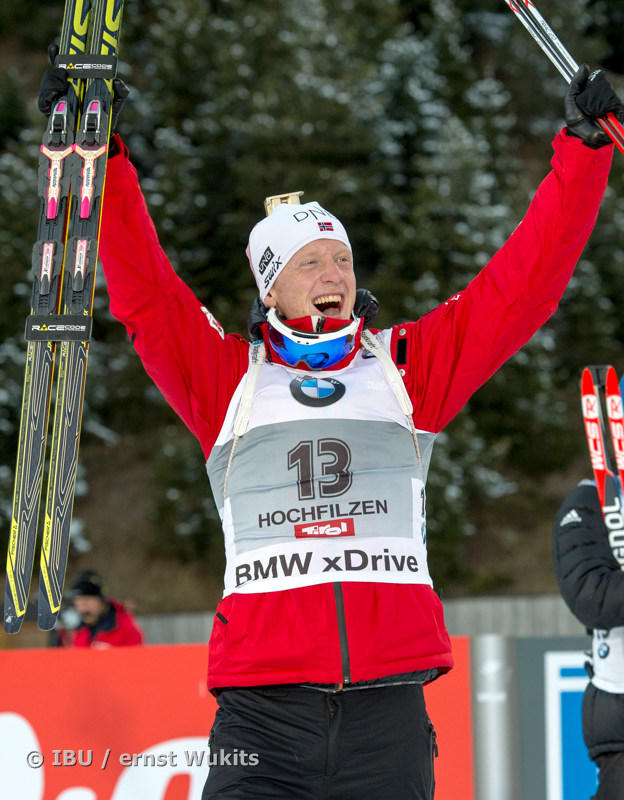
    Johannes Thingnes Bø celebrates his 10 k sprint win at Friday's IBU World Cup in Hochfilzen, Austria. (Photo: IBU/Ernst Wukits)
    Johannes Thingnes Bø celebrates his 10 k sprint win at Friday’s IBU World Cup in Hochfilzen, Austria. (Photo: IBU/Ernst Wukits)

    After the start, racers headed straight down into the valley before turning around for a long grind back to the top. Burke said that type of “gradual climbing” was what suited him best. To his surprise, several others hit most of their targets as well. The top four — Norway’s Johannes Thingnes Bø, Germany’s Simon Schempp and Andreas Birnbacher, and Austria’s Dominik Landertinger, respectively — all cleaned.

    At the end of the day, Burke knew his one miss probably cost him the podium, but he continued to focus on the positives and was pleased he took the risk. His course time ranked ninth-fastest overall.

    “I’m really happy with my ski speed right now; I think it’s probably my strongest start ski-speed wise that I’ve ever had,” he said.

    Burke finished 39.6 seconds behind Bø, who took the lead from fellow Norwegian Emil Hegle Svendsen, who started second, after starting 13th and quickly cleaning prone. Hegle cleaned as well, but missed one standing and gradually fell farther behind the 21-year-old Bø, who notched the fastest course time.

    Bø finished in 24:34.9, beating Schempp by 14.3 seconds for the win on Day 1 of the second World Cup of the season. Birnbacher was 17.9 seconds back in third, and Landertinger finished 22.5 seconds after Bø in fourth. He edged Slovenia’s Jakov Fak by 0.4 seconds, and Bø’s older brother, Tarjei, cleaned for sixth (+26.7).

    In fact, sixth through eighth place finished with perfect shooting. France’s Martin Fourcade was seventh (+27.8) and Russia’s Dmitriy Malyshko eighth (+29.2). Svendsen, the overall World Cup leader, placed ninth (+30.9) with a single miss.

    Friday’s sprint finishes determine the start order and time back for Sunday’s 12.5 k pursuit.

    “I stayed really close today, only 39 seconds back and I’ll start in a big group of guys,” Burke explained. “It should be an exciting race. I think a lot of guys will be contending for the podium.”

    Lowell Bailey (US Biathlon) racing to 17th in Friday's 10 k sprint at the IBU World Cup in Hochfilzen, Austria. (Photo: USBA/NordicFocus)
    Lowell Bailey (US Biathlon) racing to 17th in Friday’s 10 k sprint at the IBU World Cup in Hochfilzen, Austria. (Photo: USBA/NordicFocus)

    Burke’s teammate Lowell Bailey also landed in the top 20 for the U.S. on Friday, cleaning and tying Bulgaria’s Krasmir Anev for 17th, 57.6 seconds behind the winner.

    On Saturday, Bailey, Burke, Leif Nordgren, and Russell Currier will team up — in that order — in the men’s 4×7.5 k relay. “Anything can happen for sure,” Burke said.

    Nordgren placed 51st on Friday (+2:19) to qualify for the pursuit, with a single miss in prone. Currier was just outside the top-60 needed to qualify, finishing 61st with three penalties — two prone and one standing.

    Nathan Smith led the Canadians in 44th with three misses as well — two prone, one standing, and 1:57 behind the winner. Brendan Green placed 49th with two prone penalties (+2:13.9).

    In an email, Smith explained more than half of their team came down with a cold in Östersund.

    “I felt tired and on the edge during the travel day Monday. Thankfully I managed to turn things around and feel good again,” he wrote. “My prone just plain did not feel very solid. I fought for the shots but they didn’t come easily. Standing was pretty good but my first shot, which missed, I pulled a little early.”

    Smith felt better about his skiing.  I felt like today could have been a top-20 ski time but I didn’t quite make it,” he said. “Usually I feel better race to race, so maybe on Sunday I’ll be there.”

    In Sunday’s pursuit, he’ll aim for a top 30, and “with an amazing race, perhaps top 20,” he said. “I’m farther back than I’d hoped.”

    In an email, Green explained he was frustrated to open with two misses.

    “My shots throughout that bout were consistently high but I think that’s something I should be able to work through going into [Saturday],” he wrote. “Standing felt solid with a nice rhythm which I’m happy with.”

    Struggling with back pain since the start of the season in Sweden, Green explained that it wasn’t quite 100 percent, but it hadn’t kept him from doing any of his planned workouts this week, either.

    “The travel day from Sweden was hard on it but I’ve been able to get daily treatments here which are definitely helping it from getting any worse,” he wrote. “I’m hoping that over Christmas I’ll be able to spend time with my physio and sort things out to a more manageable level again.  Hopefully I won’t have too many issues with the rest of the season in the new year.”

    As for how he felt skiing on Friday, he wrote that it was “slowly starting to come along.  I’m definitely disappointed with my start to the season thus far and with my form, but I know there is the potential there for a lot more and hopefully I will get a glimpse of that soon. The course seemed to hold up fairly well and although we had to ski a double 2.5km loop after prone the race still went by pretty fast.”

    In Saturday’s relay, Smith will start for the first time, followed by Green, Marc-André Bédard, and Scott Perras. On Friday, Bedard placed 82nd with three misses (2+1) and Perras was 100th with six penalties (3+3).

    “I’ve never been anything but 3rd or 4th leg,” Smith wrote, “so it’s going to be a new experience for sure! I want to tag Brendan off in a position where he can be right in there with the lead pack. A good result right now for where we’re at is top 8.”

    “I know we’ll all be focused on doing our job during each leg of the relay and racing to the best we can,” Green wrote. “We’ll see at the end of the day how we stack up against other nations.”

    Results

  • Biathlon Preview, Part I: The Big Four

    Biathlon Preview, Part I: The Big Four

    Let's look forward to more exciting finishes like this one from last season in Ostersund, Sweden, where Martin Fourcade (FRA) played cat and mouse with Andreas Birnbacher (GER) in the last lap of biathlon's 12.5 k pursuit before beating him to the line. Photo: Fischer/Nordic Focus.
    Let’s look forward to more exciting finishes like this one from last season in Ostersund, Sweden, where Martin Fourcade (FRA) played cat and mouse with Andreas Birnbacher (GER) in the last lap of biathlon’s 12.5 k pursuit before beating him to the line. Photo: Fischer/Nordic Focus.

    The IBU World Cup biathlon season kicks off on Sunday with a mixed relay in Östersund, Sweden. With everybody gearing up to have their best performances at the Olympics, it’s set to be an exciting season – and there are other unusual aspects, too. For instance Annency, France, will make its World Cup debut as the third venue the circuit travels to.

    What about the racers? Here’s our breakdown of what to expect from the top four teams, listed in order of their combined men’s and women’s World Cup scores from last season. Stay tuned in the next few days for the rest of the teams.

    Norway

    At last year’s World Championships in Nove Mesto, the Norwegians won the mixed relay by 20 seconds, and it was no great surprise. Tora Berger was in the overall leader’s jersey for almost the entire season and took the title by a landslide; Emil Hegle Svendsen was in the fight for the men’s title all the way down to the wire, wearing the leader’s bib at times and ultimately finishing second. Both appear to be in good form already this year. Svendsen won a test race in Sjusjøen this weekend over a stacked field, and Berger had some shooting trouble but is certain to straighten that out before the season gets too far underway. She’s plenty fast.

    Tora Berger of Norway medaled - gold or silver - in every race of last year's World Championships, and dominated the World Cup Total Score. Photo: Fischer/NordicFocus.
    Tora Berger of Norway medaled – gold or silver – in every race of last year’s World Championships, and dominated the World Cup Total Score. Photo: Fischer/NordicFocus.

    On the men’s side, Norway looks even better than last year. Tarjei Bø, the 2011 overall World Cup winner, is back in good shape and was setting the pace in Sjusjøen; he struggled last year after missing a large chunk of the training season with illness, but managed a World Championship gold all the same. Ole Einar Bjørndalen didn’t always impress last year, but he also looks to be in better form, having won one of the Sjusjøen races and placed second in the other. The question is whether the 39-year-old can keep it together for a whole season all the way to the Olympics, but if anyone can do it, he can.

    This year the national team went with a decision to favor youth over experience. It seems to have paid off: Vetle Sjåstad Christiansen was second in this weekend’s mass start, while World Junior Champion Johannes Thingnes Bø was seventh in both races in his first year as a senior. The move came at the expense of Lars Berger and Alexander Os, veterans who were left off the team and had to train on their own. But they seem to have weathered the storm; the pair were invited to Font Romeu, France, this fall by the Fourcade brothers. Berger was third in the Sjusjøen mass start and Os sixth in the sprint. They will both likely see World Cup starts as well.

    On the women’s side, Synnøve Solemdal had a breakout year, winning her first World Cup race. But she had an up-and-down season, which may be partly attributed to her asthma; she says that she has now worked a lot on breathing techniques which help. Ann Kristin Flatland, a former World Cup winner, made her return partway through the season after having a baby, and is in good form again. Fanny Welle-Strand Horn broke into the top 10 for the first time and Elise Ringen and Hilde Fenne also provided support.

    Russia

    The Russian men edged Norway in the Nation’s Cup score with a variety of athletes who could hit the podium at any time. Anton Shipulin and Dmitry Malyshko each won two races, while Evgeniy Garanichev and Evgeniy Ustyugov were each twice second. Nobody can beat that depth in the men’s field, and yet Russia struggled when it counted: World Championships.

    Anton Shipulin was Russia's best performer at 2013 World Championships.
    Anton Shipulin was Russia’s best performer at 2013 World Championships.

    This past season, Shipulin was second in the mass start and third in the pursuit. Hardly bad results, but Russia expects medals, preferably gold, and preferably a lot of them. The pressure on the team for the home Games will be unbelievable. RBU Vice President for Elite Sport Viktor Maigurov told biathlonworld.com, “The Olympic Games is the competition, where only athletes with the best psychological resistance to stress and pressure, win. It will be twice as difficult for our biathletes to cope with this pressure, as these will be our Home Games.”

    The men’s team, like Norway, has a few tricks up its sleeve to make it better than last year. Ivan Tcherezov, seven-time World Cup winner and one of the senior leaders of the team, is finally back in shape after a horrendous accident that resulted in a broken leg. And Alexander Loginov, a World Junior Champion, is coming into the senior field. He had a successful World Cup debut last season, placing fifth in the sprint and third in the pursuit in Oslo.

    On the women’s side, it’s a familiar set of faces expected to be at the top. The Russian women’s team has been slipping a bit in the last years, with Olga Vilukhina and Olga Zaitseva leading the team in the Total Score in 12th and 13th. But each is more than capable to magical races and ended up on the podium several times last season. Zaitseva was practically guaranteed a medal in the World Championships pursuit, but was knocked down when Ann Kristin Flatland fell on the final lap.

    Germany

    Andrea Henkel en route to a podium finish last season in Ostersund. Photo: Fischer/NordicFocus.
    Andrea Henkel en route to a podium finish last season in Ostersund. Photo: Fischer/NordicFocus.

    Germany used to be the powerhouse of biathlon, and they can be again. But the team does not display the depth it once did: after veteran Andrea Henkel, who landed third in the Total Score, the next German was Miriam Gössner in ninth; the women nevertheless finished second behind Norway in the Nations Cup. On the men’s side, Andreas Birnbacher led the team in fifth and Erik Lesser was 16th, for fourth place overall in the Nations Cup.

    For the men, Birnbacher confirmed his status from the previous year as one of the most focused and dangerous men in the field, winning twice and collecting a few more podiums. Lesser picked up his first two podium finishes; can he build on that this year? The biggest disappointment of the team was probably Arnd Peiffer, who lost his mojo after several excellent seasons. He seemed to be off to a good start in Sjusjøen, however, so maybe things are coming back together. Florian Graf and Simon Schempp provide relay help.

    Henkel already seems on track for another excellent season, sweeping the Sjusjøen test races; she told FasterSkier in an interview this fall that she’s ready for her fourth and final Olympics. Gössner, meanwhile, has a tough road ahead. After her breakout season where she won three races (and also narrowly missed out on a medal at cross-country World Championships), she crashed her bike in Norway this spring and cracked three lumbar vertebrae. Franziska Hildebrand will replace her in the opening mixed relay. Germany also has high hopes for skiing Olympic gold medalist Evi Sachenbacher-Stehle and World Junior Champion Laura Dahlmeier, both of whom made their World Cup debuts last season with top-ten results.

    France

    When you think of France, you of course think of Martin Fourcade, who won the overall World Cup title last year over Emil Hegle Svendsen. Fourcade had nary a misstep the whole year; he was always in the fight, even if he didn’t win. It began to be unthinkable that he would lose, but he was eventually deprived on the biggest stage: World Championships. Unlike in 2012, where he swept the individual events, Fourcade won only the individual. Norwegians won the other three races. Fourcade has also been off to a tough start this year, bombing out of the Sjusjøen races.

    Marie Dorin Habert of France competing at 2013 World Championships in Nove Mesto, Czech Republic.
    Marie Dorin Habert of France competing at 2013 World Championships in Nove Mesto, Czech Republic.

    He seems certain to bounce back, and his supporting cast, while overshadowed, is impressive. After all, France was second in the men’s relay at World Championships. Martin’s brother Simon Fourcade and teammate Alexis Boeuf also had individual podiums, while Jean Guillaume Beatrix was six times in the top ten. Fourcade told biathlonworld.com that he thought Beatrix and Simon Desthieux had improved the most this year; Desthieux made the case for himself with third- and sixth-place finishes in Sjusjøen.

    The French women don’t get a lot of press, but that’s not fair. Marie Dorin Habert, the sprint bronze medalist from the 2010 Olympics, had three podiums and was one of the most consistent performers throughout the season; though she never won, she was always in the mix and finished fourth in the total score. Anais Bescond landed 17th in the total score, and Sophie Boilley and Marine Bolliet also had some good results. Marie Laure Brunet, who was bronze in the pursuit in Vancouver and once led the team, had a tough year and stopped her season short due to overtraining. She wrote a gut-wrenching blog post about how hard the decision was and her struggles to come back to top speed; hopefully she’s there now.


  • Birnbacher Perfect on Range for Mass Start Win; Podium Is “Great Early Christmas Present” for Tim Burke

    Birnbacher Perfect on Range for Mass Start Win; Podium Is “Great Early Christmas Present” for Tim Burke

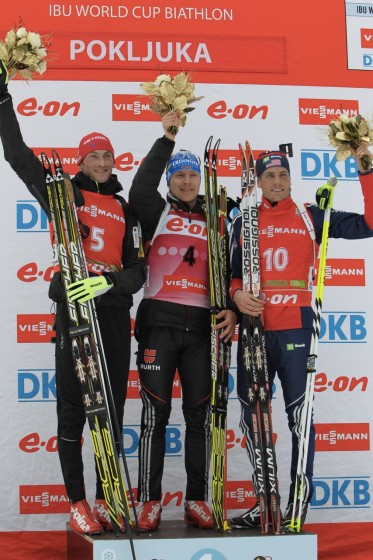
    (L-r) Jakov Fak of Slovenia, Andreas Birnbacher of Germany, and Tim Burke of the United States on the podium after the 15 k mass start in Pokljuka, Slovenia. Photo: USBA/NordicFocus.

    When you hit all twenty targets in a competition, biathlon racing is fairly simple. That was the case for Andreas Birnbacher of Germany today, who was in the top three for almost the entirety of the 15 k mass start and skied to his second victory of the season in Pokljuka, Slovenia today.

    “My shooting definitely helped,” Birnbacher said in a press conference. “On the last lap, I was very happy that those other guys were not very close, because I was quite tired.”

    When you start accumulating penalty loops, though, things get a little more complicated. That was true for the rest of the field; the other 29 men, who qualified for the prestigious mass start format based on World Cup ranking or performance this weekend in Pokljuka more specifically, all missed at least two shots.

    And having done so, they bounced around the field considerably with each clean stage – or with each penalty loop. Overall World Cup leader Martin Fourcade of France, for example, was sitting in second place after three stages, 15 seconds away from Birnbacher, along with Jakov Fak of Slovenia and Evgeniy Ustyugov of Russia.

    But after Birnbacher cleaned yet another stage – it was his sixth perfect day on the range in World Cup competition, and his third in mass start racing – Fourcade and Fak both missed a shot, while Ustyugov picked up two penalties. Birnbacher left with over 30 seconds on the competition, effectively closing the door on a possible victory by any of the imperfect shooters.

    Life became even more difficult for Fourcade and Fak when the penalty loops allowed Tim Burke of the United States and Emil Hegle Svendsen of Norway to creep back into the race.

    Burke had cleaned his initial two stages, but taken the skiing easy; after missing a shot in his first standing stage, he sat in ninth place. Svendsen had collected a penalty right out of the start, dropping to 22nd after the first prone stage. He also missed a shot in the first standing stage, but strong skiing kept him in 12th at that point, not too far behind Burke.

    After skiing hard on the fourth loop and then missing a single shot in the final stage, Burke found himself in third. Svendsen cleaned the last stage and moved into fifth. Fak was just ahead of them and Fourcade separated the two. While Birnbacher had the win locked down, it was set to be a horse race for second: Burke was the only one of the four who hadn’t won a World Cup yet this season.

    “I knew it was going to be a real fight on the last loop because Svendsen and Fourcade were only five seconds behind me,” Burke told FasterSkier in an e-mail. “Those are the last two names that you want to hear right behind you going onto the last loop.”

    Last season, Svendsen and Fourcade would have been easy bets to outsprint the others. But this is a new year, and instead it was Fak and Burke who had a six second gap with 1600 meters left in the race.

    “I was glad that I had conserved a lot of energy earlier in the race by staying in the pack so that I had enough left to pick it up at the end,” Burke wrote. “This was by far the best that I have felt on the skis this season. It felt great to be able to push again on the last loop when the others were close behind.”

    Ultimately unable to stick with the Slovenian, Burke settled for third, his best result of the season and his first podium since 2010. The result moved him from tenth to sixth in the overall World Cup standings.

    In the press conference, Burke expressed relief that he finally seems to be over the compartment syndrome that affected his 2011 season and the surgery that he was still recovering from during 2012.

    “It took almost all of last year to come back from my compartment surgery and regain my confidence that I was as fast as before,” Burke said. “I am very happy to back up here.”

    For Fak, second place was also a relief. After winning Thursday’s sprint on home soil, the Slovenian disintegrated in the pursuit and was unable to hold onto the lead, ultimately placing 22nd with six penalties.

    “That was the first time that I had number one and started in front of all of the big guys,” Fak said in today’s press conference, referring to the pursuit. “The pressure took over and I was probably the worst shooter out there.”

    With that out of the way, Fak said that “a big stone was off my back” and he was back to being the relaxed, focused athlete who had won two World Cups so far this season.

    And Burke was back to the form that had him in the yellow bib of the overall leader back in 2010.

    “This was a great race for me – both my skiing and shooting really came together on the same day,” Burke wrote in his e-mail. “This was a great early Christmas present and now I am looking forward to heading home and spending some time with my family and friends for the holidays.”

    Fourcade was left in fourth, while Bjorn Ferry of Sweden passed Svendsen to snag fifth. Ustyugov was seventh and teammate Evgeniey Garanichev eighth, Norwegian Henrik L’Abee-Lund ninth, and Florian Graf of Germany tenth.

    Jean Philippe Le Guellec was the only Canadian racing and placed 21st with two penalties.

    Results

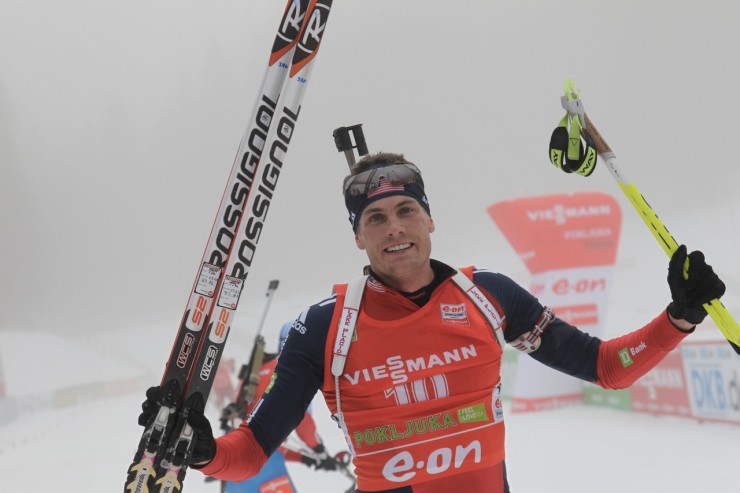
    Tim Burke celebrating at the finish line. Photo: USBA/NordicFocus.
  • Fak Regains Form of a Champion, Crushes Final Hill to Earn First Regular-Season Victory

    Fak Regains Form of a Champion, Crushes Final Hill to Earn First Regular-Season Victory

    Jakov Fak of Slovenia said that he wanted to do his work on the range, not the trails, but his skiing was at least as impressive as his two penalties in the 12.5 k pursuit race in Hochfilzen.

    Coming into this season, Jakov Fak was in the odd position of having won a World Championship, but never a regular-season World Cup race.

    The Croatian-turned-Slovenian turned heads in Ruhpolding, Germany, in March, when his strong shooting gave him a seven-second win over Simon Fourcade of France. It wasn’t his first good race; he had won bronze in the sprint at the Vancouver Olympics, and had two other podiums to his name.

    But after placing third in the sprint in Hochfilzen, Austria yesterday and then skiing a smart, clean race to move into the front in today’s pursuit, Fak has gone a long way towards proving that he can be a consistent competitor rather than just making the occasional appearance near the top of the results sheet.

    “Most of my podiums before have been in big events and I said that I wanted to be on top of the podium in a World Cup next,” Fak said in a press conference after the race, which he won by 0.9 seconds. “Today, my dream came true…I have been waiting for this almost since I was born…Approaching the finish line was a very emotional experience for me.”

    Despite his consistency and a lack of major errors, the 12.5 k pursuit was something of a rollercoaster for Fak. He started in third, and stayed there through the second shooting; there, he cleaned while the other leaders, Martin Fourcade of France and Andi Birnbacher of Germany, collected penalties. So he left on his third loop with the lead, which he extended over the 2.5 k loop. Birnbacher, who had been in second, got swallowed by a group of three Russians.

    Martin Fourcade (front) and Andreas Birnbacher led the way early, but couldn’t handle their three and two penalties, respectively.

    But in the first standing stage, Fak missed a shot, erasing the lead he had built. Birnbacher and Russians Anton Shipulin and Dimitriy Malyshko cleaned, and Fak was able to pull Malyshko the five seconds up to the leaders. By the final shooting stage, he was back at the front – but he had done some hard work.

    So had everyone else. In that final stage, all five of the leaders missed at least one shot. While Fak’s stray bullet must have initially felt like a punch in the gut, something sure to keep him from his long-dreamed-of win, it quickly became apparent that it wouldn’t set him back that much. The first athlete to clean, Fredrik Lindström, was just able to hitch onto the back of the pack of Birnbacher, Fak, Malyshko, and Fourcade as they left the penalty loop.

    Based on recent results and swagger, Fourcade was the one expected to make a move and smoke the rest of the men on their skis. But instead, it was Fak who moved to the front and put on a clinic, surging up the long, grinding hill on the far end of the race course.

    “I followed my race plan and paced myself from the start,” Fak explained later. “I knew that I had enough power left for a sprint up that last hill if I needed it.”

    Only Malyshko was able to do anything resembling following the Slovenian; Fourcade, susprisingly, struggled up the hill. By the time Fak entered the stadium, Malyshko was close behind, but it was clear that the Russian was not going to be able to muster the energy to catch or pass him. Victory belonged to Fak.

    “I wanted to do all of the work on the shooting range, not the tracks,” Fak said of the strategy that brought him the win. “Being on position one for the last standing stage is a very different feeling, but I was confident and not nervous, since I am usually very good in standing shooting.”

    For Malyshko, second place represented the best finish of his career, and just his second podium on the World Cup, although he was a frequent top-ten finisher during the 2012 season.

    Fourcade, who looked completely spent and emotionally deflated after finishing third eight seconds back, said in the press conference that despite three misses he was going for the win, which he thought he could snag. But in the end, he wasn’t shocked that Fak and Malyshko were stronger.

    “We all competed together as juniors and I know they are both good, so there is no surprise,” he said.

    Lindström was able to pass Birnbacher on the final stretches of the course and secure fourth place, his best result so far this season. Shipulin placed sixth, while Ole Einar Bjørndalen led Norway in seventh.

    One of the most exciting sprint finishes of the day was actually for eighth place, with Dominik Landertinger of Austria and Evgeny Ustyugov of Russia ratcheting up the pace again and again over the final kilometers until they appeared to be flying into the stadium. Landertinger managed to edge Ustyugov in the finishing straight, but it took an impressive display of speed. Lowell Bailey of the United States placed tenth.

    Results

    Fak was all smiles as he crossed the finish line in front of Dimitry Malyshko of Russia.
  • Birnbacher, Domracheva Get Revenge with Tight Victories in Hochfilzen Sprints

    Birnbacher, Domracheva Get Revenge with Tight Victories in Hochfilzen Sprints

    Andreas Birnbacher of Germany (foreground) and Martin Fourcade of France on the range in Ostersund, Sweden, last week; today in Austria, Birnbacher bested Fourcade by 0.4 seconds for his first win of the season. Photo: Fischer/NordicFocus.

    Last weekend in Östersund, Sweden, Andreas Birnbacher got the wrong end of a bargain with Martin Fourcade of France, who told the German that the pair should work together on the final lap but then blocked him coming into the finishing lanes and used that advantage to beat him to the line.

    At the press conference, Fourcade smirked that Birnbacher probably wouldn’t do the same thing next time.

    And today in Hochfilzen, Austria, Birnbacher turned the tables. In an individual-start 10 k sprint, the German biathlete eked out a narrow, 0.4-second victory over Fourcade. It was Birnbacher’s fifth career win and just his second in a sprint.

    Fourcade was a late starter, and Birnbacher told IBU News that as he went to cool down, he was sure that he would not win.

    “I was sure he was going to catch me,” he said.

    But the Frenchman was not able to, despite having splits going into the final lap telling him how close the race was. The gap was 6.9 seconds after the final shooting stage; Fourcade closed the gap, but not quite enough.

    “I was informed of the difference to Andi, and it was for sure an advantage to be in the back [of the field],” Fourcade said in a press conference. “But it was not enough for me today. Andi was a bit faster on the final kilometer. I heard that I was 0.7 seconds ahead of him, so in that moment I hated the one who was in front of me, but at the finish line I smiled because 0.4 seconds, this is really, really close.”

    When asked whether he was happy with second, Fourcade responded, “I’m happy with second, but sad because of the small gap between us.”

    Despite the fact that he been on the podium last weekend, Birnbacher wasn’t overly confident today.

    “The men’s sprint is always so tight,” he said in a press conference after the race, adding that he hadn’t felt great in the two days leading up to the sprint. “I never thought that I could win today, so I’m very happy.”

    His perfect shooting was what got him the win; both Fourcade and third-place Jakov Fak of Slovenia (+13.7) missed one shot, Fourcade in prone and Fak in standing. Fourcade said that he had been confident that he could win despite a penalty, even though he was in 38th place after the prone stage.

    For Fak, it’s the first podium since a sensational World Championship win in the individual in March, and a major improvement over the Östersund races.

    “I think our whole team put too much pressure on ourselves last week,” Fak said in the press conference. “We made a lot of mistakes on the shooting range… but I think we have gotten over that now. Personally, I am happier with the warmer conditions here; they are much better for me.”

    After getting serious frostbite on one of his fingers in Fort Kent, Maine, two years ago, that almost led to amputation, Fak has to be more careful than most in cold conditions. While it was ten degrees and bitterly windy in Sweden, Hochfilzen is a relatively balmy 20 degrees, with the snow temperature reported just around freezing.

    Friedrich Pinter was fourth, eleven seconds behind Fak, just missing out on giving Austria their third podium from as many athletes just four races into the season. Russians Evgeniy Ustygov (+26.1) and Andrei Makoveev (+27.1) narrowly edged Carl Johan Bergman of Sweden (+27.4), who placed seventh. Simon Hallenbarter of Switzerland placed eighth (+30.5), and Alexis Boeuf of France (+32.0) and Jean Philippe Le Guellec of Canada (+34.0) followed up podium performances in last weekend’s sprint by rounding out the top ten.

    * * *

    Darya Domracheva (BEL) competing in Ostersund last weekend.

    Darya Domracheva was also left looking for a win last weekend, as she was unable to ski quite fast enough to make up for the near-perfect shooting from Norway’s Tora Berger, who swept all three individual races.

    But in Hochfilzen today, the top four finishers all had one penalty, so the playing field was even with respect to ski time. And the Belorussian beat Berger on the trails – in fact she beat almost the whole field – so earned the win.

    “To be a winner is always special,” the 2012 World Cup runner-up said in a press conference, where she was informed that it was her tenth victory. “I tried to be more calm today.”

    But her win came partly from luck – the second-place finisher, Kaisa Makarainen of Finland, actually had a better course time than Domracheva, and matched her shooting as well. But while Makarainen hit the same number of targets, she was actually undone on the range, taking an extra 45 seconds to complete her final standing stage. Without that delay, she certainly would have taken the win; as it was, she only finished 4.7 seconds out of first.

    “I had some ice in my sight, and I tried to blow it away but it didn’t go away,” Makarainen reported in a press conference. “I almost couldn’t see anything when I was shooting in standing. Then my legs started to shake!”

    After completing her marathon shooting stage and a penalty loop, Makarainen hit the trails and turned in the fastest last-lap time.

    “I was really happy after the not-so-good shape last week that I could be on the podium here,” Makarainen said. “It’s nice to be here, but I’m a little bit sad, too, that I had problems with the standing shooting.”

    Starting several bibs behind, Domracheva heard exactly how fast the Finn had skied and had to turn on the jet engines to collect the win.

    “For sure, the results from Kaisa was a big red flag for me,” Domracheva said. “I always try to fight really hard to the finish line, but her result today was a very big motivation for me.”

    Third place went to Berger, who said coming into this race that Hochfilzen was not a great venue for her. Still, she narrowly beat teammate Synnøve Solemdal, who was looking for her first World Cup podium. At the finish line, Berger actually thought Solemdal had beaten her, but she held a three-second lead over the younger athlete.

    “With her legs, going up the last hill, I knew that it was going to be hard [to hold onto third,” Solemdal told Norwegian broadcaster NRK after she had nervously waited at the finish line to see if Berger would beat her. “But I fought as hard as I could, and in tomorrow’s pursuit, then I can be on the podium.”

    Poland had a strong showing as well, one of their best days in recent memory, with Krystyna Palka and Magdalena Gwizdon finishing fifth (+29.3) and sixth (+33.7). Teja Gregorin of Slovenia and Nadezhda Skardino of Belarus tied for seventh (+40.2), before Miriam Gossner of Germany turned in one of the more inspired performances of the day to place ninth (+44.0) despite four penalties. The rest of the top ten either shot clean or had a single missed shot, and Gossner was only beat on the trails by Makarainen. Marie Dorin Habert of France placed tenth (+48.7).

    Results: men / women

  • After Blocking Birnbacher Into Finishing Lanes, Fourcade Picks Up Victory Number 16, Moving into Fifth on All-Time List

    After Blocking Birnbacher Into Finishing Lanes, Fourcade Picks Up Victory Number 16, Moving into Fifth on All-Time List

    Martin Fourcade of France (red/yellow bib) leads a chase pack on the first lap of the 12.5 k pursuit, where he moved from tenth position to secure a win.

    ÖSTERSUND, Sweden – After placing a disappointing tenth in yesterday’s 10 k sprint, Martin Fourcade of France was seeking redemption – and to stay in the overall World Cup leaders bib that he had earned after winning Wednesday’s individual race.

    Last year’s overall champion missed only a single one of his twenty shots in today’s 12.5 k pursuit, which put him on a trajectory towards the front. The penalty came in the second standing stage, dropping him to seventh place, 25 seconds back from Russia’s Evgeniy Ustyugov; after two clean stages, Fourcade had climbed to fourth.

    “My strategy was to shoot slow and clean and I did it, but I was always a little bit behind,” Fourcade said in a press conference. “I tried to fight hard and get contact, but they were really fast as well, so I had to be always going hard, all through the race.”

    After three stages Russia’s Evgeniy Ustyugov was solidly in control, leaving the range with an 18-second lead over Alexis Boeuf, Fourcade’s teammate who had placed second in the sprint. But Fourcade charged towards the front, regaining contact with Andreas Birnbacher of Germany and Emil Hegle Svendsen of Norway, who were skiing in third.

    In the final round, Ustyugov and Boeuf handed the chasers a huge favor when they collected two and one penalties, respectively. Suddenly, Birnbacher and Fourcade were leaving the range in the lead after both cleaning their targets. But others were close behind. The two decided to work together.

    Andreas Birnbacher skis through the stadium. Photo: Fischer/NordicFocus.

    “After the shooting range I talked to Andi that we had to ski together on the beginning of the loop,” Fourcade said. “Andi did the first part of the loop and I did the last part. And then my strategy was to stay in the front position and keep Andi and make him ski more if he wanted to go by me. My strategy was good today and I think he will know it for next time.”

    While Fourcade got the better end of the deal tactically, Birnbacher said in the press conference that the decision was about survival for him.

    “On the last lap I was tired because in every round I thought I must go slower on the next round, and every round was fast for me!” he explained. “So I tried to get behind Martin so that nobody would come from behind. I knew that he is very strong and that it could be a hard sprint. On the last corner he was in front and it was very hard to go out and pass.”

    Fourcade did do his best coming into the finishing lanes to prevent Birnbacher from passing; it was awkward to watch. Even as it was, the Frenchman only finished with a 0.7-second victory.

    And what’s more, the chasers had actually gained ground on them. Arnd Peiffer of Germany had left the range 7.7 seconds behind, but crossed the finish line 4.1 seconds back; he lost a sprint with Anton Shipulin of Russia to end up fourth. Svendsen was just behind, unable to muster his usual finishing sprint, to place fifth.

    Shipulin, for one, was surprised to make it so close to the front, especially after a bad sprint race that left him with bib 23, starting more than a minute out of the lead. Despite missing a shot, he was able to climb through the field rapidly. Leaving the final shooting stage with Svendsen, he thought he’d be satisfied to ski for fourth place.

    “Honestly, I was thinking that it would be really great to have a fight with Emil on the last finish lane,” Shipulin said through a translator a the press conference. “I know that he’s very good at these. But it was a little different today. We didn’t expect that we would reach Peiffer, but we also reached him.”

    In some ways, it was not surprising to see Birnbacher near the front; last season’s mass start champion, he is always strong in this type of head-to-head racing.

    “I don’t know why exactly, but I like this kind of competition,” he said. “For shooting, it’s better for me to shoot between the others.”

    But the podium also came as a huge relief to the German, who overtrained this summer and was unsure of what to expect this season.

    “It was very important [to do well today] because I didn’t think before that I was in that good shape,” he said. “In autumn it was very hard for me, I was very tired because of the training. And now it’s getting better and better, so it’s good for me. I think I trained too much in the summer, and I slept all the time!”

    Instead of being disappointed to lose the sprint finish with Fourcade, he was – at least publicly – happy with his finish.

    “I won second place and not lost first place,” Birnbacher said.

    As for Fourcade, he was tired and said that this had been a very difficult race to win.

    “The race was really hard,” he said. “It was a really hard battle. Everyone was really compact on the start, and I knew that we had to shoot clean if we wanted to win.”

    The win today brings Fourcade’s total to 16 World Cup victories, which moves him into fifth place on the all-time list, passing Frode Andresen of Norway and Vladimir Dratchev of Belarus.

    “One of my aims this year was to become the fifth biathlete in World Cup victories, and I am happy today to be it,” Fourcade said in the press conference.

    Don’t get too cocky, though: fourth place belongs to Svendsen, who has 28 wins and will surely add a few to the tally this year, while teammate Ole Einar Bjørndalen has won a seemingly impossible 93 World Cups.

    After his penalty on the last stage, Boeuf held on for sixth, just ahead of Dimitri Malyshko, Ustyugov, Evgeniy Garanichev, and Alexei Volkov of Russia. With half of the top ten, the Russian team seems to have a good start on the Nations Cup competition.

    Results


    Martin Fourcade celebrates as Andreas Birnbacher…. doesn’t. Photo: Fischer/NordicFocus.
  • Fourcade Makes It Three Golds in Four Tries, Is King of World Championships After Hard-Fought Mass Start Victory

    Fourcade Makes It Three Golds in Four Tries, Is King of World Championships After Hard-Fought Mass Start Victory

    Martin Fourcade leading the race after the first shooting stage.

    RUHPOLDING, Germany – Martin Fourcade is a glutton for punishment.

    At every chance he got, the Frenchman would push the pace over the top of the last steep hill during today’s World Championship 15 k mass start. As the rain gently fell on the Chiemgau Arena and competitors looked more and more bedraggled, Fourcade attacked again and again, jump-skating up hill after hill, and dragging himself back from penalties that may have come from pushing too hard.

    But Fourcade is also a glutton for gold, and in the end he was rewarded with his third individual victory of the week in four races – a truly unusual feat in a sport which is decided by millimeters on the range.

    “I have always said that I didn’t fight for records, but today I know that my performance during the World Championships was big,” Fourcade said in a press conference.

    Fourcade said that he had never doubted his shape, which undoubtedly made it easier to hammer up the punishing hills loop after loop. Beginning with the very first loop, he sped up on that last hill to put a gap on the field before descending down into the stadium and onto the shooting range. That time, it worked out: Fourcade cleaned the initial prone stage and left the range in the lead.

    Birnbacher, Ole Einar Bjørndalen, Arnd Peiffer, and Fourcade in the first standing stage.

    On the second loop, Fourcade tried the same move, but this time he picked up a penalty – whether from pushing too hard or simply because conditions are difficult, is hard to say. Fourcade, who had already won two gold medals in the sprint and pursuit as well as silver in the men’s relay, fell to 14th.

    But, setting a furious pace, Fourcade pushed himself to the max one more time, gradually clawing his way through the field. An attack on that same final hill brought him back into contact with the leaders, and he was in fourth place when he pulled into the range the for his first standing bout.

    Again, Fourcade missed a shot. Andreas Birnbacher of Germany cleaned and left with a seven-second lead over Bjorn Ferry of Sweden and Jaroslav Soukup of the Czech Republic.

    This time, though, much of the field hit the penalty loop, which began to resemble a merry-go-round of colorful race suits. Even though he had two misses so, Fourcade was still very much in the race, and hit the trails 23 seconds behind Birnbacher.

    The German’s success had led to wild cheering from the 30,000 fans in attendance, and for the first part of the loop, he skied alone. But by the time the field came to the final standing stage, nobody was safe.

    Fourcade later admitted that he was intimidated by the until-then clean-shooting Birnbacher, who wore the red bib as the leader of the World Cup mass start standings.

    The chase group, led by Bergman, leaving the stadium on the final loop.

    “I didn’t think about it before, but during the competition Andreas was very strong and he could win today with zero penalties,” Fourcade said.

    For the local hero, who grew up 30 kilometers from Ruhpolding, clean shooting was not to be. Birnbacher missed a shot and was forced to hit the penalty loop. While he skied his extra 150 meters, both Ferry and Fourcade cleaned; Ferry had a slight lead on the Frenchman as they climed the first hill out of the range.

    With the prowess that Fourcade had shown both already today and throughout the championships, it seemed impossible that Ferry could hold his lead. Through the first half of the loop, though, he tucked in behind Fourcade and the two skied together.

    The pace wasn’t light, either: a group, including Birnbacher, had left the range just five seconds behind the leaders, and playing a cat-and-mouse game with one another could easily have left both Ferry and Fourcade medal-less.

    “It was not the same position that I was in with Carl Johan [Bergman] earlier this week, because there were five hungry boys trying to catch us,” Fourcade said of the final loop. “I had to push really hard to win either gold or silver. It was my only aim from the last stage, to be first or second.”

    Ferry leading Fourcade.

    The first half of the course rolled up and down, and the 6’ 6” Ferry could use his power to hang with Fourcade. But unsurprisingly, once the pair hit the course’s major climbs with a kilometer to go, Fourcade broke into the jump skate that he had used to such effect before, and Ferry could not keep up.

    “I did my best and I saw that I was a bit stronger than Bjorn on the last uphill,” Fourcade said. “But he was close to me and I never stopped pushing.”

    Ferry popped, but he didn’t fall too far behind – like Fourcade, he knew that if he slowed down even one bit, he would be swallowed by the chase pack of teammated Fredrik Lindstrom and Carl Johan Bergman, Fourcade’s brother Simon, and Birnbacher.

    That seemed like a real possibility, and although gold was locked up, the stadium full of mostly German fans nervously watched the final meters tick away, hoping that Birnbacher could win silver or at least bronze.

    Ferry, however, hung on, and coming over the top of Fourcade’s favorite hill, Lindstrom opened a small lead.

    Lindstrom, who at 22 years of age has won a single World Cup and has no other podiums, said in the press conference that he had not been expecting to find himself in the lead pack, and didn’t even realize that he was.

    “I didn’t know what position I was out on the final loop,” he admitted. “But I was coached by our trainers and heard I was in fifth place, and realized that the bronze medal was just two meters ahead of me. It was a perfect final loop for me. In the uphill I tried with all I had and it was enough to be a bronze medalist.”

    Birnbacher trailing Lindstrom to the finish line.

    Birnbacher finished a close fourth – his second wooden medal of the championships. Simon Fourcade was fifth and Bergman sixth, giving Sweden not only two on the podium but half of the top six.

    It was an amazing result for the team, which despite Bergman’s two medals earlier this week struggled in the relay and placed a dismal 16th. They are reeling, too, from the announcement that the star of their women’s team, Helena Ekholm, will retire at the end of this season.

    Today, though, the men’s team had nothing to worry about.

    For Ferry, the result was a return to the form that won him Olympic gold in Vancouver, but which had so far eluded him this season – and it was a relief.

    “I shot clean today, the shape I have this year – I know that I have to hit all the targets or else I have no chance,” Ferry said. “You see the result list and if I miss one shot then I am number ten, so it has been really tough.”

    But as thrilled as the Swedish team was, the day was clearly all about Fourcade.

    “I said before the Championships that he would be the king of the Championships,” Ferry said of the gold medalis. “I want to see him in cross country also, I think he would have a chance against Northug and the kings. He is really strong.”

    “And today he won the Swedish championship,” Lindstrom joked.

    There were no joked from the man himself, who was simply overcome by his good results.

    “It is more than I can expect in my life,” he said. “It’s only wonderful.”

    Of Note:

    – Benjamin Weger of Switzerland, currently ranked in the top ten in the overall World Cup standings, perhaps had the worst day of anyone. After missing a shot in the initial prone stage, he left the range in 25th with some ground to make up. But First he broke a ski, and a coach had to bring another out onto the course for him to clip into; then he fell and broke a pole. Trailing the 29th-place racer by a huge margin, Weger withdrew before making it to the second stage.

    – The Czechs, on the other hand, had a good day. While no individual result made huge fireworks, the team had placed three men in the field of 30, which is unusual. Jaroslav Soukup, Michal Slesingr, and Ongrej Moravec finished 11th, 12th, and 13th, within a minute of Fourcade.

    – Andriy Derezemlya of Ukraine only received a start due to the withdrawal of Jakov Fak of Slovenia. The 34-year-old four-time Olympian has been competing in World Championships since 1997; he won a World Cup in the 2004/5 season and has seven podiums to his name, but hasn’t had a great 2012. Today, though, he placed 19th.

    – Tim Burke and Lowell Bailey placed 23rd and 25th for the U.S. after missing four and five shots. Stay tuned for an interview with Bailey.

    – No Canadians qualified for the race, although JP Le Guellec was next in line after Derezemlya.

    Full results

  • Photo Gallery: World Championships Mixed Relay

    Photo Gallery: World Championships Mixed Relay

    With racing taking a break for the day in Ruhpolding, Germany, here’s a gallery from the kickoff race, yesterday’s mixed relay. Norway took the win followed by Slovenia and Germany. Click any photo to enlarge.

  • Svendsen Again Uses Explosive Sprint at the Finish, Takes Mass Start Victory for Home Crowd in Oslo

    Svendsen Again Uses Explosive Sprint at the Finish, Takes Mass Start Victory for Home Crowd in Oslo

    Svendsen racing the FIS World Cup openers in Sjusjøen, Norway this winter. Photo: flyingpointroad.com.

    When Germany’s Andreas Birnbacher left the shooting range for one more three-kilometer loop in Sunday’s mass start race, there was little doubt that he’d be beaten to the finish line.

    Yes, Birnbacher was leading. And yes, he was wearing the red bib denoting that he led the discipline standings on the World Cup circuit. There was just one problem: Emil Hegle Svendsen of Norway was right on his shoulder.

    Just one day earlier, Svendsen had laid down a spectacular sprint in the final meters of the pursuit to secure second place, leaving Russia’s Evgeniy Garanichev looking as if he was standing still. Svendsen knew, the spectators knew, and even Birnbacher knew – with a weapon like that in the Norwegian’s arsenal, Birnbacher didn’t stand a chance.

    “I realized that I could not outsprint Emil,” Birnbacher said in a press conference after the race. Instead, he tried to protect at least a second-place finish: “I went as hard as I could so no one could come up from the back and take my spot on the podium.”

    Birnbacher leading a pack early in the race. Photo: NordicFocus/Fischer.

    With Garanichev and teammate Dimitry Malyshko charging hard behind them, it was a smart move. Birnbacher led the way up the huge climb to the top of the course, down the winding descent, and up the excruciatingly steep Gratishaugen hill. As the pair approached the stadium, the noise became deafening as the crowd awaited the move that they knew was coming.

    Anticipation mounting, Birnbacher and Svendsen tucked along the flat next to the ski jump, and began up the last, small climb behind the shooting range. Then, at the top of the climb just before a sharp right turn, it happened – Svendsen went.

    “I knew I had him,” Svendsen told Norwegian broadcaster NRK after the race.

    And he did. Putting in a powerful burst, Svendsen left Birnbacher far behind and cruised to his first victory of the weekend and the 27th of his career, much to the delight of the crowd and of King Harald of Norway, who was on hand to watch the race. By the time he crossed the finish line just 250 meters later, Svendsen had six seconds on the German.

    Now Birnbacher knows how Maxim Vylegzhanin, Petter Northug’s habitual foil, feels as he races towards defeat. Perhaps, too, he can talk to countryman Axel Teichmann about how to overcome the despair of being trailed by the world’s best sprinter; on Saturday, Svendsen told the press that he had carefully studied Northug’s moves from the 2011 World Championships in Oslo.

    Despite missing out on another mass start win, Birnbacher was actually happy with his race. He said in the press conference that he hadn’t known whether to start or not because he’d been feeling sick.

    Simon Fourcade leads brother Martin in the mass start. Martin Fourcade finished 5th and Simon 19th. Photo: NordicFocus/Fischer.

    “It was really a tough race for me, I was hit by something,” he told the German Zeit newspaper. “After the second lap I was beginning to think that I would have to quit because it seemed to be going so badly. But I decided against it.”

    Birnbacher did have one thing he could lord over his Norwegian rival: clean shooting. In three mass start races so far this season, Birnbacher has missed only a single shot out of 60 taken, and his second-place finish today is his worst showing.

    So while Svendsen may have won, but he can’t touch the German’s marksmanship.

    “Birnbacher hit everything, so I had to work harder,” said Svendsen, who had two penalties. “After all, it’s been almost 700 days since I’ve hit all the targets in a race, and that’s something I’m not proud of.”

    And clean shooting is important. Despite being without a doubt one of the fastest skiers on the circuit, Svendsen has won just three times this season; his first win, in a pursuit in Hochfilzen, Austria, came, like today, despite having more penalties than his closest competitors.

    Svendsen, who took over the World Cup lead, said he knew he had to shoot better. But today he was all smiles, raising both arms in victory as he crossed the finish line. His performance was rewarded with a meeting with King Harald himself, which Svendsen said made him “more nervous than shooting.”

    While Svendsen had won three previous World Cup races at Holmenkollen, the king had never been in attendance. Today, that changed.

    “I was so nervous that I don’t remember what we talked about,” Svendsen laughed after the meeting.

    Garanichev dropped Malyshko to claim third place, wrapping up the best weekend of his career. After winning the sprint on Thursday, the young Russian picked up two bronze medals.

    “Before the season, I thought I might be on the podium sometime this year,” he said in the press conference. “But I did not expect something like this. I am very happy about my results here.”

    Full results


  • Frustrated in Mass Start, American Men Regroup and Prepare for Relay

    Frustrated in Mass Start, American Men Regroup and Prepare for Relay

    Lowell Bailey finished 21st in today's 15 k mass start in Antholz, Italy. Photo: NordicFocus/USBA.

    Both Tim Burke and Lowell Bailey had their moments in Saturday’s mass start race in Antholz-Anterselva, Italy.

    After two shooting stages, Burke was in the top ten. After three, Bailey was 11th. But in the end, after four stages and 15 k of skiing, the Americans ended up in a race with each other – for 20th place.

    “It was an up and down race for me today,” Bailey wrote in an e-mail to FasterSkier. “I started out with one penalty in prone, which put me back into 28th place – the level is so high in this event that even one miss in the initial stage can put you in the back of the field. However, I was able to get back into the mix with two clean stages.”

    With only one biathlete in the 30-man field shooting clean (Michal Slesingr of the Czech Republic, who finished fifth), an early error would have been possible for Bailey to overcome. Unfortunately, however, he wasn’t able to keep it at one.

    “I missed my second and last shots during [the final] bout, which was definitely a disappointment,” he wrote.

    After two trips around the penalty loop, Bailey was in 18th, but he ran out of gas and slipped several places in the final three kilometers. Those loops, he said, were not part of his plan.

    “I felt good going into the race today,” Bailey explained. “I had a gameplan for the shooting range. And it just didn’t come together for the last stage.”

    Burke following eventual podium finisher Martin Fourcade of France. Photo: NordicFocus/USBA.

    Burke had an even tougher time on the range. After cleaning both prone stages and sitting in ninth, he had a disastrous initial standing bout, missing three shots, and dropped to 24th. Then, in his second standing stage, he missed two more.

    Despite all that, he had more juice in his legs than Bailey, and turned in the second-fastest closing loop of any skier in the field. That enabled him to move up four spots and outsprint his teammate at the finish.

    Good skiing, however, was no consolation for Burke, who has watched initial top-ten splits disappear on the back of shooting errors after blundering in one standing stage after another.

    “I am very frustrated with my standing shooting,” he told FasterSkier. “I have been working so hard on my shooting, but the results only seem to get worse with this added effort.”

    After the Antholz races finish up, World Cup will take a break before resuming in Oslo in early February. Burke will be hitting the trails for a significant block of training, but he won’t be using a rifle – at least initially.

    “For the break I am going to stay right here in Antholz so that I can get two full weeks at altitude,” he explained. “I will be working on putting in some hours after having so many races in the last three weeks. I think I also might try putting the rifle away for a few days, so that I can get a little mental recovery before the next races.”

    While he wasn’t happy with today’s effort, Burke was confident that if his shooting came together, he’d be able to turn in some of the best performances of his career.

    “I am very happy with how I feel skiing now,” he said. “My form is good enough for a podium performance.”

    Bailey, too, was looking forward to moving on from the disappointment of the mass start.

    “I need to take the frustration and channel it into focus for tomorrow’s relay,” he said. “We have a great team and I’m excited to show that to the rest of the world.”

    Andreas Birnbacher of Germany won a sprint finish with Anton Shipulin of Russia and Martin Fourcade of France to take his second World Cup victory of the season.

    Fourcade and Fredrik Lindstrom of Sweden had been leading going into the final stage, but each missed a shot, allowing Birnbacher and Shipulin to catch up after cleaning the stage. The four men skied the last loop together, providing the crowd with a thrill as the sprinted into the stadium the final time.

    The Canadians did not qualify any athletes for the 30-man race.

    Full results

    Bailey skiing through the stadium. Photo: NordicFocus/USBA.
  • In Front of 28,000-Strong Home Crowd, Birnbacher Takes Mass Start Victory for Germany

    In Front of 28,000-Strong Home Crowd, Birnbacher Takes Mass Start Victory for Germany

    Andreas Birnbacher of Germany crosses the line first in Oberhof. Photo: Fischer/NordicFocus.

    In the first competition of this week’s six-race series in Oberhof, Germany, Olga Vilukhina anchored the Russian women’s relay team to a victory, the nation’s fourth in a row on biathlon’s World Cup circuit.

    But in the last competition, Sunday’s 15 k mass start, a different team became dominant. Germany’s Andreas Birnbacher shot 20 for 20 and skied to a 24-second win, annihilating the rest of the 30-man field. In the process, he gave his team its own fourth win in a row.

    What caused the huge swing of momentum on the World Cup? The tens of thousands of German fans filling the stadium and lining the Oberhof trails might have had something to do with it. German after German described the buoyancy they felt thanks to the cheers of the crowd.

    Still, those fans weren’t necessarily expecting Birnbacher to be the hero for the home country; the 30-year-old had only won two World Cup races before Sunday. A better bet would have been Arnd Peiffer, who had stolen the sprint victory from France’s Simon Fourcade the day before.

    Norway's Emil Hegle Svendsen led the field on the first lap. Photo: Fischer/NordicFocus.

    While Peiffer had demonstrated that he was in top form, Birnbacher had not. In fact, even Birnbacher himself was surprised that he raced so well. He told the German newspaper Zeit that he felt “really bad” on Sunday, and didn’t understand exactly why he had been so fast.

    “I was pretty tired after the travel and competition in Schalke,” he said in a postrace press conference, referring to the city biathlon competition held over the Christmas break. “I was still tired in the sprint, so it was amazing that I did so well today.”

    The race started at an easy pace, and 19 of the 30 men cleaned the initial prone stage. Without any attacks on the second loop, the group came into the range together and took to the shooting mats again. This time, only eight men remained clean, and the pack got even smaller as several of them picked up the pace.

    Birnbacher was seen at the front for the first time, along with Peiffer, Lowell Bailey of the U.S., Klemen Bauer of Slovenia, and Benjamin Weger of Switzerland. And as they raised the pace, things began to go wrong – one of the Germans lost a basket on his pole, while behind them, Christoph Sumann of Austria fell down and lost between 10 and 20 seconds.

    “Skiing went pretty well for me, especially in the first three loops,” Bailey told FasterSkier in an e-mail. “I felt fresh and I didn’t feel like I was going above my pace.”

    Arnd Peiffer (l) led the group of five into the third shooting stage. Photo: Fischer/NordicFocus.

    For Bailey, though, along with Peiffer and Weger, skiing easily was not enough. The three men all missed shots when they returned to the range for the first standing stage. While Peiffer had just one penalty, and could conceivably have still remained in podium position, the stage was a disaster for Weger and Bailey, who picked up two and three penalties and completely removed themselves from contention.

    That left only Birnbacher and Bauer. While the Slovenian is known as a fast skier, he struggled today. Bauer started off in the lead, but by the middle of the loop was slowing down in hopes that the German would take a turn at the front. Birnbacher, however, was not interested in leading, and instead pushed at Bauer’s poles – even on the flat – when he began to come too close.

    And while the pair played with tactics, behind them, another duo was pushing the pace. Simon Fourcade of France and Anton Shipulin of Russia appeared to be redlining in an attempt to catch the leaders; they came within 13 seconds at one point.

    Back at the front, Bauer was left to lead the entire loop, and based on the grimaces on his face, it was clear that the final shooting stage was going to be a challenge. While Birnbacher cleaned quickly and efficiently, the exhausted Slovenian missed three shots and resigned himself to the penalty loop.

    That left a clean-shooting Birnbacher to head out on his own, followed by Fourcade and then a steady stream of other racers. Try as he might, Fourcade was unable to close the gap, but he did lock down second place for himself.

    Birnbacher seemed to be laid-back about his performance, explaining that the victory would help him race better going forward.

    Birnbacher, on his own. Photo: Fischer/NordicFocus.

    “Having the wins is good for my confidence, but puts no pressure on me,” he said.

    For Fourcade, second place was just another step towards an eventual win.

    “Today, it did not bother me [to miss a shot] because I know my shape is good,” Fourcade said in a press conference, explaining that he had a penalty in Hochfilzen and still ended up on the podium. “I just went on and finished second. Now even though I have three podiums in the past three competitions, I am still taking them one competition at a time. I still do not have any wins like [my brother] Martin, and I hope to get one to be even with him.”

    The most impressive finishing lap was surely turned in by Emil Hegle Svendsen of Norway, who had three penalties over the course of the race and was as far back as 23rd, over a minute behind the leaders, after the third shooting stage. But Svendsen turned in the fastest time on each of his last two laps, cleaned the final stage, and shot by most of the field to snag the final spot on the podium.

    While he ended up in his usual spot, Svendsen said in a press conference that there were several reasons for his lackluster performance. First of all, he doesn’t like Oberhof.

    “Oberhof has never been such a good place for me,” he said. “I have won at almost every venue but never in Oberhof… I am lacking a bit of confidence on the shooting range. I do not feel comfortable and I have some work to do to get it back.”

    Secondly, he said, he’s lost without his teammates Tarjei Bø and Ole Einar Bjørndalen, who sat out this weekend of racing.

    “Those guys will be back and be strong,” he said. “I am eager to have them back because when all of us are together, I feed off of them, and I think I perform better.”

    After his disastrous third shooting stage, Bailey, the lone American, struggled on his skis, perhaps because he had spent too much time on the penalty loop.

    “I lost a fair amount on the fourth lap,” he told FasterSkier. “Not sure what happened, but I hit the Bergsteig (first big hill) and had nothing left in my legs. But I was able to make it through and not lose too much time.”

    After cleaning the final stage, he was able to catch a ride with Lars Berger of Norway.

    “I felt like I came back a little on the fifth loop to hold of the group that Lars was leading behind me,” Bailey said.

    “Overall, I’m happy with the result and looking forward to the races in Nove Mesto this week!”

    final results

  • Snowy Trails and Packed Fields Make a Barnburner in Hochfilzen; Le Guellec, Hakkinen Top-Ten in Pursuit

    Snowy Trails and Packed Fields Make a Barnburner in Hochfilzen; Le Guellec, Hakkinen Top-Ten in Pursuit

    Andreas Birnbacher of Germany (l) and Ole Einar Bjørndalen of Norway plow through fresh powder in their sprint to the line in Hochfilzen, Austria. Photo: nordicfocus.com courtesy of Fischer USA.
    Andreas Birnbacher of Germany and Ole Einar Bjørndalen of Norway plow through fresh powder while sprinting to the line in Hochfilzen, Austria. Photo: nordicfocus.com/Fischer USA. Click any photo to enlarge for better quality.

    There were a lot of unusual things about the World Cup biathlon races in Hochfilzen, Austria on Saturday.

    First, there was the inch of snow that fell during the men’s 12.5 k pursuit. Then, there was the fact that the field was incredibly compressed thanks to some strange weather in the original sprint race.

    “The snow storm that stopped [mid-race on Thursday] had a bigger effect than I expected,” U.S. biathlete Jay Hakkinen told FasterSkier.

    What Hakkinen (and others) hadn’t considered was the effect of setting up a pursuit where all 61 starters broke the wand in the space of two minutes.

    Course workers swept constantly to clear the shooting mats of snow. Photo: nordicfocus.com courtesy of Fischer USA.

    While cross-country race organizers can put as many skiers as they want in a mass start, it’s more complicated in biathlon due to the fact that there are only 30 points on a shooting range. In mass start racing, only 30 athletes get to start; in pursuits, which are seeded off of 10 k sprint races, 60 racers get the honors with the assumption that time gaps will prevent bottlenecking at the range.

    But in today’s pursuit, with so many starters so close together, things were a bit different. The race was essentially turned into a mass start with 60 racers.

    Tactics were further complicated by the fact that fresh snow was accumulating on the trail, and nobody wanted to work outside of the single skied-in track in the middle. As a result, long, single-file lines of closely-packed skiers snaked around the winding, open course in Hochfilzen all day, and the points on the range filled continuously during the first prone stage. The penalty loop looked like a merry-go-round at full capacity.

    “It was difficult today as only a small part of the track was fast, so it was hard to pass,” Norwegian veteran Ole Einar Bjørndalen told the press.

    But despite the close quarters and the potential stress on the range, there didn’t seem to be any problems. And for many, the mass-start feel created opportunity. The eventual winner, Andreas Birnbacher of Germany, started 26th. In a normal pursuit, that would have been minutes behind the leader, and he wouldn’t have had a chance. But today?

    “With clean shooting and perfect skis, it happened,” Birnbacher said in a press conference, still in shock that he had moved through the entire field.

    Simon Fourcade (FRA) leading the field through a tunnel. Photo: nordicfocus.com courtesy of Fischer USA.

    While Tarjei Bø of Norway and Martin Fourcade of France spent the first several loops out front, both missed shots in the third shooting stage, allowing a chase group of Simon Fourcade (Martin’s brother), Simon Eder of Austria, Birnbacher, and Bjørndalen to go by while they were stuck in the penalty loop.

    Bø and Martin Fourcade soon caught up – they are two of the fastest, most aggressive skiers on the circuit – and the six men skied together, shuffling positions, for much of the fourth loop.

    When they entered the range for the final time, the crowd held its breath. It is unusual for such a large group to be together so late in the race, and as a result the pressure to knock down targets was immense. For a few, it was too much, but Birnbacher, Bjørndalen, and Simon Fourcade were able to clean and sprint out of the stadium together to battle it out on the last loop.

    It certainly wasn’t what anyone had expected from this race – Bjørndalen may be the “King of Biathlon”, but he hasn’t won a race yet this season, and started with bib 15. Birnbacher had been even further back, and Simon is the less successful of the Fourcade brothers. Spectators are used to seeing Martin at the front, but instead, Simon had led the race on and off for several kilometers.

    By the time the men, led by Birnbacher, came down the final hill into the range, so many skiers had passed through single file that the trail looked like it had classic tracks. Even inside the tracks, it was slow; trailing skiers sometimes had to reach up and push the poles of the leaders to even out their speeds.

    Birnbacher using the powder like a waterslide. Photo: nordicfocus.com courtesy of Fischer USA.

    The crowd – waving flags and drinking beer as the snow piled up on their hats and shoulders – held their breath and watched the trio slingshot into the stadium. Bjørndalen made an aggressive move to draw even with the German; even despite his 92 World Cup wins, it’s always surprising to see such quick skiing from a 37-year-old. Fourcade trailed slightly, but the two leaders flailed through the powder to the line with amazing speed.

    “Everything was coming together as we came to the finish,” Bjørndalen said later. “I tried in the last meter, but Andi was stronger.”

    Part of the veteran’s problem may have been that the deep snow impeded his lunge to the line, and he ended up tangling and falling across the finish. But regardless of whether he would have made it on perfect corduroy, those weren’t the conditions in Hochfilzen, and Birnbacher came away with a 0.2-second victory, just the second of his career.

    The racers collapsed into the inch of fresh powder, leaving snow angels behind when they finally stood up to face the cameras.

    For Birnbacher, the win was especially meaningful as he is not considered the leader of his team.

    “Simon [Schempp] or Arnd [Peiffer] could win on any day, but this was my day,” he said in the postrace press conference. “At our training camp in Muonio, all of us showed we were in good shape. I hope that I can maintain it and be in good shape for [World Championships in] Ruhpolding. It is very important, almost the only thing everyone was talking about all summer.”

    The adversaries hugged it out after dusting off the snow. Photo: nordicfocus.com courtesy of Fischer USA.

    Fourcade was similarly thrilled. He has watched his brother pick up several victories already this season, and didn’t think he’d find similar success.

    “After the sprint, I thought I would never be on the podium ever again,” Fourcade said in the press conference. “That was the best race of my life, and I was sixth. It seems like something always happens to keep me from the podium.

    “Today, I kept thinking that something would happen and I would not make it,” he continued. “I have waited two years [since my last podium] and am very happy now. I knew my shape was very good – now all I am looking forward to is being up here with my brother!”

    Just 50 seconds after the leaders’ sprint to the line, Jean-Phillipe Le Guellec of Canada crossed in eighth place. And four seconds behind him, Hakkinen claimed ninth.

    The pair had started with bibs 48 and 45, respectively, and were among the biggest movers in the field. They were also among only five men to clean all four stages of the race (Birnbacher and Bjørndalen were two of the others).

    While each had finished in the top twenty so far this year, neither had reached the kinds of results they thought they were capable of. Le Guellec finished top-ten in the 2010 Olympics, while Hakkinen had a similar finish in the 2006 Games. For the last two seasons, they had said the same things after races: it was okay, but not what they were looking for.

    Today, that changed.

    Hakkinen leading Le Guellec. Photo: nordicfocus.com courtesy of USBA.

    “Today was a race I have known I am capable of but took awhile to accomplish,” Hakkinen wrote in an e-mail. “Skis were great, skiing was strong, and cleaning in both the sprint and pursuit [is something] I am quite proud of.”

    Le Guellec, too, was relieved to get some confirmation that his previous results were not a fluke. He explained that a changed attitude had led to his improvement.

    “I’ve been getting very anxious over the last few weekends and totally over analyzing everything,” Le Guellec said in a Biathlon Canada press release. “My motto this weekend was to just focus on skiing and shooting. Mentally I didn’t want to sweat the small stuff… I did that today and it took the pressure off.

    “This gives me the confidence to know I can be there,” he concluded. “This was a great result and I’m very happy.”

    Chris Lindsay, the High Performance Director for Biathlon Canada, confirmed that Le Guellec had been hard at work to achieve this result.

    “Today was a clear indication of JP’s capacity,” he told FasterSkier. “It has taken a few races to shake out the bugs, but he has always had his sights on being back among the best in the world. JP has been carefully strengthening each weakness in his execution. This precision in training will inevitably lead to top ten results.”

    It wasn’t just practice that returned Le Guellec to the top, Lindsay said, but also the talent of a young and improving Canadian team; Brendan Green, who finished 40th today, is currently ranked 33rd in the world and Le Guellec 36th.

    “I really think he has been helped by having strength among the rest of the team,” Lindsay said. “And the rest of the team has been helped through his previous successes and his maturity as an athlete.”

    Hakkinen nearing the finish. Photo: nordicfocus.com courtesy of USBA.

    For 34-year-old Hakkinen, who had not finished in the top ten since the 2008 season, shooting clean and netting the 22nd-fastest ski time of the day were a big deal, but there was an added bonus to his finish today.

    “Now I am also ranked in the top 30 which means I have a chance to qualify for the mass start in Oberhof, which is a big motivational boost going into the Christmas break,” he said. “It feels good to be back in the top ten, so I am planning to keep improving on today’s result.”

    With Lowell Bailey, who slipped from 21st to 25th on the back of four penalties, ranked ninth in the standings, the U.S. has a lot to be happy about. And Leif Nordgren, who had struggled through this first period of racing, finally had a strong race, missing a single shot and moving up from bib 49 to finish 33rd.

    “I followed my plan and everything except for the last ski loop went well,” he wrote in an e-mail. It feels good to be back in the points! That’s where I expect myself to be in every race – I’m happy with the direction of both my skiing and my shooting, and it’s only a third of the way through the season so there is a lot of races left.”

    Full results

    Nordgren leading Emil Hegle Svendsen of Norway. Photo: nordicfocus.com courtesy of USBA.
  • Burke, Johnson, and Studebaker Finish 21st, 22nd, and 23rd in Oslo Sprints

    Burke, Johnson, and Studebaker Finish 21st, 22nd, and 23rd in Oslo Sprints

    Studebaker cresting a hill with the city of Oslo in the background. Photo: nordicfocus.com courtesy of USBA.

    Despite coming off of a successful World Championships in which they led the count with eight medals (including two relay golds), the Norwegian team was unable to keep their hot streak going when the World Cup landed on home turf in Oslo.

    At Holmenkollen Stadium on Thursday, the best the team could muster was a second-place finish by Tora Berger in the women’s 7.5 k sprint. She finished over 30 seconds behind Magdalena Neuner of Germany, even though both racers had a single shooting penalty.

    “I would like to have a win here at Holmenkollen, but Neuner is in really good shape now so it will be hard,” Berger said in a press conference after the race.

    On the men’s side, overall World Cup leader Tarjei Boe missed four targets in the standing stage, much to the crowd’s dismay. He spent almost a minute and a half in the penalty loop – and when the top four finishers all shoot clean, that’s hard to overcome. He finished 44th overall, and didn’t accumulate a single World Cup point.

    His teammate, veteran Ole Einar Bjorndalen, skied uncharacteristically slowly, notching only the 20th-best ski time of the day. He finished 13th overall. Only Emil Hegle Svendsen and Lars Berger were able to crack the top ten, finishing sixth and tenth with one and two penalties respectively.

    Instead, the Germans owned the podium, with Andreas Birnbacher collecting his first World Cup win and Alexander Wolf finishing third. Birnbacher did not met the press after the race, but Wolf did, saying that the podium held particular meaning to him as it has come at the end of a rough season.

    “It has not been my best year,” he said. “I did not make the team for the World Championships, so I stayed at home and trained. After that, it is great to be on the podium.”

    While the Germans are a biathlon powerhouse and won only one fewer medal than the Norwegians last week, it was perhaps more of a slap in the face that the Swedes placed two men in the top five, both ahead of the home team’s top finisher. Bjorn Ferry finished second, just ten seconds behind Birnbacher, and 21-year-old Fredrik Lindstrom finished fifth.

    For the Americans, results today were a mixed bag. Three athletes made the top 30, which is one of the better team results recently – especially considering that at the recent World Championships, the best teams were only allowed to start four athletes, rather than the five or six allowed in World Cup competition. But the other four racers didn’t make the top 60, and as a result won’t get to race again in Oslo.

    Burke. Photo: nordicfocus.com courtesy of USBA.

    Tim Burke led the team in 21st. He had two penalties and skied the 21st-fastest course time, ending up just over a minute and a half behind Birnbacher. However, with large time gaps at the top of the results sheet – Wolf was over forty seconds behind his winning teammate – Burke is still in a good position for Saturday’s pursuit. He sits only 25 seconds behind tenth-place Berger, or just over a penalty loop back.

    “It was a really hard race on a tough course today,” Burke said in a USBA press release, echoing the sentiments of so many skiers two weeks ago. “The snow was quite slow, so skiing was tough. But I am really motivated now to show some great last races so I’ll continue to give everything!”

    Haley Johnson and Sara Studebaker finished 22nd and 23rd, one of the best days for the women’s team in recent history. They each had one penalty, and will start the pursuit separated by approximately one second.

    “Today’s race definitely was my best result of the season, and the best in over a year,” Johnson told FasterSkier.

    For Studebaker, 23rd wasn’t a season-best – she finished 17th in the individual at World Championships last week – but nonetheless exciting.

    “I definitely felt a bit tired from all the racing and travel of the past few weeks, but I was really happy with my effort,” she wrote in an e-mail. “Again I was able to have a really solid last loop, and with only one penalty I’m very pleased with my shooting. This is a tough course and the wind was tricky today. I feel much better now than I did last year at this time and that makes me feel really good about my overall fitness.”

    For the women, today’s results had added significance: it was the last race scored for Nations Cup points, and the U.S. locked up 15th place.

    “I am able to be [in Oslo] because of a discretionary decision to bring three women instead of just two to the final World Cup to secure our 15th team position,” Johnson explained. “This international ranking will guarantee us four start spots on the World Cup next year, instead of three… This is a great accomplishment for the women of USBA. I am very grateful for this opportunity and I am glad I have been able to make the most of it.”

    The U.S. women started the season off ranked 20th, which was unfortunate given a rules change over the summer. In an effort to reduce field sizes, the IBU changed quota sizes and divided countries into six classes instead of five. As a result, the U.S. lost a start spot – but over the course of the 2010-2011 season, the women have pulled themselves up to 15th, the lowest ranking in the next tier up.

    “[The] women now have four starts in the World Cup for next year – that is great news!” wrote U.S. Biathlon Association President and CEO Max Cobb.

    It’s an especially impressive accomplishment because in the beginning of the season, USBA only sent two women to the World Cup – so they didn’t even have three women to score points. At the time, it seemed like this would hinder the acquisition of a fourth starting position, but with Studebaker and Laura Spector each notching top-30 finishes, starting a mass start, and generally having the best seasons of their careers, they were able to do it anyway.

    Spector struggled today, missing six shots and finishing 72nd. On the whole, the U.S. athletes were separated by a wide gulf: three had good or even exceptional races, and the rest failed to finish in the top 60, the cutoff for Saturday’s pursuit. For the men, Leif Nordgren finished an agonizing 61st, only 0.1 seconds away from a spot in the pursuit. Lowell Bailey finished 74th and Jay Hakkinen 84th.

    The Canadians had a frustrating day with the only two starters, Brendan Green and Scott Perras finishing 62nd and 64th, one and six seconds away from qualifying for the pursuit.

    Full results: men / women

    Burke. Photo: nordicfocus.com courtesy of USBA.