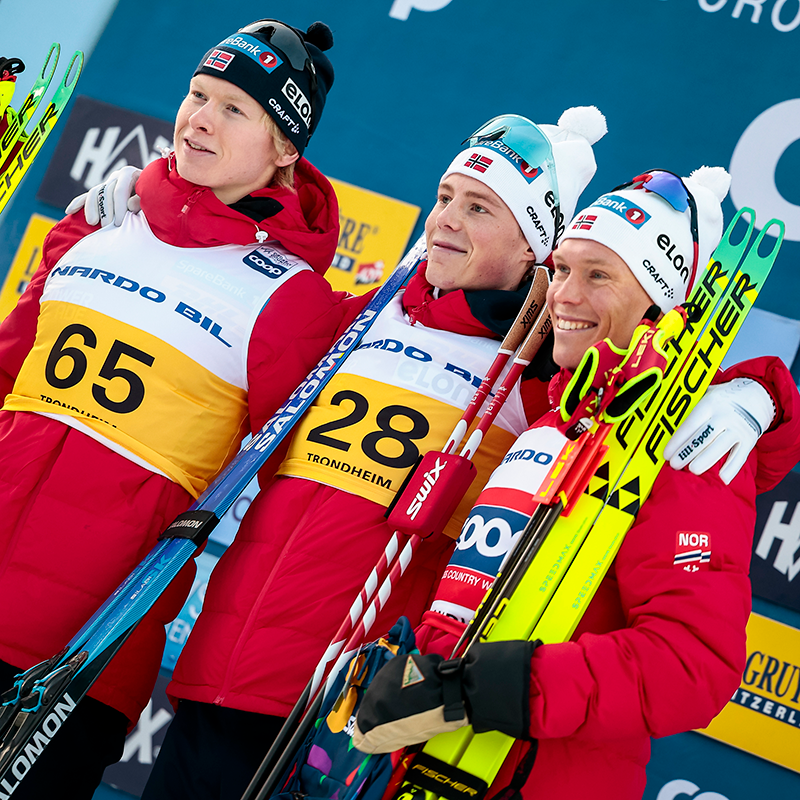
Tag: Andreas Fjorden Ree

  • Never Count Him Out . . . Klaebo Returns in the 10 k

    Never Count Him Out . . . Klaebo Returns in the 10 k

    This coverage is made possible through the generous support of Marty and Kathy Hall and A Hall Mark of Excellence Award. To learn more about A Hall Mark of Excellence Award, or to learn how you can support FasterSkier’s coverage, please contact info@fasterskier.com.

    A week ago, it looked likethe competitive season of Johannes Hoesflot Klaebo (NOR) might be over. Today, he returned to dominate the 10 k Classic Interval Start at the World Cup Final in Lake Placid. (Photo: Thibaut/NordicFocus)

    Two seasons ago in Minneapolis, the energy of an American crowd lifted an American skier—Gus Schumacher—to a surprising win in the 10 k Freestyle Interval Start. The FIS World Cup returns to the USA, but in a very different environment. Mt. Van Hoevenberg is an historic cross-country skiing destination and two-time host of the Olympic Winter Games (1932 and 1980), but the village of Lake Placid is tiny—barely 3000 residents. Not only is it small, but it’s really really far away from any urban centers that might provide spectators for these World Cup Finals events. New York City is nearly five hours away by car; Boston even farther. Even the closest airport (Albany, NY) is nearly three hours away, even in good weather. Many cross-country ski fans will undoubtedly arrive at Mt. van Hoevenberg for the chance to see their ski-heroes, but the crowds are not likely to be anything like what those heroes experienced two seasons ago in Minneapolis. Still, Americans will be enjoying the rare benefit of racing on home turf. Perhaps Schumacher—or another American on the rise—would be able to break through?

    Team USA sent Schumacher to the starting line along with his partner in the silver-medal-winning Team Sprint, Ben Ogden. Rounding out the American roster were Luke Jager, JC Schoonmaker, Zanden McMullen, John Steel Hagenbuch, Reid Goble, Benjamin Dohlby, Michael Earnhart, Zachary Jayne, Brian Bushey, and Hunter Wonders.

    As is often the case, Norwegian names crowded the ranks of seeded skiers: Emil Iversen, Harald Oestberg Amundsen, Mattis Stenshagen, Andreas Fjorden Ree, and Lars Heggen would toe the starting line, joined by a late-arriving Johannes Hoesflot Klaebo whose arrival was delayed while he—and Team Norway—debated his fitness to compete. After a dramatic fall (and subsequent concussion) in the Sprint semfinals in Drammen last week, Klaebo’s condition had remained in question. before the race, he admitted he might not be at his absolute best, but he felt he owed it to the fans gathered in Lake Placid to make an appearance.

    The arrival of Amundsen had never been in doubt, as he continues to joust with Klaebo in their rivalry for the Overall and Distance Crystal Globes. Like Klaebo, Amundsen remarked that he had been looking forward to this journey to Lake Placid.

    “I spoke with Ben Ogden, and he said it would be lots of people and a good vibe,” Amundsen remarked to FasterSkier in post-race interviews. “So I was looking forward to it. They are traveling to Europe and staying there a whole winter, so now it’s our turn to travel here and get some good races.”

    And a sentimental favorite during this World Cup Finals weekend would be Italy’s Federico Pellegrino who has announced that this World Cup season will be his last. At the end of this weekend, he will hang up his skis and glide off into retirement. Pellegrino’s chances for a fond farewell were improved by the announcement that his old friend and long-time rival, Klaebo, would not be competing in Saturday’s Sprint event.

    But, c’mon, the story of the day is the three point lead enjoyed by Amundsen over Klaebo in the chase for the World Cup Distance title. A week ago, it looked like Klaebo would run the table: Distance, Sprint, and Overall. Who knew this race could be so close. With as much as Klaebo has won this year, it would be understandable to assume that he would win all the Crystal Globes. But Amundsen has never been far behind . . . and with the disastrous collision between Klaebo and Ogden in the Drammen Spritnt (that resulted in Klaebo’s hospital stay for a concussion), Amundsen was able to ski well enough in the Holmenkollen 50 k to slide into the Distance lead.

    Amundsen would ski brilliantly in Lake Placid’s 10 k Classic Interval Start, battling snowy conditions, fighting his way to a fourth place finish behind Ree and Stenshagen. But it was Klaebo—who just a week ago looked like his season might be over—to reclaim what should rightfully have been his along.

    With the energy of a cheering and rowdy Lake Placid crowd,  Ben Ogden (USA) couldn’t hold back. (Photo: Modica/NordicFocus)

    Schumacher and Ogden would both claim impressive finishes: seventh and 11th, respectively.

    “I wanted to go out easy,” said Ogden. “But there was no hope of that with this many people cheering! I really had to fight for it at the end, but I wouldn’t have it any other way.”

    “The last couple of kilometers, it was really fun to hear so many people cheering,” said Schumacher. “And to know that what’s going to make them happy is me going as hard as I can.”

    Never Count Him Out

    Serious contenders in any Classic ski race would normally include Savelii Korostelev (AIN). But like his compatriot, Dariya Nepryaeva, Korostelev is a citizen of Russia. Despite his competing as an Individual Neutral athlete (AIN), he would not have qualified for an American visa. Korostelev would not get the chance to be on the starting line in Lake Placid.

    Snow continued to fall heavily during the Men’s race, gathering in fluffy inches on the course. Skiers continued to struggle, both uphill and down, and conditions looked likely to heavily influence the eventual results.

    Gus Schumacher (USA) would follow the example of his fast-starting teammate, Ben Ogden. Schumacher would finish seventh, Ogden 11th. (Photo:  Thibaut/NordicFocus)

    Ogden started in bib 20 with a loud and energetic fan club cheering him on. Ogden would lead the first 50 starters at the first checkpoint, but would find himself overtaken by Stenshagen, Pellegrino, Amundsen, and Schumacher. That’s right, Gus was on course, and charging.

    Klaebo would ease off the starting line, knowing that the accumulating snow was likely to favor earlier starters. His effort appeared measured; nonetheless, he was fastest through the first checkpoint, leading Amundsen (the only other skier whose placing probably concerned him) by 6.3 seconds, a lead that Klaebo extended to 16 seconds at 3.8 kilometers. If Klaebo was in race-shape today, Amundsen could find himself in trouble in Sunday’s 20 k Mass Start.

    Schumacher trailed Klaebo by only 20 seconds at the halfway mark. Between them could be found Pellegrino, Stenshagen, Ree, and Amundsen. Ogden still maintained a top-ten position, and he was able to spend some time in the leader’s chair while he waited for the arrival of later starters.

    Harald Oestberg Amundsen (NOR) wore the red leader’s bib in the Distance category. He is dertimined to fight to the end in his rivalry with countryman, Johannes Hoesflot Klaebo. (Photo: Modica/NordicFocus)

    As the race played out, the Norwegians gravitated to the top of the list of finishers. Stenshagen would take over the lead, only to be supplanted by Ree. Schumacher would cross the line just behind Pellegrino, and only 25 seconds behind Ree. But the crowd and the headlines were awaiting the arrival of Klaebo, His splits had been fastest throughout the race, and Klaebo was hoping for even more than the win. Klaebo needed to put his recent concussion behind him, and put Amundsen in his place.

    Amundsen—wearing the red Distance leaders bib—would cross the line and into the third slot . . . but that was not to last. Likewise, the red bib was soon to transfer back to the shoulders of Klaebo. To no one’s surprise—but to everyone’s surprise—Klaebo glided across the finish line for the win, some 14 seconds ahead of second place Ree, and 25 seconds ahead of fourth place Amundsen.

    “It was a tough fight, tough conditions,” said Amundsen. “But I think it was fair conditions for everyone.”

    “It was so much people, I couldn’t hear my own thinking,” grinned Amundsen.” That’s a good thing!”

    “I’m second place in the World Cup Overall, so I’m fighting for that,” said Amundsen. “And I’m twelve points behind Johannes for the overall, so it will be a close fight on Sunday. I need to take some points in the sprints during the race, and beat him in the end . . . we’ll see.”

    With two races remaining in the season—one of which (tomorrow’s Sprint) he is likely to skip—it really does appear that Klaebo will complete the near-perfect season, gathering up not only every Olympic gold medal, but the full slate of Crystal Globes—Sprint, Distance, and Overall—as well.

    World Cup Final Men’s 10 k Classic RESULTS

    Love Stories Like This? Help Keep Them Coming.

    Feature stories like this one take time, access, and care to produce. If you value thoughtful storytelling and independent ski journalism, please consider becoming a Voluntary Subscriber. Your support directly fuels the work we do to cover the people, places, and moments that make our sport special.

    Join the FasterSkier community!

    World Cup racing continues this weekend from Lake Placid and Mount van Hoevenberg:

    Saturday, March 21

    10:30 am | Women’s Sprint Qualification Free

    11:05 am | Men’s Sprint Qualification Free

    1:00 pm | Women’s Sprint Final Free

    1:00 pm | Men’s Sprint Final Free

    Sunday, March 22

    12:30 pm | Men’s 20km Mass Start Free

    2:30 pm | Women’s 20km Mass Start Free

    4:30 pm | ONE LAST LAP w/Jessie Diggins & the Retiring Stars

  • Hedegart Emerges From the Fog to Win Holmenkollen 50 k as Klæbo’s Absence Reshuffles the Distance Globe

    Hedegart Emerges From the Fog to Win Holmenkollen 50 k as Klæbo’s Absence Reshuffles the Distance Globe

    This coverage is made possible through the generous support of Marty and Kathy Hall and A Hall Mark of Excellence Award. To learn more about A Hall Mark of Excellence Award, or to learn how you can support FasterSkier’s coverage, please contact info@fasterskier.com.

    The start of the Holmenkollen Men’s 50 k Freestyle in Oslo, Norway. (Photo: Authamayou/NordicFocus)

    For nearly two hours on Saturday, 77 men disappeared into a stubborn curtain of fog that clung to the hillsides above Oslo, their figures swallowed by the mist somewhere between the stadium and the high point at Frognerseteren. When it was over, only one emerged with his arms in the air, and it was the one freestyle specialist who had been topping shorter freestyle distance races most of the season.

    Einar Hedegart, the 24-year-old former biathlete who only committed fully to cross-country skiing in November, surged past Harald Oestberg Amundsen in the final meters to win the Holmenkollen 50 k Freestyle in 1:51:38.2 — his first victory on cross-country skiing’s most storied stage, in just his seventh World Cup start.

    “This is the greatest feeling I’ve ever had,” Hedegart said after the finish. “This is just a nostalgia stadium. [A] legendary race, almost all my heroes have won this race, and especially Petter Northug. This might be the reason why I’ve been so motivated my whole life to be a cross-country skier.”

    Einar Hedegart (NOR) celebrates winning Norway’s most iconic race. www.nordicfocus.com. (Photo: Authamayou/NordicFocus)

    But the result that will echo loudest across the sport happened away from Oslo. Johannes Hoesflot Klaebo, the overall World Cup leader, was home nursing a mild concussion from a hard crash in the Drammen sprint two days earlier. Klaebo, who has already compiled a nearly perfect season, winning the Tour de Ski, all six Olympic races, secured the FIS Overall Crystal Globe, the FIS Sprint Crystal Globe, and only needed to keep racing the remaining distance races to take the clean sweep of the season with the FIS Distance Crystal Globe. BUT his absence from the start line meant zero points scored in the distance standing today. And with Amundsen’s second-place finish today, the distance crystal globe race was blown wide open: Amundsen now leads the distance standings by three points, 939 to 936, with two distance races remaining at the World Cup Finals in Lake Placid.

    Klaebo posted to Instagram yesterday: “Took a fall yesterday and hit my head pretty hard, but luckily everything is all good in the hood. Ended up with a concussion, so I’ll take some days off from both training and the internet just to make sure everything settles properly. Only got one head, so have to take good care of it.”

    He had been scheduled to fly to the United States on Sunday, but will now stay in Norway for a few extra days, hoping to recover in time for Lake Placid.

    Einar Hedegart (NOR) emerges from the fog to take the win. (Photo: Nordnes/NordicFocus)
    A Race Defined by Fog

    The Holmenkollen 50 k — first raced in 1888, a fixture of the World Cup since 1982, and a race that draws an estimated 100,000 fans to the forested hills above Oslo — returned to the calendar Saturday after a one-year absence. For the first time, the men’s and women’s 50 k races were held on the same day, the women starting 45 minutes behind the men in a format designed to create an all-day spectacle. The fog, however, had other ideas. Conditions were so thick that spectators along the course could hear the racers before they could see them.

    The course — six laps of 8.3 km with 334 meters of climbing per lap — was firm and fast after overnight salting despite an air temperature of 5.0°C. The salted, compact surface was ideal for skating, and the winning time of 1:51:38 came in roughly four minutes faster than the last time the Holmenkollen 50 k was contested in freestyle.

    Harald Oestberg Amundsen (NOR) on his way to second place. (Photo: Authamayou/NordicFocus)

    Through the first three laps, the race unfolded as a cautious tactical affair. A large pack of roughly 40 skiers stayed together, with Martin Loewstroem Nyenget, Mattis Stenshagen, and Federico Pellegrino taking turns at the front. The first athlete to make a decisive tactical move was Iver Tildheim Andersen, who changed skis early at the stadium after the third lap while the rest of the pack continued through. The fresh skis gave Andersen a burst, and when the lead group stopped for their own ski exchange one lap later, he suddenly found himself alone at the front with a roughly 15-second advantage.

    “Just stick with the field as long as possible and then hopefully be in position when the group starts swarming,” Hedegart said of his plan. “But today I was really offside, like 70 percent of the race. So I was lucky that no one took a gap.”

    The chase group — reduced to roughly eight athletes, all Norwegian once France’s Victor Lovera fell off the pace — gradually closed on Andersen through the fifth lap, with Hedegart, Simen Hegstad Krueger, Amundsen, Nyenget, Andreas Fjorden Ree, and Kasper Andersson Herland trading pulls at the front. By the time the group reached the final lap, they had swallowed Andersen, and the race became a question of who had saved enough for the final kilometers.

    Simen Hegstad Krueger (NOR) tried his best to get away for the win. (Photo: Authamayou/NordicFocus)
    Krueger’s Late Charge and Hedegart’s Final Kick

    Krueger, who was celebrating his 33rd birthday the day before, was omitted from the Norwegian Olympic team despite multiple Olympic medals in his career and was the winner of the last freestyle Holmenkollen 50 k. He drove the pace through the final lap. He pushed hard over the climbs near the iconic Holmenkollen church, stringing out the group and shedding Andersen off the back. But Krueger couldn’t sustain the pressure all the way to the finish, and as the group of seven came around the final corner and up the short, steep ramp before the descent into the home stretch, the sprint was on.

    Amundsen launched first, throwing everything he had at the final few hundred meters. But Hedegart, who had looked labored at points earlier in the race, found a gear no one could match. He came alongside Amundsen, took the lead in front of the grandstand crowd, and raised his fist in celebration as he skied across the line.

    “I felt, like, better,” Hedegart said of his position in the back of the pack through much of the race. “So I was just laying in the field, and I had to remind myself he did the same,” he added, referring to his idol Northug, whose trademark move was stalking from behind before unleashing a devastating sprint.

    Harald Oestberg Amundsen (NOR), Mattis Stenshagen (NOR), and Martin Loewstroem Nyenget (NOR), (l-r) stayed in the lead pack. (Photo: Authamayou/NordicFocus)

    Hedegart crossed in 1:51:38.2. Amundsen finished four-tenths of a second behind. Nyenget was third at +1.1. Ree took fourth (+1.5), followed by Herland (+2.1), Krueger (+3.0), Moseby (+4.8), and Andersen (+16.8) after his brave solo effort. Norway swept the top eight positions.

    France’s Lovera was the first non-Norwegian in ninth (+48.1), followed by AIN athlete Savelii Korostelev in 10th (+1:24.2).

    Zak Ketterson (USA) led the way for the Americans in the chase pack racing for 11th place; he ultimately finished 18th. (Photo: Authamayou/NordicFocus)
    Ketterson Fights for 11th in His Adopted Home

    Zak Ketterson, who spent the summer and fall living and training in Oslo, found himself in the thick of a battle for 11th place, a fight he learned about from coaches stationed along the fog-shrouded course.

    “I had heard from coaches on the side of the trail that our pack was fighting for 11th, and that was super cool,” Ketterson said. “I actually felt pretty fresh at the end and thought my finishing sprint would be pretty good, but I didn’t time it well and got really boxed in on the last couple turns into the finish.”

    Ketterson ultimately finished 18th (+1:54.2), part of a chase pack that came across the line within seconds of each other. He said everyone in the group knew a sprint was coming on the final lap.

    The fog made the tactical picture nearly impossible to read. “I couldn’t see more than 10 meters in front of me,” Ketterson said. “It definitely made it difficult to assess where I was relative to the leaders in the later laps. It also made some of the corners feel way sketchier because you couldn’t really choose an optimal line with such limited visibility.”

    For Ketterson, the race carried personal significance beyond the result. Having trained on the Holmenkollen course through the Norwegian summer and fall, he knew every climb and descent intimately. “This is definitely one of the most iconic and cool races we get to do,” he said. “It was especially special for me this year since I trained on this course all summer and fall living in Oslo. The highlight was definitely having my wife Julie and her family out there cheering me on.”

    What made the performance all the more impressive was the state of his body coming in. “I honestly feel like I am really running on fumes,” Ketterson said. “To be honest, I was not sure if I would even start this race in the morning. I felt so bad, and honestly, my body has felt super up and down in the last few weeks. I’m really curious to see how my body responds to this race. I was pleasantly surprised by how decent it felt, but I feel like the next week could go either way. Especially with the international travel tomorrow.”

    Brian Bushey (USA) gaining experience on his way to 59th place. (Photo: Authamayou/NordicFocus)
    The Rest of the North Americans

    Hunter Wonders was 45th (+5:46.9), Kevin Bolger was 48th (+6:51.3), and Brian Bushey was 59th (+12:24.9).

    Canada’s Xavier McKeever finished 41st (+5:11.4), while Thomas Stephen was 43rd (+5:18.1).

    Harald Oestberg Amundsen (NOR) takes over the FIS Distance Globe lead with just two distance races remaining. (Photo: Authamayou/NordicFocus)
    Distance Globe: Three Points

    The ramifications of Saturday’s race land squarely on the crystal globe picture. Before the race, Klaebo held a 128-point lead over Amundsen in the distance standings and a 636-point lead in the overall. With Klaebo watching from home, Amundsen’s 131-point haul (including bonus points) vaulted him into the distance lead: Amundsen now sits at 939 points, three ahead of Klaebo’s 936. Nyenget climbed to 914 in third.

    Klaebo’s overall World Cup lead, at 2,071 points to Amundsen’s 1,566, remains secure with a 505-point cushion. But the distance globe — awarded to the season’s best across distance events only — will come down to the final two races: a 10 k Classic Interval Start and a 20 k Freestyle Mass Start in Lake Placid, March 20-22.

    If Klaebo can travel to Lake Placid and race, he’ll have every opportunity to reclaim the lead. If the concussion keeps him out, the distance globe is likely to belong to Amundsen.

    Kasper Andersson Herland (NOR), who finished fifth, celebrates with Einar Hedegart (NOR), (l-r) at the finish of the Holmenkollen. (Photo: Authamayou/NordicFocus)
    A Star Made for This Stage

    Hedegart’s career trajectory is one of the season’s best stories. A junior biathlon world champion who struggled with his shooting, he drifted toward cross-country skiing after a surprising second-place finish at the Holmenkollen World Cup last season. He spent the summer training with a cross-country team while bringing his rifle to every camp, undecided. In November, after winning the popular pre-World Cup cross-country race in Beitostoelen, Norway, by a wide margin and missing eight of 20 shots in a biathlon event, he committed to leaving the rifle at home.

    Since then: an Olympic bronze in the 10 k Freestyle behind Klaebo, a team sprint gold partnered with Klaebo, victories in the Engadin Marathon, and now the Holmenkollen 50 k — a distance he had never raced at the World Cup level. He was asked whether his approach of sitting back resembled Northug’s famous stalking tactics.

    “Yeah, I felt like Petter,” Hedegart said. “So I was just lying in the field, and I had to remind myself he did the same.”

    For a race that dates to 1888, that has been won by the sport’s mythical stars, and that is contested before the King of Norway in a stadium surrounded by 100,000 fans, there is no small amount of weight to what happened Saturday at the Holmenkollen. Hedegart is, by every measure, now a cross-country skier.

    The season concludes with the World Cup Finals in Lake Placid, New York, March 20-22. Three races remain. The distance globe is separated by three points. And the world waits to see whether Klaebo can make it to the start line.


    Holmenkollen Men’s 50 k Freestyle FINAL RESULTS

    FIS Men’s Crystal Globe SPRINT STANDINGS
    FIS Men’s Crystal Globe DISTANCE STANDINGS
    FIS Men’s Crystal Globe OVERALL STANDINGS


    Love Stories Like This? Help Keep Them Coming.

    Feature stories like this one take time, access, and care to produce. If you value thoughtful storytelling and independent ski journalism, please consider becoming a Voluntary Subscriber. Your support directly fuels the work we do to cover the people, places, and moments that make our sport special.

    Join the FasterSkier community!


    Harald Oestberg Amundsen (NOR), Andreas Fjorden Ree (NOR), and Martin Loewstroem Nyenget (NOR), (l-r) share the Holmenkollen 50 k Freestyle in Oslo, Norway. (Photo: Authamayou/NordicFocus)
  • Let the Chaos Reign: Norway’s Impossible Eight-Man Puzzle for the Olympics

    Let the Chaos Reign: Norway’s Impossible Eight-Man Puzzle for the Olympics

    On most race weekends, I take my job seriously — up at 3:00 am EST, fresh coffee made, woodstove loaded, notebook out, logged on to coverage early to make sure I don’t have a technical issue. Then once the race starts, I begin looking for subtle, important moments to describe in greater detail in the race report. But there are also weekends, like this past one, when I toss my journalism hat onto the mantle above the woodstove to warm for another day, ‘grab a bucket of popcorn’, and watch, specifically, the Norwegian men’s Olympic selection saga unfold like the most incredible reality show in sport.

    This year, the selection of Norway’s eight-man Olympic cross-country ski team might be the third most fascinating storyline in the Nordic world — trailing only Jessie Diggins’ farewell tour and the Russians’ return to the start gate. And yet, the drama out of Oslo might be the strangest: imagine being one of the ten fastest skiers alive… and still needing binoculars to see an Olympic start line.

    This is what it means to be a Norwegian man in an Olympic year. It is both a birthright and a statistical tragedy.

    Erik Valnes (NOR) and Johannes Hoesflot Klaebo (NOR), (l-r) crest the final climb before descending into the stadium during the World Cup Classic Sprint in Trondheim (NOR). (Photo: Modica/NordicFocus)

    A Nation That Could Sweep Top 10 — and Still Leave Podium Skiers at Home

    Let’s get one thing out of the way: on any given Sunday — sprint, classic, skate, distance, mass start, you name it — Norway could theoretically fill the entire top ten of a World Cup with home-grown talent. Twelve deep. Some years, nearly fifteen. The country is, bluntly, absurd.

    And yet:

    • Only eight can go to Milano–Cortina.
    • Only four can start each race.
    • Only two can sprint in the team sprint.
    • Only four can race the relay.

    You can be the fifth-best classic distance skier in the world, wearing red and blue, and never get to test yourself in the Olympic 50 k Classic, the sport’s defining event.

    You can be a podium threat.

    You can be a badge-wearing World Cup, World Championship, or Olympic winner. And still hear the most devastating phrase in the language of elite skiing: “Reserve.”

    Johannes Hoesflot Klaebo leads training partner Emil Iversen durning the Skiathlon in Trondheim (NOR). (Photo: Modica/NordicFocus)

    The Ten-Man Hunger Games

    After Ruka and Trondheim, the men fighting for eight tickets look something like this:

    • Johannes Hoesflot Klaebo — simply the best male skier ever and is a favorite for gold in any race he enters.
    • Harald Oestberg Amundsen — has two fifths, one second and a first already this season.
    • Martin Loewstroem Nyenget is a force in any distance race, with first, third, fourth, and seventh-place finishes in the races he has entered this season, and is indispensable in the relay.
    • Andreas Fjorden Ree— second in the 10 k Freestyle and eighth in the Skiathlon this weekend.
    • Einar Hedegart — the young biathlete turned cross-country racer, who doesn’t even have a FIS bio pic, has broken onto the scene this season with a second in Ruka and a win in Trondheim in the two skate distance races he has entered.
    • Oskar Opstad Vike — He was second in the Classic Sprint in Trondheim, an Olympic event.
    • Erik Valnes — Olympic gold potential in the individual sprint, team sprint, and/or relay.
    • Lars Heggen — while he was only fourth in the Classic Sprint in Trondheim, that is an Olympic event.
    • Emil Iversen — the comeback story, the steady relay hand, who climbed onto the podium last weekend for the first time in five years.
    • Didrik Toenseth — has only started one World Cup, the 10 k Classic in Ruka, thus far, but was in 8th place, and it is an Olympic event. Toenseth is still one of the world’s best in distance races, yet still at risk of not making the team.

    That is ten world-class athletes, without even mentioning skiers like Simen Hegstad Krueger, who is knocking at the door and who has won bronze in all the championship 50 k races for years.

    Norway only gets to name eight Olympians.

    Grab more popcorn.

    Norway’s Andreas Fjorden Ree (NOR), Einar Hedegart (NOR), Martin Loewstroem Nyenget (NOR), (l-r) share the podium after the 10km freestyle Trondheim (NOR) last weekend. (Photo: Modica/NordicFocus)

    Who Gets the Golden Tickets? Norway’s Math Problem

    If the federation’s stated goal is to:

    1. Sweep the podiums (plural),
    2. Win the relay,
    3. Win the team sprint

    And possibly have Klaebo win everything except the marble flooring in the athletes’ dining hall, then the selection is not just about speed. It’s about risk management, event coverage, and event specialization.

    Here’s how the roles break down:

    The Locks (2):

    • Klaebo
    • Amundsen

    Barring a meteor strike, these two are sharper in December than most nations’ peak athletes in February.

    The Near-Locks (2):

    • Nyenget — championship DNA, distance weapon.
    • Valnes — if classic sprint is a medal event (it is) and you want a dependable classic leg in the relay, Valnes is on the plane.
    Didrik Toenseth took third at the 2022 Holmenkollen 50 k Classic. (Photo: NordicFocus)

    The Crucial Middle (six guys for four spots):

    This is where heartbreak lives.

    • Heggen — might already be one of the five best sprinters on earth.
    • Ree — versatility is gold in Olympic selection, and he might be Norway’s best “plug into anything” skier outside of Klæbo and Amundsen.
    • Hedegart — never flashy, but quietly always where he needs to be.
    • Vike — brutal aerobic capacity, championship build. Coaches trust this archetype.
    • Iversen — history matters. Championships matter. Norwegians never entirely write him off.
    • Toenseth — elite distance skier who would start for literally any other nation.

    Pick four.

    Explain it to the other two.

    Good luck.

    Harald Oestberg Amundsen (NOR) wins the 20 k Mass Start Freestyle during the World Cup opening weekend in Ruka (FIN). (Photo: Modica/NordicFocus)

    Then There’s the Start-Quota Madness

    Let’s say you do make the team.

    Let’s say you ski the best season of your life.

    Let’s say you’re in the shape of a medalist.

    Too bad — your teammates might be in even better shape.

    Norway could very realistically bring to Italy:

    • Eight skiers capable of a medal in the Skiathlon
    • Eight skiers capable of a medal in the Classic Sprint
    • Eight skiers capable of a medal in the 10 km Freestyle
    • Eight skiers capable of a medal in the 4 x 7.5 k Relay
    • Eight skiers capable of a medal in the Freestyle Team Sprint
    • Eight skiers capable of a medal in the 50 k Classic

    But they can only start four.

    Which means a realist must acknowledge something deliciously absurd:

    Norway will leave potential Olympic medalists off the Olympic start list. Not just off the team — off the start list.

    That is a uniquely Norwegian form of pain.

    Oskar Opstad Vike (NOR) on his way to second place during the Classic Sprint last weekend in Trondheim (NOR). (Photo: Modica/NordicFocus)

    The Fan in Me Wants A Front Row Seat

    I admit it: I want this selection battle to go deep into January.

    I want someone to pop one in Davos and get hot in Toblach.

    I want the young skiers to keep storming the podiums and scrambling what we think we know.

    I want Iversen — or Vike, or Hedegart, or Ree — to force selectors into sleepless January nights.

    Because for once, the stakes in Norway aren’t abstract. The Olympics aren’t a coronation; they’re a compression chamber.

    There are eight tickets for ten men who could anchor most nations’ relays.

    There are four start spots for races where all Norwegian Olympians can podium.

    There is no path through this selection period that does not end in heartbreak.

    And yes, as a journalist, I will cover every step of it analytically, carefully, and responsibly.

    But as a fan?

    I’m sitting on the couch, popcorn in hand, and watching the drama unfold. If competitive suffering is the essence of cross-country ski racing, Norway’s selection battle might be the purest expression the sport has.

    Bring on Davos.

    Bring on Toblach.

    Bring on the Tour.

    Let the Hunger Games continue.


    Love Stories Like This? Help Keep Them Coming.

    Feature interviews like this one take time, access, and care to produce. If you value thoughtful storytelling and independent ski journalism, please consider becoming a Voluntary Subscriber. Your support directly fuels the work we do to cover the people, places, and moments that make our sport special.

    Join the FasterSkier community!


    Lars Heggen (NOR) was fourth place in the Classic Sprint in Trondheim (NOR) last weekend. (Photo: Modica/NordicFocus)