Tag: Andreas Nygaard

  • Sunday Rundown: Harvey Wins World Champs Gold in Lahti; PyeongChang + Vasaloppet (Updated)

    Sunday Rundown: Harvey Wins World Champs Gold in Lahti; PyeongChang + Vasaloppet (Updated)

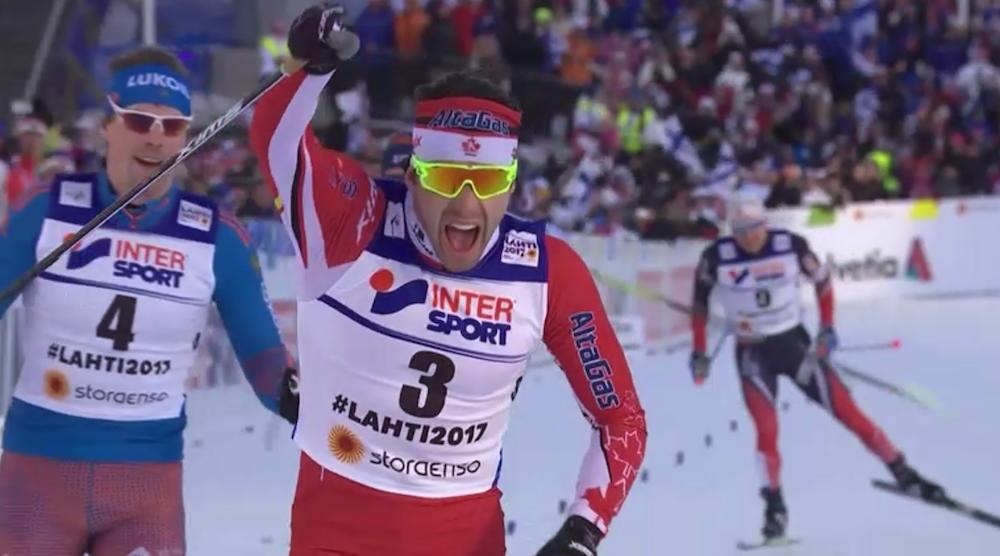
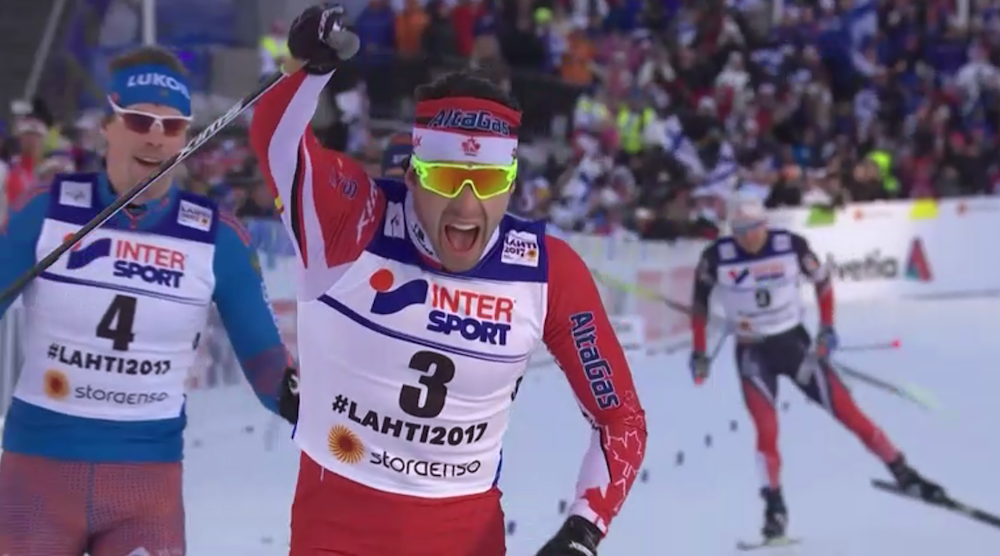
    Canada’s Alex Harvey (3) celebrates his win in the men’s 50 k freestyle mass start, his first individual gold medal at a World Championships, on Sunday at 2017 Nordic World Championships in Lahti, Finland. He beat Russia’s Sergey Ustiugov (l) by 0.6 seconds while Norway’s Sjur Røthe (9) can be seen coming in for sixth place, behind (not pictured) Finland’s Matti Heikkinen, Great Britain’s Andrew Musgrave and Norway’s Martin Johnsurd Sundby, respectively. (Photo: NBC Sports screenshot)

    FIS Nordic World Championships (Lahti, Finland): Men’s 50 k freestyle mass start

    After a week of missing out on the medals at 2017 Nordic World Championships, Canada’s Alex Harvey, a four-time World Championships medalist from 2011, 2013 and 2015, achieved his first individual gold medal in the final race of this year’s World Championships in Lahti, Finland.

    Harvey, 28, won the men’s 50-kilometer freestyle mass start in a drag race to the finish. Entering the final descent into the stadium with Norway’s Martin Johnsrud Sundby and Russia’s Sergey Ustiugov, Harvey rode his fast skis past both of them then had the most finishing kick in the final straightaway for a 0.6-second victory. He finished in 1:46.28.9 hours, while Ustiugov followed him across the line in second and Finland’s Matti Heikkinen from behind for third (+1.4), after passing Sundby around the outside of the last corner.
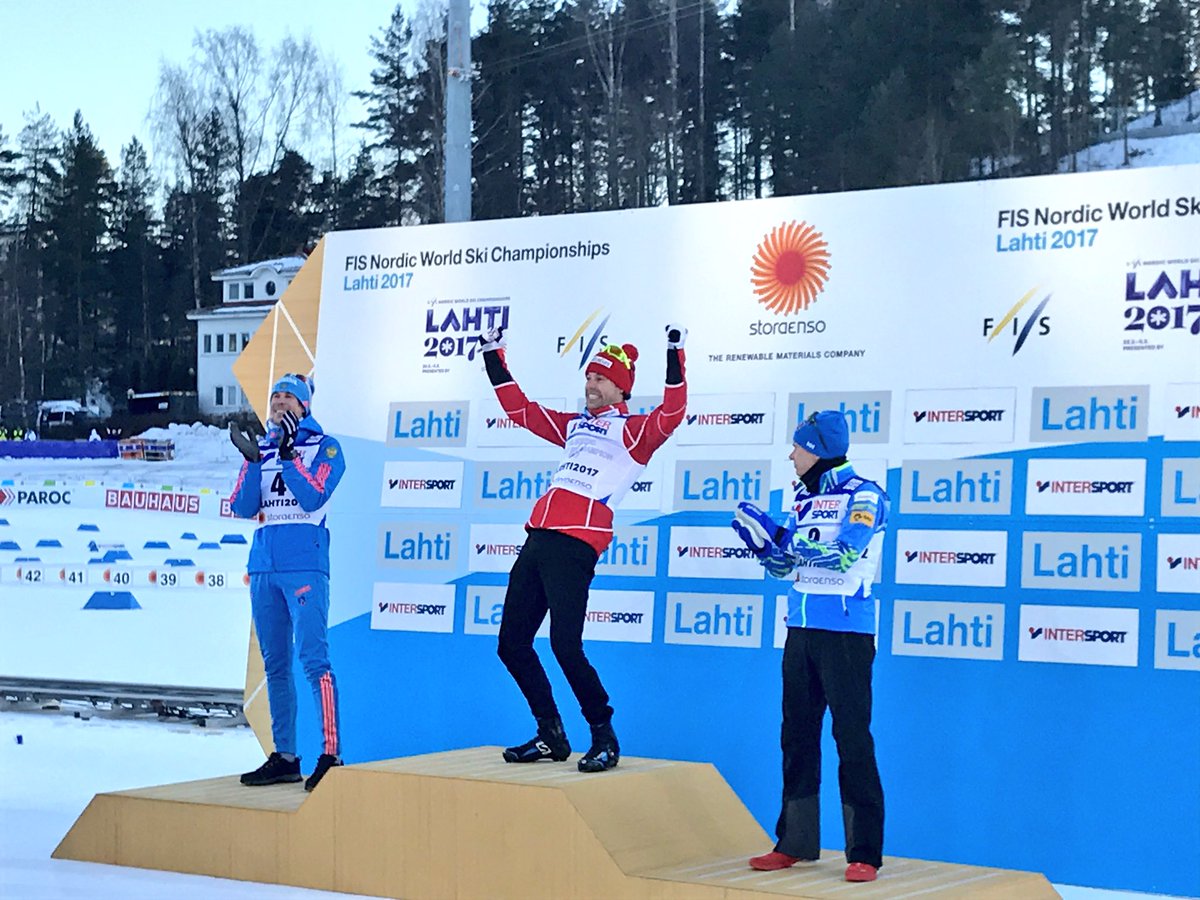
    Canada’s Alex Harvey (c) celebrates gold in the men’s 50 k freestyle mass start on Sunday at 2017 Nordic World Championships in Lahti, Finland, with Russia’s Sergey Ustiugov (l) and Finland’ Matti Heikkinen (r) joining him on the podium in second and third, respectively. (Photo: Cross Country Canada/Twitter)

    Sundby appeared to miss a pole plant soon after Heikkinen passed him and let off the pace a few meters before the finish. That’s where Great Britain’s Andrew Musgrave continued to accelerate and took fourth place, 2.9 seconds behind Harvey and 0.1 seconds ahead of Sundby in fifth. Norway’s Sjur Røthe followed another 0.4 seconds back in sixth, Switzerland’s Dario Cologna was seventh (+8.9), Norway’s Petter Northug eighth (+12.3), France’s Maurice Manificat ninth (+13.4), and Norway’s Hans Christer Holund 10th (+14.3).

    “I had really good skis,” Harvey said in a post-race interview with FIS. “I knew if I came into the corner in second place, that was the optimal position. So I was able to fight hard and hit that last corner in second and slingshot by Martin along the flat and then that was good after that.”

    “This is the best race of my life, for sure,” he added. “So I’m really happy.”

    Tad Elliott (Ski Club Vail) led the Americans in 27th (+3:16.8). Noah Hoffman (U.S. Ski Team) finished 50th (+8:53.1) and Kyle Bratrud (CXC Team) did not finish.

    Canada started four men, with Devon Kershaw finishing 38th (+5:45.5), Graeme Killick 43rd (+7:04), and Knute Johnsgaard in 55th (+12:03.3).

    For Harvey, the medal is his fifth at three World Championships and his first individual gold after winning the classic team sprint with Kershaw in 2011.

    Results

    ***

    IBU World Cup (PyeongChang, South Korea): Men’s and women’s relays

    Between the men’s and women’s relays on Sunday at the International Biathlon Union (IBU) World Cup in PyeongChang, South Korea, Canada had two teams in the top eighth, with its men’s team finishing seventh in the 4 x 7.5 k and women’s team eighth in the 4 x 6 k. Behind them, the U.S. men finished 10th and U.S. women 14th.

    France won the men’s relay by 33.8 seconds over Austria, using a total of 10 spare rounds but avoiding the penalty lap. Martin Fourcade anchored France to the win in 1:12:09.5 hours, after Jean-Guillaume Béatrix initially tagged them in first, his older brother Simon Fourcade raced them into second with near-perfect shooting (using just one spare to clean), and Simon Desthieux picked off one more place to give Fourcade a 16-second lead for the final leg.

    Austria achieved second place with Lorenz Wäger, Simon Eder, Julian Eberhard, and Dominik Landertinger combining for zero penalties and nine spares.

    Norway finished third (+45.4) with Vetle Sjåstad Christiansen, Ole Einar Bjørndalen, Vegard Gjermundshaug, and Henrik L’Abée-Lund. They had one penalty on Gjermundshaug’s third leg, and used a total of eight spares.

    Canada’s Christian Gow, Scott Gow, Nathan Smith, and Brendan Green finished seventh (+3:03.1) with zero penalties and nine spares. After Christian tagged his older brother Scott in ninth, Scott raced them into sixth place before Smith slipped four places to 10th at the final exchange. On the final leg, Green raced them into seventh, requiring two spares to clean.

    The Americans finished about nine seconds later in 10th (+3:12.8) with Lowell Bailey, Leif Nordgren, Paul Schommer, and Sean Doherty combining for zero penalties and nine spares, just like Canada. Bailey had originally put them in second at the first exchange, Nordgren dropped to seventh, then Schommer to 13th, before Doherty finally brought them back to 10th out of 24 teams.

    In the women’s relay, Germany pulled off a 22.8-second win over Norway, with one penalty and eight spares. Nadine Horchler put Germany in third at the first exchange, then Maren Hammerschmidt raced them into first by the race’s halfway point. From there, Denise Herrmann, a former cross-country World Cup regular, had to ski a penalty lap and tagged off in second, 13.5 seconds out of first. With teammate Laura Dahlmeier sitting out the relay, Franziska Hildebrand anchored Germany to the win in 1:07:35.6 after she used just one spare to clean.

    Norway placed second with Kaia Wøien Nicolaisen, Hilde Fenne, Tiril Eckhoff, and Marte Olsbu accumulating one penalty and 11 spares. Olsbu beat out the Czech Republic’s Gabriela Koukalová by one-tenth of a second at the finish, as the Czechs placed for third (+22.9), with Jessica Jislová, Eva Puskarčíková, Lucie Charvátová, and Koukalová (with a total of one penalty and nine spares).

    Canada took eighth (+1:34) with Rosanna Crawford, Julia Ransom, Megan Tandy, and Emma Lunder. Crawford tagged in second at the first exchange, Ransom slipped one place to third, Tandy lost another place to tag in fourth, and Lunder ultimately anchored them to eighth.

    The U.S., with Clare Egan, Susan Dunklee, Joanne Reid, and Maddie Phaneuf, finished 14th (+3:08.3) with one penalty and 10 spares. After Egan had a penalty on the first leg, Dunklee skied the fastest second leg to move the team from 19th to 14th, then Reid put them in 11th by the final exchange. Twenty-one teams competed in the women’s race.

    Results: Men | Women

    ***

    Ski Classics 90 k Vasaloppet (Sälen to Mora, Sweden)
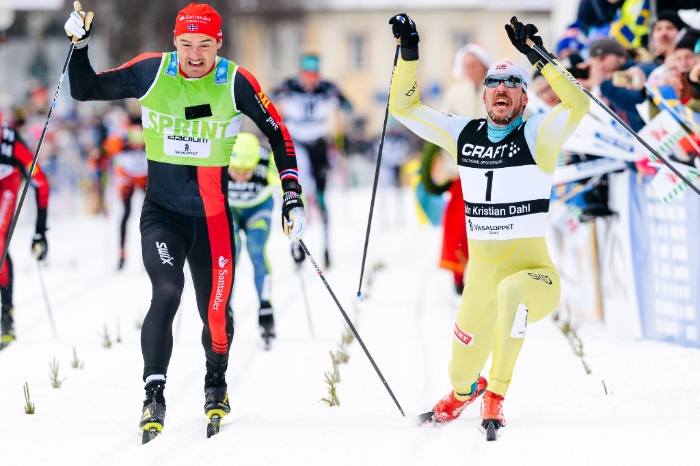
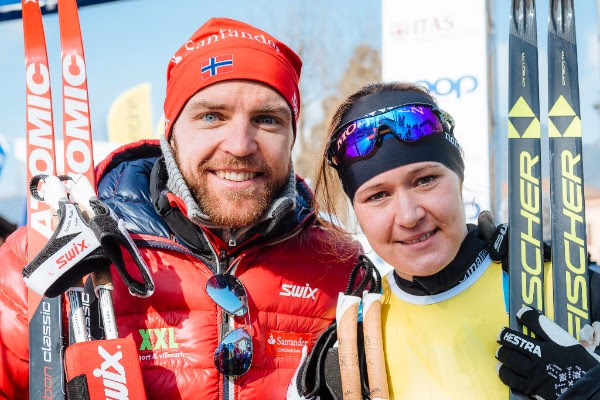
    John Kristian Dahl (r) of Team United Bakeries outlunges Ski Classics sprint leader Andreas Nygaard (r) of Team Santander for the win in Sunday’s 90 k Vasaloppet in Mora, Sweden. (Photo: Visma Ski Classics)

    [UPDATED] In Sunday’s 93rd annual 90-kilometer Vasaloppet from Sälen to Mora, Sweden, the ninth event of the Ski Classics series, John Kristian Dahl (Team United Bakeries) outlasted Andreas Nygaard (Team Santander) by one-tenth of a second for the win in 3:57:18.1 hours. The race came down to a five-way fight for first, with Stian Hoelgaard (Team Leaseplan) finishing 0.6 seconds back in third. The top 15 men were all within 21.7 seconds of the podium, and Brian McKeever, a member of Canada’s Para Nordic Ski Team, placed 20th (+2:31.1).

    “It has been a fight all day,” Dahl said, according to a Ski Classics press release. Three days ago, he had been unsure about starting the Vasaloppet following a back injury. “I was tired already after 30 k and had to let go of the lead group, but I fought my way back taking it step by step and hill by hill.”

    In the women’s race, Britta Johansson Norgren (Lager 157 Ski Team) broke away from the field to win by 1:37.9 minutes in 4:19.43.4.

    Astrid Øyre Slind (Team United Bakeries) finished second, and Sara Lindborg (Team Serneke) placed third, 9 minutes and 4.2 seconds behind Norgren. Kateřina Smutná (Team Santander) dropped out of the race about halfway through.

    “I am very tired but also so happy to win today,” Norgren said, according to the press release. “It felt pretty easy until Oxberg [Sweden] with 30 k to go, but then it got really tough and I had to fight all the way to the finish.”

    It was Norgren’s first Vasaloppet win after placing second the last three years. She increased her lead in the overall Ski Classics to 215 points over Smutná, while Tord Asle Gjerdalen continues to lead the men’s overall standings ahead of his Santander teammate Nygaard, who is 349 points behind in second place. Gjerdalen did not race Sunday’s Vasaloppet.

    Results

  • Saturday Rundown: Hamilton Second in Toblach Skate Sprint (Updated)

    Saturday Rundown: Hamilton Second in Toblach Skate Sprint (Updated)

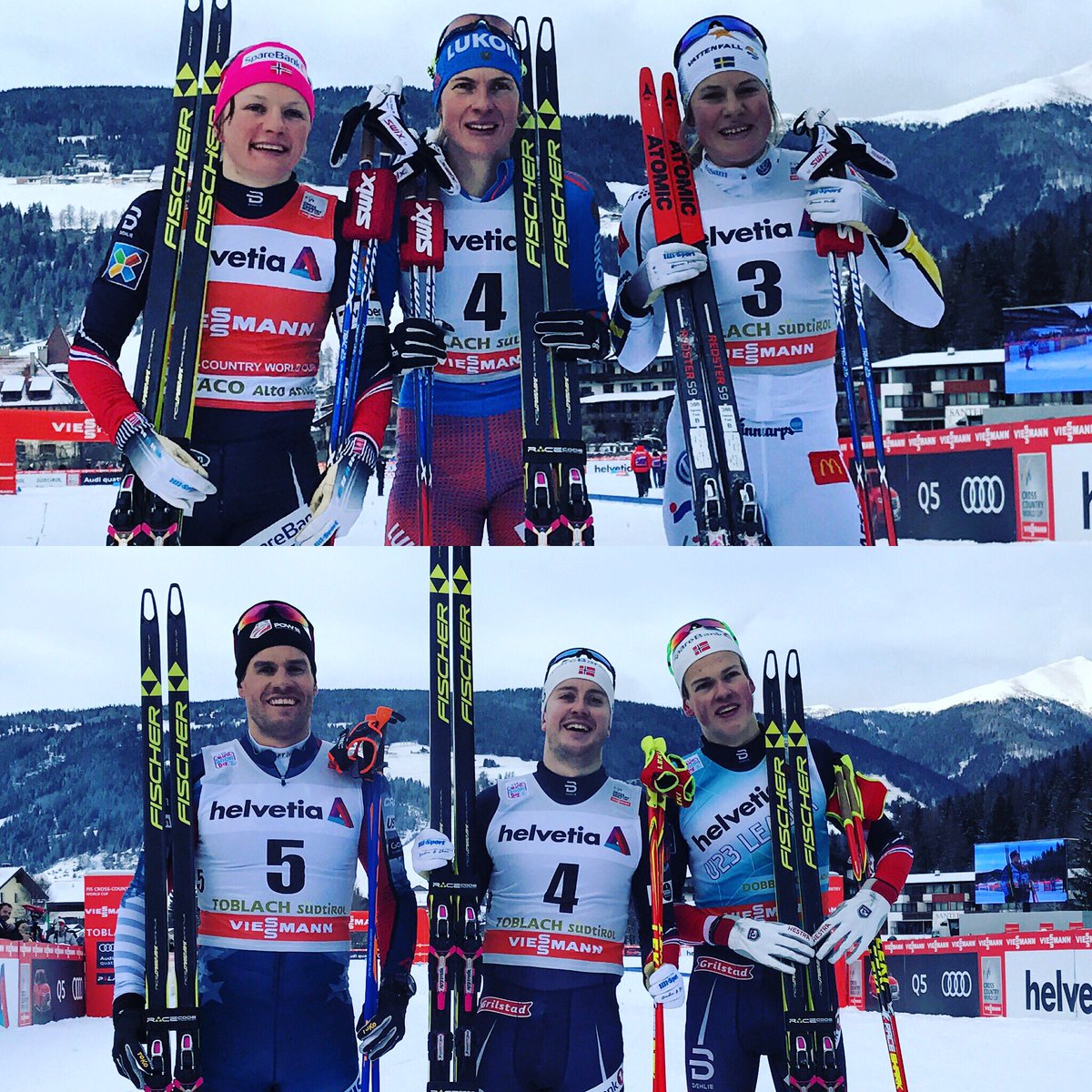
    The women's (top) and men's (bottom) podiums at the World Cup 1.3 k freestyle sprints on Saturday in Toblach, Italy. Russia's Natalia Matveeva (top center) won the women's final, ahead of Norway's Maiken Caspersen Falla (top left) and Hanna Falk (top right). American Simi Hamilton (bottom left) took second in the men's final, behind Norway's Sindre Bjørnestad Skar (bottom center) and ahead of Norway's Johannes Høsflot Klæbo (bottom right) in third. (Photo: FIS Cross Country)
    The women’s (top) and men’s (bottom) podiums at the World Cup 1.3 k freestyle sprints on Saturday in Toblach, Italy. Russia’s Natalia Matveeva (top center) won the women’s final, ahead of Norway’s Maiken Caspersen Falla (top left) and Hanna Falk (top right). American Simi Hamilton (bottom left) took second in the men’s final, behind Norway’s Sindre Bjørnestad Skar (bottom center) and ahead of Norway’s Johannes Høsflot Klæbo (bottom right) in third. (Photo: FIS Cross Country)

    FIS Cross-Country World Cup (Toblach, Italy): Freestyle sprints

    Race report

    Simi Hamilton is back on the World Cup podium and was three-hundredths of a second away from the win on Saturday in the men’s 1.3-kilometer freestyle sprint in Toblach, Italy. The American qualified fifth and went on to win his quarterfinal then advance as a lucky loser in third out of him semifinal. In the men’s final, Hamilton waited until the last hill to strike and used his conserved energy in the two-lap race to outlast the likes of Italy’s Federico Pellegrino and Norway’s Johannes Høsflot Klæbo at the finish. Hamilton put it all on the line in a photo finish with Norway’s Sindre Bjørnestad Skar, with Skar taking his first individual World Cup victory in 2:47.91. Hamilton placed second for his first podium of the season and fourth of his career. It was also Hamilton’s first time in the final this season.

    Klæbo was the second Norwegian on the podium in third, 0.66 seconds behind Skar, Pellegrino placed fourth (+1.27), Hediger was fifth (+1.84), and Norway’s Håvard Solås Taugbøl (who won the qualifier to start the day in 2:47.38) took sixth (+3.77).

    “I just had a good feeling that I was a little bit before [Hamilton],” Skar said in a post-race interview with FIS of his immediate finish-line celebration before confirming that he won. “It was very, very tight.”

    Skar, who turns 25 on Jan. 22, qualified fourth and won his quarterfinal and finished second in his semifinal, 0.05 seconds ahead of Hamilton.

    Also for the U.S., Andy Newell qualified for the heats in sixth and took third in his quarterfinal for 13th overall. Canada’s Alex Harvey qualified eighth and finished fourth in his quarterfinal for 17th overall, and the second Canadian racing this weekend, Len Valjas, qualified 23rd and took fourth in his quarterfinal for 20th.

    In the women’s race, Russia’s 30-year-old Natalia Matveeva notched the 12th individual podium of her career (all in sprints) and first victory since 2007. She challenged Norway’s Maiken Caspersen Falla on the last climb and overtook her in the finishing stretch of Saturday’s 1.3 k skate sprint final for the win in 3:04.13. Matveeva qualified fourth to start the day, then placed second in both her quarterfinal and semifinal en route to the victory. Falla won the qualifier in 3:10.89, and continued to dominate her quarterfinal and semifinal before ending up second on the day, just 0.08 seconds out of first.

    “I’ve waited a lot of time to be [here],” Matveeva told FIS afterward. “I’m very happy and the Russian team is very happy. Thank you very much my service team. Good job today.”

    Sweden’s Hanna Falk reached the podium in third (+2:41), Germany’s Sandra Ringwald placed fourth (+3.46), Sweden’s Ida Ingemarsdotter was fifth (+5.88), and Slovenia’s Vesna Fabjan sixth (+19.39).

    Americans Kikkan Randall and Sophie Caldwell tangled in the first semifinal and ended up 10th and 11th, respectively, at the end of the day. Also for the U.S. Ski Team, Ida Sargent qualified for the heats in 16th (behind Caldwell in 15th while Randall qualified 27th), and reached the semifinals as well, placing sixth in the second semifinal after skiing in third into the finishing stretch. Sargent ended up 12th for her best result in over a year.

    Results: Men | Women

    ***

    IBU World Cup (Ruhpolding, Germany): Women’s 7.5 k sprint

    Race report

    Finland’s Kaisa Mäkäräinen posts a 22-second win for her first victory of the season and first time shooting without a miss in an individual race since the Ruhpolding sprint almost exactly a year ago. Dunklee leads North Americans in 33rd and qualifies for the pursuit, along with Canada’s Rosanna Crawford (55th), Megan Tandy (56th) and Julia Ransom (60th).

    Results

    ***

    Ski Classics Kaiser Maximilian Lauf (Seefeld, Austria): 60 k classic 

    [UPDATED] Imagine knee-deep snow drifts over the course of 60 k. That’s what faced racers in Saturday’s Kaiser Maximilian Lauf, the fourth stop in the 2016/2017 Ski Classics series, in Seefeld, Austria.

    Team Santander’s Kateřina Smutná and Andreas Nygaard fared best in the conditions, racing to the women’s and men’s victories in 3:43:48.7 and 3:21:44.5, respectively.

    Smutna won the women’s race by 10.8 seconds over Astrid Øyre Slind (Team United Bakeries), and Britta Johansson Norgren (Lager 157 Ski Team) finished more than three minutes later in third place (+3:35).

    “It was the right decision to go with kick today,” Smutná said after, according to a Ski Classics press release. “It was hard for us to be in the lead and open the tracks for men. We waited for them to catch up and do the work on our behalf. I noticed it was tough for Britta because she was double poling. So, Astrid and I decided to work together in the final section of the course, and it worked perfectly.”

    The men’s race was much closer with Nygaard holding off his Team Santander teammate Tord Asle Gjerdalen by 0.6 seconds. Stian Hoelgaard (Team Leaseplan) placed third, another 0.6 seconds back.

    “It was a tough race because there was so much snow on the course,” Nygaard said, according to the press release. “At some point, we were knee-deep in soft snow. The pace was slow, but you get tired after a while because you have to work hard when it’s snowing like this. I just kept telling myself that I need to keep up with the guys and win the race in the end. This is something that I didn’t expect to happen when the season started. Let’s see how long I can keep the yellow [leaders] bib.”

    The overall Ski Classics series leader, Nygaard is also the sprint leader as well. On the women’s side, Johansson Norgren possesses both the overall and sprint bibs as well.

    FasterSkier Editor-at-Large Chelsea Little placed 17th.

    Results: Men | Women

  • Unequal Prize Money at Blink Festival Illustrates Challenges for Women’s Distance Racing

    Unequal Prize Money at Blink Festival Illustrates Challenges for Women’s Distance Racing

    Tord Asle Gjerdalen (l) and Britta Johansson-Norgren (r) after winning the 2016 Marcialonga 70 k classic. In July, Johansson Norgren won the Blink Classics 60 k rollerski race - but received only 20% as much prize money as Petter Northug got for winning the men's race. (Photo: Visma Ski Classics)
    Tord Asle Gjerdalen (l) and Britta Johansson Norgren (r) after winning the 2016 Marcialonga 70 k classic. In July, Johansson Norgren won the Blink Classics 60 k rollerski race — but received only 20 percent as much prize money as Petter Northug got for winning the men’s race. (Photo: Visma Ski Classics)

    At the end of July, Norwegian professional cross-country skier Astrid Øyre Slind hit the podium in the new 60-kilometer classic race at her country’s Blink ski festival. She faced a payout that seemed unusual: a big discrepancy between men’s and women’s prize money.

    At the competition, called Blink Classics and part of the inaugural summer season of the World Classic Tour rollerski series, the total prize money available for men was 190,000 kroner, or just over $23,000. For women, it was 50,000 kroner — about a quarter as much.

    Accordingly, Slind’s second-place finish notched her 10,000 kroner ($1,200), while the second-place man, Andreas Nygaard, received 40,000 kroner.

    And men’s winner Petter Northug took home 75,000 kroner, which was 50 percent more than the entire pot of women’s prize money.

    “It’s an enormous difference,” Slind told Norway’s NRK broadcaster.

    Sweden’s Britta Johansson Norgren, who won the women’s competition, did not return FasterSkier’s request for comment.

    In most major ski marathons, women receive equal prize money to the men. At Norway’s Birkebeiner, the prize is 40,000 (Norwegian) kroner or $4,800 apiece; at Sweden’s Vasaloppet, the 2015 prizes went up to 91,000 (Swedish) kroner or $10,700; at Italy’s Marcialonga, it was 5,300 Euros or $5,900 for both men and women.

    The American Birkebeiner pays $7,500 to both the men’s and women’s winners.

    But Blink Classics is not one of these established marathons: it is a rollerski competition in its very first year of existence. It did, however, attract the attention of the Norwegian government, which was concerned that the festival was violating the country’s equal pay act.

    “For us it has not been easy to have this situation with the girls,” Blink Festival press secretary Arne Idland told FasterSkier. “And then when they are not satisfied with the money it is really difficult. We will try as hard as we can to find a solution.”

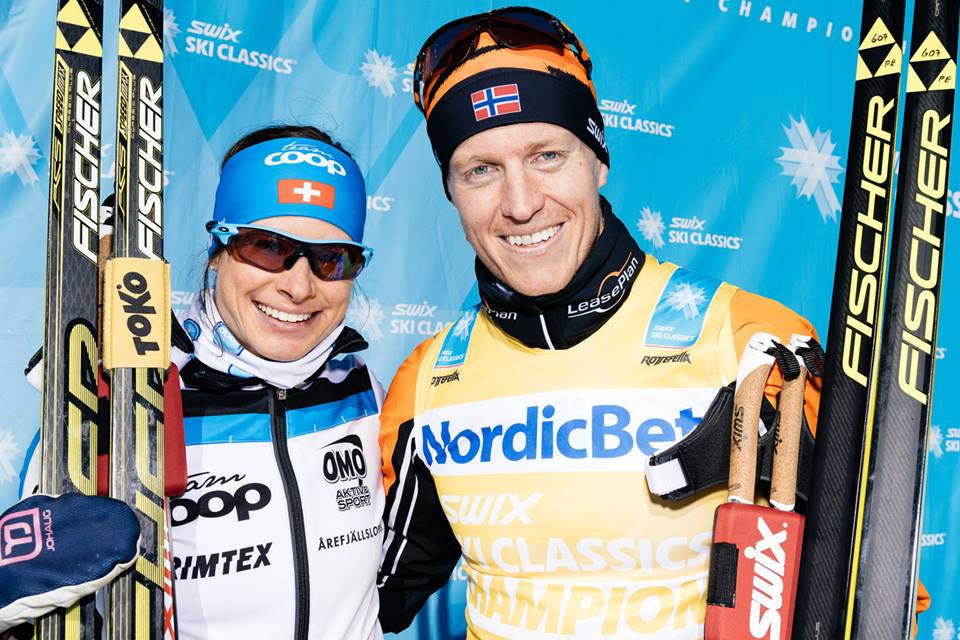
    Seraina Boner (l) of Switzerland and Team Coop and Petter Eliassen of Norway and Team LeasePlan Go won the 2015 Årefjällsloppet, receiving equal paydays. (Photo: Ski Classics)
    Seraina Boner (l) of Switzerland and Team Coop and Petter Eliassen of Norway and Team LeasePlan Go won the 2015 Årefjällsloppet, receiving equal payouts. (Photo: Ski Classics)

    New Race for a Booming Festival

    The Blink ski festival is now a giant on the summer racing circuit, with athletes from all over Europe and even North America coming to compete on rollerskis in cross-country skiing, biathlon, and the famous Lysebotn Opp hill climb. Recreational and junior classes are also a big focus, making it accessible to fans and professionals alike.

    But adding a long-distance race to the mix was not easy for organizers, who still have to make sure that the festival breaks even financially. Idland explained that Blink Classics had been in the works for three years.

    “The main challenge this year is that we, for the first time, were going into car traffic — this race was on ordinary roads with traffic [rather than the city square], and we had to close it to traffic just like they do in cycling races,” he explained.

    That entailed paying for policemen, for one thing. Having a fourth day of racing (previously there had been three, the Lysebotn Opp and two more days in the Sandnes city center) also meant more production by NRK, Norwegian national television, as it followed a long-distance race rather than staying in a set location downtown.

    “If you have live production it has to be in high definition,” Idland said. “Then it’s really expensive.”

    Then last autumn came the news from the Norwegian Ski Federation: none of the national team “A” or “B” team women would compete in the 60 k. The women usually focus on doing all three of the other days of racing, and adding a 60 k at the beginning of consecutive days of racing would be too much volume and intensity during the summer training season. Some of the men, like Eirik Brandsdal and Sjur Rothe, would do the longer race; Martin Johnsrud Sundby was interested but later pulled out.

    Concurrently, Idland said, NRK was telling the Blink organizers that it wouldn’t be possible to broadcast the men’s and women’s 60 k competitions together. It would have meant following two races at the same time — double the filming budget and staffing — and deciding all the time which feed to broadcast and commentate. NRK didn’t have expertise in doing this and said that they needed to develop it. So they would only broadcast one, and with the national team women out of the competition but the national team men in it, organizers agreed it should be the men’s race.

    “When I contacted the teams from other nations, I was open and said that this [women’s] long distance race will not be broadcast on TV and no women from the national team would start there,” Idland said of his communication with other countries’  teams last winter, before registration began. “So I advised them all not to start in this race, but to come do the three other races.”

    As a result just four womencompared to 69 men, finished the 60 k classic race.

    Johansson Norgren, the winner, is a mainstay on the Visma Ski Classics circuit and won the 2016 season title as well as numerous individual marathons. Masako Ishida, who finished third at Blink Classics, was the winter series’ fourth-ranked woman. So the podium at Blink was not so different than a podium one might see at a top winter event.

    But the decision about prize money had been made long before.

    “We said that we need good prize money on the men’s side, because the other competitions that we compare with have good prize money,” Idland said. “We also need some sprint primes. We had a total of 190,000 kroner, or about 20,000 Euros, for the men. And we had just over 5,000 [Euros] for the women. That was decided before we opened entry.”

    Even for the women, it was more prize money than was available at the other competitions in the Blink festival, Idland said. In those other races, prize money is equal for men and women and each total prize-money purse is roughly 2,000 Euros.

    “So it is double amount of money in this women’s class in any of the other races, including Lysebotn Opp,” he said. “We thought we were really doing well for the women. And it’s not every rollerski race having prize money, either.”

    Kaisa Mäkäräinen (FIN) climbs to victory in the Lysebotn hill climb at the 2013 Blink festival. The women's hill climb is televised, unlike the Blink Classics. (Photo: blinkfestivalen.no)
    Finland’s Kaisa Mäkäräinen climbs to victory in the Lysebotn hill climb at the 2013 Blink festival as a cameraman captures the action. The women’s hill climb is televised, unlike the Blink Classics. (Photo: blinkfestivalen.no)

    Building Women’s Pro Fields Takes Time

    But the discrepancy still felt unusual to some of the women, who are used to getting paid the same amount as their male counterparts for a win.

    Prize money is the same for men and women on cross-country skiing’s World Cup. In fact, female superstars like Marit Bjørgen and Therese Johaug earn more than their male counterparts because they are more dominant, grabbing a bigger proportion of the total available prize money for themselves.

    The gulf between men’s and women’s participation is greater in long-distance racing than on the World Cup. As a result, marathon organizers have to grapple with a somewhat different set of considerations as they develop the payout structure for their competitions.

    Most of the biggest ski marathons in Europe — including the Birkebeiner, Vasaloppet, and Marcialonga — are part of the Visma Ski Classics series, where organizers have come up with compromise solution when it comes to year-end rankings.

    Prize money is equal for the top three overall series finishers, but the men’s field also pays out to the fourth- and fifth-place athletes while the women’s field does not.

    “For me it sounds very strange,” Visma Ski Classics CEO David Nilsson told FasterSkier in an interview last week referring to the Blink prizes. “We have in our rules that they must have the same first prize to men and women. It is also important to reflect on the percentage [of field size], and it shouldn’t be so much more difficult for the men to get [prize money] than for the women — but you can never do more than win, so of course that has to be equal for first place.”

    In the winter, far fewer women than men are on Visma Ski Classics professional teams. But women’s races are hotly contested and often extremely dramatic, like Seraina Boner’s come-from-behind win at the 2016 Birkebeiner after passing Ishida and Poland’s Justyna Kowalczyk in the final kilometers.

    In the 2016 season, 39 different women scored points toward the overall titles. There is even an all-women’s pro team, Sweden’s Team SkiProAm, whose top athlete finished eighth in the season rankings.

    According to Nilsson, Visma Ski Classics has carefully tried to promote women’s participation, with equal prize money for first place being one component.

    “We worked very hard on this,” he said. “When I started 6-7 years ago, we had 4-5 women that were competing [professionally] in long distance skiing because it was a bigger step for them from shorter distance [World Cup] skiing than for the men.”

    While they left the women’s competition out of the spotlight this year, the Blink Classics organizers don’t think that should always be the case. Like the Visma Ski Classics, they want more women on the start line.

    “Our aim and our goal is also to have the world’s best women at the start in future,” Idland said.

    One reason for low numbers at Blink might be that long-distance racing just isn’t as popular among women in Norway as it is in neighboring Sweden, home of the Visma Ski Classics brand, said Nilsson.

    “In Norway, which we all know is very strong in cross-country skiing, we don’t see so many female participants in long-distance skiing,” he mused. “They are more from Sweden. We don’t know why the Norwegian women are not coming more.”

    The Blink 60 k is part of a three-race series of long-distance rollerski competitions called the World Classic Tour. Indeed, the second leg of the Tour was held in Sweden. Called the Alliansloppet, it is also a more established event.

    Twenty-five women finished that 48 k race, including several past Visma Ski Classics champions and members of the Swedish national team (Hanna Falk, a three-time World Cup podium finisher, won the race). Prize money was equal for men and women, including a 10,000 Swedish kroner sprint prize ($1,000) for both men and women.

    The World Classic Tour overall awards use a similar idea to the Visma Ski Classics, in that the men’s and women’s title winners earn equal paychecks but the men’s field will pay out to six places and the women’s to just three.

    Yet the series does not appear to have a policy for its constituent races in how to organize prize money at individual competitions.

    If organizers like those at the Blink festival want to develop a strong women’s competition, Nilsson suggested that they need to actually promote the women’s races.

    “We also made sure that there was much more focus on the women [than there had been before],” he said of the Visma Ski Classics efforts. “The women should have be starting [wave] before the men to have their own competition… and have [television] production of the race and their own media. When we created the system, all the attention was on the men. Then we made it so the pro teams had to get points from both the men’s and the women’s classes. This together has made the increase of the women.”

    Idland conceded that with more prize money, they might have drawn a slightly larger women’s field. But he believed the circumstances of the festival, with the three subsequent days of racing, were the bigger reason for low participation.

    On the Blink Festival website, the news story about the 60 k Classics race features five paragraphs and three photos about the men’s race, but only one paragraph and one photo of the women.

    Nilsson believed that some changes could be made without disrespecting the male athletes.

    “When you have 100 men and not so many women registered, it wouldn’t be fair to get the same [prizes],” Nilsson said. “It would be easier for the women. So it has been for us to push the development [of women’s skiing] but not to be unfair to the men’s skiers. That’s the reason we have in the prize money, five men and three women. And that reflects a little bit to the female factor, to be honest, in terms of the number of participants and the amount of professional skiers. It has to be the same difficulty to win a prize in both categories.”

    What Does Equality Mean?

    Race organizers are continuously trying to come to a more perfect solution, and one common thread seems to be that prize money must be earned by quality racing and exciting performances. Until the women’s fields are deemed to have provided that, they might not see as much compensation.

    Visa Ski Classics, for example, continues to make changes. For the 2016/2017 season, women will for the first time be able to vie for a sprint title, worth five percent of the total prize money, just as the men have done for years.

    “The reason it wasn’t the case [previously] is that there weren’t so many women — last year was the first time that there was really a group at the front,” Nilsson said. “Before it was just one or two who went away, so it wouldn’t have been interesting. The same people would have won the race as the sprint bibs. Now both men and women get a sprint bib, which is a step forward. Our goal is to make it equal the number of participants and who gets prizes.”

    Nilsson guessed that the availability of intermediate prize money may also change the tactics of the women’s races and contribute to an exciting spectacle on television.

    For his part, Idland insisted that the Blink organizers’ decision about prize money was not sexism. It could have gone the other way, he wrote in a letter to the Norwegian government explaining the discrepancy in pay.

    “I was trying to give an example with the opposite situation,” Idland said. “If Marit [Bjørgen], Therese [Johaug], Heidi [Weng], Charlotte [Kalla], and maybe some of the Americans said to us that this race we would very much like to do, and the men said they didn’t want to do it and just let the [marathon] specialists do it, then I am quite sure we would have done the opposite thing. We would have led the coverage with the women, if the level was higher.”

    After being contacted by the authorities, the Blink Festival is trying to work together with the government to achieve equality.

    “Our answer was that they would really much like to come in dialogue with us to try to make a plan for the future,” Idland said. “And that we try to build up this competition with a clear aim to have everything on an equal basis in some number of years.”

  • Gearing up for the Long Run: Ski Classics’ Jizerská 50 in Czech Republic on Sunday

    Gearing up for the Long Run: Ski Classics’ Jizerská 50 in Czech Republic on Sunday

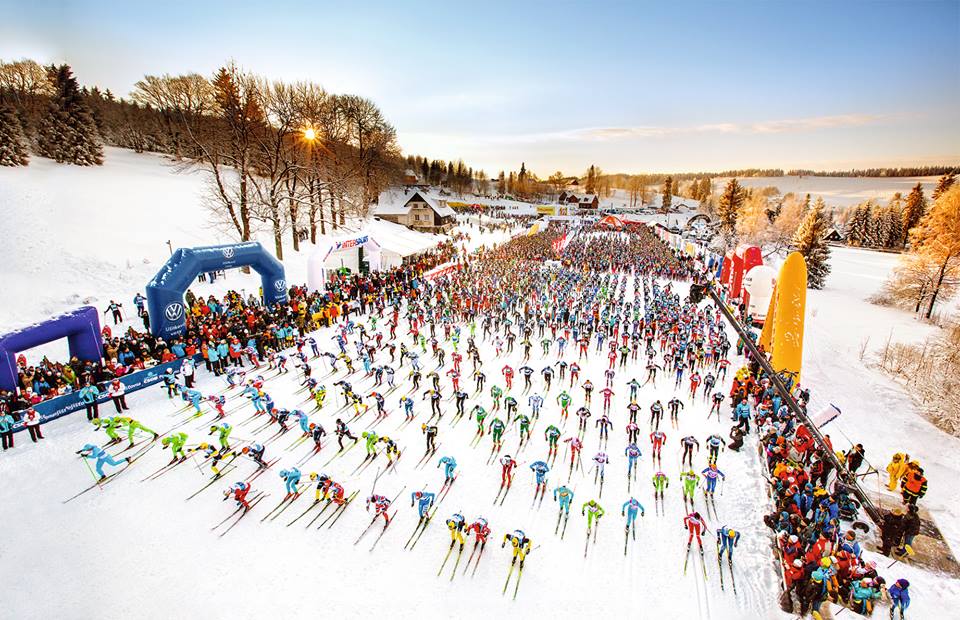
    Start of the Jizerská Padesatka, a 50 k classic race near Liberec Czech, Republic. (Photo: Swix Ski Classics)
    Start of the Jizerská Padesatka, a 50 k classic race near Liberec Czech, Republic. (Photo: Swix Ski Classics)

    Sunday’s 50-kilometer classic race Jizerská Padesatka near Liberec, Czech Republic, is the next event in the 2015 Swix Ski Classics long-distance circuit and racers are eager to hit the tracks after a long break since the first races in Italy in mid-December.

    Going into the third event in the Ski Classics (after the opening Pro Team Prologue and La Sgambeda), Norway’s Anders Aukland of Team Santander tops the overall ranking. Johan Kjølstad, who won the overall Ski Classics title last season, is second overall.

    In the Ski Classics athlete ranking, 42-year-old Aukland tops the list in front of his younger brother Jørgen Aukland. Kjølstad, who races with Team United Bakeries, is in third place, three points ahead of Czech veteran Stanislav Rezac of Team Silvani Madshus, while Sweden’s Jörgen Brink of Team Lager 157 is fifth overall going into the Jizerská 50 k on Sunday.

    In the overall sprint competition, Andreas Nygaard (Team Santander) is currently wearing the green points bib, while Team United Bakeries’ Øystein Pettersen is in second place, 10 points behind Nygaard.

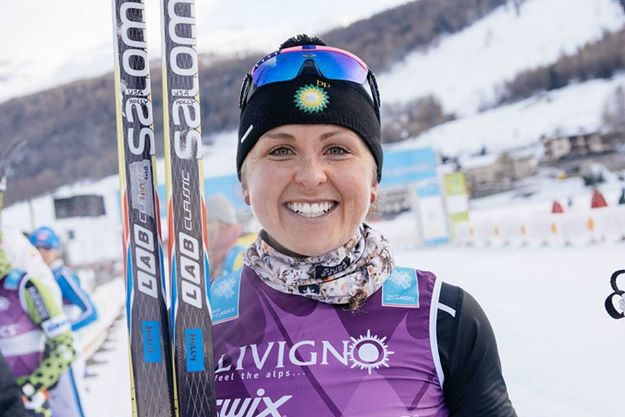
    Holly Brooks at the Pro Team Tempo, which opened the Swix Ski Classics season in mid-December in Livigno, Italy. (Photo: Swix Ski Classics)
    Holly Brooks at the Pro Team Tempo, which opened the Swix Ski Classics season in mid-December in Livigno, Italy. (Photo: Swix Ski Classics)

    Brooks Skips the Jizerská

    American Holly Brooks, who was picked up by the Aukland brothers’ Team Santander just a day prior to the start of the Ski Classics season, is in sixth place in the women’s overall competition. Seraina Boner of Switzerland, who races for Team Coop, tops both the overall standing as well as the athlete ranking.

    However, Brooks is sitting out the Jizerská, returning to Europe for the Dolomitenlauf on Jan. 18, and joining her team for the Marcialonga a week later.

    “I’m just trying to balance the FIS Marathon Cup, the Swix Ski Classics, and travel,” Brooks wrote in an email. “In years past I’ve done maybe three races 30K and longer spread out over a season, so I don’t know how my body is going to react and/or how the fatigue will build.

    “My goal is to race as much as possible without a downgrade in performance,” she added. “I have a feeling I will be very, very tired by the end of the season.”

    New Women Join Circuit

    Prior to the Jizerská, the competition for the women’s overall Ski Classics title gets tougher. Three different Pro Teams have entered new female skiers into the long-distance series: Norway’s Hilde Landheim will race for Team Coop, Viktoria Melina joins the Russian Marathon Team, and Masako Ishida of Japan will race for Team United Bakeries.

    In the Ski Classics, each professional team may enter a total of 10 skiers per season, male and female skiers included. Once entered, the teams may not unregister athletes, but they can enter additional athletes until they reach the maximum of 10 skiers.

    Stellar Conditions

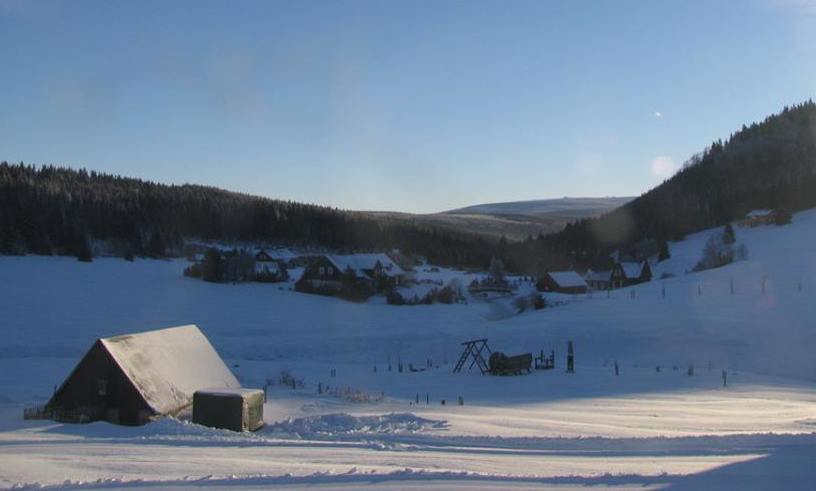
    Czech Republich, home of the Jizerská 50, which will be held on Sunday, as pictured on Jan. 6.
    Czech Republich, home of the Jizerská 50, which will be held on Sunday, as pictured on Jan. 6.

    Last year, the Jizerská races were canceled due to lack of snow, so event organizers are especially excited to put on the races this year and are proud to present stellar conditions on the race course. Promising weather forecasts, decent snowfall in the past week and cold weather have made it possible to produce enough artificial snow to cover the whole course, and the organizers are confident that they will be able to run the race as planned given the weather forecast, which predicted snow at the start and temperatures around freezing.

    “We are happy to see that the weather has turned fine and the winter conditions have finally arrived,” Martin Koucky, a member of the Jizerská 50 Organizing Committee, said in a press release. “The whole Jizerská 50 track is now covered with snow while the race preparations continue to run along at full speed. There are some thirty centimeters of artificial and natural snow at potential critical points: at the Bedrichov stadium as

    In addition to the 50 k Ski Classic on Sunday, the Jizerská race weekend opens with a 30 k skate race and a children’s race on Friday, and also offers a 25 k classic race as well as a corporate relay race on Saturday. New this year is a 1.5-kilometer double-pole sprint on Friday.

    Six More Marathons on Tap

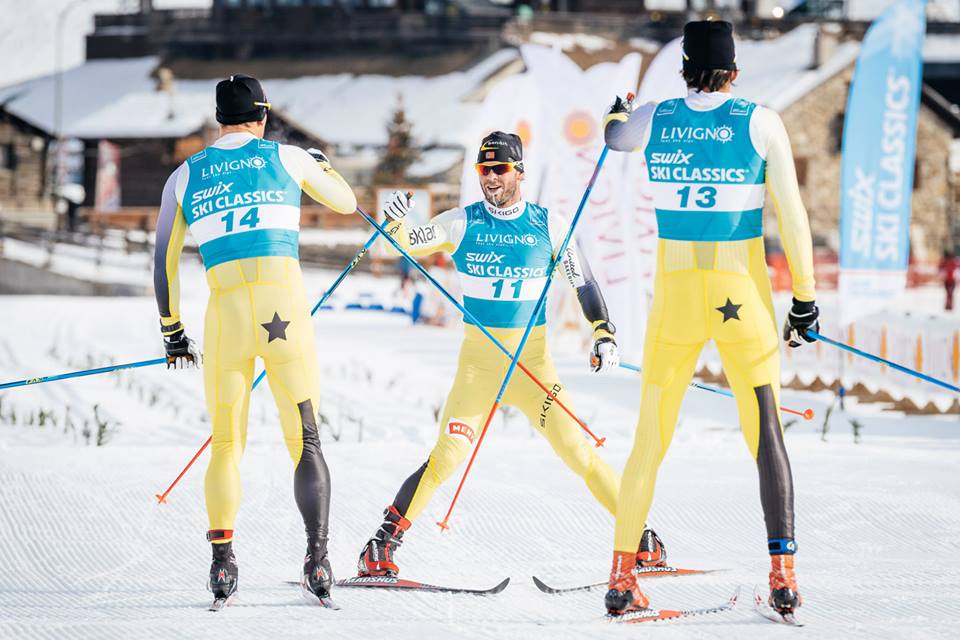
    Team United Bakeries' Pettersen (14), Berdal (11), and Kjølstad (13) at last month's La Sgambeda in Livigno, Italy. (Photo Swix Ski Classics)
    Team United Bakeries’ Pettersen (14), Berdal (11), and Kjølstad (13) at last month’s La Sgambeda in Livigno, Italy. (Photo Swix Ski Classics)

    After the Jizerská 50 on Sunday, the Ski Classics moves to Switzerland for the brand-new La Diagonela on Jan. 17.

    La Diagonela was introduced to the race series last winter as a replacement for the Jizerská 50, which was be canceled, but was such a success that the circuit included the race as a new, permanent installment on the Ski Classics calendar for the 2014/2015 season. This year, the 65-kilometer La Diagonela will be held on a picturesque new course through the villages of St. Moritz, Zuoz and Pontresina in the Engadin Valley.

    After the stop in Switzerland, the Ski Classics moves to Italy for the Marcialonga in the valleys of Val di Fassa and Val di Fiemme on Jan. 25. The 70 k race is famous for its notorious final uphill climb, the Cascata, to the finish in Cavalese town square.

    From Italy, the Pro Teams travel to Germany for the 50 k König Ludwig Lauf in Oberammergau, Bavaria, on Feb. 1.

    After the König Ludwig Lauf, the athletes get a well-deserved break from competing until the legendary 90 k Vasaloppet from Saelen to Mora, Sweden, on March 8.

    After Vasaloppet, the circuit moves on to Norway’s Birkebeinerrennet on March 21. The 54 k classic race starts in Rena, crosses to mountains to the finish line in Lillehammer, the host of the 1994 Winter Olympics.

    The series once again ends with the season finale Årefjällsloppet in Sweden on March 28. The 75 k race offers stunning views from the in Vallbo to the finish line in Åre.

    More information and complete Ski Classics schedule

  • In Opening Weekend, Sargent 10th in Muonio Sprint

    In Opening Weekend, Sargent 10th in Muonio Sprint

    Ida Sargent training in Muonio, Finland last week. Photo: CGRP.

    Despite the warm weather, which has already complicated plans for teams and race organizers all across Scandinavia, the season still managed to kick off on Friday with a classic sprint in Muonio, Finland. Justyna Kowalczyk (POL) cruised to victory over the women’s field, while Andreas Nygaard (NOR) fought off Russia’s Egor Sorin and Nikolay Bolotov in a close race for first.

    Ida Sargent (CGRP/USST) had the best American finish of the day, finishing 10th overall after qualifying in 9th on the point-to-point course. She completed the qualifying round 15 seconds behind Kowalczyk’s winning time, and was three seconds out of third.

    Rounding out the results for Craftsbury were Hannah Dreissigacker (33rd) and Clare Egan (82nd). There was no points cutoff imposed on the start; 125 women competed in all.

    Only the top 16 went on to the quarterfinals, where Sargent just missed moving on the semis. CGRP coach Pepa Miloucheva thought Sargent had a solid qualifier, but said she wasn’t feeling 100%.

    “It was a hard point-to-point course that didn’t have any downhill,” said Sargent, the lone American to qualify for the heats on Friday. “It was fun to ski in a heat…and really good to burn some nervous energy and finally race.”

    As there were only two tracks set on the narrow, man-made course, Sargent started in the second row of the quarterfinal, directly behind Kowalczyk.

    Conditions, and an athlete’s ability to adapt to them, seemed to rule the day. The course was “slushy, dirty and soft,” and there wasn’t a lot of time for testing skis or wax. The men, whose qualifier went off second, weren’t able to get on course at all before their start, which amounted to not getting on skis at all before toeing the line.

    “This is hard for classic race, so they had some trouble to make the skis work and be able to push,” said Miloucheva.

    The Craftsbury men, she said, had a hard time out on the course. No one qualified for the rounds: Pat O’Brien led the way in 72nd, followed by Tim Reynolds (104th), Dylan McGuffin (141st) and Ethan Dressigacker (152nd).

    Craftsbury’s skiers are the only Americans competing in Muonio. Last November, with the first World Cup in relatively nearby Gallivare, Sweden the following weekend, the U.S. Ski Team (USST) also raced, but the uncertainty with the opening World Cup this year has the team training through the lead-up to Sjusjoen, where all but Sargent will put on a bib for the first time in 2011-2012. Many other World Cup teams are using the FIS distance skate races at Bruksvallarna, Sweden this weekend as their final pre-season warm-up.

    Working on the course. Photo: Ethan Dreissigacker.

    The forecast doesn’t call for the temperature to dip below freezing in Muonio tonight, so race organizers will have their work cut out for them repairing the course to be ready for tomorrow’s 5/10 k skate.

    Multi-race weekends are all about recovering, both physically and mentally, from the first day of competition to be ready to go again. As she looks ahead to two more races, Sargent said her goals are to ski smoothly and pace herself better.

    More athletes are arriving in Muonio for the weekend. “Tomorrow the field is even bigger, I think there are more than 500 people racing,” said Miloucheva. “[We] will see what is going to happen!”

    Results: Qualifier | Final