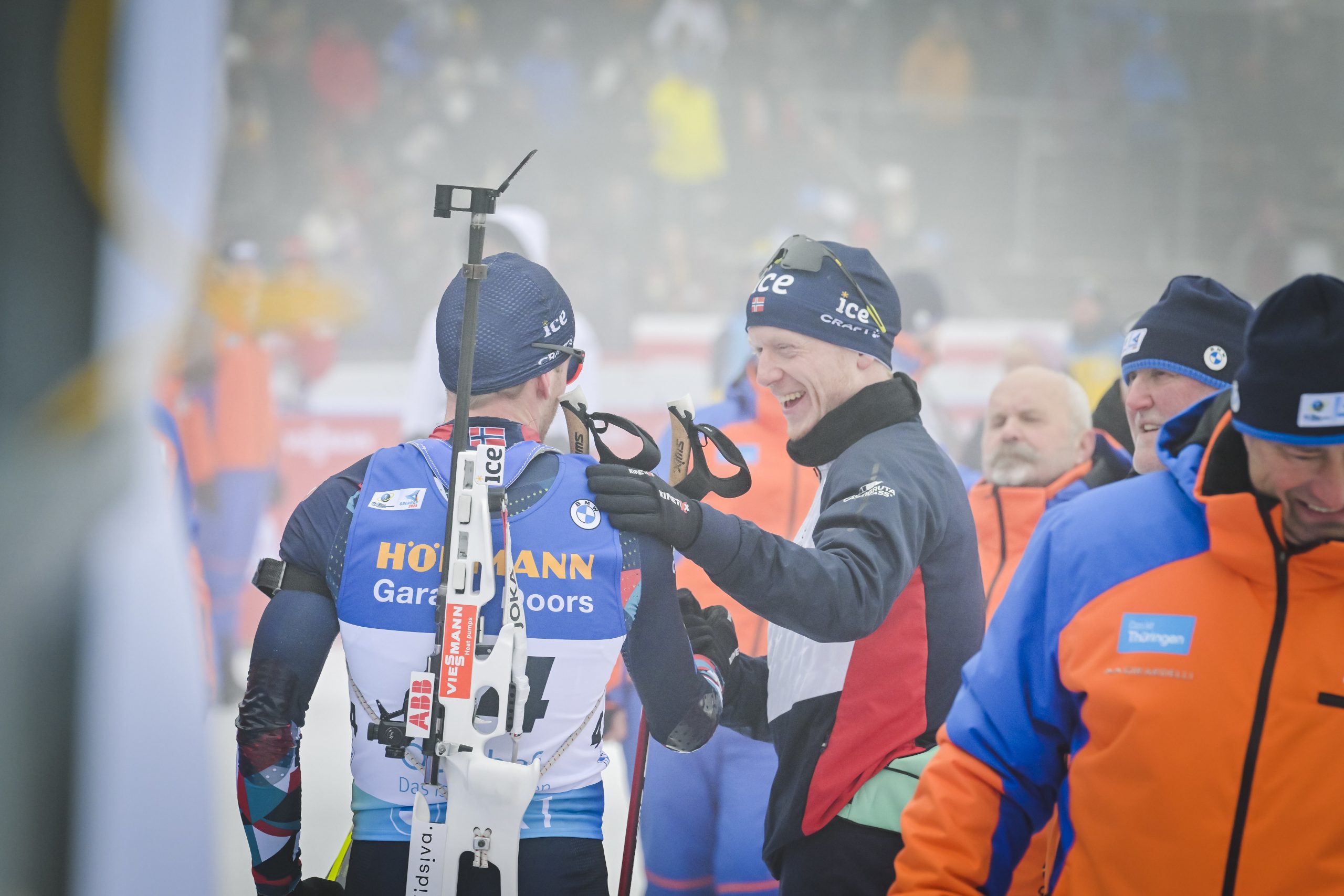
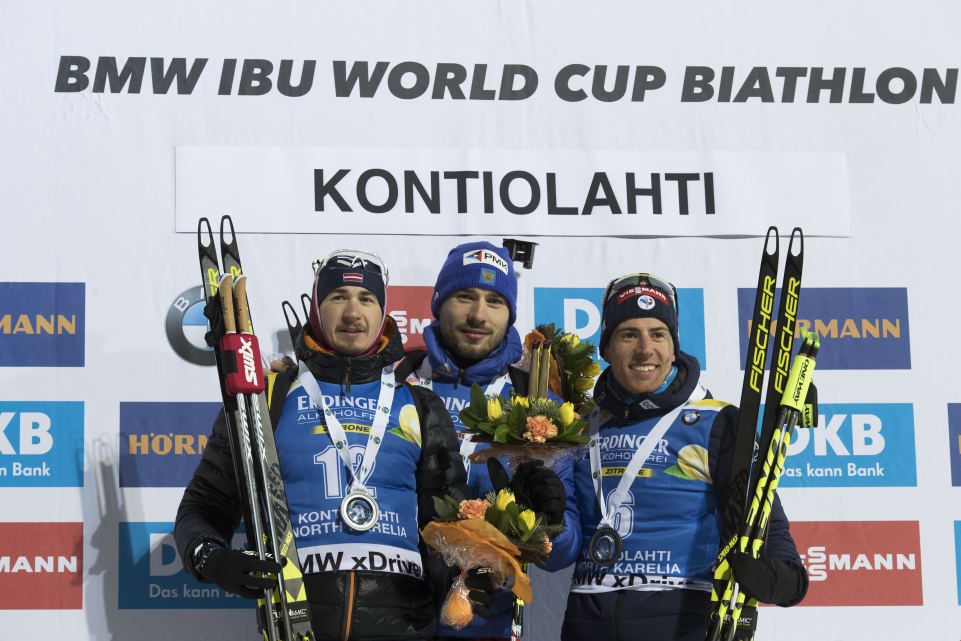
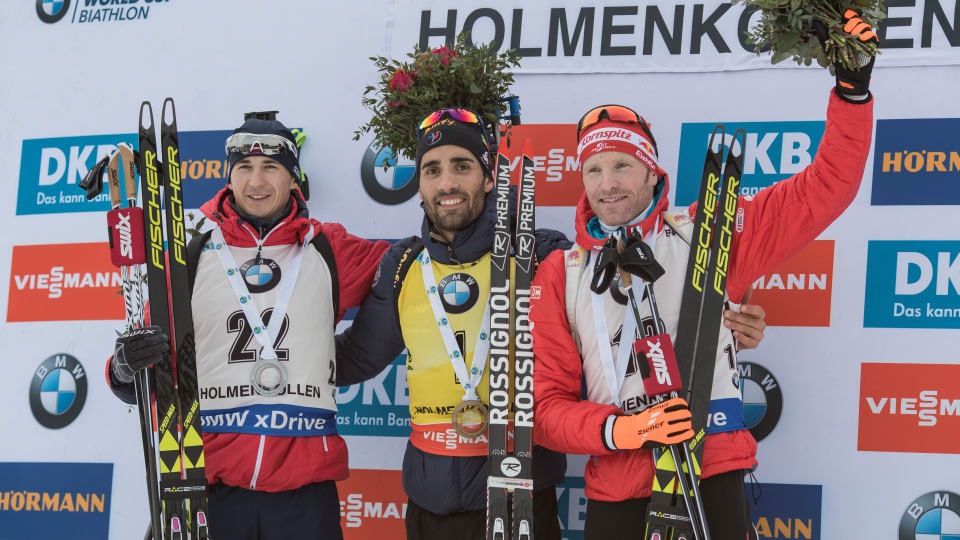
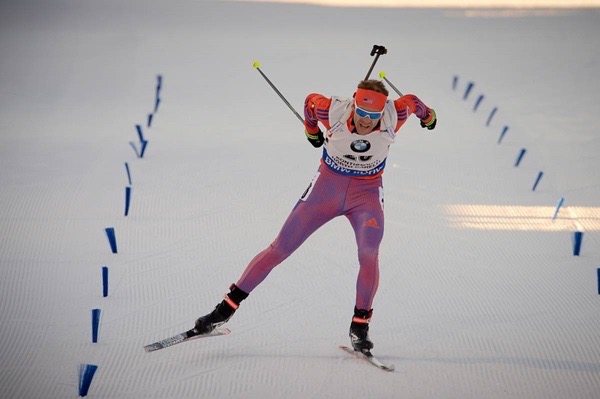
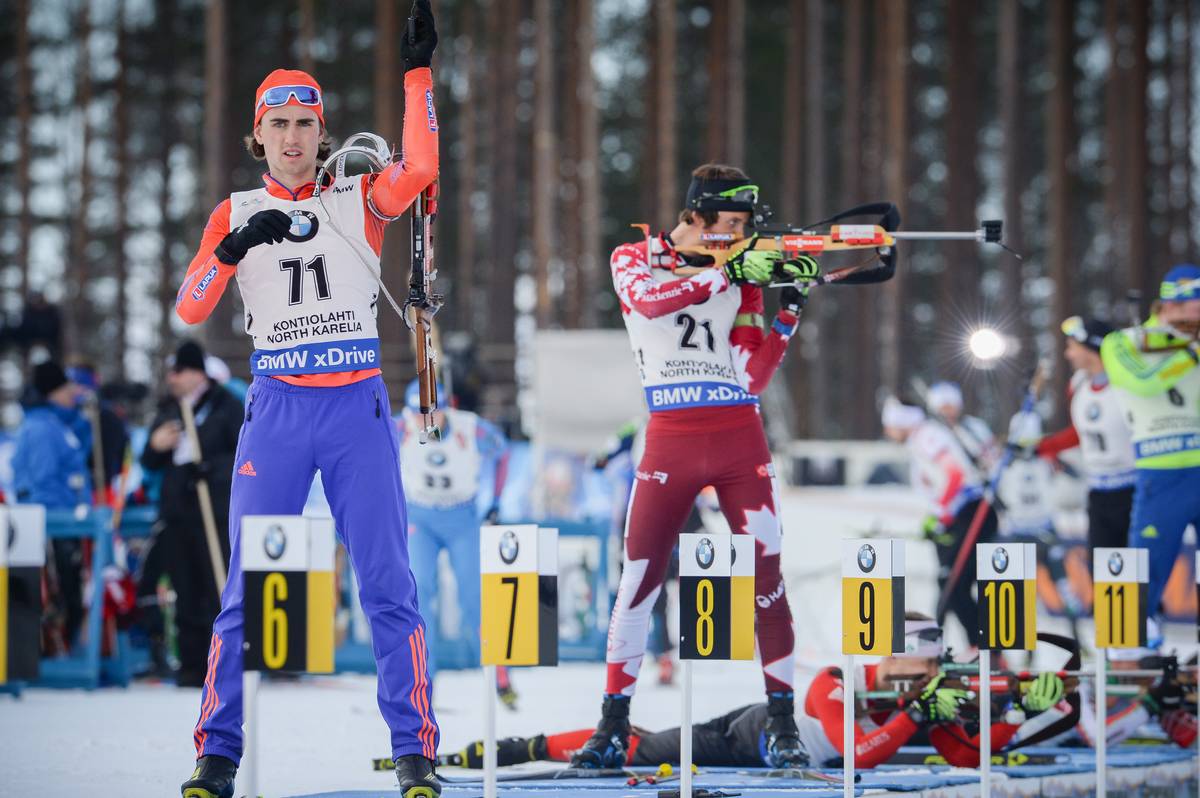
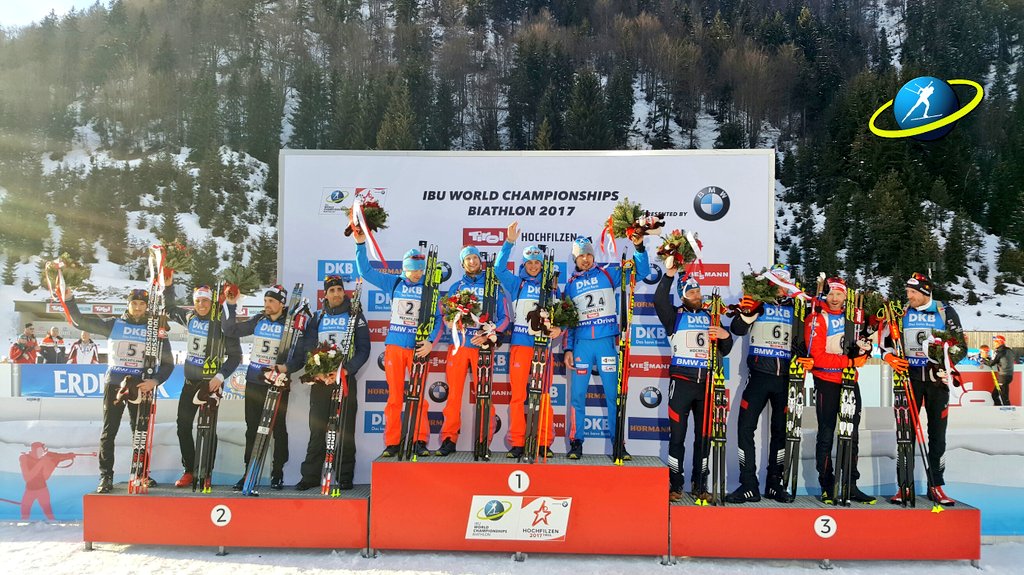
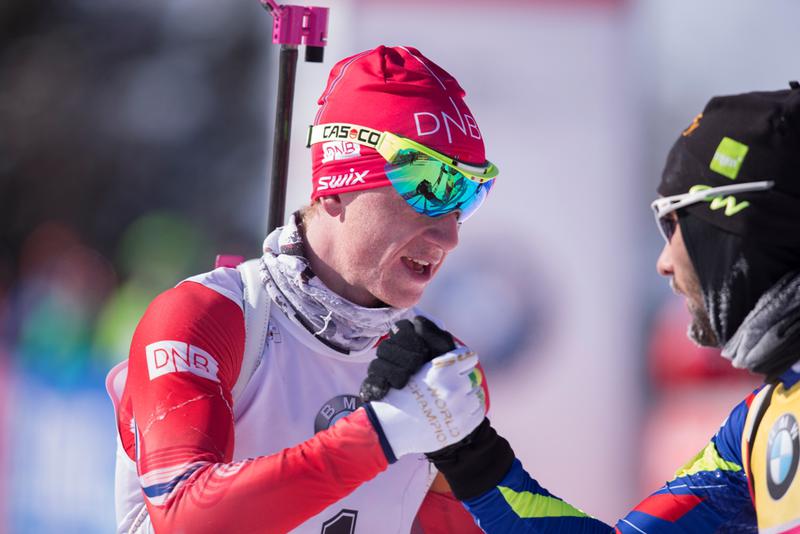
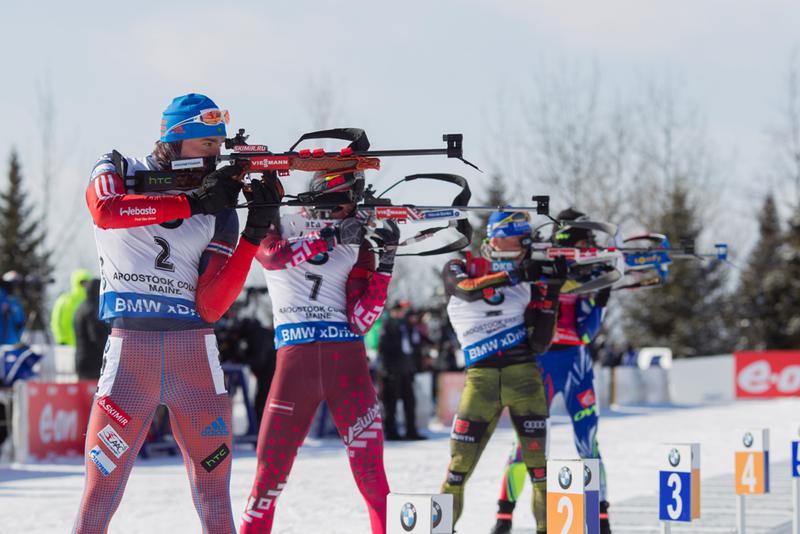
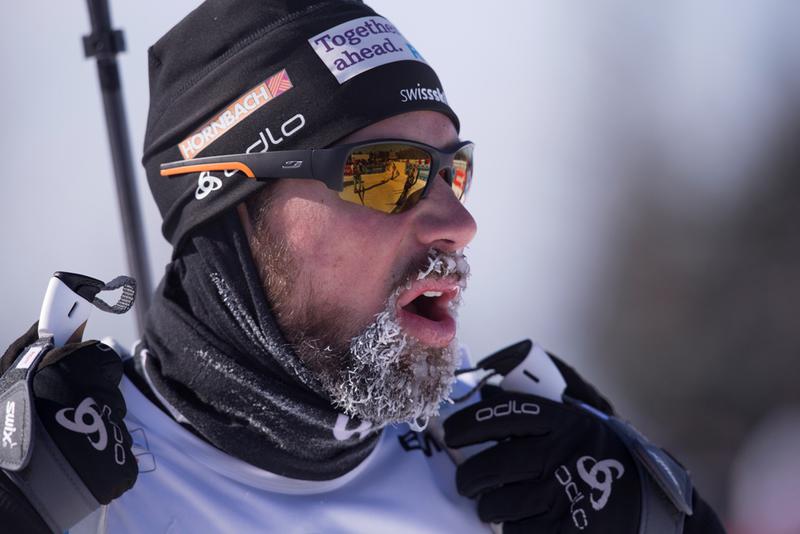
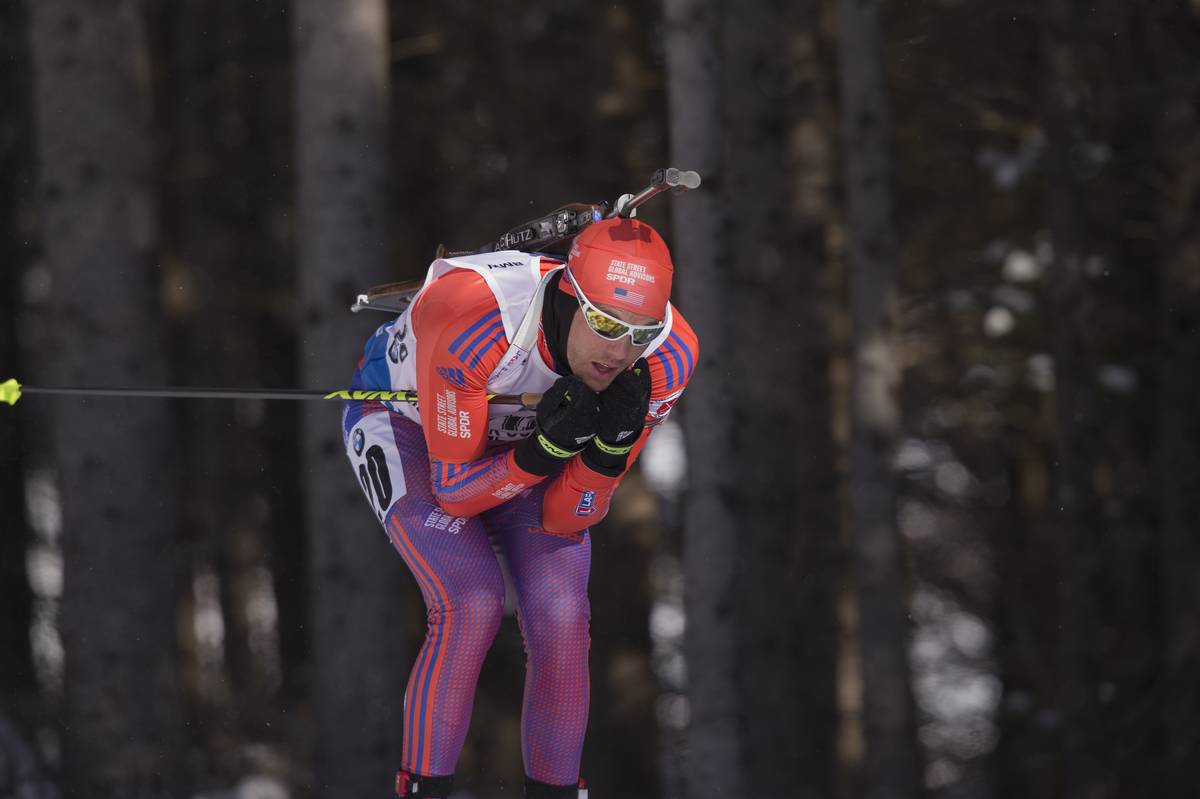
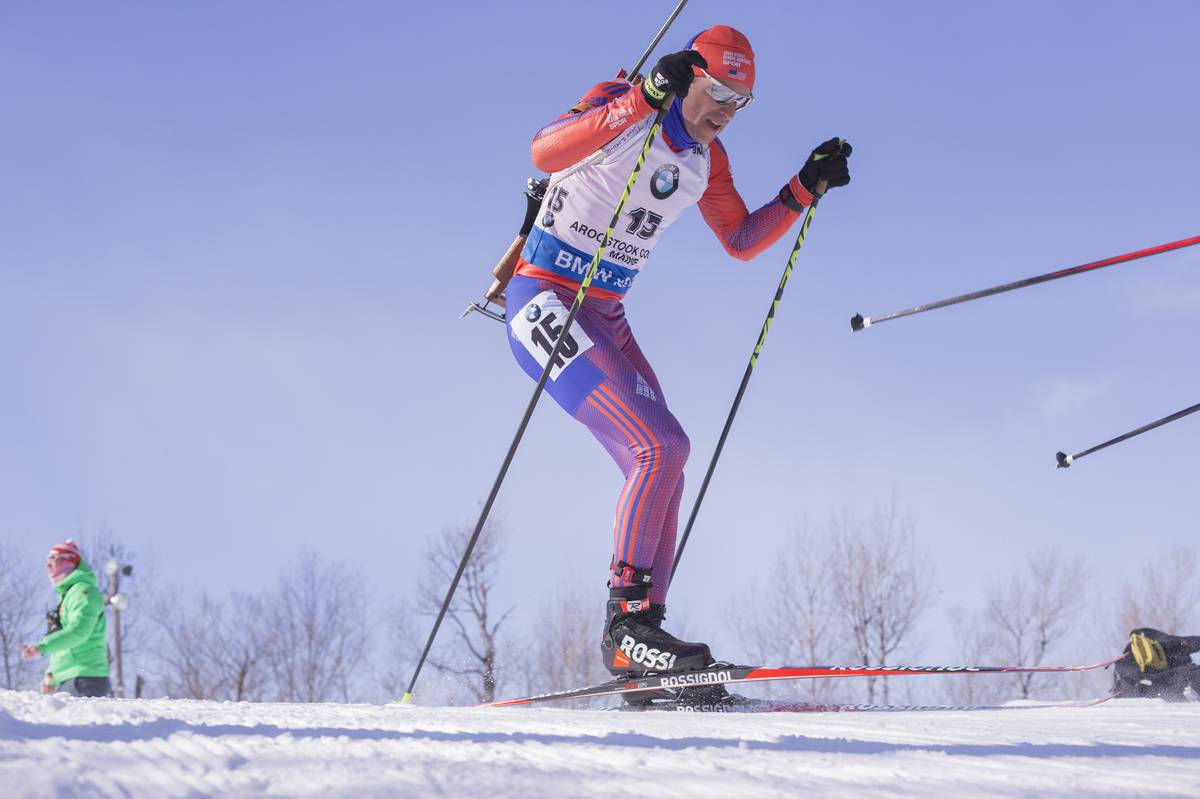
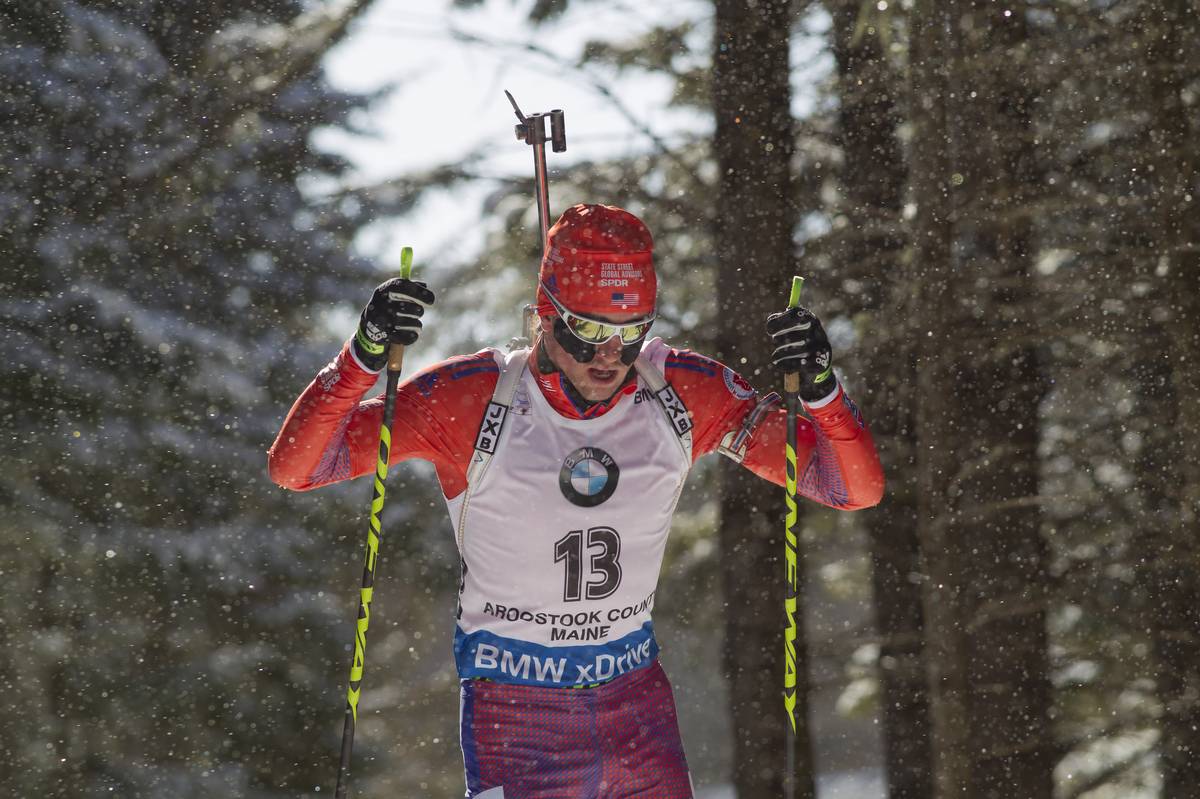
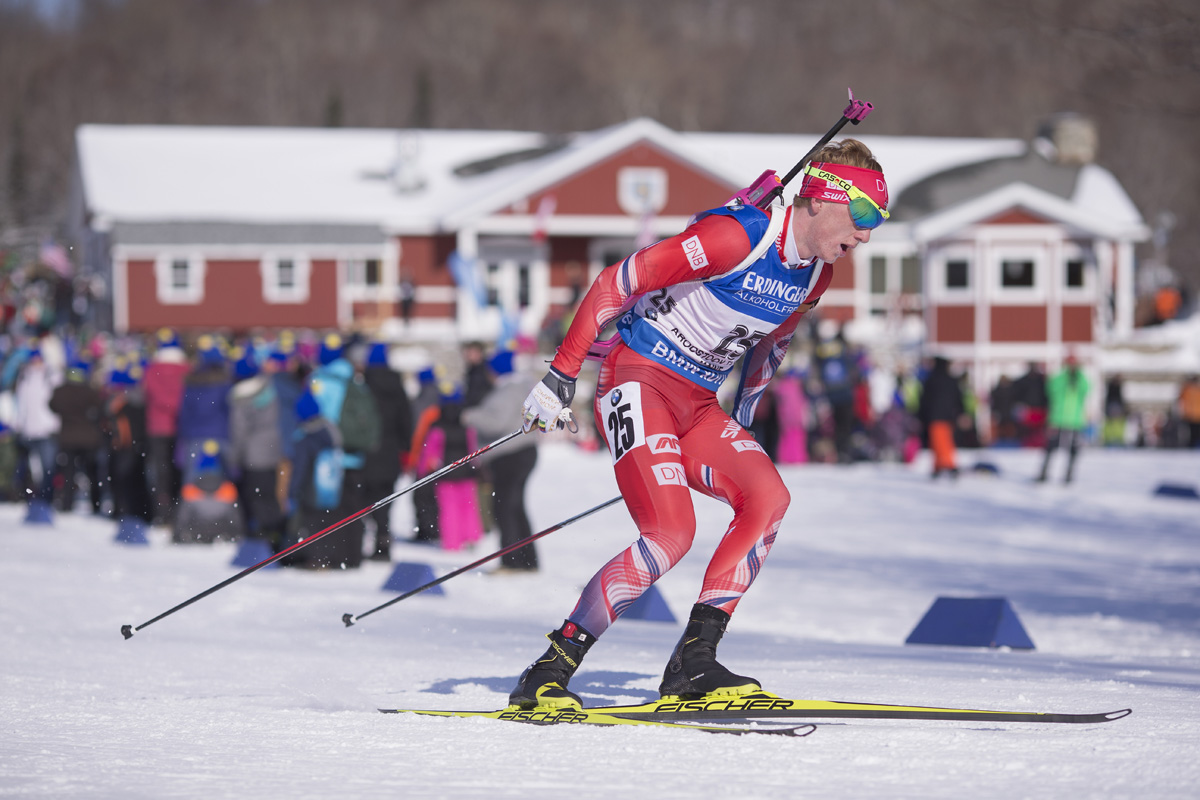
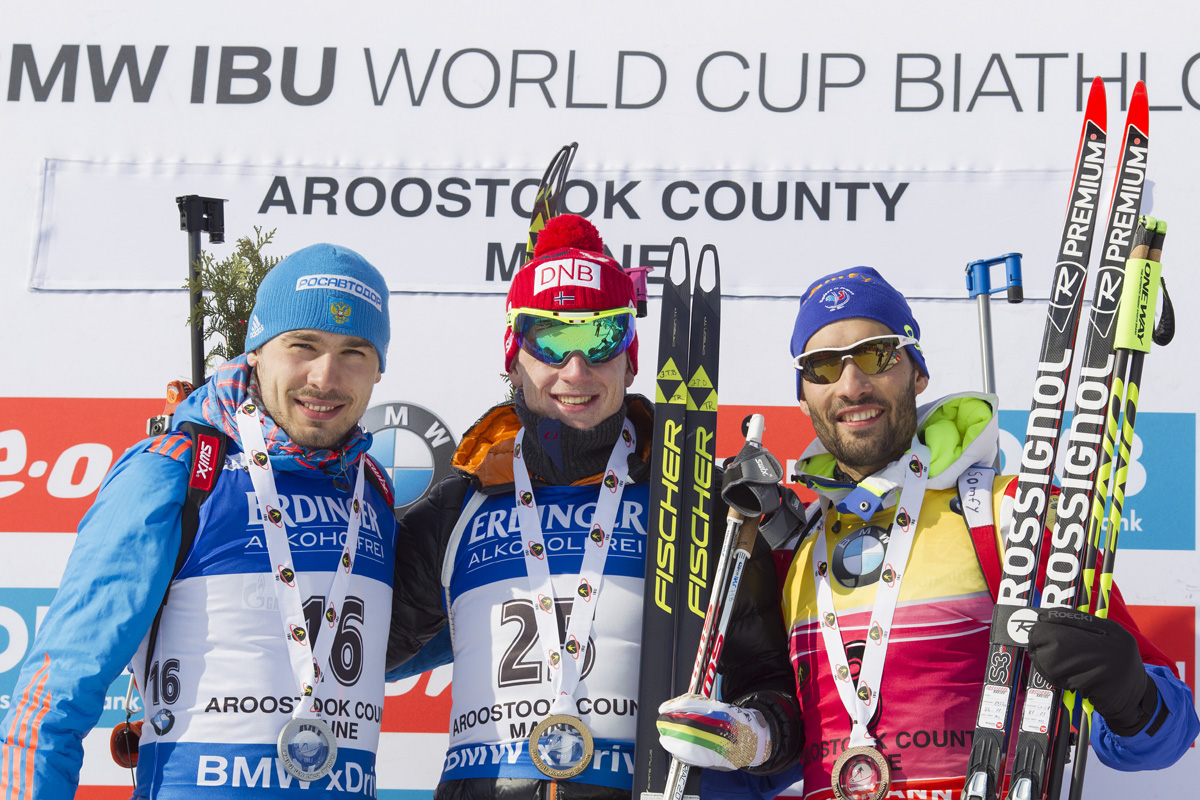
Johannes Thingnes Boe (NOR) congratulates his brother, Tarjei Boe (NOR) who finished beside him on the podium at the IBU World Championships Men’s Sprint in Oberhof. (Photo: Reichert/NordicFocus)
One man has won all five 10 k Sprint competitions so far this season, so even with 112 starters in today’s BMW IBU World Championship Sprint, there was no doubt about the favorite. Johannes Thignes Boe of Norway has been untouchable on skis since November, regularly out-skiing his nearest competitor by over 30 seconds. The 150m penalty loop in biathlon usually takes athletes about 23 seconds, so Boe can afford to miss once and still win. Today he missed once in prone—the target barely visible at 50m through dense fog—but cleaned standing with no hesitation in just 21 seconds. With a 36-second second margin to the next-fastest skier, Boe defended his Olympic title and become the 2023 World Champion. This sets him up for another likely victory in tomorrow’s Pursuit competition, but with four shooting stages, anything can happen.
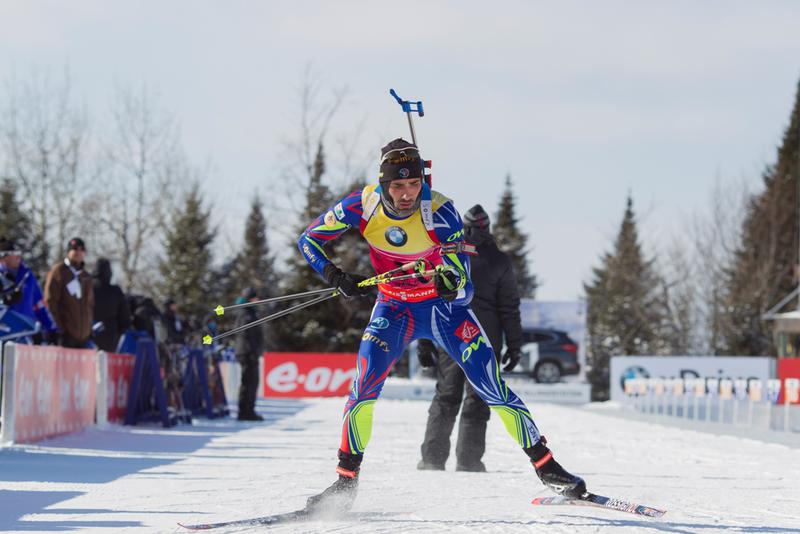
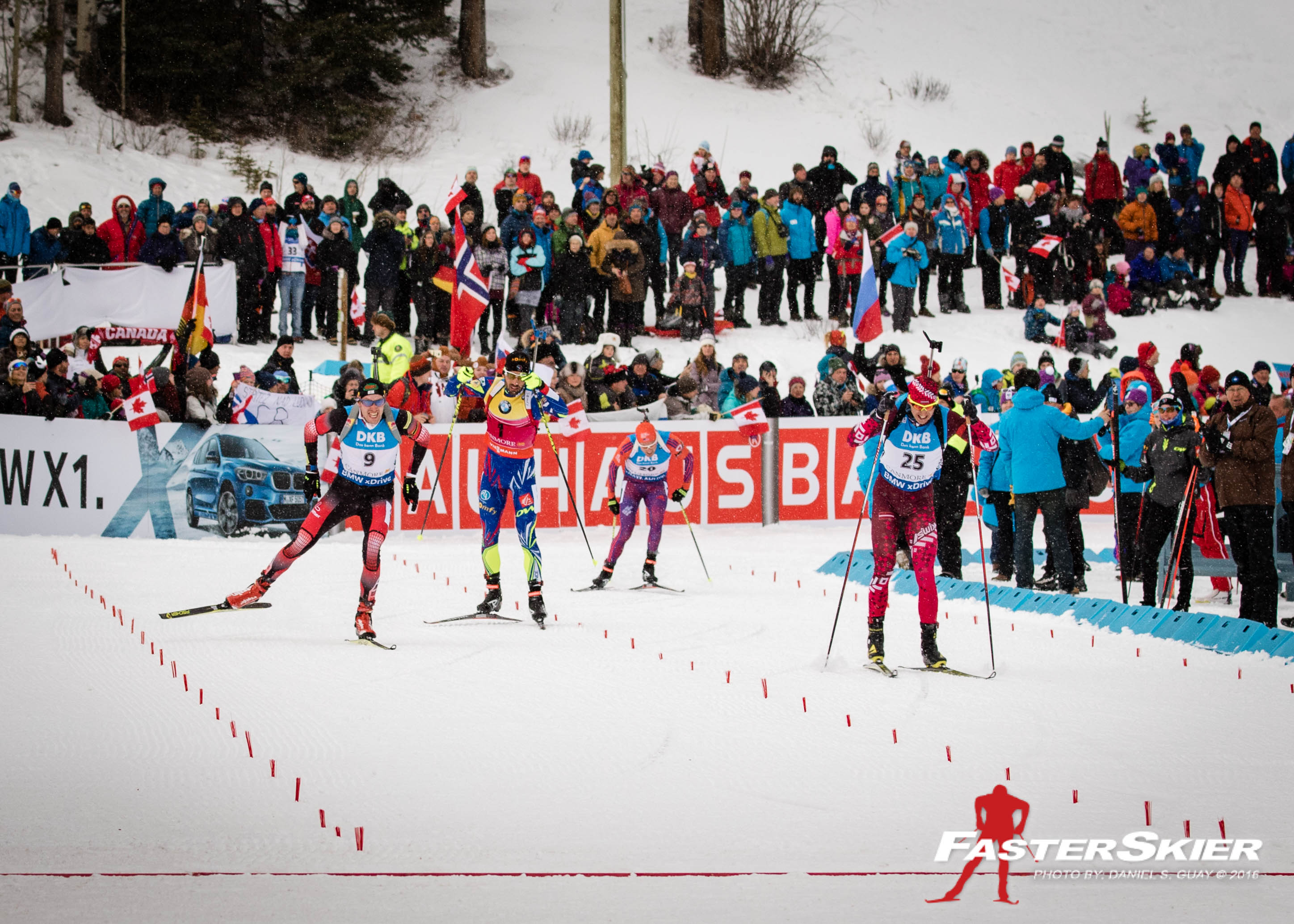
Johannes Thingnes Boe (NOR) started and finished in bib number 1 at the IBU World Championships Sprint in Oberhof, Germany. (Photo: NordicFocus)
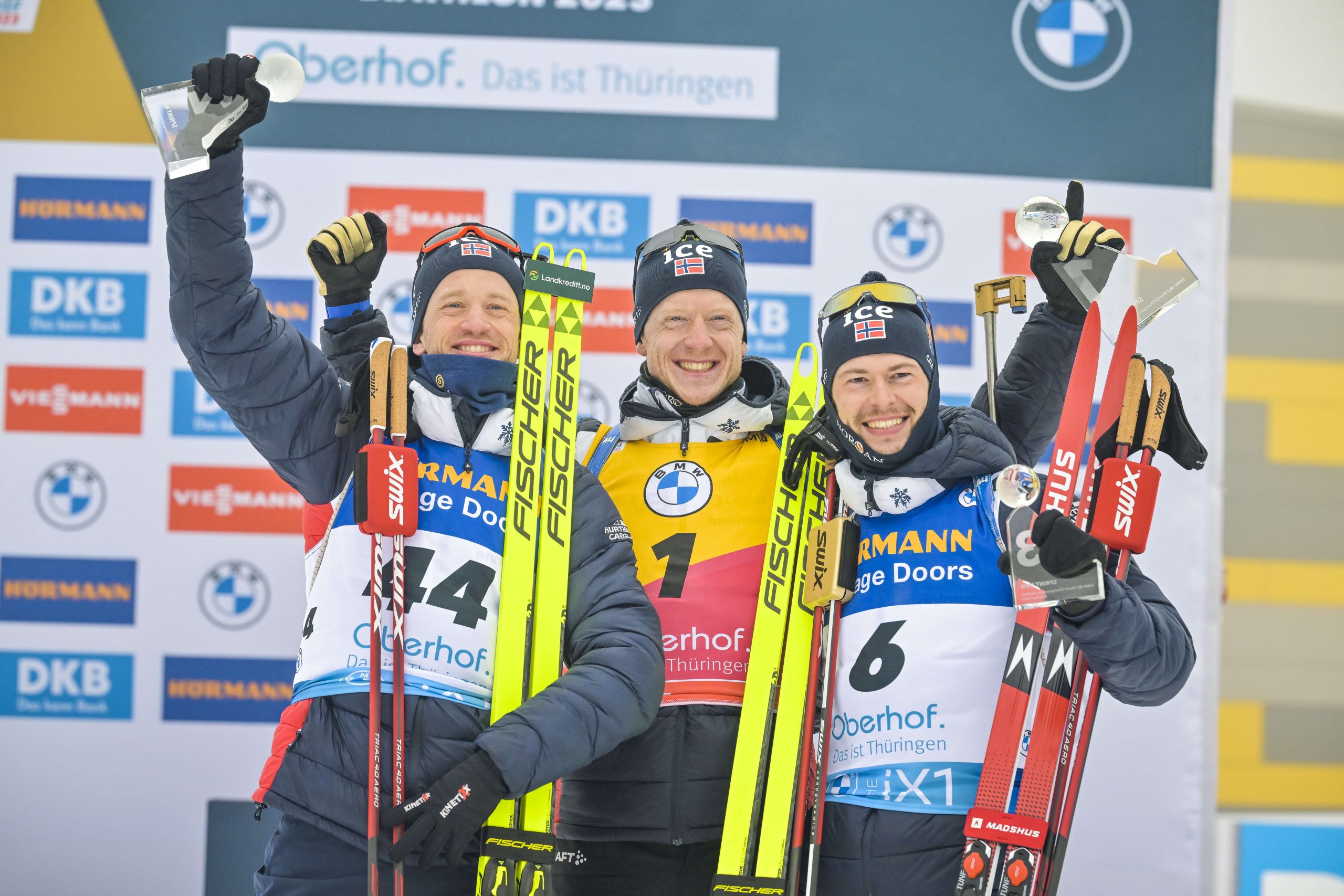
Sharing the podium with the unbeatable Boe were two teammates: his older brother, Tarjei Boe, shot the perfect score to complete the family sweep for the second time this winter, and Sturla Holm Laegreid missed just one in standing to capture the bronze. Laegreid is ranked second behind J. Boe in the Overall standings and has been on the podium in all but three competitions this season, so he was very much the silver medal favorite, but T. Boe is the fifth-ranked Norwegian (and 8th in the World Cup Overall standings), so the so-called “Boedium” was a pleasant surprise for the brothers.
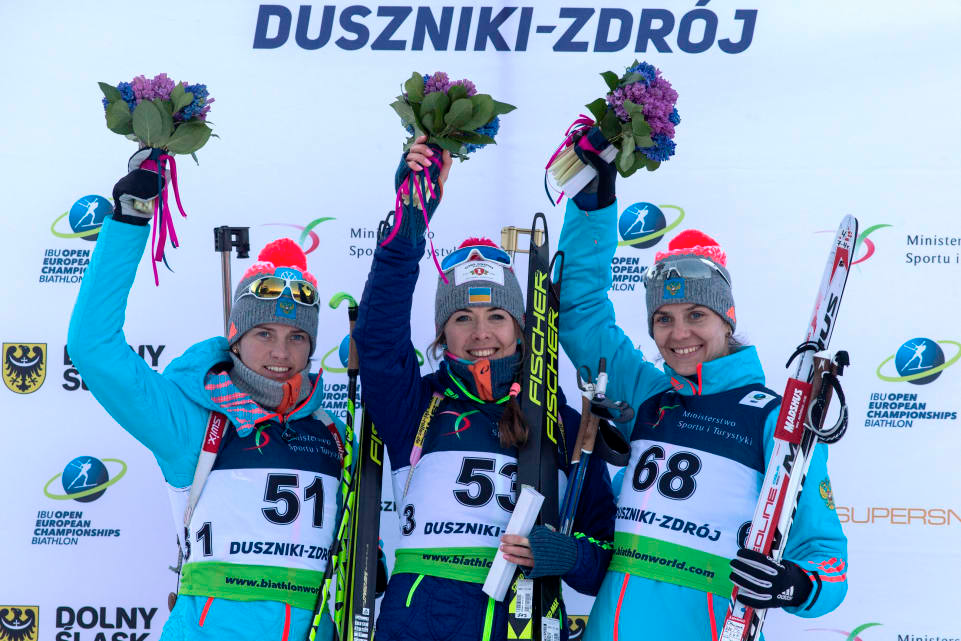
Tarjei Boe (NOR), Johannes Thingnes Boe (NOR), Sturla Holm Laegreid (NOR) (l-r) on the podium of the IBU World Championships Sprint in Oberhof, Germany. (Photo: NordicFocus)
The Norwegian men make it look easy to land on the podium even with nine out of ten hits, but it’s not. Only four people on the whole men’s World Cup circuit have a shooting average of 90%. Laegreid is one of them. The Boe brothers are among the top 15 athletes with an 88% hit rate. Add the expectation of victory, and their performances become even more impressive.
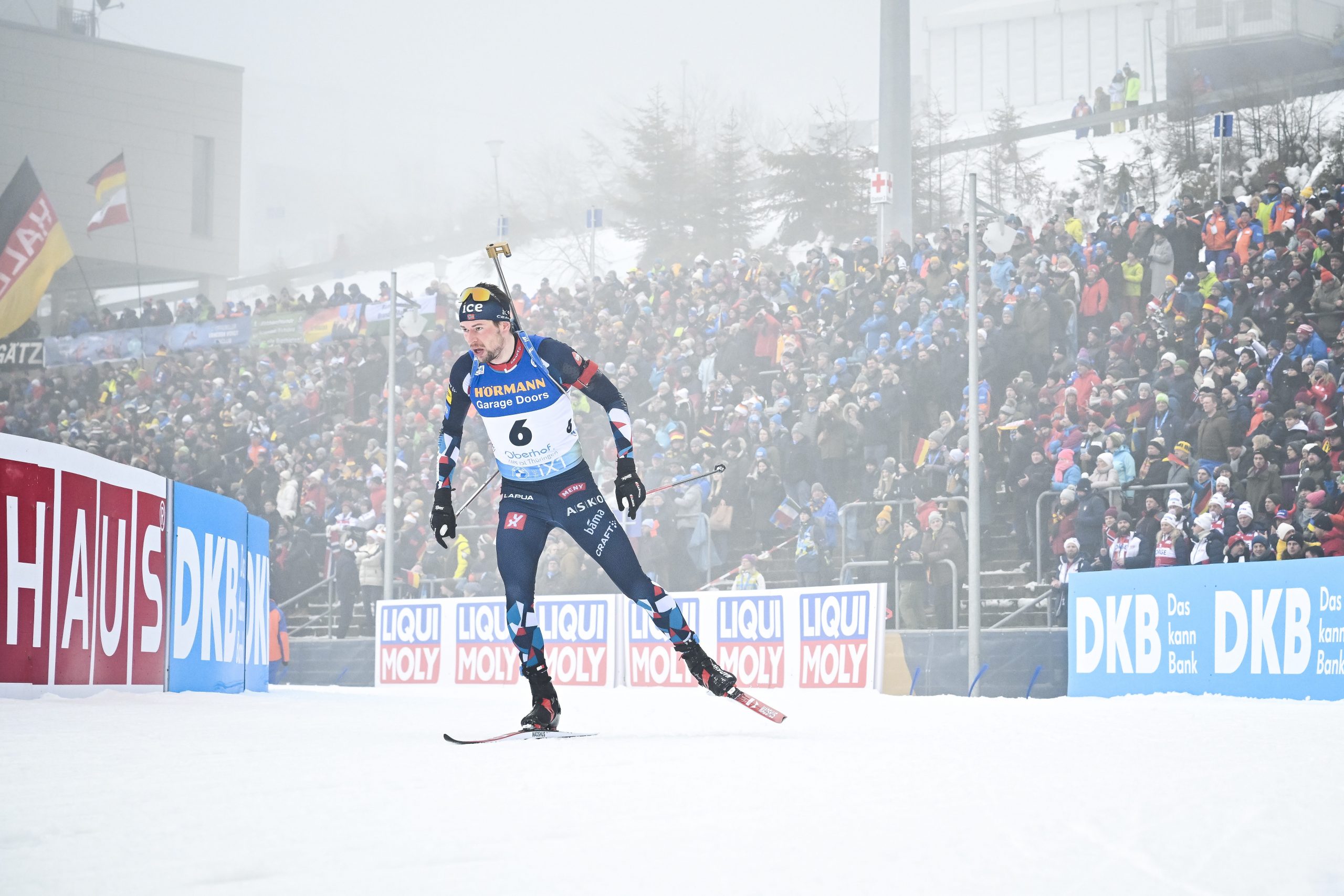
Sturla Holm Laegreid (NOR) racing to third place in the IBU World Championships Sprint in Oberhof, Germany. (Photo: NordicFocus)
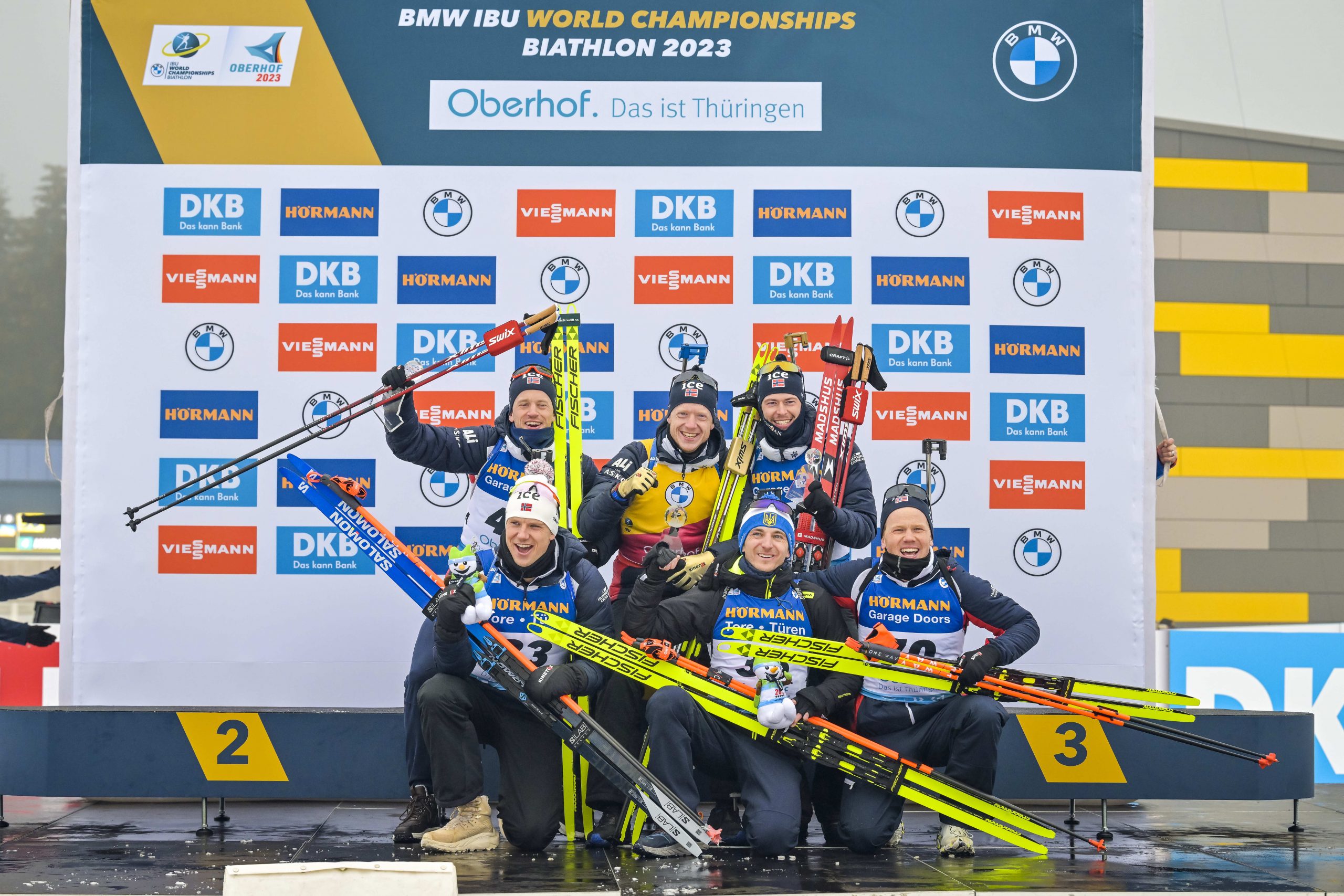
With Johannes Dale in fourth and Vetle Christiansen in sixth, the Norwegians almost pulled off a full sweep of the Flower Ceremony, but one athlete managed to upset the total domination. Dmytro Pidruchnyi of Ukraine shot clean and skied the 15th course time to take fifth. He had only raced twice this season—once in November and once just last week, with a knee operation in between—before coming to the World Championships. Pidruchnyi has a history of performing his best at championships; he was the World Champion in the Pursuit in 2019. Today’s fifth place was his top result since then. This victory will certainly mean a lot to him, his team, and the people of Ukraine as they suffer from war at home.
Flower Ceremony finishers in the IBU World Championships Sprint in Oberhof, Germany. Front L-R: Vetle Sjaastad Christiansen (NOR), Dmytro Pidruchnyi (UKR), Johannes Dale (NOR), Back: L-R: Tarjei Boe (NOR), Johannes Thingnes Boe (NOR), Sturla Holm Laegreid (NOR). (Photo: NordicFocus)
Andrejs Rastorgujevs of Latvia shot 10/10 to finish 7th, Johannes Keuhn of the home German team finished 8th for his best result of the season, and two French athletes, Quentin Fillon Maillet and Antonin Guigonnat, rounded out the top ten. Sebastian Samuelsson of Sweden finished in 11th with two penalties. Both he and Fillion Maillet will be podium threats in the Pursuit even starting around 1:10 back.
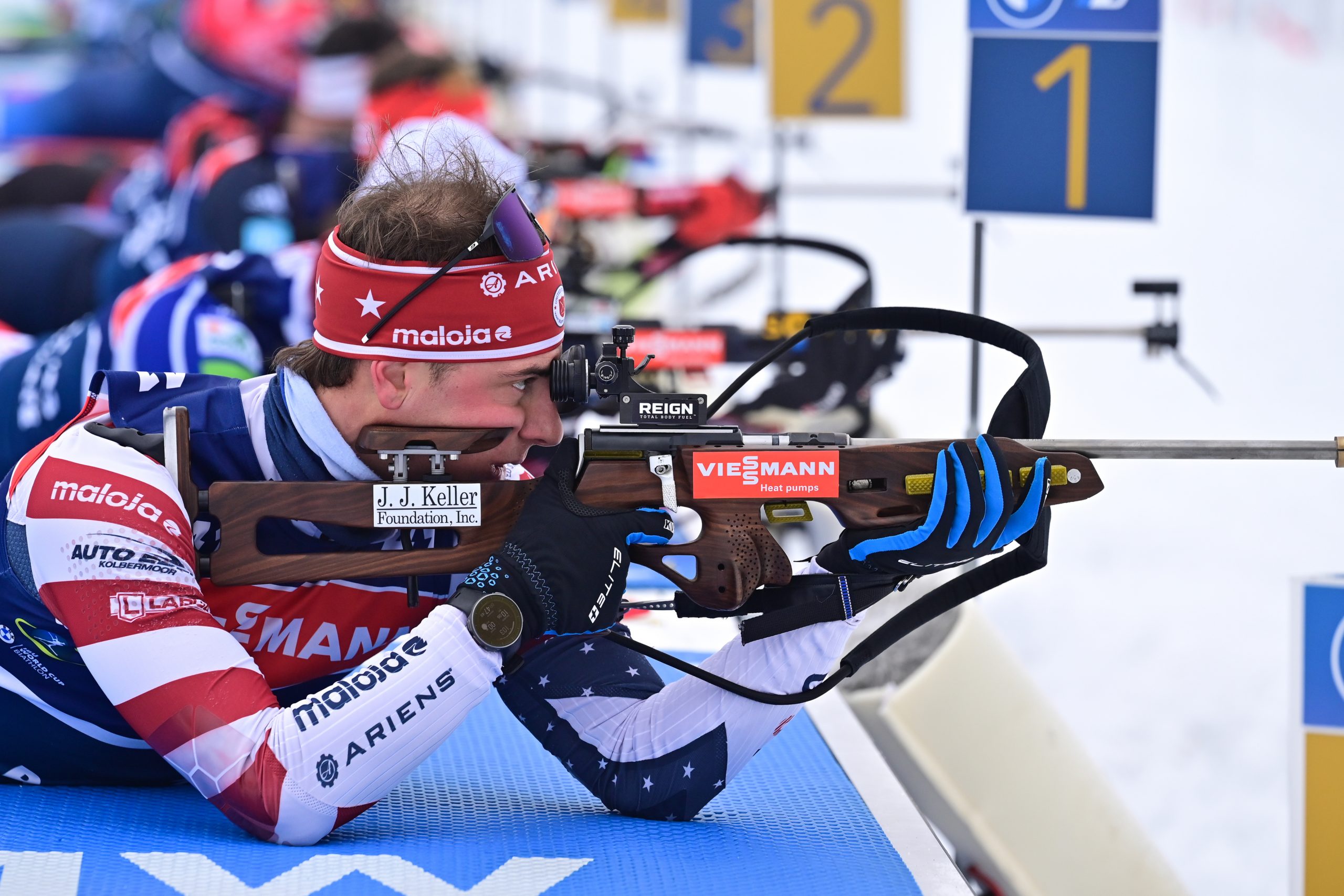
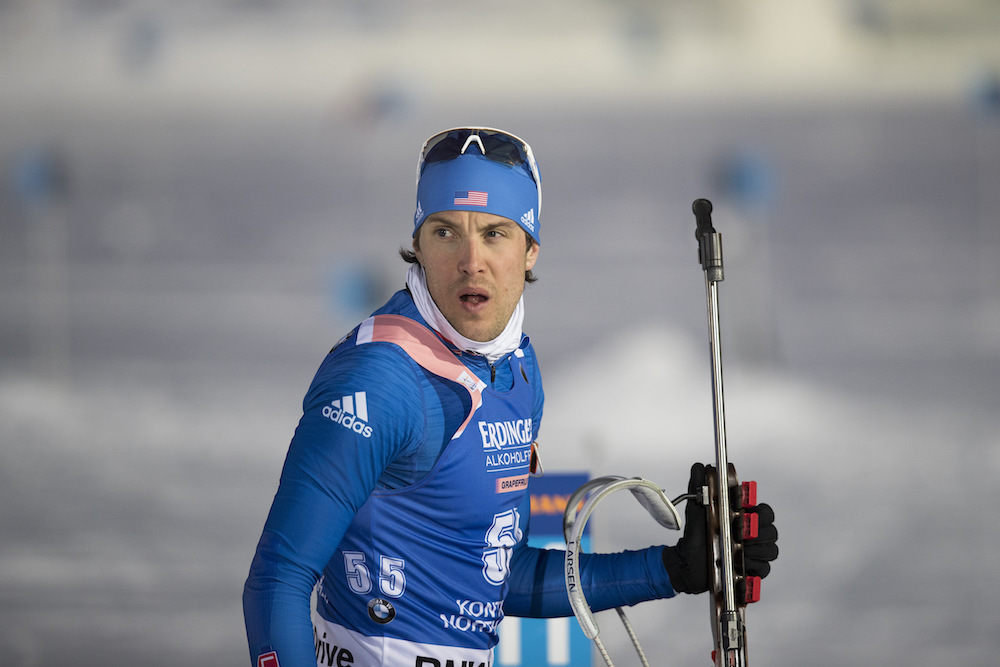
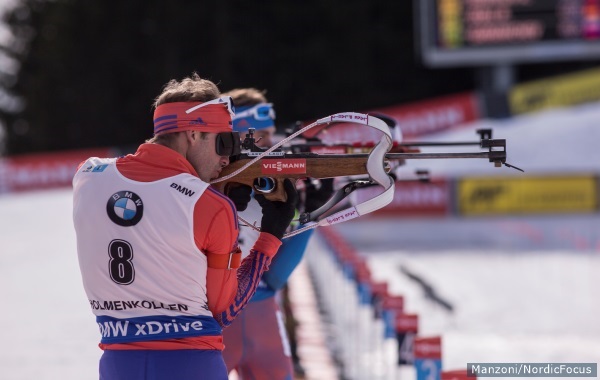
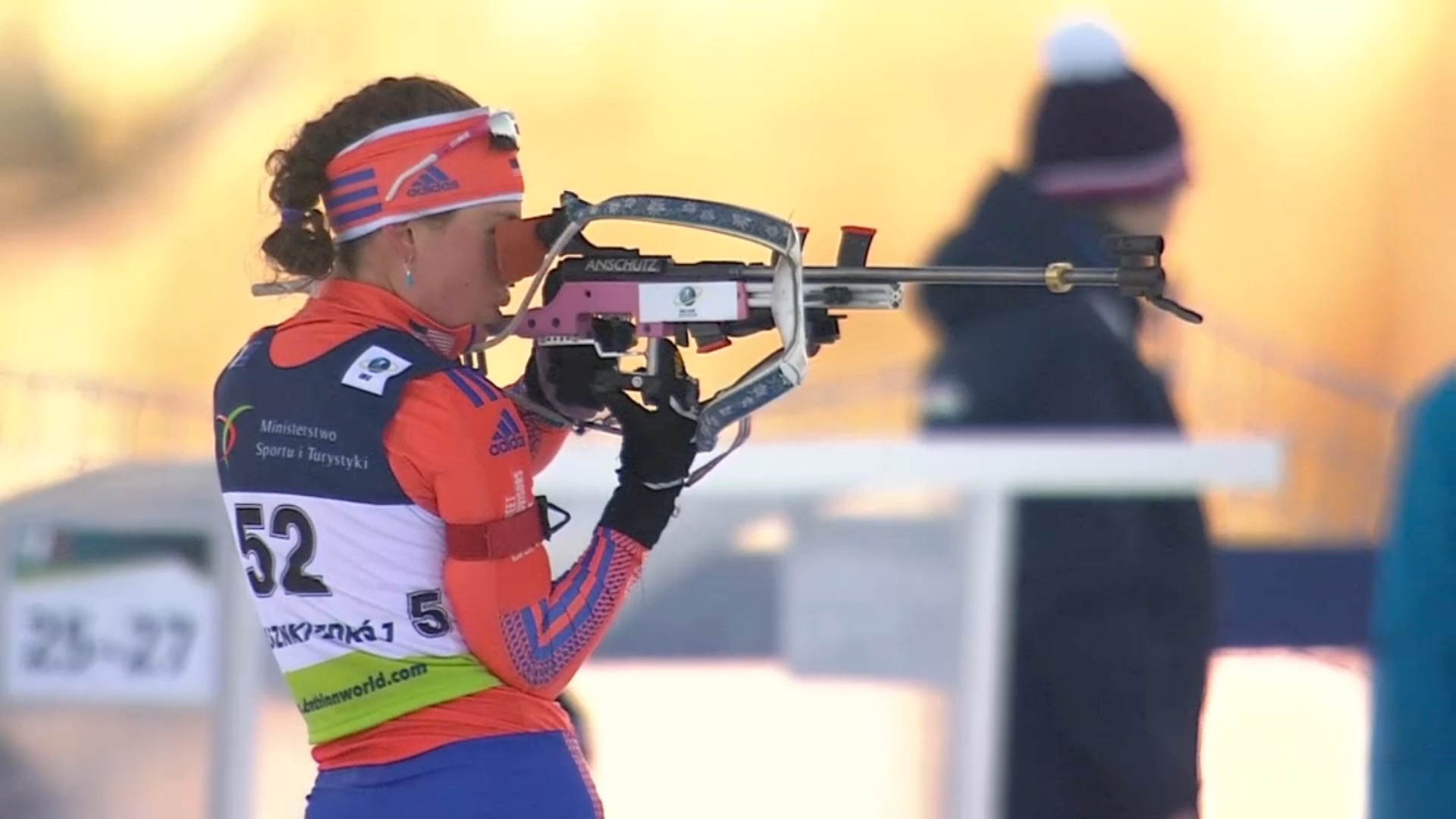
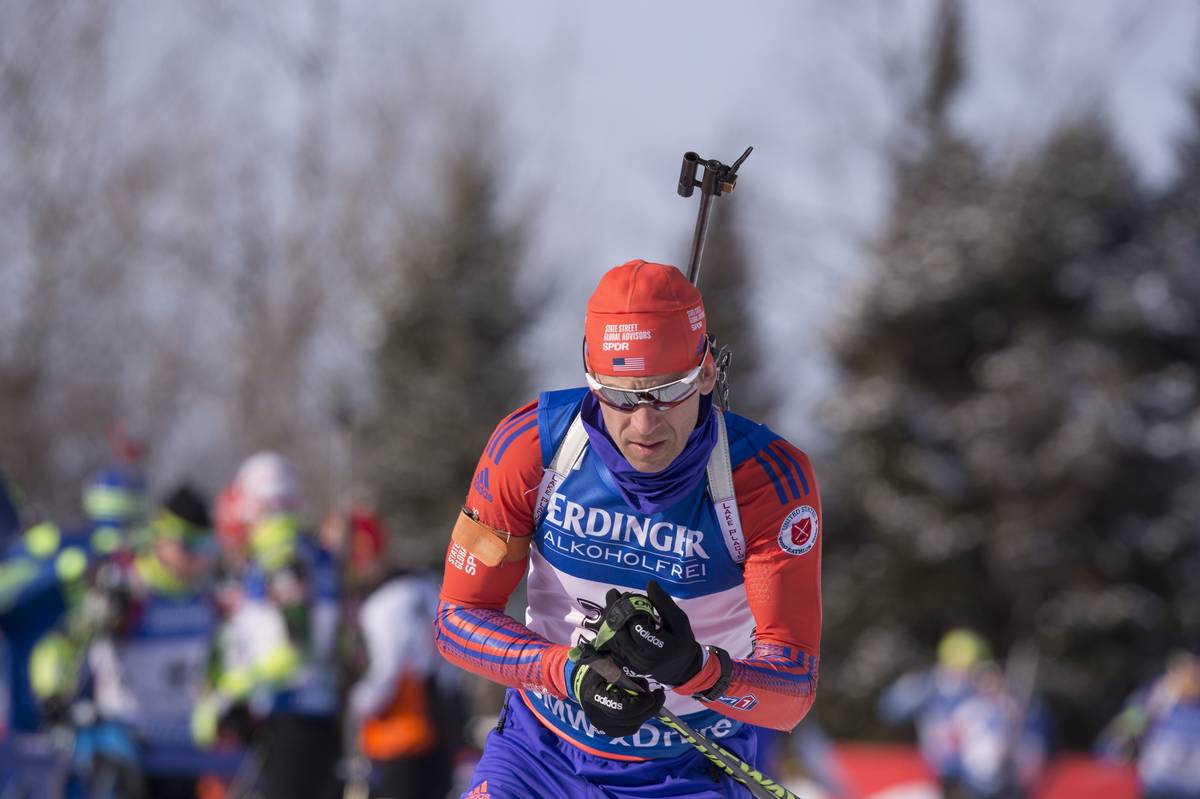
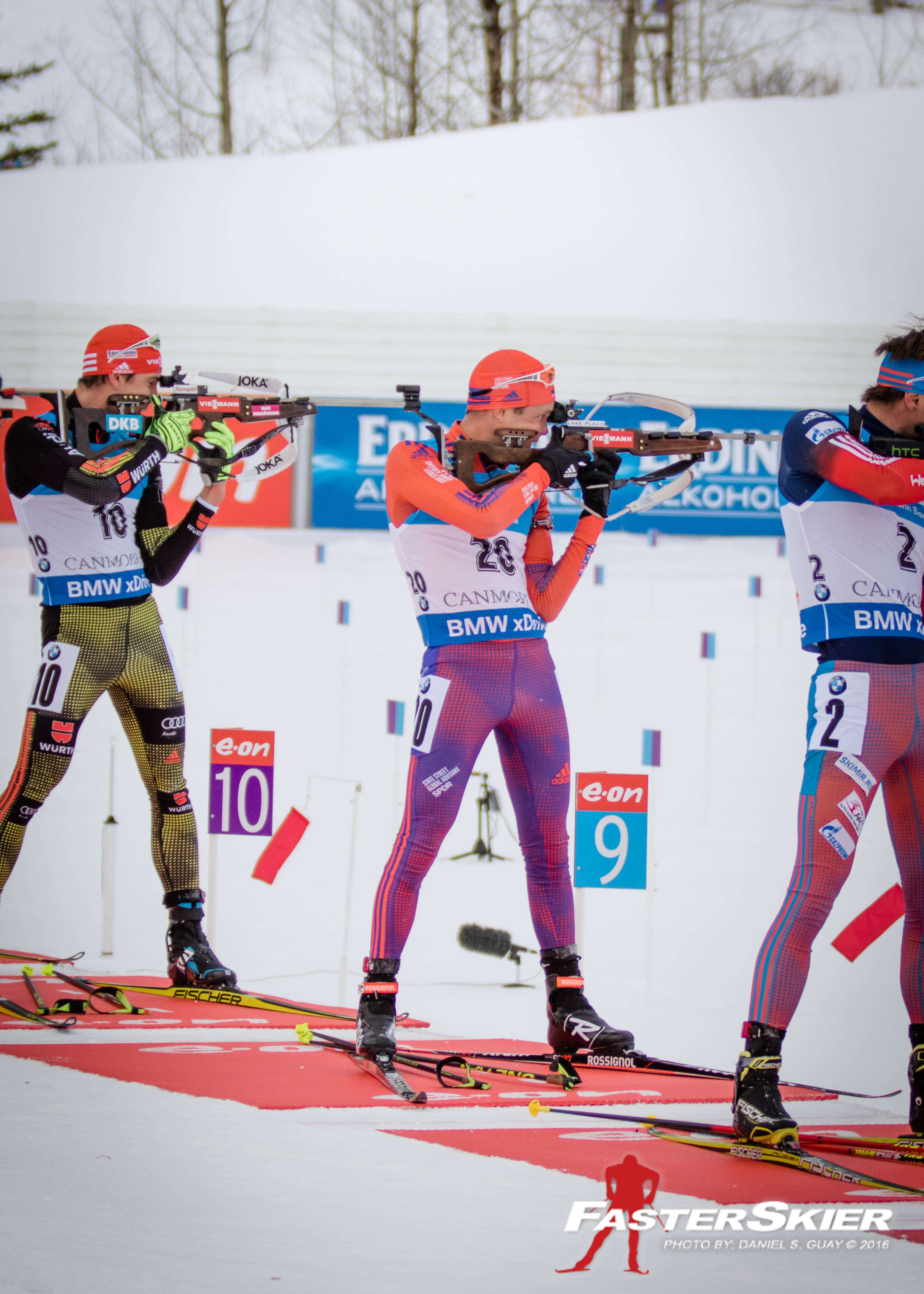
Paul Schommer (USA) zeroes his rifle before the Sprint competition at the IBU World Championships, in Oberhof, Germany. (Photo: NordicFocus)
Today was a tough day for the North Americans, with the exception of Paul Schommer (USA) who qualified for the Pursuit in 31st with one penalty each in prone and standing. Paul’s 31st-ranked course time was his best in a Sprint this season. “That prone miss was definitely one of those things where I thought, okay, I should have taken another second, but the standing felt good,” Schommer said of his shooting. As in yesterday’s Women’s Sprint, drafting on the long, windy straightaway into the range was critical. With that in mind, Schommer went out of his comfort zone on the second lap to stay with another athlete. “I may have pushed a little too hard before standing, but I made up so much time by staying with him.” It’s easy in biathlon to play the “what if” game, and Schommer recognized that he would have cracked the top 20 with one less miss, but he said, “tomorrow I’m going for the money!” The top 30 finishers in biathlon World Cups and World Championships earn prize money.
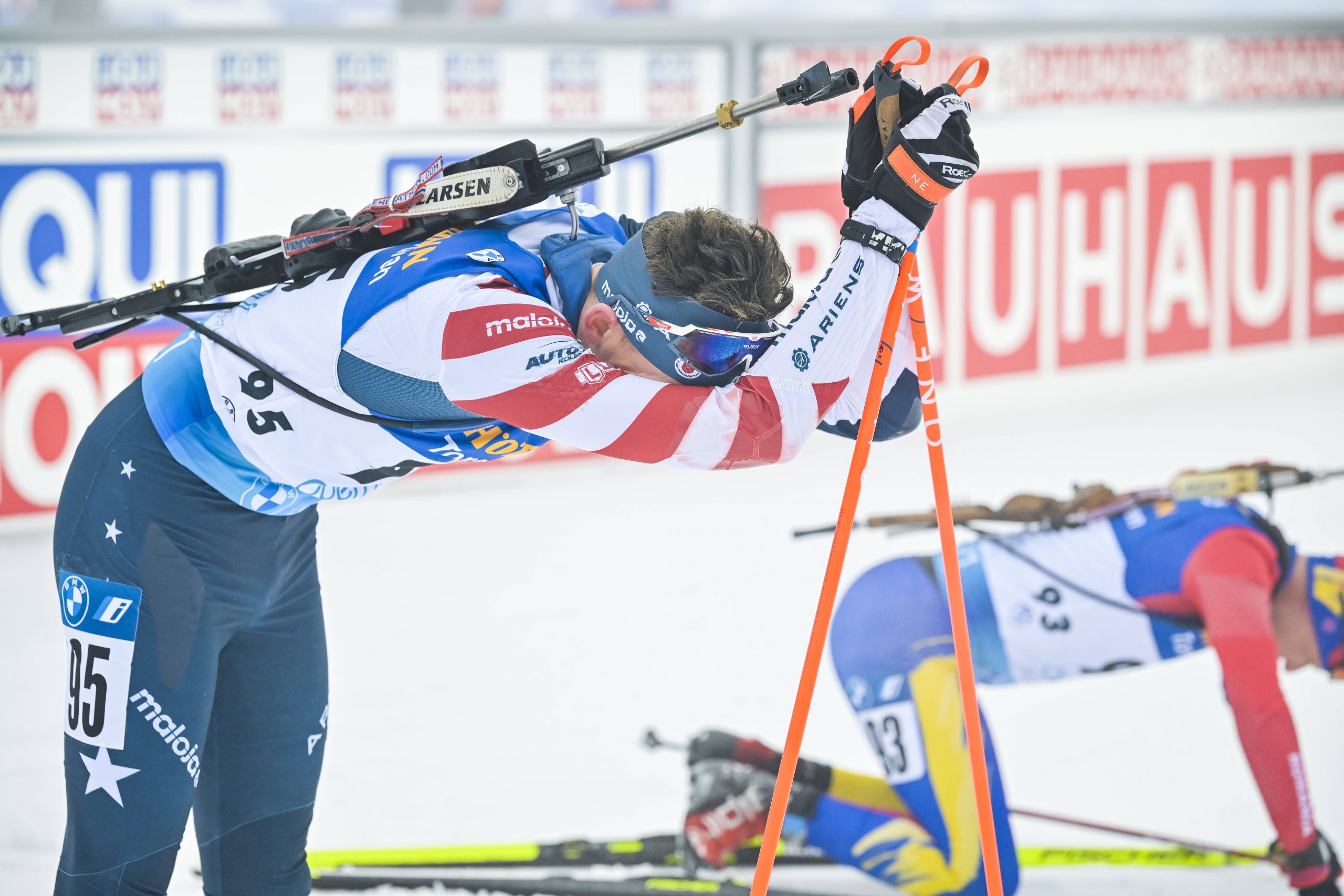
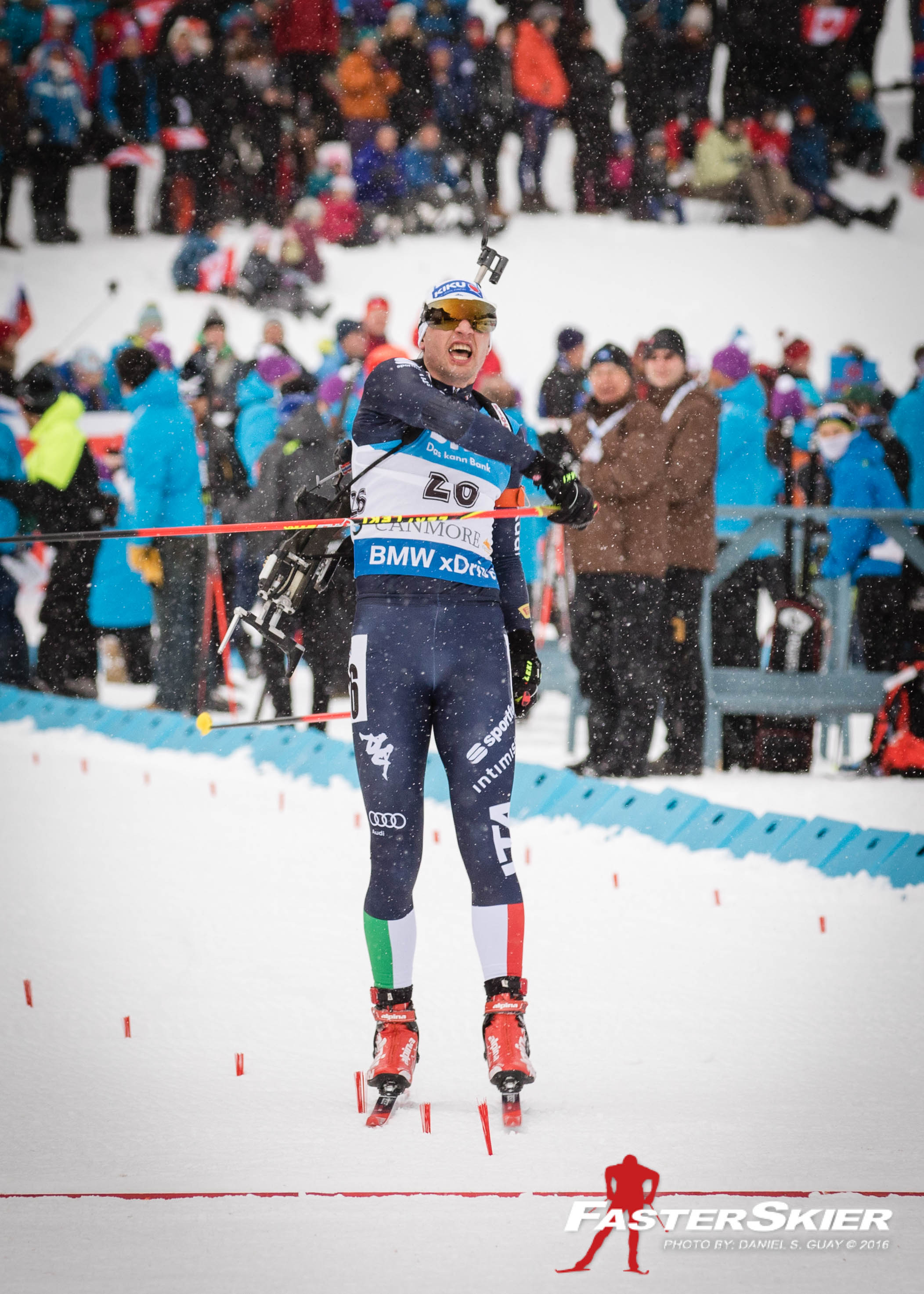
Maxime Germain (USA) in the finish of his first senior-level World Championship race. Oberhof (GER). (Photo, NordicFocus).
Twenty-one-year-old Maxime Germain (USA) finished just outside of the Pursuit qualification in 65th with three penalties. Both Sean Doherty (USA) and 22-year-old Vincent Bonacci (USA) cleaned prone but then uncharacteristically missed four in standing. They finished 80th and 98th.
For Canada, Adam Runnalls was the team’s top finisher in 82nd with five misses. Trevor Kiers was 86th with three, Christian Gow was 92nd with four, and Logan Pletz was 94th with four. This was certainly not the day that either North American team had hoped for. Those not racing in tomorrow’s Pursuit will shift their focus now to next week’s 20km Individual competition.
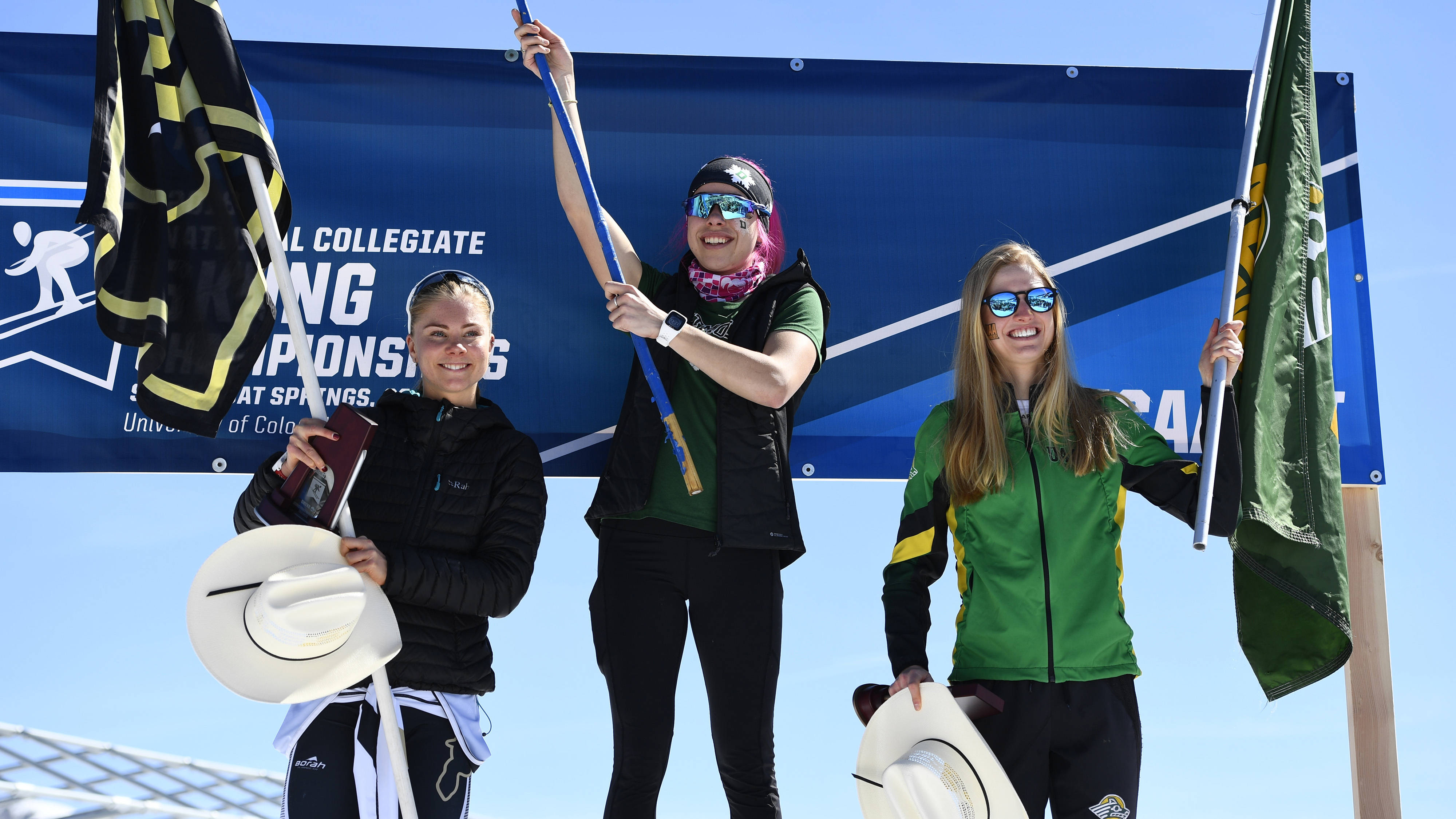
The women’s 5 k classic podium at 2018 NCAA Skiing Championships in Steamboat Springs, Colorado, with Dartmouth’s Katharine Ogden (c) in first, Colorado’s Anne Siri Lervik (l) in second, and University of Alaska Anchorage’s Hailey Swirbul (r) in third. (Photo: Clarkson Creative/DartmouthSports.com)
On the first day of NCAA Skiing Championships at Howelsen Hill in Steamboat Springs, Dartmouth College freshman Katharine Ogden and University of Utah senior Martin Bergström were crowned champions in the women’s 5-kilometer and men’s 10 k classic races, respectively.
“There isn’t much more to say about Katharine’s performance today other than she absolutely crushed it!” said Dartmouth Director of Skiing and Women’s Nordic Head Coach Cami Thompson Graves, according to the Dartmouth press release. “It was such a treat to watch her perform so well.”
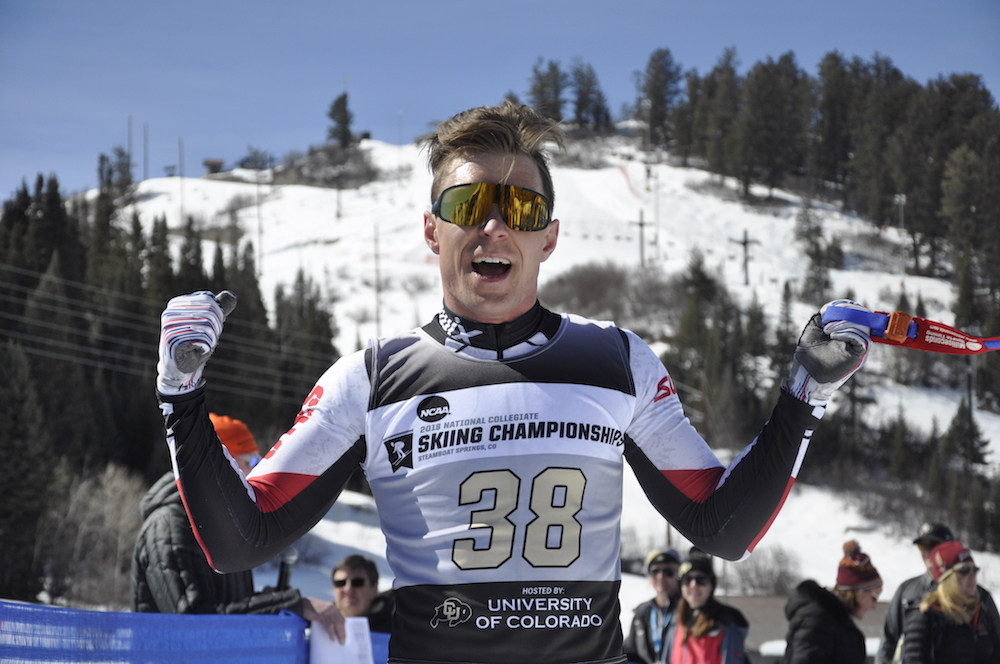
Martin Bergström (University of Utah) after winning his third-straight NCAA Skiing Championships title with a win in the 10 k classic on Thursday in Steamboat Springs, Colorado. (Photo: University of Utah)
CU, this year’s NCAA Championships host, had three women in the top 11 with last year’s classic champion Petra Hyncicova placing sixth and Christina Rolandsen finishing 11th.
The CU Buffs took the lead in the team standings on Thursday by nine points over the University of Denver (DU). Utah is currently 41 points back in third, Dartmouth moved up to fourth, and the University of Vermont, which led after Wednesday’s Day 1 alpine races, slipped to fifth.
In the men’s race, Bergström, who won both races at last year’s NCAA Championships, posted an 8.5-second victory over CU’s Petter Reistad with a winning time of 27:37.1. Dag Frode Trollebø of DU placed third (+14.7) ahead of his DU teammate Eivind Kvaale in fourth (+38.9). On his 22nd birthday, Ian Torchia, of Northern Michigan University and the U.S. Ski Team Development Team, was the top American finisher in fifth (+46.2).
Alpine slalom races will take place on Friday, while NCAA Championships will conclude with 15/20 k freestyle mass starts on Saturday.
IBU World Cup (Kontiolahti, Finland): Men’s 10 k sprint
First, a little geography lesson. Kontiolahti, Finland, is only about 100 kilometers from the Russian border, so most of the International Biathlon Union (IBU) World Cup (and World Championships) events held there attract a mostly Russian crowd.
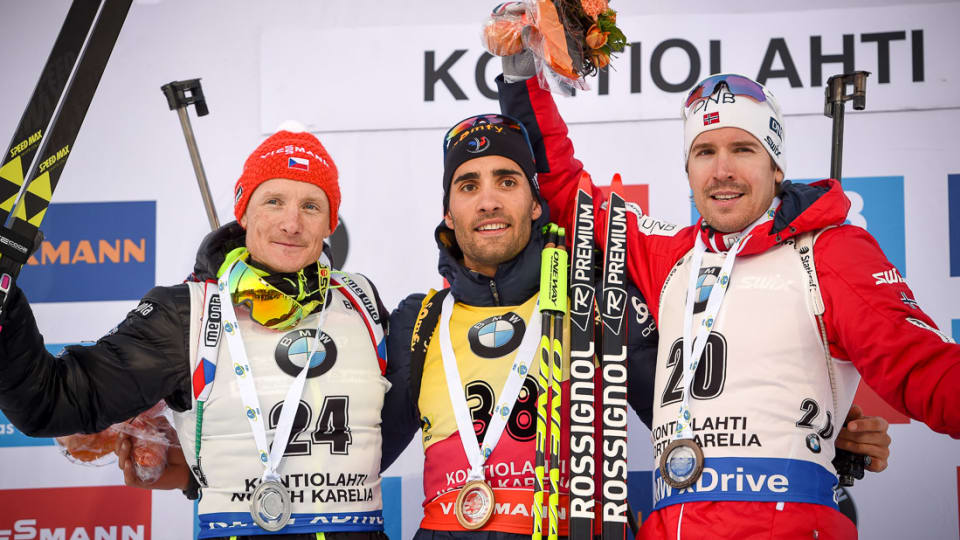
The men’s 10 k sprint podium at the IBU World Cup in Kontiolahti, Finland, with Russia’s Anton Shipulin (c) in first, Latvia’s Andrejs Rastorgujevs (l) in second, France’s Quentin Fillon Maillet (r) in third. (Photo: IBU/Biathlonworld)
And here’s a little more background: Russia’s Anton Shipulin showed up for Thursday’s IBU World Cup in Kontiolahti raring to go after having been barred from last month’s Winter Olympics in PyeongChang, South Korea.
So Shipulin hadn’t raced since Jan. 21 in Antholz, Italy. The International Olympic Committee’s decision to ban him from the 2018 Games went public on Jan. 23.
Back in action in Kontiolahti, in front of Russian fans, Shipulin delivered a 5.8-second win in the men’s 10-kilometer sprint, shooting clean and finishing in 23:51.6. It was the 31 year old’s third non-relay podium of the season and first World Cup win of 2017/2018, and he did so on a relatively moderate evening by Kontiolahti standards (at -6 degrees Celsius, or 21 Fahrenheit) with a “stiff breeze” on the range, according to an IBU press release.
“I felt very good on the tracks and shooting and today it was enough to win,” Shipulin told the IBU. “I am very happy about this … all of the Russian fans gave me a lot of support on the tracks.”
Latvia’s Andrejs Rastorgujevs tied his career best in second place, after shooting a perfect 10-for-10 as well. He acknowledged his mom and women in general after the race.
“This is very important for my team,” Rastorgujevs told the IBU. “I would also like to congratulate all of the ladies and especially my mom on International Women’s Day.”
France’s Quentin Fillon Maillet also shot clean to place third (+17.3) for his third non-relay World Cup podium of the season.
Fillon Maillet was one of the earliest starters in bib 6 yet held off Norway’s Johannes Thingnes Bø, the 30th starter, by 1.7 seconds for the last spot on the podium. Bø had been a race leader after cleaning prone but missed two standing targets (0+2) to slip out of contention and into fourth at the finish (+19.0).
Germany’s Olympic sprint champion, Arnd Peiffer placed fifth (+27.4) with one miss (0+1), and France’s Simon Desthieux finished sixth (+28.3) with one prone penalty (1+0), and Germany took seventh and eighth with Erik Lesser (+30.6; one penalty) and Simon Schempp (+32.0; two penalties), respectively. Italy had two in the top 10 with Lukas Hofer in ninth (+35.2; one penalty) and Dominik Windisch in 10th (+38.3; one penalty).
Lowell Bailey of the U.S. posted his best sprint result of the season in 16th (+48.4) after cleaning prone and missing one standing target (0+1). After starting 22nd, he recorded the 13th- and 14th-fastest overall shooting and range times, respectively, and 23rd-ranked course time.
After the Olympics, Bailey returned home to Lake Placid, N.Y., for a brief training block. Despite a hefty amount of travel over the last week and a half, he explained in an email that he felt good in his first race back.
“I felt better than I have for most of the season. Sometimes that can happen. I guess that’s the part of the unpredictability of biathlon,” Bailey wrote of Thursday’s race. “The conditions were great today; hard tracks and calm winds on the range. There was a bit of wind, but compared to the three weeks in South Korea, it seemed pretty tame.
“Shooting felt solid today,” he added. “That missed shot in standing was sooo close, but not close enough!”
Overall, Bailey stated that he was happy with his performance and looking forward to the rest of the races in Kontiolahti.
Leif Nordgren (US Biathlon) raced to 17th for his best result in three seasons on Thursday in the men’s 10 k sprint at the IBU World Cup in Kontiolahti, Finland. (Photo: USBA/NordicFocus)
His teammate Leif Nordgren finished just one place behind him in 17th (+49.9) for his best result in three years. A later starter in bib 55, Nordgren also cleaned prone and missed one standing (0+1) with the fifth-fastest shooting time and seventh-fastest range time. Overall, his course time ranked 28th out of 100 finishers. Nordgren’s individual career best on the World Cup is 16th in a sprint in February 2015. He has finished 17th three times; the last time was in a pursuit in March 2015.
Brendan Green shot clean to lead the Canadian team in 34th (+1:29.5). American Sean Doherty followed in 35th (+1:29.7) with three penalties (1+2), and Tim Burke placed 38th (+1:36.1) for the U.S., also with three misses (1+2).
In his World Cup debut, American Alex Howe finished 68th (+2:23.1) with two misses (1+1).
Canada’s Christian Gow finished 79th (+2:47.4) with two penalties (1+1), and Scott Gow was 86th (+3:01.7) with three misses (1+2).
This year’s Kontiolahti World Cup does not include a pursuit race. The women’s 7.5 k sprint is scheduled for Friday at 11:45 a.m. EST in Kontiolahti, and the single mixed relay and mixed relay will follow on Saturday. Racing in Kontiolahti will conclude with men’s and women’s mass starts.
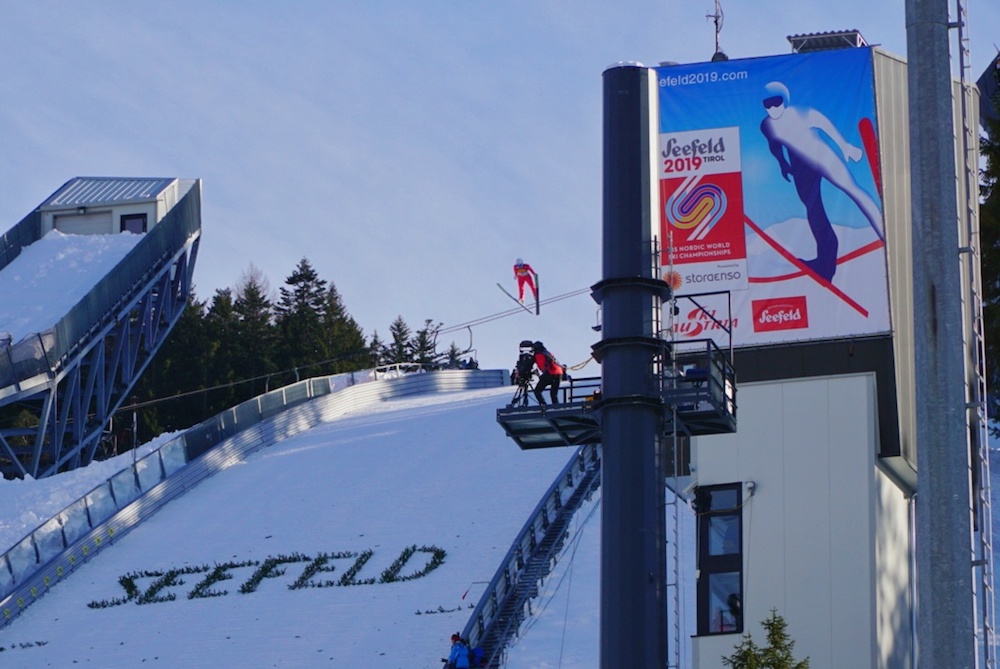
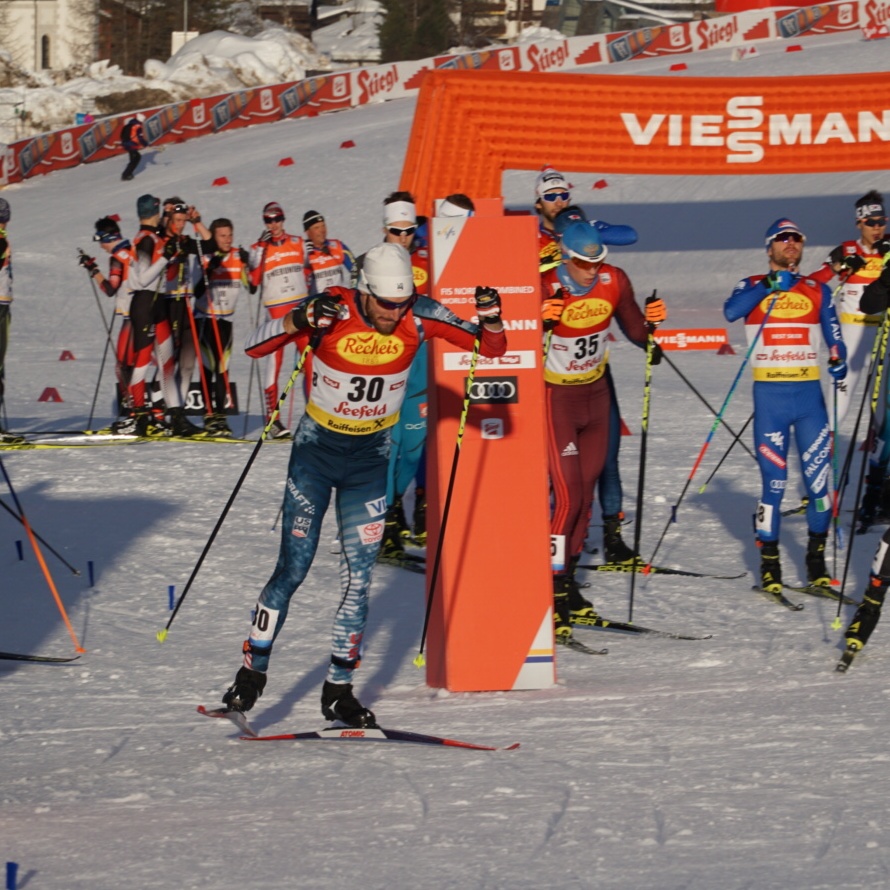
The jumping portion of the Nordic Combined World Cup Seefeld Triple on Friday in Seefeld, Austria. (Photo: Garrott Kuzzy / LumiExperiences.com)
Nordic Combined World Cup (Seefeld, Austria): Individual normal hill/5 k
On the first of the three-day Seefeld Triple Nordic Combined World Cup, Japan’s Akito Watabe took the win and Taylor Fletcher was the top American in 28th in the individual normal hill/5-kilometer Gundersen on Friday.
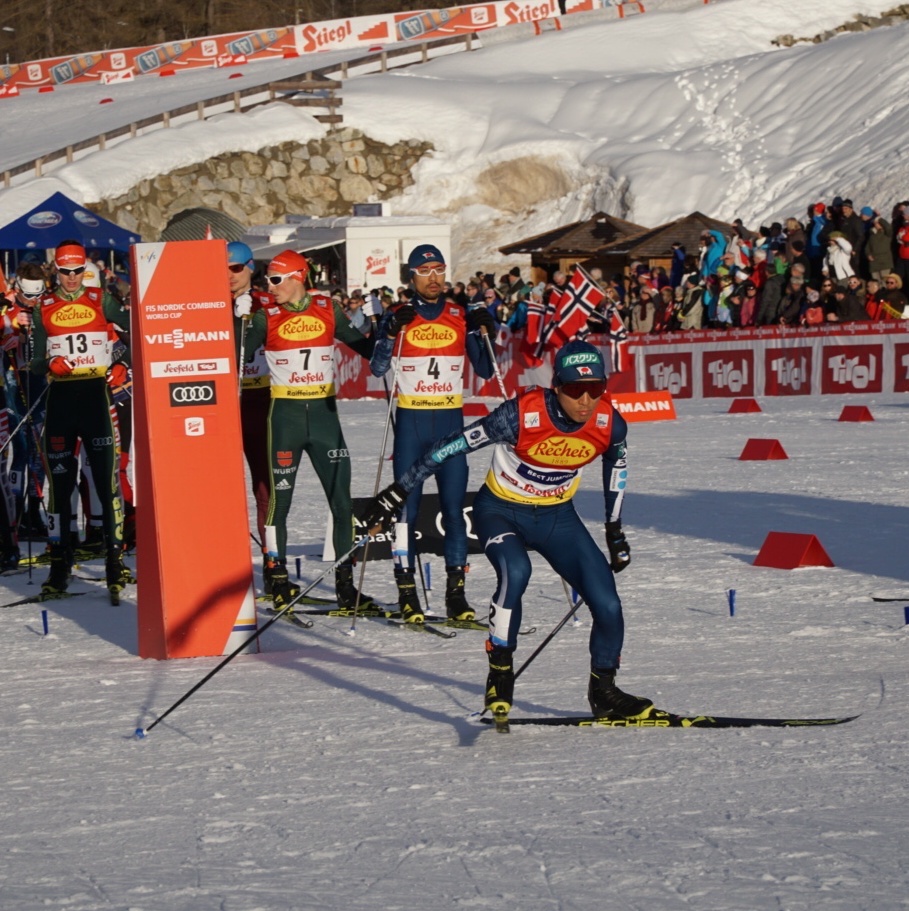
Japan’s Akito Watabe heading out of the gate second in the 5 k Gundersen on Friday at the Seefeld Triple Nordic Combined World Cup in Seefeld, Austria. Watabe went on to win the race by half a second. (Photo: Garrott Kuzzy / LumiExperiences.com)
Watabe put himself in second in the jump portion and started the 5 k ski race 21 seconds behind Norway’s Jarl Magnus Riiber in first. Watabe caught Riiber and beat him at the finish line, taking the win in 11:22.3 minutes, while Riiber followed 0.5 seconds back in second place. Germany’s Fabien Rießle followed in third, 32.4 seconds out of first, after starting the 5 k in sixth and 1:03 minutes back.
Norway’s Jan Schmid jumped to third and ended up fourth (+37.8). Watabe’s brother, Yoshito Watabe placed fifth (+47.2), losing one place in the ski race after jumping to fourth.
Two Americans competed, with Fletcher jumping to 30th and ending the day in 28th, and Jasper Good finishing 52nd (+3:45.6) after jumping to 49th. Both are headed to the 2018 Olympics next month in PyeongChang, South Korea.
Taylor Fletcher (USA Nordic) starting the 5 k Gundersen on Friday at the Seefeld Triple Nordic Combined World Cup in Seefeld, Austria. He started in 30th and finished 28th. (Photo: Garrott Kuzzy / LumiExperiences.com)
***
U.S. SuperTour (Craftsbury, Vermont): Classic sprints
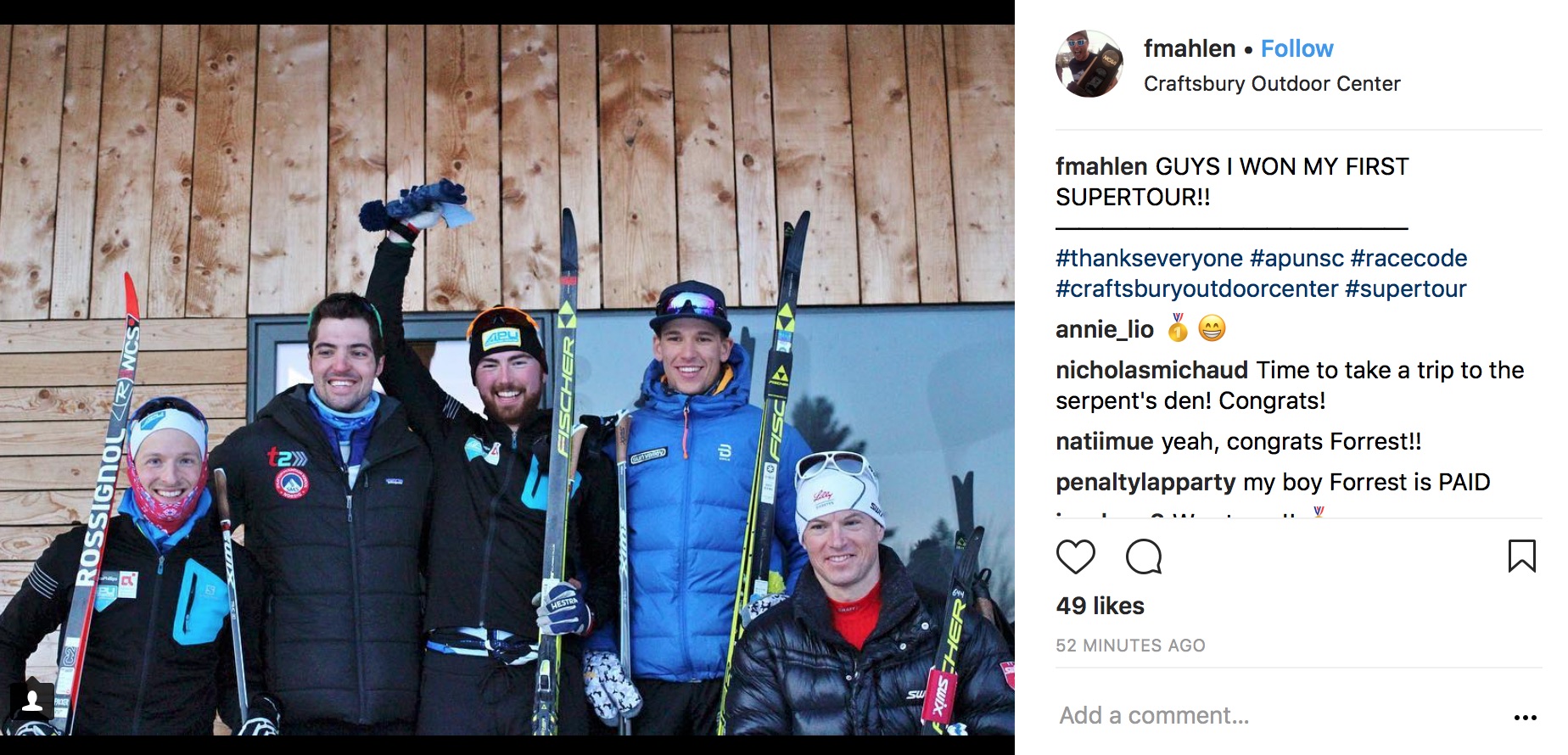
Forrest Mahlen (APU) celebrates his first time atop the SuperTour podium on Friday after winning the men’s 1.4 k classic sprint final in Craftsbury, Vermont. (Photo: Forrest Mahlen/Instagram)
Kaitlynn Miller and Forrest Mahlen won their respective classic-sprint finals at Friday’s SuperTour in Craftsbury, Vermont.
The 1.4-kilometer classic sprint kicked off a three-day race weekend at the Craftsbury Outdoor Center. On Saturday, the Craftsbury Marathon will be held (not a SuperTour event), followed by 5/10 k freestyle SuperTour races on Sunday.
Miller, of the Craftsbury Green Racing Project, started Friday by winning the women’s qualifier. She went on to win both her quarterfinal and semifinal before topping the final as well in 3:40.9 minutes. Also on Friday, it was formally announced that Miller was named to the U.S. Cross-Country Ski Team’s Olympic squad, which will compete in PyeongChang, South Korea, Feb. 10-25.
Kelsey Phinney, of the Sun Valley Ski Education Foundation (SVSEF), placed second in the women’s final, 0.63 seconds back, and Felicia Geisor (CXC Team) was third (+1.67). Erika Flowers, of the Stratton Mountain School (SMS) T2 Team placed fourth (+3.2), Canada’s Olivia Bouffard-Nesbitt (Rocky Mountain Racers) — fresh off NorAm Western Canadian Championships last weekend in Alberta — finished fifth (+5.46), and Alaska Pacific University (APU) skier Rosie Frankowski (who also made the U.S. Olympic team) placed sixth (+6.27).
On the men’s side, APU’s 24-year-old Mahlen qualified fifth, then won his quarterfinal and semifinal before taking the final for his first-career SuperTour win in 3:06.81. Ben Saxton (SMST2) initially won the qualifier and won his quarterfinal as well before placing second to Mahlen in the first semifinal. Saxton ended up 0.55 seconds back in second place in the final, just three-hundredths of a second ahead of Kevin Bolger (SVSEF) in third place (+0.58). Another half second back, Kris Freeman followed in fourth, just 1.09 out of first, Eric Packer (APU) was fifth (+1.39) and Canada’s Andy Shields (Lappe Nordic), who also competed at Western Canadian Championships last weekend) sixth (+8.99).
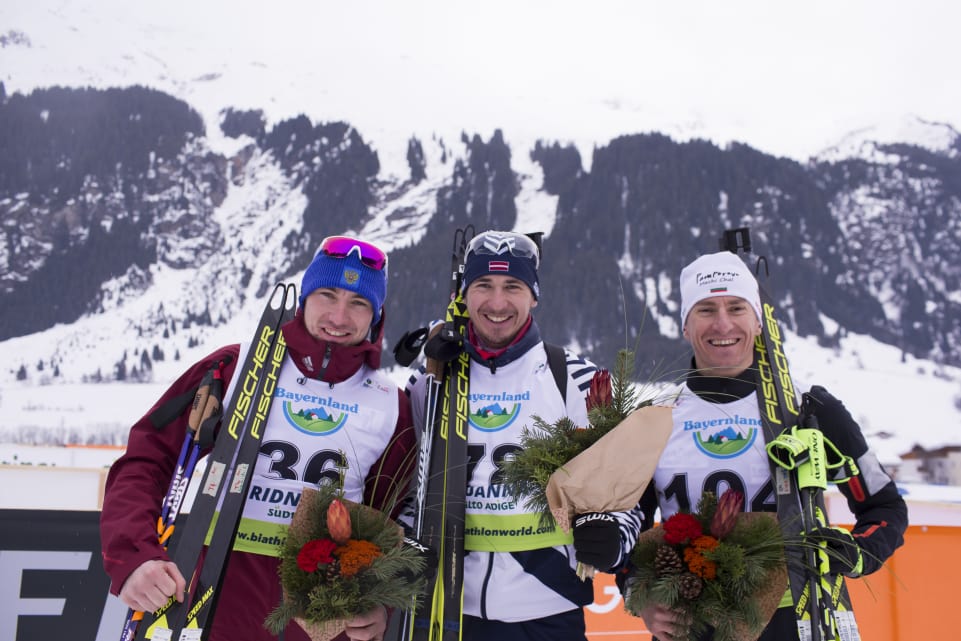
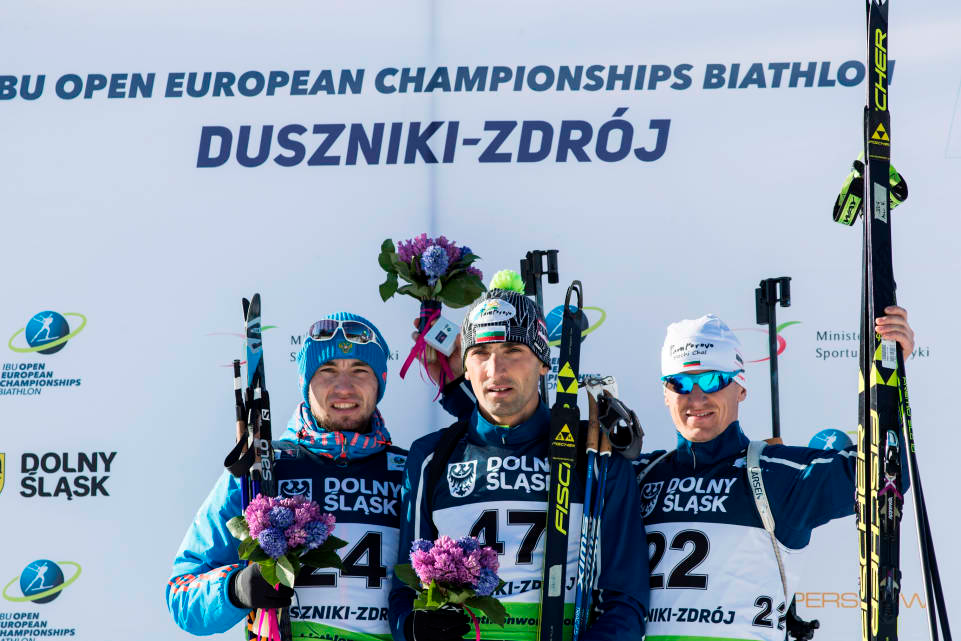
The men’s 10 k sprint podium at IBU Open European Championships, with Latvia’s Andrejs Rastorgujevs (c) in first, Russia’s Alexander Loginov (l) in second, and Bulgaria’s Krasimir Anev (r) in third. (Photo: IBU/Biathlonworld)
IBU Open European Championships (Ridnaun-Val Ridanna, Italy): Men’s and women’s sprints
Canada’s Macx Davies led the North Americans on Friday on Day 2 of the International Biathlon Union (IBU) Open European Championships in Ridnaun, Italy, placing 27th in the men’s 10-kilometer sprint with 9-for-10 shooting (1+0). Davies finished 1:32.3 minutes behind Latvia’s Andrejs Rastorgujevs, who took the win in 24:03.0 with a single penalty as well (0+1).
Russia’s Alexander Loginov placed second, 5.5 seconds back, with one penalty (1+0), and Bulgaria’s Krasimir Anev shot clean to finish third (+24.5).
“At the [last] World Cup in Anterselva [Italy], I have had a difficult time in the shooting range, and so I spent a lot of time in the last few days working on my shooting,” Rastorgujevs told the IBU after. “Today it was clear that all this hard work paid off. It is also a great motivator for Olympic gold.”
For Davies, who’s also headed to the Olympics next month, the result tied his best individual result this season after he placed 27th in an IBU Cup sprint earlier this month in Osrblie, Slovakia.
Canada entered four in the men’s race, with Carsen Campbell finishing 75th (+2:34.6) with one miss (0+1), Aidan Miller placing 91st (+3:18.2) with three penalties (1+2), and Matt Hudec finishing 119th (+4:31.6) with four misses (1+3).
Five American men raced, with Alex Howe finishing 53rd (+2:15.1) with one penalty (1+0), Jake Brown 84th (+3:02.0) with four misses (1+3), Jakob Ellingson 85th (+3:07.0) with one miss (1+0), Max Durtschi 111th (+3:50.1) with four misses (3+1), and Paul Schommer 114th (+3:59.8) with four penalties (2+2) as well.
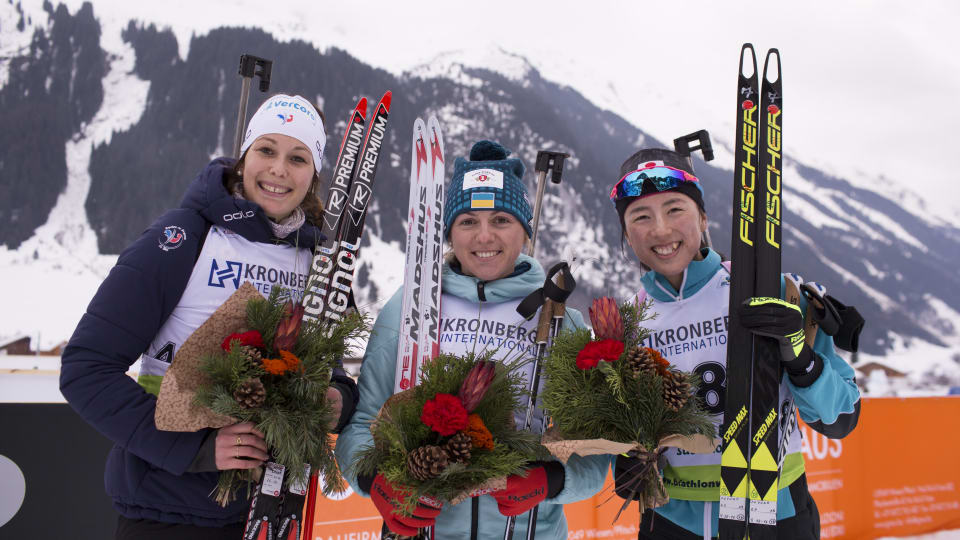
The women’s 7.5 k sprint podium at IBU Open European Championships in Ridnaun, Italy, with Ukraine’s Iryna Varvynets (c) in first, France’s Chloé Chevalier (l) in second, and Japan’s Fuyuko Tachizaki (r) in third. (Photo: IBU/Biathlonworld)
In the women’s 7.5 k sprint that followed, Chloe Levins of the U.S. was the top North American in 59th, 2:01 behind the winner Iryna Varvynets of Ukraine. Varvynets shot clean and posted the fastest finishing time of 20:54.1, 12.5 seconds faster than France’s Chloé Chevalier, Wednesday’s 15 k champion who had one miss (0+1) on Friday and ended up second. Japan’s Fuyuko Tachizaki reached the podium in third (+15.5) and was one of four women in the top five that shot clean (only Chevalier did not).
“After the individual competition on Wednesday, I was not at all happy with my shooting,” said Varvynets, who placed fifth in the 15 k. “Today I therefore concentrated especially hard in the shooting range. It was my luck that not many finished without errors, otherwise it would probably not have been enough for the victory.”
“Two races, two medals — it could not have gone better for me,” Chevalier said. “In the standing shooting I missed the first disc and got a little nervous, but thankfully, there were no further errors.”
Tachizaki called the bronze medal a “big dream come true”.
“The focus of my season had been the Olympics and I ‘only’ took part in Ridanna as part of the preparations, but with this result I have exceeded everything I have achieved so far,” she said. “At the end of the race I did not only fight hard in the track, I was already dreaming of a medal. Now I’m in seventh heaven.”
Levins had one miss in each stage (1+1), as did fellow American Maddie Phaneuf, who finished 63rd (+2:19.0) with two penalties. Clare Egan followed in 70th (+2:34.2) with four misses (3+1), Deedra Irwin was 85th (+3:38.1) with four penalties (1+3) as well, and Jennie Bender 97th (+5:52.8) with six misses (3+3).
Two Canadians started the race, with Sarah Beaudry finishing 76th (+3:02.9) with four misses (1+3). Erin Yungblut did not finish.
Open European Championships continue Saturday with the men’s and women’s pursuits. The top 60 from the sprint qualify, which, for the North Americans, means Davies, Howe, and Levins.
The championships end Sunday with single mixed and mixed relays.
France’s Martin Fourcade (c) in first, Latvia’s Andrejs Rastorgujevs (l) in second and Austria’s Simon Eder (r) in third on the podium following the men’s 15 k mass start at the season-finale 2017 IBU World Cup in Oslo, Norway. (Photo: IBU)
Between breaking historic biathlon records and waiting for the imminent birth of his second child, France’s IBU World Cup dominator Martin Fourcade forgot one crucial detail of Biathlon 101 before Sunday’s final race of the season in the men’s 15-kilometer mass start: loading his ammunition clips.
Fourcade only realized he had started with four empty clips when he crouched down on the shooting mat for the first prone shooting, then signaled for help. His coach standing at the range reacted the fastest and threw him a full clip. Fourcade inserted it into his rifle and went on to hit all five shots, leaving the range in 18th position and 21 seconds behind the leaders, almost the time it takes to ski a penalty lap.
But what he and his coach had done strictly was not allowed: Fourcade would have had to wait and receive the spare clip from a race official, because the range is a “no-coaching zone”. While the race went on, Fourcade’s name was marked with an asterisk on the timing screens, and the race jury and technical delegate started discussing if Fourcade maybe should be disqualified or hit with a time penalty.
Fourcade later said he was aware the violation was under review, but decided to keep racing like normal. Before the second shooting he had compensated the gap passing the whole field to take the lead again, and received additional spare magazines this time from an official kneeling next to the first-lane shooting mat.
Seemingly undeterred by the problems, Fourcade went on to clean not only the second stage, but also the two standing stages to create a lead of almost 25 seconds, already celebrating as he left the famous Holmenkollen arena for the final loop. He was the only athlete in the field to shoot clean in all four stages, crossing the line in a time of 37:32.2 minutes under the huge applause of thousands of fans in the stands who had just witnessed a demonstration of his abilities. But would his victory stand?
“I am simply an idiot, because I forgot to reload my magazines before the start,” Fourcade explained during a press conference later. “Today I had a really good day in spite of this huge mistake. I succeeded getting back the time I lost, and then shot clean. I am really happy and proud of my competition. It was probably one of the best days in my career, but it was a competition full of stupidness.”
Behind him, Austria’s Simon Eder and Latvia’s Andrejs Rastorgujevs – usually known as a fast skier but shaky shooter – manged to also clean the final standing stage and went out on the last loop together. Rastorgujevs was faster there, overtaking and then distancing Eder to achieve the first World Cup podium of his career with two penalties in the race (0+1+1+0), 17.4 seconds behind Fourcade. Eder finished third (+32.4) with one penalty (0+0+1+0) to claim his third individual podium of the season (plus two in single mixed relays and two in men’s relays).
In his long career, Rastorgujevs, 28, had been on the podium at IBU European Championships, winning gold in 2014 and at Summer Biathlon World Championships on rollerskis, but never in a World Cup where he only had four fourth-place finishes to his name.
“The first podium in I think more than five years for me, after a lot of fourth, fifth, sixth, seventh, eigth, ninth, tenth places,” Rastorgujevs said during the press conference. “I am really happy, and I want to say a big thanks to my team and my service guys, who have worked very hard for this second place … I think today is a special day, and it’s also a big party for my team … Now I think this is opening the door for more podiums. We will see what happens next season.”
“Yesterday I joked about a podium [in an interview], I don’t know why I did that, but I am really happy I got this podium today,” Eder explained. “The third race in a row is always a problem for my body, I already know this. I prefer to have a rest day, so I knew it was gonna be hard today. I am happy I got the third place. I saw Andrejs behind me which made me happy, and tried to keep up with him as long as possible hoping for the third or maybe second place but he was too strong for me.”
Lowell Bailey (US Biathlon) shooting during a standing stage in the men’s 15 k mass start, the last race of the 2016/2017 IBU World Cup season, on Sunday in Oslo, Norway. He went on to finish 15th. (Photo: USBA/NordicFocus)
Halfway through the race, US Biathlon’s Lowell Bailey had been in the lead after two clean prone shooting performances, taking the first lane in the standing shooting. But he missed two targets in that stage and had to ski a penalty lap, and then missed another one in the final shooting.
“I think this was one of my best races of the season in terms of ski speed. I felt composed and focused in prone, and was happy with two cleans,” Bailey wrote in an email to FasterSkier. “In the first standing, I didn’t necessarily plan on shooting on point 1, but [Russia’s Anton] Shipulin did not want to lead in and I thought, if anything, it would be a bit of an advantage to be on point 1 if the wind came up. Those two misses set me back a fair amount, but I’m happy I stayed in the race mentally, only had one miss in the last standing, and was able to ski my way back into a top-fifteen.”
Bailey finished the race in 15th place with three penalties (0+0+2+1), 1:10.4 behind Fourcade. But had Fourcade actually won, or would he be disqualified or relegated back?
After the race, the competition jury could be seen on the TV broadcast deliberating the case for several minutes, and ultimately they decided to not take any actions against Fourcade.
“I knew after the first shooting I was under disqualification [review], because the way I got back my full magazine is not the way exactly to do it,” Fourcade said. “It was a possibility to be disqualified, so I wanted to show to everyone, to all the other athletes, to the audience, to the jury also, that it was my day. And if they decided to not give me the victory, I knew in my heart that I had it.”
“I think the jury was right,” Bailey wrote in his email. “I’ve been there. I know what it’s like to make a simple, costly mistake, and I think he definitely didn’t gain any advantage by NOT loading his clips.”
Aside from Rastorgujevs and Norway’s fourth-place finisher Emil Hegle Svendsen (+42.2 with two penalties), the athlete who would have stood to benefit the most from a punishment for Fourcade was Germany’s Simon Schempp, who had been in the lead in the mass-start score World Cup standings before the race. But just coming back from a lengthy illness after last month’s World Championships where he won the men’s mass start, Schempp only finished with a 20th place (+1:28.5 with three penalties) in the same discipline on Sunday, and thereby still lost that title to Fourcade.
“The hope was there, but with my current form it is very tough,” Schempp told ARD after the race. “I gave it everything I had. I am disappointed, but something like that can’t be fixed when you come here basically without any training. I lost a lot of points in the standings the last weeks, and I can still feel the illness in my bones. I can’t help it, it happens.”
But Schempp also did not want to get the award back “off the course” by a disqualification.
“I wanted to thank and to give all my respect to the team of Germany and to Simon Schempp, who decided to not ask for a protest,” Fourcade said in the press conference, unprompted. “That’s a big gesture. I really take my hat off to Simon Schempp. I must say how impressed I am by their class, they deserve much more than a crystal globe today.”
Bailey finished the season in eighth in the World Cup Total Score standings, a career best all the more impressive considering he skipped an entire week of races in Oberhof, Germany, for a longer rest and training break after Christmas. That paid off, with a gold medal in the men’s 20 k individual at World Championships in Hochfilzen, Austria, a second place in the sprint at the World Cup in PyeongChang, South Korea, and another second place in Kontiolahti, Finland, in the single mixed relay together with his teammate Susan Dunklee.
“This is, by far, the best season of my life,” Bailey wrote reflecting on his season. “At 35 years old, I can say that I’ve waited a long time for this season. I have so many people to thank, first among them, my wife Erika for believing in me through it all, and being by side every step of the way. It’s been so great to have her and my daughter on the tour for the majority of the season.”
Eckhoff Wins Final Mass Start at Home Despite ‘Squirrel Drama’
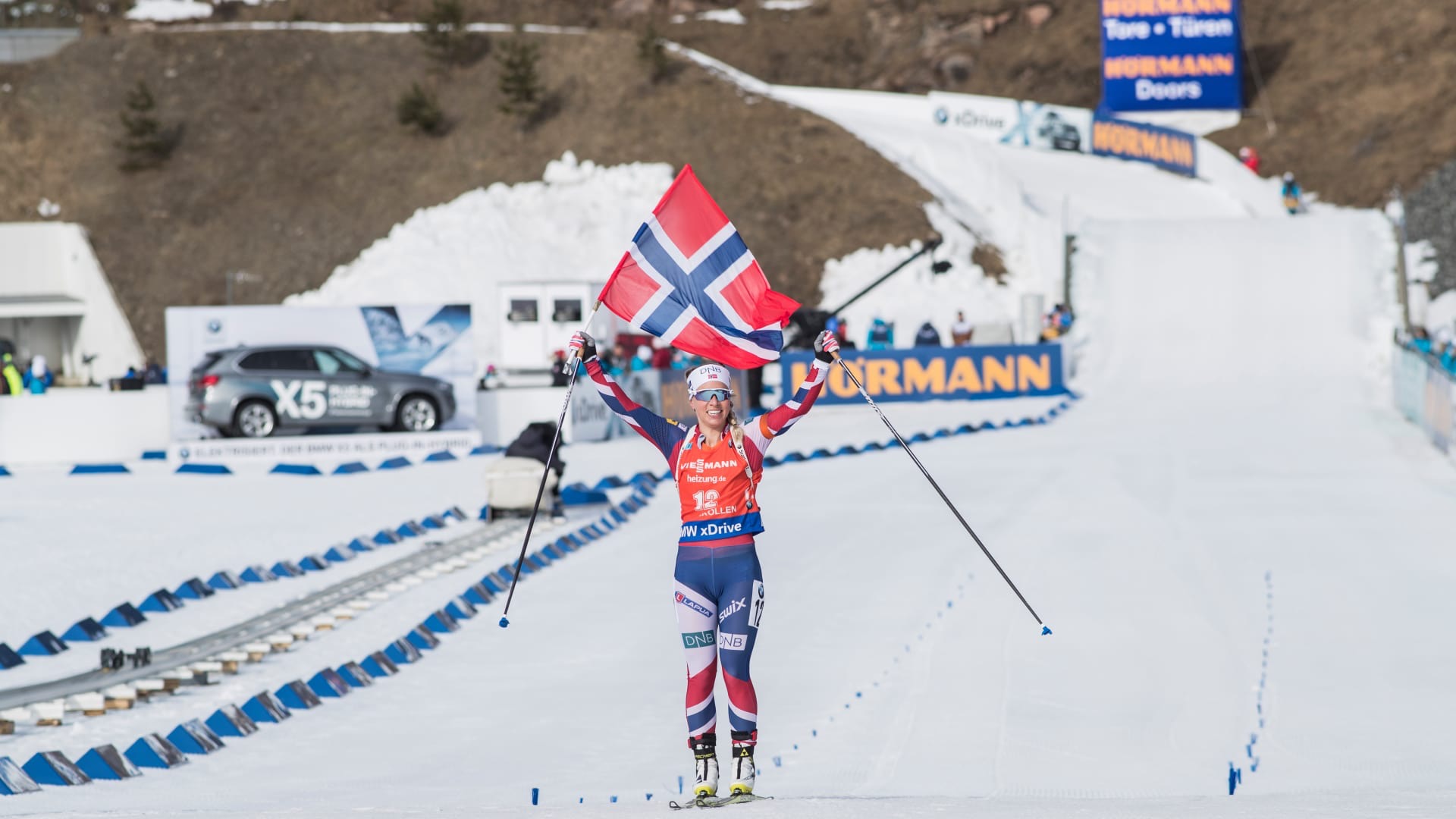
Norway’s Tiril Eckhoff crossing the finish line with the Norwegian flag to celebrate her victory in the women’s 12.5 k mass start at the 2017 IBU World Cup on Sunday in Oslo, Norway. (Photo: IBU)
“I hope I didn’t kill it,” was the first comment by Tiril Eckhoff after Sunday’s race to broadcaster NRK.
What the Norwegian was referring to was the only small thing that disturbed her victory in the women’s 12.5-kilometer mass start at her home venue in Oslo: a streaking squirrel crossed the course in a ditch before the longest climb seven kilometers into the race, right in front of a six-person lead group that included Eckhoff, France’s Justine Braisaz and American Susan Dunklee.
The little animal seemingly was confused which way it should try to escape, then jumped up when Braisaz tried to break, with Eckhoff almost running over it as well.
“That squirrel was my favorite part of the race,” Dunklee wrote in an email to FasterSkier. “It ran in front of me then I saw it collide with Justine. I couldn’t help but laugh!”
“Braisaz drove over the squirrel, so I just had to take my ski up and hope it goes well,” Eckhoff told NRK. “It’s good to see some wildlife in the forests of Norway.”
After the race she could have a good laugh about the incident, which her home country’s TV broadcaster dubbed “Eckhoff vs. ekhorn” and “ekhorndrama” by the Norwegian word for squirrel.
Reportedly the squirrel got away alive. And luckily it had not been Eckhoff vs. moose, another common dweller of the Norwegian forests.
Shooting 19-for-20 after she earlier in the season had never hit more than 16 shots in a four-stage race (0+0+1+0), Eckhoff took the lead after the final shooting ahead of Czech Republic’s Gabriela Koukalová, and pushed hard throughout the last loop to create a gap that allowed her to grab a Norwegian flag before the last ski bridge in the Holmenkollen arena, waving to the fans as she skied down the homestretch before crossing the line in a time of 34:23.1.
“I was very fed up with [always] going to the penalty loop,” Eckhoff said at the press conference. “So I just said to myself, ‘Now I’m gonna take those targets down,’ and I managed that, so now I’m really happy … because that has been my main issue.”
Eckhoff had won gold medals in the sprint and the women’s relay at last year’s World Championships at home in Oslo, where she grew up and still lives. But partly due to illnesses she struggled with this season, she didn’t return to form until after this year’s Hochfilzen World Championships. She went on to notch a second place in the sprint in PyeongChang, South Korea, and then a sprint win in Kontiolahti, Finland.
Behind Eckhoff, Koukalová finished Sunday’s race in second place (+22.6) with one penalty (0+1+0+0), thereby securing the World Cup title in the mass start discipline ahead of Germany’s Laura Dahlmeier, who finished ninth after shooting three misses (+54.2), not able to defend the small lead she held before the final but winning the overall World Cup Total Score title for the first time.
After the race, Sweden’s Hanna Öberg also received the IBU award for the “Rookie of the Year”.
“I was not under pressure today,” Koukalová said with a big smile at the press conference. “I had no expectations. I tried to imagine that I’m already somewhere else, at the athletes’ party this evening for example … It’s one of the best seasons of my life.”
“I am totally exhausted, and happy that there is no more race tomorrow,“ her rival Dahlmeier told German broadcaster ARD after the race. “The miss at the end ruined a better result today, and on the course it was also really tough for me. I have reached my limit now … I hope some energy comes back to celebrate the season tonight.”
Before the final shooting Dahlmeier’s teammate Franziska Hildebrand had been in the lead by almost 20 seconds thanks to three clean shooting performances, with her first individual podium of the season within her grasp. But she missed her very last shot, causing her coach to let out an audible swear, and she had to ski a penalty lap, which allowed the clean-shooting Eckhoff and Koukalová to pass her.
Coming back on the loop still in third place, Hildebrand was chased down by Finland’s Kaisa Mäkäräinen and Czech Republic’s Veronika Vitkova, who passed her shortly before the finish skiing down into the Holmenkollen arena. Mäkäräinen claimed the third place on the podium (+34.5) with two penalties (0+0+1+1), while Vitkova finished fourth (+36.1) and Hildebrand fifth (+39.0). Mäkäräinen’s teammate Mari Laukkanen, the winner of the preceding sprint and pursuit races in Oslo, finished sixth (+40.0) to round out the most successful weekend of her biathlon career.
“It has been some hard time the last two weeks,” Mäkäräinen said in the press conference, referring to the passing of Finnish shooting coach Asko Nuutinen. “I’m sure that has somehow affected my results in a negative way, and now yesterday and today I managed to get the power and do some better races. So I am happy with the result today. I just tried to focus on what I do, not thinking about the result that much.”
“It’s been a very special week with what happened to the Finnish girls, and I am very impressed with Kaisa and Mari,” Eckhoff said at the press conference.
Halfway through the women’s mass start, Dunklee had been in the lead after shooting clean in both of her prone stages, then held on with the top group on the course, mostly letting Eckhoff dictate the tempo.
But after also struggling on the range in Saturday’s pursuit race with ten penalties, Dunklee, who recently exhibited remarkably consistent shooting performances, started to miss and incurred three penalties in the first standing stage and another two in the last one (0+0+3+2).
“I am not entirely sure what has been off in standing this weekend,” Dunklee wrote in her email. “It’s frustrating. Maybe the biathlon gods thought it was time for a dose of humility. My ski form is the best it has been all year.“
In the end she came to the finish in 20th place, 1:43.8 behind the winner Eckhoff.
Still, Dunklee managed to retain the 10th position in the World Cup Total Score standings, another career best to end a season that included a silver medal in the mass start at the World Championships and another podium at the World Cup in Kontiolahti in the single mixed relay with Bailey.
“This is the sort of history making team that every athlete dreams of being part of during their lifetime,” Dunklee reflected on the season. “We have staff who have worked for decades believing this level is possible. Now the door has been opened. I don’t think they will have to wait decades for the next relay medals or World Championships podiums.”
France’s World Cup sprint and total score winner Martin Fourcade (c) on the podium of the men’s 10 k sprint at the 2017 IBU World Cup in Kontiolahti, Finland, with the Czech Republic’s Ondrej Moravec (l) in second and Norway’s Emil Hegle Svendsen (r) in third. (Photo: IBU)
These days at the International Biathlon Union (IBU) World Cup in Kontiolahti, Finland, biathlon star Martin Fourcade of France is not as worried about his opponents on the course as he is about the imminent birth of his second child.
“That’s the first thing I did when I came to the finish, I checked my phone to see if my wife called,” he told German broadcaster ZDF after the race.
There was no message yet, so he declared that he also intends to race on Saturday before traveling back home. “Then I don’t know about my schedule, I have to wait what my wife decides,” he added with a laugh.
In Friday’s 10-kilometer sprint, Fourcade once again posted the best course time as he so frequently has this season, and thus was able to make up the seconds he lost after a miss in his standing shooting. At the end of the day, he was the only man in the top five without hitting all 10 targets.
After that penalty, Fourcade had to fight hard for the victory on the last loop. He crossed the finish line in 22:17.0 minutes, just 0.6 seconds ahead of Czech Republic’s Ondřej Moravec, who had taken the lead just a few minutes earlier. Three-hundred meters before the finish at the last timing point, Fourcade had been two seconds behind.
“Just after the shooting, I saw the screen [in the arena] and thought, ‘OK, five seconds back with one more penalty loop, it’s something I can do,” Fourcade explained at the post-race press conference. “Then at the first split time, I was still five seconds back and thought to myself that it’s over and I will never catch him. But at the last split time my coach said to me, ‘Only two seconds,’ so I started to believe again. I think I was really lucky to start on his back. It was a real advantage today to know about the situation.”
“I think it’s a track that suits me well,” Fourcade told ZDF. “I’ve known this place for a long time, it’s where I got my first victory in the World Cup. I love it because it’s really hard, you never stop pushing. Of course I am really satisfied, because the three guys behind me were not in PyeongChang [South Korea, at last week’s World Cup]. So I didn’t choose the best situation to win here because the travel was really hard, but I [managed] to win in PyeongChang and today so I am really proud.”
With his victory Fourcade also secured the “small crystal globe” awarded to the sprint World Cup discipline winner, after he had already locked up his sixth overall World Cup title in PyeongChang. With this 13th victory of the season, he also surpassed the all-time record for most victories within one season after he previously tied Norway’s Ole Einar Bjørndalen mark a week ago.
“I want to thank him for being such an amazing inspiration,” Fourcade said during the press conference, and added regarding his sprint title: “It’s not just business. I can remember when I won my first globe in 2010 in Oslo. I always try to remember the feeling I had. And I really respect this award, and am proud and satisfied I won it.”
Norway’s Emil Hegle Svendsen claimed the third place on the podium (+9.4), pushing his teammate Johannes Thingnes Bø to fourth. Both Moravec and Svendsen had opted against the long trip to South Korea.
“Battling with Martin is always hard,” Moravec said in the press conference. “When I saw him in the last hill it was really close with 2.2 seconds. And then I knew, ‘This is not good,’ because the last 500 meters of my race were nothing special, I was really tired on the last part of the track.”
At last month’s IBU World Championships in Hochfilzen, Austria, US Biathlon’s Lowell Bailey denied Moravec his first win of the season in the individual race by 3.3 seconds.
“It is what it is, 0.6 seconds, but today I am still really satisfied for the second place,” Moravec said. “Last time [in Hochfilzen] I was 50-50 maybe, but today it’s different.”
“I think it was a big advantage for me,” he added when asked about not traveling to PyeongChang. “Because I did a great preparation at home and took a rest … I think my result today is a good answer to this question.“
“Of course I thought about going to Korea,” Svendsen explained. “But I think if I would have gone there I would have done medium races during the last three World Cups. Now I got at least one podium, and I think it is better to have some good races than a lot of medium races. I think it was better for me to stay at home after a really bad World Championships.”
“Five podiums this year is much more than I expected,” he said when asked to reflect on his season. “Because the preparation this year was not so good. I am really happy with this after all the troubles I had last summer… But I hope I can now have six good months of training and come back stronger than ever.”
One of the earliest starters in bib 3, Bø hit all of his targets and was the race leader until Svendsen finished 2.7 seconds faster. As the race progressed, Fourcade and Moravec also finished ahead of him, pushing Bø to fourth (+12.1)
“It was quite a good race,” Bø told the IBU in an interview. “I don’t know where I could do better. So even if I’m fourth place I know I did my best today. It was high level on the shooting range today, and for myself I am quite happy with 10 hits in a fast speed. … I felt strong on the tracks, and just wish I were a little bit stronger to make the podium.”
Also shooting clean, Germany’s Arnd Peiffer finished fifth (+22.3).
“This is a demanding course with three long and steep climbs,” Peiffer told ZDF. “I am glad I got through with clean shooting on the range today. In PyeongChang, I was struggling in my standing stages … and that was pretty annoying. On the course it was a solid performance. I am still feeling the effects of the travel, but that won’t be any different for the others … So I am happy about this fifth place.”
Just behind Peiffer, Austria’s Simon Eder placed sixth (+23.0) with one penalty (0+1), and Latvia’s Andrejs Rastorgujevs missed the first World Cup podium of his career after he missed his last target to finish seventh (+25.1) with one penalty (0+1).
Kontiolahti is hosting the eighth World Cup stage of the season in place of Tyumen, Russia, which withdrew as a host in the wake of the McLaren report. Though almost 2,000 miles away from Tyumen, thanks to the new location near the northern Russian-Finnish border, a number of Russian fans still made the trip to Finland. Judging by flags, outfits and cheers, it seemed like they were about even with the local fans with the feel of a home World Cup.
Bailey Clean But Slower on Course
US Biathlon’s Lowell Bailey skiing into the finish of the men’s 10-kilometer sprint at the 2017 IBU World Cup in Kontiolahti, Finland. He placed 16th. (Photo: USBA/NordicFocus)
Another skier who managed to shoot 10-for-10 on Friday was Bailey, continuing his extremely accurate shooting form of the last few weeks. But this time, the American didn’t quite have the punch that propelled him to his historic gold medal at last month’s World Championships and another second place in PyeongChang last week. After eight straight races of placing in the top 10, Bailey finished 16th on Friday, 1:01.1 behind Fourcade.
But Bailey didn’t blame the travel from South Korea to Finland for his slower ski time than usual, after posting the 43rd-ranked course time of the day.
“It was actually a little bit longer than 24 hours,” Bailey wrote in an email to FasterSkier. “I’m not sure I can use that as an excuse; several athletes did just fine after that travel (Martin Fourcade was flying again!).
“I didn’t feel completely comfortable on my skis today,” Bailey added, regarding the race conditions. “It was an icy, unstable track and I struggled to keep a flat gliding ski … The conditions were the best we’ve had all week; not too much wind on the range and the tracks were hard and didn’t seem to break down at all.”
Coming out of the final standing stage in 12th place and 32.6 seconds out of first, he lost almost another 30 seconds on the final loop.
“I definitely didn’t have the strongest last loop,” Bailey wrote. “I just didn’t have a whole lot in the tank for the three big climbs. Some days are better than others and today I wasn’t at my best on the course. But, things can change quickly and I’m hoping to feel better for tomorrow’s pursuit.”
Three Americans, Two Canadians in the Pursuit
US Biathlon’s Sean Doherty (71) and Biathlon Canada’s Brendan Green (21) on the range during the second shooting stage of the men’s 10 k sprint at the IBU World Cup in Kontiolahti, Finland. (Photo: USBA/NordicFocus)
In addition to Bailey, two other Americans qualified for Saturday’s pursuit in the top 60, with Leif Nordgren in 43rd (+1:36.8) with two penalties (1+1) and Sean Doherty finishing one position behind in 44th (+1:38.5) with one standing miss (0+1).
Paul Schommer, who is replacing Tim Burke in these final World Cups, finished 84th (+3:02.5) with three misses (2+1).
Two Canadians shot clean and also qualified for the pursuit: Brendan Green in 45th (+1:41.4) and Christian Gow in 50th (+1:55.0). Scott Gow missed the top 60 in 67th (+2:21.9) with two penalties (1+1).
The men’s 4 x 7.5 k relay podium at 2017 IBU World Championships on Saturday in Hochfilzen, Austria, with Russia (c) in first, France (l) in second, and Austria (r) in third. (Photo: IBU World Champs/Twitter)
HOCHFILZEN, Austria—Redemption, validation, national pride: just a few of the things that were on the line in today’s 4 x 7.5 k relay at IBU World Championships.
For Austria, it was clear: a good performance on home soil was critical. The team hadn’t won a medal yet despite eight chances to do so.
For Germany, the question was whether their accomplished men’s team could live up to the expectations set by its younger women’s team, which has won every relay this year, including at World Championships.
For Norway, there had been no gold so far, but the men wanted to defend their title from last year’s Championships in Oslo.
Russia? Relays were seeming like the best way to take medals. They had earned bronze in the mixed relay, but been locked out ever since. Plus, the team has been embroiled in politics. Things were getting complicated.
France’s Martin Fourcade has dominated the whole season, but only won one gold at World Championships. Would the relay be the place he could finally get a second?
Plus, Canada won bronze in the team event last year, and the U.S. men’s team, often a top-six threat, was looking to capitalize on the energy from Lowell Bailey’s gold in the 20 k individual.
Any number of teams wanted a slice of the podium. But there were only three steps, and only one set of gold medals.
Out of the start, a team that nobody had expected shot to the front: Latvia. Andrejs Rastorgujevs, always one of the fastest skiers in the field, decided to make a breakaway already on the first loop. He then quickly cleaned prone and continued to lead on his own through the second loop.
Using spares in standing, though, the strategy didn’t seem to pay off. Germany staked a claim as soon as he faltered, with veteran Erik Lesser cleaning both shooting stages with no spare rounds and then attacking the final loop. He tagged off to Benedikt Doll with 5.8 seconds on the competition.
“Erik is such a great finisher,” U.S. lead skier Lowell Bailey – who tagged off 12.4 seconds back in fourth place, after using one spare round – said of Lesser. “In that situation he is nearly unstoppable. Hats off to him. He knows how to ski relays.”
While Lesser had thrown down, many teams weren’t so far behind him. By the end of the third leg, Benedikt Doll had thrown away Germany’s lead with poor shooting and six teams were still within 32 seconds of first place. Gone were the U.S., Canada, and Norway. Anton Babikov had turned in a hero’s performance to take Russia to the front, and his team was now chased by Austria, France, Germany, Ukraine, and Italy.
Anton Shipulin had taken over for Russia with a slight lead over Austria and France. Martin Fourcade, the French anchor, chased hard, and passed Austria’s Dominik Landertinger. With a clean prone from both Fourcade and Shipulin, the race narrowed. But Shipulin still had some seconds of cushion when he came in for standing.
He needed them: Shipulin used one spare. Fourcade shot quickly, cleaned, and tried to catch the Russian. He left the range 4.2 seconds back, setting up a battle between two of the top men on the World Cup.
“Today the last round for me was the most difficult, because I knew that Martin Fourcade is a very strong athlete,” Shipulin said through a translator at the press conference. “I was just trying to run faster than him.”
It turned into the battle that wasn’t, however, with Shipulin pulling away and coasting to a 5.8-second win for Russia.
“I think it was too complicated for me today,” Fourcade said. “I am not in my best shape. Anton was really strong on the track. I tried in the beginning of the race to catch him, and I almost did it. But then he had a bit more power than I had.”
While the Russian fans weren’t the most numerous in the stands, they were among the most passionate. And the team had delivered for them.
“I feel relieved for our team and our country,” Shipulin said. “I think it has been almost ten years we have not won any [World Championships] in the relay. So we are just really lucky and really happy, and we are going to celebrate.”
(Russia did win gold at the 2014 Olympics.)
Behind Fourcade and Shipulin, Landertinger of Austria and Simon Schempp of Germany were both trying desperately to secure a podium spot, but there was only room for one.
Schempp initially appeared to have better skis on the downhills on the front end of the loop. But on the major climb on the back end, Landertinger accelerated and Schempp was utterly unable to follow. To the monstrous roar of the crowd, Landertinger skied into the stadium to take bronze with his three teammates.
“It was very, very hard,” Landertinger told Austrian broadcaster ORF. “Simon is one of the best anchor skiers I know. When I skied out of the range after the shooting and saw him just four or five meters behind me, I knew it would be very difficult. I probably looked at that climb a hundred times in training, and it was pretty clear I would do my attack there. And thank God that worked out great.”
Schempp was deflated, but said that Germany needed to have an overall better team performance to secure a podium. Eight spares wouldn’t to it.
“It wasn’t enough for the podium today,” he told German broadcaster ARD. “I gave everything I had, everything that was left. Unfortunately we were not convincing on the shooting range today.”
Doll apologized too: four of the eight spare rounds came from him, including three in the standing stage, which had dropped the team to seventh at the time.
“Everyone did their best, I also tried to do my best,” he said. “But I just didn’t have it in my head today. I am really sorry about that, it really hurts because half the used spares were on me. I might have to give out a bar round tonight. I have to take a large part of the blame on me.”
For the Austrian team, the medal was long-awaited and cause for celebration.
Leadoff skier Daniel Mesotitsch was also the leadoff guy when Austria took bronze on this same course back at 2005 World Championships.
“It feels just as great as back then,” the 40-year-old told ORF. “There is no better feeling than winning a medal at home with the team. We are all overwhelmed by our emotions. I was briefly feeling sick to my stomach even watching [the last loop]. I was a lot more nervous than during my own loop.”
But now, a medal is theirs.
“It’s beautiful,” Landertinger said. “Really, really beautiful. And I have to say, what I experienced today with those fans, I already got goosebumps coming into the arena today. And I am proud that I can race here. And now with this medal I achieved the goal I had, and I am brutally happy now.”
U.S. Team Seventh, Just Out of Top-Six Goal
Bailey delivered as the U.S. team’s leadoff racer, using just one spare round and staying near the front for the whole race. After the team could not contest the first few relays of the season, they lost valuable Nations Cup and relay points and started with a high bib number. Bailey had to make up the time on the range, rather than the trails.
“There was no where to go –it’s actually fairly narrow for a World Championships Course,” Bailey said. “There wasn’t a lot of room to work. With the high bib number you actually hit the [shooting] point [on the range] before a lot of other people, so I really was just focusing on getting my first shot off quick. I did, but I missed it unfortunately. The key is just in that first prone is keeping enough contact, so I really pushed the pace in shooting and pushed that extra round so I could maintain contact.”
While he was confident coming off his gold medal on Thursday, Bailey was also tired. He wasn’t sure how he was going to feel, or if he would be able to make up time on the trails once the pack thinned out enough for him to move.
“I was a little nervous about today, because the last 48 hours have been a little bit wild and I slept two hours the night after the individual,” he admitted. “I didn’t go to bed late. I just lay there and Erika and I were both wide awake, occasionally like, ‘Are you sleep?’ ‘No, are you sleep?’ ‘No, shit.’ You have to put your feet back on the ground, back in the ski boots.”
By the time he tagged off to Leif Nordgren, the U.S. was in fourth place, more or less where they wanted to be.
Then, Nordgren cleaned prone and moved into second place, 0.4 seconds behind Germany’s Doll. Really right where they wanted to be.
“I kind of took my time a little bit in prone,” Nordgren said. “I wanted to make sure I hit all five targets not using any extras, so that went really well.”
The pair were soon consumed by a chase back, but that didn’t bother Nordgren.
“I left the range right with Doll there for the lead, and then he didn’t push super hard the second loop so it was no problem staying with him. But of course it allowed some guys from behind to catch up, which, no big deal.”
In standing, Nordgren used one spare, dropping to fifth, and then stayed in sixth place on the trails. Despite losing places, he was still just 17.7 seconds out of the lead.
“I think I paced the race really well,” said Nordgren. “I was right there. I couldn’t quite close the gap, but you know, I think I kept us right in there, so yeah, I am happy.”
Tim Burke used one spare in prone and three in standing, and blamed his spare rounds partly on exhaustion.
“I feel so bad on the skis, it’s such a fight from the first kilometer,” he said. “By the time I got to standing my legs were cramping, and I — yeah. It’s so much easier when you’re feeling good, you can push and recover and get in the flow. When you’re just fighting the whole loop to try keep your head above water, and then you hit the mat to shoot, it’s just brutally hard.”
Despite a performance that left him frustrated, the U.S. was still in seventh place when Sean Doherty took over to race the anchor leg. He used two spares in prone and then cleaned standing, heading out on course in seventh place and on the hunt: Ukraine was just 3.2 seconds ahead.
The top six was not meant to be, though.
“I just didn’t have it in the legs today and that’s pretty frustrating,” Doherty said after crossing the line seventh, +1:50.5. “You know, to be so close to sixth there and not have the gear on the last lap to push it through. I gave it all I had and just didn’t have enough.”
With a total to eight spare rounds – not bad, but more than Russia’s three or France’s four – the team was missing the last little bit that would have gotten them to where they wanted to be.
“I would say we were hunting for the top six, and you know, Leif and Lowell got us off to such a great start,” Doherty said. “Unfortunately, I wasn’t able to really follow up on that. I think we all had it in us, just couldn’t quite get that critical mass.”
Canada 13th in Hunt for Medal Defense
Last year, the men’s relay was the best moment in several Canadian team members’ sporting careers. They won an unexpected bronze medal and were the sensation of World Championships.
This season, Nathan Smith has been out with a virus. That gave Macx Davies a chance to start. But overall, the team couldn’t match their form from the year before. With ten spares overall, they crossed the line 13th, +3:35.5.
“I was just hoping to have a good race for myself,” said Davies, for whom it was the first World Championships relay start. “It is hard to put any [results goals] on relays because it is a team event, and I am not the other three guys… It hasn’t been bad, it just has been a little too slow, especially a few too many spares for us. We need to miss less than the other nations if we ski, or if I ski, like I did today.”
“I could have definitely done better than I did today,” said leadoff racer Christian Gow, who had three spares. “Too many mistakes on the range, but I am at least happy with my skiing… I think it was a pretty good ski day. I think it is the closest I have been with that many spares. The skiing was pretty decent, but I dropped the ball in the range.”
-Gerry Furseth, Harald Zimmer, and Ian Tovell contributed
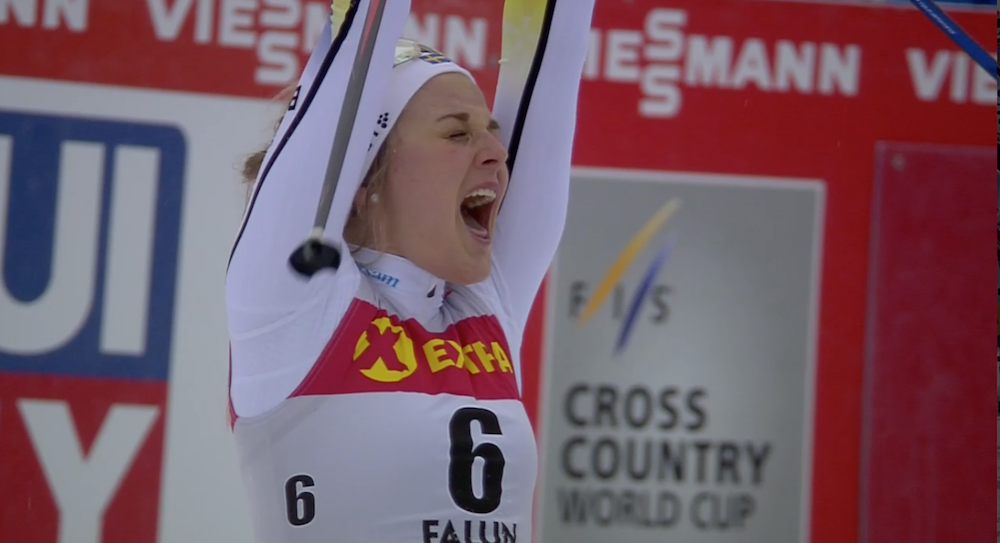
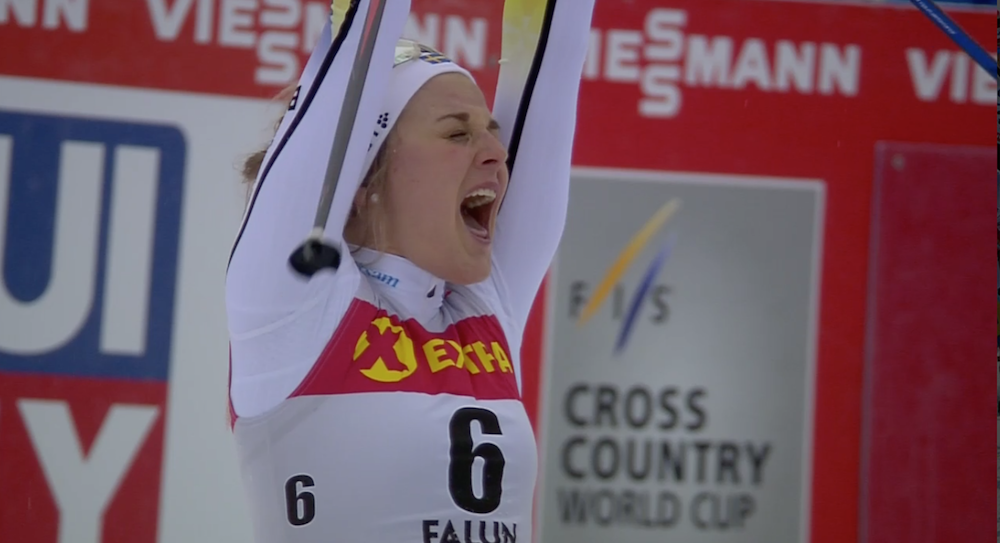
Sweden’s Stina Nilsson celebrates her second-straight World Cup sprint victory on Saturday after winning the 1.4 k freestyle sprint at home in Falun, Sweden.
FIS Cross-Country World Cup (Falun, Sweden): Men’s & women’s freestyle sprints
[UPDATED] Kikkan Randall reached the final for the first time since March 2015 on Saturday in the women’s 1.4-kilometer freestyle sprint at the World Cup in Falun, Sweden. The American qualified 26th and went on to advance in second out of her quarterfinal and semifinal to reach the six-woman final, where she ended up fifth.
Sweden’s Stina Nilsson won the final by one-hundredth of a second over Norway’s Maiken Caspersen Falla, finishing in 3:00.24 minutes. Nilsson had started the day by qualifying in sixth, 2.52 seconds behind Norway’s Marit Bjørgen, who won the qualifier in 3:00.64. This is Nilsson’s second-straight World Cup sprint win after skipping the freestyle sprint in Toblach, Italy, following the Tour de Ski.
While Bjørgen went on to win her quarterfinal, she finished fifth in her semifinal to end up ninth on the day.
Norway had two on the women’s podium with Heidi Weng in third, 1.88 seconds behind Nilsson. Finland’s Krista Parmakoski placed fourth (+1.99), and Randall was fifth (+2.56) for her best result in two years (she took last season off to have a baby). Sweden’s Jonna Sundling reached the final as well and finished sixth (+8.02).
Five U.S. women qualified for the heats, with Jessie Diggins qualifying fifth and ultimately crashing in her semifinal, where she finished fifth. That put her 10th overall on the day. Sophie Caldwell qualified third and finished fourth in her quarterfinal for 16th on the day, Sadie Bjornsen qualified 17th and also finished fourth in her quarterfinal for 19th overall, and Ida Sargent made the top-30 qualifying cutoff in 30th, then placed fifth in her quarterfinal for 25th overall.
Bjørgen topped the freestyle sprint qualifier on Saturday morning, clocking the fastest time around the 1.4 k course by just 0.08 seconds over Hanna Falk of Sweden.Caldwell qualified third (+1.23),Digginsqualified fifth (+2.39),Bjornsen17th (+5.04),Randall26th (+6.64), andSargent 30th (+8.28). Rosie Brennan (U.S. Ski Team) missed the cut in 37th (+10.90) and Liz Guiney finished 56th (+32.87). The lone Canadian woman racing on Saturday, Cendrine Browne placed 46th (+14.02).
In the men’s 1.4 k freestyle sprint final, Italy’s Federico Pellegrino held off three Norwegians and two Swedes to win in 2:45.77. The defending Sprint World Cup champion qualified second and went on to win his quarterfinal and semifinal before taking the final by six-hundredths of a second.
Norway took the remaining spots on the podium with Emil Iversen in second (+0.06) and Sindre Bjørnestad Skar in third (+0.47). Sweden’s Oskar Svensson was three-hundredths of a second off the podium in fourth (+0.50). The fastest qualifier in 2:34.49, Norway’s Johannes Høsflot Klæbo reached the final and ultimately took fifth (+1.32), and Sweden’s Teodor Peterson placed sixth (+2.08).
Canada’s Len Valjas was the top North American in 10th. He qualified 20th, advanced in second from his quarterfinal and finished fifth in his semifinal.
American Andy Newell was 16th after qualifying in 25th and finishing third in his quarterfinal. U.S. teammate Simi Hamilton followed in 18th, after qualifying 13th and finishing fourth in his quarterfinal.
In the men’s qualifier, Klæbo was 1.05 seconds faster thanPellegrinoand another 0.02 seconds faster than Russia’s Sergey Ustiugov in third.
For the U.S., Hamiltonqualified 13th (+4.52) andNewell qualified 25th (+6.74). Erik Bjornsen placed 43rd (+9.30) and Matt Gelso 59th (+13.12).
Valjaswas the lone Canadian man to make the heats, qualifying 20th (+6.22). The only other starter, Alex Harvey, placed 46th (+9.71).
IBU Open European Championships (Duszniki-Zdrój, Poland): Men’s & women’s pursuits
The men’s pursuit podium at 2017 IBU Open European Championships on Saturday in Duszniki-Zdrój, Poland, with Russia’s Alexander Loginov (c) in first, Evgeniy Garanichev (l) in second, and Latvia’s Andrejs Rastorgujevs (r) in third. (Photo: IBU)
Russia’s Alexander Loginov racked up his second win of the 2017 International Biathlon Union (IBU) Open European Championships on Saturday in the mens’ 12.5-kilometer pursuit in Duszniki-Zdrój, Poland.
After starting second, 5 seconds behind Bulgaria’s Vladimir Iliev, who won Friday’s sprint, Loginov proceeded to clean three straight stages before missing one on his final standing to cross the line first in 31:46.2 minutes.
“It was not as easy as it seemed, because from the first loop Vladimir set a really good speed,” Loginov said, according to an IBU press release. “Today we had great sunny and windless weather again, so I managed to shoot well. Probably that is why it [looked] so easy.”
Russia took first and second place with Evgeniy Garanichev following 27.8 seconds later, after starting 17th (56 seconds out of first) and shooting 19-for-20 (0+0+1+0).
“After yesterday’s sprint, I managed to work well and to show good result in pursuit, so I’m sure glad to win the silver medal,” Garanichev said, according to the IBU.
Latvia’s Andrejs Rastorgujevs improved on his fourth place in the sprint to reach the pursuit podium in third (+59.5) despite four penalties (0+1+1+2).
“On the last loop I had the information about the guys who were behind me and in front of me,” Rastorgujevs said, according to the IBU. “I was just fighting and did all I could do to get to the podium.”
Bulgaria’s Krasimir Anev, who started third, slipped to fifth (+1:28.6) with two penalties (0+1+1+0), behind Russia’s third man in the top four, Alexey Volkov in fourth (+1:01.6). Iliev as the first starter ended up 11th (+1:41.7) with six penalties (2+2+0+2).
The two Americans who had qualified for the pursuit by placing in the top 60 of Friday’s sprint, Paul Schommer and Alex Howe improved to 48th (+5:07.1) and 51st (+5:42.3), respectively.
Schommer started 58th, just ahead of Howe in 59th, and missed five targets, all in his first two prone stages (3+2+0+0). Howe accumulated four penalties (1+2+1+0).
No Canadians qualified for the pursuit.
[UPDATED] In the women’s 10 k pursuit that followed, Russia’s Irina Starykh picked up her second win and third consecutive podium of the championships, with clean shooting en route to a 19.8-second victory in 30:04.4.
Starykh started third, 38 seconds behind Ukraine’s Juliya Dzhyma and 11 seconds after her Russian teammate Svetlana Sleptsova, respectively. Dzhima missed two on her last two standing stages (0+0+1+1) to slip to second, and Sleptsova dropped one place to third (+32.1) with one prone penalty (0+1+0+0).
Veronika Vítková of the Czech Republic improved from seventh to fourth (+47.8) with two penalties (0+1+1+0), and Russia’s Svetlana Mironova moved all the way up from 13th to fifth (+1:29.6) with three misses (0+1+1+1). Just 0.2 seconds behind her, Poland’s Monika Hojnisz improved from 16th at the start to sixth (+1:29.6) with one penalty (0+0+0+1).
No North Americans qualified for the pursuit.
Open European Championships conclude Sunday with the single mixed and mixed relay.
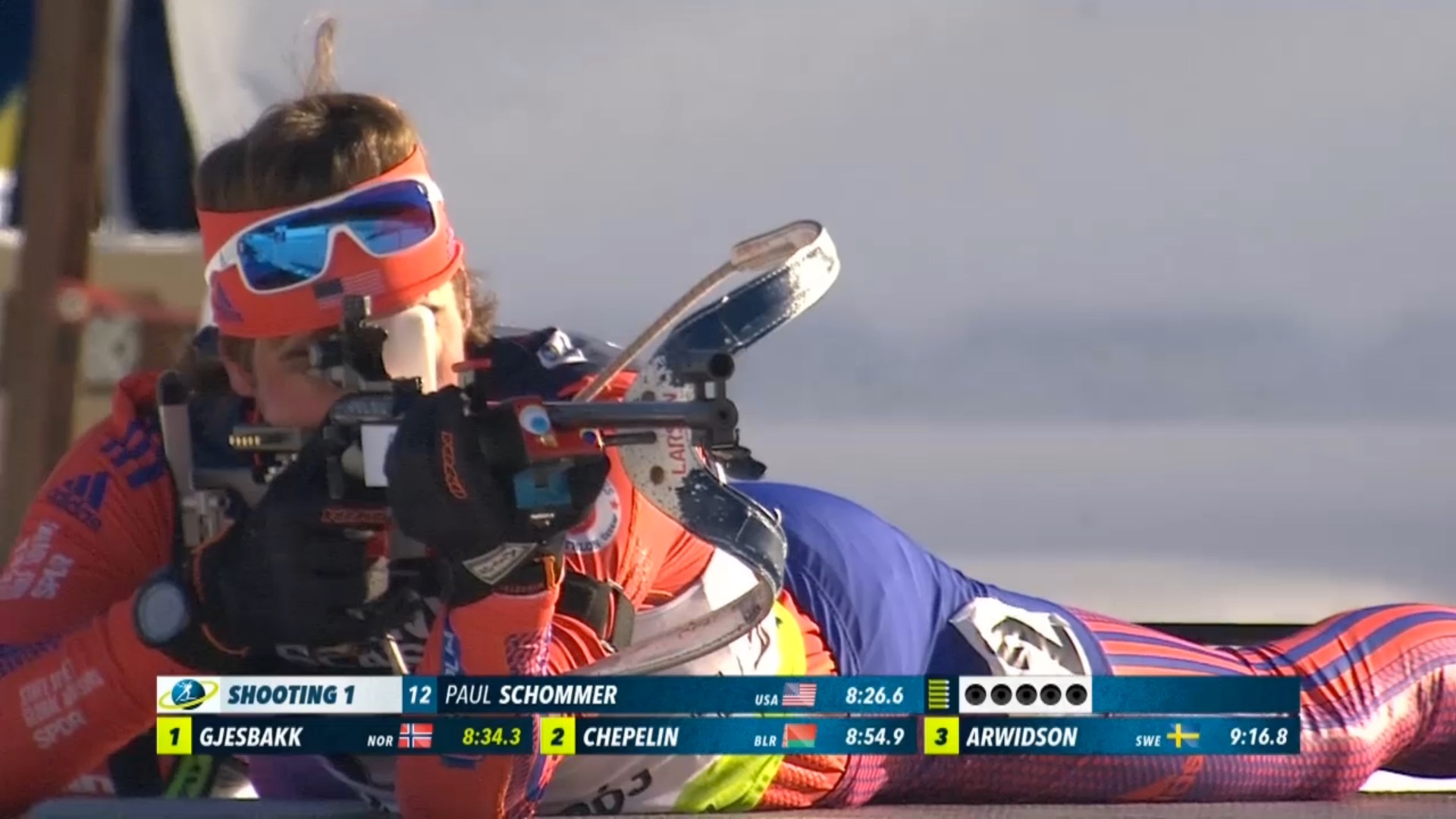
US Biathlon’s Paul Schommer shooting prone in the men’s 10 k sprint at the 2017 IBU Open European Championships in Duszniki-Zdrój, Poland. He was the top North American on Friday in 58th. (Photo: IBU/Eurovisionsports.tv screenshot)
IBU Open European Championships (Duszniki-Zdrój, Poland): Men’s & women’s sprints
On Friday in the men’s 10-kilometer sprint, two Bulgarian athletes were able to break the Russian dominance at the 2017 International Biathlon Union (IBU) Open European Championships in Duszniki-Zdrój, Poland.
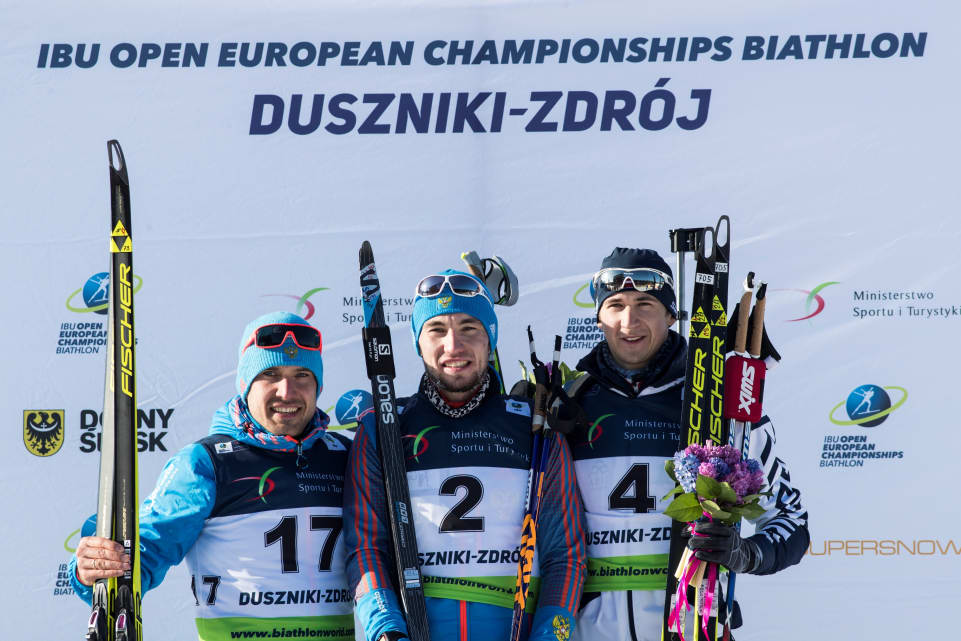
The men’s 10 k sprint podium on Friday, with Bulgaria’s Vladimir Iliev (c) in first, Russia’s Alexander Loginov (l) in second, and Bulgaria’s Krasimir Anev (r) in third at the 2017 IBU Open European Championships in Duszniki-Zdrój, Poland. (Photo: IBU)
Bulgaria’s 29-year-old Vladimir Iliev, who has competed on the IBU World Cup since 2007 and posted a career-best fifth (which he achieved earlier this season), claimed the win in a time of 24:26.9 minutes despite one penalty in the standing stage (0+1), giving a kiss to his fast skis in the finish. Russia’s Alexander Loginov, who won the men’s 20 k individual race on Wednesday after returning this season from a two-year doping suspension, placed second (+4.9) with clean shooting. Behind them, Iliev’s teammate Krasimir Anev took third (+16.7), also shooting clean, to push Latvia’s Andrejs Rastorgujevs off the podium by just 0.6 seconds (+17.3). Rastorgujevs started early in bib 4 and skied the fastest course time of the day, but incurred two penalties in his standing stage (0+2), which ultimately set him back too far for a podium.
“It was a long way to this medal and this win,” Iliev said his first career victory, according to an IBU press release. “I was ready for a high result for many years, but many things have happened, so I’m really happy to get a victory today.”
“I did not expect anything in this race, because yesterday I had health problems so even my coach advised me not to start,” Anev said after winning his second medal of the championships, following up on a second place in the individual. “So [I] went into competition without any expectations.”
In beautiful weather conditions with little wind and the sun shining on the new arena in Duszniki-Zdrój throughout the race, US Biathlon’s Paul Schommer was the best of 11 North American starters, finishing 58th (+2:14.9) with three penalties (1+2). Schommer was less than a second faster than his U.S. teammate Alex Howe, who finished 59th (+2:15.3), after skiing two penalty laps (1+1). The third American Jakob Ellingson placed 64th (+2:24.6) with one penalty (0+1), Russell Currier was 75th (+2:41.4) with four penalties (2+2), Max Durtschi was 88th (+3:16.1) with three penalties (1+2), and Michael Gibson was 103rd (+4:30.4) with two penalties (1+1).
Matthew Hudec led the Canadians on Friday in 80th (+2:54.7) with one penalty (1+0). Also for Canada, Aidan Millar finished 86th (+3:13.9) with three penalties (1+2), Carsen Campbell 89th (+3:18.3) with three penalties (2+1), Pearce Hanna 92nd (+3:24.7) with two penalties (1+1), and Matthew Neumann 94th (+3:31.8) with four penalties (1+3).
In the large field of 125 starters, Schommer and Howe qualified for Saturday’s pursuit race by placing in the top 60.
The women’s 7.5 k sprint podium on Friday, with Ukraine’s Juliya Dzhyma (c) in first, Russia’s Svetlana Sleptsova (l) in second and Russia’s Irina Starykh (r) in third at the 2017 IBU Open European Championships in Duszniki-Zdrój, Poland. (Photo: IBU)
[UPDATED] In the women’s 7.5 k sprint that followed, Ukraine’s Juliya Dzhyma managed to win in convincing fashion in a time of 21:02.3 minutes, shooting clean and skiing the second-ranked course time. It was the first individual career victory for the 26 year old in either a junior or senior championships, after she won a gold medal with Ukraine’s relay team at the 2014 Olympics in Sochi, Russia.
“When I saw that everyone was cleaning, I knew that to get in to top three, I have to do the same,” Dzhyma commented on her race, according to an IBU press release. “But honestly, I have no idea how I hit all the targets today; for the whole season, it was my first competition where I had zero.”
“I was just trying to do my best and to make the gap bigger because tomorrow is the pursuit!” she added, regarding her last loop when she increased her lead by another ten seconds.
Also shooting clean but 27 seconds off the win was Russia’s 30-year-old Svetlana Sleptsova, who, earlier in her career, won five World Cups and gold medals in the women’s relay at the 2009 World Championship and 2010 Olympics in Vancouver.
Starting behind Sleptsova, her Russian teammate Irina Starykh, the winner of the women’s individual race on Wednesday, and like Loginov, also coming back from a two-year suspension for EPO use, claimed third (+37.8) with one penalty in her standing stage (0+1). Starykh bumped Germany’s Karolin Horchler, who had led the race early on after starting in bib 2 to fourth (+42.2, with no penalties). Horchler won her first World Cup a week ago in Antholz, Italy.
“Before the competition I already felt that it would be very hard for me to shoot today,” Starykh told the IBU. “And in the end it came out that way, it was tough for me to shoot at the prone and at the standing. But just one penalty is a pretty good result, based on how I feel.”
Horchler’s teammate Denise Herrmann, who made the switch from cross-country skiing to biathlon this season, followed in fifth (+47.7) with the fastest course time of the day, but missed two targets in her standing stage including her very last shot (0+2) to miss the podium.
American Hallie Grossman during her standing stage in the women’s 7.5 k sprint on Friday at the 2017 IBU Open European Championships in Duszniki-Zdrój, Poland. She finished 70th with three penalties as the second-best North American. (Photo: IBU/Eurovisionsports.tv screenshot)
In stable weather conditions, though not as sunny as during the men’s sprint earlier on Friday, US Biathlon’s Emily Dreissigacker was the top North American woman in 69th (+3:31.1), with three penalties (2+1). Just one position behind her, American Hallie Grossman also missed three (2+1) on her way to a 70th (+3:34.4). For the 23-year-old Grossman it is her first season overseas racing in the IBU Cup.
Canada’s Erin Yungblut finished 81st (+5:50.0) with four penalties (1+3). Her teammate Leilani Tam von Burg did not finish after incurring two penalties in her prone shooting stage, and the third Canadian, Sarah Beaudry did not start.
None of the North American woman qualified for Saturday’s pursuit.
France’s Martin Fourcade leaving the range during one of four shooting stages in the pursuit on Friday at the IBU World Cup in Presque Isle, Maine. He went on to win by 24.8 seconds over Johannes Thingnes Bø of Norway. (Photo: IBU/NordicFocus)
The same three athletes who stood on the podium after the International Biathlon Union (IBUo) World Cup sprint on Thursday in Presque Isle, Maine, did so again after the men’s 12.5-kilometer pursuit on Friday, only their order had changed.
In cold and windy conditions, France’s Martin Fourcade took the victory in 31:04.4, with two penalties in the four shooting stages. The third starter, Fourcade finished 24.8 seconds ahead of Norway’s Johannes Thingnes Bø, who had won the sprint and thus started the pursuit first with a 28-second head start. Russia’s Anton Shipulin started second and ended up third (+1:11.5) with two penalties.
American Tim Burke moved into fourth place on the penultimate loop, but two misses in the final standing shooting set him back to seventh, and he kept that position to the finish, placing seventh and 2:04.9 behind Fourcade with three total penalties.
Norway’s Johannes Thingnes Bø (l) congratulates France’s Martin Fourcade after placing second to Fourcade in the IBU World Cup men’s pursuit in Presque Isle, Maine. (Photo: IBU/NordicFocus)
“Today I joined Raphaël Poirée with the number of World Cup wins,” Fourcade said of his 44th victory in a post-race interview with the IBU. “That means a lot for me. I grew up watching Raphaël on TV. To join legends you need to [be] inspired, and I know how much he inspired me.”
Asked if he feels like a legend himself now, Fourcade laughed: “No, I will never do. I just try to do my best.”
Poirée represented France on the World Cup from 1995 to 2007. He earned both silver and bronze at the 2002 Olympics in Salt Lake City, Utah, and another bronze in the relay at the 2006 Olympics in Turin, Italy, as well as 20 medals at World Championships, seven of which were gold.
Unfortunately the end of the pursuit was overshadowed by a severe crash from Germany’s Arnd Peiffer, who had left the shooting range in 11th position, then fell on a downhill section on the final loop. At high speed, Peiffer came off the right side of the course without another athlete nearby, ripped through a safety net, and crashed head and shoulder first against a thinly padded group of trees. He later could be seen on the TV broadcast sitting upright leaning against the trees, with his skis and rifle removed by coaches and course staff. He was then strapped to a stretcher and put in a neck brace as a precaution, and taken to a nearby hospital.
“I saw the immediate aftermath of the crash,” American Lowell Bailey, who had left the range shortly after Peiffer in 15th, wrote in an email. “Arnd was off the side of the trail, just following a severe 180-degree turn. The turn is tight and there is little room for error. The outside of the turn was lined with mesh snow fence and all I could see were his feet sticking up onto the trail.”
“There was a lot of blood in the snow,” Germany’s assistant coach Andreas Stitzl, who was one of the first responders sprinting to the accident site, later told German TV broadcaster ARD. Stitzl suspected that Peiffer had, at a minimum, sustained a concussion and lacerations on his mouth and forehead. “I was completely shocked how he was lying there. The most important thing was that we first stabilized his head,” Stitzl said.
ARD later posted an interview with German team doctor Klaus-Jürgen Marquardt, who confirmed that Peiffer had suffered a severe concussion, but remained conscious and could remember the crash despite some loss of short-term memory about the morning of the race. Further evaluations still had to determine other injuries, but Peiffer reportedly was able to call his family at home.
No Athlete Unscathed in Four Stages
Wind conditions gave the entire 60-man field problems during the pursuit, with stronger gusts than they had experienced during the “zeroing” target practice immediately before the race. As a result, competitors either had to adjust their sights or wait for a calmer moment.
From left to right: Russia’s Anton Shipulin, Latvia’s Andrejs Rastorgujevs, Germany’s Eric Lesser, and France’s Martin Fourcade during one of two standing stages in the men’s pursuit at the IBU World Cup in Presque Isle, Maine. Fourcade went on to win and Shipulin placed third. (Photo: IBU/NordicFocus)
Penalties quickly started to pile up and separated the field. Bø, Shipulin and Fourcade all missed one in their first prone stage, but kept the positions they had held at the start.
In the second prone stage, Bø and Shipulin managed to stay clean, while Fourcade had another penalty and for a while, fell back to fifth place behind Germany’s Erik Lesser and Latvia’s Andrejs Rastorgujevs, who hit all 10 of their targets between the two prone stages.
In the next standing stage, Bø shot fast and clean a second time, despite having to reset his position before the third shot, and headed out on the fourth loop with a 44-seconds lead. Fourcade also cleaned to improve t0 second place again entering the loop, with Shipulin also staying clean and leaving the range in third.
In this stage, Lesser missed two and Rastorgujevs missed three to fall out of contention. They went on to place 13th (+2:42.8) and 21st (+3:21.7), respectively. Switzerland’s Serafin Wiestner, who had finished a career-best fifth in the sprint the day before, even “dirtied” his standing targets, incurring the full five penalties, and went on to finish 27th.
Switzerland’s Benjamin Weger at the IBU World Cup men’s pursuit in Presque Isle, Maine. Weger finished 17th with seven penalties. (Photo: IBU/NordicFocus)
In the last standing stage, Bø entered the range still in first, but this time, he missed two while Fourcade as the closest pursuer was able to clean his targets.
“When I came to the last shoot, I though ‘OK, don’t look at Johannes’ targets’,” Fourcade told the IBU. “At the last moment, my eyes decided to look at it. My body and brain didn’t want to, but my eyes just looked at the targets. And I saw that he had two mistakes. So I thought ‘OK, you can do it.’ ”
Fourcade left the range 7.9 seconds ahead of Bø in second, and Shipulin moved into third (+47.3) after also missing one — his second penalty of the day.
On the last loop, Fourcade increased his lead over Bø to more than 20 seconds with 1 k remaining. He went on to finish 24.8 seconds ahead of the Norwegian, and Shipulin secured third place (+1:11.5).
“It was a day of statistics,” Fourcade said at the press conference when told it was his 100th day holding the yellow bib of the World Cup leader, and matched the number of victories of his countryman Poirée. “I love statistics, even if I’m not fighting for records. And this means a lot to me.”
“Second position is nice, but I always want to win,” Bø said at the press conference. “I was in the lead all the way until the fourth shooting. I felt the wind came strong and my legs were a little bit tired, then I missed two.”
“When I was racing in the penalty loop I watched Martin hit all the targets. That was really boring,” he added with a laugh.
“I would say my success was about average,” Shipulin said of his overseas trip to North America, through a translator. “I had three podiums here. I can’t say I am in my perfect form yet. Actually it was more of a training World Cup period than a competitive one, so I am satisfied… I now plan to train hard and compete as best I can at World Championships.”
Fourth place went to Austria’s Simon Eder (+1:39.7), with three penalties, who improved from 11th after the sprint, but potentially missed a chance to move onto the podium with a miss in his last standing. He left the range for the last time 45 seconds behind to Shipulin and ended up 28.2 seconds off the podium.
“The wind situation was extremely difficult,” Eder said in an Austrian Skiing Federation press release. “In the first standing shooting I waited forever until the wind calmed down. Then I quickly shot right through it. For the last standing position it just would not calm down. Then I tried to hit shot by shot. For the last one it did not work out anymore…. Of course I am very happy about the fourth place.”
Burke, 7th, Leads Three Americans in Top 20
Tim Burke racing to seventh in the men’s pursuit at the IBU World Cup in Presque Isle, Maine. (Photo: USBA/NordicFocus)
Just as it had done in the sprint, U.S. Biathlon ended up with three men in the top 20 in the pursuit. Similar to the men on the podium, the three Americans finished in a different order than on Friday.
The latest starter of the three in 20th, 1:33 minutes back based on his sprint finish, Burke raced into contention in the pursuit — putting himself in fourth with a chance at the podium. He incurred more penalties in the final shooting than those ahead of him, but still finished seventh (+2:04.9) with three penalties (1+0+0+2). Last week in Canmore, Burke also placed seventh for a season best in the mass start.
“I’m really happy with the race,” Burke told FasterSkier on the phone on Friday. “That was a great, great performance for me. That was really really tricky shooting conditions again on the range. I felt like I handled it pretty well, so I am really pleased with the result.”
“The real key to my race today was that clean first standing stage,” Burke recalled. “There I moved from 11th and I went out basically was 4th place after that. Definitely a tricky stage, it was really windy, but I just took my time. I refused to just give away a shot. I really fought for every shot there.”
On the penultimate loop, he moved up to fourth place after initially leaving the range in seventh:
“So our next loop there, I went out just behind Erik Lesser and Simon Eder,” Burke said. “I’m pretty sure there were a couple guys right behind me, I don’t know who they were. A little ways in to that loop those guys both pulled over and did not want to lead. So I ended up pulling for the rest of that loop and I felt really good.”
Burke came into the last stage still leading that pack in fourth place, but shot two misses pushed him back to seventh as he left the penalty lap again.
“I was excited for that last standing,” Burke said. “That was a really tough one. It was so windy as we were setting up. I just tried to be really patient, but I just ended up just having to go for it after awhile because I didn’t want to wait for too long.”
On the final loop, he was unable to catch those ahead of him who had passed him with just one penalty in the final stage, but Burke also didn’t lose another position, defending a narrow lead over Bulgaria’s Vladimir Iliev and Ukraine’s Artem Pryma.
“Overall I am really satisfied,” Burke concluded. “Of course I definitely wanted that sixth place to get into the [flower ceremony] awards there at the end. Going out onto the last loop I was just couple seconds behind [Czech Republic’s Michal] Slesinger. I know he’s really tough on the last loop too. We just kind of yo-yoed the whole loop: I’d make up a few seconds then lose a few seconds. Then, in the end I just felt like I was coming back to him pretty good in the last k. But I just ran out of room.”
Lowell Bailey (US Biathlon) racing to 14th in the IBU World Cup men’s pursuit on Friday in Presque Isle, Maine. (Photo: USBA/NordicFocus)
About 40 seconds behind Burke, teammate Bailey finished the pursuit in 14th (+2:43.2) with five penalties (1+0+3+1). He had started the race in 15th, 1:22 behind Bø.
“There was a lot of wind in the shooting range today,” Bailey wrote in an email. “The venue is situated on top of a plateau and the prevailing winds come ripping across the range. Usually, the wind is from left to right, but today it was fickle, and changed dramatically from one stage to the next.”
Sean Doherty started the pursuit in 13th, 1:16 behind, and with six misses (2+2+1+1), he lost a few positions to finish 20th (+3:05.3). Despite struggling with the changing wind conditions, he was satisfied with his race.
“Although it was not my best shooting, today’s result was in no way bad,” Doherty, 20, wrote in an email. “It is still my third best world cup result and I am happy with it.”
Coming off a career-best 13th in the sprint, Sean Doherty (US Biathlon) finished 20th in the men’s pursuit at the IBU World Cup in Presque Isle, Maine. (Photo: USBA/NordicFocus)
“Today for our race the wind picked up,” he explained of the shooting conditions. “It was much stronger than in zero by the time the race started. Overall it was challenging conditions on the range, but the tracks were in great shape.”
Without Biathlon Canada’s A-team at the races in Presque Isle, Scott Perras was the only Canadian who had qualified for the men’s pursuit, starting in 48th place. After a clean first shooting, he fell back in the subsequent stages, and ultimately finished 47th (+6:17.4) with seven penalties (0+2+3+2).
“The shooting conditions were pretty tough today,” Perras wrote in an email. “In zero, the wind flags would show very little wind close to the shooting mat, the flags closer to the targets were showing the truer shooting conditions. It was manageable at times but no one was given a free hit out there today, you had to work for them.
“The skiing felt ok, my legs should feel better but it takes a while to get used to the speed of the World Cup and it doesn’t happen over a weekend,” the 32-year-old Sochi Olympian added. “I was much happier with my skis today, and everything seemed a little better than in the sprint.”
Baby It’s Cold Outside
The night before the pursuit, temperatures in Presque Isle dipped to minus 21 degrees Celsius (-6 Fahrenheit). By the start of the race at 11:30 a.m. local time, the rising sun had warmed the temperature in the Nordic Heritage Center arena to a more manageable minus 16 Celsius (3 Fahreheit), according to the IBU race report.
During the pursuit, he appeared to be wearing the same gloves again, and swirled his arm several times before the shooting stages in an effort to increase blood flow in his shooting hand.
“Actually I think it’s a little colder than in Norway today,” his teammate Erlend Bjøntegaard, who skied to fifth place (+1:57.6) told the IBU. “I was just ready to attack today, and that’s what I did.”
He suspected his fifth-place result would help him to secure a spot on the Norwegian team for the upcoming World Championships in Oslo.
Sean Doherty (US Biathlon) placed 20th in the men’s pursuit at the IBU World Cup in Presque Isle, Maine. (Photo: USBA/NordicFocus)
The winner, Fourcade could be seen wearing a breathing mask before the race to warm up the cold air.
“It was really not easy because it’s a long time since we have raced in this kind of conditions,” Fourcade commented on the race condition during the press conference. “For me it was really difficult. My left hand froze during the competition; luckily I shoot with the right hand. I think this was the limit with the wind where the body can react well to the cold.”
After the race, he decided to skip the relay and expected colder temperatures on Saturday, and flew home to France on Friday.
According to some athletes, the temperatures — the coldest they had raced in this season — weren’t a problem.
“We are from Russia so this is quite normal and comfortable for us,” Shipulin said with a smile in the press conference, through a translator. “We were training before this in Yakutia [a region in the far east of Russia], where minus 17 Celsius [1.4 Fahrenheit] is considered warm temperature. … I rather had too [many] clothes on me today.”
Leif Nordgren (US Biathlon) during in the IBU World Cup men’s sprint in Presque Isle, Maine. (Photo: USBA/NordicFocus)
“Many Europeans [are] using breathing masks to warm up or train in temperatures many North Americans would consider mild,” Perras wrote. “Today was definitely warm enough that you weren’t going to hurt your lungs, but it was important to keep skin from being too exposed. I wore slightly thicker gloves in the race but decided to remove my right glove for the final standing shooting, I wanted a better feeling on the trigger. I knew that my hand would stay plenty warm for the last lap of the race even without my glove.”
“I was prepared for it,” Burke said of the frigid temperatures. “I knew there would be a good chance it would be really cold up here, so I packed all my best warm weather racing gear. I felt fine in the cold. The only part I struggled with was my hands, especially on the first loop. That first prone, I let that shot [that I missed] go without even knowing it. I just quickly pulled the trigger. After that, my hands warmed up and they were fine for the rest of the race.”
“Racing in the cold like this adds an extra bit of challenge,” Doherty explained. “It is tough on the hands, to keep them warm enough, and it adds a bit of extra stress and demand on the system. But luckily the weather is the same for everyone and you just have to work with it.”
“After growing up in the Northeast as a ski racer, I think you just learn to accept the discomfort that arises on a day like today,” wrote Bailey, of Lake Placid, N.Y. “I warmed up with a lot of extra layers so that I was as warm as possible before stripping down for the race. During the race, I lost feeling in all of my fingers except my trigger finger… It sounds odd, but for some reason, my index fingers seem to stay frost free, while I typically lose all feeling in the rest of my fingers on a day like today. But, it’s the same conditions for everyone … You just have to go out and make things work.”
Relays on Saturday
Later on Friday, organizers announced that the women’s relay would be moved from Sunday morning to Saturday at 4:10 p.m. Eastern time after the men’s relay at 2:20 pm, fearing even colder temperatures on Sunday could otherwise lead to a cancellation.
“All of us are very excited about the relay,” Burke said of his 4 x 7.5 k relay team, with Bailey, Leif Nordgren, him, and Doherty racing in that order. “I mean, two races in a row here with three guys in the top-twenty, I think [that] shows the kind of depth our team has. Coming off of two solid results, we are looking forward to this one.”
Note: In the women’s 10 k pursuit, Susan Dunklee started second and finished fifth for her second-straight flower ceremony in Presque Isle, and the U.S. women had three in the top 25 with Clare Egan in 23rd and Hannah Dreissigacker in 24th. Canada’s lone starter in the pursuit, Zina Kocher placed 46th.
“I think today was one of the women’s team’s best days ever,” Dunklee said. “Having three ladies in the top 25 is huge. It is going to be a fun relay and we have the potential to put together a great performance.”
Stay tuned for a separate report on the women’s race.
Watch the men’s and women’s relays live on Eurovision (Friday at 2:20 p.m. and 4:10 p.m. EDT)
Norway’s Johannes Thingnes Bø racing to a 28-second win in the IBU World Cup men’s 10 k sprint on Thursday in Presque Isle, Maine. (Photo: Fischer/NordicFocus)
After skipping the last tour stop in Canmore, Alberta, Norway’s Johannes Thingnes Bø returned to the International Biathlon Union (IBU) World Cup with a bang, winning the men’s 10-kilometer sprint on Thursday morning in Presque Isle, Maine, in a time of 24:38.8, with no penalties. It was the first World Cup race in the U.S. in five years.
“It’s never easy, but today I felt I had control,” Bø told the IBU in a post-race interview. “I was calm before the race, and also on the shooting range. I tried to do it like in training.”
The defending 2015 world champion in the sprint is now heading into the 2016 World Championships at home in Oslo, Norway, with a victory in the same discipline.
“It looks like it has been good for me, but who knows,” he said at the press conference on his decision to not make the long trip to Canmore, Alberta, last week for the previous World Cup. Instead, he trained for Oslo.
Asked why eight of his 10 World Cup victories came in sprints, Bø replied, “Maybe it’s because shooting is my weakness, and in the sprint there is only two [stages]. So there is a bigger chance for me to not miss so much.”
He achieved his clean shooting despite losing feeling in his fingers on the first loop due to the cold weather and his fairly thin gloves, he told Norwegian broadcaster NRK.
“Without feeling I had to focus extra hard on the innermost black spot, maybe that was the thing that made it go so well,” Bø said according to a translation.
Starting very early with bib 3, France’s Martin Fourcade had one miss in the standing stage and initially took a 38-second lead at the finish (over Norway’s second starter Erlend Bjøntegaard) thanks to Fourcade’s fast skiing, with the eventual overall fastest course time.
After changing into dry clothes and waiting in the finish pen for a few minutes, Fourcade was passed by Russia’s Anton Shipulin, who started behind him in bib 16 and had two clean shooting stages. The Russian lost time to Fourcade on the final loop, but by the finish, Shipulin, who ranks second in the overall World Cup, had preserved a 1-second lead over Fourcade — the World Cup leader.
“I have competed here 10 years ago at the Junior World Championships,” Shipulin said at the press conference through a translator. “So I know the tracks, and they are quite good.”
Shipulin ended up second when Bø, the 25th starter, barreled through the finish 27.9 seconds faster, with both clean shooting and the second-fastest overall course time. That moved Fourcade into third (+28.9) and the top-three stood through the remainder of the 88-man race.
The men’s sprint podium at the IBU World Cup in Presque Isle, Maine, with Norwegian winner Johannes Thingnes Bø (c), Russia’s Anthon Shipulin (l) in second, and France’s Martin Fourcade (r) in third. (Photo: Fischer/NordicFocus)
“Of course I am happy and satisfied with the race today,” Shipulin said. “I wasn’t as fast as those two guys on the track. But I did clean shooting, and the result was good … I hope I will get better for the World Championships.”
“My shape was really good today … The shooting range is not as easy as we thought,” Fourcade said at the press conference. “No wind today so that was good.”
“But I really was surprised by the sun; I think it was too much sunshine for my little blue eyes,” the brown-eyed Fourcade joked. “I had real difficulties on the shooting range. That is why I needed so much time in the standing shooting.”
Bø posted the best times after the first and second shooting stages, where he hit every target, and extended his lead to the finish over Shipulin. Despite placing third, Fourcade slightly added to his commanding World Cup lead, with 857 points to Shipulin’s 646.
“Johannes was simply a better biathlete today,” Fourcade said. “He shot clean, he shot fast, and [me and Shipulin] both know he will be one to beat for the World Champs.”
As the race progressed, Germany’s Erik Lesser in bib 54 had the best chance to reach the podium, thanks to two clean shooting stages.
He picked up speed throughout his three loops; after losing more than 20 seconds to Bø on each of the first two loops, he only lost 2 additional seconds on the last one. But overall, Lesser could not quite match the skiing performance of the top three and finished fourth, 45.9 behind Bø and 20 seconds off the podium.
“I was very timid on the first round, somehow insecure,” Lesser told German TV broadcaster ARD. “I felt a little tired, so I wanted to rather push towards the end. … The shooting range is not easy, in standing I had to rebuild my stance. You really have to pay attention. Everything is possible in terms of advancing or falling back.”
Behind Lesser, two Swiss athletes had their best results of the season, with Serafin Wiestner in fifth (+50.3) and Benjamin Weger (+52.5) in sixth place, both missing one shot in standing.
For Wiestner, a border police officer, it was a new personal best after previously finishing 24th in a sprint in Ruhpolding, Germany, earlier this year.
“We are really happy about this result,” Wiestner told the IBU. “The last weeks were not so good for us, for the whole team … It’s a really tricky course, but I like that.”
I had a really bad season until now,“ Weger added. “Almost [all] just bad races. So I am very happy to be back in top 10 now, the first time this season. I hope to continue like that now.”
Latvia’s Andrejs Rastorgujevs in seventh (+54.0) and Bø’s older brother, Tarjei, in eighth place (+58.9) also had just one penalty in standing, and stayed within one minute of Bø to achieve a good starting position for the pursuit on Friday.
Doherty Leads Three Americans in Top 20; Canada’s Perras 48th
American Sean Doherty returned to the World Cup on Thursday, in his first race since racking up three medals in as many races at Junior World Championships in Cheile Gradistei, Romania. At 20, he become the most decorated athlete in history of Youth/Junior World Championships in his final season as a junior.
Starting in the middle of the field in bib 42, Doherty was the youngest competitor in the sprint. He shot clean in prone, and then missed one in standing, having to ski a penalty lap. The top North American, he ultimately placed 13th for his career-best World Cup result, 1:16.2 behind Bø.
“My shooting today felt good, very in control,” Doherty, a New Hampshire native, wrote in an email. “The wind was manageable, it just came and went but was never too extreme. The range approach here is deceptively tough, and the wind conditions can be tricky but overall today was a good day on the range.
“I am really looking forward to the pursuit,” he added.
Lowell Bailey (US Biathlon) racing to 15th in the men’s sprint at the IBU World Cup in Presque Isle, Maine. Bailey was one of three U.S. men in the top 20 on Thursday. (Photo: USBA/NordicFocus)
Shortly behind, another American Lowell Bailey placed 15th (+1:22.4), also with a clean prone shooting and one penalty in standing.
“The wind can definitely be a factor here as the venue sits on top of a plateau,” Bailey explained in an email. “But today, I think the biggest factor was the approach. It is one of the more difficult approaches [in the World Cup] and if you aren’t prepared for it, you will be surprised at the fact that you aren’t very recovered when you hit the mat.”
Earlier this week, Bailey provided a unique view of the Presque Isle courses for the IBU in a first-person video, skiing through the men’s sprint loop, the arena and the penalty lap (coincidentally, Johannes Thingnes Bø passed Bailey in the penalty lap during the video).
“A lot of transitions from downhills directly into steep uphills,” Bailey commented in the video. “So you have to be changing techniques all the time.”
“The snow here is very cold,” he said of the conditions. “You can hear it, kind of squeaking like Styrofoam. That makes it interesting for waxing. We’ll be on very hard cold wax. Very fine stone grinds with the ski base.”
In his email, he explained that the course was challenging, particularly with a “corkscrew” downhill section, with some ice beneath the snow. “You had to stay alert and react when your skis started to slip,” he wrote.
“I felt like an alpine skier,” winner J.T. Bø joked about the course in an IBU interview. “You had to ski at the very edge of the skis. It was really hard, but it was cool.”
“The two places are really different,” Fourcade said during the press conference, comparing Canmore with Presque Isle. “Canmore is huge mountains, and here we are more in the forest. I prefer the track here, but it’s hard to compare two sites.”
Also for the U.S., Tim Burke started early bib 6, missed one target in each of his shooting stages, but finished 20th (+1:32.7) as the second-best athlete with two penalties.
“I felt solid on the ski course today,” Burke wrote in an email. “It was not one of my best days, but I was able to keep a good pace for the entire race. This is an interesting course in that there are not really any big climbs, but on the other hand there is very little recovery because of the challenging downhills. This was my first time competing on this course and I really liked it.
“My shooting felt decent today and the two misses were very close,” Burke continued. “But two misses is obviously too much for the sprint competition.”
Leif Nordgren in bib 76 came in 65th (+3:02.6) with three penalties (2+1). Eleven seconds outside the top 60, he missed qualifying for Friday’s pursuit.
“The men were just really consistent, everybody close together and just the whole field for the top athletes, so it puts them into a very good place looking ahead for tomorrow’s pursuit race,” US Biathlon coach Jonne Kähkönen said in a phone interview with FasterSkier. “Hopefully Susan’s podium will give them another push.”
After the men’s race on Thursday, Susan Dunklee raced to second place in the women’s 10 k sprint to tie the best-ever result by a U.S. biathlete, male or female.
Canada brought some of its developmental team to Presque Isle, with the athletes prequalified for the World Championships in Oslo skipping the races and continuing to train at home in Canmore.
Originally Nathan Smith had planned to keep competing in Presque Isle, partly in order to defend his top 20 in the overall World Cup (he was 19th after the Canmore World Cup).
“It was a really last minute decision. I literally had my stuff packed and ready to load into the team van,” Smith told FasterSkier in an email. “I was already somewhat uncertain about going because my skiing has been lackluster the last few weeks. When I saw how potentially cold it could be [in Presque Isle] I decided that perhaps I should stay in Canmore to get some rest and refocus after a very demanding month of racing, travel, and all the extra energy spent at a home world cup. I’ll be cheering the team on from the comfort of my living room.”
Asked how he thought that might affect his place in the standings, he guessed it would drop him just outside the top 20.
“I was hoping to be near top 10 by this point but unfortunately I didnt make so many points the last 2 world cups,” Smith wrote. “I think it’s better for me to try and perform my best … at world champs instead of chasing points to try and stay around 15th to 20th.”
Without the usual starters, Scott Perras achieved the best result for the Canadian men in the sprint on Thursday, finishing 48th (+2:36.0), with one penalty in both prone and standing, and qualified for the pursuit on Friday.
“Shooting was ok, I was a bit tight for prone but it was fine,” Perras wrote in an email. “Presque Isle can be pretty windy, today was just a slight breeze, almost perfect!
“Skiing felt ok, I expected to feel a little better for sure,” he added. “[The] course is fun, what makes it difficult is the fact that you climb for a couple minutes before you get to the biggest climb on the course. That and the fact there isn’t much time ever spent in a downhill tuck.”
In their first World Cup races of the season, Canada’s 21-year-old Carsen Campbell finished 78th (+3:45.9) with one penalty, Matthew Neumann, 26, was 82nd (+4:16.6) with three misses (1+2), and Matthew Hudec, 21, finished 88th (+5:18.6) with two penalties (1+1).
Every Course is Different
The World Cup returned to the U.S. and the Nordic Heritage Center in Presque Isle for the first time in five years since February 2011, when the World Cup also included races in Fort Kent, Maine. Back then, Fourcade placed second in the sprint to Germany’s Arnd Peiffer, who finished ninth on Thursday (+1:06.4) with one penalty.
Most athletes commented positively on the challenging course and arena, though some pointed out a few unusual details, mainly a utility building in the middle of the penalty lap making it difficult to see the competition.
“It’s pretty far around that little house, at least it feels that way,” Peiffer told German TV broadcaster ARD after the race, when asked about his penalty lap.
According to ARD’s play-by-play announcer, organizers recently measured the loop out at 155 meters, 5 meters longer than the IBU norm, but still well within the standards.
“Yes, it does feel long,” Bailey agreed in his email.
“The penalty loop definitely felt long to me but I’m sure they have measured it,” Tim Burke wrote in his email. “I think it’s just the fact that you can’t see through it, that makes it feel so long. That will be an interesting factor for the pursuit because you won’t be able to judge how many athletes are in the penalty loop.”
In contrast to that, Perras even observed some positive elements: “I don’t think the penalty loop feels any bigger, it actually skis quite well. Some penalty loops have really tight corners and you can’t really ski through the corners at all, you are almost skidding. And here there are fans in the penalty loop, how do you compete with that.”
Germany’s Lesser also noted in his interview with ARD that the shooting mats felt uneven, giving him slight problems to find his stance.
“I also felt that the shooting range mats slope towards the targets,” Burke agreed. “This is very unusual and hopefully they can fix this for the remaining competitions.”
“The shooting mats do seem to slope awkwardly,” Perras wrote. “Honestly I’ve seen this at a few ranges throughout the world. No two ranges are the same and I try to just focus on the target, besides my legs aren’t even the exact same length so don’t take my word for it.”
While not featuring quite as many people in attendance as some of the huge venues in Europe who are always on the World Cup competition calendar, there was still a good atmosphere at the Nordic Heritage Center on a weekday and in sunny weather. International athletes such as Germany’s Peiffer appreciated the support they received from the U.S. fans, many of them schoolchildren with rows of classes that had “adopted” different nations such as Germany, Italy, or even the small contingent from Romania, waiving flags and loudly cheering for the athletes.
“Those kids probably got a day off from school to come here,” Peiffer told ARD with a laugh. “But that at least means there is something going on [in the arena]. And they are cheering very enthusiastically, and the same for everyone. A very fair audience.”
“There is a lot of school kids here today and I hope they get inspired,” American Susan Dunklee told ARD in an interview after her race. “It’s a really great sport, and I think Americans haven’t fully discovered it yet.”
The World Cup in Presque Isle continues with pursuits on Friday and the men’s relay on Saturday and women’s relay on Sunday.
Italy’s 26-year-old Dominik Windisch celebrates his first-career victory in the IBU World Cup 15 k mass start on Saturday in Canmore, Alberta. (Photo: Daniel S. Guay)
In a race affected by difficult conditions on the course and shooting range, Italy’s Dominik Windisch achieved the first victory and podium of his career in the International Biathlon Union (IBU) World Cup men’s 15-kilometer mass start on Saturday in Canmore, Alberta. In third place after the final shooting stage and despite four penalties in total, the 26-year-old Windisch finished first with a time of 40:37.1 minutes, after a strong last loop.
“It was amazing. I can’t believe it yet. A dream came true for me today,” Windisch said during the post-race press conference.
Asked how long he has been waiting for this moment, Windisch later told the IBU: “I think for over 20 years, since I was a child watching competitions of the World Cup in Antholz [Italy].”
Second place went to Germany’s Benedikt Doll, 4.1 seconds back with four penalties, for the third podium of his career. Doll also moved up on the final loop thanks to the fastest course time of all athletes. France’s Quentin Fillon Maillet, who led the pack after the last shooting, fell behind on the final loop and ended up third, 8.6 seconds after the Italian, with three penalties.
‘He puked all over my skis’
Latvia’s Andrejs Rastorgujevs (25) and Austria’s Dominik Landertinger (9) lead the race for fourth, which Landertinger took by 0.2 seconds. France’s Martin Fourcade (second from l) placed sixth in the mass start, 1.5 seconds ahead of American Tim Burke (behind) on Saturday at the IBU World Cup in Canmore, Alberta. (Photo: Daniel S. Guay)
U.S. Biathlon’s Tim Burke had the best day of the three North Americans in the race, finishing seventh, 23.8 seconds after Windisch with three penalties, and just 1.5 seconds behind the overall World Cup leader, Martin Fourcade of France.
It was Burke’s best result of the season in an individual race so far, and he last achieved seventh in a 2014 mass start in Pokljuka, Slovenia.
Burke raced under the watchful eye of his wife, Andrea Burke (formerly Henkel), an Olympic and World Championships gold medalist for the German biathlon team, who provided commentary and analysis with Chad Salmela for the IBU’s live stream of the North American World Cups.
“When your wife is commentating live it puts a little extra pressure on…,“ Burke said in a post-race phone interview with FasterSkier. “I think she’s having a lot of fun with it. It’s for sure a challenge to commentate in not your first language.”
Burke said the first prone shooting was the “trickiest stage” on Saturday, but he managed to keep the damage in check with just one penalty.
“It [was] changing so much shot to shot that I didn’t crack down my shots at all,” he said. “I would aim [left] off the target knowing that the wind would blow [really strong left to right]. I missed my first shot and I realized I wasn’t aiming far enough off.”
He left the range in 15th place, 41.8 seconds behind Austria’s Simon Eder in first, but still with several other athletes who had also missed at least one target.
“As I was skiing out of the range, just checking the targets, I could see there were quite a few mistakes. I knew that would keep me in the race,” Burke recalled.
In the second prone stage, Burke shot clean.
“It was really good conditions. The wind was down. It was a lot like I had zeroed for,” he said. “I hadn’t changed my sights at all so I was able to aim through and shoot fast.”
American Tim Burke (c) shooting with Russia’s Anton Shipulin (r) and Germany’s Arnd Peiffer (l) during the men’s 15 k mass start on Saturday at the IBU World Cup in Canmore, Alberta. Burke went on to place a season-best seventh. (Photo: Daniel S. Guay)
One lap later, the wind picked up for the third shooting (first standing stage).
“I just really took my time and was very happy to get out of there with one penalty. … When I left the range everyone except I think one person was in the penalty loop.”
He left the range in fourth, 17.5 seconds behind Fillon Maillet, 6.3 seconds after Latvia’s Andrejs Rastorgujevs in second, and 2.4 seconds behind Austria’s Dominik Landertinger in third.
Burke lost a few positions on the course, skiing in a group led by eventual third-place finisher Doll.
“At that point, I knew the win was still possible just because the conditions were changing so fast,” Burke said. “Anything is possible in a race like that.”
In the last shooting stage, Burke recorded another miss, skied a penalty loop and headed into the final loop in ninth place with competitive company around him: Fourcade, Landertinger, Ondrej Moravec of the Czech Republic, Slovakia’s Matej Kazar (the best shooter on Saturday with just one penalty), and Germany’s Arnd Peiffer.
“It’s not the best group to head out on the last loop with, so I knew it was going to be tough, but I hung in there,“ Burke said. “Fourcade and Landertinger got a gap with about a [kilometer] and a half to go. Then it was me and Peiffer … he was in front of me and unfortunately puked all over my skis.”
He estimated Peiffer got sick with about half a kilometer remaining in the, heading into one of the final climbs.
“I’ve heard of it happening, but that’s the first time I’ve ever seen it,” Burke said of someone throwing up during the race. “I was able to get around him after that. … Then I actually ended up catching back up to Fourcade because they started playing around, setting up for the finish … but as soon as I caught them they started sprinting, so I was pretty gassed.”
“It was a brutally difficult race,“ Landertinger, who placed fourth (+20.7) with three penalties, said in an Austrian Ski Federation press release. “On the one hand the course was extremely slow and strenuous, on the other it was difficult to assess the wind correctly on the shooting range. I had a strong final loop, where I was able to prevail against Fourcade and Rastorgujevs in the end. I am very happy with the race and the result.“
Overall, Burke skied the eighth-fastest course time, as well as the sixth-fastest final loop.
“I really like the course, that’s why I was disappointed with the sprint [on Thursday] because I feel like on a good day here I could have been one of the faster skiers,” Burke said. He placed 23rd in Thursday’s 10 k sprint with with 80 percent shooting.
“I was definitely really happy with the result. It was a crazy race with the conditions,“ Burke concluded. “[It’s my] best result this year. I feel like I can be up there more often and hopefully this will be a good step moving forward.”
Fast Skiing Wins The Race
A gust of wind blows snow during zero at the Canmore Nordic Centre on Saturday before the IBU World Cup men’s 15 k mass start.(Photo: Daniel S. Guay)
A blizzard in the early morning with strong snowfall that lasted for about 30 minutes was followed by dry strong winds which made ski preparation difficult, with a number of wax technicians reportedly already out on the course at night, working with headlamps to prepare optimal skis for the athletes.
“Today was really challenging for a lot of the technicians … I saw really big differences with the skis out there on the course,” Burke said. “We [the Americans] were in the mix.”
At the start of the race, the scenic Canadian Rockies were shrouded by thick clouds but without precipitation, although later it started to lightly snow. Wind conditions were difficult right out of the gate, and only four athletes out of 30 in the mass start managed to shoot clean in the first stage, despite a fairly slow pace on the loop with the field bunched together.
After the second shooting stage, Eder had been in the lead with clean and very fast prone shootings, but when he came back into the range the third time for his first standing stage, strong gusts of wind made it difficult for him — as well as the other top athletes — and three penalties set him back. Eder finished the race in 14th place (+57.3), with four penalties.
“Unfortunately I had no chance today. The wind in the third shooting decided the race, otherwise I would have been very well in the mix,” Eder said in the Austrian team press release. “I can’t help it. Just tick it off and look ahead.”
Fillon Maillet moved up from sixth to first place during the third loop and third shooting stage. After no athlete in the lead group was able to shoot clean in the last stage, either, the Frenchman headed out on the final loop in first, with Rastorgujevs 13.9 seconds behind. Meanwhile, Windisch, who was 14.3 seconds back to start the loop, and Doll, 20.7 seconds behind, came flying out of the penalty loop.
At the 13.4 k timing point, Windisch had taken the lead with the other three close behind him. Then at the last timing point 700 meters before the finish, Fillon Maillet still remained ahead of Doll, but into the final stretch, Doll pushed ahead of him.
Rastorgujevs, often one of the fastest skiers in the field but a somewhat shaky shooter, especially in standing, fell behind Doll and Fillon Maillet on the last loop and also lost the finish sprint to Landertinger by 0.2 seconds. He finished fifth place (+20.9), with three penalties, narrowly missing the first World Cup podium of his career.
“Last 1.5 kilometers I am empty, totally empty. No chance for fighting,” he said in a post-race English interview with the IBU. “My shooting today was good, but I am not so happy with [the] last shooting.”
Lowell Bailey (US Biathlon) leads Germany’s Benedikt Doll during the men’s 15 k mass start at the IBU World Cup in Canmore, Alberta. Doll went on to place second while Bailey finished 20th. (Photo: Daniel S. Guay)
Doll closed in on the victory, but partly due to the short finishing stretch in Canmore, he was unable to catch Windisch.
“My skiing was very good, and I really had great material,” Windisch said during the press conference. “I want to dedicate this victory to our wax men, they really did a great job.”
“It was not easy today because of the wind,” he added. “I think this shows what biathlon is [about], the field is so close and everybody can win.”
Asked about the final loop, Windisch recalled: “I just wanted to keep Rastorgujevs [behind me]. But I saw that I had faster skis, so I thought, ‘I have to take my chance now.’ I tried, and it finished well.
“Since I was a child I have watched the World Cup competitions in Antholz and saw my coach Andreas Zingerle [on the podium] there. He was an idol for me. Since this time I was dreaming of competing in the World Cup,” Windisch added
Asked about the successes of the Italian team this season, he said: “I think we are a good team, we are a young team, there is good harmony on the team, and we are good friends. It’s joy.”
“I had a bit of stitch on the last loop, breathing is still not easy,” Doll told German TV broadcaster ZDF immediately after the race, still gasping for air. “The snowfall that began during the race made an allegedly easy course very arduous.”
Doll recorded the fastest course time of all 30 athletes, but said he struggled especially on the last loop.
“I saw the guys ahead, but I have to admit my bigger fear was about those behind because there were seven or eight guys following me,” Doll said of the final 2.5 k. “So I said to myself that I have to go full-throttle right from the start so they never catch up. That worked well, but I didn’t expect to be able to make up two more positions. Quentin [Fillon Maillet] didn’t look so fresh anymore, and I made use of that.”
“After my bad sprint, I wanted to do a good shooting,” the 23-year-old Fillon Maillet said during the press conference, after notching his third-career podium. “Today the conditions were windy, very windy… Three mistakes is [usually] not very good, but today that was good shooting. Skiing was very hard on the last loop. But I am very happy for this race… I prefer racing in mass starts or pursuits, because we are all very close together…. Maybe I have more motivation for this [type of] race.”
The World Cup Leaders
It was also an uncharacteristically difficult race day for the leaders in the overall World Cup standings. Fourcade incurred six penalties, but was able to place sixth thanks to the second-fastest skiing time on the course. Russia’s Anton Shipulin finished 17th with six penalties, and Germany’s Simon Schempp in 21st place with eight. In the standings, Schempp moved into third, ahead of Norway’s Tarjei Bø, who is skipping the World Cup stages in North America, by one point.
Smith Frustrated with Ski Speed, Bailey with Shooting
Canada’s lone man in the mass start, Nathan Smith finished 16th (+1:12.1) with three penalties) and American Lowell Bailey placed 20th (+1:46.7) with five penalties. The field is limited to 30, with the top 25 in the World Cup standings and five others with the best sprint results in Canmore.
“On the first lap I thought this could be good,“ Smith said in a Biathlon Canada press release. “I’m still feeling kind of tired on the skis so I was making up some time on the range thankfully so I could maintain my placing in the middle of the pack.”
Nathan Smith (Biathlon Canada) racing to 16th in the men’s 15 k mass start at the IBU World Cup in Canmore, Alberta. (Photo: Daniel S. Guay)
Smith had one miss in the first prone stage and left the range in 12th place.
“Usually a miss in the first prone will put me off the back in 25th or so, but with the tricky conditions it was pretty much equivalent to 5/5,” Smith wrote in an email to FasterSkier. “At that point I thought I could still be in the mix through the whole race.”
In the second prone, he shot clean, improving to eighth, 33.5 seconds out of first, but lost positions on the course again with the 26th-ranked time on that loop. Overall, his course time ranked 24th.
“I knew my skiing was once again not good enough,” he wrote. “I was getting passed on course and couldn’t hang on. I knew today it would take perfect shooting for a strong result.”
He went on to record two more penalties in the standing stages.
“My standing actually felt amazing today,” Smith wrote. “I was kicking myself for missing one shot in each.”
“We are all shooting at the same time in a mass start so if it is windy, it is windy for everyone,” he explained in the press release. “There was a reasonable amount of wind in standing, but not so windy you couldn’t hold the rifle and focus on the target.”
On the final loop, three competitors passed Smith, and as he headed toward the finish to finish 8 seconds behind Russia’s Evgeniy Garanichev in 15th, Smith waived to his hometown crowd.
“I tried my best to maintain position on the last lap but just couldn’t hang on,” Smith wrote. “The crowd was so loud each time I came into or looped behind the stadium. I felt privileged to come ‘home’ to the finish with all that support.”
“16th is a good result for me,” Smith concluded. “I’m happy with where my shooting is at but am becoming more and more frustrated with my ski shape. I’m not sure what has gone wrong but I’m going to look for a solution.”
After a first loop in the top third of the pack, U.S. Biathlon’s Lowell Bailey had one more miss than Burke and Smith in the first shooting stage, setting him back to 21st place at the time.
“I didn’t take enough clicks [sight adjustments] to account for the wind change in the first prone,” Bailey wrote in an email. “You never want to start out a race with two penalties.”
With the help of his coaches, he made the necessary adjustments for the next prone stage, this time cleaning it.
“The coaches show you a board with all of your shots at some point on the foregoing loop,” Bailey explained. “After a 6-click wind in the first prone, the wind died back to calm by the second prone. This meant I could just aim for the center.”
In the third shooting, Bailey incurred two more penalties, dropping him back down to 21st and 1:13 out of first, and then he missed one more in the final shooting stage to leave the range in 20th, 1:37 behind the leader.
“There wasn’t much wind in the third shooting and I can only blame myself for those misses,” he wrote.
Overall Bailey recorded the 21st course time. “I felt fine,” he explained of his skiing. “It definitely wasn’t the ski course that was holding me back today. ”
“I’m disappointed with the race,” he wrote. “I put a lot of focus and effort into this world cup [in Canmore]. I came directly here in preparation following the Antholz World Cup and I really felt prepared for these races. Unfortunately, I wasn’t able to put it together on the range over the past two races. It’s frustrating, but you can’t go back and re-do it… you just have to focus on what adjustments need to be made going into the next races.”
He placed 24th in the sprint, just behind Burke with two penalties. Smith finished 31st in that race with one miss.
Mixed Relays
The World Cup in Canmore concludes with a mixed relay (2 women, 2 men) and a single mixed relay (1 woman, 1 man) on Sunday.
Burke and Bailey plan to race the mixed relay for the U.S., together with Hannah Dreissigacker and Susan Dunklee at the start, while Leif Nordgren and Annelies Cook will team up for the single-mixed relay.
“I just want to put together a decent performance on the range. That’s my goal,” Bailey wrote.
Biathlon Canada will aim for a podium at home this weekend; after Rosanna Crawford and Nathan Smith were able to achieve second place in the single mixed relay at the opening World Cup in Östersund, Sweden.
On Sunday, Smith will team up with Julia Ransom, while Crawford races the mixed relay with Sarah Beaudry, Macx Davies, and Brendan Green.
“Julia has been so strong lately, I know we will put on a good show for the home crowd!” Smith wrote.
Russia’s Anton Shipulin (2) leads early in the men’s 15 k mass start at the IBU World Cup in Canmore, Alberta. (Photo: Daniel S. Guay)
IBU World Cup men’s 15 k mass start in Canmore, Alberta. (Photo: Daniel S. Guay)
IBU World Cup men’s 15 k mass start in Canmore, Alberta. (Photo: Daniel S. Guay)
IBU World Cup men’s 15 k mass start in Canmore, Alberta. (Photo: Daniel S. Guay)
IBU World Cup men’s 15 k mass start in Canmore, Alberta. (Photo: Daniel S. Guay)
IBU World Cup men’s 15 k mass start in Canmore, Alberta. (Photo: Daniel S. Guay)
Overall World Cup leader Martin Fourcade of France after placing sixth in the men’s mass start at the IBU World Cup in Canmore, Alberta. (Photo: Daniel S. Guay)
Tim Burke (US Biathlon) after finishing seventh in the men’s 15 k mass start at the IBU World Cup in Canmore, Alberta. (Photo: Daniel S. Guay)
IBU World Cup men’s 15 k mass start in Canmore, Alberta. (Photo: Daniel S. Guay)
IBU World Cup men’s 15 k mass start in Canmore, Alberta. (Photo: Daniel S. Guay)
Nathan Smith (Biathlon Canada) racing to Canada’s first men’s medal at IBU World Championships on March 7 in the 10 k sprint in Kontiolahti, Finland. Smith achieved silver for his first career podium at the World-Cup level. (Photo: Fischer/NordicFocus)
Before this season, Nathan Smith had never experienced a flower ceremony at the IBU World Cup level before. He had heard the ballads and seen the podium from a distance, yet he hadn’t been the one being photographed from multiple angles, waving to the crowd and mom and dad back home while accepting several prizes.
By the end of 2014/2015, Smith’s starting to feel like its almost routine. The 28-year-old Canadian placed fifth in Thursday’s World Cup 10-kilometer sprint in Khanty-Mansiysk, Russia, for his second-best sprint result since finishing second at IBU World Championships earlier this month in Kontiolahti, Finland.
In early February, Smith broke out with a career-best seventh in a World Cup sprint in Nove Mesto, Czech Republic. While that didn’t put him in the top six required for the flower ceremony, his result in the next day’s pursuit did; he placed fifth for a new high.
Almost exactly a month later on March 7, he became the first Canadian male to medal at IBU World Championships. He earned silver in the sprint and stood on the second-highest step on the international podium.
In the days that followed in Kontiolahti, Smith placed 13th in the pursuit, 44th in the individual (with five penalties) and 23rd in the mass start.
For him, the last World Cup in Khanty-Mansiysk was about ending on another high note. He achieved that with 90-percent shooting, missing one prone target and cleaning standing with the third-fastest range time overall. The 24th starter, Smith finished 34 seconds behind winner Martin Fourcade of France, who put down the fastest time of 23:47.0.
“I knew if my skiing came back up that a top-10 should be more than possible,” Smith explained in an email on Thursday. “I would say I actually exceeded my expectations a little. I would’ve been pretty happy with a top-16.”
Ranked 37th after prone, the Canadian moved into ninth overall after hitting all his standing targets. He closed the race with the sixth-fastest last lap and clocked the 11th-fastest course time overall.
“I was really tired in the Mass Start at the end of worlds. I knew I was still in good shape after a great ski in the relay the day before, so I was hoping with a few easy days I’d be able to recover and bring my ski speed back up to where its been the last month,” Smith explained.
The Canadian team’s travel day from Finland to Siberia went “really smoothly,” he added. He slept most of his flight and had been sleeping 10 to 11 hours every night since.
“I kept training easy until [Wednesday] when I did some pretty hard but typical race prep,” he explained.
While gearing up for Thursday’s sprint, the first of three races in Khanty (with the pursuit on Saturday and the mass start on Sunday), Smith and his teammate Brendan Green pushed each other during short intervals on Wednesday.
“I went really hard up the big climb before the range and totally blew up while shooting,” Smith recalled. “So that was a good lesson and I was careful not to repeat that today!”
Heading into his last lap on Thursday, he heard he was only a few seconds behind the current leader — France’s Simon Fourcade at the time.
“I gave it my all and I had enough to grab first when I crossed the line,” Smith wrote.
Germany’s Benedikt Doll on his way to his first IBU World Cup podium in third in the men’s 10 k sprint on Thursday in Khanty Mansiysk, Russia. (Photo: IBU/Evgeny Tumashov)
Germany’s Benedikt Doll in bib 27 finished 15.7 seconds faster to bump him to second, after a clean prone and one miss standing, and Latvia’s Andrejs Rastorgujevs in bib 32 came up 0.3 seconds short of Doll to move Smith into third.
Martin Fourcade started 38th and consistently set the fastest times on course, cleaning both stages and finishing 18.3 seconds faster than Doll.
Russia’s Anton Shipulin, in the hunt for the overall World Cup title behind Fourcade, started 43rd and also shot a perfect 10-for-10, but came up 13 seconds short of the Frenchman at the finish. After prone, Shipulin was 7.1 seconds down to Fourcade, and before the final lap, he had 11.4 seconds to make up. He ended up second and remains second in the overall World Cup standings, trailing Fourcade by 117 points.
“I knew that I could be conservative today or go very hard,” Fourcade told the IBU. “I decided to not be conservative and not have any regrets. I am very happy to win here in Khanty-Mansiysk; this is the place where I won my first World Championship.”
While it was Fourcade’s eighth win this season, it was a first-career podium for Doll.
“At the beginning of the race I did not feel so good,” the 24-year-old German told the IBU. “After the start, I suddenly did not feel tired and my legs did not hurt. I felt like I could run and run; I never had this feeling before. … I am very happy; it is a big honor for me to stand on the podium with these two men.”
Overall World Cup leader and Thursday’s 10 k sprint winner, Martin Fourcade of France enjoys his reindeer-drawn victory lap in Khanty Mansiysk, Russia. (Photo: IBU/Evgeny Tumashov)
Smith took fifth to tie his second-best result and take part in the reindeer festivities that accompanied Thursday’s awards ceremony.
“It feels great, and it’s reassuring to know that I can fairly consistently be in it when I’m on,” Smith said of the flower ceremony. “I’m almost getting familiar with it?”
On Saturday, he’ll start fifth in the 12.5 k pursuit, 34 seconds after Fourcade. Germany’s Arnd Peiffer, who finished 0.4 seconds behind him in sixth on Thursday, will start with Smith. Fredrik Lindström, who placed seventh, will start two seconds later.
“The pursuit is going to be a really tight one. It will come down to shooting,” Smith wrote. “I’m in a nice pack so I’ll try and conserve some energy and knock down all the targets. Then see what I’ve got left for the last lap. I’m not focusing too much on the mass start yet, one race at a time, but I’m getting pretty close to top-15 overall, so that’s a goal I have in mind.”
He currently sits in 18th in the overall World Cup, 45 points out of 15th.
Canada’s other male in the sprint, Green placed 30th (+1:23.5) with a single standing penalty. Green started 47th and ranked 29th overall after both shooting stages, ultimately finishing in the top 30 with the 38th-ranked course time.
Nordgren Surprises Himself in 21st
Leif Nordgren led three Americans in 21st (+1:14) for one of the top-five results of his career. Like Green, Nordgren cleaned prone and missed one standing. He started 41st and came within reach of a top 20 on his final lap, finishing 1.3 seconds behind Bulgaria’s Krasimir Anew in 20th.
Leif Nordgren (US Biathlon) racing to 21st in the men’s 10 k sprint on Thursday at the IBU World Cup in Khanty-Mansiysk, Russia. (Photo: USBA/NordicFocus)
“I’m pretty surprised with this result today, and really happy about it,” Nordgren wrote in an email. “Since [Wednesday] afternoon I’ve started coming down with a little upper respiratory sickness, probably just from the travel from Finland. I started to get a pretty stuffy nose, itchy throat, and today I can feel it getting down into my lungs, as well as that awesome achy body feeling!”
With that in mind, he didn’t have any expectations for the sprint.
“I had no idea on how I’d feel,” he wrote. “Since it was the last race of the season and I just started to get sick yesterday I didn’t really think about not starting.
“I knew that good shooting would be key to making the pursuit, which is what I thought would be a hard enough task for the day,” he added, explaining that conditions were near-perfect. “I felt like I didn’t really have anything to lose, so I went as hard as I could right out of the start, and I think I actually had an OK time for the first loop.”
He shot conservatively in prone to hit all his targets, which worked. He pushed himself again on his second lap and stayed ahead of a chase pack, then entered the range for the second time where he left with a single miss.
“One miss wasn’t bad,” he wrote. “The last loop I pushed as hard as I could, I was definitely starting to die a little, but about halfway through I got caught by Shipulin and it was nice to have someone to hang on to for the rest of the loop.”
Four years ago in Khanty, Nordgren notched a career-best 17th in the mass start at the same venue. He also placed 21st in the individual race there that year. This season, he set a new career-best in Nove Mesto, placing 16th in the sprint.
“This is my favorite course on the WC tour,” Nordgren explained. “I’ve had a lot of good races here before, so that was good for my head … I’m looking forward to the next races, but hopefully I can recover and be feeling a little better going into the weekend!”
Also for the U.S., Lowell Bailey placed 51st (+1:54.2) with two standing penalties and Tim Burke was 55th (+1:57.3) with four total misses, one in prone and three in standing. Both made the top-60 required for the pursuit, and will start 1:54 and 1:57 back, respectively.
Martin Fourcade gets some air over the final roller coming into the stadium…
OSLO, Norway– Martin Fourcade had the World Cup Total Score wrapped up long before today’s 15 k mass start in Oslo, but he went out with a win anyway just to make a point.
The French star had a big enough lead coming into the finish that he turned the final roller into a jump, catching air and then nailing a telemark landing that most ski jumpers would envy. Fourcade celebrated all the way to the finish line.
“It’s not about wanting to show something to someone,” said the world’s best biathlete, who has told media that he plans to become a cross country skier next year. “It’s just about me, about wanting to finish the season with a good competition, to be okay this summer when I need something in my head.”
Latvia’s Andrejs Rastorgujevs seemed to be on the way to his first win or at least his first podium, taking a lead from the third shooting stage and stretching it to 26 seconds, enough to buffer one penalty loop in the final stage. But instead he missed three shots. While he was stuck in the penalty loop, Dominik Landertinger of Austria went out on course secure in second place.
Rastorguyevs hit the trails with a pack of other skiers, and led them – including Norway’s Ole Einar Bjørndalen and Slovenia’s Jakov Fak – all the way around the final three kilometers. But Fak put in an explosive burst up the final hill and locked up third place. Rastorguyevs finished seventh, last among the group.
“It was not really a good season for me but in the end everything turned out well,” said Fak, who won the sprint competition on Thursday. “I have some good races behind me and this is good motivation going into the summer.”
U.S. biathlete Tim Burke shot a nearly perfect race, collecting only one penalty out of 20 targets. He left the range in sixth place but bled time over the final loop and finished in ninth.
“The fact that I haven’t trained since Christmas, that’s what was going on,” Burke said, referring to a long string of illnesses that cost him training time throughout the season. “Usually with the skis that I had and the shooting, I would have been on the podium for sure. I wasn’t even sure if I was going to race today. It’s really disappointing for me, for sure. I’m happy to end with a top ten, that’s always a solid result on the World Cup, but it has been a really tough season for me. I’ve struggled a lot. It’s hard to end like that.”
Teammate Lowell Bailey placed 28th with four penalties.