From the FasterSkier archive — posts syndicated from athletes’ and coaches’ own blogs between 2004 and 2012, kept online as published. Current coverage is at fasterskier.com.
Andrew Kastning is one of a small crew of Americans who work as commentators on late-night broadcasts of European cross-country ski races. He works from laptops and a television in his home in Anchorage, Alaska, and says he draws energy from a jumpsuit donated by a local U.S. Ski Team member.
PREDAZZO, ITALY — By day, Andrew Kastning’s life sounds conventional: He’s a father of three, with a desk job in Alaska doing permitting work for a federal agency.
During the winter? It’s another story.
On periodic Friday and Saturday mornings, you’ll find Kastning awake at 1 a.m., 2 a.m. or 3 a.m., standing in his living room in a sports jumpsuit, wearing a headset and delivering a monologue while watching his television.
Welcome to the strange world of being a North American television announcer of Olympic-level cross-country skiing.
With nearly all of the sport’s premier races taking place at European venues, those following cross-country from stateside have to pull overnight shifts to catch the events on an internet livestream.
Kastning, who’s paid by the International Ski Federation to call an English-language broadcast, has outfitted his wife with earplugs and a face mask that plays white noise so she can sleep through his calls. But he still woke his family up with some particularly enthusiastic play-by-play two weeks ago, when a fellow Alaskan, Gus Schumacher, cracked the podium in two World Cup races in Switzerland.
“My oldest daughter said she dreams sometimes and hears me calling the race, like: ‘Jessie Diggins!’” said Kastning, referring to the U.S. Olympic medal-winning skier.
Other regular cross-country broadcasters include Chad Salmela, a former competitive biathlete and veteran analyst from Minnesota, along with Kikkan Randall, the retired Olympic gold medal winning cross-country skier, who lives in Anchorage.
Both Randall and Salmela also pull the weekend wee-hours shifts as regular hosts of the English language livestream. And the pair will be featured this month as commentators on NBC’s national Olympics broadcast — though rather than being on site in Italy, they’ll be working out of an office complex in Connecticut.
The NBC Olympic cross-country broadcast team of Chad Salmela, right, Kikkan Randall and Steve Schlanger prepared for the first event at an office complex in Connecticut. (Courtesy photo)
Still, the setup will be an improvement over the 2022 COVID Olympics, when the broadcasters were at the same complex but sealed into individual booths connected by plexiglass windows — so they wouldn’t be sharing the same air.
It’s also the first time cross-country skiing will have Olympic commentary from announcers who are working consistently together in the leadup to the Games, with a U.S. Ski Team donor helping to boost Salmela’s and Randall’s pay in recent years to keep them on the livestream for non-Olympic World Cup races.
Cross-country athletes, coaches and boosters say regular television coverage of the sport could ultimately help make the U.S. more competitive with traditional ski powerhouses like Norway and Sweden.
“An underappreciated role of the TV product is how it builds kids’ dreams of being future champions,” Randall said in an interview. “This can actually be an important piece of developing our pipeline for the future.”
Randall’s own experience shows how much more accessible cross-country skiing has become for American spectators in recent years. A digital platform, Ski and Snowboard Live, now allows consumers to pay to stream international races while they’re happening or on tape delay.
When Randall, 43, was in high school, she said, “I remember sending in a check via mail to the National Ski Education Foundation to get VHS tapes of the World Cups of the year before.”
Kikkan Randall competing during her World Cup career in Estonia. (Fischer/Nordic Focus)
“Outside the Olympics, that was the only way to see World Cup level skiing,” she said. It was “pretty much completely inaccessible,” she added.
Randall has now fully embraced her role translating cross-country skiing’s sometimes-complicated race formats to a mass audience.
“I was curious: Am I going to know what to say? It’s one thing to have lived it, and it’s another to be able to talk about it,” she said. “But it’s come to me more naturally than I thought it would, and I really enjoy it. I get, kind of, a thrill from it — and it makes me happy to still feel that connection to the sport.”
With two kids and a full-time job leading Anchorage’s ski association on top of the commentary gig, Randall said she has to weigh opportunities carefully. It’s helped that the ski team donor, a strategic consultant named Liz Arky, offered to bump up the pay rate for the core broadcast team of Randall and Salmela — who now earn more than the few hundred dollars a night Kastning gets when he fills in.
“They can hook you, because they’re such good storytellers, and they’re so immersed in it, and they’re so passionate about it — and I just feel like that’s infectious,” Arky said in an interview. “It’s incumbent on us to grow our community and grow the audience.”
Salmela, meanwhile, pulls double duty as a commentator for both biathlon and cross-country races that are nearly all in Europe. The repeated early morning wakeups are a grind, and Salmela said his doctor has questioned whether it’s worth the cost.
“It’s a hard existence for a guy who’s 54 and dealing with Parkinson’s,” Salmela said. “It’s a tough call, because I recognize that it’s important for the sport.”
Salmela’s looking forward to the Olympic broadcasts on NBC, though, as they offer the commentators substantially more support than they get for the World Cups during the rest of the season: statistics researchers, a producer, a sound assistant. Salmela also said he’s enjoyed the partnership with Randall, who he called a “natural analyst.”
Chad Salmela interviews cross-country skier David Norris at the American Birkebeiner in 2023. (American Birkebeiner Ski Foundation)
“Her content is superb,” he said. “Because she’s smart, and she’s been one of the best at the sport — so, her perspective is well-spoken and legitimate.”
Kastning’s job can be tougher: He’s a solo practitioner for all his broadcasts, with no other analysts to banter with or riff on his takes.
He spends lunch breaks in the days before the races looking for storylines and fiddling with an Excel statistics spreadsheet. He’ll try to nap a bit in advance, then wakes up, closes his sleeping kids’ bedroom doors and heads into the living room for a sound check that takes place an hour before the start.
The toughest nights are when he’s calling two separate races, one for men and one for women: There’s generally an hour, sometimes two, between them.
“It’s really tempting to take a nap in between, because we’re talking like 2 to 3 a.m.-ish,” he said.
Kastning draws energy, he said, from his jumpsuit, which was donated by Alaska Olympic cross-country skier JC Schoonmaker.
After the soundcheck, Kastning said, “I’m kind of waiting until 10 minutes out — the countdown begins.”
“And then I’m off and running,” he said.
Help Support Our Olympic Coverage!
FasterSkier has our own Nat Herz on the ground at the Olympics, which is a significant financial lift for us. If you value the thoughtful work and access FasterSkier provides at championships like this one, please consider becoming a Voluntary Subscriber. Your support directly fuels our work to cover the people, places, and moments that make our sport special.
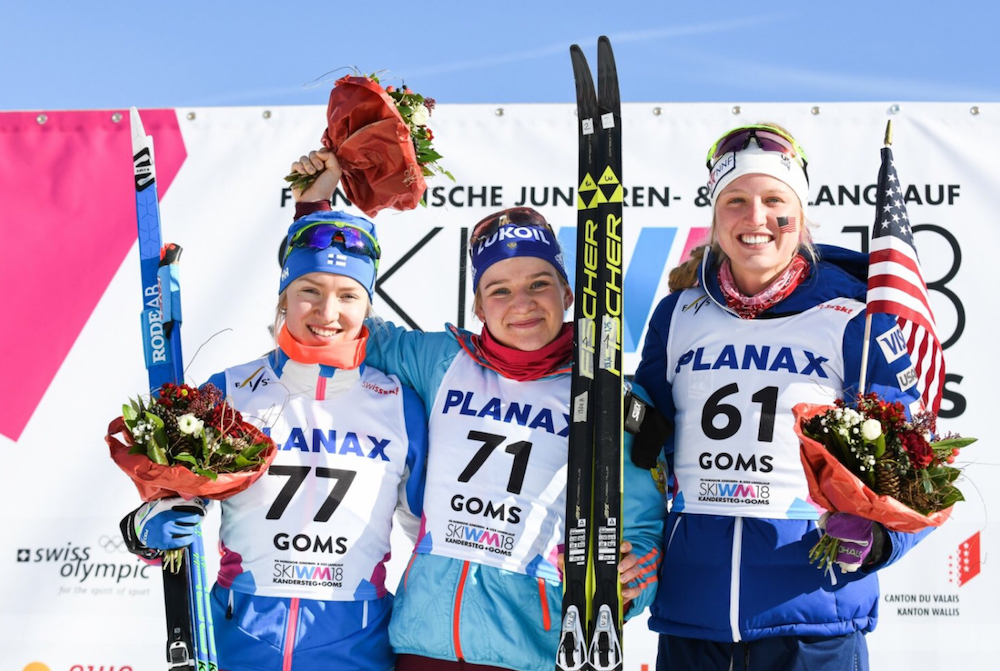
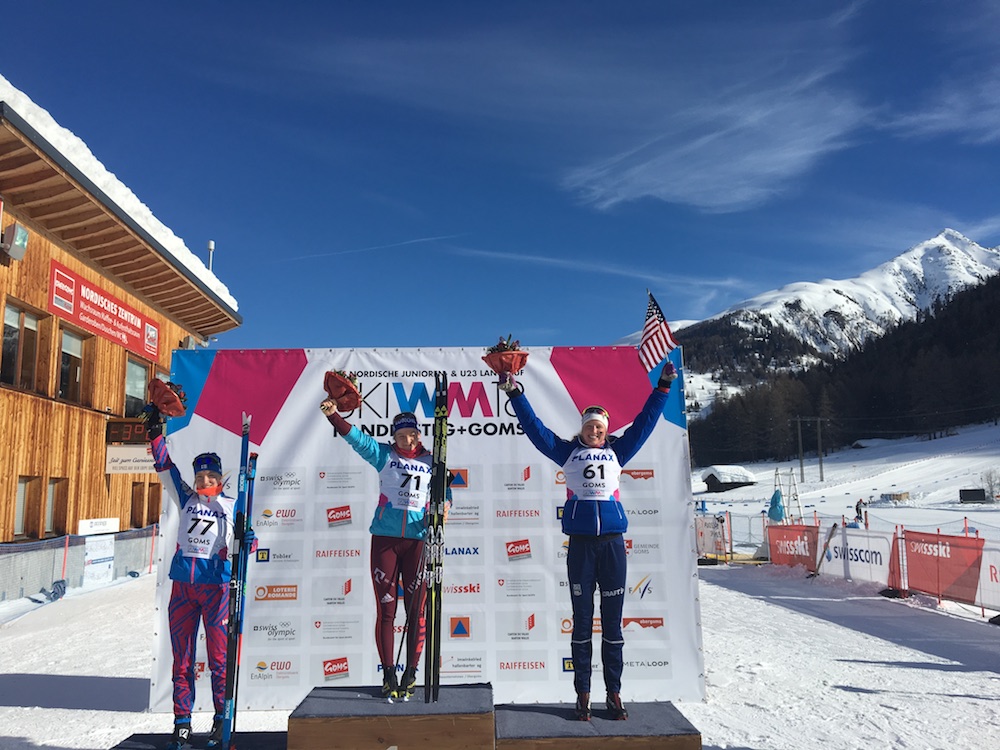
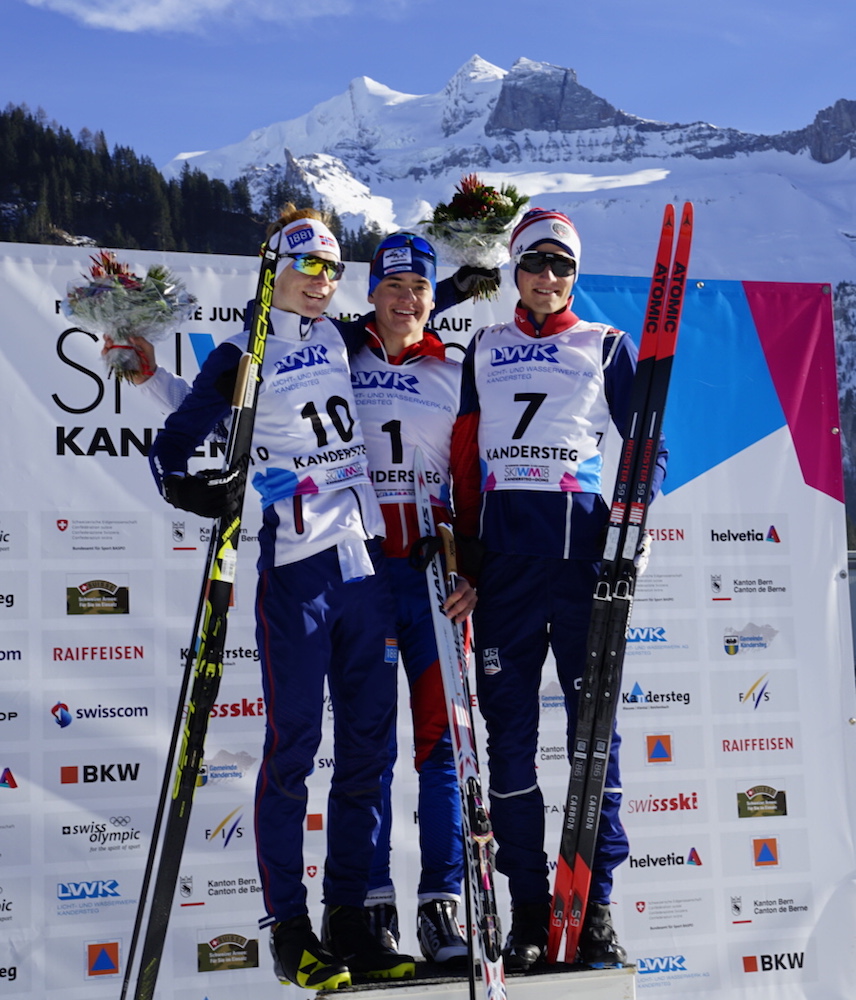
The women’s 5 k classic podium at 2018 Junior World Championships in Goms, Switzerland, with American Hailey Swirbul (r) in second, Russia’s Polina Nekrasova (c) in first, and Finland’s Anita Korva (l) in third. (Photo: JWSC2018.ch)
(This article has been updated to reflect that American Hailey Swirbul was in second for most of Tuesday’s 5 k race, not over one minute back as previously reported based on a live timing error. It has also been updated to include comments from Americans Hailey Swirbul, Ben Loomis, Stephen Schumann, and Gus Schumacher, Canada’s Antoine Cyr, University of Alaska Anchorage nordic head coach Andrew Kastning, and U.S. Ski Team Development Coach Bryan Fish.)
Junior World Championships (Goms, Switzerland): 5/10 k classic
Hailey Swirbul became the second American cross-country skier to earn an individual medal at Junior World Championships and first to take silver (Katharine Ogden claimed bronze in last year’s skiathlon) in the women’s 5-kilometer classic individual start on Tuesday in Goms, Switzerland.
Swirbul, a 19-year-old University of Alaska Anchorage sophomore, also tallied the best American finish at a Junior/U23 World Championships since Jessie Diggins earned silver in 2014 in the freestyle sprint. It was Swirbul’s second medal the last two Junior Worlds after she teamed up with Hannah Halvorsen, Julia Kern, and Ogden to take bronze in last year’s relay.
Going into this week’s championships, Swirbul, a Colorado native, explained she was aiming for a top 10 in one of the distance races. U.S. Ski Team Development Coach Bryan Fish pointed out that she wasn’t sure she’d feel up to racing on Tuesday.
“She had been feeling under the weather so she didn’t come up and ski yesterday,” Fish said on the phone Tuesday. “It was a little bit of a shock to Hailey herself that she skied so fast because there was some contemplation of whether she would race or not.”
“I made it a goal to stay relaxed and ski the race I would ski in a lower pressure race,” Swirbul wrote in an email. “I often find that I, and others, change their good race habits when at a high pressure event, so I was hoping to pace the race evenly and not start out too fast.
“The key for interval starts for me is to only think about skiing smoothly and powerfully for the first few kilometers of the race, and I’ve been discovering that that usually leads to decent splits throughout my race,” she continued.
She ended up racing to second place on Tuesday in the second race of 2018 Junior World Championships. The 61st starter (out of 84), Swirbul skied in second for most of the race, just behind Russia’s Polina Nekrasova, according toFish.
“She was basically tied for second and really had a strong second half of the course, and really skied solid in particular the last kilometer,” Fish said. “Always in the top five for sure, and well within striking distance [of the podium].”
The women’s 5 k classic podium at 2018 Junior World Championships in Goms, Switzerland, with American Hailey Swirbul (r) in second, Russia’s Polina Nekrasova (c) in first, and Finland’s Anita Korva (l) in third. (Photo: Bryan Fish)
She initially crossed the finish line in first place, more than a minute faster than the previous race leader. Her time remained faster than all but one of the women who started behind her — as Russia’s Polina Nekrasova (bib 71) took the win in 13:58.7 minutes, 14.4 seconds ahead of Swirbul.
Finland’s Anita Korva started 77th and finished third, 25.4 seconds out of first.
The Czech Republic’s Barbora Havlickova (bib 81) followed in fourth (+26.8), and Norway’s Kristine Stavås Skistad (bib 67) finished fifth (+31.9), and France’s Laura Chamiot-Maitra (bib 83) placed sixth (+34.9).
“… I honestly had no idea I was in the running for the podium during my race, because about 20 girls had yet to finish, so it wasn’t until the last girls came in that I knew I claimed a spot!” Swirbul wrote.
“It was a special moment when I ran down off of the course and I knew her split,” Fish said of Swirbul’s finishing time. “I knew she was sitting in second and they kept announcing and kept announcing, and I told her, ‘You will be second today,’ and it was kind of a combination facial expression of shock and elation. She really couldn’t believe it, but [I said], ‘You’ve got a big enough gap over third place and no one’s catching you.’
“It’s our best Junior Worlds result ever,” Fish added. “Last year was the first individual medal we had ever won or team medal at Junior Worlds and to follow that up with a silver is incredible.
“She was obviously on our podium relay last year, but she came in from U.S. nationals skiing well, qualified very high and she skied incredibly well today,” he explained. “Very fluid stride and did a great job shifting gears and doing a bit more running during the second half of the course.”
“The result hasn’t hit me yet,” Swirbul wrote. “It was beyond what I expected, so my brain is still catching up to the reality! I’ve been dreaming of racing how I know I could for the past 3 years or so, and this season has finally been my chance to break through. I’m so fortunate that things aligned for me on the day that really counted. I couldn’t have done it without Bryan Fish’s unwavering belief in us athletes, and my mom and dad’s support all these years, of course.”
Fish emphasized that while snow conditions have been “very, very good” and “very stable” in Goms, which received 1 1/2 meters (nearly 5 feet) of snow a week and a half ago, the waxing had been a bit challenging due to a temperature range of around -9 degrees to 5 degrees Celsius each day.
“I’m sure there were some teams on klister, some on klister covered with hard wax,” he said of Tuesday’s classic race. “Our techs did a really good job and they were clever with what they came up with when I heard what they were trying. … They’ve been right in the ballpark the last few days and I think they really dialed it in today, and it was impressive kick and glide. To get a podium you ned to have everything going right and I definitely think we had the skis in our favor.”
Halvorsen was the second-best American in 22nd on Tuesday, 1:10.1 out of first, Kathleen O’Connell finished 38th (+1:33.5) and Hannah Rudd was 59th (+2:24.1).
Canada’s Natalie Hynes placed 36th (+1:30.5), Hannah Mehain was 45th (+1:53.3) and Annika Richardson was 67th (+2:53.7). Catherine Reed-Metayer did not finish.
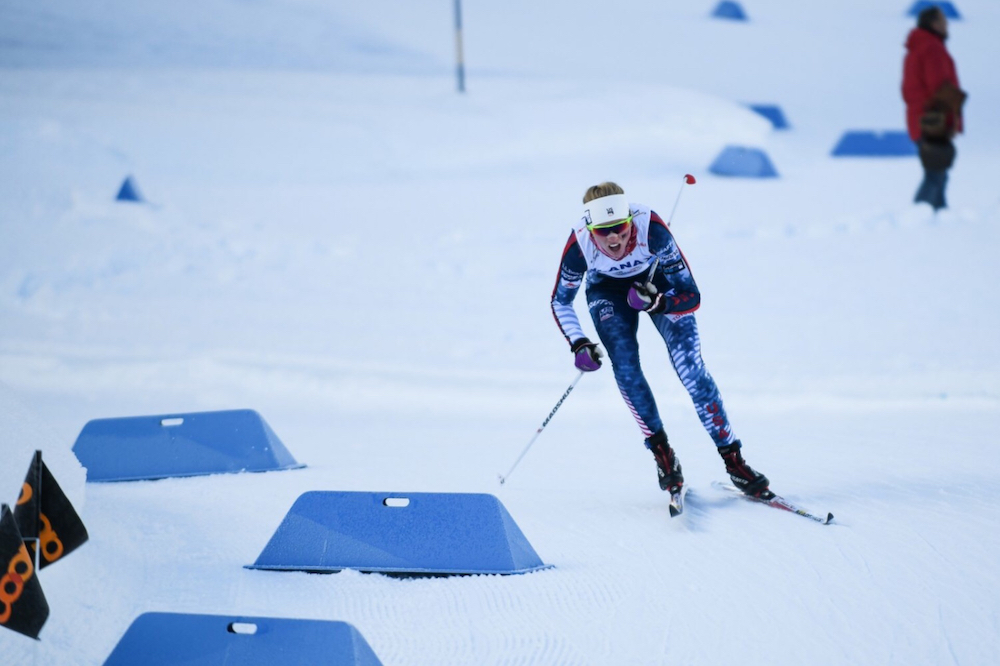
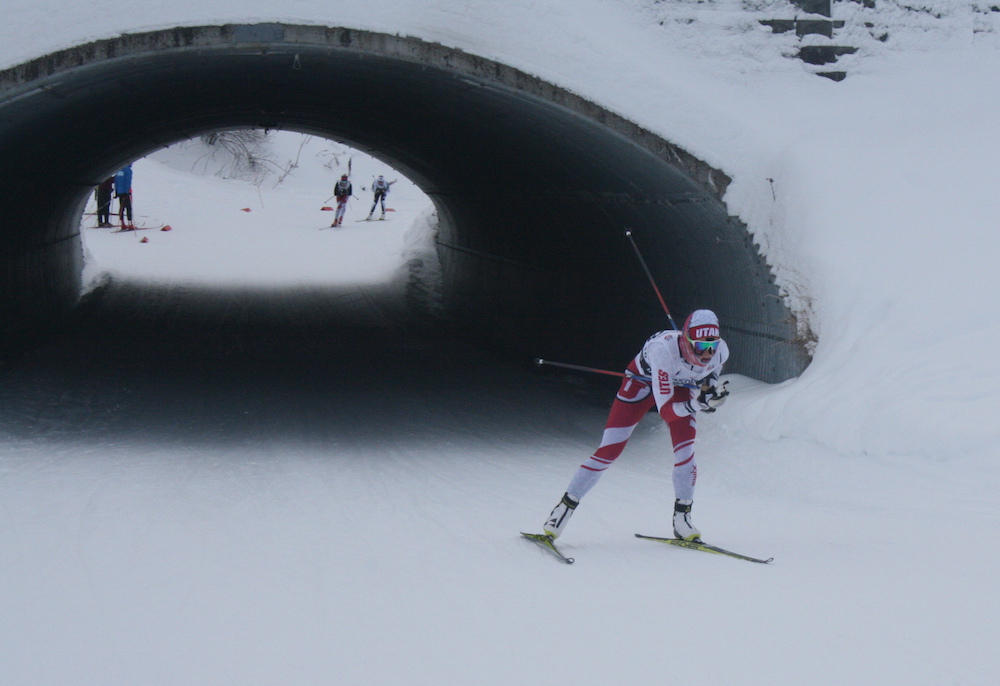
Hailey Swirbul (University of Alaska Anchorage) navigating a downhill while racing to second place in the women’s 5 k classic at 2018 Junior World Championships in Goms, Switzerland. (Photo: JWSC2018.ch)
Andrew Kastning, head coach of the University of Alaska Anchorage (UAA) nordic team, stayed up late the night before Alaska time to watch three UAA skiers (Swirbul, Rudd and Hynes) race on the Junior World Championships livestream.
“Hailey has made classic technique a priority since she stepped on UAA’s campus because that’s where she had the most potential for gain,” Kastning wrote in an email on Tuesday. “She has been working hard on a more powerful and smooth stride on the uphills while getting over elbow pain when double poling. The course looked like it played well to her strengths and that strategy.
“I saw one clip of her entering the big climb and could see that she was relaxed and striding really well,” he continued. “I knew then she was going to have a really good race.”
He noticed that the course had some intimidating downhills and corners, but he knew Swirbul wouldn’t have a problem navigating them.
“Hailey has a solid alpine skiing background and I figured if anyone would be willing to straight line the descents and flatten the corners then a massive amount of time could be saved,” Kastning wrote. “Hailey must have done that because she put 47 seconds on a Russian she was tied with at the high point. I was sort wondering if I was dreaming at moments and had to refrain from yelling and screaming because I’d wake up three daughters and a wife if I did. What a night, what a day. Seawolf Nation and USA are very proud this morning.”
Ogden 7th, Cyr 12th
In the men’s 10 k classic that followed, the excitement continued for Team USA, with 17-year-old Ben Ogden, of the Stratton Mountain School, racing to seventh in his Junior World Championships debut.
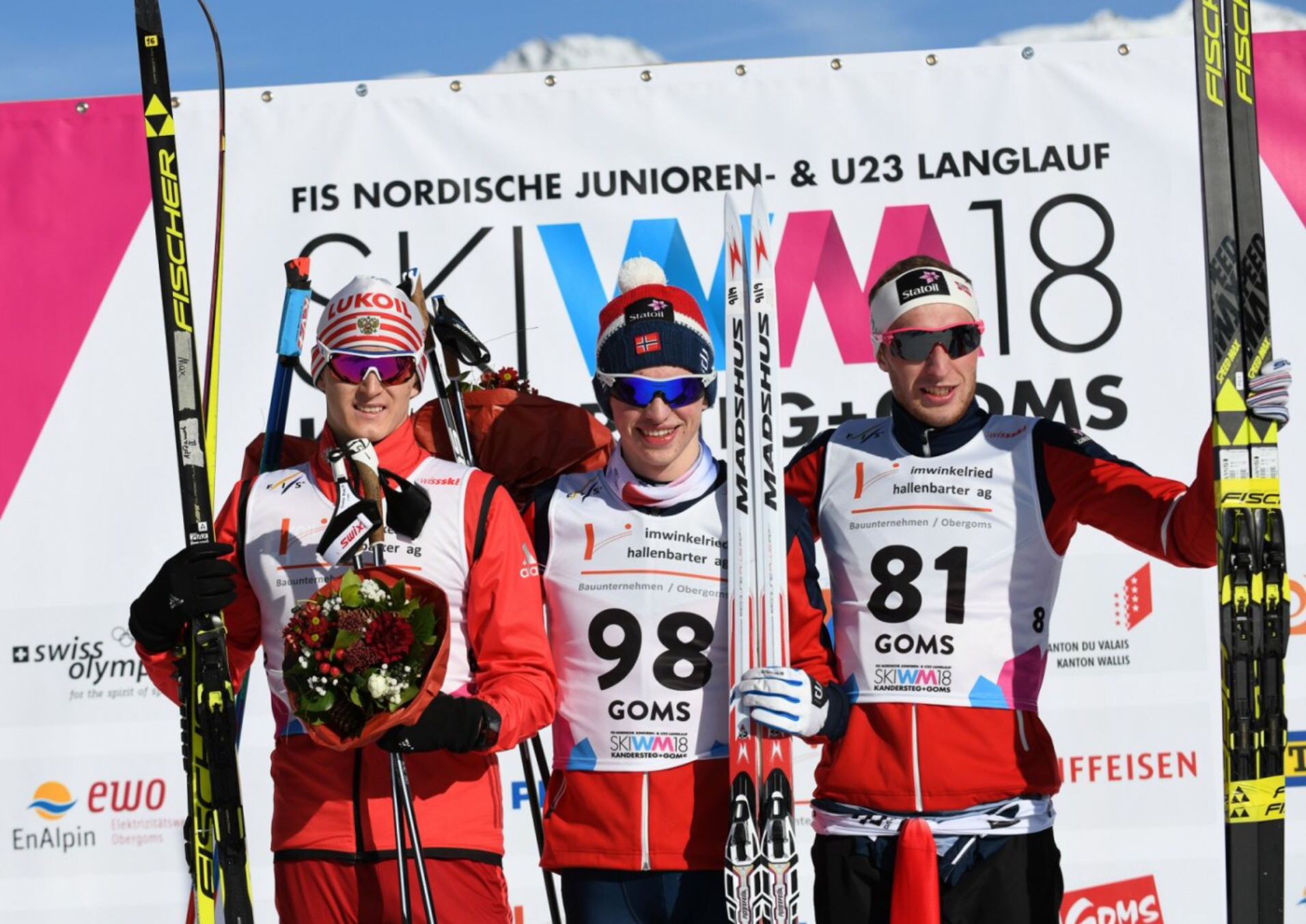
The men’s 10 k classic podium at 2018 Junior World Championships in Goms, Switzerland, with Norway’s Jon Rolf Skamo Hope (c) in first, Russia’s Sergey Ardashev (l) in second and Norway’s Jørgen Lippert (r) in third. (Photo: JWSC2018.ch)
Ogden started 72nd and crossed the finish line in first, 16.6 seconds faster than previous race leader Alexander Terentev of Russia. Six later starters ultimately bumped Ogden to seventh, and Norway’s Jon Rolf Skamo Hope took the win in 24:58.8, 40.5 seconds ahead of Ogden.
Russia’s Sergey Ardashev placed second, 9 seconds back, and Norway’s Jørgen Lippert reached the podium in third (+27.9). Norway put four in the top five and Russia had two in the top six, making Ogden the first non-Norwegian or non-Russian male finisher on the day.
According to race splits, Ogden skied an extremely consistent race, clocking the eighth, ninth or 10th fastest times throughout the 10 k.
Canada’s Antoine Cyr placed 12th (+1:07.7) in the second race of his career at Junior World Championships. Two days ago, he finished 30th in the freestyle sprint. Cyr, 19, started 78th and also skied a consistent race, hanging mostly within the top 12 throughout it.
“I knew that classic 10 km was good race for me,” Cyr wrote in an email. “On a good day I was hoping for top 30 but the course was hard and I knew that if I played it smart and paced myself I would be happy with my race.”
He focused on skiing powerfully on his first lap, with big strides and strong double poling, and tried to attack the A-climb and “punchy climb towards the end of the loop” on the second and last lap.
“A top 12 for us in Canada means a lot and with a 25th place in the [skate sprint qualifier] and a 12th place today I think it makes me realize that I have my place on the world level scene,” Cyr wrote. “… This race was a good redemption after my crash in the sprint. I am really happy with the results !!”
Gus Schumacher notched his second top 20 of the week in 17th (after placing 19th in the skate sprint), finishing 1:19.1 out first first, Hunter Wonders placed 22nd (+1:39.1), and Canyon Tobin was 37th (+2:17.2) for the U.S.
In an email, Schumacher, of Alaska Winter Stars, explained he had been aiming for a top 10.
“For this race I really focused on keeping the first quarter super relaxed and then picking it up after that,” he wrote of his pacing. “During the race I felt like I raced the first lap well but somewhere on the second lap I must’ve pushed just a little too hard and gone over my threshold, because I really faltered in the middle of that one on the big sprint hill. Other than that I felt like I skied the flats and most of the gradual uphills well, especially before 7.5k.”
Overall he added that he was “fairly satisfied … but I know that I can do better and that kind of hurts me. I just didn’t feel like I had the spark that I normally have towards the end of a race like this.” Moving forward, he had similar goals for the skiathlon and was excited for the relay.
Canada’s Etienne Hebert finished 44th (+2:42.3), Ty Godfrey was 57th (+3:29.5), and Felix Longpre 58th (+3:29.7) out of 96 finishers.
“It’s really exciting when you look at our day in general,” Fish noted. “We had two young boys with 2000 birth years; there was only three boys in the top 40 that had a 2000 year of birth and we had two. … That’s just really exciting for U.S. skiing in general, that we have athleetes showing up not just to participate, but to really perform.”
The men’s individual normal hill/10 k Gundersen podium at the first Day of Nordic Combined Junior World Championships in Kandersteg, Switzerland, with American Ben Loomis (r) in third, the Czech Republic’s Ondrej Pazout (c) in first, and Norway’s Einar Lurås Oftebro (l) in second. (Photo: Josh Parker)
Nordic Combined Junior World Championships (Kandersteg, Switzerland): Normal hill/10 k Gundersen
In the first competition of 2018 Nordic Combined Junior World Championships in Kandersteg, Switzerland (about 75 kilometers west of Goms), American Ben Loomis achieved the first podium of his career in his fifth Junior Worlds (counting his first in straight-up ski jumping), racing to third in the individual normal hill/10 k Gundersen on Tuesday.
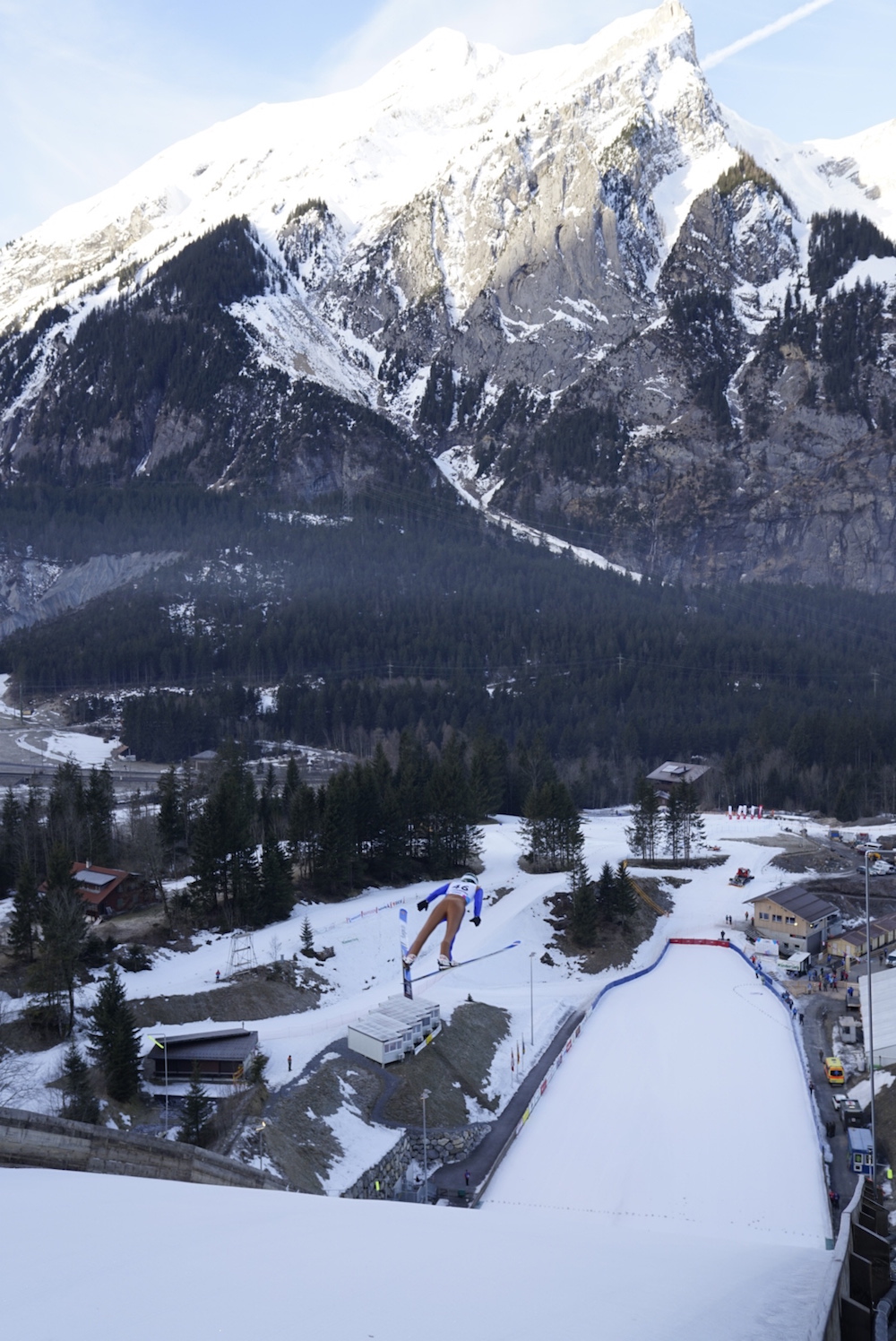
Ben Loomis (USA Nordic) jumping to seventh on Tuesday at 2018 Nordic Combined Junior World Championships in Kandersteg, Switzerland. He went on to place third in the 10 k for his first Junior Worlds medal. (Photo: Josh Parker)
Loomis, a 19-year-old U.S. Nordic Combined national team member who grew up in Wisconsin, was recently selected to compete at his first Olympics next month in PyeongChang, South Korea. In an email, Loomis explained he found out just over a week ago, which motivated him to compete at a high level, but it didn’t change his plans or goals for his last Junior Worlds.
“My focus of the winter has always been the Junior World championships so my Olympic nomination has not changed my training in the last few weeks,” he wrote. “Going into this week, and for the last 2 years now my goal was always a podium finish.”
He started out Tuesday by jumping to seventh on the 106-meter “normal” hill, then started the 10 k race 38 seconds out of first.
“The hill here in Kandersteg is very new which is nice because it feels similar to other modern jumps,” Loomis explained. “I was satisfied with my competition jump but not 100% happy. There are still a few things I need to fix on the technical side of my jumping.”
The Czech Republic had the two best jumpers on the day, with Ondrej Pazout leading after the jump portion, followed by his teammate Jan Vytrval in second. Pazout started the 10 k with an 11-second head start on Vytrval and ended up holding off his challengers to secure gold, finishing first in 22:58.3. Norway’s Einar Lurås Oftebro raced from 10th after the jump to second at the finish, just 2.3 seconds behind Pazout, with the second-fastest 10 k time.
Loomis passed four skiers to finish third, 8.3 seconds out of first, with the third-fastest time. Norway’s Johannes Lamparter slipped from third to fourth overall (+16.2), and Vytrval finished fifth (+21.6).
“I knew with a good race a podium was still possible from 38 seconds back,” Loomis wrote. “The track here is really tough with technical decent which leaves good opportunity to make up time.”
Working within a group, he caught up to third place on the first of four laps and was up to second on the second lap.
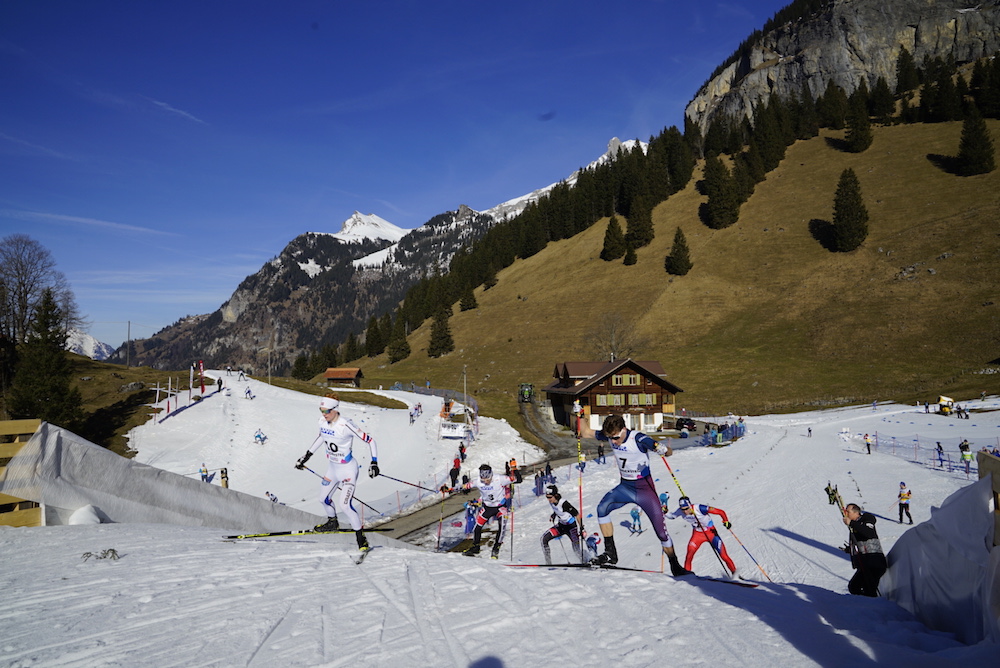
American Ben Loomis (7) racing with Norway’s Einar Lurås Oftebro (l) during the 10 k Gundersen on Tuesday at 2018 Nordic Combined Junior World Championships in Kandersteg, Switzerland. Loomis went on to finish third for his first Junior Worlds medal and Oftebro placed second. (Photo: Josh Parker)
“We had 5 or 6 guys in this group and on the 3rd lap I took the lead,” Loomis explained. “Towards the last hill on the 4th lap, I made a move alongside Einar Oftebro. Einar was strong on the last stretch and able to beat me as well as almost catching the leader Ondra.
“Taking a step on the podium was an excellent feeling today,” he added. “I have been working very hard, especially towards this specific race for a long time now. Accomplishing this is a huge relief and very motivating for the future.”
The U.S. had two in the top 15 with Stephen Schumann in 13th (+1:29.1). Schumann was 29th after the jump and started the 10 k 1:47 out of first, then posted the fifth-fastest course time to pick off 16 places.
“Going into today I was really just hoping to put together a solid jump and a good race and hopefully finish within the top 10 like last year,” Schumann wrote in an email. “Unfortunately I did not have the jump I was hoping for. I was about 1 meter late off the end of the take off, taking away some of the power and height that my legs otherwise would have given me. Luckily the conditions on the hill were pretty consistent today so I knew about where I would be standing after jumping going into the race.”
Given his starting position, he believed a top 15 was within reach. He ended up catching Italy’s Aaron Kostner, who started 27th, and the two worked together to catch one group after another.
“I felt pretty good but he got me on the last lap,” Schumann wrote of Kostner, who finished about 20 seconds ahead of him in 11th place. “But over all it was a pretty good race and I finished with the 5th fastest time. Behind Aaron with the 4th fastest.
“Overall I feel that had I had a little bit better jump on the hill I could have contended for a top 10 maybe top 5 but was happy with my race and my 13th place finish,” he added. “Coming across the line I was pretty sure Ben had finished in the top 5 at least, as I could see him going up the last hill as I was staring down it. But when I actually crossed the line and saw him I could tell he had gotten to the podium and I was psyched for him, went and gave him a hug and congratulated him.”
Looking ahead to the rest of the week, Schumann’s hoping for a medal in the 4 x 5 k team event.
“And personally I hope to finish in the top 10 in the 5km race with a better jump and another solid race,” he wrote.
Also for the U.S., Jared Shumate placed 35th (+4:06.3), up from 49th in the jump, and Tucker Hoefler was 51st (+6:37.4), up from 53rd.
The University of New Mexico ski team (alpine and nordic) celebrates its podium finish at the 2010 NCAA Championships.
The men’s and women’s nordic and alpine ski teams at the University of New Mexico (UNM) will be defunded and cease to exist by the end of June, university administrators announced Thursday afternoon. While the death of the ski team is being presented as a fait accompli by the UNM athletic department, ski team advocates are nonetheless rallying support and preparing to make their case for continued funding to the Board of Regents. The threatened cut to another western ski program comes six months after UNM’s neighbor far to the north, the University of Alaska, had to rely on a groundswell of community support to reverse an announced ax to its ski program.
Budget background
Last month the local paper, the Albuquerque Journal, reported that legislators were running into the final days of the session in their attempt to balance the state’s budget “amid a fiscal crisis.” On Monday of this week it reported on New Mexico Governor Susana Martinez’s symbolic move to veto all funding for public colleges and universities for the next fiscal year. On Thursday, the Associated Press reported that state legislators were preparing to sue the governor over this action, “amid an unrelenting standoff … over how to shore up state finances.”
Also Thursday, UNM officials announced that the school would no longer sponsor men’s and women’s skiing. “The decision will save the department approximately $600,000 per year in operating budget, scholarships and salaries,” the school wrote in a press release.
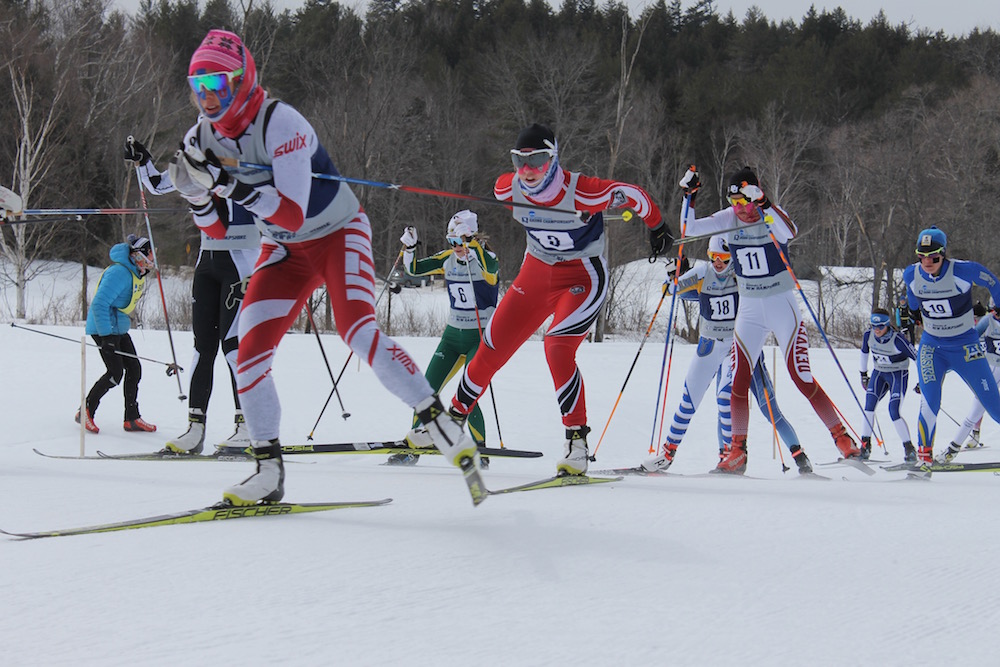
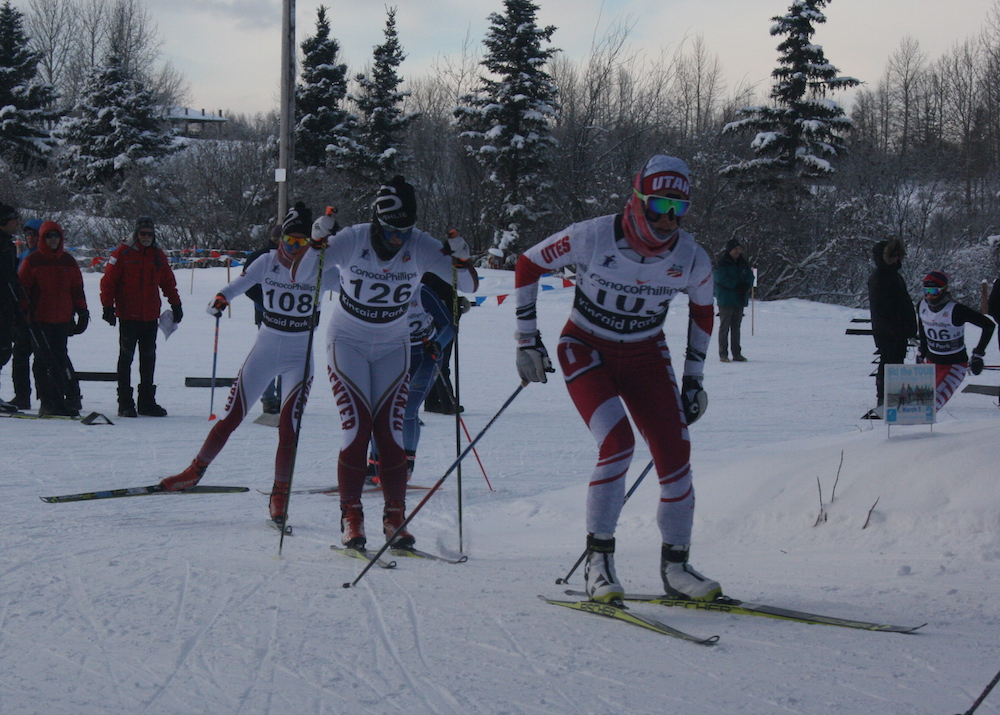
UNM’s Krista Niiranen (c) racing out of the stadium while following Utah’s Merete Myrseth (l) and skiing ahead of Denver’s Taeler McCrerey (11) and NMU’s Kristen Bourne (6) in the women’s 15 k freestyle mass start at 2017 NCAA Championships in Jackson, N.H.
In round numbers, the budget for the UNM athletic department was roughly $32 million in the previous fiscal year.
The UNM athletic department recorded a deficit of $1.54 million for the fiscal year that ended in June 2016, the Albuquerque Journal reported last summer. “According to a report to University regents,” the Journal wrote, “UNM fell short of ticket revenue projections by $975,000 and missed fundraising goals by $200,000.”
In the summer 2016 article, Vice President for Athletics Paul Krebs “made it clear it doesn’t mean there are bills not being paid or sports being cut.”
At that time, UNM Regent Marron Lee told the Journal that she was adamant that sports would not be cut in response to the budget deficit.
“No. We do not have too many sports,” the Journal article quotes her as saying. “We do a really good job with athletics at the University of New Mexico and I can’t think of one sport where I’d say, ‘Well, you have to be on the chopping block because we have a deficit.’”
So why was skiing the only sport cut now after all? Here’s what an FAQ sheet from the UNM athletic department has to say:
“Why skiing as opposed to a different sport? There are now less than 35 ski programs in the country that compete in the NCAA, and several of those do not compete full squads. There are just six other NCAA programs in the West, and when you look at the costs associated with skiing such as travel, insurance for international student-athletes, equipment and the fact that we practice three hours away, skiing made the most fiscal sense for our department.”
The ski team’s perspective
Head Coach Fredrik Landstedt is unconvinced. “They’re justifying it partly because of the budget,” Landstedt told FasterSkier in a Thursday phone call, “because skiing has fewer schools [sponsoring it], 34 sponsored institutions right now with skiing; there’s a few more if you count men’s and women’s. … But in my opinion, it doesn’t really matter how many schools that sponsor your sport, if you want to be on the top. I wouldn’t really care if there were 200 more ski teams out there that had crappy teams; it wouldn’t hurt me any. I don’t even understand the justification based on the number of sports. I mean, we’re competing right at the top.”
(UNM sports information director Frank Mercogliano told the Albuquerque Journal that no one from the ski team “immediately felt up to discussing the decision with media.” Landstedt was more than willing to speak when cold-called on Thursday afternoon.)
Finland’s Aku Nikander (r) of the University of New Mexico leads Noah Hoffman of the U.S. Ski Team around a corner on the Spencer Loop during the final lap of the men’s 50 k classic race at the U.S. Distance Nationals at Hillside in Anchorage, Alaska, in 2014.
Landstedt is objectively correct that the UNM ski team operates at a high level within American collegiate skiing. The team won a national championship in 2004, the school’s first NCAA team title in any sport. They were seventh at NCAA Championships this year – “but that’s one of our worst places,” Landstedt said of a program that consistently places even higher than that.
Alluding to the threatened cut to the University of Alaska Anchorage (UAA) ski team last fall, Landstedt said, of a team that has enjoyed solid results but that has historically lagged behind UNM at the top of the results sheet, “This will definitely hurt collegiate skiing. Because now, you know, Alaska Anchorage is one of the top programs, but they haven’t been even close to as successful as we’ve been as far as being up on the podium. And now you’re cutting one of the top programs in the country … and that means, what program is safe out there? ADs everywhere can point to the fact that they cut us – we were national champions.”
For UAA head nordic coach Andrew Kastning, “the pain from our recent struggle [over being defunded] is still fresh,” he wrote to FasterSkier. “So I know what they’re feeling and hurt for them as well.”
Kastning continued, looking back on his experience at UAA, “One of the reasons we got saved is because we got a lot of vocal support from [the] ski community which recognizes the importance and uniqueness of US college skiing and how it can raise the level of competition for every skiing region. It’s too early to tell what this means for college skiing, but it’s not good, and we all need to stand together and fight for the Lobos just as hard as we yelled and screamed for the Seawolves.”
(Current actions to support the UNM ski team are discussed at the end of this article.)
Back in Albuquerque, Landstedt is justifiably proud of his program. He cites the current 3.92 GPA of the women’s ski team, and 3.6 GPA for the men, as evidence for his claim that skiing has “always been the top academic program” at UNM.
Plus “We’ve always been the top athletic program,” Landstedt adds. “We have 13 NCAA trophies; there are only three more at UNM, total, for all the other sports. And we have 17 individual NCAA champions. So athletically we have traditionally by far been the best program [at UNM].”
Landstedt continues, “And on top of that, the ski team has always covered its budget here, so we never put anything to the deficit. We don’t have facilities that they have to pay for at UNM. The only cost as far as facilities is that the State of New Mexico has provided us with two vans, that’s it for 30 years. … So you’re showing poor judgment when you’re cutting the program that really typifies the excellence of being a student-athlete, a top student-athlete at the top level.”
The skiers’ perspective
One such student-athlete is Patrick Brachner, a senior alpine skier from Austria. Brachner spoke candidly with FasterSkier about how the athletes found out the news and the current mood of the team.
“For us, this decision came absolutely out of nowhere,” Brachner wrote to FasterSkier earlier today. “We knew that the Athletic Department was reporting a deficit, but it was always communicated that no teams will be dropped. Also, the Ski Team has not increased its spending since 2003 and we raised about $50,000 every year from supporters to support our budget. If there is a certain amount allocated from the Athletic Department for skiing, and our coaches never exceeded this budget, why would there be any reason to cut this program, although other programs have continuously exceeded their spending.”
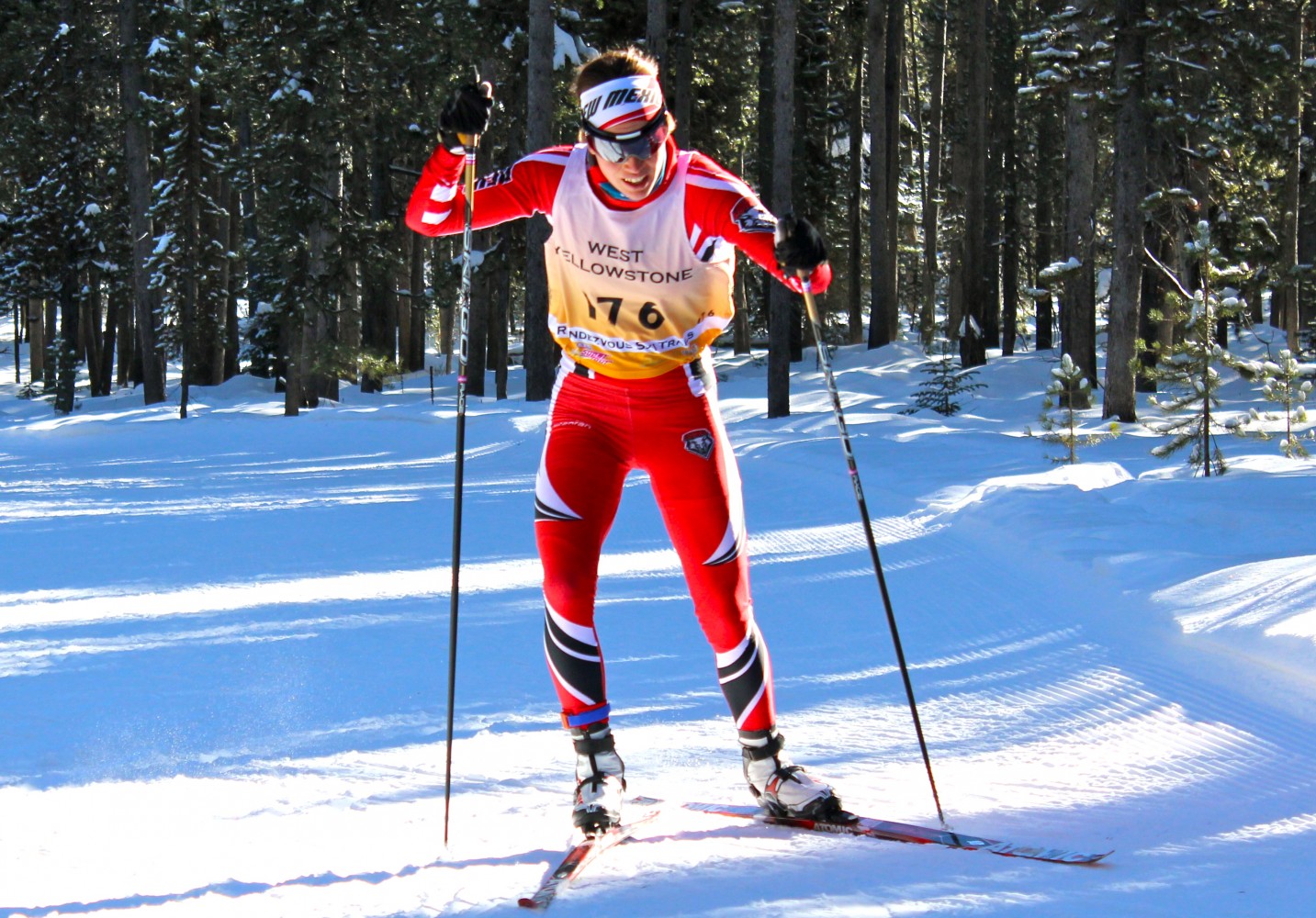
Emilie Cedervaern (University of New Mexico) during the first lap of the women’s SuperTour 10 k freestyle race in West Yellowstone, Mont., in Nov. 2015.
“It was a total shock” to learn yesterday that the program was being cut, Brachner continued. “Most of my teammates declared majors, signed up for classes the day before, I was talking to new recruits about their living situation for next year only hours before we got dropped.”
The mood within the team “wasn’t great” on Thursday, Brachner noted. But he added that, “if anything, this has just put us closer together and sparked our fighting spirit. It is amazing to see all the support of other UNM Alumns, and even Alumns of other colleges with a skiing program. People have to understand how great of a job the UNM Ski Team does in shaping people for the rest of their lives.”
Finally, Brachner provided a dose of realism regarding the options for current athletes. While UNM pledged either to honor current scholarships through graduation or to help skiers transfer to another institution, Brachner wrote that “It’s too late to transfer to other ski teams; spots are taken.”
(Frank Mercogliano, an assistant athletic director of communications at UNM, had a far less pessimistic view of current athletes’ options. “I don’t think that’s correct” that it’s already too late to transfer somewhere else, Mercogliano told FasterSkier in a Friday phone call. “Because we’ve got other schools that have basically had us on speed-dial, calling, asking about kids. … There’s room; kids will be able to transfer and go to schools, and be able to get scholarships. I mean, they’re going to make room. We have some kids that are – we have a lot of podium kids coming back here, both in Nordic and in Alpine. There’s room – trust me, they’ll find – the Utahs, and the Colorados, and the Denvers, and even the New Hampshires and the Vermonts and the Montana States and the Alaska Anchorages of the world – they’ll find room. They’re going to find room for kids that can win podiums on the circuit. They’ll do that.”)
And as for those students who wish to remain at UNM, on scholarship and without skiing? “In order to keep their scholarships here,” the senior Brachner wrote of his current teammates potentially still in Albuquerque next year, “they would need to work 10h for free per week for the Athletic Department, the institution that kicked them out.”
Funding issues and the men’s basketball coach
Hanging over any current discussion of funding for the UNM athletic department is the prominent and public fact that the school recently paid one million dollars to buy out the contract of men’s basketball head coach Craig Neal, a decision that occurred on March 31. (Neal would have been owed an additional $300,000 if he had been fired during the current contract year, which began on April 1.)
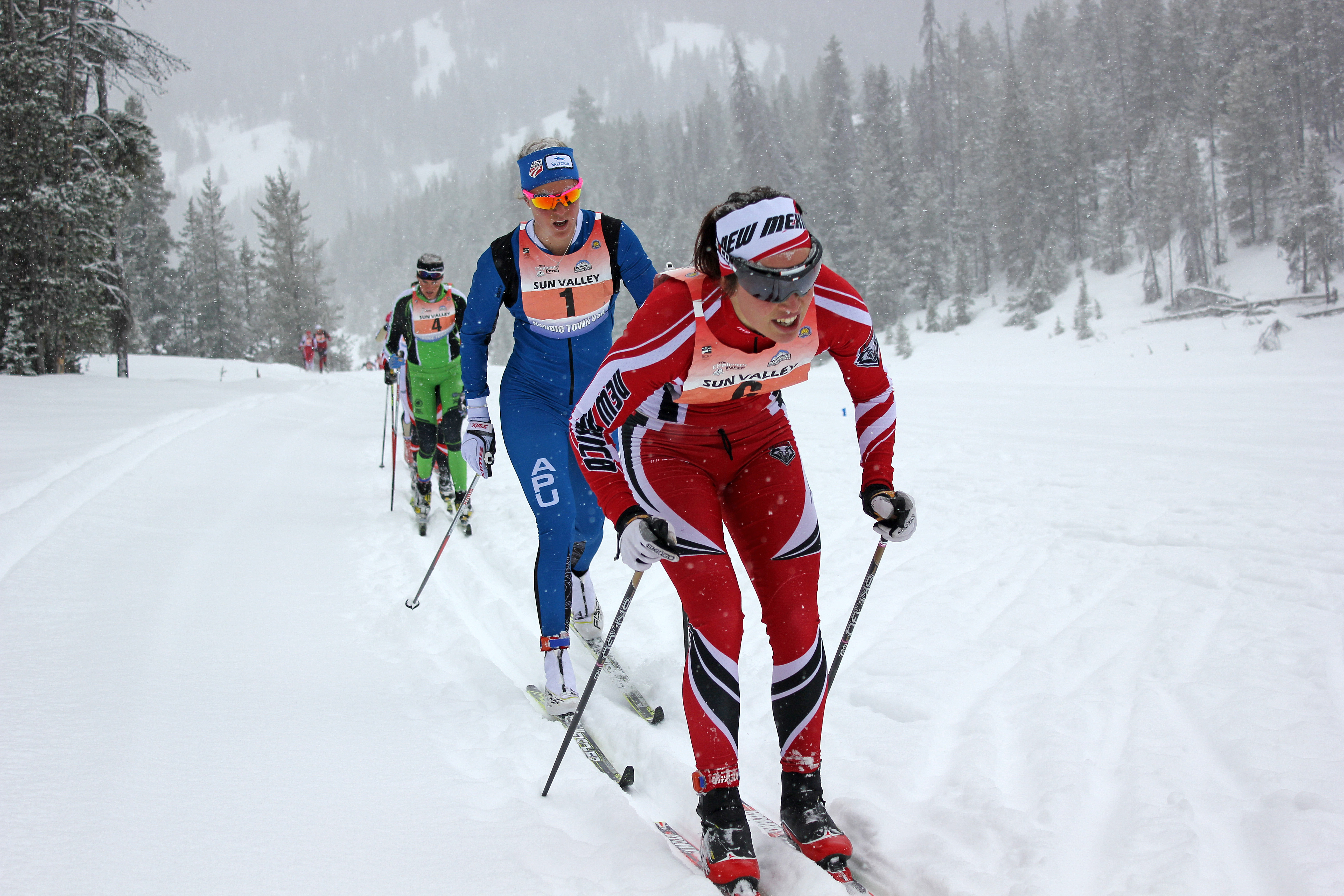
Emilie Cedervaern (New Mexico) leads Sadie Bjornsen on the final climb of the first leg at the 2015 SuperTour Finals 4 x 5 k mixed relay in Sun Valley, Idaho.
At best, it may be said to be bad optics for the athletic department to pay out a $1 million buyout on March 31, then announce on April 13 that a sport is being eliminated due to lack of funding and the need to save $600,000. (Although Landstedt suggests that the actual savings to UNM would be closer to $450,000.) At worst, ski-team members are beyond skeptical.
“The economy in New Mexico is poor,” Landstedt acknowledged. “They’re still trying to work out the state budget, the university has said it has a budget deficit, and the athletic department has a budget deficit. But the athletic department’s deficit is in big part because they signed very poor contracts with the basketball coach and have to pay them million-dollar buyouts, and so forth.”
He continued, “The economy is tough, tough decisions have to be made, but I believe there are other ways to cut or to increase your budget than by cutting our program out. That said, I believe it’s not the main reason for the predicament UNM Athletics are in; it’s because of the management or the current leadership of athletics.”
Brachner, the current alpine skier, similarly pulled no punches in contrasting the Neal buyout with the recent news about defunding the ski program.
In the introduction to an online petition in support of the ski team, Brachner wrote, “After firing UNM’s basketball coach earlier this month, UNM’s Athletic Director Paul Krebs has decided to discontinue the Women’s and Men’s Skiing program, a program that has deep roots not only within the University, but throughout the entire state. To put things in perspective, only the replacement of UNM’s basketball coach during his existing contract will cost the athletic department far more than the yearly budget of Women’s and Men’s skiing combined. This example is only the tip of the iceberg of ongoing financial mismanagement at the expense of student-athletes.”
For its part, the UNM athletic department disavows any connection between the buyout and this recent announcement. Its FAQ document addresses this claim: “Are there any ties between this announcement and the recent search for a men’s basketball coach and the buyout for Craig Neal?”
The answer given is: “No, discussions about ways to help our bottom-line regarding our budget have been ongoing for several months among the department’s budget committee. That committee made a recommendation to [vice president of athletics] Paul Krebs and he made the recommendation to the University administration. Regardless of the buyout for men’s basketball coach Craig Neal, this decision would have been made.”
New Mexico’s Emilie Cedervaern on the ground after winning the 15 k classic mass start at the 2015 NCAA Championships in Lake Placid.
Mercogliano, the athletics department spokesman, also provided a more nuanced view of the contract language of the Neal buyout. Mercogliano mentioned a mitigation clause in the contract, by which any money Neal earns over the next two years reduces UNM’s financial obligations to its former coach by an equal amount.
That is, Neal is presumptively owed $500,000 in each of the next two years, payable in 24 monthly installments, as a “salary” for not coaching the UNM basketball team in that time. But if he made $100,000 per year for two years, then UNM would owe him only $400,000 per year for two years, or $800,000 total. If he made $250,000 per year, then UNM would owe him $500,000 over the next two years. And so on.
“We’re assuming he’s going to get a job,” Mercogliano said of Neal; “that’s not much of a question at this point. Whatever salary he then gets gets mitigated off of what we owe him.”
Mercogliano also characterized the budget analysis as, “It’s not, ‘Skiing was cut, we’ve got this $600,000, how now are we going to spend it.’ It’s money that we just don’t have any more, because of state budget cuts, rising costs, cost of scholarships,” and other expenses.
What happens next
Skiing has been a varsity sport at the University of New Mexico since 1970 (it began as a club sport two years before that). Despite that venerable heritage, UNM is now preparing for a future without skiing. “Is there a possibility skiing could be reinstated?” its FAQ sheet notes.
“One would never say never,” was the answer, “but in our current climate, it is not a part of the future vision of Lobo Athletics. We are moving forward with skiing off the table.”
University of New Mexico athletes toe the line alongside citizen skiers at the Chama Chile Ski Classic in Chama, N.M. (Photo: Southwest Nordic Ski Club)
Despite that official statement, Landstedt is preparing to advocate for his program. “We’re going to fight this decision. We’re working out a strategy right now,” he told FasterSkier late Thursday afternoon. “Because we were told at the meeting at 1 o’clock [today] – the AD told us they would discontinue the ski program. They read us a letter stating that by June 30 we’re out of there, we’re fired. And then 10 minutes later the press release went out, and then right after that they told the student-athletes. So we didn’t find out anything until right then. It was very poorly handled by the department in the first place.”
Brachner wrote, “UNM’s Board of Regents has their next meeting on Tuesday and we need to gather as many troops as possible in favor of the team, athletes, teachers, supporters, friends, etc. to show that we are important to the community and it is valuable for UNM to have a Ski Team.”
One representative of the local ski community is Clay Moseley. The president of Southwest Nordic Ski Club, based in Los Alamos, is active in supporting what he calls “a small, but very vibrant Nordic community in New Mexico, with a rapidly expanding group of kids in both Albuquerque and Northern New Mexico.” Moseley wrote to FasterSkier that “Our access to the team is a critical part of the motivation for the kids. They marvel at the team and the team members are always so supportive and friendly to our kids. We are SO isolated here, so having that little bit of contact to some ski ‘heroes’ is vital.”
As of Friday, a petition titled, “Save the NMU Ski Team,” had more than 3,000 supporters. Its goal is 5,000.
The Board of Regents may be reached by email at regents [at] unm.edu, or by phone at 505-277-7639. Contact information for Board of Regents President Robert M. Doughty III is available through his law firm website. Board of Regents Vice President Marron Lee lists her email address as marronresipsa [at] gmail.com in the publicly available New Mexico Bar Association Directory.
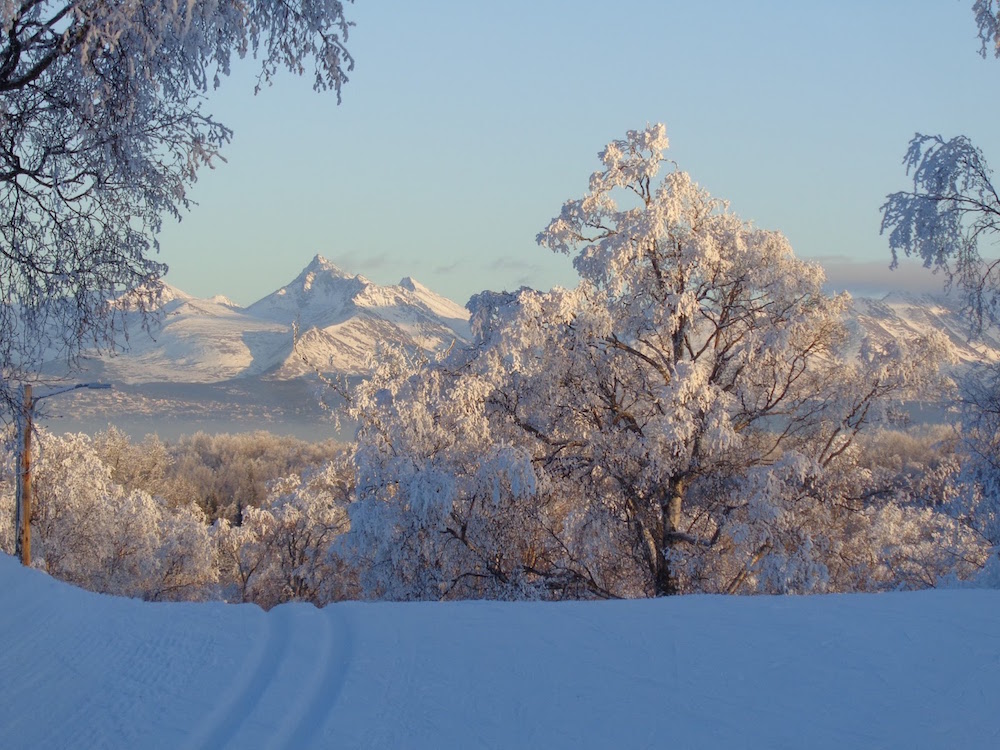
The Chugach Mountains as seen from the Lekisch Loop, part of the course for the weekend’s races, at Kincaid Park in Anchorage, Alaska. (Photo: Adam Verrier)
ANCHORAGE, Alaska — So how cold was it at Kincaid Park Sunday morning for the last of four Rocky Mountain Intercollegiate Ski Association (RMISA) races held in the Anchorage area this week?
“It’s f—ing cold,” said women’s winner Merete Myrseth of the University of Utah. “It was cold,” said men’s winner Moritz Madlener of the University of Denver. “Now we fly back to Denver and get warm.” [Unavailable for comment] were the two skiers who required an ambulance for cold-related injuries following the women’s race.
For the record, temperatures were consistently at or above zero degrees Fahrenheit all morning, so readily FIS-legal. (The International Ski Federation, which sanctioned all of this week’s races, has a temperature cutoff of -20° C, or -4° F, in order for a race to be held.) The real problem was the wind, which blew steadily from the north at around 10mph all morning.
Unless the real problem was the humidity. The city of Anchorage is, well, a natural anchorage, bordered by Cook Inlet to the north and Turnagain Arm to the south. The Kincaid stadium is well under a kilometer away from the shores of the ice-choked Pacific Ocean; athletes were within 150 meters of the Turnagain Arm beach at one point on Sunday’s race course. Humidity was over 90% all morning. By any measure, conditions were somewhere between “raw” and “brutal.”
At least atmospherically speaking. The ski trails were in superb shape following 30″ of snow in the month of January, if slow due to temperatures below zero Saturday night into Sunday morning.
The first race of the day, the men’s 20-kilometer freestyle mass start, saw its start moved one hour later due to cold conditions. In that time the temperature rose from -2° F to zero.
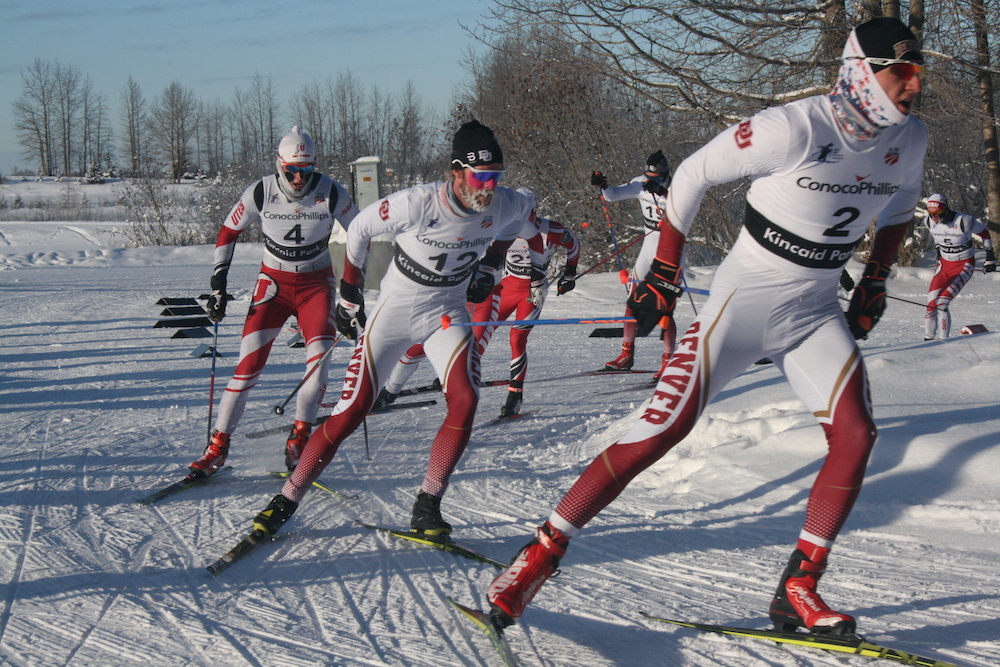
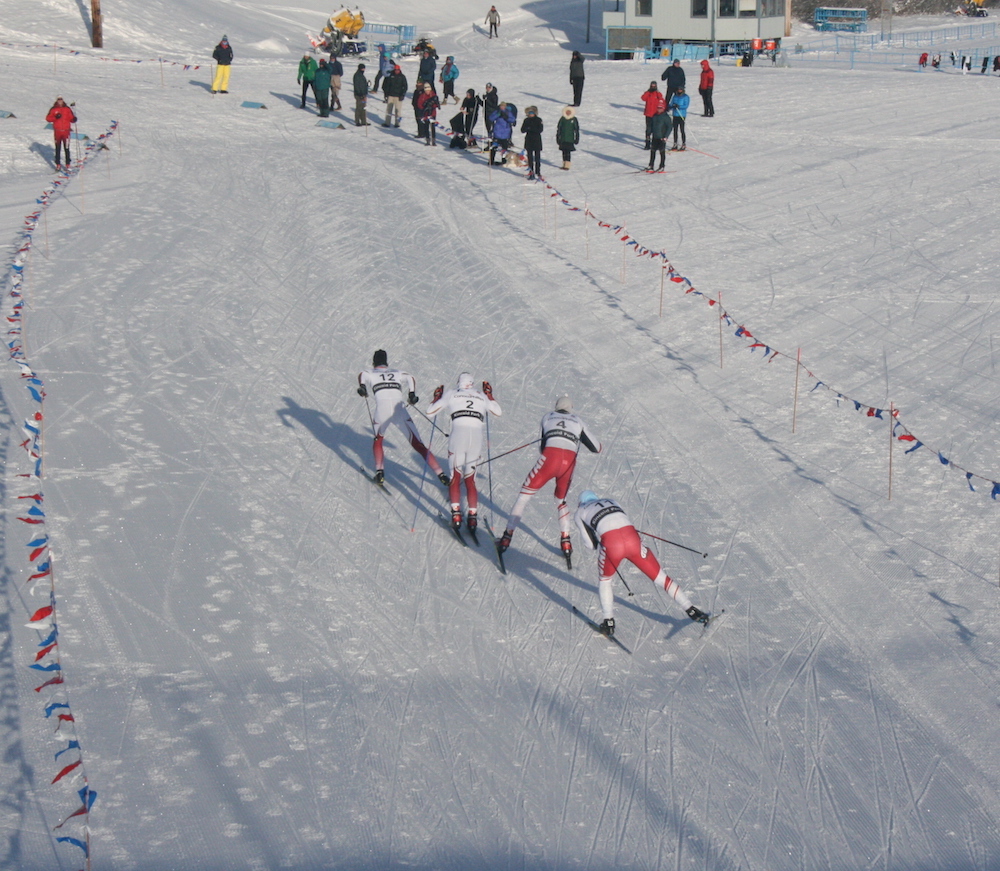
Denver’s Moritz Madlener (2) leads Dag Frode Trollebø of Denver (12) and Kevin Bolger of Utah (4) in the men’s 20 k skate at Kincaid Park in Anchorage, Alaska. (Photo: Adam Verrier)
When the race started, Denver’s Madlener quickly moved near the front as the field of 42 racers headed north out of the stadium to make their way up Elliott’s Climb. (For Anchorage readers, or anyone else familiar with Kincaid: the course went up Elliott’s and down Rollercoaster; up and down the Gong Hill; through the lower tunnel out to Mize’s Folly; take the first right onto Hairpin; take the first left at the top of Hairpin onto the 2.9 k Lekisch. Men did two laps of this, for 15 k, then a final 5 k lap that cut out Elliott’s. Women did two laps of the 7.5 k course for 15 k total.)
“I was in the front pack pretty much the whole race,” Madlener recounted in an in-person interview with FasterSkier. “Tried to, you know, set the pace every now and then to get rid of people. Which worked pretty well; I think four of us got away after maybe 12 [kilometers]. And then we stayed together for the rest of the race, and then the last couple hills we kind of separated.”
Madlener ultimately crossed the line in 52:39.2, edging teammate Dag Frode Trollebø by 2.6 seconds. Martin Bergström of the University of Utah followed in third (+10.4). “That’s a great feeling” to share the podium with a teammate, Madlener told FasterSkier.
Madlener recalled that he had “a really good start” to his season at U.S. nationals – he earned two podiums there, second in the classic sprint and third in the 15 k skate – before he got sick “and had to catch up. And the races so far here in Alaska weren’t that great,” he continued, “so I was very happy to win today.”
This week marked Madlener’s second time racing in Alaska; he previously competed in the last RMISA race series held in Anchorage, in early 2015. That week was marked by warm weather, rain, and shortened courses.
Madlener is a fan, of Alaska in general and particularly the full courses that athletes got to race on this year.
“I think it’s beautiful,” Madlener said of Alaska. “It’s like – I would say it’s like a big theme park; people are surfing and flying around and fishing. I really enjoy it. And the courses – again, two years ago, were not so great, but this year there’s a lot of snow, they’re pretty amazing courses. Like a rollercoaster.”
Merete Myrseth of Utah enters the stadium approaching the finish in the women’s 15 k skate at Kincaid Park in Anchorage, Alaska. (Photo: Adam Verrier)
Sunday’s race course featured a total of eight A-climbs for the men in 20 k, and six A-climbs for the women in 15 k. There was an average of 34 meters of climbing per kilometer on the main 7.5 k loop.
Four racers, roughly a tenth of the field, were DNFs in the men’s race, likely due to a combination of the hills and the cold. Two skiers did not finish the women’s race. An additional eight opted not to start.
The first words out of Madlener’s mouth when asked about his race were, “It was – first of all it was cold, obviously.” Myrseth, the women’s winner who skis for Utah, voiced similar sentiments: “It was cold, really cold,” she began her race summary. (By the time of the women’s race start at 12:30 p.m., temperatures had climbed to 1.6° F.)
“I was unsure if I would start the whole race because it was so cold, actually too cold for me,” Myrseth told FasterSkier in a brief in-person interview while shivering in the windy stadium soon after her finish. “But it went really easy in the first half of the lap,” she continued, and she felt good. “So I decided to speed up when I came to hills”; there Myrseth created a gap that she kept all the way to the finish.
But not without difficulty. “I didn’t feel good,” Myrseth said. “My feet, I couldn’t feel my feet, it was so cold. So I had to just, like, double pole over the hills, I was so tight in my feet and lost my balance, it was just so hard to keep balancing. But I made it to the finish line. And I am so happy that Guro took the second place.”
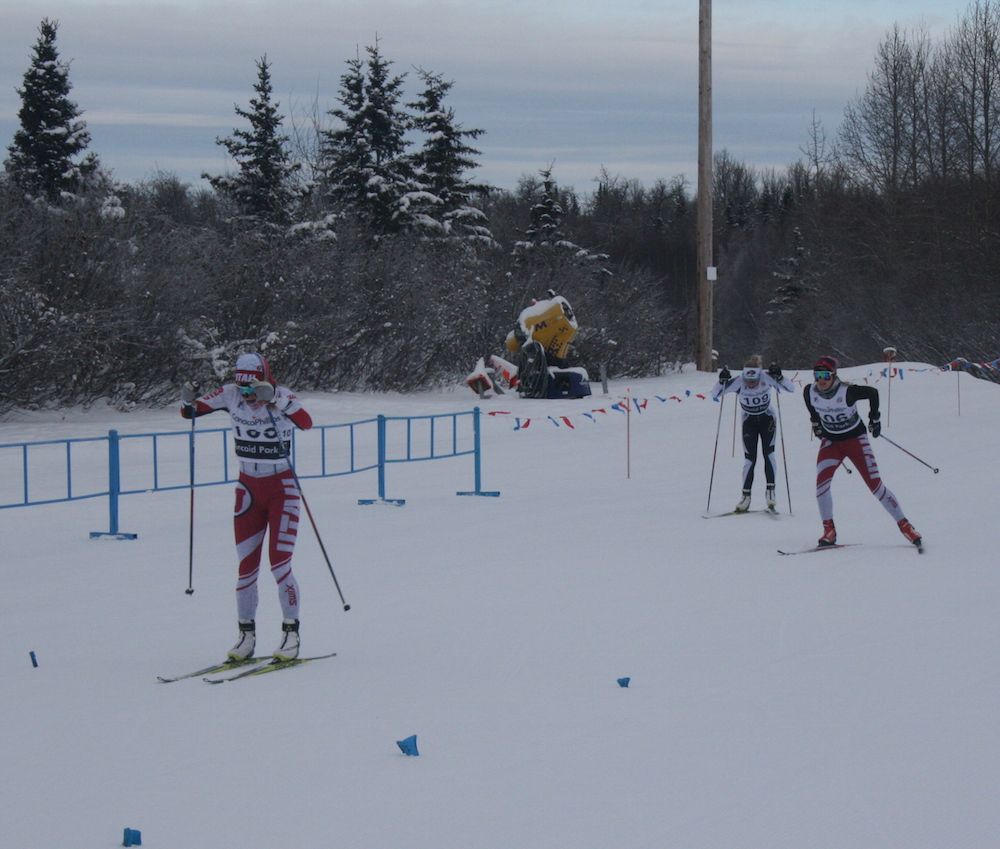
Merete Myrseth of Utah (l) in the finishing chute en route to the narrow victory over Guro Jordheim of Utah (106) and Christina Rolandsen of Colorado (109) at Kincaid Park in Anchorage, Alaska. (Photo: Adam Verrier)
Myrseth crossed the finish line in 46:28.3 for 15 k, double poling the last few meters to the finish. As she noted, she was followed by teammate Guro Jordheim in a close second (+0.5). Christina Rolandsen of the University of Colorado was not far back in third (+1.8). There was then a 30-second gap to a chase pack containing places fourth through sixth. 32 skiers finished the women’s race.
This week marked Myrseth’s first time racing in Anchorage or even visiting Alaska. So what did she think? “I love it,” said the native of Øverbygd, Norway. “It’s f—ing cold, but it reminds me of Norway, my home. I’m used to it. But it’s so nice; I really like it here.”
Sunday’s race marked the fourth race of the week in the Anchorage area for RMISA athletes. Recaps of the first three races follow below.
On Tuesday, February 7, RMISA athletes, plus a handful of skiers from Alaska Pacific University (APU) with sterling sprint credentials, raced a 1.4-kilometer freestyle sprint at Kincaid. Conditions were impeccable, with pure blue skies, temperatures in the high teens, and last month’s fresh snow mixed in with the base of manmade snow covering the sprint loop.
In the women’s race, Merete Myrseth of Utah posted the fastest time in qualifying, 3:25.77, followed by Becca Rorabaugh of APU (+2.14) and Utah’s Guro Jordheim (+3.65). All three skiers made the A-Final, where Myrseth took her first victory of the week. The overall podium, which was also the college podium, was Jordheim in second and Anika Miller (Montana State) in third. Casey Wright (UAA), Rorabaugh, and Jasmi Joensuu (Denver) were fourth through sixth.
Times were not available for any of the heats.
In the men’s race, Dag Frode Trollebø (Utah) set the pace in qualifying in 2:48.80. He was followed by APU’s Logan Hanneman (+1.52) and Utah’s Martin Bergström (+3.33).
Three of the six skiers in the men’s A-Final were locals (in the broad sense of being from Alaska; the Hanneman brothers are from Fairbanks, not Anchorage). And it was the Hanneman show in the final, as the elder Reese Hanneman took the victory over his younger brother Logan. Trollebø was third. Kevin Bolger of Utah, last seen winning the classic sprint national championship at Soldier Hollow, Bergström, and APU’s Forrest Mahlen rounded out the final finisher spots in that order.
The collegiate podium for the men’s race was Trollebø, Bolger, and Bergström. (APU is not an NCAA-affiliated athletic program.)
While sprinting may be on the horizon for NCAA skiing in general, it had yet to make an appearance on the RMISA circuit.
“This was the first sprint that I know of in my, what – 10 years of RMISA coaching now and we’ve never had just a straight invitational sprint,” University of Alaska Anchorage Head Nordic Coach Andrew Kastning told FasterSkier in person following Sunday’s distance skate races.
Kastning said that the addition of a sprint in Anchorage stemmed from a desire for a change of pace, and to avoid repetition in a single week with four races. “So when we sat down last spring and were deciding the schedule,” he said, “we’d been hearing for a few years now from our athletes that the fives, 10s, 15s, and 20s [kilometer race format] every weekend just kind of got boring, and we wanted to mix it up. So we counted the qualifying round as an invite at U.S. Nationals, and then we ran the full sprint [this week] and counted that. … So we just wanted to mix it up a little up here. Especially with four races in a short period of time, you don’t want to be doing all the same distances and the same courses.”
So did the college athletes appreciate the chance to contest a sprint race in the middle of the RMISA race season? “Some of them do,” Kastning said. “There’s always a sprint specialist in the crowd who gets to shine. And I know there were kids on the podium, or in the top-10 at least, that aren’t normally in a distance race. So it allows some athletes to play to their strengths and shine a bit when they maybe wouldn‘t in a 20 k race, they can in a sprint.”
On the non-collegiate side, APU skier Reese Hanneman, a sprint specialist, was thrilled to have a mid-season sprint race with high-level competition on his adopted home course. “I wish there were more sprint races in the middle of the season,” Hanneman told the Alaska Dispatch News.
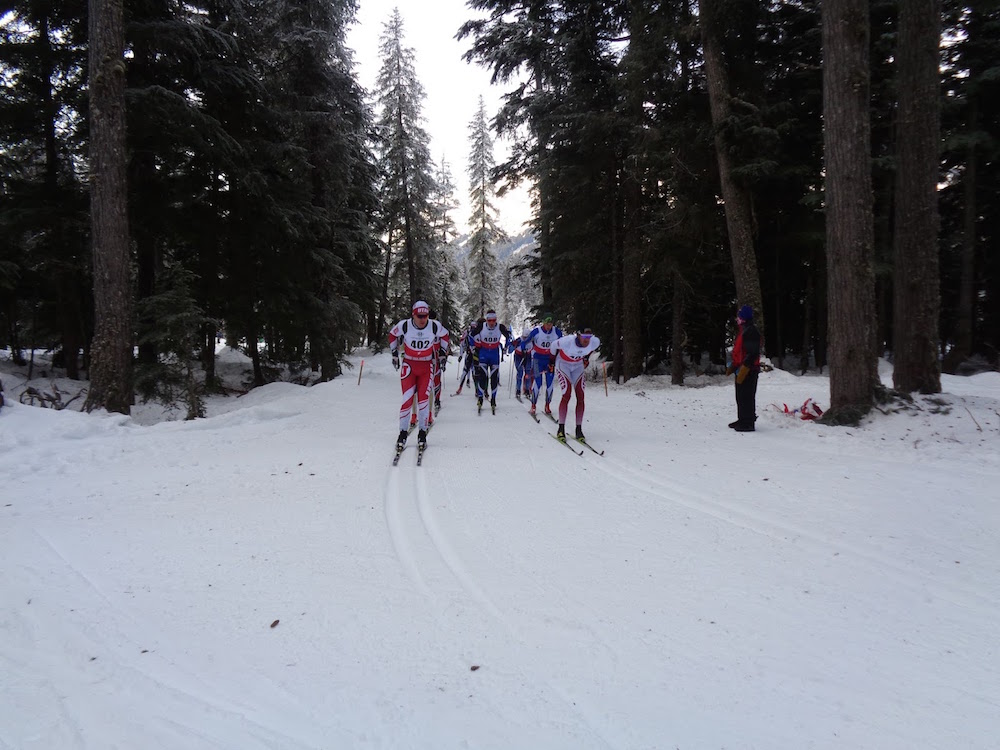
Utah’s Martin Bergström (402) leads Denver’s Dag Frode Trollebø (right) and APU’s Reese Hanneman (center) at the start of the mixed-gender classic relay in Girdwood, Alaska. (Photo: Adam Verrier)
The next day, Wednesday, February 8, skiers made the 45-minute drive down Turnagain Arm from Anchorage to Girdwood for a classic relay race. Girdwood is perhaps best known in ski circles as home to the Alyeska Resort alpine area, which boasts an average annual snowfall of 669″ and (when it’s clear) sweeping views of the mountains and glaciers overlooking Turnagain Arm. Publications as diverse as Powder magazine and National Geographic have lauded Girdwood as a quintessential locals ski town (“Best For: Off-the-beaten-path powder hounds with an aversion to glamour”).
Girdwood also has a proud nordic heritage, though you have to look a little harder to find it. It is home to APU skier Chelsea Holmes, who will be competing at World Champs in Lahti later this month. And it hosted the 1969 Junior Nationals, on trails cleared from the continent’s northernmost coastal rainforest for this purpose.
As discussed in more detail on former U.S. Ski Team member Tim Kelley’s invaluable blog, Alaska Lost Ski Areas Project, the trails faded back into the woods at some point during the 1970s. High-level nordic skiing in Girdwood then languished for over thirty years, until the early part of this decade, when the Girdwood Nordic Ski Club oversaw construction of a new 5 k loop. The reborn nordic trails have since hosted a handful of local high school races in periods of poor snow conditions in Anchorage, but it is safe to say that Wednesday’s relay was the most significant cross-country ski race held in Girdwood since 1969.
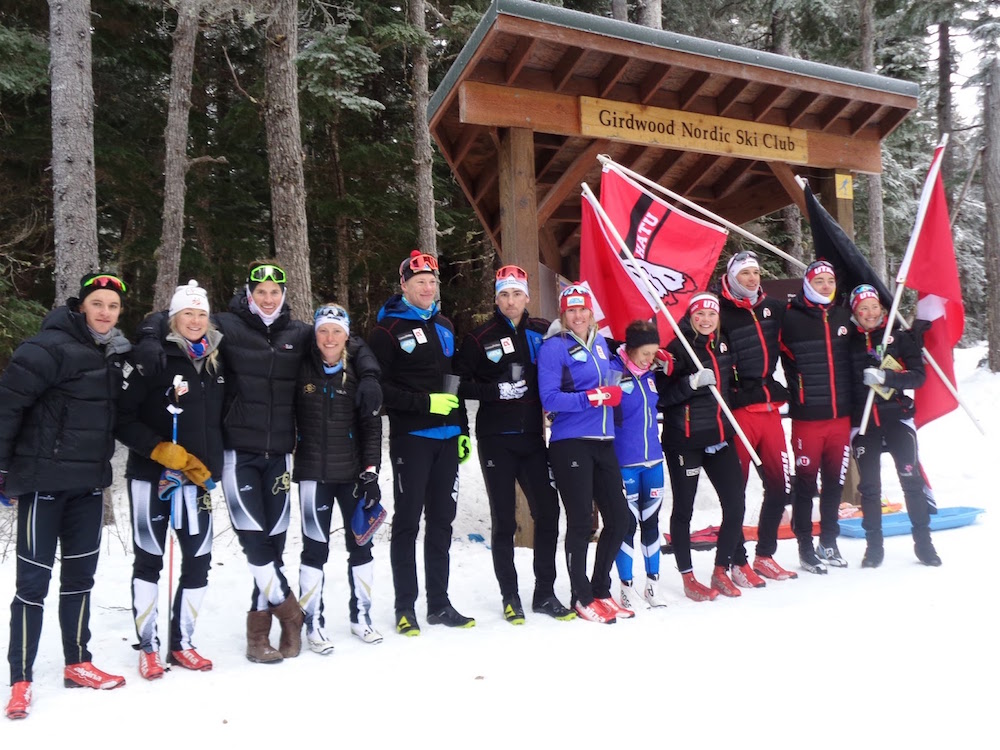
APU (1st), Colorado (2nd), and Utah (3rd) make up the podium for the mixed-gender classic relay in Girdwood, Alaska. (Photo: Adam Verrier)
Athletes raced in a mixed-gender 4 x 5-kilometer classic relay in the epochal event, man/woman/man/woman. It was once again APU leading the way, as the team of Reese Hanneman, Rosie Frankowski, Logan Hanneman, and Rorabaugh crossed the finish line for the victory in 57:33.7. Second overall, and first among collegiate teams, was Colorado (Mads Ek Strøm, Jesse Knori, Petter Reistad, Christina Rolandsen), 25.6 seconds back. They were followed by Utah (Bergström, Jordheim, Bolger, Myrseth) (+1:02.6). Fourth overall, and third for the NCAA podium, was Denver (Trollebø, Linn Eriksen, Moritz Madlener, Joensuu) (+1:25.4).
“Everybody was psyched on a new format and a new trail in a beautiful location,” Kastning told FasterSkier of Wednesday’s race.
Kastning added that the relay, like the previous day’s sprint, was new territory for RMISA racing. “We’ve never had a relay that’s counted for anything,” he said. “I think the relay captures college skiing well, with the mixed gender and the team aspect, men and women working together to try and reach the podium.”
Three days later, Saturday, February 11, skiers were back in Anchorage for individual start distance classic races, 5 k for the women and 10 k for the men. Race time was moved forward from 10 a.m. to noon, which allowed temperatures to rise from 2° F up to 8°.
Saturday’s course was by some measures the hilliest of the week, clocking in at a healthy 39 meters of climbing per kilometer of distance. The upper limit for FIS homologation is 40 m/km. (The course covered the final two-thirds of Sunday’s 7.5 k course – notably Gong Hill, Mize’s Folly, Lekisch.)
Merete Myrseth of Utah (103) leads Denver’s Jasmi Joensuu (126) and Taeler McCrerey (108) in the women’s 15 k skate at Kincaid Park in Anchorage, Alaska. (Photo: Adam Verrier)
Rorabaugh started near the end of the field in the women’s 5 k classic, which had 39 starters. Two A-Climbs later she crossed the finish line in 15:47.0, which held up as the fastest time of the day. Colorado skier Knori was second (+4.2), followed by her teammate Rolandsen in third (+8.2). Jordheim of Utah (+13.8) was fourth overall to round out the collegiate podium, just ahead of APU’s Frankowski in fifth (+15.0).
It was Rorabaugh’s first 5 k classic FIS race in this country in over five years.
The men raced two laps of the same course for a 10 k classic. Denver’s Trollebø was again on the podium, posting the day’s fastest time of 26:51.60. He was followed by Utah’s Bolger in second (+15.0) and Colorado’s Reistad in third (+19.3). Utah skier Bergström (+29.2), immediately followed by Denver skier Madlener (+29.4), rounded out the top five.
The week’s four races were technically scored as parts of two college invitational race series. In the Seawolf Invitational, encompassing the sprint and relay from the first part of the week, plus two alpine races held at Alyeska in January, the University of Utah took the overall team title with 665 points. The University of Denver (569 points) and the University of Colorado (549 points) followed. The order was the same if the standings are broken out by exclusively nordic results: Utah, Denver, Colorado.
The weekend’s distance races combined with two other January alpine races to make up the week’s second race series, the UAA Invitational. Combined standings were unchanged here, as Utah (661 points) took the victory over Denver (636 points) and Colorado (544 points). On nordic results alone the ranking was the same: Utah, Denver, Colorado.
RMISA racing continues with the RMISA Championships/NCAA West Regional in Colorado in late February, then (for qualifying skiers) NCAA Championships in New Hampshire in March. Nordic races will be held at Jackson Ski Touring Center.
Kastning explained that RMISA schools take their biennial trip to Alaska in years when NCAA Championships are set for the East Coast, “because it’s lower elevation. So other teams like to get some sea-level racing,” he said. “And so it helps our whole region do better I think at NCAAs, because you get some tempo racing, a different kind or style of racing than you do when you’re racing at 9,000 feet.”
From left, Dag Frode Trollebø of Denver, Moritz Madlener of Denver, Kevin Bolger of Utah, and Martin Bergström of Utah enter the stadium in the men’s 20 k skate at Kincaid Park in Anchorage, Alaska. (Photo: Adam Verrier)
Happy skiers: University of Alaska Anchorage Seawolves skiers celebrate the news that their program will not be cut, on the UAA campus on Nov. 10, 2016. (Photo: UAA Athletics)
Note: This article has been updated to include comments from Andrew Kastning.
***
Supporters of #savealaskaskiing have won a tentative victory, as the NCAA’s decision not to take any action on the University of Alaska’s waiver request has significantly changed the university’s options heading into today’s Board of Regents meeting.
University of Alaska (UA) President Jim Johnsen said in a press release, “As a result of this nonresponse from the NCAA, I will recommend to the Board of Regents that we not reduce teams at this time. Similarly, given the complexity associated with the consortium option as discussed with the Regents, I will recommend against pursuing that option at this time as well.”
The NCAA Division II Membership Committee had met in Indianapolis on Tuesday and Wednesday of this week. In order to cut skiing at either Alaska university, the committee would have had to approve the UA waiver request, which sought to bring the number of teams at both the University of Alaska Anchorage (UAA) and University of Alaska Fairbanks (UAF) below the NCAA-required minimum threshold of 10 teams per school. The Board of Regents would then have to recommend eliminating skiing at either or both schools.
But the NCAA declined to reach the university’s waiver request, apparently because UA was making a request that was in some way hypothetical or too early. (In legal terms, the waiver request was not yet ripe for consideration.) The problem, in the NCAA’s eyes, was that UA was seeking permission to drop below 10 teams before it actually did so.
As Johnsen wrote in the press release, “the NCAA responded” to the waiver request by “saying that it was neither approving nor denying the university’s request. Rather it declined to take any action at all. The NCAA’s response indicated that it would consider a waiver request only after the university reduced the number of teams below the 10-team minimum. We know that such a step would risk a wide variety of financial and programmatic NCAA sanctions.”
As a result of these implications, Johnsen wrote, he would recommend to the Board of Regents that either team reduction or a consortium model not be pursued at this time.
Johnsen’s proposed alternative seemed to acknowledge the strength and volume of support from the recent #savealaskaskiing movement.
“Instead of those options” of team reduction or a consortium model, Johnsen continued, “I will suggest we tap into the large outpouring of support from our student athletes, our communities and our alumni. It is clear that the ski community strongly supports the programs at UAA and UAF. Of course, much depends on our future budget. But given the volume of voices of support for athletics and the passion of their arguments, we will recommend instead to engage with these supporters to invite and encourage their financial support for the athletic programs they value so much.”
“It is clear that the ski community strongly supports the programs at UAA and UAF. Of course, much depends on our future budget.” — University of Alaska President Jim Johnsen
Johnsen concluded, “I look forward to a full conversation about this approach with the Board of Regents today, and I am confident we will find an appropriate way forward.”
Happy skiers: University of Alaska Fairbanks women’s skiers get together for a photo last season: (from left to right) Hannah Rowland, Anne-Tine Markset, Nichole Bathe, Martina Himma, Ann-Cathrin Uhl, and Sarissa Lammers. (Photo: Nick Crawford)
The Board of Regents meeting began in Fairbanks on Thursday morning, and continues through Thursday and Friday.
The meeting began with the President’s Report first thing on Thursday morning. Skiing supporters currently attending the Board of Regents meeting told FasterSkier, in a paraphrase of Johnsen’s remarks, that the UA President had specifically mentioned the strong outpouring of support from the nordic skiing community, and had explicitly stated that he did not recommend dropping skiing at this time.
UAF head nordic coach Nick Crawford is pleased.
Crawford wrote to FasterSkier, “We received great news today that the University of Alaska administration is not pursuing elimination of sports teams at either UAF or UAA at this time. While the NCAA did not formerly deny the waiver request to drop below 10 sports as we had hoped, their non-action appears to have the same result of maintaining a full sports program here at UAF. If the athletic department drops below the 10 sport minimum the NCAA would likely issue sanctions that would harm all of our sports ranging from reduced scholarship limits, financial penalties and bans on postseason play. With the strong outcry of support from our ski community, it’s clear that the University administration now values collegiate skiing in Alaska much more than it previously did!”
Crawford continued, in reference to the groundswell of support for #savealaskaskiing, “I’ve been overwhelmed with the support for our teams from cross country ski enthusiasts from across the state, country and globe! We’ve always known collegiate skiing in Alaska has had a strong base of support but it’s been incredibly moving over the last two weeks to see everyone coming out to support us in so many different ways! I would like to personally thank the Alaskan and United States skiing community for all of their efforts thus far!”
UAA head nordic coach Andrew Kastning sounded similar notes of relief and gratitude.
As Kastning wrote to FasterSkier, “We are very happy with the announcement to reverse the decision made a few weeks ago and can begin to breathe life into the future of our ski team. We had over 5,000 people sign the petition and who knows how many call and write the Board of Regents. That kind of reaction was impossible to ignore the best possible outcome for the near future has been made. I’m sure we will be tasked with tapping into all the vocal support we’ve garnered to help fund our program which is something I believe we can do given the amazing response we’ve received from all over the skiing world. I can’t thank these people enough, today’s announcement wouldn’t be possible without them.”
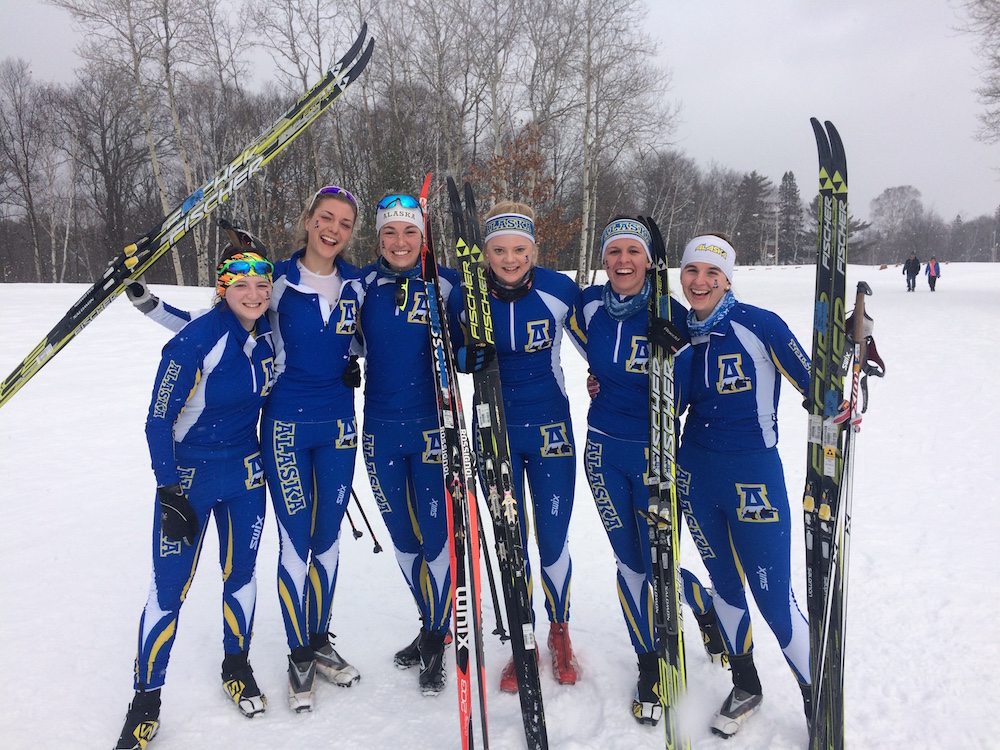
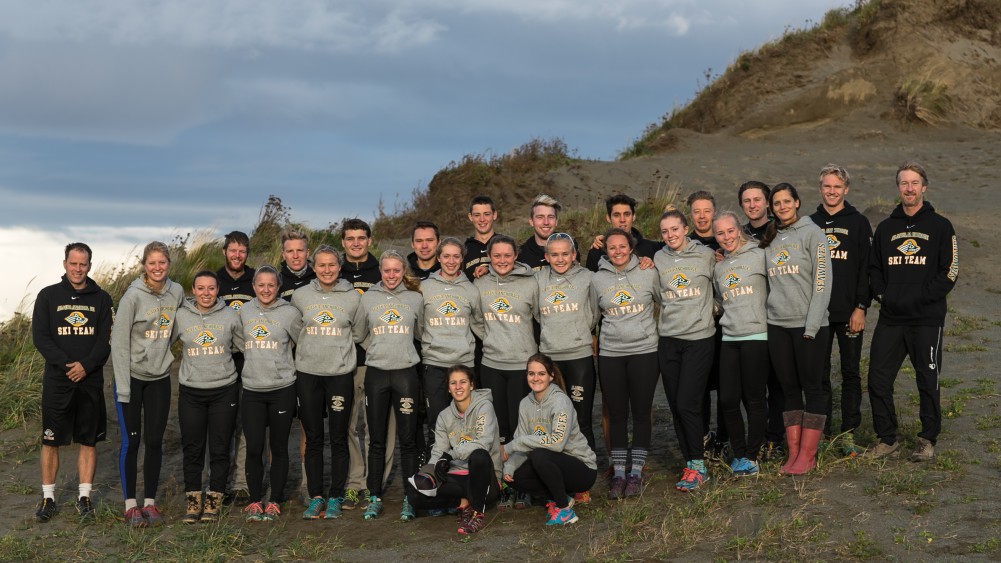
The present faces of the 2016/2017 University of Alaska Anchorage Ski Team (both nordic and alpine) at Kincaid Park in Anchorage. (Photo: Adam Phillips/UAA Athletics)
College skiing in Alaska is on its deathbed. (Or perhaps on its deathbed in Anchorage, and at least in the sick bay in Fairbanks.) FasterSkier previously posted thoughts and reactions from some of the more prominent University of Alaska Anchorage (UAA) skiing alumni, including Olympians Brian Gregg and Sadie Bjornsen. But there are other people who stand to be even more immediately affected if the University of Alaska Board of Regents cuts college skiing after this season: the athletes who ski for UAA, and the people who coach them. Here we share some thoughts from those groups, in an attempt to understand the human cost of the proposed elimination of UAA skiing following the 2016/2017 season.
Two Athletes: Hailey Swirbul and Casey Wright
Hailey Swirbul, 18, is a true freshman at UAA. Born and raised in Colorado, she visited Anchorage for the first time on her official recruiting visit to UAA last fall. To her surprise, Anchorage was love at first sight (“I stepped off the plane and I saw those mountains glowing pink, and I was like, Whoa, this is magical. This is nothing like Fairbanks!”), and she happily committed to ski for UAA soon after. Swirbul competed and trained internationally prior to coming to UAA, including anchoring the U.S. women’s relay team at Junior World Championships in Almaty, Kazakhstan, in February 2015, and attending International Junior Camp in Norway that summer.
Casey Wright, 21, took a slightly more circuitous path to skiing for the UAA Seawolves (fondly referred to by the team as the “Skiwolves”). Wright, an Australian, was born in Melbourne, and is a member of the Australian National Ski Team. She has raced for her country at several international competitions, including world juniors in 2013 and 2014 and World Championships in Falun, Sweden, in 2015. Wright previously skied in the U.S. for the Sun Valley Ski Education Foundation (SVSEF) Gold Team in Sun Valley, Idaho. (She is one of at least three Australian national team skiers who currently live and train in Anchorage, including Alaska Pacific University athletes Jessica Yeaton and Paul (PK) Kovacs.)
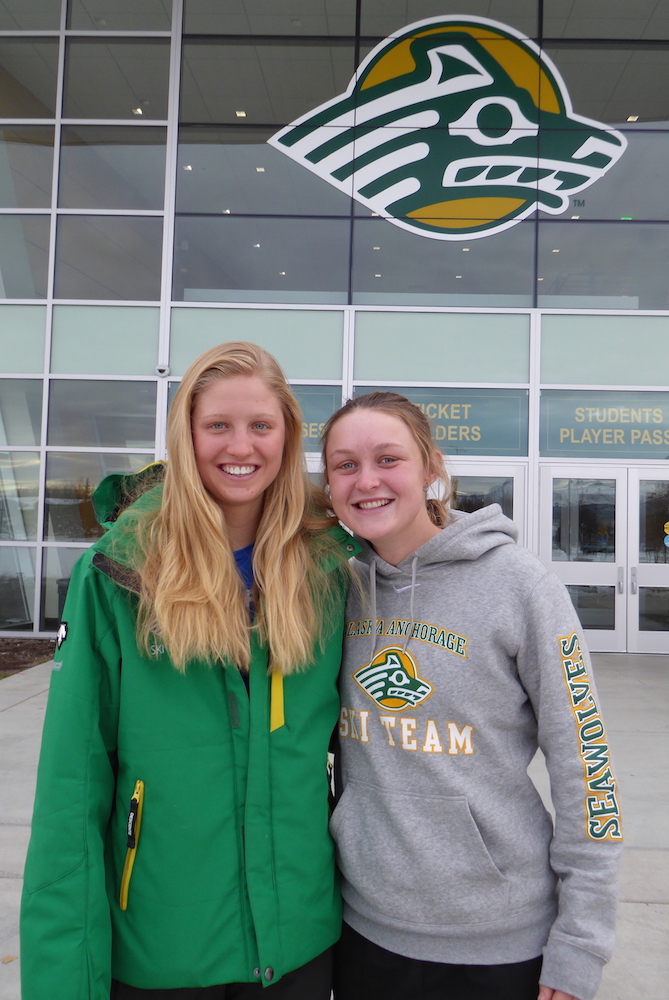
UAA present: ‘Skiwolves’ Hailey Swirbul (l) and Casey Wright (r), on the UAA campus in Anchorage, Alaska, in October 2016. (Photo: Gavin Kentch)
Both athletes spoke with FasterSkier in an in-person interview on the UAA campus on Oct. 28, slightly more than 24 hours after news came out that their program was slated to be discontinued at the end of this season. Both Wright and Swirbul were surprised and disappointed, but nonetheless impressively buoyant given the circumstances.
And speaking of buoyant, it is not just an orthographic coincidence that you can’t spell “Seawolves” without “love.” Both athletes’ sincere love – for their sport, for each other, for their suddenly endangered ski program – was apparent throughout the interview, in which Wright and Swirbul at times literally finished each others’ sentences.
This particularly came through in each athlete’s overriding concern at this moment: for others and for their team.
“I’ve gone from initial, like, absolute being distraught to kind of angry, and now I’m trying to understand why, and trying to look in the future,” Wright said when asked how she was feeling. “For us at the moment, or for me anyway, it’s just, like, looking for out my team, looking out for my coaches, just trying to make sure everyone’s okay. I think that’s really my main concern at the moment – that everyone is coping as well as they could be.”
Swirbul expressed similar sentiments: “One of the hardest things … that each of us are going to face is breaking up this team, ’cause we have such a young team, and we have so much potential, and it is horrible to see that go right now.”
“We are really close,” Wright added. “I’ve never been on a team where I’ve had this connection with teammates, where it’s like – we’re just like a family, an extended family.”
Indeed, Wright called the Skiwolves “my second family.” “It takes me, like, over 30 hours to get home,” she observed, reflecting the distance between Alaska and the antipodes. “This team is my family,” Wright stated, her voice and syntax breaking, “and – the thought of not being able to see all these people every day – like, after this year – or not even a year, after, what is it, going to be five months, pretty much, six months, is just like – it’s devastating. I can’t even fathom… that’s just heartbreaking.”
Swirbul, discussing the Oct. 27 meeting at which they were told that their program was slated to be cut, continued with the familial theme. “One of our teammates actually paralleled it to a funeral, and it feels like our team is dying,” Swirbul said.
“It feels like a death in the family,” Wright concurred.
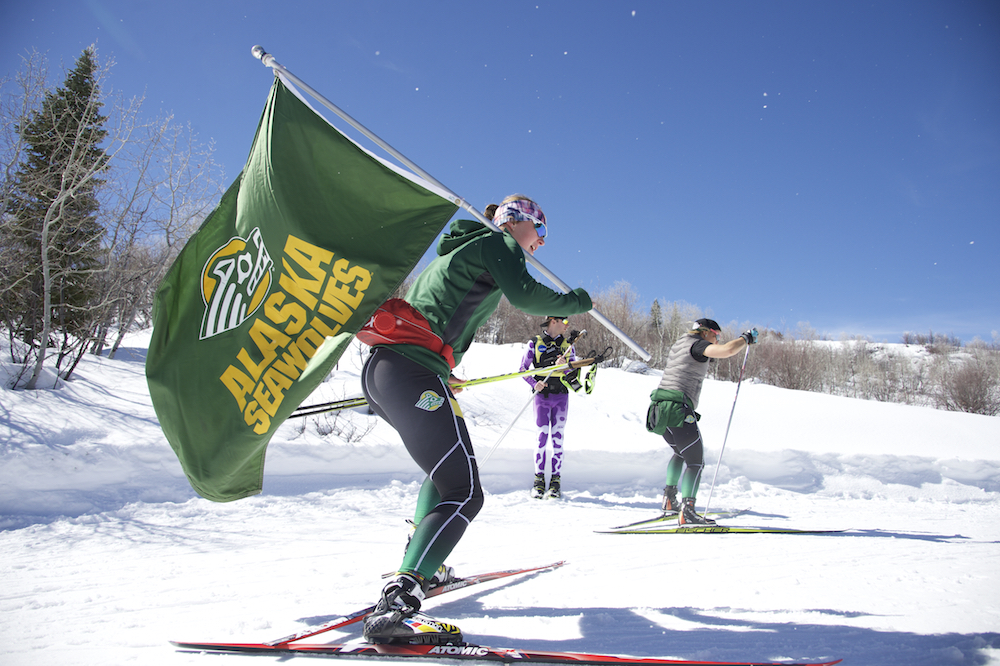
UAA present: Casey Wright carries the Seawolves’ team flag at the 2016 NCAA Skiing Championships last March at Howelsen Hill in Steamboat Springs, Colo. (Photo: Jamie Schwaberow/NCAA Photos)
While both athletes underscored that the team was quickly becoming tighter than it ever had been, they admitted that they had begun thinking about what might come next if their program – and college scholarships – come to an end.
(UAA Athletic Director Keith Hackett wrote in his public statement that “UAA will honor our commitment to those Student-Athletes who have been impacted by this decision by keeping them on scholarship through the spring of 2018.” But head nordic coach Andrew Kastning said that he was “a little surprised” to hear that his athletes only had two more years on scholarship (counting the 2016/2017 season), “because at one point when we thought that we were going to be – when the cuts were being talked about, [assistant nordic coach] Sara Studebaker had asked Keith what would happen to our athletes that are here. And he said, ‘Their scholarships will be honored until they graduate.’ But it didn’t sound like that was arranged, at least at this point.”)
“It’s impossible not to think about [next year],” Swirbul, 18, said. “I’ve been thinking about it for the past couple months, unfortunately, especially when [my] parents have been encouraging me to look into that in case that happened, and it did. First off, I need to clear up what this whole situation with the scholarship in the coming years is. And that’s a huge factor in my decision. If that’s the case, then my first option would be to attend school here still, and potentially ski for APU [Alaska Pacific University]. Otherwise, I need to start applying to colleges all over again.” (While athletes who transfer schools are typically required to sit out a year before playing again at their new school, the one-year waiting period is waived when the athlete’s sport was cut at the previous school.)
Swirbul reiterated that she yearned to stay in Anchorage: “I love it here. I don’t want to leave. Taking that away from me, taking that away from all of us, is just heartbreaking.”
Wright, who turns 22 next month, had similar goals, but was still working with the NCAA to gain some clear answers to something as simple as how many years of NCAA eligibility she had remaining before she began the process of seeking out other schools. “I’m in a bit more of a difficult situation, being an international student-athlete,” Wright said.
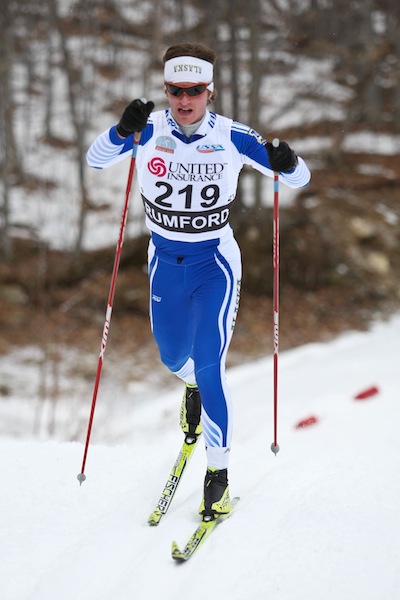
UAA past: Erik Bjornsen (then UAA, now APU and USST) races in the men’s 15 k classic race at 2011 U.S. Nationals in Rumford, Maine. (Photo: FlyingPointRoad.com)
“In order for me to achieve my goals,” she continued, “the best place for me to be, I believe, is in the U.S. It’s just, the calibre of skiing here is fantastic in order for me to develop and reach my goals. Although I don’t have as many years of eligibility left, so that would be a difficult one to try and convince another team to take me on.” Wright also hoped to stay in Anchorage if at all possible.
Wright recounted her self-initiated “recruitment” into the UAA program (she had been skiing with the SVSEF before she began reaching out to American NCAA ski teams), and how it led to the current team at UAA. “Andrew was the only one that responded to an Australian girl contacting him saying that I was a skier,” Wright said. “I don’t think anyone else believed me.”
UAA originally didn’t have scholarship space for her, but a space then opened up on short notice. “So I pretty much just jumped on a plane and came here. … It was the best decision I could have made. It’s just been incredible,” she said.
Wright recounted the process by which this year’s team – which, she pointed out, skews young and blonde – was assembled soon after she came on board. “Andrew was talking about all these freshman girls we’ve got coming in. He was like, ‘We’ve got a lot of 18-year-olds.’ It was like, ‘Oh boy, we’re going to have a lot of Justin Bieber [Swirbul cracks up], and teeny-bopping around’ – but it’s been nothing like that.”
Swirbul: “Wow, thank God.”
Wright: “He just kept signing girls.”
Swirbul: “And they’re all blonde and they’re all freshman.” (This is almost literally true.)
Wright: “Andrew has dubbed us The Blondetourage. That pretty much sums us up.”
On a more serious note, and discussing the process that led to the ski team being cut, both athletes were quick to reject a reporter’s suggestion that they might feel betrayed.
“I absolutely would not say betrayed,” Swirbul said. “And I think that’s how the coaches feel. They feel like they betrayed us – I think some of them are blaming themselves for this. And that’s the hardest thing for me to see, is thinking about my teammates and my coaches that might not have a clear path of where to go in the next few years. I think that I’ll figure something out, and a new door will open. I just worry – I feel so much for the people that don’t have that clear path.”
Swirbul also disagreed with the premise that skiing had been singled out in some manner. “I I don’t think we were necessarily singled out,” she said. “But I can’t understand why they would cut skiing in Alaska. I don’t understand that. And I don’t think they understand why they cut us. I don’t know. … Were we singled out? No. Are we some of the best academic and hard-working people at UAA? Yes. And I don’t think they would purposefully single out those types of people to remove.”
“Were we singled out? No. Are we some of the best academic and hard-working people at UAA? Yes. And I don’t think they would purposefully single out those types of people to remove.” — Hailey Swirbul, UAA freshman nordic skier
Finally, Swirbul graciously declined an invitation to compare the ski team’s record of success to the consistent mediocrity and decades-long trend of losing seasons that plague the UAA hockey team.
“I would never wish this upon anyone else, and I can’t say that I would rather have the gymnastics be cut, or the hockey be cut – because this sucks. And I don’t want anyone to go through this,” Swirbul said.
At the same time, Swirbul expressed some confusion as to whether it was really money or something else that was driving the decision to submit skiing for proposed elimination.
UAA past: Sadie Bjornsen (then UAA, now APU and USST) skis to a third place finish in the women’s 5 k classic race at the 2009 NCAA Championships in Rumford, Maine. (Photo: FlyingPointRoad.com)
“Actually, what the director [Hackett] ended up saying,” Swirbul recalled of the Oct. 27 meeting, “was that it doesn’t even come down to money at this point, it’s more NCAA rules. They’re cutting our teams from 13 to nine. And so they need a 10th team, potentially. And they said, ‘If we do need a 10th team, if that waiver goes through and we need to find a tenth team, they will find the money to do that somehow.’ However, they can’t let us find the money to fund ourselves. I don’t even know what they’re talking about. They said there’s money there if they need to have a 10th team.”
Wright expressed similar sentiments: “We want the opportunity to, if it is down to money, we want the opportunity to fundraise. We were told that Alaska wasn’t a giving state, that people here don’t want to give money, that’s what he told us, which, we don’t believe that’s true, considering that APU is able to fundraise six figures annually.”
The Alaska Dispatch News, or ADN, has reported that the annual budget of the APU program is “about the same amount” as that of the UAA ski team. “With APU always in financial straits,” the ADN wrote, “the team raises most of its own funds.”
While it is hard to quantify the generosity of a state, some indication of Alaskans’ attitudes toward charitable contributions may be gleaned from the success of Pick.Click.Give, a program that allows Alaskans to voluntarily choose to donate a portion of the Permanent Fund Dividend (PFD), the share of oil revenue that is annually given to most Alaskans. Last year 5.5 percent of Alaskans who filed for a PFD online made a donation through the program, donating an average of $108 per person from a revenue check that this year came out to $1,022 per person.
“If we were given the opportunity to raise funds,” Wright continued, “or to meet a target, or who knows what … we would have done it. We would have been knocking on doors, asking for people to donate, selling cookies like Girl Scouts. We would have had a bake sale. I think that’s what hurts the most, is that we couldn’t do anything, we weren’t given the opportunity to save ourselves; it was basically said, ‘This is out of your hands.’ … That kind of stings as well, when we’re told, ‘You just have to sit back and wait,’ which skiers aren’t good at doing. If there’s something that we can do, we want to do it.”
The Coach: Andrew Kastning
Head coach Kastning, 34, now in his sixth season at UAA, also yearns to take action and find a solution. He and his wife, former Whitman ski coach Calisa Kastning, have a new house in Anchorage and two young girls. “We got another kid on the way, coming in March,” Kastning noted. “So the stakes to figure something out are kinda high.”
Kastning spoke with FasterSkier by phone on Oct. 29, shortly before the lifelong Cubs fan watched Chicago lose Game 4 of the World Series 7-2 to the Cleveland Indians.
Coach Andrew Kastning teaching seventh-grade boys to V2 in Kiana, Alaska, on a Skiku ski outreach trip to rural Alaska. (Photo: Celia Kastning)
Beyond the obvious, there are several aspects of Kastning’s situation that are particularly poignant. The first is that, as he said, “I’ve got the team now that I’ve always wanted. And nothing against the teams I’ve coached before, but since I got to Alaska I’ve been trying to get kids – young, promising Americans combined with experienced international racers. And for the most part, it’s been experienced international racers that I had.”
Until, Kastning continued, “I turned the corner when Hailey signed a year ago. She signed early, and that opened the door, opened the eyes of other American recruits coming out of high school to look at Alaska. And this is the team that I’ve always wanted to coach. Because we have so much talent and they’re so young, and so moldable, and they’re getting along so well … it’s been awesome to do that. It makes the sting of it a little bit extra, because there are eight freshmen on my team and four sophomores. And so we’re set up well to be stronger and stronger.”
But this is cross-country skiing, a sport where your speed this season is largely determined by how much you were training the year before (and the year before that, etc.). And it appears that Kastning will only have one season in which to help his athletes achieve their best. “We’re just trying to get the best peak performance that they have within them,” Kastning said, “and I know they’ll ski their hearts out.”
Kastning remains clear-eyed about the artificial limitations of taking what should be a four-year progression and compressing it down into one season. “It would be a Disney story to win the NCAAs this year,” Kastning said. “However, looking ahead in the next two to four years, given this group of kids, I don’t think that’s out of the question. The way they’re working together, and the talent level that they have.”
“It would be a Disney story to win the NCAAs this year. However, looking ahead in the next two to four years, given this group of kids, I don’t think that’s out of the question.” — Andrew Kastning, UAA head nordic coach
The other reason this is especially poignant for the Kastning family is that together they’ve been through this drill before. Twice. Kastning was assistant nordic coach at the University of Nevada, Reno, in the late 2000s, until he saw the writing on the wall and left for a more secure coaching job elsewhere. A year later, the Nevada athletic director – a man named Keith Hackett – announced that skiing was going to be cut at Nevada.
UAF past: David Norris (now APU) racing at U.S. nationals in Rumford, Maine. (Photo: Kris Dobie)
(Hackett would take the same job at UAA in 2012. His official UAA bio notes, “UAA’s skiing, men’s basketball, women’s basketball and men’s cross country [running] teams have all produced top-four national finishes since 2008.”)
Kastning’s then-girlfriend, now-wife, Calisa (Schouweiler) Kastning, was coaching at Whitman at the time. Until, Andrew says, “Calisa called me at the conclusion of the 2009 NCAA mass start races – I was still in my ski boots – and she was in tears, telling me that her program had just ended. … And it was a shocking announcement. And they had no chance to fight it, and no ability to fundraise to keep it going, and even a few donors there came through with a big chunk of money that wanted to keep the team, but the athletic department stood their ground and said ‘no.’ ”
Andrew happened to visit Calisa in time to attend the final team gathering for the Whitman College Blues ski team (most famous skiing alumnae: Holly Brooks ’04 and Laura Valaas ’06).
“And it was heartbreaking.”
“I wasn’t even involved with that program at all,” Andrew said. “But then through my girlfriend at the time, to see those kids trying to cope with the last team gathering – which we’ll have to go through too if this decision stands – it was really hard. And I was just kind of a bystander in that situation. So I’ve already been through one final gathering for that team. And it was a little bit by happenstance, but I know what it’s like and I know what the emotional rollercoaster is that we’re going to have to go through until the end of the spring semester.”
Andrew continued, looking ahead to a year full of lasts: “We’ll have Athlete of the Year banquets, with the whole athletic department, and it’s going to weigh on everybody’s mind there. And we’ll have our final team barbecue gathering where we name our most valuable players and our most improved, and all that. And normally we give framed pictures to our seniors, and talk about each senior athlete and what they’ve contributed to the program and say goodbye to them. And now we’ll probably have to make framed pictures of everybody, and try and talk about everybody. Which will take all night, because they’re all such awesome kids.”
UAA breakfast present: Local skiers show their support for #savealaskaskiing. (Photo: Holly Brooks)
Despite Andrew’s shared history with Hackett and shuttered ski teams, he hesitates to blame Hackett for the current decision at UAA: “I wish the president [UA President Jim Johnsen] had been there [at the meeting to make the announcement], because he’s the one that’s really pulling all these micromanagement strings above, and unfortunately Keith is having to, for lack of a better word, be his puppet, and take orders from the top. Because even though Keith cut skiing once [before], I don’t – at least I don’t want to believe that that was his first choice. It seemed like it was just a fait accompli, like it was agreed upon on both campuses that the ski team was an easy target. And that was going to be the first tree to fall.”
(Many symbolic trees are falling on the UAA campus these days. A survey of faculty and staff released earlier this week showed that “more than half” of current staff members “feel that morale [at UAA] is the lowest they have ever seen.”)
As a small silver lining, Kastning appreciates that at least someone else had to give his athletes the bad news: “In a sense I was glad that Keith had to be the one to look them in the eye and tell them that their hopes and dreams were going to be crushed in Alaska.”
A final season to remember
It is clear from coach and athletes alike that, while news like this could potentially cleave some teams apart before the season even began, it is instead leading the 2016/2017 Skiwolves to cleave together even stronger than before. Here’s the final word from the athletes:
Swirbul: “It’s quite bizarre that they’re cutting out this part of Alaskan culture in Anchorage. … And we’re hosting nordic U.S. Nationals in two years – Anchorage is hosting that – and there won’t be a college team here. That’s ridiculous. That’s outrageous.”
Wright: “It’s almost comical to think that we won’t be there in green and gold on the start line. It’s really heartbreaking. It’s just sad.
“But we’re going to rally together, and we’re going to have a memorable season. And people are going to remember the Seawolves. It’s not that we’re just gonna hang our heads low, and walk out from our last race. We’re going to go out there, and people are going to know that we’re there. We’re going to be there loud and proud. And I think that’s going to be – that’s the thing I’m looking forward to most this season, is that we’re going to make it one that people are… next season they’re going to miss us, because we’re not on the start line with them.”
Swirbul: “Nice. That makes me hyped.”
Wright: “I think that makes everyone hyped right now. We’re going to make this season count.”
The Alaska Airlines Center, home to the University of Alaska Anchorage Seawolves athletics program in Anchorage, Alaska, photographed last month. (Photo: Gavin Kentch)
The University of Alaska system structured its recent waiver requests to the NCAA partially around a presidential directive to preserve men’s hockey at any cost, then backed away from that suggestion in a public explanation of its actions, an analysis of the school’s official waiver documents suggests.
University of Alaska Anchorage (UAA) Athletic Director Keith Hackett and President Jim Johnsen announced last week that men’s and women’s skiing at both UAA and the University of Alaska Fairbanks (UAF) were among the sports targeted for elimination in a waiver request submitted to the relevant NCAA membership committee. At the time, Johnsen told the Alaska Dispatch News that “hockey survived largely because the NCAA requires a school to offer two men’s team sports and two women’s team sports,” and that the only men’s team sports at both UAA and UAF are basketball and hockey. (NCAA bylaws consider cross-country skiing to be an individual sport.)
But the official waiver requests submitted to the NCAA were somewhat less circumspect. “The President of the University System has stated that Alaska Anchorage shall make every effort to retain men’s hockey,” UAA’s waiver request stated. And “the President of the University System has stated that Alaska Fairbanks shall make every effort to retain men’s hockey,” UAF’s waiver request stated in near-identical language.
(The waiver requests are substantively identical, but were written, or at least edited, by different people. Run-on sentences, typographical errors, and citations to nonexistent bylaw provisions that are present in the UAA waiver request were corrected in the UAF version of the same document.)
The 13 sports currently sponsored at UAA are as follows:
Table of 13 sports currently offered at UAA, prior to its waiver request to the NCAA this month (Screenshot from UAA waiver request)
The 10 sports currently sponsored at UAF are as follows:
Table of 10 sports currently offered at UAF, prior to its waiver request to the NCAA this month. (Screenshot from UAF waiver request)
The team sports offered at UAA, according to NCAA Division II Bylaws Section 20.10.3.3, are men’s basketball, men’s ice hockey, women’s basketball, and women’s volleyball. This bylaw defines all other sports at UAA (cross-country running, skiing, indoor and outdoor track, and gymnastics) as individual sports.
At UAF, the team sports are men’s hockey, men’s basketball, women’s basketball, and women’s volleyball. Cross-country running, skiing, swimming, and rifle (riflery) are all defined as individual sports.
UAA and UAF are currently both members of the Great Northwest Athletic Conference, or GNAC. UAA and UAF both wrote in their waiver requests that they must sponsor basketball, volleyball, and cross-country running in order to remain a member of GNAC.
University of Alaska Fairbanks women’s nordic-team skiers get together for a photo last season: (from left to right) Hannah Rowland, Anne-Tine Markset, Nichole Bathe, Martina Himma, Ann-Cathrin Uhl, and Sarissa Lammers. (Photo: Nick Crawford)
Waiver options
UAA and UAF are both seeking relief from the requirements of Bylaw 20.10.3(a), which states that a Division II member school “shall sponsor” a minimum of “Five varsity intercollegiate sports, including at least two team sports, based on the minimum requirements of Bylaw 20.10.3.3 and involving all-male teams or mixed teams of males and females; and five varsity intercollegiate sports, including at least two team sports, based on the minimum requirements of Bylaw 20.10.3.3 and involving all-female teams.”
There are therefore two parts to this bylaw: the requirement that a school have at least 10 sports, and the requirement that a school have at least two team sports per gender.
Both UA schools are seeking a waiver solely of the 10-sports-total provision of this bylaw. It is unclear how much attention was paid to the possibility of seeking a waiver of the two-team-sports provision, in addition to or instead of the 10-sports-total provision. Gaining some leeway with regard to the two-team-sports requirement would potentially allow either school to look anew at hockey or basketball, the two most expensive sports at UAA by a substantial margin, as a potential target for cuts.
Hackett, the UAA athletic director, was asked by email, “Did UAA consider seeking a waiver of the two-team-sports requirement, in addition to or instead of the ten-sports-total requirement?” He wrote back, “Yes, many months ago as part of Strategic Pathways. The answer is NO to the second part of your question.”
Hackett was also asked whether men’s hockey could be said to be receiving special treatment from Johnsen, the UA President, when men’s basketball is also a team sport (as well as one required for GNAC membership).
Hackett wrote, “Both waivers stated the same thing with regard to making every effort to retain Hockey at both Institutions as directed by President Johnsen. Both UAA and UAF are members of the GNAC and we wanted to be sure we would be able to maintain our Full membership with our primary Division II Conference. Men’s Basketball was not part of any discussion.”
The budget for the UAA hockey team for the 2016/2017 season is, in round numbers, $1,347,000 dollars. The budget for the men’s basketball team is $467,000. The budget for the women’s basketball team is $446,000. The budget for each of the men’s and women’s ski teams (at UAA, this includes alpine as well as nordic) is $280,000.
While direction from President Johnsen features as a significant part of the official waiver request that was submitted to the NCAA on behalf of both schools, this presidential involvement is not mentioned in the Frequently Asked Questions document posted on the Strategic Pathways website.
“In the waiver application why was hockey named specifically as a sport to keep when it is the most expensive sport?” asks question 2 of the FAQ document.
The answer given there is, “In making these decision [sic], cost was a driving factor, but it was not the only one. We applied a set of reasonable criteria that included keeping specific sports required by GNAC in order to keep our membership in that conference, making sure we are adhering to the gender equity requirements of Title IX, keeping the strong instate rivalry between UAA and UAF and cost.”
Additional surprises?
While all previous reporting on this story, in FasterSkier, the Alaska Dispatch News and elsewhere, has focused on UAA’s announced plan to eliminate four sports (men’s and women’s skiing and men’s and women’s indoor track), the official request submitted to the NCAA actually mentions the possibility of cutting a fifth sport if financially necessary:
Detail from waiver request by University of Alaska Anchorage to NCAA this month. (Screenshot from UAA waiver request)
The language in the footnote – “two (possibly three) male sports and two female sports” – suggests that, if a fifth sport were to be cut, it would be a third men’s sport. Assuming for the moment that basketball and hockey are “protected” (by virtue both of being team sports and of UAA not having sought a waiver to the two-team-sports requirement), that leaves men’s cross-country running and men’s outdoor track potentially vulnerable as a fifth sport to be eliminated.
(Analogous language in the UAF waiver request mentions cutting only two sports, men’s and women’s skiing, alongside reducing scholarships among the remaining eight sports.)
Furthermore, both schools’ waiver requests seek a waiver of the 10-sport requirement for a set period, five years, and promise to “evaluate its options to return to the 10-sport minimum required for compliance with Division II membership criteria” at the start of the 2021/2022 season.
When asked whether he thought that elimination of a fifth sport would be necessary, Hackett wrote, “I certainly hope not. I am not sure there is a timeline in place for making any further team decisions. I have not spent any time considering additional sport team reductions.”
When asked whether he expected that any eliminated sport would be able to return after having been cut for five years, Hackett wrote, “It would be difficult to ascertain.”
Recent developments
Since news of the waiver request first broke last week, supporters of the #savealaskaskiing movement have been busy. There is a website. (The team behind the website includes André Horton, currently a consultant with a lobbying and campaign management group but formerly a member of the U.S. Alpine Ski Team, as well as UAA head ski coach Sparky Anderson, Horton told FasterSkier in an email.) There is a march and public protest planned for Fairbanks next Thursday afternoon, Nov. 10, in connection with the upcoming Board of Regents meeting. And there are alternative budget proposals being advanced that claim to save an equal amount of money through administrative restructuring, while leaving academics and athletics programs unscathed.
Manon Locatelli of the University of Alaska Anchorage double poles out of the start of the 2015 Seawolf Invite at Kincaid Park in Anchorage, Alaska. (Photo: Sam Wasson Photography / http://portfolio.samwassonphotography.com/about)
The University of Alaska Board of Regents heard public testimony for two hours on Monday afternoon. While the teleconference window was technically open to anyone who wanted to testify on any subject, firsthand reports from people who listened to the testimony suggest that the focus was overwhelmingly UAA and UAF skiing, and that all testimony on this subject was in favor of preserving the program.
Nearly all “of the comments were regarding skiing,” wrote third-generation Alaskan, former UAA skier, and former Alaska Pacific University ski coach Charlie Renfro in an email to FasterSkier. The only exceptions were “a couple comments about other university programs that were/are on the chopping block.”
“Something like 50 people were able to comment,” Renfro continued, “and I would say about 48 of them were very constructive and from people who are all very knowledgeable regarding the UAA/UAF programs – both nordic and alpine. Nearly everyone that called in, I knew personally from either nordic or alpine, past, present, athletes, coaches and parents. One girl, a ski alum who said she was calling from Copenhagen (it was 2am there) gave an incredibly concise, heartfelt speech. It was very moving. I hope the [Board of Regents] felt the same way.”
Anchorage resident Ira Edwards, who previously skied on the UAF nordic team and currently works for the State of Alaska, Department of Natural Resources (ski fans may recognize Edwards’s name from his side job – he spent many years as Rossignol’s U.S. race service manager), expressed similar sentiments.
Rossignol tech rep Ira Edwards provides race support at a race at Kincaid Park in Anchorage, Alaska.
“I have called into these before, for various other reasons” unconnected to athletics, Edwards told FasterSkier in a recent phone interview. “Generally, they have an hour and a half for testimony, or sometimes only an hour – they anticipated a higher call volume, so I think they bumped this one up – but I don’t think I’ve ever heard more than five or six people ever call in.”
But on Monday afternoon, Edwards called in roughly a half hour after the public comment window opened, and was caller number 41 in the telephonic queue. He was the last person to be able to speak on Monday; the Board closed testimony immediately after he had finished speaking, after hearing two hours’ worth of comments. Edwards personally knew of a friend who was caller number 91 – that is, there were at least 50 more people after him who had hoped to speak – and suspects that there were a total of “well over 100 people” on the line who called in in an attempt to testify.
Edwards recalls a total of three comments that were not about skiing (and one of those concerned the school’s running program). “There was not a single negative comment [about skiing],” Edwards said.
Next steps
Two things would have to happen for either or both of the UA system’s waiver requests to be approved: (1) first the NCAA Division II Membership Committee must approve the request, and (2) then the University of Alaska Board of Regents must approve the request.
The membership committee holds a regularly scheduled in-person meeting in Indianapolis on Tuesday and Wednesday of next week, Nov. 8-9. Committee chair Kevin Schriver told FasterSkier on Monday that the committee “will see if that [the UA waiver requests] will be a part of our agenda.” An agenda for next week’s meeting is not yet posted online.
The University of Alaska Board of Regents meets the following two days, Thursday and Friday, Nov. 10-11, in Fairbanks. The agenda for that meeting “has not yet been posted,” a Board of Regents representative told FasterSkier in a Thursday afternoon phone call. They said it would be posted on Friday, Nov. 4.
The Board of Regents agenda and related materials should be accessible from here once they have been posted. Information about a live stream of next week’s Board of Regents meeting is available on the same page.
Differing perspectives
While many Alaskans are banding together in support of the ski program at both schools, the specific mood on both campuses seems somewhat different, reflecting differing circumstances and divergent views of the possibility of the NCAA granting the relevant waiver request.
In Fairbanks, ski team supporters are holding out hope that the NCAA 10-sport rule will operate as a bulwark to keep UAF from cutting the relatively low-profile sport of skiing.
UAF head nordic coach Nick Crawford. (Courtesy photo)
As UAF head nordic coach Nick Crawford wrote to FasterSkier last week, “For UAF specifically, I don’t think skiing will be cut as I don’t think the NCAA will grant the waiver to the ‘10 sport minimum requirement.’ One of the NCAA’s core values is to provide sporting opportunities from athletes of many different sports and the 10 sport rule is in effect to protect small sports like skiing. It’s a slippery slope to allow Alaska to cut ‘less well known’ sports like skiing and indoor track to continue to fund their more popular sports, If the NCAA grants this waiver, it sets a precedent to eliminate non-revenue generating sports across the country with fewer and fewer sports offerings and that is not a direction I think the NCAA wants to go in.”
One of Crawford’s athletes, sophomore skier Conner Truskowski, expressed similar sentiments and included a call to action, writing to FasterSkier, “When we first got the news we were all pretty bummed out and mad that something as Alaskan as skiing was being considered for cuts. However, now that we have had time to process what could happen, we are all motivated to prove to the NCAA and everyone else that we are willing to fight for the sport we love and prove that the ski community benefits from having us as a team here. I want to stress that no decision has been made yet and there is still time to let everyone in the decision making process [know] that skiing is valuable. We believe that the waiver will not pass because the NCAA does not generally allow exceptions to their rules. Because of all that has happened, we are training harder than ever to make our season the best one we’ve ever had. Again, I really want to make it clear that no decision has been made yet and to let everyone know that their voice can be heard in the decision. Let the NCAA know that Alaska skiing is valuable to the ski community, both locally, nationwide, and worldwide.”
But at UAA, head nordic coach Andrew Kastning sounded somewhat more resigned, as if the NCAA were less of a bulwark and more of a Maginot Line.
In a recent phone interview, Kastning told FasterSkier, “Ultimately, I have a sliver of hope that the waiver doesn’t pass, that the Regents can be swayed and decide that skiing has to be saved and they need to make another decision. So I feel like there’s a tiny chance for UAA to survive at this point. But it’s obviously a giant hurdle to clear when the athletic director and the president have publicly recommended that this is the route to go to save the school money.”
While Kastning was clearly saddened, he saved his strongest disappointment for his athletes. “I ache the most for my athletes,” Kastning said, “the ones that I’ve coached and the ones that know how special the situation and an experience it is to go to UAA and ski race in Alaska, and travel around the American West. And also for the current team, that has just gotten here and has only been here for a year at most, and they’re really bonding well and working really hard to reach their goals. And because of some short-sighted decisions and a tough budget situation, are faced with having to find another path.”
Manon Locatelli of the University of Alaska Anchorage double poles out of the start of the 2015 Seawolf Invite at Kincaid Park in Anchorage, Alaska. (Photo: Sam Wasson Photography)
An outcome first broached as a possibility this spring became an all-too-concrete reality Thursday afternoon, when plummeting oil prices and a yawning state budget deficit led to the announcement that University of Alaska President Jim Johnsen was targeting nordic skiing for elimination, at both the University of Alaska Anchorage (UAA) and the University of Alaska Fairbanks (UAF), in a waiver request submitted to the NCAA. On Friday, the ski community and affected skiers continued to react.
Financial background, or, how did we get here?
As FasterSkier previously reported, the State of Alaska is dependent upon funds from a single source, oil revenue, to an extent unparalleled in any other state. Falling oil prices over the last two years have led to widespread budget deficits, layoffs and reductions of both state and private-sector employees (particularly in the oil and gas industry), and political recriminations over the failure to pass a balanced budget.
When FasterSkier first reported on this story in May 2016, the price of oil was approximately $48 a barrel. At the close of trading on Thursday, oil was at $49.89 a barrel. At these prices, the State of Alaska faces a revenue shortfall equal to approximately two-thirds of its budget. Oil has not been over $100 a barrel in over two years.
Alaska residents have not paid a state income tax since 1980. Although some communities have instituted local sales taxes, there is no statewide sales tax.
Brian Gregg (Team Gregg/Madshus) racing the Davos World Cup 30 k freestyle in Switzerland. (Photo: Madshus/NordicFocus)
Alumni react
Brian Gregg, currently one half of Team Gregg, came to UAA to ski in 2005. He later became a three-time SuperTour distance champion and a 2014 Olympian. When he was first asked, in May, if he would like to answer some questions about what UAA skiing had meant to him, Gregg promptly responded with a 600-word email titled, “UAA Ski Team, a vital part in my pathway to the Olympics.”
Gregg took some time out from preparing for this winter’s first on-snow time trial at Frozen Thunder in Canmore, Alberta, to share some updated thoughts earlier on Friday. Gregg wrote to FasterSkier, “This is very disappointing news to me personally and to the entire skiing community. NCAA Skiing is a major asset in the development of cross-country skiers for our country. The future for skiing as an NCAA sport does not look good. I have seen the programs cut at Western State, University of Nevada Reno, Whitman College, Saint John’s University, College of St. Benedict, Gustavus Adolphus, [Macalaster], and now UAA and possibly UAF. The question now is who is next?”
Gregg continued, with an eye to the future, “I also start to think about whether or not NCAA has a rule on the number of member school which must have programs in order for there to be an NCAA Championship. Currently the Central Division has only 5 Men’s programs and 6 women’s programs, several which don’t even have a Coach who is paid full time. I encourage everyone to be preemptive in showing the incredible value of our existing skiing programs to the administration, student body and community.”
Sadie Bjornsen currently skis for Alaska Pacific University (APU) and is a member of the U.S. Ski Team (USST). But in 2009, she was a freshman for the UAA Seawolves and finished in the top five in five out of eight races and placed third overall in the classic race at NCAA Skiing Championships.
“My year as a Seawolf was one of the most important ‘steps’ of my life,” Bjornsen wrote to FasterSkier on Friday. “I would have never been drawn to AK fresh out of high school, and discovered this incredible state. I see skiing as a big family with many functioning parts. By eliminating one integral part of the ski community, we are cutting off a strong piece of the family!”
Even though Bjornsen moved down the street to APU after one year, she is quick to underscore the important role of the NCAA-affiliated UAA program for American cross-country skiing.
U.S. ski team member, Sadie Bjornsen racing to a 17th overall in the women’s10 k freestyle at Stage 7 of the Ski Tour Canada in Canmore, Alberta. (Photo: Fischer/NordicFocus)
“I have always considered Alaska to be the best training for a cross country skier in the US,” Bjornsen wrote. “We have the perfect environment for training, including early snow in the fall, and late snow in the spring. I now race professionally, and am a student at Alaska Pacific University while racing World Cup. I see APU as providing the very best opportunity in the world for myself, but, I know this level is not designed for everyone. It is important to have options, and varied levels so that skiers can choose where they want to go, and have a path to where they are looking to reach. I would never give back that year of racing NCAA at UAA, a year that taught me so many lessons! It saddens me to know that won’t be available for everyone anymore!”
Joey Caterinichio is a local. She attended West Anchorage High School, where in the 1980s she raced on the same ski team as future four-time Olympian Nina Kemppel and current U.S. Ski Team head coach Chris Grover. (Caterinichio herself would later travel to Sochi as nordic program manager for the USST.)
After graduating from West High, Caterinichio originally pursued college skiing at St. Lawrence University in upstate New York. But after two years away, the lure of home brought her back to Anchorage, where she skied another two years for UAA.
Caterinichio, now 46, still lives in Anchorage, where she runs a medical supply company and, with her husband, raises three children. She also runs local community ski training group Alaska Nordic Racing. Caterinichio has attended 20 Junior Nationals.
Joey Caterinichio skiing for UAA, as shown in the 1992-1993 Seawolves media guide. (Courtesy photo)
Caterinichio took to Facebook soon after the news hit Thursday afternoon. (Caterinichio gave FasterSkier permission to share her thoughts.) Posting a historic photo, showing her skiing in a suit she had designed herself, she wrote, “This is me featured on the cover of the Seawolves magazine representing skiing in 92-93. This same picture was featured in the Great Alaska Shootout booklets [a basketball tournament] which loses tons of money every year, yet we are not cutting basketball. The money UAA is saving by cutting these programs is pennies compared to the good they do for the community and the positive role models that move up here or stay here for college because of the sport. These same folks stay and give back to Alaska.”
Reflecting on her personal history, Caterinichio continued, “Not only did I return from St. Lawrence to ski my last 2 years for UAA, I graduated with 2 degrees in science and I taught in the UAA Biology Department. With roots in this community, I stayed in Alaska. I own my own business, Employ others and In addition I have contributed thousands of hours to the sport of cross country skiing at the local level, national level and international level. There are others who chose this same path and who contribute hugely to this community. It’s not just about the sport. It’s about recruiting high quality community members to Alaska who stay and give back. Chasing these types of folks out of our state, cutting these sports in a time where the community is dying for positivity and crime is at its all time high! It’s time to think beyond the dollar. My give back alone for 25 years is an example of what could be lost. And on top of it this is ALASKA! We are a winter sport community. Come on UAA. As an alumni think global, think community!”
In a follow-up phone conversation, Caterinichio noted, “I’m not going to stop with Facebook now … It’s time to move quickly – I don’t know if anything’s fixable right now, but it’s time to try.”
Caterinichio clarified that while her goal was “to save skiing, of course,” she was also aiming “not to disrespect any of the other sports” at UAA. “I believe that all sports are important … and produce highly functional individuals for our community,” Caterinichio said.
Other skiers react
Holly Brooks is a two-time Olympian, recently retired from racing with the USST and APU. Brooks long ago put down roots in Anchorage, buying a house and recently opening a counseling, consulting and coaching practice.
Brooks gave FasterSkier permission to share what she had posted on her personal Facebook page after hearing the news: “It seems a bit ironic that while … our presence (as a country) and success internationally is growing, options in the US for skiers to support and chase their dreams are shrinking. While the NCAA doesn’t represent everyone’s path it’s an undeniable and important part of the ski community at large. The loss [of] NCAA skiing in Alaska is a huge hit to the greater nordic ski family nationwide.”
Holly Brooks (APU), following the Anchorage Tour at Kincaid Park last March. (Photo: Rob Whitney)
Brooks explained that she was hoping to channel her emotions over this recent news into something more positive: “Am I frustrated? Absolutely? Am I mad? You’d better believe it…. But I’ve decided that the best thing to do today is to channel my anger into something positive and that is to pitch in and support developing US skiers via the ‘Drive for 25.’ The National Nordic Foundation (NNF) … is an organization whose sole purpose is to help fund developing skiers. When I was invited to extend my stay on the World Cup to the tune of $140/day (for many months) the NNF pitched in to help. The Drive for 25 is the main fundraiser for NNF and the idea is ‘what if every ski fan in the United States donated $25 dollars – or more?’ By participating, D25 donors show that skiing matters and they are part of Team USA!”
As of earlier this week, 62 donations for NNF’s Drive for 25 program had come from Alaska, trailing only Minnesota (69) and Utah (64).
Kikkan Randall is a four-time Olympian, and a current member of APU and the USST. She did not ski for UAA, but as a lifelong Anchorage resident and prominent supporter of skiing and youth athletics, she feels strongly about the role of local college skiing in supporting the community.
“I just think we’re going to miss out on some really big contributions to the community, our ski teams are all out there working with kids and helping to take care of trails,” Randall told a local television station. “I think the community is really going to take a hit.”
How final is this?
The finality of this decision arguably remained an open question as the dust settled on Thursday and Friday. Despite a statement in the Alaska Dispatch News (ADN), repeated in FasterSkier, that skiing at both UAA and UAF had been “targeted for elimination in a waiver request submitted to the NCAA,” there was hope in Fairbanks that the waiver request would not be approved, and so skiing would be saved at least at UAF.
As UAF head nordic coach Nick Crawford wrote to FasterSkier late Thursday, “For UAF specifically, I don’t think skiing will be cut as I don’t think the NCAA will grant the waiver to the ‘10 sport minimum requirement.’ One of the NCAA’s core values is to provide sporting opportunities from athletes of many different sports and the 10 sport rule is in effect to protect small sports like skiing. It’s a slippery slope to allow Alaska to cut ‘less well known’ sports like skiing and indoor track to continue to fund their more popular sports, If the NCAA grants this waiver, it sets a precedent to eliminate non-revenue generating sports across the country with fewer and fewer sports offerings and that is not a direction I think the NCAA wants to go in.”
The 10-sport rule is contained in section 20.10.3(a)-(b) of the NCAA Division II Bylaws, which provides that “A member of Division II shall sponsor in Division II a minimum of” either five sports for each of men and women, or four sports for men and six for women.
Crawford told the Fairbanks Daily News-Miner on Thursday, “I guess I’d say I’m confident that we’ll be here still. It seems like the 10-sport minimum is designed so that small sports like ours aren’t overridden by larger sports.”
University of Alaska Fairbanks nordic skiers rollerskiing on campus last fall. (Photo: UAF)
Current UAF skier Conner Truskowski expressed similar sentiments to his coach on Facebook, writing, “To clarify, as a student athlete at UAF, skiing has not yet been cut! The universities are submitting waiver to the NCAA to allow for an exception to the 10 sport rule. While things do look very dark for UAA skiing, the waiver will most likely not pass as the NCAA doesn’t really allow exceptions to the rules. Even if the waivers do pass, these programs won’t be cut until next year.”
Truskowski continued, “This is a very dark time for collegiate skiing here in Alaska, but not all hope is lost. We are doing everything we can as athletes to fight for our program, and we can use all the help from the nationwide, and worldwide community we can get. Please help us all support Alaska skiing. Make it know[n] to the NCAA that there is strong opposition to this waiver, it will help us out immensely.”
Three-hundred miles to the south, UAA officials seemed to express a greater sense of finality. As UAA Athletic Director Keith Hackett wrote in an official statement, “at the conclusion of the 2016-17 academic year, UAA Seawolf Athletics will be discontinuing our sponsorship of Men’s and Women’s Skiing and Men’s/Women’s Indoor Track and Field.”
Hackett continued, “Should the NCAA Waiver request not be approved, we will take time to carefully consider which program would be reinstated.”
This presumably means only one program would be reinstated, as opposed to multiple programs. This is because the NCAA waiver would take UAA from 13 teams down to nine. If the waiver were denied, UAA would need to field only the minimum of 10 teams to comply with section 20.10.3(a)-(b) of the NCAA Division II bylaws.
Next steps and opportunities for advocacy
As the ADN reported, “If the NCAA grants a waiver to the university, the Board of Regents would still have to approve the elimination of sports teams. If a decision by the NCAA is made in time, the regents will take up the issue at their next board meeting on Nov. 10-11 in Fairbanks.”
The ADN continued, “No public comment will be allowed during that meeting. Instead, public testimony must be made by telephone on Monday from 4-6 p.m. The number to call is 1-866-726-0757.”
Toby Schwoerer, a five-time All-American in skiing at UAA (plus a sixth time in cross-country running), wrote to FasterSkier that he “would like to see some coordinated effort to write emails to the 11 Board members” of the Board of Regents, linking to contact information for the individual members of the Board.
The budget figures involved
As Crawford, UAF’s head coach, wrote, “One consideration is that skiing is not one of the most expensive collegiate sports in our state. If the state truly wants to save money through sport reductions they would choose to eliminate one of the more expensive sports.”
Crawford’s math seems to be correct. The data suggest that hockey is by far the single most expensive sport, and that skiing is somewhere in the lower middle in terms of overall team cost.
The ADN, citing figures from UAA, has broken down the UAA sports teams’ total budget of $4.33 million for the 2017 fiscal year that began on July 1, 2016.
University of Alaska Anchorage Seawolves logo (Photo: GoSeawolves.com)
Over 31 percent of that $4.33 million total, or $1.35 million, goes to one team, the men’s hockey team. (UAA has only a men’s hockey program.)
From 1985 through 2016, UAA skiing finished in the top 10 at NCAA Championships 31 times in 32 years.
The next most costly programs are men’s and women’s basketball, at approximately $450,000 each. Both programs have enjoyed ample success; the women’s team reached the Division II national championship game in April 2016, losing to national champion Lubbock Christian.
Men’s and women’s skiing are in the middle of the pack financially, at a cost of $280,000 for each of the men’s and women’s teams, or $560,000 total. The ski program costs somewhat less at UAF, $400,000 total, because UAF has only a nordic team and not an alpine team as well, and so has fewer athletes.
The UAA athletics program as a whole finished eighth overall, out of approximately 300 teams with D-II athletics programs nationwide, in the 2015/2016 Directors’ Cup, a season-long competition across all Division II sports programs that awards points for a school’s performance in up to 14 sports. It was the highest overall finish in UAA history. Over one-tenth of the Seawolves’ points for their Directors’ Cup ranking, 63 out of 570.5, came from skiing.
“We have developed an elite Division II program here,” Hackett told the ADN on Thursday. “This inhibits us in so many ways now. You reduce our teams and our budget, and it really impacts our ability to compete at the national level.”
History repeats itself?
Several of the major figures involved unfortunately have relevant experience in this vein.
Hackett most recently held a comparable position at the University of Nevada, Reno. The Nevada ski team was defunded and discontinued under his tenure. The assistant nordic coach until shortly before the program was cut was UAA’s current head nordic coach Andrew Kastning.
Kastning and his now wife, Calisa (Schouweiler) Kastning, moved to Whitman College, where Calisa was hired to coach the men’s and women’s nordic teams at the start of the 2007/2008 season. Fewer than two years later, the Whitman ski program was cut.
Kastning previously told a local radio program that they had thought they would be safe moving to a ski program in Alaska.
Recapping a lifespan
Skiing began at UAA in 1977, near the end of the pipeline boom, and one year following the establishment of the Alaska Permanent Fund. The population of Anchorage would grow from 48,000 to 174,000 during the 1970s, reflecting the pipeline boom. The original 15 kilometers of trails at local ski area Kincaid Park had been laid out a few years earlier. The Italian skier Giorgio Di Centa, who won two gold medals at the 2006 Olympics, was 5 years old.
March 1991: Bjorn Lasserud of Minneapolis at World Masters Championships at Kincaid Park in Anchorage. Lasserud won multiple national and World Masters championships. (Photo: Peter Hale)
If, as appears likely, NCAA-affiliated skiing at UAA comes to an end following the 2016/2017 season, it will be an even 40 years old. It will have survived the first great Alaskan oil recession, of the mid-1980s, but not the second. The Alaska Permanent Fund will have become a political football.
During the lifespan of UAA skiing, Kincaid hosted at least seven U.S. National Championships, five National Masters Championships, one Masters World Cup, and one World Cup weekend. (The World Cup was in March 1983. Gunde Svan won; Americans Tim Caldwell and Bill Koch placed second and third.) The 15 k of trails at Kincaid increased three- to four-fold, depending upon what you measure. Di Centa competed in his first FIS race in 1992, and his most recent, though probably not his last, in March 2016. The population of Anchorage is now approximately 300,000.
UAA nordic skiers recorded six individual NCAA championships (plus another three for alpine skiers) in the program’s first 39 years. The program as a whole (both nordic and alpine combined) had, through last season, a highest finish at NCAA Championships of fourth, in 2009. From 1985 through 2016, UAA finished in the top ten at NCAA Championships 31 times in 32 years.
Notable skiers who recorded All-American performances at UAA include, in chronological order, Dan Fleener, Urban Enkvist, Erik Flora, Frode Lillefjell, Lars Flora, Toby Schwoerer, Eric Strabel, Mandy Kaempf, Nicole DeYong, Brian Gregg, Andy Liebner, Sadie Bjornsen, Lex Treinen, and Erik Bjornsen. Gregg and both Bjornsen siblings would later ski on the 2014 U.S. Olympic Team.
* This article has been edited to reflect the fact that Andrew Kastning was the assistant head coach at the University of Nevada, Reno, when the ski program was cut, not the head coach.
The University of Alaska Anchorage nordic team talks technique with assistant coach Sara Studebaker-Hall (r) during a rollerski session last Tuesday in Kincaid Park. (Photo: UAA Nordic.blogspot.com)
ANCHORAGE, Alaska – The University of Alaska president has recommended two options that could preserve the future of intercollegiate skiing at one or both of Alaska’s NCAA member schools – but both options may be without precedent in modern NCAA history. The final decision will be made by the Board of Regents in mid-November.
The future of college skiing in Alaska has had a bumpy ride since this spring, with alternating suggestions first that there was little cause for concern for ski-team supporters, but then that skiing at either or both of the University of Alaska Anchorage (UAA) and University of Alaska Fairbanks (UAF) was under threat. The current status is that the teams are once more in limbo, and awaiting a final decision from the Board of Regents later this year.
At a University of Alaska (UA) Board of Regents meeting in Juneau, Alaska, last Thursday, UA President Jim Johnsen presented his initial directions regarding Phase I of Strategic Pathways, the campus-wide audit aimed at reducing costs in light of reduced oil prices, a decimated state budget, and declining financial support for all aspects of the UA system.
Regarding intercollegiate athletics, President Johnsen recommended:
Pursue with NCAA: (1) waiver of ten team rule, or (2) consortium; BOR [Board of Regents] action would be required
Increase private funding support
If waiver or consortium unsuccessful, consider modifying existing programs to reduce cost and/or elimination of 1 or both programs
The decision is in some ways a non-decision, to the extent that it directs further action but does not make a final decision at this time. (The Strategic Pathways site states, “President Johnsen will appoint teams to begin the implementation workability of each of the options presented.”)
The Alaska Dispatch News, or ADN, reported that the Board of Regents reacted to Johnsen’s Thursday recommendation by expressing that it hoped to avoid any option involving the elimination of an athletic program: “But regents said they were concerned that eliminating UA’s athletic programs would trigger community backlash and create instability for current student athletes, as well as issues with recruiting. They unanimously passed a motion directing university management to develop options to allow UA to avoid eliminating athletic programs.”
The ADN also quoted Alaska Governor Bill Walker as telling the Board, “I feel pretty strongly about athletics. … It would be hard to have a university without athletics as part of it. So I’m a strong supporter of athletics.”
How feasible are these options?
President Johnsen’s team investigating the feasibility of either option may face a tough go of it: it appears that both options are without precedent in modern NCAA history.
The Strategic Pathways team charged with analyzing intercollegiate athletics already recognized as much. As it wrote earlier this year when it first discussed the option of a consortium model, “This model would require an unprecedented exception from the NCAA to allow two athletic programs who are geographically isolated from one another to compete as one program while not duplicating sports in either location.”
The athletics review team added that cons of this approach include, “May be difficult to obtain NCAA approval due to unprecedented exception.” And, “Longest timeline to implementation.”
Christian Dennie, a Texas attorney who has previously worked for Division I athletics departments and whose current practice includes representing both student-athletes and athletic departments in disputes over NCAA waivers and conference rules, mirrored the review team’s skepticism regarding this proposal.
“As far as the consortium model,” Dennie wrote to FasterSkier after hearing the facts of the UA proposal, “it does not seem feasible due to the distance unless all of the athletes were on one campus, which would be more like a consolidation.”
As FasterSkier previously explained, typical examples of schools in a consortium model are much closer to each other than the 360 road miles that separate Anchorage and Fairbanks.
The NCAA Office of Public and Media Relations did not respond to multiple requests for comment regarding whether either proposed option had any precedent.
While examples exist of schools that successfully operate in some version of a consortium model, there may be no other coeducational college or university in existence that has successfully proceeded under President Johnsen’s first option, that is, obtaining a waiver of the 10-team rule.
The reference is to section 20.10.3(a)-(b) of the NCAA Division II Bylaws, which provides that “A member of Division II shall sponsor in Division II a minimum of” either five sports for each of men and women, or four sports for men and six for women. Section 20.10.3.3.11 provides for a probationary period and restricted membership status for a school’s failure to meet minimum sports sponsorship criteria.
While section 20.10.3.3.12.1 discusses the possibility of waivers for a failure to meet the “minimum contests or participants” standards – that is, a school failed to have a sufficient number of ski meets in a year, or to enter sufficient athletes in a meet – this rule envisions “situations beyond the control of the institution (e.g., weather conditions or disaster preventing completion of a scheduled competition, or verified injury or illness at the site of competition preventing the participation of the required minimum number of individuals).”
There does not appear to be any bylaw provision that would allow either UAA or UAF to consistently and purposefully operate an athletics program with fewer than the required number of sports teams, and still maintain its NCAA Division II status.
(Regarding a potential waiver to the 10-team requirement, Dennie wrote, “I know of at least one institution that has less than 10 sports at the D2 level. Texas Woman’s University in Denton, Texas has 5 sports. I am not sure if they received a waiver or not.” But this is likely kosher under bylaw section 20.10.3(c), “single-gender programs.” That section states, “Institutions that sponsor and conduct athletics programs for only one gender must sponsor a minimum of five varsity intercollegiate sports, including at least two team sports.” That is, it may, strictly speaking, be the five-team-per-gender rule that controls this situation, not the 10-team rule.)
The ADN reported that the university system has yet to make any sort of formal request to the NCAA, but quoted President Johnsen as saying, “We have engaged expert counsel to advise us and assist us with this.”
Town hall meetings throughout the state
President Johnsen’s recommendation follows a spate of public meetings and public outreach over the last several weeks.
In early September, a town hall meeting was held in Fairbanks to discuss the Strategic Pathways recommendations, which cover multiple areas within the University of Alaska system, and not just athletics. As the Fairbanks Daily News-Miner reported, meeting attendees “were nearly united in their mission to protect UAF’s athletics programs. Largely absent from the discussion was nonathlete students.”
University of Alaska Fairbanks nordic skiers rollerskiing on campus last fall. (Photo: UAF)
Reached by email shortly after the meeting, UAF Head Nordic Coach Nick Crawford wrote to FasterSkier, “I didn’t make it to the town hall unfortunately… I’ve been pretty swamped with the first few weeks of the athletes being back in town! Anyhow a few of the athletes went and said we had good support for athletics and the ski team specifically!”
A week later, and 300 miles to the south, a similar meeting was held in Anchorage. UAA Head Nordic Coach Andrew Kastning wrote to FasterSkier soon after that meeting, “It was encouraging to hear all the supporters of athletics speak up, but it was difficult to tell if President Johnsen was swayed at all from up in his podium. I will say that the outpouring of support for college skiing in Alaska from around the world has been tremendous and we very much feel the tight-knit ski community at work. I feel this is a battle we can still win and we as a coaching staff and community of skiers are doing everything we can to that end.”
Kastning added, “Regents meet Sept. 14th to discuss the options and hopefully return to the drawing board. Final decisions reached Nov. 10-11 and announcements made shortly after.”
UAA campus newspaper The Northern Light, mirroring the tone of the News-Miner, reported of this meeting that, “Although the forum was meant to be a place for students, staff, and community members to speak about all things with phase I of Strategic Pathways, the discussion was overwhelmingly focused on the possibility of cutting UAA athletics.”
The Northern Light quoted UAA student-body president Sam Erickson as saying, “I am most concerned with the preponderance of public backlash that has resulted from the athletics suggested cuts. I recognize it’s a highly visible program and that’s why those cuts are going to garner outrage. I’m concerned that that’s drowning other news, just as significant. Things that would significantly change the educational future for all students.”
Lobbying efforts and Winter Olympians
As UAF’s Crawford recently wrote to FasterSkier, “We’ve reached out to our supporters in Fairbanks and around the world in support of skiing both at UAA and UAF and have gotten a very positive response. There was a community forum with UA President [Jim Johnsen] recently and our UAF Skiing supporters had a strong presence in support of Nanook skiing and apparently the online commenting option has gotten some very good responses as well. It’s not too late to write in with your support so we would encourage anyone who hasn’t done so yet to do so!”
Meanwhile, in Anchorage, lobbying efforts were more ambitious. Earlier this month, the Nordic Skiing Association of Anchorage sent an email to all of its members, subject line: “Help Save Collegiate Skiing in Alaska.” The email, signed “The UAA Ski Team,” wrote, “Our program is facing a potential elimination from the University of Alaska-Anchorage Athletics Department. We are fighting for our kids and the future of our team.”
The ski team listed a number of potential talking points that supporters could use, and encouraged them to submit comments to the Strategic Pathways review team. “Bottom line,” the email concluded, “we desperately need your help.”
University of Alaska Anchorage Seawolves logo (GoSeawolves.com)
UAA Head Skiing Coach Sparky Anderson shared a similar message on his public Facebook page, writing to supporters, “Many of my friends are former athletes who I’ve had the privilege to work with from over a decade of coaching at UAA. You are all shining examples of what the ski team does for the state of Alaska. The UAA ski team attracts top minds such as yourself who graduate, excel, enrich Alaska’s community, work and provide employment for other Alaskans.”
Anderson added, “Now, we need your help. Please use and share this Strategic Pathways feedback link to comment about the UAA Ski Team’s mission of fostering a culture of education at UA. It’s imperative that UA President Jim Johnsen understands that our shoulders are up against the same wheel. With your help, I look forward to many more years working with outstanding individuals here at the UAA ski team.”
Finally, UAA brought out a bevy of boldface names in support of its cause. Last week, Holly Brooks, a two-time Winter Olympian recently retired from competitive skiing with Alaska Pacific University (APU) and the U.S. Ski Team, delivered a letter to the UA President, Board of Regents, and Athletic Directors. The full letter makes the case for the benefits of skiing in general, and its suitability to Alaska in particular.
Brooks wrote, “Nordic and alpine skiing are wildly popular recreational sports in Anchorage and the collegiate teams serve as examples or ‘pedestals’ of what many Anchorage citizens aspire to in their own athletics. Anchorage hosts the largest high school ski race in the entire country, the Lynx Loppet. Many youth in Anchorage including the Junior Nordic Program and the ASD high school programs look forward to seeing UAA skiers zip by them on the trails, serving as a ‘real-life’ example of fitness and/or technique. What other sports can recreational or developing athletes literally jump in behind collegiate athletes and hang on for the ride?”
In a follow-up email to FasterSkier, Brooks added, in reference to options for cross-country skiing in the Anchorage area, “choices are healthy and competition is healthy. We need UAA, APU, WinterStars, ANR.”
(The acronyms are references to the collegiate program at the University of Alaska Anchorage, the elite and community program at Alaska Pacific University Nordic Ski Center, the community program at Alaska Winter Stars, and the community program at Alaska Nordic Racing, respectively.)
The letter was co-signed by a dozen other Winter Olympians with strong local ties to Anchorage and/or UAA, including cross-country skiers Erik Bjornsen, Sadie Bjornsen, Lars Flora, Kikkan Randall, James Southam, and Adam Verrier; biathletes Rachel Steer and Sara Studebaker-Hall; Alpine skiers Anna Berecz, Megan Gerety, and Tommy Moe; and freestyle skier Alex Wilson. At least eight of the signers had attended, coached at, and/or skied for UAA. Between them, the signers boasted 24 Olympics appearances, two Olympic medals, and two FIS World Championships medals.
The dollar amounts involved
In 2015, the athletics program at UAA and UAF cost a combined $16 million for a total of 23 varsity sports teams. The ADN explained that $3 million of this came from “private sources, including ticket sales.” The remaining $13 million came from the UA general fund.
The ADN has suggested that the UAA ski team has a budget of “about $500,000.” But this number may be too high, or at least may somehow overstate the cost savings that would result from potentially cutting the team: FasterSkier previously quoted internal documents generated by the UA athletics review team as saying that suspending or eliminating the UAA ski team “would produce an immediate net savings of $272,981.00 based on FY 16 figures.”
But Anderson, the head ski team coach, confirms the higher figure, recently telling Anchorage radio station KSKA that the budget for the entire UAA ski team is “just north of $500,000.” That covers the men’s and women’s alpine and nordic programs, and includes what Anderson said is a total of 12 scholarships for a combined 23 athletes. (UAF has only a nordic program. In 2015/2016, the most recent year for which information is available, it had seven women and 11 men on its nordic team.)
Kastning, UAA’s nordic coach, said in the same radio program that he would far rather cut program costs by, for example, 10 or 20 percent than lose the entire ski program. He mentioned some money-saving steps that the nordic team has already taken for the 2016/2017 season, such as reducing the size of the travel team and eating out less while on the road.
Kastning also said that all schools in the Rocky Mountain Intercollegiate Ski Association (RMISA) will be instituting a ban on pure fluoro waxes for all races save championship meets, a move made as much for health reasons as for economics.
Finally, in a poignant nod to his personal history of job loss and displacement, Kastning noted that he left (former RMISA program) University of Nevada, Reno, shortly before it cut its nordic program, and he and his wife went to (former RMISA program) Whitman College, where she was coaching skiing, only to see Whitman cut its nordic program, also. Kastning said they thought they would be safe moving to a ski program in Alaska.
Reactions and next steps
Crawford, the UAF coach, wrote to FasterSkier last Friday following President Johnsen’s statement, “Seeking permission from the NCAA to form a consortium between athletics at UAA and UAF or pursuing an exemption to the 10 sport minimum rule seems to be bad for collegiate skiing at first glance. The 10 sport minimum rule is in place to promote smaller sports like skiing and cross-country so that collegiate athletic departments around the country sponsor more sports than just the big TV sports like football, basketball and to some extent hockey. I’m worried that if the NCAA accepts either the consortium or 10 sport minimum it will create a legal precedence that would be bad news for many of the non revenue generating sports across the country.”
Crawford added, “I was relieved to see that the UA Board of Regents is strongly in support of ‘preventing the elimination of intercollegiate athletics’ as shown by their 10-0-0 vote in favor of [a related motion on this issue]. This gives me confidence that skiing and cross country running will remain at UAF as they are very cost effective for the university and are strongly supported by our local community.”
Kastning did not respond to an email asking for a response to President Johnsen’s recommendation.
UAA Athletic Director Keith Hackett told the ADN last Thursday that he wasn’t yet ready to comment on the recent discussion at the Board of Regents meeting.
Final decisions are expected to be made at the UA Board of Regents meeting on Nov. 10-11. UAA and UAF begin their ski seasons with an informal dual meet at Birch Hill in Fairbanks the following weekend. The ADN recently reported that the UAA hockey team, which faces the same concerns about its future as all UAA sports teams, is still scouting potential recruits for the 2017/2018 season, but is not currently extending scholarship offers.
A University of Alaska Anchorage skier carries the team flag of the Seawolves at the 2016 NCAA Skiing Championships last March at Howelsen Hill in Steamboat Springs, Colo. (Photo: Jamie Schwaberow/NCAA Photos)An internal review group has set forth its options for the future of NCAA-sanctioned college sports in Alaska – and for fans of cross-country skiing, most of the options don’t look very good. That’s the current status of intercollegiate sports in the University of Alaska system heading into three months of meetings and recommendations that will attempt to trim the university budget to respond to failing state finances.
As FasterSkier previously reported, Alaska is a historically oil-rich state that is suddenly not all that rich. The effect on the state’s budget has been pronounced, with calls for drastic cuts to virtually all aspects of state finances. The University of Alaska system, which has flagship campuses in the University of Alaska Fairbanks (UAF) and University of Alaska Anchorage (UAA), has not been spared. Multiple working groups were convened earlier this summer to critically evaluate several portions of the University of Alaska system, including athletics.
Three options, from nuclear to consolidating
The preliminary report from the athletics review team presented three options for the future status and funding of intercollegiate athletics within the University of Alaska system, and therefore within the entire state of Alaska. (UAA and UAF are the state’s only two institutions with NCAA-sanctioned sports teams; most of UAA’s 13 varsity teams, and UAF’s 10, compete in Division II. The state’s best-known ski team, Alaska Pacific University, is associated with a school but does not have NCAA affiliation.) Each option has several subparts.
Option 1 is the most drastic. This option involves eliminating NCAA sports completely at either or both of UAA and UAF. Cutting NCAA sports entirely at one school would reduce the overall University of Alaska budget by 2 to 3 percent. Cutting them at both schools would reduce the overall budget by 5 percent. This is “the most controversial option with the most severe consequences,” the review team wrote. Option 1, as applied to both schools, would leave Alaska as the only state in the country with no intercollegiate sports teams.
Option 2 would be to combine the two campuses of Fairbanks and Anchorage – which at a distance of 360 road miles are an all-day drive or a one-hour flight away from each other – into a single consortium model, operated under the name of only one of the schools. The total sports teams operated between the two schools would be reduced from 23 teams down to 15; only one school would sponsor each sport. A narrative description of the proposed athletics consortium model suggests that men’s and women’s cross-country skiing would operate out of Fairbanks.
The preliminary report acknowledges that it would require “an unprecedented exception from the NCAA to allow two athletic programs who are geographically isolated from one another to compete as one program while not duplicating sports in either location.” Other NCAA schools that operate in an athletic consortium model are much closer to each other than Anchorage and Fairbanks; for example, Columbia University and Barnard College are located across the street from each other in New York City, while Southern Vermont College and Bennington College are separated by five miles in the greater Bennington area.
Option 3 is to keep both programs, but with some modifications, based on switching solely to those sports that are offered by the Great Northwest Athletic Conference, or GNAC. (Currently some of UAA and UAF’s sports have GNAC affiliation, but some do not.)
In one version of option 3, “Both UAA and UAF switch to the GNAC model to decrease funding levels after initial startup costs. Both programs would only have sports that compete at Div. II level in the GNAC conference versus their current model of having some Div. I sports” alongside mostly Division II sports. In another version of option 3, UAF would maintain the status quo, keeping its 10 teams in order to meet NCAA requirements, while only UAA would move to the GNAC model.
Skiing is not a GNAC sport. In order to become a fully GNAC school, UAA would, among other changes, eliminate men’s and women’s skiing as well as gymnastics. For UAF to become a GNAC school, it would eliminate men’s and women’s skiing, among other sports, replacing them with soccer, golf, and/or track.
The review team acknowledged that the drawbacks to option 3 include “Loss of skiing, strong local (Fairbanks) support.”
While the exact number of parts and subparts may be counted in different ways, and some version of both option 2 and option 3 preserve some version of college skiing in the state of Alaska, it is also true that several of the options presented would mean the end of college skiing at one or both of Alaska’s two NCAA schools.
In addition to the three options surveyed above, the review team also offered additional budget reduction options as part of a restructuring plan for fiscal year 2018. These options included the elimination of the UAA men’s ski program (both cross-country and alpine) at the end of the 2016/2017 season. “[Skiing] was the first sport to be introduced at UAA,” the review team acknowledged, “and has been very successful as a member of the NCAA.” But “that being said,” the review team continued, “it is a sport that has very limited external support from Alumni and community members and does not have the ability to generate significant revenue to assist in sustaining the program.”
A decision to cut the men’s ski program – which at this time is simply one of several ideas that have been suggested – “would produce an immediate net savings of $272,981.00 based on FY 16 figures,” the review team wrote.
All sports, at both UAA and UAF, are fully funded through the 2016/2017 academic year. Both schools will begin their race season in the 13th annual Alaska Nordic Cup, an informal meet between UAA and UAF, at Fairbanks’s Birch Hill ski area in mid-November.
Next steps: Public meetings and searching for support
So what’s next? Lots of meetings. As the Strategic Pathways site explains, there will be public forums held with the University of Alaska president during the first two weeks of September. The president will then share initial recommendations with the University of Alaska Board of Regents at its next meeting, on Sept. 15-16. The Board of Regents will then present “final outcomes” at its meeting of Nov. 10-11.
“The State of Alaska is going through a very tough period and there are some very tough decisions that will have to be made,” UAA Athletic Director Keith Hackett wrote in an email to FasterSkier. “That being said, there is still time to provide input before any decisions or final recommendations are made.”
UAA Head Nordic Ski Coach Andrew Kastning is working hard to ensure that the Strategic Pathways review team hears from the cross-country ski community regarding the value of the program that he coaches.
“Today I’m just doubling down on my community PR campaign,” Kastning said on the phone on Monday. “Because there is an online form that allows you to leave comments on the options presented, the pros and cons, and in fact we’ve been sending that link out to everyone we know. We’ve been rallying support from other institutions’ athletic directors and coaches to not just write in on that form, but also call [our athletic director], tell them what a value skiing is.”
University of Alaska Fairbanks women’s nordic-team skiers get together for a photo last season: (from left to right) Hannah Rowland, Anne-Tine Markset, Nichole Bathe, Martina Himma, Ann-Cathrin Uhl, and Sarissa Lammers. (Photo: Nick Crawford)Kastning’s counterpart in Fairbanks, UAF cross-country skiing and running head coach Nick Crawford, is doing the same.
“We’re optimistic that the UA President and Board of Regents will listen to the strong support of our community and will choose to continue funding both ski teams,” Crawford wrote in an email. “I encourage everyone to use the online feedback form to voice their support for UAF and UAA skiing.”
Crawford added, in a nod to the benefit of having two collegiate ski programs in the state, “The UAF and UAA ski teams have a long history of being friendly rivals but also mutually beneficial to one another. It would be a shame to lose either program as both would suffer.”
Back in Anchorage, Kastning speaks with evident pride of the virtues of his program and its athletes. “It seems pretty clear that President [Jim] Johnsen doesn’t understand what he would be losing if he were to decimate the athletic department,” Kastning told FasterSkier. “In regard to UAA skiing, we have perennially the highest GPA of all the sports teams. We have … the highest graduation rate. And we pull in people from out of state that stay and work here.”
Kastning mentioned plans to present his case at the upcoming public forum: “We’re going to be out there in force at the so-called town hall event [in September], asking questions and stating the fact – what I told you about graduation rates and high GPAs and what the community would stand to lose if it lost its collegiate ski team, as well as the loss of the ability to recruit kids from out of state. If they axe an athletic program, it would be so much harder just to get general students to come from out of state.”
“We have perennially the highest GPA of all [our] sports teams. We have … the highest graduation rate. And we pull in people from out of state that stay and work here.” — Andrew Kastning, University of Alaska Anchorage nordic ski team head coach
And speaking of students, what’s next for the student-athletes currently enrolled at and planning to ski for UAA and UAF? Under the NCAA Division II bylaws, Rule 14.5.5.1, a student-athlete transferring from one NCAA school to another must typically sit out his or her next year of competition before playing sports at the new school. But Rule 14.5.5.2.6 provides an exception: this requirement does not apply when the original school “dropped (or has publicly announced it will drop) the sport … from its intercollegiate program.” That is, an athlete currently skiing for an Alaska school that dropped skiing would be eligible to compete for another NCAA skiing program in the winter of 2017/2018, assuming that space and scholarships were available.
The view from inside the UAA and UAF ski programs
“The options from Strategic Pathways, as they’ve been presented so far, are pretty scary for skiing, collegiate skiing in the entire state of Alaska,” Kastning said.
He underscored that funding collegiate skiing at any level less than men’s and women’s cross-country and alpine teams means that “you’re completely out of contention for a national title, which is what we’re trying to do at UAA. We support alpine and nordic.”
Kastning addressed the inherent suitability of skiing for the state of Alaska, contrasting it with some other proposed sports that might seem less apposite for a state where UAF students famously celebrate their membership in the 40 Below Club by posing for bikini photos in front of a temperature sign on campus.
Addressing option 3, which would involve dropping skiing in favor of a move to solely those sports offered by the GNAC (including, for example, soccer and golf), Kastning observed, “It’s like, nobody thought through what it would be like to have a golf team in Alaska. Or if you were to close your eyes and think about Alaska, do you think about golf courses, or do you think about white, snowy mountains, and the possibility of going out to play on skis? And obviously 99 percent of the Lower 48 people will think of skiing and white, snowy mountains, so why wouldn’t you have a ski team in Alaska? Of any state in the entire United States, it fits the most with the Alaskan identity to go outside and go skiing.
“So that was a little bit frustrating,” he continued, “to see the language that wasn’t in there highlighting the great community of skiers we have, not just in Anchorage but in the surrounding area, as well as the option presented that they would take away our program and add a soccer team, or a golf team? It’s borderline ludicrous.”
Crawford, writing separately, expressed near-identical concerns. “The idea of replacing skiing in the University of Alaska system with other sports like golf or soccer that are more suited to warmer climates seems ludicrous to me,” he wrote.
Kastning ended his interview by expressing his concerns about a potential domino effect if skiing were to disappear from one or both of Alaska’s two NCAA programs: “If Alaska didn’t support college skiing, then NCAA might look at the sport as a whole and wonder, What’s the point? If Alaska doesn’t support it, then why should we?”
“It’s scary not just for us,” Kastning added, “but it can start to be scary for the rest of the college ski teams around the country.”
University of Alaska Anchorage skier Mackenzie Kanady at the 2015 University of Utah invite at Soldier Hollow in Midway, Utah. (Photo: UAA)
ANCHORAGE, Alaska – There will be a fully funded cross-country ski team at the University of Alaska Anchorage this school year, but all bets are off when it comes to evaluating priorities across the athletic department for next year. That’s the word from University of Alaska Anchorage (UAA) officials as the Alaska Legislature drags through its latest special session with no final budget yet approved.
As FasterSkier previously reported, this spring saw the UAA nordic ski team concerned for its future in light of a suddenly impoverished oil-dependent state budget. Its head coach reached out to local supporters, insisting that ski teams are “usually the first on the chopping block” when it comes to making budget decisions.
These fears were in large part driven by mathematical reality: the UAA Athletic Department had been instructed to institute cuts of $1.7 million to an overall department budget of $10.5 million. This amount represented roughly 16 percent of the overall budget, and as much as one third of the total general dollars that the department receives annually.
Last week, as the Alaska Legislature continued its tortuous progression toward passing a budget for the upcoming fiscal year that begins on July 1, UAA got the $1.7 million back.
As the Alaska Dispatch News recently reported, the University of Alaska Board of Regents last Friday approved a budget that saw decreases in state funding and would lead to hundreds of layoffs across the university system. But the budget also made less severe cuts than had been expected, reducing the university budget by $15 million rather than a feared $50 million. While the overall budget has still been reduced, the budget that was passed came as good news to university administrators who had been preparing for even more reductions.
A University of Alaska Anchorage skier carries the team flag of the Seawolves at the 2016 NCAA Skiing Championships last March at Howelsen Hill in Steamboat Springs, Colo. (Photo: Jamie Schwaberow/NCAA Photos)
Or as UAA Athletic Director Keith Hackett told FasterSkier in a phone interview Friday afternoon, a cut of “15 million is still a lot, but it’s less than 50 million.”
Hackett was pleased to say that, within the UAA athletic department, “nobody will be affected” for the upcoming school year. (The state budget the Alaska Legislature is currently finessing is for the 2017 fiscal year, which begins on July 1, 2017. UAA sports for the 2016/2017 school year, which occurs entirely within the 2017 fiscal year, resume in August 2017.)
Hackett emphasized that the return of the $1.7 million in athletic department funding was a short-term solution, and not a permanent reprieve. “I still believe that some time in the coming year we’re going to have to make some very tough decisions,” Hackett said. “We’re just postponing the challenging decisions we have to make.”
“I still believe that some time in the coming year we’re going to have to make some very tough decisions. We’re just postponing the challenging decisions we have to make.” — UAA Athletic Director Keith Hackett
The next step will be for the athletics department, like virtually all other components of the University of Alaska system, to go through the Strategic Pathways process, a budget analysis and restructuring program that aims to evaluate all programs within the University of Alaska system, cut some, and consolidate others. The increase in funding, Hackett explained, was “one-time money to cover what our reduction was going to be. … That would allow us to go through the Strategic Pathways process” during the coming school year.
The state’s other NCAA ski program, at the University of Alaska Fairbanks, previously told FasterSkier, “we’ve been assured that it’s business as usual through 2017.”
UAA Head Nordic Coach Andrew Kastning, in a Monday phone interview with FasterSkier, deferred to Hackett for an official statement on the budget process or its implications. But he did say he was relieved.
“I am quite relieved to have some stability moving into next year and a chance to work with some bright incoming and returning athletes that are on the ski team,” Kastning said. “We’re a very young team for next year … so perhaps having some stability moving forward, and to know that I’ll get to help develop that, is a great opportunity. … It’ll be a new experience for me – I’ve never had a team this young. I look forward to the places they can go.”
Aspen’s Hailey Swirbul anchoring the U.S. women to eighth in the 4 x 3.3 k relay at 2015 Junior World Championships in Almaty, Kazakhstan. She signed a letter of intent with the University of Alaska Anchorage and will make her freshman debut next season. (Photo: Logan Hannneman)
The UAA roster includes at least six incoming freshmen, with Hailey Swirbul being one of the most boldface additions. Swirbul, a junior skier from Aspen, Colo., who represented the U.S. at the 2015 Junior World Championships in Almaty, Kazakhstan, signed a national letter of intent with UAA in November 2015.
She is joined by freshman women Michaela Keller-Miller and Hannah Rudd of Loppet Nordic Racing, Canadian Natalie Hynes, Bjørk Hågensen of Bozeman, Mont., and Sweden’s Zacke Torreson for the men.
Swirbul and her teammates join a ski team that is fully funded for now, but which may be going through a similar funding exercise again during the upcoming school year, with an unknown outcome and uncertain future. The return of funding from the Alaska Legislature “gives us a little bit of a reprieve,” Hackett said. “But the time will come again, later in the year, that we have to make those decisions again.”
A University of Alaska Anchorage skier carries a Seawolves team flag at the 2016 NCAA Skiing Championships last March at Howelsen Hill in Steamboat Springs, Colo. (Photo: Jamie Schwaberow/NCAA Photos)
ANCHORAGE, Alaska – As the 2016 special session of the Alaska Legislature comes down to the wire, it’s clear that state funding for Alaska’s two National Collegiate Athletic Association (NCAA) cross-country ski programs is going to be substantially reduced as part of widespread cuts to the state university system.
But by exactly how much, and with what effects, and whether there will still be two NCAA ski programs in Alaska once the budget is finalized and the dust clears, are all still up in the air approaching the Wednesday deadline for the end of the session – and may not be resolved until several weeks after that.
That’s where things currently stand, according to representatives of the University of Alaska Anchorage and University of Alaska Fairbanks athletic departments and cross-country ski programs.
Background: Two NCAA programs, lots of oil money
The state of Alaska has two universities whose athletic programs have NCAA affiliation: the University of Alaska Anchorage (UAA) Seawolves and the University of Alaska Fairbanks (UAF) Nanooks. (The state’s other well-known cross-country ski program is affiliated with Alaska Pacific University, or APU, which is not an NCAA member school and does not receive direct state funding as controlled by the Alaska Legislature.)
UAA is a member of the Rocky Mountain Intercollegiate Ski Association (RMISA) along with eight other schools from the western half of the Lower 48.
UAF has historically been a member of the Midwest-based Central Collegiate Ski Association (CCSA), although it may be moving to the RMISA as early as next season, according to UAF Head Nordic Coach Nick Crawford. UAA has 13 varsity sports teams. UAF has 10.
Etienne Richard of the University of Alaska Anchorage at the 2016 NCAA Skiing Championships in Steamboat Springs, Colo. (Photo: UAA)
Historically, both programs have received funding from the University of Alaska system, and have produced successful skiers. UAA boasts six individual nordic championships in its history, and a steady string of All-American performances. UAF claims three individual championships. Both schools have sent skiers to NCAA Skiing Championships virtually every year since 1981.
The schools’ performances have not changed, but their state funding might. The State of Alaska has historically been flush with oil money. There has been no state income tax since 1980, there is no state sales tax, and the state famously – in the form of dividend payments from the state’s sovereign wealth fund, the Alaska Permanent Fund – pays people to live there. As recently as last fall, every qualifying citizen in the state received more than $2,000 dollars. The city of Valdez, Alaska, paid out $10,000 in total prize money for a January nordic ski race, drawing the money largely from taxes on the Trans-Alaska Pipeline, whose southern terminus is in Valdez.
But within the last two years, the price of Alaskan oil has plummeted, from (in round numbers) close to $100 per barrel to less than $50. Crude prices are now at a 12-year low. And 80 to 90 percent of state spending has historically come from oil revenues – with no state income tax or sales tax, and relatively few other industries in the state, there have been few other sources of funding. The result is that the state faces a yawning budget deficit, in an amount equal to at least two-thirds of its budget (maybe closer to three-fourths depending on the current price of oil), and few viable options for closing it.
The current session of the Alaska Legislature, which is set to close Wednesday, May 18, has been marked by several months’ worth of partisan dispute over the proper use of Permanent Fund revenue to help close the gap. And publications ranging from NPR to the Alaska Dispatch News (ADN) to The New York Times have documented Alaska’s extremely resource-dependent economy, and the resulting outsized effect of a fall in oil prices. “Oil money no longer pays the bills here,” one Times article began.
The effects of falling oil prices
In this economic climate, everything is on the table when it comes to balancing the state budget, including college sports. (For what it’s worth, it is fair to say that Alaska is hardly Alabama or Tennessee when it comes to college sports fandom. There are no college football teams in the state. College hockey has its fans, but UAA hockey often struggles to draw 3,000 fans in a 6,000-seat arena for its home games.)
The UAA athletic department has an annual budget of $10.5 million. As UAA Athletic Director Keith Hackett told a local television station earlier this year, “We could potentially have a reduction of $1.7 million and that would be about a third of our general dollars that we receive annually, so it’s a significant impact.”
A potential cut of $1.7 million to an overall budget of $10.5 million is a reduction of slightly more than 16 percent. This is the third consecutive year in which the UAA budget has been cut.
Manon Locatelli of the University of Alaska Anchorage double poles out of the start of the 2015 Seawolf Invite at Kincaid Park in Anchorage, Alaska. (Photo: Sam Wasson/Sam Wasson Photography)
As Hackett explained in a recent email to FasterSkier, “I was given my budget reduction amount on April 18 and it was confirmed to me on April 23.”
He stated that he and several athletic-department staff members have been working hard to implement cuts in the least painful manner possible.
“With a reduction of this size we have to look at vertical vs. horizontal reductions to minimize the impact on all teams and programs,” Hackett wrote. (He told the ADN that a “horizontal” cut is one that affects all sports to some extent, as opposed to a “vertical” cut, in which one sport is excised entirely.)
Hackett wrote to FasterSkier that he and his staff are “look[ing] at a wide range of criteria” in working out a reduced budget: “NCAA requirements, conference requirements, Title IX requirements, revenue and expense data, and how we can minimize the impact on all of our teams and Student-Athletes.”
The first three of these requirements, which are presumably non-negotiable if UAA would like to retain its NCAA status and/or its federal funding, are significant. As previously explained in the ADN, the school’s NCAA Division II membership requires a minimum of 10 sports, including at least two “team” sports per gender – that’s men’s and women’s basketball, women’s volleyball, and men’s hockey. And the school’s conference membership in the Great Northwest Athletic Conference means that UAA has to have five specific sports – basketball (men’s and women’s), cross-country running (men’s and women’s), and volleyball.
There’s some overlap there, but the math is clear: “That leaves seven UAA sports unprotected by NCAA and GNAC membership requirements,” the ADN reported. “Those sports are men’s and women’s skiing, men’s and women’s indoor track, men’s and women’s outdoor track, and gymnastics.”
Michael Friess coaches both men’s and women’s outdoor track, men’s and women’s indoor track, and men’s and women’s cross-country running. That’s an impressive six out of 13 NCAA varsity sports, and only one head coach salary. And two of those sports, men’s and women’s cross-country running, are “protected” by virtue of conference membership requirements.
No one is officially saying that this leaves UAA cross-country skiing particularly vulnerable – Hackett and his crew are still working on budget decisions, so there was no official statement on that matter. But UAA Head Nordic Ski Coach Andrew Kastning seems to have seen the writing on the wall.
In early April, Kastning wrote to several dozen members of the local ski community to help solicit support for his program. The email subject line was, “A chance to help the UAA Ski Team.” The recipients were a mix of local UAA ski alumni, club program directors, community supporters, and prominent local nordic Olympians. A copy of the email was shared with FasterSkier.
Kastning explained that falling oil prices had forced the state and university system to “look at making deep cuts to programs and services in order to balance the budget.” He continued: “I have been around long enough to know that this means bad news for ski teams, which are usually the first on the chopping block since we are not a mainstream sport, do not compete in the GNAC, and do not produce revenue.”
UAA’s Hanna Slotte racing at the 2015 Seawolf Invite in Anchorage. (Photo: Sam Wasson/Sam Wasson Photography)
In his email to potential supporters, Kastning requested, “please take a few minutes, and think of a short story, or experience as to why you are a better person thanks to your ski racing experiences in college, how being a part of our ski team helped you be where you are today,” and to write about this to the University president. He suggested that supporters communicate “that you sincerely hope he doesn’t narrow the opportunities of future student athlete ski racers from having the same experiences you did.”
On May 7, the ADN ran an article titled, ‘From Shootout to entire teams, UAA sports are under scrutiny as budget cuts loom.’ On May 9, Kastning again reached out to local supporters. “If you read [this article] then you already know that our ski team is not out of the woods yet,” he wrote, and again asked supporters to speak to university administration about “the value of Collegiate Skiing in Anchorage, Alaska.”
In an email exchange with FasterSkier, Kastning initially declined to comment: “I’m going to delay answering these questions until we know exactly what will happen,” he wrote, referring to the state budget situation and funding for the program.
Kastning later emailed a more detailed statement: “We have been given every indication from our Athletic Administration to move forward with plans for next year. I have six true freshman women and two freshman men arriving on campus next fall and am extremely excited to begin working diligently with them all to become the best college skiers in the country. Though the budget crisis in Alaska will certainly have its effect on all state programs, the future of the UAA Ski Team is strong provided we are given the resources to compete.”
Timeline for budget decisions
It is currently mid-May. The Alaska Legislature is required to finish its session by Wednesday. There will be no final budget set until that time, but it seems safe to assume that, whatever happens, funding for the state university system is not going to be increased in the final version of the budget, nor will new funding sources suddenly arrive to make up for the yawning gap in oil revenue.
Different parties have different understandings of the timeline for budget decisions and potential program reductions or cuts. As Hackett wrote, he had a confirmed budget reduction amount in hand as of April 23 (and has since been working on how to implement a reduction of that amount). For his part, Kastning wrote, “We have heard that a final answer will be given on or after May 20th.”
The next University of Alaska Board of Regents meeting, meanwhile, will be held June 2-3 in Anchorage. The Board of Regents has stated that it will hear an update from Strategic Pathways, a university-wide efficiency and cost-reduction study, and approve the 2017 Fiscal Year budget at that meeting.
Hackett also noted the “New fiscal year begins on July 1. Decisions need to be made in advance of the new FY [fiscal year].”
The 2017 conference schedule for RMISA member schools has not yet been posted.
Relative security in Fairbanks
University of Alaska Fairbanks women’s nordic-team skiers pose for a photo last season: (from left to right) Hannah Rowland, Anne-Tine Markset, Nichole Bathe, Martina Himma, Ann-Cathrin Uhl, and Sarissa Lammers. (Photo: Nick Crawford)
Three hundred miles to the north, Nick Crawford, coming off his first season as UAF’s cross-country skiing and running head coach, feels relatively secure about the safety of his program.
“Our team security might be a little stronger than UAA’s,” Crawford said in a recent phone interview with FasterSkier. Indeed, Crawford said, while UAF is hardly immune to the budget pressures that are squeezing the UAA athletic department, “we’ve been assured that it’s business as usual through 2017.”
The biggest reason for Crawford’s equanimity is simple math: a school must offer 10 varsity sports to have NCAA member status. (The rule is widely understood as preventing a school from offering solely the two revenue sports of football and basketball, and so requiring them to effectively subsidize a broader range of offerings across other, non-revenue sports.) UAA currently has 13, and so, in blunt mathematical terms, has some sports to spare. UAF only has 10 varsity sports. To cut any of them would be to deny NCAA status to the school’s Division I men’s hockey team (as well as all other teams).
As Crawford noted, “With the 10-sport minimum that we’re at, we’re in a fundamentally different place than they are [in Anchorage]. If we go, the whole athletic department goes.”
Crawford also pointed out that, of the school’s 10 sports, “I’m head coach for four of them,” that is, men’s and women’s cross-country running and cross-country skiing. Crawford further stated that UAF has already “been hit much harder by athletic department cuts than Anchorage has,” including a recent 30 percent reduction in ski scholarships, and he felt fortunate that the cut allocated for this year “is not terribly severe.” He said that UAF already receives much less state aid for athletics than UAA: “We’re already operating a lot more cost-effectively for the state, so to speak,” than UAA is.
Crawford cited an independent outside consultant’s report from January 2016, which concluded that “UAF athletics is already far exceeding peer group institutions in terms of generated revenues, and is realistically close to reaching capacity” (this is largely a reflection of the popularity of men’s hockey within the Fairbanks community).
The report also stated, with regard to UAF’s 10-sport minimum for NCAA status, “UAF currently is sponsoring the minimum number of sports. While it would be possible to modify UAF’s sports, realistically the current offerings make the most sense. Eliminating men’s ice hockey is a logical topic for debate given its cost, but as is discussed later there would be significant negative consequences as well.”
As the report’s executive summary concludes, “Given the financial climate in the state of Alaska, it is understandable that there is necessary budget impact for intercollegiate athletics at UAF. However, given the reductions that have already been executed, it is hard to identify additional sources of savings without severely incapacitating the athletics program.”
(A comparable outside consultant report does not seem to exist for the UAA athletic department. This does not necessarily mean that UAA likewise would not be hard pressed to “identify additional sources of savings without severely incapacitating the athletics program.” UAA has also experienced cuts to its athletic department budget in recent years.)
Premature eulogies?
It is important to emphasize that no final decisions have been made about the Fiscal Year 2017 budget, for either the University of Alaska system as a whole or the UAA athletics department specifically. But, as Kastning wrote to supporters, ski teams “are usually the first on the chopping block.” It seems fair to say that there is at least the potential that the UAA nordic ski team will not exist in a few years, or will perhaps exist in a greatly reduced form.
Crawford, the UAF coach, would not welcome such a development. It would be “really unfortunate” if the UAA program were cut, Crawford said. “One thing that’s really hard about these sort of things is, they take a long time to come back. It may be a short-sighted cost reduction … to make a cut like this, but it takes a long time to return to what we have now.”
The first words out of Crawford’s mouth in last week’s phone interview were, “We want UAA to have a team – it’s mutually beneficial to have both teams in Alaska.” Crawford cited the Alaska Nordic Cup, a low-key November weekend race series between the two schools held in Anchorage and Fairbanks in alternating years, as “a great example of why we value having another team in Alaska.” That’s “just a really healthy example of our collaboration between the two teams,” Crawford noted.
As Crawford noted, the “best case scenario for everyone is that athletics remains where it is right now, with the same state funding that it’s had.” Barring that, Crawford suggested that he would prefer to see a joint nordic program operating out of just one school before either school’s ski program got cut entirely, although he made clear that he thought the state of Alaska could support two NCAA programs.
The perennial question of the appropriate role of college skiing
Brian Gregg, a 2014 U.S Olympian and former University of Alaska Anchorage skier, at the Seeley Hills Classic last winter. (Photo: Once in a Blue Moon Studio/Kelly Randolph)
Brian Gregg, a 2014 Olympian and three-time SuperTour distance champion, is one of the more prominent alums of the UAA ski program. When asked whether he would like to answer some questions about what UAA skiing had meant to him, Gregg promptly responded with a 600-word email titled, “UAA Ski Team, a vital part in my pathway to the Olympics.”
Gregg states that UAA played an integral role in his own personal and athletic development. “When I was 15 years old I wrote down my dream of representing the USA as an Olympic ski racer,” Gregg wrote. “I loved skiing, I loved working hard, unfortunately I wasn’t super fast… yet. I transferred to UAA at the beginning of my Junior year and my ski career began to take off. Where I had thought that I was training hard, smart and consistent my coaches and teammates helped open my eyes to the actual work and preparation to become a great skier. I went from fighting my way from being one of the last three finishers at NCAA as a freshman to finishing in the lead pack my Senior year at UAA. UAA helped to teach me the tools and steps needed to turn my dream into a focused goal and an eventual reality.”
Gregg also praises the education he received at UAA, explaining that studying business management prepared him for his current job of managing the two-member Team Gregg.
“Although I am now based in Minneapolis, my bond with Alaska will never break,” he wrote. “I enjoy returning to the state for vacation, racing, and an annual trip to teach cross country skiing for a week in the villages” with the Skiku program.
Gregg believes that it is important to have an NCAA ski program in Anchorage alongside APU.
“Cross country skiing is one of the largest sports in Alaska. With winter arriving early and departing late, Alaska is an ideal place for cross country skiing,” he wrote. “It is important for their to be multiple high level programs in the state as it fosters a healthy competition. The strengths of the programs will ebb and flow. In the early 2000s the UAA team was actually stronger that the APU team and now the APU team is arguably the strongest program in the country. That being said, many of the athletes and staff were students at UAA and several were first exposed to Alaska through their decision to study at UAA.”
(The Bjornsen siblings are two of the more prominent athletes who initially skied for UAA before transferring to APU. Both are current members of the U.S. Ski Team.)
Perhaps unsurprisingly, in light of his personal background (not only did Gregg ski collegiately for UAA, his wife, Caitlin Compton Gregg, skied for Northern Michigan University), Brian believes in the importance of a vibrant NCAA ski program in this country.
“NCAA skiing is a huge opportunity that we have for the development of ski racing in the United States,” he wrote. “Some of the college programs have budgets that are greater than the National teams. Cross country skiing is a sport which requires time to develop. For many skiers, myself included, the path to success requires multiple years of training and commitment. The collegiate system is a way to build that training volume and the training years while also preparing yourself for a career beyond athletics.”
Finally, on the enduring question of the significance of American nordic roster spots often being filled by exchange students from Nordic countries, Gregg explains that he sees the benefit: “When I first began looking into US NCAA programs I found it frustrating the number of foreign athletes. My opinion on this changed quickly though when I realized the tremendous benefit of having different people, thoughts and cultures come together with a common goal. I learned so much about ski racing and life from my foreign teammates. One of the best parts about college is the gathering of many different views and thoughts.”
Back in Alaska, Crawford had similar sentiments.
“College skiing is a huge development pipeline,” he said. “The recent article on Ian Torchia made me smile — I really agree with this. … I think what we’re seeing is our World Cup skiers, more and more as a percentage, are going to college, doing NCAA skiing first.”
Alternate funding sources?
The many virtues of college skiing notwithstanding, it seems fair to say that it is not going to become a revenue sport like football or basketball any time soon. In that light, the fact that the USA Triathlon Foundation recently committed $2.6 million in seed money over several years to help develop triathlon as an NCAA sport came as some interest.
(There are currently eight schools with burgeoning NCAA-affiliated triathlon programs, currently all for women only; college triathlon was funded through the NCAA “emerging sports program … created to help schools provide more participation opportunities for female athletes”). If at least 40 schools sponsor triathlon within the next decade, it can become an NCAA championship sport.)
Luke Bodensteiner, the U.S. Ski and Snowboard Association (USSA) executive vice president for athletics, applauded these efforts of the USA Triathlon Foundation, but clarified that no comparable source of money exists for collegiate skiing under the USSA umbrella.
“There’s not a bucket or category of funds [within USSA] that would be allocated specifically for NCAA programs,” Bodensteiner told FasterSkier in a recent phone interview. “I would suspect that those are monies that are unrestricted, and that could be spent in any way.” And, Bodensteiner explained, USSA does not have a comparable source of funds.
“I suspect that triathlon undertook this [initiative] with an eye to developing a talent pipeline [for the pro ranks],” Bodensteiner added. He clarified that, “USSA has taken a pretty big interest in NCAA athletes in general.” For example, he said, it has “hired a new liaison, whose role is mostly in optimization of the NCAA athletes, to allow athletes to train and compete” more effectively.
Next steps
While the specifics remain up in the air, some things seem apparent at this time: Alaska Permanent Fund revenue will have to be used to make up much of the state-budget deficit; the UAA athletic department is going to see its budget reduced in some amount; cross-country skiing is generally more vulnerable at UAA than at UAF because UAF cannot cut any varsity sport without losing NCAA status for all sports.
FasterSkier will publish updates on this story as they become available.
***
Full disclosure: The author took math and science courses at UAA in the late 1990s; this was to bolster his high school curriculum, and he has never attended UAA as a full-time student. Also, the author skied in the November 2015 Alaska Nordic Cup Invite as a member of an open relay team not affiliated with either UAA or UAF.
The UAA nordic and alpine teams go head to head in the sand-dune sprints at Kincaid Park in Anchorage, Alaska. (Photo: Adam B. Verrier/UAAnordic.blogspot.com)
The following workout comes from Andrew Kastning, head coach of the University of Alaska Anchorage (UAA) nordic team. Twice each fall, the university’s nordic and alpine teams converge on their favorite sandbox on their picturesque coast for a sufferfest of sand-dune sprinting. “The family that plays together stays together and the ski team that suffers together can win together,” Kastning explains.
Want to submit your favorite workout, or one of your team’s? Email info@fasterskier.com with the subject line: ‘Wednesday Workout’.
ANCHORAGE, Alaska — On the far southwestern edge of Kincaid Park in Anchorage, AK there is a large sand dune that is growing into the forest. When high winds sweep along Turnagain Arm they deposit soft sand and silt in a quarter square mile area that offers a fantastic place to do some running intervals. In collegiate skiing, teams that are fighting for an NCAA Championship offer both Alpine and Nordic skiing to men and women.
Other than the fact that we both slide on snow, Alpine athletes and Nordic athletes are a very different breed; from their physical shape to their mental obstacles, you cant find much in common across the two disciplines. Yet at the end of the day, our team scores are combined to one total in the final standings, so it’s important to know we all have the same goals. Once in a great while we can suffer together in workouts and the Kincaid Dunes offers the perfect venue!
Alpine athletes continually work in the anaerobic zone, and Nordic athletes need to tune up speed and quickness. What better way than with hard running in soft sand?
The UAA Ski Team does this workout twice each fall, with different formats. Last week we did the first one consisting of 12 x 20-30 second sprints. On the north side of the dune is much steeper and softer and gets the quad muscles flooded quickly as you try to be the first one to the top. The south side offers a little firmer surface and not as steep which can burn the legs and lungs as you try to be the first to the line drawn in the sand.
We did six sprints on each side and saw four people, three Alpine, one Nordic, lose their breakfast by the end! The Alpiners usually win the first few sprints but the endurance training of the Nordics kick in about halfway through the workout.
In two weeks we will conquer this dune again but with a pyramid-style format, 6 x 10 sec, 3 x 30 sec, 1 x 60 sec on the firmer side, then 3 x 30 sec up and over the softer side, finished off with 6 x 10 sec back on the firmer side. The family that plays together stays together and the ski team that suffers together can win together.
To review:
First competition: 12 x 20-30 second sprints (with six sprints on one side of dune, six sprints on the other for different terrain, surfaces and muscle sensations)
Two weeks later…
Second comp: Pyramid-style: 6 x 10 seconds, 3 x 30 seconds, 1 x 60 seconds on the firmer side of the dune. Then 3 x 30 seconds up and over softer side, and finally 6 x 10 seconds on the firmer side
Andrew Kastning teaching the 7th grade boys to V2 in Kiana, Alaska. (Photo: Celia Kastning/Facebook)
The following non-traditional workout comes from Andrew Kastning, head coach of the University of Alaska Anchorage. Kastning recently returned from his third trip to remote Northwest Alaska (where he visited Kiana and Noorvik) with the NANANordic program, which brings cross-country skiing knowledge and equipment to elementary through high-school students.
***
Having the opportunity to teach 8 days of cross country skiing to the remote villages of Alaska is both rewarding and demanding. It’s hard to pin down an exact ‘workout’ we do up there, because by the end of just one day, your feet burn, and your mental focus just got tested by 100+ eager Inupiaq kids, thirsty for time on skis. There can, however, be progress made toward personal growth depending on how you want to slice it.
Every day you’re there, you wake with the spinning sun to eat breakfast with the kids, some whom like to greet you with a speedy free climb to hang on your neck. Throughout the day you get 1 hour with each grade, k-12, to teach skating and play games. Almost all sessions match different grades together to get everyone out at least once, and to spread the demand for different boot sizes as far across the spectrum as possible.
Coach Andrew Kastning answers a few questions in Noorvik, Alaska. (Photo: NANANordic Facebook)
So your day might start with eight too-cool-for-skiing 9th and 10th graders and sixteen energetic 2nd graders. They all request boots that are too big, and poles that are too small, so individual negotiation periods ensue during checkout, as we try to promote proper ankle support for skating, and adequate leverage opportunities for the ‘sticks’. The little ones need help properly fastening the boots, so you get about 8 squats tying bows, and strapping Velcro, followed by a quick sprint outside to catch the quick ones before they zoom off to the river bluff to hit a ‘fly’.
The curriculum throughout the day is a sliding scale based on age and ski aggression, all of which land you on a certain point of the learning curve. The goal of the whole experience is to catch that point on the curve and nudge it along through brief demonstrations, laps around the school yard, games, and zigzagging adventures through town.
Your heart rate doesn’t quite reach level 1 during all this, but your cheek muscles might get tested for smiling endurance. Your core strength can get a workout depending on how many tree well hazards your constituents find, and your legs can get a solid workout if you succumb to all the requests for chariot pulls. After an hour of this, it’s either a race or a plod back to the ski room to switch the gear out to the next group… and repeat!
When the final school bell rings for the day, a line of the 70 most enthusiastic kids shows up at your makeshift ski room, clamoring their way through the line to get another hour and a half on skis. Here you have free range to take the better ones on a distance ski up some icy river, or meandering toward a far hillside on the ‘snowgo’ trails. The young ones stay back and work with you on 1-ski balance with a piggyback ride, or jumping skills, or some food-chain style sprints of wolves chasing caribou (sharks and minnows). All this can leave you firmly planted in the teacher lounge chairs for the remainder of the evening, or you could go get schooled in basketball by the same locals you just schooled in skiing.
In 2012, this routine played out in 4 villages, last year jumped to 11 villages, and this year we expanded once again to 26 villages, each getting about 4 days of concentrated skiing! If you were still standing at the end of four days, there were a lot of 20-60 mile skis you could challenge yourself down the snowgo trail to the next village.
Some of these were into the wind across parts of the Chukchi Sea, others had a strong tail wind down a frozen river hopping from windblown patch to windblown patch. My first year I skied from Noorvik to Selawik (32mi) with Lars Flora, Reese Hanneman, Charlie Renfro, and Evelyn Dong and we ran into about 2,000 caribou sidling across the frozen tundra! Each of these trips left you with a sense of being in the middle of nowhere, on a grand adventure hoping to have a brush with raw nature. No matter how tired you got though, as you came gliding into the next village, you had to be sure to smile and exude a big love for skiing, because you were about to be overwhelmed with the next kids excited to cross country ski.
By the time I boarded the commuter jet back to Kotzebue this year, I felt like I had just finished a volume week at training camp. Be sure to inquire about volunteer opportunities with NANANordic and Skiku, for 2015, and you too can take part in this unique volume training camp while spreading the good vibes of sliding on snow!
A student of the NANANordic program, which visited Kobuk, Alaska, in April 2013. (Photo: NANANordic video/Charlie Renfro)
Two NANANordic videos from last year’s trips to Kobuk and Shungnak, plus two more from the program’s most recent visits to Ambler, Kiana and Noorvik earlier this month, all of which show enthusiastic young skiers and spring skiing at its best in Northwest Alaska.
“We would take footage in each village and present the movies at the end of the week to the kids in an assembly,” wrote Charlie Renfro, producer of the Kobuk, Shungnak and Ambler videos, in an email. “So fun. Lots of smiles and excitement:) When I watch the Shungnak one I almost cry for some reason..Weird:)”
University of Alaska-Anchorage Head Coach Andrew Kastning filmed and edited the video on Kiana and Noorvik.