From the FasterSkier archive — posts syndicated from athletes’ and coaches’ own blogs between 2004 and 2012, kept online as published. Current coverage is at fasterskier.com.
Andrew Musgrave is a mainstay of the World Cup cross-country skiing circuit and a two-time podium finisher, racing for a surprisingly strong British team. Devon and Nat chatted with him this week about a major budget cut for the British team that’s forced team members to fundraise; Muzzy also talks about his training, his life in Norway, his diet and his plans to start feuds on the World Cup.
This World Cup coverage is made possible through the generous support of Marty and Kathy Hall and the A Hall Mark of Excellence Award. To learn more about A Hall Mark of Excellence Award or to learn how you can support FasterSkier’s coverage please contact info@fasterskier.com.
By Rachel Bachman Perkins and Ian Tovell
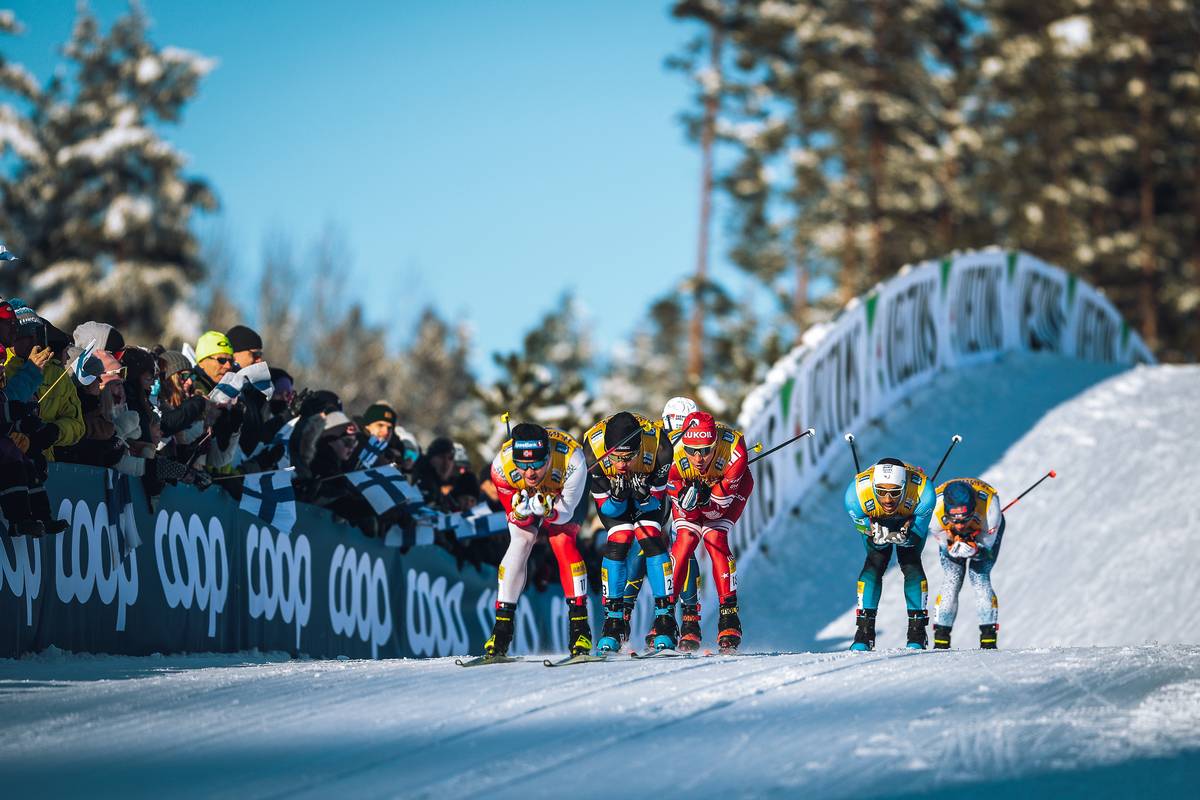
During a brief reprieve from racing, the top tier of international racing made its way from the high desert of Zhangjiakou, China to a venue tucked into snow-capped pines and nestled amongst the lakes of southern Finland. With more start spots per country than during the Games and some athletes choosing a weekend away from the World Cup, a number of new faces appeared on the start lists in Lahti for the 1.6-kiilometer freestyle sprint.
Logan Diekmann (BSF Pro) makes his first World Cup appearance in the 1.6 k freestyle sprint qualifier in Lahti, FIN. (Photo: NordicFocus)
For the U.S., these names included Logan Diekmann (BSF Pro Team) and Bill Harmeyer (SMS T2), both of whom earned their first World Cup starts this weekend via their performance on the SuperTour circuit this season. These athletes joined Kevin Bolger, Logan Hanneman, and Zak Ketterson; the Team Birkie athlete also earned his first World Cup starts earlier this year at the Tour de Ski.
Diekmann currently leads the SuperTour sprint standings with 119 points. He was second in the freestyle sprint during the U.S. Cross Country Championships in Soldier Hollow in January and skied to 5th in the sprint in both Duluth and Lake Placid.
Harmeyer was ranked third in the sprint standings with 83 points, behind Noel Keeffe who is currently racing at the 2022 U23 World Ski Championships in Lygna, NOR. Harmeyer has consistently posted top-five times in qualification during the SuperTour sprint races, and has raced into the final in three out of six SuperTour sprints. A fall in the quarterfinal during US Nationals left him in 24th after qualifying in fifth.
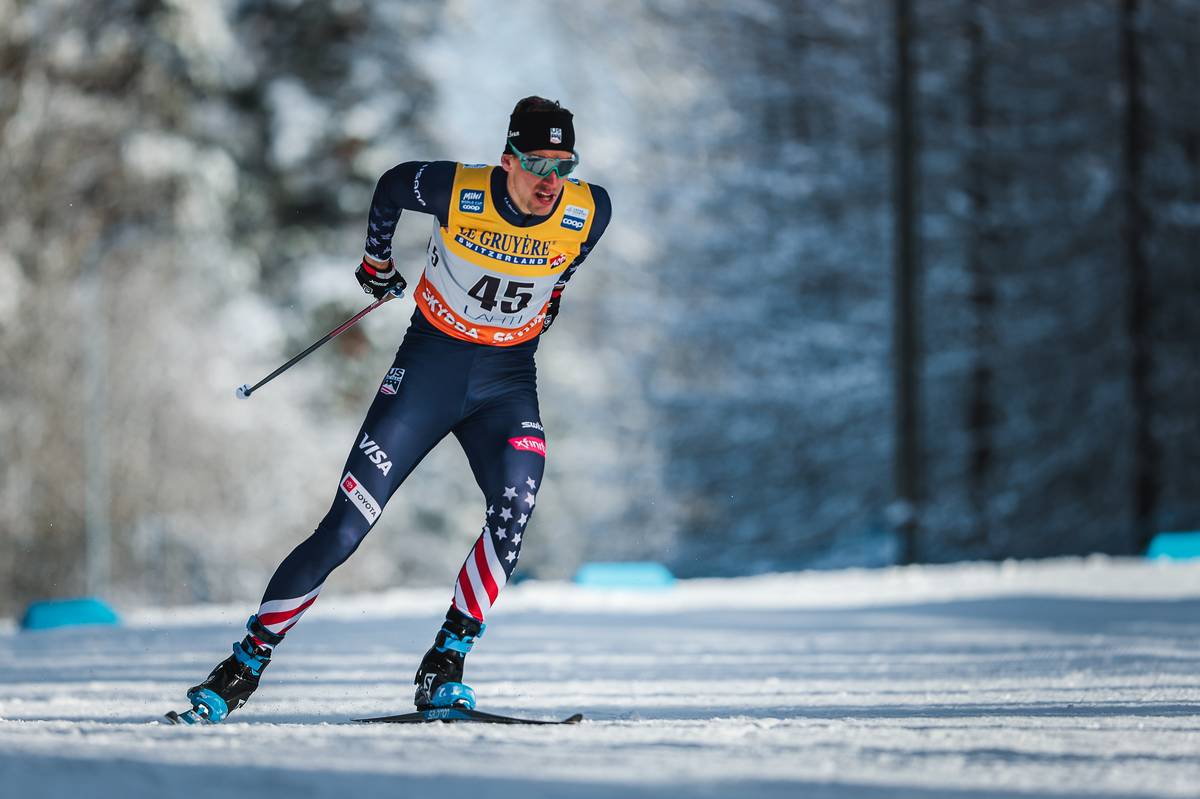
Bill Harmeyer (SMS T2) makes his first World Cup appearance in the 1.6 k freestyle sprint qualifier in Lahti, FIN. (Photo: NordicFocus)
Lucas Chanavat (FRA) was the top qualifier finishing the course in a time of 2:57.85. All five of the Americans finished outside the top-30 in qualification, but Canadian Graham Ritchie cracked into the heats for North America in 27th (+7.73).
The quarterfinal rounds played out mostly as expected, with Chanavat and Johannes Høsflot Klæbo (NOR) advancing from the first round after a close finish. Norway’s Håvard Solås Taugbøl and Olympic silver medalist Federico Pellegrino of Italy crossed the line first and second in heat two, spread by just 0.06 seconds. Winning the third heat, Andrew Young (GBR) crossed the line in 3:04.32, just ahead of Russia’s Gleb Retivykh (+.20).
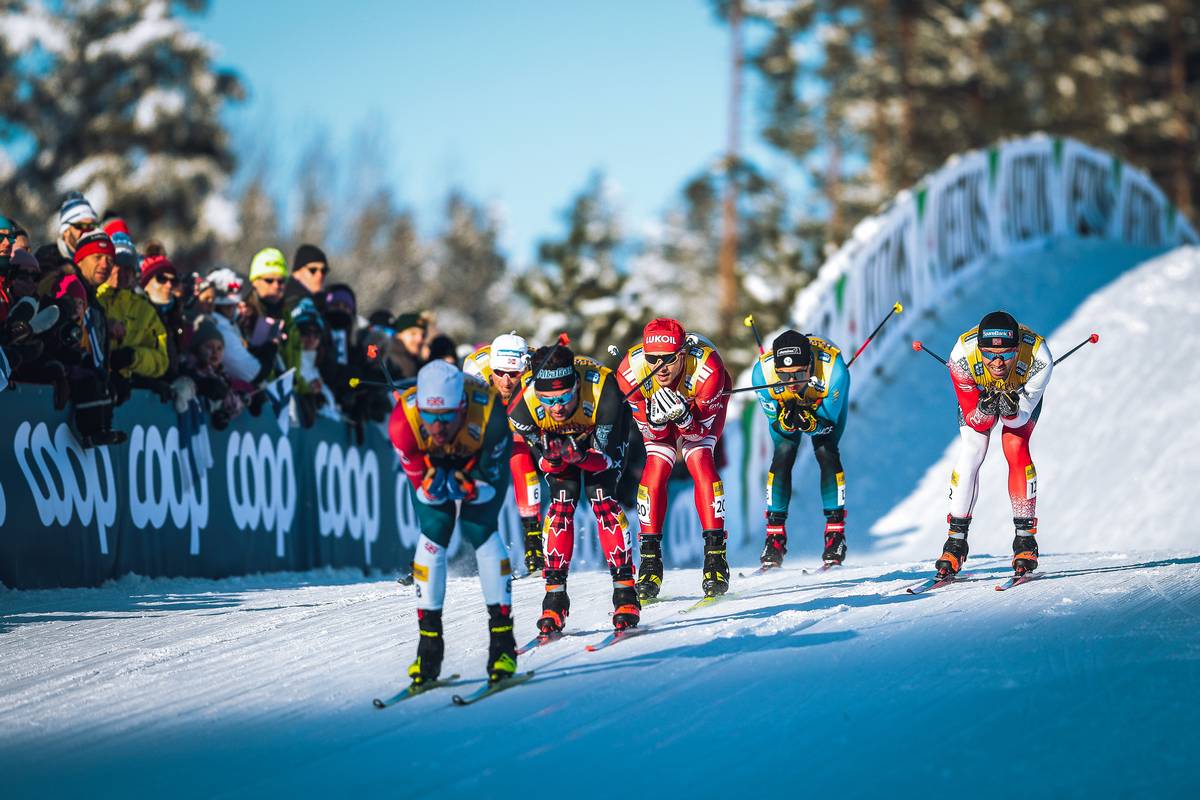
The fourth quarterfinal heat saw a close finish, as Sindre Bjørnestad Skar (NOR) took the race to the line alongside Richard Jouve of France and Alexander Bolshunov of Russia were right at his heels. Skar won the closing sprint with Jouve +0.01 behind and Bolshunov in third (+0.07). Michal Novak (+.49) of the Czech Republic finished in fourth, with both Novak and Bolshunov narrowly missing out on lucky losers.
Fast racing in the fifth heat saw four competitors advance to the next round. Janik Riebli (SUI) won the heat in a time of 2:59.56, while China’s Qiang Wang finished second (+.10) to move onto the semis. A top prospect for the Chinese ski program, this is Wang’s first World Cup appearance since the pandemic began. Wang was fifth in qualification during the Olympic freestyle sprint in Zhangjiakou, where he took second in his heat to Norway’s Erik Valnes before being issued a disqualification for obstruction and being relegated last in the heat.
Qiang Wang (CHN) leads at the start of the fifth quarterfinal heat in Lahti. (Photo: NordicFocus)
Following the pace of the leaders, Maciej Starega (+.64) of Poland and Arnaud Chautemps (+1.61) of France crossed the line third and fourth to advance into the semis as lucky losers.
In the first semifinal, five skiers all remained close coming into the finish to vie for the two automatic spots. Pellegrino was able to hold the field off and win the semi with a time of 2:59.57, however, he was later disqualified, pushing him to sixth place. Klæbo crossed in second (+.07), guaranteeing his spot in the final, while Chanavant and Taugbøl were third (+.21) and fourth (+.37), respectively. Due to Pellegrino’s disqualification, Taugbøl was able to make it through to the final as a lucky loser.
In the second semi, Retivykh held off a push from Skar to win in 2:59.67, with the Norwegian 0.02 behind. Wang crossed third (+.34) with a time fast enough to earn the second lucky loser spot in the final.
Sindre Bjørnestad Skar leads his heat during the freestyle sprint in Lahti, FIN. (Photo: NordicFocus)
In the final, an early tangle between Wang and Retivykh as the two rounded a corner sent the Chinese athlete to the ground, losing contact with the pack.
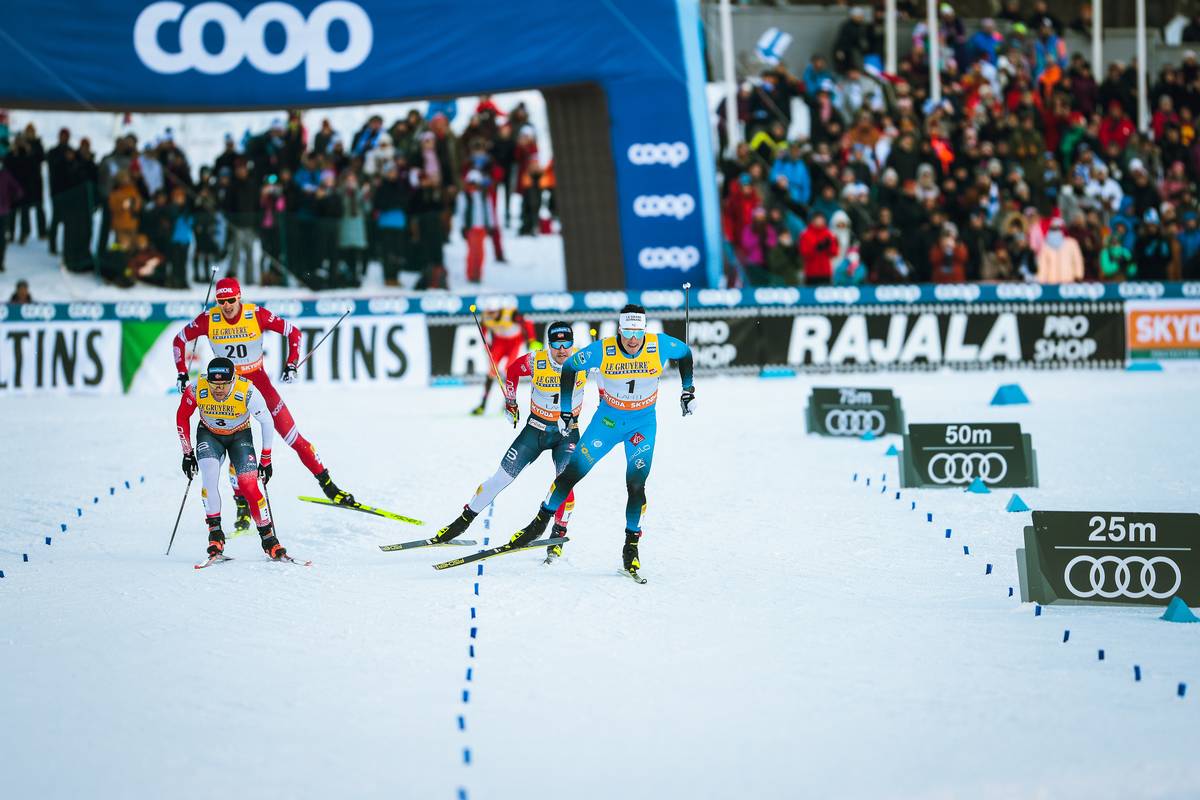
The remaining five men stayed close as they powered through the course. Rounding the bend into the final 100 meters, four skiers remained in contention for the podium, but it was Klæbo who slingshot from the outside, putting his closing speed on display as he threw his boot to win a photo finish with Chanavat in 2:58.34, Skar and Taugbøl on their tails.
Johannes Høsflot Klæbo with a look before taking the win in the freestyle sprint in Lahti, FIN. (Photo: NordicFocus)
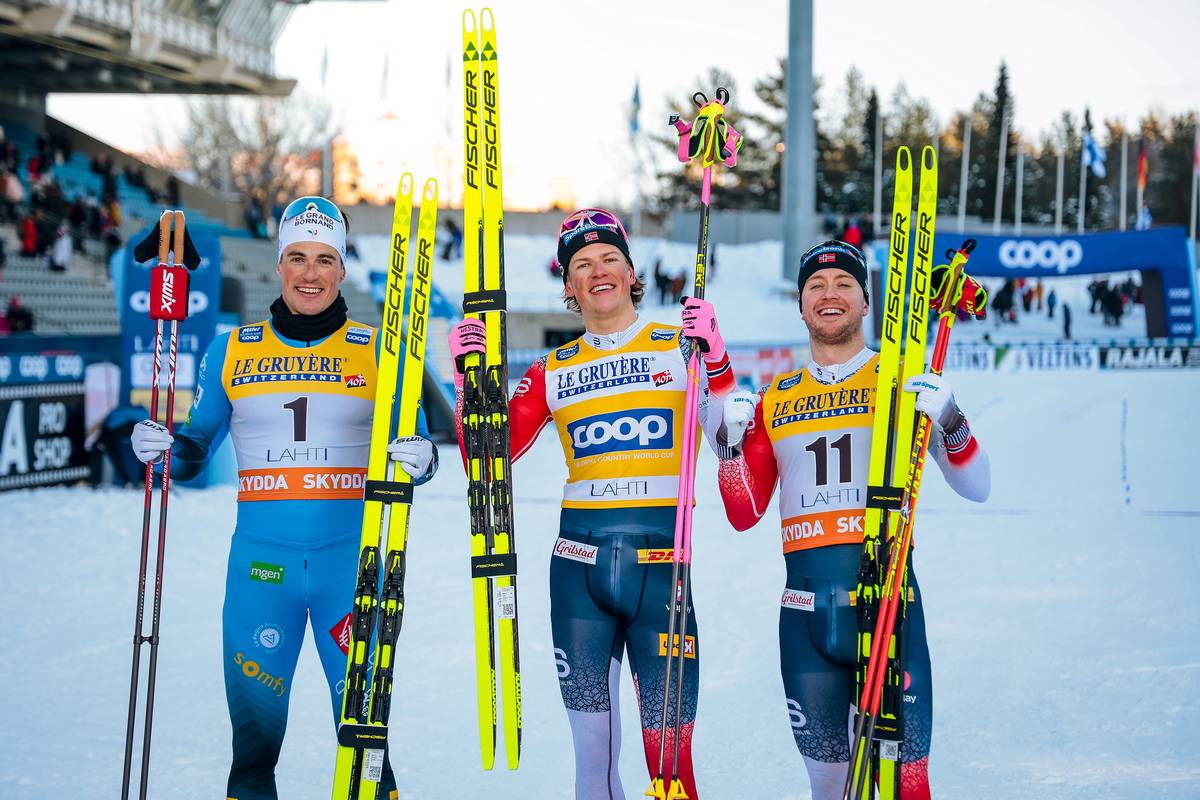
The Norwegian had advantage at the finish, with Chanavat just 0.04 seconds back in second place. Skar held off his teammate for the final podium spot in third (+.23), while Taugbøl took fourth (+0.58). Retivykh crossed a few meters back in fifth (+0.90), while Wang rebounded from his crash to finish 7.77 seconds behind in sixth.
A close race for second and third heads into the final 25 meters in Lahti. (Photo: NordicFocus)
“It was amazing,” Klæbo told FIS after the race. “It isn’t so many days since we competed in the Olympics, but still, it’s always fun to race.”
Klæbo commented on the excitement of racing in Lahti, which has hosted many championship events including the 2019 World Championships. He added that the racing on these tracks is often tight, which keeps it exciting for spectators – of which there were many today. When asked about racing in front of a crowd after nearly two years of empty stadiums, Klæbo smiled.
“It was amazing. I think what they have done, and finally seeing the end of the COVID situation – I think it’s amazing. It’s always great to compete against a big crowd, and it was amazing today as well.”
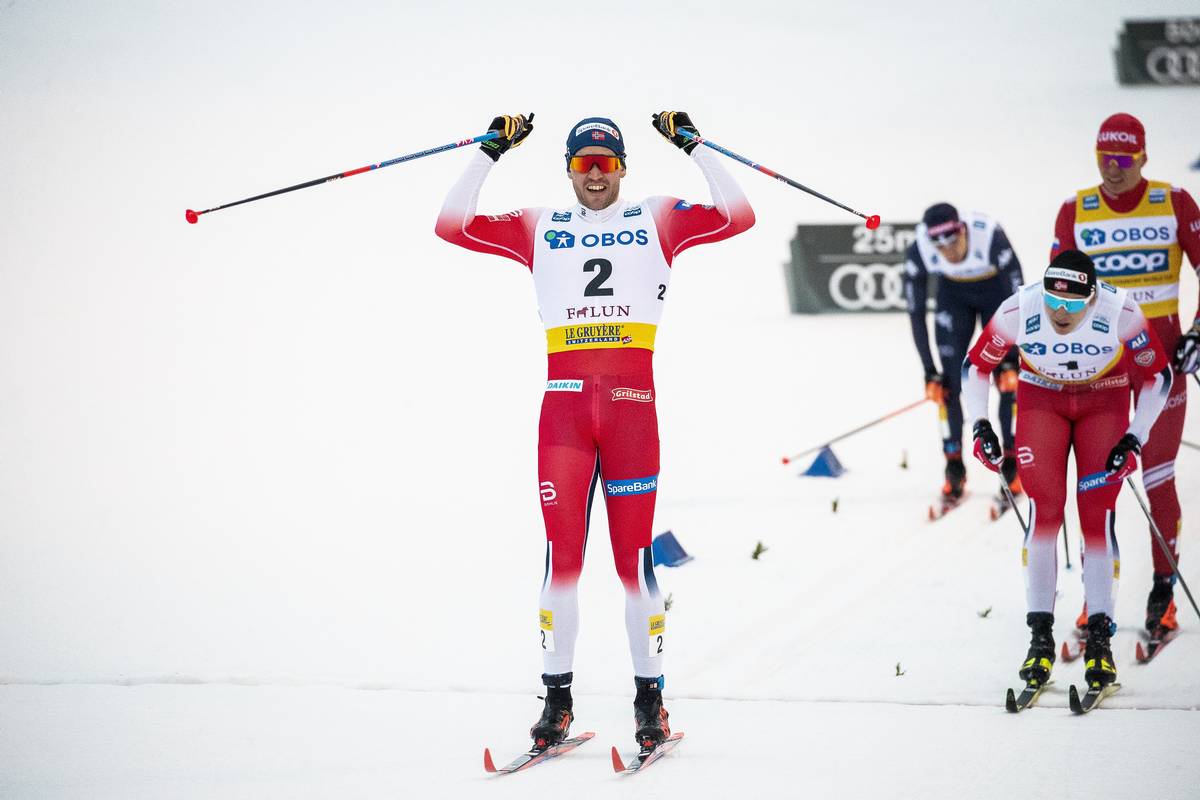
Johannes Høsflot Klæbo (NOR) takes the win in Lahti’s freestyle sprint ahead of Lucas Chanavat (FRA) and Sindre Bjørnestad Skar (NOR). (Photo: NordicFocus)Graham Ritchie races in the quarterfinal of the freestyle sprint in Lahti, FIN. (Photo: NordicFocus)
After finishing fifth in a tightly spread third quarterfinal heat, Graham Ritchie bumped up from his bib rank to finish 24th.
Kevin Bolger was the top American qualifier in Lahti in 33rd (+8.90), just 0.41 seconds off the mark needed for the top-30. On his tails was Diekmann in 34th (+9.14), with Hanneman close behind in 39th (+9.79). Ketterson was next for the U.S. in 49th (+12.13), with Harmeyer next in 50th (+12.28).
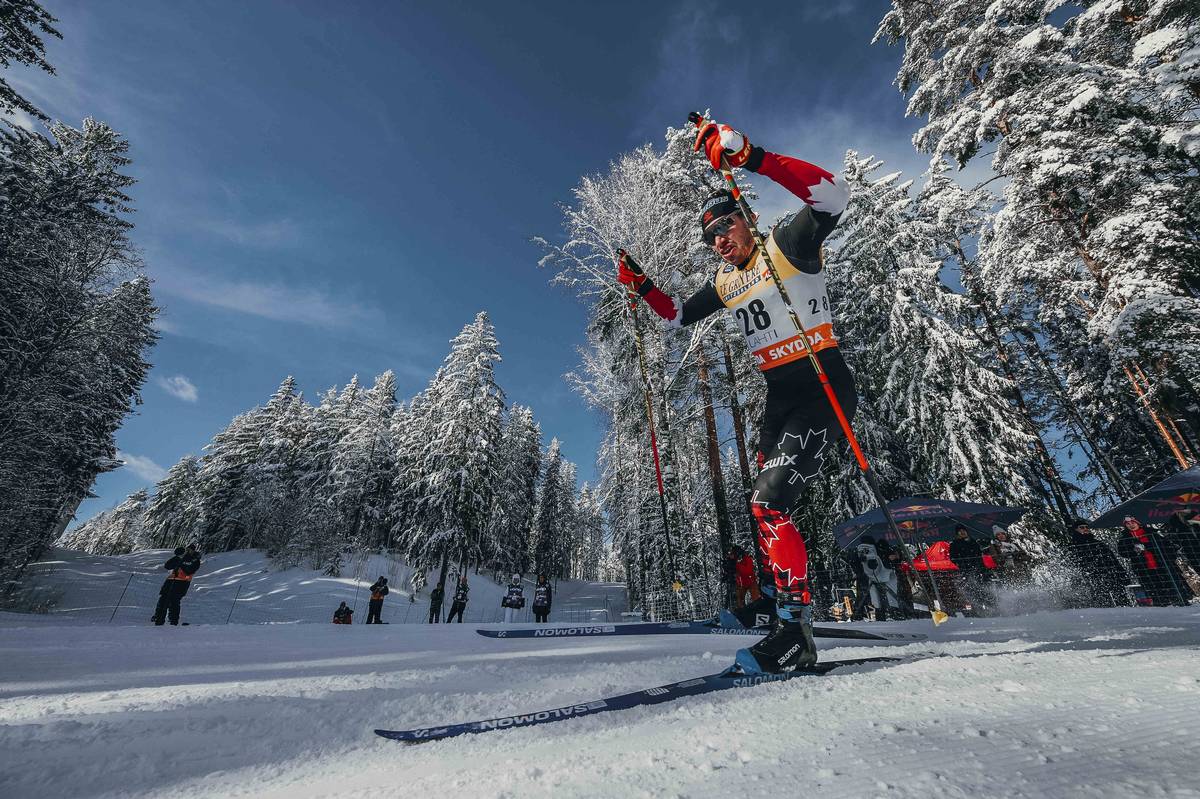
Kevin Bolger leads the American men in 33rd during the freestyle sprint qualifier in Lahti, FIN. (Photo: NordicFocus)Antoine Cyr (CAN) races the qualifier of Lahti’s freestyle sprint. (Photo: NordicFocus)
Outside the top-30 for Canada, Antoine Cyr was 40th in qualification (+9.99), with Olivier Léveillé next in 46th (+11.79), followed by Phillippe Boucher in 55th (+14.02) and Rémi Drolet in 58th (+15.87).
Racing continues tomorrow with a 15 k individual start classic.
A dense field of men’s skiers during Saturday’s 15 k mass start classic in Falun, Sweden. The event was marred by several serious crashes. (Photo: NordicFocus)
Crash and Burn in Falun:
News from around the scene has some World Cup skiers on the mend after Saturday’s mass start races in Falun, Sweden. A few notes from the men’s and women’s 10 k and 15 k mass start classic race: there were numerous crashes, some serious.
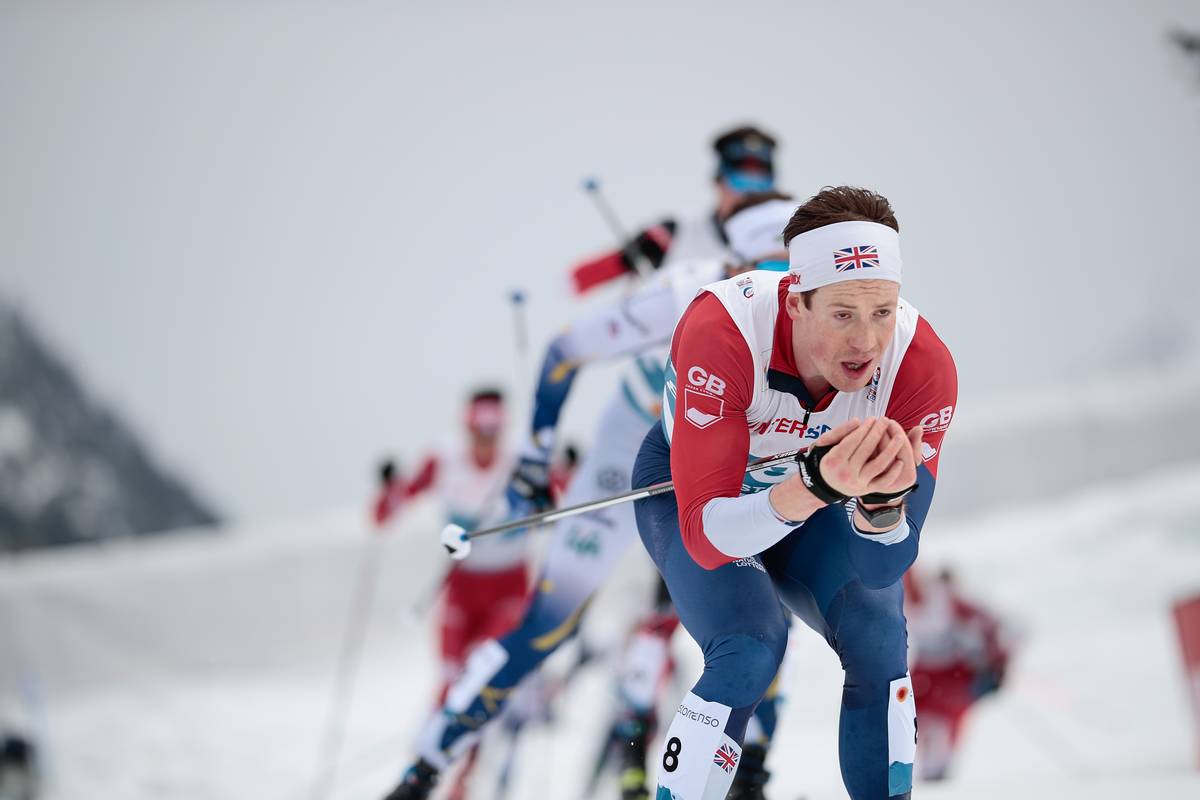
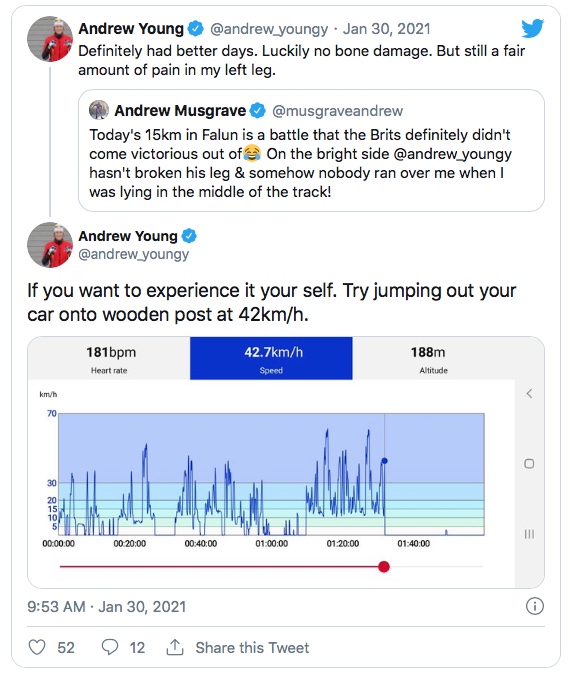
According to an Instagram post from British skier Andrew Young, he crashed on the fourth lap of the men’s race. “I slid into and through (!) the wooden advertising banners and hit a wooden post on the other side.” On Twitter, Young posted data from his day racing that illustrated he hit the wooden post at 42.7 km/h (25 mph).
The initial fear was that Young had fractured his femur. X-rays ruled out a bone-break, yet he has experienced pain and swelling in his left leg. He aims to begin training at the end of this week.
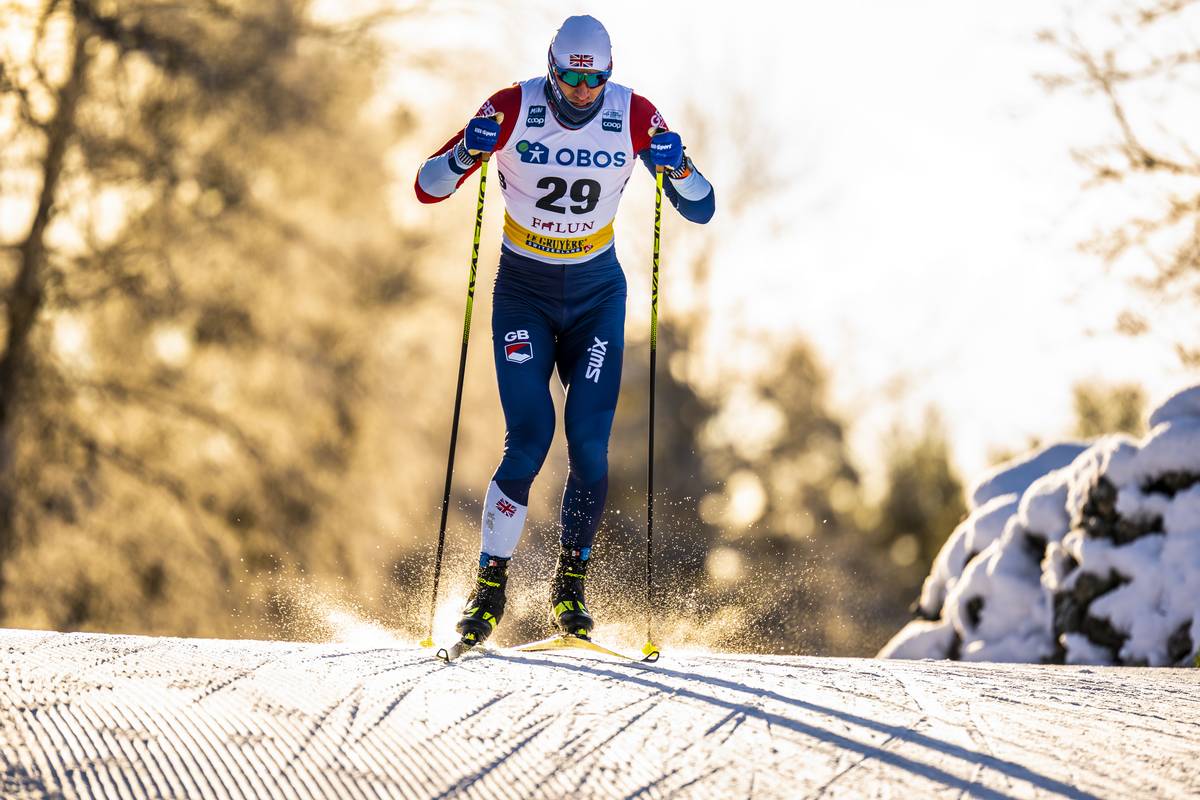
Andrew Young seen here racing in last Friday’s 15 k skate in Falun, Sweden. The British athlete suffered a nasty crash in Saturday’s was start race. (Photo: NordicFocus)
This carnage, along with the numerous spills suffered from other athletes, prompted discussion about course safety in Falun. Some called for “netting” to catch athletes sliding of course in precarious situations much like we have grown accustomed to in high-stakes alpine skiing speed events. Devon Kershaw, in a podcast for FasterSkier, explained that the mass start course used in Falun was simply too easy, and allowed for congested skiing. In other words, no terrain feature, like a bury ling climb, could separate skiers. Skiers trailing near the back of the pack could catch up on the downhills where the crashes occurred.
An earlier version of this story reported Kerttu Niskanen of Finland had broken a bone during a crash on Saturday. Although she did suffer the injury, it was not caused by a crash.
Hannah Halvorsen racing in the 2020 Dresden, Germany sprints, where she earned her first World Cup points. (Photo: NordicFocus)
Resilience:
In better news concerning athletes who have suffered a catastrophic injury and returned with a fury, U.S. Ski Team athlete Hannah Halvorsen was featured in a solid podcast interview on the “We Are Superman” podcast. It’s a good listen for anyone looking for some inspiration regarding resilience. FasterSkier has covered Halvorsen’s return to skiing as well as featured a first-person narrative of her struggle with body image.
Tuesday’s statement from WADA recognized they were unlikely to be successful in appealing the ruling to the Swiss Federal Tribunal.
“WADA was disappointed that the CAS Panel, based on its own assessment of proportionality, decided not to impose all the consequences that WADA sought (and not for the full four-year period),” claimed WADA in the press release. “However, the grounds of appeal to the Swiss Federal Tribunal are limited to procedural matters such as jurisdiction, the composition of the Panel and the right to be heard. The Swiss Federal Tribunal does not conduct a review of the merits and would therefore not interfere with the Panel’s assessment of the proportionality of the consequences. As a result, and following unanimous advice from in-house and external legal counsels, WADA strongly believes an appeal would have served no useful purpose and decided to refrain from doing so.”
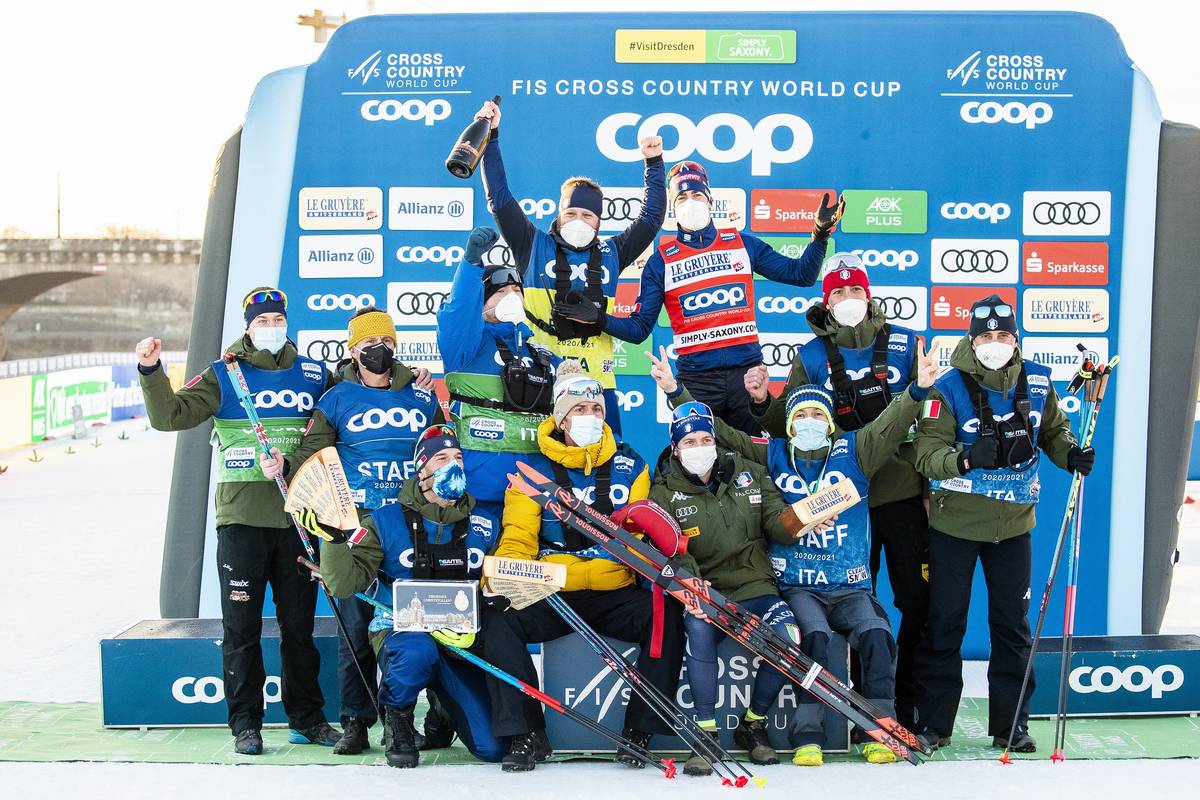
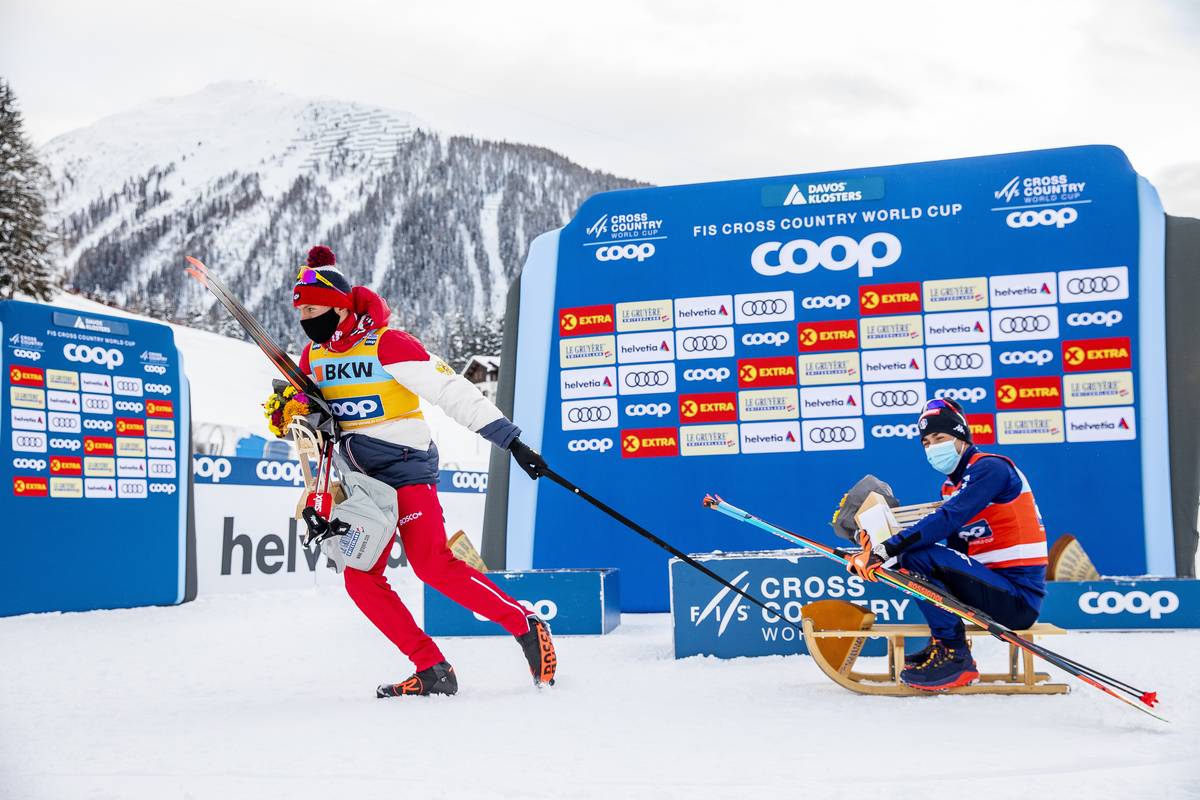
The Pellegrino support crew after his Dresden win. (Photo: NordicFocus)
This World Cup coverage is made possible through the generous support of Marty and Kathy Hall and their A Hall Mark of Excellence Award. To learn more about A Hall Mark of Excellence Award or to learn how you can support FasterSkier’s coverage please contact info@fasterskier.com.
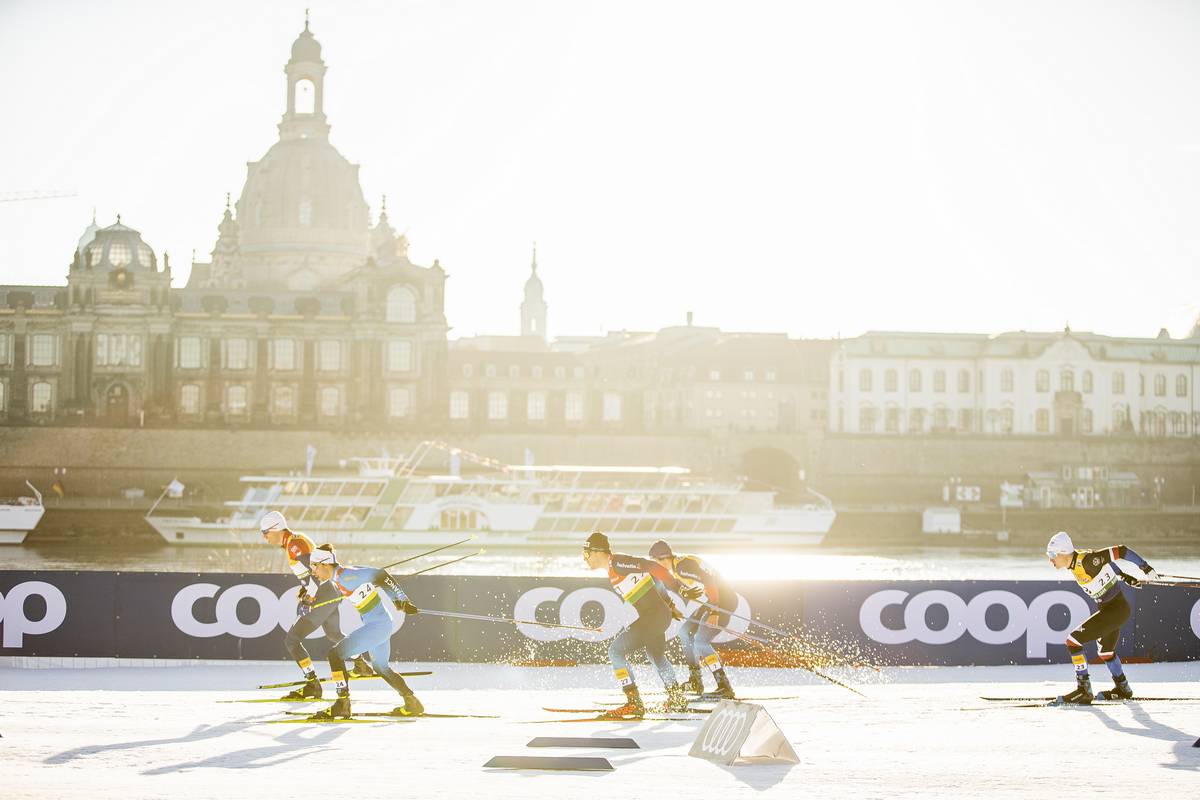
Laid out like a white magic carpet along the Elbe River in Dresden, Germany, the thin ribbon of snow became the speedy tracks for the men’s 1.3-kilometer freestyle sprint on Saturday. While the state of Saxony, where Dresden is situated, went on lockdown this week, Federico Pellegrino of Italy was unleashed, yet again.
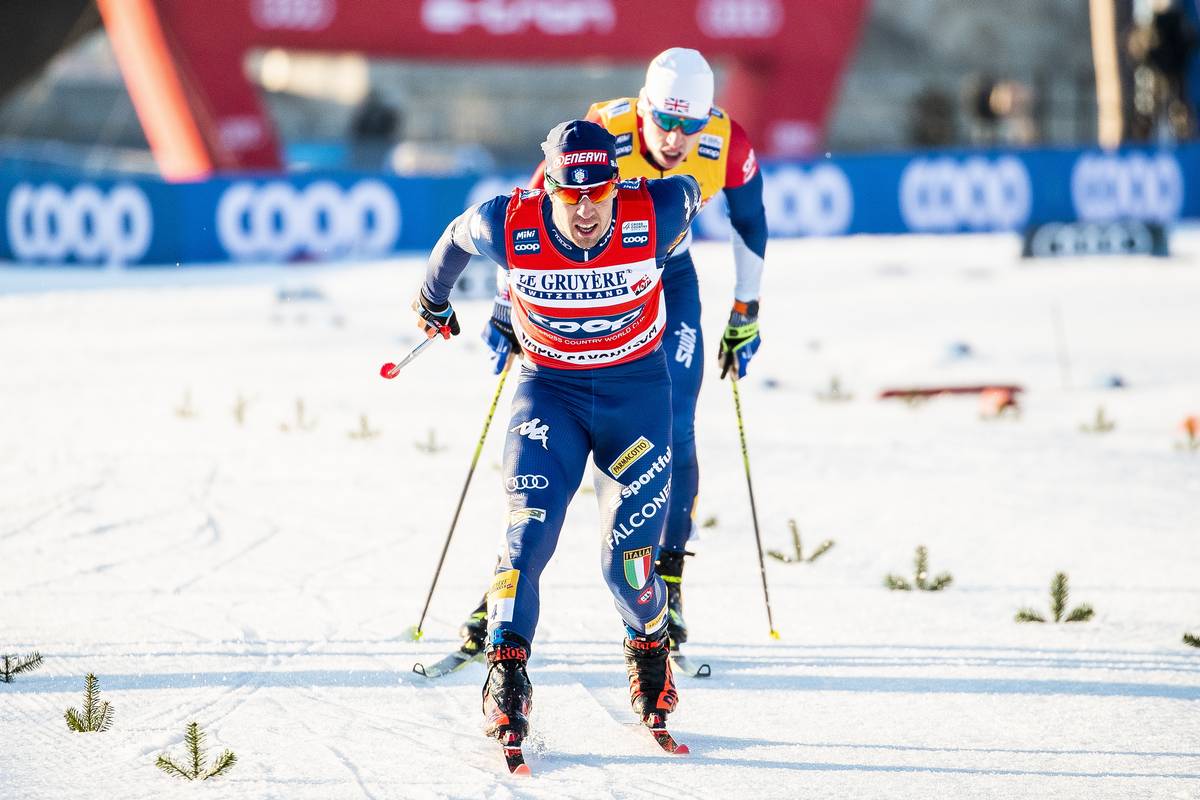
Peerless once again to the line: Federico Pellegrino with the Dresden skate sprint win. (Photo: NordicFocus)
After qualifying in fourth behind fastest qualifier Lucas Chanavat from France, Pellegrino boxed out, out-paced, and out-foxed the six-athlete final to win in 2:21:96. Last week’s sprint winner in Davos for back-to-back wins. This is Pellegrino’s 15th individual World Cup title, to place third overall for the most career sprint wins on the World Cup. (Johannes Høsflot Klæbo of Norway has 24 wins, while the now-retired Emil Jönsson of Sweden won 16 sprints.)
“After Davos, for sure my confidence went up, really up, and I knew I had a good chance to win,” said, Pellegrino in his post-race interview with FIS, “Two years ago I was disqualified and last year somebody took me down… so today by the semi-final I didn’t want to get any risk so I went in the front.”
Pellegrino advanced to the final after winning the first quarterfinal and placing second to Andrew Young (28) in the first semifinal. Great Britain’s Young continued his impressive rise to the elite level as he placed second on Saturday, a scant 0.53 seconds off Pellegrin’s winning time. Last weekend in Davos, Young earned his first World Cup podium since 2015, when he placed third overall in the skate sprint. Russia’s Gleb Retivykh placed third (+0.91) for the podium’s final spot. Teammate Alexander Bolshunov, the overall leader of the men’s World Cup, was fourth (+1.19). Two Americans advanced to the finals. Simi Hamilton, for his best 2020-2021 result skied to fifth (+1.80), and Kevin Bolger sixth (+3.95).
A big glimmer of British hope, Andrew Young leads the pack in Dresden. (Photo: NordicFocus)
For the thirty-three-year-old Hamilton, in his third individual sprint of the season, he has steadily improved. After placing 50th in the Ruka classic sprint, he qualified ninth and placed 14th in Davos, cresting with his fifth place in Dresden. Hamilton did not start last year’s Dresden sprint as he recovered from illness.
Post-race interview with Simi Hamilton.
“I think there were a lot more good things than bad things that came out of today,” said Hamilton. “Those will become more clear as I go forward. … I feel like I regained a lot of confidence today with my top-end speed which I feel I haven’t had in a few years just with getting older and losing a little bit of power. On a day like today when you have such a fast flat course, you are not going to have a good qualifier and you are not going to ski in the finals if you don’t at least have a little bit of sprinter strength still. So I think that was a really good sign.”
Big and smooth: Simi Hamilton during the Dresden sprints. He placed 5th overall. (Photo: NordicFocus)
Since Bolger broke onto the scene after placing 11th in the 2018 Lahti, Finland skate sprint, Saturday’s result marked his 12th career top-30 World Cup result. However, since that Lahti semi, Bolger has a run of semi-final droughts. His sixth place in Dresden is a result high-mark for the U.S. Ski Team athlete as he advanced to his first sprint final after progressing through the semis along with Hamilton as lucky losers.
Bolger looked at ease in the final, his big-frame keeping pace, until he snapped a pole. He did eventually receive a spare, fiddled with the grip, and reconnected to the pack of five skiers slightly upfront.
“I was on cloud nine I was psyched to be there,” Bolger said of his first sprint final appearance. “Even going back [a bit], once you make the semi-final anything is possible, and then making that final was an extra cherry on top. From there I wanted to try and just ski fast in any possible way that I could. From the gun I just went for it and had a really great start … I got unlucky with that pole break but just getting there is such a relief because … I came onto the scene in Lahti with that 11th, and there has been this big elephant in the room, ‘when am I going to get back to the semi-final again?’ Doing it today and getting to a final is like a huge monkey off my back.”
Post-race interview with Kevin Bolger.
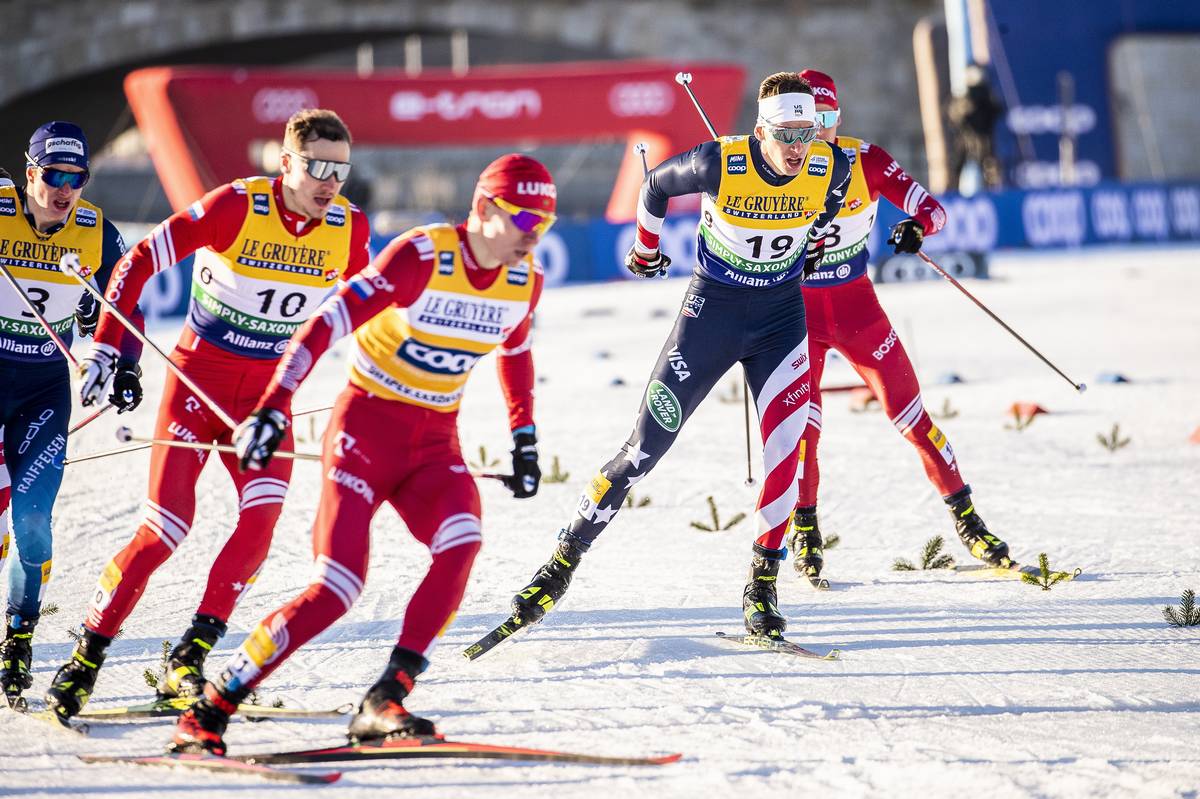
Kevin Bolger, bib 19, had a career-best 6th overall in Saturday’s Dresden skate sprint. (Photo: NordicFocus)
Hanneman moved onto the semi-finals for the second weekend in a row. In Davos, he placed ninth overall, a career-best. Today, he fell off the pace in the first semi where he placed sixth. He concluded the day 12th overall.
Logan Hanneman placed 12th on the day in Dresden. (Photo: NordicFocus)
Gus Schumacher (20), finished in 43rd, while Tyler Kornfield was 52nd.
Considering the World Cup sprint series, Pellegrino leads with 220 points, Bolshunov is second with 170, and Young is third with 152. Hamilton is eighth, Bolger ninth, and Hanneman 11th, respectively.
Racing continues in Dresden with a team sprint on Sunday.
Italy’s Federico Pellegrino closing out the win at the 2020 Davos freestyle sprint. (Photo: NordicFocus)
This World Cup coverage is made possible through the generous support of Marty and Kathy Hall and their A Hall Mark of Excellence Award. To learn more about A Hall Mark of Excellence Award or to learn how you can support FasterSkier’s coverage please contact info@fasterskier.com.
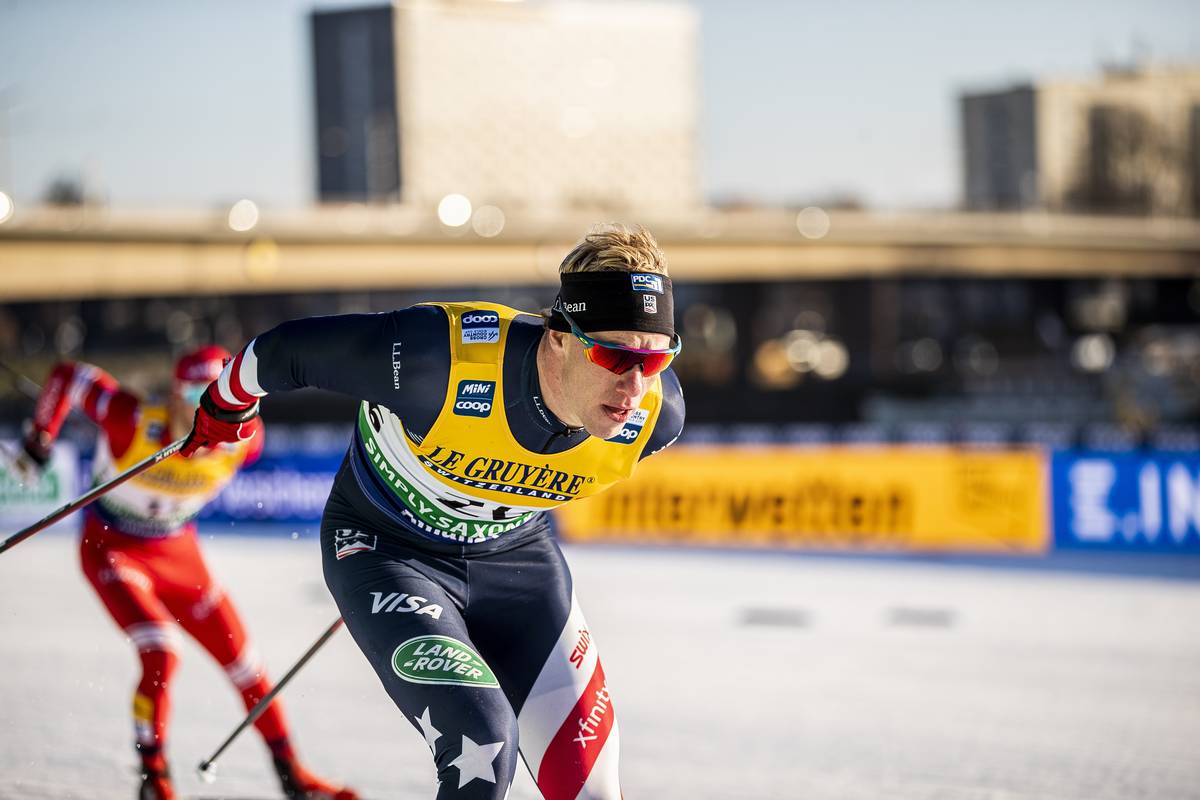
Italy’s Federico Pellegrino (30) loves the skate sprint. Before his win in the Davos, Switzerland, freestyle sprint on Saturday, Pellegrino had won 13 World Cup sprints. All of those wins, beyond a 2016 classic sprint win in Canmore, were skate. The Italian powerhouse did not disappoint. In a field diminished by the withdrawal of Norway, Finland, and Sweden due to Covid-19 precautions, the podium was free for the taking. Pellegrino took the win by 2.13 seconds over Russia’s Alexander Bolshunov in second, and Britain’s Andrew Young third.
With today’s result, Pellegrino solidifies a third sprint win in Davos, tying the absent Johannes Høsflot Klæbo for the most at the venue. For the powerhouse that is Pellegrino, he seemed like a sure bet for the win early on. He qualified in second, 1.70 seconds behind top qualifier Lucas Chanavat of France. He advanced to the finals with a win-win through the semis.
Post-race audio interview with Great Britain’s Andrew Young.
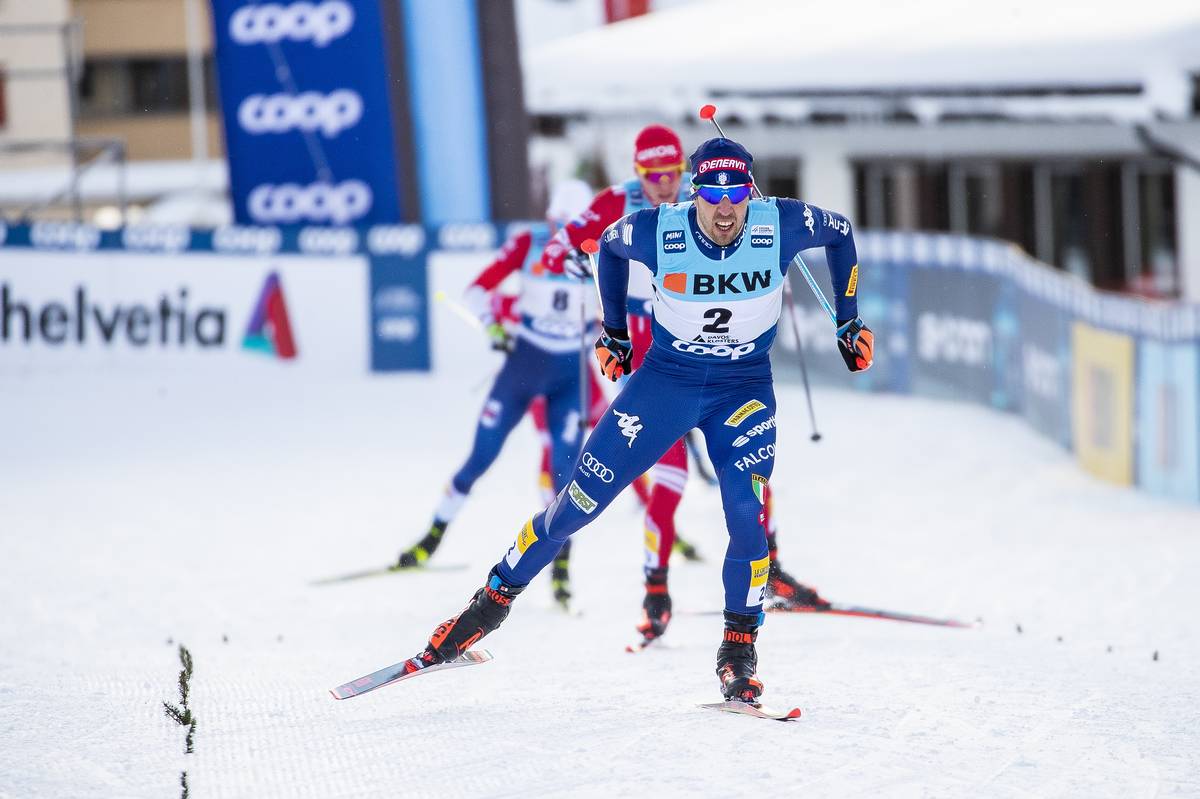
Andrew Young (bib 8) of Great Britain, placed third overall on Saturday’s Davos skate sprint. (Photo: Nordic Focus)
Young’s third place in Davos matched his third place in the 2015 Toblach, Italy skate sprint – a career-best mark for the 28-year-old skier based out of Trondheim, Norway. In a post-race interview, Young explained that he had dedicated himself this year to becoming a more all-around skier. In the past, he has been known as a sprinter, and most proficient in skate. However, in the opening weekend in Ruka, Finland, he placed 14th overall in the three-race series with a 19th in the classic sprint, 16th in the 15 k classic, and 14th overall and fifth-best time of day in the 15 k skate pursuit.
Today’s third place marks an athlete on a clear upward trajectory in the early parts of the race season. By his own admission, Young said he “lucked” out in his semifinal, as several skiers were taken out in a fall, including Gus Schumacher of the U.S. and Chanavat. Young placed second in the quarterfinal, 0.4 seconds behind Pellegrino. In his semi, luck played no hand as he matched up with Pellegrino and Bolshunov, who went 1–2, to place third (+0.88) and advance as a lucky loser.
Letting the data speak, the final, even in the absence of Norway, Sweden, and Finland, was for real. Gleb Retivykh of Russia, who placed fourth Saturday, is a bronze medalist from the 2019 World Championships in the skate sprint. Richard Jouve, who finished fifth today, also placed fifth in the same Davos event in 2017.
Valerio Grond of Switzerland, age 20, in his first World Cup appearance, placed sixth.
Alexander Bolshunov (RUS), who placed second in Saturday’s sprint in Davos, pulls the winner, Federico Pellegrino (ITA). (Photo: NordicFocus)
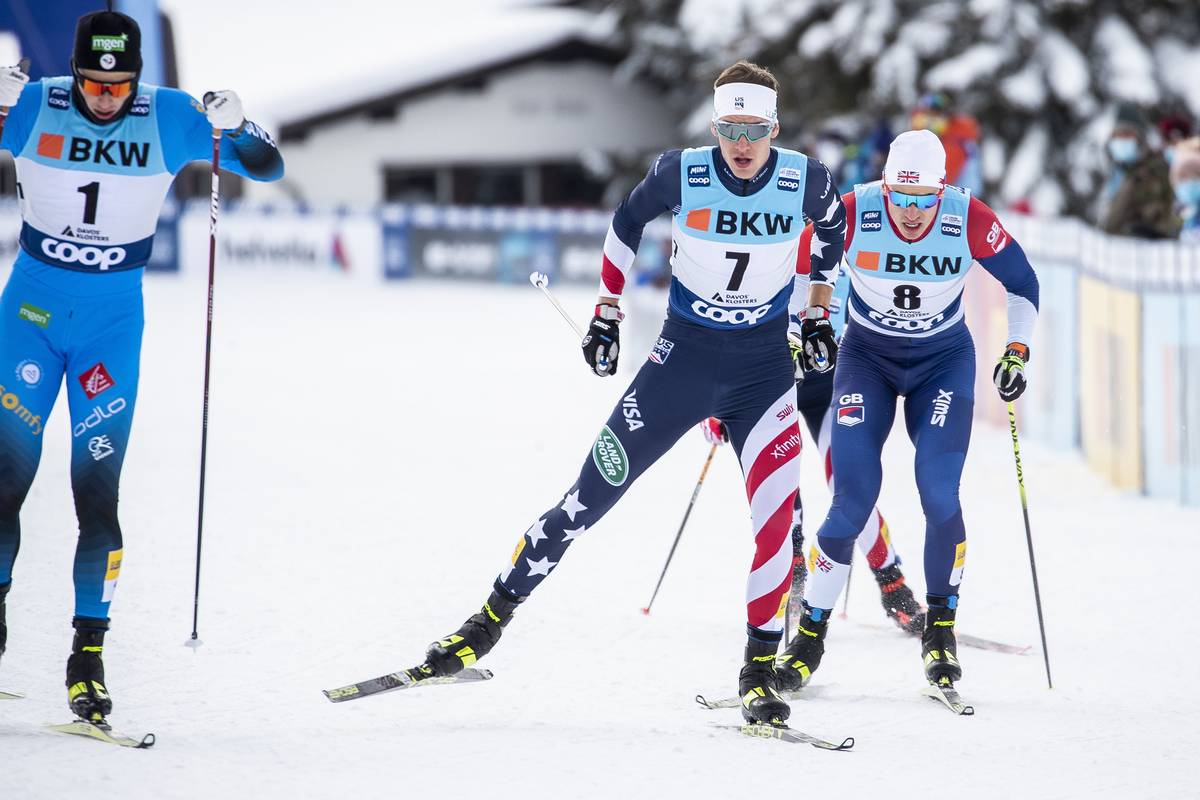
Stepping back to the qualification round, fellow 20-year-old JC Schoonmaker clocked the fastest American time today in 2:22.66 (+4.21) for a 5th-place finish. Kevin Bolger in 7th and Simi Hamilton in 9th rounded out the top ten, while Logan Hanneman placed 15th and Gus Schumacher 29th to put all five U.S. men inside the points.
Racing in the first heat with the eventual podium members, Pellegrino and Young, Bolger and Schumacher were eliminated in the quarterfinals after finishing 3rd and 5th, respectively. Bolger was just 0.3 seconds off the time needed for a lucky loser spot. Hamilton took 3rd in his heat, and Schoonmaker 5th, finishing their day after the quarters.
The final U.S. results, outside of Logan Hanneman, played out this way: Tyler Kornfield in 62nd, Schumacher 25th, Schoonmaker 18th, Hamilton 14th, and Bolger 13th.
“Super fun to be back in the heats,” wrote Bolger in a post-race email. “I always love racing here in Davos — perfect conditions and some sun is hard to beat for a World Cup weekend!! Happy with qualifying 7th it’s the best qualifier ever. I wish I would have had a little more spice in the heats but today was all around just really great!! I thought the men’s team showed up in a huge way — qualifying 5 guys and Logan hitting one out of the park with a top 10! Excited to see where my season goes as well as this men’s team!”
Kevin Bolger (bib 7) on course during the quarterfinal of the 1.5 k skate sprint in Davos, Switzerland. (Photo: NordicFocus)
In the fourth and fastest heat, Hanneman held on to the lead group, finishing fourth in a photo finish with Switzerland’s Valerio Grond to advance to the semis. For the 27-year-old Hanneman, who hails from Fairbanks and trains in Anchorage, this was a career-best result. This was Hanneman’s seventh World Cup top-30. Previously, his best result was an 18th in the Tour de Ski’s classic sprint in Val di Fiemme, Italy.
“I think it would have been a pretty good day had [the Scandinavians and Finns] been here and I’m happy to take advantage of it,” said Hanneman. “Really really satisfied. Now I know how much more fit I have to be to compete in a semi-final.”
Full post-race interview with Logan Hanneman.
Logan Hanneman (bib 15) in the mix during the 1.5 k skate sprint in Davos, Switzerland. (Photo: NordicFocus)
Typing “Davos” into the FIS-Ski data filter for Simi Hamilton was a bit startling. Results data going back a decade populated the screen. All things considered, the loveliness of Davos and its relatively high altitude have been kind to the super-lung from Aspen, Colorado. Rather than focus on a single result or moment, what is clear is that Hamilton brings knowledge and experience to a group thirsty for their own success benchmarks. His 14th today is solid, but his willingness to celebrate others speaks for itself.
Simi Hamilton (bib 9) skis alongside Switzerland’s Roman Furger during the quarterfinal of the 1.5 k skate sprint in Davos. (Photo: NordicFocus)
“I’m super proud of what our entire team accomplished today,” Hamilton emailed. “Obviously, Rosie’s win and Soph’s 5th place were the true highlights, but to witness 10 men and women qualify for the heats was pretty incredible. This is still World Cup racing no matter who is on the start list or not, and for that many people to score points is still a pretty historic achievement. I am especially proud of what the guys were able to do today. Just being a part of this men’s team is incredible and I’m humbled that I get to be a part of a group that has such good energy right now, especially as it relates to those young boys. I wasn’t satisfied with my result and how my day ended, but I felt really encouraged by a few things that went well for me today, so I am going to build off of those for next weekend. I know I am fit this season, and my pure speed needs a bit of work, but that’s kind of right where I want to be right now. So I’m looking forward (hopefully) to lots more racing to come.”
Johannes Hoesflot Klaebo (NOR) toes the line in Ruka, Finland to capture the win on the season distance opener. Photo: NordicFocus
This World Cup coverage is made possible through the generous support of Marty and Kathy Hall and their A Hall Mark of Excellence Award. To learn more about A Hall Mark of Excellence Award or to learn how you can support FasterSkier’s coverage please contact info@fasterskier.com.
A spicy rivalry in sports just heightens the tension. Although Norway’s Johannes Høsflot Klæbo has achieved wunderkind status, last season his prowess was usurped by a stronger Alexander Bolshunov from Russia. At 24 and 23 years old, respectively, Klæbo and Bolshunov are two era-defining skiers. In 2019-2020, although Klæbo remained the king of sprinting, Bolshunov had Klæbo’s number in distance events and won the overall World Cup.
Alexander Bolshunov (RUS) strides his way into the 2020-21 World Cup season with hopes of defending his overall distance crystal globe and corresponding red bib. Photo: NordicFocus
It’s early early early. However, two races into the season Klæbo appears Ferrari-tuned in both sprints and the longer grinds. Although placing second in Friday’s sprint was perhaps a less than special season start, it was not inauspicious for Klæbo.
Starting in bib 64, Klæbo was handed several key data points on Saturday, in terms of pacing, by those beginning ahead of him. Iivo Niskanen, a Finn who wins mostly in Finland and 15 k classics too, began in bib 37. Emil Iversen of Norway began in bib 42. Russia’s Alexey Chervotkin was way early in bib 26.
Bolshunov, considered by many the athlete to surpass Klæbo on the day, began two bibs later, in bib 66.
Time was on Klæbo’s side. With a smooth stride and glide on a cold-snow firm-track day, Klæbo posted the fastest times at every intermediate split and won the race in 34:04.6 minutes. Bolshunov was no foil as he eked within 9.6 seconds at 5 k, yet he bled another 10 seconds on the second lap. He placed third overall 18 seconds behind. Turns out, on this day, knowing Klæbo’s splits two bibs ahead, was of no assistance for Bolshunov. Sometimes the finicky tuning of the Ferrari outpaces the Lambo. (I drive a Prius, so take that for what it’s worth.)
Second place went to Chervotkin (25), for his best individual result on the World Cup and his first podium. He placed fourth in the 2018 Falun 15 k classic and fifth in Lenzerheide’s 2017 15 k classic. (Yup, there’s a pattern.)
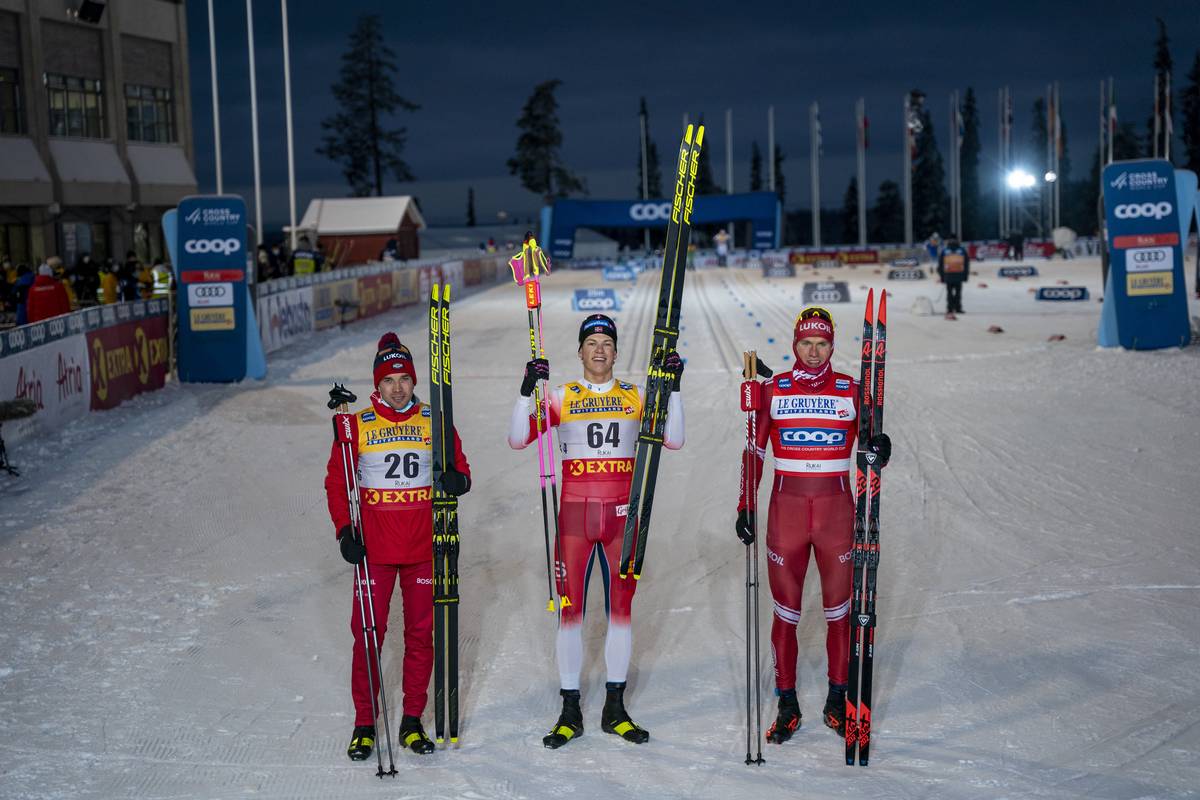
Alexey Chervotkin (RUS), Johannes Høsflot Klæbo (NOR), Alexander Bolshunov (RUS), (l-r) take the podium in the men’s 15k classic opener in Ruka, Finland. Photo: NordicFocus
In any event, you’ll note in the FIS interview below, that Klæbo appears to be suppressing a big genuine smile post-race. The distance event throne had eluded Klæbo since last year’s Tour de Ski when he won the 15 k classic mass start in Val di Fiemme. He did that with a little naughty stare back at a trio of chasing Russians as he finished. For someone so thirsty for the win and used to drinking from the well in big gulps, that victory was way back on January 3, 2020. Consider that timespan a distance race drought for the Norwegian superstar. The thirst has been momentarily quenched.
Setting up a tasty treat for tomorrow’s 15 k freestyle pursuit is this: Klæbo starts 16 seconds ahead of Bolshunov, who sits second overall, and 21 seconds ahead of teammate Emil Iversen. No way does Iversen assist Bolshunov in catching Klæbo. Or maybe he does. The World Cup drama in Ruka continues to unfold.
In the 15 k classic, Schumacher raced to his best World Cup result to date with a 39th place, 1:56.3 off Klæbo’s time. With the tight splits of the men’s field, as they say, every second counts. Coming through 13.1 k, Schumacher was positioned 47th. At the time, nearly 10 seconds off of the 39th spot. In the closing moments, he was able to advance considerably in the standings.
Tomorrow’s 15 k skate pursuit should be interesting for Schumacher. He starts in bib 41, two seconds after Norway’s Simen Hegstad Krüger in bib 40. Krüger should be an excellent early season pacing chess-piece for Schumacher: outside of a single classic race time of day win, Krüger has won two 15 k skates and one 10 k skate on the World Cup. He’s also the 2018 Olympic champ in the 30 k skiathlon.
Post-race interview about the men’s side with U.S. Ski Team Head Coach Matt Whitcomb
Gus Schumacher of the U.S., racing to a career-best 39th in the 2020 Ruka 15 k classic. (Photo: NordicFocus)
Scott Paterson was the next best-placed American in 53rd (+2:20.5). Simi Hamilton finished 55th (+2:30.2), Kevin Bolger 62nd (+3:01.6), Logan Hanneman 66th (+3:28), and Schoonmaker 75th (+4:38.7).
The in-form Brits are not to be missed. Andrew Musgrave placed sixth overall, 32.8 seconds out, while his teammate Andrew Young raced to 16th (+1:05.7).
Andrew Musgrave of Great Britain placed 6th in the 15 k classic. (Photo: NordicFocus)
Andrew Young placed 16th in the 15 k classic. (Photo: NordicFocus)
Racing continues for the men with a 15 k skate pursuit on Sunday.
Erik Valnes of Norway (bib 1) and teammate Pål Golberg (bib 2), and Lauri Vuorinen of Finland, (l-r) during the quarterfinals of the classic sprint in Falun, Sweden. (Photo: NordicFocus)
Thousands of spectators, slate skies, and a manmade loop of snow laid down in the otherwise green-brown Falun, Sweden ski stadium greeted the World Cup on Saturday. After a weekend hiatus last week, racers contested a 1.4-kilometer classic sprint in one of Sweden’s skiing epicenters.
The main World Cup sprint star, Johannes Høsflot Klæbo, was absent. The twenty-three-year-old Klæbo broke two fingers last week. According to Norwegian broadcaster NRK, he will be reevaluated on Feb. 13. The fingers were broken while Klæbo and a group of friends were using a “boxing machine”. The game involved hitting a padded area that measures the force of impact. Klæbo’s gloved hand slipped off the pad and struck a hard surface adjacent to the pad.
Although considered a lock in classic sprints, Klæbo has won nine of the last 10 World Cup classic sprints — including five in a row — this would be a day for another skier to claim the win on a course featuring two significant climbs and twisting banked turns on the descents.
Erik Valnes of Norway notched the fastest qualifying time in 2:51:15, followed by teammate Pål Golberg 0.26 seconds back. Overall World Cup leader, Russia’s Alexander Bolshunov (23), the person who could pad his overall World Cup lead with Klæbo out, qualified in third (+0.51).
Alexander Bolshunov charging during the classic sprint in Faklun., Sweden. (Photo: NordicFocus)
In the quarterfinals, it looked like the yellow overall leader’s bib had instilled special powers on Bolshunov. He won the third heat in 2:53.47. Although in a different lineup with five other skiers creating the context, Italy’s Federico Pellegrino won the second quarterfinal in a markedly slower time of 2:59.23.
The first semifinal featured Pellegrino, Bolshunov, Golberg, and Valnes as the main contenders. As the semi to watch, Bolshunov was the thoroughbred out of the gates. He led the double pole army of six over the top of the first hill as he began to string out the field. He then led the classic-run up the second climb, with Pellegrino, Valnes, and Golberg following in order over the top.
Again, Bolshunov hung on over the top with three other skiers towed along. Pellegrino eventually grabbed the lead on the final climb as he moved ahead of Bolshunov. Pellegrino won the speedy semi in 2:50.41, with Bolshunov in second (+0.10), Golberg in third (+0.40), and Valnes in fourth (+1.64). Golberg and Valnes would advance to the final as lucky losers.
Federico Pellegrino during the classic sprint in Falun, Sweden. Pellegrino placed fourth overall. (Photo: NordicFocus)
Bolshunov blazed ahead in the final. His double poling was peerless. His tempo up the first major climb was a mirror of his semi where he was first over the top and forced others to gap up.
On the second climb at 1:45, Bolshunov crested the hill in first with the others chasing. On the descent, with a long glide out lasting nearly 12 seconds, Bolshunov was caught as the leading foursome ran into the final hill before the finish.
Golberg led the charge followed by Valnes with Bolshunov and Pellegrino trailing a few meters back in third and fourth.
Downt the line it was Golberg for the win in 2:51.83. Valnes was second (+0.52), Bolshunov third (+0.92), and Pellegrino fourth (+2.40). Norway’s Håvard Solås Taugbøl placed fifth (+9.74), and Sweden’s Teodor Petterspon sixth (+49.48).
“My feeling was good today but I had a really tough semi final,” Golberg told FIS after the race. “So I expected the final to be tough as well so my tactic was to follow Alexander Bolshunov and fortunately I ended up with a bit more power. We had five Rossignol skis in the finals so something was definitely right today.”
Pål Golberg (NOR) for the classic sprint win in Falun, Sweden. (Photo: NordicFocus)
Bolshunov, who leads the overall with no threat from Klæbo in the near future, he was disappointed with his day. “I am not too happy with today’s result as I was expecting more of myself,” Bolshunov told FIS. “But something did not work out as I was not able to speed up more and go away from my opponents and therefore it would have been good for me if there would have been one more heat so that I could have pulled everything out or maybe if the course would have been longer, then I might have pulled it off.”
No North American men qualified for the heats. Canada’s Bob Thompson was the top North American in 43rd. Alexis Dumas placed 62nd and Ricardo Izquierdo-Bernier 64th.
Logan Hannaman (APU) and Kevin Bolger (USST), finished 52nd and 53rd, respectively. Ben Saxton (SMST2) raced to 55th.
According to U.S. World Cup Coach Matt Whitcomb, Simi Hamilton is recovering from a back injury and will miss this weekend of World Cup racing.
Post-race interview with U.S. World Cup Coach Matt Whitcomb
“There is no painting any way other than what it is, it was just a bad day,” said Whitcomb.
Bob Thompson of Canada during the Falun, Sweden classic sprint qualifier. (Photo: NordicFocus)
Logan Hanneman of the U.S. during the Falun, Sweden classic sprint qualifier. (Photo: NordicFocus)
Kevin Bolger of the U.S. during the Falun, Sweden classic sprint qualifier. (Photo: NordicFocus)
Britain’s Andrew Young qualified for the heats which was a career first in a classic sprint. He placed 19th overall.
The men’s classic sprint podium from Falun, Sweden: Erik Valnes (NOR) in second, Pål Golberg (NOR) first, and Alexander Bolshunov (RUS) third, (l-r). (Photo: NordicFocus)
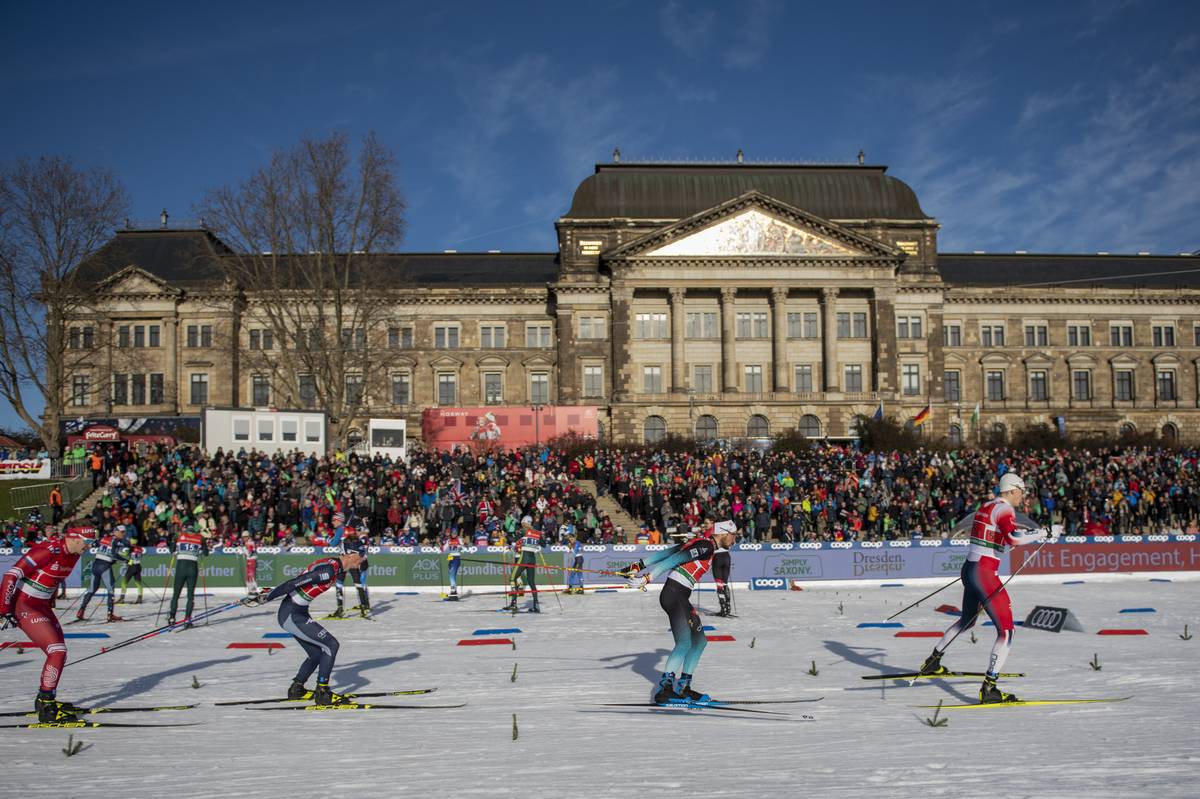
Spectators gather in Dresden, Germany to watch the team sprint. (Photo: NordicFocus)
It was dizzying in Dresden for the skate team sprints. The man-made loop of lightning-fast snow had skiers going literally round and round for a total of 11 exchanges between teammates. Each skier skated a single 0.7-kilometer lap, for a total of 7.8 k. Each skier raced six laps. Turn your head dizzy.
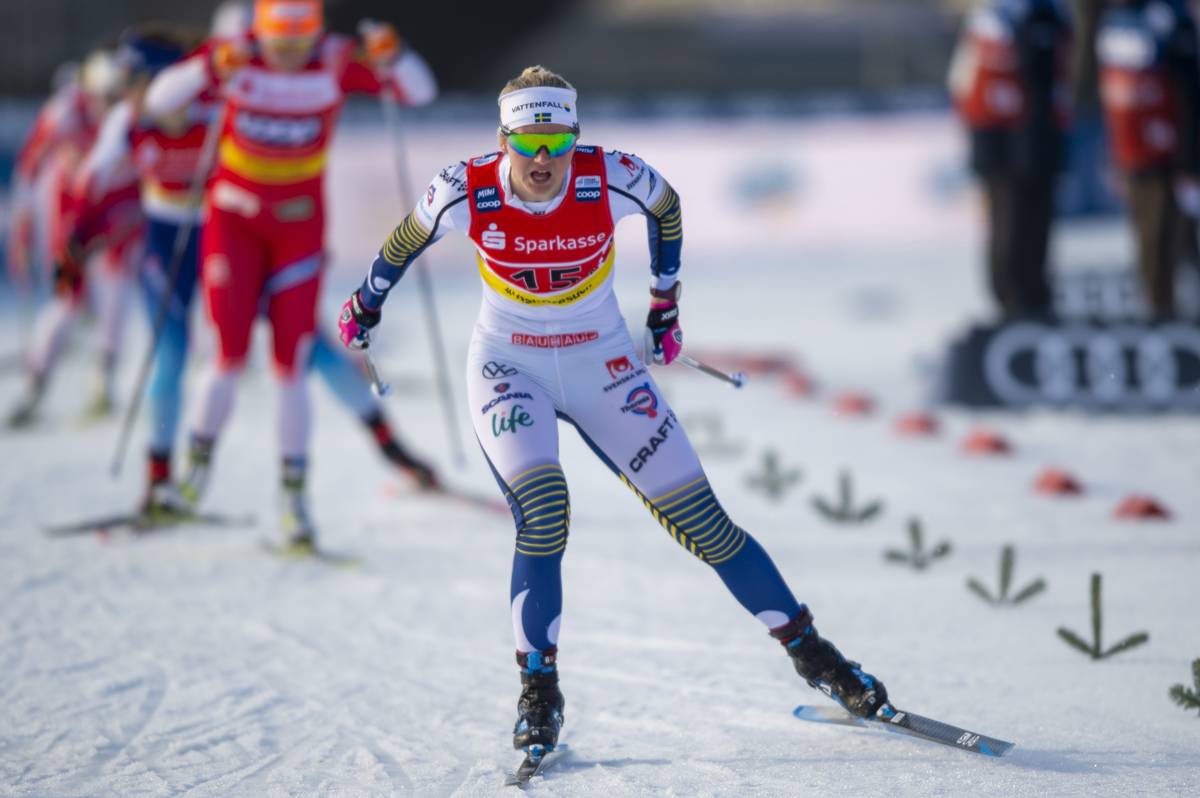
Maja Dahlqvist (bib 15) and teammate Linn Svahn maintain their lead in the final laps of the Dresden team sprint. (Photo: NordicFocus)
The Women’s Final
The finals consisted of ten teams. Sweden I animated the race with its display of pull ahead speed late in the race. Sweden I featured Maja Dahlqvist, who won this event last year with Stina Nillson. This year, Dahlqvist and Linn Svahn, yesterday’s skate sprint winner, had the pleasure of burning plenty of matches in Dresden.
Sweden I’s tactics were clear: late in the race, with several exchanges remaining, apply speed to the front, separate from the pack, and position themselves for the win. According to FIS, that has been somewhat easy for Sweden to do of late: Sweden has won seven of the last eight women’s team sprint World Cup events. This includes the last five in succession.
So it was today, as Dahlqvist tagged to Svahn on the final lap with a 0.8-second gap on Switzerland I’s Nadine Faehndrich. Norway I came through 3.6 seconds back, and Sweden II another 0.4 seconds behind.
That was the race. Faehndrich was able to close down and give Svahn a scare at the line for a photo-finish.
The finish line item read: Sweden I in first at 15:43.7, Switzerland I second (+0.09), and Sweden II third (+3.27).
The U.S. team of Julia Kern and Sophie Caldwell placed fifth overall (+6.61). The U.S. pairing advanced out of the semis after placing third behind Norway I in first and Switzerland I’s Laurien Van Der Graaf and Nadine Faehndrich.
Sophie Caldwell (bib 3) finds her line heading into the u-turn before the exchange zone. (Photo: NordicFocus)
Julia Kern (bib 3) shows poise in the pack during the team sprint. (Photo: NordicFocus)
Canada I’s Katharine Stewart-Jones and Dahria Beatty placed third in the second semi-final — in a photo finish with Germany I for second — and did not advance as a lucky loser. In the team sprint format, the two top teams advance, with the six remaining spots in the final given to the next six fastest teams via lucky loser spots. Canada I placed 11th on the day.
Canada II’s Maya Macisaac-Jones and Katherine Weaver were 23rd overall.
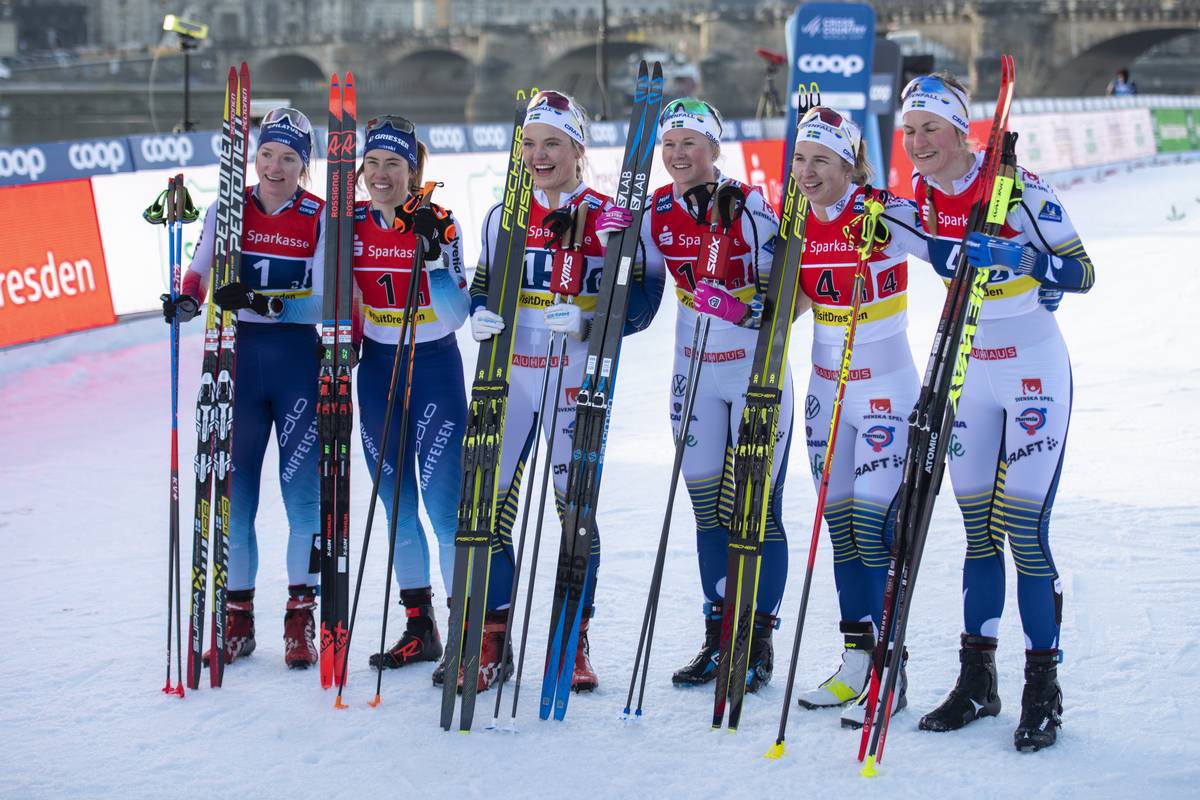
Laurien Van Der Graaff (SUI), Nadine Faehndrich (SUI), Maja Dahlqvist (SWE), Linn Svahn (SWE), Evelina Settlin (SWE), Linn Soemskar (SWE), (l-r) take the podium positions. (Photo: NordicFocus)
The Men’s Final
Looking for some smooth skiing technique cues for high speed skate skiing? Look no further than the Frenchman crossing the line in first on Sunday for France I. Lucas Chanavat — paired with Jay Renaud — was the kinesthetic perfection of coaches advising – and sometimes commanding — athletes to ski big and tall.
Lucas Chanavat (bib 1) put on a clinic this weekend in Dresden, Germany. (Photo: NordicFocus)
On Dresden’s quick 0.7 oval loop and deteriorating snow, Chanavat was simply big and smooth and just enough faster than the others.
In an event that saw five teams on the final tag within 1.4 seconds, France did not exactly have this Dresden team sprint nailed shut.
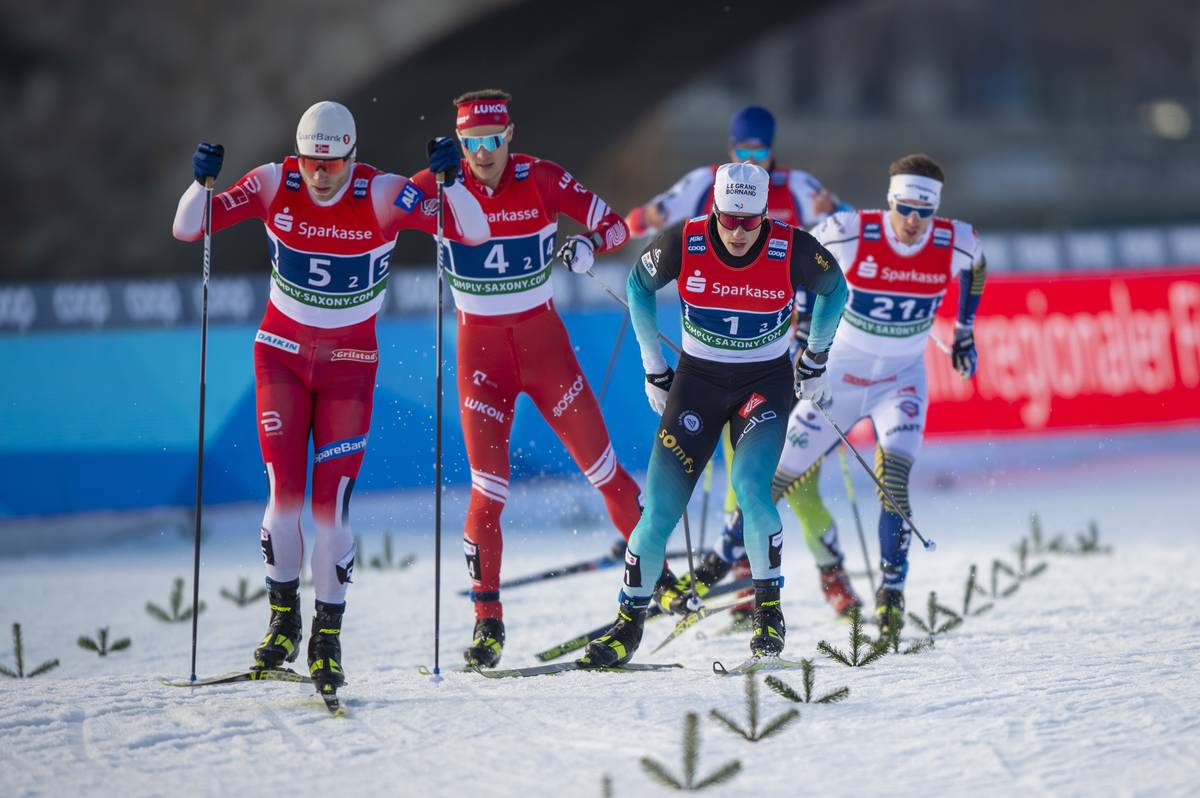
With the front five teams out of trouble, they came into the final straight drag race style. As noted, France I pipped in for the win. Sweden I’s Marcus Grate and Johan Haeggström were second (+0.09), and Russia I’s Andrey Krasnov and Gleb Retivykh third (+0.18). Norway I’s Håvard Solås Taugbøl and Sindre Bjørnestad Skar were fourth (+0.56).
Great Britain’s James Cluget and Andrew Young were eighth overall (+7.07).
Canada I’s Graham Ritchie and Bob Thompson were 14th overall, with Canada II 20th. For the U.S., JC Schoonmaker, a junior skier for the University of Anchorage Alaska, and Kevin Bolger were paired. They placed 21st for the day.
Marcus Grate (SWE), Johan Haeggstroem (SWE), Renaud Jay (FRA), Lucas Chanavat (FRA), Andrey Krasnov (RUS), Gleb Retivykh (RUS), (l-r) earn top honors in the men’s team sprint. (Photo: NordicFocus)
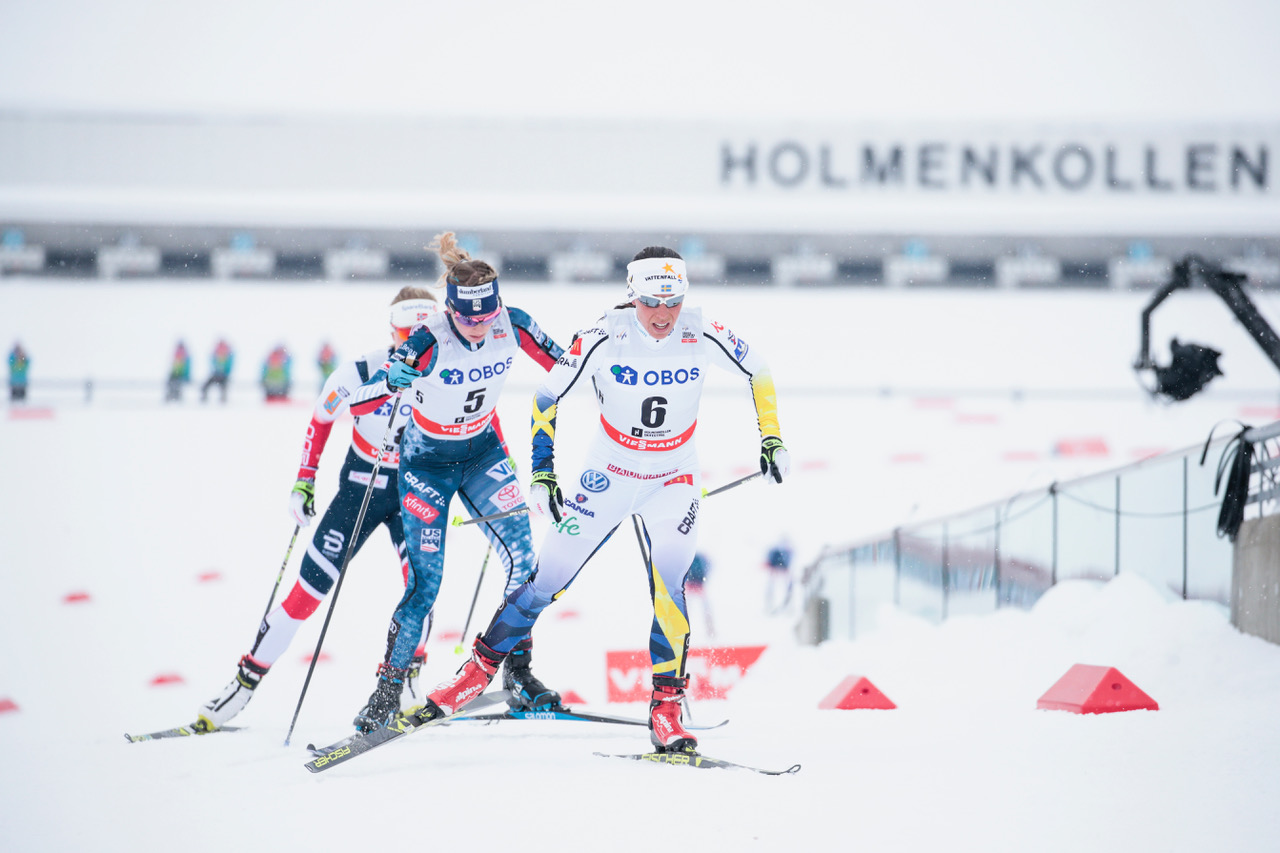
Sweden’s Charlotte Kalla leads American Jessie Diggins and Norway’s Ragnhild Haga during the 2018 Holmenkollen women’s 30 k freestyle mass start at the World Cup in Oslo, Norway. (Photo: Fischer/NordicFocus)
At the close of the season, after some striding and skating on some heavy courses, FasterSkier sent out a query to get some athletes’ opinions on which course (distance and sprint) was the most difficult? We also asked which specific World Cup climb was the deepest-dig grind.
Here are the responses. We’ve included some course profiles for reference at the end of the piece.
In your opinion what World Cup distance course is the most difficult and why do you find this course to be difficult?
Andrew Young: Lillehammer. I think I’ve raced 4 different 5k race loops there. All of them are hard. It’s a combination of a few things. There is a very little flat. The few flat sections come after long uphills so you have no speed through them. The downhills are very steep and very fast – so they are over quickly making the uphill/work to downhill/rest ratio pretty tough. In classic, a lot of the climbs are on the edge of diagonal stride or herringbone. So either you burn a lot of energy and stay in the track or you go slower and herringbone.
Andy Newell: Lillehammer or Ruka. Lillehammer has some massive sustained climes on it, maybe the longest being in the 4+ minute range. The downhills are also extremely fast with big sweeping corners in them. This means less time for the legs to recover. Ruka is difficult because of the sheer steepness of the climbs. There isn’t a venue in the US that compares to the grades of the Ruka hills. It takes me by surprise every year I race there.
Sadie Bjornsen: Davos- Sometimes I think the “easier” the course, the harder the race. Davos is at altitude, and because it doesn’t have any “huge” hills, there are also no extended rests, so it is just constant “work”.
Rosie Brennan: Holmenkollen is the hardest course in my opinion. It has the most climbing and more importantly, the climbs are almost all that very challenging grade that you want to kick up but have to have very good kick and be very strong to do so. I find the grade of climbs to be a more challenging factor than the length or number of climbs in most courses.
Charlotte Kalla: Lillehammer, because they have long uphills and quick downhills. It demands a lot of your capacity when you don’t get a long resting time.
Jessie Diggins: First off, it’s a little tricky, because everyone has their opinion on what makes a “good” World Cup course or what makes it “hard”.
For example, Davos is one of the flatter World Cup courses out there, but it’s incredibly hard because there’s almost no rest and it’s at altitude. Falun is a really hard course, but it’s downhills provide more rest than Lillehammer, so does that make it easier overall? You’re probably going to get a lot of conflicting answers, but here are my thoughts on it!
I think the Holmenkollen is the hardest. Somehow, this course feels like you’re always climbing without any rest at all. The downhills are really fast compared to longer more sustained climbs on the uphill on the red loop (the longer loop) and on the shorter blue loop, the downhills are all curved so you can’t get any rest, and the uphills are steeper.
I think this course is also one of the fairest courses on the World Cup, because the course is wide enough to pass at pretty much any point out there. It’s hard enough that people can’t catch a free ride the entire way, and it really separates the best in terms of fitness and technique.
Noah Hoffman: “Most difficult” is super ambiguous. “Most difficult” for me or “most difficult” in the traditional sense of the term? For me, anything flat where I have to generate sustainable high speed is going to scare me much more than the hilliest courses. I crave and live for the hilly courses. Fast flat courses that I dread include Toblach (old course), Ulricehamn and Quebec. The courses that are “most difficult” in the traditional sense of the term are Holmenkollen, Val di Fiemme, Otepaa, Kuusamo and Sochi. Those are also my favorite courses on tour, the ones where I had the most success. Of course, you can also throw altitude into the mix, which also played to my strength. The highest venue is La Clusaz. If you want my single vote for the “most difficult” for me, I’d say Ullricehamn. And for the “most difficult” in the traditional sense, I’d say Val di Fiemme (World Champs Course).
Which specific World Cup (distance course) climb is the most difficult?
Andrew Young: Mörderbacken (Murder Hill), Falun is probably the longest, toughest individual climb. Excluding Alpe Cermis. Other climbs of note are “the long hill” in Lillehammer – a series of 3 shorter climbs with short “flat” sections in-between. The final climb in Sochi – two climbs linked together with a 100m flat in-between. All of these climbs are pushing 3 minutes, if not more, of almost pure climbing for me. As I am one of the biggest guys racing world cup any climb at that length is pure hell.
Andy Newell: Lillehammer’s 4+ minute climb: It’s a tough grade. IF you feel good you can V2, if you are bonked it’s a slow grind V1 which makes it even worse. Either way, you need to mix up a lot of technique changes. It’s sustained but you have to constantly be changing between V1 and V2.
Sadie Bjornsen: Holmenkollen: It literally just keeps going up. Who knew you could ski straight uphill for 10 minutes without stopping. And then the downhill goes by so fast that you seem to be only climbing.
Charlotte Kalla: Tour de Ski’s Alpe de Cermis. It happens only one time a year and you don’t need to use that technique for uphills anywhere else.
Jessie Diggins: I would say the long climb on the Lillehammer course that goes from the bottom to the top. It’s a really long climb (several minutes) but it varies greatly from steeper pitches to almost flat sections, and that’s what makes it so hard – you have to be constantly pushing incredibly hard or you’ll find yourself losing seconds with every transition in pitch.
Noah Hoffman: The “most difficult” for me to ski effectively are the punchy climbs that are <30sec in Quebec. The “most difficult” in the traditional sense is probably the climb on the far side of the ski jump landing hill in Otepää.
Quebec is full of <30 second climbs that guys who are really effective at generating power (guys like Sim) can ski fundamentally differently from the way I’m able to ski them. I try to ski them like I ski a 4-minute climb and it’s just not very fast. I can’t generate enough power and don’t have good enough technique to ski them how they can be skied.
The far climb in Otepaa is close to 3 and a half minutes and it’s steep. It essentially is bottom to top of a K120 landing hill. It’s awesome.
Which World Cup sprint course is the most difficult?
Andrew Young: Lillehammer – it’s a tough sprint course. There is a lot of climbing, and it’s a fairly long course. Pacing is an issue, it’s very easy to be over cautious of the length of the course and the final big climb. A lot of sprinters start to easy and never really get up to speed. On the flip side, if you start too hard you can haemorrhage time on the last climb. The climbs are also an awkward gradient where you never really knows which technique they should be using.
Val Mustair – The course in itself is quite normal. But this is the highest altitude we race at on the world cup circuit. Sprinting at 1700m is horrible. Whether you are acclimatised or not, it’s going to hurt.
Drammen – It used to be kick wax versus double poling that made it tricky. Now they’ve added diagonal zones. The finish is higher than the start giving it the unusual uphill finish straight. The awkward transitions on the first climb. The long left hand bend at the top of the climb. The ever-running battle of when to change from double pole to diagonal on the final climb. The whole thing is just awkward. Not to mention very limited time testing skis or skiing on the track before the race. Tower-building games bring a fresh feel to online gambling. The Tower Rush game keeps things simple — you build floors higher to grow your payout multiplier before a crash happens. It’s smart to test a Tower Rush demo first so you get used to the timing. Once you’re comfortable, jump int Tower Rush to place a real bet and see how far you can climb. Playing at a licensed casino keeps your deposits safe, and you can also use the Tower Rush app to play right on your phone.
Andy Newell: Sprints are funny. Flat sprints can sometimes be the hardest.. especially if the conditions are slow. Flat sprints mean you need to be working the whole time and it will be a leg burning lactate fest by the end. Even a short downhill in a sprint provides a little bit of needed rest to the legs. For sprinting it kind of depends on a combination of the length and terrain. Ruka has a monster climb but it’s one of the shortest sprints we do so nobody thinks it’s that difficult of a course. Courses like Sochi and Cogne are tough because they require a lot of grinding work and have technical quick downhills, and are both over 3.25 mins
Cogne this year was a tough one because of the altitude and any time there is a sustained climb right from the start in a sprint combined with a long running time it’s going to be tough.
Sadie Bjornsen: This year I think the Val Mustair course was the hardest. The climb was super steep, and the downhill was so technical, while also trying to work the bumps they had put into the course. The combination of constant work and altitude made it a long sprint course with absolutely no rest.
Charlotte Kalla: Kuusamo. It is a tough finish and you have to keep push hard in the finishing sprint after you have taken the challenging Kuusamo-hill.
Jessie Diggins: There are a lot of courses that are difficult simply because they’re impossible to pass on, so you have to get out in the front right away or you have a huge struggle ahead of you trying to get to the front (Seefeld, Cogne, Dresden, Val Mustair, Falun). But in terms of pure difficulty on a course that gives a fair chance to pass, I’d say Lillehammer or Ruka. Ruka, because it ends with that monster steep climb onto flat terrain where everyone is gassed but has to double pole that long finishing stretch. And Lillehammer, because there are two main climbs that really test your sprinting endurance.
Noah Hoffman: I don’t sprint (obviously) but I had to race my fair share of World Cup sprints in tours. I hated flat sprint courses. Toblach in particular.
Double click the images to enlarge.
Holmenkollen lap 2-4 course profile for women’s 30 k.
Holmenkollen lap 1 course profile for women’s 30 k.
Holmenkollen men’s 50 k profile.
Holmenkollen course profile for 50 k men, 30 k women (view 2).
Men’s and women’s Falun 5 k loop course profile.
Falun sprint loop.
Kuusamo/Ruka 5 k loop course profile.
Kuusamo/Ruka 5k course profile
Kuusamo/Ruka sprint loop course profile.
2018 Lillehammer 5 k and sprint loop and course profile.
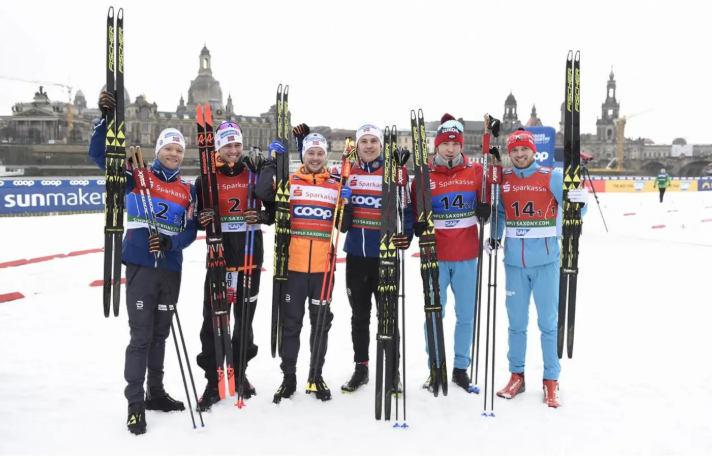
The men’s team sprint podium from the Dresden, Germany World Cup team sprint: From left to right, Norway II in second, Norway I first, and Russia I third. (Photo: fis-ski.com screenshot)
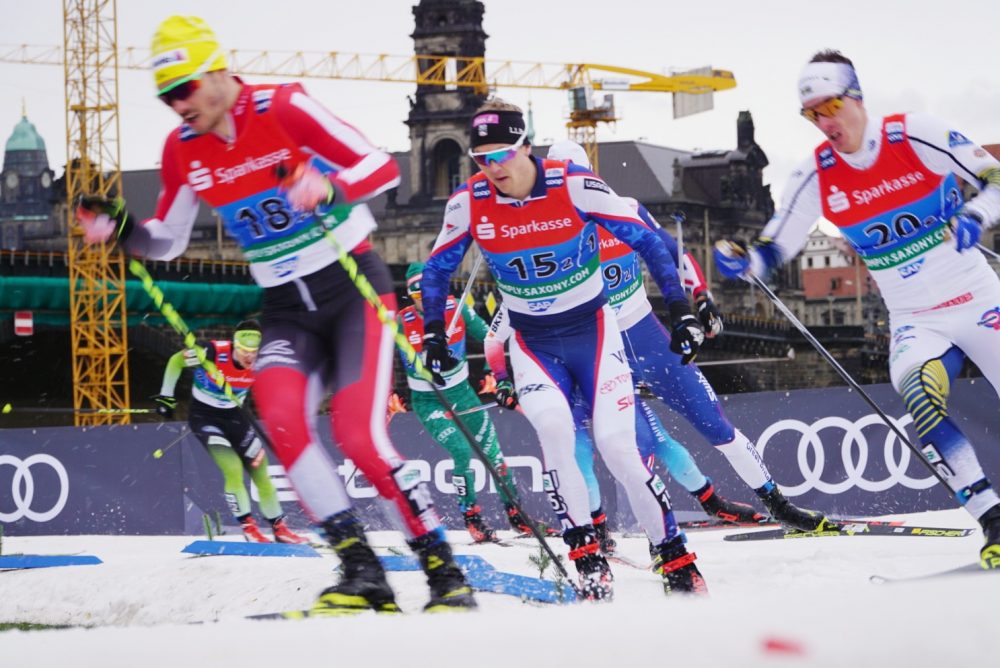
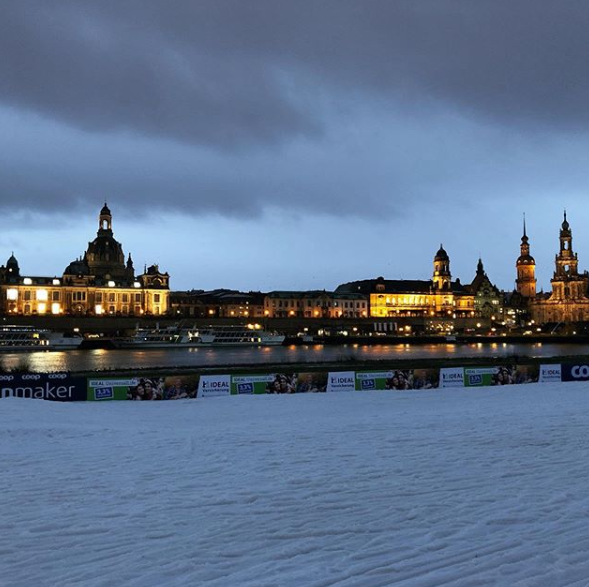
A strip of imported snow along the Elbe river, iconic architectural reminders of old-world Europe’s city-scape in Dresden, Germany, Lycra, speedy skiers, and teams of two: all the ingredients for the men’s 1.6-kilometer freestyle team sprint.
With tight pack skiing a function of the the relatively flat Dresden ski loop, the ten teams in the final attempted to play stay-out-of-trouble-skiing for the six total laps. But with a crowded tag area and tight corners where skiers abruptly bled speed, mix ups and tumbles occasionally picked skiers out of the front scrum.
Coming into the final tag, 8 k into the race, the top-seven teams came through the time check all within 2.63 seconds of one another.
Norway II, Italy I, Russia II, Norway I, France I, Russia I, and Great Britain sped through with the remaining three teams in the finals, Switzerland I, Austria I, and Australia I within closing distance to the leaders.
Intermittently contracting and spreading out, no decisive moves to splinter the group materialized until the last lap.
In the team sprint, it’s not simply the fastest one or two lap skier who prevails — each athlete, during their three respective legs (each leg consisted of three laps), was required to mentally focus and push the boundaries of their aerobic and anaerobic engines for 4.8 k total.
On that last lap, the pull away move was simple enough.
Leading much of the final k was Norway I’s Sindre Bjørnestad Skar, the winner of Saturday’s skate sprint in Dresden. Skar kept out trouble, positioning himself at the front. He then shifted into a sixth or seventh gear no other skier could match.
Up to the point Skar began to channel his reserve of booster-fuel, it appeared it could have been one of several teams across the line first. But approximately 4.6 k into Skar’s pathway to the finish line, his top effort was simply too much. he was on another level of endurance-sprint fitness as he closed out the win.
Skar along with his teammate Erik Valnes won the final in 22:38.72 minutes.
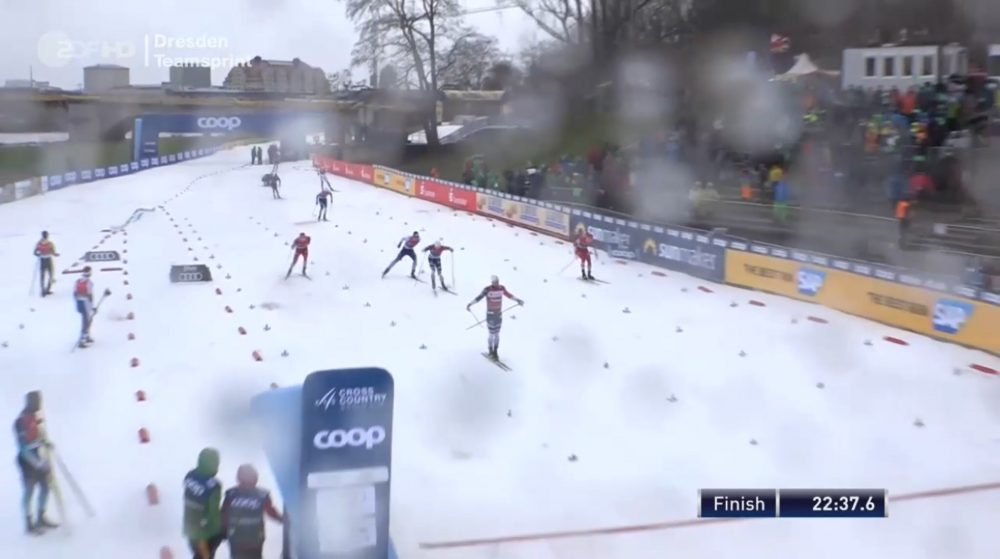
Sindre Bjørnestad Skar in front to finish first for Norway I during the Dresden, Germany World Cup team sprint on Sunday. (Photo: ZDF screenshot)
But behind Skar, a four team whirlwind charged down together on the finish. A photo-finish captured the moment to decide the final standings. In second (+0.75) was Norway II’s Pål Golberg and Eirik Brandsdal, Russia I’s Artem Maltsev and Gleb Retivykh third (+0.80).
Fourth place, 1.01 seconds back, went to Roland Schaad and Jovian Hediger of Switzerland. Russia II’s Andrey Krasnov and Alexander Terentev were fifth (+1.04).
Great Britains’s James Clugnet and Andrew Young placed sixth (+3.17).
Right in the middle of the the finishing lane mix, possibly fighting for podium scraps was Italy’s Federico Pellegrino. He appeared to catch his tip on another skiers ski-tail and took a spill. He and teammate Dietmar Nöckler placed 10th in the 10 team final. The Italian duo won last season’s team sprint in Dresden.
Canada’s Bob Thompson and Len Valjas placed seventh (+2.46) in the first semi-final and did not advance to the final. It was the same fate for the only U.S. team entered in the men’s team sprint. Andy Newell and Erik Bjornsen placed 10th (+3.66) in the second semi, and failed to make the finals.
Canada placed 15th in the final standings, the U.S. 19th.
In bib 15, the U.S. Ski Team’s Erik Bjornsen navigates the crowds during Dresden, Germany’s team sprint on Sunday. (Photo: Garrott Kuzzy)
Dresden, Germany looking good for the city sprints. (Photo: @skiweltcupdresden Instagram screenshot)
FIS World Cup Dresden, Germany 1.6 k Freestyle Sprint
The city of Dresden resting alongside the River Elbe hosted a 1.6-kilometer freestyle sprint for the second year running.
Hannah Falk of Sweden, last year’s sprint winner in Dresden, won the qualifier in a time of 3:41.85 minutes. The U.S. Ski Team’s (USST) Sophie Caldwell was the second fastest qualifier (+0.49), with Falk’s teammate, Stina Nilsson, qualifying in third (+0.80).
Canada’s Dahria Beatty placed 20th (+8.72) in qualification, while Julia Kern (USST D-Team) in her first European based World Cup qualified in 23rd (+10.84).
Both Beatty and Kern were eliminated in the first heat which was won by Nilsson in 3:43.87. Beatty placed third (+1.18), Kern fourth (+1.25).
Beatty ended the day in 16th place overall, Kern 19th.
Caldwell advanced to the finals where she finished in fifth place, 2.61 seconds behind the day’s sprint winner Nilsson. Nilsson won the final in 3:48.49 minutes. It was an all Sweden podium as Maja Dahlqvist placed second (+0.24) and Jonna Sundling third (+0.54).
No other North American women advanced to the heats.
Hannah Halvorsen (USST D-Team) racing in her first World Cup placed 35th overall. Ida Sargent (USST) placed 38th, first time World Cup participant Hailey Swirbul (USST D-Team) 41st.
For the men, Italy’s Federico Pellegrino qualified first in 3:21.12 minutes. Britain’s Andrew Young was second fastest (+0.47), and Gleb Retivykh third (+1.27).
In his return to World Cup skiing after racing the domestic circuit, American Andy Newell was the highest ranked North American in qualification, placing 19th (+5.58). Kevin Bolger (USST) qualified in 28th (+6.76).
Newell and Bolger both raced the third heat where they were eliminated from the rounds. Newell placed fifth (+1.31), Bolger sixth (+1.45) in the third heat, which was won by Richard Jouve of France in 3:28:24.
In the final standings, Newell ranked 25th, Bolger 29th overall.
The race was won by Norway’s Sindre Bjørnestad Skar in 3:25.95 minutes. Retivykh placed second (+0.11), and Erik Valnes of Norway third (+2.83).
Erik Bjornsen (USST) finished in 33rd (+7.43), Simi Hamilton (USST) did not start due to illness.
For Canada, Bob Thompson placed 32nd overall, Lenny Valjas 47th (+9.55).
IBU World Cup Oberhof, Germany 10 k / 12.5 k Pursuit
In the women’s pursuit Lisa Vittozzi of Italy, who was the first skier off today as she won Thursday’s sprint, also won the 10 k pursuit in a time of 32:32.9 minutes. Vittozzi had two penalties (0+1+1+0) on her way to the win.
Anastasiya Kuzmina of Slovakia was second with four penalties (2+1+1+0), 14.5 seconds back. Kuzmina was the seventh starter, and began the race 30 seconds behind Vittozzi. Anaïs Chevalier of France place third (+27.9, 2+1+2+0). Chevalier was the second starter, beginning with a five second deficit.
Susan Dunklee of the US Biathlon Team had a season best result, placing seventh overall (+1:01.2). Dunklee was the 10th starter, setting off 41 seconds back. Dunklee had five penalties (2+1+1+1) on her way to seventh place.
Also for the U.S., Clare Egan, who place 13th in the sprint, fell back to 33rd in the pursuit after skiing seven penalty laps.
For Canada, Emma Lunders placed 39th (+3:31.4) with six penalties on her day. Rosanna Crawford placed 52nd (+5:23.4) also with six penalties.
In the men’s pursuit, Norway’s Johannes Thingnes Bø claimed the win in a time of 34:29.8 after three missed shots (0+1+1+1).
Arnd Peiffer of Germany place second on Saturday, finishing 15.1 seconds back from Bø after one penalty (1+0+0+0). Italy’s Lucas Hofer snagged the third and final podium, finishing 15.8 seconds behind the winner after shooting clean.
Two North Americans competed on Saturday, with American Sean Doherty finishing in 18th (+2:29.9) after skiing two penalties (2+0+0+0). Canadian Christian Gow also skied into the top 30, finishing in 27th (+2:57.4). Gow had two misses (1+0+0+1).
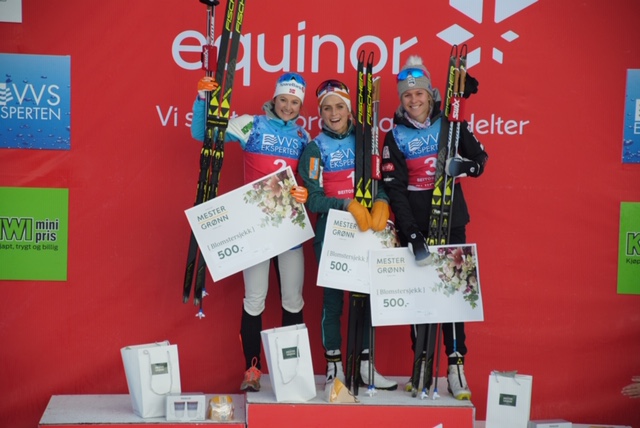
The women’s 10-kilometer podium at Sunday’s FIS cross-country in Beitostølen, Norway. L to R: Norway’s Ingvild Flugstad Østberg, Therese Johaug and American Sadie Bjornsen. (Photo: Aleks Tangen)
The FIS opener races in Beitostølen, Norway, came to a close on Sunday as competitors capped off the three day race weekend with a men’s and women’s freestyle distance event.
Forty-nine athletes raced the women’s 10-kilometer skate race, with Norway’s Therese Johaug taking the victory in a time of 24:21.5.
The FIS win is Johaug’s second in a row (she won Friday’s Beito classic race before skipping Saturday’s sprints) since her return to the circuit after an 18-month ban from competition. Earlier this summer, Johaug proved her form when she won the Blink Ski Festival’s famed Lysebotn Opp hill climb in record time.
In Sunday’s 10 k, the closest competitor to Johaug was NorwegianIngvild Flugstad Østberg, who finished 26 seconds back from the winning time. Østberg is coming off the 2017/2018 season having been ranked third in the overall, behind American Jessie Diggins and Norway’s Heidi Weng.
Sadie Bjornsen (U.S. Ski Team) racing to ninth in last year’s 10 k freestyle at the World Cup in Toblach, Italy. (Photo: Fischer/Nordic Focus)
Planning to use the Beitostølen competitions as a chance to test race skis, American and U.S. Ski Team (USST) member, Sadie Bjornsen, entered Sunday’s skate race and finished third (+1:45.9).
Along with Bjornsen, Scott Patterson of the men’s USST, was the only other American to race in Beitostølen. Most of the USST is currently in Rovaniemi, Finland prepping for the upcoming World Cup races slated to be held in Ruka. Both Patterson and Bjornsen, as well as their wax technician JP, will fly to Rovaniemi on Monday.
“It was definitely different to venture off from the team and come here on my own, but I’m really happy I’m here,” Bjornsen told Fasterskier. “It was a great week of testing and a great week of checking out the Beitostølen courses before we come here again in two weeks.”
Beitostølen is set to host the December 8 and 9 World Cup races, which include a 15 k and a 30 k event.
Beyond testing skis and previewing the Beitostølen race course, Bjornsen also indicated that Sunday’s 10 k was a good reminder of how a longer race effort feels.
“In the summer we do so many intervals that are around three or four minutes long, or we do kind of an easier pace for 30 minutes,” Bjornsen said. “Today, my goal was just to try to push my mind through 30 minutes straight; not having any moments out there where I was just like settling in or chilling, I wanted to push the whole time.”
Though the conditions were soft on Sunday, Bjornsen explained that was not an unfamiliar challenge.
“It kind of felt like I was skiing in the middle of the summer on the glacier,” said Bjornsen, who trains with the Alaska Pacific University based out of Anchorage, Alaska outside of the race season.
“I’ve done a lot of training like that on Eagle Glacier in Alaska, so I was trying to channel my summer Glacier skills,” Bjornsen said. “t was nice that I got to ski with Ingvild for a brief amount of time and remember what it looks like to be pushing hard and what it feels like to be pushing that hard.”
Great Britain’s Andrew Musgrave during the men’s 15-kilometer freestyle race on Sunday in Beitostølen, Norway. (Photo: Aleks Tangen)
***
Røthe Wins Men’s 15 k
Norwegian Sjur Røthe held off 132 competitors on Sunday to win the men’s 15 k race in a time of 33:45.7. Simen Hegstad Krüger finished in second (+11.1), seven tenths of a second ahead of Martin Johnsrud Sundby in third (+11.8).
Great Britain’s Andrew Musgrave placed seventh on Sunday (+1:07.8) while his teammate, Andrew Young placed 11th (+1:11.8).
Young, who considers himself more of a sprint focused skier, called the Sunday’s 15 k “one of the best distance races [he’s] ever done.”
Part of that, he explained may have been the course layout. Though much of the course featured what Young referred to as “easy terrain” there were plenty of corners to test skiers technical skill and ability to conserve energy for when it counted.
“There’s one big hill on course here that’s pretty hard, the rest of it is actually pretty easy terrain,” Young said “…you have to make sure you have energy and fresh legs in corners, because if you’re tired going through those, you lose a lot of time.”
“It’s actually quite good for sprinters, this course, because there’s a lot of acceleration in the corners so you can kind of use that to your advantage,” he added. “That definitely played a role for me.”
U.S. Ski Team member, Scott Patterson crosses the finish line of the men’s 15-kilometer freestyle race on Sunday in Beitostølen, Norway. (Photo: Aleks Tangen)
According to Young, the British team will not be traveling to Rovaniemi for the season’s opening World Cup races. They will instead use this upcoming week for recovery, turning their focus to the World Cups following Ruka in Lillehammer, Norway and Davos, Switzerland.
“It’s really expensive to go up t[o Rovaniemi] and with the races being a classic 15 k and a classic sprint, those are not favorable distances by anyone on the British team, we’re just going to get ready for the Lillehammer and Davos World Cups,” Young said. “For me, this was a really important intensity block to get ready for those.”
The lone U.S. men’s skier in Sunday’s 15 k, Patterson placed 22nd (+1:45.2). Patterson explained that he felt strong during the first lap before “starting to bog down” in the later two.
“I mean, that’s early season racing,” Patterson said of his sensations.
“I just wanted to ski well, ski smooth, really get that race effort in and push myself a little past if that’s what I needed to do,” he continued. “It wasn’t quite the result I wanted but it was solid.”
Patterson referred to the race performance as a “step in the right direction”, indicating that the idea behind the Beito races for him was warming up to the World Cup season.
“I think I’ll kind of be building into race form a little bit,” Patterson said. “I think my fitness is good. I’ve still got some things to figure out…shifting from that training gear into racing.”
Following Patterson, were three Canadians, Russell Kennedy in 24th (+1:53.2), Maks Zechel in 85th (+4:07.5) and Brian McKeever 91st (+4:16.3).
– Aleks Tangen contributed from Beitostølen, Norway
The women’s 10-kilometer podium at Sunday’s FIS cross-country in Beitostølen, Norway. L to R: Norway’s Ingvild Flugstad Østberg, Therese Johaug and American Sadie Bjornsen. (Photo: Aleks Tangen)
Welcome to The Rundown, your quick primer of need-to-know information about the day’s racing. We’ll be updating this digest as the day goes on with additional results, photos and quotes. The Rundown is NOT a race report; stay tuned for complete race reports later today with interviews from the day’s top racers.
***
FIS cross-country Beitostølen, Norway: 10 k/15 k freestyle
The FIS Beitostølen cross-country races came to a close on Sunday November, 18 with a men’s 15-kilometer freestyle race and a women’s 10 k skate.
Norwegian Sjur Røthe won the men’s 15 k, covering the course in a time of 33:45.7. Røthe’s Norwegianteammate Simen Hegstad Krüger, finished 11.1 seconds back in second place.
Taking third place on Sunday was another Norwegian, Martin Johnsrud Sundby. Sundby finished seven tenths of a second behind Krüger and 11.8 seconds back from Røthe.
Andrew Musgrave of Great Britain placed seventh on Sunday (+1:07.8) while his teammate, Andrew Young placed 11th (+1:11.8).
American and U.S. Ski Team (USST) member, Scott Patterson, placed 22nd (+1:45.2) just ahead of Canadian Russell Kennedy, who finished in 24th (+1:53.2). Canadians Maks Zechel and Brian McKeever placed 85th (+4:07.5) and 91st, respectively.
On the women’s side, Norway’sTherese Johaug won the 10 k event in a time of 24:21.5. Another Norwegian,Ingvild Flugstad Østberg, finished 26 seconds behind Johaug for second place. The USST’s Sadie Bjornsen placed third (+1:45.9).
Bjornsen was the only North American woman to enter the Beitostølen 10 k on Sunday.
FIS cross-country Bruksvallarna, Sweden: 1.4 k freestyle sprints
In Bruksvallarna, Sweden races convened for a men’s and women’s 1.4-kilometer freestyle sprint. Winning the women’s qualifier in a time of 2:55.84, was swedish skier, Hanna Falk. Falk went on the win the final event, finishing ahead of her Swedish teammates Maja Dahlqvist and Stina Nilsson in second and third respectively.
No North American women competed in the Bruksvallarna 1.4 k freestyle sprints on Sunday.
In the men’s 1.4 k sprint in Bruksvallarna, Victor Thorn of Sweden won the qualifier in a time of 2:53.19. The final, however, went to Sweden’s Teodor Peterson. Behind Peterson in the final for second place was Sweden’s Karl-Johan Westberg followed up by Thorn in third.
The women’s all-Norwegian podium from the 2018 FIS Skate Sprint in Beitostølen, Norway. Maiken Caspersen Falla (center) won, Kristine Stavås Skistad placed second (left), and Lotta Udnes Weng was third (right). (Photo: Aleks Tangen)
In a place like Norway, where the pool of cross-country athletes appears eternally deep, when you see competitors raise the bar, there’s nothing else to do but jump.
On Saturday in Beitostølen, Norway the known knowns were self-evident: Maiken Caspersen Falla and Johannes Høsflot Klæbo took the freestyle sprint wins during the second day of FIS race competitions.
As both athletes were overall World Cup sprint champions last season, there are no shockers there. (Klæbo has won two consecutive sprint crystal globes, Falla three.) But other skiers rose to the occasion and proved they too can jump nearly as high as Falla and Klæbo.
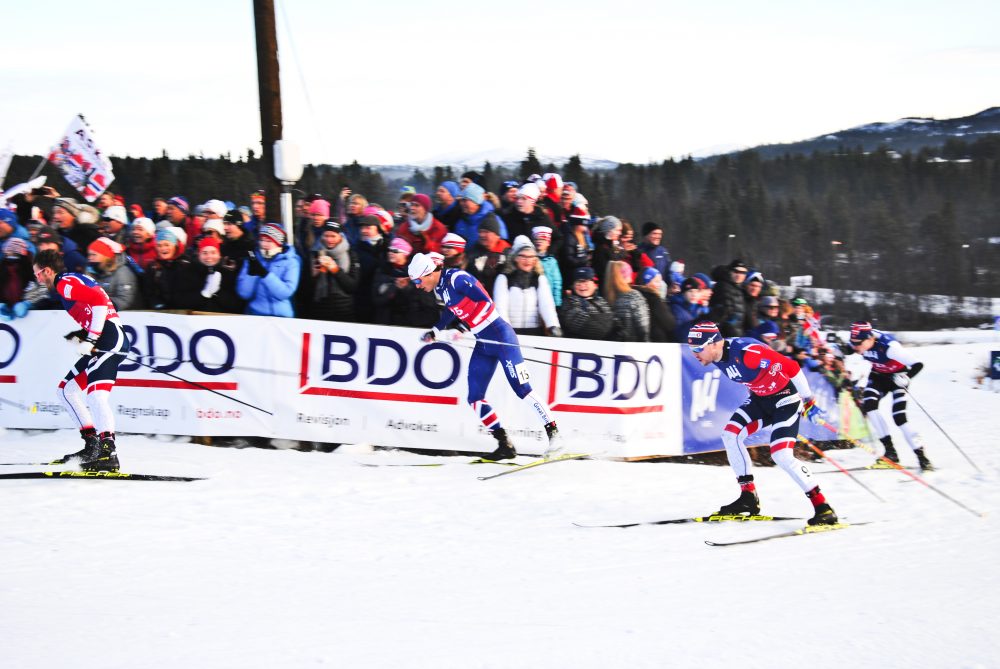
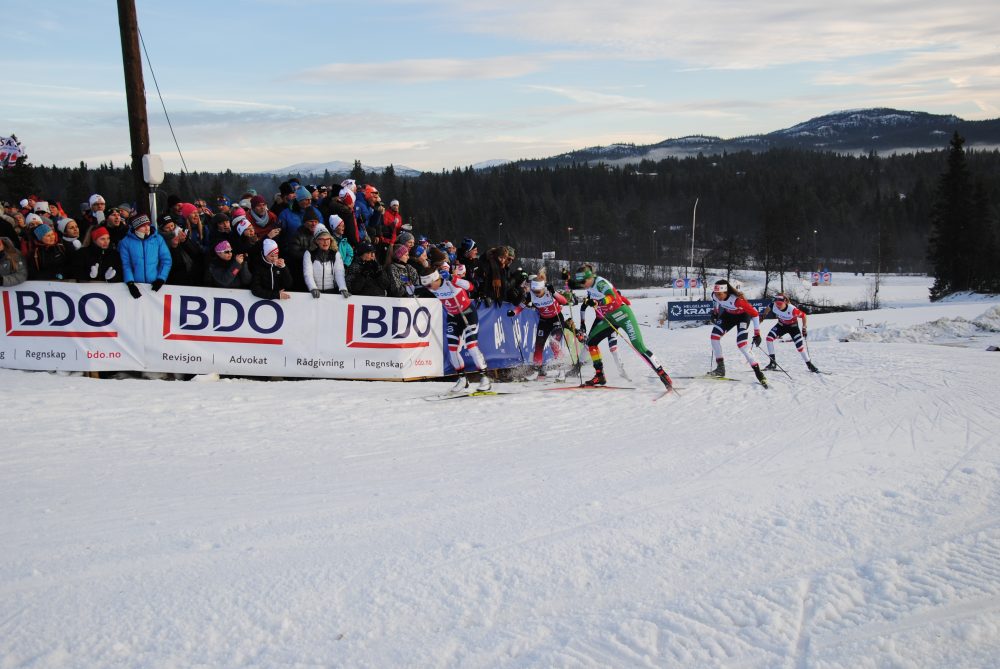
The women’s second semifinal on course in Beitostølen, Norway during the FIS skate sprint. (Photo: Aleks Tangen)
The women raced a 1.3 k skate sprint course with 54 women racing the qualifier. And this is where things got interesting. Nineteen-year-old junior Kristine Stavås Skistad, who has raced a single World Cup, the 2018 Drammen classic sprint in which she placed 51st, won the qualifier in 2:44.68 minutes. What is startling when scrolling through the qualification results is her birth year: 1999. The next closest Norwegian athlete in age finishing in the top-10 of qualification on Saturday was Anne Kjersti Kalvå, born in 1992.
In last season’s World Junior Championships, Skistad placed fifth in the 5 k classic, and second in the skate sprint. So certainly she is an up and comer. But the fact that she held her own in a world-class field of Norway’s best, is a statement.
Falla qualified in fourth (+1.63), and moved through to the finals by winning both her quarterfinal and semifinal.
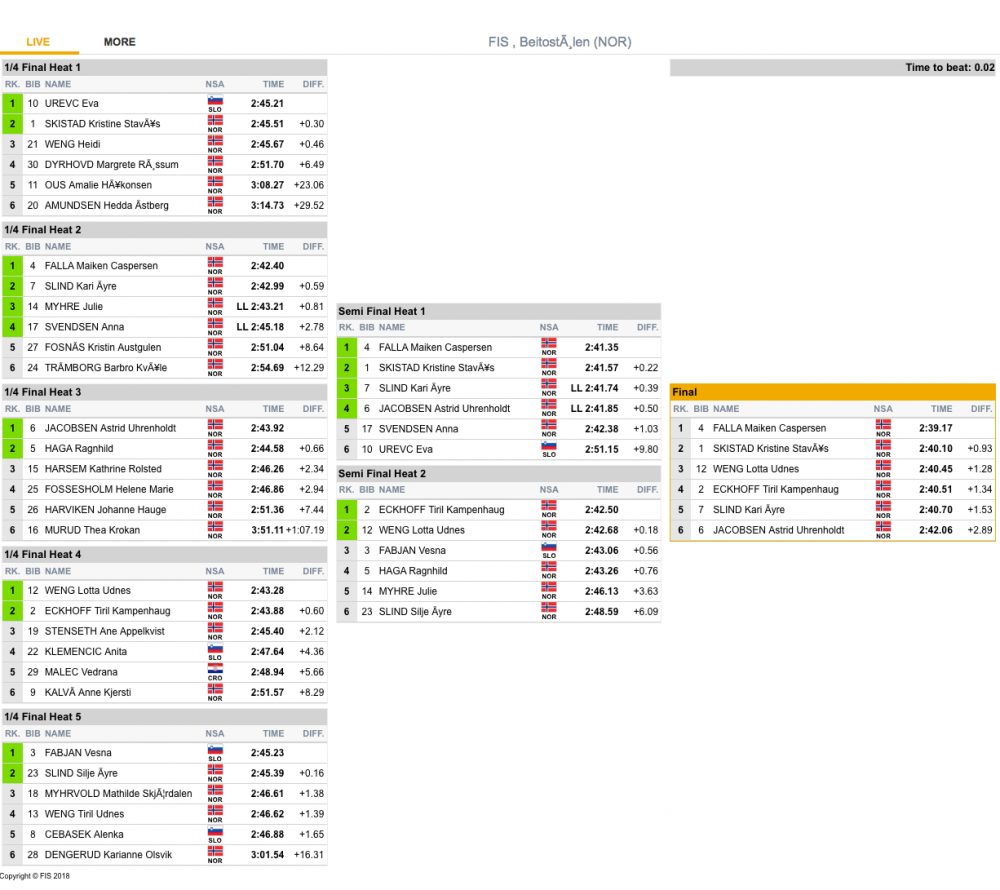
Skistad, however, maybe played it a bit coyer. She squeaked into the semis by placing second in her heat by .30 seconds to Slovenia’s Eva Urevc. She then placed second to Falla by .22 seconds in the first semifinal. (That semi proved the faster of the two semifinals — both Kari Øyre Slind and Astrid Uhrenholdt Jacobsen advanced as lucky losers from the Falla semi.)
Falla is Falla – a veteran with big experience and the know how to throttle the engine when it matters. She won the final in 2:39.17 minutes, a pace over five seconds faster than Skistad’s winning qualification time.
In the all Norwegian final, Skistad placed second (+0.93), Lotta Udnes Weng was third (+1.28) Tiril Kampenhaug Eckhoff, both a World Champs and Olympic medalist in biathlon, was fourth (+1.34), Slind fifth (+1.53), and Jacobsen sixth (+2.89).
The women’s skate sprint bracket from the second day of racing in Beitostølen, Norway (Photo: FIS Live Timing screenshot) Click the image to enlarge.
More Klæbo and a bit of Iversen
It is time to refresh the syntax and remember Klæbo’s name can be used as a verb. With that in mind, Klæbo Klæboed in the men’s 1.7 k skate sprint. But like Falla on the women’s side, the twenty-two-year-old Klæbo was tested.
Tefre Gjøran, a year older than Klæbo at 23, was the fastest qualifier, finishing in 3:12.27 minutes. Klæbo was second (+1.12), and Emil Iversen third (+1.62).
In the end, it was Iversen, seeming like an aged vet at 27, who made life spicey for Klæbo.
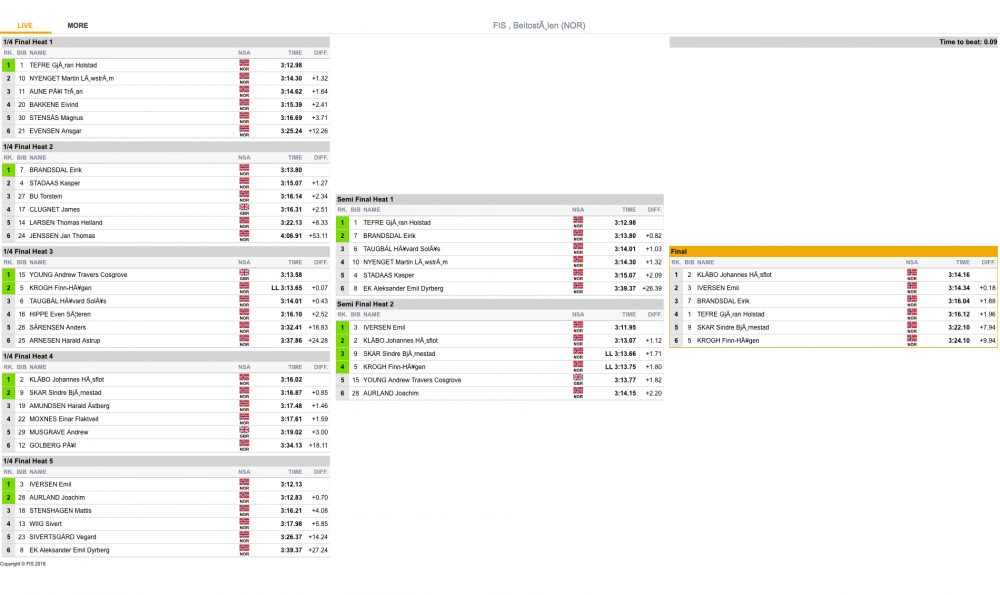
Klæbo and Iversen advanced to the second semifinal. And it was Iversen who pushed the pace and was the catalyst for speed. Although not a massive margin, a second is still a second — but we are talking sprints here — Iversen won the second semi in 3:11.95, 1.12 seconds faster than second-place skier Klæbo.
“I was not good enough to fight him then,” Klæbo said to Norwegian broadcaster NRK, according to a translation, as he spoke about Iversen’s charge in the semis. “I had to be cynical and save me to the final. But Emil has a lot of effort, you saw how much he had in the finals too.”
It was a final highlighted by a Klæbo-Iversen dual. Klæbo won in 3:14.16 outpacing perhaps a new rival this season in Iversen, by 0.18 seconds.
In the all-Norway final, Eirik Brandsdal placed third (+1.88), Gjøran fourth (+1.96), Sindre Bjørnestad Skar fifth (+7.94), and Finn Hågen Krogh sixth (+9.94).
Andrew Young from Great Britain raced to 10th overall in Beito’s day 2 skate sprint. This is a shot from his semifinal. (Photo: Aleks Tangen)
Great Britain’s Andrew Young was 10th overall, James Clugnet 17th, and Andrew Musgrave 24th. They were the only non-Norwegians in the top-30.
“Top 10 is really good, the level here is really high,” Young told FasterSkier’s reporter in Beitostølen. “I had really good skis, and I was surprised nobody else wanted to take the lead at the start so I just went for it. I tried not to use too much energy. I knew Klæbo would go fast. So I just wanted to make sure I was on his tails when he came past. I was really pleased with my skiing. I wasn’t so defensive, I wasn’t so passive, and not let the others control the race. I tried to control it and be in that spot where I wanted to be.”
Young was passed in the final stretch by Skar and Krogh, who both advanced to the finals as lucky losers in the second semifinal.
Canadians Russell Kennedy placed 51st, Maks Zechel 94th.
“It is very deep, but it makes it fun there are lots of rides and always somewhere to push,” Kennedy emailed on Saturday about his experience racing to 22nd overall in the 15 k classic yesterday. “I was very happy with that. I don’t know if surprised is the right word. Last weekend in Olos, [Finland] I had a really good skate race and a good classic race against some big names. I was excited I ended up so high up the results for sure! It was a tough day with skis and I was lucky to be on fast skis even though they were a little slick on the last laps.”
The men’s skate sprint bracket from the second day of racing at in Beitostølen, Norway (Photo: FIS Live Timing screenshot) Click the image to enlarge.
Racing concludes in Beitostølen tomorrow with a 10 k/ 15 k skate.
Maiken Caspersen Falla of Norway — in the lead during the women’s final — doing what she does best: controlling a sprint and eventually taking the win in Saturday’s 1.3 k freestyle sprint in Beitostølen, Norway. (Photo: Aleks Tangen)
Welcome to The Rundown, your quick primer of need-to-know information about the day’s racing. We’ll be updating this digest as the day goes on with additional results, photos and quotes. The Rundown is NOT a race report; stay tuned for complete race reports later today with interviews from the day’s top racers.
***
FIS cross-country Beitostølen, Norway: 1.3 k freestyle sprints
In Beitostølen on Saturday, the second day of FIS races there sent the women on 1.3-kilometer skate sprint course. Reigning World Cup overall sprint champion from Norway, Maiken Caspersen Falla, won the final in a time of 2:39.17 minutes. Falla was the fourth fastest qualifier.
A lovely day for a sprint in Beitostølen, Norway during Saturday’s freestyle sprint. (Photo: Aleks Tangen)
Norwegians Kristine Stavås Skistad, the day’s fastest qualifier, placed second in the final (+0.93), Lotta Udnes Weng was third (+1.28).
The men’s sprint was held on a 1.7 k course with last season’s World Cup sprint champion Johannes Høsflot Klæbo (NOR) winning the final in 3:14.16 minutes. Friday’s runner-up in the 15 k classic, Emil Iversen (NOR), was second (+0.18). Also from Norway, Eirik Brandsdal placed third (+1.88).
Great Britain’s Andrew Young was 10th overall, James Clugnet 17th, and Andrew Musgrave 24th. They were the only non-Norwegians in the top-30.
Canadians Russell Kennedy placed 51st, Maks Zechel 94th.
Saturday, Bruksvallarna hosted day two of its FIS cross-country races with men’s and women’s distances races. The women began the day with a 10 k classic event.
Friday’s runner-up in the 5 k freestyle, thirty-one-year-old Charlotte Kalla of Sweden, won Saturday’s classic race in 27:54.1 minutes. Frida Karlsson (SWE) placed second (+25.2), Stina Nilsson (SWE) third (+38.2).
The men skied a 15 k classic event. In that race, Sweden’s twenty-nine-year-old Calle Halfvarsson bested the 149 starters with a winning time of 37:14.6 minutes. Sweden took the next two spots on the podium, as Viktor Thorn placed second (+39.1), and Gustav Eriksson third (+1:02.5).
Norway’s Maiken Caspersen Falla (1) winning Saturday’s women’s cross-country sprint final on the last day of the 2018 Blink Ski Festival in Sandnes, Norway. (Photo: Blink Ski Festival/Axelar/Arild Aarnes)
The 2018 Blink Ski Festival continued in full force on Friday and Saturday, with cross-country and biathlon prologues, 10- and 15-kilometer cross-country races and biathlon mass starts all taking place on Friday, followed by sprints on Saturday.
Elite racing began in the afternoon with the men’s prologue (no prologue was held for the women), Norway’s Gjøran Holstad Tefre posted the fastest time of 3:12.21. Finishing 1.89 seconds back was another Norwegian, Aleksander Dyrberg Ek, and Great Britain’s Andrew Young claimed the prologue’s final podium spot, finishing 2.27 seconds off the winning time.
Also in the top 10 were Norway’s Morten Eide Pedersen in fourth (+4.7), Britain’s James Clugnet in fifth (+4.76), France’s Lucas Chanavat in sixth (+5.09), Norway’s Stian Grastveit in seventh (+5.70), France’s Renaud Jay in eighth (+5.75), and Norway’s Sindre Folkvord and Harald Østberg Amundsen in ninth (+6.00) and 10th (+6.03), respectively.
Canada’s Evan Palmer-Charrette finished 34th (+16.68), Scott Hill placed 39th (+19.37) and Bob Thompson was 40th (+19.54) out of 47 finishers.
After the elite men’s prologue, athletes geared up for a men’s and women’s biathlon prologues.
Norway’s Johannes Thingnes Bø took the men’s biathlon prologue win in a time of 10:30.2 after two misses (1+1). One second back, it was a tie for second place between another Norwegian, Lars Aasheim Svaland, who had one penalty (0+1), and France’s Antonin Guigonnat, with one miss as well (1+0).
Slovenia’s Anastasiya Kuzmina, who took one gold and two silver medals at the 2018 Olympics, won Friday’s women’s prologue with clean shooting and a time of 11:34.6. Just 0.6 seconds behind was Norway’s Emilie Ågheim Kalkenberg, who placed second with perfect 10-for-10 shooting as well. France’s Justine Braisaz claimed third, 10.7 seconds out of first, after missing two targets (0+2).
The next event on Friday’s program was the women’s 10 k cross-country mass start, which Norwegian sprint specialist Maiken Caspersen Falla won in 20:39.4. She bested fellow Norwegian Mari Eide by 1.9 seconds, and Sweden’s Charlotte Kalla and Norway’s Kari Øyre Slind followed in third (+3.9) and fourth (+3.9), respectively, with the same time.
Working their way into the top 10 were Russia’s Elena Soboleva in fifth (+4.9), Finland’s Krista Pärmäkoski in sixth (+5.0), Norway’s Ingvild Flugstad Østberg and Ragnhild Haga in seventh (+5.1) and eighth (+5.2), respectively, Austria’s Teresa Stadlober in ninth (+6.6), and Russia’s Natalia Matveeva in 10th (+8.7). Out of 31 women, Nichole Bathe, racing for Great Britain, finished in 23rd (+1:09).
Sweden’s Hanna Öberg (front) racing to first in the women’s biathlon mass start on Friday the 2018 Blink Ski Festival in Sandnes, Norway. (Screenshot: NRK broadcast)
Friday’s program then moved on to the women’s biathlon mass start. Sweden’s Hanna Öberg won the event in a time of 13:19.4 despite three misses (0+1+2+0). Kuzmina finished second, crossing 2.1 seconds behind the Swede after a penalty in each stage (1+1+1+1). Third place went to another Swede, Mona Brorsson, who crossed 5.9 seconds after Öberg and shot four penalties (2+1+1+0).
Norway’s Henrik L’abeé-Lund (r) winning the men’s biathlon mass start on Friday at the 2018 Blink rollerski festival, ahead of his teammate Johannes Thingnes Bø in second in Sandnes, Norway. (Screenshot: NRK broadcast)
Following the women’s biathlon race, the men’s biathlon mass start got underway. Norway’s Henrik L’abeé-Lund emerged as the winner, crossing the line in 17:21.3 after shooting four penalties (1+1+2+0). Exactly three seconds behind him was J.T. Bø in second place with two misses (1+0+1+0). Sealing the all-Norwegian podium was Vetle Sjåstad Christiansen, who missed six targets (1+1+2+2) and finished 12.1 seconds after L’abeé-Lund for third.
Russia’s Sergey Ustiugov leading the pack of the elite men’s 15-kilometer freestyle cross-country mass start on Friday at the 2018 Blink Ski Festival in Sandnes, Norway. (Screenshot: NRK broadcast)
Friday’s final race turned back to cross-country for the elite men’s 15 k freestyle mass start. Russian skier, Sergey Ustiugov, who was banned from competing at the 2018 Winter Olympics, won it in 29:26.0, 2.1 seconds ahead of Norway’s Aleksander Ek, (who had placed second in the prologue to start the day). Italy’s Federico Pellegrino was just another 0.6 seconds back in third (+2.7).
“I was a little nervous today because I won it last year and I wanted to repeat my success here again today,” Ustiugov told NRK through a translator. “It didn’t go easy, but I did manage to do what I wanted to do, and I would like to thank all my team, Markus [Cramer], and the rest of the team. That was great.”
The remaining top ten included Norway’s Vebjørn Turtveit in fourth (+2.9), Sindre Bjørnestad Skar in fifth (+3.9), Øystein Pettersen in sixth (+5.4), and Torstein Bu in seventh (+5.8). France’s Adrien Backscheider and Clement Parisse placed eighth (+5.9) and ninth (+6.2) respectively, followed by Norway’s Eirik Brandsdal in tenth (+6.2).
Racing for Canada, Alex Harvey finished 14th (+7.5).
Norway’s Maiken Caspersen Falla winning the women’s cross-country sprint on Saturday at the Blink Ski Festival in Sandnes, Norway. It was her second-straight victory after topping Friday’s 10 k freestyle mass start as well. (Screenshot: NRK broadcast)
Saturday marked the final day of the Blink rollerski festival and included cross-country and biathlon sprints. In the women’s cross-country final, Norway’s Falla picked up her second-straight win, ahead of Russia’s Matveeva in second (+1.6) and Sweden’s Ida Ingemarsdotter in third (+2.4). Norway’s Eide was just off the podium in fourth (+2.9), Norway’s Barbro Kvåle Trømborg placed fifth (+3.7), and another Norwegian, Linn Ravndal, finished 8 seconds back in sixth.
Falla’s won the final in 3:40.8 after topping her quarterfinal and semifinal as well.
The men’s cross-country racing began with a prologue, which Norway’s Vetle Christiansen won in 1:31.92, just three-hundredths of a second ahead of his fellow countryman, Ek. France’s Baptiste Noel placed third in the prologue, 1.76 seconds out of first.
Russia’s Gleb Retivykh (second from r) winning the men’s cross-country sprint final on Saturday at the Blink Ski Festival in Sandnes, Norway. (Screenshot: NRK broadcast)
In the heats later in the day, Russia’s Gleb Retivykh came out on top of the final, getting there by placing second in both his quarterfinal and semifinal, then winning the last round by 0.2 seconds over Pellegrino in a time of 3:15.5. Pellegrino had won his quarterfinal but advanced as a lucky loser in fourth out of the second semifinal. The 25-year-old Ek capped off his successful series with another podium, placing third in the final, just 0.3 seconds out of first.
In a post-race interview with NRK, Retivykh explained this was his first time at Blink.
“I am very happy,” he said in English. “Today is my first win at Blink, and [it was my] first time here.”
In a close final, Norway’s Gjøran Tefre and Brandsdal followed in fourth (+0.5) and fifth (+0.7), respectively, Italy’s Francesco De Fabiani was just behind in sixth (+0.8).
France’s Justine Braisaz celebrating across the line as she wins the women’s biathlon super sprint on the last day of 2018 Blink Ski Festival on Saturday in Sandnes, Norway. (Screenshot: NRK broadcast)
Biathletes were able to experience head-to-head sprint racing as well (a deviation from the typical biathlon World Cup sprint format, which is individual), in the women’s and men’s biathlon supersprints, which included one prone and one standing shooting stage per heat.
France’s Braisaz won the women’s final in 7:45.3. She had previously won her quarterfinal (which was a longer distance), then placed seventh in the first semifinal (same distance as final). Norway’s Marte Olsbu placed second in the final (+0.4), and Sweden’s Brorsson returned to the podium in third (+0.9).
“It was really close at the end, but I am very happy about the weekend here,” Braisaz told NRK on English after. “Everything is perfect, even though the weather is a little bit — how do you say — moody. But it’s OK. And I am really happy to be in Norway and I will make my stay longer after the festival weekend.”
Norway’s Vetle Sjåstad Christiansen winning the men’s biathlon supersprint on Saturday, the last day of the Blink Ski Festival, in Sandnes, Norway. (Screenshot: NRK broadcast)
In the men’s biathlon super sprint, Norway’s Christiansen dominated the day, winning his quarterfinal and semifinal before beating J.T.Bø by 2.2 seconds in the men’s final with a time of 12:01.8. France’s Guigonnat completed the podium in third, 8.5 seconds behind Christiansen.
Norway’s Johannes Høsflot Klæbo celebrates his first win of the season on Saturday in the men’s 1.5 k classic sprint FIS race in Beitostølen, Norway. (Photo: Aleks Tangen)
BEITOSTØLEN, Norway — A year ago, 20-year-old Johannes Høsflot Klæbo leapt onto the scene with a season-opening skate-sprint win in Beitostølen. Before that, he made waves at 2016 U23 World Championships, winning gold in the skate sprint, 10-kilometer classic and 4 x 5 k relay. But until last season, Klæbo, a member of Norway’s national U23 team, was hardly a household name to those outside of Norwegian skiing circles.
That all ended in Beito. Klæbo landed on the podium in the first World Cup sprint of the 2016/2017 season, placing third in the classic sprint in Kuusamo, Finland, and accumulated half a dozen podium finishes throughout last winter. He capped the season as the men’s U23 World Cup champion as well as the Sprint World Cup winner.
Now a full-fledged member of the Norwegian Sprint World Cup Team, Klæbo, who turned 21 last month, returned to Beitostølen to post a second- and first-place finish so far in two International Ski Federation (FIS) races there. He started his season off by taking second in Friday’s 15 k classic, 18 seconds behind reigning Overall World Cup champion Martin Johnsrud Sundby.
On Saturday, Klæbo won the 1.5 k classic sprint in Beitostølen without so much as a blemish, winning the qualifier to start the day then topping each of his heats en route to the final.
Norway’s Johannes Høsflot Klæbo crossing the line first for the win in the men’s classic sprint final on Saturday at the FIS season-opener in Beitostølen, Norway. (Photo: Aleks Tangen)
Up against five other Norwegians in the final, Klæbo raced to first once more in 3:50.4 minutes, finishing 1.1 seconds ahead of runner-up Kasper Stadaas. World Cup sprinter Eirik Brandsdal followed in third (+1.8), Fredrik Riseth was fourth (+6.4), Sondre Turvoll Fossli crossed in fifth (+6.7), and Emil Iversen was sixth (+9.2).
“My goal was to ski a good race,” Klæbo told a group of reporters after. “I wanted to get away from the pack towards the end and luckily the gap remained until the end.”
Iversen called attention to the young Norwegian while speaking with reporters after the race. “There has never been a talent like him,” Iversen said.
With snow starting to fall just before the men’s qualifier, Klæbo fared best on the course, racing to a 3.07-second qualifying win over Riseth with a time of 3:39.76.
Norwegian sprint coach Arild Monsen emphasized Klæbo’s ability to accelerate in and out of turns.
“Cross-country skiing has seen some development in recent years with specific techniques in specific zones, and Johannes has developed an ability to take advantage of that,” Monsen told a group of reporters. “We saw that very clearly today. The trick is to technically skilled when you’re tired and he’s able to do that almost to point where we don’t understand how.”
Klæbo went on to win his quarterfinal by 0.5 seconds over Norway’s Gjøran Tefre, then his semifinal by 0.2 seconds over Brandsdal. U.S. Ski Team member Andy Newell faced him in the quarterfinal, where Newell finished fourth in the heat, 3.7 seconds behind Klæbo and 2.6 seconds behind Norway’s Emil Nyeng in third. Newell missed advancing to the semifinals and finished the day in 16th overall.
“I knew we were going to have a fast heat because Klæbo had set a pretty strong pace from the first hill on, so we were really close to lucky losers,” Newell told FasterSkier in a post-race interview. “The second heat was just barely faster.”
With his second Beitostølen sprint victory, Klæbo told NRK that he was glad to get this race under his belt.
“This felt good, and I’m glad that sprint is up and running,” he said. “This was a good race considering what will happen next weekend.”
The World Cup kicks off next weekend in Kuusamo with a classic sprint on Nov. 24, followed by 15 k classic and 15 k freestyle races for the men on Nov. 25 and 26.
The lone American man in Saturday’s race, Newell qualified in 11th, 10.86 seconds off Klæbo’s time.
“Felt good in qualification, skis weren’t perfect because it started snowing just before,” Newell told FasterSkier after. “Skis were fast, but not quite enough grip, so we did a little re-wax for the heats.”
He noted that he’s been working with Fischer in Beitostølen as he’s there without his team (the rest of the U.S. Ski Team is currently training in Rovaniemi, Finland).
For the first 300 meters of his quarterfinal, six skiers started at a relaxed pace with Klæbo and Newell at the back of the pack leading into the the first downhill. While both were able to work their way to the front on the first climb, Newell lost steam on the second-to-last hill, “Danskebakken” (Danish hill).
“I was stuck in the back up the first hill, so I had to burn a match to get to the front, which probably made me a little tired for the last hill,” Newell reflected.
With what he called “great grip” up the big climb, he felt like he was dragging a bit over the top.
“I was definitely getting a little tired on the flat part over the top,” he said. “Because it’s the first sprint, maybe I wasn’t aggressive enough in the transitions, maybe it’s because the skis were a little draggy, but it seemed like I would get passed by somebody or two people going into each hill.”
With enough grip on the climbs, he would pass those racers back.
“So tried to finish strong but not quite there, but it’s a long season and hopefully the body will feel a little better in Kuusamo,” Newell said. “It’s all good, just training so looking forward to the World Cup.”
Out of the 30 men who qualified for Saturday’s sprint heats, only two were not Norwegian: Newell and Great Britain’s Andrew Young (who qualified 22nd). Young went on to finish the day in 23rd overall after finishing fifth in his quarterfinal.
Falla Stuns with Late Attack
Maiken Caspersen Falla (l) leading the women’s final up a climb, along with fellow Norwegian national team member Astrid Uhrenholdt Jacobsen (in green) during the women’s 1.5 k classic sprint FIS race on Saturday in Beitostølen, Norway. (Photo: Aleks Tangen)
In the women’s race, Maiken Caspersen Falla controlled the women’s race in a similar fashion to Klæbo, winning the qualifier, quarter, semi, and ultimately, the final.
In the final, Falla, who won last year’s Beitostølen skate sprint as well as her second-straight Sprint World Cup Crystal Globe, skied with the pack until the final climb where she made her move before entering the final stretch alone. Falla, 27, finished 3.7 seconds clear of anybody in 3:01.1. In another all-Norwegian final, Mari Eide placed second and Astrid Uhrenholdt Jacobsen claimed third (+4.8). Tiril Udnes Weng placed fourth (+6.7), Kari Vikhagen Gjeitnes was fifth (+11.1) and Ane Appelkvist Stenseth was sixth (+18.5).
Falla started the morning with a qualifying win in 2:54.86, 1.77 seconds ahead of Slovenia’s Katja Visnar in second. She didn’t slow down much for the heats, racing to first in each in 3:01.7, 3:02.3 and 3:01.1, respectively.
“I felt that it went better and better and it’s wonderful to have that feeling when you’re sprinting,” Falla told NRK after.
After watching her attack and pass three women on the final hill, NRK commentator Fredrik Aukland called her “the best sprinter in the world”.
When asked if this performance was good enough to win any race in the future, she told a group of reporters, “I hope so, of course. There is finishing hill already next weekend that is kind of similar to this one and I have practiced running up hills a lot so it’s obviously fun to test it in a race.”
Teammates with Newell on the Stratton Mountain School (SMS) Elite Team, Anne Hart raced to 31st for the second day in a row, missing qualifying in the top 30 by 0.28 seconds.
“I am happy about my qualification,” she told FasterSkier immediately after her race, before she knew whether her time was fast enough for the heats. “The course is a lot faster than yesterday, good condition.”
Hart started the qualifier third out of 58 women, just ahead of Visnar in bib 4. Her time was 17.55 seconds back from Falla’s.
“I skied with Katja Visnar and she is really good classic sprinter,” Hart said. “… It feels really good to be able to ski with all these World Cup skiers.”
Nichole Bathe, who was born in the U.S. but is racing for Great Britain, finished 33rd (+19.26), about 2 seconds out of the top 30.
Canada’s Isabella Howden of Barrie Cross Country (BXC) finished 58th (+57.28) in the qualifier. In the men’s qualifier, her teammates Joey Foster and Scott James Hill finished 74th (+32.45) and 84th (+36.64), respectively, and fellow Canadians Ryan Jackson and Maks Zechel (who are training in Norway with Team Asker) finished 97th (+43.99) and 102nd (+48.48), respectively, out of 109.
The Beitostølen weekend concludes with 10/15 k freestyle individual starts on Sunday.
Canadians Ryan Jackson (l) and Maks Zechel (r) with Team Asker coach Ola Kvisle at the Oslo Marathon 10 k rollerski race in Oslo, Norway. (Photo: Anne Haarstad)
Editor’s Note: The following is part of a series proposed by Maks Zechel, a 20-year-old Canadian cross-country skier embarking on his first season training abroad. In August, he recently made the big move to Norway, where he’ll be training and racing with Team Asker for the entire winter. Through these updates, Maks hopes to share his personal “observations, stories and lessons learned” to help close the gap between North American and Scandinavian nordic skiing. Previous posts: #1,#2,#3, #4, and #5.
***
It was a typically frigid day of January ski racing in Thunder Bay, Canada (any Canadian cross-country skier will have grimaced just from reading that). Halfway through the A-final of the Ontario Cup U16 classic sprint, I was already far behind the leaders, Tony Gunka and Ryan Jackson. The previous day I had won the distance classic race, my first ever “O-Cup” medal, finishing only three seconds ahead of Ryan, and now my expectations were higher than ever. The margin between us in the qualifier that morning? Three seconds.
Swinging around a fast corner into the last big climb of the race, already out of contention for the win, I looked at the ground in front of me and just skied as hard as I could. I had nothing to lose, so I skied my best. As I crested the hill, I suddenly noticed that I had caught Ryan and Tony and was dropping them. Elated by the empty track ahead, I double poled as hard as I could.
Ryan Jackons (front) and Maks Zechel turning the final corner during a 2013 classic sprint in Thunder Bay, Ontario.
Suddenly, Ryan and I were neck-and-neck again. We turned the final corner and could see the whiskers marking the finishing lanes, tantalizingly close. Side by side, neither of us able to see, just focusing on slamming those poles down. We remained stubborn until the finish, with Ryan pulling in front right before the line.
The remainder of the season continued in much the same way, and strangely the margin between Ryan and I in most of our races, no matter the distance, was three seconds. We didn’t know it at the time, but every time one of us lost to the other, we both won.
Since that year, Ryan and I have been close friends and competitors, even roommates for a year. We have both had good and bad years of results, but I have continually been inspired to push my own limits by his work ethic and accomplishments. On Sept. 15, Ryan joined me here in Norway, where we begin our latest venture to see how fast we can become.
Ryan arrived in the middle of my second testing week with Team Asker, where I was happy to achieve new personal bests in the uphill running test, skate time trial (not too difficult as I went the wrong way last time…), and the double-pole sprint qualifier. Most of these improvements are likely due to being more familiar with the courses and being more comfortable here, but regardless it was nice to move forwards.
Testing week was highlighted by the replacement of our regular uphill double-pole test with a 10-kilometer classic rollerski race in downtown Oslo, as a part of the Oslo Marathon race weekend. The week prior to this race, Team Asker held a 10 k qualification race, where the top-10 Asker skiers were selected to race in the Oslo Marathon for the team prize of $30,000 NOK (approx. $4,673 Canadian). This qualification race was the most tactical rollerskiing race that I have ever competed in. About 16 of us raced eight laps of a mostly flat 1.4 k loop. Like a road-biking race, positions were constantly changing. It was great for me to practice staying calm and absorbing speed changes so as not to waste energy, but I still regularly found myself catching up to the lead pack after being “accordion-ed” off the back of an attack. Having been sick that entire week, I didn’t have an excellent race, but it was enough for me to qualify (see a video of the race, and me flying off the course on the first lap, below).
The night before the Oslo Marathon was not the usual quiet, pre-race evening. Having crossed the finish line of the uphill running race at around 7 p.m., I biked home where I met Ryan and helped him settle in for his first night in Norway. A long pre-race sleep was quickly lost to our excitement of having finally both made it to Norway, a trip that has been in various stages of planning since we first discussed the idea on an offseason run through Vincent Massey Park in Ottawa two years ago.
After a short night, we were out the door before 7 a.m. to take the train to Oslo for a 9 a.m. race start. The big stress that morning was how we would survive the race without suffering broken limbs or equipment. I had skied the course the weekend before with Team Asker, and in just that easy ski through the streets of Oslo, we broke three pole tips. The race organizers were predicting that 50 percent of the field would break poles.
I thanked the “ski gods” for the perfect sunny day and dry pavement that the morning had brought, as I outlined the obstacles of the race for Ryan: a fast downhill right after the start leading into a sharp turn and funneling the race through a narrow, cobblestoned street guarded by waist-high posts in the middle of the race course; multiple stretches of streetcar rails; sewer grates and small curbs to be hopped; more sections of cobblestones; and a downhill finishing stretch marred by manhole covers and pavement dished out by years of traffic. Oh, and then we had to jump two tall timing mats across the finish line. At least road cyclists can use bikes designed for cobblestones when they race Paris-Roubaix, not so with rollerski wheels that fit perfectly between cracks. It was an excellent opportunity to work on agility while racing with 60 other skiers and being filmed by NRK … at least that’s what I told myself. (See course preview below)
In typical skier fashion, we complained a lot about the race conditions until the race started, the field spread out and it ended up being surprisingly easy for most people to stay on their feet. Our team raced well and we won the team competition, with teammates Erland Kvisle and Harald Amundsen coming third and fourth behind Junior World Championships medalists Thomas Helland Larsen and Magnus Kim. Andrew Young, a World Cup sprint medalist, was fifth. I finished 18th, 1:45 minutes behind the winner.
Part of the lead group at the Oslo Marathon 10 k classic rollerski race on Sept. 16 in Oslo, Norway. (Photo: Sindre Ryan)
How do I react to these results? I finished 19 seconds behind the winner in the qualification race and 1:45 back in the Oslo Marathon, both against world-class competition. On the outside, these margins seem like nothing, but in reality they represent a massive gap between where I am now and where I hope to be in the coming years. It is easy to dismiss seconds as being irrelevant, but these seconds mean everything in the winter. This winter, 19 seconds in a 10 k race at a Scandinavian Cup could mean the difference between finishing in the top 50 and finishing in the top 100. If I am unwilling to fight for those seconds now, then the winter’s results will reflect that. To close a gap of seconds, it will require a lot more than just improving my recovery strategies or drinking a litre of beet juice a day. My fight for seconds has to be taken to every interval session and time trial and become a mantra taken into race season.
It may not be such a big gap now, but come winter, this game of seconds will become a real life battle for minutes. For Ryan and I, this is nothing new, but now the stage is bigger than ever before. To come three seconds behind the other will mean ten spots on the results sheet. It is a daunting reality for any skier, but I am lucky to have a friend from home to pursue these challenges with. In a foreign place, teammates and friends are more than just people to hang out with — they’re family.
Norwegian Phrase of the Week
It’s not the fart that kills you, it’s the smell. – Petter Solberg
Translation: It’s not the speed that kills you, it’s the slam (crash).
*A quote from Norwegian professional rally car racing legend, Petter Solberg, known for speaking “Noglish” (Norwegian-English), resulting in excellent quotes lost in translation.*
Team Asker on the podium after winning the team competition at the Oslo Marathon 10 k classic rollerski race on Sept. 16 in Oslo, Norway. (Photo: Anne Haarstad)
***
About Maks: Maks Zechel is a competitive cross-country skier who secretly wants to become a professional mile runner. He loves hiking and going on canoe trips with his family, as well as peanut butter cups in ice cream. Johan Olsson is his favourite skier and he hopes to race the Cortina-Toblach stage of the Tour de Ski one day. He enjoys writing about his experiences. Follow him on Instagram @makszechel.
In the men’s classic sprint on Day 1 of the three-day 2017 Toppidrettsveka mini tour, Norway’s Aune Pål Trøan (1) crosses the line ahead of his countrymen Johannes Høsflot Klæbo (7) and Eirik Brandsdal (10) while Sweden’s Calle Halfvarsson (r) placed fourth. Halfvarsson went on to win the tour, ahead of Klaebo in second. (Screenshot: NRK broadcast)
This past weekend was once again the time of the year for the Toppidrettsveka ski festival, a three-day rollerski mini tour held annually since 2005 in the region of Trondheim, Norway. In addition to the individual stages, points for the top-30 finishers were awarded to compile an overall ranking similar to the Tour de Ski.
The elite field of athletes was mostly comprised of Norwegian and other Scandinavian skiers active on the International Ski Federation (FIS) World Cup and European Continental Cup level, as well as a handful of international starters, including two Americans: U.S. Ski Team member Andy Newell, who raced at last month’s Blink Ski Festival in Norway, and Kevin Bolger, who is coming off his senior season at the University of Utah.
Day 1: Aure Sprint
American Andy Newell (U.S. Ski Team) at the start of the men’s sprint in Aure, Norway, on Day 1 of the 2017 Toppidrettsveka rollerski mini tour. (Screenshot: NRK broadcast)
The festival started last Thursday with a classic sprint in the small town of Aure, on a fairly long course with a steep downhill and a roundabout at the bottom, after which the athletes had to ski up the same hill toward the finish.
In the men’s race, Norway’s Aune Pål Trøan took the win in the final with a time of 2:46.46, narrowly edging Norwegian World Cup skiers Johannes Høsflot Klæbo by 0.41 seconds and Eirik Brandsdal by 0.43 seconds. Just another tenth of a second back, Sweden’s Calle Halfvarsson placed fourth (+0.44).
Newell’s run ended in the quarterfinals, where he finished sixth in his heat, just half a second from advancing. His heat was a tight race that featured the eventual winner Trøan, who along with World Cup regular Emil Iversen, advanced as a lucky loser behind Brandsdal and his teammate Aleksander Ek. Bolger did not reach the quarterfinals.
In the women’s final, Sweden’s Linn Sömskar prevailed with a time of 3:03.94, edging out five Norwegians, including Kathrine Rolsted Harsem in second and 2016 Toppidrettsveka title-defender Heidi Weng in third. Earlier in the day, Sömskar also won her quarterfinal and semifinal heats decisively.
Two weeks ago, Sömskar won three races at the 2017 rollerski world championships in Solleftea, Sweden — the 18-kilometer freestyle, 16 k classic, and team sprint with Maja Dahlqvist.
Day 2: Brekka Mass Start and Trondheim Sprint
On Friday, athletes competed in two events: a mass start followed by a sprint later in the evening.
Switzerland’s Dario Cologna topped the men’s 24 k mass start, a point-to-point race from Aure to Brekka, finishing in 59:11.3 after breaking away on the long final climb. Halfvarsson claimed second (+10.8), followed by Finland’s Iivo Niskanen in third (+17.2) ahead of Norway’s Niklas Dyrhaug in fourth (+27.4).
“Great to win here,” Cologna told Norwegian broadcaster NRK in an interview in the finish. “Many good skiers, the best in the world, so it’s a good feeling. Good to see that everything is working well [in preparation] for this important season.”
Bolger finished 51st (+4:48.6) and Newell crossed 15 seconds later in 54th (+5:03.9) in the large field of 124 finishers.
In the women’s mass start over the same 24 k course, the race was even closer and came down to a finishing sprint. Weng took the win in 1:07.30.3, just 3.5 seconds ahead of her teammate Astrid Uhrenholdt Jacobsen, while Sweden’s Anna Haag finished 7.8 seconds back in third. Another Swede, Ebba Anderson placed fourth (+22.0), while the rest of the field crossed the line more than four minutes later. Haag and Anderson are just coming off a training camp in Sweden, where they were joined by U.S. Ski Team members Liz Stephen and Kikkan Randall.
For Stage 3 on the same day, athletes raced a 1 k sprint in the center of Trondheim, Norway’s third-largest city. There, Klæbo won the men’s final after a decisive attack on the finishing stretch in a time of 2:19.56 minutes, ahead of fellow Norwegian Ragnar-Kristoffer Braqvin Andresen in second (+0.23) and Even Northug in third (+2.85), the younger brother of 2016 Toppidrettsveka winner Petter Northug Jr. Halfvarsson finished fourth (+2.94), thereby taking the lead in the intermediate tour standings on Day 2, ahead of Klæbo, Cologna and Trøan.
Both Newell and Bolger missed qualifying for the sprint heats and did not score additional points.
In a true photo finish (left to right) Norway’s Barbro Kvaale won the women’s sprint on Day 2 of the 2017 Toppidrettsveka rollerski mini tour in Trondheim, Norway, ahead of Sweden’s Linn Sömskar in second, Norway’s Heidi Weng in third, Norway’s Kathrine Rolsted Harsem in fourth, and Switzerland’s Laurien Van Der Graaff in fifth. (Screenshot: NRK broadcast)
The women’s sprint final went to Norway’s Barbro Kvåle in a time of 2:46.04, who placed sixth in the final the day before. She edged Sömskar by just 0.08 seconds and Weng was another hundredth of a second back in third (+0.09). Harsem placed fourth (+0.25), and Switzerland’s Laurien Van Der Graaff, who led until the final meters of the race, finished fifth (+0.37). In the overall standings, Weng spent the night in the lead, ahead of Sömskar, Jacobsen and Harsem.
Day 3: Trondheim Pursuit/Mass Start
The mini tour concluded Saturday with classic races in Trondheim. However, with a smaller field of 37 athletes for the last women’s race, the points collected in the prior three events were not converted into time gaps before the final stage. Instead, athletes started together for a 12-kilometer mass start and the overall results and time back from the winner were computed after the race.
In rainy weather (with many of the spectators sporting ponchos), the short-sleeved athletes persistently circled their laps around the city course. The top group got smaller and smaller, and after 7.5 k, only 10 women remained within three seconds of the lead. That group dwindled to six by the finishing stretch, where Haag outlunged Jacobsen by 0.2 seconds for the win and Sömskar crossed another 0.4 seconds back in third (+0.6). Three Norwegians followed, with Harsem in fourth (+1.2), Weng in fifth (+1.5) and Lovise Hemdal in sixth (+2.0). Fifteen seconds later, Kvåle in seventh (+16.7) led the next four finishers across the line.
After computing the overall Toppidrettsveka standings, Weng was deemed the winner for the second-straight year. Sömskar placed second, 34.1 seconds back (she only had one weaker stage in the long mass start where she finished 11th, almost six minutes behind Weng), and Jacobsen was just another 1.6 seconds back in third (+35.7). Harsem finished the tour in fourth (+46.7), and Haag placed fifth (+59.5).
“I was impressed with myself actually,” Weng told NRK in a finish-line interview, according to a translation. “That I managed to keep up so well despite some very stiff arms … I don’t know if I am on a better way than last year, but yes, I feel really quite good.”
On the conditions, which Jacobsen called “dangerous“, Weng was pleased everyone played it safe.
“We took it very easy, and it was good that we all kept it a bit safe, there were some very slippery spots, but it went well,” Weng said.
With more in the men’s field, the men raced a 15 k pursuit, with Halfvarsson starting first, 12 seconds ahead of Klæbo in second, and 50 seconds ahead of Cologna in third. Trøan left the gate 1 minute back and Brandsdal started 2 seconds later.
Despite the heavy rain, which had worsened since the women’s race, Halfvarsson increased his lead on Klæbo. By 5.1 k, the Swede was more than 40 seconds clear of Klæbo, and Cologna came through the checkpoint 1:13 back. Having to ski through puddles of standing water at times, Halfvarsson extended his lead on Klæbo to over a minute by 11.2 k. Another 30 seconds behind Klæbo, Northug led a large chase group of about 20 racers after the pack had caught Cologna.
Halfvarsson held his comfortable lead through the finish, completing the final stage in a time of 34:08.4 for the overall victory. Klæbo had to fight a lot harder to hold onto second place, crossing the line 1:14.7 back and only a few meters ahead of the chase group. Northug outlasted the pack in a finishing sprint for third place (+1:18.5), while Bransdal missed the podium by half a second in fourth (+1:19.0), as did Niskanen in fifth (+1:19.0) and Trøan in sixth (+1:20.0).
“Today, it was pretty easy,” Halfvarsson told NRK, according to a translation. “I had the goal to go out hard, and knew I was going to get it when Johannes had problems to follow.”
“[My] days are over, there is a new kid in town,” 13-time world champion Northug said in English in a finish-line interview with NRK, referencing Klæbo standing next to him.
“He is the one who is absolutely the fastest of all of us,” Halfvarsson agreed in his interview with NRK when asked about the upcoming season. “Petter will be strong if he can find the shape for the winter, but it’s Johannes who I fear the most.”
“He is just saying that,” Klæbo told NRK. “I think there are many Norwegians that are going to go fast this winter.”
The best time of the final stage was posted by Great Britain’s Andrew Musgrave in 33:33.8, while Halfvarsson’s time ranked 25th. Musgrave finished eighth overall (+1:20.4).
For the stage, Newell placed 53rd and Bolger 64th. Overall, Newell finished the tour in 56th (+2:28.7) and Bolger placed 67th (+3:01.2).
The men’s 4 x 7.5 k relay podium at 2017 IBU World Championships on Saturday in Hochfilzen, Austria, with Russia (c) in first, France (l) in second, and Austria (r) in third. (Photo: IBU World Champs/Twitter)
IBU World Championships (Hochfilzen, Austria): Men’s relay
[UPDATED] Russia’s four-man relay team hit nearly every target on Saturday, using a total of just three spares to clean 40 targets, and stayed out of the penalty loop to capture gold in the men’s 4 x 7.5-kilometer relay at the International Biathlon Union (IBU) World Championships in Hochfilzen, Austria.
It was the last team event and the second-to-last day of the championships, with the men’s and women’s elite mass starts remaining on Sunday. Anton Shipulin anchored the Russians to first, 5.8 seconds ahead of France’s Martin Fourcade, after Shipulin cleaned his prone stage and used one spare in standing to hold onto the lead his team built. Fourcade cleaned both stages to secure silver for his team, and Austria took bronze (+20.1) with anchor Dominik Landertinger.
After Russia’s Alexey Volkov used one spare in each of his shooting stages and came through the exchange in seventh, Maxim Tsvetkov and Anton Babikov both cleaned without any spares to bring the team into fourth, then first, respectively.
France’s first leg Jean-Guillaume Béatrix shot clean as well and tagged Quentin Fillon Maillet in second. Fillon Maillet then needed one spare in prone, but cleaned standing to take the lead, tagging Simon Desthieux in first. Desthieux used three spares in prone, but avoided the penalty lap before tagging Fourcade in third, 12 seconds behind Austria in second. Fourcade closed the gap and clinched second, and France combined for a total of just four spare rounds.
Austria achieved bronze in front of a home crowd with Daniel Mesotitsch, Julian Eberhard, Simon Eder, and Landertinger combining for 10 spares and no penalties.
Finishing 8.5 seconds after Austria, Germany placed fourth. Italy was a minute and a half out of first in fifth, Ukraine took sixth (+1:41.3), and the U.S. placed seventh (+1:50.5) with Lowell Bailey, Leif Nordgren, Tim Burke, and Sean Doherty. Bailey initially put the team in fourth at the first exchange, 12.4 seconds out of first, then Nordgren tagged Burke in sixth, 17 seconds behind. Burke used four spares to clean and tagged Doherty in seventh, about a minute back. The Americans used a total of eight spares but had no penalties.
Canada finished 13th (+3:35.5) with Christian Gow, Scott Gow, Macx Davies, and Brendan Green. They were 39 seconds out of first and in 12th place after Christian Gow’s first leg, then slipped to 14th before Davies moved them back into 12th by the last exchange. Canada had a total of 10 spares and zero penalties.
FIS Cross-Country World Cup (Otepää, Estonia): Freestyle sprint
In the last World Cup before the upcoming 2017 International Ski Federation (FIS) Nordic Ski World Championships next week in Lahti, Finland, five U.S. women qualified in the top 12 of the women’s 1.3-kilometer freestyle sprint, and Jessie Diggins reached the final on Saturday in Otepää, Estonia.
Diggins started the day by placing 12th in the qualifier, 3.93 seconds behind Sweden’s Stina Nilsson in first (and her U.S. teammates Kikkan Randall in third, Sophie Caldwell in fourth, and Ida Sargent in 10th) before winning her quarterfinal and semifinal. In the final, Diggins wad gapped by the leaders on the final climb and finished fifth (+6.82).
The women’s freestyle sprint podium at the Otepaa World Cup on Saturday in Estonia, with Swedish winner Stina Nilsson (c), Norway’s Maiken Caspersen Falla (l) in second and Heidi Weng (r) in third. (Photo: FIS Cross Country/Twitter)
Nilsson won the final in a time of 2:49.96 minutes, just ahead of Norway’s Maiken Caspersen Falla (+0.27) who lost her balance and her speed with it on the last corner. The two had broken away from third place and Nilsson led into the final straightaway and held Falla off for the win. Norway took second through fourth with Heidi Weng in third place (+3.75) and Astrid Uhrenholdt Jacobsen in fourth (+4.91).
Randall initially finished her quarterfinal in third position and would have been out, but advanced when Russia’s Natalia Matveeva was relegated to last for obstruction. In the same semifinal as Diggins, Randall fell cresting a small hill over a tunnel and finished fifth (+13.30) for ninth overall on the day.
Caldwellplaced second in her quarterfinal heat behind the day’s winner Nilsson, then stumbled halfway up a climb early in her semifinal, but stuck with the pack to finish fifth (+1.83) for 10th overall.
Sargent raced in the same quarterfinal as Falla and narrowly missed advancing to the semifinal in third place, fewer than 0.2 seconds behind Switzerland’s Laurien van der Graaff in second and 0.35 seconds behind Falla, who won that heat. Sargent placed 13th on the day.
Sadie Bjornsen qualified 25th and finished fourth (+2.82) in the same quarterfinal as Randall for the 25th overall.
Canada’s Dahria Beatty also qualified for the sprint heats in 30th place, and finished sixth in her quarterfinal for 29th overall.
Also for Canada, Cendrine Browne finished the qualification in 48th place and Katherine Stewart-Jones was one position behind in 49th.
Also for the U.S., distance specialists Chelsea Holmes and Rosie Brennan placed 58th and 60th, respectively.
The men’s freestyle sprint podium on Saturday at the World Cup in Otepaa, Estonia, with Norway’s Johannes Høsflot Klæbo (c) taking his first World Cup win, Norway’s Finn Hågen Krogh (l) in second, and Russia’s Sergey Ustiugov (r) in third. (Photo: FIS Cross Country/Twitter)
In the men’s 1.6-kilometer sprint, Norway’s Johannes Høsflot Klæbo achieved the first World Cup victory of his career in a time of 3:06.53 minutes, holding onto a lead he had created with an attack right out of the start gate in the final. His teammate Finn Hågen Krogh placed second (+0.60), taking the inside lane in the last turn to push reigning Tour de Ski winner Sergey Ustiugov of Russia to third (+1.0).
For the North Americans, it was a day of narrow misses.
For the U.S., Simi Hamilton started his race day by qualifying in seventh position, and placed second in his quarterfinal. He then closely missed out on the final after placing fourth in his semifinal in a four-way sprint photo finish (+0.33), just 0.04 seconds behind the third place and lucky loser time of Norway’s Håvard Solås Taugbøl, who advanced. Hamilton ended the day in eighth overall.
Canadian World Cup Team member Alex Harvey snuck into the sprint heats in 29th place in the qualifier, then just missed out on advancing from his quarterfinal in a photo finish for second with Great Britain’s Andrew Young, who took it by 0.04 seconds. Harvey finished third in that heat, 0.6 behind Italy’s Federico Pellegrino, for 15th for the day. Young went on to finish sixth in his semifinal for 12th overall, and Pellegrino advanced as a lucky loser from the same semifinal and was fourth in the final (+4.77).
American Andy Newell qualified 16th and finished sixth (+1.89) in his quarterfinal for 27th overall.
Canada’s Len Valjas missed qualifying for the heats in 40th place, as did his teammate Devon Kershaw in 50th.
American Erik Bjornsen was 53rd, and for Canada, Jesse Cockney 54th and Knute Johnsgaard 56th. In his World Cup debut, Benjamin Lustgarten placed 64th in the qualifier.