From the FasterSkier archive — posts syndicated from athletes’ and coaches’ own blogs between 2004 and 2012, kept online as published. Current coverage is at fasterskier.com.
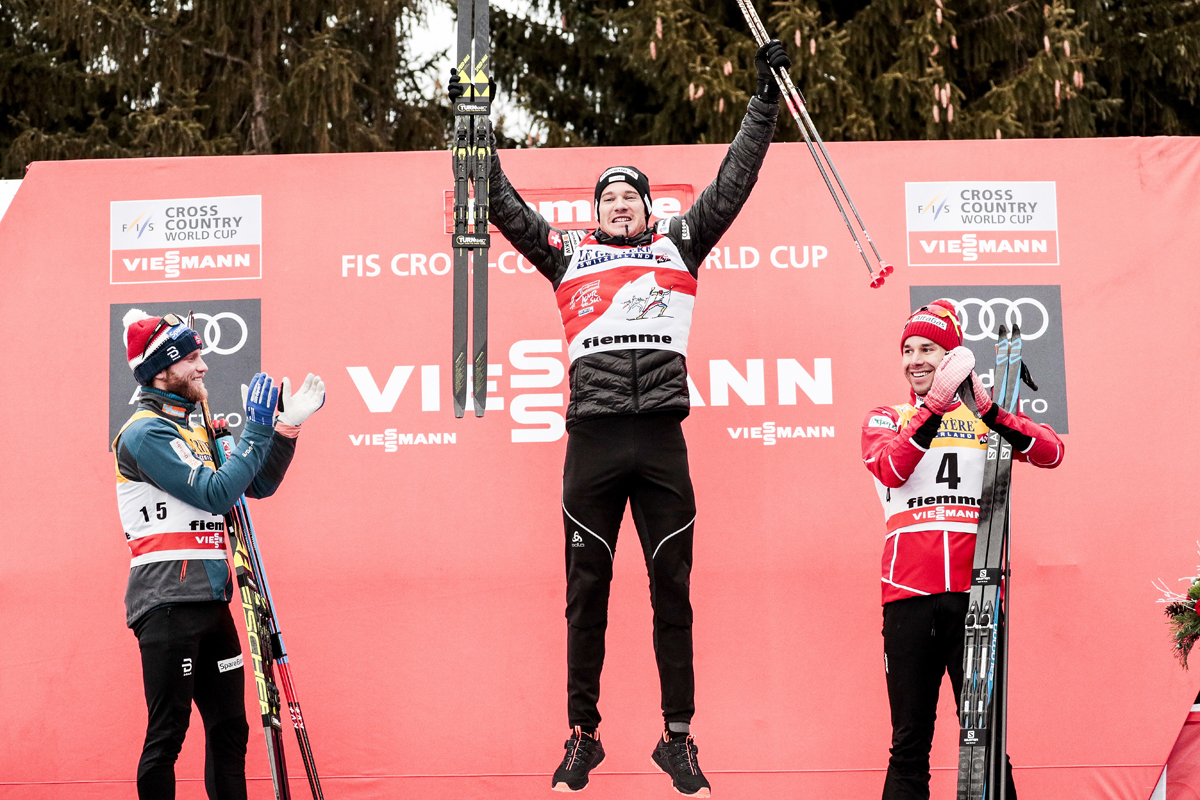
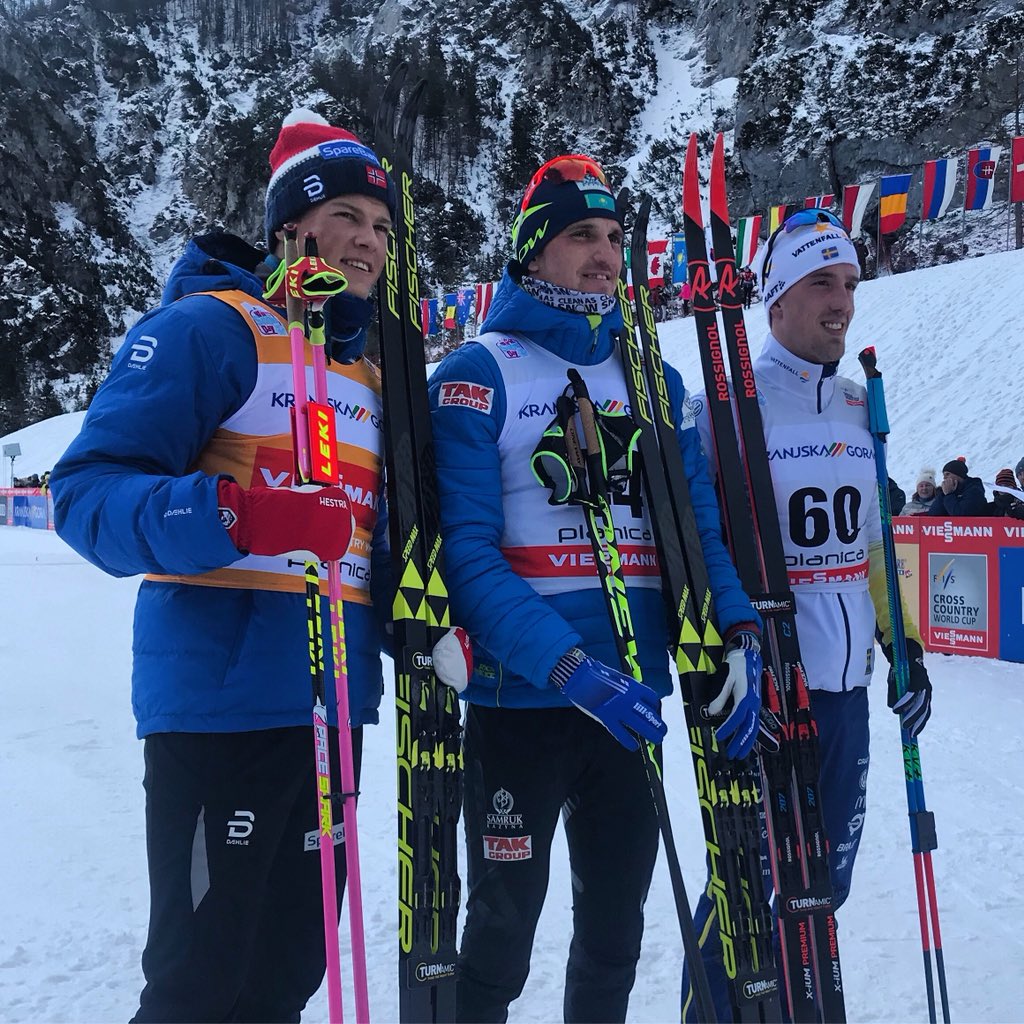
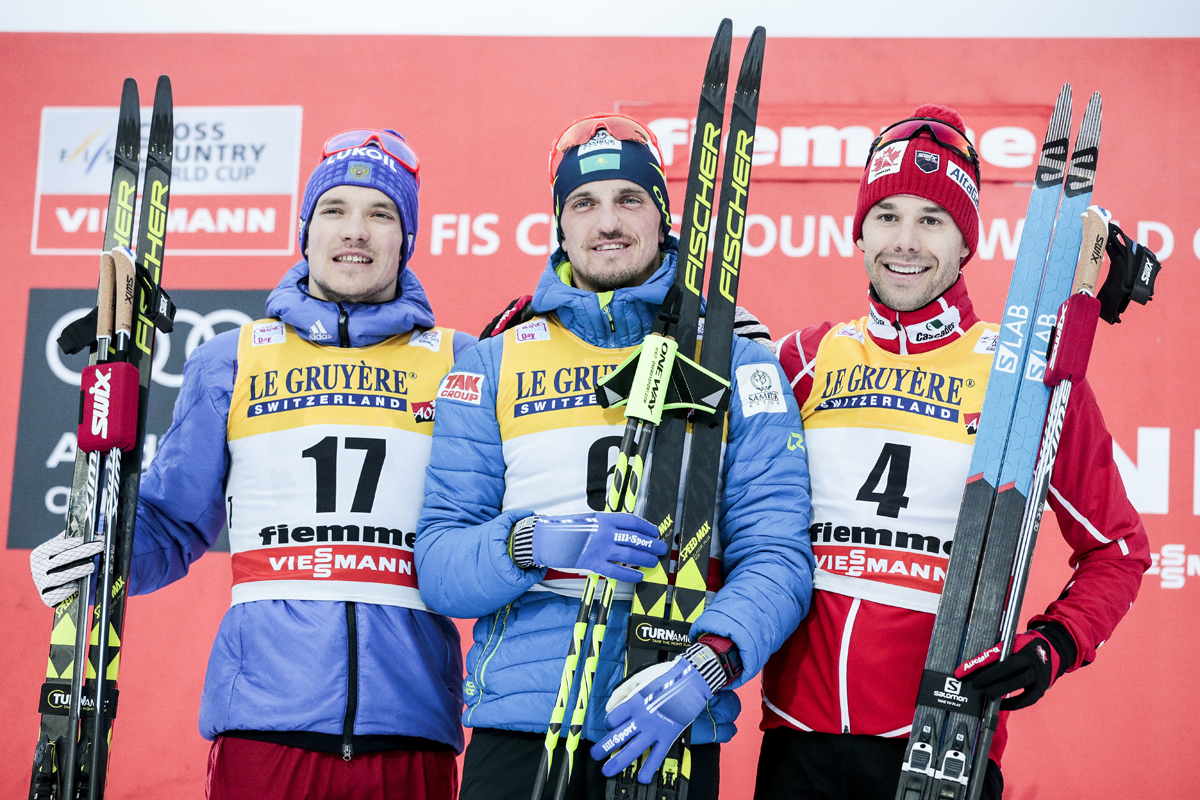
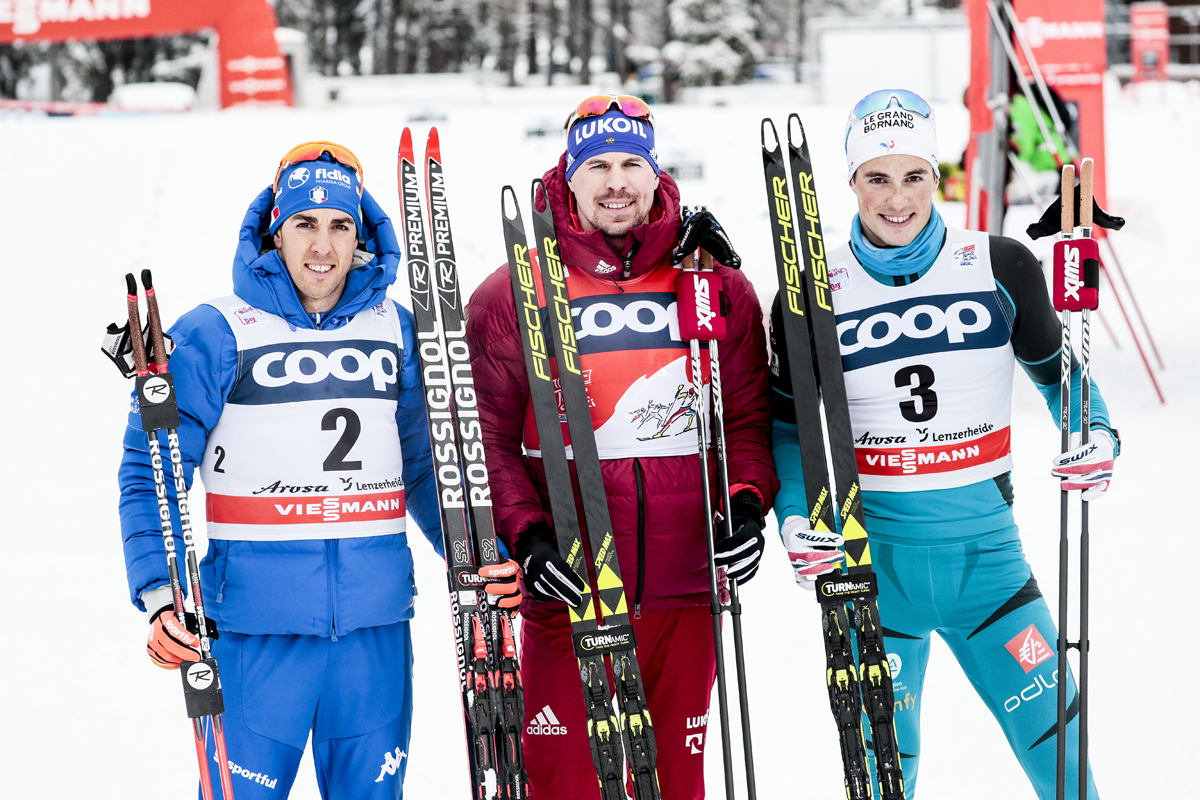
The men’s podium in Oberstdorf, Germany. Alexander Bolshunov (RUS) took the win in the 30 k skiathlon ahead of Norway’s Simen Hegstad Krüger and Sjur Røthe. (Photo: NordicFocus)
And the World Cup beat goes on. Nearly 70 men lined up in Oberstdorf, Germany for a 15/15-kilometer skiathlon, battling across techniques in front of a Bavarian Alp backdrop. The venue will be the home of the 2021 FIS Nordic World Ski Championships.
The 3.75 k course in Oberstdorf featured a variety of terrain, with the Burgstall hill climb bringing athletes to the high point of the course. To increase the pulse in the long race, four rounds of 15 World Cup bonus points were available at the 6.2, 9.9, 21.2, and 24.9 kilometer checkpoints in addition to those awarded to the top 30 athletes at the finish.
Russia’s Alexander Bolshunov looked to repeat his skiathlon victory in Lillehammer, preserving his position at the top of the distance standings and becoming the third athlete to win multiple skiathlon events in a season. Norway’s Martin Johnsrud Sundby did this in 2015/16 and Germany’s Tobias Angerer did so in 2005/06. Piggy backing on his back-to-back wins in Nové Město, a skiathlon win for Bolshunov would mark a third consecutive win.
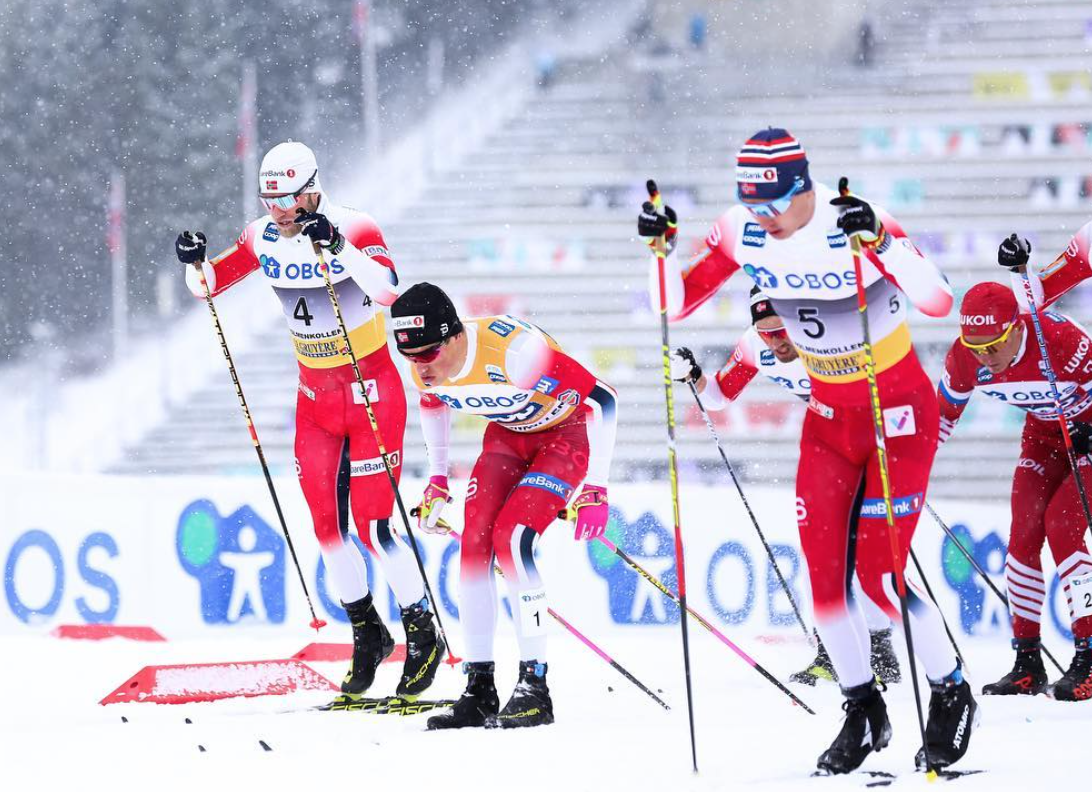
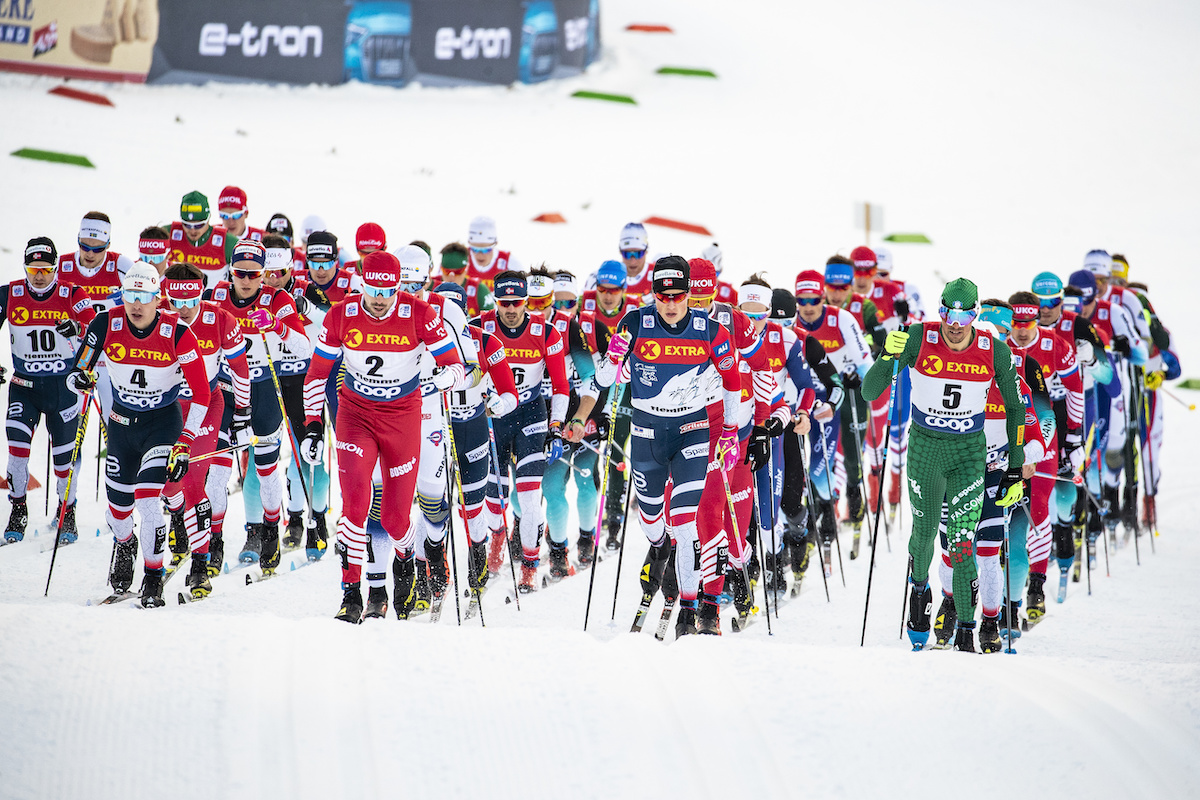
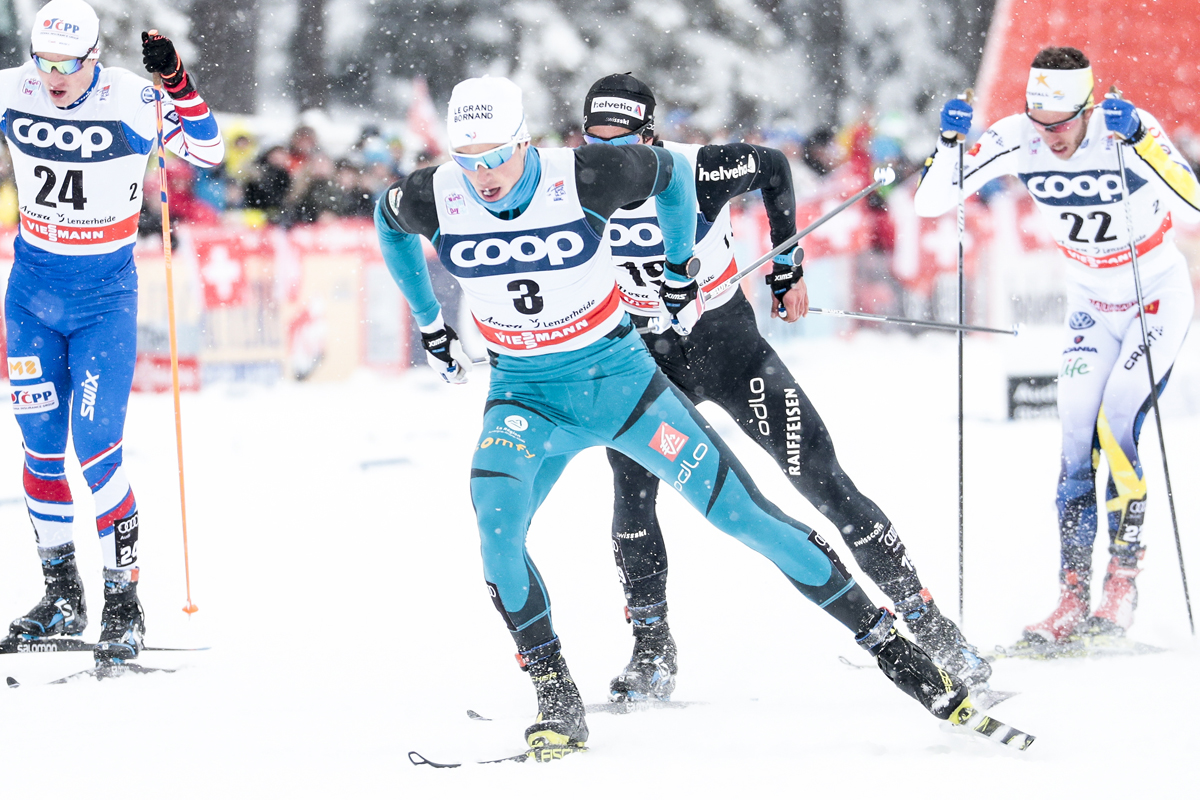
And they’re off! Skiers take to the course in Oberstdorf for the 30 k skiathlon. Johannes Høsflot Klæbo (bib 3) dropped from the race during the classic leg. (Photo: NordicFocus)
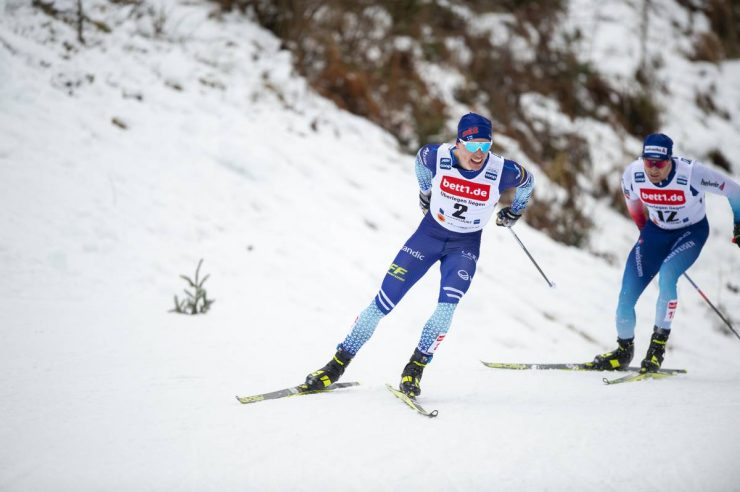
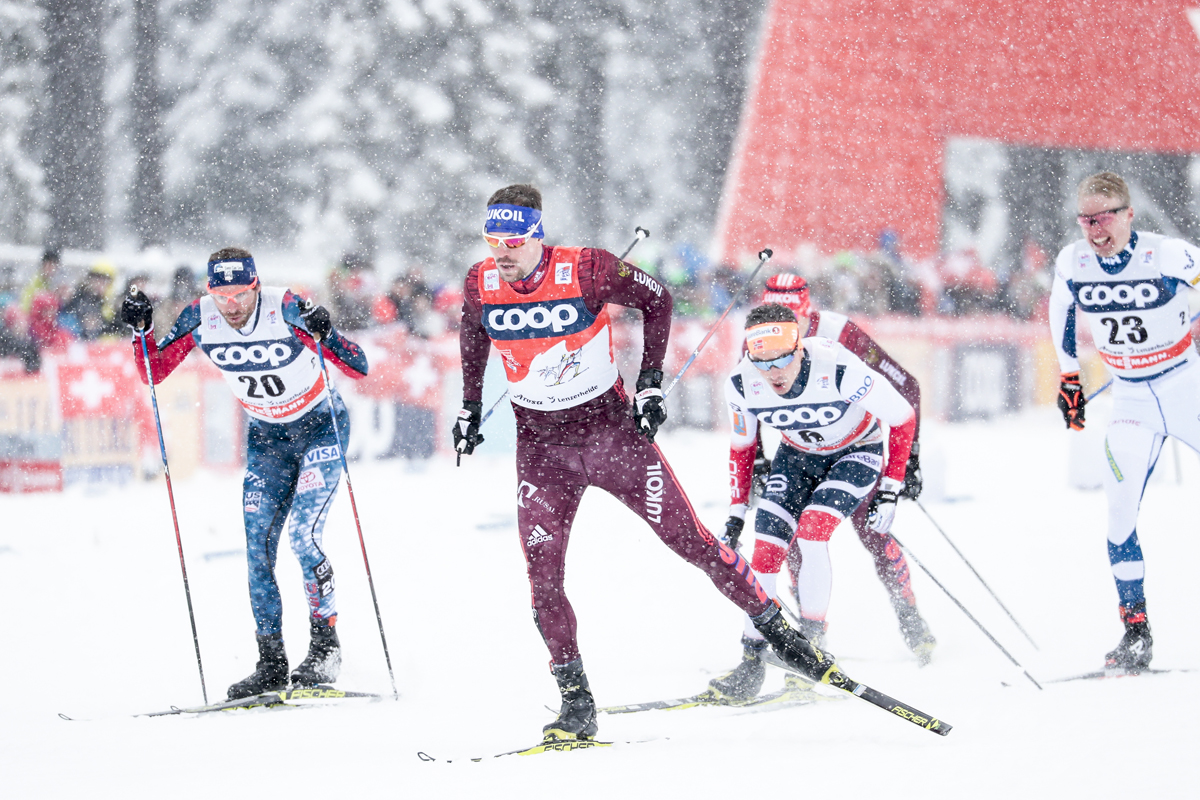
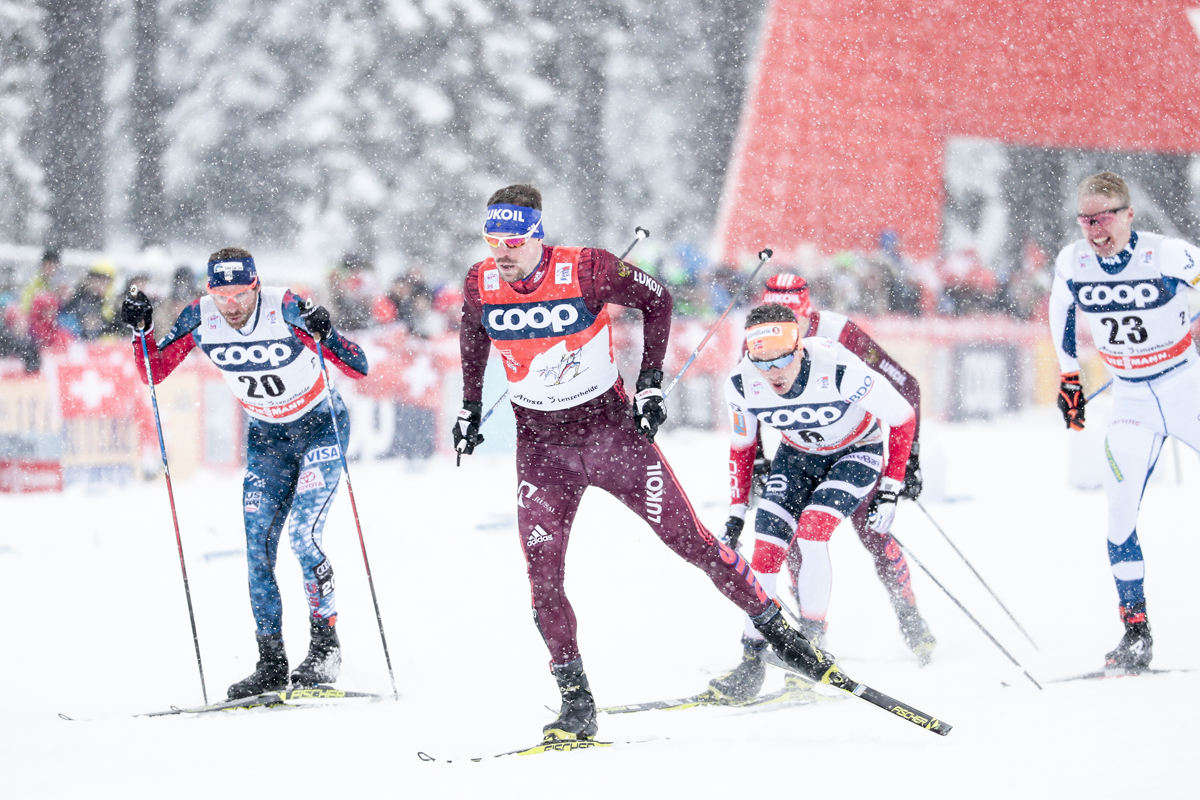
Iivo Niskanen (center, bib 2) sets out to lead the classic leg of the 30 k skiathlon in Oberstdorf. (Photo: NordicFocus)
However, it was not the Russian that took the reins off the line. It was the Finns. In particular, Iivo Niskanen who has historically proven his capacity in distance classic events and more recently demonstrated his ability to skate with the best in the world. Niskanen led at nearly every checkpoint over the first 10 k, taking the maximum points at both 6.2 and 9.9 k.
Then things began to change. Bolshunov led at the exchange with a train of Norwegians on his heels. Sjur Røthe, Simen Hegstad Krüger, Hans Christer Holund, and Sundby, who had all taken a conservative approach to the classic leg, were now within 3.5 seconds of the Russian. Fading quickly from his position at the front, Niskanen sat nearly 30 seconds back in 9th.
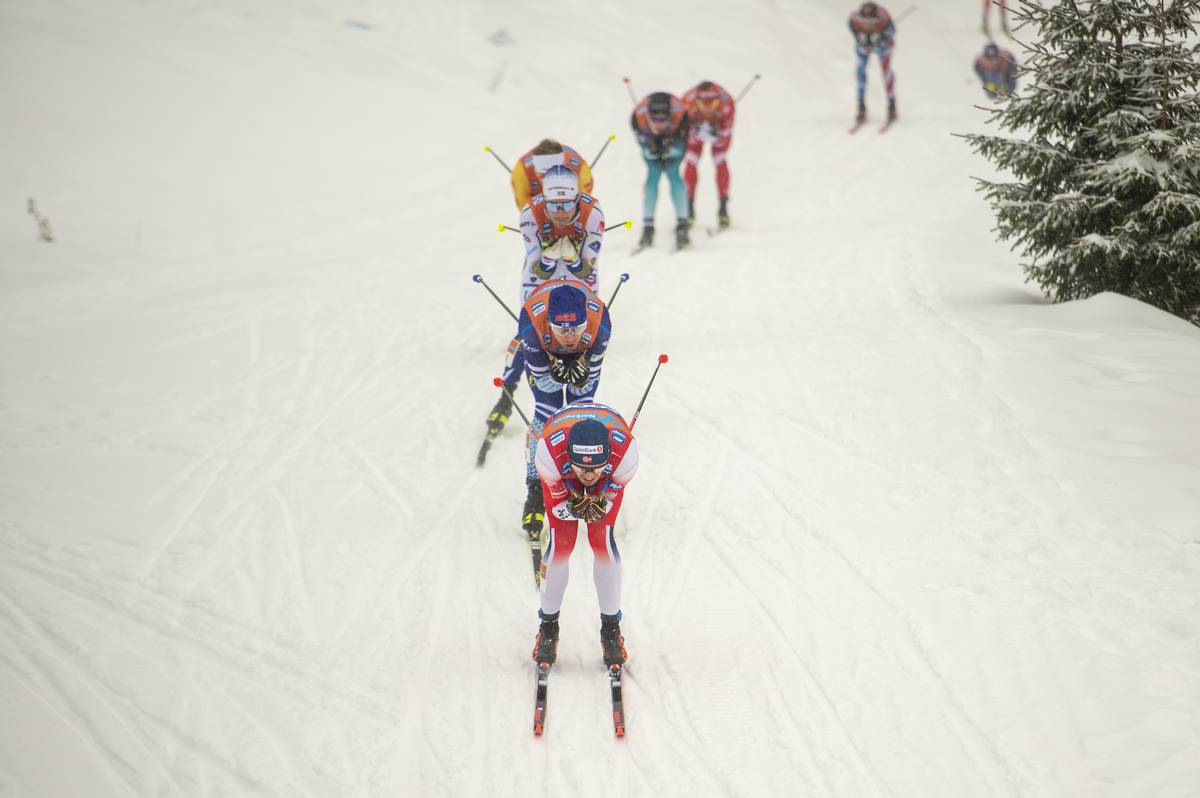
A Norwegian power train in the 30 k skiathlon in Oberstdorf. (Photo: NordicFocus)
Up the hill and around the bend, Hans Christer Holund (NOR) leads Martin Johnsrud Sundby (NOR) and Andrey Larkov (RUS) during the 30 k skiathlon in Oberstdorf. (Photo: NordicFocus)
And so it was through the next wave of bonus points at 21.2 k. Røthe took the full 15, with Krüger, Bolshunov, Holund, Andrey Larkov (RUS), and Sundby close behind.
Rebounding from his large deficit, Niskanen had slashed his gap in half and was continuing to catch the lead pack. He rocketed his way back to the front by the 24.9 k checkpoint, collecting another 15 bonus points before being swallowed once more by the group.
Rebounding from a deficit, Iivo Niskanen closes the gap to the lead group in the 30 k skiathlon in Oberstdorf. (Photo: NordicFocus)
With just over a kilometer to go, the top seven men were separated by less than four seconds. The pack included the four Norwegians, two Russians, and Switzerland’s veteran Dario Cologna.
Taking the lead on a downhill and holding it on the final climb over a bridge just before the stadium, Bolshunov made his move. With Røthe and Krüger in hot pursuit, the 23-year-old Tour de Ski Champion powered down the final stretch to stop the clock at 1:13:40.6. Krüger took the next podium spot (+0.9), followed by Røthe in third (+1.2).
Alexander Bolshunov sprints for the win in the 15/15-kilometer skiathlon in Oberstdorf, Germany. (Photo: NordicFocus)
Bolshunov strikes again in the 2020 15/15-kilometer skiathlon in Oberstdorf, Germany. (Photo: NordicFocus)
“I’m very happy to win today on the course in Oberstdorf which will be used next year in the World Championship,” Bolshunov told FIS at the press conference through a translator. “The course became much more difficult and more interesting to compete on. For sure, we will see how it will be next year.”
When asked how he worked with the group that emerged at the front, Bolshunov responded, “It was [my] own race.”
“Cat and mouse.” Sjur Røthe (bib 4) chases Alexander Bolshunov’s yellow bib during the 30 k skiathlon in Oberstdorf. (Photo: NordicFocus)
“He really played a little [with us],” Røthe told NRK about Bolshunov’s tactics. “There were four mice against a cat out there.”
Just off the podium, Sundby took home the wooden medal with 4th place (+2.5). It is the 35-year-old’s best result of the season, though he has been unable to do much racing due to a back injury. In fact, Sundby’s last result came in early December in the skiathlon in Lillehammer, where he took 5th. Sundby has won three skiathlon events in his lengthy career, and holds the rare statistic of earning a spot on the podium in 12 seasons, the third-most of any World Cup athlete.
Martin Johnsrud Sundby (NOR) takes 4th in the 30 k skiathlon in Oberstdorf. (Photo: NordicFocus)
Johannes Høsflot Klæbo and Emil Iversen left us scratching our heads. After a poor start to the classic leg, both athletes dropped out. Klæbo’s DNF dropped him from third to fifth in the distance standings, though he remains in second place in the overall, trailing Bolshunov by 299 points.
“I do not know,” Klæbo told NRK, according to a translation. “It’s been a long time since I felt as bad as today. It was really just the whole day and nothing that felt particularly good. If I can’t fight for the top 30, then there is no point going around here.”
Iversen gave NRK a similar explanation.
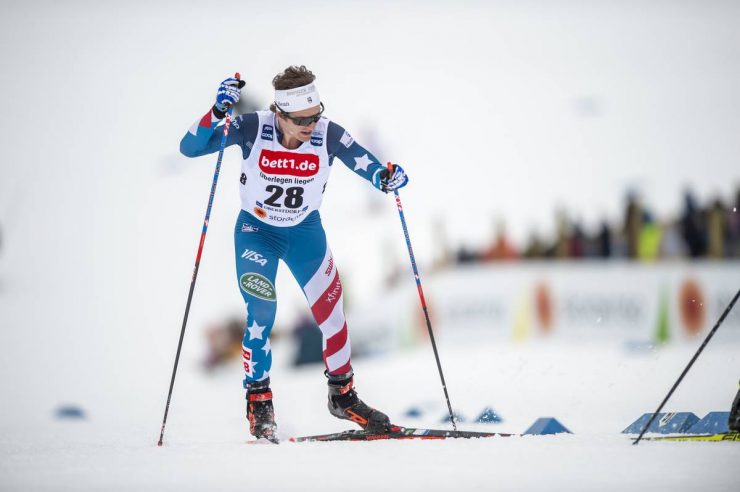
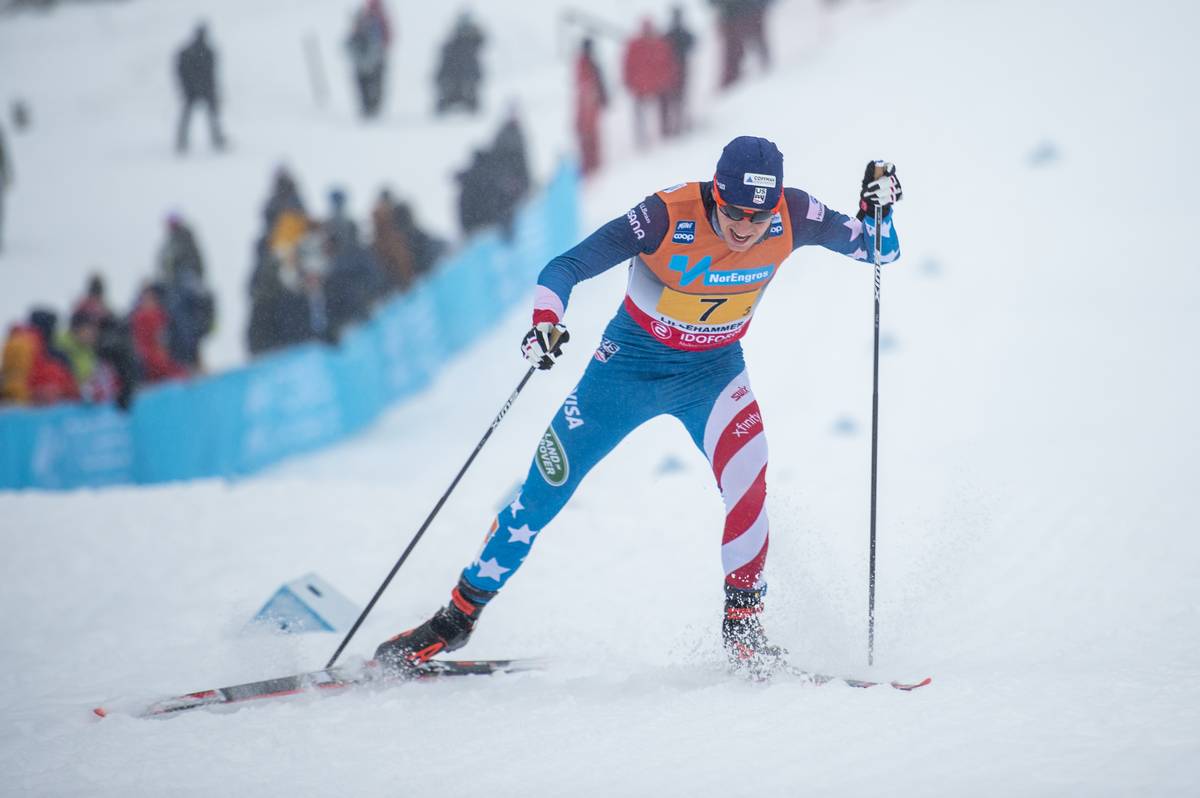
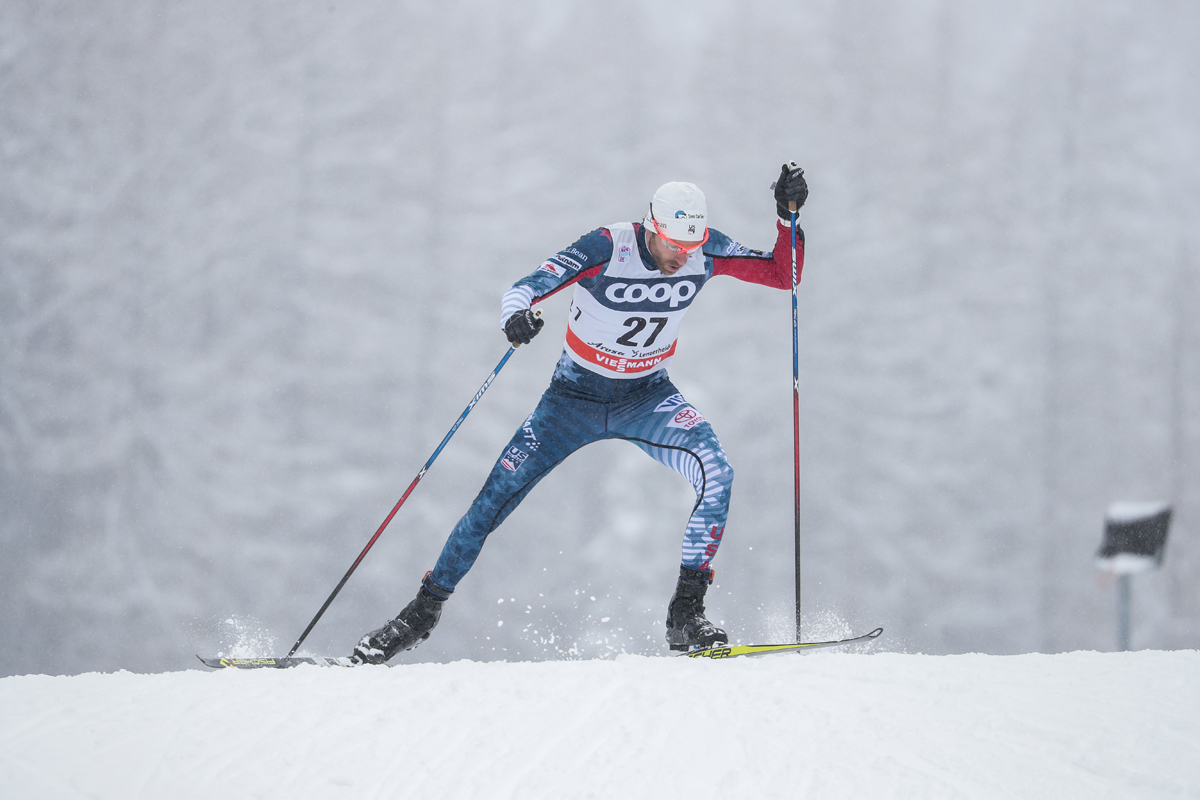
David Norris skis to 28th in the 30 k skiathlon in Oberstdorf. (Photo: NordicFocus)
The sole American finisher David Norris landed inside the points in 28th (+2:01.0). The Fairbanks native hovered around this top-30 position throughout the race, reaching a peak placement of 20th place at the 9.9 k checkpoint.
“My plan going into the race was to use the classic leg to put myself into good position for the skate,” wrote Norris in an email. “You never know how your body will feel 15 or 20 km’s later so you have to risk it a little. I was happy with my classic skiing and I had moved up into a group on the last lap of the classic which was roughly positions 15 – 22. Unfortunately, over the top of a hill my klister iced up and I fell. That moved me back a few groups to about position 32. Overall my skis were very good, but the snow was variable and the tracks were breaking down.
“In the skate leg I intentionally kept a little in reserve during the first 10km trying to ensure I’d have some energy in the last 5km. I slowly worked up through some guys and felt really strong throughout the skate.”
Norris expressed that the techs did a great job selecting skis and choosing wax given the variable conditions in Oberstdorf. He added that he feels good about the performance and his sensations on course, though he has not felt this way leading up to the event.
“I feel fit. It has been odd that in training I don’t feel very good – tired and kind of flat, but I’m feeling pretty strong the past couple of races. In the skate leg I intentionally kept a little in reserve during the first 10km trying to ensure I’d have some energy in the last 5km. I slowly worked up through some guys and felt really strong throughout the skate.”
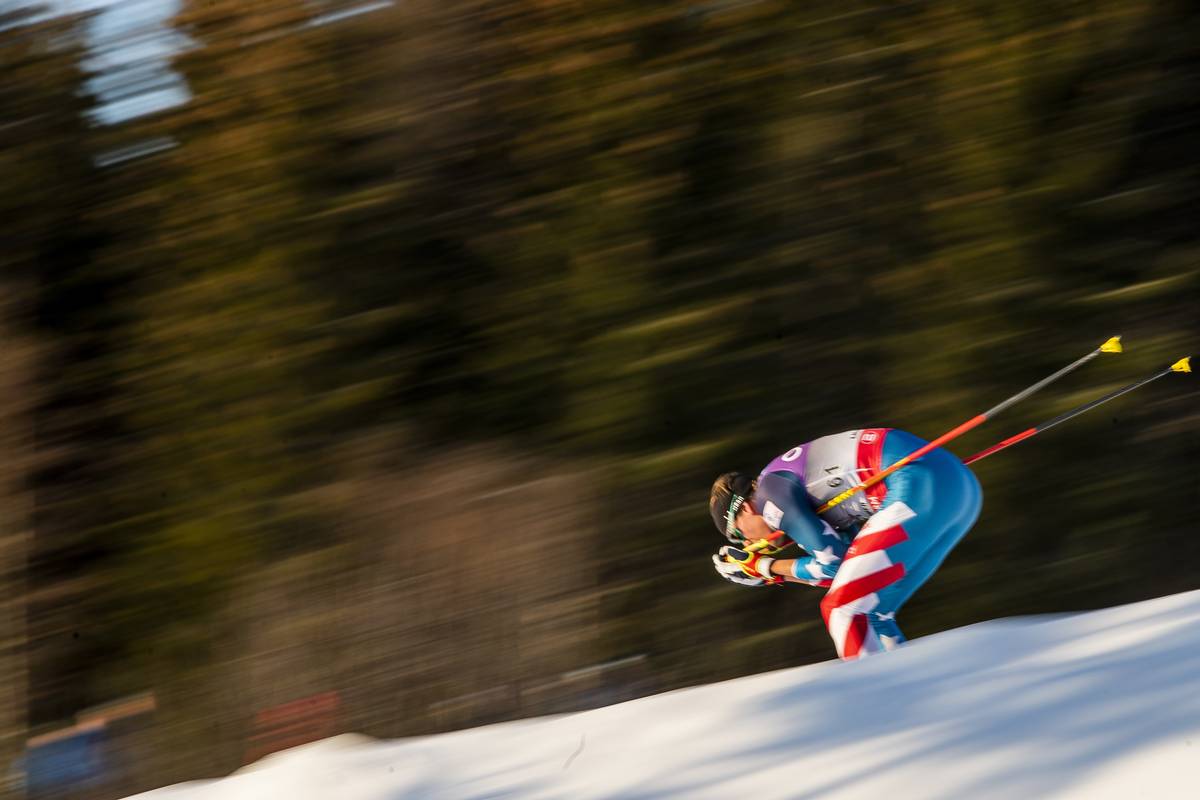
Ian Torchia on course during the 30 k skiathlon in Oberstdorf. (Photo: NordicFocus)
Ian Torchia also began the race but did not finish. He was one of seven men to drop from the race. An additional three were lapped and therefore pulled from the competition.
“I felt very bad out there today,” emailed Torchia. “I started flooding very early on while moving backwards in the pack. Very confusing as I felt better this week compared to Nové Město leading into the race. Hopefully a week in Seefeld and some consultation with my coach will put me on the right track.”
In a post-race call, Matt Whitcomb expressed pride in Norris’s grit and dedication to the process of becoming a World Cup contender. He also provided insight into both today’s event, including how Norris’s crash affected his position in reach of the top-20 and Torchia’s DNF.
Whitcomb also explained that Erik Bjornsen, who did not compete today, may return to the World Cup in Lahti after the FIS SkiTour 2020. In the meantime, Bjornsen has his eyes set on domestic distance classics, including the Boulder Mountain Tour and the American Birkie.
Post-race interview with Matt Whitcomb.
Recovering from a inopportune crash, David Norris fought to the point of wobbly legs in the last classic lap of the 30 k skiathlon in Obsertdorf. (Photo: NordicFocus)
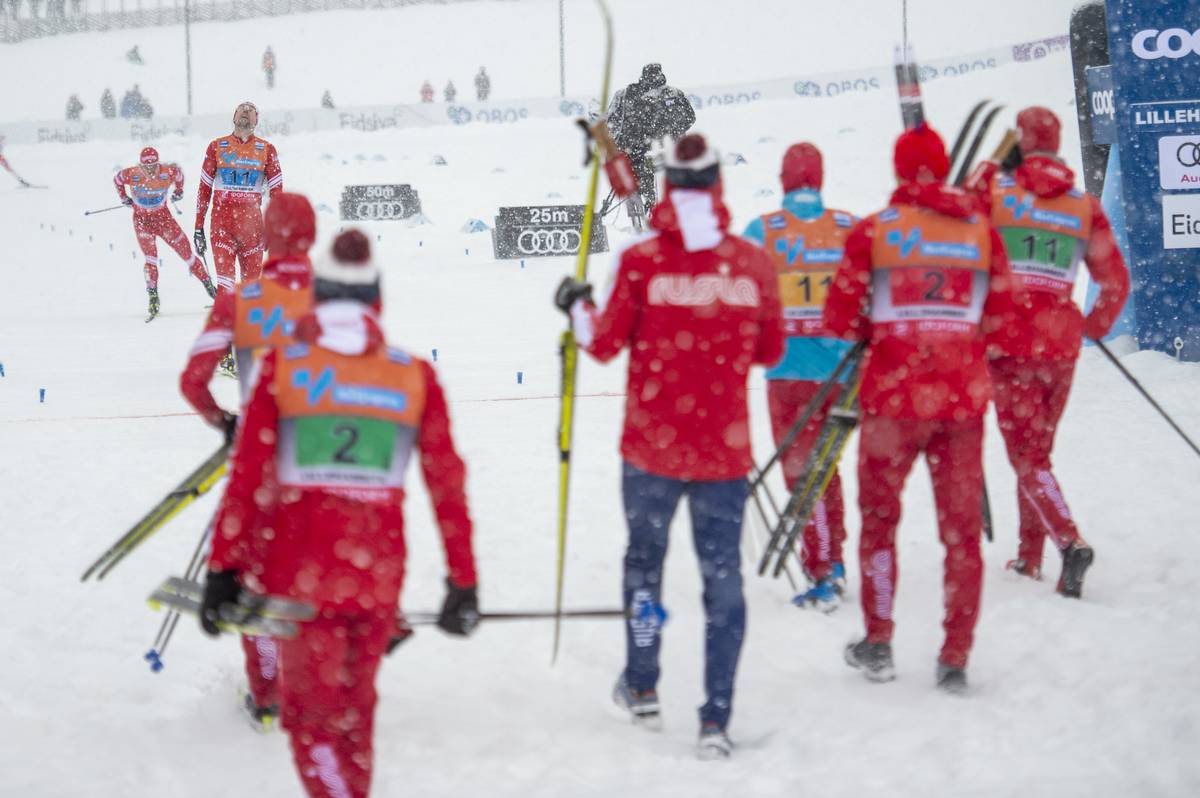
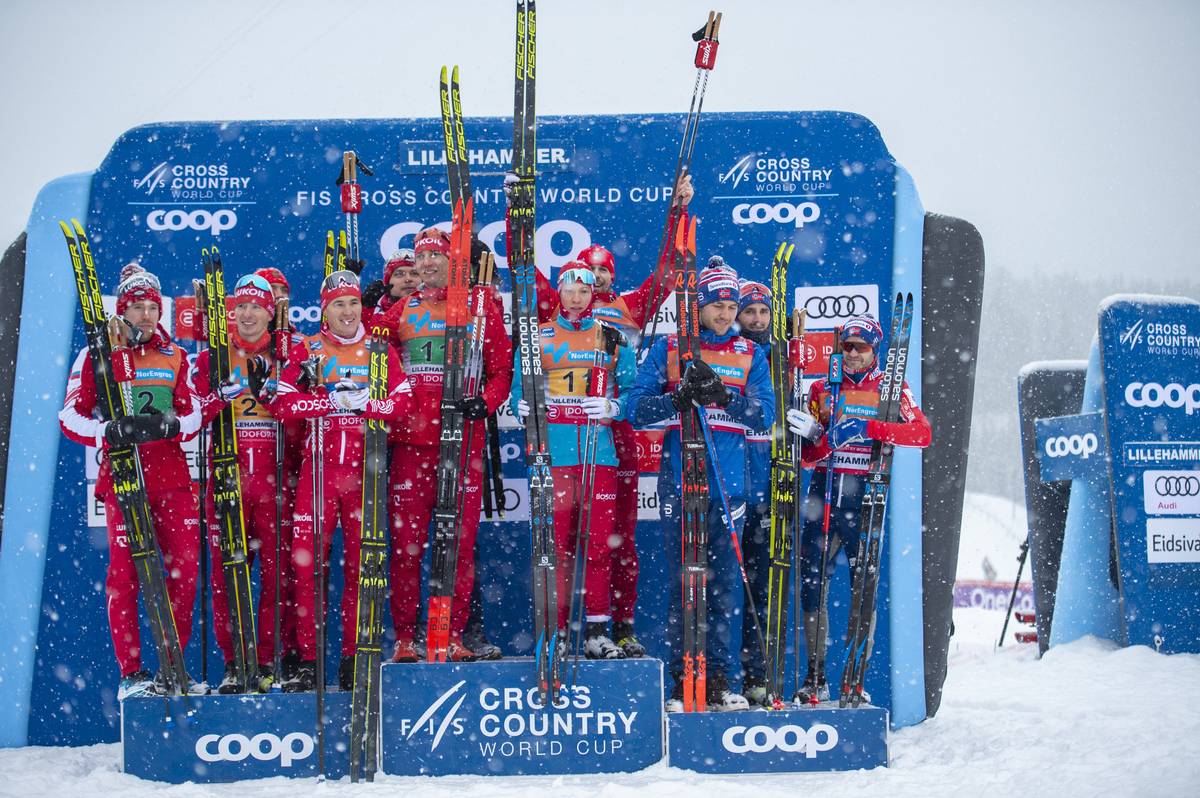
Russia soaking it in as they take 1-2 in the 4 x 7.5 k relay in Lillehammer, Norway. (Photo: NordicFocus)
Call it what you want: national pride, national bias, flag-waving: the team relays elicit nationalistic tendencies. In Lillehammer, Norway, you might think and maybe expect it’s your birthright to see the hometeam crush. That’s been the recent norm almost without exception.
Here’s the quick stats to either dispel or reinforce those tendencies: Norway has won nine of the last 11 relay races on the World Cup. Russia won the other two. In fact, Russia took first and second, Norway third in the last head-to-head 4 x 7.5 k match last season in Ulricehamn, Sweden. Throwing Norwegian dominance back into the equation, Norway has won five of the last six relays on home snow.
On paper, at least for Norway, some big names were missing from their team lineups. No No Emil Iversen. No Johannes Høsflot Klæbo. No Martin Johnsrud Sundby. That trio finished third, fourth. and fifth in Saturday’s 30k skiathlon. Add to that Didrik Tønseth who was busy representing Norway at the European Cross-Country Running Championships.
But Norway is deep with talent. As is Russia. For those keeping score, you’ll see no Alexander Bolshunov featured on either of the Russian teams — he won the skiathlon yesterday. That all said, in a non-championship year maybe it’s a time to tinker and experiment. Here were the teams holding the most podium potential.
Norway I: Pål Golberg, Hans Christer Holund, Sjur Røthe, Finn Hågen Krogh
Russia I: Andrey Larkov, Ilia Semikov, Denis Spitsov, Andrey Melnichenko
Russia 2: Ivan Yakimushkin, Evgeniy Belov, Ilia Poroshkin, Sergey Ustiugov
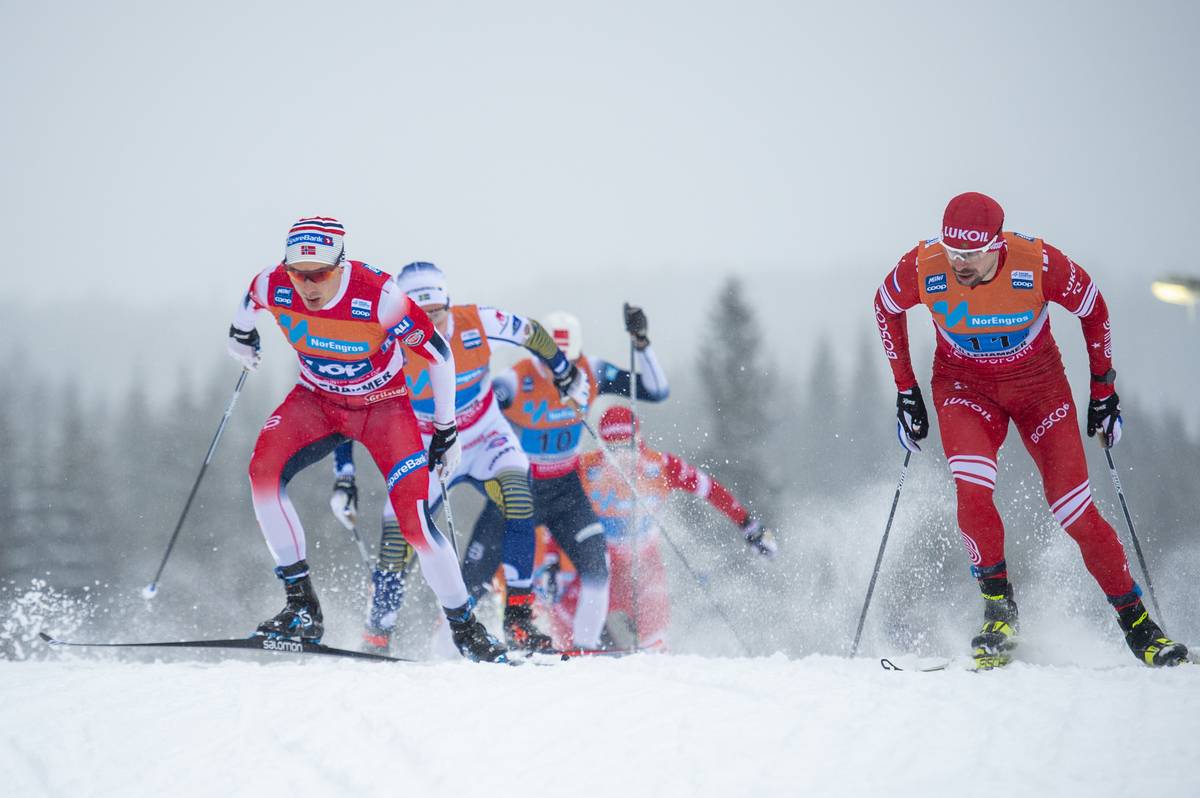
Pål Golberg (NOR) leading the pack during the scramble leg of the 4 x 7.5 k relay in Lillehammer, Norway. (NordicFocus)
The first tag, after 7.5 k, Russia I pulled through first, with Norway I and Sweden right behind. Russia II was 10.5 seconds back, Finland 15.5, the U.S. 17.0, and Norway II dangling 19 seconds off the lead.
As the classic legs ended at 15 k, the race was more about who was falling off out of contention, rather than a team up front making any decisive gesture for a kill shot. Finland came through first, with Russia II next (+0.4), then Norway I (+2.2), Russia II (+9.7), Norway II (+10.5), and Germany (+15.0).
The next closest team was Sweden, roughly twenty-nine seconds arrears in seventh place. At that point, the U.S. team of Erik Bjornsen, David Norris, Scott Patterson, and Kevin Bolger were in ninth (+1:13.7) and racing in a no-man’s-land with a sizable gap to France in eighth and Kazakhstan drifting back in 10th.
Simen Hegstad Krüger (bib 10) during the 4 x 7.5 k relay in Lillehammer, Norway. (Photo: NordicFocus)
The race began to look a tad spicy for Norway around the 21.2 k mark, nearly an hour into the race. Krüger for Norway II, a sometimes peerless skate skier at that, put his stamp on the affair as he powered ahead on the course’s most prominent climb. Norway I’s Røthe followed Krüger in step. And Sweden’s Jens Berman kept pace as well. The real tease was that Russia I (Spitsov) and Russia II (Poroshkin) appeared cooked as were their team’s chances for anything but third place.
But, it’s a four chapter race. And the fourth leg coalesced into a five team scrum by 25k. Both Russian teams, the Norwegian squads, and Germany were all in it. We should note that Ustiugov, tagged 15 seconds back at the exchange, looked impressive shutting down that gap as he reeled in the lead groups.
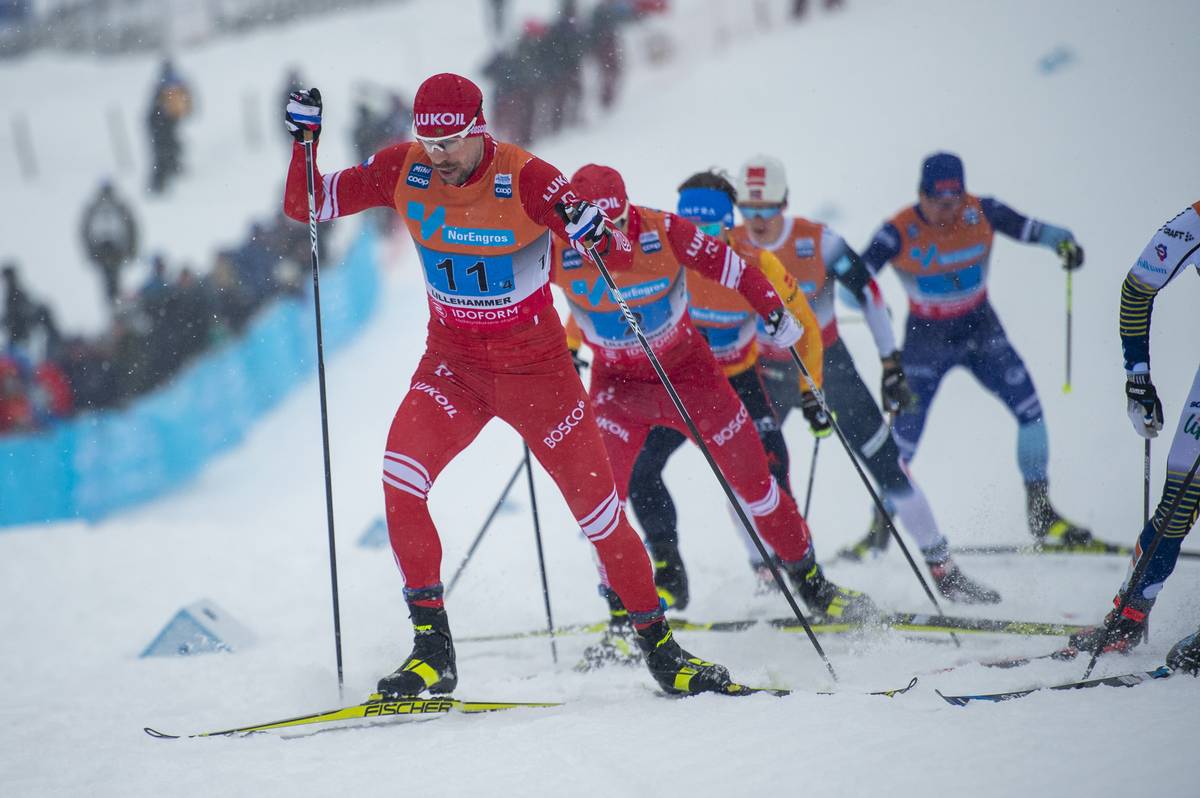
Russia’s Sergey Ustiugov (right) showing his solid form during the men’s 4 x 7.5 k relay in Lillehammer, Norway. (Photo: NordicFocus)
The racing scene’s old friend, Ustiugov, went to the front and eventually shut down the pace. It wasn’t exactly a crawl. It was Ustiugov revealing his tactical hand: wait until punishing terrain, and throw down a punishing push.
But it was Melnichenko for Russia I who made that move. Ustiugov kept pace and pulled through not long after Melinchenkov separted. Ustiugov looked like vintage Ustiugov: a full-body, all-in-it, furnace of power.
Sergey Ustiugov of Russia taking control during the 4 x 7.5 k relay in Lillehammer, Norway (Photo:NordicFocus)
And that was it. Norwegian dreams were snuffed, Russian dreams realized.
Russia I won in 1:26:46.8 hours. Russia II took second (+1.3), and Norway I third (+8.9). Norway II lost the toe-to-the-line finish by placing fourth (+9.0).
The U.S. team skied to ninth place, 3:33.3 minutes back. U.S. World Cup Coach Matt Whitcomb explained in an interview that relay racing is often a “game of contact and if contact is lost the race is often lost.” The U.S. did lose contact. It remained a relay for the U.S. bright moments and the reality of skiing solo for a few legs. (In the interview below, Whitcomb also notes the thrill of watching an emerging Chinese program finish the men’s relay in a non-championship event.)
Matt Whitcomb post-race interview
Closing out the day on the race course was China. They placed 11th (+12:44.6). Making note that the 2022 Olympics will be hosted by China, it will be interesting to see how this team develops.
Scott Paterson of the U.S. Ski Team during the third leg of the 4 x 7.5 k relay in Lillehammer, Norway. (Photo: NordicFocus)
Scott Patterson post-race interview
Kevin Bolger during the 30k skiathlon in Lillehammer, Norway. (Photo: NordicFocus)
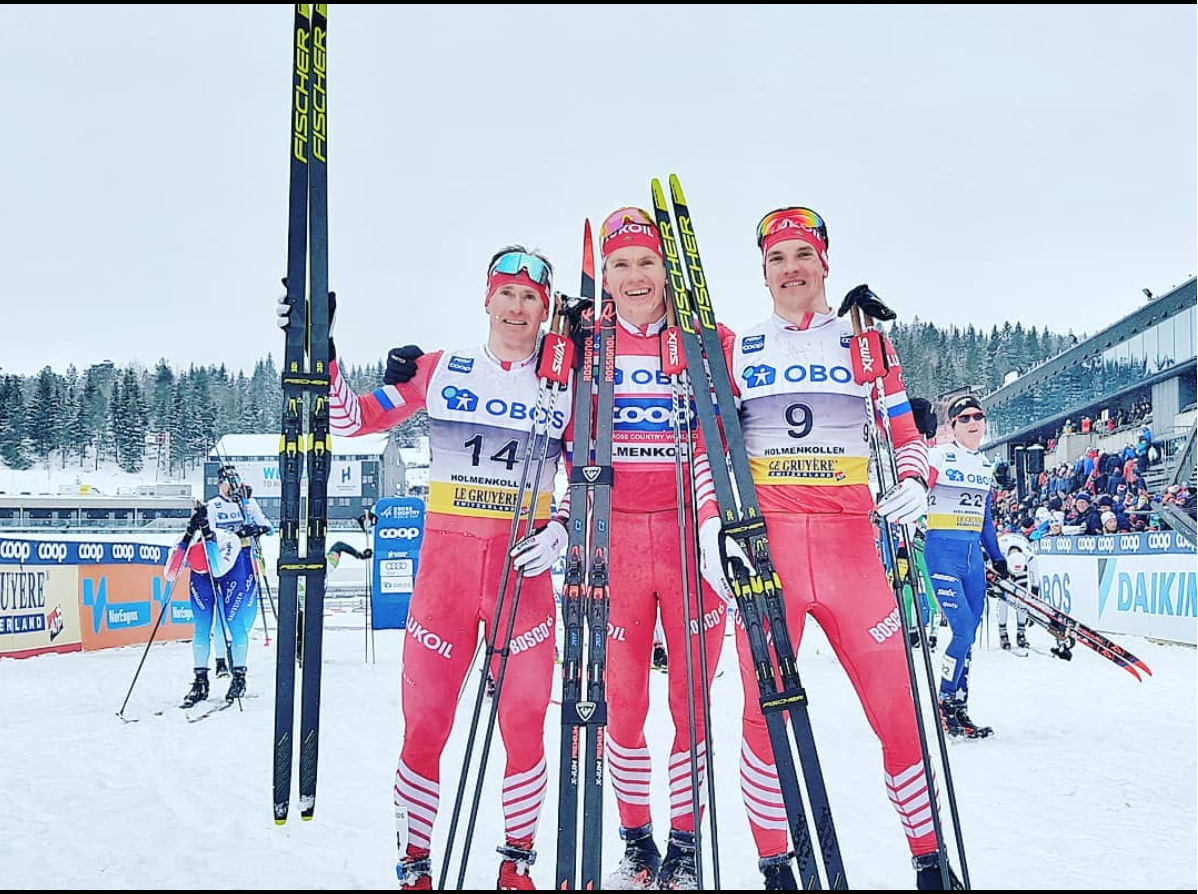
A clean sweep for Russia today. From left to right, Maxim Vylegzhanin was 2nd, Alexander Bolshunov was 1st and Andrey Larkov was third. (Photo: Screenshot/ FIS Instagram)
Russian skier, Alexander Bolshunov made history today during the Holmenkollen 50-kilometer classic mass start race. With his victory, Bolshunov became the youngest person and the third Russian to win the storied Holmenkollen 50 k. Bolshunov finished today’s race in 2:23:49.8 hours.
For Bolshunov, who comes off a World Championships during which he won four silver medals, this was his fourth World Cup win of the season. The victory on Saturday reinforced Bolshunov’s lead in the World Cup distance cup rankings and he leapfrogged Norway’s Johannes Høsflot Klæbo for the overall World Cup lead. Bolshunov has amassed 1,230 points to Klæbo’s 1,181. Klæbo placed 38th in Saturday’s race.
Bolshunov spoke about the end of the season and how he is approaching these finals races with a FIS reporter after the race, “At the end of the season, it is a necessity to show his best results each race and to fight in each race until the end and hopefully everything will be done.”
The race featured no solo attack that could break away from the A-list of distance specialists. The lead was tossed around a number of times and for the first half of the race, Norway’s fans were treated to a 30-plus deep train of skiers engined by Sjur Røthe, Martin Johnsrud Sundby and Emil Iversen. But the ebb and flow of the 50 k allows skiers to sit in the pack, buy their time, conserve resources, then pounce.
With 10 k to go, Russian skiers moved to the front, and began dictating the pace. At 1.6 k remaining, a Russian foursome consisting of Maxim Vylegzhanin, Andrey Larkov, Bolshunov, and Ilia Semikov were defining the flag waving rights on Norway’s holy-grail of ski loops.
The race came down to the finishing stretch with Bolshunov charging into the finish, double poling all the way, and out sprinting his teammates to take the win. Vylegzhanin placed second and his teammates, Andrey Larkov and Illia Semikov, came in third and fourth respectively.
This was the last World Cup race for Vylegzhanin who is retiring at the end of this season; this was his 24th podium in his career, but his first this season.
Vylegzhanin spoke to a FIS reporter after the race, via a translator, “Of course it was a pleasure to see all the people coming to see me and congratulate me on the finish line and after the finish. The Russian team is very strong, we got all four places and we have many young potentials here who are proof that the Russian team is a very strong team. I started here at Holmenkollen in 2007 with the 7th place and since then I was getting 4th, 3rd, 2nd and actually it’s my best place to compete here.”
Those skiing in the back of the well defined lead pack only began dropping off during the last 3 k. At that point, the Russians ramped up the pace and only Norway’s Martin Johnsrud Sundby, and Canada’s Alex Harvey were able to hang tightly connected to the Russians.
The top 11 finishers were dominated by Russia and Norway. Russia took the top four spots as well as the tenth spot and Norway went 6, 7, 8, 9 and 11. Harvey was the only skier to break this pattern, finishing fifth overall.
Norwegian racers Marin Johnsrud Sundby, Johannes Høsflot Klæbo and Simen Hegstad Krueger starting the Holmenkollen 50k off strong (Photo: Screenshot/Holmenkollen Ski Fest Instagram/Jacques Holst)
Harvey’s fifth place on Saturday matched his career best Holmenkollen 50 k finish — he was fifth during the 2011 Oslo World Chamionship’s 50 k skate. On Saturday, Harvey skied with the lead pack the entire race, sitting in the top 20 until the last 5k when he started making his way toward the front of the pack.
“This year in classic, I never had good feelings really, so today was the first day I felt like I could actually race in classic, “ Harvey told FasterSkier in the mixed zone. “But of course, coming so close to the podium is always bittersweet. But the Russians, I think you could tell, had better skis, better glide. They were struggling on the kick but really high speed, so in the end they were really strong. So it was a really good race for me, but the podium was close, I could taste it.”
He continued on, discussing today’s race pace, “It was a fairly easy pace the whole way. There was a huge group and guys were slowly getting dropped off the back, but there was never a big attack. So for me personally, I was in control the whole time, but I had good shape and pretty easy kicking skis.”
U.S. Ski Team member Scott Patterson finished 19th. This was Patterson’s best individual finish of the season. He skied with the lead pack until the last 3.75k, when he began to fall back.
“This is my fourth time racing Holmenkollen, so I know that pack hangs on and people just start shooting off that back on the last couple laps,” Patterson told FasterSkier in Oslo. “So I figured I’d ski with that pack for as long as I could and hope I had energy for the finish. I think I did pretty good, I was pretty low on energy for that last 3.75, but it worked out pretty well.”
In Oslo on Saturday, U.S. skiers Adam Martin (CGRP) and Kyle Bratrud (SMS T2) were 31st and 40th respectively. Ben Lustgarten (CGRP) did not finish the race.
Holmenkollen is a unique experience for races, with crowds, snow sculptures and bonfires lining the entire race course. It is essentially an end of season party for athletes and spectators alike.
Norris commented on the atmosphere, “This is a highlight of the season. The crowd is so loud up top, and it’s so awesome to be here.”
Harvey also appreciated the spectacle of the event, he told FasterSkier, “Having a little party is good for the sport, it make for good images. When the legs are screaming, to hear so much noise, it’s like you stop thinking for a bit, when you’re so exhausted, it kind of keeps you going.”
Racing continues tomorrow in Oslo with the women’s 30 k classic.
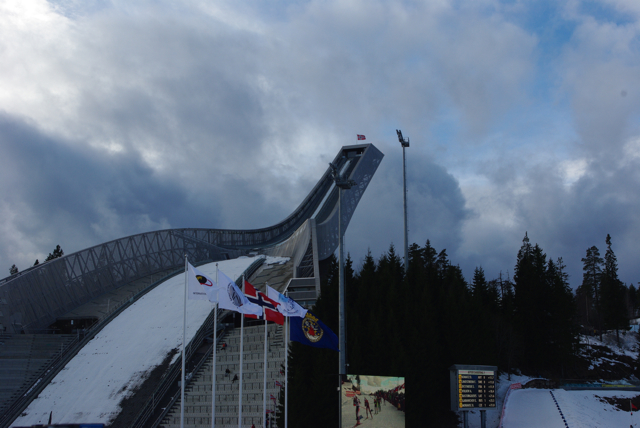
The Holmenkollen jump overloooks the iconic venue above Oslo, Norway.
FIS World Cup Oslo, Norway Holmenkollen 50 K Mass Start Classic
Today’s podium at the men’s 50-kilometer mass start classic at Holmenkollen involved a tight group of skiers, many of them Russians and Norwegians.
Of the top-11 skiers, five were from Russia, five from Norway with the lone wolf slotted in there, Alex Harvey from Canada.
Russia swept the podium with twenty-two-year-old Alexander Bolshunov placing first in 2:23:49.8 hours. Maxim Vylegzhanin was second (+1.0), and Andrey Larkov third (+1.6). For good measure, Ilia Semikov, also from Russia, skied to fourth (+2.0).
Harvey, in his final appearance at Holmenkollen, placed fifth (+4.6). Norway took sixth through ninth.
On Saturday in Östersund, Sweden, the IBU World Cup men’s field raced a 10-kilometer sprint, with Norway’s Johannes Thingnes Bø took the win, completing the course in a time of 24:37.6 after one miss (0+1). Russia’s Alexander Loginov placed second after shooting 100 percent and finishing 13.7 seconds behind Bø. Third place went to France’s Quentin Fillon Maillet, who also shot clean and finished 16.5 seconds behind the winner.
Leading the way for the North Americans was the U.S.’s Sean Doherty in 22nd. Doherty shot clean and finished 1:32.1 minutes back from Bø. Just outside the Top 30 was American Leif Nordgren who also had a perfect shooting score and finished 1:51.5 minutes off the winning time.
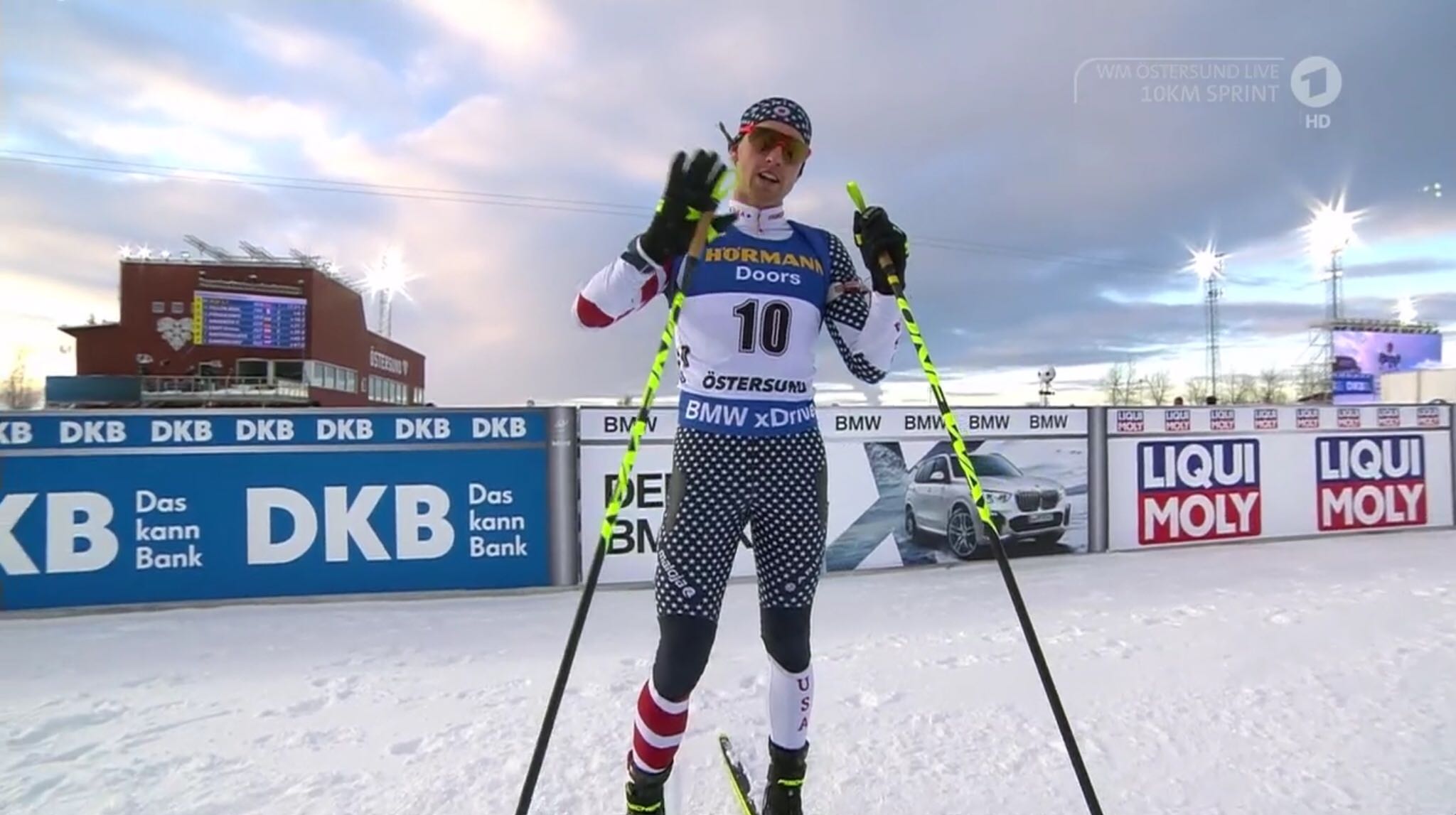
American Sean Doherty ater placing 22nd on Saturday in the men’s IBU World Cup 10-kilometer sprint held in Östersund, Sweden. (Photo: ZDF Screenshot)
Racing for Canada, Scott Gow finished in 50th (+2:18.2) after one miss. U.S. skier Jake Brown placed 58th (+2:41.0) after three misses (0+3) and Canadian Aidan Millar 61st (+2:43.5) with one missed shot (1+0). Two more Canadians raced on Saturday, with Jules Burnotte placing 76th (+3:18.1) after two misses and Christian Gow finishing in 84th (+3:32.5) after four missed shots (2+2).
The 2019 NCAA Skiing National Championships wrapped up on Saturday, with the University of Utah taking home the overall title. Utah finished with 530.5 points, followed by the University of Vermont with 476 points, and Colorado University with 455 points.
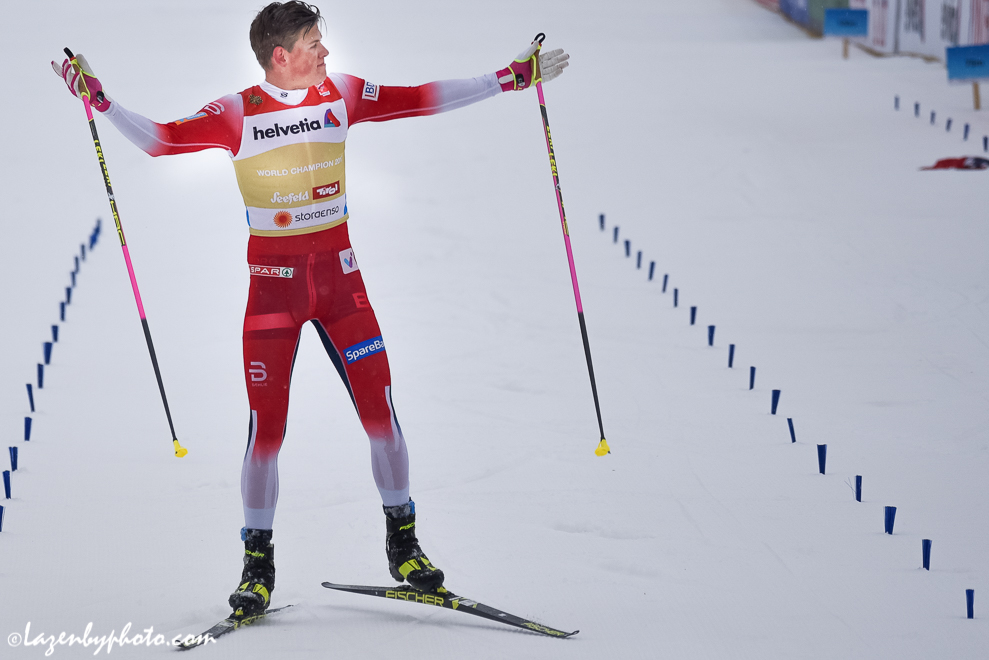
Johannes Høsflot Klæbo of Norway displaying what has become his iconic gesture when crossing the line as a winner. Once again it was an opportunity for the arms being outstretched as Klæbo anchored Norway to the 4 x 10 k relay win at the 2019 World Championships. (Photo: John Lazenby/lazenbyphoto.com)
The 4 x 10-kilometer men’s relay was a two-team tango as Russia’s Sergey Ustiugov and Norway’s Johannes Høsflot Klæbo were tagged for their respective anchor legs on Friday. The two teams stuck together until Klæbo moved ahead with less than five k to go and gapped Russia by 22 seconds.
It was enough final leg surge for Norway’s Emil Iversen,Martin Johnsrud Sundby, Sjur Røthe, andKlæbo to win in 1:42:32.1 hours. Russia’s Andrey Larkov, Alexander Bessmertnykh, Alexander Bolshunov, and Ustiugov placed second (+38.8).
The final podium spot came down to a final sprint won by France’s Richard Jouve over Finland’s Perttu Hyvarinen.
Adrien Backscheider, Maurice Manificat, Clement Parisse, and Jouve were 1:01.0 back in their third place statement.
Finland’s Ristomatti Hakola, Iivo Niskanen, Matti Heikkinen, and Hyvarinen were fourth (+1:02.8).
The U.S. team of Erik Bjornsen, Scott Patterson, David Norris, and Kyle Bratrud skied to ninth (+4:06.4).
Canada’s Alex Harvey, Scott James Hill, Evan Palmer-Charrette, and Lenny Valjas placed 12th (+7:05.5).
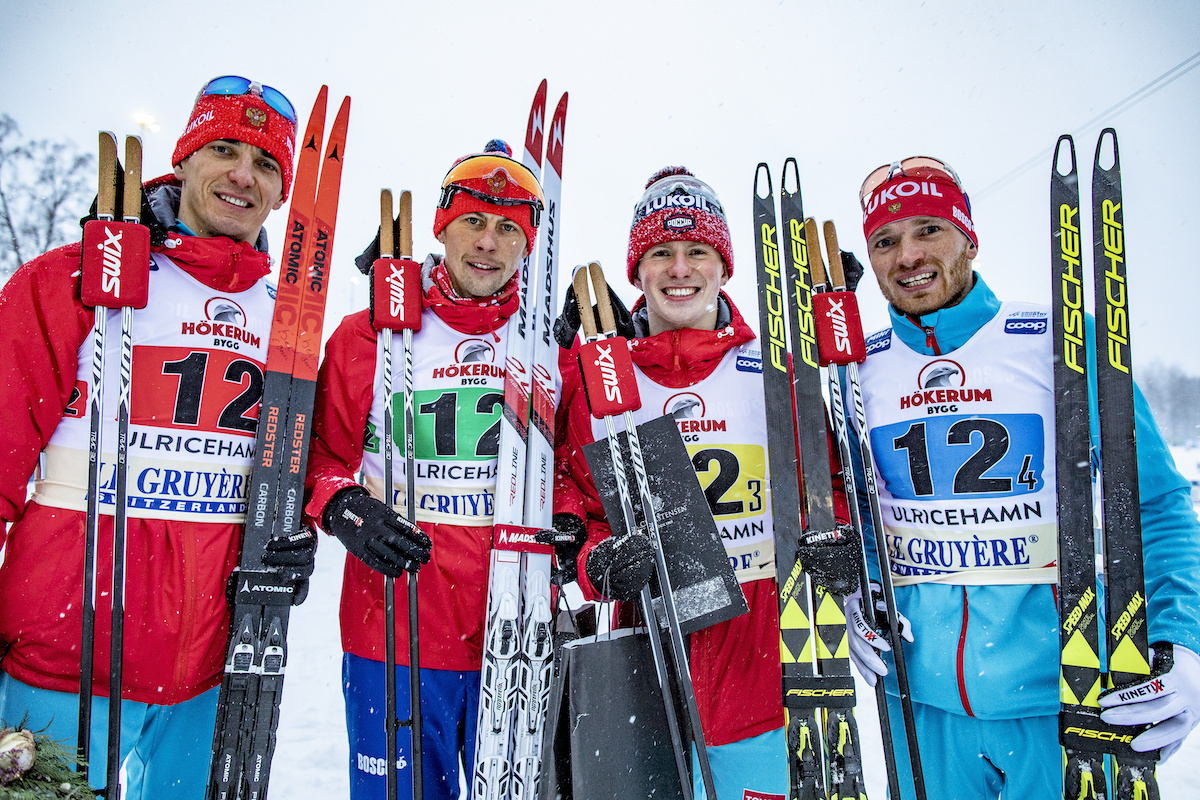
The Winning 4 x 7.5 k Russian relay team at the Ulricehamn, Sweden World Cups: from left to right, Evgeniy Belov, Alexander Bessmertnykh, Denis Spitsov and Artem Maltsev. (Photo: Fischer/Nordic Focus)
Today in Ulricehamn, Sweden, the men skied a 4 x 7.5- kilometer relay in unsettled conditions. Racers dealt with harsh conditions as the wind howled and heavy snow fell. With a softened course, it appeared most teams struggled with kick on the steeper climbs.
Scott Patterson of the U.S. Ski Team (USST) commented on the conditions via email, “the race conditions were interesting with both falling snow and blasting wind. The organizers re-groomed the course in between the women’s and men’s races which did improve things, but the downhill corners were chopped up and soft.”
Russia II took the victory today in a time of 1:17:53.2 minutes with Evgeniy Belov, Alexander Bessmertnykh, Denis Spitsov and Artem Maltsev.
The winning team was followed closely by their teammates on Russia I; Andrey Larkov, Alexander Bolshunov, Andrey Melnichenko and Sergey Ustiugov.
Atypically, Norway had a rough start to the day – more on this in a bit — but the entire team put in a massive effort to claim third place. The Norwegian team consisted of Hans Christer Holund, Didrik Tønseth, Sjur Røthe and Simen Hegstad Krueger.
The Russian teams lead the entire race, flip-flopping between leaders. Russia I and II worked together throughout, but Russia II had superior fitness. With each Russia II surge, Russia I was unable to match the pace. In the closing k’s, Russia II charged for the finish. Russia I couldn’t hold on. Russia I finished 20.8 seconds behind.
During the initial lap of the scramble leg, the entire field remained close-knit. Only at the start of the second lap did both Russian teams, along with Sweden I, begin to gap the field. The Russians were able to hold this lead throughout the race. As the race progressed, and the pacing screws turned, Sweden was unable to match the Russians as they faded to place fifth overall (+1:39.6).
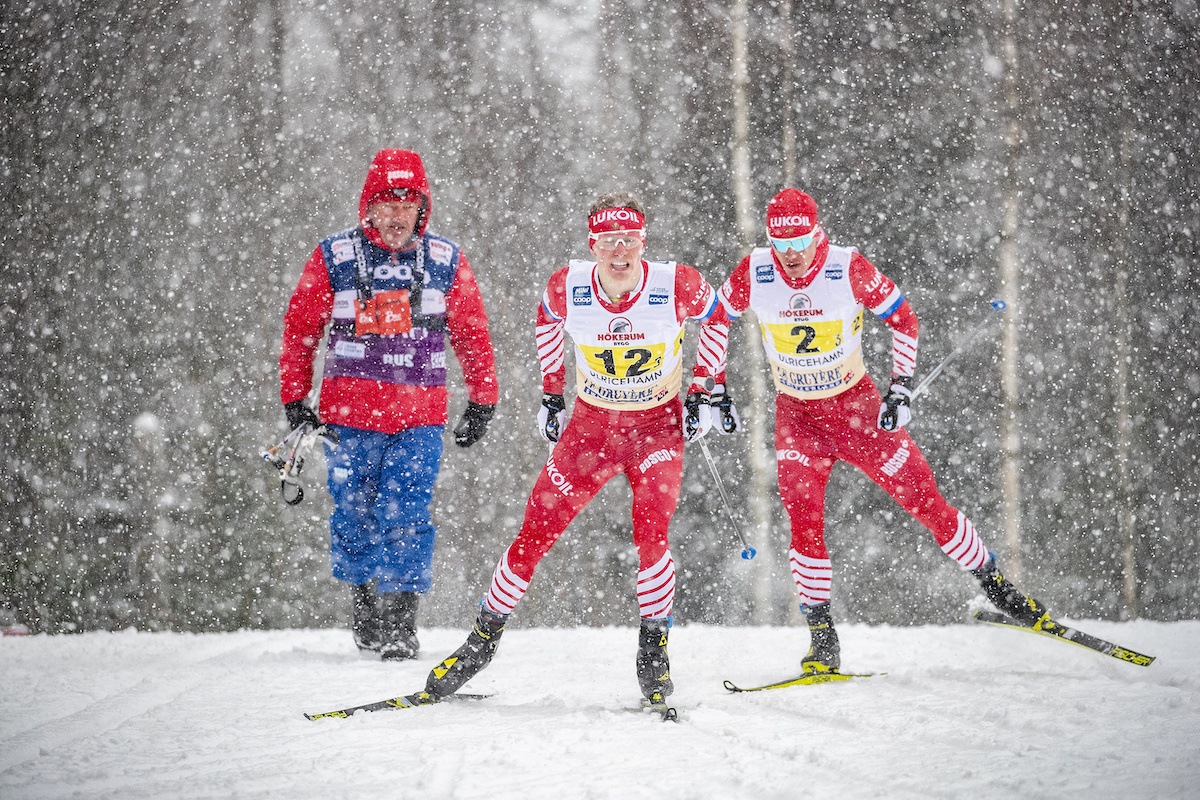
Russia’s Denis Spitsov (bib 12) and Andrey Melnichenko (bib2) leading the men’s 4 x 7.5 k relay in Ulricehamn, Sweden. (Photo: Fischer/Nordic Focus)
USST Head Coach Chris Grover commented on the Russian team’s performance this season.
“I mean they’ve been super strong all season, we certainly saw that up in Beitostolen and Lillehammer and the Tour,” Grover remarked over the phone. “It does seem like there are a lot of really good things going on with their program from a service perspective. They just had extraordinary skis race after race after race, especially in classic legs. It is very noticeable that they are doing a fantastic job on the service side and they obviously have a lot of depth and a lot of great athletes that have been coming up for a long time.”
The Norwegian team, as strong as they were, fell back during the first classic leg. It was a gradual decline for Holund throughout his 7.5 k effort. Coming into the first exchange, Norway was sitting in 12th place.
During Norway’s second leg, Tønseth made gains. He tagged Norway off in fourth place, giving his teammates a chance at the podium. Røthe, the third skier for Norway hammered to put his team within eyesight of third, which at the time was held by Lari Lehtonen of Finland.
By the end of his leg, Roethe had caught, passed and dropped Lehtonen, putting Norway solidly in third place. Krueger, the Norwegian team’s anchor, was able to hold third place until the finish. According to FIS, Norway has been on the podium in every men’s distance relay for the last 12 years.
The U.S. relay team, Erik Bjornsen, Scott Patterson, David Norris, and Benjamin Lustgarten finished 13th overall (+4.10.8).
During the first two legs, the U.S. team sat in the top-10. Bjornsen skied a strategically strong race, skiing smoothly towards the front of the pack. For the remainder of the race, the U.S. bounced bouncing between eighth and 13th place.
The U.S. Ski Team’s Erik Bjornsen during December’s 4 x 7.5 k relay in Beitostølen, Norway. (Photo: Aleks Tangen)
Bjornsen commented on the team’s strategy going into the race, “Our tactics were to try and stay with the group for as long as possible. We knew we weren’t going to be fighting for a podium spot today, just with where everyone is at right now. We also know this is good practice for World Champs so we used it as another opportunity to learn. We’ve set a goal as a men’s team to get a top 8. In a few years with some strong younger guys coming up, maybe that could be a top 5. Once you’re getting top 5’s then anything is possible when it all comes together.”
Bjornsen chose to race only the relay this weekend in preparation for World Championships which begin in three weeks. His conservative approach to race stars this weekend left him feeling fresh for Sunday’s relay.
“Erik did a great job, stayed in the fight for a long time there and it may be one of Scott’s better classic races. He did a really good job of holding steady with the group that he was in,” Grover commented.
This was Norris’s first World Cup since the U.S. National Championships concluded in early January.
“Coming off of Nationals I feel fit and healthy,” Norris told FasterSkier. “I got here Thursday night and I am glad I got two hard races in before a training camp in Davos. I am going to Davos tomorrow. This gives me plenty of time to adjust and prepare for the Cogne World Cup and World Championships.”
The U.S. team has a distance and sprint training camp planned for the next two weeks until the World Cup in Lahti, Finland on Feb. 9. The Lahti races include a skate sprint and team sprint, with no distance races scheduled until Cogne’s races starting on Feb.16. These training camps are in preparation for the World Championships in Seefeld, Austria.
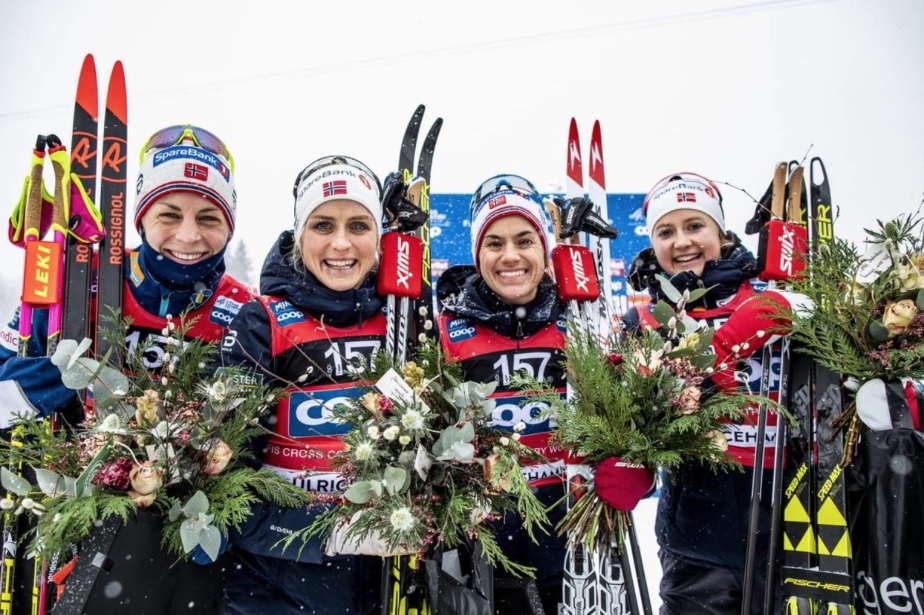
The winners of the 2019 4 x 5 k relay in Ulricehamn, Sweden: (l-r) Norway’s Astrid Uhrenholdt Jacobsen, Therese Johaug, Heidi Weng, and Ingvild Flugstad Østberg. (Photo: fis-ski.com screenshot)
FIS World Cup Ulricehamn, Sweden 4 x 5 k / 4 x 7.5 k relay
The sun rises, the sun sets, and Norway wins the women’s 4 x 5-kilometer relay in Ulricehamn, Norway on Sunday. For the 11th time in a row, a Norwegian women’s team bested the world in the storied race format.
Heidi Weng, Therese Johaug, Astrid Uhrenholdt Jacobsen, and Ingvild Flugstad Østberg won in a time of 57:06.3 minutes. For the first tag, nine teams came in separated by 8.1 seconds. Johaug, skiing the second leg for Norway, opened a gap of 9.3 seconds over Russia I by the 10 k mark.
The time back to second-placed Sweden I stretched to 37.4 seconds by the finish.
Sweden I’s team consisted of Evelina Settlin, Ebba Andersson, Charlotte Kalla, and Jonna Sundling.
Finland I placed third (+41.2) wth Laura Mononen, Krista Pärmäkoski, , Riitta-Liisa Roponen, and Evelina Piippo.
The U.S. team of Sadie Bjornsen, Rosie Brennan, Caitlin Patterson, and Jessie Diggins finished in sixth (+1:26.6).
In the men’s 4x 7.5k relay, Russia II and Russia I came away in first and second place respectively.
Russia II’s team of Evgeniy Belov, Alexander Bessmertnykh, Denis Spitsov, and Artem Maltsev won in a time of 1:17.53.2 hours.
Russia I’s Andrey Larkov, Alexander Bolshunov, Andrey Melnichenko, and Sergey Ustiugov finished 20.8 seconds back.
In third was Norway, 35.8 seconds behind. Hans Christer Holund, Didrik Tønseth, Sjur Røthe, and Simen Hegstad Krüger, Norway’s foursome, were 35.8 seconds back. On the first leg, at 9.7 k, Norway was in ninth place, with a 43.1-second deficit.
The U.S. team of Erik Bjornsen, Scott Patterson, David Norris, and Ben Lustgarten placed 13th (+4:10.8).
IBU World Cup Antholz, Germany 12.5 k / 15 k Mass Start
On Sunday in Antholz, home country athlete Germany’s Laura Dahlmeier won in 35:32.8 minutes while skiing a single penalty lap during her first prone stage. The Czech Republic’s Marketa Davidova placed second (13.1, 0+0+1+0), with Vanessa Hinz of Germany in third (+16.4 1+0+0+0).
“It’s a fantastic feeling to be right at the top again,” Dahlmeier told the IBU. “I started very badly and I felt slow. But I came back strongly and I remained virtually without error in the shooting. It was a good weekend for me.”
US Biathlon’s Clare Egan raced and shot to 15th overall, 1:05.8 back, with two penalties in her first prone stage, otherwise she shot clean.
Rosanna Crawford of Canada placed 28th (+3:50.2, 0+1+3+1).
In the men’s 15 k mass start, there was one new development: Johannes Thingnes Bø of Norway did not win. He did, however, place second to France’s Quentin Fillon Maillet. He won the race in 34:39.4 seconds while shooting clean in all four stages. Depositing between PLN 60 and PLN 199, we will receive a bonus of 125% of our deposit (a maximum of PLN 1,600), as well as a package of 50 free spins Vulkan Bet on the Doom of Dead slot machine. On the other hand, if we deposit at least PLN 200, we will get 100 free spins after the game as a reward, as well as a bonus of as much as 200% of our own deposit (a maximum of PLN 2,800 to visit).
Bø was 14.3 seconds back in second place, with a single miss in each of his standing stages. Germany’s Arnd Peiffer was third (+24.6, 0+0+0+0).
Christian Gow of Canada was the sole North American in the race. He placed 27th (+3:22.5, 1+1+0+1).
Lake Placid SuperTour 10 k/15 k mass start classic
Kaitlynn Miller (CGRP) won the women’s 1o k classic mass start in 36:12.7 minutes. Coming in 2.9 seconds back was Jessica Yeaton(APU/Australian National Team) in second place. In third, skiing for Dartmouth, was Katharine Ogden (37:27.8).
Kyle Bratrud (SMS T2) won the men’s 15 k classic mass start in 46:41.3 minutes. In second place was Adam Martin (CGRP) who raced to a time of 46:55.0. Canada’s Andy Shields (Lappe Nordic) placed third in 47:41.6.
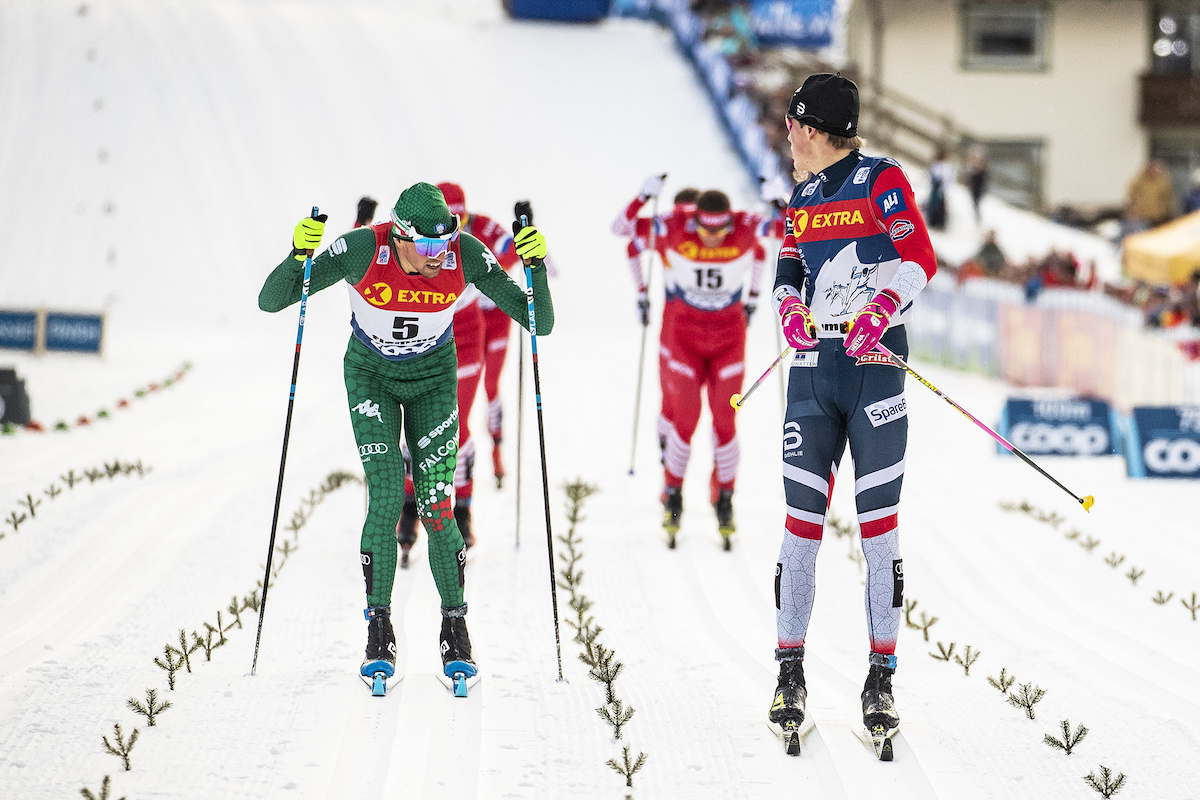
Norway’s Johannes Høsflot Klæbo (r) crossing ahead of Italy’s Francesco de Fabiani to secure his fourth win of the 2019 TdS. He placed first in the men’s 15-kilometer classic event on Saturday in Val di Fiemme, Italy. (Photo: Fischer/Nordic Focus)
The final stages of the Tour de Ski (TdS) often bring drama: the attrition of some athletes leaving opportunity for others.
Among the 45 male competitors who chose to start Saturday’s TdS Stage 6 of 7–a 15-kilometer classic mass start in Val di Fiemme, Italy–some may have been experiencing fatigue from racing the Tour’s previous five stages; others may have been finding their peak. For Italy’s Francesco de Fabiani, who started Saturday in bib number 5, it looked like the latter.
With a little less than half a kilometer to go, the Italian appeared to be reeling in a win for Italy. He had stormed to the front of the lead pack–which consisted of two Norwegians Johannes Høsflot Klæbo and Hans Christer Holund, as well as four Russians – Alexander Bolshunov, Andrey Larkov, Maxim Vylegzhanin, and Andrey Sobakarev – in the final climb. A gap between de Fabiani and the final six expanded to almost a meter by the crest of the last uphill.
But as de Fabiani made headway into the final descent and toward the finishing stretch, the shadow of one skier closed in. One that few would choose as their counterpart in a sprint to the finish. Klæbo.
The Norwegian’s skis had caught up to de Fabiani by the bottom of the hill and as the duo approached the final 50-meter stretch to the finish line, Klæbo switched lanes and shadowed on de Fabiani’s left.
The Italian worked to stave off the powerful double poles of Klæbo, but with the race’s two bonus sprints already in the bag, Klæbo was not about to let up on the finish line sprint. He ousted de Fabiani in the 15 k’s final tracks, crossing first in a time of 40:52.6 minutes. De Fabiani crossed 0.6 tenths of a second behind the Norwegian for second place.
“I think it was really tough in the last uphill,” Klæbo said during a FIS interview after the race. “But I [managed to] get a stream down before the finish line then I held a little bit higher speed than the Italian guy so then it was just full speed to the finish and I’m not stopping before I cross the finish line now.”
The start of the men’s Stage 6 15 k mass start classic of the 2018/2019 Tour de Ski. (Photo: Fischer/Nordic Focus)
The victory marks Klæbo’s fourth of the Tour: he opened with a win in Stage 1, a freestyle sprint in Toblach, before moving on to place 12th in Stage 2 and winning Stage 3, another skate sprint in Val Müstair. After a ninth-place finish in Stage 4, he returned to the top of the podium in Stage 5, claiming first in the Oberstdorf 15 k pursuit.
His victory in Stage 6 makes him the first male in history to win four stages while still a U23 (he turned 22 this October). He also now has back-to-back TdS wins–the last Norwegian to do so was Martin Johnsrud Sundby in 2016. Notably, this is also Klæbo’s first TdS. He is now leading the men’s overall TdS standings and will start tomorrow’s final stage climb 1:20.4 ahead of Russia’s Sergey Ustiugov, who is currently ranked second in the TdS overall standings.
“Today was really hard and I was a bit afraid of the Russian guys because I heard that they were going to set a high speed but I had a very good day and took a lot of bonus second as well so it was really really cool to be first,” Klæbo said.
For the 25-year-old de Fabiani, Saturday’s second place finish is his seventh individual podium on the World Cup. One of those podiums came earlier in this season’s TdS, as he also garnered a second place finish in Stage 4, also a 15 k classic mass start. He has now moved up to fourth in the overall TdS standings after his performance in Stage 6.
Norway’s Johannes Høsflot Klæbo (r) crossing ahead of Italy’s Francesco de Fabiani to secure his fourth win of the 2019 TdS. He placed first in the men’s 15-kilometer classic event on Saturday in Val di Fiemme, Italy. (Photo: Fischer/Nordic Focus)
Taking the third position in Stage 6 on Saturday was Russia’s Alexander Bolshonov, who crossed 2.6 seconds behind Klæbo.
The Russian had perhaps been looking more for the win. At the 11.4 k mark, he was at the helm of the lead group, which was still 20 skiers strong at that point. In another kilometer and a half, the front had finally dwindled to seven, with a pull from Sobakarev stringing out a pack consisting of Bolshunov, Klæbo, Holund, Vylegzhanin, Larkov and de Fabiani. Bolshunov continued to set the pace until the final kilometer when a push from de Fabiani caused racers to scramble.
The Italian’s pace proved one that only Klæbo could match. Following Bolshunov in third was Larkov in fourth (+3.4), Vylegzhanin in fifth (+4.6), Sobakarev in sixth (+6.3), Holund in seventh (+13.0) Russian Denis Spitsov in eighth (+27.1), Great Britain’s Andrew Musgrave in ninth (+29.0) and Norway’s Martin Johnsrud Sundby in tenth (+29.9).
The lone North American to start Stage 6 was U.S. skier, Ben Lustgarten who finished the day in 44th (+5:31.7).
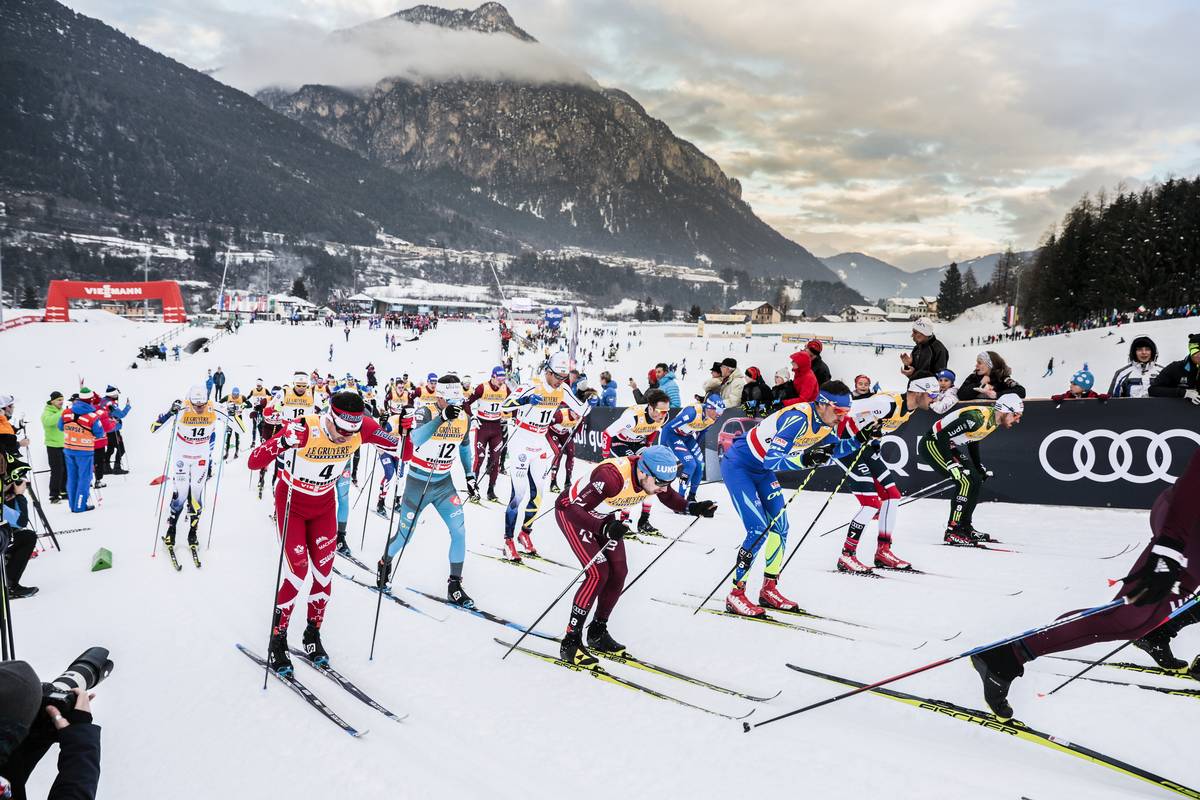
The start of the men’s 15 k classic mass start at Stage 6 of the 2018 Tour de Ski on Saturday in Val di Fiemme, Italy, with (front row, left to right) Canada’s Alex Harvey, Russia’s Sergey Ustiugov, Kazakhstan’s Alexey Poltoranin, Norway’s Martin Johnsrud Sundby, and Switzerland’s Dario Cologna. (Photo: Salomon/NordicFocus)
Beginning this Saturday in Toblach, Italy with a freestyle sprint is the 13th edition of the Tour de Ski (TdS). According to the International Ski Federation (FIS), over the course of seven stages the men will race 80.918 kilometers, the women 60.67 k.
The TdS has become both a staple and a spectacle of the annual World Cup calendar. With a jam-packed series of races primacy is placed on both the ability to recover well and wither less as the TdS transpires.
Prognostication can be tricky in a long-form template like the TdS. So much can go astray during seven races not to mention the travel and dicey germ-avoidance.
Last season’s winner on the women’s side, Heidi Weng of Norway, sits 18th overall in the World Cup standings (14th in distance). She has four top-20’s in the four distance events she’s contested with her best result an eighth in Lillehammer’s 10 k skate. Although featuring two sprints in the first three stages, the TdS remains a distance skier’s paradise.
Weng has skied solidly on the World Cup, but she has yet to show the form that made her a TdS overall winner in 2017 and 2018. Norway has won the last five iterations of the TdS: Marit Bjørgen won once in 2014/2015, Therese Johaug twice (2013/2014, 2015/2016), and Weng the last two years.
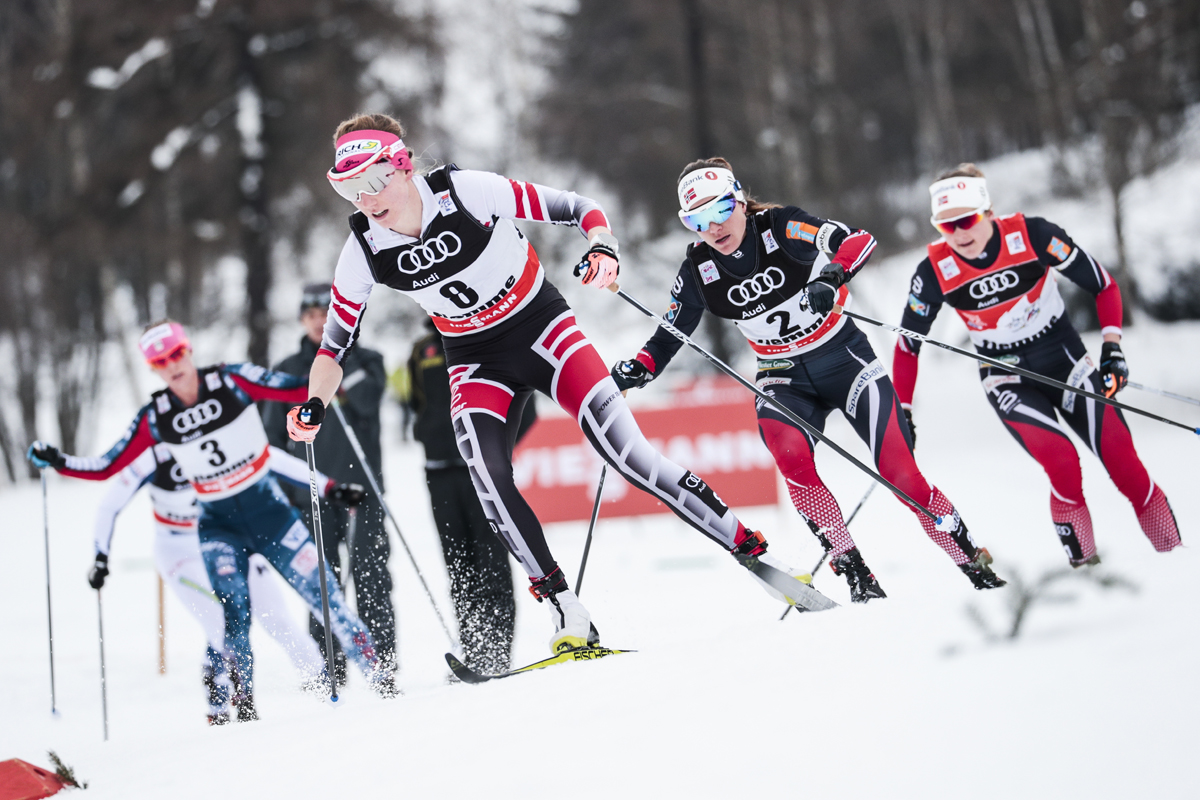
Austria’s Teresa Stadlober leads Norway’s Heidi Weng (2) and Ingvild Flugstad Østberg, American Jessie Diggins (3) and others around a downhill corner during the women’s 10 k classic mass start at Stage 6 of the 2018 Tour de Ski in Val di Fiemme, Italy. (Photo: Fischer/NordicFocus)
If Norway is to keep the streak alive, Ingvild Flugstad Østberg, last year’s TdS runner up, could be the heir apparent. She currently ranks second in the World Cup overall and 15th on the sprint list.
Johaug, having returned from an 18 month doping ban, has been on a distance race tear. She has won all five World Cup distance events this season. Johaug, however, will not be lining up for the TdS.
Only five different women have earned distance podiums this season — Johaug, Østberg, Sweden’s Charlotte Kalla and Ebba Andersson, and Finland’s Krista Pärmäkoski. Along with Johaug, Kalla and Andersson are skipping the TdS. (Andersson sits third overall on the World Cup, Kalla fifth.) With the TdS missing three of the five top ranked World Cup distance skiers, daily stages and the overall podium are up for grabs.
Last season’s third overall finisher, Jessie Diggins of the U.S. Ski Team (USST), often cites the TdS as a point in the season when her form trends towards podium performances. She sits eighth in the current distance standings and could very well have a stout TdS.
Russia’s Natalia Belorukova and Yulia Nepryaeva look strong as does Sadie Bjornsen (USST), and Austria’s Teresa Stadlober.
With less than predictable distance stage podiums for the women, it may simply come down to a drag race on the Alpe Cermis final climb Jan. 6.
Switzerland’s Dario Cologna (c) celebrates his fourth Tour de Ski overall title. He was joined by Norway’s Martin Johnsrud Sundby (l) and Canada’s Alex Harvey (r) on the podium in second and third, respectively. (Photo: Fischer/NordicFocus)
The men’s scene is also open to interpretation. Last season’s TdS winner, Switzerland’s Dario Cologna, was in fact a surprise victor. Prior to Cologna’s stage two win in last year’s TdS, it had been nearly three years since the four time TdS overall winner had won a World Cup. Cologna sits 21st overall on the World Cup currently. Given last year’s resurgence, anything is possible for the Swiss skier.
Then there’s Martin Johnsrud Sundby form Norway. He finished on the TdS podium the last three years. At thirty-four-years-old, Sundby is ranked first on the distance list, with a second, a third, and a fourth place in distance races this season.
Sundby won the TdS on two occasions – in 2013/2014 and in 2016. His 2015 win was stripped after he tested positive for excessive levels of Salbutamol. He placed second in the past two Tours.
In a field rife with talent, Sundby’s ability to race and rebound and race and rebound will be tested. Sjur Røthe, Emil Iversen, and Didrik Tønseth— all from Norway— look in form. And there’s Norway’s Johannes Høsflot Klæbo. The winner of last season’s overall World Cup has had flashes of his past explosive self. He could be a TdS protagonist.
The men’s field is notably tight. Along with the Norwegians, several Russians could pop a podium, a stage win, and the overall. Russia comes with a loaded team ready to exploit. Alexander Bolshunov leads the overall World Cup – he’ll turn twenty two on Dec. 31st. He’s backed by teammates Evgeniy Belov, Andrey Melnichenko, and Denis Spitsov.
Canada’s Alex Harvey placed third overall last year and he looked stronger as the TdS progressed.
The Stages
Stage 1: Dec. 29, skate sprint in Toblach, Italy.
Stage 2: Dec. 30, 10 k/15 k skate in Toblach, Italy.
Stage 3: Jan. 1, skate sprint in Val Müstair, Switzerland.
Stage 4: Jan. 2, 10 k/15 k classic mass start in Oberstdorf, Germany.
Stage 5: Jan. 3, 10 k/15 k skate pursuit in Oberstdorf, Germany.
Stage 6: Jan. 5th, 10 k/15 k classic mass start in Val di Fiemme, Italy.
Stage 7: Jan 6th, 9 k final climb skate pursuit in Val di Fiemme, Italy.
Teams
United States
Women: Sophie Caldwell, Sadie Bjornsen, Jessie Diggins.
Men: Ben Lustgarten, Simi Hamilton, Erik Bjornsen, Kevin Bolger.
U.S. Ski Team Head Coach Chris Grover noted in a text that Caldwell, Hamilton, and Bolger will likely cease the TdS after the stage three sprint. Additionally, this is a small team for the U.S. at the TdS. Several athletes turned down TdS nominations including Scott Patterson (USST), Andy Newell (SMS T2/Salomon), Kyle Bratrud (SMS T2), Rosie Brennan (APU), Rosie Frankowski (APU), Caitlin Patterson (CGRP), and Julia Kern (SMS T2). These skiers plan on racing U.S. Nationals this January in Craftsbury, Vermont.
Canada
Women: Emily Nishikawa, Dahria Beatty
Men: Alex Harvey, Lenny Valjas, Bob Thompson
Norway
Women: Ingvild Flugstad Østberg, Maiken Caspersen Falla, Astrid Uhrenholdt Jacobsen, Kari Øyre Slind, Kathrine Rolsted Harsem, Heidi Weng, Lotta Udnes Weng, Tiril Udnes Weng Mari Eide, Anna Svendsen
Men: Martin Johnsrud Sundby, Hans Christer Holund, Emil Iversen, Didrik Tønseth, Simen Hegstad, Krüger, Sjur Røthe, Johannes Høsflot Klæbo, Martin Løwstrøm Nyenget, Eirik Brandsdal, Finn Hågen Krogh
Russia
Women: Yulia Belorukova, Lidia Durkina, Anna Zherebyateva, Mariya Istomina, Natalia Nepryaeva, Anna Nechaevskaya, Anastasia Sedova, Elena Soboleva
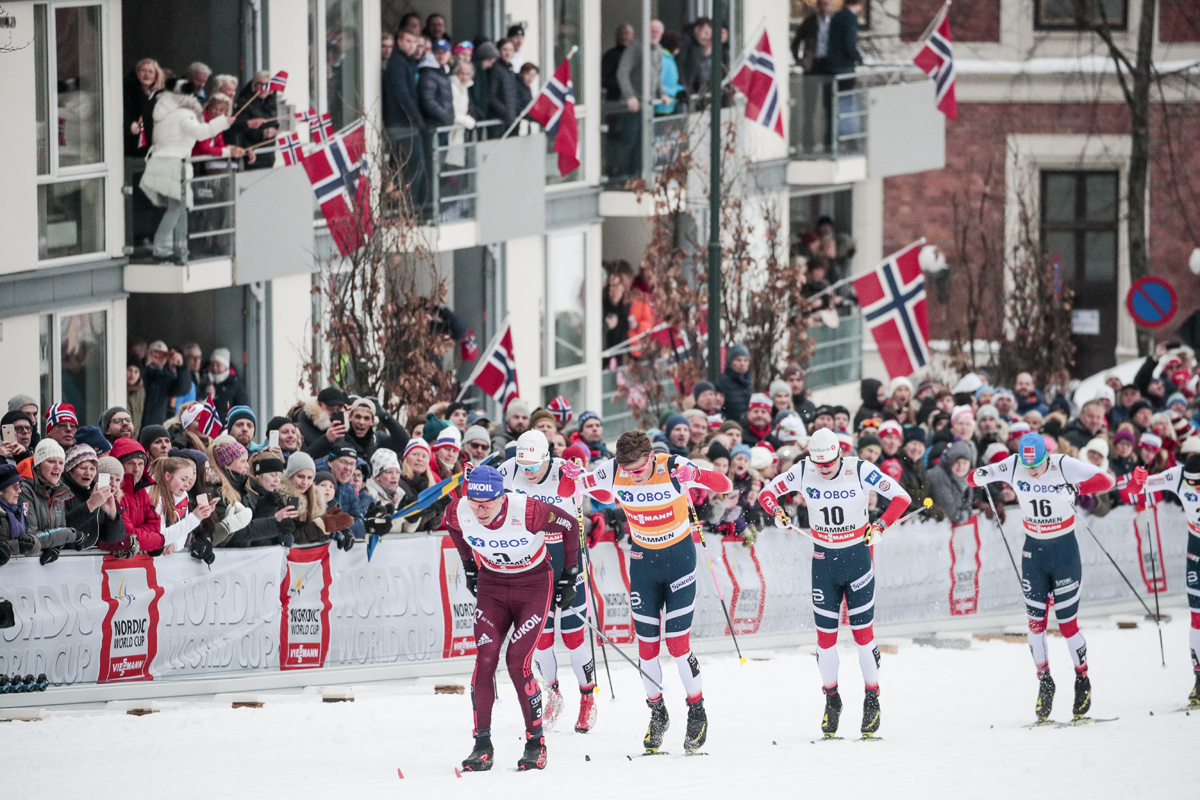
Russia’s Alexander Bolshunov leads five Norwegians in the men’s classic sprint final at the World Cup in Drammen, Norway: (from l to r) Eriik Brandsdal, Johannes Høsflot Klæbo (yellow bib), Sindre Bjørnestad Skar (10), Kasper Stadaas (16), and Emil Iversen. (Photo: Fischer/Nordic Focus)
Welcome to FasterSkier’s World Cup Preview, where we check in with the top-10 teams from last year’s FIS Cross Country World Cup tour before the season starts. The World Cup begins with a classic sprint in Ruka, Finland on Nov. 24th.
***
Russia
Overall in Nations Cup Last Year:3rd
Women’s Ranking 2017/2018:5th
Men’s Ranking 2017/2018:2nd
Russians to Watch:
For several years the attention grabbing fact about Russia was the morass of allegations and findings regarding rampant doping.
The bureaucratic seesaw teetering and tottering prior to the 2018 PyeongChang Games boiled down to will they or won’t they. As in, will Russian athletes be able to compete?
The Russian Federation was banned outright from the Games; it’s athletes competed under the IOC flag as Olympic Athletes from Russia (OAR).
The taint on competing Russian cross-country athletes last season was palpable. Clean or not, there was a sense of guilt by association. They must be a tough lot. Whatever psychic baggage the Russians carried as part of a shunned team, their collective results at the Olympics didn’t skip a beat. The same goes for the World Cup, where the group landed third overall in the Nation’s Cup.
A cadre of young Russian skiers propelled themselves into medal position. There was 22-year-old Denis Spitsov who missed a bronze in the Olympic 30 k skiathlon by less than three seconds. He placed third in the Holmenkollen 50 k skate.
The Russian men won silver in the PyeongChang 4 x 10 k relay.
By season’s end, Bolshunov was fifth overall in the World Cup standings. Added into Russia’s overall mix, Alexey Chervotkin was 11th overall, Usitugov 12th, Andrey Larkov 18th, Spitsov 20th, Maxim Vylegzhanin 27th, and Gleb Retivykh 30th.
Count them up, that’s seven men in the top-30 of the World Cup overall. Deep is deep.
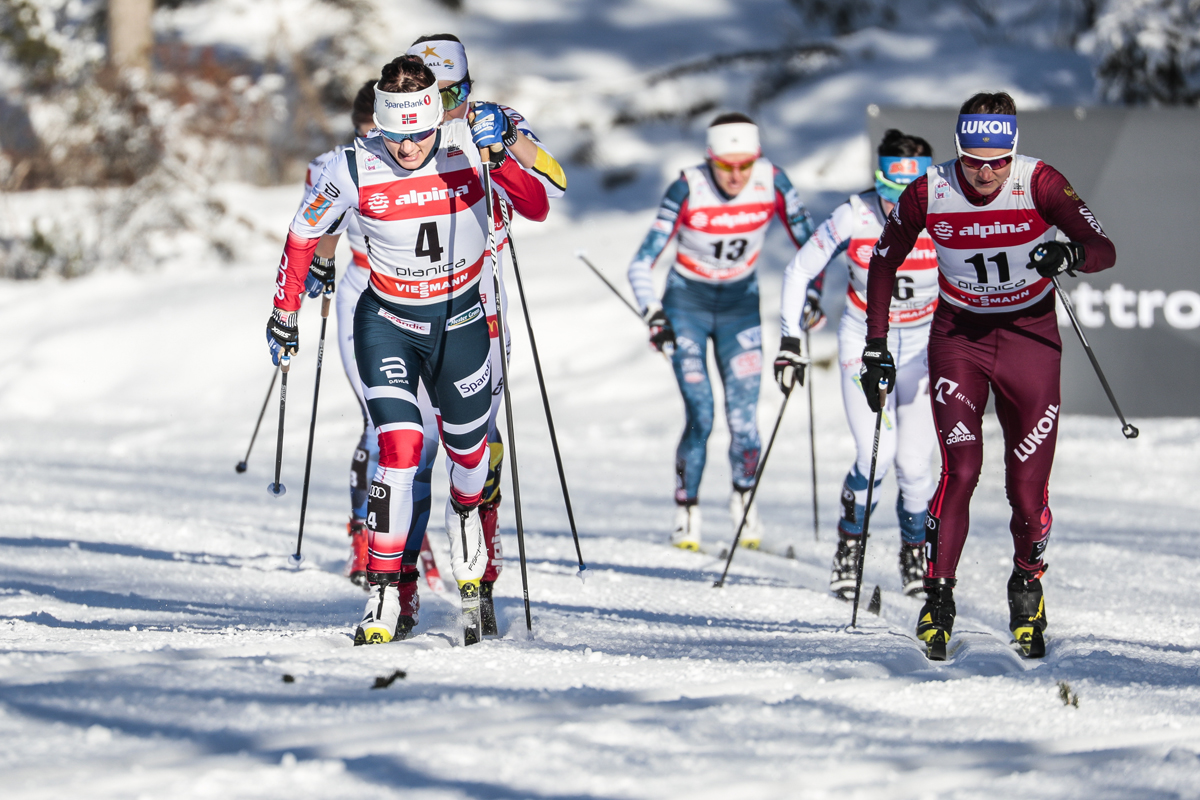
Maiken Caspersen Falla (NOR), Yulia Belorukova (RUS), (l-r) during the 2018 FIS world cup cross-country, individual sprint, Planica, Slovenia. (Photo: Fischer/Nordic Focus)
The Russian women had three athletes in the top-30 overall. Natalia Nepryaeva was ranked 13th, Anastasia Sedova 16th, and Yulia Belorukova 29th.
Nepryaeva, at twenty three years old, had three top-five finishes on the World Cup including a second place in Lahti’s 10 k classic. She placed fourth in the Olympic classic sprint and eighth in the 15 k skiathlon. Also at twenty-three-years-old, Belorukova podiumed on several occasions in World Cup sprints, and won bronze in the Olympic classic sprint.
In the Games 4 x 5 k relay, Nepryaeva, Belorukova, Sedova, and Anna Nechaevskaya, were third for Russia.
Beginning a new Olympic quadrennial, many years removed from Sochi but its dark-sided impacts still relatively fresh, Russia has new faces on the scene. The Russian Ski Federation appears that it can plug and play as it moves athletes into its winning pipeline.
Alex Harvey (2) follows Kazakhstan’s Alexey Poltoranin (5) at the front of the pack during the during the men’s 50 k classic mass start at the 2018 Pyeongchang Olympics in South Korea (Photo: Flyingpointroad)
PYEONGCHANG, South Korea —Not even three kilometers into the men’s 50-kilometer classic mass start on Saturday, Canada’s Devon Kershaw was an S.O.S. skier. The Canadian’s ski pole had snapped and he singlesticked for almost a kilometer before he received another. By the time Kershaw was handed a spare, many of the bibs he started with were striding away; any hope he may have harbored for a podium dashed away with them.
But in his fourth and final Olympics, the 35-year-old Kershaw will be the first to tell you there were other reasons he committed to four more years of Winter Games preparation following Sochi.
“I really stuck around to see if I could push Alex [Harvey] — I do push Alex in training — and to see him get an Olympic medal,” Kershaw told FasterSkier in person after Saturday’s race.
PyeongChang is also, allegedly, Canadian Alex Harvey’s final Olympics. He has stated his plans to retire after the 2019 World Cup Finals in Québec City.
“I was just so motivated to be around to see the first Olympic medal for men get hung around a [Canadian] neck. That’s what drove me every day,” Kershaw reflected.
Canadians Devon Kershaw (r) and Graeme Killick during the men’s 50 k at the 2018 Pyeongchang Olympics in South Korea (Photo: Flyingpointroad)
Coming into the 2018 Winter Games, Harvey, 29, was the favorite for a country that has yet to claim an Olympic medal in men’s cross-country. Harvey’s closest finish until Saturday was seventh in the men’s 15 k freestyle, just 12.5 seconds away from bronze. Earlier in the PyeongChang Games, the Québec native placed eighth in the men’s 30 k skiathlon, and 32nd in the classic sprint. Last year at World Championships in Lahti, Finland, Harvey was crowned the 50 k freestyle mass start world champ.
On Saturday in PyeongChang, while Kershaw waved one half of his ski pole in search of a whole, Harvey hammered away up front in an attempt to earn hardware for Canada.
Harvey, Russia’s Andrey Larkov, and Norwegians Martin Johnsrud Sundby and Hans Christer Holund, skied in a chase pack behind Finland’s Iivo Niskanen, Kazakhstan’s Alexey Poltoranin and Russia’s Alexander Bolshunov, the three of which had gapped the field around the race’s halfway point.
For close to 20 k, Harvey, Larkov, Sundby, and Holund appeared to be racing for fourth through seventh place. With less than 8 k to go, the four men began gaining ground on Poltoranin skiing in third.
“We knew that going with Niskanen is such a hard pace and some of these guys would pay the price later on,” Harvey told FasterSkier of the lead group’s fast pace.
As Harvey, Larkov and Sundby exchanged leads, the time gap to third shrank from 1 minute and 15 seconds at the 30 k mark to 26 seconds by the 43 k mark. Around 45 k, Poltoranin had slowed to a shuffle and stepped aside to let Larkov, Sundby, Harvey, and Holund pass.
With 5 k to go, Harvey was visibly working hard. Afterwards, he told reporters he was unabashed about the demands he put on his body.
“The last laps, my quads were cramping, my biceps, my calves, my stomach, too,” Harvey said. “You just focus on the process, the present, on your technique. If there’s somebody ahead of you, you just focus on his skis; just stay on his tails.”
Three Norwegians leading the pack, with Hans Christer Holund (3), Emil Iversen (12) and Martin Johnsrud Sundby (4) looking to see if anyone else wants to take a turn up front during the men’s 50 k classic mass start at the 2018 Olympics in PyeongChang, South Korea. Canada’s Alex Harvey is directly behind Iversen. (Photo: FlyingPointRoad)
Harvey skied within centimeters of Sundby, Larkov and Holund until the final headwall climb. As the four strode up to the hill’s halfway point, Larkov made his move. The Russian put close to three seconds on the Canadian and the Norwegians by the crest of the hill. That gap widened by the time they made their final descent to the stadium.
Larkov propelled himself into third, 2:37.5 minutes after Niskanen crossed the line first in 2:08:22.1 hours. Second went to Russia’s Bolshunov (+18.7). Harvey sprinted into the finishing stretch with Sundby at his side and outlunged the Norwegian for fourth. All said and done, the Canadian missed a medal by just 6.1 seconds.
In his final Olympics, Harvey’s emotions were heavy as he approached the press. Given the dark cloud that surrounds the 2014 Games, Harvey weighed in tacitly about Saturday’s 50 k podium, which included two Russians.
“You want to believe in the new generation of Russians, so you’ve got to give them the benefit of the doubt, for sure,” Harvey said. “It’s so hard to be fourth with two Russians in front. I do believe these younger guys are doing it clean, but with everything we’ve seen … in the back of your mind there’s a bit of doubt.”
After reflecting on all three of his Winter Olympics, Harvey hoped he and his teammates are a harbinger for Canada’s future cross-country scene (Harvey and Kershaw have been a staple for more than a decade, bringing Canada its best Olympic team result after placing fourth in the 2010 Vancouver team sprint).
Canada’s Alex Harvey after giving his all in the men’s 50 k classic mass start at the 2018 Olympics in PyeongChang, South Korea. He placed fourth for the best individual Olympic result for a male Canadian cross-country skier. (Photo: FlyingPointRoad)
“I think with my teammates, Devon [Kershaw], Ivan [Babikov], George [Grey], we were able to raise the bar for men’s cross-country skiing in Canada,” Harvey said. “… To realistically have expectations set for ourselves of believing in the podium, that was never done before, so I think that’s good for the future generations. To believe that it’s possible, to fight for the top ten, top five, week in [and] week out in the World Cup, at the World Championships, at the Olympics. That’s something that I’m really proud of.”
Harvey’s fourth place now ranks as Canada’s best individual men’s cross-country performance at a Winter Games. The previous best individual result was Kershaw’s fifth in the Vancouver 50 k freestyle. On Saturday, Kershaw was the second Canadian across the line in 26th (+9:27.).
As both close out their Olympic careers, they seem grounded. Not every Olympic dream has to end with medals. Rather, it’s about reaching the limits they push themselves to, once they are there.
“It’s a hard position to end up in,” Harvey said of his fourth place. “But it’s all I had today; there’s no regrets.”
Patterson 11th for Best U.S. Men’s Result Since 1976
Just as the U.S. women crushed a decades-old record earlier this week, American Scott Patterson raced to the best individual distance finish for a male U.S. cross-country skier since Bill Koch placed second and sixth at the 1976 Winter Olympics in Innsbruck, Austria. A first-time Olympian, Patterson placed 11th (+4:52.1), 15.2 seconds outside of the top 10 and 31 seconds back from Switzerland’s 15 k gold medalist Dario Cologna in ninth.
“Early on, I was with that second chase pack just trying to ski relaxed, ski well,” the 26-year-old Patterson said.
He had been skiing around 20th for the first 20 k, but moved up into 15th by the 23 k mark. In another 2 kilometers, Patterson was up to 13th. He pulled with Germany’s Andreas Katz and Russia’s Denis Spitsov — the 15 k freestyle bronze medalist — eventually dropping both.
American Scott Patterson (29) racing to 11th in the men’s 50 k classic mass start at the 2018 PyeongChang Olympics in South Korea. In doing so, he tallied the best American men’s result in an individual Olympic cross-country race since Bill Koch placed second and sixth at the 1976 Olympics. (Photo: Flyingpointroad)
Patterson worked his way past Norway’s Niklas Dyrhaug, Russia’s Alexey Chervotkin, and Poltoranin (who had been in contention for the bronze medal), before ultimately taking 11th.
“It was exciting for the last 5 k when people were starting to dangle in front of me,” Patterson said. “Probably a couple of k out when I got Dyrhaug, and then coming by Poltoranin, too, who I think was skiing pretty far up there early on there in the race. I just wanted a few more k to get [Norway’s Emil] Iversen and get into the top 10, maybe Cologna, too.”
The next American finisher on the day was Noah Hoffman in 33rd.
“Every race has gotten better at these Olympics and I would have loved to have been top 30,” Hoffman, a two-time Olympian, said. “In Sochi I was looking for big results and here I haven’t been close to that and it’s disappointing, but I’ve processed all of that. It’s been four years since I’ve really skied the way that I’ve wanted to and I’m pretty just excited to be here. I’m living up these Games trying to take it all in.”
American Noah Hoffman during the men’s 50 k classic mass start at the 2018 PyeongChang Olympics in South Korea (Photo: Flyingpointroad)
Three more North Americans competed in Saturday’s race, with Canada’s Graeme Killick finishing 27th (+10:06.7), American Tyler Kornfield placing 48th (+16:14.4) and Canada’s Russell Kennedy 49th (+16:54.5).
Despite getting sick Friday, Killick entered the race and finished with his best performance of the Games.
“My energy felt pretty decent and I’m really happy with that race,” Killick said. “I had to fight really hard for the last lap, because I had a group coming back on me and I was kind of in no man’s land. I’m really happy I was able to hold them off.”
The 50 k start was Kornfied’s second race of his first Olympics. Just last month, the 26 year old made his World Cup debut. Reflecting on his recent experiences, Kornfield was perceptive of the idea that racing takes time.
Canada’s Graeme Killick (48) leading his teammates Russell Kennedy (49) and Devon Kershaw in the men’s 50 k classic at the 2018 Olympics in PyeongChang, South Korea. They went on to place 27th, 49th and 26th, respectively. (Photo: FlyingPointRoad)
“I didn’t get the opportunity to race the World Cup until this year and a lot of times that got me down, frustrated me and felt like I wasn’t progressing with a lot of the other athletes in the nation and internationally as well,” Kornfield said. “I just had to be patient and know that eventually it’s going to click.
“It’s been a breakthrough season, but it hasn’t been above and beyond what I’ve done in the past,” he added. “So it’s just being patient and waiting your turn and knowing that it’s going to come, you just need to put your best race you can each day.”
Kennedy will head to a training camp in Japan, before returning to PyeongChang for the 2018 Winter Paralympics March 9-18 as one of Brian McKeever’s guides for the visually impaired races.
“I was feeling really good, I just didn’t have it in the end, the last two laps. I blew up pretty hard,” said Kennedy, a 26-year-old first-time Olympian. “It was still fun, and I, you always learn something from a 50 about what your body can do and where the limit is.”
The final cross-country 2018 Olympic event, the women’s 30 k classic mass start, takes place Sunday.
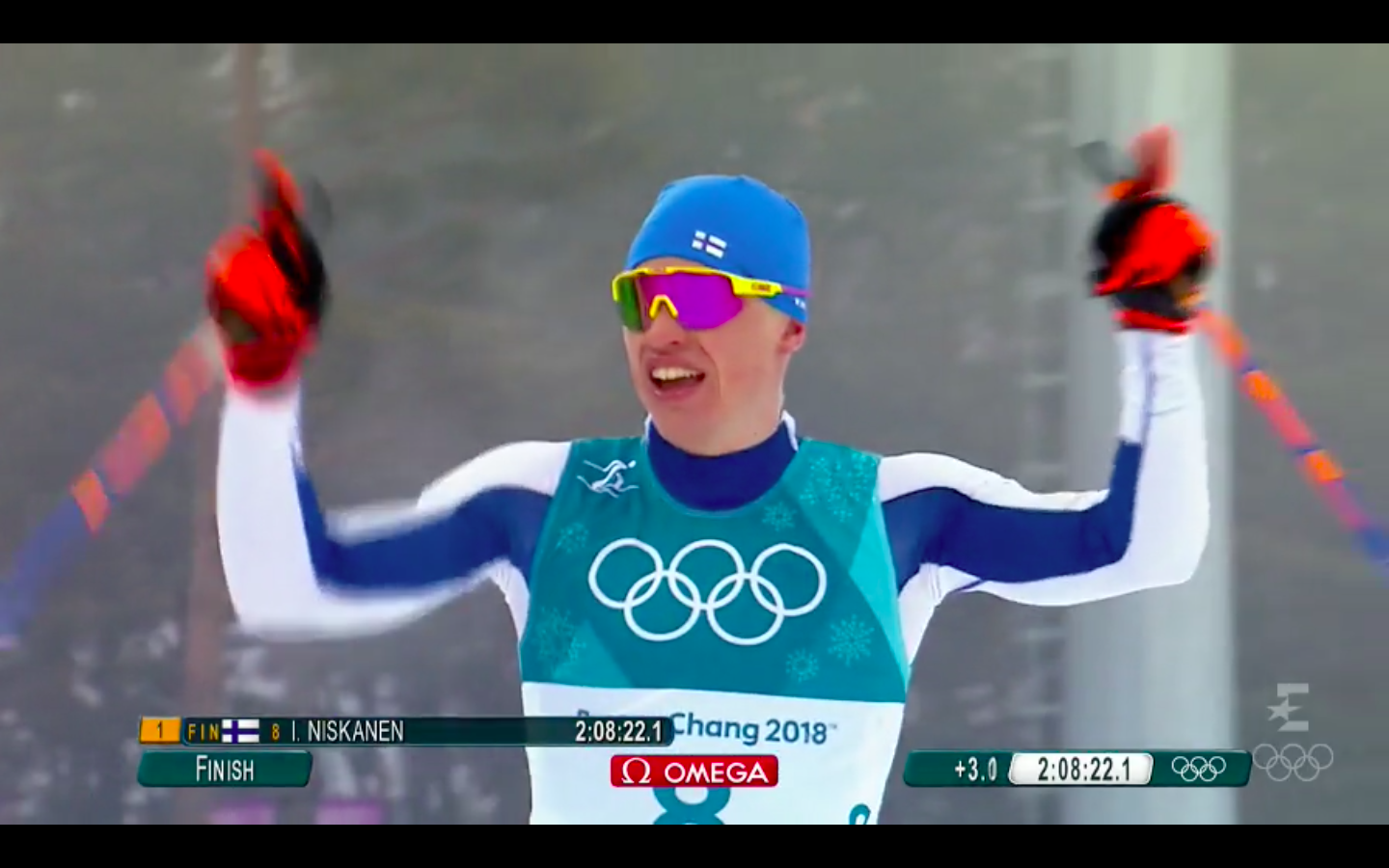
Finland’s Iivo Niskanen after winning the men’s 50 k classic mass start at the 2018 Winter Olympics in PyeongChang, South Korea. (Photo: FlyingPointRoad)
PYEONGCHANG, South Korea — Sun, clouds, fog, and snow. At the Alpensia Cross-Country Skiing Center on Saturday, the men’s 50-kilometer classic mass start transpired like a 50 k should. There was the break-the-pack pace from the start. There was the hard-man up front trying for a solo break. Of course there were chasers: one of whom blew up and faded and another that latched on for a silver-medal ride. And eventually there was a group of four that closed in on a single medal that eventually left three athletes unsatisfied. This was solid Olympic 50 k racing.
For Finland’s 26-year-old Iivo Niskanen, the plan worked. Burning through the 68 other starters began right away. As the 2 p.m. unfettered sun warmed the tracks, the kilometers ticked off with the favorites coalescing in the front. They included Martin Johnsrud Sundby of Norway, Kazakhstan’s Alexey Poltoranin, Alex Harvey of Canada, and the Olympic Athletes from Russia’s (we’ll just call them Russians) Alexander Bolshunov — a 21-year-old star of the Games, if you’re a medal counter (with two silvers and a bronze before Saturday’s race).
This is the 50 k classic, a race usually suited for the well-established and the well-conditioned. This was Niskanen’s day.
The switch flipped at 17.5 k when the Finn was set to fly. Sundby skied 1.4 seconds back, Poltoranin +2.3, Russia’s Alexey Chervotkin +3.4, Bolshunov +4.3, Russia’s Andrey Larkov +5.4, Norway’s Hans Christer Holund +5.7, and Harvey +6.0. These were the names that topped the course’s time checks.
Bold. Daring. Tempting fate. All these words could describe the noticeable uptick in effort from Niskanen at 22.36 k that cracked the field. Unike the tale of the frog in boiling water unaware of it’s slow demise — Niskanen’s pacing shakedown was abrupt. Although not exactly a punch of effort, there was no subtlety to it.
Passing through 27.2 k, Bolshunov trailed the Niskanen-Poltoranin duo by 20.9 seconds. Niskanen soldiered as the consummate soloist except Poltoranin was velcroed on. A look to the side here, another look to the side there from Niskanen could not convince Poltoranin to take a pull up front.
Norway’s Niklas Dyrhaug leads a mass of skiers during the men’s 50 k classic mass start on Saturday at the 2018 Olympics in PyeongChang, Sourth Korea. (Photo: FlyingPointRoad)
A second and third plot line developed behind. Bolshunov surged. Sundby, Holund and Harvey solidified into a core that would slowly bleed time to the leaders. In their own eventual fight for bronze, Harvey’s group fended off every racer except for Russians Larkov and Chervotkin.
Up ahead, Bolshunov flaunted his 21-year-old verve. There was no stage fright. He caught, passed, and gapped Poltoranin. At 33.32 k, only Bolshunov could muster the fight and locked in on Niskanen. As much as Bolshunov was the 50 k’s yin at this point, Poltoranin was its yang. His valiant chase of Niskanen early on smudged out by his crash and burn. Poltoranin was eventually caught by the Harvey group and finished 15th (+5:15.0).
Late in the race, the temps had cooled below freezing and flurries fell. The sun-to-cloud swap also came with a fog bank reminiscent of March in Holmenkollen. Through the stadium at 37.5 k, neither Niskanen nor Bolshunov exchanged skis. Again, like with Poltoranin, Niskanen pulled up slightly. Bolshunov wouldn’t take the invite. He continued drafting the Finn.
Finland’s Iivo Niskanen leads Alexander Bolshunov of the Olympic Athletes from Russia during the men’s 50 k classic mass start at the 2018 Olympics in PyeongChang, South Korea. (Photo: FlyingPointRoad)
That dynamic changed as Bolshunov led down the sweeping turn into the stadium area around 40 k. With the Russian 0.6 seconds ahead, Niskanen changed into his third pair of skis for the day, taking advantage of his ability to swap skis twice during the race. (This is important and we’ll come back to this point: Bolshunov exchanged skis only once.)
With Niskanen’s gear swap and Bolshinov’s power-double-pole, the Russian led out of the stadium.
“I saw the gap appear,” Niskanen said in the post-race press conference. “There’s is no penalty loop like in a normal exchange area — often there is an extra meters when you are going to change skis. So of course, it’s a guess about the dirty snow, and here the snow is so dirty that it’s a big difference between fresh and old skis.”
Niskanen gambled. So, too, did Bolshunov. Eleven seconds opened as they both rolled the dice. This was not, as it first appeared, a gold-medal move for Bolshunov. Less than two kilometers later, Niskanen was there to taunt Bolshunov with noticeably faster skis.
“I could catch him quite easily,” Niskanen recalled. “Then the only tactical plan was to wait and wait and use better skis when it is possible and the best place to use them.”
The best place was the final headwall. The body worked. The skis flew. Niskanen won the 50 k in 2:08:22.1 as he pulled away from Bolshunov in the race’s closing moments. A dejected Bolshunov earned his fourth medal of the 2018 Games (after silver in the relay and team sprint, and bronze in the individual classic sprint) placing second, 18.7 seconds back.
A medal still hung out there for Larkov, Harvey, Sundby, and Holund. Like Niskanen on the final climb, Larkov stung the group first while Harvey and Sundby punched too late. Larkov took bronze, 2:37.5 minutes behind Niskanen. Harvey shut down Sundby on the final stretch to secure fourth (+2:43.6). and Sundby placed fifth (+2:43.7).
The Russians were first to the press conference. Through an interpreter, Bolshunov hinted at his frustration at being so close to gold.
“Obviously I am a little bit disappointed because I could have won this race,” Bolshunov said. “There was a small problem that affected my result.”
Norway’s Martin Johnsrud Sundby leads Finland’s Iivo Niskanen (8), Kazakhstan’s Alexey Poltoranin (behind Niskanen), and Canada’s Alex Harvey (2) early in the men’s 50 k classic mass start at the 2018 Olympics in PyeongChang, South Korea. (Photo: FlyingPointRoad)
That small problem, Bolshunov clarified, were his skis. “Basically the small problem was with the fact that it got much colder and the skis were not as slippery as they should have been. So my result was affected,” he said.
Larkov, too, said his skis were off. “Basically just like my teammate I am also a little bit disappointed,” Larkov, 28, said. “I had some problems with my skis because the weather got colder as we were racing and I had to change my skis. After I changed skis I thought I basically I had no chance but I managed to get to third place.”
Bolshunov and Larkov were the only two skiers in the top 31 to swap skis once. Every other racer took the two allowed ski exchanges. (Four other skiers total among the finishers changed skis a single time.)
Bolshunov entered the optional ski exchange area slightly ahead of Niskanen when the Finn swapped at 40 k. Asked by FasterSkier why he chose to ski on, Bolshunov claimed he wasn’t in position.
“Basically I was on the right and I was not in the right position to change the skis,” Bolshunov said. “I would have changed them but I could not do it in time, so I had to go on like that.”
During the press conference, neither Niskanen nor the Russians acknowledged each other. After learning that the Russians blamed skis as their demise and Niskanen’s gift, the gold-medal winner tried to set the record straight as he and Bolshunov share the same ski sponsor.
“Skis were really really good,” Niskanen said of his own planks. “Maybe you can see the reason here in the result list. The Russian guys have changed skis only once, but that has been their tactic. Also my tactic was to use third and second best pair at the beginning of the race and leave the best pair at the end. It’s the same series skis for me and one of them. We have brother pairs.”
Niskanen’s win was the first gold for Finland (across all sports) in PyeongChang. As the reigning 15 k classic world champion, Niskanen said that he has embraced a selective peaking strategy. For the last two years he has focused on two championship classic races: the 15 k in Lahti, and Saturday’s 50 k.
“Two years after Sochi, I trained so hard and tried to do too many things and have too much races and I got easily sick,” Niskanen said. “And then last two years I want to be the best shape at the right time. Maybe someday my main goal in the season is to win the World Cup overall, but last two years, the only goal has been one race because at the moment, I am so much better in classic. Everything, like the skiathlon [here], they have been preparation races for me to improve the shape.”
If the skiathlon was a training run for Niskanen, as he claimed, it worked. Yet his fortunes were much better Saturday. During the skiathlon, Niskanen strung out the field during the classic leg. He faded to finish in 19th. His hot start in the 50 k, Niskanen acknowledged, made for an anxious Finnish coach.
“Maybe my coach was a bit nervous to watch the race because I often start too hard too early,” Niskanen said. “This time I suffered well, but you just need to live the moment and play the game. If you don’t try you cannot win. This time I was the strongest man.”
The men’s Olympic 50 k classic podium in PyeongChang, South Korea, with (from left to right) Alexander Bolshunov (l) of the Olympic Athletes from Russia (OAR) in second, Finland’s Iivo Niskanen (c) in first, and Andrey Larkov (OAR) in third. (Photo: FlyingPointRoad)
The strongest man on Saturday was undeniably the strongest man. For the second consecutive Olympics, Russia has stepped onto the 50 k podium. With that comes the spectre of doping. Russia went 1-2-3 in the 50 k in Sochi amidst evidence later uncovered about state-sponsored doping. In PyeongChang the Olympic Athletes from Russia (OAR) went 2-3. With that, of course, comes questions. At the 2018 Winter Olympics, even with the increased scrutiny since Sochi, two Russian athletes have been flagged for doping: a curler and bobsledder.
“I don’t know if I can answer this question because I’m only starting to compete on this level,” Bolshunov, who was invited to these Olympics as an OAR athlete because he was not associated with the Sochi debacle, said when asked if he and his 2018 Olympic teammates have any affiliation with Sochi’s taint. “I cannot really compare what happened four years ago with the athletes that are here. I am my own man and they were their own team. So we just do the best we can and we move ahead.”
The 26-year-old Finn, skiing in his second Olympics, broke away from a well-credentialed chase pack at the 17-kilometer mark of Saturday’s Olympic 50-kilometer mass start classic race, then skied a courageous race from there to take the gold nearly 90 minutes of racing later.
He had some company, as Olympic Athlete from Russia Alexander Bolshunov made an equally gutsy move to bridge the gap up to Niskanen by 36 k. But Niskanen used a well-timed surge on the final uphill to come round Bolshunov with 1.1 k to go, and take the convincing win by the finish. Behind him, Olympic Athlete from Russia Andrey Larkov made a similar move on the final hill 2 ½ minutes later to come clear of a chase group and take the bronze.
But let’s back up. A field of 69 racers began the 50 k classic at 2 p.m. local time under cloudy skies, which ultimately gave way to heavy mist and light snow as the floodlights came on around 3:30 in the afternoon. It was the 23rd running of a race first held at the 1924 Olympics in Chamonix. Boldface names such as Bjørn Dæhlie, Gunde Svan, and Thomas Wassberg are among its historical champions. A Finn had not won this race since Kalevi Hämäläinen in 1960.
Norwegian Martin Sundby led a 23-racer pack through the end of the second lap, roughly 17 k and 42 minutes into the race. Niskanen was in seventh at this point, 2.5 seconds off the lead.
Less than a kilometer later, with nearly two-thirds of the race still ahead of him, Niskanen headed to the front. Moving quickly, he soon opened up a small gap over much of the rest of the field. Roughly five minutes later, around the 19-k mark, he began pushing the pace in earnest.
The field began to spread out almost immediately. Niskanen was closely followed by Alexey Poltoranin of Kazakhstan.
Niskanen and Poltoranin skied together throughout lap 3, their advantage soon growing to 20 seconds over the chase group. By 26 k, they had a gap of 25 seconds to Bolshunov in third.
At 27 k, Bolshunov set off on a courageous solo effort to reel in the two athletes in front of him, leaving Sundby to lead the chase group. Seven minutes later, Bolshunov had made up 25 seconds over less than three kilometers; he moved around Poltoranin, and set out to track down Niskanen.
Finally, at the 36 k mark, after roughly 10 k of solo work, Bolshunov had caught up to Niskanen. The two men skied together throughout the fifth and penultimate lap, Niskanen still in the lead until he finally moved aside, all but forcing Bolshunov to come round him and take the lead.
Bolshunov led through the second half of lap five, and appeared to be pulling away while Niskanen seemed to be tiring from the solo effort as well as fighting slick skis. As the two came through the stadium for a final time, 42 k into the race, they were over a minute clear of a fading Poltoranin, and more than two minutes up on the Sundby/Alex Harvey/et al. chase group. The final order of the medals was still up in the air, but gold and silver, in some order, seemed very likely to go to the two men in the breakaway.
Bolshunov led through the stadium the final time, where he did not avail himself of a final ski exchange. Behind him, Niskanen pulled over for new skis. Bolshunov, sensing the Finn’s absence, immediately put in a surge, and gapped Niskanen by roughly 11 seconds early in the final lap. But 8.3 k per lap is a long way, and Niskanen steadily worked to close the gap without panicking. By the 44 k mark, 2.3 k into the final lap and with a full 6 k yet to go, Niskanen had pulled back even with the Olympic Athlete from Russia.
The two men skied together for the next 4+ kilometers. Bolshunov appeared stronger, and is the better sprinter of the two, but Niskanen had experience. And fresh skis.
Suddenly, Niskanen went. With 1.1 k to go, going up the final hill for the final time, he surged hard, and immediately opened up a gap of several meters over his rival. Behind him, Bolshunov stood up as he crested the hill, nearly coming to a stop.
An exultant Niskanen skied in unchallenged, crossing the finish line in a final time of 2:08:22.1. A deflated Bolshunov followed 18.7 seconds later for silver, slamming his pole to the ground as he crossed the finish line.
Behind them, Poltoranin had been caught midway through the final lap, ultimately fading to finish 15th. Coming into the final uphill it was Sundby, fellow Norwegian Hans Christer Holund, Harvey, and Larkov, four men fighting for one final spot on the podium. Much as Niskanen had done 2 1/2 minutes earlier, Larkov pushed ahead on this hill, opening up a gap that he held all the way to the finish. He took third, 2:37.5 behind Niskanen.
A few seconds later, Harvey outlunged Sundby for fourth, +2:43.6 to +2:43.7. Holund was sixth (+2:50.1), Daniel Rickardsson of Sweden another minute back in seventh (+3:50.4), Czech Martin Jaks eighth (+4:10.5), Switzerland’s Dario Cologna ninth (+4:21.1), and Norwegian Emil Iversen tenth (+4:36.9).
One spot later, Scott Patterson led the way for the Americans in eleventh (+4:52.1), after consistently skiing in the teens throughout much of the race. It is the best men’s Olympic distance result in generations.
For the Americans, Noah Hoffman followed in 33rd (+10:42), and Tyler Kornfield was 48th (+16:14.4).
Harvey’s fourth led the way for Canada. He was followed by Devon Kershaw in 26th (+9:27.3), Graeme Killick one spot back in 27th (+10:06.7), and Russell Kennedy in 49th (+16:54.5).
The final race at this year’s Winter Olympics is the women’s 30 k classic mass start, tomorrow afternoon local time.
Canada’s Len Valjas (l) and American Andy Newell scrambling during the first leg of the men’s 4 x 10-kilometer relay on Sunday at the 2018 Olympics in PyeongChang, South Korea. (Photo: FlyingPointRoad)
PYEONGCHANG, South Korea — Zooming in on the leaders of Sunday’s nordic race, the Olympic broadcast stream focused on a red Norwegian suit set against the backdrop of Russian maroon. The televised showdown presented for the men’s 4 x 10-kilometer relay final leg was shaping up to be between the Olympic Athletes from Russia and Norway: Denis Spitsov verses Johannes Høsflot Klæbo. As the two skiers struck out for Lap 2 of 3 of the final 10 k leg, both spectators and screen apprehensively followed.
Had the camera panned 250 meters ahead, it might have caught the flurrying ski tails of American Noah Hoffman, dashing the top of the 3.3 k lap’s initial climb. Around 45 seconds earlier, Hoffman had been tagged into the race as the anchor leg for the U.S. men. His hot start was not just for show or a final push to the front. If he wanted to prevent the U.S. team from an eliminatory pull, he would need to stay ahead of Spitsov and Klæbo.
A cat-and-mouse game between the leaders certainly could buy the U.S. skier a little more time to pad the time gap. But until then, he sifted a reductionist race: Stay in the game. Don’t get caught by Klæbo.
American Noah Hoffman anchoring the U.S team during the men’s 4 x 10-kilometer relay on Sunday at the 2018 Olympics in PyeongChang, South Korea. (Photo: FlyingPointRoad)
“The highlight for me was watching these guys stick with their guys,” Canada’s Len Valjas said of his relay teammates in a post-race interview with FasterSkier. “And another one was watching Noah stay away from Klæbo. We were all yelling, cheering for him. That was amazing.”
The relay had more than one race in the works. Hoffman staying in front of Klæbo was one. Canada’s Graeme Killick catching Sweden was another.
After Valjas scrambled the first classic leg, he came through the exchange in 10th, handing off to Killick for the second classic leg. As Killick headed out for his first lap, Sweden was four places and 38.3 seconds ahead.
The 28-year-old Canadian, in his second Olympics, was by no means deterred. Working kilometer by kilometer, Killick strode past the Czech Republic’s Martin Jaks, Germany’s Thomas Bing and eventually Sweden’s Daniel Rickardsson.
After moving up three places, Killick went through the second exchange in seventh with the seventh-fastest time, passing off the race to Russell Kennedy. Going into Leg 3, 2.6 seconds separated the Canadians from the tag between Sweden’s Rickardsson and Marcus Hellner. All said and done, Killick had made up 40.9 seconds to catch and pass Sweden.
“Everyone, I think, skied to a higher level today,” Killick told FasterSkier after. “We were all able to dig deep for our teammates and make sure we pass off in good position.”
“Anything can happen in a relay and that’s one of the reasons it’s always exciting to get on the start line and do your best,” Killick continued. “When I tagged off Russell, he was with Hellner … It was cool to see everyone dig so deep and just fight for the team.”
Racing Canada’s third relay leg, Kennedy, a 26-year-old Olympic rookie, held tight to Hellner through the first lap. And again through the second. And through the first half of the third. It was not until around the final major climb, that Hellner broke away from Kennedy’s red maple-leaf suit.
Canada’s Graeme Killick racing the second leg of the men’s 4 x 10-kilometer relay on Sunday at the 2018 Olympics in PyeongChang, South Korea. He brought the team from 10th to seventh with the seventh-fastest second-leg time. (Photo: FlyingPointRoad)
“I was psyched when I saw GKill killed it, and gave me an amazing position,” Kennedy said after. “But I was also a bit nervous because … I was walking to the line with Hellner and I was like, he’s an Olympic champ. I got to stick with him and hold on, and that’s what I did. I just locked on, the wax techs gave me amazing skis today, and I held on as hard as I could. He threw in a sprint at the top of the hill, blew me up, but I was psyched to have made it almost three laps with him.”
Hellner has two relay gold medals from the Olympics, one from 2014 and another from 2010, as well as two 30 k skiathlon golds from the 2010 and 2014 Games. The 32-year-old Swede is also a multiple-time World Championships medalist with several top-10 World Cup 15 k freestyle results. While Kennedy considers himself more of a sprinter, Sunday’s performance may perhaps change his perspective.
“I was just thinking, don’t blow. Do it for the team,” Kennedy said. “I knew that if I could hand off to Knute in a good position, were were in a really good position for us. Can’t ask for much more than that. I gave it everything for sure. I was just happy we caught the Slovakian guy so Knute had someone to ski with. But yeah, amazing day for me, for sure. I felt really good.”
Canada’s Knute Johnsgaard (12) racing the final leg of the the men’s 4 x 10-kilometer relay on Sunday at the 2018 Olympics in PyeongChang, South Korea. He anchored the team to ninth for its second-best Olympic relay result. (Photo: FlyingPointRoad)
After skiing the seventh-fastest third leg, Kennedy came through the exchange in eighth and handed off to teammate Knute Johnsgaard, also in his first Olympics, for the final freestyle leg. Johnsgaard kept the Canadians ahead of the Czech Republic, staving off Kazakhstan until the final kilometer and a half.
“It was pretty tough for me, especially the sprint hill,” Johnsgaard, 25, said. “We knew it was going to be hard. We did the best we could.”
Canada finished in ninth, 3:41 seconds off first, which was taken by Norway’s lineup of Didrik Tønseth, Martin Johnsrud Sundby, Simen Hegstad Krüger, and Klæbo in a time of 1:33:04.9. The ninth place ties the country’s second-best Olympic relay result, which was set at the Calgary Games in 1988. Canada’s best relay finish was in 2010 when the team placed seventh with Devon Kershaw, Alex Harvey, Ivan Babikov, and George Grey.
Harvey opted not to race Sunday’s relay, and Johnsgaard started in his place.
In last year’s World Championships team relay in Lahti, Finland, with Harvey on the team, the Canadians were lapped out of the race.
“We’ve had some terrible luck with relays. I think we did great today,” said Valjas, a 29-year-old two-time Olympian. “It’s not our A-team; we knew that coming in. I think we performed amazing and I’m super happy with how it went. Especially all these guys staying with some serious big names in cross-country skiing. I’m impressed, these guys were fighting hard and I’m proud of all of them.”
Alongside the Canadian’s solid team performance, the U.S. had several personal highlights. Scrambling in the first leg was American Andy Newell in his second race of the week (after placing 37th in the individual classic sprint) and potentially, the 32 year old’s last Olympic race.
“The sprint day was really disappointing, because I knew I had a lot more to give in the qualification. To be just out was frustrating, I know I had a much better result than that in me, and my body is feeling better than that result,” Newell told FasterSkier on Sunday. “To be able to come back and get another start, it was great.”
Having scrambled in Olympic relay races before, Newell explained that allowing the pace to burn off the front was part of his plan. Through the first lap he was 2.3 seconds off the lead pace. Around 5 k, he was racing with Canada, Estonia, Austria, the Czech Republic, Switzerland, and Germany around 6 seconds back. With around one lap to go, Kazakstan’s Alexey Poltoranin bulldozed to the front and began pushing pace. Newell stuck to his racing plan.
“It’s a high-pressure event. Somebody who has raced first legs for their country before, talk about being nervous the night before, when you know you’re going to go off and the rest of the team’s counting on you,” Newell said. “Relays … there’s so much national pride, no matter what team you come from. Whether it is a Norway/Sweden rivalry or and Canada/U.S. rivalry, they all go back and have their history.”
“I probably haven’t raced a 10 k in probably over a month, talk about nerve racking,” Newell continued. “To step to the line with Poltoranin, some of these guys, when you know they are much better 10 k classic skiers than I am.”
Poltoranin has reached the World Cup podium numerous times in distance classic races. On Sunday, Newell came through the exchange in 12th, 1:28.8 minutes behind Poltoranin in first.
“I just have to go and be like, ‘A minute twenty back, it feels like a bad race, but these guys are the best in the world. … It sounds bad, but we have to do what we call damage control a little bit, try to ski with the guys we can ski with, and put our team in the best position we can,” Newell explained.
American Resse Hanneman racing the second leg of the men’s 4 x 10-kilometer relay on Sunday at the 2018 Olympics in PyeongChang, South Korea. In his first Olympic race, after being tagged in 12th, he came through the second exchange in 14th. (Photo: FlyingPointRoad)
He passed off to American Reese Hanneman for the second classic leg. The event was Hanneman’s debut Olympic race. The 28-year-old Alaska native was called on to the team as the first alternate.
“Skiing with the top 13 classic skiers in the world … for me, it became apparent that I was going to have to really focus and make it hurt to minimize the time I was going to lose to them,” Hanneman said. “I could barely see or stand up by the end of it. I’m not happy with how I performed, but I’m happy with how deep I was able to dig.”
Hanneman tagged off to Scott Patterson in 14th, who then took the American’s first freestyle leg. Creeping up on Patterson were the race leaders. He geared up through all three of his laps, holding off both Norway’s Simen Hegstad Krüger and Russia’s Alexey Chervotkin.
“All the coaches were out there going, ‘You’ve got two minutes. You’ve got 1:39,’ just the whole way,” Patterson said, referring to his time back to the leaders. “It’s not the direction you want to be getting splits, but that’s where we were.”
“Also, we knew with Erik [Bjornsen] sitting out, with Simi [Hamilton] sitting out, with Paddy [Caldwell] sick, we knew were in a little bit of a tough shape for today, so not getting lapped was a bit of goal going in,” Patterson added.
With Hoffman anchoring the final three laps, the Americans achieved their goal. Don’t get caught by Klæbo became ‘Klæbo can’t catch me.’
“They weren’t charging their second lap — my first lap — but I knew they would be charging on the last lap and I knew I needed every second I possibly could, so I went out hard,” Hoffman said. “I was just viewing it as a 6.6 k race. Like the last lap doesn’t matter at that point, just got to get there. I did everything I could and it was close but I am pretty psyched that we as a team made it.”
The Americans finished the relay in 14th (+9:24.2) out of 14 teams.
“You never know how its going to go down,” Hoffman said of relays. “Unless you are scrambling you don’t know what the start is going to be like, where you’re going to be, if you’re going to be alone, if you’re going to be with people, you got to be adaptable, you got to be able to make your own plan out there.
“This was my first time ever anchoring a relay so that’s pretty cool experience,” Hoffman added. “I had a lot of support finishing. … Even though we were a long ways back the crowd seemed to stick around for me, which was pretty fun.”
Johannes Høsflot Klæbo anchoring the Norwegian men’s 4 x 10 relay to gold on Sunday at the 2018 Olympics in PyeongChang, South Korea, while Denis Spitsov (background) celebrates silver for the Olympic Athletes for Russia. (Photo: FlyingPointRoad)
For a while in the men’s 4 x 10-kilometer relay on Sunday, it looked like the Russians might run away with the win. But that was just two classic legs and 20 k into the race, with a lot more racing to come.
While Kazakhstan’s Alexey Poltoranin had handed off in first at the first exchange, just ahead of Andrey Larkov of the Olympic Athletes from Russia, Italy, France and Norway skied together behind them, with Norway’s Didrik Tønseth trailing off the back, 18 seconds behind.
On the next classic leg, Russia’s Alexander Bolshunov put a hurt on the field. Within the first 3.3 k lap, he was 25 seconds ahead of Kazakhstan’s Yevgeniy Velichko in second, who was followed closely by Italy, Norway and France in third through fifth. Sweden’s Daniel Rickardsson had fallen farther behind to more than a minute back in sixth place, after his teammate Jens Burman lost contact with the lead group on the first leg.
By the second exchange, Russia was 24.5 seconds clear of second place, while Italy’s Francesco de Fabiani tagged Giandomenico Salvadori in second, France’s Maurice Manificat tagged Clement Parisse in third (+28.0), and Norway’s Martin Johnsrud Sundby tagged Simen Hegstad Krüger in fourth (+32.1). Kazakhstan’s Velichko had fallen off the pace and was another 19 seconds back in fifth.
Over the next 10 k, the first skate leg, Krüger and Parisse reeled in Russia’s Alexey Chervotkin, catching him before the end of their second lap. One lap later, Krüger came through the final exchange in first, tagging Johannes Høsflot Klæbo 0.4 seconds ahead of France in second. Chervotkin tagged Russia’s anchor Denis Spitsov in third, 16.2 seconds back, while Finland’s Matti Heikkinen passed Italy’s Salvadori on the last climb to put Finland in fourth (+58.6).
Team France celebrates its bronze-medal finish in the men’s 4 x 10 k relay at the 2018 Olympics on Sunday in PyeongChang, South Korea. (Photo: FIS Cross Country/Twitter)
Early in the final leg, France’s Adrien Backscheider took the lead ahead of Klæbo. The two held Spitsov off until the end of the second lap, where Spitsov came through the stadium first to start the final loop. Spitsov and Klæbo soon upped the pace, dropping Backscheider, and shortly after the 8.27 k checkpoint, Klæbo truly put the jets on to accelerate away from Spitsov. He dropped the Russian on a climb just before the final uphill, where it was clear that the gold was Norway’s.
As he sped down into the stadium, Klæbo relaxed his arms, skied to the sideline and took a flag from the stands. He looked back for a moment and then crossed the finish line first in 1:33:04.9 hours, while Spitsov followed 9.4 seconds later for silver for Russia. Backscheider held on for bronze (+36.9) as his team exuberantly celebrated with him at the finish.
Finland placed fourth (+1:40.5), Sweden fifth (+2:05.6), Germany sixth (+2:08.2), Italy seventh (+2:35.2), and Kazakhstan eighth (+3:31.4). Canada was ninth (+3:41.0) for its second-best Olympic relay result (with Len Valjas, Graeme Killick, Russell Kennedy, and Knute Johnsgaard), and the U.S. finished 14th (+9:24.2), out of 14 teams, with Andy Newell, Reese Hanneman, Scott Patterson, and Noah Hoffman.
France’s Martin Fourcade lunging for his second gold of the 2018 Olympics in PyeongChang, South Korea, winning the men’s 15 k mass start on Sunday. (Photo: FlyingPointRoad)
Martin Fourcade is the champion once again. Six days after he won the 12.5-kilometer pursuit for his first gold in PyeongChang, the 29-year-old Frenchman did it again in the men’s 15 k mass start on Sunday, winning in a photo finish at the line.
He took charge on the first loop, leading the field into the range for the first prone shooting. There, Fourcade shot a penalty and slipped to 19th, but it wasn’t over.
Clean shooting on the second prone brought him up to eighth, 9.4 seconds out of first. Germany’s Benedikt Doll took that lead at that point after his second stage without a miss. Meanwhile Norway’s Johannes Thingnes Bø shot three misses on that second stage and dropped out of contention.
One loop later, Fourcade moved into first with a clean standing. He left the range about 1 second ahead of Germany’s Simon Schempp and 2 seconds ahead of Germany’s Erik Lesser, after both made it through the first three stages without a miss. Doll missed one to slip to seventh, almost 30 seconds behind.
After Fourcade and Schempp exchanged leads over the next loop, Lesser moved into first just before the final shooing, Going head to head, Fourcade and Schempp both missed one while Lesser missed two. Fourcade and Schempp still left the range in first and second, respectively, separated by 0.4 seconds, while Lesser slipped to fifth, 22.5 seconds back.
Doll left the range in third (+19.2) after cleaning and Norway’s Emil Hegle Svendsen moved into fourth (+21.9) with a clean standing stage as well.
In the end, Fourcade outlunged Schempp for the win in 35:47.3 minutes, with Schempp finishing less than a tenth of a second behind for silver, and Svendsen beat out Lesser in the finishing stretch by 0.4 seconds to claim bronze, 11.2 seconds behind, while Lesser settled for fourth (+11.6). Doll followed them in fifth (+18.8), Austria’s Julian Eberhard placed sixth (+30.7) with three penalties, Norway’s Erlend Bjøntegaard seventh (+32.1) with two misses, Norway’s Tarjei Bø eighth (+34.6) with three penalties, Sweden’s Jesper Nelin ninth (+34.6) with two misses, and Slovenia’s Jakov Fak 10th (+36.1), just ahead of the Czech Republic’s Ondřej Moravec in 11th (+36.3), with one miss each.
Norway swept the medals in the first men’s cross-country race of the 2018 Olympics in PyeongChang, South Korea, with Simen Hegstad Krüger (c) taking gold, Martin Johnsrud Sundby (l) silver and Hans Christer Holund (r) bronze. (Photo: FlyingPointRoad)
PYEONGCHANG, South Korea — First a quick parable every skier has heard: never give up. From coaches, teachers and certainly parents, it’s always the same. Never give up. For those on the receiving end of the timeworn parable, it can sound like the annoying advice of elders; something that only applies in the later years. Easily brushed off words that might apply later, never now.
Early in the men’s 30 k skiathlon at the 2018 Olympics in PyeongChang, South Korea. (Photo: FlyingPointRoad)
During Sunday’s blustery and downright frigid 30-kilometer skiathlon, the first men’s cross-country race of the 2018 Olympic Games, that parable came into play not more than fifteen seconds after the start. Sixty-eight skiers shot off the line and merged into the classic ski tracks — the front-row athletes, the likes of Canada’s Alex Harvey, Norwegians Martin Johnsrud Sundby and Johannes Høsflot Klæbo, Switzerland’s Dario Cologna, and Finland’s Iivo Niskanen, skied clean up the first climb.
Caught up in the striding, double poling and the tumbling was Norway’s 24-year-old Simen Hegstad Krüger, bib 7, waving his arm as he lay prone on the snow. Skier down — broken pole. There really didn’t seem much to it other than it was bib 7. Bib 7 slow to get up, slow to unstrap his mangled pole, slow to get into the tracks and single stick for tens of meters. Bib 7. Krüger.
Then the coach arrives, the pole becomes functional, the game is on. By then, Niskanen, a renowned classic skier, had accelerated the pace. From the front, the pack was pulled apart like taffy. From the back of the mass of skiers, where Krüger now ventured, a sea of 67 other bib numbers waited to be picked off. Whatever the phrase “never give up” is in Norwegian, it most certainly rattled around in Krüger’s mind.
“It’s my first-ever Olympic race and it started in the worst possible way,” Krüger said during the post-race press conference. “I just had to try to stay calm and use some time to catch up because I think if I had skied too fast there after my crash, I don’t think I would have any power when I caught up.”
Let’s ascend from the bottom up on Krüger’s World Cup results pyramid. He has 28 World Cup top-30 results, 12 of which are top 10’s. Of those top 10’s, he has two podiums: a third place in the fifth stage of the 2017 Tour de Ski, the 10 k skate in Toblach, Italy, and another win in Toblach this past December in the 15 k skate.
Surely this is no spoiler — bib 7 won the Olympic 30 k skiathlon on Sunday in 1:16:20 hours in burley conditions. On top of that, consider this: he’s a first-time Olympian, this was his first Olympic race and first championship gold.
Let’s get back to Niskanen, who is a no-joke classic skier. Of all his major wins, including Finland’s National Junior Championships (with multiple titles in 2012 and 2013), you have to comb through to find a freestyle win. There are three skate wins, none on the World Cup. And here’s another striking piece of information, according to the International Ski Federation (FIS) database, Niskanen has never won off of Finnish soil except for the 15 k classic at 2014 U23 World Championships in Val di Fiemme, Italy.
Finland’s Iivo Niskanen leads Switzerland’s Dario Cologna, Canada’s Alex Harvey and several Norwegians during the classic portion of the men’s 30 k skiathlon at the 2018 Olympics in PyeongChang, South Korea. (Photo: FlyingPointRoad)
PyeongChang is in South Korea, seven time zones from Finland.
Number crunching in sport is nothing new. Somebody in the Norwegian head-shed must have known Niskanen’s skewed geographic preference.
Off the Finn went with the skiathlon favorites all in tow. By all accounts, Niskanen set a punchy pace. Nearly through 10 k, the 26 year old owned it. No doubt he knew his chances were slim if he didn’t break the pack and stretch out a solo lead before the transition to 15 k of skate technique. For a bit after 10 k, Sundby took some pulls up front. But in what became a familiar classic leg trend, the 13 skiers, separated by no more than five seconds, zipped down the banked corner before the 15 k mark gear exchange led by none other than Niskanen.
The Finn had done the job of cutting the lead pack down to a manageable number, but he hadn’t built a gap from which he could nurse a cushion during the skate leg. In being the fox for at least 12 hounds, Niskanen had burned through his high-pace fuel. Fourth out of the transition, 1.3 seconds behind Klæbo in first, he was back in 18th just under 4 k later, 9 seconds out of first. He ultimately finished the skiathlon in 19th place, 1:14.2 minutes behind the winner.
A quick swap of the skis and the poles and the 21-year-old young gun from Norway, Klæbo, was first through the 15 k time check. Harvey followed next with a tight grouping from first to 13th within 9.5 seconds, tightening pole straps on the run and readying for the skate leg throwdown.
Norway’s Simen Hegstad Krüger (7) leads Germany’s Lucas Bögl during the skate leg of the men’s 30 k skiathlon on Sunday at the 2018 Olympics in PyeongChang, South Korea. (Photo: FlyingPointRoad)
Here’s the thing: the 14th skier through the exchange, 15.2 seconds back was Krüger. This athlete was in 67th at 0.88 k, and improved to 57th 1.5 k later. Fast and steady, Krüger would reel in the front group. By 17.25 k, he was within a few seconds of lead.
“As soon as I changed skis, then suddenly my legs felt great again,” Krüger said at the press conference. “I knew that now all possibilities are open again and just tried to start fresh.”
The skate leg’s dynamics proved the opposite of the classic. There was no Niskanen-type breaking the wind. At moments it appeared Harvey would surge, or Cologna, or Sundby, or Holund, or Great Britain’s Andrew Musgrave.
Krüger hung tight, never taking the leadership reins.
“I knew that the skating part is my strongest part and I had to try to save some power the first two laps there and just stay with the group,” Krüger reflected.
The plot thickened as the k’s ticked off. With the likes of Sundby in the pack, Krüger couldn’t risk a finish-line sprint. In his third Olympics, Sundby is still seeking his first Olympic gold (after taking bronze in the Sochi 30 k skiathlon and silver in the 2010 Vancouver 4 x 5 k relay).
Before Sundby, 33, could dictate the closing chapter of Sunday’s race, Krüger stung the group with a power surge around 26.25 k and quickly gapped the chasers by 9.1 seconds. A little over a kilometer later, Krüger had opened up a 22.8-second lead.
“I know that there’s some quite fast skiers in the group, so I knew that my chance was to get rid of them before the finish,” Krüger said of his tactics. “When I got some meters there I had to go for it and don’t look back.”
Norway’s Simen Hegstad Krüger celebrates after winning gold in the men’s 30 k skiathlon on Sunday at the 2018 Olympics in PyeongChang, South Korea. (Photo: FlyingPointRoad)
He never looked back. It was an exclamation-point Olympic gold medal win, and he beat Sundby in second by 8 seconds and another Norwegian teammate Hans Christer Holund in third by 9.9 seconds.
Although Krüger kept his eyes focused ahead, Sundby said during the press conference that he and Holund were looking around for potential chasers.
“For sure, we have a really clear team tactics,” Sundby explained of why he and Holund did not attempt to close the gap on Krüger. “If one of us gets seconds from the rest of the pack, the others cannot try to catch him, so me and Hans Christer, I think we were waiting for Alex, Dario, Maurice [Manificat], everybody else to try to catch Simen. I think both of us were a bit surprised that nobody really tried.”
Both Sundby and Holund acknowledged that when the gap grew to 20 seconds, they felt the team pact to not chase down a potential Norwegian gold medalist had been honored. On the final hill climb before the finish Sundby and Holund went.
“I don’t think either me or Martin wanted to have Alex or Dario, we didn’t want to sprint with them in the last few hundred meters so when it was like 1 1/2 kilometers [to go], I think [Sundby] said or I said, ‘Now we just go,’ ” Holund said at the press conference. “And we did that in the hill.”
Sundby settled for silver and Holund bronze, 2.8 seconds clear of Denis Spitsov, representing the Olympics Athletes of Russia, in fourth.
“For sure, for us it was a bit frustrating, we also wanted to go for the gold for sure,” Sundby said. “But our team tactics was clear today and it’s just amazing that we really pulled this [podium sweep] off.”
“… Simen is a really strong guy, not just physical but also mental,” said the 28-year-old Holund, also in his Olympic debut. “I think we should give credit to Simen that he was actually daring to break loose on the last lap there. I don’t think many people would have the confidence to do that and that’s why he deserves that gold medal.”
Norway’s Simen Hegstad Krüger (7) gets a big hug from one of his teammates after he won gold in his first Olympic race, the men’s 30 k skiathlon, on Sunday at the 2018 Winter Games in PyeongChang, South Korea. (Photo: FlyingPointRoad)
After the race, Krüger acknowledged that he owed some gratitude to his silver and bronze Norwegian teammates.
“I think both the guys there on both sides [of me] could’ve gone faster when I got some meters, but they let the others do the work,” noted Krüger. “So I think I owe them a big thanks for not catching up with me when I went for it.”
Spitsov, 21, also in his first Olympics, finished fourth, ahead of France’s Maurice Manificat in fifth (+14.2), Cologna in sixth (+25.1), Musgrave in seventh (+25.7), and Harvey, who edged Martin Jaks of the Czech Republic, for eighth (+33.4 and +33.8, respectively). Klæbo, one of the pre-race favorites, finished 10th (+43.4).
Harvey, who had been eyeing the skiathlon, said after the race the best skiers had won.
Canada’s Alex Harvey (4) leading France’s Jean-Marc Gaillard (9) and Finland’s Iivo Niskanen (8) during the skate leg of the men’s 30 k skiathlon at the 2018 Olympics in PyeongChang, South Korea. Harvey went on to finish eighth. (Photo: FlyingPointRoad)
“I think the three best guys won today,” Harvey told FasterSkier after. “It was a fair race and they were just stronger than anybody else in the world.”
Asked about the race’s defining breakaways in the final kilometers, he said he just didn’t have the legs to react.
“I was feeling good until Sundby and Holund went and then I just couldn’t go,” Harvey said.
After Harvey’s top 10, the next Canadian across the line was Devon Kershaw in 36th (+3:35.3). Graeme Killick finished 45th (+5:19.6), and Knute Johnsgaard was lapped and did not finish.
Kershaw noted the high pace during the classic leg curtailed his later-race efforts.
“I was really shocked that the classic went out as hard as it did,” Kershaw told FasterSkier. “And, after that, you’re in survival mode … It was really, really brutal today. “You know, it wasn’t the coldest day I’ve done, but it was for sure the windiest race I’ve ever competed in. When you’re having a bad day, that wind really tears at your mind, so I struggled.”
For the U.S., Scott Patterson led the way in 18th (+1:07.5). In his first Olympics, Patterson’s moxy was palpable. The the 26-year-old, first-year U.S. Ski Team member began the skate leg in 27th position, 47.7 seconds behind the leaders.
U.S. Ski Team member Scott Patterson (c) on his way to 18th place in his first Olympic race, the men’s 30 k skiathlon, at the 2018 Winter Games in PyeongChang, South Korea. (Photo: FlyingPointRoad)
Immediately as Patterson skated away, his powerful strides were evidence he’d only be picking off spots in the final 15 k.
“The last couple skiathlons I’ve done it’s been a little bit rough classic,” Patterson told FasterSkier after. “Then you switch to skating and it’s like, ‘OK, now I know what I’m doing’, and it definitely felt like that today.”
A year ago at the pre-Olympic World Cup in PyeongChang, Patterson finished ninth in the 30 k skiathlon. Besides that result, his best individual World Cup finish was 27th in the 15 k freestyle mass start at the most recent World Cup on Jan. 28 in Seefeld, Austria.
As he completed the third of four skate laps, Patterson could see Sundby’s lead group 34 seconds ahead of him.
“Everyone was giving us splits off to that front group and it was like, ‘OK, maybe we can make it, maybe we can make it,’ ” Patterson reflected, smiling. “But then you’re also like, ‘They’re going to start charging real soon.’ So I was kind of optimistic, but also, when you’re leading that pack, it’s like, I want this pack to move up, but I don’t want to be the one making it move up because that’s a lot of work.”
He credited France’s Jules Lapierre, who finished 15th, and Italy’s Francesco de Fabiani, who placed 20th, for helping to pull the group along.
“I ended up leading the final sprint hill quite a few times, but [Lapierre] did a lot of work out on the course, which was super helpful…,” Patterson said. “We were able to kind of pull apart our group a bit and pick off a few of the guys struggling from the lead pack, like we got Iivo Niskanen right at the end, which I was pretty psyched about.”
Erik Bjornsen (U.S. Ski Team) racing to 42nd in the men’s 30 k skiathlon at the 2018 Olympics in PyeongChang, South Korea. (Photo: FlyingPointRoad)
Also for the U.S., Erik Bjornsen finished 42nd (+4:34.7), Paddy Caldwell 51st (+6:58.1), and Noah Hoffman 54th (+7:08.7).
“I really enjoy both courses and I think the classic portion was maybe a little trickier with the wind today,” Caldwell said of his race. “I was just telling Reese [Hanneman] that I thought that things were pulling apart more in the classic side. You know, if you lose the group in front of you and then you catch the wind, it gets really tough. I think that the time gaps today are probably going to be quite, quite large because of that, but we had awesome skis on both sides [classic and skate]. I was trying to maintain position in classic and pick off people where I could in skate.”
In his second Olympics, Hoffman also said the wind played a factor.
“Honestly, it was gusty and there were sections where you’d come into the wind and just be brought to a dead stop,” Hoffman said. “But overall, it could have been a lot more of a grind because we had this warm spell the last couple days and the snow was quite fast out there. It was an uphill wind in terms of the general direction, and so for the most part the downhills were slower, but still tucking and then the uphills, you got a little bit of a boost … My body wasn’t there today.”
Olympic cross-country racing continues Tuesday with the men’s and women’s classic sprints.
Finland’s Krista Pärmäkoski after winning her first non-stage World Cup on Sunday in the women’s 10 k classic in Planica, Slovenia. She bested Sweden’s Charlotte Kalla’s time by 3.6 seconds. (Screenshot: ARD broadcast)
FIS Cross Country World Cup (Planica, Slovenia): 10/15 k classic
Just when it looked like one of those Charlotte-Kalla days, Finland’s Krista Pärmäkoski swooped in and topped the Swede’s time by 3.6 seconds in the women’s 10-kilometer classic individual start on Sunday for her first-career outright World Cup win.
Outright meaning non-stage; Pärmäkoski has two World Cup wins to her name for setting the fastest time of day in 2016 pursuit races.
But Sunday’s 10 k in Slovenia saw her rising to the challenge and besting Charlotte Kalla’s time of 27:12.3, which was at least 39 seconds faster than the first 57 starters. Kalla had started 32nd and beat the previous top time set by Swedish U23 skier Ebba Andersson (bib 28) by 48.6 seconds.
Austria’s Teresa Stadlober started later in bib 56 and clocked the second-fastest time to Kalla, 39 seconds back.
But it was Pärmäkoski in bib 58 who beat them all. Even Norway’s Heidi Weng, who started 60th, couldn’t come close, as she finished 33.5 seconds off Pärmäkoski’s winning time for third place. That put Stadlober in fourth and Andersson in fifth at the end of the day.
Finland’s Kerttu Niskanen placed sixth (+49.4), Norway’s Kari Øyre Slind took seventh (+49.5), Poland’s Justyna Kowalczyk (who’s more of a marathon skier these days) placed eighth (+1:02.1), Norway’s Kathrine Rolsted Harsem (who placed second in Saturday’s classic sprint) finished ninth (+1:03.2), and American Jessie Diggins was 10th (+1:05.4).
Another American, Caitlin Patterson, of the Craftsbury Green Racing Project (CGRP), broke through with her second-best individual World Cup result in 20th (+1:45.2). (Last year, she finished seventh in the pre-Olympic PyeongChang World Cup 15 k skiathlon in a notably small field.)
Kikkan Randall (U.S. Ski Team) followed in 23rd (+1:50.4), and her teammates Sophie Caldwell placed 31st (+2:17.2), Liz Stephen 35th (+2:34.9), and Ida Sargent 37th (+2:37.5).
For the second-straight weekend, no Canadian women competed.
The World Cup men’s 15 k classic podium on Sunday in Planica, Slovenia, with Kazakhstan’s Alexey Poltoranin (c) in first, Norway’s Johannes Høsflot Klæbo (l) in second, and Sweden’s Calle Halfvarsson (r) in third. (Photo: FIS Cross Country/Twitter)
In the men’s 15 k classic, Kazakhstan’s Alexey Poltoranin tallied his second win of the season and first in a race against Norway’s Johannes Høsflot Klæbo on Sunday, winning by 13.2 seconds over Klæbo in 36:54.7.
Poltoranin, 30, started 44th and a minute behind the 21-year-old Klæbo. When Klæbo finished, he bumped Russia’s Ivan Kirillov, also 21, out of the leader’s chair by 43.3 seconds. Then Poltoranin finished 13.2 seconds faster, but Klæbo held onto second when Sweden’s 60th starter, Calle Halfvarsson, finished third (+42.8). It was Halfvarsson’s second podium of the season after placing third in the classic sprint at the November World Cup opener in Kuusamo, Finland. In Saturday’s classic sprint in Slovenia, Halfvarsson qualified second but crashed out of the quarterfinals to finish the day in 30th overall.
Norway’s Emil Iversen started 66th and ended up fourth (+54.7) and Kirillov scored his first World Cup top 10 in fifth (+56.5). Russia had four in the top 10 with Stanislav Volzhentsev in sixth (+57.8), Andrey Larkov in eighth (+1:02.2) and Andrey Sobakarev in ninth (+1:03.4). Norway’s Mattis Stenshagen finished seventh (+1:00.8) and Finland’s Iivo Niskanen took 10th (+1:10.1).
Scott Patterson (U.S. Ski Team) was the top North American in 43rd (+2:56.2), Ben Lustgarten (Craftsbury Green Racing Project) finished 46th (+3:04.9) and Tyler Kornfield (Alaska Pacific University) was 57th (+4:03.7). Andy Newell did not finish.
Canada’s Devon Kershaw returned to the circuit and placed 44th (+2:57.1), Bob Thompson (NTDC Thunder Bay) was 64th (+5:05.0), and Dominique Moncion-Groulx (Alberta World Cup Academy) was 70th (+6:11.7).
Russia’s Stefaniya Nadymova outsprinting Japan’s Ayane Miyazaki at the finish for the win at the inaugural women’s Nordic Combined Continental Cup competition on Saturday in Rena, Norway. (Photo: FIS/Romina Eggert)
FIS Nordic Combined Continental Cup (Rena, Norway): First-ever women’s competitions
Fourteen women, including American Gabriella Armstrong, made history this weekend by competing in the first women’s Nordic Combined Continental Cup in Rena, Norway (after the scheduled opener in Jan. 6-7 in Otepää, Estonia, was canceled), with back-to-back days of individual large hill/5-kilometer Gundersen start races.
On Saturday, Russia’s Stefaniya Nadymova took the win in 16:26.9, just 0.6 seconds ahead of Japan’s Ayane Miyazki in second. Germany’s Jenny Nowak joined them on the podium in third, 16.6 seconds out of first. Armstrong finished 12th (+6:24).
Nadymova, 23, had kicked off the event by jumping to first in the provisional round, which was used for the jumping results, and began the 5 k with a 10-second head start on Nowak in second place. Miyazaki jumped to third and started 14 seconds back. Armstrong jumped to 14th and started 4:08 out of first.
On Sunday, 15-year-old Miyazaki took the win in 16:23.2, swapping places with Nadymova, who finished second, 11.7 seconds back. Nowak, also 15, repeated in third, but finished over a minute and 21 seconds back out of first.
Miyazaki had jumped to first place earlier in the day and started the 5 k with a 20-second cushion to Nadymova in second. Nowak jumped to third and started 1:08 minutes back.
Armstrong, 19, of the New York Ski Education Foundation, jumped to 11th and finished 11th, 4:26.1 after Miyazaki.
Several U.S. Nordic Combined men also competed in Rena, with Taylor Fletcher placing fourth in Saturday’s individual large hill/10 k, 2.7 seconds behind Austria’s Thomas Joebstl in first. Fletcher had skied up from 25th and 2:17 back after the jump with the second-fastest course time.
Also for the U.S., Adam Loomis placed 33rd (+2:30.7) after jumping to 45th with the 12th-fastest course time. Grant Andrews finished 41st (+3:28.7), and Jared Schumate 43rd (+4:10.1).
Fletcher reached the podium in Sunday’s individual large hill/10 k in third behind two Austrians. After jumping to 19th, he skied the fourth-fastest course time to finish third, 3.7 seconds behind Dominik Terzer in first and 2.7 seconds behind Martin Fritz in second.
Loomis improved to 29th (+1:40.9), up from 35th in the jump, and Andrews finished 37th (+2:36.4) and Shumate 40th (+2:57.9).
The men’s large hill/4 x 5 k team event podium on Sunday at the Nordic Combined World Cup in Chaux-Neuve, France, with Norway (c) in first, Germany (l) in second, and Finland (r) in third. (Photo: FIS/NordicFocus)
FIS Nordic Combined World Cup (Chaux-Neuve, France): Saturday & Sunday
Four American men competed at the Nordic Combined World Cup this weekend in Chaux-Neuve, France, with three of them racing in Saturday’s individual large hill/10 k Gundersen and all four racing Sunday’s large hill/4 x 5 k team event.
Norway’s Jan Schmid was the big winner this weekend, racking up an individual win on Saturday and a team victory on Sunday. He won Saturday’s competition after jumping to fourth and starting 27 seconds behind jump leader Akito Watabe of Japan. Schmid worked his way up to first in the 10 k with the third-fastest course time, crossing the line 1.4 seconds ahead of Watabe in 23:32.7.
Watabe finished second and Finland’s Ilkka Herola placed third (+21.5), just ahead of Austria’s Lukas Klapfer in fourth (+21.8).
Ben Loomis led USA Nordic in 37th (+2:49), after jumping to 37th, Stephen Schumann finished 45th (+5:17.0) and Ben Berend 46th (+5:22.2).
On Sunday, Schmid teamed up with Espen Andersen, Jarl Magnus Riiber and Jørgen Graabak to win the 4 x 5 k team event in 47:22.5 by 13.1 seconds. Germany followed in second, with Eric Frenzel, Fabian Rießle, Johannes Rydzek, and Vinzenz Geiger, and Finland placed third (+20.5) with Leevi Mutru, Arttu Maekiaho, Herola, and Eero Hirvonen.
Norway had led after the jump and started the relay 1:03 minutes ahead of Finland in second. France jumped to third and ended up fourth (+47.4), after being passed by Germany, which had started the relay in fourth.
Japan placed fifth (+2:50.9), Italy sixth (+3:59.9), Austria seventh (+4:06.8), Poland eighth (+5:22.1), Estonia ninth (+5:52.1), Russia 10th (+6:41.2), and the U.S. (with Schumann, Loomis, Berend, and Jasper Good) 11th (+6:52.4).
Western Canadian Championships (Red Deer, Alberta): Relays
Nine men’s teams and six women’s squads contested the open relays on the last day of the NorAm Western Canadian Championships on Sunday in Red Deer, with Ontario’s Team “O” (Scott Hill, Michael Somppi and Andy Shields) winning the men’s 3 x 5 k and Alberta 1 (Annika Hicks, Emma Camicioli and Zina Kocher) winning the women’s 3 x 5 k.
For Shields and Hicks, it was their second win of the weekend after they won their respective classic mass starts on Saturday.
Team “O” posted a 19.9-second win over B.C. Storm (Remi Drolet, Tallon Noble and Greg Kilroy), finishing first in 36:22.6. Alberta 5.1 (Sebastien Boehmler-Dandurand, Sam Hendry and Russell Kennedy) placed third (+52.3).
In the women’s relay, Alberta 1 beat out B.C. Fast, Furious & Freakin’ Awesome (Katie Weaver, Michaela McLean and Kaia Andal) by 2 minutes and 37.8 seconds, winning in 43:17.2. Alberta had two teams on the podium with the Kit Kats (Ember Large, Molly Jane Strum, and Sara McLean) in third (+4:25.8).
APU’s Tyler Kornfield (126) leads APU’s Eric Packer (118) and DU’s Eivind Romberg Kvaale (124) to the line in the men’s 30 k classic mass start at 2018 U.S. Cross Country Championships on Sunday in Anchorage, Alaska. Kornfield, Packer, and Kvaale finished first, second and third, respectively. Kris Freeman (10, second from left) was fourth overall and the third American.
U.S. Cross Country Championships (Anchorage, Alaska): 20/30 k classic mass starts
Sweden’s Hedda Bångman denied Caitlin Patterson of her first outright victory of the week at 2018 U.S. Cross Country Championships, but Patterson as the first American racked up her third-straight national title in the women’s 20-kilometer classic mass start at Kincaid Park on Sunday in Anchorage, Alaska.
The top-three Americans in the women’s 20 k classic mass start on Sunday at 2018 U.S. nationals in Anchorage, Alaska, with Caitlin Patterson (1) of the Craftsbury Green Racing Project (CGRP) in first, Rosie Frankowski of APU (l) in second, and Kaitlynn Miller (r) of CRGP in third.
Bångman, a 22-year-old freshman at the University of Colorado Boulder (CU), pulled off a 15.9-second win in the mass start, crossing the line in 1:00:55.3 hours. Patterson, of the Craftsbury Green Racing Project (CGRP), finished second, but was the top American in the event for the third time this week, and Rosie Frankowski, of Alaska Pacific University (APU), notched third (second American), 19.6 seconds back.
Rounding out the top 10 was Jessica Yeaton, who trains with APU and races for Australia, in fourth (+44.1), Kaitlynn Miller (CGRP) as the third American in fifth overall (+1:13.5), Alayna Sonnesyn of the University of Vermont (UVM) in sixth (+1:25.3), Chelsea Holmes (APU) in seventh (+1:55.4), Norwegian CU skiers Christina Rolandson and Anne Siri Lervik in eighth (+1:55.7) and ninth (+1:56.1), respectively, and Erika Flowers of the Stratton Mountain School (SMS) Elite Team in 10th (+2:14.6).
The men’s 30 k classic mass start was incredibly close, with APU’s Tyler Kornfield taking his first-ever distance national title (he was the 2012 classic sprint national champion) in 1:21:43.6. He edged his teammate Eric Packer by 0.7 seconds at the line, and Eivind Romberg Kvaale, a sophomore at the University of Denver (DU), finished 1 seconds back in third.
Kris Freeman (Caldwell Sport) was just off the overall podium in fourth (+1.6), but was the third American. Another DU skier, Dag Frode Trollebø, also from Norway, finished fifth (+2.0), and APU had three in the top six with David Norris in sixth (+2.5). Noah Hoffman (Ski & Snowboard Club Vail) finished seventh (+2.6), Scott Patterson (APU) eighth (+3.6), and Craftsbury’s Adam Martin and Ben Lustgarten followed in ninth (+14.7) and 10th (+14.9), respectively. With Brian Gregg (CXC/LNR/Team Gregg) in 11th (+16.1), the men’s top 11 were separated by less than 17 seconds.
IBU World Cup (Oberhof, Germany): Men’s and women’s relays
Racers on the range during the men’s 4 x 7.5 k relay on a foggy Sunday at the IBU World Cup in Oberhof, Germany. (Photo: IBU/Biathlonworld)
The Swedish men’s team and French women won the second relays of the International Biathlon Union (IBU) World Cup season on Sunday, with Sweden winning the men’s 4 x 7.5 k relay by 1:10.8 over Italy, and France besting Germany by 32.4 seconds.
Notably, most of the top teams didn’t start all of their “A” teamers.
In the men’s race, Sweden’s Martin Ponsiluoma, Jesper Nelin, Sebastian Samuelsson, and Fredrik Lindström combined for their first win together — and the first win for most of the members on the team.
“It is a dream when you are a kid to compete in a World Cup,” Samuelsson said, according to an IBU press release. “To have a win is really amazing!”
The Swedish women’s team also landed on the podium in third (+48.2).
“What a race by the whole team,” said Lindström, who also has one non-relay World Cup win (from 2012) to his name. “It could not be better.”
Conditions could not have been much more difficult for shooting on Sunday, with the fog that had descended early in the day for the women’s race worsening for the men’s race. When there wasn’t fog, there was wind.
Misses were common throughout the two races, and even with racers being able to use three spares per shooting stage to clean, there were a high number of penalty laps.
But the Swedish men kept their penalties to a minimum, with just one for the entire team and a total of nine spare rounds used among them. After Ponsiluoma came through the first exchange in sixth, Nelin skied them into third, Samuelsson picked off another place despite skiing a penalty after his standing stage to put them in second, and Lindström anchored them to first.
“The conditions today were so special. Somehow I felt not so nervous, I was calm and had luck on my side,” Lindström said at a post-race press conference about his nearly flawless shooting (0+0; 0+1).
“I have never [been first] before,” he added. “Not like this in a relay at least. That’s really fantastic.”
“I had to look up to see if I was aiming the right way,” Nelin said after cleaning prone (0+0) then using two spares to clean standing (0+2). “I had no idea where I was aiming, so it was really difficult. But I hit, and it was good. Maybe these conditions fit me and I should never see anything.”
Italy placed second with Thomas Bormolini, Lukas Hofer, Dominik Windisch, and Thierry Chenal combining for two penalties and 11 spares. Hofer had skied them up from eighth to second, and Windisch then took the lead on the third leg to put them in first at the final exchange, 1 minute ahead of Sweden. But Chenal slipped with the seventh-fastest last leg time and a penalty after standing.
“Being on the podium with the team is always a special feeling,” Hofer said at the press conference. “For Thierry, it’s the first year in the World Cup, and he does a really good job, not just today. I am really happy that he could close out this relay. Second place is like a win for us.”
Norway placed third (+2:04.6) with Vetle Sjåstad Christiansen, Henrik L’Abée-Lund, Lars Helge Birkeland, and Tarjei Bø. Together, they had three penalties (two from L’Abée-Lund and one from Birkeland) and 14 spares.
“I grew up on Holmenkollen so I practiced a lot there [in fog],” L’Abée-Lund said. “But today was really really hard, I didn’t see anything in prone. Standing was OK, but prone was really difficult.”
“It’s great to be on the podium,” Christiansen said. “Of course Norway always wants to win, but today we are very happy for our brothers in our neighbor-country Sweden.”
The Canadian men placed 10th (+6:23.1) out of 25 teams with Christian Gow, Scott Gow, Brendan Green, and Carsen Campbell having a combined six penalties and 20 spares. Three of those penalties came on Scott Gow’s second leg, two from Campbell’s anchor leg, and one on Christian Gow’s first leg.
After a penalty on his first prone stage (1+3), Christian cleaned standing with a spare (0+1) and tagged Scott in 11th, 53 seconds out of first. Scott then had two penalties in prone and three in standing, but managed to improve to eighth given how much everyone else was struggling with the shooting as well. Green kept them in eighth with two clean stages (0+2, 0+3), and Campbell, in his first World Cup relay, cleaned prone (0+2) but had two standing penalties (2+3) to put the team in 10th at the finish.
In an interview with German broadcaster ARD halfway through the race, Canadian coach Matthias Ahrens called the range conditions, which ranged from thick fog to unpredictable wind, “very hard to assess.”
“… To be honest, the good thing was that conditions were very bad,” he later added. “So regarding visibility, almost everyone was on the range at the same time [with the same irregular conditions]. They had to wait very long, and of course had bad conditions to shoot, but much of the field was there at the same time.”
The French women’s team, of Anais Bescond, Anais Chevalier, Celia Aymonier, and Justine Braisaz, celebrate their relay victory on Sunday at the IBU World Cup in Oberhof, Germany. (Photo: IBU/Biathlonworld)
In the women’s race, with better shooting visibility, France’s Anais Bescond, Anais Chevalier, Celia Aymonier, and Justine Braisaz took the win in 1:12.42.4, with one penalty and 10 spares. After Bescond put them in first through the first exchange, 6 seconds ahead of Italy in second, Chevalier had to ski a penalty loop after prone but cleaned standings (1+3, 0+0) and tagged off in second, 23 seconds behind Italy, now in first.
One loop later, France was back in first thanks to Aymonier, who cleaned with just two spares (0+0, 0+2), and they extended their lead from 0.8 seconds at the last exchange to 32 seconds at the finish with Braisaz, who shot 0+1, 0+3, and skied the fastest anchor leg.
“I know that it’s always good for Justine to start in the first position, so I really wanted to pass the relay to her in that,” Aymonier said in a press conference after.
“I was nervous, too,” Braisaz said. “That kind of shooting turned my mind upside down, actually. The crowd was very loud, and … I wasn’t very focused on what I did. It was a bit foggy, too, so that made it harder. But finally it was a French day, maybe.”
“In my mind the whole team is really strong, and really able to get the first place,” Bescond said. “After years and years and years behind Germany’s team we finally did it. So just Oberhof spirit I think.”
Germany placed second with Vanessa Hinz, Denise Herrmann, Franziska Preuss, and Maren Hammerschmidt. They combined for two penalties and 13 spares; with a penalty on Hinz’s first leg and one more on Hammerschmidt’s last shooting. After being tagged in 14th, Herrmann skied them into fourth, 40 seconds out of first, and Preuss elevated them to second, which Hammerschmidt held onto.
“I was struggling a little bit in the prone shooting,” Herrmann said. “But the skiing was good today, and also the standing [shooting]. I tried to go fast on the track and catch some girls.”
Sweden, with Linn Persson, Anna Magnusson, Elisabeth Högberg, and Mona Brorsson, avoided the penalty loop and used eight spares to reach the podium for the first time in six seasons. In sixth place at the first exchange, they slipped one place to seventh on the second leg, but Högberg raced them up to fourth with near-perfect shooting (0+0, 0+1) with one leg to go. Brorsson then anchored them to third with clean shooting (0+2, 0+1) and the third-fastest last leg.
“It’s just super nice for us! I am super happy,” Magnusson said. “We were very emotional at the finish.”
When Brorsson was asked if she believe she could fight for the podium, she responded, “Not really. But I said to Linn, ‘Maybe it is our day today. Please let it be our day today.’ ”
The Canadian women finished 14th (+6:37.5), out of 20 teams, with two penalties and 13 spares. Sarah Beaudry initially put them in 15th after shooting 0+1, 0+2, then Julia Ransom had a standing penalty (0+2, 1+3) to slip one place to 16th. Megan Tandy picked off three places with clean shooting (0+0, 0+2) and tagged Emma Lunder in 13th, and Lunder had a penalty in prone but cleaned standing (1+3, 0+0) to finish in 14th.
The men’s overall 2018 Tour de Ski podium atop Alpe Cermis after the final Stage 7 hill climb: with Switzerland’s Dario Cologna (c) in first, Norway’s Martin Johnsrud Sundby (l) in second and Canada’s Alex Harvey (r) in third. (Photo: FIS Cross Country/Twitter)
Dario Cologna of Switzerland added a fourth Tour de Ski (TdS) title to his list of accolades on Sunday, winning the 2018 edition of the race in dominant fashion, with a 1:26.5-minute win over Norway’s Martin Johnsrud Sundby. And Canada’s Alex Harvey scored his first TdS overall podium in third.
The 31-year-old Cologna started the 9-kilometer freestyle pursuit up Alpe Cermis 1:15 ahead of Kazakhstan’s Alexey Poltoranin in second. Russia’s Sergey Ustiugov, slated to start third, did not start due to a back injury. Thus Harvey was the third man off the start line, 1:23 behind Cologna.
(Sweden’s Marcus Hellner, 13th after Saturday’s Stage 6, also did not start the Tour’s final stage.)
Early on, Cologna started putting time into his competitors, extending his lead on Poltoranin to 1:20.5 and Harvey to 1:24 at 1.8 k.
By 4 k, however, Harvey had used his speedy skiing on the flatter portions of the race leading up to the climb to catch Poltoranin, and the two clocked through that checkpoint 1:19.4 behind Cologna. Behind them, Russia’s Alexander Bolshunov skied just ahead of Sundby, another 21 seconds and 22 seconds back, respectively, in fifth and sixth.
While Harvey clawed back a few more seconds on Cologna, he was still 1:17.8 back at 6.2 k, with Poltoranin just 0.7 seconds behind him in third.
Harvey remained in second until around 8.5 k; with just a half kilometer to go, Sundby had caught both Poltoranin and Harvey, passing them both. Sundby held that position and finished second, 1:26.5 behind Cologna, who won in 28:52.1.
Harvey stayed strong for third (+1:30.6) while Poltoranin dropped off the Canadian’s pace in the final half kilometer and finished fourth (+1:41.7). Norway’s Hans Christer Holund placed fifth (+2:17.8), Bolshunov lost a spot to finish sixth (+3:09.7), France’s Jean-Marc Gaillard finished seventh (+3:16.7), Sweden’s Daniel Rickardsson eighth (+3:20.8), and Russia’s Alexey Chervotkin and Andrey Larkov took ninth (+3:33.5) and 10th (+3:37.8), respectively.
France’s Maurice Manificat, known for his strength in freestyle hill climbs and pursuit races, rose from 14th to 11th (+3:45.7) with the second fastest time of day, 12.8 seconds slower than Sundby as the time of day winner in 28:36.4. Cologna’s time was fourth fastest (+15.7), behind Russian U23 skier Denis Spitsov in third (+14.3) (Spitsov started 20th and finished 13th). Holund’s time ranked fifth (+20.6) and Harvey’s time was sixth fastest (+23.6) of the 43 men that finished the race.
The lone American man to complete this year’s Tour, Paddy Caldwell (U.S. Ski Team) skied the 22nd fastest time of day for 38th overall (+11:54.8).
Heidi Weng (center) celebrates her second Tour de Ski victory, with teammate Ingvild Flugstad Østberg second and the U.S. Ski Team’s Jessie Diggins third. (Photo: FIS Cross Country/Twitter)
In the women’s hill climb that kicked off the day, Heidi Weng raced to her second consecutive TdS title. The Norwegian started the day within two seconds of teammate Ingvild Flugstad Østberg, and the two skied together for the flat section of the nine-kilometer stage of the competition. But when the climbing got steep on Alpe Cermis, Weng left her teammate behind and eventually racked up a 48.5-second win.
The battle for third was less predictable. Jessie Diggins of the United States started the day in fourth, but made up the ten seconds to third-place KristaPärmäkoski of Finland in the first few kilometers. The pair climbed together for a while before Diggins attacked. Pärmäkoski tired on the final sections of the Alpe Cermis and Diggins took the podium in definitive style, 2:23.2 behind Weng and 24 seconds ahead of Pärmäkoski. It’s the first overall Tour de Ski podium for Diggins or any American athlete.
Teresa Stadlober of Austria finished fifth (+3:09.4), Kerttu Niskanen of Finland sixth (+4:17.0), Russia’s Anastasia Sedova seventh (+4:49.6), and Switzerland’s Nathalie von Siebenthal eighth (+4:56.1).
Sadie Bjornsen started eighth and slipped one spot to finish ninth (+6:15.0), giving the U.S. two top-ten finishers in the Tour de Ski for the first time. Liz Stephen finished 16th (+8:25.8) and Rosie Brennan 24th (+10:59.6).
En route to her win, Weng notched the fastest time of the day on the 9 k stage. Stadlober’s time was second, Diggins third, Østberg fourth, and Stephen fifth.
32 women finished this year’s edition of the Tour de Ski.
Alexey Poltoranin of Kazakhstan (c) celebrates his first World Cup win in two seasons, as Russia’s Andrey Larkov (l) takes the first podium of his career. Alex Harvey of Canada (r) was third for his first podium of the season. (Photo: Salomon/NordicFocus)
Saturday’s 15 k classic mass start in Val di Fiemme, Italy, began as many expected: with aggressive skiing from Sergey Ustiugov and his Russian teammates.
Ustiugov, last year’s Tour de Ski champion, started the day ranked second, 53 seconds behind Switzerland’s Dario Cologna, himself a three-time Tour de Ski champion. Ustiugov was obviously trying to make up some of that time in a bid to challenge Cologna for the title: he skied hard from the start and won the bonus sprints at 3.6 and 8.6 kilometers, and teammates like Alexander Bolshunov, Alexey Chervotkin, and Andrey Larkov were often surrounding him at the front of the race.
Early in the men’s 15 k classic mass start at Stage 6 of the 2018 Tour de Ski on Saturday in Val di Fiemme, Italy, with (front row, chasing, from left to right) Canada’s Alex Harvey (4), Russia’s Alexey Chervotkin, Kazakhstan’s Alexey Poltoranin, Norway’s Hans Christer Holund. (Photo: Salomon/NordicFocus)
Those bonus sprint seconds alone took 12 seconds out of Cologna’s overall lead. But the strategy appeared to backfire.
After the second bonus sprint, Ustiugov slowed to catch his breath. The man who had crossed the timing carpet just behind him, Alexey Poltoranin of Kazakhstan, just kept going. Behind him, Cologna and Canada’s Alex Harvey quickly latched on. It was a breakaway.
For several kilometers, their gap to the chasers hovered around two, three, or four seconds. Russia’s Larkov caught on. So did Norway’s Didrik Tønseth, but then he fell of the back of the pack again.
Poltoranin kept pushing the pace, and Harvey and Cologna took turns leading, too. The group was clearly trying to put some time on the men around them in the Tour standings.
“I knew some guys were struggling so I was really trying to lead the pace today,” Harvey, who also led for a kilometer or so around the 6 k mark, said in a Cross Country Canada (CCC) press release. “I was feeling good and I took my responsibility because I really wanted to make it hard and keep the speed high in the front for some of those guys struggling.”
And it worked. As the distance wore down towards the finish line, it was a group of four, with the rest of the field increasingly stringing out behind them. Ustiugov lost more seconds, and more. So did Norway’s Martin Johnsrud Sundby, who had come into the day ranked third in the Tour.
“In Val di Fiemme, our team has always managed to perform well in the classic mass start,” Larkov said in a Russian ski team Instagram post, according to a translation. “Today, from the very beginning of the race, the speed was almost maximum. After four laps of six, a group of leaders began to thin out. I saw all [my teammates] are behind us. I couldn’t slow down my opponents, so I went and got in behind them.”
Coming into the final downhill, Poltoranin led in one track, and Harvey in another. But Harvey’s skis appeared to be the tiniest bit slower than his competition’s.
Canada’s Alex Harvey en route to third — his first podium of the season — in the men’s 15 k classic mass start on Saturday at Stage 6 of the 2018 Tour de Ski in Val di Fiemme, Italy. (Photo: Salomon/NordicFocus)
“I went for more grip to have perfect kick,” Harvey, who had been able to stride up the final climb while Larkov and Poltoranin had to jump out of the tracks and herringbone, said in a FIS press release. “I knew the other guys had a little bit faster skis.”
That kick had put him in a great position for 14.5 kilometers and allowed him to be in podium position, but in the race’s final meters it turned into a drawback. Larkov pulled around him to follow Poltoranin to the finish, ending up just 0.4 seconds back for the first World Cup podium of his career.
“I watched [how] their skis work,” Larkov said in the Instagram post. “For Harvey and Cologna, the skis were slightly worse. I paid attention to this.”
Harvey double-poled with all his might and hung onto third (+0.9). Cologna realized he didn’t have the finish sprint, and crossed the line a weary fourth (+2.3).
It is Harvey’s first podium of the season – he has been fourth three different times – and also his first classic podium since 2015 World Championships.
“This was a good result, especially in classic,” he said. “To do it on a really hard course here is really good.”
Alexander Bolshunov of Russia finished fifth (+15.0) and Daniel Rickardsson of Sweden sixth (+20.2).
Sundby finished 11th, 28.9 seconds back.
“It’s terribly bad,” he told Norwegian broadcaster NRK, according to a translation. “Not good at all… We have nothing to blame on… but that’s the reality. I’m not in better shape. Being out of it in a 15 k classic is unusual… As of today, this is far too bad.”
Cologna may not have been on the podium today, but he held onto and even extended his Tour de Ski lead. Going into Sunday’s final stage, the climb up the Alpe Cermis, he has an advantage of 1:14.4 over Poltoranin, who vaulted from sixth into second place in the Tour standings with his win.
Kazakhstan’s Alexey Poltoranin leads Russia’s Alexey Chervotkin on a downhill during the men’s 15 k classic mass start at Stage 6 of the Tour de Ski in Val di Fiemme, Italy. Poltoranin went on to win the stage and put himself second in the Tour with one stage remaining. (Photo: Fischer/NordicFocus)
For Poltoranin, it is a return to form as he has quite a large collection of World Cup wins and podiums, but his last win had come two years ago in a Tour de Ski stage in Oberstdorf. Almost all of his best results have been in classic, and today was his day. Not only did he push the pace in a move that ended up defining the race, but he was able to claim the win, too.
“Second place is a new record for me [in the Tour de Ski],” Poltoranin told FIS’s Jeff Ellis in a stadium interview. “Of course I’m really happy I won.”
Ustiugov had been uncertain of starting Saturday’s race, after sustaining a mild back injury in one of his several crashes in the mass start in Oberstdorf, Germany, on Thursday.
He is now ranked third in the Tour de Ski, 1:21.5 back, and only the slimmest of margins ahead of Harvey, who is fourth 1:22.7 back. Then there is Bolshunov, +1:39.4, and Sundby +1:42.2. While Cologna, who last year had the fifth-fastest time up the big climb, is looking good to claim his fourth overall Tour de Ski title, the podium places are still wide open.
“The goal tomorrow will be to not work too much on the flats, but keep at it,” Harvey said in the CCC press release. “I don’t want to save my energy as much as I can for the climb, and not get caught by the guys behind me. It’s not my best event but the guys around me are all in the same boat.”
In last year’s edition Sundby had the 12th-fastest climb time, Harvey the 14th-fastest, and Ustiugov the 16th-fastest. The previous year, however, Sundby clocked the best climb time. In the past few years, when Poltoranin has finished the Tour he has never had a top-15 time up the Alpe Cermis. And Bolshunov has never competed in the Tour de Ski before.
In the 15 k mass start, the lone U.S. starter, Paddy Caldwell, finished 48th, +3:38.6.
Russia’s Sergey Ustiugov (front) leads American Andy Newell (20), Norway’s Finn Hågen Krogh, Russia’s Andrey Larkov (behind Krogh), and Finland’s Iivo Niskanen in Quarterfinal 1 of the Tour de Ski 1.5-kilometer freestyle sprint on Saturday in Lenzerheide, Switzerland. Krogh won that heat, Ustiugov finished second, Larkov was third, Newell fourth, and Niskanen fifth. Ustiugov went on to win the men’s final while Krogh placed fifth overall. (Photo: Fischer/NordicFocus)
For Sergey Ustiugov, the Tour de Ski (TdS) is picking up where he left it last year. Last January, the 25-year-old Russian finished 2017 Tour’s final competition as the overall winner, earning his first TdS title over Norway’s Martin Johnsrud Sundby. In this season’s first stop — a freestyle sprint in Lenzerheide, Switzerland — the Russian reclaimed the coveted leader’s bib, earning not only the stage win, but the Tour’s overall lead with six stages remaining.
“I really wanted to win today to start the Tour strong,” Ustiugov said, according to an International Ski Federation (FIS) press release.
Ustiugov’s opening day began with his qualifier, which he won after covering the course in a time of 2:58.46 minutes. Italy’s Federico Pellegrino posted the second-fastest qualifying time, 1.08 seconds back from the Russian.
Ustiugov then advanced to the first quarterfinal, along with his teammate Andrey Larkov, Norway’s Finn Hågen Krogh, Finland’s Iivo Niskanen, Sweden’s Calle Halfvarsson, and American Andy Newell (Newell previously qualified in 20th (+5.94)).
The six balled together into a tight group from the start, with Krogh setting the pace up front and Ustiugov positioning himself at the back heading into the first climb. Halfway through the hill, Ustiugov surged, moving from sixth to second before cresting the top. The Swede’s skis proved faster, however, and by the first descent, Halfvarsson had surpassed Ustiugov, while Newell tucked into fifth between Niskanen and Larkov.
At the bottom of the course’s second climb, a misplanted pole brought Halfvarsson down. Just behind him, Newell narrowly quickly maneuvered to the right of the fallen skier’s skis to stay in contact with the leaders.
By the time Halfvarsson picked himself up, the group had reach the top of that climb and a break was beginning to form. Ustiugov and Krogh cruised in the front while Newell chased in third.
Heading into the final 100-meter stretch, the battle for the top two spots was on: Krogh, Ustiugov, Newell, Niskanen, and Larkov all in the mix. In the end, it was Krogh and Ustiugov who went 1-2, with the Norwegian besting the Russian by 0.07 seconds.
Larkov finished third (+0.36) and Newell crossed in fourth, 0.55 seconds behind Krogh. Neither Larkov nor Newell advanced to the semifinals, and Newell ultimately placed 19th on the day.
American Andy Newell racing the men’s 1.5 k freestyle-sprint qualifier at Stage 1 of the Tour de Ski on Saturday in Lenzerheide, Switzerland. He qualified 20th and went on to finish 19th overall. (Photo: Fischer/Nordic Focus)
“Despite not a great result today my strength, speed, and fitness are all feeling pretty good at the moment so I’m optimistic about the races to come,” Newell wrote in an email. “Always frustrating when you are feeling better than what the results show but sometimes that is sprint racing.
“I selected a tough heat on purpose to shoot for the A final but as always the quarters were tight and competitive and I was left wishing I could have made better attacks,” he added. “Stoked for the races to come.”
From there, Ustiugov left no doubt as to how he wanted to start the 2018 TdS and finish Saturday’s sprint. He and Krogh advanced to the first semifinal, along with Pellegrino, Finland’s Ristomatti Hakola, Russia’s Alexander Bolshunov, and Norway’s Emil Iversen.
In the semifinal, the Russian again took to the back of the pack for the first half of the course, a calibrated move for a racer who is known to prefer to control the pace from the front. The Russian would wait until just before the course’s second major climb to make a move. Nestled behind Krogh with one downhill left, Ustiugov waited for his chance to charge. It came in the final corner.
As the group rounded the final turn together, Ustiugov, Pellegrino and Krogh skied side by side, as if their skis were linked together with string.
In a photo finish, it was Ustiugov who crossed first in the semifinal, 0.04 seconds ahead of Pellegrino, who was just 0.02 seconds ahead of Krogh. The first of the day’s two lucky loser spots went to Krogh, the second went to Hakola in fourth (+1.11).
Heading into the final, it was Ustiugov, Pellegrino, Hakola, Krogh, Jouve, and another Frenchman, Lucas Chanavat, who had won both his quarterfinal and semifinal after qualifying in third.
By this time, Ustiugov’s tactic had changed. The cat was out of the bag and he was ready to lead. From the start he raced at the front, and Chanavat positioned to his left as they moved through the first climb. Pulling hard to their right was Pellegrino in third.
Ustiugov drove the front, pulling the rest of the finalists behind him. By the second climb it became obvious the Russian was ready to get what he came for. He gapped the field, leaving everyone but Pellegrino and Chanavat behind. In the finishing stretch, Ustiugov continued to distance himself from his competitors, finishing first in 2:57.28 while Pellegrino crossed 1 second later in second place and Chanavat finished 2.76 seconds back in third.
“The result is fine but I had some troubles with my legs today and I think that is from the training period before the start of the Tour,” the 27-year-old Pellegrino said, according to FIS.
France’s Lucas Chanavat (3) racing to his first individual World Cup podium at Stage 1 of the 2018 Tour de Ski, the men’s skate sprint in Lenzerheide, Switzerland. (Photo: Fischer/NordicFocus)
For Chanavat, 23, Saturday marked his first individual World Cup podium.
“I knew the second lap is going to be the most important one,” Chanavat told FIS. “Ustiugov was really strong on the flats but I could keep up with him. I was little bit struggling on the uphill. In the end I was lacking the speed on the home stretch but I am very happy for my first podium.”
Hakola finished fourth (+5.91), Krogh fifth (+14.39) and Jouve sixth (+21.01). Rounding out the top 10 was Canada’s Alex Harvey in seventh, Switzerland’s Jovian Hediger in eighth, Bolshunov in ninth, and Great Britain’s Andrew Young in 10th.
Harvey’s seventh place was the top North American finish on Saturday and puts him in seventh in the overall standings. After qualifying 18th (+4.98) he advanced to the fifth quarterfinal. There, he took a lesson from Ustiugov’s book and paced the first half of the course before making his move. It was not until halfway through the second climb that the Canadian made his way from sixth to second, slipping in behind Switzerland’s Roman Furger. By the final descent, Harvey had moved into the front. Waving to the crowd as he crossed first in his heat was Harvey in a time of 2:58.8, 0.56 seconds clear of Young in second place.
Both Harvey and Young advanced to the second semifinal, where the Canadian finished third, 0.01 seconds behind France’s Jouve, who automatically advanced in second (0.34 behind Chanavat in first). For Harvey (and for Young, who placed fifth in that heat), that was the end of the road. He missed the final by one-hundredth of a second.
“Body felt great again. I feel like I did 2 mistakes though, first one was when I took the lead heading into the 2nd lap,” Harvey wrote in an email. “I kinda eased up a tiny bit and Chanavat took me by surprise when he launched into the hill, he gapped me instantly. I should have driven it hard as soon as I took the lead.
“Second mistake was when I was trying to overtake Jouve, I tried to take go by him on the outside right at the bottom on the downhill, and then again in the last corner before the finish,” he continued. “Looking back I should have just chilled behind him in those two corners, not ski the longer way outside and where the snow was a bit slower and the just have a tiny more power for the finishing stretch…0.02s more extra power could have gone a long way.”
“It’s still very early in the Tour but so far so good,” Harvey concluded. “I have a bit of an advantage on the allrounders, other than Finn and Usti, so that’s nice.”
Leading the U.S. men was Simi Hamilton, who qualified in 15th and advanced to the second quarterfinal. Out of the start, Hamilton stayed in the back of the pack, pacing off Pellegrino in fifth. Hakola manned the front through the first climb. Heading into the first descent, Hamilton picked off two positions, moving into fourth behind Hakola, Norway’s Sindre Bjørnestad Skar, and France’s Baptiste Gros.
After a tight corner with Gros, Hamilton edged into third for the course’s flatter V2 section before the second major climb. The group continued uphill, Hakola and Pellegrino now charging up front. Corning into the final stretch, Pellegrino had created enough of a gap to ease into the finish, crossing first 0.35 seconds ahead of Hakola in second and 0.56 seconds ahead of Hamilton in third. That finish put Hamilton in 15th at the end of the day.
Two Americans finished in the top 10, with Newell in 19th, and Erik Bjornsen qualified for the heats in 27th and went on to place 25th overall after finishing fifth in his quarterfinal.
“Andy and Simi were right there in the middle of their heats, but today you just needed to be in a more aggressive position later in the course because the moves that these guys are often able to make weren’t possible today, so they’re a little frustrated I think,” U.S. coach Matt Whitcomb said on the phone. “And I think if we were to go back and do this again, we would ski the middle section of the course very aggressively and just put ourselves in front.”
“I’m not a regular heat skier, so just making the heats is usually my goal going into them,” Bjornsen wrote in an email on Saturday. “Today I was happy to feel strong in the heats and mix it up a bit.”
To kick off the 2018 TdS, Bjornsen bettered his finish by almost threefold. He qualified in 27th, 6.95 seconds behind Ustiugov, and then faced off with Jouve, Hediger, Bolshunov, Iversen, and Finland’s Martti Jylhä.
“Hopefully I can get some more practice in them because every time I feel a little more comfortable,” Bjornsen continued. He is currently 29th in the tour standings, based on adjustments for qualifying time and time bonuses. “Being in 29th is great but it’s really to early to start looking at overall tour position for me. The distance races are usually what start spreading people out.”
Out of the gate, Bjornsen tracked to the back, skiing in fifth just behind Iversen and Jylhä, while Hediger and Bolshunov commanded the front.
By the top of the first climb Bjornsen had moved around the inside of Jylhä and up into third. With the cheers of a homecrowd pushing him along, Hediger continued to lead up the second major climb. Bjornsen slightly lost contact in fifth as the group descended toward the finishing stretch, and in the final meters, it was Iversen clinched first, 0.2 seconds ahead of Jouve in second. Bjornsen finished fifth, 0.82 seconds out of first, to end up 25th overall.
Also racing for the U.S., was Paddy Caldwell who finished the qualifier in 74th. Devon Kershaw, the only other Canadian racing this year’s TdS, placed 86th out of 94 racers on Saturday.
–Harald Zimmer, Jason Albert, and Andrea Potyondy-Smith
Russia’s Sergey Ustiugov (c) after winning the first race ot the 2018 Tour de Ski, the men’s 1.5-kilometer freestyle sprint on Saturday in Lenzerheide, Switzerland. Italy’s Federico Pellegrino (l) placed second and France’s Lucas Chanavat (r) finished third. (Photo: Fischer/NordicFocus)